
Submitted:
11 August 2026
Posted:
12 August 2026
You are already at the latest version
Abstract
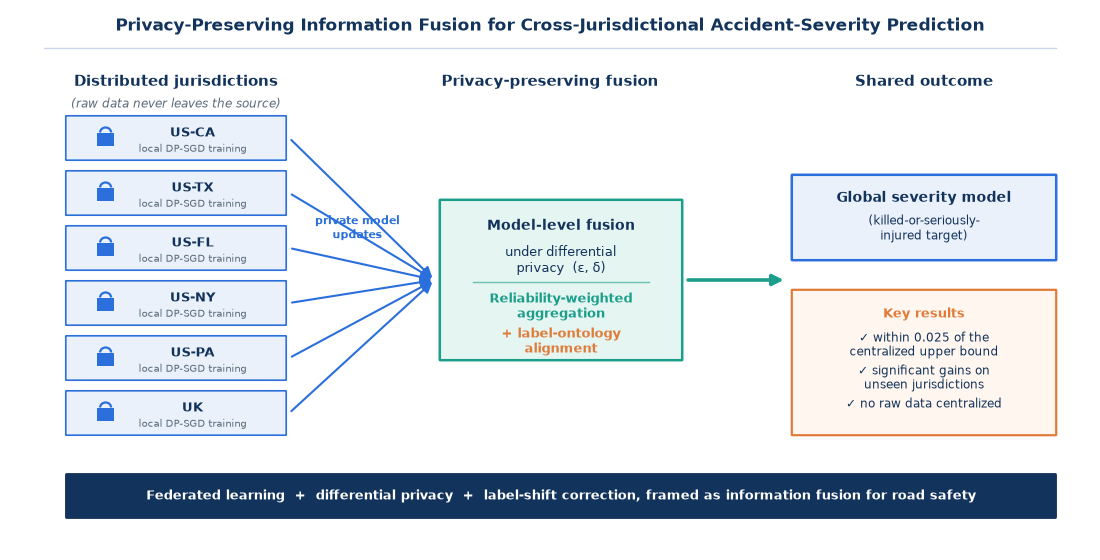
Road-safety authorities in different jurisdictions each hold accident records that, combined, could train stronger severity-prediction models, yet these records can be neither centralized, for privacy and governance reasons, nor directly merged, because jurisdictions encode severity under incompatible ontologies. This paper recasts that impasse as an information-fusion prob- lem and fuses heterogeneous, cross-jurisdictional crash sources into a single accident-severity model while every raw record stays at its source. Three components act together: model-level fusion under differential privacy, a reliability-weighted aggregation rule that trusts each source by its measured quality rather than its size, and a per-source centered logit-adjustment layer that reconciles mismatched label ontologies without double-correcting the shared class imbalance. This is, to the authors’ knowledge, the first approach to address multi-source fusion, local data retention, formal differential privacy, and label-ontology reconciliation jointly for accident-severity prediction. Across the United States (US Accidents) and the United King- dom (STATS19), harmonized to a common killed-or-seriously-injured target and evaluated over five seeds, the proposed methods significantly outperform a uniform private baseline at every privacy budget (p < 0.05); the private fused model reaches 0.599 balanced accuracy, within 0.025 of a centralized upper bound (0.624) while keeping data local, and retains the highest macro-F1 of all methods. Alignment significantly improves generalization to unseen jurisdictions for five of six held-out regions. The study is equally explicit about limits: alignment does not equalize sources, and a membership-inference attack reveals no measurable leakage for differential privacy to remove.
Keywords:
information fusion
; federated learning
; differential privacy
; label-ontology alignment
; cross-jurisdiction generalization
; accident severity
Copyright: This open access article is published under a Creative Commons CC BY 4.0 license, which permit the free download, distribution, and reuse, provided that the author and preprint are cited in any reuse.


