

Submitted:
11 August 2026
Posted:
12 August 2026
You are already at the latest version
Abstract
Audiences increasingly encounter the news not through newsrooms but through chatbots, AI-generated summaries, and platform intermediaries that reproduce the form of journalism while omitting the human judgment that produces it. This paper asks what is lost in that substitution. We argue that a central but invisible casualty is epistemic labor: the contextual, accountable human work that converts plausible-sounding information into locally trustworthy knowledge. We examine this from an unusual vantage point, inside a local television newsroom in the American Midwest that is integrating an AI-assisted editorial tool, where the same class of technology audiences meet outside the newsroom becomes briefly visible at the human-AI handoff. Drawing on an in-progress, IRB-approved qualitative case study (embedded observation, workflow mapping, journalist interviews, and participatory co-design), we introduce the provenance gap: the systematic invisibility of epistemic labor in AI-mediated news, which leaves audiences unable to distinguish accountable local reporting from outputs that merely resemble it. We discuss implications for provenance signaling, local news sustainability, and the design of AI news agents.
Keywords:
human-machine communication
; local news
; epistemic labor
; AI-mediated news
; provenance
; generative AI
; news audiences
; qualitative case study
1. Introduction
This year’s organizing concern for computation and journalism is that audiences increasingly get information from chatbots, content creators, and AI-generated summaries rather than from news outlets directly, threatening the reach and relevance of traditional newsrooms. Most responses treat this as a problem of distribution and attention: how do newsrooms reach audiences who have moved elsewhere? We argue that the substitution carries a second, less examined cost. AI intermediaries reproduce the form of news, the confident sentence, the tidy summary, the plausible local detail, while omitting the human judgment that makes news accountable. What disappears is not only the newsroom’s audience but the epistemic labor that distinguishes reporting from text that resembles reporting.
We examine this loss from an unusual vantage point: inside a local television newsroom that is itself integrating an AI-assisted editorial tool. The same class of generative system that audiences encounter outside the newsroom, producing summaries, drafts, and suggested framings, is here being folded into professional production under deadline. At the moment a journalist accepts, revises, questions, or overrides an AI output, the labor that is invisible in the finished product becomes briefly observable. Studying that handoff lets us specify, concretely, what an external chatbot or summary leaves out when an audience bypasses the newsroom entirely.
From this case we develop the provenance gap: the systematic invisibility of epistemic labor in AI-mediated news. Because the labor that makes information locally accountable leaves no trace in the output, audiences cannot perceive the difference between information that has passed through accountable human judgment and information that merely looks as though it has. The newsroom is, in this sense, epistemic infrastructure, and like most infrastructure, it becomes visible mainly when it is removed.
This paper makes three contributions. First, it reframes the newsroom’s internal negotiation of AI as a lens on the broader information ecosystem, connecting workflow-level observation to ecosystem-level stakes. Second, it introduces the provenance gap and links it to two supporting constructs grounded in our fieldwork, normative anchoring and epistemic labor. Third, it draws out implications for provenance signaling, local news sustainability, and the design of AI news agents for the computation and journalism community.
2. Background
2.1. News Beyond the Newsroom
A growing share of public information flows through intermediaries rather than newsrooms. The automated and computational journalism literature has documented how algorithmic systems reshape labor, authority, and compositional form in news production (Carlson, 2015; Diakopoulos, 2019), and critical accounts caution against treating fluent machine output as understanding (Broussard, 2018). In parallel, the long decline of local news outlets has thinned the institutions that hold community-specific knowledge (Nielsen, 2015). Generative AI compounds both trends: it can produce news-shaped text at scale, and it does so without the local institutions that historically vouched for such text.
2.2. Human-Machine Communication
We adopt a human-machine communication (HMC) lens, which treats AI systems as communicative actors that participate in meaning-making rather than as passive instruments (Guzman & Lewis, 2020; Sundar, 2020). The relevant question becomes how journalists, and audiences, communicate and negotiate with these systems, not merely how they operate them. This reframing matters for our argument because it locates the value of news not in the text alone but in the negotiated judgment that produced it.
2.3. Epistemic Labor, Provenance, and Authenticity
Ekbia and Nardi (2017) describe heteromation, the uncredited human work that quietly sustains automated systems. We extend this to the news ecosystem: the labor that makes information trustworthy is increasingly performed, when it is performed at all, out of audience view. As synthetic and AI-summarized content proliferates, provenance, the verifiable origin and handling of information, becomes central to questions of authenticity. We argue that provenance is not only technical metadata about a file’s history but the perceptibility of human accountability behind a claim. The provenance gap names what happens when that accountability is real but imperceptible.
3. Case and Method
Our site is a local television newsroom in the United States Midwest that is integrating an AI-assisted editorial tool as part of a parent-organization initiative. The study uses a multi-phase qualitative case design (Figure 1): (1) embedded observation of AI-assisted editorial work as it happens; (2) human-AI workflow mapping that traces where staff and the tool hand off, check, and intervene; (3) semi-structured journalist interviews on how staff make sense of the tool; and (4) participatory co-design of a human-in-the-loop training manual with the newsroom. The study received expedited approval from the Bowling Green State University Institutional Review Board (protocol code IRB-2026-68; date of approval: May 19, 2026). An introductory observation phase (Round 1) is complete; the remaining phases are ongoing, and analysis runs throughout.
Our analytic stance departs from system evaluation. Rather than measuring how well the tool performs, we trace the human-AI handoff as the site where epistemic labor is briefly visible, and we read that labor as a proxy for what external AI mediation omits. A scoping note is important here. We do not claim the newsroom’s editorial tool is identical to consumer chatbots. The claim is narrower and methodological: both rest on the same generative substrate, and the internal setting lets us observe the corrective human work that the external setting hides from audiences by design.
Generative AI disclosure. The authors used a generative AI assistant (Anthropic’s Claude) to support reframing and editing of this manuscript. All research design, fieldwork, IRB compliance, data, analysis, theoretical constructs, and claims are the authors’ own. No findings were generated by AI, and all citations were verified by the authors. No participant data was entered into any AI system, and AI tools were not used to analyze qualitative data or to produce empirical results. The authors reviewed and revised all AI-assisted text and take full responsibility for the content of this submission.
4. Preliminary Findings
Round 1 surfaced four patterns (Table 1). We present them as provisional; data collection is ongoing. Each is reframed here around the provenance gap, that is, around what the pattern implies for an audience that receives AI output without the newsroom’s intervening labor.
4.1. The Locality Blind Spot
The clearest evidence of the provenance gap appears where AI outputs conflict with journalists’ contextual knowledge of their own communities. Staff catch outputs that are fluent and plausible yet locally wrong, and they correct them before air. The corrected version reaches the audience; the error does not. The significance for the ecosystem is direct: the same uncorrected output is what an external summary or chatbot delivers to an audience that bypassed the newsroom. Local context, the names, histories, sensitivities, and the things a place will and will not tolerate, is precisely what AI mediation strips, and precisely what local newsrooms uniquely hold.
4.2. Invisible Provenance
Professional norms (sourcing, verification, ethical framing, audience responsibility) operate as informal but consequential editorial checkpoints. The labor those checkpoints trigger leaves no mark on the finished story. We name the mechanism normative anchoring: journalists invoke established norms as active stabilizing structures whenever AI outputs are ambiguous, contextually inadequate, or misaligned with local newsroom culture, so that norms do not merely constrain AI use but constitute the terms on which outputs become usable. This extends Deuze’s (2005) account of journalistic occupational ideology into human-AI collaboration. In the ecosystem, audiences receive the output minus the checkpoint, with no signal that any checkpoint was ever applied. The accountability is real inside the newsroom and invisible outside it.
4.3. Labor that Intensifies as It Disappears
Adoption arrives as an organizational mandate from above; staff experience it as pressure rather than choice. The work of adjudicating AI output against local knowledge, community accountability, and ethical obligation, what we call epistemic labor, intensifies even as AI is positioned as an efficiency solution (Ekbia & Nardi, 2017). The ecosystem inverts this. Inside the newsroom the labor grows; across the wider information environment the same labor is being removed, because audiences who move to AI summaries receive the efficiency without the adjudication. Efficiency for the audience and intensification for the worker are two faces of the same omission.
4.4. The Reassurance Audiences do not Get
Early conversations surface three recurring worries: adapting to a changing workflow, learning an unfamiliar skill set, and the prospect of being replaced. What reassures staff is twofold: humans stay in charge of how the AI is used, and human eyes remain the fact-check, working alongside the tool rather than being replaced by it. This reassurance maps onto both constructs, human-led use onto normative anchoring and human verification onto epistemic labor. The ecosystem implication is pointed. Audiences who consume AI-summarized news are, in effect, receiving the very replaced version that newsroom staff are reassured they are not. The condition that makes adoption feel safe inside the newsroom is the condition that is absent for the audience outside it.
5. Discussion: The Provenance Gap and Local Stakes
Read together, these patterns suggest that the newsroom functions as epistemic infrastructure: a site where invisible human labor converts plausible information into locally accountable knowledge. The provenance gap is the reason this function is easy to undervalue. Because the labor is imperceptible in the output, AI intermediaries that reproduce the output can appear equivalent to the newsroom while doing none of the work (Figure 2). We draw out three implications.
Provenance signaling. If accountability is real but imperceptible, one response is to make it perceptible. Normative anchoring points to a design target: surfacing the editorial checkpoints a piece of local news has passed through, so that provenance is communicated to audiences as a signal of human accountability rather than left as invisible backstage work. This reframes provenance from file-level metadata toward a perceptible claim about judgment, and connects directly to the symposium’s interest in transparency and synthetic-media authenticity.
Local news sustainability. Sustainability arguments commonly focus on revenue and attention. The provenance gap adds an epistemic dimension: the labor that distinguishes local reporting is exactly what disintermediation removes. A community that shifts to AI summaries does not simply pay a different outlet; it loses the locality blind-spot correction that no general-purpose model performs. Sustainability framings that count only dollars and clicks understate what is at stake.
Designing AI news agents. If AI agents are to participate responsibly in the information ecosystem, they might be designed to preserve, defer to, or at minimum signal the absence of epistemic labor, and to flag locality blind spots rather than smoothing over them with fluent text. Our handoff observations offer concrete failure modes that such systems would need to anticipate.
6. Conclusion and Future Work
The remaining phases of the study (workflow mapping, journalist interviews, and participatory co-design) will test and refine the provenance gap and its two supporting constructs against fuller data, including the co-designed training manual as a practical artifact the newsroom can use. We offer the provenance gap as an agenda item for a community thinking about news beyond the newsroom. If audiences are leaving the newsroom for intermediaries that reproduce its outputs without its labor, then naming, measuring, and signaling that labor may be among the more consequential problems at the intersection of computation and journalism.
Author Contributions
Conceptualization, D.S. and M.M.U.R.; methodology, D.S.; investigation, D.S. and M.M.U.R; formal analysis, D.S.; data curation, D.S.; writing (original draft preparation), D.S.; writing (review and editing), D.S. and M.M.U.R.; visualization, D.S.; project administration, D.S. All authors have read and agreed to the posted version of the manuscript.
Funding
This research received no external funding.
Institutional Review Board Statement
The study was conducted in accordance with the Declaration of Helsinki and approved by the Institutional Review Board of Bowling Green State University (protocol code IRB-2026-68; date of approval: May 19, 2026).
Informed Consent Statement
Informed consent was obtained from all participants involved in the study.
Data Availability Statement
The data supporting this study consist of qualitative field notes, workflow documentation, and interview material collected at a single identifiable news organization under an approved IRB protocol. Because participants could be identified from these materials, the data are not publicly available. De-identified excerpts may be made available by the corresponding author upon reasonable request, subject to IRB approval and participant confidentiality protections.
Conflicts of Interest
The authors declare no conflicts of interest.
References
- Broussard, M. (2018). Artificial unintelligence: How computers misunderstand the world. MIT Press. [CrossRef]
- Carlson, M. (2015). The robotic reporter: Automated journalism and the redefinition of labor, compositional forms, and journalistic authority. Digital Journalism, 3(3), 416-431. [CrossRef]
- Deuze, M. (2005). What is journalism? Professional identity and ideology of journalists reconsidered. Journalism, 6(4), 442-464. [CrossRef]
- Diakopoulos, N. (2019). Automating the news: How algorithms are rewriting the media. Harvard University Press. [CrossRef]
- Ekbia, H., & Nardi, B. (2017). Heteromation, and other stories of computing and capitalism. MIT Press. [CrossRef]
- Guzman, A. L., & Lewis, S. C. (2020). Artificial intelligence and communication: A Human-Machine Communication research agenda. New Media & Society, 22(1), 70-86. [CrossRef]
- Nielsen, R. K. (Ed.). (2015). Local journalism: The decline of newspapers and the rise of digital media. I.B. Tauris.
- Sundar, S. S. (2020). Rise of machine agency: A framework for studying the psychology of human-AI interaction (HAII). Journal of Computer-Mediated Communication, 25(1), 74-88. [CrossRef]
Figure 1.
Multi-Phase Qualitative Case Design of the Newsroom Study.
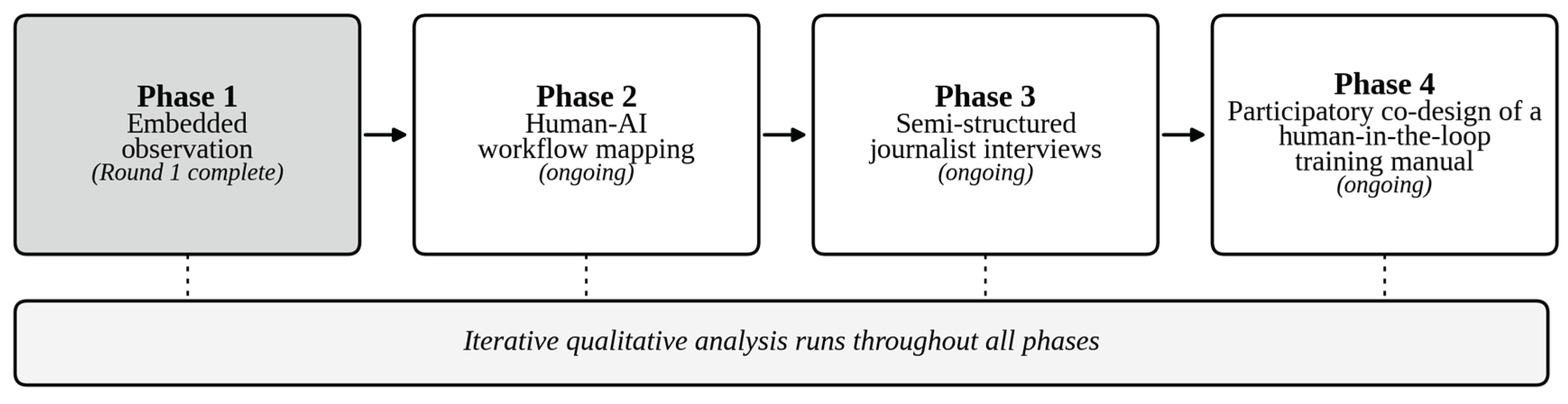
Figure 2.
The Provenance Gap: Two Paths From Generative Output to Audience.
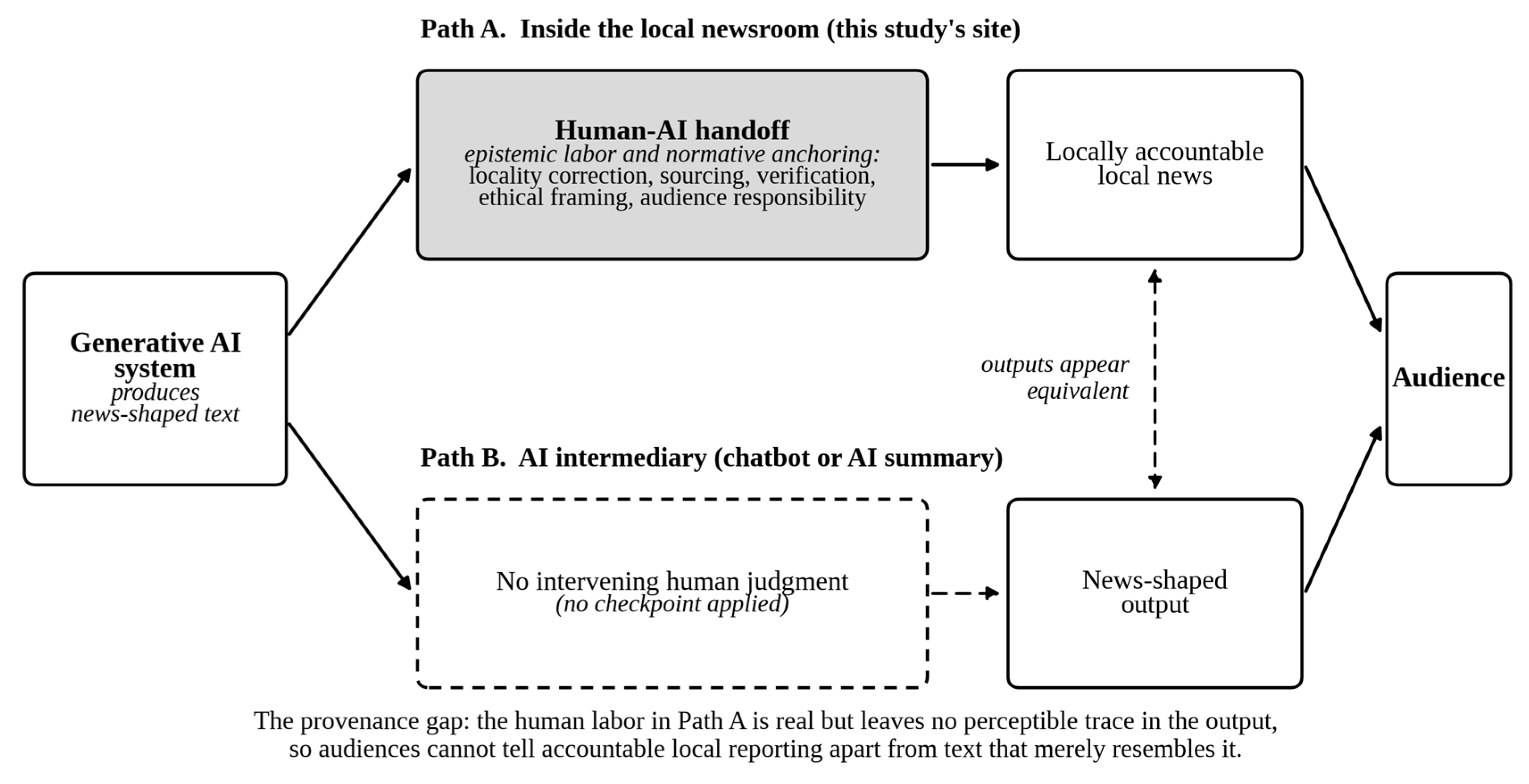

Table 1.
Round 1 Patterns Inside the Newsroom and Their Ecosystem Implications.
| Pattern | Inside the newsroom | What audiences of AI intermediaries receive |
|---|---|---|
| The locality blind spot | Staff catch fluent but locally wrong outputs and correct them before air | The uncorrected output, with local errors intact |
| Invisible provenance | Norm-based editorial checkpoints (normative anchoring) set the terms on which outputs become usable | The output minus the checkpoint, with no signal that one was applied |
| Labor that intensifies as it disappears | Epistemic labor of adjudicating AI output grows under an adoption mandate | Efficiency without adjudication, as the same labor is removed from the path |
| The reassurance audiences do not get | Humans stay in charge of use, and human eyes remain the fact-check | In effect, the replaced version that staff are reassured they are not |
Disclaimer/Publisher’s Note: The statements, opinions and data contained in all publications are solely those of the individual author(s) and contributor(s) and not of MDPI and/or the editor(s). MDPI and/or the editor(s) disclaim responsibility for any injury to people or property resulting from any ideas, methods, instructions or products referred to in the content. |
© 2026 by the authors. Licensee MDPI, Basel, Switzerland. This article is an open access article distributed under the terms and conditions of the Creative Commons Attribution (CC BY) license.
Copyright: This open access article is published under a Creative Commons CC BY 4.0 license, which permit the free download, distribution, and reuse, provided that the author and preprint are cited in any reuse.