

Submitted:
10 August 2026
Posted:
11 August 2026
You are already at the latest version
Abstract
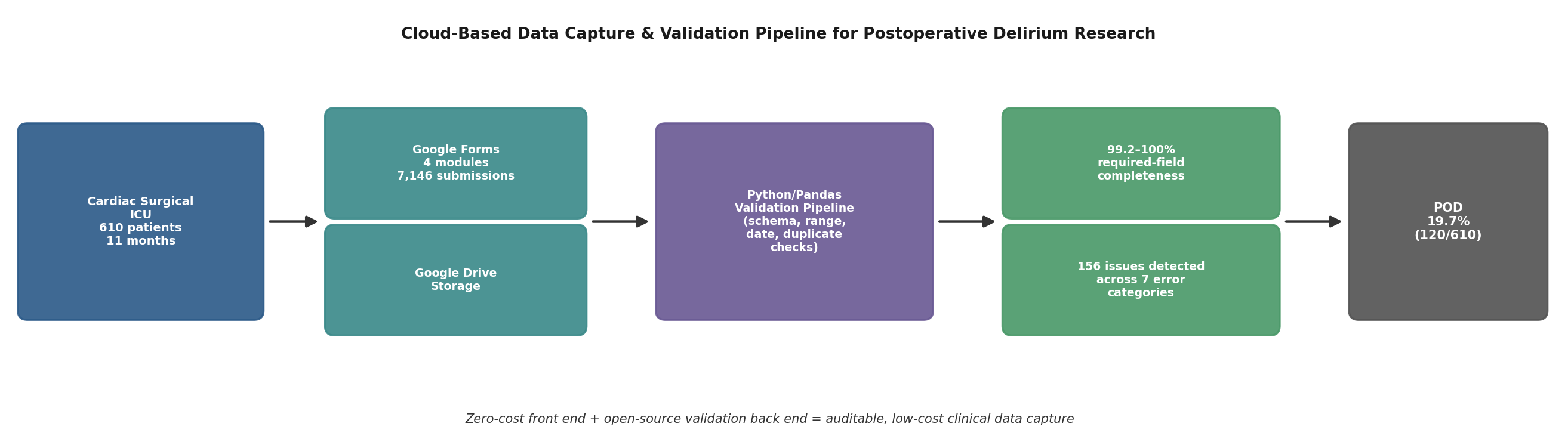
Background: Prospective bedside data collection for complex clinical syndromes such as postoperative delirium (POD) is labour-intensive and error-prone, and commercial electronic data capture (EDC) systems often carry substantial licensing and infrastructure costs. Methods: We deployed a low-cost, cloud-based data-capture and validation pipeline in a 10-bed cardiac surgical intensive care unit, combining four Google Forms modules with an open-source Python/Pandas validation backend, and retrospectively compared raw form exports against the validated dataset to quantify the pipeline’s real-world data-quality performance. Results: Over 11 months, the pipeline processed 7,146 raw form submissions (636 preoperative, 644 intraoperative, 2,517 ICU outcomes, 3,349 delirium-screening entries), contributing to a final cohort of 610 patients with required-field completeness of 99.2–100%. Scripted validation identified and resolved 156 discrete data-quality issues across seven categories, including duplicate submissions, a non-numeric identifier, date-typing errors, a spreadsheet auto-formatting artefact, required-field omissions, and manually flagged invalid entries. Direct comparison against REDCap, KoBoToolbox, and Epicollect5 showed this architecture matches the validation rigour of dedicated electronic data capture platforms without their server infrastructure or licensing cost. As an illustrative clinical application, postoperative delirium incidence was 19.7% (120/610). Conclusion: A zero-cost data-entry front end paired with a transparent, open-source validation backend can deliver auditable, high-completeness clinical datasets, offering a scalable, transferable model for data quality management in resource-constrained healthcare research.
Keywords:
delirium
; informatics
; data-quality
; validation
; digitalization
; cardiac-surgery
; reproducibility
Copyright: This open access article is published under a Creative Commons CC BY 4.0 license, which permit the free download, distribution, and reuse, provided that the author and preprint are cited in any reuse.


