

Submitted:
10 August 2026
Posted:
11 August 2026
You are already at the latest version
Abstract
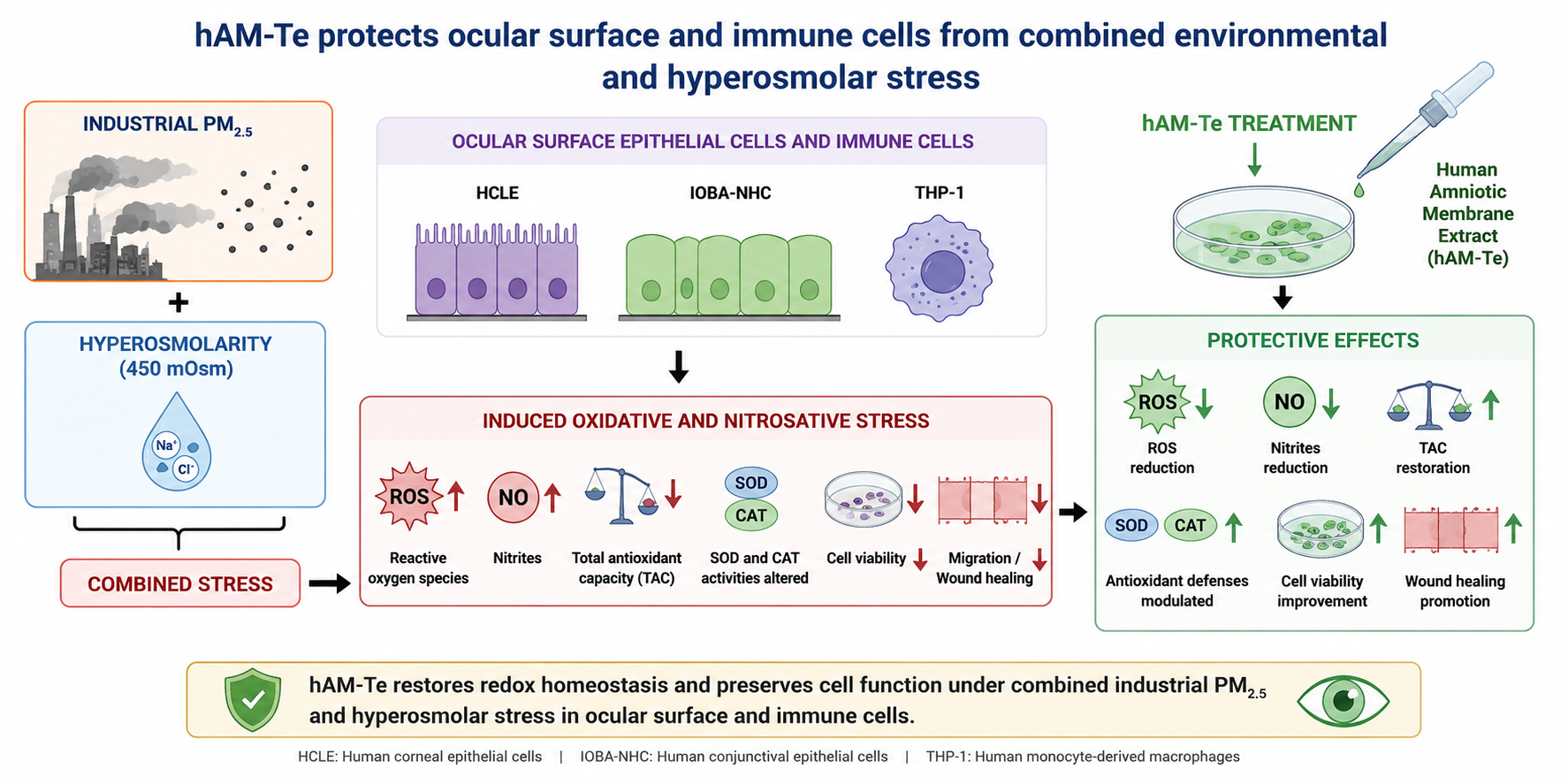
Airborne particulate matter (PM₂.₅) contributes to oxidative damage of the ocular surface, particularly under dry eye-related hyperosmolar conditions. We evaluated the protective effects of a soluble extract derived from lyophilized human amniotic membrane patches (hAM-Te) in human corneal and conjunctival epithelial cells and THP-1 macrophages exposed to hyperosmolarity, industrial PM₂.₅, or both. Cell viability, migration, reactive oxygen species, nitrite production, total antioxidant capacity, and antioxidant enzyme activities were assessed. Combined hyperosmolarity and PM₂.₅ markedly impaired cell viability and migration while increasing oxidative and nitrosative stress. hAM-Te significantly improved cell viability and wound closure, reduced reactive oxygen species and nitrite levels, restored antioxidant capacity, and modulated endogenous antioxidant defenses. These findings demonstrate that hAM-Te attenuates redox imbalance and cellular injury induced by combined environmental and hyperosmolar stress, supporting its potential as a protective strategy against pollution-associated ocular surface damage.
Keywords:
particulate matter
; hyperosmolarity
; oxidative stress
; human amniotic membrane
; ocular surface
; redox homeostasis
; cell culture
Copyright: This open access article is published under a Creative Commons CC BY 4.0 license, which permit the free download, distribution, and reuse, provided that the author and preprint are cited in any reuse.


