

Submitted:
10 August 2026
Posted:
11 August 2026
You are already at the latest version
Abstract
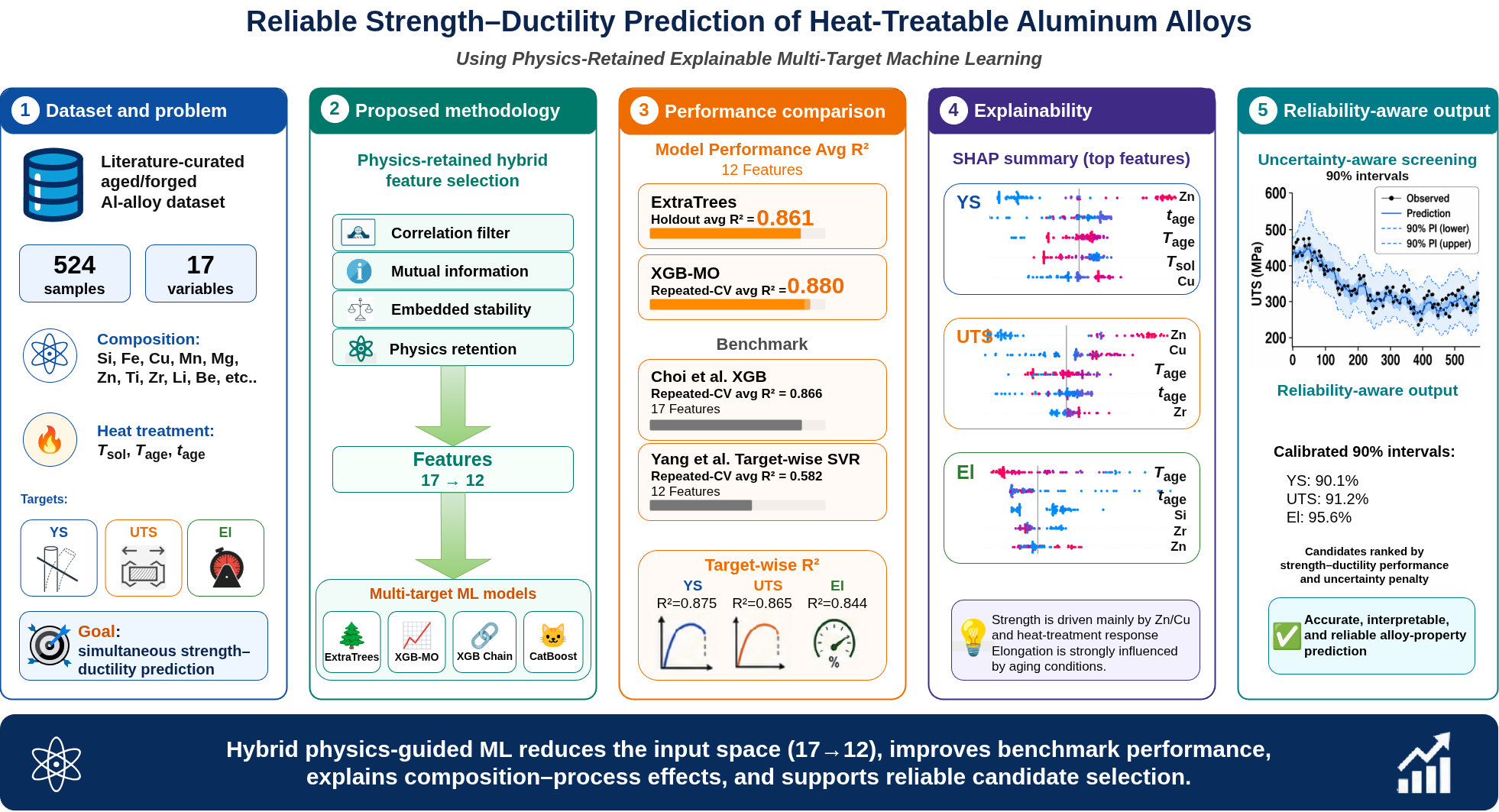
Predicting yield strength (YS), ultimate tensile strength (UTS), and elongation (El) in heat-treatable aluminum alloys is challenging because of nonlinear interactions between alloy composition and heat-treatment parameters. This study proposes a physics-retained, explainable, and uncertainty-aware multi-target machine-learning framework for simultaneous strength–ductility prediction. A hybrid feature-selection strategy combining statistical relevance, mean embedded importance, and metallurgical retention reduced the input space from 17 to 12 variables while preserving solution treatment temperature, aging temperature, and aging time. A matched 17-feature comparator was evaluated using the same repeated outer-validation splits, inner tuning procedure, model families, hyperparameter-search space, and search budget. Across 25 outer evaluations, the 12-feature pipeline achieved a macro-averaged R2 of 0.807 ± 0.043, macro-NRMSE of 0.424±0.047, and macro-NMAE of 0.293 ± 0.033, compared with 0.800 ± 0.047, 0.431 ± 0.052, and 0.294 ± 0.040, respectively, for the 17-feature pipeline. An exploratory post-selection paired comparison yielded a mean macro-R2 difference of 0.0068, a corrected 95% interval of [−0.0198,0.0335], and p = 0.602. Because k = 12 was selected using the same outer-validation summaries, these statistics are descriptive rather than confirmatory. The selected pipeline therefore used 29.4% fewer descriptors with similar observed mean performance, although superiority or statistical equivalence was not established. On the untouched final-test partition, the locked 12-feature ExtraTrees model achieved target-wise R2 values of 0.857, 0.842, and 0.826 for YS, UTS, and El, respectively. SHAP assigned the largest model attributions to Zn, Cu, and selected heat-treatment conditions; these attributions explain model behavior rather than causal metallurgical effects. Ensemble-conformal intervals supported uncertainty-aware retrospective prioritization of held-out conditions. However, because no external or experimental validation was performed and performance decreased under composition-group-disjoint validation, the framework should be regarded as an internally evaluated modeling workflow rather than a validated alloy-design tool.
Keywords:
aluminum alloys
; strength–ductility prediction
; multi-target regression
; feature selection
; explainable artificial intelligence
; SHAP
; uncertainty quantification
; conformal prediction
Copyright: This open access article is published under a Creative Commons CC BY 4.0 license, which permit the free download, distribution, and reuse, provided that the author and preprint are cited in any reuse.


