
Submitted:
07 August 2026
Posted:
11 August 2026
You are already at the latest version
Abstract
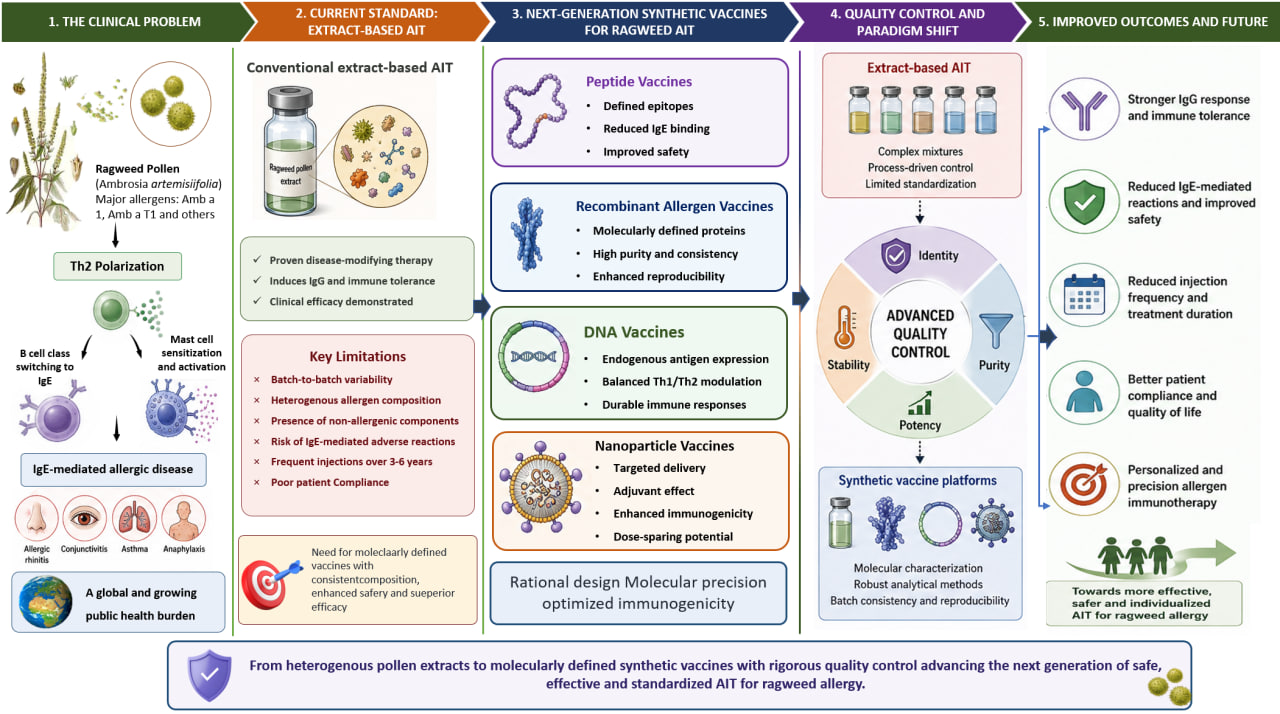
Ragweed (Ambrosia artemisiifolia) pollen allergy is a major and growing public health problem worldwide, with clinical manifestations ranging from rhinitis and conjunctivitis to asthmatic episodes and anaphylaxis. The major ragweed allergen, Amb a 1, exhibits high IgE-binding potential and triggers type 1 hypersensitivity reactions. Although allergen-specific immunotherapy (AIT) effectively induces long-term immune tolerance, conventional extract-based formulations face critical limitations including batch-to-batch variability, heterogeneous allergen composition, IgE-mediated adverse reactions, inconsistent immunogenicity, and poor patient compliance. This critical re-view synthesizes and evaluates published evidence on current synthetic vaccine strategies for ragweed AIT, with emphasis on their design, immunological performance, and quality control considerations. This review critically evaluates current approaches to synthetic vaccine development for ragweed AIT, with particular focus on pep-tide-based constructs, recombinant proteins, DNA vaccines, and adjuvant-enhanced formulations, alongside corresponding quality control strategies. The available evidence indicates that synthetic vaccines provide a more rational, molecularly characterized trajectory for producing optimized AIT products with improved safety profiles, enhanced clinical efficacy, reduced injection frequency, and improved batch standardization relative to extract-based immunotherapy. These advances highlight the potential of synthetic vaccine platforms to support personalized immunotherapy and more effective disease-modifying treatment of allergic disorders.
Keywords:
Ambrosia artemisiifolia
; allergen-specific immunotherapy (AIT)
; synthetic vaccine
; IgE-mediated hypersensitivity
; IgG-mediated immune tolerance
; personalized immunotherapy
; quality control
Copyright: This open access article is published under a Creative Commons CC BY 4.0 license, which permit the free download, distribution, and reuse, provided that the author and preprint are cited in any reuse.


