

Submitted:
09 August 2026
Posted:
11 August 2026
You are already at the latest version
Abstract
In the Heikal Universal Theory of Selective Interfaces and Spatial Resonance natural boundaries, called Selective Interfacial Manifolds (Barzakh), mediate interactions in macroscopic, biological, chemical, nuclear, and quantum systems. Conventional scientific and cosmological systems, are largely dependent on just mechanical measuring instruments, along with seeming dimensions, to narrate the behaviors of matter and energy. This dependency places basic methodological limitations, which cannot consider into complex systems, and interfacial phenomena. To overcome this limitation, we present here The Heikal Theory of Topological Selective Interfacial Manifolds a universal theoretical/mathematical model that dictates all reactive endeavors, be they chemical, physical, geological or the like – rethinking interaction, scattering and -equilibrium on cosmological, microscopic and quantum scales of -orders – including those of double orders. This is based on a sound mathematical structure with well-defined topological metric tensors (Gμν -Barzakh), scattering Smatrix, geometric resistance coefficients (ΛT), diagnostic resonance criteria (Rlock), and indices of topological transformation efficiency ηHeikal. This paradigm-level manifestation shows that all the manifestations of formation of objects, flow of matter and energy, and spatial regularity of the universe are controlled not by simple volumetry but by nano- and cosmic-scale Selective Interfacial Manifolds which serve as topological bridges and states of topological tension connecting different domains of any category of interaction. By treating astrodynamics, interfacial interactions, scattering amplitudes, and structural transitions under different boundary conditions the theory provides a unified mathematical treatment of the most ultra-efficient topological confinement states, as well as structural collapse mechanisms under oxidative stress. Therefore, this approach establishes the basis for a universal scientific model beyond classical disciplinary boundaries which might gain insights into a geometric unification of the cosmos from minute particles to gaping the vastness of outer space as shown in Figure 1.
Keywords:
selective interfaces
; spatial resonance
; selective interfacial manifold
; mathematical physics
; topological physics
; quantum interfacial manifold
; interface dynamics
Introduction
Natural boundaries are at the core of physical reality. They control the flow of matter, energy, and information at scales as small as biological membranes and mineral interfaces and as large as atomic electron clouds and the quantum vacuum. Many of these are well described by conventional scientific theories using the physics jargon of energy barriers, electrostatic potentials, diffusion gradients, and quantum probability within their respective disciplines [1]. Yet these are generally application-specific and not endowed with a mechanistic explanation that spans and can illustrate the generic principles of boundary-mediated interactions over different scales of nature. The Infinite Universal Reality of Selective Interfaces and Spatial Resonance of Heikalian Best Theory – a perfect general unity theory or modulation matrix of space-time – which in turn explains all natural edges as being a Selective Boundary Matrices (Barzakhs)—mobile topological interfaces that preside over interactions via Spatial Geometric Resonance along with Temporal, Geometric evolutionary potentials and more [2]. In this model, the flow of matter, energy and information is via quintessence, which can flow when the in-flowing geometric aspects of what is incoming geometrically resonate enough with the web-like nature of that particular boundary. The result is that a variety of natural occurrences may be seen as examples of resonance, topological mismatch, or interface restructuring under a generalized physical principle [3]. In order to turn this idea into a calculable scientific model, the present work constructs a mathematical theory based on the Hilbert-space resonance operators, tensorial representation of topological deformations, and thermodynamic coupling relations. These formulations define a set of experimental parameters for resonance probability, stability of the interface, and topological selectivity, and thus provides quantitative predictions that can be tested experimentally.The theory is then taken to multi-science scale phenomena. disciplines such as biomineralization, chemical bonding, isotope separation, quantum tunneling, superconductivity, quantum gravity, biological morphogenesis, nanomaterials, and topological oncology. Instead of looking at these effects as different and independent phenomena, the suggested framework tries to model them in a common mathematical and topological framework.
The purpose of this contribution is thus to develop the theory, the mathematical formalism, and the possible scientific uses of the Heikal Universal Theory, and to offer a novel viewpoint for sensitive interfaces in macroscopic, biological, and quantum systems: a selective interface in any system that exhibits a form of a quantum and classical behaviour.
Figure 1.
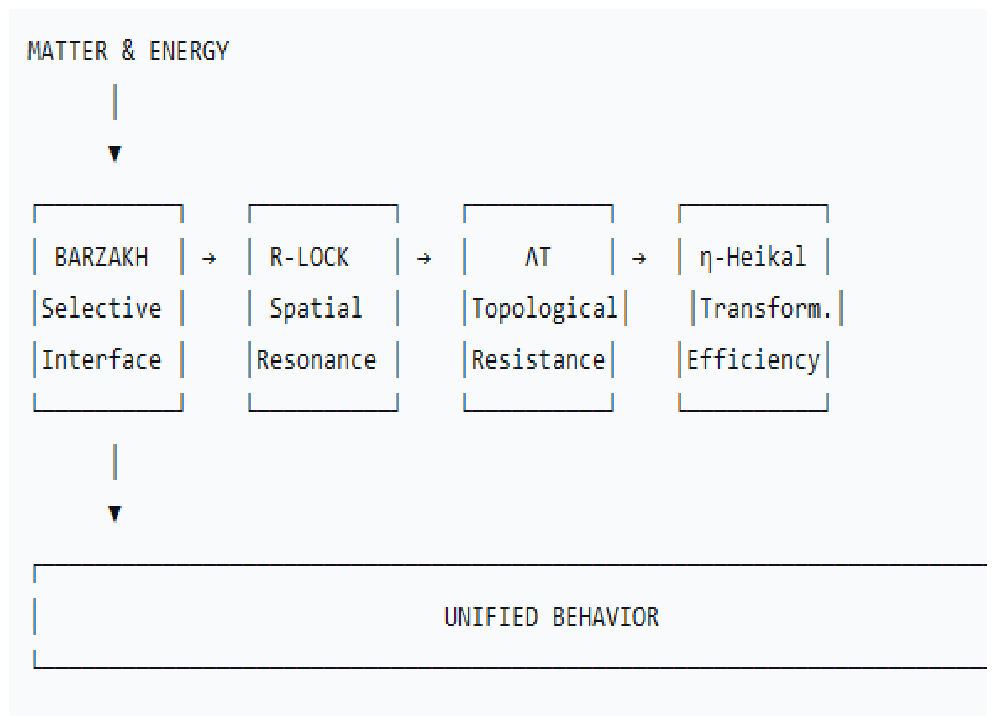
The graphical abstract encapsulating the hierarchical development of the Heikal framework: Barzakh → Rlock → ΛT → ηHeikal → Unified Behavior.
Figure 1.
The graphical abstract encapsulating the hierarchical development of the Heikal framework: Barzakh → Rlock → ΛT → ηHeikal → Unified Behavior.
1. The Core Postulate of the Theory
The central postulate of the theory can be stated as follows:
“All natural boundaries can be interpreted as Selective Boundary Matrices (Barzakhs)—dynamic topological interfaces that regulate interactions through the principle of Spatial Geometric Resonance. The transfer of matter, energy, or information occurs only when the geometric properties of an incoming entity achieve sufficient resonance with the topology of the corresponding interface”
This one principle gets rescaled cosmologically, microscopically, and quantum mechanically, reinterpreting interaction, scattering, and equilibrium within its framework. There is a heavy reliance on purely mechanical measuring tools and apparent dimensions in traditional scientific and cosmological systems throughout their various physical, astronomical and natural bodies to describe matter and energy behaviour. This heavy reliance sets hard-to-break methodological restraints nothing gets in or out in terms of modeling complex phenomena, and in interfacial phenomena... To surpass such a cognitive limitation, Heikal framework presents The Heikal Theory of Topological Interfacial Barzakh, a theoretical-mathematical treatise that governs universally all interactive processes, be those of a chemical, physical, geographical, or what have you kind of nature of processes.
2. Theoretical Foundations: The Concept of the Barzakh
2.1. Definition of the Barzakh (Selective Boundary Matrix)
In the Heikal framework, the term Barzakh is used in its technical sense as a Selective Boundary Matrix: a dynamic, geometrically organized interface that separates two physical domains and selectively regulates the exchange of matter, energy, and information between them. The Barzakh is not a passive membrane or a simple physical wall; it is an active topological structure possessing:
- A topological state vector (Φc) describing its geometric and spatial properties.
- A characteristic resistance to deformation, quantified by the Barzakh Resistance Factor (ΛT).
- A selectivity mechanism based on Spatial Geometric Resonance rather than on apparent physical dimensions alone.
The theory conclusively proposes that all manifestations of material formation, mass and energy transfer, and spatial regularity across the universe are governed not by apparent volumetry alone, but rather by the dynamics of the “nano- and cosmic barzakh,” which acts as a bridge and a state of topological tension linking disparate realms across all interactive domains.
2.2. Spatial Geometric Resonance as the Universal Interaction Principle
Spatial Geometric Resonance is the process that makes the Barzakh selective. Every participant in the interactions - particle, ion, molecule, biological construct, cosmic system - is assigned a Geometric Vector in which their spatial, energetic, and dynamic attributes are taken into account. An interaction can take place only once the Geometric Vector of the incoming entity has been “refolded” enough to become locally compatible with the shape of the Barzakh it will meet. The result is a state called a Resonance Lock, and nonresonance is a Topological Mismatch that automatically excludes the interaction.The theory applies the formalism of quantum mechanics — specifically the Born rule where the square of the wave-function overlap gives the probability of a quantum event — to macroscopic material interfaces by likening ions and nanoscale pores to interacting topological waves. This translation of quantum formalism to material interfaces is unparalleled in the theory.
2.3. The Geometric Vector
The Geometric Vector is one of the most central notions of the theory. It encodes the spatial, energetic, and dynamic aspects of an interacting object, be it particles, molecules, biological systems, or larger physical constructs. here are a few concrete examples which show in what sense:
- The proton (H⁺) is a pure “Geometric Vector”.
- A neutron is naturally understood as a powerful geometric vector that can interact with the nuclear surface through resonance conditions. .
- Enantiomers have been suggested to carry opposite geometric vectors which emerge from the dichotomous topological nature in their mirror images.
- Electromagnetic radiation is regarded as a propagating geometric vector whose measurable characteristics depend on how they interact with other bounding systems.
2.4. The Resonance Lock and Topological Locking
A Resonance Lock is the state of being attained when the shape of an entering entity is able to resonate with that of the Barzakh in question. In molecular coordination, the Multidimensional Resonance Lock is the concept that a ligand design is multidimensionally “shape-matched” to a metal center that is geometrically optimized to envelop a metallic center and that attains exact spatial alignment with the metal’s prerequisites. From the material science perspective, the Rlock parameter captures the degree of topological fit between two materials, and Rlock >1 if the lower material exhibits Topological Locking enhancement due to chemical/resonance effects exceeding the limit of mechanical surface-to-surface constraints [3].
2.5. Topological Mismatch and Structural Collapse
When spatial resonance does not take place, the system recognizes a state of Topological Mismatch: the observed anomaly or exclusion results from partial compatibility between the two systems involved. At the limit, a nonviable enclosure relation may induce a reformation or collapse of structure, as in the conceptualization of nuclear instability as a state of geometric disequilibrium within nested atomic enclosure systems, or in the detection of structural collapse under oxidative stress.
3. The Universal Role of Selective Interfaces Across Scales
The Heikal framework applies the Barzakh concept at three fundamental scales of nature: the macroscopic scale, the biological scale, and the quantum scale.
3.1. Macroscopic Interfaces
At the macroscopic scale, the concept of spatial resonance is proposed as a mechanism through which geometric relationships between natural systems and human-designed structures may emerge. A representative example is the astronomical orientation of the Great Temple of Abu Simbel, where architectural alignment demonstrates a sophisticated relationship between terrestrial geometry and celestial cycles. Within the Heikal framework, such alignments are interpreted as examples of large-scale geometric synchronization, in which the spatial configuration of a structure is optimized to interact with recurring solar and lunar illumination patterns. This concept suggests that ancient architectural systems may represent early examples of deliberate geometric calibration between terrestrial interfaces and astronomical reference systems.
3.2. Biological Interfaces
At the biological level, selective interfaces are found, for example, in biomineralization, in which an organism directs the formation of a highly ordered mineral body under physiological condition. In marine biomineralization, the organizing biological interface is a specialized protein matrix that controls the localization and organization of the dissolved ions (Ca²⁺, CO₃²⁻) and other charged species [2]. In the Heikal modeling, these protein assisted structures are viewed as BDs biological Barzakhs in which molecular topology dictates nucleation routes, enabling formation of ordered mineral structures, i.e., oriented aragonite nanostructures are such examples [4]. This offers a conceptual view of biological interfaces as dynamic controllers of molecular arrangement and selective material synthesis.
3.3. The Quantum Interface: The Atomic Barzakh
At the scale of quantum mechanics the atom is a prototypical interface-mediated system. The electron cloud around the nucleus is treated as a Quantum Barzakh—a translucent matrix of boundaries that moderates interactions at the atomic core with the outer quantum space within the Heikal framework [5]. Instead of being a probability distribution only, this boundary is suggested to have a geometric structure which affects how atom interacts with energy and matter.
In this picture, to absorb photons and become excited an atom must take on a spatial form commensurate with that of the incident electromagnetic radiation, i.e., the spatial parameters of the incident field must become resonant with spatial parameters allowed for within the atom. The interaction can be thought of as a geometric matching (compatibility) between the external energy input and the internal topology of the electronic structure.
Nuclear instability is understood in this context as a state of geometric infraction in nested atomic boundary systems. Radioactive decay (alpha, beta and gamma emission) is suggested to be a spontaneous rearrangement of the system by which energy and particles are released in order to move towards a more stable form.In this interpretation, radioactive events are better seen as kinetic shifts in internal topological relationships rather than discrete stochastic happenings
4. The Universal Barzakh Protocol: A Master Heuristic for All Scientific Anomalies
Heikal framework postulates a general method for studying complicated systems analyser in terms of boundaries topology in space and spatial resonance.The procedure includes four systematic stages as shown in Table 1:
5. The Mathematical Framework of the Heikal Universal Theory
In this section we introduce and motivate the six basic equations that form the mathematical core of the theory. All equations are given in their entirety, with exact definitions of all variables, and their conceptual basis is stated in terms exactly consistent with the original theory.
1. The Spatial Resonance Equation (Quantum Barzakh Level)
R = |⟨Φc | Ψv⟩|2
Definitions and Variables:
- R (Spatial Resonance Coefficient): Represents the likelihood of an interaction or “Topological Lock” occurring across the Barzakh.
- ⟨Φc| (Topological State Vector of the Barzakh): Describes the geometry the geometric and spatial properties of the interfacial matrix.
- |Ψv⟩ (geometric and electrostatic state vector): Represents the structural properties of the incoming interacting particle or ion.
Conceptual Basis: This equation is motivated by Quantum Mechanics (Born Rule) [6]. The Heikal Theory transposes this formalism to matter interfaces at the macroscopic scale, suggesting ions and nanoscale pores act as co-propagating topological waves. The probability of a successful interaction is the square of the overlap of the topological state vector of the Barzakh with the geometric state vector of the incoming entity [5].
2. Topological Tension Equation (Tensor Formulation)
Gμν(Barzakh) = ΛT × Tμν
Definitions and Variables:
- Gμν (Barzakh) (Barzakh Curvature Tensor): Represents the topological distortion occurring within the internal structure of the Barzakh upon ionic traversal.
- Tμν (Stress-Energy Tensor): describes the energy density and momentum flux of the entity penetrating the Barzakh.
- ΛT (Topological Resistance Coefficient): An intrinsic, material-specific parameter defining the matrix’s resistance to topological deformation.
The conceptual basis: This equation is constructed in close analogy with Einstein’s Field Equations. Heikal’s model of the physical Barzakh replaces the cosmic void with the physical Barzakh cavity and introduces the chemically adjustable Barzakh Resistance Factor (ΛT). This equation describes the effective geometrical reaction of a Barzakh to mechanical and physico-chemical perturbations [7].
3. Thermodynamic Alignment and Macroscopic Matrices
ΔGlock = -RT ln(Rlock × χ)
Definitions and Variables:
- ΔGlock (Free Energy of Resonance Lock): The change in Gibbs free energy associated with forming a “Resonance Lock.”
- Rlock: The microscopic topological matching coefficient (0 to 1).
- χ (Geometric Scaling Factor): describes macroscopic physical attributes of the synthesized Barzakh (e.g., surface area or pore volume).
Theoretical Basis: This equation is based on the Isotherm of the Classical Thermodynamics Gibbs Energy. thermodynamic spontaneity in Heikal demonstrates that selective interfaces [8].
4. The Diagnostic Resonance Coefficient (Applied Metric)
Rlock = Adsorption Capacity (mg/g) / Specific Surface Area (m²/g)
The R lock coefficient of the Resonance lock is the ratio of the between actual adsorption capacity to its geometric scaling factor (χ), calculated from the specific surface area (BET).
Classification of Materials Based on Rlock: using this metric materials are divided into functional tiers. As shown in Table 2 :
5. Heikal Modification Efficiency (η-Heikal)
Mathematical Formulation:
ηHeikal = [1 - (Rlock(ref) / Rlock (mod)] × 100
This metric isolates the influence of topological engineering, mathematically provides mathematical evidences confirming the effectiveness of synthetic pathways in active resonance sites independent of simple surface area expansion [9].
6. Matrix Stability Index (S_matrix)
Mathematical Formulation:
Smatrix = Rlock(final) / Rlock(initial)
S_matrix, based on Retention Indices, measures Topological Integrity and not actual weight loss
7. Summary Table of the Mathematical Framework

Table 3.
Summary the Mathematical Framework of the Heikal Universal Theory.
| # | Equation | Key Parameters | Physical Meaning |
| 1 | R = | ⟨Φc | Ψv⟩ |
| 2 | Gμν(Barzakh) = ΛT × Tμν | Gμν, ΛT, Tμν | Topological distortion of the Barzakh under stress (Einstein field equation analogy) |
| 3 | ΔGlock = -RT ln(Rlock × χ) | ΔGlock, Rlock, χ | Thermodynamic free energy of forming a Resonance Lock (Gibbs isotherm analogy) |
| 4 | Rlock = Adsorption Capacity / BET | Rlock | Diagnostic coefficient classifying General Matrices, Ideal Matrices, and Selective Barzakhs |
| 5 | ηHeikal = [1 - (Rlock (ref) / Rlock (mod)] × 100 | ηHeikal | Efficiency of topological engineering in creating active resonance sites |
| 6 | Smatrix = Rlock(final) / Rlock(initial) | Smatrix | Topological Integrity index |
Conclusions
The Heikal Universal Theory of Selective Interfaces and Spatial Resonance provides a comprehensive mathematical model to characterize and analyze interactive events in terms of Selective Boundary Matrices (Topological Barzakhs). In contrast to traditional methods that are based on obvious physical dimensions or parameters of surface area or volume, this theory shows that the macroscopic characteristics of the system are determined by the configuration, topological properties and energetic attributes of the system’s interfacing boundaries. The introduced mathematical formalism, which includes the Barzakh metric tensor (Gμν(Barzakh)), the scattering matrix (Smatrix), the topological resistance coefficient (ΛT), the locking resonance parameter (Rlock), the matrix stability index (Smatrix), and the Heikal modification efficiency (ηHeikal), renders a general and powerful set of diagnostic equations applicable for analyzing various forms of interaction irrespective of the material nature of the interactions. They are not limited to a particular system of materials, but rather they are formulated as mathematical instruments that can be applied to study interfacial reactions, confinement effects, structural transformations and stability mechanisms in chemistry, physics, biology, geosciences and nuclear.
References
- Politzer, P.; Murray, J. S. The fundamental nature and role of the electrostatic potential in atoms and molecules. Theor. Chem. Acc. 2002, 108(3), 134–142. [Google Scholar] [CrossRef]
- Heikal, A. The Heikal Barzakh Objection: Deriving protein-mediated biomineralization as a universal marine boundary process. Preprints.org. 2026. [Google Scholar]
- Hall, B. The continuous creation model: A geometric foundation for unifying physics. 2025; 3.
- Zhao, R. Biomineralization-driven advances in materials science and biomedical engineering. JACS Au Advance online publication. 2025. [Google Scholar] [CrossRef] [PubMed]
- Hashemi, A.; Zakeri, M. J.; Jung, P.; Blanco-Redondo, A. Topological quantum photonics. APL Photonics 2025, 10(1). [Google Scholar] [CrossRef]
- Born, M. Zur Quantenmechanik der Stoßvorgänge. Z. Für Phys. 1926, 37(12), 863–867. [Google Scholar] [CrossRef]
- Einstein, A. Die Feldgleichungen der Gravitation. In Sitzungsberichte der Königlich Preußischen Akademie der Wissenschaften zu Berlin; 1915; pp. 844–847. [Google Scholar]
- Gibbs, J. W. On the equilibrium of heterogeneous substances. Trans. Connect. Acad. Arts Sci. 1878, 3(3), 343–524. [Google Scholar]
- Han, E. G.; Lee, J. H.; Kang, M. S. ZIF-8-Embedded Cation-Exchange Membranes with Improved Monovalent Ion Selectivity for Capacitive Deionization. Membranes 2025, 15(1), 19. [Google Scholar] [CrossRef]
Table 1.
The complex system analyzer in terms of boundary topology and spatial resonance.
| Step | Name | Description |
|---|---|---|
| 1 | Identify the Interface (Barzakh Mapping) | Specify the physical, biological, or conceptual interface at which the interaction takes place. All processes are considered to be enacted via an interface with certain topological characteristics |
| 2 | Map the Geometric Vector(Vector Profiling) | Describe the pertinent spatial, energetic, and temporal characteristics of the interacting pairs, be they particles, molecules, biological systems, or macroscopic physical constructs. |
| 3 | Detect Resonance Failure (Topological Mismatch) | Locate the position and type of geometric incompatibility in spatial resonance. The detected anomaly is understood to be the result of partial compatibility between two systems in interaction.. |
| 4 | Engineer the Resonance (The Solution Vector) | Modify the interface, environment, or interacting entity to enhance geometric compatibility and promote a more stable resonance condition. Through this protocol, the Heikal framework proposes a transition from purely descriptive analysis toward a form of topological engineering, where systems are optimized by controlling boundary relationships. |
Table 2.
Summarizes the classification of materials into functional tiers based on the Rlock metric.
Table 2.
Summarizes the classification of materials into functional tiers based on the Rlock metric.
| Tier | Criterion | Interpretation |
| General Matrices | Rlock < 1 | Capacity is limited by geometry; the performance depends primarily on available surface area and adsorption is physical and geometry-limited. |
| Ideal Matrices | Rlock ≈ 1 | Topological equivalence exists between surface geometry and adsorbate; near-perfect efficiency. |
| Selective Barzakhs | Rlock > 1 | Materials are subject to Topological Locking, and their performance is further improved through chemically/resonance-mediated mechanisms beyond the limits of physical surfaces. |
Disclaimer/Publisher’s Note: The statements, opinions and data contained in all publications are solely those of the individual author(s) and contributor(s) and not of MDPI and/or the editor(s). MDPI and/or the editor(s) disclaim responsibility for any injury to people or property resulting from any ideas, methods, instructions or products referred to in the content. |
© 2026 by the authors. Licensee MDPI, Basel, Switzerland. This article is an open access article distributed under the terms and conditions of the Creative Commons Attribution (CC BY) license (http://creativecommons.org/licenses/by/4.0/).
Copyright: This open access article is published under a Creative Commons CC BY 4.0 license, which permit the free download, distribution, and reuse, provided that the author and preprint are cited in any reuse.