

Submitted:
10 August 2026
Posted:
11 August 2026
You are already at the latest version
Abstract
Beginning in the 1860s, both the Kingdom of Serbia (Yugoslavia) and Romania gained notoriety as important regional factors in the South-Eastern European struggle for power. The beginning of the 20th century marks the strategic emergence of common interests between the two states and significant growth of the trading volume between the two. In this context, the heightening presence of Belgrade on Romanian territory was noticed, both politically, highlighted by consular representation, and economic interest, defined through the Danubian navigation- commerce binomial relation. In the first three decades of the 20th century, The Yugoslav Kingdom represented an important factor in Danubian navigation and an active presence in Romanian ports. The main vector in promoting their economic interests in the region was the Serbian Navigation Company, which became the Serbian Navigation Service, and subsequently, the Yugoslav Navigation Service. This service operated in the majority of Romanian ports and competed successfully against a multitude of significant, long-standing companies. The dynamization of commercial trade on the Danube presupposed the operationalization of a consular network in Belgrade that included the port of Brăila and the capital city, Bucharest. Between 1906 and 1932 the presence of 15 official Serbian (Yugoslav) consuls was recorded in Romania, of which 6 were based in Brăila and 9 in Bucharest. In relation to the regional scale of the Serbian (Yugoslav) Kingdom in the aforementioned time period, Belgrade had a consistent politico-economic presence in Romania, the interstate relations reaching significant heights that have temporarily contributed to the consolidation of regional stability.
Keywords:
Serbia
; Romania
; Danube
; navigation
; consular representation
1. Introduction
The aim of the study is to summarize a number of key points of the presence of Serbia (Yugoslav Kingdom) in Romanian cities during the first half of the 20th century from the perspective of economic interest generated by Danubian navigation and commerce, as well as consular representation as an element of political interest.
The scientific breakthrough consists of highlighting the interests of the Serbian (Yugoslav) Kingdom in Romania – two states with a common rich history and gaining steady recognition regionally after acquiring their independence and liberating themselves from Ottoman influence.
Historiography – The main focal point of research approach refers to the profound study of original documents existent in the Archives of the Ministry of Foreign Affairs in Romania (AMFAR) in the “Foreign Representatives in Romania – Staff of Foreign Embassies and Consulates” [trad. : Reprezentanți străini în România – Personalul Legațiunilor și Consulatelor străine] collection, file no. 17 (Serbia) and in Subject 68 – Romania and Foreign River, Maritime, and Air Navigation Companies, Vol. 17 (Yugoslavia). The data collected following the research process was completed with elements extracted from specialty works undergone by authors such as Carmen Atanasiu, Thoma Gâlcă, Wlaker D. Hines, Emil Octavian Mocanu, Lucia Taftă and Grigore C. Vasilescu.
2. Historical Context
Starting with the first two decades of the 19th century and until the beginning of the Second World War, the Serbian (Yugoslav) Kingdom and Romania distinguished themselves as important regional factors in the South-Eastern European power struggle. Notwithstanding the geographical proximity and their riparian status, these two state entities were in the centre of historical evolution in the aforementioned period that were linked to the so-called “European question” (the decline of the Ottoman Empire.) A significant event in the common history between Serbia and Romania sought state independence and exiting Ottoman domination, following the Russo-Turkish war between 1877 and 1878, which ended in the defeat of the Empire, consecrated through the San Stefano and Berlin treaties. After gaining independence, the main political objectives of the two states focused on offensive techniques that sought its consolidation, imposing their stances on an European level, imposing their sovereignty on Danubian territorial waters, and promoting their own economic interests. During the same time period, both states understood the need for institutionalizing their own navigation companies that would ensure their independence from already established companies that operated on the Romanian Danube since the 1830s. Since the beginning of the 20th century and until the start of the Second World War, Serbia and Romania bore relevant roles in the Danubian region and the Balkans, having crucial positions during the Balkan Wars, the First World War (at the end of which the two states were on the same side), and key-events of the Interwar period. The aforementioned period established a substantial development of the bilateral Romanian-Serbian relations. The political component of these collaborations materialized through the emergence of the Little Entente in the year 1921, a strategic Serbian-Romanian initiative, later joined by Czechoslovakia, whose purpose was the diminishing of Hungary’s territorial claims (Francois Fejito, 1991.)
The Cooperation between the Yugoslav Kingdom and Romania gained innovative positive aspects in February 1934 in the context of shared belonging in the Little Entente or the Balkan Pact, an alliance that ensured regional security. Turkey and Greece were also part of the latter alliance (Gheorghe Bordeiu, 2008).
4. Serbia’s Consular Network in Romanian Cities (1909 – 1932)
Consular representation is an extremely important institution in ensuring citizen’s protection scheme, especially the migrant population, and the state’s economic and commercial efforts. The “consulate’s” institution can be traced back to antiquity out of the need to protect sailors and traders that had abandoned their homelands to settle in foreign countries (Claudia Simona Timofte, 2010, p. 49).
The main elements in the conceptual sphere of consular representation sought terms such as sending state which establishes a consular office on a receiving state’s territory; consular offices of different ranks (consular agency, vice consulate, general consulate), as well as consular ranks (consular agent, vice-consul, consul, consul general).
Consular offices bore autonomy over the legates (embassies) in the states where they operated, only having a political subordination requirement. Generally, establishing a consular office sought two aspects: the presence of significant communities of migrants in a certain region, whose interests and/or the existence of economic interests in that area had to be protected. When practicing their consular activity, according to the punctual interests of the sending state, the advancing or lowering of an office’s rank could happen: whether a consulate agency became a vice consulate or a consulate was demoted to a vice consulate (Ionel Constantin Mitea, 2025, p. 81.)
The first form of political bilateral dialogue between Serbia and the Romanian Principates was institutionalized ever since the year 1836 when the Serbian Princely Diplomatic Agency was inaugurated in Bucharest. In April 1879, the two states had established diplomatic relations on a Legate level, following the events of the year 1868 when the Alliance Accord between the Serbian Republic and Romania was concluded, being one of the first bilateral international accords made by modern Serbia (the Ministry of Foreign Affairs of Serbia, (https://www.mfa.gov.rs/en/foreign-policy/bilateral-cooperation/romania ; Wikipedia https://ro.wikipedia.org/wiki/Rela%C8%9Biile_dintre_Rom%C3%A2nia_%C8%99i_Serbia).
Both in the 19th century and today, the work of consular offices involves not only its attributes of citizen protection within their area of representation, but also a significant component in promoting commercial interest of sending states. In this context, the incipient forms of Serbian consular representation in Romanian cities were linked to the interest for the commercial potential of Romanian ports in the Danube, which were institutionalized in the year 1859. Consequently, in October 1859, the Serbian Commercial Agency was established in Braila. Constantin Karcea was appointed head of the organisation and received the title of “praetor,” on a similar rank to consul, in the sense of political representation of an analogous entity. (AMFAR, Reprezentanți, file no. 17, Note 283/1859, Agentul diplomatic al Serbiei în Principatele Unite). In the Ministry of Foreign Affairs in Bucharest Archive there are no notes regarding the year in which the agency ceased its operations.
In 1906, the Serbian authorities requested the approval made by the Bucharest branch regarding the establishing of a new Commercial Agency in Braila under the leadership of Eftimie Popovitch, representative of the Sava Bank in Belgrade. This agency operated under the authority of the Ministry of Agriculture, Trade, and Industry in Belgrade (AMFAR, Reprezentanți, file no. 17/P7, Note 107/1906, Legația Serbiei).
In 1907, following the resignation of Eftimiu Popovitch, the leadership of the Serbian commercial agency in Braila was undertaken by Georges Nikolitch (AMFAR, Reprezentanți, file no. 17/P6, Note 432/1907, Legația Serbiei).
Two years later, in 1909, the Commercial Agency of Serbia in Braila was transformed into a consulate. This change sought to significantly grow the volume of Serbian commercial activity in the ports in Galati, Braila, and Constanta. Georges Nikolitch thus acted as consul of the novel office, a former commercial agent of Serbia in Braila. The jurisdiction of the new Serbian office included the Braila, Covurlui, Putna, Tecuci, Tulcea, and Constanta counties (AMFAR, Reprezentanți, file no. N1/S4, Note 53/1909, Legația Serbiei).
Figure 1.
–. erbal note, Royal Serbian Legation in Bucharest - Transformation of the Serbian Trade Agency in Brăila into a consulate, AMFAR, file 17/S4.
Figure 1.
–. erbal note, Royal Serbian Legation in Bucharest - Transformation of the Serbian Trade Agency in Brăila into a consulate, AMFAR, file 17/S4.
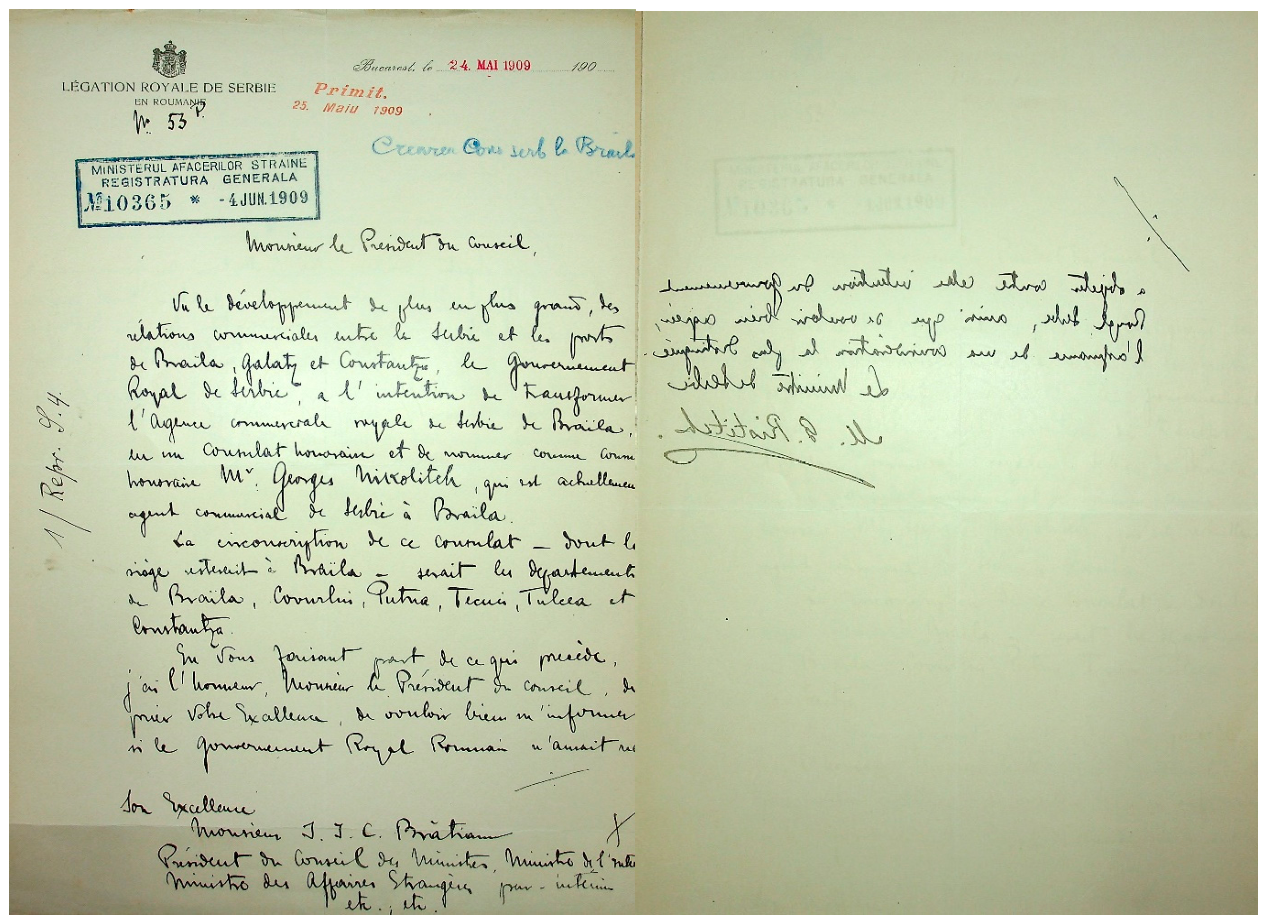
In 1914, this jurisdiction was extended over the Silistra and Durostor counties (AMFAR, Reprezentanți, file no. 1/S8, Note 12/1914, Legația Serbiei). Georges Nikolitch received the “exequatur” for the Royal House of Romania in August 1909. He maintained this position until October 1924, when he was relieved of his duties due to significant health problems. (AMFAR, Reprezentanți, file no. 17/N1, Note 1312/1909, Legația Serbiei; Nota 52707/1924, Legația Regatului Sârbilor, Croaților și Slovenilor).
In November 1914, M. Milankovitch was named consul general of Serbia in Bucharest (AMFAR, Reprezentanți, file no. 17/M15, Note 2330/1914, Legația Serbiei la București).
In the following years, the dynamic of consular representation of Serbia in Romania bore the following evolution:
- -
- On March 1st 1920, Mirko Petchar was appointed viceconsul at the Consulate-General of the Kingdom of Serbs, Croats and Slovenes in Bucharest. He kept his position until August 1922 when he was transferred to Marseille in a similar position (AMFAR, Reprezentanți, file no. 17/P8, Nota 283/1920; file no. 17/K6, Nota 501/1922, Legația Serbiei).
- -
- On August 18th 1922, Dobrivoie Svilokositch concluded his term as Consul-General in Bucharest, having been appointed to a similar position in Cairo (AMFAR, Reprezentanți, file no. 17/K6, Nota 523/1922, Legația Serbiei).
- -
- Djuro (Georges) Kolombatovitch, former Vice Consul in Düsseldorf, undertook Mirko Petchar’s duties in August 1922. His mission concluded in September 1923 (AMFAR, Reprezentanți, file no. 17/K6, Nota 544/1923, Legația Serbiei).
- -
- In August 1922, Raiko Vintrovitch was appointed as the new Consul-General of the Kingdom of Serbs, Croats and Slovenes in Bucharest (AMFAR, Reprezentanți, file no. 17/K6, Nota 523/1922, Legația Serbiei). Prior to his naming in this position, he was a director of the Consular and Commercial Section at the Ministry of Foreign Affairs in Belgrade (AMFAR, Reprezentanți, file no. 17/V2, Note 599/1922).
- -
- In September 1923, Dragutin Kulmer was appointed vice-consul in Bucharest, having previously carried out specific duties at the Serbian office in Düsseldorf (AMFAR, Reprezentanți, file no. 17/K6, Nota 544/1923, Legația Serbiei).
- -
- Dimitryevitch Janitchije was names Consul-General in Braila in May 1926. His naming coincided with the opening of a Consulate-General of the Yugoslav Kingdom in the Danubian port. Previous to his naming in Braila, the Serbian official had been a Consul-General at Constantinople (AMFAR, Reprezentanți, file no. 17/D2, Nota 385/1926). He fulfilled his duties until May 1927.
- -
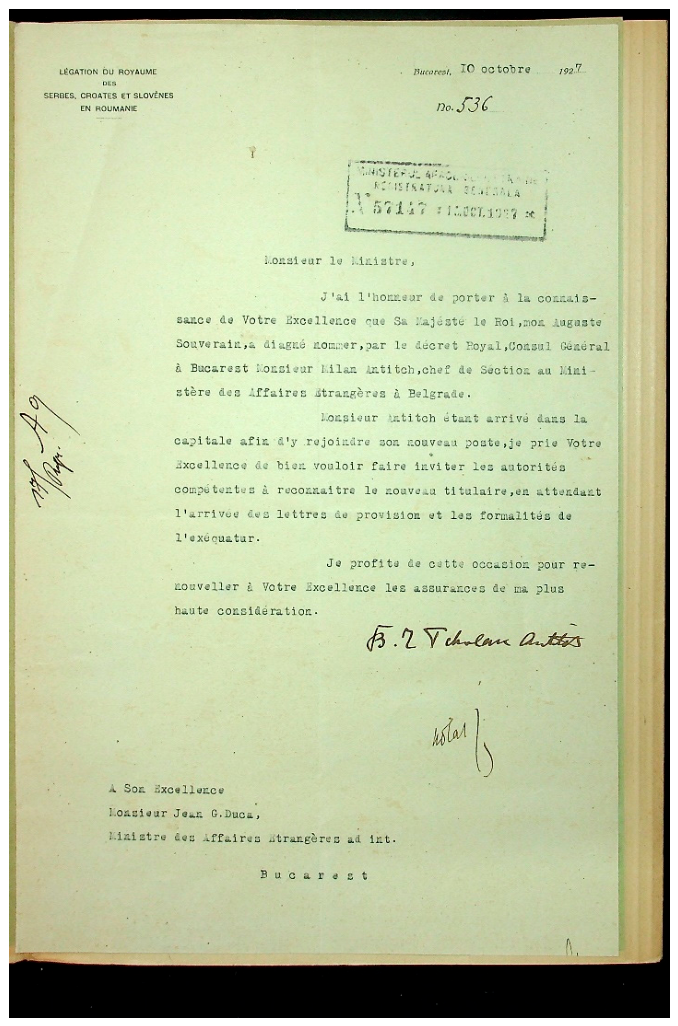
- Antitch Milan was named Consul-General in Bucharest in October 1927 after his previous position as Head of the Ministry of Foreign Affairs in Belgrade (AMFAR, Reprezentanți, file no. 17/A9, Nota 536/1927).
Figure 2.
- Verbal note, Legation of the Kingdom of Serbs, Croats and Slovenes in Bucharest – Milan Antich was appointed general consul, AMFAR, file 17/A9.
Figure 2.
- Verbal note, Legation of the Kingdom of Serbs, Croats and Slovenes in Bucharest – Milan Antich was appointed general consul, AMFAR, file 17/A9.
- -
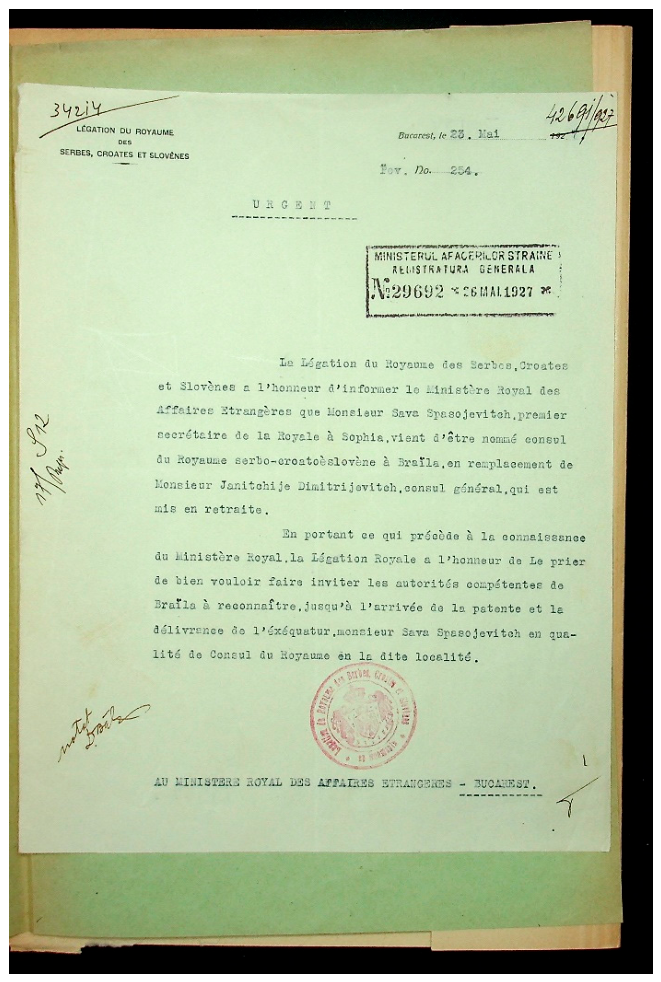
- Sava Spasojevitch, former Sercetary I at the Serbian Legate in Sofia was names consul in Braila in May 1927, taking over the attributes of the former Consul-General, Janitchije Dimitryevitch (AMFAR, Reprezentanți, file no. 17/S12, Note 254/1927). In this context, most probably, the consular office in Braila had changed its rank from Consulate-General to Consulate.
Figure 3.
- Verbal note, Legation of the Kingdom of Serbs, Croats and Slovenes in Bucharest – Sava Spasojevitch was appointed consul in Brăila, AMFAR, file 17/S12.
Figure 3.
- Verbal note, Legation of the Kingdom of Serbs, Croats and Slovenes in Bucharest – Sava Spasojevitch was appointed consul in Brăila, AMFAR, file 17/S12.
- -
- In March 1927 in Bucharest, a new Consul-general was named. Scetozar Rachitch, who previously occupied a similar position in Prague. He replaced Raiko Vintrovitch, who was appointed at the head of the Administrative and legal Section within the Ministry of Foreign Affairs in Belgrade (AMFAR, Reprezentanți, file no. 17/R4, Nota 98/1927).
- -
- Ivan Voukotitch was appointed Consul-General in Bucharest in May 1928. He hd previously served as a counsellor at the Legation of the Kingdom of Serbs, Croats, and Slovenes in Budapest. He completed his mission in July 1929, having been appointed to a similar post in Genoa (AMFAR, Reprezentanți, file no. 17/V4, Nota 138/1928, Nota 3209/1929).
- -
- Anton Novacan was appointed consul in Braila in October 1930, replacing Sava Spasojetvitch, the latter having been transferred to the Ministry of Foreign Affairs in Belgrade (AMFAR, Reprezentanți, file no. 17/N6, Nota 420/1930, Legația Serbiei).
- -
- Ivan Bozic was appointed consul of Yugoslavia in Braila in March 1932, taking over the duties of Anton Novacan. During that time, the jurisdiction of the consular office in Braila included the following counties: Brăila, Constanța, Tulcea, Ismail, Covurlui, Cahul, Tighina, Cetatea Albă, Lăpușna, Orhei, Fălciu, Tutova, Tecuci, and Râmnicu-Sărat (AMFAR, Reprezentanți, file no. 17/B4, Notele 110 și 116/1932, Legația Serbiei).
5. Conclusions
The beginning of the 20th century marked the emergence of common strategic interests of the Kingdom of Serbia (Yugoslavia) and Romania, as well as a significant increase in the trade volume between the two states. In this context, the consolidation of common strategic presence of Belgrade in the Romanian geopolitical space became noticeable, both through the Danubian navigation-commerce binomial factor and from a political standpoint, as proven by increased consular representation.
During the time periods discussed in the article, the Yugoslav Kingdom was an important factor in Danubian navigation and an active presence in Romanian ports. The main vector in promoting its economic interests in the region was the Serbian Navigation Company, which successively and subsequently became the Serbian Service for Navigation and the Yugoslav Service for Navigation. This service operated in the majority of the Romanian ports and successfully competed against long-standing companies.
The shipping capabilities range of Yugoslavia had steadily diversified during the years 1920-1930, resulting in the following transformations: the emergence of a Syndicate of Serbian Navigation; the transformation of the Yugoslav Navigation Service into the Royal Yugoslav Navigation Society (1926); the emergence of new routes on the Danube and the Black Sea by the Jadranska Plovidha company (1926); the emergence of the Yugoslav Navigation Company (1930).
The growth of trade volume on the Danube entailed the establishment of a consular network driven by Belgrade, which included the Braila port and the capital city, Bucharest. The incipient forms of Serbian consular representation in the Romanian geopolitical space materialized through the establishment of a Commercial Agency in Braila (1906), which subsequently became a consular office. Thus, the interest for the potential commercial prowess of the Romanian ports of the Danube became apparent.
For the reference period, consular representation of Belgrade in Romania involved the following significant milestones:
- -
- The establishment of the Consulate in Braila in 1909, based on the former structure of the Serbian Commercial Agency in the same port city;
- -
- The emergence of the Consulate-General of Serbia in Bucharest (1914), and;
- -
- The conversion of the Braila Consulate to a Consulate-General (1926);
Between 1906 and 1932, the archives of the Ministry of Foreign Affairs in Bucharest record the presence of 15 Serbian (Yugoslav) consular officials in Braila and 9 in Bucharest.
Given the regional scope of the Serbian (Yugoslav) Kingdom, during the time period covered by this study, Belgrade had a consistent economic and political presence in Romania. There were strategic relationships reached an efficient state of collaboration which temporarily contributed to the consolidation of regional stability.
Abbreviations
The following abbreviations are used in this manuscript:
| AMFAR | Archives of the Ministry of Foreign Affairs in Romania |
| DRP | The Serbian Navigation Company |
| DDSG | Austrian company Erste Donau-Dampfschiffahrts-Gesellschaft |
| MFTR | Hungarian navigation company |
| RRN | Romanian River Navigation |
| SHS | Brodarski Sindikats |
| IDC | International Danube Commission |
References
- Problema 68 - Societăți de navigație fluvială, maritimă și aeriene, române și străine, volumul 17 (Iugoslavia: 1887–1941).
- Fondul - Reprezentanți străini în România – Personalul Legațiunilor și Consulatelor străine, dosarul 17 (Serbia).
- Atanasiu, Carmen Problema suveranității României la Dunăre și „Navigația Fluvială Română” (1919 – 1945), București, 2003,.
- Bordeiu, Gheorghe, Un moment important în istoria relațiilor internaționale – Constituirea Înțelegerii Balcanice (februarie 1934), Revista de Științe Socio – Umane, Chișinău, 2008.
- Francois Fejito, La petite entente, La France et Benes, Centrul de Cercetare Persee, 1991. https://www.persee.fr/doc/xxs_0294-1759_1991_num_29_1_2334.
- Gâlcă, Thoma, Navigația fluvială și maritimă în România, RAPCCA, București, 1930,.
- Hines, Walker D., Reports on Daube Navigation (submitted to the Advisory and Technical Comittee for Communications and Transit of the League of Nations), 1925, Geneva,.
- Mitea, Ionel Constantin, Companii de navigație la Gurile Dunării (1830 – 1939), Ed. Cetatea de Scaun, Târgoviște, 2022.
- Mitea, Ionel Constantin, Austrian consular representation in theports of Maritime Danubeand Black Sea, expression of the Regional geopolitical interest of the Habsburg Empire (Austria – Hungary) 1833 – 1916, Eminak Scientific Quarterly Journal No. 2(50), Ukraine.
- Mocanu, Emil Octavian, Portul Brăila de la regimul de porto-franco la Primul Război Mondial (1836–1914), Editura Istros, Brăila, 2013;
- Taftă, Lucia, „Francezi la Marea Neagră” - documente inedite despre companiile franceze de navigație la Dunărea de Jos și Marea Neagră în a doua jumătate a sec. XIX”, Revista istorică 10.1–2 (1999);
- Timofte, Claudia Simona, Drept diplomatic și consular, Editura Universității din Oradea, 2010.
- Uygun, Süleyman „Fransiz Fraissinet vapur kumpanyasi ve Osmanli limanlarindaki faaliyetleri”, Karadeniz Incelemeleri Dergisi 12.24 (2018). https://dergipark.org.tr/tr/pub/kid/article/422614.
- Vasilescu, Grigore C., Dunărea internațională și transporturile, București, 1931,.
- Other online resources.
- Pagina oficială a Ministerului Afacerilor Externe al Serbiei. https://www.mfa.gov.rs/en/foreign-policy/bilateral-cooperation/romania;
- Wikipedia https://ro.wikipedia.org/wiki/Rela%C8%9Biile_dintre_Rom%C3%A2nia_%C8%99i_Serbia.
Disclaimer/Publisher’s Note: The statements, opinions and data contained in all publications are solely those of the individual author(s) and contributor(s) and not of MDPI and/or the editor(s). MDPI and/or the editor(s) disclaim responsibility for any injury to people or property resulting from any ideas, methods, instructions or products referred to in the content. |
© 2026 by the authors. Licensee MDPI, Basel, Switzerland. This article is an open access article distributed under the terms and conditions of the Creative Commons Attribution (CC BY) license (http://creativecommons.org/licenses/by/4.0/).
Copyright: This open access article is published under a Creative Commons CC BY 4.0 license, which permit the free download, distribution, and reuse, provided that the author and preprint are cited in any reuse.