

Submitted:
10 August 2026
Posted:
11 August 2026
You are already at the latest version
Abstract
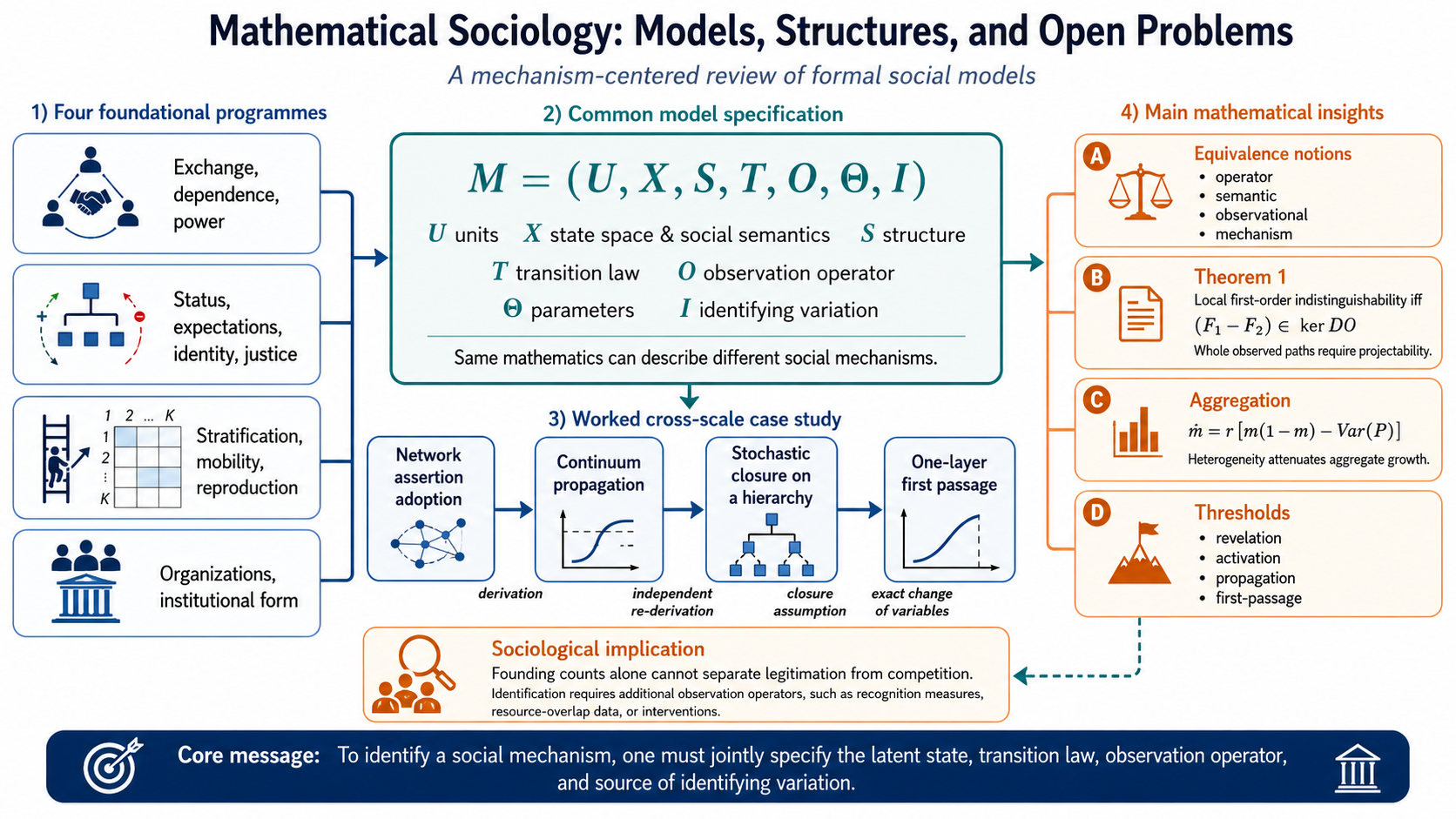
Mathematical sociology has developed through partially independent programs concerned with exchange, status, mobility, organizations, social influence, collective action, and institutional trust. These traditions often share matrices, hazard rates, games, and differential equations while representing non-equivalent social objects. This survey reconstructs four foundational programs by substantive mechanism. Each model is written as a tuple comprising units, a state space with its social semantics, a structure, a transition law, an observation operator, parameters, and a source of identifying variation. The central result is a mechanism indistinguishability theorem: two transition laws are locally indistinguishable to first order at a common latent state exactly when their difference lies in the kernel of the differential of the observation operator, while equality of whole observed paths requires projectability. No increase in sample size under one observation design removes such non-identification. A corollary on aggregation explains why the mean of a population of logistic actors is not logistic, and a worked example shows that founding counts cannot separate organizational legitimation from competition. A worked cross-scale case study carries one chain from discrete adoption through continuum propagation to a first-passage reduction, with the status of every claim stated explicitly.
Keywords:
mathematical sociology
; formal sociology
; social mechanisms
; social influence
; institutional trust
; identification
; aggregation
; observation models
MSC: Primary 91D10; Secondary 91D30, 91D15, 91C05, 60J70, 35K57
1. Introduction
Mathematical sociology is not a single theory and has never been organized around a single mathematical apparatus. It emerged through partially independent programs concerned with action, relations, positions, organizations, populations and social change, and its unity lies in a shared ambition rather than in a shared technique. To formalize a sociological theory is to specify the social units involved, the meaning and admissible range of the state variables, the rules by which states change or relations are reproduced, the aggregation map connecting levels of analysis, and the observations through which the resulting claims could be evaluated. Each of these five commitments is substantive, and none of them is supplied by the mathematics.
The early programs illustrate different sides of this task. Rashevsky sought an axiomatic treatment of human relations on the model of mathematical biology [1]; Simon showed that a verbal theory of small-group interaction could be restated as a system of differential equations whose consequences were not evident in the prose [2]; Coleman set out both a systematic introduction to the mathematics of social processes [3] and, later, a general theory in which the passage from individual action to social organization is the central explanatory problem [4]; Fararo insisted that formal theory is a reconstruction of a social mechanism rather than a notation for its description [5,6,7]; White developed structural accounts in which positions, vacancies and identities, rather than persons, are the moving parts [8,9]. The analytical-sociology programme later made the mechanism-based reading of explanation explicit [10,11], and the classic diffusion study of medical innovation [12] shows how early the field combined formal modelling with the design of an empirical test.
1.1. Demarcation
The boundaries drawn in this survey indicate differences of analytical emphasis rather than mutually exclusive disciplinary jurisdictions. Work originating in sociophysics, network science, control theory or computational sociology belongs to the present corpus whenever its formalism represents an identifiable social mechanism and assigns an explicit social meaning to its variables and observables.
Sociophysical research often foregrounds universality, phase behaviour and analogies with physical systems [13,14,15,16], whereas the present survey foregrounds the mapping between a formal mechanism and a specifically sociological object. A graph is one formal representation of social structure, and a powerful one, but it is not a universal substitute for positions, roles, exchange dependencies, organizational forms, vacancies, strata or institutional authority. Computational sociology foregrounds data-intensive inference, simulation and computational implementation [17,18,19]; mathematical sociology, as delimited here, is defined by the formal representation of a social mechanism. The two domains overlap extensively but neither contains the other. Systems and control approaches to social dynamics likewise define their subject as the meeting of models of social processes with multi-agent systems and control theory [20,21], which is one more reason to describe these boundaries as differences of focus.
1.2. Why a Renewed Synthesis
Three developments make a renewed synthesis timely. Digital traces and repeated surveys have expanded the observable record of social dynamics. Algorithmic mediation and generative agents have introduced new mechanisms and new classes of simulated actors. At the same time, richer data and more flexible models have made the distinction between fit, prediction and mechanism identification more consequential rather than less. The contemporary problem is not a shortage of mathematical models. It is the increasing difficulty of establishing what their variables represent, which level of social organization they describe, and what observations could distinguish their mechanisms.
1.3. Relation to Existing Reviews
Broad syntheses and specialized reviews serve different purposes. Within the sociological literature the last broad synthesis of mathematics in sociology appeared more than two decades ago: Edling surveyed the major research streams using mathematics, logic and computer modelling and emphasized an emerging synthesis of process, structure and action [22], following an earlier review of mathematical models in sociology [23] and a parallel discussion of what formal theorizing requires [24]. Vitanov and Vitanov provide a recent wide-ranging guide to traditional and newer areas of mathematical social dynamics [25]. Statistical-physics, systems-and-control and opinion-dynamics reviews offer substantially greater depth within particular model families [13,20,21,26,27,28,29,30,31,32,33]. A companion survey of mathematical frameworks for network dynamics organizes the control- and inference-oriented literature by analytical technique [34].
The present survey complements these works by returning to the substantive programs of formal sociology while applying a common analytical template across classical and contemporary models. For each principal program it identifies the unit of analysis, the semantics of the state variable, the transition mechanism, the status of the principal claims, the relation between microscopic and macroscopic descriptions, the observation operator, and the remaining identification problem.
1.4. Contributions
First, the review supplies a common formal scheme for comparison. A model is written as the tuple (3), four distinct notions of equivalence are separated, and Theorem 1 states when two transition laws are locally indistinguishable to first order at a common latent state: exactly when their difference lies in the kernel of the differential of the observation operator. Equality of whole observed paths requires the further condition of projectability. Identification thereby becomes a separation condition on kernels rather than a question of sample size, and the recurring identification problems of the four programmes appear as instances of one condition. On this basis the review reconstructs those programmes by substantive mechanism rather than by mathematical technique, making explicit that theories expressed through superficially similar matrices, hazard rates, games or differential equations may concern non-commensurable units.
Second, the principal worked programs are accompanied by a common claim-status discipline that separates direct derivation, independent re-derivation, closure assumptions, modelling choices, empirical illustrations and sociological interpretations. This prevents mathematical consequences from being silently strengthened into claims about social mechanisms or empirical confirmation.
Third, the review develops an analytical decomposition for aggregation in probabilistic influence models. The mean dynamics contain both a mismatch between mean effective pressure and the observed mean and a state–pressure covariance. An exactly solvable rank-one benchmark shows that a vanishing covariance yields a closed two-variable system but not, in general, scalar logistic dynamics.
Fourth, the review distinguishes four mathematically different objects commonly described as thresholds: an actor’s threshold for public revelation, an actor’s threshold for behavioural activation, a system-level barrier to field propagation, and an analyst-defined operational threshold for first passage.
Fifth, comparison across the substantive sections reveals five recurrent problems and yields a four-part criterion for empirical specification: a latent social state, a transition law, an observation operator, and a source of identifying variation.
Sixth, the survey formulates a mechanism-specific research agenda. Each open problem identifies the unresolved mathematical separation, the known obstacle to identification or closure, and the additional measurements, structural restrictions, interventions or counterexamples required for progress. The aggregation decomposition and the threshold taxonomy are analytical devices developed for cross-program comparison rather than free-standing results.
1.5. Organization
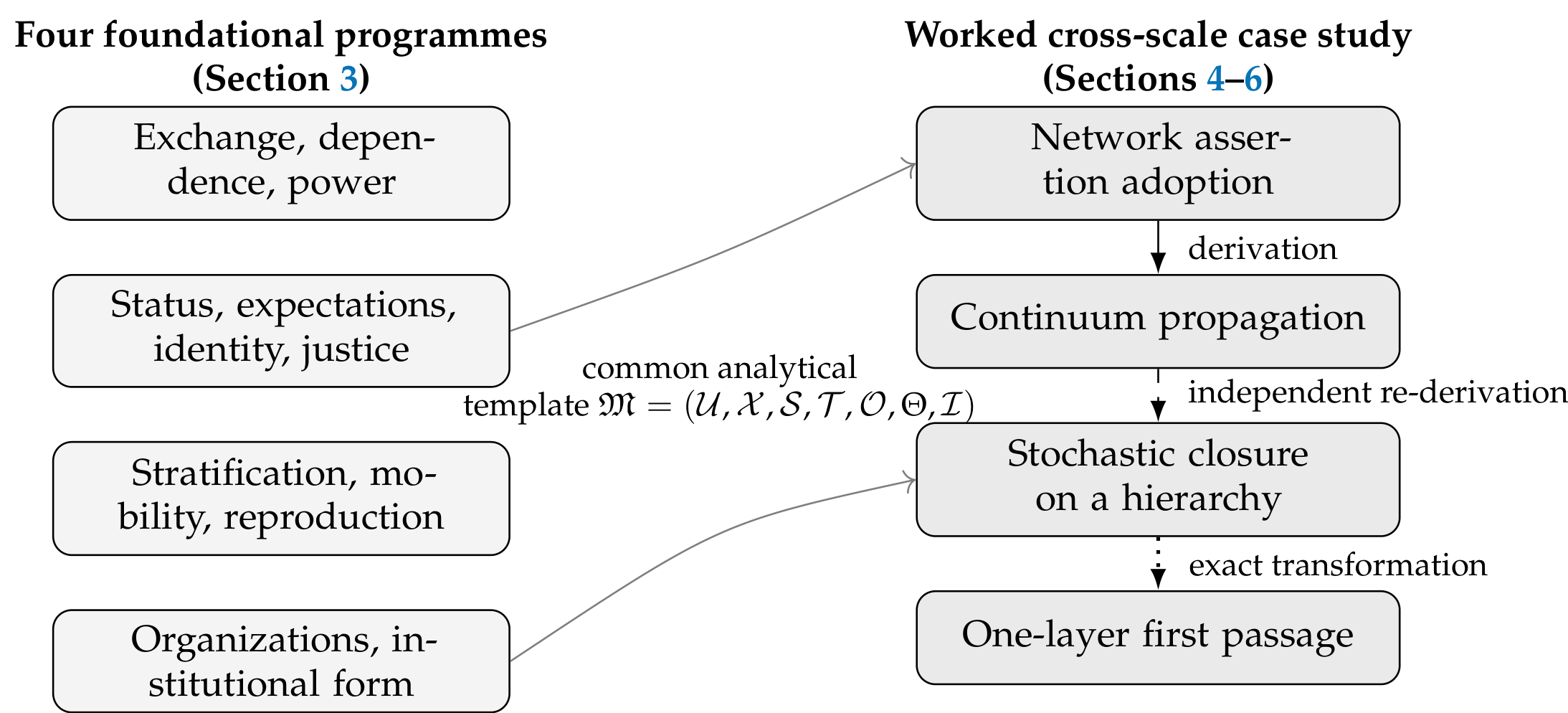
Section 2 states the scope and the construction of the corpus. Section 3 reconstructs four foundational programmes, preceded by a formal scheme for comparison and by a discussion of how social structure is represented. Section 4, Section 5 and Section 6 provide a worked cross-scale case study showing how the common analytical template operates across a discrete adoption model, a continuum propagation limit and a stochastic first-passage reduction. They follow one progressively restricted chain from probabilistic assertion adoption, through continuum propagation, to a one-layer stochastic first-passage reduction, marking explicitly which transitions are derivations and which are changes of scale or modelling closure. Section 7 treats identification, calibration and validation; Section 8 draws the cross-cutting conclusions and states the research agenda; Section 9 concludes.
2. Scope and Corpus
This article is a structured, mechanism-centered survey rather than a systematic or scoping review. Its purpose is to reconstruct and compare major formal traditions in mathematical sociology, including their state variables, units of analysis, transition mechanisms, empirical interpretations and unresolved identification problems.
The corpus was constructed iteratively through searches of multidisciplinary and field-specific databases, manual examination of major sociology and mathematical-social-science journals, backward and forward citation tracing, and purposive inclusion of foundational monographs and chapters required to reconstruct the historical development of formal programs. Four positive criteria governed inclusion. A source is included when it contains an explicit mathematical, statistical, computational or logical model; when the formalization represents a definite sociological mechanism rather than applying a general method to a social data set; when the work is a foundational statement, a substantial extension, a direct test, a documented critique or a contemporary synthetic assessment of a formal program; or when it is required for the interpretation, identification, measurement or validation of a model. Purely applied studies that contribute no account of a social mechanism are not part of the central corpus, and technical mathematical and methodological works are included as supporting sources rather than as independent traditions of mathematical sociology.
Two conventions follow from the mechanism-centered design. Classification is multi-label: formal sociological work regularly connects an individual mechanism, a relational structure, a group process and an institutional outcome, and assigning each source to exactly one section would destroy the connections the survey is meant to display. And the corpus is deliberately selective rather than exhaustive. Its inclusion rules favour works that clarify a formal mechanism, establish a mathematical result, test a distinctive prediction, document a failure or boundary condition, or resolve an identification problem. The survey therefore supports analytical comparison and reconstruction of formal programs, but it should not be interpreted as an estimate of publication frequencies or as a complete bibliometric census of mathematical sociology.
2.1. Corpus Construction, Classification, and Stopping Rule
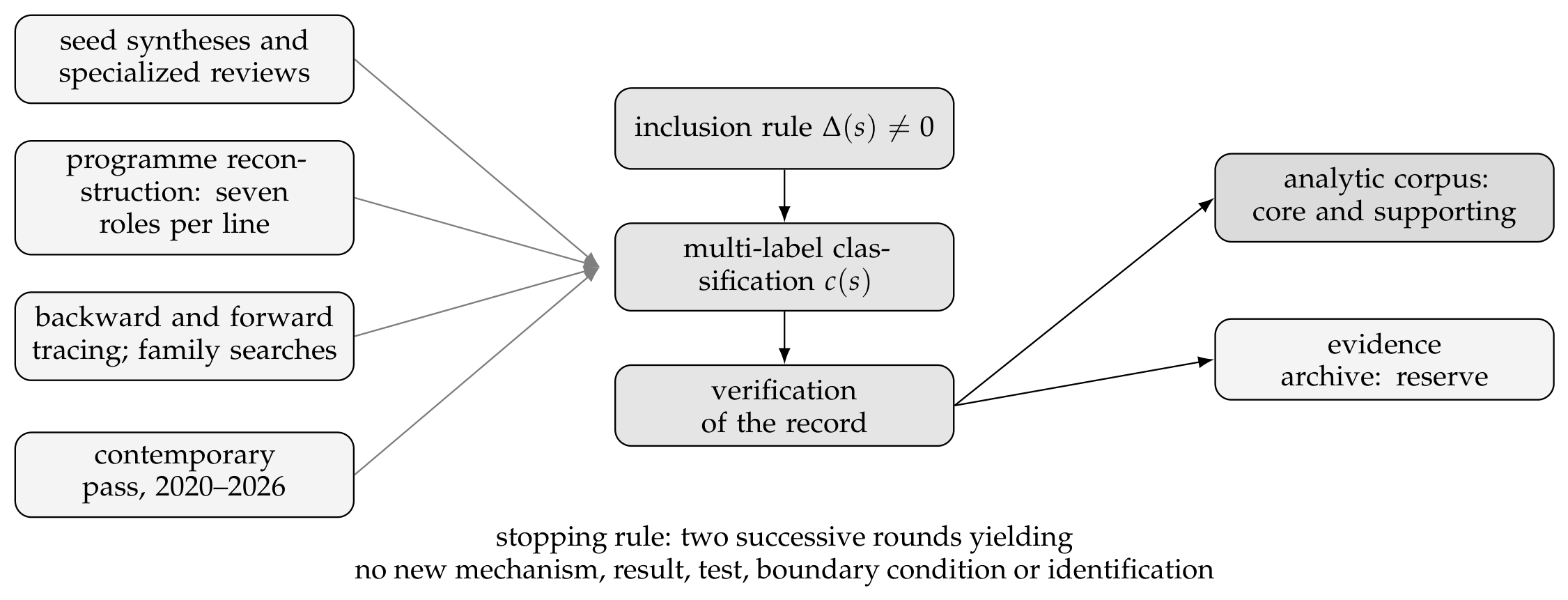
Because the corpus is selective, the selection has to be auditable and transparent. This subsection states the procedure, the classification applied to each record, the rule that terminated the search, and the resulting counts.
Step 1: seed syntheses. The starting point was the small set of broad syntheses of the field together with the specialized reviews of its main model families [13,16,17,20,21,22,23,24,25,26,27,28,34].
Step 2: programme reconstruction. For every family, and then for every line within a family, seven roles were sought explicitly: the foundational statement of the mechanism; its principal formal extension; a mathematical result about the model class; a direct empirical test; a documented critique, anomaly or boundary condition; a contemporary synthesis; and the current identification problem. A line was treated as reconstructed only when a source had been found for each role or when the absence of such a source was itself recorded as a gap.
Step 3: inclusion rule. A source s enters the analytic corpus if it contributes at least one element of
where is a new mechanism or a new social semantics for an existing one, a new mathematical result about the model class, a new direct empirical test, a new boundary condition or counterexample, and a new identification, estimation or measurement result. Sources with relative to material already represented are further applications of already included models; they were not added for completeness. Technical mathematical and methodological works enter as supporting sources, tied to the mechanism they serve.
Step 4: classification. Every record carries a multi-label descriptor
together with a corpus role, namely core, supporting or reserve, and a verification status recording how the bibliographic record was checked: publisher page, primary document, library catalogue, secondary citation only, metadata conflict, or unrefereed preprint. Labels are not exclusive, since formal sociological work regularly connects an individual mechanism, a relational structure, a group process and an institutional outcome; family-level counts therefore do not sum to the number of distinct sources.
Step 5: contemporary layer. A separate pass over the years 2020–2026 was carried out, not to reach a numerical quota but to ensure that no statement about the current state of a programme rests exclusively on literature predating 2003. Where a programme has an active formal line, contemporary work carries the argument; where it does not, contemporary work reports what has since been tested, which limitations have been found and how identification has changed, while the classical source remains the statement of the mechanism.
Step 6: stopping rule. Search within a family was stopped after two successive rounds of forward and backward tracing and keyword updating produced no new mechanism class, no new mathematical result, no new direct test, no new documented boundary condition and no new identification result, but only further applications of already represented models. The stopping criterion is therefore mechanism saturation rather than a target number of references.
Counts. The working corpus contains 500 records. Fourteen records classified as reserve or as redundant supporting material were retained in the evidence archive but are not cited here, so the article contains 486 references.
Relation to broader guides. Reference counts are not comparable across reviews with different denominators. A recent wide-ranging guide to mathematical social dynamics assembles a much larger reference list because its stated aim is to orient new researchers across areas [25]; the present survey requires each source to perform an analytical function in a mechanism-centered reconstruction. Table 1 states the difference.
Figure 1.
Construction and organization of the review corpus. The procedure is not a systematic-review protocol: it reconstructs programmes role by role, admits a source only when it adds a mechanism, a result, a test, a boundary condition or an identification argument, and terminates on mechanism saturation rather than at a target number of references.
Figure 1.
Construction and organization of the review corpus. The procedure is not a systematic-review protocol: it reconstructs programmes role by role, admits a source only when it adds a mechanism, a result, a test, a boundary condition or an identification argument, and terminates on mechanism saturation rather than at a target number of references.
3. A Mechanism-Centered Reconstruction of Four Foundational Programmes
Figure 2.
Architecture of the survey. Section 3 maps four foundational programmes; Section 4, Section 5 and Section 6 apply the same analytical template to one chain at full mathematical resolution. Arrow styles distinguish a derivation, an independent re-derivation on a different microscopic architecture, and an exact change of variables; the closure assumption enters at the third stage. Grey links indicate where the case study draws on the classical programmes.
Figure 2.
Architecture of the survey. Section 3 maps four foundational programmes; Section 4, Section 5 and Section 6 apply the same analytical template to one chain at full mathematical resolution. Arrow styles distinguish a derivation, an independent re-derivation on a different microscopic architecture, and an exact change of variables; the closure assumption enters at the third stage. Grey links indicate where the case study draws on the classical programmes.
3.1. A Formal Scheme for Comparison
To compare programmes that share formalism but not subject matter, the objects being compared must first be written down. Throughout what follows, a model in mathematical sociology is taken to be a tuple
in which is the set of acting or propagating units, the state space carried by those units together with the social meaning assigned to its points, the social structure over , whether a graph, a partition into positions, a set of feasible matchings, a hierarchy of depths or a population of forms, the transition law taking states and structure to a distribution over subsequent states, the observation operator mapping latent states to observable quantities, the parameters, and the source of identifying variation. The last two components are usually left implicit; the argument of this survey is that they are part of the model and not commentary on it.
Four notions of sameness follow. None of them implies the others without additional restrictions.
Definition 1
(Operator equivalence, or dynamical conjugacy). Two models are operator equivalent if there is a bijection conjugating their transition laws, that is for all t in the deterministic case, and for the pushforward of the transition kernels in the stochastic case, irrespective of what and denote. The term operator equivalence is used here in preference to structural equivalence, which already denotes a different relation between positions in a network.
Definition 2
(Semantic equivalence). Two models are semantically equivalent if their units and the social meanings of their state spaces coincide, so that a statement about in one is a statement about the same social object in the other.
Definition 3
(Observational equivalence). Two models are observationally equivalent under a design D if the induced distributions of the observed data coincide, that is if for every measurable A. The observation operator and the distribution of observed data are objects of different types, and it is the latter that must agree.
Definition 4
(Mechanism equivalence). Two models are mechanism equivalent if the social process generating transitions is the same, so that an intervention on that process has the same consequences in both.
Most confusions addressed in this survey are failures to distinguish these notions. A logistic equation for an adoption probability and a logistic equation for a proportion of a discrete state are operator-equivalent as scalar differential equations but semantically distinct. Two influence models with different microscopic mechanisms may be observationally equivalent once responses are generated, expressed and sampled, which is precisely the situation of Section 4.5. A block recovered by network inference and a sociological role may be observationally close and mechanism-distinct. And the recurrent identification problems collected in Section 8 are all instances of the same pattern: mechanism equivalence is not implied by observational equivalence, so additional structure, additional measurement or an exogenous source of variation is needed to separate mechanisms that share an observable.
The four families below are presented in the notation of (3). They differ first in and , then in , and only afterwards in ; the recurrence of similar operators across them is what makes the first two differences easy to overlook.
3.2. Observation Fibres and Mechanism Identifiability
The four equivalences of Section 3.1 are so far a classification. This subsection turns the relation between the last two into a statement that can be checked, and that recurs, in the same form, in every programme surveyed below. The construction is elementary; its value lies in being the same construction each time.
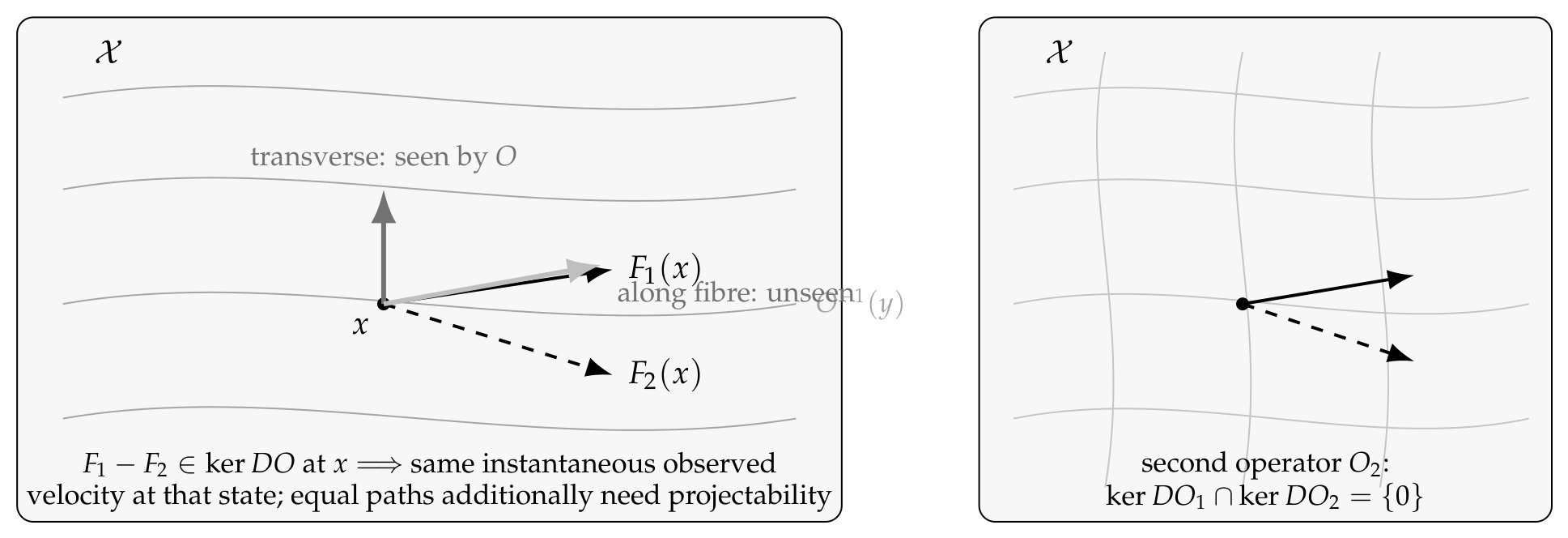
Let the latent dynamics be on a state space and let the observation operator be a continuously differentiable map , so that the observed quantity is . The set
is the observation fibre through x: every latent state in it produces the same observation. Directions along a fibre are, by construction, directions in which the latent state can move without the observation changing.
Definition 5
(Locally indistinguishable mechanisms). Two transition laws are locally indistinguishable through O on a set if for every .
Definition 6
(Projectability). A vector field F is projectable through O on A if there is a locally Lipschitz map with
that is, if the rate of change of the observation depends on the latent state only through the observation itself. Equivalently, O is a semiconjugacy from the flow of F to the flow of G.
Theorem 1
(Local mechanism indistinguishability). Let O be continuously differentiable, let be locally Lipschitz, and let .
- (i)
- (Instantaneous form.) If at a state , then the two models induce the same instantaneous rate of change of the observation at x: . Neither the value of y nor its slope distinguishes the two mechanisms at that state.
- (ii)
- (Path form.) Assume in addition that A is forward invariant for both flows and that is projectable through O on A in the sense of Definition 6, with projected field G. Then for any initial states with the observed paths coincide, , on the common interval of existence.
- (iii)
- (Necessity of projectability.) Without hypothesis (ii) the conclusion fails: indistinguishability of the vector fields at every state does not imply indistinguishability of the observed paths.
Proof. (i) is the chain rule: along any solution and , and the two right-hand sides agree at x by hypothesis.
(ii) Let . By (i) and Definition 5, for every , so both observed paths satisfy the same closed ordinary differential equation on , with the same initial value. Since G is locally Lipschitz, the solution is unique, whence .
(iii) Take , , so that and . Put and . Then at every state, so the two fields are locally indistinguishable on all of in the sense of Definition 5. Starting both flows at the origin gives and hence , while and hence . The observed paths differ for every . Neither field is projectable through O, since is not a function of . □
Part (iii) is not a technicality but the substantive content of the result. The pointwise condition says that the mechanisms are invisible at a given state; whether they remain invisible along a trajectory depends on whether the observation closes on itself. Failure of projectability is therefore not an obstacle to the argument but the phenomenon the argument is about: it is exactly what produces the extra terms in a macroscopic law.
Remark 1
(Stochastic analogue). Theorem 1 is stated for ordinary differential equations, whereas several models surveyed here are counting processes, hazard models, Markov transitions or Itô diffusions. For these, equality of the projected drift is not sufficient, and the comparison must be made between generators: two models are indistinguishable through O when
for all x and all f in a suitable class of test functions. For a diffusion this single condition constrains three objects at once: the projected drift , the Itô correction involving , and the projected quadratic variation . If in addition (6) holds with a common operator acting on functions of the observation alone, that is , then the observed process is itself Markov with generator and the two models induce the same law, which is the sense of observational equivalence of Definition 3. This lumpability requirement is the stochastic counterpart of projectability, and it is what licenses the use of the theorem in Section 6 and Section 7, where the observable is a quadratic variation rather than a drift.
Corollary 1
(Aggregation and the failure of projectability). Let the observation be the unweighted mean, , so that and is the set of zero-sum perturbations. Then any two microscopic laws with are locally indistinguishable in the sense of Definition 5. Moreover the mean is projectable if and only if depends on x only through ; when it does not, no closed macroscopic law in the mean exists, and the discrepancy is precisely the term that must be added.
The second half of the corollary is the general form of the closure results of Section 7.3. For the influence dynamics studied there, depends on the microscopic configuration beyond its mean whenever the covariance is non-zero, so projectability fails and the mean of a population of logistic actors does not obey a logistic law. The exceptional cases identified in Proposition 5 are exactly the configurations in which projectability is restored, either onto a two-dimensional reduction or, under a uniform common row, onto the mean alone.
Corollary 2
(Several observations). Let be observation operators available on the same design. The directions in which the mechanism is locally identifiable are exactly those outside . In particular, if , then the available observations locally separate all infinitesimal differences of mechanism at x.
This gives the fourth component of the specification (3) a precise meaning. A source of identifying variation is not useful because it is new data, but because it reduces the common observational null space. The same holds for interventions: writing and under an intervention a, two mechanisms are locally distinguishable by a family of interventions if
Identification is therefore a separation condition on the ranks of the differentials of the available observation operators, evaluated on the differences of the candidate transition laws.
Figure 3.
Observation fibres and identifying variation. Left: two candidate transition laws differ at a common latent state by a vector lying along the fibre of the observation operator, so the difference is annihilated by and the instantaneous observed velocity is the same; equality of whole observed paths requires in addition that the field be projectable, by Theorem 1(ii). Right: a second operator cuts the fibres transversally, so the intersection of the kernels is trivial and the mechanisms are locally separated. No increase in sample size under the same observation design can remove structural non-identification; sample size still governs precision once identification has been secured.
Figure 3.
Observation fibres and identifying variation. Left: two candidate transition laws differ at a common latent state by a vector lying along the fibre of the observation operator, so the difference is annihilated by and the instantaneous observed velocity is the same; equality of whole observed paths requires in addition that the field be projectable, by Theorem 1(ii). Right: a second operator cuts the fibres transversally, so the intersection of the kernels is trivial and the mechanisms are locally separated. No increase in sample size under the same observation design can remove structural non-identification; sample size still governs precision once identification has been secured.
Worked example: density does not identify legitimation and competition
The abstract condition becomes concrete in the ecological setting of Section 3.7. Let the latent state be , where L measures recognition, or taken-for-grantedness, of an organizational form and C measures resource competition, and suppose the founding intensity is the only quantity recorded, . Up to the fixed monotone transformation this is the observation operator
Consider two mechanisms,
Under the first, recognition grows and competition is static. Under the second, recognition grows faster while competition grows at exactly the rate that offsets the difference. Both are constant fields, both are projectable through O with , and
so by Theorem 1(ii) the two histories produce the identical founding trajectory from any common initial value of . An arbitrarily long series of founding counts cannot say whether a form was becoming accepted in a stable competitive environment or becoming accepted while competition intensified in step with it. This is not a small-sample problem, and it is not repaired by adding decades of data.
The remedy is to add an operator with a different mechanism loading. An independent indicator of recognition, , gives
so by Corollary 2 the two mechanisms are locally separated. In sociological terms: founding and mortality counts are insufficient; what is required is an independent measure of category recognition, taken-for-grantedness or public familiarity, or a measure of resource overlap and congestion, or an intervention that acts on recognition without acting directly on competition. This is the empirical content of the theorem, and it is the reason why the institutional-embeddedness proposal in the density-dependence debate was a response to an identification problem rather than a change of subject [35,36,37].
The construction organizes the identification problems of the four programmes as instances of one condition. In mobility, a single observed transition hazard does not separate duration dependence, unobserved frailty and vacancy supply whenever their perturbations project identically onto the aggregate intensity; the opportunity process supplies a candidate second operator, but only if its innovations are not themselves generated by the frailty being estimated. In organizational ecology, founding and mortality intensities depend on recognition and competition only through combinations such as , so any pair of mechanisms with the same combination lies in the kernel and density alone cannot separate them; category-recognition measures and resource-overlap data act as additional operators. In social influence, the averaging operator has the kernel of Corollary 1, which is why the mean of a population of logistic actors does not obey a logistic law and why the missing terms are covariances. In institutional trust the three noise channels are not all alike: a layer-common shock is homoscedastic on the logit scale, whereas demographic updating and survey sampling share the same state dependence and differ in scaling and time structure. A single empirical variance series without a measurement model is therefore insufficient to separate the last two, and repeated identical items together with known subsample sizes are the additional operators required. In each case the remedy has the same shape: enlarge the set of observation operators, restrict the class of admissible transition laws, or intervene, until the intersection of the kernels no longer contains the difference of interest.
3.3. Representing Social Structure
Sociological theories that receive a mathematical form must first decide what kind of object their formalism represents. A matrix may encode who influences whom, who may exchange with whom, who occupies which position, or which organizational forms compete for the same resources; the algebra is indifferent between these readings, whereas the sociology is not.
The most widely used representation is the graph, and its sociological pedigree is long. Sociometry made the pattern of choices in a group an object of measurement [38]; balance theory turned the sign of relations into a structural constraint [39,40]; the study of triads and transitivity turned local configurations into testable structural hypotheses [41]; the argument on the strength of weak ties connected local tie properties to macroscopic access [42]; homophily was identified as a pervasive regularity of association [43]; small-world and scale-free constructions supplied generative accounts of global network features [44,45]; structural holes reinterpreted position as brokerage advantage [46]; and centrality measures made positional advantage numerical [47,48,49,50,51]. Positional analysis, in the strict sense, developed in parallel: structural equivalence [52], blockmodels of roles and positions [53,54] and core–periphery models [55] treat the network as evidence about positions rather than as the social structure itself.
The statistical machinery attached to this representation has changed substantially since those statements. Early exponential-family models for directed graphs [56,57] grew into a broad programme of statistical network modelling [58], in which degeneracy and instability are now understood as properties of particular specifications and asymptotic regimes rather than as a generic defect of the class [59,60,61]. Blockmodel inference treats communities as latent statistical structure rather than as visually dense subgraphs [62]: mixed-membership formulations allow a single actor to belong to several groups with context-dependent weights [63], degree-corrected models separate broad degree heterogeneity from block structure [64], hierarchical formulations tie the resolution of detected structure to explicit model selection [65], and detectability and recovery theory specify when latent labels are statistically recoverable at all, distinguishing exact, partial and weak recovery together with their information-theoretic and computational thresholds [66,67]. Latent-space models [68] now serve simultaneously as models of clustering [69], of longitudinal evolution [70] and of timed relational events [71]. Graph-limit theory connects probabilistic network models to exchangeability [72,73] and has been extended from dense to sparse regimes, at the cost that the limiting object is defined only up to an equivalence class [74]. Models of dependence beyond pairs distinguish hypergraphs from simplicial complexes and other higher-order formalisms [75,76,77,78,79], with group-level thresholds capable of producing multistability, intermittency and hybrid transitions in explicitly specified models [80,81,82]. Networks whose topology co-evolves with the states carried on them form a further class [83,84,85]. Random walks and diffusions on graphs provide a complementary geometric language for the same objects [86].
Three consequences of this development matter for a survey organized by social mechanism. The first is that the same statistical apparatus is compatible with incompatible sociological readings. A block recovered by inference is a set of vertices with similar connection probabilities; whether it corresponds to a social role, a class, a status group or an institutional position is a separate question that the estimation procedure does not answer. Statistical identifiability of latent labels is not sociological validity of their interpretation. The second is that a latent coordinate is a parameter of a tie or event model, not an observed position of the actor; relative distances may be identified while the coordinates themselves are invariant only up to rotation and translation, so a moving coordinate should not be read as a moving actor without an alignment procedure and independent substantive validation. Models of network dynamics are subject to the same caution: stochastic actor-oriented models specify a transition process, usually a continuous-time Markov chain observed at discrete waves [87,88,89], whereas exponential-family models specify a distribution over graphs, and shared statistics do not make the two interchangeable or their coefficients comparable [90].
The third consequence concerns homophily, the most frequently invoked sociological interpretation of network similarity. Observed similarity between connected actors decomposes into preference, opportunity, triadic and focal closure, geography, network amplification and possible influence [43,91,92,93], and influence and latent homophily are generically confounded in observational network data [94]. A static coefficient of similarity therefore identifies none of these mechanisms on its own.
This is why the sections below are organized by social mechanism rather than by representation. The four families differ in what they take the acting unit to be, in what changes when the system changes, and in what a macroscopic regularity is a regularity of.

Table 2.
Units of analysis in the four foundational programmes.
| Family | Acting or propagating unit | What changes | Characteristic formalism |
|---|---|---|---|
| Exchange, dependence and power | Actor in a relation, with exclusion as the source of leverage | Division of a fixed pool between connected positions | Structural power indices, resistance points, cooperative-game solutions, non-cooperative bargaining |
| Status, expectations, identity and affect | Actor in a task-oriented or meaning-bearing encounter | Expectations, self-meanings, sentiments, justice evaluations | Signed path aggregation, control loops, impression-formation equations, logarithmic evaluation functions |
| Stratification, mobility and social reproduction | Position, vacancy and cohort as much as individual | Occupancy of positions over careers and generations | Log-linear association, Markov and semi-Markov transitions, vacancy chains, multistate demography |
| Organizations and institutional form | Organization and population of organizations | Founding, survival, adaptation and institutional resemblance | Bounded-search rules, learning models, counting-process intensities, diffusion models |
3.4. Exchange, Dependence, Power, and Coalitions
Social exchange theory asks how the structure of who can transact with whom determines who obtains what. Its formal history is unusual in sociology: several distinct mathematical programs made incompatible numerical predictions for the same experimental networks, the predictions were tested, and one of them encountered a documented anomaly and was extended in response [95,96].
In the notation of (3), the family takes to be actors occupying positions, an exchange graph together with an exchange rule limiting the number of agreements per position, and the division of a fixed pool. Write for the set of maximum-weight matchings, for the pool available to a pair, and for a payoff vector. Four distinct objects are then defined on the same graph. Dependence theory orders positions by a vulnerability functional of G. Exclusion theory assigns each position a structural index built from signed counts of non-intersecting paths and fixes the division within a matched pair by an equal-resistance condition. Cooperative theory selects the core of the induced game,
which may be empty or set-valued. Bargaining theory selects, for a maximum-weight matching , the balanced outcome. Here unmatched vertices receive , an outcome is stable if for every edge, and the outside option of a matched vertex is the best it could obtain elsewhere,
with when no such edge exists. The characteristic function of the induced game assigns to a coalition S the value of a maximum-weight matching inside S. The balanced outcome is then characterized by
Each of the four induces an ordinal partition of V. They agree on some graphs and disagree on others, and the disagreement is what the experimental programme tested. The comparison question of the family can therefore be stated exactly: for which graph classes do the four maps induce the same ordinal partition?
Dependence. The founding formulation states that the power of A over B is the dependence of B on A, where dependence increases with the value of the resources the partner controls and decreases with the availability of those resources outside the relation [97,98]. Power is thus relational rather than an attribute, and imbalance generates balancing operations: withdrawal, network extension, status giving and coalition formation. Extending the account from dyads to networks required procedures for locating the positions whose removal most disrupts exchange, and experiments established that the resulting predictions hold in small negatively connected structures [99,100]. Connection type proved to be a first-order structural variable rather than a detail: positively and negatively connected networks distribute power differently, because in the former exchanges complement one another while in the latter they compete [101,102].
Exclusion. A second program locates power not in dependence but in the capacity to exclude [103]. If a position can conclude agreements with several neighbours while each neighbour can conclude one only with it, the neighbours compete and the excluded partner receives nothing. The graph-theoretic power index of network exchange theory formalizes this by an alternating count of non-intersecting paths, in which odd-length paths lead to potential partners and add strength while even-length paths lead to their alternatives and subtract it [104]. In its generalized form the index is domain- and exchange-capacity-dependent, and quantitative use requires the original notation rather than the schematic form. The division within a pair is then fixed by a resistance criterion, at which the two actors’ ratios of forgone to attainable payoff are equal. The program was tested extensively [105,106,107,108] and encountered a specific limitation: the original index predicted equality in structures in which simulation suggested small but systematic differences. The anomaly first appeared in simulation, was reproduced and analysed within the program, and led to an iterative extension tracking probabilistic exclusion across rounds [109,110,111,112,113]. Information conditions matter as well: experiments in the dependence tradition were typically run without information about network structure, those in the exclusion tradition with full information, which accounts for part of the divergence between them [114].
Coalitional stability. A third program treats an exchange network as a cooperative game and asks which divisions lie in its core [115,116,117]. The relation to exclusion theory is not one of general equivalence. The two can yield compatible ordinal predictions in selected strong-power exclusionary networks, but the core may be empty or set-valued, whereas network exchange theory is designed to produce relational or point predictions under additional behavioural assumptions. The same tradition supplied an early and still underused connection between exchange and combinatorial optimization, relating exclusionary exchange to assignment games and to the chromatic number of the exchange graph [118]; a related algebraic connection runs through eigenvector-based power measures, in which negative attenuation formalizes the intuition that being connected to well-connected others is a liability when exchange is exclusive [49]. Alternative equilibrium formulations distinguishing substitutable from complementary exchange relations [119,120], and expected-value formulations combining exchange values with estimated exchange probabilities [121,122], complete the set of competitors. Coalition formation, from the classical bargaining accounts [123,124,125,126] to embedded games in exchange networks [127], connects the family to cooperative game theory. In the common experimental scope examined by Willer and Emanuelson, the resistance model of elementary theory yielded the highest reported precision, followed by a hybrid expected-value–resistance model; the authors explicitly noted limitations of scope and of independence, since they had participated in developing the theories and running the experiments [128].
Negotiated and reciprocal exchange. All of the above describe negotiated exchange. When benefits are given unilaterally and reciprocity is neither negotiated nor guaranteed, the same networks behave differently. Reciprocal exchange generates trust and affective attachment where negotiated exchange does not, precisely because it exposes the giver to risk [129,130]; commitment can emerge from uncertainty rather than from optimization [131]; and coercion operates as a base of power distinct from the control of rewards [132]. A parallel line treats the emotions produced by successful exchange as the mechanism that turns a relation or a network into a group [133,134,135]. These results bound the scope of the first three programs rather than competing with them: the protocol of exchange, not only its structure, is a theoretical variable.
Bargaining outside sociology. The same structures have been analysed with different tools in economics and computer science, and the two literatures have remained largely separate. One branch characterizes stable and balanced outcomes on networks, with balanced divisions computable in polynomial time when stable outcomes exist and characterized through the Edmonds–Gallai decomposition of maximum matchings [136,137,138,139]. A second studies dynamic non-cooperative bargaining with outside options generated by random matching and exit, characterizing limit equilibrium payoffs through mutually estranged sets and shortage ratios [140,141,142,143,144].
That relation is the natural open problem of the family. Let denote the set of balanced payoff vectors over all maximum-weight matchings. Components admitting a unique perfect matching yield unique local balanced assignments, whereas non-trivial elementary components may leave a family of balanced values, so coordinatewise intervals are not an adequate summary. For which graph classes does the ordinal power partition induced by a specified version of the index agree with the payoff ordering of balanced outcomes, either matching-conditioned, existentially, or robustly in the sense that implies ? What minimal counterexamples separate these cases, and what is the complexity of deciding agreement? The obstacle is not the absence of either theory but the absence of a common microscopic origin for the graph and the bargaining description.
3.5. Status, Expectations, Identity, Affect, and Justice
Where exchange theory studies what actors obtain, this family studies how they are evaluated, how they interpret what happens, and how they judge outcomes. It subdivides into programs that determine the distribution of influence, programs that regulate the choice of action given meanings, and programs that evaluate results.
Here is the set of actors in a task-oriented encounter, a signed directed graph whose vertices include actors, status characteristics and task outcome states, and a pair of expectation levels. Let and be the sets of positive and negative relevance paths from actor x to the outcome, the length of path r, and f a decreasing path-strength function. The principle of organized subsets aggregates within a sign and then compares signs,
and the behavioural link is the linear probability specification for the standardized experimental situation, where is the probability of retaining one’s own answer.
Proposition 1
(Conditional probabilistic reading of same-sign aggregation). Suppose for every path, and suppose that to each path there is associated a latent Bernoulli activation with , the activations being conditionally independent given the status situation. Then , so the same-sign expression in (15) is the leak-free noisy-OR probability that at least one relevance path is active.
The reading fails without those additional stipulations, and three failures matter. In the theory as stated, is a path strength rather than a probability of causal activation. Conditional independence needs a factorization of its own: edge-disjointness suffices only under independent edge transmission without shared latent causes, and a polytree structure alone does not guarantee it. And (15) combines two signed subsets, so a normalized signed outcome model is required rather than a single gate. Finally, a noisy-OR specifies a local conditional distribution; posterior log-odds appear only once priors, an evidence model and the full graph are given. The open problem is to characterize the status graphs on which for all pairs.
Expectation states and status characteristics. In a group oriented to a common task with a valued outcome, participants lack direct information about one another’s competence and use available differences as grounds for expectations about each contribution [145,146,147]. Those expectations are self-fulfilling: the actor from whom more is expected speaks more often and is less often rejected. The theory states its scope conditions explicitly, which is rare in sociology: the group must be task-oriented and collectively oriented, and the task must have a valued and evaluated outcome. A status situation is represented as a signed graph whose vertices are actors, status characteristics, states of characteristics, task outcome states and generalized expectation states. Path strength declines with path length, and same-sign paths are aggregated by the principle of organized subsets: the actor organizes consistent positive and negative paths into two signed subsets, within each of which evidence combines with diminishing returns as , after which the two are compared. The expectation advantage is then linked to a behavioural observable through a linear probability specification for the standardized experimental situation, , where is the probability of retaining one’s own answer. A priori parameterizations turned the theory from a fitted into a predictive one [148,149], though meta-analysis shows that the estimated behavioural parameters are sensitive to protocol, number of trials, presentation technology and participant-exclusion rules [150]. Competing principles for processing status information were compared experimentally on status-inconsistent situations, in which an actor is superior on one characteristic and inferior on another [151]; the choice of aggregation function is thus an empirically testable theoretical commitment rather than a technical detail. The burden-of-proof formulation, under which a characteristic becomes salient by default unless dissociated from the task, has itself been challenged as inconsistent with the notion of a generalized expectation state [152]. The programme has continued to develop [153,154,155,156,157,158], including tests aimed at the intermediate mechanism rather than the terminal behaviour [159].
Status construction. The theory just described takes the status value of a characteristic as given. A second program asks where that value comes from, arguing that local differences in resources, encountered repeatedly across overlapping encounters, can turn a nominal characteristic into a status characteristic [160,161]. Experimental work supports the creation and spread of status beliefs through an observed hierarchy of influence [162,163,164]. A minimal model shows that once one of two opposing status beliefs acquires a prevalence advantage, diffusion and symmetric loss mechanisms amplify that advantage toward population-wide consensus, while the origin of the initial asymmetry remains exogenous to the model [165]; a controlled experiment supports asymmetric loss of status value [166]. A formal theory of the spread of status value provides the more direct bridge between the two lines [167], and the substantive consequences for gender have been developed at length [168].
Affect control and identity control. A third and fourth program regulate action rather than influence. Affect control theory represents identities, behaviours and objects by evaluation, potency and activity profiles, models impression formation by empirically estimated equations, and predicts that actors select or interpret events so as to minimize deflection between culturally fundamental sentiments and transient impressions [169,170,171,172,173,174,175]. Its Bayesian reformulation turns the deterministic minimization into probabilistic sequential decision-making with partially observed identities and affective states [176,177,178]. Identity control theory is a cybernetic loop in which behaviour changes the situation so as to reduce the discrepancy between an identity standard and perceived self-meanings [179,180,181]; chronic non-verification may produce negative emotion, stress, identity change or exit from the relation [182,183,184,185], and the two control theories differ in what is being controlled [186]. Expectations and affect have been treated jointly [187].
Distributive justice. A fifth program evaluates outcomes. From the early statements of distributive justice [188,189] and its status-value formulation [190], the justice evaluation function was given a logarithmic specification relating actual to just reward, which yields at justice and an asymmetry between under- and over-reward [191,192], together with methods for analysing comparison processes and moving from individual evaluations to distributions [193,194,195]. The justice standard invoked has been shown to condition emotional responses to over-reward [196].
Bridges. This family and the previous one are connected in both directions: status value produces structural power in exchange networks [197], and power in turn produces status [198]. This is the only pair of families in the survey with a two-way formal bridge.
The natural open problem concerns the aggregation rule. For same-sign paths the expression coincides algebraically with a leak-free noisy-OR gate once one additionally posits and latent Bernoulli path activations with those conditional probabilities. The probabilistic reading does not follow from the formula alone: is a path strength rather than a probability of causal activation; conditional independence of paths requires a separate factorization, for which edge-disjointness suffices only under independent edge transmission without shared latent causes, and a polytree structure alone does not guarantee it; positive and negative paths are aggregated separately, so a normalized signed outcome model is required rather than a single gate; and a noisy-OR specifies a local conditional distribution, whereas posterior odds appear only after priors, an evidence model and the full graph are given. The Bayesian reformulation of affect control theory is a methodological precedent, not a demonstration that an analogous reconstruction would yield new empirical predictions. The problem is therefore to construct a signed probabilistic graphical model with explicit latent path activations and a normalized combination rule, to characterize the status graphs and edge-transmission models on which the ordinal expectation ranking coincides with the ranking of posterior log-odds, to derive dependency corrections where relevance paths overlap, and to test whether the divergences correspond to empirical anomalies in status-inconsistent conditions.
3.6. Stratification, Mobility, Demography, and Social Reproduction
This family observes different projections of one process, and the projections are frequently confused. Mobility tables describe the association between origin and destination; Markov and semi-Markov models describe sequences of transitions; attainment models explain individual differences through predictive or causal variables; vacancy-chain models explain the availability of transitions through the supply of positions. These are not competing answers to one mathematical question.
The projections of this family are distinct mathematical objects on the same process. Writing for the position of a lineage in generation g, for the position of an individual after n career moves and for the times of those moves, the four principal objects are
to which the vacancy process adds an operator acting on the distribution of unfilled positions rather than on the distribution of actors. The first is a Markov transition matrix, the second a semi-Markov kernel carrying duration, the third a log-linear decomposition of association in which the marginal terms and absorb structural change while carries relative mobility, and the fourth a conditional expectation. They answer different questions: a sequence of transitions, a sequence with waiting times, an association net of margins, an individual difference, and the supply of opportunities. Comparative statements across tables are made by restricting , for instance by a log-multiplicative layer effect in which holds a common association pattern fixed while its strength varies by table.
Association. The log-linear tradition separates changes in the marginal distributions of origins and destinations from changes in the origin–destination association structure, which permits comparison of relative mobility across societies with different occupational structures [199,200,201,202,203,204]. The hypothesis of a basic similarity of relative mobility across industrial societies [205] was examined at length [206,207], and the log-multiplicative layer-effect model assumes a common pattern of association across tables while allowing its overall strength to vary by a single layer parameter [208]. Interdisciplinary assessments summarize the current state [209,210].
Career transitions. Here time is age, seniority or duration in a position. Homogeneous first-order Markov models frequently failed to capture observed career mobility because transition probabilities depended on duration, prior trajectories, age, cohort and unobserved actor heterogeneity; mover–stayer, heterogeneous Markov and semi-Markov formulations were developed to relax these restrictions [211,212,213,214,215,216,217,218]. The separation of duration dependence from unobserved heterogeneity is the classical identification problem of the area: duration dependence and unobserved heterogeneity are not separately recoverable from unrestricted duration data without identifying restrictions, and mixed proportional-hazard models can be identified under suitable assumptions on covariate variation, baseline hazards and the heterogeneity distribution, though estimates may be highly sensitive to those assumptions [219,220,221]. Contemporary work extends the Markov toolbox to distributions of occupation and waiting times [222].
Intergenerational inheritance. Here the index is the generation, and the question is whether . The distinction between Markovian and non-Markovian status inheritance goes back to an early probabilistic treatment [223] and returned as the question whether two-generation data suffice for multigenerational conclusions [224]. Strong multigenerational correlation does not by itself establish non-Markovian transmission, since it is reproduced by a Markov chain with sufficiently high persistence [225]; demographic approaches make the compositional mechanisms explicit [226,227], and recent work recasts intergenerational persistence through Markov chains and memory curves [228].
Attainment. Path models decomposed observed associations into direct and mediated components under a specified recursive system [229,230,231,232,233,234,235]. Causal interpretation requires assumptions not supplied by the path coefficients themselves, including correct temporal order, absence of omitted common causes, valid treatment definitions and appropriate mediation assumptions; modern potential-outcome and graphical approaches make those assumptions explicit [236].
Opportunity structure. A distinct tradition takes the vacancy rather than the actor as the primary propagating entity: a vacancy at the top generates a chain of moves down the hierarchy, and the length and multiplier of the chain are determined by the structure of positions and the rules of replacement [8,237,238,239,240,241]. Actors do not disappear from the model; they occupy and transmit positions along the resulting chain.
Demographic reproduction. For population-level accounts of social reproduction, conditioning only on origin–destination association omits the compositional consequences of differential fertility, mortality, marriage, migration and generational overlap [242,243,244,245,246,247,248,249,250]. Assortative mating and its trends form a central part of this account [251,252,253], and event-history methods supply the technical apparatus [254,255].
The open problem of the family is to join these projections. Consider a joint counting-process model in which individual career trajectories follow a latent-class semi-Markov process and the opportunity set evolves through a vacancy-chain process, with career-transition intensities of the multiplicative form combining a class-specific duration baseline, predictable individual covariates and a time-dependent opportunity modifier. Such an intensity belongs to the multiplicative counting-process family initiated by Aalen and developed for Cox-type regression with time-dependent covariates by Andersen and Gill [256,257,258,259]. Predictability of the opportunity process is required for the intensity formulation; identification and causal interpretation additionally require restrictions on the joint compensators of the vacancy and mobility processes, and standard partial likelihood does not by itself resolve latent-class, frailty or vacancy endogeneity. A vacancy process is not exogenous merely because it is observed: vacancies arise from dismissals, voluntary departures, retirements, promotions and reorganizations, many of which depend on worker characteristics and on unobserved organizational states. The question is therefore under which restrictions latent mobility classes, duration dependence and vacancy constraints are point identified, when only partial identification is available [260,261], and what minimal combination of person-spell histories, time-stamped vacancy events, organizational rosters, risk sets and repeated mobility tables is required.
3.7. Organizations, Bounded Rationality, and Institutional Form
The fourth family treats organizations both as actors and as populations. Its micro-foundation is that organizations act through boundedly rational participants, local procedures and search rules rather than as unitary maximizers.
Bounded rationality and routines. Satisficing, aspiration levels, sequential attention to goals and problemistic search form the behavioural core [262,263,264,265,266]; near decomposability supplies the corresponding structural principle [267]; routines carry organizational memory but also change in performance [268,269]; and behaviour changes when performance falls below aspiration rather than continuously [270].
Organized anarchy. A distinct mechanism arises when problems, solutions, participants and choice opportunities arrive as partly independent streams and a decision is produced by their temporal coupling. The model permits three qualitatively different outcomes, resolution, oversight and flight, and shows that organizational choices may occur without the resolution of the problems nominally attached to them [271,272]. A systematic assessment found the original simulation incompatible with the verbal theory, since the coded elements moved in lockstep patterns [273,274]; agent-based reconstructions followed [275,276,277,278].
Learning. Mutual learning between members and an organizational code makes the balance of exploration and exploitation the central variable: faster assimilation of members to the code can improve short-run conformity and average performance, while rapid loss of heterogeneous beliefs may reduce the organization’s capacity for long-run learning [279,280,281]. Direct and vicarious learning have different selection problems: the hot-stove effect is generated when adverse own experience suppresses further sampling [282], whereas undersampling of failure arises because observations of other organizations disproportionately contain survivors and conspicuous successes [283]. Design interdependence and network structure condition the balance [284,285].
Population ecology. Organizations are subject to selection at the level of populations: composition changes through differential founding and mortality as well as through adaptation [286,287,288,289]. In the classical formulation, structural inertia concerns the reproducibility of core features, namely goals, authority structure, core technology and marketing strategy: reliability and accountability confer reproducibility advantages, while major change to the core temporarily disrupts them and may raise risk; this is not the claim that all change is impossible or equally hazardous [290]. Founding is a population-level counting process while mortality is an organization-specific hazard, and the two should not be written in the same form. Writing for the population size, a schematic review specification is
where indicates that organization i is at risk, is its age, represent recognition effects and competition effects. Here ecological legitimation denotes the increasing taken-for-granted recognition of an organizational form as its population grows; it is narrower than the normative, political and institutional legitimacy examined in Section 6. Under the canonical quadratic specifications, increasing recognition dominates at low density and increasing competition at high density, producing an inverted-U founding rate and a U-shaped mortality rate; more general functional specifications require explicit shape restrictions for these predictions to follow [291,292,293]. A broad cumulative program has reported density dependence in founding and mortality [294,295]. The meta-analysis of ecological legitimation targets the positive density effect associated with organizational-form emergence, especially founding, rather than providing a pooled test of the mortality curve, and its positive mean masks pronounced heterogeneity across populations [296]. Scale matters: a multilevel study of American brewing supported the predictions at regional and state level but not at city level [297,298]. Whether density-dependent mortality reflects legitimation or unobserved heterogeneity was contested directly [36,37], and institutional embeddedness was proposed as a way of measuring recognition independently of density [35,299]. Resource partitioning explains why increasing concentration at the centre of a resource space can increase the number of specialists at its periphery [300], and identity and genre supply the categorical apparatus [301].
Three scales appear in this family and can be written compactly. At the level of the acting organization, aspiration adaptation and problemistic search take the form
so that behaviour changes when performance falls short of aspiration rather than continuously. At the level of the organization and its code, mutual learning is a map in which governs the rate at which members are assimilated to the code, and the exploration–exploitation trade-off is the statement that increasing raises short-run agreement and lowers the long-run diversity of beliefs available for search. At the level of the population, founding and mortality follow (18) and (19).
Proposition 2
(Density dependence under the canonical specification). Write and , so that the founding and mortality intensities of (18) and (19) are proportional to and at fixed covariates. Under the canonical quadratic specification with , the founding intensity has a unique interior maximum at and is strictly increasing below it and strictly decreasing above it; under with , the mortality intensity has a unique interior minimum at . More generally, the intensities are single-peaked and single-troughed respectively if and only if changes sign once from positive to negative and changes sign once from negative to positive; for specifications outside the quadratic family these are additional hypotheses rather than consequences of the opposing signs of the two mechanisms.
Proof.
Since is strictly increasing, the intensities are monotone transformations of and at fixed covariates, so their shapes are those of the exponents. For the quadratic case vanishes only at and changes sign from positive to negative there, and ; the mortality case is symmetric with . The general statement is the definition of a single sign change of the derivative. □
Since N counts organizations, and locate the extrema of the continuous extension; on the integer lattice the extremum is attained at the nearest integer, or at two adjacent integers when the optimum falls midway.
Institutional form and diffusion. Organizations may become structurally similar even when the adopted practice has not been demonstrated to improve technical efficiency, because adoption is also driven by dependency, uncertainty, professional transmission and field-level expectations [302,303,304,305]. Threshold, diffusion and social-learning models provide possible formal representations of particular adoption mechanisms [306,307,308], but the correspondence is an analytical reconstruction rather than a derivation contained in classical institutional theory; decoupling between formal adoption and actual practice remains a distinct phenomenon [309].
Hierarchy and information. A final line derives organizational structure from the trade-off between gains from specialization in information processing and the cost of communication, and from the allocation of authority [310,311,312,313,314,315]. The suppression and distortion of upward information requires its own account, supplied by work on psychological safety, organizational silence and implicit voice theories [316,317,318]; this is the natural bridge to Section 6.
The open problem here is that recognition and competition are indexed by the same observable. The task is to construct a multilevel joint birth–death or marked counting-process model in which organizational-form recognition and resource congestion evolve as distinct latent or measured processes, with founding and organization-specific mortality intensities depending separately on them and on local and national population histories, while observed density is treated as an endogenous state generated by the same founding and mortality events; to characterize the measurement and exclusion restrictions under which the two mechanisms are point identified; and to determine when only partial identification is possible. Regulatory shocks and institutional linkages are candidate sources of identifying variation, not automatic instruments, and their exclusion restrictions must be defended substantively.
4. Social Influence, Conformity, and Collective Belief
The four families of Section 3 describe standing structures. The next three sections follow a single chain: how a specified belief is adopted across a relational structure, how an established regime propagates through a structured domain, and how the resulting state crosses an operational threshold. The chain begins with a question that is usually left implicit, namely what the state variable of an influence model represents.
4.1. Linear Averaging and Social Power
The oldest formal tradition treats opinion as a scalar coordinate revised by weighted averaging over neighbours. A formal theory of social power derived conditions for unanimity from the structure of influence [319,320]; the same structure was analysed as a distribution of attitudes under controversy [321]; and the averaging model was given its canonical probabilistic statement as a consensus process [322]. Persistent disagreement was recovered by anchoring actors partly to their initial positions [323,324], and the model was extended to several interdependent issues and to the evolution of social power itself [325,326,327]. Nonlinear aggregation rules change the picture substantially: replacing the weighted mean by a weighted median yields different equilibria and different sensitivity to extremes [328].
4.2. Bounded Confidence and Fragmentation
If actors respond only to others within a confidence interval, consensus becomes one outcome among several, and the number and location of opinion clusters become the objects of study [28,31,329,330]. The formal appeal of the class is that fragmentation arises without any assumption of negative influence, and its principal difficulty is that the confidence threshold is rarely observable.
4.3. Discrete States and Statistical-Physics Models
A parallel tradition takes the state to be categorical. The voter model and its relatives make coalescence and consensus times the central quantities [331,332,333]; further rules introduce local unanimity [334], majority effects and contrarians [14,335,336], group-size dependence and anticonformity [337,338], and herding driven by recruitment noise [339]. Reality-inspired variants and reviews summarize the current state of the class [13,340].
4.4. Polarization, Selective Exposure, and Mediated Influence
Models in which influence is biased toward already congenial sources generate polarization endogenously [341], as do models with activity-driven interaction and reciprocal reinforcement [342]. Algorithmic personalization has been added as an explicit mechanism [343,344], and argument-exchange models produce bi-polarization without negative influence [345]. Experimental evidence complicates the intuitive picture: exposure to opposing views on social media can increase rather than decrease polarization [346]. Affective polarization is a distinct dependent variable, measuring in-group warmth and out-group animus, which may diverge from ideological distance [347]. The empirical grounding of the class as a whole has been questioned, and the difficulty is not an absence of data but the absence of a correspondence between the modelled state and the measured quantity [33,348,349,350].
4.5. What the State Variable Means
This is the core of the section. Four distinct semantics circulate under the common label of opinion, and they differ in range, in the arithmetic that is permissible on them, in what an aggregate mean signifies and in what a survey instrument measures. A continuous opinion coordinate supports averaging, distances and convex combinations, but a numerical scale need not carry interpersonal cardinal meaning. A discrete state supports transitions and state frequencies, whereas a mean of state codes is interpretable only as a proportion or expectation after the coding and the population measure have been specified. An assertion-adoption probability supports probabilistic averaging, odds and hazard-like quantities, but a single response does not observe an individual probability. A coupled private–expressed architecture requires separate dynamics for the two coordinates and a link between them [351].
The observation model must be stated alongside the state model. A scale response is a noisy, discretized image of a coordinate; a binary fixed item is a Bernoulli realization; strategic public expression is a function of the private state, the social cost and the perceived distribution of opinion; a survey answer may be formed from momentarily accessible considerations rather than read off a stable attitude [352,353]; and an aggregate survey proportion is a sample mean of responses, not an individual probability. A repeated, identically worded binary item yields Bernoulli observations whose population proportion may estimate the mean adoption probability under a specified sampling and response model; a single response does not identify an individual adoption probability.
Divergence between what is held and what is expressed is not a nuisance but a mechanism. Conformity experiments established that expressed judgement responds to unanimous majorities [354]; the spiral of silence links perceived climate of opinion to willingness to speak [355]; preference falsification explains how widely unpopular arrangements persist and then collapse abruptly [356,357]; pluralistic ignorance documents systematic misperception of the prevailing norm [358]; norms that most privately reject can be publicly enforced and thereby sustained [359]; and correcting misperceived norms changes costly behaviour [360]. Inference under social pressure has been given a formal treatment [361].
A complete influence model therefore requires both a state semantics and an observation operator. Distinct latent dynamics may become observationally equivalent after response generation, strategic expression, discretization and sampling. Each semantics also forbids something. A bounded opinion coordinate does not acquire probabilistic boundary meaning merely because it is numerically restricted to the unit interval; its endpoints mean only what the measurement and scaling conventions define. For an adoption probability, nonlinear rescaling is not innocuous, since it changes probabilities, odds and the implied observation model. For a coupled architecture, observed consensus of expressions does not imply consensus of private beliefs.
4.6. Probabilistic Assertion Adoption
One recent formulation takes the state to be the probability that an actor adopts a specified assertion rather than a position on an abstract scale [362]. Local equilibration is treated as fast relative to global evolution, which is a time-scale assumption rather than a theorem; under it, the effective influence operator is a resolvent whose Neumann expansion runs over paths of influence, and is available when the effective propagation operator is non-negative with spectral radius below one. The resulting global dynamics take a matrix logistic form under the stated closure, from which a finite mean learning time follows for the specified uncorrelated propagation regime and for agents whose adoption distribution is properly normalized; it is not a universal property of arbitrary network, signal or boundary configurations. A structural limit on persuasion, of order the inverse of the obstinacy parameter, is derived for the homogeneous fully connected group and has not been established for arbitrary graphs. The semantics is the substantive move: probabilities have interpretable endpoints, whereas an abstract opinion scale does not. Related motivational accounts of why individuals adopt identity-defining assertions supply the substantive background [363].
The change of semantics carries an immediate consequence for aggregation. Writing P for the vector of adoption probabilities and for the vector of effective adoption pressures, the mean obeys exactly
so aggregate adoption is not closed: actors with different adoption probabilities generally face different effective hazards, and the missing aggregate term is a state–pressure covariance. In the scalar case this reduces to with ; the mean of a population of logistic actors therefore does not itself follow a logistic law. The consequences for estimation are taken up in Section 7.
4.7. Transition to Propagation
The variable propagated in Section 5 is therefore not opinion in a generic sense but the continuum average of a specified assertion-adoption probability. This semantic inheritance is preserved, whereas the microscopic observation model and any private–expressed discrepancy are not carried into the partial differential equation. Section 5 propagates an already defined probability-of-adoption field through a structured domain; it does not derive actor-level activation thresholds, does not reproduce critical-mass behaviour, and does not model the divergence between expressed and latent positions introduced above.
5. From Activation Thresholds to Propagation Barriers
Four mathematically different objects are commonly described as thresholds: local satisfaction that triggers relocation, actor-level activation, a requirement of social reinforcement, and a barrier to the advance of an already formed regime. This section separates them.
5.1. Behavioural Thresholds and Tipping
Schelling’s models make the threshold a condition of local satisfaction whose consequence is movement in space, so that the macroscopic outcome is a segregation pattern arising from mild individual preferences [364,365,366]; the construction has been analysed formally since [367,368]. Granovetter’s threshold models make the threshold a condition of entry into collective action, usually without spatial movement, and show that the aggregate outcome depends on the entire distribution of thresholds rather than on its mean [369]. The formal kinship of the two should not be mistaken for identity of the processes.
5.2. Network Cascades and Vulnerable Clusters
Transplanting thresholds onto a network makes the existence of a giant vulnerable cluster the condition for global cascades, and shows that cascades can be rare even in structurally susceptible networks, while higher connectivity both improves the spread of a cascade already underway and reduces the number of vulnerable vertices [370,371]. The cascade condition depends sensitively on the size of the seed [372], which makes the seed an object of theory rather than an initial condition, and the role of highly connected individuals is more limited than often assumed [373]. Threshold heterogeneity, network position and the structure of exposure have been developed together [374,375,376,377], and influence maximization studies the complementary optimization problem [378].
5.3. Complex Contagion and Social Reinforcement
If adoption requires independent confirmation from several sources, the long ties that accelerate simple contagion may be insufficient, and clustered structures may spread behaviour faster than random ones [379,380,381,382]. Threshold activation and complex contagion overlap but are not the same: the first is a deterministic rule on the fraction of active neighbours, the second a substantive hypothesis about the need for repeated or independent social confirmation. Empirical assessments use structural diversity and controlled online experiments [383,384,385,386], and higher-order formulations make group exposure explicit [81]. Classical epidemic-style models of rumour and idea transmission [387,388] and the Bass model of product adoption [389] form the background; misinformation research supplies large-scale observational cases [390,391,392].
5.4. Critical Mass and Collective Mobilization
Who forms the initial nucleus, and why, is the subject of critical-mass theory, in which heterogeneity of interests and resources rather than homogeneity drives collective action, and production functions determine whether early contributions are decisive [393,394]. This supplies precisely what cascade models take as given.
5.5. Propagation Barriers in Continuum Social Fields
A different question arises once a regime has formed: whether and where it advances. Taking the continuum limit of the network adoption model of Section 4.6 yields a degenerate anisotropic logistic diffusion, in which mobility vanishes at saturation [395]. Its analysis establishes global well-posedness under stated assumptions, spectral pinning of fronts, explicit travelling waves for stated coefficient structures through the Lambert function, curvature-induced quenching in a specified two-dimensional setting, and a variational principle for curvature-targeted control. The mathematical context is the classical theory of reaction–diffusion fronts and of their failure: monostable spreading [396,397,398], bistable travelling fronts [399], propagation failure in discrete and heterogeneous media [400,401], Allee dynamics [402], sharp transitions between extinction and propagation [403,404] and degenerate diffusion [405]. Kinetic and mean-field derivations supply the complementary route from interacting agents to continuum descriptions [406,407,408,409,410,411,412], control of such systems has been developed [413,414,415], and spatial models of unrest provide sociological applications [416,417].
Figure 4.
Four objects called thresholds. The first two are properties of actors and belong to the microscopic specification; the third is a property of the field and is not a threshold of any actor; the fourth is a cut chosen by the analyst. Results established at one level do not transfer to another.
Figure 4.
Four objects called thresholds. The first two are properties of actors and belong to the microscopic specification; the third is a property of the field and is not a threshold of any actor; the fourth is a cut chosen by the analyst. Results established at one level do not transfer to another.

5.6. Activation Is Not Propagation
The reaction term derived from the network adoption model is monostable of Kolmogorov type: is unstable, is stable, and there is no interior activation threshold and no reaction-generated critical nucleus. Hair-trigger propagation from arbitrarily small positive data is a classical property of homogeneous unblocked monostable comparators, not a property established for the full heterogeneous model, in which spectral pinning and curvature-induced quenching may prevent advance. Conversely, actor thresholds do not by themselves generate this reaction term. The class of macroscopic kinetics is fixed by the updating protocol rather than by threshold heterogeneity as such. Irreversible threshold adoption can generate an ignition-like macroscopic closure when the spatial scaling, update protocol and coarse-grained state semantics preserve a finite activation threshold; other irreversible threshold systems instead lead to monotone cascade recursions, nonlocal evolution laws or absorbing-state dynamics. Reversible best-response revision may yield a mean-field law of the form , which is bistable only under explicit multiple-crossing and stability conditions on ; an interior inflection of F is neither necessary nor sufficient. Monotonicity in time is preserved exactly when the evolution law takes the form with non-negative , since only the inactive fraction can activate; it is the diffusive flux, not the reaction, that breaks pointwise irreversibility, so a structure-preserving continuum class for cumulative adoption places spatial interaction inside . That class is not the unique possible limit: monotone integrodifference, age-structured, measure-valued and free-boundary formulations may preserve the same microscopic irreversibility.
Activation theories determine whether actors enter a regime; propagation theories determine whether an established regime advances through a structured domain. Their conditions are built from different structural data, combinatorial in the first case and geometric in the second, and the open problem is to derive both from one microscopic protocol: to obtain the macroscopic evolution law rather than presupposing its reaction class, distinguishing irreversible adoption, reversible best-response revision and activation–deactivation dynamics; to characterize the threshold distributions, network statistics, updating schedules and scaling regimes that produce monostable, ignition, bistable or multistable kinetics; and then to distinguish failure of initiation from failure of propagation, constructing minimal examples that realize each feasible combination under a common microscopic origin.
The continuum equation developed here describes propagation, pinning and quenching across structured social depth. The first-passage analysis of Section 6 does not linearize this spatially coupled equation. Instead it freezes the depth coordinate and studies the inherited local reaction–noise reduction for a single layer. Writing and using and , the coupled equation becomes
so the local nonlinearity disappears while the spatial coupling remains nonlinear. Section 6 therefore supplies an exact local threshold theory, not an exact reduction of the full hierarchical stochastic partial differential equation.
6. Trust, Legitimacy, and Institutional Breakdown
This section carries the chain to its end: from an assertion adopted across a hierarchy, through a stochastic regime, to an observable threshold-crossing event. Throughout, the state variable is written , and the words trust and distrust are assigned only after the content of A has been specified. This convention prevents a recurring confusion, since the same equation is applied below to an assertion supporting an institution and to an assertion delegitimating it.
6.1. Trust, Distrust, Confidence, and Legitimacy
Trust reduces social complexity by allowing action under uncertainty about others [418]; it is a property of relations embedded in social structure rather than a personality trait [4,419]; and organizational treatments decompose it into ability, benevolence and integrity [420,421]. Distrust is not the arithmetic complement of trust. It is a positively held expectation of harm, bad faith or incompetence, with its own antecedents and its own consequences [422,423,424,425,426]. The binary coordinate used below is a modelling simplification adopted for analytical tractability; it does not assert the sociological identity .
6.2. Authority, Institutional Support, and Delegitimation
Legitimacy is the belief that an order is worthy of support, and the classical typology of grounds for it remains the point of departure [427]. Diffuse support is distinguished from specific satisfaction with performance [428]; authority is exercised through evaluation [429]; strategic and institutional approaches to legitimacy are distinguished [430]; and theories of legitimacy are systematized as a distinct object [431]. Legitimacy is not compliance: voluntary deference grounded in legitimating beliefs differs from behaviour produced by fear of sanction or expectation of reward [432,433,434], and political trust is distinguished from regime support, performance evaluation and partisan polarization [435,436,437]. Institutional arrangements that sustain collective action supply the complementary structural account [438].
6.3. Information, Silence, and the Formation of Institutional Belief
Observed public trust need not track the latent state of a layer. Organizational silence describes the collective withholding of information about problems when speaking is perceived as unsafe or futile [317], and psychological safety and implicit voice theories specify the conditions [316,318]; formal models of hierarchy and communication supply the structural counterpart [312,313,314]. This is why institutional failure is frequently recognized late, and why an observation operator is indispensable in this section.
6.4. From Assertion Adoption to Hierarchical Trust Dynamics
Three steps precede the stochastic analysis. Section 4.6 introduced the probability of adopting a specified assertion together with an effective influence resolvent. Section 5.5 derived a continuum propagation theory from that network model. For hierarchical trust dynamics the deterministic continuum structure is independently re-derived from a directed acyclic architecture indexed by hierarchical depth rather than inherited as a direct continuum reduction of the preceding spatial model [439]. The resulting deterministic equation has the degenerate logistic-diffusive form
and it is not conservative: for , constant D and homogeneous Neumann boundary conditions the total mass satisfies , while for general an additional term appears, and variable contributes further terms after integration by parts.
6.5. A Stochastic Closure for Institutional Belief
Informational turbulence is introduced as a multiplicative Stratonovich perturbation with amplitude . This is an explicit stochastic closure assumption, motivated by maximal uncertainty in internally divided layers and vanishing uncertainty at consensus, and not a microscopic fluctuation limit. Its amplitude corresponds to a shock common to the layer rather than to demographic sampling noise in a finite population: under binomial or Wright–Fisher-type independent updating the system-size expansion yields a diffusion amplitude of order , and more general revision processes yield with q determined by the microscopic transition rates [440,441,442]; neither is exactly linearized by the logit map. The postulated amplitude instead arises exactly from an additive common shock in log-odds or from a common perturbation of the adoption growth rate. The distinction between external and internal noise and the possibility of noise-induced transitions are classical [443,444,445,446,447].
Under this closure the Itô drift acquires a cubic correction and a formal double-well drift potential, which is an algebraic consequence of the closure rather than evidence of two coordinate-invariant stationary phases. The formal interior zero-flux profile is
and it is not normalizable for any : integrability at zero requires and integrability at one requires . It is therefore an interior zero-current profile rather than a stationary or standard quasi-stationary density, and any displayed bimodal density corresponds to a regularized problem on a truncated interval or with imposed boundary conditions.
6.6. Logit Linearization and First Passage
The one-layer reduction, obtained by freezing the depth coordinate, is exactly linearized by the logit map. With the Stratonovich equation becomes
Brownian motion with drift [448]. This has three consequences. The endpoints and correspond to and are natural boundaries, inaccessible from the interior in finite time, so the absorbing extension contemplated for the parent model is not reached from interior initial data; the classification is the classical one for one-dimensional diffusions [449,450,451,452]. For the process converges almost surely to , for to , and for it crosses every finite pair of interior levels infinitely often; Kramers-type switching between two invariant local phases is therefore not established for the exact uncoupled one-layer model, although it remains a plausible hypothesis for a regularized or spatially coupled model requiring its own large-deviation analysis [453,454,455,456,457]. Institutional failure is accordingly represented not by absorption at zero trust but by passage through finite operational thresholds, for which the classical splitting probabilities and passage-time distributions of drifted Brownian motion apply [458], with governing the asymmetry and setting the time scale. An inter-layer distance in log-odds provides an observable that does not depend on the choice of thresholds.
Two elements of this construction are not mathematical consequences. The operational thresholds are modelling or normative choices rather than universal boundaries of legitimacy, and the identification of a crossing with institutional breakdown is a conditional sociological interpretation rather than an identity. The passage from an assertion supporting trust to a delegitimating assertion is a semantic reorientation of the same equation, not a derivation. Survey series are descriptively compatible with a persistent post-threshold separation in logit coordinates; they do not identify a first-passage event, establish stationarity, or estimate the model parameters. Early-warning indicators for critical transitions provide the wider methodological context [459].
6.7. Measurement and the Two Noise Channels
Suppose both channels are present, so that
In log-odds coordinates the common-shock component is homoscedastic, whereas the demographic component acquires an amplitude proportional to together with an Itô drift correction . For Wright–Fisher-type noise the amplitude diverges near consolidation and makes the endpoints accessible in finite time, so the boundary classification changes; more general revision mechanisms require a separate analysis determined by the order at which q vanishes.
Whether the common channel dominates is not settled by population size alone. For exchangeable individual shocks with common variance and pairwise correlation , the variance of the average is , so the exact criterion for dominance of the correlated component is . The condition can hold even when pairwise correlations vanish with population size, provided they decay more slowly than the inverse effective population size; it is a substantive synchrony condition rather than an assumption of perfectly common shocks. Moreover, N must be read as the number of effectively independent updating units, and shared media channels simultaneously reduce that number and strengthen the common component.
A measurement caution follows. The state-dependent variance generated by demographic belief updating must be distinguished from the mathematically similar heteroscedasticity produced by survey sampling error on the logit scale, since the delta method gives with the same functional form [460,461]. Identification therefore requires known subsample sizes, repeated identical items and a measurement model separating latent belief variation from observation noise. After correction for measurement error, homoscedastic log-odds innovations are necessary for the particular constant-coefficient Brownian first-passage reduction used here, although they are not sufficient to establish a common-shock mechanism.
The comparison must be made between quantities of the same kind. For a latent process observed at survey waves j and separated by , the measurement error enters the observed increment twice, and for small the correct decomposition is
where the bracketed term is a variance rate of the latent process and the last two are variance levels of the two measurements, with the design effect and the subsample size. The first two channels are separated by the criterion of the preceding paragraph; the third is separated by the design of Figure 5(b), not by inspection of a single variance series.
6.8. Status of the Chain
The four studies form an analytically connected modelling chain. The transition from the discrete conformity model to its continuum description is derived explicitly. For hierarchical trust dynamics the deterministic continuum structure is independently re-derived from a directed acyclic network, while the multiplicative noise amplitude is introduced as an explicit stochastic closure assumption. The resulting local stochastic equation is then mapped exactly, through the logit transformation, to Brownian motion with drift and a first-passage formulation of institutional distrust. Three limitations should be stated plainly. Under the model consolidates in the long run, so the phases are finite-time concentration and threshold-defined metastability rather than two invariant local equilibria. The binary coordinate does not represent distrust as an independent construct. And a single assertion is modelled at a time, whereas real institutions are delegitimated by bundles of assertions.
Figure 5.
Identification of the variance channels. (a) State dependence, with the two curves labelled directly. The layer-common informational shock is homoscedastic on the logit scale, whereas demographic updating and survey measurement have identical state dependence and differ only in scaling and in time structure: the first is a variance rate and carries a factor , the second is a variance level attached to each observation. (b) The design that separates them. At a fixed u, regressing the observed increment variance on across surveys of different sizes gives an intercept equal to the latent-process contribution and a slope equal to the sampling contribution ; repeated identical items estimate the measurement component directly, and only the state dependence of the measurement-corrected residual can then be used to weigh common against demographic noise.
Figure 5.
Identification of the variance channels. (a) State dependence, with the two curves labelled directly. The layer-common informational shock is homoscedastic on the logit scale, whereas demographic updating and survey measurement have identical state dependence and differ only in scaling and in time structure: the first is a variance rate and carries a factor , the second is a variance level attached to each observation. (b) The design that separates them. At a fixed u, regressing the observed increment variance on across surveys of different sizes gives an intercept equal to the latent-process contribution and a slope equal to the sampling contribution ; repeated identical items estimate the measurement component directly, and only the state dependence of the measurement-corrected residual can then be used to weigh common against demographic noise.
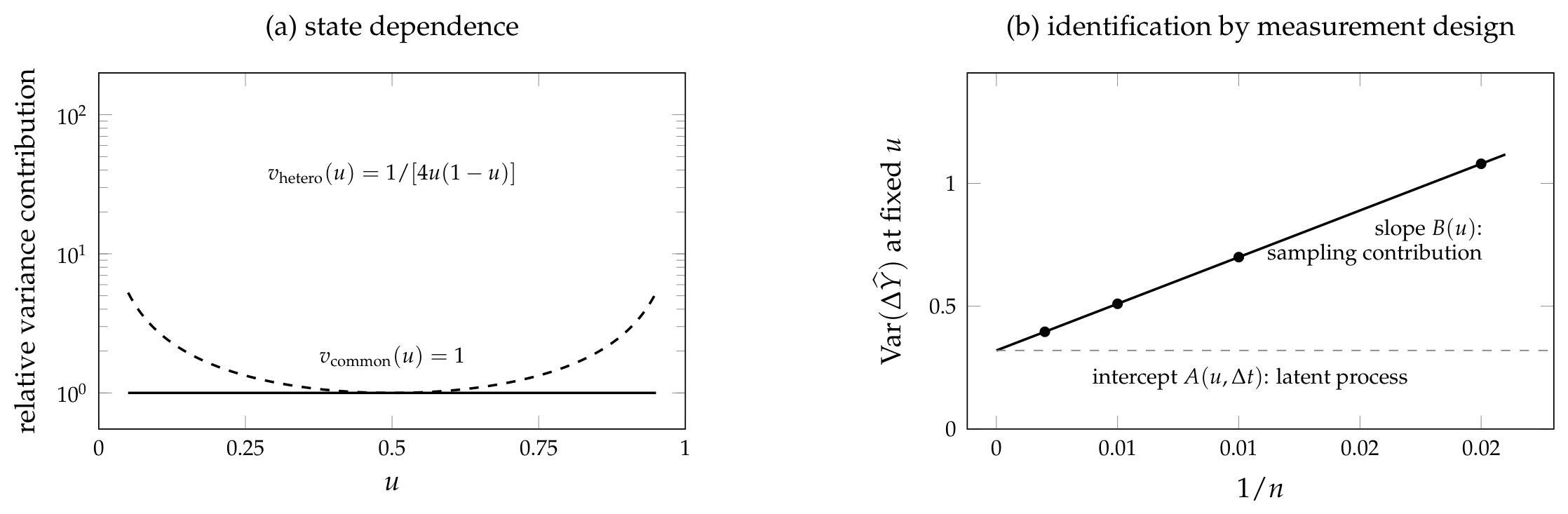
Table 3.
Claim status in the worked cross-scale case study of Section 4, Section 5 and Section 6. The distinction between a derivation, a re-derivation on a different microscopic architecture, a closure assumption, a modelling choice and a sociological interpretation is applied throughout and is not left to the reader.
Table 3.
Claim status in the worked cross-scale case study of Section 4, Section 5 and Section 6. The distinction between a derivation, a re-derivation on a different microscopic architecture, a closure assumption, a modelling choice and a sociological interpretation is applied throughout and is not left to the reader.
| Statement | Status |
|---|---|
| State is the probability of adopting a specified assertion | semantic choice, not a derivation |
| Separation of fast local equilibration from slow global evolution | time-scale assumption |
| Effective influence resolvent and its Neumann path expansion | derived when the propagation operator is non-negative with spectral radius below one |
| Matrix logistic form of the global dynamics | derived under the stated closure |
| Finite mean learning time | derived for the specified uncorrelated regime and normalized adoption distribution; not universal |
| Structural limit on persuasion of order | derived for the homogeneous fully connected group; not established for arbitrary graphs |
| Network model to continuum equation | derived |
| Spectral pinning, travelling waves, curvature-induced quenching | derived under the stated coefficient structures and geometry |
| Hierarchical continuum structure from a directed acyclic architecture | independently re-derived, not inherited from the spatial model |
| Non-conservation identity | derived for , constant D and homogeneous Neumann conditions only |
| Multiplicative amplitude | explicit stochastic closure, not a microscopic fluctuation limit |
| Cubic effective drift and formal double-well potential | algebraic consequence of the closure |
| Two coordinate-invariant stationary phases of the local equation | not established |
| Interior zero-flux profile | formally derived; not normalizable for any |
| Endpoints as absorbing states | only under an imposed boundary extension |
| Endpoints reachable from the interior in finite time | false; they are natural boundaries |
| Logit map giving Brownian motion with drift | exact for the uncoupled single layer |
| Logit map linearizing the depth-coupled equation | false |
| Kramers switching in the exact one-layer model | not established |
| Splitting probabilities and passage times with | classical results applied after the exact linearization |
| Operational thresholds | modelling or normative choice |
| Threshold crossing as institutional breakdown | conditional sociological interpretation |
| Reorientation from a trust-supporting to a delegitimating assertion | semantic reinterpretation, not a derivation |
| Survey series confirming the model | no; they illustrate the coordinate and a persistent separation and do not estimate r or |
The open problem is to derive rather than postulate the stochastic closure: to obtain a hybrid macroscopic limit for hierarchical belief adoption with both idiosyncratic revision noise and layer-common informational shocks, specifying the microscopic channel through which the common shock enters, determining when that channel yields the Stratonovich amplitude , characterizing the scaling regimes in which common, demographic or mixed noise survives, and identifying which microscopic observations estimate the two components separately.
7. Identification, Calibration, and Validation
The open problems of the preceding sections are all identification problems. This section collects them and states what distinguishes fit from identification.
7.1. What Is Being Identified
Identification of a parameter, of a latent state, of a social mechanism and of a state semantics are different tasks, and predictive validation is a fifth. Fit is not identification, and parameter identification is not mechanism identification.
7.2. Endogenous Social Effects and Network Confounding
The reflection problem shows that when the mean behaviour of a group and individual behaviour determine one another, endogenous social effects cannot be separated from contextual and correlated effects without additional information about reference groups and covariates [462,463]. In observational network data, influence, latent homophily and direct effects of individual characteristics are generically confounded, so asymmetries in regression coefficients do not identify influence [94]. The literature is not confined to impossibility results: particular network structures and instruments can restore identification under additional structural conditions [464], the endogeneity of the network itself can be modelled [465], sensitivity analysis bounds contagion effects under unmeasured homophily [466,467,468], and the design problems of peer-effect estimation have been catalogued [469]. Observational studies of behavioural spread illustrate both the promise and the difficulty [470,471].
Figure 6.
From mechanism to data. Each arrow of the upper chain is a modelling commitment; each dashed arrow marks a place where distinct mechanisms can become observationally equivalent. A model is empirically specified only when the latent state, the transition law, the observation operator and the source of identifying variation are stated jointly.
Figure 6.
From mechanism to data. Each arrow of the upper chain is a modelling commitment; each dashed arrow marks a place where distinct mechanisms can become observationally equivalent. A model is empirically specified only when the latent state, the transition law, the observation operator and the source of identifying variation are stated jointly.

7.3. Aggregation, Closure, and Observation Operators
Equation (21) states the exact closure error of the mean: aggregation failure is not a generic consequence of heterogeneity but is governed by the covariance between latent state and effective transition pressure. The averaging operator removes all zero-sum directions, and Proposition 3 shows that the information lost under this projection re-enters the mean equation through variance and covariance terms; the existence of a kernel does not by itself yield the correction. The sign of the residual measures whether influence is assortatively concentrated on already receptive actors or directed toward less receptive ones; network clustering is one possible source of positive covariance but does not determine its sign by itself, and the residual is state-dependent, so it may vanish on a heterogeneous graph for particular states.
Proposition 3
(Exact closure error of the mean). Let with , and let and denote the unweighted means. Then exactly. If this reduces to .
Proof.
Averaging the coordinates gives , and by the definition of the covariance. The scalar case follows from . □
Proposition 4
(Two residuals relative to a logistic comparator). For any constant c, . If moreover and , then and , so both residuals are covariances and both vanish when s is uniform.
Proof.
The first identity is Proposition 3 with subtracted from both sides. For the rank-one case all pressures are equal to , whence the covariance vanishes; and while . □
Proposition 5
(Rank-one closure is two-dimensional and solvable). Under with and , the pair obeys the closed system , , with solution
The mean is not autonomous and is in general not logistic; scalar logistic dynamics for m follow only when , in which case .
Proof.
Since for all i, averaging gives , while . The logistic equation for h integrates to the stated expression; and together with gives , whence the formula for . Degenerate cases are excluded by the hypotheses: gives and , and with forces . □
Proposition 6
(Attenuation of the inferred growth rate). In the scalar case, the instantaneous rate obtained by fitting a homogeneous logistic law to the aggregate slope is , and since for states in the unit interval, whenever , with equality only under internal homogeneity.
Proof.
Immediate from Proposition 3; the variance bound is the statement that for . □
Proposition 6 concerns the pointwise slope. A global nonlinear fit need not exhibit a universally quantifiable downward bias, because its result also depends on initial conditions, observation error, sampling times, parameter heterogeneity and the fitting criterion. Extending the argument to Bass-type diffusion requires a separate derivation, since innovation rates, imitation rates, states and network exposure may all be correlated [389].
Three data regimes follow. When individual probabilities and pressures are identified, the covariance is computed and no closure is needed. When the mean, the mean pressure and within-group second moments are available, the Cauchy–Schwarz inequality bounds the instantaneous slope, ; trajectory bounds additionally require bounds on the unobserved moments and a comparison argument. When only an aggregate survey proportion is available, the residual is not identified and either structural restrictions or worst-case bounds are needed [260,261]. A sequence of binary responses from one respondent is not a trajectory of an individual probability; recovering the latter still requires a response model.
Figure 7.
The aggregation result of Propositions 3 and 6. (a) The normalized slope of the population mean, , written as with : cross-sectional heterogeneity lowers the aggregate slope at every m without changing its shape. (b) The instantaneous growth rate inferred by fitting a homogeneous logistic law to the aggregate, , which is attenuated for every heterogeneous population and equals r only under internal homogeneity.
Figure 7.
The aggregation result of Propositions 3 and 6. (a) The normalized slope of the population mean, , written as with : cross-sectional heterogeneity lowers the aggregate slope at every m without changing its shape. (b) The instantaneous growth rate inferred by fitting a homogeneous logistic law to the aggregate, , which is attenuated for every heterogeneous population and equals r only under internal homogeneity.
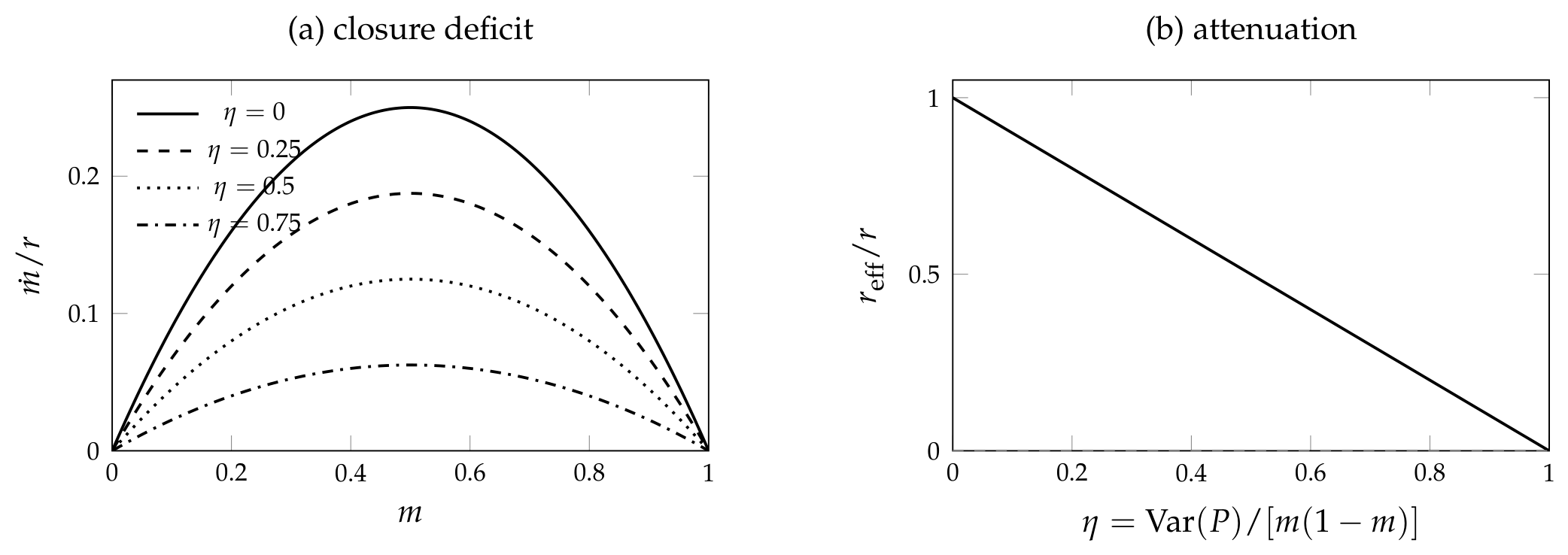
7.4. Separating Mechanisms in Dynamic Models
Three kinds of non-identification recur, and they call for different remedies. Structural mechanism confounding places several mechanisms inside one latent transition law: duration dependence, frailty and vacancy supply in mobility; recognition, competition and cohort history in organizational ecology; homophily, influence and common environment in networks. It is addressed with covariates, event histories, interventions and exclusion restrictions. State–observation confounding places the ambiguity between the latent dynamics and the observation operator: adoption probability against survey response, private belief against public expression, common process noise against survey sampling error, distinct state semantics generating one aggregate series. It can be addressed only by changing the measurement design. Simulator and implementation uncertainty covers parameter equifinality, algorithmic sensitivity, coding errors, undocumented rules, version drift and prompt sensitivity, and requires replication protocols, sensitivity analysis and out-of-sample validation.
7.5. Scale, Sample Size, and the Limits of Data-Intensive Inference
The preceding subsections have a consequence for research design that is worth stating separately, because it is often assumed rather than argued. Estimation error and identification are different problems, and only the first is a function of sample size.
Corollary 3
(Scale does not resolve indistinguishability). Let and satisfy the hypotheses of Theorem 1(ii) on A, that is there and projectable through O, and suppose the data consist of n independent replications of the same observation operator O under the same design. Then the induced distributions of the observed data coincide for every n. Consequently no estimator based on those data can be consistent for the distinction between the two mechanisms: as n grows, inference converges to the observational equivalence class of Definition 3, not to a point within it.
Proof.
By Theorem 1(ii) the two models induce the same observed path, hence the same law of a single observation under the design. Independent replication yields the product of identical marginals, so the two likelihoods coincide identically in the data, for every n. Any function of the data therefore has the same distribution under both models, which excludes consistency for a functional separating them. □
This is the geometric form of a principle familiar in econometrics: what is not identified is not estimated, and no amount of data repairs a rank deficiency [260,261,462,463]. Its sociological content is that the recurring difficulties collected in Section 8 are not consequences of small samples. Duration dependence against frailty in careers, recognition against competition in organizational populations, influence against latent homophily in networks, latent belief against expressed position in surveys, and process noise against measurement error in trust series are all kernel problems. Each of them survives an arbitrary increase in the number of respondents, organizations or observed ties, provided the additional records pass through the same observation operator.
It does not follow that data-intensive research is unproductive, and the inference sometimes drawn from such arguments, that quantitative sociology should retreat to small designs, does not follow either. Scale buys several things that matter. It reduces sampling variance, which in the setting of Section 6.7 is what makes the residual, after correction for measurement error, informative at all. It permits estimation of heterogeneity rather than of a population average, and heterogeneity is precisely the quantity whose omission generates the closure error of Proposition 3. It makes rare events, such as threshold crossings or organizational foundings in small populations, statistically accessible. And it supports designs with many weak instruments where no strong one exists.
The decisive contribution of scale, however, is of a different kind. Large digital records are typically not more replications of one operator but records generated by several operators at once: a stated preference, an observed behaviour, a timed interaction, a network tie, a location, a repeated measurement of the same item. By Corollary 2, what matters is the intersection , and adding a genuinely new operator can shrink it, whereas adding rows to a table generated by one operator cannot. The useful notion of scale for mechanism identification is therefore the number of distinct observation operators and interventions, not the number of records. Stated as a design rule: a marginal unit of research effort is better spent on a new operator, an intervention or a restriction of the admissible model class than on further replication of an existing measurement.
Read this way, the position of large-scale data in sociology and psychology is not a puzzle. Such data are in fact used extensively, and the programmatic statements of computational social science anticipated much of what followed [17,18,19]. What is striking is where the returns have accumulated: in description, prediction and the documentation of regularities such as the differential spread of true and false information [390,391,392], rather than in the separation of mechanisms that were already contested before the data arrived. The identification results of the network literature give the reason directly: influence and latent homophily remain confounded in observational data of any size [94], and the constructive responses proceed by adding structure, instruments or interventions rather than by adding observations [464,465,466,467,470]. The same asymmetry appears in the assessment of survey-based opinion models, where the reported obstacle is a mismatch between modelled state and measured quantity rather than a shortage of respondents [348], and in the evaluation of synthetic respondents, where matching a first moment leaves the joint behavioural generator unidentified [472].
Three qualifications keep the argument from proving too much. Corollary 3 is a statement about a fixed observation operator on a fixed design: it does not apply when scale changes the design, which is the usual and desirable case. It concerns exact indistinguishability, whereas in practice mechanisms often differ by a vector that is nearly, but not exactly, in the kernel; there scale does help, since the relevant quantity is the ratio of the transverse component to the estimation error, and increasing n improves that ratio while the identification problem becomes one of weak rather than absent identification. And the corollary says nothing against prediction: a model may be an excellent predictor of an observable while remaining silent about the mechanism, which is why predictive validation and mechanism validation are listed separately in Section 7.6 and why successful fit supports at most an observational representation [473].
7.6. Calibration, Falsification, and Generative Agents
Agreement with observations cannot verify a model of an open social system as true; this epistemic limitation does not preclude software verification, replication, internal-consistency tests or comparative empirical validation, but it limits the strength of the conclusion that may be drawn from a successful fit [473]. Standards for describing agent-based models were introduced precisely to make replication possible [474,475], and the validation literature distinguishes calibration from empirical validation [27,476,477].
Large language models introduce a new behavioural generator rather than a new model class. Synthetic samples can reproduce aspects of human response distributions and replicate some experimental findings [478,479], and generative agents can produce plausible interaction traces and large-scale social simulations [480,481,482,483]. The validity question is nevertheless sharp: matching a first moment does not validate a joint behavioural generator. Synthetic responses may approximate survey means while showing insufficient variance, regression relationships that diverge from human data, and sensitivity to prompt wording and to the date of execution [472]. A protocol for such simulations should extend the logic of standardized model description by documenting the behavioural generator, prompts, execution environment, sampling rules, tools and output processing; such documentation is necessary for scientific replication but may remain insufficient for exact computational reproduction when the underlying model and serving infrastructure are proprietary or mutable.
A mathematical sociology model is empirically specified only when four objects are jointly stated: the latent social state, its transition law, the observation operator, and the source of identifying variation. Without all four, successful curve fitting identifies at most an observational representation, not the social mechanism.
8. Synthesis and Open Problems
Five problems recur across the families and sections above.
One observable, several mechanisms. A mobility hazard confounds duration dependence, frailty and vacancy supply; organizational density indexes both form recognition and competition; a survey proportion mixes latent dynamics, expression and response generation; the variance of logit increments mixes common noise, demographic noise and measurement error. Theorem 1 states the common structure: the invisible part of a mechanism is exactly the part lying in the kernel of the differential of the observation operator. Mechanism identification, rather than parameter estimation, is therefore the recurrent technical bottleneck of formal sociology, and by Corollary 3 it is a bottleneck that sample size does not relieve. Progress requires additional operators, interventions or restrictions on the admissible model class, which is a statement about research design rather than about data volume.
State semantics is part of the model. The same numerical interval may denote a bounded opinion coordinate, a frequency of a discrete state, an assertion-adoption probability, an expressed position or a transformed latent coordinate. Agreement of equations or of trajectories is therefore not agreement of social objects.
Aggregation creates new terms. Macroscopic equations are not obtained by replacing individual states with their mean. Aggregation generates covariance, moment and opportunity terms whose omission changes both dynamics and interpretation, as Proposition 3 and Proposition 4 make explicit.
Thresholds live at different levels. A threshold of public revelation and a threshold of behavioural activation are properties of actors and belong to the microscopic specification. A propagation barrier is a structural property of a field and is not a threshold of any actor. An operational first-passage threshold is a cut on an observable chosen by the analyst. Conflating these levels is the error the distinction is designed to prevent.
Exactness is scale-specific. The network-to-continuum transition requires scaling; the one-layer logit transformation does not linearize the coupled equation; rank-one aggregation yields an exact two-variable but not generally a scalar reduction; the geometry of first passage depends on the correlation regime of the noise; and agreement of a language model with aggregate human responses does not identify a human behavioural mechanism. An exact result at one level of description does not automatically survive aggregation, spatial coupling, stochastic closure or measurement.
Taken together these suggest a four-part criterion for empirical specification: a latent social state, a transition law, an observation operator and a source of identifying variation. Omitting the first leaves it unclear what the variable means; omitting the second makes dynamics indistinguishable from static association; omitting the third compares the model with something other than what the data measure; omitting the fourth leaves competing mechanisms unseparated.
Figure 8.
One observable, several mechanisms. In each panel a single endogenous quantity is generated by mechanisms that are substantively distinct and are not separated by the observable alone. Mechanism identification, rather than parameter estimation, is the recurrent bottleneck.
Figure 8.
One observable, several mechanisms. In each panel a single endogenous quantity is generated by mechanisms that are substantively distinct and are not separated by the observable alone. Mechanism identification, rather than parameter estimation, is the recurrent bottleneck.
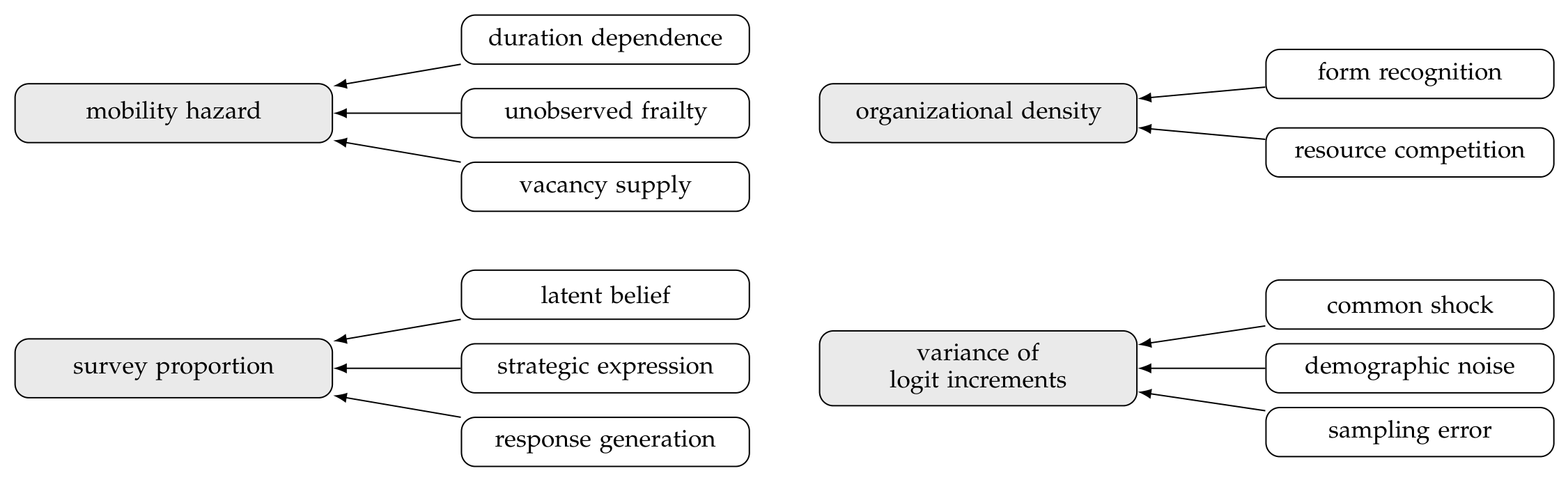
Table 4.
Latent state, transition law and observation for the principal programmes surveyed.
| Programme | Latent state | Transition law | Observation |
|---|---|---|---|
| Exchange networks | Division of a pool; positional leverage | Negotiation or bargaining protocol on a matching | Experimental payoffs |
| Expectation states | Expectation advantage | Signed path aggregation | Influence rejection rate |
| Status construction | Prevalence of a status belief | Diffusion and loss over encounters | Belief surveys and experiments |
| Mobility and careers | Position occupancy; latent mobility class | Semi-Markov transitions under an opportunity constraint | Transition hazards; mobility tables |
| Organizational ecology | Form recognition; resource congestion | Founding counting process; organization-specific hazard | Density; founding and failure counts |
| Institutional diffusion | Adoption of a practice | Coercive, mimetic, normative channels | Adoption dates and rates |
| Social influence | Assertion-adoption probability | Matrix logistic dynamics | Aggregate survey proportion |
| Institutional trust | Layer-level adoption of a delegitimating assertion | Degenerate diffusion with multiplicative noise | Repeated survey items in logit form |
Table 5.
The identifying variation still missing: what remains unseparated for each programme when only the usual observable is available.
Table 5.
The identifying variation still missing: what remains unseparated for each programme when only the usual observable is available.
| Programme | Open identification problem |
|---|---|
| Exchange networks | Agreement of dependence, exclusion, core and balanced orderings across graph classes |
| Expectation states | Conditions under which the aggregation rule agrees with posterior log-odds |
| Status construction | Origin of the initial prevalence asymmetry |
| Mobility and careers | Duration dependence against frailty against vacancy supply |
| Organizational ecology | Recognition against competition under a single density index |
| Institutional diffusion | Efficiency against legitimacy against decoupling |
| Social influence | Which state semantics generated the observed series |
| Institutional trust | Common shock against demographic noise against sampling error |
The research agenda follows in five programs. Joint latent-process identification separates mechanisms entering one intensity or one rate. Micro-to-macro closure derives state–pressure covariances, moment hierarchies, stochastic closures and reaction classes from microscopic protocols. Semantics under observation characterizes classes of observational equivalence for state models and response operators. Initiation-to-propagation derivation obtains the chain from microscopic protocol to macroscopic operator to reaction class to propagation regime. Validation of computational social agents distinguishes replication, calibration, predictive validation and mechanism validation for agent-based and language-model agents. Each is formulated in terms of explicit derivations, observable distinctions, identifying restrictions and counterexamples, which makes the proposed problems resolvable in principle and makes the cumulative structure of the field more explicit.
9. Conclusions
This survey has connected the classical programmes of formal sociology, namely exchange and power, status and identity, mobility and social reproduction, and organizations and institutional form, with contemporary models of influence, propagation, trust and computational validation. The comparison was conducted along a single template, written in (3): unit of analysis, state space and its social semantics, structure, transition law, observation operator, parameters and source of identifying variation. Four notions of sameness were distinguished, and most of the confusions examined here are failures to keep them apart.
Three limitations of the design should be stated. First, the four programmes reconstructed in Section 3 do not exhaust mathematical sociology. Formal demography and kinship, social choice and collective decision, network exchange in markets, cultural evolution and macrohistorical dynamics all have formal literatures that appear here only where they intersect the four programmes. The selection follows the inclusion rule of Section 2.1 and the requirement that a family be reconstructible role by role, not a judgement about relative importance. Second, the depth of Section 4, Section 5 and Section 6 is deliberately asymmetric with respect to Section 3: those sections are a worked cross-scale case study, chosen because the same template can be followed there from a discrete adoption rule to an observable crossing event without a break in the derivation, and not a claim that influence and trust are more central than exchange or mobility. Third, what is offered is a comparative scheme rather than an empirical theory. The scheme says what a model must state in order to be testable and where two models can be told apart; it does not by itself predict any social outcome, and the propositions collected in Section 7 are analytical devices for comparison rather than substantive results about societies.
The principal mathematical difficulty is often not the absence of a tractable equation, but the mapping among a social mechanism, the state variable chosen to represent it, the scale at which the equation is valid, and the observations used to evaluate it. Equations that are identical in form may represent different social objects, whereas one social mechanism may generate different macroscopic laws under different updating, aggregation and measurement procedures. This is why the survey has insisted on claim status: a derivation, a re-derivation on a different microscopic architecture, a closure assumption, a modelling choice and a sociological interpretation carry different evidential weight, and Table 3 shows what is at stake when they are conflated.
One consequence deserves emphasis because it cuts against a common expectation. Since indistinguishability is a property of kernels, replicating a measurement does not resolve it: an arbitrarily large sample drawn through one observation operator leaves the observational equivalence class exactly where it was. The value of large-scale social data for mechanism identification lies in the plurality of operators such data make available, not in their volume, and the same holds for interventions. This reading explains, without any appeal to disciplinary conservatism, why the returns to data-intensive social research have accumulated in description and prediction rather than in the separation of mechanisms that were contested beforehand.
Of the open problems formulated above, three seem to us the most consequential and the most nearly tractable. The first is the separation of mechanisms that share a single endogenous observable, in the concrete forms of duration dependence against frailty against opportunity supply in careers, and of form recognition against resource competition in organizational populations; both have the structure of a joint counting-process identification problem, and both have identifiable candidate sources of exogenous variation. The second is the derivation, rather than the postulation, of stochastic closures for belief dynamics, together with the scaling regimes in which a layer-common informational shock dominates idiosyncratic revision noise; here the observable consequence is sharp, since the two channels differ in the heteroscedasticity of log-odds increments once measurement error has been removed. The third is the characterization of observational equivalence classes for state semantics under explicit response and sampling operators, which determines whether the distinctions drawn in Section 4.5 can be settled with data rather than by stipulation.
The agenda proposed here is formulated in terms of explicit derivations, observable distinctions, identifying restrictions and counterexamples. These requirements make the proposed problems resolvable in principle and strengthen the cumulative development of mathematical sociology by allowing models to be compared through shared claims, data requirements and failure conditions.
Funding
This research received no external funding.
Data Availability Statement
No empirical social data were created or analyzed in this study. The coded bibliographic corpus, its classification fields and its verification record, all created for this survey, are available from the author on request.
Conflicts of Interest
The author declares no conflict of interest.
References
- Rashevsky, N. Mathematical Theory of Human Relations: An Approach to a Mathematical Biology of Social Phenomena; Principia Press: Bloomington, IN, 1947. [Google Scholar]
- Simon, H.A. A Formal Theory of Interaction in Social Groups. Am. Sociol. Rev. 1952, 17, 202–211. [Google Scholar] [CrossRef]
- Coleman, J.S. Introduction to Mathematical Sociology; Free Press of Glencoe: New York, 1964. [Google Scholar]
- Coleman, J.S. Foundations of Social Theory; Harvard University Press: Cambridge, MA, 1990. [Google Scholar]
- Fararo, T.J. Mathematical Sociology: An Introduction to Fundamentals; Wiley: New York, 1973. [Google Scholar]
- Fararo, T.J. The Meaning of General Theoretical Sociology: Tradition and Formalization; Cambridge University Press: Cambridge, 1989. [Google Scholar]
- Fararo, T.J. Reflections on Mathematical Sociology. Sociol. Forum 1997, 12, 73–101. [Google Scholar]
- White, H.C. Chains of Opportunity: System Models of Mobility in Organizations; Harvard University Press: Cambridge, MA, 1970. [Google Scholar] [CrossRef]
- White, H.C. Identity and Control: How Social Formations Emerge, 2 ed.; Princeton University Press: Princeton, 2008. [Google Scholar]
- Hedstrøm, P. Dissecting the Social: On the Principles of Analytical Sociology; Cambridge University Press: Cambridge, 2005. [Google Scholar]
- Hedstrøm, P.; Bearman, P. (Eds.) The Oxford Handbook of Analytical Sociology; Oxford University Press: Oxford, 2009. [Google Scholar]
- Coleman, J.S.; Katz, E.; Menzel, H. The Diffusion of an Innovation Among Physicians. Sociometry 1957, 20, 253–270. [Google Scholar] [CrossRef] [PubMed]
- Castellano, C.; Fortunato, S.; Loreto, V. Statistical Physics of Social Dynamics. Rev. Mod. Phys. 2009, 81, 591–646. [Google Scholar] [CrossRef]
- Galam, S. Sociophysics: A Review of Galam Models. Int. J. Mod. Phys. C 2008, 19, 409–440. [Google Scholar] [CrossRef]
- Jusup, M.; Holme, P.; Kanazawa, K.; Takayasu, M.; Romić, I.; Wang, Z.; Gecek, S.; Lipic, T.; Podobnik, B.; Wang, L.; et al. Social Physics. Phys. Rep. 2022, 948, 1–148. [Google Scholar] [CrossRef]
- Perc, M.; Jordan, J.J.; Rand, D.G.; Wang, Z.; Boccaletti, S.; Szolnoki, A. Statistical Physics of Human Cooperation. Phys. Rep. 2017, 687, 1–51. [Google Scholar] [CrossRef]
- Macy, M.W.; Willer, R. From Factors to Actors: Computational Sociology and Agent-Based Modeling. Annu. Rev. Sociol. 2002, 28, 143–166. [Google Scholar] [CrossRef]
- Lazer, D.; Pentland, A.; Adamic, L.; Aral, S.; Barabási, A.L.; Brewer, D.; Christakis, N.; Contractor, N.; Fowler, J.; Gutmann, M.; et al. Computational Social Science. Science 2009, 323, 721–723. [Google Scholar] [CrossRef] [PubMed]
- Lazer, D.M.J.; Pentland, A.; Watts, D.J.; Aral, S.; Athey, S.; Contractor, N.; Freelon, D.; González-Bailón, S.; King, G.; Margetts, H.; et al. Computational Social Science: Obstacles and Opportunities. Science 2020, 369, 1060–1062. [Google Scholar] [CrossRef] [PubMed]
- Proskurnikov, A.V.; Tempo, R. A Tutorial on Modeling and Analysis of Dynamic Social Networks. Part I. Annu. Rev. Control 2017, 43, 65–79. [Google Scholar] [CrossRef]
- Proskurnikov, A.V.; Tempo, R. A Tutorial on Modeling and Analysis of Dynamic Social Networks. Part II. Annu. Rev. Control 2018, 45, 166–190. [Google Scholar] [CrossRef]
- Edling, C.R. Mathematics in Sociology. Annu. Rev. Sociol. 2002, 28, 197–220. [Google Scholar] [CrossRef]
- Sørensen, A.B. Mathematical Models in Sociology. Annu. Rev. Sociol. 1978, 4, 345–371. [Google Scholar] [CrossRef]
- Freese, L. Formal Theorizing. Annu. Rev. Sociol. 1980, 6, 187–212. [Google Scholar]
- Vitanov, K.N.; Vitanov, N.K. Mathematical Social Dynamics: Traditional and New Areas of Research. AppliedMath 2026, 6, 90. [Google Scholar] [CrossRef]
- Peralta, A.F.; Kertész, J.; Iñiguez, G. Opinion Dynamics in Social Networks: From Models to Data. arXiv 2022, arXiv:2201.01322. [Google Scholar] [CrossRef]
- Flache, A.; Mäs, M.; Feliciani, T.; Chattoe-Brown, E.; Deffuant, G.; Huet, S.; Lorenz, J. Models of Social Influence: Towards the Next Frontiers. J. Artif. Soc. Soc. Simul. 2017, 20, 2. [Google Scholar] [CrossRef]
- Bernardo, C.; Altafini, C.; Proskurnikov, A.V.; Vasca, F. Bounded Confidence Opinion Dynamics: A Survey. Automatica 2024, 159, 111302. [Google Scholar] [CrossRef]
- Jędrzejewski, A.; Sznajd-Weron, K. Statistical Physics of Opinion Formation: Is It a SPOOF? Comptes Rendus Phys. 2019, 20, 244–261. [Google Scholar] [CrossRef]
- Noorazar, H. Recent Advances in Opinion Propagation Dynamics: A 2020 Survey. Eur. Phys. J. Plus 2020, 135, 521. [Google Scholar] [CrossRef]
- Lorenz, J. Continuous Opinion Dynamics under Bounded Confidence: A Survey. Int. J. Mod. Phys. C 2007, 18, 1819–1838. [Google Scholar] [CrossRef]
- Xia, H.; Wang, H.; Xuan, Z. Opinion Dynamics: A Multidisciplinary Review and Perspective on Future Research. Int. J. Knowl. Syst. Sci. 2011, 2, 72–91. [Google Scholar] [CrossRef]
- Olsson, H.; Galesic, M. Analogies for Modeling Belief Dynamics. Trends Cogn. Sci. 2024, 28, 907–923. [Google Scholar] [CrossRef] [PubMed]
- Volchenkov, D. Mathematical Frameworks for Network Dynamics: A Six-Pillar Survey for Analysis, Control, and Inference. Mathematics 2025, 13, 2116. [Google Scholar] [CrossRef]
- Baum, J.A.C.; Oliver, C. Institutional Embeddedness and the Dynamics of Organizational Populations. Am. Sociol. Rev. 1992, 57, 540–559. [Google Scholar] [CrossRef]
- Petersen, T.; Koput, K.W. Density Dependence in Organizational Mortality: Legitimacy or Unobserved Heterogeneity? Am. Sociol. Rev. 1991, 56, 399–409. [Google Scholar] [CrossRef]
- Hannan, M.T.; Barron, D.N.; Carroll, G.R. On the Interpretation of Density Dependence in Rates of Organizational Mortality: A Reply to Petersen and Koput. Am. Sociol. Rev. 1991, 56, 410–415. [Google Scholar] [CrossRef]
- Moreno, J.L. Who Shall Survive? A New Approach to the Problem of Human Interrelations; Nervous and Mental Disease Publishing: Washington, DC, 1934. [Google Scholar]
- Heider, F. Attitudes and Cognitive Organization. J. Psychol. 1946, 21, 107–112. [Google Scholar] [CrossRef] [PubMed]
- Cartwright, D.; Harary, F. Structural Balance: A Generalization of Heider’s Theory. Psychol. Rev. 1956, 63, 277–293. [Google Scholar] [CrossRef] [PubMed]
- Holland, P.W.; Leinhardt, S. Transitivity in Structural Models of Small Groups. Comp. Group Stud. 1971, 2, 107–124. [Google Scholar] [CrossRef]
- Granovetter, M.S. The Strength of Weak Ties. Am. J. Sociol. 1973, 78, 1360–1380. [Google Scholar] [CrossRef] [PubMed]
- McPherson, M.; Smith-Lovin, L.; Cook, J.M. Birds of a Feather: Homophily in Social Networks. Annu. Rev. Sociol. 2001, 27, 415–444. [Google Scholar] [CrossRef]
- Watts, D.J.; Strogatz, S.H. Collective Dynamics of Small-World Networks. Nature 1998, 393, 440–442. [Google Scholar] [CrossRef] [PubMed]
- Barabási, A.L.; Albert, R. Emergence of Scaling in Random Networks. Science 1999, 286, 509–512. [Google Scholar] [CrossRef] [PubMed]
- Burt, R.S. Structural Holes: The Social Structure of Competition; Harvard University Press: Cambridge, MA, 1992. [Google Scholar]
- Freeman, L.C. A Set of Measures of Centrality Based on Betweenness. Sociometry 1977, 40, 35–41. [Google Scholar] [CrossRef]
- Freeman, L.C. Centrality in Social Networks: Conceptual Clarification. Soc. Netw. 1979, 1, 215–239. [Google Scholar] [CrossRef]
- Bonacich, P. Power and Centrality: A Family of Measures. Am. J. Sociol. 1987, 92, 1170–1182. [Google Scholar] [CrossRef] [PubMed]
- Brin, S.; Page, L. The Anatomy of a Large-Scale Hypertextual Web Search Engine. Comput. Netw. ISDN Syst. 1998, 30, 107–117. [Google Scholar] [CrossRef]
- Newman, M.E.J. Networks, 2 ed.; Oxford University Press: Oxford, 2018. [Google Scholar]
- Lorrain, F.; White, H.C. Structural Equivalence of Individuals in Social Networks. J. Math. Sociol. 1971, 1, 49–80. [Google Scholar] [CrossRef]
- White, H.C.; Boorman, S.A.; Breiger, R.L. Social Structure from Multiple Networks. I. Blockmodels of Roles and Positions. Am. J. Sociol. 1976, 81, 730–780. [Google Scholar] [CrossRef]
- Boorman, S.A.; White, H.C. Social Structure from Multiple Networks. II. Role Structures. Am. J. Sociol. 1976, 81, 1384–1446. [Google Scholar] [CrossRef]
- Borgatti, S.P.; Everett, M.G. Models of Core/Periphery Structures. Soc. Netw. 1999, 21, 375–395. [Google Scholar] [CrossRef]
- Holland, P.W.; Leinhardt, S. An Exponential Family of Probability Distributions for Directed Graphs. J. Am. Stat. Assoc. 1981, 76, 33–50. [Google Scholar] [CrossRef]
- Frank, O.; Strauss, D. Markov Graphs. J. Am. Stat. Assoc. 1986, 81, 832–842. [Google Scholar] [CrossRef]
- Snijders, T.A.B. Statistical Models for Social Networks. Annu. Rev. Sociol. 2011, 37, 131–153. [Google Scholar] [CrossRef]
- Schweinberger, M. Instability, Sensitivity, and Degeneracy of Discrete Exponential Families. J. Am. Stat. Assoc. 2011, 106, 1361–1370. [Google Scholar] [CrossRef] [PubMed]
- Chatterjee, S.; Diaconis, P. Estimating and Understanding Exponential Random Graph Models. Ann. Stat. 2013, 41, 2428–2461. [Google Scholar] [CrossRef]
- Schweinberger, M.; Krivitsky, P.N.; Butts, C.T.; Stewart, J.R. Exponential-Family Models of Random Graphs: Inference in Finite-, Super-, and Infinite-Population Scenarios. Stat. Sci. 2020, 35, 627–662. [Google Scholar] [CrossRef]
- Holland, P.W.; Laskey, K.B.; Leinhardt, S. Stochastic Blockmodels: First Steps. Soc. Netw. 1983, 5, 109–137. [Google Scholar] [CrossRef]
- Airoldi, E.M.; Blei, D.M.; Fienberg, S.E.; Xing, E.P. Mixed Membership Stochastic Blockmodels. J. Mach. Learn. Res. 2008, 9, 1981–2014. [Google Scholar] [PubMed]
- Karrer, B.; Newman, M.E.J. Stochastic Blockmodels and Community Structure in Networks. Phys. Rev. E 2011, 83, 016107. [Google Scholar] [CrossRef] [PubMed]
- Peixoto, T.P. Hierarchical Block Structures and High-Resolution Model Selection in Large Networks. Phys. Rev. X 2014, 4, 011047. [Google Scholar] [CrossRef]
- Decelle, A.; Krzakala, F.; Moore, C.; Zdeborová, L. Inference and Phase Transitions in the Detection of Modules in Sparse Networks. Phys. Rev. Lett. 2011, 107, 065701. [Google Scholar] [CrossRef] [PubMed]
- Abbe, E. Community Detection and Stochastic Block Models: Recent Developments. J. Mach. Learn. Res. 2018, 18, 1–86. [Google Scholar] [CrossRef]
- Hoff, P.D.; Raftery, A.E.; Handcock, M.S. Latent Space Approaches to Social Network Analysis. J. Am. Stat. Assoc. 2002, 97, 1090–1098. [Google Scholar] [CrossRef]
- Handcock, M.S.; Raftery, A.E.; Tantrum, J.M. Model-Based Clustering for Social Networks. J. R. Stat. Soc. Ser. A (Statistics in Society) 2007, 170, 301–354. [Google Scholar] [CrossRef]
- Durante, D.; Dunson, D.B. Nonparametric Bayes Dynamic Modelling of Relational Data. Biometrika 2014, 101, 883–898. [Google Scholar] [CrossRef]
- Artico, I.; Wit, E.C. Dynamic Latent Space Relational Event Model. J. R. Stat. Soc. Ser. A Stat. Soc. 2023, 186, 508–529. [Google Scholar] [CrossRef]
- Lovász, L. Large Networks and Graph Limits; American Mathematical Society Colloquium Publications; American Mathematical Society: Providence, RI, 2012; Vol. 60. [Google Scholar]
- Orbanz, P.; Roy, D.M. Bayesian Models of Graphs, Arrays and Other Exchangeable Random Structures. IEEE Trans. Pattern Anal. Mach. Intell. 2015, 37, 437–461. [Google Scholar] [CrossRef] [PubMed]
- Borgs, C.; Chayes, J.T.; Cohn, H.; Holden, N. Sparse Exchangeable Graphs and Their Limits via Graphon Processes. J. Mach. Learn. Res. 2018, 18, 1–71. [Google Scholar]
- Battiston, F.; Cencetti, G.; Iacopini, I.; Latora, V.; Lucas, M.; Patania, A.; Young, J.G.; Petri, G. Networks beyond Pairwise Interactions: Structure and Dynamics. Phys. Rep. 2020, 874, 1–92. [Google Scholar] [CrossRef]
- Battiston, F.; Amico, E.; Barrat, A.; Bianconi, G.; Ferraz de Arruda, G.; Franceschiello, B.; Iacopini, I.; Kéfi, S.; Latora, V.; Moreno, Y.; et al. The Physics of Higher-Order Interactions in Complex Systems. Nat. Phys. 2021, 17, 1093–1098. [Google Scholar] [CrossRef]
- Bick, C.; Gross, E.; Harrington, H.A.; Schaub, M.T. What Are Higher-Order Networks? SIAM Rev. 2023, 65, 686–731. [Google Scholar] [CrossRef]
- Boccaletti, S.; De Lellis, P.; del Genio, C.I.; Alfaro-Bittner, K.; Criado, R.; Jalan, S.; Romance, M. The Structure and Dynamics of Networks with Higher Order Interactions. Phys. Rep. 2023, 1018, 1–64. [Google Scholar] [CrossRef]
- Majhi, S.; Perc, M.; Ghosh, D. Dynamics on Higher-Order Networks: A Review. J. R. Soc. Interface 2022, 19, 20220043. [Google Scholar] [CrossRef] [PubMed]
- Ferraz de Arruda, G.; Petri, G.; Rodriguez, P.M.; Moreno, Y. Multistability, Intermittency, and Hybrid Transitions in Social Contagion Models on Hypergraphs. Nat. Commun. 2023, 14, 1375. [Google Scholar] [CrossRef] [PubMed]
- Iacopini, I.; Petri, G.; Barrat, A.; Latora, V. Simplicial Models of Social Contagion. Nat. Commun. 2019, 10, 2485. [Google Scholar] [CrossRef] [PubMed]
- Hickok, A.; Kureh, Y.; Brooks, H.Z.; Feng, M.; Porter, M.A. A Bounded-Confidence Model of Opinion Dynamics on Hypergraphs. SIAM J. Appl. Dyn. Syst. 2022, 21, 1–32. [Google Scholar] [CrossRef]
- Gross, T.; Blasius, B. Adaptive Coevolutionary Networks: A Review. J. R. Soc. Interface 2008, 5, 259–271. [Google Scholar] [CrossRef] [PubMed]
- Holme, P.; Newman, M.E.J. Nonequilibrium Phase Transition in the Coevolution of Networks and Opinions. Phys. Rev. E 2006, 74, 056108. [Google Scholar] [CrossRef] [PubMed]
- Kozma, B.; Barrat, A. Consensus Formation on Adaptive Networks. Phys. Rev. E 2008, 77, 016102. [Google Scholar] [CrossRef] [PubMed]
- Blanchard, P.; Volchenkov, D. Random Walks and Diffusions on Graphs and Databases: An Introduction; Springer Series in Synergetics; Springer: Berlin, 2011; p. 10. [Google Scholar] [CrossRef]
- Snijders, T.A.B. The Statistical Evaluation of Social Network Dynamics. Sociol. Methodol. 2001, 31, 361–395. [Google Scholar] [CrossRef]
- Snijders, T.A.B.; van de Bunt, G.G.; Steglich, C.E.G. Introduction to Stochastic Actor-Based Models for Network Dynamics. Soc. Netw. 2010, 32, 44–60. [Google Scholar] [CrossRef]
- Snijders, T.A.B. Stochastic Actor-Oriented Models for Network Dynamics. Annu. Rev. Stat. Its Appl. 2017, 4, 343–363. [Google Scholar] [CrossRef]
- Block, P.; Stadtfeld, C.; Snijders, T.A.B. Forms of Dependence: Comparing SAOMs and ERGMs From Basic Principles. Sociol. Methods Res. 2019, 48, 202–239. [Google Scholar] [CrossRef]
- Kossinets, G.; Watts, D.J. Origins of Homophily in an Evolving Social Network. Am. J. Sociol. 2009, 115, 405–450. [Google Scholar] [CrossRef] [PubMed]
- Wimmer, A.; Lewis, K. Beyond and Below Racial Homophily: ERG Models of a Friendship Network Documented on Facebook. Am. J. Sociol. 2010, 116, 583–642. [Google Scholar] [CrossRef] [PubMed]
- Tóth, G.; Wachs, J.; Di Clemente, R.; Jakobi, Á.; Ságvári, B.; Kertész, J.; Lengyel, B. Inequality Is Rising Where Social Network Segregation Interacts with Urban Topology. Nat. Commun. 2021, 12, 1143. [Google Scholar] [CrossRef] [PubMed]
- Shalizi, C.R.; Thomas, A.C. Homophily and Contagion Are Generically Confounded in Observational Social Network Studies. Sociol. Methods Res. 2011, 40, 211–239. [Google Scholar] [CrossRef] [PubMed]
- Cook, K.S. Social Exchange Theory; SAGE: Newbury Park, CA, 1987. [Google Scholar]
- Cook, K.S.; Cheshire, C.; Rice, E.R.W.; Nakagawa, S. Social Exchange Theory. In Handbook of Social Psychology, 2nd ed.; DeLamater, J., Ward, A., Eds.; Springer: Dordrecht, 2013; pp. 61–88. [Google Scholar] [CrossRef]
- Emerson, R.M. Power-Dependence Relations. Am. Sociol. Rev. 1962, 27, 31–41. [Google Scholar] [CrossRef]
- Emerson, R.M. Exchange Theory, Parts I and II. In Sociological Theories in Progress; Berger, J., Zelditch, M., Anderson, B., Eds.; Houghton Mifflin: Boston, 1972; Vol. 2, pp. 38–87. [Google Scholar]
- Cook, K.S.; Emerson, R.M. Power, Equity and Commitment in Exchange Networks. Am. Sociol. Rev. 1978, 43, 721–739. [Google Scholar] [CrossRef]
- Cook, K.S.; Emerson, R.M.; Gillmore, M.R.; Yamagishi, T. The Distribution of Power in Exchange Networks: Theory and Experimental Results. Am. J. Sociol. 1983, 89, 275–305. [Google Scholar] [CrossRef] [PubMed]
- Yamagishi, T.; Gillmore, M.R.; Cook, K.S. Network Connections and the Distribution of Power in Exchange Networks. Am. J. Sociol. 1988, 93, 833–851. [Google Scholar] [CrossRef]
- Cook, K.S.; Yamagishi, T. Power in Exchange Networks: A Power-Dependence Formulation. Soc. Netw. 1992, 14, 245–265. [Google Scholar] [CrossRef]
- Willer, D.; Anderson, B. Networks, Exchange and Coercion: The Elementary Theory and Its Applications; Elsevier: New York, 1981. [Google Scholar]
- Markovsky, B.; Willer, D.; Patton, T. Power Relations in Exchange Networks. Am. Sociol. Rev. 1988, 53, 220–236. [Google Scholar] [CrossRef] [PubMed]
- Skvoretz, J.; Willer, D. Exclusion and Power: A Test of Four Theories of Power in Exchange Networks. Am. Sociol. Rev. 1993, 58, 801–818. [Google Scholar] [CrossRef]
- Skvoretz, J.; Lovaglia, M.J. Who Exchanges with Whom: Structural Determinants of Exchange Frequency in Negotiated Exchange Networks. Soc. Psychol. Q. 1995, 58, 163–177. [Google Scholar] [CrossRef]
- Willer, D. (Ed.) Network Exchange Theory; Praeger: Westport, CT, 1999; p. 352. [Google Scholar]
- Walker, H.A.; Thye, S.R.; Simpson, B.; Lovaglia, M.J.; Willer, D.; Markovsky, B. Network Exchange Theory: Recent Developments and New Directions. Soc. Psychol. Q. 2000, 63, 324–337. [Google Scholar] [CrossRef]
- Markovsky, B.; Skvoretz, J.; Willer, D.; Lovaglia, M.J.; Erger, J. The Seeds of Weak Power: An Extension of Network Exchange Theory. Am. Sociol. Rev. 1993, 58, 197–209. [Google Scholar] [CrossRef]
- Lovaglia, M.J.; Skvoretz, J.; Willer, D.; Markovsky, B. Negotiated Exchanges in Social Networks. Soc. Forces 1995, 74, 123–155. [Google Scholar] [CrossRef]
- Lovaglia, M.J.; Skvoretz, J.; Markovsky, B.; Willer, D. Assessing Fundamental Power Differences in Exchange Networks: Iterative GPI. Curr. Res. Soc. Psychol. 1995, 1, 8–15. [Google Scholar]
- Lovaglia, M.J.; Skvoretz, J.; Markovsky, B.; Willer, D. Automated Theoretical Analysis of Exchange Networks: Prerequisites and Prospects. Connections 1996, 19, 38–52. [Google Scholar]
- Markovsky, B. Developing an Exchange Network Simulator. Sociol. Perspect. 1995, 38, 519–545. [Google Scholar] [CrossRef] [PubMed]
- Skvoretz, J.; Burkett, T. Information and the Distribution of Power in Exchange Networks. J. Math. Sociol. 1994, 19, 263–278. [Google Scholar] [CrossRef]
- Bienenstock, E.J.; Bonacich, P. The Core as a Solution to Exclusionary Networks. Soc. Netw. 1992, 14, 231–243. [Google Scholar] [CrossRef]
- Bienenstock, E.J.; Bonacich, P. Game-Theory Models for Exchange Networks: Experimental Results. Sociol. Perspect. 1993, 36, 117–135. [Google Scholar] [CrossRef]
- Bienenstock, E.J.; Bonacich, P. Network Exchange as a Cooperative Game. Ration. Soc. 1997, 9, 37–65. [Google Scholar] [CrossRef]
- Bonacich, P.; Bienenstock, E.J. Assignment Games, Chromatic Number, and Exchange Theory. J. Math. Sociol. 1993, 17, 243–259. [Google Scholar] [CrossRef]
- Yamaguchi, K. Power in Networks of Substitutable and Complementary Exchange Relations: A Rational-Choice Model and an Analysis of Power Centralization. Am. Sociol. Rev. 1996, 61, 308–332. [Google Scholar] [CrossRef]
- Whitmeyer, J.M. Applying General Equilibrium Analysis and Game Theory to Exchange Networks. Curr. Res. Soc. Psychol. 1997, 2. [Google Scholar]
- Friedkin, N.E. An Expected Value Model of Social Power: Predictions for Selected Exchange Networks. Soc. Netw. 1992, 14, 213–229. [Google Scholar] [CrossRef]
- Friedkin, N.E. An Expected Value Model of Social Exchange Outcomes. In Advances in Group Processes; Lawler, E.J., Ed.; JAI Press: Greenwich, CT, 1993; Vol. 10, pp. 163–193. [Google Scholar]
- Nash, J.F. The Bargaining Problem. Econometrica 1950, 18, 155–162. [Google Scholar] [CrossRef]
- Shapley, L.S. A Value for n-Person Games. In Contributions to the Theory of Games, Vol. II; Kuhn, H.W., Tucker, A.W., Eds.; Princeton University Press: Princeton, 1953; pp. 307–317. [Google Scholar]
- Gamson, W.A. A Theory of Coalition Formation. Am. Sociol. Rev. 1961, 26, 373–382. [Google Scholar] [CrossRef]
- Komorita, S.S.; Chertkoff, J.M. A Bargaining Theory of Coalition Formation. Psychol. Rev. 1973, 80, 149–162. [Google Scholar] [CrossRef] [PubMed]
- Borch, C.; Willer, D. Power, Embedded Games and Coalition Formation. J. Math. Sociol. 2006, 30, 77–111. [Google Scholar] [CrossRef]
- Willer, D.; Emanuelson, P. Testing Ten Theories. J. Math. Sociol. 2008, 32, 165–203. [Google Scholar] [CrossRef]
- Molm, L.D.; Takahashi, N.; Peterson, G. Risk and Trust in Social Exchange: An Experimental Test of a Classical Proposition. Am. J. Sociol. 2000, 105, 1396–1427. [Google Scholar] [CrossRef]
- Molm, L.D. The Structure of Reciprocity. Soc. Psychol. Q. 2010, 73, 119–131. [Google Scholar] [CrossRef]
- Kollock, P. The Emergence of Exchange Structures: An Experimental Study of Uncertainty, Commitment, and Trust. Am. J. Sociol. 1994, 100, 313–345. [Google Scholar] [CrossRef] [PubMed]
- Molm, L.D. Coercive Power in Social Exchange; Cambridge University Press: Cambridge, UK, 1997. [Google Scholar] [CrossRef]
- Lawler, E.J.; Yoon, J. Commitment in Exchange Relations: Test of a Theory of Relational Cohesion. Am. Sociol. Rev. 1996, 61, 89–108. [Google Scholar] [CrossRef]
- Lawler, E.J. An Affect Theory of Social Exchange. Am. J. Sociol. 2001, 107, 321–352. [Google Scholar] [CrossRef] [PubMed]
- Lawler, E.J.; Thye, S.R.; Yoon, J. Social Exchange and Micro Social Order. Am. Sociol. Rev. 2008, 73, 519–542. [Google Scholar] [CrossRef]
- Kranton, R.E.; Minehart, D.F. A Theory of Buyer-Seller Networks. Am. Econ. Rev. 2001, 91, 485–508. [Google Scholar] [CrossRef]
- Corominas-Bosch, M. Bargaining in a Network of Buyers and Sellers. J. Econ. Theory 2004, 115, 35–77. [Google Scholar] [CrossRef]
- Braun, N.; Gautschi, T. A Nash Bargaining Model for Simple Exchange Networks. Soc. Netw. 2006, 28, 1–23. [Google Scholar] [CrossRef]
- Kleinberg, J.; Tardos, É. Balanced Outcomes in Social Exchange Networks. In Proceedings of the Proceedings of the 40th ACM Symposium on Theory of Computing (STOC ’08), New York, 2008; pp. 295–304. [Google Scholar]
- Manea, M. Bargaining in Stationary Networks. Am. Econ. Rev. 2011, 101, 2042–2080. [Google Scholar] [CrossRef]
- Abreu, D.; Manea, M. Bargaining and Efficiency in Networks. J. Econ. Theory 2012, 147, 43–70. [Google Scholar] [CrossRef]
- Elliott, M. Inefficiencies in Networked Markets. Am. Econ. J. Microecon. 2015, 7, 43–82. [Google Scholar]
- Elliott, M.; Nava, F. Decentralized Bargaining in Matching Markets: Efficient Stationary Equilibria and the Core. Theor. Econ. 2019, 14, 211–251. [Google Scholar] [CrossRef]
- Rong, K.; Tang, Q. Credible Nash Bargaining Solution for Bilateral Trading Networks. arXiv 2026, arXiv:2601.09198. [Google Scholar]
- Berger, J.; Cohen, B.P.; Zelditch, M. Status Characteristics and Social Interaction. Am. Sociol. Rev. 1972, 37, 241–255. [Google Scholar] [CrossRef]
- Berger, J.; Fişek, M.H.; Norman, R.Z.; Zelditch, M. Status Characteristics and Social Interaction: An Expectation-States Approach; Elsevier Scientific Publishing Company: New York, 1977. [Google Scholar]
- Berger, J.; Rosenholtz, S.J.; Zelditch, M. Status Organizing Processes. Annu. Rev. Sociol. 1980, 6, 479–508. [Google Scholar] [CrossRef]
- Fişek, M.H.; Norman, R.Z.; Nelson-Kilger, M. Status Characteristics and Expectation States Theory: A Priori Model Parameters and Test. J. Math. Sociol. 1992, 16, 285–303. [Google Scholar] [CrossRef]
- Balkwell, J.W. From Expectations to Behavior: An Improved Postulate for Expectation States Theory. Am. Sociol. Rev. 1991, 56, 355–369. [Google Scholar] [CrossRef]
- Kalkhoff, W.; Thye, S.R. Expectation States Theory and Research: New Observations from Meta-Analysis. Sociol. Methods Res. 2006, 35, 219–249. [Google Scholar] [CrossRef]
- Berger, J.; Norman, R.Z.; Balkwell, J.W.; Smith, R.F. Status Inconsistency in Task Situations: A Test of Four Status Processing Principles. Am. Sociol. Rev. 1992, 57, 843–855. [Google Scholar] [CrossRef]
- Simpson, B.; Walker, H.A. Status Characteristics and Performance Expectations: A Reformulation. Sociol. Theory 2002, 20, 24–40. [Google Scholar] [CrossRef]
- Webster, M.; Foschi, M. (Eds.) Status Generalization: New Theory and Research; Stanford University Press: Stanford, 1988. [Google Scholar]
- Berger, J.; Fişek, M.H.; Norman, R.Z.; Wagner, D.G. The Formation of Reward Expectations in Status Situations. In Status, Rewards, and Influence; Berger, J., Zelditch, M., Eds.; Jossey-Bass: San Francisco, 1985. [Google Scholar]
- Berger, J.; Webster, M.; Ridgeway, C.L.; Rosenholtz, S.J. Status Cues, Expectations, and Behavior. Adv. Group Process. 1986, 3, 1–22. [Google Scholar]
- Fişek, M.H.; Berger, J.; Norman, R.Z. Participation in Heterogeneous and Homogeneous Groups: A Theoretical Integration. Am. J. Sociol. 1991, 97, 114–142. [Google Scholar] [CrossRef] [PubMed]
- Correll, S.J.; Ridgeway, C.L. Expectation States Theory. In Handbook of Social Psychology; Delamater, J., Ed.; Kluwer: New York, 2003; pp. 29–51. [Google Scholar]
- Berger, J.; Wagner, D.G.; Webster, M. Expectation States Theory: Growth, Opportunities and Challenges. In Advances in Group Processes; Thye, S.R., Lawler, E.J., Eds.; Emerald Group Publishing Limited: Bingley, 2014; Vol. 31, pp. 19–55. [Google Scholar] [CrossRef]
- Kalkhoff, W.; Melamed, D.; Pollock, J.; Miller, B.; Overton, J.; Pfeiffer, M. Cracking the Black Box: Capturing the Role of Expectation States in Status Processes. Soc. Psychol. Q. 2020, 83, 26–48. [Google Scholar] [CrossRef]
- Ridgeway, C.L. The Social Construction of Status Value: Gender and Other Nominal Characteristics. Soc. Forces 1991, 70, 367–386. [Google Scholar] [CrossRef]
- Ridgeway, C.L.; Balkwell, J.W. Group Processes and the Diffusion of Status Beliefs. Soc. Psychol. Q. 1997, 60, 14–31. [Google Scholar] [CrossRef] [PubMed]
- Ridgeway, C.L.; Boyle, E.H.; Kuipers, K.J.; Robinson, D.T. How Do Status Beliefs Develop? The Role of Resources and Interactional Experience. Am. Sociol. Rev. 1998, 63, 331–350. [Google Scholar] [CrossRef]
- Ridgeway, C.L.; Erickson, K.G. Creating and Spreading Status Beliefs. Am. J. Sociol. 2000, 106, 579–615. [Google Scholar] [CrossRef]
- Ridgeway, C.L.; Correll, S.J. Consensus and the Creation of Status Beliefs. Soc. Forces 2006, 85, 431–453. [Google Scholar] [CrossRef]
- Mark, N.P.; Smith-Lovin, L.; Ridgeway, C.L. Why Do Nominal Characteristics Acquire Status Value? A Minimal Explanation for Status Construction. Am. J. Sociol. 2009, 115, 832–862. [Google Scholar] [CrossRef] [PubMed]
- Melamed, D.; Okuwobi, O.; Barry, L. How Do Nominal Characteristics Lose Status Value? Asymmetry in Status Deconstruction. Soc. Psychol. Q. 2024, 87, 44–63. [Google Scholar] [CrossRef]
- Berger, J.; Fişek, M.H. Diffuse Status Characteristics and the Spread of Status Value: A Formal Theory. Am. J. Sociol. 2006, 111, 1038–1079. [Google Scholar] [CrossRef]
- Ridgeway, C.L. Framed by Gender: How Gender Inequality Persists in the Modern World; Oxford University Press: New York, 2011. [Google Scholar]
- Heise, D.R. Understanding Events: Affect and the Construction of Social Action; Cambridge University Press: New York, 1979. [Google Scholar]
- Heise, D.R. Affect Control Theory: Concepts and Model. J. Math. Sociol. 1987, 13, 1–33. [Google Scholar] [CrossRef]
- Smith-Lovin, L.; Heise, D.R. (Eds.) Analyzing Social Interaction: Advances in Affect Control Theory; Gordon and Breach: New York, 1988. [Google Scholar]
- MacKinnon, N.J. Symbolic Interactionism as Affect Control; SUNY Press: Albany, 1994. [Google Scholar]
- Heise, D.R. Expressive Order: Confirming Sentiments in Social Actions; Springer: New York, 2007. [Google Scholar]
- Heise, D.R. Surveying Cultures: Discovering Shared Conceptions and Sentiments; Wiley: Hoboken, NJ, 2010. [Google Scholar]
- Robinson, D.T.; Smith-Lovin, L.; Wisecup, A.K. Affect Control Theory. In Handbook of the Sociology of Emotions; Stets, J.E., Turner, J.H., Eds.; Springer: New York, 2006; pp. 179–202. [Google Scholar]
- Schröder, T.; Hoey, J.; Rogers, K.B. Modeling Dynamic Identities and Uncertainty in Social Interactions: Bayesian Affect Control Theory. Am. Sociol. Rev. 2016, 81, 828–855. [Google Scholar] [CrossRef]
- Hoey, J.; Schröder, T.; Alhothali, A. Affect Control Processes: Intelligent Affective Interaction Using a Partially Observable Markov Decision Process. Artif. Intell. 2016, 230, 134–172. [Google Scholar] [CrossRef]
- Kroska, A.; Powell, B.; Rogers, K.B.; Smith-Lovin, L. Affect Control Theories: A Double Special Issue in Honor of David R. Heise. Am. Behav. Sci. 2023, 67, 3–11. [Google Scholar] [CrossRef]
- Burke, P.J.; Reitzes, D.C. The Link between Identity and Role Performance. Soc. Psychol. Q. 1981, 44, 83–92. [Google Scholar] [CrossRef]
- Burke, P.J. Identity Processes and Social Stress. Am. Sociol. Rev. 1991, 56, 836–849. [Google Scholar] [CrossRef]
- Stets, J.E.; Burke, P.J. Inconsistent Self-Views in the Control Identity Model. Soc. Sci. Res. 1994, 23, 236–262. [Google Scholar] [CrossRef]
- Burke, P.J.; Stets, J.E. Trust and Commitment through Self-Verification. Soc. Psychol. Q. 1999, 62, 347–366. [Google Scholar] [CrossRef] [PubMed]
- Stets, J.E.; Burke, P.J. Identity Theory and Social Identity Theory. Soc. Psychol. Q. 2000, 63, 224–237. [Google Scholar] [CrossRef]
- Cast, A.D.; Burke, P.J. A Theory of Self-Esteem. Soc. Forces 2002, 80, 1041–1068. [Google Scholar] [CrossRef]
- Burke, P.J.; Stets, J.E. Identity Theory; Oxford University Press: New York, 2009. [Google Scholar] [CrossRef]
- Smith-Lovin, L.; Robinson, D.T. Control Theories of Identity, Action, and Emotion: In Search of Testable Differences between Affect Control Theory and Identity Control Theory; 2006. [Google Scholar]
- Rogers, K.B. Expectation States, Social Influence, and Affect Control: Opinion and Sentiment Change through Social Interaction. In Advances in Group Processes; Thye, S.R., Lawler, E.J., Eds.; Emerald Group Publishing Limited: Bingley, 2015; Vol. 32, pp. 65–98. [Google Scholar] [CrossRef]
- Homans, G.C. Social Behaviour: Its Elementary Forms; Routledge and Kegan Paul: London, 1961. [Google Scholar]
- Adams, J.S. Inequity in Social Exchange. Adv. Exp. Soc. Psychol. 1965, 2, 267–299. [Google Scholar] [CrossRef]
- Berger, J.; Zelditch, M.; Anderson, B.; Cohen, B.P. Structural Aspects of Distributive Justice: A Status Value Formulation. In Sociological Theories in Progress; Houghton Mifflin: Boston, 1972; Vol. 2. [Google Scholar]
- Jasso, G. On the Justice of Earnings: A New Specification of the Justice Evaluation Function. Am. J. Sociol. 1978, 83, 1398–1419. [Google Scholar] [CrossRef] [PubMed]
- Jasso, G. A New Theory of Distributive Justice. Am. Sociol. Rev. 1980, 45, 3–32. [Google Scholar] [CrossRef]
- Jasso, G. Methods for the Theoretical and Empirical Analysis of Comparison Processes. Sociol. Methodol. 1990, 20, 369–419. [Google Scholar] [CrossRef] [PubMed]
- Hegtvedt, K.A.; Markovsky, B. Justice and Injustice. In Sociological Perspectives on Social Psychology; Cook, K.S., Fine, G.A., House, J.S., Eds.; Allyn and Bacon: Boston, 1995; pp. 257–280. [Google Scholar]
- Jasso, G.; Törnblom, K.Y.; Sabbagh, C. (Eds.) Handbook of Social Justice Theory and Research; Springer: New York, 2016. [Google Scholar]
- Clay-Warner, J.; Robinson, D.T.; Smith-Lovin, L.; Rogers, K.B.; James, K.R. Justice Standard Determines Emotional Responses to Over-Reward. Soc. Psychol. Q. 2016, 79, 44–67. [Google Scholar]
- Thye, S.R. A Status Value Theory of Power in Exchange Relations. Am. Sociol. Rev. 2000, 65, 407–432. [Google Scholar] [CrossRef]
- Thye, S.R.; Willer, D.; Markovsky, B. From Status to Power: New Models at the Intersection of Two Theories. Soc. Forces 2006, 84, 1471–1495. [Google Scholar] [CrossRef]
- Prais, S.J. Measuring Social Mobility. J. R. Stat. Soc. Ser. A 1955, 118, 56–66. [Google Scholar] [CrossRef]
- Duncan, O.D. Methodological Issues in the Analysis of Social Mobility. In Social Structure and Mobility in Economic Development; Smelser, N.J., Lipset, S.M., Eds.; Aldine: Chicago, 1966; pp. 51–97. [Google Scholar]
- Goodman, L.A. How to Ransack Social Mobility Tables and Other Kinds of Cross-Classification Tables. Am. J. Sociol. 1969, 75, 1–40. [Google Scholar] [CrossRef]
- Hauser, R.M. A Structural Model of the Mobility Table. Soc. Forces 1978, 56, 919–953. [Google Scholar] [CrossRef]
- Hout, M. Mobility Tables; Number 31 in Quantitative Applications in the Social Sciences; SAGE Publications: Beverly Hills, 1983. [Google Scholar]
- Sobel, M.E.; Hout, M.; Duncan, O.D. Exchange, Structure, and Symmetry in Occupational Mobility. Am. J. Sociol. 1985, 91, 359–372. [Google Scholar] [CrossRef]
- Featherman, D.L.; Jones, F.L.; Hauser, R.M. Assumptions of Social Mobility Research in the U.S.: The Case of Occupational Status. Soc. Sci. Res. 1975, 4, 329–360. [Google Scholar] [CrossRef]
- Erikson, R.; Goldthorpe, J.H. The Constant Flux: A Study of Class Mobility in Industrial Societies; Clarendon Press: Oxford, 1992. [Google Scholar]
- Breen, R. (Ed.) Social Mobility in Europe; Oxford University Press: Oxford, 2004. [Google Scholar]
- Xie, Y. The Log-Multiplicative Layer Effect Model for Comparing Mobility Tables. Am. Sociol. Rev. 1992, 57, 380–395. [Google Scholar] [CrossRef]
- Torche, F. Analyses of Intergenerational Mobility: An Interdisciplinary Review. Ann. Am. Acad. Political Soc. Sci. 2015, 657, 37–62. [Google Scholar] [CrossRef]
- Torche, F.; Corvalan, A. Estimating Intergenerational Mobility with Grouped Data: A Critique of Clark’s The Son Also Rises. Sociol. Methods Res. 2018, 47, 787–811. [Google Scholar] [CrossRef]
- Blumen, I.; Kogan, M.; McCarthy, P.J. The Industrial Mobility of Labor as a Probability Process; Number 6 in Cornell Studies in Industrial and Labor Relations. In New York State School of Industrial and Labor Relations; Cornell University: Ithaca, NY, 1955. [Google Scholar]
- Bartholomew, D.J. Stochastic Models for Social Processes; Wiley: London, 1967. [Google Scholar]
- McFarland, D.D. Intragenerational Social Mobility as a Markov Process. Am. Sociol. Rev. 1970, 35, 463–476. [Google Scholar] [CrossRef]
- Boudon, R. Mathematical Structures of Social Mobility; Elsevier: Amsterdam, 1973. [Google Scholar]
- Singer, B.; Spilerman, S. Social Mobility Models for Heterogeneous Populations. Sociol. Methodol. 1973, 5, 356–401. [Google Scholar] [CrossRef]
- Singer, B.; Spilerman, S. The Representation of Social Processes by Markov Models. Am. J. Sociol. 1976, 82, 1–54. [Google Scholar] [CrossRef] [PubMed]
- Singer, B.; Spilerman, S. Trace Inequalities for Mixtures of Markov Chains. Adv. Appl. Probab. 1977, 9, 747–764. [Google Scholar] [CrossRef] [PubMed]
- Stewman, S. Two Markov Models of Open System Occupational Mobility: Underlying Conceptualizations and Empirical Tests. Am. Sociol. Rev. 1975, 40, 298–321. [Google Scholar] [CrossRef]
- Elbers, C.; Ridder, G. True and Spurious Duration Dependence: The Identifiability of the Proportional Hazard Model. Rev. Econ. Stud. 1982, 49, 403–409. [Google Scholar] [CrossRef] [PubMed]
- Heckman, J.J.; Singer, B. A Method for Minimizing the Impact of Distributional Assumptions in Econometric Models for Duration Data. Econometrica 1984, 52, 271–320. [Google Scholar] [CrossRef]
- Van den Berg, G.J. Duration Models: Specification, Identification and Multiple Durations. In Handbook of Econometrics; Heckman, J.J., Leamer, E.E., Eds.; Elsevier: Amsterdam, 2001; Vol. 5, pp. 3381–3460. [Google Scholar] [CrossRef]
- Dudel, C. Expanding the Markov Chain Toolbox: Distributions of Occupation Times and Waiting Times. Sociol. Methods Res. 2021, 50, 401–428. [Google Scholar] [CrossRef]
- Hodge, R.W. Occupational Mobility as a Probability Process. Demography 1966, 3, 19–34. [Google Scholar] [CrossRef]
- Mare, R.D. A Multigenerational View of Inequality. Demography 2011, 48, 1–23. [Google Scholar] [CrossRef] [PubMed]
- Breen, R. Some Methodological Problems in the Study of Multigenerational Mobility. Eur. Sociol. Rev. 2018, 34, 603–611. [Google Scholar] [CrossRef]
- Song, X.; Mare, R.D. Shared Lifetimes, Multigenerational Exposure, and Educational Mobility. Demography 2019, 56, 891–916. [Google Scholar] [CrossRef] [PubMed]
- Song, X. Multigenerational Social Mobility: A Demographic Approach. Sociol. Methodol. 2021, 51, 1–43. [Google Scholar] [CrossRef] [PubMed]
- Blume, L.E.; Cholli, N.A.; Durlauf, S.N.; Lukina, A. Immobility as Memory: Some New Approaches to Characterizing Intergenerational Persistence via Markov Chains. Sociol. Methods Res. 2025, 54, 1396–1434. [Google Scholar] [CrossRef]
- Duncan, O.D. Path Analysis: Sociological Examples. Am. J. Sociol. 1966, 72, 1–16. [Google Scholar] [CrossRef] [PubMed]
- Blau, P.M.; Duncan, O.D. The American Occupational Structure; Wiley: New York, 1967. [Google Scholar]
- Sewell, W.H.; Haller, A.O.; Portes, A. The Educational and Early Occupational Attainment Process. Am. Sociol. Rev. 1969, 34, 82–92. [Google Scholar] [CrossRef]
- Duncan, O.D.; Featherman, D.L.; Duncan, B. Socioeconomic Background and Achievement; Seminar Press: New York, 1972. [Google Scholar]
- Jencks, C. Inequality: A Reassessment of the Effect of Family and Schooling in America; Basic Books: New York, 1972. [Google Scholar]
- Warren, J.R.; Hauser, R.M. Social Stratification across Three Generations: New Evidence from the Wisconsin Longitudinal Study. Am. Sociol. Rev. 1997, 62, 561–572. [Google Scholar] [CrossRef] [PubMed]
- Bollen, K.A. Structural Equations with Latent Variables; Wiley: New York, 1989. [Google Scholar]
- Morgan, S.L.; Winship, C. Counterfactuals and Causal Inference: Methods and Principles for Social Research, 2 ed.; Cambridge University Press: Cambridge, 2015. [Google Scholar]
- Stewman, S. An Application of a Job Vacancy Chain Model to a Civil Service Internal Labor Market. J. Math. Sociol. 1975, 4, 37–59. [Google Scholar] [CrossRef]
- Sørensen, A.B. The Structure of Inequality and the Process of Attainment. Am. Sociol. Rev. 1977, 42, 965–978. [Google Scholar] [CrossRef]
- Stewman, S.; Konda, S.L. Careers and Organizational Labor Markets: Demographic Models of Organizational Behavior. Am. J. Sociol. 1983, 88, 637–685. [Google Scholar] [CrossRef] [PubMed]
- Stewman, S. Demographic Models of Internal Labor Markets. Adm. Sci. Q. 1986, 31, 212–247. [Google Scholar] [CrossRef]
- Chase, I.D. Vacancy Chains. Annu. Rev. Sociol. 1991, 17, 133–154. [Google Scholar] [CrossRef]
- Rogers, A. Introduction to Multiregional Mathematical Demography; Wiley: New York, 1975. [Google Scholar]
- Willekens, F.J.; Shah, I.; Shah, J.M.; Ramachandran, P. Multi-State Analysis of Marital Status Life Tables: Theory and Application. Popul. Stud. 1982, 36, 129–144. [Google Scholar] [CrossRef]
- Lam, D. The Dynamics of Population Growth, Differential Fertility, and Inequality. Am. Econ. Rev. 1986, 76, 1103–1116. [Google Scholar]
- Schoen, R. Modeling Multigroup Populations; Plenum: New York, 1988. [Google Scholar]
- Preston, S.H.; Campbell, C. Differential Fertility and the Distribution of Traits: The Case of IQ. Am. J. Sociol. 1993, 98, 997–1019. [Google Scholar] [CrossRef] [PubMed]
- Mare, R.D. Differential Fertility, Intergenerational Educational Mobility, and Racial Inequality. Soc. Sci. Res. 1997, 26, 263–291. [Google Scholar] [CrossRef]
- Preston, S.H.; Heuveline, P.; Guillot, M. Demography: Measuring and Modeling Population Processes; Blackwell: Oxford, 2001. [Google Scholar]
- Keyfitz, N.; Caswell, H. Applied Mathematical Demography, 3 ed.; Statistics for Biology and Health; Springer: New York, 2005. [Google Scholar] [CrossRef]
- Mare, R.D.; Maralani, V. The Intergenerational Effects of Changes in Women’s Educational Attainments. Am. Sociol. Rev. 2006, 71, 542–564. [Google Scholar] [CrossRef] [PubMed]
- Mare, R.D. Five Decades of Educational Assortative Mating. Am. Sociol. Rev. 1991, 56, 15–32. [Google Scholar] [CrossRef]
- Schwartz, C.R.; Mare, R.D. Trends in Educational Assortative Marriage from 1940 to 2003. Demography 2005, 42, 621–646. [Google Scholar] [CrossRef] [PubMed]
- Schwartz, C.R. Trends and Variation in Assortative Mating: Causes and Consequences. Annu. Rev. Sociol. 2013, 39, 451–470. [Google Scholar] [CrossRef]
- Tuma, N.B.; Hannan, M.T. Social Dynamics: Models and Methods; Academic Press: Orlando, 1984. [Google Scholar]
- Blossfeld, H.P.; Rohwer, G. Techniques of Event History Modeling, 2 ed.; Erlbaum: Mahwah, NJ, 2002. [Google Scholar]
- Cox, D.R. Regression Models and Life-Tables. J. R. Stat. Soc. Ser. B (Methodological) 1972, 34, 187–220. [Google Scholar] [CrossRef]
- Aalen, O.O. Nonparametric Inference for a Family of Counting Processes. Ann. Stat. 1978, 6, 701–726. [Google Scholar] [CrossRef]
- Andersen, P.K.; Gill, R.D. Cox’s Regression Model for Counting Processes: A Large Sample Study. Ann. Stat. 1982, 10, 1100–1120. [Google Scholar] [CrossRef]
- Andersen, P.K.; Borgan; Gill, R.D.; Keiding, N. Statistical Models Based on Counting Processes; Springer Series in Statistics; Springer: New York, 1993. [Google Scholar] [CrossRef]
- Tamer, E. Partial Identification in Econometrics. Annu. Rev. Econ. 2010, 2, 167–195. [Google Scholar] [CrossRef]
- Manski, C.F. Partial Identification of Probability Distributions; Springer Series in Statistics; Springer: New York, 2003. [Google Scholar] [CrossRef]
- Simon, H.A. Administrative Behavior: A Study of Decision-Making Processes in Administrative Organization; The Macmillan Company: New York, 1947. [Google Scholar]
- Simon, H.A. A Behavioral Model of Rational Choice. Q. J. Econ. 1955, 69, 99–118. [Google Scholar] [CrossRef]
- Simon, H.A. Rational Choice and the Structure of the Environment. Psychol. Rev. 1956, 63, 129–138. [Google Scholar] [CrossRef] [PubMed]
- March, J.G.; Simon, H.A. Organizations; John Wiley & Sons: New York, 1958. [Google Scholar]
- Cyert, R.M.; March, J.G. A Behavioral Theory of the Firm; Prentice-Hall: Englewood Cliffs, NJ, 1963. [Google Scholar]
- Simon, H.A. The Architecture of Complexity. Proc. Am. Philos. Soc. 1962, 106, 467–482. [Google Scholar]
- Nelson, R.R.; Winter, S.G. An Evolutionary Theory of Economic Change; The Belknap Press of Harvard University Press: Cambridge, MA, 1982. [Google Scholar]
- Feldman, M.S.; Pentland, B.T. Reconceptualizing Organizational Routines as a Source of Flexibility and Change. Adm. Sci. Q. 2003, 48, 94–118. [Google Scholar] [CrossRef]
- Greve, H.R. Organizational Learning from Performance Feedback: A Behavioral Perspective on Innovation and Change; Cambridge University Press: Cambridge, 2003. [Google Scholar]
- Cohen, M.D.; March, J.G.; Olsen, J.P. A Garbage Can Model of Organizational Choice. Adm. Sci. Q. 1972, 17, 1–25. [Google Scholar] [CrossRef]
- March, J.G.; Olsen, J.P. Ambiguity and Choice in Organizations; Universitetsforlaget: Bergen, 1976. [Google Scholar]
- Bendor, J.; Moe, T.M.; Shotts, K.W. Recycling the Garbage Can: An Assessment of the Research Program. Am. Political Sci. Rev. 2001, 95, 169–190. [Google Scholar] [CrossRef]
- Olsen, J.P. Garbage Cans, New Institutionalism, and the Study of Politics. Am. Political Sci. Rev. 2001, 95, 191–198. [Google Scholar] [CrossRef]
- Fioretti, G.; Lomi, A. An Agent-Based Representation of the Garbage Can Model of Organizational Choice. J. Artif. Soc. Soc. Simul. 2008, 11, 1. [Google Scholar]
- Fioretti, G.; Lomi, A. The Garbage Can Model of Organizational Choice: An Agent-Based Reconstruction. Simul. Model. Pract. Theory 2008, 16, 192–217. [Google Scholar] [CrossRef]
- Fioretti, G.; Lomi, A. Passing the Buck in the Garbage Can Model of Organizational Choice. Comput. Math. Organ. Theory 2010, 16, 113–143. [Google Scholar] [CrossRef]
- Lomi, A.; Harrison, J.R. (Eds.) The Garbage Can Model of Organizational Choice: Looking Forward at Forty; Research in the Sociology of Organizations 36; Emerald: Bingley, 2012; p. 36. [Google Scholar]
- Levitt, B.; March, J.G. Organizational Learning. Annu. Rev. Sociol. 1988, 14, 319–338. [Google Scholar] [CrossRef]
- March, J.G. Exploration and Exploitation in Organizational Learning. Organ. Sci. 1991, 2, 71–87. [Google Scholar] [CrossRef]
- Levinthal, D.A.; March, J.G. The Myopia of Learning. Strateg. Manag. J. 1993, 14, 95–112. [Google Scholar] [CrossRef]
- Denrell, J.; March, J.G. Adaptation as Information Restriction: The Hot Stove Effect. Organ. Sci. 2001, 12, 523–538. [Google Scholar] [CrossRef]
- Denrell, J. Vicarious Learning, Undersampling of Failure, and the Myths of Management. Organ. Sci. 2003, 14, 227–243. [Google Scholar] [CrossRef]
- Rivkin, J.W.; Siggelkow, N. Balancing Search and Stability: Interdependencies among Elements of Organizational Design. Manag. Sci. 2003, 49, 290–311. [Google Scholar] [CrossRef]
- Lazer, D.; Friedman, A. The Network Structure of Exploration and Exploitation. Adm. Sci. Q. 2007, 52, 667–694. [Google Scholar] [CrossRef]
- Stinchcombe, A.L. Social Structure and Organizations. In Handbook of Organizations; March, J.G., Ed.; Rand McNally: Chicago, 1965; pp. 142–193. [Google Scholar]
- Hannan, M.T.; Freeman, J. The Population Ecology of Organizations. Am. J. Sociol. 1977, 82, 929–964. [Google Scholar] [CrossRef] [PubMed]
- Freeman, J.; Carroll, G.R.; Hannan, M.T. The Liability of Newness: Age Dependence in Organizational Death Rates. Am. Sociol. Rev. 1983, 48, 692–710. [Google Scholar] [CrossRef]
- Hannan, M.T.; Freeman, J. Organizational Ecology; Harvard University Press: Cambridge, MA, 1989. [Google Scholar] [CrossRef]
- Hannan, M.T.; Freeman, J. Structural Inertia and Organizational Change. Am. Sociol. Rev. 1984, 49, 149–164. [Google Scholar] [CrossRef]
- Carroll, G.R.; Hannan, M.T. Density Dependence in the Evolution of Populations of Newspaper Organizations. Am. Sociol. Rev. 1989, 54, 524–541. [Google Scholar] [CrossRef]
- Carroll, G.R.; Hannan, M.T. Density Delay in the Evolution of Organizational Populations: A Model and Five Empirical Tests. Adm. Sci. Q. 1989, 34, 411–430. [Google Scholar] [CrossRef]
- Hannan, M.T.; Carroll, G.R. Dynamics of Organizational Populations: Density, Legitimation, and Competition; Oxford University Press: New York, 1992. [Google Scholar]
- Hannan, M.T.; Carroll, G.R.; Dundon, E.A.; Torres, J.C. Organizational Evolution in a Multinational Context: Entries of Automobile Manufacturers in Belgium, Britain, France, Germany, and Italy. Am. Sociol. Rev. 1995, 60, 509–528. [Google Scholar] [CrossRef] [PubMed]
- Carroll, G.R.; Hannan, M.T. The Demography of Corporations and Industries; Princeton University Press: Princeton, NJ, 2000. [Google Scholar]
- Bogaert, S.; Boone, C.; Negro, G.; van Witteloostuijn, A. Organizational Form Emergence: A Meta-Analysis of the Ecological Theory of Legitimation. J. Manag. 2016, 42, 1344–1373. [Google Scholar] [CrossRef]
- Carroll, G.R.; Wade, J.B. Density Dependence in the Organizational Evolution of the American Brewing Industry across Different Levels of Analysis. Soc. Sci. Res. 1991, 20, 271–302. [Google Scholar] [CrossRef]
- Carroll, G.R.; Swaminathan, A. Density Dependent Organizational Evolution in the American Brewing Industry from 1633 to 1988. Acta Sociol. 1991, 34, 155–175. [Google Scholar] [CrossRef]
- Baum, J.A.C.; Powell, W.W. Cultivating an Institutional Ecology of Organizations: Comment on Hannan, Carroll, Dundon, and Torres. Am. Sociol. Rev. 1995, 60, 529–538. [Google Scholar] [CrossRef]
- Carroll, G.R.; Swaminathan, A. Why the Microbrewery Movement? Organizational Dynamics of Resource Partitioning in the U.S. Brewing Industry. Am. J. Sociol. 2000, 106, 715–762. [Google Scholar] [CrossRef] [PubMed]
- Hsu, G.; Hannan, M.T. Identities, Genres, and Organizational Forms. Organ. Sci. 2005, 16, 474–490. [Google Scholar] [CrossRef]
- Meyer, J.W.; Rowan, B. Institutionalized Organizations: Formal Structure as Myth and Ceremony. Am. J. Sociol. 1977, 83, 340–363. [Google Scholar] [CrossRef] [PubMed]
- DiMaggio, P.J.; Powell, W.W. The Iron Cage Revisited: Institutional Isomorphism and Collective Rationality in Organizational Fields. Am. Sociol. Rev. 1983, 48, 147–160. [Google Scholar] [CrossRef]
- Tolbert, P.S.; Zucker, L.G. Institutional Sources of Change in the Formal Structure of Organizations: The Diffusion of Civil Service Reform, 1880–1935. Adm. Sci. Q. 1983, 28, 22–39. [Google Scholar] [CrossRef]
- Powell, W.W.; DiMaggio, P.J. The Iron Cage Redux: Looking Back and Forward. Organ. Theory 2023, 4, 1–24. [Google Scholar] [CrossRef]
- Abrahamson, E.; Rosenkopf, L. Social Network Effects on the Extent of Innovation Diffusion: A Computer Simulation. Organ. Sci. 1997, 8, 289–309. [Google Scholar] [CrossRef]
- Strang, D.; Soule, S.A. Diffusion in Organizations and Social Movements: From Hybrid Corn to Poison Pills. Annu. Rev. Sociol. 1998, 24, 265–290. [Google Scholar] [CrossRef]
- Strang, D.; Macy, M.W. In Search of Excellence: Fads, Success Stories, and Adaptive Emulation. Am. J. Sociol. 2001, 107, 147–182. [Google Scholar] [CrossRef] [PubMed]
- Bromley, P.; Powell, W.W. From Smoke and Mirrors to Walking the Talk: Decoupling in the Contemporary World. Acad. Manag. Ann. 2012, 6, 483–530. [Google Scholar] [CrossRef]
- Sah, R.K.; Stiglitz, J.E. The Architecture of Economic Systems: Hierarchies and Polyarchies. Am. Econ. Rev. 1986, 76, 716–727. [Google Scholar]
- Radner, R. The Organization of Decentralized Information Processing. Econometrica 1993, 61, 1109–1146. [Google Scholar] [CrossRef]
- Bolton, P.; Dewatripont, M. The Firm as a Communication Network. Q. J. Econ. 1994, 109, 809–839. [Google Scholar] [CrossRef]
- Aghion, P.; Tirole, J. Formal and Real Authority in Organizations. J. Political Econ. 1997, 105, 1–29. [Google Scholar] [CrossRef]
- Garicano, L. Hierarchies and the Organization of Knowledge in Production. J. Political Econ. 2000, 108, 874–904. [Google Scholar] [CrossRef]
- Dessein, W. Authority and Communication in Organizations. Rev. Econ. Stud. 2002, 69, 811–838. [Google Scholar] [CrossRef]
- Edmondson, A.C. Psychological Safety and Learning Behavior in Work Teams. Adm. Sci. Q. 1999, 44, 350–383. [Google Scholar] [CrossRef]
- Morrison, E.W.; Milliken, F.J. Organizational Silence: A Barrier to Change and Development in a Pluralistic World. Acad. Manag. Rev. 2000, 25, 706–725. [Google Scholar] [CrossRef]
- Detert, J.R.; Edmondson, A.C. Implicit Voice Theories: Taken-for-Granted Rules of Self-Censorship at Work. Acad. Manag. J. 2011, 54, 461–488. [Google Scholar] [CrossRef]
- French, J.R.P. A Formal Theory of Social Power. Psychol. Rev. 1956, 63, 181–194. [Google Scholar] [CrossRef] [PubMed]
- Harary, F. A Criterion for Unanimity in French’s Theory of Social Power. In Studies in Social Power; Research Center for Group Dynamics, Institute for Social Research; Cartwright, D., Ed.; University of Michigan: Ann Arbor, 1959; pp. 168–182. [Google Scholar]
- Abelson, R.P. Mathematical Models of the Distribution of Attitudes under Controversy. In Contributions to Mathematical Psychology; Frederiksen, N., Gulliksen, H., Eds.; Holt, Rinehart and Winston: New York, 1964; pp. 142–160. [Google Scholar]
- DeGroot, M.H. Reaching a Consensus. J. Am. Stat. Assoc. 1974, 69, 118–121. [Google Scholar] [CrossRef]
- Friedkin, N.E.; Johnsen, E.C. Social Influence and Opinions. J. Math. Sociol. 1990, 15, 193–206. [Google Scholar] [CrossRef]
- Friedkin, N.E.; Johnsen, E.C. Social Influence Network Theory; Cambridge University Press: Cambridge, 2011. [Google Scholar]
- Parsegov, S.E.; Proskurnikov, A.V.; Tempo, R.; Friedkin, N.E. Novel Multidimensional Models of Opinion Dynamics in Social Networks. IEEE Trans. Autom. Control 2017, 62, 2270–2285. [Google Scholar] [CrossRef]
- Ye, M.; Liu, J.; Anderson, B.D.O.; Yu, C.; Başar, T. Evolution of Social Power in Social Networks with Dynamic Topology. IEEE Trans. Autom. Control 2018, 63, 3793–3808. [Google Scholar] [CrossRef]
- Tian, Y.; Wang, L. Dynamics of Opinion Formation, Social Power Evolution, and Naive Learning in Social Networks. Annu. Rev. Control 2023, 55, 182–193. [Google Scholar] [CrossRef]
- Mei, W.; Bullo, F.; Chen, G.; Hendrickx, J.M.; Dörfler, F. Micro-Foundation of Opinion Dynamics: Rich Consequences of the Weighted-Median Mechanism. Phys. Rev. Res. 2022, 4, 023213. [Google Scholar] [CrossRef]
- Deffuant, G.; Neau, D.; Amblard, F.; Weisbuch, G. Mixing Beliefs among Interacting Agents. Adv. Complex Syst. 2000, 3, 87–98. [Google Scholar] [CrossRef]
- Hegselmann, R.; Krause, U. Opinion Dynamics and Bounded Confidence: Models, Analysis and Simulation. J. Artif. Soc. Soc. Simul. 2002, 5, 2. [Google Scholar]
- Clifford, P.; Sudbury, A. A Model for Spatial Conflict. Biometrika 1973, 60, 581–588. [Google Scholar] [CrossRef]
- Holley, R.A.; Liggett, T.M. Ergodic Theorems for Weakly Interacting Infinite Systems and the Voter Model. Ann. Probab. 1975, 3, 643–663. [Google Scholar] [CrossRef]
- Liggett, T.M. Interacting Particle Systems; Springer: Berlin, 2005. [Google Scholar] [CrossRef]
- Sznajd-Weron, K.; Sznajd, J. Opinion Evolution in Closed Community. Int. J. Mod. Phys. C 2000, 11, 1157–1165. [Google Scholar] [CrossRef]
- Galam, S. Minority Opinion Spreading in Random Geometry. Eur. Phys. J. B 2002, 25, 403–406. [Google Scholar] [CrossRef]
- Galam, S. Contrarian Deterministic Effects on Opinion Dynamics: The Hung Elections Scenario. Phys. A 2004, 333, 453–460. [Google Scholar] [CrossRef]
- Castellano, C.; Muñoz, M.A.; Pastor-Satorras, R. Nonlinear q-Voter Model. Phys. Rev. E 2009, 80, 041129. [Google Scholar] [CrossRef] [PubMed]
- Nyczka, P.; Sznajd-Weron, K. Anticonformity or Independence? Insights from Statistical Physics. J. Stat. Phys. 2013, 151, 174–202. [Google Scholar] [CrossRef]
- Kirman, A. Ants, Rationality, and Recruitment. Q. J. Econ. 1993, 108, 137–156. [Google Scholar] [CrossRef]
- Redner, S. Reality-Inspired Voter Models: A Mini-Review. Comptes Rendus Phys. 2019, 20, 275–292. [Google Scholar] [CrossRef]
- Dandekar, P.; Goel, A.; Lee, D.T. Biased Assimilation, Homophily, and the Dynamics of Polarization. Proc. Natl. Acad. Sci. 2013, 110, 5791–5796. [Google Scholar] [CrossRef] [PubMed]
- Baumann, F.; Lorenz-Spreen, P.; Sokolov, I.M.; Starnini, M. Modeling Echo Chambers and Polarization Dynamics in Social Networks. Phys. Rev. Lett. 2020, 124, 048301. [Google Scholar] [CrossRef] [PubMed]
- Perra, N.; Rocha, L.E.C. Modelling Opinion Dynamics in the Age of Algorithmic Personalisation. Sci. Rep. 2019, 9, 7261. [Google Scholar] [CrossRef] [PubMed]
- Peralta, A.F.; Kertész, J.; Iñiguez, G. Opinion Formation on Social Networks with Algorithmic Bias: Dynamics and Bias Imbalance. J. Phys. Complex. 2021, 2, 045009. [Google Scholar] [CrossRef]
- Mäs, M.; Flache, A. Differentiation without Distancing: Explaining Bi-Polarization of Opinions without Negative Influence. PLoS ONE 2013, 8, e74516. [Google Scholar] [CrossRef] [PubMed]
- Bail, C.A.; Argyle, L.P.; Brown, T.W.; Bumpus, J.P.; Chen, H.; Fallin Hunzaker, M.B.; Lee, J.; Mann, M.; Merhout, F.; Volfovsky, A. Exposure to Opposing Views on Social Media Can Increase Political Polarization. Proc. Natl. Acad. Sci. 2018, 115, 9216–9221. [Google Scholar] [CrossRef] [PubMed]
- Iyengar, S.; Lelkes, Y.; Levendusky, M.; Malhotra, N.; Westwood, S.J. The Origins and Consequences of Affective Polarization in the United States. Annu. Rev. Political Sci. 2019, 22, 129–146. [Google Scholar] [CrossRef]
- Carpentras, D. Why We Are Failing at Connecting Opinion Dynamics to the Empirical World. Rev. Artif. Soc. Soc. Simul. 2023, 2023. [Google Scholar]
- Galesic, M.; Stein, D.L. Statistical Physics Models of Belief Dynamics: Theory and Empirical Tests. Phys. A 2019, 519, 275–294. [Google Scholar] [CrossRef]
- Galesic, M.; Olsson, H.; Dalege, J.; van der Does, T.; Stein, D.L. Integrating Social and Cognitive Aspects of Belief Dynamics: Towards a Unifying Framework. J. R. Soc. Interface 2021, 18, 20200857. [Google Scholar] [CrossRef] [PubMed]
- Ye, M.; Qin, Y.; Govaert, A.; Anderson, B.D.O.; Cao, M. An Influence Network Model to Study Discrepancies in Expressed and Private Opinions. Automatica 2019, 107, 371–381. [Google Scholar] [CrossRef]
- Converse, P.E. The Nature of Belief Systems in Mass Publics. In Ideology and Discontent; Apter, D.E., Ed.; Free Press: New York, 1964; pp. 206–261. [Google Scholar]
- Zaller, J.R. The Nature and Origins of Mass Opinion; Cambridge University Press: Cambridge, 1992. [Google Scholar]
- Asch, S.E. Studies of Independence and Conformity: A Minority of One against a Unanimous Majority. Psychol. Monogr. 1956, 70, 1–70. [Google Scholar] [CrossRef]
- Noelle-Neumann, E. The Spiral of Silence: A Theory of Public Opinion. J. Commun. 1974, 24, 43–51. [Google Scholar] [CrossRef]
- Kuran, T. Now Out of Never: The Element of Surprise in the East European Revolution of 1989. World Politics 1991, 44, 7–48. [Google Scholar] [CrossRef]
- Kuran, T. Private Truths, Public Lies: The Social Consequences of Preference Falsification; Harvard University Press: Cambridge, MA, 1995. [Google Scholar]
- Prentice, D.A.; Miller, D.T. Pluralistic Ignorance and Alcohol Use on Campus: Some Consequences of Misperceiving the Social Norm. J. Personal. Soc. Psychol. 1993, 64, 243–256. [Google Scholar] [CrossRef] [PubMed]
- Centola, D.; Willer, R.; Macy, M. The Emperor’s Dilemma: A Computational Model of Self-Enforcing Norms. Am. J. Sociol. 2005, 110, 1009–1040. [Google Scholar] [CrossRef]
- Bursztyn, L.; González, A.L.; Yanagizawa-Drott, D. Misperceived Social Norms: Women Working Outside the Home in Saudi Arabia. Am. Econ. Rev. 2020, 110, 2997–3029. [Google Scholar] [CrossRef]
- Jadbabaie, A.; Makur, A.; Mossel, E.; Salhab, R. Inference in Opinion Dynamics under Social Pressure. IEEE Trans. Autom. Control 2023, 68, 3377–3392. [Google Scholar] [CrossRef]
- Volchenkov, D.; Putkaradze, V. Mathematical Theory of Social Conformity I: Belief Dynamics, Propaganda Limits, and Learning Times in Networked Societies. Mathematics 2025, 13, 1625. [Google Scholar] [CrossRef]
- Kruglanski, A.W.; Gelfand, M.J.; Bélanger, J.J.; Sheveland, A.; Hetiarachchi, M.; Gunaratna, R. The Psychology of Radicalization and Deradicalization: How Significance Quest Impacts Violent Extremism. Political Psychol. 2014, 35, 69–93. [Google Scholar] [CrossRef]
- Schelling, T.C. Dynamic Models of Segregation. J. Math. Sociol. 1971, 1, 143–186. [Google Scholar] [CrossRef]
- Schelling, T.C. Hockey Helmets, Concealed Weapons, and Daylight Saving: A Study of Binary Choices with Externalities. J. Confl. Resolut. 1973, 17, 381–428. [Google Scholar] [CrossRef]
- Schelling, T.C. Micromotives and Macrobehavior; W. W. Norton: New York, 1978. [Google Scholar]
- Zhang, J. A Dynamic Model of Residential Segregation. J. Math. Sociol. 2004, 28, 147–170. [Google Scholar] [CrossRef]
- Brandt, C.; Immorlica, N.; Kamath, G.; Kleinberg, R. An Analysis of One-Dimensional Schelling Segregation. In Proceedings of the Proceedings of the 44th Annual ACM Symposium on Theory of Computing, New York, 2012; pp. 789–804. [Google Scholar] [CrossRef]
- Granovetter, M. Threshold Models of Collective Behavior. Am. J. Sociol. 1978, 83, 1420–1443. [Google Scholar] [CrossRef] [PubMed]
- Watts, D.J. A Simple Model of Global Cascades on Random Networks. Proc. Natl. Acad. Sci. 2002, 99, 5766–5771. [Google Scholar] [CrossRef] [PubMed]
- Dodds, P.S.; Watts, D.J. Universal Behavior in a Generalized Model of Contagion. Phys. Rev. Lett. 2004, 92, 218701. [Google Scholar] [CrossRef] [PubMed]
- Gleeson, J.P.; Cahalane, D.J. Seed Size Strongly Affects Cascades on Random Networks. Phys. Rev. E 2007, 75, 056103. [Google Scholar] [CrossRef] [PubMed]
- Watts, D.J.; Dodds, P.S. Influentials, Networks, and Public Opinion Formation. J. Consum. Res. 2007, 34, 441–458. [Google Scholar] [CrossRef] [PubMed]
- Valente, T.W. Social Network Thresholds in the Diffusion of Innovations. Soc. Netw. 1996, 18, 69–89. [Google Scholar] [CrossRef]
- Macy, M.W. Chains of Cooperation: Threshold Effects in Collective Action. Am. Sociol. Rev. 1991, 56, 730–747. [Google Scholar] [CrossRef]
- Gould, R.V. Collective Action and Network Structure. Am. Sociol. Rev. 1993, 58, 182–196. [Google Scholar] [CrossRef]
- Siegel, D.A. Social Networks and Collective Action. Am. J. Political Sci. 2009, 53, 122–138. [Google Scholar] [CrossRef]
- Kempe, D.; Kleinberg, J.; Tardos, É. Maximizing the Spread of Influence through a Social Network. In Proceedings of the Proceedings of the Ninth ACM SIGKDD International Conference on Knowledge Discovery and Data Mining, New York, 2003; pp. 137–146. [Google Scholar] [CrossRef]
- Centola, D.; Macy, M. Complex Contagions and the Weakness of Long Ties. Am. J. Sociol. 2007, 113, 702–734. [Google Scholar] [CrossRef]
- Centola, D. The Spread of Behavior in an Online Social Network Experiment. Science 2010, 329, 1194–1197. [Google Scholar] [CrossRef] [PubMed]
- Centola, D. How Behavior Spreads: The Science of Complex Contagions; Princeton University Press: Princeton, 2018. [Google Scholar]
- Guilbeault, D.; Becker, J.; Centola, D. Complex Contagions: A Decade in Review. In Complex Spreading Phenomena in Social Systems; Springer: Cham, 2018; pp. 3–25. [Google Scholar] [CrossRef]
- Ugander, J.; Backstrom, L.; Marlow, C.; Kleinberg, J. Structural Diversity in Social Contagion. Proc. Natl. Acad. Sci. 2012, 109, 5962–5966. [Google Scholar] [CrossRef] [PubMed]
- Karsai, M.; Iñiguez, G.; Kaski, K.; Kertész, J. Complex Contagion Process in Spreading of Online Innovation. J. R. Soc. Interface 2014, 11, 20140694. [Google Scholar] [CrossRef] [PubMed]
- Mønsted, B.; Sapieżyński, P.; Ferrara, E.; Lehmann, S. Evidence of Complex Contagion of Information in Social Media: An Experiment Using Twitter Bots. PLoS ONE 2017, 12, e0184148. [Google Scholar] [CrossRef] [PubMed]
- Melnik, S.; Ward, J.A.; Gleeson, J.P.; Porter, M.A. Multi-Stage Complex Contagions. Chaos 2013, 23, 013124. [Google Scholar] [CrossRef] [PubMed]
- Daley, D.J.; Kendall, D.G. Epidemics and Rumours. Nature 1964, 204, 1118. [Google Scholar] [CrossRef] [PubMed]
- Goffman, W.; Newill, V.A. Generalization of Epidemic Theory: An Application to the Transmission of Ideas. Nature 1964, 204, 225–228. [Google Scholar] [CrossRef] [PubMed]
- Bass, F.M. A New Product Growth for Model Consumer Durables. Manag. Sci. 1969, 15, 215–227. [Google Scholar] [CrossRef]
- Vosoughi, S.; Roy, D.; Aral, S. The Spread of True and False News Online. Science 2018, 359, 1146–1151. [Google Scholar] [CrossRef] [PubMed]
- Del Vicario, M.; Bessi, A.; Zollo, F.; Petroni, F.; Scala, A.; Caldarelli, G.; Stanley, H.E.; Quattrociocchi, W. The Spreading of Misinformation Online. Proc. Natl. Acad. Sci. 2016, 113, 554–559. [Google Scholar] [CrossRef] [PubMed]
- Lazer, D.M.J.; Baum, M.A.; Benkler, Y.; Berinsky, A.J.; Greenhill, K.M.; Menczer, F.; Metzger, M.J.; Nyhan, B.; Pennycook, G.; Rothschild, D.; et al. The Science of Fake News. Science 2018, 359, 1094–1096. [Google Scholar] [CrossRef] [PubMed]
- Oliver, P.; Marwell, G.; Teixeira, R. A Theory of the Critical Mass I: Interdependence, Group Heterogeneity, and the Production of Collective Action. Am. J. Sociol. 1985, 91, 522–556. [Google Scholar] [CrossRef]
- Marwell, G.; Oliver, P. The Critical Mass in Collective Action: A Micro-Social Theory; Cambridge University Press: Cambridge, 1993. [Google Scholar]
- Volchenkov, D. Mathematical Theory of Social Conformity II: Geometric Pinning, Curvature-Induced Quenching, and Curvature-Targeted Control in Anisotropic Logistic Diffusion. Dynamics 2025, 5, 27. [Google Scholar] [CrossRef]
- Fisher, R.A. The Wave of Advance of Advantageous Genes. Ann. Eugen. 1937, 7, 355–369. [Google Scholar] [CrossRef]
- Kolmogorov, A.N.; Petrovsky, I.G.; Piskunov, N.S. Etude de l’equation de la diffusion avec croissance de la quantite de matiere. Bull. De l’Universite d’Etat De Moscou Ser. Int. A 1937, 1, 1–25. [Google Scholar]
- Aronson, D.G.; Weinberger, H.F. Multidimensional Nonlinear Diffusion Arising in Population Genetics. Adv. Math. 1978, 30, 33–76. [Google Scholar] [CrossRef]
- Fife, P.C.; McLeod, J.B. The Approach of Solutions of Nonlinear Diffusion Equations to Travelling Front Solutions. Arch. Ration. Mech. Anal. 1977, 65, 335–361. [Google Scholar] [CrossRef]
- Keener, J.P. Propagation and Its Failure in Coupled Systems of Discrete Excitable Cells. SIAM J. Appl. Math. 1987, 47, 556–572. [Google Scholar] [CrossRef]
- Xin, J. Front Propagation in Heterogeneous Media. SIAM Rev. 2000, 42, 161–230. [Google Scholar] [CrossRef]
- Lewis, M.A.; Kareiva, P. Allee Dynamics and the Spread of Invading Organisms. Theor. Popul. Biol. 1993, 43, 141–158. [Google Scholar] [CrossRef]
- Zlatoš, A. Sharp Transition between Extinction and Propagation of Reaction. J. Am. Math. Soc. 2006, 19, 251–263. [Google Scholar] [CrossRef]
- Du, Y.; Matano, H. Convergence and Sharp Thresholds for Propagation in Nonlinear Diffusion Problems. J. Eur. Math. Soc. 2010, 12, 279–312. [Google Scholar] [CrossRef]
- Vázquez, J.L. The Porous Medium Equation: Mathematical Theory; Oxford University Press: Oxford, 2007. [Google Scholar] [CrossRef]
- Sznitman, A.S. Topics in Propagation of Chaos. In Ecole d’Ete de Probabilites de Saint-Flour XIX 1989; Lecture Notes in Mathematics 1464; Springer: Berlin, 1991; pp. 165–251. [Google Scholar] [CrossRef]
- Medvedev, G.S. The Nonlinear Heat Equation on Dense Graphs and Graph Limits. SIAM J. Math. Anal. 2014, 46, 2743–2766. [Google Scholar] [CrossRef]
- Chiba, H.; Medvedev, G.S. The Mean Field Analysis of the Kuramoto Model on Graphs I. Discret. Contin. Dyn. Syst. A 2019, 39, 131–155. [Google Scholar] [CrossRef]
- Toscani, G. Kinetic Models of Opinion Formation. Commun. Math. Sci. 2006, 4, 481–496. [Google Scholar] [CrossRef]
- Pareschi, L.; Toscani, G. Interacting Multiagent Systems: Kinetic Equations and Monte Carlo Methods; Oxford University Press: Oxford, 2013. [Google Scholar]
- Boudin, L.; Monaco, R.; Salvarani, F. A Kinetic Approach to the Study of Opinion Formation. ESAIM Math. Model. Numer. Anal. 2009, 43, 507–522. [Google Scholar] [CrossRef]
- Düring, B.; Markowich, P.; Pietschmann, J.F.; Wolfram, M.T. Boltzmann and Fokker-Planck Equations Modelling Opinion Formation in the Presence of Strong Leaders. Proc. R. Soc. A 2009, 465, 3687–3708. [Google Scholar] [CrossRef]
- Albi, G.; Pareschi, L.; Zanella, M. Boltzmann-Type Control of Opinion Consensus through Leaders. Philos. Trans. R. Soc. A 2014, 372, 20140138. [Google Scholar] [CrossRef] [PubMed]
- Lasry, J.M.; Lions, P.L. Mean Field Games. Jpn. J. Math. 2007, 2, 229–260. [Google Scholar] [CrossRef]
- Degond, P.; Liu, J.G.; Ringhofer, C. Large-Scale Dynamics of Mean-Field Games Driven by Local Nash Equilibria. J. Nonlinear Sci. 2014, 24, 93–115. [Google Scholar] [CrossRef]
- Berestycki, H.; Nadal, J.P.; Rodríguez, N. A Model of Riots Dynamics: Shocks, Diffusion and Thresholds. Netw. Heterog. Media 2015, 10, 443–475. [Google Scholar] [CrossRef]
- Bonnasse-Gahot, L.; Berestycki, H.; Depuiset, M.A.; Gordon, M.B.; Roché, S.; Rodriguez, N.; Nadal, J.P. Epidemiological Modelling of the 2005 French Riots: A Spreading Wave and the Role of Contagion. Sci. Rep. 2018, 8, 107. [Google Scholar] [CrossRef] [PubMed]
- Luhmann, N. Trust and Power; Wiley: Chichester, 1979. [Google Scholar]
- Gambetta, D. (Ed.) Trust: Making and Breaking Cooperative Relations; Blackwell: Oxford, 1988. [Google Scholar]
- Mayer, R.C.; Davis, J.H.; Schoorman, F.D. An Integrative Model of Organizational Trust. Acad. Manag. Rev. 1995, 20, 709–734. [Google Scholar] [CrossRef]
- Rousseau, D.M.; Sitkin, S.B.; Burt, R.S.; Camerer, C. Not So Different after All: A Cross-Discipline View of Trust. Acad. Manag. Rev. 1998, 23, 393–404. [Google Scholar] [CrossRef]
- Sitkin, S.B.; Roth, N.L. Explaining the Limited Effectiveness of Legalistic Remedies for Trust/Distrust. Organ. Sci. 1993, 4, 367–392. [Google Scholar] [CrossRef]
- Lewicki, R.J.; McAllister, D.J.; Bies, R.J. Trust and Distrust: New Relationships and Realities. Acad. Manag. Rev. 1998, 23, 438–458. [Google Scholar] [CrossRef]
- Hardin, R. Trust and Trustworthiness; Russell Sage Foundation: New York, 2002. [Google Scholar]
- Bertsou, E. Rethinking Political Distrust. Eur. Political Sci. Rev. 2019, 11, 213–230. [Google Scholar] [CrossRef]
- Uslaner, E.M. (Ed.) The Oxford Handbook of Social and Political Trust; Oxford University Press: New York, 2018. [Google Scholar]
- Weber, M. Economy and Society; University of California Press: Berkeley, 1978. [Google Scholar]
- Easton, D. A Re-assessment of the Concept of Political Support. Br. J. Political Sci. 1975, 5, 435–457. [Google Scholar] [CrossRef]
- Dornbusch, S.M.; Scott, W.R. Evaluation and the Exercise of Authority; Jossey-Bass: San Francisco, 1975. [Google Scholar]
- Suchman, M.C. Managing Legitimacy: Strategic and Institutional Approaches. Acad. Manag. Rev. 1995, 20, 571–610. [Google Scholar] [CrossRef]
- Zelditch, M. Theories of Legitimacy. In The Psychology of Legitimacy; Jost, J.T., Major, B., Eds.; Cambridge University Press: Cambridge, 2001; pp. 33–53. [Google Scholar]
- Tyler, T.R. Psychological Perspectives on Legitimacy and Legitimation. Annu. Rev. Psychol. 2006, 57, 375–400. [Google Scholar] [CrossRef] [PubMed]
- Levi, M.; Sacks, A.; Tyler, T. Conceptualizing Legitimacy, Measuring Legitimating Beliefs. Am. Behav. Sci. 2009, 53, 354–375. [Google Scholar] [CrossRef]
- Levi, M.; Stoker, L. Political Trust and Trustworthiness. Annu. Rev. Political Sci. 2000, 3, 475–507. [Google Scholar] [CrossRef]
- Citrin, J.; Stoker, L. Political Trust in a Cynical Age. Annu. Rev. Political Sci. 2018, 21, 49–70. [Google Scholar] [CrossRef]
- Hetherington, M.J. Why Trust Matters: Declining Political Trust and the Demise of American Liberalism; Princeton University Press: Princeton, 2005. [Google Scholar]
- Norris, P. Democratic Deficit: Critical Citizens Revisited; Cambridge University Press: Cambridge, 2011. [Google Scholar]
- Ostrom, E. Governing the Commons: The Evolution of Institutions for Collective Action; Cambridge University Press: Cambridge, 1990. [Google Scholar]
- Volchenkov, D.; Karunathilaka, N.; Amunugama Walawwe, V.; Mostafa, F. Trust as a Stochastic Phase on Hierarchical Networks: Social Learning, Degenerate Diffusion, and Noise-Induced Bistability. Dynamics 2026, 6, 4. [Google Scholar] [CrossRef]
- Van Kampen, N.G. Stochastic Processes in Physics and Chemistry, 3 ed.; North-Holland: Amsterdam, 2007. [Google Scholar] [CrossRef]
- Feller, W. Diffusion Processes in Genetics. In Proceedings of the Proceedings of the Second Berkeley Symposium on Mathematical Statistics and Probability; Berkeley and Los Angeles, Neyman, J., Ed.; 1951; pp. 227–246. [Google Scholar]
- Ethier, S.N.; Kurtz, T.G. Markov Processes: Characterization and Convergence; Wiley: New York, 1986. [Google Scholar] [CrossRef]
- Horsthemke, W.; Lefever, R. Noise-Induced Transitions: Theory and Applications in Physics, Chemistry, and Biology; Springer Series in Synergetics; Springer: Berlin and Heidelberg, 1984; Vol. 15. [Google Scholar] [CrossRef]
- Weidlich, W. The Statistical Description of Polarization Phenomena in Society. Br. J. Math. Stat. Psychol. 1971, 24, 251–266. [Google Scholar] [CrossRef]
- Weidlich, W. Sociodynamics: A Systematic Approach to Mathematical Modelling in the Social Sciences; Harwood Academic: Amsterdam, 2000. [Google Scholar]
- Haken, H. Synergetics: An Introduction. Nonequilibrium Phase Transitions and Self-Organization in Physics, Chemistry and Biology, 3 ed.; Springer: Berlin, 1983. [Google Scholar] [CrossRef]
- Gardiner, C. Stochastic Methods: A Handbook for the Natural and Social Sciences, 4 ed.; Springer Series in Synergetics; Springer: Berlin and Heidelberg, 2009; Vol. 13. [Google Scholar]
- Volchenkov, D. Stochastic First Passage to Institutional Distrust Under Informational Turbulence. Mathematics 2026, 14, 2450. [Google Scholar] [CrossRef]
- Feller, W. The Parabolic Differential Equations and the Associated Semi-Groups of Transformations. Ann. Math. 1952, 55, 468–519. [Google Scholar] [CrossRef]
- Feller, W. Diffusion Processes in One Dimension. Trans. Am. Math. Soc. 1954, 77, 1–31. [Google Scholar] [CrossRef]
- Karlin, S.; Taylor, H.M. A Second Course in Stochastic Processes; Academic Press: New York, 1981; pp. 1–542. [Google Scholar]
- ksendal, B. Stochastic Differential Equations: An Introduction with Applications, 6 ed.; Springer: Berlin and Heidelberg, 2003. [Google Scholar] [CrossRef]
- Kramers, H.A. Brownian Motion in a Field of Force and the Diffusion Model of Chemical Reactions. Physica 1940, 7, 284–304. [Google Scholar] [CrossRef]
- Hänggi, P.; Talkner, P.; Borkovec, M. Reaction-Rate Theory: Fifty Years after Kramers. Rev. Mod. Phys. 1990, 62, 251–341. [Google Scholar] [CrossRef]
- Freidlin, M.I.; Wentzell, A.D. Random Perturbations of Dynamical Systems; Springer: New York, 1984. [Google Scholar] [CrossRef]
- Touchette, H. The Large Deviation Approach to Statistical Mechanics. Phys. Rep. 2009, 478, 1–69. [Google Scholar] [CrossRef]
- Martin, P.C.; Siggia, E.D.; Rose, H.A. Statistical Dynamics of Classical Systems. Phys. Rev. A 1973, 8, 423–437. [Google Scholar] [CrossRef]
- Redner, S. A Guide to First-Passage Processes; Cambridge University Press: Cambridge, 2001. [Google Scholar]
- Scheffer, M.; Bascompte, J.; Brock, W.A.; Brovkin, V.; Carpenter, S.R.; Dakos, V.; Held, H.; van Nes, E.H.; Rietkerk, M.; Sugihara, G. Early-Warning Signals for Critical Transitions. Nature 2009, 461, 53–59. [Google Scholar] [CrossRef] [PubMed]
- Groves, R.M.; Fowler, F.J.; Couper, M.P.; Lepkowski, J.M.; Singer, E.; Tourangeau, R. Survey Methodology, 2 ed.; Wiley: Hoboken, NJ, 2009. [Google Scholar]
- Embretson, S.E.; Reise, S.P. Item Response Theory for Psychologists; Erlbaum: Mahwah, NJ, 2000. [Google Scholar]
- Manski, C.F. Identification of Endogenous Social Effects: The Reflection Problem. Rev. Econ. Stud. 1993, 60, 531–542. [Google Scholar] [CrossRef]
- Manski, C.F. Economic Analysis of Social Interactions. J. Econ. Perspect. 2000, 14, 115–136. [Google Scholar] [CrossRef]
- Bramoullé, Y.; Djebbari, H.; Fortin, B. Identification of Peer Effects through Social Networks. J. Econom. 2009, 150, 41–55. [Google Scholar] [CrossRef]
- Goldsmith-Pinkham, P.; Imbens, G.W. Social Networks and the Identification of Peer Effects. J. Bus. Econ. Stat. 2013, 31, 253–264. [Google Scholar] [CrossRef]
- VanderWeele, T.J. Sensitivity Analysis for Contagion Effects in Social Networks. Sociol. Methods Res. 2011, 40, 240–255. [Google Scholar] [CrossRef] [PubMed]
- Ogburn, E.L.; VanderWeele, T.J. Vaccines, Contagion, and Social Networks. Ann. Appl. Stat. 2017, 11, 919–948. [Google Scholar] [CrossRef]
- Cinelli, C.; Hazlett, C. Making Sense of Sensitivity: Extending Omitted Variable Bias. J. R. Stat. Soc. Ser. B 2020, 82, 39–67. [Google Scholar] [CrossRef]
- Angrist, J.D. The Perils of Peer Effects. Labour Econ. 2014, 30, 98–108. [Google Scholar] [CrossRef]
- Aral, S.; Muchnik, L.; Sundararajan, A. Distinguishing Influence-Based Contagion from Homophily-Driven Diffusion in Dynamic Networks. Proc. Natl. Acad. Sci. 2009, 106, 21544–21549. [Google Scholar] [CrossRef] [PubMed]
- Christakis, N.A.; Fowler, J.H. The Spread of Obesity in a Large Social Network over 32 Years. N. Engl. J. Med. 2007, 357, 370–379. [Google Scholar] [CrossRef] [PubMed]
- Bisbee, J.; Clinton, J.D.; Dorff, C.; Kenkel, B.; Larson, J.M. Synthetic Replacements for Human Survey Data? The Perils of Large Language Models. Political Anal. 2024, 32, 401–416. [Google Scholar] [CrossRef]
- Oreskes, N.; Shrader-Frechette, K.; Belitz, K. Verification, Validation, and Confirmation of Numerical Models in the Earth Sciences. Science 1994, 263, 641–646. [Google Scholar] [CrossRef] [PubMed]
- Grimm, V.; Berger, U.; Bastiansen, F.; Eliassen, S.; Ginot, V.; Giske, J.; Goss-Custard, J.; Grand, T.; Heinz, S.K.; Huse, G.; et al. A Standard Protocol for Describing Individual-Based and Agent-Based Models. Ecol. Model. 2006, 198, 115–126. [Google Scholar] [CrossRef]
- Grimm, V.; Railsback, S.F.; Vincenot, C.E.; Berger, U.; Gallagher, C.; DeAngelis, D.L.; Edmonds, B.; Ge, J.; Giske, J.; Groeneveld, J.; et al. The ODD Protocol for Describing Agent-Based and Other Simulation Models: A Second Update to Improve Clarity, Replication, and Structural Realism. J. Artif. Soc. Soc. Simul. 2020, 23, 7. [Google Scholar] [CrossRef]
- Windrum, P.; Fagiolo, G.; Moneta, A. Empirical Validation of Agent-Based Models: Alternatives and Prospects. J. Artif. Soc. Soc. Simul. 2007, 10, 8. [Google Scholar]
- Lux, T.; Zwinkels, R.C.J. Empirical Validation of Agent-Based Models. In Handbook of Computational Economics; Elsevier: Amsterdam, 2018; Vol. 4, pp. 437–488. [Google Scholar]
- Argyle, L.P.; Busby, E.C.; Fulda, N.; Gubler, J.R.; Rytting, C.; Wingate, D. Out of One, Many: Using Language Models to Simulate Human Samples. Political Anal. 2023, 31, 337–351. [Google Scholar] [CrossRef]
- Aher, G.; Arriaga, R.I.; Kalai, A.T. Using Large Language Models to Simulate Multiple Humans and Replicate Human Subject Studies. In Proceedings of the Proceedings of the 40th International Conference on Machine Learning, 2023; pp. 337–371. [Google Scholar]
- Park, J.S.; O’Brien, J.C.; Cai, C.J.; Morris, M.R.; Liang, P.; Bernstein, M.S. Generative Agents: Interactive Simulacra of Human Behavior. In Proceedings of the Proceedings of the 36th Annual ACM Symposium on User Interface Software and Technology, New York, 2023. [Google Scholar] [CrossRef]
- Park, J.S.; Zou, C.Q.; Shaw, A.; Hill, B.M.; Cai, C.J.; Morris, M.R.; Willer, R.; Liang, P.; Bernstein, M.S. Generative Agent Simulations of 1,000 People. arXiv 2024, arXiv:2411.10109. [Google Scholar] [CrossRef]
- Chuang, Y.S.; Goyal, A.; Harlalka, N.; Suresh, S.; Hawkins, R.; Yang, S.; Shah, D.; Hu, J.; Rogers, T.T. Simulating Opinion Dynamics with Networks of LLM-Based Agents. Proc. Find. Assoc. Comput. Linguist. NAACL 2024, 2024, 3326–3346. [Google Scholar] [CrossRef]
- Bail, C.A. Can Generative AI Improve Social Science? Proc. Natl. Acad. Sci. 2024, 121, e2314021121. [Google Scholar] [CrossRef] [PubMed]
Table 1.
Different denominators: reference-oriented guides and mechanism-centered reconstruction.
| Dimension | Reference-oriented guide | Present survey |
|---|---|---|
| Primary aim | Broad mapping of mathematical social dynamics | Mechanism-centered reconstruction of formal programmes |
| Unit of inclusion | Area, model, application, reference | Source contributing a mechanism, result, test, boundary condition or identification argument |
| Organization | Topic and model family | Social unit and mechanism |
| Exhaustiveness | Broad reference coverage | Selective analytical saturation |
| Technical papers | Included broadly | Supporting, unless tied to a social mechanism |
| Stopping rule | Breadth of coverage | Marginal analytical contribution and saturation |
Disclaimer/Publisher’s Note: The statements, opinions and data contained in all publications are solely those of the individual author(s) and contributor(s) and not of MDPI and/or the editor(s). MDPI and/or the editor(s) disclaim responsibility for any injury to people or property resulting from any ideas, methods, instructions or products referred to in the content. |
© 2026 by the authors. Licensee MDPI, Basel, Switzerland. This article is an open access article distributed under the terms and conditions of the Creative Commons Attribution (CC BY) license (http://creativecommons.org/licenses/by/4.0/).
Copyright: This open access article is published under a Creative Commons CC BY 4.0 license, which permit the free download, distribution, and reuse, provided that the author and preprint are cited in any reuse.