

Submitted:
10 August 2026
Posted:
11 August 2026
You are already at the latest version
Abstract
The Siberian sturgeon (Acipenser baerii, Brandt, 1869) is a potamodromous freshwater species with major ecological and commercial importance. Natural populations across the main Siberian River basins have declined so severely that the species is now classified as Critically Endangered on the IUCN Red List. This narrative analysis synthesizes current scientific knowledge regarding the ecology, reproductive biology, conservation status, and nutritional value of products derived from A. baerii, with the aim of providing an integrated perspective on this species, which has recently been introduced into Romanian aquaculture and occupies the interface between biodiversity and human consumption needs. The species’ remarkable ecological and morphological plasticity, which underlies its wide natural distribution in the Ob, Irtysh, Yenisei, and Lena River basins, has also made it the dominant species in global sturgeon aquaculture, commercially farmed in Europe, Asia and South America. Reproductive management in farming systems relies on hormonal induction, non-invasive maturity assessment and controlled hatchery practices, while emerging no-kill technologies enable repeated caviar harvesting without sacrificing the female, improving both ethical standards and economic efficiency. From a nutritional standpoint, A. baerii yields two high-value products like caviar, a rich source of long-chain polyunsaturated fatty acids (EPA and DHA) with recognized cardiovascular and neurodevelopmental benefits and meat, characterized by high biological value protein, a favorable amino acid profile, and significant omega-3 content. By products such as skin, swim bladders, glands and cartilage contribute to the higher value utilization of the species within the circular bioeconomy. Still, notable gaps remain in genetics and sex determination methods, in early life behavioral ecology and in cryopreservation protocols. Future work should also look at more sustainable feed formulations and new value added proucts.
Keywords:
sturgeon meat
; caviar
; nutritional quality
; no-kill technology
; sustainable aquaculture
; conservation
; Acipenser baerii
; reproductive biology
; polyunsaturated fatty acids
1. Introduction
Sturgeons are among the oldest and most evolutionarily distinct vertebrate lineages alive today. The order Acipenseriformes stands apart from all other bony fishes through a set of primitive traits that has been kept largely intact. These include a cartilaginous skeleton, a heterocercal tail, skin without true scales and a notochord that remains functional even in adulthood [1,2,3,4]. The family Acipenseridae itself counts 27 living species spread across four genera, Acipenser, Huso, Scaphirhynchus and Pseudoscaphirhynchus, a group that has changed remarkably little over more than 200 million years [2,5,6,7]. That evolutionary staying power has not translated into resilience in the modern era. Nearly every sturgeon species alive is now considered threatened or critically endangered, putting the family among the most at risk vertebrate groups on the planet [8,9,10]
Interest in sturgeon biology has picked up noticeably over the last approximately thirty years. This has been pushed along by conservation urgency, by efforts to rebuild depleted wild stocks and by the fast growth of sturgeon aquaculture worldwide [7,10,11]. Early work on Acipenser baerii stayed largely confined to the Ob and Irtysh basins, mostly because Siberian habitats are remote and the wild populations there were already sparse. It was not until 1961 that anything like systematic research on the eastern populations got underway, with long term studies in the Lena River basin providing the first real picture of the species’ ecology and life history [12.13]. Since then, the field has broadened considerably. Europe and Asia in particular have produced a steady stream of work on genetics and genomics, reproductive physiology, nutrition, immunology, environmental tolerance and aquaculture methods [8,14,15,16].
From a nutritional point of view, A. baerii behaves in the natural environment as an opportunistic benthic feeder, consuming insect larvae, oligochaetes, mollusks, crustaceans, and small fish [17,18]. This dietary flexibility carries over well into captivity. The species can grow efficiently on diets high in plant derived protein without any real loss in performance, so long as essential amino acid needs are covered [19,20,21]. That has made it an attractive candidate for sustainable feed development, meaning feeds that cut back on fishmeal without sacrificing growth or welfare in intensive systems [8,22,23]. Despite being critically threatened in its natural range, A. baerii adapts unusually well to farming, which is precisely why it has become one of the main species used in commercial sturgeon production globally [3,4,11,24,25]. Fast growth, tolerance of a wide range of environmental conditions, reliable artificial reproduction and compatibility with recirculating systems all make a strong biological model for a more broadly sturgeon farming [8,11,16].
This narrative review synthesizes current knowledge on the ecology, reproductive biology, aquaculture production systems, meat and caviar quality, and conservation of A. baerii, while identifying current knowledge gaps and highlighting future research priorities for sustainable sturgeon production and management.
2. Material and Methods
A narrative analysis was conducted by systematically searching major international scientific databases and authoritative institutional sources, including Google Scholar, ScienceDirect, Web of Science, Scopus, PubMed and ResearchGate, as well as technical reports and datasets published by the Food and Agriculture Organization of the United Nations (FAO) and the International Union for Conservation of Nature (IUCN). The searches combined predefined keywords such as Acipenser baerii, Siberian sturgeon, sturgeon aquaculture, caviar production, sturgeon meat, reproductive biology, conservation, polyunsaturated fatty acids, no-kill technology and sustainable aquaculture, using connectors to refine the results. Duplicate records were first removed. The remaining titles and abstracts were then checked against the scope of this analysis, and anything unrelated to the ecology, reproduction, conservation or nutritional value of A. baerii was removed at this stage. A study was excluded if it was only a conference abstract without a full paper behind it or if the methodology was not reported clearly enough to assess its quality. The year of publication was not restricted, the fundamental studies on sturgeon biology date back to 1993 and these remain relevant alongside the most recent works available at the time of writing, so both were retained. After this process, 177 studies were included in the final analysis.
A bibliometric analysis was also performed using VOSviewer (v.1.6.20; Leiden University) to complement the narrative synthesis with a quantitative perspective on current research trends on Acipenser baerii. Although the broader bibliographic search above included fundamental studies without a lower date limit, this analysis was deliberately limited to Web of Science data from 2023–2026, in order to capture only the most recent changes in research focus. Author keywords appearing at least three times were included in a co-occurrence analysis, which produced 19 keywords with the strongest links. The resulting network, shown in Figure 1, indicates the main research clusters and publication trends in the field.
3. Ecology of the Siberian Sturgeon
The Siberian sturgeon (Acipenser baerii, Brandt, 1869) is a potamodromous freshwater species characterized by remarkable ecological and morphological plasticity, capable of surviving in habitats with highly variable thermal and trophic conditions [4,7,8,18,26]. Its native range spans a vast region of northeastern Eurasia, from the Ob River basin in the west to the Kolyma River in the east, between approximately 48°–74° N latitude and 70°–97° E longitude, encompassing all major Siberian rivers draining into the Arctic Ocean [4,7,8,26]. This extensive distribution reflects the remarkable environmental adaptability of the species, which has contributed to its successful establishment in commercial aquaculture under diverse production conditions [11]. The Ob River holds ecological significance for the species, representing the most extensively studied and productive habitat within its range [4,27]. Beyond the Siberian River systems, A. baerii is also found in the tributaries of the Angara River and in the Bratsk reservoir, where it is widely distributed [28].
The Siberian sturgeon was introduced to Romania relatively recently, alongside the development of intensive aquaculture technologies, and has become widespread on Romanian farms due to its high growth potential, disease resistance, and adaptability to various production systems [29]. Delayed sexual maturation is a common trait throughout the genus Acipenser, but A. baerii exhibits a high degree of plasticity in the relationship between growth rate and age at first reproduction, primarily mediated by food availability and water temperature [29,30].
The migratory behavior of A. baerii differs significantly from that of purely anadromous sturgeons and is strictly adapted to local ecological conditions [30,31]. In the Ob River, both juveniles and adults migrate upstream from the Gulf of Ob to feed. However, only the adults continue on to the spawning grounds located downstream, a process occurring between late May and early June at temperatures of 8–11 °C and ceasing at 18–19 °C [30]. The Lake Baikal population is exclusively potamodromous and travels long distances, as the lake’s feeding grounds are spatially separated from the spawning grounds [18,30].
This characteristic allows the species to sustain intense reproductive activity even under suboptimal nutritional conditions [12]. From a feeding ecology perspective, behavioral and trophic adaptations are evident from the earliest ontogenetic stages, both under natural and laboratory conditions [19,20,21,30]. In particular, empirical studies have shown that A. baerii can maintain somatic growth rates equivalent to those achieved on diets completely devoid of animal protein, provided that the requirement for essential amino acids is fully met a finding that suggests a significant physiological predisposition toward utilizing plant-derived nutrients, consistent with the species’ general classification as omnivorous [18,30].
The Siberian sturgeon (Acipenser baerii) is classified as Critically Endangered on the IUCN Red List, a classification that reflects the dramatic collapse of wild populations throughout its Siberian range [31,32,33,34]. The decline is due to a combination of factors such as overfishing and poaching, driven by international demand for caviar, despite international bans and protective regulations in the Ob and Yenisei River basins [35,36]. Furthermore, habitat fragmentation caused by the construction of hydroelectric dams has blocked migration routes and led to the loss of up to 40% of spawning grounds [28,37], while pollution from industrial activities has caused severe reproductive abnormalities (affecting 80–100% of females in some cases) in populations of the Ob, Kolyma, and Indigirka rivers [38,39]. The species’ intrinsic biological vulnerability, such as late sexual maturity and long intervals between reproductive cycles, severely limits the ability of populations to recover naturally in low-productivity northern ecosystems [10,28,33,39].
Legally, the species is protected under CITES (Appendix II, 1997–1998) and various regional restrictions, but enforcement remains inconsistent, and poaching continues to threaten wild populations [34,36,40,41,42]. Integrated strategies are therefore needed, combining in situ conservation with living gene banks and rigorous genetic monitoring, such as that at Konakovo [43,44,45]. Advances in environmental monitoring, animal welfare, and physiological indicators are expected to support both conservation and commercial production, particularly in the context of increasingly frequent chronic heat stress [16,46].
4. Reproductive Biology of Acipenser baerii
4.1. Sexual Maturation and Gonadal Development
The Siberian stork adopts a stage-based life strategy that prioritizes extensive somatic growth before energy is redirected toward reproductive metabolism [18,47]. Sexual maturity occurs late, and the timing of its onset varies considerably depending on the environmental temperature and food availability [18]. Natural populations reach sexual maturity relatively late, females between 11 and 22 years of age, males between 9 and 19 years of age, and the slowest growth rates have been documented in populations in the cold waters of northern Russia [18,33]. Under aquaculture conditions, however, optimized temperature regimes and continuous feeding significantly shorten this interval: males reach maturity at 3–6 years, and females reach reproductive maturity at 6–8 years, with controlled reproduction allowing for the synchronization of gonadal development with production cycles [15,32,48]. Gonadal differentiation can be observed around 18 months of age, while sexual differentiation at the molecular level sometimes begins much earlier, as early as 3–6 months after hatching [49], analyses conducted on the offspring of gynogenetic females have allowed for a more precise structural characterization of this process [50].
The absence of external sexual dimorphism in A. baerii means that sex identification and maturity assessment, for both wild and aquacultured specimens, depend on gonadal biopsies, plasma hormone assays, and ultrasound examinations [15,32,51]. Ultrasound examination has proven particularly effective for sex determination in young specimens, offering a noninvasive alternative to biopsy [52], and the ovarian structure, including the organization of oocyte nests, has been described in detail in farmed females through histomorphological analyses [53]. In females, the progressive increase in 17β-estradiol during vitellogenesis remains one of the most reliable biochemical markers of approaching puberty [32]. Testosterone concentrations may also increase considerably toward the end of maturation, as estradiol is actively involved in processes of sexual differentiation, including experimentally induced sexual transdifferentiating [54,55]. The final maturation of oocytes is controlled by progestins, particularly 17,20β-dihydroxy-4-pregnen-3-one, while spermatogenesis is controlled by androgens, specifically testosterone and 11-ketotestosterone [15,32]. Sperm morphology and biochemical changes during short-term storage provide additional markers of reproductive status [56,57]. The reproductive process is triggered by GnRH, which stimulates pituitary secretion of gonadotropins and gonadal steroidogenesis [32], and reproductive performance can be predicted by the in vitro ovulation rate of isolated follicles [58]. Phytoestrogens in the diet, especially those from soy, can induce vitellogenin synthesis in immature individuals or males, disrupting hormonal sex determination [16,18].
4.2. Ovarian Cycle, Fecundity, and Reproductive Ecophysiology
A defining reproductive characteristic of A. baerii is asynchronous gonadal development: females do not produce eggs annually, and the extended intervals between egg-laying serve to replenish energy reserves depleted between reproductive events [53,59,60]. In natural habitats, the resting interval between successive spawning events averages 3–5 years, whereas under optimized aquaculture conditions this interval may be reduced to 1–2 years [18,60,61]. Histological analyses of farmed broodstock indicate that the biennial ovarian cycle is the most commonly observed pattern, though annual and triennial cycles have also been recorded within the same population, reflecting substantial individual variability [60,62]. With respect to fecundity, A. baerii produces eggs of intermediate diameter (3.0–3.6 mm), with individual mature oocyte mass ranging from 10.8 to 25.0 mg slightly lower than values recorded for related ponto-caspian species, a characteristic inversely correlated with the large clutch sizes that enhance offspring survival in the harsh Siberian environment [18,63]. The gonadosomatic index may exceed 20% in cultured individuals and reach up to 67% in certain wild populations [18,64]. In natural spawning habitats, females select hard substrates of rock or gravel in deep fluvial zones with moderate current velocity, conditions that facilitate secure egg adhesion while preventing siltation-induced asphyxiation [30,65,66]. Optimal water temperature ranges for natural reproduction and hatching exhibit a clinal pattern, ranging from 8–18 °C in the Lena River to 16–21 °C in the Kolyma system [67].
4.3. Embryonic Development and Early Life Stages
Embryogenesis in A. baerii proceeds through well-defined sequential stages, including asymmetric holoblastic cleavage, blastulation, gastrulation, neurulation, and organogenesis, with gastrulation representing a particularly sensitive phase susceptible to developmental abnormalities [50,67,68,69]. Developmental rate is strongly temperature-dependent, with elevated incubation temperatures accelerating hatching while potentially compromising embryonic survival and modulating the yolk-sac absorption rates [50,70,71]. Upon hatching, the prolarvae emerge approximately 10–12 mm in length, with their mouths still closed, relying exclusively on the endogenous reserves of the yolk sac for nutrition, a stage during which energy is produced through an intense fatty acid metabolism [15,66,67]. Hatchlings initially exhibit positive phototaxis and vertical swimming behavior (swim-up and drift), transitioning to benthic locomotion and shoaling as yolk absorption progresses [30,66].
The shift to exogenous feeding occurs approximately 9–11 days post-hatching at 18 °C and represents a critical developmental threshold and a recognized mortality bottleneck for larval survival [15,32,48,70]. Introduction of live feeds such as Artemia nauplii at this stage significantly enhances early growth and survival rates, though gradual transition to microdiets is feasible [51,70]. Skeletal and digestive anomalies may emerge under suboptimal nutritional or environmental conditions, such as sustained elevated temperatures, during early ontogeny [28,48], while high stocking densities may reduce juvenile growth performance through competition and stress responses, despite the species’ relatively high-density tolerance [51,72,73,74].
4.4. Artificial Reproduction and Hatchery Management
Acipenser baerii does not reproduce spontaneously in captivity and therefore requires controlled broodstock management incorporating both thermal conditioning and hormonal stimulation [15,32,76]. A mandatory pre-spawning wintering phase (vernalization) requires maintaining broodstock at 2–8 °C for a minimum of one to three months, a thermal cue essential for completing gametogenesis and ensuring gamete quality prior to the spring spawning induction [15,32,58,75]. Water temperature is subsequently raised progressively to 15–16 °C to initiate the ovulatory response [58,76]. Selection of reproductively competent females for hormonal induction represents the principal technical challenge in hatchery operations, as operators must prevent ovarian follicular atresia [59]. In vivo oocyte biopsy is used to confirm follicle diameter exceeding 2.8 mm, while the polarization index of the germinal vesicle serves as the key indicator for determining optimal induction timing [32,50,58,59,60].
Ovulation and spermination are induced using carp pituitary extract or synthetic GnRH analogues (such as LHRHa), the latter increasingly preferred due to superior egg quality outcomes and reduced physiological stress; females typically receive two injections (a priming dose and a resolving dose) while males receive a single dose, sometimes combined with dopamine antagonists to enhance response [15,32,76,77]. Gamete collection may be performed through minimally invasive approaches such as the Podushka technique, involving a small incision of the oviduct wall, key-hole microsurgery, which circumvents the need to sacrifice mature broodstock females, or via surgical laparotomy depending on individual size and developmental stage [15,78,79,80]. Fertilization is carried out using the semi-dry method, followed by egg de-adhesion with clay, milk, talc suspensions, tannin solutions, or diluted sodium hypochlorite, and subsequent incubation in Weiss or Osetr-type incubators at optimal temperatures of 12–16 °C for A. baerii [15,23,50,81]. Finally, sperm cryopreservation offers an important tool for genetic resource conservation and broodstock optimization, though sperm quality (DNA integrity, motility, oxidative stress) varies considerably among individual males and standardized protocols, such as optimal cryoprotectants like methanol or dimethyl sulfoxide (DMSO), remain an active area of development [32,82,83,84].
5. Products Derived from Acipenser baerii: Production Systems, Quality, and Market Positioning
5.1. Production Systems and Resource Efficiency
Production systems and resource efficiency Sturgeon aquaculture relies on a mix of production technologies, and their share differs a lot from one region to another. Table 1 summarizes rearing conditions across the wild environment and the main aquaculture systems used for A. baerii. Globally, flow-through systems still lead with 36% of production, followed by recirculating aquaculture systems (RAS) at 21%, floating cages at 18%, and earthen ponds at 6%, the rest coming from hybrid setups [3,85]. Local resources play a big role in which technology dominates: cages cover about a quarter of production in China and two thirds in Russia, while earthen ponds are the norm across Western and Central Europe [3]. However, recent environmental regulations have begun to restrict open cage culture in inland waters, notably in China, driving a shift towards land-based systems [48]. RAS is growing fast worldwide because of its high water-reuse rates, which typically range from 80% to 99% depending on management practices [51]. Stricter environmental rules and limited water availability push producers toward these closed systems, which give tighter control over oxygen, temperature, and nitrogenous compounds, all critical for A. baerii physiology [86,87,88].
RAS does demand more energy, but it cuts water use and effluent discharge substantially compared to flow-through or pond systems, which explains why it keeps expanding, especially where water is scarce [3,87]. A. baerii is now the main species used for caviar in several countries, including France, China, Italy, and Uruguay, with China leading global production of farmed sturgeon caviar [11,61,89,90].
Beyond the choice of system, integration into multitrophic setups like aquaponics looks promising when water quality is tightly controlled, although alternative diets, such as full-fat insect-based meals, still need work on palatability and growth performance [20,91]. Stocking density also matters directly for welfare and productivity, higher densities slow growth and raise stress levels in early life stages by inducing chronic stress and impairing the antioxidant system [51,73,91,92]. Juvenile A. baerii can recover from this: after periods of feed restriction followed by re-feeding, they show compensatory growth, which points to a real metabolic capacity to bounce back after nutritional stress [93,94].
5.2. Caviar Harvesting Methods and No-Kill Technology
Caviar is produced through two main methods: conventional harvesting, which sacrifices females after 6–10 years for premium malossol caviar with strong stability and shelf life [11,15], and no-kill technology, which allows five to seven harvest cycles over 15+ years per female, improving asset utilization, stabilizing output, and lowering long-term costs [11,104,105,106].
No-Kill relies on ovulated eggs, whose soft, adhesive membranes require post-harvest stabilization (e.g., thermal coagulation, tannin cross-linking, patented molecular treatments, or pH-adjusted cold-water processing) to match conventional caviar’s texture and stability [63,104,107,108,109]. Extraction uses minimally invasive techniques such as the Podushka (oviduct incision), the minimally invasive surgical technique (MIST), and abdominal stripping methods [15,78,110]. Codex Alimentarius permits labeling such products as caviar when methods are declared, and strictly requires that any hormones used to induce ovulation be approved by the competent authorities, supporting market integration [11,111].
However, repeated hormonal induction, surgical incisions, and handling raise unresolved welfare concerns, including the risk of muscular stress, suture ruptures, infections, and even mortality [79,105]. Furthermore, ovulated-egg caviar may show reduced bead integrity, a heterogeneous texture, and altered mouthfeel versus conventional product. This occurs because the eggs ripen and form a shell (chorion) which hardens upon contact with water, significantly impairing the typical melting sensation associated with the traditional egg membrane [63,107,112,113,114]. Overall, No-Kill boosts efficiency and scalability at the cost of trade-offs between sustainability, standardization, and welfare [104,105].
5.3. Sensory Quality and Technological Determinants
The sensory characteristics of A. baerii caviar are directly influenced by post-harvest processing, diet, and oocyte maturity stage [63,115]. Premium caviar is valued for its delicate buttery, nutty, and subtle oceanic aromas, complemented by a balanced texture combining slight resistance on the palate with a creamy finish, driven by free amino acids and specific nucleotides (e.g., inosinic acid) that impart a strong umami taste [115,116].
Siberian sturgeon caviar is frequently compared to Acipenser gueldenstaedtii (Osetra) in terms of egg size and coloration, though its sensory profile is characterized by buttery and yeasty notes with mild sweetness and earthy nuances, in contrast to the more pronounced marine or anchovy-like aromas typical of wild-caught sturgeons [63,107]. Recent advanced aroma profiling further describes the scent of both species with “fatty”, “fishy”, “seawater-like”, and “green/grassy” notes, which are primarily driven by aldehydes and alcohols derived from lipid oxidation during maturation [117].
A major technological challenge in quality control is the prevention of off-flavors, particularly the earthy or muddy taste caused by the volatile compounds geosmin and 2-methylisoborneol (MIB) produced by cyanobacteria and actinomycetes present in the rearing water, which rapidly accumulate in adipose tissue and roe [118,119]. To mitigate this defect, producers implement a pre-harvest purification protocol, in which sturgeons are kept in clean freshwater without being fed for several weeks prior to roe harvesting [119,120,121]. Additionally, seasonality and the duration of maturation heavily impact the volatile profile; for instance, spring-harvested caviar often exhibits higher levels of desirable “milky” or “buttery” flavors, while an optimal cold-storage maturation period of 6 to 9 months is critical for proper flavor development [119].
Post-harvest processing parameters also substantially influence the quality of the final product: for example, rinsing the eggs with cold water at an adjusted pH produces caviar that is darker in color, firmer, and glossier with a distinct “popping” sensation, compared to washing with hot water which can induce a slimier texture and a stronger seaweed odor [109].
5.4. Market Positioning
The global sturgeon market was fundamentally restructured following the collapse of wild Caspian stocks and the introduction of strict CITES conservation regulations in 1997, which effectively redirected nearly all commercial caviar production toward aquaculture [36,64,122]. Caviar retains its status as a global luxury commodity with premium pricing; however, the rapid international expansion of sturgeon farming, an industry dominated by China, which accounts for over 84–85% of global output [25,123,124] has generated a clear overproduction trend and a supply-demand imbalance, exerting sustained downward pressure on wholesale prices [3,90,125].
In response, industry analysts are increasingly anticipating the need for strategies to reposition luxury products in order to expand accessibility to middle-class consumers in emerging economies. Through the adoption of “masstige” (mass-prestige) marketing strategies, producers aim to absorb excess production while preserving brand value [90.104]. Sturgeon meat, in parallel, benefits from established domestic markets in Russia, China, and Eastern Europe, where it has longstanding cultural traditions and is commonly consumed [11,125] while achieving commercial success in Western markets through premium niche positioning as smoked fillets and luxury preserves [63,125].
Siberian sturgeon (Acipenser baerii) caviar occupies an accessible luxury segment priced significantly below Beluga (Huso huso) and premium Osetra (Acipenser gueldenstaedtii) [124], yet offering consistent quality, reliable supply, and strong consumer acceptance, making it a cornerstone of the legal global caviar market and accounting for approximately 31% of the total global caviar volume [11]
5.5. Meat and Nutritional Composition
Acipenser baerii meat is highly valued for its firm texture, absence of intramuscular bones, and favorable nutritional profile [63]. It is generally classified as a moderate-to-high fat, protein-rich food product with high biological and nutritional value [126].
Proximate composition. The flesh of A. baerii is characterized by high protein content and moderate lipid levels. Reported protein concentrations range from approximately 15.0% to 20.0%, while lipid content varies between 2.3% and 12.5%, depending on species, age, body size, and culture system [126,127]. Moisture content ranges between 70% and 78% [126]. Specimens reared in recirculating aquaculture systems (RAS) may exhibit higher protein (e.g., 23.74% dry matter) and fat concentrations compared with wild-caught individuals, reflecting efficient feed utilization under controlled conditions [128].
Amino acid profile and protein quality. The protein fraction exhibits high biological value, with a balanced profile of essential and non-essential amino acids [129]. The most abundant amino acids include glutamic acid, aspartic acid, lysine, and leucine. Lysine concentrations range from approximately 9.69 to 10.02 g per 100 g protein, and chemical scores generally exceed FAO/WHO reference patterns for most essential amino acids, confirming the high nutritional quality of sturgeon meat protein [130].
Lipid profile. Sturgeon meat is a valuable dietary source of polyunsaturated fatty acids (PUFAs), which may represent 40–50% of total fatty acids [63]. The omega-3 fatty acids EPA and DHA are particularly noteworthy, and the n-3/n-6 ratio falls within the optimal range for human health [126,131]. The fatty acid composition is, however, strongly influenced by feed formulation: partial replacement of fish oil and fishmeal with plant-based ingredients increases the proportion of omega-6 fatty acids, particularly linoleic acid, relative to omega-3 fatty acids compared with wild populations [126,129]. Early dietary programming with long-chain n-3 highly unsaturated fatty acids (n-3 HUFA) has been shown to influence growth, antioxidant response, and lipid metabolism in A. baerii [132], further underscoring the importance of feed formulation during early ontogeny. Despite this shift, the meat remains a meaningful source of EPA and DHA [129]. Additionally, sturgeon meat supplies essential minerals (magnesium, phosphorus, iron, zinc) and important B-complex vitamins, including vitamin B12, niacin, and pyridoxine [126].
Color and texture. The flesh color is species-specific, generally exhibiting achromatic tones perceived as varying shades of gray, with intermediate lightness (L*) values [63]. Instrumental analysis reveals slightly negative redness (a*) values and positive yellowness (b*) values, the latter differing significantly between Siberian and white sturgeon [63]. Color varies along the fillet: the cranial and medial zones appear whiter and more luminous, while the caudal region is darker, more reddish, and more yellowish due to higher intramuscular fat content and the presence of red muscle fibers [133]. Hybridization and fish age also influence color parameters. In Siberian × Russian sturgeon hybrids, lightness (L*) decreases and redness (a*) increases with advancing age (5 to 7 years), whereas Russian sturgeon meat maintains high lightness regardless of age [134]. Texture is firm, dense, and free of intramuscular bones, making sturgeon meat an excellent substitute for chicken breast, pork, or veal [125]. Textural parameters including hardness, gumminess, and chewiness are key determinants of consumer acceptance [123]. Hybridization can further enhance textural properties through heterosis. The Siberian × Amur sturgeon hybrid demonstrates markedly superior hardness and chewiness compared with parental species, attributed to muscle fiber hyperplasia [123].
Sensory profile. In fresh condition, sturgeon meat exhibits a fresh odor with floral, fruity, or sweet notes derived from certain esters (e.g., methyl hexanoate) and alcohols [135]. The aromatic profile may also include marine, fatty, or grassy attributes produced by aldehydes (e.g., hexanal, nonanal, heptanal) and alcohols (e.g., 1-octen-3-ol) formed via enzymatic breakdown of fatty acids [136]. A significant sensory defect in aquaculture specimens is a muddy flavor caused by the accumulation of geosmin and 2-methylisoborneol in adipose tissue, which are produced by cyanobacteria and actinomycetes present in the rearing water. [64,104].
Microbiological safety and shelf life. The shelf life of chilled sturgeon fillets under aerobic packaging is limited to approximately 8 days at 4 °C, after which total aerobic colony counts (ACC) exceed the safety threshold of 7.0 log CFU/g and total volatile basic nitrogen (TVB-N) surpasses 20 mg/100 g [135]. The dominant spoilage microorganisms are Pseudomonas fluorescens, P. mandelii, and Shewanella putrefaciens, which metabolize proteins and lipids, generating volatile malodorous metabolites (e.g., hexanenitrile, thiazole, ammonia derivatives) and bitter-tasting hypoxanthine [135,137].
Market forms. Although often considered a co-product of the caviar industry, sturgeon meat is commercially vital for farm profitability and is marketed fresh, frozen, or smoked, as whole fish, steaks (medallions), or fillets [125,138]. Within the European Union, the majority of farmed sturgeon meat is frozen and exported to Eastern European and Russian markets, where strong culinary traditions support high consumer demand [63,125]. Smoked fillets command premium prices in specialized retail, while boneless meat is increasingly used in fish paste products, stuffed pastries, and raw preparations such as sashimi, sushi, and the traditional Russian stroganina [125]. The market is dominated quantitatively by males, which are slaughtered shortly after sex determination and sometimes fetch higher prices than females retained for caviar production [125].
5.6. Caviar. Nutritional Composition, Sensory Properties, and Food Safety
Caviar, defined as the unfertilized, salted roe of sturgeon, remains the primary commercial product and continues to dominate the market. It is colloquially known as “black gold” due to its gastronomic prestige and high economic value, as well as its exceptional nutritional density, with an energy value of approximately 202–271 kcal/100 g, depending on the sturgeon species and processing method [118,139,140].
Proximate composition. The physicochemical composition of sturgeon caviar is characterized by a moisture content ranging from 47.7% to 59.5%, crude protein ranging from 23.8% to 29.3%, fat between 14.2% and 19.7%, and an ash content (strongly influenced by the degree of salting) ranging from 1.9% to 3.9% [63,89,140].
Protein and amino acid profile. Caviar constitutes an excellent source of high-quality protein, with a complete and balanced essential amino acid profile exceeding FAO/WHO reference standards [89]. The most abundant amino acid is glutamic acid (7.29%–7.69%), followed by aspartic acid, leucine, and lysine [92]. These amino acids fulfill important metabolic and functional roles, supporting immune function and cellular development. The ratio of essential to total amino acids (EAA/TAA) is particularly favorable, averaging approximately 37%–38% [89].
Lipid profile and fatty acids. The lipid fraction of caviar is rich in biologically active fatty acids. Monounsaturated fatty acids (MUFAs) represent the dominant group (approximately 38%–43%), with oleic acid (C18:1n-9) as the predominant component [63,89,141]. Of particular nutritional significance are the polyunsaturated fatty acids (PUFAs), which constitute between 29% and 35% of total fatty acids [92]. Caviar is notably rich in long-chain omega-3 fatty acids, particularly EPA and DHA, which are widely recognized for their cardiovascular and neuroprotective benefits [118,140]. The omega-6 profile including linoleic and arachidonic acids is directly influenced by diet; farmed caviar typically exhibits a higher linoleic acid content compared with wild-sourced caviar [63,141]
Vitamins and minerals. Caviar is a rich source of both fat-soluble vitamins (A, D, E) and water-soluble vitamins, particularly B12, B1, B2, and B6 [140]. Its mineral composition is equally noteworthy, comprising significant concentrations of phosphorus, calcium, magnesium, iron, zinc, and copper, all of which are essential for energy metabolism and cellular function [118].
Sensory profile. The sensory experience of caviar consumption involves a complex interaction between texture, taste, and aroma. Texture is a primary quality criterion: during mastication, the characteristic “popping” phenomenon occurs, whereby the egg membrane ruptures under mechanical pressure, releasing a fine, creamy, and unctuous internal content [109,116]. Post-harvest processing significantly influences textural properties: cold-processed caviar treated with pH-adjusted water exhibits superior firmness, popping intensity, and surface gloss, whereas mild thermal treatment (pasteurization) may yield a slightly stickier and less elastic texture [109,115].
Due to elevated salt and free amino acid concentrations, the primary taste profile of caviar is a harmonious combination of saltiness, mild sweetness, slight acidity, and pronounced umami [109,116]. The umami character is primarily driven by nucleotides (including inosinic acid and AMP) and glutamic acid [115,116]. In premium caviar (e.g., Huso huso), elevated concentrations of gamma-glutamyl peptides contribute an additional complex, round gustatory dimension known as “kokumi” [115].
The aromatic profile is largely mediated by volatile organic compounds (VOCs) derived from enzymatic degradation and oxidation of free fatty acids, including aldehydes (hexanal, nonanal, heptanal), alcohols (1-octen-3-ol), and ketones [116,117]. The optimal aromatic profile is characterized by notes of sea breeze, marine algae, oyster, butter, and hazelnut [109,115,117]. Off-flavor defects arise primarily from the accumulation of geosmin, which imparts an undesirable earthy or muddy taste the same compound responsible for sensory defects in sturgeon meat, as discussed in section 3.5 [117].
The sensory characteristics of A. baerii caviar are also directly influenced by post-harvest processing, diet, and oocyte maturity stage [63]. Siberian sturgeon caviar is frequently compared with Acipenser gueldenstaedtii (Osetra) in terms of egg size and coloration, though its sensory profile is distinguished by buttery and yeasty notes with mild sweetness and earthy nuances, in contrast to the more pronounced marine or anchovy-like aromas typical of wild-caught specimens [63,107].
Microbiological safety and quality management. Freshly extracted roe is nearly sterile; however, it is highly susceptible to contamination during processing due to its high water content, near-neutral pH (5.78–6.46), and rich nutrient composition [63]. The predominant specific spoilage organisms (SSOs) identified in sturgeon caviar belong to the genera Pseudomonas (P. fluorescens, P. mandelii), Shewanella putrefaciens, and Acinetobacter [139]. These bacteria metabolize proteins and lipids, leading to the accumulation of total volatile basic nitrogen (TVB-N), biogenic amines (histamine, cadaverine), and thiobarbituric acid reactive substances (TBARS), with concomitant deterioration of the volatile compound profile and development of rancid off-odors [118,139].
Microbial growth including that of hazardous pathogens such as Clostridium botulinum and Listeria monocytogenes is controlled through a combination of salting (3%–6% NaCl), maintenance of water activity (aw) below 0.97, and cold-chain storage at −2 °C to +4 °C [66]. To extend shelf life and maintain total viable counts (TVC) below the rejection threshold of 6.0 log CFU/g, producers may apply permitted preservatives such as sodium tetraborate (E285), which effectively inhibits spoilage bacteria within EU-regulated limits or mild pasteurization [63,115,139]. Natural antimicrobial agents, including nisin, lysozyme, and polyphenols, have also demonstrated efficacy in suppressing psychrophilic bacterial growth under refrigerated storage conditions [139].
5.7. By-Products. Collagen, Gelatin, Oils, and Bioactive Compounds
Sturgeon processing generates substantial quantities of by-products, including skin, swim bladder, viscera, and cartilage, which can be valorized to improve economic efficiency and environmental sustainability [61].
Skin and leather. Sturgeon skin can be tanned into high-quality leather (shagreen), used in luxury leather goods. This practice has recently been revitalized in Europe, particularly in France, as part of circular economy initiatives in aquaculture [61,102].
Swim bladder and isinglass. The swim bladder is the traditional raw material for isinglass, a highly purified collagen historically used as a clarifying agent in wine and beer production and in art conservation and cabinet-making due to its superior adhesive properties [24,49].
Oils and lipids. Oils extracted from viscera or liver are rich in unsaturated fatty acids and may be exploited for food supplements or pharmaceutical applications [126].
Gelatin, collagen, and cartilage. Skin and cartilaginous tissues are rich in collagen, with soluble collagen representing a significant fraction of total muscle collagen [126]. Cartilage is a natural source of chondroitin sulfate, widely used in nutraceutical formulations targeting joint health [143].
5.8. Applications in the Nutraceutical, Cosmetic, and Biomedical Industries
Cosmetic applications. Caviar extracts are widely incorporated into high-end cosmetic products, including anti-aging creams and serums, due to their rich content of proteins, lipids, vitamins, and minerals. These formulations are marketed for their moisturizing and regenerative properties, with luxury brands such as La Prairie and Dermastir using caviar as a symbolic and functional ingredient [11].
Nutraceutical applications. Sturgeon-derived oils rich in EPA and DHA contribute to cardiovascular health and cognitive development, supporting their use in functional foods and dietary supplements [129]. Additionally, protein hydrolysates obtained from meat or by-products may exhibit antioxidant activity and potential health-promoting properties [63].
Biomedical applications. Chondroitin sulfate extracted from sturgeon cartilage has demonstrated immunomodulatory effects, including increases in thymus mass and mast cell numbers in experimental animal models, indicating potential therapeutic relevance [143]. Isinglass also retains technical and biomedical relevance due to its exceptional purity and collagen structure [49].
6. Knowledge Gaps and Future Research Priorities
Although Acipenser baerii has attracted increasing scientific attention in recent decades, owing to its rapid adaptation to commercial aquaculture, and is often described as a ‘living fossil,’ substantial knowledge gaps still persist across multiple biological and applied domains. Addressing these gaps requires multidisciplinary approaches integrating molecular biology, behavioral ecology, reproductive physiology, and advanced monitoring technologies, in order to ensure both the success of conservation programs and the long-term sustainability of aquaculture production systems.
6.1. Sex Determination and Early Genetic Diagnostics
The genetic mechanism underlying sex determination in A. baerii remained unclear for a long time. Although a WZ-type model had been proposed, until recently no major gene had been identified, nor were there any reliable molecular markers for early diagnosis [54]. The prolonged rearing of males, which do not produce caviar, generates additional costs estimated at up to 30% of rearing expenses [48,144], and current methods, ultrasound and endoscopy, become effective only after 3–5 years [101,145].
The research priority was early sex determination (ESD) through the identification of molecular markers during the window of sexual differentiation [54], implementing ESD at the juvenile stage (~0.5 years) offers a clear economic advantage, allowing for the early separation of males and the optimization of rearing space [145]. However, the development of reliable PCR markers, such as AllWSex2, has been hampered by the genomic complexity of sturgeons, which retain an evolutionary octoploid karyotype of ~250 chromosomes and sex chromosomes that are poorly differentiated microscopically [34,45,146].
Despite these structural challenges, a major recent discovery identified a female specific genomic region dating back 180 million years, confirming the conserved ZZ/ZW sex-determination system in Acipenseridae [146]. As a result, the AllWSex2 marker has been validated as an effective tool for qualitative PCR based genetic sex determination, enabling high accuracy sex identification well before any morphological gonadal differentiation [55,146].
6.2. Early-Life Behavioral Ecology
The behavior of prolarvae and juveniles in the wild remains poorly understood, particularly their substrate and feeding preferences [47]. Post-release survival is affected by maladaptive behaviors acquired in hatcheries; surface feeding accustoms sturgeons, which are naturally benthic, to swimming in the upper water column, increasing the risk of predation [147].
Research focuses on “survival training” prior to release: exposure to chemical signals from predators triggers avoidance reflexes [148,149], and enriching the environment with sand or gravel reduces stress and promotes natural benthic behavior [30,150,151]. Laboratory tests provide useful data, but extrapolating these findings to natural environments remains difficult [30].
6.3. Reproductive Physiology and Endocrine Disruption
The mechanisms that regulate sexual maturity and ovarian cyclicity remain essential for the management of breeding stock [0,61]. The hypothalamic-pituitary-gonadal axis is sensitive to contaminants: nitrates in RAS systems abnormally increase sex steroid levels in females, disrupting oogenesis [152,153], and thermal stress reduces gonadotropin gene expression and vitellogenin synthesis, potentially inhibiting gonadal development [154].
6.4. Cryopreservation and Genetic Resource Banking
Standardizing cryopreservation protocols remains a priority for genetic conservation [56]. Methanol, used as a cryoprotectant in place of DMSO, has improved post-thaw motility and fertilization of sperm, but the cryopreservation of oocytes and embryos remains unfeasible due to the large size of the oocytes and variability in sperm quality limits the reliability of cryopreserved material [56].
6.5. Environmental Monitoring and Non-Invasive ASSESSMENT Technologies
The need to assess sturgeon populations and products without sacrificing the fish has driven the development of noninvasive monitoring technologies. Acoustic telemetry (VEMCO Positioning System) allows for tracking migration routes and behavioral responses to hydroelectric flow regulation [159,160], it is also essential to assess the impact of these implanted microtransmitters on the physiology and swimming ability of juveniles [161]. Furthermore, the analysis of stable isotopes (oxygen, hydrogen, carbon, nitrogen, along with sulfur and strontium) complements genetic markers in distinguishing farmed caviar or meat from poached ones [34,36,162,163].
7. Sustainability and Future Directions
Despite the significant advances achieved in the understanding and cultivation of Acipenser baerii, several scientific and technological challenges remain to be addressed. Future research should focus on improving genetic tools for sex determination, optimizing cryopreservation protocols, developing sustainable feed formulations, enhancing animal welfare in no-kill caviar production systems, and increasing the valorization of sturgeon-derived by-products. Drawing on the evidence synthesized throughout this review, a conceptual framework is proposed to illustrate the interconnected pathways linking the natural ecology of A. baerii, aquaculture development, product valorization, and conservation outcomes (Figure 2).
As illustrated in Figure 2, the sustainable management of A. baerii requires an integrated approach that connects ecological knowledge, reproductive management, aquaculture innovation, food production, and conservation strategies. Such a framework may support both the long-term viability of the species and the economic sustainability of the sturgeon industry.
7.1. Environmental Impact and Life Cycle Assessment
Long production cycles and intensive use of resources result in a significant ecological footprint for sturgeon aquaculture, which is higher than that of other fish farming systems [164]. LCA studies indicate a global warming potential of 53.4–82.9 kg CO2 equivalent per kilogram of caviar, depending on the species and the length of the growth cycle to maturity [90], with feed often accounting for over 70% of total emissions [90,165,166]. Strategies such as early sex determination (ESD) or the transition to renewable energy can reduce the impact by 3.7–21% [90].
Economic allocation of the impact through the utilization of meat and byproducts reduces caviar’s carbon footprint by 6–14%, aligning the industry with the principles of the circular economy [90,167,168]. There remains a need to develop new protein conversion efficiency indicators tailored to long-cycle species, given the increasingly acute competition between feed and food [169] at the production system level [61,90].
7.2. Animal Welfare and Ethical Considerations
The principles of the “Five Freedoms” are being applied with increasing frequency in sturgeon aquaculture as well [32], and the slaughter of females after years of rearing, while technically efficient, raises growing ethical concerns [105]. No-Kill technology (abdominal massage, “key-hole” microsurgery/MIST) is promoted as an ethical alternative, but research shows that the entire process, recurrent anesthesia (agents such as MS-222 or clove oil can themselves induce severe stress), repeated invasive handling, and mandatory preoperative fasting, generates severe chronic stress, undermining these claims [105,170,171,172,173]. Refusal to eat, which is common in the postoperative period, suggests persistent pain and suffering throughout the healing process [83].
Transparent regulatory and labeling standards are needed, as well as humane slaughter methods (electrical stunning, percussive stunning or ice slurries) that comply with WOAH and EFSA guidelines [104,174,175]. However, the lack of scientifically validated indicators for assessing unconsciousness in sturgeon remains a critical issue, this combined with inconsistent practices among farms, exposes the fish to the risk of prolonged and inhumane deaths [176].
7.3. Balancing Conservation and Market Demand
The listing of Acipenseridae species in the CITES Appendices has shifted commercial supply toward aquaculture, but the fraudulent substitution of cheaper roe from over 38 non-sturgeon species as genuine caviar remains a persistent problem in a competitive global market [64,118,177]. Advanced molecular methods, such as DNA barcoding (including COIBar-RFLP) and stable isotope analysis, enable the differentiation of wild caviar from farmed caviar and the rapid detection of fraudulently traded batches [34,36,122]. The expansion of the middle class and “masstige” marketing strategies have led to a significant increase in consumer demand for organic certification, animal welfare, and supply chain transparency [11,104].
8. Conclusions
Acipenser baerii (Brandt, 1869) has undergone a fundamental transition, from a heavily exploited wild resource to a species whose commercial viability depends almost entirely on aquaculture. The severe decline of natural populations in Siberian basins has rendered wild harvesting insufficient, shifting production almost exclusively to controlled systems. China, Russia, and several European countries have established themselves as leading producers, supported by the species’ remarkable ecological plasticity. Being predominantly freshwater and potamodromous, A. baerii avoids the physiological constraints of salinity transitions and tolerates temperature fluctuations and high stocking densities well, making it suitable for RAS systems, ponds, or cages.
The sector’s sustainability depends on several interconnected factors, such as identifying viable alternative protein sources capable of reducing the environmental footprint of production, managing genetic risks, and the potential for hybridization resulting from accidental escapes from aquaculture farms. Overall, the industry’s ability to balance economic profitability with environmental responsibility, genetic conservation, and ongoing technological innovation remains a key challenge. A. baerii thus remains a species of strategic importance for global luxury aquaculture, and its future development, including within the specific context of Romanian aquaculture, will depend on the balance between production efficiency, environmental protection, and ethical standards in an increasingly regulated market.
Author Contributions
conceptualization, C.-T.C and B.P.; methodology, C.-T.C, C.-E.N. and B.P.; validation, B.P. and G.-V.H.; formal analysis, B.P. and G.-V.H; investigation, C.-T.C, C.-E.N.; data centralization, C.-T.C, C.-E.N. ; writing—original draft preparation C.-T.C, C.-E.N.; writing—review and editing, B.P. and G.-V.H; visualization, C.-E.N.; supervision, B.P.; All authors have read and agreed to the published version of the manuscript.
Funding
This research received no external funding.
Institutional Review Board Statement
Not applicable.
Informed Consent Statement
Not applicable.
Data Availability Statement
No new data were created or analyzed in this study. Data sharing is not applicable to this article.
Conflicts of Interest
The authors declare no conflicts of interest.
References
- Birstein, V.J. Sturgeons and paddlefishes: Threatened fishes in need of conservation. Conserv. Biol. 1993, 7, 773–787. [Google Scholar] [CrossRef]
- Bemis, W.E.; Birstein, V.J.; Waldman, J.R. Sturgeon biodiversity and conservation: an introduction. In Sturgeon Biodiversity and Conservation; Birstein, V.J., Waldman, J.R., Bemis, W.E., Eds.; Springer: Dordrecht, The Netherlands, 1997; pp. 13–14. [Google Scholar] [CrossRef]
- Bronzi, P.; Chebanov, M.; Michaels, J.T.; Wei, Q.; Rosenthal, H.; Gessner, J. Sturgeon meat and caviar production: Global update 2017. J. Appl. Ichthyol. 2019, 35, 257–266. [Google Scholar] [CrossRef]
- Adel, M.; Sakhaie, F.; Hosseini Shekarabi, S.; Gholamhosseini, A.; Impellitteri, F.; Faggio, C. Dietary Mentha piperita essential oil loaded in chitosan nanoparticles mediated the growth performance and humoral immune responses in Siberian sturgeon (Acipenser baerii). Fish. Shellfish Immunol. 2024, 145, 109295. [Google Scholar] [CrossRef] [PubMed]
- Ludwig, A.; Lippold, S.; Debus, L.; Reinartz, R. First evidence of hybridization between endangered sterlets (Acipenser ruthenus) and exotic Siberian sturgeons (Acipenser baerii) in the Danube River. Biol. Invasions 2009, 11, 753–758. [Google Scholar] [CrossRef]
- Hoseinifar, S.H.; Sun, Y.Z.; Wang, A.; Zhou, Z. Probiotics as means of diseases control in aquaculture, a review of current knowledge and future perspectives. Front. Microbiol. 2018, 9, 2429. [Google Scholar] [CrossRef] [PubMed]
- Orlov, A.M.; Interesova, E.A.; Dyldin, Y.V.; Romanov, V.I. The endangered Eurasian freshwater sturgeons. Imperiled Encycl. Conserv. 2022, Vol. 2, 541–553. [Google Scholar] [CrossRef]
- Tang, P.; Zhu, H.; Chen, D.; Chen, Y.; Chen, S.; Liu, Y.; Zhang, X.; Huang, X.; Wang, J.; Hoseini, S.M.; Chen, Y. Effect of cortisol through GR regulated inflammatory cytokine expression and apoptosis of Siberian sturgeon (Acipenser baerii) after LPS treatment. Aquaculture 2024, 595, 741676. [Google Scholar] [CrossRef]
- IUCN. IUCN Red List of Threatened Species: Acipenser baerii. Available online: https://www.iucnredlist.org (accessed on 1 January 2025). [CrossRef]
- Lenhardt, M.; Jaric, I.; Kalauzi, A.; Cvijanovic, G. Assessment of extinction risk and reasons for decline in sturgeon. Biodivers. Conserv. 2006, 15, 1967–1976. [Google Scholar] [CrossRef]
- Bronzi, P.; Rosenthal, H. Present and future sturgeon and caviar production and marketing: A global market overview. J. Appl. Ichthyol. 2014, 30, 1536–1546. [Google Scholar] [CrossRef]
- Ruban, G.I. The Siberian Sturgeon Acipenser baerii Brandt: Species Structure and Ecology; GEOS Press: Moscow, Russia, 1999. [Google Scholar] [CrossRef]
- Ruban, G.I.; Akimova, N.V. Reproductive system condition and the reason for decreased abundance of Siberian sturgeon Acipenser baerii from the Ob River. J. Ichthyol. 2001, 41, 177–181. [Google Scholar]
- Williot, P.; Arlati, G.; Chebanov, M.; Gulyas, T.; Kasimov, R.; Kirschbaum, F.; Patriche, N.; Pavlovskaya, L.P.; Poliakova, L.; Pourkazemi, M.; Kim, Y.; Zhuang, P.; Zholdasova, I.M. Status and management of Eurasian sturgeon: An overview. Int. Rev. Hydrobiol. 2002, 87, 483–506. [Google Scholar] [CrossRef]
- Chebanov, M.S.; Galich, E.V. Sturgeon Hatchery Manual. In FAO Fisheries and Aquaculture Technical Paper No. 558; FAO: Rome, Italy, 2011; 303p. [Google Scholar] [CrossRef] [PubMed]
- Yang, S.; Li, D.; Feng, L.; Zhang, C.; Xi, D.; Liu, H.; Yan, C.; Xu, Z.; Zhang, Y.; Li, Y.; Yan, T.; He, Z.; Wu, J.; Gong, Q.; Du, J.; Huang, X.; Du, X. Transcriptome analysis reveals the high temperature induced damage is a significant factor affecting the osmotic function of gill tissue in Siberian sturgeon (Acipenser baerii). BMC Genom. 2023, 24, 2. [Google Scholar] [CrossRef] [PubMed]
- Zhang, T.; Zhu, X.; Xie, S.; Lei, W.; Yang, Y.; Liu, J. Effects of initial feeding on the growth, survival, and body biochemical composition of Siberian sturgeon larvae. Chin. J. Appl. Ecol. 2009, 20, 358–362. [Google Scholar]
- Ruban, G.I. Adaptive ecological and morphological features of the Siberian sturgeon (Acipenser baerii Brandt). Inland Water Biol. 2019, 12, 210–216. [Google Scholar] [CrossRef]
- Yun, B.; Xue, M.; Wang, J.; Zheng, Y.; Wu, X.; Han, F.; Zhu, X. Fishmeal can be totally replaced by vegetable protein blend at two protein levels in diets of juvenile Siberian sturgeon. Aquac. Nutr. 2014, 20, 69–78. [Google Scholar] [CrossRef]
- Zarantoniello, M.; Randazzo, B.; Nozzi, V.; Truzzi, C.; Giorgini, E.; Cardinaletti, G.; Freddi, L.; Ratti, S.; Girolametti, F.; Osimani, A.; Notarstefano, V.; Milanović, V.; Riolo, P.; Isidoro, N.; Tulli, F.; Gioacchini, G.; Olivotto, I. Physiological responses of Siberian sturgeon (Acipenser baerii) juveniles fed on full-fat insect-based diet in an aquaponic system. Sci. Rep. 2021, 11, 1057. [Google Scholar] [CrossRef] [PubMed]
- Adel, M.; Dawood, M.A.; Gholamhosseini, A.; Sakhaie, F.; Banaee, M. Effect of the extract of lemon verbena (Aloysia citrodora) on the growth performance, digestive enzyme activities, and immune-related genes in Siberian sturgeon (Acipenser baerii). Aquaculture 2021, 541, 736797. [Google Scholar] [CrossRef]
- Tacon, A.G.J.; Metian, M. Feed matters: Satisfying the feed demand of aquaculture. Rev. Fish. Sci. Aquac. 2015, 23, 1–10. [Google Scholar] [CrossRef]
- Falahatkar, B. Nutritional requirements of the Siberian sturgeon: An updated synthesis. In The Siberian Sturgeon (Acipenser baerii, Brandt, 1869); Williot, P., Nonnotte, G., Vizziano-Cantonnet, D., Chebanov, M., Eds.; Springer: Cham, Switzerland, 2018; Volume 1, pp. 207–228. [Google Scholar] [CrossRef] [PubMed]
- Williot, P.; Sabeau, L.; Gessner, J.; Arlati, G.; Bronzi, P.; Gulyas, T.; Berni, P. Sturgeon farming in Western Europe: Recent developments and perspectives. Aquat. Living Resour. 2001, 14, 367–374. [Google Scholar] [CrossRef]
- FAO. The State of World Fisheries and Aquaculture 2020: Sustainability in Action; FAO: Rome, Italy, 2020. [Google Scholar]
- Bestin, A.; Brunel, O.; Malledant, A.; Debeuf, B.; Benoit, P.; Mahla, R.; Chapuis, H.; Guemene, D.; Vandeputte, M.; Haffray, P. Genetic parameters of caviar yield, color, size and firmness using parentage assignment in an octoploid fish species, the Siberian sturgeon (Acipenser baerii). Aquaculture 2021, 540, 736725. [Google Scholar] [CrossRef]
- Zhang, X.; Wu, Y.; Hao, J.; Zhu, J.; Tang, N.; Qi, J.; Wang, S.; Wang, H.; Peng, S.; Liu, J.; Gao, Y.; Chen, D.; Li, Z. Intraperitoneal injection urocortin-3 reduces the food intake of Siberian sturgeon (Acipenser baerii). Peptides 2016, 85, 80–88. [Google Scholar] [CrossRef] [PubMed]
- Ruban, G.I. Species structure, contemporary distribution and status of the Siberian sturgeon, Acipenser baerii. Environ. Biol. Fishes 1997, 48, 221–230. [Google Scholar] [CrossRef]
- Ruban, G.I. Modern concepts on the origin and distribution of Acipenserids (Acipenseridae). J. Ichthyol. 2023, 63, 206–215. [Google Scholar] [CrossRef]
- Gisbert, E.; Ruban, G.I. Ontogenetic behavior of Siberian sturgeon, Acipenser baerii: A synthesis between laboratory tests and field data. Environ. Biol. Fishes 2003, 67, 311–319. [Google Scholar] [CrossRef]
- Ruban, G.; Mugue, N. Acipenser baerii e.T244A156718817. IUCN Red. List Threat. Species 2022. [Google Scholar] [CrossRef] [PubMed]
- Williot, P.; Nonnotte, G.; Chebanov, M. (Eds.) The Siberian Sturgeon (Acipenser baerii, Brandt, 1869). Volumes 1 and 2; Springer: New York, NY, USA, 2018. [Google Scholar]
- Ruban, G.I. The Siberian Sturgeon Acipenser baerii Brandt: Species Structure and Ecology. World Sturgeon Conserv.> Soc. Spec. Publ. 2005, 1. [Google Scholar]
- Congiu, L.; Striebel-Greiter, B.; Gessner, J.; Boscari, E.; Boner, M.; Jahrl, J.; Dalle Palle, S.; Ludwig, A. Identification and tracking of sturgeons and paddlefish products in trade: Implications for trade control and biodiversity management. Aquaculture 2023, 574, 739708. [Google Scholar] [CrossRef]
- Pikitch, E.K.; Doukakis, P.; Lauck, L.; Chakrabarty, P.; Erickson, D.L. Status, trends and management of sturgeon and paddlefish fisheries. Fish. Fish. 2005, 6, 233–265. [Google Scholar] [CrossRef]
- Van Uhm, D.; Siegel, D. The illegal trade in black caviar. Trends Organ. Crime. 2016, 19, 67–87. [Google Scholar] [CrossRef]
- Haxton, T.J.; Cano, T.M. A global perspective of fragmentation on a declining taxon-the sturgeon (Acipenseriformes). Endang. Species Res. 2016, 31, 203–210. [Google Scholar] [CrossRef]
- Akimova, N.V.; Ruban, G.I. Disturbances of Siberian sturgeon generative system resulted from anthropogenic influence. In Proceedings of the International Symposium on Sturgeons; VNIRO Publishing: Moscow, Russia, 1995; pp. 74–79. [Google Scholar]
- Barmintseva, A.E.; Mugue, N.S. Genetic variation of the Siberian sturgeon (Acipenser baerii Brandt, 1869) in aquaculture. Russ. J. Genet. 2018, 54, 210–217. [Google Scholar] [CrossRef]
- Raymakers, C. CITES, the Convention on International Trade in Endangered Species of Wild Fauna and Flora: Its role in the conservation of Acipenseriformes. J. Appl. Ichthyol. 2006, 22, 53–65. [Google Scholar] [CrossRef]
- Rochard, E. Conservation of European sturgeon Acipenser sturio in the Gironde-Garonne-Dordogne basin. In Biology and Conservation of the European Sturgeon Acipenser sturio L. 1758; Springer: Berlin/Heidelberg, Germany, 2011; pp. 493–508. [Google Scholar] [CrossRef]
- Rosenthal, H.; Bronzi, P.; Gessner, J.; Moreau, D.; Rochard, E. (Eds.) Action Plan for the Conservation and Restoration of the European Sturgeon (Acipenser sturio); Council of Europe Publishing: Strasbourg, France, 2007. [Google Scholar]
- Malyutin, V.S.; Ruban, G.I. On the history of fish husbandry of Siberian sturgeon Acipenser baerii from the Lena River for acclimatization and commercial cultivation. J. Ichthyol. 2009, 49, 1032–1037. [Google Scholar] [CrossRef]
- Chebanov, M.; Billard, R. The culture of sturgeons in Russia: Production of juveniles for stocking and meat for human consumption. Aquat. Living Resour. 2001, 14, 375–381. [Google Scholar] [CrossRef]
- Boscari, E.; Congiu, L. The need for genetic support in restocking activities and ex situ conservation programmes: The case of the Adriatic sturgeon (Acipenser naccarii Bonaparte, 1836) in the Ticino River Park. J. Appl. Ichthyol. 2014, 30, 1416–1422. [Google Scholar] [CrossRef]
- Yang, S.; Yang, X.; Li, Y.; Li, D.; Gong, Q.; Huang, X.; Wu, J.; Xu, W.; Zhao, Y. The multilevel responses of Acipenser baerii and its hybrids (A. baerii ♀ × A. schrenckii ♂) to chronic heat stress. Aquaculture 2021, 541, 736773. [Google Scholar] [CrossRef]
- Gisbert, E.; Solovyev, M. Behaviour of early life stages in the Siberian sturgeon. In The Siberian Sturgeon; Springer: Cham, Switzerland, 2018; Vol. 1, pp. 161–174. [Google Scholar] [CrossRef]
- Lobanov, V.P.; Pate, J.; Joyce, A. Sturgeon and paddlefish: Review of research on broodstock and early life stage management. Aquac. Fish. 2024, 9, 871–882. [Google Scholar] [CrossRef]
- LeBreton, G.T.O.; Beamish, F.W.H.; McKinley, R.S. Sturgeons and Paddlefish of North America; Kluwer Academic Publishers: Dordrecht, The Netherlands, 2004. [Google Scholar] [CrossRef]
- Fopp-Bayat, D.; Szadkowska, J.; Szczepkowski, M.; Szczepkowska, B.; Naumowicz, K. Gonadal analysis in the F1 progeny of a gynogenetic Siberian sturgeon Acipenser baerii female. Anim. Reprod. Sci. 2020, 221, 106548. [Google Scholar] [CrossRef] [PubMed]
- Piotrowska, I.; Kozlowski, M. Preliminary rearing outcomes of Siberian sturgeon, Acipenser baerii Brandt, juveniles in autonomous hatching and rearing modules. Fish. Aquat. Life 2024, 32, 26–33. [Google Scholar] [CrossRef]
- Bonev, S. Use of echographic methods for sex determination of three-year-old Siberian sturgeon, reared in a cage farm. In Proceedings of the VIII International Conference “Water & Fish”, 2018; pp. 306–311. [Google Scholar]
- Zelazowska, M.; Fopp-Bayat, D. Ovarian nests in cultured females of the Siberian sturgeon Acipenser baerii (Chondrostei, Acipenseriformes). J. Morphol. 2017, 278, 50–61. [Google Scholar] [CrossRef] [PubMed]
- Vizziano-Cantonnet, D. Gonadal steroids: Synthesis, plasmatic levels and biological activities in sturgeons. In The Siberian Sturgeon (Acipenser baerii, Brandt, 1869); Springer: Cham, Switzerland, 2018; Volume 1. [Google Scholar]
- Vizziano-Cantonnet, D.; Benech-Correa, G.; Lasalle-Gerla, A. Estradiol-17b but not 11b-hydroxyandrostenedione induces sex transdifferentiation in Siberian sturgeon. Aquaculture 2025, 596, 741735. [Google Scholar] [CrossRef]
- Ciereszko, A.; Pšenička, M. Siberian Sturgeon Sperm Cryoconservation. In The Siberian Sturgeon (Acipenser baerii, Brandt, 1869); Williot, P., Nonnotte, G., Chebanov, M., Eds.; Springer International Publishing: Cham, Switzerland, 2018; Volume 2, pp. 49–57. [Google Scholar] [CrossRef]
- Barulin, N.V.; Shumski, K.L. Morphological, Biochemical and Functional Changes in Sperm of the Siberian Sturgeon Acipenser baerii (Acipenseridae) during Its Short-Term Storage. J. Ichthyol. 2022, 62, 1476–1489. [Google Scholar] [CrossRef]
- Balashov, D.; Vinogradov, E.; Kovalev, K. Prediction of reproductive performance in wintering females of Siberian sturgeon (Acipenser baerii, Brandt) based on in vitro ovulation rate of isolated follicles. Aquaculture 2025, 594, 741402. [Google Scholar] [CrossRef]
- Lu, X.; Rasco, B.A. Sturgeon (Acipenser transmontanus) sexual maturation and caviar quality. Rev. Aquac. 2014, 6, 89–99. [Google Scholar] [CrossRef]
- Williot, P.; Brun, R. Ovarian development and cycles in cultured Siberian sturgeon, Acipenser baeri. Aquac. Living Resour. 1998, 11, 111–118. [Google Scholar] [CrossRef]
- Chebanov, M.; Williot, P. An assessment of the characteristics of world production of Siberian sturgeon destined to human consumption. In The Siberian Sturgeon; Springer: Cham, Switzerland, 2018; Vol. 2, pp. 257–288. [Google Scholar] [CrossRef]
- Gille, D.A.; Van Eenennaam, J.P.; Famula, T.R.; Schreier, A.D.; Beer, K.; Struffenegger, P.; Doroshov, S.I. Finishing diet, genetics, and other culture conditions affect ovarian adiposity and caviar yield in cultured white sturgeon (Acipenser transmontanus). Aquaculture 2017, 474, 121–129. [Google Scholar] [CrossRef]
- Lopez, A.; Vasconi, M.; Bellagamba, F.; Mentasti, T.; Moretti, V.M. Sturgeon meat and caviar quality from different cultured species. Fishes 2020, 5, 9. [Google Scholar] [CrossRef]
- Tavakoli, S.; Luo, Y.; Regenstein, J.M.; Daneshvar, E.; Bhatnagar, A.; Tan, Y.; Hong, H. Sturgeon, caviar, and caviar substitutes: From production, gastronomy, nutrition, and quality change to trade and commercial mimicry. Rev. Fish. Sci. Aquac. 2021, 29, 753–768. [Google Scholar] [CrossRef]
- Reshetnikov, Y.S. Atlas of Russian Freshwater Fishes; Nauka: Moscow, 2003. [Google Scholar]
- Aidos, L.; Cafiso, A.; Lopez, A.; Vasconi, M.; Valente, L.M.P.; Bazzocchi, C.; Di Giancamillo, A. Rearing environment during the endogenous feeding stage of Acipenser baerii. Animals 2022, 12, 2205. [Google Scholar] [CrossRef] [PubMed]
- Park, C.; Lee, S.Y.; Kim, D.S.; Nam, Y.K. Embryonic development of Siberian sturgeon Acipenser baerii under hatchery conditions: An image guide with embryological descriptions. Fish. Aquat. Sci. 2013, 16, 15–23. [Google Scholar] [CrossRef]
- Yang, S.; Chen, Q.; Zhang, C.; Miao, Y.; Feng, L.; Tan, C.; Xu, W.; Li, D.; Huang, X.; Wu, J.; Liu, Y.; Geng, Y.; Du, X. The dynamic response of HPI axis to two different transport modes in Acipenser baerii, Acipenser schrenckii and its hybrids (A. baerii♀ × A. schrenckii♂). Aquaculture 2024, 579, 740146. [Google Scholar] [CrossRef]
- Dettlaff, T.A.; Ginsburg, A.S.; Schmalhausen, O.I. Sturgeon fishes: Developmental biology and aquaculture; Springer-Verlag: Berlin, 1993. [Google Scholar]
- Gisbert, E.; Williot, P. Larval behaviour and effect of the timing of initial feeding on growth and survival of Siberian sturgeon (Acipenser baeri) larvae under small scale hatchery production. Aquaculture 1997, 156, 63–76. [Google Scholar] [CrossRef]
- Aidos, L.; Cafiso, A.; Bertotto, D.; Bazzocchi, C.; Radaelli, G.; Di Giancamillo, A. How different rearing temperatures affect growth and stress status of Siberian sturgeon Acipenser baerii larvae. J. Fish. Biol. 2020, 96, 913–924. [Google Scholar] [CrossRef] [PubMed]
- Qi, Q.; Zhang, C.; Wu, W.; Zhou, Q.; Lv, C.; Sun, X.; Yang, F. Ammonia stress induces transcriptional expression changes in the mature eggs of the Acipenser baerii. Animals 2025, 15, 3122. [Google Scholar] [CrossRef] [PubMed]
- Aidos, L.; Cafiso, A.; Serra, V.; Vasconi, M.; Bertotto, D.; Bazzocchi, C.; Radaelli, G.; Di Giancamillo, A. How different stocking densities affect growth and stress status of Acipenser baerii early stage larvae. Animals 2020, 10, 1289. [Google Scholar] [CrossRef] [PubMed]
- Bai, C.; Wang, Z.; Yu, J.; Wang, J.; Qiu, L.; Chai, Y.; Cai, W.; Xiong, G.; Liao, T. Effects of transport densities on the physiological and biochemical characteristics of sturgeon (Acipenser baerii ♀ × A. schrenckii ♂). Aquaculture 2024, 586, 740832. [Google Scholar] [CrossRef]
- Tretiak, O.; Pashko, S. Economic efficiency of caviar production from brood Siberian sturgeon (Acipenser baerii Brandt, 1869) grown in industrial conditions. Ribogospodars’ka Nauka Ukraïni 2022, 3, 105–120. [Google Scholar] [CrossRef]
- Pashko, S.; Tretiak, O.; Pashko, M.; Kolos, O.; Hankevych, B. The results of obtaining eggs from brood sturgeon (Acipenser baerii Brandt, 1869) at first maturity grown in industrial conditions. Fish. Sci. Ukr. 2023, 4, 70–80. [Google Scholar] [CrossRef]
- Szczepkowski, M.; Kolman, R.; Szczepkowska, B. Impact of feed ration on growth and the results of sterlet, Acipenser ruthenus L., artificial reproduction. Aquac. Res. 2015, 46, 2147–2152. [Google Scholar] [CrossRef]
- Podushka, S.B. New method to obtain sturgeon eggs. J. Appl. Ichthyol. 1999, 15, 319. [Google Scholar] [CrossRef]
- Bani, A.; Banan, A. Comparison between microsurgery and traditional egg removal from starry sturgeon, Acipenser stellatus, broodstock. J. World Aquac. Soc. 2010, 41, 144–148. [Google Scholar] [CrossRef]
- Parandavar, H.; Kazemi, R.; Pourali, H.R.; Vahabi, Y.; Pourkazemi, M. Potential for egg extraction from female sturgeon spawners through key-hole surgery. J. Appl. Ichthyol. 2006, 22, 252–256. [Google Scholar] [CrossRef]
- Kolman, R.; Szczepkowski, M. Odklejanie ikry ryb jesiotrowatych w roztworze taniny. In Rozrod, podchow, profilaktyka ryb sumoksztaltnych i innych gatunkow; Zakes, Z., Ed.; Wyd. IRS: Olsztyn, 2005; pp. 175–180. [Google Scholar]
- Kodzik, N.; Ciereszko, A.; Judycka, S.; Slowinska, M.; Szczepkowska, B.; Swiderska, B.; Dietrich, M.A. Cryoprotectant-specific alterations in the proteome of Siberian sturgeon spermatozoa induced by cryopreservation. Sci. Rep. 2024, 14, 68395. [Google Scholar] [CrossRef] [PubMed]
- Judycka, S.; Szczepkowski, M.; Ciereszko, A.; Dietrich, G.J. New extender for cryopreservation of Siberian sturgeon (Acipenser baerii) semen. Cryobiology 2015, 70, 184–189. [Google Scholar] [CrossRef] [PubMed]
- Shaliutina, A.; Hulak, M.; Gazo, I.; Linhartova, P.; Linhart, O. Effect of short-term storage on quality parameters, DNA integrity, and oxidative stress in Russian (Acipenser gueldenstaedtii) and Siberian (Acipenser baerii) sturgeon sperm. Anim. Reprod. Sci. 2013, 139, 127–135. [Google Scholar] [CrossRef] [PubMed]
- Elhetawy, A.I.G.; Sudakova, N.V.; Astafyeva, S.S.; Vasilyeva, L.M. Sturgeon Aquaculture Potentiality in Egypt in View of the Global Sturgeon Farming Scenario. 2023. [Google Scholar] [CrossRef]
- Purcic, V.; Petrea, V. Intensive Rearing Technology of Siberian Sturgeon (Acipenser baerii) in a Recirculating Aquaculture System. In Proceedings of the International Conference “Geo- and Bioecological Problems of the Middle and Lower Dniester”, Chisinau, Moldova, 2024. [Google Scholar] [CrossRef]
- Badiola, M.; Basurko, O.C.; Piedrahita, R.; Hundley, P.; Mendiola, D. Recirculating Aquaculture Systems (RAS) analysis: Main issues on management and future challenges. Aquac. Eng. 2012, 51, 26–35. [Google Scholar] [CrossRef]
- Vasilyeva, L.M.; Elhetawy, A.I.G.; Sudakova, N.V.; Astafyeva, S.S. History, current status and prospects of sturgeon aquaculture in Russia. Aquac. Res. 2019, 50, 979–993. [Google Scholar] [CrossRef]
- Gong, Y.; Huang, Y.; Gao, L.; Lu, J.; Hu, Y.; Xia, L.; Huang, H. Nutritional composition of caviar from three commercially farmed sturgeon species in China. J. Food Nutr. Res. 2013, 1, 108–112. [Google Scholar]
- Napolitano, R.; Martini, A.; Martinoli, M.; Newton, R.W.; Pulcini, D.; Tonachella, N.; Capoccioni, F. Environmental performance of sturgeon caviar production: An LCA study on luxury food. Aquaculture 2025, 608, 742766. [Google Scholar] [CrossRef]
- Nair, C.S.; Manoharan, R.; Nishanth, D.; Subramanian, R.; Neumann, E.; Jaleel, A. Recent advancements in aquaponics with special emphasis on its sustainability. J. World Aquac. Soc. 2025, 56, e13116. [Google Scholar] [CrossRef]
- Bi, B.; Yuan, Y.; Zhao, Y.; He, M.; Song, H.; Kong, L.; Gao, Y. Effect of crowding stress on growth performance, the antioxidant system and humoral immunity in hybrid sturgeon. Aquac. Rep. 2023, 28, 101468. [Google Scholar] [CrossRef]
- Ashouri, G.; Akbarzadeh, A.; Mirvaghefi, A.; Farahmand, H.; Hosseini, S.A.; Bahmani, M. Compensatory growth, plasma hormones and metabolites in juvenile Siberian sturgeon (Acipenser baerii, Brandt 1869) subjected to fasting and re-feeding. Aquac. Nutr. 2020, 26, 400–409. [Google Scholar] [CrossRef]
- Nikolova, L.; Bonev, S. Growth of Siberian sturgeon (Acipenser baerii), Russian sturgeon (Acipenser gueldenstaedtii) and hybrid. Sci. Pap. Ser. D. Anim. Sci. 2020, 63, 431–438. [Google Scholar]
- Pacini, N.; Elia, A.C.; Abete, M.C.; Dorr, A.J.M.; Brizio, P.; Gasco, L.; Righetti, M.; Prearo, M. Antioxidant response versus selenium accumulation in the liver and kidney of the Siberian sturgeon (Acipenser baerii). Chemosphere 2013, 93, 2405–2412. [Google Scholar] [CrossRef] [PubMed]
- Kim, C.H.; Kim, E.J.; Nam, Y.K. Chondrostean sturgeon hepcidin: An evolutionary link between teleost and tetrapod hepcidins. Fish. Shellfish Immunol. 2019, 88, 117–125. [Google Scholar] [CrossRef] [PubMed]
- Kim, C.H.; Kim, E.J.; Nam, Y.K. Subfunctionalization and evolution of liver-expressed antimicrobial peptide 2 (LEAP2) isoform genes in Siberian sturgeon (Acipenser baerii), a primitive chondrostean fish species. Fish. Shellfish Immunol. 2019, 93, 161–173. [Google Scholar] [CrossRef] [PubMed]
- Ghodrati, S.; Islami, H.R.; Shekarabi, S.P.H.; Masouleh, A.S.; Mehrgan, M.S. Combined effects of enzymes and probiotics on hematological parameters of juvenile Siberian sturgeon. Fish. Shellfish Immunol. 2021, 112, 116–124. [Google Scholar] [CrossRef] [PubMed]
- Rawski, M.; Mazurkiewicz, J.; Kieronczyk, B.; Jozefiak, D. Black soldier fly full-fat larvae meal is more profitable than fish meal and fish oil in Siberian sturgeon farming. Animals 2021, 11, 604. [Google Scholar] [CrossRef] [PubMed]
- Geraylou, Z.; Souffreau, C.; Rurangwa, E.; D’Hondt, S.; Courtin, C.M.; Delcour, J.A.; Buyse, J.; Ollevier, F. Intestinal fermentation characteristics and microbial community responses to dietary arabinoxylan oligosaccharides in Siberian sturgeon (Acipenser baerii). Aquaculture 2013, 404–405, 8–16. [Google Scholar] [CrossRef] [PubMed]
- Hurvitz, A.; Jackson, K.; Degani, G.; Levavi-Sivan, B. Use of endoscopy for gender and ovarian stage determinations in Russian sturgeon (Acipenser gueldenstaedtii) grown in aquaculture. Aquaculture 2007, 270, 158–166. [Google Scholar] [CrossRef]
- Zarantoniello, M.; Randazzo, B.; Gioacchini, G.; Truzzi, C.; Giorgini, E.; Riolo, P.; Olivotto, I.; Carnevali, O. Physiological responses of Siberian sturgeon (Acipenser baerii) juveniles fed a full-fat insect-based diet. Aquaculture 2020, 518, 734820. [Google Scholar] [CrossRef] [PubMed]
- Bakiyev, S.; Smekenov, I.; Zharkova, I.; Kobegenova, S.; Sergaliyev, N.; Absatirov, G.; Bissenbaev, A. Characterization of atypical pathogenic Aeromonas salmonicida isolated from a diseased Siberian sturgeon (Acipenser baerii). Heliyon 2023, 9, e17775. [Google Scholar] [CrossRef] [PubMed]
- Sicuro, B. The future of caviar production on the light of social changes: A new dawn for caviar? Rev. Aquac. 2019, 11, 204–219. [Google Scholar] [CrossRef]
- Lambert, H.; Emam, W. Dying for a canape: The welfare implications associated with both traditional and “ethical” production of caviar from sturgeon. Front. Anim. Sci. 2024, 5, 1432765. [Google Scholar] [CrossRef]
- Sternin, V.; Doré, I. Caviar: The Resource Book; Cultura: Moscow, Russia, 1993. [Google Scholar]
- Cardinal, M. Caviars: How to describe and compare their qualities? The sensorial approach. In The Siberian Sturgeon; Springer: Cham, Switzerland, 2018; Vol. 2, pp. 161–174. [Google Scholar]
- Koehler-Guenther, A. Method for Processing Ovulated Eggs of Aquatic Animals into Delicacy Foods. U.S. Patent 8,039,032, 18 October 2011. [Google Scholar]
- Jönsson, M.; Johansson, M.; Collin, B.; Djerf, H.; Ranta, T.; Wendin, K. Quality characteristics of Swedish black caviar from live sturgeons (Acipenser baerii): A comparison of hot-water and pH-adjusted cold-water post-harvest processing. Int. J. Food Prop. 2025, 28, 2589574. [Google Scholar] [CrossRef]
- Pourasadi, M.; Falahatkar, B.; Azari Takami, G. Minimally invasive surgical technique for egg collection from the Persian sturgeon (Acipenser persicus). Aquac. Int. 2009, 17, 317–321. [Google Scholar] [CrossRef]
- Codex Alimentarius Commission. Standard for Sturgeon Caviar (CODEX STAN 291–2010); FAO/WHO: Rome, Italy, 2010. [Google Scholar]
- Baker, A.K.; Vixie, B.; Rasco, B.A.; Ovissipour, M.; Ross, C.F. Development of a lexicon for caviar and its usefulness for determining consumer preference. J. Food Sci. 2014, 79, S2533–S2541. [Google Scholar] [CrossRef] [PubMed]
- Chapman, F.A.; Van Eenennaam, J.P. Technically speaking, what is sturgeon caviar? EDIS 2016 2016, FA194. [Google Scholar] [CrossRef]
- Siddique, M.A.M.; Cosson, J.; Psenicka, M.; Linhart, O. A review of the structure of sturgeon egg membranes and of the associated terminology. J. Appl. Ichthyol. 2014, 30, 1246–1255. [Google Scholar] [CrossRef]
- Rocchetti, G.; Vezzulli, F.; Senizza, B.; Betti, A.; Dordoni, R.; Lambri, M.; Lucini, L. The contribution of sturgeon species and processing conditions on caviar texture, metabolomic profile and sensory traits. Food Chem. 2025, 463, 141516. [Google Scholar] [CrossRef]
- Vilgis, T.A. The physics of the mouthfeel of caviar and other fish roe. Int. J. Gastron. Food Sci. 2020, 19, 100192. [Google Scholar] [CrossRef]
- da Silva, M.R.; Noguera, P.M.; Debeuf, B.; Petersen, M.A.; Loos, H.M.; Buettner, A. Aroma profiling and volatile fingerprinting of commercial caviar (Acipenser baerii and Acipenser gueldenstaedtii). LWT Food Sci. Technol. 2025, 230, 118261. [Google Scholar] [CrossRef]
- Farag, M.A.; Abib, B.; Tawfik, S.; Shafik, N.; Khattab, A. Caviar and fish roe substitutes: Current status of their nutritive value, biochemical diversity, authenticity and quality control methods with future perspectives. Trends Food Sci. Technol. 2021, 110, 405–417. [Google Scholar] [CrossRef]
- Le Bechec, M.; Reyrolle, M.; Chesneau, V.; Breuil, M.; Desauziers, V. Rapid analysis of VOCs with SIFT-MS as a decision-making support tool for caviar producers. Food Control 2024, 155, 110094. [Google Scholar] [CrossRef]
- Bonpunt, E. The off-flavors management in the production of farmed sturgeon. In The Siberian Sturgeon (Acipenser baerii, Brandt, 1869); Springer: Cham, Switzerland, 2018; Volume 2, pp. 175–180. [Google Scholar]
- Lindholm-Lehto, P.C.; Vielma, J.; Pakkanen, H.; Alen, R. Depuration of geosmin- and 2-methylisoborneol-induced off-flavors in recirculating aquaculture system (RAS) farmed European whitefish Coregonus lavaretus. J. Food Sci. Technol. 2019, 56, 4585–4594. [Google Scholar] [CrossRef] [PubMed]
- Boscari, E.; Barmintseva, A.; Pujolar, J.M.; Doukakis, P.; Mugue, N.; Congiu, L. Fast genetic identification of the Beluga sturgeon and its sought-after caviar to stem illegal trade. Food Control 2017, 75, 145–152. [Google Scholar] [CrossRef]
- Xu, G.; Xing, W.; Li, T.; Luo, L.; Zhang, Y.; Song, T.; Yu, H. A comparative analysis of muscle nutritional composition, texture, microstructure, and metabolomics: Hybrid sturgeon (Acipenser baeri Brandt x A. schrenckii Brandt) versus its parental varieties. Foods 2025, 15, 1665. [Google Scholar] [CrossRef] [PubMed]
- Onofri, L.; Pulcini, D.; Martini, A.; Martinoli, M.; Napolitano, R.; Tonachella, N.; Capoccioni, F. Economic Analysis of Sturgeon Farming and Caviar Production: A Case Study of an Italian Fish Farm. Water 2024, 16, 2618. [Google Scholar] [CrossRef]
- EUMOFA. Sturgeon Meat and Other By-Products of Caviar: Production, Trade and Consumption in and outside the EU; European Market Observatory for Fisheries and Aquaculture Products: Luxembourg, 2023. [Google Scholar]
- Badiani, A.; Stipa, S.; Nanni, N.; Gatta, P.P.; Manfredini, M. Physical indices, processing yields, compositional parameters and fatty acid profile of three species of cultured sturgeon (genus Acipenser). J. Sci. Food Agric. 1997, 74, 257–264. [Google Scholar] [CrossRef]
- Ljubojevic Pelic, D.; Pelic, M.; Vidakovic Knezevic, S.; Zivkov Balos, M.; Jaksic, S.; Kureljusic, J.; Puvaca, N. Slaughter yield and chemical composition of Siberian sturgeon reared in a recirculating aquaculture system (RAS). IOP Conf. Ser. Earth Environ. Sci. 2021, 854, 012055. [Google Scholar] [CrossRef]
- Vasilean, I.; Cristea, V.; Dediu, L. Researches on meat quality of sturgeons reared in recirculating aquaculture systems. Lucr. Stiint. Ser. Zooteh. 2010, 53, 289–293. [Google Scholar]
- Stoyanova, M.; Ivanova, P.; Chalova, V.; Georgiev, G.; Nikolova, L. Comparative biochemical characterization of Siberian sturgeon (Acipenser baerii), Russian sturgeon (Acipenser gueldenstaedtii), and hybrid reared in net cages. Bulg. J. Agric. Sci. 2022, 28, 146–153. [Google Scholar]
- Pyz-Lukasik, R.; Paszkiewicz, W. Species variations in the proximate composition, amino acid profile, and protein quality of the muscle tissue of grass carp, bighead carp, Siberian sturgeon, and wels catfish. J. Food Qual. 2018, 2018, 2625401. [Google Scholar] [CrossRef]
- Pelic, M.; Vidakovic Knezevic, S.; Zivkov Balos, M.; Popov, N.; Novakov, N.; Cirkovic, M.; Ljubojevic Pelic, D. Fatty acid composition of Acipenseridae - sturgeon fish. IOP Conf. Ser. Earth Environ. Sci. 2019, 333, 012092. [Google Scholar] [CrossRef]
- Luo, L.; Wang, J.; Wei, C.; Xue, M.; Zheng, Y.; Li, Z.; Tian, L. Effects of early long-chain n-3 HUFA programming on growth, antioxidant response and lipid metabolism of Siberian sturgeon (Acipenser baerii Brandt). Aquaculture 2019, 509, 96–103. [Google Scholar] [CrossRef] [PubMed]
- Wedekind, H. Chemical composition and processability of farmed sturgeon hybrids with special emphasis on Bester. Int. Rev. Hydrobiol. 2002, 87, 621–627. [Google Scholar]
- Vlahova-Vangelova, D.B.; Balev, D.; Dragoev, S.; Uzunova, G.; Nikolova, L. Age effect on technological properties of Russian sturgeon, its Siberian sturgeon hybrid and sterlet. Bulg. J. Agric. Sci. 2019, 25, 169–175. [Google Scholar]
- Yang, J.H.; Cui, S.; Sun, M.J.; Liu, K.; Tao, H.; Zhang, D.; Yan, Z.H.; Kang, C.Y.; Zhao, C.Q. Dynamic evolution of volatile compounds during cold storage of sturgeon fillets analyzed by gas chromatography-ion mobility spectrometry and chemometric methods. Food Chem. 2025, 464, 141741. [Google Scholar] [CrossRef] [PubMed]
- da Silva, M.R.; Egiddi, M.; Debeuf, B.; Buettner, A.; Loos, H.M. Aroma-active compounds in Russian sturgeon (Acipenser gueldenstaedtii) raised in recirculating aquaculture systems. J. Agric. Food Res. 2024, 18, 101443. [Google Scholar] [CrossRef]
- Zhang, Z.; Wu, R.; Gui, M.; Jiang, Z.; Li, P. Identification of the specific spoilage organism in farmed sturgeon (Acipenser baerii) fillets and its associated quality and flavour change during ice storage. Foods 2021, 10, 2021. [Google Scholar] [CrossRef] [PubMed]
- Vaccaro, A.M.; Buffa, G.; Messina, C.M.; Santulli, A.; Mazzola, A. Fatty acid composition of a cultured sturgeon hybrid (Acipenser naccarii x A. baerii). Food Chem. 2005, 93, 627–631. [Google Scholar] [CrossRef]
- Chen, R.; Liu, Z.; Wang, J.; Jin, W.; Abdu, H.I.; Pei, J.; Wang, Q.; Abd El-Aty, A.M. A review of the nutritional value and biological activities of sturgeon processed byproducts. Front. Nutr. 2022, 14, 1024309. [Google Scholar] [CrossRef] [PubMed]
- Palamarchuk, I.P.; Nikolayenko, M.S.; Ivanyuta, A.O.; Zabolotnaya, S.V.; Bal, I.M. Nutritional value of caviar of Siberian sturgeon in Ukraine. Biotechnol. Acta 2023, 16, 67–74. [Google Scholar] [CrossRef]
- Wirth, M.; Kirschbaum, F.; Gessner, J.; Williot, P.; Patriche, N.; Billard, R. Fatty acid composition in sturgeon caviar from different species: Comparing wild and farmed origins. Int. Rev. Hydrobiol. 2002, 87, 629–636. [Google Scholar]
- Chen, Y.; Wang, Q.; Zhou, X.; Liao, E.; Zhang, Y.; Chen, J. Combination of nisin, lysozyme, and tea polyphenols altered the bacterial communities and flavor profiles of sturgeon caviar during cold storage. Food Chem. X 2025, 31, 103063. [Google Scholar] [CrossRef] [PubMed]
- Chesneau, V. Immunology in sturgeons with a focus on the Siberian sturgeon. In The Siberian Sturgeon; Springer: Cham, Switzerland, 2018; Vol. 2. [Google Scholar]
- Wuertz, S.; Guralp, H.; Psenicka, M.; Chebanov, M. Sex determination in sturgeon. In Sex Control in Aquaculture; 2018; pp. 645–668. [Google Scholar] [CrossRef]
- Degani, G.; Yom Din, G. A business analysis of innovations in aquaculture: Evidence from Israeli sturgeon caviar farm. Businesses 2022, 2, 290–299. [Google Scholar] [CrossRef]
- Kuhl, H.; Guiguen, Y.; Höhne, C.; Kreuz, E.; Du, K.; Klopp, C.; Lopez-Roques, C.; Yebra-Pimentel, E.S.; Ciorpac, M.; Gessner, J.; Holostenco, D.; Kleiner, W.; Kohlmann, K.; Lamatsch, D.K.; Prokopov, D.; Bestin, A.; Bonpunt, E.; Debeuf, B.; Haffray, P.; Morvezen, R.; Patrice, P.; Suciu, R.; Dirks, R.; Wuertz, S.; Kloas, W.; Schartl, M.; Stöck, M. A 180 Myr-old female-specific genome region in sturgeon reveals the oldest known vertebrate sex determining system with undifferentiated sex chromosomes. Philos. Trans. R. Soc. B Biol. Sci. 2021, 376, 20200089. [Google Scholar] [CrossRef] [PubMed]
- Gebauer, T.; Gebauer, R.; Císař, P.; Tran, H.Q.; Tomášek, O.; Podhorec, P.; Gela, D.; Rodina, M.; Linhart, O. The effect of different feeding applications on the swimming behaviour of Siberian sturgeon: A method for improving restocking programmes. Biology 2021, 10, 1162. [Google Scholar] [CrossRef] [PubMed]
- Sloychuk, J.R.; Chivers, D.P.; Ferrari, M.C. Juvenile lake sturgeon go to school: Life-skills training for hatchery fish. Trans. Am. Fish. Soc. 2016, 145, 287–294. [Google Scholar] [CrossRef]
- Wishingrad, V.; Ferrari, M.C.; Chivers, D.P. Behavioural and morphological defences in a fish with a complex antipredator phenotype. Anim. Behav. 2014, 95, 137–143. [Google Scholar] [CrossRef]
- Gessner, J.; Wurtz, S.; Kirschbaum, F.; Wirth, M. Biochemical composition of caviar as a tool to discriminate between aquaculture and wild origin. J. Appl. Ichthyol. 2008, 24, 52–56. [Google Scholar] [CrossRef]
- Bates, L.C.; Boucher, M.A.; Shrimpton, J.M. Effect of temperature and substrate on whole body cortisol and size of larval white sturgeon (Acipenser transmontanus Richardson, 1836). J. Appl. Ichthyol. 2014, 30, 1259–1263. [Google Scholar] [CrossRef]
- Hamlin, H.J. Nitrate toxicity in Siberian sturgeon (Acipenser baerii). Aquaculture 2006, 253, 688–693. [Google Scholar] [CrossRef]
- Hamlin, H.J.; Moore, B.C.; Edwards, T.M.; Larkin, I.L.V.; Boggs, A.; High, W.J.; Main, K.L.; Guillette, L.J., Jr. Nitrate-induced elevations in circulating sex steroid concentrations in female Siberian sturgeon (Acipenser baerii) in commercial aquaculture. Aquaculture 2008, 281, 118–125. [Google Scholar] [CrossRef]
- Bock, S.L.; Chow, M.I.; Forsgren, K.L.; Lema, S.C. Widespread alterations to hypothalamic-pituitary-gonadal (HPG) axis signaling underlie high temperature reproductive inhibition in the eurythermal sheepshead minnow. Mol. Cell. Endocrinol. 2021, 537, 111447. [Google Scholar] [CrossRef] [PubMed]
- Labbe, C.; Depince, A.; Le Bail, P.-Y.; Williot, P. One alternative to germ cells cryopreservation: Cryobanking of somatic cells in sturgeon. In Biology and Conservation of the European Sturgeon Acipenser sturio L. 1758; Springer: Berlin/Heidelberg, Germany, 2010; pp. 621–633. [Google Scholar]
- Fatira, E.; Havelka, M.; Labbe, C.; Depince, A.; Psenicka, M.; Saito, T. A newly developed cloning technique in sturgeons; an important step towards recovering endangered species. Sci. Rep. 2019, 9, 1–11. [Google Scholar] [CrossRef]
- Psenicka, M.; Saito, T.; Linhartova, Z.; Gazo, I. Isolation and transplantation of sturgeon early-stage germ cells. Theriogenology 2015, 83, 1085–1092. [Google Scholar] [CrossRef] [PubMed]
- Yoshizaki, G.; Takeuchi, Y.; Kobayashi, T.; Takeuchi, T. Primordial germ cell: A novel tool for fish bioengineering. Fish. Physiol. Biochem. 2003, 28, 453–457. [Google Scholar] [CrossRef]
- Jetter, C.N.; Crossman, J.A.; Martins, E.G. Movement behaviour of endangered white sturgeon Acipenser transmontanus responds to changing environmental conditions below a dam. Endang. Species Res. 2023, 50, 295–309. [Google Scholar] [CrossRef]
- Crossin, G.T.; Heupel, M.R.; Holbrook, C.M.; Hussey, N.E.; Lowerre-Barbieri, S.K.; Nguyen, V.M.; Raby, G.D.; Cooke, S.J. Acoustic telemetry and fisheries management. Ecol. Appl. 2017, 27, 1031–1049. [Google Scholar] [CrossRef] [PubMed]
- Carrera-Garcia, E.; Kordek, J.; Gesset, C.; Jacobs, L.; Acolas, M.L. Tracking juvenile sturgeon in the wild: Miniature tag effects assessment in a laboratory study on Siberian sturgeon (Acipenser baerii). Fish. Res. 2017, 186, 337–344. [Google Scholar] [CrossRef]
- Birstein, V.J.; Doukakis, P.; Sorkin, B.; DeSalle, R. Population aggregation analysis of three caviar-producing species of sturgeons and implications for the species identification of black caviar. Conserv. Biol. 1998, 12, 766–775. [Google Scholar] [CrossRef]
- Tchaikovsky, A.; Zitek, A.; Irrgeher, J.; Opper, C.; Scheiber, R.; Moder, K.; Congiu, L.; Prohaska, T. Chemometric tools for determining site-specific elemental and strontium isotopic fingerprints in raw and salted sturgeon caviar. Eur. Food Res. Technol. 2019, 245, 2515–2528. [Google Scholar] [CrossRef]
- MacLeod, M.J.; Hasan, M.R.; Robb, D.H.F.; Mamun-Ur-Rashid, M. Quantifying greenhouse gas emissions from global aquaculture. Sci. Rep. 2020, 10, 16783. [Google Scholar] [CrossRef] [PubMed]
- Gephart, J.A.; Golden, C.D.; Henriksson, P.J.G.; Jones, R.C.; Little, D.C.; Roheim, C.A.; Troell, M. Environmental performance of blue foods. Nature 2021, 597, 360–365. [Google Scholar] [CrossRef] [PubMed]
- Bohnes, F.A.; Hauschild, M.Z.; Schlundt, J.; Laurent, A. Life cycle assessments of aquaculture systems: a critical review of reported findings with recommendations for policy and system development. Rev. Aquac. 2019, 11, 1061–1079. [Google Scholar] [CrossRef]
- Malcorps, W.; Newton, R.W.; Sprague, M.; Glencross, B.D.; Little, D.C. Nutritional characterisation of European aquaculture processing by-products to facilitate strategic utilisation. Front. Sustain. Food Syst. 2021, 5, 720595. [Google Scholar] [CrossRef]
- Chary, K.; van Riel, A.-J.; Muscat, A.; Wilfart, A.; Harchaoui, S.; Verdegem, M.; Filgueira, R.; Troell, M.; Henriksson, P.J.G.; de Boer, I.J.M.; Wiegertjes, G.F. Transforming sustainable aquaculture by applying circularity principles. Rev. Aquac. 2024, 16, 656–673. [Google Scholar] [CrossRef]
- van Riel, A.J.; Nederlof, M.A.; Chary, K.; Wiegertjes, G.F.; de Boer, I.J.M. Feed-food competition in global aquaculture: Current trends and prospects. Rev. Aquac. 2023, 15, 1142–1158. [Google Scholar] [CrossRef]
- Feng, G.; Zhuang, P.; Zhang, L.; Kynard, B.; Shi, X.; Duan, M.; Liu, J.; Huang, X. Effect of anaesthetics MS-222 and clove oil on blood biochemical parameters of juvenile Siberian sturgeon (Acipenser baerii). J. Appl. Ichthyol. 2011, 27, 595–599. [Google Scholar] [CrossRef]
- Zahl, I.H.; Samuelsen, O.; Kiessling, A. Anaesthesia of farmed fish: Implications for welfare. Fish. Physiol. Biochem. 2012, 38, 201–218. [Google Scholar] [CrossRef] [PubMed]
- Poursaeid, S.; Falahatkar, B. Starvation alters growth, stress metabolites and physiological responses in juvenile great sturgeon (Huso huso). Anim. Feed Sci. Technol. 2022, 294, 115429. [Google Scholar] [CrossRef]
- Stephen, D. A tale of two caviars - caviar and no-kill caviar; Marshallberg Farm, 2022. [Google Scholar]
- EFSA. Welfare aspects of the main systems of stunning and killing the main commercial species of animals. EFSA J. 2004, 45, 1–29. [Google Scholar] [CrossRef]
- WOAH. Welfare Aspects of Stunning and Killing of Farmed Fish for Human Consumption; World Organisation for Animal Health: Paris, France, 2023. [Google Scholar]
- Clemente, G.A.; Tolini, C.; Boscarino, A.; Lorenzi, V.; Dal Lago, T.L.; Benedetti, D.; Bellucci, F.; Manfrin, A.; Trocino, A.; Rota Nodari, S. Farmed fish welfare during slaughter in Italy: Survey on stunning and killing methods and indicators of unconsciousness. Front. Vet. Sci. 2023, 10, 1253151. [Google Scholar] [CrossRef] [PubMed]
- Pappalardo, A.M.; Guarino, F.; Ferrito, V.; Messina, A.; Barbaro, A.; De Pinto, V. From fish eggs to fish name: Caviar species identification by PCR-RFLP and sequencing. Molecules 2019, 24, 2468. [Google Scholar] [CrossRef] [PubMed]
Figure 1.
Keyword co-occurrence network derived from Web of Science data (2023–2026) on Acipenser baerii research, generated using VOSviewer (v.1.6.20). Node size reflects how often a keyword appears and thicker connecting lines mean two keywords occur together more often. Four clusters stand out. One group feeding, fasting and lipid metabolism. Another centers on growth, immune response and gut microbiota. A third links taxonomy with cryopreservation and analytical methods such as mass spectrometry. The smallest cluster covers aquaculture, where caviar shows up only as a minor, loosely connected keyword.
Figure 1.
Keyword co-occurrence network derived from Web of Science data (2023–2026) on Acipenser baerii research, generated using VOSviewer (v.1.6.20). Node size reflects how often a keyword appears and thicker connecting lines mean two keywords occur together more often. Four clusters stand out. One group feeding, fasting and lipid metabolism. Another centers on growth, immune response and gut microbiota. A third links taxonomy with cryopreservation and analytical methods such as mass spectrometry. The smallest cluster covers aquaculture, where caviar shows up only as a minor, loosely connected keyword.
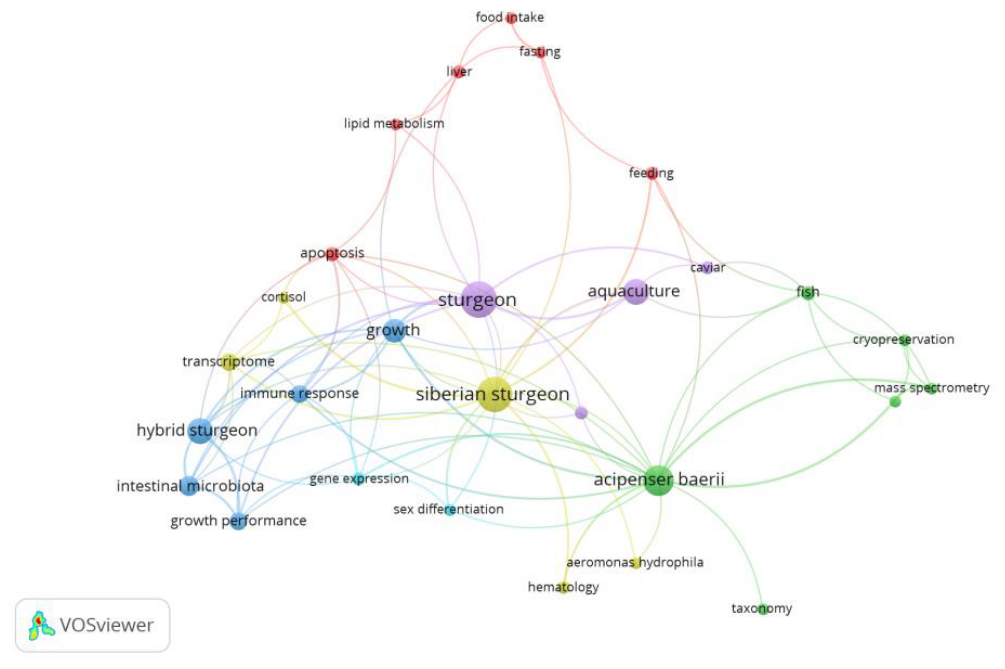
Figure 2.
Future directions for the sustainable management and valorization of A. baerii resources.
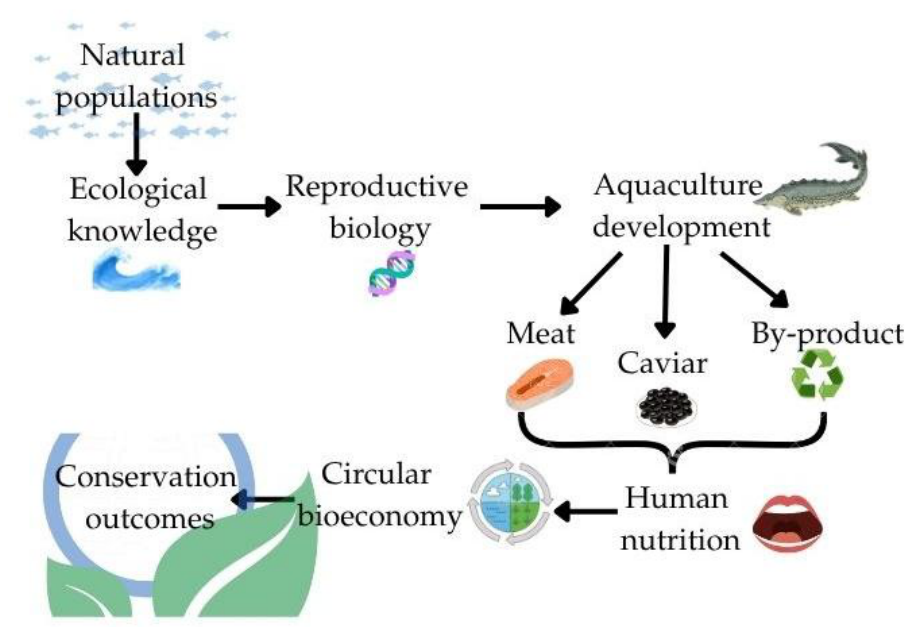

Table 1.
Comparative overview of rearing conditions for Acipenser baerii across the wild environment and principal aquaculture production systems.
Table 1.
Comparative overview of rearing conditions for Acipenser baerii across the wild environment and principal aquaculture production systems.
| Parameter | Wild environment | Extensive (ponds) | Semi-intensive | Intensive / Superintensive (RAS) | References |
| Space & stocking density | Vast rivers and lakes; unrestricted movement |
Low density; large space; unrestricted movement within pond |
Moderate density; earthen ponds with daily water exchange (10–15%) | Very high density: 500 ind./m2 (5–50 g); 50 ind./m2 (500–2,000 g); biomass > 80–100 kg/3³. |
[26,27,86,95] |
| Water type & temperature | Cold, flowing freshwater; seasonal variation between 0–25 °C | Natural conditions; dependent on climate and precipitation; 14–22 °C |
Earthen ponds; partial water renewal; semi-controlled; 20–23 °C |
Fully recirculated; strictly controlled at 18–20 °C year-round |
[25,27,96,97] |
| Water quality control | Natural self-purification; dilution by river flow | Minimal; regulated by pond ecosystem | Partial; daily water exchange for refreshment | Absolute: mechanical filtration, biofiltration, UV sterilization, oxygenation; NH3 < 0.01 mg/L; NO2−⁻ < 0.1 mg/L; DO > 8–9 mg/L; pH 7.0–7.5 |
[25,98] |
| Diet | Benthic macrofauna: chironomid larvae, oligochaetes, mollusks, crustaceans, small fish | Natural prey (plankton, benthic invertebrates); occasional supplemental feed | Natural food supplemented regularly with commercial pellets | Exclusive reliance on high-performance formulated pellets (fishmeal/fish oil or alternative ingredients) | [20,99,100] |
| Growth rate & sexual maturation | Slow growth; sexual maturity at 9–22 years depending on population | Slow to moderate growth; maturation timeline close to wild |
Moderate growth acceleration | Accelerated growth: ~700 g in 14 months; sexual maturity at 3–8 years under optimal conditions |
[8,50,101,102] |
| Disease risk & stress | Low due to low density and natural immune stimulation | Low; natural environment buffers stress |
Moderate | High chronic stress due to confinement; high susceptibility to bacterial and viral infections; system failure can cause total mortality within hours |
[25,72,103] |
| Energy & operational costs | Not applicable | Low; minimal infrastructure |
Moderate | High energy consumption; complex infrastructure; high biosecurity requirements |
[25] |
| Production output | Dependent on natural population dynamics; unpredictable | Low; slow production cycle |
Moderate | Maximum yield; predictable, year-round production |
[25,50,86] |
RAS: recirculating aquaculture system; DO: dissolved oxygen; NH3: ammonia; N2−₂⁻: nitrite.
Disclaimer/Publisher’s Note: The statements, opinions and data contained in all publications are solely those of the individual author(s) and contributor(s) and not of MDPI and/or the editor(s). MDPI and/or the editor(s) disclaim responsibility for any injury to people or property resulting from any ideas, methods, instructions or products referred to in the content. |
© 2026 by the authors. Licensee MDPI, Basel, Switzerland. This article is an open access article distributed under the terms and conditions of the Creative Commons Attribution (CC BY) license (http://creativecommons.org/licenses/by/4.0/).
Copyright: This open access article is published under a Creative Commons CC BY 4.0 license, which permit the free download, distribution, and reuse, provided that the author and preprint are cited in any reuse.