

Submitted:
08 August 2026
Posted:
11 August 2026
You are already at the latest version
Abstract
Background: Obstetric haemorrhage remains one of the leading causes of maternal mortality worldwide and continues to contribute substantially to severe maternal morbidity in low-resource settings. However, limited data exist on the outcomes of women requiring specialized critical care for severe obstetric haemorrhage in Ghana. This study aimed to describe the clinical characteristics, outcomes, and predictors of mortality among women admitted with severe obstetric haemorrhage to the main intensive care unit (ICU) of Komfo Anokye Teaching Hospital (KATH), Kumasi, Ghana. Methods: A retrospective cohort study was conducted among women admitted with severe obstetric haemorrhage to KATH’s main ICU. Data on demographic characteristics, clinical parameters, critical care interventions, and hospital outcomes were extracted from patient records. Women were categorized as survivors or non-survivors. Univariable and multivariable logistic regression analyses were performed to identify factors associated with ICU mortality. Results: Among 344 obstetric admissions to KATH’s main ICU, 79 women were admitted with severe obstetric haemorrhage and were included in the study. Postpartum haemorrhage was the most common haemorrhage subtype (32, 40.5%), followed by abruptio placentae (18, 22.8%) and uterine rupture (12, 15.2%). Overall, 44 women died during admission, resulting in an ICU mortality rate of 55.7%. Women who died had significantly lower admission Glasgow Coma Scale (GCS) scores, lower diastolic blood pressure, shorter hospital stays, and were more likely to require mechanical ventilation than survivors. In multivariable logistic regression analysis, admission GCS score was independently associated with mortality (adjusted odds ratio [aOR] = 0.78, 95% confidence interval [CI]: 0.66–0.89; p = 0.001). Mechanical ventilation and vasopressor support were not independently associated with mortality after adjustment. Conclusion: Severe obstetric haemorrhage was associated with a high mortality rate among women admitted to a general intensive care unit in Ghana. Postpartum haemorrhage was the most common haemorrhage subtype, and admission GCS score was an independent predictor of mortality. Early recognition of clinical deterioration, prompt referral, and timely access to specialized critical care services may help improve maternal outcomes among women with severe obstetric haemorrhage.
Keywords:
obstetric haemorrhage
; postpartum haemorrhage
; maternal mortality
; critical care
; intensive care
; Ghana
1. Introduction
Maternal mortality remains a major public health challenge worldwide despite substantial progress in maternal healthcare over recent decades. The World Health Organization estimated that approximately 287,000 women died from pregnancy-related causes in 2020, with nearly 95% of these deaths occurring in low- and middle-income countries [1]. Sub-Saharan Africa continues to bear the greatest burden, accounting for approximately 70% of global maternal deaths [1]. Most maternal deaths are preventable and result from complications that can be effectively managed through timely diagnosis and appropriate treatment [1].
Obstetric haemorrhage remains one of the leading direct causes of maternal mortality worldwide. It is estimated to account for approximately one-quarter of all maternal deaths globally and continues to be a major contributor to severe maternal morbidity [2,3]. Obstetric haemorrhage encompasses a spectrum of conditions including postpartum haemorrhage, antepartum haemorrhage, placental abruption, placenta previa, uterine rupture, and haemorrhagic shock [4]. Among these conditions, postpartum haemorrhage is responsible for the majority of haemorrhage-related maternal deaths worldwide [2,5]. Women who develop severe obstetric haemorrhage may rapidly progress to hypovolemic shock, disseminated intravascular coagulation, multi-organ failure, and death if prompt treatment is not available [4,5].
In Ghana, maternal mortality remains an important public health concern. National and hospital-based studies have consistently identified obstetric haemorrhage as one of the leading causes of maternal death [6,7,8]. Earlier studies reported haemorrhage as the principal cause of maternal mortality [7,8], while more recent evidence suggests that hypertensive disorders of pregnancy have overtaken haemorrhage as the leading cause in some settings [6,9]. Nevertheless, obstetric haemorrhage continues to account for a substantial proportion of maternal deaths across the country [8,10]. Postpartum haemorrhage remains a significant contributor to maternal mortality in urban tertiary facilities [9], and case-level evidence from rural Ghana illustrates how delays in referral and gaps in blood and oxygen availability can turn postpartum haemorrhage into a fatal event outside specialist centres [11].
Several studies in Ghana have examined maternal mortality trends, causes of maternal death, and health-system factors contributing to poor maternal outcomes [6,7,8]. These studies have documented the burden of obstetric haemorrhage as a cause of maternal death, and a national review of obstetric intensive care admissions has also reported outcomes across the full range of obstetric indications, including haemorrhage, within a general ICU population [12]. However, no prior study in Ghana has focused specifically on women with severe obstetric haemorrhage as a distinct clinical subgroup, characterizing their presentation in detail and identifying predictors of mortality within this population. Women admitted to critical care represent the most severely ill group of patients and are at particularly high risk of adverse maternal outcomes. Understanding the clinical characteristics of these women and identifying factors associated with mortality may help improve risk stratification, guide management, and reduce preventable maternal deaths.
Therefore, this study aimed to describe the clinical characteristics, spectrum of disease, and outcomes of women admitted with severe obstetric haemorrhage to the main ICU of Komfo Anokye Teaching Hospital (KATH), Kumasi, Ghana, and to identify predictors of ICU mortality.
2. Methodology
2.1. Study Design
This was a retrospective cohort study conducted among women admitted with severe obstetric haemorrhage to the main ICU of Komfo Anokye Teaching Hospital (KATH), Kumasi, Ghana. The study evaluated the clinical characteristics, outcomes, and predictors of ICU mortality among women requiring critical care for obstetric haemorrhage.
2.2. Study Setting
The study was conducted at the main intensive care unit of Komfo Anokye Teaching Hospital (KATH), Kumasi, Ghana. KATH is a large tertiary referral hospital that serves as a major referral centre for patients from across the country. KATH’s main ICU is a general critical care unit and is not a dedicated obstetric critical care unit. KATH’s main ICU provides advanced critical care services for women with severe obstetric and gynecological conditions requiring intensive monitoring and organ support. The unit receives referrals from maternity hospitals, district hospitals, regional hospitals, and other tertiary healthcare facilities. Multidisciplinary management is provided by obstetricians, anesthesiologists, intensivists, nurses, and allied healthcare professionals.
2.3. Study Population
The study included all women admitted to KATH’s main ICU with severe obstetric haemorrhage during the study period. Obstetric haemorrhage was identified from the primary and final diagnoses documented in patient records and included postpartum haemorrhage, antepartum haemorrhage, placental abruption, placenta previa, uterine rupture, haemorrhagic shock, and other haemorrhage-related obstetric conditions. Patients with incomplete outcome data were excluded from the analysis. Each woman contributed a single haemorrhage-related ICU admission episode to the analysis; no patient had more than one qualifying admission during the study period, so each row in the dataset represents an independent observation. Women were classified as having severe obstetric haemorrhage based on the clinical diagnosis documented in their medical records, encompassing postpartum haemorrhage, antepartum haemorrhage, placental abruption, placenta previa, uterine rupture, and haemorrhagic shock. The source cohort comprised 344 obstetric ICU admissions and has also been evaluated in a companion analysis addressing predictors of in-hospital mortality across all obstetric admissions to this ICU [13]. The present study addresses a distinct clinical question and is restricted to women with a documented severe obstetric haemorrhage diagnosis; because diagnostic conditions could coexist, some women included in this analysis may also be represented in other diagnosis-specific subgroup analyses drawn from the same cohort.
2.4. Data Collection
Data were extracted retrospectively from the hospital’s ICU database and patient medical records using a standardized data collection form. Information collected included demographic characteristics, obstetric history, admission diagnoses, physiological parameters at admission, critical care interventions, and patient outcomes. The variables collected included age, parity, Glasgow Coma Scale (GCS) score, heart rate, systolic blood pressure, diastolic blood pressure, oxygen saturation, respiratory rate, length of hospital stay, use of mechanical ventilation, vasopressor support, central venous catheterization, continuous positive airway pressure (CPAP), haemodialysis, tracheostomy, supplemental oxygen therapy, and in-hospital outcome.
2.5. Outcome Measure
The primary outcome was ICU mortality, defined as death occurring during admission to KATH’s main ICU. Patients were categorized as survivors or non-survivors based on their hospital outcome.
2.6. Statistical Analysis
Data were analyzed using R statistical software (R Foundation for Statistical Computing, Vienna, Austria). Continuous variables were assessed for distribution and summarized using means and standard deviations or medians and interquartile ranges (IQRs), as appropriate. Categorical variables were summarized using frequencies and percentages. Differences between survivors and non-survivors were assessed using the Wilcoxon rank-sum test [14] for continuous variables and the Chi-square test or Fisher's exact test [15] for categorical variables, as appropriate. Variables showing clinical relevance or statistical association with mortality in univariable analyses were entered into a multivariable logistic regression model to identify independent predictors of ICU mortality. Variables with zero variance (i.e., no observed events in one category) or that produced quasi-complete separation when combined with other covariates were excluded from the multivariable model, as stable coefficient estimation was not possible for these variables. Results were reported as adjusted odds ratios (aORs) with corresponding 95% confidence intervals (CIs). Model discrimination was assessed using the concordance (C) statistic, and calibration was assessed using the Hosmer-Lemeshow test. Multicollinearity among the predictors retained in the final model was assessed using variance inflation factors (VIFs). The linearity of the relationship between admission GCS score and the log-odds of mortality was evaluated by comparing the fit of the linear model with models incorporating a quadratic GCS term and a categorical GCS variable (severe, 3–8; moderate, 9–12; mild, 13–15). Because length of hospital stays varied considerably between patients, a Cox proportional hazards model with the same covariates was fitted as a sensitivity analysis, using length of hospital stay as the time-at-risk variable and in-hospital death as the event, to assess whether the logistic regression findings were sensitive to differences in follow-up duration between patients. Statistical significance was defined as a two-sided p-value < 0.05.
3. Results
3.1. Cohort Characteristics
A total of 344 obstetric patients were admitted to KATH’s main ICU during the study period. Of these, 79 women (23.0%) were admitted with severe obstetric haemorrhage and were included in the present analysis. The mean age of women with severe obstetric haemorrhage was 32.8 ± 5.9 years, with a median age of 33 years (IQR: 30–37). The median parity was 3 (IQR: 1–4). At admission, the median Glasgow Coma Scale (GCS) score was 14 (IQR: 7–15), median systolic blood pressure was 122 mmHg (IQR: 100–146.5), median diastolic blood pressure was 80 mmHg (IQR: 60–94), and median oxygen saturation was 96% (IQR: 90.5–98.5). Additional baseline characteristics are presented in Table 1.
3.2. Distribution of Haemorrhage Subtypes and Outcomes
Postpartum haemorrhage was the most common haemorrhage subtype, accounting for 32 cases (40.5%), followed by abruptio placentae (22.8%), uterine rupture (15.2%), other haemorrhage-related conditions (11.4%), placenta previa (7.6%), and haemorrhagic shock (2.5%) (Figure 1). Overall, 44 women died during admission, resulting in an ICU mortality rate of 55.7%, while 35 women (44.3%) survived to discharge. Mortality varied across haemorrhage subtypes. In absolute terms, postpartum haemorrhage accounted for the largest number of deaths (21/32), reflecting its size as the largest subgroup, followed by abruptio placentae (7/18) and uterine rupture (6/12). However, the case-fatality rate was not highest for postpartum haemorrhage: all women admitted with haemorrhagic shock died (2/2, 100%), and case-fatality was also higher for other haemorrhage-related conditions (6/9, 66.7%) than for postpartum haemorrhage itself (21/32, 65.6%). Detailed outcomes according to haemorrhage subtype are shown in Table 2.
3.3. Comparison Between Survivors and Non-Survivors
Compared with survivors, women who died had significantly lower admission GCS scores (median 8 vs. 15, p < 0.001) and lower diastolic blood pressure (71.5 vs. 86 mmHg, p = 0.010). Length of hospital stay was also shorter among women who died (4 vs. 9 days, p < 0.001); however, this reflects the competing risk of mortality, whereby death truncates the admission, rather than a baseline predictor of outcome, and it was not entered into the multivariable model on this basis. Mechanical ventilation was more frequently required among women who died than among survivors (31/44, 70.5% vs. 14/35, 40.0%; crude OR 3.58, 95% CI 1.40–9.12; p = 0.013). Supplemental oxygen therapy was received by all 35 survivors, compared with 38 of 44 (86.4%) non-survivors; every woman who did not receive supplemental oxygen died (p = 0.031). Of the six women who did not receive supplemental oxygen, five were managed with mechanical ventilation (and were therefore oxygenated via the ventilator circuit rather than by separate supplemental oxygen), and all six had admission oxygen saturations of 95–100%. This finding should not be interpreted as evidence that oxygen therapy was withheld from hypoxic patients; rather, it likely reflects that these women were either already ventilated or not hypoxaemic at the time supplemental oxygen would otherwise have been indicated, and their deaths appear attributable to the severity of their underlying haemorrhagic shock rather than to respiratory compromise. No statistically significant differences were observed for age, parity, heart rate, systolic blood pressure, oxygen saturation, respiratory rate, vasopressor support, central venous catheterization, CPAP use, or haemodialysis (Table 3). Tracheostomy could not be statistically compared, as no patient in either group underwent this procedure.
3.4. Predictors of ICU Mortality
Multivariable logistic regression analysis identified admission GCS score as an independent predictor of ICU mortality. Each one-point increase in GCS score was associated with an approximately 22% reduction in the odds of death (aOR = 0.78, 95% CI: 0.66–0.89; p = 0.001). Supplemental oxygen therapy, although significantly associated with mortality in univariable analysis, could not be included in the multivariable model: all 6 patients who did not receive supplemental oxygen died, producing quasi-complete separation that precluded stable estimation of this variable's effect alongside the other covariates. Although diastolic blood pressure, mechanical ventilation, and vasopressor support were associated with mortality in univariable analyses, these variables did not remain statistically significant after adjustment for other covariates. The results of the multivariable logistic regression model are presented in Table 4 and Figure 2.
The final model showed good discrimination (C-statistic = 0.81) and acceptable calibration (Hosmer-Lemeshow p = 0.05), and variance inflation factors for all four predictors were low (1.12-1.28), indicating no material multicollinearity. A sensitivity analysis testing for departure from linearity in the GCS-mortality relationship (quadratic term; categorical severity strata) did not show a statistically significant improvement in fit over the linear specification (likelihood ratio p = 0.085), supporting the use of GCS as a continuous linear predictor, though the modest sample size limits power to detect subtler non-linear effects. In two further sensitivity analyses, GCS remained an independent predictor of mortality both after excluding the 31 women with a co-occurring hypertensive disorder diagnosis (adjusted OR = 0.63, 95% CI: 0.45-0.88; p = 0.006) and when the analysis was restricted separately to non-ventilated women (OR = 0.72, 95% CI: 0.55-0.93; p = 0.011) and ventilated women (OR = 0.80, 95% CI: 0.67-0.95; p = 0.011), indicating that the association was not driven solely by sedation associated with mechanical ventilation or by neurological depression from hypertensive disease. A Cox proportional hazards model incorporating length of hospital stay as the time-at-risk variable produced consistent findings, with admission GCS score remaining the strongest predictor of mortality (adjusted hazard ratio [aHR] = 0.84, 95% CI: 0.78-0.91; p < 0.001), indicating that the logistic regression results were not an artefact of treating mortality as a fixed endpoint independent of length of follow-up.
4. Discussion
This study describes the clinical characteristics, outcomes, and predictors of ICU mortality among women admitted with severe obstetric haemorrhage to a general intensive care unit in Ghana. Three key findings emerged. Postpartum haemorrhage was the most common haemorrhage subtype, seen in two of every five admissions. The overall mortality rate was high, at 55.7%. Admission Glasgow Coma Scale (GCS) score was the only variable independently associated with ICU mortality after adjustment for other covariates.
This predominance of postpartum haemorrhage is consistent with the global pattern in which postpartum haemorrhage accounts for the majority of haemorrhage-related maternal deaths [2,5]. Liu et al. reported that postpartum haemorrhage contributes to the majority of haemorrhage-related maternal deaths globally [16], and McLintock and James estimated that more than 80% of obstetric haemorrhage occurs after delivery [5]. Similar patterns have been reported across several African countries, where postpartum haemorrhage remains the leading contributor to severe maternal outcomes [17,18,19,20]. Active management of the third stage of labour, prompt recognition of excessive bleeding, and reliable stocking of uterotonic agents at all levels of the referral chain remain central to preventing this outcome.
This rate was considerably higher than rates reported in high-income countries, where advances in obstetric care, blood transfusion services, and critical care support have improved survival [21], though comparable to mortality rates reported among critically ill obstetric patients in other resource-limited settings [22,23,24,25,26]. This likely reflects the severity of illness among women reaching KATH’s ICU, many of whom may have experienced substantial blood loss, delayed referral, or prolonged shock before specialized care could be instituted. Previous studies from Ghana have similarly identified obstetric haemorrhage as one of the leading causes of maternal death [6,7,8,12], indicating that severe bleeding continues to pose a major challenge despite improvements in maternal healthcare services nationally. Strengthening referral pathways between peripheral facilities and tertiary centres, alongside earlier activation of massive transfusion protocols, may help narrow this gap.
Admission GCS score remained the only independent predictor of mortality after adjustment for other covariates. This is consistent with reports among critically ill obstetric patients elsewhere, where impaired neurological status was similarly associated with poor outcomes and increased mortality [27,28].
Reduced GCS in this population likely reflects hypovolaemic shock and cerebral hypoperfusion rather than eclampsia or ventilator sedation: the association persisted after excluding women with hypertensive disorders and stratifying by ventilation status (Section 3.4), although the modest sample size limits precision.
Despite reflecting a relatively late stage of shock, GCS is inexpensive, requires no specialized equipment, and can be assessed at the bedside by any cadre of health worker. It may therefore serve as a practical triage tool for referring facilities to rapidly identify the highest-risk women and prioritize them for urgent resuscitation and escalation to critical care, even in settings where formal severity-scoring systems are unavailable.
Mechanical ventilation was significantly more common among women who died than among survivors in univariable analysis, but this association did not persist after adjustment for other covariates. This is consistent with reports from other critically ill obstetric populations, where the need for ventilatory support appears to reflect the severity of underlying illness rather than acting as an independent cause of death [12,26]. Women requiring ventilation typically present with haemodynamic instability, respiratory compromise, or multi-organ dysfunction, representing the most critically ill subgroup within this cohort.
Although lower diastolic blood pressure was associated with mortality in univariable analysis, it did not remain an independent predictor in the multivariable model. Blood pressure is influenced by both the degree of blood loss and compensatory physiological responses, which may make it a less stable prognostic marker than neurological status during ongoing haemorrhage. Haemodynamic monitoring nonetheless remains an essential part of managing severe obstetric haemorrhage, as early recognition of circulatory compromise can facilitate timely resuscitation.
These findings carry practical implications for maternal healthcare in Ghana and similar resource-limited settings. Severe obstetric haemorrhage remained associated with substantial mortality even after admission to specialized critical care, suggesting that interventions applied earlier in the course of illness may have greater potential to improve survival than measures directed at the point of ICU admission alone. Reducing preventable deaths will likely require earlier recognition of haemorrhage at referring facilities, prompt initiation of resuscitation and blood transfusion, well-rehearsed referral pathways, and rapid access to advanced critical care [29,30,31].
Strengths and Limitations
This study was conducted in a general intensive care unit, not a dedicated obstetric critical care unit, providing valuable data in a setting where such data remain scarce across Ghana and sub-Saharan Africa. Several limitations should nonetheless be noted. The retrospective, single-centre design constrained data completeness and generalizability and left several potential confounders unmeasured, including blood transfusion volume and timing, pre-referral delay, and resuscitation despite 84.8% of women being referred from other facilities, and whether GCS was assessed before or after sedation for mechanical ventilation; the GCS-mortality association nonetheless persisted across ventilation strata (Section 3.4). The relatively small sample size may also have limited power to detect additional predictors, and candidate variables for the multivariable model were selected by univariable screening rather than a pre-specified, clinically guided approach.
5. Conclusion
Severe obstetric haemorrhage was associated with high ICU mortality among women requiring critical care in Ghana. Postpartum haemorrhage was the most common haemorrhage subtype, and admission GCS score was independently associated with mortality. Strengthening early recognition of haemorrhage at referring facilities, using GCS at presentation to rapidly triage the most severely affected women, and ensuring prompt referral and timely access to specialized critical care could reduce preventable mortality in this population. Multicentre, prospective studies are needed to better characterize the burden of severe obstetric haemorrhage in Ghana and to validate GCS-based risk stratification.
Author Contributions
Conceptualization, R.M.K.D. and A.T.; Methodology, R.M.K.D. and M.S.F.; Software, R.M.K.D. and M.S.F.; Validation, R.M.K.D., E.A.A., K.A.N., W.K.J.S-A. and I.B.; Formal Analysis, R.M.K.D.; Investigation, J.A.K., W.A., O.A., A.P.V., A.P. and A.A.O.; Resources, A.T.; Data Curation, R.M.K.D., J.A.K., O.A. and N.A.B.; Writing – Original Draft Preparation, R.M.K.D.; Writing – Review & Editing, all authors; Visualization, R.M.K.D., W.K.J.S-A. and I.B.; Supervision, A.T. and N.A.B.; Project Administration, E.A.A. and K.A.N. All authors have read and agreed to the published version of the manuscript.
Funding
This research received no external funding.
Institutional Review Board Statement
The study was conducted in accordance with the Declaration of Helsinki and approved by the Komfo Anokye Teaching Hospital Institutional Review Board (KATH IRB; reference number KATH IRB/AP/108/23), under the protocol titled "Implementing Triage and Quality Improvement Interventions to Improve Outcomes for Obstetric Emergency Care." Approval was granted on 4 July 2023 and remained valid through 16 July 2024.
Informed Consent Statement
Patient consent was waived due to the retrospective nature of the study.
Data Availability Statement
The data presented in this study are available on request from the corresponding author.
Conflicts of Interest
The authors declare no conflicts of interest.
References
- World Health Organization, UNICEF, UNFPA, World Bank Group, and UNDESA/Population Division, Trends in Maternal Mortality 2000 to 2023: Estimates by WHO, UNICEF, UNFPA, World Bank Group and UNDESA/Population Division; World Health Organization: Geneva, 2025.
- Cresswell, J. A.; Alexander, M.; Chong, M. Y. C.; et al. Global and Regional Causes of Maternal Deaths 2009–20: A WHO Systematic Analysis. Lancet Glob. Health 2025, 13(no. 4), e626–e634. [Google Scholar] [CrossRef] [PubMed]
- Say, L.; Chou, D.; Gemmill, A.; et al. Global Causes of Maternal Death: A WHO Systematic Analysis. Lancet Glob. Health 2014, 2(no. 6), e323–e333. [Google Scholar] [CrossRef] [PubMed]
- Drew, T.; Carvalho, J. C. A. Major Obstetric Haemorrhage. BJA Educ. 2022, 22(no. 6), 238–244. [Google Scholar] [CrossRef] [PubMed]
- McLintock, C.; James, A. H. Obstetric Hemorrhage. J. Thromb. Haemost. 2011, 9(no. 8), 1441–1451. [Google Scholar] [CrossRef] [PubMed]
- Lee, Q. Y.; Odoi, A. T.; Opare-Addo, H.; Dassah, E. T. Maternal Mortality in Ghana: A Hospital-Based Review. Acta Obstet. Et. Gynecol. Scand. 2012, 91(no. 1), 87–92. [Google Scholar]
- Der, E. M.; Moyer, C.; Gyasi, R. K.; et al. Pregnancy Related Causes of Deaths in Ghana: A 5-Year Retrospective Study. Ghana Med. J. 2013, 47(no. 4), 158–163. [Google Scholar] [PubMed]
- Asamoah, B. O.; Moussa, K. M.; Stafström, M.; Musinguzi, G. Distribution of Causes of Maternal Mortality Among Different Socio-Demographic Groups in Ghana: A Descriptive Study. BMC Public Health 11 2011, 159. [Google Scholar] [CrossRef] [PubMed]
- Boafor, T. K.; Ntumy, M. Y.; Asah-Opoku, K.; et al. Maternal Mortality at the Korle Bu Teaching Hospital, Accra, Ghana: A Five-Year Review. Afr. J. Reprod. Health 2021, 25(no. 1), 56–66. [Google Scholar] [CrossRef] [PubMed]
- Asirifi, S. K. A.; Natogmah, M. K. D.; Ansing, C. A. Examining the Causes of Maternal Mortality in Tamale Teaching Hospital: A Three-Year Retrospective Study. Asian Res. J. Gynaecol. Obstet. 2025, 8(no. 1), 190–203. [Google Scholar] [CrossRef]
- Apanga, P. A.; Awoonor-Williams, J. K. Maternal Death in Rural Ghana: A Case Study in the Upper East Region of Ghana. Front. Public Health 6 2018, 101. [Google Scholar] [CrossRef] [PubMed]
- Anane-Fenin, B.; Agbeno, E. K.; Osarfo, J.; et al. A Ten-Year Review of Indications and Outcomes of Obstetric Admissions to an Intensive Care Unit in a Low-Resource Country. PLoS ONE 2021, 16(no. 12), e0261974. [Google Scholar] [CrossRef] [PubMed]
- Djokoto, R.M.K.; Bandoh, I.; Sam-Awortwi, W.K.J.; Boateng, N.A.; Addison, W.; Frimpong, M.S.; et al. Severe Hypertensive Disorders of Pregnancy Requiring Obstetric Critical Care in Ghana: A Retrospective Cohort Study. Preprints. 2026 [cited 2026 Aug 8. Available online: https://www.preprints.org/manuscript/202608.0144 (accessed on 8 Aug 2026).
- Mann, H. B.; Whitney, D. R. On a Test of Whether One of Two Random Variables Is Stochastically Larger Than the Other. Ann. Math. Stat. 1947, 18(no. 1), 50–60. [Google Scholar] [CrossRef]
- Fisher, R. A. On the Interpretation of χ² From Contingency Tables, and the Calculation of P. J. R. Stat. Soc. 1922, 85(no. 1), 87–94. [Google Scholar] [CrossRef]
- Liu, L. Y.; Nathan, L.; Sheen, J. J.; Goffman, D. Review of Current Insights and Therapeutic Approaches for the Treatment of Refractory Postpartum Hemorrhage. Int. J. Women's Health 15 2023, 905–926. [Google Scholar] [CrossRef] [PubMed]
- Sotunsa, J. O.; Adeniyi, A. A.; Imaralu, J. O.; et al. Maternal Near-Miss and Death Among Women With Postpartum Haemorrhage: A Secondary Analysis of the Nigeria Near-Miss and Maternal Death Survey. BJOG 2019, 126, no. Suppl 3, 19–25. [Google Scholar] [CrossRef] [PubMed]
- Zewdu, D.; Tantu, T. Incidence and Predictors of Severe Postpartum Hemorrhage After Cesarean Delivery in South Central Ethiopia: A Retrospective Cohort Study. Sci. Rep. 2023, 13(no. 1), 3635. [Google Scholar] [CrossRef] [PubMed]
- Riches, J.; Jafali, J.; Twabi, H. H.; et al. Avoidable Factors Associated With Maternal Death From Postpartum Haemorrhage: A National Malawian Surveillance Study. BMJ Glob. Health 2025, 10(no. 1), e015781. [Google Scholar] [CrossRef] [PubMed]
- Bwana, V. M.; Rumisha, S. F.; Mremi, I. R.; Lyimo, E. P.; Mboera, L. E. G. Patterns and Causes of Hospital Maternal Mortality in Tanzania: A 10-Year Retrospective Analysis. PLoS ONE 2019, 14(no. 4), e0214807. [Google Scholar] [CrossRef] [PubMed]
- Tripathy, S.; Singh, N.; Panda, A.; et al. Critical Care Admissions and Outcomes in Pregnant and Postpartum Women: A Systematic Review. Intensive Care Med. 2024, 50(no. 12), 1983–1993. [Google Scholar] [CrossRef] [PubMed]
- Lanza, A. V.; Amorim, M. M.; Ferreira, M.; Cavalcante, C. M.; Katz, L. Factors Associated With Severe Maternal Outcome in Patients Admitted to an Intensive Care Unit in Northeastern Brazil With Postpartum Hemorrhage: A Retrospective Cohort Study. BMC Pregnancy Childbirth 2023, 23(no. 1), 573. [Google Scholar] [CrossRef] [PubMed]
- Abie, A.; Getie Mehari, M.; Eseyneh Dagnew, T.; et al. Obstetric Admission and Maternal Mortality in the Intensive Care Unit in Africa: A Systematic Review and Meta-Analysis. PLoS ONE 2025, 20(no. 4), e0320254. [Google Scholar] [CrossRef] [PubMed]
- Rudakemwa, A.; Cassidy, A. L.; Twagirumugabe, T. High Mortality Rate of Obstetric Critically Ill Women in Rwanda and Its Predictability. BMC Pregnancy Childbirth 2021, 21(no. 1), 401. [Google Scholar] [CrossRef] [PubMed]
- Prin, M.; Kadyaudzu, C.; Aagaard, K.; Charles, A. Obstetric Admissions and Outcomes in an Intensive Care Unit in Malawi. Int. J. Obstet. Anesth. 39 2019, 99–104. [Google Scholar] [CrossRef] [PubMed]
- Igbaruma, S.; Olagbuji, B.; Aderoba, A.; Kubeyinje, W.; Ande, B.; Imarengiaye, C. Severe Maternal Morbidity in a General Intensive Care Unit in Nigeria: Clinical Profiles and Outcomes. Int. J. Obstet. Anesth. 28 2016, 39–44. [Google Scholar] [CrossRef] [PubMed]
- Adeniran, A. S.; Bolaji, B. O.; Fawole, A. A.; Oyedepo, O. O. Predictors of Maternal Mortality Among Critically Ill Obstetric Patients. Malawi Med. J. 2015, 27(no. 1), 16–19. [Google Scholar] [CrossRef] [PubMed]
- Fadiloglu, E.; Yuksel, N. D.; Unal, C.; et al. Characteristics of Obstetric Admissions to Intensive Care Unit: APACHE II, SOFA and the Glasgow Coma Scale. J. Perinat. Med. 2019, 47(no. 9), 947–957. [Google Scholar] [CrossRef] [PubMed]
- Escobar, M. F.; Nassar, A. H.; Theron, G.; et al. FIGO Recommendations on the Management of Postpartum Hemorrhage 2022. Int. J. Gynecol. Obstet. 2022, 157, no. Suppl 1, 3–50. [Google Scholar] [CrossRef] [PubMed]
- Leduc, D.; Senikas, V.; Lalonde, A. B. No. 235-Active Management of the Third Stage of Labour: Prevention and Treatment of Postpartum Hemorrhage. J. Obstet. Gynaecol. Can. 2018, 40(no. 12), e841–e855. [Google Scholar] [CrossRef] [PubMed]
- Thaddeus, S.; Maine, D. Too Far to Walk: Maternal Mortality in Context. Soc. Sci. Med. 1994, 38(no. 8), 1091–1110. [Google Scholar] [CrossRef] [PubMed]
Figure 1.
Distribution of severe obstetric haemorrhage subtypes (N = 79).
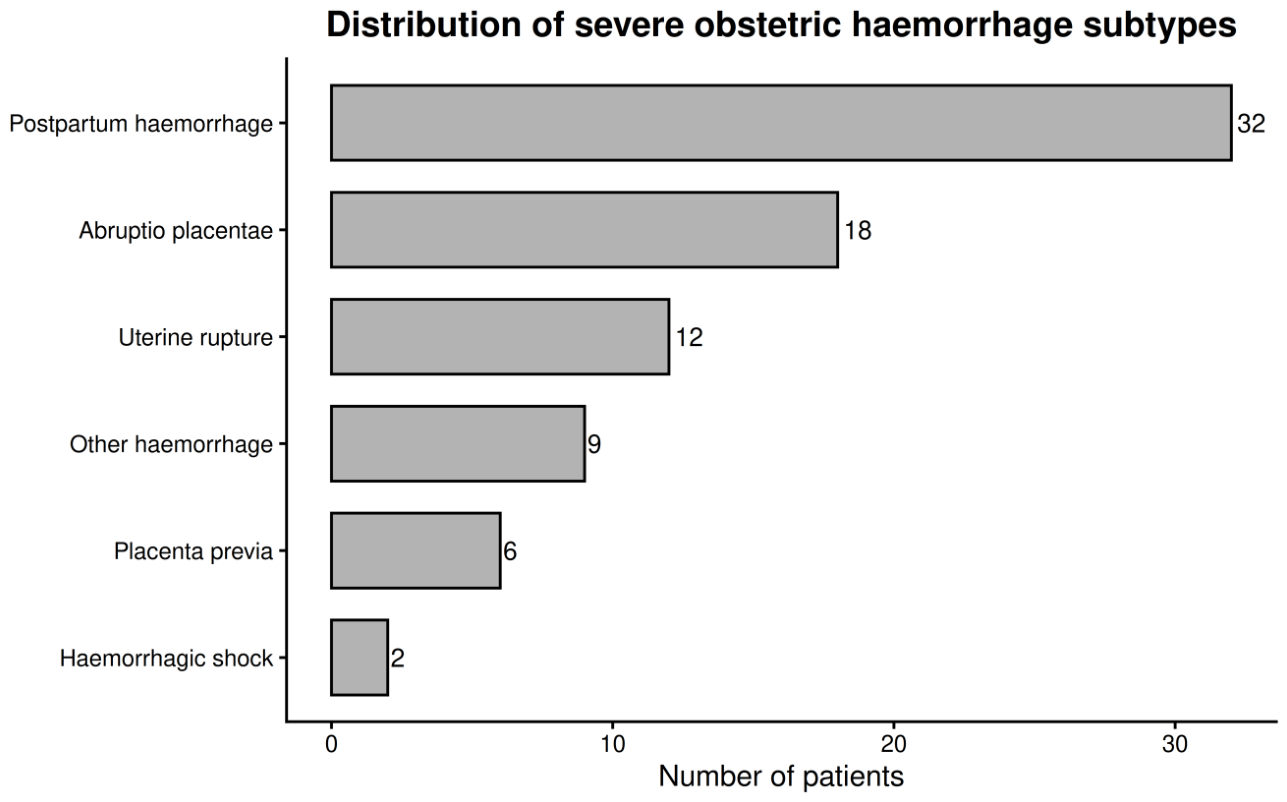
Figure 2.
Forest plot of independent predictors of ICU mortality among women with severe obstetric haemorrhage.
Figure 2.
Forest plot of independent predictors of ICU mortality among women with severe obstetric haemorrhage.
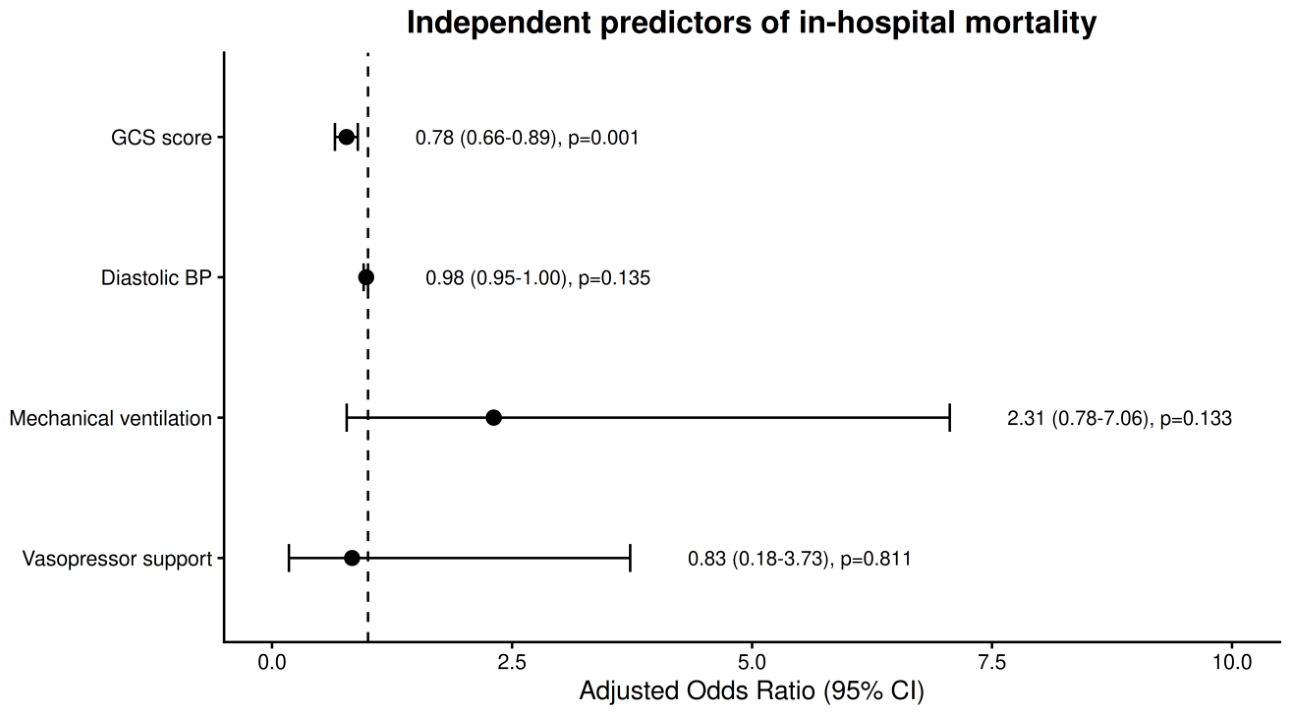

Table 1.
Baseline demographic and clinical characteristics of women admitted with severe obstetric haemorrhage (N = 79).
Table 1.
Baseline demographic and clinical characteristics of women admitted with severe obstetric haemorrhage (N = 79).
| Characteristic | Overall (N = 79) |
|---|---|
| Age, years, mean ± SD | 32.8 ± 5.9 |
| Age, years, median (IQR) | 33 (30-37) |
| Parity, median (IQR) | 3 (1-4) |
| GCS score, median (IQR) | 14 (7-15) |
| Heart rate, median (IQR) | 99 (83.5-117) |
| Systolic BP, median (IQR) | 122 (100-146.5) |
| Diastolic BP, median (IQR) | 80 (60-94) |
| SpO2, median (IQR) | 96 (90.5-98.5) |
| Respiratory rate, median (IQR) | 23 (18-31) |
| Length of hospital stay, median (IQR) | 7 (4-11) |
| Referred from another facility | 67/79 (84.8%) |
| Mechanical ventilation | 45/79 (57.0%) |
| Vasopressor support | 19/79 (24.1%) |
| CVC | 17/79 (21.5%) |
| CPAP | 6/79 (7.6%) |
| Haemodialysis | 2/79 (2.5%) |
| Tracheostomy | 0/79 (0%) |
| Supplemental oxygen | 73/79 (92.4%) |
| ICU mortality | 44/79 (55.7%) |
| Discharged alive | 35/79 (44.3%) |
Table 2.
Distribution and outcomes of severe obstetric haemorrhage by subtype.
| Subtype | N | Deaths | Mortality (%) | Mech. vent. | Vasopressor | Median LOS (d) |
| Abruptio placentae | 18 | 7 | 38.9% | 9 (50.0%) | 3 (16.7%) | 7.0 |
| Haemorrhagic shock/other bleeding | 2 | 2 | 100.0% | 2 (100.0%) | 1 (50.0%) | 2.5 |
| Other haemorrhage | 9 | 6 | 66.7% | 5 (55.6%) | 2 (22.2%) | 4.0 |
| Placenta previa | 6 | 2 | 33.3% | 3 (50.0%) | 1 (16.7%) | 20.0 |
| Postpartum haemorrhage | 32 | 21 | 65.6% | 20 (62.5%) | 8 (25.0%) | 7.0 |
| Uterine rupture | 12 | 6 | 50.0% | 6 (50.0%) | 4 (33.3%) | 5.5 |
Table 3.
Comparison of clinical characteristics between survivors and non-survivors.
| Variable | Died (n = 44) | Survived (n = 35) | P-value |
| Age | 32 (29.8-35) | 33 (30.5-38) | 0.112 |
| Parity | 2.5 (1-4) | 3 (1-4) | 0.924 |
| GCS | 8 (5-15) | 15 (14.5-15) | <0.001 |
| Heart rate | 100.5 (79.8-129) | 99 (89-112.5) | 0.921 |
| Systolic BP | 121 (96.2-140.2) | 126 (112-152.5) | 0.066 |
| Diastolic BP | 71.5 (52-88) | 86 (73-98) | 0.010 |
| SpO2 | 96 (88.8-98.2) | 96 (92.5-98.5) | 0.673 |
| Respiratory rate | 23 (17.8-31) | 23 (19.5-30.5) | 0.556 |
| Length of stay | 4 (2-7) | 9 (7-13) | <0.001 |
| Mechanical ventilation | 31 | 14 | 0.013 |
| Vasopressor support | 14 | 5 | 0.122 |
| CVC | 10 | 7 | 0.986 |
| CPAP | 2 | 4 | 0.398 |
| Haemodialysis | 1 | 1 | 1.000 |
| Tracheostomy | 0 | 0 | NE* |
| Supplemental oxygen | 38 | 35 | 0.031 |
*NE, not estimable: no patient in either group underwent tracheostomy (0/44 vs. 0/35), so no statistical comparison could be performed for this variable.
Table 4.
Multivariable logistic regression model for ICU mortality among women with severe obstetric haemorrhage.
Table 4.
Multivariable logistic regression model for ICU mortality among women with severe obstetric haemorrhage.
| Predictor | Adjusted OR (95% CI) | P-value |
| Glasgow Coma Scale score | 0.78 (0.66-0.89) | 0.001 |
| Diastolic blood pressure, mmHg | 0.98 (0.95-1.00) | 0.135 |
| Mechanical ventilation | 2.31 (0.78-7.06) | 0.133 |
| Vasopressor support | 0.83 (0.17-3.73) | 0.811 |
Disclaimer/Publisher’s Note: The statements, opinions and data contained in all publications are solely those of the individual author(s) and contributor(s) and not of MDPI and/or the editor(s). MDPI and/or the editor(s) disclaim responsibility for any injury to people or property resulting from any ideas, methods, instructions or products referred to in the content. |
© 2026 by the authors. Licensee MDPI, Basel, Switzerland. This article is an open access article distributed under the terms and conditions of the Creative Commons Attribution (CC BY) license.
Copyright: This open access article is published under a Creative Commons CC BY 4.0 license, which permit the free download, distribution, and reuse, provided that the author and preprint are cited in any reuse.