
Submitted:
07 August 2026
Posted:
11 August 2026
You are already at the latest version
Abstract
(1) Background: Markerless motion capture may enable scalable biomechanical assessment outside laboratory environments, yet its applicability to tasks involving elevated foot contacts and rapid loading transitions remains insufficiently characterized. This feasibility study evaluated OpenCap, an open-source smartphone-based markerless system, for estimating lower-limb kinematics and ground reaction forces during stair ascent, stair descent, squat, sit-to-stand, and forward lunge. (2) Methods: One healthy adult completed three repetitions of each task while data were acquired simultaneously with three smartphones, an eight-camera Vicon system, and two force plates. OpenCap/OpenSim outputs were adapted for stair and lunge kinetics and compared with marker-based kinematics and force-plate measurements using root mean square error, Pearson correlation, and cosine similarity. (3) Results Agreement was strongest for sagittal-plane lower-limb kinematics, particularly knee flexion-extension (RMSE: 1.4-10.5 deg; Pearson: 0.94-0.999). Larger discrepancies occurred for hip internal-external rotation, pelvis motion during sit-to-stand, and ankle flexion-extension. Resultant GRF waveforms showed high similarity to force-plate data (cosine similarity >=0.988; RMSE: 0.069-0.167 body weight). Stair descent produced the largest deviations and variability, particularly for single-limb forces. (4) Conclusions These findings support the technical feasibility of smartphone-based markerless functional biomechanics while highlighting the need for improved multiplanar pose estimation, contact modeling, and larger validation studies.
Keywords:
biomechanics
; markerless motion capture
; musculoskeletal simulation
; OpenCap
; smartphone video
; ground reaction forces
; kinematics
1. Introduction
Markerless motion capture systems are increasingly used for biomechanical assessment because they reduce setup time, hardware requirements, and operator dependency, enabling movement analysis in clinical, sports, and field environments. Recent advances in computer vision and musculoskeletal modeling have improved the portability of these approaches: video-based algorithms can estimate human pose from standard cameras, while physics-based models can transform motion into biomechanical variables such as joint kinematics and ground reaction forces (GRFs) [1,2,3,4].
OpenCap is an open-source markerless motion capture framework within the OpenSim ecosystem that estimates human movement dynamics from smartphone videos [5]. By combining multi-view pose estimation with musculoskeletal simulation, OpenCap can estimate lower-limb kinematics and kinetics without specialized laboratory equipment. This accessibility makes it attractive for low-cost and potentially remote functional assessment.
Previous studies have shown good agreement between OpenCap and marker-based systems for several functional activities, particularly for sagittal-plane lower-limb kinematics [6,7,8,9,10,11]. However, lower accuracy has consistently been reported for non-sagittal joint motions, ankle kinematics, and rotational degrees of freedom [7,8]. Most available validation studies have also focused on tasks that are close to the original OpenCap training distribution, such as gait, squatting, sit-to-stand, and jump-related movements [5,6,12]. The performance of OpenCap during more complex daily functional tasks, including stair negotiation and forward lunges, remains less established.
GRF estimation is an important extension of markerless biomechanics because it enables kinetic analysis without force plates. Previous studies reported promising OpenCap-based GRF estimation during gait and jumping tasks [12,13]. However, direct comparison of OpenCap-estimated GRFs with simultaneous force-plate measurements during stair ascent, stair descent, and lunge tasks remains limited.
Therefore, the aim of this study was to assess the technical feasibility of OpenCap for estimating lower-limb kinematics and GRFs during stair ascent, stair descent, squat, sit-to-stand, and forward lunge. The analysis emphasized tasks involving elevated foot-contact conditions and rapid loading transitions, which challenge both pose estimation and contact modeling. OpenCap outputs were compared with simultaneous marker-based motion capture and force-plate measurements to quantify agreement and to identify processing adaptations required for extending the pipeline beyond standard laboratory tasks..
2. Materials and Methods
2.1. Participant and Functional Tasks
One healthy adult participant (body mass: 76 kg; height: 1.75 m; body mass index: 24.8 kg/m2) was enrolled in this feasibility study. The participant provided written informed consent before data collection and for the use of anonymized data for research dissemination. The single-participant design was intended to characterize technical behavior of the OpenCap/OpenSim pipeline and identify task-specific processing requirements before larger-scale validation. Five functional tasks were analyzed: stair ascent (STA), stair descent (STD), squat (SQU), sit-to-stand (STS), and forward lunge (FWL). Each task was repeated three times. For STA, the participant walked forward and stepped onto a 22-cm-high box positioned on the distal force plate before continuing the movement. For STD, the participant started on the elevated box and descended onto the force plate before resuming forward walking. During SQU, the participant performed a full squat with feet of shoulder-width apart while maintaining heel contact with the ground. During STS, the participant stood up from a 45-cm-high stool without upper-limb assistance. For FWL, the participant performed a forward lunge onto the proximal force plate while keeping the hands on the hips. Before each acquisition, a synchronization gesture recommended by the OpenCap protocol was performed to facilitate temporal alignment between smartphone videos. Interventionary studies involving animals or humans, and other studies that require ethical approval, must list the authority that provided approval and the corresponding ethical approval code.
2.2. Experimental Setup
2.2.1. OpenCap System
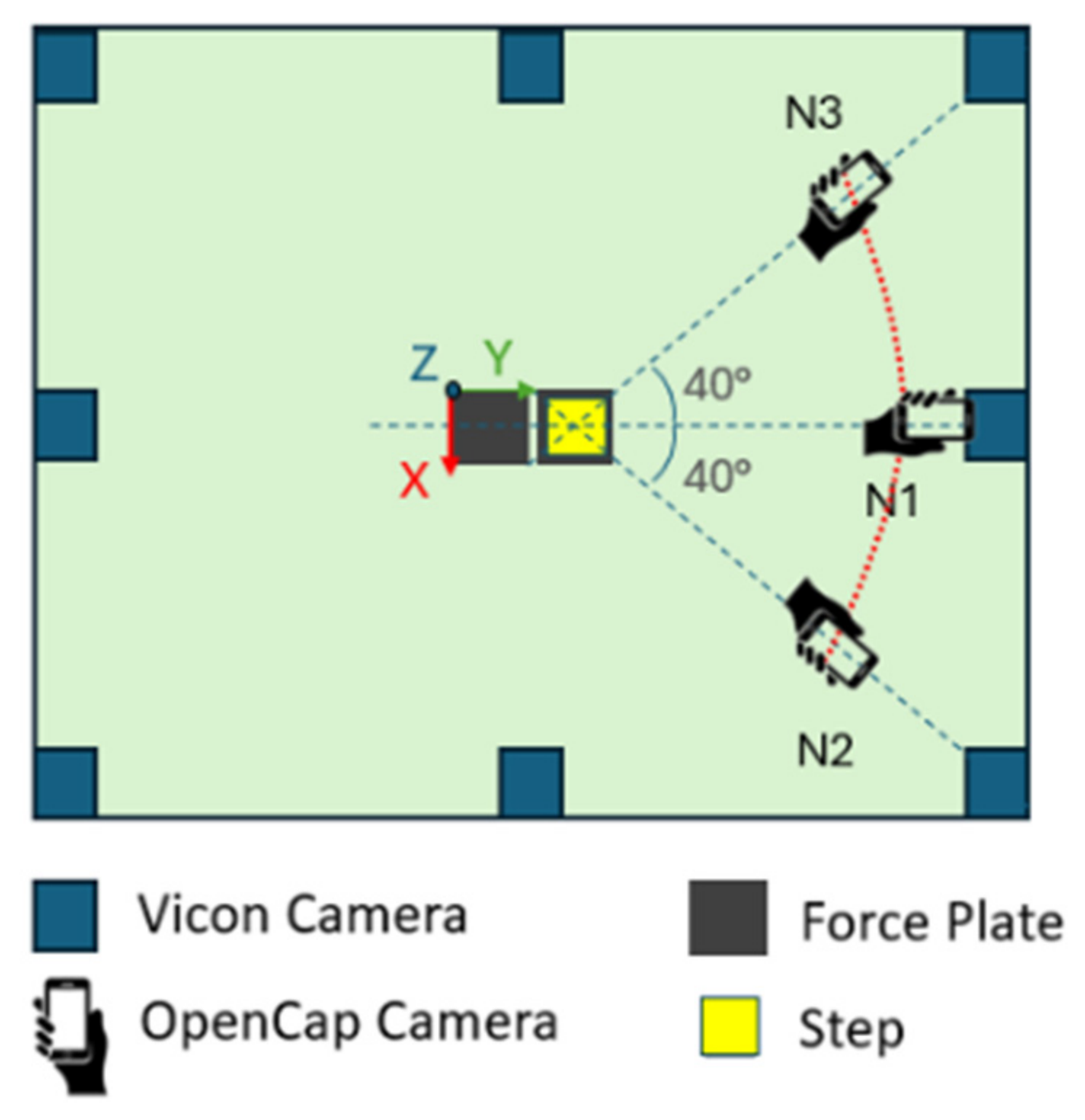
Three iPhone 12 devices (Apple Inc., USA) were used for data acquisition. Videos were recorded at 120 fps with a resolution of 720 × 1280 pixels. The smartphones were mounted on tripods at a height of approximately 1.60 m and positioned 3–4 m from the participant’s starting position. The cameras were arranged to maximize capture volume and minimize body-segment occlusions. One camera was positioned in front of the participant, while the remaining two were placed at oblique angles of approximately 40° relative to the calibration checkerboard (Figure 1). Camera calibration was performed using the standard OpenCap checkerboard (4×5 grid, 35 mm squares) positioned perpendicular to the ground. Videos were processed through the OpenCap cloud-based pipeline (https://app.opencap.ai), which automatically generated three-dimensional virtual marker trajectories from synchronized smartphone recordings.
2.2.2. Marker-Based Motion Capture System
Marker-based motion capture data were simultaneously acquired using an eight-camera Vicon system (Vicon Motion Systems Ltd., Oxford, UK) operating at 120 Hz. Ground reaction forces were synchronously recorded using two AMTI OR6-7-1000 force plates (AMTI, Watertown, MA, USA) sampled at 1000 Hz.
Figure 2.
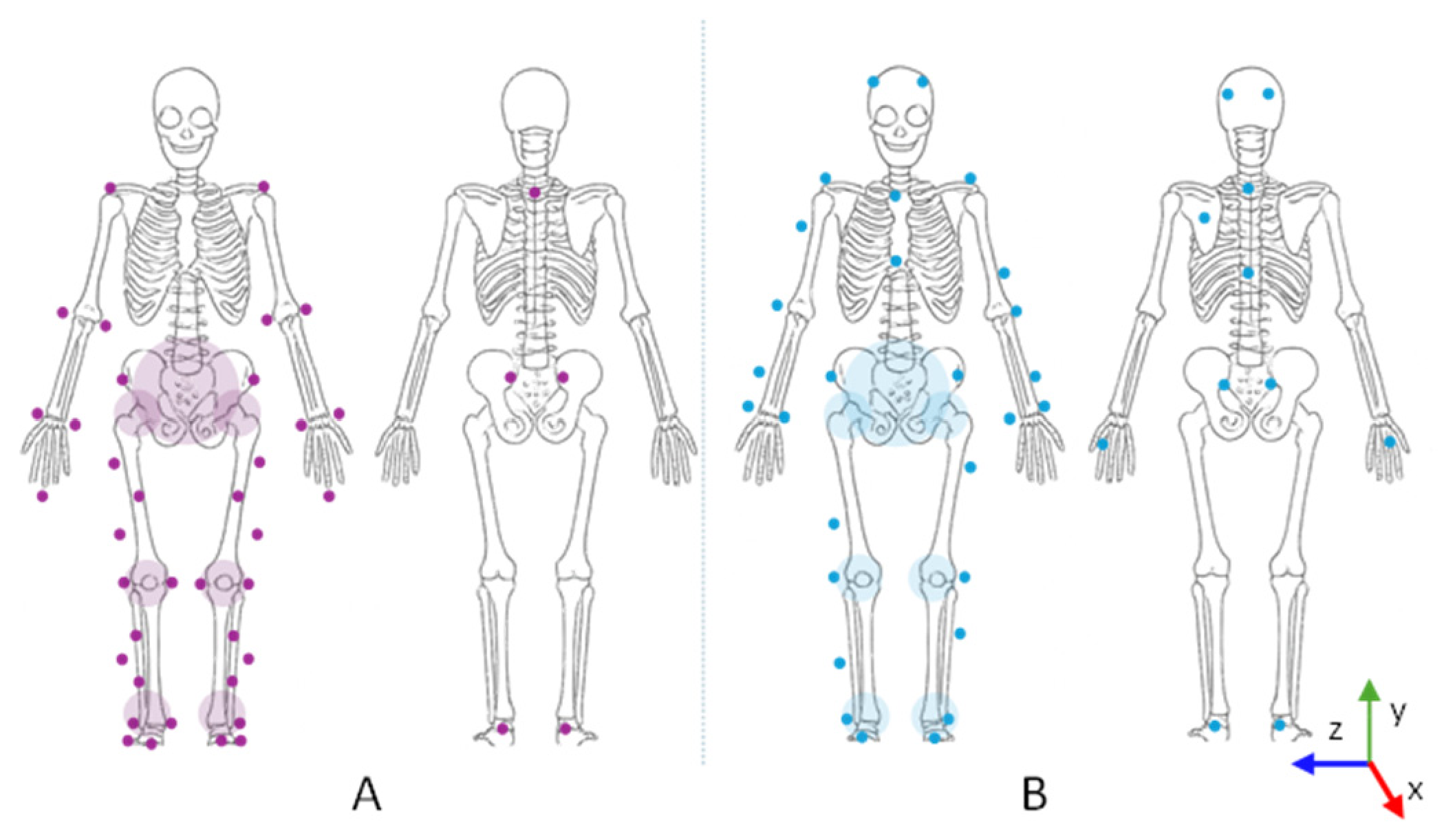
A) OpenCap virtual marker-set and joint reference B) PIG marker-set and joint reference frame.
Figure 2.
A) OpenCap virtual marker-set and joint reference B) PIG marker-set and joint reference frame.
2.2.3. OpenCap Processing
Videos acquired with OpenCap were processed through the OpenCap cloud-based pipeline to generate three-dimensional virtual marker trajectories. Two-dimensional body keypoints were detected using the HRNet pose-estimation model and triangulated into three-dimensional space through Direct Linear Transformation. The resulting trajectories were subsequently mapped to anatomical virtual markers using a Long Short-Term Memory network trained on large-scale motion datasets to improve biomechanical consistency [5], as specified by the OpenCap’s authors.
The generated marker trajectories (.trc files) were used as input for musculoskeletal analysis within OpenSim. Joint kinematics were estimated using the OpenCap automated inverse kinematics pipeline, adopting the Lai–Uhlrich full-body musculoskeletal model [14,15], comprising 22 body segments and 33 degrees of freedom.
Model scaling was performed from a static neutral pose acquired before the dynamic trials. During the calibration pose, the participant stood upright with feet shoulder-width apart and arms outstretched, slightly away from the body.
OpenCap estimates joint kinematics using a constrained inverse kinematics approach in which joint definitions and musculoskeletal geometry enforce biomechanically plausible motion. Consequently, the estimated kinematics depend on both model scaling quality and pose-estimation accuracy.
2.2.4. Marker-Based Processing
Marker-based motion capture data were processed in Vicon Nexus 2.16.1 (Vicon Motion Systems Ltd., Oxford, UK) using the Plug-In Gait (PiG) full-body model. The model included 39 reflective markers positioned on anatomical landmarks to reconstruct three-dimensional joint kinematics (Figure 2).
Unlike OpenCap/OpenSim, the PiG model estimates segment kinematics independently using an unconstrained kinematic framework. Pelvis orientation and lower-limb joint angles were extracted for subsequent comparison with OpenCap outputs.
2.2.5. Data Processing and Alignment
OpenCap joint-angle trajectories were filtered using a fourth-order low-pass Butterworth filter. Cutoff frequencies between 2 and 12 Hz were evaluated, and task-specific values were selected based on residual analysis and visual inspection of signal smoothness. A cutoff frequency of 4 Hz was selected for STA, STD, FWL, and SQU, and 2 Hz for STS; these values were applied consistently across joint degrees of freedom. Marker-based kinematic data were filtered using a fourth-order low-pass Butterworth filter with a 6-Hz cutoff frequency [16].
To enable comparison between systems, temporal alignment and static-pose angle offset correction were applied. Temporal alignment was performed by synchronizing trials using the peak of the right hip flexion-extension angle as a reference event. Task windows were manually selected from synchronized kinematic and force traces to isolate the active movement phase and exclude preparatory or residual motion; the selected windows are reported in the Supplementary Material. Angle offsets between OpenCap and PiG were computed from the static calibration pose acquired at the beginning of each trial and applied to the OpenCap joint-angle trajectories to reduce systematic differences due to model definitions, joint coordinate systems, and sign conventions. All kinematic and GRF signals were time-normalized to 0–100% of task duration using linear interpolation to 101 samples.
The comparison focused on hip angles (flexion-extension, abduction-adduction, and internal-external rotation), knee flexion-extension, and ankle flexion-extension. Additionally, results on pelvis orientation (tilt, list, and rotation) are reported in Supplementary Material.
2.2.6. Ground Reaction Force Estimation
Experimental GRFs acquired from the force plates were decimated and filtered using a fourth-order bidirectional low-pass Butterworth filter with a cutoff frequency of 25 Hz [17].
Ground reaction forces were estimated in OpenCap/OpenSim using the example_kinetics.py processing workflow. The original workflow was adapted to enable stair negotiation and forward lunge analyses, which required task-specific configuration parameters to improve convergence and contact-event handling.
For stair ascent and descent, a dynamic floor-plane threshold of 40 cm was introduced to improve foot-contact detection during elevated movements. Task-specific temporal margins were also applied to reduce edge artifacts at the beginning and at the end of the simulations. The main optimization adjustments and simulation windows are reported in the Supplementary Material.
Estimated GRFs were further smoothed using a moving-average filter over ten samples. All GRFs were normalized to body weight (BW). For each trial, the computational time required for the GRF simulations was estimated using a PC equipped with a 16 GB graphics board and ranged from 3 to 5 hours.
2.2.7. Statistical Analysis
Kinematic and GRF signals were analyzed across the three repetitions of each task to assess inter-trial repeatability. Mean trajectories and standard deviations were computed for both experimental and simulated data.
Agreement between OpenCap and reference measurements was quantified using root mean square error (RMSE), Pearson correlation coefficient, and cosine similarity. These metrics were computed for joint kinematics and resultant GRFs across all tasks.
3. Results
3.1. Static Pose
Static-pose differences between the OpenCap and PiG models were observed mainly for pelvis tilt, ankle flexion-extension, and hip internal-external rotation. Offsets were below 5 degrees (deg) for hip flexion-extension and adduction-abduction, knee flexion-extension, pelvis list, and pelvis rotation. Larger offsets were observed for hip internal-external rotation (approximately 36 deg right and 29 deg left), ankle flexion-extension (approximately 10 deg right and 7 deg left), and pelvis tilt (approximately 12 deg). These offsets were used to align OpenCap angles to the PiG convention before waveform comparison. Detailed static-pose offsets are reported in Supplementary Figure S1.
3.2. Kinematic Analysis
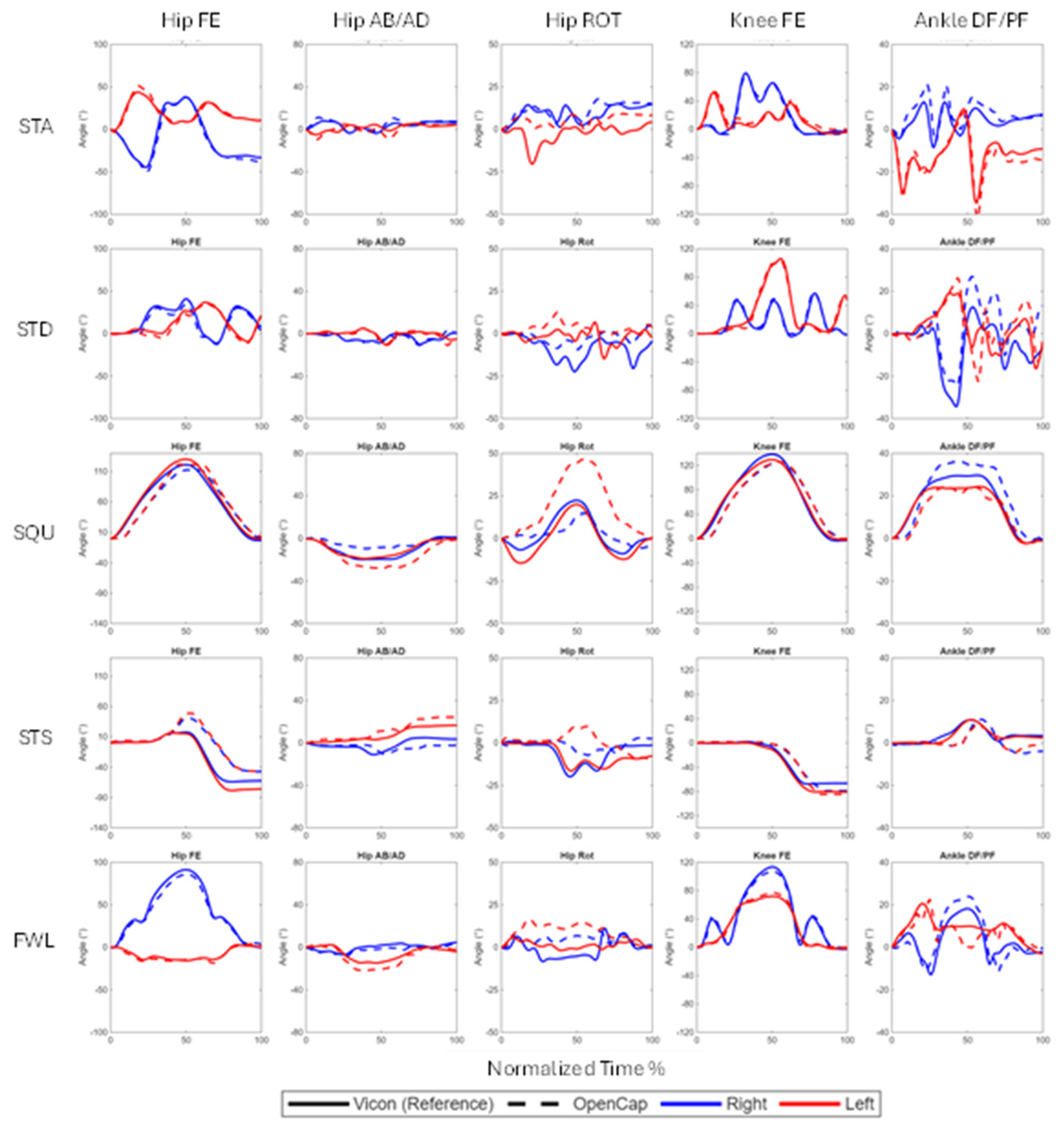
The aligned OpenCap and PiG models showed good agreement for sagittal-plane lower-limb kinematics across tasks (Figure 3). Knee flexion-extension exhibited RMSE values of 1.4-10.5 deg, Pearson correlations of 0.94-0.999, and cosine similarities above 0.97. Hip flexion-extension showed slightly larger errors but preserved the overall waveform shape across tasks.
Hip internal-external rotation showed the largest discrepancies, with RMSE exceeding 10 deg in several tasks and reaching 23.2 deg (right, SQU) and 17.3 deg (right, FWL). Ankle flexion-extension RMSE ranged from 1.4 deg (STS) to 9.3 deg (FWL). Pelvis rotations showed task-dependent variability; pelvis tilt during STS showed the weakest agreement (RMSE = 14.9 deg, Pearson = -0.86, cosine similarity = 0.25), likely reflecting model-specific differences in pelvis kinematic definitions between OpenSim and PiG. Detailed kinematic metrics are reported in Supplementary Table S1.
3.3. Ground Reaction Forces
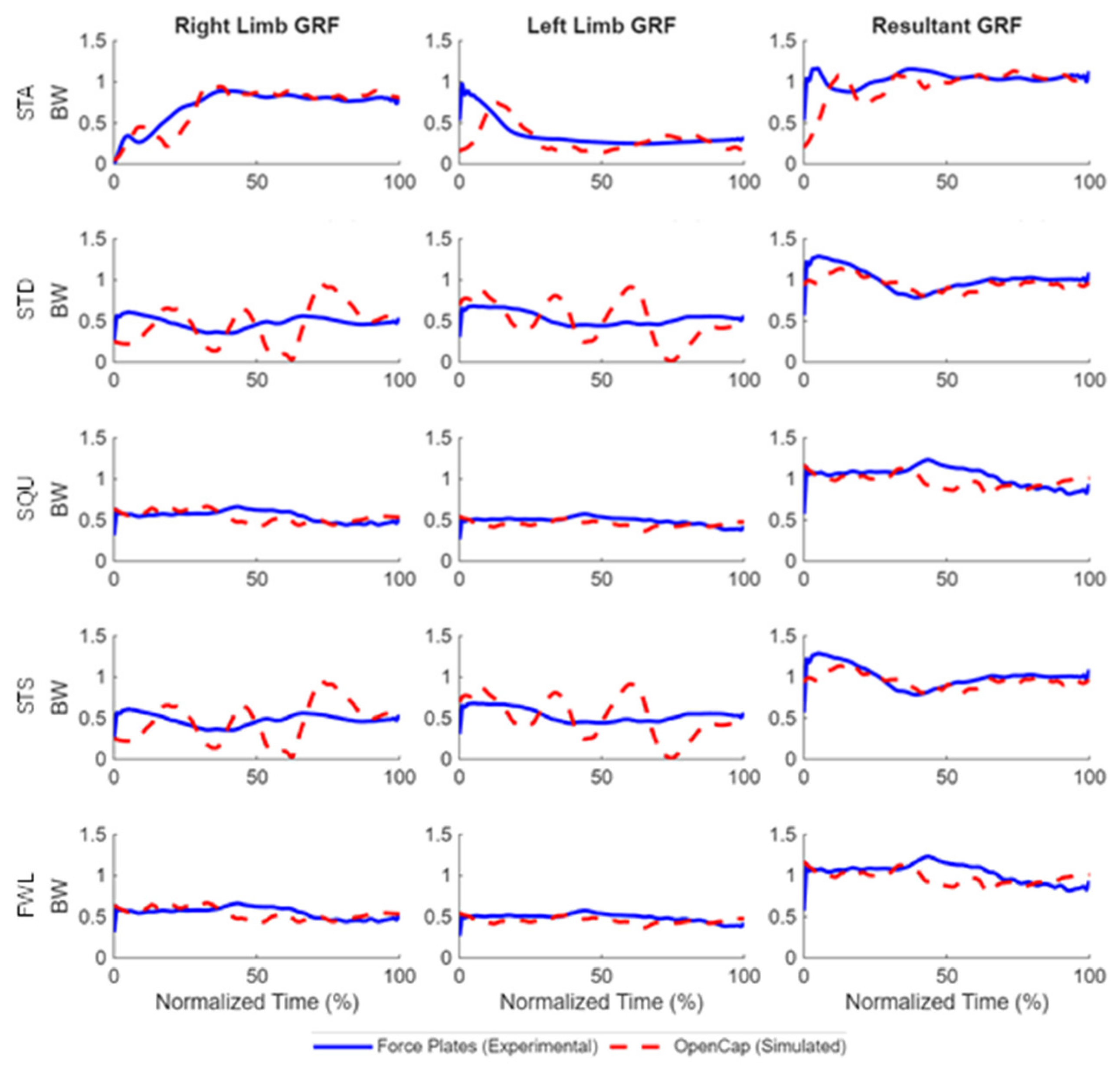
OpenCap simulations reproduced the overall trends of experimentally measured GRFs across tasks. Larger discrepancies were observed for low-amplitude horizontal force components, particularly during stair descent; therefore, quantitative analyses focused on resultant GRF magnitudes.
Figure 4 summarizes representative comparisons between experimental and simulated GRFs for all tasks. Simulated signals generally followed experimental profiles, although local fluctuations were observed during rapid loading transitions.
Figure 3.
Comparison of lower-limb joint kinematics obtained from Vicon and OpenCap across the five functional tasks: stair ascent (STA), stair descent (STD), squat (SQU), sit-to-stand (STS) and forward lunge (FWL). Solid lines represent Vicon measurements, whereas dashed lines represent OpenCap estimates. Hip flexion-extension (FE), hip abduction-adduction (AB/AD), hip internal-external rotation (Rot), knee flexion-extension (FE), and ankle dorsiflexion-plantarflexion (DF/PF) are shown for the right and left limbs. Curves are plotted over normalized task duration (0–100%).
Figure 3.
Comparison of lower-limb joint kinematics obtained from Vicon and OpenCap across the five functional tasks: stair ascent (STA), stair descent (STD), squat (SQU), sit-to-stand (STS) and forward lunge (FWL). Solid lines represent Vicon measurements, whereas dashed lines represent OpenCap estimates. Hip flexion-extension (FE), hip abduction-adduction (AB/AD), hip internal-external rotation (Rot), knee flexion-extension (FE), and ankle dorsiflexion-plantarflexion (DF/PF) are shown for the right and left limbs. Curves are plotted over normalized task duration (0–100%).
3.3.1. Repeatability Analysis
Repeatability patterns observed in simulated GRFs were generally consistent with experimental measurements. Squat trials exhibited the lowest variability, whereas stair descent showed the highest variability across repetitions. Increased variability was primarily observed during rapid GRF loading and unloading phases. Detailed repeatability metrics are reported in Supplementary Table S2.
A qualitative comparison between simulated and experimental GRFs showed that OpenCap reproduced the main temporal loading and unloading patterns across tasks (Figure 4). Local fluctuations and small timing differences remained visible during rapid transitions and foot-contact events, especially in stair negotiation. Moving-average smoothing reduced high-frequency oscillations and improved waveform readability without eliminating task-specific timing differences.
These fluctuations were most evident during stair descent, where earlier simulated contact events occasionally affected single-limb GRF estimation. Despite these local deviations, the resultant GRF was more stable than individual limb forces, suggesting partial compensation of timing and magnitude errors between limbs.
Figure 4.
Comparison of experimental and OpenCap-estimated ground reaction forces (GRFs) across the five functional tasks: stair ascent (STA), stair descent (STD), squat (SQU), sit-to-stand (STS) and forward lunge (FWL). Experimental GRFs measured with force plates are shown as solid blue lines, whereas OpenCap-estimated GRFs are shown as dashed red lines. Results are reported for the right limb (left column), left limb (middle column), and resultant GRF (right column). GRFs are normalized to body weight (BW) and plotted over normalized task duration (0–100%).
Figure 4.
Comparison of experimental and OpenCap-estimated ground reaction forces (GRFs) across the five functional tasks: stair ascent (STA), stair descent (STD), squat (SQU), sit-to-stand (STS) and forward lunge (FWL). Experimental GRFs measured with force plates are shown as solid blue lines, whereas OpenCap-estimated GRFs are shown as dashed red lines. Results are reported for the right limb (left column), left limb (middle column), and resultant GRF (right column). GRFs are normalized to body weight (BW) and plotted over normalized task duration (0–100%).
3.3.2. Qualitative Comparison Between Simulated and Experimental GRFs
A qualitative comparison between simulated and experimental GRFs showed that OpenCap reproduced the main temporal loading and unloading patterns across tasks (Figure 4). Local fluctuations and small timing differences remained visible during rapid transitions and foot-contact events, especially in stair negotiation. Moving-average smoothing reduced high-frequency oscillations and improved waveform readability without eliminating task-specific timing differences.
These fluctuations were most evident during stair descent, where earlier simulated contact events occasionally affected single-limb GRF estimation. Despite these local deviations, the resultant GRF was more stable than individual limb forces, suggesting partial compensation of timing and magnitude errors between limbs.
Quantitative comparisons between simulated and experimental resultant GRFs demonstrated overall good agreement across tasks (Supplementary Table S3). Cosine similarity values were high for all resultant GRFs (0.988-0.998), indicating strong agreement in waveform shape. RMSE values ranged from 0.069 BW for stair ascent to 0.167 BW for stair descent. Pearson correlations varied across tasks and limbs, particularly during squat and sit-to-stand, where relatively flat GRF profiles and low dynamic range amplified the influence of local fluctuations. In these cases, cosine similarity provided a more informative measure of waveform agreement than Pearson correlation alone.
These results justified using resultant GRFs as the primary kinetic outcome, while treating limb-specific load sharing as exploratory.
4. Discussion
The results revealed a variable-dependent performance pattern of smartphone-based estimations: kinematic accuracy was highest for lower-limb flexion-extension, whereas kinetic errors were primarily related to contact timing and inter-limb load sharing.
The strongest agreement was observed for sagittal-plane lower-limb kinematics, especially knee flexion-extension, which consistently showed low RMSE values and high Pearson correlations. These findings are consistent with previous OpenCap validation studies reporting higher accuracy for sagittal-plane motion than for frontal- and transverse-plane kinematics [6,7,8,9,10,11]. The knee flexion-extension RMSE values observed in this study were broadly consistent with those reported for related functional tasks [6,8]. In contrast, hip internal-external rotation, pelvis motion during STS, and ankle flexion-extension showed lower agreement. These differences likely reflect limitations of markerless 2D-to-3D pose reconstruction, sensitivity to partial segment occlusions, and differences between constrained OpenSim inverse kinematics and the unconstrained PiG model.
The GRF analysis demonstrated that OpenCap/OpenSim simulations reproduced the overall temporal behavior of experimental signals, particularly for resultant GRFs. Cosine similarity values above 0.988 indicated strong waveform agreement across tasks, while lower agreement for individual limbs reflected contact-timing and load-sharing uncertainties. Similar trends have been reported in markerless GRF estimation during gait and jumping tasks [12,13]. A key technical contribution of this study was the adaptation of the OpenCap kinetics workflow for elevated foot-contact conditions. Specifically, the dynamic floor-plane threshold and task-specific temporal margins were required to achieve stable convergence during stair and lunge simulations. These modifications may serve as a practical reference for future studies extending markerless kinetic estimation to stair negotiation and analogous tasks.
Among the analyzed movements, stair descent represented the most challenging condition for both kinematic reconstruction and GRF estimation. This task combines complex multiplanar motion, rapid loading transitions, and elevated foot contacts, all of which increase sensitivity to pose-estimation inaccuracies and contact-model assumptions. Uncertainty in foot-strike and lift-off timing likely contributed to variability in single-limb GRF estimation.
Moving-average filtering improved waveform smoothness and reduced high-frequency oscillations in the simulated GRFs, but it also highlighted the sensitivity of markerless musculoskeletal simulations to noise propagation from video-based pose estimation. The need for task-specific adaptation indicates that generalized processing settings may not be optimal for all functional movement categories.
This issue is particularly relevant when OpenCap is considered within the broader landscape of open-source markerless motion-analysis tools based on consumer-grade cameras, including MediaPipe [18], FreeMoCap [19], and Pose2Sim [21]. These tools address different stages of the biomechanical processing pipeline. MediaPipe Pose provides efficient, real-time monocular detection of body keypoints but requires additional processing and biomechanical assumptions to derive anatomically meaningful joint kinematics. FreeMoCap and Pose2Sim extend pose estimation to multiview 3D reconstruction and provide greater flexibility in camera selection and processing configurations, with Pose2Sim also supporting OpenSim-based kinematic analysis. However, their customization generally requires greater technical expertise, and additional modeling is needed to estimate movement dynamics. By contrast, OpenCap integrates synchronized smartphone acquisition, AI-based keypoint detection and virtual-marker augmentation, musculoskeletal modeling, and physics-based GRF estimation within a more standardized workflow. AI therefore primarily contributes to converting video data into motion descriptors that can be used by biomechanical models, reducing the need for physical markers and manual tracking.
From a practical perspective, this integration makes OpenCap particularly suitable for monitoring overall movement patterns and resultant loading profiles in low-resource, clinical, or field settings. Nevertheless, laboratory systems remain preferable when accurate transverse- and frontal-plane kinematics or limb-specific force estimates are clinically critical.
This study has several limitations. First, the analysis was performed on a single healthy participant, with three repetitions per task. Therefore, the findings should be interpreted as evidence of technical feasibility rather than population-level validation; additional studies are needed in larger cohorts, pathological populations, and more diverse movement conditions. Second, task-specific tuning of the OpenCap kinetics workflow was necessary for stair and lunge movements, reducing the level of automation. Finally, the simplified foot-ground contact model and the dependence on video-based pose estimation may have contributed to inaccuracies in multiplanar kinematics and GRF estimation.
Future work should include larger cohorts, clinical and sport-specific populations, repeated-session reliability analyses, and additional tasks involving elevated or asymmetric contacts. Specifically, the application of a novel tool OpenGRF [21] to smartphone-based data will be pursued. Additionally, improvements in marker augmentation, contact modeling, and task-specific musculoskeletal optimization may further enhance the accuracy and robustness of markerless kinematic and kinetic estimation.
5. Conclusion
This feasibility study showed that OpenCap can be extended to estimate lower-limb kinematics and resultant GRFs during functional tasks that include stair negotiation and forward lunge, provided that task-specific adaptations are applied to the kinetics processing workflow. Best performance was observed for lower-limb flexion-extension and overall load-profile shape, while less robust output remained sensitive to pose-estimation and contact-model assumptions. These findings support smartphone-based markerless biomechanics as a low-cost assessment approach and motivate larger validation studies before clinical deployment. Further advances in AI-based pose estimation, supported by more diverse task-specific training datasets and stronger temporal and anatomical constraints, may improve the robustness of smartphone-based biomechanics to occlusions, rapid movements, and transverse-plane rotations.
Supplementary Materials
The following supporting information can be downloaded at the website of this paper posted on Preprints.org.
Author Contributions
Conceptualization, R.S., F.D.P., L.M.; methodology, R.S. and A.C.; software, R.S. and A.C.; validation, R.S. and A.C.; formal analysis, F.D.P., L.M.; investigation, R.S, A.C.; resources: R.S.; data curation, R.S., A.C.; writing—original draft preparation, R.S. and L.M.; writing—review and editing, R.S., A.C., L.M. F.D.P..; visualization, R.S.; supervision, F.D.P. and L.M.; project administration, L.M..; funding acquisition, L.M. All authors have read and agreed to the published version of the manuscript.
Funding
This work was supported by the European Union - NextGenerationEU - National Recovery and Resilience Plan (NRRP), Mission 4 Component 2, Investment No. 1.1, PRIN 2022, D.D. 104, 02/02/2022, project “In Silico Trials for Hip Replacements to evaluate the safety of new joint replacement designs”, CUP I53D23001820006.
Informed Consent Statement
Informed consent was obtained from the subject involved in the study.
Acknowledgments
The authors acknowledge Dr. Andrea Di Pietro for his contribution during the experimental sessions.
Conflicts of Interest
The authors declare no conflicts of interest.
References
- D. Roetenberg, H. J. Luinge, and P. Sylcke, “(PDF) Xsens MVN: Full 6DOF human motion tracking using miniature inertial sensors,” ResearchGate. Accessed: Jul. 29, 2025. [Online]. Available: https://www.researchgate.net/publication/239920367_Xsens_MVN_Full_6DOF_human_motion_tracking_using_miniature_inertial_sensors.
- Z. Cao, T. Simon, S.-E. Wei, and Y. Sheikh, “OpenPose: Realtime Multi-Person 2D Pose Estimation Using Part Affinity Fields,” IEEE TRANSACTIONS ON PATTERN ANALYSIS AND MACHINE INTELLIGENCE, vol. 43, no. 1, 2021.
- J. Shotton et al., “Real-time human pose recognition in parts from single depth images,” in CVPR 2011, Jun. 2011, pp. 1297–1304. [CrossRef]
- J. Walker, A. Thomas, D. E. Lunn, G. Nicholson, and C. B. Tucker, “Concurrent validity of Theia3D markerless motion capture for detecting sagittal kinematic differences between gait speeds,” J Sports Sci, vol. 43, no. 16, pp. 1560–1571, Aug. 2025,. [CrossRef]
- S. D. Uhlrich et al., “OpenCap: Human movement dynamics from smartphone videos,” PLoS Comput Biol, vol. 19, no. 10, p. e1011462, Oct. 2023,. [CrossRef]
- J. A. Turner, C. R. Chaaban, and D. A. Padua, “Validation of OpenCap: A low-cost markerless motion capture system for lower-extremity kinematics during return-to-sport tasks,” J Biomech, vol. 171, p. 112200, Jun. 2024,. [CrossRef]
- Y. L. Lima, T. Collings, M. Hall, M. N. Bourne, and L. E. Diamond, “Validity and reliability of trunk and lower-limb kinematics during squatting, hopping, jumping and side-stepping using OpenCap markerless motion capture application,” Journal of Sports Sciences, vol. 42, no. 19, pp. 1847–1858, Oct. 2024,. [CrossRef]
- Svetek, K. Morgan, J. Burland, and N. R. Glaviano, “Validation of OpenCap on lower extremity kinematics during functional tasks,” J Biomech, vol. 183, p. 112602, Apr. 2025,. [CrossRef]
- M. A. Boswell, Ł. Kidziński, J. L. Hicks, S. D. Uhlrich, A. Falisse, and S. L. Delp, “Smartphone videos of the sit-to-stand test predict osteoarthritis and health outcomes in a nationwide study,” npj Digit. Med., vol. 6, no. 1, p. 32, Mar. 2023,. [CrossRef]
- B. Horsak, H. Kainz, and B. Dumphart, “Repeatability and minimal detectable change including clothing effects for smartphone-based 3D markerless motion capture,” Journal of Biomechanics, vol. 175, p. 112281, Oct. 2024,. [CrossRef]
- B. Horsak et al., “Concurrent validity of smartphone-based markerless motion capturing to quantify lower-limb joint kinematics in healthy and pathological gait,” Journal of Biomechanics, vol. 159, p. 111801, Oct. 2023,. [CrossRef]
- J. Verheul, M. A. Robinson, and S. Burton, “Jumping towards field-based ground reaction force estimation and assessment with OpenCap,” Journal of Biomechanics, vol. 166, p. 112044, Mar. 2024,. [CrossRef]
- P. Jamali, L.-S. Chou, and R. D. Catena, “Whole-cycle and time-specific validation of a GUI-based ground reaction force estimation tool for clinical gait analysis without a force plate,” Medical Engineering & Physics, vol. 141, p. 104366, Jul. 2025,. [CrossRef]
- Rajagopal, C. L. Dembia, M. S. DeMers, D. D. Delp, J. L. Hicks, and S. L. Delp, “Full-Body Musculoskeletal Model for Muscle-Driven Simulation of Human Gait,” IEEE Trans. Biomed. Eng., vol. 63, no. 10, pp. 2068–2079, Oct. 2016,. [CrossRef]
- K. M. Lai, A. S. Arnold, and J. M. Wakeling, “Why are Antagonist Muscles Co-activated in My Simulation? A Musculoskeletal Model for Analysing Human Locomotor Tasks,” Ann Biomed Eng, vol. 45, no. 12, pp. 2762–2774, Dec. 2017,. [CrossRef]
- F. Crenna, G. B. Rossi, and M. Berardengo, “Filtering Biomechanical Signals in Movement Analysis,” Sensors (Basel), vol. 21, no. 13, p. 4580, Jul. 2021,. [CrossRef]
- D. Liu, M. He, M. Hou, and Y. Ma, “Deep learning based ground reaction force estimation for stair walking using kinematic data,” Measurement, vol. 198, p. 111344, Jul. 2022,. [CrossRef]
- V. Bazarevsky, I. Grishchenko, K. Raveendran, T. Zhu, F. Zhang, and M. Grundmann, “BlazePose: On-device real-time body pose tracking,” arXiv preprint arXiv:2006.10204, 2020. [CrossRef]
- D. Pagnon, M. Domalain, and L. Reveret, “Pose2Sim: An end-to-end workflow for 3D markerless sports kinematics—Part 1: Robustness,” Sensors, vol. 21, no. 19, p. 6530, 2021. [CrossRef]
- J. S. Matthis and A. Cherian, “FreeMoCap: A free, open-source markerless motion capture system,” Zenodo, 2022. [CrossRef]
- OpenGRF: Prediction of Ground Reaction Forces and Moments During Activities of Daily Living Using OpenSim, Journal of the Royal Society Interface (accepted for publicaton, July 2026).
Figure 1.
Schematic representation of the experimental setup combining marker-based and markerless motion analysis systems and Vicon’s global reference system.
Figure 1.
Schematic representation of the experimental setup combining marker-based and markerless motion analysis systems and Vicon’s global reference system.
Disclaimer/Publisher’s Note: The statements, opinions and data contained in all publications are solely those of the individual author(s) and contributor(s) and not of MDPI and/or the editor(s). MDPI and/or the editor(s) disclaim responsibility for any injury to people or property resulting from any ideas, methods, instructions or products referred to in the content. |
© 2026 by the authors. Licensee MDPI, Basel, Switzerland. This article is an open access article distributed under the terms and conditions of the Creative Commons Attribution (CC BY) license (http://creativecommons.org/licenses/by/4.0/).
Copyright: This open access article is published under a Creative Commons CC BY 4.0 license, which permit the free download, distribution, and reuse, provided that the author and preprint are cited in any reuse.