
Submitted:
10 August 2026
Posted:
11 August 2026
You are already at the latest version
Abstract
The effect of matrices remains an important source of variation in LC-MS/MS-based bioanalysis due to the presence of co-eluting endogenous and exogenous compounds which affect the ionization processes of analytes. The current paper critically reviews the physicochemical principles of matrix effects in atmospheric pressure ionization (API) interfaces, emphasizing on the principle of electrospray ionization (ESI). Particular attention will be devoted to droplet formation and desolvation kinetics, surface activity effects, charge partitioning, conductivity effects, and ion-molecule reactions in gas phase that control ion suppression/enhancement. Comparative review of the ESI vs APCI ionization mechanisms will allow identifying distinctive features associated with their resistance to the matrix effect. In contrast to various practical recommendations that can be found in the literature, this paper emphasizes the use of different experimental approaches for assessing ionization variations based on post-column addition, post-extraction matrix addition, matrix factor calculation, and internal standardization. The discussion is informed by harmonized principles presented in international bioanalytical validation guidelines, specifically ICH M10, while acknowledging differences among global regulatory authorities. Notably, matrix effects are considered within the framework of indirect regulatory control, where method validation is established by accuracy and precision performance (±15% for quality control samples and ±20% at the lower limit of quantification), rather than by specified matrix effect threshold values. Mitigation approaches are assessed mechanistically, covering selective sample preparation, chromatographic selectivity, ion source parameter optimization, and the use of stable isotope-labeled internal standards. Emerging trends, such as microflow liquid chromatography, high-resolution mass spectrometry, automated methods, and artificial intelligence-assisted optimization, are critically discussed for their potential to enhance reproducibility in complex biological samples such as plasma, tissues, and dried blood spots. Taken together, this review outlines a framework for systematic assessment and control of matrix effects in contemporary LC-MS/MS bioanalysis that is mechanistic, structured, and aligned with regulatory requirements. In contrast to previous narrative reviews, this review article presents a framework that combines ionization science, validation approach, and regulatory thinking in a single model for matrix effect control.
Keywords:
bioanalytical method validation
; electrospray ionization
; ICH M10
; ion suppression
; LC–MS/MS
; matrix effects
; quantitative bioanalysis
; stable isotope-labeled internal standards
1. Introduction
Liquid Chromatography-Tandem Mass Spectrometry has come to be recognized as the dominant analytical method for quantitative bioanalysis in drug development, pharmacokinetic analysis, toxicology, and biomarker discovery. LC-MS/MS has become the gold standard in bioanalytical quantitation due to its extremely high sensitivity, structural selectivity, and ability to analyse small molecules, peptides, and metabolites. However, even with advancements in technologies like the triple quadrupole mass analyzer, high resolution mass analysers, and ultra high-performance liquid chromatography systems, ruggedness will still be affected by matrix effects. [2,3,4,5,6,10,17,20,21,22,23,24,25]
“By definition, matrix effect can be described as any alteration of the sensitivity of the analyte due to co-eluting native or alien matrix components that have an impact on the efficiency of analyte ionization, thus causing ion suppression or ion enhancement.” While this general definition is generally considered valid, it does not describe the complicated nature of the physicochemical mechanisms involved. Specifically, in atmospheric pressure ionization (API) sources, particularly in ESI, matrix effects emerge from a number of simultaneous physicochemical processes including droplet surface chemistry, charge re-distribution, solution conductivity, desolvation rate, competition for the charge on the droplet surface, and ion transfer efficiency through the gas phase. As such, matrix effects are not simply a binary process of suppression or enhancement but rather a continuum of ionization efficiency variability, which is a function of multiphase physicochemical interactions. [5,6,17,24,25,28]
While many reviews have dealt with the topic of matrix effects in LC-MS bioanalysis, many reviews tend to focus more on the qualitative aspect of ion suppression or on more practical approaches to mitigation, such as sample preparation or internal standardization. Much of the earlier literature tends to predate the current era of harmonization and technological advancement. In addition, the principles of ionization science and regulatory validation philosophy tend to be treated as distinct topics, rather than being considered as part of a single analytical paradigm. The relationship between ionization science, method development, and regulatory compliance has not been adequately expressed in the current literature of review. [12,13,14,15,16,17,24,25]
The recent harmonization process based on the International Council for Harmonisation M10 guideline has further reinforced the systematic evaluation of matrix-related variability in the bioanalytical validation process. Notably, there are no specific “numerical matrix effect acceptance limits” defined by the regulatory authorities. Rather, the control of matrix effects is indirectly assessed by the validation performance criteria, which are generally set as accuracy within ±15% and precision ≤15% at quality control samples, and ±20% at the lower limit of quantification (LLOQ). This point is very important, as matrix effects are not considered as parameters per se but as factors of the overall performance of the method. Oversimplification of the regulatory approach may result in misconceptions about acceptance criteria and validation requirements. A harmonized approach is thus required to reconcile mechanistic understanding with the compliance strategy. [12,13,14,15,16,17,24,25]
In turn, advances in analytical techniques are creating an entirely new perspective for dealing with the matrix effect. Microflow and low flow LC technology alters the conditions of droplets generation and ionization efficiency; the introduction of high resolution mass spectrometers enhances the specificity of detection but still fails to eliminate ion suppression phenomenon; ion mobility spectroscopy provides an additional level of separation; automated sample preparation systems offer improved reproducibility; while optimization software based on artificial intelligence technologies enables predictions of both chromatographic and ionization procedures. Such technological advancements demand a new approach towards the issue of matrix effects as something to control rather than overcome in an analytical procedure.As such, the following review departs from the previous descriptions to present
- (i)
- mechanistic ionization mechanisms,
- (ii)
- evaluation approaches,
- (iii)
- physicochemical-based mitigation strategies,
- (iv)
- harmonized regulatory requirements.
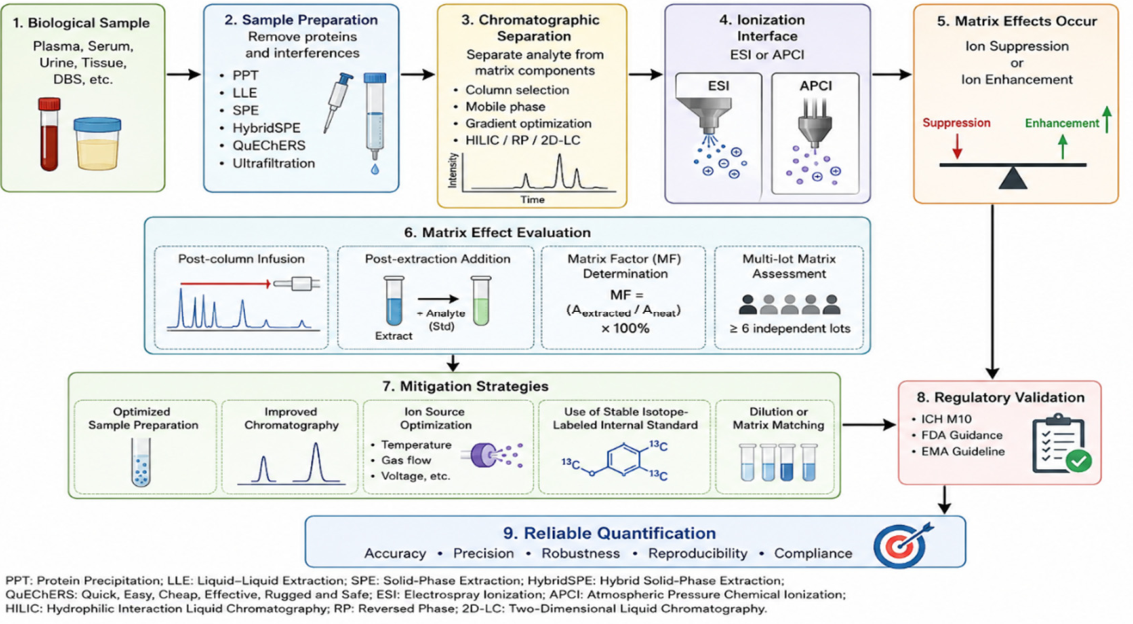
Unlike previous reviews that consider each of these issues individually, the goal here is to combine ionization technology and the philosophy of validation in a unified methodology. It is through this combination that this review aims to provide a comprehensive understanding, enriched by critical evaluation, of LC-MS/MS bioanalytical performance. [2,3,4,5,6,12,13,14,15,16,17,20,21,22,23,24,25,26,27] The overall LC–MS/MS bioanalytical workflow and integration of matrix effect control strategies are illustrated in Figure 1.
Despite significant advances in LC–MS/MS bioanalysis, matrix effects remain a major source of analytical variability because they arise from complex interactions among biological matrices, sample preparation, chromatographic separation, ionization mechanisms, and instrumental conditions. Although numerous strategies have been proposed to reduce matrix effects, these approaches are often presented independently rather than as an integrated workflow. This review therefore provides a unified framework that combines mechanistic understanding, systematic evaluation, mitigation strategies, regulatory expectations, and emerging analytical technologies to support the development of robust, reliable, and regulatory-compliant LC–MS/MS bioanalytical methods. [2,3,4,5,6,10,17,20,21,22,23,24,25]
2. Mechanistic Basis of Matrix Effects
2.1. Ionization Processes in ESI and APCI
The two most common atmospheric-pressure ionization interfaces employed in LC-MS/MS bioanalysis are electrospray ionization (ESI) and atmospheric-pressure chemical ionization (APCI). ESI is commonly used because of its tolerance to liquid chromatographic effluents and high sensitivity to polar and moderately polar compounds. ESI is, however, more prone to matrix effects because ionization occurs in charged droplets before gas-phase ion transfer, in contrast to APCI, which is dominated by gas-phase ion molecule reactions after thermal vaporization of the analytes. At high electric potential (usually 3-5 kV), the LC effluent is converted into charged droplets at the tip of the capillary. As a result of solvent evaporation facilitated by thermal and nebulizing gas support, the droplet size is reduced with concurrent enhancement of surface charge density. When the Rayleigh stability limit is attained, Coulombic repulsion causes droplet fragmentation, producing smaller progeny droplets, ultimately resulting in gas-phase ion formation. The interplay of evaporation rate, surface tension, conductivity, and charge density determines droplet stability; disturbance of these factors by co-eluting matrix components directly affects ion suppression or enhancement. [2,3,4,5,6,28,29,30,31]
Matrix constituents can interact in competition for excess charge, change the surface composition of droplets, or affect conductivity, thus affecting the efficiency of desolvation and ionization. Higher ionic strength increases the conductivity of the solution and can also affect the optimal electric field distribution across the droplet, thus decreasing the availability of analyte ions in the gas phase. Ionization is therefore better described in terms of changes in droplet dynamics and charge distribution rather than ion pairing effects alone. On the other hand, APCI is based on nebulization and thermal vaporization of the mobile phase in a heated probe (usually ~400-450 °C), where a corona discharge generates reagent ions that react with the analyte through gas-phase proton transfer or charge exchange reactions. As a result, APCI is less susceptible to liquid-phase suppression effects related to competition at the droplet surface. Non-volatile and surface-active matrix components, especially phospholipids, can accumulate at the droplet/air interface during ESI, pushing the analytes out of the highly charged regions and thus decreasing ionization efficiency. Suppression values above 50% have been observed in phospholipid-rich matrices under specific chromatographic conditions. In APCI, the less important role of droplet/surface interactions is responsible for the higher tolerance of complex biological samples. [2,3,4,5,6,10,23,24,29,30,31]

Table 1.
Comparison of ESI and APCI in LC–MS/MS Bioanalysis.
| Parameter | ESI | APCI |
|---|---|---|
| Ionization mechanism | Charged droplet ionization | Gas-phase chemical ionization |
| Suitable analytes | Polar, ionic, high MW compounds | Less polar, volatile compounds |
| Matrix effect | High susceptibility | Lower susceptibility |
| Sensitivity | Very high | Moderate to high |
| Salt tolerance | Low | Higher |
| Best applications | Peptides, proteins, metabolites, biologics | Small molecules, steroids, lipids |
| Advantages | High sensitivity, soft ionization | Better robustness, less ion suppression |
| Limitations | Greater matrix effects | Limited for highly polar/large molecules |
| Recommended use | Routine LC–MS/MS bioanalysis | Alternative for volatile, less polar analytes |
2.2. Sources of Matrix Components
Biological matrices are known to have complex mixtures of endogenous and exogenous components that have the potential to affect ionization efficiency in atmospheric-pressure ionization. The matrix effect is known to be the result of a series of physicochemical processes that occur in the formation of droplets, evaporation of solvent, and charge transfer in the gas phase rather than a single mechanism.
- (i)
- Inorganic Salts and Buffer Components
Inorganic salts (e.g., sodium, potassium, phosphate, chloride) and the remaining buffer species affect electrospray in principal ways that are primarily a consequence of increased ionic strength and conductivity, which affect the charge density of the droplet and the Rayleigh stability threshold that controls droplet division. Increased conductivity can affect desolvation rates and lead to a redistribution of excess charge among co-existent ionic species, thus reducing the response of the analyte. While ion pairing can be a problem for particular analytes, ion pairing suppression is more often a consequence of changes in droplet dynamics and ionization efficiency rather than ion pairing alone. [2,3,4,5,6,17,28,29,30,31]
- (ii)
- Proteins, Peptides, and High-Molecular-Weight Biomolecules
Protein and endogenous macromolecule interference is believed to be primarily mediated via indirect physical means. In the case of plasma or serum, the remaining proteins might cause increases in viscosity and alterations in the size distribution of droplets, as well as in evaporation rates. While direct “charge competition” between intact proteins and smaller molecules has been theorized, more often reduction is associated with the presence of coeluting phospholipids, lipoproteins, and surfactant-like substances. [2,3,4,5,6,10,23,24,25]
- (iii)
- Phospholipids and Lipophilic Endogenous Compounds
Among the major sources of ion suppression in plasma based LC-MS/MS analysis are phospholipids owing to their amphiphilicity, high prevalence, and high surface activity. Phospholipids concentrate on the surface of charged droplets during the process of electrospray ionization. As such, they tend to reduce the efficiency of ionization by competing with the analyte molecules for available charges. These are non-volatile substances, which get enriched even further during the course of droplet desolvation affecting the conductivity of the droplet, the charge distribution, and solvent evaporation prior to Coulombic fission. The extensive retention period of phospholipids causes their co-elution with analytes resulting in ion suppression. It is necessary to eliminate phospholipids selectively through appropriate sample preparation and separation for effective bioanalysis. [2,5,6,10,23,24,25]
- (iv)
- Anticoagulants and Additives (e.g., EDTA, Heparin)
Anticoagulants that may be present in blood samples could impact the ionic balance and chemistry of solutions, hence the balance of conductance and adduct formation. Electrospray ionization itself does not depend on metals; however, adduct formation involving metals is possible for certain compounds due to coordination chemistry and solvent effects. Thus, the influence of EDTA and additives must be examined taking into account the altered ionic environment and adduct formation balance and not the absence of “critical metal ions for ionization.” [2,4,5,6,17,23,24]
- (v)
- Exogenous Interferents and Co-administered Drugs
Pharmaceutical drugs, their metabolites, food ingredients, and environmental chemicals can co-elute and compete for ionization. Such substances can alter the droplet surface composition, cause charge rearrangement, or generate isobaric interferences. In multi-analyte tests, including metabolomic studies, suppression caused by a wide variety of co-eluting substances results in greater variability than in single analyte tests. [4,5,6,17,28,29,30,31]
2.3. Positive vs Negative Ionization
The susceptibility to matrix effects in LC-MS/MS analysis varies according to the physicochemical properties of the analytes, ionization mode, and composition of the matrix. In ESI, highly polar or easily protonated compounds are more susceptible to charge competition and droplet surface interactions. Hydrophilic, low-molecular-weight compounds may co-elute with early-eluting phospholipids, thus being more susceptible to suppression, while hydrophobic compounds may elute later but still be susceptible to lipophilic interferents based on chromatographic conditions. [6,10,23,24,25]
Basic compounds that are more likely to undergo protonation in positive ion mode may show increased sensitivity to charge delocalization in droplets. Negative ion mode may show different levels of sensitivity to matrix composition and ionization efficiency. Since ESI is an ionization technique that generates ions in a liquid droplet, it is more likely to be affected by matrix suppression compared to APCI, which is a gas-phase ion-molecule reaction. Matrix effects with deviations of more than 30% from unity have been observed in some ESI-based assays under non-optimal chromatographic conditions. These effects may be responsible for inter-subject variability (lipemic or hemolyzed samples), poor assay reproducibility, and possible failure of validation if the accuracy and precision of quality control samples are not met under harmonized regulatory requirements. [2,6,12,13,14,15,16,17,23,24,25] The mechanistic pathways involved in matrix-induced ion suppression and enhancement are summarized in Figure 2.
2.4. Ion Formation in ESI- Charge Residue Model (CRM) and the Ion Evaporation Model (IEM)
According to the CRM proposed by Dole, repeated solvent evaporation and Rayleigh fission generate progressively smaller droplets until complete desolvation leaves a charged analyte, making this mechanism predominant for large biomolecules such as proteins and peptides. In contrast, the IEM proposed by Iribarne and Thomson suggests that small ions are emitted directly from highly charged nanodroplets before complete solvent evaporation, making it more applicable to low-molecular-weight analytes. The dominant mechanism depends on analyte size, droplet dimensions, solvent composition, conductivity, and desolvation efficiency. In APCI, ionization occurs primarily through gas-phase reactions, where corona discharge generates N₂⁺•, which rapidly forms protonated water clusters (H₃O⁺(H₂O)ₙ). These reagent ions transfer protons to analyte molecules, while the size and abundance of water clusters influence proton-transfer efficiency and overall ionization. Because APCI relies on gas-phase chemistry rather than charged droplets, it generally exhibits lower susceptibility to matrix-induced ion suppression than ESI. [4,5,6,29,30,31]
3. Experimental Evaluation of Matrix Effects
3.1. Post-Extraction Addition Method (Matuszewski Approach)
The post-extraction addition method, first systematically described by Matuszewski et al., is widely regarded as the primary quantitative approach for evaluating matrix effects (ME) in LC–MS/MS bioanalysis. In this procedure, blank biological matrix samples are extracted and subsequently spiked with known concentrations of analyte and internal standard (IS). The resulting peak areas are compared with those obtained from equivalent concentrations prepared in neat solvent [1,12,14,44]. The absolute matrix factor (MF) is calculated as:
This approach enables direct assessment of ionization effects independent of extraction recovery, thereby isolating the ionization component of analytical variability. Because extraction recovery is evaluated separately, overall process efficiency can be expressed as the product of recovery and matrix factor. For this reason, the method is considered a regulatory standard for validation studies involving multiple matrix lots. Use of an isotope-labeled internal standard (SIL-IS) allows calculation of the IS-normalized matrix factor:
When the SIL-IS closely mimics analyte physicochemical and chromatographic behavior, normalization improves quantitative robustness by compensating for lot-specific suppression or enhancement [2,12,13,14,17,24,25,48,49,50].
However, the technique has been noted to have several limitations despite its benefits. The technique needs access to representative quantities of the blank matrix, which may not be the case in samples where the matrix is rare, or in studies involving diseased populations and metabolites. Furthermore, the technique assumes equal extraction recovery for the analytes and IS, and any differences in matrix-related variability need to be considered in the context of recovery and process performance.
3.2. Post-Column Infusion Technique
The post-column infusion method is a qualitative tool for visualizing the regions of matrix effect in real-time during the chromatographic separation. In this method, a continuous infusion of the analyte or analyte/IS solution is made post-column, usually by a syringe pump connected via a T-junction, while blank matrix samples are injected onto the LC system. During MRM analysis, a stable baseline is obtained in the absence of matrix effect. Negative deviations represent regions of signal suppression, while positive deviations represent regions of signal enhancement. This method enables the identification of regions of chromatographic separation where co-eluting endogenous compounds affect the ionization efficiency. [5,6,17,24,25,51]
Regions of high phospholipid content in plasma extracts often exhibit strong suppression regions owing to their surface-active nature and high concentration. If suppression occurs at the same time as the analyte peak, chromatographic optimization (e.g., gradient adjustment, extended separation, or changes in column chemistry) or enhanced sample preparation may be necessary. Although very useful in method development, the post-column infusion method is a qualitative tool and does not offer quantitative values of the matrix factor. It is therefore a complementary tool to the post-extraction addition method. [2,12,13,14,17,24,25,51]
3.3. Matrix Factor and IS-Normalized Matrix Factor
The matrix factor (MF) quantitatively expresses the magnitude of matrix effects and is defined as the ratio of analyte response in post-extraction spiked matrix to that in neat solvent:
Values less than unity indicate ion suppression, whereas values greater than unity indicate enhancement. Because raw MF does not account for compensation by internal standards, regulatory validation practice emphasizes use of the IS-normalized matrix factor:
Evaluation is usually done at low- and high-quality control (QC) concentrations using at least six independent matrix lots, with replicate analyses per lot [29,30,31]. Data are expressed as mean IS-normalized MF and coefficient of variation (%CV). A %CV ≤ 15% among lots is generally regarded as indicative of sufficient compensation and acceptable matrix variability according to harmonized bioanalytical validation guidelines. [12,13,14,17,48,49,50]
Notably, current ICH M10, FDA, and EMA bioanalytical guidelines do not specify concrete numerical limits for absolute MF values. Rather, control of matrix effects is indirectly ascertained by overall method accuracy (usually within ±15%) and precision (≤15% CV) at QC concentrations, including evaluation in hemolyzed or lipemic matrices as appropriate. While IS-normalized MF values in the range of about 0.85-1.15 are sometimes employed as useful development criteria, acceptance by regulatory authorities is ultimately determined by validated method performance, not individual MF values. A high inter-lot variability (%CV > 15%) may suggest matrix heterogeneity or insufficiency of internal standardization. In these instances, analysis for co-eluting phospholipids or other endogenous interferents, chromatographic optimization, or alternative internal standard choice may be considered. [10,17,23,24,25,48,49,50,53,54] The regulatory framework governing matrix effect evaluation in LC–MS/MS bioanalysis is presented in Figure 3.
4. Factors Influencing Matrix Effects
4.1. Sample Preparation Techniques
Sample preparation represents one of the most influential determinants of matrix effects (ME) in LC–MS/MS bioanalysis because it governs the extent to which endogenous interferents—particularly phospholipids and other surface-active components—are removed prior to ionization.
- (i)
- Protein Precipitation (PPT)
PPT is generally preferred owing to the simplicity and high throughput nature of this method. This typically involves the addition of organic solvents such as acetonitrile or methanol, which aid in the denaturation and precipitation of the protein component. While PPT does an excellent job in eliminating most proteins, low molecular weight endogenous substances like phospholipids remain behind in the extract. The aforementioned substances tend to elute during the early portions of the chromatographic run due to their surface-active nature and high levels of concentration. Despite the aforementioned limitation, PPT continues to find application in high-throughput pharmacokinetics studies. [17,55,56,57,58]
- (ii)
- Liquid–Liquid Extraction (LLE)
The process of liquid-liquid extraction (LLE) involves the separation of substances using different solvents and pH control for selective isolation of components from biological materials. While compared with PPT, LLE shows lower levels of phospholipids and higher extract purity. However, the optimal selection of solvent composition and pH may be required to reach equilibrium between selectivity and recovery rate. [17,24,25,59,60,61,62]
- (iii)
- Solid-Phase Extraction (SPE)
Among the most commonly employed techniques, solid-phase extraction (SPE) possesses the highest degree of selectivity. SPE exploits sorbent analyte interactions, such as reversed phase or mixed-mode ion exchange, for the purpose of performing successive conditioning, washing, and elution steps, all of which serve to remove endogenous interferences prior to analysis. Optimal SPE conditions can result in minimal suppression caused by matrix effects and improved reproducibility of IS-normalized matrix factors. On the other hand, SPE is less convenient and faster than PPT or LLE techniques. In summary, there is a compromise between speed and purity of the extracts obtained by these two approaches. [17,24,25,55,56,57,58,59,60,61,62,63,64,65,66,67]
- (iv)
- Centrifugal Ultrafiltration
Centrifugal ultrafiltration provides yet another method of matrix clean-up used for the selective elimination of high-molecular-weight matrix constituents, including proteins, before the LC–MS/MS analysis. The method uses membranes with a specific value of molecular weight cut-off (MWCO, typically 3–30 kDa), enabling the passage of low-molecular-weight compounds and retention of proteins or other macromolecules. As opposed to protein precipitation (PPT), ultrafiltration provides the benefit of decreased analyte dilution and no use of organic solvents, which may be of use for analytes prone to instability or precipitation artifacts. Centrifugal ultrafiltration can be applied in cases requiring plasma protein binding analysis, peptide bioanalysis, metabolomics, and therapeutic drug monitoring where protein-bound fractions can contribute to quantitation. Low concentration of proteins can lead to reduced viscosity and improved droplets desolvation during ESI, which results in decreased matrix effects on the analyte. Potential drawbacks to this method include nonspecific retention of analytes by membrane, analyte loss due to binding to the surface of membranes, method variability caused by differences in membrane types, and extra costs. Nevertheless, this technique is suitable in cases when experimental verification proves its applicability and reproducibility. [12,13,14,17,68,69,70,71]
- (v)
- Hybrid SPE and QuEhERS
Use of proper sample preparation strategy can be considered one of the best ways of dealing with matrix effects in LC–MS/MS bioanalysis. PPT can be regarded as simple and cost-effective method that allows processing high volume samples; however, it can leave residues of phospholipids and endogenous components that cause ion suppression effect. LLE improves sample cleanness and reduces matrix effects; however, recovery of highly polar analytes can be lower when compared with PPT method. SPE allows improving selectivity, sample cleanness, and reproducibility and can be considered preferred sample preparation technique in quantitative bioanalysis even though it is more expensive and requires more complicated methods development. QuEChERS-based extraction and ultrafiltration are convenient strategies for handling of complicated matrices and bioanalysis of peptides, correspondingly. Recently, online SPE and automated sample preparation systems have become of interest for improving reproducibility, avoiding human errors and increasing sample throughput without compromising sample cleaning. Thus, selection of sample preparation technique should depend on analyte properties, matrix, requirements of sensitivity and quantitative performance. [12,13,14,17,24,25,55,56,57,58,59,60,61,62,63,64,65,66,67,68,69,70,71,72,73,74,75,76,77]
Table 2.
Comparison of Sample Preparation Techniques for Minimizing Matrix Effects in LC–MS/MS Bioanalysis.
Table 2.
Comparison of Sample Preparation Techniques for Minimizing Matrix Effects in LC–MS/MS Bioanalysis.
| Technique | Principle | Matrix Effect Reduction | Advantages | Limitations |
|---|---|---|---|---|
| Protein Precipitation (PPT) | Protein removal using organic solvents | Low–Moderate | Simple, rapid, inexpensive | Poor phospholipid removal |
| Liquid–Liquid Extraction (LLE) | Partitioning into organic solvent | Moderate–High | Clean extracts, good selectivity | Labor-intensive; solvent consumption |
| Solid-Phase Extraction (SPE) | Selective adsorption and elution | High | Excellent cleanup and reproducibility | Higher cost; method optimization required |
| HybridSPE | Protein precipitation with phospholipid removal | Very High | Efficient phospholipid depletion; minimizes ion suppression | Limited compatibility for some analytes |
| QuEChERS | Salting-out extraction with dispersive cleanup | Moderate | Fast, economical, high throughput | Less suitable for highly complex matrices |
| Ultrafiltration (UF) | Membrane-based separation by molecular size | Moderate | Suitable for peptides/proteins; minimal solvent use | Possible analyte adsorption and membrane fouling |
4.2. Chromatographic Separation
Chromatographic separation plays a central role in mitigating matrix effects by reducing co-elution between analytes and ionization-active interferents.
- (i)
- Column Chemistry
Traditional C18 stationary phases are effective in hydrophobic analyte retention but could permit early elution of polar phospholipids, leading to suppression if co-eluting compounds have similar retention times. Other stationary phases, such as polar-embedded reversed-phase or hydrophilic interaction chromatography (HILIC), can change retention selectivity and shift the elution of the matrix components outside the retention window of the analytes. Hybrid silica stationary phases could decrease secondary silanol effects, which can cause peak aberrations or retention irreproducibility. The choice of stationary phase, therefore, depends on the chemistry of the analytes and the matrix. [17,24,25,78,79,80,81,82,83]
- (ii)
- Gradient Optimization
Gradient design is a factor that plays a crucial role in the separation of analytes and matrix components. A shallow gradient can be beneficial in enhancing the resolution between the analytes and the wide elution bands of the matrix components, while a too-steep gradient can be detrimental to co-elution. Proper column re-equilibration is required to maintain the retention time constancy. The optimization procedures may involve changing the gradient steepness, the composition of the organic modifier, or the flow rate to enhance separation from the phospholipid-rich areas detected in the post-column infusion experiments. [10,17,23,24,25,51,78,79,80,81,82,83,84]
- (iii)
- Retention Time Stability
Overload of the matrix or high phospholipid content could affect retention time, which may result in small variations in the retention time of the analyte. Another criterion that can be used to determine the robustness of the chromatographic method is the relative retention time (RRT) of the analyte to the internal standard. [12,13,14,17,48,49,50,78,79,80,81,82,83,84]
4.3. Instrumental Parameters
Instrumental configuration and source conditions directly influence droplet formation, desolvation efficiency, and gas-phase ion transfer in atmospheric-pressure ionization sources.
- (i)
- Source Design and Desolvation Conditions
Contemporary geometries of the electrospray source (such as orthogonal spray or pneumatic-assisted electrospray ionization) improve nebulization and facilitate the creation of smaller droplets, which in turn improves the efficiency of desolvation and prevents the accumulation of nonvolatile matrix components. Higher desolvation temperature and optimal nebulizing gas flow rate also improve the evaporation of the solvent and, consequently, prevent ion suppression due to incomplete drying of the droplets. Multi-nozzle or multi-jet electrospray ionization sources can help to distribute the matrix load through multiple electrospray ionization streams. [85,86,87,88,89]
- (ii)
- Flow Rate and Microflow LC
The efficiency of electrospray ionization is very sensitive to the flow rate. At lower flow rates, as in microflow LC, the initial droplet size is smaller, and the efficiency of desolvation is higher, which often leads to more stable signal intensities and less matrix-induced suppression effects compared to conventional high-flow techniques. [17,24,25,90,91,92,93]
- (iii)
- Mobile Phase Composition
The addition of volatile mobile phase modifiers (such as formic acid or ammonium salts) helps in the formation of stable ions and prevents the accumulation of nonvolatile residues. However, the addition of nonvolatile buffers can cause ion suppression by competition at the surface of the droplets or ion pairing. The composition of the gradient can also affect the solubility of endogenous lipids. [10,17,23,24,25,94,95,96,97]
Although instrumental optimization cannot eliminate matrix effects entirely, appropriate tuning of source parameters and chromatographic conditions can significantly reduce variability associated with droplet dynamics and charge redistribution.
5. Evaluation and Quantification of Matrix Effects
Systematic assessment of matrix effects is a critical step to guarantee the quantitative performance of LC-MS/MS bioanalysis. As suppression and enhancement effects are mainly observed in the ionization process, evaluation strategies need to differentiate ionization variability from extraction inefficiency and chromatographic interference. The evaluation strategies can be divided into qualitative mapping strategies and quantitative comparative strategies.
5.1. Post-Column Infusion (Qualitative Profiling)
The post-column infusion method allows for the time-resolved observation of ion suppression or enhancement during a chromatographic run. A constant analyte signal is infused into the mass spectrometer, and blank matrix extracts are injected through the LC system. Variations in the signal indicate suppression or enhancement regions for co-eluting matrix components. Although a qualitative method, it offers mechanistic information and informs chromatographic optimization based on retention windows of high suppression. [6,17,24,25,51,52,53,54]
5.2. Post-Extraction Addition (Quantitative Assessment)
The addition method post-extraction allows for the quantitative assessment of matrix factor and remains to date the most generally accepted regulatory approach. By comparing post-extraction spiked samples to neat standards, ionization effects are separated from extraction recovery. IS-normalized matrix factor variability for several lots of matrix can be used as an indicator of reproducibility in biologically relevant conditions. Notably, regulatory recommendations do not specify acceptable values of matrix factor; rather, matrix effects are considered to be controlled when criteria for validated accuracy and precision are met for matrix lots. [12,13,14,17,48,49,50]
5.3. Pre-Extraction Spiking and Recovery
Pre-extraction spiking assesses the combined effects of recovery and ionization. By comparing the pre- and post-extraction signals, it is possible to estimate the efficiency of extraction independently of the matrix factor. However, care must be taken in interpreting the results because recovery and suppression can mask variability when viewed separately. [2,5,17,24,48]
5.4. Multi-Lot Matrix Evaluation
Biological variability among individual donors is a significant contributor to matrix heterogeneity. Testing on several independent matrix sources, at least six, is advised to evaluate robustness in the context of biological variability. Adding hemolyzed or lipemic matrices will further improve robustness evaluation if relevant to the clinical context. The critical performance metric is the reproducibility of IS-normalized response and its effect on calibration accuracy and precision of quality control rather than the absolute level of suppression. [12,13,14,17,48,49,50]
5.5. Regulatory Interpretation
Regulatory bodies prefer indirect control of matrix effects via acceptable method accuracy and precision demonstration rather than predefined levels of suppression. Acceptable performance for quality control samples is expected to have bias within ±15% and precision ≤15%, with ±20% at the lower limit of quantification. Thus, the assessment of matrix effects serves as a diagnostic aid in the validation performance rather than an independent criterion.
A holistic assessment strategy should combine:
- Qualitative suppression mapping
- Quantitative matrix factor determination
- Internal standard normalization
- Multi-lot variability assessment
- Correlation with calibration and QC performance
Harmonization of mechanistic insight with the philosophy of regulatory validation in bioanalysis enables systematic control of matrix-induced variability in a reproducible bioanalytical process. [12,13,14,15,16,17,24,25,98,99,100,101,102]An integrated workflow for matrix effect evaluation and management during LC–MS/MS method development is illustrated in Figure 4.
A good assessment of the matrix effects necessitates careful selection of the blanks matrix in which the blank samples must be derived from at least six different individual subjects and be representative of the targeted biological matrix, with no endogenous interference at the retention time of the analyte and internal standard. Even though post-column infusion is a good method to determine the areas of ion suppression or enhancement, it does not give any quantitative data of the matrix effect as well as taking into account the extraction recovery. Therefore, such an approach should be supported with post-extraction addition trials. The samples whose responses are below the LLOQ should not be reported in the results but can be included in the study report as “below the limits of quantitation” based on the validated study criteria. As the matrix effect can be dependent on the analyte concentration, it is recommended to assess it at low, medium, and high quality control levels. In addition, matrix factor (MF) values should be analyzed statistically and the values of mean, CV, and ANOVA calculated if needed. [2,12,13,14,17,24,25,48,49,50]
6. Role of Internal Standards in Controlling Matrix Effects
Internal standards (IS) are essential in quantitative bioanalysis using LC-MS/MS because they allow for compensation of variability introduced by the sample preparation, extraction process, matrix effects, and instrument response. Quantitative analysis is usually performed by calculating the ratio of the peak areas of the analyte and the IS. This has the effect of normalizing the signal variability introduced during the extraction, chromatographic separation, and ionization steps. The internal standard should ideally behave like the analyte during the entire analytical procedure, including the extraction, chromatographic, and ionization steps. By sharing the same experience of ionization suppression or enhancement, the IS helps to compensate for the variability introduced by the matrix effects and allows for reliable quantification in complex biological samples such as plasma or serum. Compensation of matrix effects by normalizing with the internal standard is especially important in pharmacokinetic and bioequivalence studies where small biases can greatly affect the calculated exposure parameters. [26,32,149,151]
6.1. Stable Isotope-Labeled Internal Standards (SIL-IS)
Stable isotope-labeled internal standards (SIL-IS) are chemically equivalent to the analyte of interest except for the replacement of isotopes with non-radioactive ones, for example, ²H, ¹³C, or ¹⁵N. Because of their almost identical physicochemical properties, SIL-IS elute together with the target molecule at optimal chromatographic conditions, and the differentiation is achieved through a particular mass shift observed via mass spectrometry. The similarity in behavior exhibited by these standards under such conditions is owing to their same properties, which make SIL-IS the most reliable technique in terms of correcting matrix effects. It is highly recommended by all regulatory bodies that stable isotope-labeled standards should be used as often as possible during the course of the bioanalytical validation process.
However, certain considerations must be addressed:
- Isotope Effects: Deuterium substitution (²H) can, in some cases, lead to small variations in retention times because of differences in hydrophobicity or hydrogen bonding interactions.
- Isotope Exchange: Under certain conditions, hydrogen-deuterium exchange reactions can occur, which may influence stability.
- Assay Masking: Since SIL-IS corrects for suppression and recovery losses, it can also mask inherent analytical problems if validation is not properly assessed.
- Cost and Availability: The synthesis of labeled analogs can be costly or difficult for more complex molecules.
Sometimes ¹³C or ¹⁵N labels may be preferred over deuterium labels, wherever applicable, owing to the absence of isotope effects due to the latter. It is necessary to confirm the enrichment of isotopes and the level of purity thereof, as a way to prevent any interference by reason of presence of unlabeled analyte. IS levels have to be modified to achieve linearity of detector response, and also to preclude ion competition. Another validation parameter may be the percent IS variation among different matrices. [12,13,14,26,96,149,151]
6.2. Structural Analog Internal Standards
In the absence of stable isotope-labeled standards, structurally similar analogs can be employed as surrogate internal standards. These analogs are chosen based on their similarities in physicochemical properties and retention characteristics. While structurally similar analogs can serve to mitigate extraction differences and ionization, they cannot accurately mimic analyte responses. Differences in polarity, ionization efficiency, and chromatographic retention can preclude their ability to accurately correct for matrix-induced suppression or enhancement. As such, the use of structurally similar analogs may introduce a bias if the matrix variability is large. The choice of a suitable structurally similar analog requires that it respond similarly to multiple lots of matrix and challenge conditions. If possible, the use of a stable isotope-labeled internal standard is still preferred for ensuring maximum robustness. [12,13,14,17,25,54,149,151]
6.3. Comparative Considerations
| Aspect | Structural Analog | Stable Isotope-Labeled IS |
| Physicochemical similarity | Similar but not identical | Nearly identical to analyte |
| Compensation of matrix effects | Partial | High reliability |
| Retention behavior | May differ | Co-elution expected |
| Cost and availability | Generally lower | Often higher, synthesis required |
| Regulatory robustness | Acceptable with justification | Preferred approach |
In multi-analyte (multiplex) LC–MS/MS assays, the use of multiple stable isotope-labeled internal standards (SIL-IS) is preferred, as a single internal standard may not adequately compensate for differences in extraction recovery, chromatographic behavior, and ionization efficiency across chemically diverse analytes. Each SIL-IS should closely match the physicochemical properties and retention time of its corresponding analyte. Careful optimization is also required to minimize MRM cross-talk and isotopic interference, which may occur when isotopic impurities or overlapping precursor/product ion transitions generate signal overlap between the analyte and its SIL-IS. Appropriate selection of isotopic labels (preferably ¹³C- or ¹⁵N-labeled analogs), sufficient mass differences, optimized MRM transitions, and high isotopic purity are therefore essential to ensure accurate quantification and reliable correction of matrix effects. [15,17,25,54,55,149]
7. Strategies to Minimize and Control Matrix Effects in LC–MS/MS Bioanalysis
A strategy for mitigation of matrix effects must be mechanistically informed and system-oriented, rather than focusing on a single remedy. Since ion suppression and ion enhancement are caused by dynamic processes that occur during the course of chromatographic separation and atmospheric pressure ionization, mitigation of these effects must be accomplished through a comprehensive analytical system design that incorporates selectivity of sample preparation, chromatographic optimization, ion source conditions, and internal standardization.
7.1. Chromatographic Separation and Selectivity Enhancement
Chromatographic separation is a key aspect in the reduction of co-elution of analytes with ionization-active-matrix components. The use of stationary phase chemistry, for example, reversed-phase C18, phenyl-hexyl, polar-embedded phases, or hydrophilic interaction chromatography (HILIC), can be used to optimize retention selectivity and separate analytes from phospholipid-rich elution regions typically associated with suppression. The gradient slope, mobile phase composition, and pH can be used to optimize analyte retention and ionization efficiency. UHPLC systems are capable of improving peak efficiency and reducing elution windows; however, optimized chromatographic efficiency does not necessarily result in the reduction of suppression if matrix-dense regions overlap with analyte retention. The optimized separation using chromatography must be done through the use of suppression mapping experiments (such as post-column infusion), not retention time adjustment. The objective is for the compounds to be separated from suppression zones, not necessarily rearrange their elution sequence. [2,10,17,25,96,121,125,126,132] Major analytical strategies used to minimize and control matrix effects are summarized in Figure 5.
7.2. Ionization Source Optimization and Alternative Interfaces
The ion source conditions like flow rate of the nebulizing gas, temperature of the desolvation chamber, capillary voltage, and sheath gas configurations can directly impact the generation and solvent evaporation rates in the electrospray ionization procedure. Optimizing the above parameters can result in improved desolvation conditions and a less likely occurrence of conductivity and surface-competition suppression effects. Low flow rates, such as those in microflow liquid chromatography systems, can yield smaller droplets and have better efficiencies during the desolvation step. This can reduce the interference from the matrix in the process under optimized conditions. However, low flow rates cannot overcome inadequate matrix clean-up steps in case there is no proper selectivity during sample extraction.
Other ionization methods, such as atmospheric pressure chemical ionization (APCI) or atmospheric pressure photoionization (APPI), involve different ionization mechanisms. As APCI involves mainly gas-phase ion-molecule reactions rather than droplet-surface reactions, it may be more robust to some matrix components than electrospray ionization. The choice of ionization interface should be based on the polarity, volatility, and matrix composition of the analytes. [24,54,68,91,92,93]
7.3. Internal Standardization and Isotope-Labeled Analogs
Stable isotope-labeled internal standards (SIL-IS) are one of the most powerful methods for compensating remaining matrix effects. As the isotope-labeled analogs of the analyte of interest, they co-elute with the analyte and share the same extraction and ionization processes, thus compensating for differences in suppression, enhancement, and small recovery. To be effective, they must closely resemble the analyte in physicochemical and chromatographic properties. Deuterium-labeled standards can show small differences in retention factors under specific conditions, while ¹³C- or ¹⁵N-labeled analogs are generally better at co-elution. It must be stressed that internal standard normalization can only decrease, but not completely remove, the presence of matrix effects. The robustness of the method should, therefore, be shown by multi-lot validation and accuracy/precision performance criteria, and not solely by the use of SIL-IS. [12,13,14,17,25,50,54,96,149,151].
7.4. Matrix-Matched Calibration and Surrogate Matrices
Using matrix-matched calibration curves can help to better compensate for ion suppression if authentic blank biological matrix can be obtained. By using calibration standards prepared in extracted matrix instead of neat solvent, the response of the analyte will be more representative of actual sample conditions. When authentic blank matrix is not available (for example, endogenous compounds), surrogate matrices or stripped matrices can be used. However, surrogate systems must be shown to be equivalent in extraction recovery and ionization response to authentic samples. The requirements for calibration strategy are that it ultimately must be able to show acceptable accuracy and precision at quality control levels. [17,25,54,119,121,136].
7.5. Integrated Control Strategy
There is no single solution that completely solves the problem of matrix effects. A combination of the following is necessary for effective mitigation of matrix effects:
- ▪
- elective and Reproducible Sample Preparation
- ▪
- Chromatographic Separation from Suppression Zones
- ▪
- Ionization Source Parameters
- ▪
- Internal Standard Selection
- ▪
- multi-lot matrix validation
8. Regulatory Expectations and Guidance on Matrix Effect Evaluation
Matrix effects are acknowledged by regulatory agencies as an important source of variability in LC-MS/MS bioanalysis, but their assessment is considered in the context of overall method performance rather than by specified levels of suppression. The current recommendations from the U.S. Food and Drug Administration (FDA), the European Medicines Agency (EMA), and the International Council for Harmonization (ICH M10) specifically address that matrix effects must be assessed during method validation to ensure accurate quantitation of samples from representative biological matrices. Notably, these guidelines do not establish specific numerical acceptance criteria based solely on the extent of absolute ion suppression or enhancement. Rather, matrix effects are indirectly managed by establishing the accuracy and precision of quality control (QC) samples. In keeping with harmonized expectations, method accuracy should generally be within ±15% of nominal concentrations and precision (coefficient of variation, CV) should not exceed 15% at low, medium, and high QC concentrations. At the lower limit of quantitation (LLOQ), broader margins of ±20% for both accuracy and precision are allowed. These specifications are for validated quantitative performance and not for specific values of matrix factor (MF). [12,13,14,50,64,119]
The matrix factor, and more specifically the internal standard (IS)-normalized matrix factor, is a term that has emerged from recommendations in methodological literature related to regulatory guidance and scientific best practices, rather than from acceptance criteria specified as standalone requirements. ICH M10 suggests that the evaluation of matrix effects should be performed on multiple individual matrix lots (at least six independent sources) and that the variability of the IS-normalized response should be assessed. In reality, many laboratories consider ≤15% CV across matrix lots as an acceptable criterion for reproducibility; however, this is more a reflection of conformance with general criteria for precision rather than a regulatory-mandated threshold. Thus, the regulatory focus is not on achieving a specific value of MF (e.g., MF ≈ 1.0), but rather on establishing that the variability introduced by the matrix does not impact the integrity of the calibration or the performance of QC. When QC samples from multiple matrix sources satisfy pre-defined criteria for accuracy and precision, then matrix effects are considered to be under adequate control. On the other hand, even a degree of suppression may become unacceptable if it results in inconsistent calibration slopes, higher inter-lot variability, or QC failures. Special matrix evaluation, such as hemolyzed, lipemic, anticoagulant-varied, or diluted samples, may be necessary depending on the proposed clinical use and sample type. In these instances, it is necessary that matrix effect evaluation confirms that validated performance criteria are met within physiologically relevant variability. [12,13,14,17,25,96,119]
In conclusion, current regulatory approaches consider matrix effects as contributors to total analytical variability rather than as separate acceptance criteria. Harmonized regulatory compliance according to ICH M10 solidifies a performance-based approach: matrix effect evaluations must demonstrate that quantitative performance is accurate, precise, and reproducible under representative biological conditions. A critical distinction between mechanistic suppression extent and validation performance criteria is necessary to prevent confusion regarding regulatory requirements. Although ICH M10 offers a harmonized global approach, previous FDA and EMA guidance documents existed prior to harmonization and show only slight differences in organizational format, but not in underlying performance tenets. [12,13,14,64]
The new harmonized set of regulations formulated under ICH M10 includes basic validation principles that had been explained by both FDA and EMA guidance but gives international guidelines on how to conduct the matrix effect test. The matrix effect test should be done on at least six different matrix lots. It is not necessary to comply with certain matrix factor limits but rather to demonstrate reliable performance. [12,13,14]
9. Matrix Effects in Special Bioanalytical Applications
However, matrix effects become increasingly difficult in more complex LC-MS/MS bioanalytical applications involving low concentrations of the analyte, complex biological samples, or non-conventional sample formats. In these types of applications, even small ionization differences can lead to substantial effects on quantitative accuracy.
9.1. Low-Abundance Biomarkers and Trace-Level Quantification
In applications involving ng/mL or pg./mL levels of analysis, such as endogenous biomarkers or drug-related metabolites, small amounts of remaining matrix material can cause disproportionate effects on signal strength. At these levels of analysis, signal suppression by trace phospholipids or co-eluting endogenous material can impair sensitivity and lower the stability of the lower limit of quantification (LLOQ).
Methods to counter these issues include:
- ▪
- Highly selective sample preparation (e.g., mixed-mode SPE or phospholipid depletion)
- ▪
- Extended chromatographic gradients to better separate the sample from regions of high matrix material
- ▪
- Thorough assessment of signal-to-noise ratio in multiple lots of matrix material
High-resolution mass spectrometry (HRMS) improves selectivity and resists chemical interference; however, HRMS does not mitigate ion suppression, since ion suppression occurs at the ionization source rather than during mass analysis. In these applications, broader assessments of matrix lots may be indicated to better understand biological variability, especially in endogenous biomarkers where surrogate calibration approaches are employed. [12,13,14,114,123,128]
9.2. Peptides, Proteins, and Bottom-Up Proteomics
Peptide and protein bioanalysis also involves other complexities related to the matrix, including enzymatic digestion, adsorption, and high endogenous protein concentrations. In bottom-up proteomics, incomplete digestion, non-specific binding to laboratory surfaces, and co-elution of high-abundance proteins (such as albumin and immunoglobulins) can affect both recovery and ionization efficiency. Matrix effects can occur not only during electrospray ionization but also indirectly as a consequence of changes in digestion efficiency or peptide stability. It is therefore essential to carefully control digestion conditions, employ stable isotope-labeled peptides, and employ the correct chromatographic selectivity to guarantee reproducible quantification. More sophisticated methods, such as immunoaffinity enrichment or multi-stage mass spectrometry (e.g., MRM³), can enhance specificity and minimize interference in complex proteomic matrices, but they do not abolish suppression mechanisms altogether. [18,19,27,55,109]
9.3. Oligonucleotide Bioanalysis
The therapeutic oligonucleotides have special issues due to their polyanionic properties and high binding capacity with salts and metal ions. The presence of phosphate groups and other components in buffers may influence ionization and adduction. Ion pair reverse phase chromatography is preferred, but extra suppression issues can come from non-volatile additives in the source solution. Specific enrichment methods like hybridization and immunoaffinity techniques are employed, alongside stable isotope-labeled oligonucleotide standards. [55]
9.4. Dried Blood Spots (DBS) and Micro Sampling
There is a unique list of factors associated with the characteristics of the matrix itself for the dried blood spot (DBS) testing method, which differs from that associated with plasma samples. Viscosity changes caused by changes in hematocrit might affect spot distribution, analyte distribution, and recovery. Uneven analyte distribution can result in variability in terms of punch location and punch size. Distribution of phospholipids and other components of cells unevenly distributed while drying can cause different patterns of suppression in comparison with the analysis of blood plasma. Therefore, calibration and validation of DBS should be matrix matched since plasma matrices have their own unique features. The use of volumetric micro samplers reduces variability caused by hematocrit, although matrix evaluation in representative samples of patients is still required. [12,13,14,37,97]
9.5. Tissue Homogenates and Complex Solid Matrices
Tissues such as those from liver or brain will contain many amounts of lipids, proteins, and endogenous compounds, which are likely to be liberated upon homogenization. Such components will lead to ion suppression effects if not efficiently eliminated during sample preparation. Methods capable of reducing matrix components include optimal homogenization methods, selective extraction procedures such as LLE and SPE, and optimization of chromatography to prevent coelution of lipid-rich fractions. Since there is great variation in the composition of tissues, depending on the source and diseased state, assessment of matrix effects can only be made using specific tissue quality control samples. [17,24,25,54,137]
9.6. Alternative Biological Fluids
The combination of LBA with LC-MS/MS includes the use of immunological enrichment coupled with MS analysis, particularly in the case of analyzing large biomolecules or biologics. With the use of immunological enrichment, there is a decrease in the background interference even before ionization, preventing any ionization inhibition that could occur, while still ensuring specificity using MS. There is an increasing trend in the use of such combined approaches in the bioanalytical work on monoclonal antibodies, peptides, and novel biological drugs. [27,55]
10. Emerging Trends and Future Directions
Current trends in LC-MS/MS bioanalysis are continuing to impact the way in which matrix effects are dealt with. New technologies include better ionization efficiency, greater selectivity, automation, and the ability to handle more complex biological modalities. Although these new technologies are increasing the ability to analyze samples, they are not changing the underlying physical and chemical principles that cause ion suppression and ionization enhancement. Emerging technologies continue to improve the mitigation of matrix effects and enhance analytical robustness in LC–MS/MS bioanalysis. Differential ion mobility spectrometry (DMS/FAIMS) provides an additional gas-phase separation step that reduces chemical background and improves selectivity before mass analysis. Online solid-phase extraction (SPE) combined with column-switching minimizes manual sample handling while efficiently removing matrix components and increasing analytical throughput. Two-dimensional liquid chromatography (2D-LC) offers enhanced separation of complex biological matrices by improving analyte resolution from co-eluting endogenous compounds. In addition, ambient ionization techniques, including Desorption Electrospray Ionization (DESI) and Direct Analysis in Real Time (DART), enable rapid sample analysis with minimal preparation, although their applications in quantitative bioanalysis remain limited due to matrix-related variability. Furthermore, nano-LC and capillary LC operate at very low flow rates, generating smaller electrospray droplets that improve ionization efficiency, sensitivity, and resistance to ion suppression, making them particularly valuable for trace-level and limited-volume biological samples. [41,48,54,68,76]
10.1. Advanced Ionization Technologies
Current trends in ion source technology focus on optimizing droplet desolvation rates and robustness against surface-active interferents. Improved electrospray ionization geometries, combined ESI/APCI ion sources, and captive spray interfaces can optimize nebulization and charging, potentially improving robustness against phospholipid-rich matrices. Microflow or low-flow LC instruments (focusing in the low microliter per minute range) produce smaller starting droplets and can improve ionization efficiency, potentially improving robustness against the sample. Lower flow rates will not mitigate poor sample cleanup and could increase sensitivity to contamination if the matrix builds up in the source. [24,46,48,49,54,68,76,86,87]
10.2. High-Resolution Mass Spectrometry (HRMS)
The use of high-resolution mass spectrometry instruments, including quadrupole time-of-flight (Q-TOF) and Orbitrap instruments, offers improved mass accuracy and resolution. The use of exact mass discrimination enhances the ability to distinguish between the analyte and isobaric interferents, thus improving selectivity. Data-independent acquisition approaches allow for extended monitoring of matrix-related features and could potentially aid in retrospective analysis of suppression-related features. However, it should be noted that HRMS does not replace ion suppression because matrix effects are primarily related to ionization rather than mass analysis. [17,24,35,54,68]
10.3. Hybrid Analytical Platforms
The combination of LBA with LC-MS/MS includes the use of immunological enrichment coupled with MS analysis, particularly in the case of analyzing large biomolecules or biologics. With the use of immunological enrichment, there is a decrease in the background interference even before ionization, preventing any ionization inhibition that could occur, while still ensuring specificity using MS. There is an increasing trend in the use of such combined approaches in the bioanalytical work on monoclonal antibodies, peptides, and novel biological drugs. [27,55]
10.4. Automation and Artificial Intelligence
The use of automation, including robotic sample handling and online solid-phase extraction (SPE), can lead to increased reproducibility in matrix removal and subsequently decrease variation in matrix effects indirectly. The use of artificial intelligence and machine learning in aiding the optimization process, recognizing patterns of suppression, and predicting ionization effects is also under examination. For example, the algorithmic evaluation of information from post-column infusion can help determine suppression regions and propose gradients modifications. These approaches look quite promising but currently act merely as aids in optimization processes. [3,10,17,111,113]
10.5. Expanding Analytical Modalities and Complex Matrices
The advent of new treatment methods like PROTACs, oligonucleotides, or cellular and gene therapies introduces new issues for analytical considerations. There might be cases where molecules of these classes could present with different physicochemical properties, different metabolite profiles, or carriers that can potentially impact their ionization behavior. On the other side, samples derived from microbiomes, tissues, and diseased states possess greater variability compared to the conventional plasma matrices. 12–14, 17, 119]
10.6. Sustainability and Standardization
Projects on sustainability in analytical chemistry aim to increase the use of small amounts of solvent and eco-friendly alternatives to the mobile phase. While this is good for the environment, changes in solvent composition may impact the efficiency of ionization and the behavior of suppression. As far as regulation is concerned, the ICH M10 provides a unified global approach to matrix effects evaluation by means of performance criteria, not particular values of suppression. Possible future directions might include increased standardization of reporting and more proficiency testing, especially for non-traditional matrices like dried blood spots and tissue homogenates. Yet, regulations will continue to prioritize validation in terms of accuracy and precision. [17,24,25]
10.8. Outlook
Nevertheless, the principles behind matrix effects are firmly rooted in the fundamentals of droplet behavior and ionization mechanisms, even as technology evolves at a fast pace. Some areas in which LC-MS/MS bioanalysis is expected to develop in the future would be:
- Increased use of automation for both extraction and real-time detection
- Enhanced prediction of suppression phenomena
- Handling of more complicated therapeutics
- Consistent alignment of regulatory performance standards
In essence, dealing with matrix effects must involve a balance between technology and analytical strategy, as well as a performance-oriented approach to validation. [12,13,14,17,25,50,54]
Figure 6.
Unified Framework for Matrix Effect Assessment and Control in LC–MS/MS Bioanalysis.
11. Conclusions and Future Perspectives
Matrix effects remain one of the principal challenges in quantitative LC–MS/MS bioanalysis, particularly when analyzing complex biological matrices containing endogenous phospholipids, salts, metabolites, proteins, anticoagulants, and co-administered drugs. These effects arise primarily during atmospheric pressure ionization through complex physicochemical processes involving droplet formation, desolvation, surface activity, conductivity, charge competition, and ion transfer, ultimately influencing ionization efficiency and quantitative accuracy. A comprehensive understanding of ion suppression and ion enhancement mechanisms, particularly in electrospray ionization (ESI), is therefore essential to distinguish ionization-related phenomena from limitations associated with sample extraction or chromatographic separation during method development [17,24,25,54].
Effective control of matrix effects requires an integrated analytical strategy encompassing selective sample preparation, optimized chromatographic separation, appropriate ionization conditions, and the use of suitable internal standards, preferably stable isotope-labeled analogues. Comprehensive evaluation using validated experimental approaches, including post-column infusion, post-extraction addition, and assessment of multiple independent matrix lots, remains fundamental for identifying and characterizing matrix effects during bioanalytical method validation. Current regulatory guidance from the FDA, EMA, and ICH M10 emphasizes a performance-based validation framework in which matrix effects are considered adequately controlled when validated methods consistently demonstrate acceptable accuracy, precision, and reproducibility across representative biological matrices rather than compliance with predefined matrix factor limits [12,13,14,50,64].
Recent advances in analytical technologies, including HybridSPE, microflow LC, ion mobility spectrometry, high-resolution mass spectrometry, online solid-phase extraction, and automated sample preparation, have substantially improved the ability to minimize matrix-induced variability. Nevertheless, no single technology can completely eliminate matrix effects because they originate from the fundamental ionization processes occurring within the atmospheric-pressure ion source. Consequently, robust bioanalytical methods continue to rely on the combined optimization of sample preparation, chromatographic separation, ionization conditions, internal standardization, and comprehensive regulatory validation [12,13,14,17,25,50,54].
Future developments are expected to focus on intelligent sample preparation, multidimensional chromatography, ion mobility-based separations, differential ion mobility spectrometry (FAIMS/DMS), online extraction technologies, high-resolution mass spectrometry, and data-driven computational approaches, including artificial intelligence and machine learning for method optimization and prediction of matrix effects. These innovations will be particularly important for the quantitative analysis of emerging therapeutic modalities, including biologics, oligonucleotides, PROTACs, antibody–drug conjugates, and gene or cell therapy products, which present increasingly complex analytical challenges [27,55].
Ultimately, continued advances in analytical instrumentation, regulatory harmonization, automation, and standardized validation practices will further improve the robustness, reproducibility, and reliability of LC–MS/MS bioanalysis. However, successful mitigation of matrix effects will continue to depend on a thorough understanding of ionization mechanisms together with scientifically rigorous method development and validation, ensuring accurate and reliable quantitative measurements across diverse biological matrices [12,13,14,17,24,25,50,54].
Practical Recommendations
Based on current scientific evidence and harmonized regulatory guidance, the following practices are recommended for minimizing matrix effects in LC–MS/MS bioanalysis:
Author Contributions
Dinesh P, RESEARCH SCHOLAR. conceptualized the review topic, performed the literature search and critical analysis, and drafted the original manuscript. Sangeetha S, ASSO. PROFESSOR. contributed to scientific interpretation, critical revision of the manuscript, and refinement of technical content.
Funding
The authors received no specific financial support from any funding agency in the public, commercial, or not-for-profit sectors for the preparation of this review.
Conflicts of Interest
The authors declare that there are no conflicts of interest regarding the publication of this manuscript.
References
- Kloepfer, A.; Quintana, J.B.; Reemtsma, T. Operational options to reduce matrix effects in liquid chromatography–electrospray ionisation-mass spectrometry analysis of aqueous environmental samples. J. Chromatogr. A 2005, 1067, 153–160. [Google Scholar] [CrossRef] [PubMed]
- Matuszewski, B.K.; Constanzer, M.L.; Chavez-Eng, C.M. Strategies for the assessment of matrix effect in quantitative bioanalytical methods based on HPLC− MS/MS. Anal. Chem. 2003, 75(13), 3019–30. [Google Scholar] [CrossRef] [PubMed]
- Bonfiglio, R.; King, R.C.; Olah, T.V.; Merkle, K. The effects of sample preparation methods on the variability of the electrospray ionization response for model drug compounds. Rapid Commun. Mass Spectrom. 1999, 13(12), 1175–85. [Google Scholar] [CrossRef]
- Annesley, T.M. Ion suppression in mass spectrometry. Clin. Chem. 2003, 49(7), 1041–4. [Google Scholar] [CrossRef] [PubMed]
- Taylor, P.J. Matrix effects: the Achilles heel of quantitative high-performance liquid chromatography–electrospray–tandem mass spectrometry. Clin. Biochem. 2005, 38(4), 328–34. [Google Scholar] [CrossRef] [PubMed]
- Gosetti, F.; Mazzucco, E.; Zampieri, D.; Gennaro, M.C. Signal suppression/enhancement in high-performance liquid chromatography tandem mass spectrometry. J. Chromatogr. A 2010, 1217(25), 3929–37. [Google Scholar] [CrossRef] [PubMed]
- Fu, Y.; Li, W.; Picard, F. Assessment of matrix effect in quantitative LC-MS bioanalysis. Bioanalysis 2024, 16(12), 631–4. [Google Scholar] [CrossRef] [PubMed]
- Gomes, A.G.; Vaidya, V.V.; Patankar, S.; Kekare, M.B. A rapid bio-analytical method for simultaneous quantification of Boeravinone B and Eupalitin-3-O-β-D-galactopyranoside from Boerhaavia diffusa using LC-MS/MS. Int. J. Pharm. Clin. Res. 2014, 6(2), 149–154. [Google Scholar] [CrossRef] [PubMed]
- KUMAR, G.; SUSHMA, B.; JEYAPRAKASH, M. Lc-Ms/Ms-based quantitative profiling of papain enzyme in Carica Papaya L.: method development and validation. Int. J. App Pharm. 2024, 16(2), 86–91. [Google Scholar] [CrossRef]
- Chambers, E.; Wagrowski-Diehl, D.M.; Lu, Z.; Mazzeo, J.R. Systematic and comprehensive strategy for reducing matrix effects in LC/MS/MS analyses. J. Chromatogr. B Anal. Technol. BioMed Life Sci. 2007, 852(1-2), 22–34. [Google Scholar] [CrossRef] [PubMed]
- Hemström, P.; Irgum, K. Hydrophilic interaction chromatography. J. Sep. Sci. 2006, 29(12), 1784–821. [Google Scholar] [CrossRef] [PubMed]
- ICH M10 Bioanalytical Method Validation and Study Sample Analysis; ICH: Geneva, 2022.
- U.S. Food and Drug Administration. Bioanalytical Method Validation: Guidance for Industry. FDA: Silver Spring (MD), 2022. [Google Scholar]
- European Medicines Agency. Guideline on bioanalytical method validation. 2022. [Google Scholar] [CrossRef]
- Harahap, Y.; Andriyani, N. Method development and validation of lercanidipine in human plasma by liquid chromatography tandem-mass spectrometry. Int. J. Appl. Pharm. 2018, 10(4), 87–91. [Google Scholar] [CrossRef]
- Inturi, R.; Raju, M.D.; Rao, M.V.B.; Inturi, S. Pharmacokinetic investigation of remogliflozin in rat plasma samples by high-throughput HPLC-MS-MS. Int. J. Pharm. Pharm. Sci. 2022, 14(11), 178–185. [Google Scholar] [CrossRef] [PubMed]
- Nasiri, A.; Jahani, R.; Mokhtari, S.; Yazdanpanah, H.; Daraei, B.; Faizi, M.; Kobarfard, F. Overview, consequences, and strategies for overcoming matrix effects in LC-MS analysis: a critical review. Analyst 2021, 146(20), 6049–63. [Google Scholar] [CrossRef] [PubMed]
- An, Y.; Goldman, R. Analysis of peptides by denaturing ultrafiltration and liquid chromatography–mass spectrometry. Methods Mol. Biol. 2013, 951, 15–23. [Google Scholar]
- Jemal, M.; Xia, Y.Q. Sample preparation in LC–MS/MS bioanalysis: role of ultrafiltration. Bioanalysis 2014, 6(10), 1329–1340. [Google Scholar] [CrossRef] [PubMed]
- Gniazdowska, E.; Giebułtowicz, J.; Rudzki, P.J. How does the order of sample analysis influence the matrix effect during LC-MS bioanalysis? J. Chromatogr. B 2023, 1227, 123800. [Google Scholar] [CrossRef] [PubMed]
- Liu, L.; Liu, Q.; Wang, Y.; Yuan, Y.; Xie, F. Development of polyanion-metal ion solution systems to overcome phospholipids-related matrix effects in LC-MS/MS-based bioanalysis. Anal. Chim. Acta 2023, 1250, 340973. [Google Scholar] [CrossRef] [PubMed]
- Williams, M.L.; Olomukoro, A.A.; Emmons, R.V.; Godage, N.H.; Gionfriddo, E. Matrix effects demystified: Strategies for resolving challenges in analytical separations of complex samples. J. Sep. Sci. 2023, 46(23), 2300571. [Google Scholar] [CrossRef] [PubMed]
- Bergeron, A.; Garofolo, F. Importance of matrix effects in LC–MS/MS bioanalysis. Bioanalysis 2013, 5(19), 2331–2. [Google Scholar] [CrossRef] [PubMed]
- Furey, A.; Moriarty, M.; Bane, V. Ion suppression in LC-MS/MS: recent advances. Talanta 2019, 201, 30–38. [Google Scholar]
- Cortese, M.; Gigliobianco, M.R.; Magnoni, F.; Censi, R.; Di Martino, P. Compensate for or minimize matrix effects? Strategies for overcoming matrix effects in liquid chromatography-mass spectrometry technique: A tutorial review. Molecules 2020, 25(13), 3047. [Google Scholar] [CrossRef] [PubMed]
- Fu, Y.; Barkley, D.; Li, W.; Picard, F.; Flarakos, J. Evaluation, identification and impact assessment of abnormal internal standard response variability in regulated LC− MS bioanalysis. Bioanalysis 2020, 12(8), 545–59. [Google Scholar] [CrossRef] [PubMed]
- de Jong, K.A.; van Breugel, S.J.; Hillebrand, M.J.; Rosing, H.; Huitema, A.D.; Beijnen, J.H. Bottom-up sample preparation for the LC–MS/MS quantification of anti-cancer monoclonal antibodies in bio matrices. Bioanalysis 2020, 12(19), 1405–25. [Google Scholar] [CrossRef] [PubMed]
- Tang, L.; Kebarle, P. Dependence of ion intensity in electrospray mass spectrometry on the concentration of the analytes in the electrosprayed solution. Anal. Chem. 1993, 65(24), 3654–68. [Google Scholar] [CrossRef]
- Ouranidis, A.; Vavilis, T.; Mandala, E.; Davidopoulou, C.; Stamoula, E.; Markopoulou, C.K.; Karagianni, A.; Kachrimanis, K. mRNA therapeutic modalities design, formulation and manufacturing under pharma 4.0 principles. Biomedicines 2021, 10(1), 50. [Google Scholar] [CrossRef] [PubMed]
- Pal, N.A.; Rao, A.S.; Ravikumar, P.I. New method development and validation for the determination of febuxostat in human plasma by liquid chromatography–mass spectrometry. Int. J. Pharm. Pharm. Sci. 2016, 8(9), 61–70. [Google Scholar] [CrossRef]
- Katteboina, M.Y.; Pilli, N.R.; Inamadugu, J.K.; Satla, S.R. LC-MS/MS assay for irbesartan in human plasma using solid phase extraction technique: a pharmacokinetic study. Int. J. Pharm. Pharm. Sci. 2015, 7, 335–40. [Google Scholar] [CrossRef] [PubMed]
- Tan, A.; Lévesque, I.A.; Lévesque, I.M.; Viel, F.; Boudreau, N.; Lévesque, A. Analyte and internal standard cross signal contributions and their impact on quantitation in LC–MS based bioanalysis. J. Chromatogr. B 2011, 879(21), 1954–60. [Google Scholar] [CrossRef] [PubMed]
- Smith, G. Bioanalytical method validation: notable points in the 2009 draft EMA Guideline and differences with the 2001 FDA Guidance. Bioanalysis 2010, 2(5), 929–35. [Google Scholar] [CrossRef] [PubMed]
- Reehana, S.K.; Sujana, K. LC-MS/MS characterization of forced degradation products of tucatinib, a novel tyrosine kinase inhibitor: Development and validation of RP-HPLC method. Int. J. Pharm. Pharm. Sci. 2022, 14(1), 58–66. [Google Scholar] [CrossRef]
- Song, X.C.; Canellas, E.; Dreolin, N.; Goshawk, J.; Lv, M.; Qu, G.; Nerin, C.; Jiang, G. Application of ion mobility spectrometry and the derived collision cross section in the analysis of environmental organic micropollutants. Environ. Sci. Technol. 2023, 57(51), 21485–502. [Google Scholar] [CrossRef] [PubMed]
- Lloyd Williams, O.H.; Rijs, N.J. Reaction monitoring and structural characterisation of coordination driven self-assembled systems by ion mobility-mass spectrometry. Front. Chem. 2021, 9, 682743. [Google Scholar] [CrossRef] [PubMed]
- Rahmania, T.A.; Harahap, Y.; Sandy, K. Azithromycin and oseltamivir quantification method developed and validated using liquid chromatography–tandem mass spectrometry in dried blood spot. Int. J. Appl. Pharm. 2024, 16(2), 182–187. [Google Scholar] [CrossRef]
- Priyadarshini, I.; Akila Devi, D. Development and validation of an LC-MS/MS method for the determination of tenofovir and emtricitabine. Int. J. Appl. Pharm. 2024, 16(2), 116–123. [Google Scholar] [CrossRef]
- Fang, N.; Yu, S.; Ronis, M.J.J.; Badger, T.M. Matrix effects break the LC behavior rule for analytes in LC-MS/MS analysis of biological samples. Exp. Biol. Med. 2015, 240(4), 488–497. [Google Scholar]
- An, G.; Bach, T.; Abdallah, I.; Nalbant, D. Aspects of matrix and analyte effects in clinical pharmacokinetic sample analyses using LC-ESI/MS/MS. J. Pharm. Biomed. Anal. 2020, 183, 113135. [Google Scholar] [CrossRef] [PubMed]
- Xu, R.N.; Fan, L.; Rieser, M.J.; El-Shourbagy, T.A. Recent advances in high-throughput quantitative bioanalysis by LC-MS/MS. J. Pharm. Biomed. Anal. 2007, 44, 342–355. [Google Scholar] [CrossRef] [PubMed]
- Jemal, M. High-throughput quantitative bioanalysis by LC-MS/MS. Biomed. Chromatogr. 2000, 14, 422–429. [Google Scholar] [CrossRef] [PubMed]
- Hernandez, F.; Sancho, J.V.; Pozo, O.J. Critical review of LC-MS in bioanalysis. Anal. Bioanal. Chem. 2005, 382, 934–946. [Google Scholar] [PubMed]
- Niessen, W.M.A. Progress in liquid chromatography-mass spectrometry instrumentation and its impact on bioanalysis. J. Chromatogr. A 2003, 1000, 413–436. [Google Scholar] [CrossRef] [PubMed]
- Jessome, L.L.; Volmer, D.A. Ion suppression: A major challenge in mass spectrometry. LC GC N. Am. 2006, 24, 498–510. [Google Scholar]
- Bruins, A.P. Mechanistic aspects of electrospray ionization. J. Chromatogr. A 1998, 794, 345–357. [Google Scholar] [CrossRef]
- Manoranjani, M. Assay method development and validation of cilnidipine and ramipril, characterization of its degradants by using LC-MS/MS. Int. J. Pharm. Pharm. Sci. 2022, 14(3), 276–285. [Google Scholar] [CrossRef]
- Kebarle, P.; Verkerk, U.H. Electrospray: From ions in solution to ions in the gas phase. Mass Spectrom. Rev. 2009, 28, 898–917. [Google Scholar] [CrossRef] [PubMed]
- King, R.C.; Bonfiglio, R.; Fernandez-Metzler, C.; Miller-Stein, C.; Olah, T.V. Mechanistic investigation of ion suppression in electrospray LC-MS/MS. J. Am. Soc. Mass Spectrom. 2000, 11, 942–950. [Google Scholar] [CrossRef] [PubMed]
- Viswanathan, C.T.; Bansal, S.; Booth, B.; et al. Workshop report on quantitative bioanalytical methods validation. AAPS J. 2007, 9, E30–E42. [Google Scholar] [CrossRef]
- Jemal, M.; Schuster, A.; Whigan, D.B. Liquid chromatography-tandem mass spectrometry in drug development. Rapid Commun. Mass Spectrom. 2003, 17, 1723–1734. [Google Scholar] [PubMed]
- Liang, Z. Perspectives on addressing ionization matrix effects in LC–MS bioanalysis. Bioanalysis 2012, 4(10), 1227–1234. [Google Scholar] [CrossRef] [PubMed]
- Fu, Y.; Li, W.; Flarakos, J. Critical considerations of matrix selection in LC–MS bioanalysis for toxicokinetic and pharmacokinetic assessment in drug development. Bioanalysis 2021, 13(8), 605–608. [Google Scholar] [PubMed]
- Zhou, W.; Yang, S.; Wang, P.G. Matrix effects in LC–MS bioanalysis: an overview. Mass Spectrom. Rev. 2021, 40, 168–190. [Google Scholar]
- Kotapati, S.; Deshpande, M.; Jashnani, A.; Thakkar, D.; Xu, H.; Dollinger, G. The role of ligand-binding assay and LC–MS in the bioanalysis of complex protein and oligonucleotide therapeutics. Bioanalysis 2021, 13(11), 931–954. [Google Scholar] [CrossRef] [PubMed]
- Reddy, G.N.; Laltanpuii, C.; Sonti, R. Review on in vivo profiling of drug metabolites with LC–MS/MS in the past decade. Bioanalysis 2021, 13(22), 1697–1722. [Google Scholar] [CrossRef] [PubMed]
- Tisler, S.; Pattison, D.I.; Christensen, J.H. Correction of matrix effects for reliable non-target screening LC-ESI-MS analysis of wastewater. Anal. Chem. 2021, 93(24), 8432–8441. [Google Scholar] [CrossRef] [PubMed]
- Kruve, A.; Künnapas, A.; Herodes, K.; Leito, I. Matrix effects in pesticide multi-residue analysis by liquid chromatography–mass spectrometry. J. Chromatogr. A 2008, 1187, 58–66. [Google Scholar] [CrossRef] [PubMed]
- Kruve, A.; Rebane, R.; Kipper, K.; Oldekop, M.-L.; Evard, H.; Herodes, K.; Ravio, P.; Leito, I. Tutorial review on validation of liquid chromatography–mass spectrometry methods: Part II. Anal. Chim. Acta 2015, 870, 8–28. [Google Scholar] [CrossRef] [PubMed]
- Kruve, A.; Leito, I.; Herodes, K. Combating matrix effects in LC/ESI/MS: The extrapolative dilution approach. Anal. Chim. Acta 2009, 651, 75–80. [Google Scholar] [CrossRef] [PubMed]
- Benijts, T.; Dams, R.; Lambert, W.; De Leenheer, A. Countering matrix effects in environmental liquid chromatography–electrospray ionization tandem mass spectrometry water analysis for endocrine disrupting chemicals. J. Chromatogr. A 2004, 1029, 153–159. [Google Scholar] [CrossRef] [PubMed]
- Dams, R.; Huestis, M.A.; Lambert, W.E.; Murphy, C.M. Matrix effect in bio-analysis of illicit drugs with LC-MS/MS: Influence of ionization type, sample preparation, and biofluid. J. Am. Soc. Mass Spectrom. 2003, 14, 1290–1294. [Google Scholar] [CrossRef] [PubMed]
- Breaux, J.; Jones, K.; Boulas, P. Analytical methods development and validation. Pharm. Technol. 2003, 5, 6–13. [Google Scholar]
- Kaza, M.; Karaźniewicz-Łada, M.; Kosicka, K.; Siemiątkowska, A.; Rudzki, P.J. Bioanalytical method validation: New FDA guidance vs. EMA guideline. Better or worse? J. Pharm. Biomed. Anal. 2019, 165, 381–385. [Google Scholar] [CrossRef] [PubMed]
- McNaught, A.D.; Wilkinson, R.; IUPAC. Compendium of Chemical Terminology, (the “Gold Book”), 2nd ed.; Blackwell Scientific Publications: Oxford, UK, 1997. [Google Scholar]
- Kermit, K.M.; Robert, K.B.; Marcos, N.E.; Langley, G.J.; Liang, L.; Yasuhide, N. Definitions of terms relating to mass spectrometry (IUPAC Recommendations 2013). Pure Appl. Chem. 2013, 85, 1515–1609. [Google Scholar] [CrossRef]
- Cappiello, A.; Famiglini, G.; Pierini, E.; Palma, P.; Trufelli, H. Advanced Liquid Chromatography−Mass Spectrometry Interface Based on Electron Ionization. Anal. Chem. 2007, 79, 5364–5372. [Google Scholar] [CrossRef] [PubMed]
- Trufelli, H.; Palma, P.; Famiglini, G.; Cappiello, A. An overview of matrix effects in liquid chromatography–mass spectrometry. Mass Spectrom. Rev. 2011, 30, 491–509. [Google Scholar] [CrossRef]
- Cech, N.B.; Enke, C.G. Relating Electrospray Ionization Response to Nonpolar Character of Small Peptides. Anal. Chem. 2000, 72, 2717–2723. [Google Scholar] [CrossRef] [PubMed]
- Lambert, W. Pitfalls in LC-MS(-MS) Analysis. Toxichem. Krimtech. 2004, 71, 64–68. [Google Scholar]
- Yuan, C.; Chen, D.; Wang, S. Drug confirmation by mass spectrometry: Identification criteria and complicating factors. Clin. Chim. Acta 2015, 438, 119–125. [Google Scholar] [CrossRef] [PubMed]
- Guo, J.; Zhao, Y.; Zhao, L.; Zhang, W.; Zhang, A.; Xu, B. Simultaneous quantification of CTN986 and its deglycosylation products in rat serum using liquid chromatography/tandem mass spectrometry. Rapid Commun. Mass Spectrom. Rcm 2006, 20, 1701–1708. [Google Scholar] [CrossRef] [PubMed]
- Zhang, W.; Wan, S.; Chen, L.; Wang, X.; Wang, Z.; Huang, Y. Determination of cycloserine in microdialysis samples using liquid chromatography-tandem mass spectrometry with benzoyl chloride derivatization. Biomed. Chromatogr. 2018, 32, e4187. [Google Scholar] [CrossRef] [PubMed]
- Jin, Y.; Zhang, J.; Zhao, W.; Zhang, W.; Wang, L.; Zhou, J.; Li, Y. Development and validation of a multiclass method for the quantification of veterinary drug residues in honey and royal jelly by liquid chromatography–tandem mass spectrometry. Food Chem. 2017, 221, 1298–1307. [Google Scholar] [CrossRef] [PubMed]
- Giri, P.; Patel, N.; Patel, B.; Patel, H.; Bahekar, R.; Srinivas, N.R.; Patel, P.R.; Desai, R. Sensitive and specific LC-ESI-MS/MS method for determination of ZYDPLA1, a novel long-acting dipeptidyl peptidase 4 inhibitor in rat plasma: An application for toxicokinetic study in rats. Biomed. Chromatogr. 2017, 31. [Google Scholar] [CrossRef] [PubMed]
- Kebarle, P.; TangL. From ions in solution to ions in the gas phase – the mechanism of electrospray mass spectrometry. Anal. Chem. 1993, 65(22), A972–A986. [Google Scholar] [CrossRef]
- Tang, J.C.Y.; Dutton, J.J.; Piec, I.; Green, D.; Fisher, E.; Washbourne, C.J.; Fraser, W.D. LC–MS/MS application for urine free pyridinoline and free deoxypyridinoline: Urine markers of collagen and bone degradation. Clin. Mass Spectrom. 2016, 1, 11–18. [Google Scholar] [CrossRef] [PubMed]
- Mizuno, K.; Kataoka, H. Analysis of urinary 8-isoprostane as an oxidative stress biomarker by stable isotope dilution using automated online in-tube solid-phase microextraction coupled with liquid chromatography-tandem mass spectrometry. J. Pharm. Biomed. Anal. 2015, 112, 36–42. [Google Scholar] [CrossRef] [PubMed]
- Kataoka, H. Recent developments and applications of microextraction techniques in drug analysis. Anal. Bioanal. Chem. 2010, 396, 339–364. [Google Scholar] [PubMed]
- Zhu, B.; Liu, F.; Li, X.; Wang, Y.; Gu, X.; Dai, J.; Wang, G.; Cheng, Y.; Yan, C. Fast quantification of endogenous carbohydrates in plasma using hydrophilic interaction liquid chromatography coupled with tandem mass spectrometry. J. Sep. Sci. 2015, 38, 34–41. [Google Scholar] [CrossRef] [PubMed]
- Chen, L.; Xu, S.; Li, J. Recent advances in molecular imprinting technology: Current status, challenges and highlighted applications. Chem. Soc. Rev. 2011, 2292. [Google Scholar]
- Yang, Z.; Cai, Q.; Chen, N.; Zhou, X.; Hong, J. Selective separation and identification of metabolite groups of Polygonum cuspidatum extract in rat plasma using dispersion solid-phase extraction by magnetic molecularly imprinted polymers coupled with LC/Q-TOF-MS. RSC Adv. 2016, 6, 12193–12204. [Google Scholar] [CrossRef]
- Huang, L.C.; Zheng, N.; Zheng, B.Q.; Wen, F.; Cheng, J.B.; Han, R.W.; Xu, X.M.; Li, S.L.; Wang, J.Q. Simultaneous determination of aflatoxin M1, ochratoxin A, zearalenone and α-zearalenol in milk by UHPLC-MS/MS. Food Chem. 2014, 146, 242–249. [Google Scholar] [CrossRef] [PubMed]
- Xing, J.; Chen, X.; Zhong, D. Stability of baicalin in biological fluids in vitro. J. Pharm. Biomed. Anal. 2005, 39, 593–600. [Google Scholar] [CrossRef] [PubMed]
- Lien, G.-W.; ChenC, -Y.; WangG, -S. Comparison of electrospray ionization, atmospheric pressure chemical ionization and atmospheric pressure photoionization for determining estrogenic chemicals in water by liquid chromatography tandem mass spectrometry with chemical derivatizations. J. Chromatogr. 2009, A1216(6), 956–966. [Google Scholar] [CrossRef] [PubMed]
- Ikonomou, M.G.; BladesAT; KebarleP. Investigations of the electrospray interface for liquid chromatography/mass spectrometry. Anal. Chem. 1990, 62(9), 957–967. [Google Scholar] [CrossRef]
- Ghosh, C.; ShindeCP; ChakrabortyBS. Influence of ionization source design on matrix effects during LC–ESI-MS/MS analysis. J. Chromatogr. 2012, B893, 193–200. [Google Scholar] [CrossRef] [PubMed]
- Sagawa, N.; Takino, T.; Kurogochi, S. A simple method with liquid chromatography/tandem mass spectrometry for the determination of the six trichothecene mycotoxins in rice medium. Biosci. Biotechnol. Biochem. 2006, 70, 230–236. [Google Scholar] [CrossRef] [PubMed]
- Panuwet, P.; HunterREJr; D’SouzaPEet. Biological matrix effects in quantitative tandem mass spectrometry-based analytical methods: advancing biomonitoring. Crit. Rev. Anal. Chem. 2016, 46(2), 93–105. [Google Scholar] [CrossRef] [PubMed]
- Yaroshenko, D.; KartsovaL. Matrix effect and methods for its elimination in bioanalytical methods using chromatography-mass spectrometry. J. Anal. Chem. 2014, 69(4), 351–358. [Google Scholar] [CrossRef]
- Hanold, K.A.; FischerSM; CormiaPH; MillerCE; SyageJA. Atmospheric pressure photoionization. 1. General properties for LC/MS. Anal. Chem. 2004, 76(10), 2842–2851. [Google Scholar] [CrossRef] [PubMed]
- Takino, M.; DaishimaS; NakaharaT. Liquid chromatography/mass spectrometric determination of patulin in apple juice using atmospheric pressure photoionization. Rapid Commun. Mass Spectrom. 2003, 17(17), 1965–1972. [Google Scholar] [CrossRef] [PubMed]
- Theron, H.B.; van der MerweMJ; SwartKJ; van der WesthuizenJH. Employing atmospheric pressure photoionization in liquid chromatography/tandem mass spectrometry to minimize ion suppression and matrix effects for the quantification of venlafaxine and O-desmethylvenlafaxine. Rapid Commun. Mass Spectrom. 2007, 21(10), 1680–1686. [Google Scholar] [CrossRef] [PubMed]
- Prakash, C.; ShafferCL; NeddermanA. Analytical strategies for identifying drug metabolites. Mass Spectrom. Rev. 2007, 26(3), 340–369. [Google Scholar] [CrossRef] [PubMed]
- da Silveira, G.D.; FaccinH; et al. A liquid chromatography–atmospheric pressure photoionization tandem mass spectrometric method for the determination of organosulfur compounds in petroleum asphalt cements. J. Chromatogr. A1457 2016, 29–40. [Google Scholar] [CrossRef] [PubMed]
- Van Eeckhaut, A.; LanckmansK; SarreS; SmoldersI; MichotteY. Validation of bioanalytical LC–MS/MS assays: evaluation of matrix effects. J. Chromatogr. 2009, B877(23), 2198–2207. [Google Scholar] [CrossRef] [PubMed]
- Deventer, K.; Pozo, O.J.; Verstraete, A.G.; Van Eenoo, P. Dilute-and-shoot-liquid chromatography-mass spectrometry for urine analysis in doping control and analytical toxicology. Trac Trends Anal. Chem. 2014, 55, 1–13. [Google Scholar] [CrossRef]
- Zhou, W.; WangPG; OgunsolaOAet. Rapid determination of hexapeptides by hydrophilic interaction LC–MS/MS for in vitro skin-penetration studies. Bioanalysis 2013, 5(11), 1353–1362. [Google Scholar] [CrossRef] [PubMed]
- Zhou, W.; WangPG; KrynitskyAJ; RaderJI. Rapid and simultaneous determination of hexapeptides (Ac-EEMQRR-amide and H 2 N-EEMQRR-amide) in anti-wrinkle cosmetics by hydrophilic interaction liquid chromatography–solid phase extraction preparation and hydrophilic interaction liquid chromatography with tandem mass spectrometry. J. Chromatogr. 2011, A1218(44), 7956–7963. [Google Scholar] [CrossRef] [PubMed]
- Suni, N.M.; LindforsP; LaineOet. Matrix effect in the analysis of drugs of abuse from urine with desorption atmospheric pressure photoionization-mass spectrometry (DAPPI-MS) and desorption electrospray ionization-mass spectrometry (DESI-MS). Anal. Chim. Acta 2011, 699(1), 73–80. [Google Scholar] [CrossRef] [PubMed]
- Anastassiades, M.; LehotaySJ; StajnbaherD. Fast and easy multiresidue method employing acetonitrile extraction/partitioning and “dispersive solid-phase extraction” for the determination of pesticide residues in produce. J. AOAC Int. 2003, 86(2), 412–431. [Google Scholar] [CrossRef]
- Yang, S.; Toghi EshghiS; ChiuH; DeVoeDL; ZhangH. Glycomic analysis by glycoprotein immobilization for glycan extraction and liquid chromatography on microfluidic chip. Anal. Chem. 2013, 85(21), 10117–10125. [Google Scholar] [CrossRef] [PubMed]
- Holm, A.; StorbråtenE; MihailovaA; KaraszewskiB; LundanesE; GreibrokkT. Combined solid-phase extraction and 2D LC–MS for characterization of the neuropeptides in rat-brain tissue. Anal. Bioanal. Chem. 2005, 382(3), 751–759. [Google Scholar] [CrossRef] [PubMed]
- Rogeberg, M.; MalerodH; Roberg-LarsenH; AassC; WilsonSR. On-line solid phase extraction–liquid chromatography, with emphasis on modern bioanalysis and miniaturized systems. J. Pharm. Biomed. Anal. 2014, 87, 120–129. [Google Scholar] [CrossRef] [PubMed]
- Wilson, S.R.; JankowskiM; PepajMet. 2D LC separation and determination of bradykinin in rat muscle tissue dialysate with on-line SPE-HILIC-SPE-RP-MS. Chromatographia 2007, 66(7–8), 469–474. [Google Scholar] [CrossRef]
- Buszewski, B.; NogaS. Hydrophilic interaction liquid chromatography (HILIC) – a powerful separation technique. Anal. Bioanal. Chem. 2012, 402(1), 231–247. [Google Scholar] [CrossRef] [PubMed]
- Wang, P.G.; ZhouW. Rapid determination of cocamidopropyl betaine impurities in cosmetic products by core-shell hydrophilic interaction liquid chromatography-tandem mass spectrometry. J. Chromatogr. 2016, A1461, 78–83. [Google Scholar] [CrossRef] [PubMed]
- Wang, P.G.; HeW. Aqueous normal-phase chromatography: the bridge between reversed-phased and HILIC. In Hydrophilic Interaction Liquid Chromatography (HILIC) and Advanced Applications; WangPG, HeW, Eds.; CRC Press: NY, USA, 2011. [Google Scholar]
- Hényková, E.; Vránová, H.P.; Amakorová, P.; Pospíšil, T.; Žukauskaitė, A.; Vlčková, M.; Urbánek, L.; Novák, O.; Mareš, J.; Kaňovský, P.; et al. Stable isotope dilution ultra-high performance liquid chromatography-tandem mass spectrometry quantitative profiling of tryptophan-related neuroactive substances in human serum and cerebrospinal fluid. J. Chromatogr. A 2016, 1437, 145–157. [Google Scholar] [CrossRef] [PubMed]
- Nováková, L. Challenges in the development of bioanalytical liquid chromatography-mass spectrometry method with emphasis on fast analysis. J. Chromatogr. A 2013, 1292, 25–37. [Google Scholar] [CrossRef] [PubMed]
- Pucci, V.; Di Palma, S.; Alfieri, A.; Bonelli, F.; Monteagudo, E. A novel strategy for reducing phospholipids-based matrix effect in LC-ESI-MS bioanalysis by means of HybridSPE. J. Pharm. Biomed. Anal. 2009, 50, 867–871. [Google Scholar] [CrossRef] [PubMed]
- Keski-Rahkonen, P.; Desai, R.; Jimenez, M.; Harwood, D.T.; Handelsman, D.J. Measurement of Estradiol in Human Serum by LC-MS/MS Using a Novel Estrogen-Specific Derivatization Reagent. Anal. Chem. 2015, 87, 7180–7186. [Google Scholar] [CrossRef] [PubMed]
- Ahmad, S.; Kalra, H.; Gupta, A.; Raut, B.; Hussain, A.; Rahman, M.A. HybridSPE: A novel technique to reduce phospholipid-based matrix effect in LC-ESI-MS Bioanalysis. J. Pharm. Bioallied Sci. 2012, 4, 267–275. [Google Scholar] [CrossRef] [PubMed]
- Thakare, R.; Chhonker, Y.S.; Gautam, N.; Alamoudi, J.A.; Alnouti, Y. Quantitative analysis of endogenous compounds. J. Pharm. Biomed. Anal. 2016, 128, 426–437. [Google Scholar] [CrossRef] [PubMed]
- González-Antuña, A.; Domínguez-Romero, J.C.; García-Reyes, J.F.; Rodríguez-González, P.; Centineo, G.; García Alonso, J.I.; Molina-Díaz, A. Overcoming matrix effects in electrospray: Quantitation of β-agonists in complex matrices by isotope dilution liquid chromatography-mass spectrometry using singly (13)C-labeled analogues. J. Chromatogr. A 2013, 1288, 40–47. [Google Scholar] [CrossRef] [PubMed]
- Romero-González, R.; Garrido Frenich, A.; Martínez Vidal, J.L.; Prestes, O.D.; Grio, S.L. Simultaneous determination of pesticides, biopesticides and mycotoxins in organic products applying a quick, easy, cheap, effective, rugged and safe extraction procedure and ultra-high performance liquid chromatography–tandem mass spectrometry. J. Chromatogr. A 2011, 1218, 1477–1485. [Google Scholar] [CrossRef] [PubMed]
- Malachová, A.; Sulyok, M.; Beltrán, E.; Berthiller, F.; Krska, R. Optimization and validation of a quantitative liquid chromatography-tandem mass spectrometric method covering 295 bacterial and fungal metabolites including all regulated mycotoxins in four model food matrices. J. Chromatogr. A 2014, 1362, 145–156. [Google Scholar] [CrossRef] [PubMed]
- Sulyok, M.; Krska, R.; Schuhmacher, R. A liquid chromatography/tandem mass spectrometric multi-mycotoxin method for the quantification of 87 analytes and its application to semi-quantitative screening of moldy food samples. Anal. Bioanal. Chem. 2007, 389, 1505–1523. [Google Scholar] [CrossRef] [PubMed]
- González, O.; Blanco, M.E.; Iriarte, G.; Bartolomé, L.; Maguregui, M.I.; Alonso, R.M. Bioanalytical chromatographic method validation according to current regulations, with a special focus on the non-well defined parameters limit of quantification, robustness and matrix effect. J. Chromatogr. A 2014, 1353, 10–27. [Google Scholar] [CrossRef] [PubMed]
- Moreno-González, D.; Rodríguez-Ramírez, R.; Del Olmo-Iruela, M.; García-Campaña, A.M. Validation of a new method based on salting-out assisted liquid-liquid extraction and UHPLC-MS/MS for the determination of betalactam antibiotics in infant dairy products. Talanta 2017, 167, 493–498. [Google Scholar] [CrossRef] [PubMed]
- González, O.; Van Vliet, M.; Damen, C.W.; Van der Kloet, F.M.; Vreeken, R.J.; Hankemeier, T. Matrix Effect Compensation in Small-Molecule Profiling for an LC-TOF Platform Using Multicomponent Postcolumn Infusion. Anal. Chem. 2015, 87, 5921–5929. [Google Scholar] [CrossRef] [PubMed]
- Alcántara-Durán, J.; Moreno-González, D.; García-Reyes, J.F.; Molina-Díaz, A. Use of a modified QuEChERS method for the determination of mycotoxin residues in edible nuts by nano flow liquid chromatography high resolution mass spectrometry. Food Chem. 2019, 279, 144–149. [Google Scholar] [CrossRef] [PubMed]
- Kamiguchi, H.; Yamaguchi, M.; Murabayashi, M.; Mori, I.; Horinouchi, A. Method development and validation for simultaneous quantitation of endogenous hippuric acid and phenylacetylglycine in rat urine using liquid chromatography coupled with electrospray ionization tandem mass spectrometry. J. Chromatogr. B Anal. Technol. Biomed. Life Sci. 2016, 1035, 76–83. [Google Scholar] [CrossRef] [PubMed]
- Stahnke, H.; Kittlaus, S.; Kempe, G.; Alder, L. Reduction of Matrix Effects in Liquid Chromatography–Electrospray Ionization–Mass Spectrometry by Dilution of the Sample Extracts: How Much Dilution is Needed? Anal. Chem. 2012, 84, 1474–1482. [Google Scholar] [CrossRef] [PubMed]
- Stahnke, H.; Reemtsma, T.; Alder, L. Compensation of matrix effects by postcolumn infusion of a monitor substance in multiresidue analysis with LC-MS/MS. Anal. Chem. 2009, 81, 2185–2192. [Google Scholar] [CrossRef] [PubMed]
- Rossmann, J.; Gurke, R.; Renner, L.D.; Oertel, R.; Kirch, W. Evaluation of the matrix effect of different sample matrices for 33 pharmaceuticals by post-column infusion. J. Chromatogr. B 2015, 1000, 84–94. [Google Scholar] [CrossRef] [PubMed]
- Ahn, S.; Lee, S.; Lee, J.; Kim, B. Accurate determination of ochratoxin A in Korean fermented soybean paste by isotope dilution-liquid chromatography tandem mass spectrometry. Food Chem. 2016, 190, 368–373. [Google Scholar] [CrossRef] [PubMed]
- Ongay, S.; Hendriks, G.; Hermans, J.; Van den Berge, M.; Ten Hacken, N.H.; Van de Merbel, N.C.; Bischoff, R. Quantification of free and total desmosine and isodesmosine in human urine by liquid chromatography tandem mass spectrometry: A comparison of the surrogate-analyte and the surrogate-matrix approach for quantitation. J. Chromatogr. A 2014, 1326, 13–19. [Google Scholar] [CrossRef] [PubMed]
- Hoff, R.B.; Rübensam, G.; Jank, L.; Barreto, F.; Ruaro Peralba, M.d.C.; Pizzolato, T.M.; Silvia Díaz-Cruz, M.; Barceló, D. Analytical quality assurance in veterinary drug residue analysis methods: Matrix effects determination and monitoring for sulfonamides analysis. Talanta 2015, 132, 443–450. [Google Scholar] [CrossRef] [PubMed]
- Steiner, C.; Von Eckardstein, A.; Rentsch, K.M. Quantification of the 15 major human bile acids and their precursor 7α-hydroxy-4-cholesten-3-one in serum by liquid chromatography-tandem mass spectrometry. J. Chromatogr. B Anal. Technol. Biomed. Life Sci. 2010, 878, 2870–2880. [Google Scholar] [CrossRef] [PubMed]
- Antignac, J.-P.; De Wasch, K.; Monteau, F.; De Brabander, H.; Andre, F.; Le Bizec, B. The ion suppression phenomenon in liquid chromatography–mass spectrometry and its consequences in the field of residue analysis. Anal. Chim. Acta 2005, 529, 129–136. [Google Scholar] [CrossRef]
- Kittlaus, S.; Schimanke, J.; Kempe, G.; Speer, K. Assessment of sample cleanup and matrix effects in the pesticide residue analysis of foods using postcolumn infusion in liquid chromatography-tandem mass spectrometry. J. Chromatogr. A 2011, 1218, 8399–8410. [Google Scholar] [CrossRef] [PubMed]
- Rentsch, K.M. Knowing the unknown – State of the art of LCMS in toxicology. Trac. Trends Anal. Chem. 2016, 84, 88–93. [Google Scholar] [CrossRef]
- Nurit, E.; Lyan, B.; Piquet, A.; Branlard, G.; Pujos-Guillot, E. Development of a LC-MS/MS method for the simultaneous screening of seven water-soluble vitamins in processing semi-coarse wheat flour products. Anal. Bioanal. Chem. 2015, 407, 3471–3479. [Google Scholar] [CrossRef] [PubMed]
- Lasaosa, M.; Patel, P.; Givler, S.; De León, D.D.; Seeholzer, S.H. A liquid chromatography-mass spectrometry assay for quantification of Exendin [9-39] in human plasma. J. Chromatogr. B Anal. Technol. Biomed. Life Sci. 2014, 947, 186–191. [Google Scholar] [CrossRef] [PubMed]
- Caban, M.; Migowska, N.; Stepnowski, P.; Kwiatkowski, M.; Kumirska, J. Matrix effects and recovery calculations in analyses of pharmaceuticals based on the determination of β-blockers and β-agonists in environmental samples. J. Chromatogr. A 2012, 1258, 117–127. [Google Scholar] [CrossRef] [PubMed]
- Ismaiel, O.A.; Zhang, T.; Jenkins, R.G.; Karnes, H.T. Investigation of endogenous blood plasma phospholipids, cholesterol and glycerides that contribute to matrix effects in bioanalysis by liquid chromatography/mass spectrometry. J. Chromatogr. B Anal. Technol. Biomed. Life Sci. 2010, 878, 3303–3316. [Google Scholar] [CrossRef] [PubMed]
- Ismaiel, O.A.; Halquist, M.S.; Elmamly, M.Y.; Shalaby, A.; Thomas Karnes, H. Monitoring phospholipids for assessment of ion enhancement and ion suppression in ESI and APCI LC/MS/MS for chlorpheniramine in human plasma and the importance of multiple source matrix effect evaluations. J. Chromatogr. B Anal. Technol. Biomed. Life Sci. 2008, 875, 333–343. [Google Scholar] [CrossRef] [PubMed]
- Franco, P.; Porru, E.; Fiori, J.; Gioiello, A.; Cerra, B.; Roda, G.; Caliceti, C.; Simoni, P.; Roda, A. Identification and quantification of oxo-bile acids in human faeces with liquid chromatography–mass spectrometry: A potent tool for human gut acidic sterolbiome studies. J. Chromatogr. A 2019, 1585, 70–81. [Google Scholar] [CrossRef] [PubMed]
- Buhrman, D.L.; Price, P.I.; Rudewicz, P.J. Quantitation of SR 27417 in human plasma using electrospray liquid chromatography-tandem mass spectrometry: A study of ion suppression. J. Am. Soc. Mass Spectrom. 1996, 7, 1099–1105. [Google Scholar] [CrossRef] [PubMed]
- Heller, D.N. Ruggedness testing of quantitative atmospheric pressure ionization mass spectrometry methods: The effect of co-injected matrix on matrix effects. Rapid Commun. Mass Spectrom. 2007, 21, 644–652. [Google Scholar] [CrossRef] [PubMed]
- Genangeli, M.; Caprioli, G.; Cortese, M.; Laus, F.; Matteucci, M.; Petrelli, R.; Ricciutelli, M.; Sagratini, G.; Sartori, S.; Vittori, S. Development and application of a UHPLC-MS/MS method for the simultaneous determination of 17 steroidal hormones in equine serum. J. Mass Spectrom. 2017, 52, 22–29. [Google Scholar] [CrossRef] [PubMed]
- Ares, A.M.; Ayuso, I.; Bernal, J.L.; Nozal, M.J.; Bernal, J. Trace analysis of sulforaphane in bee pollen and royal jelly by liquid chromatography-tandem mass spectrometry. J. Chromatogr. B Anal. Technol. Biomed. Life Sci. 2016, 1012, 130–136. [Google Scholar] [CrossRef] [PubMed]
- Yarita, T.; Aoyagi, Y.; Otake, T. Evaluation of the impact of matrix effect on quantification of pesticides in foods by gas chromatography-mass spectrometry using isotope-labeled internal standards. J. Chromatogr. A 2015, 1396, 109–116. [Google Scholar] [CrossRef] [PubMed]
- Brockbals, L.; Karlsen, M.; Ramsey, J.; Miserez, B. Single injection quantification of cocaine using multiple isotopically labeled internal standards. Forensic Toxicol. 2017, 35, 153–161. [Google Scholar] [CrossRef]
- Mathias, P.C.; Hayden, J.A.; Laha, T.J.; Hoofnagle, A.N. Evaluation of matrix effects using a spike recovery approach in a dilute-and-inject liquid chromatography-tandem mass spectrometry opioid monitoring assay. Clin. Chim. Acta 2014, 437, 38–42. [Google Scholar] [CrossRef] [PubMed]
- Leonhardt, J.; Teutenberg, T.; Buschmann, G.; Gassner, O.; Schmidt, T.C. A new method for the determination of peak distribution across a two-dimensional separation space for the identification of optimal column combinations. Anal. Bioanal. Chem. 2016, 408, 8079–8088. [Google Scholar] [CrossRef] [PubMed]
- Kang, J.; Hick, L.A.; Price, W.E. Using calibration approaches to compensate for remaining matrix effects in quantitative liquid chromatography/electrospray ionization multistage mass spectrometric analysis of phytoestrogens in aqueous environmental samples. Rapid Commun. Mass Spectrom. 2007, 21, 4065–4072. [Google Scholar] [CrossRef] [PubMed]
- Berg, T.; Strand, D.H. 13C labelled internal standards—A solution to minimize ion suppression effects in liquid chromatography–tandem mass spectrometry analyses of drugs in biological samples? J. Chromatogr. A 2011, 1218, 9366–9374. [Google Scholar] [CrossRef] [PubMed]
- Topics, R. The Fitness for Pupose of Analytical Methods. 2014. [Google Scholar] [CrossRef]
- Hewavitharana, A.K. Matrix matching in liquid chromatography–mass spectrometry with stable isotope labelled internal standards—Is it necessary? J. Chromatogr. A 2011, 1218, 359–361. [Google Scholar] [CrossRef] [PubMed]
- Yang, Y.; Lu, L.; Zhang, J.; Yang, Y.; Wu, Y.; Shao, B. Simultaneous determination of seven bisphenols in environmental water and solid samples by liquid chromatography-electrospray tandem mass spectrometry. J. Chromatogr. A 2014, 1328, 26–34. [Google Scholar] [CrossRef] [PubMed]
- Ding, J.; Jin, G.; Jin, G.; Shen, A.; Guo, Z.; Yu, B.; Jiao, Y.; Yan, J.; Liang, X. Determination of Underivatized Glyphosate Residues in Plant-Derived Food with Low Matrix Effect by Solid Phase Extraction-Liquid Chromatography-Tandem Mass Spectrometry. Food Anal. Methods 2016, 9, 2856–2863. [Google Scholar] [CrossRef]
- Redruello, B.; Ladero, V.; Del Rio, B.; Fernández, M.; Martin, M.C.; Alvarez, M.A. A UHPLC method for the simultaneous analysis of biogenic amines, amino acids and ammonium ions in beer. Food Chem. 2017, 217, 117–124. [Google Scholar] [CrossRef] [PubMed]
- Gachet, M.S.; Rhyn, P.; Bosch, O.G.; Quednow, B.B.; Gertsch, J. A quantitiative LC-MS/MS method for the measurement of arachidonic acid, prostanoids, endocannabinoids, N-acylethanolamines and steroids in human plasma. J. Chromatogr. B Anal. Technol. Biomed. Life Sci. 2015, 976, 6–18. [Google Scholar] [CrossRef] [PubMed]
- Lai, X.; Kline, J.A.; Wang, M. Development, validation, and comparison of four methods to simultaneously quantify l-arginine, citrulline, and ornithine in human plasma using hydrophilic interaction liquid chromatography and electrospray tandem mass spectrometry. J. Chromatogr. B Anal. Technol. Biomed. Life Sci. 2015, 1005, 47–55. [Google Scholar] [CrossRef] [PubMed]
- Khamis, M.M.; Adamko, D.J.; El-Aneed, A. Development of a validated LC- MS/MS method for the quantification of 19 endogenous asthma/COPD potential urinary biomarkers. Anal. Chim. Acta 2017, 989, 45–58. [Google Scholar] [CrossRef] [PubMed]
- Cequier, E.; Marcé, R.M.; Becher, G.; Thomsen, C. A high-throughput method for determination of metabolites of organophosphate flame retardants in urine by ultra performance liquid chromatography-high resolution mass spectrometry. Anal. Chim. Acta 2014, 845, 98–104. [Google Scholar] [CrossRef] [PubMed]
- Busardò, F.P.; Kyriakou, C.; Marchei, E.; Pacifici, R.; Pedersen, D.S.; Pichini, S. Ultra-high performance liquid chromatography tandem mass spectrometry (UHPLC-MS/MS) for determination of GHB, precursors and metabolites in different specimens: Application to clinical and forensic cases. J. Pharm. Biomed. Anal. 2017, 137, 123–131. [Google Scholar] [CrossRef] [PubMed]
Figure 1.
LC–MS/MS Bioanalytical Workflow.
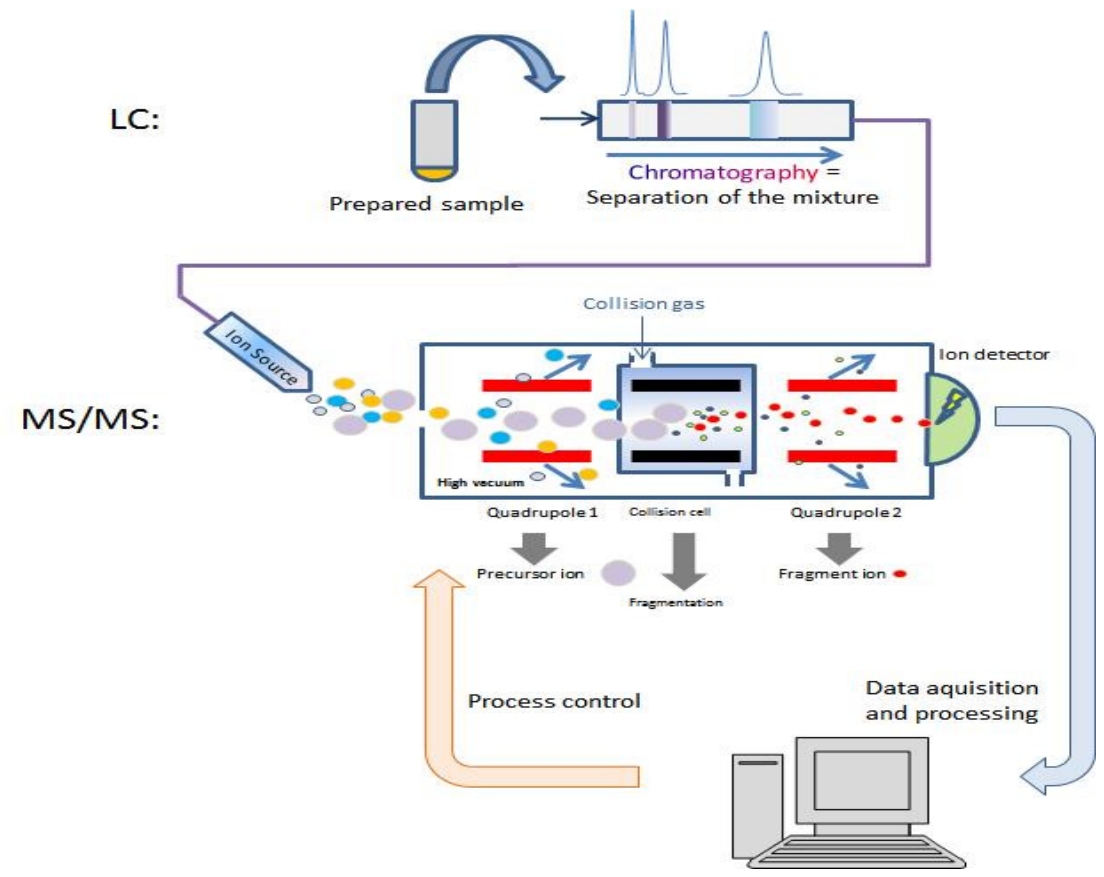
Figure 2.
Mechanisms of matrix-induced ion suppression and enhancement in electrospray ionization (adapted from Matuszewski et al., Bonfiglio et al., Annesley, and Taylor et al.).
Figure 2.
Mechanisms of matrix-induced ion suppression and enhancement in electrospray ionization (adapted from Matuszewski et al., Bonfiglio et al., Annesley, and Taylor et al.).
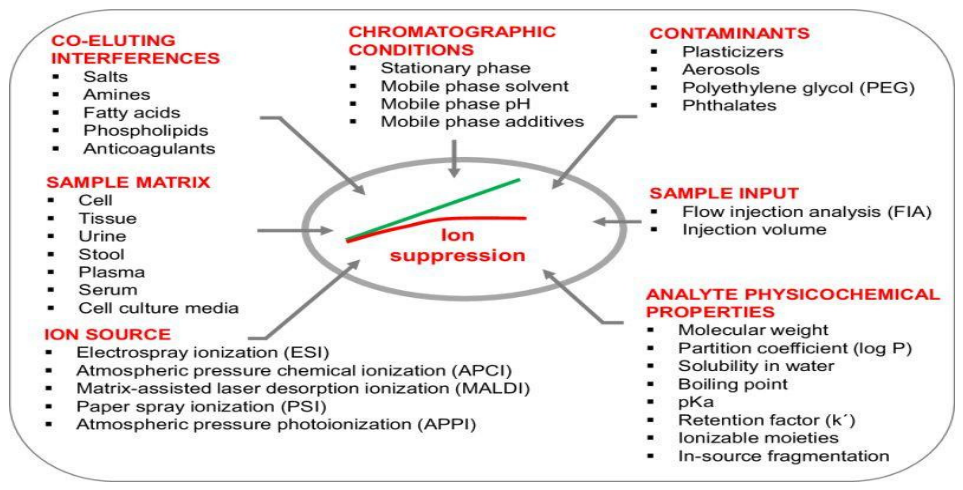
Figure 3.
Workflow for qualitative evaluation of matrix effects using post-column infusion in LC–MS/MS bioanalysis.
Figure 3.
Workflow for qualitative evaluation of matrix effects using post-column infusion in LC–MS/MS bioanalysis.
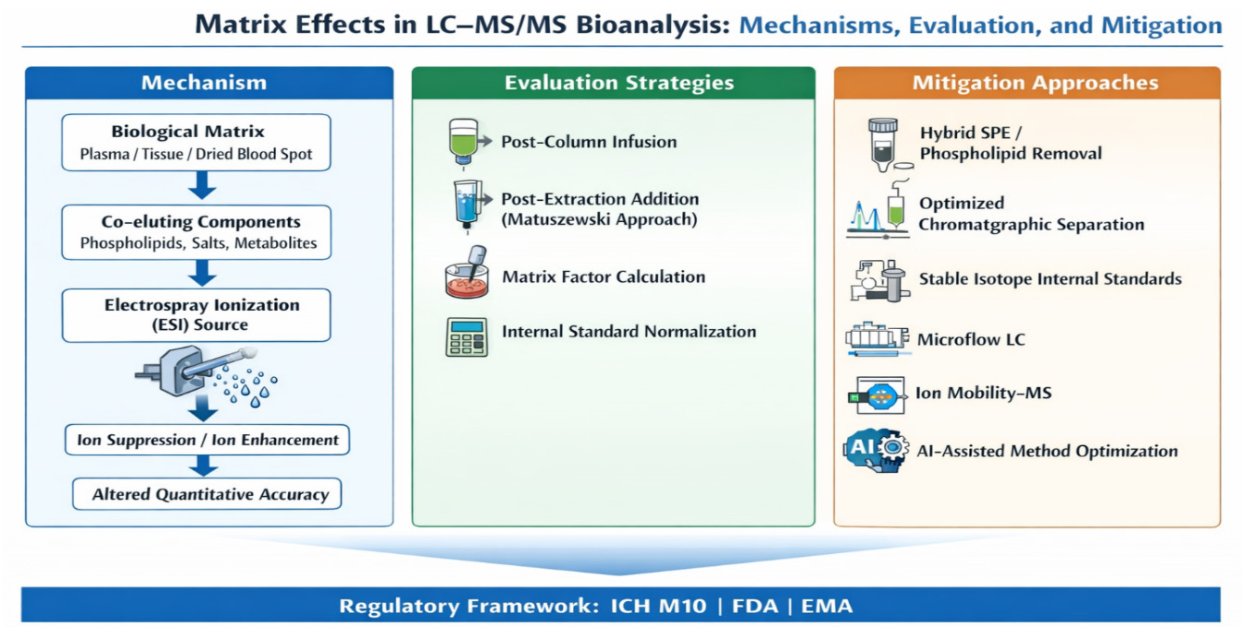
Figure 4.
Decision-Making Workflow for Matrix Effect Assessment and Control in LC–MS/MS Bioanalysis.
Figure 4.
Decision-Making Workflow for Matrix Effect Assessment and Control in LC–MS/MS Bioanalysis.
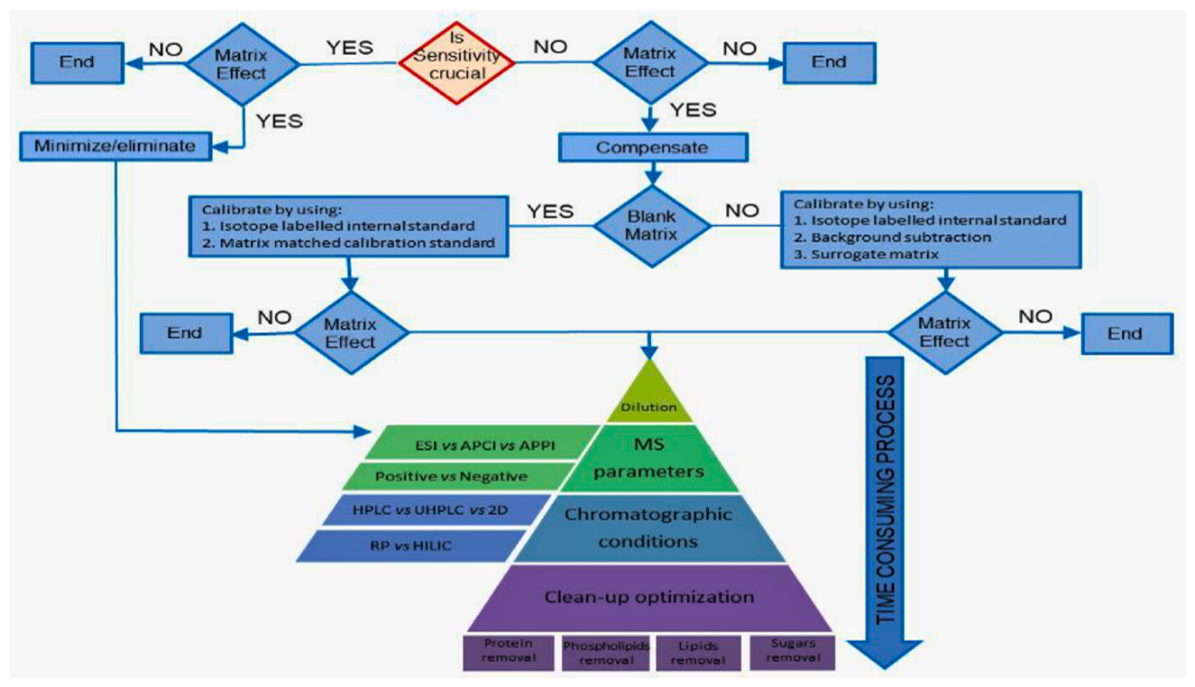
Figure 5.
Comprehensive mitigation strategy.
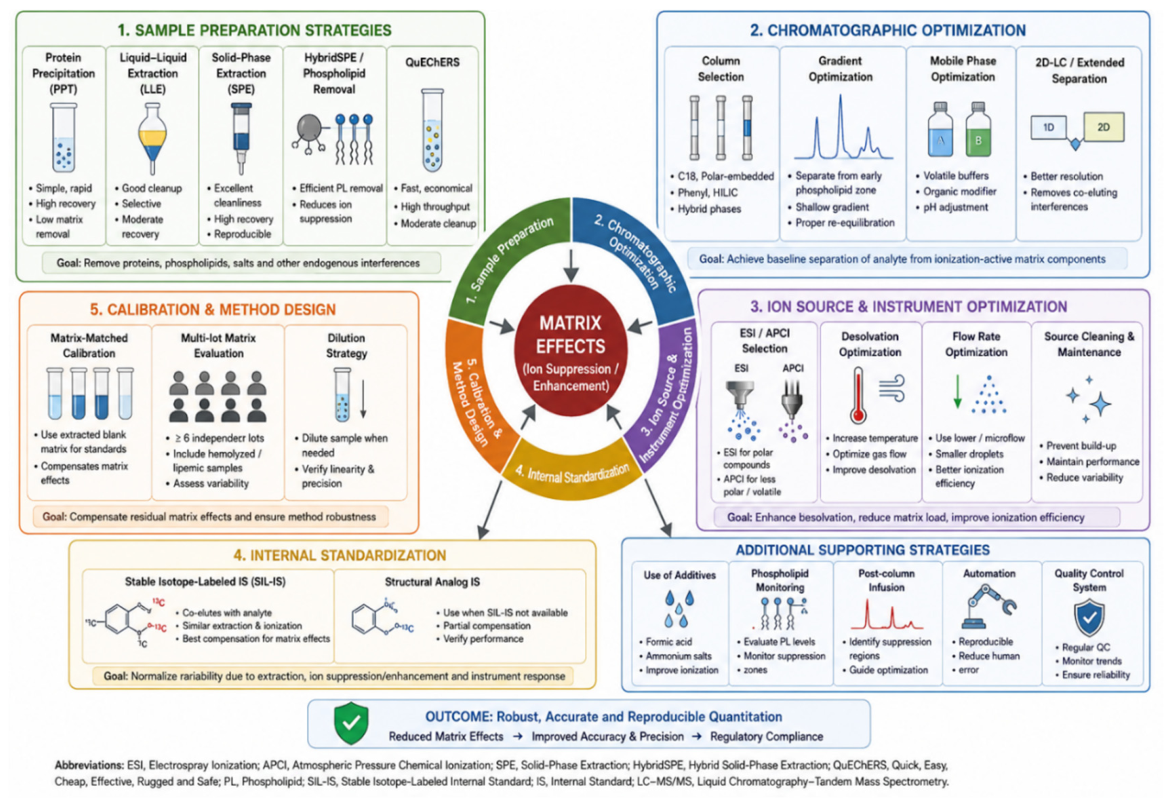
Disclaimer/Publisher’s Note: The statements, opinions and data contained in all publications are solely those of the individual author(s) and contributor(s) and not of MDPI and/or the editor(s). MDPI and/or the editor(s) disclaim responsibility for any injury to people or property resulting from any ideas, methods, instructions or products referred to in the content. |
© 2026 by the authors. Licensee MDPI, Basel, Switzerland. This article is an open access article distributed under the terms and conditions of the Creative Commons Attribution (CC BY) license.
Copyright: This open access article is published under a Creative Commons CC BY 4.0 license, which permit the free download, distribution, and reuse, provided that the author and preprint are cited in any reuse.