
Submitted:
10 August 2026
Posted:
11 August 2026
You are already at the latest version
Abstract
Ordinary differential equations (ODEs) are essential for modeling and governing physical phenomena and engineering systems across a wide range of scientific and engineering disciplines. Conventional photonic ODE solving systems exhibit a limited coefficient tunability, where the ODE coefficients are constrained by the device architecture. Here, an order- and coefficient-tunable microwave photonic (MWP) ODE solver based on an integrated microcomb source is demonstrated. A transversal filter structure is employed to directly synthesize the desired transfer function through convolution operations, enabling independently tuned ODE coefficients. We experimentally demonstrated simplified first-order, general first-order, and second-order MWP ODE solvers with different coefficients. For the input Gaussian pulse with a pulse width of ~0.1 ns, the measured output waveforms of the ODE solvers agree well with the calculated results, confirming the effectiveness of our approach. A highly reconfigurable MWP ODE solver with high processing accuracy has been achieved by using our approach, which offers a solution for applications in modern control systems, thermal diffusion, and biochemical reactions modelling.
Keywords:
ordinary differential equations
; microwave photonics
; optical microcombs
; integrated optics
1. Introduction
Mathematical models play a critical role in the analysis and design of systems. Among them, ordinary differential equations (ODEs) have widespread applications in describing dynamic phenomena across various domains, such as control systems, mechanical and electrical systems, and meteorology [1,2,3,4,5]. There is a growing need for faster and more energy-efficient solutions to ODEs, especially for ultrafast processes like rocket launches or data-intensive applications such as automated manufacturing, weather prediction, and epidemic modeling. As the speed and power efficiency of electronic analog circuits approach their bottleneck in the post-Moore era [6], photonic technologies have emerged as a compelling alternative for realizing ultrafast and broadband analog computing systems [7].
Recently, various all-optical ODE solvers, which are realized by designing infinite impulse response (IIR) filters with suitable transfer functions, have been implemented based on resonators and optical feedback loops to perform recursive operations [2,8,9,10,11]. Semiconductor optical amplifiers and optical filters have been used as differentiators and wavelength converters to achieve first-order ODE solving, where the feedback configuration required precise phase control and suffered from instability [8]. Second-order ODE solvers have subsequently been demonstrated by employing cascaded microring resonators (MRRs) [9]. In addition, systems of ODEs have been solved through using an add/drop MRR and introducing two external feedback waveguides to realize the coupling between these ODEs [2]. However, their coefficients are inherently coupled, determined by the coupling and feedback parameters, which limits the reconfigurability of the ODE solvers. In practical applications, to characterize general linear time-invariant (LTI) systems, it is necessary to solve ODEs with various orders and different coefficients. To overcome this limitation, tunable interferometric couplers have been introduced to enable tunable ODE coefficients, but the realization of arbitrary coefficients remained challenging due to the interdependence between coupling strength and phase of interferometric couplers [10,11].
With the rapid development of microwave photonics (MWP) technologies, photonic analogue computing has been extended to the microwave domain. In contrast to conventional microwave signal processing based on electronics, which face intrinsic bandwidth constraints, the use of photonic hardware and technologies to process high-bandwidth microwave signals, or MWP processing [12,13,14], can provide orders of magnitude faster speeds, which is critical for high-speed processing applications [15,16]. To achieve reconfigurable MWP ODE solvers based on the aforementioned IIR filter structure (Figure 1(a)), cascading multiple MRRs, precise alignment, and feedback loops are required, which makes the system highly sensitive to fabrication tolerance and thermal drift. An MWP ODE solver has been demonstrated using an add/drop MRR to solve a first-order ODE, where the ODE coefficient was determined by the internal decay loss of the MRR [17]. Although this approach eliminates the need for an external feedback loop, the tunability of coefficients and scalability are still restricted.
Transversal filter structures based on finite impulse response (FIR) filters can be employed to remove recursive operation and enhance reconfigurability [18,19,20,21]. The transversal filter structure performs convolution between the input microwave signal and a set of tap weights (Figure 1(b)). By appropriately designing the tap weights, which define the system’s impulse response, the convolution module can directly emulate the desired transfer function corresponding to a given ODE. This approach enables independent and reconfigurable coefficient design while maintaining stability and broadband performance.
Here, we employed a transversal filter structure, which enables high reconfigurability by using an integrated optical microcomb [22], to achieve MWP ODE solvers. Optical microcombs can provide a large number of wavelength channels by using compact micro-scale resonators [23,24], which is critical for improving the processing accuracy of MWP transversal signal processors. They are also with the ability to offer broad Nyquist zones, which allow for large processing bandwidths [25,26,27]. Optical microcombs enable MWP transversal systems to have small size, weight, and power consumption (SWaP) [23,24,28,29], and excellent compatibility with monolithic integration, making them powerful alternatives to conventional multiwavelength sources, for example, discrete laser arrays [30,31,32].
We propose and experimentally demonstrate order- and coefficient-tunable MWP ODE solvers based on a transversal filter structure using a soliton crystal microcomb source, where first- and second-order ODEs with different coefficients are solved. System demonstrations of ODE solvers with an operation bandwidth of ~24.5 GHz for Gaussian pulse input signals are performed. For the simplified first-order, general first-order, and second-order ODE solvers, with root-mean-square errors (RMSEs) between the measured and theoretical curves being ~0.030, ~0.068, and ~0.091, respectively. This good alignment confirms the effectiveness of our approach for realizing high-speed reconfigurable MWP ODE solvers.
2. Operation Principle
LTI systems are commonly demonstrated by a constant-coefficient linear ODE, which is defined as [10]
where x(t) is the input signal of an LTI system, and y(t) is the output signal representing the solution of the ODE. ai and bk are the constant coefficients. Based on Eq. (1), a simplified first-order ODE, a general first-order ODE, and a second-order ODE can be expressed as [10,11]
After Fourier transformation from Eqs. (2) – (4), transfer functions of the simplified first-order ODE Hfs (ω), the general first-order ODE Hfg (ω), and the second-order ODE Hs(ω) can be given by [33]
where j = , and ω is the angular frequency.
To implement the ODE solvers, we use a transversal filter structure as shown in Figure 1(b) that offers high reconfigurability in terms of its spectral transfer function, which can be expressed as [25,34]
where ω is the angular frequency of the input microwave signal to be processed, M is the tap number, hk (k = 0, 1, 2, …, M−1) is the tap weight of the kth tap, and ΔT is the time delay between adjacent taps. By properly designing the various tap weights hk (k = 0, 1, 2, …, M-1), different signal processing functions can be realized by using a single system without changing the hardware.
An optical microcomb is used to serve as the multi-wavelength source, which generates multiple wavelength channels that act as discrete taps for the transversal signal processor. The generated optical microcomb is spectrally shaped according to the designed tap weights hk (k = 0, 1, 2, …, M−1). Next, all of the wavelength channels of the shaped optical microcomb are imprinted with the input microwave signal via an electro-optic modulator (EOM), leading to the generation of multiple microwave replicas. Following this, the modulated optical signals are transmitted through a dispersive medium, for example, a single-mode fibre (SMF), to introduce time delays ∆T between adjacent wavelength channels, which progressively separate the microwave replicas. Finally, the delayed replicas are summed upon photodetection via a photodetector. ODE solvers with different orders and coefficients can be realized by properly setting the tap weights hk (k = 0, 1, 2, …, M−1). Tap weights are calculated through inverse Fourier transformation (IFT) from Eqs. (5) – (7).
The corresponding radiofrequency (RF) amplitude response of the simplified first-order, general first-order, and second-order ODE solvers with different coefficients as a function of tap numbers (M) is shown in Figure 2(a) − (c), respectively. For simplified first-order ODEs, the coefficients are (1) a0 = 0.2×10¹⁰, (2) a0 = 2×10¹⁰, and (3) a0 = 20×1010. For general first-order ODEs, the coefficients are (1) a0 = 0.5×10¹⁰, b0 = 1×10¹⁰, b1 = 1×10¹⁰, (2) a0 = 2×10¹⁰, b0 = −8.5×10⁹, b1 = 1, and (3) a0 = 10×1010, b0 = 1×10¹⁰, b1 = 1. For second-order ODEs, the coefficients are (1) a0 = 5×10²⁰, a1 = 5×10¹⁰, b0 = 1.5×10²¹, b1 = 1.5×10¹⁰, b2 = 1, (2) a0 = 1×10²², a1 = 1×10⁸, b0 = −1×10²⁰, b1 = −1×10²⁰, b2 = 1, and (3) a0 = 10×1030, a1 = 5×10¹⁰, b0 = 4×10¹⁴, b1 = 5×10⁹, b2 = 1. ODEs with different orders and coefficients can be solved without requiring optical feedback or cascaded MRRs to perform recursive operations, verifying the reconfigurability of the proposed system. The simulated results obtained with different tap numbers (M = 5 − 45) are shown together with the ideal transfer functions. As can be seen, the discrepancies between the ideal and simulated amplitude RF response are improved with tap numbers for all the three ODE solvers. For a small M, the limited spectral sampling introduces errors, leading to ripples and distortions in the amplitude response.
We use the root-mean-square error (RMSE) to quantitatively analyze these discrepancies, which is defined as [24]
where n is the number of sampled points, Y1, Y2, …, Yn are the values of the ideal results, and y1, y2, …, yn are the values of the simulated results. Figure 3(a) − (c) shows the RMSEs between the ideal and simulated RF response of the simplified first-order, general first-order, and second-order ODE solvers presented in Figure 2 as a function of tap number M. As expected, for all cases, the RMSEs are inversely proportional to tap numbers, confirming that the processing accuracy is influenced by the number of taps. As M increases, the discrepancies are gradually suppressed, and RMSEs reach a minimal value (typically < 0.01), indicating agreement between the simulated RF response of the proposed system and the ideal transfer function. This trend is consistent across different coefficient sets, verifying the robustness of the system. We note that when tap numbers increase, RMSEs initially decrease dramatically and reduce more gradually as tap numbers become larger, which indicates that the need for large tap numbers is not strong. For the second-order ODE solver (2), both b0 and b1 are negative, which shifts the system zeros toward the imaginary axis [35], enhancing the high-frequency gain of the transfer function as shown in Figure 2(c-ii), so the RMSE shows small improvement as the tap number increases.
3. Results
We used the experimental setup shown in Figure 4 to implement MWP ODE solvers, which included a comb generation (Figure 4(a)) and a signal processing module (Figure 4(c)). In our experiments, we employed a soliton crystal microcomb as the multi-wavelength source [19]. Soliton crystal microcombs represent a unique class of optical frequency combs, characterized by self-organized ensembles of multiple co-propagating solitons that form a crystal-like structure in the angular domain [22,36]. As shown in Figure 4a, the MRR used for generating soliton crystal microcombs was fabricated on a complementary metal-oxide-semiconductor (CMOS)-compatible doped silica glass platform [37,38], with a quality (Q) factor of ~1.9 million and a radius of ~592 μm, yielding a free spectral range (FSR) of ~49 GHz (i.e., ~0.4 nm).
The initiation of the soliton crystal microcomb was achieved via a simple pump wavelength sweeping method [39], where a continuous-wave (CW) pump laser (Yenista Optics), amplified to ~32.1 dBm by an erbium-doped fibre amplifier (EDFA, IdealPhotonics), was swept in wavelength from blue to red until modulation instability oscillations emerged. As the detuning between pump wavelength and MRR’s resonance was progressively adjusted, a stable soliton crystal oscillation state was achieved, generating over 90 wavelength channels across the C band at a pump wavelength of ~1551.3 nm, as shown in Figure 4(b). As can be seen, the soliton crystal microcomb exhibits a palm-shaped spectrum which, although often considered a potential limitation for practical use, has in fact been shown not to present a significant drawback. This is partly attributed to the higher power conversion efficiency of soliton crystal microcombs compared with single soliton states [22]. In addition, the soliton crystal microcomb demonstrated remarkable long-term power stability, with a measured relative standard deviation of −14 dB over 66 hours [40], highlighting its stability for use in practical MWP systems.
Figure 4(c) shows the schematic of the signal processing module. The first Waveshaper (Finisar) was employed to flatten the spectrum of the initially generated soliton crystal microcomb to reduce the power difference between different comb lines. The flattened microcomb was then amplified and fed into an EOM (iXblue), where the optical signal was modulated by an input microwave signal. We used a Gaussian pulse with a pulse width of ~0.1 ns as the input signal, which was produced by an arbitrary waveform generator (AWG, Keysight). The input signal was broadcast to each wavelength channel, generating multiple replicas of the microwave signal. Then, the replicas propagated in an SMF with a length of L = ~2.153 km, a dispersion of D2 = ~17.4 ps/nm/km, which introduced a time delay of ΔT = L × D2 × Δλ = ~15.0 ps, corresponding to an operation bandwidth of ~33.4 GHz. We note that the maximum operational bandwidth of the proposed system is limited by the repetition rate of the soliton crystal. Large crosstalk between adjacent taps occurs for microwave operation beyond 24.5 GHz, which is half of the soliton crystal’s repetition rate. Next, according to the designed tap weights, the comb lines were shaped by using the second Waveshaper. Finally, the delayed and weighted replicas were combined through photodetection via the balanced photodetector BPD (Finisar).
A two-stage feedback control was implemented to mitigate static and slow-varying errors [41]. The first stage reduced intensity deviations introduced during the comb flattening process. The shaped optical spectrum at the output of the first Waveshaper was measured using an optical spectrum analyzer (OSA, Anritsu) and transmitted to a computer, where it was compared with the desired tap weights. The second stage was to further compensate for errors caused by imperfections of the impulse response. It was performed channel by channel with the same input microwave signal modulated onto each comb line. The tap weights (i.e., the peak intensities of the impulse response) were measured from the BPD recorded by the oscilloscope (OSC, Keysight). These measured results were then subtracted from the designed tap weights to generate error signals, which were used to calibrate the attenuation of comb line intensities in the Waveshaper. All components of the system were included in the two feedback loops, enabling compensation for errors resulting from static and slowly varying error sources introduced by different components.
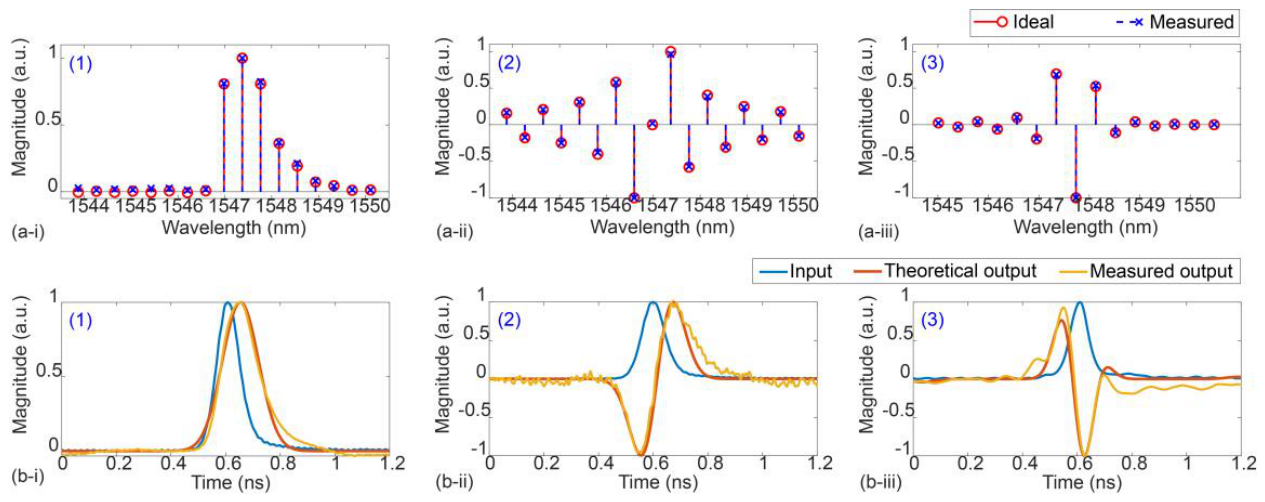
According to the results in Figure 3, we selected specific tap numbers (i.e., number of wavelength channels) for different ODE solvers. We used 15, 11, and 15 comb lines as discrete taps for the three simplified first-order ODE solvers. We employed 25, 17, and 11 comb lines for the three general first-order ODE solvers (1) – (3), respectively. For second-order ODE solvers, we used 17 comb lines for (1) and (2), and 15 comb lines for (3).
Figure 5 shows the temporal processing results of aforementioned three simplified first-order ODE solvers (1) – (3). Figure 5(a) shows the measured tap weights for the three ODE solvers with different coefficients compared with the desired tap weights. The measured comb line magnitude (blue cross) exhibits agreement with the desired weights (red circle), which confirms the high spectral shaping accuracy resulting from the two-stage feedback control. Figure 5(b) demonstrates the corresponding temporal output of the ODE solvers. The measured outputs (yellow) show good agreement with the theoretical outputs (red), and the waveform of the input Gaussian signal (blue) is also shown. The calculated RMSEs between the theoretical and measured results are ~0.030, ~0.026, and ~0.026, respectively, which indicates the high accuracy of the ODE solvers. Minor temporal broadening and slight amplitude differences are mainly attributed to the fast-varying noise from the microcomb and BPD, which cannot be compensated for by the two-stage feedback control [29].
Figure 6 shows the corresponding processing output of three general first-order ODE solvers (1) – (3) mentioned in Figure 2(b). Figure 6(a) shows the tap weights corresponding to three different coefficient sets, where the measured tap weights (blue cross) closely match the ideal targets (red circle). The corresponding temporal results are presented in Figure 6(b), where the measured outputs (yellow) exhibit good agreement with the theoretical outputs (red). The calculated RMSEs between the theoretical and measured outputs for (1) – (3) are ~0.020, ~0.054, and ~0.068, respectively. The results confirm that the proposed system can accurately realize general first-order ODE solvers.
We also note that, in our system, both positive and negative ODE coefficients have been realized by simply designing specific tap weights. Implementing negative ODE coefficients using an IIR-based photonic solving system is inherently challenging, where the sign and magnitude of the ode coefficient are determined by the amplitude and phase of the feedback paths. Hence, introducing a π-phase shift in the optical feedback signal is necessary to realize negative coefficients, which demands precise control of optical phase and temperature, as slight drifts can lead to phase mismatching and instability.
The corresponding processing results of the second-order ODE solvers in Figure 2(c) are presented in Figure 7. In Figure 7(a), the measured tap weights are shown and the ideal tap weights are also presented for comparison. The measured tap weights aligned well with the ideal tap weights. Figure 7(b) shows the waveform of the input signal and the theoretical as well as measured processing output. The RMSEs between the theoretical and measured output for different ODE coefficients (1) – (3) are ~0.027, ~0.065, and ~0.091, respectively. The measured processing results are consistent with the theoretical output, which indicates good agreement between experimental results and theory.
4. Discussion
Our results of MWP ODE solvers based on an integrated soliton crystal microcomb highlight a step toward fully reconfigurable and broadband analog computing systems. The transversal filter structure intrinsically avoids the stability and tunability limitations of ODE solvers based on IIR structure. The convolutional operation between the tunable tap weights and the signal to be processed makes our system a recursion-free platform with straightforward programmability.
In addition, the use of a two-stage feedback control method enables accurate calibration of tap coefficients, leading to high processing accuracy with RMSEs < 0.1. After calibration, there are still residual errors induced by components in the system that cannot be compensated by using the two-stage feedback control method. We infer that these errors are mainly induced by the noise floor of microcombs as well as fast-varying fluctuations from the microcomb and BPD. Self-calibrating photonic integrated circuits have been demonstrated [42,43], where the impulse response of the system was characterized by an optical reference path, enabling the establishment of a Kramers-Kronig relationship. Amplitude and phase distortions can be retrieved through Fourier-domain processing. This approach opens new opportunities for implementing a more precise feedback control in the MWP ODE solvers.
The operation bandwidth of the ODE solvers is jointly determined by the time delay between adjacent wavelength channels and half of the soliton crystal’s repetition rate. Large operation bandwidth can be achieved through employing a shorter spool of SMF and/or a microcomb source with a larger comb spacing, although at the expense of providing fewer taps.
Recent advances have driven rapid progress toward fully integrated microcomb-based MWP transversal filter systems [17,44]. Employing integrated microcomb sources to replace bulky multi-wavelength sources has already provided many advantages in terms of SWaP, cost, and complexity, further gains can be achieved by advancing the integration level of the entire system. In principle, all the components in the microcomb-based MWP transversal filter system can be monolithically integrated on a single chip, and on-chip CW lasers [45], optical amplifiers [46], EO modulators [47], dispersive elements [48], optical spectral shapers [10,49], and PDs [50] have all been demonstrated. Based on these integrated components, some sophisticated subsystems have also been demonstrated, including microcomb generation module consisting of heterogeneously integrated pump lasers and microresonators [51] and spectral shaping arrays [52,53].
Complex-valued tap weights have been achieved in MWP transversal filter systems recently [54], which provides a solution to extend the proposed ODE solver to support complex-valued taps, broadening its applications in modeling wave propagation, quantum-inspired dynamics, and coupled field systems. In addition, time-division multiplexing and matrix partitioning were used to load operators on a reconfigurable MRR array and thereby solve partial differential equations (PDEs) with > 90% accuracy on chip [55]. This describes a broader scope in which photonic hardware is no longer limited to first- or second-order ODE solvers. While the proposed microcomb-based transversal filter system primarily solves ODEs, it has the potential for solving PDEs, as linear PDEs can be converted into coupled or independent ODEs that can, in principle, be implemented using parallel ODE solver architectures. This work has broad implications for microcombs [56,57,58,59,60,61,62,63,64,65,66,67,68,69,70,71,72,73,74,75,76,77,78,79,80,81,82,83,84,85,86] and their applications to microwave photonics, neuromorphic processors and communications. [87,88,89,90,91,92,93,94,95,96,97,98,99,100,101,102,103,104,105,106,107,108,109,110,111,112,113,114,115,116,117,118,119,120,121,122,123,124,125,126,127,128,129,130,131,132,133,134,135,136,137,138,139,140,141,142,143,144,145] The addition and use of 2D materials [146,147,148,149,150,151,152,153,154,155,156,157,158,159,160,161,162,163,164,165,166,167,168,169,170,171,172,173,174,175,176,177,178,179,180,181] will add extra functionality to microcomb chips for potential applications to quantum photonics [182,183,184,185,186,187,188,189,190,191,192,193,194,195,196,197,198] and other areas. [199,200,201,202,203,204,205,206,207,208,209,210,211,212,213,214,215,216,217,218,219,220,221,222,223,224].
Conclusions
In summary, we propose and experimentally demonstrate order- and coefficient-tunable MWP ODE solvers based on an integrated microcomb source, capable of solving constant-coefficient linear first- and second-order ODEs with different coefficients. System demonstrations of the ODE solver with an operation bandwidth of ~24.5 GHz are performed, with RMSEs of ~0.030, ~0.068, and ~0.091 for the simplified first-order, general first-order, and second-order ODE solvers, respectively. The good agreement between measured and theoretical results confirms the effectiveness of our approach in realizing high-speed MWP ODE solvers with high reconfigurability. Our approach presents an effective way to implement versatile MWP ODE solver, offering a promising solution for applications in control systems, mechanical and electrical systems, and meteorology.
Conflict of interests
The authors declare no conflict of interests.
References
- Simmons, G. F. Differential equations with applications and historical notes; CRC Press, 2016. [Google Scholar]
- Hou, J.; Dong, J.; Zhang, X. Optical solver for a system of ordinary differential equations based on an external feedback assisted microring resonator. Opt. Lett. 2017, 42, 2310–2313. [Google Scholar] [CrossRef] [PubMed]
- Dorf, R. C.; Bishop, R. H. Modern Control Systems; Prentice-Hall, Inc., 2000. [Google Scholar]
- Adkins, W. A.; Davidson, M. G. Ordinary differential equations; Springer Science & Business Media, 2012. [Google Scholar]
- Kuo, B. C.; Golnaraghi, M. F. Automatic control systems; Prentice hall Englewood Cliffs, NJ, 1995. [Google Scholar]
- Lorenzon, F.; Filho, A. C. S. Beck. Parallel computing hits the power wall: principles, challenges, and a survey of solutions; Springer Nature, 2019. [Google Scholar]
- Farmakidis, N.; Dong, B.; Bhaskaran, H. Integrated photonic neuromorphic computing: opportunities and challenges. Nat. Rev. Electr. Eng. 2024, 1, 358–373. [Google Scholar] [CrossRef]
- Tan, S.; Wu, Z.; Lei, L.; Hu, S.; Dong, J.; Zhang, X. All-optical computation system for solving differential equations based on optical intensity differentiator. Opt. Express 2013, 21, 7008–7013. [Google Scholar] [CrossRef] [PubMed]
- Tan, S.; et al. High-order all-optical differential equation solver based on microring resonators. Opt. Lett. 2013, 38, 3735–3738. [Google Scholar] [CrossRef] [PubMed]
- Wu, J.; et al. Compact tunable silicon photonic differential-equation solver for general linear time-invariant systems. Opt. Express Article 2014, 22, 26254–26264. (in English). [Google Scholar] [CrossRef] [PubMed]
- Wu, J.; et al. On-Chip Tunable Second-Order Differential-Equation Solver Based on a Silicon Photonic Mode-Split Microresonator. Journal Light. Technol. Article 2015, 33, 3542–3549. (in English). [Google Scholar] [CrossRef]
- Capmany, J.; Novak, D. Microwave photonics combines two worlds. Nat. Photonics 2007, 1, 319–330. [Google Scholar] [CrossRef]
- Yao, J. Microwave Photonics. J. Light. Technol. 2009, 27, 314–335. [Google Scholar] [CrossRef]
- Wu, J.; et al. RF photonics: an optical microcombs’ perspective. IEEE J. Sel. Top. Quantum Electron. 2018, 24, 1–20. [Google Scholar] [CrossRef]
- Liu, W.; et al. A fully reconfigurable photonic integrated signal processor. Nat. Photonics 2016, 10, 190–195. [Google Scholar] [CrossRef]
- Solli, D. R.; Jalali, B. Analog optical computing. Nat. Photonics 2015, 9, 704–706. [Google Scholar] [CrossRef]
- Feng, H.; et al. Integrated lithium niobate microwave photonic processing engine. Nature 2024, 627, 80–87. [Google Scholar] [CrossRef] [PubMed]
- Capmany, J.; Ortega, B.; Pastor, D.; Sales, S. Discrete-time optical processing of microwave signals. J. Light. Technol. 2005, 23, 702–723. [Google Scholar] [CrossRef]
- Xu, X.; et al. Advanced Adaptive Photonic RF Filters with 80 Taps Based on an Integrated Optical Micro-Comb Source. Journal Light. Technol. Article 2019, 37, 1288–1295. (in English). [Google Scholar] [CrossRef]
- Xu, X.; et al. Photonic Perceptron Based on a Kerr Microcomb for High-Speed, Scalable, Optical Neural Networks. Laser Photon. Rev. Article 2020, 14, 10. (in English). [Google Scholar] [CrossRef]
- Xu, X.; et al. 11 TOPS photonic convolutional accelerator for optical neural networks. Nature 2021, 589, 44–51. [Google Scholar] [CrossRef] [PubMed]
- Sun, Y.; et al. Applications of optical microcombs. Adv. Opt. Photon. 2023, 15, 86–175. [Google Scholar] [CrossRef]
- Lin, G.; Liu, F.; Coillet, A.; Gomila, D.; Menyuk, C. R.; Chembo, Y. K. Subharmonic instabilities in Kerr microcombs. Opt. Lett. 2023, 48, 578–581. [Google Scholar] [CrossRef] [PubMed]
- Sun, Y.; et al. Quantifying the Accuracy of Microcomb-based Photonic RF Transversal Signal Processors. IEEE J. Sel. Top. Quantum Electron. 2023, 1–18. [Google Scholar] [CrossRef]
- Sun, Y.; et al. Applications of optical microcombs. Adv. Opt. Photonics 2023, 15, 86. [Google Scholar] [CrossRef]
- Pasquazi, et al. Micro-combs: A novel generation of optical sources. Phys. Rep. 2018, 729, 1–81. [Google Scholar] [CrossRef]
- Xu, X.; Tan, M.; Wu, J.; Morandotti, R.; Mitchell, A.; Moss, D. J. Microcomb-Based Photonic RF Signal Processing. IEEE Photonics Technol. Lett. 2019, 31, 1854–1857. [Google Scholar] [CrossRef]
- Li, Y.; et al. Performance Analysis of Microwave Photonic Spectral Filters based on Optical Microcombs. Adv. Phys. Res. n/a, 2400084. [CrossRef]
- Sun, Y.; et al. Optimizing the Accuracy of Microcomb-Based Microwave Photonic Transversal Signal Processors. J. Light. Technol. 2023, 41, 7223–7237. [Google Scholar] [CrossRef]
- Mansoori, S.; Mitchell, A. RF transversal filter using an AOTF. IEEE Photonics Technol. Lett. 2004, 16, 879–881. [Google Scholar] [CrossRef]
- Zhang, J.; Yao, J. Photonic true-time delay beamforming using a switch-controlled wavelength-dependent recirculating loop. J. Light. Technol. 2016, 34, 3923–3929. [Google Scholar] [CrossRef]
- Zhang, L.; et al. Photonic true time delay beamforming technique with ultra-fast beam scanning. Opt. Express 2017, 25, 14524–14532. [Google Scholar] [CrossRef] [PubMed]
- Cavicchioli, G.; Melloni, A.; Miller, D. A. B.; Engheta, N.; Morichetti, F. Programmable Photonic Architecture Solving Systems of Ordinary Differential Equations. 2023 International Conference on Photonics in Switching and Computing (PSC), 26-29 Sept. 2023; pp. 1–3. [Google Scholar] [CrossRef]
- Emami, H.; Sarkhosh, N.; Bui, L. A.; Mitchell, A. Wideband RF photonic in-phase and quadrature-phase generation. Opt. Lett. 2008, 33, 98–100. [Google Scholar] [CrossRef] [PubMed]
- Wyman, B. F.; Sain, M. K.; Conte, G.; Perdon, A.-M. On the zeros and poles of a transfer function. Linear Algebra Its Appl. 1989, 122-124, 123–144. [Google Scholar] [CrossRef]
- Cole, D. C.; Lamb, E. S.; Del’Haye, P.; Diddams, S. A.; Papp, S. B. Soliton crystals in Kerr resonators. Nat. Photonics 2017, 11, 671–676. [Google Scholar] [CrossRef]
- Razzari, L.; et al. CMOS-compatible integrated optical hyper-parametric oscillator. Nat. Photonics 2010, 4, 41–45. [Google Scholar] [CrossRef]
- Moss, D.; Morandotti, R.; Gaeta, A. L.; Lipson, M. New CMOS-compatible platforms based on silicon nitride and Hydex for nonlinear optics. Nat. Photonics Review 2013, 7, 597–607. (in English). [Google Scholar] [CrossRef]
- Wang, W.; et al. Robust soliton crystals in a thermally controlled microresonator. Opt. Lett. 2018, 43, 2002–2005. [Google Scholar] [CrossRef] [PubMed]
- Corcoran, B.; et al. Ultra-dense optical data transmission over standard fibre with a single chip source. Nat. Commun. Article 2020, 11, 7. (in English). [Google Scholar] [CrossRef] [PubMed]
- Li, Y.; et al. Feedback Control in Microwave Photonic Transversal Filter Systems Based on Optical Microcombs. In IEEE Journal of Selected Topics in Quantum Electronics; Microresonator Frequency Comb Technologies, 2024; vol. 30, no. 5, pp. 1–17. [Google Scholar] [CrossRef]
- Xu, X.; et al. Self-calibrating programmable photonic integrated circuits. Nat. Photonics 2022, 16, 595–602. [Google Scholar] [CrossRef]
- Xu, X.; et al. Phase retrieval of programmable photonic integrated circuits based on an on-chip fractional-delay reference path. Optica 2022, 9, 1401. [Google Scholar] [CrossRef]
- Shu, H.; et al. Microcomb-driven silicon photonic systems. Nature 2022, 605, 457–463. [Google Scholar] [CrossRef] [PubMed]
- Roelkens, G.; et al. III-V/silicon photonics for on-chip and intra-chip optical interconnects. Laser Photon. Rev. 2010, 4, 751–779. [Google Scholar] [CrossRef]
- Rabus, D. G.; Bian, Z.; Shakouri, A. Ring resonator lasers using passive waveguides and integrated semiconductor optical amplifiers. IEEE J. Sel. Top. Quantum Electron. 2007, 13, 1249–1256. [Google Scholar] [CrossRef]
- Wang, C.; et al. Integrated lithium niobate electro-optic modulators operating at CMOS-compatible voltages. Nature 2018, 562, 101–104. [Google Scholar] [CrossRef] [PubMed]
- Molony, A.; Lin, Z.; Williams, J. A. R.; Bennion, I.; Edge, C.; Fells, J. Fiber Bragg-grating true time-delay systems: discrete-grating array 3-b delay lines and chirped-grating 6-b delay lines. IEEE Trans. Microw. Theory Tech. 1997, 45, 1527–1530. [Google Scholar] [CrossRef]
- Chen, L.; Sherwood-Droz, N.; Lipson, M. Compact bandwidth-tunable microring resonators. Opt. Lett. 32, 3361–3363. [CrossRef] [PubMed]
- Michel, J.; Liu, J.; Kimerling, L. C. High-performance Ge-on-Si photodetectors. Nat. Photonics 2010, 4, 527–534. [Google Scholar] [CrossRef]
- Xiang, C.; et al. Laser soliton microcombs heterogeneously integrated on silicon. Science 2021, 373, 99–103. [Google Scholar] [CrossRef] [PubMed]
- Khan, M. H.; et al. Ultrabroad-bandwidth arbitrary radiofrequency waveform generation with a silicon photonic chip-based spectral shaper. Nat. Photonics 2010, 4, 117–122. [Google Scholar] [CrossRef]
- Sun, J.; Timurdogan, E.; Yaacobi, A.; Hosseini, E. S.; Watts, M. R. Large-scale nanophotonic phased array. Nature 2013, 493, 195–199. [Google Scholar] [CrossRef] [PubMed]
- Bai, Y.; et al. TOPS-speed complex-valued convolutional accelerator for feature extraction and inference. Nat. Commun. 2025, 16, 292. [Google Scholar] [CrossRef] [PubMed]
- Yuan, H.; et al. Microcomb-driven photonic chip for solving partial differential equations. Adv. Photonics 2025, 7, 016007. [Google Scholar] [CrossRef]
- Moss, D. J.; Morandotti, R.; Gaeta, A. L.; Lipson, M. New CMOS compatible platforms based on silicon nitride and Hydex for nonlinear optics. Nat. Photonics 2013, 7, 597–607. [Google Scholar] [CrossRef]
- Razzari, L.; et al. CMOS-compatible integrated optical hyper-parametric oscillator. Nat. Photonics 2010, 4(no. 1), 41–45. [Google Scholar]
- Pasquazi, et al. “Sub-picosecond phase-sensitive optical pulse characterization on a chip”. Nat. Photonics 2011, 5(no. 10), 618–623. [Google Scholar] [CrossRef]
- Ferrera, M.; et al. “On-Chip ultra-fast 1st and 2nd order CMOS compatible all-optical integration”. Opt. Express 2011, 19, 23153–23161. [Google Scholar] [CrossRef] [PubMed]
- Bao, C.; et al. Direct soliton generation in microresonators. Opt. Lett. 2017, 42, 2519. [Google Scholar] [CrossRef] [PubMed]
- Ferrera, M.; et al. “CMOS compatible integrated all-optical RF spectrum analyzer”. Opt. Express 2014, 22, 21488–21498. [Google Scholar] [CrossRef] [PubMed]
- Kues, M.; et al. “Passively modelocked laser with an ultra-narrow spectral width”. Nat. Photonics 2017, 11, 159. [Google Scholar] [CrossRef]
- Ferrera, M.; et al. Low-power continuous-wave nonlinear optics in doped silica glass integrated waveguide structures. Nat. Photonics 2008, 2, 737–740. [Google Scholar] [CrossRef]
- Ferrera, M. “On-Chip ultra-fast 1st and 2nd order CMOS compatible all-optical integration”. Opt. Express 2011, 19, 23153–23161. [Google Scholar] [CrossRef] [PubMed]
- Duchesne, D.; Peccianti, M.; Lamont, M. R. E.; et al. Supercontinuum generation in a high index doped silica glass spiral waveguide. Opt. Express 2010, 18, 923–930. [Google Scholar] [CrossRef] [PubMed]
- Bao, H.; et al. “Turing patterns in a fiber laser with a nested microresonator: Robust and controllable microcomb generation”. Phys. Rev. Res. 2020, 2(2), 023395. [Google Scholar] [CrossRef]
- Ferrera, M.; et al. “On-chip CMOS-compatible all-optical integrator”. Nat. Commun. 2010, 1, 29. [Google Scholar] [CrossRef] [PubMed]
- Pasquazi, et al. All-optical wavelength conversion in an integrated ring resonator. Opt. Express 2010, 18, 3858–3863. [Google Scholar] [CrossRef] [PubMed]
- Pasquazi, A.; Park, Y.; Azana, J.; et al. Efficient wavelength conversion and net parametric gain via Four Wave Mixing in a high index doped silica waveguide. Opt. Express 2010, 18, 7634–7641. [Google Scholar] [CrossRef] [PubMed]
- Peccianti, M.; Ferrera, L.; Razzari; et al. Subpicosecond optical pulse compression via an integrated nonlinear chirper. Opt. Express 2010, 18, 7625–7633. [Google Scholar] [CrossRef] [PubMed]
- Ferrera, M.; et al. “All-optical 1st and 2nd order integration on a chip”. Opt. Express 2011, 19, 23153–23161. [Google Scholar] [CrossRef] [PubMed]
- Ferrera, M.; et al. Low Power CW Parametric Mixing in a Low Dispersion High Index Doped Silica Glass Micro-Ring Resonator with. Opt. Express 2009, 17, 14098–14103. [Google Scholar] [CrossRef] [PubMed]
- Peccianti, M.; et al. “Demonstration of an ultrafast nonlinear microcavity modelocked laser”. Nat. Commun. 2012, 3, 765. [Google Scholar] [CrossRef] [PubMed]
- Pasquazi, et al. Self-locked optical parametric oscillation in a CMOS compatible microring resonator: a route to robust optical frequency comb generation on a chip. Opt. Express 2013, 21, 13333–13341. [Google Scholar] [CrossRef] [PubMed]
- Pasquazi, et al. Stable, dual mode, high repetition rate mode-locked laser based on a microring resonator. Opt. Express 2012, 20, 27355–27362. [Google Scholar] [CrossRef] [PubMed]
- Pasquazi, A.; et al. “Micro-combs: a novel generation of optical sources”. Phys. Rep. 2018, 729, 1–81. [Google Scholar] [CrossRef]
- Bao, H.; et al. “Laser cavity-soliton microcombs”. Nat. Photonics 2019, 13, 384–389. [Google Scholar] [CrossRef]
- Cutrona, et al. “High Conversion Efficiency in Laser Cavity-Soliton Microcombs”. Opt. Express 2022, 30, 39816–39825. [Google Scholar] [CrossRef] [PubMed]
- Rowley, M.; et al. “Self-emergence of robust solitons in a micro-cavity”. Nature 2022, 608, 303–309. [Google Scholar] [CrossRef] [PubMed]
- Cutrona, et al. “Nonlocal bonding of a soliton and a blue-detuned state in a microcomb laser”. Nat. Commun. Phys. 2023, 6, 259. [Google Scholar] [CrossRef]
- Aadhi, A.; et al. “Mode-locked laser with multiple timescales in a microresonator-based nested cavity”. APL Photonics 2024, 9, 031302. [Google Scholar] [CrossRef]
- Cooper, et al. “Parametric interaction of laser cavity-solitons with an external CW pump”. Opt. Express 2024, 32, 21783–21794. [Google Scholar] [CrossRef] [PubMed]
- Cutrona, et al. “Stability Properties of Laser Cavity-Solitons for Metrological Applications”. Appl. Phys. Lett. 2023, 122, 121104. [Google Scholar] [CrossRef]
- Murray, E.; et al. “Investigating the thermal robustness of soliton crystal microcombs”. Opt. Express 2023, 31(23), 37749–37762. [Google Scholar] [CrossRef] [PubMed]
- Sun, Y.; et al. “Enhancing laser temperature stability by passive self-injection locking to a micro-ring resonator”. Opt. Express 2024, 32(13), 23841–23855. [Google Scholar] [CrossRef] [PubMed]
- Sun, Y.; et al. “Applications of optical micro-combs”. Adv. Opt. Photonics 2023, 15(1), 86–175. [Google Scholar]
- Xu, X.; et al. Reconfigurable broadband microwave photonic intensity differentiator based on an integrated optical frequency comb source. APL Photonics 2017, 2, 096104. [Google Scholar] [CrossRef]
- Xu, X.; et al. Photonic microwave true time delays for phased array antennas using a 49 GHz FSR integrated micro-comb source. Photonics Res. 2018, 6, B30–B36. [Google Scholar] [CrossRef]
- Xu, X.; et al. “Microcomb-based photonic RF signal processing”. IEEE Photonics Technol. Lett. 2019, 31, 1854–1857. [Google Scholar] [CrossRef]
- Di Lauro, Luigi; Aadhi, A.; Alamgir, I.; Fischer, B.; Dmitriev, P.; Mazoukh, C.; Perron, N.; Viktorov, E. A.; Kovalev, A. V.; Eshaghi, A.; Vakili, S.; Chemnitz, M.; Roztocki, P.; Little, B. E.; Chu, S. T.; Moss, D. J.; Morandotti, R. “Photonics Breakthroughs 2025: Concurrent Machine Learning with a Nonlinear Amplifying Loop Mirror Reservoir”. IEEE Photonics Journal 2026, 18, AUGUST 8500309, Special issue Photonics Breakthroughs 2025. [Google Scholar] [CrossRef]
- Aadhi, A.; Di Lauro, L.; Fischer, B.; Dmitriev, P.; Alamgir, I.; Mazoukh, C.; Perron, N.; Viktorov, E.; Kovalev, A.; Eshaghi, A.; Vakili, S.; Chemnitz, M.; Roztocki, P.; Little, B.E.; Chu, S. T.; Moss, D. J.; Morandotti, R. “Scalable Photonic Reservoir Computing for Parallel Machine Learning Tasks”. Nat. Commun. 2025, 17, 1225. [Google Scholar] [CrossRef] [PubMed]
- Zhang, Haoran; Zhu, Xiaotian; Xu, Xingyuan; Chen, Shifan; Xu, Yifu; Wang, Jiajia; Liu, Zhihui; Wang, Shuai; Bai, Yunping; Wang, Chao; Little, Brent E.; Morandotti, Roberto; Moss, David J.; Chu, Sai T.; Xu, Kun. “Monolithic programmable microcombs”. Nature’s Light Sci. Appl. in press. 2026, 15. [Google Scholar] [CrossRef] [PubMed]
- Peters, L.; Cutrona, A.; Cooper, A. R.; Olivieri, L.; Getman, F.; Cecconi, V.; Paul, N.; Das, D.; Rowley, M.; Chu, S. T.; Little, B. E.; Morandotti, R.; Moss, D. J.; Totero Gongora, J. S.; Pasquazi, A.; Peccianti, M. “Millimetre-Wave Comb Generated by an Optical Microcomb”. Nat. Commun. 2026, 18. [Google Scholar]
- Li, Yang; Sun, Yang; Wu, Jiayang; Ren, Guanghui; Nguyen, Thach G.; Corcoran, Bill; Xu, Xingyuan; Chu, Sai T.; Little, Brent E.; Morandotti, Roberto; Mitchell, Arnan; Moss, David J. “Reconfigurable Microwave Photonic Filters with Ultrasteep Roll-Off Based on Optical Microcombs”. Laser Photonics Rev. 2026, 20, e01910. [Google Scholar] [CrossRef]
- Xu, Xingyuan; et al. Advanced adaptive photonic RF filters with 80 taps based on an integrated optical micro-comb source. J. Light. Technol. 2019, 37, 1288–1295. [Google Scholar] [CrossRef]
- Xu, X.; et al. “Photonic RF and microwave integrator with soliton crystal microcombs”. IEEE Trans. Circuits Syst. II Express Briefs 2020, 67, 3582–3586. [Google Scholar] [CrossRef]
- Xu, X.; et al. High performance RF filters via bandwidth scaling with Kerr micro-combs. APL Photonics 2019, 4, 026102. [Google Scholar] [CrossRef]
- Tan, M.; et al. “Microwave and RF photonic fractional Hilbert transformer based on a 50 GHz Kerr micro-comb”. J. Light. Technol. 2019, 37, 6097–6104. [Google Scholar] [CrossRef]
- Tan, M.; et al. “RF and microwave fractional differentiator based on photonics”. IEEE Trans. Circuits Syst. Express Briefs 2020, 67, 2767–2771. [Google Scholar] [CrossRef]
- Tan, M.; et al. “Photonic RF arbitrary waveform generator based on a soliton crystal micro-comb source”. J. Light. Technol. 2020, 38(no. 22), 6221–6226. [Google Scholar] [CrossRef]
- Tan, M.; et al. “RF and microwave high bandwidth signal processing based on Kerr Micro-combs”. Adv. Phys. X 2021, 6, 1838946. [Google Scholar]
- Xu, X.; et al. Advanced RF and microwave functions based on an integrated optical frequency comb source. Opt. Express 2018, 26(3), 2569. [Google Scholar] [PubMed]
- Tan, M.; et al. “Highly Versatile Broadband RF Photonic Fractional Hilbert Transformer Based on a Kerr Soliton Crystal Microcomb”. J. Light. Technol. 2021, 39, 7581–7587. [Google Scholar] [CrossRef]
- Wu, J.; et al. “RF Photonics: An Optical Microcombs’ Perspective”. IEEE J. Sel. Top. Quantum Electron. 2018, 24, 1–20. [Google Scholar] [CrossRef]
- Nguyen, T. G.; et al. Integrated frequency comb source-based Hilbert transformer for wideband microwave photonic phase analysis. Opt. Express 2015, 23, 22087–22097. [Google Scholar] [CrossRef] [PubMed]
- Xu, X.; et al. Broadband RF channelizer based on an integrated optical frequency Kerr comb source. J. Light. Technol. 2018, 36, 4519–4526. [Google Scholar]
- Xu, X.; et al. Continuously tunable orthogonally polarized RF optical single sideband generator based on micro-ring resonators. J. Opt. 2018, 20, 115701. [Google Scholar] [CrossRef]
- Xu, X.; et al. Orthogonally polarized RF optical single sideband generation and dual-channel equalization based on an integrated microring resonator. J. Light. Technol. 2018, 36, 4808–4818. [Google Scholar] [CrossRef]
- Xu, X.; et al. “Photonic RF phase-encoded signal generation with a microcomb source”. J. Light. Technol. 2020, 38, 1722–1727. [Google Scholar]
- Xu, X.; et al. “Broadband microwave frequency conversion based on an integrated optical micro-comb source”. J. Light. Technol. 2020, 38, 332–338. [Google Scholar] [CrossRef]
- Tan, M.; et al. “Photonic RF and microwave filters based on 49GHz and 200GHz Kerr microcombs”. Opt. Commun. 2020, 465, 125563. [Google Scholar] [CrossRef]
- Xu, X.; et al. “Broadband photonic RF channelizer with 90 channels based on a soliton crystal microcomb”. J. Light. Technol. 2020, 38, 5116–5121. [Google Scholar] [CrossRef]
- Tan, M. “Orthogonally polarized Photonic Radio Frequency single sideband generation with integrated micro-ring resonators”. IOP J. Semicond. 2021, 42, 041305. [Google Scholar]
- Tan, M.; et al. “Photonic Radio Frequency Channelizers based on Kerr Optical Micro-combs”. IOP J. Semicond. 2021, 42, 041302. [Google Scholar] [CrossRef]
- Corcoran, et al. “Ultra-dense optical data transmission over standard fiber with a single chip source”. Nat. Commun. 2020, 11, 2568. [Google Scholar] [CrossRef] [PubMed]
- Xu, X. “Photonic perceptron based on a Kerr microcomb for scalable high speed optical neural networks”. Laser Photonics Rev. 2020, 14, 2000070. [Google Scholar] [CrossRef]
- Xu, X.; et al. “11 TOPs photonic convolutional accelerator for optical neural networks”. Nature 2021, 589, 44–51. [Google Scholar] [CrossRef] [PubMed]
- Xu, X.; et al. “Neuromorphic computing based on wavelength-division multiplexing”. IEEE J. Sel. Top. Quantum Electron. 2023, 29, 7400112. [Google Scholar] [CrossRef]
- Bai, Y.; et al. “Photonic multiplexing techniques for neuromorphic computing”. Nanophotonics 2023, 12, 795–817. [Google Scholar] [CrossRef] [PubMed]
- Prayoonyong, et al. “Frequency comb distillation for optical superchannel transmission”. J. Light. Technol. 2021, 39, 7383–7392. [Google Scholar] [CrossRef]
- Tan, M.; et al. “Integral order photonic RF signal processors based on a soliton crystal micro-comb source”. IOP J. Opt. 2021, 23, 125701. [Google Scholar] [CrossRef]
- Han, W.; et al. “Dual-polarization RF Channelizer Based on Microcombs”. Optics Express 2024, 32(No. 7), 11281–11295. [Google Scholar] [CrossRef] [PubMed]
- Han, W.; et al. Photonic RF Channelization Based on Microcombs”. IEEE J. Sel. Top. Quantum Electron. 2024, 30(5), 7600417. [Google Scholar] [CrossRef]
- Xu, X.; et al. “Microcomb-enabled parallel self- calibration optical convolution streaming processor”. Light Sci. Appl. 2026, 15, 149. [Google Scholar] [CrossRef] [PubMed]
- Liu, Z.; et al. “Advances in Soliton Crystals Microcombs”. Photonics 2024, 11, 1164. [Google Scholar] [CrossRef]
- Corcoran, et al. “Optical microcombs for ultrahigh-bandwidth communications”. Nature Photonics Volume 2025, 19, 451–462. [Google Scholar] [CrossRef]
- Chen, S. “Integrated photonic neural networks”. npj Nanophotonics 2025, 2, 28. [Google Scholar]
- Li, Y.; et al. “Feedback control in micro-comb-based microwave photonic transversal filter systems”. IEEE J. Sel. Top. Quantum Electron. 2024, 30, 2900117. [Google Scholar] [CrossRef]
- Sun, Y.; et al. “Optimizing the performance of microcomb based microwave photonic transversal signal processors”. J. Light. Technol. 2023, 41, 7223–7237. [Google Scholar] [CrossRef]
- Tan, M.; et al. “Photonic signal processor for real-time video image processing based on a Kerr microcomb”. Nat. Commun. Eng. 2023, 2, 94. [Google Scholar] [CrossRef]
- Sun, Y.; et al. “Quantifying the Accuracy of Microcomb-based Photonic RF Transversal Signal Processors”. IEEE J. Sel. Top. Quantum Electron. 2023, 29, 1–17, 7500317. [Google Scholar] [CrossRef]
- Mazoukh, et al. “Genetic algorithm-enhanced microcomb state generation”. Nature Communications Physics 2024, 7, 81. [Google Scholar] [CrossRef]
- Chen, S.; et al. “High-bit-efficiency TOPS optical tensor convolutional accelerator using micro-combs”. Laser Photonics Rev. 2025, 19, 2401975. [Google Scholar] [CrossRef]
- Li, Y.; et al. “Performance analysis of microwave photonic spectral filters based on optical microcombs”. Adv. Phys. Res. 2025, 4(9), 2400084. [Google Scholar] [CrossRef]
- di Lauro, L.; et al. “Optimization Methods for Integrated and Programmable Photonics in Next-Generation Classical and Quantum Smart Communication and Signal Processing”. Advances Opt. Photonics 2025, 17, 526–622. [Google Scholar] [CrossRef]
- Li, Y.; et al. “Processing accuracy of microcomb-based microwave photonic signal processors for different input signal waveforms”. Photonics 2023, 10, 10111283. [Google Scholar] [CrossRef]
- Sun, Y.; et al. “Comparison of microcomb-based RF photonic transversal signal processors implemented with discrete components versus integrated chips”. Micromachines 2023, 14, 1794. [Google Scholar] [CrossRef] [PubMed]
- Xia, Chengzhuo; Xu, Yifu; Chen, Shifan; Huang, Sirui; Bai, Yunping; Chu, Sai T.; Little, Brent E.; Morandotti, Roberto; Moss, David J.; Xu, Xingyuan; Xu, Kun. TOPS-speed Reconfigurable Photonic Transposed Convolution Accelerator for Generative Tasks. Laser Photonics Rev. 2026, 20, e00771. [Google Scholar] [CrossRef]
- Tan, M.; et al. “The laser trick that could put an ultraprecise optical clock on a chip”. Nature 2023, 624((7991)), 256–257. [Google Scholar] [CrossRef] [PubMed]
- Yang, X.; et al. “Turnkey deterministic soliton crystal generation”. Laser Photonics Rev. 2025, 19(10), 2401687. [Google Scholar] [CrossRef]
- Sun, Y.; et al. “Self-locking of free-running DFB lasers to a single microring resonator for dense WDM”. J. Light. Technol. 2025, 43((4)), 1995–2002. [Google Scholar] [CrossRef]
- Han, W.; et al. “TOPS-speed complex-valued convolutional accelerator for feature extraction and inference”. Nat. Commun. 2025, 16, 292. [Google Scholar] [CrossRef] [PubMed]
- Jia, Xiyao; Bai, Yunping; Xu, Yifu; Zheng, Yixuan; Chen, Shifan; Liu, Zhihui; Wang, Shuai; Wang, Chao; Moss, David J.; Xu, Xingyuan. “Optical convolution computation: principle, applications, challenges”. Intell. Opto-Electron. 2026, 2, 260003. [Google Scholar] [CrossRef]
- Suresh, Aadithya; Cutrona, Antonio; Mcconnell, Jordan; Brooks, James; Chu, Sai T.; Little, Brent E.; Morandotti, Roberto; Moss, David J.; Totero, Juan Sebastian; Gongora; Peccianti, Marco; Pasquazi, Alessia. “Minimal observables for discriminating laser cavity solitons in a microresonator-filtered fibre lasers”. Opt. Mater. Express 2026, 16(6), 1782–1795. [Google Scholar] [CrossRef]
- Hu, J.; et al. “Thermo-optic response and optical bistablility of integrated high index doped silica ring resonators”. Sensors 2023, 23, 9767. [Google Scholar] [CrossRef] [PubMed]
- Hu, J.; et al. “Silicon photonic polarizers incorporating 2D MoS2 films”, Invited Paper. IEEE Journal Sel. Top. Quantum Electron.> 2025, 31. [Google Scholar] [CrossRef]
- Zhang, Y.; et al. “2D material integrated photonics: towards industrial manufacturing and commercialization”. Appl. Phys. Lett. Photonics 2025, 10, 040903. [Google Scholar] [CrossRef]
- Jiang, W.; et al. “Enhanced thermo-optic performance for silicon microring resonators integrated with 2D graphene oxide films”. ACS Appl. Electron. Mater. 2025, 7(12), 5650–5661. [Google Scholar] [CrossRef]
- Yang, Y.; et al. “Enhanced four-wave mixing in graphene oxide coated waveguides”. Appl. Phys. Lett. Photonics 2018, 3, 120803. [Google Scholar] [CrossRef]
- Wu, J.; et al. “Graphene oxide waveguide and micro-ring resonator polarizers”. Laser Photonics Rev. 2019, 13, 1900056. [Google Scholar] [CrossRef]
- Zhang, Y.; et al. “Enhanced Kerr nonlinearity and nonlinear figure of merit in silicon nanowires integrated with 2D graphene oxide films”. ACS Appl. Mater. Interfaces 2020, 12(29), 33094–33103. [Google Scholar] [CrossRef] [PubMed]
- Qu, Y.; et al. “Enhanced nonlinear four-wave mixing in silicon nitride waveguides integrated with 2D layered graphene oxide films”. Adv. Opt. Mater. 2020, 8, 2001048. [Google Scholar] [CrossRef]
- Hameed, Shahaz S.; Jin, Di; Zhao, Aihao; Wu, Jiayang; Hu, Junkai; Cueff, Sebastien; Grillet, Christian; Zhang, Yuning; Abidi, Irfan H.; Walia, Sumeet; Monat, Christelle; Moss, David J. “Enhanced self-phase modulation in silicon nitride waveguides integrated with 2D MoS2 films”. Adv. Mater. Technol. 2026, 11, e02349. [Google Scholar] [CrossRef]
- Wang, Rong; Jin, Di; Hu, Junkai; Liu, Wenbo; Zhang, Yuning; Abidi, Irfan H.; Walia, Sumeet; Jia, Baohua; Huang, Duan; Wu, Jiayang; Moss, David J. “AI-guided design and optimization of 2D material based optical polarizers”. Chip 2026, 5((1) 100196). [Google Scholar] [CrossRef]
- Wang, Rong; Wang, Yijun; Jin, Di; Hu, Junkai; Liu, Wenbo; Zhang, Yuning; Jia, Baohua; Huang, Duan; Wu, Jiayang; Moss, David J. “AI-guided optimization of integrated waveguide polarizers with 2D reduced graphene oxide”. Journal Opt. Soc. Am. B (JOSA B) 2026, 43, 793–803. [Google Scholar] [CrossRef]
- Wu, J.; et al. “Enhanced nonlinear four-wave mixing in microring resonators integrated with layered graphene oxide films”. Small 2020, 16, 1906563. [Google Scholar] [CrossRef] [PubMed]
- Wu, J.; et al. Paper 11282-29; “Graphene oxide waveguide polarizers and polarization selective micro-ring resonators”. SPIE Photonics West: San Francisco, CA, 4 - 7 February 2020.
- Zhang, Y.; et al. “Design and optimization of four-wave mixing in microring resonators integrated with 2D graphene oxide films”. J. Light. Technol. 2021, 39, 6553–6562. [Google Scholar] [CrossRef]
- Qu, Y.; et al. “Analysis of four-wave mixing in silicon nitride waveguides integrated with 2D layered graphene oxide films”. J. Light. Technol. 2021, 39, 2902–2910. [Google Scholar] [CrossRef]
- Wu, J.; et al. “Graphene oxide: versatile films for flat optics to nonlinear photonic chips”. Adv. Mater. 2021, 33, 2006415, 1–29. [Google Scholar]
- Qu, Y.; et al. Paper No. 11688-30, PW21O-OE109-36, 2D Photonic Materials and Devices IV; “Graphene oxide for enhanced optical nonlinear performance in CMOS compatible integrated devices”. SPIE Photonics West, 6-11 ( March 2021. [CrossRef]
- Zhang, Y.; et al. “Optimizing the Kerr nonlinear optical performance of silicon waveguides integrated with 2D graphene oxide films”. J. Light. Technol. 2021, 39, 4671–4683. [Google Scholar] [CrossRef]
- Qu, Y.; et al. “Photo thermal tuning in GO-coated integrated waveguides”. Micromachines 2022, 13, 1194. [Google Scholar] [CrossRef] [PubMed]
- Zhang, Y.; et al. “Graphene oxide-based waveguides for enhanced self-phase modulation”. Ann. Math. Phys. 2022, 5, 103–106. [Google Scholar] [CrossRef]
- Zhang, Y.; et al. “Enhanced spectral broadening of femtosecond optical pulses in silicon nanowires integrated with 2D graphene oxide films”. Micromachines 2022, 13, 756. [Google Scholar] [CrossRef] [PubMed]
- Zhang, Y.; et al. “Enhanced supercontinuum generated in SiN waveguides coated with GO films”. Adv. Mater. Technol. 2023, 8(1), 2201796. [Google Scholar]
- Zhang, Y.; et al. “Graphene oxide for nonlinear integrated photonics”. Laser Photonics Rev. 2023, 17, 2200512. [Google Scholar] [CrossRef]
- Wu, J.; et al. “Graphene oxide for electronics, photonics, and optoelectronics”. Nat. Rev. Chem. 2023, 7(3), 162–183. [Google Scholar] [CrossRef] [PubMed]
- Zhang, Y.; et al. “Enhanced self-phase modulation in silicon nitride waveguides integrated with 2D graphene oxide films”. IEEE J. Sel. Top. Quantum Electron. 2023, 29, 5100413. [Google Scholar] [CrossRef]
- Qu, Y.; et al. “Integrated optical parametric amplifiers in silicon nitride waveguides incorporated with 2D graphene oxide films”. Light Adv. Manuf. 2023, 4, 39. [Google Scholar] [CrossRef]
- Wu, J.; et al. “Novel functionality with 2D graphene oxide films integrated on silicon photonic chips”. Advanced Mater.> 2024, 36, 2403659. [Google Scholar]
- Jin, et al. “Silicon photonic waveguide and microring resonator polarizers incorporating 2D graphene oxide films”. Appl. Phys. Lett. 2024, 125, 053101. [Google Scholar] [CrossRef]
- Zhang, Y.; et al. “Advanced optical polarizers based on 2D materials”. npj Nanophotonics 2024, 1, 28. [Google Scholar] [CrossRef]
- Hu, J.; et al. “2D graphene oxide: a versatile thermo-optic material”. Adv. Funct. Mater. 2024, 34, 2406799. [Google Scholar] [CrossRef]
- Zhang, Y.; et al. “Graphene oxide for enhanced nonlinear optics in integrated photonic chips”, Paper 12888-16, Conference OE109, 2D Photonic Materials and Devices VII, Chair(s): Arka Majmdar; Carlos M. Torres Jr.; Hui Deng, SPIE Photonics West, San Francisco CA, January 27 – February 1. Proceedings 2D Photonic Materials and Devices VII. 2024, 12888, 1288805. [Google Scholar] [CrossRef]
- Jin, et al. “Thickness and Wavelength Dependent Nonlinear Optical Absorption in 2D Layered MXene Films”. Small Sci. 2024, 4, 2400179. [Google Scholar] [CrossRef] [PubMed]
- Hu, J.; et al. “Integrated waveguide and microring polarizers incorporating 2D reduced graphene oxide”. Opto-Electron. Sci. 2025, 4, 240032. [Google Scholar]
- Jia, L.; et al. “Third-order optical nonlinearities of 2D materials at telecommunications wavelengths”. Micromachines 2023, 14, 307. [Google Scholar] [CrossRef] [PubMed]
- Jia, Linnan; Wu, Jiayang; Zhang, Yuning; Qu, Yang; Jia, Baohua; Chen, Zhigang; Moss, David J. “Fabrication Technologies for the On-Chip Integration of 2D Materials”. Small Methods 2022, 6, 2101435. [Google Scholar] [CrossRef] [PubMed]
- Jia, L.; et al. “BiOBr nanoflakes with strong nonlinear optical properties towards hybrid integrated photonic devices”. Appl. Phys. Lett. Photonics 2019, 4, 090802. [Google Scholar]
- Jia, L. “Large Third-Order Optical Kerr Nonlinearity in Nanometer-Thick PdSe2 2D Dichalcogenide Films: Implications for Nonlinear Photonic Devices”. ACS Appl. Nano Mater. 2020, 3(7), 6876–6883. [Google Scholar] [CrossRef]
- Kues, M.; et al. “Quantum optical microcombs”. Nat. Photonics 2019, 13, 170–179. [Google Scholar] [CrossRef]
- Reimer, et al. Integrated frequency comb source of heralded single photons. Opt. Express 2014, 22, 6535–6546. [Google Scholar] [CrossRef] [PubMed]
- Reimer, et al. “Cross-polarized photon-pair generation and bi-chromatically pumped optical parametric oscillation on a chip”. Nat. Commun. 2015, 6, 8236. [Google Scholar] [CrossRef] [PubMed]
- Caspani, L.; et al. Multifrequency sources of quantum correlated photon pairs on-chip: a path toward integrated Quantum Frequency Combs. Nanophotonics 2016, 5, 351–362. [Google Scholar] [CrossRef]
- Montaut, N.; et al. “Progress in integrated and fiber optics for time-bin based quantum information processing”. Adv. Opt. Technol. 2025, 14, 1560084. [Google Scholar] [CrossRef]
- Reimer, et al. Generation of multiphoton entangled quantum states by means of integrated frequency combs. Science 2016, 351, 1176–1180. [Google Scholar] [CrossRef] [PubMed]
- Kues, M.; et al. “On-chip generation of high-dimensional entangled quantum states and their coherent control”. Nature 2017, 546, 622–626. [Google Scholar] [CrossRef] [PubMed]
- Roztocki, P.; et al. Practical system for the generation of pulsed quantum frequency combs. Opt. Express 2017, 25, 18940–18949. [Google Scholar] [CrossRef] [PubMed]
- Zhang, Y.; et al. “Induced photon correlations through superposition of two four-wave mixing processes in integrated cavities”. Laser Photonics Rev. 2020, 14, 2000128. [Google Scholar] [CrossRef]
- Reimer, C.; et al. “High-dimensional one-way quantum processing implemented on d-level cluster states”. Nat. Phys. 2019, 15, 148–153. [Google Scholar] [CrossRef]
- Roztocki, P.; et al. “Complex quantum state generation and coherent control based on integrated frequency combs”. J. Light. Technol. 2019, 37, 338–347. [Google Scholar] [CrossRef]
- Sciara, S.; et al. “Generation and Processing of Complex Photon States with Quantum Frequency Combs”. IEEE Photonics Technol. Lett. 2019, 31, 1862–1865. [Google Scholar] [CrossRef]
- Yu, H.; et al. “Quantum key distribution implemented with d-level time-bin entangled photons”. Nat. Commun. 2025, 16, 171. [Google Scholar] [CrossRef] [PubMed]
- Yu, H.; et al. “Exploiting nonlocal correlations for dispersion-resilient quantum communications”. Phys. Rev. Lett. 2025, 134, 220801. [Google Scholar] [CrossRef] [PubMed]
- Sciara, S.; et al. “Scalable and effective multilevel entangled photon states: A promising tool to boost quantum technologies”. Nanophotonics 2021, 10, 4447–4465. [Google Scholar] [CrossRef]
- Caspani, L.; et al. Multifrequency sources of quantum correlated photon pairs on-chip: a path toward integrated Quantum Frequency Combs. Nanophotonics 2016, 5, 351–362. [Google Scholar] [CrossRef]
- Sciara, Stefania; Roztocki, Piotr; Fisher, Bennet; Reimer, Christian; et al. “Scalable and effective multilevel entangled photon states: A promising tool to boost quantum technologies”. Nanophotonics 2021, 1–17. [Google Scholar] [CrossRef]
- Arianfard, H.; et al. “Sagnac interference in integrated photonics”. Appl. Phys. Rev. 2023, 10(1), 011309. [Google Scholar] [CrossRef]
- Arianfard, H.; et al. “Optical analogs of Rabi splitting in integrated waveguide-coupled resonators”. Adv. Phys. Res. 2023, 2, 2200123. [Google Scholar] [CrossRef]
- Arianfard, H.; et al. “Spectral shaping based on optical waveguides with advanced Sagnac loop reflectors”, Paper PW22O-OE201-20. In SPIE-Opto, Integrated Optics: Devices, Materials, and Technologies XXVI; SPIE Photonics West, 22 - 27 ( January 2022. [Google Scholar]
- Jin, Di; et al. “Modelling of complex integrated photonic resonators using scattering matrix method”. Photonics 2024, 11, 1107. [Google Scholar] [CrossRef]
- Arianfard, H.; et al. “Spectral Shaping Based on Integrated Coupled Sagnac Loop Reflectors Formed by a Self-Coupled Wire Waveguide”. IEEE Photonics Technol. Lett. 2021, 33(13), 680–683. [Google Scholar] [CrossRef]
- Arianfard, H.; et al. “Three Waveguide Coupled Sagnac Loop Reflectors for Advanced Spectral Engineering”. J. Light. Technol. 2021, 39, 3478–3487. [Google Scholar] [CrossRef]
- Arianfard, H.; et al. “Advanced Multi-Functional Integrated Photonic Filters based on Coupled Sagnac Loop Reflectors”. J. Light. Technol. 2021, 39, 1400–1408. [Google Scholar] [CrossRef]
- Arianfard, H.; et al. Paper 11691-4, PW21O-OE203-44, Silicon Photonics XVI; “Advanced multi-functional integrated photonic filters based on coupled Sagnac loop reflectors”. SPIE Photonics West, 6-11 ( March 2021.
- Wu, J.; et al. “Advanced photonic filters via cascaded Sagnac loop reflector resonators in silicon-on-insulator integrated nanowires”. Appl. Phys. Lett. Photonics 2018, 3, 046102. [Google Scholar] [CrossRef]
- Wu, J.; et al. “Micro-ring resonator quality factor enhancement via an integrated Fabry-Perot cavity”. Appl. Phys. Lett. Photonics 2017, 2, 056103. [Google Scholar] [CrossRef]
- Arianfard, Hamed; Wu, Jiayang; Juodkazis, Saulius; Moss, David J. “Spectral shaping based on optical waveguides with advanced Sagnac loop reflectors”. SPIE-Opto Integr. Opt. Devices Mater. Technol. 2022, XXVI. [Google Scholar]
- Moss, D.J.; van Driel, H.M.; Sipe, J.E. “Dispersion in the anisotropy of optical third-harmonic generation in silicon”. Opt. Lett. 1989, 14, 57–59. [Google Scholar] [CrossRef] [PubMed]
- Moss, D.J.; Sipe, J.E.; Van Driel, H.M. “Empirical tight-binding calculation of dispersion in the second-order nonlinear optical constant for zinc-blende crystals”. Phys. Rev. 1987, B36(18), 9708. [Google Scholar] [CrossRef] [PubMed]
- Moss, D.J.; Mclaughlin, S.; Randall, G.; Lamont, M.; Ardekani, M.; Colbourne, P.; Kiran, S.; Hulse, C.A. Multichannel tunable dispersion compensation using all-pass multicavity etalons”, Optical Fiber Communications Conference, Anaheim (2002) paper TuT2 page 132. Postconference Technical Digest (IEEE Cat. No.02CH37339). Opt Soc. America. Part, Washington, DC, USA, 2002; vol.1, pp. 132–3. [Google Scholar]
- Lunardi, L.M.; Moss, D.J.; Chandrasekhar, S.; Buhl, L.L.; Hulse, A.; Colbourne, P.; Randall, G.; Mclaughlin, S. Tunable dispersion compensators based on multi-cavity all-pass etalons for 40Gb/s systems. J. Light. Technol. 2002, 20, 2136. [Google Scholar] [CrossRef]
- Ido, T.; et al. “Strained InGaAs/InAlAs MQW electroabsorption modulators with large bandwidth and low driving voltage”. IEEE Photonics Technol. Lett. 1994, 6, 1207–1209. [Google Scholar] [CrossRef]
- Moss, D.J.; Van Driel, H.M.; Sipe, J.E. “Third harmonic generation as a structural diagnostic of ion-implanted amorphous and crystalline silicon”. Appl. Phys. Lett. 1986, 48, 1150–1152. [Google Scholar] [CrossRef]
- Ghahramani, et al. “Second-harmonic generation in odd-period, strained, (Si(Ge/Si superlattices and at Si/Ge interfaces”. Phys. Rev. Lett. 1990, 64, 2815. [Google Scholar] [CrossRef] [PubMed]
- Khallouf, C.; et al. “Raman scattering and supercontinuum generation in high-index doped silica chip waveguides”, Nonlinear Optics and its Applications; Dudley, John M., Peacock, Anna C., Stiller, Birgit, Tissoni, Giovanna, Eds.; SPIE, 2024; Vol. 13004, p. 130040I. [Google Scholar]
- Zerbib, M.; et al. “Observation of Brillouin scattering in a high-index doped silica chip waveguide”. Results Phys. 2023, 52, 106830. [Google Scholar] [CrossRef]
- Khallouf, C.; et al. “Raman scattering and supercontinuum generation in high-index doped silica chip waveguides”, Nonlinear Optics and its Applications; Dudley, John M., Peacock, Anna C., Stiller, Birgit, Tissoni, Giovanna, Eds.; SPIE, 2024; Vol. 13004, p. 130040I. [Google Scholar]
- Khallouf, C.; et al. “Supercontinuum generation in high-index doped silica photonic integrated circuits under diverse pumping settings”. Opt. Express 2025, 33, 8431–8444. [Google Scholar] [CrossRef] [PubMed]
- Khallouf, C.; Sader, L.; Bougaud, A.; Fanjoux, G.; Little, B.; Chu, S. T.; Moss, D. J.; Morandotti, R.; Agrawal, G. P.; Dudley, J. M.; Wetzel, B.; Sylvestre, And T. “Dual-pumping supercontinuum generation and temporal reflection in a nonlinear photonic integrated circuit”. Optics Express 2025. [Google Scholar] [CrossRef] [PubMed]
- Della Torre, et al. “Mid-Infrared Supercontinuum Generation in a Varying Dispersion Waveguide for Multi-Species Gas Spectroscopy”. IEEE J. Sel. Top. Quantum Electron. 2023, 29(1), 5100509. [Google Scholar]
- Tuniz, A.; Brawley, G.; Moss, D.J.; Eggleton, B.J. “Two-photon absorption effects on Raman gain in single mode As2Se3 chalcogenide glass fiber”. Opt. Express 2008, 16, 18524. [Google Scholar] [CrossRef] [PubMed]
- Rochette, M.; et al. “Bit-error-ratio improvement with 2R optical regenerators”. IEEE Photonics Technol. Lett. 2005, 17, 908–910. [Google Scholar] [CrossRef]
Figure 1.
Schematic diagram of microwave photonic (MWP) ODE solvers. (a) A MWP ODE solver based on an infinite impulse response (IIR) structure. an and bn are the coefficients of a given ODE. 1/s is the system function of an integrator in the Laplace transform. MW: microwave. (b) A MWP ODE solver based on a transversal filter structure. HODE: transfer function of a given ODE. hk: tap weights. IFT: inverse Fourier transform. M: tap number. ΔT: time delay between adjacent wavelength channels. EOM: electro-optic modulator. SMF: single-mode fibre. PD: photodetector.
Figure 1.
Schematic diagram of microwave photonic (MWP) ODE solvers. (a) A MWP ODE solver based on an infinite impulse response (IIR) structure. an and bn are the coefficients of a given ODE. 1/s is the system function of an integrator in the Laplace transform. MW: microwave. (b) A MWP ODE solver based on a transversal filter structure. HODE: transfer function of a given ODE. hk: tap weights. IFT: inverse Fourier transform. M: tap number. ΔT: time delay between adjacent wavelength channels. EOM: electro-optic modulator. SMF: single-mode fibre. PD: photodetector.
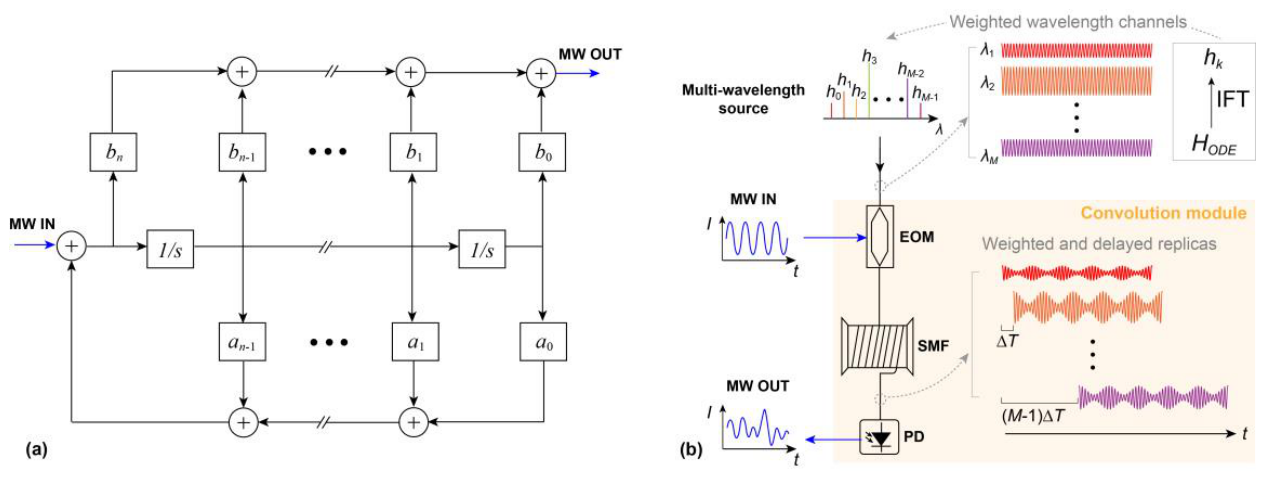
Figure 2.
Radiofrequency (RF) amplitude response of (a) simplified first-order, (b) general first-order, and (c) second-order MWP ODE solvers with different coefficients based on a microcomb source as a function of the tap number M ranging from 5 to 45.
Figure 2.
Radiofrequency (RF) amplitude response of (a) simplified first-order, (b) general first-order, and (c) second-order MWP ODE solvers with different coefficients based on a microcomb source as a function of the tap number M ranging from 5 to 45.
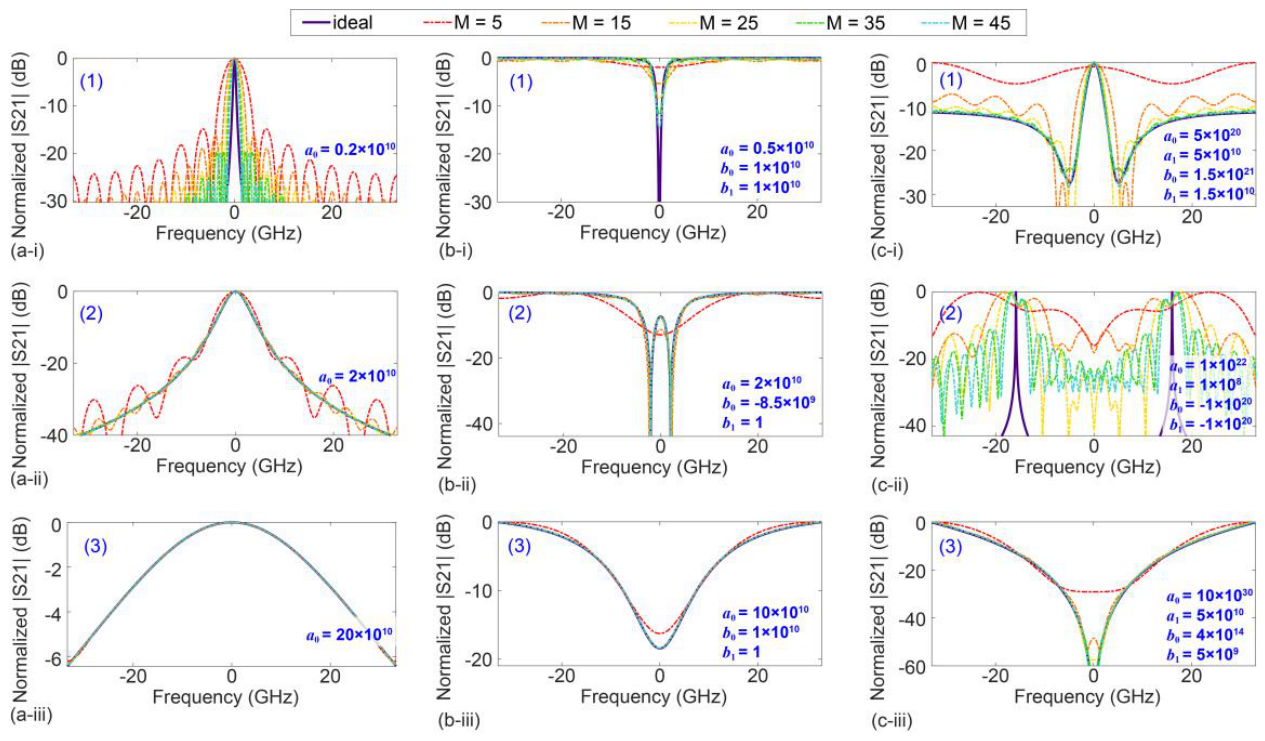
Figure 3.
Root-mean-square errors (RMSEs) between the ideal transfer functions and simulated RF response of (a) simplified first-order, (b) general first-order, and (c) second-order MWP ODE solvers with different coefficients shown in Figure 2 as a function of tap number M.
Figure 3.
Root-mean-square errors (RMSEs) between the ideal transfer functions and simulated RF response of (a) simplified first-order, (b) general first-order, and (c) second-order MWP ODE solvers with different coefficients shown in Figure 2 as a function of tap number M.

Figure 4.
Experimental schematic of a microcomb-based MWP ODE solver. (a) Schematic of soliton crystal microcomb generation. Inset: image of the MRR. CW laser: continuous-wave laser. EDFA: erbium-doped fibre amplifier. PC: polarization controller. MRR: microring resonator. (b) Microcomb spectra. (i) Optical spectrum of the generated soliton crystal microcomb. (ii) Spectrum of the microcomb in the C band. (c) Schematic of ODE solving system. MW: microwave. EOM: electro-optic modulator. SMF: single-mode fibre. BPD: balanced photodetector. OSA: optical spectrum analyzer. OSC: oscilloscope.
Figure 4.
Experimental schematic of a microcomb-based MWP ODE solver. (a) Schematic of soliton crystal microcomb generation. Inset: image of the MRR. CW laser: continuous-wave laser. EDFA: erbium-doped fibre amplifier. PC: polarization controller. MRR: microring resonator. (b) Microcomb spectra. (i) Optical spectrum of the generated soliton crystal microcomb. (ii) Spectrum of the microcomb in the C band. (c) Schematic of ODE solving system. MW: microwave. EOM: electro-optic modulator. SMF: single-mode fibre. BPD: balanced photodetector. OSA: optical spectrum analyzer. OSC: oscilloscope.
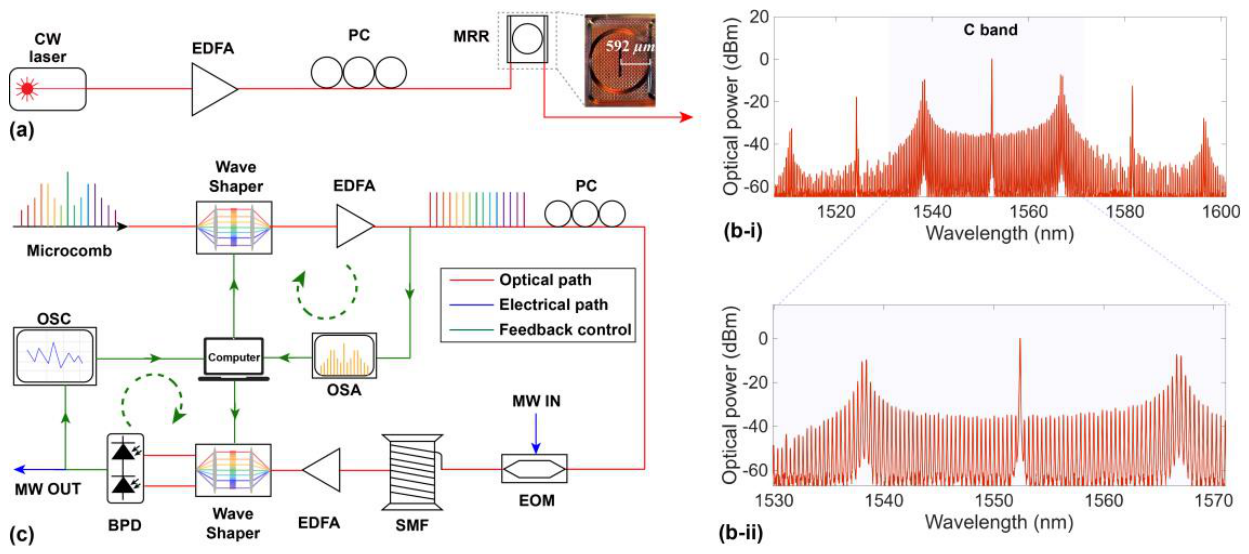
Figure 5.
Temporal processing results of simplified first-order ODE solvers with different coefficients. (a) Measured and ideal tap weights of corresponding shaped microcombs. (b) Measured and theoretical temporal output of simplified first-order ODE solvers when there is a Gaussian pulse input with a pulse width of ~0.1 ns.
Figure 5.
Temporal processing results of simplified first-order ODE solvers with different coefficients. (a) Measured and ideal tap weights of corresponding shaped microcombs. (b) Measured and theoretical temporal output of simplified first-order ODE solvers when there is a Gaussian pulse input with a pulse width of ~0.1 ns.
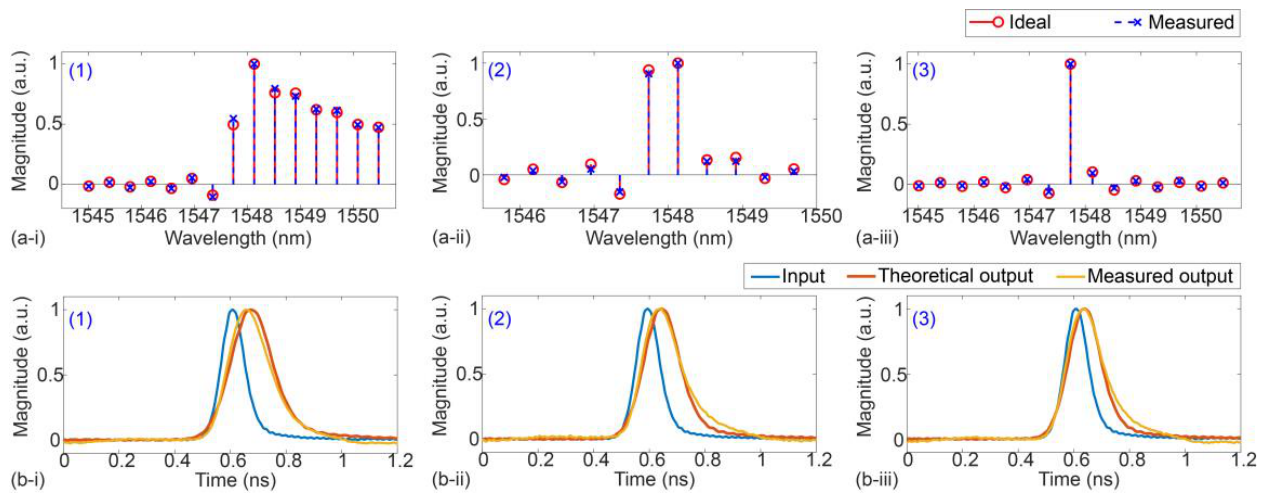
Figure 6.
Temporal processing results of general first-order ODE solvers with different coefficients. (a) Measured and ideal tap weights of corresponding shaped microcombs. (b) Measured and theoretical temporal results of general first-order ODE solvers when there is a Gaussian pulse input with a pulse width of ~0.1 ns.
Figure 6.
Temporal processing results of general first-order ODE solvers with different coefficients. (a) Measured and ideal tap weights of corresponding shaped microcombs. (b) Measured and theoretical temporal results of general first-order ODE solvers when there is a Gaussian pulse input with a pulse width of ~0.1 ns.
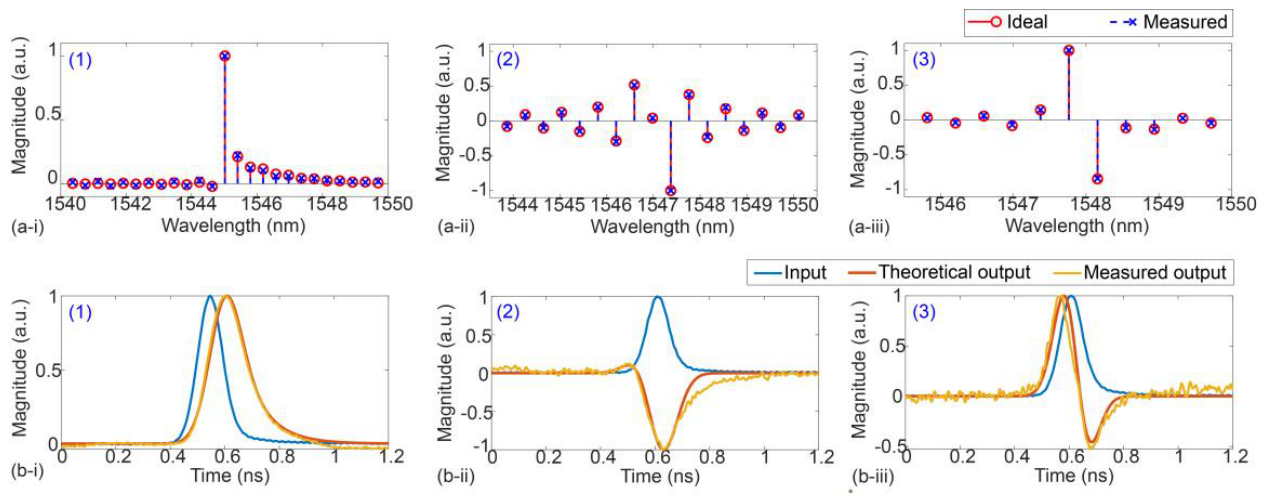
Figure 7.
Temporal processing results of second-order ODE solvers with different coefficients. (a) Measured and ideal tap weights of corresponding shaped microcombs. (b) Measured and theoretical temporal results of second-order ODE solvers when there is a Gaussian pulse input with a pulse width of ~0.1 ns.
Figure 7.
Temporal processing results of second-order ODE solvers with different coefficients. (a) Measured and ideal tap weights of corresponding shaped microcombs. (b) Measured and theoretical temporal results of second-order ODE solvers when there is a Gaussian pulse input with a pulse width of ~0.1 ns.
Disclaimer/Publisher’s Note: The statements, opinions and data contained in all publications are solely those of the individual author(s) and contributor(s) and not of MDPI and/or the editor(s). MDPI and/or the editor(s) disclaim responsibility for any injury to people or property resulting from any ideas, methods, instructions or products referred to in the content. |
© 2026 by the authors. Licensee MDPI, Basel, Switzerland. This article is an open access article distributed under the terms and conditions of the Creative Commons Attribution (CC BY) license (http://creativecommons.org/licenses/by/4.0/).
Copyright: This open access article is published under a Creative Commons CC BY 4.0 license, which permit the free download, distribution, and reuse, provided that the author and preprint are cited in any reuse.


