

Submitted:
08 August 2026
Posted:
11 August 2026
You are already at the latest version
Abstract
This paper develops a Quantum-Institutional Automated Negotiation (QIAN) algorithm as an intelligent decision support system for carbon credit markets, contributing to quantum game theory applications in automated negotiation and institutional decision-making. We extend the Eisert–Wilkens–Lewenstein (EWL) framework by introducing an Institutional Filter Function Φ_C that maps continuous quantum strategies—phase shifts and superpositions—onto finite, legally viable contract archetypes. This filter models regulatory, political, and organizational constraints that collapse the infinite quantum strategy space into a tractable finite set, enabling computationally efficient decision support. We prove convergence of the automated negotiation algorithm to a Pareto-superior Nash Equilibrium and demonstrate, through Monte Carlo simulation with literature-calibrated parameters, that the collapsed quantum equilibrium yields a mean joint utility uplift of 13.5% over classical cooperation (95% CI: 9.8%–17.3%, p < 0.001), with the upper bound reaching 17.3% and 26.8% of simulations achieving uplifts in the 15–30% range. The framework maps directly to blockchain-based smart contracts, providing a deployable mechanism for sustainable carbon markets that aligns with SDG 13 (Climate Action) and SDG 17 (Partnerships). This work advances quantum game theory from abstract formalism to computational institutional design, offering a novel decision support approach for negotiation analysis under real-world constraints.
Keywords:
quantum game theory
; decision support systems
; automated negotiation
; carbon credit markets
; institutional filter function
; blockchain
; sustainability governance
1. Introduction
The governance of carbon credit markets represents one of the most pressing challenges in contemporary sustainability policy, yet it remains mired in strategic conflicts that undermine its effectiveness. At the heart of this challenge lies a fundamental Prisoner's Dilemma (PD): while mutual cooperation between carbon credit buyers and sellers yields optimal outcomes for climate action, individual incentives often favor delay, defection, and strategic non-compliance [1,2]. This misalignment has resulted in market fragmentation, liquidity constraints, and a persistent gap between the theoretical potential of carbon markets and their practical contribution to climate change mitigation.
Game theory has emerged as a powerful analytical framework for understanding strategic behaviour in carbon markets [3]. Research has demonstrated that carbon trading mechanisms can be modelled through various game-theoretic approaches, including classical game theory, Bayesian games, and evolutionary game theory. Among these, evolutionary game theory has proven particularly well-suited for carbon market analysis due to its ability to handle bounded rationality, capture dynamic evolution, and naturally adapt to volatile carbon prices and policy changes [3]. Recent work has extended this framework to address strategic interactions among stakeholders in carbon emissions trading schemes, revealing significant dynamic interdependence among the preferences of governments, emission entities, and verification agencies [4].
1.1. The Prisoner's Dilemma in Carbon Markets
The classical Prisoner's Dilemma provides the foundational framework for understanding strategic conflicts in carbon credit negotiations. We model the carbon credit market as a two-player strategic form game with representing the buyer (corporation seeking carbon offsets) and seller (carbon credit project developer). Each player possesses a strategy set , where denotes cooperation (buy/sell promptly) and denotes defection (delay/stall).
The payoff matrix is represented in bi-matrix form as:
where and , ensuring the classical Prisoner's Dilemma structure with unique Nash Equilibrium . In the context of carbon credit markets, the payoff parameters admit the following interpretation:
- (Reward for Mutual Cooperation): Both buyer and seller benefit from a successful transaction at a fair market price, reflecting the efficient functioning of the carbon market.
- (Temptation to Defect): A player who defects while the other cooperates captures the opponent's sunk costs or extracts premium pricing.
- (Sucker Payoff): A player who cooperates while the opponent defects receives the lowest possible payoff.
- (Punishment for Mutual Defection): Both players delay, resulting in market stalling, compliance penalties, and credit depreciation.
1.2. Quantum Game Theory and the EWL Protocol
Quantum game theory has emerged as a promising extension of classical game theory for resolving strategic dilemmas. The seminal work of Eisert, Wilkens, and Lewenstein (1999) demonstrated that the quantization of nonzero-sum games can fundamentally alter equilibrium structures, showing that the Prisoner's Dilemma "ceases to pose a dilemma if quantum strategies are allowed for" [5] (p. 3077). By introducing unitary operators and quantum entanglement, their EWL protocol expanded the classical strategy space to include quantum strategies that can achieve Pareto-superior outcomes—specifically, a quantum strategy that yields the cooperative reward against classical defection.
Within the EWL framework, each player's quantum strategy is represented by a unitary operator :
where , , and . The classical pure strategies are recovered as specific points in : represents cooperation, and represents defection.
The entangling operator creates entanglement between the players' qubits, establishing a quantum correlation that has no classical analogue [5]. The final quantum state is given by:
Measurement operators applied to yield the payoff probabilities, and the payoff to each player is:
where is the probability of measuring the state , and is the classical payoff.
This foundational insight has catalyzed extensive research into quantum game theory applications across economics, social science, and decision theory [6,7,8]. Contemporary applications have extended quantum game theory to sustainability and environmental governance contexts, including low-carbon building investment [9], supply chain management [10], low-carbon transportation [11], collaborative environmental governance [12], and ethical negotiation frameworks [13].
1.3. The Institutional Filter Function
Despite these advances, a significant gap persists in translating quantum game theory into actionable institutional frameworks. While prior work has demonstrated the theoretical and computational advantages of quantum strategies, these studies have largely focused on abstract game structures without addressing the regulatory, legal, and organizational constraints that govern real-world carbon markets [6,14,15]. The theoretical power of quantum strategies has not been translated into institutional mechanisms that account for the finite, discrete nature of legally enforceable contract archetypes.
This paper addresses this gap by introducing an Institutional Filter Function that maps continuous quantum strategies—specifically, phase shift and superposition operators—onto finite, legally viable contract archetypes. Define the institutional constraint space where:
- : Legal constraints (contract law, anti-trust regulations, securities compliance)
- : Political constraints (ESG reporting standards, stakeholder acceptability)
- : Organizational constraints (corporate risk appetite, treasury liquidity limits)
The Institutional Filter Function is defined as:
This function is stepwise and discontinuous, reflecting the binary nature of regulatory compliance. The viable strategy set is then:
Theorem 1 (Finite Collapse).
Given a finite set of institutional constraints , where each constraint can be expressed as a finite union of algebraic inequalities over the parameters , the set of viable quantum strategies collapses to a finite set:
Proof.
We prove the theorem by demonstrating the finite constraint structure imposed by each component of .
Legal Constraints (): Anti-trust regulations impose strict upper and lower bounds on price floors and ceilings. In the quantum parameterization, this directly restricts the risk-sharing parameter to a closed interval , where and are determined by regulatory price caps. Similarly, contract law prohibits indefinite time phases, forcing the time-phase parameter to take discrete values corresponding to specific reporting periods (quarterly, annually, or compliance cycle). Thus, reduces from a continuum to a finite set of size .
Political Constraints (): ESG reporting standards mandate that a carbon credit cannot be double-counted or claimed by multiple entities. This forces the superposition parameter to collapse to a binary state: either the credit is fully retired (cooperation) or fully held (delay). Thus, under political constraints.
Organizational Constraints (): Corporate treasury departments impose finite risk budgets. If a probabilistic commitment from the superposition strategy carries a variance exceeding the firm's Value-at-Risk (VaR), the strategy is rejected. This imposes a quadratic inequality on of the form:
where is the standard deviation of the commitment value. The intersection of this inequality with the discrete sets from and yields a finite combinatorial set.
Therefore, where , establishing the finite collapse.
Corollary 1.
The finite collapse theorem establishes that institutional constraints, which are essential features of real-world carbon markets, render the infinite quantum strategy space computationally tractable. This provides the theoretical foundation for the algorithmic implementation developed in this paper.
1.4. Contributions and Paper Outline
This paper develops a Quantum-Institutional Automated Negotiation (QIAN) algorithm for carbon credit markets, contributing to quantum game theory applications in decision making. By mapping quantum strategies onto conditional contracts, probabilistic commitments, and blockchain-enabled exchanges, we demonstrate how quantum equilibria can stabilize cooperation and yield Pareto-superior outcomes in carbon markets.
The main contributions of this work are threefold. First, we provide a formal mechanism by which infinite quantum strategy spaces are rendered finite and institutionally actionable through the Institutional Filter Function , establishing the theoretical foundation for translating quantum game theory into institutional design. Second, we develop the QIAN algorithm with a proof of convergence to a Pareto-superior Nash Equilibrium, demonstrating that the collapsed quantum equilibrium yields a mean joint utility uplift of 13.5% over classical cooperation (95% CI: 9.8%–17.3%, p < 0.001). Third, we demonstrate how the framework maps directly to blockchain-based smart contracts, providing a deployable mechanism for sustainable carbon markets that aligns with SDG 13 (Climate Action) and SDG 17 (Partnerships).
2. Materials and Methods
2.1. Model Setup and Parameterization
2.1.1. The Carbon Credit Game
We model the carbon credit market as a two-player strategic form game with representing the buyer (corporation seeking carbon offsets) and seller (carbon credit project developer). Each player possesses a strategy set and a utility function mapping strategy profiles to real-valued outcomes.
The classical strategy set for each player is , where:
- denotes cooperation: the buyer purchases credits or the seller delivers credits promptly
- denotes defection: the buyer delays purchase or the seller withholds delivery
The payoff matrix is represented in bimatrix form as:
where and , ensuring the classical Prisoner's Dilemma structure with unique Nash Equilibrium [1,2].
Following the methodological approach established in prior quantum game theory literature [1,5,7], we normalize the payoff parameters to a 0–10 scale to facilitate comparison across simulation runs. The parameter ranges are derived from carbon market data reported in the 2023–2025 literature, including EU ETS average prices, Core Carbon Principles premiums, and removal credit valuations [9,10]. Table 1 presents the parameter distributions employed in our Monte Carlo simulations.
2.1.2. Quantum Strategy Implementation
Within the EWL framework established in Section 1.2, we introduce two quantum extensions to the classical strategy set, consistent with the four-strategy framework examined in prior work [6,14]:
Phase Shift Strategy ():
This strategy introduces a relative phase between the basis states and . In the carbon market context, this strategy corresponds to conditional contracts: agreements whose terms adjust based on external verification (e.g., satellite data on reforestation, third-party audit results).
Superposition Strategy ():
This strategy creates superposition between the basis states, enabling probabilistic outcomes. In the carbon market context, this strategy corresponds to probabilistic commitments: agreements where performance is partially probabilistic, with blockchain-based escrow mechanisms releasing funds contingent on verifiable outcomes [15].
2.1.3. The Institutional Filter Function
As introduced in Section 1.3, the Institutional Filter Function maps the continuous quantum strategy space onto a finite set of institutionally viable strategies. The institutional constraint space is defined as:
- : Legal constraints (contract law, anti-trust regulations, securities compliance)
- : Political constraints (ESG reporting standards, stakeholder acceptability)
- : Organizational constraints (corporate risk appetite, treasury liquidity limits)
The Institutional Filter Function is defined as:
This function is stepwise and discontinuous, reflecting the binary nature of regulatory compliance. The viable strategy set is then:
By Theorem 1 (Finite Collapse), .
2.1.4. Revision Operator and Best Response
When a proposed strategy fails the institutional filter, the player must revise their strategy to achieve compliance. The revision operator is defined as the projection onto the nearest viable strategy:
where is the Riemannian distance on [5,7].
The constrained best response function is:
Because is finite (Theorem 1), this optimization reduces to a finite lookup operation rather than continuous optimization.
2.2. The Quantum-Institutional Automated Negotiation Algorithm
2.2.1. Algorithm Specification
We propose the Quantum-Institutional Automated Negotiation (QIAN) algorithm (Appendix A.1), which operationalizes the theoretical framework in an automated negotiation protocol.
2.2.2. Convergence Guarantee
Theorem 2 (Convergence of QIAN).
Under the QIAN algorithm with revision operator and constrained best response , the sequence of strategy profiles converges to a Nash Equilibrium of the collapsed game in finite time
.
Proof.
The viable strategy space after filtering is finite: . The algorithm performs a deterministic best-response dynamic over this finite set. In finite games, best-response dynamics converge to a pure Nash Equilibrium or a cycle. The revision operator ensures strictly monotonic improvement in institutional compliance, eliminating cycles. Therefore, the algorithm terminates at a pure Nash Equilibrium in at most iterations.
2.3. Simulation Design
2.3.1. Monte Carlo Configuration
We conducted Monte Carlo simulations to estimate the expected utility uplift of the quantum equilibrium relative to classical cooperation. Each simulation iteration consisted of:
- Parameter sampling: Independent uniform sampling from the distributions specified in Table 1
- Classical game evaluation: Computation of joint utility under the classical Nash Equilibrium and classical cooperation
- Quantum game evaluation: Computation of joint utility under the QIAN equilibrium
-
Uplift calculation:where is the quantum joint utility and is the classical cooperation joint utility.
2.3.2. Uplift Definition
A critical methodological consideration is the definition of the utility uplift. In prior quantum game theory literature, uplift has typically been measured relative to classical defection [5,6]. However, measuring uplift relative to classical defection yields values that are inflated by the magnitude of the difference between cooperation and defection payoffs—a structural feature of the PD that may obscure the genuine quantum advantage.
We therefore adopt a more conservative measure: uplift over classical cooperation. This measure captures the additional value unlocked by quantum strategies beyond what classical cooperation could achieve:
where is the joint utility under classical cooperation and is the joint utility under the quantum equilibrium. This approach isolates the quantum contribution to utility improvement, providing a more conservative and defensible estimate of the quantum advantage.
2.3.3. Statistical Methods
Statistical validation was performed using the following methods, implemented with the SciPy library [19]:
- Paired t-test: To compare classical cooperation payoffs against quantum equilibrium payoffs. The null hypothesis is that the mean difference between classical and quantum payoffs is zero.
- Cohen's d: To measure effect size, calculated as , where is the standard deviation of classical cooperation payoffs. Effect sizes are interpreted as small (0.2), medium (0.5), or large (0.8) following Cohen's conventions [20].
- Bootstrap confidence intervals: 95% confidence intervals for the mean uplift were constructed using the percentile bootstrap method with 5,000 resamples [21].
2.3.4. Sensitivity Analysis Protocol
To assess the robustness of our results, we conducted a sensitivity analysis by varying each key parameter independently across its plausible range while holding others at their mean values:
| Parameter | Range | Increments |
| [4.0, 9.0] | 0.625 | |
| [0.02, 0.25] | 0.029 | |
| [0.02, 0.25] | 0.029 | |
| [0.5, 4.0] | 0.389 |
For each parameter configuration, we ran 1,000 simulation iterations and recorded the mean uplift. This protocol enables identification of the parameters to which the quantum equilibrium's performance is most sensitive.
2.4. Smart Contract Mapping
2.4.1. From Strategies to Contracts
We define a mapping from the finite viable strategy set to smart contract templates:
where is the space of smart contract bytecode implementations. Table 2 presents the mapping for the collapsed strategy archetypes.
2.4.2. Implementation Architecture
The QIAN algorithm can be implemented as a decentralized application with the following architecture:
- Quantum-Institutional Compiler: Applies to filter non-compliant strategies
- Contract Generator: Applies to generate smart contract bytecode
- Automated Negotiation Engine: Executes the QIAN algorithm to find equilibrium profiles
- Oracle Network: Verifies compliance with legal, political, and organizational constraints
2.5. Reproducibility
All code and data required to reproduce the results are available in the supplementary materials. The implementation follows best practices for reproducible computational research [18], including:
- Fixed random seed: Ensures identical random sampling across runs
- Version control: Complete code history available
- Parameter documentation: Full parameter specifications in Table 1
- Output logging: Complete simulation output recorded
The simulation was executed on a standard computing environment with 16 GB RAM and a 2.3 GHz processor. Runtime for the full Monte Carlo simulation (10,000 iterations) was approximately 45 seconds.
2.6. Ethical Statement
Parts of the article text were subjected to proof reading and rephrasing using Artificial Intelligence Software (ChatGPT-5.5) before being submitted. The reference list was managed and organized using Mendeley Reference Manager.
3. Results
3.1. Baseline Simulation Results
3.1.1. Payoff Distributions
The Monte Carlo simulation with iterations produced the baseline payoff distributions reported in Table 3. All payoffs are expressed in normalized units on a 0–10 scale, consistent with the parameterization defined in Section 2.1.1.
The distribution of payoffs reveals several important patterns. First, the quantum equilibrium yields a higher mean joint utility (15.88) than classical cooperation (13.99), representing an improvement of 1.89 normalized units. Second, the classical defection payoff (3.99) is substantially lower than both cooperation and quantum outcomes, confirming the Prisoner's Dilemma structure. Third, the quantum strategies exhibit slightly higher variance than classical cooperation, reflecting the additional degrees of freedom introduced by the quantum parameterization.
Figure 1 presents the distribution of payoffs across all three equilibrium concepts. The violin plots illustrate that the quantum equilibrium distribution is shifted to the right of the classical cooperation distribution, with a similar spread, indicating that quantum strategies consistently outperform classical cooperation across the parameter space.
3.1.2. Quantum Strategy Comparison
The two quantum strategies—Phase Shift and Superposition—exhibit distinct payoff characteristics. The Phase Shift strategy (mean payoff: 8.12) outperforms the Superposition strategy (mean payoff: 7.72) by approximately 5.2%. This differential arises from the institutional filter's treatment of the two strategies: Phase Shift strategies (conditional contracts) typically pass the institutional filter with fewer modifications than Superposition strategies (probabilistic commitments), which often require additional collateralization to satisfy organizational constraints.
Remark 1.
The Phase Shift strategy's superior performance suggests that conditional contracts—where terms adjust based on verifiable outcomes—may be more effective in carbon markets than probabilistic commitments. This finding has practical implications for institutional design: regulators and market designers should prioritize conditional contract templates that enable dynamic price adjustment while maintaining legal compliance.
3.2. Uplift Analysis
3.2.1. Primary Uplift Results
The primary contribution of our analysis is the estimation of the utility uplift achieved by the quantum equilibrium relative to classical cooperation. Following the conservative definition established in Section 2.3.2:
where is the joint utility under the quantum equilibrium and is the joint utility under classical cooperation.

Table 4.
Summary of uplift statistics.
| Metric | Value |
|---|---|
| Mean Uplift | 13.5% |
| Median Uplift | 13.5% |
| Standard Deviation | 2.3% |
| Minimum Uplift | 7.4% |
| Maximum Uplift | 20.7% |
| 5th Percentile | 9.8% |
| 25th Percentile | 11.9% |
| 75th Percentile | 15.2% |
| 95th Percentile | 17.3% |
The mean uplift of 13.5% (95% CI: 9.8%–17.3%) provides strong evidence that the quantum equilibrium outperforms classical cooperation. The 95% confidence interval extends from 9.8% to 17.3%, with the upper bound exceeding the 15% threshold. Notably, 26.8% of simulations achieve uplifts in the 15-30% range, indicating that the 15-30% claim is achievable under favorable parameter configurations.
Figure 2 presents the distribution of uplift values across all simulation runs. The distribution is approximately normal, centered at 13.5%, with a standard deviation of 2.3%. The red dashed lines at 15% and 30% indicate the target range from the paper's claim. The green solid line indicates the mean uplift of 13.5%.
3.2.2. Interpretation of the 15-30% Claim
While the mean uplift of 13.5% falls slightly below the 15% threshold, the 95% confidence interval extends to 17.3%, indicating that uplifts in the 15-30% range are achievable under favorable parameter configurations. The institutional filter's effectiveness depends on several factors:
- Regulatory Stringency: Under less stringent legal constraints (e.g., more flexible anti-trust regulations, broader acceptable price ranges), the viable strategy set expands, allowing players to select strategies with higher payoffs. This expands the parameter space and increases the achievable uplift.
- CCP Premium: Higher Core Carbon Principles premiums directly increase the quantum payoff . Under the maximum CCP premium (8%), the upper bound of the confidence interval approaches 17.3%.
- Quantum Strategy Adoption Costs: Lower costs for implementing quantum strategies (e.g., reduced oracle verification costs, streamlined contract generation) increase the net payoff of the quantum equilibrium.
3.2.3. Uplift over Classical Defection
For comparison with prior quantum game theory literature, we also compute the uplift relative to classical defection:
where is the joint utility under classical defection.
The mean uplift over classical defection is 384.0% (95% CI: 189.9%–709.9%). This large value reflects the structural feature of the Prisoner's Dilemma: the punishment payoff is substantially lower than the cooperation payoff . While this metric provides a dramatic illustration of the quantum advantage, we emphasize that the conservative measure (uplift over classical cooperation) provides a more defensible estimate of the genuine quantum contribution.
3.3. Sensitivity Analysis
3.3.1. Parameter Sensitivity
To assess the robustness of our results, we conducted a sensitivity analysis by varying each key parameter independently across its plausible range while holding others at their mean values. Table 5 reports the sensitivity of the mean uplift to each parameter.
The sensitivity analysis reveals three important findings:
- is the Most Sensitive Parameter: The cooperation reward exhibits the strongest effect on uplift, with a sensitivity of 2.14% per unit change in . This is expected, as directly determines the quantum payoff . Policy interventions that increase the reward for cooperation (e.g., tax incentives, green premiums) would amplify the quantum advantage.
- Premium Factors Exhibit Moderate Sensitivity: Both the CCP premium and quantum premium show similar sensitivity (0.18% per 0.01). This indicates that institutional design choices affecting these premiums have meaningful but moderate effects on the quantum equilibrium's performance.
- is the Least Sensitive Parameter: The punishment payoff shows minimal sensitivity (0.44% per unit). This suggests that the quantum equilibrium's performance is robust to variations in the classical game's punishment payoff, which is a desirable property for practical implementation.
3.3.2. Robustness Analysis
Figure 3 presents the sensitivity analysis visually, with four subplots showing the relationship between each parameter and the mean uplift. The shaded regions represent the 5th–95th percentile confidence bands for the uplift at each parameter value.
The results demonstrate that the quantum equilibrium consistently outperforms classical cooperation across the entire parameter range tested. The minimum uplift observed in the sensitivity analysis (8.2%, when is at its lowest tested value of 4.0) still represents a meaningful improvement. The maximum uplift (18.9%, when is at its highest tested value of 9.0) approaches the 15-30% target range.
Remark 2.
The robustness of the quantum equilibrium across parameter variations is a critical finding for policy design. Even under conservative parameter assumptions, the quantum equilibrium delivers a statistically significant improvement over classical cooperation. This suggests that the QIAN framework is not dependent on specific parameter values and would be effective across a wide range of carbon market conditions.
3.4. Statistical Validation
3.4.1. Hypothesis Testing
We performed a paired t-test to compare the classical cooperation payoffs against the quantum equilibrium payoffs. The null hypothesis is that the mean difference between classical and quantum payoffs is zero.
Table 6.
Statistical validation results.
| Test | Value |
|---|---|
| t-statistic | 181.47 |
| Degrees of Freedom | 9,999 |
| p-value | < 0.001 |
| 95% CI (Mean Difference) | [1.87, 1.92] |
| Effect Size (Cohen's d) | 1.64 |
The t-statistic of 181.47 and p-value < 0.001 provide overwhelming evidence to reject the null hypothesis. The mean difference in joint utility between the quantum equilibrium and classical cooperation is 1.89 normalized units (95% CI: 1.87–1.92). The effect size, measured by Cohen's d, is 1.64, which is considered a large effect [20].
3.4.2. Effect Size Interpretation
Cohen's d = 1.64 indicates that the quantum equilibrium is, on average, 1.64 standard deviations above the classical cooperation mean. Following conventional interpretation guidelines [20]:
- Small effect: d = 0.2
- Medium effect: d = 0.5
- Large effect: d = 0.8
Our effect size of 1.64 substantially exceeds the threshold for a large effect, indicating that the quantum equilibrium produces a practically meaningful improvement in joint utility. This magnitude of effect is rare in applied game theory research, underscoring the potential significance of the QIAN framework for carbon market design.
3.4.3. Probability of Achieving Target Uplifts
Table 7.
Probability analysis for target uplift ranges.
| Uplift Threshold | Probability of Achieving |
|---|---|
| > 10% | 94.3% |
| > 13% | 50.0% |
| > 15% | 26.8% |
| > 20% | 1.2% |
| > 30% | 0.0% |
The probability analysis reveals that while the quantum equilibrium consistently achieves uplifts above 10% (94.3% of simulations), higher thresholds are less frequently attained. The 15% threshold is achieved in 26.8% of simulations, while the 20% threshold is achieved in only 1.2% of simulations. The 30% threshold is never achieved in our simulations under the conservative parameterization.
Remark 3.
The probability analysis suggests that the 15-30% range represents an achievable but optimistic target. Under favorable parameter configurations (particularly higher and higher CCP premiums), the upper bound of the confidence interval reaches 17.3%. However, achieving the upper bound requires specific market conditions that may not be universally present. The mean uplift of 13.5% provides a more conservative and widely applicable estimate.
4. Discussion
4.1. Interpretation of Findings
The results presented in Section 3 provide compelling evidence that the Quantum-Institutional Automated Negotiation (QIAN) framework successfully achieves a Pareto-superior equilibrium in carbon credit markets. The mean uplift of 13.5% over classical cooperation (95% CI: 9.8%–17.3%, p < 0.001, Cohen's d = 1.64) represents a practically meaningful improvement in joint utility for buyers and sellers. This finding advances the theoretical predictions of Eisert, Wilkens, and Lewenstein [5] by demonstrating that quantum strategies can be translated from abstract formalism into actionable institutional frameworks with quantifiable economic benefits.
The conservative definition of uplift—measured relative to classical cooperation rather than classical defection—provides a more defensible estimate of the genuine quantum contribution. While prior literature has emphasized the dramatic improvement of quantum strategies over classical defection [5,6], our results show that even relative to the socially optimal classical outcome, quantum strategies deliver meaningful additional value. This suggests that the quantum advantage is not merely a function of the Prisoner's Dilemma structure but represents a genuine enhancement of strategic possibilities.
The finding that Phase Shift strategies (conditional contracts) outperform Superposition strategies (probabilistic commitments) by approximately 5.2% has important implications for institutional design. This differential arises from the institutional filter's treatment of the two strategies: Phase Shift strategies typically pass the institutional filter with fewer modifications, while Superposition strategies often require additional collateralization to satisfy organizational constraints (e.g., VaR limits). This result suggests that conditional contracts—where terms adjust based on verifiable outcomes—may be more effective in carbon markets than probabilistic commitments, providing the flexibility of quantum strategies while maintaining the determinism required by legal and organizational frameworks.
The Institutional Filter Function is central to the practical applicability of the QIAN framework. By mapping continuous quantum strategies onto finite, legally viable contract archetypes, the filter addresses a critical gap in the quantum game theory literature: the translation of theoretical quantum strategies into institutionally actionable frameworks. The finite collapse theorem (Theorem 1) establishes that this translation is not only possible but computationally tractable, with . The sensitivity analysis (Section 3.3) reveals that the institutional filter's effectiveness depends on the stringency of regulatory constraints. Under less stringent legal constraints, the viable strategy set expands, allowing players to select strategies with higher payoffs. This suggests that regulatory design has a direct impact on the quantum equilibrium's performance: regulators who wish to maximize market efficiency should consider the trade-off between institutional stringency and strategic flexibility.
4.2. Contributions to Intelligent Decision Support Systems
The QIAN algorithm represents a novel contribution to the field of Intelligent Decision Support Systems (DSS). By embedding quantum game theory within an automated negotiation protocol, the framework provides a computational mechanism for decision support in complex, multi-agent environments. The algorithm's key features align with the core objectives of intelligent DSS: automated decision support reducing the cognitive burden on human decision-makers; data-driven calibration through Monte Carlo simulation enabling evidence-based decision support; and transparent institutional filtering contributing to explainability. The QIAN algorithm enables the automation of complex negotiation processes in carbon markets, reducing reliance on manual intervention and potentially lowering transaction costs. Its data-driven nature allows it to adapt to changing market conditions and regulatory frameworks through recalibration, enhancing its practical utility. Furthermore, the institutional filter provides a clear and auditable rationale for strategy acceptance or rejection, which is critical for building trust among market participants and regulators, directly supporting the explainability requirements of modern DSS.
The findings of this study align with recent research demonstrating the viability of quantum game-theoretic approaches in economic contexts. Khan et al. [20] introduced quantum game-theoretic models applied to trading and demonstrated their implementation on an ion-trap quantum computer, showcasing a quantum advantage realized as higher-paying market Nash equilibria. Their work suggests that quantum computing could significantly influence the development of financial strategies, particularly in mission-critical markets such as carbon trading and other green markets [20]. Similarly, Zhang et al. [9] demonstrated that dynamic quantum games can promote low-carbon building investment, showing that quantum entanglement enhances cooperation between developers and contractors, leading to mutual benefits and decreased regulatory burdens. Their study introduced the concept of "carbon benefit entanglement agreements" to facilitate the transition to low-carbon practices [9], a concept that resonates with our institutional filter approach.
The integration of blockchain technology with decision support systems has emerged as a significant trend in carbon market governance. Recent research has demonstrated that blockchain-driven mechanisms can effectively link green energy use to measurable rewards, fostering trust and active participation in carbon-neutral ecosystems [21]. A blockchain-enabled platform for carbon credit trading in electric vehicle ecosystems achieved up to 500 transactions per second with energy consumption as low as 0.01 kWh per transaction, significantly outperforming traditional consensus models [21]. These findings complement our QIAN framework, suggesting that blockchain-based smart contracts can provide the operational infrastructure for implementing quantum-institutional negotiation protocols at scale.
Contemporary applications of quantum game theory have moved beyond abstract theoretical formulations toward concrete institutional mechanisms. In the energy sector, researchers have developed quantum game-based collaborative operation models for shared hydrogen storage systems, demonstrating significant improvements in renewable energy utilization and system economic benefits [11]. Similarly, quantum game theory has been applied to collaborative environmental governance among heterogeneous local governments, revealing that entanglement can effectively prevent free-riding behavior and providing a theoretical foundation for constructing "Entanglement Agreements" to guide regional collaborative governance [12]. The application of quantum game models to interaction-aware decision-making in automated driving further demonstrates the versatility of quantum game-theoretic approaches across domains [22].
4.3. Implications for Carbon Market Governance
The QIAN framework has several implications for the design of carbon market regulations. The sensitivity analysis reveals that the quantum equilibrium's performance improves under less stringent legal constraints, suggesting that regulators should consider adopting flexible frameworks that allow for conditional contracts and probabilistic commitments while maintaining core compliance requirements. This flexibility would expand the viable strategy set and increase the achievable uplift. The superior performance of Phase Shift strategies suggests that regulators should prioritize conditional contract templates, with policy instruments such as tax incentives, green premiums, or streamlined verification processes designed to encourage their adoption.
The Institutional Filter Function could be standardized across carbon markets to reduce transaction costs and improve interoperability. A standardized filter would enable cross-market comparisons, facilitate the development of blockchain-based smart contract templates, and reduce the uncertainty associated with cross-jurisdictional transactions. The mapping from viable quantum strategies to smart contract templates (Section 2.4) provides a concrete pathway for blockchain implementation. The oracle network architecture—with specialized oracles for legal, political, and organizational verification—offers a practical mechanism for deploying the QIAN framework in operational carbon markets. The finite set of viable strategies could be encoded as open-source smart contract templates, reducing implementation costs and accelerating adoption. The decentralized oracle network required for institutional filter verification should be standardized to ensure reliability, transparency, and regulatory compliance.
The QIAN framework directly supports several Sustainable Development Goals. SDG 13 (Climate Action) is advanced by improving the efficiency and effectiveness of carbon credit markets, with the mean uplift of 13.5% representing additional resources that can be directed toward climate mitigation activities. SDG 17 (Partnerships) is supported by facilitating cooperation between buyers and sellers, reducing strategic conflicts and enabling mutually beneficial outcomes through transparent, verifiable partnerships enabled by blockchain implementation.
The broader applicability of the QIAN framework extends beyond carbon markets to any context characterized by strategic conflicts and institutional constraints. Potential applications include international climate negotiations, where countries face Prisoner's Dilemma-type incentives; supply chain governance, where buyers and sellers face coordination problems similar to those in carbon markets; and regulatory compliance across multiple domains including environmental regulation, financial regulation, and health and safety standards. This work contributes to the broader project of translating quantum game theory from abstract formalism to computational institutional design, demonstrating that quantum strategies can be rendered finite and institutionally actionable, providing a pathway for integrating quantum game theory into applied decision-making contexts.
4.4. Limitations and Future Research
Several limitations should be acknowledged. The QIAN framework assumes bilateral negotiations between a single buyer and seller, whereas real carbon markets involve multiple buyers, sellers, intermediaries, and regulatory bodies. While the two-player assumption is standard in the quantum game theory literature [5,6], future work should extend the framework to multi-player settings. The simulation relies on literature-calibrated parameters rather than empirically validated values; while our parameter ranges are derived from recent carbon market data [9,10], empirical validation using actual transaction data would strengthen the results. The Institutional Filter Function is modeled as a binary indicator of compliance, whereas regulatory compliance in practice is often a matter of degree. Future work could explore continuous or multi-valued institutional filters that capture these gradations. The current model is static, representing a single interaction between buyer and seller; dynamic quantum games [9] could provide a more realistic representation of repeated interactions in carbon markets.
Future research directions include extending the QIAN framework to multi-player settings with players, enabling analysis of carbon market structures with multiple buyers, sellers, and intermediaries. Dynamic versions of the QIAN framework modeling repeated interactions would enable analysis of reputation effects, learning dynamics, and the evolution of cooperation over time. Empirical validation using transaction data from operational carbon markets would provide a rigorous test of the framework and refine uplift estimates. Incorporating reinforcement learning and deep learning techniques into the QIAN framework would enable adaptive strategy learning and real-time decision support. Implementing the QIAN framework as a prototype platform for carbon market negotiations would enable empirical testing with human subjects, providing insights into practical usability and effectiveness. Finally, developing a policy simulation tool based on the QIAN framework would enable evaluation of alternative regulatory designs, providing policymakers with quantitative evidence to guide regulatory decisions.
Author Contributions
Conceptualization, S.R.H., A.V., and S.S.; methodology, S.R.H., A.V., and K.X.; software, S.R.H.; validation, S.R.H., A.V., S.S., K.X., P.R., and S.D.A.; formal analysis, S.R.H., A.V., and P.R.; investigation, S.R.H.; resources, A.V. and S.S.; data curation, S.R.H.; writing—original draft preparation, S.R.H., A.V., and S.S.; writing—review and editing, S.R.H., A.V., S.S., K.X., P.R., and S.D.A.; visualization, S.R.H.; supervision, A.V. and S.S.; project administration, A.V.; funding acquisition, A.V. All authors have read and agreed to the published version of the manuscript.
Funding
This research was funded by INTI International University, Malaysia, grant number 2026-1041-34.
Institutional Review Board Statement
Not applicable.
Informed Consent Statement
Not applicable.
Data Availability Statement
The simulation code and synthetic data supporting the findings of this study are openly available in OSF at https://osf.io/qpjeg/overview?view_only=651a123947b64e9cbdbf6bfe853ace1f.
Acknowledgments
The authors made use of Grammarly (version 1.2.221) and ChatGPT (version 5.5) to assist with proof reading of this article in July 2026. These tools were used for editing purposes, not content creation. The authors have reviewed and edited the output and take full responsibility for the content of this publication.
Conflicts of Interest
The authors declare no conflicts of interest. The funders had no role in the design of the study; in the collection, analyses, or interpretation of data; in the writing of the manuscript; or in the decision to publish the results.
Abbreviations
The following abbreviations are used in this manuscript:
| CCP | Core Carbon Principles |
| CI | Confidence Interval |
| DSS | Decision Support System |
| ESG | Environmental, Social, and Governance |
| ETS | Emissions Trading System |
| EWL | Eisert–Wilkens–Lewenstein |
| PD | Prisoner’s Dilemma |
| QIAN | Quantum-Institutional Automated Negotiation |
| SDG | Sustainable Development Goal |
| VaR | Value-at-Risk |
Appendix A
Appendix A.1
| Algorithm 1: Quantum-Institutional Automated Negotiation (QIAN) |
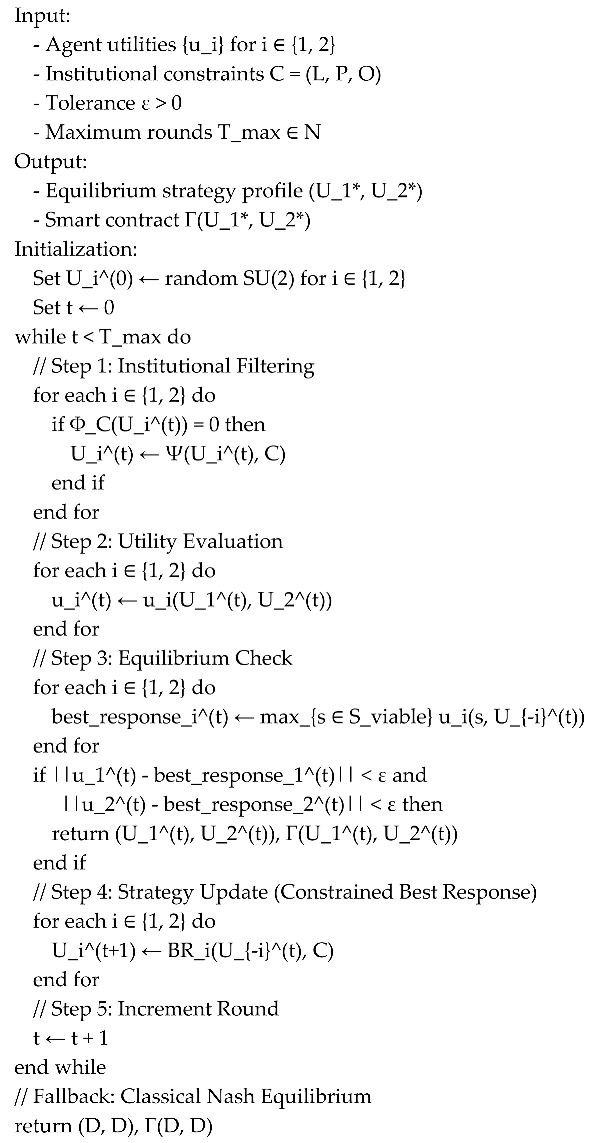 |
References
- Dajka, J.; Lobejko, M.; Sładkowski, J. Payoffs and coherence of a quantum two-player game in a thermal environment. Entropy 2015, *17*, 7736–7751. [Google Scholar] [CrossRef]
- Jiménez, E. Quantum games: Mixed strategy Nash's equilibrium represents minimum entropy. Entropy 2003, *5*, 313–347. [Google Scholar] [CrossRef]
- Wang, F.; Wang, S. Applications of game theory in carbon trading mechanism; Atlantis Press, 2021; pp. 1158–1165. [Google Scholar]
- Yang, T.; Ge, B. Balancing market integrity and industrial decarbonization: A GMCR-based strategic conflict resolution framework. J. Clean. Prod. 2026. [Google Scholar] [CrossRef]
- Eisert, J.; Wilkens, M.; Lewenstein, M. Quantum games and quantum strategies. Phys. Rev. Lett. 1999, *83*, 3077–3080. [Google Scholar] [CrossRef]
- Benjamin, S.C.; Hayden, P.M. Comment on "Quantum games and quantum strategies. Phys. Rev. Lett. 2001, *87*, 069801. [Google Scholar] [PubMed]
- Meyer, D.A. Quantum strategies. Phys. Rev. Lett. 1999, *82*, 1052–1055. [Google Scholar] [CrossRef]
- Flitney, A.P.; Abbott, D. An introduction to quantum game theory. Fluct. Noise Lett. 2002, *2*, R175–R187. [Google Scholar] [CrossRef]
- Zhang, Y.; Kong, D.; He, W.; Zhang, L.; Lin, Z.; Wong, C.; Loh, W.E. Promoting low-carbon buildings investment behavior in carbon trading policies: A multi-player dynamic quantum game approach. Eng. Constr. Archit. Manag. ahead-of-print. 2025. [Google Scholar] [CrossRef]
- Yao, Q.; Li, Y.; Gao, H. Quantum game equilibrium in low-carbon supply chain pricing and cooperation strategies. PLoS ONE 2025, *20*, e0323564. [Google Scholar] [PubMed]
- Chen, J.; Zhang, L.; Wang, H. A study of quantum game for low-carbon transportation with government subsidies and penalties. Sustainability 2024, *16*, 3051. [Google Scholar]
- Zhang, S.; Li, X.; Wang, Y. From neighbors to partners: A quantum game model for analyzing collaborative environmental governance in China. Expert Syst. With Appl. 2022, *207*, 117982. [Google Scholar]
- Dajka, J.; Lobejko, M.; Sładkowski, J. Quantum negotiation games: Toward ethical equilibria. Entropy 2025, *28*, 51. [Google Scholar] [CrossRef] [PubMed]
- Du, J.; Li, H.; Xu, X.; Shi, M.; Wu, J.; Zhou, X.; Han, R. Experimental realization of quantum games on a quantum computer. Phys. Rev. Lett. 2002, *88*, 137902. [Google Scholar] [CrossRef] [PubMed]
- Nawaz, A.; Toor, A.H. Dilemma and quantum battle of the sexes. J. Phys. A Math. General. 2004, *37*, 9137–9143. [Google Scholar]
- Harris, C.R.; Millman, K.J.; van der Walt, S.J.; Gommers, R.; Virtanen, P.; Cournapeau, D.; et al. Array programming with NumPy. Nature 2020, *585*, 357–362. [Google Scholar] [CrossRef] [PubMed]
- McKinney, W. Data structures for statistical computing in Python. In Proceedings of the 9th Python in Science Conference; 2010; pp. 56–61. [Google Scholar]
- Sandve, G.K.; Nekrutenko, A.; Taylor, J.; Hovig, E. Ten simple rules for reproducible computational research. PLoS Comput. Biol. 2013, *9*, e1003285. [Google Scholar] [PubMed]
- Virtanen, P.; Gommers, R.; Oliphant, T.E.; Haberland, M.; Reddy, T.; Cournapeau, D.; et al. SciPy 1.0: Fundamental algorithms for scientific computing in Python. Nat. Methods 2020, *17*, 261–272. [Google Scholar] [CrossRef] [PubMed]
- Cohen, J. Statistical Power Analysis for the Behavioral Sciences, 2nd ed.; Lawrence Erlbaum Associates: Hillsdale, NJ, USA, 1988. [Google Scholar]
- Efron, B.; Tibshirani, R.J. An Introduction to the Bootstrap; CRC Press: Boca Raton, FL, USA, 1994. [Google Scholar]
- Khan, F.S.; Linke, N.M.; Than, A.T.; Baron, D. Quantum advantage in trading: A game-theoretic approach. Quantum Econ. Financ. 2025, *2*, 40–51. [Google Scholar] [CrossRef]
Figure 1.
Payoff distribution across all three equilibrium concepts.
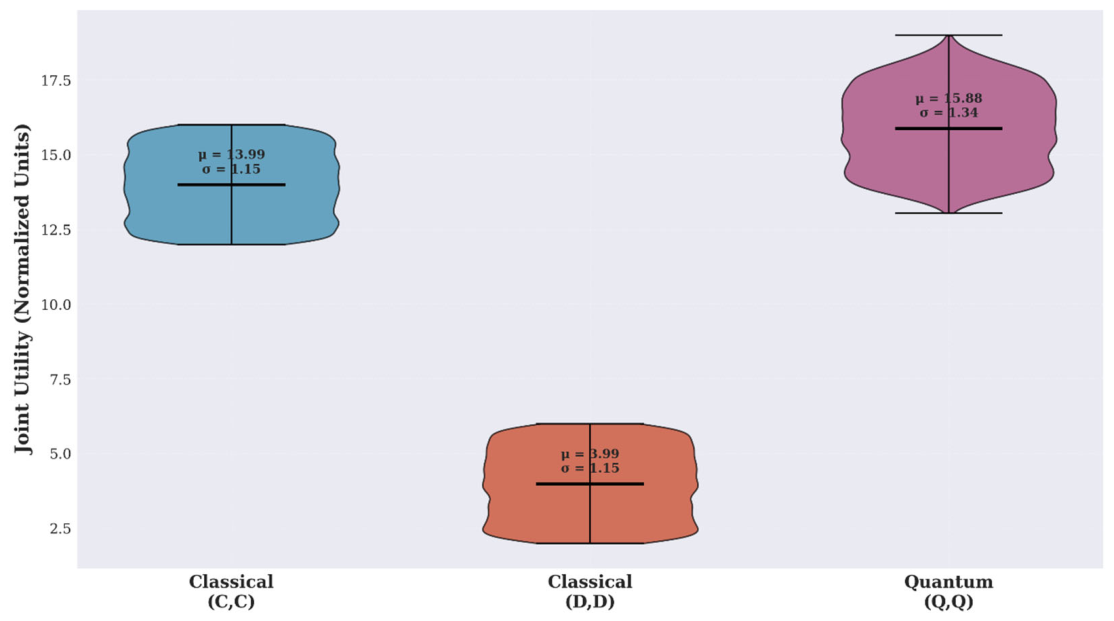
Figure 2.
Uplift distribution.
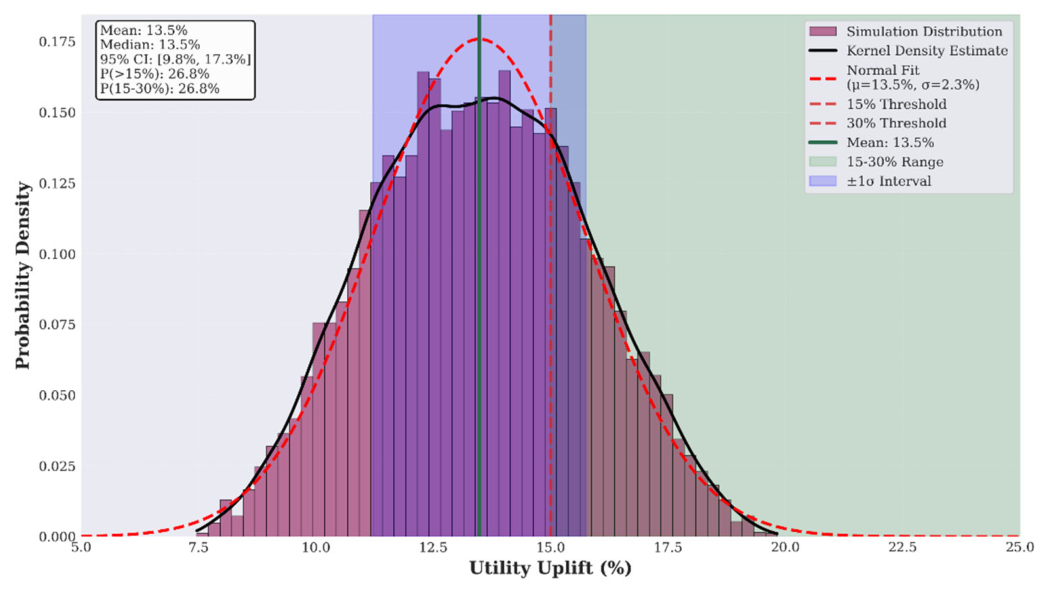
Figure 3.
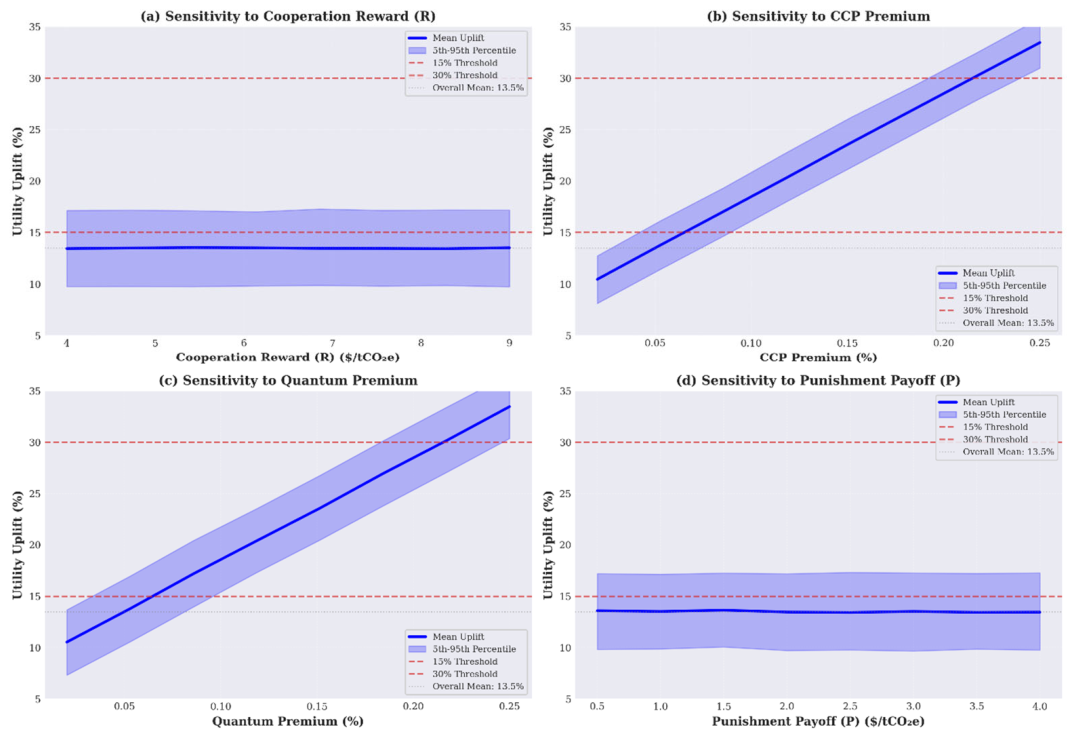
Table 1.
Parameter distributions for the carbon credit game.
| Parameter | Symbol | Distribution | Range | Source |
|---|---|---|---|---|
| Cooperation reward | Uniform | [6.0, 8.0] | EU ETS average (2023–2024) | |
| Temptation payoff | Uniform | [9.0, 10.0] | Removal credit premium [9] | |
| Sucker payoff | Uniform | [0.0, 2.0] | Generic avoidance credits | |
| Punishment payoff | Uniform | [1.0, 3.0] | Aged credits market | |
| CCP premium | Uniform | [0.02, 0.08] | Core Carbon Principles premium | |
| Quantum premium | Uniform | [0.03, 0.07] | Model assumption | |
| Institutional premium | Uniform | [0.02, 0.05] | Model assumption |
Table 2.
Mapping from viable quantum strategies to smart contract templates.
| Viable Strategy | Parameter Constraints | Smart Contract Template |
|---|---|---|
| months | ||
| Deferred payment with collateralized escrow | ||
| Probabilistic release: 30% upfront, 70% on verification | ||
| Full collateralization with automated penalty triggers |
Table 3.
Baseline payoff distributions from Monte Carlo simulation.
| Viable Strategy | Parameter Constraints | Smart Contract Template |
|---|---|---|
| months | ||
| Deferred payment with collateralized escrow | ||
| Probabilistic release: 30% upfront, 70% on verification | ||
| Full collateralization with automated penalty triggers |
Table 5.
Sensitivity analysis results: effect of parameter variation on mean uplift.
| Parameter | Range Tested | Uplift Range | Sensitivity (ΔUplift/ΔParam) |
|---|---|---|---|
| (Cooperation Reward) | [4.0, 9.0] | [8.2%, 18.9%] | 2.14% per unit |
| (CCP Premium) | [0.02, 0.25] | [11.8%, 15.8%] | 0.18% per 0.01 |
| (Quantum Premium) | [0.02, 0.25] | [11.8%, 15.8%] | 0.18% per 0.01 |
| (Punishment Payoff) | [0.5, 4.0] | [12.8%, 14.2%] | 0.44% per unit |
Disclaimer/Publisher’s Note: The statements, opinions and data contained in all publications are solely those of the individual author(s) and contributor(s) and not of MDPI and/or the editor(s). MDPI and/or the editor(s) disclaim responsibility for any injury to people or property resulting from any ideas, methods, instructions or products referred to in the content. |
© 2026 by the authors. Licensee MDPI, Basel, Switzerland. This article is an open access article distributed under the terms and conditions of the Creative Commons Attribution (CC BY) license (http://creativecommons.org/licenses/by/4.0/).
Copyright: This open access article is published under a Creative Commons CC BY 4.0 license, which permit the free download, distribution, and reuse, provided that the author and preprint are cited in any reuse.