
Submitted:
08 August 2026
Posted:
11 August 2026
You are already at the latest version
Abstract
This paper presents the redesign and metrological validation of a primary microwave microcalorimeter for RF power measurements from 10 MHz to 40 GHz. The proposed developments include a compact modular microcalorimeter head and double-sided thin-film thermopiles designed to improve thermoelectric sensitivity, measurement repeatability and operational flexibility. The redesigned architecture supports APC-7 coaxial (10 MHz–18 GHz), WR42 waveguide (18–26.5 GHz) and WR28 waveguide (26.5–40 GHz) configurations while preserving the conventional RF/DC substitution principle. Experimental results demonstrate an approximately threefold increase in thermopile output voltage together with improved measurement repeatability. Primary calibration results confirm that the redesigned microcalorimeter preserves the corrected effective efficiency while significantly reducing the expanded calibration uncertainty over the complete operating frequency range.
Keywords:
microcalorimeter
; microwave power
; measurement standard
; RF metrology
; thermopile
; effective efficiency
1. Introduction
Microcalorimeters constitute the primary reference systems for microwave power measurements at the highest metrological level. Their operating principle relies on a substitution method in which the RF power dissipated in a reference power sensor is replaced by an equivalent DC power producing the same thermal effect. This approach ensures direct traceability to the International System of Units (SI) through electrical standards. Since their introduction in the mid-twentieth century [1], microcalorimeters have remained the cornerstone of microwave power metrology and are widely used by National Metrology Institutes (NMIs) for the realization and dissemination of microwave power standards [2,3,4].
At the Laboratoire National de Métrologie et d’Essais (LNE), the first coaxial and waveguide microcalorimeters were developed in the early 1990s [5] and have since been used as primary standards for microwave power measurements. LNE currently maintains primary microwave power standards in APC-7 coaxial configuration from 10 MHz to 18 GHz, WR42 waveguide configuration from 18 GHz to 26.5 GHz, and WR28 waveguide configuration from 26.5 GHz to 40 GHz. Despite their proven robustness and long-term metrological performance, these systems have progressively reached several practical and technological limitations after more than three decades of operation. First, the sensitivity of the thermopiles used to detect the temperature rise generated by RF power dissipation remains a limiting factor, particularly when measuring low power levels. Second, the microcalorimeter heads are relatively bulky, which affects the operability of the measurement setup and increases its sensitivity to environmental perturbations, leading to thermal drifts and reduced measurement repeatability.
At the international level, several NMIs have developed advanced microcalorimeter systems to address these challenges. The Physikalisch-Technische Bundesanstalt (PTB, Germany) has developed advanced waveguide microcalorimeters and proposed a self-consistent method for determining the microcalorimeter correction factor, allowing feeding-line losses to be accurately taken into account in effective efficiency measurements [6]. Similarly, the Korea Research Institute of Standards and Science (KRISS, Republic of Korea) has developed a series of coaxial primary microcalorimeters incorporating optimized thermopile modules, dry-type thermostatic shielding and adiabatic transmission lines to improve thermal stability, minimize heat leakage and enhance the repeatability of primary microwave power measurements [7,8]. Significant developments have also been reported by the National Institute of Standards and Technology (NIST, USA) and the National Institute of Metrology (NIM, China). NIST has established broadband coaxial and waveguide microcalorimeter systems with comprehensive uncertainty characterization and traceability capabilities [9,10]. In parallel, NIM has extended primary microwave power traceability toward millimeter-wave frequencies through the development of WR-10 and WR-6 waveguide microcalorimeters, together with improved microcalorimeter designs and evaluation techniques for waveguide power standards [11,12]. Nevertheless, many existing systems remain based on legacy architectures with limited flexibility, making the integration of new sensing technologies and the implementation of multi-band measurement platforms challenging.
In this context, LNE has initiated a comprehensive modernization of its primary microwave power standards through the redesign of the microcalorimeter head, the development of high-sensitivity thermopiles capable of detecting smaller thermal gradients while providing higher output voltages, and the implementation of a modular architecture compatible with multiple microwave transmission media and frequency bands. Since the objective of this work is to improve the mechanical and thermal performance of the primary standard, the determination of the correction factor is not addressed and the conventional vector network analyzer (VNA)-based method is retained.
The main contribution of this paper is the design and metrological validation of a redesigned primary multi-configuration microwave microcalorimeter dedicated to the calibration of thermistor mounts from 10 MHz to 40 GHz. The redesigned platform combines a compact microcalorimeter head and supports three complementary configurations: APC-7 coaxial (10 MHz–18 GHz), WR42 waveguide (18–26.5 GHz), and WR28 waveguide (26.5–40 GHz). The redesigned microcalorimeter architecture, together with the newly developed high-sensitivity thermopiles, provides enhanced thermoelectric sensitivity, improved measurement repeatability and greater operational flexibility while preserving the conventional methodology for corrected effective efficiency determination.
The remainder of this paper is organized as follows. Section 2 reviews the principle of primary microwave power measurement using microcalorimeters. Section 3 presents the redesign of the multi-configuration microcalorimeter, including the new head architecture and the development of the high-sensitivity thermopiles. Section 4 reports the experimental and metrological validation of the redesigned system through thermopile characterization, effective efficiency measurements, and uncertainty analysis. Finally, Section 5 concludes the paper and discusses future developments.
2. Principle of Microwave Power Measurement
The primary calibration of microwave power sensors is based on the determination of their effective efficiency. For thermistor mounts, the effective efficiency represents the fraction of the net RF power delivered to the sensor that is converted into an equivalent substituted DC power producing the same thermal effect in the sensing element [3,4,13].
where W is the substituted DC power and is the net RF power delivered to the thermistor mount.
In practice, the thermistor mount is connected to a self-balancing DC bridge that maintains the thermistor at a constant operating resistance. When RF power is applied, the heat generated by the absorbed RF power partially replaces the Joule heating produced by the DC bias. The bridge automatically decreases the DC bias power required to maintain thermal equilibrium and constant thermistor resistance. The resulting reduction in DC power corresponds to the substituted DC power, from which the effective efficiency of the thermistor mount is determined [3].
Since a fraction of the incident RF power is reflected at the input of the thermistor mount, the net RF power absorbed can be expressed as
Where the incident RF power and Γ is the reflection coefficient of the thermistor mount.
The calibration factor commonly used for microwave power transfer standards is therefore:
Which links the effective efficiency to the incident RF power.
The determination of effective efficiency is performed using a twin-type symmetrical microcalorimeter (Figure 1). The microcalorimeter compares the thermal response of the thermistor mount under two operating conditions corresponding respectively to the absence and presence of RF power.
When RF power is not applied, the thermistor mount is heated only by the bridge bias power . The thermopile output voltage is given by
Where represents the thermal sensitivity coefficient of the microcalorimeter.
When RF power is applied , the bridge power decreases to , while the net RF power delivered to the thermistor mount contributes to the heating of the thermistor mount. The thermopile output voltage becomes
Where g is a correction factor accounting for power dissipation occurring outside the thermistor sensing element and is the thermal sensitivity coefficient associated with the second thermal equilibrium state.
Assuming a linear microcalorimeter thermopile response (, the effective efficiency can be expressed as [3]
Where are the bridge voltages measured respectively without and with RF power applied.
This equation constitutes the measurement model implemented for the APC-7, WR42 and WR28 primary microcalorimeters developed at LNE.
Ideally, all the RF power delivered to the thermistor mount should be dissipated in the sensing element. In practice, part of the RF power is dissipated elsewhere in the measurement structure before reaching the thermistor. The main contribution originates from the thermal isolation section located between the thermistor mount and the heat sink. This section is intentionally designed to reduce heat conduction and maximize the temperature rise detected by the thermopile. In coaxial microcalorimeters, thermal isolation is achieved using thin-wall coaxial transmission lines, whereas waveguide microcalorimeters employ thin-wall waveguide sections. Following the methodology historically implemented at LNE, a correction due to the parasitic attenuation must be applied [3]. Therefore, the corrected effective efficiency is estimated as
Where A(dB) is the insertion loss of the thermal isolation section expressed in dB, which is determined from the vector network analyzer (VNA) measurements and incorporated into the uncertainty evaluation of the microcalorimeter.
The previous equations show that the uncertainty associated with corrected effective efficiency measurements is mainly governed by two major contributions. The first arises from the thermal voltage measurements provided by the thermopile, which directly determine the resolution and repeatability of the RF/DC substitution process. The second is associated with the correction applied to account for the insertion loss of the thermal isolation section, which is determined from VNA measurements. In this work, the VNA-based correction procedure is intentionally kept unchanged. Consequently, the proposed developments focus exclusively on improving the thermal measurement through a redesigned microcalorimeter head and newly developed high-sensitivity thermopiles, as described in the following sections.
3. Redesign of the Microcalorimeter Head
3.1. Limitations of the Legacy Architecture
The primary microcalorimeters currently maintained at LNE were developed in the early 1990s [3] and have successfully supported microwave power traceability over the frequency range from 10 MHz to 40 GHz. Although these systems have demonstrated excellent long-term metrological performance, several practical limitations have progressively emerged after more than three decades of operation.
Figure 1, illustrates the legacy APC-7, WR42 and WR28 microcalorimeter configurations. Although all three systems are based on the same measurement principle described in Section 2, each frequency band relied on a dedicated mechanical implementation with its own RF feeding structure, heat sink assembly and thermopile integration.
One of the main limitations of the legacy systems lies in the architecture of the microcalorimeter head. As illustrated in Figure 1, each frequency band (APC-7, WR42 and WR28) relied on a dedicated head assembly incorporating a coax-to-waveguide adapter, a feeding line, a heat sink, a thermal isolation section and a thermistor mount. The feeding line was located between the RF transition and the heat sink, increasing the overall dimensions of the microcalorimeter head and introducing additional RF and mechanical interfaces. Consequently, three independent head assemblies were required to cover the complete frequency range from 10 MHz to 40 GHz, resulting in different mechanical designs and maintenance procedures. Furthermore, the additional mechanical interfaces required careful assembly and could introduce small repositioning errors after maintenance or component replacement, thereby affecting measurement repeatability.
A second limitation was associated with the thermopile integration. The positioning of the thermopile relied on several assembly operations and mechanical adjustments. As a result, small positioning variations could occur following maintenance operations or thermopile replacement. Because the thermopile measures the temperature differences generated by RF and substituted DC power within the microcalorimeter, such variations may modify the thermal distribution sensed by the thermocouple junctions. This effect can influence the thermopile output voltage and contribute to measurement variability, particularly when assessing long-term repeatability.
These observations motivated the development of a redesigned microcalorimeter architecture aimed at improving compactness, thermopile integration, maintainability and measurement repeatability while preserving the existing primary measurement principle.
3.2. New Integrated Microcalorimeter Architecture
The redesigned microcalorimeter architecture is shown in Figure 2. The main modification consists in the elimination of the feeding line previously located between the RF transition and the heat sink assembly. Depending on the operating frequency range, the RF transition consists either of an APC-7 coaxial interface or of a coax-to-waveguide transition for WR42 and WR28 configurations. The RF transition is directly connected to the heat sink assembly, resulting in the simplified RF path. Compared with the legacy architecture shown in Figure 1, the redesigned configuration significantly reduces the overall dimensions of the microcalorimeter head and decreases the number of RF and mechanical interfaces involved in the assembly. As a consequence, the system becomes more compact, easier to assemble and less sensitive to mechanical repositioning errors.
Beyond the reduction of the overall dimensions, the elimination of the feeding line enables the implementation of a common design framework covering APC-7, WR42 and WR28 configurations. Although the RF interfaces and thermal isolation sections remain frequency dependent, the same architectural principles and thermopile integration methodology are applied throughout the entire frequency range from 10 MHz to 40 GHz.
3.3. Thermopile Design and Integration
The high-sensitivity thermopiles implemented in the redesigned microcalorimeters are based on a double-sided Copper-Constantan thin-film technology. The complete design methodology, fabrication process and preliminary characterization have been reported in [14] and are therefore not repeated here. The present work focuses on the integration of these thermopiles into the redesigned modular microcalorimeter architecture and on their contribution to the overall metrological performance.
Figure 3 presents photographs of the thermopiles implemented in the redesigned APC-7 coaxial and WR42 waveguide microcalorimeters. Compared with the previous generation shown in Fig. 1, the new thermopiles employ a double-sided metallization process in which the Copper and Constantan layers are deposited on opposite sides of the FR4 substrate and interconnected through plated vias. This configuration allows a larger number of thermocouple junctions to be integrated within the same sensing area while positioning the hot junctions closer to the RF transmission path. In contrast, the legacy thermopiles were fabricated using a single-sided metallization process with relatively large planar junctions, limiting the number of thermocouples and the resulting thermoelectric sensitivity.
The redesigned thermopiles were specifically adapted to each primary microcalorimeter configuration while preserving the same design philosophy. The APC-7 coaxial microcalorimeter employs a thermopile with a higher number of thermocouple junctions than the WR42 and WR28 waveguide versions in order to accommodate the larger available sensing area. Despite these geometrical differences, all three thermopiles share the same double-sided thin-film architecture and were developed to maximize the generated thermoelectric voltage without increasing the dimensions of the microcalorimeter head.
Figure 3(c) further illustrates the integration strategy adopted in the redesigned microcalorimeter head. A dielectric cover is used as a positioning and pressing element to maintain a stable mechanical assembly between the thermal isolation section, the thermopile and the thermistor mounts. This component ensures a reproducible contact pressure and a well-controlled thermal interface throughout the measurement structure. As a result, assembly-dependent variations are significantly reduced and the relative positioning of the thermopile, thermal isolation section and thermistor mounts remains highly reproducible after assembly, maintenance operations or thermopile replacement. This contributes directly to improved repeatability of the thermopile output voltage and enhanced long-term stability of the effective efficiency measurements.
4. Metrological Validation of the Redesign Microcalorimeter Platform
4.1. Thermopile Sensitivity and Measurement Stability
As discussed in section 3, the thermopile is the core sensing element of the microcalorimeter, providing the output voltage used to quantify the temperature rise generated during the RF/DC substitution process. Consequently, its sensitivity directly influences the resolution of the thermal measurement, while its stability affects the repeatability and uncertainty associated with the determination of the corrected effective efficiency.
To experimentally validate the redesigned thermopiles, a comparative study was performed using the three LNE primary microwave microcalorimeters operating with APC-7 coaxial, WR42 and WR28 waveguide thermistor mounts. For each configuration, three representative frequencies corresponding to the lower, central and upper parts of the operating frequency band were selected, namely 10 MHz, 10 GHz and 18 GHz for the APC-7 coaxial microcalorimeter, 18 GHz, 22 GHz and 26.5 GHz for the WR42 microcalorimeter, and 26.5 GHz, 33 GHz and 40 GHz for the WR28 microcalorimeter.
For each representative calibration frequency, the incident RF power was adjusted so that the substituted DC power was maintained at approximately 6.31 mW, corresponding to the nominal operating condition of the microcalorimeter. The thermopile output voltage () associated with this thermal equilibrium state was then continuously recorded over acquisition cycles exceeding 40 h for both the legacy and redesigned microcalorimeters. Figure 4 compares the resulting thermopile output voltage evolutions for the nine representative calibration conditions.
Since all measurements were performed under the same substituted DC power of 6.31 mW, the thermopile sensitivity can be directly estimated as the ratio between the steady-state thermopile output voltage and the substituted DC power. The resulting sensitivities are approximately 0.184 mV/mW for the redesigned APC-7 microcalorimeter, 0.052 mV/mW for WR42 and 0.040 mV/mW for WR28, corresponding to improvements of about 3.3, 2.5 and 2.0, respectively, compared with the legacy configurations. These values are also significantly higher than the thermopile sensitivities reported for conventional primary microwave microcalorimeters in the literature, where values between 9 and 15 mV/W have been reported in [15,16]. Although the comparison is indicative because of differences in thermopile technologies and mechanical implementations, it confirms the effectiveness of the proposed thermopile architecture in enhancing thermal sensitivity.
The statistical analysis (Table 1) further demonstrates that this increase in sensitivity is accompanied by a substantial reduction in the relative signal dispersion. For all investigated frequencies, the redesigned thermopiles exhibit significantly lower coefficients of variation than the legacy implementation, indicating improved measurement repeatability despite the higher output voltage. These results demonstrate that the redesigned thermal sensing system provides a higher signal-to-noise ratio and a more robust thermal measurement, thereby contributing directly to the reduction of the uncertainty associated with the determination of the corrected effective efficiency, as discussed in the following sections.
4.2. Effective Efficiency and Uncertainty Evaluation Results
The performance of the redesigned modular microcalorimeter was evaluated by comparing the corrected effective efficiency and the associated expanded uncertainty with those obtained using the previous generation microcalorimeter. The comparison was performed using three primary transfer standards covering the complete operating frequency range of the system: the HP 8478B APC-7 sensor (10 MHz–18 GHz), the HP K486A WR42 sensor (18–26.5 GHz), and the HP R486A WR28 sensor (26.5–40 GHz). The corrected effective efficiencies and expanded uncertainties graphical comparison is represented in figure 5.
Figure 5(a)–(c) demonstrate that both microcalorimeters provide nearly identical corrected effective efficiency values over the entire investigated frequency range. For all three sensors, the observed differences remain limited to a few tenths of a percent and exhibit no systematic bias.
For the APC-7 standard, shown at figure 5(a), both microcalorimeter systems reproduce the expected decrease in effective efficiency from approximately 0.995 at 10 MHz to about 0.948 at 18 GHz. The maximum difference between both measurements remains below 0.4 %, confirming that the redesign does not introduce any measurable systematic deviation.
A similar behavior is observed for the WR42 and WR28 waveguide standards. The corrected effective efficiencies obtained with the redesigned system closely follow those measured with the legacy microcalorimeter throughout their respective operating bands. The largest deviation is observed at the upper frequency of the WR42 sensor (26.5 GHz), where the difference remains below 0.3 %, which is well within the corresponding measurement uncertainties.
Overall, these results demonstrate that the modular redesign preserves the measurement accuracy of the original primary standard while maintaining full compatibility with the established calibration methodology. This agreement confirms that neither the new thermopile arrangement nor the redesigned interchangeable measurement head introduces detectable bias into the RF/DC substitution process.
A much more significant improvement is observed for the expanded uncertainties shown in Figure 5(d)–(f). The uncertainty associated with the redesigned system is reduced over the entire frequency range. For the APC-7 sensor, the expanded uncertainty decreases from approximately 0.87 % to about 0.24 % at 10 MHz, corresponding to a reduction of nearly 72 %. At 10 GHz and 18 GHz, the uncertainty remains close to 0.25 %, representing reductions of approximately 40–45 % compared with the legacy system. The improvement is equally significant for the WR42 sensor. The expanded uncertainty decreases from nearly 1.0 % to approximately 0.50 %, corresponding to an average reduction of around 35–50 % depending on frequency. For the WR28 sensor, the redesigned microcalorimeter achieves a nearly constant uncertainty close to 0.80 % over the complete operating band, whereas the previous system exhibits uncertainties ranging from approximately 0.90 % to 1.18 %. The maximum reduction reaches approximately 32 % at 26.5 GHz.
The observed reduction in expanded uncertainty is attributed to several design improvements implemented in the redesigned modular microcalorimeter. The newly developed thermopile exhibits higher sensitivity, thereby improving the signal-to-noise ratio of the RF/DC substitution measurement. Furthermore, the dedicated dielectric cover provides accurate and reproducible positioning of the thermopile and ensures a stable thermal interface between the thin-wall waveguide, the power sensor under calibration, and the thermopile at the measurement reference plane. This design improves the reproducibility of the thermal transfer from the sensor mount to the thermopile and reduces variability associated with repeated assembly operations. These enhancements contribute directly to the observed reduction in expanded uncertainty. Table 2 summarizes the uncertainty budget by the GUM at the selected frequency point selected for each transfer standard. The detail calculation can be founded in [5].
5. Conclusions
This paper presented the redesign and metrological validation of a primary multi-configuration microwave microcalorimeter dedicated to RF power measurements from 10 MHz to 40 GHz. The proposed architecture combines a compact modular microcalorimeter head with newly developed double-sided thermopiles, enabling improved thermoelectric sensitivity while simplifying assembly and maintenance. Experimental results obtained with APC-7, WR42 and WR28 primary standards demonstrated an increase in thermopile output voltage together with improved measurement repeatability. Calibration results further showed that the redesigned system preserves the corrected effective efficiency of the legacy primary standard while significantly reducing the expanded measurement uncertainty over the complete operating frequency range. These results confirm that the proposed redesign enhances the metrological performance of the LNE primary microwave power standard without modifying the established RF/DC substitution methodology. The proposed architecture also provides a flexible platform for future extensions toward higher-frequency waveguide microcalorimeters dedicated to millimeter-wave and sub-terahertz power metrology.
Funding
This work was supported by the French Ministry of the Economy and Finance, responsible for Industry, and by the French National Metrology Programme through the research project "High-Frequency Power: Traceability and Extension up to THz Frequencies" (BELC256).
References
- Macpherson, A.C.; Kerns, D.M. A Microwave Microcalorimeter. Rev. Sci. Instrum. 1954, 26, 27–66. [Google Scholar] [CrossRef]
- Skilton, P.J. Developments in United Kingdom Waveguide Power Standards. DTIC 1980, 80006. [Google Scholar]
- Boutahar, M.; Erard, L. Diversification et Amélioration des Moyens de Mesure de Puissance (f <40 GHz). LCIE Rep. 1992, 691 80 022. [Google Scholar]
- Bayer, H. Mikrokalorimeter- Präzisions - Meßplatz zur Bestimmung des effektiven Wirkungsgrades von bolometer - Meßköpfen im Frequenzbereich. PTB-Mitteilungen 1970, 80, 261–269. [Google Scholar]
- Torralba, B.; Velasco, L.; Erard, L. Mesures de Puissance a des Fréquences Supérieures à 40 GHz. LCIE Report 1996, 695, 80 232. [Google Scholar]
- Judaschke, R.; Rühaak, J. Determination of the Correction Factor of Waveguide Microcalorimeters in the Millimeter-Wave Range. IEEE TIM. 2009, 4, 1104–1108. [Google Scholar] [CrossRef]
- Kwon, J.-Y.; Kang, T.-W.; Kim, J.-H.; Kang, J.-S. Development of a 3.5-mm Coaxial Microcalorimeter for RF and Microwave Power Standards at KRISS. IEEE TIM 2011, 60, 2609–2614. [Google Scholar] [CrossRef]
- Kwon, J.-Y.; Kim, J.-H.; Crowley, T. Development of a 2.4-mm Coaxial Microcalorimeter for RF and Microwave Power Standards. Proceeding CPEM 2012, 734–735. [Google Scholar] [CrossRef]
- Gu, D.; Lu, X.; Jamroz, B. F.; Williams, D. F.; Cui, X.; Sanders, A. W. NIST-Traceable Microwave Power Measurement in a Waveguide Calorimeter With Correlated Uncertainties. IEE TIM 2019, 1884–1892. [Google Scholar]
- Allen, J. W.; Clague, F. R.; Larsen, N. T.; Weidman, M. P. The NIST Microwave Power Standards in Waveguide. <italic>NIST,</italic> Technical Note 1511<italic>,</italic> 1999. [PubMed]
- Cui, X.; Yuan, W.; Li, Y.; Meng, Y.S.; Wang, X. Development of a National WR-10 (75–110 GHz) Microcalorimeter. <italic>URSI Asia-Pacific Radio Science Conference (URSI AP-RASC)</italic>, Aug. 2016, 478 – 480. [PubMed]
- Cui, X.; Meng, Y.S.; Li, Y.; Yuan, W.; Wang, X. An Improved Design and Simplified Evaluation Technique for Waveguide Microcalorimeter. IEEE TIM 2016, 65, 1450–1455. [Google Scholar] [CrossRef]
- IEEE Standard Application Guide for Bolometric Power Meters, IEEE Standard 470, <bold>1972</bold>. [CrossRef]
- Ba, D.; Litwin, A. Novel Thermopile Design for Waveguides and Coaxial Microcalorimeters in the Frequency range from DC – 40 GHz. URSI France 2025. [Google Scholar]
- Chung, N.S.; Sin, H.; Bayer, H.; Honigbaum, R. Coaxial and waveguide microcalorimeters for RF and microwave power standards. IEEE TIM 1989, 38, 460–464. [Google Scholar] [CrossRef]
- Kwon, J.Y.; Kang, T.W.; Kang, N.W. Development of a Type-N Coaxial Microcalorimeter for RF Microwave Power Standards at KRISS. IEEE TIM 2015, 1520–1526. [Google Scholar] [CrossRef]
Figure 1.
LNE legacy microcalorimeter setup.
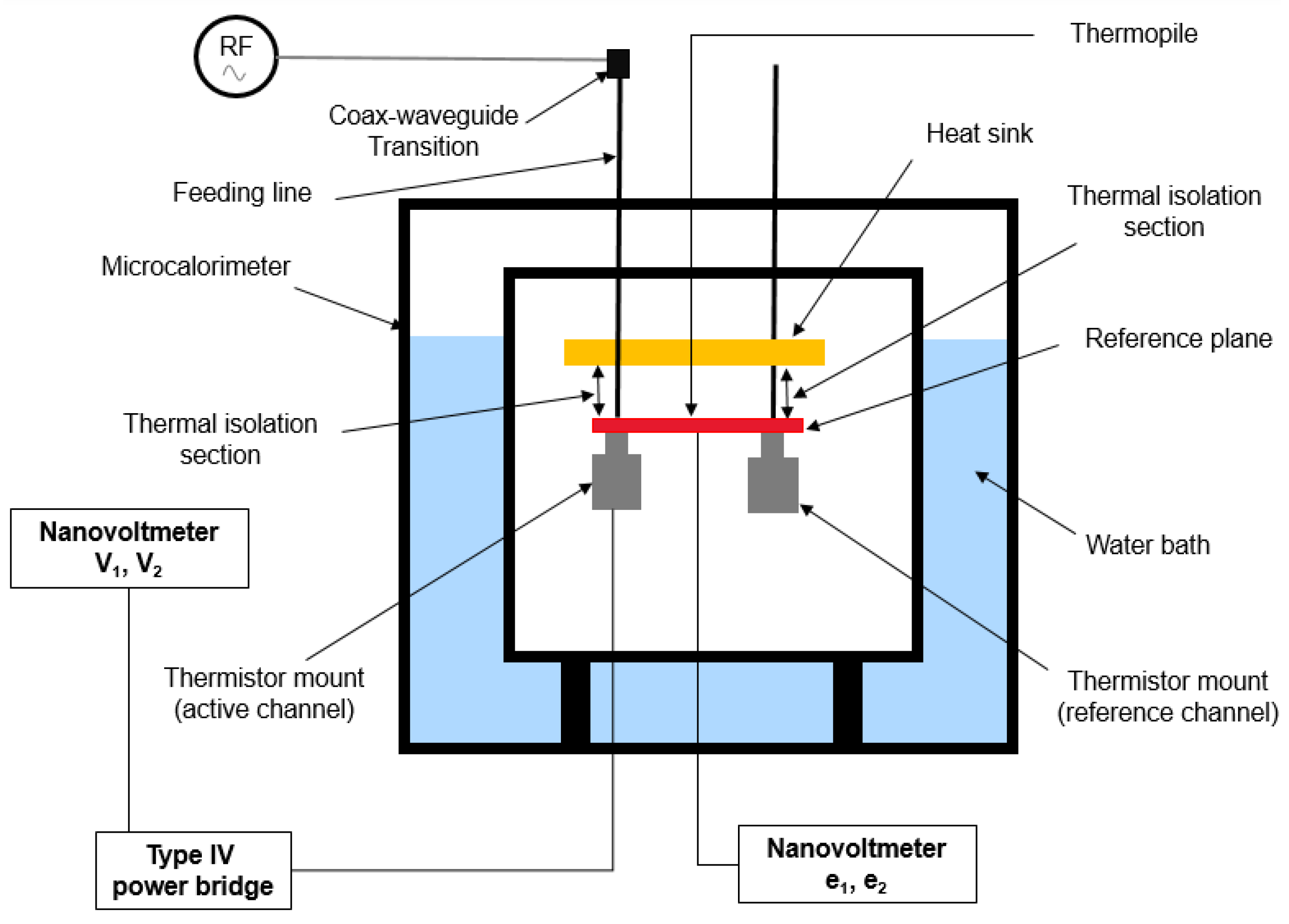
Figure 2.
Redesign modular microcalorimeter architecture.
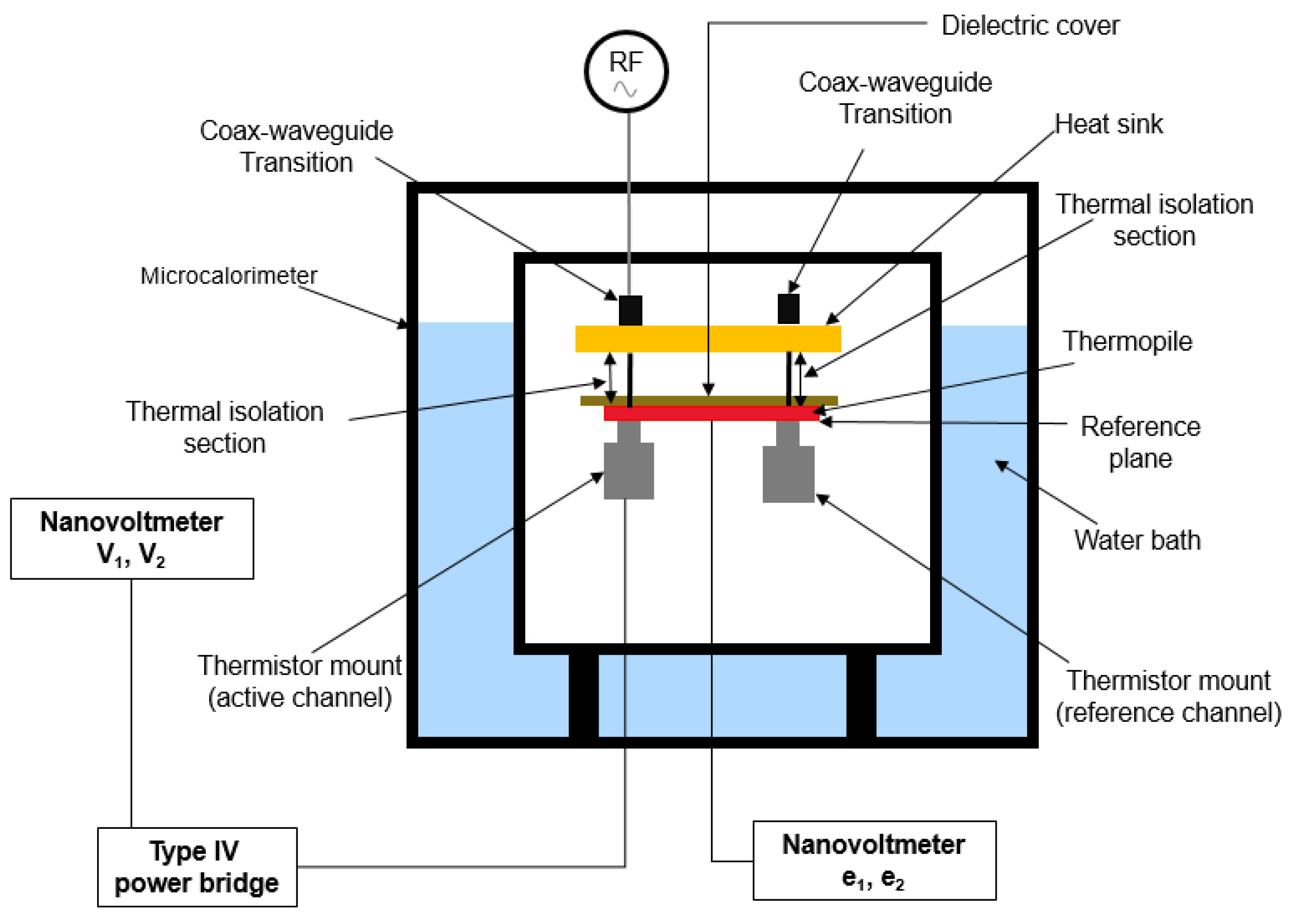
Figure 3.
Pictures of the redesigned thermopiles and assembled modular microcalorimeter head. (a) 7 mm coaxial microcalorimeter. (b) K Band microcalorimeter. (c) Assembled redesigned microcalorimeter head for K Band.
Figure 3.
Pictures of the redesigned thermopiles and assembled modular microcalorimeter head. (a) 7 mm coaxial microcalorimeter. (b) K Band microcalorimeter. (c) Assembled redesigned microcalorimeter head for K Band.
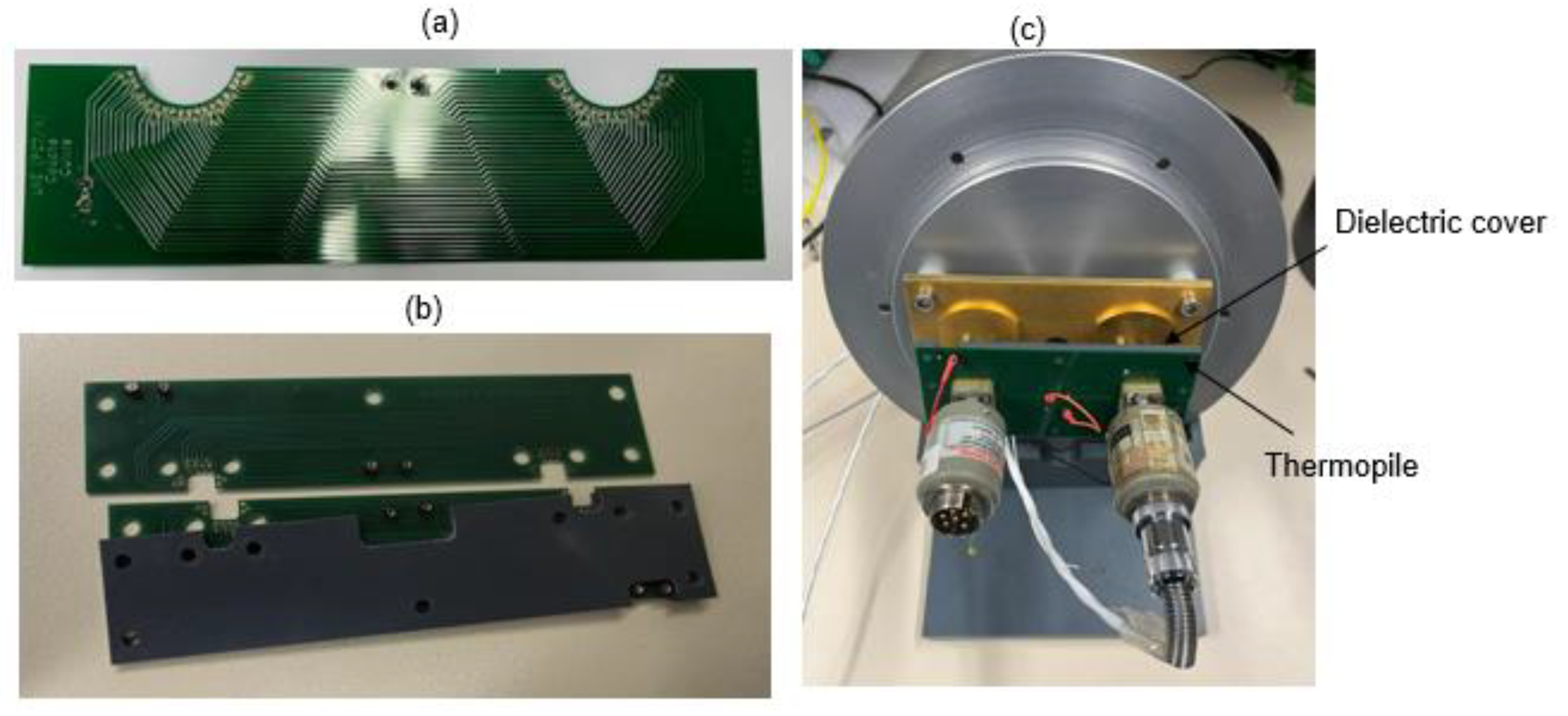
Figure 4.
Comparison of the thermopile output voltage measured during the RF substitution cycles for the legacy and the redesigned APC-7, WR42 and WR28 primary microcalorimeters.
Figure 4.
Comparison of the thermopile output voltage measured during the RF substitution cycles for the legacy and the redesigned APC-7, WR42 and WR28 primary microcalorimeters.
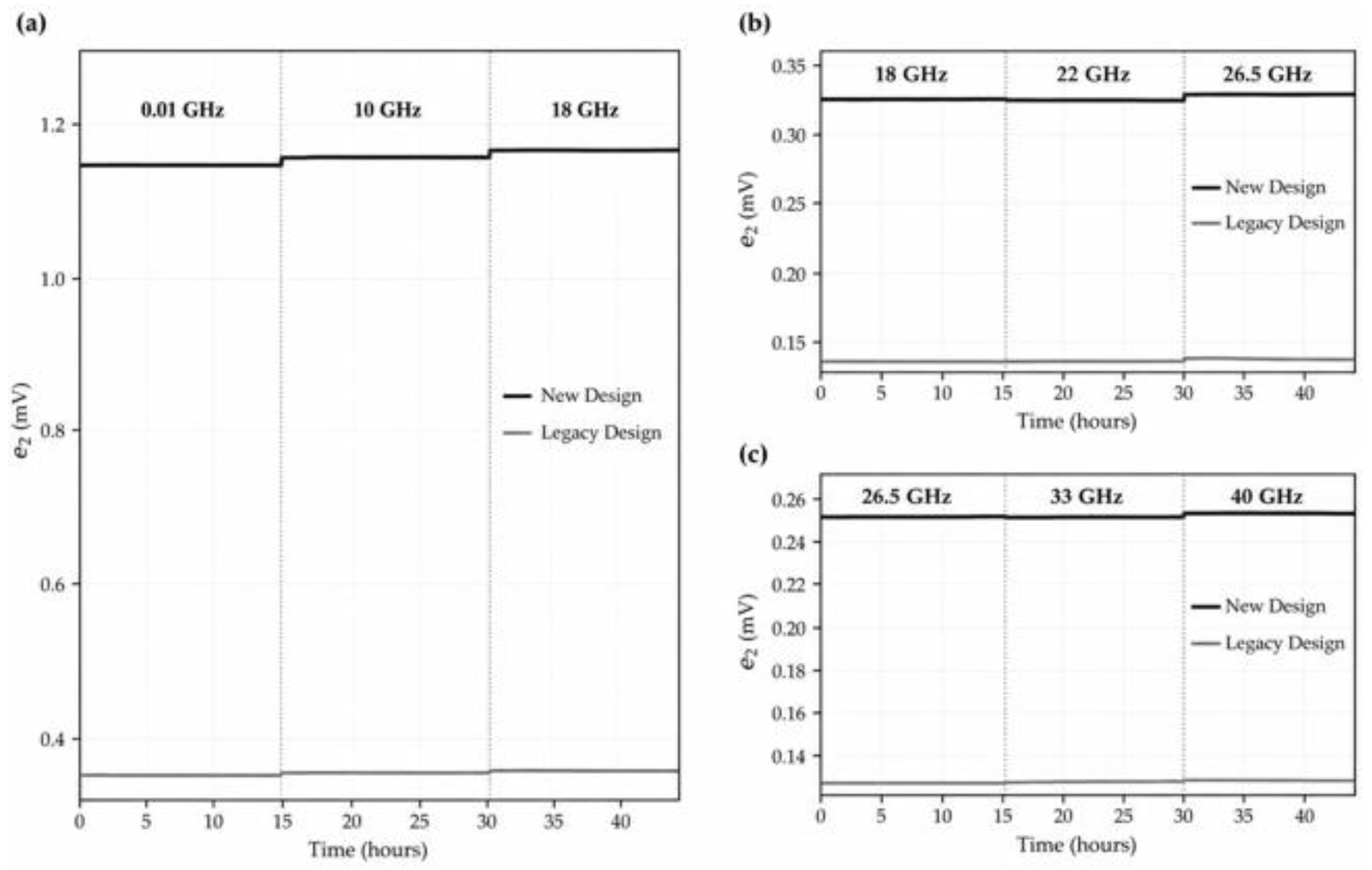
Figure 5.
Comparison of effective efficiency and expanded uncertainty for Legacy microcalorimeter and redesign microcalorimeter.
Figure 5.
Comparison of effective efficiency and expanded uncertainty for Legacy microcalorimeter and redesign microcalorimeter.
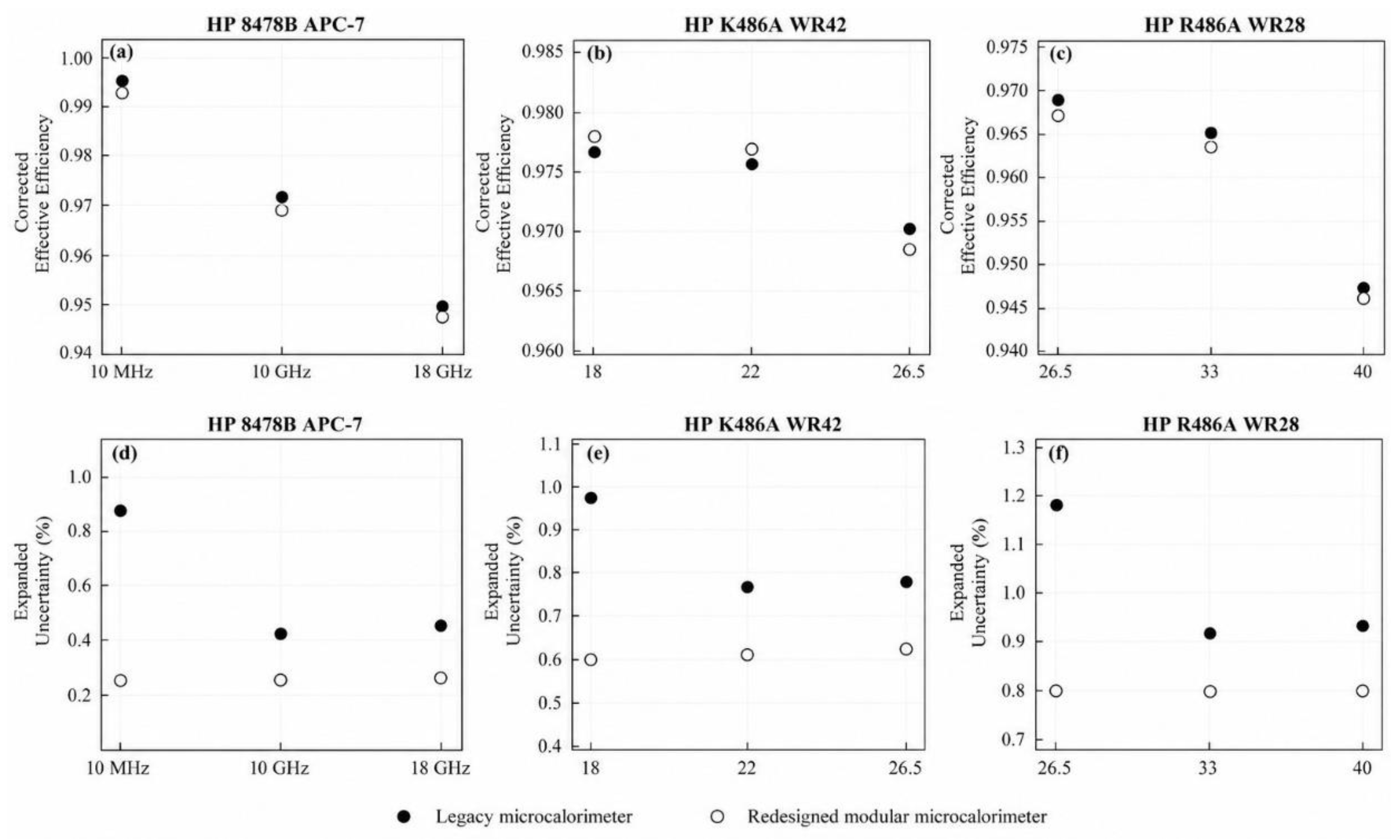

Table 1.
Statistical analysis of the thermopile output voltage measured during RF acquisition cycle.
Table 1.
Statistical analysis of the thermopile output voltage measured during RF acquisition cycle.
| Microcalorimeter | Frequency (GHz) | Architecture | Mean voltage (mV) | Standard deviation (µV) | Coefficient of variation (%) |
| APC-7 | 0.01 | Redesigned | 1.152 | 0.056 | 0.005 |
| Legacy | 0.351 | 0.339 | 0.096 | ||
| APC-7 | 10 | Redesigned | 1.159 | 0.062 | 0.005 |
| Legacy | 0.354 | 0.623 | 0.176 | ||
| APC-7 | 18 | Redesigned | 1.169 | 0.052 | 0.005 |
| Legacy | 0.356 | 0.534 | 0.150 | ||
| WR42 | 18 | Redesigned | 0.328 | 0.060 | 0.018 |
| Legacy | 0.135 | 0.231 | 0.171 | ||
| WR42 | 22 | Redesigned | 0.328 | 0.088 | 0.027 |
| Legacy | 0.135 | 0.110 | 0.081 | ||
| WR42 | 26.5 | Redesigned | 0.331 | 0.074 | 0.022 |
| Legacy | 0.135 | 0.123 | 0.091 | ||
| WR28 | 26.5 | Redesigned | 0.255 | 0.029 | 0.012 |
| Legacy | 0.125 | 0.153 | 0.123 | ||
| WR28 | 33 | Redesigned | 0.255 | 0.045 | 0.018 |
| Legacy | 0.125 | 0.111 | 0.089 | ||
| WR28 | 40 | Redesigned | 0.256 | 0.038 | 0.015 |
| Legacy | 0.126 | 0.133 | 0.105 |
Table 2.
Results of the primary calibration.
| Transfer standard | Frequency (GHz) | Architecture | Corrected effective efficiency | Expanded uncertainty (%) |
|
HP 8478B APC-7 |
0.01 | Legacy | 0.9951 | 0.88 |
| Redesigned | 0.9957 | 0.26 | ||
| 10 | Legacy | 0.9708 | 0.43 | |
| Redesigned | 0.9715 | 0.27 | ||
| 18 | Legacy | 0.9505 | 0.46 | |
| Redesigned | 0.9509 | 0.27 | ||
|
HP K486A WR42 |
18 | Legacy | 0.9769 | 0.98 |
| Redesigned | 0.9775 | 0.50 | ||
| 22 | Legacy | 0.9757 | 0.77 | |
| Redesigned | 0.9768 | 0.52 | ||
| 26.5 | Legacy | 0.9681 | 0.78 | |
| Redesigned | 0.9703 | 0.53 | ||
|
HP R486A WR28 |
26.5 | Legacy | 0.9688 | 1.18 |
| Redesigned | 0.9690 | 0.80 | ||
| 33 | Legacy | 0.9657 | 0.91 | |
| Redesigned | 0.9640 | 0.80 | ||
| 40 | Legacy | 0.9467 | 0.93 | |
| Redesigned | 0.9470 | 0.80 |
Disclaimer/Publisher’s Note: The statements, opinions and data contained in all publications are solely those of the individual author(s) and contributor(s) and not of MDPI and/or the editor(s). MDPI and/or the editor(s) disclaim responsibility for any injury to people or property resulting from any ideas, methods, instructions or products referred to in the content. |
© 2026 by the authors. Licensee MDPI, Basel, Switzerland. This article is an open access article distributed under the terms and conditions of the Creative Commons Attribution (CC BY) license (http://creativecommons.org/licenses/by/4.0/).
Copyright: This open access article is published under a Creative Commons CC BY 4.0 license, which permit the free download, distribution, and reuse, provided that the author and preprint are cited in any reuse.


