

Submitted:
13 August 2026
Posted:
14 August 2026
You are already at the latest version
Abstract
This paper examines the patentability of artificial intelligence (AI)-related inventions under the European Patent Convention (EPC), with particular attention to the framework developed by the European Patent Office (EPO) for mathematical methods and computer-implemented inventions.AI-related inventions remain subject to the ordinary patentability requirements of novelty, inventive step and industrial applicability, but the analysis requires three distinct inquiries. Under Article 52 EPC, an AI or machine-learning model claimed merely as an abstract mathematical method may be excluded, whereas a claim involving technical means may possess technical character as a whole. Under Article 56 EPC, AI-related features can support inventive step only insofar as they contribute to a technical solution to a technical problem.Under Article 83 EPC, the application must disclose the model, training process, relevant data characteristics and other implementation details to the extent necessary for the skilled person to reproduce the claimed technical effect without undue burden.EPO decisions T 0161/18 and T 1669/21 illustrate that inadequate disclosure of a neural network or computational model may result in insufficiency under Article 83 EPC and, depending on the circumstances, may also prevent reliance on the alleged technical effect for inventive step. The paper also presents an exploratory Espacenet search and a broader EP full-text patent-landscape analysis using the EPO Technology Intelligence Platform (TIP), illustrating the growth of AI-related European patenting and the effect of prosecution lag on observed grant rates.
Keywords:
Artificial Intelligence (AI)
; neural networks
; patentability requirements
; EPO jurisprudence
1. Introduction
Artificial intelligence (AI) relies on computational models and algorithms and is generally examined at the EPO within the framework applicable to mathematical methods and computer-implemented inventions. [1,19] Under Article 52(1) of the European Patent Convention (EPC), European patents may be granted for inventions in all fields of technology provided that they are new, involve an inventive step and are susceptible of industrial application.
Article 52(2) EPC lists, inter alia, mathematical methods and programs for computers among subject matter that is not regarded as an invention, while Article 52(3) limits those exclusions to such subject matter or activities 'as such'. [11]
Accordingly, an AI or machine-learning model claimed only as an abstract mathematical method may be excluded, but an AI-related claim directed to a method involving technical means or to a device may possess technical character as a whole. This threshold assessment under Article 52 EPC should be distinguished from whether the claimed features support inventive step under Article 56 EPC and whether the invention is sufficiently disclosed under Article 83 EPC. [9,12,16,18]
Figure 1 summarizes the EPO framework and the principal decisions discussed below.
2. The Role of AI
AI-related inventions can be grouped into three categories according to the role played by AI in the inventive process, as summarized in Table 1.
The principal distinction between AI-aided and AI-generated inventions lies in the degree of autonomy attributed to the algorithmic system and in the extent of human involvement in the inventive process.
Stierle's analysis of the initial EPO DABUS decisions situates the controversy within the concept of inventorship under the existing EPC framework, providing doctrinal support for treating AI-generated inventions separately from the substantive patentability requirements examined below. [27]
3. Discussion
3.1. Technical Character and Exclusions Under Article 52 EPC
For AI-related inventions, three questions should be kept distinct: (i) whether the claimed subject matter has technical character and is not excluded under Article 52 EPC; (ii) which claimed features contribute to technical character for the assessment of inventive step under Article 56 EPC; and (iii) whether the disclosure enables the skilled person to carry out the invention under Article 83 EPC.
The EPO describes the relationship between Article 52 EPC and inventive step as a 'two-hurdle approach': the first hurdle concerns whether the claimed subject matter qualifies as an invention, while the second concerns whether the features that contribute to technical character support inventive step. This framework is reflected in G 1/19 and in the EPO Guidelines and case-law overview. [12,16,18]
AI and machine-learning models are generally based on computational models and algorithms that are, in themselves, of an abstract mathematical nature. A claim directed solely to such an abstract mathematical method may therefore fall within the exclusion of Article 52(2)(a) and (3) EPC. Programs for computers are likewise excluded only to the extent that they are claimed as such under Article 52(2)(c) and [3) EPC; T 1173/97 provides the foundational 'further technical effect' formulation for computer programs. [9,15]
By contrast, where a claim is directed to a method involving the use of technical means, such as a computer, or to a device, the claimed subject matter has technical character as a whole and is not excluded from patentability under Article 52(2) and (3) EPC merely because it includes an AI algorithm. [9]
This finding establishes only that the claimed subject matter qualifies as an invention for the purposes of Article 52 EPC. It does not mean that every AI-related feature can support novelty or inventive step.
An AI or machine-learning model may contribute to the technical character of an invention when it contributes to a technical solution to a technical problem, for example through its application to a technical purpose or through adaptation to a specific technical implementation. [9]
Typical examples include the use of a neural network in a heart-monitoring apparatus to identify irregular heartbeats, AI-based control of an industrial process, or classification of technical signals based on low-level features. In such cases, the relevance of the AI feature derives from the technical purpose it serves rather than from the mere use of AI terminology. [9]
Papastefanou's analysis of machine-learning applications in smart grids similarly illustrates how AI can be embedded in a concrete technical control context and assessed within existing patent-law frameworks. [23]
Similarly, features concerning network architecture, topology or training do not become technical merely because they are specific. They may be relevant when their design is causally linked to the technical effect relied on in the claim.
Technical character may also arise from a specific implementation adapted to the hardware, for example by allocating data-intensive training steps to a GPU and other steps to a CPU so as to exploit the architecture of the computing platform. [9]
Once technical character has been established at the level of the claim as a whole, the next question is whether the features that contribute to that technical character involve an inventive step.
3.2. Inventive Step Under Article 56 EPC
For claims containing a mixture of technical and non-technical features, inventive step is assessed according to the COMVIK approach. All features that contribute to the technical character of the invention are taken into account, whereas features that make no such contribution cannot support the presence of an inventive step. The objective technical problem is therefore formulated and assessed on the basis of the features that contribute to a technical solution. [10,13,16,18]
Academic commentary on G 1/19 likewise emphasizes that the COMVIK framework remains applicable to computer-implemented simulations and, more generally, to mixed computer-implemented inventions in which non-technical features may contribute to a technical solution. [22]
In the AI context, decisions T 1191/19 [6] and T 0702/20 [7] illustrate that the mere use of a neural network or another AI model is not sufficient. The claimed AI feature, its structure, or the selected input/output data must contribute to a technical effect that is relevant to the technical problem addressed.
The technical effect relied on may be apparent from the claim and common general knowledge or may be supported by explanations, mathematical proof, experimental data or similar evidence. Mere assertions of a technical effect are not sufficient, although comprehensive proof is not invariably required. [9]
Recent analysis of the EPO problem-solution approach further emphasizes that identifying the relevant technical effect, and the objective technical problem associated with that effect, is central to the assessment of inventive step. [26]
3.3. Sufficiency of Disclosure Under Article 83 EPC
Article 83 EPC requires the application to disclose the invention in a manner sufficiently clear and complete for it to be carried out by a person skilled in the art. For AI-related inventions, the relevant question is whether the disclosed model, training process, data characteristics and other implementation details, together with common general knowledge, enable the claimed technical effect to be reproduced without undue burden over the scope of the claim. [9,11,14,18]
An important decision is T 0161/18 [2,3]. The Board found the application insufficiently disclosed because the training of the artificial neural network, which was necessary to carry out the claimed method, had not been disclosed in sufficient detail.
In that case, the lack of information concerning training also affected the assessment under Article 56 EPC: because the neural network was the distinguishing feature and its training was not disclosed in detail, the Board found that its use did not establish a specific technical effect capable of supporting inventive step. [2]
T 0509/18 [5], concerning a system and method for determining driver alertness, provides a further Article 83 EPC example: the Board dismissed the appeal on the ground of insufficient disclosure.
T 1669/21 [4], decided on 23 July 2024, further illustrates the application of Article 83 EPC to an invention based on machine learning.
The case concerned a method for determining the wear condition of a refractory lining in a metallurgical vessel by means of a computational model.
The disclosure did not provide the skilled person with sufficient guidance for implementing the model across the scope claimed. In particular, essential aspects of the model and its training remained unspecified.
The Board dismissed the appeal on the ground that the claimed invention was not sufficiently disclosed.
Among the missing information were details concerning the model architecture, the topology of the neural network, the mathematical modelling of the nodes and the learning procedure.
The input and output parameters were also defined in broad terms without identifying which concrete measurements were relevant to obtaining the predicted result.
The argument that the skilled person could fill the gaps by using existing software libraries was not sufficient. In the absence of guidance tailored to the technical problem, the required effort would have imposed an undue burden.
The characteristics of the training data were also material to the Board's assessment:
- ✓
- The patent did not specify the relevant range of operating conditions or the variations that the training data needed to cover.
- ✓
- Training on a limited dataset would have restricted the applicability of the model and would not have supported the breadth of the claims.
- ✓
- The assertion that machine learning would automatically filter out irrelevant parameters was not supported by concrete evidence.
Taken together, T 0161/18 and T 1669/21 provide useful drafting guidance, but they should not be read as establishing a fixed disclosure checklist for every AI-related invention.
The required level of detail depends on the claimed technical effect and on what the skilled person can derive from common general knowledge. Where aspects of the model architecture, training procedure, input/output variables or training-data characteristics are necessary to reproduce the claimed technical effect, those aspects should be disclosed sufficiently to avoid undue burden. [9]
Conversely, the EPO Guidelines do not generally require disclosure of the specific training dataset itself, provided that the characteristics needed to reproduce the technical effect are disclosed or can be determined by the skilled person without undue burden. [9]
The disclosure must enable the skilled person to carry out the invention over the scope of the claim, rather than only in isolated embodiments.
Accordingly, an applicant cannot rely solely on the self-learning capability of an AI system to compensate for missing technical information where that information is necessary to reproduce the claimed effect.
Ferrero Guillén and Breckwoldt Jurado combine an EPO-focused patent landscape with two case studies and report heterogeneity in the disclosure of AI-related inventions. [21]
An empirical study of medical AI patents by Aboy et al. likewise identifies substantial disclosure gaps and argues for improved examination guidance aimed at ensuring enabling disclosures. [24]
3.4. Empirical Analysis of AI Patenting at the EPO
Patent-landscape analysis has also been used by WIPO to investigate technological trends in AI patenting and provides a useful methodological benchmark for empirical work in this field. [20]
Empirical patent-landscape methods have also been applied to medical machine learning. Aboy, Price and Raker analyse global patent data with particular attention to USPTO and EPO activity, providing a useful peer-reviewed methodological comparator for the empirical approach adopted here. [25]
Two complementary searches were used to examine AI-related European patenting. The first was a rapid exploratory search on Espacenet, designed to provide a relatively restrictive snapshot of records in which AI is likely to be central to the claimed subject matter. The second was a broader patent-landscape analysis performed on the EPO Technology Intelligence Platform (TIP) using the EP full-text database. Because the two searches differ in scope, search fields, and unit of analysis, their absolute counts and percentages should not be interpreted as directly comparable estimates.

Table 2.
Methodological differences between the exploratory Espacenet search and the TIP patent-landscape analysis.
Table 2.
Methodological differences between the exploratory Espacenet search and the TIP patent-landscape analysis.
| Criterion | Exploratory Espacenet search | TIP patent-landscape analysis |
|---|---|---|
| Purpose | Rapid, relatively restrictive snapshot | Broader systematic landscape |
| Text searched | Claims | EP full text |
| Scope | AI terms combined with G06N3/02/low or G06N20/00 | Broader AI full-text landscape |
| Unit of analysis | Records retrieved after the EP filter | Unique EP applications |
| Grant indicator | EP-B1 publications in the retrieved set | EP application having an EP-B publication |
| Interpretation | Descriptive observed EP-B1 share | Application-level cumulative grant rate, interpreted by filing cohort |
3.4.1. Exploratory Espacenet Search
The following search query was used on Espacenet:
(claims="artificial intelligence" OR claims="machine learning" OR claims="deep learning" OR claims="neural network" OR claims="neural networks" OR claims="convolutional neural network" OR claims="reinforcement learning") AND (cpc=G06N3/02/low OR cpc=G06N20/00).
The query retrieved 395,300 records. Applying the EP publication-number filter (pn=EP) reduced the set to 15,575 European records, corresponding to approximately 4% of the total.
Within this restrictive search set, 7,206 EP-B1 publications were identified, corresponding to an observed EP-B1 share of 46%. This value should be interpreted as a descriptive share within the retrieved set, rather than as an estimate of the general probability that an AI-related European patent application will be granted.
Figure 2 shows the filing trend obtained from this exploratory search. Filings increased markedly from 2015 and remained high through 2024. The apparent decline in the most recent years should be interpreted cautiously because recent filings are affected by the 18-month publication delay.
3.4.2. Full-Text Patent landscape Using the EPO Technology Intelligence Platform
A second, broader search was conducted on the EPO Technology Intelligence Platform (TIP) using the EP full-text database. The purpose of this analysis was to construct a wider AI patent landscape rather than to reproduce the restrictive Espacenet query. Records were analysed at the level of unique EP applications, and grant status was determined by identifying whether an application had an EP-B publication.
The search strategy was formulated with the assistance of a GPT-based Patent Search Optimizer and implemented through a Python script developed with CODEX. This workflow was used to process the full-text search results, deduplicate records at EP application level, and calculate grant status by filing cohort.
The resulting dataset contains 57,593 unique EP AI applications, of which 16,497 had at least one EP-B publication, yielding a cumulative grant rate of 28.6% (Figure 3). For this analysis, grant rate is defined as the number of unique EP applications having an EP-B publication divided by the total number of unique EP applications in the landscape.
The cumulative grant rate is strongly affected by the large number of recent applications that remain pending. When the analysis is restricted to filing cohorts up to 2018, the observed grant rate increases to 47.4%.
The volume increased markedly from 2015, reaching a peak in 2022 with 8,980 applications. The decline observed from 2023 to 2026 warrants cautious interpretation because the most recent cohorts are incomplete.
From 2019 onward, the observed grant share declines progressively, which is consistent with the time lag inherent in examination and grant proceedings. The respective percentages for the 2019, 2020, 2021, and 2022 filing cohorts are 43.1%, 36.7%, 26.1%, and 19.5%.
Grant shares for very old cohorts, particularly those preceding 1990, show greater instability and should be interpreted with caution.
3.4.3. Interpretation and limitations
The figures obtained from the two searches should not be interpreted as conflicting estimates. The Espacenet search is a rapid, relatively restrictive claims-and-CPC search, whereas the TIP analysis uses the EP full-text database and a broader patent-landscape design, with deduplication at EP application level. The two methods therefore define different patent populations and serve different analytical purposes.
The 46% EP-B1 share observed in the Espacenet set is descriptively close to the 47.4% grant rate obtained for mature TIP cohorts (filing years up to 2018). This proximity should be regarded only as descriptive convergence, not as a formal validation of either search. Both analyses remain sensitive to search-strategy choices, classification changes, publication and examination lags, and the incompleteness of recent cohorts; very old cohorts may also be unstable because of small numbers.
4. Conclusions
Under the EPO framework, AI-related inventions are not excluded from patentability merely because they rely on mathematical models or software. The claim must first have technical character as a whole for the purposes of Article 52 EPC; for Article 56 EPC, the AI-related features relied on for inventive step must contribute to a technical solution to a technical problem; and under Article 83 EPC, the application must enable the skilled person to reproduce the claimed invention without undue burden.
Where the technical effect depends on particular characteristics of the training data, those characteristics must be disclosed unless the skilled person can determine them without undue burden using common general knowledge. In general, however, the specific training dataset itself need not be disclosed. [9]
Decisions T 1669/21 and T 0161/18 show that a generic reference to machine learning may be insufficient where the omitted information is necessary to reproduce the claimed technical effect. They do not establish a universal requirement to disclose every element of the model architecture, network topology, loss function or learning process in all AI patent applications. Rather, the application should disclose those aspects of the model, training procedure and data that are necessary for the skilled person to reproduce the claimed technical effect without undue burden.
References
- Müller, M. Issues in patenting ‘artificial intelligence’ from an EPO perspective. J. Intellect. Prop. Law. Pract. 2024, 19(3), 201–202. [Google Scholar] [CrossRef]
- European Patent Office. Technical Board of Appeal, T 0161/18 (Äquivalenter Aortendruck/ARC SEIBERSDORF), 12 May 2020, ECLI:EP:BA:2020:T016118.20200512. Available online: https://www.epo.org/en/boards-of-appeal/decisions/t180161du1 (accessed on 12 August 2026).
- Aboy, M.; Lath, A.; Minssen, T.; Liddell, K. The sufficiency of disclosure of AI inventions. J. Intellect. Prop. Law. Pract. 2024, 19(11), 834–840. [Google Scholar] [CrossRef]
- European Patent Office. Technical Board of Appeal, T 1669/21, 23 July 2024, ECLI:EP:BA:2024:T166921.20240723. Available online: https://www.epo.org/en/boards-of-appeal/decisions/t211669du1 (accessed on 12 August 2026).
- European Patent Office. Technical Board of Appeal, T 0509/18, 3 March 2020, ECLI:EP:BA:2020:T050918.20200303. Available online: https://www.epo.org/en/boards-of-appeal/decisions/t180509eu1 (accessed on 12 August 2026).
- European Patent Office. Technical Board of Appeal, T 1191/19 (Neuronal plasticity/INSTITUTGUTTMANN), 1 April 2022, ECLI:EP:BA:2022:T119119.20220401. Available online: https://www.epo.org/en/boards-of-appeal/decisions/t191191eu1 (accessed on 12 August 2026).
- European Patent Office. Technical Board of Appeal, T 0702/20 (Sparsely connected neural network/MITSUBISHI), 7 November 2022, ECLI:EP:BA:2022:T070220.20221107. Available online: https://www.epo.org/en/boards-of-appeal/decisions/t200702eu1 (accessed on 12 August 2026).
- European Patent Office. Technology Intelligence Platform (TIP). Available online: https://tip.epo.org (accessed on 10 August 2026).
- European Patent Office. Guidelines for Examination in the European Patent Office, April 2026 edition, G-II, 3.3.1, Artificial intelligence and machine learning. Available online: https://www.epo.org/en/legal/guidelines-epc/2026/g_ii_3_3_1.html (accessed on 12 August 2026).
- European Patent Office. Technical Board of Appeal, T 0641/00 (Two identities/COMVIK), 26 September 2002, OJ EPO 2003, 352, ECLI:EP:BA:2002:T064100.20020926. Available online: https://www.epo.org/en/boards-of-appeal/decisions/t000641ex1 (accessed on 12 August 2026).
- European Patent Office. European Patent Convention, Articles 52, 56 and 83, text as currently in force. Available online: https://www.epo.org/en/legal/epc (accessed on 12 August 2026).
- European Patent Office. Guidelines for Examination in the European Patent Office, April 2026 edition, G-II, 2, Examination practice. Available online: https://www.epo.org/en/legal/guidelines-epc/2026/g_ii_2.html (accessed on 12 August 2026).
- European Patent Office. Guidelines for Examination in the European Patent Office, April 2026 edition, G-VII, 5.4, Claims comprising technical and non-technical features. Available online: https://www.epo.org/en/legal/guidelines-epc/2026/g_vii_5_4.html (accessed on 12 August 2026).
- European Patent Office. Guidelines for Examination in the European Patent Office, April 2026 edition, F-III, 1, Sufficiency of disclosure. Available online: https://www.epo.org/en/legal/guidelines-epc/2026/f_iii_1.html (accessed on 12 August 2026).
- European Patent Office. Technical Board of Appeal, T 1173/97 (Computer program product/IBM), 1 July 1998, OJ EPO 1999, 609, ECLI:EP:BA:1998:T117397.19980701. Available online: https://www.epo.org/en/boards-of-appeal/decisions/t971173ex1 (accessed on 12 August 2026).
- European Patent Office. Enlarged Board of Appeal, G 1/19 (Pedestrian simulation), 10 March 2021, OJ EPO 2021, A77, ECLI:EP:BA:2021:G000119.20210310. Available online: https://www.epo.org/en/boards-of-appeal/decisions/g190001ex1 (accessed on 12 August 2026).
- European Patent Office. Legal Board of Appeal, J 8/20 (Designation of inventor/DABUS), 21 December 2021, ECLI:EP:BA:2021:J000820.20211221. Available online: https://www.epo.org/en/boards-of-appeal/decisions/j200008eu1 (accessed on 12 August 2026).
- European Patent Office; Legal Research Service of the Boards of Appeal. Case Law of the Boards of Appeal of the European Patent Office, 11th ed.; July 2025; Available online: https://www.epo.org/en/legal/case-law (accessed on 12 August 2026)ISBN 978-3-89605-395-4.
- Foss-Solbrekk, K. Three routes to protecting AI systems and their algorithms under IP law: The good, the bad and the ugly. J. Intellect. Prop. Law. Pract. 2021, 16(3), 247–258. [Google Scholar] [CrossRef]
- World Intellectual Property Organization (WIPO). WIPO Technology Trends 2019 – Artificial Intelligence; WIPO: Geneva, 2019. [Google Scholar] [CrossRef]
- Ferrero Guillén, R.; Breckwoldt Jurado, A. Vagueness in Artificial Intelligence: The ‘Fuzzy Logic’ of AI-Related Patent Claims. Digital Society 2023, 2, Article 3. [Google Scholar] [CrossRef]
- Minssen, T.; Aboy, M. The Patentability of Computer-Implemented Simulations and Implications for Computer-Implemented Inventions (CIIs). J. Intellect. Prop. Law. Pract. 2021, 16(7), 633–635. [Google Scholar] [CrossRef]
- Papastefanou, S. Smart Grids and Machine Learning in Chinese and Western Intellectual Property Law: The Key Role of Machine Learning in Integrating Sustainable Energy into Smart Grids and the Corresponding Approaches to Asset Protection in Intellectual Property Law. IIC-Int. Rev. Intellect. Prop. Compet. Law. 2021, 52, 989–1019. [Google Scholar] [CrossRef]
- Aboy, M.; Price, W. N., II; Raker, S.; Liddell, K. The Sufficiency of Disclosure of Medical Artificial Intelligence (AI) Patents. Nat. Biotechnol. 2024, 42, 839–845. [Google Scholar] [CrossRef] [PubMed]
- Aboy, M.; Price, W. N., II; Raker, S. Mapping the Patent Landscape of Medical Machine Learning. Nat. Biotechnol. 2023, 41, 461–468. [Google Scholar] [CrossRef] [PubMed]
- Müller, M. The problem-solution approach revisited (II): more on technical problems and effects. J. Intellect. Prop. Law. Pract. 2026, 21(4), 234–240. [Google Scholar] [CrossRef]
- Stierle, M. Artificial Intelligence Designated as Inventor - An Analysis of the Recent EPO Case Law. GRUR Int. 2020, 69(9), 918–924. [Google Scholar] [CrossRef]
Figure 1.
AI patenting framework and rulings (created with Gemini Notebook).
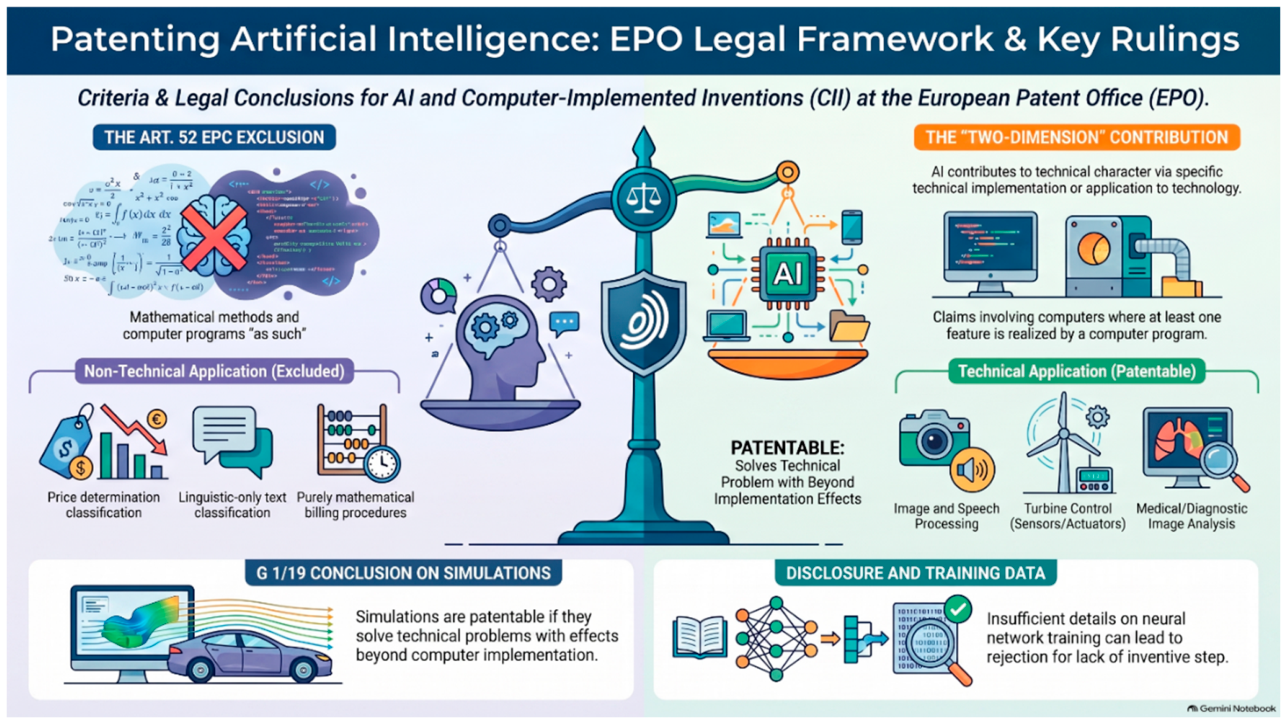
Figure 2.
Filing trend of AI implemented inventions (Espacenet search).
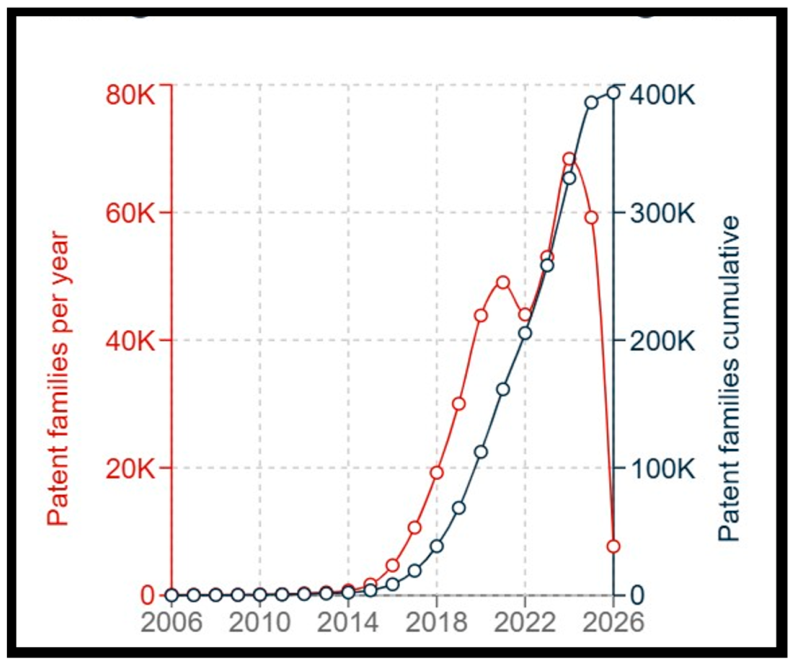
Figure 3.
Grant share of AI patents per filing year.
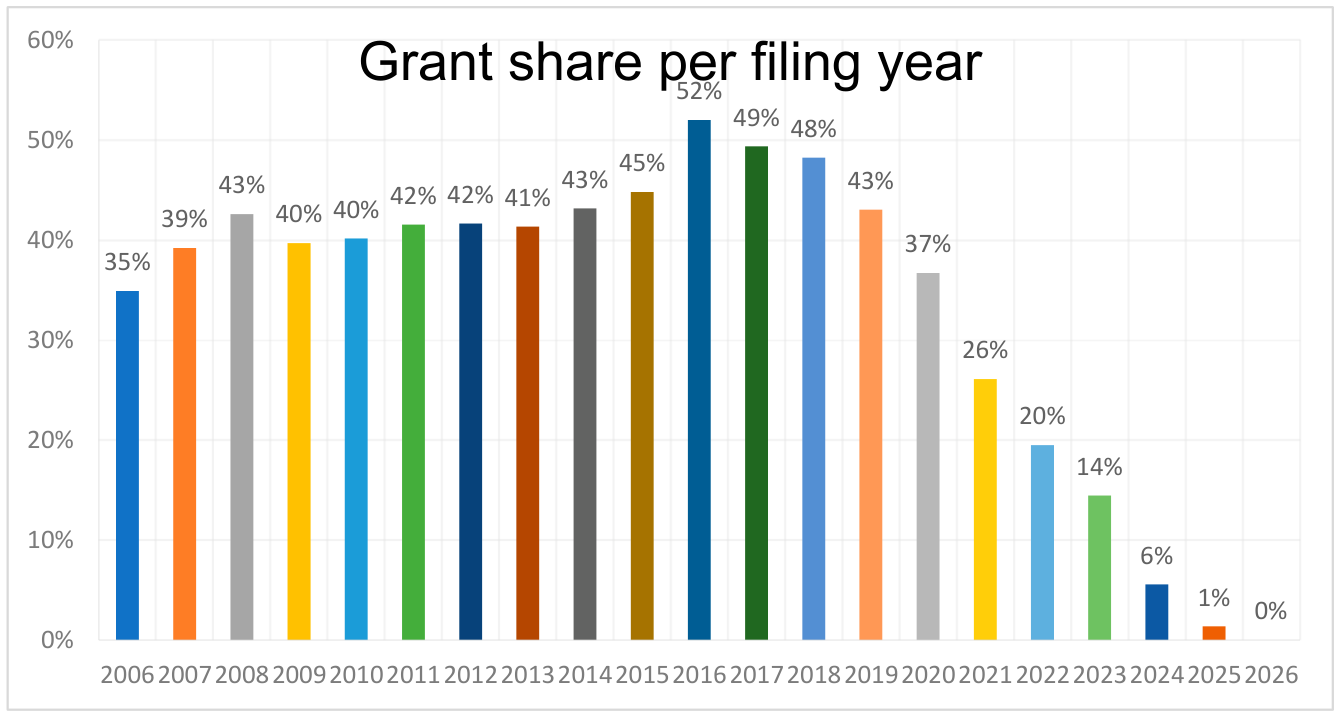
Table 1.
Classification of AI-related inventions according to the role of AI.
| AI-aided inventions | In this scenario, artificial intelligence is employed as a mere instrument in the hands of researchers, with the objective of enhancing or assisting human labor. Humans maintain control over the process, leveraging AI for specialized tasks such as complex calculations, statistical analysis, or large-scale data analysis. The invention is therefore the result of human activity that makes use of advanced technological support. |
| AI-generated inventions | These inventions are (theoretically) generated entirely autonomously by an algorithmic system. In this particular instance, AI does not merely function as an aid; rather, it serves as the primary creative force behind the invention. This is significant because it occurs in situations where no individual would traditionally qualify as an inventor under conventional criteria. A prominent illustration of this phenomenon is the DABUS system, which was engineered to autonomously generate novel concepts, independent of direct human intervention for each individual solution. In J 8/20, the EPO Legal Board of Appeal held that a machine is not an inventor within the meaning of the EPC. [17] |
| AI-co-produced inventions | The generation of inventive activity is predicated on close collaboration, wherein human intervention, on a case-by-case basis, collects and modifies the AI's outputs to transform them into new inputs in successive cycles. In this particular instance, the invention maintains a discernible human characteristic that renders it eligible for patenting. |
Disclaimer/Publisher’s Note: The statements, opinions and data contained in all publications are solely those of the individual author(s) and contributor(s) and not of MDPI and/or the editor(s). MDPI and/or the editor(s) disclaim responsibility for any injury to people or property resulting from any ideas, methods, instructions or products referred to in the content. |
© 2026 by the authors. Licensee MDPI, Basel, Switzerland. This article is an open access article distributed under the terms and conditions of the Creative Commons Attribution (CC BY) license (http://creativecommons.org/licenses/by/4.0/).
Copyright: This open access article is published under a Creative Commons CC BY 4.0 license, which permit the free download, distribution, and reuse, provided that the author and preprint are cited in any reuse.