

Submitted:
10 August 2026
Posted:
10 August 2026
You are already at the latest version
Abstract
Background/Objectives: Perioperative chemoimmunotherapy has become an important curative-intent strategy for selected patients with resectable non-small cell lung cancer (NSCLC). However, most pivotal trials evaluate neoadjuvant therapy, surgery, and postoperative immune checkpoint inhibitor (ICI) treatment as an integrated regimen. Whether continued postoperative immunotherapy provides independent incremental benefit for all patients after effective neoadjuvant chemoimmunotherapy and complete resection remains unresolved. This review focuses on the adjuvant-phase dilemma and discusses how postoperative treatment may be refined according to response and residual risk. Methods: We performed a narrative review of major neoadjuvant and perioperative chemoimmunotherapy trials, indirect comparative analyses, pathological-response studies, circulating tumor DNA (ctDNA)-based molecular residual disease (MRD) evidence, immune biomarker studies, and emerging data in driver-positive and real-world populations. Particular attention was given to evidence informing postoperative continuation, de-escalation, or intensification after neoadjuvant chemoimmunotherapy. Results: Current phase III perioperative trials demonstrate clinically meaningful activity but do not isolate the independent contribution of the adjuvant ICI phase. Pathological response provides the most accessible postoperative risk signal: pathologic complete response identifies the deepest-response group, major pathologic response represents an intermediate state, and non-major pathologic response or persistent nodal disease suggests higher relapse risk. ctDNA-based MRD offers dynamic risk refinement and may help identify patients with residual systemic disease, although prospective validation is required before it can guide routine treatment omission or escalation. Programmed death-ligand 1 (PD-L1), tumor mutational burden, tertiary lymphoid structures, B-cell signatures, radiomics, and pathomics may provide complementary information but are not sufficient as standalone decision tools. Driver-positive disease requires molecularly stratified perioperative strategies rather than unselected extrapolation from epidermal growth factor receptor (EGFR)/anaplastic lymphoma kinase (ALK)-negative trials. Conclusions: The key question in resectable NSCLC is shifting from whether perioperative immunotherapy is active to which patients truly require postoperative immunotherapy. Future trials should prospectively test response-guided strategies integrating pathological response, ctDNA-based MRD, immune contexture, baseline risk, and treatment feasibility.
Keywords:
non-small-cell lung cancer
; neoadjuvant therapy
; perioperative therapy
; immune checkpoint inhibitors
; biomarkers
1. Introduction
Lung cancer remains the leading cause of cancer-related mortality worldwide, accounting for over 1.8 million deaths annually. Non-small cell lung cancer (NSCLC) accounts for 80-85% of cases, encompassing subtypes such as adenocarcinoma, squamous cell carcinoma, and large cell carcinoma [1]. The treatment of NSCLC is primarily guided by clinical staging. While early-stage disease is often amenable to surgical resection, locally advanced NSCLC, which accounts for 30% of newly diagnosed cases, poses significant challenges. Tumor burden and mediastinal lymph node involvement impede complete (R0) resection, while the high recurrence rate following R0 resection underscores an urgent need for effective systemic therapies [2].
In response to these challenges, immunotherapy has emerged as a transformative strategy in oncology. Immune checkpoint inhibitors (ICIs) targeting programmed cell death protein 1 (PD-1)/PD-L1 and cytotoxic T-lymphocyte-associated protein 4 (CTLA-4) have significantly improved outcomes in advanced NSCLC and are now being explored in earlier stages [3]. However, although multiple trials have established the efficacy of perioperative ICI-based regimens in resectable NSCLC, they primarily evaluate perioperative treatment as an integrated strategy. Consequently, whether continued postoperative immunotherapy provides independent incremental benefit after effective neoadjuvant chemoimmunotherapy and complete resection remains unresolved. Against this background, this review focuses on the adjuvant-phase dilemma after neoadjuvant chemoimmunotherapy in resectable NSCLC and discusses how pathological response, MRD status, treatment burden, and emerging biomarkers may inform future response-guided postoperative strategies.
2. Overview of Neoadjuvant and Perioperative Treatment Regimens: Evidence and Remaining Gaps
2.1. Neoadjuvant and Perioperative Chemoimmunotherapy Regimens
Extensive clinical investigations have evaluated immune checkpoint inhibitors in the curative-intent management of resectable NSCLC. These studies can be broadly divided into neoadjuvant chemoimmunotherapy, in which ICIs are administered before surgery [4],and perioperative chemoimmunotherapy, in which postoperative ICI treatment is continued after neoadjuvant chemoimmunotherapy and resection [5].
Neoadjuvant immunotherapy aims to enhance immune activation within the tumor microenvironment before surgery, potentially reducing micrometastatic spread and promoting systemic antitumor memory [4]. CheckMate 816 established nivolumab plus platinum-doublet chemotherapy as a landmark neoadjuvant regimen, improving pathological response and event-free survival (EFS) compared with chemotherapy alone. Other neoadjuvant studies, including TD-FOREKNOW and NEOSTAR, further supported the feasibility and activity of preoperative ICI-based strategies.
Perioperative chemoimmunotherapy extends this concept by adding a postoperative adjuvant ICI phase after surgery [6]. Trials such as KEYNOTE-671, AEGEAN, CheckMate 77T, Neotorch, NADIM II, and RATIONALE-315 have evaluated this integrated approach, aiming to combine preoperative immune priming with sustained postoperative systemic control. Several of these regimens have demonstrated significant improvements in pathological response and EFS, and some have now reported more mature overall survival (OS) follow-up. However, the absence of direct comparative data within a unified clinical framework continues to fuel debates between neoadjuvant and perioperative regimens, necessitating a head-to-head comparison in the future [7].
2.2. Patient Selection, Efficacy, and Safety Considerations
Patient selection differed across major trials, which limits direct comparison between neoadjuvant-only and perioperative strategies. Most studies focused on high-risk resectable NSCLC, typically stage II–III disease, tumors ≥4 cm, or node-positive disease, while patients with known EGFR mutations or ALK rearrangements were generally excluded. Subgroup analyses from individual trials suggested that perioperative regimens may provide clinically meaningful benefit in higher-risk populations, including patients with PD-L1-negative disease, stage III disease, squamous histology, or nodal involvement [4,8,9]. However, these findings remain exploratory and should not be used to infer that all patients with such features require postoperative immunotherapy.
Overall efficacy was encouraging across both treatment paradigms, but the available data should be interpreted as an evidence landscape rather than a direct comparison. In the updated trial table, neoadjuvant-only regimens reported pathologic complete response (pCR) rates of approximately 16.2–32.6% and major pathologic response (MPR) rates of 32.1–65.1%, whereas perioperative regimens reported pCR rates of 17.2–41.0% and MPR rates of 30.2–62.0% (Table 1) [10]. Among representative phase III trials, KEYNOTE-671 reported a median EFS of 47.2 months, with updated 5-year EFS and OS rates of 49.9% and 64.6%, respectively; CheckMate 816 reported a median EFS of 43.8 months, with updated 5-year EFS and OS rates of 49.2% and 65.4%, respectively [4,9,11,12]. Other neoadjuvant and perioperative studies further support the activity of ICI-based strategies, but their outcomes are best summarized as ranges because of differences in trial design, follow-up maturity, and postoperative treatment exposure.
Safety considerations should be interpreted in the context of treatment duration. Grade ≥3 treatment-related adverse event (TRAE) and immune-related adverse event (irAE) rates varied substantially across studies, reflecting differences in chemotherapy backbone, ICI agent, reporting methods, and treatment exposure. In general, neoadjuvant-only studies reported high-grade TRAE rates of approximately 10.0–45.0%, whereas perioperative studies with available data reported rates of approximately 32.0–78.4% (Table 1) [13]. Preliminary health-related quality of life (HRQoL) data from KEYNOTE-671 suggested generally preserved postoperative quality of life, although only selected domains showed statistically significant improvement and these findings remain insufficient to guide treatment selection [14,15]. Taken together, current efficacy and safety data support the feasibility of both neoadjuvant and perioperative chemoimmunotherapy, but they do not resolve whether postoperative immunotherapy should be continued universally after surgery (Table 1).
This distinction is central to the present review: the success of a perioperative regimen does not automatically prove that the adjuvant phase contributes equally to all patients. The following section therefore focuses on the evidence gap between whole-regimen efficacy and adjuvant-phase benefit.
2.3. The Evidence Gap: Does the Adjuvant Phase Add Incremental Benefit?
In KEYNOTE-671, AEGEAN, CheckMate 77T, Neotorch, and RATIONALE-315, patients were assigned to an integrated strategy consisting of neoadjuvant chemoimmunotherapy, surgery, and continued adjuvant ICI treatment. Therefore, improvements in EFS or OS reflect the benefit of the entire perioperative regimen, rather than the isolated effect of postoperative immunotherapy. Since patients were not re-randomized after surgery to adjuvant ICI under the same neoadjuvant backbone, these trials cannot determine whether all patients truly derive incremental benefit from continued immunotherapy after complete resection.
Recent indirect evidence has reinforced this uncertainty rather than resolved it. In a network meta-analysis comparing seven perioperative ICI strategies, the researchers found no clear gain in EFS (hazard ratio [HR] = 0.97, 95% confidence interval [Cl]: 0.67 to 1.41; P = 0.87) or OS (HR = 1.17, 95% CI: 0.59 to 2.31, P =0.65) over neoadjuvant chemoimmunotherapy [16]. A second network meta-analysis reported a similar result for EFS (HR = 0.78, 95% Cl: 0.37 to 1.62; P=0.51). However, they found that in subgroups of patients with PD-L1-negative disease or Eastern Cooperative Oncology Group performance status (ECOG PS) ≥ 1, perioperative treatment was associated with significantly improved EFS compared with neoadjuvant treatment, albeit at the expense of increased grade ≥3 toxicity [17]. But again, this evidence failed to isolate the specific contribution of the postoperative adjuvant component — a limitation shared by other meta-analyses as well [18,19]. Collectively, these studies suggest that regimen-level efficacy should not be equated with universal adjuvant-phase benefit.
This evidence gap shifts the clinical question from whether perioperative immunotherapy is active to which patients truly require the postoperative component. Pathological-response analyses provide a more clinically relevant way to frame this uncertainty. Since pathological response is routinely available after surgery and is consistently associated with long-term outcomes, it currently provides the most practical first clue for postoperative risk stratification. The next section therefore examines pCR, MPR, and non-MPR as potential decision nodes for de-escalation, continuation, or intensification after neoadjuvant chemoimmunotherapy.
3. Pathological Response as an Emerging Clue to Postoperative Treatment Selection
Pathological response is currently the most accessible postoperative signal after neoadjuvant chemoimmunotherapy. Unlike baseline biomarkers, it reflects the integrated effects of tumor biology, chemotherapy sensitivity, immune activation, and host response after treatment. In the adjuvant-phase dilemma, its value is not to provide an immediate rule for omitting postoperative therapy, but to stratify residual relapse risk after surgery and guide future de-escalation or escalation trials.
3.1. pCR and MPR as Favorable Prognostic Markers
pCR and MPRare consistently associated with favorable long-term outcomes after neoadjuvant chemoimmunotherapy in resectable NSCLC, as demonstrated across landmark trials including CheckMate 816, KEYNOTE-671, AEGEAN, NADIM II, Neotorch, and RATIONALE-315 [4,8,15,20,21]. In KEYNOTE-671, a post-hoc analysis based on percent residual viable tumor (%RVT) further confirmed that lower %RVT correlates with improved EFS, reinforcing pathological response as a clinically meaningful postoperative readout [22].
Meta-analytic evidence substantiates this association [23]. A reconstructed individual-patient-data meta-analysis reported strong EFS associations for both pCR versus non-pCR (HR = 0.13) and MPR versus non-MPR (HR = 0.18), with corresponding 24-month EFS rates of approximately 94% versus 54%, and 88% versus 48%, respectively [24]. A retrospecitve cohort evaluating postoperative adjuvant ICI therapy after neoadjuvant immunotherapy further supported that the postoperative therapy could significantly improve EFS in resectable NSCLC patients, especially in those without pCR or MPR (p = 0.004). However, its effect on OS remains uncertain [25].
Despite both being favorable, pCR and MPR should not be treated as interchangeable. pCR represents the deepest measurable response with minimal relapse risk, whereas MPR encompasses a more heterogeneous group with residual viable tumor. This distinction has therapeutic implications: a recent meta-analysis comparing neoadjuvant and perioperative ICI-based regimens found that among patients achieving MPR, perioperative treatment was associated with improved EFS (P = 0.038), whereas no such benefit was observed in pCR achievers (P = 0.408) [26]. This suggests that MPR, unlike pCR, may identify a subgroup in which continued postoperative immunotherapy still confers incremental benefit. Accordingly, MPR should be viewed as an intermediate-risk category rather than a simple equivalent of pCR, and postoperative decisions in this group may require further refinement using factors such as residual viable tumor percentage, nodal status, baseline stage, ctDNA/MRD, and treatment tolerance.
3.2. Non-MPR and Incomplete Responders as Candidates for Postoperative Intensification
Non-MPR patients represent the opposite end of the postoperative risk spectrum. Residual viable tumor greater than 10%, persistent nodal disease, or postoperative molecular residual disease may indicate incomplete eradication of resistant tumor clones or insufficient immune-mediated tumor clearance. Reconstructed individual patient data meta-analysis has confirmed a prognostic gradient from pCR (good) through MPR 1%–10% (intermediate) to non-MPR (poor) [27].
Real-world evidence further supported that patients without pCR or MPR derived significant EFS benefit from additional adjuvant ICI therapy, whereas those achieving pCR or MPR do not [25,28]. A multicenter retrospective cohort study further proposed a "treatment pattern–pathological response" binary framework to guide adjuvant decisions, identifying non-MPR patients after neoadjuvant chemotherapy as clear candidates for postoperative intensification [29]. Given that non-pCR patients account for approximately 70–80% of the post-neoadjuvant population [30], this subgroup represents the most compelling target for postoperative intensification.
Biologically, this group is the most plausible population for postoperative continuation or intensification. However, evidence remains insufficient to define the optimal strategy. Multiple approaches—including continued ICI alone, additional chemotherapy, radiotherapy, dual checkpoint blockade, antibody-drug conjugates, vaccines, or MRD-guided escalation—are being explored, but to date, no completed randomized trial has prospectively validated any response-based postoperative regimen in this population. The NeoTAP01 4-year follow-up further highlights this unmet need, showing that 75% of recurrences in non-pCR patients occurred within one year post-surgery despite adjuvant treatment [31]. Therefore, non-MPR should be framed as a high-priority population for prospective intensification trials rather than as a group with an already established postoperative standard.
3.3. Ongoing Trials and Response-Based Postoperative Strategies
The limitations of current evidence highlight the need for component-specific trials that directly determine whether postoperative ICI provides additional benefit after neoadjuvant chemoimmunotherapy and surgery. ADOPT-lung is the first randomized phase III trial specifically designed to address this question in resectable NSCLC. Following neoadjuvant platinum-doublet chemotherapy plus durvalumab and surgery, eligible patients are 1:1 randomized to adjuvant durvalumab or observation, with disease-free survival (DFS) in the non-pCR population as the primary endpoint . Melanoma provides a related, although not identical, precedent for response-adapted postoperative treatment. In NADINA, neoadjuvant ipilimumab plus nivolumab followed by surgery and response-driven adjuvant therapy improved event-free survival compared with surgery followed by adjuvant nivolumab; within the neoadjuvant group, postoperative systemic therapy was reserved for patients with a pathological partial response or non-response [32]. The PRADO trial similarly demonstrated the feasibility of omitting both therapeutic lymph-node dissection and adjuvant therapy in patients achieving MPR after neoadjuvant ipilimumab plus nivolumab, while directing more intensive treatment toward poorer responders [33]. As no completed randomized NSCLC trial has yet reported the isolated contribution of postoperative ICI continuation after neoadjuvant chemoimmunotherapy, the results of ADOPT-lung are highly anticipated.
Overall, pathological response should be viewed as a potential postoperative decision signal rather than a stand-alone treatment rule. A more defensible framework is a graded model: pCR as the lowest pathological-risk state and strongest de-escalation candidate, MPR as an intermediate state requiring additional stratification, and non-MPR as a high-risk state suitable for prospective intensification studies. However, pathological response primarily reflects residual tumor burden in the resection specimen and may not fully capture systemic molecular residual disease. Therefore, ctDNA-based MRD assessment and immune-contexture markers should be incorporated as complementary layers of risk refinement, as discussed below.
4. From Pathological Response to Integrated Postoperative Strategies
Pathological response alone cannot fully capture the impact of baseline disease aggressiveness, residual systemic disease, or the feasibility of continued treatment. Therefore, a more clinically meaningful response-guided strategy shall extend beyond the pCR/MPR/non-MPR classification and integrate complementary clinical, immunological, and molecular information.
4.1. Biomarkers for Baseline Risk Refinement
Baseline stage, nodal burden, tumor extent, ECOG performance status, and molecular characteristics establish the pretreatment probability of recurrence and provide essential context for interpreting postoperative response. In a network meta-analysis, perioperative treatment was associated with significantly improved EFS compared with neoadjuvant treatment among patients with ECOG PS ≥1, albeit at the expense of increased grade ≥3 toxicity [17]. Among tumor-associated biomarkers, PD-L1 expression has shown predictive or prognostic associations in several perioperative trials, including AEGEAN and KEYNOTE-671, although inconsistent findings in Neotorch and NADIM II limited its universal application [4,8,34,35,36,37]. Similarly, tumor mutational burden (TMB) has been linked to pathological response in some neoadjuvant studies, but its ability to identify patients who specifically require or can safely omit postoperative immunotherapy remains uncertain [38,39,40,41]. Thus, while clinical risk factors, PD-L1, and TMB may inform the baseline probability of recurrence or treatment benefit, none is sufficiently reliable to override pathological response or independently dictate adjuvant therapy.
Immune-contexture biomarkers, such as tertiary lymphoid structures (TLS), B-cell signatures, and B-cell receptor (BCR) repertoire characteristics, may provide a biologically distinct and second layer of risk refinement. A meta-analysis of 17 studies including 4,291 lung cancer patients demonstrated that high TLS density was associated with improved OS (HR = 0.66, 95% CI: 0.50–0.88), with especially pronounced effects in Asian subgroups, suggesting its potential as a predictive marker for immunotherapy response and as contextual evidence for risk stratification [42]. Emerging evidence also suggests that BCR repertoire characteristics are associated with pathological response and may offer information complementary to PD-L1 and TMB [43]. Meanwhile, radiomic and pathomic approaches may further capture intratumoral heterogeneity and treatment-induced remodeling, although their predictive value for postoperative treatment selection requires prospective validation [44,45].
Taken together, these clinical, molecular, and immune-contexture features provide complementary modifiers of pathological response rather than independent treatment-selection biomarkers. Most of them remain relatively static or indirectly associated with relapse risk. A more direct postoperative strategy therefore requires a dynamic, longitudinal biomarker capable of detecting whether residual systemic disease persists after neoadjuvant treatment and surgery.
4.2. ctDNA-Based MRD for Dynamic Postoperative Risk Assessment
Whereas clinical characteristics and tissue biomarkers primarily define baseline or contextual risk, ctDNA-based molecular residual disease provides a dynamic assessment of how that risk evolves during treatment [46]. ctDNA can be measured longitudinally before treatment, after neoadjuvant therapy, following surgery, and during postoperative surveillance, thereby offering a real-time readout of molecular response and residual systemic disease [47]. This temporal dimension distinguishes MRD from baseline PD-L1 expression or TMB and makes it particularly relevant for patients with similar pathological responses but potentially different risks of recurrence.
For the adjuvant-phase dilemma, accumulating evidence suggests that postoperative ctDNA may identify patients most likely to benefit from continued therapy. In the LUNGCA-1 prospective cohort, ctDNA-detected MRD positivity at postoperative day 3 and/or 1 month strongly predicted relapse and outperformed conventional clinicopathological variables including TNM stage. Notably, adjuvant therapy was associated with improved recurrence-free survival (RFS) in MRD-positive patients, whereas no such association was observed in MRD-negative patients after adjustment [48]. A separate study evaluating MRD-guided adjuvant decisions reached a similar conclusion: landmark MRD positivity at one month after R0 resection was associated with markedly shorter DFS, while MRD-negative patients derived limited apparent benefit from adjuvant strategies [49]. Complementary studies showed that sustained MRD negativity defined a very-low-risk population, whereas residual ctDNA predicted relapse months before imaging, supporting ctDNA-positive patients as candidates for intensified surveillance, or postoperative intervention [50,51].
Despite these findings, MRD should not yet be used as a standalone criterion to omit or mandate adjuvant immunotherapy. Technical and clinical barriers also remain, including assay sensitivity, nonshedding tumors, sampling schedules, standardization and cost [47]. Future strategies may incorporate genomic features, epigenetics, dynamic monitoring (e.g., MRD), and advanced single-point assays (e.g., whole-genome sequencing [WGS] and PhasedSeq) to improve detection accuracy [52,53]. Therefore, MRD is better viewed as a risk-refinement tool to be integrated with pathological response, TNM stage, and clinical risk—guiding future trial design and patient stratification rather than dictating current clinical decisions.
4.3. An Integrated Response-Guided Clinical Framework
Taken together, pathological response, clinical and immune biomarkers, and postoperative MRD define different but interrelated dimensions of biological risk. However, translating these signals into a clinically useful postoperative strategy requires an additional consideration: whether further treatment is feasible, tolerable, and proportionate to the patient’s remaining risk. Therefore, a clinically useful postoperative framework should consider two interdependent dimensions: biological risk and treatment feasibility.
Biologically, the framework rests on three hierarchical domains: baseline clinical risk (stage, nodal status, ECOG PS, and PD-L1 expression), postoperative pathological response (pCR, MPR, or non-MPR), and dynamic molecular status (postoperative ctDNA/MRD). Baseline risk defines the pre-treatment propensity for relapse; pathological response captures the tumor's actual sensitivity to neoadjuvant therapy; and MRD provides a real-time readout of residual systemic disease. These domains should be integrated sequentially rather than averaged. Under this approach: pCR with negative postoperative MRD identifies the lowest-risk state—these patients are the most suitable candidates for de-escalation or observation trials; MPR occupies an intermediate position: prognostically favorable compared with non-MPR, but residual viable tumor, nodal status, and MRD may further separate distinct relapse risks; Non-MPR, persistent post-neoadjuvant pathological nodal (ypN) disease, positive MRD, or high baseline stage III burden should argue against premature de-escalation; these patients should be prioritized for postoperative continuation, intensification, or escalation trials if clinically fit.
Clinically, postoperative treatment tolerance acts as the modifying layer. A recent network meta-analysis showed that perioperative chemoimmunotherapy was associated with higher grade ≥3 TRAEs than neoadjuvant approaches, and adjuvant ICI is frequently interrupted because of adverse events or delayed recovery [54]. Trial-level data further indicate that the postoperative phase is not always delivered as planned, as approximately 12-13% patients suffering from discontinuation due to adverse events [9,20]. Thus, the adjuvant phase is not a “free” therapeutic extension. For patients with deep pathological response, substantial toxicity, or slow postoperative recovery, the risk–benefit balance differs from that of patients with residual viable tumor or high baseline burden [25,27]. Postoperative decisions must therefore weigh cumulative toxicity, treatment discontinuation rates, monitoring burden, and patient preference alongside biological risk.
This framework is designed for multidisciplinary discussion and trial development rather than as a direct replacement for approved regimens (Figure 1). Its primary value is to enable prospective validation of whether observation or shortened adjuvant therapy can be safely offered to patients with concordantly favorable biological and feasibility profiles, while reserving intensified strategies for those with residual risk.
5. Future Directions and Remaining Challenges
5.1. Optimizing Postoperative Treatment Duration and Intensity
The optimal duration of perioperative immunotherapy remains undefined. In the neoadjuvant phase, current practice commonly uses 3 to 4 cycles, but the ideal number of cycles has not been prospectively established across different stages and regimens [55,56]. NeoSCORE directly addressed this issue by comparing 2 versus 3 cycles of neoadjuvant sintilimab plus platinum-based chemotherapy in resectable IB–IIIA NSCLC, showing a higher MPR rate with the 3-cycle regimen than with 2 cycles (41.4% vs. 26.9%) [57]. However, whether additional cycles translate into better long-term survival or mainly increase toxicity remains uncertain. The postoperative phase is even less biologically defined: most phase III perioperative regimens adopted approximately 1 year of adjuvant ICI, largely reflecting trial design rather than validated duration. Emerging evidence suggesting similar outcomes between shorter and longer postoperative immunotherapy schedules challenges this convention, but remains insufficient to change practice [58].
Future studies should therefore move from fixed-duration adjuvant therapy toward response-adapted treatment intensity. Patients with pCR, negative postoperative ctDNA-based MRD, favorable recovery, or substantial toxicity may be appropriate candidates for shortened adjuvant therapy or observation within prospective de-escalation trials. In contrast, patients with non-MPR, persistent nodal disease, positive MRD, bulky baseline stage III disease, or poor molecular clearance may require standard-duration treatment, postoperative continuation, or escalation strategies. Component-specific studies such as ADOPT-lung are expected to clarify whether postoperative ICI is necessary after effective neoadjuvant chemoimmunotherapy and surgery [59]. MRD-guided studies and trial designs may further refine this question by assigning postoperative treatment according to molecular relapse risk rather than fixed regimen duration [49,60]. Until such data mature, de-escalation should remain investigational, particularly outside deeply responding and MRD-negative populations.
5.2. Optimizing Chemoimmunotherapy and Exploring Novel Combinations
Despite the rapid expansion of perioperative chemoimmunotherapy trials, the optimal ICI–chemotherapy regimen remains undefined. Multiple regimens are now available, but they differ in efficacy signals, safety profiles, treatment duration, and postoperative feasibility. An immediate challenge is to optimize existing chemoimmunotherapy combinations and identify which benefits patients the most. A recent network meta-analysis comparing multiple ICI-plus-chemotherapy strategies suggested that toripalimab plus chemotherapy and nivolumab plus chemotherapy may represent potentially favorable perioperative options: nivolumab offered the most significant OS improvement, whereas toripalimab performed best in both EFS and pCR, albeit at the cost of a relatively higher safety risk [18]. This supports a more nuanced direction for future trials: refining the choice, sequence, and duration of currently available ICI–chemotherapy regimens before uniformly moving toward more intensive or chemotherapy-free approaches.
Chemotherapy remains a cornerstone of current neoadjuvant and perioperative regimens, but it is also a major driver of toxicity. Chemotherapy-free or chemotherapy-minimized strategies therefore remain attractive, particularly for patients at high risk of chemotherapy-related toxicity, yet they should not be assumed to be superior to chemoimmunotherapy. Dual-checkpoint blockade, such as nivolumab plus ipilimumab, has shown activity in resectable NSCLC and may reduce chemotherapy exposure in selected patients; however, the available data are mainly phase II or exploratory, and comparisons have generally been made against chemotherapy rather than established chemoimmunotherapy regimens [61]. Similarly, PD-1/ lymphocyte-activation gene 3 (LAG-3) blockade has demonstrated feasibility and preliminary activity before surgery, but its role as a chemotherapy-sparing strategy remains investigational [62]. Thus, chemo-free treatment should be viewed as a biologically rational research direction, not as an intrinsically better approach.
Beyond currently available ICI–chemotherapy platforms, novel combinations are rapidly entering the perioperative space. Strategies involving ICI plus antiangiogenic or multitargeted agents, bispecific antibodies, antibody-drug conjugates, and immune-metabolic modulators are being tested in biomarker-defined populations [63,64,65]. However, these approaches should not distract from the central unresolved question: whether treatment intensification is needed after surgery, and in whom. Future studies should avoid adding agents uniformly and should instead prioritize appropriate treatment among patients with residual pathological or molecular risk.
5.3. Driver-Positive Disease
Patients with actionable driver alterations represent a distinct perioperative pathway. NSCLCs driven by EGFR, ALK, human epidermal growth factor receptor 2 (HER2), and other oncogene-driven NSCLCs generally derive less consistent benefit from immune checkpoint blockade, while targeted therapies have become increasingly important in early-stage disease. ADAURA established adjuvant osimertinib as an effective postoperative strategy for resected EGFR-mutant NSCLC, while ALINA demonstrated the efficacy of adjuvant alectinib over chemotherapy in ALK-positive resected NSCLC [66,67]. These data highlight that driver-positive tumors should not be managed by simply extrapolating from EGFR/ALK-negative perioperative ICI trials. At the same time, driver-positive disease should not be considered categorically immunotherapy-ineligible. Limited perioperative studies, including NEOTIDE/CTONG2104 and pooled analyses of resectable oncogene-mutant NSCLC, suggest that selected patients may achieve pathological responses, although efficacy remains heterogeneous and insufficient to support routine unselected use [68,69].
Combination or sequencing strategies involving targeted therapy and immunotherapy remain attractive but require caution because of uncertain efficacy and potential toxicity. Preliminary perioperative studies, such as anlotinib plus sintilimab in stage II–III NSCLC, have suggested higher pCR rates than immunochemotherapy in early analyses, but these findings remain immature and require prospective validation [70]. For driver-positive resectable NSCLC, the priority is not to copy the wild-type NSCLC paradigm, but to develop molecularly matched, MRD-informed, and biologically stratified perioperative strategies.
5.4. Generalizability and Real-World Implementation
The generalizability of current perioperative evidence remains limited. Most pivotal trials enrolled selected patients with good performance status, adequate organ function, and access to multidisciplinary care. Follow-up remains relatively short for several regimens, limiting assessment of late recurrence, chronic immune toxicity, and post-recurrence treatment effects [71]. Additional limitations include selection bias, underrepresentation of elderly or frail patients, racial and geographic imbalance, heterogeneity in chemotherapy backbones, and exclusion or limited representation of patients with actionable driver alterations [56,72].
Real-world implementation also depends on practical factors that are not fully captured in clinical trials: surgical recovery, adjuvant treatment initiation, completion rates, financial burden, MRD assay availability, and access to experienced thoracic oncology teams. Future studies should therefore incorporate real-world cohorts, patient-reported outcomes, standardized MRD testing, and pragmatic endpoints such as treatment completion, time to surgery, postoperative recovery, and quality of life. Ultimately, the goal is not simply to expand perioperative immunotherapy, but to deliver the right postoperative treatment intensity to the right patient at the right time (Figure 2).
6. Conclusions
Perioperative chemoimmunotherapy has reshaped the curative-intent treatment landscape for resectable NSCLC, but its success has also created a new clinical dilemma. Current trials establish the efficacy of integrated perioperative regimens, yet they do not determine whether continued postoperative immunotherapy is necessary for every patient after neoadjuvant chemoimmunotherapy. The available evidence suggests that postoperative risk is unlikely to be uniform. Patients achieving pCR, particularly when accompanied by negative postoperative MRD and favorable recovery, may represent candidates for future de-escalation studies.
The next step is to move from regimen-defined treatment to response-guided postoperative allocation. Pathological response should serve as the first decision signal, but it should be refined by ctDNA/MRD, immune contexture, baseline recurrence risk, treatment tolerance, and patient preference. Future studies should clarify optimal adjuvant duration, identify de-escalation and escalation populations, test novel combinations in residual-risk groups, develop molecularly stratified strategies for driver-positive disease, and validate implementation in real-world settings. Ultimately, the goal is not simply to expand perioperative immunotherapy, but to deliver the appropriate postoperative treatment intensity to the appropriate population.
Author Contributions
Conceptualization, H.L. and J.F.; methodology, J.F.; validation, Y.H. and R.J.; formal analysis, J.F and Y.H.; investigation, J.F and Y.H.; writing—original draft preparation, J.F and Y.H.; writing—review and editing, R.J.; visualization, J.F.; supervision, H.L.; project administration, H.L.; funding acquisition, H.L. and R.J. All authors have read and agreed to the published version of the manuscript.
Funding
This research was funded by the National Natural Science Foundation of China, grant numbers 82072557 and 82372855; the National Key Research and Development Program of China, grant number 2021YFC2500900; the Interdisciplinary Program of Shanghai Jiao Tong University, grant number YG2023ZD04; the Novel Interdisciplinary Research Project of Shanghai Municipal Health Commission, grant number 2022JC023; the Natural Science Foundation of Shanghai Municipality, grant number 22ZR1439200; and the Shanghai Leading Talent Program of the Shanghai Municipal Commission of Commerce.
Conflicts of Interest
The authors declare that they have no known competing financial interests or personal relationships that could have appeared to influence the work reported in this paper. We confirm that all figures and tables are original. No third-party material is reproduced.
Acknowledgments
We sincerely thank all the participants. We acknowledge the financial support from National Natural Science Foundation of China, Interdisciplinary Program of Shanghai Jiao Tong University, Novel Interdisciplinary Research Project from Shanghai Municipal Health Commission, Natural Science Foundation of Shanghai Municipal, and Shanghai Leading Talent Program from Shanghai Municipal Commission of Commerce. Some icons or graphic elements in Fig. 1 and Fig, 2 are adapted from BioRender.com, retrieved from https://www.biorender.com/. Final schematic illustrations were created and integrated by our original design.
Abbreviations
The following abbreviations are used in this manuscript:
| ALK | anaplastic lymphoma kinase |
| APC | article processing charge |
| BCR | B-cell receptor |
| CI | confidence interval |
| CTLA-4 | cytotoxic T-lymphocyte-associated protein 4 |
| ctDNA | circulating tumor DNA |
| DFS | disease-free survival |
| ECOG PS | Eastern Cooperative Oncology Group performance status |
| EFS | event-free survival |
| EGFR | epidermal growth factor receptor |
| HER2 | human epidermal growth factor receptor 2 |
| HR | hazard ratio |
| HRQoL | health-related quality of life |
| ICI | immune checkpoint inhibitor |
| irAE | immune-related adverse event |
| LAG-3 | lymphocyte-activation gene 3 |
| MPR | major pathologic response |
| MRD | molecular residual disease |
| NSCLC | non-small cell lung cancer |
| OS | overall survival |
| pCR | pathologic complete response |
| PD-1 | programmed cell death protein 1 |
| PD-L1 | programmed death-ligand 1 |
| R0 | complete resection with no residual tumor |
| RFS | recurrence-free survival |
| %RVT | percent residual viable tumor |
| TLS | tertiary lymphoid structures |
| TMB | tumor mutational burden |
| TRAE | treatment-related adverse event |
| WGS | whole-genome sequencing |
| ypN | post-neoadjuvant pathological nodal category |
References
- Reck, M.; Rabe, K.F. Precision Diagnosis and Treatment for Advanced Non–Small-Cell Lung Cancer. In N Engl J Med.; Longo, D.L., Ed.; 31 Aug 2017; Volume 377, 9, pp. 849–61. [Google Scholar] [CrossRef] [PubMed]
- Kim, F.; Borgeaud, M.; Addeo, A.; Friedlaender, A. Management of stage III non-small-cell lung cancer: rays of hope. Explor. Target. Anti-Tumor Ther. 2024, 5(1), 85–95. [Google Scholar] [CrossRef] [PubMed]
- Singh, N.; Temin, S.; Baker, S.; Blanchard, E.; Brahmer, J.R.; Celano, P.; et al. Therapy for Stage IV Non–Small-Cell Lung Cancer Without Driver Alterations: ASCO Living Guideline. JCO 2022, 40(28), 3323–43. [Google Scholar] [CrossRef] [PubMed]
- Forde, P.M.; Spicer, J.; Lu, S.; Provencio, M.; Mitsudomi, T.; Awad, M.M.; et al. Neoadjuvant Nivolumab plus Chemotherapy in Resectable Lung Cancer. N Engl. J. Med. 2022, 386(21), 1973–85. [Google Scholar] [CrossRef] [PubMed]
- Spicer, J.D.; Gao, S.; Liberman, M.; Kato, T.; Tsuboi, M.; Lee, S.H.; et al. LBA56 Overall survival in the KEYNOTE-671 study of perioperative pembrolizumab for early-stage non-small-cell lung cancer (NSCLC). Ann. Oncol. 2023, 34, S1297–8. [Google Scholar] [CrossRef]
- Zhang, R.; Zou, C.; Zeng, L.; Zhang, Y. Perioperative immunotherapy in nonsmall cell lung cancer. Curr. Opin. Oncol. 2025, 37(1), 40–7. [Google Scholar] [CrossRef] [PubMed]
- Ettinger, D.S.; Wood, D.E.; Aisner, D.L.; Akerley, W.; Bauman, J.R.; Bharat, A.; et al. NCCN Guidelines® Insights: Non–Small Cell Lung Cancer, Version 2.2023: Featured Updates to the NCCN Guidelines. J. Natl. Compr. Cancer Netw. 2023, 21(4), 340–50. [Google Scholar] [CrossRef] [PubMed]
- Lu, S.; Zhang, W.; Wu, L.; Wang, W.; Zhang, P.; Neotorch Investigators; et al. Perioperative Toripalimab Plus Chemotherapy for Patients With Resectable Non–Small Cell Lung Cancer: The Neotorch Randomized Clinical Trial. JAMA 2024, 331(3), 201. [Google Scholar] [CrossRef] [PubMed]
- Wakelee, H.A.; Liberman, M.; Kato, T.; Tsuboi, M.; Lee, S.H.; He, J.; et al. KEYNOTE-671: Randomized, double-blind, phase 3 study of pembrolizumab or placebo plus platinum-based chemotherapy followed by resection and pembrolizumab or placebo for early stage NSCLC. JCO 2023, 41((17_) suppl, LBA100–LBA100. [Google Scholar] [CrossRef]
- Bogatsa, E.; Lazaridis, G.; Stivanaki, C.; Timotheadou, E. Neoadjuvant and Adjuvant Immunotherapy in Resectable NSCLC. Cancers 2024, 16(9), 1619. [Google Scholar] [CrossRef] [PubMed]
- Wakelee, H.; Spicer, J.; Gao, S.; Liberman, M.; Tsuboi, M.; Kato, T.; et al. LBA67 Perioperative pembrolizumab in early-stage non-small- cell lung cancer (NSCLC): 5-year follow-up from KEYNOTE- 671. Ann. Oncol. 2025, 36, S1607–8. [Google Scholar] [CrossRef]
- Forde, P.M.; Spicer, J.D.; Provencio, M.; Mitsudomi, T.; Awad, M.M.; Wang, C.; et al. Overall Survival with Neoadjuvant Nivolumab plus Chemotherapy in Lung Cancer. N Engl. J. Med.;PubMed 2025, 393(8), 741–52. [Google Scholar] [CrossRef] [PubMed]
- Tao, Y.; Li, X.; Liu, B.; Wang, J.; Lv, C.; Li, S.; et al. Association of early immune-related adverse events with treatment efficacy of neoadjuvant Toripalimab in resectable advanced non-small cell lung cancer. In Front Oncol.; PubMed Central, 2023; Volume 13. [Google Scholar] [CrossRef] [PubMed] [PubMed Central]
- Garassino, M.C.; Wakelee, H.A.; Spicer, J.; Liberman, M.; Kato, T.; Tsuboi, M.; et al. Health-related quality of life (HRQoL) outcomes from the randomized, double-blind phase 3 KEYNOTE-671 study of perioperative pembrolizumab for early-stage non-small-cell lung cancer (NSCLC). JCO 2024, 42((16_) suppl, 8012–8012. [Google Scholar] [CrossRef]
- Spicer, J.D.; Garassino, M.C.; Wakelee, H.; Liberman, M.; Kato, T.; Tsuboi, M.; et al. Neoadjuvant pembrolizumab plus chemotherapy followed by adjuvant pembrolizumab compared with neoadjuvant chemotherapy alone in patients with early-stage non-small-cell lung cancer (KEYNOTE-671): a randomised, double-blind, placebo-controlled, phase 3 trial. The Lancet 2024, 404(10459), 1240–52. [Google Scholar] [CrossRef] [PubMed]
- Aburaki, R.; Fujiwara, Y.; Haketa, S.; Horita, N. Immune checkpoint inhibitors as neoadjuvant therapy for resectable non-small cell lung cancer: a systematic review and network meta-analysis. JNCI J. Natl. Cancer Inst. 2025, 117(11), 2191–201. [Google Scholar] [CrossRef] [PubMed]
- Wang, Y.; Zhang, L.; Zhao, X.; Sun, D.; Zhou, H.; Zhang, Y.; et al. Efficacy and safety of perioperative, adjuvant and neoadjuvant chemoimmunotherapy stratified by clinical stage and PD-L1 expression in resectable non-small cell lung cancer: a systematic review and network meta-analysis. Transl. Lung Cancer Res. 2025, 14(9), 3378–95. [Google Scholar] [CrossRef] [PubMed]
- Chen, K.; Wang, X.; Yue, R.; Chen, W.; Zhu, D.; Cui, S.; et al. Efficacy and safety of immune checkpoint inhibitors as neoadjuvant therapy in perioperative patients with non-small cell lung cancer: a network meta-analysis and systematic review based on randomized controlled trials. Front Immunol. 2024, 15, 1432813. [Google Scholar] [CrossRef] [PubMed]
- Zhou, Y.; Li, A.; Yu, H.; Wang, Y.; Zhang, X.; Qiu, H.; et al. Neoadjuvant-Adjuvant vs Neoadjuvant-Only PD-1 and PD-L1 Inhibitors for Patients With Resectable NSCLC: An Indirect Meta-Analysis. JAMA Netw. Open 2024, 7(3), e241285. [Google Scholar] [CrossRef] [PubMed]
- Heymach, J.V.; Harpole, D.; Mitsudomi, T.; Taube, J.M.; Galffy, G.; Hochmair, M.; et al. Perioperative Durvalumab for Resectable Non–Small-Cell Lung Cancer. N Engl. J. Med. 2023, 389(18), 1672–84. [Google Scholar] [CrossRef] [PubMed]
- Provencio, M.; Nadal, E.; González-Larriba, J.L.; Martínez-Martí, A.; Bernabé, R.; Bosch-Barrera, J.; et al. Perioperative Nivolumab and Chemotherapy in Stage III Non–Small-Cell Lung Cancer. N Engl. J. Med. 2023, 389(6), 504–13. [Google Scholar] [CrossRef] [PubMed]
- Jones, D.R.; Wakelee, H.; Spicer, J.D.; Liberman, M.; Kato, T.; Tsuboi, M.; et al. OA01.03 Association of Pathologic Regression with EFS in the KEYNOTE-671 Study of Perioperative Pembrolizumab for Early-Stage NSCLC. J. Thorac. Oncol. 2024, 19(10), S8. [Google Scholar] [CrossRef]
- Wei, C.; Sun, H.; Hu, J.; Ma, Z.; Cao, B. Association of pathological response with long-term survival outcomes after neoadjuvant immunotherapy: A meta-analysis. Int. Immunopharmacol.;PubMed 2024, 133, 112078. [Google Scholar] [CrossRef] [PubMed]
- Marinelli, D.; Nuccio, A.; Di Federico, A.; Ambrosi, F.; Bertoglio, P.; Faccioli, E.; et al. Improved Event-Free Survival After Complete or Major Pathologic Response in Patients With Resectable NSCLC Treated With Neoadjuvant Chemoimmunotherapy Regardless of Adjuvant Treatment: A Systematic Review and Individual Patient Data Meta-Analysis. J. Thorac. Oncol. 2025, 20(3), 285–95. [Google Scholar] [CrossRef] [PubMed]
- Li, M.; Yin, H.; Jin, Y.; Keshava, H.B.; Luo, R.; Feng, M.; et al. A Real-World Study of Resectable NSCLC Following Neoadjuvant Immunotherapy: Should Postoperative Adjuvant Immunotherapy be Recommended? Thorac. Cancer 2025, 16(23), e70195. [Google Scholar] [CrossRef] [PubMed]
- Tao, Y.; Li, X.; Cui, X.; Zhao, D.; Liu, B.; Wang, Y.; et al. Survival outcome comparison of neoadjuvant and perioperative ICI-based therapies in patients with non-small cell lung cancer achieving MPR or pCR: a systematic review and meta-analysis. Eur. J. Surg. Oncol. 2025, 51(9), 110148. [Google Scholar] [CrossRef] [PubMed]
- Nuccio, A.; Salomone, F.; Servetto, A.; Ricciuti, B.; Marinelli, D.; Bulotta, A.; et al. Neoadjuvant vs perioperative chemo-immunotherapy according to pathological response in resectable non-small cell lung cancer: a reconstructed individual patient data meta-analysis. J. Natl. Cancer Inst.;PubMed 2025, 117(11), 2388–93. [Google Scholar] [CrossRef] [PubMed]
- Zhao, J.; Huang, B.; Li, M.; Wang, X.; Zhu, J.; Wang, K.; et al. Efficacy of adjuvant therapy regimens administered during the perioperative period in resectable non-small cell lung cancer. Cancer Immunol. Immunother. 2025, 74(9), 296. [Google Scholar] [CrossRef] [PubMed]
- Chen, C.; Chen, J.; Huang, J.; He, L.P.; Shen, Y.M.; Tu, J.H.; et al. Optimizing adjuvant therapy under the guidance of MPR: A multicenter retrospective analysis of neoadjuvant therapy in non-small cell lung cancer. Eur. J. Surg. Oncol. 2026, 52(2), 111339. [Google Scholar] [CrossRef] [PubMed]
- Xu, J.; Zuo, R.; Sun, H.; Zhao, G.; Zhang, L.; Sun, B.; et al. Evaluation of the efficacy and safety of anlotinib in postoperative non-pCR non-small cell lung cancer. JCO 2025, 43, 16_suppl. [Google Scholar] [CrossRef]
- Zhou, Y.; Zhao, Z.; Zhai, W.; Feng, S.; Sun, W.; Lin, Y.; et al. Four-year outcomes with perioperative toripalimab plus chemotherapy in resectable stage III non-small cell lung cancer (NeoTAP01 study). J. Thorac. Dis. 2025, 17(5), 2947–57. [Google Scholar] [CrossRef] [PubMed]
- Blank, C.U.; Lucas, M.W.; Scolyer, R.A.; Van De Wiel, B.A.; Menzies, A.M.; Lopez-Yurda, M.; et al. Neoadjuvant Nivolumab and Ipilimumab in Resectable Stage III Melanoma. N Engl. J. Med. 2024, 391(18), 1696–708. [Google Scholar] [CrossRef] [PubMed]
- Reijers, I.L.M.; Menzies, A.M.; Van Akkooi, A.C.J.; Versluis, J.M.; Van Den Heuvel, N.M.J.; Saw, R.P.M.; et al. Personalized response-directed surgery and adjuvant therapy after neoadjuvant ipilimumab and nivolumab in high-risk stage III melanoma: the PRADO trial. Nat. Med. 2022, 28(6), 1178–88. [Google Scholar] [CrossRef] [PubMed]
- Spicer, J.; Forde, P.M.; Provencio, M.; Lu, S.; Wang, C.; Mitsudomi, T.; et al. Clinical outcomes with neoadjuvant nivolumab (N) + chemotherapy (C) vs C by definitive surgery in patients (pts) with resectable NSCLC: 3-y results from the phase 3 CheckMate 816 trial. JCO 2023, 41((16_) suppl, 8521–8521. [Google Scholar] [CrossRef]
- Yue, D.; Wang, W.; Liu, H.; Chen, Q.; Chen, C.; Liu, L.; et al. VP1-2024: RATIONALE-315: Event-free survival (EFS) and overall survival (OS) of neoadjuvant tislelizumab (TIS) plus chemotherapy (CT) with adjuvant TIS in resectable non-small cell lung cancer (NSCLC). Ann. Oncol. 2024, 35(3), 332–3. [Google Scholar] [CrossRef]
- Atezolizumab Extends DFS after NSCLC Relapse. Cancer Discov. 2021, 11(11), OF3–OF3. [CrossRef] [PubMed]
- Mountzios, G.; Remon, J.; Hendriks, L.E.L.; García-Campelo, R.; Rolfo, C.; Van Schil, P.; et al. Immune-checkpoint inhibition for resectable non-small-cell lung cancer — opportunities and challenges. Nat. Rev. Clin. Oncol. 2023, 20(10), 664–77. [Google Scholar] [CrossRef] [PubMed]
- Yang, X.; Bian, D.; Yang, J.; Duan, L.; Wang, H.; Zhao, D.; et al. Perioperative immunotherapy for resectable non-small-cell lung cancer. CCB 2024, 3(1), 4. [Google Scholar] [CrossRef]
- Cui, S.; Wang, N.; Liang, Y.; Meng, Y.; Shu, X.; Kong, F. Advances in clinical trials on perioperative immune checkpoint inhibitors for resectable non-small cell lung cancer: A comprehensive review. Int. Immunopharmacol. 2024, 141, 112903. [Google Scholar] [CrossRef] [PubMed]
- Fukuda, S.; Suda, K.; Hamada, A.; Tsutani, Y. Recent Advances in Perioperative Immunotherapies in Lung Cancer. Biomolecules 2023, 13(9), 1377. [Google Scholar] [CrossRef] [PubMed]
- Forde, P.M.; Chaft, J.E.; Smith, K.N.; Anagnostou, V.; Cottrell, T.R.; Hellmann, M.D.; et al. Neoadjuvant PD-1 Blockade in Resectable Lung Cancer. N Engl. J. Med. 2018, 378(21), 1976–86. [Google Scholar] [CrossRef] [PubMed]
- Liu, X.; Lv, W.; Huang, D.; Cui, H. The predictive role of tertiary lymphoid structures in the prognosis and response to immunotherapy of lung cancer patients: a systematic review and meta-analysis. BMC Cancer 2025, 25(1), 87. [Google Scholar] [CrossRef] [PubMed]
- Sierra-Rodero, B.; Gil-González, Á.; Molina-Alejandre, M.; Nadal, E.; Calvo, V.; Lázaro, M.; et al. Decoding B-cell Signatures of Complete Pathologic Response to Perioperative Chemoimmunotherapy in Non–Small Cell Lung Cancer. Clin. Cancer Res. 2026, 32(8), 1499–512. [Google Scholar] [CrossRef] [PubMed]
- Chen, H.; Fan, B.; Yuan, M.; Wang, D.; Qiao, C.; Qiu, N.; et al. CT-based radiomics in predicting the efficacy of preoperative neoadjuvant chemoimmunotherapy for non-small cell lung cancer: a systematic review and meta-analysis. Front Immunol. 2026, 17, 1753166. [Google Scholar] [CrossRef] [PubMed]
- Bortolotto, C.; Pinto, A.; Brero, F.; Messana, G.; Cabini, R.F.; Postuma, I.; et al. CT and MRI radiomic features of lung cancer (NSCLC): comparison and software consistency. Eur. Radiol. Exp. 2024, 8(1), 71. [Google Scholar] [CrossRef] [PubMed]
- Chen, K.; Zhao, H.; Shi, Y.; Yang, F.; Wang, L.T.; Kang, G.; et al. Perioperative Dynamic Changes in Circulating Tumor DNA in Patients with Lung Cancer (DYNAMIC). Clin. Cancer Res. 2019, 25(23), 7058–67. [Google Scholar] [CrossRef] [PubMed]
- Abbosh, C.; Hodgson, D.; Doherty, G.J.; Gale, D.; Black, J.R.M.; Horn, L.; et al. Implementing circulating tumor DNA as a prognostic biomarker in resectable non-small cell lung cancer. Trends Cancer 2024, 10(7), 643–54. [Google Scholar] [CrossRef] [PubMed]
- Xia, L.; Mei, J.; Kang, R.; Deng, S.; Chen, Y.; Yang, Y.; et al. Perioperative ctDNA-Based Molecular Residual Disease Detection for Non–Small Cell Lung Cancer: A Prospective Multicenter Cohort Study (LUNGCA-1). Clin. Cancer Res. 2022, 28(15), 3308–17. [Google Scholar] [CrossRef] [PubMed]
- Lei, S.; Yang, Y.; Jiang, W.; Xu, H.; Mao, Y.; Wang, Y. Potential of Minimal Residual Disease in Guiding Adjuvant Therapy Decisions in Non–Small Cell Lung Cancer. JCO Precis Oncol. 2026, 10(5), e2500977. [Google Scholar] [CrossRef] [PubMed]
- Zhang, J.T.; Liu, S.Y.; Gao, W.; Liu, S.Y.M.; Yan, H.H.; Ji, L.; et al. Longitudinal Undetectable Molecular Residual Disease Defines Potentially Cured Population in Localized Non–Small Cell Lung Cancer. Cancer Discov. 2022, 12(7), 1690–701. [Google Scholar] [CrossRef] [PubMed]
- Gale, D.; Heider, K.; Ruiz-Valdepenas, A.; Hackinger, S.; Perry, M.; Marsico, G.; et al. Residual ctDNA after treatment predicts early relapse in patients with early-stage non-small cell lung cancer. Ann. Oncol. 2022, 33(5), 500–10. [Google Scholar] [CrossRef] [PubMed]
- Zviran, A.; Schulman, R.C.; Shah, M.; Hill, S.T.K.; Deochand, S.; Khamnei, C.C.; et al. Genome-wide cell-free DNA mutational integration enables ultra-sensitive cancer monitoring. Nat. Med. 2020, 26(7), 1114–24. [Google Scholar] [CrossRef] [PubMed]
- Angeles, A.K.; Janke, F.; Bauer, S.; Christopoulos, P.; Riediger, A.L.; Sültmann, H. Liquid Biopsies beyond Mutation Calling: Genomic and Epigenomic Features of Cell-Free DNA in Cancer. Cancers 2021, 13(22), 5615. [Google Scholar] [CrossRef] [PubMed]
- Wang, Y.; Zhang, L.; Zhao, X.; Sun, D.; Zhou, H.; Zhang, Y.; et al. Efficacy and safety of perioperative, adjuvant and neoadjuvant chemoimmunotherapy stratified by clinical stage and PD-L1 expression in resectable non-small cell lung cancer: a systematic review and network meta-analysis. Transl. Lung Cancer Res. 2025, 14(9), 3378–95. [Google Scholar] [CrossRef] [PubMed]
- Zhang, F.; Guo, W.; Zhou, B.; Wang, S.; Li, N.; Qiu, B.; et al. Three-Year Follow-Up of Neoadjuvant Programmed Cell Death Protein-1 Inhibitor (Sintilimab) in NSCLC. J. Thorac. Oncol. 2022, 17(7), 909–20. [Google Scholar] [CrossRef] [PubMed]
- Kim, S.S.; Cooke, D.T.; Kidane, B.; Tapias, L.F.; Lazar, J.F.; Awori Hayanga, J.W.; et al. The Society of Thoracic Surgeons Expert Consensus on the Multidisciplinary Management and Resectability of Locally Advanced Non-small Cell Lung Cancer. Ann. Thorac. Surg. 2025, 119(1), 16–33. [Google Scholar] [CrossRef] [PubMed]
- Shao, M.; Yao, J.; Wang, Y.; Zhao, L.; Li, B.; Li, L.; et al. Two vs three cycles of neoadjuvant sintilimab plus chemotherapy for resectable non-small-cell lung cancer: neoSCORE trial. Sig Transduct. Target Ther. 2023, 8(1), 146. [Google Scholar] [CrossRef] [PubMed]
- Christopoulos, P. The emerging perioperative treatment paradigm for non-small cell lung cancer: a narrative review. Chin. Clin. Oncol. 2024, 13(1), 12–12. [Google Scholar] [CrossRef] [PubMed]
- Schmid, S.; Dimopoulou, G.; Van Schil, P.; König, D.; Mauti, L.; Itchins, M.; et al. ETOP 25-23 ADOPT-lung: An international, multicentre, open-label randomised phase III trial to evaluate the benefit of adding adjuvant durvalumab after neoadjuvant chemotherapy plus durvalumab in patients with stage IIB-IIIB (N2) resectable NSCLC. Lung Cancer 2025, 206, 108635. [Google Scholar] [CrossRef] [PubMed]
- Wang, K. Adjuvant osimertinib therapy guided by ctDNA-assessed MRD in resected EGFR-mutated stage IA-IIA non-small-cell lung cancer: a randomized clinical trial study protocol. Am. J. Cancer Res. 2024, 14(11), 5427–33. [Google Scholar] [CrossRef] [PubMed]
- Awad, M.M.; Forde, P.M.; Girard, N.; Spicer, J.D.; Wang, C.; Lu, S.; et al. 1261O Neoadjuvant nivolumab (N) + ipilimumab (I) vs chemotherapy (C) in the phase III CheckMate 816 trial. Ann. Oncol. 2023, 34, S731. [Google Scholar] [CrossRef]
- Schuler, M. Facts and Hopes in Neoadjuvant Immunotherapy Combinations in Resectable Non–Small Cell Lung Cancer. Clin. Cancer Res. 2025, 31(5), 801–7. [Google Scholar] [CrossRef] [PubMed]
- Zhao, Y.; Chen, G.; Chen, J.; Zhuang, L.; Du, Y.; Yu, Q.; et al. AK112, a novel PD-1/VEGF bispecific antibody, in combination with chemotherapy in patients with advanced non-small cell lung cancer (NSCLC): an open-label, multicenter, phase II trial. eClinicalMedicine 2023, 62, 102106. [Google Scholar] [CrossRef] [PubMed]
- Reyes, A.; Muddasani, R.; Massarelli, E. Overcoming Resistance to Checkpoint Inhibitors with Combination Strategies in the Treatment of Non-Small Cell Lung Cancer. Cancers 2024, 16(16), 2919. [Google Scholar] [CrossRef] [PubMed]
- Sposito, M.; Eccher, S.; Scaglione, I.; Avancini, A.; Rossi, A.; Pilotto, S.; et al. The frontier of neoadjuvant therapy in non-small cell lung cancer beyond PD-(L)1 agents. Expert Opin. Biol. Ther. 2024, 24(10), 1025–37. [Google Scholar] [CrossRef] [PubMed]
- Wu, Y.L.; Dziadziuszko, R.; Ahn, J.S.; Barlesi, F.; Nishio, M.; Lee, D.H.; et al. Alectinib in Resected ALK -Positive Non–Small-Cell Lung Cancer. N Engl. J. Med. 2024, 390(14), 1265–76. [Google Scholar] [CrossRef] [PubMed]
- Tsuboi, M.; Weder, W.; Escriu, C.; Blakely, C.; He, J.; Dacic, S.; et al. Neoadjuvant Osimertinib With/Without Chemotherapy Versus Chemotherapy Alone for EGFR -Mutated Resectable Non-Small-Cell Lung Cancer: NeoADAURA. Future Oncol. 2021, 17(31), 4045–55. [Google Scholar] [CrossRef] [PubMed]
- Zhang, C.; Sun, Y.X.; Yi, D.C.; Jiang, B.Y.; Yan, L.X.; Liu, Z.D.; et al. Neoadjuvant sintilimab plus chemotherapy in EGFR-mutant NSCLC: Phase 2 trial interim results (NEOTIDE/CTONG2104). Cell Rep. Med. 2024, 5(7), 101615. [Google Scholar] [CrossRef] [PubMed]
- Zhang, C.; Jiang, B.Y.; Yan, L.X.; Peng, L.S.; Li, J.H.; Chen, Z.Y.; et al. Neoadjuvant sintilimab plus chemotherapy in EGFR-mutant non-small cell lung cancer (NEOTIDE/CTONG2104): phase II trial and correlative genomic analysis in China. eClinicalMedicine 2026, 96, 103994. [Google Scholar] [CrossRef] [PubMed]
- Chu, T.; Li, J.; Huang, K.; Pan, S.; Qian, J.; Lu, H. 599P Anlotinib combined with sintilimab versus chemotherapy combined with immunotherapy in perioperative NSCLC: A phase II study. Ann. Oncol. 2024, 35, S1618. [Google Scholar] [CrossRef]
- Guo, H.; Li, W.; Qian, L.; Cui, J. Clinical challenges in neoadjuvant immunotherapy for non-small cell lung cancer. In Chin J Cancer Res;PubMed; PubMed Central, 30 Apr 2021; Volume 33, 2, pp. 203–15. [Google Scholar] [CrossRef] [PubMed] [PubMed Central]
- Yu, A.; Fu, F.; Li, X.; Wu, M.; Yu, M.; Zhang, W. Perioperative immunotherapy for stage II-III non-small cell lung cancer: a meta-analysis base on randomized controlled trials. Front Oncol. 2024, 14, 1351359. [Google Scholar] [CrossRef] [PubMed]
Figure 1.
Integrated response-guided postoperative decision framework for patients with resectable NSCLC after neoadjuvant chemoimmunotherapy and surgery. (A) Sequential biological-risk stratification integrates baseline clinical risk, pathological response, and postoperative ctDNA-based MRD to estimate postoperative relapse risk. These domains should be considered sequentially rather than averaged. (B) Risk–tolerance guided postoperative allocation incorporates estimated relapse risk and postoperative treatment tolerance. Patients with the lowest residual-risk profile may be appropriate candidates for observation or de-escalation trials, whereas patients with high residual-risk features and adequate postoperative tolerance may be prioritized for adjuvant ICI continuation or trial-based intensification. For patients with high residual risk but limited postoperative tolerance, treatment should be individualized with modified therapy and close monitoring. This framework is intended for multidisciplinary discussion and clinical-trial development and should not be interpreted as a recommendation to omit approved adjuvant therapy in routine practice.Abbreviations: ctDNA, circulating tumor DNA; ECOG PS, Eastern Cooperative Oncology Group performance status; ICI, immune checkpoint inhibitor; MPR, major pathological response; MRD, molecular residual disease; NSCLC, non-small cell lung cancer; pCR, pathological complete response; PD-L1, programmed death ligand 1; ypN, post-neoadjuvant pathological nodal status.
Figure 1.
Integrated response-guided postoperative decision framework for patients with resectable NSCLC after neoadjuvant chemoimmunotherapy and surgery. (A) Sequential biological-risk stratification integrates baseline clinical risk, pathological response, and postoperative ctDNA-based MRD to estimate postoperative relapse risk. These domains should be considered sequentially rather than averaged. (B) Risk–tolerance guided postoperative allocation incorporates estimated relapse risk and postoperative treatment tolerance. Patients with the lowest residual-risk profile may be appropriate candidates for observation or de-escalation trials, whereas patients with high residual-risk features and adequate postoperative tolerance may be prioritized for adjuvant ICI continuation or trial-based intensification. For patients with high residual risk but limited postoperative tolerance, treatment should be individualized with modified therapy and close monitoring. This framework is intended for multidisciplinary discussion and clinical-trial development and should not be interpreted as a recommendation to omit approved adjuvant therapy in routine practice.Abbreviations: ctDNA, circulating tumor DNA; ECOG PS, Eastern Cooperative Oncology Group performance status; ICI, immune checkpoint inhibitor; MPR, major pathological response; MRD, molecular residual disease; NSCLC, non-small cell lung cancer; pCR, pathological complete response; PD-L1, programmed death ligand 1; ypN, post-neoadjuvant pathological nodal status.
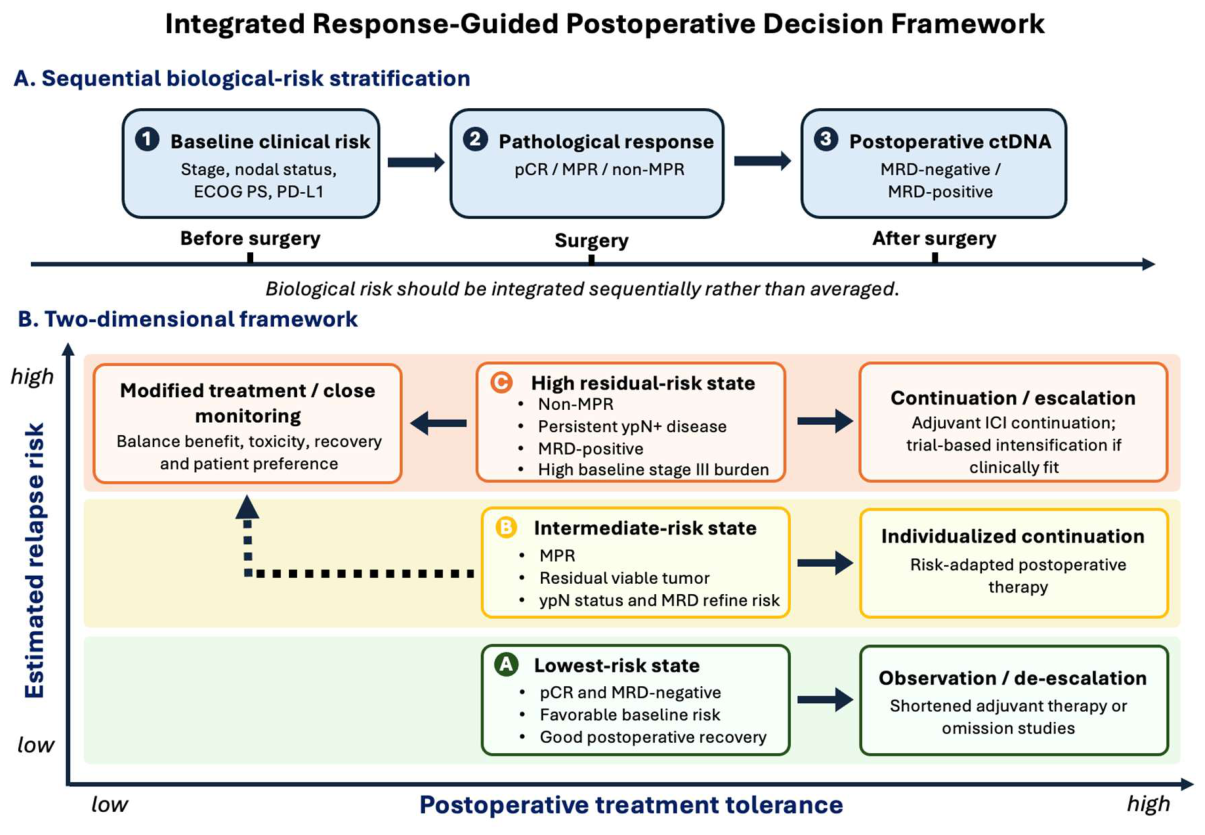
Figure 2.
Current dilemmas and future directions in perioperative immunotherapy for resectable NSCLC. This schematic illustrates key challenges that remain after the success of neoadjuvant and perioperative chemoimmunotherapy. Current trials do not clearly separate the independent contribution of neoadjuvant, surgical, and adjuvant phases, and existing biomarkers such as PD-L1 expression, TMB, and ctDNA-based MRD are insufficient as standalone predictors of postoperative treatment need. Future strategies should integrate multi-omics biomarkers, optimize postoperative treatment duration and intensity, clarify the role of chemotherapy, develop tailored approaches for driver-positive disease, and improve the real-world generalizability of trial findings. Abbreviations: pCR, complete pathological response; ctDNA, circulating tumor DNA; EFS, event-free survival; HR, hazard ratio; ICI, immune checkpoint inhibitor; MRD, molecular residual disease; MPR, major pathological response; NSCLC, non-small cell lung cancer; OS, overall survival; PD-1, programmed cell death protein 1; PD-L1, programmed death ligand 1; SOC, standard of care; TKI, tyrosine kinase inhibitor; TMB, tumor mutational burden.
Figure 2.
Current dilemmas and future directions in perioperative immunotherapy for resectable NSCLC. This schematic illustrates key challenges that remain after the success of neoadjuvant and perioperative chemoimmunotherapy. Current trials do not clearly separate the independent contribution of neoadjuvant, surgical, and adjuvant phases, and existing biomarkers such as PD-L1 expression, TMB, and ctDNA-based MRD are insufficient as standalone predictors of postoperative treatment need. Future strategies should integrate multi-omics biomarkers, optimize postoperative treatment duration and intensity, clarify the role of chemotherapy, develop tailored approaches for driver-positive disease, and improve the real-world generalizability of trial findings. Abbreviations: pCR, complete pathological response; ctDNA, circulating tumor DNA; EFS, event-free survival; HR, hazard ratio; ICI, immune checkpoint inhibitor; MRD, molecular residual disease; MPR, major pathological response; NSCLC, non-small cell lung cancer; OS, overall survival; PD-1, programmed cell death protein 1; PD-L1, programmed death ligand 1; SOC, standard of care; TKI, tyrosine kinase inhibitor; TMB, tumor mutational burden.
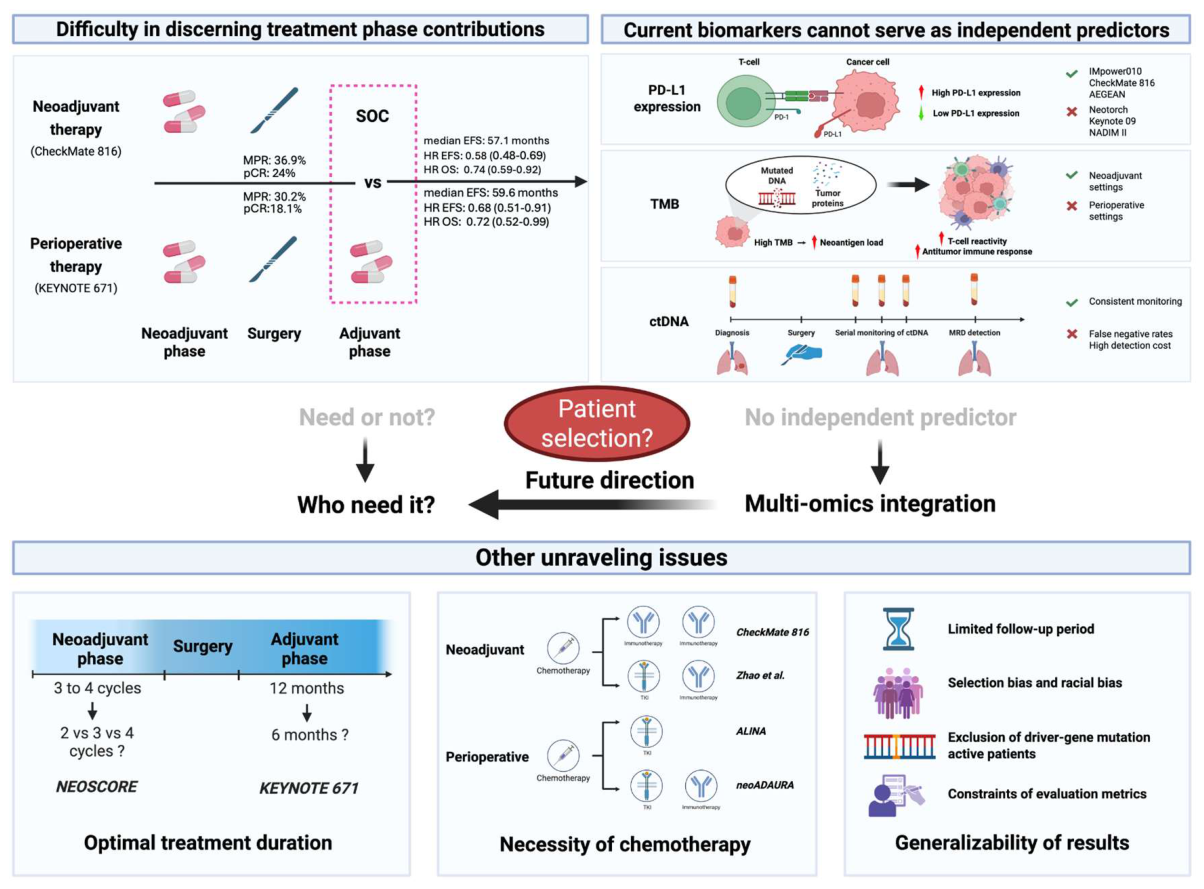

Table 1.
Landmark neoadjuvant and perioperative chemoimmunotherapy studies in resectable NSCLC.
| N◦ Pts | ICI agent | Clinical stage | Pathological response |
EFS outcome | HR EFS | OS outcome | HR OS | Safety outcome | |
|---|---|---|---|---|---|---|---|---|---|
| Perioperative regimen | |||||||||
| NADIM II | 86 | Nivolumab | IIIA | pCR: 36.8% MPR: 52.6% |
2-y PFS 67.2% 1 | 0.47 (95%CI 0.25-0.88) 1 | 2-y OS 85% | 0.43 (95% CI 0.19–0.98) | Grade ≥ 3 AE 19% 2 |
| AEGEAN | 802 | Durvalumab | IIA-IIIB | pCR: 17.2% MPR: 33.3% |
2-y EFS 63.3% 3-y EFS 60.1% |
0.69 (95%CI 0.55-0.88) | — | — | Grade ≥3 TRAE 32.4% irAE 25.4% |
| Neotorch | 501 | Toripalimab | II-III | pCR: 24.8% MPR: 48.5% |
2-y EFS 64.7% | 0.4 (95%CI 0.28-0.57) | — | 0.62 (95% CI 0.38–1.00) | Grade ≥3 AE 63.4% irAE 42.1% |
| KEYNOTE 671 | 797 | Pembrolizumab | II-IIIB | pCR: 18.1% MPR: 30.2% |
2-y EFS 62.4% 3-y EFS 54.3% 4-y EFS 48% 5-y EFS 49.9% median EFS 57.1 mo |
0.58 (95%CI 0.48-0.69) | 2-y OS 80.9% 3-y OS 71.3% 5-y OS 64.6% |
0.74 (95% CI 0.59–0.92) | Grade ≥3 TRAE 45.2% irAE 26% |
| Checkmate 77T | 461 | Nivolumab | IIA-IIIB | pCR: 25.3% MPR: 35.4% |
2-y EFS 67% 30-mo EFS 61% |
0.61 (95% CI 0.46-0.80) | 30-mo OS 78% | 0.85 (NS) | Grade ≥3 TRAE 32% irAE — |
| RATIONALE 315 | 453 | Tislelizumab | II-IIIA | pCR: 41% MPR: 56% |
2-y EFS 68% 3-y EFS 64.7% 4-y EFS 61.2% |
0.58 (95%CI 0.43-0.79) | 1-y OS 95% 2-y OS 89% 3-y OS 79.3% |
0.65 (95% CI 0.45–0.93) | Grade ≥3 TRAE 73% irAE 40.3% |
| SHR-1316 | 37 | Adebrelimab | II-III | pCR: 29.7% MPR: 51.4% |
1-y EFS 77.8% | — | 1-y OS 97.3% | — | Grade ≥3 TRAE 78.4% irAE — |
| SAKK 16—14 | 68 | Durvalumab | IIIA(N2) | pCR: 18% MPR: 62% |
2-y EFS 67.1% 3-y EFS 53.8% 4-y EFS 49% 5-y EFS 45.9% median EFS 48 mo |
— | 2-y OS 83% 5-y OS 65.8% |
— | Grade ≥3 AE 88% irAE — |
| Neoadjuvant regimen | |||||||||
| Checkmate 816 | 358 | Nivolumab | IB-IIIA | pCR: 24% MPR: 36.9% |
2-y EFS 63.8% 3-y EFS 57% 4-y EFS 49% 5-y EFS 49.2% median EFS 59.6 mo |
0.68 (95%CI 0.51–0.91) | 2-y OS 82.7% 3-y OS 78% 5-y OS 65.4% |
0.72 (95% CI 0.523–0.998) | Grade ≥3 TRAE 33.5% irAE — |
| NEOSTAR | 44 | Nivolumab | IB-IIIA | pCR: 18.2% MPR: 32.1% |
2-y EFS 73% 3-y EFS 53% |
— | 2-y OS 91% 3-y OS 86% |
— | Grade ≥3 TRAE 45% irAE — |
| phase 1b study of Sintilimab | 40 | Sintilimab | IA-IIIB | pCR: 16.2% MPR: 40.5% |
2-y EFS 72.5% 3-y EFS 70% 5-y EFS 61.5% median EFS 44.4 mo |
— | 2-y OS 91.7% 3-y OS 86.1% 5-y OS 80.4% |
— | Grade ≥3 TRAE 10% irAE — |
| TD-FOREKNOW | 94 | Camrelizumab | IIIA-IIIB | pCR: 32.6% MPR: 65.1% |
2-y EFS 76.9% | 0.52 (95%CI 0.21-1.29) | — | — | Grade ≥3 TRAE 25.6% irAE 53.5% |
Notes: Values are presented as reported in the original publications or latest available updates. Because survival endpoints and safety outcomes were defined and reported differently across trials, these data should be interpreted descriptively rather than compared directly across studies. Median EFS/PFS and median OS are shown when available. 1 For NADIM II, EFS was not reported; therefore, PFS was listed in the EFS outcome column, and the reported PFS hazard ratio was listed in the HR EFS column. 2 Because grade ≥3 TRAEs and irAEs were not reported in NADIM II, grade 3/4 AEs are provided in the safety outcome column. Abbreviations: AE, adverse event; CI, confidence interval; EFS, event-free survival; HR, hazard ratio; ICI, immune checkpoint inhibitor; irAE, immune-related adverse event; MPR, major pathological response; OS, overall survival; pCR, pathological complete response; PFS, progression-free survival; TRAE, treatment-related adverse event; mo, months; NS, not significant.
Disclaimer/Publisher’s Note: The statements, opinions and data contained in all publications are solely those of the individual author(s) and contributor(s) and not of MDPI and/or the editor(s). MDPI and/or the editor(s) disclaim responsibility for any injury to people or property resulting from any ideas, methods, instructions or products referred to in the content. |
© 2026 by the authors. Licensee MDPI, Basel, Switzerland. This article is an open access article distributed under the terms and conditions of the Creative Commons Attribution (CC BY) license (http://creativecommons.org/licenses/by/4.0/).
Copyright: This open access article is published under a Creative Commons CC BY 4.0 license, which permit the free download, distribution, and reuse, provided that the author and preprint are cited in any reuse.