

Submitted:
08 August 2026
Posted:
10 August 2026
You are already at the latest version
Abstract
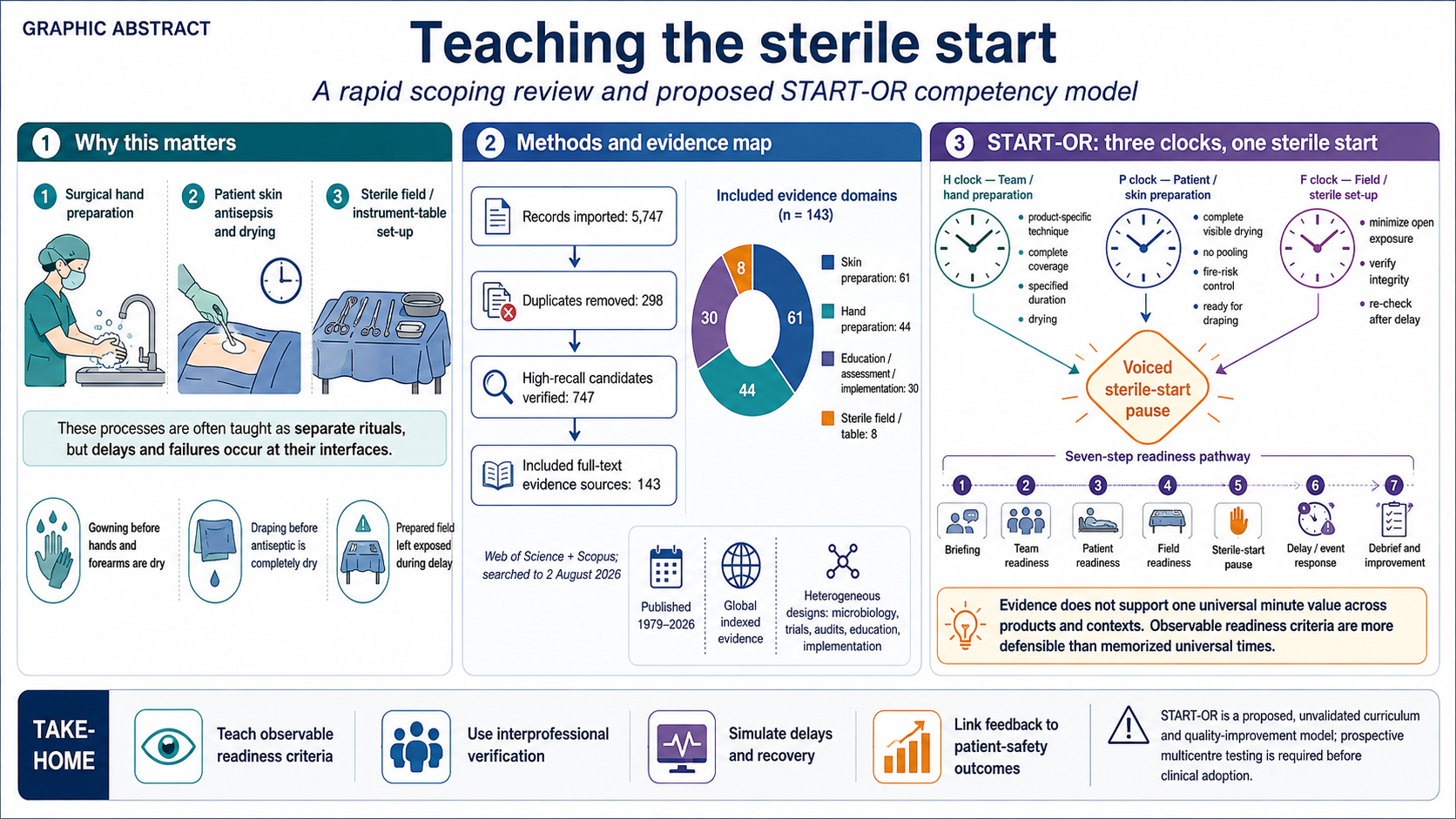
Background: Surgical hand preparation, patient skin antisepsis, draping readiness and sterile-table set-up are often taught as separate rituals, although delays and failures arise at their interfaces. Evidence also spans microbiology, infection prevention, human factors and education, making it difficult to define what learners should time, observe, communicate and re-check. Methods: A rapid scoping review mapped global indexed evidence on three sterile-start processes: surgical hand preparation; the transition from skin antisepsis to draping or incision; and sterile-field or instrument-table set-up. Web of Science and Scopus were searched from inception to 2 August 2026. Records were deduplicated and subjected to a high-recall rule-assisted primary screen. All candidate records underwent eligibility verification, and the full text of every included source was confirmed, verified and analysed by the author team. Data were charted by domain, design, specialty, educational outcome and first indexed affiliation region. Findings were integrated into the proposed Surgical Timing and Aseptic Readiness Tool for the Operating Room (START-OR). Results: Of 5747 imported records, 298 duplicates were removed, 747 candidates underwent structured eligibility verification and 143 full-text evidence sources were included after author-team confirmation and analysis. The map comprised 30 education, assessment or implementation sources; 44 surgical hand-preparation sources; 61 skin-preparation sources; and eight sterile-field or table sources. Evidence did not support one universal minute value across products and contexts. Instead, hand preparation required product-specific technique, complete coverage, specified duration and drying; skin preparation required complete visible drying, absence of pooling and fire-risk control before draping; and sterile-field management required minimizing unnecessary open exposure and re-validating integrity after delay. Educational studies identified recurrent gaps in timing accuracy, coverage, feedback, monitoring and shared responsibility. START-OR therefore separates team, patient and field clocks, then reunites them at a voiced sterile-start pause and seven readiness gates. Conclusions: Perioperative education should replace memorized universal times with observable readiness criteria, interprofessional verification, simulation of delays and feedback linked to patient-safety outcomes. START-OR is a proposed, unvalidated curriculum and quality-improvement model that requires prospective multicentre testing before clinical adoption.
Keywords:
surgical education
; operating room
; surgical hand antisepsis
; skin antisepsis
; sterile field
; patient safety
; competency-based education
; simulation
; scoping review
Background
Surgical-site infection prevention depends on a bundle of coordinated actions rather than on a single antiseptic product. International guidance places surgical hand preparation, pre-incision skin antisepsis, sterile technique and team verification within broader patient-safety systems, while the surgical safety checklist illustrates how a brief, voiced pause can convert individual tasks into shared situational awareness [1,2,3,4,5,6,7].
The educational problem is therefore not only whether a learner can recite a recommended duration. Competent performance requires knowing the product and its instructions for use, covering the correct anatomical area, recognizing complete drying and pooling, protecting the sterile field during delays, communicating uncertainty and stopping progression when readiness has not been achieved. These abilities span knowledge, psychomotor skill, performance in practice, deliberate practice, simulation and interprofessional teamwork [8,9,10,11,12,13,14,15].
Scoping review methodology is appropriate when evidence is heterogeneous in design, terminology and outcome and when the purpose is to map concepts, identify gaps and clarify whether narrower systematic review questions are feasible. This topic combines laboratory efficacy studies, randomized comparisons, audits, qualitative studies, educational interventions and professional guidance, making an integrative evidence map more defensible than a pooled global effect estimate [16,17,18].
A further conceptual problem is that the three relevant timelines are usually documented separately: the team clock for surgical hand preparation, the patient clock for antiseptic application and drying, and the field clock for opening and exposing sterile instruments. Treating these as independent rituals may conceal interface failures, such as a fully prepared table waiting for an unready patient, draping before an alcohol-based preparation has dried, or rushing gowning before the hands and forearms are dry [1,3,5,8,15].
This rapid scoping review therefore aimed to map the worldwide indexed evidence on timing, readiness, education and assessment for the sterile start; compare patterns across surgical specialties; identify educational interventions and outcome levels; and develop a transparent, testable process model for proactive aseptic management. The review questions were: what is timed or verified, how is competence taught and assessed, what specialty modifiers matter, and which observable gates should precede incision [16,17,18].
Methods
Review Design and Reporting
A rapid scoping review was conducted using the methodological foundations of Arksey and O’Malley, subsequent refinements, JBI guidance and PRISMA-ScR. PRISMA 2020 was used to strengthen flow reporting, while the model-development component was treated as a transparent evidence-informed synthesis rather than as a validated clinical guideline [16,17,18,19,20,21,22].
The review was initiated from an author-defined protocol and search plan, but it was not prospectively registered. This deviation is reported explicitly because protocol timing and public availability affect reproducibility; the complete search strategies and dated search record are supplied in Additional file 1 [19,20,21].
Eligibility Criteria
Eligibility was structured using Population–Concept–Context. Populations included learners and practising members of the perioperative team; the concept covered timing, readiness, technique, education, assessment, implementation or contamination related to the three sterile-start processes; and contexts included operating rooms, simulation centres, skills laboratories and perioperative training across specialties. Table 1 presents the operational criteria [16,18,19,21].
Information Sources and Search Strategy
Web of Science Core Collection and Scopus were searched from inception through 2 August 2026. Search blocks combined terms for surgical hand preparation, surgical skin antisepsis, draping and drying, sterile fields, instrument tables, set-up, exposure, duration, interval, contamination, education, assessment and implementation. Searches were designed for sensitivity, documented according to PRISMA-S and internally checked against PRESS principles; exact database syntax is available in Additional file 1 [23,24].
The two-database strategy was prespecified for the rapid mapping objective because Web of Science and Scopus provided broad interdisciplinary coverage, complete indexed records and cited-reference fields. Together they yielded 5747 records, 5449 unique records after deduplication and representation across every prespecified evidence domain and specialty group. This deliberate scope is sufficient for the stated rapid-review mapping objective, but it is not presented as exhaustive of MEDLINE, Embase, CINAHL, ERIC, Cochrane or grey literature and remains a limitation for future replication [18,19,23,24].
An a priori charting framework linked source characteristics to educational quality, intervention replicability, learning level, experiential learning and teamwork. MERSQI and TIDieR informed description, while Kirkpatrick, Kolb, healthcare team-training evidence and TeamSTEPPS informed the transition from learning outcomes to workplace behaviour and system improvement [25,26,27,28,29,30].
Record Management and Selection
The source workbook contained 5747 imported records: 5095 from Web of Science and 652 from Scopus. Deduplication used normalized DOI and a title–year key, producing 5449 unique records. A high-recall rule-assisted title/abstract screen identified 747 candidates, after which candidate records were evaluated against the eligibility criteria. The full text of every retained source was then confirmed, verified and analysed before charting. Duplicates, veterinary records and records whose apparent timing terminology referred to unrelated processes were removed [21,22,23].
Primary title/abstract screening was conducted by ADP using a high-recall rule-assisted workflow. WAP and ARP participated in the full-text verification and analytic confirmation of the included evidence set, and uncertain eligibility or classification decisions were resolved by author-team consensus. Automated rules supported recall and consistency but did not make final inclusion decisions, and no record was excluded solely by automation. The primary-screening design is reported transparently as a rapid-review limitation [31,32].
Data Charting and Synthesis
Charted fields included bibliographic identifiers, year, journal, title, abstract, design group, primary domain, surgical specialty, educational outcome level, database source and first explicitly stated country in the indexed affiliation field. Full text was retrieved, confirmed and analysed for all 143 included sources. The affiliation variable describes authorship geography and was not interpreted as the study site [19,21,23].
Study design and reporting quality were described rather than used as exclusion criteria, consistent with scoping review practice. The Medical Education Research Study Quality Instrument informed the education-quality lens, and TIDieR informed the assessment of whether training interventions were described with enough detail to reproduce [25,26].
Educational outcomes were organized using a four-level progression from reaction to learning, behaviour and patient, organizational or environmental outcomes. Kolb’s experiential cycle, simulation evidence, interprofessional competencies and TeamSTEPPS informed the translation from mapped evidence to curriculum design, assessment and team communication [9,10,11,12,13,14,15,27,28,29,30].
Development of the Proposed START-OR Model
START-OR—Surgical Timing and Aseptic Readiness Tool for the Operating Room—was developed through deductive integration of three evidence domains and patient-safety education frameworks. Candidate elements were retained only when they were observable, teachable, auditable and compatible with product instructions and local policy. The resulting model separates three clocks, defines seven readiness gates and adds an education-to-practice cycle. It is explicitly a proposed and unvalidated model, not a replacement for manufacturers’ instructions, institutional policy or regulatory guidance [1,3,5,8,9,15,27,28,29,30].
Patient and Public Involvement and Ethics
Patients and members of the public were not involved because the study used published and indexed literature. Ethics committee approval and participant consent were not required; nevertheless, patient safety, dignity and avoidance of preventable harm were used as normative constraints during model development [1,5,8,15].
Results
Selection of Evidence
The review imported 5747 records, removed 298 duplicates, screened 5449 unique records, retained 747 high-recall candidates and included 143 full-text evidence sources after author-team confirmation, verification and analysis. The flow and exclusion stages are shown in Figure 1, and the numerical audit trail is summarized in Table 2 [21,22].
Characteristics and Global Distribution
The 143 sources were published from 1979 to 2026, with a median publication year of 2017. Fifty-five sources were published from 2020 onward, 52 during 2010–2019, 26 during 2000–2009 and 10 before 2000. The evidence base diversified over time from product-efficacy and microbiological studies toward educational interventions, implementation research and sterile-field technologies, as illustrated in Figure 2 [33,34,35,36,37,38,39,40,41,42,43,44,45,46,47,48,49,50,51,52,53,54,55,56,57,58,59,60,61,62,63,64,65,66,67,68,69,70,71,72,73,74,75,76,77,78,79,80,81,82,83,84,85,86,87,88,89,90,91,92,93,94,95,96,97,98,99,100,101,102,103,104,105,106,107,108,109,110,111,112,113,114,115,116,117,118,119,120,121,122,123,124,125,126,127,128,129,130,131,132,133,134,135,136,137,138,139,140,141,142,143,144,145,146,147,148,149,150,151,152,153,154,155,156,157,158,159,160,161,162,163,164,165,166,167,168,169,170,171,172,173,174,175].
Randomized or controlled comparative studies were the largest design group (44/143), followed by laboratory or experimental efficacy studies (34/143), audit, observational or qualitative studies (22/143), systematic reviews or meta-analyses (15/143), other primary studies (13/143), educational interventions or simulations (6/143), protocols (5/143) and narrative guidance (4/143). Most evidence came from mixed perioperative settings, orthopaedics, trauma or spine, general or abdominal surgery, and obstetrics or gynaecology [33,34,35,36,37,38,39,40,41,42,43,44,45,46,47,48,49,50,51,52,53,54,55,56,57,58,59,60,61,62,63,64,65,66,67,68,69,70,71,72,73,74,75,76,77,78,79,80,81,82,83,84,85,86,87,88,89,90,91,92,93,94,95,96,97,98,99,100,101,102,103,104,105,106,107,108,109,110,111,112,113,114,115,116,117,118,119,120,121,122,123,124,125,126,127,128,129,130,131,132,133,134,135,136,137,138,139,140,141,142,143,144,145,146,147,148,149,150,151,152,153,154,155,156,157,158,159,160,161,162,163,164,165,166,167,168,169,170,171,172,173,174,175].
First indexed affiliations suggested broad international authorship but uneven representation: North America accounted for 44 records, Europe 42, Asia 36, Oceania 5, Africa 4 and Latin America and the Caribbean 4; 8 records were other or unclear. Because this field was derived from affiliation metadata, it should not be read as a study-site distribution. The imbalance nevertheless warns against treating practices from well-indexed settings as universally transferable. Table 3 summarizes the domain, design, specialty and affiliation characteristics [33,34,35,36,37,38,39,40,41,42,43,44,45,46,47,48,49,50,51,52,53,54,55,56,57,58,59,60,61,62,63,64,65,66,67,68,69,70,71,72,73,74,75,76,77,78,79,80,81,82,83,84,85,86,87,88,89,90,91,92,93,94,95,96,97,98,99,100,101,102,103,104,105,106,107,108,109,110,111,112,113,114,115,116,117,118,119,120,121,122,123,124,125,126,127,128,129,130,131,132,133,134,135,136,137,138,139,140,141,142,143,144,145,146,147,148,149,150,151,152,153,154,155,156,157,158,159,160,161,162,163,164,165,166,167,168,169,170,171,172,173,174,175].
Education, Assessment and Implementation Evidence
The newest education-focused sources expanded beyond conventional demonstration. They included video-based instrument-table management, a back-table simulation programme for nursing students, hands-on skin-preparation training, reviews and audits of hand-antisepsis technique, assessment of online videos, time reminders, adaptive preparation for a learner using crutches and head-mounted virtual-reality training. These studies support multimodal teaching but also show that technology is educationally useful only when linked to observable performance and feedback [33,34,35,36,37,38,39,40,41,42].
Observational, audit and qualitative studies documented a recurring theory–practice gap. Direct observation found missed technique steps; closed-loop audit and personal instruction improved performance; game-based learning supported instrument recognition and set-up; focus groups showed that skin preparation was shaped by tradition, role ambiguity and team culture; and studies of medical students and obstetric teams found variable knowledge and compliance. These findings locate the problem in curriculum, supervision and shared responsibility rather than in individual memory alone [43,44,45,46,47,48,49,50,51,52].
Remote video surveillance, feedback sessions, ultraviolet visualization, guideline implementation, skin-care education, floor marking and explicit monitoring were used to make invisible risk visible. Knowledge and attitudes were associated with sterile-table covering practice, and several studies emphasized organizational oversight, role modelling, product acceptability and local workflow. The educational evidence therefore favoured repeated observation, timely feedback and system redesign over a single induction lecture. Table 4 translates these findings into curriculum, assessment and outcome domains [53,54,55,56,57,58,59,60,61,62].
Mapped outcome levels reinforced this gap: 78 sources reported patient, organizational or environmental endpoints; 30 reported behaviour or performance; 23 reported learning or technical outcomes; one focused primarily on reaction or perception; and 11 were not classifiable from indexed records. Much of the clinically rich literature was never designed as educational research, while many educational interventions stopped before demonstrating durable workplace or patient benefit [33,34,35,36,37,38,39,40,41,42,43,44,45,46,47,48,49,50,51,52,53,54,55,56,57,58,59,60,61,62,63,64,65,66,67,68,69,70,71,72,73,74,75,76,77,78,79,80,81,82,83,84,85,86,87,88,89,90,91,92,93,94,95,96,97,98,99,100,101,102,103,104,105,106,107,108,109,110,111,112,113,114,115,116,117,118,119,120,121,122,123,124,125,126,127,128,129,130,131,132,133,134,135,136,137,138,139,140,141,142,143,144,145,146,147,148,149,150,151,152,153,154,155,156,157,158,159,160,161,162,163,164,165,166,167,168,169,170,171,172,173,174,175].
Surgical Hand-Preparation Evidence
Recent hand-preparation studies compared waterless and traditional methods, user tolerance, bacterial counts, cost and clinical outcomes. Reviews generally supported alcohol-based rubbing as an effective alternative when an appropriate formulation, amount, coverage and application method were used, but efficacy varied by formulation and test standard. Educationally, this means that ‘rub’ and ‘scrub’ are not interchangeable labels and that a duration cannot be taught independently from the product and technique [63,64,65,66,67,68,69,70,71,72,73].
Systematic reviews, comparative studies and formulation experiments examined residual activity, skin integrity, glycerol concentration, forearm coverage and World Health Organization formulations. Findings were heterogeneous across laboratory standards and clinical endpoints. The consistent teaching principle was to follow the validated product instructions, maintain systematic coverage, avoid shortening the application below the required contact period and allow the hands and forearms to dry before gowning and gloving [74,75,76,77,78,79,80,81,82,83,84].
Evidence from rural hospitals, state-of-the-art reviews and randomized efficacy trials also raised resource and sustainability considerations. Waterless preparation could reduce water use and infrastructure dependence, while shorter validated rub protocols could improve feasibility and skin tolerance. These benefits did not justify an arbitrary short cut: the permitted duration remained formulation-specific, and repeated procedures required attention to clean hands, skin condition and the local protocol [85,86,87,88,89,90,91,92,93,94,95].
Historical studies comparing one-, two-, three-, five- and ten-minute regimens showed why inherited ritual is an unreliable curriculum. A two-minute scrub could be clinically similar to three minutes in one setting, five minutes was not inferior to ten minutes before hip arthroplasty, and some short alcohol-rub regimens met microbiological criteria; however, methods, products, outcome thresholds and procedure duration differed. The defensible educational conclusion is not one global number but the ability to execute and justify a product-specific sequence [96,97,98,99,100,101,102,103,104,105,106].
Patient Skin-Preparation and Readiness Evidence
The skin-preparation literature was the largest domain and included recent randomized trials and meta-analyses comparing alcohol-containing and aqueous preparations, chlorhexidine, povidone-iodine and olanexidine across clean-contaminated, abdominal and orthopaedic surgery. Several studies favoured alcohol-containing regimens or particular formulations, but effect estimates varied by procedure, comparator, concentration and outcome. Product choice therefore requires local guideline alignment rather than a single universal hierarchy [107,108,109,110,111,112,113,114,115,116,117].
Studies from 2021–2022 extended this heterogeneity to open fractures, arthroplasty, upper-limb surgery, caesarean delivery and antimicrobial persistence. Colour, visibility and application quality affected coverage, and cost-effectiveness did not always track microbiological efficacy. Teaching should therefore include anatomical boundaries, visual confirmation, concentration, contraindications, drying and documentation rather than only naming an agent [118,119,120,121,122,123,124,125,126,127,128].
Trials and protocols published in 2019–2020 examined novel preparations, gynaecological and obstetric surgery, trauma and cardiac surgery. The evidence supported treating skin preparation as a process with an endpoint, not as a stroke count. The relevant transition to draping is achieved when the prepared area is visibly dry, pooling is absent and alcohol-fire hazards are controlled; a fixed waiting time detached from product, volume, site and environmental conditions can create false reassurance [129,130,131,132,133,134,135,136,137,138,139,140].
Earlier comparative studies and meta-analyses in spine, abdominal, arthroplasty and caesarean surgery showed both clinically important differences and unresolved variation. One randomized spine study reported fewer positive wound-edge cultures when povidone-iodine was applied several minutes before surgery and allowed to dry, while other studies focused on agent comparisons rather than timing. The education message is to teach the observable state of complete drying and the rationale for waiting, not to generalize a single minute from one product or specialty [141,142,143,144,145,146,147,148,149].
The older evidence base included observational studies, paediatric scoliosis, cardiac and vascular surgery, emergency and elective orthopaedics, nurse-performed preparation and developing-world settings. These studies reinforce that the effectiveness of skin preparation depends on protocol fidelity, site, technique, repeat application, workflow and context. They also show that nurses and instrument/scrub professionals are active safety agents whose assessment and escalation skills should be taught explicitly [150,151,152,153,154,155,156,157,158,159,160,161,162,163,164,165,166,167].
Sterile-Field and Instrument-Table Evidence
The sterile-field domain was small but directly relevant to the proposed third clock. Recent experimental and narrative evidence examined table covering, single- versus two-drape methods, ultraviolet decontamination, local unidirectional airflow and glove-package opening. Across these studies, contamination accumulated with exposure and activity, covering generally reduced airborne deposition, and the method used to introduce items could transfer contaminants. The appropriate educational response is to minimize unnecessary open time, control traffic and item introduction, and re-check the field after delay [168,169,170,171,172,173].
Older cardiothoracic transmission research and an emergency-caesarean table-preparation study illustrated the tension between contamination risk and time-critical readiness. Advance preparation may be defensible in tightly controlled circumstances, but evidence was limited and context-specific. A universal maximum open-table time cannot be inferred from this map; local policy should specify how tables are covered, observed, revalidated and discarded after breaches [174,175].
Cross-Domain Timing Synthesis and Specialty Comparison
Across all three domains, time functioned as a process-control variable rather than an independent protective dose. The strongest common rule was readiness-based synchronization: the team clock ends only after the validated hand-preparation sequence and drying; the patient clock advances only after complete skin drying, absence of pooling and fire-risk control; and the field clock should start as close as operationally feasible to use, with revalidation after delays. Table 5 summarizes what can and cannot be taught from the evidence [1,2,3,5,63,64,65,66,67,68,69,70,71,72,73,74,75,76,77,78,79,80,81,82,83,84,85,86,87,88,89,90,91,92,93,94,95,96,97,98,99,100,101,102,103,104,105,106,107,108,109,110,111,112,113,114,115,116,117,118,119,120,121,122,123,124,125,126,127,128,129,130,131,132,133,134,135,136,137,138,139,140,141,142,143,144,145,146,147,148,149,150,151,152,153,154,155,156,157,158,159,160,161,162,163,164,165,166,167,168,169,170,171,172,173,174,175].
Specialty comparison showed that orthopaedics, trauma and spine had the largest specialty-specific body of evidence, followed by general or abdominal surgery and obstetrics or gynaecology. Implant surgery heightened attention to instrument exposure and low bioburden; emergency obstetrics emphasized readiness without uncontrolled pre-exposure; long or complex procedures raised the importance of hand-product persistence and field revalidation; and sites with folds, hair, groin flora or difficult positioning increased coverage risk. Table 6 converts these modifiers into curriculum adaptations [63,64,65,66,67,68,69,70,71,72,73,74,75,76,77,78,79,80,81,82,83,84,85,86,87,88,89,90,91,92,93,94,95,96,97,98,99,100,101,102,103,104,105,106,107,108,109,110,111,112,113,114,115,116,117,118,119,120,121,122,123,124,125,126,127,128,129,130,131,132,133,134,135,136,137,138,139,140,141,142,143,144,145,146,147,148,149,150,151,152,153,154,155,156,157,158,159,160,161,162,163,164,165,166,167,168,169,170,171,172,173,174,175].
The Proposed START-OR Model
START-OR converts the sterile start into three parallel, observable clocks that converge at a voiced readiness pause (Figure 3). The team clock advances from initiation of hand preparation (H0), through completion of the product-specific technique and duration (H1), to dry hands and forearms with safe gowning and gloving (H2). The patient clock advances from the final antiseptic stroke (P0), through complete drying, absence of pooling and controlled fire risk (P1), to permission for sterile draping (P2). The field clock begins when the first sterile item is opened (F0), advances when the back table and Mayo stand are prepared and verified (F1), and reserves high-risk or implant-related items for opening as close as operationally possible to first use (F2) [1,3,5,15,63,64,65,66,67,68,69,70,71,72,73,74,75,76,77,78,79,80,81,82,83,84,85,86,87,88,89,90,91,92,93,94,95,96,97,98,99,100,101,102,103,104,105,106,107,108,109,110,111,112,113,114,115,116,117,118,119,120,121,122,123,124,125,126,127,128,129,130,131,132,133,134,135,136,137,138,139,140,141,142,143,144,145,146,147,148,149,150,151,152,153,154,155,156,157,158,159,160,161,162,163,164,165,166,167,168,169,170,171,172,173,174,175].
The central rule is deliberately stricter than “wait a fixed number of minutes”: elapsed time is documented within each clock, but progression occurs only when the responsible team member can demonstrate and communicate the corresponding readiness state. Figure 3 therefore links the three clocks to seven sequential gates: Gate 1 briefs and classifies the case; Gates 2–4 verify team, patient and field readiness; Gate 5 is the closed-loop sterile-start pause; Gate 6 governs delays, breaches, uncertainty and revalidation; and Gate 7 converts deviations and near misses into debriefing and improvement. Table 7 operationalizes each gate through triggers, required actions, observable evidence and explicit stop rules [5,8,15,29,30,33,34,35,36,37,38,39,40,41,42,43,44,45,46,47,48,49,50,51,52,53,54,55,56,57,58,59,60,61,62,63,64,65,66,67,68,69,70,71,72,73,74,75,76,77,78,79,80,81,82,83,84,85,86,87,88,89,90,91,92,93,94,95,96,97,98,99,100,101,102,103,104,105,106,107,108,109,110,111,112,113,114,115,116,117,118,119,120,121,122,123,124,125,126,127,128,129,130,131,132,133,134,135,136,137,138,139,140,141,142,143,144,145,146,147,148,149,150,151,152,153,154,155,156,157,158,159,160,161,162,163,164,165,166,167,168,169,170,171,172,173,174,175].
Education-To-Practice Cycle and Assessment
The proposed curriculum follows six linked stages: orient learners to evidence and local risks; demonstrate with visible timing cues; practise deliberately in simulation; verify performance with direct observation and objective coverage methods; transfer under supervision; and improve through audit, feedback and debrief. Figure 4 depicts this cycle, which makes the clinical process a longitudinal competency rather than a one-time demonstration [8,9,10,11,12,13,14,27,28,29,30,33,34,35,36,37,38,39,40,41,42,43,44,45,46,47,48,49,50,51,52,53,54,55,56,57,58,59,60,61,62].
Assessment should combine critical-step checklists with coverage visualization, timestamp review, team communication and delayed-start scenarios. Passing should require completion of all locally designated critical safety items; elapsed time alone should never compensate for missed coverage, wet hands or skin, pooling, an unmonitored field or failure to escalate. Table 8 proposes an assessment bundle that can be evaluated at learner, team and system levels [9,10,11,12,13,14,15,25,26,27,29,30,33,34,35,36,37,38,39,40,41,42,43,44,45,46,47,48,49,50,51,52,53,54,55,56,57,58,59,60,61,62].
Discussion
Principal Findings
This review mapped a large clinical evidence base but a comparatively small educational evidence base. The central finding is that the sterile start should not be taught as three isolated countdowns. Across hand preparation, skin preparation and sterile-field management, the defensible unit of competence is the ability to reach, recognize, communicate and maintain readiness under changing conditions [1,3,5,8,15,33,34,35,36,37,38,39,40,41,42,43,44,45,46,47,48,49,50,51,52,53,54,55,56,57,58,59,60,61,62,63,64,65,66,67,68,69,70,71,72,73,74,75,76,77,78,79,80,81,82,83,84,85,86,87,88,89,90,91,92,93,94,95,96,97,98,99,100,101,102,103,104,105,106,107,108,109,110,111,112,113,114,115,116,117,118,119,120,121,122,123,124,125,126,127,128,129,130,131,132,133,134,135,136,137,138,139,140,141,142,143,144,145,146,147,148,149,150,151,152,153,154,155,156,157,158,159,160,161,162,163,164,165,166,167,168,169,170,171,172,173,174,175].
A universal minute value was not supported because timing interacted with formulation, application method, anatomical site, volume, environmental conditions, procedure type, test standard and outcome. In education, universal numbers are attractive because they are easy to remember and audit, but they can create a false proxy for safety. START-OR retains timestamps for traceability while subordinating progression to observable completion criteria [1,2,3,63,64,65,66,67,68,69,70,71,72,73,74,75,76,77,78,79,80,81,82,83,84,85,86,87,88,89,90,91,92,93,94,95,96,97,98,99,100,101,102,103,104,105,106,107,108,109,110,111,112,113,114,115,116,117,118,119,120,121,122,123,124,125,126,127,128,129,130,131,132,133,134,135,136,137,138,139,140,141,142,143,144,145,146,147,148,149,150,151,152,153,154,155,156,157,158,159,160,161,162,163,164,165,166,167,168,169,170,171,172,173,174,175].
Implications for Surgical Hand-Preparation Education
Hand-preparation curricula should distinguish detergent scrubbing from alcohol-based rubbing, include skin-health prerequisites, teach the exact product instructions and require complete drying before gowning and gloving. Historical comparisons justify abandoning unnecessarily prolonged ritual, but they do not authorize unvalidated shortening. Learners should be able to explain why a locally approved two- or three-minute process applies to a specific product rather than repeating the number as a universal truth [3,4,63,64,65,66,67,68,69,70,71,72,73,74,75,76,77,78,79,80,81,82,83,84,85,86,87,88,89,90,91,92,93,94,95,96,97,98,99,100,101,102,103,104,105,106].
Objective observation is essential because elapsed time can conceal missed thumbs, interdigital spaces, wrists or forearms. UV visualization, direct observation, video feedback and repeated audit can convert technique from a hidden individual act into assessable performance. These methods should be used formatively and non-punitively, with escalation when the environment or product supply prevents correct performance [8,9,10,11,12,13,14,33,34,35,36,37,38,39,40,41,42,43,44,45,46,47,48,49,50,51,52,53,54,55,56,57,58,59,60,61,62].
Implications for Skin-Preparation Education
Skin-preparation teaching must integrate agent selection, anatomical coverage, application sequence, concentration, contraindications, drying and fire safety. The transition to draping should be verbalized as a readiness decision: the solution is visibly dry, pooling is absent and relevant ignition risk has been controlled. This framing is more transferable than teaching a single waiting period because it remains valid across products and specialties [1,2,5,107,108,109,110,111,112,113,114,115,116,117,118,119,120,121,122,123,124,125,126,127,128,129,130,131,132,133,134,135,136,137,138,139,140,141,142,143,144,145,146,147,148,149,150,151,152,153,154,155,156,157,158,159,160,161,162,163,164,165,166,167].
Coverage is also an educational outcome. Studies using coloured preparations or fluorescence showed that even experienced personnel can miss clinically relevant areas and that novices may perform worse. Simulation should therefore reproduce difficult positions and large preparation fields, include visual coverage feedback and assess whether the learner can identify when assistance or re-application is required [35,47,116,147].
Implications for Sterile-Field and Table Education
The field-clock evidence was sparse, which makes overprecision particularly unsafe. Available studies supported reducing unnecessary exposure, covering prepared tables during non-use when compatible with local policy, controlling item-introduction techniques and considering airflow and traffic. The educational objective is continuous stewardship of the field, including the ability to recognize when a delay changes risk and to initiate revalidation [50,59,168,169,170,171,172,173,174,175].
Emergency readiness illustrates the trade-off. A pre-prepared table may shorten response time but can increase monitoring and contamination concerns. START-OR does not resolve that balance with a universal time; it requires explicit local policy, assigned observation, protection, a documented delay response and a stop rule. This makes the rationale auditable and suitable for simulation [5,15,29,30,175].
Interprofessional and Competency-Based Implications
The sterile start is distributed work. Surgeons, nurses, surgical technologists or instrument personnel, anaesthesia professionals and support staff hold different information and control different risks. A shared pause can reduce hierarchy-dependent assumptions by requiring the responsible person for each clock to voice readiness and by granting any team member authority to stop progression. This aligns technical skill with interprofessional values, role clarity, communication and teamwork [5,6,8,15,29,30].
Competency should be demonstrated at multiple levels: knowledge of standards, skill in coverage, performance under time pressure, communication during uncertainty and contribution to patient and organizational outcomes. A curriculum that measures satisfaction only is inadequate; a programme that measures bacterial counts but not learning transfer is also educationally incomplete. START-OR links Miller’s progression, deliberate practice, simulation and workplace audit in one assessment architecture [9,10,11,12,13,14,25,27,28,33,34,35,36,37,38,39,40,41,42,43,44,45,46,47,48,49,50,51,52,53,54,55,56,57,58,59,60,61,62].
Global Transfer and Specialty Adaptation
The affiliation distribution suggests that the indexed literature is concentrated in Europe, North America and Asia, with limited representation from Africa and Latin America and the Caribbean. Resource constraints, climate, water availability, product supply, operating-room design and professional role definitions can alter implementation. The proposed model therefore standardizes principles—validated instructions, coverage, drying, protected fields, communication and revalidation—while requiring local adaptation of workflow and measurement [1,3,8,15,33,34,35,36,37,38,39,40,41,42,43,44,45,46,47,48,49,50,51,52,53,54,55,56,57,58,59,60,61,62,63,64,65,66,67,68,69,70,71,72,73,74,75,76,77,78,79,80,81,82,83,84,85,86,87,88,89,90,91,92,93,94,95,96,97,98,99,100,101,102,103,104,105,106,107,108,109,110,111,112,113,114,115,116,117,118,119,120,121,122,123,124,125,126,127,128,129,130,131,132,133,134,135,136,137,138,139,140,141,142,143,144,145,146,147,148,149,150,151,152,153,154,155,156,157,158,159,160,161,162,163,164,165,166,167,168,169,170,171,172,173,174,175].
Specialty adaptation should modify the scenario, not dilute the competency. Orthopaedic and implant surgery can emphasize exposure and contamination consequences; obstetric emergencies can test safe acceleration; cardiac and vascular cases can test prolonged synchronization; and high-throughput settings can test whether efficiency pressures provoke premature transitions. Assessment across more than one context is needed before declaring transfer [9,10,13,15,29,30,63,64,65,66,67,68,69,70,71,72,73,74,75,76,77,78,79,80,81,82,83,84,85,86,87,88,89,90,91,92,93,94,95,96,97,98,99,100,101,102,103,104,105,106,107,108,109,110,111,112,113,114,115,116,117,118,119,120,121,122,123,124,125,126,127,128,129,130,131,132,133,134,135,136,137,138,139,140,141,142,143,144,145,146,147,148,149,150,151,152,153,154,155,156,157,158,159,160,161,162,163,164,165,166,167,168,169,170,171,172,173,174,175].
Implementation and Research Agenda
Implementation should begin with local governance rather than immediate clinical enforcement. A multidisciplinary group should reconcile START-OR with manufacturer instructions, fire-safety standards, infection-prevention policy and role descriptions; pilot the checklist in simulation; establish inter-rater reliability; conduct a limited clinical feasibility phase; and review unintended consequences such as delay, waste, workarounds or punitive use [1,2,3,5,8,15,25,26,29,30].
The research agenda should move beyond isolated microbiological efficacy toward comparative educational and implementation studies. Priority designs include multicentre simulation trials, stepped-wedge implementation, prospective validation of readiness gates, human-factors studies of delays, equity-focused adaptation and linkage of educational performance to contamination signals, waste, near misses and surgical-site infection. Table 9 specifies core questions and reporting requirements [16,17,18,19,20,21,23,24,25,26,33,34,35,36,37,38,39,40,41,42,43,44,45,46,47,48,49,50,51,52,53,54,55,56,57,58,59,60,61,62,63,64,65,66,67,68,69,70,71,72,73,74,75,76,77,78,79,80,81,82,83,84,85,86,87,88,89,90,91,92,93,94,95,96,97,98,99,100,101,102,103,104,105,106,107,108,109,110,111,112,113,114,115,116,117,118,119,120,121,122,123,124,125,126,127,128,129,130,131,132,133,134,135,136,137,138,139,140,141,142,143,144,145,146,147,148,149,150,151,152,153,154,155,156,157,158,159,160,161,162,163,164,165,166,167,168,169,170,171,172,173,174,175].
Strengths and Limitations
Strengths include a large deduplicated corpus, transparent separation of clinical and educational evidence, explicit specialty comparison, inclusion of sterile-field evidence often omitted from hand- or skin-focused reviews, traceable counts and a model whose elements are observable and testable. Every included source is represented in the reference list and the evidence map is supplied as an additional file [16,19,21,23,26,33,34,35,36,37,38,39,40,41,42,43,44,45,46,47,48,49,50,51,52,53,54,55,56,57,58,59,60,61,62,63,64,65,66,67,68,69,70,71,72,73,74,75,76,77,78,79,80,81,82,83,84,85,86,87,88,89,90,91,92,93,94,95,96,97,98,99,100,101,102,103,104,105,106,107,108,109,110,111,112,113,114,115,116,117,118,119,120,121,122,123,124,125,126,127,128,129,130,131,132,133,134,135,136,137,138,139,140,141,142,143,144,145,146,147,148,149,150,151,152,153,154,155,156,157,158,159,160,161,162,163,164,165,166,167,168,169,170,171,172,173,174,175].
Several limitations are material. Only Web of Science and Scopus were searched; primary title/abstract screening was conducted by one experienced reviewer, although the included full-text set and analytic classifications were verified by the author team; geography was derived from affiliations rather than confirmed study sites; design classification was partly rule-assisted; no formal risk-of-bias appraisal was used for exclusion; and the protocol was not prospectively registered. These limitations can produce missed studies, classification error and overrepresentation of well-indexed settings [18,19,20,21,23,24,31,32].
The evidence map also included reviews, protocols and primary studies, so source counts should not be interpreted as independent patient samples. No meta-analysis was attempted because products, timings, comparators, specialties and outcomes were not sufficiently homogeneous across all three processes. START-OR was developed from mapped evidence and educational theory but has not undergone stakeholder consensus, reliability testing, feasibility evaluation or outcome validation [16,17,18,19,25,26,33,34,35,36,37,38,39,40,41,42,43,44,45,46,47,48,49,50,51,52,53,54,55,56,57,58,59,60,61,62,63,64,65,66,67,68,69,70,71,72,73,74,75,76,77,78,79,80,81,82,83,84,85,86,87,88,89,90,91,92,93,94,95,96,97,98,99,100,101,102,103,104,105,106,107,108,109,110,111,112,113,114,115,116,117,118,119,120,121,122,123,124,125,126,127,128,129,130,131,132,133,134,135,136,137,138,139,140,141,142,143,144,145,146,147,148,149,150,151,152,153,154,155,156,157,158,159,160,161,162,163,164,165,166,167,168,169,170,171,172,173,174,175].
Conclusions
Teaching the sterile start requires more than teaching minutes. The perioperative team should complete and verify a product-specific hand-preparation sequence, wait for visible patient-skin readiness and fire safety, minimize unnecessary sterile-field exposure, revalidate after delays and voice the status of all three clocks before proceeding. The proposed START-OR model converts these principles into seven readiness gates and a longitudinal education-to-practice cycle. It should be treated as a testable curriculum and quality-improvement proposal—not as a validated clinical standard—until independent multicentre evaluation is completed [1,3,5,8,15,29,30,33,34,35,36,37,38,39,40,41,42,43,44,45,46,47,48,49,50,51,52,53,54,55,56,57,58,59,60,61,62,63,64,65,66,67,68,69,70,71,72,73,74,75,76,77,78,79,80,81,82,83,84,85,86,87,88,89,90,91,92,93,94,95,96,97,98,99,100,101,102,103,104,105,106,107,108,109,110,111,112,113,114,115,116,117,118,119,120,121,122,123,124,125,126,127,128,129,130,131,132,133,134,135,136,137,138,139,140,141,142,143,144,145,146,147,148,149,150,151,152,153,154,155,156,157,158,159,160,161,162,163,164,165,166,167,168,169,170,171,172,173,174,175].
Abbreviations
AHRQ: Agency for Healthcare Research and Quality; HMD: head-mounted display; IFU: instructions for use; IPEC: Interprofessional Education Collaborative; JBI: Joanna Briggs Institute; MERSQI: Medical Education Research Study Quality Instrument; OR: operating room; PCC: Population–Concept–Context; PRISMA: Preferred Reporting Items for Systematic Reviews and Meta-Analyses; PRISMA-ScR: PRISMA extension for Scoping Reviews; SSI: surgical-site infection; START-OR: Surgical Timing and Aseptic Readiness Tool for the Operating Room; TIDieR: Template for Intervention Description and Replication; UV: ultraviolet.
Additional Files
Additional file 1 (.docx): Complete Web of Science and Scopus search strategies and search log.
Additional file 2 (.xlsx): Evidence map of 143 included sources with bibliographic and analytic fields.
Additional file 3 (.docx): PRISMA-ScR checklist with manuscript locations and final reporting status.
Author Contributions
ADP conceived the review, designed the methodology and rule-assisted workflow, curated the evidence corpus, conducted the primary screening and charting, interpreted the findings, developed the proposed START-OR model, prepared the visualizations and drafted the manuscript. WAP, AVO and ARP contributed to investigation, full-text verification, validation of the included evidence set, data curation, analytic confirmation and critical revision of the manuscript. All authors reviewed and approved the final version and accept accountability for the work.
Funding
This research received no specific grant from any funding agency in the public, commercial or not-for-profit sectors.
Ethics Approval and Consent to Participate
Not applicable. This study analysed published and indexed literature and did not involve human participants, identifiable data or animals.
Consent for Publication
Not applicable.
Availability of Data and Materials
The evidence map supporting this manuscript is included as Additional file 2. Database export files may remain subject to the licensing conditions of Web of Science and Scopus; therefore, the additional file contains the charted bibliographic evidence used for synthesis rather than redistributing proprietary platform records.
Acknowledgments
The authors acknowledge the library and database access provided by their academic institutions.
Competing Interests
The authors declare that they have no competing interests.
Generative Artificial Intelligence Statement
Generative artificial intelligence tools were used under the authors’ direction to support language organization, editorial formatting and reference normalization. No generative-AI image is included in this submission. The tools did not independently make eligibility decisions, create study data, interpret the evidence or validate the proposed model. All authors verified the full-text evidence set, reviewed the scientific content and remain accountable for the accuracy and integrity of the final manuscript.
References
- World Health Organization. Global guidelines for the prevention of surgical site infection, 2nd ed.; World Health Organization: Geneva, 2018. [Google Scholar]
- Berríos-Torres, S.I.; Umscheid, C.A.; Bratzler, D.W.; Leas, B.; Stone, E.C.; Kelz, R.R.; et al. Centers for Disease Control and Prevention guideline for the prevention of surgical site infection. JAMA Surg. 2017, 152(8), 784–791. [Google Scholar] [CrossRef] [PubMed]
- World Health Organization. WHO guidelines on hand hygiene in health care: first global patient safety challenge clean care is safer care. World Health Organization: Geneva . 2009.
- Boyce, J.M.; Pittet, D. Guideline for hand hygiene in health-care settings: recommendations of the Healthcare Infection Control Practices Advisory Committee and the HICPAC/SHEA/APIC/IDSA Hand Hygiene Task Force. MMWR Recomm. Rep. 2002, 51(RR-16), 1–45. [Google Scholar] [PubMed]
- World Health Organization. Implementation manual WHO surgical safety checklist 2009: safe surgery saves lives. World Health Organization: Geneva. 2009.
- Haynes, A.B.; Weiser, T.G.; Berry, W.R.; Lipsitz, S.R.; Breizat, A.H.S.; Dellinger, E.P.; et al. A surgical safety checklist to reduce morbidity and mortality in a global population. N Engl. J. Med. 2009, 360(5), 491–499. [Google Scholar] [CrossRef] [PubMed]
- National Institute for Health and Care Excellence. Surgical site infections: prevention and treatment. NICE guideline NGLondon: NICE. 2019. Available online: https://www.nice.org.uk/guidance/ngAccessed (accessed on 3 Aug 2026).
- World Health Organization. WHO patient safety curriculum guide: multi-professional edition. World Health Organization: Geneva, 2011.
- Miller, G.E. The assessment of clinical skills/competence/performance. Acad. Med. 1990, 65((9) Suppl, S63–S67. [Google Scholar] [CrossRef] [PubMed]
- Ericsson, K.A.; Krampe, R.T.; Tesch-Römer, C. The role of deliberate practice in the acquisition of expert performance. Psychol. Rev. 1993, 100(3), 363–406. [Google Scholar] [CrossRef]
- Gaba, D.M. The future vision of simulation in health care. Qual. Saf. Health Care 2004, 13 Suppl 1, i2–i10. [Google Scholar] [CrossRef]
- Issenberg, S.B.; McGaghie, W.C.; Petrusa, E.R.; Lee Gordon, D.; Scalese, R.J. Features and uses of high-fidelity medical simulations that lead to effective learning: a BEME systematic review. Med. Teach. 2005, 27(1), 10–28. [Google Scholar] [CrossRef] [PubMed]
- McGaghie, W.C.; Issenberg, S.B.; Petrusa, E.R.; Scalese, R.J. A critical review of simulation-based medical education research: 2003-Med Educ. 2010, 44(1), 50–63. [Google Scholar] [CrossRef] [PubMed]
- Cook, D.A.; Hatala, R.; Brydges, R.; Zendejas, B.; Szostek, J.H.; Wang, A.T.; et al. Technology-enhanced simulation for health professions education: a systematic review and meta-analysis. JAMA 2011, 306(9), 978–988. [Google Scholar] [CrossRef] [PubMed]
- Interprofessional Education Collaborative. IPEC core competencies for interprofessional collaborative practice: version Washington, DC. Interprofessional Education Collaborative, 2023.
- Arksey, H.; O’Malley, L. Scoping studies: towards a methodological framework. Int. J. Soc. Res. Methodol. 2005, 8(1), 19–32. [Google Scholar] [CrossRef]
- Levac, D.; Colquhoun, H.; O’Brien, K.K. Scoping studies: advancing the methodology. Implement Sci. 2010, 5, 69. [Google Scholar] [CrossRef] [PubMed]
- Munn, Z.; Peters, M.D.J.; Stern, C.; Tufanaru, C.; McArthur, A.; Aromataris, E. Systematic review or scoping review? Guidance for authors when choosing between a systematic or scoping review approach. BMC Med. Res. Methodol. 2018, 18, 143. [Google Scholar] [CrossRef] [PubMed]
- Peters, M.D.J.; Marnie, C.; Tricco, A.C.; Pollock, D.; Munn, Z.; Alexander, L.; et al. Updated methodological guidance for the conduct of scoping reviews. JBI Evid. Synth. 2020, 18(10), 2119–2126. [Google Scholar] [CrossRef] [PubMed]
- Peters, M.D.J.; Godfrey, C.; McInerney, P.; Khalil, H.; Larsen, P.; Marnie, C.; et al. Best practice guidance and reporting items for the development of scoping review protocols. JBI Evid. Synth. 2022, 20(4), 953–968. [Google Scholar] [CrossRef] [PubMed]
- Tricco, A.C.; Lillie, E.; Zarin, W.; O’Brien, K.K.; Colquhoun, H.; Levac, D.; et al. PRISMA extension for scoping reviews (PRISMA-ScR): checklist and explanation. Ann. Intern Med. 2018, 169(7), 467–473. [Google Scholar] [CrossRef] [PubMed]
- Page, M.J.; McKenzie, J.E.; Bossuyt, P.M.; Boutron, I.; Hoffmann, T.C.; Mulrow, C.D.; et al. The PRISMA 2020 statement: an updated guideline for reporting systematic reviews. BMJ 2021, 372, n71. [Google Scholar] [CrossRef] [PubMed]
- Rethlefsen, M.L.; Kirtley, S.; Waffenschmidt, S.; Ayala, A.P.; Moher, D.; Page, M.J.; et al. PRISMA-S: an extension to the PRISMA statement for reporting literature searches in systematic reviews. Syst. Rev. 2021, 10, 39. [Google Scholar] [CrossRef] [PubMed]
- McGowan, J.; Sampson, M.; Salzwedel, D.M.; Cogo, E.; Foerster, V.; Lefebvre, C. PRESS peer review of electronic search strategies: 2015 guideline statement. J. Clin. Epidemiol. 2016, 75, 40–46. [Google Scholar] [CrossRef] [PubMed]
- Reed, D.A.; Cook, D.A.; Beckman, T.J.; Levine, R.B.; Kern, D.E.; Wright, S.M. Association between funding and quality of published medical education research. JAMA 2007, 298(9), 1002–1009. [Google Scholar] [CrossRef] [PubMed]
- Hoffmann, T.C.; Glasziou, P.P.; Boutron, I.; Milne, R.; Perera, R.; Moher, D.; et al. Better reporting of interventions: template for intervention description and replication (TIDieR) checklist and guide. BMJ 2014, 348, g1687. [Google Scholar] [CrossRef] [PubMed]
- Kirkpatrick, D.L.; Kirkpatrick, J.D. Evaluating training programs: the four levels, 3rd ed.; Berrett-Koehler Publishers: San Francisco, 2006. [Google Scholar]
- Kolb, D.A. Experiential learning: experience as the source of learning and development. Prentice Hall: Englewood Cliffs, 1984.
- Weaver, S.J.; Dy, S.M.; Rosen, M.A. Team-training in healthcare: a narrative synthesis of the literature. BMJ Qual. Saf. 2014, 23(5), 359–372. [Google Scholar] [CrossRef] [PubMed]
- Agency for Healthcare Research and Quality. TeamSTEPPS 3.0 curriculum materials. AHRQ: Rockville, 2024. Available online: https://www.ahrq.gov/teamstepps-program/curriculum/index.html (accessed on 3 Aug 2026).
- Tricco, A.C.; Antony, J.; Zarin, W.; Strifler, L.; Ghassemi, M.; Ivory, J.; et al. A scoping review of rapid review methods. BMC Med. 2015, 13, 224. [Google Scholar] [CrossRef] [PubMed]
- Waffenschmidt, S.; Knelangen, M.; Sieben, W.; Bühn, S.; Pieper, D. Single screening versus conventional double screening for study selection in systematic reviews: a methodological systematic review. BMC Med. Res. Methodol. 2019, 19, 132. [Google Scholar] [CrossRef] [PubMed]
- Ma, Y.; Tao, T.; Ma, X.; Li, H.; Cheng, Z.; Kang, M.; et al. An integrated deep learning framework for effective management of surgical instruments tables based on videos. Health Care Manag. Sci. 2026, 29(2), 19. [Google Scholar] [CrossRef] [PubMed]
- Park, J.; Suh, E.E. Development and preliminary evaluation of a procedural performance-oriented back-table setting simulation program for nursing students. J. Korean Acad. Soc. Nurs. Educ. 2026, 32(2), 230–239. [Google Scholar] [CrossRef]
- Schaps, D.; Schultz, M.; Woody, R.; Masoud, S.; Mantyh, C. Hands-on training for preoperative skin preparation improves compliance with manufacturer instructions for use. Am. J. Surg. 2026, 251, 116719. [Google Scholar] [CrossRef] [PubMed]
- Pinto, F.D.; Ferreira, R.A.; de Siqueira, F.M.C.D.S.; Silva, J.D.O.L.; Camerini, F.G.; Fassarella, C.S. Adherence to surgical hand antisepsis technique steps by surgical teams: an integrative review. Rev. Rene 2025, 26, e95533. [Google Scholar] [CrossRef]
- Dagci, M.; Alptekin, H.M.; Ihtiyar, D.; Ozturk, G.; Ozturk, H. Evaluation of the Content, Reliability, and Quality of YouTube Videos on Surgical Hand Scrubbing. AORN Journal. 2025, 121(4), e1–e10. [Google Scholar] [CrossRef] [PubMed]
- Muhammed, A.; Ahmed Mohmed, M.H.; Mohammed Ahmed, A.B.; Ali Abdelrahman, M.E.O.; Elamin, R.; Ali Fadul, M.A.; et al. Improving Quality and Compliance of Surgical Hand Scrubbing Practices: A Clinical Audit. Cureus 2025, 17(3), e80821. [Google Scholar] [CrossRef] [PubMed]
- Ahmed, E.A.O.; Mohamed, Z.H.S.; Sayed, M.S.; Mohamed Ahmed, E.A.; Bala, A.M.A.A.; Abdelrahem, M.A.; et al. Surgical Hand Scrubbing: A Clinical Audit at a Referral Hospital. Cureus 2025, 17(11), e96465. [Google Scholar] [CrossRef] [PubMed]
- Bakcek Akcelik, O.; Kolcak, B.; Öner Karaveli̇, E.; Tastan, S. The effects of time reminders on surgical hand scrub performance and student satisfaction: A randomized controlled study. Nurse Educ. Pract. 2025, 88, 104561. [Google Scholar] [CrossRef] [PubMed]
- Lawton, C.; Schwaitzberg, S.D. Accommodating Learners: An Adaptive Approach to Surgical Hand Preparation With Crutches. J. Surg. Educ. 2024, 81(12), 103299. [Google Scholar] [CrossRef] [PubMed]
- Gungor, S.; Yava, A.; Koyuncu, A. Designing and implementing a training program on surgical hand scrubbing, wearing surgical cap and surgical mask, gowning, and gloving using HMD-based virtual reality technologies for nursing students: an exploration of student perceptions. Front. Med. 2024, 11, 1364465. [Google Scholar] [CrossRef] [PubMed]
- Rutala, W.A.; Boyce, J.M.; Weber, D.J. Disinfection, sterilization and antisepsis: An overview. Am. J. Infect. Control 2023, 51(11), A3–A12. [Google Scholar] [CrossRef] [PubMed]
- Gulsen, M.; Aydingulu, N.; Arslan, S.; Dogan, S.D.; Alptekin, D.; Nazik, E. Surgical handwashing practices of operating room staff: An observational study. Scand. J. Caring Sci. 2022, 36(4), 926–934. [Google Scholar] [CrossRef] [PubMed]
- Mukherjee, R.; Roy, P.; Parik, M. Achieving Perfect Hand Washing: an Audit Cycle with Surgical Internees. Indian J. Surg. 2021, 83(5), 1166–1172. [Google Scholar] [CrossRef] [PubMed]
- Nasiri, M.; Eslami, J.; Rashidi, N.; Paim, C.P.P.; Akbari, F.; Torabizadeh, C.; et al. “Playing with Surgical Instruments (PlaSurIn)” game to train operating room novices how to set up basic surgical instruments: A validation study. Nurse Educ. Today 2021, 105, 105047. [Google Scholar] [CrossRef] [PubMed]
- Markström, I.; Bjerså, K.; Bachrach-Lindström, M.; Falk-Brynhildsen, K.; Hollman Frisman, G. Operating room nurses’ experiences of skin preparation in connection with orthopaedic surgery: A focus group study. Int. J. Nurs. Pract. 2020, 26(5), e12858. [Google Scholar] [CrossRef] [PubMed]
- Schwartz, X.; Schmitz, M.; Safdar, N.; Pop-Vicas, A. Adherence to surgical hand antisepsis: Barriers and facilitators in a tertiary care hospital. Am. J. Infect. Control. 2018, 46(6), 714–716. [Google Scholar] [CrossRef] [PubMed]
- Gaspar, G.G.; Menegueti, M.G.; Lopes, A.E.R.; Santos, R.O.C.; de Araújo, T.R.; Nassiff, A.; et al. Alcohol-based surgical hand preparation: Translating scientific evidence into clinical practice. Antimicrob. Resist. Infect. Control 2018, 7(1), 80. [Google Scholar] [CrossRef] [PubMed]
- Van Wicklin, S.A. Are knowledge and attitudes of perioperative registered nurses associated with the practices of covering and monitoring sterile tables? Perioper. Care Oper. Room Manag. 2018, 12, 16–25. [Google Scholar] [CrossRef]
- Ooi, R.; Griffiths, A. Obstetric competence and compliance with surgical hand antisepsis prior to elective and emergency surgical procedures: a closed-loop audit. J. Hosp. Infect. 2018, 100(2), 219–221. [Google Scholar] [CrossRef] [PubMed]
- Kasperczak, M.; Kończyk, B.; Kaczmarczyk, M.; Urbanek, T.; Kuczmik, W. The assessment of practices and knowledge on surgical hand preparation among medical students of Medical University of Silesia during their clinical years. Chir. Pol. 2018, 20(1-2), 20–25. [Google Scholar]
- Khan, A.; Nausheen, S. Compliance of surgical hand washing before surgery: Role of remote video surveillance. J. Pak. Med. Assoc. 2017, 67(1), 92–96. [Google Scholar] [PubMed]
- Goldberg, J.L. Guideline Implementation: Hand Hygiene. AORN J. 2017, 105(2), 203–217. [Google Scholar] [CrossRef] [PubMed]
- Laurikainen, E.; Rintala, E.; Kaarto, A.M.; Routamaa, M. Adherence to surgical hand rubbing directives in a hospital district of Southwest Finland. Infect. Dis. 2016, 48(2), 116–121. [Google Scholar] [CrossRef] [PubMed]
- Vanyolos, E.; Peto, K.; Viszlai, A.; Miko, I.; Furka, I.; Nemeth, N.; et al. Usage of ultraviolet test method for monitoring the efficacy of surgical hand rub technique among medical students. J. Surg. Educ. 2015, 72(3), 530–535. [Google Scholar] [CrossRef] [PubMed]
- Harnoss, J.C.; Brune, L.; Ansorg, J.; Heidecke, C.-D.; Assadian, O.; Kramer, A. Practice of skin protection and skin care among German surgeons and influence on the efficacy of surgical hand disinfection and surgical glove perforation. BMC Infect. Dis. 2014, 14(1), 315. [Google Scholar] [CrossRef] [PubMed]
- Spruce, L. Back to Basics: Hand Hygiene and Surgical Hand Antisepsis. AORN J. 2013, 98(5), 449–460. [Google Scholar] [CrossRef] [PubMed]
- De Korne, D.F.; Van Wijngaarden, J.D.H.; Van Rooij, J.; Wauben, L.S.G.L.; Hiddema, U.F.; Klazinga, N.S. Safety by design: Effects of operating room floor marking on the position of surgical devices to promote clean air flow compliance and minimise infection risks. BMJ Qual. Saf. 2012, 21(9), 746–752. [Google Scholar] [CrossRef] [PubMed]
- Kramer, A.; Assadian, O.; Hübner, N.-O.; Kampf, G. Prevention of postoperative wound infections, part 2: Impact of surgical hand preparation and current aspects for the implementation. Hyg. Med. 2009, 34(1-2), 41–49. [Google Scholar]
- Kramer, A.; Hübner, N.; Below, H.; Heidecke, C.-D.; Assadian, O. Improving adherence to surgical hand preparation. J. Hosp. Infect. 2008, 70 (SUPPL. 1), 35–43. [Google Scholar] [CrossRef] [PubMed]
- Khan, A.; McLaren, S.G.; Nelson, C.L. Surgical hand scrub practices in orthopaedic surgery. Clin. Orthop. Relat. Res. 2003, 414, 65–68. [Google Scholar] [CrossRef] [PubMed]
- Ma, Y.; Yue, X.; Li, N.; Wang, J.; Wang, J.; Xia, Y.; et al. Evaluation of an intervention to improve waterless surgical hand antisepsis accuracy in a tertiary hospital of East China: a prospective pre-post intervention study. Front. Public Health 2025, 13, 1583510. [Google Scholar] [CrossRef] [PubMed]
- Lopes, A.E.R.; Menegueti, M.G.; Gaspar, G.G.; Tartari, E.; Canini, S.R.M.D.S.; Pittet, D.; et al. Comparing surgeons’ skin tolerance and acceptability to alcohol-based surgical hand preparation vs traditional surgical scrub: A matched quasi-experimental study. Am. J. Infect. Control 2022, 50(10), 1091–1097. [Google Scholar] [CrossRef] [PubMed]
- Parlak, E.A.; Iyigun, E.; Albay, A.; Bedir, O. Impact of methods and duration of surgical hand scrub on bacterial count: A randomized controlled trial. Am. J. Infect. Control 2021, 49(11), 1376–1383. [Google Scholar] [CrossRef] [PubMed]
- Javitt, M.J.; Grossman, A.; Grajewski, A.; Javitt, J.C. Association between Eliminating Water from Surgical Hand Antisepsis at a Large Ophthalmic Surgical Hospital and Cost. JAMA Ophthalmol. 2020, 138(4), 382–386. [Google Scholar] [CrossRef] [PubMed]
- Myltykbayeva, Z.; Kovaleva, G.; Mukhitdinov, A.; Omarova, S.; Nadirov, R. In Vivo Comparison of Chlorine-Based Antiseptics versus Alcohol Antiseptic for Surgical Hand Antisepsis. Scientifica 2020, 2020, 3123084. [Google Scholar] [CrossRef] [PubMed]
- Feng, W.; Lin, S.; Huang, D.; Huang, J.; Chen, L.; Wu, W.; et al. Surgical hand rubbing versus surgical hand scrubbing: Systematic review and meta-analysis of efficacy. Inj.-Int. J. Care Inj. 2020, 51(6), 1250–1257. [Google Scholar] [CrossRef] [PubMed]
- Ho, Y.-H.; Wang, Y.-C.; Loh, E.-W.; Tam, K.-W. Antiseptic efficacies of waterless hand rub, chlorhexidine scrub, and povidone-iodine scrub in surgical settings: a meta-analysis of randomized controlled trials. J. Hosp. Infect. 2019, 101(4), 370–379. [Google Scholar] [CrossRef] [PubMed]
- De Bengoa Vallejo, R.B.; Fernandez, D.S.; Cervera, L.A.; Aragón, L.M.; Losa Iglesias, M.E.; Collado Yurrita, L.R.; et al. Effectiveness of surgical hand antisepsis using chlorhexidine digluconate and parachlorometaxylenol hand scrub Cross-over trial. Medicine (United States) 2018, 97(42), e12831. [Google Scholar] [CrossRef] [PubMed]
- Hennig, T.-J.; Werner, S.; Naujox, K.; Arndt, A. Chlorhexidine is not an essential component in alcohol-based surgical hand preparation: A comparative study of two handrubs based on a modified EN 12791 test protocol. Antimicrob. Resist. Infect. Control 2017, 6(1), 96. [Google Scholar] [CrossRef] [PubMed]
- Kampf, G.; Kramer, A.; Suchomel, M. Lack of sustained efficacy for alcohol-based surgical hand rubs containing ‘residual active ingredients’ according to EN Journal of Hospital Infection. 2017, 95(2), 163–168. [Google Scholar] [CrossRef] [PubMed]
- Oriel, B.S.; Chen, Q.; Itani, K.M.F. The impact of surgical hand antisepsis technique on surgical site infection. Am. J. Surg. 2017, 213(1), 24–29. [Google Scholar] [CrossRef] [PubMed]
- Tanner, J.; Dumville, J.C.; Norman, G.; Fortnam, M. Surgical hand antisepsis to reduce surgical site infection. Cochrane Database Syst. Rev. 2016, 2016(1), CD004288. [Google Scholar] [CrossRef] [PubMed]
- Liu, L.Q.; Mehigan, S. The Effects of Surgical Hand Scrubbing Protocols on Skin Integrity and Surgical Site Infection Rates: A Systematic Review. AORN J. 2016, 103(5), 468–482. [Google Scholar] [CrossRef] [PubMed]
- Suchomel, M.; Rotter, M.; Weinlich, M.; Kundi, M. Glycerol significantly decreases the three hour efficacy of alcohol-based surgical hand rubs. J. Hosp. Infect. 2013, 83(4), 284–287. [Google Scholar] [CrossRef] [PubMed]
- Suchomel, M.; Kundi, M.; Pittet, D.; Rotter, M.L. Modified World Health Organization hand rub formulations comply with European efficacy requirements for preoperative surgical hand preparations. Infect. Control Hosp. Epidemiol. 2013, 34(3), 245–250. [Google Scholar] [CrossRef] [PubMed]
- Widmer, A.F. Surgical hand hygiene: Scrub or rub? J. Hosp. Infect. 2013, 83 (SUPPL. 1), S35–S39. [Google Scholar] [CrossRef] [PubMed]
- Gonçalves, K.D.J.; Graziano, K.U.; Kawagoe, J.Y. A systematic review of surgical hand antisepsis using an alcohol preparation compared to traditional products. Rev. Da Esc. De Enferm. 2012, 46(6), 1483–1492. [Google Scholar] [CrossRef] [PubMed]
- Chen, C.F.; Han, C.L.; Kan, C.P.; Chen, S.G.; Hung, P.W. Effect of surgical site infections with waterless and traditional hand scrubbing protocols on bacterial growth. Am. J. Infect. Control. 2012, 40(4), E15–E17. [Google Scholar] [CrossRef] [PubMed]
- Olson, L.K.M.; Morse, D.J.; Duley, C.; Savell, B.K. Prospective, randomized in vivo comparison of a dual-active waterless antiseptic versus two alcohol-only waterless antiseptics for surgical hand antisepsis. Am. J. Infect. Control. 2012, 40(2), 155–159. [Google Scholar] [CrossRef] [PubMed]
- Lai, K.W.; Foo, T.L.; Low, W.; Naidu, G. Surgical hand antisepsis-a pilot study comparing povidone iodine hand scrub and alcohol-based chlorhexidine gluconate hand rub. Ann. Acad. Med. Singap. 2012, 41(1), 12–16. [Google Scholar] [CrossRef]
- Huebner, N.O.; Kellner, N.B.; Partecke, L.I.; Koburger, T.; Heidecke, C.D.; Kohlmann, T.; et al. Determination of antiseptic efficacy of rubs on the forearm and consequences for surgical hand disinfection. J. Hosp. Infect. 2011, 78(1), 11–15. [Google Scholar] [CrossRef] [PubMed]
- Suchomel, M.; Kundi, M.; Allegranzi, B.; Pittet, D.; Rotter, M.L. Testing of the World Health Organization-recommended formulations for surgical hand preparation and proposals for increased efficacy. J. Hosp. Infect. 2011, 79(2), 115–118. [Google Scholar] [CrossRef] [PubMed]
- Nthumba, P.M.; Stepita-Poenaru, E.; Poenaru, D.; Bird, P.; Allegranzi, B.; Pittet, D.; et al. Cluster-randomized, crossover trial of the efficacy of plain soap and water versus alcohol-based rub for surgical hand preparation in a rural hospital in Kenya. Br. J. Surg. 2010, 97(11), 1621–1628. [Google Scholar] [CrossRef] [PubMed]
- Widmer, A.F.; Rotter, M.; Voss, A.; Nthumba, P.; Allegranzi, B.; Boyce, J.; et al. Surgical hand preparation: state-of-the-art. J. Hosp. Infect. 2010, 74(2), 112–122. [Google Scholar] [CrossRef] [PubMed]
- Rotter, M.L.; Kampf, G.; Suchomel, M.; Kundi, M. Long-term effect of a 1.5 minute surgical hand rub with a propanol-based product on the resident hand flora. J. Hosp. Infect. 2007, 66(1), 84–85. [Google Scholar] [CrossRef] [PubMed]
- Rotter, M.L.; Kampf, G.; Suchomel, M.; Kundi, M. Population kinetics of the skin flora on gloved hands following surgical hand disinfection with 3 propanol-based hand rubs: A prospective, randomized, double-blind trial. Infect. Control Hosp. Epidemiol. 2007, 28(3), 346–350. [Google Scholar] [CrossRef] [PubMed]
- Ahmed, A. Surgical hand scrub: Lots of water wasted. Ann. Afr. Med. 2007, 6(1), 31–33. [Google Scholar] [CrossRef] [PubMed]
- Huebner, N.O.; Kampf, G.; Loeffler, H.; Kramer, A. Effect of a 1 min hand wash on the bactericidal efficacy of consecutive surgical hand disinfection with standard alcohols and on skin hydration. Int. J. Hyg. Environ. Health 2006, 209(3), 285–291. [Google Scholar] [CrossRef] [PubMed]
- Kampf, G.; Ostermeyer, C.; Heeg, P.; Paulson, D. Evaluation of two methods of determining the efficacies of two alcohol-based hand rubs for surgical hand antisepsis. Appl. Environ. Microbiol. 2006, 72(6), 3856–3861. [Google Scholar] [CrossRef] [PubMed]
- Gaonkar, T.A.; Geraldo, I.; Shintre, M.; Modak, S.M. In vivo efficacy of an alcohol-based surgical hand disinfectant containing a synergistic combination of ethylhexylglycerin and preservatives. J. Hosp. Infect. 2006, 63(4), 412–417. [Google Scholar] [CrossRef] [PubMed]
- Kampf, G.; Kramer, A.; Rotter, M.; Widmer, A. Optimizing surgical hand disinfection. Zentralblatt Fur Chir. 2006, 131(4), 322–326. [Google Scholar] [CrossRef] [PubMed]
- Rotter, M.; Kundi, M.; Suchomel, M.; Harke, H.P.; Kramer, A.; Ostermeyer, C.; et al. Reproducibility and workability of the European test standard EN 12791 regarding the effectiveness of surgical hand antiseptics: A randomized, Multicenter trial. Infect. Control Hosp. Epidemiol. 2006, 27(9), 935–939. [Google Scholar] [CrossRef] [PubMed]
- Hsieh, H.-F.; Chiu, H.-H.; Lee, F.-P. Surgical hand scrubs in relation to microbial counts: Systematic literature review. J. Adv. Nurs. 2006, 55(1), 68–78. [Google Scholar] [CrossRef] [PubMed]
- Kampf, G.; Voss, A.; Widmer, A.F. The surgical hand disinfection between tradition and progress. Hyg. Med. 2006, 31(7-8), 316–321. [Google Scholar]
- Furukawa, K.; Ogawa, R.; Norose, Y.; Tajiri, T. A new surgical handwashing and hand antisepsis from scrubbing to rubbing. J. Nippon Med. Sch. 2004, 71(3), 190–197. [Google Scholar] [CrossRef] [PubMed]
- Parienti, J.; Thibon, P.; Heller, R.; Le Roux, Y.; von Theobald, P.; Bensadoun, H.; et al. Hand-rubbing with an aqueous alcoholic solution vs traditional surgical hand-scrubbing and 30-day surgical site infection rates - A randomized equivalence study. JAMA-J. Am. Med. Assoc. 2002, 288(6), 722–727. [Google Scholar] [CrossRef] [PubMed]
- Larson, E.L.; Aiello, A.E.; Heilman, J.M.; Lyle, C.T.; Cronquist, A.; Stahl, J.B.; et al. Comparison of different regimens for surgical hand preparation. AORN J. 2001, 73(2), 412–420. [Google Scholar] [CrossRef] [PubMed]
- Jones, R.D.; Jampani, H.; Mulberry, G.; Rizer, R.L. Moisturizing alcohol hand gels for surgical hand preparation. AORN J. 2000, 71(3), 584–592. [Google Scholar] [CrossRef] [PubMed]
- Wheelock, S.M.; Lookinland, S. Effect of surgical hand scrub time on subsequent bacterial growth. AORN J. 1997, 65(6), 1087-92; 1094-8. [Google Scholar] [CrossRef] [PubMed]
- O’Farrell, D.A.; Kenny, G.; O’Sullivan, M.; Nicholson, P.; Stephens, M.; Hone, R. Evaluation of the optimal hand-scrub duration prior to total hip arthroplasty. J. Hosp. Infect. 1994, 26(2), 93–98. [Google Scholar] [CrossRef] [PubMed]
- Babb, J.R.; Davies, J.G.; Ayliffe, G.A. A test procedure for evaluating surgical hand disinfection. J. Hosp. Infect. 1991, 18 Suppl B, 41–9. [Google Scholar] [CrossRef] [PubMed]
- Rehork, B.; Ruden, H. Investigations into the efficacy of different procedures for surgical hand disinfection between consecutive operations. J. Hosp. Infect. 1991, 19(2), 115–27. [Google Scholar] [CrossRef] [PubMed]
- Pereira, L.J.; Lee, G.M.; Wade, K.J. The effect of surgical handwashing routines on the microbial counts of operating room nurses. Am. J. Infect. Control 1990, 18(6), 354–64. [Google Scholar] [CrossRef] [PubMed]
- Eitzen, H.E.; Ritter, M.A.; French, M.L.V.; Gioe, T.J. A microbiological in-use comparison of surgical hand-washing agents. J. Bone Jt. Surg.-Ser. A 1979, 61(A3), 403–406. [Google Scholar] [CrossRef]
- Onuminya, P.O.; Adamgbe, M.A.; Okpanachi, J.A.; Abambah, O.; Agbatse, I.J.; Jibril, N.; et al. Comparison of Povidone-Iodine against a Combination of Chlorhexidine, Cetrimide, and Methylated Spirit Skin Preparation for Clean-Contaminated Laparotomy Operations at Jos University Teaching Hospital. J. West Afr. Coll. Surg. 2026. [Google Scholar] [CrossRef] [PubMed]
- Zhu, L.; Han, Z.; Wen, K.; Zhang, L.; Tang, J.; Chen, X. Efficacy of chlorhexidine in alcohol versus aqueous povidone-iodine for preoperative skin antisepsis in preventing surgical site infections: a systematic review and meta-analysis with trial sequential analysis. BMC Surg. 2026. [Google Scholar] [CrossRef] [PubMed]
- Hsieh, H.H.; Yu, Y.; Chang, C.J.; Chang, T.Y. A comparative meta-analysis of povidone-iodine-alcohol vs. chlorhexidine-alcohol for preoperative skin antisepsis in abdominal surgery. Am. J. Surg. 2025, 244, 116318. [Google Scholar] [CrossRef] [PubMed]
- Takeuchi, M.; Obara, H.; Furube, T.; Kawakubo, H.; Kitago, M.; Okabayashi, K.; et al. Efficacy of aqueous olanexidine compared with alcohol-based chlorhexidine for surgical skin antisepsis regarding the incidence of surgical-site infections in clean-contaminated surgery: a randomized superiority trial. Bjs-Br. J. Surg. 2025, 112(4), znaf065. [Google Scholar] [CrossRef] [PubMed]
- Widmer, A.F.; Atkinson, A.; Kuster, S.P.; Wolfensberger, A.; Klimke, S.; Sommerstein, R.; et al. Povidone Iodine vs Chlorhexidine Gluconate in Alcohol for Preoperative Skin Antisepsis. JAMA-J. Am. Med. Assoc. 2024, 332(7), 541–549. [Google Scholar] [CrossRef] [PubMed]
- V. Peristeri, D.; Nour, H.M.; Ahsan, A.; Abogabal, S.; Singh, K.K.; Sajid, M.S. Alcohol-Containing Versus Aqueous-Based Solutions for Skin Preparation in Abdominal Surgery-A Systematic Review and Meta-analysis. J. Surg. Res. 2023, 291, 734–741. [Google Scholar] [CrossRef] [PubMed]
- Boyce, J.M. Best products for skin antisepsis. Am. J. Infect. Control 2023, 51(11), A58–A63. [Google Scholar] [CrossRef] [PubMed]
- Takeuchi, M.; Obara, H.; Furube, T.; Kawakubo, H.; Kitago, M.; Okabayashi, K.; et al. Effect of aqueous olanexidine versus alcohol-based chlorhexidine for surgical skin antisepsis on incidence of surgical site infections in gastrointestinal surgery: multicentre randomised controlled clinical trial (OEDO trial) protocol. BMJ Open 2023, 13(8), e074169. [Google Scholar] [CrossRef] [PubMed]
- Cho, M.-R.; Choi, W.-K.; Che, S.-H.; Song, S.-K. Efficacy of skin preparation solutions in patients with total knee replacement: A randomized controlled trial. J. Orthop. Surg. 2023, 31(1), 10225536231165358. [Google Scholar] [CrossRef] [PubMed]
- Fink, K.; Örgel, M.; Baier, C.; Brauckmann, V.; Giannoudis, V.; Liodakis, E. Quality of lower limb preoperative skin preparation using colorless versus colored disinfectants–results of an experimental, randomized study in a close to reality setting. PLoS ONE 2023, 18, e0282662. [Google Scholar] [CrossRef] [PubMed]
- Bashir, M.H.; Hollingsworth, A.; Thompson, J.D.; Shortridge, D.; Lake, S.P.; Deeken, C.R.; et al. Antimicrobial performance of two preoperative skin preparation solutions containing iodine and isopropyl alcohol. Am. J. Infect. Control 2022, 50(7), 792–798. [Google Scholar] [CrossRef] [PubMed]
- Beausoleil, C.; Comstock, S.L.; Werner, D.; Li, L.; Eby, J.M.; Zook, E.C. Antimicrobial persistence of two alcoholic preoperative skin preparation solutions. J. Hosp. Infect. 2022, 129, 8–16. [Google Scholar] [CrossRef] [PubMed]
- Slobogean, G.P.; Sprague, S.; Wells, J.L.; Thabane, L.; Mullins, C.D.; Harris, A.D.; et al. Aqueous skin antisepsis before surgical fixation of open fractures (Aqueous-PREP): a multiple-period, clusterr-andomised, crossover trial. Lancet 2022, 400(10360), 1334–1344. [Google Scholar] [CrossRef] [PubMed]
- Droll, K.P.; Abouassaly, M.; Cullinan, C.; Puskas, D.; Dubois, S. Efficacy of surgical skin preparation solutions in hip arthroplasty: a prospective randomized trial. Can. J. Surg. 2022, 65(6), E756–E762. [Google Scholar] [CrossRef] [PubMed]
- Hasegawa, T.; Tashiro, S.; Mihara, T.; Kon, J.; Sakurai, K.; Tanaka, Y.; et al. Efficacy of surgical skin preparation with chlorhexidine in alcohol according to the concentration required to prevent surgical site infection: Meta-Analysis. BJS Open 2022, 6(5), zrac111. [Google Scholar] [CrossRef] [PubMed]
- Rougereau, G.; Chatelain, L.; Terracher, R.; Zadegan, F.; Ollat, D. Surgical solutions for preoperative skin preparation in total hip arthroplasty: A cost-effectiveness analysis of Betadine® and Chloraprep™. Orthop. Traumatol. Surg. Res. 2022, 108(6), 103355. [Google Scholar] [CrossRef] [PubMed]
- Hampton, J.; Park, S.S.W.; Palazzi, K.; Oldmeadow, C.; Carroll, R.; Attia, J.; et al. The effect of preoperative skin preparation on clinical outcomes with incisional surgery: a network meta-analysis. Anz. J. Surg. 2022, 92(11), 2859–2867. [Google Scholar] [CrossRef] [PubMed]
- Wade, R.G.; Bourke, G.; Wormald, J.C.R.; Totty, J.P.; Stanley, G.H.M.; Lewandowski, A.; et al. Chlorhexidine versus povidone-iodine skin antisepsis before upper limb surgery (CIPHUR): an international multicentre prospective cohort study. Bjs Open 2021, 5(6), zrab117. [Google Scholar] [CrossRef] [PubMed]
- Luwang, A.L.; Saha, P.K.; Rohilla, M.; Sikka, P.; Saha, L.; Gautam, V. Chlorhexidine-alcohol versus povidone-iodine as preoperative skin antisepsis for prevention of surgical site infection in cesarean delivery-a pilot randomized control trial. Trials 2021, 22(1), 540. [Google Scholar] [CrossRef] [PubMed]
- Dörfel, D.; Maiwald, M.; Daeschlein, G.; Müller, G.; Hudek, R.; Assadian, O.; et al. Comparison of the antimicrobial efficacy of povidone-iodine-alcohol versus chlorhexidine-alcohol for surgical skin preparation on the aerobic and anaerobic skin flora of the shoulder region. Antimicrob. Resist. Infect. Control 2021, 10(1), 17. [Google Scholar] [CrossRef] [PubMed]
- Mastrocola, M.; Matziolis, G.; Boehle, S.; Lindemann, C.; Schlattmann, P.; Eijer, H. Meta-analysis of the efficacy of preoperative skin preparation with alcoholic chlorhexidine compared to povidone iodine in orthopedic surgery. Sci. Rep. 2021, 11(1), 18634. [Google Scholar] [CrossRef] [PubMed]
- Peel, T.N.; Watson, E.; Lee, S.J. Randomised Controlled Trials of Alcohol-Based Surgical Site Skin Preparation for the Prevention of Surgical Site Infections: Systematic Review and Meta-Analysis. J. Clin. Med. 2021, 10(4), 663. [Google Scholar] [CrossRef] [PubMed]
- Edmiston, C.E.; Lavin, P.; Spencer, M.; Borlaug, G.; Seabrook, G.R.; Leaper, D. Antiseptic efficacy of an innovative perioperative surgical skin preparation: A confirmatory FDA phase 3 analysis. Infect. Control Hosp. Epidemiol. 2020, 41(6), 653–659. [Google Scholar] [CrossRef] [PubMed]
- Obara, H.; Takeuchi, M.; Kawakubo, H.; Shinoda, M.; Okabayashi, K.; Hayashi, K.; et al. Aqueous olanexidine versus aqueous povidone-iodine for surgical skin antisepsis on the incidence of surgical site infections after clean-contaminated surgery: a multicentre, prospective, blinded-endpoint, randomised controlled trial. Lancet Infect. Dis. 2020, 20(11), 1281–1289. [Google Scholar] [CrossRef] [PubMed]
- Elshamy, E.; Ali, Y.Z.A.; Khalafallah, M.; Soliman, A. Chlorhexidine-alcohol versus povidone-iodine for skin preparation before elective cesarean section: a prospective observational study. J. Matern.-Fetal Neonatal Med. 2020, 33(2), 272–276. [Google Scholar] [CrossRef] [PubMed]
- Dior, U.P.; Kathurusinghe, S.; Cheng, C.; Reddington, C.; Daley, A.J.; Ang, C.; et al. Effect of Surgical Skin Antisepsis on Surgical Site Infections in Patients Undergoing Gynecological Laparoscopic Surgery A Double-Blind Randomized Clinical Trial. JAMA Surg. 2020, 155(9), 807–815. [Google Scholar] [CrossRef] [PubMed]
- Gezer, S.; Yalvaç, H.M.; Güngör, K.; Yücesoy, İ. Povidone-iodine vs chlorhexidine alcohol for skin preparation in malignant and premalignant gynaecologic diseases: A randomized controlled study. Eur. J. Obstet. Gynecol. Reprod. Biol. 2020, 244, 45–50. [Google Scholar] [CrossRef] [PubMed]
- Ritter, B.; Herlyn, P.K.E.; Mittlmeier, T.; Herlyn, A. Preoperative skin antisepsis using chlorhexidine may reduce surgical wound infections in lower limb trauma surgery when compared to povidone-iodine - a prospective randomized trial. Am. J. Infect. Control 2020, 48(2), 167–172. [Google Scholar] [CrossRef] [PubMed]
- Hadiati, D.R.; Hakimi, M.; Nurdiati, D.S.; Masuzawa, Y.; da Silva Lopes, K.; Ota, E. Skin preparation for preventing infection following caesarean section. Cochrane Database Syst. Rev. 2020, 2020(6), CD007462. [Google Scholar] [CrossRef] [PubMed]
- Tolcher, M.C.; Whitham, M.D.; El-Nashar, S.A.; Clark, S.L. Chlorhexidine-Alcohol Compared with Povidone-Iodine Preoperative Skin Antisepsis for Cesarean Delivery: A Systematic Review and Meta-Analysis. Am. J. Perinatol. 2019, 36(2), 118–123. [Google Scholar] [CrossRef] [PubMed]
- Peel, T.N.; Dowsey, M.M.; Buising, K.L.; Cheng, A.C.; Choong, P.F.M. Chlorhexidine-alcohol versus iodineealcohol for surgical site skin preparation in an elective arthroplasty (ACAISA) study: a cluster randomized controlled trial. Clin. Microbiol. Infect. 2019, 25(10), 1239–1245. [Google Scholar] [CrossRef] [PubMed]
- Crnich, C.J.; Pop-Vicas, A.E.; Hedberg, T.G.; Perl, T.M. Efficacy and safety of a novel antimicrobial preoperative skin preparation. Infect. Control Hosp. Epidemiol. 2019, 40(10), 1157–1163. [Google Scholar] [CrossRef] [PubMed]
- Dormstetter, K.; Olson, L.K.M.; Bennaars-Eiden, A.; Bernatchez, S.F. Evaluation of activity and potential for development of antimicrobial resistance to a new tinted 2% chlorhexidine gluconate/70% isopropyl alcohol film-forming sterile preoperative skin preparation. J. Glob. Antimicrob. Resist. 2019, 17, 160–167. [Google Scholar] [CrossRef] [PubMed]
- Boisson, M.; Corbi, P.; Kerforne, T.; Camilleri, L.; Debauchez, M.; Demondion, P.; et al. Multicentre, open-label, randomised, controlled clinical trial comparing 2% chlorhexidine-70% isopropanol and 5% povidone iodine-69% ethanol for skin antisepsis in reducing surgical-site infection after cardiac surgery: the CLEAN 2 study protocol. BMJ Open 2019, 9(6), e026929. [Google Scholar] [CrossRef] [PubMed]
- Raja, S.G.; Rochon, M.; Mullins, C.; Morais, C.; Kourliouros, A.; Wishart, E.; et al. Impact of choice of skin preparation solution in cardiac surgery on rate of surgical site infection: a propensity score matched analysis. J. Infect. Prev. 2018, 19(1), 16–21. [Google Scholar] [CrossRef] [PubMed]
- Ghobrial, G.M.; Wang, M.Y.; Green, B.A.; Levene, H.B.; Manzano, G.; Vanni, S.; et al. Preoperative skin antisepsis with chlorhexidine gluconate versus povidone-iodine: a prospective analysis of 6959 consecutive spinal surgery patients. J. Neurosurg.-Spine 2018, 28(2), 209–214. [Google Scholar] [CrossRef] [PubMed]
- Anggrahita, T.; Wardhana, A.; Sudjatmiko, G. Chlorhexidine-alcohol versus povidone-iodine as preoperative skin preparation to prevent surgical site infection: a meta-analysis. Med. J. Indones. 2017, 26(1), 54–61. [Google Scholar] [CrossRef]
- Park, H.M.; Han, S.S.; Lee, E.C.; Lee, S.D.; Yoon, H.M.; Eom, B.W.; et al. Randomized clinical trial of preoperative skin antisepsis with chlorhexidine gluconate or povidone-iodine. Br. J. Surg. 2017, 104(2), E145–E150. [Google Scholar] [CrossRef] [PubMed]
- Morrison, T.N.; Chen, A.F.; Taneja, M.; Kucukdurmaz, F.; Rothman, R.H.; Parvizi, J. Single vs Repeat Surgical Skin Preparations for Reducing Surgical Site Infection After Total Joint Arthroplasty: A Prospective, Randomized, Double-Blinded Study. J. Arthroplast. 2016, 31(6), 1289–1294. [Google Scholar] [CrossRef] [PubMed]
- Srinivas, A.; Kaman, L.; Raj, P.; Gautam, V.; Dahiya, D.; Singh, G.; et al. Comparison of the efficacy of chlorhexidine gluconate versus povidone iodine as preoperative skin preparation for the prevention of surgical site infections in clean-contaminated upper abdominal surgeries. Surg. Today 2015, 45(11), 1378–1384. [Google Scholar] [CrossRef] [PubMed]
- Yasuda, T.; Hasegawa, T.; Yamato, Y.; Kobayashi, S.; Togawa, D.; Arima, H.; et al. Optimal Timing of Preoperative Skin Preparation with Povidone-Iodine for Spine Surgery: A Prospective, Randomized Controlled Study. Asian Spine J. 2015, 9(3), 423–426. [Google Scholar] [CrossRef] [PubMed]
- Sidhwa, F.; Itani, K.M.F. Skin Preparation Before Surgery: Options and Evidence. Surg. Infect. 2015, 16(1), 14–23. [Google Scholar] [CrossRef] [PubMed]
- Ngai, I.M.; Van Arsdale, A.; Govindappagari, S.; Judge, N.E.; Neto, N.K.; Bernstein, J.; et al. Skin Preparation for Prevention of Surgical Site Infection After Cesarean Delivery A Randomized Controlled Trial. Obstet. Gynecol. 2015, 126(6), 1251–1257. [Google Scholar] [CrossRef] [PubMed]
- Young, H.L.; Reese, S.; Knepper, B.; Miller, A.; Mauffrey, C.; Price, C.S. The effect of preoperative skin preparation products on surgical site infection. Infect. Control Hosp. Epidemiol. 2014, 35(12), 1535–1538. [Google Scholar] [CrossRef] [PubMed]
- Magalini, S.; Pepe, G.; Panunzi, S.; De Gaetano, A.; Abatini, C.; Di Giorgio, A.; et al. Observational study on preoperative surgical field disinfection: Povidone-iodine and Chlorhexidine-alcohol. Eur. Rev. Med. Pharmacol. Sci. 2013, 17(24), 3367–3375. [Google Scholar] [PubMed]
- Bonnevialle, N.; Geiss, L.; Cavalié, L.; Ibnoulkhatib, A.; Verdeil, X.; Bonnevialle, P. Skin preparation before hip replacement in emergency setting versus elective scheduled arthroplasty: Bacteriological comparative analysis. Orthop. Traumatol. Surg. Res. 2013, 99(6), 659–665. [Google Scholar] [CrossRef] [PubMed]
- Dromzee, E.; Tribot-Laspière, Q.; Bachy, M.; Zakine, S.; Mary, P.; Vialle, R. Efficacy of Integuseal for surgical skin preparation in children and adolescents undergoing scoliosis correction. Spine 2012, 37(21), E1331–E1335. [Google Scholar] [CrossRef] [PubMed]
- Nishihara, Y.; Kajiura, T.; Yokota, K.; Kobayashi, H.; Okubo, T. Evaluation with a focus on both the antimicrobial efficacy and cumulative skin irritation potential of chlorhexidine gluconate alcohol-containing preoperative skin preparations. Am. J. Infect. Control 2012, 40(10), 973–978. [Google Scholar] [CrossRef] [PubMed]
- Darouiche, R.O.; Wall, M.J., Jr.; Itani, K.M.F.; Otterson, M.F.; Webb, A.L.; Carrick, M.M.; et al. Chlorhexidine-alcohol versus povidone-iodine for surgical-site antisepsis. N. Engl. J. Med. 2010, 362(1), 18–26. [Google Scholar] [CrossRef] [PubMed]
- Lee, I.; Agarwal, R.K.; Lee, B.Y.; Fishman, N.O.; Umscheid, C.A. Systematic Review and Cost Analysis Comparing Use of Chlorhexidine with Use of Iodine for Preoperative Skin Antisepsis to Prevent Surgical Site Infection. Infect. Control Hosp. Epidemiol. 2010, 31(12), 1219–1229. [Google Scholar] [CrossRef] [PubMed]
- Paocharoen, V.; Mingmalairak, C.; Apisarnthanarak, A. Comparison of surgical wound infection after preoperative skin preparation with 4% chlorhexidine [correction of chlohexidine] and povidone iodine: a prospective randomized trial. J. Med. Assoc. Thail. Chotmaihet Thangphaet 2009, 92(7), 898–902. [Google Scholar]
- Swenson, B.R.; Hedrick, T.L.; Metzger, R.; Bonatti, H.; Pruett, T.L.; Sawyer, R.G. Effects of Preoperative Skin Preparation on Postoperative Wound Infection Rates: A Prospective Study of 3 Skin Preparation Protocols. Infect. Control Hosp. Epidemiol. 2009, 30(10), 964–971. [Google Scholar] [CrossRef] [PubMed]
- Eiselt, D. Presurgical Skin Preparation With a Novel 2% Chlorhexidine Gluconate Cloth Reduces Rates of Surgical Site Infection in Orthopaedic Surgical Patients. Orthop. Nurs. 2009, 28(3), 141–145. [Google Scholar] [CrossRef] [PubMed]
- Dizer, B.; Hatipoglu, S.; Kaymakcioglu, N.; Tufan, T.; Yava, A.; Iyigun, E.; et al. The effect of nurse-performed preoperative skin preparation on postoperative surgical site infections in abdominal surgery. J. Clin. Nurs. 2009, 18(23), 3325–3332. [Google Scholar] [CrossRef] [PubMed]
- Keblish, D.; Zurakowski, D.; Wilson, M.; Chiodo, C. Preoperative skin preparation of the foot and ankle: Bristles and alcohol are better. J. Bone Jt. Surg.-Am. Vol. 2005, 87A(5), 986–992. [Google Scholar] [CrossRef] [PubMed]
- Segal, C.G.; Anderson, J.J. Preoperative skin preparation of cardiac patients. AORN J. 2002, 76(5), 821–8. [Google Scholar] [CrossRef] [PubMed]
- Armstrong, E.P.; Patrick, K.L.; Erstad, B.L. Comparison of preoperative skin preparation products. Pharmacotherapy 2001, 21(3 I), 345–350. [Google Scholar] [CrossRef] [PubMed]
- Meier, D.E.; Nkor, S.K.; Aasa, D.; Olaolorun, D.A.; Tarpley, J.L. Prospective randomized comparison of two preoperative skin preparation techniques in a developing world country. World J. Surg. 2001, 25(4), 441–443. [Google Scholar] [CrossRef] [PubMed]
- May, J.; Brooks, S.; Johnstone, D.; Macfie, J. Does the addition of pre-operative skin preparation with povidone-iodine reduce groin sepsis following arterial surgery? J. Hosp. Infect. 1993, 24(2), 153–6. [Google Scholar] [CrossRef] [PubMed]
- Brown, T.R.; Ehrlich, C.E.; Stehman, F.B.; Golichowski, A.M.; Madura, J.A.; Eitzen, H.E. A clinical evaluation of chlorhexidine gluconate spray as compared with iodophor scrub for preoperative skin preparation. Surg. Gynecol. Obstet. 1984, 158(4), 363–366. [Google Scholar] [PubMed]
- Geelhoed, G.W.; Sharpe, K.; Simon, G.L. A comparative study of surgical skin preparation method. Surg. Gynecol. Obstet. 1983, 157(3), 265–268. [Google Scholar] [PubMed]
- Zarei, M.; Norouzi, N.; Teymoori, E.; Ghafarzadegan, R. Covering sterile instrument tables to prevent airborne bacterial contamination and surgical wound infections: A narrative review of operating room nursing practices. Perioper. Care Oper. Room Manag. 2025, 39, 100495. [Google Scholar] [CrossRef]
- Zarei, M.; Teymoori, E.; Norouzi, N.; Galougahi, M.H.K.; Ghorbani, M. Intraoperative airborne bacterial contamination and covered sterile instrument tables: Is the standard two-drape method better than the single-drape method? Experimental study. Perioper. Care Oper. Room Manag. 2023, 32, 100336. [Google Scholar] [CrossRef]
- Jennings, J.M.; Miner, T.M.; Johnson, R.M.; Pollet, A.K.; Brady, A.C.; Dennis, D.A. A back table ultraviolet light decreases environmental contamination during operative cases. Am. J. Infect. Control 2022, 50(6), 686–689. [Google Scholar] [CrossRef] [PubMed]
- Seth Caous, J.; Svensson Malchau, K.; Petzold, M.; Fridell, Y.; Malchau, H.; Ahlstrom, L.; et al. Instrument tables equipped with local unidirectional airflow units reduce bacterial contamination during orthopedic implant surgery in an operating room with a displacement ventilation system. Infect. Prev. Pract. 2022, 4(3), 100222. [Google Scholar] [CrossRef] [PubMed]
- Zarei, M.; Babajani-Vafsi, S.; Kazemi-Galougahi, M.H.; Bakhshi, A.; Ajorpaz, N.M.; Ghorbani, M. The safety of a novel single-drape cover for sterile back tables in the operating room compared to the standard two-drape method: an experimental study. Patient Saf. Surg. 2022, 16(1), 18. [Google Scholar] [CrossRef] [PubMed]
- Holst, D.C.; Angerame, M.R.; Dennis, D.A.; Jennings, J.M. Does the Method of Sterile Glove-Opening Influence Back Table Contamination? A Fluorescent Particle Study. J. Arthroplast. 2019, 34(9), 2075–2079. [Google Scholar] [CrossRef] [PubMed]
- Tammelin, A.; Hambræus, A.; Ståhle, E. Routes and sources of Staphylococcus aureus transmitted to the surgical wound during cardiothoracic surgery: Possibility preventing wound contamination by use of special scrub suits. Infect. Control Hosp. Epidemiol. 2001, 22(6), 338–346. [Google Scholar] [CrossRef] [PubMed]
- Campbell, B.A.; Manos, J.; Stubbs, T.M.; Flynt, N.C. Pre-preparation of the sterile instrument table for emergency cesarean section. Surg. Gynecol. Obstet. 1993, 176(1), 30–32. [Google Scholar] [PubMed]
Figure 1.
Evidence selection and mapping flow. The flow distinguishes rule-assisted retrieval from author-team eligibility verification. All 143 included sources underwent full-text confirmation, verification and analysis. Counts describe a rapid scoping review with a primary screener and author-team verification of the final evidence set. The lower bar shows the four primary domains [21,22].
Figure 1.
Evidence selection and mapping flow. The flow distinguishes rule-assisted retrieval from author-team eligibility verification. All 143 included sources underwent full-text confirmation, verification and analysis. Counts describe a rapid scoping review with a primary screener and author-team verification of the final evidence set. The lower bar shows the four primary domains [21,22].
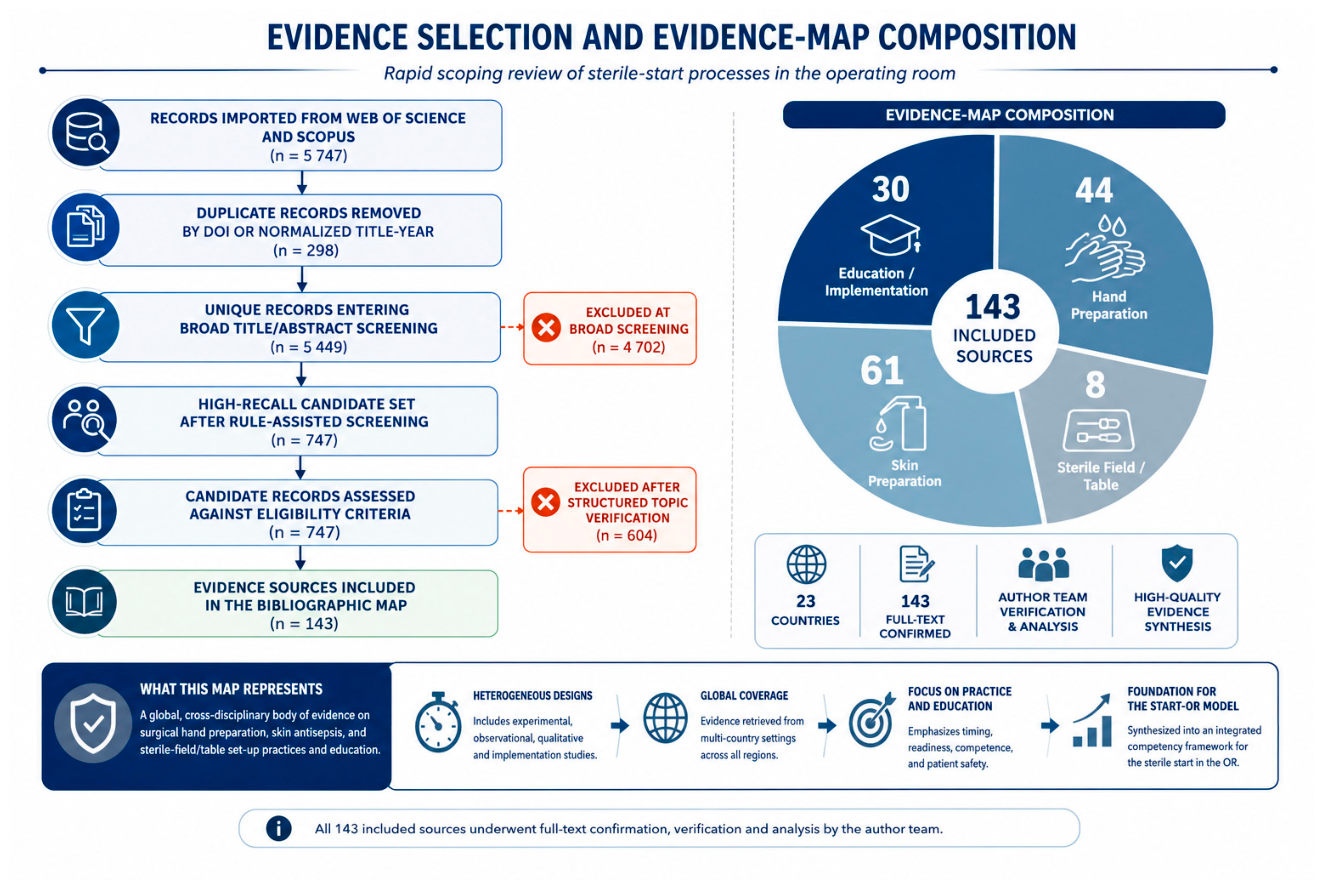
Figure 2.
Distribution of included evidence by period and domain. Stacked bars show the number of sources in each domain and publication period. The figure depicts growth of the evidence base but does not imply improved methodological quality over time [33,34,35,36,37,38,39,40,41,42,43,44,45,46,47,48,49,50,51,52,53,54,55,56,57,58,59,60,61,62,63,64,65,66,67,68,69,70,71,72,73,74,75,76,77,78,79,80,81,82,83,84,85,86,87,88,89,90,91,92,93,94,95,96,97,98,99,100,101,102,103,104,105,106,107,108,109,110,111,112,113,114,115,116,117,118,119,120,121,122,123,124,125,126,127,128,129,130,131,132,133,134,135,136,137,138,139,140,141,142,143,144,145,146,147,148,149,150,151,152,153,154,155,156,157,158,159,160,161,162,163,164,165,166,167,168,169,170,171,172,173,174,175].
Figure 2.
Distribution of included evidence by period and domain. Stacked bars show the number of sources in each domain and publication period. The figure depicts growth of the evidence base but does not imply improved methodological quality over time [33,34,35,36,37,38,39,40,41,42,43,44,45,46,47,48,49,50,51,52,53,54,55,56,57,58,59,60,61,62,63,64,65,66,67,68,69,70,71,72,73,74,75,76,77,78,79,80,81,82,83,84,85,86,87,88,89,90,91,92,93,94,95,96,97,98,99,100,101,102,103,104,105,106,107,108,109,110,111,112,113,114,115,116,117,118,119,120,121,122,123,124,125,126,127,128,129,130,131,132,133,134,135,136,137,138,139,140,141,142,143,144,145,146,147,148,149,150,151,152,153,154,155,156,157,158,159,160,161,162,163,164,165,166,167,168,169,170,171,172,173,174,175].
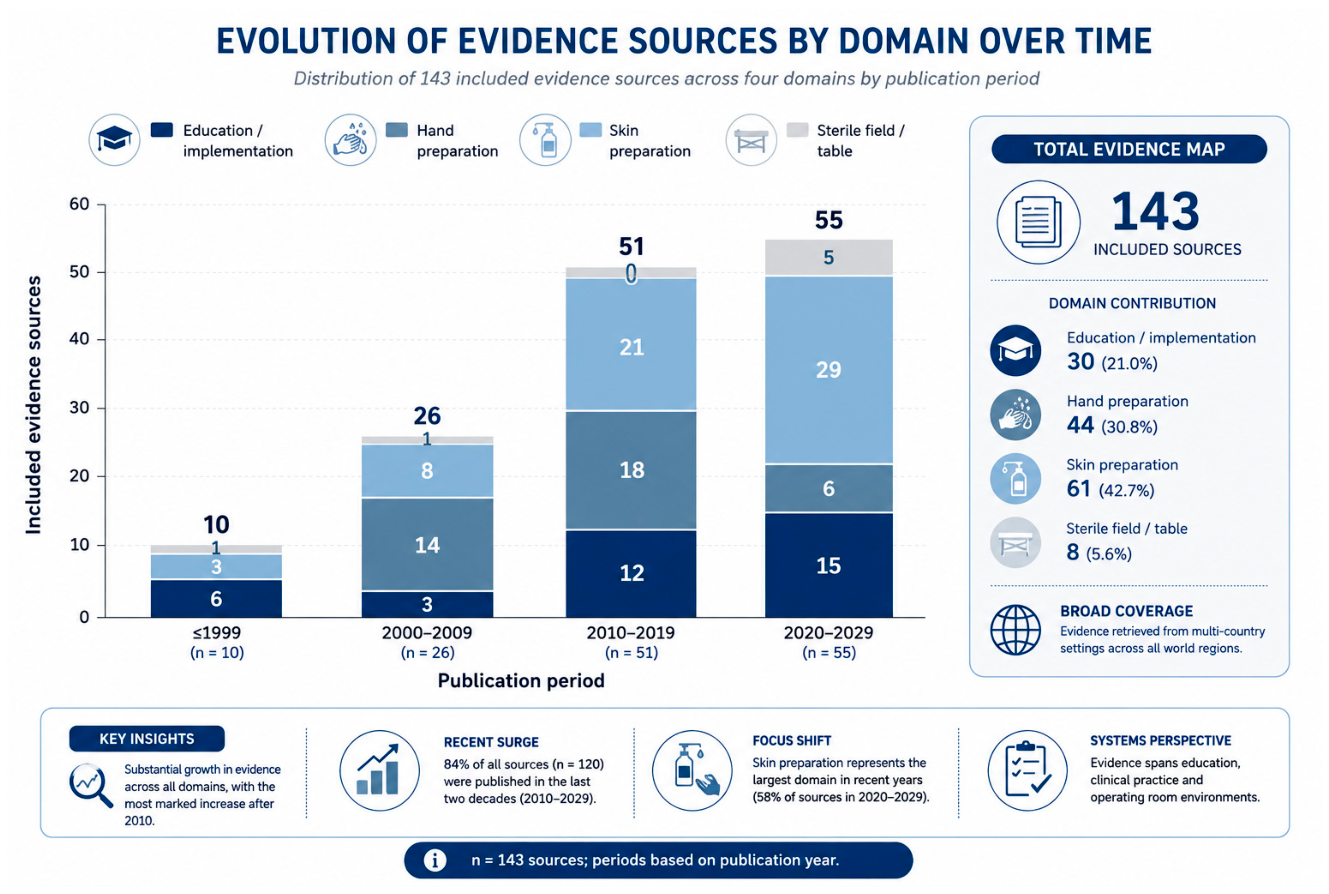
Figure 3.
START-OR clock model for the sterile start. The H, P and F clocks represent team/hand preparation, patient/skin preparation and sterile-field set-up. H0–H2, P0–P2 and F0–F2 are observable process states, not universal minute thresholds. The clocks converge at a voiced sterile-start readiness pause; Gates 1–5 govern progression to the sterile start, Gate 6 governs delay/event response and revalidation, and Gate 7 closes the learning loop through debriefing and improvement. F2 is a risk-reduction principle whose application must be reconciled with local workflow, product instructions and specialty needs. START-OR is proposed for education and quality improvement and has not yet been clinically validated [1,3,5,8,15,29,30,63,64,65,66,67,68,69,70,71,72,73,74,75,76,77,78,79,80,81,82,83,84,85,86,87,88,89,90,91,92,93,94,95,96,97,98,99,100,101,102,103,104,105,106,107,108,109,110,111,112,113,114,115,116,117,118,119,120,121,122,123,124,125,126,127,128,129,130,131,132,133,134,135,136,137,138,139,140,141,142,143,144,145,146,147,148,149,150,151,152,153,154,155,156,157,158,159,160,161,162,163,164,165,166,167,168,169,170,171,172,173,174,175].
Figure 3.
START-OR clock model for the sterile start. The H, P and F clocks represent team/hand preparation, patient/skin preparation and sterile-field set-up. H0–H2, P0–P2 and F0–F2 are observable process states, not universal minute thresholds. The clocks converge at a voiced sterile-start readiness pause; Gates 1–5 govern progression to the sterile start, Gate 6 governs delay/event response and revalidation, and Gate 7 closes the learning loop through debriefing and improvement. F2 is a risk-reduction principle whose application must be reconciled with local workflow, product instructions and specialty needs. START-OR is proposed for education and quality improvement and has not yet been clinically validated [1,3,5,8,15,29,30,63,64,65,66,67,68,69,70,71,72,73,74,75,76,77,78,79,80,81,82,83,84,85,86,87,88,89,90,91,92,93,94,95,96,97,98,99,100,101,102,103,104,105,106,107,108,109,110,111,112,113,114,115,116,117,118,119,120,121,122,123,124,125,126,127,128,129,130,131,132,133,134,135,136,137,138,139,140,141,142,143,144,145,146,147,148,149,150,151,152,153,154,155,156,157,158,159,160,161,162,163,164,165,166,167,168,169,170,171,172,173,174,175].
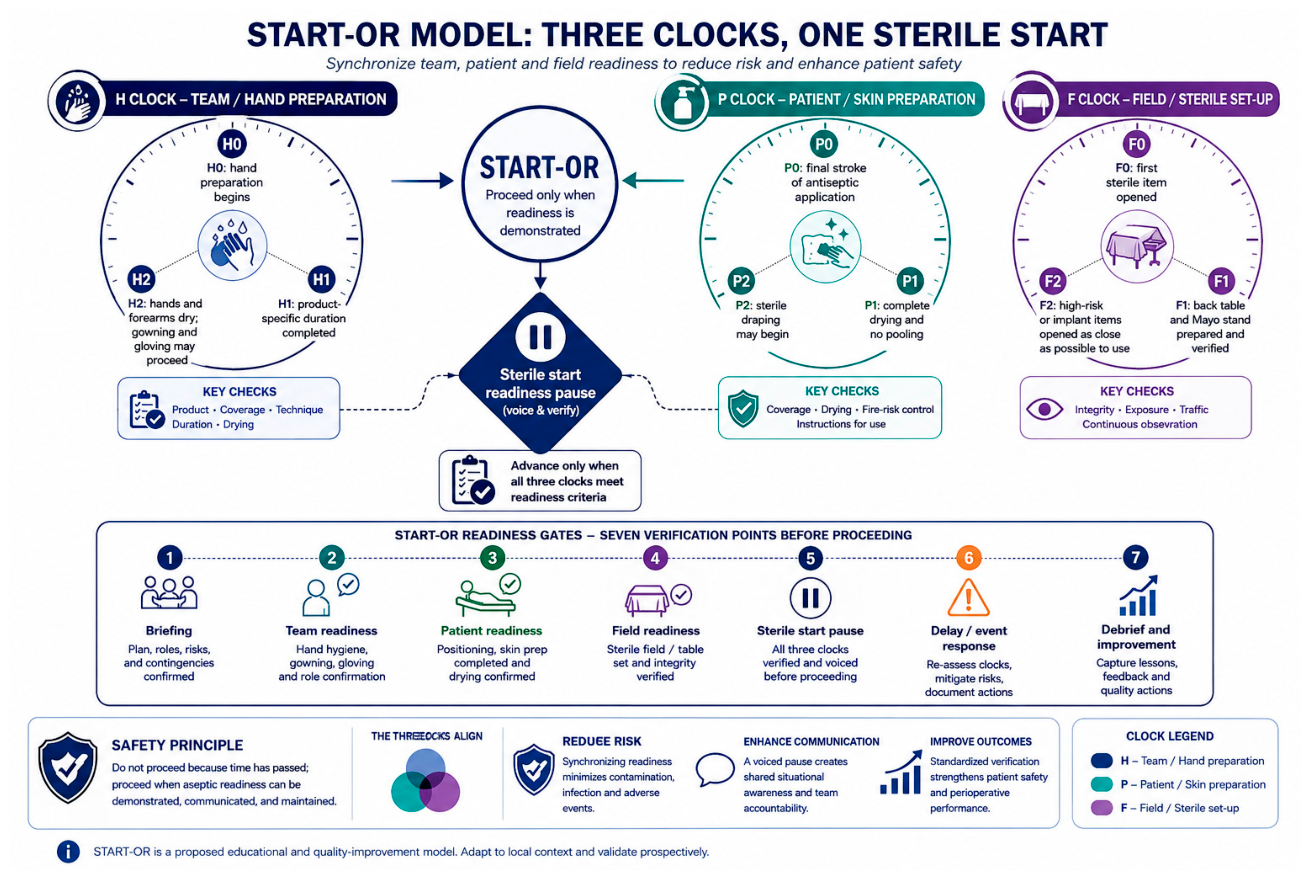
Figure 4.
START-OR education-to-practice cycle. The six stages connect curriculum design to workplace improvement. IFU, instructions for use; UV, ultraviolet visualization. The cycle should repeat when products, policies, roles or specialty contexts change [8,9,10,11,12,13,14,15,27,28,29,30,33,34,35,36,37,38,39,40,41,42,43,44,45,46,47,48,49,50,51,52,53,54,55,56,57,58,59,60,61,62].
Figure 4.
START-OR education-to-practice cycle. The six stages connect curriculum design to workplace improvement. IFU, instructions for use; UV, ultraviolet visualization. The cycle should repeat when products, policies, roles or specialty contexts change [8,9,10,11,12,13,14,15,27,28,29,30,33,34,35,36,37,38,39,40,41,42,43,44,45,46,47,48,49,50,51,52,53,54,55,56,57,58,59,60,61,62].
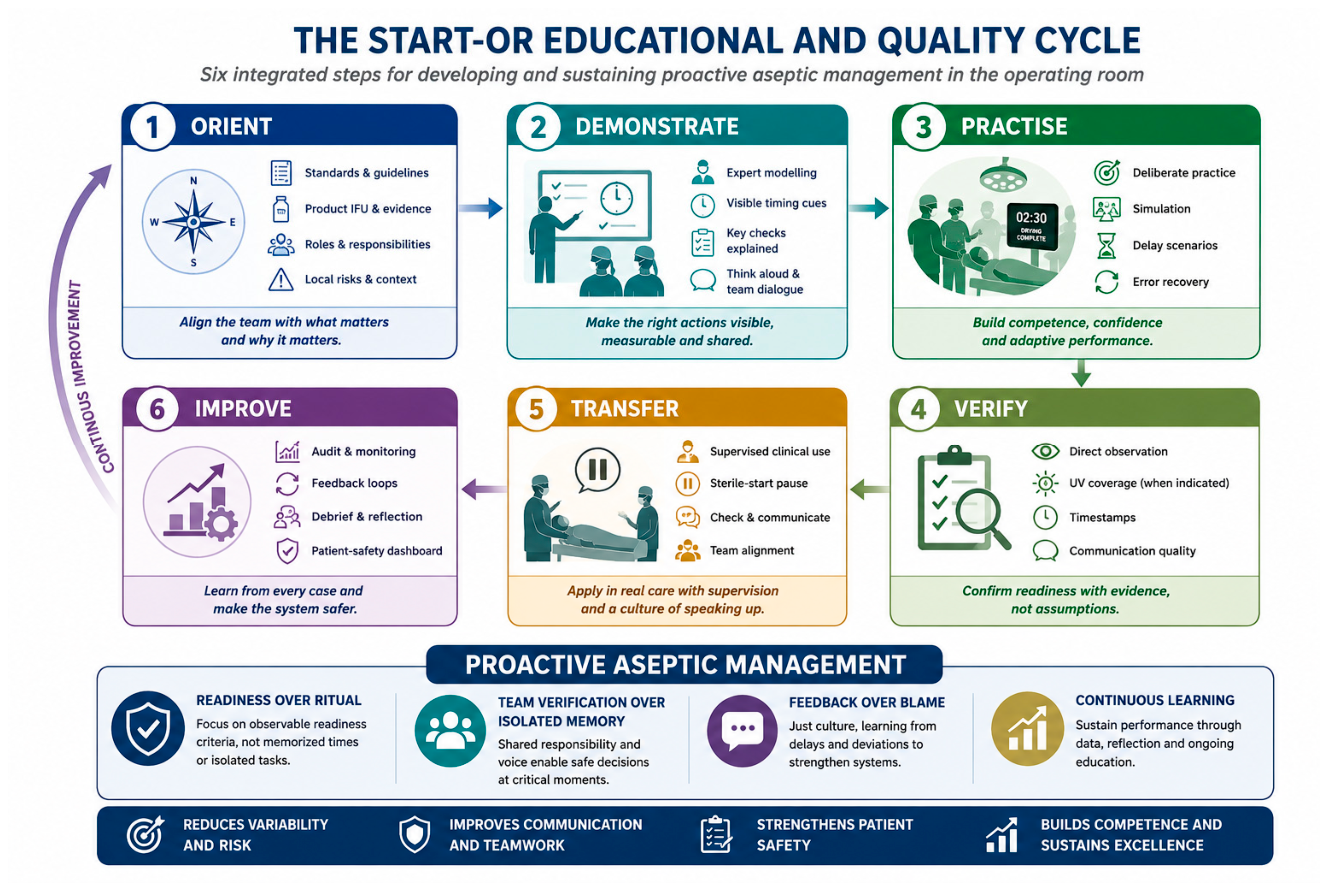

Table 1.
Eligibility criteria.
| PCC element | Included | Excluded | Rationale |
| Population | Medical, nursing and surgical-technology students; residents; surgeons; perioperative nurses; instrument/scrub personnel; anaesthesia and support staff when participating in the sterile start. | Veterinary-only populations; dental-only settings; patients without a perioperative-team or sterile-start component. | The journal focus requires relevance to healthcare-professional learning or performance. |
| Concept | Timing, duration, coverage, drying, readiness, compliance, teaching, simulation, feedback, assessment, implementation, contamination or infection outcomes for hand preparation, skin preparation-to-draping/incision, or sterile-field/table set-up. | Instrument reprocessing without a sterile-start link; unrelated transplantation bench time; general hand hygiene without surgical preparation; antisepsis outside operative/procedural care. | The concept joins clinical evidence with teachable and observable competencies. |
| Context | Operating rooms, procedure rooms, simulation, skills laboratories, perioperative education and quality-improvement programmes in any country or surgical specialty. | Non-healthcare environments and purely industrial or veterinary contexts. | Broad context supports global mapping and specialty comparison. |
| Evidence type | Primary studies, systematic or integrative reviews, protocols with relevant methods, educational interventions, audits, qualitative studies and implementation/guidance papers. | Editorials without substantive methods or data; duplicate publications; records lacking sufficient topical information. | Scoping reviews map breadth rather than restrict by a single design. |
| Language/date | All indexed languages and all publication years available in the source exports. | No exclusion solely by date; language limitations were imposed only by indexed metadata availability. | Reduces avoidable temporal and language restriction. |
Table 2.
Search and selection summary.
| Stage | n | Audit note |
| Imported records | 5747 | Web of Science 5095; Scopus 652 |
| Duplicate records removed | 298 | Normalized DOI or title–year |
| Unique records | 5449 | Entered broad title/abstract screening |
| Excluded at broad screening | 4702 | No defensible sterile-start relevance |
| High-recall candidates | 747 | Rule-assisted retrieval followed by author-team eligibility verification |
| Excluded after structured verification | 604 | Unrelated process, duplicate version, veterinary or insufficient topical information |
| Included evidence sources | 143 | All 143 full texts confirmed and analysed; 30 education/implementation; 44 hand; 61 skin; 8 field/table |
Table 3.
Characteristics of included evidence.
| Dimension | Category | n (%) |
| Primary domain | Patient skin preparation | 61 (42.7%) |
| Primary domain | Surgical hand preparation | 44 (30.8%) |
| Primary domain | Education, assessment and implementation | 30 (21.0%) |
| Primary domain | Sterile field/table and environment | 8 (5.6%) |
| Design group | Randomized/controlled comparative study | 44 (30.8%) |
| Design group | Laboratory/experimental efficacy study | 34 (23.8%) |
| Design group | Audit/observational/qualitative study | 22 (15.4%) |
| Design group | Systematic review/meta-analysis | 15 (10.5%) |
| Design group | Other primary study | 13 (9.1%) |
| Design group | Educational intervention/simulation | 6 (4.2%) |
| Design group | Protocol | 5 (3.5%) |
| Design group | Narrative review/guidance | 4 (2.8%) |
| Specialty | Mixed/unspecified perioperative setting | 77 (53.8%) |
| Specialty | Orthopedics, trauma and spine | 27 (18.9%) |
| Specialty | General and abdominal surgery | 20 (14.0%) |
| Specialty | Obstetrics and gynecology | 11 (7.7%) |
| Specialty | Cardiac and vascular surgery | 6 (4.2%) |
| Specialty | Pediatric surgery | 1 (0.7%) |
| Specialty | Ophthalmic surgery | 1 (0.7%) |
| First indexed affiliation | Europe | 42 (29.4%) |
| First indexed affiliation | North America | 44 (30.8%) |
| First indexed affiliation | Asia | 36 (25.2%) |
| First indexed affiliation | Oceania | 5 (3.5%) |
| First indexed affiliation | Africa | 4 (2.8%) |
| First indexed affiliation | Latin America and the Caribbean | 4 (2.8%) |
| First indexed affiliation | Other/unclear | 7 (4.9%) |
| First indexed affiliation | Unreported/unclear | 1 (0.7%) |
Percentages use 143 as the denominator. Affiliation region is an authorship-geography descriptor and is not equivalent to the study setting [33,34,35,36,37,38,39,40,41,42,43,44,45,46,47,48,49,50,51,52,53,54,55,56,57,58,59,60,61,62,63,64,65,66,67,68,69,70,71,72,73,74,75,76,77,78,79,80,81,82,83,84,85,86,87,88,89,90,91,92,93,94,95,96,97,98,99,100,101,102,103,104,105,106,107,108,109,110,111,112,113,114,115,116,117,118,119,120,121,122,123,124,125,126,127,128,129,130,131,132,133,134,135,136,137,138,139,140,141,142,143,144,145,146,147,148,149,150,151,152,153,154,155,156,157,158,159,160,161,162,163,164,165,166,167,168,169,170,171,172,173,174,175].
Table 4.
Educational findings and outcome gaps.
| Competency area | Teaching approaches | Assessment options | Synthesis | Evidence |
| Knowledge and cognitive framing | Guidelines, product instructions, online resources, case-based comparison | Knowledge tests; explanation of why duration, coverage and drying vary | Knowledge was often incomplete or disconnected from observed technique | [33,34,35,36,37,38,39,40,41,42,43,44,45,46,47,48,49,50,51,52] |
| Psychomotor technique | Expert demonstration, deliberate practice, UV/fluorescent visualization, VR and simulation | Direct observation; coverage maps; critical-step checklist; timed sequence | Visual feedback exposed missed areas that duration alone could not detect | [33,34,35,36,37,38,39,40,41,42,53,54,55,56,57,58,59,60,61,62] |
| Behaviour and transfer | Clinical audit, remote video, reminders, coaching and repeated feedback | Compliance in real practice; response to delays; escalation behaviour | Improvement required ongoing monitoring and organizational support | [43,44,45,46,47,48,49,50,51,52,53,54,55,56,57,58,59,60,61,62] |
| Team and system | Role clarification, floor marking, table-covering policy, debrief and safety culture | Shared pause; closed-loop communication; environmental placement | Responsibility was distributed across professions and the environment | [43,44,45,46,47,48,49,50,51,52,53,54,55,56,57,58,59,60,61,62] |
| Outcome gap | Most programmes measured technique or compliance | Link education to contamination, delay, waste and patient outcomes | Few studies followed learners from simulation to durable clinical outcomes | [33,34,35,36,37,38,39,40,41,42,43,44,45,46,47,48,49,50,51,52,53,54,55,56,57,58,59,60,61,62] |
Table 5.
Timing evidence and readiness rules.
| Process | Evidence synthesis | Proposed operational rule | What should not be taught | Evidence |
| Surgical hand preparation | Products, methods and efficacy tests differed; shorter validated regimens sometimes performed similarly to longer traditional scrubs. | Complete prerequisites, product-specified amount and duration, systematic hand/forearm coverage, then complete drying before gowning/gloving. | Do not teach one universal scrub time or equate elapsed time with complete technique. | [63,64,65,66,67,68,69,70,71,72,73,74,75,76,77,78,79,80,81,82,83,84,85,86,87,88,89,90,91,92,93,94,95,96,97,98,99,100,101,102,103,104,105,106] |
| Skin antisepsis to draping | Agent, concentration, site, volume and specialty modified outcomes; drying was a recurrent safety endpoint. | Record the last application stroke; proceed only after visible dryness, no pooling and controlled alcohol-fire risk. | Do not use an arbitrary universal waiting minute detached from the product and clinical context. | [107,108,109,110,111,112,113,114,115,116,117,118,119,120,121,122,123,124,125,126,127,128,129,130,131,132,133,134,135,136,137,138,139,140,141,142,143,144,145,146,147,148,149,150,151,152,153,154,155,156,157,158,159,160,161,162,163,164,165,166,167] |
| Sterile table and field | Contamination was influenced by exposure, activity, covering, airflow and item-introduction method. | Open as near as feasible to use; protect during non-use; monitor continuously; revalidate after delay or traffic disruption. | Do not infer an evidence-based universal open-table time from the limited heterogeneous studies. | [168,169,170,171,172,173,174,175] |
| Interfaces | Delays can leave one clock complete while another remains unready. | Use a voiced sterile-start pause and a stop rule when any clock is incomplete or uncertain. | Do not allow schedule pressure or hierarchy to substitute for readiness verification. | [1,5,8,15,29,30,33,34,35,36,37,38,39,40,41,42,43,44,45,46,47,48,49,50,51,52,53,54,55,56,57,58,59,60,61,62,63,64,65,66,67,68,69,70,71,72,73,74,75,76,77,78,79,80,81,82,83,84,85,86,87,88,89,90,91,92,93,94,95,96,97,98,99,100,101,102,103,104,105,106,107,108,109,110,111,112,113,114,115,116,117,118,119,120,121,122,123,124,125,126,127,128,129,130,131,132,133,134,135,136,137,138,139,140,141,142,143,144,145,146,147,148,149,150,151,152,153,154,155,156,157,158,159,160,161,162,163,164,165,166,167,168,169,170,171,172,173,174,175] |
Rules are evidence-informed educational recommendations and must be reconciled with the product instructions for use, fire-safety policy and institutional standards [1,2,3,5,63,64,65,66,67,68,69,70,71,72,73,74,75,76,77,78,79,80,81,82,83,84,85,86,87,88,89,90,91,92,93,94,95,96,97,98,99,100,101,102,103,104,105,106,107,108,109,110,111,112,113,114,115,116,117,118,119,120,121,122,123,124,125,126,127,128,129,130,131,132,133,134,135,136,137,138,139,140,141,142,143,144,145,146,147,148,149,150,151,152,153,154,155,156,157,158,159,160,161,162,163,164,165,166,167,168,169,170,171,172,173,174,175].
Table 6.
Specialty-specific teaching modifiers.
| Setting | Risk modifiers | Curriculum adaptation | Assessment emphasis | Evidence |
| Orthopaedics, trauma and spine | Implants, prolonged procedures, large or difficult-to-visualize preparation areas, high consequence of contamination. | Use full-limb or spine simulation, UV coverage checks, implant-item opening near use and delay revalidation. | Coverage completeness, instrument exposure and response to prolonged cases. | [59,62,102,115,116,117,118,119,120,121,122,123,124,125,126,127,134,135,136,137,141,142,143,144,145,146,147,152,153,154,155,156,157,158,159,160,161,170,171,172,173] |
| General and abdominal surgery | Clean-contaminated procedures, broad preparation fields, variable agents and workflow. | Teach site boundaries, product selection rationale, drying and bundle integration. | Protocol fidelity and handoff from preparation to draping. | [98,107,108,109,110,111,112,113,114,129,130,143,144,145,146,147,148,155,156,157,158,159,160] |
| Obstetrics and gynaecology | Emergency time pressure, caesarean readiness, variable skin and incision contexts. | Simulate urgent starts with covered tables, explicit drying confirmation and no-bypass stop rules. | Maintaining readiness under urgency without premature draping or uncontrolled table exposure. | [51,125,126,127,128,129,130,131,132,133,134,135,136,149,175] |
| Cardiac and vascular surgery | Long procedures, groin fields, multiple teams and high consequence of infection. | Add shared role assignment, groin-coverage checks, field traffic control and revalidation during prolonged cases. | Team clock synchronization and environmental discipline. | [49,140,141,162,165,174] |
| Paediatric or ophthalmic surgery | Smaller fields, age-specific skin considerations, high-throughput workflow in some settings. | Adapt product, volume and exposure while retaining the same readiness gates. | Avoiding reduced standards because the field or procedure appears smaller. | [66,153] |
| Mixed or resource-constrained settings | Water, infrastructure, staffing, product availability and local policy vary. | Teach principles that travel—validated IFU, coverage, drying, protected field and escalation—then localize the workflow. | Equity, feasibility and responsible adaptation without inventing unsupported shortcuts. | [33,34,35,36,37,38,39,40,41,42,43,44,45,46,47,48,49,50,51,52,53,54,55,56,57,58,59,60,61,62,63,64,65,66,67,68,69,70,71,72,73,74,75,76,77,78,79,80,81,82,83,84,85,86,87,88,89,90,91,92,93,94,95,96,97,98,99,100,101,102,103,104,105,106,107,108,109,110,111,112,113,114,115,116,117,118,119,120,121,122,123,124,125,126,127,128,129,130,131,132,133,134,135,136,137,138,139,140,141,142,143,144,145,146,147,148,149,150,151,152,153,154,155,156,157,158,159,160,161,162,163,164,165,166,167] |
Specialty modifies scenarios and emphasis, but it does not remove the core readiness criteria. IFU, instructions for use [33,34,35,36,37,38,39,40,41,42,43,44,45,46,47,48,49,50,51,52,53,54,55,56,57,58,59,60,61,62,63,64,65,66,67,68,69,70,71,72,73,74,75,76,77,78,79,80,81,82,83,84,85,86,87,88,89,90,91,92,93,94,95,96,97,98,99,100,101,102,103,104,105,106,107,108,109,110,111,112,113,114,115,116,117,118,119,120,121,122,123,124,125,126,127,128,129,130,131,132,133,134,135,136,137,138,139,140,141,142,143,144,145,146,147,148,149,150,151,152,153,154,155,156,157,158,159,160,161,162,163,164,165,166,167,168,169,170,171,172,173,174,175].
Table 7.
START-OR readiness gates.
| Gate | Trigger | Required team action | Observable evidence | Stop rule |
| 1. Brief and classify | Before preparation starts | Identify specialty risks, urgency, implant use, alcohol/fire considerations, expected delays, product IFU and role ownership. | Brief completed; roles named; required products and equipment present. | Do not start opening or applying products when critical resources or roles are unresolved. |
| 2. Team readiness | Before gowning/gloving | Verify prerequisites, complete hand/forearm coverage for the specified duration, then dry completely. | H1 and H2 visibly confirmed; deviation voiced. | Repeat or correct when coverage, duration, contamination or drying is uncertain. |
| 3. Patient readiness | Before draping | Verify anatomical coverage, final application point, visible dryness, no pooling and controlled fire risk. | P1 confirmed by the responsible preparer and acknowledged by the team. | Do not drape or activate ignition sources while wetness or pooling remains. |
| 4. Field readiness | Before sterile use | Confirm table integrity, monitoring responsibility, traffic control, item introduction and high-risk item timing. | F1 confirmed; breaches absent; delayed items planned. | Replace or re-establish the field after a breach or unresolved contamination. |
| 5. Sterile-start pause | Immediately before draping/incision according to workflow | Voice H2, P1/P2 and F1 status; confirm concerns and permission to proceed. | Closed-loop confirmation from designated team members. | Any team member may stop progression when a clock is incomplete. |
| 6. Delay and event response | Whenever workflow stops or conditions change | Protect the field, reassess drying/coverage, monitor traffic, document the delay and decide whether re-preparation is needed. | Revalidation documented and voiced before restart. | No automatic continuation after an unobserved or uncontrolled delay. |
| 7. Debrief and improve | After the case or audit cycle | Record deviations, waste, contamination signals, near misses and learning needs; provide non-punitive feedback. | Dashboard entry and assigned improvement action. | Do not normalize repeated workarounds without review. |
START-OR is proposed for education and quality improvement. Local implementation requires governance, product-specific validation and prospective evaluation [1,3,5,8,15,29,30,33,34,35,36,37,38,39,40,41,42,43,44,45,46,47,48,49,50,51,52,53,54,55,56,57,58,59,60,61,62,63,64,65,66,67,68,69,70,71,72,73,74,75,76,77,78,79,80,81,82,83,84,85,86,87,88,89,90,91,92,93,94,95,96,97,98,99,100,101,102,103,104,105,106,107,108,109,110,111,112,113,114,115,116,117,118,119,120,121,122,123,124,125,126,127,128,129,130,131,132,133,134,135,136,137,138,139,140,141,142,143,144,145,146,147,148,149,150,151,152,153,154,155,156,157,158,159,160,161,162,163,164,165,166,167,168,169,170,171,172,173,174,175].
Table 8.
Proposed START-OR assessment bundle.
| Competency | Learning method | Assessment | Proposed pass principle |
| Knowledge and justification | Interactive seminar; product and case comparison | Short-answer or script-concordance questions explaining product, duration, drying, covering and stop rules. | Correct rationale for all critical transitions; misconceptions remediated before practice. |
| Coverage and psychomotor skill | Demonstration plus deliberate practice | Direct-observation checklist; UV/fluorescent coverage for hands or simulated skin; contamination tracers for item introduction. | All critical anatomical areas covered and no critical breach. |
| Timing and readiness judgement | Timed simulation with variable products and environmental conditions | Timestamp log plus explanation of why the learner proceeded or waited. | Product-specific timing respected and progression based on observable readiness. |
| Team communication | Interprofessional simulation and TeamSTEPPS tools | Closed-loop call-out of H2, P1/P2 and F1; escalation of wetness, pooling, breach or delay. | Concern voiced and acknowledged without prompting. |
| Delay management | Unexpected delay, staff change, traffic or contamination scenario | Decision record: protect, observe, revalidate, re-prepare or discard. | Action matches local policy and uncertainty triggers a stop. |
| Workplace transfer | Supervised cases and mini-CEX style observation | Repeated observations across specialties and shifts. | Stable performance across more than one context; feedback acted upon. |
| System improvement | Audit and debrief dashboard | Compliance, delay, waste, near miss, contamination signal and corrective-action review. | Trends reviewed by the perioperative education and safety team. |
Table 9.
Research priorities for sterile-start education.
| Priority | Question | Preferred design | Core outcomes |
| Model validation | Do START-OR gates demonstrate content validity, feasibility, inter-rater reliability and predictive validity? | Delphi plus multicentre simulation and prospective cohort. | Gate completion, reliability, delays, near misses, contamination signals and unintended consequences. |
| Educational effectiveness | Does the six-stage curriculum improve knowledge, coverage, judgement, communication and workplace transfer? | Cluster-randomized or stepped-wedge education trial. | Immediate learning, retained skill, workplace behaviour and patient/organizational outcomes. |
| Delay management | Which delay duration and environmental conditions require protection, revalidation or replacement in different field configurations? | Controlled environmental experiments plus observational clinical study. | Air and surface bioburden, field integrity, traffic, cover method and decision accuracy. |
| Product-specific timing | Which validated timings remain effective under real-world volume, technique and repeated-case conditions? | Pragmatic comparative study stratified by product and specialty. | Coverage, bacterial reduction, skin tolerance, water use, cost and SSI where feasible. |
| Equity and global adaptation | How do resources, roles, infrastructure and culture alter implementation? | Mixed-methods studies in underrepresented regions and resource settings. | Feasibility, acceptability, fidelity, adaptation, cost and safety equity. |
| Reporting quality | Can interventions and searches be replicated? | Use PRISMA-ScR/PRISMA-S, TIDieR and a medical-education quality instrument. | Complete search syntax, intervention dose, assessor training, missing data and protocol deviations. |
SSI, surgical-site infection. Research should pre-specify which outcomes are educational, behavioural, environmental and clinical [16,17,18,19,20,21,23,24,25,26,33,34,35,36,37,38,39,40,41,42,43,44,45,46,47,48,49,50,51,52,53,54,55,56,57,58,59,60,61,62,63,64,65,66,67,68,69,70,71,72,73,74,75,76,77,78,79,80,81,82,83,84,85,86,87,88,89,90,91,92,93,94,95,96,97,98,99,100,101,102,103,104,105,106,107,108,109,110,111,112,113,114,115,116,117,118,119,120,121,122,123,124,125,126,127,128,129,130,131,132,133,134,135,136,137,138,139,140,141,142,143,144,145,146,147,148,149,150,151,152,153,154,155,156,157,158,159,160,161,162,163,164,165,166,167,168,169,170,171,172,173,174,175].
Disclaimer/Publisher’s Note: The statements, opinions and data contained in all publications are solely those of the individual author(s) and contributor(s) and not of MDPI and/or the editor(s). MDPI and/or the editor(s) disclaim responsibility for any injury to people or property resulting from any ideas, methods, instructions or products referred to in the content. |
© 2026 by the authors. Licensee MDPI, Basel, Switzerland. This article is an open access article distributed under the terms and conditions of the Creative Commons Attribution (CC BY) license (http://creativecommons.org/licenses/by/4.0/).
Copyright: This open access article is published under a Creative Commons CC BY 4.0 license, which permit the free download, distribution, and reuse, provided that the author and preprint are cited in any reuse.