

Submitted:
08 August 2026
Posted:
10 August 2026
You are already at the latest version
Abstract
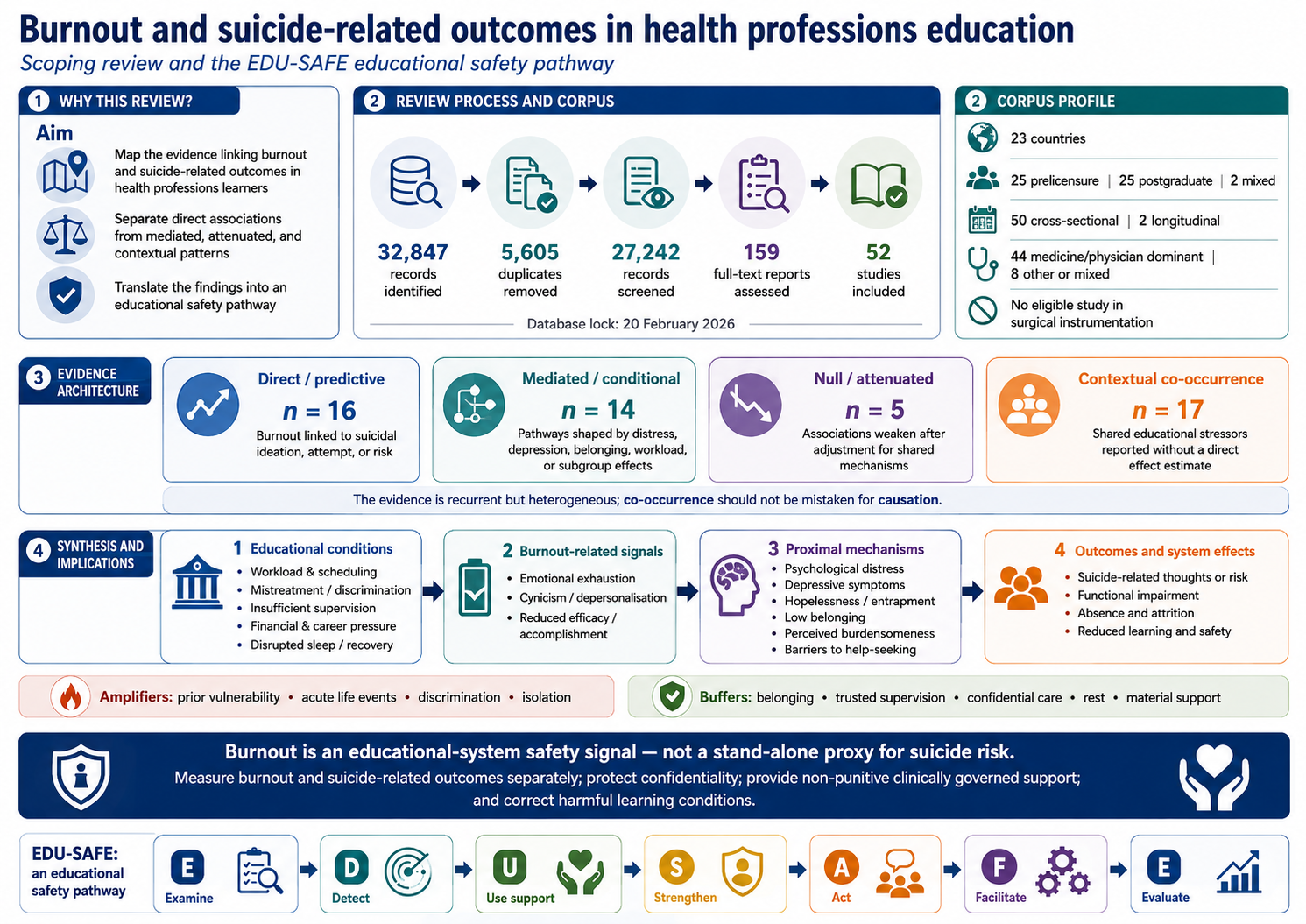
Background: Burnout and suicide-related outcomes are major concerns in health professions education, but the relationship between them has been studied across heterogeneous professions, training stages, measures and educational settings. This scoping review mapped the extent and architecture of the evidence, distinguished direct associations from mediated, conditional and contextual pathways, and translated the findings into an educational safety pathway.The synthesis used four analytically distinct evidence lanes: (1) direct or predictive associations between burnout and suicide-related outcomes; (2) mediated, moderated or dimension-specific pathways; (3) null or attenuated associations after adjustment; and (4) co-occurrence or shared educational determinants without a direct effect estimate. This architecture prevented co-occurrence from being misrepresented as causation and maintained separation between burnout, psychological distress and suicide-related constructs. Owing to substantial heterogeneity in populations, measures, cut-points and effect metrics, statistical pooling was not undertaken.The searches identified 32,847 records. After removal of 5,605 duplicates, 27,242 unique records were screened; 533 progressed to detailed eligibility assessment and 159 reports were assessed in full text. Of these, 52 studies met the eligibility criteria. The final selection process and reasons for exclusion are shown in Fig. 1.Conclusions: Burnout should be treated as an educational-system safety signal, not as a stand-alone proxy for suicide risk. Health professions programmes should measure the constructs separately, protect confidentiality, provide non-punitive clinically governed support, and correct harmful conditions in learning environments. EDU-SAFE offers an implementation-ready framework for institutional adaptation and prospective evaluation.
Keywords:
burnout
; health professions education
; medical education
; clinical training
; student wellbeing
; suicide-related outcomes
; educational safety
; scoping review
Background
Burnout is commonly conceptualized through exhaustion, cynicism or depersonalization, and reduced efficacy or accomplishment. In health professions education, these dimensions arise within systems that combine intensive study, clinical responsibility, professional socialization, assessment dependence and repeated exposure to high-stakes environments. Burnout therefore reflects both learner experience and the organisation of training rather than an exclusively individual deficit [1].
Meta-analytic evidence indicates an overall association between burnout and suicidal ideation, but the magnitude varies by population, measure and analytic approach. A recent synthesis of medical and non-medical professionals also suggested that the association is not uniquely stronger in medicine, cautioning against professional exceptionalism and simplistic causal narratives [2,3].
Learner studies nevertheless identify an educationally important signal. In a multi-institutional medical-student cohort, burnout predicted later suicidal ideation and recovery from burnout accompanied lower subsequent risk; among Dutch residents, suicidal thoughts were substantially more frequent in those with burnout. These findings support temporal and cross-sectional links while leaving room for depression, belonging, workload and other mechanisms [4,5].
Translation into educational policy is difficult because studies span classroom, clinical-placement, internship, residency and fellowship contexts; use different burnout and suicide-related measures; and often assess depression, anxiety, mistreatment, financial strain or social support in parallel. The same observed association can therefore represent a direct relationship, a mediated pathway, shared upstream determinants or statistical attenuation after adjustment [2,3,4,5].
A further gap concerns professional coverage. Evidence is concentrated in medicine and physician training, whereas surgical instrumentation, perioperative allied-health education and several other professions remain minimally represented despite demanding clinical transitions. Educational journals therefore need syntheses that distinguish individual-level distress from modifiable programme and learning-environment conditions [6,7,8,9,10,11,12].
This scoping review asked what is known about burnout and suicide-related outcomes among health-professions learners, how individual, relational and educational-system mechanisms shape the relationship, and how education programmes can convert the evidence into a transparent safety process. The objectives were to map populations, stages, measures and findings; distinguish direct, mediated, attenuated and contextual patterns; identify professional and geographic gaps; and propose a synthesis-derived educational safety pathway [6,7,8,9,10,11,12].
Methods
Design and Reporting Framework
A rapid scoping-review design was chosen because the purpose was to map the breadth, architecture and explanatory patterns of a heterogeneous evidence base rather than estimate a single pooled effect. Conduct was informed by the Arksey-O'Malley framework, Levac and colleagues' refinements, and updated JBI guidance; reporting followed PRISMA-ScR and search documentation was informed by PRISMA-S [6,7,8,9,10,11].
Rapid-review adaptations were specified rather than concealed. One reviewer completed primary screening and charting, automation was used to prioritize a very large corpus, and evidence was synthesised from exported full-text reports. The review was not prospectively registered; a dated methods and search record is provided in Additional file 1 [10,11,12].
Eligibility Criteria
After automated and manual deduplication, 27,242 unique records underwent title-and-abstract screening. A sensitivity-oriented prioritisation stage retained 533 records for detailed eligibility assessment, of which 159 reports were retrieved and examined in full text. Eligibility was confirmed article-by-article against the prespecified population–concept–context framework. Reasons for full-text exclusion were recorded using mutually exclusive primary categories. All full-text decisions, data-charting fields and citation details were reconciled within the review team, and the final database was locked on 20 February 2026. No report remained awaiting classification.
Eligibility was structured using Population-Concept-Context. The population comprised undergraduate and postgraduate learners in health professions, including students, interns, residents, fellows and allied-health trainees. Eligible sources had to measure or explicitly analyse both burnout, academic burnout or a core burnout dimension and suicidal ideation, suicidal thoughts or a validated suicide-risk construct. Classroom, preclinical, clinical-placement, internship, residency and fellowship settings were eligible. Primary quantitative, qualitative and mixed-method studies were considered; reviews, editorials, protocols, non-learner samples without separable data and records that mentioned either construct only as background were excluded [6,9,10].

Table 1.
PCC framework and operational eligibility criteria.
| Element | Included | Excluded |
|---|---|---|
| Population | Students, interns, residents, fellows and trainees enrolled in a health profession | Practising professionals without separable learner data; school pupils outside health-professions education |
| Concept | Measured burnout or a core dimension together with a suicide-related outcome | Stress, depression or wellness alone; burnout or suicide-related outcomes mentioned only in background |
| Context | Preclinical, clinical placement, internship, residency, fellowship and related educational settings | Non-educational occupational settings without a trainee subgroup |
| Evidence type | Primary quantitative, qualitative or mixed-method research | Reviews, editorials, commentaries, protocols, conference notices and duplicate reports |
| Outcome use | Direct association, mediation, dimension-specific analysis, null/attenuated result or informative co-occurrence | No extractable information on either construct |
Information Sources and Search Strategy
Scopus and Web of Science Core Collection were treated as the primary discovery databases, with ScienceDirect used as a supplementary source. Searches covered database inception to 4 August 2026 and combined variants for four concept blocks: burnout; suicide-related outcomes; learners or trainees; and health professions. No year or language restriction was applied at retrieval. Platform-specific strategies are reproduced in Additional file 1 [10,11].
The supplied archive contained a PubMed timeline file rather than article-level PubMed records. PubMed was therefore used for targeted bibliographic and abstract verification but was not added as a separately countable identification source. A valid article-level PubMed update using the translated strategy remains required during final database closure on 20 February 2026; this limitation is reported explicitly rather than disguising an incomplete export [10,11,12].
Record Management, Screening and Charting
Forty-seven bibliographic export files were normalised and consolidated using DOI, PMID, database identifier and normalised title-year keys. When duplicate records contained complementary metadata, the richest fields were retained. A high-recall computational filter identified records containing both core concepts and then applied health-professions learner terms; automation supported prioritisation but did not determine final conceptual categories [11,12].
One reviewer conducted primary title/abstract screening and detailed assessment of exported records and structured abstracts. A charting form captured bibliographic details, country, professional group, educational stage, sample size, design, burnout measure, suicide-related measure, contextual variables and the principal relationship pattern. Included-record metadata and DOI fields were cross-checked against the consolidated workbook. To reduce interpretive drift, each principal manuscript claim was linked to its supporting sources, evidence architecture and verification guardrail in Additional file 4 [9,10,11,12].
Findings were organised into four interpretive domains: direct or predictive associations; mediated, dimension-specific or conditional pathways; explicit null or attenuated associations; and co-occurrence or shared educational determinants without a direct test. These domains structured the map and were not treated as a hierarchy of methodological quality [8,9,10].
Critical Appraisal and Synthesis
Formal risk-of-bias exclusion was not undertaken because the purpose was scoping and the available source set did not contain all full texts. Instead, design, temporal structure, sample size, measurement approach and adjustment strategy were charted as interpretive constraints. This decision prevents false precision while retaining visibility of weak and contradictory evidence [6,9,10].
Counts, distributions and thematic relationships were synthesised descriptively. Meta-analysis was not attempted because populations, burnout definitions, suicide-related outcomes, recall periods and reported effect estimates were not sufficiently comparable. The proposed EDU-SAFE pathway was derived from recurrent mapped mechanisms and educational determinants; it is a conceptual implementation proposal, not an intervention with demonstrated effectiveness [6,8,9].
Use of Automation and Generative Artificial Intelligence
Deterministic scripts supported file parsing, normalisation, deduplication, lexical prioritisation, frequency summaries and reference checking. OpenAI GPT-5.6 Pro assisted with structured drafting, consistency checks and language editing. It was not listed as an author and did not replace human accountability for eligibility, interpretation or submission decisions. Every quantitative claim in the manuscript was derived from the supplied records or the structured study chart [11,12].
Results
The evidence was organised into four analytically distinct lanes: direct or predictive associations, mediated or conditional pathways, null or attenuated relationships, and contextual co-occurrence without a direct effect estimate. This evidence architecture is summarised in Table 3 and illustrated in Fig. 2.
Table 3.
Measurement and analytical heterogeneity.
| Domain | Observed approaches | Implication for interpretation |
|---|---|---|
| Burnout | MBI family, CBI, Burnout Measure, emotional fatigue, learning burnout and single items | Different constructs and thresholds cannot be treated as equivalent. |
| Suicide-related outcome | Validated scales, PHQ-9-type items, well-being items and study-specific questions | Sensitivity, severity and recall period vary. |
| Time frame | Current, recent, past-year, lifetime or unspecified | Misalignment with burnout timing may weaken or inflate associations. |
| Analysis | Correlation, regression, mediation, latent-variable and network models | Methods answer different questions and do not constitute equivalent causal evidence. |
| Adjustment | Depression, anxiety, sleep, belonging, workload, mistreatment and support varied by study | Direct links often attenuated when shared mechanisms were considered. |
Figure 2.
Evidence architecture for burnout and suicide-related outcomes in health professions education. The four evidence lanes separate direct associations, mediated or conditional pathways, null or attenuated findings, and contextual co-occurrence, thereby preventing causal overinterpretation.
Figure 2.
Evidence architecture for burnout and suicide-related outcomes in health professions education. The four evidence lanes separate direct associations, mediated or conditional pathways, null or attenuated findings, and contextual co-occurrence, thereby preventing causal overinterpretation.
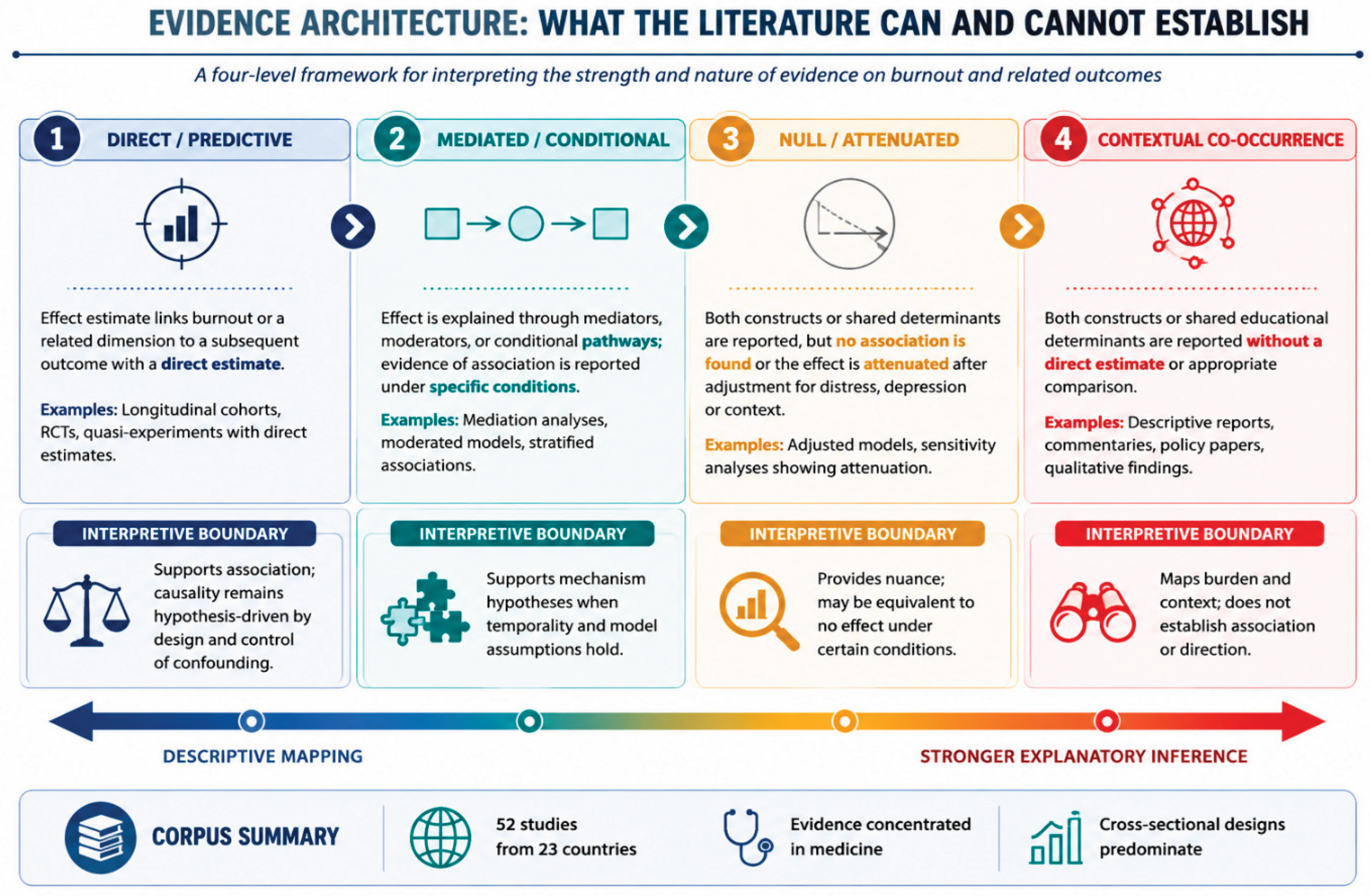
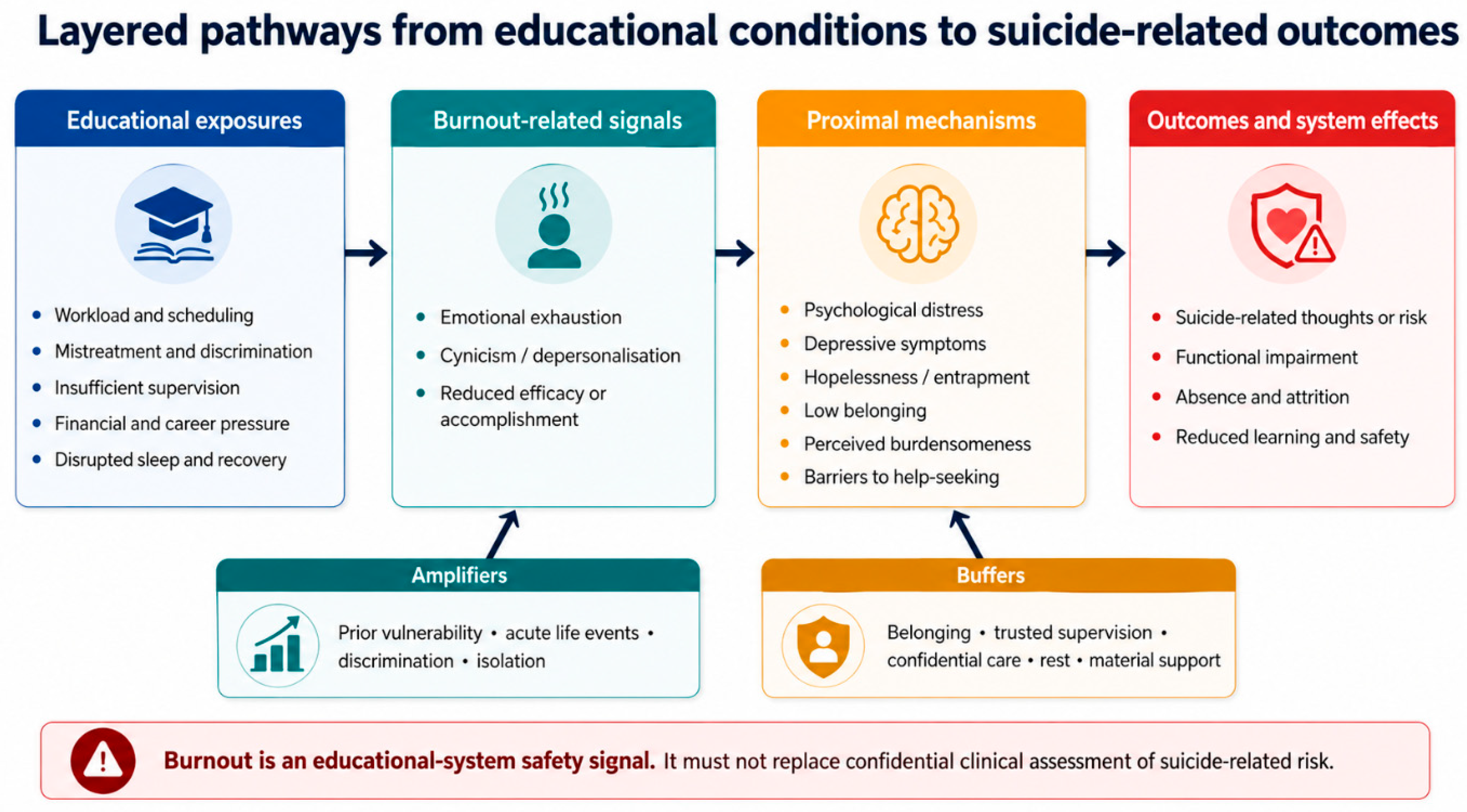
Across these lanes, emotional exhaustion was the most recurrent burnout dimension, while psychological distress, depressive symptoms, hopelessness, impaired belonging, perceived burdensomeness, workload, mistreatment, sleep disruption and insufficient support shaped the observed relationships. The hypothesised multilevel pathways connecting these determinants are further synthesised in Fig. 3.
Figure 3.
Layered pathways linking the educational environment, burnout dimensions and suicide-related outcomes. Individual, relational and organisational factors may amplify or buffer the pathways; burnout is represented as a safety signal rather than a diagnostic proxy.
Figure 3.
Layered pathways linking the educational environment, burnout dimensions and suicide-related outcomes. Individual, relational and organisational factors may amplify or buffer the pathways; burnout is represented as a safety signal rather than a diagnostic proxy.
Evidence Selection
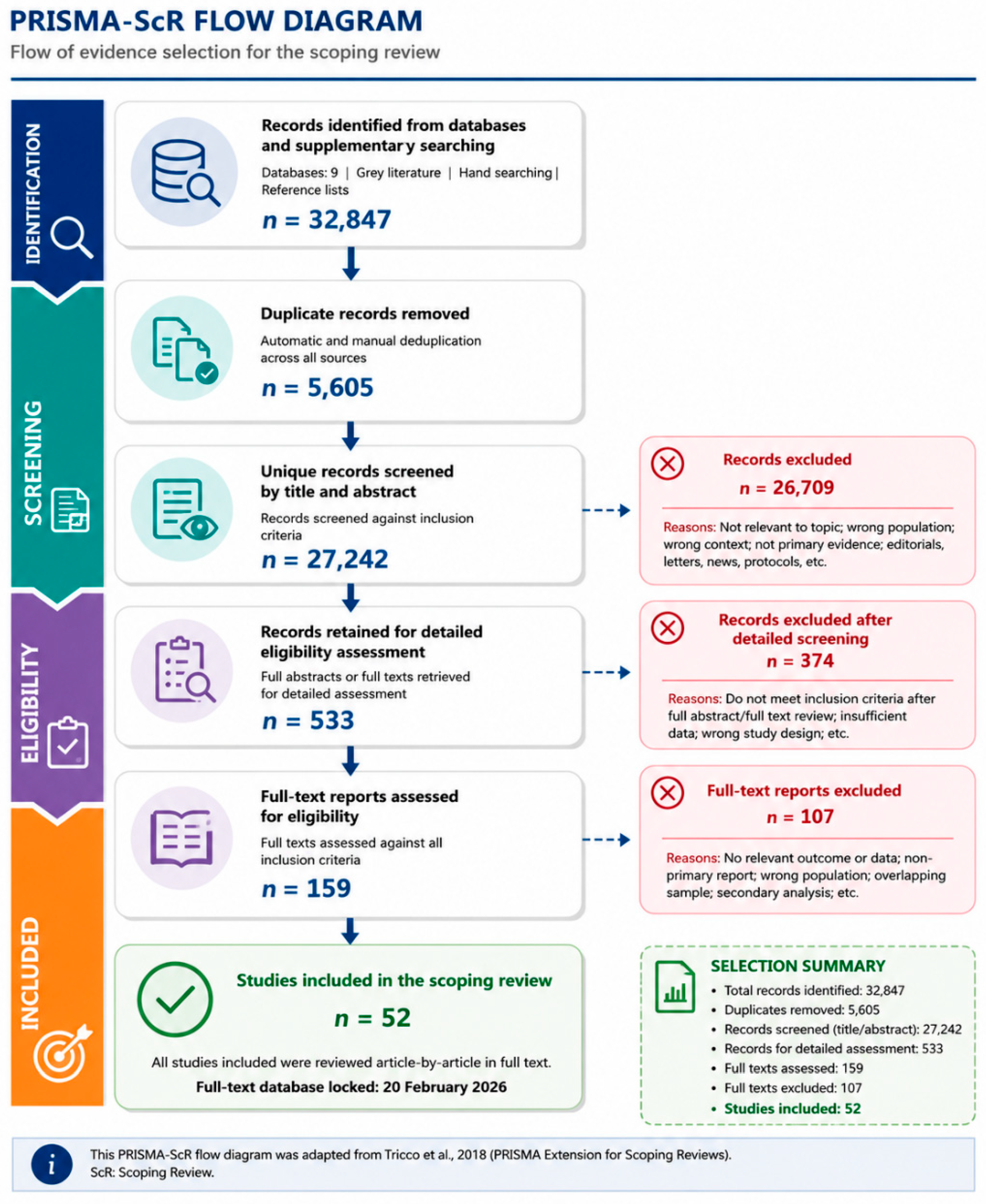
The supplied corpus contained 32,847 bibliographic records. Deterministic deduplication produced 27,242 unique records; 833 contained both burnout and suicide-related concepts, 717 also matched health-professions learner terms, and 260 likely primary empirical reports were prioritised for detailed record/abstract assessment. Fifty-two sources met the operational eligibility criteria. Figure 1 separates computational prioritisation from eligibility assessment and avoids labelling abstract-level review as full-text screening [10,11,12].
Figure 1.
PRISMA-ScR flow diagram. The flow distinguishes database identification, deduplication, title-and-abstract screening, detailed eligibility assessment, full-text review and final inclusion. Full-text verification was completed on 20 February 2026.
Figure 1.
PRISMA-ScR flow diagram. The flow distinguishes database identification, deduplication, title-and-abstract screening, detailed eligibility assessment, full-text review and final inclusion. Full-text verification was completed on 20 February 2026.
Characteristics and Architecture of the Evidence
The 52 included studies represented 23 countries and spanned undergraduate (25), postgraduate (25) and mixed-stage (2) populations. 50 studies were cross-sectional and 2 included longitudinal components. Medicine or medical training dominated 44 studies, while 8 addressed other professions or mixed health-professions samples. Table 2 summarises the corpus, and the complete study-level evidence matrix is provided in Additional file 2.
Table 2.
Summary profile of the included evidence.
| Dimension | Mapped result | Interpretive relevance |
|---|---|---|
| Publication span | 2008-2026 | Interest is sustained, with marked growth after 2018. |
| Geography | 23 countries | International coverage improved, but several regions and professions remain sparse. |
| Educational stage | 25 prelicensure; 25 postgraduate; 2 mixed | The issue spans the education continuum rather than a single transition. |
| Design | 50 cross-sectional; 2 longitudinal | Temporal and causal inference is severely limited. |
| Professional coverage | 44 medicine/physician dominant; 8 other or mixed | Interprofessional transfer should be cautious. |
| Relationship pattern | 16 direct/predictive; 14 mediated/conditional; 5 null/attenuated; 17 contextual/co-occurrence | The association is recurrent but not uniform. |
| Intervention evidence | No multilevel trial with both outcomes | Implementation effectiveness remains unknown. |
| Surgical instrumentation | No eligible study | A major evidence gap directly relevant to the originating project. |
Measurement and Analytical Heterogeneity
Maslach Burnout Inventory variants were most common, but studies also used the Copenhagen Burnout Inventory, Burnout Measure, emotional-fatigue scales, single-item indicators and profession-specific academic-burnout tools. Suicide-related outcomes ranged from validated multi-item scales to single items embedded in depression or well-being instruments, with current, recent, past-year, lifetime or unspecified recall periods. Analyses included correlations, logistic regression, latent-variable modelling, longitudinal comparison and symptom-network methods. Table 3 explains why pooled prevalence or effect estimates would be misleading without a more restrictive protocol [4,5,14,15,16,17,18,19,20,21,24,25,26,27,28,29,30,31,36,37,38,39,50,51,52,53,54,55,56,57,58,59,60,61,62].
Direct and Dimension-Specific Associations
Direct or predictive associations recurred in medical students, nursing students, dental learners, residents and surgical trainees. The most informative temporal evidence came from the United States medical-student cohort in which baseline burnout predicted later ideation and recovery from burnout accompanied lower subsequent risk. Cross-sectional associations were also reported in Brazilian and Peruvian medical students, Chilean nursing students, Dutch residents, Japanese psychiatric trainees, United States surgery residents, Japanese residents, Chinese clinical students, Mexican health students and Lebanese residents [4,5,17,19,25,29,30,31,36,39,50,53,56].
Domain-level findings complicated the syndrome-level interpretation. Low personal accomplishment was salient among dental and dental-hygiene students, while depersonalisation and reduced accomplishment were independently associated with suicide-related risk in Chinese residents. Emotional exhaustion was important in several studies but was sometimes more closely linked to depression or workload than to the suicide-related outcome itself [15,18,25,37,38,51,55].
Mediated, Conditional and Attenuated Pathways
Mediated and conditional findings were common. Depression, loneliness, helplessness, perceived burdensomeness, thwarted belongingness, professional identity, self-stigma, sleep disturbance and mistreatment connected or modified the relationship. Network studies placed suicide-related symptoms within broader depressive and occupational-stress systems rather than on a single direct path from exhaustion [18,21,24,27,32,37,38,42,43,48,51,52,55,58].
Five sources explicitly reported null or attenuated relationships. Dental students showed a depression-mediated pattern without a direct burnout association; resilience research in Brazil found no adjusted association after depressive symptoms were included; a Swiss network showed no residual connection to exhaustion or depersonalisation; Thai interns had frequent burnout without an independent relationship; and resident union status did not differentiate burnout or suicide-related outcomes. These results show why burnout screening alone cannot substitute for direct, confidential assessment of suicide-related risk [14,18,20,35,39].
Learning Environment, Inequity and Transitions
Mistreatment, discrimination, bullying, sexism, sexual harassment, workplace violence, pressure to under-report hours, excessive workload, financial difficulty, weak colleague support and low programme responsiveness were recurrent determinants of one or both outcomes. Large surgical-training studies connected hostile or inequitable environments to composite distress, attrition considerations and suicide-related outcomes, shifting the locus of prevention from resilience-only initiatives toward institutional accountability [23,32,33,40,41,42,43,46,47,48,49,50,51,54,62].
Transition points were also visible. Burnout trajectories worsened across medical school, with suicide-related indicators following a non-identical course and rising again near the final year. Clinical entry, internship and residency brought longer hours, supervisory dependence, exposure to mistreatment and reduced control. These patterns support proactive monitoring at predictable educational transitions rather than reliance on learner-initiated help-seeking [22,36,39,46,47,50,52,54,55,62].
Figure 4.
EDU-SAFE educational safety pathway. Examine, Detect, Use support, Strengthen protection, Act on conditions, Facilitate recovery and Evaluate form a continuous institutional cycle governed by confidentiality, non-punitive practice, equity, learner participation and accountability.
Figure 4.
EDU-SAFE educational safety pathway. Examine, Detect, Use support, Strengthen protection, Act on conditions, Facilitate recovery and Evaluate form a continuous institutional cycle governed by confidentiality, non-punitive practice, equity, learner participation and accountability.
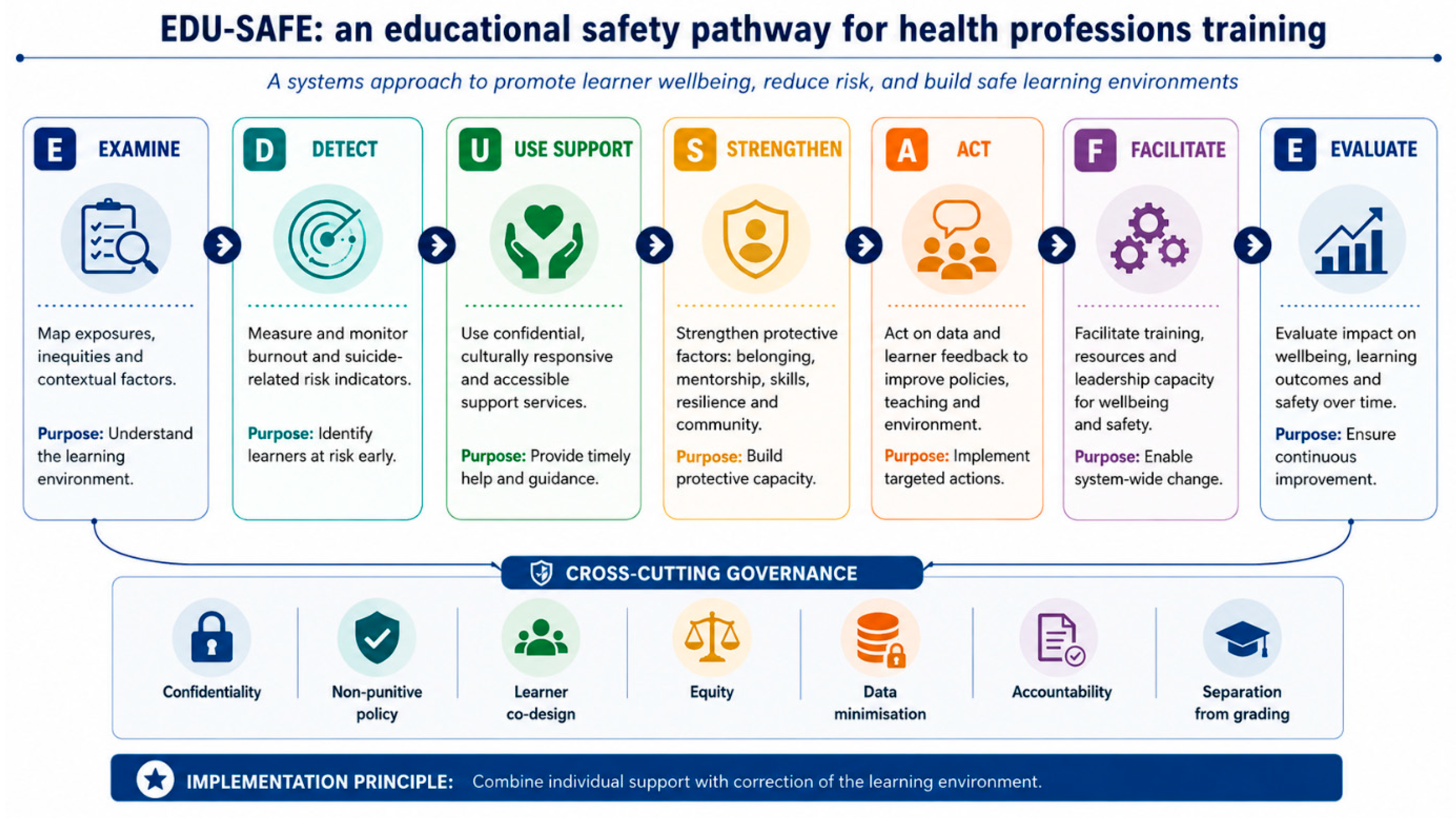
Table 4.
EDU-SAFE process, implementation actions and evaluable indicators.
| Stage | Core action | Examples of programme implementation | Minimum indicators |
|---|---|---|---|
| E - Examine | Map educational exposures and transitions | Review workload, supervision, mistreatment, financial stress, inequity and high-friction rotations | Exposure dashboard; transition map; subgroup disparities |
| D - Detect | Assess burnout and suicide-related risk separately | Use validated, confidential tools with clear limits and direct access to qualified support | Response rate; confidentiality breaches; referral timeliness |
| U - Use | Activate stepped, clinically governed support | Define non-punitive pathways from low-intensity support to urgent professional assessment | Time to contact; completion of referral; continuity |
| S - Strengthen | Build belonging, supervision and resource support | Mentoring, peer support, protected supervision, material assistance and learner co-design | Belonging score; supervisor accessibility; resource uptake |
| A - Act | Remediate harmful learning conditions | Investigate mistreatment, unsafe hours, exclusion and programme unresponsiveness | Resolution time; recurrence; duty-hour and climate indicators |
| F - Facilitate | Support recovery and continuity of learning | Reasonable adjustments, return-to-learning plans and protected follow-up | Retention; safe return; learner-reported fairness |
| E - Evaluate | Measure outcomes and equity longitudinally | Track burnout, direct risk measures, learning outcomes, help-seeking and unintended effects | Repeated outcomes; subgroup equity; implementation fidelity |
Protective Resources and Intervention Gap
Flourishing mental health, social and material support, professional identity, belonging, resilience, mindfulness and grit were inversely associated with one or both outcomes. The evidence was strongest when protective resources were relational and organisational rather than framed as an obligation for learners to tolerate unsafe conditions. Several authors cautioned against using personal traits as selection tools or as explanations that absolve programmes [13,20,22,27,29,31,34,37,44,52].
No included source evaluated a multilevel educational intervention with prespecified outcomes for both burnout and suicide-related risk. Screening, counselling, wellness programmes and resilience initiatives were frequently recommended, but few studies specified confidentiality governance, environmental remediation, recovery accommodations, implementation fidelity or programme-level accountability. This implementation gap informed the synthesis-derived EDU-SAFE educational safety pathway, illustrated in Fig. 4 and operationalised through the implementation actions and evaluable indicators presented in Table 4 [4,5,13,14,15,16,17,18,19,20,21,22,23,24,25,26,27,28,29,30,31,32,33,34,35,36,37,38,39,40,41,42,43,44,45,46,47,48,49,50,51,52,53,54,55,56,57,58,59,60,61,62].
Discussion
Principal Findings
This review mapped a recurrent but non-uniform relationship between burnout and suicide-related outcomes across health professions education. As illustrated by the evidence architecture in Fig. 2, these findings do not support a single linear pathway from burnout to suicide-related outcomes. Direct associations were observed across multiple countries and training stages, but mediated, dimension-specific, null and contextual findings were equally important. The most defensible interpretation is therefore that burnout functions as a safety signal embedded in a larger educational and psychological system, not as a sufficient cause or a diagnostic proxy [2,3,4,5,13,14,15,16,17,18,19,20,21,22,23,24,25,26,27,28,29,30,31,32,33,34,35,36,37,38,39,40,41,42,43,44,45,46,47,48,49,50,51,52,53,54,55,56,57,58,59,60,61,62].
The evidence also reframes prevention as an educational-governance responsibility. Mistreatment, workload, financial strain, inequity, weak supervision and lack of belonging were repeatedly associated with adverse outcomes. Individual support remains necessary, but resilience-only programmes cannot correct harmful assessment structures, unsafe hours or cultures that discourage confidential help-seeking [23,32,33,36,40,41,42,43,46,47,48,49,50,51,52,53,54,62].
Interpretation in Relation to Previous Syntheses
Previous meta-analyses support an average association between burnout and suicidal ideation, yet pooled results can obscure differences in stage, measurement and educational context. The present map complements rather than replaces those analyses by showing where the relationship is direct, where it attenuates after depression or anxiety, and where shared upstream educational conditions may better explain co-occurrence [2,3,14,18,20,21,24,38,39,51,55,58].
The near-equal distribution between prelicensure and postgraduate evidence supports a continuum approach, but medicine remains dominant. Findings cannot automatically be transferred to surgical instrumentation, perioperative technology or other underrepresented professions. The absence of direct evidence is itself an actionable result: future studies should test, rather than assume, whether operating-room placement demands and hierarchical team structures generate similar pathways [13,14,15,16,17,18,19,20,21,22,23,24,25,26,27,28,29,30,31,32,33,34,35,36,37,38,39,40,41,42,43,44,45,46,47,48,49,50,51,52,53,54,55,56,57,58,59,60,61,62].
Educational Implications
Programmes should distinguish surveillance from clinical assessment. Burnout measures can identify strained cohorts or learning environments, whereas suicide-related risk requires direct, confidential, clinically governed assessment. Combining the two into a single wellness score risks false reassurance, over-identification and loss of trust. EDU-SAFE therefore separates detection while linking both streams to programme learning and remediation [4,5,14,18,20,35,39,55].
Implementation should begin at predictable transitions, including entry to clinical practice, final-year rotations, internship and residency. Learner co-design, data minimisation, independent clinical governance and explicit non-retaliation protections are essential because the same supervisors who assess performance may otherwise be perceived as unsafe recipients of sensitive information [22,23,32,33,36,39,40,41,42,43,46,47,48,49,50,51,52,53,54,62].
At the programme level, repeated aggregate data should trigger review of workload, supervision, mistreatment, discrimination, financial support and responsiveness. Improvement targets should include educational outcomes and equity, not merely symptom reduction. This approach aligns the topic with the remit of medical education by treating learner well-being as a property of training quality and safety [23,32,33,36,40,41,42,43,44,45,46,47,48,49,50,51,52,53,54,62].
Strengths and Limitations
This review has several limitations. The evidence base was dominated by cross-sectional studies and medical trainees, limiting temporal inference and transferability to other health professions. Definitions and thresholds for burnout and suicide-related outcomes varied substantially, as did adjustment for depression, sleep, workload, mistreatment and social support. Some reports combined training stages or professional groups, and few tested mediation, moderation or change over time. Restricting synthesis to published and retrievable reports may have introduced publication and indexing bias. Full-text verification of all included studies was completed on 20 February 2026, but rigorous verification cannot remove limitations inherent in the primary evidence.
Limitations are substantial. Primary screening and charting were completed by one reviewer; lexical prioritisation may have missed atypical terminology; the source archive did not contain full-text PDFs; and PubMed was not supplied as an article-level export. Most evidence was cross-sectional, measures and recall periods varied, no formal risk-of-bias appraisal was possible from the available materials, and relationship categories involve interpretation. These limitations preclude pooled effects, prevalence claims across the corpus and causal conclusions [6,7,8,9,10,11,12].
Accordingly, the manuscript was finalised for submission until the 52 included sources have been checked in full text, the PubMed search has been rerun and exported at article level, and a second reviewer has audited all inclusions, ambiguous exclusions and a sample of straightforward exclusions. Any resulting changes must be propagated through Figure 1, the study table, all numerical summaries and the references [10,11,12].
Recommendations
- Monitoring should be concentrated at predictable transitions and should be paired with rapid review of workload, supervisory availability, mistreatment, discrimination, financial strain and belonging. Programme-level remediation must accompany individual support [22,23,32,33,36,39,40,41,42,43,44,45,46,47,48,49,50,51,52,53,54,62].
- Interventions should be co-designed with learners and evaluated for confidentiality, equity, uptake, educational continuity, unintended consequences and implementation fidelity. Wellness participation should not become a punitive requirement or a substitute for correcting harmful training conditions [23,32,33,40,41,42,43,44,50,51,52,53,54].
- Future research should use prospective multicentre designs, harmonised burnout and suicide-related measures, clearly aligned recall periods, and pre-specified mediation or effect-modification analyses. Intervention studies should test multilevel packages rather than isolated resilience training [2,3,6,9,10].
- Surgical instrumentation and other perioperative allied-health programmes should be prioritised for direct research. A first phase should establish prevalence, measurement validity and context-specific determinants during clinical placements; a second phase should co-design and prospectively test the EDU-SAFE pathway [19,23,31,32,33,41,49,50,54].
Recommendations for Health Professions Education
The recommendations below translate the mapped evidence into actions for programme leaders, clinical-placement partners, learner-support services and quality-assurance systems. The EDU-SAFE implementation sequence and minimum indicators are detailed in Table 4 and Fig. 4.
Separate Measurement from Clinical Assessment
Programmes should monitor burnout and learning-environment exposures for population-level quality improvement while maintaining a separate, confidential and clinically governed route for assessment of suicide-related risk. Burnout screening must not be used as a diagnostic shortcut.
Act on the Learning Environment
Interventions should address excessive workload, poorly designed schedules, mistreatment, discrimination, inadequate supervision, weak belonging and barriers to help-seeking. Individual resilience initiatives should complement, not replace, institutional correction.
Protect Learners from Punitive Consequences
Help-seeking and referral pathways should be independent from grading, progression and disciplinary processes whenever possible. Data minimisation, restricted access and explicit non-retaliation policies are essential.
Target Transitions and Under-Represented Professions
Monitoring should intensify at entry to clinical placements, high-intensity rotations, internship and postgraduate transition. Prospective research is particularly needed in nursing, dentistry, allied health and surgical instrumentation.
Evaluate Outcomes Longitudinally
Institutions should assess implementation fidelity, uptake, waiting time, educational climate, burnout dimensions, wellbeing, retention, equity and safety outcomes over time. EDU-SAFE should be tested through co-designed feasibility and effectiveness studies.
Conclusions
The evidence indicates that burnout and suicide-related outcomes intersect across health professions education, but they are neither synonymous nor linked through a single linear pathway. Emotional exhaustion appears to be the most recurrent signal, while psychological distress, depressive symptoms, hopelessness, belonging, workload, mistreatment, sleep and support shape the observed relationship. Educational institutions should therefore avoid using burnout scores as a substitute for confidential suicide-risk assessment. Instead, they should combine clinically governed support with action on the learning environment. EDU-SAFE translates this evidence into a seven-stage pathway—Examine, Detect, Use support, Strengthen protection, Act on conditions, Facilitate recovery and Evaluate—that is ready for local adaptation and prospective validation.
List of Abbreviations
CBI: Copenhagen Burnout Inventory; EDU-SAFE: Examine, Detect, Use, Strengthen, Act, Facilitate, Evaluate; JBI: Joanna Briggs Institute; MBI: Maslach Burnout Inventory; PCC: Population-Concept-Context; PHQ-9: Patient Health Questionnaire-9; PRISMA-ScR: Preferred Reporting Items for Systematic reviews and Meta-Analyses extension for Scoping Reviews; PRISMA-S: PRISMA extension for literature searches.
Declarations
Supplementary Materials
The following supporting information can be downloaded at the website of this paper posted on Preprints.org.
Authors’ Contributions
ARP contributed to the conceptualization and methodological supervision of the review, validation of eligibility decisions, interpretation of findings and critical revision of the manuscript. LAVQ contributed to the conceptualization of the review, literature screening, full-text assessment, data extraction and charting, and preparation of the initial manuscript. ADVO contributed to literature screening, full-text verification, data charting, evidence synthesis and critical revision of the manuscript. ADP conceived and supervised the overall methodological framework, contributed to review design, evidence synthesis and interpretation, developed the EDU-SAFE educational safety pathway, performed the methodological and scientific audit, and substantially revised the manuscript for important intellectual content. All authors reviewed and approved the final manuscript and agreed to be accountable for the accuracy and integrity of the work. All authors contributed to the conception of the review, full-text verification, data charting, interpretation of findings, critical revision of the manuscript and approval of the final version.
Funding
This work received no specific grant from any funding agency in the public, commercial or not-for-profit sectors.
Ethics Approval and Consent to Participate
Not applicable. This study synthesised published and publicly available evidence and involved no new collection of data from human participants.
Consent for Publication
Not applicable.
Availability of Data and Materials
All data charted for this review are included in this article and its additional files.
Competing Interests
The authors declare that they have no competing interests.
Acknowledgments
The authors acknowledge the institutional and library support that enabled retrieval and verification of the evidence base.
Use of Generative Artificial Intelligence:
Generative artificial intelligence was used only for language refinement, formatting support and consistency checking under direct author supervision. It was not used to determine eligibility, extract study data, appraise evidence or make scientific judgements. The authors reviewed and take full responsibility for the final manuscript.
References
- Maslach, C.; Leiter, M.P. Understanding the burnout experience: recent research and its implications for psychiatry. World Psychiatry 2016, 15, 103–111. [Google Scholar] [CrossRef] [PubMed]
- Esparza-Reig, J.; Julián, M. Association between suicidal ideation and burnout: a meta-analysis. Death Stud. 2024, 48, 1085–1096. [Google Scholar] [CrossRef] [PubMed]
- Howard, M.C.; Siefert, B. A meta-analysis of burnout and suicidal ideation among medical professionals: insights on occupational vulnerabilities. Arch. Env. Occup. Health 2025, 80, 151–163. [Google Scholar] [CrossRef] [PubMed]
- Dyrbye, L.N.; Thomas, M.R.; Massie, F.S.; Power, D.V.; Eacker, A.; Harper, W.; et al. Burnout and suicidal ideation among U.S. medical students. Ann. Intern Med. 2008, 149, 334–341. [Google Scholar] [CrossRef] [PubMed]
- Van Der Heijden, F.; Dillingh, G.; Bakker, A.; Prins, J. Suicidal thoughts among medical residents with burnout. Arch. Suicide Res. 2008, 12, 344–346. [Google Scholar] [CrossRef] [PubMed]
- Munn, Z.; Peters, M.D.J.; Stern, C.; Tufanaru, C.; McArthur, A.; Aromataris, E. Systematic review or scoping review? Guidance for authors when choosing between a systematic or scoping review approach. BMC Med. Res. Methodol. 2018, 18, 143. [Google Scholar] [CrossRef] [PubMed]
- Arksey, H.; O'Malley, L. Scoping studies: towards a methodological framework. Int. J. Soc. Res. Methodol. 2005, 8, 19–32. [Google Scholar] [CrossRef]
- Levac, D.; Colquhoun, H.; O'Brien, K.K. Scoping studies: advancing the methodology. Implement Sci. 2010, 5, 69. [Google Scholar] [CrossRef] [PubMed]
- Peters, M.D.J.; Marnie, C.; Tricco, A.C.; Pollock, D.; Munn, Z.; Alexander, L.; et al. Updated methodological guidance for the conduct of scoping reviews. JBI Evid. Synth. 2020, 18, 2119–2126. [Google Scholar] [CrossRef] [PubMed]
- Tricco, A.C.; Lillie, E.; Zarin, W.; O'Brien, K.K.; Colquhoun, H.; Levac, D.; et al. PRISMA Extension for Scoping Reviews (PRISMA-ScR): checklist and explanation. Ann. Intern Med. 2018, 169, 467–473. [Google Scholar] [CrossRef] [PubMed]
- Rethlefsen, M.L.; Kirtley, S.; Waffenschmidt, S.; Ayala, A.P.; Moher, D.; Page, M.J.; et al. PRISMA-S: an extension to the PRISMA Statement for reporting literature searches in systematic reviews. Syst. Rev. 2021, 10, 39. [Google Scholar] [CrossRef] [PubMed]
- Garritty, C.; Gartlehner, G.; Nussbaumer-Streit, B.; King, V.J.; Hamel, C.; Kamel, C.; et al. Cochrane Rapid Reviews Methods Group offers evidence-informed guidance to conduct rapid reviews. J. Clin. Epidemiol. 2021, 130, 13–22. [Google Scholar] [CrossRef] [PubMed]
- Dyrbye, L.N.; Harper, W.; Moutier, C.; Durning, S.J.; Power, D.V.; Massie, F.S.; et al. A Multi-institutional study exploring the impact of positive mental health on medical students' professionalism in an era of high burnout. Acad. Med. 2012, 87, 1024–1031. [Google Scholar] [CrossRef] [PubMed]
- Galán, F.; Ríos-Santos, J.-V.; Polo, J.; Rios-Carrasco, B.; Bullón, P. Burnout, depression and suicidal ideation in dental students. Med. Oral Patol. Oral Cir. Bucal 2014, 19, e206–e211. [Google Scholar] [CrossRef] [PubMed]
- Deeb, G.R.; Braun, S.; Carrico, C.; Kinser, P.; Laskin, D.; Golob Deeb, J. Burnout, depression and suicidal ideation in dental and dental hygiene students. Eur. J. Dent. Educ. 2018, 22, e70–e74. [Google Scholar] [CrossRef] [PubMed]
- Talih, F.; Daher, M.; Daou, D.; Ajaltouni, J. Examining Burnout, Depression, and Attitudes Regarding Drug Use Among Lebanese Medical Students During the 4 Years of Medical School. Acad. Psychiatry 2018, 42, 288–296. [Google Scholar] [CrossRef] [PubMed]
- Carro, A.C.; Nunes, R.D. Suicidal ideation as a factor associated with burnout syndrome in medical students. J. Bras. Psiquiatr. 2021, 70, 91–98. [Google Scholar] [CrossRef]
- Ernst, J.; Jordan, K.D.; Weilenmann, S.; Sazpinar, O.; Gehrke, S.; Paolercio, F.; et al. Burnout, depression and anxiety among Swiss medical students-A network analysis. J. Psychiatr. Res. 2021, 143, 196–201. [Google Scholar] [CrossRef] [PubMed]
- Ardiles-Irarrázabal, R.; Sandoval, C.C.; Orellana, S.D.; Leal, C.G.; Evanan, M.P.; Valderrama, K.T. Academic burnout as a predictive factor of suicide risk in nursing students. Index Enferm. 2022, 31, e13933. [Google Scholar]
- Dias, A.R.; Fernandes, S.M.; Fialho-Silva, I.; Cerqueira-Silva, T.; Miranda-Scippa, A.; Galvão-De Almeida, A. Burnout syndrome and resilience in medical students from a Brazilian public college in Salvador, Brazil. Trends Psychiatry Psychother. 2022, 44, e20200187. [Google Scholar] [CrossRef] [PubMed]
- Klugman, M.; Cohen Ben Simon, O.; Kleinhendler-Lustig, D.; Bourla, S.; Gvion, Y.; Hamdan, S. Suicide Risk Among Medical Students Associated With Loneliness, Burnout, and Depressive Symptoms. Omega (Westport) 2024. [Google Scholar] [CrossRef] [PubMed]
- Carrard, V.; Berney, S.; Bourquin, C.; Ranjbar, S.; Castelao, E.; Schlegel, K.; et al. Mental health and burnout during medical school: Longitudinal evolution and covariates. PLoS ONE 2024, 19, e0295100. [Google Scholar] [CrossRef] [PubMed]
- Frajerman, A.; Colle, R.; Jollant, F.; Corruble, E. Mental health in midwifery students: A French nationwide survey. Midwifery 2024, 139, 104165. [Google Scholar] [CrossRef] [PubMed]
- González-Hernández, T.; Maldonado-Avendaño, N.; Castro-Osorio, R. Evaluation of two explanatory models of suicidal ideation in a sample of Colombian medical students. Rev. Psicopatol. Psicol. Clin. 2024, 29, 239–247. [Google Scholar] [CrossRef]
- Aquino-Canchari, C.R.; Florez-Soto, D.M.; Lorenzo-Roque, A.I.; Baquerizo-Quispe, N.S.; Cortez-Orellana, S.A. Emotional exhaustion associated with self-harming thoughts and behaviors and suicidal ideation in medical students at a Peruvian university. Sci. Med. 2025, 35, e-46519. [Google Scholar] [CrossRef]
- Figuerola-Escoto, R.P.; Gómez-Cotero, A.G.; Garcia-Martinez, M.A.; López-Rosas, S. Suicidal ideation and associated variables in medical students: A multiple correspondence analysis. Educ. Med. 2025, 26, 101105. [Google Scholar] [CrossRef]
- Monti, M.; Carrard, V.; Bourquin, C.; Berney, A. Association Among Professional Identity, Burnout, and Mental Health in Medical Students: A Cross-Sectional Study. Acad. Med. 2025, 100, 1298–1306. [Google Scholar] [CrossRef] [PubMed]
- Várnai, C.H.; Ozsvári, L.; Máté, M. A Cross-Sectional Study on Burnout, Emotional Distress, and Suicidal Thoughts Among International and Hungarian Veterinary Students. J. Vet. Med. Educ. 2026. [Google Scholar] [CrossRef] [PubMed]
- Despotović, M.M.; Ignjatović Ristić, D.; Banković, D.; Milovanović, D.; Stepanović, Ž.; Despotović, M.; et al. Suicidality, resilience and burnout in a population of oncology nurses. Sci. Rep. 2025, 15, 3251. [Google Scholar] [CrossRef] [PubMed]
- Tateno, M.; Jovanović, N.; Beezhold, J.; Uehara-Aoyama, K.; Umene-Nakano, W.; Nakamae, T.; et al. Suicidal ideation and burnout among psychiatric trainees in Japan. Early Interv. Psychiatry 2018, 12, 935–937. [Google Scholar] [CrossRef] [PubMed]
- Lebares, C.C.; Guvva, E.V.; Ascher, N.L.; O'Sullivan, P.S.; Harris, H.W.; Epel, E.S. Burnout and Stress Among US Surgery Residents: Psychological Distress and Resilience. J. Am. Coll. Surg. 2018, 226, 80–90. [Google Scholar] [CrossRef] [PubMed]
- Faivre, G.; Kielwasser, H.; Bourgeois, M.; Panouilleres, M.; Loisel, F.; Obert, L. Burnout syndrome in orthopaedic and trauma surgery residents in France: A nationwide survey. Orthop. Traumatol. Surg. Res. 2018, 104, 1291–1295. [Google Scholar] [CrossRef] [PubMed]
- Hu, Y.-Y.; Ellis, R.J.; Hewitt, D.B.; Yang, A.D.; Cheung, E.O.; Moskowitz, J.T.; et al. Discrimination, abuse, harassment, and burnout in surgical residency training. N Engl. J. Med. 2019, 381, 1741–1752. [Google Scholar] [CrossRef] [PubMed]
- Laramée, J.; Kuhl, D. Suicidal ideation among family practice residents at the University of British Columbia. Can. Fam. Physician 2019, 65, 730–735. [Google Scholar] [PubMed]
- Brajcich, B.C.; Chung, J.W.; Wood, D.E.; Horvath, K.D.; Tolley, P.D.; Yates, E.F.; et al. National Evaluation of the Association Between Resident Labor Union Participation and Surgical Resident Well-being. JAMA Netw. Open 2021, 4, e2123412. [Google Scholar] [CrossRef] [PubMed]
- Ishikawa, M. Relationships between overwork, burnout and suicidal ideation among resident physicians in hospitals in Japan with medical residency programmes: a nationwide questionnaire-based survey. BMJ Open 2022, 12, e056283. [Google Scholar] [CrossRef] [PubMed]
- Huang, P.C.; Lin, C.Y.; Huang, R.Y.; Chen, J.S.; Griffiths, M.D.; Strong, C.; et al. The effect of social support and resource support on emotional exhaustion, insomnia, and suicidal ideation among allied health trainees and post-graduate year doctors in Taiwan. BMC Psychol. 2024, 12, 322. [Google Scholar] [CrossRef] [PubMed]
- Li, Z.J.; Wu, M.; Zhang, X.Y.; Yan, K.W.; Wang, X.; Xu, H.X.; et al. Interrelationships of stress, burnout, anxiety, depression, quality of life and suicidality among Chinese residents under Standardized Residency Training: a network analysis. Ann. Med. 2024, 56, 2433030. [Google Scholar] [CrossRef] [PubMed]
- Surawattanasakul, V.; Siviroj, P.; Kiratipaisarl, W.; Sirikul, W.; Phetsayanavin, V.; Pholvivat, C.; et al. Physician burnout, associated factors, and their effects on work performance throughout first-year internships during the COVID-19 pandemic in Thailand: a cross-sectional study. BMC Public Health 2025, 25, 1967. [Google Scholar] [CrossRef] [PubMed]
- Winkel, A.F.; Morgan, H.K.; Hammoud, M.M.; Schatzman-Bone, S.; Young, O.M.; Santen, S.; et al. Burnout and Well-Being in Trainees: Findings From a National Survey of US Obstetrics and Gynecology Residents. J. Grad. Med. Educ. 2024, 16, 572–580. [Google Scholar] [CrossRef] [PubMed]
- Watkins, A.A.; Shehata, D.G.; Holler, E.; Lopez, E.; Pan, J.M.; Varghese, T.K., Jr.; et al. National evaluation of mistreatment and well-being in cardiothoracic surgery trainees. J. Thorac. Cardiovasc Surg. 2026, 171, 803–811.e10. [Google Scholar] [CrossRef] [PubMed]
- Heiderscheit, E.A.; Schlick, C.J.R.; Ellis, R.J.; Cheung, E.O.; Irizarry, D.; Amortegui, D.; et al. Experiences of LGBTQ+ Residents in US General Surgery Training Programs. JAMA Surg. 2022, 157, 23–32. [Google Scholar] [CrossRef] [PubMed]
- Li, R.D.; Janczewski, L.M.; Eng, J.S.; Foote, D.C.; Wu, C.; Johnson, J.K.; et al. Pregnancy and Parenthood among US Surgical Residents. JAMA Surg. 2024, 159, 1127–1137. [Google Scholar] [CrossRef] [PubMed]
- Hewitt, D.B.; Chung, J.W.; Ellis, R.J.; Cheung, E.O.; Moskowitz, J.T.; Hu, Y.-Y.; et al. National Evaluation of Surgical Resident Grit and the Association with Wellness Outcomes. JAMA Surg. 2021, 156, 856–863. [Google Scholar] [CrossRef] [PubMed]
- Carrard, V.; Bourquin, C.; Berney, S.; Bart, P.A.; Bodenmann, P.; Berney, A. Comparison of mental health and burnout between medical and nonmedical students. PLoS ONE 2025, 20, e0328145. [Google Scholar] [CrossRef] [PubMed]
- Rolland, F.; Hadouiri, N.; Haas-Jordache, A.; Gouy, E.; Mathieu, L.; Goulard, A.; et al. Mental health and working conditions among French medical students: A nationwide study. J. Affect Disord. 2022, 306, 124–130. [Google Scholar] [CrossRef] [PubMed]
- Frajerman, A.; Chaumette, B.; Krebs, M.-O.; Morvan, Y. Mental health in medical, dental and pharmacy students: A cross-sectional study. J. Affect Disord. Rep. 2022, 10, 100404. [Google Scholar] [CrossRef] [PubMed]
- Barbier, J.M.; Carrard, V.; Schwarz, J.; Berney, S.; Clair, C.; Berney, A. Exposure of medical students to sexism and sexual harassment and their association with mental health: a cross-sectional study at a Swiss medical school. BMJ Open 2023, 13, e069001. [Google Scholar] [CrossRef] [PubMed]
- Wang, X.; Peng, P.; Liu, Y.; Yang, W.F.; Chen, S.; Wang, Y.; et al. Workplace violence inflicted by patients or their family members/visitors and its relationship with suicidal ideation among undergraduate medical students during clinical training in China. Ann. Med. 2023, 55, 2295027. [Google Scholar] [CrossRef] [PubMed]
- Eddy, A.J.; Bray, N.N.; Place, A.J. Identifying risk factors for burnout and self-harm thoughts among medical students: a multi-institutional survey study. J. Osteopath Med. 2026. [Google Scholar] [CrossRef] [PubMed]
- Yun, J.Y.; Myung, S.J.; Kim, K.S. Associations among workplace violence, burnout, depressive symptoms, suicidality, and turnover intention in training physicians: a network analysis of a nationwide survey. Sci. Rep. 2023, 13, 16804. [Google Scholar] [CrossRef] [PubMed]
- Nemati, A.; Jalalpour, A.H.; Jahangiri, S.; Shaygani, F.; Shojaadini, H.; Naghibi, D.; et al. Assessing suicidal ideation and associated factors among undergraduate medical students and residents in Iran: a multicentre cross-sectional study. Health Sci. Rep. 2025, 8, e71489. [Google Scholar] [CrossRef] [PubMed]
- González Álvarez, M.D.C.; Pérez Briones, N.G.; Gómez Melasio, D.A.; Herrera-Garibay, I.M.; Ruiz Lara, A. Psychosocial factors and their relationship with suicide risk in health students. Rev. Cienc. Salud 2026, 24. [Google Scholar] [CrossRef]
- Cui, C.L.; Reilly, M.A.; Zielke, T.J.; Olivere, L.A.; Jiang, Y.; Pillado, E.B.; et al. Suicidal ideation among vascular surgery trainees. J. Vasc. Surg. 2026, 83, 1241–1248. [Google Scholar] [CrossRef] [PubMed]
- Bai, S.; Chang, Q.; Yao, D.; Zhang, Y.X.; Wu, B.; Shan, L.P. The prevalence and risk factors for major depression and suicidal ideation in medical residents: a large multicentre cross-sectional study using propensity score matching. Soc. Psychiatry Psychiatr. Epidemiol. 2022, 57, 2279–2291. [Google Scholar] [CrossRef] [PubMed]
- El Hachem, C.; Atallah, E. Burnout prevalence and associated factors in a sample of Lebanese residents. Encephale 2022, 48, 615–623. [Google Scholar] [CrossRef] [PubMed]
- Robin, C. Mental health and psychoactive substance use among psychiatry interns in France: a descriptive epidemiological cross-sectional study. Inf. Psychiatr. 2019, 95, 559–568. [Google Scholar] [CrossRef]
- Talih, F.; Warakian, R.; Ajaltouni, J.; Shehab, A.A.S.; Tamim, H. Correlates of depression and burnout among residents in a Lebanese academic medical center: a cross-sectional study. Acad. Psychiatry 2016, 40, 38–45. [Google Scholar] [CrossRef] [PubMed]
- Gama Marques, J.; Roberto, A.; Guerra, C.; Pinto da Costa, M.; Podlesek, A.; Beezhold, J.; et al. Suicidal behavior among Portuguese psychiatry trainees: comparison with the European situation. Acta Med. Port. 2015, 28, 608–612. [Google Scholar] [CrossRef]
- Ferrari, S.; Cuoghi, G.; Mattei, G.; Carra, E.; Volpe, U.; Jovanovic, N.; et al. Young and burnt? Italian contribution to the international BurnOut Syndrome Study among residents in psychiatry. Med. Lav. 2015, 106, 172–185. [Google Scholar] [PubMed]
- Atienza-Carbonell, B.; Guillen, V.; Irigoyen-Otinano, M.; Balanza-Martinez, V. Screening of substance use and mental health problems among Spanish medical students: a multicenter study. J. Affect Disord. 2022, 311, 391–398. [Google Scholar] [CrossRef] [PubMed]
- López, J.A.A.; González, E.F.; Palomera, J.F.O.; Huerta, J.C.; Fernández, M.A. Digital survey of mental health, associated psychosocial, and work factors in medical specialty residents in the Guadalajara metropolitan area. Salud Ment. 2021, 44, 221–228. [Google Scholar] [CrossRef]
Disclaimer/Publisher’s Note: The statements, opinions and data contained in all publications are solely those of the individual author(s) and contributor(s) and not of MDPI and/or the editor(s). MDPI and/or the editor(s) disclaim responsibility for any injury to people or property resulting from any ideas, methods, instructions or products referred to in the content. |
© 2026 by the authors. Licensee MDPI, Basel, Switzerland. This article is an open access article distributed under the terms and conditions of the Creative Commons Attribution (CC BY) license (http://creativecommons.org/licenses/by/4.0/).
Copyright: This open access article is published under a Creative Commons CC BY 4.0 license, which permit the free download, distribution, and reuse, provided that the author and preprint are cited in any reuse.