

Submitted:
07 August 2026
Posted:
07 August 2026
You are already at the latest version
Abstract
Energy-autonomous Internet of Things (IoT) nodes are becoming important components of distributed wireless networks used in building automation, industrial monitoring and wider smart systems. Their operation is constrained not only by the amount of harvested and stored energy, but also by sensing activity, communication cost, computational workload and required service quality. This review analyzes these dependencies from a cross-layer perspective linking energy harvesting and power management, field-level IoT nodes, wireless communication technologies, and edge–fog–cloud computing. The main original contribution is a decision-oriented framework for energy-autonomous distributed intelligence, supporting adaptive placement of sensing, processing, inference and coordination functions across field, edge, fog and cloud resources. The analysis shows that energy autonomy cannot be achieved by optimizing individual nodes only. Wireless connectivity, network topology and communication overhead directly affect the feasibility of higher-level processing, while edge and fog resources can reduce field-node load and improve local service continuity. The proposed framework therefore combines energy feasibility, communication conditions, service requirements and coordination scope. The resulting guidelines are particularly relevant to building automation and smart IoT systems, supporting interoperable, adaptive and energy-efficient distributed wireless architectures.
Keywords:
energy autonomy
; Internet of Things
; wireless networks
; distributed control systems
; edge computing
; fog computing
; building automation and control systems
1. Introduction
The digital transformation of buildings has changed building automation and control systems (BACS) and building management systems (BMS) controlling building infrastructure from relatively closed technical infrastructures into heterogeneous cyber–physical systems. These systems now include field-level devices, wireless sensor networks, Internet of Things (IoT) gateways, data platforms, edge and fog resources, and cloud services. As a result, smart buildings are no longer only facilities equipped with automated heating, ventilation and air condition (HVAC), lighting or security functions. They increasingly operate as data-rich, adaptive and grid-interactive systems that sense, communicate and respond to changing indoor, outdoor and energy-system conditions [1,2,3,4]. This direction is also consistent with the broader transition toward sustainable buildings, local microgrids and energy communities, where Artificial Intelligence (AI)-driven prediction, adaptive control, transactive energy and dynamic energy management support flexibility, resilience and decarbonization [5,6,7].
1.1. From Smart Buildings to Energy-Aware IoT Automation Networks
This development is driven by several requirements: indoor comfort and safety, lower energy consumption, predictive maintenance, integration of renewable energy sources (RES), and support for demand-side management (DSM) and demand side response (DSR). These requirements are also reflected in the European regulatory framework for building performance. The revised Energy Performance of Buildings Directive (EPBD) and the Smart Readiness Indicator (SRI) promote buildings that can optimize their operation, adapt to occupants and interact with energy grids [8,9]. This strengthens the role of BACS, BMS and IoT-based infrastructures as technical enablers of energy flexibility and smart-grid readiness. Recent reviews on smart buildings and building energy management emphasize the role of AI-based control, contextual data integration and data-driven building management [1,3]. They also indicate the growing importance of Building Information Modeling (BIM)/digital twin (DT), grid-interactive operation and user-centric services [10,11,12]. However, these functions require more sensing points, more frequent data exchange and more distributed processing than classical BACS architectures. Therefore, the number of field-level devices and wireless nodes in buildings, campuses and local energy environments is expected to increase. This creates an architectural trade-off. More sensing and local intelligence are needed for adaptive, data-driven and grid-aware operation. At the same time, many field-level IoT nodes are limited in energy, computing power, memory, communication range and maintenance accessibility. In smart homes and buildings, this problem is especially important in retrofit applications, indoor environmental monitoring, occupancy-aware control, asset tracking, predictive maintenance and distributed metering. In such cases, wired power supply is often expensive, impractical or undesirable. Therefore, future IoT automation networks depend not only on communication standards and edge/fog/cloud platforms, but also on reliable operation under local energy limits.
1.2. The Energy Bottleneck of Distributed Wireless IoT Nodes
Battery-powered wireless sensors and actuators have enabled flexible deployment of smart-building functions, especially where new cabling is difficult or too expensive. However, battery dependence is still one of the main barriers to large-scale and long-term IoT deployment. Battery replacement increases maintenance cost, reduces reliability and may be unacceptable in dense, hidden, remote or safety-critical installations. Recent studies on batteryless and energy-harvesting IoT show that massive IoT cannot rely only on conventional batteries, mainly because of maintenance, cost and environmental concerns [13,14,15].
Energy harvesting (EH) has therefore become an important approach for self-sustainable IoT and wireless sensor network nodes. Ambient light, temperature gradients, vibration, airflow, radio-frequency RF signals or hybrid sources can supply ultra-low-power sensors, microcontrollers and communication interfaces. Recent reviews classify EH technologies for IoT and micro-energy harvesting systems [16,17]. Other studies analyze energy-aware cross-layer architectures, Media Access Control (MAC) protocols and task-scheduling strategies for EH IoT systems [18,19]. These works show that EH can extend node lifetime and reduce maintenance. At the same time, they indicate a basic limitation: harvested energy is variable in time and space, while the energy demand of sensing, processing and communication depends on the application, protocol, duty cycle and computational workload.
For this reason, energy autonomy should not be seen only as the selection of an energy harvester. In practical IoT automation networks, energy availability affects when data can be sampled, how often messages can be sent, whether local preprocessing is possible, which communication protocol should be used, and whether an inference or control task can be executed locally or shifted to a gateway, fog node or cloud service. Energy-neutral operation is therefore a cross-layer problem. It links the energy source, power management, storage, node scheduling, wireless communication, data aggregation, task offloading and service quality.
This view is especially important in smart-building and automation applications. Building environments are heterogeneous from the energy perspective [20]. Indoor photovoltaic sources depend on daylight and artificial lighting. Thermal gradients are often small and intermittent. Mechanical energy may be linked to HVAC ducts, doors, windows or machines. RF harvesting is usually power-limited [2,21,22]. At the same time, BACS/BMS functions may have different quality-of-service requirements, from slow environmental monitoring to near-real-time occupancy detection, fault detection or safety-related signaling. As a result, energy autonomy in building IoT networks requires architectural coordination, not only optimization of single nodes.
1.3. Edge–Fog–Cloud Continuum under Energy-Constrained Field Conditions
The second major transformation of IoT automation systems is the shift from cloud-centric data processing toward edge–fog–cloud architectures. Edge computing enables data processing close to sensors and actuators. It reduces latency, communication load and dependence on remote cloud services [23]. Fog computing extends this approach by coordinating distributed edge resources and cloud services across local or regional network layers [24]. In smart buildings, this is important because many monitoring and control functions require local responsiveness, privacy, resilience and integration of different subsystems, such as HVAC, lighting, metering, energy storage and user interfaces [2,4].
Previous work on generic IoT for smart buildings and field-level automation has shown that the integration of fieldbus systems, wireless IoT, edge/fog computing and cloud services creates new opportunities for advanced control, AI/Machine Learning (ML)-based data processing and BACS/BMS integration [25,26,27]. However, the same integration also creates new design questions. If intelligence is moved too far toward the cloud, the system may suffer from unnecessary data transmission, latency, privacy risks and dependence on external connectivity. If too much intelligence is placed at the field level, self-powered or batteryless nodes may not have enough energy or computing power to execute algorithms reliably [28,29,30]. The key question is therefore not whether intelligence should be local or cloud-based, but how much intelligence should be assigned to each layer under specific energy, communication and control requirements [31,32].
Energy-constrained field conditions make this allocation dynamic. Depending on the harvested energy level and storage state, a self-powered node may locally execute simple sensing, event detection or preprocessing, or reduce activity and delegate tasks to higher layers. Edge and fog resources can then support aggregation, lightweight inference, local actuation, node health monitoring and multi-zone coordination, while cloud services remain suitable mainly for long-term analytics, model training and large-scale optimization. Therefore, future IoT automation networks should therefore be designed as energy-aware distributed intelligence systems. In such systems, harvested energy, storage state, duty-cycle limits and communication cost become architectural variables. They influence the allocation of sensing, computing and decision-making tasks across the node–edge–fog–cloud continuum.
1.4. Review Gap, Scope and Contributions
Bearing in mind all previously discussed issues, the existing literature provides strong foundations for the individual parts of this problem. Smart-building reviews discuss IoT-enabled BMS, data-driven building management, AI, digital twins, grid-interactive buildings and smart readiness assessment. On the other hand, EH reviews classify ambient energy sources, transducers, storage elements, MAC protocols, energy-neutral operation and batteryless/intermittent computing. Edge and fog computing surveys explain how distributed computing architectures can reduce latency, improve scalability and support IoT services closer to the physical environment. However, these research streams are still only partly connected. In particular, there is still a lack of review work that jointly analyses: (i) self-powered and energy-constrained IoT nodes, (ii) low-power wireless communication technologies used in automation networks, (iii) edge/fog/cloud computing architectures, and (iv) the allocation of intelligence, control and data processing under energy-autonomous operating conditions.
In this review the author is trying to address this gap by analyzing energy autonomy as a cross-layer design constraint and enabler for distributed intelligence in IoT automation networks. The focus is not limited to EH technologies. Instead, the review discusses how locally harvested and limited energy affects the architecture of wireless IoT systems and their integration with edge, fog and cloud computing. The main contributions of this review are as follows:
- It provides a cross-layer synthesis of energy-autonomous IoT automation networks by linking ambient energy sources, power management, field-level nodes, wireless communication, edge/fog/cloud computing and smart-system applications;
- It analyses how local energy limits affect the allocation of sensing, communication, preprocessing, inference and control tasks between self-powered nodes, edge gateways, fog-level coordination and cloud services;
- It develops a decision-oriented framework for designing energy-autonomous dis-tributed intelligence in IoT automation systems, with attention to smart homes, smart buildings, BACS/BMS, local microgrids and emerging autonomous infrastructure ap-plications.
The remainder of this paper is organized as follows. Section 2 presents the review methodology and cross-layer analytical framework. Section 3 addresses energy-autonomous field-level IoT nodes, followed in Section 4 by wireless communication for energy-constrained automation networks. Section 5 extends the analysis to edge–fog–cloud processing and task offloading, while Section 6 develops the proposed cross-layer decision framework and design guidelines. Transferability, interoperability and priority research directions are discussed in Section 7. Section 8 concludes the paper and outlines future research.
2. Review Methodology and Cross-Layer Analytical Framework
The methodological design adopted in this review reflects the cross-layer character of the problem formulated in the Introduction. Energy autonomy, wireless connectivity and distributed computing are treated as interdependent dimensions of IoT automation networks. Accordingly, this section presents the procedure used to construct the literature corpus and the analytical perspective applied to interpret selected studies in relation to the placement of intelligence across node–edge–fog–cloud architectures.
2.1. Review Scope and Methodological Approach
The scope of this review is defined by the relationship between local energy availability, wireless connectivity and distributed computing. Attention is paid to how these factors affect the placement of sensing, processing, inference, control and coordination functions in IoT networks architectures, especially for smart automation applications.
The literature search covers three complementary thematic areas. The first concerns energy-autonomous and energy-constrained field-level IoT nodes. The second includes wireless communication technologies and network architectures used in automation-oriented IoT systems, including both general IoT/Wireless Sensor Network (WSN) solutions and smart building-oriented wireless networks. The third addresses edge, fog and cloud computing concepts supporting distributed intelligence, local data processing, task allocation and higher-level analytics. Publication selection follows a PRISMA-informed procedure to improve the transparency and traceability of corpus construction. Due to the interdisciplinary character of the topic, the search strategy is based on modular thematic blocks rather than on a single fixed query. This approach allows to capture publications indexed under different terminology in the fields of energy-autonomous IoT, wireless communication, smart buildings, cyber-physical systems and distributed computing. The selected studies are interpreted using a cross-layer analytical perspective. This perspective connects the literature selection process with the main objective of the article: to assess how energy constraints influence the allocation of intelligence and processing functions between field devices, edge gateways, fog-level coordination and cloud services.
2.2. Search Strategy and Corpus Construction
The literature search was carried out in four major bibliographic databases: Scopus, Web of Science, IEEE Xplore and ACM Digital Library. These sources were selected to cover both multidisciplinary scientific literature and technically oriented publications in electrical engineering, computer science, wireless networks, IoT systems and distributed computing. Due to the interdisciplinary character of the topic, the search strategy was based on modular thematic blocks rather than on a single fixed query, following a PRISMA-informed logic. This approach made it possible to capture publications indexed under different terminology in the fields of energy-autonomous IoT, wireless communication, automation networks, smart buildings, cyber-physical systems and distributed computing. To operationalize this strategy, four main thematic blocks were defined, as summarized in Table 1. Block A captured the energy-autonomous and energy-constrained character of IoT nodes. Block B identified the general IoT, WSN and automation-network context. Block C addressed wireless communication technologies relevant to energy-constrained automation networks. Block D captured edge, fog, cloud and distributed-computing concepts.
The final search strategy used two complementary main query streams, defined in Table 2. The first stream, denoted as Q1, combined energy autonomy, IoT/automation networks and edge–fog–cloud computing. It was intended to capture studies on energy-autonomous IoT systems in which distributed intelligence, computation offloading or the placement of processing functions is explicitly addressed. The second stream, denoted as Q2, combined energy autonomy, IoT/automation networks and wireless communication technologies. It was intended to capture studies focused on energy-constrained or self-powered IoT nodes and their communication constraints. Other possible combinations of thematic blocks were considered during the methodological design but were not used as separate final query streams to keep the corpus broad enough for a cross-layer review while maintaining a controlled and reproducible search structure.
Considering those two queries the initial database search returned 4947 raw records. This included 2735 records retrieved through Q1 and 2212 records retrieved through Q2. The distribution of records across databases is presented in Table 3. At this stage, the records represented the complete raw search output before deduplication and before any assessment of thematic relevance.
Subsequently, deduplication process was performed first within each database and then across all four databases. Within-database deduplication removed repeated records originating mainly from the overlap between Q1 and Q2 and reduced the corpus from 4947 to 4522 records. The database-level results were then merged into a single master file and subjected to cross-database deduplication, which produced 3126 globally unique publications. The full reduction process is summarized in Table 4. The resulting corpus represents the input dataset for subsequent title, abstract and keyword screening.
2.3. Search Strategy and Corpus Construction
The globally deduplicated corpus of 3126 records was used as the starting point for title–abstract–keyword screening. Since the literature on energy-autonomous IoT, low-power wireless communication and edge–fog–cloud computing is broad, recent and multi-threaded, a stepwise reduction procedure was applied to identify a focused set of publications suitable for detailed full-text assessment.
In the first screening step, records were retained if they linked energy-autonomous or energy-constrained operation with IoT, WSN, cyber-physical system (CPS) or automation systems and with either wireless communication or edge–fog–cloud/distributed computing. This criterion corresponded to the two final search streams defined in Section 2.2, namely Q1 and Q2. Records outside this combined scope were excluded, reducing the corpus from 3126 to 1662 records. In the second step, the retained records were screened for explicit cross-layer or system-level relevance. Priority was given to publications connecting energy availability or energy constraints with communication cost, duty cycling, local processing, task allocation, computation offloading, reliability, latency, quality of service (QoS), data aggregation or distributed intelligence. Records addressing these dimensions only as isolated topics, without an identifiable cross-layer relationship, were excluded or deprioritized. This step reduced the corpus to 859 records. In the final prioritization step, the remaining records were assessed according to their relevance to smart home, smart building, BACS, BMS and building automation contexts. Publications directly addressing building-related sensing, monitoring, HVAC, lighting, occupancy detection, indoor environmental monitoring, building energy management or automation were given the highest priority. Studies from other domains were retained only when their methods, architectures or design principles were clearly transferable to energy-autonomous IoT automation networks. This step produced a final priority pool of 401 records.
After detailed verification and analysis of the main thematic threads, from this pool 100 top-priority publications were selected as the primary full-text candidate corpus. The remaining 301 records were retained as a reserve corpus to support selected subsections or to replace primary candidates if full texts were unavailable or insufficiently relevant after detailed inspection. The screening and prioritization procedure is summarized in Figure 1.
2.4. Further Cross-Layer Analytical Strategy
The publications selected for full-text assessment were analyzed using a cross-layer strategy aligned with the structure of the review. Each study was interpreted according to its contribution to one or more of the following dimensions: energy-autonomous field-level IoT nodes, wireless communication for energy-constrained automation networks, edge–fog–cloud processing and task offloading, and cross-layer decision-making for intelligence placement. For this purpose, the analysis distinguished five levels:
- L1 – energy-autonomous field nodes;
- L2 – wireless and network operation;
- L3 – edge gateways;
- L4 – fog or local coordination;
- L5 – cloud services.
For each publication, attention was paid to the energy-related constraints considered, the communication or processing functions addressed, and the relevance of the proposed methods to smart home, smart building, BACS, BMS or transferable automation contexts. This strategy supports the main objective of the review: to synthesize how energy availability, storage state, duty-cycle limits, communication cost, computational workload and QoS requirements influence the allocation of sensing, processing, inference, control and coordination across the L1–L5 continuum. The results of this analysis provide the basis for the decision framework and design guidelines developed in Section 6.
3. Energy-Autonomous Field-Level IoT Nodes
Within the cross-layer strategy introduced in Section 2, the field-level IoT nodes represent the first functional layer, L1, at which locally available energy is converted into sensing, processing, communication and, where applicable, actuation. The architecture of those nodes combines two interdependent flows. The energy flow proceeds from an ambient source through the transducer, power-management unit (PMU) and storage subsystem to electronic loads. In parallel, the information flow proceeds from the monitored physical process through sensing and local processing toward communication or control. In this configuration energy autonomy therefore depends on the coordinated design of these flows rather than on the isolated efficiency of the harvester or the low-power characteristics of the electronics [15,33].
The analyzed literature reveals a gradual transition from source-oriented self-powered devices toward energy-aware sensing and computing nodes. Initially, harvested energy mainly replaced or supplemented conventional batteries while the application retained a largely fixed operating cycle [34,35]. Later designs exposed harvested power and storage state to the software layer, allowing duty cycles and task execution to respond to energy conditions [36]. Contemporary approaches extend this adaptation to sampling, data representation, inference quality and transmission decisions. As emphasized by Jing et al. [37,38], the field node consequently evolves from a passively supplied electronic load into a self-sustaining Artificial Intelligence of Things (AIoT) component whose functional capability change with the current and expected energy budget. Understanding this evolution requires distinguishing the energy nominally present in the environment from the power that can be delivered to individual node functions.
3.1. From Ambient Energy to a Usable Power Envelope
Ambient light, thermal gradients, vibration, airflow and radio-frequency sources differ not only in attainable power but also in variability, predictability and compatibility with the deployment environment [39]. The reviews represented by [40] show that nominal or peak harvester power alone provides insufficient information about the services that a node can maintain. Conversion losses, cold-start thresholds, storage leakage and environmental coupling reduce the energy ultimately delivered to the load, while sensing, computation and radio activation create short power peaks that may greatly exceed average demand. The relevant system-level quantity is therefore the usable energy–power envelope, understood here as the time-dependent energy and peak-power capability that can be delivered to node functions after conversion, storage and operating constraints are considered. Similar conclusions emerge from analyses of source–load matching in energy-autonomous wireless nodes [41].
The PMU and storage subsystem transform irregular harvested power into this usable envelope. Rechargeable batteries offer comparatively high energy density and stable voltage but introduce ageing, temperature sensitivity and cycle-life limitations. Supercapacitors support frequent charge–discharge cycles and short radio-current peaks, although their voltage varies with stored energy and their self-discharge is higher [42,43]. In the hybrid architecture presented in [44,45], a power-management algorithm coordinates maximum power point tracking (MPPT), battery charging and supercapacitor buffering through day, dark, sleep and active operating modes. Synchronizing supercapacitor charging with the node duty cycle prevents repetitive radio-current pulses from reaching the battery, thereby addressing storage degradation rather than only short-term power availability. Batteryless operation should therefore not be equated with storage-free operation; it usually increases the importance of buffering, voltage supervision and explicit storage-state management [46].
The power path also becomes increasingly integrated with sensing and embedded software. Cappelli et al. [47] use the same photovoltaic module as both an indoor-light energy harvester and a receiver for visible light positioning (VLP). Because maximum-power-point control interferes with optical signal acquisition, the cell is temporarily disconnected from the energy-management circuit during localization and then returned to harvesting mode. This solution demonstrates that multifunctional transducers can reduce hardware requirements but also create a scheduling conflict between energy acquisition and information acquisition. On the other hand, Markiewicz et al. [48] address integration from another direction by transferring power-conversion control to the node microcontroller. Their design lowers hardware cost and enables different service levels as the thermal gradient increases, but it also makes battery protection, cold-start recovery and software reliability part of the node energy-management problem.
The evidence supports the co-design of the energy source, PMU, storage, installation conditions and node workload. In heat-powered industrial nodes, the usable energy depends not only on the thermoelectric generator (TEG), but also on thermal contacts, heat collectors, heat sinks and operating conditions [49]. In hot or potentially explosive environments, EH can also reduce safety and certification problems related to batteries or wired power supplies [50]. Integrated architectures therefore treat EH, storage state and node activity as one controlled system: the PMU reports the energy state, while the runtime controller adjusts sensing, processing and radio operation [51]. This co-design determines which node functions are feasible. However, it does not define how these functions should be scheduled when the available energy changes. This requires energy-neutral and intermittency-aware strategies that match application tasks to the current and expected energy state.
3.2. Energy-Neutral and Intermittent Operation
Energy-neutral operation (ENO) is commonly associated with a long-term condition in which consumed energy does not exceed harvested energy [47,52]. For automation-oriented nodes, however, this balance does not guarantee continuity of the required service. A device may maintain a favorable daily energy balance while still missing an event, failing during a communication window or exhausting its buffer before completing a task. Mishra and Ray [53] address this problem through energy-demand reduction, low radio duty cycles and store–process–then–forward operation. Their results expose the central compromise: deferred communication reduces repeated radio activation but increases information delay and may generate large, accumulated payloads whose transmission cost depends on the protocol data rate. ENO should therefore be assessed together with task completion, data freshness and the minimum acceptable sensing service.
When storage cannot cover source fluctuations, the node alternates between charging, active operation and shutdown. This intermittent operation may cause loss of volatile data, repeated computation and incomplete peripheral actions. Task division, non-volatile memory and checkpointing can reduce these problems, but they also consume energy. Jing et al. [37] therefore show that checkpoint frequency, task size and recovery strategy should be designed together. However, energy-aware scheduling can also use support from higher layers. In [54], a reinforcement-learning (RL) policy selects sensing actions based on light level, supercapacitor state and event value, while the learning process is performed by a local server and base station. Thus, the IoT node can execute an adaptive policy without training it locally. Deep energy depletion is avoided because recharging may stop sensing for several hours and reduce future service availability.
More advanced approaches link energy management with both task scheduling and processing quality. Singhal et al. [55] coordinate sensing and radio tasks through separate energy buffers and use harvested-energy prediction to estimate future node availability. This allows the system to plan data collection before a batteryless node becomes inactive. Sixdenier et al. [56] extend this idea to local inference, where model complexity and exit depth are selected according to available energy and prediction confidence while maintaining energy-neutral operation. Their approach connects offline model optimization with online energy-aware execution. Together, these studies show that energy management should be integrated with application scheduling and model design, not added only after the hardware and algorithms are fixed. This progression changes the sensing stage. Once task execution depends on energy availability, the node must decide not only when to operate, but also what information is worth acquiring, processing and transmitting.
3.3. Energy-Aware Sensing and Local Data Reduction
In general, sensing is treated as a fixed and relatively low-cost source of data. This assumption is valid for some scalar sensors, but not for cameras, acoustic devices, high-frequency vibration monitoring or multi-sensor platforms. Sensor activation, analogue conditioning, conversion and memory transfers may consume a significant part of the node energy budget before communication begins. Shin et al. [57] show that battery-free vision sensing becomes feasible when the information pipeline is simplified at the acquisition stage. Their low-resolution near-infrared sensor reduces data volume and provides visual anonymity before further processing, linking energy efficiency, bandwidth reduction and privacy. Energy-aware sensing therefore concerns both the timing and the value of measurements. In [54], illumination, stored energy and event probability influence the sensing policy of an indoor node. A more direct coupling is demonstrated in [46], where contact with water simultaneously generates energy, triggers detection and initiates a Long-Term Evolution for Machines (LTE-M) alarm after sufficient energy has been stored. At the network level, the method developed in [58] selects sensors according to their contribution to field reconstruction and communication cost. Although not designed specifically for energy harvesting, it provides a transferable principle: sensing activity should be selected according to information value rather than applied uniformly.
Local preprocessing, aggregation and feature extraction can further reduce the amount of data reaching memory and radio subsystems. Store–process–then–forward operation exchanges local computation and buffering for fewer radio activations [53], while related mote architectures separate frequent low-power sensing from less frequent transmission [59]. Peralta-Braz et al. [60] move this reduction into the physical transducer itself. Resonance-tuned piezoelectric elements act as both harvesters and frequency-selective sensors, and accumulated energy becomes a compact diagnostic feature. This extends the broader concept of self-powered sensing, in which the harvesting element contributes simultaneously to energy supply and information acquisition [61]. The energy benefit of such methods must be evaluated together with information loss, latency and application requirements. For example, Yildirim et al. [62] show that accuracy alone is insufficient for energy-constrained event detection because false positives increase transmission energy, while missed detections increase response time. Energy-aware sensing should optimize the value, freshness and reliability of information – not only minimize sampling or communication frequency [63]. This creates the basis for local intelligence, which can classify, qualify or suppress data before transmission.
3.4. From Self-Powered Nodes to Energy-Aware Local Intelligence
Local processing is beneficial when the energy used for computation is lower than the communication and latency costs avoided through data reduction. This is particularly relevant for high-rate vibration, image and acoustic signals. Thermoelectrically powered Industrial Internet of Things (IIoT) nodes process vibration data locally and transmit diagnostic indicators instead of continuous raw streams [64]. A related Narrowband Internet of Things (NB-IoT) implementation extends this approach to long-range communication in an industrial plant [50]. These systems show that local processing is most useful when it changes the volume, frequency or urgency of transmitted information. Additionally, Tiny Machine Learning (TinyML) enables classification and anomaly detection through pruning, quantization, reduced numerical precision and compact model architectures [65,66]. However, arithmetic complexity alone does not determine the energy cost. Memory movement, sensor-interface activity, processor active time and hardware support may be equally important [67]. Model design should therefore be coordinated with the sensing pipeline and embedded platform rather than optimized independently [68]. At the embedded-system level, real-time operating system (RTOS)-based task separation can protect time-critical sensing and local computation from lower-priority communication and visualization processes, as demonstrated by an ESP32-based real-time energy-metering platform [69].
The main development is a shift from one fixed inference model toward a graded local service. EcoAIoT approaches combine lightweight perception, energy prediction, intermittent execution and hardware–software optimization, allowing computational capability to change with energy availability [37]. Essential wake-up and threshold detection may remain active at low energy, while feature extraction or deeper inference is enabled only under more favorable conditions. Intelligence at nodes therefore becomes adaptive rather than permanently available at its maximum level. This does not mean that all processing should remain at the field node. In [70], constrained solar-powered motes retain a simple radio stack, while an always-active sink performs protocol translation, routing, local storage and integration with Internet Protocol (IP) networks. Singhal et al. [55] similarly place prediction and coordinated data collection at the aggregator, while batteryless nodes execute only feasible local tasks. Energy-autonomous intelligence is therefore distributed: field-nodes performs early data selection and interpretation, whereas gateways and edge resources provide interoperability, availability and computational continuity.
The main stages of this evolution, together with the changing role of energy, adapted node functions and representative evidence, are summarized in Table 5.
The categories in Table 5 represent stages of increasing integration rather than separate device classes. A single node may perform detailed sensing and inference when energy is available, reduce its activity when storage declines, and preserve only essential event detection under severe scarcity. Its maturity is therefore determined less by maximum computing capability than by controlled and application-aware adaptation of the delivered service.
Energy initially determines whether the node can operate. It then influences when tasks are executed, which information is acquired, how deeply it is processed and whether the result is retained locally or transmitted. The effectiveness of this adaptation depends on synchronization, channel access, routing, retransmission and protocol-maintenance costs at the L1–L2 interface. These communication constraints are examined in Section 4.
4. Wireless Communication Technologies for Energy-Constrained Automation Networks
According to the cross-layer analytical strategy defined in Section 2.4, the energy-autonomous field node represents the first functional level (L1), while wireless transmission, channel access, routing and network operation form the second level (L2). Their interface is analyzed through available and stored energy, local processing, communication cost, task requirements and QoS. Communication includes not only payload transmission, but also radio activation, synchronization, channel access, reception, acknowledgements, retransmissions, forwarding and security operations. The resulting energy demand depends on the radio technology, protocol stack, topology, traffic profile and variability of harvested energy. Short-range links may require powered gateways or relays, while long-range links increase time on air and modem activity. Scheduled networks reduce contention but require synchronization, whereas asynchronous access becomes less efficient under dense traffic. Since wireless technologies should be evaluated as complete communication services not only by range, data rate or transmit power.
4.1. Communication Cost, Information Value and Service Quality
For short messages, radio start-up and state switching may consume more energy than payload transmission. Chatterjee et al. [80] show that local processing can require much less energy than Bluetooth Low Energy (BLE) communication and several orders of magnitude less than Long Range (LoRa) transmission. Longer sleep periods reduce radio activations but may delay or suppress relevant events. Scheduled networks additionally require joining, clock synchronization and reserved slots [14]. In Long Range Wide Area Network (LoRaWAN) Class A, the energy budget also includes two receive windows after every uplink, even without downlink traffic [81]. Energy per transmitted bit is therefore insufficient as the main design metric. A more useful measure is the amount of relevant and timely information delivered during one communication cycle. Local event detection, aggregation and compression reduce radio use, but excessive reduction may limit later analysis. Yang et al. [82] propose compact sketches that support several analytical queries without transmitting raw data, while related methods combine aggregation, adaptive reporting and lightweight security to reduce Low-Power Wide-Area Network (LPWAN) traffic [83]. Communication efficiency therefore depends on preserved information value, not only on packet size. This value is also influenced by detection errors and delay. False-positive decisions generate unnecessary transmissions, whereas missed events increase response time [62]. Slowly changing environmental data can be aggregated, while alarms and control transitions require higher reliability and lower latency. Encryption, authentication and key management introduce further processing and communication costs [84]. The communication policy must therefore balance energy use, information freshness, latency, reliability and security.
At network scale, these parameters depend on the activity of other devices. Dense LoRaWAN deployments suffer from collisions and lower packet-delivery probability even when individual nodes use low average duty cycles [85]. Massive IoT (MIoT) studies similarly show that interference, control traffic and routing overhead reduce the expected gains of low-power radios [86]. Local traffic adaptation must therefore be coordinated with shared radio resources and network availability.
4.2. Short-Range and Building-Oriented Wireless Networks
Short-range technologies are widely used for room- and zone-level automation because they support low-power endpoints and integration with building controllers. BLE, Zigbee, Thread, Z-Wave, EnOcean and KNX RF can connect environmental sensors, occupancy devices, switches and actuators without extensive new cabling. Their energy performance depends mainly on where continuous network availability is maintained. Sleeping endpoints can achieve low average consumption when powered coordinators, routers or gateways provide reception, routing and IP connectivity. Topology and infrastructure dependence should therefore be considered together with range and data rate [84,87].
BLE is suitable for short exchanges, beaconing and local node cooperation. In [80], nearby devices use BLE to identify spatially correlated measurements, while selected information is forwarded through a more energy-intensive LoRa link. The gain results from assigning different communication functions to different radios. This is also relevant to heterogeneous building networks, where low-power field links coexist with Wi-Fi, Ethernet and BACS infrastructure [88]. Continuous scanning and relaying in BLE Mesh may, however, exceed the budget of weakly harvested devices. Such nodes are better suited to endpoint roles, while persistent relaying should be assigned to powered or better-supplied equipment.
IEEE 802.15.4-based technologies support star, mesh and scheduled communication. Zigbee and Thread use local routers and border gateways, while IPv6 over the Time-Slotted Channel Hopping mode of IEEE 802.15.4e (6TiSCH) adds scheduled transmission, channel diversity and IP integration. Scheduling limits collisions and idle listening, but requires joining, synchronization and stable routing. Van Leemput et al. [14] show that batteryless routers can participate when future supercapacitor voltage is predicted and the schedule is adapted before energy depletion. Proactive route changes improve availability but increase latency, which limits their suitability for hard real-time control. An intermittent endpoint affects mainly its own data, whereas an intermittent router may disconnect several dependent nodes. Routing should therefore include stored energy, expected harvesting and the number of dependent devices, not only link quality [89]. Gateways can reduce this burden by keeping constrained nodes on simpler local protocols and transferring IP connectivity, security and integration to better-powered resources [70].
Specialized links further extend this design space. In [47], one photovoltaic module supports indoor energy harvesting and visible-light positioning, while LoRa provides reporting. Optical reception, harvesting and radio transmission compete for the same energy and must be scheduled together. Generally, short-range technologies are effective when the communication role of each device is matched to its energy availability and network responsibility.
4.3. LPWAN and Cellular Connectivity
LPWAN technologies provide building-, campus- or regional-scale coverage with small payloads and low transmission frequency. They reduce the need for dense relay infrastructure, but longer time on air, robust modulation, receive procedures and network attachment may create energy peaks that weak harvesters cannot supply [90]. Their suitability depends on the complete radio cycle and the expected service profile.
On the other hand, LoRaWAN supports periodic measurements and event reports through private or public gateways. Its star-of-stars architecture removes forwarding from field nodes, but transmission energy increases with spreading factor and time on air. Unscheduled channel access also causes more collisions in dense deployments [85,91]. Loubany et al. [81] jointly analyze capacitor size, packet rate and spreading-factor allocation for batteryless nodes. Their results show that energy feasibility and network throughput are coupled: protecting individual nodes from depletion may reduce overall capacity or packet-delivery performance. Local data reduction is therefore particularly important. Temporal filtering and spatial cooperation decrease the number of LoRa transmissions [80], while compact sketches retain analytical value with smaller payloads [82]. Aggregation and adaptive reporting extend these gains to larger networks when compression, security and coordination remain lightweight [097]. LoRaWAN is thus most effective as the final stage of a local information-reduction chain rather than as a channel for continuous raw data.
Another approaches – Narrowband Internet of Things (NB-IoT) and Long-Term Evolution for Machines (LTE-M) – provide operator-managed wide-area access without a local gateway [46]. This simplifies distributed deployments, but registration, signaling and modem activation require a larger energy reserve. In the heat-powered vibration-monitoring system described in [50], relatively stable thermoelectric energy supports local processing and periodic NB-IoT communication. Feasibility results from the joint design of the source, storage, workload and reporting interval. Event-powered systems use a different model. In [46], water contact activates the energy source and charges a local buffer before an LTE-M alert is sent. Direct cellular access removes the need for a nearby gateway, but the high-cost interface is reserved for a rare and important event. Relay assistance can improve cellular or NB-IoT coverage, although reception, synchronization and forwarding costs are transferred to intermediate devices [92].
Bearing in mind all the discussed approaches, the main difference between LoRaWAN and cellular LPWAN is therefore architectural. LoRaWAN supports locally controlled low-rate communication but has limited downlink capacity and reduced performance under dense traffic. NB-IoT and LTE-M provide managed connectivity and wider integration but require more activation energy and operator infrastructure. Neither family replaces local links where frequent bidirectional exchange or deterministic response is required [013].
4.4. Adaptive Transmission, Relaying and Gateway Integration
Communication energy can be reduced by adapting data representation, transmission timing and the communication path. These mechanisms should follow both the current energy state and expected harvesting conditions. Some recommendations and conclusions are collected in this subsection.
In-sensor analytics and collaborative processing remove temporal and spatial redundancy before long-range transmission [80]. Universal sketching preserves support for different future queries [82], while broader aggregation approaches combine compression, clustering and lightweight security [83]. Local decision thresholds also affect the number of transmitted events and detection delay. Data processing and communication are therefore parts of the same energy–information trade-off [62]. Transmission timing introduces a related compromise. Periodic reporting is simple but inefficient for slowly changing processes. Event-driven operation reduces unnecessary messages, whereas batching limits radio start-up and protocol overhead at the cost of information freshness. Predicted storage voltage can be used to adapt scheduled communication before a router becomes unavailable [14]. In LoRaWAN, reporting rate must reflect recharge time, spreading factor and collision probability. Finally, event-powered cellular nodes may delay transmission until sufficient energy has accumulated [46,81].
The communication path determines where the energy is consumed. A short-range link followed by aggregated long-range transmission may require less energy than multiple direct links [80]. Cooperative relaying can improve range and reliability, but each relay must receive, synchronize and forward the message. Different relay modes create different balances between processing cost and link performance [92]. Relay and cluster-head selection should therefore include residual energy, expected harvesting, traffic load and the number of dependent nodes [93]. Ambient backscatter technology shifts more of the communication cost away from the field device. Passive or semi-passive sensors modulate an existing RF signal instead of generating an active carrier [94]. This reduces transmitter complexity, but requires available RF carriers, readers and external processing. Channel estimation and interference mitigation may be assigned to nearby edge nodes or a Cloud Radio Access Network (C-RAN). Backscatter therefore reduces node-level demand by increasing infrastructure dependence. Additionally, gateways perform a similar redistribution. In [70], batteryless motes use a simple local radio, while the sink provides routing, buffering, protocol translation, logging and connectivity to Wi-Fi, Ethernet and cloud services. Gateway integration is consequently not only an interoperability mechanism. It transfers persistent reception, security and protocol complexity from energy-constrained field devices to better-powered edge resources.
To summarize the relative energy efficiency, compatibility with energy-harvesting operation and cross-layer implications of the main wireless communication families are gathered in Table 6.
The assessments in Table 6 are qualitative and refer mainly to low-duty-cycle operation with short payloads. Their interpretation depends on link quality, traffic density, storage capacity, protocol settings and variability of the harvested source. High field-node efficiency may also rely on powered routers, readers or gateways, which transfer part of the energy demand and system complexity to higher network layers.
Therefore, wireless communication affects both node energy demand and the distribution of processing functions. Short-range and passive links support very low-power endpoints but usually require nearby infrastructure, whereas LPWAN and cellular links extend coverage under stricter limits on activation energy, airtime, payload and latency. Heterogeneous architectures are often preferable because filtering and event qualification can remain at the field node, while aggregation, routing and more complex processing are assigned to better-powered gateway, edge, fog or cloud resources. Section 5 therefore examines how link availability, communication cost, latency and gateway capacity affect task offloading and processing allocation across the edge–fog–cloud continuum.
5. Edge–Fog–Cloud Continuum for Energy-Aware Processing and Task Offloading
The previous sections showed that field-level energy autonomy depends not only on harvested and stored energy, but also on the cost of sensing, processing and wireless communication. Following the L1–L5 analytical strategy introduced in Section 2.4, this section extends the analysis toward edge gateways, fog-level coordination and cloud services. These layers should not be considered only as additional computing resources. Through data filtering, workload allocation, communication scheduling and distributed learning, they also reshape the energy demand imposed on field nodes. Therefore, the main architectural problem is not simply whether and how a task should be offloaded. It is how sensing, communication, computation and learning processes should be distributed across the node–edge–fog–cloud continuum under changing energy, network and workload conditions. The reviewed studies increasingly combine task placement with transmission power, computing capacity, energy-harvesting time, server selection and service-delay constraints [047,066,074,100], since computation placement should be considered as a cross-layer control problem, not only as a fixed design choice [98,99,100,101].
5.1. Distributed Processing Under Energy and Communication Constraints
Local task execution avoids the energy required to transfer input data, but consumes processor energy and may exceed the memory, computing or timing capabilities of a self-powered node. In contrast, remote execution reduces the local computational load but introduces uplink transmission, protocol overhead, queueing and dependence on channel quality. Offloading is therefore beneficial only when the avoided local processing cost is greater than the energy and service costs of communication as well as remote execution [101,102]. Moreover, tasks do not always need to be assigned entirely to one layer. Deng et al. [103] considered parallel execution in which a divisible task can be processed partly by the node and partly by an edge server. This approach shows that local execution and offloading are complementary, not mutually exclusive. Partial processing can reduce completion time and balance resource use, although it also requires task partitioning, synchronization and coordinated queue management.
The preferred task execution mode also depends strongly on the communication path. In the fog-assisted simultaneous wireless information and power transfer system analyzed in [102], offloading was favored when the sensor was sufficiently close to the access point and fog server, whereas local processing became more suitable under less favorable channel conditions. Thus, even abundant edge resources may provide little practical benefit when the energy required to access them is too high.
Furthermore, computation placement must adapt over time. Again, Deng et al. [103] addressed this problem at the level of a single energy-harvesting device cooperating with an edge server, jointly considering its energy queue and parallel local–edge execution. Later approaches broaden this logic toward heterogeneous and distributed resource pools: server selection and pricing are incorporated in [98], device-to-device cooperation allows neighboring devices to forward or execute tasks in [104], and both offloading and the duration of energy harvesting are adapted in [100]. This progression shifts the problem from selecting one execution location toward coordinating spatially distributed energy and computing resources. Additionally, edge processing support can also reduce energy demand without transferring complete computational tasks. Regional edge nodes may select active sensors according to sensing quality and residual energy [58], while store–process–then–forward mechanisms can concentrate radio activity into shorter communication intervals [53]. Hence, higher layers influence field-level energy consumption not only by executing tasks, but also by controlling when sensing, processing and transmission should occur.
Overall, the relationship is bidirectional: energy availability affects where a task can be executed, while the selected execution location changes future energy use, queue states and communication demand. Within the L1–L5 analytical strategy introduced in Section 2.4, computation placement should therefore be treated as a closed-loop process that links field-node and wireless-network conditions at L1–L2 with scheduling, resource allocation and coordination decisions at L3–L5.
5.2. Functional Roles of Edge, Fog and Cloud
At L3 considered within review strategy, an edge gateway or Multi-access Edge Computing (MEC) server is the first higher-level resource directly available to field devices. Its main energy-related role is to prevent every data item and task from passing through the complete communication hierarchy. Providing aggregation, filtering, feature extraction, buffering and lightweight inference it can reduce payload size and transmission frequency while preserving short response times. Edge resources can also support intermittently available nodes by storing data and maintaining local services when cloud connectivity is unavailable [53,58,101]. In this context, the edge layer acts as both a computational resource and an energy–communication intermediary. It can reduce local processing, but it can also determine which data should be transmitted, which tasks should remain local and how frequently field devices should become active.
The distinction between edge and fog is less clear in the reviewed literature than in conventional hierarchical diagrams. Solutions involving several gateways, edge servers or device groups perform fog-level functions even when they are described as MEC systems. Distributed server selection [98], device-to-device (D2D)-assisted task execution [104] and coordinated federated learning (FL) [105] all require resource sharing and decisions extending beyond a single gateway. Within the L1–L5 review framework, L4 is therefore defined mainly by its coordination role.
Moreover, fog-level mechanisms can balance workloads, aggregate distributed results and manage heterogeneous energy and computing resources across zones or subsystems. For example, the FiQoT architecture combines residual-energy-based clustering and multi-sink load balancing with fog-level duplicate removal, anomaly detection and data aggregation before cloud transfer [106].They are particularly relevant when a decision involves several nodes, gateways or local processes, as in multi-zone automation, collaborative inference or FL. Cloud services at L5 remain suitable for computationally intensive and long-term functions, including global model training, historical analytics, fleet management, digital-twin simulations and large-scale optimization. However, the cloud is most useful when lower layers first transform raw measurements into events, features, aggregated states or model updates. A cloud-first strategy based on continuous transfer of raw data would reintroduce the communication cost, latency and congestion that distributed processing is intended to reduce [101,107]. FL concept clearly illustrates a gradual broadening of the resource-allocation problem. Hamdi et al. [108] primarily coordinate energy management, user scheduling and association to determine which devices can participate in training. The approach in [105] extends this coordination horizontally through D2D-assisted edge-server pairing and additionally considers computing power and dataset correlation. In turn, [109] incorporates the complete harvesting–sensing–training–transmission sequence into a long-term optimization loop. Thus, energy-aware FL evolves from deciding which devices participate toward deciding how data acquisition, local learning and model exchange should be jointly organized across L1–L4 proposed in review analysis strategy. Fog resources can coordinate these processes, while cloud services remain suitable for global aggregation, model management and computationally intensive retraining.
Moreover, Digital twins (DT) also span several layers. Edge resources maintain current local states and support time-critical functions, fog resources coordinate several local representations, and cloud platforms perform larger simulations and long-horizon analyses. The DT-supported offloading model discussed in [107,110] demonstrates how virtual representations can improve decisions under uncertain device positions and incomplete physical-state information. Nevertheless, synchronization and state estimation create additional communication and processing costs for the system energy balance.
Table 7 summarizes these functional roles and extends the analytical levels introduced in Section 2.4. The placement conditions do not represent fixed rules but indicate when the use of a particular layer becomes technically justified.
Bearing in mind these differences discussed in Table 7, the levels of review strategy should be viewed as complementary, not competing. Energy autonomy does not require all intelligence to remain at L1, while access to cloud resources does not justify sending all data to L5. The objective is to retain locally only those functions whose value exceeds their energy cost and to involve higher layers when they reduce communication, computation or service risks.
5.3. Energy-Aware Task Offloading and Adaptive Computation Placement
The reviewed studies consequently treat task placement as part of a wider resource-allocation problem. An offloading decision affects transmission time and power, processor frequency, edge CPU allocation, queue evolution and remaining node energy. Xu et al. [101], for example, jointly optimize offloading, transmission power, local and edge computing resources and the duration of energy harvesting. Similar approaches also include bandwidth, server selection and user scheduling [98,100]. This confirms that optimizing task placement independently of communication and energy management gives only a partial representation of system operation. Moreover, the literature broadens from energy-aware execution-mode selection toward joint control of the energy supply, radio environment and computation. The simultaneous wireless information and power transfer (SWIPT)-based model discussed in [102] determines that local computing or fog offloading is preferable under given communication and energy conditions. The three-tier IIoT architecture proposed in [101] expands this decision by jointly allocating offloading, transmission power, local and edge computing resources and energy-harvesting time. Reconfigurable intelligent surfaces (RISs) and intelligent reflecting surfaces (IRSs) add the wireless channel as another controllable resource. Additionally, while [99] coordinates IRS energy and user task queues over multiple time slots, [111] applies deep RL to jointly adapt RIS phase shifts and binary offloading in a dynamic multiuser setting. These approaches are complementary: the former emphasizes temporal energy and task scheduling, whereas the latter focuses on adaptive joint control.
Horizontal cooperation represents another development of computation placement. The parallel processing discussed in [103] remains confined to cooperation between a field device and an edge server, whereas solutions proposed in [104] allow energy- and resource-heterogeneous devices to forward or execute tasks for one another. Offloading therefore changes from a mainly vertical node-to-edge decision into local resource sharing. The same principle is transferred in [105] from computational tasks to FL model delivery and intermediate aggregation. The main benefit of D2D is therefore not merely a shorter transmission path, but also the possibility of using nearby energy, computing and data resources before involving more distant layers. These system models also reveal a methodological transition. Lyapunov-based methods considered in [103,104] support long-term energy and queue stability using explicit system models, while approach proposed in [99] extends deterministic optimization toward multi-slot stochastic energy and task scheduling. As the number of coupled states and decisions increases, deep reinforcement learning (DRL) is introduced in [105,109,111,112] to adapt policies to changing workloads, channels and resource states. In infrastructure-limited IIoT environments, this decision space can also include local execution, UAV-based mobile edge servers and remote cloud processing, with multi-agent deep Q-learning used to adapt offloading to dynamic task and channel conditions [113]. However, learning does not simply replace mathematical optimization. Hybrid solutions such as those presented in [109] use DRL for long-term time-allocation decisions while retaining model-based optimization for per-round resource control. This suggests that learning is particularly useful for high-level adaptation, whereas explicit optimization and constraints remain important for energy reserves, deadlines, reliability and permissible service degradation.
Nevertheless, learning-based methods introduce their own limitations. Training requires data and computational resources, and policies may not generalize to different installations or operating conditions. The energy cost of policy inference and control signaling is also rarely included. For automation systems, DRL should therefore support, not replace, explicit engineering constraints. FL and DT add further dimensions to adaptive computation placement. In FL, participant selection, local training intensity, CPU frequency and transmission resources must be adapted to both energy availability and the expected contribution to the global model [105,108,109]. In DT-supported systems, virtual representations can predict device, workload or channel states and evaluate alternative task placements before applying them to the physical system [107]. However, both approaches introduce their own synchronization, communication and processing overhead.
Overall, four general placement strategies emerge from the literature:
- Local-first execution is suitable when communication is expensive, immediate response is required or the task can be adapted to the available node energy [56];
- Edge-assisted processing transfers selected computation or data reduction to L3 while maintaining local responsiveness;
- Fog-coordinated processing is justified when tasks, models or resources must be shared across several nodes, gateways or zones;
- Cloud-supported processing remains appropriate for global training, historical analytics and large-scale optimization, provided that lower layers first reduce the amount and urgency of transferred data.
The key observation is: the appropriate strategy may change during operation and may involve several layers during different stages of the same task. However, most existing studies still optimize only selected parts of the L1–L5 continuum. Some focus on terminal residual energy while assuming continuously powered edge infrastructure; others optimize wireless power and offloading but omit sensing quality, application priority or coordination cost. FL and DT studies introduce additional intelligence, but they are rarely integrated with intermittent field-node operation and energy-neutrality requirements. Thus, the literature provides strong mechanisms for individual decisions, but not yet a unified method for jointly placing energy, communication, computation and intelligence across all five layers. This gap motivates this review and its original contribution – the cross-layer decision framework introduced in Section 6.
6. Edge–Fog–Cloud Continuum for Energy-Aware Processing and Task Offloading
Previous sections show that energy-autonomous distributed intelligence requires joint consideration of task placement, communication feasibility and service adaptation across L1–L5. Existing studies address mechanisms such as intermittent execution, adaptive sensing, local data reduction, graded inference and computation offloading, but usually for selected layers or objectives. Their operating thresholds remain technology- and application-dependent. This section therefore develops a common decision-oriented framework based on measurable parameters and evidence-based reference points. It treats an application as a decomposable chain of sensing, processing, communication, coordination and control operations that may be distributed across L1–L5 and adapted in quality or execution frequency. The framework aims to maintain the minimum required service, preserve the L1 energy reserve and exclude paths that violate energy, timing, reliability or quality constraints.
6.1. Decision Variables and Evidence-Based Reference Conditions
The framework combines resource-related and service-related inputs. Resource information includes available and expected harvested energy, energy reserve, peak-power capability, recharge time, local processing resources, communication conditions and the availability of L3–L5. Service information includes workload, data volume, deadline, freshness, minimum quality, reliability, privacy, criticality and coordination scope. These parameters determine whether a task is feasible, which service grade can be maintained, and which level provides the required resources and information.
The first normalized parameter is the energy-feasibility factor:
where is the energy deliverable during the decision interval, is the estimated demand of a candidate task or path, and is retained for essential operation, recovery or the next adaptation interval. A candidate is energetically feasible when . Otherwise, the service grade should be reduced, the task postponed or divided, or another resource selected.
The explicit reserve prevents non-essential activity from consuming the complete available energy. In the batteryless time-slotted IPv6 network presented in [14], adaptation was initiated above the turn-off voltage to retain energy for the next prediction interval and possible network rejoining. The platform used a 200 mF supercapacitor, an average joining energy of 0.47 J and a 15 min prediction interval. These values are platform-specific, but they show that recovery and future operation belong to the usable energy budget. A similar effect was observed in [54], where intensive use of stored energy increased initial event detection but reduced later service during recharging.
However, energy availability does not ensure that a short high-power operation can be supported. Each candidate must also satisfy:
where the maximum power required during sensing, processing, communication or actuation. The batteryless cellular detector in [46] required at least 3.2 V and could draw up to 250 mA during modem operation. A 1.5 F supercapacitor supported activation and transmission. Stored energy and peak-power capability therefore represent separate feasibility conditions.
The second normalized parameter is the offloading-cost factor:
where is the complete field-node energy required for local execution. includes preprocessing retained at L1, radio activation, network access, transmission, reception, waiting and recovery. A value of favors local execution from the field-node perspective, provided that the required service can be achieved. A value below one indicates a possible energy benefit from higher-layer processing.
The comparison must include the complete communication cycle. The batteryless LoRaWAN model in [81] included wake-up, uplink transmission, two post-transmission receive windows, idle intervals and sleep. For the investigated one-channel configuration with a 10-byte payload, the calculated reporting capability decreased from approximately 5.33 packets/h at spreading factor 7 to 3.01 packets/h at spreading factor 12. These values are not general thresholds but demonstrate how radio configuration changes recharge time and feasible reporting frequency.
Neither nor independently determines placement. Each candidate must also satisfy the deadline and the required accuracy, confidence, freshness, reliability or event-detection performance. These requirements remain separate because their importance differs between monitoring, alarms, local control and system-level optimization. Table 8 summarizes representative numerical results from the literature supporting the proposed conditions. The values should be treated as reference operating points indicating the scale of cross-layer effects and the parameters that should be measured in a specific implementation.
The reference points confirm that placement cannot be based on one physical parameter. Local processing can reduce transmission demand, but remains limited by energy, memory and output quality. Network adaptation can improve availability while increasing delay. Wide-area communication can extend connectivity while increasing reserve and peak-power requirements. Quantitative conditions must therefore be combined with service and coordination requirements.
6.2. Architecture of the Cross-Layer Decision Framework
Figure 2 presents the architecture of the framework. Its central element is the Cross-Layer Energy and Task Manager, which combines the energy and resource state with task and service requirements.
The energy and resource input mainly describes conditions at L1–L2. It includes deliverable and expected energy, reserve, peak-power capability, local processing resources, link conditions and the availability of higher-level infrastructure. Prediction may be assigned to L3 or L4 when execution at L1 would create excessive overhead. In [14], field routers supplied telemetry to a central manager that predicted the storage state and adapted the communication schedule. In [55], an aggregator predicted harvesting conditions and modified device profiles and task rates.
The second input describes workload, data volume, deadline, freshness, minimum quality, reliability, privacy, criticality and coordination scope. The coordination scope identifies whether a function concerns one node, one gateway, several local zones or a system-wide process. Local energy availability is insufficient when the required information is distributed across several devices or subsystems.
The manager performs state assessment, prediction and task decomposition. A representative application chain is SENSING → PREPROCESSING → FEATURE EXTRACTION → INFERENCE → COMMUNICATION → COORDINATION. Training, historical analytics, DT simulation and long-horizon optimization add further operations, usually assigned to L4–L5. Decomposition allows individual stages of one application to use different execution levels and service grades.
Candidate paths include complete or graded execution at L1, edge-assisted processing at L3, fog coordination at L4 and cloud-supported processing at L5. Buffering, postponement, suppression of non-essential activity and essential local fallback complement these paths. Each candidate is evaluated through energy and peak-power feasibility, offloading cost, deadline, service quality, processing capacity, privacy and coordination scope. The service grades in Figure 2 represent permissible combinations of sensing rate, processing depth, information quality and communication frequency. The minimum grade preserves essential functionality, while higher grades enable richer sensing, inference and communication. Their exact definition remains implementation specific. L2 has a distinct mediation role. It is not an execution destination equivalent to L1, L3, L4 or L5. Every remote path cross L2, while channel access, routing, relaying, synchronization, security and communication-service mechanisms determine the energy, delay and reliability of access to higher levels. A resource at L3–L5 may therefore be computationally available but inaccessible when the L2 path violates the required conditions.
The manager rejects infeasible candidates and selects the lowest processing and coordination level that provides the required resources and information without violating the L1 reserve. This rule does not always favor local execution. Multi-zone coordination may require L4 despite sufficient energy at individual nodes. Conversely, an alarm or local interlock should not depend on L5 when it can be completed at L1–L3.
The output defines the placement, service grade, activation schedule, communication policy and fallback mode. Event detection and immediate response may remain at L1, data reduction and protocol integration at L3, local coordination at L4, and model training or long-term analytics at L5. Measured energy use, storage change, communication performance, queue state and service quality return to the manager. This feedback allows the service grade, task partition or execution level to change with energy, network, workload and resource conditions.
6.3. Decision Procedure for Adaptive Task and Intelligence Placement
Figure 3 converts the framework into a six-stage procedure. It evaluates complete local execution, graded local adaptation, L2 feasibility and the selection of L3–L5 resources.
The procedure is organized into six stages, from defining the minimum service requirements to execution monitoring and possible task reallocation:
- STAGE 1. Minimum guaranteed service. The procedure first defines the service that must remain available during energy scarcity or loss of higher-layer connectivity. It includes the essential function, deadline, minimum quality and reliability, privacy, criticality and fallback behavior. Higher sensing resolution, deeper inference and more frequent re-porting form additional service grades;
- STAGE 2. Complete local execution. Full L1 execution is feasible when , the required peak power is available, local processing and memory are sufficient, and the task meets its deadline and minimum quality. A positive result retains the complete function at L1. A negative result initiates local adaptation before remote execution is considered;
- STAGE 3. Graded local execution. Local demand can be reduced through a lower sensing rate or resolution, event-driven operation, a smaller model, an earlier inference exit, a longer reporting interval or temporary buffering. The task remains at L1 when the adapted configuration restores feasibility while preserving the minimum service [54,55,56];
- STAGE 4. L2 communication-path feasibility. Higher-level execution is considered only when radio activation and transmission remain within energy and peak-power limits. The complete communication path must also satisfy delay, reliability, privacy and security requirements. The offloading-cost factor supports this assessment but does not override application constraints. An unsuitable L2 path leads to essential local operation, buffering, postponement or suppression of a non-essential task;
- STAGE 5. Selection of L3, L4 or L5. L3 is selected for tasks that exceed L1 resources but remain local to one node or gateway. It supports buffering, protocol translation, data reduction, richer inference and low-latency local control. L4 is used when several nodes, gateways, zones or local energy resources require shared information and coordination. It supports multi-zone BACS/BMS operation, local energy management and collaborative processing. L5 is assigned global or historical analytics, model training, fleet management and long-horizon simulation or optimization. One task chain may span several levels, with sensing and response at L1, data reduction at L3, coordination at L4 and global analysis at L5;
- STAGE 6. Execution and monitoring. The framework monitors the energy reserve, completion time, communication result, service quality and resource state. Stable conditions maintain the allocation. Energy depletion, communication deterioration, queue growth, quality loss or the availability of a better resource initiates reassessment. Reallocation may change the execution level or only the service grade.
The procedure does not define one permanent location of intelligence. A node may perform complete local inference during favorable harvesting conditions, use a reduced model under a lower energy budget and transfer selected features to L3 when local execution becomes insufficient. Loss of cloud access may similarly move coordination to L4 while essential L1 functions remain active.
6.4. Design Guidelines and Applicability Boundaries
The proposed framework leads to the following design guidelines:
- Define the service profile and minimum guaranteed service. Consider periodic monitoring, event-driven reporting and responsive control impose different energy, communication and latency requirements. Essential local functions should be separated from optional reporting and advanced analytics;
- Use the usable energy–power envelope and maintain a reserve. Placement should consider deliverable energy, peak-power capability, storage losses, recharge time and the energy required for restart or network rejoining;
- Design sensing and intelligence as graded services. Sampling rate, resolution, inference depth and reporting interval should have several permissible levels. Energy scarcity should first reduce the service grade where the minimum function can still be maintained;
- Compare complete execution paths. Local and remote costs should include preprocessing, memory activity, radio activation, synchronization, protocol and security overhead, retransmissions, buffering, queueing and recovery;
- Match placement to the coordination scope. L1–L3 support node- and gateway-local functions, L4 supports multi-node or multi-zone coordination, and L5 supports global history, model training and long-horizon optimization;
- Treat L2 availability as an explicit constraint. Every remote path depends on channel access, routing, scheduling, security and gateway availability. Essential service should not rely on a path whose continuity cannot be ensured;
- Preserve information value and define fallback operation. Filtering, aggregation and early exits should not violate accuracy, freshness or reliability requirements. Insufficient energy or connectivity should lead to a predefined degraded mode, buffering, postponement or safe local response;
- Assess energy redistribution and parameterize the framework for the application. Offloading can improve field-node autonomy while transferring energy and infrastructure demand to higher levels. The values of , , service thresholds and fallback rules should reflect the application and acceptable operating risk.
The guidelines remain independent of a particular harvester, wireless standard or processing platform. Their numerical parameterization depends on the service profile, coordination scope, network dependence and permissible degradation. The factors and support field-node placement but do not represent the sustainability of the complete infrastructure. Transferability, benchmarking requirements and remaining research challenges are considered in the following sections.
7. Transferability, Interoperability and Priority Research Directions
The framework developed in Section 6 provides a common decision logic, but its implementation remains domain dependent. Distributed IoT networks, automation systems and wider smart infrastructures differ in energy availability, communication architecture, service criticality and coordination scope. The main objective is therefore not to define universal thresholds, but to develop interoperable implementations and validate their parameterization under realistic operating conditions. AI and DT can support prediction, task placement and system coordination, provided that their processing, communication and synchronization costs are included in the same cross-layer assessment.
7.1. Distributed Networks and IoT
Distributed IoT environments require coordinated management of intermittent nodes, wireless access and heterogeneous processing resources. Existing studies provide energy-aware scheduling, adaptive communication and edge-assisted execution, but usually address only selected mechanisms or architectural levels [14,53]. A more complete approach should combine energy prediction, communication availability, task decomposition and service requirements within one control loop. The network role of an energy-constrained node is particularly important. Temporary loss of a sensing endpoint affects mainly its own service, whereas loss of a router, relay or aggregator may disconnect several dependent devices. Placement and scheduling decisions should therefore include the node energy state, traffic load, forwarding responsibility and influence on network connectivity. Interoperability must also extend beyond protocol conversion to information, service and platform levels [114].
AI-based methods may improve harvested-energy forecasting, link selection, task scheduling and resource allocation. Digital twins can maintain virtual representations of node, network and workload states and evaluate alternative placement decisions before their application [105]. Their benefit, however, depends on lightweight implementation and limited telemetry and synchronization overhead. Moreover, benchmarking should cover the complete sensing–processing–communication cycle, including synchronization, recovery and network rejoining. Energy-neutrality results should be accompanied by task-completion rate, latency, information freshness and service availability. The energy demand transferred to relays, gateways and higher processing resources should also be reported.
7.2. Building and Industrial Automation Systems
Building and industrial automation systems combine field devices, local communication networks, controllers, gateways and supervisory platforms, often within heterogeneous and partly proprietary infrastructures. Their functions also differ in timing and reliability requirements. Monitoring and metering may tolerate buffering, whereas fault signaling, interlocking and responsive control require predictable local operation. Further development should support open architectures, harmonized interfaces and common information models. The objective is not to replace existing protocols with one standard, but to expose energy state, available service grade and communication feasibility across heterogeneous field and supervisory systems [114,115].
Attention should be given to edge data processing integrated with field-level communication. Edge gateways should support local filtering, event qualification, buffering, inference and selected automation functions, not only protocol translation and cloud access. Such architectures can reduce upstream traffic and maintain local services during higher-level communication failures [115,116]. Verification should cover the complete field-to-edge path, including communication delay, protocol overhead, gateway availability, interoperability and fallback operation. Building-oriented case studies should also assess whether implemented control functions and service levels are consistent with EN ISO 52120 [117], EPBD-related requirements and the SRI methodology [9]. Edge AI and DT can support diagnostics, predictive maintenance, adaptive control and function verification, provided that their synchronization overhead and influence on deterministic operation remain controlled [118,119,120,121,122].
7.3. Smart Systems and Autonomous Infrastructure
Smart homes, microgrids, energy communities and autonomous infrastructures extend coordination beyond one gateway or building [7]. Local event detection and immediate response should remain close to the physical process, while multi-system energy management, collaborative optimization and long-horizon analysis require fog or cloud resources. FL and collaborative AI with AIoT can support distributed adaptation, energy forecasting and resource coordination, but introduce model-exchange, participant-selection and synchronization costs [105,108,109,123]. Their operation should tolerate delayed data, incomplete participation and temporary loss of constrained devices. Digital twins can provide a common representation of buildings, local energy systems and external services for prediction, scenario analysis and evaluation of alternative control or task-placement strategies. Practical implementation requires interoperable semantics and consistent interfaces between field networks, edge platforms, local coordination and cloud services. Building-related case studies should also verify whether distributed functions support the expected automation, energy-management and smart-readiness objectives defined by EN ISO 52120, the EPBD and SRI methodology. System-level sustainability should be distinguished from field-node autonomy. Offloading and AI processing may reduce node energy demand while increasing the load of gateways, communication infrastructure and data centers. Evaluation should therefore include energy redistribution, infrastructure utilization and maintenance requirements.
Table 9 summarizes the main challenges, enabling mechanisms and priority research directions for the three areas.
Across the three areas, the general decision sequence remains unchanged: define the minimum service, evaluate local feasibility, verify network access and select the required processing and coordination level. The main differences concern service criticality, infrastructure dependence, interface openness and coordination scale. Priority should therefore be given to interoperable standards, technically verified field-to-edge architectures, constrained AI, DT-supported validation and long-term case studies under realistic operating conditions.
8. Conclusions
Energy autonomy in IoT automation networks should be considered as a cross-layer system problem, not only as energy management as well as effective harvesting issues. Available and stored energy at field nodes affects sensing, local processing, wireless communication and service continuity, while the selected communication technology, network organization and computation placement modify future energy demand. Distributed intelligence should therefore be coordinated across field-node, wireless-network, edge, fog and cloud resources, especially in building automation systems and wider smart IoT environments.
With respect to the contributions stated in Section 1.4, this review integrates energy harvesting and power management, field-level nodes, wireless communication technologies and edge–fog–cloud computing within one cross-layer perspective; identifies how local energy constraints affect the placement of sensing, communication, preprocessing, inference and control functions; and translates these relationships into a decision-oriented framework for energy-autonomous distributed intelligence. The resulting conclusions and design guidelines are considered particularly in relation to BACS/BMS, smart buildings and distributed IoT networks used in smart systems, where field-level devices, wireless links and higher-level data processing must operate as one coordinated architecture.
The analysis indicates that no single processing level or communication approach should dominate such systems. Field nodes remain important for immediate sensing and local response, wireless networks provide access to distributed resources under energy, latency and reliability constraints, edge resources support data reduction and low-latency processing, fog resources enable multi-node and multi-zone coordination, and cloud services remain suitable for global analytics, model training and long-horizon optimization. Their roles may change during operation as energy availability, wireless-network conditions, workload and service requirements evolve. For distributed wireless systems, communication technology, network topology and computation placement should therefore be designed jointly, with energy availability treated as an active parameter of system operation.
Future work by the author and the research team will focus on efficient data processing and data handling at the field and edge levels, including the interaction between object-level communication, wireless connectivity and local processing resources. Attention will be given to long-term analysis of selected BACS/BMS case studies integrating IoT and wireless technologies, distributed data processing and mechanisms intended to improve the energy efficiency of system operation. These studies should support practical verification of field-to-edge architectures, wireless communication performance, service continuity and energy redistribution in real automation environments, and provide further evidence for the development of more autonomous, interoperable and energy-efficient distributed wireless systems.
Funding
This research was founded by the research subsidy of the Faculty of Electrical Engineering, Automatics, Computer Science and Biomedical Engineering, AGH University of Krakow. Moreover, this research was partly supported by program “Excellence initiative—research university” for the AGH University of Krakow.
Data Availability Statement
No new data were created or analyzed in this study.
Acknowledgments
During the preparation of this manuscript, the author used assistive tools the ChatGPT 5.5, the SCOPUS-AI as well as the Leap Space and the Reading Assistant GenAI Mendeley Reference Manager tools for purpose of synthesizing literature. In addition, the Open Writefull tool (version 2025.59.0) was used to verify the grammatical and stylistic correct-ness of the text. The author has reviewed and edited the output and takes full responsibility for the content of this publication.
Conflicts of Interest
The author declare no conflicts of interest.
Abbreviations
The following abbreviations are used in this manuscript:
| AI | Artificial Intelligence |
| AIoT | Artificial Intelligence of Things |
| BACS | Building Automation and Control Systems |
| BIM | Building Information Modeling |
| BLE | Bluetooth Low Energy |
| BMS | Building Management Systems |
| CPS | Cyber-Physical System |
| CPU | Central Processing Unit |
| C-RAN | Cloud Radio Access Network |
| D2D | Device-to-Device |
| DRL | Deep Reinforcement Learning |
| DSM | Demand-Side Management |
| DSR | Demand-Side Response |
| DT | Digital Twin |
| EH | Energy Harvesting |
| ENO | Energy-Neutral Operation |
| EPBD | Energy Performance of Buildings Directive |
| FL | Federated Learning |
| HVAC | Heating, Ventilation and Air Conditioning |
| IIoT | Industrial Internet of Things |
| IP | Internet Protocol |
| IPv6 | Internet Protocol version 6 |
| IRS | Intelligent Reflecting Surface |
| IoT | Internet of Things |
| LoRa | Long Range |
| LoRaWAN | Long Range Wide Area Network |
| LPWAN | Low-Power Wide-Area Network |
| LTE-M | Long-Term Evolution for Machines |
| MAC | Media Access Control |
| MEC | Multi-access Edge Computing |
| MIoT | Massive Internet of Things |
| ML | Machine Learning |
| MPPT | Maximum Power Point Tracking |
| MQTT | Message Queuing Telemetry Transport |
| NB-IoT | Narrowband Internet of Things |
| PMU | Power-Management Unit |
| QoS | Quality of Service |
| RES | Renewable Energy Sources |
| RF | Radio Frequency |
| RIS | Reconfigurable Intelligent Surface |
| RL | Reinforcement Learning |
| RTOS | Real-Time Operating System |
| SRI | Smart Readiness Indicator |
| SWIPT | Simultaneous Wireless Information and Power Transfer |
| TEG | Thermoelectric Generator |
| TinyML | Tiny Machine Learning |
| TSCH | Time-Slotted Channel Hopping |
| UAV | Unmanned Aerial Vehicle |
| UDP | User Datagram Protocol |
| VLP | Visible Light Positioning |
| WLAN | Wireless Local Area Network |
| WPT | Wireless Power Transfer |
| WSN | Wireless Sensor Network |
References
- Hernández, J.L.; de Miguel, I.; Vélez, F.; Vasallo, A. Challenges and Opportunities in European Smart Buildings Energy Management: A Critical Review. Renew. Sustain. Energy Rev. 2024, 199, 114472. [Google Scholar] [CrossRef]
- Jia, M.; Komeily, A.; Wang, Y.; Srinivasan, R.S. Adopting Internet of Things for the Development of Smart Buildings: A Review of Enabling Technologies and Applications. Autom. Constr. 2019, 101, 111–126. [Google Scholar] [CrossRef]
- Taboada-Orozco, A.; Yetongnon, K.; Nicolle, C. Smart Buildings: A Comprehensive Systematic Literature Review on Data-Driven Building Management Systems. Sensors 2024, 24, 4405. [Google Scholar] [CrossRef] [PubMed]
- Ożadowicz, A. Generic IoT for Smart Buildings and Field-Level Automation—Challenges, Threats, Approaches, and Solutions. Computers 2024, 13, 45. [Google Scholar] [CrossRef]
- Shakir, M.; Biletskiy, Y. Smart Microgrid Architecture For Home Energy Management System. In Proceedings of the 2021 IEEE Energy Conversion Congress and Exposition (ECCE); IEEE, 10 October 2021; pp. 808–813. [Google Scholar]
- Nammouchi, A.; Aupke, P.; Kassler, A.; Theocharis, A.; Raffa, V.; Felice, M. Di Integration of AI, IoT and Edge-Computing for Smart Microgrid Energy Management. In Proceedings of the 2021 IEEE International Conference on Environment and Electrical Engineering and 2021 IEEE Industrial and Commercial Power Systems Europe (EEEIC / I&CPS Europe); IEEE, 7 September 2021; pp. 1–6. [Google Scholar]
- Ożadowicz, A. Towards Sustainable Buildings and Energy Communities: AI-Driven Transactive Energy, Smart Local Microgrids, and Life Cycle Integration. Energies 2025, 18, 5668. [Google Scholar] [CrossRef]
- Stijin, Verbeke; Dorien, Aerts; Glenn, Reynders; Yixiao, Ma; Paul, Waide. FINAL REPORT ON THE TECHNICAL SUPPORT TO THE DEVELOPMENT OF A SMART READINESS INDICATOR FOR BUILDINGS; Brussels, 2020. [Google Scholar]
- European Parliament Directive (EU) 2024/1275 of the European Parliament and the Council on the Energy Performance of Buildings; EU: Strasbourg, France, 2024.
- Bayasgalan, A.; Park, Y.S.; Koh, S.B.; Son, S.-Y. Comprehensive Review of Building Energy Management Models: Grid-Interactive Efficient Building Perspective. Energies 2024, 17, 4794. [Google Scholar] [CrossRef]
- Ma, C.; Vu, H.Q.; Wang, J.; Trieu, V.-H.; Li, G. Understanding Residents’ Behavior for Smart City Management by Sequential and Periodic Pattern Mining. IEEE Trans. Comput. Soc. Syst. 2024, 11, 1260–1276. [Google Scholar] [CrossRef]
- Liu, Y.; Li, H.; Zheng, P.; Wu, H.; Wang, Z.; Li, Z.; Lin, B. Non-Invasive Measurements of Thermal Discomfort for Thermal Preference Prediction Based on Occupants’ Adaptive Behavior Recognition. Build. Environ. 2023, 228, 109889. [Google Scholar] [CrossRef]
- Ahmed, S.; Islam, B.; Yildirim, K.S.; Zimmerling, M.; Pawełczak, P.; Alizai, M.H.; Lucia, B.; Mottola, L.; Sorber, J.; Hester, J. The Internet of Batteryless Things. Commun. ACM 2024, 67, 64–73. [Google Scholar] [CrossRef]
- van Leemput, D.; Famaey, J.; Hoebeke, J.; de Poorter, E. Energy-Aware Adaptive Scheduling for Battery-Less 6TiSCH Routers in Industrial Wireless Sensor Networks. IEEE Access 2024, 12, 180034–180047. [Google Scholar] [CrossRef]
- Harshanya, M.; Dommeti, L.P.; Devi, N.A.; Kumar, D.P.; Nirmala, S.; Saraswathi, G. Battery-Free IoT Nodes for Long-Lifetime Wireless Sensor Networks. In Proceedings of the 2026 IEEE International Conference for Convergence in Computing Technology (I3CTCON), March 2026; pp. 1–6. [Google Scholar]
- Sanislav, T.; Mois, G.D.; Zeadally, S.; Folea, S.C. Energy Harvesting Techniques for Internet of Things (IoT). IEEE Access 2021, 9, 39530–39549. [Google Scholar] [CrossRef]
- Sarker, M.R.; Riaz, A.; Lipu, M.S.H.; Md Saad, M.H.; Ahmad, M.N.; Kadir, R.A.; Olazagoitia, J.L. Micro Energy Harvesting for IoT Platform: Review Analysis toward Future Research Opportunities. Heliyon 2024, 10, e27778. [Google Scholar] [CrossRef] [PubMed]
- Banotra, A.; Ghose, S.; Mishra, D.; Modem, S. Energy Harvesting in Self-Sustainable IoT Devices and Applications Based on Cross-Layer Architecture Design: A Survey. Comput. Netw. 2023, 236, 110011. [Google Scholar] [CrossRef]
- Famitafreshi, G.; Afaqui, M.S.; Melià-Seguí, J. A Comprehensive Review on Energy Harvesting Integration in IoT Systems from MAC Layer Perspective: Challenges and Opportunities. Sensors 2021, 21, 3097. [Google Scholar] [CrossRef] [PubMed]
- Bharathi Madavarapu, J.; Islam, H.; Appathurai, A.; Safdar, G.A.; Muthukumaran, N.; Gnanamalar, J. Heterogeneous Energy Harvesting Techniques for Smart Home IoT Acceleration. IEEE Access 2024, 12, 73667–73675. [Google Scholar] [CrossRef]
- Kauer, M.; Bellanger, M. High-Efficiency Indoor Photovoltaic Energy Harvesting. In Indoor Photovoltaics; John Wiley & Sons, Ltd, 2020; pp. 213–239. ISBN 9781119605768. [Google Scholar]
- Arora, S.; Nijhawan, G.; Verma, G. A Thermoelectric Energy Harvesting System for Environmental Monitoring in WSN and IoT. In Proceedings of the Proceedings 2nd IEEE International Conference on Device Intelligence Computing and Communication Technologies Dicct 2024, 2024; pp. 564–569. [Google Scholar]
- Kong, L.; Tan, J.; Huang, J.; Chen, G.; Wang, S.; Jin, X.; Zeng, P.; Khan, M.; Das, S.K. Edge-Computing-Driven Internet of Things: A Survey. ACM Comput. Surv. 2023, 55, 1–41. [Google Scholar] [CrossRef]
- Das, R.; Inuwa, M.M. A Review on Fog Computing: Issues, Characteristics, Challenges, and Potential Applications. Telemat. Inform. Rep. 2023, 10. [Google Scholar] [CrossRef]
- Pan, J.; McElhannon, J. Future Edge Cloud and Edge Computing for Internet of Things Applications. IEEE Internet Things J. 2018, 5, 439–449. [Google Scholar] [CrossRef]
- Safa, A.; Van Assche, J.; Alea, M.D.; Catthoor, F.; Gielen, G.G.E. Neuromorphic Near-Sensor Computing: From Event-Based Sensing to Edge Learning. IEEE Micro 2022, 42, 88–95. [Google Scholar] [CrossRef]
- Laroui, M.; Nour, B.; Moungla, H.; Cherif, M.A.; Afifi, H.; Guizani, M. Edge and Fog Computing for IoT: A Survey on Current Research Activities & Future Directions. Comput. Commun. 2021, 180, 210–231. [Google Scholar] [CrossRef]
- Yaïci, W.; Krishnamurthy, K.; Entchev, E.; Longo, M. Recent Advances in Internet of Things (IoT) Infrastructures for Building Energy Systems: A Review. Sensors 2021, 21, 2152. [Google Scholar] [CrossRef] [PubMed]
- Kumar, A.; Keshri, P.K. Self-Powered IoT Devices: Harnessing Energy for a Connected Future; 2025; ISBN 9781779643599. [Google Scholar]
- Qasim Alazzawi, M.; Sánchez-Aarnoutse, J.-C.; Martínez-Sala, A.S.; Cano, M.-D. Green IoT: Energy Efficiency, Renewable Integration, and Security Implications. IET Netw. 2025, 14, e70003. [Google Scholar] [CrossRef]
- Ali, O.; Ishak, M.K. Bringing Intelligence to IoT Edge: Machine Learning Based Smart City Image Classification Using Microsoft Azure IoT and Custom Vision. J. Phys. Conf. Ser. 2020, 1529, 042076. [Google Scholar] [CrossRef]
- Zhang, Z.; Wang, L.; Lee, C. Recent Advances in Artificial Intelligence Sensors. Adv. Sens. Res. 2023, 2. [Google Scholar] [CrossRef]
- Jackson, N.; Adkins, J.; Dutta, P. A Long-Lifetime Sensor Platform for a Reliable Internet of Things. In Proceedings of the Proceedings of the 18th International Conference on Information Processing in Sensor Networks; ACM: New York, NY, USA, April 16 2019; pp. 331–332.
- Landi, G.; La Notte, L.; Avallone, G.; Barone, C.; Pagano, S.; Palma, A.L.; Sdringola, P.; Puglisi, G. Self-Powered Monitoring Platform for Energy-Efficient Buildings. In Proceedings of the 2025 IEEE International Conference on Environment and Electrical Engineering and 2025 IEEE Industrial and Commercial Power Systems Europe (EEEIC / I&CPS Europe), July 2025; pp. 1–6. [Google Scholar]
- Kumar, A.; Keshri, P.K. Self-Powered IoT Devices: Harnessing Energy for a Connected Future; 2025; ISBN 9781779643599. [Google Scholar]
- Golriz, M.; Hosseini Sharifi Kalahroudi, H.; Moghari, S.; Dawi, E.A.; Khonakdar, H.A. The Role of Phase-Transition and Electrically Active Polymers in Energy Storage and Harvesting Applications: A Review. Polym. Eng. Sci. 2025, 65, 5063–5094. [Google Scholar] [CrossRef]
- Jing, Z.; Ding, Y.; Guo, B.; Wu, B.; Liu, S.; Jing, Y.; Song, G.; Liu, J.; Yu, Z. EcoAIoT: A Survey on Ecological and Sustainable AIoT Systems With Energy Harvesting. IEEE Internet Things J. 2026, 13, 20413–20436. [Google Scholar] [CrossRef]
- Nguyen, T.P. AIoT-Based Indoor Air Quality Prediction for Building Using Enhanced Metaheuristic Algorithm and Hybrid Deep Learning. J. Build. Eng. 2025, 105. [Google Scholar] [CrossRef]
- Shah, D.; Mistry, V.; Subrahmanyam, S.; Dhareshwar, S.; Nandini, C. Harvest-Aware Distributed Green Scheduling for Energy-Efficient Smart Environments. In Proceedings of the International Conference on Software Systems and Information Technology Ssitcon 2025, 2025. [Google Scholar]
- Stojanovic, R.; Maras, V.; Radonjic, S.; Martic, A.; Durkovic, J.; Pavicevic, K.; Mirovic, V.; Cvetkovic, M. A Feasible IoT-Based System for Precision Agriculture. In Proceedings of the 2021 10th Mediterranean Conference on Embedded Computing (MECO); IEEE, 7 June 2021; pp. 1–4. [Google Scholar]
- Muneer, B.; Palazzi, V.; Alimenti, F.; Mezzanotte, P.; Roselli, L. A Way Towards Energy Autonomous Wireless Sensing for EV Battery Management System. IEEE J. Microwaves 2025, 5, 555–571. [Google Scholar] [CrossRef]
- León Ávila, B.Y.; García Vázquez, C.A.; Pérez Baluja, O.; Cotfas, D.T.; Cotfas, P.A. Energy Harvesting Techniques for Wireless Sensor Networks: A Systematic Literature Review. Energy Strategy Rev. 2025, 57, 101617. [Google Scholar] [CrossRef]
- Kaushalya, T.; Littow, M.; Virta, E.; Ruotsalainen, T.; Juuti, J.; Bai, Y. A System-Level Study of Indoor Light Energy Harvesting Integrating Commercially Available Power Management Circuitry. Energy Harvest. Syst. 2024, 11. [Google Scholar] [CrossRef]
- Duhan, V.; Gawade, D.; Jain, T.; Powar*, S. Design of a Novel Power Management Unit for Photovoltaic Powered Indoor WSN Node 2021. [CrossRef]
- Gupta, P.; Tripathi, S.; Singh, S.; Gupta, V.S. MPPT-EPO Optimized Solar Energy Harvesting for Maximizing the WSN. Peer. Peer. Netw. Appl. 2023, 16, 347–357. [Google Scholar] [CrossRef]
- Nepal, R.; Brown, B.; Yu, S.; Abbasi, R.; Zhou, N.; Shaker, G. Battery-Less Long-Range LTE-M Water Leak Detector. In Proceedings of the 2025 IEEE Microwaves, Antennas, and Propagation Conference (MAPCON); IEEE, 14 December 2025; pp. 1–4. [Google Scholar]
- Cappelli, I.; Carli, F.; Fort, A.; Micheletti, F.; Vignoli, V.; Bruzzi, M. Self-Sufficient Sensor Node Embedding 2D Visible Light Positioning through a Solar Cell Module. Sensors 2022, 22, 5869. [Google Scholar] [CrossRef] [PubMed]
- Markiewicz, M.; Dziurdzia, P.; Konieczny, T.; Skomorowski, M.; Kowalczyk, L.; Skotnicki, T.; Urard, P. Software Controlled Low Cost Thermoelectric Energy Harvester for Ultra-Low Power Wireless Sensor Nodes. IEEE Access 2020, 8, 38920–38930. [Google Scholar] [CrossRef]
- Aragonés, R.; Oliver, J.; Malet, R.; Oliver-Parera, M.; Ferrer, C. Model and Implementation of a Novel Heat-Powered Battery-Less IIoT Architecture for Predictive Industrial Maintenance. Information 2024, 15, 330. [Google Scholar] [CrossRef]
- Aragones, R.; Alegret, R.N.; Oliver, J.; Ferrer, C. Autonomous Battery-Less Vibration IIoT Powered by Waste Heat for Chemical Plants Using NB-IoT. IEEE Sens. J. 2022, 22, 15448–15456. [Google Scholar] [CrossRef]
- Su, Y.; Yin, D.; Zhao, X.; Hu, T.; Liu, L. Exploration of Advanced Applications of Triboelectric Nanogenerator-Based Self-Powered Sensors in the Era of Artificial Intelligence. Sensors 2025, 25, 2520. [Google Scholar] [CrossRef] [PubMed]
- Chamanian, S.; Baghaee, S.; Ulusan, H.; Zorlu, O.; Uysal-Biyikoglu, E.; Kulah, H. Implementation of Energy-Neutral Operation on Vibration Energy Harvesting WSN. IEEE Sens. J. 2019, 19, 3092–3099. [Google Scholar] [CrossRef]
- Mishra, A.; Ray, A.K. Multi-Access Edge Computing Assisted Ultra-Low Energy Scheduling and Harvesting in Multi-Hop Wireless Sensor and Actuator Network for Energy Neutral Self-Sustainable Next-Gen Cyber-Physical System. Future Gener. Comput. Syst. 2023, 141, 298–324. [Google Scholar] [CrossRef]
- Fraternali, F.; Balaji, B.; Hong, D.; Agarwal, Y.; Gupta, R.K. Marble: Collaborative Scheduling of Batteryless Sensors with Meta Reinforcement Learning. In Proceedings of the Proceedings of the 8th ACM International Conference on Systems for Energy-Efficient Buildings, Cities, and Transportation; ACM: New York, NY, USA, November 17 2021; pp. 140–149.
- Singhal, C.; Barick, S.; Sonkar, R. Application and Energy-Aware Data Aggregation Using Vector Synchronization in Distributed Battery-Less IoT Networks. In Proceedings of the Proceedings of the 25th International Conference on Distributed Computing and Networking; ACM: New York, NY, USA, 4 January 2024; pp. 222–231. [Google Scholar]
- Sixdenier, P.-L.; Deutel, M.; Teich, J. Early-Exit Neural Architecture Search for Energy-Harvesting Edge Computing. In Proceedings of the 2025 IEEE 18th International Symposium on Embedded Multicore/Many-core Systems-on-Chip (MCSoC); IEEE, 15 December 2025; pp. 372–379. [Google Scholar]
- Shin, H.; Shim, S.; Cho, M.; Lee, Y.; Shin, J.; Kim, S.M. Extremely Low-Resolution RFID Vision for Real-Time and Visually-Anonymized Action Recognition. ACM Trans. Sens. Netw. 2026, 22, 1–26. [Google Scholar] [CrossRef]
- Gupta, V.; De, S. An Energy-Efficient Edge Computing Framework for Decentralized Sensing in WSN-Assisted IoT. IEEE Trans. Wirel. Commun. 2021, 20, 4811–4827. [Google Scholar] [CrossRef]
- Mishra, A.; Ray, A.K. Energy-Efficient Design of Wireless Sensor Mote Using Mobile-Edge Computing and Novel Scheduling Mechanism for Self-Sustainable Next-Gen Cyber Physical System. In Proceedings of the 2021 Second International Conference on Smart Technologies in Computing, Electrical and Electronics (ICSTCEE); IEEE, 16 December 2021; pp. 1–8. [Google Scholar]
- Peralta-Braz, P.; Alamdari, M.M.; Chou, C.T.; Hassan, M.; Atroshchenko, E. Simultaneous Energy Harvesting and Bearing Fault Detection Using Piezoelectric Cantilevers. IEEE Internet Things J. 2025, 12, 1–1. [Google Scholar] [CrossRef]
- Dong, B.; Shi, Q.; Yang, Y.; Wen, F.; Zhang, Z.; Lee, C. Technology Evolution from Self-Powered Sensors to AIoT Enabled Smart Homes. Nano Energy 2021, 79, 105414. [Google Scholar] [CrossRef]
- Yildirim, N.; Kim, G.; Yun, M.; Elango, N.; Park, J.; Ogras, U.Y. Energy-Constrained Optimization for Wildfire Detection Using RGB Images. In Proceedings of the Proceedings of the 13th International Workshop on Energy Harvesting and Energy-Neutral Sensing Systems; ACM: New York, NY, USA, May 6 2025; pp. 42–48.
- Olmsted, J.; Mwangi, S.; Pecha, K.; Baiocchi, O.; Biondi, K.; Teng, S.; Baiocchi, F. Hybrid Environment IoT-Mapping of Over-Tourism and Air Pollution in the Azores Archipelago. In Proceedings of the 2020 IEEE Conference on Technologies for Sustainability (SusTech), 2020; pp. 1–7. [Google Scholar]
- Aragonés, R.; Malet, R.; Oliver, J.; Prim, A.; Mascarell, D.; Salleras, M.; Fonseca, L.; Rodríguez-Iglesias, A.; Tarancón, A.; Morata, A.; et al. Milliwatt μ-TEG-Powered Vibration Monitoring System for Industrial Predictive Maintenance Applications. Information 2024, 15, 545. [Google Scholar] [CrossRef]
- Shafik, W.; Adam, M. Advanced Security Schemes for TinyML Devices. In Tiny Machine Learning; John Wiley & Sons, Ltd, 2026; pp. 367–402. ISBN 9781394294572. [Google Scholar]
- Fatemeh, D.; Li, Y.; Firouz, B.A.; Abdallah, S. On TinyML and Cybersecurity: Electric Vehicle Charging Infrastructure Use Case. IEEE Access 2024, 12, 108703–108730. [Google Scholar] [CrossRef]
- A, S.; Sabri, M.O.; J., S.K.; T., V.; J, L.; N, S. Automated Very Large-Scale Integration (VLSI) Design Using Artificial Intelligence: Energyconstrained Internet of Things (IoT) Edge Devices. In Proceedings of the 2025 IEEE International Conference on Blockchain and Distributed Systems Security (ICBDS); IEEE, 30 October 2025; pp. 1–6. [Google Scholar]
- Gade, S.; Sarote, S.; Gupta, A.; Singh, S.; Puslekar, V.D. Digital Twin for Battery-Powered Medical IoT Fleet: Safety-Aware Energy Budgeting Across Sensors, Edge AI, and Data Transmission. In Proceedings of the 2026 4th International Conference on Artificial Intelligence and Machine Learning Applications Theme: Healthcare and Internet of Things (AIMLA); IEEE, 16 April 2026; pp. 1–6. [Google Scholar]
- K, S.; Samhith, K.; H S, M.K.; M, S. Watt Watcher: An RTOS-Powered Energy Meter. In Proceedings of the 2025 Innovations in Power and Advanced Computing Technologies (i-PACT); IEEE, 25 September 2025; pp. 1–6. [Google Scholar]
- Ávila, B.Y.L.; Vázquez, C.A.G.; Baluja, O.P.; Domínguez, L.A.Q.; Cotfas, D.T.; Cotfas, P.A. Integration of a Sink Node and Django Platform for Solar-Powered Battery-Free Wsns: Enabling Ip Connectivity and Cloud Data Management. In Proceedings of the 2025 IEEE 31st International Symposium for Design and Technology in Electronic Packaging (SIITME); IEEE, 22 October 2025; pp. 55–60. [Google Scholar]
- Mackensen, E.; Klose, J.; Rombach, A.; Spitznagel, A. Energy Autonomous Automation of Smart Home Applications Using the Example of a Wireless Indoor Smart Gardening System. In Proceedings of the 2019 IEEE 15th International Conference on Automation Science and Engineering (CASE); IEEE, August 2019; pp. 1087–1092. [Google Scholar]
- Li, Y.; Wang, J.; Jiang, Z.; Sun, Y.; Wu, D.; Bahtiar, A.; Yang, Y.; Zhao, D. Advances in Perovskite Indoor Photovoltaics for Intelligent Internet of Things. Mater. Today 2025, 90, 495–518. [Google Scholar] [CrossRef]
- Doublali, A.; Jilbab, A.; Bojji, C.; Idchabani, R. Smart Wall by Wireless Sensor Network toward Building Energy Optimization. E3S Web Conf. 2022, 336, 00032. [Google Scholar] [CrossRef]
- Duhan, V.; Gawade, D.; Jain, T.; Powar*, S. Design of a Novel Power Management Unit for Photovoltaic Powered Indoor WSN Node 2021. [CrossRef]
- Saravanakumar, K.; Rajeswari, R. Microbial Fuel Cell–Based Self-powered Biosensor for Environment Monitoring in IoT Cloud Framework. Concurr. Comput. 2019, 31. [Google Scholar] [CrossRef]
- Singh, R.; Nazim, M.; Kini, G.P.; Kan, Z. Perovskite-Based Photovoltaics for Artificial Indoor Light Harvesting: A Critical Review. Sol. RRL 2023, 7. [Google Scholar] [CrossRef]
- Folea, S.C.; Mois, G.D. Lessons Learned From the Development of Wireless Environmental Sensors. IEEE Trans. Instrum. Meas. 2020, 69, 3470–3480. [Google Scholar] [CrossRef]
- Leong, W.Y. Energy Harvesting Techniques for Self-Powered Industrial IoT Sensor Nodes. In Proceedings of the 2025 IEEE Symposium on Industrial Electronics & Applications (ISIEA); IEEE, 26 July 2025; pp. 1–6. [Google Scholar]
- Flores-Hernández, D.A.; Ordaz-Dehesa, J.C.; López-Olvera, C.F.; Palomino-Resendiz, S.I. Open Architecture Testbed for Hybrid Solar Energy Harvesting Systems Based on Concentration by Fresnel Lens. Sol. Energy Mater. Sol. Cells 2025, 279, 113224. [Google Scholar] [CrossRef]
- Chatterjee, B.; Seo, D.-H.; Chakraborty, S.; Avlani, S.; Jiang, X.; Zhang, H.; Abdallah, M.; Raghunathan, N.; Mousoulis, C.; Shakouri, A.; et al. Context-Aware Collaborative Intelligence With Spatio-Temporal In-Sensor-Analytics for Efficient Communication in a Large-Area IoT Testbed. IEEE Internet Things J. 2021, 8, 6800–6814. [Google Scholar] [CrossRef]
- Loubany, A.; Samhat, A.E.; Lahoud, S.; Helou, M. El Battery-Less LoRaWAN Network Using Energy Harvesting: Improving Network Throughput. In Proceedings of the 2022 IEEE 33rd Annual International Symposium on Personal, Indoor and Mobile Radio Communications (PIMRC); IEEE, 12 September 2022; Vol. 2022-September, pp. 1032–1037. [Google Scholar]
- Yang, M.; Zhang, J.; Gadre, A.; Liu, Z.; Kumar, S.; Sekar, V. Joltik: Enabling Energy-Efficient “Future-Proof” Analytics on Low-Power Wide-Area Networks. In Proceedings of the Proceedings of the 26th Annual International Conference on Mobile Computing and Networking; ACM: New York, NY, USA, September 21 2020; Vol. 2020-January, pp. 1–14.
- Reddy, K.N.; Shukla, A.; Sivasubramanian, S.; Rajappa Sakthidharan, G.; Hussein, L.; Vaishnavi, R. Energy-Efficient IoT Data Aggregation Framework Using Low-Power Wide-Area Networks. In Proceedings of the 2024 International Conference on IoT, Communication and Automation Technology (ICICAT); IEEE, 23 November 2024; pp. 986–990. [Google Scholar]
- Rao, A.R.; Prasad, Ch.R.; Mateti, J. Exploring Wireless Communication Protocols for Embedded Systems: Performance, Challenges, and Future Directions. In Proceedings of the 2026 International Conference on Sustainable and Futuristic Technologies (ICSFT); IEEE, 24 April 2026; pp. 1–5. [Google Scholar]
- Sam\’ani, S.; Ichsan, M.; Haris, F.; Qamaruzzaman, M. A Review on Long Range Wide Area Network (LoRaWAN) for Internet of Things (IoT)-Based Smart Home Applications. Jordan J. Electr. Eng. 2026, 12, 32. [Google Scholar] [CrossRef]
- Cheikh, I.; Roy, S.; Sabir, E.; Aouami, R. Energy, Scalability, Data, and Security in Massive IoT: Current Landscape and Future Directions. IEEE Internet Things J. 2026, 13, 10127–10163. [Google Scholar] [CrossRef]
- Varga, P.; Jászberényi, Á.I.; Pásztor, D.; Nagy, B.; Nasar, M.; Raisz, D. How Beyond-5G and 6G Makes IIoT and the Smart Grid Green—A Survey. Sensors 2025, 25, 4222. [Google Scholar] [CrossRef] [PubMed]
- Wentzel, F.; Ramanathan, G.; Pourmirza, Z.; Wang, S. Learning on the Edge for Sensor Role Allocation in BLE IoT Devices. In Proceedings of the Proceedings of the 12th ACM International Conference on Systems for Energy-Efficient Buildings, Cities, and Transportation; ACM: New York, NY, USA, 19 November 2025; pp. 271–276. [Google Scholar]
- Trigka, M.; Dritsas, E. Wireless Sensor Networks: From Fundamentals and Applications to Innovations and Future Trends. IEEE Access 2025, 13, 96365–96399. [Google Scholar] [CrossRef]
- Sherazi, H.H.R.; Grieco, L.A.; Imran, M.A.; Boggia, G. Energy-Efficient LoRaWAN for Industry 4.0 Applications. IEEE Trans. Ind. Inform. 2021, 17, 891–902. [Google Scholar] [CrossRef]
- Puka, E.; Babych, O.; Kro, R.M.; Andersen, J.; Ho, T.D.; Pan, Z.; Shimamoto, S. LoRaWAN: A Long Range Wide Area Network Technology for Low Energy Consumption. In Proceedings of the 2025 10th International Conference on Applying New Technology in Green Buildings (ATiGB), July 2025; pp. 987–992. [Google Scholar]
- Uyoata, U.; Mwangama, J.; Adeogun, R. Relaying in the Internet of Things (IoT): A Survey. IEEE Access 2021, 9, 132675–132704. [Google Scholar] [CrossRef]
- Shaikh, J.M.; Topannvar, P.S. Energy-Efficient Cluster Head Selection and Scheduling in Wireless Sensor Networks: A Comprehensive Review and Future Directions. In Proceedings of the 2026 International Conference on Emerging Smart Computing and Informatics (ESCI); IEEE, 11 March 2026; pp. 1–6. [Google Scholar]
- Darsena, D.; Gelli, G.; Verde, F. Cloud-Aided Cognitive Ambient Backscatter Wireless Sensor Networks. IEEE Access 2019, 7, 57399–57414. [Google Scholar] [CrossRef]
- Capuzzo, M. PhD Forum: LoRaWAN Networks Evaluation through Extensive Ns-3 Simulations. In Proceedings of the 2021 IEEE 22nd International Symposium on a World of Wireless, Mobile and Multimedia Networks (WoWMoM); IEEE, 1 June 2021; pp. 227–228. [Google Scholar]
- Abidoye, A.P.; O., E.; C., I.; W., D. An Improved Ant Colony Optimization Algorithm: A Technique for Extending Wireless Sensor Networks Lifetime Utilization. Int. J. Adv. Comput. Sci. Appl. 2020, 11. [Google Scholar] [CrossRef]
- Kumar, K.S.; Rout, S.K.; Panda, S.K.; Mohapatra, P.K.; Jasser, M.B.; Ajibade, S.-S.M.; Chua, H.N. Advancing Node Localization in Wireless Sensor Networks Through a Hybrid Whale Optimization—Differential Evolution Framework. In Proceedings of the 2025 IEEE 15th International Conference on System Engineering and Technology (ICSET); IEEE, 4 October 2025; pp. 85–90. [Google Scholar]
- Xia, S.; Yao, Z.; Li, Y.; Mao, S. Online Distributed Offloading and Computing Resource Management With Energy Harvesting for Heterogeneous MEC-Enabled IoT. IEEE Trans. Wirel. Commun. 2021, 20, 6743–6757. [Google Scholar] [CrossRef]
- Huang, X.; Huang, G. Joint Optimization of Energy and Task Scheduling in Wireless-Powered IRS-Assisted Mobile-Edge Computing Systems. IEEE Internet Things J. 2023, 10, 10997–11013. [Google Scholar] [CrossRef]
- Hu, Y.; Deng, X.; Zhu, C.; Chen, X.; Chi, L. Resource Allocation for Heterogeneous Computing Tasks in Wirelessly Powered MEC-Enabled IIOT Systems. ACM Trans. Manag. Inf. Syst. 2023, 14, 1–17. [Google Scholar] [CrossRef]
- Xu, H.; Li, Q.; Gao, H.; Xu, X.; Han, Z. Residual Energy Maximization-Based Resource Allocation in Wireless-Powered Edge Computing Industrial IoT. IEEE Internet Things J. 2021, 8, 17678–17690. [Google Scholar] [CrossRef]
- Zheng, H.; Xiong, K.; Fan, P.; Zhong, Z.; Letaief, K. Ben Fog-Assisted Multiuser SWIPT Networks: Local Computing or Offloading. IEEE Internet Things J. 2019, 6, 5246–5264. [Google Scholar] [CrossRef]
- Deng, Y.; Chen, Z.; Yao, X.; Hassan, S.; Ibrahim, A.M.A. Parallel Offloading in Green and Sustainable Mobile Edge Computing for Delay-Constrained IoT System. IEEE Trans. Veh. Technol. 2019, 68, 12202–12214. [Google Scholar] [CrossRef]
- Sun, M.; Xu, X.; Huang, Y.; Wu, Q.; Tao, X.; Zhang, P. Resource Management for Computation Offloading in D2D-Aided Wireless Powered Mobile-Edge Computing Networks. IEEE Internet Things J. 2021, 8, 8005–8020. [Google Scholar] [CrossRef]
- Li, Z.; Zhang, K.; Zhang, Y.; Liu, Y.; Chen, Y. D2D-Assisted Adaptive Federated Learning in Energy-Constrained Edge Computing. Appl. Sci. 2024, 14, 4989. [Google Scholar] [CrossRef]
- Kaur, T.; Kaur, P.D. FiQoT: An Energy-Efficient Fog-Assisted Architecture for Quality-Driven IoT-Enabled Systems. Concurr. Comput. 2025, 37. [Google Scholar] [CrossRef]
- Yahya, M.; Naeem, M.; Alsisi, R.H.; Butt, M.O.; Ejaz, W. Robust Task Offloading in Digital Twin-Enabled UAV-IoT Networks Under Spatial Uncertainty. IEEE Open J. Commun. Soc. 2026, 7, 1717–1728. [Google Scholar] [CrossRef]
- Hamdi, R.; Chen, M.; Said, A. Ben; Qaraqe, M.; Poor, H.V. Federated Learning Over Energy Harvesting Wireless Networks. IEEE Internet Things J. 2022, 9, 92–103. [Google Scholar] [CrossRef]
- Zhao, J.; Chen, M.; Le, M.; Huang, M.; Yang, Z.; Pham, Q.-V. Sustainable Federated Learning with Mobile Crowdsensing: A DRL Approach for Learning Efficiency Maximization. In Proceedings of the ICC 2025 - IEEE International Conference on Communications; IEEE, 8 June 2025; pp. 3833–3838. [Google Scholar]
- Yahya, M.; Naeem, M.; Ejaz, W. Digital Twin UAV Networks with IoT Spatial Perturbations: Robust Offloading Framework. In Proceedings of the 2025 IEEE 36th International Symposium on Personal, Indoor and Mobile Radio Communications (PIMRC); IEEE, 1 September 2025; pp. 1–6. [Google Scholar]
- Liu, T.; Zhang, S.; Chen, J.; Messou, F.J.A.; Chakraborty, C.; Yu, K.; Leung, V.C.M. IoT-Enabled Energy Harvesting MEC Network with RIS: Joint Phase Shift and Task Offloading Optimization for Enhanced Computation Rate. In Proceedings of the GLOBECOM 2025 - 2025 IEEE Global Communications Conference; IEEE, 8 December 2025; pp. 1706–1711. [Google Scholar]
- Remmache, M.I.; Sarra Boudouh, S.; Bendouma, T.; Abdelhafidi, Z. Balancing Energy and Latency in Multi-Edge MEC Systems Using DQN-Based Task Offloading. In Proceedings of the 2025 7th International Conference on Pattern Analysis and Intelligent Systems (PAIS); IEEE, 23 April 2025; pp. 1–5. [Google Scholar]
- Shi, S.; Wang, M.; Gu, S.; Zheng, Z. Energy-Efficient UAV-Enabled Computation Offloading for Industrial Internet of Things: A Deep Reinforcement Learning Approach. Wirel. Netw. 2024, 30, 3921–3934. [Google Scholar] [CrossRef]
- Hazra, A.; Adhikari, M.; Amgoth, T.; Srirama, S.N. A Comprehensive Survey on Interoperability for IIoT: Taxonomy, Standards, and Future Directions. ACM Comput. Surv. 2023, 55, 1–35. [Google Scholar] [CrossRef]
- Schraven, M.H.; Droste, K.; Guarnieri Calò Carducci, C.G.C.; Müller, D.; Monti, A. Open-Source Internet of Things Gateways for Building Automation Applications. J. Sens. Actuator Netw. 2022, 11, 74. [Google Scholar] [CrossRef]
- Wang, R.; Gu, C.; He, S.; Shi, Z.; Meng, W. An Interoperable and Flat Industrial Internet of Things Architecture for Low Latency Data Collection in Manufacturing Systems. J. Syst. Archit. 2022, 129, 102631. [Google Scholar] [CrossRef]
- ISO 52120-1:2021, I. 205 T.C. Energy Performance of Buildings Contribution of Building Automation, Controls and Building Management; Geneva, Switzerland, 2021.
- Shuhaiber, A. A Bio-Inspired Smart Home: AI-Driven Adaptive Energy Management with Edge Computing, Blockchain Security, and Self-Powered IoT Sensors; 2026; Vol. 15895 LNCS, ISBN 9783031976506. [Google Scholar]
- Lv, L.; Wu, Z.; Zhang, L.; Gupta, B.B.; Tian, Z. An Edge-AI Based Forecasting Approach for Improving Smart Microgrid Efficiency. IEEE Trans. Ind. Inform. 2022, 18, 7946–7954. [Google Scholar] [CrossRef]
- Wang, T.; Gan, V.J.L.; Hu, D.; Liu, H. Digital Twin-Enabled Built Environment Sensing and Monitoring through Semantic Enrichment of BIM with SensorML. Autom. Constr. 2022, 144, 104625. [Google Scholar] [CrossRef]
- Revolti, A.; Gualtieri, L.; Pauwels, P.; Dallasega, P. From Building Information Modeling to Construction Digital Twin: A Conceptual Framework. Prod. Manuf. Res. 2024, 12. [Google Scholar] [CrossRef]
- Talasila, P.; Gomes, C.; Mikkelsen, P.H.; Arboleda, S.G.; Kamburjan, E.; Larsen, P.G. Digital Twin as a Service (DTaaS): A Platform for Digital Twin Developers and Users. In Proceedings of the 2023 IEEE Smart World Congress (SWC); IEEE, 28 August 2023; pp. 1–8. [Google Scholar]
- Senthil, G.A.; Devi, R.R.; Prabha, R.; Sharmila, L. Optimized Federated Deep Reinforcement Learning with Trust-Aware Blockchain Security in Underwater IoT Networks. Wireless Networks 2026. [Google Scholar] [CrossRef]
Figure 1.
Stepwise screening and prioritization workflow applied to the globally deduplicated literature corpus, resulting in a primary full-text candidate corpus of 100 publications.
Figure 1.
Stepwise screening and prioritization workflow applied to the globally deduplicated literature corpus, resulting in a primary full-text candidate corpus of 100 publications.
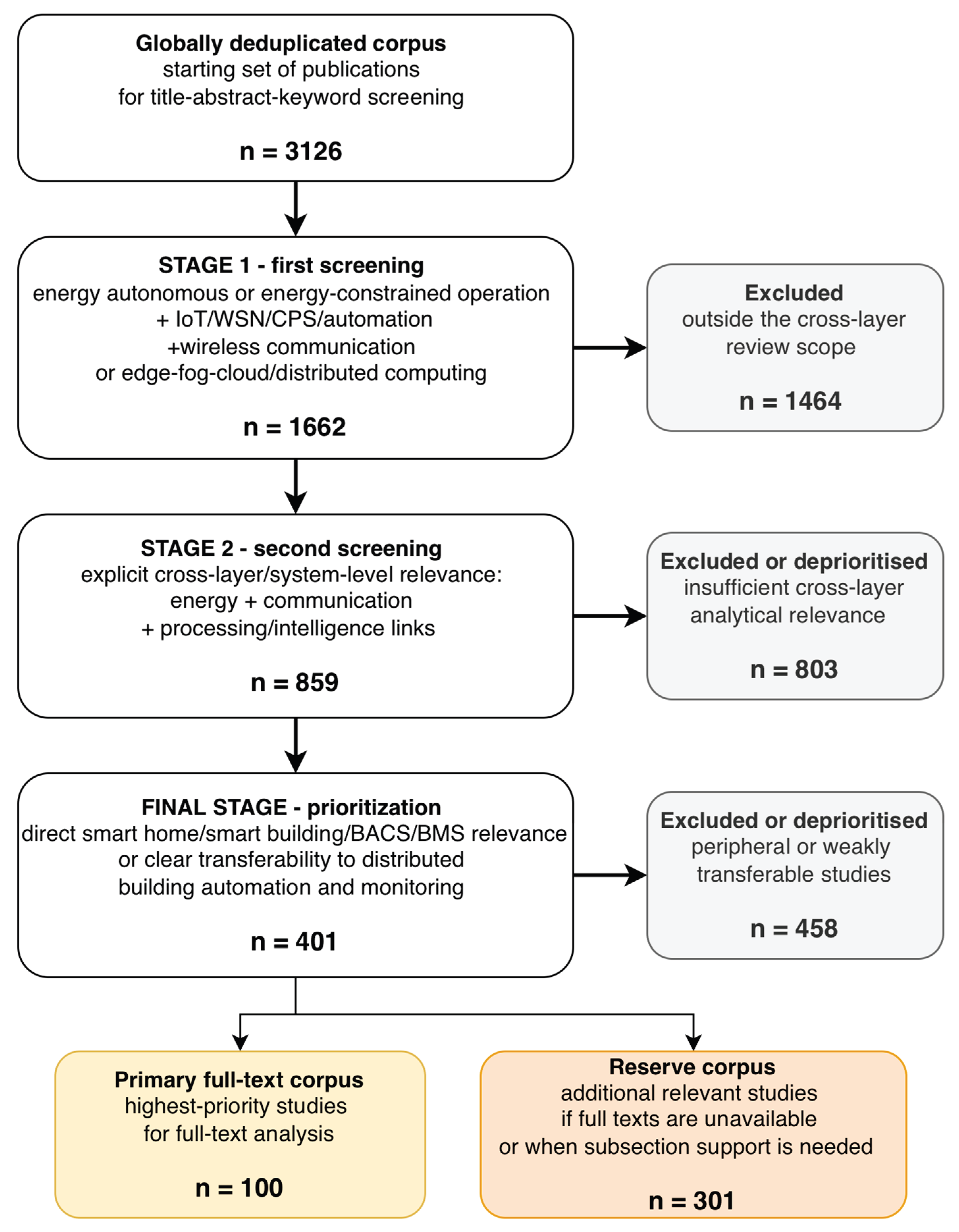
Figure 2.
Architecture of the proposed cross-layer decision framework for energy-autonomous distributed intelligence.
Figure 2.
Architecture of the proposed cross-layer decision framework for energy-autonomous distributed intelligence.
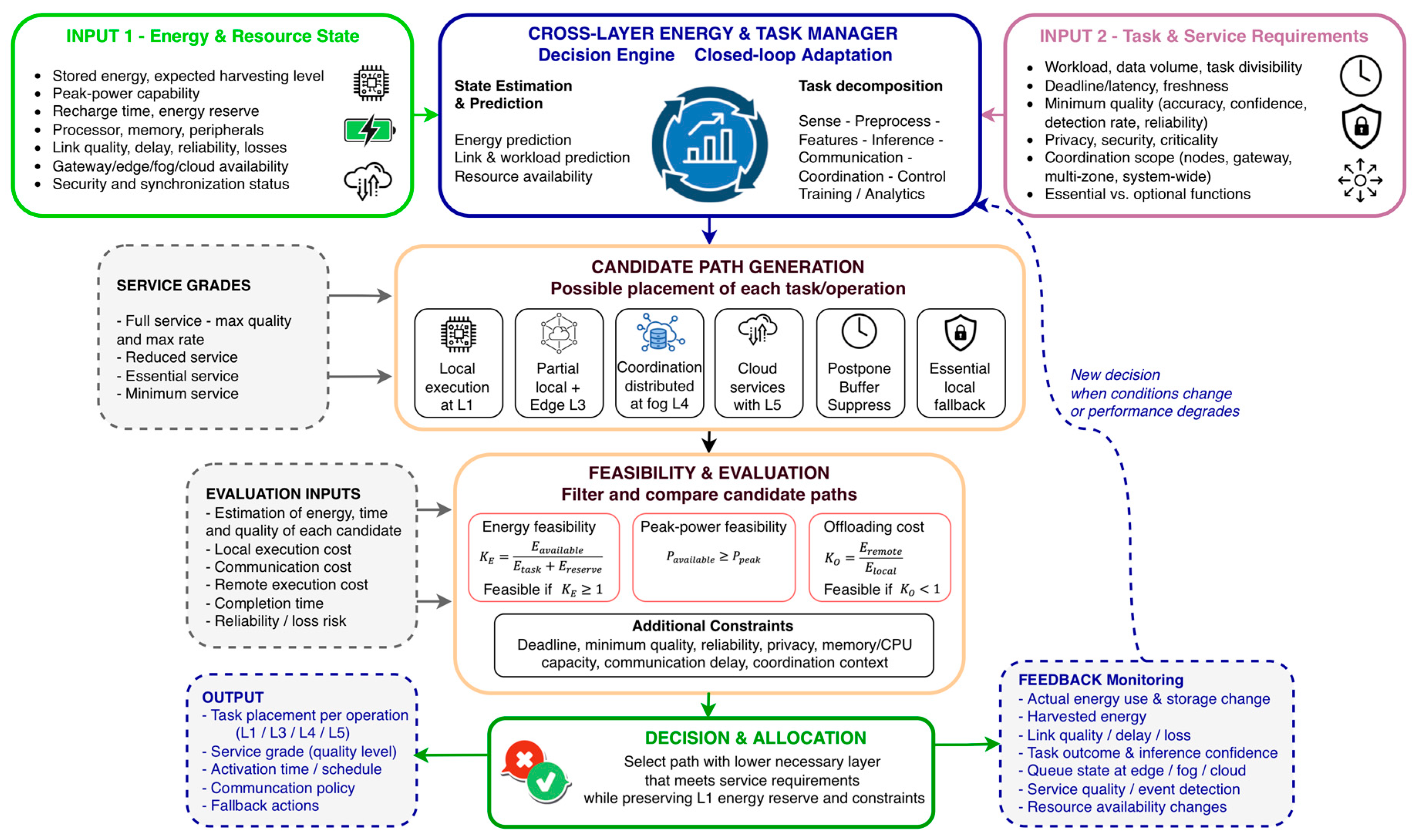
Figure 3.
Decision procedure for adaptive task and intelligence placement across the distributed computing continuum.
Figure 3.
Decision procedure for adaptive task and intelligence placement across the distributed computing continuum.
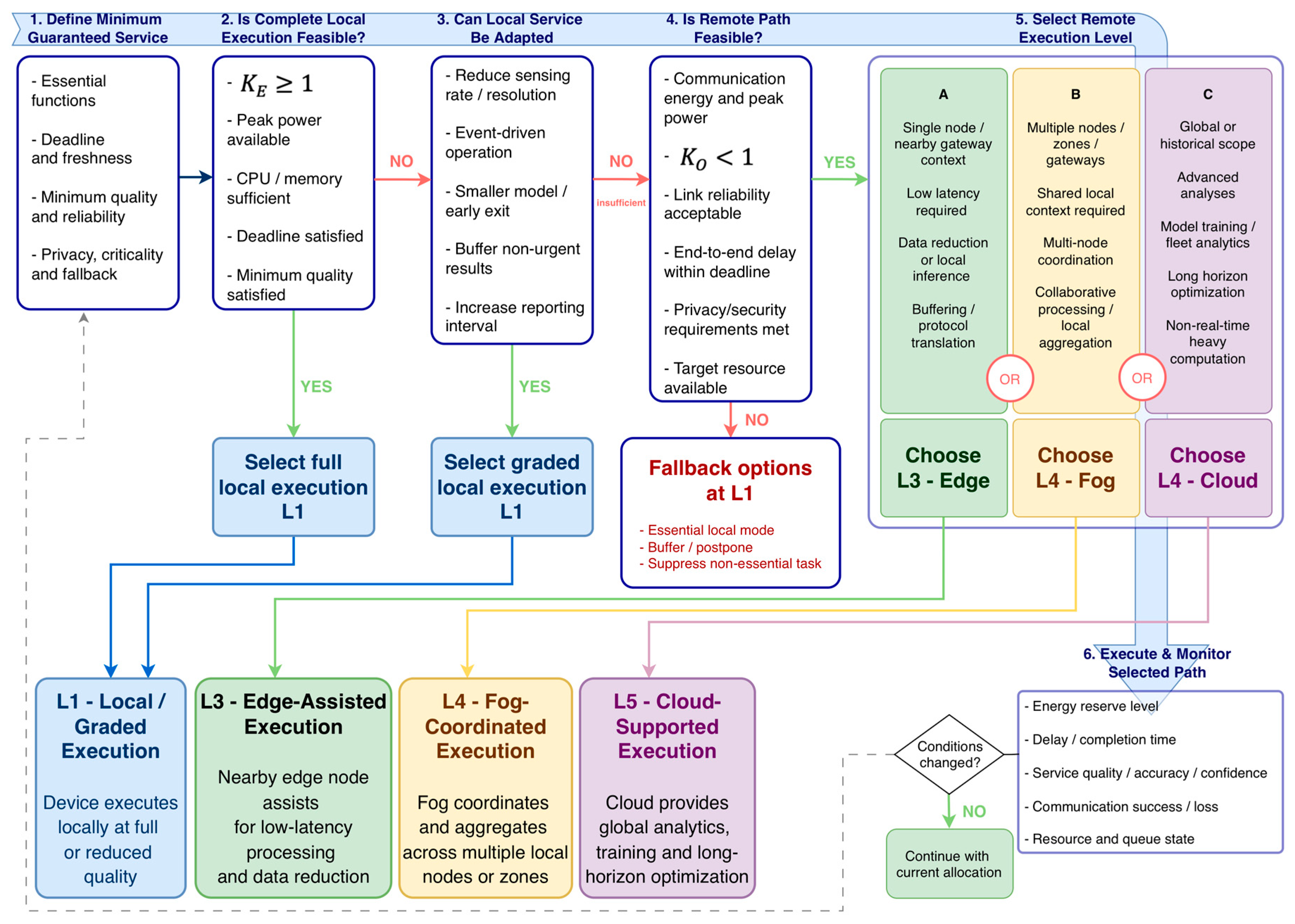

Table 1.
Main thematic blocks used to construct the database search queries.
| Block | Search area | Core keywords and phrases |
|---|---|---|
| A | Energy autonomy and constrained operation |
“energy harvesting”, “energy-autonomous”, “self-powered”, “batteryless”, “battery-free”, “energy-neutral”, “energy-constrained”, “intermittent computing”, “intermittent operation” |
| B | IoT, WSN and automation networks |
“IoT”, “Internet of Things”, WSN, “wireless sensor network”, “wireless sensor networks”, “cyber-physical system”, “CPS”, “automation network”, “building automation”, “BACS”, “BMS”, “smart building”, “smart home” |
| C | Wireless communication technologies |
“low-power wireless”, “Zigbee”, “Z-Wave”, “Bluetooth Low Energy”, “BLE”, “Bluetooth Mesh”, “Thread”, “Matter”, “EnOcean”, “KNX RF”, “Wi-Fi HaLow”, “IEEE 802.11ah”, “LoRaWAN”, “NB-IoT”, “LPWAN”, “IEEE 802.15.4”, “6TiSCH” |
| D | Edge–fog–cloud and distributed computing |
“edge computing”, “fog computing”, “cloud computing”, “edge intelligence”, “distributed intelligence”, “task offloading”, “computation offloading”, “TinyML”, “local inference”, “near-sensor computing”, “federated learning” |
Table 2.
Final main query streams used in the database search.
| Query stream | Combination of thematic blocks | Main purpose |
|---|---|---|
| Q1 | A + B + D | Identification of studies on energy-autonomous IoT and automation networks in relation to distributed intelligence, edge/fog/cloud architectures, task allocation, computation offloading and processing-function placement |
| Q2 | A + B + C | Identification of studies on energy-autonomous or energy-constrained IoT/WSN nodes in relation to wireless communication technologies, low-power networking and protocol-level constraints |
Table 3.
Raw records retrieved from the four databases.
| Database | Q1 | Q2 | Total raw records |
|---|---|---|---|
| Scopus | 606 | 520 | 1126 |
| Web of Science | 430 | 395 | 825 |
| IEEE Xplore | 1010 | 636 | 1646 |
| ACM Digital Library | 689 | 661 | 1350 |
| Total | 2735 | 2212 | 4947 |
Table 4.
Deduplication and corpus reduction process.
| Stage/Database | Raw records | Unique records after deduplication |
Removed records | Reduction |
|---|---|---|---|---|
| Scopus | 1126 | 1098 | 28 | 2.5% |
| Web of Science | 825 | 808 | 17 | 2.1% |
| IEEE Xplore | 1646 | 1571 | 75 | 4.6% |
| ACM Digital Library | 1350 | 1045 | 305 | 22.6% |
| Subtotal after within-database deduplication |
4947 | 4522 | 425 | 8.6% |
| Cross-database deduplication |
4522 | 3126 | 1396 | 30.9% |
| Final globally deduplicated corpus |
4947 | 3126 | 1821 | 36.8% |
Table 5.
Evolution of field-level IoT nodes under increasing energy awareness.
| Filed-level node paradigm | Energy | Main mechanisms |
Functions adapted to energy availability |
Main design implication |
Literature |
|---|---|---|---|---|---|
| Harvester-coupled low-power node | Alternative or supplementary supply | Energy conversion, voltage regulation, basic storage and predefined duty cycling | Wake-up interval and transmission frequency | The application remains largely fixed; autonomy is determined mainly by source–load matching | [33,40,41,48,49,51,57,61,71,72,73] |
| Buffered or hybrid self-powered node | Resource accumulated and redistributed between low-power and peak-load periods | MPPT, battery–supercapacitor coordination, controlled charging and power-domain management | Sensor activation, communication bursts and selected high-power operations | Storage architecture determines the usable power envelope and resilience to source variability | [46,47,48,49,50,59,64,70,74,75] |
| Energy-neutral and intermittency-aware node | Measured and predicted constraint on task execution | Energy budgeting, task decomposition, persistent state, federated energy storage, forecasting and application-aware scheduling | Task rate, execution order, peripheral availability and reporting interval | Functional continuity requires coordination between energy state, task completion and service requirements | [32,37,53,54,55,56,63,67,76] |
| Energy-aware sensing node | Budget and physical resource for acquiring and representing useful information | Adaptive sampling, event-driven activation, multifunctional transducers and physical feature extraction | Sampling frequency, measurement resolution, sensor choice and generated data volume | The objective changes from maximizing sample count to maximizing useful information per unit of energy | [32,46,47,53,54,57,58,59,60,61,62,63,64,77,78,79] |
| Energy-aware intelligent node |
Runtime variable controlling computational quality and placement | TinyML, pruning, quantization, early exits, model selection and local–remote cooperation | Inference depth, confidence threshold, accuracy, communication decision and task delegation | Intelligence becomes graded and can be redistributed between field and higher layers | [37,50,55,56,57,62,64,67,68,70,79] |
Table 6.
Evolution of field-level IoT nodes under increasing energy awareness.
| Communication technologies family | Relative field-node energy efficiency and compatibility with EH readiness | Main energy-related limitation | Best suited automation traffic |
Cross-layer implications for task and intelligence placement | Literature |
|---|---|---|---|---|---|
| Short-range low-power and building-oriented networks: BLE, Zigbee, Thread, Z-Wave, EnOcean and KNX RF | Energy efficiency: High for sleeping endpoints; Medium–Low for routers and relays. EH compatibility: High for periodic and event-driven sensing, but limited for always-listening and forwarding devices | Scanning, idle reception, mesh forwarding and dependence on continuously available routers | Periodic sensing, occupancy events, switches and local control | Basic sensing and event detection can remain at the field node (L1). Persistent reception, routing, protocol translation and system integration should usually be assigned to the wireless infrastructure and edge gateway (L2–L3). | [70,80,84,86,87,88,89,90,95] |
| Scheduled industrial mesh: TSCH and 6TiSCH | Energy efficiency: Medium–High under stable schedules. EH compatibility: Medium; improved by energy prediction and schedule adaptation, but limited by synchronization and routing duties | Joining, synchronization and maintenance of routing availability | Periodic monitoring and reliability-oriented communication | Communication scheduling should use storage state and expected harvesting at the field and network levels (L1–L2). Slot allocation, route adaptation and recovery from intermittent routers can be coordinated by gateway or local fog resources (L3–L4). | [14,70,89,90] |
| Local IP and extended-range WLAN: Wi-Fi and Wi-Fi HaLow | Energy efficiency: Low–Medium. EH compatibility: Low for conventional Wi-Fi and Medium for Wi-Fi HaLow under infrequent traffic and long sleep intervals. | Association, idle reception and relatively long active periods | Higher-rate sensing, firmware transfer, gateways and richer local services | Direct IP connectivity is more suitable for better-powered devices and edge gateways (L1/L3). Weak nodes should preprocess and aggregate data before transfer to edge or higher-level services (L3–L5). | [70,84,86,87,95] |
| Unlicensed LPWAN, mainly LoRaWAN |
Energy efficiency: Medium–High for infrequent uplinks, but lower at high spreading factors or under dense traffic. EH compatibility: Medium–High when sufficient buffering and long recharge intervals are available. | Long time on air, receive windows, collisions and limited downlink availability | Metering, environmental monitoring and delay-tolerant event reporting | Data reduction and event qualification should remain close to the sensor (L1), while multi-node aggregation and transmission coordination can be performed by gateways or local fog services (L3–L4). Cloud transfer should mainly concern compact summaries and long-term data (L5). | [47,62,80,81,82,83,85] |
| Cellular LPWAN: NB-IoT and LTE-M | Energy efficiency: Low–Medium because of signaling and modem activation. EH compatibility: Low–Medium; feasible mainly with stable harvesting, larger buffers or rare event-triggered transmission. | Network attachment, signaling, modem activation and high peak-energy demand | Remote monitoring, distributed assets and rare high-value alarms | Local filtering and event qualification are required before modem activation at the field node (L1). Cellular links are most suitable for selected alarms or periodic summaries delivered to remote coordination and cloud services (L4–L5). | [46,50,86,92,95] |
| Passive and specialized links: backscatter, optical/VLP and wake-up communication | Energy efficiency: Very high at the field node. EH compatibility: High, but strongly dependent on available RF carriers, illumination, readers or dedicated infrastructure. | Dependence on external carriers, illumination, readers and dedicated infrastructure | Sparse sensing, localization, triggering and batteryless tags | The field device can be limited to sensing, modulation or wake-up functions (L1). Reception, decoding, interference mitigation and persistent connectivity are transferred to readers, edge gateways or higher-level resources (L3–L5). | [40,47,73,86,94,96,97] |
Table 7.
Functional roles, selected techniques and energy-related implications across the L1–L5 processing continuum.
Table 7.
Functional roles, selected techniques and energy-related implications across the L1–L5 processing continuum.
| Review framework level | Available resources and constraints | Main processing and coordination functions |
Energy-related system contribution |
Conditions favoring task placement |
|---|---|---|---|---|
| L1 — energy-autonomous field node | Limited and variable harvested or stored energy; restricted memory and processing; direct access to sensors and actuators |
Sampling, event-triggered sensing, filtering, compression, thresholding, partial local execution and lightweight or early-exit inference |
Avoids radio use; supports immediate response; enables energy-proportional computation by adapting sampling, central processing unit (CPU) activity or inference depth |
Small or divisible task; strict response time; sufficient stored or predicted energy; expensive or unavailable communication; privacy, resilience or direct actuation required [009,083] |
| L2 — wireless/ network operation |
Shared bandwidth, variable channel quality, protocol overhead, retransmissions and energy-dependent accessibility of higher layers |
Duty-cycled access, routing, aggregation, D2D relaying, transmission-power and time allocation, WPT/SWIPT, and RIS/IRS-assisted energy and data links |
Determines the energy cost of remote processing; reduces active-radio time; can provide RF energy and improve the offloading channel; enables energy-aware relay and transmission scheduling |
Link gain and reliability justify transmission; communication energy remains lower than avoided local computation; sufficient harvesting and offloading time is available [054,056,074,079,082,100] |
| L3 — edge gateway/MEC |
Moderate or high local computing and storage; low access latency; limited gateway coverage and server capacity |
Aggregation, feature extraction, buffering, protocol translation, local inference, store–process–then–forward operation, binary or partial offloading, edge caching and joint CPU–power–time allocation |
Reduces node processing and long-distance data transfer; shortens radio- active periods; supports intermittent nodes and local service continuity; absorbs workloads exceeding L1 resources |
Data can be reduced before further transfer; low latency is required; the gateway is reachable at acceptable energy cost; joint allocation provides a benefit over fixed offloading [061,071,079,100] |
| L4 — fog/local coordination |
Distributed and heterogeneous resources across several devices, gateways, servers, zones or subsystems; additional coordination overhead |
Distributed server selection and pricing, multi-node scheduling, D2D-assisted resource sharing, workload balancing, collaborative processing, FL participant selection, multi-level aggregation, and graph/DRL-based server pairing |
Uses nearby energy, computing and data resources before involving the cloud; balances heterogeneous workloads and energy budgets; reduces long-range task and model- update transmissions |
Tasks or models involve several nodes or zones; resource availability is uneven; local cooperation and dataset complementarity outweigh signaling, relay and queueing costs [047,053,054,065,078] |
| L5 — cloud services | Large-scale computing and storage; global visibility; higher latency, uplink demand and dependence on external connectivity | Global FL aggregation and retraining, historical analytics, fleet management, long-horizon optimization, DT simulation and higher-level control of cloud–edge architectures |
Removes intensive and long-term workloads from constrained local infrastructure; supports global prediction and optimization, but may increase telemetry and synchronization demand |
Global scope, extensive history or complex simulation is required; the task is not hard real-time; lower layers can transmit compact features, model updates or selected DT states [094,100] |
Table 8.
Evidence-based reference operating points supporting the proposed cross-layer decision framework.
Table 8.
Evidence-based reference operating points supporting the proposed cross-layer decision framework.
| Decision relationship |
Reference operating point | Framework implication | Literature |
|---|---|---|---|
| Energy reserve and network recovery |
A 200 mF supercapacitor, average joining energy of 0.47 J and a 15 min prediction interval was used in the evaluated batteryless time-slotted IPv6 network. Two-hop request–response latency remained below 340 ms, although outliers reached approximately 5 s |
The reserve should cover essential operation and recovery until the next adaptation interval. Energy feasibility does not guarantee sufficiently low latency |
[14] |
| Peak-power feasibility |
Cellular modem operation required at least 3.2 V and could draw up to 250 mA. A 1.5 F supercapacitor supported activation and transmission |
Long-range communication requires sufficient stored energy and peak-power buffering |
[46] |
| Protocol and security overhead |
Communication energy increased from 1.17 mWh for UDP to 1.71 mWh for MQTT and 2.82 mWh for MQTT with transport-layer security |
Remote-path energy includes protocol and security overhead, not only payload transmission |
[50] |
| Reserve-aware sensing | The policy in [54] detected up to 25.6% more events during the initial period and up to 66% more under low-light conditions, but deep depletion reduced later service |
Energy management should preserve a reserve and consider a longer operating horizon |
[54] |
| Prediction-based task control | The task manager increased component availability by at least 15.28%. Dynamic aggregation reduced data loss by 99.04% and packet delay by 94.96% relative to the compared method |
Predicted energy and device state can control task rates, peripherals and aggregation timing | [55] |
| Energy- proportional inference |
Early-exit selection improved inference accuracy by up to 36% relative to the compared approach while maintaining energy-neutral operation | Inference depth can be adapted before transferring the complete task |
[56] |
| Local processing and collaboration | In-sensor analytics required approximately 467 times less energy than Bluetooth Low Energy communication and 69,500 times less than LoRa communication while retaining more than 99% of information. Collaboration increased the worst-case lifetime by approximately 50% |
Local reduction and aggregation are preferred when they substantially reduce long-range communication | [80] |
| Recharge- constrained reporting |
Batteryless LoRaWAN reporting capability decreased from 5.33 packets/h at spreading factor 7 to 3.01 packets/h at spreading factor 12 |
Reporting frequency should be evaluated together with recharge time and the complete communication cycle |
[81] |
Table 9.
Main challenges and priority research directions for energy-autonomous distributed intelligence.
Table 9.
Main challenges and priority research directions for energy-autonomous distributed intelligence.
| Area | Main challenge | Role of AI and DT | Technical and system enablers | Priority research and validation need |
|---|---|---|---|---|
| Distributed networks and IoT |
Coordination of intermittent nodes, wireless access and heterogeneous processing resources |
AI for energy forecasting, scheduling and resource selection; digital twins for state estimation and evaluation of placement alternatives |
Energy-aware routing, adaptive duty cycling, edge orchestration, semantic data exchange, lightweight telemetry and open IoT interfaces |
Closed-loop cross-layer control and benchmarks covering sensing, processing, communication, recovery and energy redistribution |
| Building and industrial automation |
Integration of field devices, legacy protocols, gateways and supervisory platforms | Edge AI for local inference, diagnostics and adaptive control; digital twins for functional verification and process representation |
Open gateways, interoperable information models, protocol translation, fieldbus and wireless integration, local buffering and edge data processing |
Field-to-edge case studies, long-term tests and function-level assessment against EN ISO 52120, EPBD and SRI requirements |
| Smart systems and autonomous infrastructure |
Coordination across buildings, microgrids, energy communities and external services |
Federated and collaborative AI for distributed adaptation; digital twins for scenario analysis and multi- system optimization |
Fog coordination, federated learning, interoperable semantics, digital-twin platforms, energy-management interfaces and cloud–edge integration |
Hierarchical orchestration, tolerance to incomplete data and intermittent devices, and system-level sustainability assessment |
Disclaimer/Publisher’s Note: The statements, opinions and data contained in all publications are solely those of the individual author(s) and contributor(s) and not of MDPI and/or the editor(s). MDPI and/or the editor(s) disclaim responsibility for any injury to people or property resulting from any ideas, methods, instructions or products referred to in the content. |
© 2026 by the authors. Licensee MDPI, Basel, Switzerland. This article is an open access article distributed under the terms and conditions of the Creative Commons Attribution (CC BY) license (http://creativecommons.org/licenses/by/4.0/).
Copyright: This open access article is published under a Creative Commons CC BY 4.0 license, which permit the free download, distribution, and reuse, provided that the author and preprint are cited in any reuse.


