

Submitted:
07 August 2026
Posted:
07 August 2026
You are already at the latest version
Abstract
The design of unsymmetrical N-heterocyclic carbene (uNHC) ligands represents an effective strategy for tuning the catalytic performance of ruthenium olefin metathesis catalysts. In this work, two second-generation Hoveyda–Grubbs-type complexes bearing unsymmetrical NHC ligands with N-benzyl and N′-2-isopropylphenyl substituents and anti or syn backbone configurations were synthesized and fully characterized. Their catalytic performance was evaluated in representative olefin metathesis reactions, including cross metathesis, ethenolysis of ethyl oleate, and ring-closing metathesis of substrates with increasing steric demand, and compared with that of the corresponding N-cyclohexyl analogues and the commercial second-generation Hoveyda–Grubbs catalyst. Replacing the N-cyclohexyl substituent with the more flexible N-benzyl group significantly influences catalyst performance, although this depends on both the backbone configuration and the type of metathesis transformation. Overall, catalysts featuring an anti phenyl-substituted NHC backbone exhibited superior performance, particularly in the ethenolysis of ethyl oleate and in the sterically demanding ring-closing metathesis of linalool. The introduction of the benzyl substituent reduced the differences in catalytic behavior between the anti and syn isomers in RCM reactions compared with the corresponding cyclohexyl derivatives. Finally, the chiral anti catalyst was evaluated in a model asymmetric ring-opening cross-metathesis reaction, affording only low enantioselectivity.
Keywords:
unsymmetrical NHCs
; ruthenium catalysts
; olefin metathesis
1. Introduction
Over the past two decades, N-heterocyclic carbenes (NHCs) have become indispensable ancillary ligands in transition-metal catalysis [1,2]. Their peculiar steric and electronic properties enable the generation of highly active metal complexes that often combine exceptional catalytic performance with remarkable stability toward air and moisture. Among the various metal–NHC architectures developed to date, ruthenium carbene complexes have emerged as the benchmark catalysts for the olefin metathesis reaction, one of the most powerful methodologies for the formation of carbon-carbon double bonds [3,4]. In particular, the introduction of NHC-supported ruthenium complexes, the so-called second-generation catalysts, has profoundly expanded the scope of olefin metathesis, providing organic and polymer chemists with access to unprecedented reactivity while maintaining excellent functional-group tolerance [5,6,7].
Because the catalytic performance of these complexes can be finely controlled through ligand design, considerable effort has been devoted to modulating the steric and electronic properties of NHC ligands [5,6,8]. This is generally achieved through two complementary approaches: modification of the NHC backbone and variation of the N-substituents. Backbone functionalization, particularly through the introduction of stereogenic centers and control of their relative configuration (syn or anti), modulates the steric environment around the metal center and consequently substrate accessibility [9]. At the same time, the development of unsymmetrical NHCs (uNHCs), especially those bearing differentiated N-alkyl and N′-aryl substituents, has emerged as a powerful strategy to create an asymmetric coordination environment around the ruthenium center [8,10]. By combining substituents with different steric and electronic characteristics, uNHC ligands provide an additional level of control over catalyst properties, leading to enhanced stability, activity, and selectivity in challenging metathesis transformations where conventional symmetrical analogues often show limited efficiency [11,12].
Building on these considerations, our group has developed a family of ruthenium-based olefin metathesis catalysts bearing unsymmetrical N-alkyl, N′-aryl NHC ligands with either anti or syn backbone configurations [13,14,15,16,17,18,19,20]. For these complexes, the catalytic behavior is governed by a synergistic interplay between backbone stereochemistry and nature of the N-substituents. In particular, anti catalysts were generally found to be more active than their syn counterparts, and this difference is especially pronounced in complexes bearing an N-cyclohexyl, N′-2-isopropylphenyl NHC ligand, suggesting that even subtle modifications within the uNHC framework can strongly affect catalyst performance [13,14,16]. To further investigate how unsymmetrical NHC modifications can influence catalytic performance, we sought to examine whether replacing the N-cyclohexyl substituent with a benzyl group could further modulate the ruthenium coordination environment. The introduction of a methylene spacer is expected to increase the conformational flexibility of the NHC ligand, allowing the pendant aryl ring to adopt different orientations with respect to the metal center. This increased flexibility may either position the aromatic ring away from the ruthenium center or bring it into closer proximity, potentially enabling weak secondary interactions with the metal [21,22,23]. Herein, we report the synthesis and characterization of two new second-generation Hoveyda–Grubbs-type complexes (1 and 2, Figure 1) featuring uNHC ligands bearing a flexible pendant benzyl substituent on one nitrogen atom and a 2-isopropylphenyl group on the other. The catalytic behavior of the new complexes was evaluated in olefin metathesis transformations such as cross metathesis (CM), ring-closing metathesis (RCM) and asymmetric ring opening cross-metathesis (AROCM) and compared with that of the previously reported analogous anti and syn N-cyclohexyl, N′-2-isopropylphenyl catalyst (3 and 4, Figure 1).
2. Materials and Methods
2.1. General Information
All reactions were conducted under a nitrogen atmosphere using standard Schlenk line and glove box systems, with dry and distilled solvents. The reagents of high purity were sourced from TCI Chemicals and Sigma-Aldrich and were used as-is without any further purification. Crude products for ligand Synthesis were purified at each step via flash chromatography using silica gel (mesh size 230-400) from Sigma-Aldrich, while complexes were purified under nitrogen using silica gel of the same mesh size but from TSI Cambridge. Thin layer chromatography was performed using 60 F254 silica gel pre-coated plates, which contain a fluorescent indicator, and were visualized under either a UV lamp or with staining agents such as I2 or KMnO4 solutions. Deuterated solvents used in the NMR analysis of complexes were stored in a glove box over 4 Å molecular sieves. NMR spectra were recorded on Bruker Avance spectrometers operating at 250, 300, 400, and 600 MHz, with the same operating frequency in MHz for 1H NMR. For 13C NMR, the operating frequencies for these instruments were 62.5, 75, 161.9, and 150 MHz, respectively. For the preparation of NMR samples, 10 to 20 mg of compounds were dissolved in 0.5 mL of deuterated solvent. ESI-MS measurements of organic compounds were performed on a Waters Quattro Micro triple quadrupole mass spectrometer equipped with an electrospray ion source. ESI-FT-ICR measurements of complexes were performed on a Bruker Solaris XR instrument. Chiral HPLC analysis were performed using JASCO LC-NET II/ADC model with a JASCO PU-2089 Plus Pump and a UV detector JASCO MD-2010, set at 254 nm.
2.2. Synthesis of Mono-Arylated Diamines A and A’
The synthesis of diamines was accomplished following literature procedures [13,14]. A three-neck round-bottom flask equipped with a condenser and a magnetic stirrer was charged with Pd(OAc)₂ (0.250 mmol, 0.0560 g), BINAP (0.500 mmol, 0.314 g), tBuONa (5.00 mmol, 0.484 g), and dry toluene (50 mL). After stirring 10 minutes, (1R,2R)-(+)-1,2-diphenylethylenediamine or (1R,2S)-1,2-diphenylethane-1,2-diamine (3.80 mmol, 0.800 g) was added, followed by 1-bromo-2-isopropylbenzene (2.50 mmol, 0.502 g). The reaction mixture was stirred at 100 °C under inert atmosphere for 24 hours. The dark purple reaction mixture was then cooled to room temperature, diluted with hexane, and filtered through silica, using methanol to elute the desired product. The obtained dark orange solid was purified by flash chromatography on silica gel (1:40), using hexane/ethyl acetate mixtures (from 9:1 to 6:4). The products A anti A’ were obtained as a yellow-orange oil in 90% and 87% yield, respectively.
A: 1H NMR (ppm, 400 MHz, CDCl3): δ 7.40–7.32 (overlapping signals, 10H, Ar-H), 7.18 (m, 1H, o-Ar-H), 6.91 (m, 1H, m-Ar-H), 6.69 (m, 1H, p-Ar-H), 6.25 (m, 1H, m-Ar-H), 5.43 (br s, 1H, NH), 4.60 (br s, 1H, N-CH-CH-N), 4.46 (br s, 1H, N-CH-CH-N), 3.14 (m, 1H, Ar-CH(CH3)2), 1.45 (br d, 3H, Ar-CH(CH3)2), 1.32 (br d, 3H, Ar-CH(CH3)2).
ESI-MS: m/z = 331 [M+H]+.
A’: 1H NMR (ppm, 300 MHz, CDCl3): δ 7.33–7.03 (overlapping signals, 10H, Ar-H), 7.03 (d, 1H, J = 7.5 Hz, o-Ar-H), 6.82 (dt, 1H, J = 7.5, 0.7 Hz, m-Ar-H), 6.59 (t, 1H, J = 7.5 Hz, p-Ar-H), 6.27 (d, 1H, J = 7.5 Hz, m-Ar-H), 4.52 (br d, 1H, N-CH-CH-N and NH), 4.24 (d, J = 5.9 Hz, 1H, N-CH-CH-N), 2.77 (ept, 1H, J = 6.8 Hz, Ar-CH(CH3)2), 1.22 (d, 3H, J = 6.8 Hz, Ar-CH(CH3)2), 1.05 (d, 3H, J = 6.8 Hz, Ar-CH(CH3)2).
ESI-MS: m/z = 331 [M+H]+.
2.3. Synthesis of Unsymmetrical Diamine B
According to a previously reported procedure [20], benzaldehyde (0.452 g, 4.26 mmol), mono-arylated diamine A (0.470 g, 1.42 mmol) and dry MeOH (18 mL) were introduced in un a round bottom flask charged by molecular sieves (4 Å). The reaction mixture was stirred at room temperature for 18 hours. Afterwards, sodium borohydride (0.215 g, 5.68 mmol) and dry MeOH (6 mL) were added. The mixture was stirred at 60 °C for further 48 hours. After cooling to room temperature, the reaction mixture was quenched with and extracted with DCM. The combined organic layers were dried over anhydrous , filtered, and concentrated under reduced pressure. The product was purified by flash column chromatography on silica gel (hexane: ethyl acetate, 9:1 to 6:4). The desired product B was obtained as yellow oil in 80% yield.
1H NMR (ppm, 600 MHz, CDCl3, Figure S1): δ 7.37–7.18 (overlapping signals, 17H, Ar-H), 6.92 (t, 1H, J = 7.8 Hz, m-Ar-H), 6.72 (t, 1H, J = 6.8 Hz, p-Ar-H), 6.28 (d, 1H, J = 7.8 Hz, m-Ar-H), 5.59 (br s, 1H, NH), 4.50 (d, 1H, J = 5.8 Hz, N-CH-CH-N), 4.07 (d, 1H, J = 6.0 Hz, N-CH-CH-N), 3.83 (d, 1H, J = 13.4 Hz, N-CHH-Ph), 3.57 (d, 1H, J = 13.5 Hz, N-CHH-Ph), 3.23 (ept, 1H, J = 6.6 Hz, Ar-CH(CH3)2), 1.46 (d, 3H, J = 6.9 Hz, Ar-CH(CH3)2), 1.41 (d, 3H, J = 6.4 Hz, Ar-CH(CH3)2).
13C NMR (ppm, 150 MHz, CDCl3, Figure S2): δ 162.45 (Cq), 144.27 (Cq), 141.49 (Cq), 140.97 (Cq), 140.62 (Cq), 140.09 (Cq), 128.62 (Ar-CH), 128.41 (Ar-CH), 128.03 (Ar-CH), 127.88 (Ar-CH), 127.71 (Ar-CH), 127.53 (Ar-CH), 127.44 (Ar-CH), 126.36 (Ar-CH), 127.17 (Ar-CH), 127.11 (Ar-CH), 127.05 (Ar-CH), 126.44 (Ar-CH), 124.76 (Ar-CH), 117.08 (Ar-CH), 111.94 (Ar-CH), 67.96 (N-CH-CH-N), 63.9 (N-CH-CH-N), 51.19 (CH2-Ph), 27.57 (Ar-CH(CH3)2), 22.85 (Ar-CH(CH3)2), 22.39 (Ar-CH(CH3)2).
ESI-MS: m/z = 421,26289 [M+H]+.
2.4. Synthesis of Unsymmetrical Diamine B’
Following a modified literature procedure [24], in a round-bottom flask equipped by magnetic stirrer mono-arylated diamine A’ (0.331 g, 1.07 mmol), was introduced, dissolved in anhydrous methanol (54 mL), and then benzaldehyde (0.125 g, 1.18 mmol) was added dropwise. Lastly, anhydrous MgSO4 was added, and the reaction was stirred at room temperature overnight. Subsequently, the reaction mixture was filtered to remove MgSO4 and sodium borohydride (0.162 g, 4.28 mmol) was added in three portions. The resulting mixture was stirred at room temperature for another 18 hours. The product was purified via flash column chromatography on silica gel (n-hexane/ethyl acetate, 9:1 to 2:8). The desired product B’ was obtained as a yellow oil in 76% yield.
1H NMR (ppm, 600 MHz, CDCl3, Figure S5): δ 7.29–7.25 (overlapping signals, 6H, Ar-H), 7.20–7.19 (overlapping signals, 5H, Ar-H), 7.07–7.05 (overlapping signals, 5H, Ar-H), 6.83 (dt, 1H, J = 7.5, 1.3 Hz, m-Ar-H), 6.60 (dt, 1H, J = 7.5, 1.3 Hz, p-Ar-H), 6.24 (d, 1H, J = 8.0 Hz, m-Ar-H), 5.00 (br s, 1H, NH), 4.54 (br s, 1H, N-CH-CH-N), 4.07 (d, 1H, J = 5.4 Hz, N-CH-CH-N), 3.76 (d, 1H, J = 5.9 Hz, N-CHH-Ph), 3.50 (d, 1H, J = 5.9 Hz, N-CHH-Ph), 2.87 (ept, 1H, J = 6.8 Hz, Ar-CH(CH3)2), 1.31 (d, 3H, J = 6.8 Hz, Ar-CH(CH3)2), 1.18 (d, 3H, J = 6.8 Hz, Ar-CH(CH3)2).
13C NMR (ppm, 150 MHz, CDCl3, Figure S6): δ 143.88 (Cq), 140.29 (Cq), 140.06 (Cq), 139.68 (Cq), 132.35 (Cq), 128.29 (Ar-CH), 128.25 (Ar-CH), 128.17 (Ar-CH), 127.88 (Ar-CH), 127.82 (Ar-CH), 127.41 (Ar-CH), 127.14 (Ar-CH), 126.54 (Ar-CH), 124.78 (Ar-CH), 117.07 (Ar-CH), 111.78 (Ar-CH), 66.91 (N-CH-CH-N), 62.74 (N-CH-CH-N), 51.04 (CH2-Ph), 27.62 (Ar-CH(CH3)2), 22.44 (Ar-CH(CH3)2), 22.37 (Ar-CH(CH3)2).
ESI-MS: m/z = 421.26254 [M+H]+.
2.5. General Procedure for the Synthesis of Tetrafluoroborate Salts
To single-neck round-bottom flask equipped with a magnetic stirrer was charged with appropriate diamine B or B’ (1.26 mmol, 0.530 g) and CH(OEt)3 (10.1 mmol, 1.68 mL). The mixture was stirred for a few minutes, and then NH4BF4 (1.51 mmol, 0.158 g) was added. A condenser was fitted to the flask, and the reaction mixture was stirred overnight at 140 °C. The following day, the mixture was evaporated to dryness in vacuo, and the product was washed and subsequently purified by flash column chromatography on silica gel using hexane/ethyl acetate 1:9 as the eluent. The desired products C anti C’ were obtained as white solids in 88% and 80% yield, respectively.
C: 1H NMR (ppm, 600 MHz, CDCl3, Figure S9): δ 8.68 (s, 1H, N-CH-N), 7.55–7.53 (overlapping signals, 3H, Ar-H), 7.41–7.40 (overlapping signals, 3H, Ar-H), 7.36–7.26 (overlapping signals, 11H, Ar-H), 7.15 (m, 1H, Ar-H), 7.07 (br d, 2H, Ar-H), 7.03–7.00 (overlapping signals, 3H, Ar-H), 7.11–7.09 (overlapping signals, 4H, Ar-H), 5.17-5.14 (overlapping signals 3H, N-CH-CH-N, N-CH-CH-N, N-CHH-Ph), 4.49 (d, 1H, J = 14.2 Hz, N-CHH-Ph), 2.96 (ept, 1H, J = 6.7 Hz, Ar-CH(CH3)2), 1.23 (d, 3H, J = 6.8 Hz, Ar-CH(CH3)2), 1.06 (d, 3H, J = 6.7 Hz, Ar-CH(CH3)2).
13C NMR (ppm, 150 MHz, CDCl3, Figure S10): δ 157.64 (N-CH-N), 145.61 (Cq), 134.56 (Cq), 134.12 (Cq), 132.09 (Cq), 131.13 (Cq), 130.85 (Ar-CH), 130.57 (Ar-CH), 130.46 (Ar-CH), 130.36 (Ar-CH), 129.75 (Ar-CH), 129.72 (Ar-CH), 129.57 (Ar-CH), 129.54 (Ar-CH), 128.22 (Ar-CH), 128.15 (Ar-CH), 127.47 (Ar-CH), 127.37 (Ar-CH), 77.88 (N-CH-CH-N), 72.27 (N-CH-CH-N), 51.11 (CH2-Ph), 28.45 (Ar-CH(CH3)2), 24.37 (Ar-CH(CH3)2), 24.06 (Ar-CH(CH3)2).
ESI-MS: m/z = 431.24829 [M−BF4]−.
C’: 1H NMR (ppm, 600 MHz, CDCl3, Figure S13): δ 8.51 (s, 1H, N-CH-N), 7.45–7.41 (overlapping signals, 4H, Ar-H), 7.32–7.31 (overlapping signals, 2H, Ar-H), 7.25–7.22 (overlapping signals, 5H, Ar-H), 7.15 (m, 1H, Ar-H), 7.07 (br d, 2H, Ar-H), 7.03–7.00 (overlapping signals, 3H, Ar-H), 6.92–6.90 (overlapping signals, 2H, Ar-H), 6.16 (d, 1H, J = 12.2 Hz, N-CH-CH-N), 5.73 (d, 1H, J = 12.2 Hz, N-CH-CH-N), 5.07 (d, 1H, J = 14.4 Hz, N-CHH-Ph), 4.62 (d, 1H, J = 14.4 Hz, N-CHH-Ph), 3.06 (ept, 1H, J = 6.8 Hz, Ar-CH(CH3)2), 1.26 (d, 3H, J = 6.8 Hz, Ar-CH(CH3)2), 1.17 (d, 3H, J = 6.8 Hz, Ar-CH(CH3)2).
13C NMR (ppm, 150 MHz, CDCl3, Figure S14): δ 159.11 (N-CH-N ), 144.17 (Cq), 132.12 (Cq), 130.37 (Cq), 130.31 (Cq), 130.15 (Cq), 129.74 (Ar-CH), 129.67 (Ar-CH), 129.51 (Ar-CH), 129.27 (Ar-CH), 129.18 (Ar-CH), 128.98 (Ar-CH), 128.54 (Ar-CH), 128.41 (Ar-CH), 127.71 (Ar-CH), 127.44 (Ar-CH), 127.30 (Ar-CH), 73.27 (N-CH-CH-N), 69.06 (N-CH-CH-N), 51.51 (CH2-Ph), 28.54 (Ar-CH(CH3)2), 24.32 (Ar-CH(CH3)2), 24.29 (Ar-CH(CH3)2).
ESI-MS: m/z = 431.24829 [M−BF4]−.
2.6. General Procedure for the Synthesis of Catalysts
Inside a glovebox, the appropriate imidazolinium tetrafluoroborate salt (0.289 mmol, 0.150 g) was dissolved in anhydrous toluene in a 20 mL vial to obtain a 0.02 M solution. The base, potassium tert-amylate (1.7 M solution in toluene, 0.17 mL), was then added, and the reaction mixture was stirred for a few minutes at room temperature. Afterward, the first-generation Hoveyda-Grubbs complex HGI (0.241 mmol, 0.145 g) was added. The Schlenk tube was taken out of the glovebox and placed in an oil bath preheated to 70 °C for one hour. After cooling the reaction mixture to room temperature, column chromatography was performed using TSI silica (silica-to-crude weight ratio of 70:1), eluting with a hexane/diethyl ether gradient from 5:1 to 2:1. The desired products 1 and 2 were isolated as green solids in 37% and 26% yield, respectively. Their structures were confirmed by ¹H NMR and ¹³C NMR analysis and by mass spectrometry.
1: 1H NMR (ppm, 600 MHz, C6D6, major isomer, Figure S17) δ 16.24 (s, 1H, Ru=CH-oOiPrC6H4), 7.78 (d, 2H, J = 7.5 Hz, Ar-H), 7.51 (d , 2H, J = 6.4 Hz, Ar-H), 7.36 (d , 2H, J = 7.5 Hz, Ar-H), 7.24−7.19 (overlapping signals, 2H, Ar-H), 7.17-7.01 (overlapping signals, 10H, Ar-H), 6.94-6.91 (overlapping signals, 3H, Ar-H and N-CHH-Ph), 6.68 (t, 1H, J=7.3 Hz, Ar-H), 6.57 (t, J= 7.8 Hz, 1H, Ar-H), 6.45 (d, J= 8.3 Hz, 1H, Ar-H), 5.17 (d, 1H, J = 14.0 Hz, N-CHH-Ph), 4.77 (br s, 2H, N-CH-CH-N), 4.65 (ept, 1H, J = 6.1 Hz, OCH(CH3)2), 3.55 (ept, 1H, J = 6.8 Hz, Ar-CH(CH3)2), 1.68 (m, 6H, OCH(CH3)2), 1.34 (d, 3H, J = 6.8 Hz, Ar-CH(CH3)2), 1.03 (d, 3H, J = 6.9 Hz, Ar-CH(CH3)2).
13C NMR (ppm, 150 MHz, C6D6, Figure S18) δ 289.02 (Ru=CH-oOiPrC6H4), 211.28, 153.44, 148.24, 144.17, 140.12, 139.46, 139.19, 135.83, 133.05, 130.36, 129.78, 129.61, 129.24, 129.18, 128.93, 127.02, 126.87, 126.79, 122.53, 122.23, 113.22, 79.63, 75.44, 71.54, 55.11, 27.92, 24.57, 23.48, 22.13.
ESI-MS: m/z = 679.22439 [M−Cl]−.
2: 1H NMR (ppm, 600 MHz, C6D6, major isomer, Figure S22) δ 16.26 (s, 1H, Ru=CH-oOiPrC6H4), 7.76 (d, 2H, J = 7.2 Hz, Ar-H), 7.61 (dd , 1H, J = 8.0, 1.2 Hz, Ar-H), 7.15−7.06 (overlapping signals, 15H, Ar-H and N-CHH-Ph), 7.02−6.97 (overlapping signals, 3H, Ar-H), 6.77−6.70 (overlapping signals, 3H, Ar-H), 6.65−6.58 (overlapping signals, 5H, Ar-H), 6.47 (br d, 2H, Ar-H), 5.78 (d, 1H, J = 10.0 Hz, N-CH-CH-N), 5.22 (d, 1H, J = 13.4 Hz, N-CHH-Ph), 5.01 (d, 1H, J = 10.0 Hz, N-CH-CH-N), 4.68 (q, 1H, J = 6.1 Hz, OCH(CH3)2), 3.44 (ept, 1H, J = 6.8 Hz, Ar-CH(CH3)2), 1.74 (d, 3H, J = 6.1 Hz, OCH(CH3)2), 1.69 (d, 3H, J = 6.1 Hz, OCH(CH3)2), 1.25 (d, 3H, J = 6.8 Hz, Ar-CH(CH3)2), 1.12 (d, 3H, J = 6.8 Hz, Ar-CH(CH3)2).
13C NMR (ppm, 150 MHz, C6D6, Figure S23) δ 289.71 (Ru=CH-oOiPrC6H4), 214.53, 153.38, 148.66, 144.27, 139.27, 136.49, 133.71, 133.13, 130.88, 130.40, 130.27, 130.12, 122.51, 122.42, 113.25, 75.45, 75.03, 68.97, 53.88, 28.84, 24.48, 24.03, 22.25, 22.08.
ESI-MS: m/z = 679.22480 [M−Cl]−.
2.7. CM Reaction of Allylbenzene (5) and Cis-1,4-Diacetoxy-2-Butene (6) (Scheme 2, Table 1)
Under a nitrogen atmosphere, compounds 5 (160 μL) and 6 (66 μL) were added simultaneously to a solution of the catalyst (2.5 mol%) in dry dichloromethane. The reaction mixture was refluxed under nitrogen overnight, after which the solvent was removed under reduced pressure. The crude product was purified by column chromatography using hexane/ethyl acetate 9:1 as the eluent to afford 7 as a colorless oil. The E/Z ratio of 7 was determined by 1H NMR spectroscopy by integration of the resonances at δ 4.55 (d) and 4.74 (d) ppm (CDCl₃).
2.8. Ethenolysis of Ethyl Oleate (8) (Scheme 3, Table 2)
Under a nitrogen atmosphere, 8 (5.4 mmol) and dodecane (150 μL, internal standard) were introduced into an autoclave. An aliquot was withdrawn at this stage to provide the t = 0 sample. The autoclave was purged with ethylene three times, after which a toluene solution of the catalyst (20–500 ppm) was added. The reactor was then purged with ethylene three additional times and pressurized with ethylene to 10 bar. The reaction mixture was stirred at 50 °C for 3 h, and subsequently quenched by cooling the autoclave in an ice bath. Ethyl vinyl ether was then added to deactivate the catalyst, and GC samples were prepared by dilution with hexane. The samples were stored at −20 °C until GC analysis.
2.9. General Procedure for RCM Reactions
In a nitrogen-filled glovebox, an NMR tube equipped with a screw-cap septum was charged with 0.80 mL of a catalyst solution (1- 5 mol %) in C₆D₆. The NMR tube was placed in the preheated NMR probe and equilibrated at 60 °C. Subsequently, 0.080 mmol of substrate (0.1 M) was added, and the progress of the reaction was monitored by 1H NMR spectroscopy.
RCM of Diethyl Diallylmalonate (13) (Figure 2a). A portion of 13 (19.3 μL) was added to the preheated NMR tube containing the catalyst solution. Conversion to the cyclized product 14 was determined by integration of the methylene proton signals of the starting material (δ 2.84 ppm, dt) and the product (δ 3.14 ppm, s).
RCM of Diethyl Allylmethallylmalonate (15) (Figure 2b). A portion of 15 (20.5 μL) was added to a preheated NMR tube containing 0.80 mL of catalyst solution (1 mol %). Conversion to 16 was determined by integration of the methylene proton signals of the starting material at δ 2.96 (d) and 2.93 (s), and those of the product at δ 3.18 (m) and 3.07 (s).
RCM of Diethyl Dimethallylmalonate (17) (Figure 2c). A portion of 17 (21.6 μL) was injected into a heated NMR tube containing 0.80 mL of catalyst solution (5 mol %). Conversion to 18 was determined by integration of the methylene proton signals of the starting material at δ 2.98 (s) and those of the product at δ 3.15 (s).
RCM of (±)-Linalool (19) (Figure 2d). A portion of 19 (14.3 μL) was added to the preheated NMR tube containing the catalyst solution. Conversion to the cyclized product 20 was determined by integration of the methylene proton signals of the starting material (δ 1.12 ppm, br s) and the product (δ 1.27 ppm, br s).
2.10. AROCM of Cis-5-Norbornene-Endo-2,3-Dicarboxylic Anhydride (21) with Styrene (Scheme 4, Table 3)
Under nitrogen atmosphere, 21 (0.43 mmol) and styrene (4.3 mmol) were simultaneously added to 7.5 mL of a CH2Cl2 solution of the catalyst (3mol%). The reaction mixture was stirred at room temperature for four hours, concentrated under reduced pressure, and purified via column chromatography (petroleum ether:diethyl ether 1:1) to afford the product 22 as a colorless oil. About 2 mg of the product were dissolved in 2 mL of hexane:2-propanol 99:1 (HPLC grade purity), filtered using a syringe filter and then injected into the HPLC system.
22: 1H NMR (ppm, 400 MHz, CDCl3, Figure S27): δ 7.45-7.31 (overlapping signals, 5H, Ar-H), 6.60 (m, 1H), 6.36 (m, 1H), 6.04 (br quint, 1H), 5.28 (m, 2H), 3.60 (m, 2H), 3.26-3.09 (m, 2H), 2.20 (m, 1H), 1.73-1.55 (m, 1H).
3. Results and Discussion
3.1. Synthesis of uNHC Ruthenium Complexes
The synthesis of the NHC ligand precursors for complexes 1 and 2 was accomplished in four steps, as outlined in Scheme 1, following previously reported procedures [14,20,24]. In the first step (a), (1R,2R)-(+)-1,2-diphenylethylenediamine or meso-1,2-diphenylethylenediamine underwent monoarylation via a palladium-catalyzed Buchwald–Hartwig cross-coupling reaction with 1-bromo-2-isopropylbenzene to afford the corresponding monoarylated diamines A and A′. In the second step (b), A and A′ were benzylated by reductive amination with benzaldehyde, yielding the corresponding unsymmetrical diamines B and B′. The third step (c) involved cyclization of these intermediates with ethyl orthoformate and sodium tetrafluoroborate to give the corresponding NHC tetrafluoroborate salts C and C′, respectively. In the final step (d), the desired Hoveyda–Grubbs complexes 1 and 2 were obtained by in situ deprotonation of the NHC ligand precursors with potassium tert-amylate in the presence of the first-generation Hoveyda–Grubbs catalyst (HGI). It should be noted that complex 1 is enantiopure, whereas complex 2 is obtained as a racemic mixture (only one of the enantiomers is depicted in Figure 1).
All compounds were characterized by 1H-NMR and 13C-NMR as well as ESI mass spectrometry. The corresponding NMR spectra and mass spectrometry data are reported in the Supplementary Material.
Unfortunately, despite several attempts, no crystals suitable for single-crystal X-ray diffraction analysis could be obtained.
The 1H-NMR spectrum of complex 1 shows at least two signals corresponding to the benzylidene proton resonating at 16.24 ppm and 16.26 ppm, attributable to two conformers present in a 4:1 ratio (Figure S17). Based on a 2D NOESY NMR experiment (Figure S21), these conformers are assigned to solution structures in which the benzylidene fragment is oriented below the N-2-isopropylphenyl group of the NHC ligand, while the N-2-isopropylphenyl group adopts different spatial arrangements owing to the reduced conformational freedom imposed by the substituted backbone. For the major conformer, the diagnostic resonances in the proton spectrum (Figure S17) include the benzylidene proton, which appears as a singlet at 16.24 ppm, and the methylene protons of the benzyl substituent, which give as a singlet at 4.79 ppm. The latter signal is shifted upfield by approximately 0.4 ppm relative to that observed for the corresponding NHC ligand precursor (5.17 ppm, Figure S17).
The 13C-NMR spectrum of 1 (Figure S18) displays two characteristic resonances at 211.28 ppm and 289.02 ppm, assigned to the NHC ligand carbene carbon and the benzylidene carbon, respectively.
Similarly, the 1H-NMR spectrum of complex 2 reveals the presence of two conformational isomers analogous to those observed for complex 1 (Figure S22). These conformers are present in a 4.5:1 ratio, as determined from the integration of the benzylidene proton signals at 16.25 ppm and 16.18 ppm. The characteristic resonances of the major conformer include the benzylidene proton, which appears as a singlet at 16.25 ppm, and the methylene protons of the benzyl substituent, which resonate as two doublets at 5.21 and 4.99 ppm. These signals are shifted by 0.13 and 0.36 ppm, respectively, relative to those observed for the corresponding NHC tetrafluoroborate salt.
The 13C-NMR spectrum of complex 2 (Figure S23), exhibits two diagnostic resonances at 214.53 and 289.71 ppm, which are assigned to the NHC carbene carbon and the benzylidene carbon, respectively.
It should be noted that, in general, the different symmetry of the NHC backbone (syn or anti) can lead not only to different steric properties but also to different electronic properties of the corresponding ligands. It is well known that the σ-donating properties of NHC ligands are crucial in controlling their interaction with transition metals, and consequently in determining the reactivity and selectivity of NHCs in transition-metal-mediated catalysis. According to the literature, it is possible to estimate the σ-donor character of NHC ligands using a method based on 13C NMR spectroscopy.
The σ-donating capacity of NHC ligands is, in fact, closely correlated with the 1JCH coupling constants between the C and H atoms at the precarbenic position in the corresponding imidazolium or imidazolinium salts [25,26]. Larger 1JCH coupling constants correspond to N-heterocyclic carbene species with lower σ-donor capacity due to a more pronounced s character of the orbital involved in the C–H bond. In the proton-coupled 13C-NMR spectra, the NHC ligand precursor C, with phenyl groups in the anti stereochemical configuration, exhibits a 1JCH value of 208.09 Hz, whereas the imidazolinium salt C’, with phenyl groups in the syn configuration, displays a lower 1JCH value of 205.47 Hz. These results indicate that the stereochemical configuration of the backbone carbon atoms directly influences the σ-donating character of the corresponding NHCs. In particular, the ligand with the syn backbone is expected to have better σ-donating properties than its anti counterpart. Furthermore, compared to the NHC ligand precursors of 3 (1JCH = 206.58 Hz) and 4 (1JCH = 203.54 Hz), both C and C’ appear to be overall weaker σ-donors. This trend is consistent with the lower electron-donating ability of N-benzyl substituents compared with N-cyclohexyl substituents.
Regarding the interaction of the ligands with the metal and its influence on the electronic structure of the metal center in the respective complexes, it should be emphasized that the electronic density in NHC-metal complexes depends by strong σ-donation and weaker π-interactions, including ligand-to-metal π donation and metal-to-ligand π back-donation. The balance between these electronic contributions, together with the steric properties of the ligands, is expected to influence the electronic properties of the metal center and, consequently, the catalytic behavior of the corresponding ruthenium complexes.
3.2. Catalysis
The catalytic behavior of the new complexes 1 and 2 was first evaluated in the standard cross-metathesis (CM) reaction between allylbenzene (5) and cis-1,4-diacetoxy-2-butene (6) in CH₂Cl₂ at 40 °C using 2.5 mol% catalyst (Scheme 2)[27]. The results are summarized in Table 1. For comparison, the corresponding results obtained with complexes 3 and 4 under identical conditions are also reported [13]. In addition, to place these results in a more general context, data for the commercially available symmetrical second-generation Hoveyda–Grubbs catalyst (HGII) were included [16].
Both the new catalysts were active in this reaction, affording the desired product in good yields. Complex 1 provided a 70% yield, whereas complex 2 afforded 82%, surpassing both complex 3 (67%) and the commercially available HGII (69%) (Table 1, entries 1, 2, 3 and 5).
Comparison of the catalytic performances of 1-4 highlights the influence of the NHC ligand backbone configuration. Complexes 2 and 4, bearing a syn backbone configuration, consistently exhibited slightly higher activity than their corresponding anti analogues, 1 and 3, respectively (cf. entries 2 and 4 vs 1 and 3). In contrast, the effect of the backbone configuration on E/Z selectivity was less pronounced for complexes 1 and 2 than for 3 and 4 (cf. entries 1 and 2 vs 3 and 4), suggesting that the benzyl N-substituent partially mitigates the influence of the backbone configuration.
Overall, these results confirm that both the backbone configuration and the nature of the N-substituents of the NHC ligand contribute to the catalytic performance [14,16]. Although the syn backbone generally enhances catalytic activity, the presence of the benzyl N-substituent appears to reduce the effect of the backbone on E/Z selectivity, indicating that these steric features act cooperatively in determining the catalytic outcome. A particularly attractive cross-metathesis reaction in which Ru complexes bearing uNHC ligands have often been found to exhibit higher selectivity than their symmetrical counterparts is the ethenolysis of fatty acid esters derived from renewable resources, where they generally favour the formation of ethenolysis products over the corresponding self-metathesis products [16,20,26,27,28,29,30]. This transformation affords terminal olefins, which are valuable intermediates for numerous industrial applications [31,32].
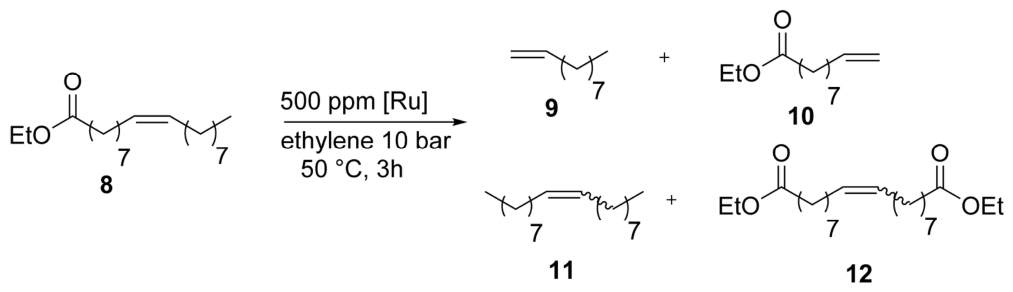
The catalytic performance of the new complexes 1 and 2 was therefore evaluated in the ethenolysis of ethyl oleate (90–95% purity) using grade 3.0 ethylene (99.9%) at an ethylene pressure of 10 bar, a catalyst loading of 500 ppm, and a reaction temperature of 50 °C (Scheme 3). Data for the same reaction carried out with 3, 4 and HGII are also reported [16]. The results are summarized in Table 2.
The anti complex 1 exhibited higher selectivity, yield, and turnover number (TON) than both its syn analogue 2 and the symmetrical HGII catalyst (Table 2, entries 1, 2 and 5), confirming the significant influence of the NHC backbone configuration on the outcome of this reaction [16,20]. Comparison with complexes 3 and 4 further indicates that the effect of replacing the N-cyclohexyl substituent with an N-benzyl group is more beneficial for catalysts bearing an anti backbone than for those with a syn backbone (cf. entries 1 and 3, and 2 and 4). Notably, all the catalysts were less selective toward the formation of the desired products 9 and 10 than syn complex 4, which has previously been reported to exhibit significantly higher selectivity than both its anti analogue and related catalysts bearing N-alkyl, N′-2-isopropylphenyl NHCs [16].
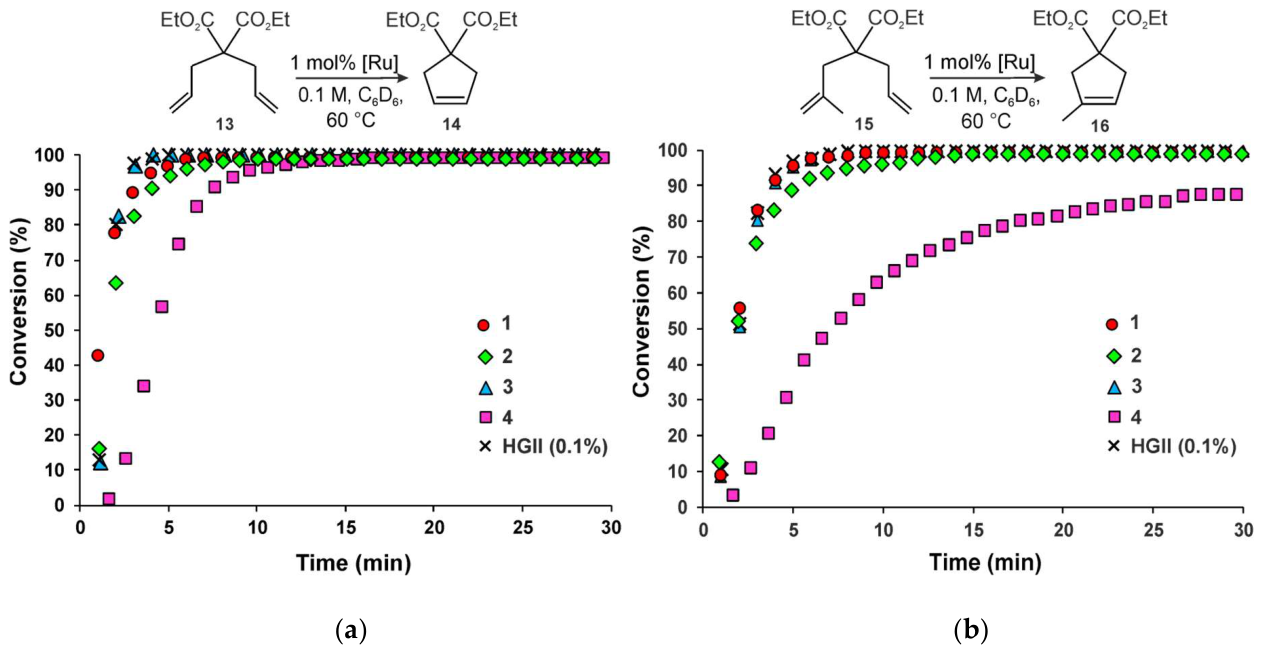
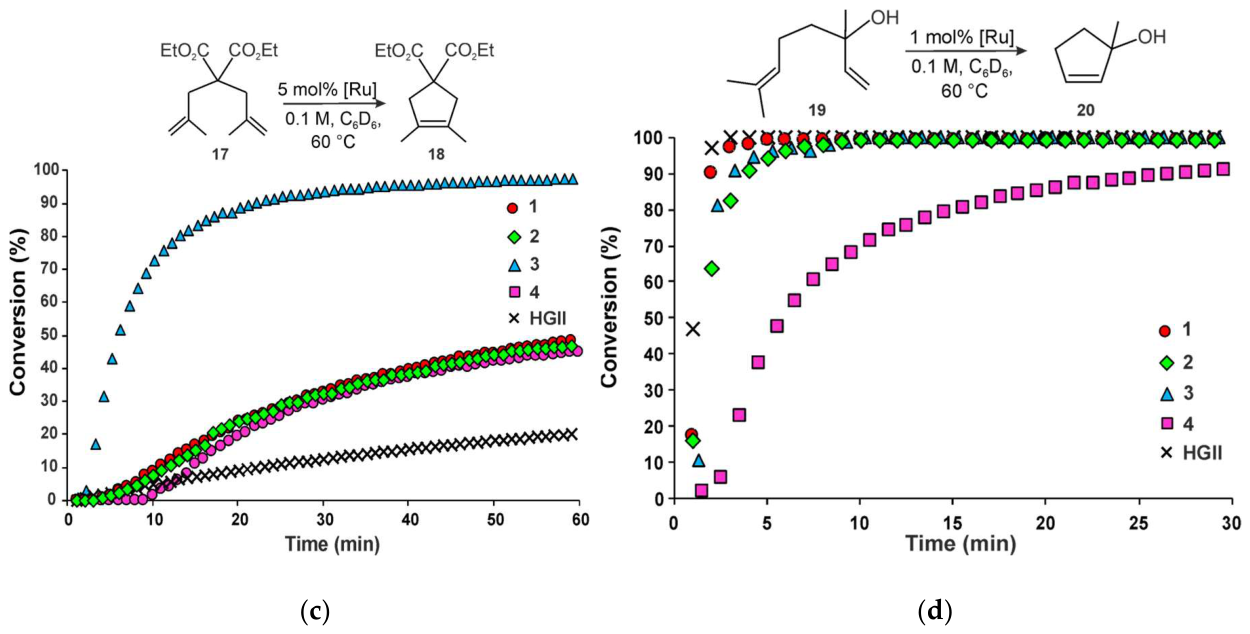
The efficiency of new catalysts 1 and 2 was further evaluated in RCM reactions of olefins with increasing steric hindrance, namely diethyldiallylmalonate (13), diethylallylmethylmalonate (15), and diethyldimethallylmalonate (17), which afford cycloolefins 14, 16 and 18 bearing di-, tri-, and tetrasubstituted double bonds, respectively. All RCM reactions were carried out at 60 °C in C6D6 and monitored by 1H NMR spectroscopy. The corresponding kinetic profiles are shown in Figure 2, where comparisons with 3, 4 and HGII are also included [13,16].
The new catalysts 1 and 2 efficiently promoted the cyclization of 13, achieving complete conversion in 7 and 9 min, respectively. However, they were less active than catalyst 3, which completed the cyclization in 4 min, and the commercial HGII catalyst, which achieved >99% conversion in only 4 min despite being used at a tenfold lower catalyst loading (Figure 2a). The differences in reactivity between the anti and syn N-benzyl catalysts 1 and 2 were less pronounced than those observed for catalysts 3 and 4, which required 20 min to complete the ring-closing reaction of 13, again highlighting the combined influence of the NHC backbone configuration and the nature of the N-substituent.
A similar trend was observed in the RCM of 15 (Figure 2b). Catalysts 1 and 2 again displayed high activity, reaching complete conversion in 9 and 15 min, respectively. Catalyst 3 showed a kinetic profile comparable to that of 1, completing the cyclization of 15 in 8 min, whereas catalyst 4 reached only 94% conversion after 1 h. The commercial HGII catalyst again outperformed all the tested catalysts, achieving complete conversion in 8 min at a catalyst loading of 0.1 mol%. These results further support the beneficial effect of the anti arrangement of the phenyl substituents on the NHC backbone. Moreover, they suggest that the catalytic behavior results from the combined influence of the backbone configuration and the nature of the N-substituent, with the effect of replacing the N-cyclohexyl substituent by an N-benzyl group being more pronounced in the syn series than in the anti series.
In the more demanding RCM of 17 (Figure 2c), catalysts 1 and 2 gave 49% and 46% conversion after 60 min, respectively. Both catalysts were significantly more active than the commercial HGII catalyst, which reached only 20% conversion under the same reaction conditions, and displayed activities comparable to that of catalyst 4 (45% conversion). In contrast, catalyst 3 achieved >97% conversion, further supporting the conclusion that the influence of the N-substituent depends on the backbone configuration and that N-benzyl substitution appears to reduce the difference in catalytic activity between the syn and anti isomers.
Beyond malonate derivatives, 1 and 2 were further evaluated in the RCM of (±) linalool (19). Linalool is a naturally occurring monoterpene and a major component of the essential oils of numerous aromatic plants. Its use as a substrate for RCM is of particular interest because the reaction affords 1-methylcyclopenten-2-ol and isobutylene, both valuable building blocks for the production of polymers and fuels from renewable resources [28,29]. This transformation represents a particularly challenging transformation because of the substantial steric hindrance of the reacting substrate: one double bond is trisubstituted, whereas the other is attached to a quaternary carbon. Nevertheless, the reaction is promoted by the presence of an allylic hydroxyl group, which is believed to interact with the catalytic center, thereby facilitating the cyclization [30].
All cyclization reactions were conducted at 60 °C in C6D6, and the kinetic plots are depicted in Figure 2d. In the graphs, the conversion–time curves determined for the ring-closure reaction promoted by catalysts 3 and 4 are reported as well. Comparison to commercially available HGII catalyst is also included [20,31].
As emerged from the analysis of results, once again anti catalysts 1 and 3 are more efficient than their syn congeners 2 and 4. In addition, N-benzyl catalysts exhibited higher activity than the corresponding N-cyclohexyl catalysts. More in detail, 1 and 3 afforded complete conversion of 19 to the desired cyclic product 20 in 5 and 10 min, respectively, whereas 2 required 10 min to complete cyclization and 4 reached 97% conversion in 60 min. As for the commercial HGII catalyst, it emerged as the most active system, completing the ring-closing reaction within only 3 min.
Finally, the enantiopure catalyst 1 was evaluated in an asymmetric metathesis transformation, namely the asymmetric ring-opening cross-metathesis (AROCM) of the meso-norbornene derivative 21 with styrene (Scheme 4), following the approach previously reported for chiral N-alkyl/N′-aryl catalysts [14,15,16,32]. The results are reported in Table 3.
The reaction reached >98% conversion after 4 h, as determined by 1H NMR analysis of the crude reaction mixture. The desired product 22 was isolated in 62% yield with a low enantiomeric excess (10% ee). In agreement with previous studies [14,15,16,32], a mixture of the side products 23 and 24, together with stilbene formed by the homometathesis of styrene, was also obtained. Moreover, only the E-configured products were detected. Compared with the results obtained using the N-cyclohexyl catalyst 3, no significant differences were observed. Replacing the cyclohexyl group with a benzyl substituent resulted in only a marginal improvement in the isolated yield of the desired product, with no enhancement in enantioselectivity.
4. Conclusions
Herein, the synergistic effect of NHC backbone configuration and the nature of the unsymmetrical N-substitution was investigated through the introduction of two new Hoveyda-Grubbs-type complexes featuring a flexible N-benzyl group in unsymmetrical N-alkyl, N’-2-isopropylphenyl NHC ruthenium complexes. Their catalytic behavior was evaluated in some representative olefin metathesis reactions, including the CM of cis-1,4-diacetoxy-2-butene with allyl benzene, the ethenolysis of ethyl oleate and the RCM of malonate derivatives with increasing steric bulkiness, as well as of (±) linalool. Overall, the catalyst bearing an anti NHC backbone configuration proved to be more efficient than its syn counterpart. Compared with the N-cyclohexyl analogues, the presence of the N-benzyl group mitigates the differences in activity between anti and syn isomers in RCM reactions while providing improved performance in CM and ethenolysis reactions. These results suggest that the different steric properties of the benzyl and cyclohexyl substituents, rather than the σ-donating ability of the uNHC ligand, are primarily responsible for the observed enhanced activity. In the AROCM of cis-5-norbornene-endo-2,3-dicarboxylic anhydride with styrene, the enantiopure N-benzyl catalyst also afforded higher yields of the desired product than the corresponding N-cyclohexyl catalyst, albeit with lower enantiomeric excess.
In summary, this study adds another piece to the puzzle of systematically tuning the N-substituents in unsymmetrical N-alkyl, N’-aryl NHC ruthenium complexes, thereby contributing to the identification of key uNHC structural motifs that enhance catalyst performance in olefin metathesis.
Supplementary Materials
The following supporting information can be downloaded at the website of this paper posted on Preprints.org, Figures S1-S27: 1H-, 13C- and bidimensional NMR spectra; Figures S28-S29: ESI-FT-ICR spectra; Figure S30: chiral HPLC chromatogram.
Author Contributions
Investigation, data curation, formal analysis, G.G.; investigation, data curation, formal analysis, visualization, writing – review and editing, C.L. and A.D.; formal analysis, data curation, writing—review and editing, R.T.; conceptualization, investigation, data curation, formal analysis, validation, visualization, supervision, writing – original draft, writing – review & editing, F.G.
Funding
This research received no external funding.
Data Availability Statement
The original contributions presented in this study are included in the article/supplementary material. Further inquiries can be directed to the corresponding author.
Conflicts of Interest
The authors declare no conflicts of interest.
Acknowledgments
This work was supported by the University of Salerno (FARB grants). The authors gratefully acknowledge Dr. Patrizia Oliva and Dr. Patrizia Iannece from the Department of Chemistry and Biology “A. Zambelli”, University of Salerno, for technical assistance.
References
- Díez-González, S.; Marion, N.; Nolan, S.P. N-Heterocyclic Carbenes in Late Transition Metal Catalysis. Chem. Rev. 2009, 109, 3612–3676. [CrossRef]
- Hopkinson, M.N.; Richter, C.; Schedler, M.; Glorius, F. An Overview of N-Heterocyclic Carbenes. Nature 2014, 510, 485–496. [CrossRef]
- Grubbs, R.H.; Wenzel, A.G.; O’Leary, D.J.; Khosravi, E. Handbook of Metathesis; Wiley-VCH Verlag GmbH & Co. KGaA: Weinheim, Germany, 2015.
- Grela, K. Olefin Metathesis: Theory and Practice; John Wiley & Sons: Hoboken, NJ, USA, 2014.
- Samojłowicz, C.; Bieniek, M.; Grela, K. Ruthenium-Based Olefin Metathesis Catalysts Bearing N-Heterocyclic Carbene Ligands. Chem. Rev. 2009, 109, 3708–3742. [CrossRef]
- Vougioukalakis, G.C.; Grubbs, R.H. Ruthenium-Based Heterocyclic Carbene-Coordinated Olefin Metathesis Catalysts. Chem. Rev. 2010, 110, 1746–1787. [CrossRef]
- Ogba, O.M.; Warner, N.C.; O’Leary, D.J.; Grubbs, R.H. Recent Advances in Ruthenium-Based Olefin Metathesis. Chem. Soc. Rev. 2018, 47, 4510–4544. [CrossRef]
- Hamad, F.B.; Sun, T.; Xiao, S.; Verpoort, F. Olefin Metathesis Ruthenium Catalysts Bearing Unsymmetrical Heterocyclic Carbenes. Coord. Chem. Rev. 2013, 257, 2274–2292. [CrossRef]
- Paradiso, V.; Costabile, C.; Grisi, F. NHC Backbone Configuration in Ruthenium-Catalyzed Olefin Metathesis. Molecules 2016, 21, 117. [CrossRef]
- Tornatzky, J.; Kannenberg, A.; Blechert, S. New Catalysts with Unsymmetrical N-Heterocyclic Carbene Ligands. Dalton Trans. 2012, 41, 8215–8225. [CrossRef]
- Paradiso, V.; Costabile, C.; Grisi, F. Ruthenium-Based Olefin Metathesis Catalysts with Monodentate Unsymmetrical NHC Ligands. Beilstein J. Org. Chem. 2018, 14, 3122–3149. [CrossRef]
- Monsigny, L.; Kajetanowicz, A.; Grela, K. Ruthenium Complexes Featuring Unsymmetrical N-Heterocyclic Carbene Ligands—Useful Olefin Metathesis Catalysts for Special Tasks. Chem. Rec. 2021, 21, 3648–3661. [CrossRef]
- Paradiso, V.; Bertolasi, V.; Grisi, F. Novel Olefin Metathesis Ruthenium Catalysts Bearing Backbone-Substituted Unsymmetrical NHC Ligands. Organometallics 2014, 33, 5932–5935. [CrossRef]
- Paradiso, V.; Bertolasi, V.; Costabile, C.; Grisi, F. Ruthenium Olefin Metathesis Catalysts Featuring Unsymmetrical N-Heterocyclic Carbenes. Dalton Trans. 2016, 45, 561–571. [CrossRef]
- Paradiso, V.; Menta, S.; Pierini, M.; Della Sala, G.; Ciogli, A.; Grisi, F. Enantiopure C1-Symmetric N-Heterocyclic Carbene Ligands from Desymmetrized meso-1,2-Diphenylethylenediamine: Application in Ruthenium-Catalyzed Olefin Metathesis. Catalysts 2016, 6, 177. [CrossRef]
- Paradiso, V.; Bertolasi, V.; Costabile, C.; Caruso, T.; Dąbrowski, M.; Grela, K.; Grisi, F. Expanding the Family of Hoveyda–Grubbs Catalysts Containing Unsymmetrical NHC Ligands. Organometallics 2017, 36, 3692–3708. [CrossRef]
- Paradiso, V.; Grisi, F. Ruthenium-Catalyzed Alternating Ring-Opening Metathesis Copolymerization of Norborn-2-ene with Cyclic Olefins. Adv. Synth. Catal. 2019, 361, 4133–4139. [CrossRef]
- Troiano, R.; Costabile, C.; Grisi, F. Alternating Ring-Opening Metathesis Polymerization Promoted by Ruthenium Catalysts Bearing Unsymmetrical NHC Ligands. Catalysts 2023, 13, 34. [CrossRef]
- Troiano, R.; Liguori, C.; Costabile, C.; Grisi, F. A Hoveyda–Grubbs-Type Olefin Metathesis Catalyst Bearing a Fluorinated Unsymmetrical NHC Ligand. Eur. J. Inorg. Chem. 2026, 29, e70255. [CrossRef]
- Nadeem, R.; Troiano, R.; D’Amato, A.; Tedesco, C.; Grisi, F. Ruthenium-Based Catalysts Bearing Unsymmetrical NHCs for Specific Olefin Metathesis Applications. RSC Adv. 2026,16, 35671-35685. [CrossRef]
- Ablialimov, O.; Kędziorek, M.; Torborg, C.; Malińska, M.; Woźniak, K.; Grela, K. New Ruthenium(II) Indenylidene Complexes Bearing Unsymmetrical N-Heterocyclic Carbenes. Organometallics 2012, 31, 7316–7319. [CrossRef]
- Ablialimov, O.; Kędziorek, M.; Malińska, M.; Woźniak, K.; Grela, K. Synthesis, Structure, and Catalytic Activity of New Ruthenium(II) Indenylidene Complexes Bearing Unsymmetrical N-Heterocyclic Carbenes. Organometallics 2014, 33, 2160–2171. [CrossRef]
- Grudzień, K.; Trzaskowski, B.; Smoleń, M.; Gajda, R.; Woźniak, K.; Grela, K. Hoveyda–Grubbs Catalyst Analogues Bearing the Derivatives of N-Phenylpyrrol in the Carbene Ligand—Structure, Stability, Activity and Unique Ruthenium–Phenyl Interactions. Dalton Trans. 2017, 46, 11790–11799. [CrossRef]
- Małecki, P.; Gajda, K.; Ablialimov, O.; Malińska, M.; Gajda, R.; Woźniak, K.; Kajetanowicz, A.; Grela, K. Hoveyda–Grubbs-Type Precatalysts with Unsymmetrical N-Heterocyclic Carbenes as Effective Catalysts in Olefin Metathesis. Organometallics 2017, 36, 2153–2166. [CrossRef]
- Verlinden, K.; Buhl, H.; Frank, W.; Ganter, C. Determining the Ligand Properties of N-Heterocyclic Carbenes from 77Se NMR Parameters. Eur. J. Inorg. Chem. 2015, 2015, 2416–2425. [CrossRef]
- Ruamps, M.; Lugan, N.; César, V. A Cationic N-Heterocyclic Carbene Containing an Ammonium Moiety. Organometallics 2017, 36, 1049–1055. [CrossRef]
- Ritter, T.; Hejl, A.; Wenzel, A.G.; Funk, T.W.; Grubbs, R.H. A Standard System of Characterization for Olefin Metathesis Catalysts. Organometallics 2006, 25, 5740–5745. [CrossRef]
- Meylemans, H.A.; Quintana, R.L.; Goldsmith, B.R.; Harvey, B.G. Solvent-Free Conversion of Linalool to Methylcyclopentadiene Dimers: A Route to Renewable High-Density Fuels. ChemSusChem 2011, 4, 465–469. [CrossRef]
- Vasilenko, I.V.; Frolov, A.N.; Kostjuk, S.V. Cationic Polymerization of Isobutylene Using AlCl3OBu2 as a Coinitiator: Synthesis of Highly Reactive Polyisobutylene. Macromolecules 2010, 43, 5503–5507. [CrossRef]
- Hoye, T.R.; Zhao, H. Some Allylic Substituent Effects in Ring-Closing Metathesis Reactions: Allylic Alcohol Activation. Org. Lett. 1999, 1, 1123–1125. [CrossRef]
- Ambrosio, C.; Paradiso, V.; Costabile, C.; Bertolasi, V.; Caruso, T.; Grisi, F. Stable Ruthenium Olefin Metathesis Catalysts Bearing Symmetrical NHC Ligands with Primary and Secondary N-Alkyl Groups. Dalton Trans. 2018, 47, 6615–6627. [CrossRef]
- Thomas, R.M.; Grubbs, R.H. Mechanistic Studies of Enantioselective N-Aryl, N-Alkyl NHC Ruthenium Metathesis Catalysts in Asymmetric Ring-Opening Cross-Metathesis. Chem. N. Z. 2011, 75, 65–71.
Figure 1.
Hoveyda-Grubbs second-generation-type catalysts used in this study.
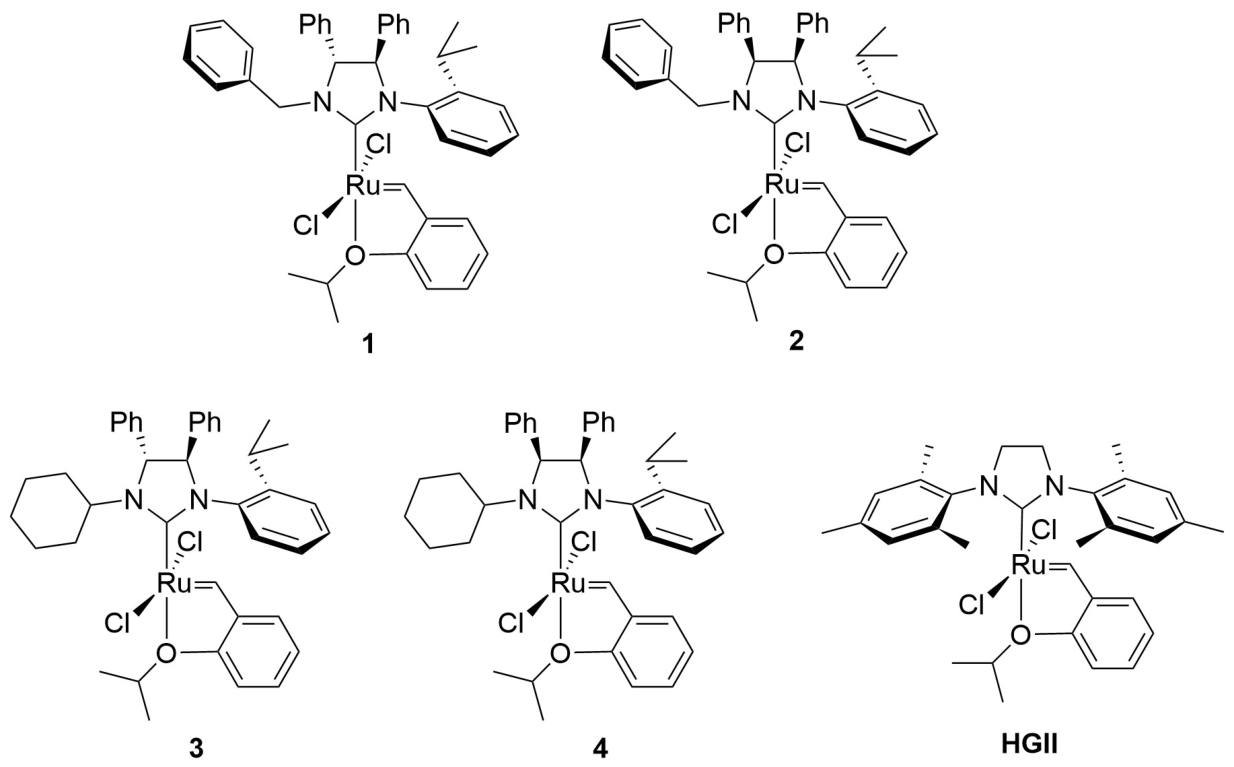
Figure 2.
RCM reactions of (a) diethyl diallylmalonate, (13), (b) diethyl allylmethylmalonate (15), (c) diethyl dimethallylmalonate (17), and (±) linalool (19).
Figure 2.
RCM reactions of (a) diethyl diallylmalonate, (13), (b) diethyl allylmethylmalonate (15), (c) diethyl dimethallylmalonate (17), and (±) linalool (19).
Scheme 1.
Synthesis of novel uNHCs ruthenium complexes 1 and 2.

Scheme 2.
CM reaction of allylbenzene (5) and cis-1,4-diacetoxy-2-butene (6).

Scheme 3.
Ethenolysis of ethyl oleate (8).
Scheme 4.
AROCM of 21 with styrene.
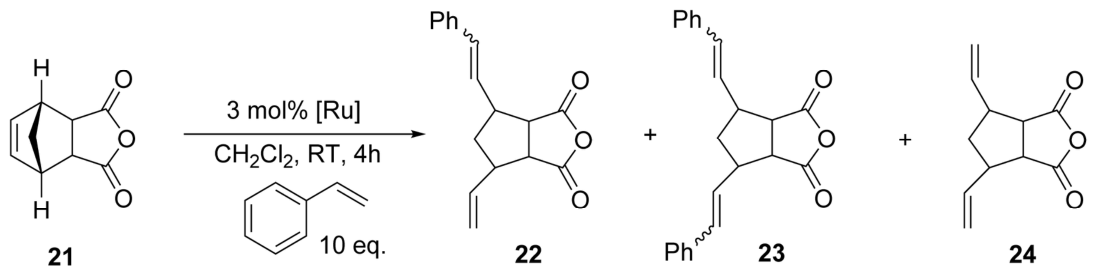

Table 1.
CM of 5 and 6 promoted by catalysts 1-4 and HGII.
| entry | catalyst | isolated yield (%) | E/Za |
| 1 | 1 | 70 | 8.0 |
| 2 | 2 | 82 | 6.0 |
| 3 | 3 | 67 | 7.6 |
| 4 | 4 | 72 | 2.6 |
| 5 | HGII | 69 | 8.6 |
a Determined by 1H NMR analysis.
Table 2.
Ethenolysis of 8 with catalysts 1-4 and HGII.
| entry | catalysta | conversionb(%) | selectivityc(%) | yieldd (%) | TONe |
| 1 | 1 | 72 | 66 | 48 | 960 |
| 2 | 2 | 42 | 47 | 20 | 400 |
| 3 | 3 | 63 | 58 | 36 | 720 |
| 4 | 4 | 38 | 77 | 29 | 580 |
| 5 | HGII | 71 | 43 | 30 | 600 |
a The reactions were run neat using 5.4 mmol of ethyl oleate at 10 bar of ethylene (99.9% purity) with dodecane (150 μL) used as an internal standard. b Determined by GC analysis. Conversion = 100 – [(final moles of 8) × 100/[initial moles of 8]. c Determined by GC analysis. Selectivity = 100 (moles of ethenolysis products 9 + 10)/[(moles of 9 + 10) + (2 × (moles of 11 + 12))]. d Yield= (conversion × selectivity)/100. e TON = yield × (initial moles of 8/moles of catalyst)/100.
Table 3.
AROCM of 21 with styrene promoted by catalysts 1 and 3.
| entry | catalyst a | 22 yielda (%) | 23 yielda(%) | 24 yielda (%) | ee (22)a |
| 1 | 1 | 62 | 12 | 14 | 10 |
| 2 | 3 | 46 | 15 | 10 | 13 |
a Isolated yield. b Enantiomeric excess determined by chiral HPLC.
Disclaimer/Publisher’s Note: The statements, opinions and data contained in all publications are solely those of the individual author(s) and contributor(s) and not of MDPI and/or the editor(s). MDPI and/or the editor(s) disclaim responsibility for any injury to people or property resulting from any ideas, methods, instructions or products referred to in the content. |
© 2026 by the authors. Licensee MDPI, Basel, Switzerland. This article is an open access article distributed under the terms and conditions of the Creative Commons Attribution (CC BY) license (http://creativecommons.org/licenses/by/4.0/).
Copyright: This open access article is published under a Creative Commons CC BY 4.0 license, which permit the free download, distribution, and reuse, provided that the author and preprint are cited in any reuse.