

Submitted:
07 August 2026
Posted:
07 August 2026
You are already at the latest version
Abstract
Listeria monocytogenes is one of the leading foodborne pathogens and an increasing public health concern because of the emergence of antimicrobial-resistant strains. This scoping review aimed to synthesize the available evidence on the prevalence and phenotypic antimicrobial resistance profiles of L. monocytogenes in animal-derived foods. The review was conducted following the Joanna Briggs Institute methodology and the PRISMA-ScR guidelines through systematic searches of PubMed/MEDLINE, Scopus, Web of Science, and Embase. Of the 711 records identified, 11 studies met the eligibility criteria. The included studies reported the occurrence of L. monocytogenes in meat and meat products, milk and dairy products, and ready-to-eat foods, with prevalence ranging from 0.1% to 60.0% across different food matrices. Resistance was most frequently reported to β-lactams and tetracyclines, whereas several studies identified multidrug-resistant isolates. In contrast, most isolates remained susceptible to ampicillin, amoxicillin, vancomycin, linezolid, and gentamicin. This scoping review provides an updated synthesis of the available evidence on the prevalence and phenotypic antimicrobial resistance profiles of Listeria monocytogenes in animal-derived foods and summarizes the phenotypic antimicrobial resistance patterns reported across the included food matrices.
Keywords:
Listeria monocytogenes
; antimicrobial resistance
; prevalence
; dairy products
; ready-to-eat foods
; multidrug resistance
; food safety
1. Introduction
Listeriosis is a disease caused by the Gram-positive bacterium Listeria monocytogenes, which is recognized as one of the most important foodborne bacterial pathogens worldwide owing to the severity of listeriosis and its high case-fatality rate. Compared with other foodborne pathogens, listeriosis has a case-fatality rate of approximately 20–30% and primarily affects vulnerable populations such as pregnant women, newborns, older adults, and immunocompromised individuals [1,2]. Because of its clinical and epidemiological impact, L. monocytogenes is regarded as a high-priority pathogen for surveillance and food safety.
The importance of this microorganism lies in its ability to survive as an environmental saprophyte and subsequently transition into an intracellular pathogen following the consumption of contaminated food, overcoming host physiological barriers through complex cellular interactions [3]. This environmental-to-host transition contributes to its establishment as a persistent foodborne pathogen. Its persistence throughout the food production systems is further supported by its remarkable ability to adapt to environmental stress, allowing survival at refrigeration temperatures and tolerance to a variety of disinfectants commonly used in the food industry. In addition, its ability to form biofilms on food-processing surfaces, together with its considerable genetic diversity, promotes long-term survival and hinders eradication, particularly in meat-processing plants [4].
Listeria monocytogenes can establish biofilms on hard-to-clean niches, where the extracellular polymeric matrix protects bacterial cells from cleaning and disinfection procedures and facilitates cross-contamination during food processing [2,4]. Consequently, even when sanitation procedures are properly implemented, the persistence of this pathogen may increase the likelihood of recurrent food contamination, thereby increasing the potential for consumer exposure [5].
Beyond the clinical implications of listeriosis, increasing attention has been directed toward the emergence of antimicrobial-resistant isolates.
The first-line treatment for listeriosis has traditionally been ampicillin or penicillin G, often combined with gentamicin. However, the emergence of antimicrobial-resistant isolates has become a growing public health concern because of its potential impact on therapeutic efficacy [6].
Although most L. monocytogenes isolates remain susceptible to first-line antimicrobial agents, the intensive and inappropriate use of antibiotics in the clinical, veterinary, and agricultural sectors creates selective pressure that favors the emergence and dissemination of resistant strains throughout the food chain. This process contributes to the dissemination of antimicrobial resistance determinants among bacterial populations and represents a growing challenge [6,7].
The development of antimicrobial resistance in L. monocytogenes is a dynamic process driven by several molecular mechanisms, including intrinsic and acquired resistance. The latter may occur through horizontal gene transfer mediated by plasmids and transposons, facilitating the acquisition of resistance determinants such as tet genes associated with tetracycline resistance [6].
The maintenance of plasmid-mediated resistance is also influenced by bacterial fitness costs, which may promote the emergence of compensatory mutations that reduce the biological cost associated with newly acquired resistance genes [8]. Furthermore, continuous exposure to sublethal concentrations of antibiotics, such as ampicillin and gentamicin, alters the physiology of the microorganism, promoting biofilm formation and potentially facilitating the emergence of more persistent and antimicrobial-resistant strains [7].
Several studies have documented resistance to multiple antimicrobial classes among L. monocytogenes isolates recovered from foods. Resistance to tetracyclines has been reported by Ndahi et al.[9], Dan et al.[10] and Lotfollahi et al.[11], whereas fluoroquinolone resistance has been described by Dan et al.[10] and Gautam et al.[12]. Similarly, lincosamide resistance has been documented by Ndahi et al.[9], Lotfollahi et al. [11] and Gowda et al.[13] In addition, multidrug-resistant (MDR) profiles have been identified by Ndahi et al.[9], Dan et al.[10] and Paiva et al.[14], demonstrating the occurrence of multidrug-resistant isolates in food matrices. Collectively, these findings highlight the importance of strengthening microbiological and antimicrobial resistance surveillance in foods.
Despite the growing number of studies investigating the occurrence of L. monocytogenes in animal-derived foods and their antimicrobial resistance profiles, the available scientific evidence remains scattered across different geographic regions, food matrices, and methodological approaches. Moreover, existing studies vary in the types of foods evaluated, bacterial isolation and identification methods, antimicrobial susceptibility testing procedures, and antimicrobial agents analyzed, making direct comparisons among studies difficult and hampering the identification of consistent resistance patterns. This heterogeneity limits the current understanding of the distribution of L. monocytogenes and its antimicrobial resistance profiles, as well as their implications for food safety thereby hindering the development of evidence-based systematic monitoring, risk assessment, and control strategies.
Consequently, there is a need to synthesize and integrate the available evidence to provide a comprehensive overview of the occurrence of L. monocytogenes and its antimicrobial resistance patterns across different food matrices, while providing an evidence base to support microbiological monitoring, food safety risk assessment, and control strategies throughout the food production systems.
Within this context, a scoping review was conducted following the PRISMA-ScR guidelines to synthesize the available evidence on the prevalence and phenotypic antimicrobial resistance profiles of Listeria monocytogenes in animal-derived foods. The review aimed to characterize antimicrobial resistance patterns across different food matrices and provide an evidence base to support microbiological coordinated monitoring, food safety risk assessment, and evidence-based decision-making within a One Health framework.
2. Materials and Methods
Study Design and Protocol Registration
This scoping review was developed a priori and conducted in accordance with the Preferred Reporting Items for Systematic Reviews and Meta-Analyses Extension for Scoping Reviews (PRISMA-ScR) guidelines [15], to enhance the transparency, reproducibility, and methodological rigor of the review process. The study protocol was prospectively registered in the Open Science Framework (OSF) with the registration identifier osf.io/7xcwf.
Research Question
The research question was formulated using the Population–Concept–Context (PCC) framework recommended by the Joanna Briggs Institute for the development of scoping reviews. This framework was used to define the scope of the review and establish the eligibility criteria for study selection, as follows:
P (Population): Listeria monocytogenes isolates.
C (Concept): Phenotypic antimicrobial resistance.
C (Context): Meat, meat products, raw milk, and dairy products.
What scientific evidence is available regarding the prevalence and phenotypic antimicrobial resistance profiles of Listeria monocytogenes isolated from meat, meat products, raw milk, and dairy products?
Systematic Literature Search
A systematic literature search was conducted in the electronic databases PubMed/MEDLINE, Scopus, Web of Science, and Embase, covering all studies published from database inception through December 27, 2025. In addition, a manual search of the reference lists of the included articles and other relevant publications was performed to identify potentially eligible studies not identified through the electronic search strategy.
The search strategy was adapted to the terminology and syntax of each database, using Medical Subject Headings (MeSH) for PubMed/MEDLINE, Emtree terms for Embase, and free-text keywords across all databases. Health Sciences Descriptors (DeCS) were used to verify terminological equivalence during the development of the search strategy but not as controlled vocabulary in the international databases.
Searches were conducted using the search interface provided by each database. Depending on the search functionality of each database, each conceptual block was entered into separate search fields (e.g., Title, Abstract, Keywords, Topic, MeSH, or Emtree) and combined using the Boolean operators AND and OR. The complete search strategies presented in Table 1 correspond to the Boolean expressions derived from the search concepts entered through these interfaces. No restrictions were applied regarding language or publication date.
Study Selection
All records identified through the database searches were initially imported into Mendeley for reference management and subsequently exported to Rayyan, where duplicate records were identified and removed, and the study screening process was conducted.
Study selection was performed in two sequential stages. In the first stage, the two authors (G.S. and M.A.) independently assessed the publication types, as well as the titles and abstracts of the retrieved records, according to the predefined eligibility criteria to identify potentially relevant studies, thereby minimizing selection bias. Articles that did not meet the inclusion criteria were excluded at this stage.
In the second stage, the full texts of the potentially eligible studies were retrieved, and both authors independently assessed their eligibility according to the predefined inclusion and exclusion criteria (Table 2). The reasons for excluding studies assessed at the full-text stage were systematically documented according to the predefined eligibility criteria. Any disagreements between the reviewers were resolved through consensus. Finally, only studies reporting data on the antimicrobial susceptibility or resistance of Listeria monocytogenes isolated from meat, meat products, raw milk, or dairy products were included in the qualitative synthesis.
The entire study selection process, including records identified, duplicate records removed, records screened, full-text reports assessed for eligibility, studies excluded, and studies included, were documented using the PRISMA 2020 flow diagram in accordance with the PRISMA-ScR reporting recommendations to enhance the transparency and reproducibility of the review process.

Table 2.
Inclusion and Exclusion Criteria for Study Selection.
| Inclusion Criteria | Exclusion Criteria |
| Observational studies reporting original data. | Studies focusing on microorganisms other than Listeria monocytogenes. |
| Studies reporting the isolation and identification of Listeria monocytogenes from food matrices. | Experimental laboratory studies using reference strains or artificially inoculated samples. |
| Studies evaluating the antimicrobial susceptibility or resistance profiles of Listeria monocytogenes isolates. | Narrative reviews, systematic reviews, meta-analyses, editorials, letters to the editor, or conference abstracts. |
| Studies conducted on meat, meat products, raw milk, dairy products, and ready-to-eat animal-derived foods. | Studies that did not report antimicrobial susceptibility or resistance testing results. |
| Studies providing sufficient methodological detail, microbiological identification, and antimicrobial susceptibility testing. | Studies focusing exclusively on environmental samples unrelated to food matrices. |
Data Extraction
Data extraction was performed using a standardized, predefined data extraction form to systematically record the methodological characteristics and relevant outcome data of the included studies, as well as variables related to the prevalence and antimicrobial resistance of Listeria monocytogenes. The following information was extracted from each study: first author; year of publication; study design; country where the study was conducted; isolation source; food sample type; sample size; methods used for bacterial isolation and identification; antimicrobial susceptibility testing method; antimicrobial agents evaluated; reported prevalence, when available; and antimicrobial resistance profiles (File S1-Optimized_Matrix_Listeria).
Data extraction was performed independently by both investigators (G.S. and M.A.) using a structured, predefined data extraction matrix developed according to the objectives of the review and the variables described above. Any discrepancies were resolved through joint reassessment of the full text of the corresponding study, with the extracted data verified against the predefined fields of the data extraction matrix. Any remaining differences were discussed until consensus was reached.
The extracted data were subsequently organized into structured tables to facilitate comparisons across the included studies and support the narrative synthesis of the included evidence. This approach facilitated a comprehensive description of the methodological characteristics of the studies, the prevalence of Listeria monocytogenes, and the antimicrobial resistance patterns identified across the different food matrices evaluated.
Data Synthesis
A qualitative descriptive synthesis of the included studies was conducted, with the extracted data organized into tables to summarize study characteristics and facilitate comparisons across the included evidence. The synthesis was carried out in three stages: (i) description of the included studies, (ii) analysis of the prevalence of Listeria monocytogenes in foods, and (iii) assessment of the antimicrobial resistance of the isolates. Findings were compared across food matrices, including meat, meat products, raw milk, dairy products, and ready-to-eat animal-derived foods and, whenever possible, according to study characteristics and the classes of antimicrobial agents evaluated.
Because of the methodological heterogeneity of the included studies with respect to study design, food matrices, microbiological techniques, antimicrobial susceptibility testing methods, and the reporting of results, the evidence was synthesized using a narrative approach, identifying similarities, differences, and reported antimicrobial resistance patterns across the included studies. The findings were presented in comparative tables to facilitate their interpretation.
Critical Appraisal of the Sources of Evidence
In accordance with the objectives of scoping reviews and the recommendations of the PRISMA-ScR reporting guidelines and the Joanna Briggs Institute (JBI), no formal methodological quality assessment or risk-of-bias assessment of the included studies was performed, as the purpose of this review was to map and synthesize the available evidence on the prevalence and antimicrobial resistance profiles of Listeria monocytogenes isolated from animal-derived foods rather than to evaluate the quality of the evidence.
3. Results
General Description of the Included Studies
A total of 711 records were identified through database searches across PubMed (n = 144), Scopus (n = 230), Web of Science (n = 111), and Embase (n = 226). Following the removal of 302 duplicate records, 409 unique records remained for title and abstract screening, of which 363 were excluded. Consequently, 46 full-text reports were assessed for eligibility.
Before full-text eligibility assessment, two reports were excluded because they represented duplicate reports or contained overlapping datasets, leaving 44 reports for eligibility assessment. Following full-text eligibility assessment, 33 studies were excluded because they did not meet the predefined eligibility criteria. The remaining 11 studies were included in the qualitative synthesis (Figure 1).
The included studies were published between 2014 and 2025, encompassing more than a decade of research on the occurrence and antimicrobial resistance of L. monocytogenes in animal-derived foods. The studies were conducted in seven countries, including Nigeria [9], Romania [10], India [12,13,16], Iran [11,17], Egypt [18], Ethiopia [19,20] and Portugal [14], reflecting the global interest in investigating L. monocytogenes in animal-derived foods (Table 2).
Table 2.
Characteristics of the included studies.
| Authors | Year | Country | Sample Size (n) | Food Matrix |
|---|---|---|---|---|
| Ndahi et al.[9] | 2014 | Nigeria | 300 | Raw beef, goat and chicken meat, and meat products |
| Dan et al.[10] | 2015 | Rumania | 144 | Raw poultry meat |
| Lotfollahi et al.[11] | 2017 | Iran | 442 | Raw meat from different animal sources, meat products, milk, and dairy products |
| Gautam et al.[12] | 2022 | India | 15 | Ready-to-eat foods |
| Paiva et al.[14] | 2025 | Portugal | 75 | Raw beef, raw pork, meat products, and meat preparations |
| Sharma et al. [16] | 2017 | India | 457 | Raw bovine milk |
| Gowda et al.[13] | 2017 | India | 765 | Raw beef |
| Akrami-Mohajeri et al.[17] | 2018 | Iran | 545 | Raw milk and dairy products |
| Gebremedhin et al.[19] | 2021 | Ethiopia | 450 | Raw beef |
| Getaneh et al.[20] | 2025 | Ethiopia | 100 | Raw beef |
| Ebaya et al. [18] | 2019 | Egypt | 100 | Raw milk |
The food matrices investigated primarily included raw beef [9,11,13,16,19], raw goat meat and chicken meat [9], raw poultry meat [10], meat products [9,11,14], raw bovine milk [16,20], milk and dairy products [11,17], as well as ready-to-eat foods [12], demonstrating the broad range of food matrices evaluated across the included studies (Table 2).
The number of samples varied considerably across the included studies, ranging from 15 to 765 samples. The smallest sample size was reported by Gautam et al.[12], who analyzed 15 ready-to-eat food samples, whereas the largest was reported by Gowda et al. [13], with 765 samples. The remaining studies included between 75 and 545 samples [9,10,11,12,13,14,16,17,18,19,20], reflecting variations in study scope and sampling strategies.
Prevalence of Listeria monocytogenes in Food Matrices
The prevalence of L. monocytogenes reported in the included studies varied widely, ranging from 0.1% to 60%, across different food matrices and sample sizes (Table 3).
Among meat and meat product matrices, the prevalence of L. monocytogenes ranged from 0.1% to 16%. The lowest prevalence was observed in raw beef (0.1–4.4%) [13,16,19], whereas higher values were reported in raw chicken meat (13.2%) [10] and in raw beef, raw pork, meatballs, hamburgers, fresh sausages, breaded meat skewers, and traditional Portuguese sausages (Alheira and Moura) (16%) [14]. Similarly, studies evaluating raw beef, goat meat, chicken meat, suya, Kilishi, Balangu, and Tsire [9], as well as sausages, pasteurized milk, cheese, raw chicken meat, and beef, goat, and sheep meat cubes [11], reported intermediate prevalence values of 4% and 3%, respectively, indicating that L. monocytogenes was detected across a wide range of animal-derived food matrices.
Among dairy matrices, the reported prevalence of L. monocytogenes ranged from 1.1% to 7%, with the lowest reported prevalence observed in raw bovine milk (1.1%) [16] and the highest in commercially marketed raw bovine milk (7%) [20]. In addition, one study evaluating raw milk, cheese, butter, curd, and ice cream reported an intermediate prevalence of 4% [17], indicating the prevalence of L. monocytogenes across a broad range of dairy products.
Among ready-to-eat food matrices, only one study evaluated this category, including a variety of meat- and vegetable-based ready-to-eat foods, and reported the highest prevalence observed among the studies included (60%) [12]. This was the highest prevalence reported across all food matrices evaluated in this review.
Antimicrobial Resistance Profiles of Listeria monocytogenes
Antimicrobial resistance was reported across all 11 included studies, although the resistance patterns varied according to the food matrix and the antimicrobial agents evaluated (Table 4). Resistance to β-lactams was the most frequently reported finding, being documented in 8 of the 11 studies [9,11,12,14,16,18,19,20]. Resistance to tetracyclines was reported in 7 studies [9,10,14,17,18,19,20], whereas resistance to sulfonamides, quinolones/fluoroquinolones, macrolides, aminoglycosides, and phenicols was reported less consistently across the included evidence. Multidrug-resistant (MDR) isolates were identified in 8 studies [9,10,12,14,16,17,18,19], although the reported frequency varied considerably among food matrices and geographic regions.
Resistance to β-lactams was the most frequently reported antimicrobial resistance pattern and was observed in isolates recovered from beef, goat, and chicken meat, traditional meat products, raw milk, cheese, butter, curd, ice cream, and ready-to-eat foods [9,11,12,16,17,19,20]. The antimicrobial agents most frequently associated with resistance were penicillin, ampicillin, oxacillin, cefotaxime, ceftriaxone, piperacillin, and cloxacillin. Notably, 100% resistance to penicillin G, piperacillin, oxacillin, and ceftriaxone was reported among isolates from raw bovine milk [16]. Likewise, isolates recovered from raw beef exhibited high resistance frequencies to oxacillin and cefotaxime [19], whereas isolates from ready-to-eat foods also showed resistance to cefotaxime and oxacillin [12].
Tetracyclines represented the second most frequently reported class exhibiting resistance. This pattern was identified in isolates recovered from fresh meat, meat products, raw milk, dairy products, and ready-to-eat foods [9,10,14,17,18,19,20]. Similarly, resistance to sulfonamides and trimethoprim/sulfamethoxazole was observed primarily in meat and meat products [9,10,14], whereas resistance to quinolones and fluoroquinolones, including ciprofloxacin, levofloxacin, and nalidixic acid, was reported in meat, milk, and ready-to-eat foods [10,12,14,19,20]. Resistance to macrolides, aminoglycosides, and phenicols was also reported, although less frequently and with greater variability across the different food matrices [12,13,14,17,18,19].
In contrast, several studies reported high susceptibility to vancomycin, linezolid, gentamicin, amoxicillin, ampicillin, and chloramphenicol among isolates recovered from both meat and dairy products [9,11,14,16,17,19,20]. High susceptibility to these antimicrobial agents was consistently reported across several of the included studies despite the occurrence of resistance to β-lactams and tetracyclines.
Multidrug resistance (MDR) was also frequently reported across the different food matrices. Among isolates recovered from raw chicken meat, 23% exhibited MDR profiles [10], whereas the frequency reached 28.6% among isolates from beef, pork, and meat products [14]. In raw bovine milk, 100% of the isolates were reported as MDR [16], and another study on raw beef found that 95% of the isolates exhibited this phenotype [19]. Likewise, isolates recovered from dairy products frequently exhibited resistance to two or three antimicrobial agents [17], whereas 82% of the isolates recovered from raw bovine milk were resistant to five or more antimicrobial agents [18]. In contrast, Lotfollahi et al. [11] and Gowda they did not identify any MDR isolates.
The heatmap of antimicrobial classes (Figure 2) provides an overview of the antimicrobial resistance patterns reported across the included studies. Resistance to β-lactams was the most consistently reported finding, whereas tetracyclines also exhibited frequent resistance despite greater variability among food matrices and geographic regions. In contrast, aminoglycosides, fluoroquinolones, and macrolides displayed more heterogeneous resistance profiles.
Overall, resistance to β-lactams represented the predominant phenotypic antimicrobial resistance pattern identified across the included studies, whereas resistance to tetracyclines and multidrug-resistant (MDR) profiles also emerged as recurrent findings among isolates recovered from meat, dairy products, and ready-to-eat foods. Considerable variability in antimicrobial resistance profiles was observed across food matrices and geographic regions.
4. Discussion
The objective of this scoping review was to synthesize and map the available scientific evidence on the prevalence of Listeria monocytogenes and its phenotypic antimicrobial resistance profiles in animal-derived foods intended for human consumption. The available evidence indicates that L. monocytogenes remains a major foodborne pathogen because of its ability to persist throughout different stages of the food chain and to exhibit resistance to clinically important antimicrobial agents. This evidence reinforces its continued relevance, particularly because invasive listeriosis is associated with high hospitalization and mortality rates among pregnant women, neonates, older adults, and immunocompromised individuals [1,2,3].
The evidence gathered also indicates that antimicrobial resistance in L. monocytogenes should be interpreted within an integrated One Health framework, as the circulation of resistant strains involves animal production, food processing, the environment, and human health. The food chain may therefore act as both a reservoir and a dissemination route for antimicrobial resistance determinants, highlighting the need for coordinated surveillance and control strategies across the veterinary, food, and environmental sectors [21].
Although antimicrobial-resistant L. monocytogenes was identified across different food matrices, these findings should be interpreted cautiously because substantial heterogeneity was observed in sampling strategies, isolation and identification methods, antimicrobial susceptibility testing protocols, and interpretative criteria. Consequently, this review provides an updated synthesis of the available evidence and identifies overall resistance patterns but does not allow reliable estimation of the global burden of antimicrobial resistance in L. monocytogenes. These limitations emphasize the need to harmonize study methodologies and susceptibility testing approaches to improve international comparability and strengthen global epidemiological surveillance.
The reported prevalence of Listeria monocytogenes varied markedly among the included studies, ranging from 0.13% to 60.00%. The lowest prevalence (0.13%) was reported by Gowda et al.[13] in samples collected from slaughterhouses and cattle production environments, whereas the highest prevalence (60.00%) was observed by Gautam et al. [12] in ready-to-eat foods. This wide variation probably reflects differences in food matrices, sampling strategies, processing conditions, and laboratory detection methods, all of which influence the survival, persistence, and recovery of L. monocytogenes throughout the food chain.
From a microbiological perspective, the ability of L. monocytogenes to survive in different food matrices depends on intrinsic factors such as pH, water activity, nutrient availability, and food composition, together with extrinsic factors including storage temperature, processing conditions, and hygienic practices during production and handling. These factors directly influence pathogen survival, growth, and recovery during microbiological analysis and may partly explain the differences in prevalence observed among meat, dairy products, and ready-to-eat foods [22,23,24,25,26].
Dairy products remain one of the principal food matrices associated with Listeria monocytogenes contamination. The recurrent detection of the pathogen in raw milk, pasteurized milk, soft cheeses, and other dairy products [11,16,17,18] indicates that these foods continue to represent an important source of consumer exposure. This persistence has been attributed to the ability of L. monocytogenes to survive and grow under refrigeration, form biofilms on food-processing surfaces, and adapt to a wide range of environmental stresses, thereby facilitating long-term establishment within dairy processing environments and increasing the risk of cross-contamination during production [27].
Ready-to-eat foods also represent an important public health concern because they are consumed without a subsequent heat treatment capable of eliminating L. monocytogenes. Although the highest prevalence was reported by Gautam et al.[12], this estimate should be interpreted cautiously considering the methodological characteristics of the study. Nevertheless, the overall pattern is consistent with previous evidence identifying ready-to-eat foods as one of the principal routes of human exposure to L. monocytogenes and a priority target for food safety surveillance programs [26,28,29,30].
Overall, the marked variability in the reported prevalence indicates that contamination by L. monocytogenes does not follow a uniform epidemiological pattern but instead reflects differences in production systems, food processing, commercialization practices, and pathogen ecology. Consequently, prevalence should not be interpreted as an isolated indicator of public health risk, since a low isolation frequency does not exclude the presence of strains with enhanced persistence, environmental adaptation, or virulence potential. Instead, prevalence should be interpreted within the broader context of food characteristics, production practices, and pathogen biology.
The antimicrobial resistance profiles of Listeria monocytogenes isolates exhibited substantial phenotypic variability across the included studies. Despite this heterogeneity, resistance was most consistently reported against β-lactams and tetracyclines, whereas susceptibility and resistance patterns for the remaining antimicrobial classes varied considerably among isolates recovered from meat, meat products, milk, dairy products, and ready-to-eat foods [9,10,11,12,14,16,17,31].
The predominance of resistance to β-lactams and tetracyclines is consistent with recent systematic reviews and meta-analyses identifying these antimicrobial classes as the most frequently associated with resistance among foodborne L. monocytogenes isolates [32,33,34]. Although resistance frequencies differed among geographical regions and food matrices, the recurrence of this pattern suggests that resistance to these antimicrobial classes is widespread rather than restricted to specific epidemiological settings.
β-Lactams represented the antimicrobial class most frequently associated with resistance among the included studies. The detection of β-lactam-resistant L. monocytogenes isolates in raw meat, meat products, milk, and cattle [9,11,16,18,20] is particularly relevant because aminopenicillins remain the first-line treatment for invasive listeriosis [2,23]. Consequently, resistance to these antimicrobial agents should be regarded as an important epidemiological warning signal requiring continuous monitoring, even when resistant isolates are recovered from foods rather than clinical cases.
However, the clinical significance of β-lactam resistance should be interpreted according to the specific antimicrobial agents evaluated. Whereas resistance to penicillin and ampicillin may have direct therapeutic implications, the high resistance rates reported for cefotaxime, ceftriaxone, and other cephalosporins should not be interpreted as evidence of acquired resistance. Listeria monocytogenes is intrinsically less susceptible to cephalosporins because of the low affinity of specific penicillin-binding proteins for these antimicrobial agents. Consequently, grouping all β-lactams into a single category may overestimate the clinical relevance of the observed resistance pattern [35].
Tetracycline resistance was also one of the most consistent findings of this review. The resistance profiles identified among L. monocytogenes isolates recovered from meat, meat products, milk, and dairy products [11,14,17,18] indicate that resistance to this antimicrobial class remains widely distributed across different food production systems. This pattern is generally attributed to the historical selective pressure associated with tetracycline use in food-producing animals, although the included studies did not directly evaluate this relationship.
These findings agree with recent systematic reviews identifying tetracyclines among the antimicrobial classes most frequently associated with resistance in foodborne L. monocytogenes isolate [33,34,36,37]. Unlike the intrinsically reduced susceptibility observed for certain cephalosporins, tetracycline resistance is primarily mediated by acquired and transferable determinants, particularly the ribosomal protection genes tetM and tetS, together with efflux mechanisms. These genetic determinants facilitate the dissemination and maintenance of tetracycline resistance across different bacterial reservoirs, reinforcing their epidemiological importance [34,38].
Experimental transfer of the tetM gene from a food-derived Listeria monocytogenes isolate to Enterococcus faecalis in processed cheese further suggests that food matrices may support the horizontal transfer of antimicrobial resistance genes under favorable conditions [38]. Although most studies included in this review evaluated only phenotypic resistance and did not investigate the underlying molecular mechanisms, the available evidence provides a biologically plausible explanation for the recurrent occurrence of tetracycline resistance among foodborne L. monocytogenes isolates.
Fluoroquinolones, macrolides, aminoglycosides, sulfonamides, and phenicols exhibited considerably more heterogeneous resistance patterns across the included studies. While some investigations reported high resistance frequencies, others documented low or no resistance to the same antimicrobial classes, highlighting substantial variability among food matrices, geographical regions, production systems, and the distribution of acquired resistance determinants [34,37]. Moreover, recent genomic studies have demonstrated that the presence of resistance genes does not always translate into phenotypic resistance, emphasizing the complexity of resistance regulation and expression in L. monocytogenes [39].
Despite the resistance reported for several antimicrobial classes, many studies consistently documented high susceptibility to ampicillin, amoxicillin, vancomycin, linezolid, and gentamicin among L. monocytogenes isolates recovered from animal-derived foods [9,11,13,14,16,17,19,20]. These findings indicate that resistance to these clinically important antimicrobial agents remains relatively uncommon among foodborne isolates [33,34,40]. Nevertheless, the coexistence of susceptible and resistant isolates highlights the dynamic nature of antimicrobial susceptibility and underscores the importance of continuous surveillance to detect emerging resistance patterns, monitor temporal changes, and support evidence-based management of listeriosis.
Overall, the available evidence indicates that antimicrobial resistance in Listeria monocytogenes isolated from animal-derived foods is a complex phenomenon that cannot be interpreted solely based on phenotypic susceptibility profiles. The coexistence of intrinsic and acquired resistance mechanisms, together with considerable methodological heterogeneity and differences in susceptibility testing panels and interpretative criteria (CLSI versus EUCAST), limits direct comparisons among studies. Integrating phenotypic susceptibility testing with molecular and genomic characterization would improve the distinction between intrinsic and acquired resistance, enhance understanding of the dissemination of resistance determinants throughout the food chain, and strengthen antimicrobial resistance monitoring [34,35,39].
Multidrug resistance (MDR) was one of the most relevant findings identified in this review. Several studies reported Listeria monocytogenes isolates resistant to three or more antimicrobial classes recovered from meat, meat products, milk, and ready-to-eat foods [11,14,16,17,18,19,20]. Although MDR frequencies varied substantially across studies, the recurrent detection of multidrug-resistant isolates in different food matrices indicates that MDR is widely distributed among foodborne L. monocytogenes and remains an important challenge for food safety.
The available evidence is consistent with recent systematic reviews reporting the recurrent detection of multidrug-resistant L. monocytogenes isolates in foods of animal origin across different geographical regions [33,34,40]. Nevertheless, direct comparisons among studies should be interpreted cautiously because MDR definitions, antimicrobial susceptibility testing panels, and interpretative criteria were not standardized across the investigations included in this review.
The emergence of multidrug-resistant Listeria monocytogenes has been primarily attributed to the accumulation of multiple antimicrobial resistance determinants within the same bacterial isolate. These determinants are frequently carried by plasmids, transposons, and other mobile genetic elements, facilitating the acquisition and dissemination of resistance to different antimicrobial classes [34,38,39].
Horizontal gene transfer may further contribute to the dissemination of multidrug resistance, as resistance genes associated with tetracyclines, macrolides, and other antimicrobial classes can be exchanged between Listeria monocytogenes and other Gram-positive bacteria present in foods or food-processing environments [34,38]. This mechanism reinforces the role of the food-processing environment as a potential reservoir and dissemination route for antimicrobial resistance determinants.
From a food safety perspective, the recurrent detection of multidrug-resistant L. monocytogenes isolates highlights the need to strengthen antimicrobial resistance surveillance throughout the food chain. Integrating microbiological monitoring, prudent antimicrobial use, and molecular characterization could facilitate the early detection and tracking of resistant strains, thereby supporting more effective systematic monitoring and evidence-based food safety risk management [41,42].
The available evidence on multidrug resistance should nevertheless be interpreted cautiously because substantial methodological heterogeneity was observed among the included studies. Differences in MDR definitions, antimicrobial panels, and susceptibility interpretative criteria limit direct comparisons across investigations and probably contribute to the reported variability. Consequently, the burden of MDR should always be interpreted within the methodological context of each study and the characteristics of the food matrices evaluated.
Beyond antimicrobial resistance, the long-term persistence of Listeria monocytogenes within food-processing environments represents another major factor contributing to its public health significance. The organism can survive on equipment, food-contact surfaces, drains, and other difficult-to-clean niches, where it withstands refrigeration temperatures, nutrient limitation, cleaning procedures, and other environmental stresses [27,43,44,45]. These adaptive traits facilitate cross-contamination and contribute to the long-term establishment of the pathogen within food-processing facilities.
Biofilm formation is considered one of the principal mechanisms supporting this environmental persistence because the extracellular polymeric matrix protects bacterial cells from environmental stresses and reduces the effectiveness of conventional cleaning and sanitation procedures [43,45]. Although biofilm formation has frequently been associated with antimicrobial resistance, current evidence indicates that these traits are not consistently linked and are probably governed by distinct biological mechanisms. Consequently, persistence should be interpreted as the result of interactions among biofilm formation, stress-response systems, and strain-specific genetic characteristics rather than antimicrobial resistance alone [43,44,45].
The relationship between environmental persistence, biofilm formation, and antimicrobial resistance should also be interpreted cautiously because most available studies are based on cross-sectional or experimental designs that do not permit causal inferences. Furthermore, the heterogeneity of study designs and experimental models limits direct comparisons and reduces the generalizability of these findings to commercial food-processing environments.
From a food safety perspective, the persistence of biofilm-forming Listeria monocytogenes strains presents major challenges for the food industry. Contamination of raw materials, food-processing environments, or finished products may result in product recalls, production interruptions, substantial economic losses, and reduced consumer confidence [26,43]. Strengthening environmental monitoring programs, periodically validating cleaning and sanitation procedures, implementing robust Hazard Analysis and Critical Control Point (HACCP) systems, and promoting good manufacturing practices throughout the food chain remain fundamental measures for minimizing contamination risks and supporting food safety [46].
One of the principal strengths of this scoping review is the integration of evidence on the prevalence and phenotypic antimicrobial resistance of Listeria monocytogenes in animal-derived foods. By synthesizing information on resistance profiles, their distribution across food matrices, and the principal genetic determinants associated with antimicrobial resistance, this review provides a comprehensive overview that may support the early detection of emerging resistant strains, improve microbiological risk assessment, and strengthen antimicrobial resistance surveillance [2,3].
The findings also have practical implications for food safety management. Integrating information on antimicrobial resistance profiles, contamination sources, persistence mechanisms, and environmental reservoirs of L. monocytogenes can support the implementation and continuous improvement of internationally recognized food safety management systems, including Hazard Analysis and Critical Control Point (HACCP), ISO 22000, and FSSC 22000[2,12,46]. Moreover, this evidence may assist in identifying critical control points, optimizing environmental monitoring programs, and strengthening the verification and validation of preventive measures throughout the food production chain.
Reducing Listeria monocytogenes contamination and limiting antimicrobial resistance require integrated interventions across the food chain, including prudent antimicrobial use in food-producing animals, continuous environmental monitoring, rigorous hygiene and sanitation programs, and robust food safety management systems [2,24,47]. Together, these measures reduce selective pressure, limit the dissemination of resistant strains, and minimize food contamination.
Although Listeria monocytogenes was not included among the priority antimicrobial-resistant pathogens in the 2024 update of the World Health Organization priority pathogens list [48], the findings of this review indicate that it remains a pathogen of considerable importance because of its foodborne transmission, persistence in food-processing environments through biofilm formation, and the occurrence of clinically relevant antimicrobial resistance profiles [1,2,23]. Strengthening microbiological and antimicrobial resistance surveillance, reinforcing food safety management systems, and promoting prudent antimicrobial use therefore remain essential strategies for reducing its impact [49].
This scoping review has several limitations inherent to the available literature. Considerable heterogeneity among the included studies with respect to food matrices, geographical regions, isolation and identification methods, antimicrobial susceptibility testing panels, and interpretative criteria limited direct comparisons across investigations. In addition, variability in the methods used to detect antimicrobial resistance determinants, together with incomplete reporting in some studies, reduced the consistency of the evidence synthesis.
Given the exploratory nature of this scoping review and the methodological heterogeneity of the available evidence, quantitative comparisons and pooled estimates of antimicrobial resistance were not feasible. Nevertheless, the findings provide a comprehensive synthesis of current knowledge, identify important evidence gaps, and highlight the need for standardized methodologies and integrated phenotypic and molecular surveillance to improve the understanding of antimicrobial resistance in Listeria monocytogenes from animal-derived foods.
5. Conclusions
This scoping review synthesized the available evidence on the prevalence of Listeria monocytogenes and its phenotypic antimicrobial resistance profiles in animal-derived foods and ready-to-eat products. The findings demonstrate that L. monocytogenes remains widely distributed across diverse food matrices, particularly meat, dairy products, and ready-to-eat foods, highlighting its continued relevance for food safety and public health.
Although most Listeria monocytogenes isolates remained susceptible to first-line antimicrobials, the detection of β-lactam- and tetracycline-resistant strains, together with the occurrence of multidrug-resistant isolates, indicates that antimicrobial resistance continues to represent an important challenge for food safety. In addition, the ability of L. monocytogenes to persist in food-processing environments through biofilm formation facilitates recurrent contamination events, underscoring the importance of implementing integrated prevention, monitoring, and control strategies throughout the food chain.
This scoping review provides a scientific foundation for strengthening epidemiological and antimicrobial resistance surveillance, as well as the implementation and continuous improvement of food safety management systems. The synthesized evidence can support microbiological risk assessment, inform decision-making by public health authorities and the food industry, and guide the development of evidence-based preventive strategies within a One Health framework. Collectively, the findings expand the current understanding of antimicrobial resistance in Listeria monocytogenes and provide a scientific basis for strengthening food safety policies and antimicrobial resistance surveillance.
Supplementary Materials
The following supporting information can be downloaded at the website of this paper posted on Preprints.org, File S1-Optimized_Matrix_Listeria, File S2-Scoping Review Resistence Listeria Monocytogenes and PRISMA Sr 2020 checklist.
Author Contributions
Conceptualization, G.S. and M.A.; methodology, G.S. and M.A.; software, G.S.; validation, G.S. and M.A.; formal analysis, G.S. and M.A.; investigation, G.S.; resources, G.S. and M.A.; data curation, G.S. and M.A.; writing—original draft preparation, G.S.; writing—review and editing, M.A.; visualization, G.S.; supervision, M.A. All authors have read and agreed to the published version of the manuscript.
Funding
This research received no external funding.
Institutional Review Board Statement
Not applicable.
Informed Consent Statement
Not applicable.
Data Availability Statement
The data analyzed in this study are fully synthesized and available within the body of the manuscript and its accompanying tables.
Acknowledgments
The authors express their gratitude to the Master’s Program in Applied Microbiology at the Universidad Politécnica Estatal del Carchi for the academic support provided during the development of this research. During the preparation of this manuscript, the authors used ChatGPT to improve the writing and readability of the text, assist with the translation of the manuscript into American English, and support the design of the graphical abstract. The authors critically reviewed and edited all AI-assisted outputs and assume full responsibility for the accuracy, integrity, and content of this publication.
Conflicts of Interest
The authors declare no conflict of interest.
Abbreviations
| AMR | Antimicrobial Resistance |
| DeCS | Health Sciences Descriptors |
| MDR | Multidrug Resistance |
| MeSH | Medical Subject Headings |
| OSF | Open Science Framework |
| PCC | Population–Concept–Context |
| PRISMA | Preferred Reporting Items for Systematic Reviews and Meta-Analyses |
| PRISMA-ScR | Preferred Reporting Items for Systematic Reviews and Meta-Analyses Extension for Scoping Reviews |
| RTE | Ready-to-Eat |
| SXT HACCP JBI CLSI EUCAST |
Trimethoprim/Sulfamethoxazole Hazard Analysis and Critical Control Point Joanna Briggs Institute Clinical and Laboratory Standards Institute European Committee on Antimicrobial Susceptibility Testing |
References
- Wiśniewski, P.; Adamski, P.; Trymers, M.; Chajęcka-Wierzchowska, W.; Zadernowska, A. Predicting Antibiotic Resistance in Listeria monocytogenes from Food and Food-Processing Environments Using Next-Generation Sequencing: A Systematic Review. Int. J. Mol. Sci. 2025, 26(20), 10112. [Google Scholar] [CrossRef] [PubMed]
- Anupama, A.; Pattapulavar, V.; Christopher, J.G. The past, present, future of Listeria monocytogenes: Understanding the molecular pathways, antibiotic resistance and public health implications. Med. Microecol. 2025, 25. [Google Scholar] [CrossRef]
- Khan, S.A.; Han, Y.S. Listeria monocytogenes: Host−pathogen interactions and innate immune response. Res. Microbiol. 2025, 176(8). [Google Scholar] [CrossRef] [PubMed]
- Romeo, M.; Lasagabaster, A.; Lavilla, M.; Amárita, F. Genetic Diversity, Biofilm Formation, and Antibiotic Resistance in Listeria monocytogenes Isolated from Meat-Processing Plants. Foods 2025, 14(9), 1580. [Google Scholar] [CrossRef]
- Yangchen, J.; Sarkar, D.; Rood, L.; Vaskoska, R.; Kocharunchitt, C. Listeria monocytogenes: A Continuous Global Threat in Ready-to-Eat (RTE) Foods. Foods 2025, Vol 14, Page 3664. 2025, 14(21), 3664. [Google Scholar] [CrossRef] [PubMed]
- Luque-Sastre, L.; Arroyo, C.; Fox, E.M.; McMahon, B.J.; Bai, L.; Li, F.; et al. Antimicrobial Resistance in Listeria Species. Microbiol. Spectr. 2018, 6(4). [Google Scholar] [CrossRef] [PubMed]
- Murray, C.J.; Ikuta, K.S.; Sharara, F.; Swetschinski, L.; Robles Aguilar, G.; Gray, A.; et al. Global burden of bacterial antimicrobial resistance in 2019: a systematic analysis. The Lancet. 2022, 399(10325), 629–55. [Google Scholar] [CrossRef] [PubMed]
- San Millan, A. Evolution of Plasmid-Mediated Antibiotic Resistance in the Clinical Context. Trends Microbiol. 2018, 26(12), 978–85. [Google Scholar] [CrossRef] [PubMed]
- Ndahi, M.D.; Kwaga, J.K.; Bello, M.; Kabir, J.; Umoh, V.J.; Yakubu, S.E.; et al. Prevalence and antimicrobial susceptibility of Listeria monocytogenes and. Lett. Appl. Microbiol. 2014. [Google Scholar] [CrossRef] [PubMed]
- Dan, S.D.; Tăbăran, A.; Mihaiu, L.; Mihaiu, M. Antibiotic susceptibility and prevalence of foodborne pathogens in poultry meat in Romania. J. Infect. Dev. Ctries. 2015, 9(1), 035–41. [Google Scholar] [CrossRef] [PubMed]
- Lotfollahi, L.; Chaharbalesh, A.; Ahangarzadeh Rezaee, M.; Hasani, A. Prevalence, antimicrobial susceptibility and multiplex PCR-serotyping of Listeria monocytogenes isolated from humans, foods and livestock in Iran. Microb. Pathog. 2017, 107, 425–9. [Google Scholar] [CrossRef] [PubMed]
- Obaidat, M.M. Prevalence and antimicrobial resistance of Listeria monocytogenes, Salmonella enterica and Escherichia coli O157:H7 in imported beef cattle in Jordan. Comp. Immunol. Microbiol. Infect. Dis. 2020, 70, 101447. [Google Scholar] [CrossRef] [PubMed]
- Gautam, A.; Kaur, K.; Boadh, R.; Aggarwal, M.; Khandal, R.K. Evaluation of Antibiotic Resistant Pathogens in Ready to Eat Food. NeuroQuantology [Internet] 2022, 20(10), 1123–42. Available online: https://go.gale.com/ps/i.do?p=HRCA&sw=w&issn=13035150&v=2.1&it=r&id=GALE%7CA728622495&sid=googleScholar&linkaccess=fulltext (accessed on 20 July 2026).
- Paiva, J.; Silva, V.; Poeta, P.; Saraiva, C. Antimicrobial Resistance Profile and Biofilm Formation of Listeria monocytogenes Isolated from Meat. Antibiotics 2025, Vol 14(14(5)). [Google Scholar] [CrossRef] [PubMed]
- Tricco, A.C.; Lillie, E.; Zarin, W.; O’Brien, K.K.; Colquhoun, H.; Levac, D.; et al. PRISMA Extension for Scoping Reviews (PRISMA-ScR): Checklist and Explanation. Ann. Intern Med. 2018, 169(7), 467–73. [Google Scholar] [CrossRef] [PubMed]
- Sharma, S.; Sharma, V.; Dahiya, D.K.; Khan, A.; Mathur, M.; Sharma, A. Prevalence, Virulence Potential, and Antibiotic Susceptibility Profile of. Foodborne Pathog. Dis. 2017. [Google Scholar] [CrossRef] [PubMed]
- Gowda, T.K.G.M.; Latha, C.; Sunil, B.; Van Damme, I. Occurrence and Antibiotic Susceptibility of Listeria Species and Staphylococcus aureus in Cattle Slaughterhouses of Kerala, South India. Foodborne Pathog. Dis. 2017, 14(10), 573–9. [Google Scholar] [CrossRef] [PubMed]
- Akrami-Mohajeri, F.; Derakhshan, Z.; Ferrante, M.; Hamidiyan, N.; Soleymani, M.; Conti, G.O.; et al. The prevalence and antimicrobial resistance of Listeria spp in raw milk and traditional dairy products delivered in Yazd, central Iran (2016). Food Chem. Toxicol. 2018, 114, 141–4. [Google Scholar] [CrossRef] [PubMed]
- Ebaya, M.M.A.; AL-Ashmawy, M.A.M.; EL-Sokkary, M.M.; El Galil, K.H.A.; Barwa, R.M. Studies on isolation and inhibitory effect on food-borne pathogens from raw milk in Egypt by natural oils. Pak. J. Pharm. Sci. 2019, 32(4), 1485–94. [Google Scholar] [CrossRef] [PubMed]
- Gebremedhin, E.Z.; Hirpa, G.; Mideksa Borana, B.; Sarba, E.J.; Marami, L.M.; Abdisa Kelbesa, K.; et al. Listeria Species Occurrence and Associated Factors and Antibiogram of Listeria monocytogenes in Beef at Abattoirs, Butchers, and Restaurants in Ambo and Holeta in Ethiopia. 2021. [Google Scholar] [CrossRef] [PubMed]
- Getaneh, A.; Berhanu, L.; Gume, B.; Deneke, Y.; Kassa, T.; Dadi, L.S.; et al. Occurrences and antibiotic susceptibility patterns of Listeria monocytogenes in raw meat samples from abattoir and butcher shops in Jimma Town, Southwest Ethiopia. Heliyon 2025, 11(4), e42589. [Google Scholar] [CrossRef] [PubMed]
- Ramatla, T.; Khasapane, G.; Achilonu, C.C.; Tshikantwa, T.S.; Nkhebenyane, J.; Lekota, K.E.; et al. “One Health” perspective on the prevalence of Listeria monocytogenes and its antibiotic resistance profiles in South Africa: a comprehensive systematic review and meta-analysis. Sci. Rep. 2026, 16(1), 7680. [Google Scholar] [CrossRef] [PubMed]
- d’Ovidio, L.; de Oliveira, D.P.; Ivanova, I.V.; Vaz-Velho, M.; Franco BDGde, M.; Todorov, S.D. Listeria monocytogenes—Can We Reduce or Eliminate It From Food Commodities? Mol. Nutr. Food Res. 2025, 70(1), e70329. [Google Scholar] [CrossRef] [PubMed]
- Finn, L.; Onyeaka, H.; O’Neill, S. Listeria monocytogenes Biofilms in Food-Associated Environments: A Persistent Enigma. Foods 2023, 12(18), 3339. [Google Scholar] [CrossRef]
- Nikolaou, F.G.; Colobatiu, L.M.; Ciupescu, L.M.; Tabaran, A.; Hategan, A.R.; Mihaiu, R.; et al. Prevalence and Antimicrobial Resistance of Listeria monocytogenes Isolated from Dairy Products in Romania. Antibiotics 2025, Vol 14, Page 482. 2025, 14(5), 482. [Google Scholar] [CrossRef] [PubMed]
- Rippa, A.; Bilei, S.; Peruzy, M.F.; Marrocco, M.G.; Leggeri, P.; Bossù, T.; et al. Antimicrobial Resistance of Listeria monocytogenes Strains Isolated in Food and Food-Processing Environments in Italy. Antibiotics 2024, 13(6). [Google Scholar] [CrossRef] [PubMed]
- Martinez-Laorden, A.; Arraiz-Fernandez, C.; Cantalejo, M.J.; Gonzalez-Fandos, E. Prevalence, identification and antimicrobial resistance of Listeria monocytogenes and Listeria spp. isolated from poultry and pork meat. Int. J. Food Sci. Technol. 2024, 59(4), 2667–75. [Google Scholar] [CrossRef]
- Chowdhury, B.; Anand, S. Environmental persistence of Listeria monocytogenes and its implications in dairy processing plants. Compr. Rev. Food Sci. Food Saf. 2023, 22(6), 4573–99. [Google Scholar] [CrossRef] [PubMed]
- Liu, Z.; Wang, Y.; Wang, C.; Liu, L.; Li, X.; Li, G.; et al. Listeria monocytogenes of two sequence types in a maternal-fetal listeriosis: BMC Infect Dis. 2026. [Google Scholar] [CrossRef] [PubMed]
- Duma, M.N.; Ciupescu, L.M.; Dan, S.D.; Crisan-Reget, O.L.; Tabaran, A. Virulence and Antimicrobial Resistance of Listeria monocytogenes Isolated from Ready-to-Eat Food Products in Romania. Microorganisms 2024, 12(5), 954. [Google Scholar] [CrossRef]
- Kayode, A.J.; Okoh, A.I. Assessment of multidrug-resistant Listeria monocytogenes in milk and milk product and One Health perspective. PLoS ONE 2022, 17(7), e0270993. [Google Scholar] [CrossRef] [PubMed]
- Dos Reis, J.O.; Vieira, B.S.; Cunha Neto, A.; Castro, V.S.; Figueiredo EEde, S. Antimicrobial Resistance of Listeria monocytogenes from Animal Foods to First- and Second-Line Drugs in the Treatment of Listeriosis from 2008 to 2021: A Systematic Review and Meta-Analysis. Can. J. Infect. Dis. Med. Microbiol. 2022, 2022, 1351983. [Google Scholar] [CrossRef] [PubMed]
- Tayeb, B.A.; Mohamed-Sharif, Y.H.; Choli, F.R.; Haji, S.S.; Ibrahim, M.M.; Haji, S.K.; et al. Antimicrobial Susceptibility Profile of Listeria monocytogenes Isolated from Meat Products: A Systematic Review and Meta-Analysis. Foodborne Pathog. Dis. 2023, 20(8), 315–33. [Google Scholar] [CrossRef] [PubMed]
- Olaimat, A.N.; Al-Holy, M.A.; Shahbaz, H.M.; Al-Nabulsi, A.A.; Abu Ghoush, M.H.; Osaili, T.M.; et al. Emergence of Antibiotic Resistance in Listeria monocytogenes Isolated from Food Products: A Comprehensive Review. Compr. Rev. Food Sci. Food Saf. 2018, 17(5), 1277–92. [Google Scholar] [CrossRef] [PubMed]
- Krawczyk-Balska, A.; Markiewicz, Z. The intrinsic cephalosporin resistome of Listeria monocytogenes in the context of stress response, gene regulation, pathogenesis and therapeutics. J. Appl. Microbiol. 2016, 120(2), 251–65. [Google Scholar] [CrossRef] [PubMed]
- Gómez, D.; Azón, E.; Marco, N.; Carramiñana, J.J.; Rota, C.; Ariño, A.; et al. Antimicrobial resistance of Listeria monocytogenes and Listeria innocua from meat products and meat-processing environment. Food Microbiol. 2014, 42, 61–5. [Google Scholar] [CrossRef] [PubMed]
- Chen, P.; Cheng, F.; Huang, Q.; Dong, Y.; Sun, P.; Peng, Q. Distribution and Antimicrobial Resistance Characterization of Listeria monocytogenes in Poultry Meat in Jiading District, Shanghai. J. Food Prot. 2024, 87(3). [Google Scholar] [CrossRef] [PubMed]
- Haubert, L.; da Cunha, C.E.P.; Lopes, G.V.; da Silva, W.P. Food isolate Listeria monocytogenes harboring tetM gene plasmid-mediated exchangeable to Enterococcus faecalis on the surface of processed cheese. Food Res. Int. 2018, 107, 503–8. [Google Scholar] [CrossRef] [PubMed]
- Djordjevic, S.P.; Jarocki, V.M.; Seemann, T.; Cummins, M.L.; Watt, A.E.; Drigo, B.; et al. Genomic surveillance for antimicrobial resistance - a One Health perspective. Nat. Rev. Genet. 2024, 25(2), 142–57. [Google Scholar] [CrossRef] [PubMed]
- dos Reis, C.M.F.; Barbosa, A.V.; Rusak, L.A.; Vallim, D.C.; Hofer, E. Antimicrobial susceptibilities of Listeria monocytogenes human strains isolated from 1970 to 2008 in Brazil. Rev. Soc. Bras. Med. Trop. 2011, 44(2), 173–6. [Google Scholar] [CrossRef] [PubMed]
- Lakicevic, B.; Jankovic, V.; Pietzka, A.; Ruppitsch, W. Wholegenome sequencing as the gold standard approach for control of Listeria monocytogenes in the food chain. J. Food Prot. 2023, 86(1), 100003. [Google Scholar] [CrossRef] [PubMed]
- Djordjevic, S.P.; Jarocki, V.M.; Seemann, T.; Cummins, M.L.; Watt, A.E.; Drigo, B.; et al. Genomic surveillance for antimicrobial resistance - a One Health perspective. Nat. Rev. Genet. 2024, 25(2), 142–57. [Google Scholar] [CrossRef] [PubMed]
- Silva, A.; Silva, V.; Gomes, J.P.; Coelho, A.; Batista, R.; Saraiva, C.; et al. Listeria monocytogenes from Food Products and Food Associated Environments: Antimicrobial Resistance, Genetic Clustering and Biofilm Insights. Antibiotics 2024, Vol 13, Page 447. 2024, 13(5), 447. [Google Scholar] [CrossRef] [PubMed]
- Panebianco, F.; Lovisolo, S.; Rubiola, S.; Civera, T.; Di Ciccio, P. Will Listeria monocytogenes biofilm in the food industry withstand the eco-friendly technologies? Recent findings on electrolyzed water, plasma-activated water, ozone, and enzymes. Curr. Opin. Food Sci. 2024, 56, 101126. [Google Scholar] [CrossRef]
- Je, H.J.; Kim, U.I.; Koo, O.K. A comprehensive systematic review and meta-analysis of Listeria monocytogenes prevalence in food products in South Korea. Int. J. Food Microbiol. 2024, 415. [Google Scholar] [CrossRef] [PubMed]
- SISTEMA DE ANÁLISIS DE PELIGROS Y DE PUNTOS CRÍTICOS DE CONTROL (HACCP) Y DIRECTRICES PARA SU APLICACIÓN [Internet]. Available online: https://www.fao.org/4/y1579s/y1579s03.htm (accessed on 20 July 2026).
- Churchill, K.J.; Sargeant, J.M.; Farber, J.M.; O’connor, A.M. Prevalence of Listeria monocytogenes in select ready-to-eat foods—deli meat, soft cheese, and packaged salad: A systematic review and meta-analysis. J. Food Prot. 2019, 82(2), 344–57. [Google Scholar] [CrossRef] [PubMed]
- La OMS pone al día la lista de bacterias farmacorresistentes más peligrosas para la salud humana [Internet]. Available online: https://www.who.int/es/news/item/17-05-2024-who-updates-list-of-drug-resistant-bacteria-most-threatening-to-human-health (accessed on 4 July 2026).
- Elbehiry, A.; Marzouk, E.; Abalkhail, A.; Edrees, H.M.; Ellethy, A.T.; Almuzaini, A.M.; et al. Microbial Food Safety and Antimicrobial Resistance in Foods: A Dual Threat to Public Health. Microorganisms 2025, 13(7), 1592. [Google Scholar] [CrossRef] [PubMed]
Figure 1.
PRISMA 2020 flow diagram of the study selection process.
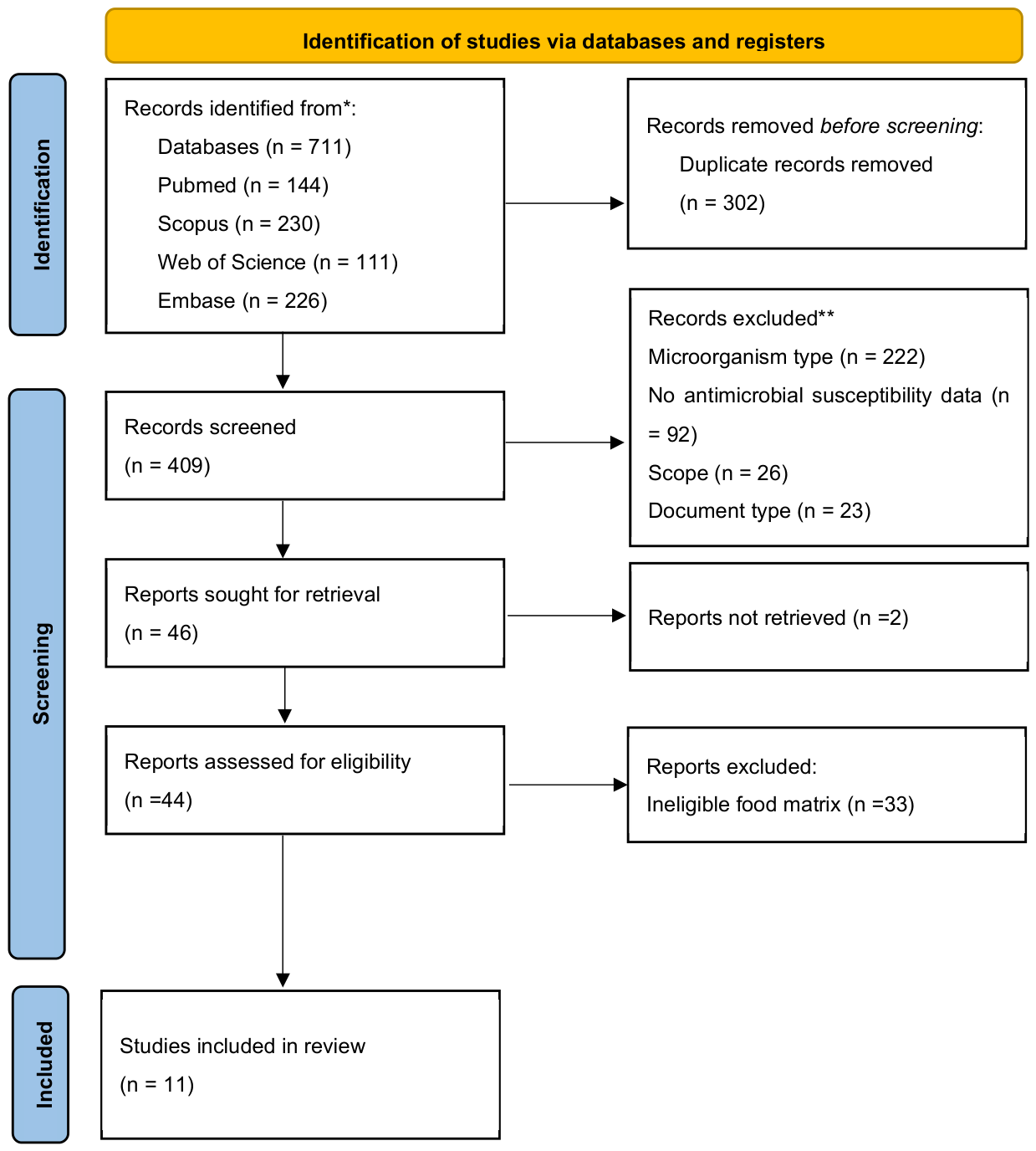
Figure 2.
Heatmap of antimicrobial resistance profiles of Listeria monocytogenes.
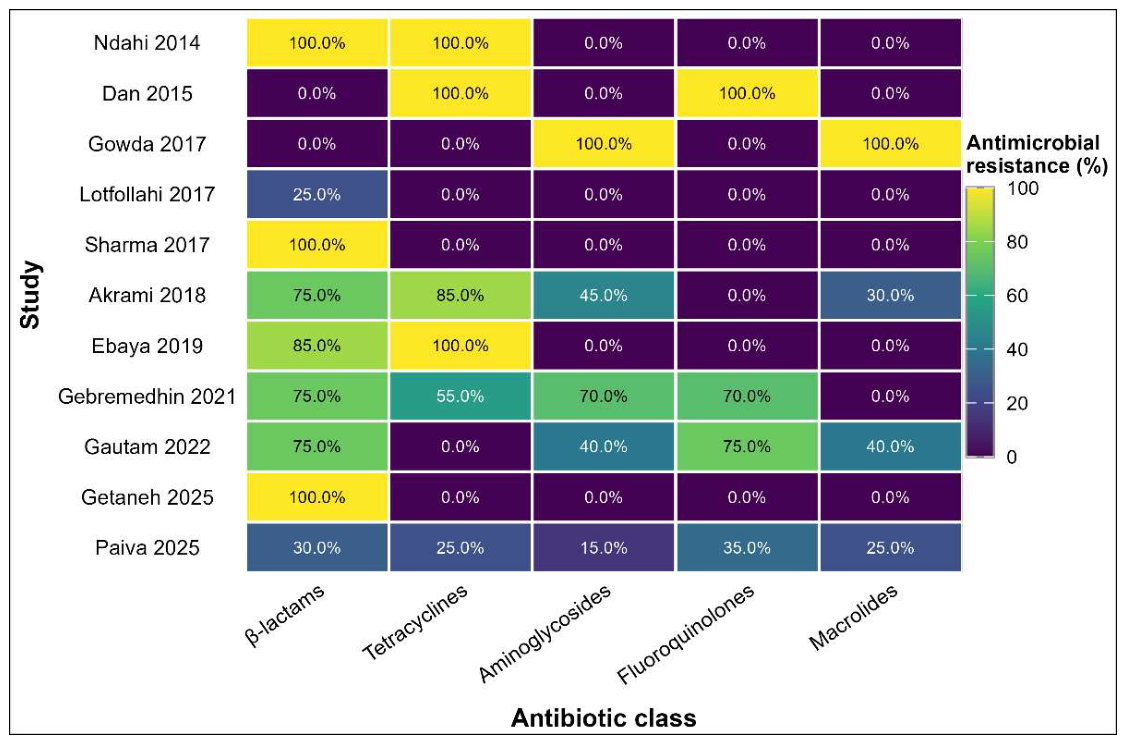
Table 1.
Search Strategies for electronic databases.
| Database | Search Strategy |
|---|---|
| PubMed | (“Antibiotic Resistance” OR “Antibiotic Resistance, Microbial” OR “Antimicrobial Drug Resistance” OR “Antimicrobial Drug Resistances” OR “Antimicrobial Resistance, Drug” OR “Antimicrobial Resistances, Drug” OR “Drug Antimicrobial Resistance” OR “Drug Antimicrobial Resistances” OR “Drug Resistance, Microbial” OR “Drug Resistances, Microbial” OR “Resistance, Antibiotic” OR “Resistance, Drug Antimicrobial” OR “Resistances, Drug Antimicrobial”) AND (“Listeria monocytogenes”) AND (“Disease, Food-borne” OR “Disease, Foodborne” OR “Food borne Disease” OR “Food borne Diseases” OR “Food borne Illness” OR “Food borne Illnesses” OR “Food Poisoning” OR “Food Poisonings” OR “Food-borne Disease” OR “Food-borne Diseases” OR “Food-borne Illness” OR “Food-borne Illnesses” OR “Foodborne Disease” OR “Foodborne Diseases” OR “Foodborne Illness” OR “Foodborne Illnesses” OR “Illness, Food-borne” OR “Illness, Foodborne” OR “Illnesses, Foodborne” OR “Poisoning, Food”) |
| Scopus | TITLE-ABS-KEY((“Antibiotic Resistance” OR “Antibiotic Resistance, Microbial” OR “Antimicrobial Drug Resistance” OR “Antimicrobial Drug Resistances” OR “Antimicrobial Resistance, Drug” OR “Antimicrobial Resistances, Drug” OR “Drug Antimicrobial Resistance” OR “Drug Antimicrobial Resistances” OR “Drug Resistance, Microbial” OR “Drug Resistances, Microbial” OR “Resistance, Antibiotic” OR “Resistance, Drug Antimicrobial” OR “Resistances, Drug Antimicrobial”)) AND TITLE-ABS-KEY((“Listeria monocytogenes”)) AND TITLE-ABS-KEY((“Disease, Food-borne” OR “Disease, Foodborne” OR “Food borne Disease” OR “Food borne Diseases” OR “Food borne Illness” OR “Food borne Illnesses” OR “Food Poisoning” OR “Food Poisonings” OR “Food-borne Disease” OR “Food-borne Diseases” OR “Food-borne Illness” OR “Food-borne Illnesses” OR “Foodborne Disease” OR “Foodborne Diseases” OR “Foodborne Illness” OR “Foodborne Illnesses” OR “Illness, Food-borne” OR “Illness, Foodborne” OR “Illnesses, Foodborne” OR “Poisoning, Food”)) |
| Web of Science | (“Antibiotic Resistance” OR “Antibiotic Resistance, Microbial” OR “Antimicrobial Drug Resistance” OR “Antimicrobial Drug Resistances” OR “Antimicrobial Resistance, Drug” OR “Antimicrobial Resistances, Drug” OR “Drug Antimicrobial Resistance” OR “Drug Antimicrobial Resistances” OR “Drug Resistance, Microbial” OR “Drug Resistances, Microbial” OR “Resistance, Antibiotic” OR “Resistance, Drug Antimicrobial” OR “Resistances, Drug Antimicrobial”)) AND (“Listeria monocytogenes”) AND (“Disease, Food-borne” OR “Disease, Foodborne” OR “Food borne Disease” OR “Food borne Diseases” OR “Food borne Illness” OR “Food borne Illnesses” OR “Food Poisoning” OR “Food Poisonings” OR “Food-borne Disease” OR “Food-borne Diseases” OR “Food-borne Illness” OR “Food-borne Illnesses” OR “Foodborne Disease” OR “Foodborne Diseases” OR “Foodborne Illness” OR “Foodborne Illnesses” OR “Illness, Food-borne” OR “Illness, Foodborne” OR “Illnesses, Foodborne” OR “Poisoning, Food”) |
| Embase | (‘antibacterial drug resistance’ OR ‘antibacterial resistance’ OR ‘antibiotic non-susceptibility’ OR ‘antibiotic nonsusceptibility’ OR ‘antimicrobial drug resistance’ OR ‘antimicrobial resistance’ OR ‘bacterial drug resistance’ OR ‘bacterial resistance’ OR ‘bacterium resistance’ OR ‘drug resistance, bacterial’ OR ‘drug resistance, microbial’ OR ‘microbial drug resistance’ OR ‘resistance, antibiotic’ OR ‘antibiotic resistance’) AND (‘bacterium monocytogenes’ OR ‘Corynebacterium infantisepticum’ OR ‘Corynebacterium parvulum’ OR ‘Erysipelothrix monocytogenes’ OR ‘Listerella hepatolytica’ OR ‘listeriosis monocytogenes’ OR ‘Listeria monocytogenes’) AND (‘food borne disease’ OR ‘food borne diseases’ OR ‘food borne illness’ OR ‘food borne illnesss’ OR ‘food borne infection’ OR ‘food borne infections’ OR ‘food infection’ OR ‘food intoxication’ OR ‘food toxicity’ OR ‘food toxicology’ OR ‘foodborne disease’ OR ‘foodborne diseases’ OR ‘foodborne illness’ OR ‘foodborne illnesses’ OR ‘foodborne infection’ OR ‘foodborne infections’ OR ‘food poisoning’) |
Table 3.
Prevalence of Listeria monocytogenes in different food matrices.
| Authors | Year | Food Matrix | Sample Size (n) | Positive Samples | Reported Prevalence (%) |
|---|---|---|---|---|---|
| Ndahi et al.[9] | 2014 | Beef, goat, chicken meat, suya, Kilishi, Balangu, and Tsire | 300 | 12 | 4 |
| Dan et al.[10] | 2015 | Raw chicken meat | 144 | 19 | 13.2 |
| Lotfollahi et al.[11] | 2017 | Sausages, pasteurized milk, cheese, raw chicken meat, beef, goat, and sheep meat cubes | 267 | 8 | 3 |
| Gautam et al. [12] | 2022 | Chicken burger, vegetarian paneer burger, egg roll, vegetable-filled Momos, vegetable spring roll, cheeseburger, chicken Chow mein, cheese salad, white pasta, fried potato chaat, chicken curry, chicken nuggets, vegetable cutlets, chicken spring roll, and Aloo paratha. | 15 | 9 | 60 |
| Paiva et al.[14] | 2025 | Raw beef, raw pork, meatballs, hamburgers, fresh sausages, breaded meat skewers, Alheira sausage, and Moura sausage | 75 | 12 | 16 |
| Sharma et al.[16] | 2017 | Raw bovine milk | 457 | 5 | 1.1 |
| Gowda et al.[13] | 2017 | Raw beef | 765 | 1 | 0.1 |
| Akrami-Mohajeri et al.[17] | 2018 | Raw milk, cheese, butter, curd, and ice cream | 545 | 22 | 4 |
| Gebremedhin et al.[19] | 2021 | Raw beef | 450 | 20 | 4.4 |
| Getaneh et al.[20] | 2025 | Raw beef | 100 | 2 | 2 |
| Ebaya et al.[18] | 2019 | Raw bovine milk | 100 | 7 | 7 |
For studies that evaluated multiple food matrices, only the food matrices meeting the eligibility criteria of the present review were included in this table.
Table 4.
Reported Antimicrobial Resistance Profiles of Listeria monocytogenes.
| Authors | Year | Food matrix | L. monocytogenes isolates evaluated | Main Resistance Findings | Main Susceptibility Findings | MDR Profile |
|---|---|---|---|---|---|---|
| Ndahi et al.[9] | 2014 | Beef, goat, chicken meat, suya, Kilishi, Balangu, and Tsire | 12 | 100% resistant to 9/14 antimicrobial agents; recurrent resistance to penicillin, SXT, nitrofurantoin, tetracycline, streptomycin, ampicillin, lincomycin, and trimethoprim | Susceptible to gentamicin; most isolates were susceptible to kanamycin and ciprofloxacin | Yes |
| Dan et al.[10] | 2015 | Raw chicken meat | 19 | Resistance primarily to tetracyclines, sulfonamides, and quinolones/fluoroquinolones | Not fully specified for L. monocytogenes | 23% MDR |
| Lotfollahi et al.[11] | 2017 | Sausages, pasteurized milk, cheese, raw chicken meat, and beef, goat, and sheep meat cubes | 22 | Resistance to penicillin G (27.2%); intermediate susceptibility to clindamycin (100%) and rifampicin (9%) | Susceptible to chloramphenicol, linezolid, amoxicillin/clavulanic acid, kanamycin, tetracycline, SXT, gentamicin, and ampicillin | No |
| Gautam et al.[12] | 2022 | Chicken burger, veg paneer burger, egg roll, vegetable filling for Momos, veg spring roll, cheese burger, chicken Chowmein, cheese salad, white pasta, fried potato chaat, chicken curry, chicken nuggets, veg cutlets, chicken spring roll and Aloo paratha. | Not clearly specified | Levofloxacin (80%); cefotaxime (80%); ciprofloxacin (80%); cotrimoxazole (60%); gentamicin, azithromycin, and chloramphenicol (40%); oxacillin (20%) | Not clearly specified | Yes |
| Paiva et al.[14] | 2025 | Raw beef, raw pork, meatballs, hamburgers, fresh sausages, breaded meat skewers, Alheira sausage, and Moura sausage | 21 | SXT (76.19%); ciprofloxacin (38.10%); meropenem (33.33%); tetracycline and erythromycin (28.57%); rifampicin (23.8%); kanamycin (14.3%) | 100% susceptible to ampicillin, chloramphenicol, gentamicin, linezolid, and vancomycin | 28.6% MDR |
| Sharma et al.[16] | 2017 | Raw bovine milk | 5 | 100% resistant to penicillin G, piperacillin, oxacillin, and ceftriaxone; 80% to ampicillin, amoxicillin/clavulanic acid, and nalidixic acid; 60% to ceftazidime | 100% susceptible to vancomycin, ciprofloxacin, gatifloxacin, amikacin, azithromycin, gentamicin, kanamycin, norfloxacin, and streptomycin | Yes |
| Gowda et al.[13] | 2017 | Raw beef | 1 | Resistant to clindamycin and gentamicin | Susceptible to amoxicillin, ampicillin, ceftazidime, cefuroxime, chloramphenicol, and doxycycline | Not |
| Akrami-Mohajeri et al.[17] | 2018 | Raw milk, cheese, butter, curd, and ice cream | 22 | Tetracycline (86.3%); chloramphenicol (77.2%); penicillin (77.2%); streptomycin (45.4%); erythromycin (36.3%) | 100% susceptible to vancomycin and SXT | Frequent (≥2–3 antimicrobial agents) |
| Gebremedhin et al.[19] | 2021 | Raw beef | 20 | Oxacillin (80%); cefotaxime (75%); amikacin and nalidixic acid (70%); chloramphenicol (60%); tetracycline (55%) | Amoxicillin (95%); vancomycin (90%); clindamycin (85%) | 95% MDR |
| Getaneh et al.[20] | 2025 | Raw beef | 2 | Resistance to cloxacillin, nalidixic acid, and penicillin | Susceptible to amoxicillin, vancomycin, sulfamethoxazole, gentamicin, ampicillin, chloramphenicol, and tetracycline | No |
| Ebaya et al.[18] | 2019 | Raw bovine milk | 17 | Oxytetracycline (100%); high resistance to penicillin and neomycin; multiple resistance profiles | Highest susceptibility to norfloxacin | 82% resistant to ≥5 antimicrobial agents |
The number of isolates evaluated may differ from the number of positive samples, as some studies recovered more than one isolate from a single positive sample. Abbreviations follow the terminology used in the original studies (SXT: trimethoprim/sulfamethoxazole; MDR: multidrug resistance).
Disclaimer/Publisher’s Note: The statements, opinions and data contained in all publications are solely those of the individual author(s) and contributor(s) and not of MDPI and/or the editor(s). MDPI and/or the editor(s) disclaim responsibility for any injury to people or property resulting from any ideas, methods, instructions or products referred to in the content. |
© 2026 by the authors. Licensee MDPI, Basel, Switzerland. This article is an open access article distributed under the terms and conditions of the Creative Commons Attribution (CC BY) license.
Copyright: This open access article is published under a Creative Commons CC BY 4.0 license, which permit the free download, distribution, and reuse, provided that the author and preprint are cited in any reuse.