

Submitted:
07 August 2026
Posted:
07 August 2026
You are already at the latest version
Abstract
Electronic health records (EHRs) are a primary target for foundation models because they capture longitudinal, multimodal, and large-scale clinical trajectories. However, routinely collected clinical data remain difficult to model due to extreme sparsity, irregular temporal sampling, heterogeneous representations, and informative missingness. In this Perspective, we provide an EHR-centered synthesis of foundation models across the translational pipeline, spanning data resources, model architectures, and the requirements for reliable clinical integration. We first examine the data characteristics and real-world barriers that shape EHR modeling, including coding variation and distribution shift. We then review the three dominant model families, including structured-sequence, clinical language, and multimodal models, with a focus on architectural adaptations for longitudinal clinical reasoning. Next, we summarize emerging clinical use cases, from outcome prediction and phenotyping to assistive documentation, digital-twin simulation, and causal inference. Finally, we delineate the engineering and governance conditions necessary for clinical translation, including evaluation under distribution shift, workflow-integrated monitoring, and regulatory oversight. By linking technical advances to the practical constraints of healthcare delivery, this Perspective outlines a roadmap for transitioning EHR foundation models from research benchmarks to safe, impactful clinical technologies.
Keywords:
electronic health records
; foundation models
; clinical decision support
; natural language processing
; causal inference
; clinical translation
1. Introduction
Clinical recordkeeping has been transformed over the past two decades, with most healthcare systems transitioning from fragmented paper charts to integrated electronic health records (EHRs) [1]. Unlike curated research datasets, EHRs capture longitudinal patient trajectories through heterogeneous mixtures of structured data, including diagnosis codes, medication orders, and laboratory results, and unstructured clinical narratives [2]. Because these records are generated during routine care rather than designed for research, they are characteristically sparse, irregularly sampled, and incomplete, with patterns of missingness that may themselves carry clinical meaning [3]. These properties have limited conventional clinical AI, which typically targets narrowly defined prediction tasks and cannot readily capture the longitudinal, heterogeneous, and workflow-dependent nature of real-world patient care [4,5].
These limitations have motivated growing interest in foundation models for EHRs. Rather than relying on task-specific labeled supervision, foundation models use self-supervised pre-training on large-scale unlabeled clinical data to learn transferable patient representations that can be adapted to diverse downstream tasks with limited additional annotation [6,7]. This approach is well-suited to healthcare, where labeled data are costly, clinical ontologies evolve continuously, and meaningful signals are distributed across long and heterogeneous patient histories. Yet scale alone does not resolve the core challenges of clinical deployment. Models trained on routinely collected data risk inheriting documentation biases, encoding institutional practice patterns rather than generalizable disease biology, and failing to transfer reliably across hospitals, patient populations, and care workflows [8,9]. These concerns become especially important when EHR models are used to inform clinical decisions rather than merely to describe risk. A model that accurately identifies patients at high risk does not necessarily indicate which action should be taken, or whether an alternative diagnostic, monitoring, or treatment strategy would improve outcomes [10].
Existing EHR foundation models span three broad paradigms: structured-sequence models that learn from longitudinal coded events, clinical language models that operate on free-text notes or textualized records, and multimodal architectures that integrate EHR data with other biomedical modalities such as imaging or genomics [5,11,12]. Across these paradigms, a shared ambition is to produce reusable patient representations supporting prediction, phenotyping, generation, causal inference, and clinical decision support across diverse outcomes, specialties, and care settings. However, translational value cannot be reduced to benchmark performance alone. For EHR foundation models to function reliably in practice, they must operate within real healthcare workflows, be evaluated rigorously under distribution shift and cross-site variation, and be embedded within governance frameworks addressing data privacy, patient safety, clinical accountability, and regulatory oversight [9,13].
Despite a growing body of reviews on foundation models in healthcare [6,14], existing accounts tend to be either too broad to provide a focused treatment of EHR-specific modeling or too narrow in their coverage of particular model classes, modalities, or tasks. This Perspective addresses that gap by offering a systematic, EHR-centered account across the full translational pipeline, spanning data resources (Section 2), model architectures and pre-training strategies (Section 3), downstream clinical applications (Section 4), and requirements for responsible clinical integration (Section 5). Throughout, we ask not only whether these models perform well on benchmarks, but whether their outputs can be translated into clinically meaningful decisions about diagnosis, monitoring, and treatment, and what it would take for them to be rigorously evaluated, responsibly governed, and safely deployed in real-world clinical practice.
2. Data for EHR Foundation Models
2.1. Data Landscape
EHRs provide one of the richest longitudinal records of real-world clinical care. Unlike curated clinical trial datasets or single-modality registries, they capture heterogeneous information generated during routine healthcare delivery, encompassing structured data such as diagnosis and procedure codes, laboratory measurements, vital signs, and medication records, as well as unstructured clinical notes. Structured information supports standardized longitudinal modeling at scale, whereas free-text notes preserve contextual nuance that structured coding cannot fully capture. Increasingly, these records are also linked to imaging, genomic, and other biomedical resources. Their scale and diversity make large EHR repositories a valuable substrate for foundation model development, although their irregularity, incompleteness, and documentation variability introduce substantial challenges for modeling and evaluation.
Table 1 provides an overview of representative datasets, while Supplementary Table S2 summarizes source coding systems across major structured EHR domains. We classify dataset origins into the following categories, ordered broadly by their practical importance and current influence on EHR foundation model development.
Figure 1.
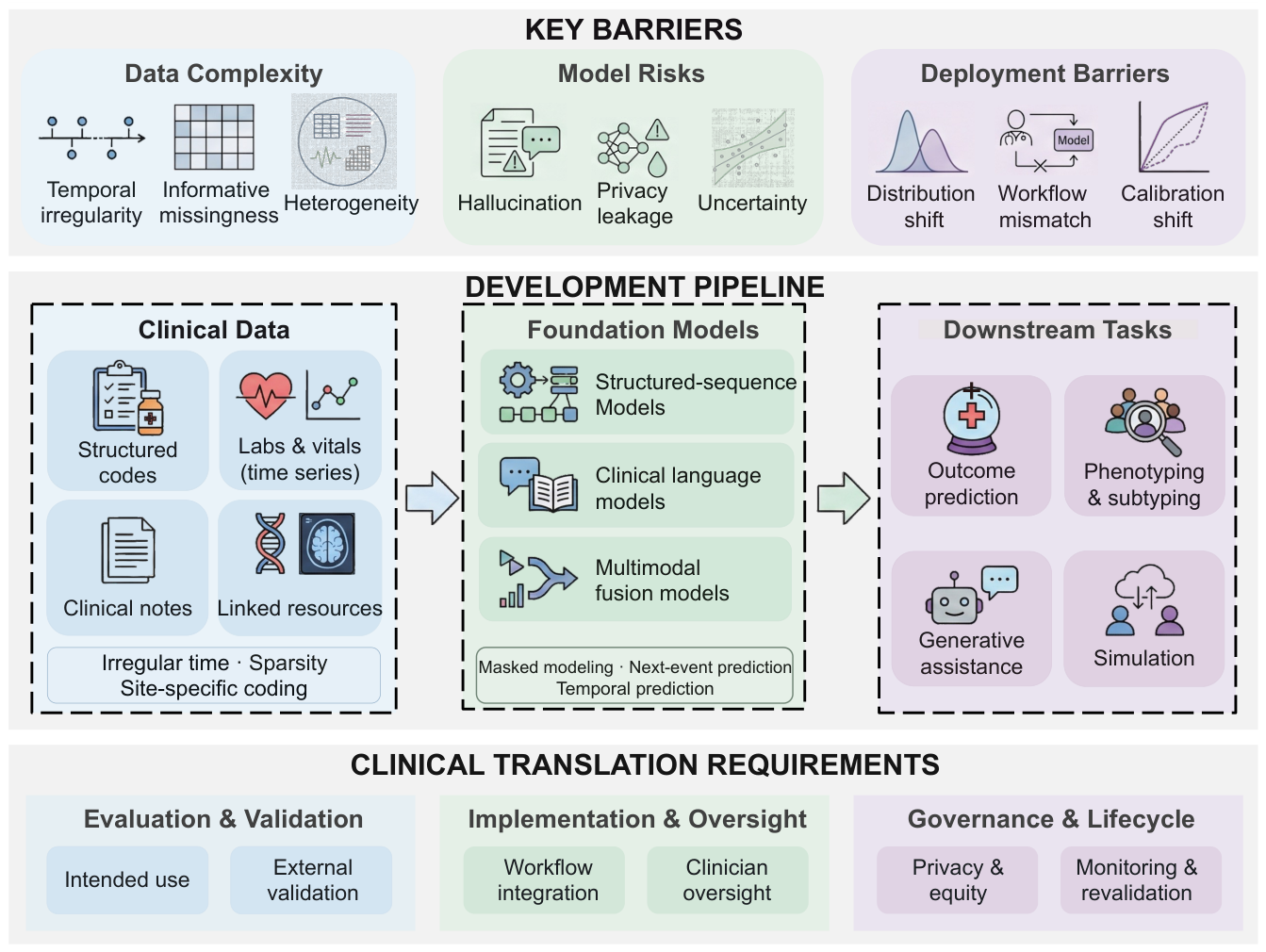
Barriers, development pipeline, and requirements for clinical translation of EHR foundation models. The upper panel summarizes key barriers related to data complexity, model risks, and deployment barriers. The middle panel outlines the development pipeline, in which clinical data are used to pretrain structured-sequence, clinical language, and multimodal models for downstream clinical tasks, including outcome prediction, phenotyping, generative assistance, and simulation. The lower panel highlights requirements for clinical translation, including intended-use specification, external validation, workflow integration, clinician oversight, governance, privacy and equity assessment, and lifecycle monitoring.
Figure 1.
Barriers, development pipeline, and requirements for clinical translation of EHR foundation models. The upper panel summarizes key barriers related to data complexity, model risks, and deployment barriers. The middle panel outlines the development pipeline, in which clinical data are used to pretrain structured-sequence, clinical language, and multimodal models for downstream clinical tasks, including outcome prediction, phenotyping, generative assistance, and simulation. The lower panel highlights requirements for clinical translation, including intended-use specification, external validation, workflow integration, clinician oversight, governance, privacy and equity assessment, and lifecycle monitoring.
Integrated health system EHRs capture care across outpatient, emergency, inpatient, and specialty settings within operational provider organizations [15,16,17,18]. They provide broad longitudinal coverage within a single system, reflect heterogeneous real-world workflows, and closely approximate the environments in which clinical AI models are ultimately deployed, making them the most directly relevant substrate for foundation model development and clinical translation.
Commercial real-world data platforms aggregate records across fragmented provider and payer ecosystems through curated ingestion pipelines and harmonized schemas [19,20,21,22]. Their principal strengths are cross-system scale, broad population coverage, and secondary-use infrastructure designed to support large-scale observational analysis, enabling pretraining on patient volumes that individual health systems cannot match.
Federated research networks support multi-institution analysis while preserving local data stewardship through shared data models, coordinated curation, and governed execution environments [23,24,25,26,27]. They enable large-scale, privacy-preserving research that no single institution could conduct independently, and are increasingly important for evaluating model generalizability across diverse sites and populations.
ICU research repositories capture data from critically ill patients undergoing intensive monitoring and treatment in high-acuity hospital settings [28,29,30,31]. Their defining characteristics are dense bedside measurements, frequent laboratory testing, detailed intervention records, and high temporal resolution. Their public availability and rich temporal structure have made them foundational benchmarks for early EHR modeling research, and they remain widely used for model development and evaluation.
Primary care registries reflect routine community-based care delivered through longitudinal outpatient practice [32,33]. They offer sustained follow-up, systematic documentation of chronic disease, prescribing continuity, and relatively standardized ambulatory workflows, supporting long-horizon population health research and the study of disease progression over years or decades.
EHR-linked biobanks connect routine clinical phenotypes with genomic, molecular, and other biological data [34,35,36,37,38]. By bridging coded clinical trajectories with mechanistic biological context, they are especially valuable for studies of disease etiology, genotype-phenotype relationships, and translational discovery, and are becoming increasingly important as foundation models expand toward multimodal biological integration.
Administrative claims databases originate from reimbursement workflows rather than direct clinical documentation, and provide longitudinal records of billable encounters, diagnoses, procedures, and dispensing events [39,40,41,42]. Their primary strengths are scale, long follow-up, and broad coverage of healthcare utilization, though they lack the granular clinical detail available in direct EHR sources, limiting their utility as a primary training resource for foundation models.

Table 1.
Landscape of Major Clinical Datasets. Datasets are categorized along two primary axes: (1) Data Source and (2) Data Integration Architecture. The Size column reports the approximate number of unique total patients when publicly available; otherwise, record-level counts (e.g., encounters per year) are shown. Data modalities are abbreviated as follows: Codes (structured diagnosis/procedure codes/medications); Labs (laboratory test results); Vitals (physiological measurements); Notes (unstructured free-text clinical notes); Img. (medical imaging data, e.g., MRI, X-ray); Omics (genomic/molecular data); Wear. (wearable sensor data). Availability is color-coded: Green=Available, Gray=Unavailable. Access types: Open Public (credentialed public access), Academic app. (application-based academic access), Institutional (institution-restricted), Gov restricted (government-controlled), Partnership (collaboration-based), Commercial (commercially licensed).
Table 1.
Landscape of Major Clinical Datasets. Datasets are categorized along two primary axes: (1) Data Source and (2) Data Integration Architecture. The Size column reports the approximate number of unique total patients when publicly available; otherwise, record-level counts (e.g., encounters per year) are shown. Data modalities are abbreviated as follows: Codes (structured diagnosis/procedure codes/medications); Labs (laboratory test results); Vitals (physiological measurements); Notes (unstructured free-text clinical notes); Img. (medical imaging data, e.g., MRI, X-ray); Omics (genomic/molecular data); Wear. (wearable sensor data). Availability is color-coded: Green=Available, Gray=Unavailable. Access types: Open Public (credentialed public access), Academic app. (application-based academic access), Institutional (institution-restricted), Gov restricted (government-controlled), Partnership (collaboration-based), Commercial (commercially licensed).
| Category | Dataset | Size | EHR variables | Other modalities | Access | |||||
|---|---|---|---|---|---|---|---|---|---|---|
| Codes | Labs | Vitals | Notes | Image | Omics | Wearable | ||||
| Integrated Health System EHR | STARR [15] | ∼3.4M | ✓ | ✓ | ✓ | ✓ | ✓ | ✕ | ✕ | Institutional |
| NYU Langone EHR [43] | not reported | ✓ | ✓ | ✓ | ✓ | ✕ | ✕ | ✕ | Institutional | |
| SIPPS Dataset [44] | ∼2k | ✓ | ✓ | ✓ | ✓ | ✕ | ✕ | ✕ | Institutional | |
| Mount Sinai Data Warehouse [45] | ∼12M | ✓ | ✓ | ✓ | ✓ | ✓ | ✕ | ✕ | Institutional | |
| Mayo Clinic Platform_Discover [46] | ∼10M | ✓ | ✓ | ✓ | ✓ | ✓ | ✕ | ✕ | Commercial | |
| SickKids (Hospital for Sick Children) [47] | ∼1.9M | ✓ | ✓ | ✓ | ✓ | ✓ | ✕ | ✕ | Institutional | |
| UCSF Clinical Data Warehouse [18] | ∼4.3M | ✓ | ✓ | ✓ | ✓ | ✓ | ✕ | ✕ | Institutional | |
| Mass General Brigham (RPDR) [16] | ∼7M | ✓ | ✓ | ✓ | ✓ | ✓ | ✕ | ✕ | Institutional | |
| VA EHR (VistA / CDW) [17] | ∼25M | ✓ | ✓ | ✓ | ✓ | ✕ | ✕ | ✕ | Gov restricted | |
| DoD Military Health System (MDR/MHS) [48] | ∼9.6M | ✓ | ✓ | ✓ | ✓ | ✕ | ✕ | ✕ | Gov restricted | |
| HCA Healthcare [49] | ∼47M encounters/year | ✓ | ✓ | ✓ | ✓ | ✕ | ✕ | ✕ | Partnership | |
| Commercial RWD Platforms | Truveta Data [19] | 130M | ✓ | ✓ | ✓ | ✓ | ✓ | ✕ | ✕ | Partnership |
| Cerner Real-World Data (now Oracle Health) [20] | ∼117M | ✓ | ✓ | ✓ | ✓ | ✓ | ✕ | ✕ | Commercial | |
| IBM Explorys (now Merative) [50] | ∼64M | ✓ | ✓ | ✓ | ✓ | ✓ | ✕ | ✕ | Commercial | |
| Flatiron Health [21] | ∼5M | ✓ | ✓ | ✓ | ✓ | ✓ | ✕ | ✕ | Partnership | |
| HealthVerity [51] | ∼330M | ✓ | ✓ | ✕ | ✕ | ✕ | ✕ | ✕ | Commercial | |
| Tempus [22] | ∼8.5M records | ✓ | ✓ | ✕ | ✓ | ✓ | ✓ | ✕ | Partnership | |
| IQVIA Real-World Data [52] | ∼1.2B | ✓ | ✓ | ✕ | ✕ | ✕ | ✕ | ✕ | Commercial | |
| Veradigm (Allscripts/Practice Fusion) [53] | ∼80M | ✓ | ✓ | ✓ | ✓ | ✕ | ✕ | ✕ | Commercial | |
| Komodo Health [54] | ∼330M | ✓ | ✓ | ✕ | ✕ | ✕ | ✕ | ✕ | Commercial | |
| MSK-CHORD (MSKCC) [55] | ∼1.7M | ✓ | ✓ | ✓ | ✓ | ✕ | ✕ | ✕ | Institutional | |
| Federated Research Networks | PCORnet [23] | ∼100M | ✓ | ✓ | ✓ | ✕ | ✕ | ✕ | ✕ | Partnership |
| TriNetX [27] | ∼250M | ✓ | ✓ | ✓ | ✕ | ✕ | ✕ | ✕ | Commercial | |
| OHDSI Network [24] | ∼810M | ✓ | ✓ | ✓ | ✕ | ✕ | ✕ | ✕ | Partnership | |
| OpenSAFELY [26] | ∼58M | ✓ | ✓ | ✓ | ✓ | ✕ | ✕ | ✕ | Gov restricted | |
| Epic Cosmos [56] | ∼300M | ✓ | ✓ | ✓ | ✓ | ✓ | ✕ | ✕ | Institutional | |
| OneFlorida+ Data Trust [57] | ∼26M | ✓ | ✓ | ✓ | ✓ | ✕ | ✕ | ✕ | Academic app. | |
| N3C (National COVID Cohort Collaborative) [25] | ∼22.8M | ✓ | ✓ | ✓ | ✓ | ✕ | ✕ | ✕ | Academic app. | |
| Sentinel System (FDA) [58] | 540M | ✓ | ✓ | ✕ | ✕ | ✕ | ✕ | ✕ | Gov restricted | |
| HCSRN (Health Care Systems Research Network) [59] | ∼25M | ✓ | ✓ | ✓ | ✓ | ✓ | ✕ | ✕ | Academic app. | |
| ICU Research Repositories | MIMIC-III [28] | ∼47k | ✓ | ✓ | ✓ | ✓ | ✓ | ✕ | ✕ | Open Public |
| MIMIC-IV [29] | ∼365k | ✓ | ✓ | ✓ | ✓ | ✓ | ✕ | ✕ | Open Public | |
| eICU-CRD [30] | ∼139k | ✓ | ✓ | ✓ | ✓ | ✕ | ✕ | ✕ | Open Public | |
| AmsterdamUMCdb [60] | ∼20k | ✓ | ✓ | ✓ | ✓ | ✕ | ✕ | ✕ | Open Public | |
| HiRID [31] | ∼34k records | ✓ | ✓ | ✓ | ✕ | ✕ | ✕ | ✕ | Open Public | |
| SICdb (Salzburg ICU) [61] | ∼27k records | ✓ | ✓ | ✓ | ✕ | ✕ | ✕ | ✕ | Open Public | |
| Primary Care Registries | CPRD (UK) [32] | ∼21M | ✓ | ✓ | ✓ | ✓ | ✕ | ✕ | ✕ | Academic app. |
| THIN (The Health Improvement Network) [33] | ∼17M | ✓ | ✓ | ✓ | ✓ | ✕ | ✕ | ✕ | Commercial | |
| EHR-Linked Biobanks | UK Biobank [34] | ∼500k | ✓ | ✓ | ✓ | ✕ | ✓ | ✓ | ✓ | Academic app. |
| All of Us (NIH) [35] | ∼848k | ✓ | ✓ | ✓ | ✕ | ✕ | ✓ | ✓ | Academic app. | |
| MVP (Million Veteran Program) [62] | ∼1M | ✓ | ✓ | ✕ | ✕ | ✕ | ✓ | ✕ | Gov restricted | |
| FinnGen [36] | ∼500k | ✓ | ✓ | ✕ | ✕ | ✕ | ✓ | ✕ | Academic app. | |
| China Kadoorie Biobank (CKB) [63] | ∼512k | ✓ | ✓ | ✕ | ✕ | ✕ | ✓ | ✕ | Academic app. | |
| BioBank Japan (BBJ) [64] | ∼200k | ✓ | ✓ | ✕ | ✕ | ✕ | ✓ | ✕ | Academic app. | |
| KPRB (Kaiser Permanente Research Bank) [65] | ∼440k | ✓ | ✓ | ✓ | ✕ | ✕ | ✓ | ✕ | Institutional | |
| Danish National Biobank [66] | ∼3M | ✓ | ✓ | ✕ | ✕ | ✕ | ✓ | ✕ | Academic app. | |
| BioVU (Vanderbilt) [37] | ∼300k | ✓ | ✓ | ✓ | ✕ | ✕ | ✓ | ✕ | Institutional | |
| eMERGE (Electronic Medical Records and Genomics) [38] | ∼1.5M | ✓ | ✓ | ✓ | ✕ | ✕ | ✕ | Partnership | ||
| Administrative Claims Databases | Medicare [39] | ∼65M | ✓ | ✕ | ✕ | ✕ | ✕ | ✕ | ✕ | Gov restricted |
| Medicaid (T-MSIS/MAX) [40] | ∼80M | ✓ | ✕ | ✕ | ✕ | ✕ | ✕ | ✕ | Gov restricted | |
| MarketScan (Merative) [41] | ∼273M | ✓ | ✕ | ✕ | ✕ | ✕ | ✕ | ✕ | Commercial | |
| Optum Clinformatics / Market Clarity [42] | ∼100M | ✓ | ✓ | ✕ | ✕ | ✕ | ✕ | ✕ | Commercial | |
| HCUP-NIS (National Inpatient Sample) [67] | 7–8M records/year | ✓ | ✕ | ✕ | ✕ | ✕ | ✕ | ✕ | Academic app. | |
Note: References can be dataset source papers, papers that use the dataset, or official dataset websites.
Beyond patient-level records, foundation model development also draws on complementary text resources for pretraining and evaluation. Supplementary Table S1 summarizes representative examples, including biomedical literature corpora, medical reasoning benchmarks, and curated clinical text collections.
2.2. Data Characteristics and Challenges
Different EHR data sources provide complementary signals for foundation model development. Integrated health system EHRs and primary care registries offer broad longitudinal follow-up across chronic disease management, care transitions and routine care, making them well suited for modeling long-range patient trajectories. ICU research repositories, by contrast, are particularly valuable for densely structured data such as diagnosis codes, procedures, medications, laboratory measurements and vital signs, because they capture high-frequency acute care processes and enable learning of fine-grained physiological dynamics, although they offer limited longitudinal continuity and are strongly shaped by site-specific ICU practices. Commercial platforms, federated networks and claims databases complement both by further expanding scale, heterogeneity and opportunities for external validation. Together, these data support tokenization, temporal modeling and large-scale self-supervised learning, yet they remain constrained by coding heterogeneity, irregular sampling, workflow-dependent missingness and, in some settings, reduced physiological detail or incomplete capture across care sites.
These constraints reflect deeper properties that make EHR data intrinsically difficult to model. Clinical records are irregular, informatively missing and institutionally variable. Unlike the regular grids of computer vision or the relatively uniform sequential structure of web text, clinical observations are recorded on uneven timelines that range from minutes in acute care to months or years in chronic disease management, which complicates representation learning and challenges the positional assumptions built into standard Transformer architectures [4]. Missingness is often clinically informative rather than random: a laboratory test may be absent because it was not indicated, not available or judged unnecessary in context, so treating missing values purely as noise risks discarding useful signal [68]. Institutional variability adds a further layer of difficulty, as the same clinical event may be recorded using different vocabularies, coding practices and documentation styles across sites, and even shared data models do not fully eliminate this variation. Supplementary Table S2 illustrates this diversity. Together, these properties hinder transportability and motivate representation strategies that reduce dependence on local schemas, including approaches that map structured entries to human-readable descriptions and serialize them into chronological sequences [44,69].
3. Model Architectures and Training Strategies
EHR foundation models can be organized into three broad methodological paradigms, each defined by the type of clinical data it is designed to represent. Structured-sequence models learn from longitudinal coded events such as diagnoses, medications, procedures and laboratory measurements (Section 3.1). Clinical language models operate on clinical narratives or textualized records, recovering information that structured fields capture only partially (Section 3.2). Multimodal approaches build on both by integrating additional biomedical data sources, such as imaging and omics, to learn more comprehensive patient representations (Section 3.3).
Although these paradigms differ in input format, pretraining objectives and architectural design, they are converging on a common goal: to support a wide range of downstream tasks rather than a single narrowly defined prediction problem. This shift reframes EHR modeling beyond endpoint prediction toward broader objectives, including representing patient state, supporting clinical assistance and enabling simulation-oriented applications. Figure 2 and Figure 3 summarize this progression and the corresponding modeling workflows.
In the following sections, we review each paradigm in turn, focusing on the clinical data it is designed to model, the main training strategies it employs, and the strengths and limitations that shape its potential for clinical translation.
3.1. Structured-Sequence Models
Structured EHR data comprise irregularly timed diagnoses, medications, procedures, laboratory tests, vital signs and demographic attributes, which must first be reorganized into temporally indexed clinical events before sequence modeling. Transformer-based architectures have become the dominant framework for this setting because they capture long-range dependencies across heterogeneous coded histories more effectively than earlier recurrent or convolutional approaches.
Within this framework, the field has progressed along three connected directions. The first focuses on learning reusable patient representations from observed histories, yielding embeddings that transfer across diverse downstream tasks. The second moves beyond representation toward generative or survival-aware forecasting, reframing prediction as the modeling of future clinical events rather than fixed-window classification. The third targets the scaling demands of long clinical timelines through more efficient attention mechanisms and tokenization schemes. Together, these advances have strengthened the ability of structured-sequence models to represent disease progression, although their performance remains sensitive to coding granularity, irregular observation processes and site-specific recording practices.
3.1.1. From Representation Learning to Generative Forecasting
Early Transformer-based EHR models were designed primarily to learn general-purpose representations from observed patient histories. Encoder-only architectures such as Med-BERT [70] and BEHRT [5] adopted masked-token pretraining objectives, reconstructing structured clinical tokens through bidirectional attention to capture contextual patterns across visits. The resulting patient embeddings could be transferred to a range of downstream tasks, including diagnosis prediction, risk prediction, and patient similarity search.
When paired with task-specific heads, these representations also supported prospective prediction, including time-to-event applications. Subsequent benchmarking efforts such as EHRShot [71] provided systematic comparisons of pretrained EHR models across diverse clinical prediction tasks, clarifying where pretraining most improves transferability and sample efficiency, particularly in low-label settings.
Yet fixed patient embeddings paired with endpoint-specific heads remain limited in what they can express. They are well-suited to predefined risk estimation but do not explicitly model how future clinical states unfold over time. This limitation has motivated a shift toward autoregressive architectures that model the conditional distribution of future events given prior history. Models such as Foresight [11] and CEHR-GPT [72] apply causal masking to forecast future coded events and generate longitudinal patient timelines from preceding observations. More recent work pushes this generative paradigm to a substantially larger scale, pretraining decoder-only medical event foundation models on longitudinal records from 118 million patients and 115 billion discrete events, and suggests that simulation-based inference can support a broad range of downstream tasks as model and data scale increase [73].
This generative framing changes the role of the model, moving it from reusable representation learning toward approximation of future clinical trajectories. In principle, it enables trajectory-level forecasting, simulation of alternative disease courses, and synthetic cohort generation, although clinical value ultimately depends on whether generated trajectories remain plausible, calibrated, and interpretable enough for downstream use.
3.1.2. From Discrete Ordering to Continuous-Time Risk Modeling
Although autoregressive models introduce temporal directionality, early implementations often represented time only implicitly through token order. In this formulation, events separated by hours and events separated by years can appear similarly adjacent whenever no intermediate observations are recorded, blurring the distinction between acute deterioration and slow chronic progression, which has consequences for calibration, temporal validity, and clinical interpretation.
Recent work has therefore modeled time more explicitly within continuous-time and survival-aware frameworks. One direction extends generative trajectory modeling to predict not only the next clinical event but also the interval until its occurrence. Delphi [74], for example, incorporates continuous representations of age and jointly forecasts the upcoming event together with its timing. By producing temporally calibrated trajectories and absolute incidence patterns, such approaches move closer to modeling disease progression itself rather than only the ordering of coded events.
A complementary line of work brings survival modeling directly into large-scale sequence pretraining. Methods such as MOTOR [12] and SurvivEHR [75] place time-to-event estimation at the center of the pretraining objective. MOTOR combines a Transformer encoder with a piecewise exponential survival model to estimate hazard functions across multiple outcomes, whereas SurvivEHR pairs a generative decoder with a competing-risk objective to jointly model event type and event time. By accounting explicitly for hazard structure and censoring during optimization, these models yield representations that are more closely aligned with calibrated longitudinal risk estimation.
These developments reflect a conceptual shift in structured-sequence modeling: time becomes a core variable in the inference problem, rather than only an ordering device. Their success, however, still depends on the quality of timestamped supervision, censoring assumptions, and the stability of temporal patterns across institutions and care settings.
3.1.3. Scaling to Long Clinical Histories
Even as modeling objectives have become more expressive, sequence length remains a major practical constraint. A single patient’s EHR can span decades and contain tens of thousands of event tokens, and because standard self-attention scales quadratically with sequence length, models are often forced to truncate records or restrict the temporal window, potentially discarding clinically important long-range dependencies.
Two broad strategies have emerged to address this constraint. The first imposes hierarchy on the sequence. HiTANet [76], for example, summarizes individual events within a visit before applying attention across visits, improving computational efficiency and aligning naturally with the visit-based structure of clinical care. Predefined visit-level aggregation, however, can obscure interactions that unfold across visit boundaries.
The second adopts architectures that scale more favorably with context length. State space models and related recurrent formulations summarize prior history in compact hidden states that are updated sequentially as new events arrive. EhrMamba [77], for instance, adapts modern state space architectures to structured clinical sequences and achieves linear complexity in sequence length, making it feasible to model decade-spanning histories at scale.
Longer context alone, however, does not guarantee better clinical modeling. The key question is whether these efficient architectures preserve the clinically relevant structure of long-term disease progression while remaining interpretable and robust to the sparse, irregular and institution-specific observation patterns characteristic of real-world EHR data.
3.2. Clinical Language Models
Whereas structured-sequence transformers operate on discrete medical codes, clinical language models (CLMs) operate directly on unstructured text such as clinical narratives, discharge summaries and radiology reports. This shift offers three practical advantages for EHR modeling: CLMs can recover information that is only partially captured in structured fields, provide a common language-based interface across heterogeneous record elements, and exploit biomedical and clinical knowledge acquired during large-scale pretraining. Driven by advances in BERT- and GPT-family architectures, CLMs have therefore become an increasingly important direction in EHR modeling [78].
Here we focus on the use of CLMs for prediction from EHR data, particularly event and time-to-event prediction, while leaving applications such as summarization, chatbots and agentic workflows to Section 4. Existing work falls into three broad strategies: direct modeling of raw clinical notes, textualization of structured records for language-model input, and the use of language models to extract structured signals or embeddings from free text for downstream sequence modeling.
3.2.1. Raw Clinical Note Modeling
Domain-adaptive pretraining on MIMIC-III notes improved readmission prediction in ClinicalBERT [79], and NYUTron scaled this paradigm to real-world health-system data, demonstrating gains across multiple tasks including readmission, in-hospital mortality and length of stay [43]. Subsequent work has extended this approach to linguistically heterogeneous settings, including mixed Chinese–English clinical narratives [80].
A persistent challenge is document length. Clinical notes are often long, redundant and shaped by copy-forward practices, with clinically relevant cues dispersed across hundreds or thousands of tokens. Two complementary responses have emerged. Long-context clinical transformers extend input capacity to several thousand tokens [81], whereas extraction-based pipelines aim to remove redundancy before modeling, for example by using named entity recognition to retain salient information from discharge summaries or by compressing lengthy records into concise model-readable snapshots [82].
More recent work has investigated whether generative LLMs can support clinical prediction directly from notes, without task-specific fine-tuning. ClinicRealm [83] provides an early systematic evaluation of zero-shot prediction with frontier LLMs on tasks such as mortality, readmission and length of stay, and Naliyatthaliyazchayil et al. [84] report stronger zero-shot performance from reasoning-oriented models in complex risk stratification settings.
3.2.2. Textualization of Structured Data
A second strategy converts structured clinical records into natural language, allowing general-purpose or clinically adapted LLMs to process medical histories as text. CPLLM [69] translates structured codes into natural-language descriptions for next-visit diagnosis and readmission tasks, while LLaMA2-EHR [44] generates more narrative-style text with connective phrases for better alignment with generative LLMs. Subsequent work explores richer prompting and reasoning-oriented formulations: EHR-CoAgent [85] augments prompts with endpoint definitions and prevalence statistics within a dual-agent framework in which a critic model identifies weaknesses in a predictor agent, while DT-GPT [86] concatenates structured clinical events, demographic variables and task prompts into unified natural-language inputs, reporting strong zero-shot generalization to unseen clinical variables.
A further line reformulates records as autoregressive event streams. The Next Event Prediction framework [55] fine-tunes language models to forecast future events from timestamped triplets, while Llemr [87] injects structured event embeddings via a projection layer for multi-task instruction tuning. Foresight 2 [88] adopts a hybrid pipeline that extracts SNOMED-CT concepts from free text while retaining local textual context, and EHR-R1 [89] extends reinforcement-learning-based reasoning to textualized EHR sequences. The principal limitation is that clinically important structure may be altered or lost during serialization, and apparent reasoning ability may partly reflect prompt format rather than faithful modeling of the underlying record.
3.2.3. Structuring Unstructured Data
A third strategy reverses the direction of conversion: language models transform clinical narratives into structured concepts or embeddings consumed by downstream structured-sequence models. BERT-XML [90] applies BERT-based models to predict ICD codes from clinical text. The Multimodal Transformer [91] encodes hourly ICU notes using ClinicalBERT and integrates these embeddings with numerical variables for temporal patient dynamics, and Pandey et al. [92] similarly combine structured EHR variables with ClinicalT5 representations for readmission prediction. The MEME framework [93] serializes tabular EHR data into clinical pseudo-notes processed by a frozen MedBERT encoder. These approaches recover semantic content lost in purely coded records but remain sensitive to note quality and documentation style, and preprocessing errors can propagate downstream in ways that are difficult to detect.
3.3. Multimodal EHR Foundation Models
Patient health is inherently multimodal and longitudinal, and no single data source can fully represent the underlying clinical state. Structured EHR codes summarize diagnoses and treatments concisely, clinical notes preserve contextual nuance, medical imaging contributes anatomical evidence, and omics data capture biological variation that is invisible in routine records [94,95]. Multimodal integration therefore aims to combine these complementary views into a unified patient representation that no single modality can support alone [6,96].
This integration is particularly consequential in high-stakes clinical settings. In fields such as oncology and neurology, combining structured records, imaging and molecular data provides the biological grounding needed for accurate prediction [97,98]. The benefit, however, comes at substantially greater modeling cost: each additional modality introduces heterogeneous missingness patterns, temporal misalignment, distinct governance requirements and considerable implementation burden.
3.3.1. Multimodal Representation, Alignment and Basic Fusion
The central technical challenge in multimodal EHR foundation modeling is integrating data sources that differ in dimensionality, temporal structure and semantic granularity into representations that support downstream learning [98]. Three fusion strategies have emerged, differing in how much modality-specific structure they preserve and how much cross-modal interaction they support.
The first maps heterogeneous observations into a shared token space so that they can be processed by a common backbone. Its appeal is simplicity: discrete laboratory values, free-text clinical phrases and image-derived tokens are projected into a unified embedding space and modeled with a single sequence learner. Representative examples include frameworks that serialize tabular EHR data into notes to reuse text-native models [93], and knowledge-aware tokenization methods such as MedTok, which incorporate ontological relations into code representations [99]. The trade-off is that homogenizing modalities into a single sequence collapses modality-specific inductive biases, which can dilute semantic content and obscure physiological signals more easily detected in their native representation.
The second preserves architectural differences across modalities by routing each input through a dedicated encoder—for example a vision encoder for imaging and a Transformer encoder for text—before combining outputs through concatenation or related aggregation [97,98]. This modular design is computationally practical and allows each modality to retain features that might otherwise be diluted. Its limitation is that simple late aggregation may be insufficient when clinically relevant dependencies are asynchronous or strongly interaction-dependent across modalities [100].
The third uses interaction-based fusion through cross-attention to allow one modality to condition the interpretation of another [94,101]. In image-text settings, for example, cross-attention can align anatomical regions with diagnostic language, focusing the model on regions and terms that are jointly relevant [101]; related extensions aim to make these interactions more structured or interpretable [102]. This strategy is the most expressive but also the most demanding in terms of alignment, computation and interpretability. Across all paradigms, a recurring concern is whether learned cross-modal interactions reflect genuine biomedical structure rather than incidental statistical associations or site-specific documentation patterns.
3.3.2. Knowledge-Guided and Biologically Grounded Learning
Recent work has begun to explore multimodal models that incorporate biological priors and structured biomedical knowledge to address this limitation [103,104]. Knowledge-guided learning uses medical knowledge graphs or formal ontologies to connect discrete EHR codes with imaging or genomic modalities, improving semantic coherence across heterogeneous data types [103]. A related strategy treats genomic features as conditioning variables that modulate clinical state transitions: phenotype-genotype alignment models suggest that incorporating genomic priors can improve long-horizon disease prediction when longitudinal EHR data are sparse [104]. A complementary line of work aims to learn representations reflecting physiologically stable structure rather than incidental cross-modal correlations introduced by local documentation practices [95], linking multimodal modeling to the broader problem of deployment reliability discussed in Section 5.
For these models to support reliable clinical use, cross-modal alignments will need to reflect reproducible biological and clinical structure rather than local documentation artifacts or unstable statistical correlations.
4. Downstream Tasks
Downstream tasks are the settings in which pretrained EHR foundation models are adapted to specific clinical problems, typically through fine-tuning, prompting, or lightweight task-specific heads. Compared with task-specific pipelines trained from scratch, foundation models can offer more reusable patient representations and stronger transfer across related endpoints. To provide a clinically oriented overview, this Perspective groups downstream tasks into five broad families: clinical outcome prediction, patient state understanding, EHR-grounded generative and interactive tasks, simulation-oriented modeling, and causal inference and counterfactual reasoning (Table 2).
4.1. Task Families and Problem Formulations
4.1.1. Clinical Outcome Prediction
Clinical outcome prediction is one of the most established uses of EHR foundation models. These tasks aim to forecast future clinical outcomes or events from a patient’s prior history, and they fall into two broad settings.
The first, general clinical prediction, asks whether a clinical outcome or near-future event will occur. Typical examples include in-hospital mortality, 30-day readmission, incident diagnoses, and the next diagnosis or medication [5,70,79,105,106,107]. The second, time-to-event modeling, asks when an event will occur. This setting is most useful when event timing matters, follow-up varies across patients, or censoring and competing risks must be accounted for explicitly. Typical examples include time to death and time to ICU transfer [12,75].
4.1.2. Patient State Understanding Tasks
Patient state understanding tasks aim to characterize a patient’s current clinical state rather than predict a single future endpoint. Foundation models are appealing here because pretrained representations can summarize broader longitudinal context than hand-engineered features and may support more label-efficient inference across heterogeneous records [7,108].
Two functional forms are common. The first identifies patients with predefined clinical characteristics from structured and unstructured records, as in disease phenotype identification or cohort eligibility matching [109]. The second derives phenotypic subgroups or disease states in a more data-driven manner, as in patient subgroup discovery or de novo clinical subtyping [110]. These tasks place a stronger emphasis than prediction tasks on representations that are clinically coherent, stable and reproducible across datasets and institutions.
4.1.3. EHR-Grounded Generative and Interactive Tasks
EHR-grounded generative and interactive tasks use foundation models to summarize records, answer questions about patient histories or support record-centered interaction. Representative applications include documentation assistance, chart summarization, report drafting, clinical question answering and clinician-facing copilots [111,112,113]. These uses are attractive because they target major workflow bottlenecks, especially documentation burden and chart review. The evidentiary standard should depend on intended use: tools that summarize records or prioritize chart review can tolerate different error profiles from systems that influence triage, diagnosis or treatment decisions.
4.1.4. Simulation and Synthetic Data Tasks
Simulation-oriented applications extend EHR foundation models beyond prediction toward the generation of artificial clinical data. One direction uses generative models to produce synthetic patient cohorts for benchmarking, methods development and privacy-preserving data sharing [114,115,116]. A second direction generates longer-horizon patient trajectories that aim to preserve disease progression patterns over months or years rather than only single-visit distributions [86]. Such trajectory simulators may also be used as inputs to counterfactual analyses under hypothetical interventions, but this use requires causal assumptions and evaluation standards that differ from those used to assess synthetic cohorts. Across simulation-oriented applications, the central challenge is to preserve clinically meaningful structure without reproducing sensitive records, amplifying historical bias, or mistaking distributional realism for clinical validity [117,118].
4.1.5. Causal Inference and Counterfactual Reasoning
A growing line of work extends EHR foundation models beyond prediction toward causal questions. In clinical decision making, the relevant question is often not only which patients are likely to deteriorate, but whether a different diagnostic, monitoring, or treatment strategy would change their outcomes [119]. This distinction matters because high predictive accuracy does not, by itself, identify the effect of an intervention. Treatment choices, laboratory testing, imaging, and follow-up intensity are all shaped by clinical judgment and patient severity, creating confounding structures that are difficult to remove from routine EHR data.
Foundation models may contribute to causal analyses by summarizing high-dimensional pre-treatment histories, estimating nuisance functions such as outcome models and propensity scores, or generating longitudinal trajectories for treatment comparison [120,121]. These uses are especially relevant for conditional treatment effect estimation, time-varying treatment regimes, digital-twin simulations, and target trial emulation—an approach that operationalizes an explicit hypothetical trial protocol in observational data [122]. Recent work extends these ideas to distributed EHR networks and external-control settings, highlighting both scalability and identification challenges [123].
The key limitation is that richer representations do not replace causal identification. Foundation models may improve adjustment for measured covariates, but they cannot by themselves resolve unmeasured confounding, poor overlap, treatment-selection bias or changes in outcome mechanisms across settings. Evaluation therefore requires comparison with randomized or quasi-experimental evidence where available, negative-control analyses, and sensitivity analyses for unmeasured confounding [124,125].
4.2. Metrics for Downstream Tasks
Performance metrics vary across downstream task families. For discriminative tasks including event and time-to-event prediction, commonly used measures include AUROC, AUPRC and calibration metrics such as the Brier score and expected calibration error; calibration is especially important when predictions are used to trigger clinical action, since a model may discriminate well while systematically mis-estimating absolute risk [12,75,126]. For generative and interactive tasks, automatic metrics such as ROUGE and BERTScore assess similarity to reference text but do not establish clinical faithfulness; evaluation should additionally cover factual correctness, hallucination, chart-grounded accuracy and workflow outcomes such as documentation time and clinician satisfaction [113,127]. For simulation-oriented tasks, evaluation covers distributional fidelity, clinical plausibility, downstream utility and privacy; when the same simulators are used for counterfactual treatment comparison, causal identification and sensitivity to unmeasured confounding must also be addressed [115,116,119].
The downstream task families reviewed in this section define the technical capabilities that EHR foundation models may provide. Their clinical value depends on how these capabilities are mapped onto specific application contexts, users, workflows and risks.
5. Toward Clinical Implementation: Barriers and Requirements
Clinical implementation links downstream model capabilities to specific use cases, while also introducing requirements for validation, equity, workflow integration, and governance. Figure 4 summarizes these relationships across clinical applications, implementation barriers, and deployment requirements.
5.1. Clinical Applications
EHR foundation models can support several clinical use cases, although the correspondence between task categories and applications is rarely one to one. Models trained on longitudinal patient records may support triage and early warning, for example by predicting deterioration, readmission, mortality, or other time-sensitive outcomes [7,12]. Similar representations can be used for diagnostic support and phenotyping, including disease-state identification, patient stratification, and computable phenotype construction from structured data and clinical text. Generative and interactive systems may assist with documentation, communication, chart review, and clinician-facing question answering, provided that their outputs can be traced back to the underlying record [113,127]. Other potential applications include treatment planning and monitoring, population-health management, trial cohort identification, and simulation-oriented uses such as synthetic EHR generation or digital-twin modeling.
Implementation requirements differ across these applications. Retrospective cohort discovery and documentation drafting generally allow greater opportunity for human review than real-time escalation, diagnostic support, or treatment selection. For this reason, the clinical application needs to be specified before an evaluation strategy can be defined [128,129].
5.2. Intended Use and Risk
Clinical translation cannot be inferred from benchmark performance alone [9,13]. Before an EHR foundation model can be evaluated for routine use, its intended clinical function must be specified with sufficient precision. A model used to summarize notes, retrieve relevant chart information, or prioritize administrative work carries a different evidentiary burden from one that influences triage, diagnosis, prognosis, or treatment selection. The intended use therefore determines both the acceptable level of residual uncertainty and the safeguards required before deployment.
This distinction is important because the same technical system may pose different risks in different workflows. A generative model that drafts a discharge summary can be checked against the chart before signing, whereas a model that recommends escalation of care may affect time-sensitive decisions. Lower-risk applications may be suitable for bounded evaluation with human review, local usability testing, and clear documentation of failure modes. Higher-risk applications require stronger evidence for calibration, robustness, transportability, and clinical utility, as well as explicit arrangements for oversight and accountability [128,130]. Intended use is therefore not merely a deployment label. It defines the threshold at which evidence becomes sufficient for clinical adoption.
5.3. Transparency, Reporting, and Lifecycle Documentation
A second barrier is the limited visibility that many institutions have into how models are developed, updated, and maintained. Local adoption requires more than summary performance statistics. Developers need to report the provenance of training data, the intended population, preprocessing choices, model version history, evaluation settings, and known limitations. Without this information, clinical sites cannot judge whether a model has been tested under conditions that resemble their own patient population, documentation practices, and operational constraints.
These reporting requirements become more demanding for foundation models because they are often adapted across tasks and updated after release. A model that has been fine-tuned locally, connected to retrieval systems, or modified through subsequent releases may no longer correspond to the version originally evaluated. Documentation should therefore support lifecycle management as well as initial assessment. Institutions need to know when an update has occurred, what changed, whether prior validation still applies, and which conditions should trigger revalidation [128]. Transparent reporting is thus a practical requirement for safe local governance, rather than simply a matter of scientific reproducibility.
5.4. Reliability Barriers in Real-World Settings
Reliable performance in clinical settings is difficult to guarantee because EHR data are unstable, heterogeneous, and often imperfectly labeled. For generative models, one obvious concern is factual unreliability. Outputs may contain hallucinated clinical details, fabricated citations, incorrect laboratory values, or invented histories [131,132]. These errors are especially problematic because fluent language can make unsupported statements appear credible. Clinical use therefore requires mechanisms that anchor generated outputs to source records and make verification feasible within the workflow.
Predictive models face a different but related problem: the statistical structure of the EHR changes across institutions and over time. Coding transitions, revised clinical guidelines, new order sets, changing documentation practices, and differences between academic and community hospitals can all alter the relationship between recorded data and clinical outcomes [133,134]. A model may preserve acceptable discrimination while losing calibration, meaning that predicted risks no longer carry the same interpretation in a new setting. Single-site retrospective evaluation can therefore overstate deployment readiness [9]. These shifts also motivate causal-invariance approaches, which seek representations that depend less on local documentation, testing, or referral practices and more on reproducible clinical structure [95]. Such methods may improve robustness across settings, but they do not replace external validation, calibration monitoring, or explicit causal analyses when models are used to guide treatment decisions [135].
Label quality adds a further constraint: many studies use billing codes as proxies for disease status, but such codes are shaped by reimbursement incentives and may introduce biased supervision when coding or testing practices vary across patient groups [3]. Implementation-oriented evaluation should therefore include calibration, subgroup performance, external validation, and clinical utility rather than aggregate accuracy alone [9,128].
5.5. Verification, Interpretability, and Clinician Oversight
Clinical adoption also depends on whether users can judge when a model output should be trusted. Aggregate metrics rarely provide enough guidance at the bedside. Clinicians often need to know which observations, diagnoses, medications, laboratory results, or recent events contributed to an output, and whether the model may be operating outside its reliable range [132]. Interpretability methods such as attention visualization, feature attribution, counterfactual explanations, and generated rationales can be useful, but only when they support this practical judgment [102,136].
Two requirements are central. The first is fidelity: an explanation should reflect the actual basis of the model output. A polished rationale that does not correspond to the model’s reasoning can create false reassurance [137]. The second is verifiability: an explanation should help clinicians check the output against the chart under realistic time constraints. Explanations that point to specific time-stamped events, medications, laboratory values, and diagnoses are more useful than abstract summaries when the task requires chart-grounded review [113]. Interpretability should therefore be evaluated as part of clinical oversight, not only as a technical property of the model.
5.6. Governance, Privacy, and Equity
The use of EHR foundation models also raises institutional responsibilities that extend beyond performance evaluation. Privacy remains a central concern. De-identification reduces risk but does not eliminate the possibility that models may memorize rare clinical narratives, distinctive event sequences, or combinations of quasi-identifiers [118,138]. The risk is particularly relevant when models are trained on free text, long-context records, or data from small subpopulations. Mitigation strategies such as differential privacy, access controls, privacy-aware training objectives, and federated learning can reduce exposure, but each introduces trade-offs in accuracy, infrastructure, and operational complexity [26,114].
Equity requires similar attention because EHR data reflect existing patterns of access, diagnosis, documentation, and treatment. Models trained on such data may reproduce or amplify disparities if some groups receive less testing, less complete documentation, or systematically different clinical attention [8,139]. Missingness itself may become informative in ways that underestimate risk for underserved populations [3]. Strong aggregate performance may therefore conceal clinically important differences in error rates, calibration, or downstream impact [132].
Governance should treat these issues as continuing responsibilities. Institutions need data use agreements, audit logs, access policies, incident response procedures, and clear accountability for model updates and failures [15]. They also need procedures for examining subgroup performance and downstream consequences after deployment. When inequities are detected, mitigation strategies such as reweighting, representation balancing, adversarial debiasing, or constraint-based optimization may be considered, but their clinical consequences should be evaluated carefully rather than treated as purely technical fixes.
Regulatory expectations are also increasingly relevant. FDA guidance on AI in regulatory decision-making emphasizes that model credibility must be evaluated in relation to a defined context of use, with documentation of training data, assessment of failure modes, and procedures for post-deployment monitoring [129,140]. Although focused on drug and biological product review, these principles apply directly to EHR foundation models: intended use must be specified, validation must be context-appropriate, and deployment must include ongoing monitoring and update procedures.
5.7. Deployment, Monitoring, and Revalidation
Even a well-evaluated model can fail if it is poorly integrated into clinical infrastructure. Deployment requires local code mapping, timestamp alignment, handling of delayed or corrected entries, and inference pipelines that match the timing of clinical decisions. Workflow fit is also important. Outputs that arrive too late, lack actionable context, or duplicate existing alerts are likely to be ignored and may contribute to alert fatigue [141,142]. Implementation should therefore include interface design, escalation pathways, and clinician training that set realistic expectations about model capabilities and limitations [143].
After deployment, monitoring should be routine. Changes in patient mix, guidelines, documentation practices, and institutional workflows can all degrade performance [144]. Monitoring should combine statistical drift detection with outcome-linked audits, calibration checks, subgroup analyses, and review of rare high-severity errors. When degradation is identified, recalibration, retraining, workflow modification, or withdrawal may be necessary. Human oversight mechanisms should also allow clinicians to contest outputs, provide feedback, and report unsafe recommendations [128,145]. Revalidation is therefore part of ordinary clinical operation, not an exceptional response to failure.
6. Conclusion
This Perspective has synthesized EHR foundation models across the full path from clinical data generation to model development, downstream application and real-world implementation. At the data level, EHRs provide rich longitudinal records of routine care, but their use is constrained by coding heterogeneity, irregular sampling, informative missingness, uneven label quality and site-specific documentation practices. At the model level, the field has developed along three main directions: structured-sequence models, clinical language models and multimodal foundation models. These model families differ in how they represent patient histories, clinical narratives and heterogeneous biomedical signals, but they share a common dependence on the quality, scale and clinical meaning of the data used for pretraining. At the application level, EHR foundation models now support a broad set of downstream tasks, including outcome prediction, patient-state representation, phenotyping, generative assistance, simulation, synthetic data generation, causal inference and counterfactual reasoning.
The strongest evidence to date remains in representation learning, retrospective prediction and related forms of patient-state modeling on large longitudinal datasets. Evidence is more limited for open-ended generation, general clinical-copilot use and multimodal systems operating under routine care constraints. It is even more limited for causal or counterfactual claims drawn from observational records. High benchmark performance, especially in retrospective or single-system studies, does not by itself establish clinical readiness. For these models to move reliably into practice, they must demonstrate not only discrimination, but also calibration, temporal stability, transportability across institutions, source-grounded verification and acceptable failure behavior under realistic workflow conditions [6,14,128,144].
Future progress will depend on more than continued scaling or architectural refinement. It will require clearer intended-use definitions, stronger prospective and workflow-grounded evaluation, causal-aware evaluation frameworks that distinguish risk prediction from causal claims about diagnosis, monitoring and treatment decisions, and more robust approaches to transportable phenotyping and weak supervision [146,147]. It will also require governance models that support privacy-preserving and multi-institution evidence generation through federated and distributed learning [148,149]. The next generation of EHR foundation models should therefore be judged not only by predictive performance, but by whether they can be evaluated, governed and maintained as dependable clinical technologies across the heterogeneous environments in which healthcare is actually delivered, rather than only demonstrated as capable models on curated retrospective benchmarks.
Acknowledgments
This work was partially supported by the National Institute on Aging (NIA) of the National Institutes of Health (NIH) grants 1R01AG085581 and RF1AG082938, and the National Institute of Arthritis and Musculoskeletal and Skin Diseases (NIAMS) of the NIH grant R01AR082684 to H.Z.
Conflicts of Interest
Y.D., J.L., X.H., and Y.Y. are employees of Eli Lilly and Company. The remaining authors declare no competing interests.
References
- Kristiina Häyrinen, Kaija Saranto, and Pirkko Nykänen. Definition, structure, content, use and impacts of electronic health records: a review of the research literature. International journal of medical informatics, 77(5):291–304, 2008. [CrossRef]
- Guthrie S Birkhead, Michael Klompas, and Nirav R Shah. Uses of electronic health records for public health surveillance to advance public health. Annual review of public health, 36(1):345–359, 2015. [CrossRef]
- Denis Agniel, Isaac S Kohane, and Griffin M Weber. Biases in electronic health record data due to processes within the healthcare system: retrospective observational study. Bmj, 361, 2018.
- Inci M Baytas, Cao Xiao, Xi Zhang, Fei Wang, Anil K Jain, and Jiayu Zhou. Patient subtyping via time-aware lstm networks. In Proceedings of the 23rd ACM SIGKDD international conference on knowledge discovery and data mining, pages 65–74, 2017.
- Yikuan Li, Shishir Rao, José Roberto Ayala Solares, Abdelaali Hassaine, Rema Ramakrishnan, Dexter Canoy, Yajie Zhu, Kazem Rahimi, and Gholamreza Salimi-Khorshidi. Behrt: transformer for electronic health records. Scientific reports, 10(1):7155, 2020. [CrossRef]
- Michael Moor, Oishi Banerjee, Zahra Shakeri Hossein Abad, Harlan M Krumholz, Jure Leskovec, Eric J Topol, and Pranav Rajpurkar. Foundation models for generalist medical artificial intelligence. Nature, 616(7956):259–265, 2023. [CrossRef]
- Lin Lawrence Guo, Jason Fries, Ethan Steinberg, Scott Lanyon Fleming, Keith Morse, Catherine Aftandilian, Jose Posada, Nigam Shah, and Lillian Sung. A multi-center study on the adaptability of a shared foundation model for electronic health records. NPJ digital medicine, 7(1):171, 2024. [CrossRef]
- Ziad Obermeyer, Brian Powers, Christine Vogeli, and Sendhil Mullainathan. Dissecting racial bias in an algorithm used to manage the health of populations. Science, 366(6464):447–453, 2019. [CrossRef]
- Ben Van Calster, Maarten van Smeden, Wouter van Amsterdam, Maarten Coemans, Laure Wynants, and Ewout W Steyerberg. The enemies of reliable and useful clinical prediction models: a review of statistical and scientific challenges. Annual Review of Statistics and Its Application, 13, 2025.
- Miguel A Hernán, Wei Wang, and David E Leaf. Target trial emulation: a framework for causal inference from observational data. Jama, 328(24):2446–2447, 2022. [CrossRef]
- Zeljko Kraljevic, Dan Bean, Anthony Shek, et al. Foresight—a generative pretrained transformer for modelling of patient timelines using electronic health records: a retrospective modelling study. The Lancet Digital Health, 6(4):e281–e290, 2024a. [CrossRef]
- Ethan Steinberg, Jason Alan Fries, Yizhe Xu, and Nigam Shah. MOTOR: A time-to-event foundation model for structured medical records. In The Twelfth International Conference on Learning Representations, 2024. URL https://openreview.net/forum?id=NialiwI2V6.
- Florian Markowetz. All models are wrong and yours are useless: making clinical prediction models impactful for patients. NPJ precision oncology, 8(1):54, 2024. [CrossRef]
- Michael Wornow, Yizhe Xu, Rahul Thapa, Birju Patel, Ethan Steinberg, Scott Fleming, Michael A Pfeffer, Jason Fries, and Nigam H Shah. The shaky foundations of large language models and foundation models for electronic health records. npj digital medicine, 6(1):135, 2023a. [CrossRef]
- Somalee Datta, Jose Posada, Garrick Engstrom, Janos Hajagos, Matthew Moran, Brett Beaulieu-Jones, Steven Hershman, Auston Bostwick, Jennifer Hughes, Adam Wilcox, et al. A new paradigm for accelerating clinical data science at Stanford Medicine. arXiv preprint arXiv:2003.10534, 2020.
- Mass General Brigham Research Computing. Research patient data registry (rpdr), 2025. URL https://rc.partners.org/about/who-we-are-risc/research-patient-data-registry. Accessed: 2026-03-10.
- Lori E Price, Kate Shea, and Sheila Gephart. Prevalence and costs of chronic conditions in the VA health care system. Medical Care Research and Review, 72(5):509–530, 2015.
- University of California, San Francisco. Ucsf clinical data for research. https://data.ucsf.edu/research/ucsf-data, 2026. Accessed: 2026-04-29.
- Truveta Research. De-identified EHR data at scale: Truveta. White Paper, 2025.
- Louis Ehwerhemuepha, Kimberly Carlson, Ryan Moog, Ben Bondurant, Cheryl Akridge, Tatiana Moreno, Gary Gasperino, and William Feaster. Cerner real-world data (crwd)-a de-identified multicenter electronic health records database. Data in brief, 42:108120, 2022. [CrossRef]
- Tamara Snow, Jeremy Snider, Leah Comment, Stella Stergiopoulos, Virginia Fisher, Margaret McCusker, and Cheryl Cho-Phan. Comparison of population characteristics in real-world clinical oncology databases in the us: Flatiron health-foundation medicine clinico-genomic databases, flatiron health research databases, and the national cancer institute seer population-based cancer registry. medRxiv, pages 2023–01, 2023.
- Tempus AI, Inc. Real-world data | tempus. https://www.tempus.com/life-sciences/real-world-data/, 2025. Accessed: 2026-04-29.
- Laura Goettinger Qualls, Thomas A Phillips, Bradley G Hammill, James Topping, Darcy M Louzao, Jeffrey S Brown, Lesley H Curtis, and Keith Marsolo. Evaluating foundational data quality in the national patient-centered clinical research network (pcornet®). Egems, 6(1):3, 2018. [CrossRef]
- George Hripcsak, Jon D Duke, Nigam H Shah, Christian G Reich, Vojtech Huser, Martijn J Schuemie, Marc A Suchard, Rae Woong Park, Ian Chi Kei Wong, Peter R Rijnbeek, et al. Observational health data sciences and informatics (ohdsi): opportunities for observational researchers. Studies in health technology and informatics, 216:574, 2015.
- Melissa A Haendel, Christopher G Chute, Tellen D Bennett, David A Eichmann, Justin Guinney, Warren A Kibbe, Philip R O Payne, Emily R Pfaff, Peter N Robinson, Joel H Saltz, Heidi Spratt, Christine Suver, John Wilbanks, Adam B Wilcox, Amy E Williams, Chunhua Wu, Sunghwan Yoo, Xiaohan Zhang, Clair Blacketer, Russ Bradford, et al. The national covid cohort collaborative (n3c): rationale, design, infrastructure, and deployment. Journal of the American Medical Informatics Association, 28(3):427–443, 2021. [CrossRef]
- Linda Nab, Andrea L Schaffer, William Hulme, Nicholas J DeVito, Iain Dillingham, Milan Wiedemann, Colm D Andrews, Helen Curtis, Louis Fisher, Amelia Green, et al. Opensafely: A platform for analysing electronic health records designed for reproducible research. Pharmacoepidemiology and drug safety, 33(6):e5815, 2024. [CrossRef]
- Umit Topaloglu and Matvey B Palchuk. Using a federated network of real-world data to optimize clinical trials operations. JCO clinical cancer informatics, 2:1–10, 2018. [CrossRef]
- Alistair EW Johnson, Tom J Pollard, Lu Shen, Li-wei H Lehman, Mengling Feng, Mohammad Ghassemi, Benjamin Moody, Peter Szolovits, Leo Anthony Celi, and Roger G Mark. MIMIC-III, a freely accessible critical care database. Scientific Data, 3(1):1–9, 2016. [CrossRef]
- Alistair EW Johnson, Lucas Bulgarelli, Lu Shen, Alvin Gayles, Ayad Shammout, Steven Horng, Tom J Pollard, Sicheng Hao, Benjamin Moody, Brian Gow, et al. MIMIC-IV, a freely accessible electronic health record dataset. Scientific Data, 10(1):1, 2023. [CrossRef]
- Tom J Pollard, Alistair EW Johnson, Jesse D Raffa, Leo A Celi, Roger G Mark, and Omar Badawi. The eICU Collaborative Research Database, a freely available multi-center database for critical care research. Scientific Data, 5(1):1–13, 2018. [CrossRef]
- Stephanie L Hyland, Martin Faltys, Matthias Hüser, Xinrui Lyu, Thomas Gumbsch, Cristóbal Esteban, Christian Bock, Max Horn, Michael Moor, Bastian Rieck, et al. Early prediction of circulatory failure in the intensive care unit using machine learning. Nature Medicine, 26(3):364–373, 2020. [CrossRef]
- Emily Herrett, Aisling M Gallagher, Krishnan Bhaskaran, Harriet Forbes, Rohini Mathur, Tjeerd van Staa, and Liam Smeeth. Data resource profile: Clinical Practice Research Datalink (CPRD). International Journal of Epidemiology, 44(3):827–836, 2015. [CrossRef]
- Betina T Blak, Mary Thompson, Hassy Dattani, and Alison Bourke. Generalisability of The Health Improvement Network (THIN) database: demographics, chronic disease prevalence and mortality rates. Informatics in Primary Care, 19(4):251–255, 2011. [CrossRef]
- Cathie Sudlow, John Gallacher, Naomi Allen, Valerie Beral, Paul Burton, John Danesh, Paul Downey, Paul Elliott, Jane Green, Martin Landray, et al. UK Biobank: an open access resource for identifying the causes of a wide range of complex diseases of middle and old age. PLoS Medicine, 12(3):e1001779, 2015. [CrossRef]
- Andrea H Ramirez, Lina Sulieman, David J Schlueter, Alyssa Halber, Lorenzo D Botto, Maria Botello-Harbaum, et al. The All of Us Research Program: data quality, utility, and diversity. Patterns, 3(8):100570, 2022. [CrossRef]
- Mitja I Kurki, Juha Karjalainen, Priit Palta, Timo P Sipilä, Kati Kristiansson, Kati M Donner, Mary P Reeve, Hannele Laivuori, Mervi Aaltonen, Susanna Lemmelä, et al. FinnGen provides genetic insights from a well-phenotyped isolated population. Nature, 613(7944):508–518, 2023. [CrossRef]
- Dan M Roden, Jill M Pulley, Melissa A Basford, Gordon R Bernard, Ellen W Clayton, Jeffrey R Balser, and Dan R Masys. Development of a large-scale de-identified dna biobank to enable personalized medicine. Clinical Pharmacology & Therapeutics, 84(3):362–369, 2008. [CrossRef]
- Omri Gottesman, Helena Kuivaniemi, Gerard Tromp, W Andrew Faucett, Rongling Li, Teri A Manolio, Saskia C Sanderson, Joseph Kannry, Randi Zinberg, Melissa A Basford, et al. The eMERGE Network: a consortium of biorepositories linked to electronic medical records data for conducting genomic studies. BMC Medical Genomics, 6(Suppl 2):S1, 2013.
- Centers for Medicare & Medicaid Services (CMS) Medicare Claims Data. https://www.cms.gov/data-research/statistics-trends-and-reports/basic-stand-alone-medicare-claims-public-use-files, 2024. Accessed: 2025-12.
- Nick Williams, Craig S Mayer, and Vojtech Huser. Data characterization of medicaid: legacy and new data formats in the cms virtual research data center. AMIA Summits on Translational Science Proceedings, 2021:644, 2021.
- David M Adamson, Stella Chang, and Leigh G Hansen. Health research data for the real world: the marketscan databases. New York: Thompson Healthcare, page b28, 2008.
- Paul J Wallace, Nilay D Shah, Taylor Dennen, Paul A Bleicher, and William H Crown. Optum labs: building a novel node in the learning health care system. Health affairs, 33(7):1187–1194, 2014. [CrossRef]
- Lavender Yao Jiang, Xujin Chris Liu, Nima Pour Nejatian, Mustafa Nasir-Moin, Duo Wang, Anas Abidin, Kevin Eaton, Howard Antony Riina, Ilya Laufer, Paawan Punjabi, et al. Health system-scale language models are all-purpose prediction engines. Nature, 619(7969):357–362, 2023. [CrossRef]
- Angeela Acharya, Sulabh Shrestha, Anyi Chen, Joseph Conte, Sanja Avramovic, Siddhartha Sikdar, Antonios Anastasopoulos, and Sanmay Das. Clinical risk prediction using language models: benefits and considerations. Journal of the American Medical Informatics Association, 31(9):1856–1864, 2024. [CrossRef]
- Riccardo Miotto, Li Li, Brian A Kidd, and Joel T Dudley. Deep patient: an unsupervised representation to predict the future of patients from the electronic health records. Scientific reports, 6(1):26094, 2016. [CrossRef]
- Mayo Clinic Platform. Discovery – Mayo Clinic Platform, 2024. URL https://www.mayoclinicplatform.org/discover/. Accessed: 2026-04-26.
- Lin Lawrence Guo, Maryann Calligan, Emily Vettese, Sadie Cook, George Gagnidze, Oscar Han, Jiro Inoue, Joshua Lemmon, Johnson Li, Medhat Roshdi, et al. Development and validation of the sickkids enterprise-wide data in azure repository (sedar). Heliyon, 9(11), 2023. [CrossRef]
- Tracey Perez Koehlmoos, Jessica Korona-Bailey, Jared Elzey, Brandeis Marshall, and Lea A Shanley. Ethical use of big data for healthy communities and a strong nation: unique challenges for the military health system. In BMC proceedings, volume 18, page 21. Springer, 2024.
- HCA Healthcare. Our technology. https://www.hcahealthcare.com/about/our-technology, 2026. Accessed: 2026-04-29.
- Mike D Rinderknecht and Yannick Klopfenstein. Predicting critical state after covid-19 diagnosis: model development using a large us electronic health record dataset. NPJ digital medicine, 4(1):113, 2021. [CrossRef]
- William Murk, Monica Gierada, Michael Fralick, Andrew Weckstein, Reyna Klesh, and Jeremy A Rassen. Diagnosis-wide analysis of COVID-19 complications: an exposure-crossover study. CMAJ, 193(1):E10–E18, 2021.
- IQVIA. Real world data and insights, 2024. URL https://www.iqvia.com/solutions/real-world-evidence/real-world-data-and-insights. Accessed: 2026-03-10.
- Veradigm. Veradigm network ehr data solutions. https://veradigm.com/real-world-data-solutions/, 2025. Accessed: 2026-04-29.
- Komodo Health. Komodo health data: Healthcare map, 2026. URL https://www.komodohealth.com/komodo-health-data/. Accessed: 2026-03-10.
- Zekai Chen, Arda Pekis, and Kevin Brown. Building the ehr foundation model via next event prediction. arXiv preprint arXiv:2509.25591, 2025.
- Yasir Tarabichi, Adam Frees, Steven Honeywell, Courtney Huang, Andrew M Naidech, Jason H Moore, and David C Kaelber. The cosmos collaborative: a vendor-facilitated electronic health record data aggregation platform. ACI open, 5(01):e36–e46, 2021. [CrossRef]
- Elizabeth Shenkman, Myra Hurt, William Hogan, Olveen Carrasquillo, Steven Smith, Andrew Brickman, and David Nelson. Oneflorida clinical research consortium: linking a clinical and translational science institute with a community-based distributive medical education model. Academic Medicine, 93(3):451–455, 2018. [CrossRef]
- Jeffrey S Brown, Aaron B Mendelsohn, Young Hee Nam, Judith C Maro, Noelle M Cocoros, Carla Rodriguez-Watson, Catherine M Lockhart, Richard Platt, Robert Ball, Gerald J Dal Pan, et al. The us food and drug administration sentinel system: a national resource for a learning health system. Journal of the American Medical Informatics Association, 29(12):2191–2200, 2022. [CrossRef]
- Todd R Ross, Deborah Ng, Jeffrey S Brown, Richard Pardee, Mark C Hornbrook, G Hart, and John F Steiner. The hmo research network virtual data warehouse: a public data model to support collaboration. EGEMS, 2(1):1049, 2014. [CrossRef]
- Patrick J Thoral, Jan M Peppink, Ronald H Driessen, Eric JG Sijbrands, Erwin JO Kompanje, Lewis Kaplan, Heatherlee Bailey, Jozef Kesecioglu, Maurizio Cecconi, Matthew Churpek, et al. Sharing ICU patient data responsibly under the Society of Critical Care Medicine/European Society of Intensive Care Medicine Joint Data Science Collaboration: the Amsterdam University Medical Centers Database (AmsterdamUMCdb) example. Critical Care Medicine, 49(6):e563–e577, 2021. [CrossRef]
- Nikolaus Rodemund, Bernhard Wernly, Christian Jung, Crispiana Cozowicz, and Andreas Koköfer. The Salzburg Intensive Care database (SICdb): an openly available critical care dataset. Intensive Care Medicine, 49(6):700–702, 2023. [CrossRef]
- J Michael Gaziano, John Concato, Mary Brophy, Louis Fiore, Saiju Pyarajan, James Breeling, Stacey Whitbourne, Jennifer Deen, Colleen Shannon, Donald Humphries, et al. Million Veteran Program: a mega-biobank to study genetic influences on health and disease. Journal of Clinical Epidemiology, 70:214–223, 2016. [CrossRef]
- Zhengming Chen, Junshi Chen, Rory Collins, Yu Guo, Richard Peto, Fan Wu, and Liming Li. China Kadoorie Biobank of 0.5 million people: survey methods, baseline characteristics and long-term follow-up. International Journal of Epidemiology, 40(6):1652–1666, 2011. [CrossRef]
- Akiko Nagai, Makoto Hirata, Yoichiro Kamatani, Kaori Muto, Koichi Matsuda, Yutaka Kiyohara, Toshiharu Ninomiya, Akiko Tamakoshi, Zentaro Yamagata, Taisei Mushiroda, et al. Overview of the BioBank Japan Project: study design and profile. Journal of Epidemiology, 27(3S):S2–S8, 2017. [CrossRef]
- Cathy Schaefer, RPGEH GO Project Collaboration, et al. C-a3-04: the kaiser permanente research program on genes, environment and health: a resource for genetic epidemiology in adult health and aging. Clinical Medicine & Research, 9(3-4):177–178, 2011. [CrossRef]
- Kasper Laugesen, Erzsébet Sørensen, Christian Erikstrup, Søren Brunak, Thomas Werge, Henrik Ullum, and Henrik Toft Sørensen. A review of major Danish biobanks: advantages and possibilities of health research in Denmark. Clinical Epidemiology, 15:213–239, 2023. [CrossRef]
- Jonah J Stulberg and Elliott R Haut. Practical guide to surgical data sets: healthcare cost and utilization project national inpatient sample (nis). JAMA surgery, 153(6):586–587, 2018. [CrossRef]
- Zachary C Lipton, David Kale, and Randall Wetzel. Modeling missing data in clinical time series with rnns. In Machine Learning for Healthcare Conference, pages 253–270. PMLR, 2016.
- Ofir Ben Shoham and Nadav Rappoport. Cpllm: Clinical prediction with large language models. PLOS Digital Health, 3(12):e0000680, 2024. [CrossRef]
- Laila Rasmy, Yang Xiang, Ziqian Xie, Cui Tao, and Degui Zhi. Med-bert: pretrained contextualized embeddings on large-scale structured electronic health records for disease prediction. npj Digital Medicine, 4(1):86, 2021. [CrossRef]
- Michael Wornow, Rahul Thapa, Ethan Steinberg, Jason Fries, and Nigam Shah. Ehrshot: An ehr benchmark for few-shot evaluation of foundation models. Advances in Neural Information Processing Systems, 36:67125–67137, 2023b. [CrossRef]
- Chao Pang, Xinzhuo Jiang, Nishanth Parameshwar Pavinkurve, Krishna S Kalluri, Elise L Minto, Jason Patterson, Linying Zhang, George Hripcsak, Gamze Gürsoy, Noémie Elhadad, et al. Cehr-gpt: Generating electronic health records with chronological patient timelines. arXiv preprint arXiv:2402.04400, 2024.
- Shane Waxler, Paul Blazek, Davis White, Daniel Sneider, Kevin Chung, Mani Nagarathnam, Patrick Williams, Hank Voeller, Karen Wong, Matthew Swanhorst, et al. Generative medical event models improve with scale. arXiv preprint arXiv:2508.12104, 2025.
- Artem Shmatko, Alexander Wolfgang Jung, Kumar Gaurav, Søren Brunak, Laust Hvas Mortensen, Ewan Birney, Tom Fitzgerald, and Moritz Gerstung. Learning the natural history of human disease with generative transformers. Nature, pages 1–9, 2025.
- Charles Gadd, Krishna Gokhale, Aditya Acharya, Jennifer Cooper, Francesca Crowe, Leah Fitzsimmons, Thomas Jackson, Krishnarajah Nirantharakumar, Christopher Yau, and OPTIMAL collaborative. Survivehr: a competing risks, time-to-event foundation model for multiple long-term conditions from primary care electronic health records. medRxiv, pages 2025–08, 2025.
- Junyu Luo, Muchao Ye, Cao Xiao, and Fenglong Ma. Hitanet: Hierarchical time-aware attention networks for risk prediction on electronic health records. In Proceedings of the 26th ACM SIGKDD international conference on knowledge discovery & data mining, pages 647–656, 2020.
- Adibvafa Fallahpour, Mahshid Alinoori, Wenqian Ye, Xu Cao, Arash Afkanpour, and Amrit Krishnan. Ehrmamba: Towards generalizable and scalable foundation models for electronic health records. In Stefan Hegselmann, Helen Zhou, Elizabeth Healey, Trenton Chang, Caleb Ellington, Vishwali Mhasawade, Sana Tonekaboni, Peniel Argaw, and Haoran Zhang, editors, Proceedings of the 4th Machine Learning for Health Symposium, volume 259 of Proceedings of Machine Learning Research, pages 291–307. PMLR, 15–16 Dec 2025. URL https://proceedings.mlr.press/v259/fallahpour25a.html.
- Xinsong Du, Zhengyang Zhou, Yifei Wang, Ya-Wen Chuang, Yiming Li, Richard Yang, Wenyu Zhang, Xinyi Wang, Xinyu Chen, Hao Guan, et al. Testing and evaluation of generative large language models in electronic health record applications: a systematic review. Journal of the American Medical Informatics Association, page ocaf233, 2026.
- Kexin Huang, Jaan Altosaar, and Rajesh Ranganath. Clinicalbert: Modeling clinical notes and predicting hospital readmission. arXiv preprint arXiv:1904.05342, 2019.
- Tzu-Ying Chen, Ting-Yun Huang, and Yung-Chun Chang. Using a clinical narrative-aware pre-trained language model for predicting emergency department patient disposition and unscheduled return visits. Journal of Biomedical Informatics, 155:104657, 2024. [CrossRef]
- Yikuan Li, Ramsey M Wehbe, Faraz S Ahmad, Hanyin Wang, and Yuan Luo. Clinical-longformer and clinical-bigbird: Transformers for long clinical sequences. arXiv preprint arXiv:2201.11838, 2022.
- William R Small, Ryan J Crowley, Chloe Pariente, Jeff Zhang, Kevin P Eaton, Lavender Yao Jiang, Eric Oermann, and Yindalon Aphinyanaphongs. Enhancing the prediction of hospital discharge disposition with extraction-based language model classification. npj Health Systems, 3(1):4, 2026. [CrossRef]
- Yinghao Zhu, Junyi Gao, Zixiang Wang, Weibin Liao, Xiaochen Zheng, Lifang Liang, Miguel O Bernabeu, Yasha Wang, Lequan Yu, Chengwei Pan, et al. Clinicrealm: Re-evaluating large language models with conventional machine learning for non-generative clinical prediction tasks. arXiv preprint arXiv:2407.18525, 2024.
- Parvati Naliyatthaliyazchayil, Raajitha Muthyala, Judy Wawira Gichoya, and Saptarshi Purkayastha. Evaluating the reasoning capabilities of large language models for medical coding and hospital readmission risk stratification: Zero-shot prompting approach. Journal of medical Internet research, 27:e74142, 2025. [CrossRef]
- Hejie Cui, Zhuocheng Shen, Jieyu Zhang, Hui Shao, Lianhui Qin, Joyce C Ho, and Carl Yang. Llms-based few-shot disease predictions using ehr: A novel approach combining predictive agent reasoning and critical agent instruction. In AMIA Annual Symposium Proceedings, volume 2024, page 319, 2025.
- Nikita Makarov, Maria Bordukova, Papichaya Quengdaeng, Daniel Garger, Raul Rodriguez-Esteban, Fabian Schmich, and Michael P Menden. Large language models forecast patient health trajectories enabling digital twins. npj Digital Medicine, 8(1):588, 2025. [CrossRef]
- Zhenbang Wu, Anant Dadu, Mike Nalls, Faraz Faghri, and Jimeng Sun. Instruction tuning large language models to understand electronic health records. Advances in neural information processing systems, 37:54772–54786, 2024. [CrossRef]
- Zeljko Kraljevic, Joshua Au Yeung, Daniel Bean, James Teo, and Richard J Dobson. Large language models for medical forecasting–foresight 2. arXiv preprint arXiv:2412.10848, 2024b.
- Yusheng Liao, Chaoyi Wu, Junwei Liu, Shuyang Jiang, Pengcheng Qiu, Haowen Wang, Yun Yue, Shuai Zhen, Jian Wang, Qianrui Fan, et al. Ehr-r1: A reasoning-enhanced foundational language model for electronic health record analysis. arXiv preprint arXiv:2510.25628, 2025.
- Zachariah Zhang, Jingshu Liu, and Narges Razavian. Bert-xml: Large scale automated icd coding using bert pretraining. arXiv preprint arXiv:2006.03685, 2020.
- Weimin Lyu, Xinyu Dong, Rachel Wong, Songzhu Zheng, Kayley Abell-Hart, Fusheng Wang, and Chao Chen. A multimodal transformer: Fusing clinical notes with structured ehr data for interpretable in-hospital mortality prediction. In AMIA Annual Symposium Proceedings, volume 2022, page 719, 2023.
- Sanjib Raj Pandey, Joy Dooshima Tile, and Mahdi Maktab Dar Oghaz. Predicting 30-day hospital readmissions using clinicalt5 with structured and unstructured electronic health records. PLoS One, 20(9):e0328848, 2025. [CrossRef]
- Simon A Lee, Sujay Jain, Alex Chen, Kyoka Ono, Arabdha Biswas, Ákos Rudas, Jennifer Fang, and Jeffrey N Chiang. Clinical decision support using pseudo-notes from multiple streams of ehr data. npj Digital Medicine, 8(1):394, 2025. [CrossRef]
- Mohammad Al Olaimat and Serdar Bozdag. Caat-ehr: Cross-attentional autoregressive transformer for multimodal electronic health record embeddings. arXiv preprint arXiv:2501.18891, 2025.
- Yuewen Sun, Lingjing Kong, Guangyi Chen, Loka Li, Gongxu Luo, Zijian Li, Yixuan Zhang, Yujia Zheng, Mengyue Yang, Petar Stojanov, et al. Causal representation learning from multi-modal biomedical observations. ArXiv, pages arXiv–2411, 2025.
- Julián N Acosta, Guido J Falcone, Pranav Rajpurkar, and Eric J Topol. Multimodal biomedical ai. Nature medicine, 28(9):1773–1784, 2022. [CrossRef]
- Shih-Cheng Huang, Anuj Pareek, Saeed Seyyedi, Imon Banerjee, and Matthew P Lungren. Fusion of medical imaging and electronic health records using deep learning: a systematic review and implementation guidelines. NPJ digital medicine, 3(1):136, 2020. [CrossRef]
- Weijieying Ren, Jingxi Zhu, Zehao Liu, Tianxiang Zhao, and Vasant Honavar. A comprehensive survey of electronic health record modeling: From deep learning approaches to large language models. arXiv preprint arXiv:2507.12774, 2025a.
- Xiaorui Su, Shvat Messica, Yepeng Huang, Ruth Johnson, Lukas Fesser, Shanghua Gao, Faryad Sahneh, and Marinka Zitnik. Multimodal medical code tokenizer. arXiv preprint arXiv:2502.04397, 2025.
- Meiling Wang, Wei Shao, Shuo Huang, and Daoqiang Zhang. Hypergraph-regularized multimodal learning by graph diffusion for imaging genetics based alzheimer’s disease diagnosis. Medical image analysis, 89:102883, 2023. [CrossRef]
- Benedikt Boecking, Naoto Usuyama, Shruthi Bannur, Daniel C Castro, Anton Schwaighofer, Stephanie Hyland, Maria Wetscherek, Tristan Naumann, Aditya Nori, Javier Alvarez-Valle, et al. Making the most of text semantics to improve biomedical vision–language processing. In European conference on computer vision, pages 1–21. Springer, 2022.
- Tin Lai. Interpretable medical imagery diagnosis with self-attentive transformers: a review of explainable ai for health care. BioMedInformatics, 4(1):113–126, 2024. [CrossRef]
- Radha Ambalavanan, R Sterling Snead, Julia Marczika, Gideon Towett, Alex Malioukis, and Mercy Mbogori-Kairichi. Ontologies as the semantic bridge between artificial intelligence and healthcare. Frontiers in Digital Health, 7:1668385, 2025. [CrossRef]
- Jonathan Amar, Edward Liu, Alessandra Breschi, Liangliang Zhang, Pouya Kheradpour, Sylvia Li, Lisa Soleymani Lehmann, Alessandro Giulianelli, Matt Edwards, Yugang Jia, et al. Integrating genomics into multimodal ehr foundation models. bioRxiv, pages 2025–10, 2025.
- Zhichao Yang, Avijit Mitra, Weisong Liu, Dan Berlowitz, and Hong Yu. Transformehr: transformer-based encoder-decoder generative model to enhance prediction of disease outcomes using electronic health records. Nature communications, 14(1):7857, 2023. [CrossRef]
- Junmo Kim, Joo Seong Kim, Ji-Hyang Lee, Min-Gyu Kim, Taehyun Kim, Chaeeun Cho, Rae Woong Park, and Kwangsoo Kim. Pretrained patient trajectories for adverse drug event prediction using common data model-based electronic health records. Communications Medicine, 5(1):232, 2025. [CrossRef]
- Yukang Jiang, Bingxin Zhao, Xiaopu Wang, Borui Tang, Huiyang Peng, Zidan Luo, Yue Shen, Zheng Wang, Zhiwen Jiang, Jie Wang, et al. Ukb-mdrmf: a multi-disease risk and multimorbidity framework based on uk biobank data. Nature Communications, 16(1):3767, 2025. [CrossRef]
- Su Xian, Monika E Grabowska, Iftikhar J Kullo, Yuan Luo, Jordan W Smoller, Wei-Qi Wei, Gail Jarvik, Sean Mooney, and David Crosslin. Language-model-based patient embedding using electronic health records facilitates phenotyping, disease forecasting, and progression analysis. Research Square, pages rs–3, 2024.
- Emily Alsentzer, Matthew J Rasmussen, Romy Fontoura, Alexis L Cull, Brett Beaulieu-Jones, Kathryn J Gray, David W Bates, and Vesela P Kovacheva. Zero-shot interpretable phenotyping of postpartum hemorrhage using large language models. NPJ digital medicine, 6(1):212, 2023. [CrossRef]
- Jiajun Qiu, Yao Hu, Li Li, Abdullah Mesut Erzurumluoglu, Ingrid Braenne, Charles Whitehurst, Jochen Schmitz, Jatin Arora, Boris Alexander Bartholdy, Shrey Gandhi, et al. Deep representation learning for clustering longitudinal survival data from electronic health records. Nature Communications, 16(1):2534, 2025. [CrossRef]
- Augustin Toma, Patrick R Lawler, Jimmy Ba, Rahul G Krishnan, Barry B Rubin, and Bo Wang. Clinical camel: An open expert-level medical language model with dialogue-based knowledge encoding. arXiv preprint arXiv:2305.12031, 2023.
- Zhichao Yang, Avijit Mitra, Sunjae Kwon, and Hong Yu. Clinicalmamba: A generative clinical language model on longitudinal clinical notes. In Proceedings of the 6th Clinical Natural Language Processing Workshop, pages 54–63, 2024.
- Weijieying Ren, Tianxiang Zhao, Lei Wang, Tianchun Wang, and Vasant Honavar. Diallms: Ehr enhanced clinical conversational system for clinical test recommendation and diagnosis prediction. arXiv preprint arXiv:2506.20059, 2025b.
- Jinsung Yoon, Michel Mizrahi, Nahid Farhady Ghalaty, Thomas Jarvinen, Ashwin S Ravi, Peter Brune, Fanyu Kong, Dave Anderson, George Lee, Arie Meir, et al. Ehr-safe: generating high-fidelity and privacy-preserving synthetic electronic health records. NPJ digital medicine, 6(1):141, 2023. [CrossRef]
- Vasileios C Pezoulas, Dimitrios I Zaridis, Eugenia Mylona, Christos Androutsos, Kosmas Apostolidis, Nikolaos S Tachos, and Dimitrios I Fotiadis. Synthetic data generation methods in healthcare: A review on open-source tools and methods. Computational and structural biotechnology journal, 23:2892–2910, 2024. [CrossRef]
- Aldren Gonzales, Guruprabha Guruswamy, and Scott R Smith. Synthetic data in health care: A narrative review. PLOS Digital Health, 2(1):e0000082, 2023. [CrossRef]
- Manlio De Domenico, Luca Allegri, Guido Caldarelli, Valeria d’Andrea, Barbara Di Camillo, Luis M Rocha, Jordan Rozum, Riccardo Sbarbati, and Francesco Zambelli. Challenges and opportunities for digital twins in precision medicine from a complex systems perspective. npj Digital Medicine, 8(1):37, 2025. [CrossRef]
- Simeone Marino, Ruth Cassidy, Joseph Nanni, Yuxuan Wang, Yipeng Liu, Mingyi Tang, Yuan Yuan, Toby Chen, Anik Sinha, Balaji Pandian, et al. Medical data sharing and synthetic clinical data generation–maximizing biomedical resource utilization and minimizing participant re-identification risks. npj Digital Medicine, 8(1):526, 2025. [CrossRef]
- Mattia Prosperi, Yi Guo, Matt Sperrin, James S Koopman, Jae S Min, Xing He, Shannan Rich, Mo Wang, Iain E Buchan, and Jiang Bian. Causal inference and counterfactual prediction in machine learning for actionable healthcare. Nature Machine Intelligence, 2(7):369–375, 2020. [CrossRef]
- Edward H Kennedy. Towards optimal doubly robust estimation of heterogeneous causal effects. Electronic Journal of Statistics, 17(2):3008–3049, 2023. [CrossRef]
- Valentyn Melnychuk, Dennis Frauen, and Stefan Feuerriegel. Causal transformer for estimating counterfactual outcomes. In International conference on machine learning, pages 15293–15329. PMLR, 2022.
- Miguel A Hernán and James M Robins. Using big data to emulate a target trial when a randomized trial is not available. American journal of epidemiology, 183(8):758–764, 2016. [CrossRef]
- Haoyang Li, Chengxi Zang, Zhenxing Xu, Weishen Pan, Suraj Rajendran, Yong Chen, and Fei Wang. Federated target trial emulation using distributed observational data for treatment effect estimation. NPJ Digital Medicine, 8(1):387, 2025. [CrossRef]
- Marc Lipsitch, Eric Tchetgen Tchetgen, and Ted Cohen. Negative controls: a tool for detecting confounding and bias in observational studies. Epidemiology, 21(3):383–388, 2010. [CrossRef]
- Tyler J VanderWeele and Peng Ding. Sensitivity analysis in observational research: introducing the e-value. Annals of internal medicine, 167(4):268–274, 2017. [CrossRef]
- Andrew J Vickers and Ford Holland. Decision curve analysis to evaluate the clinical benefit of prediction models. The Spine Journal, 21(10):1643–1648, 2021. [CrossRef]
- Ryutaro Tanno, David GT Barrett, Andrew Sellergren, Sumedh Ghaisas, Sumanth Dathathri, Abigail See, Johannes Welbl, Charles Lau, Tao Tu, Shekoofeh Azizi, et al. Collaboration between clinicians and vision–language models in radiology report generation. Nature Medicine, 31(2):599–608, 2025. [CrossRef]
- Gary S Collins, Karel GM Moons, Paula Dhiman, Richard D Riley, Andrew L Beam, Ben Van Calster, Marzyeh Ghassemi, Xiaoxuan Liu, Johannes B Reitsma, Maarten Van Smeden, et al. Tripod+ ai statement: updated guidance for reporting clinical prediction models that use regression or machine learning methods. bmj, 385, 2024. [CrossRef]
- U.S. Food and Drug Administration. Considerations for the use of artificial intelligence to support regulatory decision-making for drug and biological products: Guidance for industry and other interested parties. Draft guidance, January 2025. URL https://www.fda.gov/regulatory-information/search-fda-guidance-documents/considerations-use-artificial-intelligence-support-regulatory-decision-making-drug-and-biological. Accessed: 2026-04-26.
- Sonya Makhni, Paul Cerrato, Jose Rico, Shehzad Niazi, Jack O’Horo, Steve Peters, Vijay Shah, and John Halamka. Meeting the challenges of electronic health record (ehr) optimization. npj Digital Medicine, 2025. [CrossRef]
- Stephen Gilbert, Jakob Nikolas Kather, and Aidan Hogan. Augmented non-hallucinating large language models as medical information curators. NPJ digital medicine, 7(1):100, 2024. [CrossRef]
- Monica Agrawal, Irene Y Chen, Freya Gulamali, and Shalmali Joshi. The evaluation illusion of large language models in medicine. npj Digital Medicine, 8(1):600, 2025. [CrossRef]
- Kabir Jalal, Alexandre Charest, Xiaohuan Wu, et al. The ICD-9 to ICD-10 transition has not improved identification of rapidly progressing stage 3 and stage 4 chronic kidney disease patients: a diagnostic test study. BMC Nephrology, 25:55, 2024. [CrossRef]
- John H Holmes, James Beinlich, Mary R Boland, Kathryn H Bowles, Yong Chen, Tessa S Cook, George Demiris, Michael Draugelis, Laura Fluharty, Peter E Gabriel, et al. Why is the electronic health record so challenging for research and clinical care? Methods of information in medicine, 60(01/02):032–048, 2021. [CrossRef]
- Ke Zhu, Rima Izem, Peng Yang, Ying Yuan, Herbert Pang, Mark van der Laan, Lei Nie, Birol Emir, Pallavi Mishra-Kalyani, Hana Lee, and Shu Yang. Externally controlled trials: A review of design and borrowing through a causal lens. arXiv preprint arXiv:2605.03282, 2026.
- Shuang Zhou, Mingquan Lin, Sirui Ding, Jiashuo Wang, Canyu Chen, Genevieve B Melton, James Zou, and Rui Zhang. Explainable differential diagnosis with dual-inference large language models. npj Health Systems, 2(1):12, 2025. [CrossRef]
- James C Douglas, Yidong Gan, Ben Hachey, and Jonathan K Kummerfeld. Less is more: Explainable and efficient icd code prediction with clinical entities. In Proceedings of the 63rd Annual Meeting of the Association for Computational Linguistics (Volume 1: Long Papers), pages 30835–30847, 2025.
- Nicholas Carlini, Florian Tramèr, Eric Wallace, Matthew Jagielski, Ariel Herbert-Voss, Katherine Lee, Adam Roberts, Tom B. Brown, Dawn Song, Úlfar Erlingsson, Alina Oprea, and Colin Raffel. Extracting training data from large language models. In 30th USENIX Security Symposium (USENIX Security 21), pages 2633–2650. USENIX Association, 2021.
- Laleh Seyyed-Kalantari, Haoran Zhang, Matthew BA McDermott, Irene Y Chen, and Marzyeh Ghassemi. Underdiagnosis bias of artificial intelligence algorithms applied to chest radiographs in under-served patient populations. Nature medicine, 27(12):2176–2182, 2021. [CrossRef]
- U.S. Food and Drug Administration, Health Canada, and Medicines and Healthcare products Regulatory Agency. Good machine learning practice for medical device development: Guiding principles, October 2021. URL https://www.fda.gov/media/153486/download. Accessed: 2026-04-26.
- Cheryl D. Stults, Sien Deng, Meghan C. Martinez, Joseph Wilcox, Nina Szwerinski, Kevin H. Chen, Stephanie Driscoll, Joanna Washburn, and Veena G. Jones. Evaluation of an ambient artificial intelligence documentation platform for clinicians. JAMA Network Open, 8(5):e258614, 2025. [CrossRef]
- Matthew J Duggan, Julietta Gervase, Anna Schoenbaum, William Hanson, John T Howell, Michael Sheinberg, and Kevin B Johnson. Clinician experiences with ambient scribe technology to assist with documentation burden and efficiency. JAMA Network Open, 8(2):e2460637–e2460637, 2025. [CrossRef]
- Arjun Mahajan and Dylan Powell. Transforming healthcare delivery with conversational AI platforms. npj Digital Medicine, 8:581, 2025. [CrossRef]
- Lisa M. Koch, Christian F. Baumgartner, and Philipp Berens. Distribution shift detection for the postmarket surveillance of medical AI algorithms: a retrospective simulation study. npj Digital Medicine, 7:120, 2024. [CrossRef]
- Suzanne Bakken. Ai in health: keeping the human in the loop, 2023.
- Isabelle-Emmanuella Nogues, Jun Wen, Yucong Lin, Molei Liu, Sara K Tedeschi, Alon Geva, Tianxi Cai, and Chuan Hong. Weakly semi-supervised phenotyping using electronic health records. Journal of biomedical informatics, 134:104175, 2022. [CrossRef]
- Jun Wen, Jue Hou, Clara-Lea Bonzel, Yihan Zhao, Victor M. Castro, Vivian S. Gainer, Dana Weisenfeld, Tianrun Cai, Yuk-Lam Ho, Vidul A. Panickan, Lauren Costa, Chuan Hong, J. Michael Gaziano, Katherine P. Liao, Junwei Lu, Kelly Cho, and Tianxi Cai. Latte: Label-efficient incident phenotyping from longitudinal electronic health records. Patterns, 5(1):100906, 2024. [CrossRef]
- Nicola Rieke, Jonny Hancox, Wenqi Li, Fausto Milletari, Holger R Roth, Shadi Albarqouni, Spyridon Bakas, Mathieu N Galtier, Bennett A Landman, Klaus Maier-Hein, et al. The future of digital health with federated learning. NPJ digital medicine, 3(1):119, 2020. [CrossRef]
- Jiayi Tong, Chongliang Luo, Md Nazmul Islam, Natalie E Sheils, John Buresh, Mackenzie Edmondson, Peter A Merkel, Ebbing Lautenbach, Rui Duan, and Yong Chen. Distributed learning for heterogeneous clinical data with application to integrating covid-19 data across 230 sites. NPJ digital medicine, 5(1):76, 2022. [CrossRef]
Figure 2.
Evolution of EHR foundation models and their downstream applications. Representative models are arranged along a temporal axis and grouped into three broad paradigms: structured-sequence models operating on coded longitudinal clinical events, clinical language models operating on narrative or textualized EHR data, and multimodal foundation models integrating heterogeneous biomedical modalities. The lower panel summarizes the broadening range of downstream applications, from clinical outcome prediction and patient-state understanding to generative tasks and simulation-oriented modeling.
Figure 2.
Evolution of EHR foundation models and their downstream applications. Representative models are arranged along a temporal axis and grouped into three broad paradigms: structured-sequence models operating on coded longitudinal clinical events, clinical language models operating on narrative or textualized EHR data, and multimodal foundation models integrating heterogeneous biomedical modalities. The lower panel summarizes the broadening range of downstream applications, from clinical outcome prediction and patient-state understanding to generative tasks and simulation-oriented modeling.
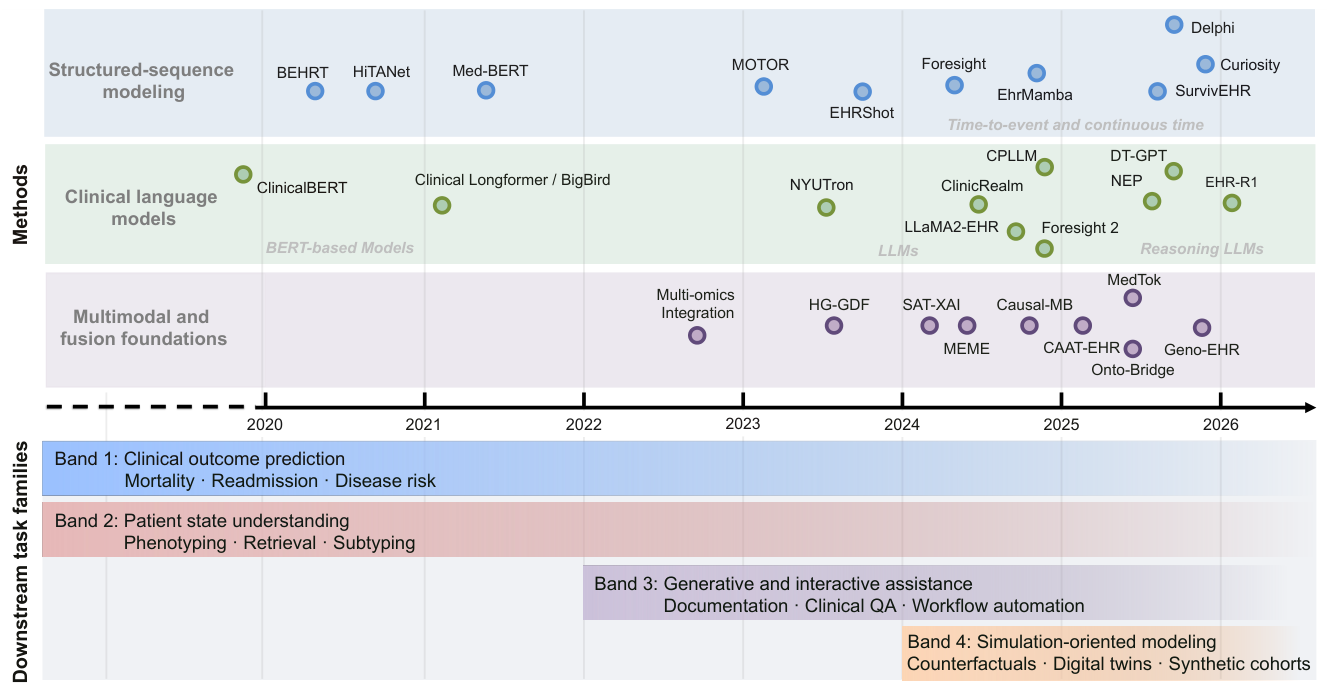
Figure 3.
Conceptual overview of EHR foundation models across three paradigms and their downstream applications. (a) Structured-sequence models convert heterogeneous longitudinal EHR data into temporally ordered clinical tokens and learn patient representations through longitudinal sequence backbones under objectives such as representation learning, generative forecasting and survival-aware modeling. (b) Clinical language models operate on clinical notes and related textualized medical-record representations, while also enabling bidirectional conversion between structured records and free-text narratives. (c) Multimodal fusion models extend EHR foundation modeling by integrating structured EHR backbones with clinical text embeddings and additional modalities through unified tokenization, modality-specific encoders and fusion backbones. (d) Downstream tasks span major application areas including time-to-event prediction, clinical event prediction, patient phenotyping, documentation assistance, clinical chatbots and scientific discovery.
Figure 3.
Conceptual overview of EHR foundation models across three paradigms and their downstream applications. (a) Structured-sequence models convert heterogeneous longitudinal EHR data into temporally ordered clinical tokens and learn patient representations through longitudinal sequence backbones under objectives such as representation learning, generative forecasting and survival-aware modeling. (b) Clinical language models operate on clinical notes and related textualized medical-record representations, while also enabling bidirectional conversion between structured records and free-text narratives. (c) Multimodal fusion models extend EHR foundation modeling by integrating structured EHR backbones with clinical text embeddings and additional modalities through unified tokenization, modality-specific encoders and fusion backbones. (d) Downstream tasks span major application areas including time-to-event prediction, clinical event prediction, patient phenotyping, documentation assistance, clinical chatbots and scientific discovery.
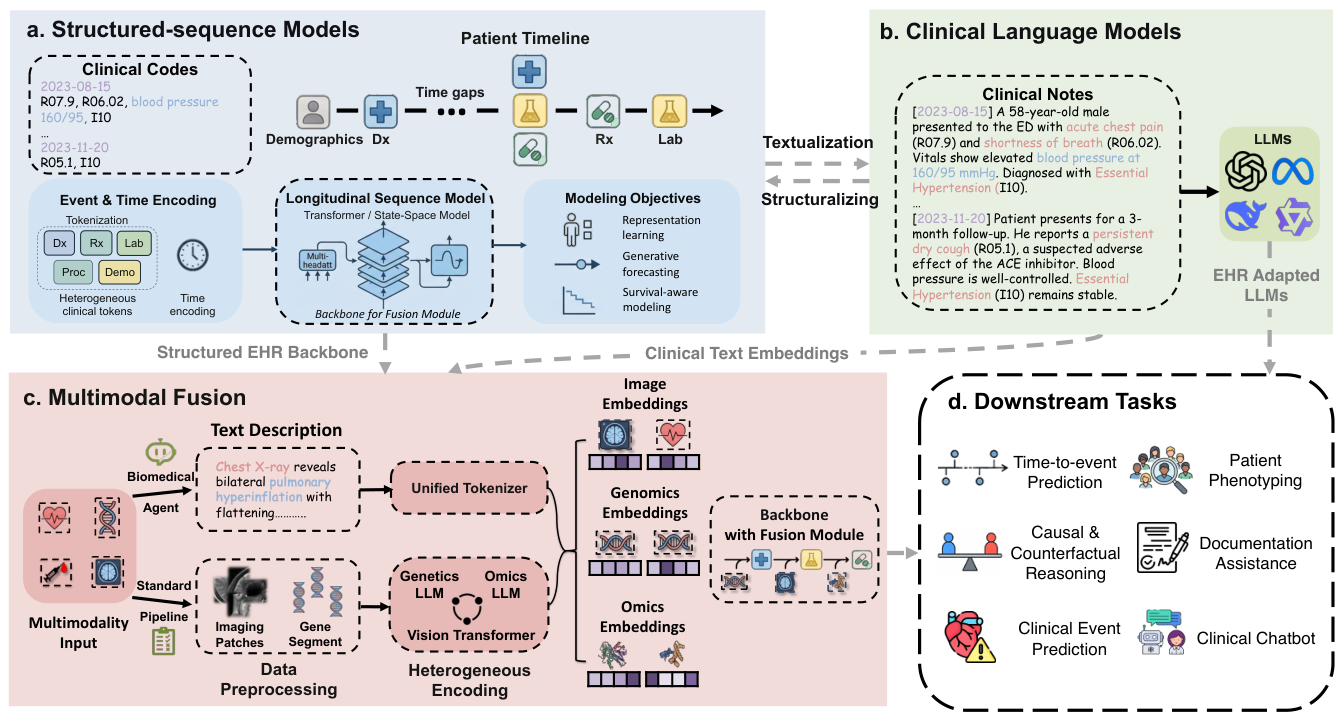
Figure 4.
Translating EHR foundation models into clinical practice. EHR foundation models offer reusable capabilities that can support diverse clinical workflows, but their impact depends on more than technical performance. Translation requires a clear match between model capability, intended clinical use, deployment risk and operational responsibility. This overview illustrates the shift from downstream task performance to clinically governed implementation, where evidence standards, verification, monitoring and workflow integration determine whether models can be used safely and sustainably in real-world care.
Figure 4.
Translating EHR foundation models into clinical practice. EHR foundation models offer reusable capabilities that can support diverse clinical workflows, but their impact depends on more than technical performance. Translation requires a clear match between model capability, intended clinical use, deployment risk and operational responsibility. This overview illustrates the shift from downstream task performance to clinically governed implementation, where evidence standards, verification, monitoring and workflow integration determine whether models can be used safely and sustainably in real-world care.
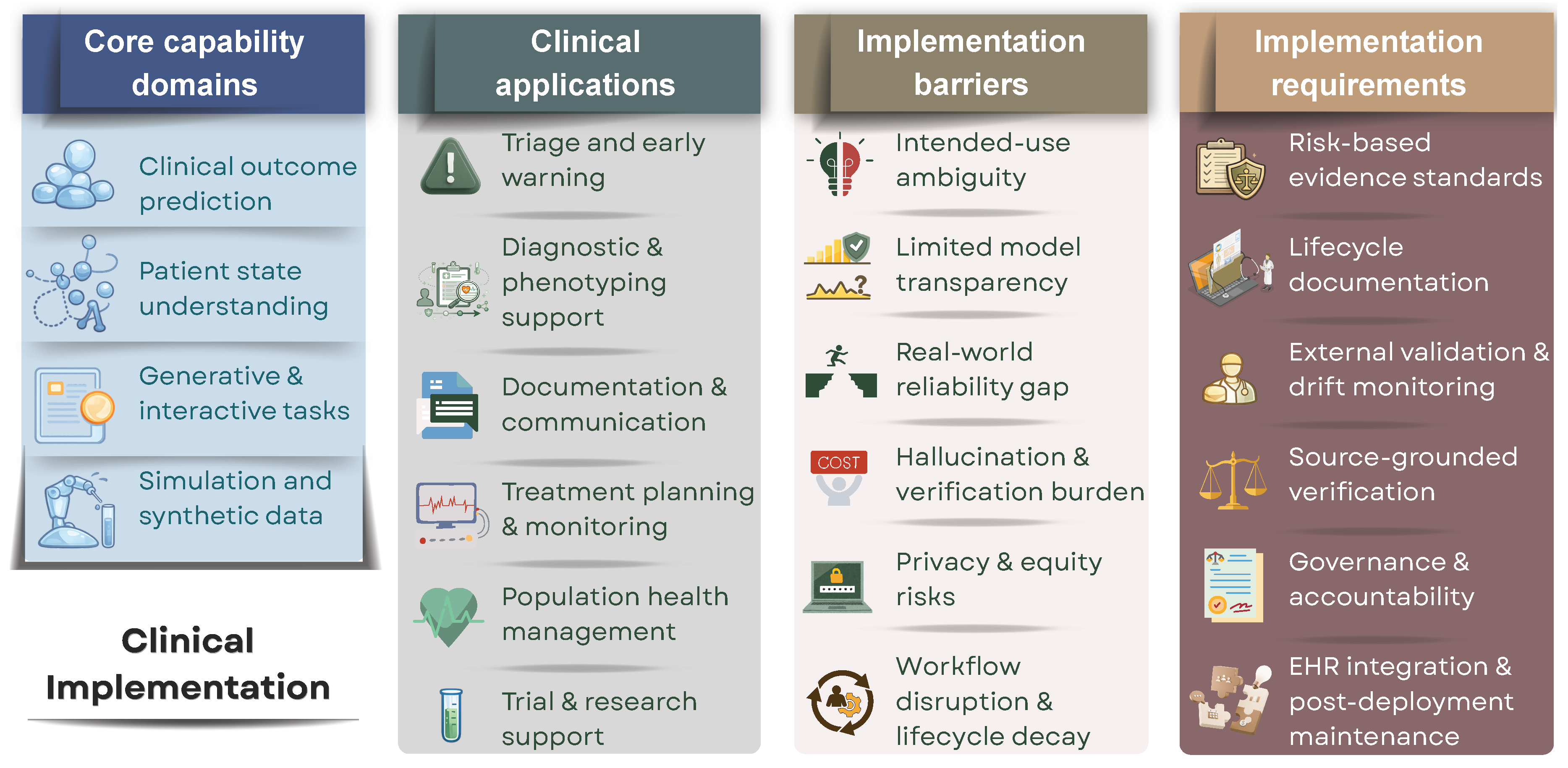
Table 2.
Downstream task taxonomy: subcategories, representative tasks, and typical metrics.
| Subcategory | Representative task | Typical metric |
|---|---|---|
| A. Clinical outcome prediction | ||
| General clinical prediction | In-hospital mortality prediction | AUROC, AUPRC, F1 score, Brier score, Expected calibration error, Precision@k, Recall@k, Mean reciprocal rank |
| 30-day readmission prediction | ||
| Adverse drug event prediction | ||
| Next event prediction | ||
| Time-to-event modeling | Time-to-death prediction | Harrell’s C-index, Time-dependent AUROC, Integrated Brier score, Dynamic prediction error, CIF calibration error |
| Time-to-deterioration prediction | ||
| Time-to-ICU transfer prediction | ||
| Competing-risk event modeling | ||
| B. Patient state understanding tasks | ||
| Predefined Clinical State Identification | Rare disease case identification | AUROC, AUPRC, Recall at fixed FPR, Positive predictive value, F1 score, Calibration slope/intercept, Decision curve net benefit |
| Treatment responder identification | ||
| Cohort eligibility matching | ||
| High-risk phenotype detection | ||
| Latent Phenotype and Progression Modeling | Patient subgroup discovery | Silhouette coefficient, Adjusted Rand Index, Normalized mutual information, Cluster stability score, Macro-F1 score, AUROC, Weighted Cohen’s kappa |
| De novo clinical subtyping | ||
| Progression trajectory derivation | ||
| Longitudinal pattern discovery | ||
| C. EHR-grounded generative and interactive tasks | ||
| Documentation assistance | Discharge summary drafting | ROUGE-L, BLEU score, BERTScore, RadGraph F1, Entity precision/recall, Clinical concept coverage, Expert rating score |
| Radiology report generation | ||
| Clinical note generation | ||
| Chart summarization | ||
| Conversational reasoning and copilots | Natural-language EHR interaction | Top-k diagnostic accuracy, Guideline adherence rate, Evidence attribution accuracy, Task success rate, Abstention rate, Clinical safety violation rate, Expert panel rating |
| Test recommendation | ||
| Guideline-based reasoning | ||
| Clinical question answering | ||
| D. Simulation and synthetic data tasks | ||
| Long-horizon trajectory simulation | Future visit sequence generation | Sequence negative log-likelihood, Dynamic time warping, Mean absolute error, Root mean squared error, Continuous ranked probability score, Trajectory coverage |
| Disease trajectory generation | ||
| Long-term comorbidity modeling | ||
| Care pathway generation | ||
| Synthetic cohort generation | Synthetic patient generation | Hellinger distance, Maximum mean discrepancy, TSTR, AUROC/AUPRC, Membership inference attack rate, Attribute disclosure risk, Privacy–utility frontier |
| Privacy-preserving data generation | ||
| Synthetic cohort sharing | ||
| Rare event data augmentation | ||
| E. Causal inference and counterfactual reasoning | ||
| Treatment effect estimation | Average treatment effect estimation | PEHE in semi-synthetic benchmarks, Treatment-effect calibration, Agreement with trial or quasi-experimental estimates, Overlap and positivity diagnostics, Sensitivity analyses including E-values |
| Conditional treatment effects | ||
| Doubly robust estimation | ||
| Subgroup heterogeneity assessment | ||
| Counterfactual trajectory modeling | Time-varying counterfactuals | Counterfactual trajectory error in simulated settings, Time-dependent calibration, Negative-control outcome consistency, Coverage of effect intervals |
| Counterfactual digital twins | ||
| Treatment trajectory comparison | ||
| Synthetic control prediction | ||
| Policy evaluation and target trial emulation | Off-policy treatment evaluation | Policy value and regret, Importance-weighted estimator variance, Target-trial emulation agreement with trial benchmarks, Sensitivity bounds under unmeasured confounding |
| Dynamic treatment regimes | ||
| Target trial operationalization | ||
| Comparative effectiveness | ||
Disclaimer/Publisher’s Note: The statements, opinions and data contained in all publications are solely those of the individual author(s) and contributor(s) and not of MDPI and/or the editor(s). MDPI and/or the editor(s) disclaim responsibility for any injury to people or property resulting from any ideas, methods, instructions or products referred to in the content. |
© 2026 by the authors. Licensee MDPI, Basel, Switzerland. This article is an open access article distributed under the terms and conditions of the Creative Commons Attribution (CC BY) license (http://creativecommons.org/licenses/by/4.0/).
Copyright: This open access article is published under a Creative Commons CC BY 4.0 license, which permit the free download, distribution, and reuse, provided that the author and preprint are cited in any reuse.


