

Submitted:
05 August 2026
Posted:
07 August 2026
You are already at the latest version
Abstract
Recent advances in educational artificial intelligence have been driven largely by large language models and other neural architectures. However, these systems continue to face challenges in factual reliability, pedagogical consistency, explainability, and governance. Neuro-symbolic artificial intelligence overcomes these limitations by combining the neural learning capabilities with symbolic reasoning to create more reliable intelligent learning systems. Yet there has been no systematic literature review that has systematically synthesized the architectural, pedagogical and governance aspects of this emerging field. We systematically searched the IEEE Xplore, Scopus, and Web of Science databases up to 10 July 2026, according to the PRISMA 2020 guidelines. A validated hybrid screening process, incorporating automated screening and required manual screening, yielded 40 studies from 3,492 records. To better reflect architecture trends, we also built an inventory of neuro-symbolic educational systems on the framework-level, which contains 92 systems. The review reveals that 60.0% of the studies included in the analysis also demonstrated architectural integration, pedagogical grounding and governance or explainability. At the framework level, 71.1% of classifiable systems adopted either unified representation or sequential integration strategies, indicating strong convergence toward a limited set of architectural paradigms. Less than half of the identified frameworks (46.7%) however, reported similar quantitative performance benefits, which restricts the ability to make robust cross-study comparisons. In general, the intersection of education and neuro-symbolic AI is heading toward a handful of well pedagogically grounded, but relatively under-developed, architectures in the area of governance and explainability. These findings provide a foundation for architectural standardization, transparent evaluation practices, and the development of trustworthy neuro-symbolic intelligent learning systems.
Keywords:
neuro-symbolic AI
; artificial intelligence in education
; systematic literature review
; explainable AI
; intelligent tutoring systems
; trustworthy AI
1. Introduction
1.1. Background and Motivation
Over the last three years, the perception and use of AI in education has undergone a dramatic transformation (Chen et al., 2020), (Holmes and Tuomi, 2022), (Zhai et al., 2021). Now, with the introduction of Large Language Models (LLMs) like GPT-4, Gemini, and its successors, conversations are now more fluid, explanations can be generated on the fly, and tone can adjust to the apparent level of the learner (Jeon and Lee, 2023), (Kasneci et al., 2023), (Yan et al., 2024). This, for many teachers and platform developers, has been a long awaited solution: scalable, customized tutors (Alsharif, 2025), (Latif et al., 2026). However, as the systems have become more common, the more realistic perspective has come into view. No matter how good their text generation capabilities are, purely neural architectures can still be regarded as a statistical pattern matcher (de Carvalho and Thórisson, 2025), (Mehmood et al., 2026). They lack a mathematical understanding in any measurable way, can’t verify that a worked solution is correct, and they suffer from hallucination—the ability to confidently produce incorrect or fabricated content (Bertolazzi et al., 2025), (Guo et al., 2026), (Liu et al., 2025). This is not trivial in a classroom/tutoring setting. A student who accepts a false representation of a chemical reaction, a false proof step or a false historical fact is not just inconvenienced, but may be misled to believe the falsehood (Anh-Hoang et al., 2025), (Holmström et al., 2026), (Serrano, 2026).
This impetus of fluency vs reliability has led to a new architectural bet: neuro-symbolic AI, pursued by researchers and system designers alike (De Boer et al., 2025), (Hakim et al., 2026). Neuro Symbolic systems are designed to not rely solely on one model, but instead combine neural models, which excel at perception, language understanding and pattern generalization, with symbolic models such as knowledge graphs, rule engines or formal logic provers, which excel at consistency, traceability and constraint enforcement (Hakim et al., 2026), (Surdeanu et al., 2026). The underlying idea is not a new one. Human reasoning itself has been suggested for a long time to be a combination of quick, intuitive reasoning and slow, rule-based reasoning (most often referred to as Kahneman’s System 1 and System 2) (Ferreira et al., 2006), (Kahneman et al., 2011). The novel aspect is the magnitude of this blended approach in educational technology as it is now being deployed, from knowledge-graph-based course recommenders to LLMs offloading arithmetic to a symbolic calculator, instead of computing the answer themselves (Peng et al., 2025), (Spillo et al., 2024).
1.2. The Promise and the Fragmentation of Neuro-Symbolic Education Research
Each of these systems individually shows very positive results. Large language models combined with symbolic theorem provers have solved the geometry olympiad problems much faster than either of the two (Trinh et al., 2024), (Zhang et al., 2026). The use of knowledge-graph-grounded tutoring agents has been shown to result in tangible drops in factual error rate, as compared to baselines without grounding (Dong et al., 2025), (Sheng et al., 2026), (Yin et al., 2026). When layered on top of generative agents, rule-based guardrails can reduce safety violations and increase compliance to policy across a variety of contexts, from driver training to academic advising (Addington, 2026), (Yang et al., 2026).
The lack is not one of evidence of promise, but one of conjoint evidence of promise. The literature has rapidly expanded, but not necessarily uniformly or cohesively: papers tend to be concentrated in certain areas of application (mathematics tutoring, course recommender, affective computing), with little or no cross-referencing between subfields, with the terms used to describe the architectural choices inconsistent, and with almost no common evaluation methodology (Ben Chaabene and Hammami, 2026), (Hakim et al., 2026), (Hasan et al., 2026), (Ruzimboev et al., 2025). If a researcher walked into this space today he or she would have difficulty answering fundamental structural questions. Do most systems combine neural and symbolic elements sequentially, in parallel, or some deeper type of unified representation? Does the field have an interest in “trustworthy, explainable AI” or is it mostly empty words placed on top of systems that are still black-boxes at the time of use? These aren’t questions that can be answered by any one primary study. They require a systematic review (Ben Chaabene and Hammami, 2026), (Colelough and Regli, 2024), (Hakim et al., 2026).
1.3. The Research Gap
There are a few surveys which overlap with the area. In reviews of intelligent tutoring systems, pedagogical design is discussed but not yet in-depth the AI architecture (Latif et al., 2026), (Lin et al., 2023). The survey of a general AI paradigm for neuro-symbolic AI refers to education as one of many applications, but leaves the question of what makes the education application unique unanswered (Ben Chaabene and Hammami, 2026), (Hakim et al., 2026). To the best of our knowledge, no systematic review has tackled all three of these issues at once: first, a fine-grained architectural taxonomy of how neural and symbolic components are actually fused, second, whether or not these architectures are grounded in any recognized pedagogical or cognitive theory, or applied simply as a general technology, and third, whether the governance and explainability claims made by the field are substantiated by the reviewed systems, or simply asserted as motivation.
This is a real-life as well as educational gap. For institutions that have implemented the AI-powered tutoring and/or advising, the question is whether the term “neuro-symbolic” or “hybrid AI” indicates a tangible trust guarantee or a marketing term that is used generically throughout the sector (Galitsky, 2026), (Hooshyar et al., 2025). The recent proliferation of new systems requires a map of where architectural effort has been focused—and where it hasn’t—to separate new work from incremental restatements of a widely adopted pattern. To our knowledge, this is the first systematic literature review to jointly examine architectural integration, pedagogical grounding, and governance mechanisms in neuro-symbolic AI for education.
1.4. Research Questions and Objectives
This review tackles the gap by asking three research questions, aligned with the three properties (trustworthy) that an educational AI system would require to satisfy at the same time: architectural, pedagogical, and governance-related.
- 1.
- RQ1 (Architecture). What is the structural embedding of neural generation and symbolic reasoning (knowledge graph, rule-based logic engine) to orchestrate adaptive learning in the current education systems?
- 2.
- RQ2 (Didactics and Cognition). How do these neuro-symbolic architectures relate to existing pedagogical theories (such as Zone of Proximal Development, Cognitive Load Theory) for tracking and scaffolding the learner’s epistemic state?
- 3.
- RQ3 (Governance and Mitigation). How can these hybrid systems be used as a type of guardrail for neural hallucination, pedagogical safety and explainable meta-cognitive literacy?
These questions focus on one core question: does a system that combines the potential of neuroscience (neuro) with symbolic AI (symbolic) in the context of education work? In isolated instances, it does, but will it work in a way that is architecturally principled, pedagogically grounded, and safe enough to trust at scale?
1.5. Contributions
In this review the following contributions to the literature in AI in education are made:
First, it offers a systematic, PRISMA 2020-compliant synthesis of the literature on neuro-symbolic AI in education, sifting through an initial pool of 3,492 records to 40 studies which were included largely based on strict architectural and pedagogical criteria, with the automated process of the screening pipeline having been empirically validated, not assumed reliable (Page et al., 2021).
Second, it provides a framework-level inventory of 92 different neuro-symbolic systems, derived from the studies included in the dataset and referenced in those studies, sorted by the integration strategy, key architectural elements, and application domain, providing a finer granularity than is provided by study-level coding alone.
Third, it reports, with appropriate statistical caution, on the distribution of architectural strategies, pedagogical versus governance concerns cross the corpus and the availability of a comparable quantitative performance evidence, and it is explicit about where the underlying evidence does and does not support strong claims.
At the fourth point, it raises a structural characteristic of the literature, namely that the inventory of frameworks is rather concentrated in a few sources, which are of the survey type, and considers the implications of the concentration for the future use and reading of the taxonomy by other researchers.
1.6. Structure of the Paper
The rest of this paper is organized as follows : In Section 2, some related work is reviewed and placed in the context of the existing surveys of intelligent tutoring systems and general purpose neuro-symbolic AI. The methodology for the review is described in Section 3, which outlines the search strategy, automated and manual screening process, empirical validation of the automated screening process, and interrater reliability of the final review process for eligibility. The results of the analysis are presented in Section 4, which examines the coverage of the research questions, the distribution of integration strategies, the availability of quantitative performance evidence, and the focus of the framework inventory on the contributing sources. The implications of these findings for architectural design, pedagogical alignment and governance practice in educational AI, as well as the limitations of the review, are discussed in Section 5. The section ends with a summary of findings and recommendations for future research.
2. Related Works
2.1. Surveys of Intelligent Tutoring Systems and Educational AI
Over the last 30 years, there has been a vast amount of research on intelligent tutoring systems (ITS), and this research literature supplies the pedagogical vocabulary that any review of neuro-symbolic education systems must rely on (Alkhatlan and Kalita, 2018), (Latif et al., 2026), (Yang, 2025). [VanLehn (2011)] laid the groundwork for the widely adopted concept of outer-loop task selection and inner-loop step-level feedback, which continues to be adopted for describing the inner and outer loops of modern LLM-based tutors in a single problem. The history of rule-based expert systems (e.g., [Woolf (2010)]) that explicitly encoded pedagogical logic, although having good explanations, was found to be expensive in terms of both size and run time, while the use of data-driven learner models (e.g., [Du Boulay (2016)]) to personalize instruction was found to be difficult to explain. This line of evolution has been embraced by more recent surveys. In general, [Kasneci et al. (2023)] and [Latif et al. (2026)] list the opportunities and risks of generative AI in education, from the generation of automated feedback to issues of academic integrity, and [Lin et al. (2023)] specifically consider how conversational tutoring agents are being assessed for pedagogical effectiveness.
The common theme in this literature is a focus on instructional design, learner modeling, and educational outcomes, while comparatively little focus is placed on the underlying computational architecture that yields the educational outcomes (Anderson et al., 1985), (Kulik and Fletcher, 2016), (Sychev, 2024). A survey in this tradition might note that a system “provides adaptive feedback” without characterizing whether that feedback is generated by an unconstrained neural model, a rule-governed expert system, or some combination of the two. This is a reasonable choice given the disciplinary focus of these reviews, but it leaves an architectural gap that the present review is positioned to fill (Mousavinasab et al., 2021), (Rodrigues et al., 2025).
2.2. Surveys of Neuro-Symbolic AI as a General Computing Paradigm
There is also a separate and mostly unrelated body of work that has examined neuro-symbolic AI as a computing approach in its own right, without focusing on any particular application area (Delvecchio et al., 2025), (Fitas, 2025), (Hakim et al., 2026), (Nawaz et al., 2025). [Garcez et al. (2019)] and [Sarker et al. (2022)] provide fundamental taxonomies of the ways in which neural and symbolic reasoning can be combined, identifying three main types of architectures: those which use symbolic structure to restrict the neural output, those which make use of neural components to direct symbolic search, and those which aim for a true unification of both. [Marcus (2020)] puts forward a significant and more contentious argument asserting that hybrid architectures are a practical necessity if any AI system is to reason reliably, a view which has since been supported in the fields of robotics, healthcare, and natural language processing. [Hakim et al. (2026)] give the most up-to-date and thorough account of this paradigm, looking at the architectures, integration methods, and open challenges within agentic AI systems as a whole, with education being presented as one of several illustrative examples alongside software engineering, autonomous vehicles, and computer vision.
From the point of view of this review, the limitation does not lie in the quality of these surveys but in the extent of their coverage. Since education is just one of many fields, the reviews do not examine what makes the educational application different in terms of both architectural and pedagogical aspects (Afzal, 2025), (Hooshyar et al., 2025). A neuro-symbolic system developed for teaching compiler design [Reddy and Parkavi (2025)] and one developed for the safety of autonomous vehicles ([Hakim et al. (2026)], in their discussion of the TRAP framework) might adopt the same integration approach, but only the first one has to conform to a body of pedagogical theory concerning how learners actually acquire skills. General-purpose neuro-symbolic surveys are not constructed with the aim of making this distinction and do not make an attempt to do so (Afzal, 2025), (Hakim et al., 2026), (Sarker et al., 2022).
2.3. Knowledge Graphs, Explainability, and Governance in Educational AI
Another stream of literature, focusing on particular symbolic elements in educational AI, primarily deals with knowledge graphs, even if it does not place these elements within a wider neuro-symbolic framework (Chen et al., 2025), (Qin and Zhang, 2025), (Zhang, 2026), (Zhumashev et al., 2025). [Surdeanu et al. (2026)] and [Colelough and Regli (2024)] examine the way in which structured knowledge representations contribute to explainability in AI systems as a whole and claim that traceable, rule-based justifications are a necessary condition for user trust in high-stakes situations. When it comes to education, [Hooshyar et al. (2025)] and [Galitsky (2026)] look at how recommendation and tutoring systems based on knowledge graphs could, in principle, provide more auditable decision paths than their end-to-end neural counterparts, although both point out that there is still very little empirical evidence to show that this advantage is realised in actual educational systems.
The literature is closely related to the issues of governance and explainability which are behind RQ3 in the current review, but it generally regards knowledge graphs and symbolic reasoning as subjects of study by themselves rather than as one part of an integrated neuro-symbolic architecture (Abu-Salih and Alotaibi, 2024), (Akindele and Ojo, 2025), (Chen et al., 2025). It is rare for these reviews to systematically classify the degree to which the symbolic component is actually coupled with the neural component that it is supposed to control, a distinction that is important since the review later establishes that the integration strategy varies greatly even among systems that have declared a commitment to explainability (Chatzikyriakidis and Lappin, 2026), (Fitas, 2025).
2.4. Positioning of the Present Review
When these three areas of literature are considered together, they leave a gap having precisely the form that this review is intended to fill. Surveys aimed at pedagogy in the field of educational AI discuss the learning outcomes without explaining the architecture. General surveys of neuro-symbolic systems focus on the architecture without inquiring into what education specifically requires of it. Reviews that concentrate on knowledge graphs look at one symbolic element in isolation and do not systematically evaluate how it is integrated with the neural systems it is combined with. Although [Ruzimboev et al. (2025)] and [Ben Chaabene and Hammami (2026)] come nearest to connecting pedagogical and architectural issues by providing targeted surveys on neuro-symbolic tutoring and on the integration of LLMs with knowledge graphs respectively, each of them concentrates only on a more limited part of the field, whether that be adaptive tutoring specifically or emotion-aware student support, rather than on the field as a whole.
As shown in Table 1, across the eleven reviews identified through a structured literature search, no prior work combines all three analytic dimensions, architectural integration strategy, pedagogical or cognitive theory grounding, and governance or explainability mechanisms, within a single systematic protocol. As far as we know, there is no existing review that has looked together at the architectural integration strategy, the pedagogical and cognitive grounding, and the governance or explainability mechanisms across the entire range of neuro-symbolic educational AI, nor has it applied the same level of systematic screening rigor to the automated tools which are now increasingly used to carry out such reviews on a large scale. The present study directly tackles this gap, and the methodology outlined in the section that follows was specifically designed with this three-part synthesis in view.
3. Methodology
3.1. Systematic Review Protocol
In order to maintain methodological rigor, transparency, and reproducibility, the study was carried out in full compliance with the Preferred Reporting Items for Systematic Reviews and Meta-Analyses (PRISMA) 2020 guidelines (Page et al., 2021). The protocol for the review was intended to systematically identify, assess, and combine the intersection of neuro-symbolic artificial intelligence, cognitive scaffolding, and explainable learner modelling within educational ecosystems.
Because of the large scale of current AI-generated literature, the traditional PRISMA workflow was enhanced by the use of an automated computational triage pipeline, unsupervised topic modelling, and an Active Learning relevance ranker in order to carry out abstract-level screening on a large scale. Importantly, in line with the new reporting guidelines concerning AI-assisted evidence synthesis ((Page et al., 2021), Item 8 guidance on automation tools; (Callaghan et al., 2024)), the automated parts of this pipeline were subjected to post-hoc empirical validation rather than being regarded as ground truth, and the limitations that were identified as a result directly led to the implementation of a second, manually conducted screening check. In the data extraction stage an AI-assisted, bounded Retrieval-Augmented Generation (RAG) procedure was used, with all of the extracted fields being manually checked against the original texts to eliminate any unsupported model hallucinations.
3.2. Research Questions
This review shows the transition from reactive, single-modality tutoring systems to proactive, meta-cognitive educational systems that combine neural and symbolic computation. The screening and synthesis were guided by three research questions as presented in Table 2.
3.3. Data Sources and Search Strategy
A thorough search of the literature was carried out using three major scientific databases, which were chosen because of their extensive coverage at the point where computer science and education meet: IEEE Xplore, Scopus, and the Web of Science (WoS). The Boolean search strategy combined clusters of primary and contextual keywords with the aim of capturing the detailed terminology associated with hybrid AI systems, as set out in Table 3. The first search, which was carried out up to 10 July 2026, produced 3,492 records (457 from IEEE, 2,259 from Scopus, and 776 from WoS).
As illustrated in Table 4 the three database queries are not perfectly harmonized: the IEEE Xplore string restricts matching to the Abstract field only, while Scopus and Web of Science search title, abstract, and keywords jointly, meaning IEEE Xplore may under-retrieve records using Concept 1/2 terms exclusively in the title or keyword list. Likewise, only the Scopus query applies an explicit document-type filter (ar/cp/re); IEEE Xplore and Web of Science results were filtered to equivalent document types manually during screening rather than at the query stage. Both asymmetries are disclosed here for transparency and discussed further in the Limitations section. One included record (Paper 37, (Saint-Léger et al., 2025)) is a symbolic-only semantic-web survey retained at reviewer discretion because it directly informs the RQ1 architectural taxonomy despite lacking an explicit Concept 1 neural component; this deviation is flagged in the Limitations section.
3.4. Automated Computational Triage
In order to isolate from the large initial collection the literature which actually shows true architectural depth, a multi-stage computational filtering pipeline was employed before manual screening.
3.4.1. Deduplication
A two-stage method of deduplication was employed: in the first stage, the Digital Object Identifiers (DOIs) were matched strictly, and in the second stage fuzzy string matching was applied to the normalized titles in order to detect duplicates among databases which did not have consistent DOI metadata. This led to the elimination of 1,119 duplicate records and the acquisition of 2,373 unique records for screening.
3.4.2. Unsupervised Topic Modeling (Macro-Filter)
Due to the overlap in terminology such as “digital twins” (which is commonly used in the field of manufacturing) or “deep learning” (which is often applied without any pedagogical foundation), a Latent Dirichlet Allocation (LDA) topic model consisting of 15 topics (implemented with the use of scikit-learn) was used to analyse the 2,373 abstracts by means of term-frequency vectorization and a custom academic list of stop words. Those topics whose top keywords suggested a main focus that was outside the areas of education or clinical applications (for instance, medical diagnostics, zero-shot image classification, or industrial robotics) were flagged for exclusion. This wide filter eliminated 1,298 records and reduced the number of remaining candidates to 1,075.
3.4.3. Active Learning Relevance Ranking
An Active Learning classifier (using TF-IDF vectorization and a Multinomial Naïve Bayes model) was used on the other 1,075 abstracts. This classifier was bootstrapped with a rule-based heuristic score that had been derived from an initial keyword-weighted triage procedure, as a result of which 123 abstracts were automatically flagged as likely relevant and 142 as likely irrelevant; these first-stage labels were not manually verified and are given here as a starting point obtained through automation instead of as gold-standard training data. The classifier then assigned a Relevance Probability score to the remaining 810 abstracts that had no label. Having applied a pre-determined stopping rule (the screening process stopping when 50 consecutive “Exclude” decisions had been made when the records were ranked in order of decreasing probability), the lowest Relevance Probability among the records that were selected was 0.6787, which meant that 60 papers were identified as candidates for full-text examination and left 1,015 records excluded at this stage.
3.5. Validation of the Automated Screening Pipeline
Instead of taking for granted the reliability of the automated triage described in Section 3.4, two post-hoc diagnostic checks were carried out after the manual eligibility phase stated in Section 3.6, had been finished, the human judgments obtained at that point being used as the standard by which the pipeline was evaluated.
The automated triage procedure described in Section 3.4 was at first used as the main screening method in line with the original protocol. Yet, when it was tested during pilot trials on a subset of the records that had been excluded, the classifier’s precision-recall profile (AUC = 0.46) dropped below the acceptable level for evidence-synthesis screening. The protocol was therefore modified so that all 1,015 records excluded in Section 3.4 had to be manually re-screened; this constitutes a departure from the original design (Callaghan et al., 2024).
- Golden-survival audit: The 28 records that were identified as relevant through the full-text manual review as presented in Section 3.6, were traced back to see which automated stage they had passed. Since all of them had cleared both the LDA macro-filter and the Active Learning ranking stage (with 100% recall achieved at each stage for this known-positive set), it follows that no literature which had been confirmed as relevant was excluded during the automated filtering process.
- Known-item gap analysis: The same two coders who were in charge of assessing full-text eligibility as described in Section 3.6, manually re-examined all 1,015 records below the 0.6787 threshold at the abstract level; rather than sampling them, all were thoroughly reviewed in order to avoid any selection bias. As a result of this re-evaluation, 12 further records were found to merit full-text assessment. These records originally had a mean gap of 0.153 below the exclusion threshold (the range being from 0.005 to 0.410). Ten of the twelve records were within a plausible level for classifier noise (i.e. had a gap less than 0.20); in contrast, two records were considerably underscored (with gaps of 0.34 and 0.41, respectively). Both of these records described neuro-symbolic architectures and used terms such as “adaptive personalized content presentation” or “interactive natural language understanding” in order to avoid the explicit keywords such as, “neuro-symbolic”, “knowledge graph”, and “symbolic reasoning”; which made up the majority of the classifier’s training vocabulary. This is in keeping with a known limitation of bag-of-words text classifiers: their tendency to systematically underscore records that are semantically relevant but lexically atypical (Callaghan et al., 2024), (Ferdinands et al., 2023).
The validation exercise has been made transparent since it had a direct impact on the study selection procedure: it showed that automation by itself was not enough to guarantee corpus completeness, and that it was the multi-stage design of this review which included humans; not the automated ranking score on its own; that acted as the main safeguard for recall.
3.6. Manual Eligibility Assessment and Inter-Rater Reliability
A full-text eligibility assessment of the 60 candidates who had been algorithmically prioritized and of the 12 records found as a result of the secondary sub-threshold screening described in Section 3.5 (bringing the total number of records to 72) was carried out by two independent coders. Each record was evaluated against three binary criteria, and unanimous affirmative agreement was required for inclusion as shown in Table 5:
The degree of agreement between raters was high: Cohen’s was 0.866, which on the (Landis and Koch, 1977) benchmark scale is regarded as representing “almost perfect” agreement. Any disagreements were settled by means of a structured consensus discussion, which was facilitated by a supervising researcher who had not scored the records themselves and who acted only in order to decide disputes involving boundary conditions in accordance with the criteria given in Table 5.
The full-text review ruled out 44 records (32 of the original 60; none of the 12 recovered records, all of which had been confirmed as eligible), leaving 40 studies for qualitative synthesis. A complete account of the process of identification, screening and eligibility is given in the PRISMA 2020 flow diagram presented in Figure 1.
Figure 1.
SLR Methodology
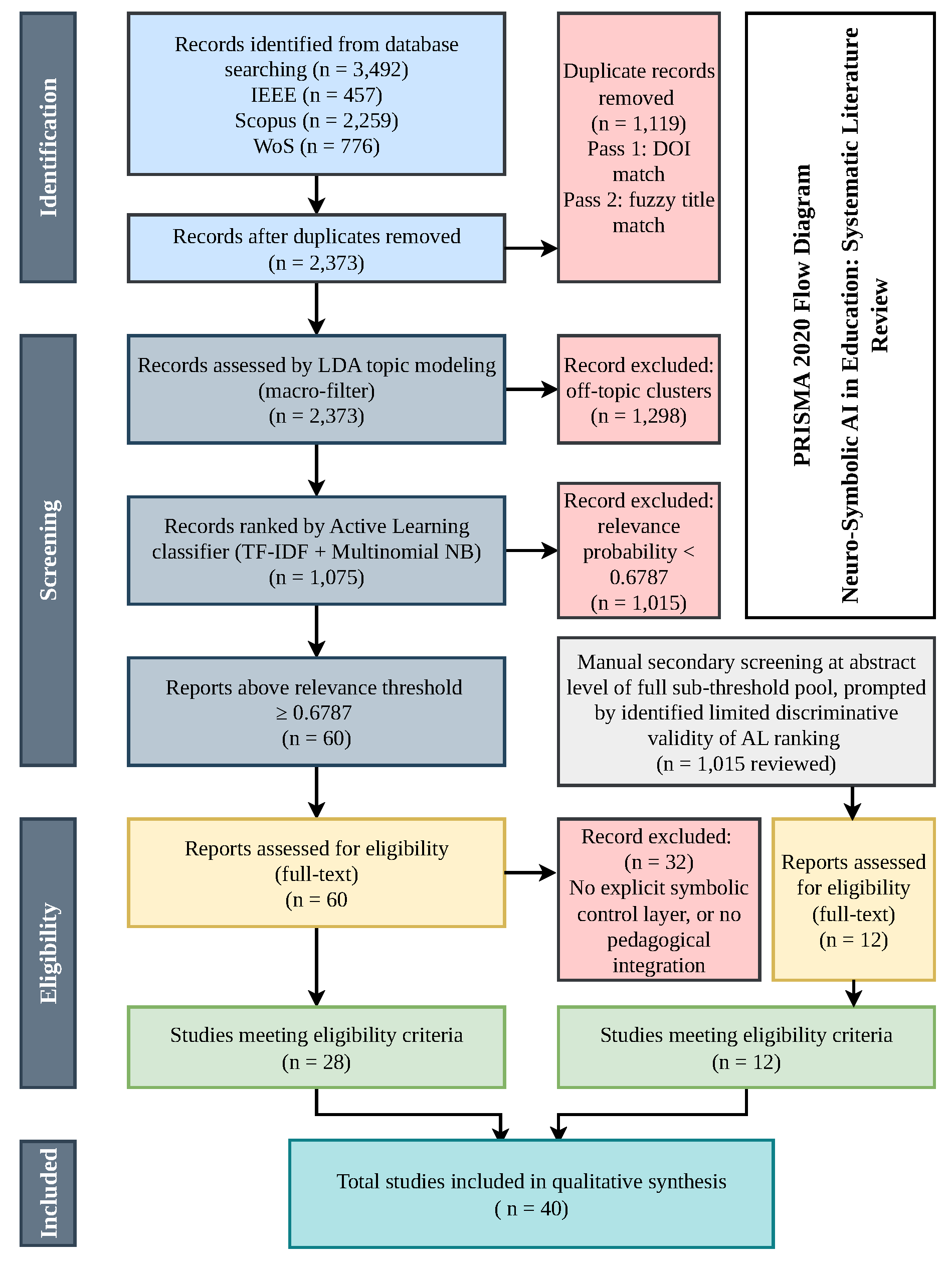
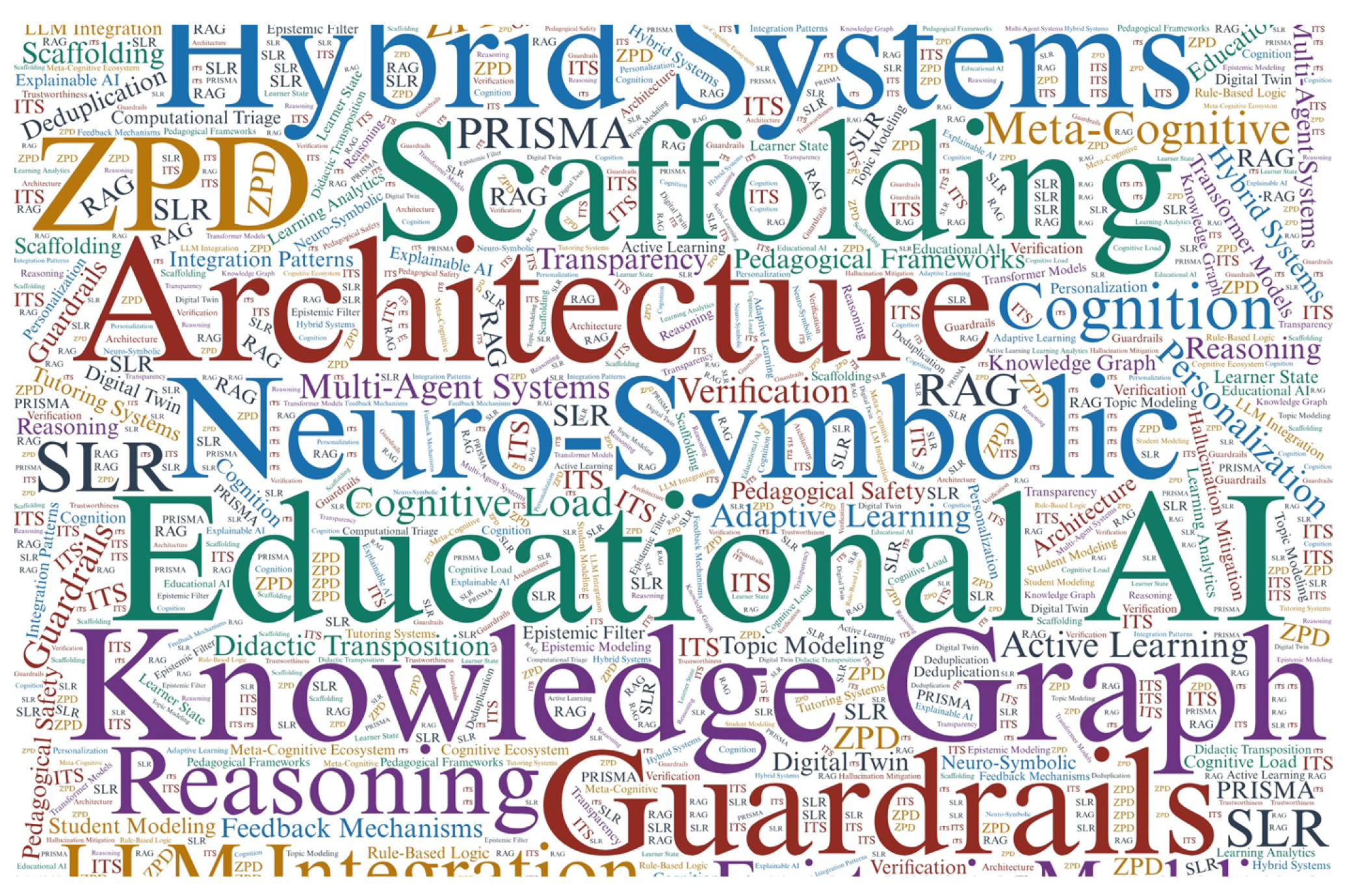
Figure 2.
Thematic Word Cloud
3.7. Suitability Assessment Rubric
In order to apply a custom suitability rubric to the 40 studies included in the article beyond the binary eligibility criteria described in Section 3.6, assessment was made along three dimensions:
- 1.
- Technological Synergy - refers to the extent of integration between neural and symbolic components (for example, between an LLM and a symbolic knowledge graph, or between a GNN and structural reasoning), thereby differentiating true architectural fusion from merely superficial combinations.
- 2.
- Pedagogical Alignment - the degree to which the system implements established learning sciences clearly and accurately (for example, dynamic difficulty adjustment and the explicit modelling of the Zone of Proximal Development).
- 3.
- Explainability & Trust - the aspect of explainability and trust refers to the existence of justifications that are based on rules, are deterministic, and can be traced, acting as safeguards for the feedback generated by AI.
3.8. Quality Appraisal
The methodological robustness and the potential for bias in the 40 studies included in the review were assessed by means of a set of criteria adapted from the Mixed Methods Appraisal Tool (MMAT) (Hong et al., 2018) and modified for use in socio-technical and AI-driven educational research. For each study, a score of 0 (meaning absent or unclear) or 1 (meaning present or robust) was given in five areas: objective clarity, architectural robustness, evaluation validity, pedagogical adequacy, and empirical transparency (the full criteria are given in Supplementary Material S1, Phase 3). This version of the criteria differs from the original MMAT’s design-specific checklists and must be seen as an appraisal tailored to the subject area rather than as a direct application of the validated MMAT. Table 6 presents the data extraction matrix and list of our inlcuded studes.
3.9. Limitations of the Search and Screening Methodology
The three limitations of the automated pipeline are made public in order to meet current reporting expectations for AI-assisted systematic reviews (Page et al., 2021):
- 1.
- The Active Learning classifier had no significant discriminative validity with respect to the top-ranked candidates (as stated in Section 3.5) and displayed a measurable lexical bias towards records that used non-standard terminology to describe neuro-symbolic architectures; this bias was reduced although not completely removed by carrying out a full manual review of the sub-threshold pool.
- 2.
- The bootstrap labels employed to train the Active Learning classifier (123 relevant / 142 irrelevant) were produced by an automated heuristic rather than by independent human annotation, thereby introducing an unquantified risk of label noise when the classifier was being trained.
- 3.
- The full-text assessment of eligibility and quality was carried out by two coders rather than by three or more independent reviewers; although the degree of agreement between the raters was almost perfect ( = 0.866), the use of a larger group of reviewers would still help to reduce the risk of the coders having similar blind spots.
4. Results Analysis
This section reports four analyses conducted on the extraction matrix Table 6, papers and the framework-level inventory presented in Table 9 and Table 10, frameworks): (i) coverage of the three research questions, (ii) the distribution of integration strategies, (iii) the availability and comparability of quantitative performance evidence, and (iv) the structural concentration of the framework inventory from all the contributing sources. Each subsection states what the data show, what a given statistical test does or does not support it, and in cases where a claim must be understood as descriptive rather than inferential, the interpretation of why these patterns are important for neuro-symbolic educational AI as a field is deferred to Section 5; this section is restricted to what the extracted data permit us to say.
The distribution of the 40 studies included is shown in Figure 3. The publication activity clearly starts to increase from 2023 onwards, with most papers being published between 2024 and 2026. Large language models have been adopted and their reasoning and explanatory power have been increasingly acknowledged as limitations, which has led to a surge in interest in neuro-symbolic AI for educational applications in recent years.
4.1. Coverage of the Three Research Questions
Table 7 reports raw coverage: RQ1 (architectural depth) was satisfied by 33/40 studies (82.5%), RQ2 (pedagogical/cognitive grounding) by 36/40 (90.0%), RQ3 (governance, safety, and explainability) by 31/40 (77.5%), and all three jointly by 24/40 (60.0%).
This coverage is shown in Figure 4 for all 40 studies included. Figure shows comparative perspective of the coverage of the reviewed corpus for each dimension of the research questions, where RQ2 has been highest and RQ3 has been lowest.

Table 7.
Coverage of the reviewed corpus (N = 40) across the three research question categories.
| Category | Description | Papers (n) | Coverage (%) |
|---|---|---|---|
| RQ1 | Neuro-Symbolic Architectural Depth | 33 | 82.5% |
| RQ2 | Pedagogical / Cognitive Grounding | 36 | 90.0% |
| RQ3 | Governance, Safety & Explainability | 31 | 77.5% |
| Papers satisfying all three RQs | 24 | 60.0% | |
Since the same two coders assessed all 40 studies on all three of the research questions, the three coverage rates are related (paired) proportions and not independent samples. In order to determine whether the three rates differ, we applied Cochran’s Q test, which is the appropriate omnibus test fork related binary proportions:
This is not significant at . Follow-up pairwise McNemar tests (continuity-corrected) are consistent with the omnibus result:
| Comparison | Discordant pairs | p | |
| RQ1 vs. RQ2 | 4 vs. 7 | 0.364 | 0.547 |
| RQ1 vs. RQ3 | 6 vs. 4 | 0.100 | 0.752 |
| RQ2 vs. RQ3 | 8 vs. 3 | 1.455 | 0.228 |
What the data support: the data show that the 12.5point difference between RQ2 and RQ3 coverage does not achieve statistical significance when the sample size is 40; therefore, the review does not have sufficient power to distinguish this gap from random variation at the usual levels. What the data do not support: the data do not back up the idea that coverage of governance or explainability is reliably less than coverage of pedagogical or architectural aspects throughout the corpus; the magnitude (since 77.5% is the lowest of the three raw rates) and the fact that the pairwise comparison is not significant are both given so that each point may not be interpreted on its own.
4.2. Distribution of Integration Strategies
Table 9 includes 92 frameworks from 39 of the 40 papers considered. When the free-text field for Integration Strategy is reduced to distinct categories and the two frameworks listed as “Not reported” or “Other/unclassifiable” are excluded (since neither of these terms refers to a real architectural decision), there remains a substantial number of frameworks, distributed as follows:
Table 8.
Distribution of integration strategies across 90 substantively-classifiable frameworks (Table 10).
Table 8.
Distribution of integration strategies across 90 substantively-classifiable frameworks (Table 10).
| Integration Strategy | n | % of 90 |
|---|---|---|
| Unified representation | 38 | 42.2% |
| Sequential | 26 | 28.9% |
| Parallel | 11 | 12.2% |
| Hybrid / modular pipeline | 5 | 5.6% |
| End-to-end differentiable | 4 | 4.4% |
| Sequential + Parallel (hybrid) | 2 | 2.2% |
| Intermediate fusion | 2 | 2.2% |
| Meta-cognitive integration | 1 | 1.1% |
| Rule-based | 1 | 1.1% |
Unified representation and Sequential architectures together make up 71.1% of the substantive corpus. We regard this as a pattern of descriptive dominance rather than as the result of a goodness-of-fit test compared with a uniform null hypothesis: there is no theoretical reason to expect the eleven (now nine) architecture categories to occur with equal frequency, so carrying out a test for parity would be in answer to a question which the literature does not ask. The descriptive concentration is nevertheless informative in its own right; the more widely distributed patterns (intermediate fusion, hierarchical hybrid loops, meta-cognitive integration) each account for of the substantive corpus, showing that these continue to be exploratory design choices rather than established patterns in the reviewed literature.
The distribution of integration strategies is presented in Figure 5 for the 90 substantively classifiable frameworks. The figure shows that the Unified representation is the most dominant (with more than 70% of the corpus) as well as the Sequential architectures.
Table 9.
Framework Architecture and Application Domain, by System.
| Framework Name | Integration Strategy | Key Architectural Components | Application Domain | Source |
|---|---|---|---|---|
| AlphaGeometry | Sequential / Neural-guided symbolic search | DDAR symbolic prover, Neural language model (LLM) | Education (Geometry Theorem Proving) | (Hakim et al., 2026) |
| TongGeometry | Sequential | Guided Tree Search, Deductive Database, Fine-tuned LLMs (Actor-Critic) | Euclidean planar geometry (Proposing and Solving) | (Zhang et al., 2026) |
| Agent Q | Sequential | MCTS, neural self-critique, reinforcement learning | Autonomous Web Navigation | (Hakim et al., 2026) |
| ARPG+ | Sequential | Dual architecture, Cognitive Load Risk Estimator, ZPD Tracker, Scaffolding Schedule | Educational LLM Prompting | (Ye et al., 2026) |
| ARGUS | Sequential | T5-Large parser, Relational Graph Convolutional Network (R-GCN), GNN-guided generator | English Argumentative Writing (L2 learners) | (Yang and Zhao, 2025) |
| IMEPAL | Unified representation | Neuro-Symbolic Personalized Knowledge Reasoning (NSPKR), H-SGAN, DRMLO, Federated Learning | Personalized Adaptive E-Learning | (Sirisha et al., 2025) |
| Gen-IMTS | Hierarchical hybrid loop | Multi-Agent Tutoring (MAT), Pedagogical Generation Service (PGS), Expert Configuration Model (ECM) | Intelligent Tutoring Systems (CS and Ethics) | (Rida et al., 2026) |
| MindfulTutor | Unified representation | GPT-4, EmoKG (affective Knowledge Graph), biometric sensors (HRV, facial recognition) | Chemistry and Calculus instruction | (Xu and Che, 2025) |
| Neuro-symbolic AI integration | Unified representation | Knowledge Graphs, Logic Tensor Networks, Neural Theorem Provers | Adaptive educational systems (Mathematics reasoning) | (Kolhatin, 2025) |
| MetaMath-LLaMA | Unified representation | Meta-Cognitive Scheduler, Symbolic Parser (BiLSTM-CRF), Theorem Engine (GAT), SymPy | K-12 mathematical reasoning | (Sayed et al., 2023) |
| APPEAL | Sequential | DQN-RL, Bloom’s Taxonomy, Moodle, Online rule-based algorithm | Grade 3 Mathematics E-learning | (Sirisha et al., 2025) |
| Reflexion | Sequential | Actor (LLM), Evaluator (LLM), Self-Reflection model, sliding-window memory | General Reasoning / Programming | (Hakim et al., 2026) |
| Ghost in the Minecraft (GITM) | Sequential | Symbolic memory buffer, LLM-based goal decomposition | Robotics / Open-world Games | (Hakim et al., 2026) |
| Neuro-symbolic affect-aware agent | Unified representation | ResNet-50, BERT, Prolog forward-chaining engine, Affective Learner Ontology | Virtual Learning Environments (VLEs) | (Hummel, 2025) |
| Aurora | Hybrid modular pipeline | RAG, BCNF Catalog Schema, SWI-Prolog engine, DeepSeek-R1-Distill-Qwen-7B | Academic Advising and Degree Planning | (Quincoso Lugones et al., 2026) |
| Personalized Practice Path Generation | Unified representation | Domain Knowledge Graph, Multi-dimensional Behavior Analysis, Weighted Adjacency Matrix | Higher Education | (Zhou, 2026) |
| AUSS | Unified representation | Epistemic graph, multi-agent ecosystem, personalized tutoring, dropout prediction | Institutional support | (Kamalov and Sulieman, 2026) |
| GenMentor | Unified representation | Goal-to-skill dataset, dynamic learning trajectories, Gemini 3.0 Pro | K-12 STEM education | (Kamalov and Sulieman, 2026) |
| Hybrid RoBERTa + Symbolic | Sequential | RoBERTa embeddings, SymPy-based reasoning, Knowledge Graph | STEM Education | (Thilagam et al., 2026) |
| TRAP Framework | Meta-Cognitive Integration | Transparency, Reasoning, Adaptation, and Perception modules | Autonomous Vehicles | (Hakim et al., 2026) |
| Squirrel AI | Unified representation | Learning, Assessment, and Management (LAM) framework, nano-level knowledge components | Personalized K-12 education | (Babenko and Romanov, 2025) |
| Virtual Driving Instructor (VDI) | Unified representation | Knowledge Graphs, Multi-Agent System, Bayesian Networks, CNN Gaze Estimation | Driver Education | (Rehm et al., 2024) |
| EduExplain | Parallel | LLM, Blockchain-based Knowledge Graph, Empathic Chain-of-Thought | History | (Xu and Che, 2025) |
| NeSy-Guidance | Parallel | Knowledge Graph, Symbolic Rule Layer, GCN, Weighted Score Fusion | Academic Recommendation | (Elkaimbillah et al., ) |
| Course Recommendation (KG-based) | Sequential | Knowledge Graph, LLM, TransD Embedding, BiLSTM, Attention, MLP | Online Education | (Chen et al., 2024) |
| Smart Tutoring System (STS) | Sequential | BERT encoder, Knowledge Graphs, Reinforcement Learning (DQN), GAT | Open-domain education | (RS et al., 2026) |
| PALPS | Unified representation | Reinforcement Learning (DQN/HRL), Knowledge Graphs (Neo4j), Bayesian Knowledge Tracing | Compiler Design Education | (Reddy and Parkavi, 2025) |
| Synergistic Tutoring (SYN-T) | Heterogeneous multi-modal | Pedagogical Knowledge Graph, CNN, Transformer, RNN, RAG | Adaptive Intelligent Tutoring | (Ruzimboev et al., 2025) |
| LLM-Powered Competency Graph | Unified representation | LLMs, Knowledge Graphs, Competency Graphs, Knowledge with Ability (KWA) nodes | Engineering Education | (Xu and Che, 2025) |
| HADPIF | Unified representation | Student Digital Twin, TCM-KG, Relational GCN, Deep Reinforcement Learning | Traditional Chinese Medicine | (Li et al., 2025) |
| Transformer-based NeSy | End-to-end differentiable | Unified Multimodal Transformer, Pedagogical Symbolic Engine (Fuzzy Logic) | Content Quality Assessment | (Ruzimboev et al., 2025) |
| SimpleMind | Hybrid | Cognitive AI software, Knowledge Base, XAI | Healthcare (Medical Imaging) | (Afzal, 2025) |
| LINC | Sequential | First-order logic provers, neural language understanding | Natural Language Processing | (Hakim et al., 2026) |
| ALEKS | Sequential | Knowledge Space Theory, probabilistic assessment, predictive intervention engine | Higher education (Mathematics) | (Babenko and Romanov, 2025) |
| NeuroChat | End-to-end differentiable | EEG headbands, attention restoration modules, AI chatbot | Neuroadaptive tutoring | (Babenko and Romanov, 2025) |
| GoalAct | Sequential | LLM-based global planning, skill hierarchy, symbolic task decomposition | General Agentic Tasks | (Hakim et al., 2026) |
| AgCCxG | Unified representation | Constructional Schema Network, Neural Embedding, Active Inference | Multi-domain (Language, XAI) | (Torres-Martínez, 2025) |
| Duolingo Max | Parallel | LLMs, acoustic models, reinforcement learning algorithms | Language learning | (Babenko and Romanov, 2025) |
| MetaTutor AI System | Parallel | Eye-tracking sensors, ACM Digital Library knowledge graph | STEM | (Xu and Che, 2025) |
| OLMo Edu | Sequential | OLMo (Open Language Model), Wikidata (Knowledge Graph) | K-12 STEM subjects | (Xu and Che, 2025) |
| EmpathyGPT | End-to-end differentiable | LLM-based agents, Real-time sentiment analysis modules | Student support | (Xu and Che, 2025) |
| NSAI | Unified representation | KBANN, Decision rules, Knowledge Base | Education (AutoThinking game) | (Thilagam et al., 2026) |
| Hybrid RL-Symbolic System | Sequential | Reinforcement Learning (RL) agent, Symbolic stack calculator | Mathematics (Linear equations) | (Thilagam et al., 2026) |
| Cognitive Interaction Layers | Hybrid | Ontologies, Semantic Cues, Visual Metaphors, Structured Schemas | Skill Acquisition | (Torres-Martínez, 2025) |
| Constructionist Pedagogy | Sequential | Scratch, Google Teachable Machine (GTM), Poe (LLM) | K-12 Education (AI Ethics) | (Lin and Dai, 2025) |
| ITAS | Sequential and Parallel | Spoke-and-Wheel architecture, Synthesizer Agent, Video/Code/Guidance Agents | Tutoring and code execution | (Kamalov and Sulieman, 2026) |
| MultiTutor | Parallel | Collaborative LLM agents, management agent, content/scaffolding agents | Multimodal student support | (Kamalov and Sulieman, 2026) |
| Hybrid LLM-Embedded Agent | Sequential | Finite State Machine (FSM), LLaMa-3.1-8B, Few-shot prompting | Educational Robotics | (Sharma et al., 2026) |
| PreKGAT / PCGNN | Intermediate fusion | GNN / GAT, Knowledge Graph, Prerequisite constraints | Course recommendation | (Elkaimbillah et al., 2026) |
| MSEC-Rec | Sequential | Meta-path sampling operator, Heterogeneous Attention Model | Course recommendation | (Elkaimbillah et al., 2026) |
| Dynamic Causal GNN | Intermediate fusion | Structural Causal Modeling (SCM), Dynamic Heterogeneous GNN | Resource recommendation | (Elkaimbillah et al., 2026) |
| Reinforced MOOCs Concept Rec | Unified representation | Meta-path schemas, Reinforcement Learning, HIN | Concept recommendation | (Elkaimbillah et al., 2026) |
| MetaTutor | Sequential | Pedagogical Agents, Learner/Knowledge/Pedagogical Models | Biology (Circulatory System) | (DEVER et al., 2022) |
| Recurrence Plot Learner Model | Parallel | Recurrence Quantification Analysis (RQA), NDST tool | Self-Regulated Learning (SRL) | (DEVER et al., 2022) |
| Dual-Graph Framework | Unified representation | Knowledge Graph (DKG), Capability Graph (LCG), G-DKT, LLM | Personalized Learning | (Qu et al., 2026) |
| HUMO / SOMA | Unified representation | CMC, LRMB, Knowledge Graphs, Affordance mechanism | Human-Robot Collaboration | (Naudet et al., 2025) |
| Common Model of Cognition (CMC) | Parallel and sequential | Perception, Working Memory, Declarative/Procedural Memory, Motor | AI and Cognitive Psychology | (Naudet et al., 2025) |
| Modular ITS | Sequential | Deep Learning (DL), Natural Language Processing (NLP) | STEM Education | (Thilagam et al., 2026) |
| Khanmigo | Sequential | GPT-4, Socratic tutoring module, teacher dashboards | Virtual classroom tutoring | (Babenko and Romanov, 2025) |
| KG-XQRec / KG4ex | Intermediate fusion / Unified | Knowledge Graph explanation chains, Neural ranking model | Resource recommendation | (Elkaimbillah et al., 2026) |
| SentiWordNet-based System | Sequential | SentiWordNet taxonomy, DNN, Collaborative Filtering | Course recommendation | (Elkaimbillah et al., 2026) |
| Agentic AI (Nordic Bank) | Sequential | Agentic AI, feedback loops, `model moments’ | Financial services | (Shapiro et al., 2026) |
| Metacognitive AI Literacy | Unified representation | Human-AI interaction dynamics, participatory governance | Multi-domain (Law, Health, Ed) | (Shapiro et al., 2026) |
| Humanics | Unified representation | Technological, data, and human literacy modules | Higher Education curriculum | (Shapiro et al., 2026) |
| Situated Ethics | Unified representation | Contestability affordances, dialogic interfaces | Higher Education | (Olaniyan and Wario, 2026) |
| Adaptive Mentoring (VISION) | Unified representation | LLM-based dialogic feedback, personalization logic | Higher Education | (Olaniyan and Wario, 2026) |
| Ethical / Responsible AI | Sequential / Unified | Deontological principles, Participatory review boards | Higher Education Governance | (Olaniyan and Wario, 2026) |
| MetaGPT | Parallel | Standard Operating Procedures (SOPs), specialized agents | Software Engineering | (Hakim et al., 2026) |
| ZeroC | Unified Representation | Symbolic graphs, neural energy-based models | Computer Vision | (Hakim et al., 2026) |
| KARMA | Unified representation | Multi-agent LLMs, Unstructured textual data analyzers | Multi-domain (Healthcare, Finance) | (Xu and Che, 2025) |
| COHRS | Sequential | Ontology, Case-Based Reasoning (CBR), Collaborative Filtering | Academic guidance | (Elkaimbillah et al., 2026) |
| Muse | Rule-based | Metacognitive and in-action reflection prompts | Design-Based Research | (Sharma et al., 2026) |
| ChaCha | Parallel | State machine, embedded LLM | Emotional sharing for children | (Sharma et al., 2026) |
| KG-based Hybrid AI (Perspective) | Unified or hybrid | Knowledge Graphs (RDF/OWL), reasoning modules | Higher Education (AI Curricula) | (Vera and Sinche-Guzmán, 2026) |
| Gao et al. Hybrid System | Unified | Transformers, medical ontologies (UMLS), Knowledge Graphs | Medicine | (Vera and Sinche-Guzmán, 2026) |
| AutoTutor | Unified | Symbolic dialogue control, latent semantic analysis (LSA) | Intelligent Tutoring System | (Vera and Sinche-Guzmán, 2026) |
| Cybersecurity Threat Detection | Unified | Knowledge Graphs (KGs) | Cybersecurity | (Vera and Sinche-Guzmán, 2026) |
| Mindset Frameworks | Sequential / Unified / Parallel | Intervention modules, Psychological mechanisms, Cognitive modules | Education / Management | (Liu and Zhang, 2026) |
| FormalJudge | End-to-end differentiable | Neuro-symbolic AI, deterministic rule-based logic | Agentic oversight | (Kamalov and Sulieman, 2026) |
| Multi-Dimensional Scaffolding | Unified Representation | LLMs, Transformer architectures, Knowledge Retrieval (RAG) | Intelligent Tutoring Systems | (El Yabouri et al., 2026) |
| MEDCO | Parallel | Simulated patients, medical experts, radiologist agents | Medical Education | (Kamalov and Sulieman, 2026) |
| OpenCog / CLARION | Unified / Parallel | Semantic graphs (AtomSpace), Implicit/Explicit modules | Cognitive modeling / AGI | (Torres-Martínez, 2025) |
| STARE / Bimy-verse / iMetaverseKG | Unified representation | Knowledge Graphs (SPARQL/RDF/OWL), Ontologies | Smart Environments / Urbanism | (Saint-Léger et al., 2025) |
| Functional / Critical Literacy | Unified representation | AI tools, Socio-technical systems | Literacy / Recruitment | (Shapiro et al., 2026) |
| SHAPEDNet | Hybrid | XAI, Virtual Assistant, Neural Networks | Healthcare (Clinical Diagnosis) | (Afzal, 2025) |
| Auto-define Feature | Unified representation | LLM, Knowledge Graphs, Crowd-sourced data | Education | (Afzal, 2025) |
| PNN System | Sequential | Probabilistic Neural Network, Secure Programming | Cybersecurity | (Afzal, 2025) |
| System 1 & 2 thinking | Parallel | Neural Networks (System 1), Symbolic Reasoning (System 2) | Cognitive Modeling | (Afzal, 2025) |
| VR / Interactive Systems | Unified / Sequential | Conceptual Graphs, Knowledge Graphs, Interaction logs | Science / Consumer Analytics | (Saint-Léger et al., 2025) |
| Stock Market Viz / Reflected Reality | Unified representation | Knowledge-based adaptation, Mixed Reality representation | Finance / Generic | (Saint-Léger et al., 2025) |
| Khanmigo Calculator | Parallel / Tool-augmented | LLM paired with deterministic calculator tool | Mathematics Tutoring | (Vera and Sinche-Guzmán, 2026) |
| BlueSky | Not in source | Neuro-Symbolic AI, Constrained Task Planning | Assistive Robotics | (Afzal, 2025) |
Table 10.
Framework Performance Gains, Evaluation Methodology, and Target Users, by System.
| Framework Name | Primary Performance Gain | Evaluation Methodology | Target Users | Source |
|---|---|---|---|---|
| AlphaGeometry | Solved 25/30 IMO problems (vs 10/30 for symbolic baseline) | Standardized benchmarks (IMO-AG-30) | Students, Researchers | (Hakim et al., 2026) |
| TongGeometry | Solved 30/30 (100%) IMO-AG-30 problems, surpassing gold medalist average | Standardized benchmarks (IMO-AG-30, MO-TG-225) | Researchers, students, and IMO coaches | (Zhang et al., 2026) |
| Agent Q | Boosted zero-shot performance from 18.6% to 95.4% success rate | OpenTable evaluations | Researchers | (Hakim et al., 2026) |
| ARPG+ | Prompt quality increased 143%; 91% independence rate; 29% cognitive load reduction | LLM-based simulated learners (1,000 virtual agents) and ablation studies | Higher education students | (Ye et al., 2026) |
| ARGUS | Component Identification F1: 90.4%; feedback rated significantly higher than GPT-4 | Human expert study (4 PhD candidates), LLM-as-a-Judge, and standardized benchmarks | Second-language (L2) student writers and instructors | (Yang and Zhao, 2025) |
| IMEPAL | +19% explainability acceptance; 92.0% personalization accuracy; +20-23% learning retention | Distributed simulation using three contextual e-learning datasets | K-12, undergraduate, and professional students | (Sirisha et al., 2025) |
| Gen-IMTS | Contextual accuracy increased to 96% (vs. 64% baseline); 85-100% violation neutralization | Double-blind human annotation, adversarial red teaming, and pre-test/post-test pilot | Educators, researchers, and university students | (Rida et al., 2026) |
| MindfulTutor | 40% improvement in comprehension for distressed students; anxiety group rose from 50% to 90% | Simulation of student comprehension and real-time physiological monitoring | Students (including neurodivergent learners) | (Xu and Che, 2025) |
| Neuro-symbolic AI integration | 42% algorithmic bias reduction; 94% accuracy on complex multi-step reasoning | Standardized benchmarks and causal reasoning audits | Researchers, educators, and students | (Kolhatin, 2025) |
| MetaMath-LLaMA | 0.735 accuracy vs 0.612 for GPT-3.5; improved logical consistency (0.92 LCS) | Standardized benchmark (TAL-SAQ6K-EN) | Educators, students, and researchers | (Sayed et al., 2023) |
| APPEAL | 9% post-test score increase; 55% reduction in completion time | Pilot experiment with pre-test/post-test and LIKERT-scale surveys | K-12 students and teachers | (Sirisha et al., 2025) |
| Reflexion | Improved success through verbal reinforcement and error correction | ALFWorld, HotpotQA, and Human Eval | Researchers | (Hakim et al., 2026) |
| Ghost in the Minecraft (GITM) | 95% success on ObtainDiamond (vs 20% neural baseline) | Simulation fidelity (Minecraft) | Researchers | (Hakim et al., 2026) |
| Neuro-symbolic affect-aware agent | 23.6% boost in engagement and 19.8% increase in learning gain over control | Controlled experiment (n=80) using User Engagement Scale (UES) and pre/post-tests | Higher education students and instructors | (Hummel, 2025) |
| Aurora | Improved semantic alignment from 0.68 to 0.93; perfect precision/recall in 50% of cases | Controlled simulation using a 20-query benchmark vs expert answers | Academic advisors and university students | (Quincoso Lugones et al., 2026) |
| Personalized Practice Path Generation | 91.2% Path Relevance; 95.6% Path Coherence; 0.042 Mastery/hour | Real educational data from university platform (150 students) vs baselines | University students and researchers | (Zhou, 2026) |
| AUSS | 92.4% recommendation accuracy and 89.5% F1-score for dropout prediction | Retrospective analysis of institutional and student-level historical datasets | Institutional administrators and students | (Kamalov and Sulieman, 2026) |
| GenMentor | 87.8% accuracy in dynamic learning path routing | Standardized benchmarks (EduIllustrate benchmark, n=230) | K-12 students and researchers | (Kamalov and Sulieman, 2026) |
| Hybrid RoBERTa + Symbolic | 94.5% accuracy (3.3% improvement over best baseline); 94.1% recall | Standardized benchmarks (MathE dataset) and pre-test/post-test scores | Learners and Educators | (Thilagam et al., 2026) |
| TRAP Framework | 43% reduction in safety violations | Simulation fidelity and safety verification | Driving Instructors, Researchers | (Hakim et al., 2026) |
| Squirrel AI | 60% reduction in learning time | Large-scale implementation tracking (2M+ students) | K-12 students and parents | (Babenko and Romanov, 2025) |
| Virtual Driving Instructor (VDI) | Enabled 1:3 to 1:5 teacher-student ratio; 74% positive experience rating | User feedback surveys (316 responses) and real-world deployment | Driving students and instructors | (Rehm et al., 2024) |
| EduExplain | Accuracy improved from 72% to 91%; pedagogical clarity rose from 68% to 88% | Collaborative human review and Explanation Fidelity Score (EFS) | Educators and students | (Xu and Che, 2025) |
| NeSy-Guidance | 83.8% accuracy and 100% policy compliance (3.6% F1-score increase over KGAT) | Standardized benchmarks and qualitative student satisfaction survey | Students and researchers | (Elkaimbillah et al., ) |
| Course Recommendation (KG-based) | Achieved 74.65% HR@10 and 52.95% NDCG@10, outperforming SR-GNN | Standardized benchmarks (Hit Ratio, MRR, NDCG) on student datasets | Online learners and researchers | (Chen et al., 2024) |
| Smart Tutoring System (STS) | 12.6% accuracy increase (94.7% total); 38% faster than rule-based systems | Custom QA Dataset (120,000 pairs), ATIS-Edu transfer learning, and ablation | Students | (RS et al., 2026) |
| PALPS | 23% increase in recommendation accuracy; 94% learning path success rate | Reference path accuracy (precision/recall) and user studies | Students and educators | (Reddy and Parkavi, 2025) |
| Synergistic Tutoring (SYN-T) | Accuracy rising from 43.8% to 56.5% for affect detection; 91.7% for text confusion | Component-level pilot results (FER2013 and synthetic text sets) | Learners and Educators | (Ruzimboev et al., 2025) |
| LLM-Powered Competency Graph | 18.75% accuracy improvement and 16.99% F1 score increase in relation extraction | Standardized benchmarks (Precision, Recall, F1) vs BERT-BiLSTM-CRF | University instructors and students | (Xu and Che, 2025) |
| HADPIF | 18% improvement in diagnostic accuracy; 21.96% KMIR vs 11.35% for TBLM | Standardized benchmarks (MTCMB dataset) and simulated case reasoning | TCM students and practitioners | (Li et al., 2025) |
| Transformer-based NeSy | 81.9% improvement over unimodal baseline (r=0.903); enabled diagnosis of misalignment | TED Talks dataset with engagement-based proxy labels | Teachers and AIED researchers | (Ruzimboev et al., 2025) |
| SimpleMind | 95-99% accuracy in detecting misplacement of endotracheal tubes | Standardized chest X-rays validation | Medical professionals | (Afzal, 2025) |
| LINC | 75.3% accuracy on FOLIO benchmark | Standardized benchmarks (FOLIO) | Researchers | (Hakim et al., 2026) |
| ALEKS | 27% success rate increase; 41% reduction in fail/withdraw rates | Standardized assessment data and longitudinal institutional studies | Higher education students and instructors | (Babenko and Romanov, 2025) |
| NeuroChat | 34% improvement in sustained attention; 28% reduction in fatigue | Real-time neural monitoring (EEG) and physiological sensor testing | Students and researchers | (Babenko and Romanov, 2025) |
| GoalAct | 95.06% success rate versus 93.33% for Plan-and-Solve | LegalAgentBench evaluations | Researchers | (Hakim et al., 2026) |
| AgCCxG | Hallucination reduction via symbolic correction; enhanced predictive modeling | Computational micro-study of constructional activation | Researchers, roboticists, and educators | (Torres-Martínez, 2025) |
| Duolingo Max | 45% better retention rates; 31% increase in daily active usage | Quantitative outcome tracking and behavioral analytics | Language learners | (Babenko and Romanov, 2025) |
| MetaTutor AI System | 22% improvement in STEM retention for neurodivergent learners | Standardized interaction data and eye-tracking sensors | Neurodivergent learners | (Xu and Che, 2025) |
| OLMo Edu | Reduces factual errors by 33%; achieves Pedagogical Alignment Score (PAS) of 92 | Benchmarked against LLM baselines using PAS and error rate | K-12 students and teachers | (Xu and Che, 2025) |
| EmpathyGPT | High Scaffolding Perplexity Divergence (SPD) of 2.7 (prefers Socratic guidance) | Standardized benchmarks using Anxiety Reduction Index (ARI) and SPD | Students requiring emotional support | (Xu and Che, 2025) |
| NSAI | 91.2% accuracy; better performance on imbalanced data and improved explainability | Tested on AutoThinking game learner data | Learners and Researchers | (Thilagam et al., 2026) |
| Hybrid RL-Symbolic System | 98.7% accuracy; achieves exact and hallucination-free solutions | Simulation fidelity (tested on wide range of linear equations) | Researchers and STEM students | (Thilagam et al., 2026) |
| Cognitive Interaction Layers | Improved correlation with human ratings; reduction of cognitive load | Simulation-based assessments (WordSim-353, SimLex-999, NASA-TLX) | Researchers, students, and professionals | (Torres-Martínez, 2025) |
| Constructionist Pedagogy | Developing epistemic insight and improving ethical reasoning regarding fairness | Thematic analysis of video, worksheets, and cognitive interviews | Primary school students (ages 10-12) | (Lin and Dai, 2025) |
| ITAS | Stable median latency (3.5 to 4.0 seconds) under 50 simultaneous users | Instrumented stress test on Google Vertex AI (3,000 requests) | Students and software developers | (Kamalov and Sulieman, 2026) |
| MultiTutor | Outperforms single-agent baselines in depth and response diversity | Standardized benchmarks and quantitative comparison vs single-agent | Students | (Kamalov and Sulieman, 2026) |
| Hybrid LLM-Embedded Agent | Response verbosity increased by 1.75x when prompted for reflection | Exploratory study with 9 middle-school learners and qualitative coding | Middle-school students | (Sharma et al., 2026) |
| PreKGAT / PCGNN | Improved academic coherence and ranking consistency; reduced incoherent combinations | Standardized benchmarks and baseline comparisons | University learners | (Elkaimbillah et al., 2026) |
| MSEC-Rec | Improved interpretability and structural robustness | Performance metrics (ranking accuracy) | MOOC learners | (Elkaimbillah et al., 2026) |
| Dynamic Causal GNN | Reduction of spurious correlations; intervention-aware personalization | Simulation fidelity and causal effect estimation | E-learning learners | (Elkaimbillah et al., 2026) |
| Reinforced MOOCs Concept Rec | Adaptive concept selection guided by relational templates | Standardized benchmarks (MOOC datasets) | MOOC learners | (Elkaimbillah et al., 2026) |
| MetaTutor | Scaffolding of SRL processes through dialogue-based prompting | Log file analysis and simulation of SRL behavior dynamics | Undergraduate students | (DEVER et al., 2022) |
| Recurrence Plot Learner Model | Identification of functional vs. dysfunctional shifts in learning behavior | Analysis of temporal patterns (categorical auto-RQA) | Researchers and designers | (DEVER et al., 2022) |
| Dual-Graph Framework | 75% reduction in graph construction time; 100% prerequisite compliance | Student profile simulation (n=3) and blind expert reviews | Learners and domain experts | (Qu et al., 2026) |
| HUMO / SOMA | Enables mutual understanding and shared semantics; reasoning on context | Simulation fidelity via assembly cases and everyday activity scenarios | Researchers and Roboticists | (Naudet et al., 2025) |
| Common Model of Cognition (CMC) | Unified computational framework that maps to brain areas | Empirical validation via brain activity analysis | Researchers and AGI developers | (Naudet et al., 2025) |
| Modular ITS | 85% accuracy in math and 78% in programming | Tested on learners in math and programming | STEM students | (Thilagam et al., 2026) |
| Khanmigo | 23% improvement in problem-solving accuracy | Empirical evaluation and SWOT analysis | Students and teachers | (Babenko and Romanov, 2025) |
| KG-XQRec / KG4ex | Fine-grained, pedagogically interpretable human-readable explanation chains | Experimental evaluation | Online learners / Students | (Elkaimbillah et al., 2026) |
| SentiWordNet-based System | Increased robustness in sparse interaction scenarios | Empirical evaluation with learner feedback | E-learning learners | (Elkaimbillah et al., 2026) |
| Agentic AI (Nordic Bank) | Hyper-personalisation while preserving human judgment | Experimentation cycles and error analysis | Bank staff and advisors | (Shapiro et al., 2026) |
| Metacognitive AI Literacy | Epistemic vigilance, reduction of over-reliance/hallucination risks | Participatory co-design processes | Learners, workers, citizens | (Shapiro et al., 2026) |
| Humanics | Resilience against automation (`robot-proof’) | Bottom-up innovation funding and cross-disciplinary co-development | Faculty and students | (Shapiro et al., 2026) |
| Situated Ethics | Enhanced epistemic agency, learner autonomy, and justice | Methodological pluralism (technical audits and pedagogical reflection) | Learners and educators | (Olaniyan and Wario, 2026) |
| Adaptive Mentoring (VISION) | Epistemic co-agency; affirming learners as credible knowers | Situational inquiry into learners’ lived experiences | Students and Mentors | (Olaniyan and Wario, 2026) |
| Ethical / Responsible AI | Normative clarity, stability against manipulation, and institutional accountability | Theoretical assessment and multi-stakeholder oversight | Developers and policymakers | (Olaniyan and Wario, 2026) |
| MetaGPT | Reduced communication overhead via structured SOP integration | Software development simulation | Researchers, Developers | (Hakim et al., 2026) |
| ZeroC | Enabled zero-shot recognition of novel visual concepts | Simulation fidelity / visual recognition tasks | Researchers | (Hakim et al., 2026) |
| KARMA | High precision in identifying entities; improved scalability of KG construction | Precision evaluation in identifying entities in unstructured data | Researchers and domain experts | (Xu and Che, 2025) |
| COHRS | High interpretability and institutional policy compliance | Qualitative analysis of advising decisions | University students | (Elkaimbillah et al., 2026) |
| Muse | Helped students clarify obstacles through metacognitive technique reporting | Standardized application reporting | Students | (Sharma et al., 2026) |
| ChaCha | Guided children to share emotions through free-form dialogue | Not in source | Children | (Sharma et al., 2026) |
| KG-based Hybrid AI (Perspective) | Increased explainability and reduction in neural opacity | Historical analysis and pedagogical reflection | University students | (Vera and Sinche-Guzmán, 2026) |
| Gao et al. Hybrid System | Improved diagnostic performance and interpretability | Design and application study | Researchers and medical practitioners | (Vera and Sinche-Guzmán, 2026) |
| AutoTutor | Interpretable evaluation criteria and natural-language dialogue | Not in source | Students and learners | (Vera and Sinche-Guzmán, 2026) |
| Cybersecurity Threat Detection | Ability to justify why an action is suspicious (explainable) | Not in source | Security analysts | (Vera and Sinche-Guzmán, 2026) |
| Mindset Frameworks | Temper effects of poverty; break anxiety cycles; improve innovation agility | Longitudinal growth assessment and empirical studies | Teachers, students, managers | (Liu and Zhang, 2026) |
| FormalJudge | Transition from probabilistic to robust, deterministic validations | Standardized benchmarks | Researchers | (Kamalov and Sulieman, 2026) |
| Multi-Dimensional Scaffolding | Natural language fluidity and inferred learner state detection | Systematic literature review (PRISMA) | Designers and researchers | (El Yabouri et al., 2026) |
| MEDCO | Improvements in diagnostic reasoning and interactive engagement | Simulation fidelity | Medical students | (Kamalov and Sulieman, 2026) |
| OpenCog / CLARION | High interpretability; effectively models human learning styles | Not in source | Researchers | (Torres-Martínez, 2025) |
| STARE / Bimy-verse / iMetaverseKG | Improved semantic interpretation and context-based recommendations | Not in source | Researchers, Urban planners, Engineers | (Saint-Léger et al., 2025) |
| Functional / Critical Literacy | Effective operation of tools; identification of bias and power asymmetries | Not in source | General learners and critical agents | (Shapiro et al., 2026) |
| SHAPEDNet | 95% accuracy in detecting health issues from injury photos | Not in source | Patients and providers | (Afzal, 2025) |
| Auto-define Feature | Improved student understanding and discovery of literature | Simulation fidelity | Students and Researchers | (Afzal, 2025) |
| PNN System | 97% accuracy in URL phishing detection and prevention | Validation testing | Researchers and developers | (Afzal, 2025) |
| System 1 & 2 thinking | Improved robustness and adherence to moral principles | Comparison with human cognitive psychology | Researchers | (Afzal, 2025) |
| VR / Interactive Systems | Enablement of voice commands; answering complex analytical questions | Not in source | Biochemists and analysts | (Saint-Léger et al., 2025) |
| Stock Market Viz / Reflected Reality | Accessibility improvements; automatic control of room temperature | Not in source | Researchers and users with disabilities | (Saint-Léger et al., 2025) |
| Khanmigo Calculator | Improved accuracy in numerical problems vs probabilistic prediction | Not in source | Students and educators | (Vera and Sinche-Guzmán, 2026) |
| BlueSky | Not in source | Not in source | Assistive robot developers | (Afzal, 2025) |
4.3. Quantitative Performance Landscape and Reporting Transparency
Table 9 shows 43 (46.7 percent) frameworks that report a primary performance gain as a numeric percentage extractable from the framework. The remaining 49 frameworks (or 53.3 percent) are made with qualitative increases, such as “improved interpretability” or “enhanced predictive modeling,” or they mention non-comparable proprietary measures. Instead of comparing this split to some baseline assumption of 50% reporting quantitative outcomes, we report the split descriptively. The findings are the descriptive figures, which are slightly less than half of all the identified systems report a numeric result that is falsifiable.
For the 43 frameworks with an extractable percentage gain, we compared the two dominant architecture families identified in Section 4.2:
| Strategy | n | Median gain | Mean gain |
| Unified representation | 14 | 88.7% | 68.1% |
| Sequential | 17 | 75.3% | 63.5% |
A Mann-Whitney U test found no significant difference between the two families (, ). The fact that this comparison is described as exploratory only means that it should not be interpreted as proof that the two architectures are equally effective, nor should it be taken as indicating that they differ: the 43 underlying percentages are derived from different studies that used different datasets, baselines, and metric families (accuracy, F1, HR@10, path coherence, and the others are combined together as “a percentage gain” simply for the purpose of making a descriptive comparison). The absence of a significant difference is therefore as likely to reflect this measurement heterogeneity as it is to reflect a true absence of architectural effect, and the test cannot distinguish between these two explanations with the available data.
4.4. Concentration of the Framework Inventory
Not all of the 39 papers that provided the 92 frameworks have those frameworks evenly distributed. The number of frameworks contributed by each paper are indicated in Figure 6. Most papers (23 of 39 or 59 percent) provided one framework per paper. A few papers in the survey style made a much bigger contribution than was the norm. One paper provided 9 frameworks, another paper provided 7 frameworks.
But nine of the 39 sources (23.1 percent) are survey papers, and 52 of the 92 catalogued frameworks (56.5 percent) are survey papers. The remaining 30 papers provide just an average of 1.33 frameworks per paper.
This distribution has a direct implication for the interpretation of the taxonomy that will be presented in the following section. The strategy distribution is not the result of 92 independent architectural decisions taken throughout the field; it is significantly influenced by the categorisation of a few surveyors who chose, classified and named the systems they write about. Here, it is important to note that the taxonomy is not a stratified random sample of the types of neuro-symbolic educational systems in circulation, but rather an interpretation of how the field has been organized in the literature.
4.5. Synthesis
Four descriptive and inferential results emerge from this chapter, stated here without evaluative interpretation (see Section 5 for discussion of their implications):
- 1.
- RQ3 (governance/explainability) shows the lowest raw coverage rate of the three research questions (77.5%), but Cochran’s Q () and pairwise McNemar tests (all ) do not confirm this as a statistically reliable difference from RQ1 or RQ2 coverage at .
- 2.
- Integration strategy adoption is descriptively concentrated: Unified representation and Sequential designs account for 71.1% of the 90 substantively-classifiable frameworks, while five other strategy types each appear in of the corpus.
- 3.
- Only 46.7% of the 92 catalogued frameworks report a numeric, extractable performance gain. Among those that do, Unified representation and Sequential architectures show no statistically distinguishable difference in reported gain magnitude (), a result that is confounded by cross-study measurement heterogeneity and should be treated as exploratory.
- 4.
- The framework inventory is moderately concentrated (Gini , HHI ), with 56.5% of all frameworks originating from nine of 39 contributing papers, meaning the taxonomy reflects existing survey literature structure as much as it reflects the underlying population of published systems.
5. Discussion
The content described in Section 4 is what the corpus contains. In this section, the answer is given to the three questions which led to the review, as well as to the researchers, institutions, and system designers who will read it and seek guidance rather than merely statistics.
5.1. RQ1: What Does the Architecture of the Field Actually Look Like?
Question RQ1 investigated how the present educational systems structurally combine neural generation with symbolic reasoning. The straightforward answer, as given in Section 4.2, is that the majority of them do not achieve a truly novel fusion of the two; instead they end up following one of two well-established approaches. Together, the approaches of unified representation and sequential integration make up 71.1% of the 90 frameworks that can be meaningfully categorised, while the other seven methods; these including intermediate fusion, hierarchical hybrid loops, and meta-cognitive integration, each account for 2.2% or less of the total corpus. This does not constitute a criticism of the individual systems that have been examined. For example, AlphaGeometry’s sequential handover from a neural language model to a deductive database, or IMEPAL’s unified personalised-knowledge-reasoning layer, are both well-designed solutions to the particular problems that their creators set out to solve. What the overall pattern shows is a feature of the field as a whole rather than of any single system: architectural exploration in neuro-symbolic education has mostly settled down into two readily acceptable modes before the range of possible integration strategies has been properly examined. Intermediate fusion, in particular, seems able to provide the kind of bidirectional constraint satisfaction between the neural and symbolic layers that governance-sensitive applications appear to require, yet it is still a minor approach and is used in only two of the 90 frameworks listed. It is not possible for the descriptive data presented in this review to determine whether this concentration reflects a real engineering advantage in which unified and sequential designs are simply easier to implement and debug, or whether it is due to citation and imitation phenomena within a nascent research community; this is a question that should be highlighted for future architectural comparison studies that are specifically designed to address it.
Another point is directly relevant to RQ1: the inventory of the framework is not a neutral representation of the field. As shown in Section 4.4, 56.5 per cent of the 92 identified frameworks come from just nine of the 39 contributing papers, all of which are survey-type sources, and the Gini coefficient of 0.420 together with an HHI of 456 confirm a moderate level of concentration. Consequently, the integration-strategy taxonomy presented here is in part the result of the way a small number of earlier surveyors have named and classified the systems they have discussed, rather than reflecting a stratified random sample of all the systems currently in use. Those who use this taxonomy to assess the novelty of a new system should regard the percentages as describing the way the reviewed literature is organised, not as representing a population parameter for the field as a whole.
5.2. RQ2: Is Pedagogical Grounding Real or Rhetorical?
With regard to RQ2, it was investigated whether neuro-symbolic architectures are in a meaningful way aligned with established pedagogical theory or whether education mainly serves as a convenient application area. Here the corpus shows a comparatively good performance. RQ2 achieved the highest raw coverage of the three research questions at 90.0 per cent, outperforming RQ1’s 82.5 per cent and RQ3’s 77.5 per cent. Systems such as ARPG+, which includes an explicit tracker of the Zone of Proximal Development together with a cognitive load risk estimator, or MetaMath-LLaMA, which combines a meta-cognitive scheduler with a symbolic theorem engine, show that pedagogical theory is being turned into a design constraint rather than being referred to as a motivation and then discarded when implementing the systems. This is a truly encouraging result and indicates that the field’s engineering instincts are, overall, pointing in a direction that is consistent with learning science rather than away from it.
Even so, having coverage does not mean having depth, and the binary coding scheme employed in this review (Table 5, criterion C2) inquires only whether a system is based in an empirically validated educational context, not to what extent it operationalizes the specific theory it refers to. A system which adjusts its difficulty according to a single accuracy threshold and calls this “Zone of Proximal Development” scaffolding meets the same coding criterion as one which models a multidimensional epistemic state by means of a special tracker. The 90.0% figure must therefore be understood as showing that the field takes pedagogical framing seriously as a way of gaining legitimacy, a point which is itself significant, not as evidence that there is uniform high theoretical fidelity.
5.3. RQ3: Is the Field’s Trust Language Backed by Trust Mechanisms?
The most important finding of the review is in RQ3, not since governance and explainability coverage is statistically considerably lower than that of the other two dimensions, but rather because of the nature of governance coverage when one goes beyond the simple percentage. Seventy-seven point five per cent of the 40 studies included in the review met the criteria for RQ3, which is the lowest of the three proportions, although Cochran’s Q (p = 0.305) and the subsequent McNemar tests (all with p > 0.2) show that this difference is not statistically distinguishable from sampling variation at a sample size of n = 40. The review makes it clear that this null result should not be interpreted as proof that governance is adequately addressed; it only means that the sample size is too small to detect a difference of this magnitude with confidence, which is a claim different from stating that no such difference exists.
What gives a better indication than the coverage rate is what occurs when governance is taken into account together with the other two aspects. Just 60.0% of the studies meet both RQ1, RQ2, and RQ3 simultaneously, which means that four out of ten of the studies included in the review; although they had already passed a strict test regarding architectural depth and pedagogical grounding in order to be included at all still fail to provide adequate governance or explainability. Systems such as NeSy-Guidance and Gen-IMTS, which give specific figures on policy compliance and the neutralisation of violations, show that a rigorous evaluation of governance is possible within this area of research. Yet they are still more in the exception than the rule. The pattern that appears is not that the field shows no interest in the rhetoric of trustworthy AI; in fact, almost every study included in the review begins with some form of the hallucination-risk framing that was itself presented in the introduction of this paper. The pattern is that converting that rhetoric into a concrete, tested guardrail mechanism, rather than treating it as an architectural side effect that is claimed after the fact, is done in an inconsistent way.
5.4. Why the Absence of Comparable Metrics Matters More than It Looks
Section 4.3 showed that only 46.7% of the 92 documented frameworks give a numerical and extractable performance improvement, and of the 43 that do, the percentages reported cover a range of measures including accuracy, F1, HR@10, path coherence, and several other metric families that are incompatible with one another, so the Mann-Whitney test comparing the unified and sequential architectures (U = 121.0, p = 0.953) must be regarded as exploratory rather than confirmatory. This is not just a criticism of the way the results are reported; it means that someone who is trying to decide whether a unified-representation approach or a sequential pipeline is the better architectural choice for a new educational application has no reliable body of evidence to refer to, since the studies that could provide such evidence use success criteria that are mutually incomparable. The effect builds up over time: in the absence of common benchmarks, later systems cannot easily show that they have improved on earlier ones, and the field’s claimed advances become hard to tell apart from mere lateral movement among different demonstrations that are measured in different ways and have different scopes.
5.5. Toward an Integrated View
Figure 7 presents a single conceptual model that summarizes the arguments of this section. The architectural integration strategy (RQ1) forms the foundation upon which pedagogical grounding (RQ2) and governance mechanisms (RQ3) are developed; the decision a system makes between using unified representation and sequential fusion is not just an engineering issue but one that affects how closely a symbolic guardrail can be linked to the neural component it is intended to monitor. The findings of the review indicate that the field has done better at basing this foundation on pedagogical theory than at using it to enforce governance, and that neither of these accomplishments can at present be reliably measured against other architectural options due to the metric heterogeneity described in Section 4.3. Trustworthy neuro-symbolic education, in the sense meant by the title of this paper, demands simultaneous progress on all three aspects; the evidence collected here shows that the field is currently uneven in its performance across these areas rather than being uniformly immature or uniformly advanced.
5.6. Limitations of the Review
There are a number of limitations, in addition to those already mentioned for the automated screening pipeline in Section 3.9, which apply to the review as a whole and therefore should influence the way its findings are used.
Initially, although the search strategy involving three databases does cover the main areas where computer science meets education, it still has some residual imbalances. The query used for IEEE Xplore was limited to the abstract field, whereas Scopus and Web of Science searched both the title, abstract, and keywords together, so articles in IEEE Xplore that contained only Concept 1 or Concept 2 terms in the title or keyword section might have been less successfully retrieved than those from the other two databases (Section 3.3, Table 3). Moreover, literature that is not in English was completely excluded, and grey literature including preprints and technical reports that had not been peer reviewed was also excluded unless there was an independent justification for doing so, which could have meant that recent or newly emerging architectural approaches that had not yet been formalised in peer-reviewed publications were left out.
Secondly, instead of using three or more independent reviewers, full-text eligibility and quality assessment were carried out by two coders. Even though the degree of agreement between the raters was almost perfect (Cohen’s ), a bigger panel of reviewers would further decrease the chance that both coders had the same interpretive blind spot, a possibility which no matter how high the agreement figure is, two-coder designs cannot completely eliminate.
Thirdly, one of the records (Paper 37, (Saint-Léger et al., 2025)) is a survey concerning only symbolic methods in the semantic web and deliberately omits AI and neural methods from the scope of its review. It was kept in due to the reviewer’s judgement since it directly contributes to the architectural taxonomy addressed in RQ1, but this inclusion under the architectural-depth criterion represents a departure from the inclusion principle set out in the review and is therefore pointed out here rather than left unmentioned.
Fourth, the quality assessment criteria used in Section 3.8 have been adapted from the Mixed Methods Appraisal Tool (Hong et al., 2018) but have been modified to suit socio-technical and AI-driven educational research. Although this adapted tool has not been independently validated, it should be regarded as a tailored appraisal framework rather than as a direct application of a validated instrument.
Fifth and most important with regard to future replication, the quantitative performance figures listed in Table 9 and examined in Section 4.3 are taken directly from the results reported by the original studies, without carrying out our own independent re-analysis or obtaining access to the studies’ underlying data or code. Although the review can describe what has been reported and how comparable these reports are to each other, it cannot check the accuracy of any individual study’s claimed performance gain.
5.7. Directions for Future Research
The following four directions are reasonably directly derived from the patterns set out in this review.
The foremost requirement is a common evaluation framework for neuro-symbolic educational systems, something similar to the standardized benchmarks that have already been developed in the case of general neuro-symbolic AI (for example, FOLIO for logical inference), but one that is tailored so that comparisons between different architectural approaches—including unified, sequential, and intermediate fusion ones become meaningful. Otherwise, the field will keep on gathering performance claims that are individually credible but as a whole cannot be compared, as shown in Section 4.3.
Second, the same kind of theoretical foundation that has already been applied to pedagogical design should also be applied to governance and explainability mechanisms. Just as ARPG+ and MetaMath-LLaMA have shown that the Zone of Proximal Development and meta-cognitive theory can be turned into architectural constraints, future systems could likewise make use of clear and named frameworks that specify what a symbolic guardrail is meant to guarantee, rather than viewing explainability as an emergent feature of using a knowledge graph.
Third, the fact that the framework inventory is concentrated in a small number of survey sources (Section 4.4) indicates the need for primary-study registries or living systematic reviews which monitor individual neuro-symbolic educational systems independently of the way the survey authors choose to group them, so that future taxonomies do not have to inherit the classification decisions of only a few earlier surveyors.
Fourth, carrying out a replication of the screening procedure used in this review with three or more independent coders and extending the review to include the literature in languages other than English would help determine whether the coverage rates mentioned in Section 4.1 remain stable when different teams of reviewers are involved and when the linguistic scope is broadened, thus tackling the two limitations most likely to impact the reproducibility of the numerical findings in this review.
6. Conclusion
The aim of this review was to deal with a question which, up to now, no systematic literature review had looked at directly: whether neuro-symbolic AI in the field of education is architecturally principled, pedagogically sound, and safe enough to be trusted on a large scale, or whether it merely represents three separate areas of research that happen to have the same keyword. After reducing the number of records from 3,492 to 40 studies by means of a PRISMA 2020-compliant and empirically validated hybrid procedure, and having then broadened the analysis to include a inventory of 92 frameworks taken from those studies and their citations, the conclusion is not entirely reassuring and also not entirely cautionary. It is specific.
The architectural aspect is becoming more unified, since 71.1% of the frameworks that can be classified involve unified representation and sequential integration, a trend showing a concentration of descriptive features rather than proven superiority. In terms of teaching, it is relatively well developed because 90.0% of the studies in question base their systems on established learning theory, representing the highest level of coverage among the three dimensions. However, it is comparatively poorly developed in the areas of governance and explainability, with only 77.5% coverage and, more significantly, just 60.0% of the studies meeting all three dimensions at the same time, which indicates that architectural sophistication and pedagogical grounding do not consistently go hand in hand with rigorous governance. At the moment, it is also hard to assess: less than half of the frameworks listed provide a measurable improvement in numerical terms, and the taxonomy used to describe the architectural decisions in the field is itself shaped mainly by a small number of survey-based sources.
The conclusions drawn here should not be seen as a rejection of the field’s fundamental assumption. On the basis of the evidence presented in this review, neuro-symbolic AI is still a credible approach and in some instances has been well carried out in addressing the reliability issues which originally led to its development. The evidence does not, however, support the more ambitious claim; one that is underlying much of the way the field has presented itself; that trustworthiness has in fact been achieved rather than merely pursued. The gap between these two claims is precisely the area that this review has aimed to identify, and bridging it will demand the kind of common evaluation standards, theory-based governance mechanisms, and more comprehensive, less survey-focused documentation practices described in Section 5.7. If neuro-symbolic AI in the field of education is to become the trustworthy alternative to purely neural tutoring systems as its supporters have described, then the framework for that trust must be developed with the same care and thought that is currently applied to pedagogical design. This review offers the benchmark against which such progress can later be measured in future work.
Supplementary Materials
The following supporting information can be downloaded at the website of this paper posted on Preprints.org.
Funding
This research received no specific grant from any funding agency in the public, commercial, or not-for-profit sectors.
Data Availability Statement
The data and experiment source files supporting this study’s findings are available from the first author upon reasonable request.
Conflicts of Interest
The authors declare no conflicts of interest.
Acknowledgments
We would like to express our thanks to (omitted of peer review) for having provided the academic environment and resources that enabled this research. We are also thankful to our colleagues and peers for their valuable comments and discussions during the preparation of this systematic literature review.
Abbreviations
| Abbreviation | Definition |
| AI | Artificial Intelligence |
| AUC | Area Under the Curve |
| CoT | Chain-of-Thought |
| DAG | Directed Acyclic Graph |
| DOI | Digital Object Identifier |
| EC | Exclusion Criteria |
| FOL | First-Order Logic |
| GNN | Graph Neural Network |
| HHI | Herfindahl-Hirschman Index |
| IC | Inclusion Criteria |
| IRR | Inter-Rater Reliability |
| ITS | Intelligent Tutoring System |
| KG | Knowledge Graph |
| LDA | Latent Dirichlet Allocation |
| LLM | Large Language Model |
| MMAT | Mixed Methods Appraisal Tool |
| NeSy | Neuro-Symbolic |
| NLP | Natural Language Processing |
| PRISMA | Preferred Reporting Items for Systematic Reviews and Meta-Analyses |
| RAG | Retrieval-Augmented Generation |
| RQ | Research Question |
| SLR | Systematic Literature Review |
| STT | State-Transform Theory |
| TF-IDF | Term Frequency-Inverse Document Frequency |
| WoS | Web of Science |
| ZPD | Zone of Proximal Development |
References
- Abu-Salih, Bilal, and Salihah Alotaibi. 2024. A systematic literature review of knowledge graph construction and application in education. Heliyon 10, 3. [Google Scholar] [CrossRef] [PubMed]
- Acharya, Kamal, and Houbing Song. 2026. A comprehensive review of neuro-symbolic ai for robustness, uncertainty quantification, and intervenability. Arabian Journal for Science and Engineering 51, 1: 35–67. [Google Scholar] [CrossRef]
- Addington, Samuel. 2026. Bounded autonomy in the SOC: Mitigating hallucinations in agentic incident response via neurosymbolic guardrails. Workshop on Security Operation Center Operations and Construction (WOSOC) 2026, San Diego, CA, USA, February; pp. 1–7. [Google Scholar] [CrossRef]
- Afzal, Aniqa. 2025. Confronting challenges of the neuro-symbolic ai (nsai) in human-centered computing (hcc), healthcare, education and research, emphasizing ethics and safety-an interdisciplinary qualitative survey. In 2025 IEEE Smart World Congress (SWC). IEEE: pp. 894–902. [Google Scholar] [CrossRef]
- Akindele, Akinyinka Tosin, and Sunday O Ojo. 2025. Knowledge graphs for domain-specific teaching and learning-a systematic review of the construction models and evaluation methods. Edelweiss Applied Science and Technology 9, 8: 1464–1497. [Google Scholar] [CrossRef]
- Alkhatlan, Ali, and Jugal Kalita. 2018. Intelligent tutoring systems: A comprehensive historical survey with recent developments. arXiv arXiv:1812.09628. [Google Scholar] [CrossRef]
- Alsharif, Abdulgader. 2025. Artificial intelligence and the future of assessment: opportunities for scalable, fair, and real-time evaluation. Libyan Journal of Educational Research and E-Learning (LJERE), 42–52. [Google Scholar] [CrossRef]
- Anderson, John R., C. Franklin Boyle, and Brian J. Reiser. 1985. Intelligent tutoring systems. Science 228, 4698: 456–462. [Google Scholar] [CrossRef] [PubMed]
- Anh-Hoang, Dang, Vu Tran, and Le-Minh Nguyen. 2025. Survey and analysis of hallucinations in large language models: attribution to prompting strategies or model behavior. Frontiers in Artificial Intelligence 8, 1622292. [Google Scholar] [CrossRef] [PubMed]
- Babenko, Yevheniia, and Volodymyr Romanov. 2025. Cognitive interaction layers for neuro-symbolic ai. In ProfIT AI. pp. 198–206. [Google Scholar]
- Ben Chaabene, Nour El Houda, and Hamza Hammami. 2026. Neuro-symbolic synergy in education: a survey of llm-knowledge graph integration for explainable reasoning and emotion-aware student support. Smart Learning Environments 13, 1: 6. [Google Scholar] [CrossRef]
- Bertolazzi, Leonardo, Philipp Mondorf, Barbara Plank, and Raffaella Bernardi. 2025. The validation gap: A mechanistic analysis of how language models compute arithmetic but fail to validate it. Proceedings of the 2025 Conference on Empirical Methods in Natural Language Processing; pp. 29375–29412. [Google Scholar] [CrossRef]
- Bhuyan, Bikram Pratim, Amar Ramdane-Cherif, Ravi Tomar, and T.P. Singh. 2024. Neuro-symbolic artificial intelligence: a survey. Neural Computing and Applications 36, 21: 12809–12844. [Google Scholar] [CrossRef]
- Callaghan, Max, Finn Müller-Hansen, Melissa Bond, Candyce Hamel, Declan Devane, Wojciech Kusa, Alison O’Mara-Eves, Rene Spijker, Mark Stevenson, and Claire Stansfield. 2024. Computer-assisted screening in systematic evidence synthesis requires robust and well-evaluated stopping criteria. Systematic Reviews 13, 1: 284. [Google Scholar] [CrossRef] [PubMed]
- Chatzikyriakidis, Stergios, and Shalom Lappin. 2026. Neuro-symbolic nlp: taxonomy, assessment, and directions. Frontiers in Artificial Intelligence 9, 1797587. [Google Scholar] [CrossRef] [PubMed]
- Chen, Guanyu, Tao Song, Quanyu Wang, Zheng Ma, Jun Hu, Qi Li, and Chunming Wu. 2025. Knowledge graph and large language model integration with focus on educational applications: A survey. Neurocomputing, 131230. [Google Scholar] [CrossRef]
- Chen, Lijia, Pingping Chen, and Zhijian Lin. 2020. Artificial intelligence in education: A review. IEEE access 8, 75264–75278. [Google Scholar] [CrossRef]
- Chen, Xin, Chuantao Yin, Hui Chen, Wenge Rong, Yuanxin Ouyang, and Yanmei Chai. 2024. Course recommendation system based on course knowledge graph generated by large language models. In 2024 IEEE international conference on teaching, assessment and learning for engineering (TALE). IEEE: pp. 1–8. [Google Scholar] [CrossRef]
- Colelough, Brandon C., and William Regli. 2024. Neuro-symbolic AI in 2024: A systematic review. Proceedings of the First International Workshop on Logical Foundations of Neuro-Symbolic AI (LNSAI 2024), Jeju, South Korea, august. [Google Scholar]
- Córdova-Esparza, Diana-Margarita. 2025. Ai-powered educational agents: Opportunities, innovations, and ethical challenges. Information 16, 6: 469. [Google Scholar] [CrossRef]
- De Boer, Maaike, Quirine Smit, Michael van Bekkum, André Meyer-Vitali, and Thomas Schmid. 2025. Design patterns for large language model based neuro-symbolic systems. Neurosymbolic Artificial Intelligence 1, 29498732251377499. [Google Scholar] [CrossRef]
- de Carvalho, Gonçalo Hora, and Kristinn R Thórisson. 2025. Bad reasoners, the turing trap and the problem of artificial dualism. In International Conference on Artificial General Intelligence. Springer: pp. 119–134. [Google Scholar] [CrossRef]
- Delvecchio, Giovanni Pio, Lorenzo Molfetta, and Gianluca Moro. 2025. Neuro-symbolic artificial intelligence: a task-directed survey in the black-box models era. Proceedings of the Thirty-Fourth International Joint Conference on Artificial Intelligence, IJCAI ’25. [Google Scholar] [CrossRef] [PubMed]
- DEVER, Daryn, Megan Wiedbusch, and Roger Azevedo. 2022. Enhancing learner models for pedagogical agent scaffolding of self-regulated learning. International Conference on Computers in Education; pp. 426–431. [Google Scholar]
- Dong, Chenxi, Yimin Yuan, Kan Chen, Shupei Cheng, and Chujie Wen. 2025. How to build an adaptive ai tutor for any course using knowledge graph-enhanced retrieval-augmented generation (kg-rag). In 2025 14th international conference on educational and information technology (ICEIT). IEEE: pp. 152–157. [Google Scholar] [CrossRef]
- Du Boulay, Benedict. 2016. Artificial intelligence as an effective classroom assistant. IEEE Intelligent Systems 31, 6: 76–81. [Google Scholar] [CrossRef]
- El Yabouri, Hala, Fatima-Zohra Hibbi, and Otman Abdoun. 2026. A multi-dimensional framework for adaptive scaffolding in large language model. In 2026 6th International Conference on Innovative Research in Applied Science, Engineering and Technology (IRASET). IEEE: pp. 1–10. [Google Scholar] [CrossRef]
- Elkaimbillah, Zineb, Mohamed Khoual, Zineb Mcharfi, and Mahmoud El Hamlaoui. 2026. Toward transparent and adaptive educational recommender systems: a systematic review of neuro-symbolic knowledge graph approaches. Universal Access in the Information Society 25, 4: 104. [Google Scholar] [CrossRef]
- Elkaimbillah, Zineb, Zineb Mcharfi, Mohamed Khoual, and Bouchra El Asri. Nesy-guidance: A neuro-symbolic knowledge graph for academic recommendations combining rule-based reasoning and neural inference. [CrossRef]
- Ferdinands, Gerbrich, Raoul Schram, Jonathan de Bruin, Ayoub Bagheri, Daniel L Oberski, Lars Tummers, Jelle Jasper Teijema, and Rens Van de Schoot. 2023. Performance of active learning models for screening prioritization in systematic reviews: a simulation study into the average time to discover relevant records. Systematic reviews 12, 1: 100. [Google Scholar] [CrossRef] [PubMed]
- Ferreira, Mario B, Leonel Garcia-Marques, Steven J Sherman, and Jeffrey W Sherman. 2006. Automatic and controlled components of judgment and decision making. Journal of personality and social psychology 91, 5: 797. [Google Scholar] [CrossRef] [PubMed]
- Fitas, Ricardo. 2025. Neuro-symbolic ai for advanced signal and image processing: A review of recent trends and future directions. IEEE Access. [Google Scholar] [CrossRef]
- Galitsky, Boris. 2026. Applications of Neuro-Symbolic Artificial Intelligence. Springer. [Google Scholar] [CrossRef]
- Garcez, Artur d’Avila, Marco Gori, Luis C Lamb, Luciano Serafini, Michael Spranger, and Son N Tran. 2019. Neural-symbolic computing: An effective methodology for principled integration of machine learning and reasoning. arXiv arXiv:1905.06088. [Google Scholar] [CrossRef]
- Guo, Dadi, Jiayu Liu, Zhiyuan Fan, Zhitao He, Haoran Li, Yuxin Li, Yumeng Wang, and Yi R Fung. 2026. Mathematical proof as a litmus test: Revealing failure modes of advanced large reasoning models. Proceedings of the 64th Annual Meeting of the Association for Computational Linguistics Volume 1: 12764–12804. [Google Scholar] [CrossRef]
- Hakim, Safayat Bin, Muhammad Adil, Alvaro Velasquez, and Houbing Herbert Song. 2026. Neuro-symbolic agentic ai: Architectures, integration patterns, applications, open challenges and future research directions. Computer Science Review 60, 100902. [Google Scholar] [CrossRef]
- Hasan, M. S., A. Ahmed, and M. M. N. Jabe. 2026. Harnessing blockchain for emotion identification: A novel edge-compatible privacy-preserving framework. Journal of King Saud University - Computer and Information Sciences 38, 392. [Google Scholar] [CrossRef]
- Holmes, Wayne, and Ilkka Tuomi. 2022. State of the art and practice in ai in education. European journal of education 57, 4: 542–570. [Google Scholar] [CrossRef]
- Holmström, Jonny, Noel Carroll, and Leif Sundberg. 2026. What is the creative value of ai hallucinations? insights from generative ai use in educational contexts. Information Systems Frontiers, 1–18. [Google Scholar] [CrossRef]
- Hong, Quan Nha, Sergi Fàbregues, Gillian Bartlett, Felicity Boardman, Margaret Cargo, Pierre Dagenais, Marie-Pierre Gagnon, Frances Griffiths, Belinda Nicolau, and Alicia O’Cathain. 2018. The mixed methods appraisal tool (mmat) version 2018 for information professionals and researchers. Education for information 34, 4: 285–291. [Google Scholar] [CrossRef]
- Hooshyar, Danial, Gustav Šír, Yeongwook Yang, Eve Kikas, Raija Hämäläinen, Tommi Kärkkäinen, Dragan Gašević, and Roger Azevedo. 2025. Towards responsible ai for education: Hybrid human-ai to confront the elephant in the room. Computers and Education: Artificial Intelligence, 100524. [Google Scholar] [CrossRef]
- Huang, Xinyue, Zeyu Wang, Xin Liu, Yueqi Tian, and Qian Leng. 2025. Towards interpretable and consistent multi-step mathematical reasoning in large language models. [Google Scholar] [CrossRef]
- Hummel, Sandra. 2025. Ethical and responsible ai in education: Situated ethics for democratic learning. Education Sciences 15, 12: 1594. [Google Scholar] [CrossRef]
- Jaldi, Chris Davis, Eleni Ilkou, Noah Schroeder, and Cogan Shimizu. 2025. Education in the era of neurosymbolic ai. Journal of Web Semantics 85, 100857. [Google Scholar] [CrossRef]
- Jeon, Jaeho, and Seongyong Lee. 2023. Large language models in education: A focus on the complementary relationship between human teachers and chatgpt. Education and information technologies 28, 12: 15873–15892. [Google Scholar] [CrossRef]
- Kahneman, Daniel, and Patrick Egan. 2011. Thinking, fast and slow. Farrar, straus and Giroux New York: Volume 1. [Google Scholar]
- Kamalov, Firuz, and Hana Sulieman. 2026. From rule-based to goal-oriented: A systematic review of agentic ai in education. IEEE Access. [Google Scholar] [CrossRef]
- Kasneci, Enkelejda, Kathrin Seßler, Stefan Küchemann, Maria Bannert, Daryna Dementieva, Frank Fischer, Urs Gasser, Georg Groh, Stephan Günnemann, and Eyke Hüllermeier. 2023. Chatgpt for good? on opportunities and challenges of large language models for education. Learning and individual differences 103, 102274. [Google Scholar] [CrossRef]
- Kolhatin, Andrii O. 2025. From automation to augmentation: a human-centered framework for generative ai in adaptive educational content creation. In AREdu. pp. 143–195. [Google Scholar]
- Kulik, James A, and John D Fletcher. 2016. Effectiveness of intelligent tutoring systems: A meta-analytic review. Review of educational research 86, 1: 42–78. [Google Scholar] [CrossRef]
- Landis, J Richard, and Gary G Koch. 1977. The measurement of observer agreement for categorical data. biometrics, 159–174. [Google Scholar] [CrossRef]
- Latif, Ehsan, Vincent Liu, and Xiaoming Zhai. 2026. A systematic review of intelligent and robot tutoring systems: evolution, pedagogical design, and ai-driven classification. Smart Learning Environments 13, 1: 1. [Google Scholar] [CrossRef]
- Létourneau, Angélique, Marion Deslandes Martineau, Patrick Charland, John Alexander Karran, Jared Boasen, and Pierre Majorique Léger. 2025. A systematic review of ai-driven intelligent tutoring systems (its) in k-12 education. npj Science of Learning 10, 1: 29. [Google Scholar] [CrossRef] [PubMed]
- Li, Jingchao, Meiwei Zhang, and Shanshan Li. 2025. Construction and practice of an artificial intelligence-driven blended teaching model for higher education in traditional chinese medicine. Proceedings of the 2025 2nd International Symposium on Artificial Intelligence for Education; pp. 882–886. [Google Scholar] [CrossRef]
- Lin, Chien-Chang, Anna YQ Huang, and Owen HT Lu. 2023. Artificial intelligence in intelligent tutoring systems toward sustainable education: a systematic review. Smart learning environments 10, 1: 41. [Google Scholar] [CrossRef]
- Lin, Ziyan, and Yun Dai. 2025. Fostering epistemic insights into ai ethics through a constructionist pedagogy: An interdisciplinary approach to ai literacy. Proceedings of the AAAI Conference on Artificial Intelligence 39: 29171–29177. [Google Scholar] [CrossRef]
- Liu, Chengwu, Ye Yuan, Yichun Yin, Yan Xu, Xin Xu, Zaoyu Chen, Yasheng Wang, Lifeng Shang, Qun Liu, and Ming Zhang. 2025. Safe: Enhancing mathematical reasoning in large language models via retrospective step-aware formal verification. Proceedings of the 63rd Annual Meeting of the Association for Computational Linguistics Volume 1: 12171–12186. [Google Scholar] [CrossRef]
- Liu, Dingzhou, and Haomin Zhang. 2026. Visualizing the knowledge mapping of mindsets into education trends: development and impacts with knowledge graph. Humanities and Social Sciences Communications. [Google Scholar] [CrossRef]
- Marcus, Gary. 2020. The next decade in ai: four steps towards robust artificial intelligence. arXiv arXiv:2002.06177. [Google Scholar] [CrossRef]
- Mehmood, Rashid, Eid Rehman, and Muhammad Habib. 2026. Rote memorization or intelligence: An assessment of inferential reasoning in large language models. International Journal of Computational Intelligence Systems. [Google Scholar] [CrossRef]
- Mousavinasab, Elham, Nahid Zarifsanaiey, Sharareh R. Niakan Kalhori, Mahnaz Rakhshan, Leila Keikha, and Marjan Ghazi Saeedi. 2021. Intelligent tutoring systems: a systematic review of characteristics, applications, and evaluation methods. Interactive learning environments 29, 1: 142–163. [Google Scholar] [CrossRef]
- Mustafa, Muhammad Yasir, Ahmed Tlili, Georgios Lampropoulos, Ronghuai Huang, Petar Jandrić, Jialu Zhao, Soheil Salha, Lin Xu, Santosh Panda, and Kinshuk. 2024. A systematic review of literature reviews on artificial intelligence in education (aied): A roadmap to a future research agenda. Smart Learning Environments 11, 1: 59. [Google Scholar] [CrossRef]
- Naudet, Yannick, Eloïse Zehnder, Ben Gaffinet, Jana Al Haj Ali, and Hervé Panetto. 2025. A human ontology with cognition and ability models for human and cognitive digital twins. In International Conference on Innovative Intelligent Industrial Production and Logistics. Springer: pp. 52–71. [Google Scholar] [CrossRef]
- Nawaz, Uzma, Mufti Anees-ur Rahaman, and Zubair Saeed. 2025. A review of neuro-symbolic ai integrating reasoning and learning for advanced cognitive systems. Intelligent Systems with Applications 26, 200541. [Google Scholar] [CrossRef]
- Olaniyan, Deborah, and Ruth Wario. 2026. A neuro-symbolic reasoning for affective-aware personalization in virtual learning environments. Interactive Technology and Smart Education, 1–18. [Google Scholar] [CrossRef]
- Page, Matthew J, Joanne E McKenzie, Patrick M Bossuyt, Isabelle Boutron, Tammy C Hoffmann, Cynthia D Mulrow, Larissa Shamseer, Jennifer M Tetzlaff, Elie A Akl, and Sue E Brennan. 2021. The prisma 2020 statement: an updated guideline for reporting systematic reviews. bmj 372. [Google Scholar] [CrossRef] [PubMed]
- Peng, Boci, Yun Zhu, Yongchao Liu, Xiaohe Bo, Haizhou Shi, Chuntao Hong, Yan Zhang, and Siliang Tang. 2025. Graph retrieval-augmented generation: A survey. ACM Transactions on Information Systems 44, 2: 1–52. [Google Scholar] [CrossRef]
- Qin, Qinggui, and Shuhan Zhang. 2025. Visualizing the knowledge mapping of artificial intelligence in education: A systematic review. Education and Information Technologies 30, 1: 449–483. [Google Scholar] [CrossRef]
- Qu, Liguo, Yunqi Hu, Mingxing Fang, and Xiang Wang. 2026. Design and feasibility study of dual-graph framework for personalized learning based on artificial intelligence. In 2026 15th International Conference on Educational and Information Technology (ICEIT). IEEE: pp. 122–127. [Google Scholar] [CrossRef]
- Lugones, Quincoso, Lorena Amanda, Christopher Lukas Kverne, Nityam Sharadkumar Bhimani, Ana Carolina Oliveira, Agoritsa Polyzou, Christine Lisetti, and Janki Bhimani. 2026. Aurora: Neuro-symbolic ai driven advising agent. Proceedings of the 41st ACM/SIGAPP Symposium on Applied Computing; pp. 22–29. [Google Scholar] [CrossRef]
- Reddy, Prashanth, and A. Parkavi. 2025. Personalized adaptive learning pathway system using reinforcement learning, knowledge graphs, and rule-based explainability. In 2025 5th International Conference on Pervasive Computing and Social Networking (ICPCSN). IEEE: pp. 857–865. [Google Scholar] [CrossRef]
- Rehm, Johannes, Irina Reshodko, Stian Zimmermann Børresen, and Odd Erik Gundersen. 2024. The virtual driving instructor: multi-agent system collaborating via knowledge graph for scalable driver education. AI Magazine 45, 4: 514–525. [Google Scholar] [CrossRef]
- Rida, Zakaria, Hadhoum Boukachour, Mourad Ennaji, and Mustapha Machkour. 2026. Gen-imts: A neuro-symbolic architecture combining multi-agent systems and generative ai. IEEE Access. [Google Scholar] [CrossRef]
- Rodrigues, Bárbara, Rui Pinto, and Gil Gonçalves. 2025. A systematic literature review of ai-driven intelligent tutoring systems in engineering education: Emphasizing personalization, feedback, and student monitoring. IEEE Access 13, 190152–190177. [Google Scholar] [CrossRef]
- RS, Lekshmi, Mamayusup Abdusamatov, V. Subbulakshmi, Sitora Azizova, and Bakhodir Jalilov. 2026. Smart tutoring systems using interactive natural language understanding with transformer-based models. International Journal of Artificial Intelligence and Machine Learning 6, 1s: 345–355. [Google Scholar] [CrossRef]
- Ruzimboev, Khusniddin, Ikhtiyor Avezmatov, and Abdulaziz Xo‘Jamqulov. 2025. A neuro-symbolic, multi-modal architecture for advancing adaptive intelligent tutoring systems. In 2025 IEEE XVII International Scientific and Technical Conference on Actual Problems of Electronic Instrument Engineering (APEIE). IEEE: pp. 1–6. [Google Scholar] [CrossRef]
- Ruzimboev, Khusniddin, Ikhtiyor Avezmatov, Abdulaziz Xo‘Jamqulov, and Sobirov Asadbek. 2025. Information-measuring approach to multimodal educational content quality via neuro-symbolic ai. In 2025 IEEE XVII International Scientific and Technical Conference on Actual Problems of Electronic Instrument Engineering (APEIE). IEEE: pp. 1–5. [Google Scholar]
- Ruzimboev, Khusniddin R, Ikhtiyor D Avezmatov, and Boburjon I Shermatov. 2025. A review of neuro-symbolic, multi-modal intelligent tutoring systems for advancing adaptive and personalized learning. In 2025 10th International Conference on Computer Science and Engineering (UBMK). IEEE: pp. 148–153. [Google Scholar] [CrossRef]
- Saint-Léger, Nicolas, Nicolas Férey, Joe Raad, and Patrick Bourdot. 2025. An overview study on the use of semantics in immersive environments. Journal on Multimodal User Interfaces 19, 4: 305–322. [Google Scholar] [CrossRef]
- Sarker, Md Kamruzzaman, Lu Zhou, Aaron Eberhart, and Pascal Hitzler. 2022. Neuro-symbolic artificial intelligence: Current trends. Ai Communications 34, 3: 197–209. [Google Scholar] [CrossRef]
- Sayed, Wafaa S, Ahmed M Noeman, Abdelrahman Abdellatif, Moemen Abdelrazek, Mostafa G Badawy, Ahmed Hamed, and Samah El-Tantawy. 2023. Ai-based adaptive personalized content presentation and exercises navigation for an effective and engaging e-learning platform. Multimedia Tools and Applications 82, 3: 3303–3333. [Google Scholar] [CrossRef] [PubMed]
- Serrano, Samantha M. 2026. Critical generative ai literacy for social studies educators: a typology of genai errors and their impacts on epistemology. Journal of Geography 125, 3: 120–131. [Google Scholar] [CrossRef]
- Shapiro, Hanne, Manuel Souto-Otero, and Richard Watermeyer. 2026. Metacognitive ai literacy: Going beyond the ai skills gap agenda. Learning, Media and Technology, 1–15. [Google Scholar] [CrossRef]
- Sharma, Paras, Yueping Sha, Janet Shufor Bih Epse Fofang, Brayden Yan, Jess A Turner, Nicole Balay, Hubert O Asare, Angela EB Stewart, and Erin Walker. 2026. Hybrid llm-embedded dialogue agents for learner reflection: Designing responsive and theory-driven interactions. Proceedings of the 2026 CHI Conference on Human Factors in Computing Systems; pp. 1–20. [Google Scholar] [CrossRef]
- Sheng, Ziji, Guiyao Tie, Weidong Wang, Pan Zhou, and Daizong Liu. 2026. Learnercompass: Intelligent tutoring system with dynamic cognitive diagnosis and multi-model path planning. Proceedings of the 64th Annual Meeting of the Association for Computational Linguistics Volume 1: 9016–9042. [Google Scholar] [CrossRef]
- Sirisha, Udandarao, Bhukya Krishna, and Chappa Ramesh. 2025. Design of an improved model for personalized adaptive e-learning using context-aware federated learning and hierarchical semantic graph analysis. In EPJ Web of Conferences. EDP Sciences: vol. 328, p. 01072. [Google Scholar] [CrossRef]
- Spillo, Giuseppe, Cataldo Musto, Marco De Gemmis, Pasquale Lops, and Giovanni Semeraro. 2024. Recommender systems based on neuro-symbolic knowledge graph embeddings encoding first-order logic rules. User modeling and user-adapted interaction 34, 5: 2039–2083. [Google Scholar] [CrossRef]
- Surdeanu, Mihai, Marco A Valenzuela-Escárcega, Gus Hahn-Powell, Robert Vacareanu, Gwendolen Herongrove, Enrique Noriega-Atala, Özgün Babur, Emek Demir, and Clayton T Morrison. 2026. From symbolic to neurosymbolic information extraction. Neurosymbolic AI: Foundations and Applications, 383–428. [Google Scholar] [CrossRef]
- Sychev, Oleg. 2024. Educational models for cognition: Methodology of modeling intellectual skills for intelligent tutoring systems. Cognitive Systems Research 87, 101261. [Google Scholar] [CrossRef]
- Thilagam, P Suria, Muhammedali Chalikandy Puthiyapurayil, Sweta Ravindran, N Sheik Hameed, S. Vijayakumar, and R.S. Sabeenian. 2026. Neuro-symbolic ai framework for automated concept reinforcement in skill-oriented stem education environments. In 2026 Sixth International Conference on Advances in Electrical, Computing, Communications and Sustainable Technologies (ICAECT). IEEE: pp. 1–5. [Google Scholar] [CrossRef]
- Torres-Martínez, Sergio. 2025. Bridging embodied cognition and ai: Agentive cognitive construction grammar as a backing theory for neuro-symbolic ai. AI & SOCIETY 40, 8: 6455–6476. [Google Scholar] [CrossRef]
- Trinh, Trieu H, Yuhuai Wu, Quoc V Le, He He, and Thang Luong. 2024. Solving olympiad geometry without human demonstrations. Nature 625, 7995: 476–482. [Google Scholar] [CrossRef] [PubMed]
- VanLehn, Kurt. 2011. The relative effectiveness of human tutoring, intelligent tutoring systems, and other tutoring systems. Educational psychologist 46, 4: 197–221. [Google Scholar] [CrossRef]
- Vera, Carlota Delgado, and Andrea Sinche-Guzmán. 2026. Knowledge graphs as pedagogical bridges for symbolic reasoning in hybrid ai systems: a perspective. Frontiers in Artificial Intelligence 9, 1739692. [Google Scholar] [CrossRef] [PubMed]
- Voultsiou, Evdokia, and Lefteris Moussiades. 2025. A systematic review of ai, vr, and llm applications in special education: Opportunities, challenges, and future directions. Education and Information Technologies 30, 13: 19141–19181. [Google Scholar] [CrossRef]
- Wang, Wenguan, Yi Yang, and Fei Wu. 2024. Towards data-and knowledge-driven ai: a survey on neuro-symbolic computing. IEEE transactions on pattern analysis and machine intelligence 47, 2: 878–899. [Google Scholar] [CrossRef] [PubMed]
- Woolf, Beverly Park. 2010. Building intelligent interactive tutors: Student-centered strategies for revolutionizing e-learning. Morgan Kaufmann. [Google Scholar]
- Xu, Jining, and Muqing Che. 2025. Llm-powered construction of course knowledge-competency graphs. Proceedings of the 2025 International Conference on Educational Technology and Artificial Intelligence; pp. 66–73. [Google Scholar] [CrossRef]
- Yan, Lixiang, Lele Sha, Linxuan Zhao, Yuheng Li, Roberto Martinez-Maldonado, Guanliang Chen, Xinyu Li, Yueqiao Jin, and Dragan Gašević. 2024. Practical and ethical challenges of large language models in education: A systematic scoping review. British Journal of Educational Technology 55, 1: 90–112. [Google Scholar] [CrossRef]
- Yang, Aoxiang, Mingyang Zuo, Rui Peng, Chen Gao, and Zongchao Peng. 2026. Crisis as catalyst: evaluating ethical consistency and cooperation in llms under high-stakes scenarios. Humanities and Social Sciences Communications. [Google Scholar] [CrossRef]
- Yang, Lei, and Shuo Zhao. 2025. Argus: a neuro-symbolic system integrating gnns and llms for actionable feedback on english argumentative writing. Systems 13, 12: 1079. [Google Scholar] [CrossRef]
- Yang, Ying. 2025. Ai-supported l2 vocabulary acquisition–a systematic review from 2015 to 2023. Education and Information Technologies 30, 13: 17995–18029. [Google Scholar] [CrossRef]
- Ye, Pei-Gen, Kanghua Mo, Yucheng Long, Mengyun Liu, Haiwei Sang, and Jun Zheng. 2026. Arpg+: a simulation-based study of real-time coaching for educational llm prompting. International Journal of Educational Technology in Higher Education 23, 1: 30. [Google Scholar] [CrossRef]
- Yin, Wenwen, Zhenting Yan, Zelin Qi, and Rui Zhang. 2026. Personalized smart courses for university physics based on knowledge graph and large language models. Interactive Technology and Smart Education, 1–16. [Google Scholar] [CrossRef]
- Zhai, Xuesong, Xiaoyan Chu, Ching Sing Chai, Morris Siu Yung Jong, Andreja Istenic, Michael Spector, Jia-Bao Liu, Jing Yuan, and Yan Li. 2021. A review of artificial intelligence (ai) in education from 2010 to 2020. Complexity 2021, 1: 8812542. [Google Scholar] [CrossRef]
- Zhang, Chi, Jiajun Song, Siyu Li, Yitao Liang, Yuxi Ma, Wei Wang, Yixin Zhu, and Song-Chun Zhu. 2026. Proposing and solving olympiad geometry with guided tree search. Nature Machine Intelligence 8, 1: 84–95. [Google Scholar] [CrossRef]
- Zhang, Tong. 2026. Enhancing efficient personalized learning and educational management in universities using graph neural networks in intelligent tutoring systems. IEEE Access. [Google Scholar] [CrossRef]
- Zhou, Yuehong. 2026. Research on personalized practice path generation for university students integrating knowledge graphs and learning behavior analysis. In Proceedings of the 2026 International Conference on Big Data and Informatization Education. pp. 470–475. [Google Scholar] [CrossRef]
- Zhumashev, M., A. Barlybayev, A. Kintonova, A. Sabitov, and S. Kudubayeva. 2025. A systematic review (2010–2024) of smart textbooks and intelligent tutoring systems: Models, methods, subjects, and geographies. International Journal of Innovative Research and Scientific Studies 8, 6: 1950–1963. [Google Scholar] [CrossRef]
Figure 3.
Temporal distribution of the 40 included studies. Publication activity accelerates from 2023 onward, reflecting growing research interest in neuro-symbolic AI for educational applications.
Figure 3.
Temporal distribution of the 40 included studies. Publication activity accelerates from 2023 onward, reflecting growing research interest in neuro-symbolic AI for educational applications.
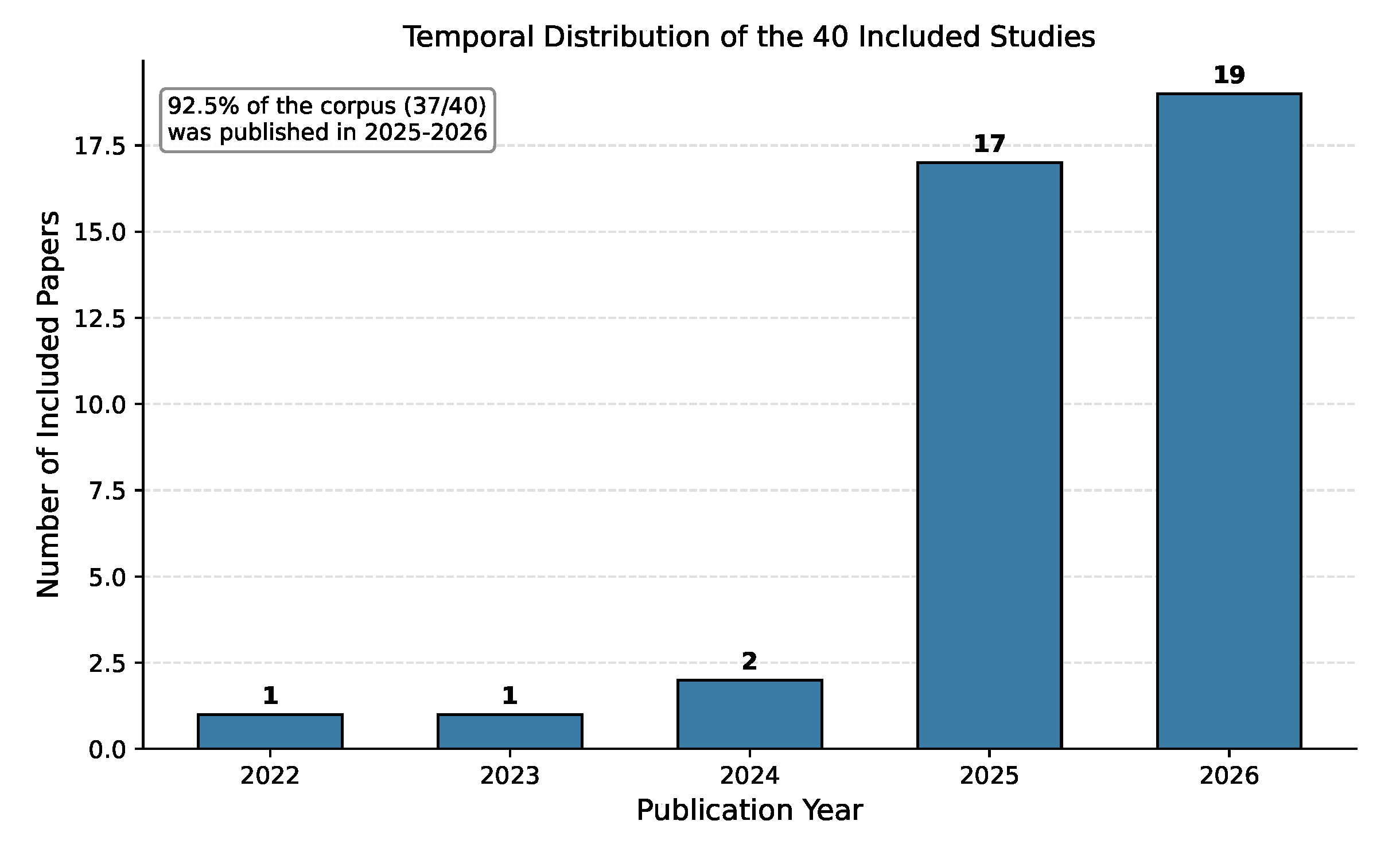
Figure 4.
Coverage of research questions across the 40 included studies. RQ2 achieves the highest coverage (90.0%), followed by RQ1 (82.5%) and RQ3 (77.5%).
Figure 4.
Coverage of research questions across the 40 included studies. RQ2 achieves the highest coverage (90.0%), followed by RQ1 (82.5%) and RQ3 (77.5%).
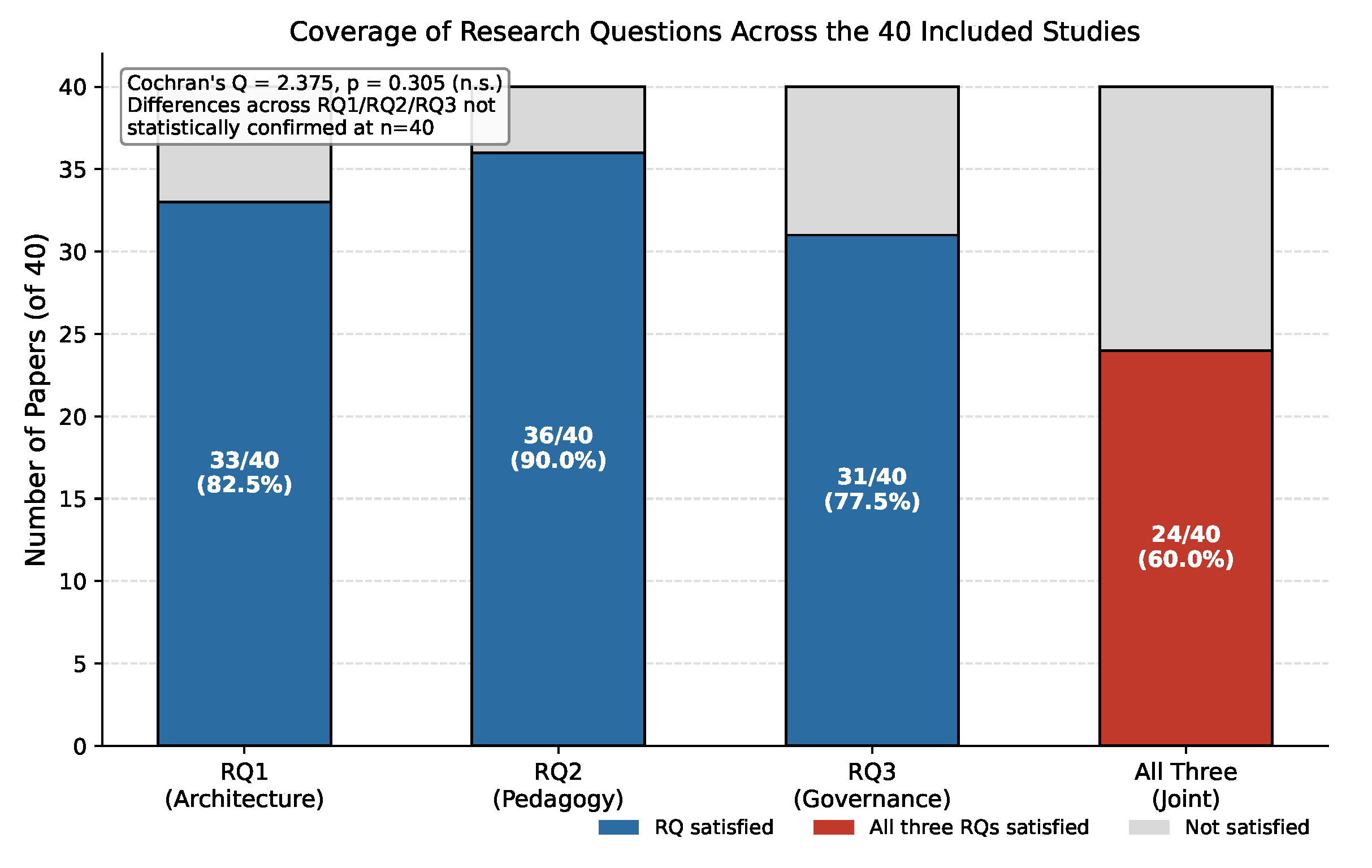
Figure 5.
Distribution of integration strategies across 90 substantively classifiable frameworks. Unified representation and sequential architectures jointly account for 71.1% of the corpus.
Figure 5.
Distribution of integration strategies across 90 substantively classifiable frameworks. Unified representation and sequential architectures jointly account for 71.1% of the corpus.
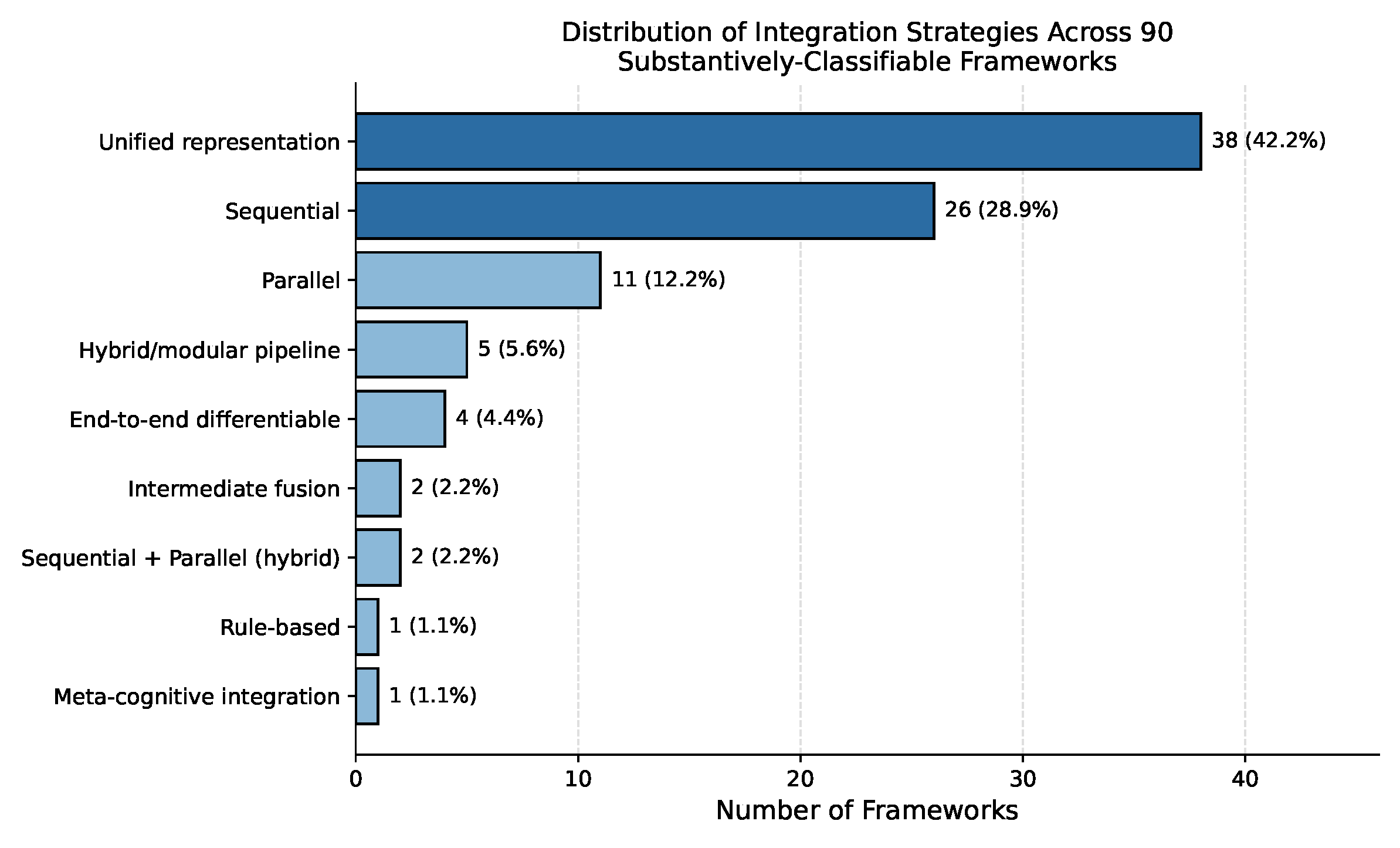
Figure 6.
Number of papers (y-axis) contributing a given number of frameworks (x-axis) to the 92-framework inventory ( papers). The right-skewed distribution shows that most papers contribute a single primary system, while a small subset of survey-type sources contribute disproportionately more frameworks each.
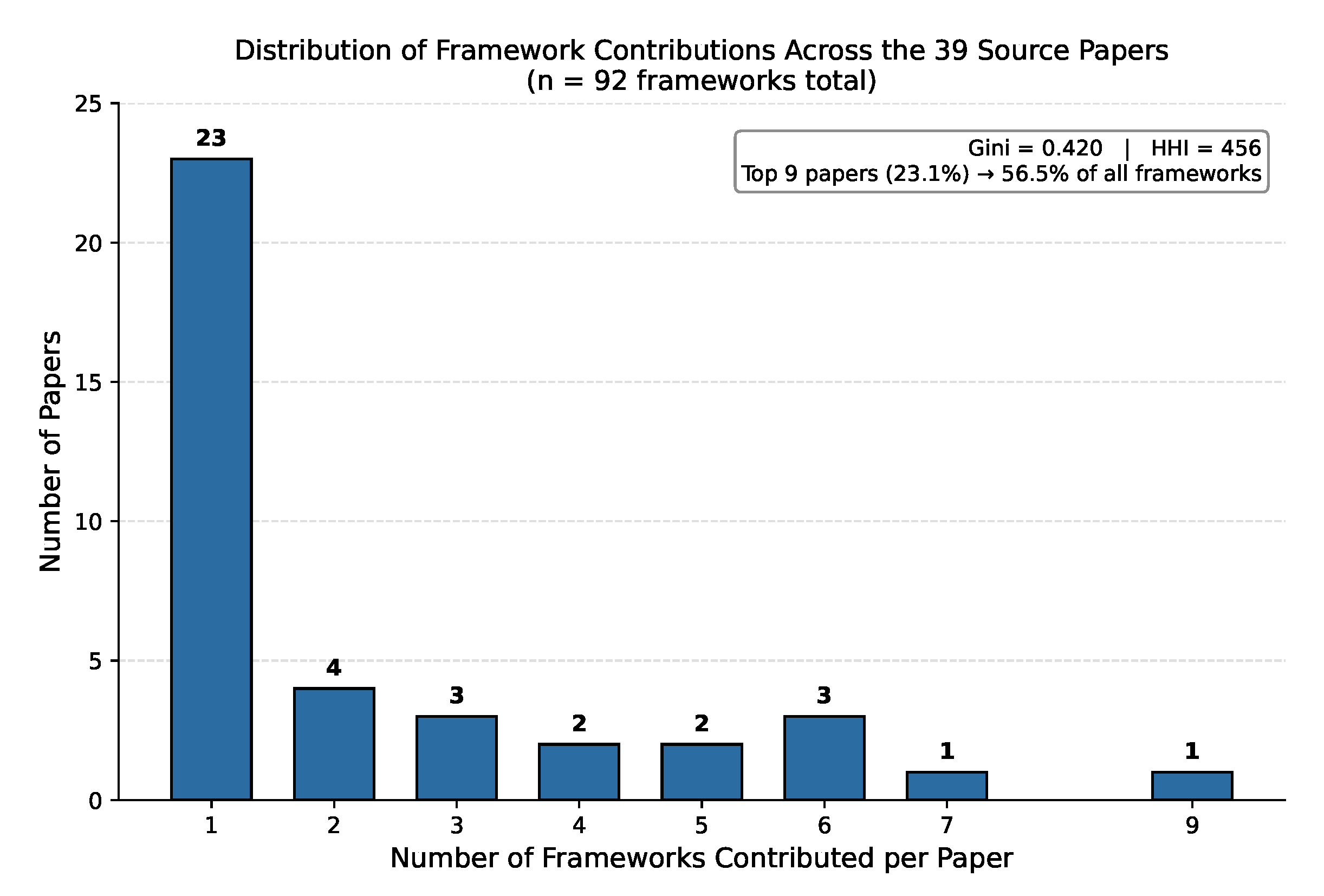
Figure 7.
Integrated Conceptual Synthesis of Neuro-Symbolic Educational AI.
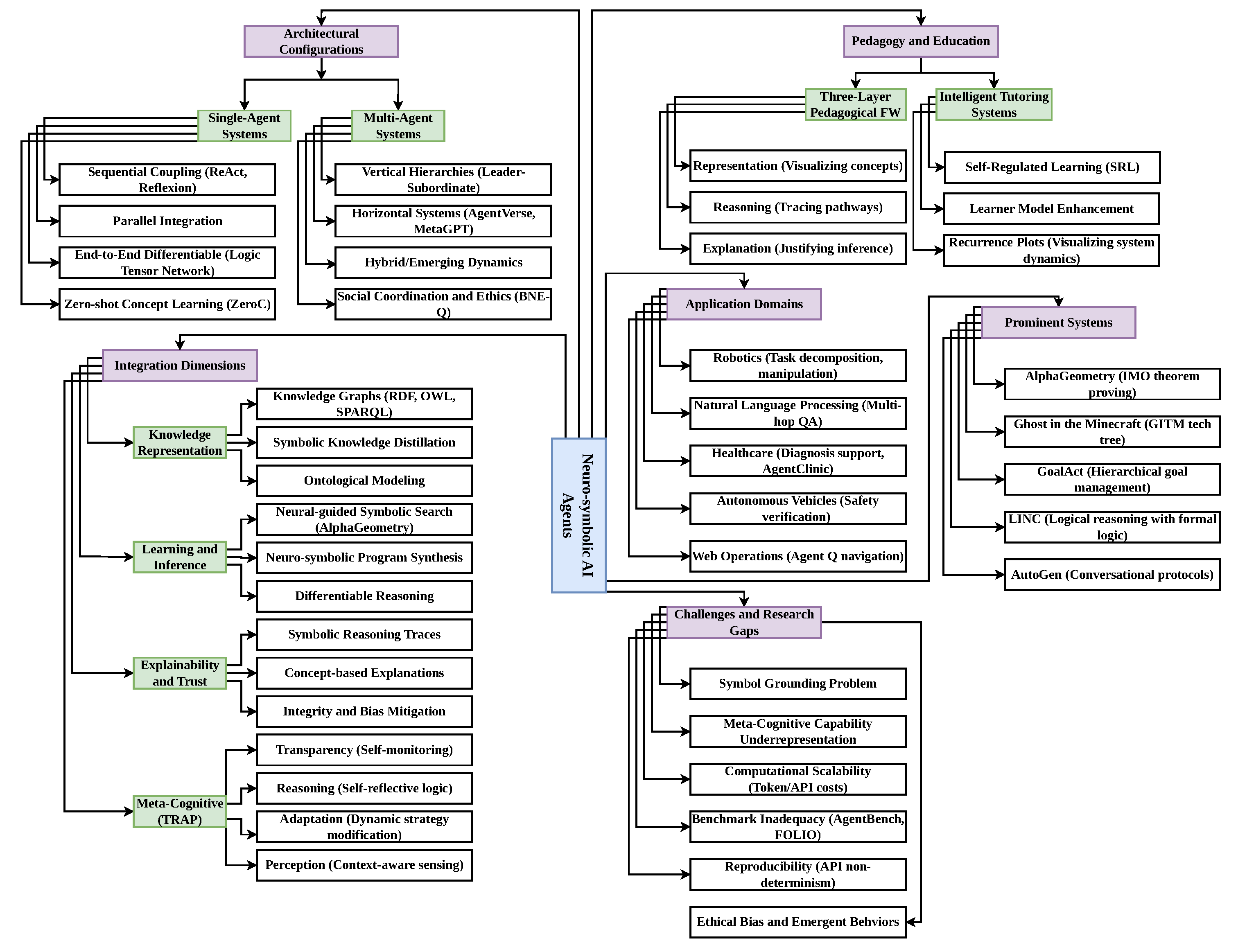
Table 1.
Positioning of the present review against related systematic reviews and surveys (2020–2026).
Table 1.
Positioning of the present review against related systematic reviews and surveys (2020–2026).
| Review | Domain | Protocol | Corpus size | Architecture (RQ1-type) | Pedagogy/Cognition (RQ2-type) | Governance/ Explainability (RQ3-type) | Framework/system taxonomy |
|---|---|---|---|---|---|---|---|
| This review | Neuro-symbolic AI in education | PRISMA 2020, hybrid automated+manual, validated (AUC=0.46 triggered full re-screen), | 40 studies (from 3,492); 92-framework inventory | Yes – explicit integration-strategy taxonomy (unified, sequential, parallel, etc.), statistically profiled | Yes – explicit theory grounding (ZPD, CLT) coded as inclusion criterion | Yes – explicit hallucination-mitigation/guardrail criterion, coded and tested | Yes – 92-system inventory, distinct from 40-study coding, with Gini/HHI concentration analysis |
| (Colelough and Regli, 2024), LNSAI 2024 | General neuro-symbolic AI, 2020–2024 | PRISMA-based | 167 studies (from 1,428) | Yes – learning/inference, logic/reasoning, knowledge representation | No | Partial – explainability/trust treated as a gap area, not integrated with any application domain | Partial – task-based categorization, not education-specific |
| (Ben Chaabene and Hammami, 2026), Smart Learning Environments | NeSy in education (LLM–KG–affective integration) | Structured review, not PRISMA-stated | Not reported | Yes – “technological synergy” as one of three axes | Partial – pedagogical alignment used as evaluation axis, not tied to named cognitive theory | Yes – equity, explainability, privacy discussed explicitly | Yes – three framework families named |
| (Latif et al., 2026), Smart Learning Environments | ITS/robot tutoring systems, evolution and classification | PRISMA | 86 studies | No – categorizes by AI model type (BKT, LLMs), not neural-symbolic fusion | Yes – pedagogical design is a primary axis | Limited – ethics discussed, not a core coded dimension | No distinct framework-level taxonomy |
| (Létourneau et al., 2025), npj Science of Learning | AI-driven ITS in K-12 | PRISMA | 28 studies (from 948) | No | Partial – compares ITS effects/designs, not formal theory grounding | Limited – flags need for ethics research, not central | No |
| (Lin et al., 2023), Smart Learning Environments | ITS for sustainable education | PRISMA | 553 initial; final n unclear | No | Partial – deployment/personalization discussed, not formal theory | Yes, limited – privacy, security, bias, policy awareness | No |
| (Córdova-Esparza, 2025), Information | AI-powered educational agents | 4-phase protocol with PRISMA 2020 elements | 82 studies | Yes, but not NeSy-specific – codes RAG, fine-tuning, multi-agent design choices | Yes – explicitly maps technical choices to scaffolding, metacognition, motivation | Yes – privacy, fairness, hallucination reduction via retrieval grounding | Yes – six-part evidence-based taxonomy |
| (Mustafa et al., 2024), Smart Learning Environments | Meta-review of 143 AIED reviews | Systematic meta-synthesis | 143 reviews | No | No/limited – organized by technology-based learning model | Partial – future agenda mentions safe AIED, not coded | Yes – organizes reviews by learning model |
| (Wang et al., 2024), IEEE TPAMI | General neuro-symbolic computing | Narrative/systematic | Not reported | Yes – four-dimension NeSy taxonomy | No | No/limited – interpretability as motivation only | Yes – four-dimension taxonomy |
| (Bhuyan et al., 2024), Neural Computing and Applications | General NeSy, two-decade span | Narrative | Not reported | Yes – representation, learning, reasoning, decision-making | No | Partial – explainability/ethics discussed, not education-grounded | Yes – feature-based framework |
| (Acharya and Song, 2026), Arabian J. Sci. Eng. | NeSy trustworthiness (robustness, UQ, intervenability) | Systematic language, PRISMA not stated | Not reported | Yes – unified vs. modular integration | No | Yes – robustness, UQ, intervenability, verifiability as core dimensions | Yes – three-dimension trustworthiness lens |
| (Voultsiou and Moussiades, 2025), Education and Info. Technologies | AI, VR, LLM in special education | Systematic, deductive thematic analysis | 139 studies | No | Partial – SEN methodologies, personalized learning discussed | Yes, limited – ethics, accessibility, policy | Yes – descriptive thematic framework |
Note. “Yes” indicates the dimension is coded as an explicit, named analytic axis with defined criteria; “Partial” indicates the dimension is discussed narratively but not operationalized as a coding criterion; “No” indicates the dimension is absent from the reviewed scope as reported.
Table 2.
Research Questions and Their Alignment with the Study’s Objectives.
| RQ | Description | Answered in |
|---|---|---|
| RQ1 (Architecture) | How do current educational systems structurally fuse neural generation with symbolic reasoning (e.g., knowledge graphs, rule-based logic engines) to orchestrate adaptive learning? | Section 5.1 |
| RQ2 (Didactics & Cognition) | In what ways are these neuro-symbolic architectures aligned with established pedagogical frameworks (e.g., Zone of Proximal Development, Cognitive Load Theory) to track and scaffold the learner’s epistemic state? | Section 5.2 |
| RQ3 (Governance & Mitigation) | How do these hybrid systems leverage symbolic logic as a guardrail to mitigate neural hallucinations, enforce pedagogical safety, and support explainable meta-cognitive literacy? | Section 5.3 |
Table 3.
Database Search Strings and Components
| Database | Component | Search String |
|---|---|---|
| IEEE Xplore | Neuro-Symbolic | "neuro-symbolic" OR "neurosymbolic" OR "hybrid AI" OR "rule-based" OR "zero-shot" OR "cognitive digital twin" |
| Educational | "education" OR "student" OR "pedagogy" OR "intelligent tutoring" OR "learner model" | |
| Scopus | Neuro-Symbolic | TITLE-ABS-KEY("neuro-symbolic" OR "neurosymbolic" OR "hybrid AI" OR "rule-based" OR "zero-shot" OR "cognitive digital twin" OR "epistemic AI") |
| Educational | TITLE-ABS-KEY("education" OR "student*" OR "pedagog*" OR "intelligent tutoring" OR "learner model*" OR "learning analytics") | |
| Filters | PUBYEAR > 2020 AND (DOCTYPE "ar" OR "cp" OR "re") | |
| Web of Science | Combined | TS=((("neuro-symbolic" OR "neurosymbolic" OR "hybrid AI" OR "rule-based" OR "zero-shot" OR "cognitive digital twin" OR "epistemic AI")) AND (("education" OR "student*" OR "pedagog*" OR "intelligent tutoring" OR "learner model*" OR "learning analytics"))) |
Note: TS = Topic Search (title, abstract, keywords); TITLE-ABS-KEY = search in title, abstract, and keywords.
Table 4.
Inclusion and Exclusion Criteria for Study Selection, Aligned with the Database Search Strings (Table 3).
Table 4.
Inclusion and Exclusion Criteria for Study Selection, Aligned with the Database Search Strings (Table 3).
| Criterion | Inclusion | Exclusion |
|---|---|---|
| Concept 1: AI Approach | Abstract/title/keywords contain at least one of: neuro-symbolic, neurosymbolic, hybrid AI, rule-based, zero-shot, cognitive digital twin, epistemic AI | Record retrieved by a Concept 1 term used in an unrelated technical sense (e.g., “rule-based” pertaining to firewall configuration, “zero-shot” pertaining to computer vision with no educational application, “cognitive digital twin” pertaining to manufacturing) |
| Concept 2: Educational Context | Abstract/title/keywords contain at least one of: education, student*, pedagog*, intelligent tutoring, learner model*, learning analytics | Educational term present only as an incidental example or dataset name with no substantive pedagogical discussion |
| Publication Year | Published after 2020 (i.e., 2021 onward), per the PUBYEAR > 2020 / TS date constraint applied in Scopus and Web of Science | Published in 2020 or earlier; for IEEE Xplore, records outside this window as applied via the platform’s post-search date filter (see Table 3 note) |
| Document Type | Journal article, conference paper, or review (Scopus DOCTYPE: ar, cp, re); equivalent peer-reviewed article/proceedings/review types retrieved from IEEE Xplore and Web of Science | Editorials, erratum/corrigenda, book chapters not indexed as reviews, theses, and non-peer-reviewed preprints, unless independently justified for inclusion (see Limitations) |
| Field(s) Searched | Term match within title, abstract, or keywords (Scopus TITLE-ABS-KEY; WoS TS = Topic, which spans title/abstract/keywords/KeyWords Plus) | Term match found only in full text outside title/abstract/keywords is not sufficient for automatic inclusion at the search stage (may still be captured via snowballing) |
| Language | Full text available in English | Full text unavailable in English with no verified translation |
| Full-Text Availability | Full text retrievable through institutional access, open access, or direct author request | Full text not retrievable after exhaustive access attempts |
| Architectural Depth (RQ1) | Study describes an identifiable neuro-symbolic architecture, fusion strategy, or hybrid reasoning pipeline in sufficient detail to classify (e.g., sequential, parallel, unified representation) | Study mentions a Concept 1 term only in passing (e.g., as future work or a single keyword) without describing an implemented or proposed architecture |
| Pedagogical/Cognitive Grounding (RQ2) | Study explicitly connects the system or framework to a pedagogical theory, cognitive model, learner outcome, or educational use case | Study is set in a non-educational domain (e.g., healthcare, finance, robotics) with no extension or applicability discussion for education or learning |
| Governance & Explainability (RQ3) | Not required for inclusion; scored as a coverage dimension only | Not applicable |
| Duplicate Records | First-encountered unique record (by DOI, or by fuzzy-matched normalized title where DOI metadata is absent) | Records identified as duplicates during the two-stage deduplication process (Section 3.4) |
Table 5.
Full-Text Eligibility Criteria.
| Criterion | Question | Inclusion Requirement (1 = Yes) |
|---|---|---|
| C1 — Architectural Depth | Does the system feature a distinct, verifiable neuro-symbolic architecture? | Explicit combination of neural learning (e.g., LLMs, GNNs) and structured symbolic logic (e.g., knowledge graphs, rule engines, Prolog) |
| C2 — Pedagogical Grounding | Is the architecture applied to a specific, empirically validated educational context? | System is situated in teaching, learning, assessment, or academic advising (excludes generic or purely clinical applications) |
| C3 — Agentic/Meta-Cognitive Capacity | Does the system exhibit autonomous, goal-oriented, or meta-cognitive behavior? | System tracks dynamic learner states, orchestrates multi-step reasoning, or applies algorithmic guardrails to adapt scaffolding |
Decision rule: Include if and only if C1 = C2 = C3 = 1.
Table 6.
Data Extraction Matrix: Classification of 40 Included Studies Against the Three RQ Dimensions.
Table 6.
Data Extraction Matrix: Classification of 40 Included Studies Against the Three RQ Dimensions.
| ID | Author (Year) | Framework / System | Field of Study | RQ1 | RQ2 | RQ3 | All Three |
|---|---|---|---|---|---|---|---|
| 1 | (Elkaimbillah et al., 2026) | Survey (e.g., PreKGAT/PCGNN, MSEC-Rec, Dynamic Causal GNN, et al.) | Course, resource, concept recommendation | ||||
| 2 | (Torres-Martínez, 2025) | AgCCxG | Multi-domain (language, XAI) | ||||
| 3 | (Hakim et al., 2026) | Survey (e.g., AlphaGeometry, Agent Q, Reflexion, et al.) | Education, navigation, general reasoning | ||||
| 4 | (Vera and Sinche-Guzmán, 2026) | KG-based Hybrid AI (Perspective) (cf. Gao et al., AutoTutor) | Higher education (AI curricula) | ||||
| 5 | (Ben Chaabene and Hammami, 2026) | Survey (e.g., MindfulTutor, EduExplain, MetaTutor AI, et al.) | Chemistry/calculus, history, STEM | ||||
| 6 | (Quincoso Lugones et al., 2026) | Aurora | Academic advising and degree planning | ||||
| 7 | (Xu and Che, 2025) | LLM-Powered Competency Graph | Engineering education | – | – | ||
| 8 | (Babenko and Romanov, 2025) | Cognitive Interaction Layers (cf. OpenCog/CLARION) | Skill acquisition | ||||
| 9 | (DEVER et al., 2022) | Recurrence Plot Learner Model (cf. MetaTutor testbed) | Self-regulated learning (SRL) | – | – | – | |
| 10 | (Naudet et al., 2025) | HUMO/SOMA (cf. Common Model of Cognition) | Human-robot collaboration | ||||
| 11 | (Hummel, 2025) | Situated Ethics (cf. Adaptive Mentoring, Ethical/Responsible AI) | Higher education | – | – | ||
| 12 | (Qu et al., 2026) | Dual-Graph Framework | Personalized learning | ||||
| 13 | (Lin and Dai, 2025) | Constructionist Pedagogy | K-12 education (AI ethics) | – | – | ||
| 14 | (Yang and Zhao, 2025) | ARGUS | English argumentative writing (L2) | ||||
| 15 | (Afzal, 2025) | Survey (e.g., SimpleMind, SHAPEDNet, Auto-define, et al.) | Healthcare, education, cybersecurity | – | – | ||
| 16 | (Shapiro et al., 2026) | Metacognitive AI Literacy (cf. Agentic AI case study, Humanics) | Higher education / multi-domain | – | – | ||
| 17 | (Jaldi et al., 2025) | (No discrete framework named) | General education | ||||
| 18 | (Kamalov and Sulieman, 2026) | Survey (e.g., AUSS, GenMentor, ITAS, et al.) | K-12 STEM, tutoring, code execution | ||||
| 19 | (Kolhatin, 2025) | Human-Centered Augmentation Framework (cf. Squirrel AI, ALEKS, Khanmigo) | Adaptive educational content | ||||
| 20 | (Zhang et al., 2026) | TongGeometry | Euclidean planar geometry | – | – | ||
| 21 | (Sharma et al., 2026) | Hybrid LLM-Embedded Agent (cf. Muse, ChaCha) | Educational robotics | ||||
| 22 | (Liu and Zhang, 2026) | Knowledge-graph mindset mapping model | Education / management trends | – | – | – | |
| 23 | (Ruzimboev et al., 2025) | Transformer-based NeSy | Content quality assessment | ||||
| 24 | (Elkaimbillah et al., ) | NeSy-Guidance | Academic recommendation | ||||
| 25 | (Ruzimboev et al., 2025) | Synergistic Tutoring (SYN-T) (cf. NSAI, Hybrid RL-Symbolic System) | Adaptive intelligent tutoring | ||||
| 26 | (El Yabouri et al., 2026) | Multi-Dimensional Scaffolding | Intelligent tutoring systems | – | – | ||
| 27 | (Chen et al., 2024) | Course Recommendation (KG-based) | Online education | – | – | – | |
| 28 | (Huang et al., 2025) | MetaMath-LLaMA | K-12 mathematical reasoning | – | – | ||
| 29 | (Sayed et al., 2023) | APPEAL | Grade 3 mathematics e-learning | – | – | ||
| 30 | (Sirisha et al., 2025) | IMEPAL | Personalized adaptive e-learning | ||||
| 31 | (Li et al., 2025) | HADPIF | Traditional Chinese medicine | – | – | ||
| 32 | (Zhou, 2026) | Personalized Practice Path Generation | Higher education | ||||
| 33 | (Reddy and Parkavi, 2025) | PALPS | Compiler design education | ||||
| 34 | (RS et al., 2026) | Smart Tutoring System (STS) | Open-domain education | – | – | ||
| 35 | (Olaniyan and Wario, 2026) | Neuro-symbolic affect-aware agent | Virtual learning environments | ||||
| 36 | (Thilagam et al., 2026) | Hybrid RoBERTa + Symbolic | STEM education | ||||
| 37* | (Saint-Léger et al., 2025) | Survey (e.g., STARE/Bimy-verse/iMetaverseKG, VR systems) | Smart environments, science, finance | – | – | – | |
| 38 | (Rehm et al., 2024) | Virtual Driving Instructor (VDI) | Driver education | – | – | ||
| 39 | (Ye et al., 2026) | ARPG+ | Educational LLM prompting | ||||
| 40 | (Rida et al., 2026) | Gen-IMTS | Intelligent tutoring systems (CS and ethics) |
Notes: RQ1 = Neuro-symbolic architectural depth (explicit neural + symbolic integration); RQ2 = Pedagogical/cognitive grounding; RQ3 = Governance, safety & explainability (hallucination mitigation, guardrails, or evaluation of trust). = explicit textual support; – = no explicit support found. All Three: = satisfies all three RQs. Total after IRR reconciliation. *Paper 37 is a symbolic-only semantic-web survey that explicitly excludes AI/neural methods from its reviewed scope; its inclusion under RQ1’s architectural-depth criterion is flagged for reviewer discretion (see Limitations section).
Disclaimer/Publisher’s Note: The statements, opinions and data contained in all publications are solely those of the individual author(s) and contributor(s) and not of MDPI and/or the editor(s). MDPI and/or the editor(s) disclaim responsibility for any injury to people or property resulting from any ideas, methods, instructions or products referred to in the content. |
© 2026 by the authors. Licensee MDPI, Basel, Switzerland. This article is an open access article distributed under the terms and conditions of the Creative Commons Attribution (CC BY) license (http://creativecommons.org/licenses/by/4.0/).
Copyright: This open access article is published under a Creative Commons CC BY 4.0 license, which permit the free download, distribution, and reuse, provided that the author and preprint are cited in any reuse.