

Submitted:
06 August 2026
Posted:
10 August 2026
You are already at the latest version
Abstract
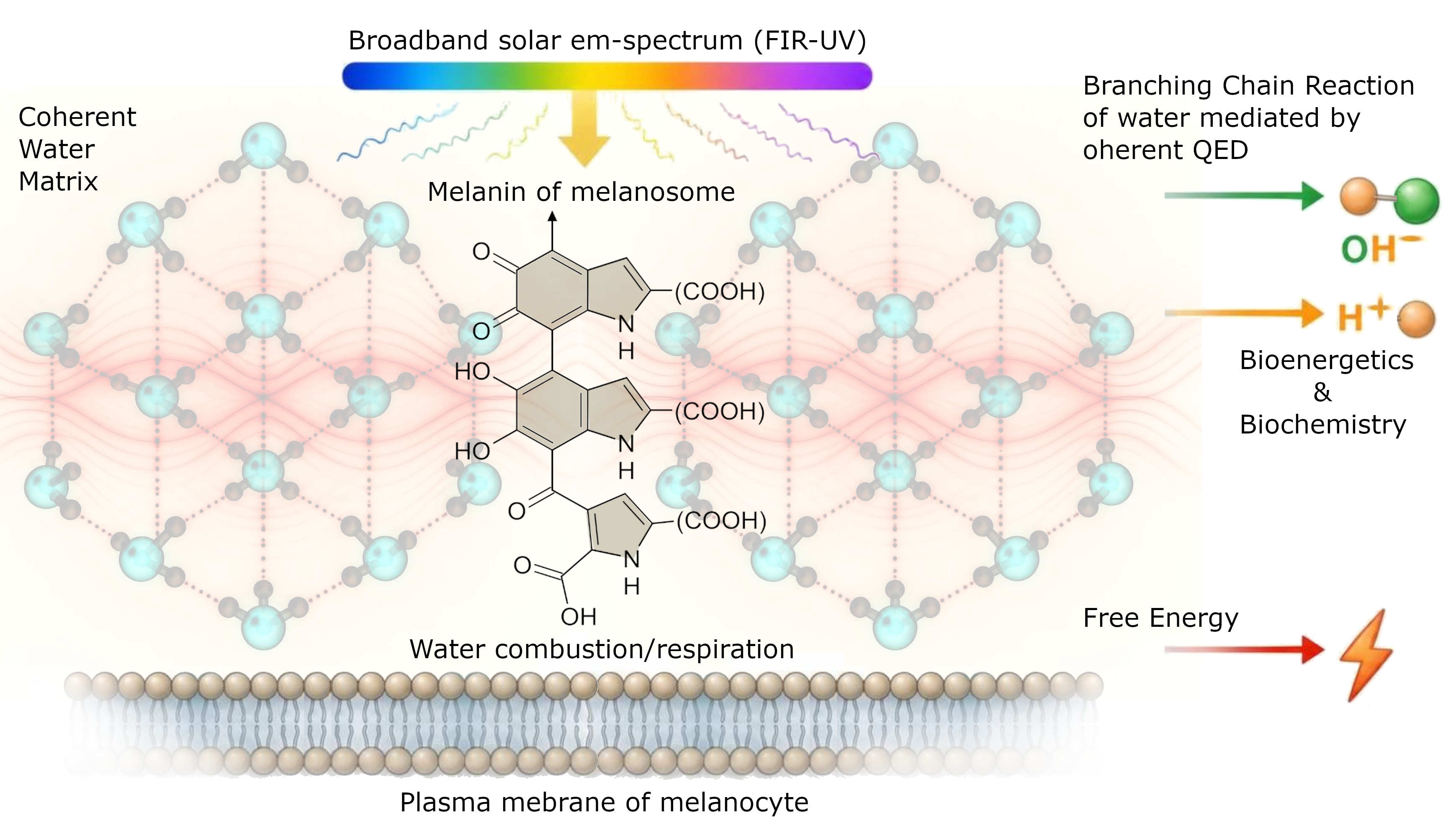
In the last decade significant progress has been made in understanding the crucial role of melanin in the energy production in cells and tissues (accounting for up to 90 % of the total in organisms) [1]. This requires rethinking the central role of glucose and ATP which instead are thought to play a primary role in building biomass [2]. The mechanism by which melanin absorbs a wide range of the electromagnetic (em) spectrum (from FIR to far UV and ionizing radiations helping organisms to cope with exposure to X- or γ rays [3]) and dissociates water molecules (releasing oxygen, hydrogen and free energy), has been extensively verified to occur in biological systems [4]. This mechanism has also been reproduced in laboratory and showed valuable applications in water revitalization and purification treatments [5]. In terms of bioenergetics, these findings highlight the importance for mammals (including humans) of sunlight exposure (which provides the full em spectrum) while maintaining adequate hydration to maintain a good homeostasis and optimal health. This process of hydrolysis and oxygen production through melanin and light had been proposed by Arturo Solìs Herrera and thus termed human photosynthesis [1]. However, the proposed dissociation of water molecules (with an initial electron transition at around 7 eV and ionization threshold at 12.62 eV) is not explainable within the still semi-classical vision of quantum mechanics (QM), especially when triggered by photons with much lower energy). In contrast, a description of water and biological matter in terms of Quantum Field Theory (QFT) that takes into account the key role of coherence and the interplay with hydrophilic surfaces provides a clear and physically sound picture [6]. In this paper we would propose a possible semi-quantitative theoretical framework for this fundamental biological process, which appears to underpin most metabolism in heterotrophic organisms, by interpreting water and living matter in terms of Quantum Electro-Dynamics(QED) [7]. This will allow us to make important progress in biochemistry and medicine too.
Keywords:
melanin
; coherent water
; QED
; quasi-free electrons
; water dissociation
; bioenergetics
1. Structure and Properties of Melanin
Melanin is a high-molecular-weight pigment that is ubiquitous in nature and present in various organisms, including animals and plants [8] (which have chlorophyll in their leaves and melanin in other parts such as roots and woody parts and seeds [9]). It is also synthesized in many fungi and concentrated on the cell wall [3]. This serves to perform its role as both a screen and a collector of electromagnetic energy, which is then converted and made available to the cell. Melanin can have up to 5 different molecular structures (see [10]), but in biological system, two main structures are most abundant [11]: eumelanin (derived from tyrosine + L-Dopa), and pheomelanin (derived from tyrosine + cysteine) [12]. Eumelanin is a dark brown or black pigment composed of monomers of 5,6-dihydroxyindole (DHI) and 5,6-dihydroxyindole-2-carboxylic acid (DHICA), while pheomelanin is a reddish-brown pigment composed mainly of benzothiazine monomers [13] (see Figure 1) – an in-depth presentation of the melanin family is accessible here [14], whereas melanogenesis is described here [15].
Melanin is a substance with unique physical and chemical properties, including paramagnetic characteristics and the presence of stable free radicals (ortho-semiquinonimine and ortho-semiquinone), as well as the ability to absorb UV and visible radiation [16]. Melanin’s chemical composition, which is rich in aromatic rings and π electrons, gives it the ability to shield radiation and neutralize other species such as free radicals or chelating toxic metals [17]. Melanin can scavenge radicals by both donating and accepting free electrons [18,19], which makes it a critical factor for survival even in the microbiological world [20], and an interesting candidate for biotechnology [21] and even for technical applications [22].
Melanin is a molecule with unique and surprising properties. While it was traditional considered to be merely a protective pigment against UV rays [27,28], studies [1,4,29] have revealed that it has the intrinsic ability to transform light energy into chemical energy through the dissociation of water molecules, in a process similar to photosynthesis in plants. This ability makes melanin an important source of energy for cells, perhaps even the most important one, surpassing the traditional roles attributed to glucose and mitochondria. Additionally, melanin exhibits significant anti-angiogenic properties, reducing blood vessel growth, and has trophic properties that contribute to maintain tissue strength and integrity [30,31,32]. Its ability to absorb the entire electromagnetic spectrum, from gamma rays [31,33], to UV [34,35], to radio waves [36,37,38,39,40,41], makes it the “blackest” substance known in nature and gives it a fundamental role in cellular bioenergetics, as summarized in the next section. In this context, an oddity was recently observed when melanin was artificially ‘harvested’ from the black fungus Curvularia following exposure to 1 kGy of gamma irradiation and used as an antibiotic against several bacterial and fungal strains [42]. Given that the challenge to correlate the various forms of melanin heterogeneity with structure and function has not yet been properly answered [43] we are confident that essential clues will become available by relating the observed characteristics with quantum properties related to the aqueous phase in biota. Indeed, such peculiar properties cannot be perceived adequately without first grasping the true role of water in living matter.
2. The Role of Melanin in Energy Production
Recent quoted research shows that melanin plays a central role in energy production and in the regulation of oxygen and hydrogen. This is due to its ability to dissociate water molecules at room temperature in a process similar to chlorophyll photosynthesis. However, unlike photosynthesis, this process can proceed in both directions. The hydrolysis reaction catalyzed by chlorophyll in photosynthesis is known as:
This reaction occurs during the light phase of photosynthesis, in which the energy of the reddish band of the visible spectrum (corresponding to 680 nm / 1.82 eV for photosystem-II and 700 nm / 1.77 eV for photosystem-I respectively) is used to split the water molecule, releasing oxygen, protons and electrons. According to this process, melanin dissociates the water molecule as follows: [30]:
The main difference compared to chlorophyll is that reaction in melanin is reversible. Melanin dissociates water to produce hydrogen, which is said to be the primary source of energy for the human body. Hydrogen drives ATP synthesis and surpasses glucose in efficiency. It also acts as a powerful antioxidant [30]. Melanin can also reform the water molecule, generating an orderly flow of electrons [44]. This is a crucial point for regulating oxygen levels in the body:
- -
- to supply oxygen to all parts of the body (which are in fact difficult to reach by means of respiration1),
- -
- and to reduce it when its concentration reaches 97% of its maximum saturation [32]. At this point, the chemical reaction changes direction, reforming water and conveying an orderly flow of collected electrons.
This continuous and regular cycle of water dissociation and recombination nourishes the cells, supporting the functioning of organelles such as mitochondria and influencing complex metabolic pathways. Melanin also provides the energy necessary for the activity of enzymes such as carbonic anhydrase. Reduced engagement of this enzyme can lead to respiratory symptoms [4].
The widespread presence of melanin in many living species and tissues suggests an ancient evolutionary mechanism. This supports the working hypothesis that melanin is a crucial element of cellular bioenergetics and the overall health of the organism. This clearly challenges traditional metabolic theories and opens new avenues for understanding vital mechanisms.
From a chemical-physical point of view, this process is obviously not straightforward. Within a mainstream interpretation of water as a molecule with a bond energy of approximately 4.73 eV, between H and O, a first electronic transition of approximately 7 eV, and an ionization threshold of 12.62 eV, it seems impossible. This is also because water – under laboratory conditions – can only be thermally dissociated above a threshold temperature of 2000 °C, resulting in a mixture of oxygen and hydrogen that can be used as fuel. So, how can melanin achieve such dissociation (from which released energy can be used as work), even when the triggering excitations originate within the IR or visible spectra, whose energies are well below those theoretically necessary to break a “strong” bond such as that of a water molecule? The answer, as will be shown shortly, lies in understanding that the water molecule is not always the same object, regardless of its state (especially if it is in a condensed phase).
3. The Quantum Electrodynamics (QED) View of Condensed and Living Matter
Biological systems are undoubtedly the most complex phenomena that modern science aims to understand in all their facets. In particular understanding living dynamics, in terms of both medical practice, resource use and environmental interaction can only be achieved by starting from a deep internalization of the tools and concepts provided to us by the most advanced branch of theoretical physics concerning condensed matter2: Quantum Field Theory [45].
Quantum Mechanics (QM), as a semi-classical approximation, is widely known in various scientific fields as it has proven effective in describing a wide range of phenomena, with most applications tied to technology. On the other hand, QFT (the only one able to restitute a realistic picture of the world [46]) shows that the principles of complementarity (overly simplified in the commonly referred-to naïve concept of “wave-particle duality”) actually descends from the consideration of “limit cases” of something that is more profoundly non-partitionable, and whose “duality” only emerges when attempting to interact classically with a few quanta at a time (thus, not appliable in condensed phases of matter) that are assumed to be arbitrarily isolatable and countable [47].
Besides avoiding certain approximations (like SVE and, under different circumstances RWA3 [48]), the main difference between the conventional (QM) and QFT approaches deals primarily with the size of the aggregates of quanta considered. In fact, the simplification to “few bodies” cannot be applied to real physical systems, especially when dynamics are at play that relate not only to “many components” but are also markedly collective and cannot be deduced from the interaction between a few. This circumstance is most evident in condensed matter, but even more so in living systems, where a condition known as coherence is a) a prerequisite for the concept of Life, and b) assigns the living state its ‘meaning’ [49].
Considering that a large proportion of living matter consists of water molecules (around or above 90% by number) and learning “how” they give rise to the liquid phase along with its unique properties we gradually begin to grasp that the living state is a particular thermodynamic phase of condensed matter based on coherent water: a living phase of matter [50] that differs from the inanimate one primarily by its ability to generate spontaneously movement (work) in relation to specific purposes, functions, stimuli, and environmental conditions. To do so, (i) the living system must be susceptible to stimulus-response relationships, whereby the system continuously updates itself into new configurations. These configurations derive from the fact that the effects produced by the causes provide feedback on the formers. Furthermore, (ii) it must be endowed with self-organization, which implies that (iii) it must be able to dissipate entropy externally. These conditions can only be satisfied where a fractal hierarchy of coherent modes is in force, [51] belonging to the different space-time scales typical of the size of the quanta involved in the system’s oscillations that must be in accordance to its organizational levels. As will be shown below, these three conditions are all satisfied where coherence unfolds in a fractal hierarchy of modes. These modes belong to the different space-time scales and typically relate to the size of the oscillating quanta involved. The element that allows such emerging properties is water in the state it attains when forming large collective groups of molecules that oscillate in phase.
The existence of multiple phases of liquid water [52], implies the existence of a long-range messenger capable of bringing initially distant molecules much closer together. This correlation field is what distinguishes a gas from a liquid. This “messenger” must be a mesoscopic/macroscopic correlation field that can exist in many configurations, allowing various collective states to emerge. As this has been already observed experimentally enables the manifestation of many thermodynamic phases of the same substance: this messenger is the electromagnetic field [47].
This possibility cannot emerge within the conceptual framework of QM, not even under certain thermodynamic conditions, where a series of molecules interacting through static forces admits. This is in accordance with von Neumann’s fundamental theorem [53], where there is a unique fundamental state (a single vacuum) and therefore a single phase (i.e., only one type of condensation, for example). It is precisely this conceptual limit that led various scholars [54], to believe that it was impossible for water so exhibit different phases under the same temperature and pressure conditions, even though Röntgen [55] more than a century ago, had already proposed a two-component model for liquid water.
as it is not possible to present the entire electrodynamic treatment here (for which we refer to various references [56,57,58,59]), we will limit ourselves to stating that liquid water, like many other molecular species, is composed of two fractions:
● a coherent and thus ordered state, in which the electrons of the molecules oscillate in phase with each other, and with a self-trapped em field within the set of molecules itself, between two energy levels (the fundamental, sp3, and the excited, 5d);
● an incoherent, disordered state – essentially gaseous – in which the molecules are subject to the stochastic dynamics of thermal agitation, as in vapor.
Within the coherent domains, the em field is continuously exchanged between molecules, and in this way, the excitation spends about 90% of its lifetime as a photon and about 10% as oscillating matter. This leads to the photon oscillation period being stretched over time, resulting in a reduction in frequency, leading to the renormalization from the hard UV range to the IR range, down to approximately 6.3·1013 Hz. This is the basis of the dynamics of self-confinement of the em field.
In fact, we speak of sub-radiance (as opposed to the super-radiance of lasers) in relation to the quasi-particles of field-matter. At a non-zero temperature T, the electrodynamic attraction is counterbalanced by the disruptive force of thermal collisions that can dislodge a certain number of molecules from the “unison dance” at any given moment. Using a statistical derivation [57], it is possible to estimate the fraction of molecules that have lost coherence due to thermal noise for a given value of T. As in the case of superfluid Helium, the two fractions, Fcoh(T) and Finc(T), of coherent and non-coherent molecules [45], respectively, are linked by the relation , which determines the total number of molecules belonging to each phase for each temperature T.
At ambient pressure and temperature, the ratio of Fcoh(T)/Finc(T) is about 0.40/0.60, meaning the coherent fraction constitutes about 40% of the liquid in volume. However, it should be noted that molecules continuously pass from one phase to the other over time, implying the fractions represent an average that is based on this continuous passage of molecules.
4. Coherent Water, Interfaces and “Water Respiration”
In the case of the water molecule, the excited state involved in the coherent oscillation at 12.07 eV above the fundamental, sp3 is located just below the molecule’s ionization threshold (ITh) of 12.62 eV. This special condition enables liquid water to exhibit unique and extraordinary properties, including its role as the primary electron donor within living matter. An oscillation of 12.07 eV corresponds to a CD with a theoretical diameter as large as the wavelength of the electromagnetic mode (i.e., 100 nm), although at ordinary temperatures, CDs are typically between 50 and 75 nm in size.
Given the proximity to the ITh the onset of coherent oscillation gives rise to the appearance of one quasi-free electron for each molecule in the coherent state. Since a CD contains, an average of about 6 million water molecules, and since the excited state is populated with a weight of about 10%, this means that, at any given moment, around 10% (approx. 600 thousand) of the electrons in the CD are quasi-free [60]. Therefore, the CD becomes a reservoir of easily excitable electrons. However, since they belong to a coherent state, they respond collectively to every perturbation. An external excitation that is not too large (smaller than the energy gap4 otherwise this would result in the disintegration of the CD) cannot be “absorbed” by a single molecule but is stored by the CD as a whole. This excited collective state is still coherent leading to the collective orbital motions, known as cold vortices. The vortices are (“cold” because they cannot decay thermally, i.e., they cannot lose energy through thermal collisions, otherwise they would lose the thermodynamic advantage of being coherent, and would therefore be no longer at a lower than vacuum level [61]. The sufficiently high-density levels that enable electrons to oscillate in phase exhibit a specific feature that is not observable in other liquids but is unique to water. This makes it the only molecular species capable of extending coherence to ever-larger space-time scales (within super-domains, even in the order of km and months) [62]. A quasi-free electron at the edge of the CD is immersed in an electrical potential, given by three contributions: where 0.54 eV is the residual, attractive energy that binds the electron to the CD relative to the energy required to reach the ionization threshold of 12.62 eV (). The difference of 0.1 eV derives from the electromagnetic field gradient between the inside and outside of the coherent zone. This is the energy contribution of the counter-potential, which is given by the repulsive ponderomotive force. This force pushes all electric charges to the CD-periphery (electrons more so than protons, the former are 2000 times lighter). refers to the boundary conditions and the thermodynamic history of the system, contributing to the choice of the level within the quasi-continuous band between the 5d orbital and the ionization threshold [57]. The value of therefore constitutes the only energy barrier that keeps an electron of the cold vortices bound to the CD. As will shortly be demonstrated, this value is de facto a red-ox potential of the CD by providing the energy to trigger the dissociation of a coherent water molecule. The CD is understood to be a reservoir of electric charges that can be donated at a low energy cost, which is why coherent water, like melanin, is considered a semiconductor [63].
These energies are much lower than those involved in the process of DC-induced electrolysis (1.23 eV, or the thermal equivalents of approx. 2300 K). This reduction in energy also occurs when electrons pass from the coherent phase to other molecular species, such as oxygen, which usually occurs via the tunneling effect.
With an electronegativity of around 0.44 eV, the donation of a quasi-free electron to the oxygen molecule is commonplace. This results in the formation of an anion (O2-) on one side and the immediate escape of an ionized water molecule (H2O+) on the other. These two species constitute the basis for the dissociation of the water molecule in the coherent state (at very low energy costs) and the release of large quantities of energy (stored in the CDs as photons) as they transit to the non-coherent state. Despite the fact that the vacuum level of the latter is higher, the coherent fraction is repopulated almost instantly, thanks to the trigger of environmental excitations, especially in the IR range.
It has been suggested that liquid water can ‘store’ large quantities of energy in the form of electronic cold vortices. This is achieved by collecting minute excitations and dissociating them using suitable excitations (for example, those released by suitable molecular partners, such as coenzymes, or melanin), which release large amounts of hydrogen, oxygen, electrons and energy in the form of photons. The existence of quasi-free electrons in the CDs of water has been confirmed by numerous studies [63,64] who detected electric currents in deionized water separated by a semipermeable membrane. One half of the container fitted with Nafion® snippets has a greater coherent fraction (implementing the formation of water in an interfacial state), while the other zone contained just bulk water. The more coherent part contains a higher concentration of quasi-free electrons, and this produces an electromotive force, resulting in a potential difference between 100-150 mV, which is similar in magnitude to membrane potentials of healthy cells (around 80-90 mV).
Thus, due to the dense packing of the CDs water in contact with hydrophilic surfaces (as is the case for all biological water), constitutes a “boosted” coherent phase (incoherent fraction is minimized). In-phase oscillations ensure phasing of the water molecular dipole rotations enabling overlapping coherences, i.e. coherence of CDs. However, when it adheres to the surface, it loses its rotational invariance in space, resulting in a macroscopic structuring (orders of magnitude thicker than estimates based on electrostatic interactions would suggest). In this way a thickness exceeding several hundred microns can be achieved (Figure 2). Except for protons (H+), this layer is hardly occupied by any solutes. This observation led to the term exclusion zone (EZ) being coined [65]. However, the idea that dissolved molecules are entirely excluded from interfacial water has been contradicted by rigorous experimental evidence [66]. Rather, co-resonating molecules/ions are captured by the interfacial region of the CD, while those species not resonating with the CD oscillation are excluded. Nonetheless, EZ-water has many properties that improperly make it appear to be a fourth phase of water in a dynamic sense, but not in a thermodynamic sense. in other words, it is a system whose kinetics are very different (slower), but not for energetic reasons, but for inertial ones, as is the case with a glassy state. Indeed, it is reasonable to speak of a glassy state of water.
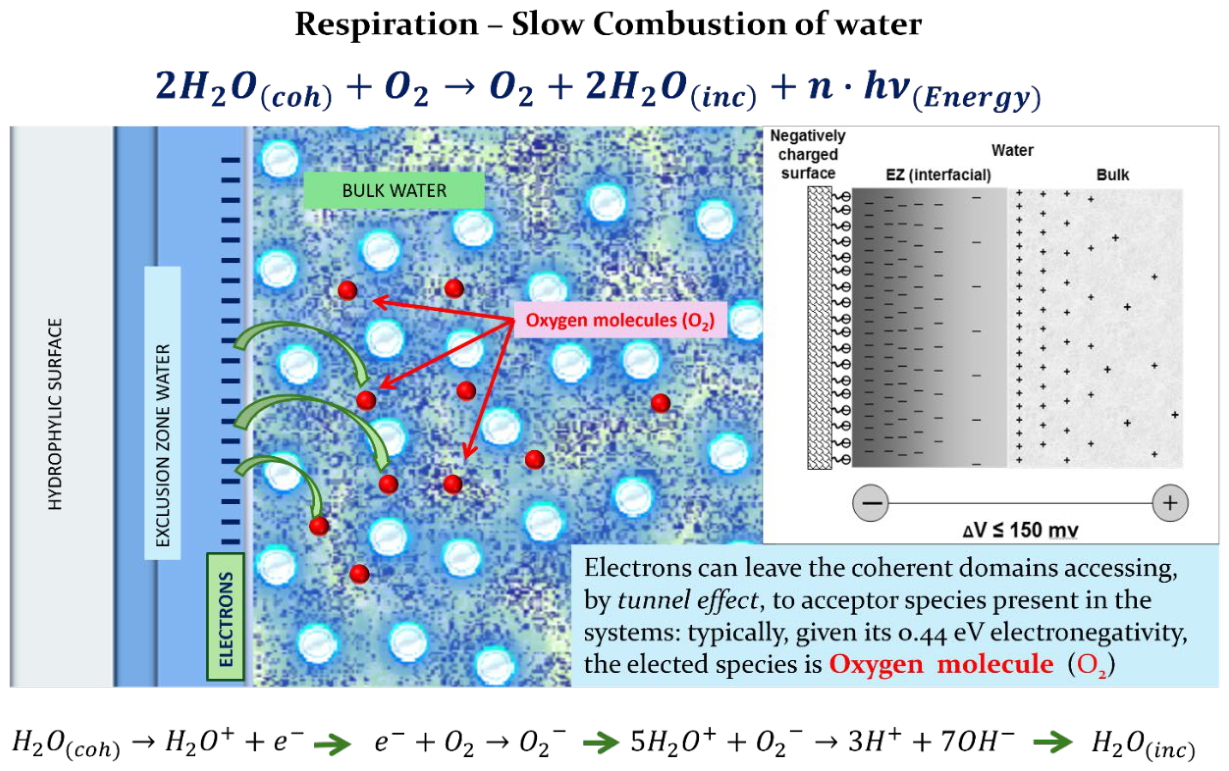
About a decade ago, it was discovered that “organized” water such as EZ-water prevailing in biological matter, [67,68], gives rise to a process called water respiration (also known as the slow combustion of water). In this process, water acts as an electron donor, while the dissolved oxygen acts as an electron acceptor. Obviously, water respiration generates not only oxygen, hydrogen and various radicals, but also the free energy required to power biochemical reactions and support the living state [69].
Both water respiration and melanin-induced photosynthesis can be easily accommodated within QED thereby overcoming the known bioenergetic limitations of relying solely on the classical ATP/ADP pathway, particularly with regards to the mechanism by which the low-density energy is utilized for work. Moreover, that view neglects the key players in oxidoreductive processes such as molecular oxygen reduction as the and the numerous species of free radicals (including Reactive Oxygen Species, ROS), which in the conventional framework are considered harmful to organisms. This one-sided interpretation is rooted in an inadequate understanding of metabolic processes, that ignores the central role of coherent water and associated electromagnetic fields. To our knowledge, only few studies [70,71,72], have shown that ROS are indispensable in bioregulation and, through water respiration, are involved in the conversion of energy, made available by the immense and coherently coupled connectome regulating oxygen and hydrogen rates in tissues. Thanks to the ubiquitous presence of chemical partner species (such as NADPH-oxidase, superoxide dismutase (SOD), catalase, melanin etc.), under normal physiological conditions, about 20% of the oxygen consumed is for their production [73] which can increase up to 70% in regimes of intense metabolism [74].
The usually adopted single-electron reduction of oxygen to water [75] envisions the intermediate production of superoxide radical ((HO2)•), then hydrogen peroxide (H2O2), and finally hydroxyl radical (OH•):
However, this reaction is actually catalyzed in the body mainly by NADPH oxidase
and the superoxide radical is immediately eliminated by SOD
while hydrogen peroxide is intercepted by catalase and converted back into water and oxygen
Therefore, the single-electron reduction of oxygen can be rewritten as [69]:
which means an overall neat oxygen-flux reaction summarized as [72]
All of these reactions release energy equivalent to that associated with the decay of the electrons involved (on the order of E ≥1 eV). For instance, the energy yield in the dismutation of two superoxide radicals is equivalent to a near-infrared photon (λ~1269 nm = 0.977 eV ~ 1 eV), which is sufficient to convert oxygen from its ground state (triplet) to an excited state (singlet). When two singlet oxygen molecules decay simultaneously back to the triplet state, the energy can be “summed,” yielding a quantum of double energy (equivalent to λ ~635 nm, almost 2 eV, red light) [76]. The decomposition of two H2O2 molecules releases the energy equivalent to 2 eV (λ <610 nm). Given the very high turnover of these enzymes, it is reasonable to assume that SOD dismutation of (HO2)• or catalase decomposition of H2O2 produces several high-density quanta in the MHz-range. This prevents the energy from being dissipated spontaneously as heat and promotes the formation of larger-sized quanta.
Knowing that processes like the one-electron reduction of oxygen (and/or its reformation) require both the availability of “cheap” electrons and the ability to maintain electronic and photonic excited states for timescales much greater than those predictable under ordinary conditions, it becomes clear that the presence of coherent water is necessary for these processes to occur. Coherent water is the predominant molecular species in all living systems, with concentrations up to 50 M, and thus constitutes an immense reservoir of quasi-free electrons. However, all this could not happen in the absence of crucial catalytic species, such as the enzymes mentioned above, to which melanin must be added – reasons that are expressed in the next section.
In essence, interfacial coherent water acts as a donor of quasi-free electrons provided that a suitable acceptor species is available, so as to be able to convert that potential/structural energy into free energy capable of doing work. This acceptor is normally available in the form of the oxygen molecule, which is produced by the respiration of water. We propose that this process is synergistic with photosynthesis not just limited to chlorophyll but being extended to melanin as well. It can’t be excluded however, that other species can also be excellent electron acceptors likewise promoting the dissociation of water.
Various pieces of evidence show that, water can split spontaneously and produce (bubbling) oxygen under mild conditions (i.e. not requiring high energies), such as freezing-thawing, evaporation-condensation, sonication within audible frequencies (not requiring cavitation), mechano-chemical activation in the presence of weak magnetic fields [77], exposure to non-ionizing radiation such as microwaves [78], stirring water doped with fine powders of NiO, Cu2O or Fe3O4 [79], as well as the presence of melanin dispersed in porous material immersed in liquid water [5,32]. As this appears to be the primary mechanism in nature, it must be concluded that wherever coherent water and oxygen are present, the slow combustion (or respiration) of water is the pathway of choice. Such dynamics involves the reduction of oxygen by a single electron, as well as the subsequent reversal of this step, along with the intermediate production of ROS species and protons. The overall reaction of water respiration can therefore be summarized as
It is therefore a redox process involving the oxidation of coherent water tied to the reduction of oxygen, to generate energy in the form of electronic excitation. Although melanin is hydrophobic in association with water, it can accept, store and donate electrons, offering redox capacitor properties. It is this feature that has led to speculations that melanin plays an energetic role in biology [17]. Supported by specific catalysts, this process is fundamental to maintaining the system in a non-equilibrium state, which is the necessary prerequisite for melanin to carry out photosynthesis.
5. A Better Understanding of the Action of Melanin
At this point, we can briefly consider how melanin’s ability to dissociate water molecules and to produce hydrogen, oxygen, and chemical energy is closely linked to the presence and properties of the coherent and interfacial water, which constitutes more than 90% of the molar fraction in soft matter [50]. Indeed, it is conceivable that melanin-mediated “photosynthesis” and water respiration are the same phenomenon or two complementary and synergistic processes that need to be verified.
This does in no way diminish the importance of melanin; quite the contrary, it highlights the pivotal roles of melanin and coherent water in energy metabolism, along with other often overlooked species such as carbon dioxide and carbonates, ROS, as well as various enzymes and coenzymes.
We could say that they are complementary and synergistic because they both have the ability to transform electromagnetic radiation into chemical (oxidoreductive) work via electric charge transfer. In this sense, they are both catalysts, but they operate in different ways:
- -
- coherent water can act as a multimodal laser, transforming low-energy excitations into high-energy photons. It exists in a state in which immense reserves of electrons can be transferred at low cost.
- -
- melanin, in addition to transforming low-energy excitations into electronic transitions, it is even capable of doing the opposite. Having higher ionization thresholds than coherent water,5 melanin can absorb the harsh blows from ionizing radiation and transform them into excitations [80] that can be “managed” by the coherent connectome. These excitations can then be used for (i) dissociation, for (ii) in situ production of hydrogen / oxygen, and for (iii) the reconversion of the latter into water whenever thresholds are exceeded.
Finally, it must be understood that melanin (as well as other “mild” stimuli) could not dissociate water molecules if the latter were in an isolated and incoherent state. Under such conditions unattainable energy sizes would be required to achieve that. Dissociation can occur in the liquid phase, and not only in living matter, precisely because there is a coherent fraction of molecules whose electrons (10%) are pushed close to the ionization threshold.
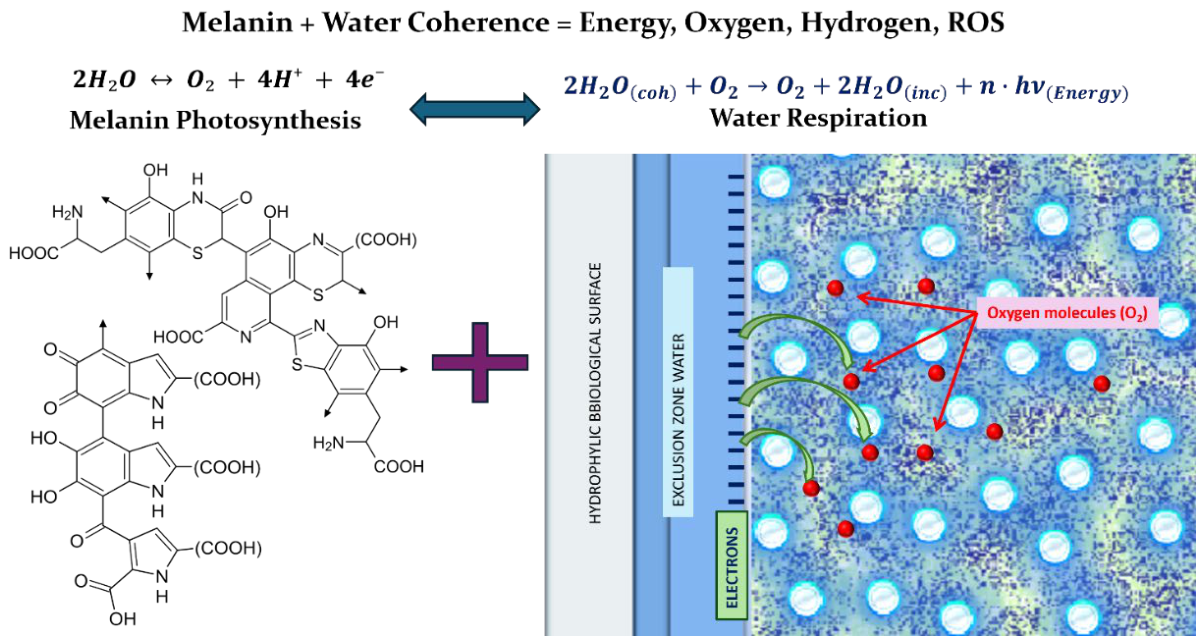
Therefore, it can be concluded that, among the various possible “water respirations” pathways (catalyzed by different chemical species), the one in synergy with melanin would certainly be one of the most significant:
Figure 3.
Scheme that aims to represent the synergy and/or possible correspondence between the “photosynthesis” promoted by melanin and the respiration of coherent water. The two types of melanin (eumelanin and pheomelanin, on the left) would be able to exert a protective role for the coherence of the water connectome, they being able to withstand the harsh effects of higher-energy radiation. Simultaneous dissociation of water is possible because 10% of coherently excited electrons are close to the ionization threshold. While this is a reasonable hypothesis, it nevertheless requires further investigation and verification.
Figure 3.
Scheme that aims to represent the synergy and/or possible correspondence between the “photosynthesis” promoted by melanin and the respiration of coherent water. The two types of melanin (eumelanin and pheomelanin, on the left) would be able to exert a protective role for the coherence of the water connectome, they being able to withstand the harsh effects of higher-energy radiation. Simultaneous dissociation of water is possible because 10% of coherently excited electrons are close to the ionization threshold. While this is a reasonable hypothesis, it nevertheless requires further investigation and verification.
6. Conclusions and Remarks
In this contribution, we wish to highlight the relevance of both Herrera’s discoveries concerning melanin’s role in energy production and oxygen regulation, as well as to draw attention to the concept of living matter offered by Quantum Field Theory. We propose that the two areas of research complement each other, providing novel understanding of the bioenergetics and biochemistry of organisms. Currently, this field is still treated semi-quantitatively, but we are convinced that the proposed approach provides the basis for a more refined theoretical framework that can be corroborated experimentally.
Melanin mediated “photosynthesis”, in which the associated coherent fraction of water play a central role, becomes evident when considering that it would take something like 50 to 170 kg of food a day to meet the energetic requirements of an average human adult [81]. The interpretative tools provided by QFT show that production via the collection and channeling of electromagnetic excitations (both intrinsic and extrinsic) fuels the low-entropic state of organisms. Similar to laser-cooling [82], the multimodal laser properties of coherent water accumulate low-grade excitations and to such significant levels as to yield high-energy quanta that can be released on demand [62].
Melanin owns its crucial properties to its numerous delocalized electrons spread across aromatic subunits, in that:
- on the one hand these subunits are essential for photons with large wavelengths (non-ionizing) as support the collection of low-energy excitations, that are routed to the coherent aqueous connectome;
- on the other hand, the same subunits also mitigate the adverse effects of ionizing radiation. Without the absorption of these high energy quanta, the coherent connectome would be seriously compromised, resulting in all the known adverse side effects known in radiation sickness. The transduction and conversion of these high-energy photons into less energetic “chunks” “feed” the coherent water matrix. In concert with co-resonating molecular species this ensemble of coherently oscillating molecules couple to the various biochemical cycles (super-coherence), where they can be released ‘on demand’ with the appropriate energy [83].
The idea that water is the fundamental driver of this process is validated by the existence of life in environments deprived of solar light (e.g. the zoonosis of hydrothermal vents in the aphotic zone of the oceans or extremophiles in anoxic environments such as archaea) [84]. This could suggest the possibility that nutritional uptake through food could be something more addressed to our microbiome and strictly not for our energetics/metabolism, supporting some claims about people who could live without eating, provided that they are exposed to the full solar spectrum]. Indeed, the “breatharian” hypothesis is certainly an exotic and speculative concept, yet it provides clues as to how living organisms can feed on water, CO2, and UV-VIS light within an N2/O2 rich environment [85]. Along with supplements of N, S, and P, the idea of being fed on does not seem so far-fetched. In fact, some prokaryotes are capable of doing just that [86]. Certain bacteria require just an electrical discharge to retrieve their biosynthetic capabilities [87]. Solein®, a brand name about to be commercialized, is synthesized from Xanthobacter flavus. It claims to extract hydrogen and oxygen from its surroundings and captures carbon dioxide (CO2) to produce a protein-rich biomass that does not originate from either vegetable or animal matter6. The case of Prahlad Jani who claims to have survived for decades with little or no food and water, however, still remains unresolved7 [88]. Of course, this is still to be rigorously verified.
Finally, the role of coherent water in the organism, as the main “source of energy”, highlights the need to revise established theories in medicine and physiology not only with regard to energy production and oxygen distribution, but also with regard to the current cardio-hemodynamic model. According to this model, blood is pushed into the smallest capillaries solely by the pressure action of cardiac systole [89]. However, this is untenable, given the enormous pressure drop that blood, which is quite viscous, would experience alongside with the progressive branching and increasingly narrowing blood vessels. Recent experimental studies have demonstrated that a Nafion® tube with a sufficiently small-diameter exposed to infrared radiation (even the thermal background radiation at room temperature is sufficient to establish such zoning), aided by the internal endothelial layer a zoning of interfacial water (EZ-water) [90]. This structure acts as a cushion, enabling red blood cells (RBCs) to pass through these narrow capillaries without the need of an external pump. This is analogous to what happens in vivo when blood flows through 4-5 µm wide capillaries, [91] which are capable of dragging erythrocytes (whose average diameter is 7-8 µm) though them, despite the fact that, according to the r4 dependence stated by the Hagen–Poiseuille principle, friction rises with the 4th power as the tube radius decreases. Therefore, the pressure wave originating from the contraction of the heart in peripheral capillaries is insufficient8, a topic that will be addressed in a future paper.
In light of physico-chemical aspects that cannot be ignored anymore, a more up-to-date model of physiology is required. Clearly, two major research paths meet here. With this work we aim to build a bridge between them, in order to support a radically different vision of biology and medicine, naïve puts less emphasis on “molecularism”, which or more than a century has prevented the life sciences from dealing with the physical (and semantic [83]) processes that characterizes the living dynamics.
Author Contributions
Both the authors contributed equally to the compilation of this article. All authors have read and agreed to the published version of the manuscript.
Funding
This research received no external funding.
Institutional Review Board Statement
Not applicable as this study did not involve experimental trials with humans or animals.
Informed Consent Statement
Not applicable.
Data Availability Statement
Not applicable.
Conflicts of Interest
The authors declare no conflicts of interest.:
References
- A. S. Herrera, «The Intrinsic Chemistry of Melanin Modifies Radically Current Concepts about the Bioenergetics of Photosynthesis: A Review,» in Recent Research Advances in Biology Vol. 7, vol. 7, New York, BP International, 2021, pp. 57-68.
- A. Herrera, M. Esparza, G. Ashraf, A. A. Zamyatnin Jr e G. Aliev, «Beyond Mitochondria, What Would be the Energy Source of the Cell?,» Central Nervous System Agents in Medicinal Chemistry, vol. 15, n. 1, pp. 32-41, 2015. [CrossRef] [PubMed]
- E. Dadachova, R. Bryan, X. Huang, T. Moadel, A. Schweitzer e al, «Ionizing Radiation Changes the Electronic Properties of Melanin and Enhances the Growth of Melanized Fungi,» PLoS ONE, vol. 2, n. 5, pp. 1-13, 2007.
- D. B. Geoffrey Goodman, «Melanin directly converts light for vertebrate metabolic use: Heuristic thoughts on birds, Icarus and dark human skin,» Medical Hypotheses, vol. 71, n. 2, pp. 190-202, 2008. [CrossRef] [PubMed]
- A. Herrera, M. Esparza e M. Arias, «A Novel Method to Improve Quality of Drinking Water, Based on the Eye’s Biology,» Journal of Water Resource and Protection, vol. 14, n. 4, pp. 318-333, 2022. [CrossRef]
- E. Del Giudice, A. De Ninno, M. Fleischmann, G. Mengoli, M. Milani, G. Talpo e G. Vitiello, «Coherent Quantum Electrodynamics in Living Matter,» Electromagnetic Biology and Medicine, vol. 24, n. 3, pp. 199-210, 2005. [CrossRef]
- E. Del Giudice, S. Doglia, M. Milani e G. Vitiello, «A quantum field theoretical approach to the collective behavior of biological systems,» Nuclear Physics B, vol. 251, n. 13, p. 375, 1985. [CrossRef]
- F. Solano, «Melanins: Skin Pigments and Much More—Types, Structural Models, Biological Functions, and Formation Routes,» New Journal of Science, vol. 2014, n. 498276, p. 28, 2014.
- A. Glagoleva, O. Shoeva e E. Khlestkina, «Melanin Pigment in Plants: Current Knowledge and Future Perspectives,» Frontiers in Plant Science, vol. 11, n. 770, June 2020.
- W. Cao, X. Zhou, N. McCallum, Z. Hu, Q. Ni, U. Kapoor, C. Heil, K. Cay, T. Zand, A. Mantanona, A. Jayaraman, A. Dhinojwala, D. Deheyn, M. Shawkey, M. Burkart, J. Rinehart e N. Gianneschi, «Unraveling the Structure and Function of Melanin through Synthesis,» Journal of the American Chemical Society, vol. 143, n. 7, pp. 2622-2637, 2021. [CrossRef] [PubMed]
- L. Guo, W. Li, Z. Gu, L. Wang, L. Guo, S. Ma, C. Li, J. Sun, B. Han e J. Chang, «Recent Advances and Progress on Melanin: From Source to Application,» International Journal of Molecular Sciences, vol. 24, n. 5, p. 4360, 2023. [CrossRef] [PubMed]
- R. Cordero e A. Casadevall, «Melanin,» Current Biology, vol. 30, n. 4, pp. 142-143, 2020.
- K. Byun, J. Lee e S. Oh, «Melanin Characteristics,» in Melanin - A Biological Perspective and Aesthetic Approach, Singapore, Springer, 2025, pp. 3-18.
- S. Song, H. Yang, S. Liu, H. Yu, D. Li, P. Li e R. Xing, «Melanin: insights into structure, analysis, and biological activities for future development,» Journal of Materials Chemistry B, vol. 11, n. 32, pp. 7528-7543, 2023. [CrossRef] [PubMed]
- M. Blois, «Structure, The Melanins: Their Synthesis and Structure,» in Photochemical and Photobiological Reviews, Boston, Springer, 1978, p. 115–134.
- J. Oh, J. Kim, S. Son, W. Jung, D. Kim, J. Seo e G. Kim, «Fungal melanin as a biocompatible broad-spectrum sunscreen with high antioxidant activity,» Royal Society of Chemistry Advances, vol. 11, n. 32, pp. 19682-19689, 2021. [CrossRef] [PubMed]
- E. Kim, Z. Wang, J. Phua, W. Bentley, E. Dadachova, A. Napolitano e G. Payne, «Enlisting electrochemistry to reveal melanin’s redox-related properties,» Materials Advances, vol. 5, n. 8, pp. 3082-3093, 2024. [CrossRef]
- E. Kim, M. Kang, T. Tschirhart, M. Malo, E. Dadachova, G. Cao, J. Yin, W. Bentley, Z. Wang e G. Payne, «Spectroelectrochemical Reverse Engineering Demonstrates that Melanin’s Redox and Radical Scavenging Activities are Linked,» Biomacromolecules, vol. 18, n. 12, pp. 4084-4098, 2017. [CrossRef] [PubMed]
- M. Terranova, «Prominent Roles and Conflicted Attitudes of Eumelanin in the Living World,» International Journal of Molecular Sciences, vol. 24, n. 9, p. 7783, 2023. [CrossRef] [PubMed]
- N. El-Naggar e W. Saber, «Natural Melanin: Current Trends, and Future Approaches, with Especial Reference to Microbial Source,» Polymers, vol. 14, n. 7, p. 1339, 2022. [CrossRef] [PubMed]
- A. Blàzquez-Castro e J. Stockert, «Biomedical overview of melanin. 1. Updating melanin biology and chemistry, physico-chemical properties, melanoma tumors, and photothermal therapy,» Biocell, vol. 45, n. 4, p. 849–862, 2021. [CrossRef]
- N. Al-Shamery, D. Biyashev e L. e. a. Blancafort, «From melanogenesis to melanin technologies,» Communications Chemistry, vol. 8, n. 323, 2025.
- S. Ito e K. Fujita, «Microanalysis of eumelanin and pheomelanin in hair and melanomas by chemical degradation and liquid chromatography,» Analytical Biochemistry, vol. 144, n. 2, pp. 527-536, 1985. [CrossRef] [PubMed]
- K. Wakamatsu e S. Ito, «Advanced chemical methods in melanin determination,» Pigment Cell & Melanoma Research, vol. 15, n. 3, pp. 174-183, 2002. [CrossRef] [PubMed]
- G. Gosset, Melanins: Functions, Biotechnological Production, and Applications, Springer, 2023.
- S. Premi, S. Wallisch, C. Mano, A. Weiner, A. Bacchiocchi, K. Wakamatsu, E. Bechara e R. D. T. B. D. Halaban, «Photochemistry. Chemiexcitation of melanin derivatives induces DNA photoproducts long after UV exposure,» Photochemistry, vol. 347, n. 6224, pp. 842-847, 2015. [CrossRef] [PubMed]
- G. N. Chauhan A, «Role of Visible Light on Skin Melanocytes: A Systematic Review,» Photochemistry and Photobiology, vol. 97, pp. 911-915, 2021. [CrossRef] [PubMed]
- B. Mahmoud, C. Hexsel, I. Hamzavi e H. Lim, «Effects of Visible Light on the Skin†,» Photochemistry and Photobiology, vol. 84, pp. 450-462, 2008. [CrossRef] [PubMed]
- P. Crippa, F. Martini e C. Viappiani, «Direct evidence of electron—phonon interaction in melanins,» Journal of Photochemistry and Photobiology B, vol. 11, n. 3-4, pp. 371-375, 1991. [CrossRef] [PubMed]
- A. Herrera e S. Suchkov, «The unique property of melanin to dissociate the water molecule like chlorophyll in plants: Implications in the assessment and understanding of genomic instability and Warburg effect in human cancer,» vol. 17, n. Supplement 1, p. S20, 2018. [CrossRef]
- A. Abd-El-Aziz, N. Abed, A. Mahfouz e R. Fathy, «Production and characterization of melanin pigment from black fungus Curvularia soli AS21 ON076460 assisted gamma rays for promising medical uses,» Microbial cell factories, vol. 23, n. 1, p. 68, 2024.
- A. Herrera, M. Esparza, S. A. P.E., M. Ávila-Rodriguez, G. Barreto, Y. Li, S. Bachurin e G. Aliev, «Unsuspected Intrinsic Property of Melanin to Dissociate Water Can Be Used for the Treatment of CNS Diseases,» entral Nervous System & Neurological Disorders - Drug Targets, vol. 15, n. 2, pp. 135-140, 2020.
- E. Dadachova e A. Casadevall, «Ionizing radiation: how fungi cope, adapt, and exploit with the help of melanin,» Current Opinion in Microbiology, vol. 11, n. 6, pp. 525-528, 2008. [CrossRef] [PubMed]
- S. Premi e e. al., «Chemiexcitation of melanin derivatives induces DNA photoproducts long after UV exposure,» Science, vol. 347, pp. 842-847, 2015. [CrossRef] [PubMed]
- G. S. Gajula RP, «Commentary: Chemiexcitation of melanin derivatives induces DNA photoproducts long after UV exposure,» Frontiers of Physiology, vol. 6, n. 276, 2015.
- W. Xie, D. A. N. Gianneschi e M. Shawkey, «Interactions of Melanin with Electromagnetic Radiation: From Fundamentals to Applications,» Chemical Reviews, vol. 124, n. 11, pp. 7165-7216, 2024. [CrossRef] [PubMed]
- H. Kim, S. Oh, C. Choi, Y. J.Y. e al, «Attenuation Effect of Radiofrequency Irradiation on UV-B-Induced Skin Pigmentation by Decreasing Melanin Synthesis and through Upregulation of Heat Shock Protein 70,» Molecules, vol. 26, n. 24, p. 7648, 2021. [CrossRef] [PubMed]
- J. Kim, D.-J. Kang, J. Seok, M.-H. Kim, D.-S. Kim, S.-B. Jeon, H.-D. Choi, J. Moon, N. Kim e H. Kim, «Exposure to Radiofrequency Electromagnetic Fields Enhances Melanin Synthesis by Activating the P53 Signaling Pathway in Mel-Ab Melanocytes,» International Journal of Molecular Sciences, vol. 25, n. 22, p. 12457, 2024. [CrossRef] [PubMed]
- K. Kim, Y. Lee, N. Kim, H. Choi, D. Kang, H. Kim e K. Lim, «Effects of Electromagnetic Waves with LTE and 5G Bandwidth on the Skin Pigmentation In Vitro,» International Journal of Molecular Sciences, vol. 22, n. 1, p. 170, 2020. [CrossRef] [PubMed]
- E. Mackenzie, F. Connor e D. Ekaterina, «Assessing Melanin Capabilities in Radiation Shielding and Radioadaptation,» Journal of Medical Imaging and Radiation Sciences, vol. 50, n. 1, pp. Supplement-S2, 2019.
- P. Abramov, S. Zhukov, Z. Bedran, B. Gorshunov e K. Motovilov, «Analysis of Melanin Properties in Radio-Frequency Range Based on Distribution of Relaxation Times,» in 5th International Conference on Nanotechnologies and Biomedical Engineering, 2022.
- A. Abd-El-Aziz, N. Abed, A. Mahfouz e R. Fathy, «Production and characterization of melanin pigment from black fungus Curvularia soli AS21 ON076460 assisted gamma rays for promising medical uses,» Microbial Cell Factories, vol. 23, n. 68, p. 19, 2024.
- A. Choudhury e D. Ghosh, «Elucidating the Structure of Melanin and Its Structure-Property Correlation,» Accounts of Chemical Research, vol. 58, n. 9, pp. 1509-1518, 2025. [CrossRef] [PubMed]
- A. Herrera, A. Esparza, P. Arias, G. Ashraf, O. Mosa, V. Fisenko, S. Sologova, S. Dostdar, A. Sokolov, E. Bovina, V. Chubarev, V. Tarasov, S. Somasundaram, C. Kirkland e G. Aliev, «The Role of Melanin to Dissociate Oxygen from Water to Treat Retinopathy of Prematurity,» Central nervous system agents in medicinal chemistry, vol. 19, n. 3, pp. 215-222, 2019. [CrossRef] [PubMed]
- G. Preparata, QED Coherence in Matter, World Scientific, 1995.
- G. Preparata, An Introduction to a Realistic Quantum Physics, World Scientific, 2002.
- M. Blasone, J. Jizba e G. Vitiello, Quantum field theory and its macroscopic manifestations, London: Imperial College Press, 2011.
- A. Kurcz, A. Capolupo, A. Beige, E. Del Giudice e G. VItiello, «Rotating wave approximation and entropy,» Physics Letters A, vol. 374, n. 36, pp. 3726-3732, 2010b. [CrossRef]
- H. Fröhlich, Coherent Excitations in Biological Systems, Springer-Verlag, 1983.
- E. Del Giudice, V. Voeikov, A. Tedeschi e G. Vitiello, «The origin and the special role of coherent water in living systems,» in Fields of the Cell, Kerala, India: Research Signpost, 2015, pp. 95-111.
- S. Kauffman, The Origins of Order, Self-Organisation and Selection in Evolution, New York: Oxford University Press, 1993.
- V. Elia, G. Ausanio, A. De Ninno, R. Germano, E. Napoli, Niccoli e M., «Experimental Evidences of Stable Water Nanostructures at Standard Pressure and Temperature Obtained by Iterative Filtration,» Water Journal, vol. 5, pp. 121-130, January 2013.
- J. von Neumann, Mathematical Foundations of Quantum Theory, Princeton: Princeton University Press, 1955.
- J. Bernal e R. Fowler, «A Theory of Water and Ionic Solution, with Particular Reference to Hydrogen and Hydroxyl Ions,» Journal of Chemical Physics, vol. 1, n. 8, p. 515, 1933. [CrossRef]
- W. Röntgen, «Ueber die Constitution des flüssigen Wassers Annalen der Physik,» Annalen der Physik, vol. 281, n. 1, pp. 91-97, 1892.
- A. Garbelli, «Proprietà termodinamiche e dielettriche dell’acqua alla luce della teoria complessa delle interazioni molecolari rlettrodinamiche ed elettrostatiche,» Tesi di Laurea, pp. 1-89, May 2000.
- I. Bono, E. Del Giudice, L. Gamberale e M. Henry, «Emergence of the Coherent Structure of Liquid Water,» Water, vol. 4, pp. 510-532, 2012. [CrossRef]
- P. Renati e P. Madl, «What Is the “Hydrogen Bond”? A QFT-QED Perspective,» International Journal of Molecular Sciences, vol. 25, n. 7, p. 3846, 2024. [CrossRef] [PubMed]
- P. Renati, QED in Condensed and Living Matter - From theoretical background to epistemological implications, Hamburg: VERLAG DR. KOVAČ, 2024, p. 492.
- R. Arani, I. Bono, E. Del Giudice e G. Preparata, «QED coherence and the thermodynamics of water,» International Journal of Modern Physics B, vol. 9, pp. 1813-1841, 1995. [CrossRef]
- E. Del Giudice, P. Stefanini, A. Tedeschi e G. Vitiello, «The interplay of biomolecules and water at the origin of the active behaviour of living organisms,» Journal of Physics: Conference Series (), vol. 329, 2011.
- E. Del Giudice, P. R. Spinetti e A. Tedeschi, «Water Dynamics at the Root of Metamorphosis in Living Organisms,» Water, pp. 566-586, 2012.
- R. Germano, E. Del GIudice, A. De Ninno, V. Elia, C. Hison, V. Tontodonato, D. Cirillo e F. Tuccinardi, «Oxhydroelectric effect in Bi-distilled water,» Key Engineering Materials, vol. 543, pp. 455-459, March 2013. [CrossRef]
- T. Yinnon, V. Elia, E. Napoli, R. Germano e Z. Liu, «Water Ordering Induced by Interfaces: An Experimental and Theoretical Study,» Water, vol. 7, pp. 96-128, May 2016.
- J. Zheng, A. Wexler e G. Pollack, «Effect of buffers on aqueous solute-exclusion zones around ion-exchange resins,» Journal of Colloid and Interface Science, vol. 332, n. 2, pp. 511-514, Aprile 2009. [CrossRef] [PubMed]
- G. L, «Part II - Complexity and Life Sciences (in italian),» in Complex Systems in Medicine, vol. 1, Roma, Mooxi Srl, 2024.
- J. Clegg, «Intracellular Water, Metabolism, and Cell Architecture: Part 2,» in Coherent Excitations in Biological Systems. Proceedings in Life Sciences, Berlin, SpringerNature, 1983, pp. 162-177.
- J. Clegg, «Metabolic consequences of the extent and disposition of the aqueous intracellular environment,» Journal of Experimental Zoology, vol. 215, n. 3, pp. 303-313, 1981. [CrossRef] [PubMed]
- V. Voeikov e E. Del Giudice, «Water Respiration, the basis of the living state,» Water Journal, vol. 1, p. 52 – 75, July 2009.
- W. Dröge, «Free radicals in the physiological control of cell function,» Physiological Reviews, vol. 82, n. 1, pp. 47-95, 2002. [CrossRef] [PubMed]
- V. Voeikov, «Reactive oxygen species, water, photons and life,» Biology Forum/Rivista di Biologia, vol. 94, n. 2, pp. 237-258, May-Aug 2001.
- V. Voeikov, «Reactive oxygen species (ROS) pathogens or sources of vital energy? Part 1. ROS in normal and pathologic physiology of living systems,» Journal of Alternative and Complementary Medicine, vol. 12, n. 2, pp. 111-118, March 2006. [CrossRef] [PubMed]
- H. P. Souza, X. Liu, A. Samouilov, P. Kuppusamy, F. R. M. Laurindo e a. J. L. Zweier, «Quantitation of superoxide generation and substrate utilization by vascular NAD(P)H oxidase,» American Journal of Physiology-Heart and Circulatory Physiology, vol. 282, n. 2, pp. 466-474, 2002.
- J. Trimarchi, L. Liu, D. Porterfield, P. Smith e D. Keefe, «Oxidative phosphorylation-dependent and -independent oxygen consumption by individual preimplantation mouse embryos,» Biology of Reproduction, vol. 62, n. 6, pp. 1866-1874, 2000. [CrossRef] [PubMed]
- M. J. Green e H. O. Hill, «Chemistry of dioxygen,» Methods in Enzymology, vol. 105, pp. 3-22, 1984. [CrossRef] [PubMed]
- E. Cadenas e H. Sies, «Low-level chemiluminescence as an indicator of singlet molecular oxygen in biological systems,» Methods in Enzymology, vol. 105, pp. 221-231, 1984. [CrossRef] [PubMed]
- G. Domrachev, Y. Rodygin e D. Selivanovskii, «The role of sound and of liquid water as a dynamically unstable polymeric system in mechanochemically activated oxygen-generating processes under terrestial conditions,» Russian journal of physical chemistry, vol. 66, n. 3, pp. 457-460, 1992.
- V. Vaks, G. Domrachev, Y. Rodygin e al., «Dissociation of water by microwave radiation,» Radiophysics and Quantum Electronics, vol. 37, n. 1, pp. 85-88, 1994. [CrossRef]
- S. Ikeda, T. Takata, M. Komoda, M. Hara, J. N. Kondo, K. Domen, A. Tanaka, H. Hosono e H. Kawazoe, «Mechano-catalysis—a novel method for overall water splitting,» Physical Chemistry Chemical Physics, vol. 1, n. 18, pp. 4485-4491, 1999. [CrossRef]
- A. Mostert e al, «The photoreactive free radical in eumelanin,» Science Advances, vol. 4, n. eaaq1293, 2018. [CrossRef] [PubMed]
- M. Esparza, R. Arias, P. Arias, M. Arias e H. A.S., «The Unexpected Capability of Melanin to Split the Water Molecule and the Alzheimer’s Disease,» Neuroscience and Medicine, vol. 2, n. 3, pp. 217-221, 2011.
- A. Beige, P. L. Knight e G. Vitiello, «Cooling many particles at once,» New Journal of Physics, vol. 7, n. 96, pp. 1-10, April 2005. [CrossRef]
- P. Madl e P. Renati, «Quantum Electrodynamics Coherence and Hormesis: Foundations of Quantum Biology,» International Journal of Molecular Sciences, vol. 24, n. 18, p. 14003, 2023. [CrossRef] [PubMed]
- S. Altalhi, J. Schultz, T. Jamil e e. al., «Decoding microbial diversity, biogeochemical functions, and interaction potentials in red sea hydrothermal vents,» nvironmental Microbiome, vol. 20, n. 118, 2025.
- C. Vidal, he Beginning and the End - The Meaning of Life in a Cosmological Perspective, The Frontiers Collection a cura di, Springer Cham, 2014, p. 379.
- K. Malik e D. Claus, «Xanthobacter flavus, a new species of nitrogen-fixing hydrogen bacteria,» International Journal of Systematic and Evolutionary Microbiology, vol. 29, n. 4, pp. 283-287, 1979. [CrossRef]
- J. Foster e J. Litchfield, «A continuous culture apparatus for the microbial utilization of hydrogen produced by electrolysis of water in closed-cycle space systems,» Biotechnology and Bioengineering, vol. 6, n. 4, pp. 441-456, 1964. [CrossRef]
- M. Mast, «Claims of anomalously long fasting: An assessment of the evidence from investigated cases,» Explore, vol. 16, n. 5, pp. 287-296, 2020. [CrossRef] [PubMed]
- R. Marinelli, B. Fuerst, H. Zee, A. McGinn e W. Marinelli, «The Heart is not a pump - A refutation of the Pressure Propulsion Premise of Heart Function,» Frontier Perspectives, vol. 5, n. 1, pp. 15-24, 1995.
- A. Yu, P. Carlson e G. Pollack, «Unexpected axial flow through hydrophilic tubes: Implications for energetics of water,» The European Physical Journal Special Topics, vol. 223, p. 947–958, April 2014. [CrossRef]
- S. Reitsma, D. Slaaf, H. Vink, A. van Zandvoort e o. E. M. MG, «The endothelial glycocalyx: composition, functions, and visualization,» Pflügers Archiv - European Journal of Physiology, vol. 454, n. 3, pp. 345-359, 2007.
- D. W. Lübbers, N. Opitz, P. P. Speiser e H. J. Bisson, «Notizen: Nanoencapsulated Fluorescence Indicator Molecules Measuring pH and pO2 Down to Submicroscopical Regions on the Basis of the Optode-Principle,» Zeitschrift für Naturforschung C, vol. 32, n. 1-2, pp. 133-134, 1977. [CrossRef] [PubMed]
- T. Ye, L. Hong, J. Garguilo, A. Pawlak, G. Edwards, R. Nemanich, T. Sarna e J. Simon, «Photoionization Thresholds of Melanins Obtained from Free Electron Laser-Photoelectron Emission Microscopy, Femtosecond Transient Absorption Spectroscopy and Electron Paramagnetic Resonance Measurements of Oxygen Photoconsumption,» Photochemistry and Photobiology, vol. 82, n. 3, pp. 7333-737, 2006. [CrossRef] [PubMed]
| 1 | The actual concentration of oxygen in tissues depends on several factors, including oxygen consumption by cells, distance from capillaries, partial pressure of oxygen in the blood, and the oxygen-carrying capacity of hemoglobin. In the old model, oxygen moves from the lungs to the tissues through a pressure gradient, but its solubility in water is limited, making the process inefficient and the transport capacity of hemoglobin insufficient to meet the body’s theoretically estimated energy requirements. Oxygen is a non-polar molecule and poorly soluble in water. Its solubility decreases with increasing temperature and increases with pressure. At 37 °C, the solubility of oxygen in water is approximately 0.033 g per kg of water. Hemoglobin transports most of the oxygen in the blood. Each gram of hemoglobin can bind approximately 1.34 mL of oxygen. However, the actual amount of oxygen available to tissues depends on hemoglobin saturation and partial pressure of oxygen. Studies [92] have shown that under normal conditions, the partial pressure of oxygen (pO2) in tissues is lower than in arterial blood, with values that can fall below 5 mmHg in some areas. Atmospheric oxygen, therefore, does not appear to be the main source of oxygen for all tissues, which is why Solís-Herrera suggests that oxygen is generated locally where it is needed through the dissociation of water mediated by melanin. |
| 2 | In this context, we are referring to the Standard Model (SM). This does not mean that it would be inappropriate, or even unnecessary, to pursue physical and cosmological research from different theoretical perspectives. |
| 3 | We cannot explore this topic in depth here, but we will provide a brief explanation. The slowly varying envelope (SVE) approximation ignores the significant reduction (renormalization) in the frequency of the electromagnetic field when it is coupled to matter quanta. Under the premise that certain density and amplitude thresholds are met, this approximation considers the amplitude of the electromagnetic field mode responsible for exciting the matter oscillators to be a constant and much smaller than the phase (exponential) term. This makes it impossible to grasp the possibility of departing from the system’s perturbative ground state (PGS). Such a departure from the PGS implies the formation of a set of stably coupled electromagnetic field quanta and matter field quanta oscillating in phase (the coherent domain). The Rotating Wave Approximation (RWA) involves neglecting the counter-rotating terms in the system’s Hamiltonian, although oscillating rapidly constitutes a negligible contribution to the system dynamics under resonance conditions. This approximation is valid when the interactions are weak and the time scales between the rotating and counter-rotating terms differ by at least one or two orders of magnitude. However, doing so – especially when the couplings between the field and the matter become significant, is problematic as the counter-rotating part of the Hamiltonian can no longer be neglected as it is related to the entropy operator and induces an irreversible temporal evolution. This causes the vacuum state to become a generalized coherent state, showing the entanglement of the modes in which the counter-rotating terms are expressed [48]. |
| 4 | By "energy gap" we mean the difference in energy (approximately 0.16 eV) between the vacuum levels of the isolated (higher) and coherent molecule (lower), thus expressing the thermodynamic stability of the latter, and indicating how much energy must be required to disrupt its coherence (knock a molecule out of coherence). |
| 5 | Photoionization threshold for eumelanin was determined to be 4.4 eV, corresponding to a wavelength of approximately 282 nm in the UV-B region of the electromagnetic spectrum. Pheomelanin has two photoionization thresholds: the first is similar to that of eumelanin, at 4.4 eV (282 nm), and the second is even lower at around 3.8 eV, corresponding to a wavelength of approximately 326 nm, which is located in the UV-A region of the electromagnetic spectrum [93]. |
| 6 | |
| 7 | |
| 8 | See “The Helical Heart”: https://youtu.be/N6ORMHi9rcU
|
Figure 1.
Molecular structures of the two main types of melanin found in living organisms. Eumelanin (left panel) is a dark-brown to black pigment composed of 5,6-dihydroxyindole (DHI) and 5,6-dihydroxyindole-2-carboxylic acid (DHICA) monomer units containing 6% - 9% nitrogen. Pheomelanin (right panel) in the other hand, is a reddish-brown pigment composed of benzothiazine monomer units containing 8% - 11% nitrogen and 9% - 12% sulfur. When subjected to acidic permanganate oxidation, eumelanin’s DHI converts into pyrrole-2,3-dicarboxylic acid (PDCA) and DHICA into pyrrole-2,3,5-tricarboxylic acid (PTCA). Pheomelanin oxidation, however, results in 1,3-thiazole-2,4,5-tricarboxylic acid (TTCA) and 1,3-thiazole-4,5-dicarboxylic acid (TDCA) [23,24,25]. The neuromelanin found in mammalian brains is an insoluble, brown, variable mixture of eumelanin and pheomelanin, of an unknown synthesis. Unlike eumelanin, which is a weaker reducing agent, pheomelanin reduces molecular oxygen at an appreciable rate even in absence of light [26], just fueled by the IR, thermal, background [2].
Figure 1.
Molecular structures of the two main types of melanin found in living organisms. Eumelanin (left panel) is a dark-brown to black pigment composed of 5,6-dihydroxyindole (DHI) and 5,6-dihydroxyindole-2-carboxylic acid (DHICA) monomer units containing 6% - 9% nitrogen. Pheomelanin (right panel) in the other hand, is a reddish-brown pigment composed of benzothiazine monomer units containing 8% - 11% nitrogen and 9% - 12% sulfur. When subjected to acidic permanganate oxidation, eumelanin’s DHI converts into pyrrole-2,3-dicarboxylic acid (PDCA) and DHICA into pyrrole-2,3,5-tricarboxylic acid (PTCA). Pheomelanin oxidation, however, results in 1,3-thiazole-2,4,5-tricarboxylic acid (TTCA) and 1,3-thiazole-4,5-dicarboxylic acid (TDCA) [23,24,25]. The neuromelanin found in mammalian brains is an insoluble, brown, variable mixture of eumelanin and pheomelanin, of an unknown synthesis. Unlike eumelanin, which is a weaker reducing agent, pheomelanin reduces molecular oxygen at an appreciable rate even in absence of light [26], just fueled by the IR, thermal, background [2].
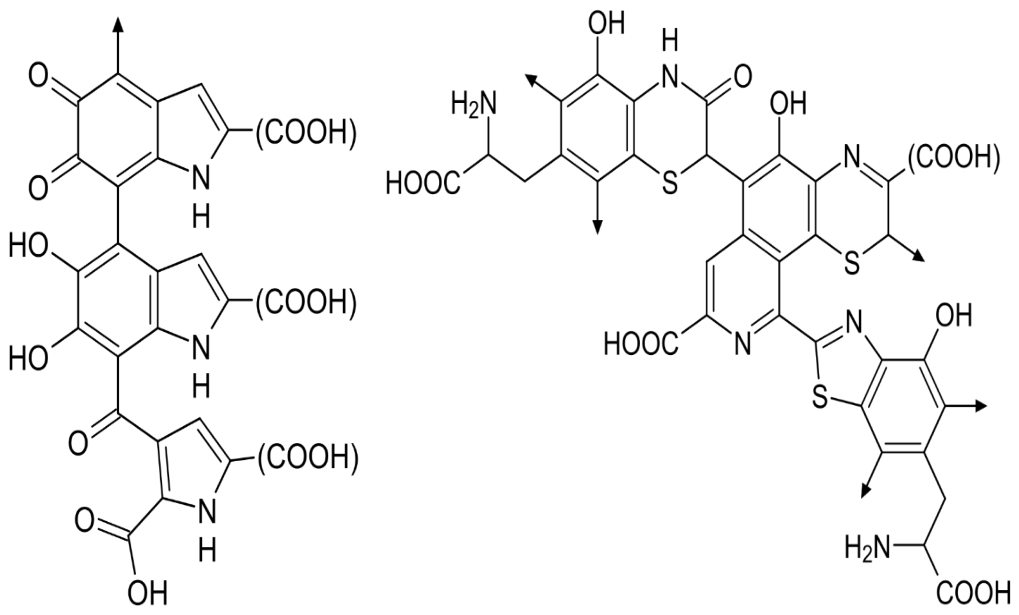
Figure 2.
Figurative ex vivo scheme representing water respiration [69], referring to the couple EZ-bulk water (where EZ layers are of the order of hundreds of micrometers, depending on the case). This process is interconnected with the reduction of oxygen molecules by electrons and their subsequent recomposition, as well as the production of ROS, as well as hydrogen and energy in the form of both electric charges and photons. The curious and unique feature of the above reaction is that the initial and the final step appear to be identical, i.e. water. The difference lies in the fact that the H2O on the left belongs to the excited (coherent) fraction, whereas the H2O on the right refers to the ground state (incoherent) bulk fraction. In simplified terms, quasi-free electrons migrate from the coherent interfacial zone to oxygen molecules (dissolved in the bulk liquid fraction of water), promoting their reduction in a process whereby water is oxidized and dissociated. This process, in which coherent water requires minimal energy to dissociate, and give rise to a “slow (or mild) combustion”, should certainly be considered as the basis for the “photosynthesis” catalyzed by melanin. Melanin plays a central role in both (i) distributing high energy radiation (having a decohering effect) into quanta that can be “managed” by the coherent water matrix and (ii) catalyzing the oxidation/reduction reactions of water, oxygen, and hydrogen. Clearly, this conceptual idea requires still experimental verifications, by elaborating on the energies exchanged and the required chemical steps involved.
Figure 2.
Figurative ex vivo scheme representing water respiration [69], referring to the couple EZ-bulk water (where EZ layers are of the order of hundreds of micrometers, depending on the case). This process is interconnected with the reduction of oxygen molecules by electrons and their subsequent recomposition, as well as the production of ROS, as well as hydrogen and energy in the form of both electric charges and photons. The curious and unique feature of the above reaction is that the initial and the final step appear to be identical, i.e. water. The difference lies in the fact that the H2O on the left belongs to the excited (coherent) fraction, whereas the H2O on the right refers to the ground state (incoherent) bulk fraction. In simplified terms, quasi-free electrons migrate from the coherent interfacial zone to oxygen molecules (dissolved in the bulk liquid fraction of water), promoting their reduction in a process whereby water is oxidized and dissociated. This process, in which coherent water requires minimal energy to dissociate, and give rise to a “slow (or mild) combustion”, should certainly be considered as the basis for the “photosynthesis” catalyzed by melanin. Melanin plays a central role in both (i) distributing high energy radiation (having a decohering effect) into quanta that can be “managed” by the coherent water matrix and (ii) catalyzing the oxidation/reduction reactions of water, oxygen, and hydrogen. Clearly, this conceptual idea requires still experimental verifications, by elaborating on the energies exchanged and the required chemical steps involved.
Disclaimer/Publisher’s Note: The statements, opinions and data contained in all publications are solely those of the individual author(s) and contributor(s) and not of MDPI and/or the editor(s). MDPI and/or the editor(s) disclaim responsibility for any injury to people or property resulting from any ideas, methods, instructions or products referred to in the content. |
© 2026 by the authors. Licensee MDPI, Basel, Switzerland. This article is an open access article distributed under the terms and conditions of the Creative Commons Attribution (CC BY) license (http://creativecommons.org/licenses/by/4.0/).
Copyright: This open access article is published under a Creative Commons CC BY 4.0 license, which permit the free download, distribution, and reuse, provided that the author and preprint are cited in any reuse.