

Submitted:
06 August 2026
Posted:
06 August 2026
You are already at the latest version
Abstract
The deposition of light-absorbing aerosols like dark brown carbon (d-BrC) accelerates cryospheric melt, yet accurately modeling this radiative forcing is hindered by a lack of empirical data. To address this gap, we developed a novel, low-footprint laboratory snow synthesis and deposition apparatus. This system couples the cryogenic generation of nature-identical snow with controlled aerosol dry deposition, allowing spectral albedo reductions to be quantified via an integrating sphere spectrophotometer. The setup was rigorously validated using Cabojet, a highly absorbing BC proxy, achieving high-fidelity optical closure with the Snow, Ice, and Aerosol Radiative (SNICAR) model (root-mean-square error < 0.022) and establishing a 165 parts per billion (ppb) detection limit of BC in snow. Applying this validated methodology to nebulized d-BrC tarballs revealed that the dry deposition of ∼1000 ppb d-BrC drives a visible broadband albedo decrease of 0.06. This apparatus offers a highly controlled, empirical platform to ground-truth theoretical radiative forcing calculations for diverse, real-world cryospheric contaminants. Further, by introducing a modular and rapid laboratory set up, these experiments overcome the limitations of outdoor field studies and resource-intensive cold rooms.
Keywords:
snow albedo
; dark brown carbon
; light-absorbing particles
; SNICAR model
; cryogenic synthesis
; integrating sphere
; aerosol-cryosphere interactions
1. Introduction
The deposition of light-absorbing particles (LAPs) onto the cryosphere triggers a powerful snow-darkening effect by dominating visible broadband albedo reductions [1], exerting a baseline global annual mean surface radiative forcing of up to +0.054 W m−2 [2,3]. Modern deposition profiles demonstrate an increasingly complex LAP burden on global snowpacks characterized by highly diverse aerosol mixtures. This includes black carbon concentrations in mid-latitude regions that exceed polar baselines by up to two orders of magnitude, driving nearly 20% of the albedo reduction across the Tibetan Plateau [4]. Biomass and fossil fuel burning produce plumes of smoke that can travel thousands of kilometers before depositing light-absorbing carbon on snow and ice [5]. Furthermore, this burden is compounded by mineral dust, which dominates high-altitude snow darkening over High Mountain Asia [6] as massive storms from the Taklamakan Desert persistently darken surrounding mountain snowpacks across multiple seasons [7]. This complexity is exacerbated by the emergent accumulation of microplastics across the Arctic, Antarctic, and alpine cryosphere [8]. Despite these substantial regional impacts, the Intergovernmental Panel on Climate Change (IPCC) [9] notes that most CMIP6 climate models do not explicitly represent the darkening of snow by the deposition of this complex aerosol mixture, leading to a systemic underestimation of global radiative forcing.
Beyond this broad mixture of aerosols, the specific parameterization of carbonaceous particles constitutes a major source of uncertainty, primarily due to the intricate brown-black continuum of light-absorbing combustion aerosols [10]. Along this continuum, the imaginary part of the refractive index (k) varies by orders of magnitude, progressing from weakly absorbing light brown carbon ( at 550 nm) to strongly absorbing dark brown carbon (d-BrC; at 550 nm) depending on combustion conditions. Recent aircraft measurements and global assessments have revealed the ubiquity of d-BrC in wildfire plumes, demonstrating that its mass absorption cross-section (0.5 to 1.5 m2 g−1 at 500 nm) and overall shortwave absorption frequently rival or exceed that of black carbon, challenging the traditional paradigm of black carbon absorption dominance [11,12]. Consequently, the deposition of d-BrC has emerged as a potent, yet critically under-evaluated, radiative forcing agent in global snowpacks. A recent modeling study [13] established that d-BrC deposition alone can increase annual mean snow radiative forcing by 0.6 to 17.9 W m−2, a 1.6- to 2.1-fold enhancement over scenarios considering only black carbon deposition. Given that current models struggle to capture these dynamics, He, 2022 [14] asserts that “more measurements of BrC optical properties and concentrations in snow are needed” to effectively constrain model estimates. This explicit gap necessitates the development of controlled empirical methodologies capable of precise laboratory deposition.
While robust methodologies have been developed for laboratory sea-ice generation [15,16], the controlled synthesis of nature-identical snow presents significantly greater logistical challenges. Conventional approaches to actual snow generation typically necessitate resource-intensive, walk-in cold rooms to house massive experimental chambers, such as those requiring 24-hour prolonged crystal growth times to produce merely a few kilograms of snow [17,18]. Conversely, techniques circumventing indoor facilities rely heavily on naturally freezing outdoor environments, tethering experimental feasibility to unstable ambient temperatures and weather conditions [19]. Consequently, attempts to study aerosol deposition on snow often suffer from a lack of strict microphysical control; for instance, recent efforts to quantify the effects of brown carbon deposition were constrained by their reliance on outdoor natural snowpacks, where the lack of environmental containment limits precise optical baselining [20].
To overcome these limitations, the field desperately requires a simple, low-footprint method to simultaneously generate snow and conduct precise, controlled aerosol deposition within a standard, ambient-temperature laboratory. The direct precursor to our apparatus was introduced by Hadley and Kirchstetter, 2012 [21], who utilized a liquid nitrogen-based methodology to synthesize snow doped with black carbon. By spraying an aqueous aerosol suspension into a 1.3-m-tall insulated chamber cooled to -100 °C, their technique inherently trapped the aerosols within the ice matrix during the phase change. This internal freezing mechanism fundamentally differs, both physically and optically, from true atmospherically relevant dry deposition, wherein aerosols are deposited onto the surfaces of existing snow grains. This is especially relevant as dry deposition flux has been found to be more than five times greater than wet deposition flux [22]. Building upon this foundation, our custom-built, low-footprint apparatus overcomes these spatial and logistical friction points. By facilitating true aerosol dry deposition onto laboratory-generated snow, the system enables highly controlled optical investigations into the radiative forcing of light-absorbing aerosols without the need for expansive cold rooms or outdoor environments.
2. Materials and Methods
2.1. Laboratory Snow Generation and Aerosol Deposition
To precisely study the radiative impacts of light-absorbing aerosols on snowpack in a controlled setting, we developed a custom-built laboratory snow generation and deposition apparatus. The system simulates natural snow accumulation by flash-freezing individually atomized water droplets during gravitational settling. The primary component is a 4-foot-tall, thermally insulated styrofoam snow generation chamber. Liquid nitrogen is introduced into the bottom of the chamber to establish cryogenic ambient temperatures through evaporation, which are tunable down to ∘C. Water is injected into the top of the chamber from a pressurized liquid dispensing tank through an ultra-fine fogging nozzle (ITW Vortec, 60-200 m droplet size). The tank pressure is regulated by a step-down pressure regulator, allowing the operator to adjust the liquid feed pressure (typically maintained around 10 psi). To further control the atomized droplet size, a flow control valve is used between the tank and the nozzle. Inside the air-powered nozzle, the pressurized water flow is sheared apart into fine droplets by compressed air (40 psi) at a maximum spray angle of 21°. The compressed air flow through the nozzle also serves to circulate the air within the chamber and increase the liquid nitrogen evaporation rate by preventing pooling at the bottom of the chamber. As the droplets descend through the cryogenic environment, they rapidly freeze into granular ice crystals that accumulate at the base of the chamber, closely mimicking the physical properties of fresh natural snow. A schematic overview of the entire snow generation apparatus is presented in Figure 1a.
Following snow synthesis, snow is collected into multiple sample holders. A flat surfaced putty knife is used to compact the snow in the sample holder and spread the surface evenly. Aerosols are deposited onto the snow surface in a controlled manner. For this study, we focused on Cabojet 200 (Cabot Corporation) and dark brown carbon (d-BrC) aerosols. Cabojet 200 is a BC-like material that has been used for BC analysis in ice and snow [23,24], and is deposited on snow samples for system validation and limit of detection calculations. Cabojet 200 suspensions in water of varying dilution ratios are aerosolized using a Collison nebulizer. D-BrC is deposited on snow samples as a case study to demonstrate an application of the system to a less well-known particle. D-BrC aerosol was generated via the piezoelectric nebulization of liquid tar suspension followed by a thermal heat shock in a tube furnace [25]. The aerosol stream is subsequently cooled to prevent localized melting of the snowpack upon impaction. Dry deposition of the d-BrC tarballs onto the snow surface is achieved using an inverted funnel enclosure that ensures spatially homogeneous deposition (Figure 1b). An SMPS was inserted in parallel to measure particle size distribution. D-BrC aerosol was nebulized at a flow rate of 0.2 LPM and diluted by a factor of 20 using nitrogen gas. The total deposition time (ranging from 2 to 4 minutes) is tuned to vary the surface mass loading of the light-absorbing particles across different samples. During deposition, the snow sample holder is held in a bath of evaporating liquid nitrogen to ensure the snow remains frozen, and a slight air gap is maintained between the inverted funnel and sample holder to allow residual air to flow out.
2.2. Integrating Sphere Reflectance Spectrophotometer
We utilized a spectrophotometric technique based on an integrating sphere to quantify the spectral albedo reduction of the contaminated snow. The optical system centers on a 6-inch diameter integrating sphere (RT-060-SF, Labsphere Inc.) lined with Spectraflect, a highly reflective Lambertian coating (Figure 1c). The sphere is illuminated by a collimated halogen light source capable of a maximum 10 W output. The source is driven by a programmable DC power supply controller, which allows for precise regulation of the output current and target set points.
Snow samples are collected in custom-designed 3D-printed cylindrical holders with a depth of approximately 5 cm, which exceeds the ultraviolet and visible light penetration depth for snow, thereby ensuring semi-infinite optical thickness. The sample holder is mounted flush against the measurement port of the integrating sphere. The measurement port is located opposite to the collimated light source, with the rays reflecting off the surface of the sample undergoing multiple reflections within the integrating sphere and being distributed uniformly over the interior surface of the sphere. The input light is spatially integrated, hence the name “integrating” sphere. A portion of this spatially integrated light enters a detector port where a spectrometer via fiber optic cable records the intensity of the reflected light. The ratio of the spectral intensity measured for a sample to that measured for a known reference can be used to calculate the spectral albedo for the sample [26]. Spectral reflectance is measured over the 350–1000 nm wavelength range using a high-resolution spectrometer (Flame-S-VIS-NIR, Ocean Optics). Measurements were made under the single beam measurement condition with the reference and sample physically swapped at the same port. Typically, this results in single-beam substitution errors due to the variation in the sphere’s throughput between the reference and the sample. However, because the samples have a high albedo (>0.85) that are close to the reference albedo, this error is negligible, allowing the spectral albedo of the snow to be derived directly from the ratio of the measured intensities.
2.3. Optical Microscopy and Microphysical Characterization
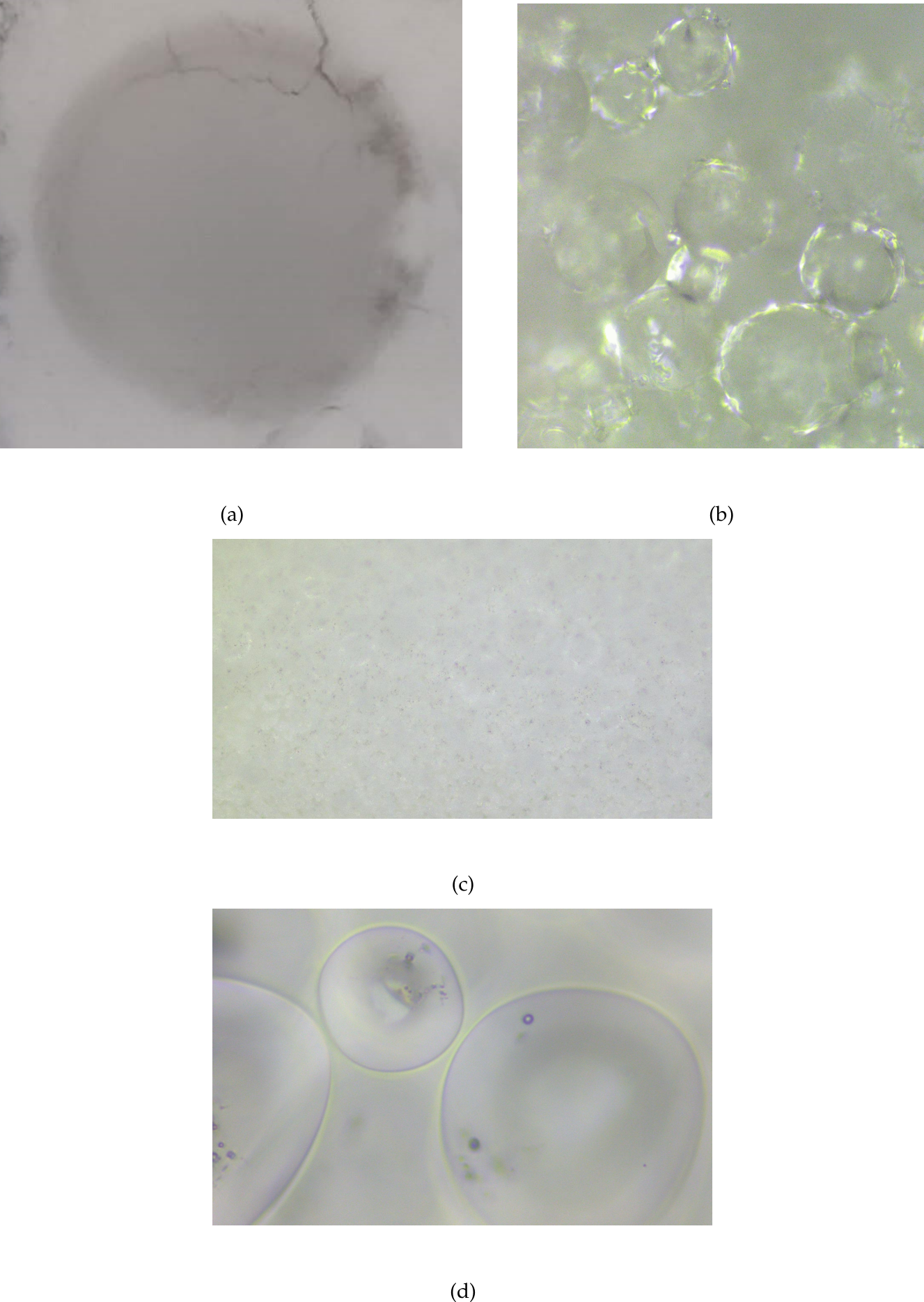
In parallel with the bulk optical measurements, we performed microphysical characterization of the synthesized snow grains and deposited aerosols. A thin layer of the freshly generated snow was collected on a pre-chilled, improvised aluminum block designed to prevent rapid melting. The snow grains were imaged using a high-magnification digital light microscope. These microscopic observations confirmed that the laboratory-generated snow features dendritic structures and grain diameters of approximately 100 m, consistent with observations of natural fresh snow. Furthermore, the microscopy provided visual confirmation of the homogeneous distribution and mixing state of the dry-deposited d-BrC tarballs across the snow surface.
3. Results and Discussion
3.1. Optical Validation Using Cabojet
To rigorously validate the snow synthesis, aerosol deposition, and optical measurement system, initial experiments were conducted using a standardized, highly absorbing BC proxy (Cabojet). Spectral reflectance was measured for pristine laboratory-synthesized snow and snow doped with sequentially diluted aerosol suspensions (100x dilution all the way up to 100000x dilution). To isolate the physical optical signature from high-frequency instrumental noise, the raw, uncut directional reflectance arrays were processed using a Savitzky-Golay filter (window length = 151, polynomial order = 3) and truncated strictly to the 400–800 nm visible spectrum to avoid near-infrared artifacts from the halogen light source.
Because the spectrometer measures directional reflectance, which can naturally exceed 1.0 in forward-scattering geometries due to the faceted nature of ice crystals, the experimental spectra were dynamically scaled by a constant factor of 0.98. This scaling successfully mapped the directional observations onto the hemispheric albedo bounds (maximum 1.0) utilized by radiative transfer models.
To achieve optical closure, the experimental curves were compared against theoretical hemispheric albedos simulated by the Snow, Ice, and Aerosol Radiative (SNICAR-ADv4) model [27,28] (Figure 2a). Snow samples, which were 5 cm thick, were assumed to consist of two layers: a top layer with aerosol homogenously mixed, and an underlying layer of pristine snow. In the model, the physical structure of the snowpack was locked across all samples to a realistic compacted matrix of snow grains (density 200 kg m−3, effective grain radius 50 µm, top layer thickness 10 mm), allowing only the equivalent black carbon (BC) mass concentration to vary.
The model successfully reproduced the empirical spectral shapes with high fidelity. The 1000x and 100x dilution curves matched SNICAR outputs for 100 ppb and 1000 ppb of BC, respectively, yielding an average joint root-mean-square error (RMSE) of under 0.022. The distinct visible-spectrum curvature (400–600 nm) indicative of carbonaceous absorption is perfectly captured. Furthermore, the tenfold increase in modeled mass loading (100 ppb to 1000 ppb) directly mirrors the tenfold sequential dilution of the source suspension. This optical closure confirms that the deposition system operates with high predictability and linearity, and that the laboratory-generated snowpack responds to radiative forcing in accordance with established physical theory.
3.2. Limit of Detection (LOD) and System Boundaries
Having established optical closure, the boundaries of the measurement system were quantified. For atmospheric and cryospheric applications, integrating spectral data into a single broadband albedo metric is necessary to evaluate total shortwave energy balances. Consequently, the individual measured spectral albedos were collapsed into visible broadband albedos (VBA) by weighting the spectra by the incident irradiance fraction for a standard mid-latitude summer solar spectrum.
To calculate the Limit of Detection (LOD) of the optical measurement system, the uncertainty band (noise floor) of the pristine snow VBA was established. A regression of VBA versus logarithmic aerosol concentration was then performed using the standardized Cabojet-doped samples. As shown in Figure 2b, the LOD was determined at the intersection of the concentration regression and the pristine noise floor. The resulting BC-equivalent LOD is 164.5 ppb. This threshold indicates that the presented methodology is highly capable of detecting and quantifying the particulate darkening effect in moderately to heavily polluted snowpacks, establishing clear operational boundaries for future field-mimicking experiments.
3.3. Application to d-BrC Deposition
Following system validation, the methodology was applied to a complex, novel aerosol: nebulized liquid tar dark brown carbon (d-BrC). The d-BrC deposition was conducted in parallel with a Scanning Mobility Particle Sizer (SMPS) to empirically measure the aerosol size distribution and number concentration. By coupling the SMPS data with the deposition time and flow rate, precise surface mass loadings were calculated (468.4 ppb, 527.3 ppb, and 1028.1 ppb) assuming homogeneous mixing in the upper 10 mm of the snowpack. For the heaviest loading of 1028.1 ppb, the experimental visible broadband albedo dropped to 0.93 from a pristine albedo of 0.99, a decrease of 0.06.
Using these mass loadings, forward SNICAR simulations were performeds. As shown in Figure 3, while the heaviest deposition case (1028.1 ppb) showed reasonable agreement in the short-visible wavelengths, at lower deposition masses close to the limit of detection, modeled albedos diverged from experimental albedos, particularly at longer wavelengths ( nm).
This divergence suggests the necessity of the empirical methodology presented in this study. SNICAR and similar radiative transfer models assume ideal, spherical particles with neat external or internal mixing states embedded uniformly within an infinite ice matrix. The divergence of the model from the SMPS-derived d-BrC curves suggests that the morphological, mixing, and refractive properties of d-BrC are more complex than what standard parameterizations accurately predict.
3.4. Microphysical Evidence of Aerosol Deposition
Optical microscopy was performed on the snow samples (Figure 4) to observe snow grain shape and size, as well as aerosol deposition. The microscopy aligns with the structural assumptions used in the SNICAR modeling, including that pristine snow grains (Figure 4b) exhibit roughly spherical geometries on the order of 100 m in diameter, supporting the m effective radius parameter utilized in the optical closure.
However, images of the d-BrC deposited snow (Figure 4c and Figure 4d) reveal complex aerosol-snow interactions. The d-BrC particles do not deposit as independent, uniformly distributed spheres; rather, they exhibit clumping, pooling, and localized aggregation along ice crystal boundaries and air bubbles. These non-uniform microphysical changes during the dry deposition of d-BrC may not be adequately captured by standard radiative transfer models. Consequently, these images help underscore the critical need for robust, physical laboratory simulation chambers to empirically measure the true radiative forcing of complex carbonaceous aerosols.
4. Conclusions
In this study, we presented a novel, low-footprint laboratory apparatus designed for the cryogenic synthesis of nature-identical snow and the subsequent controlled dry deposition of aerosols. By coupling this generation chamber with an integrating sphere spectrophotometer, we achieved high-fidelity optical closure (average joint RMSE < 0.022) using a standardized carbonaceous proxy, establishing a visible broadband limit of detection of 165 ppb equivalent black carbon. Furthermore, the application of this system to nebulized d-BrC tarballs demonstrated that morphologically complex aerosols form localized aggregates and pools along ice crystal boundaries. These complex microphysical interactions drive nuanced spectral albedo reductions that deviate from the idealized spherical mixing states typically utilized in standard radiative transfer models, underscoring the necessity of empirical methodologies to accurately constrain aerosol radiative forcing.
Beyond static optical validation, the modular, multifunctional, and customizable design of this apparatus provides a robust platform for developing a process-based understanding of aerosol-cryosphere interactions. Future methodological refinements may focus on optimizing deposition flow rates and exposure times to mitigate surface cratering and localized melting during heavy dosing. Additionally, the controlled nature of the chamber enables high-resolution studies on the temporal evolution of snowpack optics, facilitating experiments on snow metamorphosis and grain evolution under varying relative humidity (RH) conditions and thermal cycling. Further microphysical investigations are also warranted to understand the precise structural and optical implications of LN2-soaked snow resulting from this specific cryogenic synthesis process.
This laboratory set up offers broad utility for the next generation of cryospheric research. As recent literature highlights the expanding diversity of light-absorbing impurities, this system is uniquely positioned to investigate the radiative impacts of established as well as emerging contaminants, including microplastics [29], snow algae [30], and other visible-light-absorbing pigments. Snow albedo geoengineering, which has recently attracted attention [31], may also be tested using this system before wider deployment. Furthermore, the lifecycle of these deposited particles can be comprehensively tracked beyond initial deposition through simulated meltwater analysis and subsequent re-aerosolization studies utilizing a Single Particle Soot Photometer (SP2). By providing an empirical bridge between complex aerosol morphologies and theoretical radiative transfer, this methodology supports a more accurate, holistic understanding of contaminant-driven cryospheric melt.
Author Contributions
G.S.C. and R.K.C. conceptualized the study. G.S.C. designed and built the experimental setup. Experiments and data collection were performed by G.S.C., L.Z., and S.Y. Data analysis and visualization were performed by G.S.C. The first draft of the manuscript was written by G.S.C. and all authors read and approved the final manuscript. R.K.C. was responsible for funding acquisition.
Funding
This research has been supported by the Simons Foundation, the Quad Fellowship, and the McDonnell Scholars Academy.
Institutional Review Board Statement
Not applicable.
Informed Consent Statement
Not applicable.
Data Availability Statement
The data that support the findings of this study are available from the corresponding author upon reasonable request.
Conflicts of Interest
The authors declare no conflicts of interest.
References
- Warren, S.G. Optical Properties of Snow. Rev. Geophys. 1982, 20, 67–89. [Google Scholar] [CrossRef]
- Flanner, M.G.; Zender, C.S.; Randerson, J.T.; Rasch, P.J. Present-Day Climate Forcing and Response from Black Carbon in Snow. J. Geophys. Res. Atmos. 2007, 112. [Google Scholar] [CrossRef]
- Skiles, S.M.; Flanner, M.; Cook, J.M.; Dumont, M.; Painter, T.H. Radiative Forcing by Light-Absorbing Particles in Snow. Nat. Clim. Change 2018, 8, 964–971. [Google Scholar] [CrossRef]
- Kang, S.; Zhang, Y.; Qian, Y.; Wang, H. A Review of Black Carbon in Snow and Ice and Its Impact on the Cryosphere. Earth-Sci. Rev. 2020, 210, 103346. [Google Scholar] [CrossRef]
- Zhou, J.; Tie, X.; Xu, B.; Zhao, S.; Wang, M.; Li, G.; Zhang, T.; Zhao, Z.; Liu, S.; Yang, S.; et al. Black Carbon (BC) in a Northern Tibetan Mountain: Effect of Kuwait Fires on Glaciers. Atmos. Chem. Phys. 2018, 18, 13673–13685. [Google Scholar] [CrossRef]
- Sarangi, C.; Qian, Y.; Rittger, K.; Ruby Leung, L.; Chand, D.; Bormann, K.J.; Painter, T.H. Dust Dominates High-Altitude Snow Darkening and Melt over High-Mountain Asia. Nat. Clim. Change 2020, 10, 1045–1051. [Google Scholar] [CrossRef]
- Xing, Y.; Chen, Y.; Yan, S.; Cao, X.; Zhou, Y.; Zhang, X.; Shi, T.; Niu, X.; Wu, D.; Cui, J.; et al. Dust Storms from the Taklamakan Desert Significantly Darken Snow Surface on Surrounding Mountains. Atmos. Chem. Phys. 2024, 24, 5199–5219. [Google Scholar] [CrossRef]
- Zhang, Y.; Gao, T.; Kang, S.; Shi, H.; Mai, L.; Allen, D.; Allen, S. Current Status and Future Perspectives of Microplastic Pollution in Typical Cryospheric Regions. Earth-Sci. Rev. 2022, 226, 103924. [Google Scholar] [CrossRef]
- Intergovernmental Panel On Climate Change (Ipcc). Climate Change 2021 – The Physical Science Basis: Working Group I Contribution to the Sixth Assessment Report of the Intergovernmental Panel on Climate Change, 1 ed.; Cambridge University Press, 2023. [Google Scholar] [CrossRef]
- Saleh, R.; Cheng, Z.; Atwi, K. The Brown–Black Continuum of Light-Absorbing Combustion Aerosols. Environ. Sci. Technol. Lett. 2018, 5, 508–513. [Google Scholar] [CrossRef]
- Chakrabarty, R.K.; Shetty, N.J.; Thind, A.S.; Beeler, P.; Sumlin, B.J.; Zhang, C.; Liu, P.; Idrobo, J.C.; Adachi, K.; Wagner, N.L.; et al. Shortwave Absorption by Wildfire Smoke Dominated by Dark Brown Carbon. Nat. Geosci. 2023, 16, 683–688. [Google Scholar] [CrossRef] [PubMed]
- Xu, L.; Lin, G.; Wu, C.; Chen, X.; Wang, H.; Chen, C.; Chakrabarty, R.K.; Gao, M.; Vakkari, V.; van Zyl, P.G.; et al. Strong Global Radiative Effects from Wildfire Dark Brown Carbon. Nat. Geosci. 2026, 1–8. [Google Scholar] [CrossRef]
- Chelluboyina, G.S.; Kapoor, T.S.; Chakrabarty, R.K. Dark Brown Carbon from Wildfires: A Potent Snow Radiative Forcing Agent? npj Clim. Atmos. Sci. 2024, 7, 1–10. [Google Scholar] [CrossRef] [PubMed]
- He, C. Modelling Light-Absorbing Particle–Snow–Radiation Interactions and Impacts on Snow Albedo: Fundamentals, Recent Advances and Future Directions. Environ. Chem. 2022, 19, 296–311. [Google Scholar] [CrossRef]
- Marks, A.A.; Lamare, M.L.; King, M.D. Optical Properties of Sea Ice Doped with Black Carbon – an Experimental and Radiative-Transfer Modelling Comparison. The Cryosphere 2017, 11, 2867–2881. [Google Scholar] [CrossRef]
- Hall, B.; Johnson, S.; Thomas, M.; Rampai, T. Review of the Design Considerations for the Laboratory Growth of Sea Ice. J. Glaciol. 2023, 69, 953–965. [Google Scholar] [CrossRef]
- Schleef, S.; Jaggi, M.; Löwe, H.; Schneebeli, M. An Improved Machine to Produce Nature-Identical Snow in the Laboratory. J. Glaciol. 2014, 60, 94–102. [Google Scholar] [CrossRef]
- Landolt, S.D.; Rasmussen, R.M.; Hills, A.J.; Underwood, W.; Knight, C.A.; Jachcik, A.; Schwartz, A. The NCAR–FAA Snow Machine: An Artificial Snow-Generation System. J. Atmos. Ocean. Technol. 2018, 35, 2159–2168. [Google Scholar] [CrossRef]
- Brandt, R.E.; Warren, S.G.; Clarke, A.D. A Controlled Snowmaking Experiment Testing the Relation between Black Carbon Content and Reduction of Snow Albedo. J. Geophys. Res. Atmos. 2011, 116. [Google Scholar] [CrossRef]
- Beres, N.D.; Sengupta, D.; Samburova, V.; Khlystov, A.Y.; Moosmüller, H. Deposition of Brown Carbon onto Snow: Changes in Snow Optical and Radiative Properties. Atmos. Chem. Phys. 2020, 20, 6095–6114. [Google Scholar] [CrossRef]
- Hadley, O.L.; Kirchstetter, T.W. Black-Carbon Reduction of Snow Albedo. Nat. Clim. Change 2012, 2, 437–440. [Google Scholar] [CrossRef]
- Wang, Z.W.; Gallet, J.C.; Pedersen, C.A.; Zhang, X.S.; Ström, J.; Ci, Z.J. Elemental Carbon in Snow at Changbai Mountain, Northeastern China: Concentrations, Scavenging Ratios, and Dry Deposition Velocities. Atmos. Chem. Phys. 2014, 14, 629–640. [Google Scholar] [CrossRef]
- Wendl, I.A.; Menking, J.A.; Färber, R.; Gysel, M.; Kaspari, S.D.; Laborde, M.J.G.; Schwikowski, M. Optimized Method for Black Carbon Analysis in Ice and Snow Using the Single Particle Soot Photometer. Atmos. Meas. Tech. 2014, 7, 2667–2681. [Google Scholar] [CrossRef]
- Arienzo, M.M.; McConnell, J.R.; Murphy, L.N.; Chellman, N.; Das, S.; Kipfstuhl, S.; Mulvaney, R. Holocene Black Carbon in Antarctica Paralleled Southern Hemisphere Climate. J. Geophys. Res. Atmos. 2017, 122, 6713–6728. [Google Scholar] [CrossRef]
- You, S.W.; Upadhyay, P.; Kapoor, T.S.; Cheng, Z.; Ren, G.; Puthussery, J.V.; Sumlin, B.J.; China, S.; Mishra, R.; Chakrabarty, R.K. Laboratory Synthesis and Characterization of Wildfire-like Dark Brown Carbon Aerosols. Aerosol Sci. Technol. 2025, 0, 1–13. [Google Scholar] [CrossRef]
- Carr, K.F. Integrating Sphere Theory and Applications Part I: Integrating Sphere Theory and Design. Surf. Coat. Int. 1997, 80, 380–385. [Google Scholar] [CrossRef]
- Flanner, M.G.; Arnheim, J.B.; Cook, J.M.; Dang, C.; He, C.; Huang, X.; Singh, D.; Skiles, S.M.; Whicker, C.A.; Zender, C.S. SNICAR-ADv3: A Community Tool for Modeling Spectral Snow Albedo. Geosci. Model Dev. 2021, 14, 7673–7704. [Google Scholar] [CrossRef]
- Whicker, C.A.; Flanner, M.G.; Dang, C.; Zender, C.S.; Cook, J.M.; Gardner, A.S. SNICAR-ADv4: A Physically Based Radiative Transfer Model to Represent the Spectral Albedo of Glacier Ice. The Cryosphere 2022, 16, 1197–1220. [Google Scholar] [CrossRef]
- Zhang, Y.L.; Kang, S.C.; Gao, T.G. Microplastics Have Light-Absorbing Ability to Enhance Cryospheric Melting. Adv. Clim. Change Res. 2022, 13, 455–458. [Google Scholar] [CrossRef]
- Chevrollier, L.A.; Cook, J.M.; Halbach, L.; Jakobsen, H.; Benning, L.G.; Anesio, A.M.; Tranter, M. Light Absorption and Albedo Reduction by Pigmented Microalgae on Snow and Ice. J. Glaciol. 2023, 69, 333–341. [Google Scholar] [CrossRef]
- Webster, M.A.; Warren, S.G. Regional Geoengineering Using Tiny Glass Bubbles Would Accelerate the Loss of Arctic Sea Ice. Earth’s Future 2022, 10, e2022EF002815. [Google Scholar] [CrossRef]
Figure 1.
Experimental setup for evaluating the radiative forcing of light-absorbing aerosols on snow. (a) Schematic overview of the custom laboratory apparatus used for synthesizing snow under cryogenic conditions. (b) Detailed schematic of the dry deposition setup used to homogeneously deposit d-BrC tarball aerosols onto the snow surface. (c) Configuration of the integrating sphere reflectance spectrophotometer, illustrating the single-beam substitution geometry used for spectral albedo measurements.
Figure 1.
Experimental setup for evaluating the radiative forcing of light-absorbing aerosols on snow. (a) Schematic overview of the custom laboratory apparatus used for synthesizing snow under cryogenic conditions. (b) Detailed schematic of the dry deposition setup used to homogeneously deposit d-BrC tarball aerosols onto the snow surface. (c) Configuration of the integrating sphere reflectance spectrophotometer, illustrating the single-beam substitution geometry used for spectral albedo measurements.
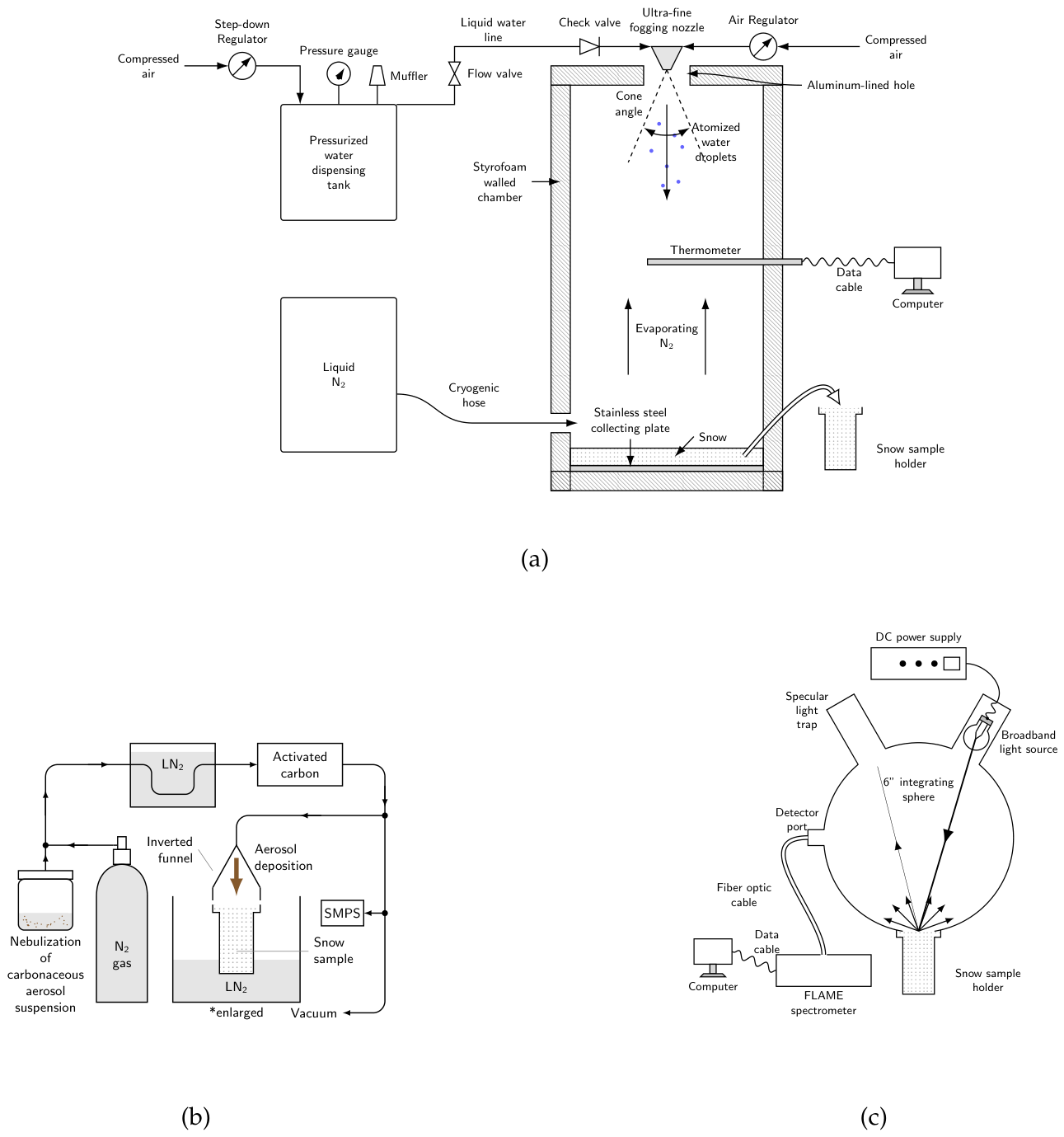
Figure 2.
(a) Optical closure between experimental Cabojet doped snow spectra and SNICAR-ADv4 simulations. (b) Limit of Detection (LOD) regression analysis for the optical measurement system.
Figure 2.
(a) Optical closure between experimental Cabojet doped snow spectra and SNICAR-ADv4 simulations. (b) Limit of Detection (LOD) regression analysis for the optical measurement system.
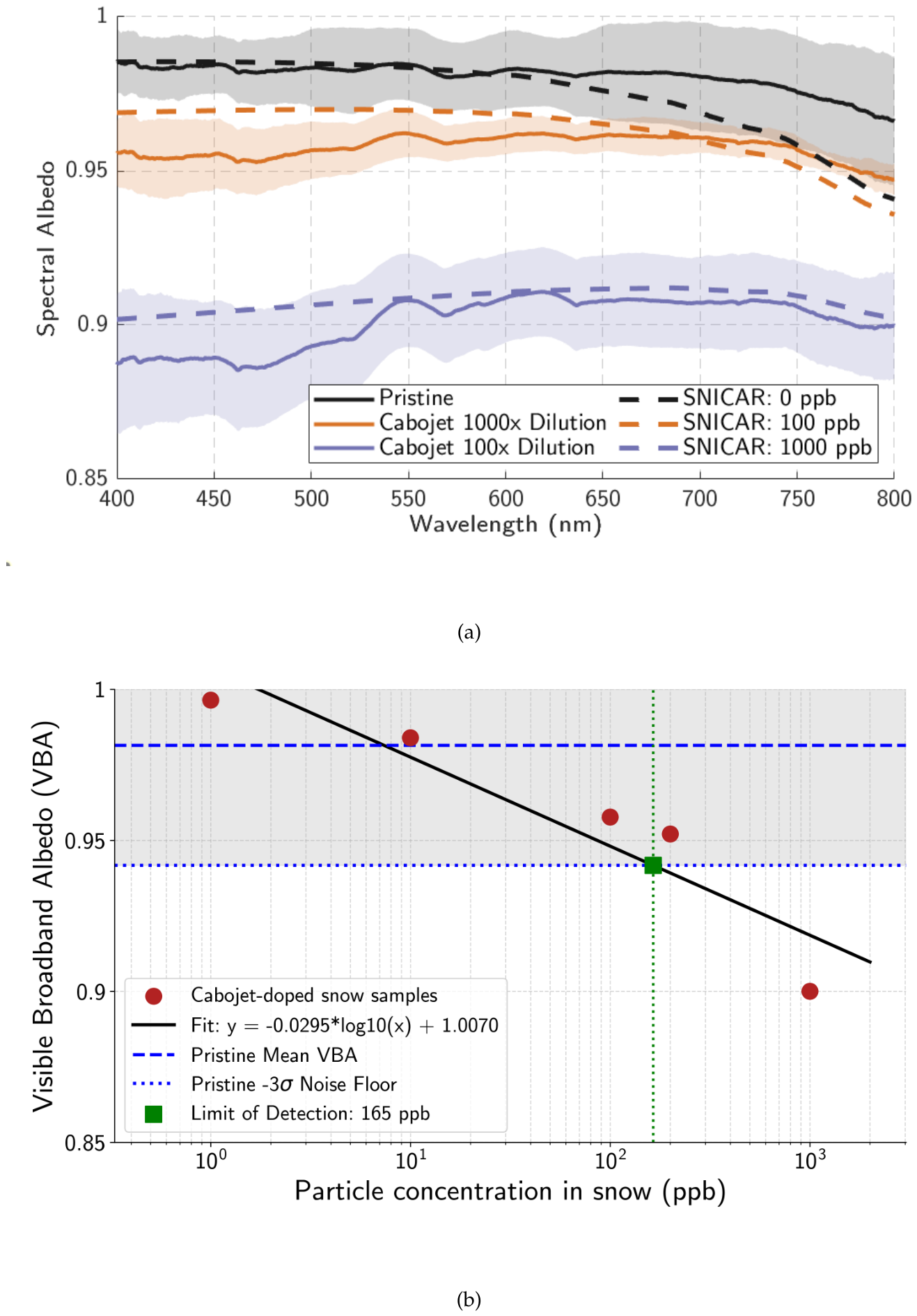
Figure 3.
Divergence between experimental d-BrC doped snow spectra and SNICAR-ADv4 simulations using SMPS-derived mass loadings.
Figure 3.
Divergence between experimental d-BrC doped snow spectra and SNICAR-ADv4 simulations using SMPS-derived mass loadings.
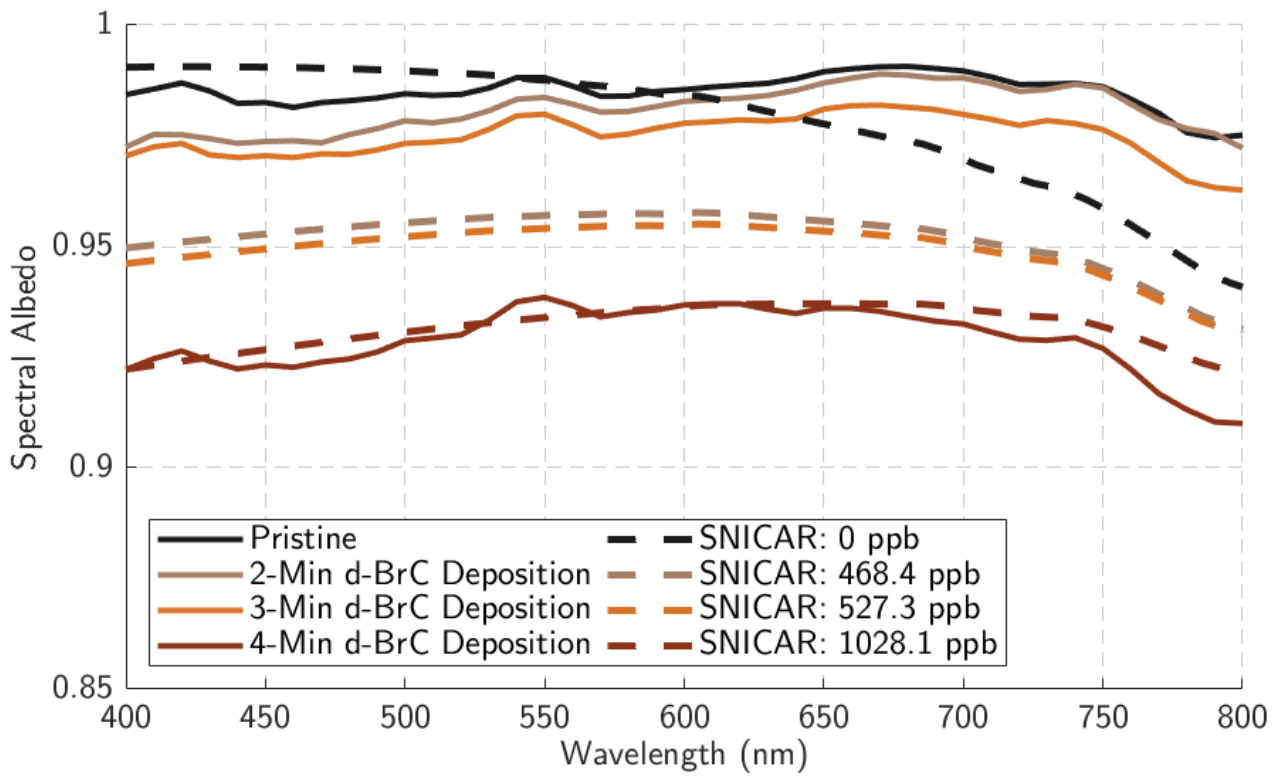
Figure 4.
(a) Macroscopic image of a circular patch of d-BrC deposited snow surrounded by pristine snow (b) Optical microscopy showing pristine laboratory snow grains (c) Optical microscopy view showing deposition of d-BrC over the snow crystal matrix in the foreground, with the outlines of snow grains visible in the background (d) Zoomed in view of snow grains showing bubbles and particles.
Figure 4.
(a) Macroscopic image of a circular patch of d-BrC deposited snow surrounded by pristine snow (b) Optical microscopy showing pristine laboratory snow grains (c) Optical microscopy view showing deposition of d-BrC over the snow crystal matrix in the foreground, with the outlines of snow grains visible in the background (d) Zoomed in view of snow grains showing bubbles and particles.
Disclaimer/Publisher’s Note: The statements, opinions and data contained in all publications are solely those of the individual author(s) and contributor(s) and not of MDPI and/or the editor(s). MDPI and/or the editor(s) disclaim responsibility for any injury to people or property resulting from any ideas, methods, instructions or products referred to in the content. |
© 2026 by the authors. Licensee MDPI, Basel, Switzerland. This article is an open access article distributed under the terms and conditions of the Creative Commons Attribution (CC BY) license.
Copyright: This open access article is published under a Creative Commons CC BY 4.0 license, which permit the free download, distribution, and reuse, provided that the author and preprint are cited in any reuse.