

Submitted:
05 August 2026
Posted:
06 August 2026
You are already at the latest version
Abstract
Immune-inflammatory dysregulation plays a central role in the pathophysiology of schizophrenia (SCZ). Interleukin-33 (IL-33), a pleiotropic alarmin cytokine of the IL-1 family, modulates neuroimmune communication, glial activation, and tissue repair, yet its involvement in psychotic disorders remains poorly characterized. This study examined serum IL-33 concentrations in 21 patients experiencing an acute psychotic relapse and 21 age- and sex-matched healthy controls (HC). Using a longitudinal design, we measured serum IL-33 by ELISA at 12:00 h and 24:00 h on the day after admission and the day before discharge in patients, alongside comprehensive clinical assessment with the Positive and Negative Syndrome Scale (PANSS). Patients with SCZ exhibited significantly lower IL-33 levels than HC at all time points (p < 0.05). Notably, IL-33 concentrations increased significantly at midnight from admission to discharge (p = 0.028), paralleling clinical improvement in PANSS positive and general psychopathology scores. A robust inverse correlation between age and IL-33 levels was observed in both patients and controls (p < 0.05), independent of sex, smoking status, sampling time, and antipsychotic dosage. These findings provide the first longitudinal evidence that IL-33 is reduced during acute psychotic episodes and rises in association with clinical recovery, supporting its role as a state-dependent biomarker. Our results highlight the involvement of alarmin signalling in the neuroimmune dysregulation underlying psychotic relapse and underscore the importance of age as a critical covariate in immunopsychiatric research.
Keywords:
schizophrenia
; interleukin-33
; IL-33
; alarmin
; neuroinflammation
; psychoneuroimmunology
; biomarker
; psychotic relapse
1. Introduction
Schizophrenia (SCZ) is characterized by persistent disturbances in the perception of reality, thinking, emotions, behaviour, and social/occupational functioning (American Psychiatric Association, 2022). The illness presents a remitting and relapsing course, with varying degrees of recovery among affected subjects with most experiencing significant social and functional impairment (Tandon et al., 2024).
The neurobiological basis of SCZ remains partially understood, though there is evidence implicating immune dysregulation in the pathophysiology of the disorder (Kirkpatrick and Miller, 2013). Several studies have reported alterations in peripheral cytokine levels, acute phase proteins and inflammatory proteins in patients with SCZ, both during acute psychotic episodes and in periods of clinical stability (Halstead et al., 2023; Kalmady et al., 2018; Morera et al., 2007). Pro-inflammatory cytokines, such interleukin-2 (Shangguan et al., 2023), interleukin-6, interleukin-18 (Saka et al., 2026), tumour necrosis factor-alpha (TNF-α) and interleukin-1β (IL-1β) (Zhang et al., 2021), have been found to be elevated in some patients, suggesting a possible link between the immune dysregulation and symptom severity, disease progression, or treatment response.
Interleukin-33 (IL-33), a member of the IL-1 cytokine family, has emerged as a key player in neuroinflammation and neuroimmune interactions (Liew et al., 2016). IL-33 functions as a traditional cytokine and as a nuclear alarmin released in response to cellular damage or stress (Liew et al., 2016). IL-33 is expressed in barrier tissues and the central nervous system, where it is mainly produced by astrocytes, oligodendrocytes and endothelial cells, and exerts pleiotropic effects by binding to its ST2 receptor, modulating the activity of various immune cells, including T-helper 2 (Th2) cells, regulatory T cells, and group 2 innate lymphoid cells (Miller, 2011; Schmitz et al., 2005).
Despite its emerging relevance and the association of IL-33 polymorphism with the risk of SCZ (Kordi-Tamandani et al., 2016), the role of blood levels of IL-33 as a SCZ biomarker remains underexplored, particularly in relation to acute psychotic relapses. There are controversial results regarding how IL-33 is altered in SCZ. Increased blood levels in SCZ patients compared to healthy subjects (Borovcanin et al., 2018; Kozłowska et al., 2021) as well a no differences between SCZ patients and healthy subjects (Borovcanin et al., 2018; de Campos-Carli et al., 2017; Koricanac et al., 2022; Petrova et al., 2024) have been reported.
A recent systematic review of IL-33 in SCZ (Tascon-Cervera et al., 2025) highlighted the limited and heterogeneous body of evidence, with substantial variability in clinical status, study designs and psychopathological assessment across published studies, as well as a lack of longitudinal investigations specifically addressed to acute psychotic relapses.
Understanding whether IL-33 levels change during acute exacerbations, and if such changes are reversible upon clinical improvement, could shed light into the biological mechanisms underpinning relapses and recovery in SCZ. The present study aims to investigate serum IL-33 levels in patients with SCZ during an acute psychotic relapse requiring hospitalization.
2. Methods
2.1. Subjects
Twenty-one acute SCZ inpatients meeting DSM-IV criteria for SCZ, paranoid type, participated in the study. Patients were recruited from the emergency unit of the Canary Islands University Hospital before being hospitalised in the psychiatric ward because of an acute psychotic relapse. Patients were diagnosed by two experienced clinical psychiatrists based on the Structured Clinical Interview for the DSM-IV. A sample of 21 healthy controls (HC), matched by age and gender, without personal and family psychiatric history was recruited between the researchers’ acquaintances. Physical healthiness of the HC was evaluated by a short medical history and a general laboratory test. Mental healthiness was assessed informally by asking the subjects if they had received psychiatric treatment in the past or if they were receiving treatment at present or if any first-degree relative was in the past or at present receiving psychiatric treatment. Psychological treatment was considered as well as receiving psychiatric treatment.
The inclusion criteria considered subjects with age between 18 and 65 and being able to speak and understand Spanish. The exclusion criteria considered subjects with intellectual disabilities, previous history of severe trauma and/or head trauma, alcohol and/or substance abuse, physical illness, pregnancy, anti-inflammatories intake, immunosuppressants or antiviral therapy, physical agitation, current infections and autoimmune or metabolic disorders.
2.2. Clinical Assessment
Patients’ psychopathology was assessed with the Spanish adaptation of the Positive and Negative Syndrome Scale (PANSS) (Peralta Martín and Cuesta Zorita, 1994). The PANSS was published in 1987 by Kay, Fiszbein, and Opler (Kay et al., 1987) and was designed to provide an operationalized and standardized assessment of SCZ. The PANSS consists of 30 items divided into three subscales. Each item is scored on a scale from 1 (absent) to 7 (extreme severity). The Positive Scale (7 items: Delusions, Conceptual disorganization, Hallucinatory behaviour, Excitement, Grandiosity, Suspiciousness / Persecution, Hostility) evaluates functions that are “in excess” or present when they should not be. The Negative Scale (7 items: Blunted affect, Emotional withdrawal, Poor rapport (apathy), Passive/Apathetic social withdrawal, Difficulty in abstract thinking, Lack of spontaneity and flow of conversation, Stereotyped thinking) evaluates functions that are “diminished” or absent compared to normal functioning. The General Psychopathology Scale (16 items) measures other symptoms that affect quality of life and prognosis but do not strictly fit into the “positive” or “negative” categories. Somatic concern, Anxiety, Guilt feelings, Tension, Mannerisms and posturing, Depression, Motor retardation, Uncooperativeness, Unusual thought content, Disorientation, Poor attention, Lack of judgment and insight, Disturbance of volition, Poor impulse control, Preoccupation, Active social avoidance are the items that comprise the General Psychopathology Scale.
2.3. Study Protocol
Blood was collected the day after admission and the day before discharge in the group of patients. The blood of HC was collected once in any day between the period of admission and discharge of the patients. Samples were collected at 12:00 and 24:00 hours to minimise the interference with the hospitalization routines and because midday and midnight represent two opposite peak times along the day. To reduce the physical and psychological stress induced by the blood extraction, subjects were relaxed in bed one hour before the extraction. After blood extraction, samples were placed in vacutainer tubes without anticoagulant and allowed to clot, then they were centrifuged at 3000 rpm. during 5 min. After that, serum was separated, aliquoted in Eppendorf tubes, and stored frozen at - 70° C until analysis.
The study protocol was conducted following the Helsinki Declaration, and all subjects gave written informed consent before inclusion. The Ethics and Investigation Committee of the Canary Islands University Hospital approved the protocol (protocol code Nº 2008-41).
2.4. Interleukin-33 Measurements
IL-33 concentration in serum was evaluated using a solid-phase Enzyme Linked Immunosorbent Assay (Millipore, Saint Louis, MO, USA), according to the manufacturers protocol. The kit uses a calibration curve with a range 0-500 pg./ml. Samples and standards absorbance units were read in a microplate spectrophotometer at 450 nm (Spectra MAX-190, Molecular Devices, Sunnyvale, CA, USA). A one phase exponential decay provided the best standard curve fit (the correlations of R 2 of different kits ranged between 0.9967 and 0.9990). The limit of detection (LOD) of the assay was established in 1.202 pg./ml. Intra-assay and inter-assay coefficients of variation (CV) were calculated at 4.09 % and 10.03 %, respectively.
To minimize the assay variance, all serum samples were analysed the same day with the same laboratory batch and by the same analyst. The analyst was blind with respect to the samples pertaining to admission/discharge, day/night, and to patient/control groups.
2.5. Statistical Analysis
Data were analysed using the 29th version of the Statistical Package for the Social Sciences (SPSS, Chicago, Illinois, USA). Patients and healthy subjects’ serum IL-33 differences were compared by means of a t-test for independent samples. Patients’ serum IL-33 differences at admission and discharge as well as 12:00 (day) and 24:00 (night) were analysed by means of a t-test for paired samples. The statistic chi-square was applied to study the association between qualitative variables. Correlations between quantitative variables were analysed with the Pearson coefficient. Quantitative data are presented as mean ± standard deviation (SD) while qualitative data are presented as absolute values and/or percentages.
All statistical tests were two-tailed. Statistical significance level was set at 0.05. When p ranged between 0.06 and 0.09, we describe a trend to significance.
To make all antipsychotic treatments comparable, each patient antipsychotic treatment was converted into chlorpromazine equivalent doses (CED) (Atkins et al., 1997; Woods, 2003).
3. Results
The whole sample was comprised by 42 subjects, 21 HC and 21 SCZ inpatients. Sociodemographic and clinical characteristics of both samples are presented in Table 1. Patients and HC had a similar age. With respect to the distribution of men and women in both samples, there were no sex differences between patients and HC. There were no significant differences in the distribution of smoking status (yes/no) of patients and HC, though there was a trend to significance (0.07), more patients than HC smoked.
In Table 2 we present the comparison of PANSS scales scores between admission and discharge. Positive and global scores decreased significantly between admission and discharge. Negative scores did not change significantly between admission and discharge.
3.1. Description of the Samples’ Characteristics and IL-33 Levels
3.1.1. Healthy Controls
Because there are no normative data about IL-33, the laboratory manufacturer of the ELISA kit recommends using local samples to validate “normal samples”. We tried to know in HC if serum IL-33 was related to age, sex, smoking status (yes/no), and time of the day when blood was extracted, 12:00 or 24:00 hours.
Pearson correlation coefficients between age and serum IL-33 levels in HC was -0.574 (p < 0.006) at 12:00 hours and -0.618 at 24:00 hours (p < 0.003). The inverse correlation between age and IL-33 means that as the subject gets older the serum IL-33 level decrease. Regarding sex, there were no significant differences between men (622.6 ± 883.3) and women (767.3 ± 869.6) at 12:00 hours (p = 0.78) neither at 24:00 hours (men: 603.8 ± 958.9 vs women: 740.5 ± 953.7, p = 0.79). The comparison of serum IL-33 levels between day/night did not elicit differences (12:00: 657.1 ± 857.7 vs 24:00 636.4 ± 835.5, p = 0.58). We could not compare the serum IL-33 levels by smoking status because only two subjects were smokers.
3.1.2. Patients
Comparison of serum IL-33 levels by sex (Table 3) at admission and discharge did not result in significant differences.
As well as in healthy subjects, there was a negative and statistically significant correlation between serum IL-33 levels and age (Table 4) both at admission and discharge and at 12:00 and 24:00 hours. Again, as the subject gets older the serum level of IL-33 decreases.
With respect to the day/night differences (Table 5), there were no significative differences between 12:00 and 24:00 hours at admission or discharge, but at admission there was a trend to significance, IL-33 at 12:00 hours tended to be higher than at 24.00 hours (p = 0.087).
There were no significant differences in IL-33 between smokers (N=8) and no smokers (N=13) (admission 12:00 hours smokers: 167.9 ± 363.0 vs non-smokers: 304.2 ± 434.7, p = 0.49; admission 24:00 hours smokers: 148.7 ± 326.0 vs non-smokers: 279.4 ± 403.5, p = 0.48).
In Table 6 we present the correlations between serum IL-33 and clinical variables controlled by age (partial correlation) at 12:00 and 24:00 hours, both at admission and discharge. There were no significant correlations between serum IL-33 levels and any clinical variable.
3.2. IL-33 Comparisons Between Patients at Admission and Discharge and Healthy Controls
In Figure 1 we present the comparison of serum IL-33 levels at 12:00 and 24:00 hours between patients and HC. Patients had significantly lower levels of serum IL-33 than HC at 12:00 and at 24:00 hours, both at admission and at discharge.
3.3. Comparison of Serum IL-33 Levels by Day-Night and at Admission-Discharge in Patients
According to Table 7, serum IL-33 increased significantly at 24:00 hours between admission and discharge. Serum IL-33 at 12:00 hours increased between admission and discharge, but it did not reach statistical significance.
4. Discussion
As far as we know this is the first longitudinal admission-discharge study that provides evidence that IL-33 participates in the biological processes underlying the acute psychotic relapse and clinical recovery in SCZ. Patients presented significantly lower serum IL-33 concentrations than HC at midday and midnight, both at admission and discharge, indicating an IL-33 deficit that is not limited to the acute phase alone. IL-33 levels increased significantly at midnight from admission to discharge in parallel with the clinical improvement on the positive and general PANNS scores, suggesting a state-dependent improvement of IL-33 signalling during recovery from acute exacerbation.
Previous studies have reported increased IL-33 levels in patients compared to control subjects (Borovcanin et al., 2018; Kozłowska et al., 2021) as well as no differences in IL-33 levels between patients and control subjects (de Campos-Carli et al., 2017; Koricanac et al., 2022; Petrova et al., 2024). The only follow-up research that studied IL-33 levels (Subbanna et al., 2020) do not compare patients with control subjects; they studied the effect of CED on IL-33 after three months of treatment. No change in IL-33 levels was observed. This result is in accordance with our results; there was no correlation between CED and serum IL-33. Other researchers have also reported no relationships between antipsychotics and IL-33 levels (de Campos-Carli et al., 2017; Koricanac et al., 2022).
To our knowledge, this is the first time that the observation of a negative correlation between age and serum IL-33 levels in patients and HC is reported. This finding is consistent with the broader concept of immunosenescence, whereby the alarmin pathways, including IL-33, decline with aging (Li et al., 2024). The lack of significant differences according to sex (men vs. women) or sampling time (day vs. night) in both samples indicate that these factors had little influence on serum IL-33 levels in this study, supporting the reliability of the comparisons between patients and controls.
An interesting result is the increase in serum IL-33 levels from admission to discharge, which reached statistical significance at midnight and showed a similar, though non-significant, trend at midday. This temporal pattern parallels clinical improvement measured with the positive and general PANSS scales and may reflect a partial restoration of immune homeostasis during recovery from acute psychosis. IL-33 is known to function as both a pro-inflammatory cytokine and as a neuroprotective factor involved in synaptic plasticity and neuronal repair, depending on the context and target cells (Fairlie-Clarke et al., 2018; Pandolfo et al., 2021). The progressive rise in IL-33 over the course of hospitalisation could indicate the reactivation of regulatory IL-33 signalling pathways that is suppressed during the acute relapse. It seems as if the increased levels of IL-33 between admission and discharge pointed to an IL-33 “normalization”, compared to the IL-33 level of HC, though longer periods of follow-up will elucidate if patients with low serum IL-33 would reach the serum IL-33 levels of HC. Subbanna et al (Subbanna et al., 2020) compared in an outpatient sample the IL-33 level before treatment and after three months of treatment. They reported a non-statistically significant decrease in IL-33 levels. The main difference with our study is that we had a control group to compare the patients IL-33 levels. An alternative and speculative explanation for the results of Subbanna et al is that the lower IL-33 may act an early predictor of a future relapse.
Taking into consideration the evidence of immune alterations in SCZ, our results fit with the evidence of an altered cytokine network in this disorder. Recent meta-analyses have demonstrated the increased of peripheral levels of several pro-inflammatory cytokines, including IL-6, TNF-α and IL-1-related molecules, particularly during acute psychotic states and in antipsychotic-naïve patients (Halstead et al., 2023). IL-33, as a member of the IL-1 family and an alarmin released by stressed or damaged cells, may participate in this network by influencing glial activation, microglia-neuron crosstalk, and synaptic function (Fairlie-Clarke et al., 2018). The lower IL-33 levels we observed in patients might therefore reflect an inefficient or exhausted alarmin response.
There are two limitations to be considered in our study. First, the sample size is relatively small, which reduces statistical power and may limit the detection of weaker associations. This increases the risk of Type II errors (failing to detect differences that may exist) and makes it difficult to generalize the results to the broader SCZ population. And, second, serum IL-33 represents only a part of the dynamics of the central nervous system, as peripheral and central cytokine patterns can diverge. IL-33 acts through its receptor, ST2. There is a soluble form (sST2) that acts as a “decoy”, blocking IL-33 function. Without measuring sST2, the interpretation of IL-33 levels is incomplete.
On the other hand, our research also has some strength. First, the longitudinal design (admission-discharge). Unlike cross-sectional studies that only measure a single point in time, this research follows the same patients from the acute phase of psychosis through their clinical improvement. This allows the observation of intra-individual changes linked to recovery. Second, the collection of blood samples at 12:00 hours (midday) and 24:00 hours (midnight) is a major methodological asset. Since many cytokines and hormones follow biological rhythms, measuring nocturnal IL-33 adds a layer of precision that no previous studies have considered. Third, the analysis of covariates (age and medication). The study identifies, for the first time, the influence of age on serum IL-33 levels and analyses the correlation with CED, which is essential for ruling out confounding effects. And finally, the originality of our research because IL-33 has been less studied than IL-6 or TNF-α in SCZ. Proposing it as a “state” biomarker (one that changes with clinical improvement) is a novel contribution to the field of immunopsychiatry. However, our findings should be interpreted in the context of the existing literature. A recent systematic review of IL-33, its soluble receptor sST2 and the IL-33/sST2 axis in SCZ (Tascon-Cervera et al., 2025) identified a limited and heterogeneous evidence base, with inconsistent results across studies and marked differences in clinical phase, sample characteristics, and study designs. To our knowledge, no previous study specifically examined acute psychotic relapses using a longitudinal admission-discharge approach, which may partly explain the discrepancies reported across previous investigations.
In conclusion, our findings show that patients with SCZ present significantly reduced serum IL-33 levels compared to healthy individuals, and that IL-33 levels increase in parallel with the clinical improvement during hospitalisation. These results support the hypothesis that IL-33 participates in the biological processes underlying acute psychotic relapses and recovery and highlight IL-33 as a potential candidate biomarker for SCZ. Future studies with longer follow-up periods of time are necessary to know if SCZ patients’ serum concentrations of IL-33 achieve the values of healthy subjects. The control of the age of patients and control subjects should be included systematically in future designs.
Funding
This research has been partially funded by FUNCIS (Fundacion Canaria de Investigacion y Salud, PI: 08/115).
Institutional Review Board Statement
The study protocol was conducted following the Helsinki Declaration. The Ethics and Investigation Committee of the Canary Islands University Hospital approved the protocol (protocol code Nº 2008-41 and date of approval: 14 Apryl 2008).
Conflicts of Interest
The authors have no conflicts of interest to disclose.
Informed Consent Statement
All subjects gave written informed consent before inclusion.
Data Availability Statement
The original contributions presented in this study are included in the article. Further inquiries can be directed to the corresponding author.
References
- American Psychiatric Association. American psychiatric association: Diagnostic and statistical manual of mental disorders fifth edition text revision DSM-V-TR; American Psychiatric Associaton, 2022. [Google Scholar]
- Atkins, M.; Burgess, A.; Bottomley, C.; Riccio, M. Chlorpromazine equivalents: A consensus of opinion for both clinical and research applications. Psychiatric Bulletin 1997, 21, 224–226. [Google Scholar] [CrossRef]
- Borovcanin, M.M.; Janicijevic, S.M.; Jovanovic, I.P.; Gajovic, N.; Arsenijevic, N.N.; Lukic, M.L. IL-33/ST2 Pathway and Galectin-3 as a New Analytes in Pathogenesis and Cardiometabolic Risk Evaluation in Psychosis. Front. Psychiatry 2018, 9, 271. [Google Scholar] [CrossRef] [PubMed]
- de Campos-Carli, S.M.; Miranda, A.S.; Dias, I.C.S.; de Oliveira, A.; Cruz, B.F.; Vieira, É.L.M.; Rocha, N.P.; Barbosa, I.G.; Salgado, J.V.; Teixeira, A.L. Serum levels of interleukin-33 and its soluble form receptor (sST2) are associated with cognitive performance in patients with schizophrenia. Compr. Psychiatry 2017, 74, 96–101. [Google Scholar] [CrossRef] [PubMed]
- Fairlie-Clarke, K.; Barbour, M.; Wilson, C.; Hridi, S.U.; Allan, D.; Jiang, H.-R. Expression and Function of IL-33/ST2 Axis in the Central Nervous System Under Normal and Diseased Conditions. Front. Immunol. 2018, 9, 2596. [Google Scholar] [CrossRef] [PubMed]
- Halstead, S.; Siskind, D.; Amft, M.; Wagner, E.; Yakimov, V.; Shih-Jung Liu, Z.; Walder, K.; Warren, N. Alteration patterns of peripheral concentrations of cytokines and associated inflammatory proteins in acute and chronic stages of schizophrenia: a systematic review and network meta-analysis. Lancet Psychiatry 2023, 10, 260–271. [Google Scholar] [CrossRef] [PubMed]
- Kalmady, S.V.; Shivakumar, V.; Jose, D.; Ravi, V.; Keshavan, M.S.; Gangadhar, B.N.; Venkatasubramanian, G. Plasma cytokines in minimally treated schizophrenia. Schizophr. Res. 2018, 199, 292–296. [Google Scholar] [CrossRef] [PubMed]
- Kay, S.R.; Fiszbein, A.; Opler, L.A. The positive and negative syndrome scale (PANSS) for schizophrenia. Schizophr. Bull. 1987, 13. [Google Scholar] [CrossRef] [PubMed]
- Kirkpatrick, B.; Miller, B.J. Inflammation and Schizophrenia. Schizophr. Bull. 2013, 39, 1174–1179. [Google Scholar] [CrossRef] [PubMed]
- Kordi-Tamandani, D.M.; Bahrami, A.R.; Sabbaghi-Ghale-No, R.; Soleimani, H.; Baranzehi, T. Analysis of IL-33 gene polymorphism (rs11792633 C/T) and risk of schizophrenia. Mol. Biol. Res. Commun. 2016, 5, 45–48. [Google Scholar] [PubMed]
- Koricanac, A.; Tomic Lucic, A.; Veselinovic, M.; Bazic Sretenovic, D.; Bucic, G.; Azanjac, A.; Radmanovic, O.; Matovic, M.; Stanojevic, M.; Jurisic Skevin, A.; Simovic Markovic, B.; Pantic, J.; Arsenijevic, N.; Radosavljevic, G.D.; Nikolic, M.; Zornic, N.; Nesic, J.; Muric, N.; Radmanovic, B. Influence of antipsychotics on metabolic syndrome risk in patients with schizophrenia. Front. Psychiatry 2022, 13, 925757. [Google Scholar] [CrossRef] [PubMed]
- Kozłowska, E.; Brzezińska-Błaszczyk, E.; Agier, J.; Wysokiński, A.; Żelechowska, P. Alarmins (IL-33, sST2, HMGB1, and S100B) as potential biomarkers for schizophrenia. J. Psychiatr. Res. 2021, 138, 380–387. [Google Scholar] [CrossRef] [PubMed]
- Li, N.; Li, Y.; Yu, T.; Gou, M.; Chen, W.; Wang, X.; Tong, J.; Chen, S.; Tan, S.; Wang, Z.; Tian, B.; Li, C.-S.R.; Tan, Y. Immunosenescence-related T cell phenotypes and white matter in schizophrenia patients with tardive dyskinesia. Schizophr. Res. 2024, 269, 36–47. [Google Scholar] [CrossRef] [PubMed]
- Liew, F.Y.; Girard, J.P.; Turnquist, H.R. Interleukin-33 in health and disease. Nat. Rev. Immunol. 2016, 16, 676–689. [Google Scholar] [CrossRef] [PubMed]
- Miller, A.M. Role of IL-33 in inflammation and disease. J. Inflamm. 2011. [Google Scholar] [CrossRef] [PubMed]
- Morera, A.L.; Henry, M.; García-Hernández, A.; Fernandez-López, L. Acute phase proteins as biological markers of negative psychopathology in paranoid schizophrenia. Actas Esp. Psiquiatr. 2007, 35, 249–252. [Google Scholar] [PubMed]
- Pandolfo, G.; Genovese, G.; Casciaro, M.; Muscatello, M.R.A.; Bruno, A.; Pioggia, G.; Gangemi, S. Il-33 in mental disorders. Medicina (Lithuania) 2021, 57, 315. [Google Scholar] [CrossRef] [PubMed]
- Peralta Martín, V.; Cuesta Zorita, M.J. Validation of positive and negative symptom scale (PANSS) in a sample of Spanish schizophrenic patients. Actas Luso. Esp. Neurol. Psiquiatr. Cienc. Afines 1994, 22, 171–177. [Google Scholar] [PubMed]
- Petrova, N.N.; Serazetdinova, V.S.; Dorofeуkov, V.V. Remission and Immunological Profile of Patients in the Initial Stages of Schizophrenia. Doctor.Ru 2024, 23, 48–55. [Google Scholar] [CrossRef]
- Saka, I.M.; Arslan, F.C.; Demir, S.; Menteşe, A. The relationship between serum Interleukin- 6, Interleukin- 18, Interleukin- 2, Eotaxin-1, Monocyte Chemoattractant Protein 1 levels and cognitive functions in treatment-resistant schizophrenia. Psychiatry Res. 2026, 355, 116835. [Google Scholar] [CrossRef] [PubMed]
- Schmitz, J.; Owyang, A.; Oldham, E.; Song, Y.; Murphy, E.; McClanahan, T.K.; Zurawski, G.; Moshrefi, M.; Qin, J.; Li, X.; Gorman, D.M.; Bazan, J.F.; Kastelein, R.A. IL-33, an interleukin-1-like cytokine that signals via the IL-1 receptor-related protein ST2 and induces T helper type 2-associated cytokines. Immunity 2005, 23, 479–490. [Google Scholar] [CrossRef] [PubMed]
- Shangguan, F.; Chen, Z.; Lv, Y.; Zhang, X.-Y. Interaction between high interleukin-2 and high cortisol levels is associated with psychopathology in patients with chronic schizophrenia. J. Psychiatr. Res. 2023, 165, 255–263. [Google Scholar] [CrossRef] [PubMed]
- Subbanna, M.; Shivakumar, V.; Venugopal, D.; Narayanaswamy, J.C.; Berk, M.; Varambally, S.; Venkatasubramanian, G.; Debnath, M. Impact of antipsychotic medication on IL-6/STAT3 signaling axis in peripheral blood mononuclear cells of drug-naive schizophrenia patients. Psychiatry Clin. Neurosci. 2020, 74, 64–69. [Google Scholar] [CrossRef] [PubMed]
- Tandon, R.; Nasrallah, H.; Akbarian, S.; Carpenter, W.T.; DeLisi, L.E.; Gaebel, W.; Green, M.F.; Gur, R.E.; Heckers, S.; Kane, J.M.; Malaspina, D.; Meyer-Lindenberg, A.; Murray, R.; Owen, M.; Smoller, J.W.; Yassin, W.; Keshavan, M. The schizophrenia syndrome, circa 2024: What we know and how that informs its nature. Schizophr. Res. 2024, 264, 1–28. [Google Scholar] [CrossRef] [PubMed]
- Tascon-Cervera, J.J.; Fernandez-Lopez, M.L.; Morera-Fumero, A.L. Relationships between schizophrenia and the alarmins interleukin-33 (IL-33), soluble receptor of interleukin-33 (sST2) and the ratio IL-33/sST2. A systematic review. J. Psychiatr. Res. 2025, 186, 16–22. [Google Scholar] [CrossRef] [PubMed]
- Woods, S.W. Chlorpromazine equivalent doses for the newer atypical antipsychotics. Journal of Clinical Psychiatry 2003, 64, 663–667. [Google Scholar] [CrossRef] [PubMed]
- Zhang, L.; Liu, F.; Zheng, H.; Wu, R.; Zhao, J. Serum Interleukin-1β and tumor necrosis factor–α in first-episode drug-naive and chronic schizophrenia patients: Associated with cognitive deficits. Asian J. Psychiatr. 2021, 58, 102605. [Google Scholar] [CrossRef] [PubMed]
Figure 1.
Comparison of Interleukin-33 in patients and controls at admission/discharge and midday/midnight.
Figure 1.
Comparison of Interleukin-33 in patients and controls at admission/discharge and midday/midnight.
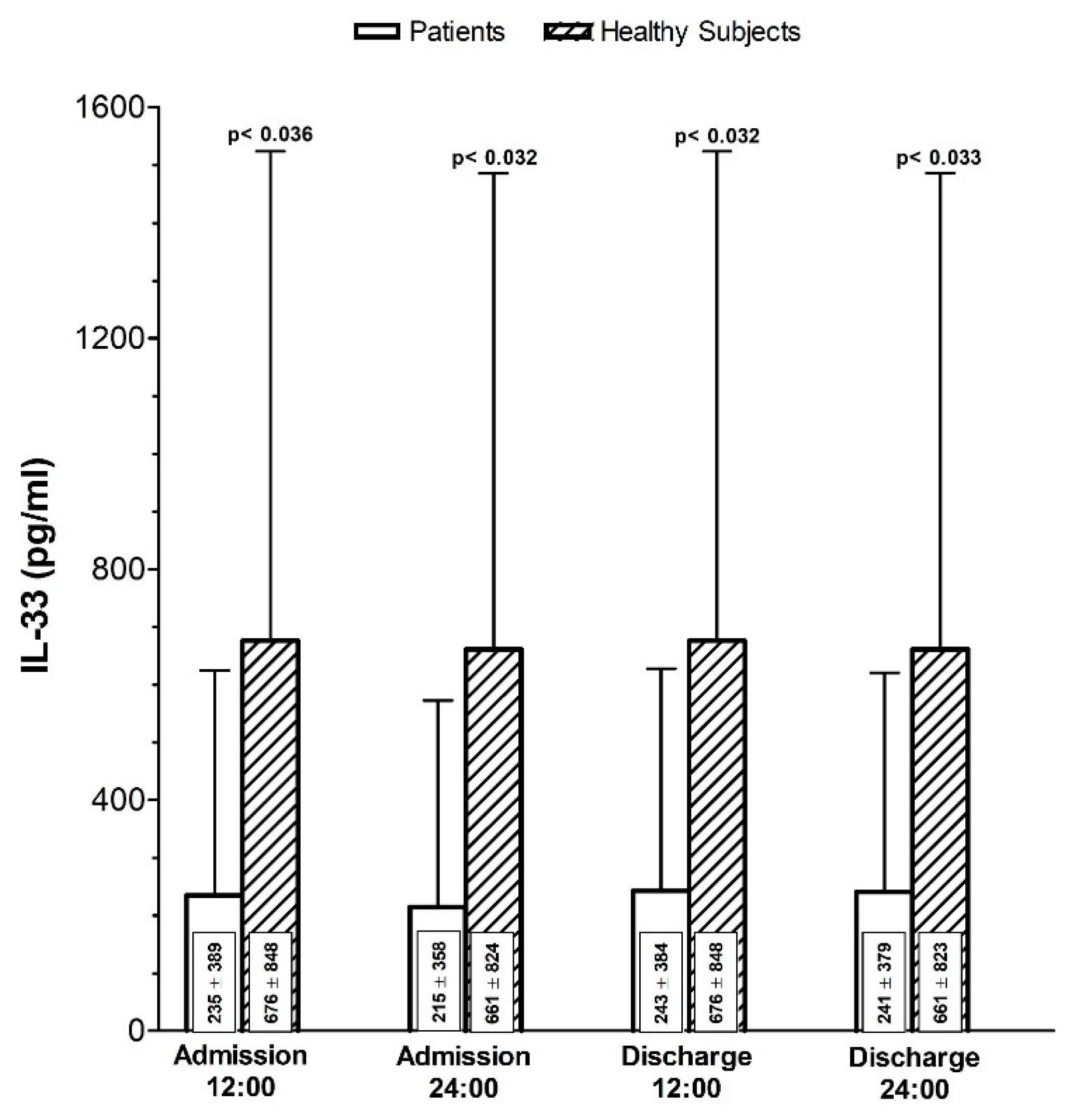

Table 1.
Sociodemographic and clinical variables.
| Variables | Patients | Healthy Controls | P |
|---|---|---|---|
| Age mean ± SD | 39.2 ± 13.3 | 36.6 ± 12.1 | 0.52 |
| Sex Men/Women | 15/6 | 16/5 | 0.73 |
| Smoking status Yes/No | 8/13 | 2/19 | 0.07* |
| CED mg/day | 778.4 ± 485 | ||
| Age of illness onset | 19.7 ± 4.9 | ||
| Illness duration, years | 18.8 ± 13.9 | ||
| Number of previous hospitalizations | 5.8 ± 4.7 | ||
| Length of hospitalization | 20.7 ± 10.1 |
CED: Chlorpromazine Equivalent Doses * p value of Chi square with the correction of Yates.
Table 2.
Comparison of positive, negative, and global scores at admission and discharge.
| PANSS | Mean ± SD | P | |
|---|---|---|---|
| Positive score | Admission | 2.71 ± 0.85 | 0.001 |
| Discharge | 1.62 ± 0.59 | ||
| Negative score | Admission | 1.89 ± 0.66 | 0.62 |
| Discharge | 1.57 ± 0.36 | ||
| Global score | Admission | 1.49 ± 0.27 | 0.004 |
| Discharge | 1.25 ± 0.22 | ||
Table 3.
Comparison of IL-33 levels by sex at admission and discharge by time of the day.
| IL-33 | Men | Women | P |
|---|---|---|---|
| 12:00 Admission | 213.6 ± 394.1 | 288.7 ± 407.3 | 0.70 |
| 24:00 Admission | 200.1 ± 380.8 | 249.8 ± 323.4 | 0.78 |
| 12:00 Discharge | 220.9 ± 393.1 | 298.5 ± 389.9 | 0.69 |
| 24:00 Discharge | 215.2 ± 386.1 | 306.2 ± 388.9 | 0.63 |
Table 4.
Pearson correlation coefficients between serum IL-33 levels and age in patients at admission and discharge and by time of the day.
Table 4.
Pearson correlation coefficients between serum IL-33 levels and age in patients at admission and discharge and by time of the day.
| IL-33 | Admission 12:00 | Admission 24:00 | Discharge 12:00 | Discharge 24:00 | |
|---|---|---|---|---|---|
| Age | r | -0.476 | -0.483 | -0.487 | -0.514 |
| p | 0.040 | 0.036 | 0.034 | 0.024 | |
Table 5.
Day-night comparison of serum IL-33 levels in patients at admission and discharge.
| Time | Mean ± SD | P |
|---|---|---|
| 12:00 Admission | 235.1 ± 389.1 | 0.087 |
| 24:00 Admission | 214.9 ± 358.0 | |
| 12:00 Discharge | 243.1 ± 384.1 | 0.75 |
| 24:00 Discharge | 241.2 ± 379.4 |
Table 6.
Pearson correlation coefficients between serum levels of IL-33 and clinical variables.
| Variables | IL-33 12 h Admission | IL-33 24 h Admission | IL-33 12 h Discharge | IL-33 24 h Discharge | |
|---|---|---|---|---|---|
| Age of illness onset | r | 0.174 | 0.216 | 0.196 | 0.213 |
| p | 0.610 | 0.524 | 0.563 | 0.530 | |
| Years of evolution | r | -0.083 | -0.119 | -0.102 | -0.116 |
| p | 0.807 | 0.728 | 0.766 | 0.734 | |
| Number of previous hospitalizations | r | 0.510 | 0.500 | 0.492 | 0.499 |
| p | 0.109 | 0.117 | 0.124 | 0.118 | |
| Length of hospitalization | r | -0.156 | -0.148 | -0.148 | -0.114 |
| p | 0.647 | 0.665 | 0.663 | 0.738 | |
| CED | p | 0.414 | 0.406 | 0.417 | 0.396 |
| r | 0.206 | 0.216 | 0.202 | 0.228 | |
| PANSS positive symptoms admission score | r | -0.240 | -0.290 | -0.264 | -0.271 |
| p | 0.477 | 0.388 | 0.433 | 0.420 | |
| PANSS negative symptoms admission score | r | 0.129 | 0.207 | 0.146 | 0.174 |
| p | 0.705 | 0.542 | 0.669 | 0.609 | |
| PANSS general symptoms admission score | r | -0.211 | -0.226 | -0.219 | -0.216 |
| p | 0.534 | 0.503 | 0.517 | 0.524 | |
| PANSS positive symptoms discharge score | r | 0.155 | 0.078 | 0.134 | 0.105 |
| p | 0.649 | 0.820 | 0.695 | 0.759 | |
| PANSS negative symptoms discharge score | r | -0.071 | -0.080 | -0.103 | -0.064 |
| p | 0.836 | 0.816 | 0.762 | 0.852 | |
| PANSS general symptoms discharge score | r | -0.320 | -0.322 | -0.325 | -0.288 |
| p | 0.337 | 0.335 | 0.329 | 0.390 |
Table 7.
Admission-discharge comparison of serum IL-33 levels in patients by time of the day.
| Time | Mean ± SD | P |
|---|---|---|
| 12:00 Admission | 235.1 ± 389.1 | 0.360 |
| 12:00 Discharge | 243.1 ± 384.1 | |
| 24:00 Admission | 214.9 ± 358.0 | 0.028 |
| 24:00 Discharge | 241.2 ± 379.4 |
Disclaimer/Publisher’s Note: The statements, opinions and data contained in all publications are solely those of the individual author(s) and contributor(s) and not of MDPI and/or the editor(s). MDPI and/or the editor(s) disclaim responsibility for any injury to people or property resulting from any ideas, methods, instructions or products referred to in the content. |
© 2026 by the authors. Licensee MDPI, Basel, Switzerland. This article is an open access article distributed under the terms and conditions of the Creative Commons Attribution (CC BY) license (http://creativecommons.org/licenses/by/4.0/).
Copyright: This open access article is published under a Creative Commons CC BY 4.0 license, which permit the free download, distribution, and reuse, provided that the author and preprint are cited in any reuse.