

Submitted:
04 August 2026
Posted:
06 August 2026
You are already at the latest version
Abstract
Background: Current immunotherapy regimens are phase-agnostic—they treat all patients as if they occupy the same functional immune state, overlooking evidence that the immune system follows an endogenous response program and that the same intervention can produce divergent outcomes depending on when it is administered. Concept: We propose a conceptual framework in which immune responses follow an endogenous phase program driven by the IL-2/Treg axis, manifesting as a continuum of functional immune states operationally approximated as five recurrent phases—tolerance, priming, effector, contraction, and return to tolerance. This program is regulated by the Treg–Tpex balance. We introduce a Conceptual Immune State Landscape (ISL) as a multidimensional heuristic for describing regulatory–effector balance, integrating regulatory capacity, effector potential, and cytokine availability. Key Propositions: (1) Disease context determines the directional bias of immune imbalance (effector-skewed or regulatory-skewed), thereby defining the therapeutic goal. However, the actual biological effect of any intervention is gated by the patient’s current dynamic phase—a principle we term the phase-induced functional switch: the same nominal dose can produce functionally opposite outcomes depending on phase. (2) Combination therapy sequencing should follow the principle of “release suppression first, then amplify response.” (3) Circadian rhythm serves as a superimposed gain control on the endogenous phase program. (4) Therapeutic endpoints should be redefined as system recoverability—the capacity of the immune system to mount a complete response and return to homeostasis—rather than static biomarkers alone. Implications: This framework offers a unified and testable paradigm for optimizing immunotherapy timing, explains contradictory clinical trial results through phase-blind confounding, and generates six specific, falsifiable hypotheses amenable to prospective validation.
Keywords:
phase-structured immunotherapy
; IL-2/Treg axis
; Treg–Tpex balance
; state-dependent modulation
; immunotherapy timing
; combination therapy sequencing
; circadian rhythm
; system recoverability
1. Introduction
Despite the transformative success of immune checkpoint inhibitors (ICIs) [1], interleukin-2 (IL-2) [2], TNF inhibitors [3], and JAK inhibitors [4], a fundamental question remains unresolved: when should each agent be given to maximize therapeutic benefit? Current clinical practice adopts a phase-agnostic strategy—treating all patients as if they occupy the same functional immune state at the time of intervention. This approach overlooks three converging lines of evidence. First, the immune system follows an endogenous, antigen-driven response program with qualitatively distinct functional phases [5,6]. Second, circadian rhythms impose 24-hour modulation on immune cell trafficking and function [7,8]. Third, the sequence in which combination therapies are administered significantly affects efficacy [9].
These observations converge on a core hypothesis: the effect of an immune intervention depends not only on its molecular target, but critically on the patient’s endogenous immune phase at the time of administration. This framework builds on established concepts of immune homeostasis, T cell exhaustion, and cytokine-mediated feedback [29,30,31,32], but extends them by proposing that phase is a contextual variable capable of reprogramming the functional output of a given dose—a phenomenon we term the phase-induced functional switch.
Contradictory results from existing clinical studies provide circumstantial support for this hypothesis. In a systematic matched analysis of PD-1 inhibitor trials, early-phase trials overestimated phase III efficacy due to exclusion of patients with autoimmune comorbidities (OR = 1.66, 95% CI: 1.43–1.92) [10,11], suggesting that patient immune status at enrollment—rather than drug efficacy alone—shapes trial outcomes. Atezolizumab in triple-negative breast cancer (TNBC) yielded opposite results in IMpassion130 and IMpassion131, potentially attributable to differences in glucocorticoid pretreatment between trial populations [12,13]. Chronotherapy studies demonstrate that immunotherapy efficacy varies systematically with the time of day of administration [7,8,14]. These findings collectively suggest that failure to stratify by immune phase—treating all patients as if they occupy the same functional state—may be a common and underappreciated cause of contradictory clinical results.
This Concept Paper does not report original experimental data. Rather, it synthesizes existing mechanistic and clinical observations into a unified conceptual framework. The primary contribution is the integration of IL-2 receptor biology, Treg–Teff competition dynamics, and circadian modulation into a phase-structured model in which the timing of intervention relative to endogenous immune dynamics determines the functional outcome. We present the framework’s core logic, derive testable hypotheses with explicit falsifiability conditions, and propose a translational roadmap.
2. The Immune Phase System
2.1. The Endogenous Immune Phase Program
In this paper, “immune rhythm” refers specifically to the antigen-driven sequential response program governed by the IL-2/Treg axis [5,6]. This program manifests as a continuum of functional immune states that can be operationally approximated as five recurrent phases (Figure 1A):
Tolerance phase: Characterized by dominant Treg-mediated suppression, low effector T cell activity, and elevated immune checkpoint expression. The system is biased toward maintaining self-tolerance and preventing autoimmunity.
Priming phase: Antigen presentation drives T cell activation and Tpex (precursor exhausted T cell) expansion. IL-2 availability begins to rise, and the Treg–Teff balance starts shifting toward effector potential.
Effector phase: Peak effector T cell expansion and cytotoxic function. Tpex differentiate into transitory effector cells. IL-2 consumption by Teff is maximal; Tregs are relatively suppressed. This is the window of maximal immune-mediated tissue impact.
Contraction phase: Activation-induced cell death eliminates most effector T cells. Tregs upregulate CD25 and exhibit heightened signaling sensitivity, actively terminating the effector response and re-establishing homeostasis. Tpex reserves are replenished.
Return to tolerance: A new homeostatic setpoint is reached, characterized by restored Treg–Teff balance and a replenished Tpex reservoir. The system regains the capacity to respond to subsequent antigenic challenges.
The five-phase classification reflects a clinically useful discretization of continuous dynamics, not a claim of discrete developmental stages. Actual transitions between phases are continuous, and patients may occupy intermediate states. The key clinical insight is that cellular composition, receptor expression, and cytokine sensitivity change qualitatively across phases, meaning that the same molecular signal can be interpreted differently depending on when it arrives.
IL-2 acts as a nonlinear competitive signaling field in which Treg (high-affinity IL-2Rα/CD25), Tpex (precursor effector T cells), and effector T cells (intermediate-affinity IL-2Rβ/γ) exhibit different response thresholds and competitive advantages based on receptor affinity and cellular state [5,6,15,16]. As the system transitions through phases, receptor expression and sensitivity change, dynamically reprogramming how the same IL-2 signal is interpreted by different cellular compartments. This competition forms the molecular basis for the phase-induced functional switch described below.
2.2. The Conceptual Immune State Landscape (ISL)
We introduce a Conceptual Immune State Landscape (ISL)—not a numerical metric, but a multidimensional heuristic—for describing regulatory–effector balance (Figure 1B). ISL integrates three quantifiable dimensions [5,6,17,18]:
Regulatory capacity: Treg-mediated suppressive ability, reflecting Treg frequency, Foxp3 expression levels, and functional suppressive capacity measured ex vivo.
Effector potential: Tpex-to-effector differentiation flux, captured by the Tpex/Teff ratio and trajectory of differentiation markers (e.g., TCF-1, TOX, PD-1 gradient).
Cytokine availability: IL-2 competitive field dynamics, reflected by local IL-2 concentration, sCD25 levels (as a decoy receptor), and IL-2–STAT5 signaling readout.
ISL is not a calculable index. Its clinical utility lies in tracking concordant directional trends (rising, falling, or stable) across these dimensions—for example, rising regulatory capacity with falling effector potential indicates a shift toward tolerance. ISL partitions immune state space into three operational regions:
Tolerance zone (high ISL): Regulatory capacity dominates; effector potential is minimal. This zone is characteristic of established tumor microenvironments with T cell exhaustion, chronic viral infections with persistent antigen stimulation, successful pregnancy maintenance, and the post-contraction homeostatic state. In this zone, immune-promoting interventions face high activation barriers because Treg-mediated suppression and immune checkpoint expression must first be released.
Critical zone (intermediate ISL): Regulatory and effector forces are finely balanced with dynamic instability. Small perturbations—a cytokine pulse, checkpoint blockade, or antigen fluctuation—can shift the system toward either tolerance or effector dominance. This zone represents the highest-leverage window for therapeutic intervention: the system is maximally responsive but also maximally vulnerable to intervention mistiming. Most clinical decision-making occurs in or near this zone.
Effector zone (low ISL): Effector potential dominates; regulatory capacity is insufficient to constrain immune activation. This zone characterizes autoimmune disease flares, cytokine release syndrome, acute graft rejection, and the peak of anti-tumor immune responses. In this zone, further immune activation risks immunopathology; the therapeutic goal is typically to reinforce regulatory control and prevent collateral tissue damage.
Different disease contexts tend toward specific ISL biases [20,21]: tumors and chronic infections gravitate toward the tolerance zone (high regulatory capacity, low effector potential); autoimmune conditions and cytokine release syndrome toward the effector zone (low regulatory capacity, high effector potential). However, individual patients within a disease category may occupy different positions on the ISL depending on disease stage, treatment history, and intercurrent events—hence the need for individualized phase inference.
2.3. Multi-Parameter Phase Inference System
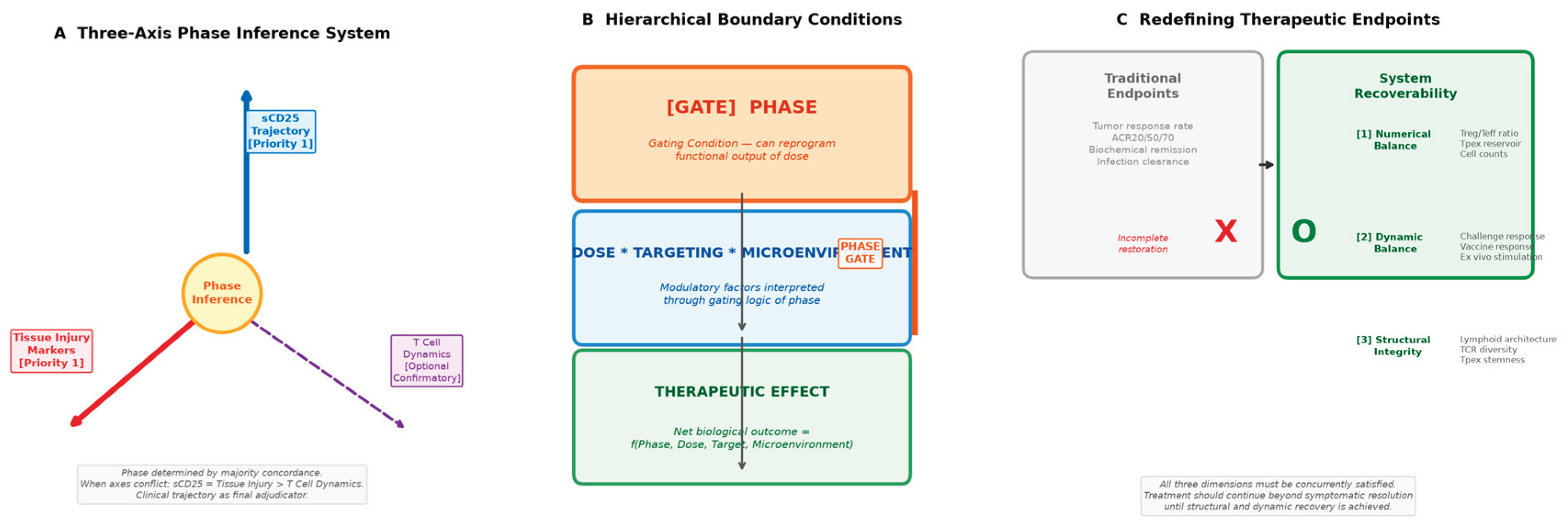
Translating the ISL concept into clinical practice requires a practical method for inferring a patient’s current phase. We propose a three-axis inference system (Figure 4A) that prioritizes directional concordance over temporal synchrony:
Axis 1: Soluble IL-2 receptor dynamics (sCD25). The rise–peak–decline trajectory of sCD25 provides a direct readout of systemic IL-2 competition dynamics [5,6]. Rising sCD25 indicates increasing T cell activation (priming → effector transition); declining sCD25 from peak signals entry into contraction. Absolute thresholds are less informative than directional trends.
Axis 2: Tissue injury output. Organ-specific markers reflect the functional consequence of immune activity. For liver, ALT and γ-GT are well-established [3]; for other organs, tissue-specific markers should be used (e.g., troponin for myocardium, creatinine for kidney). When tissue-specific markers are unavailable, acute-phase reactants (CRP, ferritin) may serve as surrogates, though with lower specificity.
Axis 3: Antigen-specific T cell dynamics (optional confirmatory). Tpex and effector T cell frequencies, measured by flow cytometry or inferred from transcriptomic signatures, can confirm phase assignment [10,19]. This axis is designated optional because it requires specialized laboratory infrastructure not universally available.
Phase assignment is determined by the majority of concordant directional signals across available axes. When axes conflict, sCD25 and tissue injury markers take priority, with clinical trajectory serving as the final adjudicator. This priority reflects that sCD25 provides a direct readout of systemic IL-2 competition dynamics, whereas antigen-specific T cell frequencies are more susceptible to local redistribution effects that may not reflect the systemic phase.
3. Phase-Dependent Immunotherapy Model
3.1. Core Principle: Disease Bias Determines Targets, Dynamic Phase Determines Effects
Disease bias—whether the underlying immune dysregulation is effector-skewed (autoimmune disease, cytokine release syndrome) or regulatory-skewed (cancer, chronic infection)—defines the therapeutic goal: dampen effector responses or activate them. However, the actual biological effect of any intervention is gated by the patient’s current phase, because cellular composition, receptor expression, and cytokine sensitivity change qualitatively across phases. In other words: disease context tells us which direction we need to push the system; phase tells us whether and how that push will be received.
3.2. Boundary Conditions: The Phase-Induced Functional Switch
Phase is a gating condition, not a sufficient condition (Figure 4B). Critically, dose–effect relationships are phase-context dependent. The same nominal dose is not a fixed pharmacological constant; its functional output is reprogrammed by the prevailing phase. We term this the phase-induced functional switch. The clearest illustration is IL-2:
- During effector phases, high-dose IL-2 preferentially engages intermediate-affinity IL-2Rβγ on Teff, driving effector expansion [2].
Thus, phase can redirect the functional output of a given dose. Dose magnitude, targeting hierarchy, and microenvironment remain modulatory factors, but their effects are interpreted through the gating logic of phase. Highly targeted molecules (e.g., bispecific T cell engagers) shift phase dependence from “receptor competition” to “network perturbation propagation,” yet phase constraints persist because even precisely targeted molecules operate within a cellular ecosystem whose composition and reactivity are phase-dependent [20,21].
3.3. Non-Linear Dose–Response Across Phases
IL-2 signaling follows a non-linear, phase-dependent optimum. Insufficient signal fails to trigger Teff activation (below activation threshold); appropriate signal drives effective effector expansion without premature Treg engagement; excessive signal crosses the Treg high-affinity threshold, prematurely terminating the effector window and impairing Tpex reserve formation [2,5,6,15]. The therapeutic window is not a fixed dose range—it shifts dynamically with phase. This “more is not better” principle has practical implications: the optimal IL-2 dose in the effector phase may be supra-therapeutic or even detrimental in the contraction phase, and vice versa.
3.4. Mechanisms Underlying Contraction-Phase Response Bias
During contraction, effector T cells exhibit reduced sensitivity to reactivation signals, while Tregs are highly activated with elevated CD25 expression [5,6,15] (Figure 2A). Immune-promoting interventions administered under these conditions may bias toward enhancing regulatory compartment signaling rather than effector activation. This reflects a core mechanism by which the same agent can produce opposite effects across phases—supported by evidence that high-dose IL-2 in early contraction may drive Treg functional consolidation rather than effector activation [5,6,9,22].
3.5. Drug Classification and Phase Matching Tendencies
Based on the refined phase–dose relationship, phase matching tendencies are summarized below (full matrix in Supplementary Table S1; Figure 2B provides a visual overview):
Immune checkpoint inhibitors (tumor context): Priming/effector phases are hypothesized to be optimal [1,10]; caution is warranted in the contraction phase, where Treg-mediated suppression may dominate [9].
TNF inhibitors (autoimmune context): Effector phase administration is hypothesized to be optimal [3]; administration during contraction may interfere with Treg-mediated tolerance reconstruction [23].
IL-6R inhibitors: In autoimmune contexts, both effector and contraction phases may be suitable [3]. By contrast, in tumor/infection contexts, use during the effector phase may impair Teff-mediated anti-tumor immunity and should be avoided. This contrast illustrates the framework’s core logic: the same drug’s phase suitability can reverse with disease bias.
JAK inhibitors / glucocorticoids: During effector/over-inflammatory phases, these agents may increase ISL (restoring regulatory control) [4]; however, if they suppress Treg function during contraction, they may paradoxically decrease ISL and impair homeostasis—caution is required.
IL-2 (dose- and phase-stratified, exemplifying the phase-induced functional switch):
◦ High-dose IL-2 in tumor/infection effector phases → Teff expansion.
◦ High-dose IL-2 in autoimmune early contraction (1–2 weeks after activity peak) → predicted Treg functional consolidation; blocks pathogenic Tpex formation.
◦ Low-dose IL-2 in autoimmune steady state → selective Treg expansion.
◦ Pause IL-2 in tumor/infection contraction → protects Tpex reserve.
4. Principles of Combination Therapy Sequencing
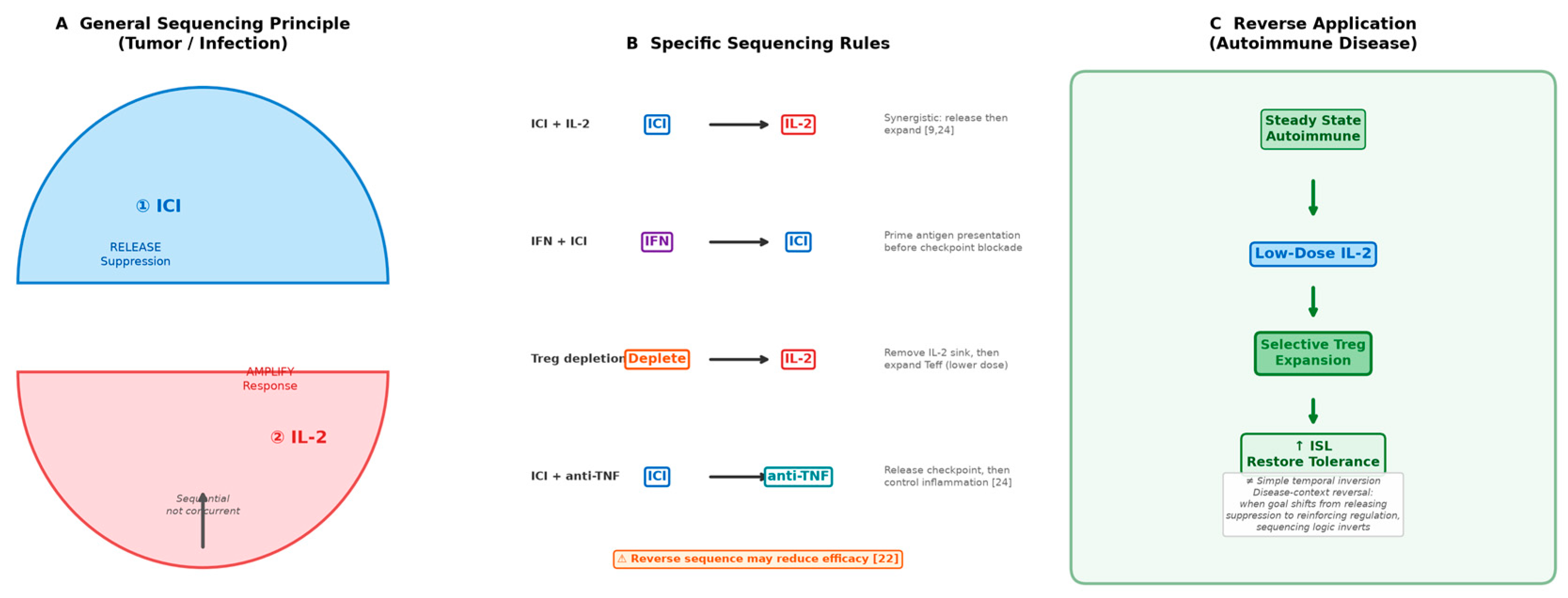
We propose a general sequencing principle: release suppression first, then amplify response (Figure 3A–B). The mechanistic rationale is that removing Treg-mediated brakes before attempting effector expansion prevents the effector stimulus from being consumed or neutralized by a dominant regulatory compartment.
For ICI + IL-2 in tumor contexts, administering ICI first (to release PD-1-mediated suppression) followed by IL-2 (to expand the disinhibited effector compartment) is predicted to produce synergistic efficacy [9,24]. Conversely, IL-2 → ICI sequencing tends toward reduced efficacy, because IL-2-driven Treg expansion may blunt the subsequent ICI effect [22].
The reverse application in autoimmune contexts—low-dose IL-2 during steady state to selectively expand Treg before other interventions [5,6] (Figure 3C)—represents a disease-context reversal of the sequencing logic, not a simple temporal inversion. When the therapeutic goal is to reinforce regulation rather than release it, the sequence naturally inverts.
In Treg depletion strategies (e.g., anti-CD25), IL-2 administration immediately following depletion may maximize Teff expansion by exploiting the transient reduction in IL-2 consumption. However, the dose should be lower than the conventional dose used without depletion, because removal of the primary IL-2 sink increases bioavailability, and excessive activation risks activation-induced cell death and Tpex depletion.
5. Circadian Rhythm as Gain Control
The endogenous immune phase program unfolds over days to weeks. Superimposed upon it is a 24-hour circadian rhythm that modulates the sensitivity threshold for interventions within each phase. Mechanistically, CD8⁺ T cell infiltration and function exhibit circadian oscillations regulated by clock genes [7,26]. Current evidence suggests that priming and effector phases tend toward morning (6:00–10:00) administration, while the contraction phase may favor evening (16:00–20:00) administration [7,8,14] (Supplementary Table S2).
Circadian rhythm does not replace the antigen-driven phase program but serves as a superimposed gain control: if the endogenous phase determines the direction of response, circadian timing modulates its magnitude. This distinction is clinically relevant—a correctly phase-matched intervention administered at the wrong circadian time may show attenuated efficacy, while a phase-mismatched intervention is unlikely to be rescued by optimal circadian timing alone.
Important caveats: The temporal mapping between specific immune phases and clock time is derived from the present conceptual framework. Current evidence supports time-of-day effects on immune responsiveness but does not directly validate phase–time equivalence. Chronotype variation may influence chronotherapy consistency [25], and contradictions across chronotherapy studies may partially reflect individual circadian phase offset from standard clock time. Most evidence remains retrospective and requires prospective validation with individualized circadian phase measurement.
6. Testable Hypotheses and Falsifiability Conditions
A conceptual framework derives its scientific value from generating specific, falsifiable predictions. We articulate six testable hypotheses, each paired with a falsifiability condition following Popperian criteria [27].
Hypothesis 1 (Disease bias determines phase direction): The optimal phase for the same drug may be opposite in different disease contexts. For example, IL-2 in tumor (effector phase) should expand Teff, whereas IL-2 in autoimmune (steady state) should expand Treg [20,21].
Hypothesis 2 (PD-1 inhibitor phase selectivity): PD-1 inhibitor efficacy is higher when administered during the effector phase than during the contraction phase, as measured by objective response rate and progression-free survival [10,11].
Hypothesis 3 (TNF inhibitor phase window): TNF inhibitors show optimal efficacy when initiated during the effector phase of autoimmune disease, with reduced benefit when initiated during contraction [3,23].
Hypothesis 4 (JAK inhibitor/glucocorticoid bidirectional dependence): The direction of ISL modulation by JAK inhibitors and glucocorticoids differs between effector and contraction phases: increasing ISL during effector phases but potentially decreasing ISL during contraction [4].
Hypothesis 5 (Circadian modulation of immunotherapy): Morning versus evening administration of immunotherapy shows significant efficacy differences, with the direction of the difference dependent on whether the intervention is immune-promoting or immune-suppressing [7,8,14].
Hypothesis 6 (Phase-induced dose–effect switch for IL-2): High-dose IL-2 expands Teff in the effector phase but consolidates Treg function in the early contraction phase (autoimmune context), as measured by Treg suppressive capacity and pathogenic Tpex frequency [5,6,15].
Falsifiability conditions:
- Condition 1: Phase stratification fails to improve predictive accuracy for immunotherapy outcomes (AUC increase < 5%; P > 0.05).
- Condition 2: IL-2 effects are directionally consistent across phases regardless of dose—i.e., the same dose always produces Teff-dominant or Treg-dominant effects irrespective of the patient’s phase.
- Condition 4: ISL-inferred phase shows no correlation with independent immune measures such as scRNA-seq-derived Treg/Tpex signatures, TCR clonality, or Treg suppression assays (Spearman’s ρ < 0.3, P > 0.05).
- Condition 6: High-dose IL-2 produces identical Teff-dominant effects in both effector and contraction phases—i.e., no phase-induced functional switch is observed.
To facilitate empirical evaluation of these hypotheses, we have developed specific validation protocols (detailed in Supplementary Materials). The common design elements across all protocols are: (i) phase inference using sCD25 trajectory combined with tissue injury markers, (ii) stratification by inferred phase prior to outcome comparison, and (iii) comparison of outcomes between phase-matched and phase-mismatched groups. All protocols are designed to be executable using existing laboratory assays (flow cytometry, soluble biomarker ELISAs, standard clinical chemistry) and do not require experimental infrastructure beyond what is available in most academic medical centers. The validation framework prioritizes retrospective analyses of completed trials with archived biospecimens as the fastest route to initial falsification or provisional corroboration, followed by prospective observational studies and ultimately randomized trials comparing phase-matched versus conventional scheduling.
7. Redefining Therapeutic Endpoints: System Recoverability
Traditional therapeutic endpoints—tumor response rate, ACR20/50/70, infection clearance, or biochemical remission—measure whether the disease manifestation has been suppressed, but cannot determine whether the immune system has truly restored its homeostatic capacity. A patient may achieve a conventional endpoint while remaining in a fragile state prone to relapse upon the next antigenic challenge. ISL attainment (return to the tolerance zone with balanced regulatory and effector capacity) is necessary but insufficient; it describes the current state, not the system’s resilience [5,6].
We propose “system recoverability” as the ultimate therapeutic endpoint (Figure 4C)—the capacity of the immune system to mount a complete, context-appropriate response to a subsequent antigenic challenge and return to homeostasis without overshoot or collapse. System recoverability requires three interdependent dimensions [10,17,18,28]:
Numerical balance: Restoration of disease-context-appropriate Treg/Teff ratios, Tpex reservoir size, and lymphoid cell counts within reference ranges. Numerical balance ensures that the system has sufficient cellular resources in each compartment to respond to future challenges. However, numerical balance alone does not guarantee functional competence—a numerically “normal” Treg compartment may be functionally exhausted.
Dynamic balance: The capacity of the system to mount an appropriate immune response to a new antigenic challenge (e.g., vaccination response, infection clearance) without tipping into hyperinflammation or anergy. Dynamic balance can be assessed through challenge tests—such as vaccine response, delayed-type hypersensitivity, or ex vivo stimulation assays—that probe the system’s ability to activate, expand, and contract appropriately. This dimension captures the functional responsiveness that numerical balance alone cannot assess.
Structural integrity: Preservation of the lymphoid tissue architecture, TCR repertoire diversity, and Tpex stemness program required for long-term immune surveillance and memory formation. Structural integrity encompasses the “hardware” of the immune system—lymph node germinal centers, bone marrow niches, thymic output—as well as the clonal diversity that ensures broad antigen recognition. Irreversible structural damage (e.g., lymphoid depletion from chronic inflammation or cytotoxic therapy) may preclude full recoverability even when numerical and dynamic balances appear restored.
Operationally, system recoverability is achieved when all three dimensions are concurrently satisfied: numerical balance within disease-appropriate ranges, intact dynamic responsiveness to challenge, and structural integrity of the immune architecture. The practical implication is that therapeutic decision-making should not terminate at the first sign of clinical response. Rather, treatment duration should be calibrated to the time required for structural and dynamic recovery—a timeframe that may extend well beyond symptomatic resolution. Prospective studies correlating recoverability metrics with long-term relapse-free survival and immune-related adverse events are needed to validate this endpoint.
Figure 4.
A proposed multi-parameter framework for immune state inference and therapeutic evaluation.
Figure 4.
A proposed multi-parameter framework for immune state inference and therapeutic evaluation.
8. Discussion
This framework provides a conceptual bridge from immune phase dynamics to understanding therapeutic heterogeneity. It offers a unified logic: disease bias defines the therapeutic goal, but phase gates the actual effect of any intervention. This logic explains why “phase-blind” clinical trials—those that pool patients at different immune stages—may produce contradictory results: when drug effects cancel each other out across heterogeneous phase distributions, the net result can appear null even when the drug is genuinely effective in phase-stratified subsets.
The phase-induced functional switch—where the same dose produces opposite effects across phases—is most clearly illustrated by IL-2 and reconciles long-standing contradictions in the IL-2 literature. Why does low-dose IL-2 expand Tregs in some studies but not others? Why does high-dose IL-2 sometimes fail to produce durable effector responses? The framework suggests that phase at the time of administration, rather than dose alone, may be the missing explanatory variable. If validated, this insight has immediate implications for IL-2-based trial design: phase stratification should be incorporated as a pre-specified analysis, and dose selection should be phase-adaptive rather than fixed.
Existing studies provide the mechanistic components—IL-2 receptor biology [5,6,15], Treg–Teff competition [16,20], Tpex biology [10,17,18], and circadian modulation [7,8,26]—but these observations have not been integrated into a single operational model in which the timing of intervention relative to endogenous immune dynamics determines the functional outcome. This integration is the primary conceptual contribution of the present work.
The framework is not without limitations. First, it is primarily applicable to chronic antigen contexts—tumor, chronic infection, autoimmune diseases, and transplant rejection—where the immune system engages in sustained, antigen-driven dynamics. It is not applicable to conditions where immune system structure is irreversibly destroyed (e.g., post-myeloablative chemotherapy prior to hematopoietic reconstitution, advanced AIDS). Second, phase is a gating condition, not a sufficient condition: even optimal phase matching cannot guarantee efficacy if the target is biologically irrelevant or the dose is inappropriate [5,6]. Third, the ISL is a heuristic, not a validated clinical instrument; its dimensions require operationalization and prospective validation before clinical deployment. Fourth, while the framework may conceptually extend to pregnancy maintenance and other regulatory contexts, its primary validation should be pursued in chronic antigen-driven settings where the IL-2/Treg axis is known to play a central role.
The relationship between this framework and existing concepts deserves clarification. The phase model does not replace the cancer-immunity cycle [33] or the concept of immunoediting [34]; rather, it provides a higher-order temporal structure within which these processes operate. Similarly, circadian immunology [32] is incorporated not as an alternative timer but as a superimposed modulation layer. The framework’s novelty lies not in any single component but in their integration into a testable, phase-structured logic that generates specific predictions about when, in what sequence, and at what dose interventions should be deployed.
Beyond its immediate application to immunotherapy, the phase-structured framework may have relevance for vaccine design (timing of prime-boost regimens relative to baseline immune phase), management of immune-related adverse events (early detection of phase shifts preceding clinical toxicity), and personalized tapering of immunosuppressive therapy (using ISL trajectory to guide withdrawal timing). These extensions remain speculative and warrant dedicated investigation.
A practical translation pathway is proposed: in the short term (6–12 months), retrospective analyses of completed trials stratified by inferred phase using archived sCD25 and clinical laboratory data; in the medium term (2–3 years), prospective observational studies with serial phase monitoring; and in the long term (3–5 years), development of algorithmic phase inference tools integrated into electronic health records, enabling real-time, point-of-care phase assessment. The ultimate test will be a prospective randomized trial comparing phase-matched versus conventional immunotherapy scheduling—a trial that is feasible with current laboratory infrastructure.
9. Conclusion
Immunotherapy is evolving from “target-directed” toward “phase-matched” precision. We propose a conceptual framework in which disease bias defines the therapeutic goal, but phase gates and can redirect the functional effect of dose—a principle we term the phase-induced functional switch. This framework reframes combination therapy sequencing (release suppression first, then amplify response), integrates circadian rhythm as gain control, and redefines therapeutic endpoints as system recoverability across three dimensions: numerical balance, dynamic balance, and structural integrity.
The ultimate objective is to identify the patient’s current phase, understand the phase-specific characteristics of immune cells and cytokines relevant to the disease context, and apply interventions to rebalance the system—eliminating the pathogenic driver and restoring durable, self-correcting immune homeostasis. The framework generates six specific, falsifiable hypotheses. Their prospective evaluation in stratified clinical studies will determine whether phase-structured immunotherapy represents a genuine advance or a seductive but ultimately incorrect simplification.
Supplementary Materials
The following supporting information can be downloaded at the website of this paper posted on Preprints.org.
Author Contributions
Yuanshan Zhang is solely responsible for the conceptualization, literature review, framework development, manuscript preparation, and final approval of this work.
Funding
This research did not receive any specific grant from funding agencies in the public, commercial, or not-for-profit sectors.
Data Availability Statement
No original data were generated or analyzed in this Concept Paper. All cited literature is publicly available.
Conflicts of Interest
The author declares no conflicts of interest.
AI Use Statement
The author used AI-assisted tools for language refinement, literature retrieval assistance, and organization of portions of the discussion during the preparation of this manuscript. All scientific content, theoretical reasoning, core concepts, interpretation, and final manuscript are the sole responsibility of the author. AI tools were not involved in study design, data analysis, or conclusion derivation. The author accepts full responsibility for all viewpoints, data interpretation, and academic judgments expressed in this manuscript.
References
- Topalian SL, Drake CG, Pardoll DM. Immune checkpoint blockade: a common denominator approach to cancer therapy. Cancer Cell. 2015;27(4):450-461. [CrossRef]
- Rosenberg SA. IL-2: the first effective immunotherapy for human cancer. J Immunol. 2014;192(12):5451-5458.
- Tanaka T, Narazaki M, Kishimoto T. IL-6 in inflammation, immunity, and disease. Cold Spring Harb Perspect Biol. 2014;6(10):a016295. [CrossRef]
- O’Shea JJ, Schwartz DM, Villarino AV, Gadina M, McInnes IB, Laurence A. The JAK-STAT pathway: impact on human disease and therapeutic intervention. Annu Rev Med. 2015;66:311-328.
- Boyman O, Sprent J. The role of interleukin-2 during homeostasis and activation of the immune system. Nat Rev Immunol. 2012;12(3):180-190. [CrossRef]
- Abbas AK, Trotta E, Simeonov DR, Marson A, Bluestone JA. Revisiting IL-2: biology and therapeutic prospects. Sci Immunol. 2018;3(25):eaat1482. [CrossRef]
- Wang C, Zeng Q, Gül ZM, et al. Circadian tumor infiltration and function of CD8+ T cells dictate immunotherapy efficacy. Cell. 2024;187(11):2690-2702.e17. [CrossRef]
- Qian DC, Kleber T, Brammer B, et al. Effect of immunotherapy time-of-day infusion on overall survival among patients with advanced melanoma in the USA (MEMOIR): a propensity score-matched analysis of a single-centre, longitudinal study. Lancet Oncol. 2021;22(12):1777-1786. [CrossRef]
- Kilic IB, Weberova P, VanDyke D, et al. Temporal optimization of CD25-biased IL-2 agonists and immune checkpoint blockade leads to synergistic anticancer activity despite robust regulatory T cell expansion. J Immunother Cancer. 2025;13(8):e010465. [CrossRef]
- Im SJ, Hashimoto M, Gerner MY, et al. Defining CD8+ T cells that provide the proliferative burst after PD-1 therapy. Nature. 2016;537(7620):417-421. [CrossRef]
- Li X, et al. Comparison of efficacy discrepancy between early-phase clinical trials and phase III trials of PD-1/PD-L1 inhibitors. J Immunother Cancer. 2024;12(1):e007959. [CrossRef]
- Schmid P, Rugo HS, Adams S, et al. Atezolizumab plus nab-paclitaxel as first-line treatment for unresectable, locally advanced or metastatic triple-negative breast cancer (IMpassion130): updated efficacy results from a randomised, double-blind, placebo-controlled, phase 3 trial. Lancet Oncol. 2020;21(1):44-59. [CrossRef]
- Miles D, Gligorov J, André F, et al. Primary results from IMpassion131, a double-blind, placebo-controlled, randomised phase III trial of first-line paclitaxel with or without atezolizumab for unresectable locally advanced/metastatic triple-negative breast cancer. Ann Oncol. 2021;32(8):994-1004. [CrossRef]
- Huang Z, Ruan Z, Xu S, Zou N, et al. Overall survival according to time-of-day of immunochemotherapy for extensive-stage small cell lung cancer. Cancer. 2025;131(24):e70126. [CrossRef]
- Shouse SA, et al. Interleukin-2 receptor signaling acts as a checkpoint that influences the distribution of regulatory T cell subsets. iScience. 2024;27(12):111248. [CrossRef]
- Zhou L, et al. Spatial and functional targeting of intratumoral Tregs reverses CD8+ T cell exhaustion and promotes cancer immunotherapy. J Clin Invest. 2024;134(14):e180080. [CrossRef]
- Xu J, Jia Z, Zhao X, et al. BCOR and ZC3H12A suppress a core stemness program in exhausted CD8+ T cells. J Exp Med. 2025;222(8):e20241133. [CrossRef]
- Wijesinghe SKM, Rausch L, Gabriel SS, Galletti G, De Luca M, et al. Lymph-node-derived stem-like but not tumor-tissue-resident CD8+ T cells fuel anticancer immunity. Nat Immunol. 2025;26(8):1367-1383. [CrossRef]
- Wang M, Sang J, Xu F, et al. Microwave Ablation Combined with Flt3L Provokes Tumor-Specific Memory CD8+ T Cells-Mediated Antitumor Immunity in Response to PD-1 Blockade. Adv Sci (Weinh). 2025;12(4):e2413181. [CrossRef]
- Guo X, Nie H, Zhang W, et al. Contrasting cytotoxic and regulatory T cell responses underlying distinct clinical outcomes to anti-PD-1 plus lenvatinib therapy in cancer. Cancer Cell. 2025;43(2):248-268.e9. [CrossRef]
- Seddu K, Chowdhary K, Henderson M, et al. Dynamics and variegation in the Treg response to Interleukin-2. Proc Natl Acad Sci U S A. 2025;122(47):e2518991122. [CrossRef]
- Mahmoodifar S, et al. Gaming the cancer-immunity cycle by synchronizing the dose schedules. Proc Natl Acad Sci USA. 2025;122(32):e2423775122. [CrossRef]
- Quach TD, Huang W, Sahu R, et al. Context-dependent induction of autoimmunity by TNF signaling deficiency. JCI Insight. 2022;7(5):e149094. [CrossRef]
- Guardamagna M, Lochrin SE, Smithy JW, et al. International real-world study of combination immunotherapy sequences in metastatic melanoma. J Immunother Cancer. 2025;13(11):e012225. [CrossRef]
- Ismail-Sutton S, Hughes B, Buchwald ZS, et al. Personalizing chronotherapy of immune checkpoint blockade. J Immunother Cancer. 2025;13(10):e013026. [CrossRef]
- Mello RM, Masri S, Lamia KA. Rhythms of risk: the intersection of clocks, cancer, and chronotherapy. J Clin Invest. 2026;136(3):e198780. [CrossRef]
- Popper KR. The Logic of Scientific Discovery. London: Routledge; 2002. (Originally published in 1959).
- Videla S, García-Lafuente A, Antolín M, et al. Antitumor necrosis factor therapy in rat chronic granulomatous colitis: critical dose-timing effects on outcome. J Pharmacol Exp Ther. 1998;287(3):854-859. [CrossRef]
- Sakaguchi S, Sakaguchi N, Asano M, Itoh M, Toda M. Immunologic self-tolerance maintained by activated T cells expressing IL-2 receptor alpha-chains (CD25). Breakdown of a single mechanism of self-tolerance causes various autoimmune diseases. J Immunol. 1995;155(3):1151-1164. [CrossRef]
- Malek TR, Yu A, Vincek V, Scibelli P, Kong L. CD4 regulatory T cells prevent lethal autoimmunity in IL-2Rbeta-deficient mice. Implications for the nonredundant function of IL-2. Immunity. 2002;17(2):167-178.
- Wherry EJ. T cell exhaustion. Nat Immunol. 2011;12(6):492-499. [CrossRef]
- Scheiermann C, Kunisaki Y, Frenette PS. Circadian control of the immune system. Nat Rev Immunol. 2013;13(3):190-198. [CrossRef]
- Chen DS, Mellman I. Oncology meets immunology: the cancer-immunity cycle. Immunity. 2013;39(1):1-10. [CrossRef]
- Schreiber RD, Old LJ, Smyth MJ. Cancer immunoediting: integrating immunity’s roles in cancer suppression and promotion. Science. 2011;331(6024):1565-1570. [CrossRef]
Figure 1.
Conceptual organization of endogenous immune response states and the Conceptual Immune State Landscape (ISL).
Figure 1.
Conceptual organization of endogenous immune response states and the Conceptual Immune State Landscape (ISL).
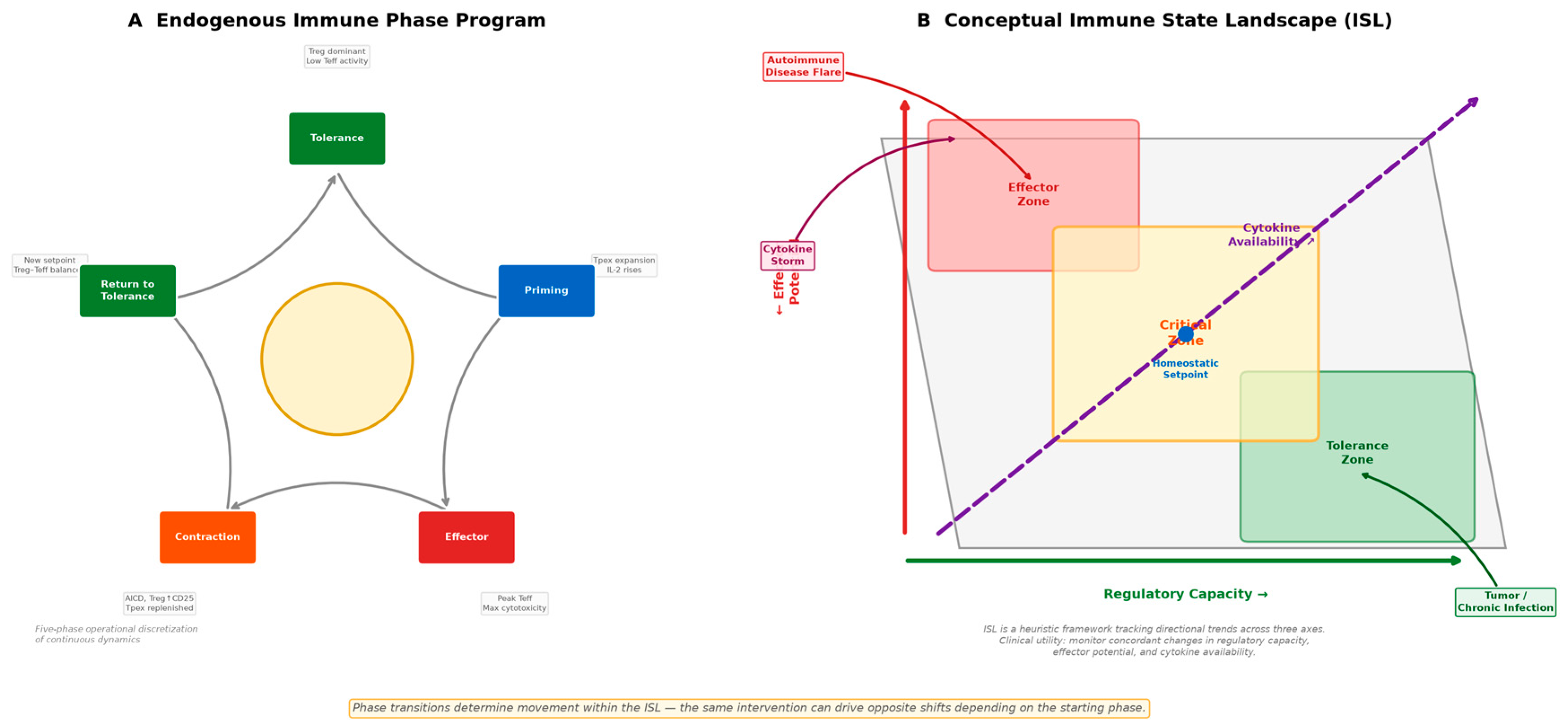
Figure 2.
Phase-dependent drug effects and hypothesized phase matching tendencies.
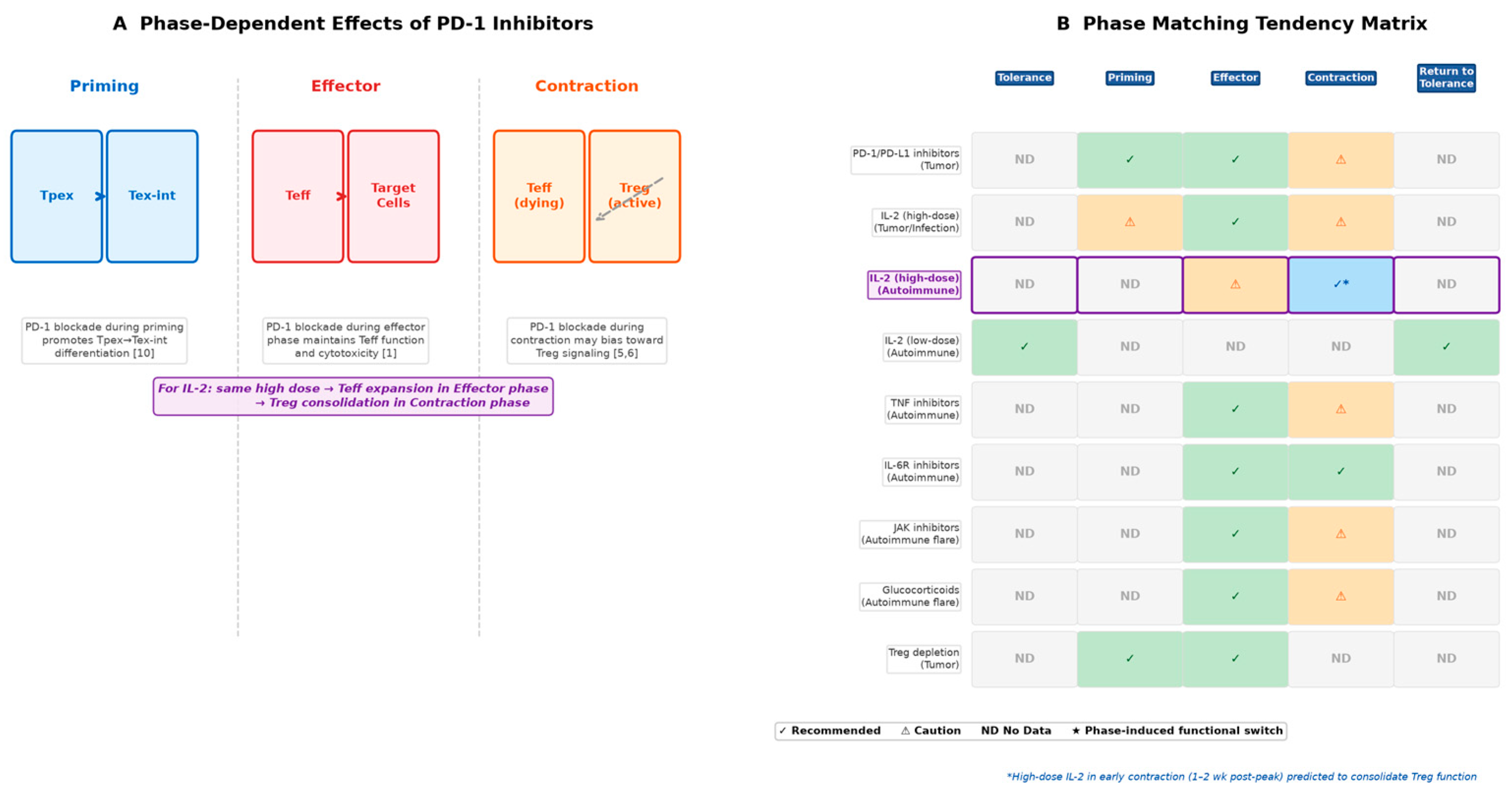
Figure 3.
Proposed principles of combination therapy sequencing.
Disclaimer/Publisher’s Note: The statements, opinions and data contained in all publications are solely those of the individual author(s) and contributor(s) and not of MDPI and/or the editor(s). MDPI and/or the editor(s) disclaim responsibility for any injury to people or property resulting from any ideas, methods, instructions or products referred to in the content. |
© 2026 by the authors. Licensee MDPI, Basel, Switzerland. This article is an open access article distributed under the terms and conditions of the Creative Commons Attribution (CC BY) license (http://creativecommons.org/licenses/by/4.0/).
Copyright: This open access article is published under a Creative Commons CC BY 4.0 license, which permit the free download, distribution, and reuse, provided that the author and preprint are cited in any reuse.


