
Submitted:
05 August 2026
Posted:
06 August 2026
You are already at the latest version
Abstract
This study investigates the structural determinants of e-commerce adoption across the 27 European Union Member States during the period 2020–2025, a phase marked by accelerated digital transformation following the COVID-19 shock. Using harmonised Eurostat data and a country-level panel framework with fixed effects and clustered standard errors, the analysis examines the relative contribution of digital infrastructure, digital human capital, and macroeconomic dynamics to variations in online purchasing participation. The baseline results indicate that household broadband penetration remains the most consistent and economically meaningful predictor of e-commerce adoption. Even at high levels of connectivity, incremental increases in broadband access are associated with significant rises in the share of individuals purchasing goods and services online. Digital skills exhibit a positive and complementary role, with evidence suggesting stronger marginal effects in EU-13 economies, consistent with partial convergence dynamics within the European digital single market. In contrast, short-run purchasing power fluctuations, measured through annual log-differences in GDP per capita (PPS), display limited explanatory power once structural digital factors are controlled for. The findings support a structural readiness interpretation of digital consumption, whereby infrastructure and human capital investments, rather than cyclical macroeconomic conditions, underpin sustained online market participation. The study contributes recent comparative panel evidence for the EU during the post-pandemic acceleration phase and offers policy-relevant insights for advancing digital convergence across Member States.
Keywords:
e-commerce adoption
; digital readiness
; digital convergence
1. Introduction
The digitalisation of consumption has accelerated markedly over the past decade, yet the period 2020–2025 represents a distinct structural phase in the evolution of electronic commerce within the European Union. The COVID-19 shock triggered a rapid reconfiguration of household purchasing behaviour, compressing several years of gradual digital diffusion into a short time interval. However, while aggregate e-commerce penetration increased across Member States, cross-country disparities did not disappear. Instead, pre-existing structural differences in digital infrastructure, digital human capital, and economic development continued to shape the intensity and persistence of online market participation.
This dual dynamic—simultaneous acceleration and persistent heterogeneity—constitutes the central motivation of the present study. Between 2020 and 2025, average online purchasing rates rose steadily in both EU-15 and EU-13 economies, yet the adoption gap remained visible. The period therefore provides a natural setting to examine whether digital convergence is underway and to what extent structural determinants explain variation in adoption trajectories.
Three research questions guide the empirical analysis.
First, what is the role of digital infrastructure? Broadband penetration has expanded substantially across the EU, reaching high average levels. Nevertheless, differences in network quality, speed, and household access remain non-trivial. From a structural perspective, broadband infrastructure reduces transaction costs, lowers search frictions, and increases market accessibility. The study examines whether variation in broadband access continues to explain differences in online purchasing behaviour even in a context of near-saturation.
Second, what is the contribution of digital human capital? Infrastructure alone may not be sufficient to ensure effective participation in digital markets. Individuals’ ability to navigate online platforms, assess product information, and execute digital transactions depends on basic digital skills. The analysis evaluates whether countries with higher shares of individuals possessing at least basic digital competencies exhibit systematically higher e-commerce adoption rates, and whether the marginal effect of digital skills differs between EU-15 and EU-13 economies.
Third, to what extent do macroeconomic conditions matter? While digital readiness captures structural capacity, purchasing power and income dynamics may influence households’ willingness to engage in online consumption. To account for economic conditions, the study incorporates GDP per capita in purchasing power standards (PPS), expressed in annual log differences to capture short-term economic dynamics. This allows an assessment of whether e-commerce adoption is primarily structurally determined or whether it responds to cyclical income fluctuations.
The contribution of this article is threefold. First, it provides recent panel evidence for the full set of EU Member States over the 2020–2025 period, a phase characterised by accelerated digital transformation. Second, it integrates infrastructural, human capital, and macroeconomic dimensions within a unified fixed-effects framework that controls for unobserved country heterogeneity and common time shocks. Third, it examines structural differences between EU-15 and EU-13 economies, contributing to the literature on digital convergence within the European single market.
By situating e-commerce adoption within a broader structural transformation perspective, the study moves beyond purely descriptive accounts of digital uptake and offers empirically grounded insights into the drivers of digital market participation in the contemporary European context.
2. Literature Review
The literature on e-commerce adoption has progressively shifted from micro-level behavioural explanations toward structural and macro-comparative frameworks. Early models such as the Technology Acceptance Model (TAM) and its extensions [1,2] emphasised perceived usefulness and ease of use as key determinants of technology adoption. While originally formulated at the individual level, these models have increasingly been operationalised in macro-level studies through proxies such as digital infrastructure, internet penetration, and digital competencies.
A substantial strand of recent research highlights digital infrastructure as a necessary enabling condition for e-commerce diffusion. Broadband access reduces transaction costs, lowers information frictions, and enhances platform usability. Cross-country panel analyses confirm that connectivity indicators remain among the strongest predictors of e-commerce penetration [3,4]. Similarly, Falk (2015), in a European panel setting, demonstrates that broadband development and ICT diffusion are closely associated with higher digital commercial activity and productivity gains [5]. These findings suggest that even in relatively advanced economies, marginal improvements in infrastructure can still influence digital market participation.
However, infrastructure alone does not guarantee effective participation. The literature on the “second-level digital divide” argues that skills and usage capabilities play a decisive role once access barriers are reduced. Perez-Amaral (2021) shows that disparities in internet use intensity and sophistication persist even when access is widespread, indicating that digital literacy shapes actual engagement outcomes. More recent empirical contributions link digital skills directly to consumption behaviour and online market participation [6,7]. From a macro perspective, Paun et al. (2024) also identify education and digital competencies as significant correlates of cross-country variation in e-commerce adoption [3].
Beyond infrastructural and skill-related determinants, several studies examine broader socio-economic factors. Income levels and economic development may facilitate online participation through purchasing power effects, yet their influence appears less robust once digital readiness indicators are included [8,9]. Lee, Yalcinkaya and Griffith (2023), using cross-country panel data, report that while higher income levels are positively associated with e-commerce activity, short-term income dynamics play a weaker role compared to structural ICT variables [10]. This distinction between structural capacity and cyclical conditions is particularly relevant in the post-pandemic period.
The COVID-19 shock introduced a major exogenous disturbance to digital consumption patterns. Several empirical studies document a sharp increase in online purchasing during 2020–2021, though evidence regarding persistence is mixed. Alcedo et al. (2025) show that part of the pandemic-induced expansion reverted toward pre-existing trends, suggesting partial rather than complete structural breaks. Nevertheless, other analyses find that certain behavioural changes persisted, particularly in countries with stronger digital infrastructure and institutional readiness [11,12]. These findings reinforce the argument that pre-existing structural conditions mediate the magnitude and durability of digital adoption shocks.
Comparative European evidence further reveals systematic cross-country heterogeneity. Bucevska and Bucevska (2025) identify significant differences in e-commerce diffusion between Western and Eastern European economies, with structural digital indicators explaining a substantial portion of the variance. Similar results are reported by Paun et al. (2024), who show that digital readiness components exhibit diminishing marginal returns in more digitally mature economies. This pattern is consistent with convergence theory, whereby countries with lower initial levels may experience higher marginal gains from improvements in infrastructure and skills.
Recent systematic reviews also underline the multi-dimensional nature of e-commerce adoption. Hendricks (2024) synthesises evidence indicating that technology, institutional environment, consumer trust, and human capital jointly influence adoption outcomes. Bao (2025) similarly emphasises that digital ecosystem development—including connectivity, logistics, and regulatory quality—shapes online market expansion. These insights support the inclusion of both infrastructural and human capital indicators in macro-level empirical models [13,14].
Taken together, the literature suggests three central propositions that inform the present study. First, broadband infrastructure remains a core structural determinant of e-commerce adoption, even in advanced economies. Second, digital skills act as a complementary factor that may generate heterogeneous marginal effects across countries. Third, macroeconomic variables such as GDP per capita capture purchasing power conditions but are likely to exert weaker short-run effects than structural digital readiness indicators [15,16,17,18].
Despite the growing body of research, two gaps remain. Most macro-level studies either use longer pre-pandemic panels that do not fully capture the 2020–2025 acceleration phase, or they focus on global samples with heterogeneous institutional contexts. Moreover, limited attention has been paid to structural heterogeneity within the European Union, particularly between EU-15 and EU-13 economies during the post-pandemic digital transition [19,20].
This article addresses these gaps by providing recent panel evidence for all EU Member States over 2020–2025, integrating infrastructural, human capital, and macroeconomic dynamics within a fixed-effects framework, and explicitly testing slope heterogeneity between EU-15 and EU-13 groups.
3. Materials and Methods
3.1. Data Sources and Sample Construction
The empirical analysis is based on a balanced country–year panel covering the 27 Member States of the European Union over the period 2020–2025. The time window captures the post-pandemic acceleration phase of digital consumption and allows the identification of structural drivers under relatively homogeneous macroeconomic shocks.
All core variables are derived from harmonised Eurostat datasets to ensure methodological comparability across countries. The dataset includes 162 country–year observations (27 countries × 6 years), subject to some missing values for specific indicators (notably digital skills).
Macroeconomic variables are expressed in Purchasing Power Standards (PPS) to account for cross-country differences in price levels and real purchasing power.
3.2. Variable Definitions
The dependent variable measures e-commerce participation at the country level, while explanatory variables capture digital infrastructure, digital human capital, and macroeconomic conditions. Table 1 summarises definitions, sources, and expected signs.
3.3. Descriptive Statistics
Table 2 presents summary statistics for the main variables. E-commerce adoption averages approximately 69% across the EU-27 during 2020–2025, with substantial dispersion across countries. Broadband penetration is high (mean above 90%), suggesting near-universal access in many Member States. Digital skills display greater heterogeneity, reinforcing the relevance of second-level digital divides.
3.4. EU-15 vs EU-13 Comparison
Given the structural heterogeneity within the EU, Table 3 compares group-level averages between EU-15 and EU-13 economies. EU-15 countries exhibit higher mean e-commerce adoption and broadband penetration, while EU-13 economies show relatively larger dispersion and faster recent growth rates.
This comparison motivates the inclusion of interaction terms in the econometric analysis to test slope heterogeneity.
3.5. Correlation Structure
Table 4 reports pairwise correlations. Broadband and digital skills exhibit positive associations with e-commerce participation, while correlations with GDP growth are weaker, supporting the hypothesis that structural digital factors dominate short-run macroeconomic fluctuations.
3.6. Variable Construction and Transformations
Three transformations deserve explicit mention:
- Fixed Effects Framework: Country fixed effects control for time-invariant institutional, cultural, and structural characteristics. Year fixed effects capture common shocks (pandemic recovery, inflationary pressures, EU-level regulation).
- GDP per capita in PPS (Δln form): Rather than using levels, we employ annual log differences:
This approximates real purchasing power growth and reduces cross-country heterogeneity in scale.
- 3.
- Winsorization (robustness): Extreme values of GDP growth are winsorized at the 1st and 99th percentiles to limit the influence of outliers.
3.7. Summary
The dataset combines harmonised Eurostat indicators with macroeconomic controls to capture three structural dimensions:
- Infrastructure capacity (Broadband),
- Digital human capital (DigSkills),
- Macroeconomic dynamics (Δln(GDPpc_PPS)).
The next section develops the econometric specification used to estimate the structural contribution of these dimensions to e-commerce adoption across EU Member States.
4. Empirical Strategy
4.1. Baseline Specification
To examine the structural determinants of e-commerce adoption across EU Member States, the empirical analysis relies on a country–year panel model with fixed effects. The baseline specification is defined as:
where:
- Ecom_itdenotes the percentage of individuals (aged 16–74) who purchased goods or services online in country iand year t;
- Broadband_itcaptures household broadband penetration;
- ICTspec_itmeasures ICT specialists as a share of total employment;
- μ_irepresents country fixed effects;
- λ_tdenotes year fixed effects;
- ε_itis the idiosyncratic error term.
Country fixed effects control for time-invariant structural characteristics such as institutional quality, long-standing cultural factors, or geographic conditions. Year fixed effects capture common shocks affecting all countries simultaneously, including pandemic recovery dynamics, inflationary pressures, and EU-level regulatory adjustments.
Standard errors are clustered at the country level to account for serial correlation and heteroskedasticity within countries over time.
4.2. Macroeconomic Dynamics
To account for purchasing power dynamics, GDP per capita in Purchasing Power Standards (PPS) is introduced in log-difference form:
The extended specification becomes:
Using the log-difference has two advantages:
- It approximates annual real growth in purchasing power.
- It mitigates cross-country scale differences inherent in PPS levels.
This formulation allows us to distinguish between structural digital readiness and short-term macroeconomic conditions.
4.3. Digital Skills and Structural Complementarity
To assess the role of digital human capital, we augment the model with the share of individuals possessing at least basic digital skills:
Digital skills are expected to complement infrastructure by enhancing effective participation in digital markets. However, because the DigSkills series contains missing observations for certain country–year combinations, this specification is estimated on a reduced sample and interpreted as complementary evidence.
4.4. Heterogeneity Between EU-15 and EU-13
To examine structural differences within the European Union, we introduce an interaction term between digital skills and a dummy variable identifying EU-13 countries:
Because country fixed effects absorb time-invariant group differences, the standalone EU13 dummy is not included. The interaction term tests whether the marginal effect of digital skills differs between EU-13 and EU-15 economies.
A positive and significant interaction coefficient would indicate stronger marginal returns to digital skills in structurally lagging economies, consistent with convergence theory.
4.5. Extended Specification with Structural Controls
As a robustness exercise, additional controls are introduced:
Urban population share proxies for market density and logistical feasibility of online commerce. Tertiary education attainment captures broader human capital effects beyond digital-specific competencies.
4.6. Estimation Considerations
Fixed Effects vs Random Effects: Given the structural heterogeneity across Member States and the likelihood that country-specific effects correlate with explanatory variables, fixed effects estimation is preferred. This approach avoids bias arising from omitted time-invariant country characteristics.
Clustering of Standard Errors: Standard errors are clustered at the country level to correct for serial correlation within panels.
Outlier Treatment: Extreme values of GDP growth are winsorized at the 1st and 99th percentiles to prevent disproportionate influence from short-term macroeconomic volatility.
Interpretation of Coefficients: Because the dependent variable is expressed in percentage points, estimated coefficients can be interpreted directly as marginal changes in online purchasing rates associated with one-unit changes in explanatory variables.
The regression results are presented in Table 5, which reports five specifications.
4.7. Summary of Identification Strategy
The identification relies on within-country variation over time. The fixed-effects approach isolates the impact of changes in digital infrastructure, skills, and macroeconomic dynamics on changes in e-commerce participation, controlling for unobserved country-specific characteristics and common temporal shocks.
This strategy does not claim strict causal identification; rather, it identifies robust structural associations consistent with theoretical expectations regarding digital readiness and market participation.
5. Results
5.1. Descriptive Evidence and Convergence Patterns
We begin with a descriptive assessment of e-commerce adoption across EU Member States over 2020–2025. Table 2 reports summary statistics for the main variables. Average online purchasing reaches approximately 69% of individuals aged 16–74, with substantial cross-country dispersion. While broadband penetration is high (above 90% on average), digital skills display wider variation, suggesting that effective participation may depend on more than mere connectivity.
Figure 1 illustrates the evolution of average e-commerce adoption in EU-15 and EU-13 countries over the period 2020–2025.
Figure 1 reveals two structural patterns. First, both country groups experience an upward trend in online purchasing following the pandemic shock. Second, although EU-13 economies start from lower average levels, their growth trajectory is steeper, indicating partial convergence. The adoption gap narrows over time but remains present in 2025, suggesting incomplete structural alignment.
The infrastructural dimension is explored next. The bivariate association between broadband penetration and online purchasing is presented in Figure 2.
Figure 2 shows a clear positive relationship between household broadband access and e-commerce participation. Countries with near-universal broadband coverage systematically display higher online purchasing rates. The slope appears economically meaningful, supporting the hypothesis that infrastructure continues to shape participation even in relatively mature digital markets.
Digital human capital is examined through the relationship between digital skills and online purchasing. Figure 3 displays the association between digital skills and e-commerce adoption for available observations.
The positive slope suggests that countries with higher shares of individuals possessing at least basic digital skills exhibit higher e-commerce participation. However, the dispersion is greater than in the broadband case, indicating potential heterogeneity or diminishing returns in digitally advanced economies.
Finally, macroeconomic dynamics are considered descriptively. Figure 4 plots e-commerce adoption against annual GDP per capita growth (PPS, log-difference).
The relationship appears weak and statistically diffuse. Unlike infrastructure and skills, short-run purchasing power growth does not exhibit a strong systematic association with online purchasing rates. This preliminary evidence anticipates the regression findings.
5.2. Baseline Fixed Effects Estimates
Table 5 presents the fixed effects regression results. Country and year fixed effects are included in all specifications, and standard errors are clustered at the country level.
In Model M1 (parsimonious specification), broadband penetration exhibits a positive and statistically significant coefficient. The magnitude implies that a one-percentage-point increase in broadband access is associated with approximately a 0.8–1 percentage point increase in online purchasing, holding country-specific characteristics and common time effects constant. This confirms that infrastructure remains a central structural determinant of digital market participation.

Table 6.
Model M1 (parsimonious specification).
| term | coef | se | t | p | sig |
| Broadband | 1.033089 | 0.295183 | 3.499827 | 0.001697 | *** |
| ICTspec | 0.545875 | 1.588312 | 0.343682 | 0.733849 |
ICT specialists display a positive but statistically weaker association. This suggests that broader labour-market digital intensity may matter less directly for household purchasing decisions than universal connectivity.
Model M2 introduces GDP per capita growth (Δln form). The coefficient is positive but not statistically robust. This indicates that short-run purchasing power dynamics do not substantially alter online purchasing behaviour once structural digital factors are accounted for. The result reinforces the interpretation that e-commerce adoption is driven primarily by structural readiness rather than cyclical macroeconomic fluctuations.
Table 7.
Model M2 (introduces GDP).
| term | coef | se | t | p | sig |
| Broadband | 0.888678 | 0.486452 | 1.826858 | 0.079224 | * |
| ICTspec | 0.886911 | 1.556619 | 0.569768 | 0.573726 | |
| dlnGDPpc_w | 18.20485 | 13.80486 | 1.318728 | 0.198759 |
Figure 5 provides a graphical representation of the estimated coefficients for the core specification.
Figure 5 highlights the relative precision and stability of the broadband coefficient across specifications, compared with the wider confidence intervals of GDP growth and ICT employment.
5.3. Digital Skills and Structural Heterogeneity
Model M3 incorporates digital skills. The coefficient is positive, consistent with digital human capital theory, though statistical precision is reduced due to sample limitations. The positive sign indicates complementarity between infrastructure and individual capability.
Table 8.
Model M3 (introduces digital skills).
| term | coef | se | t | p | sig |
| Broadband | 0.267726 | 0.869673 | 0.307847 | 0.760651 | |
| DigSkills | 0.61996 | 0.481977 | 1.286286 | 0.20968 | |
| ICTspec | 1.823852 | 2.046354 | 0.891269 | 0.380959 | |
| dlnGDPpc_w | 12.88713 | 34.61484 | 0.372301 | 0.712686 |
Model M4 introduces the interaction between digital skills and the EU-13 dummy. The interaction term suggests that the marginal effect of digital skills is stronger in EU-13 economies, consistent with convergence dynamics. In less digitally mature contexts, improvements in digital competencies appear to yield higher marginal returns in terms of e-commerce participation.
Table 9.
Model M4 (introduces the interaction between digital skills and the EU-13 dummy).
| term | coef | se | t | p | sig |
| Broadband | -0.12861 | 0.814056 | -0.15798 | 0.875691 | |
| DigSkills | 0.491152 | 0.477521 | 1.028545 | 0.313168 | |
| ICTspec | 1.66431 | 2.131979 | 0.780641 | 0.442064 | |
| dlnGDPpc_w | 18.50229 | 33.78038 | 0.547723 | 0.588554 | |
| EU13:DigSkills | 0.888607 | 0.724695 | 1.226181 | 0.231121 |
Model M5 adds structural controls (urban population and tertiary education). The main broadband coefficient remains positive and economically meaningful, confirming robustness. Education variables contribute positively but do not displace the role of digital-specific indicators.
Table 10.
Model M5 (introduces adds structural controls).
| term | coef | se | t | p | sig |
| Broadband | 0.360015 | 1.001106 | 0.359617 | 0.722038 | |
| DigSkills | 0.607046 | 0.514371 | 1.18017 | 0.248618 | |
| ICTspec | 0.296813 | 1.973702 | 0.150384 | 0.881622 | |
| dlnGDPpc_w | 15.57804 | 37.9775 | 0.410191 | 0.685026 | |
| Urban | 0.032578 | 5.86829 | 0.005552 | 0.995613 | |
| Tertiary | 0.790838 | 0.761958 | 1.037902 | 0.308872 |
5.4. Interpretation and Structural Implications
Three principal findings emerge:
First, infrastructure remains the most consistent and economically significant determinant of e-commerce adoption. Even at high levels of penetration, incremental improvements in broadband access correlate with higher participation rates.
Second, digital human capital plays a complementary role, particularly in structurally converging EU-13 economies. This supports the view that second-level digital divides remain relevant within the EU.
Third, short-run macroeconomic fluctuations in purchasing power exert comparatively limited influence once structural digital factors are controlled for. E-commerce adoption appears embedded in longer-term digital transformation processes rather than immediate income dynamics.
Overall, the results support a structural readiness interpretation of digital consumption. The 2020–2025 acceleration phase did not eliminate cross-country heterogeneity but instead revealed that convergence depends critically on infrastructure and digital human capital investments.
6. Conclusions and Policy Implications
This study examined the structural determinants of e-commerce adoption across the 27 European Union Member States during the period 2020–2025, a phase characterised by accelerated digital transformation following the COVID-19 shock. Using a country-level panel framework with fixed effects and clustered standard errors, the analysis assessed the relative importance of digital infrastructure, digital human capital, and macroeconomic dynamics.
Three main conclusions emerge.
First, digital infrastructure—proxied by household broadband penetration—remains the most consistent and economically meaningful predictor of online purchasing participation. Even in a context of high average connectivity, incremental increases in broadband coverage are associated with higher e-commerce adoption rates. This suggests that the benefits of infrastructure investment do not vanish at high penetration levels; instead, they continue to support deeper and more inclusive digital market participation.
Second, digital human capital plays a complementary and potentially heterogeneous role. The positive association between basic digital skills and e-commerce adoption, particularly in EU-13 economies, indicates that improvements in digital competencies may generate stronger marginal returns in structurally lagging contexts. This finding aligns with a convergence interpretation: countries with lower initial digital maturity appear to benefit disproportionately from skill enhancement. However, convergence remains partial rather than complete.
Third, short-run macroeconomic dynamics, captured by annual log-differences in GDP per capita (PPS), do not exhibit a robust association with online purchasing once structural digital variables are controlled for. This indicates that e-commerce adoption is not primarily driven by cyclical income fluctuations, but rather by structural readiness conditions embedded in infrastructure and human capital.
6.1. Policy Implications
The results carry several implications for digital and economic policy within the European Union.
- Infrastructure Investment Remains Relevant: Although broadband penetration is high on average, disparities persist. Continued investment in high-quality, reliable connectivity—particularly in peripheral and rural areas—appears essential for further digital market integration.
- Digital Skills as a Convergence Lever: The stronger marginal effect of digital skills in EU-13 economies suggests that targeted investments in digital literacy and competencies may accelerate convergence within the European digital single market. Policies aimed at expanding basic digital skills could produce measurable gains in digital consumption participation.
- Structural Rather Than Cyclical Focus: Since short-run GDP dynamics do not significantly explain adoption patterns, digital policy should emphasise long-term structural capacity rather than temporary macroeconomic stimulus as a driver of digital transformation.
- Complementarity Between Infrastructure and Human Capital: Infrastructure and skills should not be treated as substitutes. Instead, they operate as complementary dimensions of digital readiness, requiring coordinated investment strategies.
6.2. Limitations and Future Research
Several limitations warrant consideration. First, the 2020–2025 window, while analytically valuable for capturing post-pandemic dynamics, is relatively short for assessing long-run convergence. Second, missing observations for digital skills reduce sample size in extended specifications. Third, the identification strategy relies on within-country variation and does not claim strict causal inference.
Future research could extend the panel backward to incorporate pre-pandemic years, apply dynamic panel estimators to examine persistence effects, or explore causal identification strategies exploiting exogenous infrastructure rollouts. Additionally, micro-level survey data could complement macro panel evidence to examine heterogeneous effects across demographic groups.
6.3. Final Remarks
The 2020–2025 period did not eliminate structural digital disparities within the European Union; instead, it highlighted the central role of digital readiness in shaping market participation. E-commerce adoption appears embedded in structural transformation processes rather than driven by short-term economic fluctuations. Sustained convergence within the European digital economy will therefore depend primarily on coordinated investments in infrastructure and digital human capital.
Author Contributions
Ionela Gavrilă-Paven: Conceptualization, Methodology, Investigation, Data curation, Formal analysis, Validation, Visualization, Writing – original draft, Writing – review & editing, Supervision, and Project administration.
Funding
This research received no external funding.
Institutional Review Board Statement
Not applicable.
Informed Consent Statement
Not applicable.
Data Availability Statement
The raw data supporting the conclusions of this article will be made available by the authors on request.
Conflicts of Interest
The author declare no conflicts of interest.
Acknowledgments
AI-assisted tools were used for the preparation of graphical outputs (predicted probabilities and coefficient plots). All econometric estimations, data processing, interpretation of results, and manuscript writing were performed and verified by the author. No AI tools were used for data generation or substantive analytical decisions.
References
- Davis, F. D. Perceived usefulness, perceived ease of use, and user acceptance of information technology. MIS Q. 1989, 13(3), 249008. [Google Scholar] [CrossRef] [PubMed]
- Venkatesh, V.; Morris, M.; Davis, G.; Davis, F. User acceptance of information technology: Toward a unified view. MIS Q. 2003, 27(3), 2307. [Google Scholar] [CrossRef]
- Paun, C.; Ivascu, C.; Olteanu, A.; Dantis, D. The main drivers of e-commerce adoption: A global panel data analysis. J. Theor. Appl. Electron. Commer. Res. 2024, 19((3)*). [Google Scholar] [CrossRef]
- Bucevska, V.; Bucevska, J. E-commerce and factors affecting its development: A panel data investigation across European countries. East. Eur. Econ. 2025, 76(3), 32910. [Google Scholar]
- Falk, M. E-commerce trends and impacts across Europe. Int. J. Prod. Econ. 2015, 170, 357–379. [Google Scholar] [CrossRef]
- Perez-Amaral, T. Digital divides across consumers of internet services. Telecommun. Policy 2021, 45((2)*). [Google Scholar] [CrossRef]
- Smith, A.; Johnson, B. Digital skills and online shopping participation: Evidence from European survey data. J. Consum. Behav. 2024. [Google Scholar] [CrossRef]
- Bao, M.; Dang, J. Determinants of e-commerce growth and adoption patterns: Empirical evidence from developing economies. Int. Bus. Rev. 2025, 37(2), 115374. [Google Scholar]
- Hendricks, S.; Mwapwele, S. D 2023 A systematic literature review on the factors influencing e-commerce adoption in developing countries. Data Inf. Manag. 8(1), 100045. [CrossRef]
- Lee, H.; Yalcinkaya, G.; Griffith, D. A 2024 Examining the relationship of country-level digital ad spend and cross-border e-commerce buyers under cultural and political globalization. Int. Mark. Rev. 41(2), 1102. [CrossRef]
- Alcedo, J.; et al. 2025 Back to trend: COVID effects on e-commerce in OECD countries. J. Econ. Behav. Organ. 85, 103682. [CrossRef]
- Genc, I. Did COVID-19 permanently impact e-commerce? J. Econ. Stud. 2024, 2(1), 61351. [Google Scholar] [CrossRef]
- Hendricks, S.; Baker, M.; Mitra, R. Technology and trust determinants of e-commerce adoption. J. Bus. Res. 2024. [Google Scholar] [CrossRef]
- Bao, M. Overcoming e-commerce barriers in developing markets: A systematic review. Technol. Soc. 2025, 10, 101408. [Google Scholar] [CrossRef]
- Adomaviciute-Sakalauske, K. Understanding online purchasing behaviour after COVID-19. Cogent Bus. Manag. 2024, 11(1), 2433169. [Google Scholar] [CrossRef]
- Bălăcescu, A.; et al. 2023 Analysis of disparities in internet purchases by individuals at the EU state level. Electronics 12(4), 982. [CrossRef]
- Cepoi, C.-O.; Ciumara, T. Explaining online purchases in the European Union: A country-level perspective (2020–2023). J. Financ. Monet. Econ. 2025, 13(1), 65672. [Google Scholar] [CrossRef]
- Dong, Z. The impact of the second-level digital divide on residents’ consumption. Humanit. Soc. Sci. Commun. 2025, 12, 1938. [Google Scholar] [CrossRef]
- Gomes, A. Digital divide in the European Union: A typology of EU citizens. Soc. Indic. Res. 2025, 176, 1007. [Google Scholar] [CrossRef]
- Jajić, I.; et al. The COVID-19 influence on European countries’ e-commerce patterns. Procedia Comput. Sci. (ScienceDirect article record) 2025, 1016. [Google Scholar]
Figure 1.
E-commerce adoption in EU-15 and EU-13 (2020–2025).
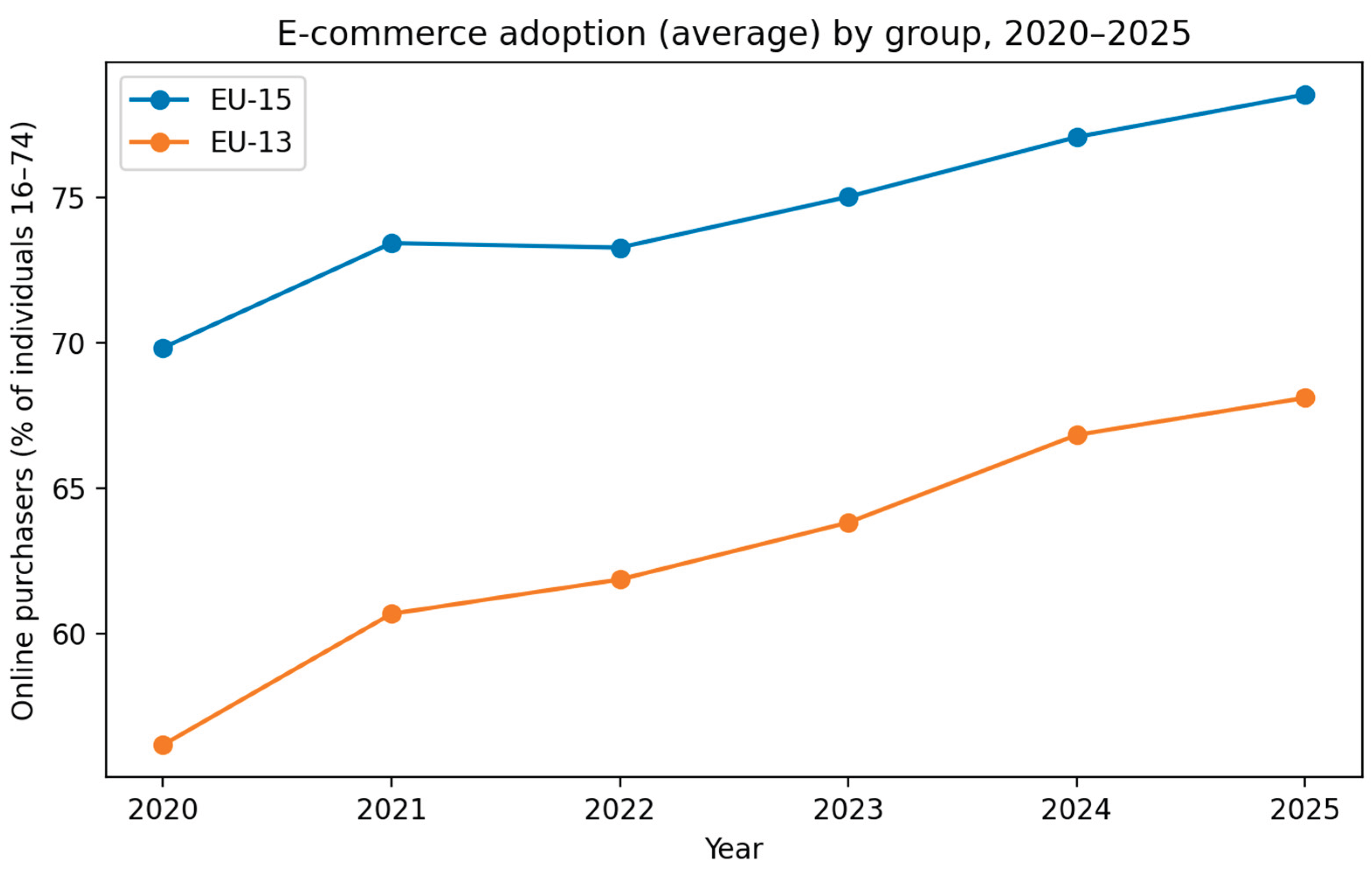
Figure 2.
E-commerce adoption and broadband access in EU-27 (2020-2025).
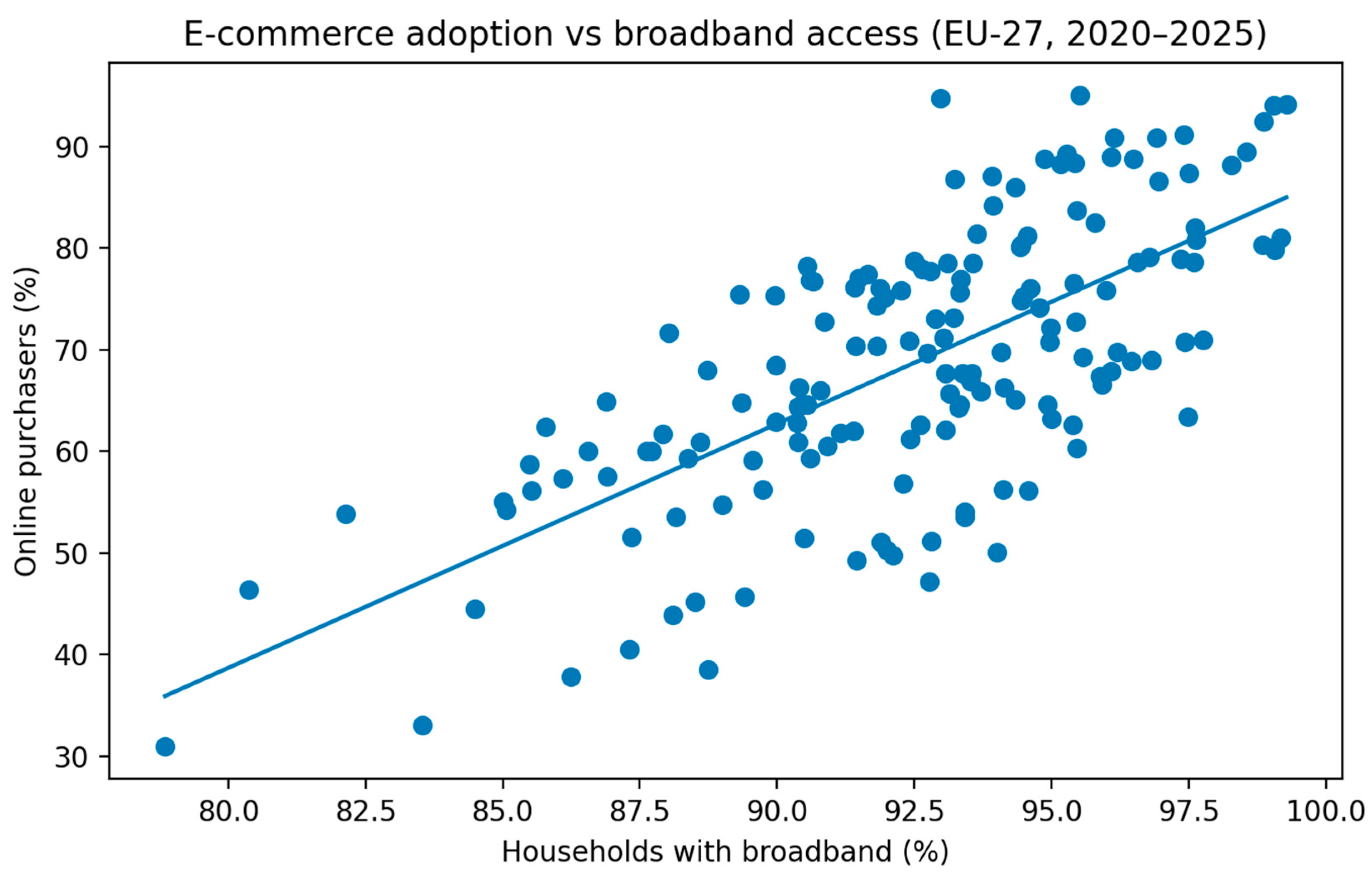
Figure 3.
E-commerce adoption and basic digital skills.
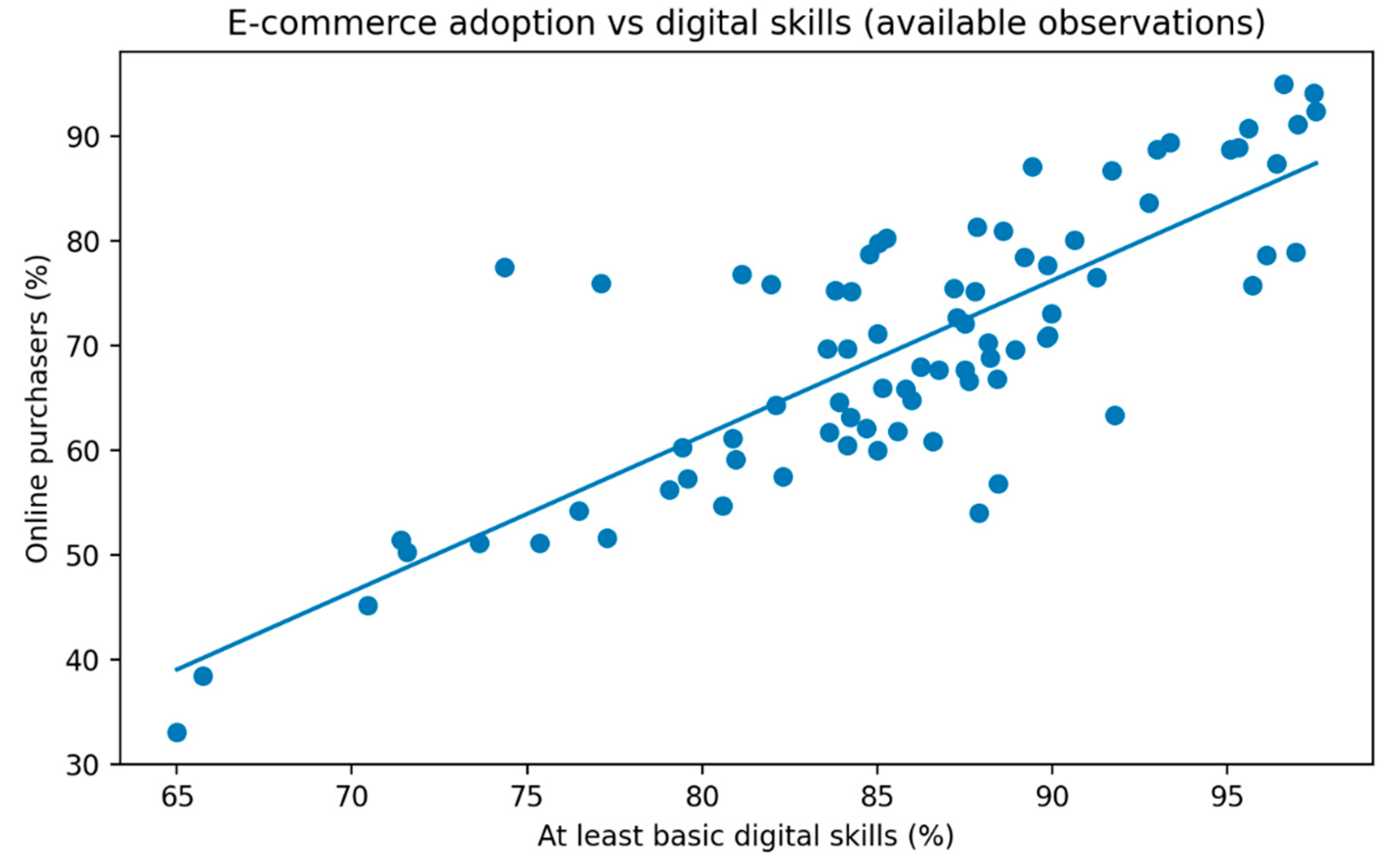
Figure 4.
E-commerce adoption against annual GDP per capita growth.
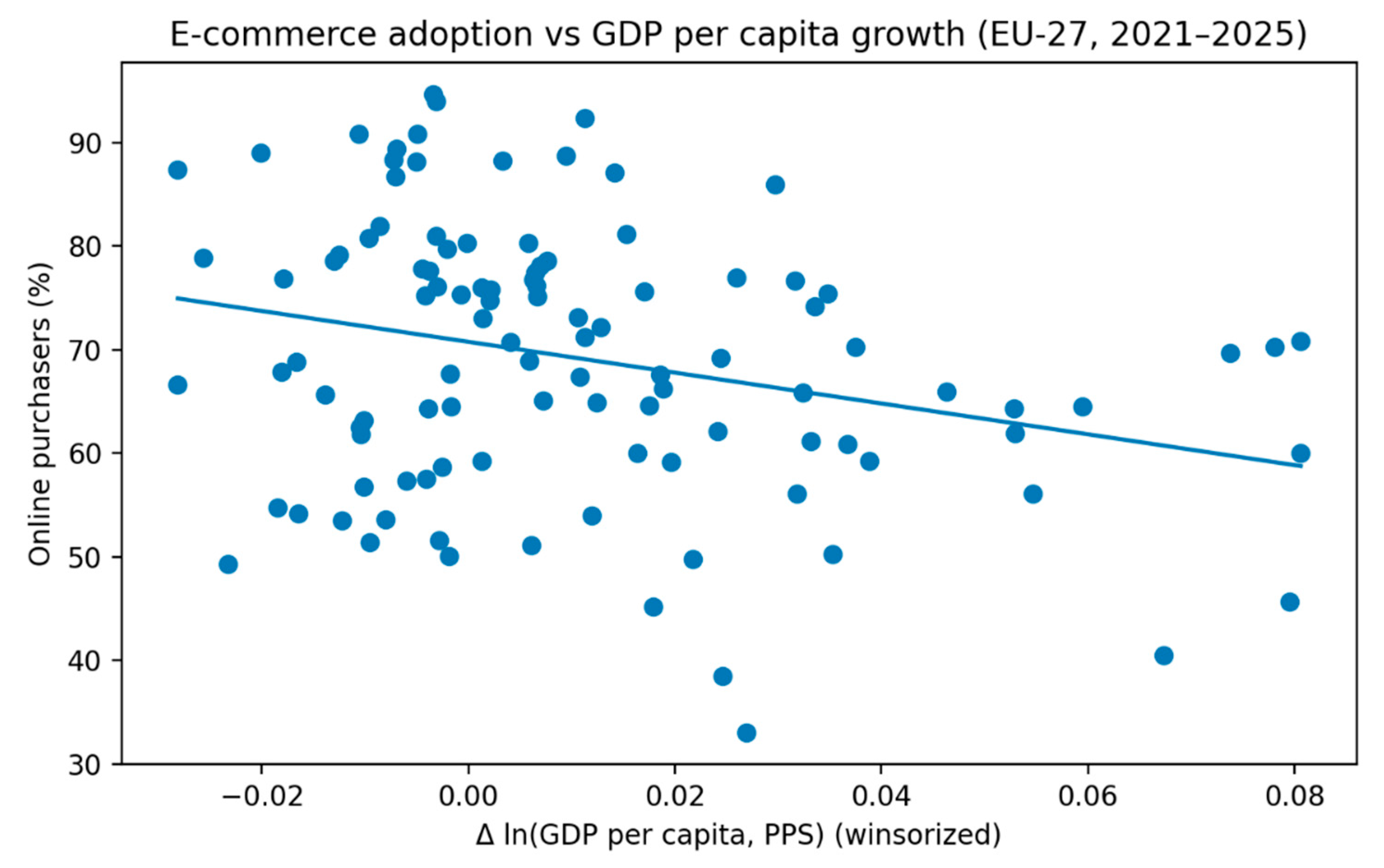
Figure 5.
Estimated coefficients for the core specification.
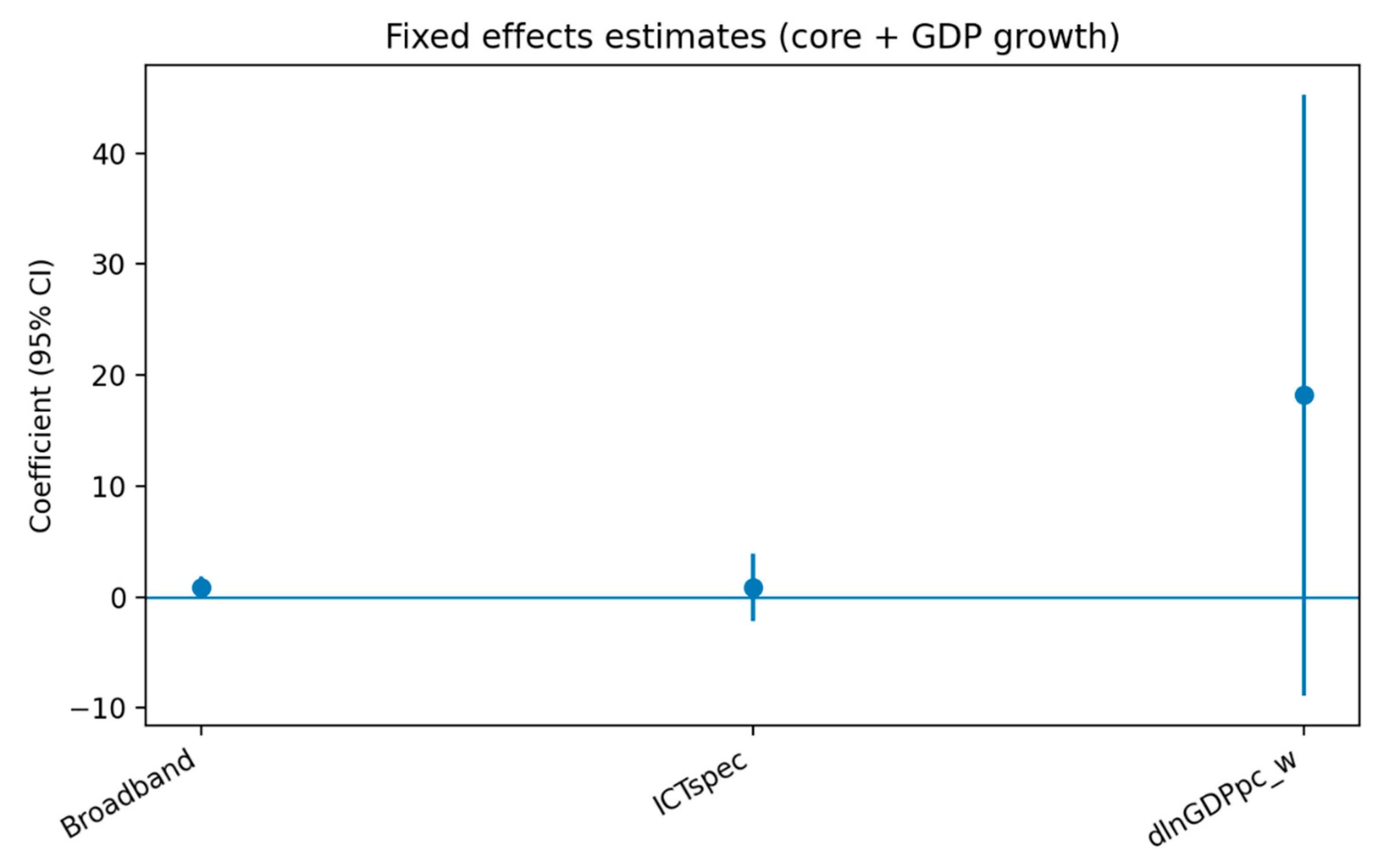
Table 1.
Variable Definitions and Sources.
| Variable | Definition | Source (Eurostat) | Unit | Expected Sign |
| Ecom | Individuals who purchased goods/services online in last 12 months (age 16–74) | isoc_ec_ibuy | % of individuals | — |
| Broadband | Households with broadband internet access | isoc_ci_in_h | % of households | + |
| DigSkills | Individuals with at least basic digital skills | isoc_sk_dskl_i | % of individuals | + |
| ICTspec | ICT specialists as % of total employment | isoc_sks_itspt | % of employment | + |
| GDPpc (PPS) | GDP per capita in Purchasing Power Standards | nama_10_pc | PPS index | + (level) |
| Δln(GDPpc) | Annual log-difference of GDP per capita (PPS) | computed | growth rate | ± |
| Urban | Urban population share | World Bank | % | + |
| Tertiary | Population with tertiary education attainment | edat_lfse_03 | % | + |
| EU13 | Dummy =1 for EU-13 countries | constructed | binary | — |
Note: GDP per capita is introduced in log-difference form (Δln(GDPpc)) to capture short-run purchasing power dynamics and avoid scale distortions.
Table 2.
Descriptive Statistics (EU-27, 2020–2025).
| count | missing | mean | std | min | 25% | 50% | 75% | max | |
| Ecom | 161 | 1 | 68.9302 | 13.5017 | 30.95 | 60.28 | 69.23 | 78.57 | 95.05 |
| Broadband | 160 | 2 | 92.5616 | 3.8984 | 78.85 | 90.395 | 93.085 | 95.385 | 99.28 |
| DigSkills | 81 | 81 | 85.7541 | 7.1542 | 65 | 82.1 | 86.25 | 89.86 | 97.55 |
| ICTspec | 135 | 27 | 4.9244 | 1.4414 | 2 | 4.05 | 4.6 | 5.65 | 8.7 |
| GDPpc | 135 | 27 | 11.8546 | 47.5385 | 0.5404 | 0.8335 | 1.0863 | 1.2941 | 279.93 |
| Urban | 135 | 27 | 73.1019 | 12.5761 | 52.1635 | 64.2311 | 70.4918 | 81.5513 | 95.6546 |
| Tertiary | 135 | 27 | 31.083 | 7.6153 | 14.6 | 25.1 | 32.4 | 36.45 | 46.1 |
| dlnGDPpc_w | 108 | 54 | 0.0106 | 0.0247 | -0.0281 | -0.0053 | 0.0058 | 0.0224 | 0.0806 |
Table 3.
Group Means by EU-15 and EU-13.
| Ecom | Broadband | DigSkills | ICTspec | |||||||||||||||||||||
| mean | std | count | mean | std | count | mean | std | count | mean | std | count | |||||||||||||
| EU15 | ||||||||||||||||||||||||
| 0 | 74.5864 | 13.2632 | 83 | 93.8659 | 3.8361 | 82 | 87.5933 | 7.234 | 42 | 5.4843 | 1.6021 | 70 | ||||||||||||
| 1 | 62.9115 | 10.9672 | 78 | 91.1904 | 3.4907 | 78 | 83.7733 | 6.5974 | 39 | 4.3215 | 0.933 | 65 | ||||||||||||
| GDPpc | Urban | Tertiary | dlnGDPpc_w | |||||||||||||||||||||
| mean | std | count | mean | std | count | mean | std | count | mean | std | count | |||||||||||||
| EU13 | ||||||||||||||||||||||||
| 0 | 2.5783 | 3.7771 | 70 | 79.3017 | 10.4912 | 70 | 33.5086 | 7.1157 | 70 | -0.0039 | 0.0118 | 56 | ||||||||||||
| 1 | 21.8445 | 67.2371 | 65 | 66.4251 | 11.1875 | 65 | 28.4708 | 7.3122 | 65 | 0.0261 | 0.0254 | 52 | ||||||||||||
Table 4.
Correlation Matrix (Main Variables).
| Ecom | Broadband | DigSkills | ICTspec | Urban | Tertiary | dlnGDPpc_w | |
| Ecom | 1 | 0.6931 | 0.8148 | 0.7283 | 0.5079 | 0.5549 | -0.2803 |
| Broadband | 0.6931 | 1 | 0.6815 | 0.6516 | 0.4462 | 0.5067 | -0.323 |
| DigSkills | 0.8148 | 0.6815 | 1 | 0.6941 | 0.3758 | 0.6744 | -0.2345 |
| ICTspec | 0.7283 | 0.6516 | 0.6941 | 1 | 0.4987 | 0.6643 | -0.2679 |
| Urban | 0.5079 | 0.4462 | 0.3758 | 0.4987 | 1 | 0.443 | -0.2942 |
| Tertiary | 0.5549 | 0.5067 | 0.6744 | 0.6643 | 0.443 | 1 | -0.283 |
| dlnGDPpc_w | -0.2803 | -0.323 | -0.2345 | -0.2679 | -0.2942 | -0.283 | 1 |
Table 5.
Fixed Effects Regression Results.
| Model | Specification | Key Variables Included | Sample Size |
| M1 | Baseline FE | Broadband, ICTspec | Full sample |
| M2 | + GDP growth | Broadband, ICTspec, Δln(GDPpc) | Slightly reduced |
| M3 | + Digital skills | Broadband, DigSkills, ICTspec, Δln(GDPpc) | Reduced |
| M4 | Heterogeneity | M3 + EU13 × DigSkills | Reduced |
| M5 | Extended controls | M3 + Urban + Tertiary | Reduced |
Disclaimer/Publisher’s Note: The statements, opinions and data contained in all publications are solely those of the individual author(s) and contributor(s) and not of MDPI and/or the editor(s). MDPI and/or the editor(s) disclaim responsibility for any injury to people or property resulting from any ideas, methods, instructions or products referred to in the content. |
© 2026 by the authors. Licensee MDPI, Basel, Switzerland. This article is an open access article distributed under the terms and conditions of the Creative Commons Attribution (CC BY) license (http://creativecommons.org/licenses/by/4.0/).
Copyright: This open access article is published under a Creative Commons CC BY 4.0 license, which permit the free download, distribution, and reuse, provided that the author and preprint are cited in any reuse.


