

Submitted:
05 August 2026
Posted:
05 August 2026
You are already at the latest version
Abstract
Long-horizon autonomous robots must retain and reuse important information from sensing, learning, and reasoning so that past events can continue to influence future decisions and actions. However, conventional memory retrieval and fixed-interval reminders either fail to activate information when it is indirectly relevant or repeatedly process it after its importance has decreased. This paper proposes a persistent influence model for autonomous robots. Important sensor states, newly learned knowledge and skills, externally supplied information, and conclusions autonomously judged important by a thinking module are represented as persistent influence items. These items can be independently reconsidered at adaptive intervals or attached to the prompts of related future tasks. During each processing cycle, the thinking module may request additional sensing, perform analysis, apply learned knowledge, execute a skill, or take protective action. An independent regulation module gradually updates influence strength, processing interval, and state according to elapsed time, new evidence, and action outcomes, preventing high-consequence information from being removed prematurely. Experiments show that the proposed method reduced cumulative temperature excess by 72.6% in a long-horizon latent-risk scenario, achieved an 83.33% task-success rate, and increased hazard prevention for thinking-identified issues to 41.18%, while reducing unnecessary inspections by 79.7% compared with fixed-interval persistence.
Keywords:
persistent influence
; autonomous robots
; long-horizon reasoning
; continual learning
1. Introduction
Humans do not treat every observation, thought, instruction, or newly acquired skill as an isolated event. Some information continues to influence later attention, reasoning, and behavior even when it is not part of the current task. Pain is a typical example. After experiencing pain in a joint or muscle, a person may avoid excessive force, periodically check whether the condition has improved, and recall the pain when performing a related activity. The influence may gradually weaken after repeated normal observations, but a later abnormal sensation or demanding action can make it important again. Newly learned knowledge and skills have a similar persistent effect. After learning a safer way to lift an object or operate a tool, a person may reuse it in later situations that are not identical to the original learning task. Humans can also maintain unresolved concerns, warnings, and externally provided instructions over long periods and allow them to affect future decisions when relevant.
This capability is important for autonomous robots [1] operating over long periods. A robot may observe an early warning that does not immediately cause a failure, learn a skill whose future applications are not yet known, receive an instruction that should remain effective across multiple tasks, or autonomously identify a weak signal that may indicate a future hazard. Such information should not necessarily dominate every subsequent reasoning cycle. However, it should also not disappear merely because several later observations appear normal or because the current task is only indirectly related to the original event. For example, a motor warning may be followed by a long period of normal operation, while a rare high-load task occurring much later may still trigger severe damage. Similarly, a newly learned grasping method may be useful for objects that differ in appearance but share relevant physical properties.
Existing robot memory mechanisms do not fully support this form of long-term influence [2]. Short-term state representations usually emphasize the current task and recent observations. Experience replay and continual learning preserve data or model parameters, but they do not directly determine when a particular piece of information should re-enter reasoning. Retrieval-based memory normally returns information according to similarity between the current query and stored content. It may therefore miss information whose importance is causal, safety-related, or indirectly relevant rather than semantically similar. In contrast, fixed reminders or fixed-interval processing can repeatedly introduce information even when no new evidence exists, increasing reasoning cost and interfering with unrelated tasks. More importantly, allowing a single reasoning result to directly delete an important item may cause premature forgetting, especially for low-probability but high-consequence risks.
Inspired by the persistent effects of pain, learning, unresolved concerns, and instructions in human behavior, this paper studies how analogous functionality can be constructed for autonomous robots. The goal is not to reproduce human memory or cognition biologically. Instead, we abstract a functional property: some information should maintain a controllable influence on later reasoning and behavior, and this influence should change gradually according to time, relevance, evidence, task demands, and action outcomes. We refer to this property as persistent influence.
This paper proposes a persistent influence management model for long-horizon autonomous robot reasoning and behavior. Information originating from continuous sensing, newly learned knowledge or skills, external instructions, or autonomous thinking can be converted into a persistent influence item. Each item records its content, source, type, confidence, influence strength, consequence severity, processing interval, next processing time, current state, and processing history. This representation distinguishes the storage of information from its current ability to affect robot decisions.
A persistent influence item can affect the robot through two delivery modes. First, it can be independently sent to the thinking module at an adaptive interval, even when the robot is not currently performing an obviously related task. This mode supports periodic reconsideration, evidence collection, and autonomous follow-up. Second, the item can be attached as an explicitly labeled prompt block when the robot processes a related task. This mode allows previously identified risks, learned knowledge, or unresolved issues to directly influence the current decision. After receiving an item, the thinking module may request additional sensing, analyze the situation, apply learned knowledge, execute a skill, modify the current action, or take a protective measure.
The persistence of an item is not directly controlled by a single output of the thinking module. An independent persistent influence regulation module updates its influence strength, processing interval, and state according to accumulated evidence and action outcomes. When repeated processing provides no new information, the interval can gradually increase and the influence can move from an active state to an observation state. When related tasks, abnormal observations, or new supporting evidence appear, the item can be strengthened and processed more frequently. For high-consequence risks, a severity-dependent minimum influence is maintained until repair, replacement, or sufficient causal evidence indicates that the source of the risk has been removed. Therefore, long retention does not require high-frequency processing, and temporary normal observations do not automatically eliminate a potentially severe latent risk.
The proposed model also provides a general interface between persistent information and a robot thinking module. It does not require every possible source, object category, risk type, or future task to be predefined. Initial regulation rules can be implemented using explicit update functions and safety constraints, while later systems may replace parts of these rules with learned policies. This separation allows the thinking module to focus on situation interpretation and action generation, while the regulation module controls how long an item should remain influential and how often it should be reconsidered.
The main contributions of this paper are as follows:
- A human-inspired persistent influence concept is introduced for autonomous robots. It captures the functional effects of signals such as pain, newly learned knowledge, unresolved concerns, and long-term instructions without attempting to reproduce human cognition biologically.
- A unified persistent influence representation is proposed for information originating from sensing, learning, external instructions, and autonomous thinking. The representation explicitly separates stored content from its current influence strength, processing interval, consequence severity, and state.
- Two complementary delivery modes are developed. Independent processing supports autonomous reconsideration and follow-up, whereas prompt-attached delivery enables persistent information to affect ongoing related tasks.
- An independent regulation mechanism is designed to update influence strength, processing frequency, and lifecycle state according to relevance, new evidence, elapsed time, uncertainty, and action outcomes. The mechanism prevents important information from being prematurely removed by a single reasoning result.
The remainder of this paper is organized as follows. Section 2 reviews related research on robot memory, continual and lifelong learning, cognitive architectures, autonomous reasoning, and safety-aware decision-making. Section 3 presents the persistent influence representation, delivery mechanisms, regulation process, and lifecycle management method. Section 4 describes the experimental scenarios, configurations, evaluation metrics, and results. Finally, Section 5 summarizes the findings and discusses future work.
2. Related Work
The proposed persistent influence model is related to robot memory, continual and lifelong learning, cognitive architectures, intrinsic motivation, and metareasoning. These research directions provide important mechanisms for preserving experience, transferring knowledge, generating autonomous behavior, and controlling computation. However, they generally focus on what information is stored, learned, retrieved, or explored, rather than on how a particular piece of information should maintain a gradually regulated influence over future robot reasoning and behavior. This section reviews three closely related aspects and clarifies their relationship to the proposed model.
2.1. Robot Memory and Retrieval-Augmented Embodied Agents
Robot memory systems organize past observations, actions, objects, and task experiences so that they can support later reasoning and execution. The ArmarX memory architecture, for example, treats memory as an active component that connects sensorimotor and semantic representations and provides services for prediction, simulation, planning, and action parameterization [3]. Its combination of working memory, long-term memory, episodic structure, and multimodal data representation provides a strong foundation for long-lived cognitive robots. ReMEmbR stores spatial, temporal, and visual information from long robot deployments and retrieves relevant records for long-horizon question answering [4]. Retrieval-Augmented Embodied Agents retrieve reusable policies from an external memory bank and integrate them into the generation of policies for new tasks [5]. These methods demonstrate that explicit memory can improve long-horizon understanding, policy reuse, and adaptation without requiring all past information to remain in the immediate context.
The main advantage of retrieval-based memory is efficiency. Instead of repeatedly supplying the entire interaction history, a retriever selects a small set of records according to a query, visual observation, task description, or multimodal similarity. This design is particularly effective when the current request directly indicates which historical information is needed. Structured spatial and temporal metadata can further improve retrieval for questions involving where and when an event occurred [4]. Similarly, retrieving a previously successful policy can reduce the amount of new training required for a related manipulation task [5]. Nevertheless, retrieval is usually reactive: stored information becomes available only after an explicit query or a sufficiently similar current context is formed. A latent motor fault, a weak warning, or an unresolved concern may therefore remain inactive when its importance is causal or safety-related but its semantic similarity to the current task is low. Retrieval confidence also does not directly specify how long the retrieved information should continue to influence the robot after the current query has ended.
The proposed method complements rather than replaces these memory architectures. A persistent influence item may still refer to an episodic record, semantic fact, learned policy, sensor state, or external-memory entry. The difference is that the proposed model adds an influence-management layer above storage and retrieval. Each item has an influence strength, consequence severity, processing interval, lifecycle state, and next processing time. It can be reconsidered independently even when no direct query is issued, or attached to the prompt of a later related task so that it can affect the current decision. In addition, repeated normal observations can reduce its processing frequency without immediately deleting it. Thus, conventional robot memory primarily answers the question of how information is represented and accessed, whereas persistent influence additionally addresses when the information should re-enter reasoning, how strongly it should affect behavior, and under what evidence it may be weakened, reactivated, or retired.
2.2. Continual Learning and Cross-Task Skill Reuse
Continual learning enables an agent to acquire new knowledge from a sequence of experiences while limiting the loss of previously learned capabilities. Lesort et al. describe continual learning for robotics as the incremental acquisition of knowledge and skills under changing data distributions, objectives, and resource constraints [6]. In robotic reinforcement learning, Xie and Finn retain previous experiences and policies to cumulatively expand a robot’s skill set under sequential task arrival [7]. LIBERO provides task suites for evaluating the transfer of declarative and procedural knowledge in lifelong robot manipulation [8]. More recently, Meng et al. proposed a nonparametric knowledge space that preserves and combines knowledge from sequential robot tasks [9]. These studies are closely related to the present work because newly learned knowledge and skills constitute an important source of persistent influence.
The principal benefits of continual learning are knowledge preservation, sample-efficient adaptation, forward transfer, and resistance to catastrophic forgetting. Retaining earlier experience can reduce the number of samples needed to learn a new robot task [7], while modular or nonparametric knowledge representations can help an agent infer whether existing knowledge should be reused or a new component should be created [9]. Benchmarks such as LIBERO also reveal that procedural transfer is more complex than transferring static object concepts, because the order of tasks, policy architecture, demonstrations, and pretraining strategy can all affect later performance [8]. However, most continual learning methods focus on updating model parameters, retaining replay data, selecting a policy module, or evaluating performance after a task has been learned. They do not explicitly maintain a time-varying influence for a particular learned fact or skill during subsequent reasoning cycles. A skill may remain encoded in the model but still fail to be selected when a later task is only partially related. Conversely, broad reuse can produce negative transfer when a skill is activated for unsuitable objects or contexts.
The proposed model addresses a complementary stage between learning and execution. It does not replace the algorithm that learns a skill or prevent catastrophic forgetting inside a neural policy. Instead, once knowledge or a skill has been learned, the robot can create a persistent influence item that records its applicability, confidence, expected benefit, consequence of misuse, and previous outcomes. The item can then be attached to later tasks when relevant, strengthened after successful reuse, weakened after contradictory evidence, and retained in an observation state when its future usefulness is uncertain. This makes the distinction between knowledge retention and knowledge influence explicit. Continual learning preserves what the robot has learned; persistent influence regulates when that learned content should affect a later reasoning or action decision. The two mechanisms can therefore be combined: a continual learner maintains the underlying skill, while the proposed regulator manages its selective cross-task activation.
2.3. Cognitive Architectures, Intrinsic Motivation, and Reasoning Regulation
Cognitive architectures attempt to integrate perception, memory, reasoning, learning, and action within a unified computational system. Soar formulates goal-directed behavior through the selection and application of operators to represented states and supports problem solving, learning, episodic memory, and semantic memory [10]. ACT-R integrates declarative memory, procedural knowledge, perceptual modules, and action modules to model how cognitive components jointly produce behavior [11]. These architectures are important to the present study because they show that memory should not be treated as an isolated database; it must interact with reasoning and action selection. Their structured mechanisms also provide interpretability and allow knowledge acquired in one cognitive process to support another process.
Intrinsic-motivation and curiosity-driven methods provide a complementary approach to autonomous behavior. Oudeyer and Kaplan classify computational intrinsic-motivation mechanisms according to signals such as novelty, prediction error, uncertainty, and learning progress [12]. Pathak et al. use self-supervised prediction error as an intrinsic reward, allowing an agent to explore even when external rewards are sparse [13]. These methods are beneficial because they enable an agent to identify informative situations and acquire skills without requiring every learning objective to be externally specified. However, an intrinsic reward usually affects the immediate selection of an exploration or learning action. It does not necessarily create a persistent issue that remains available after novelty decreases. Prediction error may become small after several normal observations even though the original event indicates a rare but high-consequence risk. Likewise, cognitive architectures commonly use activation, retrieval, production rules, or architectural learning mechanisms, but they do not directly provide a general lifecycle in which an open-ended item has independently regulated strength, consequence-aware retention, adaptive processing intervals, and controlled retirement.
Metareasoning studies how an agent should allocate computation and decide whether additional reasoning is worth its cost. Recent work applies value-of-computation principles to LLM reasoning so that unnecessary intermediate reasoning can be reduced while task performance is maintained [14]. This objective is related to the adaptive intervals in the proposed method: both approaches seek to avoid spending equal computational effort on every issue. The difference is that metareasoning generally regulates computation for the current problem, whereas persistent influence regulates the future availability and strength of information across many problems and time steps. In the proposed model, the thinking module may autonomously identify an important issue, request new observations, or recommend that an issue is resolved, but an independent regulator controls its long-term influence. A single LLM judgment therefore cannot immediately remove an item whose accumulated evidence or consequence severity still justifies retention. This separation supports open-ended issue creation while reducing premature forgetting, uncontrolled persistence, and repeated fixed-frequency reasoning.
Overall, previous research provides strong solutions for storing robot experience, retrieving relevant records, preserving learned capabilities, generating curiosity-driven behavior, and integrating cognitive functions. The proposed method focuses on a different but complementary problem: regulating how selected information continues to affect a robot after its original observation, learning episode, instruction, or reasoning process has ended. It connects stored memory, learned skills, and autonomously identified issues to future reasoning through explicit delivery and lifecycle mechanisms. Consequently, persistent influence can be implemented on top of retrieval memory, continual learning, or a cognitive architecture rather than being restricted to one particular memory representation, learning algorithm, or thinking model.
3. Adaptive Persistent Influence Model
This section presents the proposed persistent influence model for autonomous robots. The model aims to enable selected information to continuously affect robot reasoning and behavior over a relatively long period. Such information may originate from continuously sensed environmental or internal states, newly learned knowledge, newly acquired skills, external instructions, or information that the thinking module autonomously judges to be important.
The proposed model is different from a conventional memory mechanism that only stores historical information and retrieves it when it is explicitly required by the current task. A persistent influence can be repeatedly sent to the thinking module at an adaptive interval or attached to the prompt when the robot is processing another issue. Therefore, information obtained in one situation can continue to influence sensing, reasoning, skill application, and action in later situations.
The thinking module is responsible for analyzing a persistent influence and proposing information collection or actions. However, it cannot directly remove the influence. An independent persistent influence regulation module gradually adjusts its influence strength, processing interval, and state according to elapsed time, repeated processing, new evidence, and action results. This separation prevents an important influence from disappearing immediately because of a single uncertain judgment.
The overall model is expressed as
3.1. Persistent Influence Construction
3.1.1. Information Sources
The robot continuously perceives its environment and internal state. The observation at time t is represented by
Continuous sensing does not mean that all raw sensor data are directly submitted to the thinking module. A lightweight perception component first detects significant changes, abnormalities, repeated observations, and potentially important situations. Only selected information is considered as a candidate for persistent influence construction.
Persistent influence candidates are not limited to sensor observations. They may also be generated when the robot learns new knowledge, acquires a new skill, receives an external instruction, or autonomously judges that some information should remain noticeable for a long period.
The source of a persistent influence is defined as
The sensing source includes important environmental or internal states, such as possible damage, abnormal temperature, or a repeatedly observed environmental change. The learned-knowledge source includes newly acquired facts, relations, patterns, constraints, and general conclusions. The learned-skill source represents executable methods that may be reused in future situations.
The thinking source represents information that the thinking module autonomously judges to have long-term value. Such information does not need to correspond to an immediate sensor abnormality. For example, the thinking module may judge that a newly discovered relation, an unresolved concern, a useful principle, or a possible future risk should remain noticeable. The external source includes human instructions or information provided by another system.
3.1.2. Candidate Evaluation
For a candidate c, its persistent value is evaluated according to
where denotes the difference from previously observed or known information, denotes abnormality or urgency, denotes expected future usefulness, denotes possible applicability across different tasks, and denotes the possible consequence of forgetting the information.
A candidate is converted into a persistent influence when
where is the candidate threshold.
For sensor-derived information, and are normally more important. For newly learned knowledge or skills, future usefulness and cross-task applicability may dominate. For information proposed by the thinking module, the reasoning basis and confidence are recorded together with the candidate. Therefore, a single unsupported output from the thinking module does not automatically become a permanent influence.
3.1.3. Persistent Influence Representation
An accepted candidate is represented as
where denotes the influence content, denotes its source, and denotes its type. The variable is the current confidence, is the influence strength, and describes the applicable scope. denotes the severity of the potential consequence if the influence is ignored. A low current occurrence probability does not imply that a high-consequence influence can be removed quickly. The variable denotes its delivery mode, is the current processing interval, and is the next scheduled processing time. The variable represents its current state, and records previous sensing, reasoning, action, and update results.
The influence type is defined as
A protective state represents a possible risk, damage, or abnormal internal condition. An unresolved issue requires continued information collection, analysis, or action. Learned knowledge supports later reasoning, while a learned skill provides a reusable executable method. An important belief is a conclusion, concern, or principle that the thinking module considers worthy of continued attention.
3.2. Persistent Delivery and Closed-Loop Processing
3.2.1. Two Persistent Delivery Modes
A persistent influence can be delivered to the thinking module in two ways. In the first mode, it is independently sent to the thinking module when its scheduled processing time is reached. The persistent influence itself then becomes the main issue to be processed. This mode is called independent persistent processing.
In the second mode, a persistent influence is attached to the prompt when the thinking module is processing another issue. In this case, it is provided as additional long-term context and may affect the reasoning or action for the current issue. This mode is called prompt-attached persistent influence.
For a persistent influence item , its delivery mode is defined as
Here, means that the influence is processed in a separate reasoning cycle, whereas means that it is included in the prompt of another issue. The value allows the two delivery modes to be used according to the current situation.
A persistent influence is activated for independent processing when
where indicates whether should be independently processed at time t, and is the indicator function. The variable denotes the scheduled time for the next processing cycle. The event indicator becomes one when newly sensed information, a task change, or another relevant event requires the influence to be reconsidered before its scheduled time.
When the robot is processing another issue , a persistent influence may be attached to the current prompt. Here, denotes the issue or task currently processed by the thinking module. The attachment decision is defined as
where indicates whether is attached to the current prompt. The variable is the creation time of the influence, and is its initial attachment period. During this period, a newly constructed influence remains generally noticeable even when its relevance cannot yet be estimated accurately.
The variable denotes the content of the persistent influence, denotes the current robot and environmental state, and measures the relevance of the influence to the current issue and state. The terms and denote the current influence strength and confidence, respectively, while is the attachment threshold.
This mechanism allows newly sensed states, newly learned knowledge, newly acquired skills, and information judged important by the thinking module to affect other reasoning activities over a certain period. A newly created or highly relevant influence is attached more frequently. As its strength or relevance decreases, it is attached less frequently and is eventually supplied only when it is sufficiently related to the current issue.
3.2.2. Source-Identified Prompt Organization
Persistent influences are explicitly separated from the current issue in the prompt. The prompt submitted to the thinking module is organized as
where is the current issue or task, is the current robot state, is the set of selected persistent influences, and contains other necessary reasoning history.
Each persistent influence is supplied in a source-identified block:
The label distinguishes the influence from ordinary current-task information. The source identifies whether the information was sensed, newly learned, produced by thinking, or externally supplied. The type indicates whether it is a protective state, unresolved issue, learned knowledge, learned skill, or important belief.
For an LLM-based thinking module, the prompt may be logically organized as follows:
- [CURRENT ISSUE]
- The issue or task currently being processed.
- [CURRENT ROBOT STATE]
- The observations directly related to the current issue.
- [PERSISTENT INFLUENCES]
- Source: sensing
- Type: protective state
- Content: The right-arm motor recently showed possible overheating.
- Source: learned knowledge
- Type: learned knowledge
- Content: High loads combined with rapid repeated motion may increase the probability of motor overheating.
- Source: thinking
- Type: important belief
- Content: The condition of the right-arm motor should remain noticeable during later manipulation tasks.
- [INSTRUCTION]
- Process the current issue while considering the persistent influences when relevant. Determine whether additional information, analysis, skill application, or action is needed.
When an influence is independently processed, it becomes the current issue:
When it is attached to another prompt, the current issue remains unchanged:
3.2.3. Thinking, Sensing, and Action
The thinking module may be implemented by an LLM or another reasoning model. At the k-th processing cycle, it receives the organized prompt and produces
where denotes the thinking module, is the proposed operation, is the estimated risk, is the remaining uncertainty, and is the estimated progress. The variables and denote newly obtained supporting and contradictory evidence.
The proposed operation may include collecting additional sensor information, checking a related object or component, analyzing historical observations, testing a hypothesis, applying newly learned knowledge, executing a learned skill, taking a protective action, or continuing observation.
Each persistent processing cycle therefore forms a closed loop:
The thinking module may judge that an issue has been resolved or that an influence is no longer important. However, this judgment is treated only as evidence. The thinking module cannot directly delete the influence.
3.3. Persistent Influence Regulation and Learning
3.3.1. Independent Regulation Module
The persistent influence regulation module is responsible for gradually adjusting the influence strength, processing interval, and state. It is separated from the thinking module because a long-term influence should not immediately disappear only because the thinking module produces one uncertain or incorrect judgment.
The regulation module receives the previous influence state, reasoning result, sensor observations, action result, and processing history:
where denotes the regulation module, contains the reasoning and observation results, and contains the results of executed actions.
The regulation module performs three main functions: adjusting the influence strength, determining the next processing interval, and controlling progressive retirement.
3.3.2. Influence-Strength Regulation
The influence strength is gradually updated according to
where is the elapsed time since the previous processing cycle, and represents repeated processing without new supporting evidence. The variable indicates that the previous action failed or that the issue remains unresolved.
For a low-probability but high-consequence influence, the regulation module maintains a consequence-dependent lower bound
until repair, replacement, or sufficient causal evidence shows that the risk source has been removed. Normal observations may increase the processing interval and move the item to the observation state, but they do not alone justify retirement.
New supporting evidence and repeated action failure can strengthen the influence. Elapsed time, repeated processing, contradictory evidence, and stable resolution progress gradually weaken it.
To prevent excessive reduction in one cycle, the maximum decrease is limited by
where is the maximum permitted reduction in one processing cycle. Therefore, the thinking module cannot cause a persistent influence to disappear immediately.
3.3.3. Adaptive Processing Interval
The processing interval determines how frequently an influence is independently reconsidered or attached to other prompts. The current processing urgency is calculated by
The next interval is updated by
where and are the minimum and maximum allowed processing intervals.
When risk, uncertainty, or action failure remains high, increases and the interval becomes shorter. The persistent influence is therefore processed or attached more frequently. When sufficient information is obtained and stable progress is achieved, the interval is gradually increased.
The next scheduled processing time is
The processing interval can be shortened again when new supporting or abnormal evidence appears. Thus, interval adjustment is dynamic rather than a one-way decay process.
Influence strength and processing interval have different meanings. Influence strength determines how strongly an item affects reasoning and behavior, whereas the interval determines how frequently the item is reconsidered. For example, a learned safety rule may be processed infrequently but can still have a strong effect whenever a related task occurs.
3.3.4. Progressive Retirement
A persistent influence has three main states:
An active influence is regularly processed and may frequently affect robot reasoning or behavior. When its strength decreases and the related issue appears to have been resolved, it enters the observation state instead of being immediately removed. In this state, it is processed less frequently but can still be reactivated by new evidence.
An influence can be retired only when
where is the retirement threshold, is the number of consecutive cycles supporting retirement, M is the required number of confirmations, and is the minimum persistence duration.
Therefore, one successful action or one judgment from the thinking module cannot directly remove a persistent influence. A retired item may remain in historical memory and can be reactivated when related evidence appears again.
Different types of persistent influences may use different retirement rules. A temporary protective state may gradually disappear after repeated confirmation of recovery. An unresolved issue may be retired after its solution is verified. Learned knowledge and learned skills are normally retained for a longer period and are deactivated mainly when they become irrelevant, are superseded by better knowledge, or are repeatedly shown to be incorrect.
3.3.5. Learning Improved Policies
The overall framework remains fixed, including persistent influence representation, the two delivery modes, closed-loop processing, gradual regulation, interval bounds, and progressive retirement. However, the specific decision methods inside the framework do not need to remain manually defined.
Initially, predefined rules can determine candidate selection, information collection, action selection, prompt attachment, interval adjustment, and retirement. After sufficient experience has been accumulated, these decisions can be improved by a learned policy:
where determines whether the influence should be independently processed, attached to another prompt, or temporarily remain inactive.
The learned policy may discover more effective information sources, analysis procedures, actions, delivery modes, and processing intervals. For example, it may learn which sensor combination can verify an issue more efficiently, when newly learned knowledge should be attached to another reasoning process, or when a newly acquired skill can be transferred to a different situation.
The output of the learned policy is constrained by the regulation module:
where contains permitted actions, delivery constraints, interval bounds, the maximum influence reduction, the minimum persistence duration, and mandatory processing requirements for high-risk influences.
Consequently, the proposed model combines continuous sensing, newly learned knowledge and skills, autonomous importance judgment, independent and prompt-attached persistent delivery, closed-loop reasoning and action, gradual influence regulation, and experience-based policy improvement within a unified framework.
4. Verification
This section verifies whether the proposed persistent influence model enables information originating from sensing, learning, and autonomous thinking to continuously affect later robot reasoning and behavior. Three controlled long-horizon simulation experiments are conducted. The first experiment evaluates a low-probability but high-consequence risk discovered through sensing. The second evaluates the cross-task reuse of newly learned knowledge and skills. The third evaluates an important issue autonomously identified by the thinking module.
The experiments compare the proposed method with no persistence, retrieval-based memory, fixed-interval persistence, and two ablated variants. In addition to task effectiveness, the experiments measure unnecessary persistent processing, LLM calls, token consumption, and premature retirement. This allows the proposed method to be evaluated in terms of both long-horizon effectiveness and processing cost.
4.1. Experimental Environment and Protocol
4.1.1. Test Scenarios
The experiments are implemented as controlled stochastic simulations of a mobile manipulation robot. The robot contains a mobile base, a manipulator, internal and environmental sensors, a thinking module, a persistent influence store, and the proposed persistent influence regulation module. The thinking module is implemented using the deepseek-v4-flash model. It receives the current robot state, the current task, and the persistent influence items visible in the current reasoning cycle. It then selects one action and estimates the current risk, uncertainty, progress, and supporting or contradictory evidence.
Table 1 summarizes the three scenarios.
In Experiment 1, each round contains 80 sequential robot tasks. The task sequence contains heavy manipulation, repetitive sorting, light manipulation, inspection, and navigation tasks with probabilities of 0.09, 0.18, 0.25, 0.17, and 0.31, respectively. An initial warning is introduced at Step 4, indicating a latent degradation of the right-arm motor. No severe failure is directly injected at this step. Starting from Step 14, each task has a task-dependent probability of triggering the latent defect. The base trigger probabilities range from 0.001 for navigation to 0.18 for heavy manipulation and are further adjusted according to the degradation level. If a latent event is triggered, the probability of severe failure depends on the robot action. For example, using the affected arm normally retains the full failure probability, whereas splitting the load, slowing down, or using the other arm reduces it. Each severe failure adds a consequence cost of 100 and a substantial motor-temperature increase.
In Experiment 2, each round contains 30 subsequent tasks after a new grasping skill has been learned. Ten tasks are highly related smooth-cylinder tasks, ten are partially related tasks containing both valid and invalid transfer cases, and ten are unrelated manipulation, navigation, or inspection tasks. The order of the 30 tasks is randomly shuffled. When the learned skill is applicable, its use increases the nominal success probability from 0.54 to 0.88. When it is incorrectly applied to an unsuitable task, the nominal success probability decreases from 0.85 to 0.57. Consequently, this experiment evaluates both beneficial transfer and the cost of applying a persistent skill too broadly.
In Experiment 3, each round contains 26 time steps. The initial box tilt is sampled between 0.34 and 0.43, below the standard alarm threshold of 0.88. A true progressive hazard is generated with a probability of 0.62, and a later reactivation event is generated with a probability of 0.34. For a true hazard, vibration gradually increases the tilt by 0.040–0.090 per step, with an additional increase when the robot operates near the shelf. The hazard threshold is 1.00. The robot may continue its current task, inspect the box, or reposition it. Repositioning can prevent the counterfactual hazard before the standard alarm threshold is reached.
4.1.2. Compared Methods
The following methods are compared:
- No Persistence: only the current observation and current task are processed. Previously observed information does not autonomously affect later tasks.
- Retrieval Memory: historical information is stored but is supplied to the thinking module only when its semantic relevance to the current task is sufficiently high.
- Fixed Interval: persistent information is independently processed every three steps and may also be attached to later task prompts. Its processing interval is not adapted according to evidence or action results.
- Proposed: the complete model, including independent processing, prompt-attached delivery, adaptive processing intervals, result-driven strength updates, and independent persistent influence regulation.
- Independent Only: persistent information is periodically processed but is not attached to the prompt of the current task. This ablation evaluates whether independent reconsideration alone is sufficient to influence ongoing robot behavior.
- No Regulation: both delivery modes are retained, but the independent persistent influence regulation mechanism is removed. A persistent item may therefore be weakened or retired too quickly according to a single thinking result.
The common minimum and maximum processing intervals are 1 and 8 steps, respectively. The long-horizon risk item in Experiment 1 is allowed to increase its interval to 25 steps because it represents a risk that may remain relevant after a long normal period. The initial prompt-attachment period is four steps, the attachment threshold is 0.34, and the normal retirement-strength threshold is 0.22. At least five steps and two consecutive resolution confirmations are required before retirement. The maximum strength reduction in a single update is limited to 0.22.
4.1.3. Execution and Statistical Protocol
Each method is executed for 30 rounds in each experiment. The same random seed and the same externally generated task sequence, sensor noise, vibration, latent-event draws, and action-outcome draws are used for all methods in the same round. Therefore, differences between methods are not caused by different external scenarios.
The LLM temperature is set to 0, the request timeout is 90 seconds, and at most two retries are allowed. The LLM prompt and response are briefly printed during execution for process inspection. Each successfully completed method–round pair is written to a CSV file and followed by a completion flag. If execution is interrupted, completed rounds are skipped and the program resumes from the first incomplete round. Two LLM requests failed in the No-Persistence condition of Experiment 1 and were processed by the predefined rule fallback. No LLM error occurred for the proposed method.
Unless otherwise stated, the reported values are the mean and standard deviation over 30 rounds. The figures show the mean and standard error. Paired comparisons use the same round seeds. A paired Wilcoxon signed-rank test is used for continuous or count metrics, while an exact McNemar test is used for paired binary hazard outcomes.
4.1.4. Evaluation Metrics
Experiment 1 uses the number of catastrophic failures, catastrophe-prevention rate, maximum motor temperature, number of high-temperature steps, cumulative temperature excess above the safe threshold, unnecessary inspections, task time, LLM calls, token consumption, and premature retirement. The cumulative temperature excess measures both the duration and magnitude of thermal risk rather than only the maximum temperature.
Experiment 2 uses task-success rate, cross-task reuse rate, transfer-success rate, persistent activation precision and recall, irrelevant attachment rate, missed reuse rate, negative transfer rate, task time, and LLM cost. Cross-task reuse measures the proportion of applicable later tasks in which the learned skill is actually used.
Experiment 3 uses early risk detection, hazard-prevention rate, missed-hazard rate, important-issue creation precision and recall, unsupported persistence, useful follow-up actions, evidence-collection efficiency, unnecessary inspections, task interruption, delay, and LLM cost. Hazard-prevention results are calculated over the 17 rounds in which the box would have reached the hazard threshold without intervention. Unsupported persistence is evaluated over the nine rounds in which a persistent issue should not have remained active.
4.2. Long-Horizon Low-Probability and High-Consequence Risk
Table 2 reports the results of the long-horizon motor-risk experiment. The proposed method reduced the mean number of catastrophic failures from 2.00 under No Persistence to 1.53, corresponding to a reduction of 23.3%. It also reduced the mean number of failures relative to Retrieval Memory from 1.73 to 1.53. These differences were significant in the paired comparisons, with against No Persistence and against Retrieval Memory.
The proposed method also reduced the maximum motor temperature from 93.19 under No Persistence and 89.48 under Retrieval Memory to 80.30. The number of high-temperature steps decreased from 14.67 under No Persistence to 7.20, a reduction of 50.9%. More importantly, the cumulative temperature excess decreased from 419.38 to 114.75, corresponding to a reduction of 72.6%. The reductions in peak temperature, high-temperature duration, and cumulative temperature excess were significant against No Persistence, with , , and , respectively.
Compared with Fixed Interval, the proposed method increased the mean catastrophe-prevention rate from 17.89% to 26.94% (). At the same time, unnecessary inspections decreased from 13.70 to 1.90, total token consumption decreased from 18,034 to 12,061, and average task time decreased from 1.660 to 1.488. Thus, the adaptive interval did not simply keep the influence permanently active at high frequency. It retained the high-consequence risk while reducing repeated checks during long periods without new evidence.
Figure 1.
Effectiveness and processing cost in the long-horizon latent-risk experiment. The proposed method obtains a higher prevention rate than the fixed-interval method while requiring substantially fewer tokens. Error bars indicate the standard error over 30 rounds.
Figure 1.
Effectiveness and processing cost in the long-horizon latent-risk experiment. The proposed method obtains a higher prevention rate than the fixed-interval method while requiring substantially fewer tokens. Error bars indicate the standard error over 30 rounds.
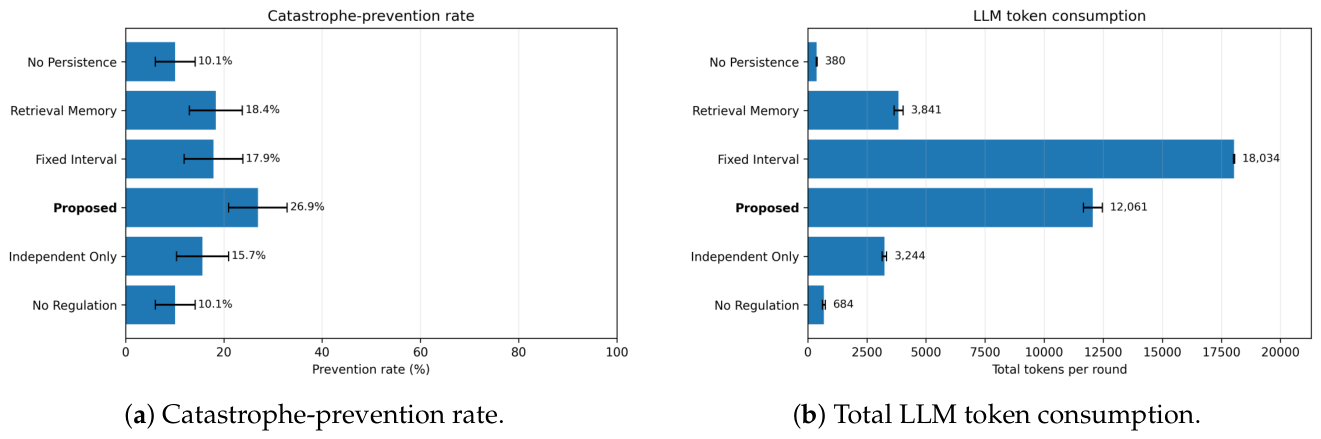
The ablation results further clarify the mechanism. Independent Only produced 1.90 failures and a peak temperature of 91.97 because the persistent risk was reconsidered but was not supplied to the prompt of the ongoing high-stress task. No Regulation retired the influence prematurely in all 30 rounds and produced results close to No Persistence, including 2.00 failures and a cumulative temperature excess of 431.17. In contrast, the proposed regulator produced no premature retirement and increased the final mean processing interval to 21.5 steps while retaining a nonzero influence strength. These results demonstrate that prompt-attached delivery is needed for a persistent risk to affect the current task and that the independent regulation module prevents a severe but infrequent risk from being removed after only a few normal observations.
The proposed method does not eliminate all failures: 76.67% of the rounds still contain at least one catastrophic event. The result should therefore be interpreted as a significant reduction in long-horizon risk and accumulated consequence rather than complete risk elimination.
4.3. Cross-Task Reuse of Newly Learned Knowledge and Skills
Table 3 presents the results for newly learned knowledge and skills. The proposed method achieved a task-success rate of 83.33%, compared with 68.78% for No Persistence, 75.67% for Retrieval Memory, and 75.78% for Fixed Interval. The improvements were significant in all three paired comparisons ().
The main advantage is the coverage of future applicable tasks. The proposed method achieved a cross-task reuse rate and activation recall of 100%, whereas Retrieval Memory achieved only 43.70% and Fixed Interval achieved 62.64Ṫhe improvements over both baselines were significant (). Retrieval Memory achieved a higher activation precision of 89.95%, but this conservative selection caused it to miss more than half of the applicable tasks. The proposed method therefore provides a different balance: it prioritizes complete cross-task reuse while retaining substantially better selectivity than fixed-interval persistence.
Compared with Fixed Interval, the proposed method reduced irrelevant attachment from 57.86% to 34.90% and negative transfer from 21.19% to 14.27%. These reductions were significant, with for irrelevant attachment and for negative transfer. Thus, the improvement in task success is not obtained merely by inserting the learned skill into every later task. The relevance- and feedback-based mechanism reduces the incorrect use of the skill in unrelated situations.
Figure 2.
Results for newly learned knowledge and skill reuse. The proposed method achieves the highest task-success rate and reuses the learned method in all applicable later tasks.
Figure 2.
Results for newly learned knowledge and skill reuse. The proposed method achieves the highest task-success rate and reuses the learned method in all applicable later tasks.
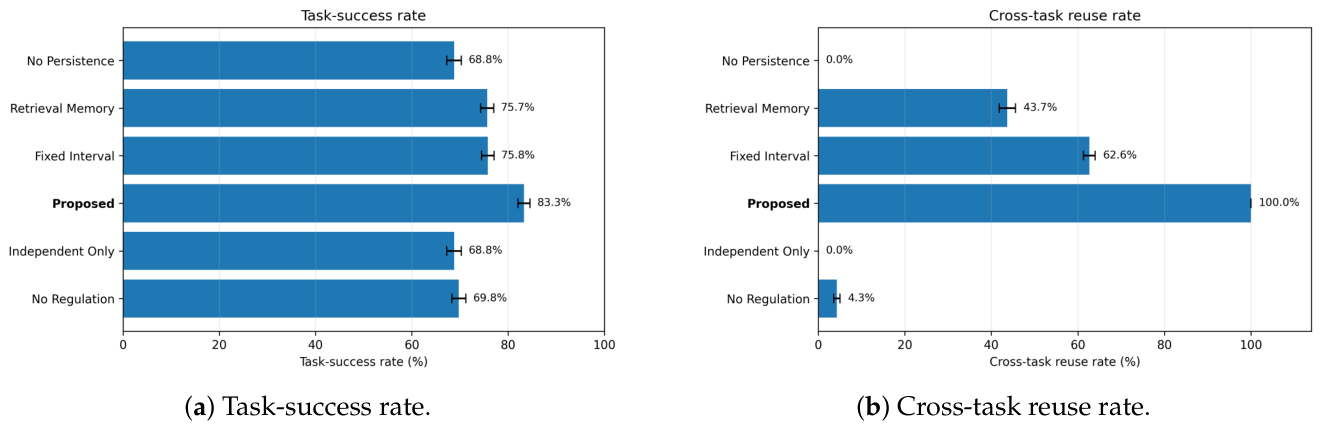
Independent Only obtained the same task-success rate as No Persistence and a cross-task reuse rate of zero. Periodically reviewing the skill without attaching it to the current task therefore did not change the current grasping decision. No Regulation retained only 4.29% cross-task reuse and prematurely retired the learned influence in 53.33% of the rounds. These results show that newly learned knowledge must be made visible during a related future task and must not be removed according to a small number of early outcomes.
The higher reuse coverage introduces additional reasoning cost. The proposed method required an average of 29.4 LLM calls and 13,157 tokens, compared with 6.93 calls and 3,032 tokens for Retrieval Memory and 18 calls and 8,145 tokens for Fixed Interval. Therefore, Experiment 2 demonstrates a substantial gain in cross-task effectiveness rather than the lowest computational cost. Improving the precision of attachment while maintaining high recall remains a possible optimization direction.
4.4. Persistent Processing of Thinking-Identified Important Issues
Experiment 3 evaluates whether the thinking module can autonomously identify information that deserves long-term attention even though it has not yet triggered a conventional alarm. Of the 30 generated scenarios, 17 would have reached the hazard threshold without intervention, 21 contained an issue that should be created or later reactivated, nine should not maintain an unsupported persistent issue, and 11 contained a later reactivation event.
As shown in Table 4, the proposed method prevented the hazard in 41.18% of the 17 counterfactual hazard scenarios. Retrieval Memory prevented 29.41%, while No Persistence, Fixed Interval, and No Regulation prevented none. The proposed method significantly outperformed No Persistence and Fixed Interval under the exact paired McNemar test ( for both). It also significantly outperformed Independent Only ( versus , ). Its advantage over Retrieval Memory was positive but not statistically significant in the current 17 hazard cases ().
The creation precision of the proposed method was 91.30%, compared with 70.00% for Retrieval Memory and Fixed Interval. More importantly, in cases where a persistent issue should not remain active, unsupported persistence decreased from 100% under both baselines to 19.75%. Thus, the proposed method did not obtain its higher hazard-prevention rate simply by retaining every uncertain observation indefinitely.
Compared with Fixed Interval, the number of unnecessary inspections decreased from 6.73 to 1.37, a reduction of 79.7%. Token consumption decreased from 9,721 to 5,983, a reduction of 38.4%, and average task delay decreased from 0.468 to 0.360. The reductions in unnecessary inspections and token consumption were significant, with and , respectively.
Figure 3.
Results for thinking-identified important issues. The proposed method improves hazard prevention while avoiding the repeated unnecessary inspections produced by fixed-interval persistence.
Figure 3.
Results for thinking-identified important issues. The proposed method improves hazard prevention while avoiding the repeated unnecessary inspections produced by fixed-interval persistence.
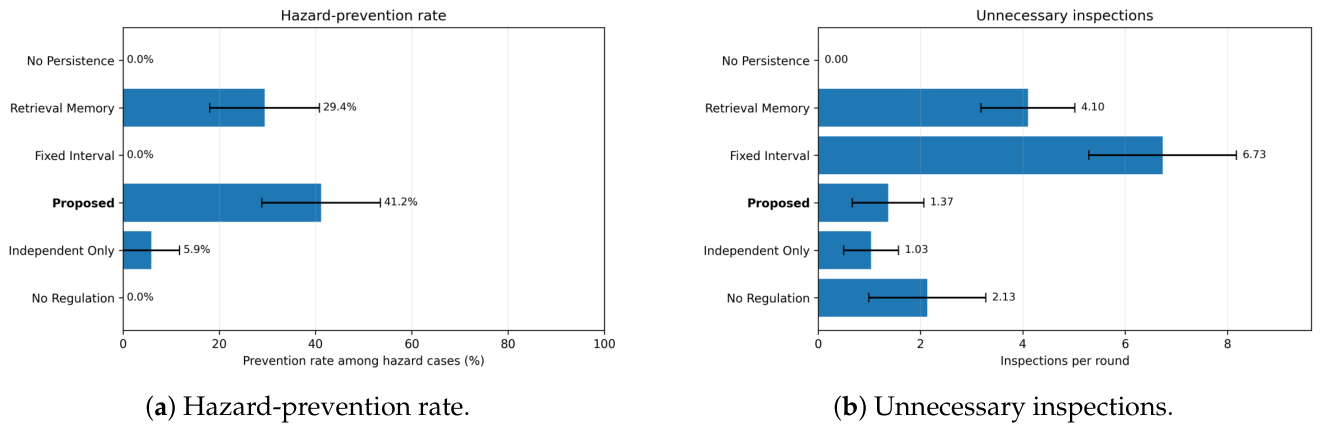
Independent Only detected the issue but prevented only 5.88% of hazards because its conclusions were not consistently supplied to the prompt of the current shelf-related task. No Regulation achieved zero hazard prevention despite using the same initial creation mechanism as the proposed method. These results indicate that identifying an important issue is not sufficient by itself. The issue must remain available, be supplied to later relevant reasoning, and be updated according to follow-up evidence and action outcomes.
The missed-hazard rate of the proposed method remains 58.82%, and the comparison with Retrieval Memory is based on only 17 hazard cases. Consequently, additional rounds and physical-robot experiments are required before claiming complete or universally superior hazard prevention.
4.5. Overall Discussion
The three experiments provide complementary evidence for the proposed model.
First, Experiment 1 shows that an important state originating from sensing can remain influential after a long period of normal operation. The proposed method reduces catastrophic failures and accumulated thermal damage while requiring substantially fewer inspections and tokens than fixed-interval persistence. This supports the use of consequence-aware minimum influence strength and gradual interval expansion for low-probability but high-consequence risks.
Second, Experiment 2 shows that newly learned knowledge and skills can be reused beyond the task in which they were acquired. The proposed method achieves 83.33% task success and 100% cross-task reuse, demonstrating that persistent influence is not limited to unresolved hazards but can also support continual robot learning.
Third, Experiment 3 shows that the thinking module can autonomously mark a weak but potentially important observation for later processing. The proposed method increases hazard prevention to 41.18%, reduces unsupported persistence to 19.75%, and avoids the high inspection cost of fixed-interval processing.
Across the experiments, Fixed Interval frequently retains useful information but incurs repeated processing, unnecessary attachment, or unnecessary inspection. Retrieval Memory has lower cost and sometimes higher precision, but it misses information whose future importance is not captured by direct semantic similarity. Independent Only demonstrates that periodic reconsideration alone cannot reliably affect the current task. No Regulation demonstrates that allowing a thinking result to directly remove a persistent influence causes premature forgetting or ineffective long-term behavior.
Overall, the results demonstrate that the proposed method provides a better balance among long-horizon effectiveness, cross-task influence, and processing cost. It enables important information from sensing, learning, and autonomous thinking to affect future robot behavior without requiring the same information to be inserted at a fixed high frequency. Nevertheless, the experiments are controlled stochastic simulations rather than physical-robot evaluations, the proposed method has higher reasoning cost in the skill-transfer experiment, and the number of true hazard cases in Experiment 3 is limited. These limitations define the main directions for subsequent verification.
5. Conclusions
This paper proposed a persistent influence management model for long-horizon autonomous robot reasoning and behavior. Inspired by persistent human influences such as pain, newly learned knowledge, unresolved concerns, and long-term instructions, the model enables important information from sensing, learning, external input, and autonomous thinking to continue affecting future decisions. Persistent items can be independently reconsidered at adaptive intervals or attached to related task prompts, while an independent regulation module controls their strength, processing frequency, and lifecycle.
The experiments demonstrated the effectiveness of the proposed approach in three scenarios. It reduced cumulative temperature excess by 72.6% for a latent high-consequence motor risk, achieved an 83.33% task-success rate and 100% cross-task reuse for a newly learned skill, and improved hazard prevention for thinking-identified issues to 41.18%. Compared with fixed-interval persistence, it also reduced unnecessary inspections and reasoning costs. The ablation results showed that persistent information must be available during related tasks and should not be removed directly according to a single reasoning result.
Future work will evaluate the model on physical robots, improve attachment precision and computational efficiency, and investigate learned regulation policies under explicit safety constraints.
References
- Chen, W.; Chi, W.; Ji, S.; Ye, H.; Liu, J.; Jia, Y.; Yu, J.; Cheng, J. A survey of autonomous robots and multi-robot navigation: Perception, planning and collaboration. Biomim. Intell. Robot. 2025, 5, 100203. [Google Scholar] [CrossRef]
- Chung, N.; Hanyu, T.; Nguyen, T.; Le, H.; Bumgarner, F.; Nguyen, D.M.H.; Vo, K.; Yamazaki, K.; Rainwater, C.; Kieu, T.; et al. Rethinking progression of memory state in robotic manipulation: An object-centric perspective. In Proceedings of the Proceedings of the AAAI Conference on Artificial Intelligence; 2026; Vol. 40, pp. 3407–3415. [Google Scholar]
- Peller-Konrad, F.; Kartmann, R.; Dreher, C.R.; Meixner, A.; Reister, F.; Grotz, M.; Asfour, T. A memory system of a robot cognitive architecture and its implementation in ArmarX. Robot. Auton. Syst. 2023, 164, 104415. [Google Scholar] [CrossRef]
- Anwar, A.; Welsh, J.; Biswas, J.; Pouya, S.; Chang, Y. Remembr: Building and reasoning over long-horizon spatio-temporal memory for robot navigation. In Proceedings of the 2025 IEEE International Conference on Robotics and Automation (ICRA); IEEE, 2025; pp. 2838–2845. [Google Scholar]
- Zhu, Y.; Ou, Z.; Mou, X.; Tang, J. Retrieval-augmented embodied agents. In Proceedings of the Proceedings of the IEEE/CVF Conference on Computer Vision and Pattern Recognition, 2024; pp. 17985–17995. [Google Scholar]
- Lesort, T.; Lomonaco, V.; Stoian, A.; Maltoni, D.; Filliat, D.; Díaz-Rodríguez, N.; et al. Continual learning for robotics: Definition, framework, learning strategies, opportunities and challenges. arXiv 2019, arXiv:1907.001821, 8. [Google Scholar]
- Xie, A.; Finn, C. Lifelong robotic reinforcement learning by retaining experiences. In Proceedings of the Conference on Lifelong Learning Agents. PMLR, 2022; pp. 838–855. [Google Scholar]
- Liu, B.; Zhu, Y.; Gao, C.; Feng, Y.; Liu, Q.; Zhu, Y.; Stone, P. Libero: Benchmarking knowledge transfer for lifelong robot learning. Adv. Neural Inf. Process. Syst. 2023, 36, 44776–44791. [Google Scholar] [CrossRef]
- Meng, Y.; Bing, Z.; Yao, X.; Chen, K.; Huang, K.; Gao, Y.; Sun, F.; Knoll, A. Preserving and combining knowledge in robotic lifelong reinforcement learning. Nat. Mach. Intell. 2025, 7, 256–269. [Google Scholar] [CrossRef]
- Laird, J.E.; Newell, A.; Rosenbloom, P.S. Soar: An architecture for general intelligence. Artif. Intell. 1987, 33, 1–64. [Google Scholar] [CrossRef]
- Anderson, J.R.; Bothell, D.; Byrne, M.D.; Douglass, S.; Lebiere, C.; Qin, Y. An integrated theory of the mind. Psychol. Rev. 2004, 111, 1036–1060. [Google Scholar] [CrossRef] [PubMed]
- Oudeyer, P.Y.; Kaplan, F. What is intrinsic motivation? A typology of computational approaches. Front. Neurorobotics 2007, 1, 108. [Google Scholar] [CrossRef] [PubMed]
- Pathak, D.; Agrawal, P.; Efros, A.A.; Darrell, T. Curiosity-driven exploration by self-supervised prediction. In Proceedings of the International conference on machine learning. PMLR, 2017; pp. 2778–2787. [Google Scholar]
- De Sabbata, C.N.; Sumers, T.R.; AlKhamissi, B.; Bosselut, A.; Griffiths, T.L. Rational metareasoning for large language models. arXiv 2024, arXiv:2410.05563. [Google Scholar]

Table 1.
Verification scenarios and experimental purposes.
| Experiment | Robot scenario | Persistent source | Main verification purpose |
| Long-horizon latent risk | The robot continuously performs manipulation, sorting, inspection, and navigation tasks after an initial motor-degradation warning. Later physically stressful tasks may trigger a low-probability but severe motor failure. | Sensing; protective state | Whether a serious latent risk can remain influential over a long quiet period, reduce later failures, and avoid unnecessary fixed-frequency monitoring. |
| Cross-task skill reuse | The robot learns a grasping method for smooth rounded objects and subsequently processes highly related, partially related, and unrelated manipulation tasks. | Newly learned knowledge and skill | Whether newly acquired knowledge and skills are selectively reused across later tasks while limiting irrelevant activation and negative transfer. |
| Thinking-identified issue | The thinking module observes a slightly tilted box near a shelf edge. The tilt is initially below the standard alarm threshold but may gradually increase because of later vibration. | Autonomous thinking; important belief | Whether the robot can autonomously create and maintain an important issue, collect additional evidence, and prevent a future hazard before a conventional alarm is triggered. |
Table 2.
Results for the long-horizon low-probability and high-consequence risk experiment. Values are mean ± standard deviation over 30 rounds.
Table 2.
Results for the long-horizon low-probability and high-consequence risk experiment. Values are mean ± standard deviation over 30 rounds.
| Method | Catastrophic failures | Prevention rate | Peak temperature | Temperature excess | Unnecessary inspections | Total tokens | Premature retirement |
| No Persistence | |||||||
| Retrieval Memory | |||||||
| Fixed Interval | |||||||
| Proposed | |||||||
| Independent Only | |||||||
| No Regulation |
Table 3.
Results for cross-task reuse of newly learned knowledge and skills. Values are mean ± standard deviation over 30 rounds. A dash indicates that no prompt-attached activation occurred and the corresponding precision is undefined.
Table 3.
Results for cross-task reuse of newly learned knowledge and skills. Values are mean ± standard deviation over 30 rounds. A dash indicates that no prompt-attached activation occurred and the corresponding precision is undefined.
| Method | Task success | Cross-task reuse | Activation precision | Activation recall | Irrelevant attachment | Negative transfer | Total tokens | Premature retirement |
| No Persistence | - | - | ||||||
| Retrieval Memory | ||||||||
| Fixed Interval | ||||||||
| Proposed | ||||||||
| Independent Only | - | - | ||||||
| No Regulation |
Table 4.
Results for thinking-identified important issues. Hazard metrics are evaluated over 17 counterfactual hazard cases. Unsupported persistence is evaluated over nine cases in which the issue should not remain active.
Table 4.
Results for thinking-identified important issues. Hazard metrics are evaluated over 17 counterfactual hazard cases. Unsupported persistence is evaluated over nine cases in which the issue should not remain active.
| Method | Hazard prevention | Missed hazard | Issue-creation precision | Unsupported persistence | Unnecessary inspections | Average task delay | Total tokens |
| No Persistence | – | – | |||||
| Retrieval Memory | |||||||
| Fixed Interval | |||||||
| Proposed | |||||||
| Independent Only | |||||||
| No Regulation |
Disclaimer/Publisher’s Note: The statements, opinions and data contained in all publications are solely those of the individual author(s) and contributor(s) and not of MDPI and/or the editor(s). MDPI and/or the editor(s) disclaim responsibility for any injury to people or property resulting from any ideas, methods, instructions or products referred to in the content. |
© 2026 by the authors. Licensee MDPI, Basel, Switzerland. This article is an open access article distributed under the terms and conditions of the Creative Commons Attribution (CC BY) license (http://creativecommons.org/licenses/by/4.0/).
Copyright: This open access article is published under a Creative Commons CC BY 4.0 license, which permit the free download, distribution, and reuse, provided that the author and preprint are cited in any reuse.