
Submitted:
15 July 2026
Posted:
05 August 2026
You are already at the latest version
Abstract
This study analysed the relationships among physical activity, physical fitness, and motor competence in primary-school children, and examined whether objectively measured physical activity predicts motor competence and physical fitness. A total of 164 children participated (86 boys; aged 6.65–10.38 years). Physical activity was assessed by accelerometry as the daily time spent in moderate-to-vigorous physical activity (MVPA); motor competence was assessed with the Motor Competence Assessment (MCA); physical fitness with the FITescola battery; and body mass index (BMI) was computed. Pearson correlations and two multiple linear regression models (with robust standard errors) were estimated, with physical activity as the predictor and sex, age, and BMI as covariates. Motor competence and physical fitness were strongly associated (r = 0.65; p < 0.001), whereas physical activity was not significantly associated with either (r = 0.13 and r = −0.04; p > 0.05). In the regression models, physical activity predicted neither motor competence (β = 0.13; p = 0.141) nor physical fitness (β = −0.01; p = 0.855); BMI was the strongest, negatively signed predictor in both models. At these ages, the volume of physical activity is weakly associated with motor competence and physical fitness, highlighting the need for structured, motor-development-oriented school interventions.
Keywords:
physical activity
; physical fitness
; motor competence
; accelerometry
; children
; primary school
1. Introduction
Promoting active lifestyles during childhood is a public health priority. International guidelines recommend that children and adolescents accumulate, on average, at least 60 minutes per day of moderate-to-vigorous physical activity (MVPA) [1]. Beyond the volume of physical activity, however, the development of physical fitness and motor competence plays a central role, as both are associated with multiple indicators of physical, psychological, and social health across the lifespan [2].
The developmental model proposed by Stodden et al. [3] has guided much of the research in this field. According to this model, motor competence—understood as proficiency across a broad set of motor skills—and physical activity establish a dynamic and reciprocal relationship, mediated by physical fitness and perceived competence, and moderated by weight status. The model further posits that the strength of this relationship changes throughout development: at younger ages, the association between motor competence and physical activity is expected to be weak, tending to strengthen with age as higher levels of motor competence become necessary for participation in more demanding physical activities—the so-called proficiency barrier.
With respect to the relationship between motor competence and physical fitness, the evidence has consistently pointed to positive associations of moderate-to-strong magnitude. Systematic reviews and meta-analyses document that children with higher motor competence tend to display better physical fitness indicators, particularly cardiorespiratory and muscular fitness [4,5]. In the Portuguese context, Luz et al. [6] confirmed this association, underscoring the conceptual and empirical overlap between the two constructs.
The relationship between motor competence and physical activity has proved more inconsistent, however. Although some longitudinal studies suggest that motor competence in childhood predicts physical activity in adolescence [7], others conducted with younger children report weak or non-significant associations [8]. This inconsistency may stem partly from the developmental stage studied, but also from the method used to assess physical activity: objective measures, such as accelerometry, capture mainly the volume and intensity of movement, and not necessarily the quality or diversity of the underlying motor skills [2].
Weight status is another relevant element of the model. Higher levels of adiposity have been associated with lower motor competence and lower physical fitness, giving rise to a negative spiral in which excess weight impairs motor performance, which in turn may limit participation in physical activity [9].
In Portugal, validated instruments are available to assess these constructs. Motor competence can be assessed with the Motor Competence Assessment (MCA), which comprises the stability, locomotor, and manipulative components [10,11], whereas health-related physical fitness is frequently assessed with the FITescola battery [12]. Nevertheless, few studies have combined, within a single sample of primary-school children, the objective assessment of physical activity by accelerometry with these two batteries.
Against this background, the present study aimed to analyse the relationships among physical activity, physical fitness, and motor competence in primary-school children. More specifically, it sought to examine the extent to which objectively measured physical activity predicts motor competence and physical fitness, controlling for the effects of sex, age, and body mass index. Given the developmental model and the age range under study, a strong association was expected between motor competence and physical fitness, together with weak associations between physical activity and both constructs.
2. Materials and Methods
2.1. Participants and Design
A total of 164 primary-school children participated, comprising 86 boys (52.4%) and 78 girls (47.6%), aged between 6.65 and 10.38 years (M = 8.59; SD = 1.05). A cross-sectional, correlational design was adopted. The sample was recruited by convenience in the school setting. The study was conducted in accordance with the principles of the Declaration of Helsinki, and was approved by the Ethics Committee of the University of Extremadura(approval number 231/2026, 28/05/2026). Institutional authorisation was additionally obtained from the participating school boards within the framework of the regional motor competence monitoring programme. Written informed consent was obtained from all parents or legal guardians prior to data collection; verbal assent was additionally obtained from each child immediately before testing. All data were anonymised at the point of collection and treated as strictly confidential in accordance with the General Data Protection Regulation (Regulation [EU] 2016/679). No financial or material incentives were offered.
2.2. Instruments and Measures
Anthropometry. Body mass and height were assessed following standardized procedures, and body mass index was computed (BMI = body mass / height²; kg/m²).
Physical activity. Physical activity was assessed by accelerometry. Children wore a triaxial ActiGraph wGT3X-BT accelerometer for five consecutive days, and only records with all five valid days of wear were retained. Data were collected predominantly in 5-second epochs (60 Hz sampling) and processed to determine the daily time spent in moderate-to-vigorous physical activity (MVPA, in minutes per day), which was used as the indicator of physical activity.
Motor competence. Motor competence was assessed with the Motor Competence Assessment (MCA) [10,13]. The MCA comprises three components—stability, locomotor, and manipulative—operationalized through six tasks: lateral platform shifting and lateral jumps (stability); shuttle run and standing long jump (locomotor); and throwing velocity and kicking velocity (manipulative). Performance on each task was converted into a percentile based on normative values for the Portuguese population [11], and the total motor competence percentile was used in the analyses.
Physical fitness. Health-related physical fitness was assessed using tests from the FITescola battery [12], namely the standing long jump (lower-body muscular strength), the 4 × 10 m shuttle-run agility test, the 20-m shuttle-run (PACER) test (cardiorespiratory fitness), and the lateral transfer test. Performance on each test was converted into a percentile, and the mean of the four percentiles was used as a global indicator of physical fitness.
2.3. Procedures
Assessments were carried out in the school setting, under standardized conditions, by previously trained assessors. Each child completed the motor competence and physical fitness tests and wore the accelerometer during the period defined for data collection.
2.4. Statistical Analysis
Data were analysed using the statsmodels package in Python. In addition to descriptive statistics, the normality of the distributions was examined with the Shapiro–Wilk test. Associations between variables were quantified using the Pearson correlation coefficient. To test the predictive value of physical activity, two multiple linear regression models were estimated, with motor competence and physical fitness as the dependent variables, respectively, and physical activity (MVPA), sex, age, and BMI as predictors. The absence of multicollinearity was verified through variance inflation factors (VIF), and homoscedasticity through the Breusch–Pagan test; given the presence of heteroscedasticity in one of the models and the departure of the residuals from normality, estimates with robust (HC3) standard errors are reported. A significance level of 0.05 was adopted.
3. Results
3.1. Descriptive Statistics and Assumptions
Table 1 presents the descriptive statistics for the study variables. On average, children accumulated 24.54 minutes per day (SD = 17.41) of MVPA and were located at the 61.07th (SD = 19.04) and 61.12th (SD = 17.35) percentiles of motor competence and physical fitness, respectively. The Shapiro–Wilk test revealed departures from normality for all variables (p < 0.05), with physical activity showing the greatest positive skewness (skewness = 2.00). Given the sample size (N = 164) and the robustness of ordinary least squares to moderate departures from normality, parametric analyses were retained, using robust (HC3) standard errors.
3.2. Correlation Analyses
The intercorrelations among the variables are presented in Table 2. Motor competence and physical fitness were positively, strongly, and significantly associated (r = 0.65, p < 0.001). By contrast, physical activity was not significantly associated with either motor competence (r = 0.13, p = 0.092) or physical fitness (r = −0.04, p = 0.616). BMI was negatively correlated with both constructs, more markedly with physical fitness (r = −0.33, p < 0.001) than with motor competence (r = −0.20, p < 0.05).
3.3. Multiple Regression Analyses
Two multiple linear regression models were estimated, with physical activity as the focal predictor and sex, age, and BMI as covariates. In both, variance inflation factors were low (maximum VIF = 1.07), ruling out multicollinearity problems.
In the first model, with motor competence as the dependent variable (Table 3), the set of predictors explained 7.8% of the variance (R² = 0.078; adjusted R² = 0.055), F(4, 159) = 3.37, p = 0.011. Physical activity did not emerge as a significant predictor (B = 0.14; β = 0.13; p = 0.141), and BMI was the only significant predictor, with a negative effect (B = −1.62; β = −0.21; p = 0.014).
In the second model, with physical fitness as the dependent variable (Table 4), the predictors explained 10.9% of the variance (R² = 0.109; adjusted R² = 0.087), F(4, 159) = 4.86, p < 0.001. Here too, physical activity was not a significant predictor (B = −0.01; β = −0.01; p = 0.855), and BMI was again the strongest and most significant predictor, with a negative effect (B = −2.33; β = −0.32; p < 0.001).
In summary, and as illustrated in Figure 1, objectively measured physical activity did not significantly predict either motor competence or physical fitness, with BMI being the main—negatively signed—correlate of both constructs.
4. Discussion
The present study examined the relationships among physical activity, physical fitness, and motor competence in primary-school children. The main findings indicate a strong association between motor competence and physical fitness, together with an absence of significant association between objectively measured physical activity and either of these constructs. Body mass index emerged as the most robust, negatively signed predictor of both motor competence and physical fitness.
The strong association observed between motor competence and physical fitness (r = 0.65) is consistent with previous literature [4,5,6] and reinforces the notion that both constructs share common motor foundations. It should be noted, however, that some of the tasks in the two batteries tap similar capacities—notably the standing long jump and the running tasks—which may contribute to the magnitude of the association found.
By contrast, physical activity did not significantly predict either motor competence or physical fitness. Although this result may appear counterintuitive, it is consistent with the developmental model of Stodden et al. [3] and with studies that, at early ages, document weak associations between motor competence and physical activity [8]. Within this framework, the relationship between these constructs is expected to strengthen only at later developmental stages, when participation in more physically demanding activities requires higher levels of motor competence. Moreover, accelerometry quantifies the volume and intensity of movement, but not its quality or diversity; it is therefore plausible that children with different levels of motor competence accumulate similar volumes of MVPA, albeit through qualitatively distinct movement patterns [2].
The prominent role of body mass index, negatively associated with both constructs, is in line with evidence that excess adiposity impairs motor performance and physical fitness [9]. Given the cross-sectional nature of the study, causality cannot be inferred; the observed relationship is nonetheless compatible with the negative spiral of disengagement described in the reference model, in which weight status and motor performance influence each other reciprocally over time.
From a practical standpoint, the results suggest that, in primary school, the mere accumulation of physical activity may not be sufficient to promote the development of motor competence and physical fitness. These findings reinforce the importance of high-quality physical education, intentionally oriented toward teaching and consolidating fundamental movement skills [14], as well as of strategies to prevent excess weight from early ages.
Some limitations should nonetheless be considered. The cross-sectional design does not allow causal relationships to be established. The non-probabilistic nature of the sample limits the generalizability of the results. Operationalizing physical activity through total MVPA time, although widely used, does not capture movement quality, and the occasional heterogeneity in accelerometer recording parameters may have introduced some variability. The overlap of tasks between the motor competence and physical fitness batteries may, in addition, have inflated the association between these constructs. Finally, perceived competence—a central variable in the reference model—was not assessed.
Future research would benefit from longitudinal designs that allow the directionality and evolution of these relationships to be tested across development, from the inclusion of perceived competence as a mediating variable, and from evaluating the effect of structured intervention programmes on motor competence and physical fitness.
5. Conclusions
In primary-school children, motor competence and physical fitness are strongly associated, whereas the objectively measured volume of physical activity proves to be a weak, non-significant predictor of both constructs. Body mass index stands out as the main, negatively signed correlate of motor competence and physical fitness. These results underscore the need for school-based interventions that, beyond promoting physical activity, intentionally target the development of motor skills and the prevention of excess weight.
Author Contributions
Conceptualization, P.G.R. and J.S.; methodology, P.G.R., L.C. and S.J.I.; formal analysis, P.G.R.; investigation, P.G.R.; data curation, P.G.R.; writing—original draft preparation, P.G.R.; writing—review and editing, L.C., S.J.I. and J.S.; supervision, J.S. All authors have read and agreed to the published version of the manuscript.
Funding
This research received no external funding.
Institutional Review Board Statement
The study was conducted in accordance with the Declaration of Helsinki. Ethical review and approval are currently being processed (request submitted); the approval reference will be included following acceptance by the bioethics committee.
Informed Consent Statement
Informed consent was obtained from the parents or legal guardians of all children involved in the study.
Data Availability Statement
The data presented in this study are available on request from the corresponding author.
Conflicts of Interest
The authors declare no conflicts of interest.
References
- World Health Organization. WHO Guidelines on Physical Activity and Sedentary Behaviour; World Health Organization: Geneva, Switzerland, 2020. [Google Scholar]
- Robinson, L.E.; Stodden, D.F.; Barnett, L.M.; Lopes, V.P.; Logan, S.W.; Rodrigues, L.P.; D’Hondt, E. Motor Competence and Its Effect on Positive Developmental Trajectories of Health. Sports Med. 2015, 45, 1273–1284. [Google Scholar] [CrossRef] [PubMed]
- Stodden, D.F.; Goodway, J.D.; Langendorfer, S.J.; Roberton, M.A.; Rudisill, M.E.; Garcia, C.; Garcia, L.E. A Developmental Perspective on the Role of Motor Skill Competence in Physical Activity: An Emergent Relationship. Quest 2008, 60, 290–306. [Google Scholar] [CrossRef]
- Cattuzzo, M.T.; dos Santos Henrique, R.; Ré, A.H.N.; de Oliveira, I.S.; Melo, B.M.; de Sousa Moura, M.; de Araújo, R.C.; Stodden, D. Motor Competence and Health-Related Physical Fitness in Youth: A Systematic Review. J. Sci. Med. Sport 2016, 19, 123–129. [Google Scholar] [CrossRef] [PubMed]
- Utesch, T.; Bardid, F.; Büsch, D.; Strauss, B. The Relationship Between Motor Competence and Physical Fitness from Early Childhood to Early Adulthood: A Meta-Analysis. Sports Med. 2019, 49, 541–551. [Google Scholar] [CrossRef] [PubMed]
- Luz, C.; Rodrigues, L.P.; De Meester, A.; Cordovil, R. The Relationship Between Motor Competence and Health-Related Fitness in Children and Adolescents. PLoS ONE 2017, 12, e0179993. [Google Scholar] [CrossRef] [PubMed]
- Barnett, L.M.; van Beurden, E.; Morgan, P.J.; Brooks, L.O.; Beard, J.R. Childhood Motor Skill Proficiency as a Predictor of Adolescent Physical Activity. J. Adolesc. Health 2009, 44, 252–259. [Google Scholar] [CrossRef] [PubMed]
- Lopes, V.P.; Rodrigues, L.P.; Maia, J.A.R.; Malina, R.M. Motor Coordination as Predictor of Physical Activity in Childhood. Scand. J. Med. Sci. Sports 2011, 21, 663–669. [Google Scholar] [CrossRef] [PubMed]
- D’Hondt, E.; Deforche, B.; Gentier, I.; De Bourdeaudhuij, I.; Vaeyens, R.; Philippaerts, R.; Lenoir, M. A Longitudinal Analysis of Gross Motor Coordination in Overweight and Obese Children Versus Normal-Weight Peers. Int. J. Obes. 2013, 37, 61–67. [Google Scholar] [CrossRef] [PubMed]
- Luz, C.; Rodrigues, L.P.; Almeida, G.; Cordovil, R. Development and Validation of a Model of Motor Competence in Children and Adolescents. J. Sci. Med. Sport 2016, 19, 568–572. [Google Scholar] [CrossRef] [PubMed]
- Rodrigues, L.P.; Luz, C.; Cordovil, R.; Bezerra, P.; Silva, B.; Camões, M.; Lima, R. Normative Values of the Motor Competence Assessment (MCA) from 3 to 23 Years of Age. J. Sci. Med. Sport 2019, 22, 1038–1043. [Google Scholar] [CrossRef] [PubMed]
- Henriques-Neto, D.; Minderico, C.; Peralta, M.; Marques, A.; Sardinha, L.B. Test–Retest Reliability of Physical Fitness Tests Among Young Athletes: The FITescola® Battery. Clin. Physiol. Funct. Imaging 2020, 40, 173–182. [Google Scholar] [CrossRef] [PubMed]
- Rodrigues, L.P.; Luz, C.; Cordovil, R.; Pombo, A.; Lopes, V.P. Motor Competence Assessment (MCA) Scoring Method. Children 2022, 9, 1769. [Google Scholar] [CrossRef] [PubMed]
- Lubans, D.R.; Morgan, P.J.; Cliff, D.P.; Barnett, L.M.; Okely, A.D. Fundamental Movement Skills in Children and Adolescents: Review of Associated Health Benefits. Sports Med. 2010, 40, 1019–1035. [Google Scholar] [CrossRef] [PubMed]
Figure 1.
Physical activity as a predictor of motor competence and physical fitness. Panels (a,b) depict the bivariate relationship between physical activity (MVPA, min/day) and motor competence and physical fitness, respectively, with the fitted regression line; panel (c) presents the standardized coefficients (β) of the two models with 95% confidence intervals—bars crossing zero indicate non-significant effects. N = 164.
Figure 1.
Physical activity as a predictor of motor competence and physical fitness. Panels (a,b) depict the bivariate relationship between physical activity (MVPA, min/day) and motor competence and physical fitness, respectively, with the fitted regression line; panel (c) presents the standardized coefficients (β) of the two models with 95% confidence intervals—bars crossing zero indicate non-significant effects. N = 164.
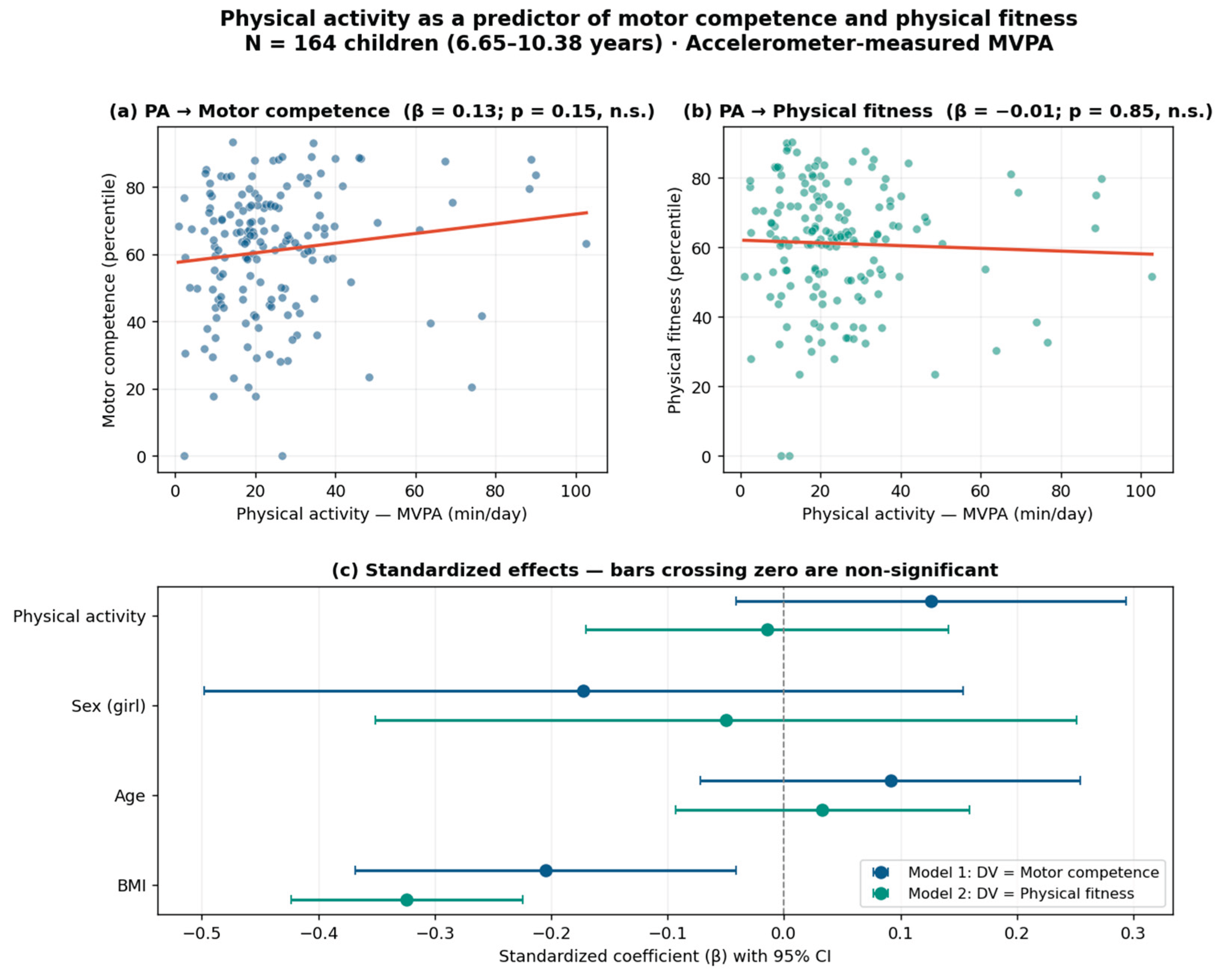

Table 1.
Descriptive statistics for the study variables (N = 164).
| Variable | M | SD | Min | Max | Skewness |
|---|---|---|---|---|---|
| Physical activity (MVPA, min/day) | 24.54 | 17.41 | 0.84 | 102.73 | 2.00 |
| Motor competence (percentile) | 61.07 | 19.04 | 0.00 | 93.33 | -0.71 |
| Physical fitness (percentile) | 61.12 | 17.35 | 0.00 | 90.22 | -0.74 |
| Age (years) | 8.59 | 1.05 | 6.65 | 10.38 | -0.09 |
| BMI (kg/m²) | 17.25 | 2.41 | 12.76 | 24.07 | 0.96 |
M = mean; SD = standard deviation. Physical activity corresponds to daily minutes of MVPA; motor competence and physical fitness are expressed as percentiles. All variables departed from normality in the Shapiro–Wilk test (p < 0.05).
Table 2.
Intercorrelation matrix (Pearson coefficients) among the variables (N = 164).
| Variable | 1 | 2 | 3 | 4 | 5 |
|---|---|---|---|---|---|
| 1. PA (MVPA) | — | ||||
| 2. Motor competence | 0.13 | — | |||
| 3. Physical fitness | -0.04 | 0.65*** | — | ||
| 4. Age | 0.10 | 0.11 | 0.04 | — | |
| 5. BMI | 0.10 | -0.20* | -0.33*** | -0.02 | — |
MVPA = moderate-to-vigorous physical activity (min/day); BMI = body mass index. * p < 0.05; *** p < 0.001.
Table 3.
Multiple linear regression for motor competence (dependent variable).
| Predictor | B | SE | β | t | p | 95% CI |
|---|---|---|---|---|---|---|
| (Constant) | 72.85 | 20.47 | — | 3.56 | < 0.001 | [32.74, 112.97] |
| Physical activity (MVPA) | 0.14 | 0.09 | 0.13 | 1.47 | 0.141 | [-0.05, 0.32] |
| Sex (girl) | -3.28 | 3.16 | -0.17 | -1.04 | 0.300 | [-9.48, 2.92] |
| Age | 1.66 | 1.52 | 0.09 | 1.10 | 0.273 | [-1.31, 4.63] |
| BMI | -1.62 | 0.66 | -0.20 | -2.45 | 0.014* | [-2.91, -0.33] |
N = 164. SE = heteroscedasticity-robust standard error (HC3); β = standardized coefficient; 95% CI = 95% confidence interval for B. R² = 0.078; adjusted R² = 0.055; F(4, 159) = 3.37, p = 0.011. * p < 0.05; *** p < 0.001.
Table 4.
Multiple linear regression for physical fitness (dependent variable).
| Predictor | B | SE | β | t | p | 95% CI |
|---|---|---|---|---|---|---|
| (Constant) | 97.38 | 11.62 | — | 8.38 | < 0.001 | [74.61, 120.16] |
| Physical activity (MVPA) | -0.01 | 0.08 | -0.01 | -0.18 | 0.855 | [-0.17, 0.14] |
| Sex (girl) | -0.87 | 2.67 | -0.05 | -0.32 | 0.745 | [-6.09, 4.36] |
| Age | 0.55 | 1.07 | 0.03 | 0.51 | 0.609 | [-1.54, 2.63] |
| BMI | -2.33 | 0.36 | -0.32 | -6.40 | < 0.001*** | [-3.04, -1.62] |
N = 164. SE = heteroscedasticity-robust standard error (HC3); β = standardized coefficient; 95% CI = 95% confidence interval for B. R² = 0.109; adjusted R² = 0.087; F(4, 159) = 4.86, p < 0.001. * p < 0.05; *** p < 0.001.
Disclaimer/Publisher’s Note: The statements, opinions and data contained in all publications are solely those of the individual author(s) and contributor(s) and not of MDPI and/or the editor(s). MDPI and/or the editor(s) disclaim responsibility for any injury to people or property resulting from any ideas, methods, instructions or products referred to in the content. |
© 2026 by the authors. Licensee MDPI, Basel, Switzerland. This article is an open access article distributed under the terms and conditions of the Creative Commons Attribution (CC BY) license (http://creativecommons.org/licenses/by/4.0/).
Copyright: This open access article is published under a Creative Commons CC BY 4.0 license, which permit the free download, distribution, and reuse, provided that the author and preprint are cited in any reuse.


