

Submitted:
04 August 2026
Posted:
05 August 2026
You are already at the latest version
Abstract
This research considers the acceptance of Artificial Intelligence (AI), technological and organizational readiness, willingness to change, and concerns related to AI adoption among employees of local government or-ganizations in Greece. Drawing on the Unified Theory of Acceptance and Use of Technology (UTAUT), extended featuring Organizational Readiness for Change theory and AI-specific individual and organizational determinants, the study puts forward an integrated conceptual framework for examining employees' behavioral intention to adopt AI. The research adopted a quantitative research methodology using a structured online questionnaire dis-tributed through Google Forms
to municipalities and public organizations across Greece, yielding 239 valid responses from local government employees. The outcome of the primary research indicates that there is a positive attitude towards AI and a moderately strong intention to use AI-based applications in the workplace, with participants recognizing AI's potential to improve ef-ficiency, service quality, and decision making. Nonetheless, still the technological and organizational readiness remains at a transitional stage, with considerable challenges in digital skills, data governance, strategic planning, and infrastructure. Employees demon-strate preparedness to engage with the organizational changes AI adoption requires, however, concerns continue about job transformation, new skill requirements, and the wider impact of AI on public sector employment.
Keywords:
artificial intelligence
; local government
; technology acceptance
; organizational readiness
; AI readiness
; digital transformation
; municipalities
; public sector
1. Introduction
1.1. The Background of the Study
Artificial Intelligence, also well know by its acronym AI, has emerged as one of the has become one of the defining digital technologies of the Fourth Industrial Revolution, changing how organisations process information, make decisions, and deliver services. Advances in machine learning, natural language processing, computer vision, and generative AI have enabled organizations to automate standard tasks, analyse vast amounts of structured and unstructured data, and support intricate decision-making operations that were previously dependent on human expertise. The outcome is that AI is widely accepted not only as “another tecnological developent” but as major breakthrough on organisational performance which will affect the efficiency of organisations (Brynjolfsson & McAfee, 2017; Dwivedi et al., 2023).
The private sector has led the adoption of AI to improve productivity, customer experience, and business intelligence, while governments are also progressively investing in AI to modernise public administration and respond to growing public demands for more efficient, transparent, and citizen-centred public services. National governments, regional authorities, and local administrations have begun integrating AI into a wide range of administrative functions, including document management, public service delivery, resource allocation, urban planning, predictive maintenance, fraud detection, and citizen engagement. These developments demonstrate a more extensive transition from conventional e-government initiatives towards intelligent public administration, where AI supports not only the digitisation of existing procedures but also the redesign of organisational processes and public value creation (Mergel et al., 2019; Wirtz et al., 2019).
International organisations have also encouraged the use of AI in public administration. The OECD and the European Commission view AI as an important part of digital transformation, highlighting its potential to improve administrative efficiency, support evidence-based policymaking, and enhance public service delivery (OECD, 2025). At the same time, public organisations face stricter legal and ethical requirements than the private sector. AI systems must comply with national and European legislation, including the General Data Protection Regulation (GDPR) when personal data are processed, while ensuring transparency, accountability, and public trust (Belias et al., 2021).
Among public organisations, local governments occupy a particularly important position in the digital transformation agenda. Municipalities are the level of administration closest to citizens and deliver critical services such as urban planning, environmental management, licensing, financial administration, social care, waste management, and citizen support (Mantas et al., 2025). These functions generate large volumes of administrative data and involve many repetitive, information-intensive processes that can benefit from AI-enabled automation and decision support.
However, introducing AI into municipal organisations extends far beyond the acquisition of new technologies. Digital transformation requires organisations to redesign workflows, develop new competencies, establish appropriate governance mechanisms, and encourage organisational cultures that encourage innovation and persistent learning. Nonetheless, technological investments on public organisations do not always bring efficiency, instead they lead often on limited improvements, due of the fact that public organisations have complicated frameworks, bureaucracy, lack of resources andother constrains (Mantas et al., 2026). Therefore, the success of AI initiatives on the public sector is subject mostly of organisational preparedness and the employees’ and the managers’ openness to adapt the AI on everyday operations.
Employees represent one of the key determinants of successful AI implementation. Many traditional information systems that primarily supported administrative effectiveness, contemporary AI applications increasingly assist—or even perform—tasks including judgement, prediction, recommendation, and decision support (Mantas et al., 2025). This evolution fundamentally changes employees’ relationships with technology. Municipal employees are expected not only to operate AI-enabled systems as well as to interpret AI-generated outputs, evaluate algorithmic recommendations, and integrate them within administrative decision-making while continuing job accountability. As a result, employees’ perceptions, attitudes, and behavioural intentions become central to the successful adoption and effective use of AI within local government.
Existing research demonstrates that employees’ acceptance of emerging technologies depends on a complicated interaction among technological characteristics, organisational conditions, and individual psychosocial factors. Employees are generally more willing to adopt AI when they see it as useful, easy to use, and capable of improving work performance. Belias et al (2021) along with Mantas et al (2026) have expressed concerns that there are factors which discourage the use of AI from employees, but also from managers, such as algorithm transparency, the loss of job autonomy, lack of support from the upper management and limited computer literacy, along with the greatest fear which is the job losses due of the use of AI. Understanding the above mentnioned perceptions are particularly important in public organisations, where successful technological innovation necessitates cooperation between organisational leadership and employees while preserving high standards of accountability, fairness, and public trust.
The Greek public sector provides a particularly appropriate context for investigating these issues. During the last decade, Greece has accelerated its digital transformation through considerable investments in e-government services, interoperable electronic platforms, and public sector modernisation. More recently, national strategies have increasingly recognised AI as a strategic priority for upgrading public administration efficiency and upgrading public service delivery. Nevertheless, although technical infrastructure has continued to improve, considerably less is known about whether public employees themselves are prepared to adopt AI as part of their daily job activities. This question is especially relevant for local government, where municipalities differ substantially in digital maturity, available resources, organisational capabilities, and workforce readiness. Understanding the factors that shape municipal employees’ acceptance of AI; hence it constitutes an important step toward supporting successful AI implementation and achieving the wider goals of digital transformation within Greek public administration.
Despite the rapid expansion of AI applications across the public sector, understanding the factors that determine successful AI adoption continues an continuing research challenge. At this point there is a number of recent studies which argue that the implementation of AI must not rely only on technological innovation although it must be regarded as a multidimensional organisational transformation involving changes in governance, work practices, employee capabilities, leadership, and organizational culture (Dwivedi et al., 2023; European Commission, 2024; OECD, 2024; Mikalef et al., 2023). As governments increasingly deploy AI to improve administrative effectiveness, evidence-based policymaking, and citizen service delivery, research has shif3333ted from investigating whether AI should be adopted to examining the organisational, technological, and human conditions that enable successful implementation.
Technology acceptance theories remain the dominant theoretical perspective for explaining individuals’ willingness to adopt emerging technologies. The Technology Acceptance Model (TAM) (Davis, 1989) introduced perceived usefulness and perceived ease of use as the principal determinants of behavioural intention, while the Unified Theory of Acceptance and Use of Technology (UTAUT) expanded this perspective through incorporating performance expectancy, effort expectancy, social influence, and assisting conditions (Venkatesh et al., 2003). n systems (Dwivedi et al., 2023; Mikalef et al., 2023; European Commission, 2024).
Recent evidence from the European Commission demonstrates that organisational capabilities, governance structures, AI competencies, and institutional support strongly influence AI adoption among public managers across European countries. Reports coming from international organisations such as OECD (2024) and the European Commission (2024) argue that a the successful implication of AI relies on trustworthy governance, effective human resource management, a culture of ownership among the employees and their supervisors and robust institutional structures instead than technological capability.
Another important development concerns the rising recognition that organisational readiness constitutes a prerequisite for successful AI implementation. Although earlier studies mainly examined individual technology acceptance, recent research shows that organisational capabilities are key for moving AI initiatives from experimental pilots to routine operational use. Organisational readiness includes the leadership, infrastructure, governance, skills, culture, and change management capabilities needed for successful AI integration (Jöhnk et al., 2021; Mikalef et al., 2023). Consistent with Weiner’s (2009) theory of organisational readiness, successful digital transformation depends on employees’ joint devotion to change and their confidence that organisational resources and capabilities are sufficient to support implementation, which is very important on digital transformation of organisations. More recent empirical evidence indicates that variables such as leadership commitment, organizational learning, and AI governance are some of the success factors which will determine AI readiness on public sector organisations (European Commission, 2024; Madan & Ashok, 2024; OECD, 2024).
Employees themselves have become one of the most key determinants of AI adoption. AI technologies increasingly collaborate with employees in performing analytical and decision-support activities, requiring new competencies, persistent learning, and confidence in interacting with intelligent systems. Digital self-efficacy and personal innovativeness which represent important antecedents of AI acceptance because employees with greater confidence in their digital abilities generally display lower technological anxiety, stronger behavioural intentions, and greater readiness to experiment with new technologies (Bandura, 1997; Agarwal & Prasad, 1998). Recent studies additionally demonstrate that organisations achieving higher levels of AI maturity invest extensively in workforce upskilling (the strategic process of equipping the workforce with advanced competencies to meet developing technological requirements and industry standards (Viswan, 2026), AI literacy, continuous vocational development, and organisational learning, recognising employees as strategic enablers of digital transformation instead than passive technology users (OECD, 2024; Mikalef et al., 2023).
A number of researches, such as Dwivedi et al., (2023), European Commission (2024) and OECD, (2024) has identified several barriers that may inhibit AI adoption. Employees frequently voice worries about algorithm transparency, job autonomy, ethical responsibility, surveillance, privacy, and the possible effects of AI on existing job roles. Recent research also shows that unclear governance, limited organisational guidance, insufficient training, and weak policies for responsible AI use can reduce employees’ confidence and willingness to use AI . These results show that organisational support and governance mechanisms influence AI acceptance as strongly as technological characteristics themselves while evidence from OECD member countries shows that many public organisations have moved beyond small AI pilot projects. On the other hand AI implementation is still restricted from low levels of employees readiness, the lack of leadership commitment to the changes needed to develop AI solutions in an organisation and other managerial factors rather than solely technical barriers (OECD, 2024; European Commission, 2024).
Despite the growing body of research on AI adoption, several gaps remain. Much of the existing evidence comes from the private sector, healthcare, financial services, or studies of citizens’ acceptance of AI. Far less attention has been given to public employees, even though they are the ones expected to use AI in their everyday administrative work (Jonathan et al., 2025). In addition, technology acceptance, organisational readiness, and resistance to organisational change are often examined separately, despite growing evidence that these factors interact during digital transformation (Kuberkar & Singhal, 2020). Third, there is the issue that there is limited research from similar researches, especially from South Europe and countries like Greece (Mantas et al, 2026). A final point is despite of the fact that Greece has managed to become one of the key players of digital transformation in EU and of the increase used of AI on its public sector, still there is not any empirical evidence regarding municipal employees regarding their perceptions and the level of readiness for the use of AI in their job (Mantas et al, 2026). Dealing with these gaps contributes both theoretically and practically by delivering a more comprehensive understanding of the technological, organisational, and psychosocial factors that shape AI adoption within local government (Plimakis et al, 2024; Mantas et al, 2025; Mantas et al, 2026; Plimakis & Mantas, 2026).
Accordingly, this study develops an integrated conceptual framework that combines UTAUT, organisational readiness theory, and AI-specific organisational and individual factors to explain municipal employees’ intention to adopt AI. By jointly examining technology acceptance, organisational readiness, digital self-efficacy, personal innovativeness, resistance to change, and AI-related job insecurity, the proposed framework seeks to deliver a more comprehensive explanation of AI adoption than models focusing exclusively on technological determinants.
1.2. Development of the Conceptual Framework
The literature reviewed above indicates that no individual theoretical perspective is sufficient to explain employees’ adoption of AI within public sector organisations. Technology acceptance theories explain employees’ behavioural intention well, but they do not fully account for the organisational context and AI-specific challenges that influence the adoption of these technologies in everyday work (Schwaerzler et al., 2024). Similarly, organisational readiness theories explain an organisation’s capacity to implement change but provide limited insight into how employees evaluate AI as an emerging technology, while more recent research has provided a better glance in AI, where its sucessful implemantion is a combination of organisationl and technological factors, but also of how the individual employee regards the usefulness of AI within the organisation that he/she she works (Dwivedi et al., 2023; Mikalef et al., 2023).
This study therefore develops an integrated conceptual framework that combines the Unified Theory of Acceptance and Use of Technology (UTAUT) (Venkatesh et al., 2003), Organizational Readiness for Change Theory (Weiner, 2009), and recent AI adoption literature. This integrated approach embodies the multidimensional nature of AI implementation within municipalities, where the technological characteristics, organisational capabilities, employee competencies, and psychological perceptions simultaneously influence behavioural intention. Rather than viewing AI adoption as solely an individual decision, the proposed framework recognises that employees operate within organisational environments that either facilitate or constrain successful digital transformation.
UTAUT provides the principal conceptual basis for explaining employees’ behavioural intention to use AI. The model proposes that behavioural intention is mainly influenced by performance expectancy, effort expectancy, social influence, and assisting conditions (Venkatesh et al., 2003). These constructs have regularly demonstrated strong explanatory power through multiple technological contexts and remain among the most widely validated predictors of technology acceptance. Nevertheless, recent studies suggest that AI differs essentially from previous generations of information systems because employees increasingly collaborate with intelligent systems able of generating recommendations, predictions, and autonomous outputs. AI adoption appears to depend on more than technology-related factors alone. Organisational and psychosocial factors also need to be considered to better understand employees’ willingness to adopt AI (Dwivedi et al., 2023; Mikalef et al., 2023).
Furthermore Organizational Readiness for Change Theory supplies the organisational perspective supporting this research. According to Weiner (2009), successful organisational transformation depends on employees’ common commitment to change and their collective confidence that sufficient organisational resources, leadership support, and institutional capabilities exist to implement change effectively, while Maden & Ashok (2024) have mentioned similar factors along with digital infrastructure and an organisational culture which fosters the changes needed to adopt AI within the organisation. These organisational factors not only enable technological implementation but also determine employees’ confidence in the organisation’s ability to successfully deploy AI.
Beyond these recognized theoretical perspectives, recent AI literature identifies several individual characteristics and AI-specific concerns that influence behavioural intention (Han et al, 2025), such as digital self-efficacy — which stands for the employees’ ability to successfully use information technology (Mikalef et al, 2023) along with the employees’ readiness to use those new technologies and to cope with the challenges that may come up. Those two constructs, according to Mikalef et al (2023) are assocaited with high levels of AI acceptance and with the intention to adopt AI. However, it is important to note that there are concerns regarding job insecurity and resistance to organisational change may discourage AI adoption in spite of favourable technological and organisational conditions. The wider use of AI has also raised concerns about job autonomy, changing roles, and possible job displacement, all of which can influence employees’ willingness to adopt the technology (Dwivedi et al., 2023).
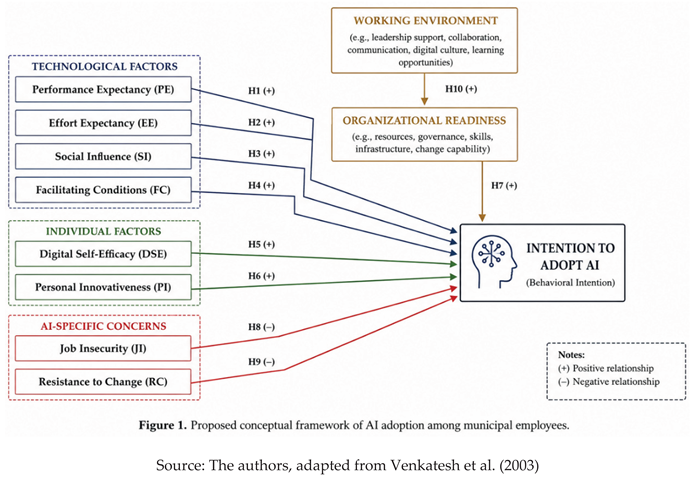
Based on these conceptual foundations, this research proposes an integrated conceptual model consisting of ten hypothesised relationships. Performance expectancy, effort expectancy, social influence, facilitating conditions, digital self-efficacy, personal innovativeness, organisational readiness, job insecurity, and opposition to change are proposed as direct antecedents of employees’ intention to adopt AI. In addition, the organisational working environment is hypothesised to positively influence organisational readiness by creating conditions that facilitate organisational change and digital transformation. Collectively, these relationships offer a thorough explanation of how technological perceptions, organisational capabilities, and individual attitudes jointly shape AI adoption among municipal employees.
Figure 1 illustrates the proposed conceptual framework. The model recognises that successful AI implementation within local government goes beyond technological functionality and depends on the interaction between organisational readiness, employee perceptions, and AI-specific concerns. Through integrating established technology acceptance theory with organisational readiness and contemporary AI adoption research, the framework intends to deliver a more comprehensive understanding of municipal employees’ acceptance of AI while tackling several gaps identified in the existing literature. The following section develops the research hypotheses derived from this conceptual framework.
1.3. Research Hypotheses
Building upon the proposed conceptual framework, this study develops ten hypotheses explaining municipal employees’ intention to adopt AI. Consistent with UTAUT, employees are more likely to accept AI when they view it as useful, easy to use, supported by colleagues and management, and facilitated by adequate organisational resources (Davis, 1989; Venkatesh et al., 2003). Recent AI studies additionally demonstrate that behavioural intention is influenced by organisational capabilities, employee competencies, and governance mechanisms (Dwivedi et al., 2023; European Commission, 2024; OECD, 2024). Accordingly, the following hypotheses are proposed:
H1:
Performance expectancy positively influences employees’ intention to adopt AI.
H2:
Effort expectancy positively influences employees’ intention to adopt AI.
H3:
Social influence positively influences employees’ intention to adopt AI.
H4:
Facilitating conditions positively influence employees’ intention to adopt AI.
Employees’ personal characteristics additionally influence AI adoption. Employees with higher digital self-efficacy and stronger personal innovativeness are generally more willing to experiment with new technologies and show increased behavioural intentions to use AI (Bandura, 1997; Agarwal & Prasad, 1998; Mikalef et al., 2023). Concerns regarding job insecurity and resistance to organisational change may discourage AI adoption, chiefly within public organisations undergoing digital transformation (Dwivedi et al., 2023; European Commission, 2024).
H5:
Digital self-efficacy positively influences employees’ intention to adopt AI.
H6:
Personal innovativeness positively influences employees’ intention to adopt AI.
H7:
Organisational readiness positively influences employees’ intention to adopt AI.
H8:
Job insecurity negatively influences employees’ intention to adopt AI.
H9:
Resistance to change negatively influences employees’ intention to adopt AI.
Finally, organisational readiness is determined by the wider organisational environment. Supportive leadership, collaboration, communication, digital culture, and learning opportunities create favourable conditions for AI implementation and organisational change (Weiner, 2009; OECD, 2024; European Commission, 2024).
H10:
The working environment positively influences organisational readiness.
1.4. Research Aim and Contributions
This study intends to investigate the factors influencing municipal employees’ intention to adopt Artificial Intelligence within Greek local government through integrating UTAUT, Organizational Readiness Theory, and AI-specific organisational and individual determinants into a unified conceptual framework. The study adds to the academia and the existing knowledge in three ways. First, it expands existing AI adoption research through integrating technological, organisational, and psychological perspectives inside a single empirical model. Second, it offers empirical evidence from Greek municipalities, a context that remains underrepresented in AI adoption research. Third, it offers useful insights for policymakers together with municipal leaders by identifying the organisational conditions and employee-related factors that facilitate successful AI implementation. Figure 1 presents the proposed conceptual framework examined in this study.
2. Materials and Methods
2.1. Research Design and Instrument Development
This study adopted a quantitative, cross-sectional research design to investigate the factors influencing municipal employees’ intention to adopt AI in Greek local government. A survey methodology was selected because it enables the systematic collection of standardized data from a relatively large number of respondents and is widely used in studies examining technology acceptance, organizational readiness, and digital transformation within public organizations. The cross-sectional design is appropriate for examining the relationships among multiple organizational and individual factors influencing employees’ intention to adopt AI.
The data for this study were collected using a self-administered questionnaire. Rather than creating all measurement items from scratch, the questionnaire was developed by adapting well-established scales that have already been used and validated in previous studies on technology acceptance and organizational behavior. It consisted of three sections. The first section collected demographic and job-related information, such as gender, age, education, years of professional experience, and current position within the municipality. The second section explored participants’ familiarity with artificial intelligence technologies and whether they currently use AI as part of their daily work. The final section included the items used to measure the variables of the proposed research model.
The design of the questionnaire was based primarily on the Unified Theory of Acceptance and Use of Technology (UTAUT) proposed by Venkatesh et al. (2003). Therefore, the survey included the model’s main constructs: Performance Expectancy, Effort Expectancy, Social Influence, and Facilitating Conditions. Since the study examines AI adoption in Greek municipalities, additional variables were included to capture factors that are not fully covered by the original UTAUT model. These were Organizational Readiness for Change (Weiner, 2009), Digital Self-Efficacy, Personal Innovativeness, Job Insecurity, and Resistance to Change. The above mentioned variables / constructs were chosen because recent studies, such as Dwivedi et al (2023) along with Mikalef et al (2023), have provided empirical findings which claim that those constructs are expected to have a positive influence on the adoption of digital innovations and technological solutions in public organisations.
Most of the questionnaire items were taken from measurement scales that have already been tested and validated in earlier studies. Using these established instruments provided a solid basis for measuring each construct while allowing the questionnaire to better reflect the setting of Greek municipalities and the study’s focus on AI adoption. In particular, the items assessing Organizational Readiness were adapted from Belias and Trihas (2022). Measures for Digital Self-Efficacy and Personal Innovativeness were drawn from the work of Bandura (1997) and +Agarwal and Prasad (1998), respectively. Some expressions were rephrased and a few terms were adjusted so that the questions would be easier for local government employees to understand. These changes were limited to wording and did not alter the concepts that each scale was originally designed to measure.
All variables were measured on a five-point Likert scale, ranging from 1 (“Strongly Disagree”) to 5 (“Strongly Agree”). This response format is commonly used in technology acceptance research because it captures participants’ attitudes consistently and is well suited to statistical analysis..
Before launching the main survey, the questionnaire was pilot tested with 23 employees working in Greek municipalities. The purpose of the pilot study was to assess the clarity of the questions, evaluate the overall structure of the questionnaire, and estimate the time required for completion. Participants reported that the questionnaire was clear and straightforward to complete, while only a few minor wording changes were suggested. Based on this feedback, the final version of the questionnaire was considered appropriate for the main phase of data collection.
2.2. Variables and Data Analysis
The proposed conceptual framework includes nine latent constructs that capture the technological, organizational, and individual factors associated with AI adoption. Behavioral Intention to Adopt AI serves as the main outcome variable in the model. The factors expected to influence this intention are Performance Expectancy, Effort Expectancy, Social Influence, Facilitating Conditions, Digital Self-Efficacy, Personal Innovativeness, Organizational Readiness, Job Insecurity, and Resistance to Change. These variables were selected based on the theoretical foundations of the Unified Theory of Acceptance and Use of Technology (UTAUT), Organizational Readiness Theory but also derive from empirical evidence as they have been identified in recent studies on AI adoption in public organizations (Venkatesh et al., 2003; Weiner, 2009; Dwivedi et al., 2023; Mikalef et al., 2023).

Table 1.
summarizes the constructs included in the study together with their theoretical sources and the number of questionnaire items used to measure each construct.
Table 1.
summarizes the constructs included in the study together with their theoretical sources and the number of questionnaire items used to measure each construct.
| Construct | Source | Items |
|---|---|---|
| Performance Expectancy | Venkatesh et al. (2003) | 6 |
| Effort Expectancy | Venkatesh et al. (2003) | 3 |
| Social Influence | Venkatesh et al. (2003) | 3 |
| Facilitating Conditions | Venkatesh et al. (2003) | 2 |
| Digital Self-Efficacy | Bandura (1997); adapted | 4 |
| Personal Innovativeness | Agarwal & Prasad (1998) | 2 |
| Organizational Readiness | Belias & Trihas (2022) | 4 |
| Job Insecurity | Adapted from recent AI adoption literature | 2 |
| Resistance to Change | Adapted from Organizational Readiness scale | 1 |
| Behavioral Intention | Venkatesh et al. (2003) | 3 |
Prior to hypothesis testing, the quality of the measurement instrument was examined by reliability and construct validation procedures. Internal consistency was examined and assesed with Cronbach’s alpha, using 0.70 as the minimum acceptable value. Construct validity was examined through Exploratory Factor Analysis (EFA). Principal Component Analysis with Varimax rotation was used to identify the questionnaire’s underlying factor structure and confirm the grouping of the measurement items. The Kaiser–Meyer–Olkin (KMO) measure and Bartlett’s Test of Sphericity were used to determine whether the data were suitable for factor analysis.
After the assessment of the measurement properties, descriptive statistical analyses were carried out to summarize respondents’ demographic characteristics and the distribution of the study variables. Means, standard deviations, frequencies, and percentages were calculated where appropriate. Kolmogorov–Smirnov tests indicated that all study variables deviated significantly from a normal distribution (p < 0.05); consequently, Spearman’s rank-order correlation coefficients (rho) were estimated to examine the strength and direction of relationships among the study variables and to appraise potential multicollinearity prior to regression analysis.
Multiple linear regression was used to examine the proposed hypotheses, with Behavioural Intention to Adopt AI as the dependent variable. All independent variables were entered into the model at the same time, allowing the effect of each predictor to be examined while controlling for the others. The regression results are reported using unstandardised coefficients (B), t-values, p-values, and the coefficient of determination (R2). Statistical significance was assessed at the 5% level (p < 0.05).
All statistical analyses were performed using IBM SPSS Statistics (Version 21). The software was used for data screening, descriptive statistics, reliability analysis, exploratory factor analysis, correlation analysis, and multiple regression analysis. Prior to the analyses, the dataset was examined for missing values, outliers, and violations of the assumptions of linear regression, including normality, homoscedasticity, independence of residuals, and multicollinearity, to guarantee the validity and robustness of the statistical results.
2.3. Sampling, Data Collection, and Ethical Considerations
Data were collected through an online questionnaire created in Google Forms. This method made it possible to distribute the survey quickly, protect participants’ anonymity, and automatically record responses for later analysis. At the same time, employees could complete the questionnaire whenever it was most convenient for them. The survey link was sent by email to municipal administrations, including human resource and administrative departments, and was also shared directly with municipal employees. Respondents were encouraged to forward the questionnaire to colleagues working in other municipalities, helping the study reach participants from a wider geographical area and a variety of local government settings.
A combination of convenience and purposive sampling was used. This approach was chosen because the research required participants who were familiar with municipal administrative procedures and, ideally, had some exposure to digital transformation initiatives within their organizations. Efforts were made to include municipalities with different characteristics, such as metropolitan, urban, rural, mountainous, and island municipalities, in order to obtain a more diverse sample. Although this type of sampling does not allow the findings to be generalized to all municipal employees in Greece, it is commonly adopted in organizational and public administration research where obtaining a complete sampling frame is difficult.
After excluding incomplete submissions, the final dataset included 239 valid responses, which provided a sufficient sample for the planned multivariate analyses. Before distributing the questionnaire on a larger scale, a pilot study was carried out with 23 employees from Greek municipalities. The pilot was used to assess whether the questions were clear, relevant, and easy to answer, as well as to identify any practical issues with the questionnaire. Based on participants’ feedback, a small number of wording changes were made to improve clarity. No changes were made to the underlying constructs or measurement scales, and the questionnaire was considered suitable for the main study.
Participation was entirely voluntary. Before beginning the questionnaire, participants were provided with information about the purpose of the study, the approximate time required to complete the survey, the anonymous nature of their participation, and the fact that the data would be used exclusively for academic research. Completing and submitting the questionnaire was taken as confirmation that participants had given their informed consent. At no point during the study were respondents asked to provide personally identifiable information, such as their name, contact details, or identification number.
The confidentiality of participants was protected throughout the study. Questionnaire responses were stored securely, and access to the data was restricted to the researcher. During the analysis, results were reported only in aggregated form so that no individual participant could be identified. Every stage of the research was conducted in accordance with established ethical principles, including voluntary participation, anonymity, confidentiality, and responsible handling of research data, while also complying with the requirements of the General Data Protection Regulation (GDPR) (EU Regulation 2016/679).
The findings should be interpreted in light of several methodological considerations. Since participants were recruited through convenience sampling, the sample cannot be assumed to represent all employees working in Greek municipalities. Using an online questionnaire may also have affected who chose to participate. Employees who felt more comfortable using digital technologies or who already had an interest in AI may have been more likely to complete the survey. In addition, because the study followed a cross-sectional design, it reflects participants’ views at the time the data were collected and cannot capture how those views might change over time. As a result, the data do not allow conclusions about causality or about how attitudes toward AI may change in the future. Even so, the study brings together responses from employees working in municipalities with diverse geographical and administrative characteristics, offering a meaningful basis for exploring the factors that influence AI adoption and organizational readiness in Greek local government.
2.4. Use of Generative Artificial Intelligence
Generative Artificial Intelligence (GenAI) was used during the preparation of this manuscript to support language refinement, improve the organization and clarity of the text, and assist in the preparation of illustrative figures. The study design, questionnaire development, data collection, statistical analyses, interpretation of the findings, and all scientific conclusions were developed, verified, and approved exclusively by the authors. No AI-generated content was used as empirical data or analytical evidence.
3. Results and Discussion
3.1. Sample Characteristics and AI Use
The final sample consisted of 239 municipal employees representing different demographic groups, educational backgrounds, employment categories, and municipal departments. The relatively balanced distribution of respondents across gender, age, and work experience enhances the robustness of the empirical findings by reducing the possibility that the results reflect the perceptions of a single employee subgroup. Furthermore, participants were drawn from several administrative departments, providing a comprehensive overview of AI perceptions across the operational functions of Greek local government.
The majority of respondents possessed tertiary education qualifications (51.0%), while almost one-third had more than twenty years of job experience. Such characteristics indicate that the sample included employees with substantial organizational knowledge while simultaneously maintaining representation from younger staff members who may exhibit greater familiarity with emerging digital technologies. The demographic characteristics of the respondents are summarized in Table 2.
Beyond the demographic profile, respondents reported varying levels of organizational exposure to Artificial Intelligence. More than half indicated that AI technologies had already been introduced within their municipality, while a similar proportion reported personally using AI applications. These findings suggest that AI is gradually becoming integrated into municipal operations, although implementation remains uneven across local authorities.
The responses showed that MyAIgov and ChatGPT were the AI applications used most often by participants, with Google Gemini and Microsoft Copilot also reported, although less frequently. These findings suggest that generative AI tools are gradually becoming part of everyday work in Greek municipalities. They also indicate that employees are gaining experience with AI not only through tools introduced in their workplace but also by using widely available applications on their own.
Table 3.
AI adoption and usage among municipal employees (N = 239).
| Variable | Category | n | % |
|---|---|---|---|
| AI used in municipality | Yes | 131 | 54.8 |
| No | 108 | 45.2 | |
| Personally use AI applications | Yes | 125 | 52.3 |
| No | 114 | 47.7 | |
| AI tools used | MyAIgov | 58 | 24.3 |
| ChatGPT | 49 | 20.5 | |
| Google Gemini | 46 | 19.2 | |
| Microsoft Copilot | 42 | 17.6 | |
| Other | 44 | 18.4 |
The resuts of this primary research indicated that indeed Greek municipalities are in an early stage of adoption. Many organisations have started introducing AI into their operations, almost half of the respondents reported that these technologies are not yet used in their workplace. This uneven picture is also reflected in recent reports, which show that public organisations across Europe differ considerably in their level of digital maturity. Factors such as infrastructure, available resources, and organisational capacity continue to shape the pace of AI adoption (OECD, 2024; European Commission, 2024).
Interestingly, the proportion of respondents personally using AI applications was almost identical to the proportion reporting organizational AI implementation. This observation suggests that employees increasingly develop AI-related competencies independently of formal organizational initiatives. Overall, the demographic composition of the sample and the reported AI usage patterns provide a suitable empirical foundation for examining the determinants of AI acceptance and organizational readiness among employees in Greek local government. Getting used to AI through everyday use may help employees feel more comfortable when these technologies are introduced in their workplace. Previous experience with AI may make employees more confident and less hesitant to use similar tools in their work. Recent studies of AI adoption in public organisations report a similar pattern (Dwivedi et al., 2023; Mikalef et al., 2023).
3.2. The instrument’s Reliability
Before testing the hypotheses, the measurement scales were evaluated to confirm their validity and reliability. Exploratory Factor Analysis (EFA) using Principal Component Analysis (PCA) was conducted for each construct. The KMO measure and Bartlett’s test of sphericity indicated that the data were appropriate for factor analysis.
The measurement model showed good psychometric properties. All constructs met the recommended criteria for factor analysis, with KMO values above 0.70 and statistically significant Bartlett’s tests of sphericity (p < 0.001). In addition, every retained item loaded above 0.40 on its respective factor, supporting the adequacy of the measurement scales. Depending on the construct, the extracted factors explained between 54.4% and 67.8% of the total variance, indicating an acceptable level of explanatory power for social science research.
Table 4.
Exploratory Factor Analysis results for the study constructs.
| Construct | Items | KMO | Bartlett’s Test (p) | Variance Explained (%) |
|---|---|---|---|---|
| Performance Expectancy | 4 | 0.74 | <0.001 | 67.4 |
| Job Insecurity | 2 | 0.72 | <0.001 | 54.7 |
| Effort Expectancy | 3 | 0.80 | <0.001 | 67.8 |
| Social Influence | 3 | 0.80 | <0.001 | 64.6 |
| Facilitating Conditions | 2 | 0.70 | <0.001 | 54.8 |
| Digital Self-Efficacy | 4 | 0.75 | <0.001 | 58.5 |
| Personal Innovativeness | 2 | 0.80 | <0.001 | 65.4 |
| Behavioral Intention | 3 | 0.70 | <0.001 | 54.4 |
| Organizational Readiness | 4 | 0.74 | <0.001 | 61.1 |
The EFA results support the conceptual distinction between the proposed constructs and demonstrate that the questionnaire possesses adequate construct validity. Importantly, none of the measurement items required removal during the factor extraction process, suggesting that the adapted measurement scales transferred well to the context of Greek local government employees. The successful replication of the expected factor structure also provides empirical support for the theoretical integration of the UTAUT framework with organizational readiness and AI-specific psychological factors proposed in this study.
As indicated from Table 5, Cronbach’s alpha analysis indicates the high levels of reliability of the research instrument. All of the examined variables are above the recommended value of 0.70, with the exception of Digital Self-Efficacy, though it is still acceptable as its coefficient is very marginal.
Taken together, the validity and reliability analyses indicate that the measurement instrument possesses satisfactory psychometric properties for investigating AI acceptance and organizational readiness among municipal employees. Even if the Digital Self-Efficacy is a=0,699, this a value which falls just below the 0.70 threshold used on this study. Given the fact that this is a exploratory research, this minimal difference should not be considered as a limitation. Therefore, the research instrument was considered appropriate for the subsequent descriptive analyses and hypothesis testing.
3.3. Descriptive Statistics
Following the assessment of the measurement properties, descriptive statistics were calculated for all study constructs to provide an overview of municipal employees’ perceptions regarding AI adoption and organizational readiness. Table 6 presents the mean scores and standard deviations for the nine latent constructs included in the conceptual framework.
The above descriptive results suggest that employees hold generally positive, but measured, views about the use of AI in Greek municipalities. None of the average scores reached the upper end of the five-point scale, indicating that strong enthusiasm for AI has not yet developed. Instead, respondents appear to recognise the opportunities that AI may offer while also acknowledging the practical and organisational issues that still need to be addressed before these technologies can become part of everyday municipal work. This perspective has been found on similar researches on the public sector such as of Mikalef et al (2023) where the building of capabilities leads on higher levels of confidence which is required for the upcoming changes that AI implementation will bring for a public organisation. Viewed in this context, the findings suggest that AI adoption in Greek municipalities is progressing steadily rather than through rapid or large-scale organisational change.
Behavioural Intention had the highest mean score (M = 3.44), showing that most employees were generally willing to use AI in their work. Although this was the highest score among the study variables, it still reflects moderate rather than strong acceptance. This is in line with UTAUT, which identifies behavioural intention as the closest predictor of technology use (Venkatesh et al., 2003), and with more recent studies reporting growing acceptance of AI in public organisations as employees become more familiar with these technologies (Dwivedi et al., 2023; Mikalef et al., 2023; Haesevoets et al., 2025).
At the same time, willingness to use AI does not necessarily mean that organisations are ready to implement it successfully. Employees may be positive about AI while still questioning whether their municipality has the leadership, governance, and resources needed to support its effective use (Neumann et al., 2024; OECD, 2024). In this respect, the results suggest that employees are optimistic about the potential of AI, but less certain that the organisational conditions for its successful adoption are already in place.
The Performance Expectancy score (M = 3.33) indicates that employees generally see AI as a technology that could improve municipal operations. Overall, it seems that the employees have a positive view for AI as a technology that improves their daily work-life. Nonetheless, the same participants seem to have some degree of caution on how AI can be used. This is shown by the moderate score on the Performance Expectancy, which is evidence that respondents recognised the benefits of AI, but they are not convinced about how it can be successfully Implemented in their workplace, since there are issues of legal compliance, accountability and public trust (OECD, 2024).
Recent studies have similarly shown that employees’ views of AI depend not only on the technology itself but also on the organisational environment in which it is introduced. Leadership support, governance, and organisational preparedness all influence whether AI is seen as useful in everyday practice (Neumann et al., 2024; Jonathan et al., 2025). The findings therefore suggest that positive attitudes towards AI need to be supported by appropriate organisational conditions if municipalities are to adopt these technologies successfully.
3.4. Hypothesis Testing and Discussion
This section examines the proposed hypotheses and addresses the three research questions by investigating the relationships between technological, organizational, and individual factors influencing Artificial Intelligence (AI) acceptance among municipal employees. The analysis was conducted in two stages. First, Spearman’s rank-order correlation analysis was performed to explore the relationships among the study variables, consistent with the non-normal distribution of the data confirmed by Kolmogorov–Smirnov tests. Second, multiple linear regression analysis was employed to determine the independent contribution of each predictor to employees’ Behavioral Intention to adopt AI.
The correlation analysis revealed statistically significant relationships among the majority of the examined constructs, providing preliminary support for the proposed conceptual framework. Behavioral Intention was positively associated with Performance Expectancy, Effort Expectancy, Social Influence, Facilitating Conditions, Digital Self-Efficacy, Personal Innovativeness, and Organizational Readiness, whereas Job Insecurity and Resistance to Change demonstrated significant negative relationships. The results suggest that employees are more willing to adopt AI when they see it as useful, feel confident using digital technologies, and work in supportive organisational environments. In contrast, concerns about job displacement and organisational change are associated with lower levels of AI acceptance.
Although these findings deliver valuable evidence regarding the relationships among the study variables, correlation analysis alone does not establish the independent contribution of each predictor. Therefore, a multiple linear regression analysis was conducted to identify the variables that remain significant after controlling for the effects of the remaining constructs.
The regression model explained 73.8% of the variation in Behavioural Intention (R2 = 0.738), indicating a strong overall fit. This suggests that the variables included in the model account for much of employees’ willingness to adopt AI in Greek municipalities. At the same time, the regression results differed from the bivariate analysis, as not all variables that showed significant individual relationships remained significant once they were examined together.
Table 7.
Multiple regression analysis predicting Behavioral Intention.
| Predictor | B | T | P | Result |
|---|---|---|---|---|
| Performance Expectancy | 0.221 | 3.162 | >0.05 | Not Significant |
| Job Insecurity | -0.300 | 3.203 | <0.05 | Significant (−) |
| Effort Expectancy | 0.144 | 3.013 | >0.05 | Not Significant |
| Social Influence | 0.074 | 3.207 | >0.05 | Not Significant |
| Facilitating Conditions | 0.145 | 2.076 | >0.05 | Not Significant |
| Digital Self-Efficacy | 0.255 | 3.068 | <0.05 | Significant (+) |
| Personal Innovativeness | 0.387 | 3.208 | <0.05 | Significant (+) |
| Resistance to Change | -0.178 | 3.003 | >0.05 | Not Significant |
| Organizational Readiness | 0.274 | 2.892 | <0.05 | Significant (+) |
Model statistics: R2 = 0.738; Adjusted R2 = 0.728; F(9, 229) = 12.34; p < 0.001.
The regression analysis provides a more nuanced understanding of AI acceptance than the descriptive findings alone. When all variables were examined simultaneously, only Digital Self-Efficacy, Personal Innovativeness, Organisational Readiness, and Job Insecurity remained significant predictors of Behavioural Intention. In contrast, the traditional UTAUT constructs—Performance Expectancy, Effort Expectancy, Social Influence, Facilitating Conditions—and Resistance to Change lost their independent explanatory power. These findings suggest that AI adoption is influenced less by perceptions of the technology itself than by employees’ confidence in using it, their openness to innovation, and the organisational context in which implementation occurs.
These findings address the first two research questions while extending traditional technology acceptance theory. UTAUT proposes that usefulness, ease of use, and social influence are the primary drivers of technology adoption (Venkatesh et al., 2003). However, the present results indicate that these effects become less important once organisational and psychological factors are considered. Similar conclusions have been reported by Mikalef et al. (2023), Neumann et al. (2024), and Jonathan et al. (2025), suggesting that AI implementation in public organisations is better understood as organisational transformation rather than the adoption of a conventional information system.
Digital Self-Efficacy was positively associated with employees’ intention to adopt AI, highlighting the importance of confidence in one’s own digital abilities. This finding is consistent with Social Cognitive Theory (Bandura, 1997) and with previous studies linking digital competence to greater acceptance of AI (Mikalef et al., 2023; Han et al., 2025). Personal Innovativeness showed a similar pattern, indicating that employees who are more open to trying new technologies are also more willing to use AI (Agarwal & Prasad, 1998; Dwivedi et al., 2023; Mikalef et al., 2023). At the same time, the results suggest that AI adoption may currently rely on employees who are already digitally confident and open to innovation, making wider adoption across the workforce more challenging.
Organisational Readiness was one of the strongest predictors of AI adoption, suggesting that successful implementation depends as much on the organisation as on the technology itself. This is in line with recent studies showing that leadership, governance, workforce development, and institutional capability play a central role in preparing organisations for AI (Jöhnk et al., 2021; Neumann et al., 2024; Madan & Ashok, 2024; European Commission, 2024; OECD, 2024; Jonathan et al., 2025). Rather than acting as a background condition, organisational readiness appears to be a key capability that enables AI adoption.
Job Insecurity, as caused from the potential implementatino of A, has also had a significant negative effect on AI adoption, despite its relatively low average score. This suggests that employees were less concerned about losing their jobs than about how AI might change their roles and the skills they would need in the future. Similar findings have been reported in recent public-sector studies (European Commission, 2024; Haesevoets et al., 2025; Jonathan et al., 2025). These results also highlight the need for clear communication, employee involvement, and ongoing training during AI implementation (OECD, 2024; European Commission, 2024).
The results of the hypothesis testing are summarized in Table 8.
The hypothesis testing demonstrates that AI acceptance in Greek municipalities is shaped by a combination of individual capabilities, organisational conditions, and technology-related perceptions. Although the traditional UTAUT constructs were positively associated with behavioural intention in the correlation analysis, only Digital Self-Efficacy, Personal Innovativeness, Organisational Readiness, and Job Insecurity remained significant in the multivariate model. This suggests that once organisational and psychological factors are considered simultaneously, the explanatory power of conventional technology acceptance variables becomes substantially weaker. Rather than contradicting UTAUT, these findings indicate that AI adoption in local government is considerably more complex than the adoption of conventional information systems because it requires employees to adapt to new ways of working, decision-making, and interacting with intelligent technologies. This view is also reflected in recent public-sector studies, which emphasise that introducing AI is not only a technological issue but also a broader organisational change that affects the way public organisations operate (Dwivedi et al., 2023; Haesevoets et al., 2025).
Digital Self-Efficacy was one of the strongest predictors of AI adoption, highlighting the importance of employees’ confidence in their digital skills, an evidence which appears on similar researches such as of Han et al (2025). The current research has an importance since it goes further than the previous ones by by showing that Digital Self-Efficacy remains significant even after controlling Performance Expectancy and Effort Expectancy. This suggests that, within municipalities, employees’ confidence in their own abilities is more influential than their perceptions of AI’s functionality. One possible explanation is that public organisations typically provide fewer opportunities for experimentation than private firms, making individual competence a critical resource during the early stages of AI implementation.
The positive effect of Personal Innovativeness suggests that employees’ willingness to experiment with new technologies plays an important role in AI adoption. Similar conclusions have been reported by Agarwal and Prasad (1998) and more recent research on digital transformation (Dwivedi et al., 2023; Mikalef et al., 2023). Employees who are naturally willing to experiment with new technologies appear more likely to embrace AI despite uncertainty regarding its organisational implications. Nevertheless, our findings suggest that innovativeness alone is insufficient to explain AI adoption. Its influence appears to depend on whether organisations create opportunities for experimentation, learning, and knowledge sharing, which agrees with the findings of Neumann et al (2024) who argue that leadership support and organisational culture affect the responses of employees on AI initiatives but also that individual innovativeness and organisational readiness reinforce one another rather than acting independently.
The significant effect of Organisational Readiness further supports the view that AI implementation is fundamentally an organisational challenge rather than solely a technological one. This finding agrees with other similar researches that have indicated that managerial concepts such as leadership commitment, digital infrastructure and employee development are necessary prerequisites so to have a successful AI adoption (Jöhnk et al., 2021; Madan & Ashok, 2024). The research comes also in alighment with the findings of Babšek et al. (2025)’s systematic research, which claim sthat organisational readiness in public administration extends beyond technological capacity to include strategy, governance, organisational culture, and institutional alignment. Likewise, Jonathan et al. (2026) emphasise that organisational readiness is closely linked to the ability of public organisations to generate public value from AI rather than simply introducing new technologies. Unlike many previous studies that conceptualise organisational readiness as a contextual factor, the present findings indicate that employees directly associate organisational preparedness with their own willingness to adopt AI, highlighting the close relationship between institutional capability and individual acceptance.
Another finding is that Job Insecurity was the only factor that had a negative effect on Behavioural Intention. Although most employees were not particularly worried about losing their jobs, concerns about how AI might change their roles or the skills they would need still reduced their willingness to adopt it. Similar findings have been reported in recent public-sector research (Dwivedi et al., 2023; European Commission, 2024). Unlike earlier studies that focused on fears of job replacement, the present results suggest that municipal employees are more likely to see AI as a tool that supports, rather than replaces, human judgement, which is consistent with the findings of Haesevoets et al. (2025).
Perhaps the most interesting finding concerns the lack of significance of Performance Expectancy, Effort Expectancy, Social Influence, and Facilitating Conditions in the final regression model. This result differs from the original UTAUT framework (Venkatesh et al., 2003), where these constructs consistently predict behavioural intention, and from several studies conducted in private-sector contexts. This result is not entirely unexpected. Recent studies of public organisations have also shown that AI adoption depends more on organisational readiness and employees’ capabilities than on how the technology itself is perceived (European Commission, 2024; Neumann et al., 2024; Babšek et al., 2025). One explanation is that municipalities have already reached a stage where employees generally recognise AI’s potential usefulness. Consequently, differences in behavioural intention are no longer determined by whether AI is perceived as useful or easy to use but by whether employees feel sufficiently capable of using it and whether their organisations possess the resources and governance structures required for successful implementation. This interpretation also explains why the traditional UTAUT variables exhibited significant bivariate relationships but lost explanatory power in the multivariate model, suggesting that their effects may be mediated through organisational readiness and employees’ digital confidence rather than influencing behavioural intention directly.
Overall, these findings indicate that AI adoption in Greek municipalities should be understood primarily as a process of organisational change rather than technology acceptance alone. While established technology acceptance models remain valuable for explaining employees’ initial perceptions of AI, they appear insufficient for explaining adoption in public-sector organisations where organisational readiness, workforce capability, governance, and concerns regarding job roles become more influential than technological characteristics themselves. The findings also support recent research suggesting that AI implementation cannot be explained by technology alone but must also consider organisational and human factors (Dwivedi et al., 2023; Mikalef et al., 2023; European Commission, 2024; Jonathan et al., 2026). In practice, this means that municipalities are likely to achieve better results by combining investments in AI with staff development, organisational preparation, and strong leadership.
3.5. Theoretical and Practical Implications
The findings show that technology-related factors explain only part of AI adoption in public administration. Although models such as TAM and UTAUT provide a useful foundation (Venkatesh et al., 2003), organisational conditions and individual characteristics also influence employees’ willingness to adopt AI. This is especially evident in local government, where introducing AI often involves organisational change as well as the adoption of new technology (Dwivedi et al., 2023).
A key theoretical contribution is the integration of traditional technology acceptance constructs with organisational readiness and AI-specific individual characteristics. While Performance Expectancy, Effort Expectancy, Social Influence, and Facilitating Conditions were initially associated with Behavioural Intention, they lost significance once organisational and psychological factors were considered. Instead, Digital Self-Efficacy, Personal Innovativeness, Organisational Readiness, and Job Insecurity emerged as the strongest predictors of AI acceptance. This evidence has also been found in similar researches that have mentioned the importance of employee readiness and organisational capability to ensure the implementation of AI on the workplace (Neumann et al., 2024; Jonathan et al., 2025).
The pattern observed in this study suggests that UTAUT explains only part of AI adoption in the public sector. The model remains useful for understanding how employees evaluate new technologies (Venkatesh et al., 2003), but AI implementation in local government also depends on organisational factors such as leadership, governance, organisational learning, and workforce capability (Jöhnk et al., 2021; Madan & Ashok, 2024; European Commission, 2024; OECD, 2024). As AI becomes part of everyday administrative practice, these organisational conditions appear to play a greater role than technology acceptance models alone can explain.
Digital Self-Efficacy offers a similar insight. Employees who are confident in their ability to use digital technologies are more willing to adopt AI, which is consistent with the central idea of Social Cognitive Theory that self-efficacy shapes behaviour (Bandura, 1997).
Organisational Readiness had a strong influence on employees’ intention to adopt AI in Greek municipalities. This suggests that introducing AI is not simply a matter of investing in new technologies. Organisations also need the leadership, planning, governance structures, and employee development needed to support the change. Similar conclusions have been reported in recent studies of AI implementation in the public sector (Neumann et al., 2024; European Commission, 2024; Jonathan et al., 2025).
The findings suggest that introducing AI into municipalities is not simply a matter of investing in new technologies. Equal attention should be given to the people who will use them. Helping employees build digital skills, encouraging experimentation through training and pilot projects, and addressing concerns about changing job roles through clear communication and ongoing reskilling are all likely to support AI adoption (Bandura, 1997; Agarwal & Prasad, 1998; Mikalef et al., 2023; Dwivedi et al., 2023; European Commission, 2024; Haesevoets et al., 2025; OECD, 2024). Simply introducing AI is unlikely to lead to successful implementation. Organisational readiness, leadership, and the way change is managed appear to be just as important as the technology itself (Neumann et al., 2024; Jonathan et al., 2025).
3.6. Limitations and Future Research
Despite providing new evidence on AI acceptance in Greek local government, this study has several limitations that should be considered when interpreting its findings.
First, the cross-sectional design captures employees’ perceptions at a single point in time and therefore cannot account for how AI acceptance evolves as municipalities gain experience with AI implementation. Because organisational readiness and employees’ attitudes are likely to change throughout digital transformation, longitudinal studies are needed to examine whether the relationships identified here remain stable over time.
Second, the study focuses exclusively on Greek municipalities. While this context provides valuable insight into local government, institutional, cultural, and regulatory differences may limit the transferability of the findings to other public-sector settings. Comparative studies across countries and levels of government would help determine whether the factors influencing AI adoption are context-specific or more widely generalisable.
The use of purposive and convenience sampling, together with self-reported questionnaire data, is another limitation of this study. While these methods are widely used in technology adoption research, they may introduce selection bias and social desirability bias. In addition, AI adoption was assessed through Behavioural Intention rather than actual use. Future studies could strengthen the evidence by combining survey responses with objective measures, such as AI usage data, organisational performance, or service quality.
Methodologically, the study employed Exploratory Factor Analysis and multiple regression, which were appropriate for testing the proposed relationships. However, future research should validate the model using Confirmatory Factor Analysis and Structural Equation Modelling with larger and more diverse samples. Such approaches would allow researchers to examine indirect, mediating, and moderating effects that could not be explored in the present study.
Finally, the findings should be interpreted within the rapidly evolving AI landscape. Variables such as trust in AI, algorithmic transparency, perceived fairness, data privacy, ethical governance, and human-AI collaboration are becoming increasingly important in public administration and were beyond the scope of this study. Incorporating these factors would not only improve explanatory power but also advance more comprehensive models of responsible AI adoption in the public sector (Dwivedi et al., 2023; European Commission, 2024; OECD, 2024).
At the same time, these limitations reflect the fact that AI adoption in the public sector is still developing. Future research could build on these findings by following organisations over time and comparing different public-sector settings to better understand how technological, organisational, and human factors influence AI adoption.
4. Conclusions
AI is increasingly transforming the operation of public organizations by supporting decision-making, improving administrative efficiency, and enhancing the quality of public service delivery. However, the successful implementation of AI depends not only on technological capabilities but also on employees’ willingness to adopt intelligent systems and organizations’ readiness to support digital transformation. Against this background, the present study investigated the factors influencing AI acceptance and organizational readiness among employees in Greek local government.
The study examined employees’ intention to adopt AI by using UTAUT as its main theoretical framework while also considering organisational and psychological factors. In addition to technological perceptions, the analysis included Digital Self-Efficacy, Personal Innovativeness, Job Insecurity, Resistance to Change, and Organisational Readiness. Data were collected from 239 employees working in Greek municipalities and analysed using Exploratory Factor Analysis, reliability analysis, Spearman’s correlation, and multiple linear regression. The findings identify the factors that have the greatest influence on AI acceptance in Greek local government.
The findings indicate that while traditional technology acceptance variables—including Performance Expectancy, Effort Expectancy, Social Influence, and Facilitating Conditions—are positively associated with employees’ intention to adopt AI, they do not remain significant predictors when organizational and individual characteristics are considered simultaneously. Instead, Digital Self-Efficacy, Personal Innovativeness, and Organizational Readiness emerged as the principal positive determinants of Behavioral Intention, whereas Job Insecurity remained the only significant negative predictor.Overall, the model suggests that successful AI adoption is driven as much by organisational and individual factors as by the technology itself. Employees’ digital confidence, openness to innovation, and the organisation’s readiness for change appear to matter more than simply having positive attitudes towards AI.
The findings add to the growing literature on AI adoption in public administration in several ways. They show that AI implementation in local government is not simply a matter of technology adoption but also involves organisational change. The results also support the inclusion of organisational readiness alongside established technology acceptance models, providing a broader explanation of employees’ willingness to adopt AI. Finally, by focusing on Greek municipalities, the study adds evidence from a setting that has received relatively little attention, particularly within Southern Europe.
For municipal leaders and policymakers, the message is straightforward: investing in AI technology is only part of the process. Employees need the skills and confidence to use these tools in their daily work. This means providing regular training, supporting the development of digital skills, communicating organisational changes openly, and putting in place clear arrangements for the responsible use of AI. Without these conditions, investment in AI is less likely to deliver the expected benefits.
5. Proposed AI Maturity Model for Municipalities
The findings of this research indicate that municipalities differ not only in their technological capabilities but also in their organisational readiness to adopt AI. Building on these results, and drawing on international AI governance frameworks (European Commission, 2024; OECD, 2025; Yigitcanlar, 2026), this study develops a five-level AI maturity model. The model is intended to help municipalities assess their current level of readiness and identify the organisational and technological improvements needed before moving to more advanced AI applications.
The proposed maturity model illustrates that successful AI implementation extends beyond technological deployment and requires progressive organizational development. Municipalities should advance through successive stages by strengthening digital infrastructure, developing employee capabilities, improving data governance, and establishing institutional mechanisms that ensure transparency, accountability, and responsible AI use. Although conceptual in nature, the model complements the empirical findings of this study by translating the identified determinants of AI acceptance into a practical roadmap for municipal digital transformation.
Table 9.
Proposed AI Maturity Model for AI Adoption in Municipalities.
| Level 1 – Digital Foundation | Limited digital infrastructure; priority is digitization of administrative processes and public services. | None |
| Level 2 – Basic Digital Services | Digital services available but information systems remain fragmented. | Chatbots, virtual assistants, FAQ automation |
| Level 3 – Data-Driven Municipality | Integrated e-services, CRM systems, open data, and basic analytics capabilities. | Request classification, decision-support tools, workflow automation |
| Level 4 – AI-Ready Organization | High-quality data, skilled workforce, and established AI governance policies. | Predictive analytics, mobility analytics, predictive maintenance |
| Level 5 – Intelligent Municipality | AI embedded in organizational strategy with governance, human oversight, algorithm registers, citizen participation, and continuous monitoring. | Strategic AI-enabled public services and intelligent decision support |
Source: Developed by the authors based on the findings of this study and adapted from the European Commission (2024), OECD (2025), and Yigitcanlar (2026).
References
- Agarwal, R.; Prasad, J. A conceptual and operational definition of personal innovativeness in the domain of information technology. Inf. Syst. Res. 1998, 9(2), 204–215. [Google Scholar] [CrossRef]
- Babšek, M.; Murko, E.; Aristovnik, A. Organisational AI readiness for public administration: A comprehensive review and framework for conceptual modelling. Int. J. Econ. Bus. Adm. 2025, 13(3), 24–47. [Google Scholar] [CrossRef] [PubMed]
- Bandura, A. Self-efficacy: The exercise of control; W. H. Freeman, 1997. [Google Scholar]
- Belias, D.; Trihas, N. Investigating the readiness for organizational change: A case study from a hotel industry context/Greece. J. Tour. Manag. Res. 2022, 7(2), 1047–1062. [Google Scholar] [CrossRef]
- Belias, D.; Malik, S.; Rossidis, I.; Mantas, C. The use of big data in tourism: Current trends and directions for future research. Acad. J. Interdiscip. Stud. 2021, 10(5), 357–364. [Google Scholar] [CrossRef]
- Davis, F. D. Perceived usefulness, perceived ease of use, and user acceptance of information technology. MIS Q. 1989, 13(3), 319–340. [Google Scholar] [CrossRef] [PubMed]
- Dwivedi, Y. K.; Kshetri, N.; Hughes, L.; Slade, E. L.; Jeyaraj, A.; Kar, A. K.; Wright, R. So what if ChatGPT wrote it? Multidisciplinary perspectives on opportunities, challenges and implications of generative conversational AI for research, practice and policy. Int. J. Inf. Manag. 2023, 71, 102642. [Google Scholar] [CrossRef]
- European Commission. AI and GenAI adoption by local and regional administrations; Publications Office of the European Union, 2024. [Google Scholar]
- Haesevoets, T.; Verschuere, B.; Roets, A. AI adoption in public administration: Perspectives of public sector managers and public sector non-managerial employees. Gov. Inf. Q. 2025, 42(2), 102029. [Google Scholar] [CrossRef]
- Han, Z.; Song, G.; Zhang, Y.; Li, B. Trust the machine or trust yourself: How AI usage reshapes employee self-efficacy and willingness to take risks. Behav. Sci. 2025, 15(8), 1046. [Google Scholar] [CrossRef] [PubMed]
- Jöhnk, J.; Weißert, M.; Wyrtki, K. Ready or not, AI comes—An interview study of organizational AI readiness factors. Bus. Inf. Syst. Eng. 2021, 63(1), 5–20. [Google Scholar] [CrossRef]
- Jonathan, G. M.; Gebremeskel, B. K.; Yalew, S. D.; Kuika Watat, J. AI for the public sector: Readiness, adoption, and the public value promises. InBIR-WS 2025: BIR 2025 Workshops and Doctoral Consortium, 24th International Conference on Perspectives in Business Informatics Research (BIR 2025), Riga, Latvia, September 17-19, 2025; 2025; pp. 213–226. [Google Scholar]
- Jonathan, G. M.; Yalew, S. D.; Gebremeskel, B. K.; Watat, J. K. AI adoption in the public sector: Organizational readiness and the pursuit of public value. Complex Syst. Inform. Model. Q. 45 2026, 43–70. [Google Scholar] [CrossRef]
- Kuberkar, S.; Singhal, T. K. Factors influencing adoption intention of AI powered chatbot for public transport services within a smart city. Int. J. Emerg. Technol. Learn. 2020, 11(3), 948–958. [Google Scholar]
- Madan, R.; Ashok, M. Organisational and technological AI readiness: Evidence from Canadian public administration. In Proceedings of the International Conference on Information Systems (ICIS), 2024. [Google Scholar]
- Mantas, C.; Malik, S.; Karapetsas, V. The integration and development of Artificial intelligence in Higher education. The Evolution of Artificial Intelligence in Higher Education: Challenges, Risks, and Ethical Considerations. Chapter 9; Emerald Publication, 2024. [Google Scholar]
- Mantas, C.; Karapetsas, V.; Malik, S. The usage of AI in the public sector: The case of Greece and proposals for future research. In Education, future jobs and smart systems in the age of artificial intelligence; Emerald Publishing, 2025. [Google Scholar]
- Mantas, C.; Malik, S.; Karapetsas, V. Challenges and Opportunities faced by Entrepreneurs in the Persian Gulf and Arabian Gulf (PGAG) Region from the Use of AI: Comparison with Practices in Other Regions (Kuwait and Greece). In The Persian Gulf and Arabian Gulf (Red Sea) Economies in Transition - Dynamics of Entrepreneurship and Digital Transformation; Springer Nature Switzerland: Cham, 2026. [Google Scholar] [CrossRef]
- Mergel, I.; Edelmann, N.; Haug, N. Defining digital transformation: Results from expert interviews. Gov. Inf. Q. 2019, 36(4), 101385. [Google Scholar] [CrossRef]
- Mikalef, P.; Lemmer, K.; Schaefer, C.; Ylinen, M.; Fjørtoft, S. O.; Torvatn, H. Y.; Niehaves, B. Examining how AI capabilities can foster organizational performance in public organizations. Gov. Inf. Q. 2023, 40(2), 101797. [Google Scholar] [CrossRef]
- Neumann, O.; Guirguis, K.; Steiner, R. Exploring artificial intelligence adoption in public organizations: A comparative case study. Public Manag. Rev. 2024, 26(1), 114–141. [Google Scholar] [CrossRef]
- OECD. 2023 OECD Digital Government Index: Results and key findings; OECD Publishing, 2024. [Google Scholar]
- OECD. Artificial intelligence for advancing smart cities; OECD Publishing, 2025. [Google Scholar]
- Plimakis, S.; Mantas, C.; Karapetsas, V.; Malik, S. Τracking the state of art in smart cities: The case of Greek cities. International Conference on Smart Cities, Arab Open University (Kuwait), November 17-19, 2024; 2024. [Google Scholar]
- Plimakis, S.; Mantas, C. From digitalization lag to artificial intelligence revolution? Entrepreneurial innovation and red tape pitfalls in Greece. In Artificial intelligence policy reform and implementation in Greece; IGI Global, 2026. [Google Scholar]
- Schwaerzler, C.; Carrasco, M.; Daniel, C.; Bollyky, B.; Niwa, Y.; Bharadwaj, A.; Awad, A.; Sargeant, R.; Nawandhar, S.; Kostikova, S. Which economies are ready for AI? The AI maturity matrix; Boston Consulting Group, 2024. [Google Scholar]
- Venkatesh, V.; Morris, M. G.; Davis, G. B.; Davis, F. D. User acceptance of information technology: Toward a unified view. MIS Q. 2003, 27(3), 425–478. [Google Scholar] [CrossRef]
- Viswan, D. The Role of Upskilling and Reskilling in Future Workforce Development. In Zenodo; CERN European Organization for Nuclear Research), 2026. [Google Scholar] [CrossRef]
- Weiner, B. J. A theory of organizational readiness for change. Implement. Sci. 4 2009, 67. [Google Scholar] [CrossRef] [PubMed]
- Wirtz, B. W.; Weyerer, J. C.; Geyer, C. Artificial intelligence and the public sector: 9Applications and challenges. Int. J. Public Adm. 2019, 42(7), 596–615. [Google Scholar] [CrossRef]
- Yigitcanlar, T. Governing urban AI from the frontline: A stage-gate framework for responsible municipal deployment. In Smart Cities; 2026. [Google Scholar]
Table 2.
Demographic characteristics of the respondents (N = 239).
| Variable | Category | n | % |
|---|---|---|---|
| Gender | Male | 114 | 47.7 |
| Female | 117 | 49.0 | |
| Other | 8 | 3.3 | |
| Age | <30 years | 56 | 23.4 |
| 31–40 years | 51 | 21.3 | |
| 41–50 years | 55 | 23.0 | |
| >50 years | 77 | 32.2 | |
| Education | High School | 33 | 13.8 |
| Vocational Education | 41 | 17.2 | |
| Technological Institute | 43 | 18.0 | |
| University Degree | 88 | 36.8 | |
| Master’s Degree | 24 | 10.0 | |
| Doctorate | 10 | 4.2 | |
| Work Experience | 0–5 years | 44 | 18.4 |
| 6–10 years | 51 | 21.3 | |
| 11–15 years | 36 | 15.1 | |
| 16–20 years | 50 | 20.9 | |
| >20 years | 58 | 24.3 | |
| Employment Status | Permanent | 91 | 38.1 |
| Fixed-term | 79 | 33.1 | |
| Seasonal | 69 | 28.9 |
Table 5.
Reliability analysis of the study constructs.
| Construct | Cronbach’s α | Interpretation |
|---|---|---|
| Performance Expectancy | 0.778 | Good |
| Job Insecurity | 0.711 | Acceptable |
| Effort Expectancy | 0.744 | Acceptable |
| Social Influence | 0.852 | Excellent |
| Facilitating Conditions | 0.788 | Good |
| Digital Self-Efficacy | 0.699 | Acceptable |
| Personal Innovativeness | 0.812 | Good |
| Behavioral Intention | 0.878 | Excellent |
| Organizational Readiness | 0.840 | Excellent |
Table 6.
(a). Descriptive statistics of the study constructs (N = 239). (b). Spearman correlations between study variables and Behavioral Intention to Adopt AI.
Table 6.
(a). Descriptive statistics of the study constructs (N = 239). (b). Spearman correlations between study variables and Behavioral Intention to Adopt AI.
| a | ||
| Construct | Mean | SD |
| Performance Expectancy | 3.33 | 1.40 |
| Effort Expectancy | 3.18 | 1.55 |
| Social Influence | 3.17 | 1.38 |
| Facilitating Conditions | 3.11 | 1.42 |
| Digital Self-Efficacy | 3.23 | 1.30 |
| Personal Innovativeness | 3.24 | 1.46 |
| Organizational Readiness | 3.05 | 1.47 |
| Job Insecurity | 2.89 | 1.39 |
| Behavioral Intention | 3.44 | 1.24 |
| b | ||
| Variable | Behavioral Intention (Spearman rho) | |
| Performance Expectancy | 0.443** | |
| Effort Expectancy | 0.427** | |
| Social Influence | 0.512** | |
| Facilitating Conditions | 0.468** | |
| Digital Self-Efficacy | 0.509** | |
| Personal Innovativeness | 0.445** | |
| Organizational Readiness | 0.450** | |
| Job Insecurity | -0.388** | |
| Resistance to Change | -0.432* | |
*p < 0.05; **p < 0.01.
Table 8.
Summary of hypothesis testing.
| Hypothesis | Proposed Relationship | Individual Regression | Multiple Regression | Decision |
|---|---|---|---|---|
| H1 | Performance Expectancy → Behavioral Intention | Supported | Not Significant | Partially Supported |
| H8 | Job Insecurity → Behavioral Intention | Supported | Supported | Supported |
| H2 | Effort Expectancy → Behavioral Intention | Supported | Not Significant | Partially Supported |
| H3 | Social Influence → Behavioral Intention | Supported | Not Significant | Partially Supported |
| H4 | Facilitating Conditions → Behavioral Intention | Supported | Not Significant | Partially Supported |
| H5 | Digital Self-Efficacy → Behavioral Intention | Supported | Supported | Supported |
| H6 | Personal Innovativeness → Behavioral Intention | Supported | Supported | Supported |
| H9 | Resistance to Change → Behavioral Intention | Supported | Not Significant | Partially Supported |
| H7 | Organizational Readiness → Behavioral Intention | Supported | Supported | Supported |
| H10 | Working Environment → Organisational Readiness | Supported | — | Supported |
Disclaimer/Publisher’s Note: The statements, opinions and data contained in all publications are solely those of the individual author(s) and contributor(s) and not of MDPI and/or the editor(s). MDPI and/or the editor(s) disclaim responsibility for any injury to people or property resulting from any ideas, methods, instructions or products referred to in the content. |
© 2026 by the authors. Licensee MDPI, Basel, Switzerland. This article is an open access article distributed under the terms and conditions of the Creative Commons Attribution (CC BY) license (http://creativecommons.org/licenses/by/4.0/).
Copyright: This open access article is published under a Creative Commons CC BY 4.0 license, which permit the free download, distribution, and reuse, provided that the author and preprint are cited in any reuse.