
Submitted:
04 August 2026
Posted:
05 August 2026
You are already at the latest version
Preprints on COVID-19 and SARS-CoV-2
Abstract
Background: Calcineurin inhibitor (CNI)-based immunosuppression after solid organ transplantation increases the risk of severe COVID-19. Nirmatrelvir/ritonavir, the guideline-preferred oral antiviral in the general population, causes a well-documented, potentially dangerous drug-drug interaction (DDI) with tacrolimus via ritonavir-mediated inhibition of cytochrome P450 3A4 (CYP3A4). Molnupiravir lacks this interaction but remains underused, partly because non-transplant clinicians may not recognize the risk posed by nirmatrelvir/ritonavir or the safety of molnupiravir as an alternative. Methods: We conducted a single-center retrospective analysis evaluating kidney and simultaneous pancreas-kidney (SPK) transplant recipients receiving tacrolimus who completed 61 treatment encounters with molnupiravir (800 mg twice daily for 5 days) for confirmed COVID-19. Tacrolimus trough levels and serum creatinine (SCr) were compared before and after treatment using the Wilcoxon signed-rank test, with Cohen’s d as the effect size estimate. Acute kidney injury (AKI) was classified by KDIGO criteria. Results: Among 52 unique patients, mean tacrolimus trough concentration was unchanged after treatment (pre 5.52 ± 2.26 vs. post 5.47 ± 1.97 ng/mL, mean difference -0.05 ng/mL, 95% CI -0.64 to 0.54; p = 0.941, Cohen’s d = -0.023). Serum creatinine was similarly unchanged (p = 0.706; d = 0.034). Five encounters (8.2%) met KDIGO AKI criteria. None though was attributable to molnupiravir. No adverse effects attributable to molnupiravir were reported, no mortalities, and 1.6% required hospitalization. Conclusions: Molnupiravir showed no evidence of a pharmacokinetic interaction with tacrolimus and no nephrotoxicity in this cohort, supporting its use as the preferred first-line outpatient COVID-19 antiviral for transplant recipients receiving calcineurin inhibitors. Because nirmatrelvir/ritonavir poses a life-threatening interaction risk in this population, primary care providers, emergency physicians, and general nephrologists should default to molnupiravir and consult a transplant pharmacist when uncertain.
Keywords:
molnupiravir
; tacrolimus
; kidney transplantation
; pancreas transplantation
; COVID-19
; drug-drug interaction
; calcineurin inhibitor
; nirmatrelvir/ritonavir
; retrospective studies
1. Introduction
Solid organ transplant recipients are among the most clinically vulnerable populations during any respiratory viral pandemic. Chronic immunosuppression, required to prevent allograft rejection, profoundly impairs innate and adaptive antiviral immune responses, resulting in substantially higher rates of severe COVID-19, hospitalization, and death than in the general population [1,2].
Two oral antivirals have received regulatory authorization for outpatient COVID-19 treatment in high-risk adults, nirmatrelvir/ritonavir (Paxlovid) and molnupiravir (Lagevrio). Nirmatrelvir/ritonavir reduced the relative risk of hospitalization or death by 89% in the pivotal EPIC-HR trial among unvaccinated high-risk adults [3]. However, ritonavir, included as a pharmacokinetic booster, is one of the most potent inhibitors of cytochrome P450 3A4 (CYP3A4) and P-glycoprotein in clinical use.
Tacrolimus, the cornerstone of modern transplant immunosuppression, is extensively metabolized by CYP3A4 and is a P-glycoprotein substrate. Its narrow therapeutic index makes it highly sensitive to CYP3A4 inhibition. Co-administration with ritonavir produces predictable, clinically dangerous elevations in tacrolimus trough concentrations. Published case reports document increases of 5 to 20-fold or greater, causing calcineurin inhibitor toxicity, acute kidney injury (AKI), neurotoxicity, and potential graft loss [4,5,6,7,8,9,10]. Multiple case series have documented life-threatening tacrolimus toxicity after nirmatrelvir/ritonavir administration in transplant recipients, often prescribed by general practitioners or primary care providers (PCPs) unaware of the interaction’s severity [11,12].
Molnupiravir acts through a distinct mechanism. As a prodrug of the ribonucleoside analogue EIDD-1931, it induces viral RNA error catastrophe by incorporating into the viral RNA polymerase template. Critically, molnupiravir is not metabolized by CYP3A4 and does not inhibit, induce, or interact with major drug-metabolizing enzymes or drug transporters [13,14]. This pharmacokinetic profile makes it compatible with tacrolimus and other calcineurin inhibitors without dose adjustment, additional monitoring, or specialist co-management. The MOVe-OUT trial demonstrated a 30% relative risk reduction in hospitalization or death versus placebo in unvaccinated high-risk outpatients [15], and the PANORAMIC trial showed reduced time to recovery in vaccinated populations [16].
Despite these pharmacological advantages, real-world evidence in kidney and simultaneous pancreas-kidney (SPK) transplant recipients specifically remains limited, and no published study has examined the implications of these findings explicitly for prescriber behavior, particularly the risk of nirmatrelvir/ritonavir being prescribed by non-transplant clinicians unaware of its clinically significant interaction with tacrolimus and the role molnupiravir as the preferred first-line outpatient antiviral in this population [17,18,19,20].
We report a single-center retrospective cohort of 61 treatment encounters in 52 kidney and SPK transplant recipients receiving tacrolimus who were treated with molnupiravir for COVID-19. We present paired statistical analysis of tacrolimus trough levels and serum creatinine before and after treatment, safety and hospitalization data, a comparison with published literature, and a focused discussion of the importance of molnupiravir awareness among non-transplant prescribers.
2. Materials and Methods
2.1. Study Design and Setting
We conducted a single-center retrospective cohort study evaluating the safety and clinical outcomes of routine outpatient molnupiravir use in tacrolimus-treated transplant recipients with COVID-19, reflecting our institution’s standard-of-care practice of avoiding nirmatrelvir/ritonavir because of its well-established drug-drug interaction with calcineurin inhibitors. All data were generated during routine clinical care and analyzed retrospectively. No prospective intervention, protocol-driven testing, or deviation from standard practice was introduced for the purposes of this study. Reporting follows applicable elements of the STROBE (Strengthening the Reporting of Observational Studies in Epidemiology) guideline.
2.2. Participants
All adult (age ≥18 years) kidney or SPK transplant recipients who received a complete 5-day course of molnupiravir (800 mg orally every 12 hours) for confirmed COVID-19 infection were eligible. Patients were identified through pharmacy dispensing records cross-referenced with transplant clinic databases. Because some patients experienced more than one COVID-19 infection, each treatment course was analyzed as a separate encounter, and multiple encounters per unique patient were explicitly accounted for in the analysis. One patient receiving cyclosporine rather than tacrolimus was excluded, as were patients who were prescribed but never initiated therapy and those without any post-treatment laboratory data.
2.3. Data Collection and Outcome Definitions
Variables collected from the electronic health record included transplant type (kidney or SPK), age, sex, ethnicity, COVID-19 vaccination status, days from symptom onset or a positive COVID-19 test to treatment initiation, tacrolimus trough levels, serum creatinine, hospitalization for COVID-19 or COVID-19-related complications, and any adverse effects attributed to molnupiravir. Clinical notes were reviewed to ascertain the context for serum creatinine changes. The primary outcomes were the change in tacrolimus trough level from before to after treatment, as evidence of a DDI, and the change in serum creatinine. AKI was classified using KDIGO (Kidney Disease: Improving Global Outcomes) criteria: a rise in serum creatinine of at least 0.3 mg/dL from the pre-treatment baseline, or a rise to at least 1.5 times the pre-treatment value. AKI events were further classified by the treating team’s clinical assessment as attributable to COVID-19 illness or dehydration, another concurrent clinical cause, or molnupiravir itself. Safety endpoints included reported adverse effects, hospitalization, and death.
2.4. Statistical Analysis
Because tacrolimus trough levels and serum creatinine differences were non-normally distributed (Shapiro-Wilk p < 0.001 for both), the Wilcoxon signed-rank test was used as the primary method for paired comparisons. Paired t-tests and 95% confidence intervals (CIs) of mean differences are also reported for completeness and comparability with prior literature. Effect size was estimated with Cohen’s d. Descriptive statistics are reported as mean ± standard deviation (SD) or median (interquartile range, IQR) as appropriate. Analyses were performed using Python 3.11 with SciPy 1.11. A two-tailed p-value < 0.05 was considered statistically significant.
3. Results
3.1. Patient and Encounter Characteristics
Sixty-one treatment encounters involving 52 unique patients met all inclusion criteria (Table 1). Nine patients experienced multiple COVID-19 infections and contributed more than one encounter (eight patients with two encounters each and one patient with four encounters). The cohort comprised 55 kidney transplant encounters (90.2%) and 6 SPK encounters (9.8%). Mean age was 55.0 ± 14.7 years (range, 26–84), and 42 patients (68.9%) were male. Most patients were non-Hispanic/Latino (90.2%) and vaccinated against COVID-19 (91.8%). Molnupiravir was initiated a mean of 1.3 ± 1.4 days after symptom onset or a positive test. One encounter involved a PCP-initiated nirmatrelvir/ritonavir prescription that was intercepted and switched to molnupiravir by the transplant pharmacist before the patient took any doses, a real-world prescribing near-miss illustrating the safety risk this study addresses.
3.2. Effect of Molnupiravir on Tacrolimus Trough Levels
Among all 61 encounters with paired tacrolimus data, the mean pre-treatment trough was 5.52 ± 2.26 ng/mL and the mean post-treatment trough was 5.47 ± 1.97 ng/mL. The mean difference was -0.05 ng/mL (95% CI, -0.64 to 0.54), with no statistically significant change on the Wilcoxon signed-rank test (W = 905; p = 0.941) or the paired t-test (t = 0.179; p = 0.859). Cohen’s d was -0.023, indicating a negligible effect size. Median tacrolimus level was 5.50 ng/mL (IQR, 4.60–6.20) before treatment and 5.40 ng/mL (IQR, 4.20-6.60) after treatment. No encounter required a tacrolimus dose adjustment attributable to molnupiravir. Full statistical results are presented in Table 2 and Figure 1.
3.3. Effect on Serum Creatinine and Kidney Function
Among all 61 encounters with paired serum creatinine data, mean pre-treatment serum creatinine was 1.39 ± 0.54 mg/dL and mean post-treatment serum creatinine was 1.40 ± 0.62 mg/dL. The mean difference was 0.010 mg/dL (95% CI, -0.064 to 0.084; Wilcoxon p = 0.706; paired t-test p = 0.792; Cohen’s d = 0.034). Median serum creatinine was 1.30 mg/dL before treatment and 1.20 mg/dL after treatment. Five encounters (8.2%) met KDIGO AKI criteria. On clinical review, three were attributable to COVID-19 related dehydration or illness severity, one followed co-administration of amlodipine (a CYP3A4 inhibitor) on day 11 after treatment that caused a transient tacrolimus and serum creatinine elevation unrelated to molnupiravir, and one occurred in the context of a non ST-segment elevation myocardial infarction. No AKI event was attributable to molnupiravir. Results are shown in Table 2 and Figure 2.
3.4. Safety, Adverse Effects, Hospitalization, and Mortality
No adverse effect attributable to molnupiravir was reported across all 61 encounters. One encounter (1.6%) required hospitalization. This patient was admitted two days into therapy for leukopenia and neutropenia in the context of being within three months of transplant and received remdesivir during the inpatient stay before completing the molnupiravir course. The admission was attributed to early post-transplant vulnerability rather than molnupiravir toxicity. No mortalities occurred. Figure 3 summarizes the clinical outcome data.
4. Discussion
This single-center retrospective analysis of 61 treatment encounters in kidney and SPK transplant recipients receiving tacrolimus provides evidence that molnupiravir can be administered for COVID-19 without a clinically or statistically meaningful effect on tacrolimus trough levels, serum creatinine, or allograft function. The near-zero effect sizes (Cohen’s d, -0.023 for tacrolimus and 0.034 for serum creatinine) reinforce that the absence of a DDI reflects a negligible pharmacological interaction rather than merely a lack of statistical power. A hospitalization rate of 1.6% and mortality of 0% compare favorably with historical COVID-19 hospitalization rates of 25-60% reported in immunocompromised solid organ transplant recipients before antiviral therapies became available.
4.1. Comparison with Prior Studies
A systematic PubMed search was conducted for studies reporting molnupiravir use in solid organ transplant recipients (Table 3), and Table 4 summarizes documented cases of tacrolimus toxicity after nirmatrelvir/ritonavir administration to contextualize the clinical urgency of this analysis message.
Our cohort extends and is concordant with prior studies. Villamarín et al. [13] reported the first prospective cohort of 9 kidney transplant recipients treated with molnupiravir and found no nephrotoxicity or DDI. Wojtala et al. [14] demonstrated safe outpatient use in 16 kidney transplant recipients in Poland, with AKI events attributable to COVID-19 rather than the drug. Len et al. [17], in a Spanish multicenter experience, noted that molnupiravir was frequently the only pharmacologically safe option given DDI concerns with alternatives. Perrin et al. [18] published the largest single-center series (93 kidney transplant recipients; median follow-up, 19 months), demonstrating stable graft function, absence of a DDI, and a 3.2% hospitalization rate. Patel et al. [21] reported 100% tolerability and no calcineurin inhibitor toxicity among 23 solid organ transplant recipients. The present study is in line with all these findings, adds formal non-parametric statistical analysis with effect sizes, encompasses both kidney and SPK recipients, includes encounters from repeated COVID-19 infections, and contributes our regional perspective. By documenting a real-world nirmatrelvir/ritonavir prescribing near-miss and framing findings in terms of prescriber behavior, this study adds a dimension largely absent from prior publications.
The pharmacological contrast with nirmatrelvir/ritonavir is clinically decisive. Ritonavir’s inhibition of CYP3A4 predictably raises tacrolimus levels 5 to 20-fold, a hazard well documented enough to be listed as a contraindication in multiple transplant pharmacology guidelines [4,5,6]. Case reports continue to emerge of transplant recipients receiving nirmatrelvir/ritonavir from PCPs, urgent care clinicians, or general practitioners unaware of this interaction, resulting in life-threatening tacrolimus toxicity requiring hospitalization, phenytoin administration, and intensive monitoring [8,9,10,11,12]; Table 4 illustrates this pattern through five published cases. In our cohort, one encounter involved a PCP-initiated nirmatrelvir/ritonavir prescription that was intercepted by the transplant pharmacist before dispensing, a prescribing near-miss that underscores the real-world risk.
4.2. Implications for Primary Care and Non-Transplant Clinicians
The most clinically important implication of this study is its relevance to prescribers outside the transplant community. Kidney transplant recipients are increasingly managed for routine and acute care by PCPs, urgent care physicians, emergency physicians, and general nephrologists who may lack familiarity with transplant pharmacology. The perception that nirmatrelvir/ritonavir is the superior first-line COVID-19 antiviral, true for the general population, is directly harmful when applied to transplant recipients receiving a calcineurin inhibitor without recognition of the interaction.
For any patient known to be taking tacrolimus or cyclosporine for solid organ transplant immunosuppression, molnupiravir is the preferred first-line outpatient COVID-19 antiviral. Nirmatrelvir/ritonavir should not be prescribed without specialist review and a specific pharmacokinetic management plan. When a prescribing clinician is unsure about a transplant recipient’s immunosuppression regimen, the appropriate action is to prescribe molnupiravir and contact the patient’s transplant center, transplant physician or transplant pharmacist for guidance. Many transplant centers and clinics provide around-the-clock pharmacist or coordinator support for these situations. Patients should be counseled at every transplant visit to inform any new prescriber of their transplant status and tacrolimus use and to contact their transplant team before starting any new antiviral prescription. At a systems level, transplant centers should strengthen communication with community clinicians and direct outreach to referring primary care providers.
4.3. AKI Events in Context
The 8.2% incidence of KDIGO-defined AKI warrants context. None of the five AKI events was attributable to molnupiravir. Three occurred with COVID-19 illness and dehydration, a recognized cause of pre-renal AKI in transplant recipients. One followed concurrent initiation of amlodipine, a CYP3A4 inhibitor that independently raised tacrolimus levels, on day 11 after treatment completion. One occurred during a non ST-segment elevation myocardial infarction. This pattern is consistent with that reported by Wojtala et al. [14], who also attributed AKI events to COVID-19 rather than to molnupiravir. Regardless of antiviral choice, transplant clinicians should remain vigilant about dehydration prevention, concurrent medications, and tacrolimus monitoring during the COVID-19 illness period.
4.4. Limitations
This single-center retrospective analysis has several limitations. First, the retrospective design precludes causal inference. Tacrolimus and serum creatinine values were drawn at varying intervals before and after treatment as part of routine clinical care rather than a standardized protocol, introducing heterogeneity in measurement timing. Second, because this is a single-center experience, results may not be generalizable to transplant programs with different patient demographics, immunosuppression protocols, or COVID-19 variant exposures. Third, 9 of 52 patients contributed multiple encounters. Although each encounter was analyzed separately as an independent treatment course, within-patient correlation is not fully accounted for in the paired tests, which may slightly overstate precision. Fourth, variant-specific data and systematic data on concomitant medication changes were not available, limiting assessment of clinical confounders. Fifth, the small number of SPK recipients (n = 6) precludes subgroup analysis. Prospective, multicenter studies with standardized pre- and post-treatment monitoring protocols would strengthen this evidence base.
5. Conclusions
In this single-center retrospective analysis of 61 treatment encounters in kidney and SPK transplant recipients receiving tacrolimus, molnupiravir demonstrated no significant effect on tacrolimus trough levels (Wilcoxon p = 0.941, Cohen’s d = -0.023), no significant effect on serum creatinine (Wilcoxon p = 0.706, Cohen’s d = 0.034), a 0% adverse effect rate, 0% COVID-19 related mortality, and a 1.6% hospitalization rate. AKI occurred in 8.2% of encounters, attributable entirely to COVID-19 illness, concurrent medications, or intercurrent events, not to molnupiravir. These findings, consistent with and extending prior published literature, confirm that molnupiravir is safe and pharmacologically appropriate as the first-line outpatient COVID-19 treatment for transplant recipients receiving tacrolimus or other calcineurin inhibitors. Because nirmatrelvir/ritonavir poses a life-threatening interaction risk in this population, this preference is a patient-safety imperative rather than simply a clinical preference. PCPs, emergency physicians, urgent care clinicians, and general nephrologists who encounter COVID-19 in transplant recipients should be aware of this distinction. When uncertain, they should prescribe molnupiravir and consult the patient’s transplant center, or pharmacist. Prospective multicenter studies are needed to validate these findings across more diverse transplant populations.
Author Contributions
Conceptualization, MP; methodology, MP; formal analysis, MP, MP; investigation, MP, KQ, SP, JV; data curation, MP, KQ, SP, JV; writing-original draft preparation, MP; writing-review and editing, MP, KQ, SP, MP, JV; supervision, MP. All authors have read and agreed to the published version of the manuscript.
Funding
This analysis received no external funding.
Institutional Review Board Statement
This project involved retrospective analysis of data collected during routine clinical care. Prior to analysis, the dataset was stripped of all 18 HIPAA identifiers such that individual patients could not be re-identified, and the study team retained no key or code linking the data back to patient identity. In accordance with the policy of the Institutional Review Board (IRB) of the University of Vermont, this work therefore does not meet the regulatory definition of human subjects research under 45 CFR 46.102(e), as it involved no interaction or intervention with subjects and no access to identifiable private information. IRB review was accordingly not required.
Informed Consent Statement
Not applicable. As the analyzed dataset was fully de-identified (stripped of all 18 HIPAA identifiers) and could not be linked back to individual patients, this work did not involve identifiable human subjects under the applicable regulatory definition, and individual patient informed consent was not required.
Data Availability Statement
The data presented in this report are available on request from the corresponding author.
Conflicts of Interest
The authors declare no conflicts of interest.
Abbreviations
The following abbreviations are used in this manuscript:
| AKI | Acute kidney injury |
| CI | Confidence interval |
| CNI | Calcineurin inhibitor |
| CYP3A4 | Cytochrome P450 3A4 |
| DDI | Drug–drug interaction |
| IQR | Interquartile range |
| KDIGO | Kidney Disease: Improving Global Outcomes |
| PCP | Primary care provider |
| SCr | Serum creatinine |
| SD | Standard deviation |
| SOT | Solid organ transplant |
| SPK | Simultaneous pancreas–kidney |
| TAC | Tacrolimus |
References
- Fishman, J.A. Infection in Solid-Organ Transplant Recipients. N. Engl. J. Med. 2007, 357, 2601–2614. [Google Scholar] [CrossRef] [PubMed]
- Danziger-Isakov, L.; Sweet, S.; Delamare, N.; et al. COVID-19 in Solid Organ Transplant: A Multi-Institutional Cohort Study. Am. J. Transplant. 2021, 21, 3925–3934. [Google Scholar] [CrossRef] [PubMed]
- Hammond, J.; Leister-Tebbe, H.; Gardner, A.; et al. Oral Nirmatrelvir for High-Risk, Nonhospitalized Adults with Covid-19 (EPIC-HR). N. Engl. J. Med. 2022, 386, 1397–1408. [Google Scholar] [CrossRef] [PubMed]
- Lemaitre, F.; Budde, K.; Van Gelder, T.; et al. Management of Drug Interactions with Nirmatrelvir/Ritonavir in Patients Treated for COVID-19: A French Perspective. Therapie 2022, 77, 353–360. [Google Scholar] [CrossRef] [PubMed]
- Wang, A.X.; Koff, A.; Hao, D.; et al. Effect of Nirmatrelvir/Ritonavir on Calcineurin Inhibitor Levels: Early Experience in Four SARS-CoV-2 Infected Kidney Transplant Recipients. Am. J. Transplant. 2022, 22, 2117–2119. [Google Scholar] [CrossRef] [PubMed]
- Merino, E.; Bernal-Monterde, V.; et al. Real-Life Experience with Nirmatrelvir/Ritonavir in Solid Organ Transplant Recipients during the Omicron Wave. Transplantation 2023, 107, 754–759. [Google Scholar] [CrossRef] [PubMed]
- Callaghan, S.; Cohen, S.; et al. Tacrolimus Toxicity Secondary to Drug-Drug Interaction with Nirmatrelvir/Ritonavir (Paxlovid) in Kidney Transplant Recipients. Transpl. Infect. Dis. 2022, 24, e13944. [Google Scholar]
- Prikis, M.; Cameron, A. Paxlovid (Nirmatrelvir/Ritonavir) and Tacrolimus Drug-Drug Interaction in a Kidney Transplant Patient with SARS-2-CoV Infection: A Case Report. Transplant. Proc. 2022, 54, 1557–1560. [Google Scholar] [CrossRef] [PubMed]
- Berar Yanay, N.; Freiman, S.; Shapira, M.; et al. Paxlovid-Tacrolimus Drug-Drug Interaction in a 23-Year-Old Female Kidney Transplant Patient with COVID-19. Clin. Drug Investig. 2022, 42, 791–794. [Google Scholar] [CrossRef] [PubMed]
- Coyne, M.; Aye, M. Tacrolimus Toxicity in Two Renal Transplant Recipients Treated with Nirmatrelvir/Ritonavir: A Case Series. Ann. Intern. Med. Clin. Cases 2023, 2, e221121. [Google Scholar] [CrossRef]
- Park, S.J.; Cha, S.H.; et al. Treatment of Acute Tacrolimus Toxicity with Phenytoin after Paxlovid Administration in a Kidney Transplant Recipient. Kidney Res. Clin. Pract. 2022, 41, 784–788. [Google Scholar] [CrossRef] [PubMed]
- Pagan Santini, R.A.; et al. Drug-Drug Interactions Leading to Tacrolimus Toxicity in a Renal Transplant Patient with COVID-19: The Role of Paxlovid and the Mitigating Use of Phenytoin. Cureus 2025, 17, e80902. [Google Scholar] [CrossRef] [PubMed]
- Villamarín, M.; Marquez-Coello, M.; et al. Preliminary Clinical Experience of Molnupiravir to Prevent Progression of COVID-19 in Kidney Transplant Recipients. Transplantation 2022, 106, e482–e484. [Google Scholar] [CrossRef] [PubMed]
- Wojtala, P.; Durlik, M.; et al. Molnupiravir When Used Alone Seems to Be Safe and Effective as Outpatient COVID-19 Therapy for Hemodialyzed Patients and Kidney Transplant Recipients. Viruses 2022, 14, 2224. [Google Scholar] [CrossRef] [PubMed]
- Jayk Bernal, A.; Gomes da Silva, M.M.; Musungaie, D.B.; et al. Molnupiravir for Oral Treatment of Covid-19 in Nonhospitalized Patients (MOVe-OUT). N. Engl. J. Med. 2022, 386, 509–520. [Google Scholar] [CrossRef] [PubMed]
- Butler, C.C.; Hobbs, F.D.R.; Gbinigie, O.A.; et al. Molnupiravir Plus Usual Care versus Usual Care Alone as Early Treatment for Adults with COVID-19 at Increased Risk of Adverse Outcomes (PANORAMIC): An Open-Label, Platform-Adaptive Randomized Controlled Trial. Lancet 2023, 401, 281–293. [Google Scholar] [CrossRef] [PubMed]
- Len, O.; Los-Arcos, I.; et al. SARS-CoV-2 Infection in Solid Organ Transplant Recipients: Experience with Molnupiravir. Transpl. Infect. Dis. 2023, 25, e14199. [Google Scholar] [CrossRef] [PubMed]
- Perrin, P.; Caillard, S.; et al. Management of Kidney Transplant Outpatients with COVID-19: A Single Center Experience. Transpl. Int. 2024, 37, 12920. [Google Scholar] [CrossRef] [PubMed]
- Rycen, J.; et al. Acute Kidney Injury and Tacrolimus Toxicity in a Kidney Transplant Recipient Treated with Nirmatrelvir/Ritonavir: A Case Report. J. Med. Case Rep. 2024, 18, 601. [Google Scholar] [CrossRef] [PubMed]
- American Society of Transplantation. COVID-19 Guidance: Antiviral Therapy for Transplant Recipients. Available online: https://www.myast.org.
- Patel, P.; Hart, R.G.; et al. Molnupiravir for Treatment of COVID-19 in Solid Organ Transplant Recipients. Transplantation 2023, 107, e163–e165. [Google Scholar] [CrossRef] [PubMed]
Figure 1.
Tacrolimus trough levels before and after molnupiravir treatment. (A) Individual paired tacrolimus trough values (ng/mL) for each treatment encounter. Lines connect the pre-treatment to post-treatment value for each encounter (red, increase; blue, decrease or unchanged); navy diamonds and error bars show the group mean ± SD. (B) Box-and-whisker plots with overlaid individual data points comparing pre- and post-treatment distributions. (C) Histogram of change scores (post minus pre); the dashed red line marks zero change, the solid navy line marks the mean change (−0.05 ng/mL), and the dotted amber line marks the median change (-0.21 ng/mL). Wilcoxon signed-rank test: W = 905, p = 0.941; paired t-test: t = 0.179, p = 0.859; Cohen’s d = -0.023. n = 61 encounters.
Figure 1.
Tacrolimus trough levels before and after molnupiravir treatment. (A) Individual paired tacrolimus trough values (ng/mL) for each treatment encounter. Lines connect the pre-treatment to post-treatment value for each encounter (red, increase; blue, decrease or unchanged); navy diamonds and error bars show the group mean ± SD. (B) Box-and-whisker plots with overlaid individual data points comparing pre- and post-treatment distributions. (C) Histogram of change scores (post minus pre); the dashed red line marks zero change, the solid navy line marks the mean change (−0.05 ng/mL), and the dotted amber line marks the median change (-0.21 ng/mL). Wilcoxon signed-rank test: W = 905, p = 0.941; paired t-test: t = 0.179, p = 0.859; Cohen’s d = -0.023. n = 61 encounters.
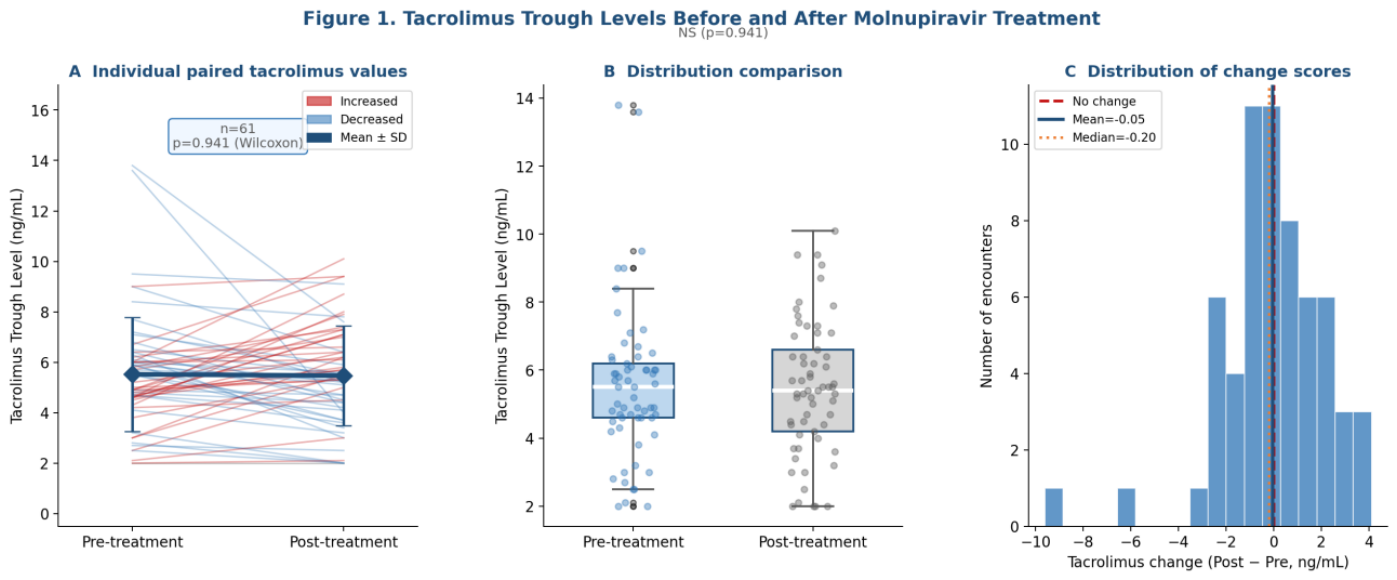
Figure 2.
Serum creatinine before and after molnupiravir treatment. (A) Individual paired serum creatinine (SCr) values (mg/dL) for each encounter. Red lines highlight encounters meeting KDIGO acute kidney injury (AKI) criteria (n = 5, 8.2%), amber lines indicate an SCr increase not reaching the KDIGO threshold, and blue lines indicate stable or improved SCr; navy diamonds and error bars show the group mean ± SD. (B) Box-and-whisker plots comparing pre- and post-treatment SCr distributions. (C) Histogram of SCr change scores; the dashed red line marks zero change, the dotted amber line marks the KDIGO AKI threshold (+0.3 mg/dL), and the solid navy line marks the mean change (+0.010 mg/dL). Wilcoxon signed-rank test: W = 835, p = 0.706; paired t-test: t = -0.265, p = 0.792; Cohen’s d = 0.034. n = 61 encounters. All five AKI events were attributable to COVID-19 illness (n = 3), concurrent amlodipine initiation (n = 1), or non ST-segment elevation myocardial infarction (n = 1); none was attributable to molnupiravir.
Figure 2.
Serum creatinine before and after molnupiravir treatment. (A) Individual paired serum creatinine (SCr) values (mg/dL) for each encounter. Red lines highlight encounters meeting KDIGO acute kidney injury (AKI) criteria (n = 5, 8.2%), amber lines indicate an SCr increase not reaching the KDIGO threshold, and blue lines indicate stable or improved SCr; navy diamonds and error bars show the group mean ± SD. (B) Box-and-whisker plots comparing pre- and post-treatment SCr distributions. (C) Histogram of SCr change scores; the dashed red line marks zero change, the dotted amber line marks the KDIGO AKI threshold (+0.3 mg/dL), and the solid navy line marks the mean change (+0.010 mg/dL). Wilcoxon signed-rank test: W = 835, p = 0.706; paired t-test: t = -0.265, p = 0.792; Cohen’s d = 0.034. n = 61 encounters. All five AKI events were attributable to COVID-19 illness (n = 3), concurrent amlodipine initiation (n = 1), or non ST-segment elevation myocardial infarction (n = 1); none was attributable to molnupiravir.
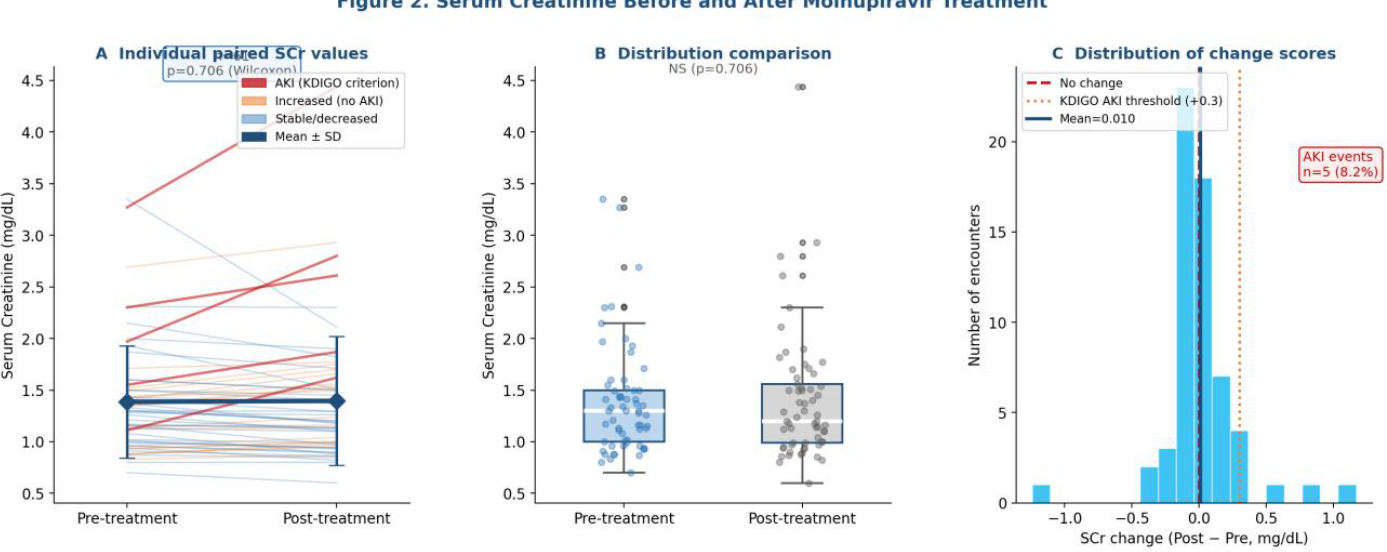
Figure 3.
Clinical safety and efficacy outcomes. (A) Horizontal bar chart summarizing key safety and efficacy outcome rates across all 61 treatment encounters, including adverse effects (0%), hospitalization (1.6%), COVID-19 related death (0%), and cohort vaccination rate (91.8%). (B) Classification of the five encounters (8.2%) meeting KDIGO acute kidney injury criteria by clinical attribution: COVID-19 related dehydration or illness severity (n = 3, 4.9%), other concurrent clinical cause (n = 2, 3.3%; amlodipine-mediated CYP3A4 interaction unrelated to molnupiravir, n = 1; non ST-segment elevation myocardial infarction, n = 1), and molnupiravir (n = 0).
Figure 3.
Clinical safety and efficacy outcomes. (A) Horizontal bar chart summarizing key safety and efficacy outcome rates across all 61 treatment encounters, including adverse effects (0%), hospitalization (1.6%), COVID-19 related death (0%), and cohort vaccination rate (91.8%). (B) Classification of the five encounters (8.2%) meeting KDIGO acute kidney injury criteria by clinical attribution: COVID-19 related dehydration or illness severity (n = 3, 4.9%), other concurrent clinical cause (n = 2, 3.3%; amlodipine-mediated CYP3A4 interaction unrelated to molnupiravir, n = 1; non ST-segment elevation myocardial infarction, n = 1), and molnupiravir (n = 0).
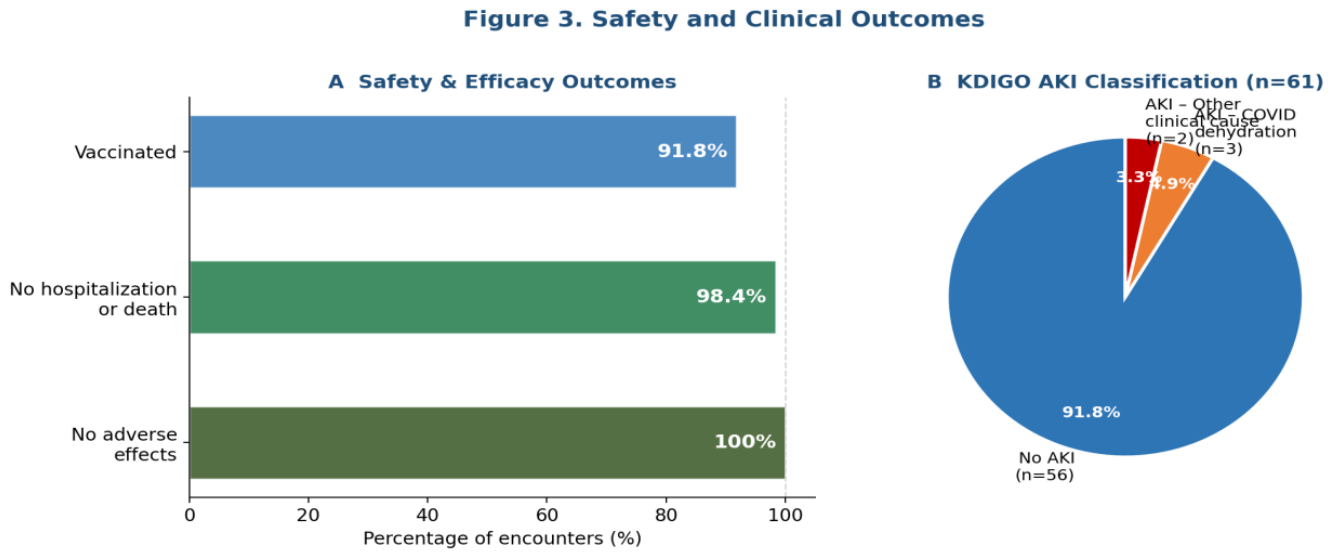

Table 1.
Baseline characteristics of the study cohort.
| Characteristic | Value |
| Total treatment encounters, n | 61 |
| Unique patients, n | 52 |
| Transplant type, n (%) | |
| Kidney transplant | 55 (90.2) |
| Simultaneous pancreas-kidney (SPK) | 6 (9.8) |
| Age, years, mean (SD) [range] | 55.0 (14.7) [26–84] |
| Sex, n (%) | |
| Male | 42 (68.9) |
| Female | 19 (31.1) |
| Ethnicity-non-Hispanic/Latino, n (%) | 55 (90.2) |
| COVID-19 vaccination status, n (%) | |
| Vaccinated | 56 (91.8) |
| Not vaccinated | 3 (4.9) |
| Unknown | 2 (3.3) |
| Days from symptom onset/positive test to treatment, mean (SD) [range] | 1.3 (1.4) [0–6]] |
| Patients with >1 COVID-19 infection (multiple encounters), n (%) | 9 (17.3) |
| Hospitalization attributable to COVID-19, n (%) | 1 (1.6) |
| COVID-19–related death, n (%) | 0 (0) |
| Adverse effects attributed to molnupiravir, n (%) | 0 (0) |
SPK = simultaneous pancreas-kidney; SD= standard deviation. Patients with multiple COVID-19 infections contributed more than one treatment encounter. All encounters were treated with molnupiravir 800 mg twice daily for 5 days. One patient receiving cyclosporine was excluded. All included patients were receiving tacrolimus-based immunosuppression.
Table 2.
Primary paired statistical analysis: tacrolimus trough levels, serum creatinine, and AKI events before and after molnupiravir treatment.
Table 2.
Primary paired statistical analysis: tacrolimus trough levels, serum creatinine, and AKI events before and after molnupiravir treatment.
| Parameter | n | Pre-Treatment, Mean (SD) [Median, IQR] | Post-Treatment, Mean (SD) [Median, IQR] | Mean Δ (95% CI) | p-Value * |
| Tacrolimus Trough Level, ng/mL | |||||
| Overall | 61 | 5.52 (2.26) [5.50; 4.60–6.20] | 5.47 (1.97) [5.40; 4.20–6.60] | −0.05 (−0.64 to 0.54) | 0.859 / 0.941† |
| Cohen’s d (effect size) | 61 | — | — | d = −0.023 | Negligible |
| Serum Creatinine, mg/dL | |||||
| Overall | 61 | 1.39 (0.54) [1.30; 0.96–1.66] | 1.40 (0.62) [1.20; 0.94–1.71] | 0.010 (−0.064 to 0.084) | 0.792 / 0.706† |
| Cohen’s d (effect size) | 61 | — | — | d = +0.034 | Negligible |
| AKI Events—KDIGO Criteria (SCr rise ≥0.3 mg/dL or ≥1.5× baseline) | |||||
| Total AKI events, n/N (%) | 5/61 | — | 8.2% | — | |
| Attributed to COVID-19 illness/dehydration | 3 | — | 4.9% | — | |
| Attributed to concurrent clinical cause ‡ | 2 | — | 3.3% | — | |
| Attributed to molnupiravir | 0 | — | 0% | — | |
* Shapiro-Wilk testing confirmed non-normal distribution for both tacrolimus trough levels and SCr differences (p < 0.001 for both); the Wilcoxon signed-rank test was therefore used as the primary statistical method. † p-values reported as paired t-test / Wilcoxon signed-rank test. ‡ Concurrent clinical causes: amlodipine initiation on day 11 post-treatment causing transient CYP3A4-mediated tacrolimus elevation unrelated to molnupiravir (n = 1); non ST-segment elevation myocardial infarction (n = 1).
Table 3.
Summary of published cohort studies on molnupiravir in solid organ transplant recipients.
| Study (Year) | Design/Country | N (Tx Type) | IS Regimen | Hosp. Rate | DDI Reported | Follow-Up | Key Finding |
| Villamarín et al., 2022 [13] | Prospective cohort; Spain | 9 KTR | TAC-based | 11% | None | ~30 d | No nephrotoxicity; no DDI with immunosuppression |
| Wojtala et al., 2022 [14] | Retrospective; Poland | 16 KTR + 20 HD | CNI-based | 0% (KTR) | None | 30 d | Safe outpatient use; AKI from COVID-19 illness, not drug |
| Patel et al., 2023 [21] | Retrospective; USA (SOT) | 23 SOT | TAC ± MPA | 4% | None | 69 d | 100% tolerability; no CNI toxicity or dose changes required |
| Len et al., 2023 [17] | Retrospective; Spain (multi-SOT) | 57 SOTR | CNI-based | 7% | None | ~90 d | Only safe option when DDIs preclude alternatives; no immunosuppression interactions |
| Perrin et al., 2024 [18] | Single-center retrospective; France (KTR) | 93 KTR | CNI-based | 3.2% | None | 19 mo (median) | Stable graft function at extended follow-up; no rejection; no DDI |
| Current study | Single-center retrospective; USA (KTR + SPK) | 61 encounters/52 patients | TAC-based | 1.6% | None | Up to 1 y | No DDI; stable TAC (p = 0.941) and SCr (p = 0.706); 0% AE; 0% death; includes SPK and repeat infections |
KTR = kidney transplant recipient; SPK = simultaneous pancreas-kidney; SOT = solid organ transplant; CNI = calcineurin inhibitor; TAC = tacrolimus; MPA = mycophenolic acid; HD = hemodialysis; DDI = drug-drug interaction; IS = immunosuppression; AE = adverse events; Hosp. = hospitalization.
Table 4.
Documented cases of severe tacrolimus toxicity following nirmatrelvir/ritonavir administration in kidney transplant recipients.
Table 4.
Documented cases of severe tacrolimus toxicity following nirmatrelvir/ritonavir administration in kidney transplant recipients.
| Study | Clinical Presentation | TAC Level, ng/mL | Outcome/Relevance |
| Prikis and Cameron, 2022 [8] | 34-year-old man, KTR; nausea and AKI after 5 doses of nirmatrelvir/ritonavir prescribed at transplant center | >30 (reported) | TAC and nirmatrelvir/ritonavir held; AKI resolved; toxicity occurred despite specialist involvement |
| Berar Yanay et al., 2022 [9] | 23-year-old woman, KTR; nausea, vomiting, tremors after nirmatrelvir/ritonavir for COVID-19 | >60 | AKI and hyperkalemia; both drugs held; full recovery; early case establishing interaction severity |
| Coyne and Aye, 2023 [10] | Two KTR; altered mental status, AKI, supratherapeutic TAC after nirmatrelvir/ritonavir | >30 (both cases) | Hospitalization required in both; recovery; harm occurred despite known DDI risk |
| Park et al., 2022 [11] | 65-year-old man, KTR; severe AKI after nirmatrelvir/ritonavir; managed with phenytoin as CYP3A4 inducer | Severely elevated | AKI reversed after phenytoin; TAC restarted; illustrates complexity of managing this DDI |
| Pagan Santini et al., 2025 [12] | 72-year-old man, KTR; altered mental status, AKI; nirmatrelvir/ritonavir prescribed by PCP without transplant consultation | >90 | IV phenytoin required; most severe reported TAC level; illustrates PCP prescribing risk |
| Rycen et al., 2024 [19] | 57-year-old man, KTR; nausea, vomiting, lethargy 48 h after nirmatrelvir/ritonavir prescribed by general practitioner | Severely elevated | Emergency department presentation; hospitalization; highlights nonspecialist prescribing risk across health systems |
These cases contextualize the clinical urgency of selecting molnupiravir over nirmatrelvir/ritonavir in CNI-treated transplant recipients and illustrate the prescribing risk posed by non-specialist clinicians. KTR = kidney transplant recipient; AKI = acute kidney injury; TAC = tacrolimus; PCP = primary care provider; IV = intravenous; DDI = drug-drug interaction. Therapeutic range for tacrolimus is typically 5-10 ng/mL in stable kidney transplant recipients.
Disclaimer/Publisher’s Note: The statements, opinions and data contained in all publications are solely those of the individual author(s) and contributor(s) and not of MDPI and/or the editor(s). MDPI and/or the editor(s) disclaim responsibility for any injury to people or property resulting from any ideas, methods, instructions or products referred to in the content. |
© 2026 by the authors. Licensee MDPI, Basel, Switzerland. This article is an open access article distributed under the terms and conditions of the Creative Commons Attribution (CC BY) license.
Copyright: This open access article is published under a Creative Commons CC BY 4.0 license, which permit the free download, distribution, and reuse, provided that the author and preprint are cited in any reuse.