
Submitted:
04 August 2026
Posted:
05 August 2026
You are already at the latest version
Abstract
Geopolitical Risk (GPR) has become a central concern for financial stability. This study examines the intellectual and conceptual structure of GPR research in financial markets, banking, and insurance, using a Bibliometric-Systematic Literature Review (B-SLR) framework that combines PRISMA-guided screening with bibliometric performance analysis and science mapping (bibliometrix, VOSviewer). A total of 395 journal articles were retrieved from Scopus, along with a dedicated subsample of 45 documents on banking and insurance applications. Results show that scientific production accelerated sharply after 2018, peaking at 125 articles in 2025. The field’s intellectual core remains organized around the Caldara and Iacoviello GPR Index. Within the banking and in-surance subsample, growth is even steeper, reflecting the very gap that motivated this study, since research on GPR’s transmission to the banking and insurance sectors had remained fragmented and no comprehensive bibliometric mapping of the field had previously been available. Dedicated citation clusters have emerged around bank-ing-focused outlets, while a comparable structure for insurance has yet to develop. These findings carry both theoretical and practical value, offering scholars a structured map for future research while cautioning risk managers and regulators about the still-limited evidence base on insurance.
Keywords:
geopolitical risk
; banking
; insurance
; bibliometric analysis
; PRISMA
1. Introduction
Recent international events, especially the Russia-Ukraine conflict and rising tensions in the Middle East, have significantly heightened concerns about global economic and financial stability. These incidents have made Geopolitical Risk (GPR) a core element in financial models, not just a temporary issue. Caldara and Iacoviello (2022) describe GPR as “the threat, realization, and escalation of adverse events related to wars, terrorism, and tensions among states and political actors that impact the peaceful development of international relations”.
Scholarly interest in GPR has increased significantly over the past decade, with a notable acceleration in scientific output following 2020. This growth correlates with both the formalization of the Geopolitical Risk (GPR) Index by Caldara and Iacoviello, initially developed in 2018 and subsequently revised in 20211 to incorporate a different methodology, and the emergence of large-scale geopolitical crises that rendered the topic unavoidable for financial researchers. The index quantifies the proportion of newspaper articles that reference geopolitical tensions using specific keywords associated with geopolitical risk (Caldara and Iacoviello, 2022). The GPR Index serves as a reliable proxy for assessing geopolitical risk across nations (Aysan et al. 2023). Most scholarly investigations have focused on the impact of GPR on financial markets, recognizing its importance as a variable in the broader financial system. However, only a handful of studies have examined the relationship between GPR and specific segments of the financial sector, particularly banking and insurance institutions. Many studies apply econometric models and focus on specific geographic regions (Adel and Naili 2024; Aftab and Naveed 2022; Alsadan et al. 2025; Fianto and Ibrahim 2025; Olalere and Mukuddem-Petersen 2024; Sivaprasad et al. 2025). Furthermore, the rapid expansion of this research domain complicates the identification of well-established trends and emerging gaps. To date, no comprehensive bibliometric mapping of this field has been conducted. A related scientometric analysis by Aysan et al. (2023) maps the broader geopolitical risk literature; however, their study is not sector-specific. Similar gaps apply to Aiswarya and Muthumeenakshi (2024), whose PRISMA-guided review of 810 documents likewise covers the field generally, without a sector-specific focus, and omits co-citation analysis entirely. To address this deficiency, the present study provides a detailed bibliometric analysis of contemporary research on GPR’s influence on the financial sector, with particular reference to the banking and insurance sectors. Employing quantitative mapping techniques, this investigation seeks to synthesize extant knowledge and to serve as a guide for future research. The existing literature generally agrees that GPR weakens financial stability through several well-known transmission channels, including energy price shocks, declines in credit quality, and capital flow volatility, with a significant focus on the banking sector as a key point of exposure. However, the insurance industry is relatively underexplored, with empirical results varying across contexts, and there is no comprehensive framework that outlines the field’s overall conceptual development. This study aims to offer both theoretical and practical insights into this rapidly changing field by consolidating a fragmented body of literature. It investigates how geopolitical shocks spread through the financial system, focusing specifically on banking and insurance as key institutional intermediaries. Ultimately, this work lays a foundation for future research and helps risk managers and regulators manage turbulent periods. Methodologically, the study employs a Bibliometric-Systematic Literature Review framework (Marzi et al. 2025), utilizing data from Scopus and advanced mapping tools like bibliometrix and VOSviewer to visualize the field’s intellectual landscape. The paper is organized as follows: Section 2 reviews the literature and theoretical concepts of geopolitical risk; Section 3 describes the methodology, including data collection and bibliometric methods; Section 4 discusses empirical findings; and Section 5 summarizes key insights and suggests future research directions.
2. Literature Review
In recent years, Geopolitical Risk (GPR) has emerged as a significant systemic risk factor capable of influencing macroeconomic dynamics and threatening global financial stability (Liang et al. 2023; Zheng J. et al., 2023), as well as the stability of financial institutions (Caldara and Iacoviello 2022; Istiak and Serletis 2020). As defined above, Caldara and Iacoviello (2022) conceptualize GPR in intentionally broad terms, as encompassing the threats, actual occurrences, and escalation of adverse events tied to war, terrorism, and interstate or political tensions that disrupt the peaceful conduct of international relations. Given the complexity of GPR, its measurement requires an analytical approach beyond simply documenting conflicts. To address the lack of standardized tension-tracking metrics, Caldara and Iacoviello (2018, 2022) propose the GPR Index, a news-based methodology that monitors the monthly proportion of newspaper articles covering adverse geopolitical events and threats across 10 major international newspapers, including the Financial Times, The Guardian, and The Wall Street Journal. The research is organized around eight keyword categories, which the authors aggregate into two subindexes: the Geopolitical Threats (GPT) Index, indicating tension buildup and future risk, and the Geopolitical Acts (GPA) Index, reflecting the direct occurrence of crises such as terrorist attacks or wars (Caldara and Iacoviello 2022).
2.1. Transmission Channels to the Financial System
There is a strong consensus in the literature that GPR destabilizes global financial stability. Many studies systematically examine how geopolitical tensions influence the financial system through various channels, such as energy price shocks (Nasim et al. 2023), shifts in investor sentiment (Albaity et al. 2024; Shabir et al. 2023), credit quality declines (Pham et al. 2021; Phan et al. 2022; Trinh and Tran 2024), and direct disruptions in conflict zones, which cause physical damage and operational crises (Pham et al. 2021). In addition to these known pathways, a key transmission channel involves shifts in investor sentiment, which lead to delayed economic decisions. Increased GPR heightens uncertainty and often causes market panic, prompting firms and investors to postpone large expenditures, consumption, and irreversible investments (Bouri et al. 2023; Cui and Maghyereh 2024a; Godil et al. 2020; Khraiche et al. 2023; Salisu et al. 2022; Sheikh et al. 2024; Sohag et al. 2022; Tang et al. 2023). This decline in expected profitability can result in macroeconomic shifts like reduced employment and overall economic activity (Bouri et al. 2023; Khraiche et al. 2023; Salisu et al. 2022; Sheikh et al. 2024). Additionally, this behavior and increased risk aversion trigger a flight to quality, leading to international capital outflows from emerging and conflict-affected regions toward more stable economies and safe assets (Będowska-Sójka et al. 2022; Cheng et al. 2022; Cui and Maghyereh 2024a; Salisu et al. 2022; Sheikh et al. 2024; Sohag et al. 2022; Tang et al. 2023; Triki and Ben Maatoug 2021; Umar et al. 2022b; Yang et al. 2023; Zheng J. et al. 2023). Recent evidence suggests that ESG assets and climate-related markets could act as effective safe havens, attracting investors seeking resilience through sustainable investments during geopolitical risks (Hoque et al. 2023; Tang et al. 2023; Yang et al. 2024).
Gheorghe et al. (2025) provide more detail, finding that ESG-focused ETFs tend to be more resilient during extreme geopolitical crises, partly buffering against market chaos. In contrast, AI-themed ETFs perform better in moderate-risk settings but are more susceptible to systemic shocks. Similar patterns are seen in cryptocurrency markets; Gaied Chortane and Naoui (2026) show the Russia-Ukraine conflict boosted informational dominance and connectedness among energy-heavy digital currencies like Bitcoin and Ethereum, raising systemic failure risk. Meanwhile, green cryptocurrencies remained more stable and acted as defensive assets. Additionally, GPR contributes to global inflation by raising commodity and energy prices, which raises trade and operational costs for companies (Cui and Maghyereh 2024b; Fang and Shao 2022; Huang et al. 2021; Li et al. 2022; Nasim et al. 2023). These changes often cause currency fluctuations, with affected countries’ currencies depreciating during geopolitical shocks (Fang and Shao 2022; Sheikh et al. 2024; Zheng J. et al. 2023). Torun et al. (2026) highlight a disconnect between WTI crude oil prices and the Russian ruble beginning in 2024, driven by geoeconomic fragmentation and sanctions. The ruble no longer serves as a typical petrocurrency because sanctions have severed its traditional links to oil prices, prompting investors to rethink risk models based on past correlations and illustrating how geopolitical shocks can permanently alter macroeconomic relationships. This financial pressure raises financing costs as banks adjust risk premiums, leading to higher loans’ costs and tighter credit for firms (Khraiche et al. 2023; Sheikh et al. 2024; Umar et al., 2022a). The impact also spreads through behavioral and systemic pathways: GPR shifts investor expectations, with many pricing assets based on worst-case scenarios and extreme risks (Bouri et al. 2023; Liu et al. 2021; Salisu et al. 2022; Zheng J. et al. 2023). Such shifts can trigger risk contagion, where geopolitical events strengthen interconnectedness in financial markets, heightening systemic risk globally (Cui and Maghyereh 2024a; Umar et al., 2022b; Yang et al. 2023; Zheng J. et al. 2023).
At a systemic level, GPR is a key driver of financial volatility, exerting a stronger influence on market fluctuations than on direct returns across various asset classes (Balcilar et al. 2018; Tang et al. 2023). Additionally, GPR amplifies cross-market risk spillovers, especially when the global financial system becomes highly interconnected during crises like the Russia-Ukraine conflict or the 9/11 attacks (Tang et al. 2023; Zheng J. et al. 2023). One main transmission pathway is the oil-stock relationship: the financialization of commodities promotes risk spread through heightened precautionary and speculative demand in futures markets, especially for vital resources like crude oil (Cheng et al. 2022; Cui and Maghyereh 2024b; Huang et al. 2021; Li et al. 2022; Liu et al. 2021; Zheng D. et al. 2023). As a result, GPR greatly influences crude oil price volatility, which then spills over into equity markets, notably in energy-intensive sectors (Huang et al. 2021; Tang et al. 2023). Conversely, GPR can also act as a catalyst for the energy transition, encouraging a shift from geopolitically sensitive fossil fuels to renewable energy and green bonds as part of strategic diversification and hedging (Sohag et al. 2022; Tang et al. 2023; Zheng D. et al. 2023). In bond markets, GPR often prompts a flight to quality, with investors shifting funds from risky equities to government securities, potentially boosting bond returns during conflicts (Cheng et al. 2022; Tang et al. 2023; Zheng J. et al. 2023).
Research on green bonds reveals complex and often asymmetric dynamics. Some studies indicate that green bonds can lower portfolio volatility caused by economic uncertainty, while others show that their long-term returns may suffer due to geopolitical events (Będowska-Sójka et al. 2022; Sohag et al. 2022; Tang et al. 2023). Conversely, precious metals, especially gold and silver, consistently serve as strong safe havens and hedges against GPR shocks, particularly in the short and medium term (Cheng et al. 2022; Tang et al. 2023). The dominant literature finds a significant negative link between rising GPR and stock market performance (Balcilar et al. 2018; Caldara and Iacoviello 2022; Tang et al. 2023; Zhou et al. 2020). Shocks to the GPR index generally cause declines in stock returns and yields on long-term investments (Bouri et al. 2023; Tang et al. 2023), although Balcilar et al. (2018) note that this relationship varies across markets and economic conditions. Stock returns in advanced economies are more susceptible to GPR (Salisu et al. 2022), while emerging markets show mixed responses (NguyenHuu and Örsal 2024). Among BRICS countries, Russia faces the highest risk exposure, but India tends to be more resilient (Balcilar et al. 2018). Evidence further points to a greater impact during market downturns, with GPR as a key driver of increased volatility (Balcilar et al. 2018). Financial market data suggest that geopolitical risk functions as a systemic shock, spreading instability through price swings, currency devaluations, and shifts in investor sentiment.
2.4. Synthesis and Research Questions
A comprehensive review of the literature shows broad consensus on several aspects, alongside ongoing methodological debates and notable empirical gaps. Regarding GPR’s influence on financial markets, evidence consistently indicates that geopolitical shocks are a widespread driver of financial volatility, impacting market fluctuations more than direct returns across asset classes (Balcilar et al. 2018; Tang et al. 2023). The flight-to-quality reaction is well established, with capital routinely shifting from risky equities to government securities, precious metals, and increasingly, ESG-focused assets during geopolitically stressful periods (Cheng et al. 2022; Hoque et al. 2023; Tang et al. 2023). The oil-stock relationship is identified as a key transmission channel, where commodity price volatility caused by GPR spills over into equity markets, especially in energy-heavy sectors (Huang et al. 2021; Tang et al. 2023). Recent evidence suggests a larger shift in risk structures, indicating that traditional safe-haven assets are being actively reshaped by geopolitical forces, with sustainability and energy considerations emerging as important factors of resilience (Gaied Chortane and Naoui 2026; Gheorghe et al. 2025). At the institutional level, the literature presents a more complex picture. It is generally agreed that GPR weakens bank solvency via NPL buildup (Pham et al. 2021; Vu et al. 2023), prompts credit risk revaluation (Nguyen and Thuy 2023), and encourages a flight-to-headquarters in lending practices (Pham et al. 2021). Still, debates exist over how capital structures respond: some research finds a counter-cyclical increase in banks’ leverage to maintain client relationships and manage public debt (Istiak and Serletis 2020), while others report sharp credit cuts driven by elevated risk premiums (Khoo and Cheung 2021). Bettin et al. (2023) introduce additional methodological complexity by demonstrating that standard risk measures often underestimate capital shortfalls by neglecting interactions among systemic, climate, and geopolitical shocks, thereby emphasizing the need for more integrated analytical approaches. Geographical differences are evident as well: while emerging economies and the Asia-Pacific region are highly affected by GPR, financial development tends to lessen its impact on stability (Trinh and Tran 2024). Resilience in advanced markets has its limits, as European banks near the Russia-Ukraine conflict reduced protection from robust institutions (Vu et al. 2023), although ECB oversight has somewhat alleviated liquidity stresses.
While formalizing the Caldara and Iacoviello index has encouraged more research on Geopolitical Risk (GPR), the literature remains scattered in methodology and themes. A review of current studies highlights three main research gaps needing systematic analysis. The first is the imbalance between banking and insurance: while aspects like financial stability (Trinh and Tran 2024), operational profitability (Pham et al. 2019), and corporate governance (Shabir et al. 2023) in banking have received ongoing attention, insurance companies are mostly seen as passive risk-mitigation tools in control variables (Bussy and Zheng 2023). Their operational resilience, solvency during crises, and asset pricing amid war or terrorism are largely unexplored. The second gap involves inconsistent empirical findings on leverage and capital structure, which calls for studies that unify strategic and mechanical views. Lastly, the evolving conceptual landscape remains poorly mapped. Recent research has started to include new paradigms like ESG frameworks (Lee et al. 2024), asymmetric transmission in developing economies (Albaity et al. 2024; Nasim et al. 2023), and the behavior of digital and thematic assets under geopolitical stress (Gaied Chortane and Naoui 2026; Gheorghe et al. 2025; Torun et al. 2026). However, no comprehensive framework has yet identified the major conceptual clusters, key theories, or knowledge networks shaping this field. Conducting a systematic bibliometric analysis helps by quantifying publication patterns and mapping co-authorship and citation networks. This approach provides a clearer view of the field’s conceptual landscape and offers valuable guidance for future research, especially on banking and insurance, which are often understudied within the broader financial system.
To achieve these objectives, this research seeks to address the following questions:
RQ1: What emerging trends in scientific production on GPR in the financial sector are evident, and which journals and authors are most influential?
This research question arises from the need to spotlight the leading voices and journals shaping the field, especially since 2020, when GPR became a cornerstone of financial modeling. Identifying these key contributors is crucial for understanding the landscape and momentum of current research.
RQ2: What is the intellectual structure of the field, as revealed by co-citation and co-word analyses?
RQ3: What emerging thematic clusters are evident, and how has the research focus evolved in response to recent shocks?
These research questions delve into the intellectual and thematic fabric of the field through science-mapping techniques such as co-citation and co-word analysis. Such methods, as highlighted by Marzi et al. (2025) and Donthu et al. (2021), are essential for uncovering hidden trends and connections within the literature. By doing so, they reveal how scholarship has responded to major shocks like the Russia-Ukraine conflict and illuminate the web of academic collaboration.
RQ4: What under-researched areas and gaps should define the future research agenda?
This research question aims to identify research gaps to advance the field, particularly regarding the operational resilience and asset-pricing dynamics of financial institutions under geopolitical stress, with the banking and insurance sector as a primary focus.
3. Materials and Methods
This study utilizes the Bibliometric-Systematic Literature Review (B-SLR) framework developed by Marzi et al. (2025). It combines the rigorous methodology of systematic reviews, following the PRISMA protocol (Page et al. 2021), with quantitative science-mapping techniques. This hybrid approach facilitates the identification, selection, and synthesis of relevant studies and explores the conceptual and intellectual structure of GPR literature within banking and insurance sectors. The B-SLR process in this paper comprises three main stages: (1) data collection and search strategy, (2) selection and screening criteria, and (3) bibliometric analysis and visualization tools.
3.1. Data Source and Search Strategy
Bibliographic data were collected from the Scopus database, chosen for its extensive multidisciplinary coverage and frequent use in bibliometric research within management and finance fields (Donthu et al. 2021). The search was performed on June 9, 2026, focusing on the Title, Abstract, and Keywords of indexed documents. The search string targeted the intersection between geopolitical risk and the financial sector, particularly banking and insurance institutions, following the structure outlined in Table 1.
The first block of the query limited results to documents that explicitly address the geopolitical risk construct, using both the full term and its common acronym, “GPR,” as established by the Caldara and Iacoviello (2022) index. The second block focused on the financial sector by combining banking and insurance terminology with broader categories such as financial markets and institutions. This ensured studies on GPR’s impact on financial intermediaries were not excluded if they did not explicitly mention “bank” or “insurance” in the title, abstract, or keywords. Four additional filters were applied in Scopus for thematic and methodological consistency: (i) subject area limited to Economics, Econometrics and Finance (“ECON”) and Business, Management and Accounting (“BUSI”); (ii) document type limited to journal articles (“ar”), excluding conference papers, book chapters, and reviews; (iii) language limited to English to ensure consistency in subsequent analyses; and (iv) publication stage limited to “final,” excluding articles in press with unstable bibliometric metadata. The initial search returned 545 documents.
3.2. Selection Criteria and Screening Process
Following the PRISMA protocol (Page et al. 2021), document selection involved the standard stages of identification, screening, eligibility, and inclusion. The identification phase yielded a raw dataset of 545 records from the Scopus query described earlier. To inform the screening process, the search query was developed through a systematic review of the Global Risks Reports published by the World Economic Forum (WEF) from 2006 to 2026. These reports map geopolitical risk categories over time and help define the exclusion criteria, ensuring only studies addressing empirically recognized geopolitical risk categories are included. Since a single database was used, duplicate records were not expected. After screening titles and abstracts, 150 records were excluded because GPR was not a primary focus, the study did not analyze financial sector outcomes at the market or institutional level, or it solely examined non-financial outcomes without implications for financial intermediaries or markets. The final dataset, consisting of 395 articles, was used for bibliometric analysis. In line with B-SLR guidelines (Marzi et al. 2025), the number and reasons for excluded records are shown in the PRISMA flow diagram (Figure 1), ensuring transparency and reproducibility in the dataset construction.
3.3. Bibliometric Tools and Analytical Techniques
The final dataset, exported from Scopus in CSV format with full bibliographic details, abstracts, and cited references, was analyzed using dedicated bibliometric software, reflecting the growing recognition and adoption of such tools in research (Tomaszewski 2023). Consistent with the combined use of performance analysis and science mapping tools recommended within the B-SLR framework (Marzi et al. 2025), two complementary packages were selected. First, the bibliometrix package (Aria and Cuccurullo 2017) was selected, among the bibliometric software packages available and widely adopted in the literature (Moral-Muñoz et al. 2020), for its capacity to compute performance indicators and generate thematic maps directly within the R environment (RQ1). Second, VOSviewer (van Eck and Waltman 2010) was selected for its strong network visualization capabilities (Moral-Muñoz et al. 2020) and was used to develop and visualize science maps addressing RQ2 and RQ3. This involved constructing co-citation networks of references and authors to explore the field’s intellectual foundation, creating co-authorship networks at the author and country levels to reveal collaboration patterns, and analyzing co-occurrence networks of author keywords to identify the domain’s conceptual structure. These combined methods enable a triangulated analysis of research performance, intellectual structure, social collaborations, and conceptual themes within the GPR literature in the financial sector, aligning with the B-SLR framework’s multi-method approach (Marzi et al. 2025).
4. Results
Bibliometric methods are broadly classified into performance analysis and science mapping (Cobo et al. 2011; Donthu et al. 2021). While the former concerns the quantitative evaluation of research constituents (e.g., authors, journals, institutions), science mapping focuses on uncovering the structural and relational properties that connect these constituents, thereby revealing the intellectual, social, and conceptual architecture of a research field.
4.1. Performance Analysis
Prior to examining the relational structure of the field through science mapping, a performance analysis was conducted to characterize the productivity and impact of the geopolitical risk literature. This analysis, performed in R using the bibliometrix package (Aria and Cuccurullo 2017), covers the full sample of 395 documents retrieved from Scopus and addresses five main dimensions: annual scientific production, the most productive and impactful authors, the leading countries and journals, the most cited publications and author productivity patterns as described by Lotka’s Law.
4.1.1. Annual Scientific Production
The distribution of publications over time (Figure 2) shows that research on geopolitical risk was exiguous before 2018, with only sporadic contributions between 2010 and 2017, never exceeding one article per year. Scientific output began to accelerate from 2018 onward, followed by a first marked increase in 2020 and a subsequent steeper growth trajectory from 2021 to 2024. Production peaked in 2025 with 125 articles, the highest annual figure in the sample. The count for 2026 (76 articles, as of the data at the extraction date), reflects the partial coverage of the current year rather than an actual decline.
4.1.2. Most Productive Authors
The authors with most publications are listed in Table 2. Hoque M.E. leads the ranking with 9 documents, followed by Bossman A. Li Y. and Liu J. (7 each) and Ahmed F., Bouri E. and Teplova T. (6 each). When productivity is combined with impact using citation-based indices (Table 3), a partially different ranking emerges. Bossman A. achieves the highest h-index (6), reflecting a particularly high citation rate relative to his short publishing history (starting only in 2022). Ahmed F. and Huang S., however, record the highest m-index (1.33 each) despite a lower h-index (4), owing to an even shorter publishing history (starting in 2024), indicating an even faster year-on-year citation accumulation rate, though over a narrower window. Meanwhile, Teplova T., despite having only 6 publications, accumulates the highest total citation count among all authors. This divergence between productivity and impact is largely attributable to a single, highly influential contribution. As shown in Table 7, the most cited paper in the entire dataset lists Teplova T. as a co-author. Her citation profile therefore illustrates how, in a rapidly growing and event-driven field, a single well-timed contribution tied to a major geopolitical shock can shape an author’s bibliometric standing.
This pattern confirms that scientific influence in this field is not solely determined by publication volume but also by the timing and thematic positioning of contributions relative to geopolitical events.

Table 2.
Most productive authors by number of publications.
| Author | Number of papers |
|---|---|
| Hoque M.E. | 9 |
| Bossman A. | 7 |
| Li Y. | 7 |
| Liu J. | 7 |
| Ahmed F. | 6 |
| Bouri E. | 6 |
| Teplova T. | 6 |
| Billah M. | 5 |
| Gubareva M. | 5 |
| Guesmi K. | 5 |
Source: own elaboration based on Scopus data (bibliometrix, R).
Table 3.
Author impact indices (h-index, g-index, m-index).
| Element | h_index | g_index | m_index | Total Citations | Number of Publications | Publication Year Start |
|---|---|---|---|---|---|---|
| Bossman A. | 6 | 7 | 1.20 | 364 | 7 | 2022 |
| Bouri E. | 5 | 6 | 0.71 | 230 | 6 | 2020 |
| Hoque M.E. | 5 | 9 | 0.63 | 202 | 9 | 2019 |
| Li Y. | 5 | 7 | 1.00 | 171 | 7 | 2022 |
| Teplova T. | 5 | 6 | 1.00 | 628 | 6 | 2022 |
| Ahmed F. | 4 | 6 | 1.33 | 66 | 6 | 2024 |
| Gubareva M. | 4 | 5 | 1.00 | 160 | 5 | 2023 |
| Guesmi K. | 4 | 5 | 1.00 | 58 | 5 | 2023 |
| Hammoudeh S. | 4 | 4 | 0.80 | 272 | 4 | 2022 |
| Huang S. | 4 | 5 | 1.33 | 71 | 5 | 2024 |
Source: own elaboration based on Scopus data (bibliometrix, R).
4.1.3. Country and Journal-Level Productivity
At the country level (Table 3), China is by far the most productive contributor, with 116 documents, more than five times the output of the second-ranked country, the United States (21 documents), followed by France (15), India, Saudi Arabia and Turkey (14 each), and Portugal and the United Kingdom (13 each). This degree of concentration is consistent with the strong presence of Chinese-affiliated researchers noted in the science mapping section.
Figure 3 complements this picture with an explicit view of the international collaboration network underlying the field’s country-level output: node size reflects each country’s publication volume, while connecting lines represent co-authorship ties between countries, with line thickness proportional to the strength of the collaboration. China’s central position and the thickness of its link to the United Kingdom stand out as the network’s most prominent collaborative tie, followed by a dense fan of thinner connections linking China to Turkey, Saudi Arabia, and a broader set of Gulf, South Asian, and European countries. This map offers a more immediately interpretable, geographically anchored counterpart to the VOSviewer country co-authorship network discussed in Section 4.3.3.
Table 3.
Scientific production by country.
| Country | Number of papers |
|---|---|
| China | 116 |
| USA | 21 |
| France | 15 |
| India | 14 |
| Saudi Arabia | 14 |
| Turkey | 14 |
| Portugal | 13 |
| United Kingdom | 13 |
| Tunisia | 11 |
| Greece | 9 |
Source: own elaboration based on Scopus data (bibliometrix, R).
At the journal level (Table 5), Finance Research Letters is the most prolific outlet with 43 articles, followed by Resources Policy (38) and Energy Economics (31). Together, these three journals alone account for 112 documents, confirming their role as the primary publication outlets for this literature. When journal impact is assessed using citation-based indices (Table 6), Resources Policy records the highest h-index and total citation count, on a par with Finance Research Letters for total citations, followed by Energy Economics.
4.1.4. Most Cited Publications
The most highly cited documents in the dataset retrieved through this study’s search strategy are listed in Table 7. The most-cited paper (Umar Z. et al., 2022, Finance Research Letters) has accumulated 360 citations, followed by Balcilar M. et al. (2018, Economic Systems, 346 citations) and Liang C. et al. (2022, Technological Forecasting and Social Change, 343 citations).
Table 7.
Most globally cited documents.
| Authors | Title | Journal | Publication Year |
Total Citations |
|---|---|---|---|---|
| Umar Z., Polat O., Choi S.Y.; Teplova T. | The Impact of The Russia-Ukraine Conflict on the Connectedness of Financial Markets | Finance Research Letters | 2022 | 360 |
| Balcilar M., Bonato M., Demirer R., Gupta R. | Geopolitical Risks and Stock Market Dynamics of the BRICS. | Economic Systems | 2018 | 346 |
| Liang C., Umar M., Ma F., Huynh T.L.D. | Climate Policy Uncertainty and World Renewable Energy Index Volatility Forecasting | Technological Forecasting and Social Change | 2022 | 343 |
| Antonakakis N., Gupta R., Kollias C., Papadamou S. | Geopolitical Risks and The Oil-Stock Nexus Over 1899–2016 | Finance Research Letters | 2017 | 330 |
| Gong X., Xu J. | Geopolitical Risk and Dynamic Connectedness Between Commodity Markets | Energy Economics | 2022 | 299 |
| Fang Y. Shao Z. | The Russia-Ukraine Conflict and Volatility Risk of Commodity Markets | Finance Research Letters | 2022 | 232 |
| Shahzad U., Mohammed K.S., Tiwari S., Nakonieczny J., Nesterowicz R. | Connectedness Between Geopolitical Risk, Financial Instability Indices and Precious Metals Markets: Novel Findings from Russia Ukraine Conflict Perspective | Resources Policy | 2023 | 226 |
| Das D., Kannadhasan M., Bhattacharyya M. | Do The Emerging Stock Markets React to International Economic Policy Uncertainty, Geopolitical Risk and Financial Stress Alike? | North American Journal of Economics and Finance | 2019 | 213 |
| Cheng C.H.J., Chiu C.W.J. | How Important Are Global Geopolitical Risks to Emerging Countries? | International Economics | 2018 | 195 |
| Sohag K., Hammoudeh S., Elsayed A.H., Mariev O. Safonova Y. | Do Geopolitical Events Transmit Opportunity or Threat to Green Markets? Decomposed Measures of Geopolitical Risks | Energy Economics | 2022 | 187 |
Source: own elaboration based on Scopus data (bibliometrix, R).
4.1.5. Lotka’s Law
Lotka’s Law is widely regarded as one of the foundational regularities in bibliometric research (Kushairi and Ahmi 2021). First formulated by Lotka (1926), it describes an inverse relationship between the number of papers an author publishes and the number of authors reaching that publication count: authors with n contributions are expected to be roughly 1/nᵃ as numerous as single-contribution authors, with the exponent a typically close to two. In practice, this means that highly productive authors become disproportionately rarer as their output grows, while the vast majority of contributors publish only once or twice on a given topic. The distribution of author productivity (Table 8) is broadly consistent with the pattern predicted by Lotka’s Law (Aria and Cuccurullo 2017). Most contributors (82,72% of the total) have published only a single document on the topic, while progressively smaller shares have published two (10,47%), three (3,35%) or four (1,68%) documents. At the end of this distribution sits a single author, Hoque M.E., with 9 documents, who is also the most productive author identified in Section 4.1.2.
4.2. Trends in Scientific Production
In addition to the performance indicators discussed above, the bibliometrix package was used to construct a thematic strategic diagram (Cobo et al. 2011), which classifies the keywords clusters of the field along two dimensions, centrality (relevance degree) and density (development degree), into four quadrants: motor themes (high centrality, high density), basic themes (high centrality, low density), niche themes (low centrality, high density) and emerging or declining themes (low centrality, low density). A complementary analysis of thematic evolution and trend topics tracks how these clusters have developed across different time periods.
The strategic diagram (Figure 4) confirms and enriches the picture that will be corroborated in more detail by the co-word analysis (presented in Section 4.3.1). The basic themes quadrant is dominated by the core cluster geopolitical risk, economic policy uncertainty, financial market, confirming these constructs as the transversal and foundational themes underpinning the entire field. The motor themes quadrant, which identifies themes that are well-developed and central to the field’s structure, contains a single cluster suggesting that hedging-oriented methodologies and investor sentiment represent the most mature and simultaneously most central line of inquiry in this field. The niche themes quadrant (consistent with the focus reported in Section 4.4) groups highly specialized clusters that are well developed internally but only loosely connected to the rest of the field including, notably, banking vulnerability, financial fragmentation, and international risk. Finally, the emerging or declining themes quadrant includes clusters that are either not yet fully developed or losing centrality within the field.
The trend topics chart (Figure 5) offers a complementary, term-level view of this same evolutionary dynamic, plotting each keyword’s period of use (horizontal bar, from first to last occurrence in the dataset) against its frequency (bubble size) and median year of occurrence (bubble position). Geopolitical risk stands out as by far the highest-frequency term, centred just before 2025 and spanning a wide window from roughly 2023 onward, consistent with its role as the field’s dominant and still-rising construct. At the other end of the timeline, stock returns and geopolitical uncertainty are the earliest-appearing terms, suggesting they belong to an earlier vocabulary that has since been partly superseded by the more specific terminology dominating the field’s most recent output. Notably, bank stability also appears among the trending terms, centred around 2023 with a usage window extending to the most recent period, an independent confirmation, from a purely temporal-frequency perspective, of the growing (if still comparatively narrow) footprint of banking-focused research within the field, consistent with the dedicated analysis presented in Section 4.4.
4.3. Science Mapping
The present study draws on co-word (operationalized through keyword co-occurrence analysis), co-citation and co-authorship analysis, as they jointly allow for a comprehensive characterization of the geopolitical risk literature along three complementary dimensions: its conceptual structure (what the field is about), its intellectual structure (which foundational works and authors have shaped it), and its social structure (who is producing this knowledge and through which collaborative patterns). All three analyses were performed using VOSviewer software (van Eck and Waltman 2010), which enables the construction and visualization of bibliometric networks based on co-occurrence and co-citation data extracted from Scopus.
4.3.1. Co-Word Analysis
Co-word analysis was conducted on the combined keyword set, author keywords, and index keywords to identify the dominant conceptual clusters characterizing the geopolitical risk literature. For all three keyword sets, a thesaurus file was applied prior to clustering to merge synonyms and equivalent term variants into a single unified keyword. A minimum occurrence threshold of 5 was applied in each case; lower thresholds were required for keywords, given their large and dispersed vocabulary, to preserve thematic coverage while keeping the resulting network interpretable. For the all-keywords network, 108 terms met the threshold, resulting in six clusters; for the author-keyword network, 44 terms met the threshold, resulting in eight clusters; finally, for the index-keywords network, 73 terms met the threshold, resulting in five clusters.
As shown in Table 9, the all-keywords network (Figure 6) is organized into six clusters overall, but for clarity of exposition, only the four main clusters are reported in the table. Cluster 3 (blue) is the most prominent, anchored on geopolitical risk, confirming its role as the field’s dominant construct and its immediate association with financial market volatility and connectedness. Cluster 1 (red) combines specific geopolitical events with energy-related and econometric terms. Cluster 2 (green) is centered on crude-oil pricing and forecasting methodology. Cluster 4 (yellow) groups monetary and quantile-based hedging terms. No banking-specific term appears among the ten most frequent keywords of the main clusters, but the term bank stability appears as one of only two items forming a sixth small cluster of the underlying VOSviewer solution. As with the author-keywords network discussed below, this cluster does not surface in Table 9 because of the deliberate choice to report only the four main and most significant clusters, rather than reflecting an actual absence of banking-related content from the network.
The author-keyword network (Table 10) is organized into eight clusters. For clarity of exposition, only the four main and most significant clusters are reported in the table. The network is dominated by Cluster 4 (yellow), which is built around geopolitical risk, the most cited term in the entire network (with 245 citations). This cluster functions as the field’s terminological hub. Because geopolitical risk itself co-occurs with an extremely broad range of other keywords, VOSviewer’s clustering algorithm groups it with generic, high-frequency terms that do not exhibit stronger affinity with any of the other three main clusters. This pattern of a disproportionately large core cluster surrounding the field’s central construct, alongside smaller, more internally coherent clusters, indicates a research field that is still consolidating and in which the central construct has not yet been fully absorbed into more specialized sub-literatures. Cluster 1 (red) addresses energy and climate-related spillover dynamics; Cluster 2 (green) is centered on financial market volatility and systemic stress in response to specific geopolitical shocks. Cluster 3 (blue) is specifically dedicated to hedging-oriented quantile methodology. As in the all-keywords network, no banking-specific term features among the top keywords of these four main clusters. The full VOSviewer map (Figure 7) contains a small cluster, among the non-reported ones, formed by bank stability, positioned at the periphery of the network, too small to feature in Table 10, but a first sign that banking sector applications of geopolitical risk are beginning to gain their own space in the field’s conceptual vocabulary.
Table 9.
Distribution of most used keywords among all keywords in clusters.
| Cluster 1 (Red) | Total Link Strength | Occurrence | Cluster 2 (Green) | Total Link Strength | Occurrence | Cluster 3 (Blue) | Total Link Strength | Occurrence | Cluster 4 (Yellow) | Total Link Strength | Occurrence |
|---|---|---|---|---|---|---|---|---|---|---|---|
| Geopolitics | 854 | 85 | Crude Oil | 298 | 29 | Geopolitical Risk | 1051 | 259 | Exchange Rate | 99 | 16 |
| Energy | 343 | 37 | China | 271 | 26 | Stock Market | 274 | 41 | Quantile Regression | 91 | 16 |
| Spillover Effect | 277 | 31 | Costs | 274 | 21 | Financial Stress | 57 | 14 | Gold | 136 | 15 |
| Time Varying | 214 | 27 | Price Dynamics | 207 | 19 | Risk Management | 153 | 14 | Regression Analysis | 163 | 13 |
| Commodity | 204 | 23 | Vector Autoregression | 160 | 14 | Value Engineering | 165 | 14 | European Union | 101 | 10 |
| Covid-19 | 169 | 23 | Commodity Price | 109 | 9 | Russia-Ukraine Conflict | 45 | 12 | Oil Supply | 105 | 9 |
| Russia | 192 | 20 | Granger Causality Test | 61 | 8 | Emerging Markets | 35 | 11 | Investor Sentiment | 69 | 8 |
| United States | 221 | 20 | Volatility Spillovers | 65 | 8 | Volatility | 46 | 11 | Hedge | 69 | 7 |
| Ukraine | 172 | 15 | Economics | 67 | 7 | Dynamic Connectedness | 40 | 10 | Precious Metals | 54 | 7 |
| Financial Crisis | 101 | 13 | India | 73 | 7 | Stock Returns | 43 | 9 | Agriculture | 66 | 6 |
Source: own elaboration based on Scopus data.
Table 10.
Distribution of most used keywords among authors’ keywords in clusters.
| Cluster 1 (Red) | Total Link Strength | Citations |
|---|---|---|
| Uncertainty | 27 | 20 |
| Green Bond | 15 | 13 |
| Commodity | 15 | 11 |
| Spillover | 14 | 11 |
| Energy | 10 | 10 |
| Connectedness | 17 | 9 |
| Risk Spillover | 7 | 7 |
| Climate Policy Uncertainty | 8 | 6 |
| Cryptocurrencies | 15 | 6 |
| Cluster 2 (Green) | Total Link Strength | Citations |
| Stock Market | 41 | 23 |
| Volatility | 19 | 11 |
| Emerging Markets | 14 | 9 |
| Event Study | 13 | 8 |
| Financial Stress Index | 8 | 8 |
| Cross-Quantilogram | 9 | 6 |
| War | 11 | 6 |
| Commodity Futures | 5 | 5 |
| Russia | 11 | 5 |
| Cluster 3 (Blue) | Total Link Strength | Citations |
| Investor Sentiment | 19 | 8 |
| Hedge | 15 | 7 |
| Quantile-On-Quantile Regression | 18 | 6 |
| Wavelet Coherence | 14 | 6 |
| Financial Uncertainty | 8 | 5 |
| Precious Metals | 12 | 5 |
| Cluster 4 (Yellow) | Total Link Strength | Citations |
| Geopolitical Risk | 249 | 245 |
| Financial Market | 23 | 17 |
| Stock Returns | 12 | 7 |
| China | 9 | 6 |
| Climate Risk | 9 | 6 |
Source: own elaboration based on Scopus data.
The index-keyword network (Table 11), which reflects database-assigned terms rather than the author’s own wording, is organized in five clusters overall (Figure 8). Again, only the four main significant clusters are reported in the table. Cluster 3 (blue) contains geopolitical risk and closely mirrors Cluster 3 of the all-keywords network. Cluster 2 (green) groups together the core geopolitics and commodity-trading vocabulary. Cluster 1 (red) addresses risk assessment and energy-related terms. Consistent with the other two keyword networks, no banking-specific term appears among the ten most frequent index keywords of any cluster.
Taken together, the three co-occurrence maps consistently indicate that the conceptual structure of the field is organized around the intersection of geopolitical risk with three principal application domains, financial markets, energy and commodities markets, and hedging instruments, while methodological terms reveal a strong reliance on time-varying and quantile-based econometric frameworks.
4.3.2. Co-Citation Analysis
The co-citation analysis, conducted on cited authors, references, and sources, allows the field’s foundational intellectual structure to be reconstructed. As with the co-word analysis, a thesaurus file was applied to each of the three co-citation networks before clustering to merge equivalent name and reference variants. A minimum threshold of 10 citations was applied throughout the co-citation analyses to isolate the network’s most central and consistently co-cited elements.
For the cited-authors analysis, among the 9,343 authors in the dataset, only 351 met this threshold. The largest connected set comprised 113 authors, as shown in Figure 9, where each node represents an author and lines and distances indicate the relations between them. The analysis identifies five clusters overall, but for clarity of exposition, only the four main and most significant clusters, detailed in Table 12, are discussed and can be interpreted as successive layers in the development of the field’s foundational themes. Cluster 2 (green), led by Iacoviello M., represents the seminal stream on the measurement of geopolitical uncertainty, from which most subsequent empirical applications derive. Cluster 1 (red), led by Davis S.J., corresponds to the parallel and complementary literature on economic policy uncertainty (EPU) and its volatility-forecasting implications. Cluster 3 (blue) reflects the methodological tradition centered on connectedness and spillover-index construction. Cluster 4 (yellow) extends the field toward novel and alternative asset classes in relation to geopolitical risk.
For the cited-references analysis, out of 18,822 cited references, 47 met the threshold, resulting in four clusters, described in Table 13. For clarity of exposition, up to ten items per cluster are reported; clusters with fewer entries are shown in full. This more granular network confirms and refines the structure emerging from the cited-authors network. Caldara and Iacoviello’s paper is unambiguously the most co-cited reference and occupies the most central position in the network, acting as a bridge between all other clusters. Around it, Cluster 1 (red) groups foundational and early empirical applications of the GPR Index. Cluster 2 (green) brings together more recent applied papers that extend the GPR framework to specific hedging and asset-pricing questions. Cluster 3 (blue) is distinctly methodological, comprising the core spillover-index literature. Finally, Cluster 4 (yellow) isolates the EPU-specific and investment under uncertainty literature, underscoring that this stream, while closely related to GPR research, retains a partially distinct citation identity.
Taken together, these two analysis indicate that the intellectual structure of the field is organized around a single foundational reference (Caldara and Iacoviello’s GPR index), from which two parallel branches depart: one methodological, concerned with the measurement of connectedness and spillovers, and one applied, concerned with extending geopolitical risk measures to an increasingly broad set of financial assets.
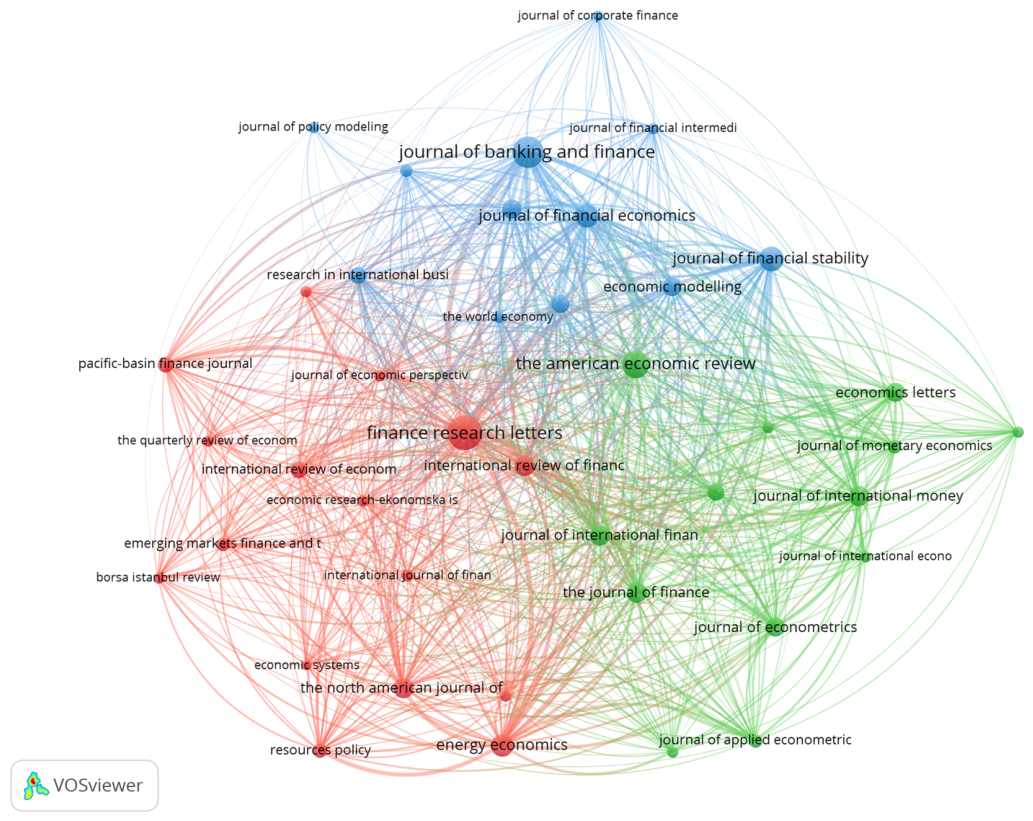
For the cited-sources analysis, the threshold selected 162 cited sources from 4,843. The resulting journal network (Figure 10) is organized into five clusters overall, reported in Table 14 with each cluster capped at its ten most cited items; smaller clusters are reported in full. Cluster 1 (red) is the field’s dominant generic cluster, absorbing a very broad range of mainstream economics and finance outlets, led by The American Economic Review, and functioning, much like the largest clusters already observed in the co-word and cited-authors networks, as a citation hub rather than a thematically coherent group. Cluster 2, led by Energy Economics, situates a substantial share of the literature at the intersection of geopolitical risk and energy/environmental economics. Cluster 3, led by the Journal of Banking and Finance, contains the discipline’s top-tier general finance journals. Cluster 4, led by the Journal of Econometrics, reflects the field’s econometric and forecasting-oriented dimension. Cluster 5, anchored by Finance Research Letters (1,340 citations, the second highest in the entire network), forms a distinct applied finance citation core, separate from both the generic hub of Cluster 1 and the top-tier theoretical cluster of Cluster 3.
4.3.3. Co-Authorship Analysis
Co-authorship analysis was used to examine the collaborative structure of the field at the author, country and organizational levels. Overall, this analysis yields a meaningful structure only at the country level, while at both the author and organizational levels, the networks do not support substantive conclusions beyond confirming the field’s collaborative fragmentation.
The co-authorship analysis of countries (Figure 11), by contrast, is the only one of the three co-authorship analyses to produce a dense network. With a minimum document threshold of 5, 33 countries met the selection criterion, resulting in six clusters. Only the four most significant clusters are reported in Table 15. Two distinct dimensions emerge from this analysis and are kept separate throughout: productivity, measured by document count, and impact, measured by citations, which do not always align. Cluster 4 is anchored by China, both the network’s most productive country by a wide margin (133 documents) and its most central node (highest total link strength), together with the United Kingdom, Vietnam, Australia and New Zealand. Cluster 1 is anchored by the United States (36 documents), together with Germany, Indonesia, Malaysia, Taiwan, Bangladesh and the Czech Republic. Cluster 2 brings together a European-Gulf group led by France, which records the network’s second-highest total link strength (59, ahead of the United States’ 54) despite a comparable document count (37), with the United Arab Emirates, Saudi Arabia, Tunisia, Pakistan, Romania and Kuwait. Cluster 3 groups South Korea, Lebanon, Greece, Spain and Italy together with South Africa, which, despite contributing only 8 documents, records the highest average citation count per document in the entire network (99.75). This configuration indicates that, despite the weak collaborative ties observed among individual authors, the field benefits from substantial cross-country research collaboration.
Taken together, the three co-authorship maps depict a research field whose social structure is not significant or interpretable at either the author or the organizational level and whose only substantive collaborative signal emerges at the country level. This configuration is consistent with an emerging and rapidly internationalizing research area.
4.4. Focus on the Banking and Insurance Sector
To complement the analyses presented above, a dedicated subsample of 45 documents explicitly addressing banking and insurance-related applications of geopolitical risk was extracted and subjected to the same performance analysis and science mapping procedures. The annual production of this sub-sample shows an even steeper growth trajectory than that of the field as a whole. From an isolated contribution in 2014, output remained minimal through 2020-2022, with no more than three documents per year, before increasing markedly to 6 documents in 2023, 8 in 2024, and 18 in 2025 alone. This pattern indicates that the banking and insurance sector has become an increasingly prominent application domain, particularly in the most recent phase of the field’s development.
The most cited contribution in the sub-sample is “Geopolitical Risk and Bank Stability” (Phan, Tran and Iyke, 2022, Finance Research Letters, 153 citations), followed by “The Impact of Economic Uncertainty and Geopolitical Risks on Bank Credit” (Demir and Danisman, 2021, North American Journal of Economics and Finance, 94 citations) and “Geopolitical Risk and the Cost of Bank Loans” (Nguyen and Thuy, 2023, Finance Research Letters, 68 citations). These top contributions point to bank stability, lending behavior, and credit risk as the dominant angles through which the impact of geopolitical risk on the banking sector has been studied. Insurance-specific applications remain comparatively less developed, both in number and in citation impact: only six papers in the entire sub-sample explicitly address insurance, none of which reaches even a third of the citation count of the top banking-focused paper.
At the journal level, Finance Research Letters is confirmed as the primary outlet for this literature (10 of the 45 documents), consistent with its central role in the field overall, followed by Economics Letters (4 documents). When journal impact is assessed, Finance Research Letters again leads with an h-index of 4 (249 citations across its 10 papers), while Economics Letters, despite a lower h-index (3), shows the highest m-index in the sub-sample (1.5), reflecting a very recent but fast-accumulating citation record (all four papers published in 2025).
At the country level, China (10 documents) and Saudi Arabia (6) are the most active contributors, followed by a cluster of European economies (Germany and Italy, 3 each; Poland, 2) and a smaller Middle Eastern/Gulf and South/East Asian group (Turkey, the United Arab Emirates, and India, 2 each). This pattern suggests that banking and insurance sector applications of geopolitical risk research are particularly salient in economies with either systemically important banking sectors or substantial exposure to geopolitical instability.
Finally, the distribution of author productivity in the sub-sample is even more skewed than that observed for the field (Section 4.1.5). 107 of the 118 authors (90.7%) have published only a single document, compared with 82.7% in the full dataset, while only one author (Lee C.C.) has published three documents, the maximum recorded in the sub-sample. This heightened concentration confirms that the banking and insurance-focused literature is, at the individual-author level, even more fragmented and less consolidated than the parent field from which it derives.
To further probe the intellectual structure underlying banking and insurance focused geopolitical risk research, a dedicated co-citation analysis of cited sources was conducted on the sub-sample (Figure 12). 41 journals met the minimum threshold of 10, organized into 3 clusters, a markedly different and more informative structure than that observed for the field as a whole (see Figure 10, Section 4.3.2).
Cluster 1 (red) is dominated by Finance Research Letters (total link strength 3.251, 111 citations, the most central node in the entire network), together with Energy Economics (2,277, 47), the International Review of Financial Analysis (1,415, 39), the North American Journal of Economics and Finance (1,404, 36) and the International Review of Economics and Finance (943, 25). Cross-referencing this cluster against the field wide one shows that it merges items originating from three separate field wide clusters (Cluster 1, 2 and 5). With only 41 sources meeting the citation threshold in the sub-sample, compared with 162 at the field-wide level, VOSviewer resolves a coarser solution here, in which finer field-wide distinctions collapse into a single, broader grouping. Cluster 2 (green) groups the discipline’s core theoretical and econometric journals, led by the American Economic Review (1,984, 67). This cluster draws its composition from four different field-wide clusters, again reflecting the coarser resolution imposed by the smaller subsample. Cluster 3 (blue) is led by the Journal of Banking and Finance (87 citations, the second most central node overall) together with the Journal of Financial Stability and the Journal of Financial Economics. Of the twelve journals in this cluster, four originate from the field-wide top-tier finance Cluster 3 (including the Journal of Banking and Finance and the Journal of Financial Economics themselves), while the remaining eight are drawn mainly from the generic field-wide Cluster 1. This result meaningfully qualifies the finding reported for the field-wide co-citation network (Section 4.3.2), where the Journal of Banking and Finance is co-cited primarily within a generic top-tier finance cluster rather than within a distinct banking-specific cluster. Within this dedicated subsample, by contrast, the Journal of Banking and Finance becomes the clear organizing node of its own cluster, indicating that once the analysis is restricted to papers specifically addressing banking applications of geopolitical risk, a genuinely banking and stability-focused citation core does emerge. In other words, the absence of a distinctly banking-focused journal cluster at the field-wide level reflects the dilution of this sub-theme within the much larger literature.
Figure 12.
Co-citation analysis focused on the banking and insurance sectors performed on cited sources, bibliometric map. Source: own elaboration based on Scopus data (VOSviewer).
Figure 12.
Co-citation analysis focused on the banking and insurance sectors performed on cited sources, bibliometric map. Source: own elaboration based on Scopus data (VOSviewer).
The thematic strategic diagram constructed on this sub-sample (Figure 13) provides the first evidence, across all analyses conducted in this study, of thematic clusters explicitly and exclusively dedicated to banking and insurance topics. Six clusters emerge, distributed across three of the four quadrants of the diagram. The basic themes quadrant (high centrality, low density) contains a single, large cluster built around geopolitical risk, bank stability, and economic policy uncertainty, confirming that, within this sub-field too, geopolitical risk and its most direct banking-specific correlate, bank stability, remain the central but still relatively undeveloped core around which the literature is organized. The niche themes quadrant (high density, low centrality) is by far the most populated, comprising three distinct clusters: banking vulnerability, cross-border banking flows, financial fragmentation; banking sector, emerging economies, financial stress; and world uncertainty index and insurance, the cluster in which the sub-field’s insurance dimension is embedded; The presence of three separate niche clusters indicates that banking-specific geopolitical risk research has begun to develop distinct, reasonably mature conceptual sub-strands, but these remain disconnected both from one another and from the field’s central discourse. The emerging or declining themes quadrant (low centrality, low density) contains two smaller clusters, emerging markets and uncertainty. Most notably, the motor themes quadrant (high centrality, high density) is entirely empty in this sub-sample, in contrast to the field-wide thematic map (see Figure 4, Section 4.2). This absence indicates that banking- and insurance-focused geopolitical risk research has not yet produced any line of inquiry that is both well-developed internally and central to the subfield’s discourse.
Banks and insurance companies are closely linked to financial markets and global economies, making them particularly vulnerable to geopolitical risk, increasing the likelihood of misallocation of their products and services. Empirical results have revealed that increased geopolitical risk and economic policy uncertainty reduce banking and insurance stability (Olalere and Mukuddem-Petersen 2024; Phan et al. 2022; Zhang et al. 2024). The banking sector plays a key intermediary role and is highly vulnerable to external shocks (Demir and Danisman 2021; Nasim et al. 2023; Trinh and Tran 2024; Vu et al. 2023). Reflecting this, banking has attracted more research attention than the insurance sector and other financial intermediaries despite their non-negligible exposure to systemic and geopolitical shocks (Billio et al. 2012).
Recent literature suggests that geopolitical risk significantly reduces banking stability through increased solvency risk, increased non-performing loans, and tighter funding costs. This negative impact is more pronounced when the risk materializes in real geopolitical events, as they result in direct consequences on markets and companies. The literature analyzed establishes that geopolitical risk (GPR) exerts a deleterious impact on global financial stability, manifesting in reduced Z-score levels and a higher probability of default, especially in emerging economies and less capitalized banking systems. Cross-country research reports a significant negative relationship between geopolitical risk and bank solvency, usually assessed via the Z-score (Shabir et al. 2023; Trinh and Tran 2024). A historical perspective spanning 120 years shows that this relationship is non-linear. Only major geopolitical events, such as world wars, cause substantial drops in bank capitalization, whereas moderate shocks have minimal impact (Behn et al. 2025). Geopolitical risk (GPR) significantly undermines the stability of the global banking system, leading to reduced Z-scores and increased non-performing loans (Trinh and Tran 2024; Olalere and Mukuddem-Petersen 2024). This vulnerability is particularly pronounced in emerging markets and BRICS countries, where banking stability is negatively affected by the interaction between GPR and economic policy uncertainty (Trinh and Tran 2024; Olalere and Mukuddem-Petersen 2024). In addition to primary channels, recent studies highlight geopolitical risk as a major driver of inflation, which impacts bank performance in two ways. Initially, rising inflation may increase interest and non-interest income, but over time it tends to reduce operational efficiency and threaten long-term stability (Karkowska et al. 2025). Geopolitical shocks also heighten interbank risk spillovers, with short-term market sensitivity increasing during periods of global uncertainty (He et al. 2025).
Geopolitical dynamics are one of the main factors of global financial instability, capable of favoring the propagation of shocks within the economic-financial system. Wang et al. (2025) analyze the impact of geopolitical risk on banking systemic risk, considering transmission mechanisms. The authors state that increasing GPR contributes significantly to systemic risk by elevating individual bank and asset risk and triggering the bursting of speculative bubbles. Yuan et al. (2026) analyze how US-China geopolitical tensions affect the stability of China’s commercial banking sector, increasing systemic risk in China via macro channels, such as exchange rates and expectations, and micro channels such as corporate credit quality and loan concentration.
At the systemic level, increased geopolitical risk raises overall systemic risk by elevating individual bank risks and triggering asset price bubble bursts (Wang et al. 2025). Bettin et al. (2023) complement this picture by proposing a multivariate approach to assess systemic, climate, and geopolitical risks in Eurozone banking. Their research finds that geopolitical risk plays a disproportionately large role in overall capital shortfalls during times of intense tension, a finding that aligns with the Caldara and Iacoviello (2022) GPR Threats index.
Traditional two-variable measures tend to underestimate capital shortages because they overlook the complex interactions among different shocks. Financial stability and bank solvency are further challenged by rising Non-Performing Loans (NPLs) (Pham et al. 2021; Trinh and Tran 2024; Wang et al., 2025). Geopolitical tensions directly affect borrowers’ ability and willingness to service debts, leading to rapid drops in asset quality (Pham et al. 2021; Trinh and Tran 2024). This results in an increase in NPLs, especially in conflict-affected banks that face higher credit risks following hostilities (Wang et al. 2025). These banks tend to prioritize asset quality over loan volume, focusing on safer lending and reducing overall credit (Pham et al. 2021). Geopolitical shocks can quickly turn into solvency crises that threaten bank capital, especially during major geopolitical events (Behn et al., 2025). In war zones such as Ukraine, infrastructure damage and occupation exacerbate this process, destroying collateral and leaving large credit exposures unsecured (Bernardelli et al. 2023; Pham et al. 2019, 2021). The combined impact of income loss and collateral destruction can quickly double NPL ratios (Pham et al. 2019), turning local geopolitical shocks into solvency crises that threaten bank capital (Pham et al. 2021; Wang et al. 2025). The literature also suggests that NPLs act as important signals for market participants (Nguyen and Thuy 2024). Since wholesale financiers generally lack incentives for detailed monitoring, they rely on these signals to decide whether to extend or withdraw funding (Nguyen and Thuy 2024). High NPL ratios increase the likelihood of funding runs, liquidity shortages, refinancing risks, and inefficient asset liquidation, especially for small and medium-sized banks.
The worsening of banking stability therefore influences the granting of credit and investment. Macroeconomic uncertainty (WUI) predominantly affects business credit, GPR depresses consumer loans and mortgages. Regarding credit provision, Demir and Danisman (2021) note that, while GPR does not impact overall credit growth, it specifically depresses consumer loans and mortgages.
Geopolitical Risk (GPR) directly affects banks’ operations and market performance. It leads to risk repricing, in which banks respond to increased GPR by raising loan costs and tightening non-price conditions, such as shorter maturities and higher collateral requirements (Nguyen and Thuy 2023). In Europe, this results in reduced overall lending, mainly due to declines in foreign activity, while domestic lending remains relatively steady (Chiaramonte et al. 2025). Geopolitical stress prompts a shift in bank lending toward headquarters and nearby regions, where monitoring costs are lower amid economic uncertainty (Pham et al. 2021).
The main divergences relate to the behavior of leverage, which increases in US commercial banks under geopolitical shock (due to links to government debt) but decreases in market-based institutions, and asset quality (NPLs), which in wartime crisis contexts can temporarily improve thanks to proactive regulatory interventions and public moratoriums (Trinh & Tran 2024; Olalere & Mukuddem-Petersen 2024). Although banks typically cut new loan issuance as asset quality worsens, Istiak and Serletis (2020) note that US commercial banks sometimes increase leverage after a GPR shock to maintain customer relationships and fund public debt. In Europe, exposure to external geopolitical risk increases the vulnerability of the system, especially for large banks (Gabbiadini 2025), while events such as the Russia-Ukraine conflict have a severe impact on performance (Vu et al. 2023). Gabbiadini et al. (2025) investigate how European banks’ exposure to geopolitical risks in foreign countries influences domestic systemic risk. Exposure to foreign GPR exacerbates vulnerability especially for large banks and those in the euro area due to increased cross-border interconnection. In Europe, events such as the Russia-Ukraine war have put severe pressure on performance and valuations, although authorities’ proactive responses have partially supported liquidity positions (Vu et al. 2023). Empirical evidence supports this, showing that these conflicts like the Russia-Ukraine war raise default and liquidity risks and weaken European banks’ stability (Vu et al. 2023).
Market reactions to geopolitical shocks include rapid but temporary increases in bank CDS spreads and declines in stock returns (Dieckelmann et al. 2025). This effect varies with the economic environment: it reduces returns in bearish markets but can create positive risk premiums during bullish periods (Albaity et al. 2024). Research on G20 countries further emphasizes this nuance, showing that bank stock indices are uniquely sensitive to geopolitical tensions when market performance is at its highest (Boungou and Urom 2025). These findings collectively suggest that market sentiment and the specific market regime play a critical moderating role in how geopolitical risks are perceived and priced by the financial community (Albaity et al. 2024; Boungou and Urom 2025). In parallel, Adel and Naili (2024) note that the ability to anticipate shocks is conducive to profits, although sudden events are detrimental.
The resilience of the credit system is closely linked to structural characteristics. Banks with higher capitalization, diversification, large or publicly owned banks have a greater capacity to absorb such shocks. In addition, it emerges that the urgency dictated by geopolitical conflicts runs counter to climate objectives, and that their interaction with climate risks suggests the need to implement transparency reforms and geopolitical stress tests, in order to ensure financial sustainability. (Trinh & Tran, 2024). The resilience capacity seems to depend on variables such as maturity, capitalization and the high level of financial innovation. The presence of these factors shows a superior ability to absorb uncertainty (Vu, 2023; Yuan, 2026). Moreover, the effective management of these risks lies in factors such as financial development and institutional quality (Trinh & Tran 2024; Vu et al., 2023). Large, foreign or listed banks appear more resilient than small, young or low-capital institutions (Demir and Danisman, 2021; Vu et al., 2023). Overall, a bank’s resilience to geopolitical shocks depends heavily on its financial strength; less-capitalized banks are far more vulnerable, while well-capitalized banks can better buffer against these destabilizing effects and preserve financial stability (Phan et al. 2022; Trinh and Tran 2024). Conversely, large, well-capitalized banks are less affected and often benefit from a “flight to safety,” where investors shift their investments to more stable institutions during periods of uncertainty (Nguyen and Thuy 2024). Even if insolvency is avoided, the decline in capital ratios can lead to broad credit constraints (Bernardelli et al. 2023).
In particular, Vashisht & Mundi (2025) highlight how the role of CEOs and environmental factors can mitigate or even reverse the effects of geopolitical risk through better access to and management of strategic information. Banks’ resilience is often strengthened by leadership and environmental factors (Vashisht and Mundi 2025).
Oil-dependent economies can mitigate the negative impact of geopolitical risk through oil rents, which act as a financial buffer (Alsagr and Almazor 2020). Alsagr and Almazor (2020) show that oil revenues mitigate the negative impact in crude-dependent economies, where risk can even be positively associated with profitability. Ownership structure also matters; state-owned banks tend to exhibit more resilient lending during crises compared to private banks (Chiaramonte et al. 2025). The adoption of FinTech solutions and the presence of strong capital ratios, measured through the Capital Adequacy Ratio (CAR), help mitigate this impact Yuan et al. (2026).
The urgency dictated by geopolitical conflicts contrasts with climate objectives, and how their interaction with climate risks suggests the need to implement transparency reforms and geopolitical stress tests, in order to ensure financial sustainability. (Trinh & Tran 2024). Environmental and technological factors are also relevant; energy shocks stemming from geopolitical tensions reduce investment efficiency and increase operational costs, such as the costs of maintaining branches and data centers (Nasim et al. 2023). Moreover, rising geopolitical tensions escalate cybersecurity risks, with Bernardelli et al. (2023) reporting more state-sponsored hacking attacks on the internet and payment systems during wartime.
Finally, Wang (2025) and Yuan (2026) underline how the adoption of stringent regulations and targeted monetary policies is essential to contain the systemic risk associated with international geopolitical tensions.
Compared with extensive research on banking, studies on the impact of geopolitical risk (GPR) on the insurance sector are more fragmented. However, recent empirical data from BRICS countries indicates that geopolitical risk significantly predicts insurance market activity (Lee and Lee 2020). Emerging research shows a dual effect: geopolitical shocks influence insurance pricing and boost demand for protection to safeguard corporate governance. Aggarwal and Kalia (2022) address this gap by examining how combined uncertainties affect Property and Casualty premiums. They find that GPR notably affects both the average and the variability of Property and Casualty premium indices, suggesting that rising global unrest prompts insurers to adapt their models to higher risks of extreme events, raising costs and potentially creating financial barriers when risks become uninsurable. This relationship often depends on the state, as seen in Russia, where bidirectional causality between geopolitical risk and premiums appears mainly during bearish markets (Lee and Lee 2020). Further supporting this complexity, research across 14 countries shows that geopolitical risk affects premiums asymmetrically and nonlinearly, with long-term effects generally exceeding short-term ones (Hemrit and Nakhli 2021). In contexts such as Saudi Arabia, increased geopolitical tension negatively affects insurance demand by reducing government spending and the efficiency of private-sector investment (Hemrit 2022). These shocks influence insurance through stricter underwriting requirements and heightened risks such as adverse selection and moral hazard due to information asymmetry (Hemrit and Nakhli 2021). Li et al. (2025) find that perceptions of geopolitical uncertainty at the firm level raise the likelihood of purchasing Directors’ and Officers’ liability insurance. They interpret this as Directors’ and Officers’ liability insurance acting as a signal of responsibility and governance during uncertain times, reassuring stakeholders. Interestingly, political ties and state enterprise ownership do not lessen but increase this demand, as managers face greater risk aversion under political and regulatory pressures. Even amid these pressures, investors in markets like China may still view life insurance as a safe asset, especially at higher distribution quantiles, despite long-term negative impacts of geopolitical risk on premiums (Xiang et al. 2023).
Insurance companies are typically viewed from two main perspectives. First, the insurance industry serves as a risk-mitigation tool. Bussy and Zheng (2023) point out that multinational firms increasingly seek specialized political risk coverage to safeguard Foreign Direct Investment (FDI) amid rising geopolitical tensions, though this also increases insurers’ exposure to large payouts in major military conflicts. Second, insurers operate within strict regulatory and operational boundaries. Shabir et al. (2023) mention the clear separation that limits insurance activities from banking groups. However, this separation does not shield insurers from systemic pressures. As essential financial intermediaries, they remain vulnerable when geopolitical uncertainties cause capital outflows from emerging economies, directly threatening insurer stability (Hemrit and Nakhli 2021). Responses to these risks vary by region; some insurers reallocate assets abroad to hedge against domestic risks, while others increase premiums to reserve against high-impact events (Hemrit and Nakhli 2021). Despite extensive research, a notable gap remains due to limited empirical studies on how GPR directly affects insurer solvency or influences strategic asset choices, a concern heightened by insurers’ holdings of significant GPR-sensitive assets such as sovereign bonds and stocks, which are highly susceptible to geopolitical shocks (Baur and Smales 2020). A partial exception is Zhang et al. (2024), who model the joint default dependence between U.S. insurers and banks using a time-varying asymmetric copula and find a significant negative correlation between this systemic linkage and the Caldara and Iacoviello (2022) GPR index. This is a counterintuitive result they attribute to central banks’ stabilizing interventions during geopolitical turmoil, suggesting that the relationship between geopolitical risk and insurer-bank interconnectedness is more nuanced than a simple risk-amplification channel. Beyond these systemic considerations, incorporating geopolitical risks into insurance pricing is crucial for risk management, though it may also hinder the availability of coverage during periods of global unrest (Hemrit and Nakhli 2021).
5. Discussion
This section revisits the study’s four research questions, considering the bibliometric evidence presented in the Sections above.
The performance analysis confirms (RQ1) that geopolitical risk became a financial modeling concern only after 2018, with growth accelerating sharply from 2020 onward and peaking at 125 articles in 2025. This trajectory corroborates the paper’s opening claim that the Caldara and Iacoviello GPR Index is the trigger of the field’s expansion. The index’s 2021 revision and the subsequent escalation of geopolitical shocks are clearly visible as turning points in the annual production curve. At the same time, the productivity and impact divergence documented for individual authors (Bossman A. leading on h-index despite fewer publications than Hoque M.E., and Teplova T.’s citation count driven by a single highly cited contribution) indicates that scholarly influence in this field is shaped by well-timed engagement with a major geopolitical event rather than by sustained output alone. The concentration of output in three journals (Finance Research Letters, Resources Policy, and Energy Economics) and one country (China, with more than five times as many documents as the second-ranked) further suggests that the field’s institutional and editorial base remains narrow.
Turning to the field’s intellectual structure (RQ2), the co-citation analysis shows that the architecture is organized concentrically around a single foundational reference (Caldara and Iacoviello’s “Measuring Geopolitical Risk”). The bibliometric evidence suggests that fragmentation characterizes the field’s applications (the growing number of asset classes, sectors and geographies to which GPR is applied, rather than its foundations, which remain remarkably unified around a single measurement framework.
The thematic diagram adds a further layer to this picture (RQ3), identifying geopolitical risk, economic policy uncertainty and financial markets as the field’s basic themes and hedging and quantile methodology as its only motor theme. The thematic evolution analysis confirms that this centrality has been earned through responsiveness to real shocks: successive time windows introduce COVID-19, then the Russia-Ukraine conflict as dominant co-occurring themes. This alignment is noteworthy, as it suggests that the observed bibliometric patterns reflect the field’s real-world subject matter rather than being driven solely by citation-network dynamics. This picture is further corroborated at the term level by the trend topics analysis (Figure 5), where bank stability emerges as a recent yet persistent trending term, confirming banking’s growing, if still narrow, footprint within the field, consistent with the evidence presented in Section 4.4. Within the banking and insurance-focused subsample, however, the motor themes quadrant is empty. Banking-specific concepts cluster among the niche themes, while the insurance dimension is confined to a single, even more peripheral cluster. This bibliometric asymmetry is the structural counterpart of the qualitative imbalance already identified in Section 2. Indeed, banking research has accumulated enough density to be recognized as a distinct theme, even if still niche, whereas insurance has not yet reached that threshold at all.
The dedicated co-citation analysis of the banking and insurance subsample offers a further, more encouraging nuance to this picture (RQ4). When the analysis is restricted to this sub-sample, the Journal of Banking and Finance and the Journal of Financial Stability emerge as the organizing nodes of a genuinely banking-focused citation cluster, a structure invisible at the field-wide level, where the Journal of Banking and Finance is absorbed into a generic finance cluster. This suggests that a banking-specific intellectual core is beginning to crystallize, but only becomes visible once the surrounding, much larger parent literature is filtered out, precisely the kind of structure that a field-wide bibliometric analysis alone, without a dedicated sectoral focus, would have failed to detect. The insurance sector shows no comparable pattern: across every analysis conducted in this study, co-word, co-citation, co-authorship, and thematic mapping alike, insurance-related terms and references never organize into an autonomous cluster, appearing instead as isolated nodes attached to broader and generic themes. This confirms that the insurance sector represents the field’s most significant blind spot and the area where future research is likely to yield the highest marginal contribution.
Two further implications follow from this combined reading. First, the near-total absence of author and institution-level collaboration, only partially offset by country-level ties, suggests that closing the gaps identified above will require not only new empirical studies, but also more structured collaborative arrangements, particularly between banking-focused and insurance-focused research communities, which at present appear to operate largely in isolation from one another. Second, the event-driven nature of the field’s growth and citation patterns, evident across the performance analysis, the co-word networks and the thematic evolution diagram alike, implies that future geopolitical shocks are likely to remain the primary catalyst for new research. Scholars and journals positioned to respond rapidly to emerging crises, as the most-cited papers in this dataset have done with the Russia-Ukraine conflict, are disproportionately likely to shape the field’s next phase of development.
6. Conclusions
This study set out to address the absence of a systematic bibliometric mapping of the literature on geopolitical risk (GPR) and the financial sector, with particular attention to banking and insurance institutions as its primary intermediaries. Adopting a Bibliometric-Systematic Literature Review framework and combining PRISMA-guided screening with performance analysis and science mapping on a sample of 395 documents, the study offers an account of how this rapidly expanding field has grown.
Three contributions follow from this exercise. First, the study documents that the field’s expansion is a recent and event-driven phenomenon, still heavily dependent on a narrow set of countries, journals and well-timed contributions. Second, it shows that the field’s intellectual core is tightly organized around a single foundational measurement framework; fragmentation is a feature of the field’s expanding applications rather than of its foundations. Third, and most directly relevant to the paper’s original motivation, the study provides converging evidence that banking research on GPR has begun to develop a distinct, if still niche, identity within the field, whereas insurance research has not and remains scattered across generic clusters.
These findings carry both theoretical and practical implications. Theoretically, the study offers scholars entering this field a structured map of its intellectual architecture to guide future contributions. Practically, the findings are relevant to risk managers and regulators seeking to navigate an increasingly volatile geopolitical environment. Conversely, the near-absence of a comparable evidence base for insurance signals an area where practitioners should exercise caution, given the limited academic scrutiny to date of insurers’ solvency and portfolio behavior under geopolitical stress.
Several limitations of this study should be acknowledged, most of which stem from choices inherent to the bibliometric method itself. First, bibliographic data were retrieved from a single database, Scopus. While this choice is consistent with established practice in bibliometric studies in management and finance (Donthu et al. 2021), it may exclude relevant work indexed exclusively in other databases. Future studies could usefully cross-validate the present findings against a multi-database sample. Second, the search was restricted to English-language journal articles, a choice that ensured methodological consistency in the subsequent co-word analyses but may have excluded non-English-language documents. Third, the search string, although informed by a systematic review of the World Economic Forum’s Global Risk Reports, necessarily relies on keyword matching within titles, abstracts, and keywords. Despite the thesaurus-based harmonization applied prior to clustering, this approach may still have under or over included studies that discuss geopolitical risk using different terminology or that address financial sector outcomes without using the specific search terms employed. Fourth, the dataset constitutes a snapshot extracted on a single date (June 9, 2026) from a field whose annual output is still growing exponentially. Both the performance indicators and, especially, the citation-based impact measures are likely understating the eventual influence of the most recent contributions, particularly those published in 2025 and 2026. Fifth, the dedicated subsample of banking- and insurance-focused documents (45 records) is considerably smaller than the full sample, and the resulting thematic and co-citation clusters should accordingly be interpreted as indicative rather than definitive, given the greater sensitivity of small networks to clustering resolution choices.
Building on results and the limitations discussed above, three avenues for future research appear particularly promising. First, given the pronounced imbalance documented throughout this study, future empirical work should focus specifically on the insurance sector, examining insurer solvency, underwriting behavior, and portfolio reallocation under geopolitical stress. Second, future bibliometric work could complement the present co-citation and co-word analyses with bibliographic coupling, which is better suited to detecting the field’s most recent and still emerging research fronts than the backward-looking co-citation techniques employed here. Third, replicating this analysis on a multi-database sample and at a later point in the field’s development would help determine whether the concentration patterns and thematic gaps identified here reflect a durable structural feature of the field or a transient stage in its rapid early growth.
Appendix A
This appendix presents a representative selection of studies illustrating the substantive content underlying the thematic clusters identified in the banking and insurance focused strategic diagram (Figure 13, Section 4.4).
For each cluster, selected papers are summarized to provide concrete empirical grounding for the keyword labels shown in the thematic map (Table A1), linking the bibliometric structure to the actual findings of the underlying literature.
Table A1.
Summary of Reviewed Studies on Geopolitical Risk in the Banking and Insurance Sectors.
| Research stream | Authors | Title | Year | Journal | Results |
|---|---|---|---|---|---|
| Geopolitical risk Banking vulnerability |
Zehri, C., Ammar, L. S. B., & Youssef, W. A. B. | Geopolitical Risk, Financial Fragmentation and Banking Vulnerabilities: A Global Autoregressive Distributed Lag Analysis. https://doi.org/10.1111/ecot.70009 |
2026 | Economics of Transition and Institutional Change | Rising GPR significantly increases financial fragmentation by reducing reliance on foreign assets and increasing FDI outflows towards safer regions. GPR heightens banking vulnerability by raising costs and NPLs, while reducing capital, profits and stability. In the long run, GPR and fragmentation erode international risk diversification, with more severe effects in emerging markets. The interaction between GPR and fragmentation amplifies short-term banking pressures. |
| Geopolitical risk | Yuan, C., Kang, R., & Liu, L. | Geopolitical tensions and systemic vulnerability in the banking sector: Evidence from China. https://doi.org/10.1016/j.frl.2026.109679 |
2026 | Finance Research Letters | Rising US-China tensions are associated with a significant increase in systemic banking risk. The effect is more pronounced for urban and rural commercial banks, while it is partially mitigated for large state-owned banks. Shocks are transmitted through increased exchange rate volatility, deteriorating aggregate economic expectations, worsening corporate credit quality and increased loan concentration. |
| Geopolitical risk | Zhou Y., Zhang W., Ma T. | Geopolitical risks and cross-border allocation of bank capital https://doi.org/10.1016/j.econlet.2026.113012 |
2026 | Economics Letters | CS_GPR significantly reduces other economies’ claims on the home economy while expanding their liability exposure to it. The reduction in claims manifests in both the banking and non-financial corporate sectors of the home economy, while the increase in liabilities is concentrated in the banking sector, appearing as capital outflows from both domestic and overseas banks. Heterogeneity analysis indicates that the impact of CS_GPR on bank capital allocation is most pronounced in emerging and low-openness economies. |
| Geopolitical risk | Fianto, B. A., & Ibrahim, M. H. | Bank lending amid geopolitical risk: The GCC case 10.1002/rfe.70017 |
2025 | Review of Financial Economics | Geopolitical risk, particularly at the global level, depresses credit growth for 2-3 years. Islamic banks show resilience to global risk but not to local risk; capitalisation and liquidity do not significantly mitigate the negative effects, although local risk appears to have become more relevant in recent years, affecting small and low-liquidity banks more persistently. |
| Uncertainty | Albaity, M., Mallek, R. S., Ur-Rehman, I., & Mustafa, H. | Global Innovation and uncertainty dynamics: Implications for bank performance https://doi.org/10.1016/j.jik.2025.100800 |
2025 | Journal of Innovation & Knowledge | The study examines the impact of innovation (GII) and uncertainty on banking performance, with particular focus on geopolitical risk (GPR), which shows an ambivalent effect: negative on ROA but positive on bank stock returns, a result that runs counter to EPU and WUI, both of which are negative for ROA and Tobin’s Q. GII in turn presents a complex picture (negative with ROA, positive with Tobin’s Q), with a negative effect on ROE and stock returns linked to earnings dilution and greater perceived risk in accessing financing. |
| Geopolitical risk | Sivaprasad, S., Adami, R., Malki, I., Ibragimova, D., & Yodgorova, F. | Spillover effects of geopolitical risk on the banking sectors of post-Soviet countries. 10.1108/RBF-01-2025-0026 |
2025 | Review of Behavioral Finance | The paper examines the spillover effects of geopolitical risk on the banking sectors of a sample of post-Soviet countries, focusing on the consequences of the Russia-Ukraine conflict. There is little or no evidence of significant transmission of GPR to bank returns and risk in the countries examined. The results show no directional correlation between conflict-driven geopolitical risk measures and bank returns. This implies that the banks examined were not significantly or negatively affected by the geopolitical risks captured by the indices used. These findings point to particularly isolated financial systems, which have so far allowed local central banks to shield financial institutions from the negative effects of exogenous developments in neighbouring areas. |
| Banking sector Emerging markets |
Yousfani, K., Iftikhar, H., Rodrigues, P. C., Armas, E. A. T., & López-Gonzales, J. L. | Global shocks and local fragilities: A financial stress index approach to pakistan’s monetary and asset market dynamics. https://doi.org/10.3390/economies13080243 |
2025 | Economies | The authors construct a Financial Stress Index (FSI) for Pakistan to capture systemic stress, distinguishing between domestic vulnerabilities and external shocks, including geopolitical risk. They find that banking sector risk is the main contributor to systemic stress in Pakistan, followed by trade finance constraints and exchange rate volatility. There is a statistically significant positive correlation between Pakistan’s FSI and the global GPR index: when global geopolitical risk rises, financial stress in Pakistan tends to rise in parallel. |
| Geopolitical risk | Ahmed, F., & Sohag, K. | Spillover effects of separated oil price shocks on regional financial stress amidst Russia–Ukraine and global geopolitical tensions: a novel GVAR approach https://doi.org/10.1007/s40822-025-00329-8 |
2025 | Eurasian Economic Review | The authors examine the response of financial stress to geopolitical shocks and oil price shocks. A positive shock to Russian geopolitical risk (RGPR) increases the FSI and particularly affects the “rest of Asia” bloc, which should diversify its trade relationships. The G-20 needs greater cooperation to build shared safety margins, while the Nordic bloc shows resilience but must maintain sound fiscal policies. |
| Geopolitical risk Banking vulnerability |
Alsadan, A., Alalmaee, H., Zehri, C., & Youssef, W. A. B. | Global financial fragmentation under raised geopolitical risk. https://doi.org/10.1007/s10368-025-00671-x |
2025 | International Economics and Economic Policy | The authors explore the negative effects of global financial fragmentation (GFF), driven by geopolitical risk (GPR), on banking systems. GPR contributes significantly to financial fragmentation by reducing foreign assets and debt and increasing foreign direct investment (FDI) outflows. GPR increases banking costs and non-performing loans (NPLs) and reduces regulatory capital, profits and overall stability. Financial fragmentation (GFF) worsens these vulnerabilities, especially through FDI flight. GPR and GFF drastically reduce risk diversification (IRD), with more severe effects in emerging economies than in advanced economies. The policy implications highlight the need to strengthen financial resilience, improve risk management and ensure stable flows of foreign direct investment (FDI). |
| Geopolitical risk | Wang, Y., Song, G., & Lu, Y. | Geopolitical risk, bank regulation, and systemic risk: A cross-country analysis. https://doi.org/10.1016/j.frl.2025.106893 |
2025 | Finance Research Letters | The study shows that geopolitical risk significantly increases systemic banking risk, acting through individual bank risk, asset risk and speculative bubbles. Stricter regulatory policies (operating restrictions, deposit insurance, strong supervisory authorities) mitigate these effects. |
| Geopolitical risk | Vashisht, S., & Mundi, H. S. | Do well-connected bank CEOs mitigate the impact of geopolitical risk on bank stability? Evidence from an emerging market. https://doi.org/10.1016/j.frl.2025.107777 |
2025 | Finance Research Letters | The impact of geopolitical risk on bank stability in India is analysed, also considering the role of CEOs’ social networks. The results show a negative relationship between geopolitical risk and bank stability, but CEOs with strong relational networks manage to mitigate these negative effects through their social connections. The heterogeneity analysis of banks also reveals that size, diversification and capitalisation help mitigate geopolitical risk. In particular, greater income diversification and adequate capitalisation strengthen bank resilience, while state ownership is positively associated with stability |
| Geopolitical Risk | Gabbiadini, M., Meoli, M., & Vismara, S. | Geopolitical risk and systemic risk in the European banking system. https://doi.org/10.1016/j.frl.2025.108796 |
2025 | Finance Research Letters | Greater exposure to foreign geopolitical risk significantly increases systemic risk in the European banking sector. European banks’ average exposure to foreign GPR has shown an increasing trend over time. Large banks and those located in the Euro area show significantly higher sensitivity to, and contribution to, systemic risk compared with smaller banks or those outside the Euro area. |
| Geopolitical risk | Topcu, M., & Can, U. | Political stability, geopolitical risks, and bank stability. https://doi.org/10.1016/j.frl.2025.108889 |
2025 | Finance Research Letters | Underlying risks exert asymmetric effects along the distribution of bank stability. Political stability significantly improves bank resilience only in the lower quantiles (more fragile banks). Geopolitical risk significantly reduces bank stability, with the strongest and most negative impact found in the lowest quantiles. GDP per capita and inflation significantly influence stability in almost all quantiles. |
| Geopolitical risk | Cai, P., Zhou, X., & Wang, H. | Sectoral Stress Testing of Bank Credit Risk in China: A SUR Model Analysis of Macroeconomic and Geopolitical Shocks. https://doi.org/10.1016/j.frl.2025.109165 |
2025 | Finance Research Letters | Geopolitical risk and financial leverage are generally positively associated with NPL rates, while GDP and interest rates show negative associations. GPR increases NPL rates in almost all sectors except retail trade (WRT). Under stress scenarios, geopolitical shocks systematically exacerbate credit risk, with the real estate (RE) sector showing the largest increase in tail risk. |
| Geopolitical risk | Behn, M., Lang J. H., Reghezza A. | 120 Years of Insight: Geopolitical Risk and Bank Solvency | 2025 | Economics Letters | A two standard deviation increase in a geopolitical risk index is associated with a decrease in the bank capital-to-asset ratio of around 0.2 percentage points. The effect is non-linear: only very high geopolitical risk leads to a sizeable decline in bank capitalisation, while more moderate increases of the index exert a negligible impact. This suggests that only major geopolitical events are likely to affect bank solvency to a degree that can endanger financial stability. |
| Geopolitical risk | Boungou, W., Urom C. | Geopolitical Tensions and Banks’ Stock Market Performance | 2025 | Economics Letters | Geopolitical tensions negatively affect bank performance. Moreover, we find that this impact differs according to the level of stock performance, the period affected by geopolitical tensions (before and during the war in Ukraine and from the war in Israel onwards) and the location of banking systems. |
| Geopolitical risk | Chiaramonte, L., Mecchia F., Paltrinieri A., Piserà S. | Does Geopolitical Risk Affect Bank Lending Behavior? Evidence from Europe | 2025 | The European Journal of Finance | GPR leads to a decline in total lending, which is attributed to foreign activities, while no significant impact on domestic lending is documented. Our results also show a more resilient lending behavior in response to geopolitical shocks from state-owned banks compared with private banks, implying that the response of bank total lending to GPR is contingent on bank ownership structure. |
| Geopolitical risk | Dieckelmann, D., Larkou C., McQuade P., Pancaro C., Rößler D. | Geopolitical Risk and Euro Area Bank CDS Spreads and Stock Prices: Evidence from a New Index | 2025 | Economics Letters | A one standard deviation increase in the exposure-weighted bank-level geopolitical risk index is significantly associated with an increase in CDS spreads of 34 basis points and a decline in stock prices of around 6%. Furthermore, the responses of these variables are relatively short-lived. |
| Geopolitical risk | Chen Y-C;Liu C-C;Liu S-H;Shi W-Z | Geopolitical Risks and Bank Lending in Taiwan: an Empirical Analysis | 2025 | Review of Pacific Basin Financial Markets and Policies | Shows how rising geopolitical risk pushes up loan interest rates in Taiwan, except during periods of global crisis. The analysis also finds divergent behaviour between state-owned and private banks, as well as a mitigating effect of corporate liquidity reserves on financing costs. |
| Geopolitical risk Uncertainty |
Olalere, O. E., & Mukuddem-Petersen, J. | Geopolitical risk, economic policy uncertainty, and bank stability in BRICS countries. https://doi.org/10.1080/23322039.2023.2290368 |
2024 | Cogent Economics & Finance | Investigates the effects of geopolitical risk (GPR) on bank stability and the moderating role of economic policy uncertainty (EPU) in this relationship in the BRICS countries. Rising GPR and EPU significantly reduce banks’ Z-score. The effect of GPR on stability is negative for both China and India and for the other BRICS countries. High institutional quality (political stability and regulatory quality) has a positive impact on stability. |
| Geopolitical risk Uncertainty |
Albaity, M., Saadaoui Mallek, R., & Mustafa, H. | Heterogeneity of investor sentiment, geopolitical risk and economic policy uncertainty: do Islamic banks differ during COVID-19 pandemic? 10.1108/IJOEM-11-2021-1679 |
2024 | International Journal of Emerging Markets | Economic uncertainty harmed bank returns, affecting Islamic banks more during COVID-19. Geopolitical risk had mixed effects: negative for banks with medium-to-low performance, positive for those with better performance. Islamic banks, overall, outperformed conventional ones, with a positive and significant relationship with bank returns, demonstrating that Islamic banks outperformed conventional ones during the study period. |
| Geopolitical risk | Adel, N., & Naili, M. | Geopolitical risk and banking performance: evidence from emerging economies. 10.1108/JRF-10-2023-0243 |
2024 | The Journal of Risk Finance | The authors study the impact of geopolitical risks on the profitability and solvency of banks operating in the emerging economies of the Middle East and Africa. These show significant sensitivity to geopolitical risks; effective anticipation of or adaptation to such risks positively influences performance. The impact of geopolitical risk on the profitability of African banks appears inconclusive and statistically insignificant. These findings highlight the complex interaction between geopolitical dynamics and financial performance across different regional contexts. |
| Geopolitical risk Banking sector |
NguyenHuu, T., & Örsal, D. K. | Geopolitical risks and financial stress in emerging economies. 10.1111/twec.13529 |
2024 | The World Economy | In emerging economies, GPR significantly worsens conditions when financial stress is already at or above average. However, GPR does not trigger stress when the financial situation is favourable. In emerging economies, currency markets and, to a lesser extent, the banking sector and bond market suffer more severe consequences from geopolitical tensions than the stock market. In contrast, advanced economies, represented by the Group of Seven (G7), recorded negative consequences of GPR on their stock markets, but negligible effects on other components of their financial systems. |
| Geopolitical risk | Lee, C. C., Lu, M., Wang, C. W., & Cheng, C. Y. | ESG engagement, country-level political risk and bank liquidity creation. https://doi.org/10.1016/j.pacfin.2024.102260 |
2024 | Pacific-Basin Finance Journal | ESG performance has a positive and significant impact on bank liquidity creation. This positive relationship is significantly stronger in countries with high geopolitical risk than in low-risk contexts. According to the authors, ESG activities increase depositor confidence and improve risk management, enabling banks to generate more liquidity even in unstable contexts. In high-risk countries, ESG acts as a signal of reputation and resilience that attracts investors and capital. |
| Geopolitical risk Uncertainty |
Trinh, H. H., & Tran, T. P. | Global banking systems, financial stability, and uncertainty: How have countries coped with geopolitical risks? https://doi.org/10.1016/j.iref.2024.103647 |
2024 | International Review of Economics & Finance | The authors analyse the effects of news-based geopolitical risk (GPR) on the financial stability of banking systems and investigate possible mitigation mechanisms. GPR has strong negative effects on financial stability, reducing the Z-score and increasing non-performing loans (NPLs). Financial development, better global governance and military spending mitigate these effects. Banks with more capital, better performance and greater concentration are less vulnerable. |
| Geopolitical risk | Nguyen, T. C., & Thuy, T. H. | Bank wholesale funding in an era of rising geopolitical risk. 10.1111/twec.13620 |
2024 | The World Economy | Rising GPR significantly reduces banks’ share of wholesale funding, but the effect mainly affects small and medium-sized banks, as large banks are unaffected and indeed benefit from this effect. The underlying mechanism is linked to the quality of bank assets: smaller banks, with lower quality assets, lose funding from both informed and uninformed creditors. The authors suggest that policymakers monitor smaller banks and consider measures such as taxing short-term funding. |
| Geopolitical risk | Nguyen, T. C., & Thuy, T. H. | Geopolitical risk and the cost of bank loans. https://doi.org/10.1016/j.frl.2023.103812 |
2023 | Finance Research Letters | Geopolitical risk is associated with higher loan interest rates and stricter non-price contractual terms. Banks respond to geopolitical risk with higher rates, but also with stricter requirements (more stringent collateral and covenants) and higher loan fees. The effects of concrete geopolitical acts are more pronounced than those of mere geopolitical threats. |
| Geopolitical risk Uncertainty |
Vu, P. T. T., Huynh, N., Phan, H., & Hoang, H. | Financial earthquakes and aftershocks: From Brexit to Russia-Ukraine conflict and the stability of European banks. https://doi.org/10.1016/j.intfin.2023.101830 |
2023 | Journal of International Financial Markets, Institutions and Money | Crisis events significantly reduce profitability (ROA, ROE) and efficiency (higher CTI). Market valuations (TBQ, MTB, MV) fall considerably during the war and the pandemic. Stability declines (lower Z-score). War-specific effect: the Russia-Ukraine war increased insolvency risk more than other events, but paradoxically banks showed better credit positions (lower NPLs) and liquidity (higher LIQ) during this specific period. |
| Geopolitical risk, world uncertainty index |
Xiang, Feiyun, Tsangyao Chang, and Shi-jie Jiang | Economic and Climate Policy Uncertainty, Geopolitical Risk and Life Insurance Premiums in China: A Quantile ARDL Approach’ | 2023 | Finance Research Letters | The results show that EPU negatively affects LIP in most cases except the lowest quantiles, GPR has a negative influence among the higher quantiles, and the negative effects of CPU on LIP are significant mainly in higher quantiles. The findings suggest that investors and Firms treat life insurance products as secure assets when policy instability and geopolitical issues become serious. |
| Banking sector | Bernardelli, M., Korzeb Z., Niedziółka P., Waliszewski K. | Channels for the Impact of the War in Ukraine on the Commercial Banking Sector in Poland—First Results of the Study | 2023 | Contemporary Economics | The war destabilises the banking system of war-torn countries, also affecting the basic areas of assessment of the banking systems of countries bordering or economically linked to countries directly involved in the war. Significant negative abnormal returns are determined by a country’s location and level of dependence on Russian energy resources. |
| Geopolitical risk, Systemic risk | Bettin, G., Mensi G. M., Recchioni M. C. | Multifactor Risk Attribution Applied to Systemic, Climate and Geopolitical Tail Risks for the Eurozone Banking Sector’ | 2023 | Risks | Total combined risk is on average 18% higher than traditional systemic risk estimates, that climate risk more than doubled in our period of analysis, and that geopolitical risk surged to over 5% of total combined risk. Our climate risk estimate is in line with the results of the 2022 European Central Bank climate stress test, and our geopolitical risk measure shows a positive correlation with the GPRD and Threats index. |
| Uncertainty Banking Sector |
Forsström V., Lind K., Sousa R. M., Uddin G. S., Jayasekera R. | Making sense of uncertainty: An application to the Scandinavian banking sector |
2023 | International Journal of Finance & Economics | Swedish banks are the main source of contagion in the region and spillovers tend to increase in times of heightened uncertainty. Global economic policy uncertainty, global financial uncertainty and local housing market uncertainty affect the Scandinavian banking sector the most. By contrast, geopolitical risk spillovers are limited. |
| Geopolitical risk | Phan, D. H. B., Tran, V. T., & Iyke, B. N. | Geopolitical risk and bank stability. https://doi.org/10.1016/j.frl.2021.102453 |
2022 | Finance Research Letters | The authors show that an increase in geopolitical risk is associated with a decline in bank stability. The results show that geopolitical risk is negatively related to Ln(Z-score), confirming that an increase in it weakens bank stability. This negative effect is also confirmed by the other stability measures considered (ROA and ROE volatility, non-performing loans). The control variables are also significant, proving to be relevant factors for bank stability. |
| Geopolitical risk, World Uncertainty Index |
Hemrit, W. | Does Insurance Demand React to Economic Policy Uncertainty and Geopolitical Risk? Evidence from Saudi Arabia | 2022 | The Geneva Papers on Risk and Insurance—Issues and Practice | Empirical results reveal negative short-term effects of geopolitical risk and uncertainty about government economic policy on insurance demand. However, the effect of the latter is not permanent. |
| Uncertainty World Uncertainty Index |
Aggarwal D;Kalia D | Examining Comovement and Causality Between Producer Price Index For P&C Insurance Premium and Uncertainty Indices: Wavelet and Non-Parametric Quantile Causality Approach | 2022 | Research in Economics | The analysis highlights an asymmetric link between global uncertainty and property and casualty insurance premiums, with climate uncertainty anticipating and driving prices on a semi-annual basis. This evidence shows a significant causal impact, especially in the central quantiles of the distribution, confirming a robust dependence between political/economic uncertainty and market dynamics. |
| Geopolitical risk Uncertainty |
Demir, E., & Danisman, G. O. | The impact of economic uncertainty and geopolitical risks on bank credit. https://doi.org/10.1016/j.najef.2021.101444 |
2021 | The North American Journal of Economics and Finance | The study compares the effects of economic uncertainty (WUI) and geopolitical risk (GPR) on bank credit growth (2,439 banks, 19 countries, 2010-2019). Economic uncertainty significantly reduces credit, especially corporate credit, while geopolitical risk has no overall effect but harms consumer loans and mortgages. Foreign and listed banks are found to be more immune to both risks. |
| Geopolitical risk, World Uncertainty Index |
Hemrit, W., Nakhli M. S. | Insurance and Geopolitical Risk: Fresh Empirical Evidence | 2021 | The Quarterly Review of Economics and Finance | The geopolitical risk affects insurance premiums in an asymmetric and nonlinear manner, except for India, but the transmission mechanism is not the same. In addition, for most emerging countries, the authors show that the impact is considerably greater in the long- run than in the short-run. |
| Geopolitical risk Banking Sector Emerging markets |
Alsagr, N., & Almazor, S. F. V. H. | Oil Rent, Geopolitical Risk and Banking Sector Performance. https://doi.org/10.32479/ijeep.9668 |
2020 | International Journal of Energy Economics and Policy | GPR has a significant negative impact on overall bank profitability. The interaction between GPR and oil rents is positive and significant. Geopolitical shocks tend to push up oil prices, increasing revenues and liquidity in exporting countries, which favours the performance of local banks. |
| Uncertainty | Istiak, K., & Serletis, A. | Risk, uncertainty, and leverage. https://doi.org/10.1016/j.econmod.2020.06.010 |
2020 | Economic Modelling | The authors find that the financial leverage of commercial banks increases when geopolitical risk and macroeconomic, political and stock market uncertainty increase. Client-based trading relationships of banks and high public indebtedness towards banks during periods of crisis are responsible for this relationship. We find that the financial leverage of broker-dealers and shadow banks decreases when Chicago risk and macroeconomic, political, financial and stock market uncertainty increase. We argue that the vulnerability of broker-dealers and shadow banks to whole-market risk/uncertainty is responsible for this relationship. |
| Geopolitical risk, World Uncertainty Index |
Lee, Chi-Chuan, and Chien-Chiang Lee. | Insurance Activity, Real Output, and Geopolitical Risk: Fresh Evidence from BRICS | 2020 | Economic Modelling | Empirical results reveal unidirectional causality that runs from real output and geopolitical risk to insurance activities in Brazil and South Africa. We also observe bi-directional lower-tail causality among real output, insurance premiums, and geopolitical risk in Russia. Findings also present bi-directional causality among real output, insurance premiums, and geopolitical risk at different quantiles. Knowledge of these causal relationships can prevent governments from conducting a ‘one-size-fits-all’ policy. |
| Geopolitical risk | Andreeva, A. V. | Economic confidence as a factor of management of Russian banks’ financial stability under the condition of geopolitical risks. 10.5539/ass.v10n23p102 |
2014 | Asian Social Science | Sanctions restrict access to capital markets; a reallocation of resources towards large state-owned banks is observed; a 6.1% outflow of deposits from medium/small banks in favour of large ones; rising default rates and refinancing costs. The reduction in available liquidity resources and the growing reliance on small banks’ ability to attract short-term funding sources may reduce not only their solvency, but also financial stability and even solvency itself. |
Source: own elaboration.
References
- Adel, Nabil, and Maryem Naili. 2024. ‘Geopolitical Risk and Banking Performance: Evidence from Emerging Economies’. The Journal of Risk Finance 25 (4): 646–63. [CrossRef]
- Aftab, Rehan, and Muhammad Naveed. 2022. ‘Is Financial Institutions’ Stability of BRICS Block Responsive to Uncertain Dimensions?’ Cogent Business & Management 9 (1): 2010484. [CrossRef]
- Aggarwal, Divya, and Deepali Kalia. 2022. ‘Examining Comovement and Causality between Producer Price Index for P&C Insurance Premium and Uncertainty Indices: Wavelet and Non-Parametric Quantile Causality Approach’. Research in Economics 76 (2): 141–48. [CrossRef]
- Aiswarya, Selva, and Muthu Muthumeenakshi. 2024. ‘Exploratory Bibliometric Analysis on Geopolitical Risk’. International Research Journal of Multidisciplinary Scope 05 (04): 1180–97. [CrossRef]
- Albaity, Mohamed, Ray Saadaoui Mallek, and Hasan Mustafa. 2024. ‘Heterogeneity of Investor Sentiment, Geopolitical Risk and Economic Policy Uncertainty: Do Islamic Banks Differ during COVID-19 Pandemic?’ International Journal of Emerging Markets 19 (11): 4094–115. [CrossRef]
- Alsadan, Abdullah, Hassan Alalmaee, Chokri Zehri, and Wissem Ajili Ben Youssef. 2025. ‘Global Financial Fragmentation under Raised Geopolitical Risk’. International Economics and Economic Policy 22 (3): 44. [CrossRef]
- Alsagr, Naif, and Stefan F. Van Hemmen Almazor. 2020. ‘Oil Rent, Geopolitical Risk And Banking Sector Performance’. International Journal of Energy Economics and Policy 10 (5): 305–14. [CrossRef]
- Aria, Massimo, and Corrado Cuccurullo. 2017. ‘Bibliometrix: An R-Tool for Comprehensive Science Mapping Analysis’. Journal of Informetrics 11 (4): 959–75. [CrossRef]
- Aysan, Ahmet Faruk, Ali Yavuz Polat, Hasan Tekin, and Ahmet Semih Tunalı. 2023. ‘The Ascent of Geopolitics: Scientometric Analysis and Ramifications of Geopolitical Risk’. Defence and Peace Economics 34 (6): 791–809. [CrossRef]
- Balcilar, Mehmet, Matteo Bonato, Riza Demirer, and Rangan Gupta. 2018. ‘Geopolitical Risks and Stock Market Dynamics of the BRICS’. Economic Systems 42 (2): 295–306. [CrossRef]
- Baur, Dirk G., and Lee A. Smales. 2020. ‘Hedging Geopolitical Risk with Precious Metals’. Journal of Banking & Finance 117 (August): 105823. [CrossRef]
- Będowska-Sójka, Barbara, Ender Demir, and Adam Zaremba. 2022. ‘Hedging Geopolitical Risks with Different Asset Classes: A Focus on the Russian Invasion of Ukraine’. Finance Research Letters 50 (December): 103192. [CrossRef]
- Behn, Markus, Jan Hannes Lang, and Alessio Reghezza. 2025. ‘120 Years of Insight: Geopolitical Risk and Bank Solvency’. Economics Letters 247 (February): 112168. [CrossRef]
- Bernardelli, Michał, Zbigniew Korzeb, Paweł Niedziółka, and Krzysztof Waliszewski. 2023. ‘Channels for the Impact of the War in Ukraine on the Commercial Banking Sector in Poland—First Results of the Study’. Contemporary Economics 17 (2): 142–73. [CrossRef]
- Bettin, Giulia, Gian Marco Mensi, and Maria Cristina Recchioni. 2023. ‘Multifactor Risk Attribution Applied to Systemic, Climate and Geopolitical Tail Risks for the Eurozone Banking Sector’. Risks 11 (10): 173. [CrossRef]
- Billio, Monica, Mila Getmansky, Andrew W. Lo, and Loriana Pelizzon. 2012. ‘Econometric Measures of Connectedness and Systemic Risk in the Finance and Insurance Sectors’. Journal of Financial Economics 104 (3): 535–59. [CrossRef]
- Boungou, Whelsy, and Christian Urom. 2025. ‘Geopolitical Tensions and Banks’ Stock Market Performance’. Economics Letters 247 (February): 112093. [CrossRef]
- Bouri, Elie, Rami Hammoud, and Christina Abou Kassm. 2023. ‘The Effect of Oil Implied Volatility and Geopolitical Risk on GCC Stock Sectors under Various Market Conditions’. Energy Economics 120 (April): 106617. [CrossRef]
- Bussy, Adrien, and Huanhuan Zheng. 2023. ‘Responses of FDI to Geopolitical Risks: The Role of Governance, Information, and Technology’. International Business Review 32 (4): 102136. [CrossRef]
- Caldara, Dario, and Matteo Iacoviello. 2022. ‘Measuring Geopolitical Risk’. American Economic Review 112 (4): 1194–225. [CrossRef]
- Cheng, Sheng, Zongyou Zhang, and Yan Cao. 2022. ‘Can Precious Metals Hedge Geopolitical Risk? Fresh Sight Using Wavelet Coherence Analysis’. Resources Policy 79 (December): 102972. [CrossRef]
- Chiaramonte, Laura, Federico Mecchia, Andrea Paltrinieri, and Stefano Piserà. 2025. ‘Does Geopolitical Risk Affect Bank Lending Behavior? Evidence from Europe’. The European Journal of Finance 31 (16): 2089–113. [CrossRef]
- Cobo, M. J., A. G. López-Herrera, E. Herrera-Viedma, and F. Herrera. 2011. ‘Science Mapping Software Tools: Review, Analysis, and Cooperative Study among Tools’. Journal of the American Society for Information Science and Technology 62 (7): 1382–402. [CrossRef]
- Cui, Jinxin, and Aktham Maghyereh. 2024a. ‘Higher-Order Moment Risk Spillovers across Various Financial and Commodity Markets: Insights from the Israeli–Palestinian Conflict’. Finance Research Letters 59 (January): 104832. [CrossRef]
- Cui, Jinxin, and Aktham Maghyereh. 2024b. ‘Unveiling Interconnectedness: Exploring Higher-Order Moments among Energy, Precious Metals, Industrial Metals, and Agricultural Commodities in the Context of Geopolitical Risks and Systemic Stress’. Journal of Commodity Markets 33 (March): 100380. [CrossRef]
- Demir, Ender, and Gamze Ozturk Danisman. 2021. ‘The Impact of Economic Uncertainty and Geopolitical Risks on Bank Credit’. The North American Journal of Economics and Finance 57 (July): 101444. [CrossRef]
- Dieckelmann, Daniel, Chloe Larkou, Peter McQuade, Cosimo Pancaro, and Denise Rößler. 2025. ‘Geopolitical Risk and Euro Area Bank CDS Spreads and Stock Prices: Evidence from a New Index’. Economics Letters 254 (August): 112461. [CrossRef]
- Donthu, Naveen, Satish Kumar, Debmalya Mukherjee, Nitesh Pandey, and Weng Marc Lim. 2021. ‘How to Conduct a Bibliometric Analysis: An Overview and Guidelines’. Journal of Business Research 133 (September): 285–96. [CrossRef]
- Fang, Yi, and Zhiquan Shao. 2022. ‘The Russia-Ukraine Conflict and Volatility Risk of Commodity Markets’. Finance Research Letters 50 (December): 103264. [CrossRef]
- Fianto, Bayu Arie, and Mansor H. Ibrahim. 2025. ‘Bank Lending amid Geopolitical Risk: The GCC Case’. Review of Financial Economics 43 (4): 608–28. [CrossRef]
- Gabbiadini, Mirko, Michele Meoli, and Silvio Vismara. 2025. ‘Geopolitical Risk and Systemic Risk in the European Banking System’. Finance Research Letters 86 (December): 108796. [CrossRef]
- Gaied Chortane, Sana, and Kamel Naoui. 2026. ‘Entropic Geometry and Information Dynamics in Green Cryptocurrency Markets’. Risks 14 (2): 30. [CrossRef]
- Gheorghe, Catalin, Oana Panazan, Hind Alnafisah, and Ahmed Jeribi. 2025. ‘ETF Resilience to Uncertainty Shocks: A Cross-Asset Nonlinear Analysis of AI and ESG Strategies’. Risks 13 (9): 161. [CrossRef]
- Godil, Danish Iqbal, Salman Sarwat, Arshian Sharif, and Kittisak Jermsittiparsert. 2020. ‘How Oil Prices, Gold Prices, Uncertainty and Risk Impact Islamic and Conventional Stocks? Empirical Evidence from QARDL Technique’. Resources Policy 66 (June): 101638. [CrossRef]
- He, Yue, Miaomiao Tao, and Xiaohang Ren. 2025. ‘U.S. Interbank Risk Spillover Network: Temporal Dynamics and External Shocks’. Finance Research Letters 85 (November): 107910. [CrossRef]
- Hemrit, Wael, and Mohamed Sahbi Nakhli. 2021. ‘Insurance and Geopolitical Risk: Fresh Empirical Evidence’. The Quarterly Review of Economics and Finance 82 (November): 320–34. [CrossRef]
- Hemrit, Wael. 2022. ‘Does Insurance Demand React to Economic Policy Uncertainty and Geopolitical Risk? Evidence from Saudi Arabia’. The Geneva Papers on Risk and Insurance—Issues and Practice 47 (2): 460–92. [CrossRef]
- Hoque, Mohammad Enamul, Low Soo-Wah, and Mabruk Billah. 2023. ‘Time-Frequency Connectedness and Spillover among Carbon, Climate, and Energy Futures: Determinants and Portfolio Risk Management Implications’. Energy Economics 127 (November): 107034. [CrossRef]
- Huang, Jianbai, Qian Ding, Hongwei Zhang, Yaoqi Guo, and Muhammad Tahir Suleman. 2021. ‘Nonlinear Dynamic Correlation between Geopolitical Risk and Oil Prices: A Study Based on High-Frequency Data’. Research in International Business and Finance 56 (April): 101370. [CrossRef]
- Istiak, Khandokar, and Apostolos Serletis. 2020. ‘Risk, Uncertainty, and Leverage’. Economic Modelling 91 (September): 257–73. [CrossRef]
- Karkowska, Renata, Zbigniew Korzeb, and Paweł Niedziółka. 2025. ‘Inflation’s Dual Impact on European Banks’ Profitability’. Journal of Policy Modeling 47 (1): 64–77. [CrossRef]
- Khoo, Joye, and Adrian (Wai Kong) Cheung. 2021. ‘Does Geopolitical Uncertainty Affect Corporate Financing? Evidence from MIDAS Regression’. Global Finance Journal 47 (February): 100519. [CrossRef]
- Khraiche, Maroula, James W. Boudreau, and Md Shahedur R. Chowdhury. 2023. ‘Geopolitical Risk and Stock Market Development’. Journal of International Financial Markets, Institutions and Money 88 (October): 101847. [CrossRef]
- Kushairi, Norliza, and Aidi Ahmi. 2021. ‘Flipped Classroom in the Second Decade of the Millenia: A Bibliometrics Analysis with Lotka’s Law’. Education and Information Technologies 26 (4): 4401–31. [CrossRef]
- Lee, Chi-Chuan, and Chien-Chiang Lee. 2020. ‘Insurance Activity, Real Output, and Geopolitical Risk: Fresh Evidence from BRICS’. Economic Modelling 92 (November): 207–15. [CrossRef]
- Lee, Chien-Chiang, Meiting Lu, Chih-Wei Wang, and Chia-Yu Cheng. 2024. ‘ESG Engagement, Country-Level Political Risk and Bank Liquidity Creation’. Pacific-Basin Finance Journal 83 (February): 102260. [CrossRef]
- Li, Conggang, Yijun Liu, Rong Xu, and Xingmei Xu. 2025. ‘Insuring Legitimacy: The Role of Uncertainty Perceptions in Shaping Corporate Insurance Demand’. Economic Modelling 151 (October): 107157. [CrossRef]
- Li, Sufang, Dalun Tu, Yan Zeng, Chenggang Gong, and Di Yuan. 2022. ‘Does Geopolitical Risk Matter in Crude Oil and Stock Markets? Evidence from Disaggregated Data’. Energy Economics 113 (September): 106191. [CrossRef]
- Liang, Chao, Qin Luo, Yan Li, and Luu Duc Toan Huynh. 2023. ‘Global Financial Stress Index and Long-Term Volatility Forecast for International Stock Markets’. Journal of International Financial Markets, Institutions and Money 88 (October): 101825. [CrossRef]
- Liu, Yang, Liyan Han, and Yang Xu. 2021. ‘The Impact of Geopolitical Uncertainty on Energy Volatility’. International Review of Financial Analysis 75 (May): 101743. [CrossRef]
- Lotka, Alfred J. 1926 The Frequency Distribution of Scientific Productivity.” Journal of the Washington Academy of Sciences 16 (12): 317–23. http://www.jstor.org/stable/24529203.
- Marzi, Giacomo, Marco Balzano, Andrea Caputo, and Massimiliano M. Pellegrini. 2025. ‘Guidelines for Bibliometric-Systematic Literature Reviews: 10 Steps to Combine Analysis, Synthesis and Theory Development’. International Journal of Management Reviews 27 (1): 81–103. [CrossRef]
- Moral-Muñoz, José A., Enrique Herrera-Viedma, Antonio Santisteban-Espejo, and Manuel J. Cobo. 2020. ‘Software Tools for Conducting Bibliometric Analysis in Science: An up-to-Date Review’. El Profesional de La Información 29 (1). [CrossRef]
- Nasim, Asma, Subhan Ullah, Ja Ryong Kim, and Affan Hameed. 2023. ‘Energy Shocks and Bank Efficiency in Emerging Economies’. Energy Economics 126 (October): 107005. [CrossRef]
- Nguyen, Thanh Cong, and Tien Ho Thuy. 2023. ‘Geopolitical Risk and the Cost of Bank Loans’. Finance Research Letters 54 (June): 103812. [CrossRef]
- Nguyen, Thanh Cong, and Tien Ho Thuy. 2024. ‘Bank Wholesale Funding in an Era of Rising Geopolitical Risk’. The World Economy 47 (11): 4306–30. [CrossRef]
- NguyenHuu, Tam, and Deniz Karaman Örsal. 2024. ‘Geopolitical Risks and Financial Stress in Emerging Economies’. The World Economy 47 (1): 217–37. [CrossRef]
- Olalere, Oluwaseyi Ebenezer, and Janine Mukuddem-Petersen. 2024. ‘Geopolitical Risk, Economic Policy Uncertainty, and Bank Stability in BRICS Countries’. Cogent Economics & Finance 12 (1): 2290368. [CrossRef]
- Page, Matthew J., Joanne E. McKenzie, Patrick M. Bossuyt, et al. 2021. ‘The PRISMA 2020 Statement: An Updated Guideline for Reporting Systematic Reviews’. BMJ, March 29, n71. [CrossRef]
- Pham, Tho, Oleksandr Talavera, and Andriy Tsapin. 2021. ‘Shock Contagion, Asset Quality and Lending Behaviour: The Case of War in Eastern Ukraine’. Kyklos 74 (2): 243–69. [CrossRef]
- Pham, Tho, Oleksandr Talavera, and Junhong Yang. 2019. ‘Multimarket Competition and Profitability: Evidence from Ukrainian Banks’. Oxford Economic Papers, June 7, gpz041. [CrossRef]
- Phan, Dinh Hoang Bach, Vuong Thao Tran, and Bernard Njindan Iyke. 2022. ‘Geopolitical Risk and Bank Stability’. Finance Research Letters 46 (May): 102453. [CrossRef]
- Salisu, Afees A., Lukman Lasisi, and Jean Paul Tchankam. 2022. ‘Historical Geopolitical Risk and the Behaviour of Stock Returns in Advanced Economies’. The European Journal of Finance 28 (9): 889–906. [CrossRef]
- Shabir, Mohsin, Ping Jiang, Yasir Shahab, and Peng Wang. 2023. ‘Geopolitical, Economic Uncertainty and Bank Risk: Do CEO Power and Board Strength Matter?’ International Review of Financial Analysis 87 (May): 102603. [CrossRef]
- Sheikh, Umaid A., Mehrad Asadi, David Roubaud, and Shawkat Hammoudeh. 2024. ‘Global Uncertainties and Australian Financial Markets: Quantile Time-Frequency Connectedness’. International Review of Financial Analysis 92 (March): 103098. [CrossRef]
- Sivaprasad, Sheeja, Roberta Adami, Issam Malki, Dildora Ibragimova, and Feruza Yodgorova. 2025. ‘Spillover Effects of Geopolitical Risk on the Banking Sectors of Post-Soviet Countries’. Review of Behavioral Finance 17 (3): 544–62. [CrossRef]
- Sohag, Kazi, Shawkat Hammoudeh, Ahmed H. Elsayed, Oleg Mariev, and Yulia Safonova. 2022. ‘Do Geopolitical Events Transmit Opportunity or Threat to Green Markets? Decomposed Measures of Geopolitical Risks’. Energy Economics 111 (July): 106068. [CrossRef]
- Tang, Yumei, Xihui Haviour Chen, Provash Kumer Sarker, and Sarra Baroudi. 2023. ‘Asymmetric Effects of Geopolitical Risks and Uncertainties on Green Bond Markets’. Technological Forecasting and Social Change 189 (April): 122348. [CrossRef]
- Tomaszewski, Robert. 2023. ‘Visibility, Impact, and Applications of Bibliometric Software Tools through Citation Analysis’. Scientometrics 128 (7): 4007–28. [CrossRef]
- Torun, Erdost, Erhan Demireli, and Simon Grima. 2026. ‘Geoeconomic Fragmentation and Market Decoupling: A Time–Frequency Anatomy of Oil–Ruble Volatility Spillovers (2020–2025)’. Risks 14 (5): 104. [CrossRef]
- Triki, Mohamed Bilel, and Abderrazek Ben Maatoug. 2021. ‘The GOLD Market as a Safe Haven against the Stock Market Uncertainty: Evidence from Geopolitical Risk’. Resources Policy 70 (March): 101872. [CrossRef]
- Trinh, Hai Hong, and Thao Phuong Tran. 2024. ‘Global Banking Systems, Financial Stability, and Uncertainty: How Have Countries Coped with Geopolitical Risks?’ International Review of Economics & Finance 96 (November): 103647. [CrossRef]
- Umar, Zaghum, Ahmed Bossman, Sun-Yong Choi, and Tamara Teplova. 2022a. ‘Does Geopolitical Risk Matter for Global Asset Returns? Evidence from Quantile-on-Quantile Regression’. Finance Research Letters 48 (August): 102991. [CrossRef]
- Umar, Zaghum, Onur Polat, Sun-Yong Choi, and Tamara Teplova. 2022b. ‘The Impact of the Russia-Ukraine Conflict on the Connectedness of Financial Markets’. Finance Research Letters 48 (August): 102976. [CrossRef]
- Van Eck, Nees Jan, and Ludo Waltman. 2010. ‘Software Survey: VOSviewer, a Computer Program for Bibliometric Mapping’. Scientometrics 84 (2): 523–38. [CrossRef]
- Vashisht, Shailja, and Hardeep Singh Mundi. 2025. ‘Do Well-Connected Bank CEOs Mitigate the Impact of Geopolitical Risk on Bank Stability? Evidence from an Emerging Market’. Finance Research Letters 84 (November): 107777. [CrossRef]
- Vu, Phuong Thi Thu, Nhan Huynh, Hoa Phan, and Hanh Hoang. 2023. ‘Financial Earthquakes and Aftershocks: From Brexit to Russia-Ukraine Conflict and the Stability of European Banks’. Journal of International Financial Markets, Institutions and Money 88 (October): 101830. [CrossRef]
- Wang, Yu, Gaoya Song, and Yiming Lu. 2025. ‘Geopolitical Risk, Bank Regulation, and Systemic Risk: A Cross-Country Analysis’. Finance Research Letters 76 (April): 106893. [CrossRef]
- Xiang, Feiyun, Tsangyao Chang, and Shi-jie Jiang. 2023. ‘Economic and Climate Policy Uncertainty, Geopolitical Risk and Life Insurance Premiums in China: A Quantile ARDL Approach’. Finance Research Letters 57 (November): 104211. [CrossRef]
- Yang, Junhua, Samuel Kwaku Agyei, Ahmed Bossman, Mariya Gubareva, and Edward Marfo-Yiadom. 2024. ‘Energy, Metals, Market Uncertainties, and ESG Stocks: Analysing Predictability and Safe Havens’. The North American Journal of Economics and Finance 69 (January): 102030. [CrossRef]
- Yang, Yajie, Longfeng Zhao, Yipin Zhu, Lin Chen, Gangjin Wang, and Chao Wang. 2023. ‘Spillovers from the Russia-Ukraine Conflict’. Research in International Business and Finance 66 (October): 102006. [CrossRef]
- Yuan, Chen, Runqi Kang, and Lanbiao Liu. 2026. ‘Geopolitical Tensions and Systemic Vulnerability in the Banking Sector: Evidence from China’. Finance Research Letters 94 (April): 109679. [CrossRef]
- Zhang, Xuan, Minjoo Kim, Cheng Yan, and Yang Zhao. 2024. ‘Default Dependence in the Insurance and Banking Sectors: A Copula Approach’. Journal of International Financial Markets, Institutions and Money 91 (March): 101911. [CrossRef]
- Zheng, Deyuan, Chunguang Zhao, and Jiaying Hu. 2023. ‘Impact of Geopolitical Risk on the Volatility of Natural Resource Commodity Futures Prices in China’. Resources Policy 83 (June): 103568. [CrossRef]
- Zheng, Jinlin, Baoyu Wen, Yaohui Jiang, Xiaohan Wang, and Yue Shen. 2023. ‘Risk Spillovers across Geopolitical Risk and Global Financial Markets’. Energy Economics 127 (November): 107051. [CrossRef]
- Zhou, Mei-Jing, Jian-Bai Huang, and Jin-Yu Chen. 2020. ‘The Effects of Geopolitical Risks on the Stock Dynamics of China’s Rare Metals: A TVP-VAR Analysis’. Resources Policy 68 (October): 101784. [CrossRef]
Figure 1.
PRISMA flow diagram for sample selection. Source: authors’ processing based on Scopus data.
Figure 1.
PRISMA flow diagram for sample selection. Source: authors’ processing based on Scopus data.
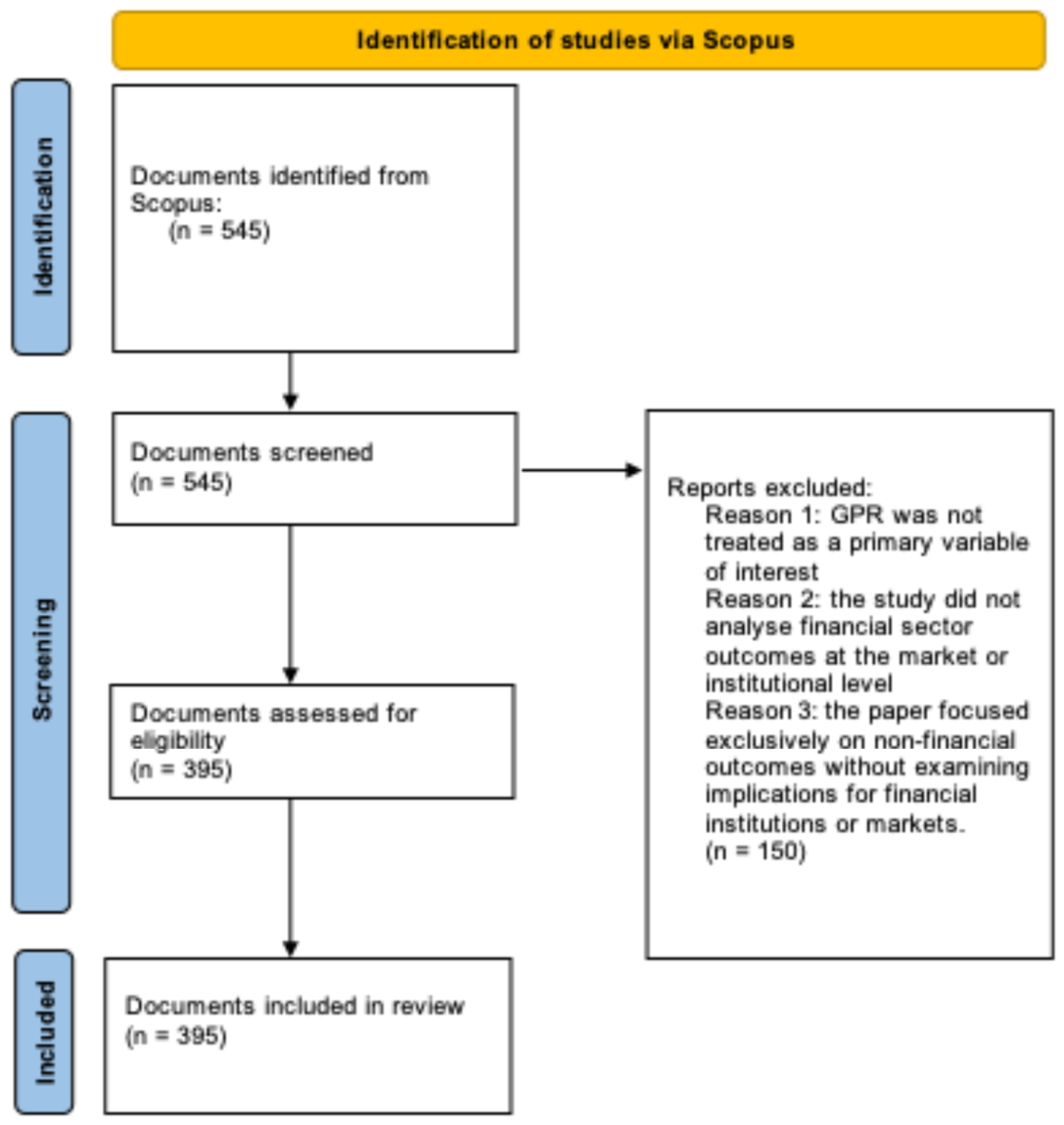
Figure 2.
Annual scientific production. Source: own elaboration based on Scopus data (bibliometrix, R).
Figure 2.
Annual scientific production. Source: own elaboration based on Scopus data (bibliometrix, R).
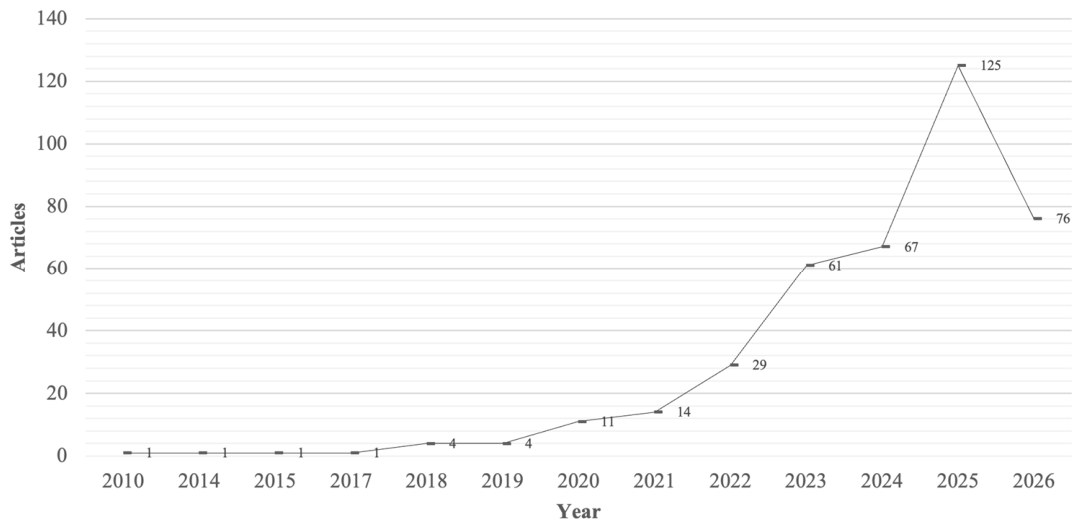
Figure 3.
Annual scientific production. Source: own elaboration based on Scopus data (bibliometrix, R).
Figure 3.
Annual scientific production. Source: own elaboration based on Scopus data (bibliometrix, R).
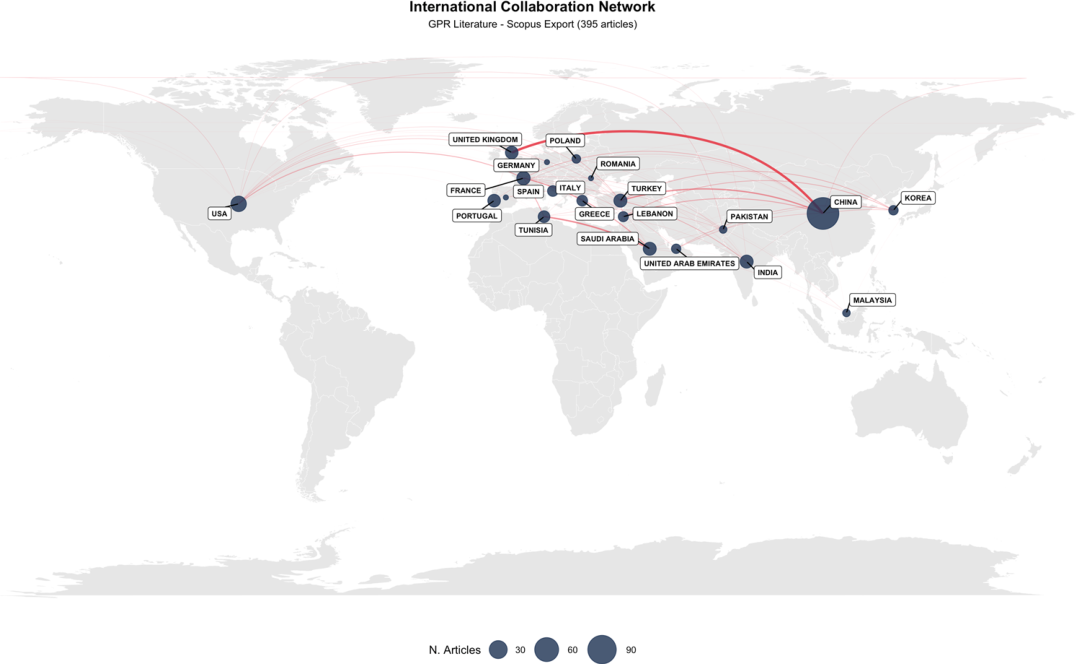
Figure 4.
Thematic strategic diagram (motor, basic, niche, and emerging/declining themes). Source: own elaboration based on Scopus data (bibliometrix, R).
Figure 4.
Thematic strategic diagram (motor, basic, niche, and emerging/declining themes). Source: own elaboration based on Scopus data (bibliometrix, R).
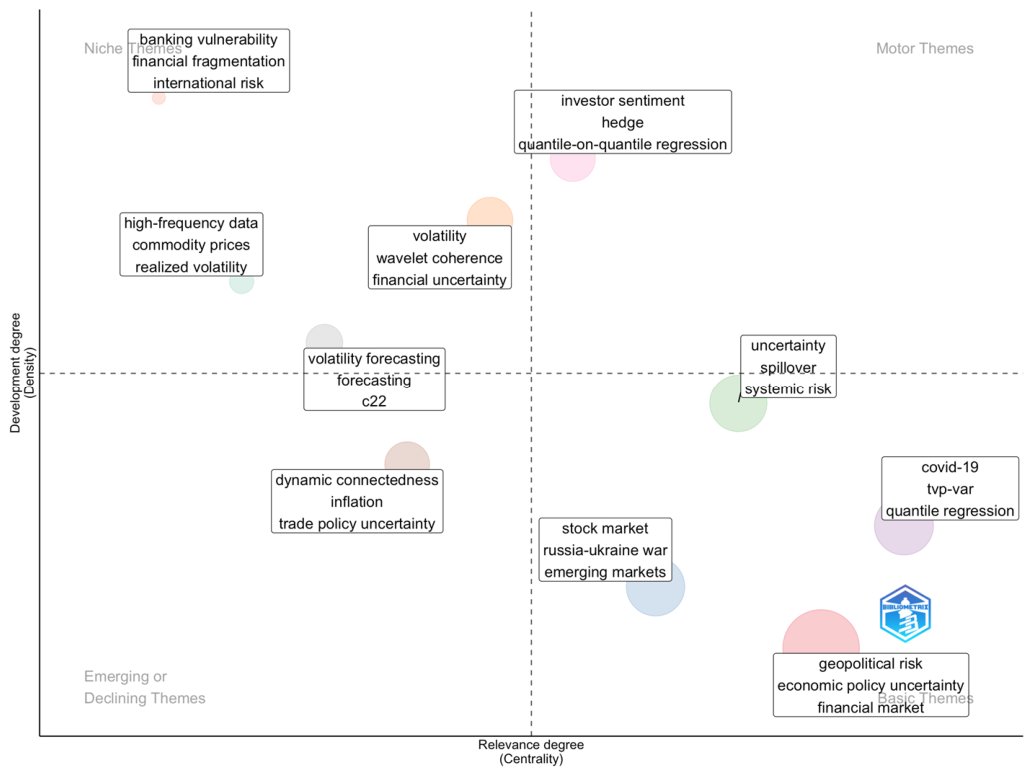
Figure 5.
Trend topics. Source: own elaboration based on Scopus data (bibliometrix, R).
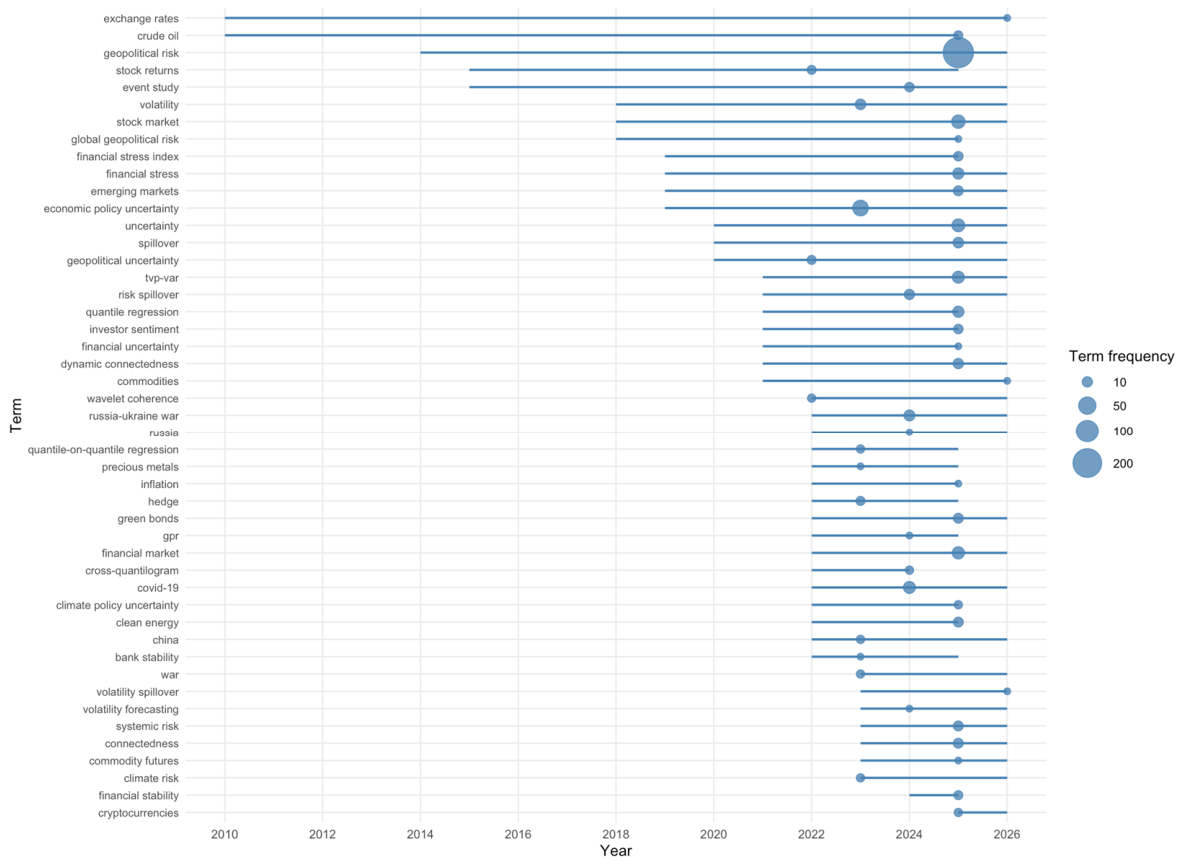
Figure 6.
Co-occurrence analysis performed on all keywords, bibliometric map. Source: own elaboration based on Scopus data (VOSviewer).
Figure 6.
Co-occurrence analysis performed on all keywords, bibliometric map. Source: own elaboration based on Scopus data (VOSviewer).
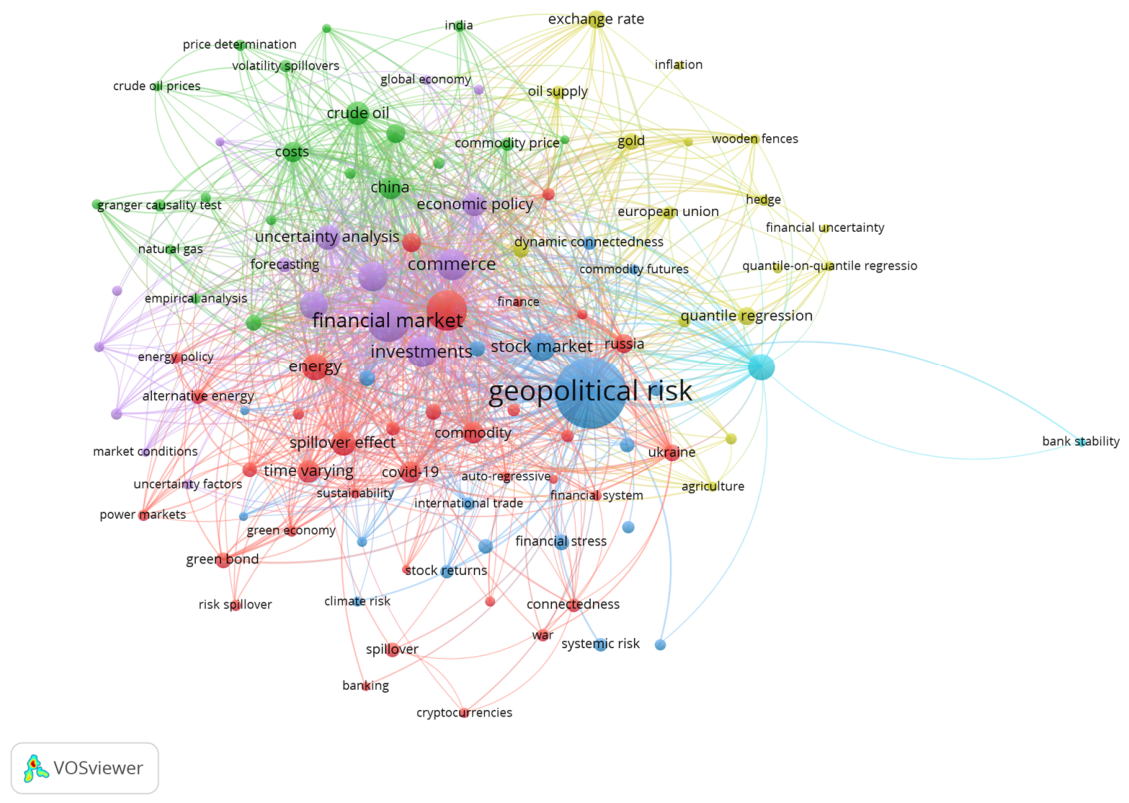
Figure 7.
Co-occurrence analysis performed on author keywords bibliometric map. Source: own elaboration based on Scopus data (VOSviewer).
Figure 7.
Co-occurrence analysis performed on author keywords bibliometric map. Source: own elaboration based on Scopus data (VOSviewer).
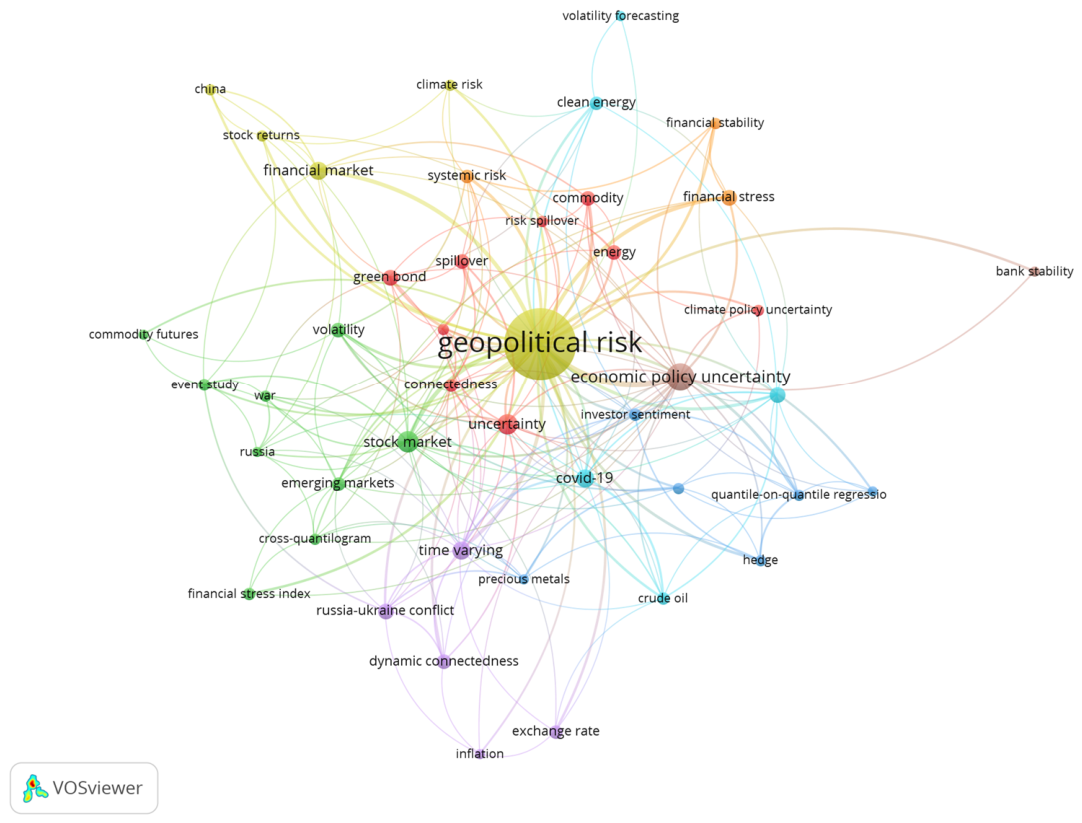
Figure 8.
Co-occurrence analysis performed on index keywords bibliometric map. Source: own elaboration based on Scopus data (VOSviewer).
Figure 8.
Co-occurrence analysis performed on index keywords bibliometric map. Source: own elaboration based on Scopus data (VOSviewer).
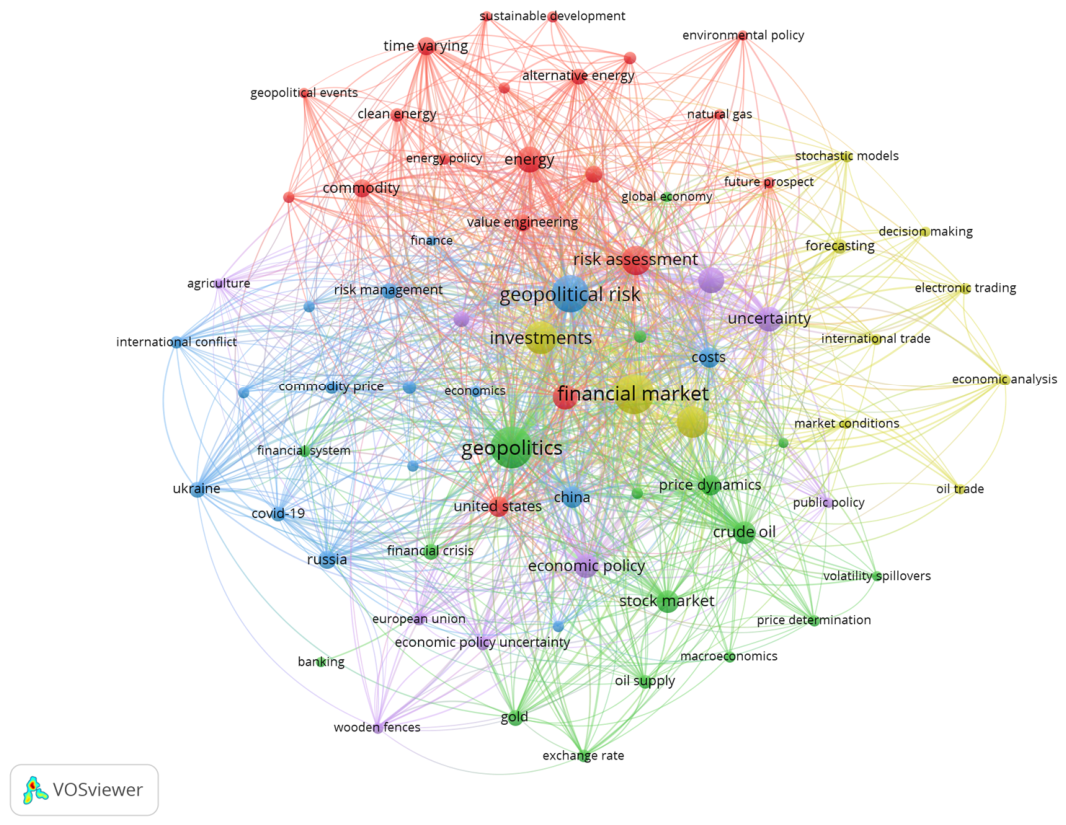
Figure 9.
Co-citation analysis performed on cited authors bibliometric map. Source: own elaboration based on Scopus data (VOSviewer).
Figure 9.
Co-citation analysis performed on cited authors bibliometric map. Source: own elaboration based on Scopus data (VOSviewer).
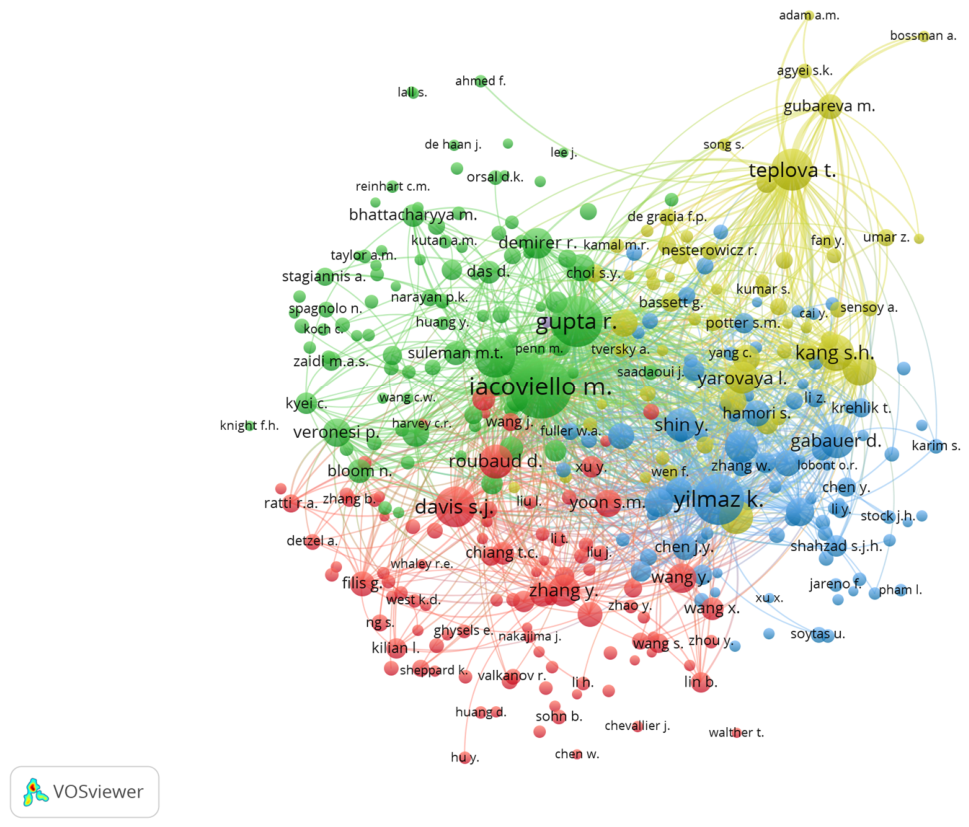
Figure 10.
Co-citation analysis performed on cited sources bibliometric map. Source: own elaboration based on Scopus data (VOSviewer).
Figure 10.
Co-citation analysis performed on cited sources bibliometric map. Source: own elaboration based on Scopus data (VOSviewer).
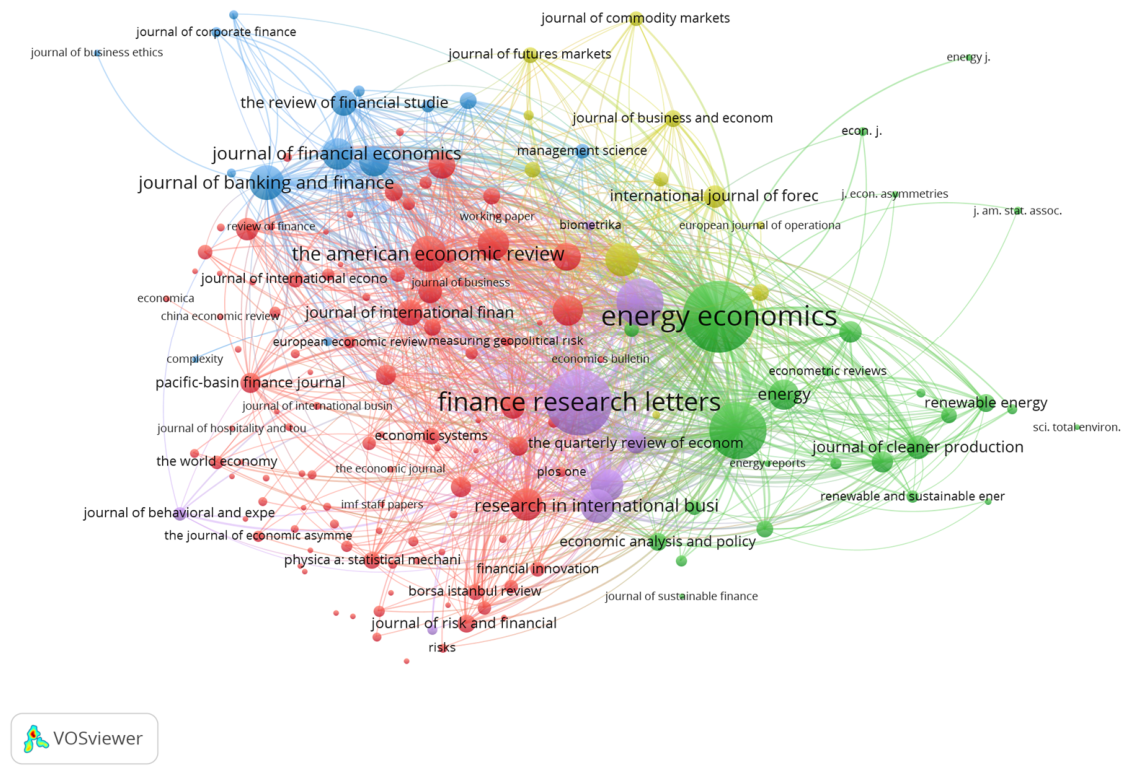
Figure 11.
Co-authorship analysis performed on countries bibliometric map. Source: own elaboration based on Scopus data (VOSviewer).
Figure 11.
Co-authorship analysis performed on countries bibliometric map. Source: own elaboration based on Scopus data (VOSviewer).
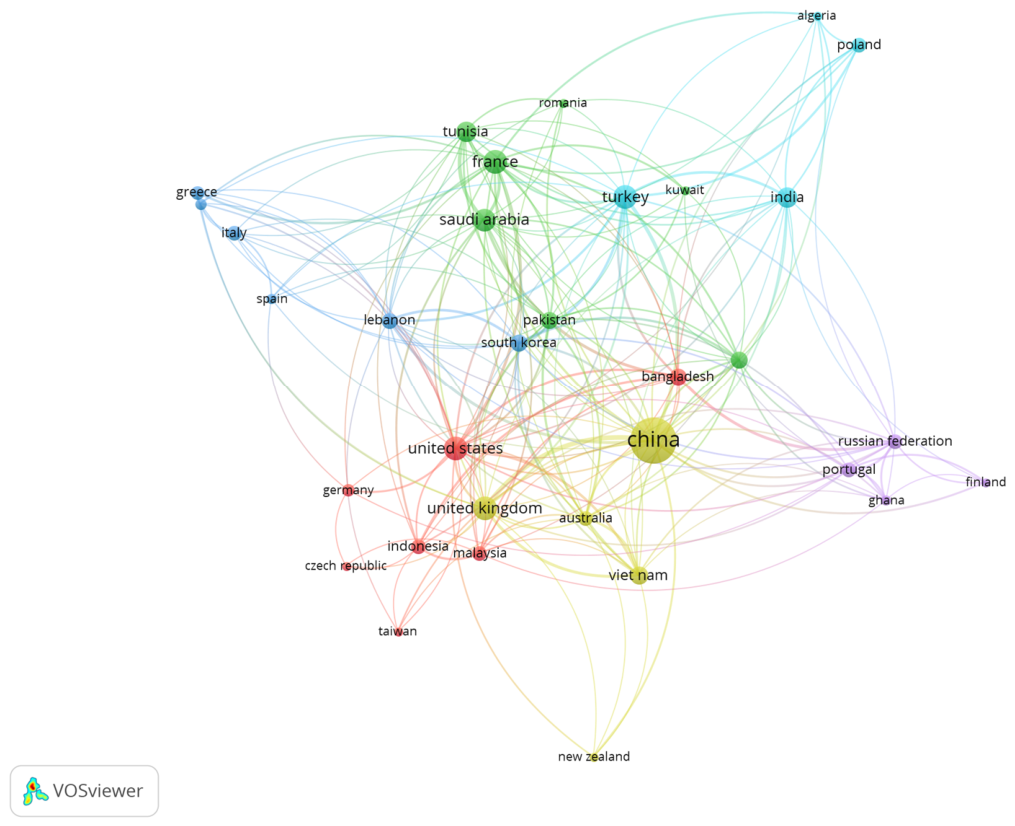
Figure 13.
Thematic strategic diagram (motor, basic, niche, and emerging/declining themes) focused on the banking and insurance sectors. Source: own elaboration based on Scopus data (bibliometrix, R).
Figure 13.
Thematic strategic diagram (motor, basic, niche, and emerging/declining themes) focused on the banking and insurance sectors. Source: own elaboration based on Scopus data (bibliometrix, R).
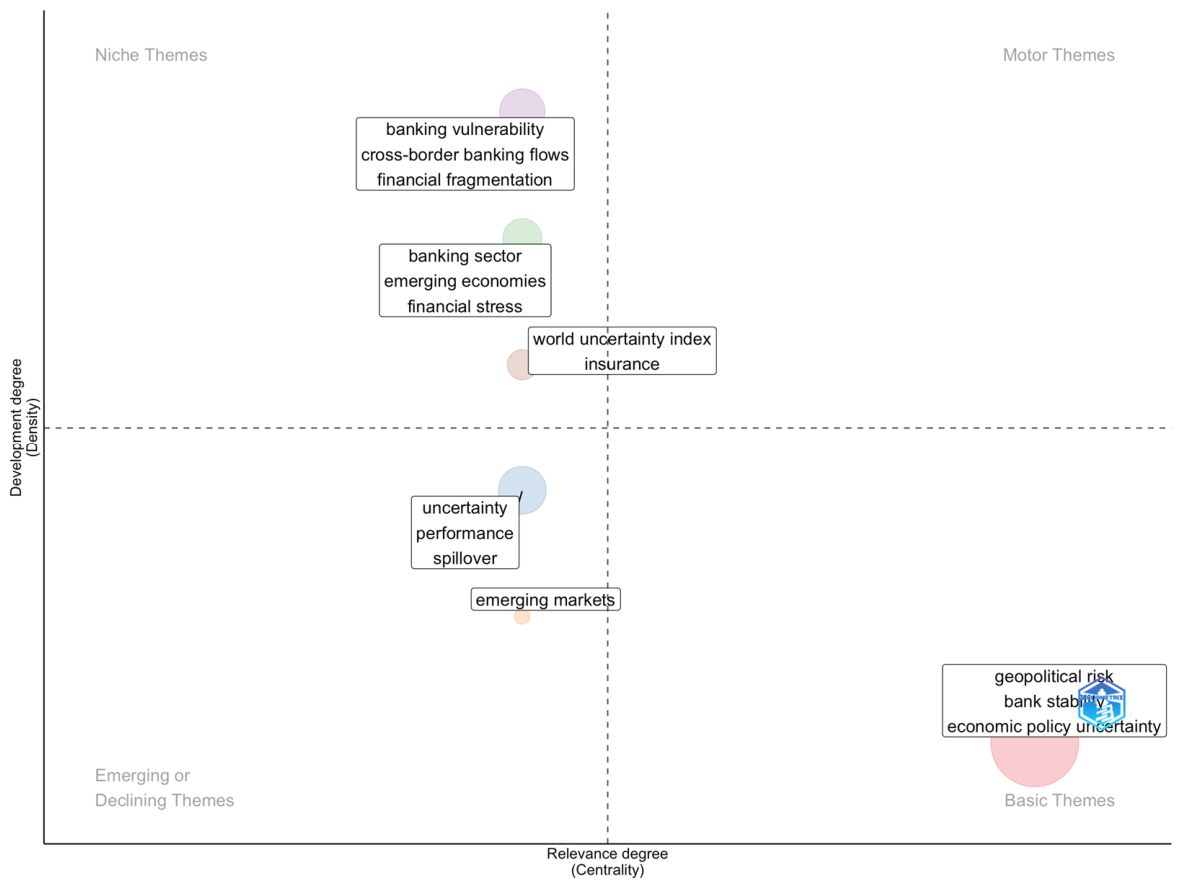
Table 1.
Search Equation.
| Database | Search Equation |
|---|---|
| Scopus | TITLE-ABS-KEY ((“geopolitical risk*” OR “GPR”)) AND TITLE-ABS-KEY ((bank*) OR (insurance) OR (insurance compan*) OR (financial market*) OR (financial institution*)) AND (LIMIT-TO(SUBJAREA, “ECON”) OR LIMIT-TO (SUBJAREA, “BUSI”)) AND (LIMIT-TO (DOCTYPE, “ar”)) AND (LIMIT-TO(LANGUAGE, “English”)) AND (LIMIT-TO (PUBSTAGE, “final”)) |
Note: The Boolean AND and OR indicators and the reserved symbols * and “” were used to construct the search equation.
Table 5.
Most relevant sources (journals) by number of publications.
| Journal | Number of papers |
|---|---|
| Finance Research Letters | 43 |
| Resources Policy | 38 |
| Energy Economics | 31 |
| Research in International Business and Finance | 16 |
| International Review of Economics and Finance | 14 |
| International Review of Financial Analysis | 13 |
| North American Journal of Economics and Finance | 13 |
| International Journal of Finance and Economics | 9 |
| Economics Letters | 7 |
| Journal of International Financial Markets Institutions and Money | 7 |
Source: own elaboration based on Scopus data (bibliometrix, R).
Table 6.
Journal impact indices (h-index, g-index, m-index).
| Element | h_index | g_index | m_index | Total Citations | Number of Publications | Publication Year Start |
|---|---|---|---|---|---|---|
| Resources Policy | 26 | 38 | 3.71 | 1825 | 38 | 2020 |
| Finance Research Letters | 16 | 42 | 1.60 | 1825 | 43 | 2017 |
| Energy Economics | 15 | 31 | 3.00 | 1187 | 31 | 2022 |
| International Review of Financial Analysis | 7 | 13 | 1.17 | 336 | 13 | 2021 |
| North American Journal of Economics and Finance | 7 | 13 | 0.88 | 485 | 13 | 2019 |
| Research in International Business and Finance | 6 | 13 | 1.00 | 185 | 16 | 2021 |
| Applied Economics | 5 | 5 | 1.00 | 88 | 5 | 2022 |
| International Journal of Finance and Economics | 5 | 9 | 0.83 | 98 | 9 | 2021 |
| International Review of Economics and Finance | 5 | 8 | 1.67 | 74 | 14 | 2024 |
| Journal of International Financial Markets, Institutions and Money | 5 | 7 | 0.83 | 143 | 7 | 2021 |
Source: own elaboration based on Scopus data (bibliometrix, R).
Table 8.
Author productivity distribution according to Lotka’s Law.
| Total Publications | Number of Authors | Percentage (%) |
|---|---|---|
| 1 | 790 | 0.8272 |
| 2 | 100 | 0.1047 |
| 3 | 32 | 0.0335 |
| 4 | 16 | 0.0168 |
| 5 | 10 | 0.0105 |
| 6 | 3 | 0.0031 |
| 7 | 3 | 0.0031 |
| 9 | 1 | 0.0010 |
Source: own elaboration based on Scopus data (bibliometrix, R).
Table 11.
Distribution of most used keywords among index keywords in clusters.
| Cluster 1 (Red) | Total Link Strength | Occurrence | Cluster 2 (Green) | Total Link Strength | Occurrence | Cluster 3 (Blue) | Total Link Strength | Occurrence | Cluster 4 (Yellow) | Total Link Strength | Occurrence |
|---|---|---|---|---|---|---|---|---|---|---|---|
| Risk Assessment | 422 | 41 | Geopolitics | 756 | 82 | Geopolitical Risk | 676 | 66 | Financial Market | 723 | 77 |
| Energy | 305 | 32 | Crude Oil | 258 | 25 | China | 241 | 22 | Investments | 529 | 50 |
| Spillover Effect | 232 | 29 | Stock Market | 204 | 25 | Costs | 260 | 21 | Commerce | 529 | 49 |
| United States | 199 | 20 | Price Dynamics | 191 | 19 | Russia | 153 | 15 | Forecasting | 69 | 10 |
| Commodity | 171 | 15 | Financial Crisis | 79 | 12 | Ukraine | 141 | 13 | Electronic Trading | 67 | 7 |
| Time Varying | 172 | 15 | Gold | 116 | 12 | Risk Management | 135 | 12 | International Trade | 59 | 7 |
| Value Engineering | 146 | 14 | Oil Supply | 93 | 9 | Covid-19 | 114 | 11 | Economic Analysis | 66 | 6 |
| Vector Autoregression | 145 | 14 | Exchange Rate | 81 | 8 | Commodity Price | 99 | 9 | Stochastic Models | 73 | 6 |
| Alternative Energy | 111 | 12 | Granger Causality Test | 57 | 8 | Economic Impact | 86 | 9 | Decision Making | 43 | 5 |
| Clean Energy | 96 | 9 | Price Determination | 63 | 7 | International Conflict | 83 | 8 | Market Conditions | 54 | 5 |
Source: own elaboration based on Scopus data.
Table 12.
Distribution of most cited authors in clusters.
| Cluster 1 (Red) | Citations | Cluster 2 (Green) | Citations | Cluster 3 (Blue) | Citations | Cluster 4 (Yellow) | Citations |
|---|---|---|---|---|---|---|---|
| Davis S.J. | 139 | Iacoviello M. | 310 | Yilmaz K. | 210 | Teplova T. | 141 |
| Roubaud D. | 93 | Gupta R. | 215 | Gabauer D. | 96 | Kang S.H. | 107 |
| Zhang Y. | 85 | Wohar M.E. | 135 | Shin Y. | 90 | Lucey B.M. | 97 |
| Wang Y. | 74 | Smales L.A. | 100 | Zhang H. | 90 | Vo X.V. | 92 |
| Yoon S.M. | 60 | Demirer R. | 79 | Umar M. | 69 | Yarovaya L. | 90 |
| Pierdzioch C. | 54 | Veronesi P. | 69 | Tiwari A.K. | 68 | Goodell J.W. | 62 |
| Filis G. | 53 | Papadamou S. | 62 | Bouri E. | 57 | Lee C.C. | 62 |
| Engle R.F. | 50 | Lau M.C.K. | 60 | Hamori S. | 57 | Hammoudeh S. | 55 |
| Nguyen D.K. | 45 | Bloom N. | 48 | Sadorsky P. | 57 | Gubareva M. | 53 |
| Wang X. | 42 | Li S. | 47 | Uddin G.S. | 57 | Xu J. | 40 |
Source: own elaboration based on Scopus data.
Table 13.
Distribution of most cited references in clusters.
| Cluster 1 (Red) | Citations |
|---|---|
| Balcilar, M., Bonato, M., Demirer, R., & Gupta, R. (2018). Geopolitical Risks and Stock Market Dynamics of The BRICS. Economic Systems, 42(2), 295-306. | 42 |
| Bloom, N. (2009). The Impact of Uncertainty Shocks. Econometrica, 77(3), 623-685. | 33 |
| Sohag, K., Hammoudeh, S., Elsayed, A. H., Mariev, O., & Safonova, Y. (2022). Do Geopolitical Events Transmit Opportunity or Threat to Green Markets? Decomposed Measures of Geopolitical Risks. Energy Economics, 111, 106068. | 23 |
| Pástor, Ľ., & Veronesi, P. (2013). Political Uncertainty and Risk Premia. Journal Of Financial Economics, 110(3), 520-545. | 23 |
| Das, D., Kannadhasan, M., & Bhattacharyya, M. (2019). Do The Emerging Stock Markets React to International Economic Policy Uncertainty, Geopolitical Risk and Financial Stress Alike? The North American Journal of Economics and Finance, 48, 1-19. | 22 |
| Kannadhasan, M., & Das, D. (2020). Do Asian Emerging Stock Markets React to International Economic Policy Uncertainty and Geopolitical Risk Alike? A Quantile Regression Approach. Finance Research Letters, 34, 101276. | 16 |
| Aysan, A. F., Demir, E., Gozgor, G., & Lau, C. K. M. (2019) Effects of the Geopolitical Risks on Bitcoin Returns and Volatility. Research In International Business and Finance, Elsevier, Vol. 47(C), Pages 511-518. | 16 |
| Umar, Z., Bossman, A., Choi, S. Y., & Teplova, T. (2022). Does Geopolitical Risk Matter for Global Asset Returns? Evidence From Quantile-On-Quantile Regression. Finance Research Letters, 48, 102991. | 16 |
| Bossman, A., & Gubareva, M. (2023). Asymmetric Impacts of Geopolitical Risk on Stock Markets: A Comparative Analysis of The E7 And G7 Equities During the Russian-Ukrainian Conflict. Heliyon, 9(2), E13626. | 15 |
| Antonakakis, N., Gupta, R., Kollias, C., & Papadamou, S. (2017). Geopolitical Risks and the Oil-Stock Nexus Over 1899–2016. Finance Research Letters, 23, 165-173. | 14 |
| Cluster 2 (Green) | Citations |
| Caldara, D. & Iacoviello M. (2022). Measuring Geopolitical Risk. American Economic Review, April, 112(4), 1194-1225. | 198 |
| Baur, D. G., & Smales, L. A. (2020). Hedging Geopolitical Risk with Precious Metals. Journal Of Banking & Finance, 117, 105823. | 37 |
| Liu, J., Ma, F., Tang, Y., & Zhang, Y. (2019). Geopolitical Risk and Oil Volatility: A New Insight. Energy Economics, 84, 104548. | 34 |
| Gong, X., & Xu, J. (2022). Geopolitical Risk and Dynamic Connectedness Between Commodity Markets. Energy Economics, 110, 106028. | 31 |
| Bouoiyour, J., Selmi, R., Hammoudeh, S., & Wohar, M. E. (2019). What Are the Categories of Geopolitical Risks That Could Drive Oil Prices Higher? Acts Or Threats?. Energy Economics, 84, 104523. | 30 |
| Tiwari, A. K., Boachie, M. K., Suleman, M. T., & Gupta, R. (2021). Structure Dependence Between Oil and Agricultural Commodities Returns: The Role of Geopolitical Risks. Energy, 219, 119584. | 18 |
| Wang, Y., Bouri, E., Fareed, Z., & Dai, Y. (2022). Geopolitical Risk and the Systemic Risk in the Commodity Markets Under the War in Ukraine. Finance Research Letters, 49, 103066. | 17 |
| Su, C. W., Khan, K., Tao, R., & Nicoleta-Claudia, M. (2019). Does Geopolitical Risk Strengthen or Depress Oil Prices and Financial Liquidity? Evidence From Saudi Arabia. Energy, 187, 116003. | 15 |
| Wang, K. H., Su, C. W., & Umar, M. (2021). Geopolitical Risk and Crude Oil Security: A Chinese Perspective. Energy, 219, 119555. | 13 |
| Antonakakis, N., Gupta, R., Kollias, C., & Papadamou, S. (2017). Geopolitical Risks and the Oil-Stock Nexus Over 1899–2016. Finance Research Letters, 23, 165-173. | 11 |
| Cluster 3 (Blue) | Citations |
| Diebold, F. X., & Yilmaz, K. (2012). Better To Give Than to Receive: Predictive Directional Measurement of Volatility Spillovers. International Journal of Forecasting, Elsevier, Vol. 28(1), Pages 57-66. | 73 |
| Yilmaz, F. X. D. K. (2014). On The Network Topology of Variance Decompositions: Measuring the Connectedness of Financial Firms. | 37 |
| Antonakakis, N., Chatziantoniou, I., & Gabauer, D. (2020). Refined Measures of Dynamic Connectedness Based on Time-Varying Parameter Vector Autoregressions. Journal Of Risk and Financial Management, 13(4), 84. | 24 |
| Koop, G., Pesaran, M. H., & Potter, S. M. (1996). Impulse Response Analysis in Nonlinear Multivariate Models. Journal Of Econometrics, 74(1), 119-147. | 16 |
| Pesaran, H. H., & Shin, Y. (1998). Generalized Impulse Response Analysis in Linear Multivariate Models. Economics Letters, 58(1), 17-29. | 16 |
| Baruník, J., & Křehlík, T. (2018). Measuring The Frequency Dynamics of Financial Connectedness and Systemic Risk. Journal Of Financial Econometrics, 16(2), 271-296. | 14 |
| Jarque, C. M., & Bera, A. K. (1980). Efficient Tests for Normality, Homoscedasticity and Serial Independence of Regression Residuals. Economics Letters, 6(3), 255-259. | 11 |
| Phillips, P. C., & Perron, P. (1988). Testing For a Unit Root in Time Series Regression. Biometrika, 75(2), 335-346. | 11 |
| Cluster 4 (Yellow) | Citations |
| Baker, S., Bloom, N., & Davis, S. (2016). Measuring Economic Policy Uncertainty. The Quarterly Journal of Economics. 131. 1593-1636. | 80 |
| Sharif, A., Aloui, C., & Yarovaya, L. (2020). COVID-19 Pandemic, Oil Prices, Stock Market, Geopolitical Risk and Policy Uncertainty Nexus in the US Economy: Fresh Evidence from the Wavelet-Based Approach. International Review of Financial Analysis, 70, 101496. | 21 |
| Caldara, D. And Iacoviello M. (2018). Measuring Geopolitical Risk. International Finance Discussion Papers, 1222. | 17 |
| Bouri, E., Demirer, R., Gupta, R., & Marfatia, H. A. (2019). Geopolitical Risks and Movements in Islamic Bond and Equity Markets: A Note. Defence And Peace Economics, 30(3), 367-379. | 16 |
| Phan, D. H. B., Tran, V. T., & Iyke, B. N. (2022). Geopolitical Risk and Bank Stability. Finance Research Letters, 46, 102453. | 15 |
| Dixit, A. K., & Pindyck, R. S. (1994). Investment Under Uncertainty. Princeton University Press. | 10 |
Source: own elaboration based on Scopus data.
Table 14.
Distribution of most cited sources in clusters.
| Cluster 1 (Red) | Citations |
|---|---|
| The American Economic Review | 412 |
| The North American Journal of Economics and Finance | 334 |
| Economics Letters | 313 |
| Economic Modelling | 294 |
| Econometrica | 243 |
| Journal of International Money and Finance | 226 |
| Journal of International Financial Markets, Institutions and Money | 207 |
| The Quarterly Journal of Economics | 180 |
| Applied Economics | 176 |
| Journal of Financial Stability | 156 |
| Cluster 2 (Green) | Citations |
| Energy Economics | 1612 |
| Resources Policy | 1025 |
| Energy | 278 |
| Journal of Cleaner Production | 172 |
| Energy Policy | 153 |
| Technological Forecasting and Social Change | 145 |
| Renewable Energy | 109 |
| Economic Analysis and Policy | 98 |
| Environmental Science and Pollution Research International | 86 |
| Journal of Environmental Management | 81 |
| Cluster 3 (Blue) | Citations |
| Journal of Banking and Finance | 389 |
| Journal of Financial Economics | 311 |
| The Journal of Finance | 289 |
| The Review of Financial Studies | 202 |
| Journal of Empirical Finance | 90 |
| Management Science | 68 |
| The European Journal of Finance | 48 |
| Journal of Financial and Quantitative Analysis | 45 |
| Journal of Corporate Finance | 35 |
| Quantitative Finance | 30 |
| Cluster 4 (Yellow) | Citations |
| Journal of Econometrics | 352 |
| International Journal of Forecasting | 165 |
| Journal of Business and Economic Statistics | 95 |
| Annals of Operations Research | 86 |
| Journal of Futures Markets | 85 |
| The Review of Economics and Statistics | 83 |
| Journal of Forecasting | 74 |
| Journal of Commodity Markets | 68 |
| International Economic Review | 33 |
| Expert Systems with Applications | 23 |
| Cluster 5 (Violet) | Citations |
| Finance Research Letters | 1340 |
| International Review of Financial Analysis | 701 |
| Research in International Business and Finance | 352 |
| International Review of Economics and Finance | 342 |
| The Quarterly Review of Economics and Finance | 145 |
| Journal of Behavioral and Experimental Finance | 58 |
| Biometrika | 34 |
| Journal of Financial Econometrics | 33 |
Source: own elaboration based on Scopus data.
Table 15.
Distribution of co-authorship analysis performed on countries in clusters.
| Cluster 1 (Red) | Total Link Strength | Documents | Citations |
Average Publication Year |
Average Citations |
| United States | 54 | 36 | 1445 | 2023.50 | 40.14 |
| Bangladesh | 39 | 18 | 494 | 2024.17 | 27.44 |
| Malaysia | 19 | 13 | 446 | 2022.54 | 34.31 |
| Germany | 8 | 10 | 109 | 2025 | 10.90 |
| Indonesia | 21 | 13 | 87 | 2024.69 | 6.69 |
| Czech Republic | 4 | 5 | 71 | 2024.20 | 14.20 |
| Taiwan | 6 | 5 | 71 | 2023.40 | 14.20 |
| Cluster 2 (Green) | Total Link Strength | Documents | Citations |
Average Publication Year |
Average Citations |
| France | 59 | 37 | 939 | 2024.19 | 25.38 |
| United Arab Emirates | 31 | 18 | 828 | 2024.44 | 46 |
| Saudi Arabia | 45 | 32 | 485 | 2024.22 | 15.16 |
| Pakistan | 37 | 18 | 332 | 2023.94 | 18.44 |
| Tunisia | 33 | 25 | 284 | 2024.44 | 11.36 |
| Romania | 9 | 6 | 91 | 2024.17 | 15.17 |
| Kuwait | 9 | 5 | 79 | 2024.80 | 15.80 |
| Cluster 3 (Blue) | Total Link Strength | Documents | Citations |
Average Publication Year |
Average Citations |
| South Africa | 11 | 8 | 798 | 2022.75 | 99.75 |
| South Korea | 36 | 18 | 761 | 2023.33 | 42.28 |
| Lebanon | 33 | 17 | 587 | 2023.12 | 34.53 |
| Greece | 12 | 12 | 468 | 2023.50 | 39 |
| Spain | 8 | 7 | 86 | 2023.43 | 12.29 |
| Italy | 11 | 14 | 81 | 2024.71 | 5.79 |
| Cluster 4 (Yellow) | Total Link Strength | Documents | Citations |
Average Publication Year |
Average Citations |
| China | 81 | 133 | 3851 | 2024.32 | 28.95 |
| United Kingdom | 49 | 35 | 1646 | 2023.71 | 47.03 |
| Vietnam | 36 | 20 | 961 | 2023.65 | 48.05 |
| Australia | 33 | 15 | 365 | 2024.13 | 24.33 |
| New Zealand | 8 | 6 | 102 | 2024 | 17 |
Source: own elaboration based on Scopus data.
Disclaimer/Publisher’s Note: The statements, opinions and data contained in all publications are solely those of the individual author(s) and contributor(s) and not of MDPI and/or the editor(s). MDPI and/or the editor(s) disclaim responsibility for any injury to people or property resulting from any ideas, methods, instructions or products referred to in the content. |
© 2026 by the authors. Licensee MDPI, Basel, Switzerland. This article is an open access article distributed under the terms and conditions of the Creative Commons Attribution (CC BY) license (http://creativecommons.org/licenses/by/4.0/).
Copyright: This open access article is published under a Creative Commons CC BY 4.0 license, which permit the free download, distribution, and reuse, provided that the author and preprint are cited in any reuse.


