
Submitted:
03 August 2026
Posted:
05 August 2026
You are already at the latest version
Abstract
Fresh fruits are highly perishable products whose acceptance depends not only on external appearance and firmness, but also on the preservation of taste and aroma. This review addresses the relationship between active packaging and the maintenance of fruit sensory quality, with special emphasis on the volatilome as a dynamic marker of aroma integrity. The first part ex-amines how taste and aroma are formed during ripening through the interaction of sugars, organic acids, phenolics, amino acids and a wide range of volatile compounds, including fatty-acid-derived esters and aldehydes, terpenoids, carote-noid-derived norisoprenoids, phenylpropanoids, sulfur-containing compounds and glycosidically bound precursors. It then analyzes how these traits deteriorate during packaged shelf life through temperature effects, refrigerated and room-temperature storage, microbial and enzymatic activity, mechanical damage and packaging-atmosphere imbalance, showing that visual and sensory shelf life do not necessarily decline together. The second part reviews how active packaging can preserve—or unintentionally distort—this volatilome, covering modified-atmosphere and gas-regulating systems, anti-microbial and ethylene-managing systems based on released essential oils, sulfur dioxide and ethanol emitters, oxygen and carbon dioxide regulators, moisture absorbers, multi-active combinations and packaging-adjacent edible coatings. A recurring principle emerges: every active function is double-edged, as an intervention that delays spoilage or senescence may itself add exogenous notes or trigger fermentative off-flavors unless it is tuned to a sensory compatibility threshold. The packaging material is also decisive, since paper and cardboard buffer humidity and interact weakly with aroma compounds, whereas high-barrier polymers sustain a modified atmosphere but can scalp esters and terpenes; conversely, releasing volatiles com-patible with the native aroma can act as an aroma-positive strategy that restores characteristic notes. Active packaging should therefore be evaluated not only by conventional quality parameters, but also by headspace gas evolution, sugar/acid balance, odor-active volatiles, off-flavor markers and sensory validation.
Keywords:
active packaging
; fresh fruits
; volatilome
; aroma quality
; taste
; off-flavors
; modified atmosphere packaging
; postharvest storage
1. Introduction
Fresh fruits are valued not only as sources of nutrients, fiber and bioactive compounds, but also as highly distinctive sensory products. Their market acceptance depends on appearance, texture, juiciness, sweetness, acidity, aroma and the interaction among these attributes during consumption. Among them, flavor is especially complex because it does not arise from a single chemical group. Sugars and organic acids shape sweetness, sourness and freshness, whereas volatile organic compounds largely determine the aromatic identity perceived before eating and retronasally during mastication. This interaction explains why fruits with similar soluble solids content or titratable acidity may be judged very differently by consumers if their volatile profile has been altered during breeding, ripening, cold storage, handling or packaging [1,2,3].
In this context, the concept of fruit volatilome is particularly useful. For the purposes of this review, the fruit volatilome can be defined as the complete and dynamic set of volatile organic compounds emitted, accumulated, transformed or lost by fruit tissues across development, ripening, postharvest storage, packaging and consumption. This term is broader than a simple inventory of aroma compounds. It includes the biochemical origin of volatiles, their free and bound forms, their temporal evolution, their partitioning between fruit tissue and package headspace, and their sensory relevance. In fresh fruits, the volatilome is mainly alcohols, aldehydes, ketones, lactones, terpenoids, norisoprenoids, apocarotenoids, phenylpropanoids/benzenoids and sulfur-containing compounds, although their relative abundance and odor activity vary greatly among species, cultivars, maturity stages and storage conditions [4,5,6,7,8].
Aroma formation during ripening is the result of coordinated metabolic reprogramming. Fatty-acid-derived volatiles are produced through lipoxygenase-related pathways and include C6 aldehydes and alcohols associated with green and fresh notes, as well as esters that often contribute fruity and sweet-like aromas. Amino-acid-derived volatiles may provide branched-chain alcohols, aldehydes, esters and sulfur compounds, which are relevant in fruits such as melon, banana, apple and tropical species. Terpenoids, norisoprenoids and apocarotenoids contribute floral, citrus, resinous and fruity notes, depending on the fruit matrix. In addition, many volatiles occur as glycosidically bound precursors, which act as latent aroma reservoirs and can be released by enzymatic or physicochemical processes during ripening and storage [5,6,7,8].
The preservation of this volatilome is one of the major challenges in postharvest technology. Fresh fruits remain metabolically active after harvest, and their sensory profile continues to evolve during transport, storage, retail display and domestic handling. Packaging can modify the fruit microenvironment by changing O2 and CO2 concentrations, water vapor pressure, ethylene accumulation, condensation, tissue dehydration and microbial growth. These changes may be beneficial when they slow respiration, delay senescence, reduce decay and limit mechanical or water-loss damage. However, an inappropriate package atmosphere can also suppress desirable volatile synthesis, promote fermentative metabolism, accumulate secondary volatiles or generate sensory defects that reduce consumer acceptance even when the fruit remains visually acceptable [9,10,11,12,13].
The problem is especially relevant because visual shelf life and sensory shelf life do not always decline at the same rate. Low temperature is widely used to reduce respiration and microbial spoilage, but several fruits are sensitive to chilling-induced aroma loss. In tomato, refrigeration has been associated with reduced flavor-associated volatiles and altered expression of genes involved in volatile biosynthesis. In melon, postharvest chilling can reduce volatile acetate esters, which are compounds strongly associated with characteristic melon aroma. Conversely, room-temperature exposure during retail display may accelerate respiration, softening, sugar and acid changes, microbial growth and the production of off-odors, particularly when temperature abuse interacts with restricted gas exchange inside the package [14,15,16,17]. Off-flavor formation in packaged fruits is commonly associated with fermentative metabolism, microbial spoilage, enzymatic degradation, tissue disruption and excessive or poorly balanced atmosphere modification. Ethanol, acetaldehyde, ethyl acetate, organic acids, sulfur-related compounds and other stress-associated volatiles can accumulate when oxygen availability becomes limiting or when microbial communities develop in damaged or high-moisture tissues. These compounds may contribute to alcoholic, solvent-like, vinegar-like, musty, sulfury or stale notes. Importantly, some of these markers may appear before clear visual deterioration, which makes the volatilome a valuable early indicator of sensory quality loss [14,17].
Active packaging offers a promising strategy to manage this problem because it is designed to interact with the food-package environment rather than acting only as a passive barrier. Depending on the system, active packaging may modulate oxygen, carbon dioxide, ethylene, moisture, microbial growth, oxidation reactions or the controlled release of bioactive compounds. In fruits, this approach is usually discussed in terms of shelf-life extension, decay control and waste reduction. Nevertheless, its real value should also be judged by its capacity to preserve the native aroma and taste profile of the fruit and to avoid the formation of off-odors and off-flavors. Recent reviews on active, smart and edible packaging have emphasized the expansion of antimicrobial, antioxidant, ethylene-scavenging, moisture-regulating, biodegradable and intelligent systems, but the specific relationship between these technologies and the preservation of the fruit volatilome remains less systematically integrated [18,19].
This review examines the relationship between active packaging and the preservation of taste and aroma quality in fresh fruits, with special emphasis on the volatilome as a central marker of sensory integrity. The first part reviews how aroma and taste are formed during fruit ripening and how they deteriorate during packaged shelf life, considering temperature, storage conditions, microbial and enzymatic changes, mechanical damage and packaging atmosphere. The second part will address the main active packaging systems used to preserve fruit sensory quality, including modified atmosphere packaging, antimicrobial systems, ethylene adsorption, SO2 emission, multi-active approaches, ethanol emission, oxygen scavenging, carbon dioxide emission and water vapor adsorption. By connecting fruit physiology, volatile biochemistry, packaging design and sensory quality, this review aims to support a more precise evaluation of packaging technologies for fresh fruits.
2. Formation of Aroma and Taste in Fruits During Ripening
Fruit ripening is the developmental process through which fleshy fruits acquire the sensory traits that define their commercial and eating quality. From a physiological perspective, ripening involves coordinated changes in respiration, hormone signaling, pigment metabolism, cell wall disassembly, primary metabolism, secondary metabolism and tissue softening. From a sensory perspective, the same process builds the fruit’s flavor identity through the interaction between sweetness, acidity, bitterness, astringency, juiciness, texture and aroma. Sugars and organic acids provide the main taste framework, whereas volatile organic compounds are responsible for much of the characteristic aroma perceived before and during consumption [20,21,22]. This is particularly relevant for packaged fresh fruits because packaging technologies can preserve, modulate or damage an existing sensory potential, but they cannot fully create a volatilome that was not properly developed before harvest. Fruit harvested before adequate physiological maturity may retain firmness and external quality, but often shows weak aroma, insufficient sugar accumulation, excessive acidity or an unbalanced volatile profile. Conversely, fruit harvested at a suitable maturity stage enters postharvest storage with a more complete biochemical capacity to sustain desirable volatile production, provided that temperature, atmosphere composition and handling conditions do not suppress ripening-related metabolism [20,21,23,24]. The ripening-dependent formation of fruit sensory quality, from biochemical precursors and metabolic regulation to aroma release, taste perception, texture and consumer acceptance is summarized in Figure 1.
Ripening behavior differs markedly between climacteric and non-climacteric fruits, although this distinction should not be applied in an overly rigid manner. Climacteric fruits, including apples, banana, pear, peach, tomato and several melon types, show a ripening-associated increase in respiration and ethylene production, and ethylene regulates many processes involved in softening, pigmentation, sugar/acid balance and volatile biosynthesis. Non-climacteric fruits, including strawberry, grape, citrus and many berries, do not show a climacteric ethylene burst, although ethylene may still influence specific ripening responses. In these fruits, abscisic acid, sugars, auxins, jasmonates and other signals contribute to ripening control in a species-dependent manner [23,24,25]. These physiological differences have direct postharvest implications. In climacteric fruits, part of the aroma-forming capacity may continue after harvest if the fruit has reached the appropriate physiological stage, whereas in many non-climacteric fruits the scope for postharvest aroma development is more limited. This explains why early harvesting may be especially detrimental for fruits such as strawberry, grape or citrus, where on-plant ripening strongly determines sugar accumulation, acid decline and varietal aroma. Nevertheless, cultivar, maturity stage, ethylene sensitivity, storage temperature and package atmosphere can strongly alter the final sensory output within the same species [20,24,25].
Taste development during ripening is largely determined by the accumulation and balance of soluble sugars, organic acids, phenolic compounds, free amino acids and other soluble metabolites. Glucose, fructose and sucrose are the main sugars contributing to sweetness, although their relative proportions vary among species and cultivars. Organic acids, mainly malic and citric acids, provide sourness and freshness and strongly modulate perceived sweetness. For this reason, the sugar/acid ratio is usually more informative than soluble solids content alone, especially in fruits such as citrus, pineapple, grape, apple, peach and strawberry, where consumer acceptance depends on balance rather than sweetness alone [20,26,27]. Phenolic compounds influence bitterness, astringency and mouthfeel, particularly in fruits such as grape, persimmon, pomegranate, apple peel and berries. Free amino acids may contribute directly to taste, but their main relevance in the context of the volatilome is that they also act as precursors of aroma volatiles. For example, branched-chain and aromatic amino acids can generate aldehydes, alcohols and esters with fruity, malty, floral or honey-like notes, linking primary metabolism with the formation of fruit aroma [28,29,30].
The fruit volatilome can be understood as the complete and dynamic set of volatile organic compounds produced, stored, transformed, released or lost by fruit tissues during development, ripening and postharvest life. In ripe fruits, this volatilome is commonly composed of esters, alcohols, aldehydes, ketones, lactones, terpenes, sesquiterpenes, norisoprenoids, apocarotenoids, phenylpropanoids, benzenoids and sulfur-containing compounds [4,5,6,7,28,29,30]. The sensory relevance of each compound depends not only on its concentration, but also on odor threshold, volatility, matrix interactions, tissue disruption, temperature and retronasal release during consumption. Therefore, compounds present at low concentrations may strongly influence aroma if their odor thresholds are low, whereas abundant compounds may have limited sensory impact if they are poorly odor-active. This is why the preservation of fruit aroma during packaging should not be evaluated only through total volatile abundance, but through the maintenance of key odor-active compounds and the avoidance of off-flavor markers [3,14,20,27].
Fatty-acid metabolism is one of the main biochemical sources of fruit aroma volatiles. Through lipoxygenase-related pathways, linoleic and linolenic acids can be converted into C6 and C9 aldehydes, alcohols and esters. Compounds such as hexanal, (E)-2-hexenal, (Z)-3-hexenal, hexanol and (Z)-3-hexenol are associated with green, grassy, leafy and fresh-cut notes. In moderate concentrations, these volatiles contribute freshness; in excess, they may indicate immaturity, mechanical damage or tissue disruption. Their formation is therefore closely linked to membrane status, oxygen availability, enzyme activity and storage conditions [29,30,31,32]. As ripening progresses, many fruits shift from aldehyde-rich profiles towards alcohols and esters. Alcohol dehydrogenases participate in the interconversion between aldehydes and alcohols, while alcohol acyltransferases catalyse ester formation from alcohols and acyl-CoA substrates. Esters are especially important in apple, banana, strawberry, melon and pear, where they provide fruity, sweet, banana-like, apple-like, pear-like or tropical notes. This pathway is highly relevant for packaging because excessive atmosphere restriction, low oxygen, altered ethylene action or unsuitable temperature may reduce desirable ester biosynthesis or redirect metabolism towards fermentative compounds [32,33,34,35,36].
Amino-acid-derived volatiles represent another major component of fruit aroma. Branched-chain amino acids such as leucine, isoleucine and valine may generate branched-chain aldehydes, alcohols and esters, whereas phenylalanine may lead to phenylacetaldehyde, 2-phenylethanol, benzaldehyde, methyl benzoate, eugenol and related benzenoid or phenylpropanoid compounds. These volatiles contribute fruity, malty, floral, honey-like, almond-like or spicy notes depending on their concentration and fruit matrix [28,29,37,38]. Methionine and cysteine can also generate sulfur-containing compounds. These compounds are often present at low concentrations and may contribute to desirable tropical or varietal notes when they remain within an appropriate sensory range. However, under unsuitable storage or packaging conditions, especially when oxygen availability is restricted or microbial activity increases, sulfur-containing volatiles may shift towards sulfury, cabbage-like, onion-like or overripe notes [14,17,28,38].
Terpenoids, carotenoid-derived volatiles and phenylpropanoid/benzenoid compounds also contribute strongly to fruit aroma identity. Monoterpenes such as limonene, linalool, geraniol, alpha-terpineol and citral provide citrus-like, floral, fresh and resinous notes in fruits such as citrus, grape, mango, melon and berries. Carotenoid cleavage generates apocarotenoids and norisoprenoids, including beta-ionone, beta-damascenone and geranylacetone, which can have a strong sensory impact at very low concentrations [29,30,39,40]. These pathways connect aroma with ripening-associated pigment metabolism, explaining why changes in fruit color and volatile composition may be metabolically related. Phenylpropanoid and benzenoid volatiles, including benzaldehyde, benzyl alcohol, methyl benzoate, eugenol, guaiacol, methyl salicylate, phenylacetaldehyde and 2-phenylethanol, can provide almond-like, floral, clove-like, smoky, medicinal, spicy or honey-like notes. Their contribution is strongly species- and cultivar-dependent, and studies in strawberry have shown how domestication and breeding can reshape the gain or loss of specific flavor-related compounds [27,41].
Not all aroma compounds occur exclusively as free volatiles. Many fruits contain glycosidically bound aroma precursors, in which volatile aglycones are conjugated to sugar residues. These bound forms are usually non-volatile or weakly volatile and therefore do not directly contribute to aroma until hydrolysis releases the aglycone. This bound fraction acts as a latent aroma reservoir and has been described in grape, mango, citrus, kiwifruit, tamarillo, strawberry and other fruits [8,42]. Its relevance for packaged fruits is considerable because tissue integrity, endogenous enzymes, microbial enzymes, pH and atmosphere composition may influence the release or transformation of bound aroma compounds during shelf life. A package that delays senescence but suppresses the release of desirable aroma aglycones may preserve firmness while weakening flavor, whereas conditions that promote tissue stress or microbial hydrolysis may accelerate the formation of atypical aroma notes [8,14,42].
The sensory potential established during ripening remains highly vulnerable after harvest because the same metabolic pathways responsible for desirable aroma can also shift towards quality loss under unsuitable storage or packaging conditions. Fatty-acid oxidation, altered ester biosynthesis, amino-acid catabolism, carotenoid cleavage, glycoside hydrolysis and fermentative metabolism may all modify the volatile profile once fruit tissues are exposed to cold stress, temperature abuse, restricted gas exchange, mechanical injury or microbial development [14,17,29,30,31,32,37,42]. The transition from ripening to shelf life should therefore be understood as a continuum rather than as two independent phases: the volatilome formed during ripening becomes the biochemical substrate on which postharvest deterioration processes act. This point is particularly relevant for packaged fresh fruits, where the package atmosphere may either preserve the native aroma profile or accelerate the appearance of off-odors and off-flavors depending on the balance between fruit respiration, film permeability, temperature and microbial control [9,10,11,12,13,14].

Table 1.
Main biochemical routes involved in the formation of taste and aroma during fruit ripening.
Table 1.
Main biochemical routes involved in the formation of taste and aroma during fruit ripening.
| Biochemical route or sensory component | Main precursors | Representative compounds | Typical sensory contribution | Fruit examples | Relevance for packaged fruits |
| Sugar metabolism | Glucose, fructose, sucrose, sorbitol | Soluble sugars | Sweetness and flavor balance | Apple, pear, grape, peach, citrus, berries | Determines baseline acceptability before packaging [1] |
| Organic acid metabolism | Malic acid, citric acid | Organic acids | Sourness, freshness, sweetness modulation | Citrus, pineapple, apple, peach, grape, strawberry | Sugar/acid balance may shift during storage [26] |
| Phenolic metabolism | Flavonoids, tannins, phenolic acids | Catechins, anthocyanins, tannins | Bitterness, astringency, mouthfeel | Grape, persimmon, pomegranate, apple peel, berries | Oxidation or tissue damage may modify mouthfeel [20] |
| Fatty-acid/lipoxygenase pathway | Linoleic and linolenic acids | Hexanal, (E)-2-hexenal, hexanol, (Z)-3-hexenol | Green, grassy, fresh-cut notes | Apple, tomato, melon, pear, strawberry | Sensitive to oxygen availability, tissue damage and storage temperature [31] |
| Ester biosynthesis | Alcohols and acyl-CoA substrates | Ethyl butanoate, ethyl hexanoate, hexyl acetate, isoamyl acetate | Fruity, sweet, banana-like, apple-like notes | Apple, banana, strawberry, melon, pear | Can be reduced by low temperature, ethylene inhibition or unsuitable atmospheres [33] |
| Amino-acid-derived volatiles | Leucine, isoleucine, valine, phenylalanine | 2-Methylbutanal, 3-methylbutanol, phenylacetaldehyde, 2-phenylethanol | Fruity, malty, floral, honey-like notes | Melon, banana, tomato, apple, strawberry | Hypoxia and microbial activity may shift desirable notes towards off-flavors [38] |
| Sulfur-containing compounds | Methionine, cysteine | Methionol and other sulfur volatiles | Tropical or varietal notes at trace levels; sulfury notes in excess | Melon, citrus, tropical fruits | May become problematic under low oxygen or microbial spoilage [38] |
| Terpenoid pathway | Isoprenoid precursors | Limonene, linalool, geraniol, citral | Citrus-like, floral, fresh, resinous notes | Citrus, grape, mango, melon, berries | Retention depends on film permeability and headspace partitioning [30] |
| Carotenoid cleavage | Beta-carotene, lycopene, zeaxanthin | Beta-ionone, beta-damascenone, geranylacetone | Floral, violet-like, fruity, tea-like notes | Tomato, grape, watermelon, melon | Linked to maturity, pigment metabolism and storage stress [39] |
| Glycosidically bound aroma pool | Glycosylated terpenes, alcohols, phenols and norisoprenoids | Linalool, geraniol, benzyl alcohol, 2-phenylethanol after hydrolysis | Latent floral, fruity or varietal aroma | Grape, mango, citrus, tamarillo, kiwifruit | Atmosphere and enzyme activity may affect release of bound aroma [42] |
Table 2.
Volatilome-related variables that should be considered when evaluating active packaging for fresh fruits.
Table 2.
Volatilome-related variables that should be considered when evaluating active packaging for fresh fruits.
| Quality dimension | Conventional measurement | Volatilome-related complement | Interpretation for active packaging |
| Visual shelf life | Colour, browning, decay incidence | Volatile markers of senescence or microbial spoilage | Visual acceptability may persist after aroma decline [14] |
| Texture | Firmness, softening rate, juiciness | Volatiles linked to tissue disruption and lipid oxidation | Mechanical damage may increase green or oxidized notes [44] |
| Taste balance | Soluble solids, titratable acidity, sugar/acid ratio | Interaction between sugars, acids and aroma-enhancing volatiles | Sweetness perception may depend on volatile preservation [1] |
| Aroma preservation | Total volatile abundance | Key odor-active compounds and odor thresholds | Total VOCs alone may not predict sensory quality [60] |
| Off-flavor risk | Sensory panel descriptors | Ethanol, acetaldehyde, ethyl acetate, sulfur-like compounds | Indicates hypoxia, fermentation or microbial activity [17] |
| Packaging performance | Gas composition, weight loss, microbial counts | Fruit tissue/headspace volatile partitioning | Film permeability and active components may reshape aroma release [12] |
3. Taste and Aroma Deterioration Processes During the Shelf Life of Packaged Fresh Fruits
After harvest, fresh fruits remain metabolically active, and their sensory quality continues to evolve during storage, transport, retail display and domestic handling. In packaged fruits, this evolution is shaped by the interaction between fruit physiology and the microenvironment created by packaging. Respiration, transpiration, ethylene production, tissue softening, membrane changes and microbial development continue after harvest, while the package modifies oxygen availability, carbon dioxide accumulation, water vapor pressure, condensation, headspace volume and volatile partitioning [11,12,13,14]. As a result, shelf life should not be interpreted only as the period during which fruit remains visually acceptable, but as the period during which appearance, texture, taste and aroma remain aligned with consumer expectations. Recent reviews on postharvest flavor deterioration have emphasized that odor-active volatile changes, sugar/acid imbalance, fermentative metabolism and microbial spoilage may compromise flavor before severe external symptoms become evident [14,43].
Taste deterioration during packaged storage is mainly associated with changes in soluble sugars, organic acids, phenolic compounds and texture-related perception. Sugars and organic acids may be consumed as respiratory substrates, diluted by water movement, modified by continued ripening or affected indirectly by senescence and tissue breakdown. These changes alter sweetness, sourness and freshness, but their sensory impact also depends on aroma because some volatiles can enhance or suppress perceived sweetness and fruitiness [1,20,26,27]. Phenolic oxidation, cell wall degradation and loss of juiciness may further change mouthfeel, bitterness, astringency and the release of taste-active compounds during mastication. Therefore, taste deterioration in packaged fruits is not only a chemical process, but also a physiological and structural process in which metabolism, texture and aroma release interact [44,45].
Aroma deterioration is more directly linked to changes in fruit volatilome. During shelf life, desirable odor-active compounds may decrease because of reduced biosynthesis, volatilization, enzymatic transformation, sorption into packaging materials or altered partitioning between tissue and headspace. At the same time, new compounds may accumulate through lipid oxidation, amino-acid catabolism, fermentative metabolism, tissue disruption or microbial activity [14,17,29,30]. This dual process is central to packaged fruit quality: sensory failure may result either from the loss of characteristic varietal volatiles or from the appearance of off-odor markers such as ethanol, acetaldehyde, ethyl acetate, acetic acid, sulfur-like volatiles, musty compounds or stale aldehydic notes [14,17,43].
The deterioration trajectory is strongly influenced by the design of the packaging system. A suitable package can slow respiration, reduce water loss, limit microbial growth and maintain a favorable O2/CO2 balance. However, a poorly matched package can suppress desirable aroma biosynthesis, promote hypoxia, accelerate fermentative pathways, increase condensation or create conditions that favor microbial off-odor formation [11,12,13]. This is especially relevant for fresh-cut fruits, berries and soft fruits because their high-water activity, fragile tissues and exposed surfaces increase respiration, leakage of cellular nutrients and susceptibility to microbial spoilage [12,44]. Thus, the preservation of taste and aroma requires packaging systems that are evaluated not only through firmness, color, weight loss and decay incidence, but also through odor-active volatile preservation, off-flavor prevention and maintenance of the sugar/acid balance [13,14,43].
In this section, deterioration is considered through two connected levels. First, temperature is addressed as the main external driver controlling respiration, ethylene response, enzyme activity, microbial proliferation and volatile release. Second, the formation of off-odors and off-flavors is examined through microbial, enzymatic, mechanical and packaging-related routes. This structure is useful because the same sensory defect may arise from different mechanisms. For example, alcoholic notes may reflect fruit fermentation under low oxygen, yeast activity in damaged tissues or excessive atmosphere restriction inside the package; green notes may indicate normal freshness, immaturity, cutting injury or lipid oxidation depending on concentration and context [14,17,29,43]. A mechanistic interpretation of these routes is therefore essential for designing active packaging systems that preserve the native fruit volatilome rather than merely prolonging visual shelf life. The main physiological, microbiological, enzymatic, mechanical and packaging-related routes involved in taste and aroma deterioration during packaged shelf life are summarized in Figure 2.
3.1. Influence of Temperature on Taste and Aroma Deterioration in Fresh Fruit
Temperature is one of the most decisive external factors controlling the deterioration of taste and aroma in fresh fruits because it simultaneously affects fruit metabolism, microbial growth, gas exchange and volatile release. As temperature increases, respiration and ethylene-related processes generally accelerate, leading to faster consumption of sugars and organic acids, more rapid softening, increased membrane permeability and shorter sensory shelf life. Conversely, low temperature slows many of these processes and is therefore essential for postharvest preservation, but excessive cooling may impair ripening-related aroma biosynthesis or induce chilling injury in sensitive fruits [14,20,43,46]. This dual role makes temperature management particularly complex: the optimum condition is not simply the lowest possible temperature, but the lowest temperature that delays deterioration without suppressing the fruit’s capacity to maintain its characteristic sensory profile.
The effect of temperature on the volatilome depends on both biochemical and physical mechanisms. Biochemically, temperature modifies the activity of enzymes involved in volatile formation, including lipoxygenases, alcohol dehydrogenases, alcohol acyltransferases, terpene synthases and enzymes related to amino-acid and carotenoid-derived volatile metabolism [29,30,31,32,33,34,35,36,37,38]. Physically, temperature affects the vapor pressure of volatile compounds and their partitioning between fruit tissue, juice phase, cut surface, package atmosphere and the surrounding air. A fruit stored at low temperature may contain relevant aroma compounds but release them less intensely at the moment of consumption, whereas a fruit exposed to warmer conditions may emit volatiles more strongly while simultaneously deteriorating faster [14,20,46]. Thus, aroma intensity during shelf life reflects both the metabolic preservation of the volatilome and the temperature-dependent release of volatile compounds.
Temperature also determines whether packaging produces a beneficial modified atmosphere or an unfavorable microenvironment. In packaged fruits, O2 concentration decreases and CO2 concentration increases as a function of fruit respiration, film permeability, headspace volume, product load and storage temperature. If temperature rises above the range for which the package was designed, respiration may exceed gas transmission through the film, causing excessive O2 depletion and CO2 accumulation. Under these conditions, fruit tissues may shift towards fermentative metabolism, with increased production of ethanol, acetaldehyde, ethyl acetate and other compounds associated with alcoholic, solvent-like or overripe notes [11,17,47,48]. For this reason, temperature abuse is especially problematic in packaged fruits: it not only accelerates normal senescence but can also transform a suitable packaging atmosphere into a sensory-damaging one.
The interaction between temperature and packaging is particularly relevant for fresh-cut fruits, berries and other highly perishable commodities. Cutting or tissue damage increases respiration, surface area, cellular leakage and microbial susceptibility, while packaging increases humidity and modifies gas composition. At inadequate temperatures, this combination can accelerate sugar and acid depletion, phenolic oxidation, tissue softening, microbial growth and off-odor formation [43,44,47]. In these products, a short period of temperature abuse may have a disproportionate impact because the exposed tissues respond rapidly and because the package atmosphere can change faster than in intact fruits. Therefore, the temperature sensitivity of the product should be considered together with the permeability and active functions of the package, rather than as an independent storage variable [47,48].
From a sensory perspective, temperature influences both the rate and the direction of quality change. Moderate warming may temporarily increase aroma perception by enhancing volatile release, but it can also accelerate the transition from desirable ripening notes to overripe, fermented or stale notes. Excessive cooling may preserve firmness and external appearance, but weaken aroma by reducing ester formation, altering ethylene-dependent metabolism or inducing chilling-related physiological disorders in sensitive fruits [14,15,16,46]. This explains why visual quality is often an insufficient indicator of sensory quality in packaged fruit. A fruit may remain firm, bright and apparently marketable while its volatilome has already lost key odor-active compounds or accumulated early off-flavor markers [12,13,14].
For active packaging, temperature should therefore be treated as a design parameter, not only as a storage condition. Oxygen scavengers, CO2 emitters or absorbers, ethylene scavengers, antimicrobial systems, moisture regulators and volatile emitters may all show temperature-dependent kinetics. A system that performs well under stable refrigeration may be less effective, or even detrimental, under fluctuating retail or domestic conditions if its active response does not match fruit respiration and microbial dynamics [18,19,47,48]. Consequently, studies evaluating active packaging for fresh fruits should report not only nominal storage temperature, but also temperature fluctuations, headspace gas evolution, humidity, condensation, volatile profile and sensory descriptors. Without this information, it is difficult to determine whether a packaging technology truly preserves fruit volatilome or merely prolongs external shelf life.
3.1.1. Refrigerated Storage
Refrigerated storage is one of the most widely used strategies to extend the shelf life of fresh fruits because it reduces respiration, ethylene production, transpiration, enzymatic activity and microbial growth. However, refrigeration does not always preserve sensory quality in the same way that it preserves external appearance. In many fruits, low temperature slows visible deterioration but may also reduce the formation or release of key aroma volatiles, especially esters, terpenoids and other compounds associated with ripe-fruit identity [14,15,16,46]. This discrepancy is particularly important in packaged fruits because low temperature, package permeability and fruit respiration jointly determine the headspace atmosphere. If refrigeration reduces volatile biosynthesis or release, the fruit may remain visually acceptable while its aroma becomes weaker, less varietal or less attractive to consumers [12,13,14,48]. The effect of refrigeration depends strongly on the physiological tolerance of each fruit species. Temperate fruits such as apples, pears and many berries generally benefit from cold storage, although prolonged storage may still modify volatile profiles and reduce aroma intensity. By contrast, many tropical and subtropical fruits are susceptible to chilling injury when stored below their tolerance threshold but above the freezing point. Chilling injury involves membrane dysfunction, altered lipid metabolism, oxidative stress, impaired energy status and disruption of ripening-related processes, which may lead to pitting, browning, uneven ripening, water-soaked tissues, mealiness, increased decay and poor aroma development [49,50]. From the perspective of the volatilome, chilling injury is relevant because membrane damage and oxidative stress can alter fatty-acid-derived volatiles, suppress normal ester biosynthesis and favor the appearance of stress-related aldehydes, alcohols or stale notes [14,29,31,49].
Tomato provides a clear example of the sensory risks associated with refrigeration. Although low temperature can delay softening and decay, chilling has been linked to a marked loss of flavor-related volatiles and to changes in the expression and epigenetic regulation of genes involved in volatile synthesis [15]. This is highly relevant for packaged tomatoes and tomato-derived fresh products because the consumer often judges quality by aroma intensity, sweetness perception and the balance between green and ripe notes. A package that maintains firmness but allows the cold-induced depletion of key volatiles would extend commercial shelf life without preserving eating quality [3,15,20,27]. Similar reasoning applies to aromatic melons, where postharvest chilling can reduce volatile acetate ester biosynthesis. Since esters are central contributors to melon aroma, refrigeration may weaken the sensory character of the product even when visual quality remains acceptable [16].
Fresh-cut fruits require particular attention under refrigerated storage because cutting intensifies respiration, exposes cellular contents, increases wound-related metabolism and creates a larger surface for volatile release and microbial colonization. In fresh-cut cantaloupe melon, storage at 4 °C was associated with a considerable decrease in several aroma compounds, especially esters, and this reduction was interpreted as an early step in freshness loss [51]. This example is important because it shows that refrigeration can slow microbial spoilage while still allowing aroma deterioration. In packaged fresh-cut fruits, the problem may be intensified when high humidity and condensation develop inside the package, because these conditions can favor microbial growth and the accumulation of off-odor metabolites if temperature control is not stable [47,48,51].
Berries also illustrate the difficulty of preserving aroma under cold storage. Strawberries are usually refrigerated to slow softening, decay and water loss, but their aroma is highly sensitive to storage duration, tissue integrity and preharvest conditions. In halved strawberry fruits, storage modified volatile organic compound profiles and affected gene expression related to quality maintenance, while the response was influenced by preharvest factors [52]. For packaged strawberries and other berries, this means that refrigerated storage should not be evaluated only by decay incidence or firmness retention. Changes in esters, furanones, terpenoids, aldehydes and alcohols may alter the characteristic fruity and floral profile even before the product becomes visually unacceptable [12,14,47,52].
Refrigeration also modifies aroma perception through physical effects on volatile release. At low temperature, the vapor pressure of aroma compounds decreases, reducing their transfer from fruit tissue to the package headspace and from the food matrix to the nasal cavity during consumption. This means that refrigerated fruit may smell less intense immediately after removal from storage, even if part of the volatile pool remains present in the tissue [14,20,46]. In practical terms, this creates a distinction between chemical preservation and sensory availability. Some fruits may recover part of their aroma perception after tempering at room temperature before consumption, but this recovery depends on whether the volatile biosynthetic capacity has merely been slowed or has been irreversibly impaired by chilling stress, senescence or prolonged storage [14,15,16,49].
In active packaging design, refrigerated storage should therefore be treated as a commodity-specific condition rather than a universal preservation solution. The package must maintain an atmosphere that slows respiration and microbial growth without imposing excessive O2 limitation or CO2 accumulation, while also controlling water vapor to avoid condensation. This balance is especially delicate under temperature fluctuations because small increases in temperature can sharply increase respiration, whereas the gas transmission properties of the package may not adjust at the same rate [47,48]. For aroma preservation, refrigerated active packaging should be validated through headspace gas composition, sensory descriptors and volatile profiling, including both the loss of desirable compounds and the accumulation of early off-flavor markers. This approach is necessary to avoid the misleading conclusion that refrigeration and packaging are successful simply because fruit remains firm, bright and free of visible decay [13,14,48].
3.1.2. Storage at Room Temperature
Storage at room temperature, including retail display, temporary in-store exposure and domestic handling, represents a markedly different deterioration scenario from refrigerated storage. Moderate warming can increase the immediate perception of aroma because volatile compounds show higher vapor pressure and are released more readily from the fruit matrix into the package headspace and surrounding air. In climacteric fruits, room-temperature exposure may also allow ripening-related metabolism to continue, which can be desirable when fruit has been harvested at a mature but not fully ripe stage [20,23,24,46]. However, this apparent sensory advantage is usually short-lived. Higher temperature accelerates respiration, ethylene production, water loss, softening, membrane permeability and substrate consumption, thereby shortening the period during which sweetness, acidity, texture and aroma remain balanced [46,53]. For packaged fruits, the main risk is that the same warming that enhances aroma release may also accelerate the biochemical and microbiological routes that lead to off-flavor formation.
Room-temperature storage affects taste primarily through the faster use of sugars and organic acids as respiratory substrates. As respiration increases, soluble sugars and organic acids may decline or become less balanced, reducing sweetness, freshness and the characteristic sugar/acid ratio of the fruit [20,26,46]. In whole fruits, these changes may be gradual, but in fresh-cut products they can occur more rapidly because cutting increases surface area, disrupts tissue compartmentalization and stimulates wound-related metabolism. Fresh-cut fruits have been shown to lose quality more rapidly than whole fruits during storage, with changes depending on the commodity, processing intensity and storage conditions [54]. Therefore, in room-temperature conditions, the deterioration of taste should not be understood only as a change in soluble solids or acidity, but as a combined loss of metabolic balance, texture integrity and aroma support.
The effect of room temperature on aroma is even more complex because it can initially increase volatile emission while simultaneously destabilizing the native volatilome. In the early stages of exposure, warmer conditions may enhance the perception of fruity, floral or ripe notes, particularly if esters and terpenoids are still being produced or released. As storage progresses, however, desirable volatiles may decline because of substrate depletion, enzyme imbalance, volatilization, oxidation or microbial transformation [14,29,30,46]. Fresh-cut pineapple provides a useful example: when stored at 20 °C, free volatiles may increase initially but later decline sharply, while odor-associated compounds such as ethyl acetate and ethanol become more prominent at late storage stages [55]. This illustrates a key point for the present review: stronger aroma at room temperature does not necessarily mean better aroma quality; it may indicate a transition from varietal aroma towards overripe or fermentative notes.
Room-temperature storage is particularly problematic in packaged fruits because fruit respiration and package gas transfer may become mismatched. Packaging films are often selected for a target commodity, product load and storage temperature. If fruit is held at room temperature after being packed for refrigerated distribution, respiration may increase faster than gas transmission through the film. O2 may then fall below the fruit’s tolerance threshold, while CO2 accumulates in the headspace [11,47,48]. Under these conditions, fruit tissues may shift towards fermentative metabolism, producing ethanol, acetaldehyde, ethyl acetate and related compounds associated with alcoholic, solvent-like, overripe or fermented notes [14,17,48]. The risk is especially high in fresh-cut fruits because damaged tissues respire more rapidly and because leaked cellular fluids provide substrates for microbial growth [47,53,54].
Fresh-cut melons are a good example of this temperature sensitivity. Fresh-cut cantaloupe is valued for its aroma but is highly perishable, and storage temperatures higher than the ideal refrigerated range can rapidly alter quality markers. A multi-trait study comparing 0, 5 and 10 °C found that temperature influenced microbial load, vitamin C loss, phenolic content and the volatile organic compound profile; the authors also identified volatile markers associated with storage time and temperature [56]. Although 10 °C is still below typical room temperature, this evidence is useful because it shows that even moderate deviations from optimal refrigeration can reshape the volatilome of fresh-cut fruit. At true room temperature, the same direction of change would be expected to occur faster and with greater risk of microbial and fermentative off-odor development [46,47,56].
Microbial deterioration becomes a central issue at room temperature. Yeasts, molds and bacteria grow more rapidly when temperature increases, especially when package humidity is high and fruit surfaces are wet or damaged. In fresh-cut fruits, cellular leakage provides sugars, organic acids and amino acids that microorganisms can metabolize into alcohols, organic acids, esters, ketones, sulfur compounds and other microbial volatile organic compounds [47,53,54]. These compounds may mask the native fruit aroma and generate fermented, sour, musty, earthy, vinegar-like or sulfury notes. The problem is intensified when condensation forms inside the package, because surface moisture facilitates microbial colonization and can create localized zones of low oxygen. Thus, in room-temperature storage, physiological fermentation and microbial spoilage may reinforce each other rather than acting as separate deterioration routes [14,17,47].
From the perspective of active packaging, room-temperature exposure should be treated as a realistic stress condition, not as an exceptional event. In commercial chains, fruit may experience temporary warming during loading, retail display, consumer transport or domestic storage. Active systems such as antimicrobial films, ethylene scavengers, moisture absorbers, oxygen scavengers and CO2 regulators may respond differently under these conditions because their kinetics are affected by temperature and relative humidity [18,19,47,48]. A package that performs well under stable refrigeration may therefore fail at room temperature if it cannot compensate for accelerated respiration, condensation, microbial growth or volatile accumulation. For this reason, studies on active packaging for fruit aroma preservation should include, where possible, a temperature-abuse or room-temperature scenario, together with headspace gas monitoring, sensory analysis and volatilome profiling. This would make it possible to determine whether the system preserves the original sensory identity of the fruit or merely delays visible deterioration while allowing aroma imbalance to develop [13,14,48,55,56].
3.2. Formation of Off-Odors and Off-Flavors
Off-odors and off-flavors represent one of the clearest forms of sensory failure in packaged fresh fruits because they indicate that the native aroma profile has moved away from the expected sensory identity of the product. This deterioration may occur through two complementary processes: the loss or suppression of desirable odor-active volatiles, and the accumulation of compounds perceived as alcoholic, solvent-like, vinegar-like, musty, stale, grassy, sulfury, rancid or overripe [14,17,57]. The distinction is important because a fruit can lose aroma quality even without producing an obvious unpleasant odor. For example, a reduction in esters, terpenoids, lactones or norisoprenoids may make the fruit seem flat or weakly aromatic, whereas the accumulation of ethanol, acetaldehyde, ethyl acetate, acetic acid, sulfur-containing compounds or microbial volatiles may actively generate rejection [14,17,29,30,57].
The formation of off-odors is strongly concentration- and matrix-dependent. Some volatile compounds that are desirable at low or moderate levels can become defective when they exceed their sensory balance within the fruit matrix. Esters are a clear example: they contribute fruity and sweet notes in apple, melon, banana, strawberry and pear, but excessive accumulation of ethyl acetate may produce solvent-like or fermented impressions [17,29,33,34,35,36,37]. Aldehydes show a similar duality. C6 aldehydes can provide freshness and green notes, but high concentrations after cutting, bruising or lipid oxidation may make the aroma harsh, grassy or damaged [29,31,32]. Sulfur-containing volatiles may contribute varietal complexity in some fruits, yet under anaerobic or microbial conditions they can rapidly shift towards sulfury, cabbage-like or onion-like descriptors [14,17,38]. Therefore, off-flavor formation should be interpreted as a disruption of volatile balance rather than as the simple presence or absence of a single compound.
In packaged fruits, the most frequent off-flavor route is associated with low oxygen availability and the activation of fermentative metabolism. When O2 concentration falls below the fruit’s lower oxygen tolerance, pyruvate may be redirected towards acetaldehyde through pyruvate decarboxylase and then towards ethanol through alcohol dehydrogenase. Acetaldehyde and ethanol are natural metabolites involved in fruit ripening and aroma formation, but they accumulate much more intensely under partially or fully anaerobic conditions, including controlled or modified atmospheres, wax coatings or poorly ventilated packaging systems [17,57]. Their accumulation may be accompanied by ethyl acetate and other esters that intensify alcoholic, fermented or solvent-like notes. This route is particularly relevant for active packaging because systems that reduce O2 too strongly, or that are not matched to the product respiration rate, may preserve visual appearance while damaging flavor [11,47,48,57].
Off-flavors may also arise from oxidative and wound-related metabolism. Mechanical injury, cutting, bruising, chilling damage and senescence disrupt cell compartmentalization, allowing enzymes and substrates to interact more freely. Lipoxygenase-related reactions may increase the formation of aldehydes and alcohols derived from membrane fatty acids, while oxidative stress can alter membrane integrity and promote the appearance of stale, grassy or oxidized notes [29,31,32,49,50]. At the same time, changes in alcohol dehydrogenase and alcohol acyltransferase activity may alter the balance between aldehydes, alcohols and esters, making the profile less characteristic of the ripe fruit [32,33,34,35,36]. In fresh-cut fruits, this route is especially important because the exposed surface promotes volatile release, tissue leakage, respiration and microbial access to nutrients [44,53,54,58].
Microbial activity adds another layer of complexity because microorganisms can both produce their own volatile organic compounds and modify fruit-derived compounds. Yeasts, molds and bacteria may generate alcohols, organic acids, ketones, esters, sulfur compounds and other microbial volatiles associated with fermented, musty, earthy, sour, vinegar-like or spoiled notes [47,58,59]. These microbial aromas do not simply add to the native fruit aroma; they can mask varietal notes, accelerate tissue degradation and contribute to package-atmosphere imbalance by consuming O2 and producing CO2. The problem is intensified when high relative humidity, condensation, damaged tissues or leaked juices create localized niches for microbial growth inside the package [47,53,54,58,59].
Analytically, off-odor formation cannot be properly assessed only by measuring total volatile abundance. Some fruit with a high total volatile concentration may still be defective if the increase is dominated by fermentation products or microbial metabolites. Conversely, a fruit with a lower total volatile concentration may be acceptable if the main odor-active compounds remain balanced and off-flavor markers remain below sensory thresholds [14,17,60]. For this reason, volatilome-based evaluation should combine untargeted profiling with targeted monitoring of key markers such as ethanol, acetaldehyde, ethyl acetate, acetic acid, C6 aldehydes, sulfur-like compounds and microbial VOCs. Gas chromatography-olfactometry and odor activity value approaches are useful because they help distinguish compounds that are abundant from those that actually contribute to aroma perception [60].
For active packaging, the prevention of off-odors and off-flavors requires a balance between slowing deterioration and avoiding excessive stress. Antimicrobial systems may reduce microbial spoilage, ethylene scavengers may delay ripening and senescence, moisture absorbers may reduce condensation, and gas-modulating systems may help maintain adequate O2 and CO2 levels. However, these functions must be carefully adjusted to the fruit species, cultivar, maturity stage, cut status, product load, film permeability and expected storage temperature [18,19,47,48]. An active system that is too aggressive in oxygen removal, too weak in moisture control, or poorly adapted to temperature fluctuations may shift the package microenvironment towards fermentation or microbial off-odor formation. Therefore, off-flavor prevention should be considered a central performance criterion in active packaging design, not a secondary consequence of shelf-life extension [14,17,48,57].
3.2.1. By Microbial Deterioration
Microbial deterioration is one of the most important causes of off-odor and off-flavor development in packaged fresh fruits, particularly in berries, soft fruits and fresh-cut products. Fruits are naturally exposed to microorganisms in the field, during harvest, washing, cutting, packing, transport, retail handling and domestic storage. Although not all microorganisms immediately cause spoilage, the combination of high-water activity, available sugars and organic acids, fragile tissues and postharvest handling damage creates favorable conditions for yeasts, molds and bacteria to develop during shelf life [47,58,59,61,62]. In packaged fruits, microbial activity is especially relevant because the package can retain humidity, concentrate volatile metabolites and modify O2/CO2 levels, thereby influencing both microbial growth and the sensory expression of spoilage [47,48,61].
The microbial ecology of fresh fruits is strongly affected by commodity type, pH, surface structure, maturity stage, tissue integrity and storage temperature. Berries and grapes, for example, are particularly vulnerable to molds and yeasts because of their soft tissues, high sugar content and delicate epidermis. A study on fresh berries, grapes and citrus fruits showed that mold and yeast contamination varied among fruit types, supporting the idea that microbial deterioration cannot be generalized across commodities [62]. In fresh-cut fruits, the risk is even higher because peeling, slicing or dicing removes natural protective barriers, releases cellular nutrients and creates large, wounded surfaces. These conditions accelerate both physiological deterioration and microbial colonization, making microbial spoilage a central limitation for sensory shelf life [53,54,58,61].
Microbial off-odors arise because microorganisms metabolize fruit-derived substrates into volatile compounds that can interfere with the native fruit aroma. Yeasts may convert sugars into ethanol, higher alcohols, esters, organic acids and carbonyl compounds, while molds and bacteria can generate a broader set of alcohols, aldehydes, ketones, acids, sulfur compounds, terpenoid-like compounds and musty or earthy volatiles [59,63,64]. In a strawberry-based model system, yeasts isolated from strawberries produced volatile compounds such as acetone, ethyl acetate, ethanol, isopropyl acetate, ethyl butyrate, 1-propanol, 2-methyl-1-propanol, 1-butanol, 2-methyl-1-butanol, 3-methyl-1-butanol, 1-hexanol and hexyl acetate, while sugar concentrations decreased during storage [63]. This is particularly important for volatilome interpretation because some of these compounds also occur naturally in fruits. Their presence alone does not necessarily indicate spoilage; their concentration, timing, microbial context and balance with varietal aroma compounds determine their sensory meaning [14,17,63].
This overlap between fruit-derived and microbially derived volatiles makes microbial deterioration difficult to diagnose using only untargeted volatile abundance. Ethanol and ethyl acetate, for instance, may be produced by fruit tissues under low-oxygen conditions, but they may also arise from yeast metabolism in damaged or sugar-rich tissues [17,57,63]. Similarly, esters can contribute desirable fruity notes when they are part of the normal ripening profile, but they may produce fermented, solvent-like or overripe impressions when microbial activity or anaerobic metabolism shifts their concentration beyond the expected sensory range [17,29,33,34,35,36,37,63]. Therefore, microbial deterioration should be assessed by combining volatile markers with microbial counts, sensory descriptors, tissue condition and headspace gas composition, rather than by interpreting individual compounds in isolation [47,60,61,63].
Molds play a particularly important role in packaged fruit deterioration because they can grow on damaged surfaces, latent infections or zones of high humidity. Common postharvest fungal problems in fruits include infections caused by genera such as Botrytis, Penicillium and Rhizopus, depending on the commodity and storage conditions. In strawberries, fungal infection has been shown to modify the volatile profile, and an electronic nose combined with GC-MS was able to discriminate early fungal disease development and classify different fungal infection types before deterioration became fully advanced [65]. This supports the relevance of volatile monitoring as an early-warning approach for microbial spoilage. In the context of active packaging, this point is especially valuable because microbial volatile organic compounds may reveal the beginning of sensory failure before visible decay is severe enough to be detected by conventional quality inspection [59,60,65].
The packaging atmosphere can either restrict or promote microbial off-flavor formation depending on how it interacts with temperature, product load, film permeability and moisture. Modified atmospheres with reduced O2 and elevated CO2 may slow the growth of some aerobic spoilage organisms and reduce respiration, but they do not sterilize the product. If temperature control is poor, or if the atmosphere becomes too restrictive, facultative anaerobic microorganisms and yeasts may continue to grow and produce fermentative metabolites [47,48,61,63]. High CO2 may also alter the competitive balance among microbial groups, while condensation inside the package can create wet microzones that favor microbial colonization. Thus, microbial deterioration in packaged fruits is not only a function of microbial contamination at packing; it is also a consequence of the microenvironment created during shelf life [47,48,61,64].
Microbial deterioration also affects taste, not only aroma. As microorganisms consume sugars and organic acids, the fruit may lose sweetness, freshness and the characteristic sugar/acid balance. At the same time, microbial production of organic acids, ethanol and other metabolites may introduce sour, fermented or vinegar-like notes. Tissue maceration caused by microbial enzymes can increase softening, leakage and loss of juiciness, while fungal growth or bacterial spoilage may generate bitterness, stale mouthfeel or an unpleasant aftertaste [53,54,58,61,64]. These effects are especially problematic in fresh-cut fruits because texture collapse and liquid exudation increase the availability of nutrients, reinforcing microbial growth and creating a feedback loop between tissue breakdown, package humidity and off-flavor formation [53,54,58,61].
For active packaging, microbial deterioration should be considered a sensory problem as much as a safety or decay problem. Antimicrobial films, coatings, pads or emitters may reduce microbial growth, but their effectiveness should be evaluated together with aroma preservation. Some antimicrobial compounds, including essential oils or plant-derived volatiles, may have their own strong odor and could mask or distort the native fruit aroma if the release rate is not properly controlled [18,19,59]. Likewise, moisture absorbers may reduce condensation and microbial growth, but excessive dehydration can damage texture and freshness perception. The most suitable active packaging system is therefore not necessarily the one with the strongest antimicrobial effect, but the one that limits microbial growth while maintaining the balance of fruit-derived odor-active compounds, suppressing microbial off-odor markers and preserving the expected taste profile [14,18,19,47].
From a methodological perspective, microbial deterioration should be incorporated into volatilome-oriented packaging studies through integrated monitoring. At a minimum, studies should combine microbial counts, headspace O2/CO2, temperature history, visible decay, sensory descriptors and targeted volatile markers such as ethanol, acetaldehyde, ethyl acetate, acetic acid, higher alcohols, sulfur-like compounds and musty or earthy volatiles [14,17,60,63,64,65]. For more detailed studies, untargeted GC-MS, GC-olfactometry, electronic nose systems and multivariate analysis can help distinguish physiological aroma changes from microbial spoilage signatures. This distinction is essential for the development of active packaging systems that preserve the fruit volatilome rather than simply delaying visible mold growth [59,60,65].
3.2.2. By Enzymatic Deterioration
Enzymatic deterioration is a central mechanism of taste and aroma loss during the shelf life of packaged fresh fruits, especially when tissue integrity has been weakened by ripening, cutting, bruising, chilling stress, senescence or microbial colonization. In intact fruit, many enzymes and substrates are spatially separated by membranes, organelles and cell wall structures. Once this compartmentalization is disrupted, enzymes gain access to substrates that were previously less available, accelerating browning, softening, lipid oxidation, volatile transformation and the release or depletion of taste-active compounds [44,45,53,54,58]. This process is particularly relevant for fresh-cut fruits because minimal processing creates exposed surfaces, stimulates wound responses, increases respiration and ethylene production, and favors faster contact between enzymes, oxygen and cellular substrates [45,53,54,58].
One of the main enzymatic routes affecting aroma is the oxidation of membrane lipids through lipoxygenase-related pathways. Linoleic and linolenic acids can be converted into aldehydes and alcohols such as hexanal, (E)-2-hexenal, (Z)-3-hexenal, hexanol and (Z)-3-hexenol, which are associated with green, grassy and fresh-cut notes [29,31,32]. At moderate levels, these compounds may reinforce freshness, but after cutting, bruising or storage stress they can become excessive and contribute to harsh, damaged or unripe sensory impressions. The same pathway also interacts with alcohol dehydrogenase and alcohol acyltransferase activity, which regulate the balance among aldehydes, alcohols and esters [32,33,34,35,36]. Therefore, enzymatic deterioration does not necessarily mean the simple loss of volatiles; in many cases, it means a redistribution of the volatilome towards a less balanced profile, with lower varietal identity and a higher proportion of wound-related or oxidized notes.
Enzymatic browning is another important route of sensory deterioration because it affects appearance, taste and, indirectly, aroma perception. Polyphenol oxidase and peroxidase catalyze the oxidation of phenolic compounds into quinones, which can polymerize into brown pigments and modify the redox environment of the tissue [66]. Although browning is usually evaluated visually, its sensory consequences are broader. Oxidation of phenolics may change bitterness, astringency and mouthfeel, while tissue browning can reduce consumer expectation of freshness before the fruit is even consumed [44,66]. In fruits such as apple, pear, peach, banana and some fresh-cut tropical fruits, browning reactions are particularly relevant because cutting or bruising exposes phenolic substrates to oxygen and oxidative enzymes. Packaging atmospheres with reduced O2 may slow browning, but excessive O2 limitation can simultaneously increase fermentative metabolism; therefore, anti-browning control must be balanced with the need to preserve normal aroma metabolism [47,48,57,66].
Cell wall-degrading enzymes also contribute to the deterioration of taste and aroma because texture strongly determines how flavor is perceived during consumption. Polygalacturonases, pectin methylesterases, beta-galactosidases, cellulases, expansins and other cell wall-modifying proteins participate in softening during ripening, but excessive or uncontrolled activity during storage leads to tissue collapse, loss of crispness, leakage, mealiness or reduced juiciness [44,67,68]. These physical changes affect flavor in several ways. First, they modify the release of sugars, acids and volatiles during mastication. Second, they increase cellular leakage and surface wetness, creating conditions that favor microbial growth. Third, they can expose additional substrates for oxidative and fermentative reactions. Thus, texture deterioration should not be separated from aroma deterioration; both processes are connected through tissue structure, enzyme activity and volatile release dynamics [44,53,54,58,67].
Enzymes involved in ripening-related aroma biosynthesis may also become unbalanced during storage. Alcohol dehydrogenase and alcohol acyltransferase are essential for the formation of alcohols and esters that contribute to desirable fruit aroma, but their activity depends on oxygen availability, substrate supply, maturity stage, ethylene regulation and temperature [32,33,34,35,36]. Under suitable ripening conditions, these enzymes help form fruity esters in apple, banana, strawberry, melon and pear. Under stress conditions, however, altered enzyme activity can contribute to the accumulation of ethanol, acetaldehyde, ethyl acetate or atypical ester profiles, particularly when packaging promotes low-O2 conditions or when temperature abuse accelerates respiration [17,33,34,35,36,48,57]. This point is important because the same enzymatic families can support desirable aroma formation during ripening and off-flavor development during shelf life, depending on the physiological context.
Glycosidase-related activity also deserves attention in packaged fruits because many aroma compounds occur as glycosidically bound precursors. Hydrolysis of these bound forms can release terpenes, norisoprenoids, alcohols, phenols and other aglycones that may enhance varietal aroma [8,42]. However, uncontrolled hydrolysis during storage, especially when tissue damage or microbial enzymes are involved, may change the timing and balance of aroma release. A limited release of bound volatiles may improve aroma complexity, whereas excessive or poorly synchronized release may contribute to atypical notes or accelerate the depletion of latent aroma reserves [8,42,59]. This mechanism is still less studied in active packaging than respiration, microbial growth or firmness retention, but it is highly relevant for a volatilome-oriented interpretation of fruit sensory quality.
The interaction between enzymatic deterioration and packaging atmosphere is particularly delicate. Reduced O2 levels may slow oxidative browning and some lipid oxidation reactions, but if O2 becomes too low, the fruit may shift towards anaerobic metabolism, leading to the accumulation of fermentation-related compounds [47,48,57]. Elevated CO2 may delay some physiological processes and microbial growth, but excessive CO2 can contribute to physiological disorders, altered acidity and abnormal flavor in sensitive commodities [11,47,48]. Similarly, high humidity inside the package reduces water loss but can increase condensation, tissue maceration and microbial enzyme activity. Therefore, enzymatic deterioration cannot be managed by a single packaging target such as low oxygen or high humidity; it requires a carefully balanced microenvironment adapted to the fruit species, cut status, maturity stage and temperature conditions [45,47,48].
For active packaging, controlling enzymatic deterioration means preserving metabolic balance rather than fully suppressing metabolism. Antioxidant systems, anti-browning agents, edible coatings, moisture regulators and atmosphere-modifying materials may reduce enzymatic damage, but their effectiveness should be evaluated in relation to taste and aroma preservation, not only visual quality [18,19,45]. A coating or film that reduces browning but suppresses ester formation may improve appearance while weakening aroma. Conversely, a package that maintains volatile formation but fails to control phenolic oxidation or softening may preserve aroma but lose consumer acceptance through poor appearance and texture. Future studies should therefore combine enzyme-related quality markers with volatile profiling, sensory analysis, sugar/acid balance, firmness, browning index and headspace gas monitoring to determine whether active packaging truly protects the sensory identity of fresh fruit [14,44,45,48,60].
3.2.3. By Mechanical Damage
Mechanical damage is one of the earliest and most underestimated triggers of taste and aroma deterioration in fresh fruits. It can occur during harvesting, field handling, washing, grading, sorting, packing, transport, retail display and consumer handling, and may result from impact, compression, vibration, abrasion, puncture, cutting or friction [69,70,71,72]. Although bruising is often treated as a visual defect, its consequences are physiological and biochemical. Mechanical stress disrupts cell walls and membranes, breaks tissue compartmentalization, increases electrolyte leakage, stimulates respiration and ethylene production, accelerates water loss and exposes internal substrates to oxygen and enzymes [69,70,71]. These changes directly affect fruit volatilome because the loss of tissue integrity modifies both volatile biosynthesis and volatile release.
The sensory impact of mechanical damage depends on the severity, location and visibility of the injury. Some defects, such as cuts, cracks or crushed tissue, are immediately evident, whereas internal bruising or microstructural damage may remain hidden during early shelf life [69,70]. This is particularly problematic for packaged fruits because visually acceptable products may already contain damaged tissues that are metabolically unstable. Once enclosed in a package, injured fruit can modify the headspace faster than sound fruit because respiration and transpiration are increased, while damaged cells release sugars, organic acids, phenolics, amino acids and lipid substrates. As a result, the package may shift more rapidly towards high humidity, O2 depletion, CO2 accumulation and volatile imbalance, especially when the product load is high or the film permeability was designed for undamaged fruit [47,48,69,72].
Mechanical injury has an immediate effect on aroma through wound-induced volatile production. Damage to membranes increases the availability of fatty acid substrates for lipoxygenase-related reactions, promoting the formation of C6 aldehydes and alcohols such as hexanal, (E)-2-hexenal, (Z)-3-hexenal, hexanol and (Z)-3-hexenol [29,31,32]. These compounds can be desirable when they provide moderate fresh and green notes, but after bruising, cutting or crushing they may become dominant and give the fruit an excessively grassy, harsh, raw or damaged aroma. In strawberry fruit, wounding has been shown to stimulate the biosynthesis of trans-2-hexenal, confirming the close connection between tissue injury, lipoxygenase activity and the rapid formation of green-note volatiles [73]. Therefore, wound-related volatiles should be interpreted carefully: they may indicate freshness in freshly cut tissue, but also early deterioration when their concentration exceeds the normal sensory balance.
The response to mechanical damage is also maturity-dependent. As fruit ripens, tissue firmness declines, cell wall structure changes and susceptibility to compression or impact damage often increases. At the same time, the volatile pathways active at each maturity stage differ, so the effect of wounding on aroma is not constant throughout ripening. In tomato, wounding elicited ripening-stage-specific changes in gene expression and volatile production, showing that the same mechanical stimulus can generate different aroma outcomes depending on fruit developmental stage [74]. This has direct implications for packaged fruits: a ripe fruit may be more aromatic but also more fragile, whereas a less ripe fruit may tolerate transport better but possess a weaker volatilome. Packaging must therefore protect the fruit physically without forcing harvest at an excessively immature stage that compromises taste and aroma potential [20,24,69,74].
Mechanical damage also affects taste through changes in texture, juice release and the exposure of taste-active compounds to enzymatic and microbial reactions. Bruised or compressed tissues may lose crispness, firmness and juiciness, while cell rupture can lead to localized leakage of sugars, organic acids and phenolics. These changes may initially increase the release of soluble compounds during consumption, but they usually accelerate loss of freshness, tissue collapse and unbalanced mouthfeel during storage [44,45,53,67]. Phenolic oxidation after injury can increase browning and alter bitterness or astringency, while cell wall degradation may produce mealiness or a watery texture that weakens the perception of sweetness and freshness [45,66,67,68]. In this sense, mechanical damage does not only generate off-odor risk; it alters the physical basis through which taste and aroma are perceived.
A key consequence of mechanical damage is its interaction with microbial deterioration. Injured surfaces and leaked juices provide nutrients and water that facilitate the growth of yeasts, molds and bacteria. This is especially relevant in fresh-cut fruits, berries, ripe stone fruits and soft tropical fruits, where even small injuries can create localized spoilage niches inside the package [47,53,54,58,61,62,63,64,65]. Microorganisms developing on damaged tissues may produce ethanol, higher alcohols, esters, acids, ketones, sulfur compounds and musty or earthy volatiles, which can mask the native aroma and generate fermented, sour or spoiled notes [59,63,64,65]. Thus, mechanical injury often acts as an initiating event that links enzymatic deterioration, microbial spoilage and package-atmosphere imbalance.
Mechanical damage during transport deserves special attention because vibration and repeated low-intensity impacts can produce cumulative injury even when individual events appear minor. Transport-related vibration depends on road conditions, vehicle speed, vibration duration, package position, stack height, cushioning, package geometry and fruit-to-fruit contact [72]. This type of damage is relevant for aroma preservation because cumulative bruising may not be detected immediately, yet it can accelerate respiration, softening, water loss and microbial susceptibility during subsequent storage. For active packaging, this means that chemical or biological activity alone is insufficient if the package does not provide adequate structural protection. Antimicrobial films, ethylene scavengers or moisture absorbers cannot fully compensate for bruising caused by poor cushioning, excessive compression, overfilling or unstable transport conditions [69,70,71,72].
The design of packaging systems should therefore integrate mechanical protection with atmosphere and moisture control. Trays, punnets, pads, cushioning materials, headspace volume, fill weight, sealing conditions and stacking resistance influence the degree of tissue injury and, indirectly, the evolution of the volatilome [69,70,71,72]. A package that minimizes impact and compression can help preserve the native aroma profile by reducing cell rupture, lipid oxidation, juice leakage and microbial colonization. Conversely, a package with good gas-modifying properties but poor physical protection may maintain an apparently favorable O2/CO2 atmosphere while allowing local bruising and off-flavor development. For fresh-cut fruits, mechanical damage is partly inherent to processing, but its consequences can still be reduced through sharp cutting tools, gentle handling, adequate washing and drying, suitable portion size, and packaging that prevents excessive tissue movement and free-liquid accumulation [45,53,54,58].
From a methodological perspective, mechanical damage should be incorporated into volatilome-oriented studies on active packaging rather than treated only as a handling artifact. Studies should report the physical condition of the fruit before packaging, the presence of bruising or cut surfaces, package fill ratio, headspace volume, transport simulation or vibration conditions, and the degree of juice leakage or condensation during storage [69,70,71,72]. Volatile profiling should include both desirable aroma compounds and wound-related markers such as C6 aldehydes and alcohols, together with fermentative and microbial markers when damaged tissues are present [14,17,29,31,32,63,64,65,73]. This would allow researchers to distinguish whether off-flavor formation is mainly caused by the packaging atmosphere itself, by pre-existing mechanical injury, or by the interaction between damaged tissues and the package microenvironment.
3.2.4. By Packaging System
The packaging system can protect fresh fruits against deterioration, but it can also become a direct cause of taste and aroma loss when its properties are not properly matched to the physiology of the product. In packaged fruits, the final microenvironment depends on the interaction between fruit respiration, product mass, headspace volume, film permeability, perforation level, humidity, temperature and storage duration [11,47,48]. When these variables are balanced, packaging can reduce water loss, slow respiration, limit microbial growth and preserve freshness. When they are poorly adjusted, the same package can promote O2 depletion, excessive CO2 accumulation, condensation, volatile imbalance, fermentative metabolism and off-flavor formation [14,17,47,48]. Therefore, the packaging system should not be considered a neutral container, but an active determinant of the fruit volatilome during shelf life.
The most evident packaging-related route of off-flavor formation is gas imbalance. Modified atmosphere packaging is usually designed to reduce O2 and increase CO2 to levels that slow respiration and senescence without inducing physiological damage. However, if O2 falls below the tolerance threshold of the fruit, aerobic respiration becomes insufficient and fermentative metabolism is activated, leading to the accumulation of acetaldehyde, ethanol, ethyl acetate and related compounds [17,48,57]. These volatiles may generate alcoholic, solvent-like, fermented or overripe notes, especially in fruits with high respiration rates or in fresh-cut products with exposed tissues. The risk becomes greater when packages designed for refrigeration are exposed to room temperature, because fruit respiration increases faster than the package can compensate through gas transmission [46,47,48,55]. Under these conditions, visual shelf life may appear extended, while sensory shelf life is already compromised.
The effect of packaging on volatile composition is not limited to fermentation markers. Packaging can reshape the whole aroma profile by modifying the relative abundance of esters, aldehydes, alcohols, terpenes, sesquiterpenes and other odor-active compounds. A study using a biopolymer-coated polyethylene active film showed that packaging affected the volatile composition of fruits through the combined influence of modified atmosphere and packaging-shaped bacterial communities [75]. In that work, the active film helped reduce off-flavor production and preserve sesquiterpenes in longan, partly through antimicrobial and moisture-absorbing effects, whereas in strawberry the high respiration rate made the volatile profile more dependent on the atmosphere created inside the package. In strawberries, hypoxic conditions increased ethyl esters associated with off-flavor while decreasing methyl and hexyl esters linked to typical fruity aroma [75]. This example is particularly relevant because it shows that the same active packaging concept may have different sensory consequences depending on the fruit’s respiration rate, microbial ecology and tolerance to low O2.
Another packaging-related mechanism is aroma scalping, which refers to the sorption of volatile aroma compounds by packaging materials. Many fruit aroma compounds are hydrophobic, low-molecular-weight molecules that can partition into polymeric materials, reducing their availability in the fruit headspace and altering the perceived aroma balance [76,77]. This is especially important for esters, terpenes, aldehydes and other compounds with high sensory relevance at low concentrations. Flavor scalping may reduce global aroma intensity, but it may also produce a more subtle distortion: some compounds are absorbed more strongly than others, so the package does not simply reduce aroma but changes its proportions [76,77]. In fruits whose sensory identity depends on delicate volatile ratios, such as strawberry, melon, citrus, peach or apple, selective sorption of key odorants may weaken varietal identity even when total volatile production remains relatively high [3,14,29,60].
The extent of aroma scalping depends on the chemical properties of both the volatile compounds and the packaging material. Non-polar compounds tend to interact more strongly with non-polar polymers, while polymer density, crystallinity, layer structure, additives, contact time, temperature and food matrix composition influence sorption and diffusion [76,77]. Although many studies on scalping have used model systems or beverages, the mechanism is directly relevant to fresh fruits because packages contain an aqueous, humid headspace in which aroma compounds partition between tissue, package atmosphere and polymer surface. In a sealed package, the film can therefore act as an unintended sink for odor-active volatiles. This issue deserves more attention in fruit active packaging studies, where the focus is often placed on gas composition, microbial counts and firmness, while polymer-volatile interactions remain insufficiently assessed [14,18,19,76,77].
Packaging may also alter aroma through the release of active compounds. Antimicrobial or antioxidant packaging systems based on essential oils, plant extracts, volatile compounds or active labels can reduce microbial spoilage and oxidative deterioration, but they may also introduce their own aroma into the package headspace [18,19,78,79]. This effect can be beneficial if the active volatile is compatible with the fruit aroma and released at a low, controlled rate. However, it can be negative if the active compound masks the native volatilome, gives the fruit a spicy, medicinal, resinous or artificial note, or remains at concentrations above consumer acceptance thresholds [79]. For example, active labels containing cinnamon essential oil extended the shelf life of Calanda peach and reduced infection while maintaining most positive sensory descriptors close to the initial quality level after storage, showing that active volatile release can be compatible with sensory preservation when the system is well designed [78]. Nevertheless, this result should not be generalized to all fruit-essential oil combinations, because the sensory impact depends on the fruit matrix, active compound, release kinetics, package volume and storage temperature [78,79].
Moisture regulation is another packaging function with direct consequences for taste and aroma. High relative humidity reduces fruit dehydration and helps preserve firmness and juiciness, but excessive humidity and condensation promote microbial growth, surface wetness, tissue maceration and off-odor formation [12,47,61]. Conversely, excessive moisture removal may limit condensation but can increase weight loss, shriveling and textural dryness, reducing the perception of freshness and sweetness. Moisture-absorbing pads, hydrophilic layers and active films may therefore contribute to aroma preservation indirectly by reducing wet microenvironments that support microbial growth. However, their performance must be balanced against the need to maintain juiciness and avoid excessive dehydration [12,47,48,75]. This balance is particularly critical in berries and fresh-cut fruits, where small amounts of leaked juice can create localized spoilage niches inside the package.
The packaging system can also influence taste and aroma through ethylene management. In climacteric fruits, ethylene is involved in ripening, softening, pigment development and volatile biosynthesis [23,24,33]. Ethylene scavengers or absorbers can delay ripening and senescence, but excessive suppression of ethylene-related processes may also limit the development of desirable aroma, especially in fruit harvested before full sensory maturity [20,23,24,33]. In this sense, ethylene control should not be interpreted only as a tool for slowing ripening. It must be adjusted according to the fruit’s maturity stage and intended market window. A package that delays softening but prevents the formation of ripe-fruit esters, lactones or other characteristic volatiles may extend commercial life while reducing eating quality [20,24,33,36].
The interaction between packaging and temperature remains decisive for all these mechanisms. Film permeability, fruit respiration, active compound release, volatile sorption and microbial growth are all temperature-dependent [46,47,48,75]. A package that produces a favorable atmosphere at 4-5 °C may become hypoxic at 10-20 °C; an antimicrobial active label with acceptable release under refrigeration may become too intense at room temperature; a moisture-absorbing system that works under stable cold storage may be overwhelmed by condensation during temperature fluctuations [47,48,75,78,79]. Therefore, packaging-related aroma deterioration should be studied under realistic postharvest scenarios, including cold-chain interruptions, retail display and domestic handling. Otherwise, the sensory performance of the packaging system may be overestimated.
From a methodological point of view, the packaging system should be evaluated as part of the volatilome rather than as an external preservation factor. Studies should report package material, thickness, permeability, perforation, headspace volume, product-to-headspace ratio, active component concentration, release or absorption kinetics, O2/CO2 evolution, relative humidity, condensation and temperature history [47,48,75]. Volatile profiling should include both fruit-derived aroma compounds and packaging-sensitive markers such as ethanol, acetaldehyde, ethyl acetate, key esters, terpenoids, aldehydes, sulfur-like volatiles and any active volatile released by the packaging system [14,17,60,75,78,79]. This approach would make it possible to distinguish whether sensory deterioration originates from fruit physiology, microbial spoilage, material sorption, active compound release or a mismatch between fruit respiration and package permeability.
The central implication is that packaging performance cannot be judged only by the extension of visual shelf life. A package may reduce decay and weight loss while still weakening aroma through scalping, suppressing ester biosynthesis, inducing hypoxia or masking fruit volatiles with active compounds [14,17,75,76,77,78,79]. Conversely, a well-designed active package can help preserve the native fruit volatilome by maintaining adequate gas balance, limiting condensation, reducing microbial growth and avoiding excessive interaction between aroma compounds and packaging materials [18,19,75,78]. For this reason, the relationship between active packaging and sensory quality must be evaluated through an integrated framework that combines conventional shelf-life parameters with volatilome analysis and sensory validation. This point provides the logical transition to the next part of the review, where the main active packaging strategies for preserving taste and aroma in fresh fruits are considered.
Table 3.
Main deterioration processes affecting taste and aroma quality in packaged fresh fruits.
| Deterioration factor | Main mechanism | Volatilome consequence | Taste/texture consequence | Typical risk conditions | Relevant control approach |
| Refrigerated storage | Reduced respiration and microbial growth, but possible chilling injury or suppression of aroma biosynthesis in sensitive fruits | Loss of esters, terpenoids or varietal volatiles; stress-related aldehydes or alcohols | Weak aroma, uneven ripening, mealiness, browning or poor flavor recovery after cold storage | Storage below physiological tolerance threshold; prolonged refrigeration; chilling-sensitive commodities | Commodity-specific temperature control; avoidance of chilling ranges; volatile profiling after storage and after tempering [14] |
| Room-temperature storage | Accelerated respiration, ethylene action, substrate depletion and microbial growth | Initially higher volatile release followed by overripe, fermented or stale notes | Sugar/acid imbalance, softening, water loss, reduced freshness | Retail display, cold-chain interruption, domestic storage, high product load | Temperature-stable package design; cold-chain control; temperature-abuse validation [46] |
| Microbial deterioration | Growth of yeasts, molds and bacteria using sugars, acids and leaked cellular nutrients | Ethanol, higher alcohols, esters, acids, sulfur compounds, musty/earthy volatiles | Fermented, sour, vinegar-like, musty or spoiled notes; tissue leakage and decay | Condensation, damaged tissues, fresh-cut surfaces, high water activity | Antimicrobial packaging; moisture control; hygienic processing; microbial and VOC monitoring [59] |
| Enzymatic deterioration | Lipid oxidation, phenolic oxidation, cell wall degradation and altered ester metabolism | Excess C6 aldehydes/alcohols, oxidized notes, altered ester balance | Browning, bitterness/astringency changes, softening, juiciness loss | Cutting, bruising, chilling stress, senescence | Balanced O2/CO2 atmosphere; antioxidant/anti-browning systems; control of tissue damage [66] |
| Mechanical damage | Cell rupture, membrane disruption, substrate leakage and increased respiration | Rapid wound-related C6 volatiles; later fermentative or microbial VOCs | Bruising, texture collapse, juice leakage, altered mouthfeel | Harvest, grading, transport vibration, compression, slicing | Structural protection; cushioning; suitable fill weight; reduced fruit movement inside package [69] |
| Packaging imbalance | Inadequate film permeability, excessive O2 removal, high CO2, condensation or active-compound mismatch | Ethanol, acetaldehyde, ethyl acetate, aroma scalping, masking by active volatiles | Visual shelf life may persist despite flavor failure | Poor film/commodity match; temperature abuse; excessive active release | Commodity-specific package design; headspace gas monitoring; sensory and volatilome validation [47] |
4. Preservation of Taste and Aroma in Fresh Fruits by Active Packaging
The preceding section established that the packaging system is not a neutral container but an active determinant of the fruit volatilome, able to either preserve or degrade sensory quality depending on how its properties are matched to the physiology of the product (Section 3.2.4, Figure 2). The same variables that, when poorly adjusted, promote oxygen depletion, condensation, aroma scalping and fermentative off-flavor formation can, when deliberately controlled, be turned into tools for maintaining the native aroma profile. Active packaging exploits this duality: instead of limiting the package to a passive barrier, it incorporates components that regulate the gaseous environment, remove or release specific compounds, or suppress the metabolic and microbial processes that drive aroma loss. This section therefore develops, as functional strategies, the mechanisms that Section 3.2 introduced as sources of risk and evaluates each of them by the criterion adopted throughout this review, their net effect on the volatilome and on the balance of taste-active compounds, rather than on shelf life judged by appearance alone.
A single principle underlies the whole section and follows directly from the fruit-dependent behavior illustrated at the end of Section 3.2.4, where the same active-packaging concept preserved sesquiterpenes in one fruit while promoting fermentative esters in another: every active function is double-edged. A modified atmosphere that slows senescence can, if oxygen falls too low, trigger the ethanol and acetaldehyde accumulation already described; an antimicrobial or ethylene-suppressing volatile that protects the fruit may itself add exogenous notes if released above its sensory threshold; and a gas emitter that controls decay can distort the sugar–acid balance. The mechanisms summarized at a conceptual level in Table 4 are examined here in detail and organized by their primary mode of action: modification of the gaseous atmosphere (Section 4.1), release of antimicrobial compounds (Section 4.2), management of ethylene by adsorption or by suppression of its biosynthesis (Section 4.3), emission of sulphur dioxide (Section 4.4), the combination of several functions in multi-active systems (Section 4.5), and a group of further gas- and moisture-regulating systems together with packaging-adjacent surface coatings (Section 4.6). Across all of them, particular attention is paid to the packaging material, since paper- and cardboard-based systems and polymeric films interact very differently with lipophilic aroma compounds and with in-package humidity, a distinction that conditions both the retention of key odorants and the risk of aroma scalping. The volatilome-related endpoints appropriate for evaluating these systems are those already outlined in Table 2, and representative active-packaging systems, grouped by format and material, are summarized in Table 5.
Table 4.
Packaging-related mechanisms that may preserve or deteriorate fruit volatilome.
| Packaging mechanism | Potential benefit | Sensory risk | Volatilome markers to monitor | Design consideration |
| Reduced O2 atmosphere | Slows respiration, senescence and oxidative reactions | Excessive O2 reduction may induce fermentation | Ethanol, acetaldehyde, ethyl acetate, ethyl esters | Match film permeability to fruit respiration, product load and temperature [162] |
| Elevated CO2 atmosphere | May reduce respiration and inhibit some spoilage organisms | Excessive CO2 may cause physiological stress or abnormal flavor | Fermentation markers, altered ester/alcohol balance | Define commodity-specific CO2 tolerance thresholds [164] |
| Moisture control | Limits dehydration and preserves juiciness | Excess humidity or condensation favors microbial growth; excessive absorption causes dryness | Microbial VOCs, musty notes, sulfur-like compounds | Balance water-loss prevention with condensation reduction [12] |
| Ethylene scavenging | Delays ripening, softening and senescence | Excessive ethylene removal may suppress aroma development in climacteric fruits | Esters, lactones, ripening-associated volatiles | Adjust to maturity stage and desired ripening window [109] |
| Antimicrobial active compounds | Reduces microbial spoilage and microbial off-odors | Active compounds may mask native fruit aroma | Essential-oil markers, microbial VOCs, varietal aroma compounds | Control release rate and sensory compatibility with the fruit [96] |
| Oxygen scavenging | Limits oxidative reactions and may reduce browning | Can create hypoxia if excessive | Ethanol, acetaldehyde, ethyl acetate | Use only when respiration rate and package permeability are well defined [163] |
| Aroma scalping by polymers | None from a sensory perspective, unless unwanted volatiles are removed | Loss of key odor-active compounds and distortion of aroma balance | Esters, terpenes, aldehydes, norisoprenoids | Select materials with low sorption of target aroma compounds [76] |
| Active labels or emitters | Targeted antimicrobial or antioxidant action without direct food contact | Over-release may produce artificial, medicinal, spicy or resinous notes | Active volatile compounds and native fruit volatiles | Validate release kinetics under refrigeration and temperature abuse [140] |
Table 5.
Table 5. Representative active-packaging systems for the preservation of taste and aroma in fresh fruits, grouped by mode of action and packaging material. Reference numbers will be assigned on final integration into the manuscript reference list.
Table 5.
Table 5. Representative active-packaging systems for the preservation of taste and aroma in fresh fruits, grouped by mode of action and packaging material. Reference numbers will be assigned on final integration into the manuscript reference list.
| Active-packaging system | Format/material | Active agent or mechanism | Representative fruit | Main effect on aroma and off-flavor | References |
| Ethylene scavenging | Mineral pad/sachet | KMnO4 on montmorillonite or sepiolite (oxidation) | Blueberry, apricot | Delays senescence; aroma-neutral ethylene removal preserves esters and lactones | [117,118] |
| Ethylene adsorption | Cardboard coating; PE film | Halloysite nanotubes (lumen adsorption) | Tomato | Ethylene sink combined with controlled essential-oil release | [126,127] |
| Ethylene-biosynthesis suppression | Active paper sheets | Released essential oils (down-regulate ACS/ACO) | Broccoli–apple; blueberry–blackberry; flat peach | Reduces ethylene formation and delays senescence; risk of exogenous herbal notes above threshold | [134,135,136,137] |
| Aroma recovery (aroma-positive) | Vapor treatment at end of vacuum cooling | Essential-oil vapors | Culinary herbs | Restores characteristic volatiles lost during cooling (enriches native aroma) | [144] |
| Antimicrobial release | Active cardboard box; active paper | Essential oils in β-cyclodextrin | Tomato, mandarin, nectarine, lemon | Controls decay and preserves aroma; sensory-threshold constraint on release | [92,93,172,174] |
| SO2 emission | Cellulosic pad + perforated plastic liner | Sodium/potassium metabisulfite | Table grape | Controls Botrytis and keeps rachis fresh; risk of bleaching and sulfurous off-flavor | [145,147,148] |
| Ethanol emission | Sachet in polymeric MAP bag | Ethanol vapor | Table grape, mulberry | Antifungal; may enrich aroma at low dose or add fermented notes in excess | [146,150] |
| O2 scavenging | Iron-based sachet | Oxygen absorption | Strawberry (with CO2 absorber) | Limits oxidative aroma loss; hypoxia off-flavor risk if O2 removed too far | [163] |
| CO2 emission | Sachet (often with O2 absorber) | CO2 generation | Strawberry, berries | Suppresses decay; excess CO2 causes ester suppression and CO2 injury | [163,164] |
| Water-vapor adsorption | Hygroscopic pad/tray (plastic); hygroscopic cardboard | NaCl or fructose absorbers; cellulosic buffering | Strawberry, tomato, bell pepper | Limits condensation and microbial/fermentative off-odor; cardboard buffers humidity as co-benefit | [170,171,172,173] |
| Edible coating (packaging-adjacent) | Surface coating | Carnauba wax + EO/β-cyclodextrin; Ag–chitosan | Citrus; fresh-cut melon | Surface barrier plus controlled release; direct tissue contact tightens the sensory constraint | [176,177,179] |
4.1. Modified Atmosphere Packaging
MAP modifies the gaseous environment surrounding the fruit, usually by reducing O₂ and increasing CO₂. In passive MAP, the equilibrium atmosphere is generated by respiration and film permeability. In active MAP, a defined atmosphere is introduced by gas flushing or by active gas-regulating elements. MAP can reduce respiration, delay senescence, limit microbial growth and maintain firmness and color [47,80,81,82,83]. From a flavor perspective, MAP must be understood as a metabolic regulator. O₂ and CO₂ affect respiration, fermentation, ethylene biosynthesis, ester biosynthesis, organic acid metabolism, sugar depletion, membrane oxidation and microbial growth. Therefore, the optimal MAP for flavor preservation may be different from the optimal MAP for visual shelf-life extension.
Cozzolino et al. [84] evaluated fresh-cut ‘Big Top’ nectarines stored in air or active MAP. Using SPME-GC-MS, the authors showed that MAP influenced the volatile profile and sensory quality of nectarine slices after cold storage. Grossi Bovi Karatay et al. [12] showed that gas composition, condensation and membrane permeability influenced off-odor development and volatile accumulation in strawberries. Costa et al. [82] investigated passive and active MAP conditions for ready-to-eat table grapes, showing that packaging strategy influenced quality preservation. Dhumal and Sarkar [85] reported that MAP influenced shelf life and quality of fresh-cut apple wedges. Tinebra et al. [86] showed that different MAP conditions influenced mulberry fruit quality, including freshness-related attributes. Mulla et al. [87] reported that active MAP affected strawberry shelf life and quality parameters.
MAP can preserve taste by slowing respiration-related sugar and organic acid depletion. However, if atmosphere composition induces hypoxia, the resulting fermentative volatiles can dominate sensory perception even when soluble solids and acidity remain acceptable. Thus, MAP evaluation should include soluble solids, titratable acidity, pH, organic acid profile, sugar profile, sugar–acid ratio, ethanol, acetaldehyde, ethyl acetate and sensory descriptors for sweetness, sourness, freshness and fermented notes [12,14,43,88,89].
Super-atmospheric oxygen MAP has been proposed as an alternative for some whole and fresh-cut fruits and vegetables. It may suppress browning and microbial growth while avoiding severe hypoxia. However, very high oxygen can also accelerate oxidative reactions and modify volatile stability. Xu et al. [83] concluded that the effects of super-atmospheric oxygen MAP are product-dependent and require careful optimization.
4.2. Antimicrobial Active Packaging
Antimicrobial active packaging incorporates or releases compounds capable of inhibiting spoilage microorganisms. In fresh fruit applications, the most studied active agents include essential oils, plant extracts, organic acids, chitosan, antimicrobial peptides, volatile aldehydes and encapsulated natural compounds [79,90,91,92,93,94,95,96,97,98,99]. Antimicrobial active packaging preserves flavor mainly by reducing spoilage-related volatile production. Fungal pathogens and spoilage yeasts can generate moldy, musty, fermented, acidic and rotten notes. Inhibiting these microorganisms delays sensory rejection and preserves freshness. However, antimicrobial packaging may also introduce exogenous aroma, taste or trigeminal sensations if the active compounds migrate or are released at excessive levels.
Active cardboard packaging containing β-cyclodextrin–essential oil inclusion complexes has been evaluated for grapes, nectarines and lettuce. López-Gómez et al. [92] reported that active packaging reduced microbial growth and improved quality retention. In mandarins, active cardboard boxes with smart internal lining based on encapsulated essential oils enhanced shelf life [93]. Ju et al. [94] reported that clove essential oil-fortified active packaging reduced fungal decay and preserved table grape quality. Ramos et al. [95] showed that biodegradable active packaging enriched with essential oils enhanced strawberry shelf life. Pinto et al. [98] reported that red thyme oil vapors reduced fungal decay and extended the shelf life of oranges. Kahramanoğlu [99] showed that lemongrass oil application combined with MAP improved postharvest life and quality of strawberries. Controlled release is critical for antimicrobial active packaging. Direct incorporation of essential oils into films can cause burst release, intense exogenous aroma and rapid depletion. Encapsulation technologies, including cyclodextrin inclusion complexes, nanoemulsions, electrospun fibers, nanosponges and multilayer structures, can regulate release and reduce sensory impact [96,100,101,102,103,104,105,106,107,108].
Cyclodextrins are particularly relevant because they form inclusion complexes with hydrophobic volatile molecules. Xiao et al. [101] reviewed cyclodextrins as carriers for volatile aroma compounds. Silva et al. [102] demonstrated that cyclodextrin nanosponges can encapsulate coriander essential oil for controlled-release active packaging. Shi et al. [103] prepared lemon essential oil/β-cyclodextrin inclusion complexes for blackberry preservation. Cao et al. [104] developed carvacrol β-cyclodextrin inclusion complexes and 1-MCP-α-cyclodextrin coated paper for peach preservation. Magri et al. [105] studied lemongrass essential oil encapsulation in cyclodextrins and maltodextrin. Xi et al. [106] and Yin et al. [107] showed that hydroxypropyl-β-cyclodextrin can form inclusion complexes with essential oil compounds and regulate their release kinetics. Ming et al. [108] reviewed rational design, molecular interactions and activity assessment of essential oil encapsulation in cyclodextrins.
4.3. Ethylene Adsorption Packaging
Ethylene is the central regulator of ripening and senescence in climacteric fruits and, consequently, a primary driver of both aroma development and aroma loss during postharvest life. At trace concentrations, it accelerates respiration, chlorophyll degradation, tissue softening and membrane deterioration, and it governs the ester- and lactone-forming pathways that define ripe-fruit aroma, so that either its excess or its excessive suppression can degrade flavor [33,109]. Two complementary active-packaging strategies are used to limit its effect: removal of the ethylene accumulated in the package headspace (scavenging or adsorption) and suppression of the fruit’s own ethylene biosynthesis by volatiles released from the package [110]. From a flavor perspective, these routes are not equivalent. Scavenging withdraws an exogenous stimulus without adding volatiles to the headspace, whereas biosynthesis-suppressing systems based on essential oils simultaneously introduce aroma-active molecules, so that their sensory outcome is governed by the same sensory compatibility threshold discussed for antimicrobial active packaging (Section 4.2).
4.3.1. Ethylene Scavenging and Adsorption Systems
Ethylene scavengers reduce the headspace ethylene concentration by chemical oxidation or physical adsorption, and are presented as sachets, as fillers dispersed in polymer films, or as coatings on paper and cardboard [111,112]. Potassium permanganate, which oxidizes ethylene to carbon dioxide and water, remains the most widely used chemical scavenger; because it is not food-contact-safe, it must be confined to sachets or immobilized on high-surface-area mineral supports [113,114]. The approach is long-established: Scott et al. [115] delayed banana ripening with permanganate in polyethylene bags, and Scott and Wills [116] reduced brown heart in pears by absorbing ethylene from the storage atmosphere. Álvarez-Hernández et al. reviewed the adsorbent materials available for this purpose [113] and, specifically, permanganate-based scavengers as active packaging [114], and then validated two mineral supports in fruit: a protonated montmorillonite loaded with potassium permanganate delayed senescence and preserved quality in blueberries [117], and a sepiolite-supported permanganate scavenger retained postharvest quality in apricots [118]. Comparable benefits have been reported with other carriers and fruits, permanganate-coated zeolite nanoparticles in ‘Golden Delicious’ apples [119], permanganate treatments in kiwifruit [120], permanganate–zeolite sachets in banana [121], and permanganate impregnated on silica–alumina derived from sugar cane bagasse ash, which delayed ripening and reduced ethylene production and weight loss in mangoes packed in cardboard boxes [122]. In all these systems, the support governs performance, since specific surface area and water availability determine both the oxidation rate and the risk of over-oxidation [113].
Physical adsorbents remove ethylene without chemical conversion. Activated carbon inside modified-atmosphere packages maintained tomato quality during cold storage [123], palladium-modified zeolites extended banana shelf life [124], and titanium dioxide coatings photocatalytically oxidize ethylene under ultraviolet illumination [125]. Halloysite nanotubes (HNTs) are particularly interesting for flavor-oriented packaging because their tubular lumen can retain ethylene while also acting as a reservoir for volatile actives. Tas et al. [126] dispersed HNTs in polyethylene to obtain nanocomposite films combining ethylene scavenging with an improved gas barrier, whereas Buendía-Moreno et al. [127] incorporated essential oils entrapped within cyclodextrins and/or HNTs into the coating of an active cardboard box for fresh tomato, so that the same nanomaterial provided both an ethylene sink and a controlled-release antimicrobial function.
The material format conditions the flavor outcome. When the scavenger is dispersed in a plastic film, as in the HNT/polyethylene nanocomposites above [126], or in the sachet-plus-LDPE systems that preserved banana and kiwifruit under modified atmosphere [128], the same barrier that retains the modified atmosphere also sorbs lipophilic esters and terpenes, a phenomenon known as flavor scalping that can measurably deplete the aroma of the packaged product [76]. When the scavenger is applied as a coating on paper or cardboard, the substrate is porous and hygroscopic, does not generate a strong modified atmosphere, but buffers condensation and interacts less strongly with fruity volatiles [127]. From the standpoint of aroma preservation, ethylene scavenging therefore has the distinctive advantage of being an essentially aroma-neutral intervention: it delays the senescence-driven decline of characteristic esters, lactones and terpenes, and the softening that governs their release, without adding exogenous odorants to the headspace. Its main limitation is that scavenging alone does not control fungal spoilage, so it is frequently combined with antimicrobial functions, as in the antifungal active packaging that associated thymol with an ethylene scavenger during storage of cherry tomatoes [129], a multi-active configuration further discussed in Section 4.5.
4.3.2. Suppression of Ethylene Biosynthesis by Released Essential Oils
A mechanistically different route does not remove ethylene from the headspace but reduces its formation within the fruit. The reference technology for inhibiting ethylene action is 1-methylcyclopropene (1-MCP), which blocks ethylene receptors and has been widely adopted to preserve firmness and delay senescence [130]. Receptor blockade, however, also suppresses the ripening programme that generates aroma. Yang et al. [131] showed that ethylene and 1-MCP regulate the major volatile biosynthetic pathways in apple, with 1-MCP down-regulating ester formation; the inhibition of alcohol acyltransferase, alcohol dehydrogenase and lipoxygenase by 1-MCP has been repeatedly reported as the biochemical basis of this aroma loss [33]. The effect is documented across fruits: 1-MCP altered the volatile composition of ‘Packham’s Triumph’ pears during long-term storage [132] and modified the aroma compounds of ‘Big Top’ nectarines after shelf life [133]. This illustrates a general constraint on any ethylene-suppressing strategy: excessive inhibition of ripening preserves texture and acidity at the expense of the very esters and lactones that define ripe-fruit aroma, yielding firmer but blander fruit.
Released essential oils offer a milder and multifunctional alternative. Navarro-Martínez et al. [134] showed that essential oils emitted from active packaging strongly reduce ethylene biosynthesis in broccoli and apples, and López-Gómez et al. subsequently quantified the effect on the key biosynthetic enzymes, reporting reductions of up to about 50% in ACC synthase and ACC oxidase activity, with grapefruit and thyme essential oils the most effective in broccoli and tomato [135], and anise and lemon essential oils inhibiting ethylene production in blueberries and blackberries by 60–76%, even at an abusive temperature of 22 °C [136]. The same principle had been demonstrated earlier with active paper sheets carrying nanoencapsulated essential oils, which controlled ethylene production and maintained quality in flat peaches [137]. Unlike 1-MCP, these systems attenuate rather than abolish ethylene signaling, and they are almost always built on active paper sheets rather than high-barrier plastic films, so they combine ethylene suppression with the moisture-buffering behavior of the cellulosic substrate and avoid the flavor scalping associated with polymeric barriers [76].
The flavor balance of this route is more delicate than that of scavenging, because the released essential oils are simultaneously ethylene-suppressing, antimicrobial (Section 4.2) and aroma-active. Their benefit for aroma is twofold, delayed senescence and reduced microbial spoilage, but the same carvacrol, thymol, anise or citrus volatiles can add herbal, phenolic, anise-like or citrus notes if released above the sensory threshold. This is particularly critical in citrus, whose aroma is dominated by limonene, linalool, α-terpineol and terpinen-4-ol, compounds proposed as quality-control parameters [138] and closely correlated with sensory quality [139], so that an exogenous citrus-type volatile may either reinforce or distort the native profile. The determining design variable is therefore the release rate, which must remain within the window bounded below by physiological and antimicrobial efficacy and above by sensory acceptability. López-Gómez et al. [140] characterized the release kinetics of carvacrol from active paper packaging under open- and closed-package conditions, providing the quantitative release data required to keep the emitted dose inside that window. Active paper sheets with nanoencapsulated essential oils have been validated in lemons, where they controlled microbial growth [141] and modulated the antioxidant system of the fruit [141], and essential oil vapors have also been shown to preserve quality in other highly perishable produce such as sliced mushrooms [142]. A further co-benefit is energetic: the antimicrobial and anti-ethylene action of released essential oils can reduce the refrigeration requirements of the cold chain [143].
A limiting case of this reasoning is the deliberate use of released volatiles to restore, rather than merely preserve, product aroma. Martínez-Hernández et al. [144] applied essential oil vapors at the end of the vacuum cooling of fresh culinary herbs and showed that the treatment promoted aromatic recovery, partially compensating the loss of characteristic volatiles caused by the cooling process. This result is conceptually important for the present review because it demonstrates that active packaging based on volatile release need not be a source of off-aromas: when the emitted volatiles are compatible with, or belong to, the product’s own aroma profile, controlled release can act as an aroma-positive intervention. It is the clearest counterpoint to the off-flavor risk that dominates the antimicrobial and biosynthesis-suppressing literature, and it reinforces the general criterion that the volatiles released by active packaging should, whenever possible, be selected among those naturally present in the target aroma.
4.4. SO2 Emission Active Packaging
Sulfur dioxide (SO₂) emission is the dominant active-packaging technology for table grapes, a non-climacteric fruit whose postharvest life is limited less by ripening metabolism than by grey mold caused by Botrytis cinerea, against which SO₂ remains the standard control [145,146]. SO₂-generating pads are cellulosic sheets containing sodium or potassium metabisulfite that react with the water vapor transpired by the fruit, so that the emission rate is intrinsically coupled to package humidity and temperature [145]. Commercial pads are engineered with two release phases: a fast initial burst that eradicates fungal spores on the berry surface during the first hours of storage, and a slow, sustained release that suppresses latent inoculum for up to two months [145]. Youssef and Roberto [147] compared dual- and slow-release pads in clamshell-packaged ‘Benitaka’ grapes and showed that the active-ingredient load and the perforated liner jointly determine the control of grey mold, shattered berries and stem browning, and Higuchi et al. [148] demonstrated that combining a field ultra-fast pad applied before packaging with a dual-release pad during cold storage extends the shelf life of ‘Italia’ grapes while minimizing the total dose delivered to the fruit.
From a flavor standpoint, SO₂ emission preserves the sensory identity of the bunch mainly by preventing the decay that would otherwise generate moldy, fermented and rotten off-odors, and by maintaining rachis freshness through its antioxidant action, which limits stem browning and the associated loss of visual and aromatic quality [145]. This protective effect, however, is bounded by a narrow tolerance window. Excess SO₂ causes berry bleaching, shattered berries, darkening of the rachis and phytotoxicity, and, most relevant here, a pungent, sulfurous off-flavor that accompanies the irreversible damage observed in over-exposed berries [149], together with sulfite residues to which a fraction of consumers are hypersensitive [150]. Because release is governed by temperature and relative humidity, both of which fluctuate along the cold chain, the delivered dose is difficult to predict: insufficient release leaves the fruit unprotected, whereas excessive vaporization bleaches the berries and imparts off-flavor [150]. Regulatory limits reflect this risk, with the main import markets, including the European Union and the United States, setting a maximum residue tolerance of 10 ppm of SO₂ in table grapes [145].
The material configuration is characteristic and instructive. The metabisulfite emitter is a paper-based sheet placed inside cardboard boxes together with perforated plastic liners, so that a cellulosic emitter and a polymeric retention barrier operate jointly: the liner retains the gas long enough for it to act, while its perforations prevent both saturation and excessive condensation [145,148]. The central design challenge is therefore not efficacy, which is well established, affordable and safer than fungicide dipping [145], but the control of a reactive gas whose optimal concentration for decay suppression lies close to the threshold for bleaching, residue accumulation and sulfurous off-flavor. In this respect, SO₂ emission poses the same quantitative problem as essential oil release (Section 4.3.2), matching a humidity- and temperature-dependent release rate to a narrow sensory window, and would benefit from the same kinetic characterization approach used for carvacrol release from active paper [140].
These limitations have driven a sustained search for gentler emitters. Ethanol vapor has been proposed as the leading alternative for grapes [150,151], and chlorine dioxide-releasing sachets and films have been developed for berries [146]; both are discussed in Section 4.6. The comparison is a useful illustration of the general principle of this review: an active gas that is highly effective against spoilage microorganisms is not necessarily neutral for flavour, and the selection of the emitted molecule should weigh its antimicrobial potency against its own sensory footprint.
4.5. Multi-Active Packaging
Multi-active packaging combines two or more functions in a single system. In fresh fruit packaging, the most relevant functions are modified atmosphere, antimicrobial release, antioxidant activity, ethylene regulation, moisture control, condensation control and controlled release of volatile compounds. The rationale for multi-active packaging is that fruit flavor deterioration is multifactorial. MAP can delay respiration but may not control fungal spoilage. Antimicrobial packaging can suppress microorganisms but may not prevent fermentation. Moisture control can reduce condensation but does not regulate O₂ and CO₂. Ethylene regulation can delay senescence but may suppress desirable aroma formation. Therefore, multi-active packaging aims to control several deterioration pathways simultaneously [100,104,152,153,154].
Yildirim et al. [100] reviewed multilayer and composite films for active biodegradable packaging, highlighting the potential of layered structures to control release and improve functionality. Khalil et al. [152] and Sothornvit [153] emphasized that active and intelligent packaging systems are increasingly designed to combine preservation, monitoring and controlled interaction with the food environment. Müller et al. [154] reviewed active packaging concepts for food preservation and highlighted the need to match active systems with product-specific deterioration mechanisms.
The combination of MAP with antimicrobial active packaging is particularly promising. MAP reduces respiration and senescence, while antimicrobial components suppress spoilage microorganisms. Mahecha-Rubiano et al. [155] developed a combined active packaging system with modified atmospheres and antimicrobial control for fresh strawberries, illustrating the growing interest in integrated systems. However, this combination must be optimized carefully because MAP can modify the volatility and partitioning of antimicrobial compounds, while high humidity can accelerate release from hydrophilic matrices.
Many natural antimicrobials also have antioxidant activity. Essential oils, phenolic extracts and chitosan-based systems can reduce microbial growth and oxidative reactions [79,90,91,98]. However, antioxidant activity should not be interpreted as universally beneficial. Some lipid-derived aldehydes contribute positively to fresh green aroma. The objective is not to eliminate all oxidation-derived volatiles but to maintain a desirable balance among fruity, fresh, green and ripe notes.
4.6. Other Active Packaging Systems
Beyond ethylene management, antimicrobial release and SO₂ emission, a further group of active systems targets the gaseous and moisture environment of the package through the emission or removal of ethanol, oxygen, carbon dioxide and water vapor [156]. In fresh fruit, these systems must be evaluated, as in the preceding sections, not only by their effect on decay and shelf life but by their consequences for the volatilome and the sugar–acid balance, since each of them can shift fruit metabolism towards or away from the fermentative pathways that generate off-flavors.
4.6.1. Ethanol Emission
Ethanol vapor emission was developed largely as a gentler alternative to SO₂ for decay-prone fruits. Ethanol is a generally-recognized-as-safe compound, and controlled-release sachets release ethanol vapor that inhibits Botrytis cinerea and other postharvest fungi. Lichter et al. [150] demonstrated that ethanol controls postharvest decay of table grapes while avoiding the bleaching and sulfite residues associated with metabisulfite pads, and Chervin et al. [151] reported that ethanol vapors limit Botrytis development over the postharvest life of table grapes; ethanol is accordingly listed among the main chemical and bio-based alternatives for Botrytis control in this crop [146]. Its flavor outcome is genuinely two-sided. At moderate doses, ethanol can be channeled into ester biosynthesis and has been reported to increase desirable aroma in fruits such as pear [157] and sweet cherry [158], and an ethanol-releasing sachet reduced decay while improving the aroma attributes of mulberry fruit [159], a rare example of an emitting system that enriches rather than masks the native aroma. At excessive doses, however, the same pathway accumulates ethanol, acetaldehyde and ethyl acetate in the tissue, producing the alcoholic and solvent-like notes that define fermentative off-flavor [160]. As the emitter is typically enclosed within a plastic modified-atmosphere bag, the released dose accumulates in a low-exchange headspace and must be matched to the fermentative tolerance of the fruit.
4.6.2. O2 Scavenging
Oxygen scavengers, most commonly iron-based sachets, remove residual and permeating oxygen from the package to suppress oxidative reactions and aerobic spoilage, and are well established for oxygen-sensitive foods [161]. In fresh respiring fruit, however, their use is constrained by the fruit’s own oxygen requirement. Beaudry [162] established that the benefits of reduced O₂ partial pressure are bounded by a lower limit below which pyruvate metabolism shifts to fermentation; beyond that limit, alcohol dehydrogenase and pyruvate decarboxylase generate the ethanol, acetaldehyde and ethyl acetate that dominate anaerobic off-flavor, the same mechanism that constrains modified-atmosphere packaging (Section 4.1). Oxygen absorbers are therefore used cautiously with whole fruit and more often in combination with other elements than alone: Aday et al. [163] combined oxygen and carbon dioxide absorbers to delay softening and mold development and extend the shelf life of strawberries, showing that the gain in firmness and decay control must be balanced against the risk of anaerobic off-flavor formation. From a flavor perspective, the value of O₂ scavenging in fruit lies less in creating a near-anoxic atmosphere than in trimming the oxygen peaks that drive oxidative aroma degradation, while remaining above the fermentative threshold.
4.6.3. CO2 Emission
Carbon dioxide emission raises the headspace CO₂ concentration to inhibit microbial growth, an approach particularly suited to soft fruits such as strawberries and other berries, which tolerate, and benefit from, elevated CO₂ levels that suppress Botrytis and slow respiration [163]. CO₂ emitters are frequently paired with oxygen absorbers, since the volume contraction caused by oxygen removal is offset by CO₂ generation while the accumulated CO₂ adds an antimicrobial effect [163]. The flavor trade-off is well characterized in strawberry and closely mirrors that of high-CO₂ modified atmospheres. Ke et al. [164] showed that the aroma of controlled-atmosphere strawberries is altered not only by the overproduction of acetaldehyde and ethanol but also by a reduced production of volatile esters, so that flavor is degraded from two directions at once. Larsen and Watkins [160] related off-flavor to increases in ethyl acetate and ethanol and identified atmospheres near 10% CO₂ and 2% O₂ as beneficial for firmness and ripening delay without off-flavor development, and Pelayo-Zaldívar et al. [165] found that the flavor life of strawberries, judged by aroma compounds, sugars, acids and sensory evaluation, is shorter than the postharvest life judged by appearance, both in air and under CO₂ enrichment. More recently, short-term high-CO₂ treatment of ‘Seolhyang’ strawberries was shown to suppress the characteristic furanone while preserving the C6 aldehydes responsible for fresh notes and reducing acetaldehyde accumulation [166], confirming that the direction of the effect depends strongly on dose and duration. Where fruit respiration or CO₂ sensitivity makes accumulation a hazard rather than a benefit, the complementary tool is CO₂ scavenging, for which calcium hydroxide-based adsorbing films have been developed [167]. In both directions the design objective is the same: to hold CO₂ within the species-specific window that controls microorganisms without triggering CO₂ injury, ester suppression or fermentative off-flavor.
4.6.4. Water Vapor Adsorption
Water vapor adsorption addresses a problem common to all packaged fruit: transpired and respired water accumulates in the headspace and condenses on the film and on the fruit surface, where it promotes fungal growth, tissue maceration, appearance defects and, ultimately, flavor loss [168]. Plastic films have a water-vapor permeability far below the transpiration rate of most fresh produce, so they tend to trap condensation [168], and dedicated moisture regulators have been developed to counter this while maintaining the high relative humidity that fruit requires. Contact absorber pads remove liquid water only, which is insufficient because respiring fruit releases most of its water as vapor into the headspace [169]; non-contact systems therefore embed a hygroscopic salt or sugar between polymer layers. Rux et al. [170] developed humidity-regulating trays containing sodium chloride and validated them on strawberries and tomatoes, and Bovi et al. [171] characterized the moisture absorption kinetics of fructose-loaded pads, keeping the weight loss of packaged strawberries below 1% while minimizing in-package condensation. The material dimension connects directly to the paper-versus-plastic distinction that recurs throughout this review: the cellulosic substrate of active paper and cardboard is intrinsically hygroscopic and moderates in-package humidity as a co-benefit of its antimicrobial function. Active cardboard boxes with coatings of encapsulated essential oils have been shown to extend the shelf life of fresh tomato [172] and to preserve quality in bulk-packaged bell pepper [173] and nectarines [174], while active paper sheets have been validated in cherry tomato and kale [175]. Controlling condensation is, finally, an aroma-relevant intervention: by limiting the water film that both favors spoilage microorganisms and creates local anaerobic pockets, moisture regulation reduces the microbial and fermentative off-odors that would otherwise develop, complementing the temperature- and atmosphere-based strategies described in the preceding sections.
4.6.5. Edible Coatings and Surface-Active Layers (Packaging-Adjacent Systems)
Edible coatings are not packaging in the strict sense, since they are applied to the fruit surface rather than to a container, but they share the two defining features of active packaging discussed above: they modify the gas exchange of the product and they act as reservoirs for the controlled release of active compounds, and they are therefore briefly considered here for completeness [156]. Chitosan-based matrices are the most studied: carvacrol-loaded chitosan nanoparticles maintained the quality of fresh-cut carrots [176], silver–chitosan nanocomposites applied as edible coatings affected the quality of fresh-cut melon [177]. Chitosan has also been used as a carrier for micronutrient fortification in fresh-cut produce [178]. From the perspective of aroma, the most relevant example is the combination of a carnauba wax coating with essential oils entrapped in β-cyclodextrins, which provides simultaneously a surface diffusion barrier and a controlled-release antimicrobial system in citrus fruit [179]; this configuration reproduces, at the fruit surface, the encapsulation-and-release logic that governs active paper and cardboard, and is subject to the same sensory constraint, since the coating places the aroma-active compound in direct contact with the tissue that will be consumed. Related encapsulation strategies have been applied to the sanitizing step rather than to the package [180], illustrating the continuity between surface treatments and packaging-borne release systems.
Overall, the active-packaging strategies reviewed in this section demonstrate that the preservation of fruit flavour and aroma depends on achieving an appropriate balance between gas composition, moisture regulation, microbial control, ethylene management and the controlled release or removal of active compounds. Modified-atmosphere systems, antimicrobial agents, ethylene scavengers, SO2 or ethanol-emitting devices, O2/CO2 regulators, moisture absorbers and multi-active configurations may preserve desirable volatiles, delay senescence and limit the formation of spoilage-related compounds. However, poorly adjusted atmosphere composition, excessive active-compound release, hypoxia, condensation or aroma scalping by packaging materials may suppress native aroma, promote fermentative metabolites and reduce consumer acceptance. Figure 3 integrates the main active-packaging functions discussed in this section and summarizes their potential beneficial and adverse effects on the fruit volatilome, emphasising that successful packaging design requires matching the active mechanism, release kinetics and material properties to the physiology and sensory tolerance of each fruit.
5. Conclusions
The preservation of taste and aroma in fresh fruits cannot be understood only as an extension of visual shelf life. Fresh fruits may remain firm, bright and commercially acceptable while their sensory identity has already deteriorated through the loss of key odor-active compounds or the accumulation of off-flavor markers. For this reason, fruit volatilome should be considered a central quality marker in studies dealing with packaged fruits. Its value lies not only in describing the volatile compounds present in each fruit, but also in integrating ripening physiology, postharvest metabolism, package atmosphere, microbial activity and sensory perception.
The formation of aroma and taste begins before packaging, during fruit development and ripening. Sugars, organic acids, phenolics, amino acids and volatile precursors establish the sensory potential of the fruit, while fatty-acid-derived volatiles, amino-acid-derived compounds, terpenoids, carotenoid-derived volatiles, phenylpropanoid/benzenoid compounds, sulfur-containing compounds and glycosidically bound precursors shape the final aroma profile. Packaging can preserve, modulate or damage this sensory potential, but it cannot fully compensate for fruit harvested before adequate maturity or for a volatilome that was not properly developed during ripening.
During shelf life, the same metabolic pathways responsible for desirable aroma formation may shift towards deterioration under unsuitable storage or packaging conditions. Temperature plays a decisive role in this transition. Refrigerated storage slows respiration and microbial spoilage, but in chilling-sensitive fruits it may suppress desirable volatile biosynthesis, reduce aroma intensity or induce physiological disorders. Room-temperature storage can temporarily enhance aroma release, but it accelerates respiration, substrate depletion, softening, microbial growth and fermentative metabolism. Therefore, temperature management should be considered a determinant of sensory preservation, not merely a tool for delaying decay.
Off-odors and off-flavors arise through several interconnected routes. Microbial deterioration may generate fermented, musty, sour, vinegar-like or sulfur notes; enzymatic deterioration may promote browning, lipid oxidation, altered ester metabolism and tissue softening; mechanical damage may trigger wound-related volatiles, juice leakage and microbial colonization; and poorly matched packaging systems may induce hypoxia, excessive CO2 accumulation, condensation, aroma scalping or masking by active compounds. These routes often interact. For example, bruised tissues may respire faster, leak nutrients, favor microbial growth and drive the package atmosphere towards fermentative conditions. This explains why sensory deterioration in packaged fruits should be interpreted as a system-level process rather than as the result of a single isolated factor.
Active packaging has strong potential to preserve the taste and aroma of fresh fruits, but its success depends on careful adaptation to fruit species, cultivar, maturity stage, respiration rate, cut status, product load, storage temperature and expected distribution conditions. Systems designed to control oxygen, carbon dioxide, ethylene, moisture, microbial growth or oxidation may improve sensory shelf life only when they maintain the balance of the native volatilome and prevent the accumulation of off-flavor compounds. Conversely, an active system that is too restrictive, too intense or poorly matched to the fruit may extend visual shelf life while reducing eating quality.
Across the active packaging strategies reviewed here, a single principle recurs: every function that protects the fruit is also able to alter its flavor. Modified-atmosphere and gas-regulating systems slow senescence and microbial growth but may, under hypoxia or excess carbon dioxide, promote the ethanol, acetaldehyde and ethyl acetate that define fermentative off-flavor; antimicrobial and ethylene-suppressing systems based on essential oils delay spoilage and ripening but introduce aroma-active volatiles that can add exogenous herbal, phenolic or citrus notes; sulfur dioxide and ethanol emitters control decay in table grapes but carry the risk of sulfur or alcoholic off-notes; and moisture regulators limit condensation-driven spoilage, although excessive drying may concentrate solutes. The governing design criterion for every release-based system is therefore a sensory compatibility threshold: the active compound must be delivered above the level required for antimicrobial or physiological efficacy yet below the level of sensory detection, which makes the characterization of release kinetics as important as the demonstration of antimicrobial or anti-senescence activity.
Two further conclusions emerge specifically from the packaging perspective. First, the packaging material is not a neutral support: paper- and cardboard-based systems are breathable and hygroscopic, buffer in-package humidity and interact only weakly with lipophilic volatiles, whereas high-barrier polymeric films sustain a modified atmosphere but can scalp esters and terpenes, so that the choice between cellulosic and polymeric formats directly conditions both aroma retention and the risk of flavor loss. Second, active packaging based on the release of volatiles need not be a source of off-flavor: when the emitted compounds belong to, or are compatible with, the native aroma of the product, controlled release can act as an aroma-positive intervention that restores or reinforces characteristic notes rather than masking them. This reframes the released-volatile approach from a purely antimicrobial tool into a potential instrument for actively shaping, and even recovering, fruit aroma
Future research should therefore move beyond conventional shelf-life parameters such as firmness, color, weight loss and decay incidence. These measurements remain necessary, but they are insufficient to evaluate the sensory performance of packaging. Studies should include headspace gas evolution, humidity and condensation, microbial status, sugar/acid balance, volatile profiling, off-flavor markers and sensory analysis. Particular attention should be paid to odor-active compounds rather than total volatile abundance, because compounds present at low concentrations may have a decisive impact on consumer perception.
In conclusion, the relationship between active packaging and fruit sensory quality should be evaluated through an integrated volatilome-based framework. The most effective packaging systems will be those capable of preserving the biochemical and sensory architecture formed during ripening while reducing the physiological, microbial, enzymatic and mechanical routes that lead to off-odor and off-flavor formation. This approach would allow active packaging to be assessed not only as a technology for extending shelf life, but also as a strategy for protecting the authentic taste and aroma quality of fresh fruits.
Author Contributions
Conceptualization, A.J.P.-L., J.D.F.-N., A.L.-G, G.B.M.-H. and J.R.A.-M.; writing-original draft preparation, A.J.P.-L., G.B.M.-H., J.D.F.-N., A.L.-G., P.M.-M. and J.R.A.-M.; writing-review and editing, all authors; visualization, J.D.F.-N.; supervision, J.R.A.-M., A.L.-G, G.B.M.-H. All authors have read and agreed to the published version of the manuscript.
Funding
This work was carried out without the aid of research funds.
Institutional Review Board Statement
Not applicable.
Informed Consent Statement
Not applicable.
Data Availability Statement
No new data were created or analyzed in this review.
Conflicts of Interest
The authors declare no conflicts of interest.
References
- Baldwin, E.A.; Goodner, K.; Plotto, A. Interaction of volatiles, sugars, and acids on perception of tomato aroma and flavor descriptors. J. Food Sci. 2008, 73, S294–S307. [Google Scholar] [CrossRef] [PubMed]
- Klee, H.J.; Tieman, D.M. The genetics of fruit flavour preferences. Nat. Rev. Genet. 2018, 19, 347–356. [Google Scholar] [CrossRef] [PubMed]
- Tieman, D.; Zhu, G.; Resende, M.F.R.; Lin, T.; Nguyen, C.; Bies, D.; Rambla, J.L.; Beltran, K.S.O.; Taylor, M.; Zhang, B.; et al. A chemical genetic roadmap to improved tomato flavor. Science 2017, 355, 391–394. [Google Scholar] [CrossRef] [PubMed]
- El Hadi, M.A.M.; Zhang, F.J.; Wu, F.F.; Zhou, C.H.; Tao, J. Advances in fruit aroma volatile research. Molecules 2013, 18(7), 8200–8229. [Google Scholar] [CrossRef] [PubMed]
- Defilippi, B.G.; Kader, A.A.; Dandekar, A.M. Aroma volatiles: Biosynthesis and mechanisms of modulation during fruit ripening. Adv. Bot. Res. 2009, 50, 1–37. [Google Scholar] [CrossRef]
- Mostafa, S.; Wang, Y.; Zeng, W.; Jin, B. Floral scents and fruit aromas: Functions, compositions, biosynthesis, and regulation. Front. Plant Sci. 2022, 13, 860157. [Google Scholar] [CrossRef] [PubMed]
- Lu, H.; Zhao, H.; Zhong, T.; Chen, D.; Wu, Y.; Xie, Z. Molecular regulatory mechanisms affecting fruit aroma. Foods 2024, 13(12), 1870. [Google Scholar] [CrossRef] [PubMed]
- Chen, X.; Fedrizzi, B.; Kilmartin, P.A.; Quek, S.Y. Development of volatile organic compounds and their glycosylated precursors in tamarillo (Solanum betaceum Cav.) during fruit ripening: A prediction of biochemical pathway. Food Chem. 2021, 339, 128046. [Google Scholar] [CrossRef] [PubMed]
- Montero-Calderon, M.; Rojas-Grau, M.A.; Aguilo-Aguayo, I.; Soliva-Fortuny, R.; Martin-Belloso, O. Influence of modified atmosphere packaging on volatile compounds and physicochemical and antioxidant attributes of fresh-cut pineapple (Ananas comosus). J. Agric. Food Chem. 2010, 58, 5042–5049. [Google Scholar] [CrossRef] [PubMed]
- Amaro, A.L.; Beaulieu, J.C.; Grimm, C.C.; Stein, R.E.; Almeida, D.P.F. Effect of oxygen on aroma volatiles and quality of fresh-cut cantaloupe and honeydew melons. Food Chem. 2012, 130, 49–57. [Google Scholar] [CrossRef]
- Sandhya. Modified atmosphere packaging of fresh produce: Current status and future needs. LWT Food Sci. Technol. 2010, 43, 381–392. [Google Scholar] [CrossRef]
- Bovi, G.G.; Caleb, O.J.; Ilte, K.; Rauh, C.; Mahajan, P.V. Impact of modified atmosphere and humidity packaging on the quality, off-odour development and volatiles of ‘Elsanta’ strawberries. Food Packag. Shelf Life 2018, 16, 204–210. [Google Scholar] [CrossRef]
- Shinde, R.; Vinokur, Y.; Fallik, E.; Rodov, V. Effects of genotype and modified atmosphere packaging on the quality of fresh-cut melons. Foods 2024, 13, 256. [Google Scholar] [CrossRef] [PubMed]
- Zhao, H.; Zhang, S.; Ma, D.; Liu, Z.; Qi, P.; Wang, Z.; Di, S.; Wang, X. Review of fruits flavor deterioration in postharvest storage: Odorants, formation mechanism and quality control. Food Res. Int. 2024, 182, 114077. [Google Scholar] [CrossRef] [PubMed]
- Zhang, B.; Tieman, D.M.; Jiao, C.; Xu, Y.; Chen, K.; Fei, Z.; Giovannoni, J.J.; Klee, H.J. Chilling-induced tomato flavor loss is associated with altered volatile synthesis and transient changes in DNA methylation. Proc. Natl. Acad. Sci. USA 2016, 113, 12580–12585. [Google Scholar] [CrossRef] [PubMed]
- Zhang, H.; Zhu, X.; Xu, R.; Yuan, Y.; Abugu, M.N.; Yan, C.; Tieman, D.; Li, X. Postharvest chilling diminishes melon flavor via effects on volatile acetate ester biosynthesis. Front. Plant Sci. 2023, 13, 1067680. [Google Scholar] [CrossRef] [PubMed]
- Ali, M.; Batool, S.; Khalid, N.; Manzoor, M.F.; Zhao, X.; Li, X.; Li, F.; Xinhua, Z.; Aadil, R.M. Alcoholic off-flavor disorders in fresh fruits. J. Food Biochem. 2023, 2023, 3959653. [Google Scholar] [CrossRef]
- Andrade, M.A.; Barbosa, C.H.; Ribeiro-Santos, R.; Tome, S.; Fernando, A.L.; Silva, A.S.; Vilarinho, F. Emerging trends in active packaging for food: A six-year review. Foods 2025, 14(15), 2713. [Google Scholar] [CrossRef] [PubMed]
- Chan, W.C.; Kaseke, T.; Chew, S.C.; Neo, Y.P.; Nyam, K.L. Recent advances in active, smart and edible packaging applications to enhance post-harvest quality and shelf-life of fruits. Front. Food Sci. Technol. 2025, 5, 1723921. [Google Scholar] [CrossRef]
- Kader, A.A. Flavor quality of fruits and vegetables. J. Sci. Food Agric. 2008, 88, 1863–1868. [Google Scholar] [CrossRef]
- Seymour, G.B.; Ostergaard, L.; Chapman, N.H.; Knapp, S.; Martin, C. Fruit development and ripening. Annu. Rev. Plant Biol. 2013, 64, 219–241. [Google Scholar] [CrossRef] [PubMed]
- Giovannoni, J.J. Genetic regulation of fruit development and ripening. Plant Cell 2004, 16, S170–S180. [Google Scholar] [CrossRef] [PubMed]
- Alexander, L.; Grierson, D. Ethylene biosynthesis and action in tomato: A model for climacteric fruit ripening. J. Exp. Bot. 2002, 53, 2039–2055. [Google Scholar] [CrossRef] [PubMed]
- Klee, H.J.; Giovannoni, J.J. Genetics and control of tomato fruit ripening and quality attributes. Annu. Rev. Genet. 2011, 45, 41–59. [Google Scholar] [CrossRef] [PubMed]
- Cherian, S.; Figueroa, C.R.; Nair, H. ‘Movers and shakers’ in the regulation of fruit ripening: A cross-dissection of climacteric versus non-climacteric fruit. J. Exp. Bot. 2014, 65, 4705–4722. [Google Scholar] [CrossRef] [PubMed]
- Etienne, A.; Genard, M.; Lobit, P.; Mbeguie-A-Mbeguie, D.; Bugaud, C. What controls fleshy fruit acidity? A review of malate and citrate accumulation in fruit cells. J. Exp. Bot. 2013, 64, 1451–1469. [Google Scholar] [CrossRef] [PubMed]
- Tieman, D.; Bliss, P.; McIntyre, L.M.; Blandon-Ubeda, A.; Bies, D.; Odabasi, A.Z.; Rodriguez, G.R.; van der Knaap, E.; Taylor, M.G.; Goulet, C.; et al. The chemical interactions underlying tomato flavor preferences. Curr. Biol. 2012, 22, 1035–1039. [Google Scholar] [CrossRef] [PubMed]
- Goff, S.A.; Klee, H.J. Plant volatile compounds: Sensory cues for health and nutritional value? Science 2006, 311, 815–819. [Google Scholar] [CrossRef] [PubMed]
- Schwab, W.; Davidovich-Rikanati, R.; Lewinsohn, E. Biosynthesis of plant-derived flavor compounds. Plant J. 2008, 54, 712–732. [Google Scholar] [CrossRef] [PubMed]
- Dudareva, N.; Klempien, A.; Muhlemann, J.K.; Kaplan, I. Biosynthesis, function and metabolic engineering of plant volatile organic compounds. New Phytol. 2013, 198, 16–32. [Google Scholar] [CrossRef] [PubMed]
- Song, J.; Bangerth, F. Fatty acids as precursors for aroma volatile biosynthesis in pre-climacteric and climacteric apple fruit. Postharvest Biol. Technol. 2003, 30, 113–121. [Google Scholar] [CrossRef]
- Speirs, J.; Lee, E.; Holt, K.; Kim, Y.D.; Scott, N.S.; Loveys, B.; Schuch, W. Genetic manipulation of alcohol dehydrogenase levels in ripening tomato fruit affects the balance of some flavor aldehydes and alcohols. Plant Physiol. 1998, 117, 1047–1058. [Google Scholar] [CrossRef] [PubMed]
- Defilippi, B.G.; Kader, A.A.; Dandekar, A.M. Apple aroma: Alcohol acyltransferase, a rate-limiting step for ester biosynthesis, is regulated by ethylene. Plant Sci. 2005, 168, 1199–1210. [Google Scholar] [CrossRef]
- D’Auria, J.C. Acyltransferases in plants: A good time to be BAHD. Curr. Opin. Plant Biol. 2006, 9, 331–340. [Google Scholar] [CrossRef] [PubMed]
- Aharoni, A.; Keizer, L.C.P.; Bouwmeester, H.J.; Sun, Z.; Alvarez-Huerta, M.; Verhoeven, H.A.; Blaas, J.; van Houwelingen, A.M.M.L.; De Vos, R.C.H.; van der Voet, H.; et al. Identification of the SAAT gene involved in strawberry flavor biogenesis by use of DNA microarrays. Plant Cell 2000, 12, 647–662. [Google Scholar] [CrossRef] [PubMed]
- Beekwilder, J.; Alvarez-Huerta, M.; Neef, E.; Verstappen, F.W.A.; Bouwmeester, H.J.; Aharoni, A. Functional characterization of enzymes forming volatile esters from strawberry and banana. Plant Physiol. 2004, 135, 1865–1878. [Google Scholar] [CrossRef] [PubMed]
- Gonda, I.; Bar, E.; Portnoy, V.; Lev, S.; Burger, J.; Schaffer, A.A.; Tadmor, Y.; Gepstein, S.; Giovannoni, J.J.; Katzir, N.; Lewinsohn, E. Branched-chain and aromatic amino acid catabolism into aroma volatiles in Cucumis melo L. fruit. J. Exp. Bot. 2010, 61, 1111–1123. [Google Scholar] [CrossRef] [PubMed]
- Maoz, I.; Lewinsohn, E.; Gonda, I. Amino acids metabolism as a source for aroma volatiles biosynthesis. Curr. Opin. Plant Biol. 2022, 67, 102221. [Google Scholar] [CrossRef] [PubMed]
- Lewinsohn, E.; Sitrit, Y.; Bar, E.; Azulay, Y.; Meir, A.; Zamir, D.; Tadmor, Y. Carotenoid pigmentation affects the volatile composition of tomato and watermelon fruits, as revealed by comparative genetic analyses. J. Agric. Food Chem. 2005, 53, 3142–3148. [Google Scholar] [CrossRef] [PubMed]
- Mathieu, S.; Terrier, N.; Procureur, J.; Bigey, F.; Gunata, Z. A carotenoid cleavage dioxygenase from Vitis vinifera L.: Functional characterization and expression during grape berry development in relation to C13-norisoprenoid accumulation. J. Exp. Bot. 2005, 56, 2721–2731. [Google Scholar] [CrossRef] [PubMed]
- Aharoni, A.; Giri, A.P.; Verstappen, F.W.A.; Bertea, C.M.; Sevenier, R.; Sun, Z.; Jongsma, M.A.; Schwab, W.; Bouwmeester, H.J. Gain and loss of fruit flavor compounds produced by wild and cultivated strawberry species. Plant Cell 2004, 16, 3110–3131. [Google Scholar] [CrossRef] [PubMed]
- Liang, Z.; Fang, Z.; Pai, A.; Luo, J. Glycosidically bound aroma precursors in fruits: A comprehensive review. Crit. Rev. Food Sci. Nutr. 2022, 62, 215–243. [Google Scholar] [CrossRef] [PubMed]
- Qin, Q.; Li, X.; Wang, Y.; Zhang, Y.; Li, M.; Chen, K. Postharvest flavor quality changes and preservation strategies for peach fruits: A comprehensive review. Plants 2025, 14(9), 1310. [Google Scholar] [CrossRef] [PubMed]
- Toivonen, P.M.A.; Brummell, D.A. Biochemical bases of appearance and texture changes in fresh-cut fruit and vegetables. Postharvest Biol. Technol. 2008, 48, 1–14. [Google Scholar] [CrossRef]
- Rico, D.; Martin-Diana, A.B.; Barat, J.M.; Barry-Ryan, C. Extending and measuring the quality of fresh-cut fruit and vegetables: A review. Trends Food Sci. Technol. 2007, 18, 373–386. [Google Scholar] [CrossRef]
- Paull, R.E. Effect of temperature and relative humidity on fresh commodity quality. Postharvest Biol. Technol. 1999, 15, 263–277. [Google Scholar] [CrossRef]
- Caleb, O.J.; Mahajan, P.V.; Al-Said, F.A.J.; Opara, U.L. Modified atmosphere packaging technology of fresh and fresh-cut produce and the microbial consequences-A review. Food Bioprocess Technol. 2013, 6, 303–329. [Google Scholar] [CrossRef] [PubMed]
- Belay, Z.A.; Caleb, O.J.; Opara, U.L. Influence of initial gas modification on physicochemical quality attributes and molecular changes in fresh and fresh-cut fruit during modified atmosphere packaging. Food Packag. Shelf Life 2019, 21, 100359. [Google Scholar] [CrossRef]
- Sevillano, L.; Sanchez-Ballesta, M.T.; Romojaro, F.; Flores, F.B. Physiological, hormonal and molecular mechanisms regulating chilling injury in horticultural species. Postharvest technologies applied to reduce its impact. J. Sci. Food Agric. 2009, 89, 555–573. [Google Scholar] [CrossRef]
- Valenzuela, J.L.; Manzano, S.; Palma, F.; Carvajal, F.; Garrido, D.; Jamilena, M. Oxidative stress associated with chilling injury in immature fruit: Postharvest technological and biotechnological solutions. Int. J. Mol. Sci. 2017, 18(7), 1467. [Google Scholar] [CrossRef] [PubMed]
- Lamikanra, O.; Richard, O.A. Effect of storage on some volatile aroma compounds in fresh-cut cantaloupe melon. J. Agric. Food Chem. 2002, 50, 4043–4047. [Google Scholar] [CrossRef] [PubMed]
- Baldwin, A.; Dhorajiwala, R.; Roberts, C.; Dimitrova, S.; Tu, S.; Jones, S.; Ludlow, R.A.; Cammarisano, L.; Davoli, D.; Andrews, R.; Kent, N.A.; Spadafora, N.D.; Muller, C.T.; Rogers, H.J. Storage of halved strawberry fruits affects aroma, phytochemical content and gene expression, and is affected by pre-harvest factors. Front. Plant Sci. 2023, 14, 1165056. [Google Scholar] [CrossRef] [PubMed]
- Watada, A.E.; Ko, N.P.; Minott, D.A. Factors affecting quality of fresh-cut horticultural products. Postharvest Biol. Technol. 1996, 9, 115–125. [Google Scholar] [CrossRef]
- Gil, M.I.; Aguayo, E.; Kader, A.A. Quality changes and nutrient retention in fresh-cut versus whole fruits during storage. J. Agric. Food Chem. 2006, 54, 4284–4296. [Google Scholar] [CrossRef] [PubMed]
- Zhou, D.; Liu, Q.; Wu, C.; Li, T.; Tu, K. Characterization of soluble sugars, glycosidically bound and free volatiles in fresh-cut pineapple stored at different temperature. Food Biosci. 2021, 43, 101329. [Google Scholar] [CrossRef]
- Amaro, A.L.; Spadafora, N.D.; Pereira, M.J.; Dhorajiwala, R.; Herbert, R.J.; Muller, C.T.; Rogers, H.J.; Pintado, M. Multitrait analysis of fresh-cut cantaloupe melon enables discrimination between storage times and temperatures and identifies potential markers for quality assessments. Food Chem. 2018, 241, 222–231. [Google Scholar] [CrossRef] [PubMed]
- Pesis, E. The role of the anaerobic metabolites, acetaldehyde and ethanol, in fruit ripening, enhancement of fruit quality and fruit deterioration. Postharvest Biol. Technol. 2005, 37, 1–19. [Google Scholar] [CrossRef]
- Francis, G.A.; Gallone, A.; Nychas, G.J.; Sofos, J.N.; Colelli, G.; Amodio, M.L.; Spano, G. Factors affecting quality and safety of fresh-cut produce. Crit. Rev. Food Sci. Nutr. 2012, 52, 595–610. [Google Scholar] [CrossRef] [PubMed]
- Mari, M.; Bautista-Banos, S.; Sivakumar, D. Decay control in the postharvest system: Role of microbial and plant volatile organic compounds. Postharvest Biol. Technol. 2016, 122, 70–81. [Google Scholar] [CrossRef]
- Egea, M.B.; Bertolo, M.R.V.; Oliveira Filho, J.G.; Lemes, A.C. A narrative review of the current knowledge on fruit active aroma using gas chromatography-olfactometry (GC-O) analysis. Molecules 2021, 26(17), 5181. [Google Scholar] [CrossRef] [PubMed]
- Ragaert, P.; Devlieghere, F.; Debevere, J. Role of microbiological and physiological spoilage mechanisms during storage of minimally processed vegetables. Postharvest Biol. Technol. 2007, 44, 185–194. [Google Scholar] [CrossRef]
- Tournas, V.H.; Katsoudas, E. Mould and yeast flora in fresh berries, grapes and citrus fruits. Int. J. Food Microbiol. 2005, 105, 11–17. [Google Scholar] [CrossRef] [PubMed]
- Ragaert, P.; Devlieghere, F.; Loos, S.; Dewulf, J.; Van Langenhove, H.; Debevere, J. Metabolite production of yeasts on a strawberry-agar during storage at 7 °C in air and low oxygen atmosphere. Food Microbiol. 2006, 23, 154–161. [Google Scholar] [CrossRef] [PubMed]
- Alegbeleye, O.; Odeyemi, O.A.; Strateva, M.; Stratev, D. Microbial spoilage of vegetables, fruits and cereals. Appl. Food Res. 2022, 2, 100122. [Google Scholar] [CrossRef]
- Pan, L.; Zhang, W.; Zhu, N.; Mao, S.; Tu, K. Early detection and classification of pathogenic fungal disease in post-harvest strawberry fruit by electronic nose and gas chromatography-mass spectrometry. Food Res. Int. 2014, 62, 162–168. [Google Scholar] [CrossRef]
- Queiroz, C.; Lopes, M.L.M.; Fialho, E.; Valente-Mesquita, V.L. Polyphenol oxidase: Characteristics and mechanisms of browning control. Food Rev. Int. 2008, 24, 361–375. [Google Scholar] [CrossRef]
- Brummell, D.A.; Harpster, M.H. Cell wall metabolism in fruit softening and quality and its manipulation in transgenic plants. Plant Mol. Biol. 2001, 47, 311–340. [Google Scholar] [CrossRef]
- Prasanna, V.; Prabha, T.N.; Tharanathan, R.N. Fruit ripening phenomena-An overview. Crit. Rev. Food Sci. Nutr. 2007, 47, 1–19. [Google Scholar] [CrossRef] [PubMed]
- Opara, U.L.; Pathare, P.B. Bruise damage measurement and analysis of fresh horticultural produce-A review. Postharvest Biol. Technol. 2014, 91, 9–24. [Google Scholar] [CrossRef]
- Li, Z.; Thomas, C. Quantitative evaluation of mechanical damage to fresh fruits-A review. Trends Food Sci. Technol. 2014, 35, 138–150. [Google Scholar] [CrossRef]
- Hussein, Z.; Fawole, O.A.; Opara, U.L. Harvest and postharvest factors affecting bruise damage of fresh fruits. Hortic. Plant J. 2020, 6, 1–13. [Google Scholar] [CrossRef]
- Al-Dairi, M.; Pathare, P.B.; Al-Yahyai, R.; Opara, U.L. Mechanical damage of fresh produce in postharvest transportation: Current status and future prospects. Trends Food Sci. Technol. 2022, 124, 195–207. [Google Scholar] [CrossRef]
- Myung, K.; Hamilton-Kemp, T.R.; Archbold, D.D. Biosynthesis of trans-2-hexenal in response to wounding in strawberry fruit. J. Agric. Food Chem. 2006, 54, 1442–1448. [Google Scholar] [CrossRef] [PubMed]
- Baldassarre, V.; Cabassi, G.; Spadafora, N.D.; Aprile, A.; Muller, C.T.; Rogers, H.J.; Ferrante, A. Wounding tomato fruit elicits ripening-stage specific changes in gene expression and production of volatile compounds. J. Exp. Bot. 2015, 66, 1511–1526. [Google Scholar] [CrossRef] [PubMed]
- Cai, J.; Lu, W.; Kan, Q.; Chen, X.; Cao, Y.; Xiao, J. Volatile composition changes of fruits in a biopolymer-coated polyethylene active packaging: Effects of modified atmosphere and packaging-shaped bacterial community. Food Res. Int. 2022, 152, 110843. [Google Scholar] [CrossRef] [PubMed]
- Sajilata, M.G.; Savitha, K.; Singhal, R.S.; Kanetkar, V.R. Scalping of flavors in packaged foods. Compr. Rev. Food Sci. Food Saf. 2007, 6, 17–35. [Google Scholar] [CrossRef]
- Adams, A.; van Bloois, S.; Otte, B.; Caro, E.; Mekap, D.; Sandkuehler, P. Flavor scalping by polyethylene sealants. Food Packag. Shelf Life 2019, 21, 100371. [Google Scholar] [CrossRef]
- Montero-Prado, P.; Rodriguez-Lafuente, A.; Nerin, C. Active label-based packaging to extend the shelf-life of Calanda peach fruit: Changes in fruit quality and enzymatic activity. Postharvest Biol. Technol. 2011, 60, 211–219. [Google Scholar] [CrossRef]
- Perumal, A.B.; Huang, L.; Nambiar, R.B.; He, Y.; Li, X.; Sellamuthu, P.S. Application of essential oils in packaging films for the preservation of fruits and vegetables: A review. Food Chem. 2022, 375, 131810. [Google Scholar] [CrossRef] [PubMed]
- Fang, Y.; Wakisaka, M. A review on the modified atmosphere preservation of fruits and vegetables with cutting-edge technologies. Agriculture 2021, 11(10), 992. [Google Scholar] [CrossRef]
- Ghidelli, C.; Pérez-Gago, M.B. Recent advances in modified atmosphere packaging and edible coatings to maintain quality of fresh-cut fruits and vegetables. Crit. Rev. Food Sci. Nutr. 2018, 58, 662–679. [Google Scholar] [CrossRef] [PubMed]
- Costa, C.; Lucera, A.; Conte, A.; Mastromatteo, M.; Speranza, B.; Antonacci, A.; Del Nobile, M.A. Effects of passive and active modified atmosphere packaging conditions on ready-to-eat table grape. J. Food Eng. 2011, 102, 115–121. [Google Scholar] [CrossRef]
- Xu, C.-C.; Lu, M.-Y.; Li, R.; Liu, D.-K.; Guo, C.-X. Super-atmospheric oxygen modified atmosphere package of whole and fresh-cut fruits and vegetables. Food Bioprocess Technol. 2024, 17, 2499–2518. [Google Scholar] [CrossRef]
- Cozzolino, R.; Cefola, M.; Pace, B.; Malorni, L.; Martignetti, A.; Montemurro, N.; Pellicano, M.P. Quality, sensory and volatile profiles of fresh-cut Big Top nectarines cold stored in air or modified atmosphere packaging. Int. J. Food Sci. Technol. 2018, 53, 1736–1743. [Google Scholar] [CrossRef]
- Dhumal, C.V.; Sarkar, P. Influence of modified atmospheres on shelf life and quality of fresh-cut apple wedges. J. Food Meas. Charact. 2021, 15, 4035–4047. [Google Scholar] [CrossRef]
- Tinebra, I.; Sortino, G.; Inglese, P.; Fretto, S.; Farina, V. Effect of different modified atmosphere packaging on the quality of mulberry fruit (Morus alba L. cv Kokuso 21). BioMed Res. Int. 2021, 2021, 8844502. [Google Scholar] [CrossRef] [PubMed]
- Mulla, M.F.Z.; Shonte, T.T.; Pathania, S. Quality parameters and shelf life of strawberry (cv. Centenary) fruits as affected by active modified atmosphere packaging. Int. J. Food Sci. Technol. 2025, 60(1), vvaf010. [Google Scholar] [CrossRef]
- Liu, G.; Bi, J.; Chen, Q. Impact of postharvest ripening on peach quality: Aroma release and formation mechanism. Food Chem. 2025, 479, 143743. [Google Scholar] [CrossRef] [PubMed]
- Gu, Y.; Xu, M.; Liu, J.; Kan, J.; Zhang, M.; Xiao, L.; Yang, X.; Qi, X.; Qian, C. Combined effects of 1-MCP and modified atmosphere packaging on flavor quality and volatile profile of cold-stored strawberries revealed by untargeted GC-MS analysis. Foods 2025, 14(17), 2936. [Google Scholar] [CrossRef] [PubMed]
- Atarés, L.; Chiralt, A. Essential oils as additives in biodegradable films and coatings for active food packaging. Trends Food Sci. Technol. 2016, 48, 51–62. [Google Scholar] [CrossRef]
- Sharma, S.; Barkauskaite, S.; Jaiswal, A.K.; Jaiswal, S. Essential oils as additives in active food packaging. Food Chem. 2021, 343, 128403. [Google Scholar] [CrossRef] [PubMed]
- López-Gómez, A.; Ros-Chumillas, M.; Buendía-Moreno, L.; Martínez-Hernández, G.B. Active cardboard packaging with encapsulated essential oils for enhancing the shelf life of fruit and vegetables. Front. Nutr. 2020, 7, 559978. [Google Scholar] [CrossRef] [PubMed]
- López-Gómez, A.; Ros-Chumillas, M.; Buendía-Moreno, L.; Navarro-Segura, L.; Martínez-Hernández, G.B. Active cardboard box with smart internal lining based on encapsulated essential oils for enhancing the shelf life of fresh mandarins. Foods 2020, 9, 590. [Google Scholar] [CrossRef] [PubMed]
- Ju, J.; Chen, X.; Xie, Y.; Yu, H.; Guo, Y.; Cheng, Y.; Qian, H.; Yao, W. Effect of active packaging material fortified with clove essential oil on fungal decay and quality of table grapes. Polymers 2021, 13(19), 3445. [Google Scholar] [CrossRef] [PubMed]
- Ramos, M.; Beltrán, A.; Peltzer, M.; Valente, A.J.M.; Garrigós, M.C. Biodegradable active packaging enriched with essential oils for enhancing the shelf life of strawberries. Antioxidants 2023, 12(3), 755. [Google Scholar] [CrossRef] [PubMed]
- Wicochea-Rodríguez, J.D.; Chalier, P.; Ruiz, T.; Gastaldi, E. Active food packaging based on biopolymers and aroma compounds: How to design and control the release. Front. Chem. 2019, 7, 398. [Google Scholar] [CrossRef] [PubMed]
- Lanciotti, R.; Patrignani, F.; Belletti, N.; Guerzoni, M.E.; Gardini, F.; Gianotti, A. Trans-2-hexenal-based antifungal packaging to extend the shelf life of strawberries. Foods 2021, 10, 2166. [Google Scholar] [CrossRef] [PubMed]
- Pinto, L.; Bonifacio, M.A.; De Giglio, E.; Cometa, S.; Logrieco, A.F.; Baruzzi, F.; Sada, A. Effect of red thyme oil vapours on fungal decay, quality parameters and shelf-life of oranges during cold storage. Food Chem. 2021, 336, 127590. [Google Scholar] [CrossRef] [PubMed]
- Kahramanoğlu, İ. Effects of lemongrass oil application and modified atmosphere packaging on the postharvest life and quality of strawberry fruits. Sci. Hortic. 2019, 256, 108527. [Google Scholar] [CrossRef]
- Yildirim, S.; Röcker, B.; Rüegg, N.; Lohwasser, W.; Sängerlaub, S. A review of multilayer and composite films and coatings for active biodegradable packaging. npj Sci. Food 2022, 6, 18. [Google Scholar] [CrossRef] [PubMed]
- Xiao, Z.; Zhang, Y.; Niu, Y.; Ke, Q.; Kou, X.; Guo, Y. Cyclodextrins as carriers for volatile aroma compounds: A review. Carbohydr. Polym. 2021, 269, 118292. [Google Scholar] [CrossRef] [PubMed]
- Silva, F.; Caldera, F.; Trotta, F.; Nerín, C.; Domingues, F.C. Encapsulation of coriander essential oil in cyclodextrin nanosponges: A new strategy to promote its use in controlled-release active packaging. Innov. Food Sci. Emerg. Technol. 2019, 56, 102177. [Google Scholar] [CrossRef]
- Shi, C.; Fang, D.; Xia, S.; Li, J.; Zhang, X. Preparation and characterization of lemon essential oil@β-cyclodextrin inclusion for blackberry postharvest preservation. Food Control 2023, 154, 109979. [Google Scholar] [CrossRef]
- Cao, Z.; Su, J.; Luo, Y.; Wang, X.; Liu, Z.; Chen, Y.; Zou, Y.; Shen, W.; Ge, X. Preparation of carvacrol β-cyclodextrin inclusions and 1-methylcyclopropene-α-CD coated paper by water-free method for postharvest preservation of peach.et al. Food Bioprocess Technol. 2025, 18, 1580–1600. [Google Scholar] [CrossRef]
- Magri, A.; Ramos, M.; Mellinas, C.; Jiménez, A.; Garrigós, M.C. Encapsulation of lemongrass essential oil in cyclodextrins and maltodextrin: Antioxidant, antimicrobial and release studies. Carbohydr. Polym. Technol. Appl. 2025, 9, 100749. [Google Scholar] [CrossRef]
- Xi, X.; Huang, J.; Zhang, S.; Zhang, Y.; Li, J.; Liu, Y. Preparation and characterization of inclusion complex of Myristica fragrans Houtt. essential oil with 2-hydroxypropyl-β-cyclodextrin. Food Chem. 2023, 423, 136316. [Google Scholar] [CrossRef] [PubMed]
- Yin, H.; Wang, C.; Yue, J.; Deng, Y.; Jiao, S. Optimization and characterization of 1,8-cineole/hydroxypropyl-β-cyclodextrin inclusion complex and study of its release kinetics. Food Hydrocoll. 2021, 110, 106159. [Google Scholar] [CrossRef]
- Ming, L.; Xiao, Z.; Nie, Z.; Xiao, N.; Wu, H.; Yang, S.; Tu, Y.; Zhong, H.; Liu, H.; Li, Z. Encapsulation of essential oil in cyclodextrin: An exploration of rational design, molecular interactions, and activity assessment. Ind. Crops Prod. 2025, 224, 120611. [Google Scholar] [CrossRef]
- Martínez-Romero, D.; Bailén, G.; Serrano, M.; Guillén, F.; Valverde, J.M.; Zapata, P.; Castillo, S.; Valero, D. Tools to maintain postharvest fruit and vegetable quality through the inhibition of ethylene action: A review. Crit. Rev. Food Sci. Nutr. 2007, 47, 543–560. [Google Scholar] [CrossRef] [PubMed]
- Martínez-Hernández, G.B.; Taboada-Rodríguez, A.; Marin-Iniesta, F. Plant bioactive compounds in foods and food packages. Foods 2024, 13, 1419. [Google Scholar] [CrossRef] [PubMed]
- Alonso-Salinas, R.; López-Miranda, S.; Pérez-López, A. J.; Acosta-Motos, J. R. Strategies to delay ethylene-mediated ripening in climacteric fruits: Implications for shelf life extension and postharvest quality. Horticulturae 2024, 10(8), 840. [Google Scholar] [CrossRef]
- Zhang, H.; Han, M.; Xie, Y.; Yang, W.; Wang, X.; Xie, D. Applications of ethylene-regulating packaging in post-harvest fruits and vegetables storage: A review. Packag. Technol. Sci. 2022, 35, 461–471. [Google Scholar] [CrossRef]
- Álvarez-Hernández, M.H.; Artés-Hernández, F.; Ávalos-Belmontes, F.; Castillo-Campohermoso, M.A.; Contreras-Esquivel, J.C.; Ventura-Sobrevilla, J.M.; Martínez-Hernández, G.B. Current scenario of adsorbent materials used in ethylene scavenging systems to extend fruit and vegetable postharvest life. Food Bioprocess Technol. 2018, 11, 511–525. [Google Scholar] [CrossRef]
- Álvarez-Hernández, M.H.; Martínez-Hernández, G.B.; Avalos-Belmontes, F.; Castillo-Campohermoso, M.A.; Contreras-Esquivel, J.C.; Artés-Hernández, F. Potassium permanganate-based ethylene scavengers for fresh horticultural produce as an active packaging. Food Eng. Rev. 2019, 11, 159–183. [Google Scholar] [CrossRef]
- Scott, K.J.; McGlasson, W.B.; Roberts, E.A. Potassium permanganate as an ethylene absorbent in polyethylene bags to delay ripening of bananas during storage. Aust. J. Exp. Agric. Anim. Husb. 1970, 10, 237–240. [Google Scholar] [CrossRef]
- Scott, K.J.; Wills, R.B.H. Reduction of brown heart in pears by absorption of ethylene from the storage atmosphere. Aust. J. Exp. Agric. 1974, 14, 266–268. [Google Scholar] [CrossRef]
- Álvarez-Hernández, M.H.; Martínez-Hernández, G.B.; Avalos-Belmontes, F.; Rodríguez-Hernández, A.M.; Castillo-Campohermoso, M.A.; Artés-Hernández, F. An innovative ethylene scrubber made of potassium permanganate loaded on a protonated montmorillonite: A case study on blueberries. Food Bioprocess Technol. 2019, 12, 524–538. [Google Scholar] [CrossRef]
- Álvarez-Hernández, M.H.; Martínez-Hernández, G.B.; Avalos-Belmontes, F.; Miranda-Molina, F.D.; Artés-Hernández, F. Postharvest quality retention of apricots by using a novel sepiolite-loaded potassium permanganate ethylene scavenger. Postharvest Biol. Technol. 2020, 160, 111061. [Google Scholar] [CrossRef]
- Sardabi, F.; Mohtadinia, J.; Shavakhi, F.; Jafari, A.A. The effects of 1-methylcyclopropene (1-MCP) and potassium permanganate coated zeolite nanoparticles on shelf life extension and quality loss of Golden Delicious apples. J. Food Process. Preserv. 2014, 38, 2176–2182. [Google Scholar] [CrossRef]
- Bal, E.; Celik, S. The effects of postharvest treatments of salicylic acid and potassium permanganate on the storage of kiwifruit. Bulg. J. Agric. Sci. 2010, 16(5), 576–584. [Google Scholar]
- Yin, C.Y.; Akhir, M.A.M.; Uda, M.N.A.; Nuradibah, A.M. Effect of potassium permanganate and zeolite on shelf life and quality of Musa acuminata. IOP Conf. Ser. Mater. Sci. Eng. 2020, 864, 012141. [Google Scholar] [CrossRef]
- Chanka, N.; Donphai, W.; Chareonpanich, M.; Faungnawakij, K.; Rupprechter, G.; Seubsai, A. Potassium permanganate-impregnated amorphous silica–alumina derived from sugar cane bagasse ash as an ethylene scavenger for extending shelf life of mango fruits. ACS Omega 2024, 9, 6749–6760. [Google Scholar] [CrossRef] [PubMed]
- Bailén, G.; Guillén, F.; Castillo, S.; Serrano, M.; Valero, D.; Martínez-Romero, D. Use of activated carbon inside modified atmosphere packages to maintain tomato fruit quality during cold storage. J. Agric. Food Chem. 2006, 54, 2229–2235. [Google Scholar] [CrossRef] [PubMed]
- Tzeng, J.-H.; Weng, C.-H.; Huang, J.-W.; Shiesh, C.-C.; Lin, Y.-H.; Lin, Y.-T. Application of palladium-modified zeolite for prolonging postharvest shelf life of banana. J. Sci. Food Agric. 2019, 99, 3467–3474. [Google Scholar] [CrossRef] [PubMed]
- Maneerat, C.; Hayata, Y. Gas-phase photocatalytic oxidation of ethylene with TiO2-coated packaging film for horticultural products. Trans. ASABE 2008, 51, 163–168. [Google Scholar] [CrossRef]
- Tas, C.E.; Hendessi, S.; Baysal, M.; Unal, S.; Cebeci, F.C.; Menceloglu, Y.Z.; Unal, H. Halloysite nanotubes/polyethylene nanocomposites for active food packaging materials with ethylene scavenging and gas barrier properties. Food Bioprocess Technol. 2017, 10, 789–798. [Google Scholar] [CrossRef]
- Buendía-Moreno, L.; Sánchez-Martínez, M.J.; Antolinos, V.; Ros-Chumillas, M.; Navarro-Segura, L.; Soto-Jover, S.; Martínez-Hernández, G.B.; López-Gómez, A. Active cardboard box with a coating including essential oils entrapped within cyclodextrins and/or halloysite nanotubes. A case study for fresh tomato storage. Food Control 2019, 107, 106763. [Google Scholar] [CrossRef]
- Öztürk, M.; Ayhan, Z. Combined effects of ethylene scavenging-active packaging system and modified atmosphere to reduce postharvest losses of ethylene sensitive produce: Banana and kiwifruit. Packag. Technol. Sci. 2023, 36, 951–967. [Google Scholar] [CrossRef]
- Álvarez-Hernández, M.H.; Martínez-Hernández, G.B.; Castillejo, N.; Martínez, J.A.; Artés-Hernández, F. Development of an antifungal active packaging containing thymol and an ethylene scavenger. Validation during storage of cherry tomatoes. Food Packag. Shelf Life 2021, 29, 100734. [Google Scholar] [CrossRef]
- Watkins, C.B. The use of 1-methylcyclopropene (1-MCP) on fruits and vegetables. Biotechnol. Adv. 2006, 24, 389–409. [Google Scholar] [CrossRef] [PubMed]
- Yang, X.; Song, J.; Campbell-Palmer, L.; Fillmore, S.; Zhang, Z. Ethylene and 1-MCP regulate major volatile biosynthetic pathways in apple fruit. Food Chem. 2016, 194, 325–336. [Google Scholar] [CrossRef] [PubMed]
- Moya-León, M.A.; Vergara, M.; Bravo, C.; Montes, M.E.; Moggia, C. 1-MCP treatment preserves aroma quality of ‘Packham’s Triumph’ pears during long-term storage. Postharvest Biol. Technol. 2006, 42, 185–197. [Google Scholar] [CrossRef]
- Rizzolo, A.; Eccher Zerbini, P.; Grassi, M.; Cambiaghi, P.; Bianchi, G. Effect of 1-methylcyclopropene on aroma compounds in ‘Big Top’ nectarines after shelf life. J. Food Qual. 2006, 29, 184–202. [Google Scholar] [CrossRef]
- Navarro-Martínez, A.; López-Gómez, A.; Martínez-Hernández, G.B. Potential of essential oils from active packaging to highly reduce ethylene biosynthesis in broccoli and apples. ACS Food Sci. Technol. 2021, 1, 1050–1058. [Google Scholar] [CrossRef]
- López-Gómez, A.; Navarro-Martínez, A.; Garre, A.; Artés-Hernández, F.; Villalba, P.; Martínez-Hernández, G.B. The potential of essential oils from active packaging to reduce ethylene biosynthesis in plant products. Part 1: Vegetables (Broccoli and Tomato). Plants 2023, 12, 3404. [Google Scholar] [CrossRef] [PubMed]
- López-Gómez, A.; Navarro-Martínez, A.; Garre, A.; Iguaz, A.; Martínez-Hernández, G.B. The potential of essential oils from active packaging to reduce ethylene biosynthesis in plant products. Part 2: Fruits (Blueberries and Blackberries). Plants 2023, 12(19), 3418. [Google Scholar] [CrossRef] [PubMed]
- López-Gómez, A.; Navarro-Martínez, A.; Martínez-Hernández, G.B. Active paper sheets including nanoencapsulated essential oils: A green packaging technique to control ethylene production and maintain quality in fresh horticultural products—A case study on flat peaches. Foods 2020, 9(12), 1904. [Google Scholar] [CrossRef] [PubMed]
- Pérez-López, A.J.; Saura, D.; Lorente, J.; Carbonell-Barrachina, A.A. Limonene, linalool, α-terpineol and terpinen-4-ol as quality control parameters in mandarin juice processing. Eur. Food Res. Technol. 2006, 222, 281–285. [Google Scholar] [CrossRef]
- Pérez-López, A.J.; Carbonell-Barrachina, A.A. Volatile odour components and sensory quality of fresh and processed mandarin juices. J. Sci. Food Agric. 2006, 86, 2404–2411. [Google Scholar] [CrossRef]
- López-Gómez, A.; Navarro-Martínez, A.; Garre, A.; Iguaz, A.; Maldonado-Guzmán, P.; Martínez-Hernández, G.B. Kinetics of carvacrol release from active paper packaging for fresh fruits and vegetables under conditions of open and closed package. Food Packag. Shelf Life 2023, 37, 101081. [Google Scholar] [CrossRef]
- López-Gómez, A.; Navarro-Martínez, A.; Martínez-Hernández, G.B. Effects of essential oils released from active packaging on the antioxidant system of lemons. Sci. Hortic. 2023, 312, 111855. [Google Scholar] [CrossRef]
- López-Gómez, A.; Ros-Chumillas, M.; Navarro-Martínez, A.; Barón, M.; Navarro-Segura, L.; Taboada-Rodríguez, A.; Marín-Iniesta, F.; Martínez-Hernández, G.B. Essential oil vapours applied to sliced mushrooms. Foods 2021, 10(6), 1196. [Google Scholar] [CrossRef] [PubMed]
- Martínez-Hernández, G.B.; López-Gómez, A. Essential oils released from active packaging reduce the refrigeration requirements of fresh produce. Clean. Technol. 2022, 4, 1255–1268. [Google Scholar] [CrossRef]
- Martínez-Hernández, G.B.; Taboada-Rodríguez, A.; Garre, A.; Marín-Iniesta, F.; López-Gómez, A. The application of essential oil vapors at the end of vacuum cooling of fresh culinary herbs promotes aromatic recovery. Foods 2021, 10, 498. [Google Scholar] [CrossRef] [PubMed]
- Aguiar, A.C.; Higuchi, M.T.; Yamashita, F.; Roberto, S.R. SO2-generating pads and packaging materials for postharvest conservation of table grapes: A review. Horticulturae 2023, 9(6), 724. [Google Scholar] [CrossRef]
- De Simone, N.; Pace, B.; Grieco, F.; Chimienti, M.; Tyibilika, V.; Santoro, V.; Capozzi, V.; Colelli, G.; Spano, G.; Russo, P. Botrytis cinerea and table grapes: A review of the main physical, chemical and bio-based control treatments in post-harvest. Foods 2020, 9(9), 1138. [Google Scholar] [CrossRef] [PubMed]
- Chaves Junior, O.J.; Youssef, K.; Koyama, R.; Ahmed, S.; Dominguez, A.R.; Mühlbeier, D.T.; Roberto, S.R. Control of gray mold on clamshell-packaged ‘Benitaka’ table grapes using sulphur dioxide pads and perforated liners. Pathogens 2019, 8(4), 271. [Google Scholar] [CrossRef] [PubMed]
- Higuchi, M.T.; Aguiar, A.C.; Leles, N.R.; Ribeiro, L.T.M.; Bosso, B.E.C.; Yamashita, F.; Youssef, K.; Roberto, S.R. Active packaging systems to extend the shelf life of ‘Italia’ table grapes. Horticulturae 2024, 10(3), 214. [Google Scholar] [CrossRef]
- Chen, Y.; Li, Z.; Ettoumi, F.-e.; Li, D.; Wang, L.; Zhang, X.; Ma, Q.; Xu, Y.; Li, L.; Wu, B.; Luo, Z. The detoxification of cellular sulfite in table grape under SO2 exposure: Quantitative evidence of sulfur absorption and assimilation patterns. J. Hazard. Mater. 2022, 439, 129685. [Google Scholar] [CrossRef] [PubMed]
- Lichter, A.; Zutkhy, Y.; Sonego, L.; Dvir, O.; Kaplunov, T.; Sarig, P.; Ben-Arie, R. Ethanol controls postharvest decay of table grapes. Postharvest Biol. Technol. 2002, 24, 301–308. [Google Scholar] [CrossRef]
- Chervin, C.; Westercamp, P.; Monteils, G. Ethanol vapours limit Botrytis development over the postharvest life of table grapes. Postharvest Biol. Technol. 2005, 36, 319–322. [Google Scholar] [CrossRef]
- Khalil, C.; Râpeanu, G.; Bahrim, G. Active and intelligent packaging for food preservation: A review. Foods 2022, 11(21), 3317. [Google Scholar] [CrossRef] [PubMed]
- Pereira de Abreu, D.A.; Cruz, J.M.; Paseiro Losada, P. Active and intelligent packaging for the food industry. Food Rev. Int. 2012, 28, 146–187. [Google Scholar] [CrossRef]
- Müller, P.; Schmid, M.; Sängerlaub, S. Active packaging concepts for food preservation: A review. Food Packag. Shelf Life 2020, 25, 100526. [Google Scholar] [CrossRef]
- Mahecha-Rubiano, Y.R.; Garavito, J.; Castellanos, D.A. Configuration of a combined active packaging system with modified atmospheres and antimicrobial control to preserve fresh strawberry fruits. Food Packag. Shelf Life 2024, 42, 101390. [Google Scholar] [CrossRef]
- Martínez-Hernández, G.B.; López-Gómez, A. Active food packaging for food safety and quality control. In Active Food Packaging: Principles, Technologies and Innovations; Jaiswal, S., Sharma, S., Jaiswal, A.K., Eds.; Elsevier: Amsterdam, The Netherlands, 2026; Volume Chapter 13, pp. 443–466. ISBN 978-0-443-24760-6. [Google Scholar] [CrossRef]
- Paz, O.; Janes, H.W.; Prevost, B.A.; Frenkel, C. Enhancement of fruit sensory quality by post-harvest applications of acetaldehyde and ethanol. J. Food Sci. 1982, 47, 270–273. [Google Scholar] [CrossRef]
- Bai, J.; Plotto, A.; Spotts, R.; Rattanapanone, N. Ethanol vapor and saprophytic yeast treatments reduce decay and maintain quality of intact and fresh-cut sweet cherries. Postharvest Biol. Technol. 2011, 62, 204–212. [Google Scholar] [CrossRef]
- Choosung, P.; Utto, W.; Boonyaritthongchai, P.; Wasusri, T.; Wongs-Aree, C. Ethanol vapor releasing sachet reduces decay and improves aroma attributes in mulberry fruit. Food Packag. Shelf Life 2019, 22, 100379. [Google Scholar] [CrossRef]
- Larsen, M.; Watkins, C.B. Firmness and concentrations of acetaldehyde, ethyl acetate and ethanol in strawberries stored in controlled and modified atmospheres. Postharvest Biol. Technol. 1995, 5, 39–50. [Google Scholar] [CrossRef]
- Cichello, S.A. Oxygen absorbers in food preservation: A review. J. Food Sci. Technol. 2015, 52, 1889–1895. [Google Scholar] [CrossRef] [PubMed]
- Beaudry, R.M. Effect of O2 and CO2 partial pressure on selected phenomena affecting fruit and vegetable quality. Postharvest Biol. Technol. 1999, 15, 293–303. [Google Scholar] [CrossRef]
- Aday, M.S.; Caner, C.; Rahvalı, F. Effect of oxygen and carbon dioxide absorbers on strawberry quality. Postharvest Biol. Technol. 2011, 62, 179–187. [Google Scholar] [CrossRef]
- Ke, D.; Zhou, L.; Kader, A.A. Mode of oxygen and carbon dioxide action on strawberry ester biosynthesis. J. Am. Soc. Hortic. Sci. 1994, 119, 971–975. [Google Scholar] [CrossRef]
- Pelayo-Zaldívar, C.; Ebeler, S.E.; Kader, A.A. Postharvest life and flavor quality of three strawberry cultivars kept at 5 °C in air or air + 20 kPa CO2. Postharvest Biol. Technol. 2003, 27, 171–183. [Google Scholar] [CrossRef]
- Kim, I.; Ahn, D.; Choi, J.H.; Lim, J.-H.; Ok, G.; Park, K.-J.; Lee, J. Changes in volatile compounds in short-term high CO2-treated ‘Seolhyang’ strawberry (Fragaria × ananassa) fruit during cold storage. Molecules 2022, 27(19), 6599. [Google Scholar] [CrossRef] [PubMed]
- Lee, H.G.; Cho, C.H.; Kim, H.K.; Yoo, S. Improved physical and mechanical properties of food packaging films containing calcium hydroxide as a CO2 adsorbent by stearic acid addition. Food Packag. Shelf Life 2020, 26, 100558. [Google Scholar] [CrossRef]
- Linke, M.; Geyer, M. Condensation dynamics in plastic film packaging of fruit and vegetables. J. Food Eng. 2013, 116, 144–154. [Google Scholar] [CrossRef]
- Mahajan, P.V.; Rodrigues, F.A.S.; Motel, A.; Leonhard, A. Development of a moisture absorber for packaging of fresh mushrooms (Agaricus bisporus). Postharvest Biol. Technol. 2008, 48, 408–414. [Google Scholar] [CrossRef]
- Rux, G.; Caleb, O.J.; Geyer, M.; Mahajan, P.V. Humidity-regulating trays: Moisture absorption kinetics and applications for fresh produce packaging. Food Bioprocess Technol. 2016, 9, 709–719. [Google Scholar] [CrossRef]
- Bovi, G.G.; Caleb, O.J.; Rauh, C.; Mahajan, P.V. Moisture absorption kinetics of FruitPad for packaging of fresh strawberry. J. Food Eng. 2018, 223, 248–254. [Google Scholar] [CrossRef]
- Buendía-Moreno, L.; Ros-Chumillas, M.; Navarro-Segura, L.; Sánchez-Martínez, M.J.; Soto-Jover, S.; Antolinos, V.; Martínez-Hernández, G.B.; López-Gómez, A. Effects of an active cardboard box using encapsulated essential oils on the tomato shelf life. Food Bioprocess Technol. 2019, 12, 1548–1558. [Google Scholar] [CrossRef]
- Buendía-Moreno, L.; Martínez-Hernández, G.B.; Ros-Chumillas, M.; Navarro-Segura, L.; Soto-Jover, S.; Antolinos, V.; López-Gómez, A. An innovative active cardboard box for bulk packaging of fresh bell pepper. Postharvest Biol. Technol. 2020, 164, 111171. [Google Scholar] [CrossRef]
- Ros-Chumillas, M.; Buendía-Moreno, L.; Sánchez-Martínez, M.J.; Antolinos, V.; Navarro-Segura, L.; Martínez-Hernández, G.B.; López-Gómez, A. Active cardboard packaging with essential oils for nectarines. In Proceedings of the X Congreso Ibérico y VIII Congreso Iberoamericano de Ciencias y Técnicas del Frío (CYTEF 2020), 11–12 November 2020; Universidad Pública de Navarra: Pamplona, Spain, 2020. [Google Scholar]
- Navarro-Martínez, A.; Piñeros-Castro, Y.; Garre, A.; López-Gómez, A.; Martínez-Hernández, G.B. Active paper sheets for the preservation of cherry tomato and kale. Foods 2025, 14(24), 4225. [Google Scholar] [CrossRef] [PubMed]
- Martínez-Hernández, G.B.; Amodio, M.L.; Colelli, G. Carvacrol-loaded chitosan nanoparticles maintain quality of fresh-cut carrots. Innov. Food Sci. Emerg. Technol. 2017, 41, 56–63. [Google Scholar] [CrossRef]
- Ortiz-Duarte, G.; Pérez-Cabrera, L.E.; Artés-Hernández, F.; Martínez-Hernández, G.B. Ag-chitosan nanocomposites in edible coatings affect the quality of fresh-cut melon. Postharvest Biol. Technol. 2019, 147, 174–184. [Google Scholar] [CrossRef]
- Artés-Hernández, F.; Formica-Oliveira, A.C.; Artés, F.; Martínez-Hernández, G.B. Improved quality of a vitamin B12-fortified ‘ready to blend’ fresh-cut mix salad with chitosan. Food Sci. Technol. Int. 2017, 23, 513–528. [Google Scholar] [CrossRef]
- Martínez-Hernández, G.B.; Navarro-Martínez, A.; López-Gómez, A. Carnauba wax coatings including essential oils entrapped in β-cyclodextrins for citrus fruit. Ind. Crops Prod. 2025, 225, 120461. [Google Scholar] [CrossRef]
- Martínez-Sánchez, M.Á.; Martínez-Hernández, G.B.; López-Gómez, A. Encapsulated vinegar as a sanitizing agent for fresh produce. Foods 2024, 13, 3142. [Google Scholar] [CrossRef] [PubMed]
Figure 1.
Schematic overview of the biochemical and physiological processes underlying aroma and taste development during fruit ripening. Primary metabolites and aroma precursors, including sugars, organic acids, amino acids, fatty acids, phenylpropanoid precursors, terpenoid and carotenoid precursors, sulfur-containing compounds, and glycosidically bound volatile precursors, are transformed through ripening-associated metabolic reprogramming. In climacteric fruits, ethylene-mediated changes in gene expression, enzyme activation or deactivation, and substrate availability strongly regulate the formation, release, and balance of aroma compounds. The resulting volatilome, together with non-volatile taste-active compounds and fruit texture, shapes sensory perception and ultimately influences consumer acceptance. Abbreviations: OA, organic acids; GPP, geranyl diphosphate; C6 compounds, six-carbon volatile compounds; aas, amino acids.
Figure 1.
Schematic overview of the biochemical and physiological processes underlying aroma and taste development during fruit ripening. Primary metabolites and aroma precursors, including sugars, organic acids, amino acids, fatty acids, phenylpropanoid precursors, terpenoid and carotenoid precursors, sulfur-containing compounds, and glycosidically bound volatile precursors, are transformed through ripening-associated metabolic reprogramming. In climacteric fruits, ethylene-mediated changes in gene expression, enzyme activation or deactivation, and substrate availability strongly regulate the formation, release, and balance of aroma compounds. The resulting volatilome, together with non-volatile taste-active compounds and fruit texture, shapes sensory perception and ultimately influences consumer acceptance. Abbreviations: OA, organic acids; GPP, geranyl diphosphate; C6 compounds, six-carbon volatile compounds; aas, amino acids.
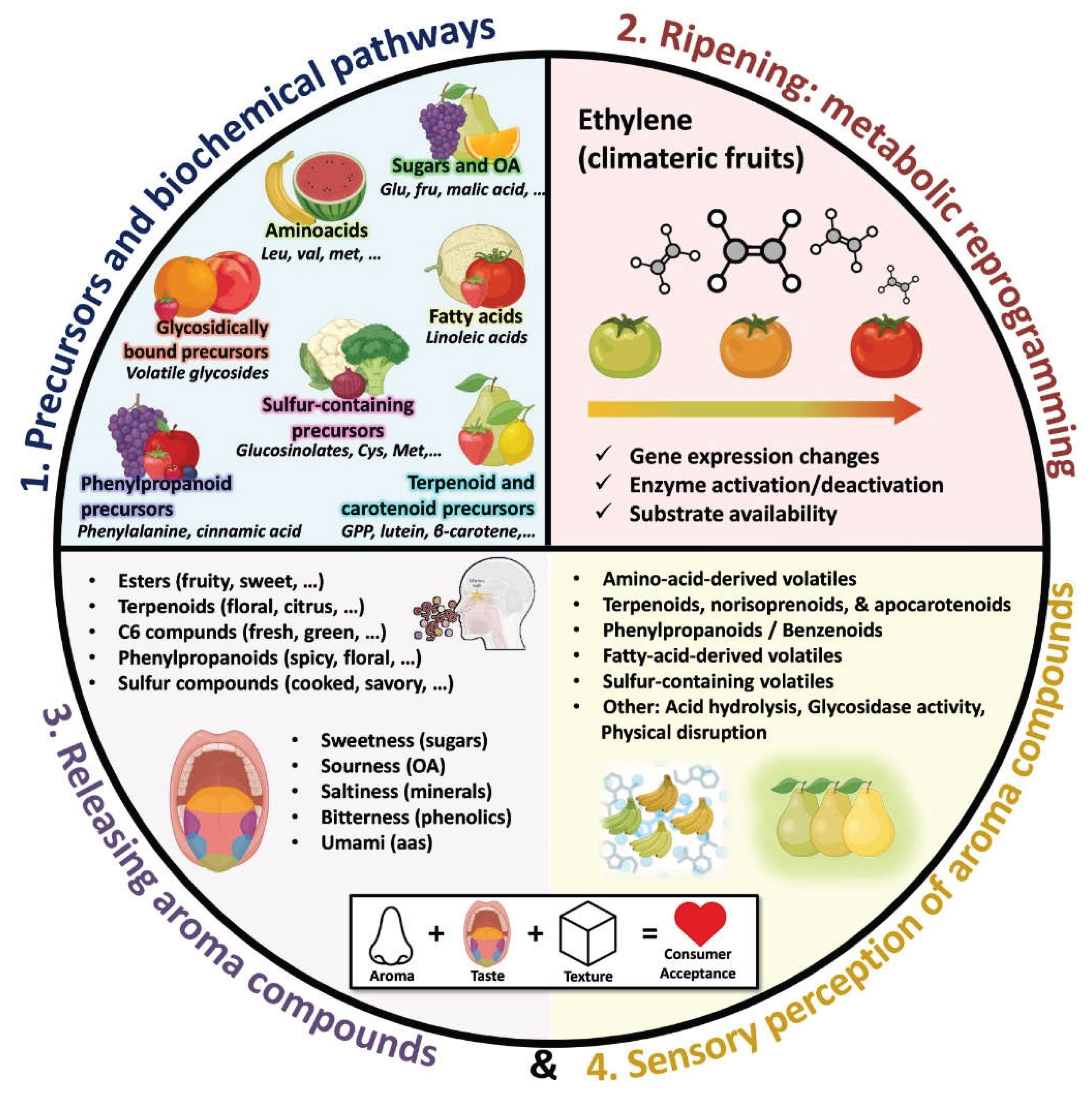
Figure 2.
Main routes of taste and aroma deterioration during the shelf life of packaged fresh fruits. Temperature stress, microbial deterioration, enzymatic deterioration, mechanical damage and packaging imbalance can independently or jointly alter the sensory quality of packaged fresh fruits. Temperature stress includes refrigerated storage, chilling injury, room-temperature exposure and cold-chain breaks, which may reduce ester biosynthesis, weaken aroma release, accelerate respiration and disturb the sugar/acid balance. Microbial deterioration, driven by yeasts, molds, bacteria, condensation and leaked juice, may generate fermented, sour, musty notes and microbial volatile organic compounds. Enzymatic deterioration involves lipoxygenase, polyphenol oxidase, peroxidase, cell wall enzymes and glycosidases, leading to C6 aldehydes and alcohols, browning, softening and aroma imbalance. Mechanical damage caused by bruising, cutting, compression, vibration or cell rupture promotes wound-related volatiles, juice leakage, increased respiration and microbial niches. Packaging imbalance, including low O2, high CO2, aroma scalping, excessive active-compound release and poor humidity control, may favor ethanol, acetaldehyde, ethyl acetate accumulation, masked aroma and loss of varietal identity. The final sensory outcomes include weak aroma, loss of varietal character, alcoholic, solvent-like, vinegar-like, grassy, musty, sulfury, stale or oxidized notes, and reduced consumer acceptance.
Figure 2.
Main routes of taste and aroma deterioration during the shelf life of packaged fresh fruits. Temperature stress, microbial deterioration, enzymatic deterioration, mechanical damage and packaging imbalance can independently or jointly alter the sensory quality of packaged fresh fruits. Temperature stress includes refrigerated storage, chilling injury, room-temperature exposure and cold-chain breaks, which may reduce ester biosynthesis, weaken aroma release, accelerate respiration and disturb the sugar/acid balance. Microbial deterioration, driven by yeasts, molds, bacteria, condensation and leaked juice, may generate fermented, sour, musty notes and microbial volatile organic compounds. Enzymatic deterioration involves lipoxygenase, polyphenol oxidase, peroxidase, cell wall enzymes and glycosidases, leading to C6 aldehydes and alcohols, browning, softening and aroma imbalance. Mechanical damage caused by bruising, cutting, compression, vibration or cell rupture promotes wound-related volatiles, juice leakage, increased respiration and microbial niches. Packaging imbalance, including low O2, high CO2, aroma scalping, excessive active-compound release and poor humidity control, may favor ethanol, acetaldehyde, ethyl acetate accumulation, masked aroma and loss of varietal identity. The final sensory outcomes include weak aroma, loss of varietal character, alcoholic, solvent-like, vinegar-like, grassy, musty, sulfury, stale or oxidized notes, and reduced consumer acceptance.
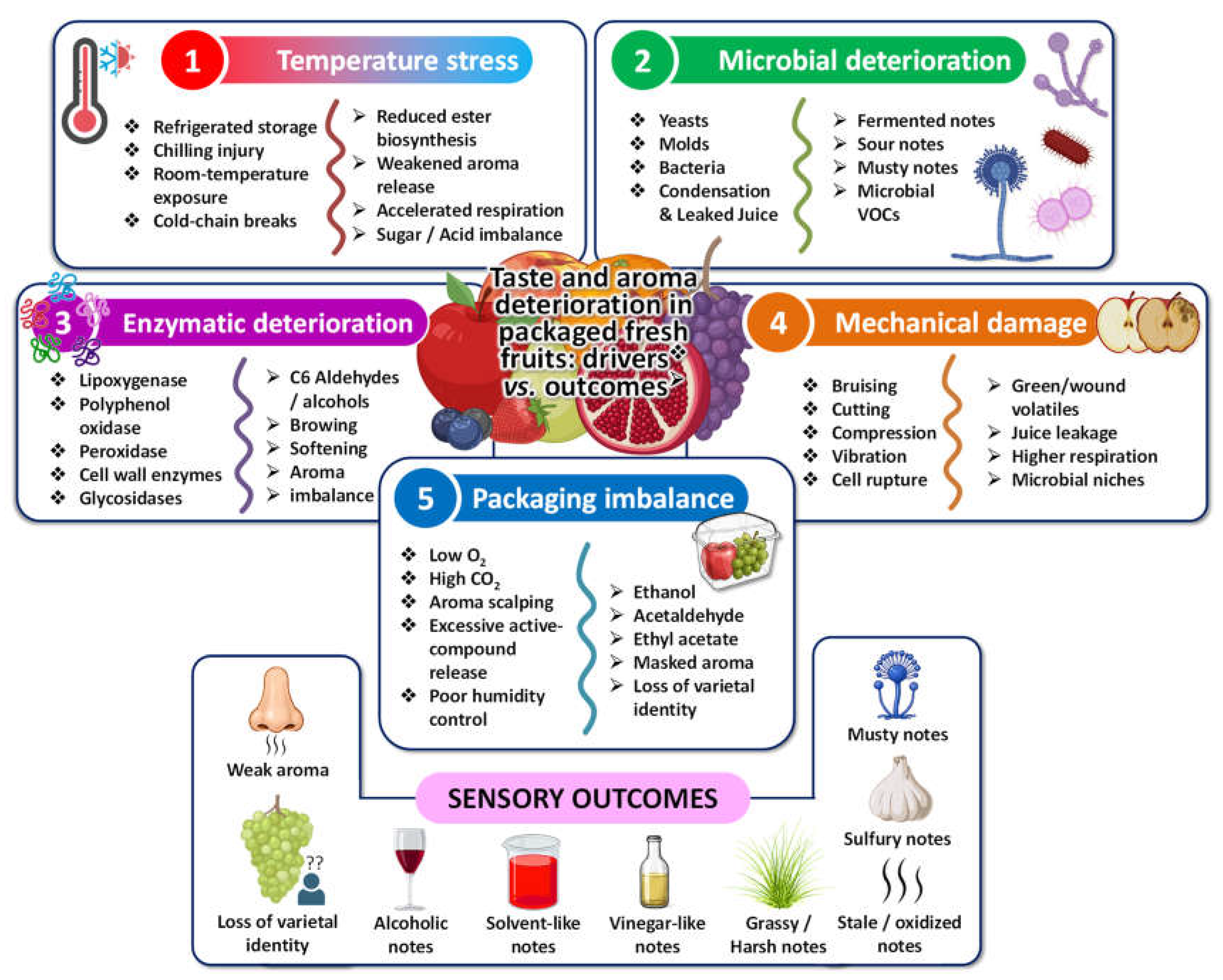
Figure 3.
Active-packaging systems for the preservation of taste and aroma in fresh fruits and their effect on the volatilome. Active-packaging functions (left) act on the packaged-fruit volatilome (center), whose response is conditioned by the packaging material along a continuum from breathable, hygroscopic paper and cardboard to high-barrier polymeric films and PLA. Depending on how each function is matched to the fruit physiology, the outcome (right) ranges from aroma preservation, through the aroma-positive case in which released volatiles restore or reinforce the native profile, to off-flavor risk. Across all release-based systems, performance is bound by the sensory compatibility threshold.
Figure 3.
Active-packaging systems for the preservation of taste and aroma in fresh fruits and their effect on the volatilome. Active-packaging functions (left) act on the packaged-fruit volatilome (center), whose response is conditioned by the packaging material along a continuum from breathable, hygroscopic paper and cardboard to high-barrier polymeric films and PLA. Depending on how each function is matched to the fruit physiology, the outcome (right) ranges from aroma preservation, through the aroma-positive case in which released volatiles restore or reinforce the native profile, to off-flavor risk. Across all release-based systems, performance is bound by the sensory compatibility threshold.
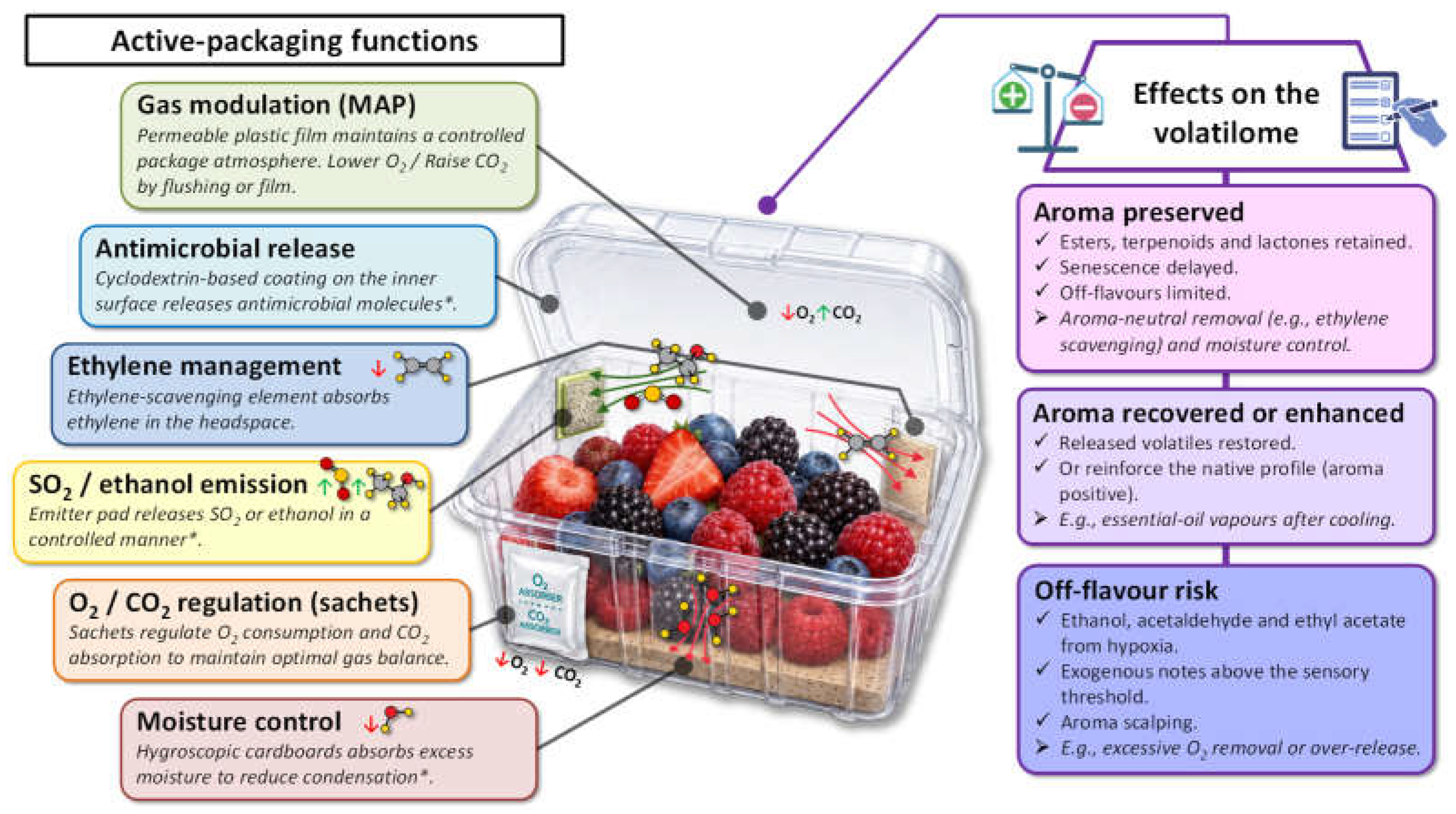
Disclaimer/Publisher’s Note: The statements, opinions and data contained in all publications are solely those of the individual author(s) and contributor(s) and not of MDPI and/or the editor(s). MDPI and/or the editor(s) disclaim responsibility for any injury to people or property resulting from any ideas, methods, instructions or products referred to in the content. |
© 2026 by the authors. Licensee MDPI, Basel, Switzerland. This article is an open access article distributed under the terms and conditions of the Creative Commons Attribution (CC BY) license (http://creativecommons.org/licenses/by/4.0/).
Copyright: This open access article is published under a Creative Commons CC BY 4.0 license, which permit the free download, distribution, and reuse, provided that the author and preprint are cited in any reuse.


