

Submitted:
04 August 2026
Posted:
05 August 2026
You are already at the latest version
Abstract
Background/Objectives: Total hip arthroplasty (THA) in older patients is commonly performed under general anesthesia (GA) or spinal anesthesia (SA). Although prior studies have emphasized postoperative outcomes, perioperative hemodynamic differences remain insufficiently characterized. This study compared intraoperative and early postanesthesia care unit (PACU) hemodynamic changes and in-hospital clinical outcomes between SA and GA in older patients undergoing elective THA. Methods: This single-center retrospective observational study included patients aged ≥65 years who underwent THA from 2020 to 2025. Exclusion criteria included below-normal left ventricular ejection fraction, moderate-to-severe valvular heart disease, atrial fibrillation, severe dementia, acute kidney injury, end-stage renal disease, wound infection, sepsis, or dexmedetomidine loading/high-dose maintenance exposure. The primary hemodynamic outcomes were the occurrences of SAP < 90 mmHg intraoperatively and in the PACU. Secondary outcomes included the difference between preanesthetic SAP and the lowest SAP recorded in the PACU (ΔSAP), PACU length of stay, vasopressor use, transfusion volume, hospital stay, and in-hospital complications. Results: SAP < 90 mmHg occurred more frequently with SA than GA intraoperatively (35.8% vs. 24.3%, p = 0.024) and in the PACU (39.3% vs. 24.9%, p = 0.005). SA was associated with lower estimated blood loss [400.0 (350.0–450.0) mL vs. 450.0 (400.0–500.0) mL, p < 0.001], greater phenylephrine and ephedrine requirements, longer PACU stay [30 (20–35) min vs. 25 (20–30) min, p < 0.001], and greater ΔSAP (46.98 ± 23.32 mmHg vs. 32.63 ± 23.12 mmHg, p < 0.001). Hospital stay, transfusion requirements, and 12-h visual analog scale scores did not differ significantly between groups, while major in-hospital complications were uncommon in both groups. Conclusions: In older patients undergoing elective THA, SA was associated with more frequent intraoperative and PACU hypotension than GA. These findings support closer blood pressure monitoring and timely hemodynamic intervention throughout surgery and early recovery.
Keywords:
total hip arthroplasty
; spinal anesthesia
; general anesthesia
; hypotension
; postanesthesia care unit
; perioperative hemodynamics
1. Introduction
Total hip arthroplasty (THA) is an established surgical treatment for advanced hip osteoarthritis and selected hip fractures [1]. In the United States, more than 200,000 patients undergo THA annually, and the reported incidence of major, potentially life-threatening complications within 30 days after surgery ranges from 0.2% to 1.2%[1]. THA is commonly performed under general anesthesia (GA) or spinal anesthesia (SA). Accordingly, the comparative effects of these anesthetic techniques on intraoperative management and postoperative outcomes have been extensively investigated [2,3].
SA may offer advantages over GA in patients undergoing THA by attenuating sympathetic activation and inflammatory responses and potentially reducing pulmonary complications associated with GA [4,5]. Nevertheless, other studies have not demonstrated clear superiority of SA over GA in hip surgery [6,7]. Thus, the optimal anesthetic technique for THA remains uncertain [8].
THA may involve total blood loss of approximately 500–1400 mL when hidden blood loss is included [9]. The associated reduction in circulating blood volume and preload during surgery and the early postoperative period may exacerbate hypotension in patients receiving SA. Previous studies of THA have primarily evaluated broad postoperative outcomes, whereas direct hemodynamic comparisons between GA and SA have received comparatively limited attention, including the incidence of systolic arterial pressure (SAP) <90 mmHg during surgery and immediate postoperative recovery and the corresponding need for vasopressors or intravenous fluids [4,5,6,7].
Hypotension, including SAP <90 mmHg, has been associated with increased risks of myocardial injury and acute kidney injury [10]. Such hypotension may therefore require prompt treatment with intravenous fluids and vasopressors. Moreover, postoperative blood pressure monitoring, including during the postanesthesia care unit (PACU) stay, is generally less continuous than intraoperative monitoring, raising the possibility that hypotension may persist undetected or untreated for longer periods [11,12].
Therefore, this study compared blood pressure changes during surgery and throughout the PACU stay between SA and GA in older patients undergoing elective THA, who may be particularly susceptible to hypotension. We also evaluated the clinical significance of these hemodynamic differences.
2. Materials and Methods
This single-center retrospective observational study compared intraoperative and early postoperative hemodynamic changes between general anesthesia (GA) and spinal anesthesia (SA) in patients aged ≥65 years undergoing elective total hip arthroplasty (THA). The study protocol was approved by the Institutional Review Board of Soonchunhyang University Cheonan Hospital (approval no. 2026-04-026; April 29, 2026).
Patients aged ≥65 years who underwent THA between 2020 and 2025 were screened. Exclusion criteria comprised conditions considered likely to substantially influence perioperative hypotension, including a left ventricular ejection fraction <50%, moderate-to-severe valvular heart disease, clinically significant arrhythmias, including atrial fibrillation, a preoperative diagnosis of severe dementia or inability to follow commands, acute kidney injury, end-stage renal disease, wound infection, or sepsis. Patients who received a dexmedetomidine loading dose or high-dose maintenance infusion (>0.3ug/kg/h) during anesthesia were also excluded (Figure 1).
For patients receiving GA, anesthesia was induced with propofol 1–2 mg/kg and maintained with sevoflurane at approximately 1 minimum alveolar concentration. At the end of anesthesia, neuromuscular blockade was reversed with sugammadex 2–4 mg/kg.
For patients receiving SA, spinal anesthesia was performed with the patient in the lateral position using a Quincke needle inserted at the L3–L4 or L4–L5 interspace. Hyperbaric bupivacaine 9–10 mg was administered intrathecally, and surgery was initiated after the sensory block reached approximately the T10 dermatome. Sedation was initiated with midazolam 2–3 mg, followed, when clinically indicated, by a dexmedetomidine infusion at a rate not exceeding 0.3 μg/kg/h. All patients underwent surgery in the lateral position.
Arterial blood pressure was continuously monitored via a radial arterial catheter and recorded in the electronic anesthesia record at 5-min intervals. Intraoperative hypotension was defined as at least one recorded SAP value <90 mmHg. The radial arterial catheter was maintained during PACU recovery, and arterial pressure was recorded at 5-min intervals until PACU discharge.
2.1. Statistical Analysis
Propensity score matching (PSM) was performed to reduce selection bias associated with the choice of anesthetic technique. Propensity scores were estimated using a logistic regression model that included the following covariates: age, sex, body mass index (BMI), American Society of Anesthesiologists (ASA) physical status classification as a three-level categorical variable(ASA I, II, and III), history of cardiovascular disease, chronic kidney disease defined as an estimated glomerular filtration rate <60 mL/min/1.73 m2, hypertension, diabetes mellitus, chronic pulmonary disease, history of stroke or transient ischemic attack, smoking history, preoperative hemoglobin concentration, preanesthetic systolic arterial pressure (SAP), and preanesthetic diastolic arterial pressure (DAP).
Patients were matched in a 1:1 ratio using nearest-neighbor matching without replacement on the logit of the propensity score, with a caliper width of 0.265 standard deviations of the logit of the propensity score. Adequate covariate balance was achieved after matching, with absolute standardized mean differences <0.1 for all covariates. The final matched cohort consisted of 173 patients in each group. Baseline characteristics before and after matching are presented in Table 1. Continuous variables are summarized as the mean ± standard deviation, and categorical variables as number and percentage.
Before matching, continuous variables were compared using Welch’s t test, and categorical variables were compared using the chi-square test or Fisher’s exact test, as appropriate. After matching, paired t tests were used for continuous variables, and McNemar’s exact test was used for binary variables to account for the matched-pair structure. Covariate balance was assessed using absolute SMDs rather than p values because SMDs quantify the magnitude of imbalance independently of sample size. Because clinical factors other than anesthetic technique that could substantially affect perioperative hemodynamics were excluded a priori and PSM yielded a relatively homogeneous cohort, no additional multivariable regression analysis was performed.
For the two primary binary hemodynamic outcomes, matched odds ratios (ORs) comparing SA with GA were calculated from discordant matched pairs. Exact 95% confidence intervals (CIs) were obtained from the discordant-pair distribution using the conditional binomial method, and corresponding p values were derived from two-sided exact McNemar tests. An OR greater than 1 indicated higher odds of hypotension in the SA group.
Intraoperative variables presented in Table 2 were compared within the 1:1 propensity score-matched cohort of 173 patients per group. Continuous variables with approximately symmetric distributions, including surgical duration, anesthesia duration, pleth variability index (PVI) at the end of surgery, and total intravenous fluid volume, were compared using paired t tests. Estimated blood loss and total phenylephrine and ephedrine doses were summarized as medians with interquartile ranges because of their skewed distributions and compared using the Wilcoxon signed-rank test. Phenylephrine use, ephedrine use, and the occurrence of intraoperative SAP <90 mmHg were compared using McNemar’s exact test. Intraoperative SAP <90 mmHg was defined as at least one SAP value <90 mmHg during surgery, based on the lowest value recorded for each patient.
For PACU and in-hospital clinical outcomes presented in Table 3, the difference between preanesthetic SAP and the lowest SAP recorded in the PACU (ΔSAP) and hospital length of stay were summarized as the mean ± standard deviation and compared using paired t tests. PACU length of stay, postoperative transfusion volume, visual analog scale (VAS) scores at 12 h after surgery, and fentanyl doses administered in the PACU were summarized as medians with interquartile ranges because of their skewed distributions or ordinal properties and compared using the Wilcoxon signed-rank test. The occurrence of SAP <90 mmHg in the PACU was compared using McNemar’s exact test.
Clinical outcomes were identified through review of the electronic medical records from the day of surgery until hospital discharge.
Intensive care unit admission, cardiovascular complications, acute kidney injury, cerebrovascular events, and in-hospital mortality were also evaluated. However, because few or no events occurred in either group, these outcomes were excluded from the main inferential analyses and reported descriptively. Because this was a retrospective observational study, no formal sample size or power calculation was performed. All eligible patients who met the predefined inclusion and exclusion criteria during the study period were included in the analysis. All statistical analyses were performed using IBM SPSS Statistics, version 29 (IBM Corp., Armonk, NY, USA). A two-sided p value <0.05 was considered statistically significant.
3. Results
Before matching, several baseline characteristics differed between the groups. After PSM, all absolute standardized mean differences (SMDs) were <0.1, indicating adequate covariate balance between the groups. Following matching, BMI, ASA physical status classification, preoperative hemoglobin concentration, preanesthetic SAP and DAP, and major comorbidities were comparable between the groups (Table 1).
Surgical duration, anesthesia duration, pleth variability index at the end of surgery, and total intravenous fluid volume were also comparable between the groups. However, intraoperative SAP <90 mmHg occurred significantly more frequently in the SA group than in the GA group (35.8% vs. 24.3%, p = 0.024). Estimated blood loss was lower in the SA group [400.0 (350.0–450.0) mL vs. 450.0 (400.0–500.0) mL, p < 0.001], whereas cumulative phenylephrine and ephedrine doses were significantly greater in the SA group (p < 0.001 and p = 0.001, respectively). Nevertheless, the proportions of patients who received phenylephrine (39.3% vs. 30.1%, p = 0.101) and ephedrine (50.3% vs. 43.9%, p = 0.260) did not differ significantly between the groups (Table 2).
As shown in Table 3, the SA group had a longer PACU stay than the GA group [30 (20–35) min vs. 25 (20–30) min, p < 0.001] and a greater decrease from preanesthetic SAP to the lowest SAP recorded in the PACU (ΔSAP) (46.98 ± 23.32 mmHg vs. 32.63 ± 23.12 mmHg, p < 0.001). SAP <90 mmHg also occurred significantly more frequently in the PACU in the SA group than in the GA group (39.3% vs. 24.9%, p = 0.005). In contrast, hospital length of stay, postoperative transfusion volume, and visual analog scale scores at 12 h after surgery did not differ significantly between the groups.
Effect estimates for the primary hemodynamic outcomes are summarized in Table 4. Compared with GA, SA was associated with higher odds of intraoperative SAP <90 mmHg (matched OR, 1.77; 95% CI, 1.07–2.98; p = 0.024) and PACU SAP <90 mmHg (matched OR, 2.00; 95% CI, 1.21–3.37; p = 0.005).
The cumulative fentanyl dose administered in the PACU was significantly lower in the SA group (p < 0.001) (Table 3).
Two patients in the GA group (1.2%) and three patients in the SA group (1.7%) required intensive care unit admission because of severe hypotension that did not respond adequately to initial treatment in the PACU. Myocardial injury was defined as a troponin concentration exceeding the institutional upper reference limit of 14 pg/mL, measured on the day of surgery or postoperative day 1. Myocardial injury occurred in four patients in the GA group (2.3%) and one patient in the SA group (0.6%). No cases of acute kidney injury, cerebrovascular events, or in-hospital death were identified in either group.
4. Discussion
In this study, we compared intraoperative and PACU hemodynamic changes and in-hospital clinical outcomes between SA and GA in patients aged ≥65 years undergoing THA. SA was associated with more frequent intraoperative SAP <90 mmHg and greater cumulative intraoperative vasopressor doses than GA. During PACU recovery, SA was also associated with more frequent SAP <90 mmHg and a longer length of stay. By contrast, major in-hospital complications were uncommon and were reported descriptively because of the small number of events. These findings suggest that patients aged ≥65 years receiving SA may require closer hemodynamic monitoring and more frequent intervention from the intraoperative period through early recovery, when the physiologic effects of spinal anesthesia may persist.
Some previous studies, in contrast to the present findings, have reported greater hemodynamic stability with SA than with GA during hip surgery [13,14,15]. One prospective study defined severe hypotension as mean arterial pressure (MAP) <65 mmHg sustained for >12 min [13]. In contrast, the present study defined hypotension using the lowest SAP recorded during each observation period. Differences in outcome definition may partly account for the discrepant findings. Moreover, patients in the present cohort received 9–10 mg of hyperbaric bupivacaine, whereas previous studies reporting less hypotension with SA than with GA in older patients undergoing hip surgery generally used doses ≤9 mg or hypobaric solutions [13,16,17,18]. Hyperbaric bupivacaine generally spreads more cephalad than hypobaric bupivacaine and may therefore produce a more extensive sympathetic block [19]. Thus, the higher frequency of hypotension in the SA group may partly reflect the dose and baricity of bupivacaine. Nevertheless, because 9–10 mg of hyperbaric bupivacaine has also been used in previous studies involving older patients, this regimen cannot be considered unusually high or nonstandard and does not, by itself, invalidate the comparison between GA and SA [20,21,22].
When hidden blood loss is included, total perioperative blood loss during THA has often been reported to exceed 1,000 mL [9]. This finding suggests that substantial reductions in circulating blood volume and preload may occur in addition to visible intraoperative bleeding and that occult blood loss may continue after surgery [9,23]. SA produces arteriolar dilation and venodilation through sympathetic blockade and may also cause bradycardia, thereby reducing systemic vascular resistance, venous return, and cardiac output [24,25,26]. In older patients, impaired baroreflex responsiveness and limited cardiovascular reserve may further accentuate the resulting decrease in arterial pressure [18,27]. Thus, among older patients undergoing THA under SA, perioperative volume depletion may have interacted with residual sympathetic blockade during early PACU recovery, contributing to persistent susceptibility to hypotension. Conversely, among patients receiving GA, sympathetic activation during emergence in response to pain, anxiety, airway stimulation, or shivering may have partially counteracted decreases in arterial pressure [28,29,30]. Collectively, the dose and baricity of the spinal anesthetic, perioperative changes in intravascular volume, and differences in autonomic responses may have contributed to the greater susceptibility to hypotension observed in the SA group. Although a previous study reported that SA was associated with better early postoperative mental status and lower rates of transfusion and intensive care unit admission than GA [31], the present cohort excluded patients with severe dementia who could not follow commands, clinically significant arrhythmias, or reduced left ventricular ejection fraction. Consequently, major in-hospital outcomes, including postoperative intensive care unit admission, myocardial injury, acute kidney injury, cerebrovascular events, and in-hospital death were uncommon, and the study had limited statistical power to detect clinically meaningful between-group differences in these outcomes. Estimated blood loss was significantly lower in the SA group than in the GA group. However, because clinically significant hemorrhage-related hypotension generally occurs after a loss of approximately 30%–40% of total blood volume [32], the between-group difference of approximately 50 mL was unlikely to account for the observed difference in hypotension. Postoperative packed red blood cell transfusion volume through hospital discharge also did not differ significantly between the groups, indicating similar overall transfusion requirements after PACU discharge. Nevertheless, transfusion decisions were based not only on hemoglobin concentration but also on estimated surgical blood loss, the patient’s clinical condition on the ward, and the treating physician’s judgment. Therefore, transfusion volume should not be interpreted as a direct surrogate for total blood loss.
4.1. Limitations
Because of the retrospective observational design, residual confounding from unmeasured variables cannot be excluded. Several additional limitations should also be acknowledged. First, previous studies have reported that mean arterial pressure (MAP) of 60–70 mmHg or systolic arterial pressure (SAP) 90–100 mmHg is associated with adverse outcomes, including acute kidney injury, myocardial injury, and myocardial infarction [33]. To apply a consistent operational definition of hypotension, SAP <90 mmHg rather than MAP was selected as the primary hemodynamic endpoint because this threshold commonly prompts clinical assessment and treatment, including vasopressor administration, intravenous fluid therapy or blood transfusion when clinically indicated. Second, dexmedetomidine, which was used for intraoperative sedation in the SA group, may cause hypotension [34]. However, patients who received a dexmedetomidine loading dose were excluded. Sedation was initiated with midazolam, and dexmedetomidine was used only when clinically indicated, at a maintenance infusion rate ≤0.3 μg/kg/h without a loading dose. Furthermore, the infusion was routinely discontinued approximately 10 min before the end of surgery. Previous studies have reported that low-dose dexmedetomidine maintenance infusion without a loading dose during spinal anesthesia does not significantly increase the occurrence of hypotension or bradycardia [35,36]. Therefore, although dexmedetomidine may have contributed to hemodynamic variability in some patients, it was unlikely to be the principal explanation for the observed between-group differences. Third, unlike previous studies that evaluated the duration or cumulative burden of hypotension [37,38], the present study evaluated its occurrence rather than its duration. Because hypotensive episodes were treated promptly after detection as part of routine clinical practice, retrospective quantification of their duration was not feasible. In addition, PACU vasopressor administration was not recorded separately. Consequently, the analysis could not fully characterize the duration of hypotension or the intensity of hemodynamic treatment during PACU recovery. Nevertheless, SAP <90 mmHg is a commonly used threshold for clinically significant hypotension [39,40], and its significantly higher frequency in the SA group remains clinically relevant.
5. Conclusion
Among patients aged ≥65 years undergoing total hip arthroplasty, spinal anesthesia was associated with more frequent hypotension than general anesthesia during both the intraoperative period and PACU recovery. This association may reflect the combined effects of neuraxial sympathetic blockade, attenuated perioperative stress responses, and relative hypovolemia related to perioperative blood loss. These findings suggest that patients receiving spinal anesthesia may remain susceptible to hypotension throughout surgery and early PACU recovery. Accordingly, patients receiving spinal anesthesia may benefit from vigilant blood pressure monitoring and timely hemodynamic treatment throughout surgery and early PACU recovery.
Author Contributions
Conceptualization, J.Y.J. and Y.H.S.; methodology, J.Y.J., Y.H.S., and J.S.P.; formal analysis, J.Y.J. and J.S.P.; validation, Y.H.S., H.Y.G., and W.J.K.; investigation, J.Y.J., D.H.K., Y.E.S., J.H.M., and S.H.K.; resources, W.J.K.; data curation, J.Y.J., D.H.K., Y.E.S., J.H.M., H.S.J., and S.H.K.; writing—original draft preparation, J.Y.J.; writing—review and editing, J.Y.J., Y.H.S., J.S.P., and W.J.K.; visualization, J.Y.J. and Y.E.S.; supervision, Y.H.S.; project administration, J.Y.J.; funding acquisition, J.Y.J. All authors have read and agreed to the published version of the manuscript.
Funding
This work was supported by the Soonchunhyang University Research Fund (No. 2026-0044).
Institutional Review Board Statement
The study was conducted in accordance with the Declaration of Helsinki and approved by the Institutional Review Board of Soonchunhyang University Cheonan Hospital (protocol code 2026-04-026; approval date: April 29, 2026).
Informed Consent Statement
The requirement for informed consent was waived by the Institutional Review Board because of the retrospective nature of this study.
Data Availability Statement
The data supporting the findings of this study are available from the corresponding author upon reasonable request. The data are not publicly available because of patient privacy and institutional restrictions.
Conflicts of Interest
The authors declare no conflict of interest.
Abbreviations
The following abbreviations are used in this manuscript:
| ASA | American Society of Anesthesiologists |
| BMI | Body mass index |
| CI | Confidence interval |
| CKD | Chronic kidney disease |
| DAP | Diastolic arterial pressure |
| EBL | Estimated blood loss |
| eGFR | Estimated glomerular filtration rate |
| GA | General anesthesia |
| Hb | Hemoglobin |
| IV | Intravenous |
| LOS | Length of stay |
| MAP | Mean arterial pressure |
| OR | Odds ratio |
| PACU | Postanesthesia care unit |
| PS | Propensity score |
| PSM | Propensity score matching |
| PVI | Pleth variability index |
| RBC | Red blood cell |
| SA | Spinal anesthesia |
| SAP | Systolic arterial pressure |
| SD | Standard deviation |
| SMD | Standardized mean difference |
| SPSS | Statistical Package for the Social Sciences |
| THA | Total hip arthroplasty |
| VAS | Visual analog scale |
| ΔSAP | Difference between preanesthetic SAP and the lowest SAP recorded in the PACU |
References
- Helwani, M.A.; Avidan, M.S.; Ben Abdallah, A.; Kaiser, D.J.; Clohisy, J.C.; Hall, B.L.; et al. Effects of regional versus general anesthesia on outcomes after total hip arthroplasty: a retrospective propensity-matched cohort study. J. Bone Jt. Surg. Am. 2015, 97(3), 186–93. [Google Scholar] [CrossRef] [PubMed]
- Telang, S.; Heckmann, N.D.; Olsen, A.; De, A.; Stambough, J.B. Spinal Anesthesia in Total Hip Arthroplasty is Associated With Improved Outcomes in the American Joint Replacement Registry Population. Arthroplast Today 2024, 30, 101566. [Google Scholar] [CrossRef] [PubMed]
- Basques, B.A.; Toy, J.O.; Bohl, D.D.; Golinvaux, N.S.; Grauer, J.N. General compared with spinal anesthesia for total hip arthroplasty. J. Bone Jt. Surg. Am. 2015, 97(6), 455–61. [Google Scholar] [CrossRef] [PubMed]
- Kettner, S.C.; Willschke, H.; Marhofer, P. Does regional anaesthesia really improve outcome? Br. J. Anaesth. 2011, 107 Suppl 1, i90–5. [Google Scholar] [CrossRef] [PubMed]
- Banz, V.M.; Jakob, S.M.; Inderbitzin, D. Review article: improving outcome after major surgery: pathophysiological considerations. Anesth. Analg. 2011, 112(5), 1147–55. [Google Scholar] [CrossRef] [PubMed]
- Neuman, M.D.; Feng, R.; Carson, J.L.; Gaskins, L.J.; Dillane, D.; Sessler, D.I.; et al. Spinal Anesthesia or General Anesthesia for Hip Surgery in Older Adults. N Engl. J. Med. 2021, 385(22), 2025–35. [Google Scholar] [CrossRef] [PubMed]
- Li, T.; Li, J.; Yuan, L.; Wu, J.; Jiang, C.; Daniels, J.; et al. Effect of Regional vs General Anesthesia on Incidence of Postoperative Delirium in Older Patients Undergoing Hip Fracture Surgery: The RAGA Randomized Trial. Jama 2022, 327(1), 50–8. [Google Scholar] [CrossRef] [PubMed]
- Greimel, F.; Maderbacher, G.; Zeman, F.; Grifka, J.; Meissner, W.; Benditz, A. No Clinical Difference Comparing General, Regional, and Combination Anesthesia in Hip Arthroplasty: A Multicenter Cohort-Study Regarding Perioperative Pain Management and Patient Satisfaction. J. Arthroplast. 2017, 32(11), 3429–33. [Google Scholar] [CrossRef] [PubMed]
- Foss, N.B.; Kehlet, H. Hidden blood loss after surgery for hip fracture. J. Bone Jt. Surg. Br. 2006, 88(8), 1053–9. [Google Scholar] [CrossRef]
- Ahuja, S.; Mascha, E.J.; Yang, D.; Maheshwari, K.; Cohen, B.; Khanna, A.K.; et al. Associations of Intraoperative Radial Arterial Systolic, Diastolic, Mean, and Pulse Pressures with Myocardial and Acute Kidney Injury after Noncardiac Surgery: A Retrospective Cohort Analysis. Anesthesiology 2020, 132(2), 291–306. [Google Scholar] [CrossRef] [PubMed]
- Devereaux, P.J.; Sessler, D.I.; Leslie, K.; Kurz, A.; Mrkobrada, M.; Alonso-Coello, P.; et al. Clonidine in patients undergoing noncardiac surgery. N Engl. J. Med. 2014, 370(16), 1504–13. [Google Scholar] [CrossRef] [PubMed]
- Flick, M.; Lohr, A.; Weidemann, F.; Naebian, A.; Hoppe, P.; Thomsen, K.K.; et al. Post-anesthesia care unit hypotension in low-risk patients recovering from non-cardiac surgery: a prospective observational study. J. Clin. Monit. Comput. 2024, 38(6), 1331–6. [Google Scholar] [CrossRef] [PubMed]
- Simonin, M.; Delsuc, C.; Meuret, P.; Caruso, L.; Deleat-Besson, R.; Lamblin, A.; et al. Hypobaric Unilateral Spinal Anesthesia Versus General Anesthesia for Hip Fracture Surgery in the Elderly: A Randomized Controlled Trial. Anesth. Analg. 2022, 135(6), 1262–70. [Google Scholar] [CrossRef] [PubMed]
- Meuret, P.; Bouvet, L.; Villet, B.; Hafez, M.; Allaouchiche, B.; Boselli, E. Hypobaric Unilateral Spinal Anaesthesia versus General Anaesthesia in Elderly Patients Undergoing Hip Fracture Surgical Repair: A Prospective Randomised Open Trial. Turk. J. Anaesthesiol. Reanim. 2018, 46(2), 121–30. [Google Scholar] [CrossRef] [PubMed]
- Casati, A.; Aldegheri, G.; Vinciguerra, E.; Marsan, A.; Fraschini, G.; Torri, G. Randomized comparison between sevoflurane anaesthesia and unilateral spinal anaesthesia in elderly patients undergoing orthopaedic surgery. Eur. J. Anaesthesiol. 2003, 20(8), 640–6. [Google Scholar] [CrossRef]
- Messina, A.; La Via, L.; Milani, A.; Savi, M.; Calabrò, L.; Sanfilippo, F.; et al. Spinal anesthesia and hypotensive events in hip fracture surgical repair in elderly patients: a meta-analysis. J. Anesth. Analg. Crit. Care 2022, 2(1), 19. [Google Scholar] [CrossRef] [PubMed]
- Olofsson, C.; Nygårds, E.B.; Bjersten, A.B.; Hessling, A. Low-dose bupivacaine with sufentanil prevents hypotension after spinal anesthesia for hip repair in elderly patients. Acta Anaesthesiol. Scand. 2004, 48(10), 1240–4. [Google Scholar] [CrossRef] [PubMed]
- Hofhuizen, C.; Lemson, J.; Snoeck, M.; Scheffer, G.J. Spinal anesthesia-induced hypotension is caused by a decrease in stroke volume in elderly patients. Local Reg. Anesth. 2019, 12, 19–26. [Google Scholar] [CrossRef] [PubMed]
- Flesher, E.; Ghysels, E.; Hadzic, A.; Cops, J.; Gielen, J.; Van Herreweghe, I.; et al. Baricity of spinal bupivacaine and the incidence of hypotension in non-obstetric surgery: A systematic review. Eur. J. Anaesthesiol. Intensive Care 2025, 4(1), e0064. [Google Scholar]
- Ben-David, B.; Frankel, R.; Arzumonov, T.; Marchevsky, Y.; Volpin, G. Minidose bupivacaine-fentanyl spinal anesthesia for surgical repair of hip fracture in the aged. Anesthesiology 2000, 92(1), 6–10. [Google Scholar] [CrossRef] [PubMed]
- Favarel-Garrigues, J.F.; Sztark, F.; Petitjean, M.E.; Thicoïpé, M.; Lassié, P.; Dabadie, P. Hemodynamic effects of spinal anesthesia in the elderly: single dose versus titration through a catheter. Anesth. Analg. 1996, 82(2), 312–6. [Google Scholar] [PubMed]
- Agarwal, D.; Chopra, M.; Mohta, M.; Sethi, A.K. Clonidine as an adjuvant to hyperbaric bupivacaine for spinal anesthesia in elderly patients undergoing lower limb orthopedic surgeries. Saudi J. Anaesth. 2014, 8(2), 209–14. [Google Scholar] [CrossRef] [PubMed]
- Zeng, J.W.; Chen, X.; Yang, L.M.; Liu, C.J.; Cao, F. Hidden blood loss and its risk factors after hip hemiarthroplasty for hip fracture in the elderly. Jt. Dis. Relat. Surg. 2026, 37(1), 35–41. [Google Scholar] [CrossRef] [PubMed]
- Arndt, J.O. The low pressure system: the integrated function of veins. Eur. J. Anaesthesiol. 1986, 3(5), 343–70. [Google Scholar] [PubMed]
- Ferré, F.; Martin, C.; Bosch, L.; Kurrek, M.; Lairez, O.; Minville, V. Control of Spinal Anesthesia-Induced Hypotension in Adults. Local Reg. Anesth. 2020, 13, 39–46. [Google Scholar] [CrossRef] [PubMed]
- Butterworth, JFt; Piccione, W., Jr.; Berrizbeitia, L.D.; Dance, G.; Shemin, R.J.; Cohn, L.H. Augmentation of venous return by adrenergic agonists during spinal anesthesia. Anesth. Analg. 1986, 65(6), 612–6. [Google Scholar] [CrossRef]
- Lairez, O.; Ferré, F.; Portet, N.; Marty, P.; Delmas, C.; Cognet, T.; et al. Cardiovascular effects of low-dose spinal anaesthesia as a function of age: An observational study using echocardiography. Anaesth. Crit. Care Pain Med. 2015, 34(5), 271–6. [Google Scholar] [CrossRef] [PubMed]
- Haas, C.E.; LeBlanc, J.M. Acute postoperative hypertension: a review of therapeutic options. Am. J. Health Syst. Pharm. 2004, 61(16), 1661–73; quiz 74–5. [Google Scholar] [CrossRef]
- Ledowski, T.; Reimer, M.; Chavez, V.; Kapoor, V.; Wenk, M. Effects of acute postoperative pain on catecholamine plasma levels, hemodynamic parameters, and cardiac autonomic control. Pain 2012, 153(4), 759–64. [Google Scholar] [CrossRef] [PubMed]
- Cusack, B.; Buggy, D.J. Anaesthesia, analgesia, and the surgical stress response. BJA Educ. 2020, 20(9), 321–8. [Google Scholar] [CrossRef] [PubMed]
- Owen, A.R.; Amundson, A.W.; Fruth, K.M.; Duncan, C.M.; Smith, H.M.; Johnson, R.L.; et al. Spinal Compared with General Anesthesia in Contemporary Primary Total Hip Arthroplasties. J. Bone Jt. Surg. Am. 2022, 104(17), 1542–7. [Google Scholar] [CrossRef] [PubMed]
- Bonanno, F.G. Hemorrhagic shock: The “physiology approach”. J. Emerg. Trauma Shock. 2012, 5(4), 285–95. [Google Scholar] [CrossRef] [PubMed]
- McEvoy, M.D.; Gupta, R.; Koepke, E.J.; Feldheiser, A.; Michard, F.; Levett, D.; et al. Perioperative Quality Initiative consensus statement on postoperative blood pressure, risk and outcomes for elective surgery. Br. J. Anaesth. 2019, 122(5), 575–86. [Google Scholar] [CrossRef] [PubMed]
- Baek, S.; Lee, J.; Shin, Y.S.; Jo, Y.; Park, J.; Shin, M.; et al. Perioperative Hypotension in Patients Undergoing Orthopedic Upper Extremity Surgery with Dexmedetomidine Sedation: A Retrospective Study. J. Pers. Med. 2023, 13(12). [Google Scholar] [CrossRef] [PubMed]
- Ok, H.G.; Baek, S.H.; Baik, S.W.; Kim, H.K.; Shin, S.W.; Kim, K.H. Optimal dose of dexmedetomidine for sedation during spinal anesthesia. Korean J. Anesthesiol. 2013, 64(5), 426–31. [Google Scholar] [CrossRef] [PubMed]
- Sangkum, L.; Termpornlert, S.; Tunprasit, C.; Rathanasutthajohn, C.; Komonhirun, R.; Dusitkasem, S. Effect of low-dose dexmedetomidine to prolong spinal anesthesia in elderly patients: a prospective randomized controlled study. BMC Anesthesiol. 2024, 24(1), 427. [Google Scholar] [CrossRef] [PubMed]
- Xu, X.; Hu, X.; Wu, Y.; Li, Y.; Zhang, Y.; Zhang, M.; et al. Effects of different BP management strategies on postoperative delirium in elderly patients undergoing hip replacement: A single center randomized controlled trial. J. Clin. Anesth. 2020, 62, 109730. [Google Scholar] [CrossRef] [PubMed]
- Zhao, X.; Dong, S.; Zhu, L.; Wu, W. Association between continuous low-dose norepinephrine infusion and intraoperative hypotension burden in patients aged 80 years and older undergoing total hip arthroplasty: a retrospective cohort study. Front Med. 2026, 13, 1791081. [Google Scholar] [CrossRef] [PubMed]
- Douglas, N.; Gilbert, S.; Ong, J.; Kave, B.; Leslie, K.; Darvall, J.N. Treatment of and outcomes from hypotension in the post-anaesthesia care unit: A single-centre retrospective cohort study. Anaesth. Intensive Care 2025, 53(4), 231–7. [Google Scholar] [CrossRef] [PubMed]
- Yang, S.S.; Gelinas, C.; Yim, E.; Li, M.M.J.; Kardash, K.; Zhang, M.; et al. Association of intraoperative dexmedetomidine use with postoperative hypotension in unilateral hip and knee arthroplasties: a historical cohort study. Can. J. Anaesth. 2022, 69(12), 1459–70. [Google Scholar] [CrossRef] [PubMed]
Figure 1.
Flow diagram of patient selection and formation of the propensity score-matched cohort. Total hip arthroplasty (THA); general anesthesia (GA); spinal anesthesia (SA); propensity score matching (PSM); micrograms per kilogram per hour (µg/kg/h).
Figure 1.
Flow diagram of patient selection and formation of the propensity score-matched cohort. Total hip arthroplasty (THA); general anesthesia (GA); spinal anesthesia (SA); propensity score matching (PSM); micrograms per kilogram per hour (µg/kg/h).
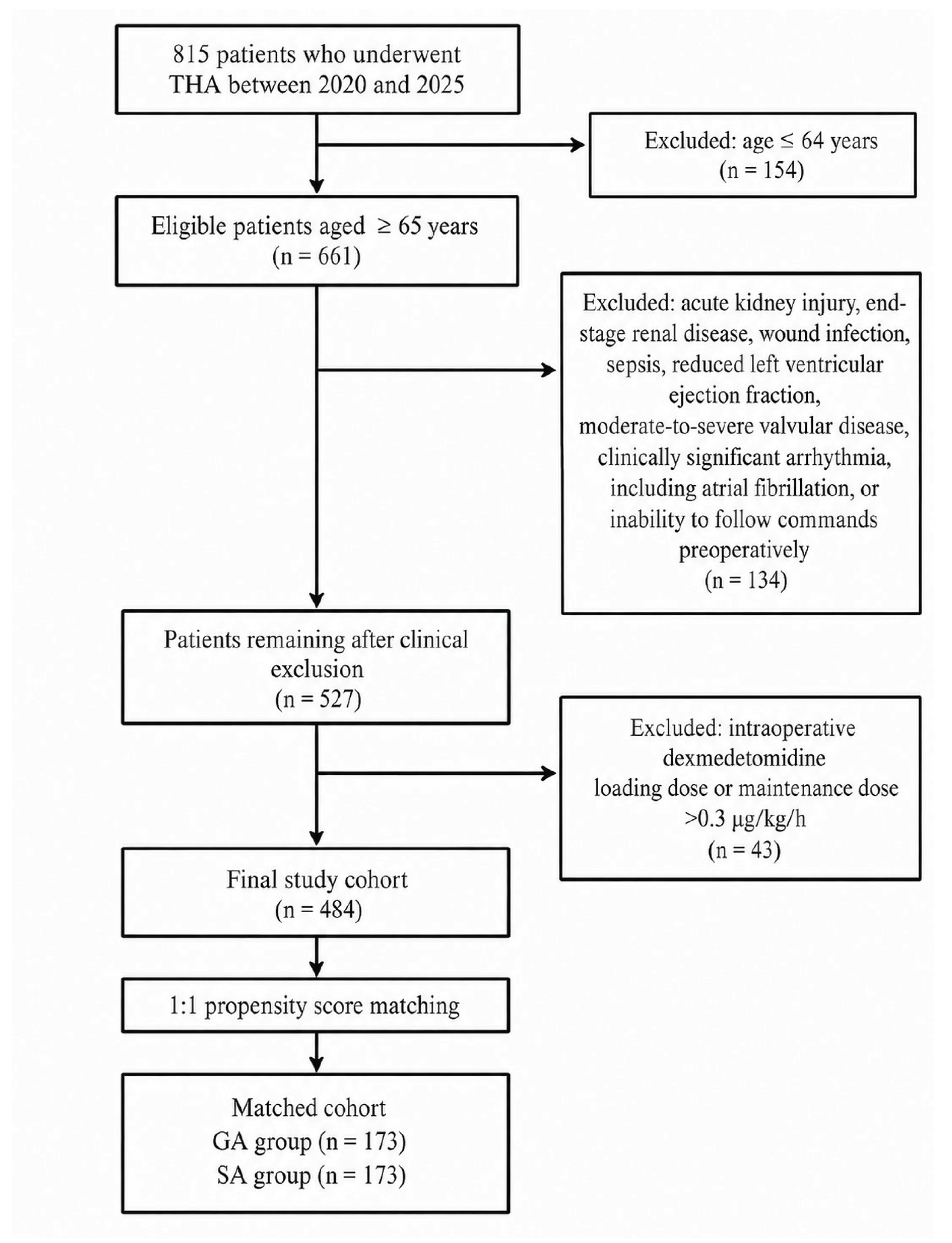

Table 1.
Baseline characteristics before and after propensity-score matching.
| Variable | Before PSM | After PSM | ||||||
| GA (n=289) | SA (n=195) | P | SMD | GA (n=173) | SA (n=173) | P | SMD | |
| Age, years | 75.50 ± 7.07 | 75.98 ± 6.85 | 0.453 | 0.069 | 76.03 ± 6.96 | 75.98 ± 6.84 | 0.939 | 0.008 |
| BMI, kg/m2 | 23.75 ± 3.10 | 24.11 ± 3.01 | 0.196 | 0.120 | 24.15 ± 3.39 | 23.90 ± 2.90 | 0.430 | 0.080 |
| ASA physical status, n (%) | 0.177 | 0.173 | 0.756 | 0.081 | ||||
| I | 11 (3.8%) | 4 (2.1%) | 5 (2.9%) | 4 (2.3%) | ||||
| II | 219 (75.8%) | 139 (71.3%) | 125 (72.3%) | 131 (75.7%) | ||||
| III | 59 (20.4%) | 52 (26.7%) | 43 (24.9%) | 38 (22.1%) | ||||
| Preoperative Hb, g/dL | 11.83 ± 1.24 | 11.95 ± 1.30 | 0.316 | 0.093 | 11.97 ± 1.29 | 11.85 ± 1.23 | 0.378 | 0.096 |
| Preanesthetic SAP, mmHg | 157.99 ± 17.19 | 157.43 ± 13.85 | 0.691 | 0.036 | 156.79 ± 17.23 | 157.50 ± 13.76 | 0.669 | 0.046 |
| Preanesthetic DAP, mmHg | 82.39 ± 10.09 | 81.64 ± 9.59 | 0.404 | 0.077 | 81.60 ± 9.96 | 82.03 ± 9.84 | 0.686 | 0.044 |
| Male sex | 86 (29.8%) | 73 (37.4%) | 0.078 | 0.163 | 63 (36.4%) | 56 (32.4%) | 0.470 | 0.085 |
| History of cardiovascular disease | 36 (12.5%) | 22 (11.3%) | 0.696 | 0.036 | 19 (11.0%) | 19 (11.0%) | 1.000 | 0.000 |
| CKD (eGFR < 60 mL/min/1.73 m2) | 27 (9.3%) | 28 (14.4%) | 0.088 | 0.155 | 25 (14.5%) | 20 (11.6%) | 0.511 | 0.086 |
| Hypertension | 216 (74.7%) | 138 (70.8%) | 0.334 | 0.089 | 118 (68.2%) | 125 (72.3%) | 0.435 | 0.088 |
| Diabetes mellitus | 99 (34.3%) | 69 (35.4%) | 0.798 | 0.024 | 58 (33.5%) | 60 (34.7%) | 0.908 | 0.024 |
| Chronic pulmonary disease | 87 (30.1%) | 67 (34.4%) | 0.324 | 0.091 | 55 (31.8%) | 58 (33.5%) | 0.810 | 0.037 |
| Stroke or transient ischemic attack | 33 (11.4%) | 30 (15.4%) | 0.203 | 0.116 | 24 (13.9%) | 25 (14.5%) | 1.000 | 0.017 |
| Smoking | 24 (8.3%) | 12 (6.2%) | 0.376 | 0.083 | 11 (6.4%) | 12 (6.9%) | 1.000 | 0.023 |
Continuous variables are presented as mean ± standard deviation, and categorical variables as number (%). P values for ASA physical status represent the overall comparison of the ASA I-III distribution between groups. Before propensity score matching, between-group comparisons were performed using Welch’s t-test for continuous variables and the chi-square test or Fisher’s exact test for categorical variables, as appropriate. After propensity score matching, paired t-tests were used for continuous variables, and McNemar’s exact test was used for binary categorical variables. General anesthesia (GA); spinal anesthesia (SA); body mass index (BMI); American Society of Anesthesiologists physical status classification (ASA); hemoglobin (Hb); systolic arterial pressure (SAP); diastolic arterial pressure (DAP); chronic kidney disease (CKD); estimated glomerular filtration rate (eGFR); standardized mean difference (SMD); propensity score matching (PSM).
Table 2.
Intraoperative variables.
| Variable | GA (n=173) | SA (n=173) | P value |
| Duration of surgery, min | 75.79 ± 11.45 | 76.10 ± 15.14 | 0.839 |
| Duration of anesthesia, min | 115.98 ± 16.70 | 116.44 ± 17.84 | 0.801 |
| PVI at end of surgery, % | 10.00 ± 3.17 | 9.74 ± 2.00 | 0.369 |
| Total IV fluid volume, mL | 717.05 ± 202.70 | 737.40 ± 225.32 | 0.411 |
| Intraoperative SAP <90 mmHg, n (%) | 42 (24.3%) | 62 (35.8%) | 0.024* |
| Estimated blood loss, mL | 450.0 (400.0–500.0) | 400.0 (350.0–450.0) | <0.001* |
| Phenylephrine use, n (%) | 52 (30.1%) | 68 (39.3%) | 0.101 |
| Phenylephrine total dose, µg | 0.0 (0.0–100.0) | 0.0 (0.0–200.0) | <0.001* |
| Ephedrine use, n (%) | 76 (43.9%) | 87 (50.3%) | 0.260 |
| Ephedrine total dose, mg | 0.0 (0.0–5.0) | 4.0 (0.0–12.0) | 0.001* |
Continuous variables are presented as mean ± standard deviation or median (interquartile range), as appropriate. Continuous variables with approximately symmetric distributions were compared using paired t-tests, whereas variables with skewed distributions were compared using the Wilcoxon signed-rank test. Categorical variables were compared using McNemar’s exact test. Intraoperative SAP <90 mmHg was defined according to the lowest SAP recorded for each patient during surgery. * p < 0.05. General anesthesia (GA); intravenous (IV); spinal anesthesia (SA); pleth variability index (PVI); systolic arterial pressure (SAP).
Table 3.
PACU and in-hospital clinical outcomes.
| Variable | GA (n=173) | SA (n=173) | P value |
| PACU length of stay, min | 25 (20–30) | 30 (20–35) | <0.001* |
| Difference between preanesthetic SAP and the lowest PACU SAP, mmHg (ΔSAP) | 32.63 ± 23.12 | 46.98 ± 23.32 | <0.001* |
| PACU SAP <90 mmHg, n (%) | 43 (24.9%) | 68 (39.3%) | 0.005* |
| Hospital length of stay, days | 19.39 ± 5.66 | 18.36 ± 5.57 | 0.101 |
| Postoperative transfusion (packed RBC units) | 1 (0–1) | 1 (0–1) | 0.287 |
| Pain VAS score at 12 h (0–10) | 5 (5–5) | 5 (4–5) | 0.075 |
| Cumulative fentanyl dose in the PACU (µg) | 25 (25–50) | 0 (0–0) | <0.001* |
Continuous variables are presented as mean ± standard deviation or median (interquartile range), as appropriate. Continuous variables with approximately symmetric distributions were compared using paired t-tests, whereas variables with skewed distributions were compared using the Wilcoxon signed-rank test. Categorical variables were compared using McNemar’s exact test. * p < 0.05. General anesthesia (GA); spinal anesthesia (SA); postanesthesia care unit (PACU); systolic arterial pressure (SAP); length of stay (LOS); red blood cell (RBC); visual analog scale (VAS).
Table 4.
Matched effect estimates for the primary hemodynamic outcomes.
| Outcome | GA (n=173) | SA (n=173) | Matched OR (95% CI) | P value |
| Intraoperative SAP <90 mmHg | 42 (24.3%) | 62 (35.8%) | 1.77 (1.07–2.98) | 0.024* |
| PACU SAP <90 mmHg | 43 (24.9%) | 68 (39.3%) | 2.00 (1.21–3.37) | 0.005* |
Values are presented as number (%). Matched odds ratios compare SA with GA and were estimated from discordant matched pairs. Exact 95% CIs were calculated using the conditional binomial method. P values were obtained using the two-sided exact McNemar test. An OR greater than 1 indicates higher odds in the SA group. * p < 0.05. General anesthesia (GA); spinal anesthesia (SA); postanesthesia care unit (PACU); systolic arterial pressure (SAP); odds ratio (OR); confidence interval (CI).
Disclaimer/Publisher’s Note: The statements, opinions and data contained in all publications are solely those of the individual author(s) and contributor(s) and not of MDPI and/or the editor(s). MDPI and/or the editor(s) disclaim responsibility for any injury to people or property resulting from any ideas, methods, instructions or products referred to in the content. |
© 2026 by the authors. Licensee MDPI, Basel, Switzerland. This article is an open access article distributed under the terms and conditions of the Creative Commons Attribution (CC BY) license (http://creativecommons.org/licenses/by/4.0/).
Copyright: This open access article is published under a Creative Commons CC BY 4.0 license, which permit the free download, distribution, and reuse, provided that the author and preprint are cited in any reuse.


