
Submitted:
03 August 2026
Posted:
05 August 2026
You are already at the latest version
Abstract
Concrete is the most widely used construction material in civil engineering, and its long-term performance and durability are directly related to structural safety and service life. To investigate the effects of early curing temperature and relative humidity on concrete performance, this study set different curing temperature conditions (20℃, 30℃, 40℃, 50℃, and 60℃) and relative humidity conditions (55%, 65%, 75%, 85%, and 95%). Compressive strength and impermeability tests were conducted on concrete specimens cured for 7 days, and comparative analysis was carried out using specimens of different ages under standard curing conditions. The results show that, under 55% RH, the compressive strength first increases and then slightly decreases with increasing temperature, with the most significant growth occurring between 40℃ and 50℃, followed by a decline at 60℃. The penetration height first decreases and then increases, indicating that moderate temperature elevation is beneficial to the development of concrete performance, whereas excessively high temperature may lead to performance deterioration. Under 20℃, with the increase in relative humidity, the compressive strength of concrete continuously increases and the penetration height decreases significantly, indicating that higher humidity is conducive to strength development and improvement of impermeability. Compared with 7-day curing, concrete under 28-day standard curing conditions exhibits higher strength and better impermeability, suggesting that prolonged curing age contributes to the continuous development of concrete performance. The research results can provide a reference for concrete curing control and durability improvement under complex environmental conditions.
Keywords:
concrete
; curing temperature
; relative humidity
; compressive strength
; impermeability
1. Introduction
Concrete is currently the most widely used construction material, and its early curing conditions have an important influence on its later service performance (Byard et al. 2012). In practical engineering, concrete structures are often exposed to complex and variable environments, in which temperature and humidity affect the development of early-age properties and further influence the mechanical properties and durability of concrete (Du et al. 2020). Existing studies have mainly focused on the variation of concrete performance under standard curing conditions or under the action of a single factor, while research on concrete performance under non-standard temperature and humidity conditions remains relatively insufficient (Wang and Zhu 2010). In particular, the influence mechanisms of curing temperature and relative humidity on compressive strength and impermeability still need to be further clarified. Therefore, this study established curing conditions with different humidity levels at the same temperature and different temperatures at the same humidity. After 7 days of curing, the compressive strength and penetration height of concrete were tested, aiming to analyze the variation patterns of concrete compressive strength and impermeability under different curing temperature and relative humidity conditions, and to provide a reference for concrete curing control and durability improvement in complex environments.
Early overseas studies mainly focused on the influence of a single environmental factor on concrete performance. Mehta and Monteiro pointed out in their classic work that curing conditions affect the hydration process of cement and further influence the development of concrete properties (Kim et al. 2021). The experiments conducted by Tazawa and Miyazawa showed that, within the range of 20–40°C, an increase in temperature can promote the growth of early-age strength of concrete (Al-Gburi et al. 2025). However, when the temperature exceeds 50°C, the strength may decrease due to accelerated moisture loss or increased adverse internal effects (Li et al. 2026). Neville emphasized the important role of humidity: when the relative humidity is below 50%, premature moisture loss inhibits the hydration process (Shen and Xu 2019), resulting in a decline in concrete performance; under high-humidity conditions (>90% RH), sufficient moisture is beneficial to the improvement of concrete performance (Aparicio et al. 2016), especially in terms of impermeability. Subsequent studies have generally supported these views, suggesting that 40–50°C is a favorable temperature range for early strength development (Wang et al. 2025), while a high-humidity environment has a positive effect on improving concrete durability.
Domestic scholars have further studied the influence of curing temperature and humidity on concrete performance in combination with practical engineering conditions(Wang et al. 2023). By comparing standard curing with natural exposure conditions, Lu Han et al. found that high-temperature and dry environments easily lead to the deterioration of the mechanical properties and durability of concrete (Lin et al. 2026). Relevant studies generally believe that curing temperature and relative humidity are important environmental factors affecting the development of concrete performance. Existing tests have shown that increasing the curing temperature within a certain range is beneficial to the growth of early-age strength of concrete; however, excessively high curing temperature may have an adverse effect on later strength development. In terms of humidity, with the increase in curing relative humidity, the penetration height of concrete generally shows a decreasing trend, and specimens under standard curing conditions usually exhibit better impermeability, indicating that a high-humidity environment is conducive to improving the compactness and durability of concrete.
In summary, existing studies have relatively clearly revealed the influence patterns of temperature and humidity on concrete performance, respectively. However, systematic research on the variation characteristics of compressive strength and impermeability of concrete under different curing temperature and relative humidity conditions remains insufficient. Therefore, further analysis through multiple groups of controlled experiments is still necessary.
2. Experimental Content and Methods
2.1. Test Specimens
The concrete prepared in this test had a strength grade of C20. The cementitious materials used were ordinary Portland cement with a strength grade of P.O 42.5 and fly ash with an average particle size of 10–30 μm. The aggregates were crushed stone with a particle size range of 3.75–25 mm and sand with a particle size range of 0.075–4.75 mm, both obtained from a quarry in Huaxi District, Guiyang City, Guizhou Province. The mix proportion is shown in Table 1. The specimens included standard cubic specimens (150 mm × 150 mm × 150 mm) and standard truncated cone specimens (175 mm × 185 mm × 150 mm).
2.2. Experimental Procedures
2.2.1. Specimen Preparation and Curing
According to the mix proportion, all materials were placed into a concrete mixer and mixed to form fresh concrete. The fresh concrete was then poured into molds and cured at room temperature for molding. After demolding, the specimens were placed in preset constant-temperature and constant-humidity chambers for 7 days of curing.
To simulate realistic complex environmental conditions, five different temperature levels and five different relative humidity levels were set. The curing temperatures were 20°C, 30°C, 40°C, 50°C, and 60°C, while the relative humidity levels were 55%, 65%, 75%, 85%, and 95%. In addition, a control group under standard curing conditions was established, with a temperature of 20°C and a relative humidity of 95% for 28 days, in order to compare the influence of curing age on concrete performance. The specific curing conditions of the specimens are shown in Table 2, Table 3, Table 4, Table 5, Table 6, Table 7 and Table 8.
2.2.2. Compressive Strength Test
Standard cubic specimens (150 mm × 150 mm × 150 mm) were used, with three specimens per group. The specimens were placed on the compression testing machine in three separate placements (as shown in Figure 1), and the compressive strength test was carried out in accordance with theStandard for Test Methods of Concrete Physical and Mechanical Properties(Hughes and Bahramian 2015).
Force-controlled loading mode was adopted, with the loading rate set at 0.5 MPa/s ± 10%. The compressive strength of each group of specimens was obtained from the test. For each group of three specimens, the compressive strength was calculated to the nearest 0.1 MPa. If the difference between the maximum or minimum value and the median value was ≤ 15% of the median value, the arithmetic mean was taken as the result. If the difference exceeded 15%, a Grubbs' test (significance level α = 0.05) was performed in accordance with Appendix C of the 《Standard for Test Methods of Concrete Physical and Mechanical Properties》. After removing any outliers, supplementary tests were conducted. The damage patterns of the concrete specimens obtained after the test are shown in Figure 2.
2.2.3. Impermeability Test
Standard truncated cone specimens (top diameter 175 mm, bottom diameter 185 mm, height 150 mm) were used. After the concrete specimens were taken out of the curing chamber, each specimen was fitted with a sealing rubber ring to ensure good sealing performance. Using a concrete specimen mounting and demoulding machine, the specimens were installed into the impermeability moulds and then mounted on the concrete permeameter. The concrete specimen mounting and demoulding machine is shown in Figure 3a, and the concrete permeameter is shown in Figure 3b.
Before using the concrete permeameter, the water inlet valve should be opened to expel air from the system, after which the specimens are installed. The lower pressure limit is set to 0.1 MPa and the upper limit to 0.9 MPa. The total impermeability test duration is 8 hours, during which the process is manually monitored throughout. If water seepage reaching the top of a specimen occurs during this period, a supplementary test shall be conducted. After the impermeability test, the specimens are taken out, demoulded, and then split using the compression testing machine under force-controlled loading mode at a loading rate of 0.05 MPa/s ± 10%. After splitting, the water penetration height is measured using a steel ruler. For each specimen, 10 penetration height values are taken, and the average penetration height is used as the indicator to characterize impermeability—the lower the penetration height, the better the impermeability. The morphology of the specimens after splitting is shown in Figure 4.
3. Results and Analysis
3.1. Effect of Temperature on Compressive Strength and Impermeability
3.1.1. Evolution of Compressive Strength
To investigate the effect of temperature on the compressive strength of C20 concrete, compressive strength tests were conducted on three concrete specimens after 7 days of curing under a constant humidity of 55%. The results are shown in Figure 5 and Table 2. The analysis reveals that all specimens exhibited an increasing trend in strength from 20°C to 50°C. However, from 50°C to 60°C, the rate of strength increase diminished, and strength 2 even began to decline, while the increase rate of strength 1 also significantly dropped (Minho et al. 2017; Sciumè et al. 2024). It is evident that 50°C represents the optimal temperature. This indicates that a higher temperature is not necessarily better. In the range of 20°C to 50°C, elevated temperature significantly accelerates the hydration reaction rate of cement and promotes the formation of hydration products, thereby rapidly enhancing the early-age strength of concrete (LF et al. 2017; Lou and Ma 2022). However, excessively high temperature can cause strength retrogression, suggesting that an overly high curing temperature may adversely affect the development of the concrete microstructure. This is also corroborated by the 7-day average compressive strength.
3.1.2. Evolution of Impermeability
To investigate the effect of temperature on the impermeability of C20 concrete, the impermeability indices of 15 specimens were tested and statistically analyzed under a constant humidity of 55%. The results are shown in Figure 6 and Table 3. Under the constant humidity of 55%, the impermeability of C20 concrete showed a trend of first increasing and then decreasing with changes in curing temperature, exhibiting an overall "V"-shaped characteristic with 40°C as the turning point (Shi et al. 2021). As shown in Figure 6, as the temperature increased from 20°C to 40°C, the average penetration height of specimens 1–3 gradually decreased, indicating that a moderate increase in curing temperature is beneficial for improving the impermeability of concrete. This is mainly because, within a certain temperature range, elevated temperature can promote the development of concrete properties. When the temperature further increased from 40°C to 60 °C, the penetration height increased significantly and exceeded the value measured at 20°C, indicating that the impermeability deteriorated instead. This result is largely consistent with the phenomenon of compressive strength reduction at 60°C, suggesting that excessively high curing temperatures have an adverse effect on the performance of C20 concrete.
3.1.3. Temperature Sensitivity Analysis
To analyze the effect of curing temperature on concrete performance, a temperature sensitivity coefficient is introduced under a relative humidity of 55%:
where: is the temperature sensitivity coefficient; ΔY is the change in the performance index; ΔT is the change in temperature. When Y is taken as the compressive strength , represents the sensitivity of strength to temperature; when Y is taken as the average penetration height h, represents the sensitivity of impermeability to temperature.
Under a relative humidity of 55%, the 7-day compressive strength of the concrete generally increased first and then slightly decreased with rising temperature. At 20, 30, 40, 50, and 60°C, the 7-day compressive strengths were 11.2, 12.3, 13.5, 15.2, and 15.1 MPa, respectively. Calculated for adjacent intervals, the temperature sensitivity coefficients are as follows:
It can be seen that within the range of 20–50°C, the temperature sensitivity coefficients are all positive, indicating that an increase in curing temperature is generally beneficial to the development of the early-age strength of C20 concrete. Among these, the temperature sensitivity coefficient in the 40–50°C interval is the largest, suggesting that temperature variation within this range has the most pronounced promoting effect on early-age strength gain. When the curing temperature rises to 60°C, the temperature sensitivity coefficient turns negative, indicating that excessively high temperatures have begun to exert an adverse effect on concrete strength development. The reason is that within a certain range, raising the temperature can accelerate the cement hydration process, thereby promoting the early-age strength growth of concrete (Link et al. 2020; Gholizadeh-Vayghan et al. 2024); however, when the temperature is too high, it may lead to deterioration of the curing conditions, thereby weakening subsequent strength development, ultimately manifesting as a strength reduction.
In terms of impermeability, the average penetration height exhibits a V-shaped pattern with temperature variation. As the temperature increases from 20°C to 40°C, the average penetration height decreases from 11.091 cm to 8.347 cm; when the temperature further rises to 60°C, the average penetration height increases to 12.210 cm. The corresponding temperature sensitivity coefficients are as follows:
Since a smaller penetration height indicates better impermeability of concrete, the temperature sensitivity coefficient is negative in the 20–40°C interval, indicating that a moderate increase in curing temperature is beneficial to the enhancement of impermeability. In the 40–60°C interval, the temperature sensitivity coefficient turns positive, showing that as the temperature continues to rise, the impermeability of concrete deteriorates instead. This demonstrates that the effect of temperature on the impermeability of concrete exhibits distinct stage characteristics: a moderate temperature rise can improve impermeability, whereas excessively high temperatures produce an adverse effect.
Based on the analysis of the test results, temperature influences the development of concrete performance mainly by affecting the hardening process and moisture conditions (Bai et al. 2019; Li 2021). Within a favorable temperature range, increasing the curing temperature helps promote the formation of concrete properties, resulting in certain improvements in both impermeability and mechanical performance. However, when the curing temperature is too high, the conditions for performance development may deteriorate, thereby weakening the later-age properties of concrete and ultimately manifesting as a decline in impermeability.
Therefore, within the scope of this test, the effect of temperature on concrete performance is not monotonic; rather, there exists a relatively optimal curing temperature range. In engineering applications, the curing temperature should be reasonably controlled according to actual environmental conditions, avoiding excessively high temperatures or large fluctuations, so as to ensure the stable development of concrete strength and durability.
3.2. Effect of Humidity on Compressive Strength and Impermeability
3.2.1. Evolution of Compressive Strength
To investigate the effect of humidity on the compressive strength of C20 concrete, compressive tests were conducted on three specimens under a constant temperature of 20°C. The results are shown in Figure 7 and Table 4. The experimental results clearly show that as the relative humidity increased from 55% to 95%, the 7-day compressive strength of the concrete generally exhibited a monotonically increasing trend. This pattern clearly indicates that an adequate water supply is the fundamental prerequisite for ensuring sufficient cement hydration and achieving strength development (Wang et al. 2024). In a low-humidity environment (e.g., 55% RH), premature moisture loss severely inhibits the hydration reaction, leading to insufficient strength development (Qin et al. 2025).
3.2.2. Evolution of Impermeability Performance
To evaluate the influence of humidity on the impermeability performance of C20 concrete, impermeability tests were performed on three specimens at a constant temperature of 20°C. The results are shown in Figure 8 and summarized in Table 5. The results demonstrate that humidity significantly affected the impermeability performance of C20 concrete. As shown in Figure 8, at 20°C, the penetration height decreased markedly as the curing humidity increased from 55% to 95%, indicating an improvement in concrete impermeability with increasing humidity (Wang et al. 2019). These findings suggest that high-humidity curing conditions promote the development of concrete properties and effectively enhance impermeability. By contrast, specimens cured under low-humidity conditions exhibited greater penetration heights, corresponding to relatively poor impermeability performance (Sun et al. 2026).
3.2.3. Humidity Sensitivity Analysis
To analyze the effect of curing humidity on concrete performance, a humidity sensitivity coefficient is introduced under a constant temperature of 20°C:
Where: is the humidity sensitivity coefficient; is the change in the performance index; is the change in relative humidity. When Y is taken as the compressive strength , represents the sensitivity of strength to humidity; when Y is taken as the average penetration height h, represents the sensitivity of impermeability to humidity.
At 20°C, with relative humidities of 55%, 65%, 75%, 85%, and 95%, the 7-day compressive strengths of the concrete were 10.2, 12.1, 12.8, 13.7, and 14.0 MPa, respectively. Calculated for adjacent intervals, the humidity sensitivity coefficients are as follows:
The results indicate that, within the scope of this test, the humidity sensitivity coefficient remains consistently positive, suggesting that increasing relative humidity can continuously promote the early-age strength development of C20 concrete. Among the intervals, the humidity sensitivity coefficient in the 55%–65% range is the largest, indicating that the early-age strength of concrete is most sensitive to humidity changes under relatively low-humidity conditions. As the relative humidity increases further, the sensitivity coefficient gradually decreases, suggesting that the promoting effect of humidity on strength gain exhibits a certain diminishing marginal characteristic. Comprehensive analysis reveals that higher-humidity curing conditions are more favorable for the formation and development of concrete properties, thereby promoting the improvement of early-age strength, whereas under low-humidity conditions, concrete strength development is constrained to some extent.
In terms of impermeability, at 20°C, the average penetration height decreased from 11.091 cm at 55% relative humidity to 6.861 cm at 95% relative humidity. The overall humidity sensitivity coefficient is as follows:
Since a smaller penetration height indicates better impermeability, this result demonstrates that increasing curing humidity can significantly improve the impermeability of concrete. The main reason is that higher humidity conditions are conducive to the sustained development of concrete properties, making its internal structure denser, thereby reducing water penetration channels and lowering the penetration height. In contrast, under low-humidity conditions, the development of concrete properties is restricted and the internal structure is relatively weaker, leading to a decline in impermeability.
Further analysis reveals that humidity conditions directly affect the moisture retention during the hardening process of concrete and the subsequent formation of properties. Under higher ambient humidity, moisture loss from the interior of concrete is slower, which is beneficial for the stable development of its properties, thereby simultaneously improving both strength and impermeability. Conversely, in a low-humidity environment, moisture is more easily lost, resulting in insufficient overall property development of concrete, ultimately manifesting as lower compressive strength and greater penetration height.
In summary, humidity exerts a significant influence on concrete performance. Higher-humidity curing not only benefits early-age strength formation but also contributes to the enhancement of impermeability. Therefore, in practical engineering, attention should be paid to moist curing to ensure the coordinated development of the mechanical properties and durability of concrete.
3.3. Effect of Curing Age on Compressive Strength and Impermeability
3.3.1. Comparison of Performance Between 7-Day Non-Standard Curing and 28-Day Standard Curing
By comparing the compressive strength and penetration height of concrete under 7-day curing conditions in each group with those under standard curing (20°C, relative humidity ≥ 95%, curing age 28 days), a clear conclusion can be drawn: standard curing offers significant advantages in enhancing concrete strength, compactness, and impermeability, and its effect is difficult to substitute through short-term or non-ideal environmental curing (Z et al. 2019; Dai et al. 2021). The experimental data are shown in Table 6, Table 7 and Table 8.
The experimental data show that even when cured for 7 days at 20°C and 95% relative humidity—the conditions closest to standard curing—the average compressive strength of the concrete was only 14.0 MPa, which is significantly lower than the average compressive strength of 20.4 MPa achieved under standard curing for 28 days. Meanwhile, the average penetration height under these 7-day conditions was 6.861 cm, still higher than the 5.588 cm obtained after 28 days of standard curing. Under other temperature and humidity combinations, the penetration heights were even greater, with some specimens exceeding 11 cm. This indicates that after only 7 days of curing, even with optimized temperature and humidity conditions, the strength and impermeability of concrete still cannot reach the level attained after 28 days of standard curing.
The reason is that under 7-day curing conditions, the properties of concrete are still in a continuous development stage, and the internal microstructure has not yet been fully perfected (Gong et al. 2022; Hong et al. 2023). Consequently, both the compressive capacity and impermeability are limited to some extent. In contrast, standard curing conditions not only provide a more suitable temperature and humidity environment but also ensure a sufficient curing age, which is more conducive to the stable development of concrete properties, ultimately resulting in higher strength and better impermeability.
Therefore, in practical engineering, early-age curing conditions should be reasonably controlled according to the structural type, service environment, and performance requirements. For structures with high impermeability and durability requirements, such as basements, water tanks, and bridge piers, particular attention should be paid to early thermal and moisture curing to avoid performance degradation caused by insufficient curing time or unfavorable environmental conditions (Krząkała et al. 2023). Especially under non-standard curing conditions, necessary measures should be taken to ensure the normal development of concrete strength and impermeability, so as to reduce durability risks such as later-age leakage and steel reinforcement corrosion, and to enhance the safety and service life of the structure.
3.3.2. Curing Age Sensitivity Analysis
To analyze the effect of curing age on concrete performance, specimens cured at 20°C and 95% relative humidity for 7 days were compared with those subjected to standard curing for 28 days. The results show that with the extension of curing age, the compressive strength of the concrete increased and the average penetration height decreased, indicating that both compressive performance and impermeability were improved.
To describe the effect of age, a curing age sensitivity coefficient is introduced:
where: is the curing age sensitivity coefficient; is the change in the performance index; is the change in curing time.
In terms of compressive strength, the concrete compressive strength was 14.0 MPa at 7 days and increased to 20.4 MPa at 28 days. Therefore, the curing age sensitivity coefficient for compressive strength is:
This indicates that during the period from 7 to 28 days, the compressive strength increased by approximately 0.305 MPa per day of curing age on average.
In terms of impermeability, the average penetration height was 6.861 cm at 7 days and decreased to 5.588 cm at 28 days. Therefore, the curing age sensitivity coefficient for penetration height is:
Since a smaller penetration height indicates better impermeability, this result demonstrates that the longer the curing age, the better the impermeability of concrete.
Overall, curing age has a significant effect on concrete performance. Compared with 7-day curing, concrete under 28-day standard curing exhibits higher compressive strength and a smaller penetration height, indicating that extending curing time is beneficial for the continuous development of concrete properties and can further improve its internal structure and impermeability. Therefore, in practical engineering, a sufficient curing age should be ensured to enhance the mechanical properties and durability of concrete.
4. Conclusions
(1) Under a relative humidity of 55%, when the curing temperature increased from 20°C to 60°C, the 7-day compressive strength of the concrete increased from 11.2 MPa to 15.2 MPa and then slightly decreased to 15.1 MPa; the average penetration height decreased from 11.091 cm to 8.347 cm and then rose to 12.210 cm. This indicates that a moderate temperature rise is beneficial to strength development and impermeability improvement, whereas excessively high temperatures lead to performance deterioration. Sensitivity analysis shows that the compressive strength is most sensitive in the 40–50°C interval, with a sensitivity coefficient of 0.17 MPa/°C; in the 50–60°C interval, the sensitivity coefficient is –0.01 MPa/°C, indicating that high temperatures have already begun to exert an adverse effect on strength development.
(2) At 20°C, when the relative humidity increased from 55% to 95%, the 7-day compressive strength of the concrete increased from 10.2 MPa to 14.0 MPa, and the average penetration height decreased from 11.091 cm to 6.861 cm. This demonstrates that a high-humidity environment facilitates continuous cement hydration and the densification of the internal structure. Sensitivity analysis reveals that the compressive strength is most sensitive to humidity in the 55%–65% interval, with a sensitivity coefficient of 0.19 MPa/%; thereafter, the sensitivity gradually diminishes, although increasing humidity consistently promotes the impermeability.
(3)At 20°C and 95% relative humidity, when the curing age was extended from 7 days to 28 days, the compressive strength increased from 14.0 MPa to 20.4 MPa, and the average penetration height decreased from 6.861 cm to 5.588 cm. The corresponding curing age sensitivity coefficient for compressive strength is 0.305 MPa/d, and that for average penetration height is –0.061 cm/d. This indicates that extending the curing age can effectively promote later-age hydration reactions, thereby improving strength and impermeability.
(4) Appropriate temperature and high humidity can promote the formation of hydration products, and a longer curing age facilitates further densification of the internal structure, resulting in higher compressive strength and lower penetration height. In engineering practice, attention should be paid to the control of the curing environment to ensure the coordinated development of the mechanical properties and durability of concrete.
References
- Byard, B. E.; Schindler, A. K.; Barnes, R. W. Early-age cracking tendency and ultimate degree of hydration of internally cured concrete. J. Mater. Civ. Eng. 2012, 24(8), 1025–1033. [Google Scholar] [CrossRef]
- Du, X.; Li, Z.; Han, J.; et al. Effect of different humidity-controlling modes on microstructure and compressive behavior of ordinary concrete. J. Mater. Civ. Eng. 2020, 32(1), 04019337. [Google Scholar] [CrossRef]
- Wang, Y.; Zhu, J. Multiscale modeling and simulation of concrete free deformation under the influence of environmental temperature and humidity. J. Mater. Civ. Eng. 2010, 37(9), 16. [Google Scholar] [CrossRef]
- Kim, S.; Lee, N.; Lee, H.K.; et al. Experimental and theoretical studies of hydration of ultra-high performance concrete cured under various curing conditions. Constr. Build. Mater. 2021, 278(7), 122352. [Google Scholar] [CrossRef]
- Al-Gburi, M.; Abed, J.; Almssad, A.; et al. The effect of real curing temperatures on early age concrete strength development in massive concrete structures. Eur. J. Environ. Civ. Eng. 2025, 29(9), 1832–1847. [Google Scholar] [CrossRef]
- Li, J.; Yuan, G.; Li, Q. Effect of elevated temperature on the deformation behaviors of early-age concrete. Buildings 2026, 16, 2102. [Google Scholar] [CrossRef]
- Shen, J.; Xu, Q. Effect of moisture content and porosity on compressive strength of concrete during drying at 105 °C. Constr. Build. Mater. 2019, 195, 19–27. [Google Scholar] [CrossRef]
- Aparicio, S.; Martínez-Ramírez, S.; Molero-Armenta, M.; et al. The effect of curing relative humidity on the microstructure of self-compacting concrete. Constr. Build. Mater. 2016, 104, 154–159. [Google Scholar] [CrossRef]
- Wang, Y.; Xue, S.; Li, X.; et al. Effect of curing temperatures on the early-age tensile creep behavior of high-performance concrete. Case Stud. Constr. Mater. 2025, 22, e04729. [Google Scholar] [CrossRef]
- Wang, Y.; Zhu, J.; Sun, Y. Multi-scale modeling and simulation of bidirectional coupled moisture and heat transfer in concrete. J. Build. Eng. 2023, 74, 106856. [Google Scholar] [CrossRef]
- Lin, H.; Jiang, Y.; Li, S.; et al. In situ study on high-temperature performance and structural deterioration mechanism of concrete. Processes 2026, 14(11), 1753. [Google Scholar] [CrossRef]
- Hughes, B. P.; Bahramian, B. Cube tests and the uniaxial compressive strength of concrete. Mag. Concr. Res. 2015, 17(53), 177–182. [Google Scholar] [CrossRef]
- Minho, Y.; Gyuyong, K.; Youngsun, K.; et al. Creep behavior of high-strength concrete subjected to elevated temperatures. Materials 2017, 10(7), 781. [Google Scholar] [CrossRef] [PubMed]
- Sciumè, G.; Moreira, M. H.; Pont, S. D. Thermo-hygro-chemical model of concrete: from curing to high temperature behavior. Mater. Struct. 2024, 8, 57. [Google Scholar] [CrossRef]
- Lou, B.; Ma, F. Crack extension resistance of steam-cured concrete under different curing temperature conditions. Theor. Appl. Fract. Mech. 2022, 119, 103331. [Google Scholar] [CrossRef]
- LF, B.; ZZ, B.; YY, B.; et al. Effect of elevated curing temperature on ceramsite concrete performance. Constr. Build. Mater. 2017, 153, 423–429. [Google Scholar] [CrossRef]
- Shi, J.; Liu, B.; Zhou, F.; et al. Effect of steam curing regimes on temperature and humidity gradient, permeability and microstructure of concrete. Constr. Build. Mater. 2021, 281(8), 122562. [Google Scholar] [CrossRef]
- Link, J.; Sowoidnich, T.; Pfitzner, C.; et al. The influences of cement hydration and temperature on the thixotropy of cement paste. Materials 2020, 13(8), 1853. [Google Scholar] [CrossRef] [PubMed]
- Gholizadeh-Vayghan, A.; Hernandez, G. M.; Kingne, F. K.; et al. Thermal reactivation of hydrated cement paste: Properties and impact on cement hydration. Materials 2024, 17(11), 2659. [Google Scholar] [CrossRef] [PubMed]
- Bai, Y.; Wang, Y.; Xi, Y. Modeling the effect of temperature gradient on moisture and ionic transport in concrete. Cem. Concr. Compos. 2019, 106(1), 103454. [Google Scholar] [CrossRef]
- Li, K. Influence of temperature on the moisture transport in concrete. Crystals 2021, 11(1), 8. [Google Scholar] [CrossRef]
- Wang, Y.; Li, H.; Ma, C.; et al. Effect of surface curing condition on the humidity field and moisture transfer in concrete. Constr. Build. Mater. 2024, 411, 134701. [Google Scholar] [CrossRef]
- Qin, J.; Gong, L.; Jin, C.; et al. Capillary tension shrinkage mechanism of high-strength concrete based on critical pore radius under low relative humidity curing conditions. Structures 2025, 80, 109968. [Google Scholar] [CrossRef]
- Wang, X.; Yu, R.; Song, Q.; et al. Optimized design of ultra-high performance concrete (UHPC) with a high wet packing density. Cem. Concr. Res. 2019, 126, 105921. [Google Scholar] [CrossRef]
- Sun, C.; Zhang, L.; Zhu, B.; et al. Early-age compressive behavior and damage modeling of self-compacting concrete under coupled low-temperature and low-humidity curing. Constr. Build. Mater. 2026. [Google Scholar] [CrossRef]
- Z, J.; C, J.; C, X.; et al. Experiment research of concrete splitting tensile strength based on age and curing temperature. IOP Conf. Ser. Earth Environ. Sci. 2019, 267(5), 052056. [Google Scholar] [CrossRef]
- Dai, J.; Wang, Q.; Bi, R.; et al. Research on influencing factors and time-varying model of thermal conductivity of concrete at early age. Constr. Build. Mater. 2021, 125638. [Google Scholar] [CrossRef]
- Gong, F.; Shi, R.; Xu, L. Linear energy storage and dissipation laws of concrete under uniaxial compression at different ages. Constr. Build. Mater. 2022, 318, 125963. [Google Scholar] [CrossRef]
- Hong, M.; Lei, D.; Hu, F.; et al. Assessment of void and crack defects in early-age concrete. J. Build. Eng. 2023, 106372. [Google Scholar] [CrossRef]
- Sciumè, G.; Hernandez, G. M.; Kingne, F. K.; Gu, J.; Dilissen, N.; El Kadi, M.; Tysmans, T.; Vleugels, J.; Rahier, H.; Snellings, R. Thermal reactivation of hydrated cement paste: Properties and impact on cement hydration. Materials 2024, 17(11), 2659. [Google Scholar] [CrossRef]
- Krząkała, J.; Łaziński, P.; Gerges, M.; et al. Influence of actual curing conditions on mechanical properties of concrete in bridge superstructures. Materials 2023, 16(1), 54. [Google Scholar] [CrossRef] [PubMed]
Figure 1.
Compression testing machine.
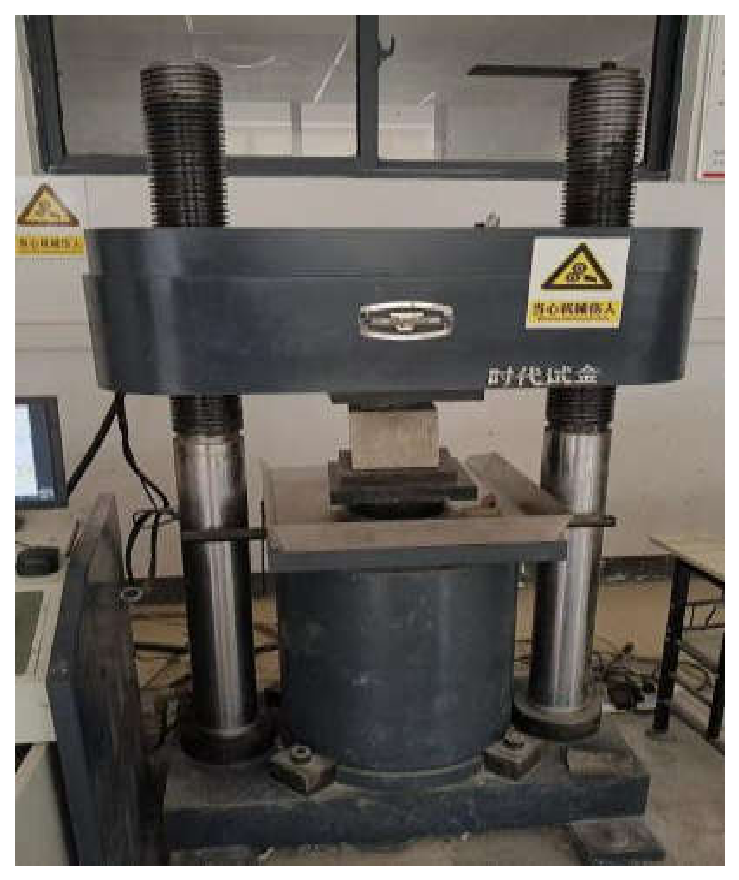
Figure 2.
Concrete specimen after failure.
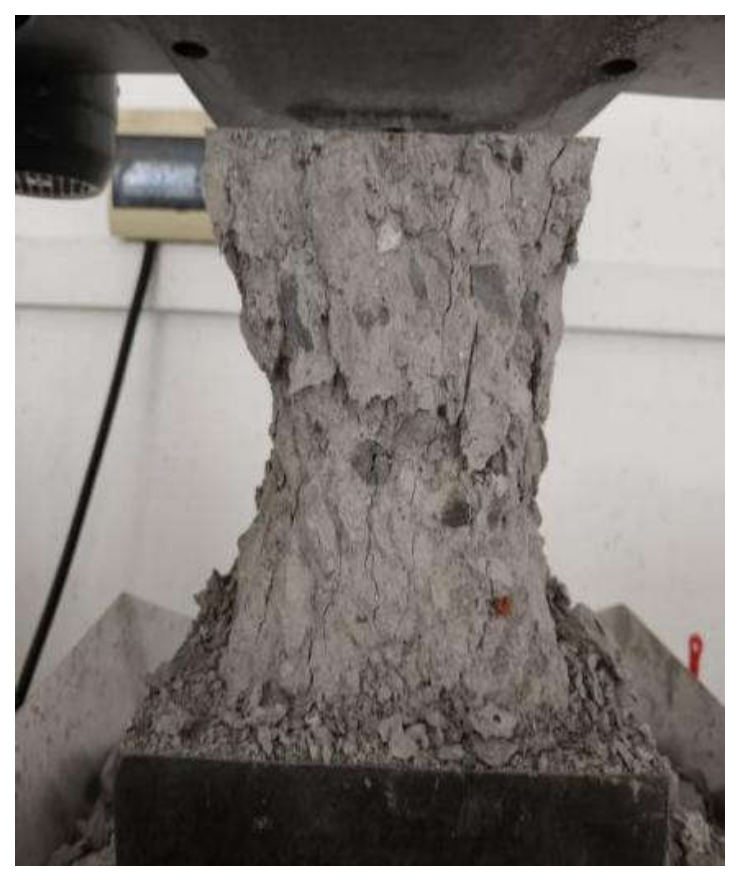
Figure 3.
a) Concrete specimen mounting and demolding machine; (b) Concrete permeameter.
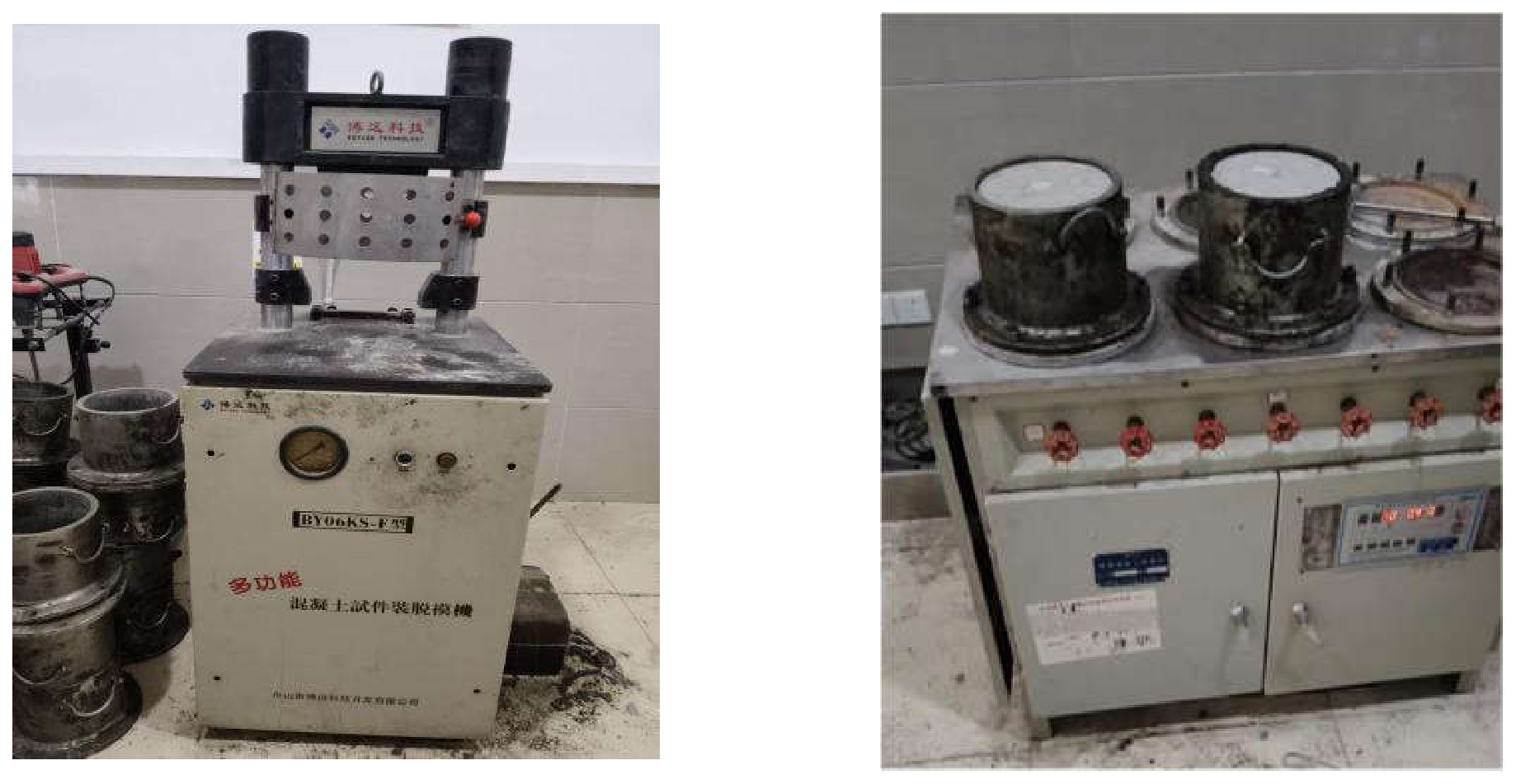
Figure 4.
Morphology of concrete specimens after splitting.
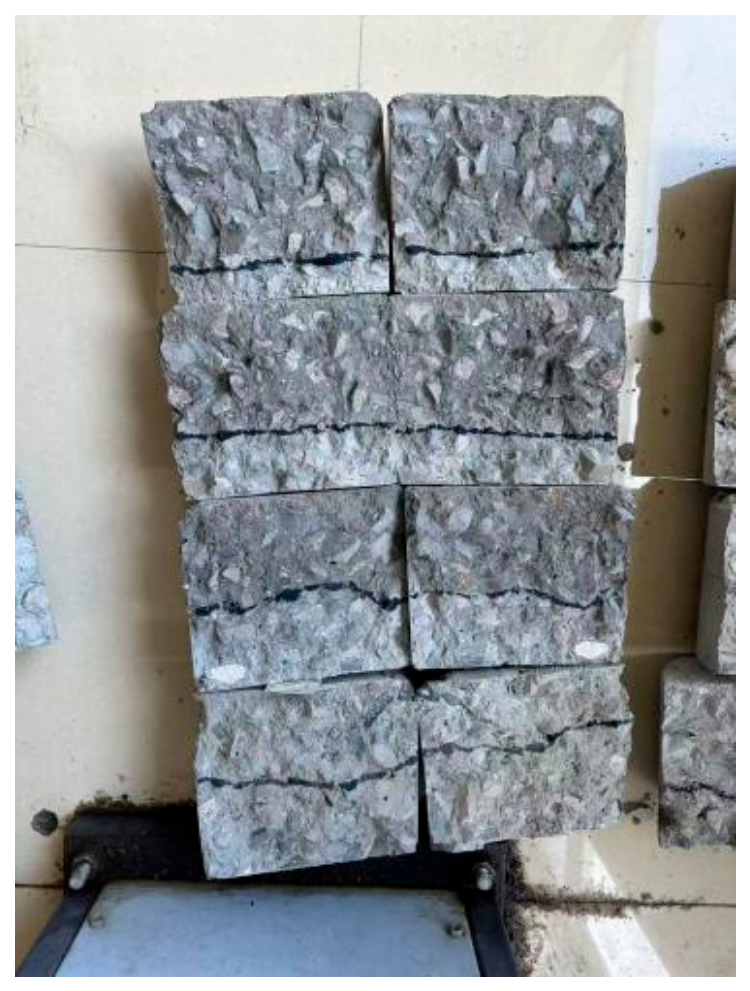
Figure 5.
Evolution of the compressive strength of concrete with temperature.
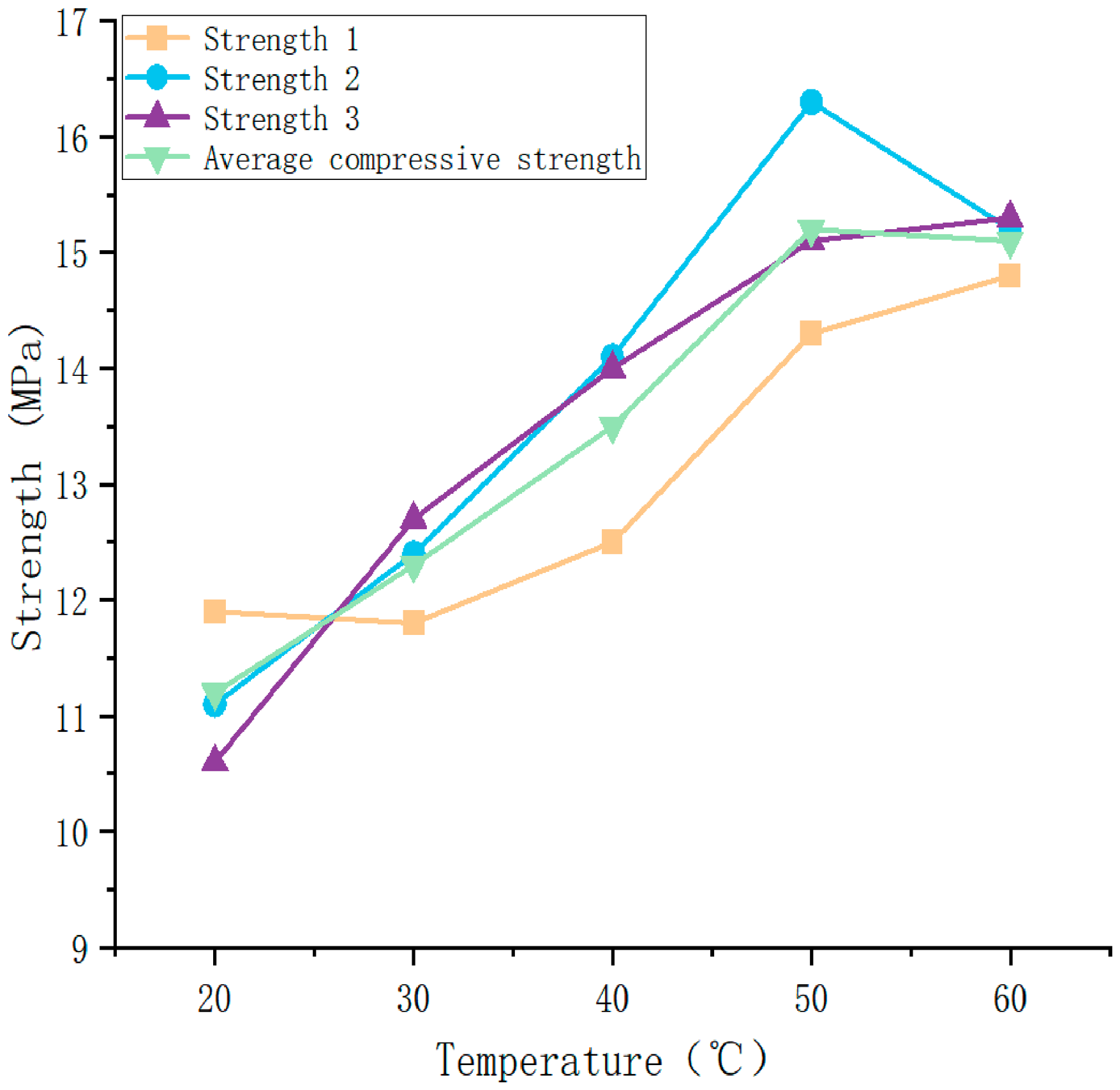
Figure 6.
Evolution of the average penetration height of concrete with temperature.
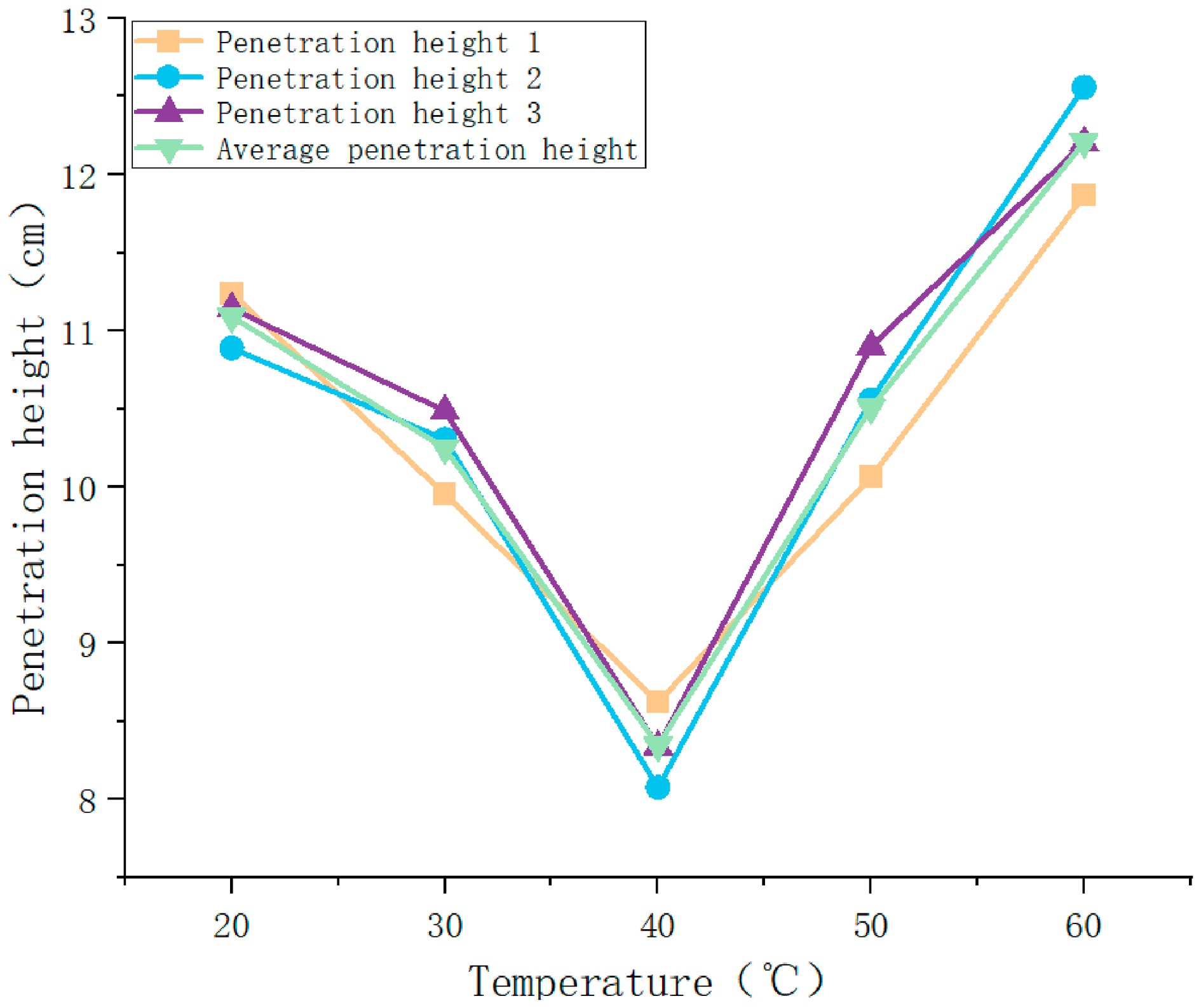
Figure 7.
Evolution of concrete compressive strength with humidity.
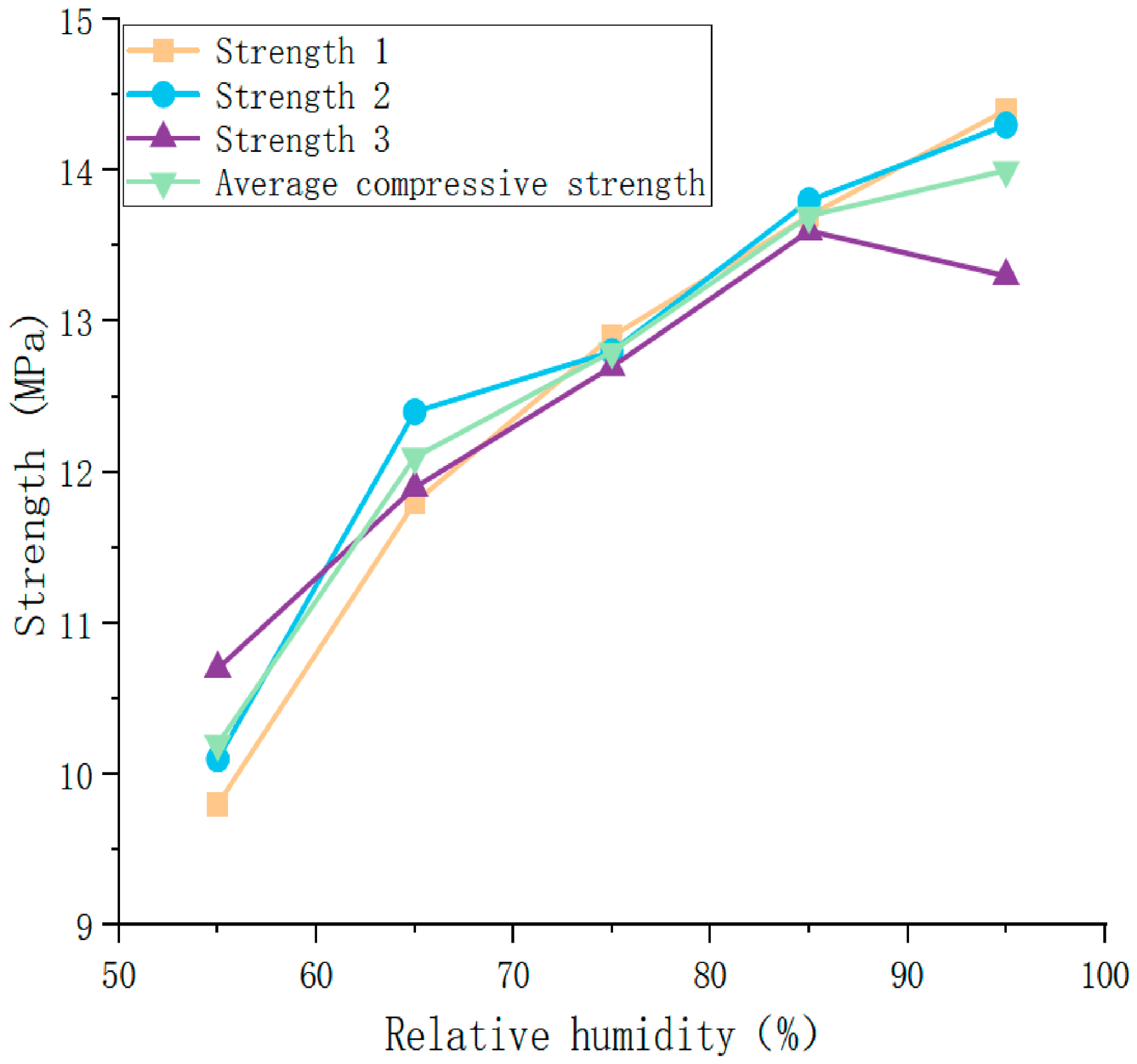
Figure 8.
Evolution of the average penetration height of concrete with humidity.
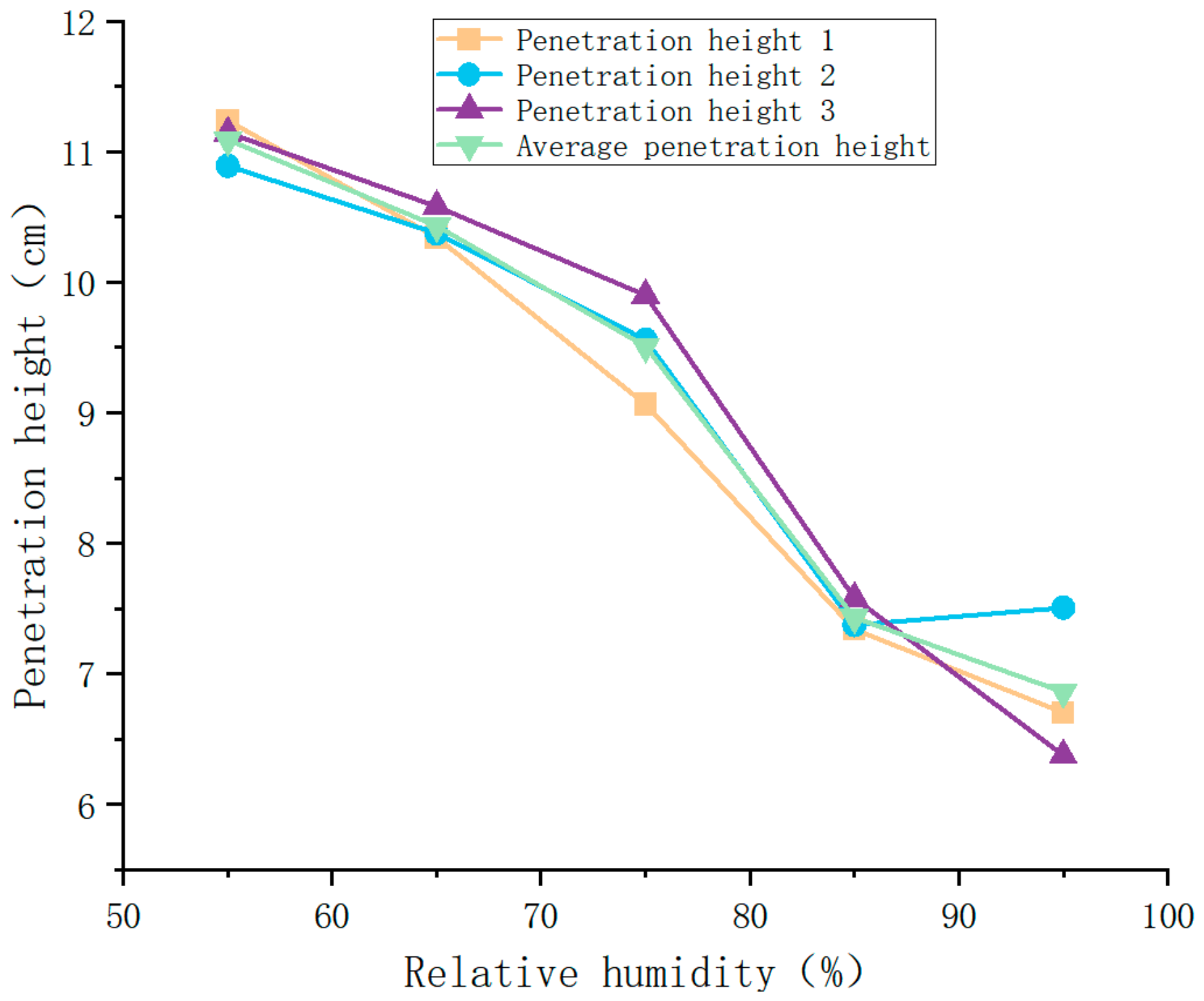

Table 1.
Mix Proportion of Concrete (Unit: kg/m³).
| Water | Cement | Fly ash | Fine sand | Crushed stone |
|---|---|---|---|---|
| 259 | 348 | 74 | 1041 | 1365 |
Table 2.
Compressive strength of concrete under different temperature conditions (7-day curing).
| Relative humidity (%) | Temperature (°C) | 7-day compressive strength (MPa) | |||
|---|---|---|---|---|---|
| Strength 1 | Strength 2 | Strength 3 | Average compressive strength | ||
| 55 | 20 | 11.9 | 11.1 | 10.6 | 11.2 |
| 30 | 11.8 | 12.4 | 12.7 | 12.3 | |
| 40 | 12.5 | 14.1 | 14.0 | 13.5 | |
| 50 | 14.3 | 16.3 | 15.1 | 15.2 | |
| 60 | 14.8 | 15.2 | 15.3 | 15.1 | |
Table 3.
Penetration height of concrete columns under different temperature conditions. (7-day curing)
Table 3.
Penetration height of concrete columns under different temperature conditions. (7-day curing)
| Humidity | Temperature | h1 | h2 | h3 | h4 | h5 | Average penetration height | Average penetration height of specimens | Overall average |
|---|---|---|---|---|---|---|---|---|---|
| 55 | 20 | 11.21 | 11.42 | 11.61 | 11.71 | 11.43 | 11.476 | 11.239 | 11.091 |
| 10.66 | 11.24 | 10.77 | 10.82 | 10.52 | 11.002 | ||||
| 9.86 | 10.23 | 10.65 | 11.35 | 11.2 | 10.658 | 10.89 | |||
| 11.15 | 11.2 | 11.46 | 10.85 | 10.95 | 11.122 | ||||
| 11.45 | 11.5 | 10.8 | 10.45 | 11.3 | 11.1 | 11.144 | |||
| 10.95 | 11.35 | 11.5 | 11.3 | 10.84 | 11.188 | ||||
| 30 | 9.73 | 10.09 | 9.96 | 9.95 | 10.03 | 9.952 | 9.953 | 10.248 | |
| 9.79 | 9.97 | 9.83 | 9.99 | 10.19 | 9.954 | ||||
| 9.85 | 10.1 | 10.23 | 10.4 | 10.35 | 10.186 | 10.304 | |||
| 10.58 | 10.23 | 10.65 | 10.2 | 10.45 | 10.422 | ||||
| 10.2 | 10.56 | 11.1 | 10.32 | 10.26 | 10.488 | 10.486 | |||
| 10.35 | 10.15 | 10.48 | 10.6 | 10.84 | 10.484 | ||||
| 40 | 8.75 | 8.93 | 9.2 | 9.15 | 8.95 | 8.996 | 8.624 | 8.347 | |
| 7.85 | 8.2 | 8.35 | 8.41 | 8.45 | 8.252 | ||||
| 8.25 | 8.6 | 8.3 | 7.86 | 7.9 | 8.182 | 8.078 | |||
| 8.05 | 7.65 | 7.85 | 8.1 | 8.22 | 7.974 | ||||
| 9.05 | 8.75 | 8.46 | 8.35 | 8.22 | 8.566 | 8.339 | |||
| 7.88 | 8.21 | 8.34 | 8.15 | 7.98 | 8.112 | ||||
| 50 | 10.52 | 10.45 | 10.22 | 11.26 | 11.14 | 10.718 | 10.065 | 10.508 | |
| 10.1 | 9.78 | 9.33 | 9.2 | 8.65 | 9.412 | ||||
| 10.78 | 10.99 | 10.34 | 10.25 | 10.45 | 10.562 | 10.559 | |||
| 10.45 | 10.55 | 10.82 | 10.62 | 10.34 | 10.556 | ||||
| 10.45 | 10.8 | 11.1 | 11.2 | 10.95 | 10.900 | 10.900 | |||
| 10.75 | 11.23 | 11.2 | 10.85 | 10.47 | 10.900 | ||||
| 60 | 12.74 | 11.26 | 11.21 | 11.98 | 13.41 | 12.12 | 11.867 | 12.210 | |
| 12.36 | 11.22 | 10.41 | 11.76 | 12.32 | 11.614 | ||||
| 11.83 | 11.73 | 11.42 | 12.83 | 13.94 | 12.35 | 12.56 | |||
| 13.10 | 13.40 | 13.50 | 12.40 | 11.45 | 12.77 | ||||
| 11.53 | 11.90 | 12.40 | 12.65 | 12.00 | 12.096 | 12.203 | |||
| 12.30 | 12.10 | 12.25 | 12.50 | 12.40 | 12.31 |
Table 4.
Compressive strength of concrete under different humidity conditions (7-day curing).
| Temperature (°C) | Relative humidity (%) | 7-day compressive strength (MPa) | |||
|---|---|---|---|---|---|
| Strength 1 | Strength 2 | Strength 3 | Average compressive strength | ||
| 20 | 55 | 9.8 | 10.1 | 10.7 | 10.2 |
| 65 | 11.8 | 12.4 | 11.9 | 12.1 | |
| 75 | 12.9 | 12.8 | 12.7 | 12.8 | |
| 85 | 13.7 | 13.8 | 13.6 | 13.7 | |
| 95 | 14.4 | 14.3 | 13.3 | 14.0 | |
Table 5.
Penetration height of concrete columns under different humidity conditions.
| (7-day curing) | |||||||||
|---|---|---|---|---|---|---|---|---|---|
| Temperature | Humidity | h1 | h2 | h3 | h4 | h5 | Average penetration height | Average penetration height of specimens | Overall average |
| 20 | 55 | 11.21 | 11.42 | 11.61 | 11.71 | 11.43 | 11.476 | 11.239 | 11.091 |
| 10.66 | 11.24 | 10.77 | 10.82 | 10.52 | 11.002 | ||||
| 9.86 | 10.23 | 10.65 | 11.35 | 11.2 | 10.658 | 10.89 | |||
| 11.15 | 11.2 | 11.46 | 10.85 | 10.95 | 11.122 | ||||
| 11.45 | 11.5 | 10.8 | 10.45 | 11.3 | 11.1 | 11.144 | |||
| 10.95 | 11.35 | 11.5 | 11.3 | 10.84 | 11.188 | ||||
| 65 | 10.65 | 10.42 | 10.3 | 10.5 | 10.72 | 10.518 | 10.342 | 10.432 | |
| 9.84 | 9.98 | 10.2 | 10.35 | 10.46 | 10.166 | ||||
| 9.9 | 10.25 | 10.54 | 10.86 | 11.1 | 10.53 | 10.375 | |||
| 10.2 | 10.45 | 9.85 | 10.15 | 10.45 | 10.22 | ||||
| 9.85 | 10.10 | 10.16 | 10.28 | 10.35 | 10.148 | 10.58 | |||
| 11.25 | 11.16 | 10.95 | 10.6 | 11.1 | 11.012 | ||||
| 75 | 9.52 | 9.45 | 9.22 | 10.26 | 10.14 | 9.718 | 9.065 | 9.508 | |
| 9.1 | 8.78 | 8.33 | 8.2 | 7.65 | 8.412 | ||||
| 9.78 | 9.99 | 9.34 | 9.25 | 9.45 | 9.562 | 9.559 | |||
| 9.45 | 9.55 | 9.82 | 9.62 | 9.34 | 9.556 | ||||
| 9.45 | 9.8 | 10.1 | 10.2 | 9.95 | 9.9 | 9.9 | |||
| 9.75 | 10.23 | 10.2 | 9.85 | 9.47 | 9.9 | ||||
| 85 | 7.65 | 7.42 | 7.30 | 7.50 | 7.72 | 7.518 | 7.342 | 7.432 | |
| 6.84 | 6.98 | 7.20 | 7.35 | 7.46 | 7.166 | ||||
| 6.90 | 7.25 | 7.54 | 7.86 | 8.10 | 7.53 | 7.375 | |||
| 7.2 | 7.45 | 6.85 | 7.15 | 7.45 | 7.22 | ||||
| 6.85 | 7.1 | 7.16 | 7.28 | 7.35 | 7.148 | 7.58 | |||
| 8.25 | 8.16 | 7.95 | 7.6 | 8.1 | 8.012 | ||||
| 95 | 7.1 | 7.25 | 7.34 | 7.05 | 6.8 | 7.108 | 6.703 | 6.861 | |
| 5.9 | 6.2 | 6.75 | 6.34 | 6.3 | 6.298 | ||||
| 6.5 | 6.95 | 7.3 | 7.4 | 7.52 | 7.134 | 7.506 | |||
| 8.15 | 8.02 | 7.94 | 7.78 | 7.5 | 7.878 | ||||
| 7.25 | 6.9 | 6.75 | 6.35 | 6.4 | 6.73 | 6.375 | |||
| 5.75 | 5.9 | 6.1 | 6.2 | 6.15 | 6.02 | ||||
Table 6.
Compressive Strength of Concrete at 7 and 28 Days of Curing.
| Temperature (°C) | Relative humidity (%) | 7-day compressive strength / MPa | 28-day compressive strength / MPa | ||||||
|---|---|---|---|---|---|---|---|---|---|
| Strength 1 | Strength 2 | Strength 3 | Compressive strength | Strength 1 | Strength 2 | Strength 3 | Compressive strength | ||
| 20 | 95 | 14.4 | 14.3 | 13.3 | 14.0 | 17.8 | 17.0 | 19.2 | 18.0 |
Table 7.
Concrete penetration height after 7 days of curing.
| Temperature | Humidity | h1 | h2 | h3 | h4 | h5 | Average infiltration height | Overall average value |
|---|---|---|---|---|---|---|---|---|
| 20 | 95 | 7.1 | 7.25 | 7.34 | 7.05 | 6.8 | 7.108 | 6.861 |
| 5.9 | 6.2 | 6.75 | 6.34 | 6.3 | 6.298 | |||
| 6.5 | 6.95 | 7.3 | 7.4 | 7.52 | 7.134 | |||
| 8.15 | 8.02 | 7.94 | 7.78 | 7.5 | 7.878 | |||
| 7.25 | 6.9 | 6.75 | 6.35 | 6.4 | 6.73 | |||
| 5.75 | 5.9 | 6.1 | 6.2 | 6.15 | 6.02 |
Table 8.
Concrete penetration height under standard curing conditions.
| Concrete column penetration height under standard curing conditions (unit: cm) | ||||||
|---|---|---|---|---|---|---|
| h1 | h2 | h3 | h4 | h5 | Average penetration height | Overall average value |
| 5.40 | 5.50 | 5.75 | 5.25 | 5.35 | 5.45 | 5.588 |
| 5.80 | 5.70 | 5.55 | 5.50 | 5.40 | 5.59 | |
| 4.80 | 5.25 | 6.40 | 5.40 | 4.95 | 5.36 | |
| 5.30 | 5.35 | 5.10 | 6.00 | 5.90 | 5.53 | |
| 5.65 | 5.70 | 5.25 | 5.50 | 5.40 | 5.50 | |
| 5.53 | 5.90 | 6.40 | 6.65 | 6.00 | 6.096 | |
Disclaimer/Publisher’s Note: The statements, opinions and data contained in all publications are solely those of the individual author(s) and contributor(s) and not of MDPI and/or the editor(s). MDPI and/or the editor(s) disclaim responsibility for any injury to people or property resulting from any ideas, methods, instructions or products referred to in the content. |
© 2026 by the authors. Licensee MDPI, Basel, Switzerland. This article is an open access article distributed under the terms and conditions of the Creative Commons Attribution (CC BY) license (http://creativecommons.org/licenses/by/4.0/).
Copyright: This open access article is published under a Creative Commons CC BY 4.0 license, which permit the free download, distribution, and reuse, provided that the author and preprint are cited in any reuse.


