

Submitted:
03 August 2026
Posted:
05 August 2026
You are already at the latest version
Abstract
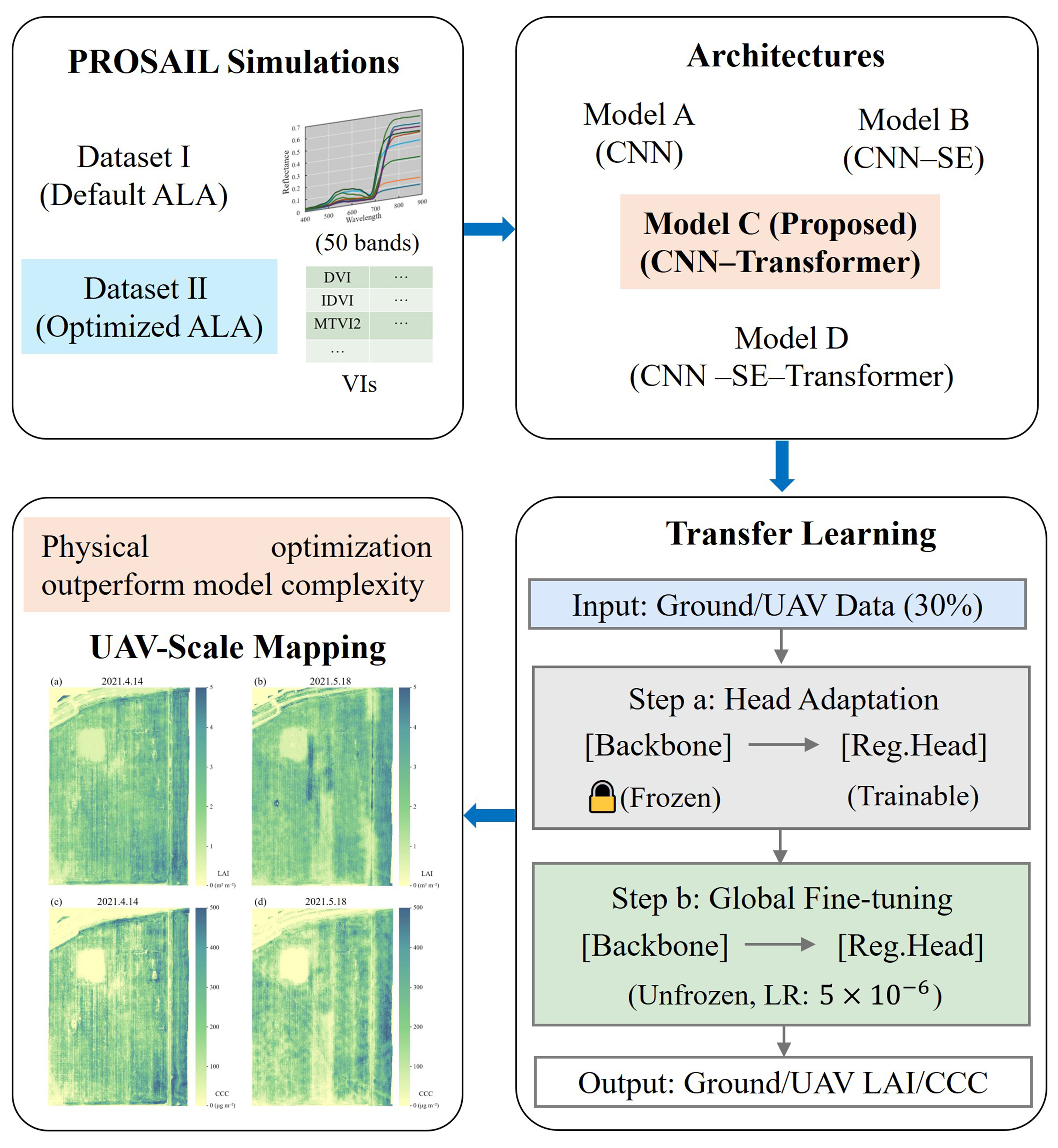
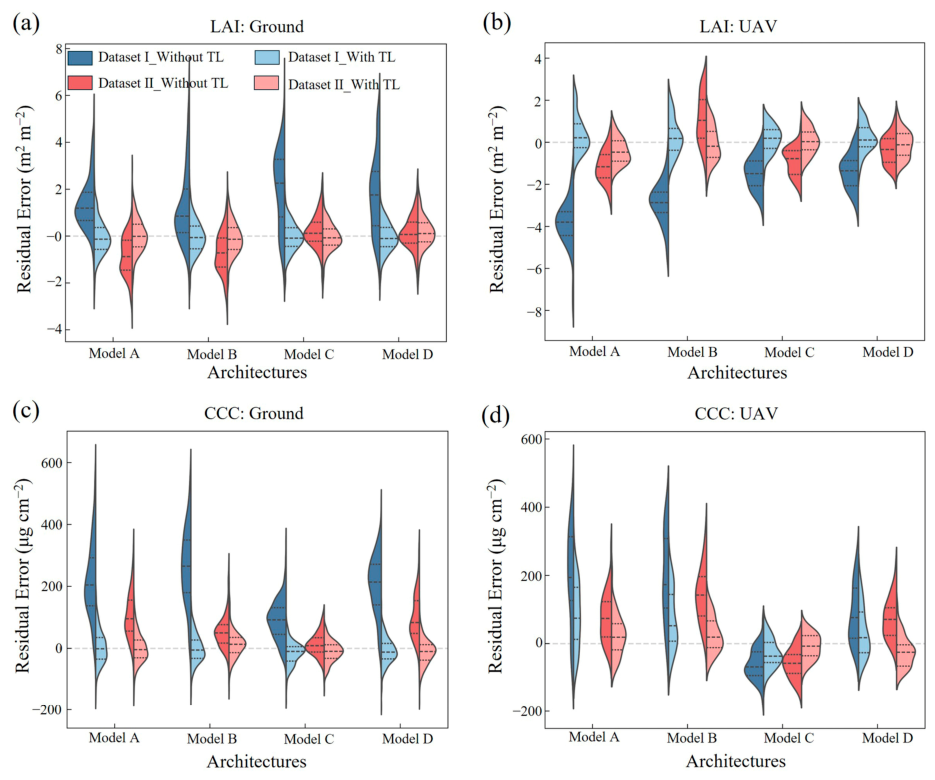
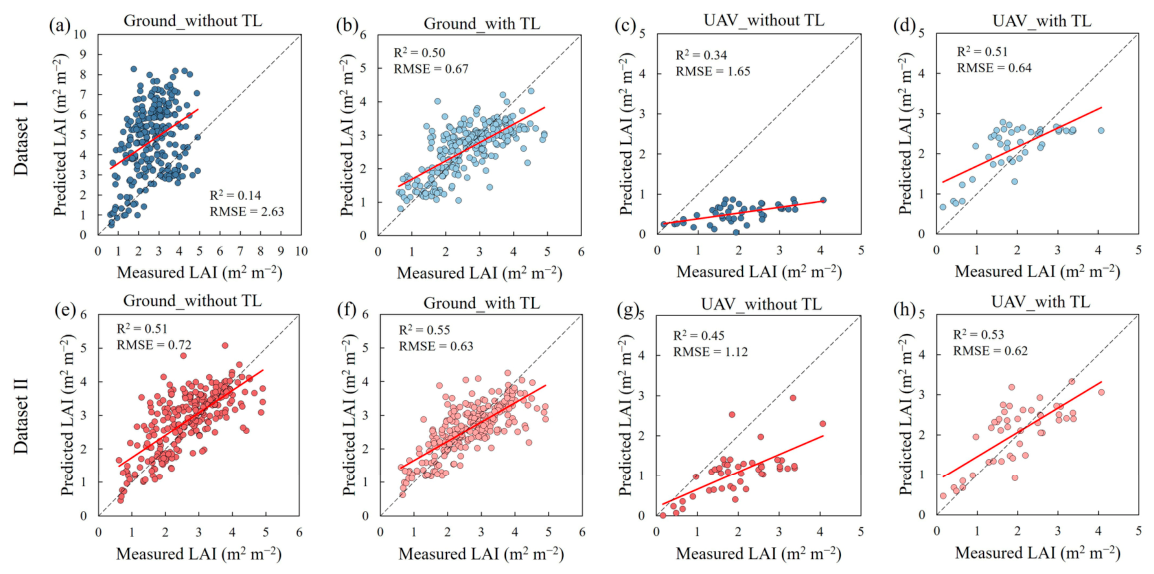
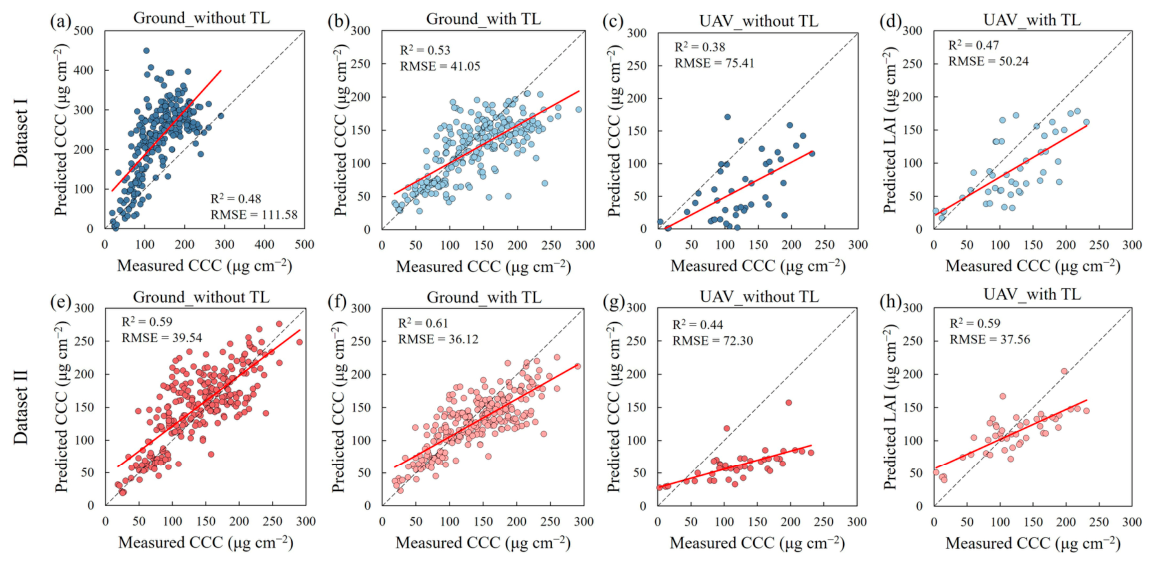
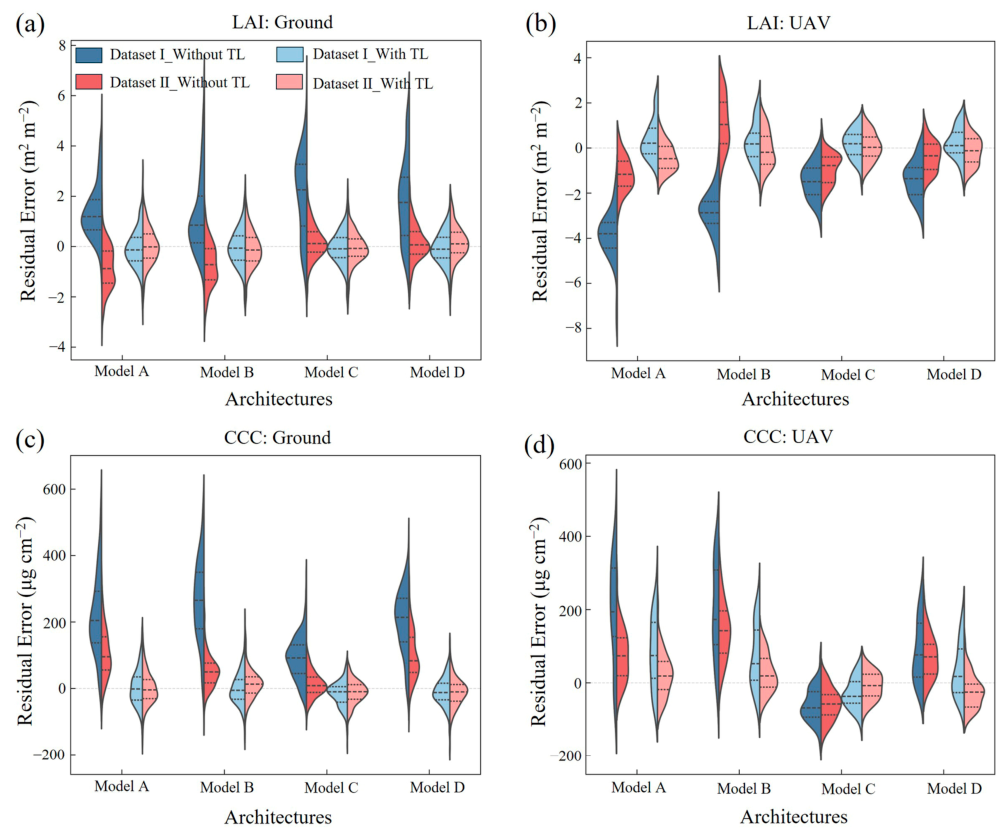
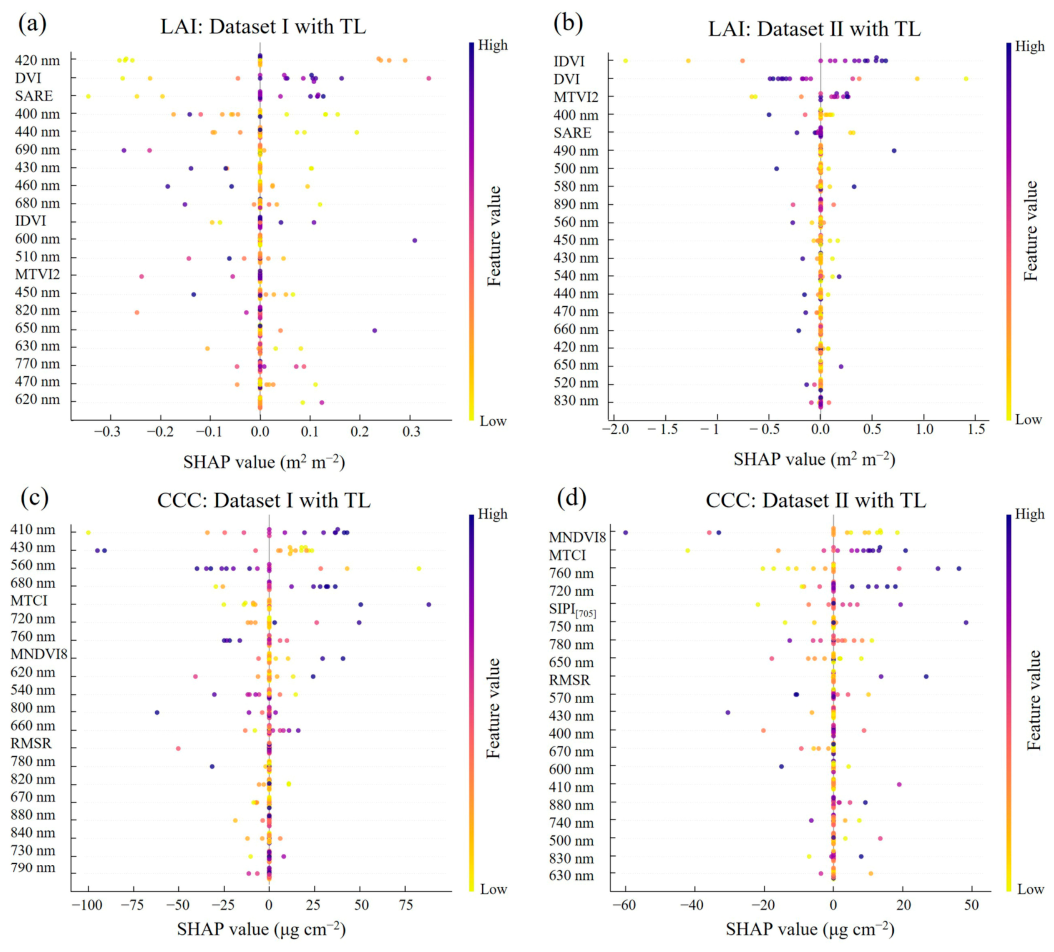
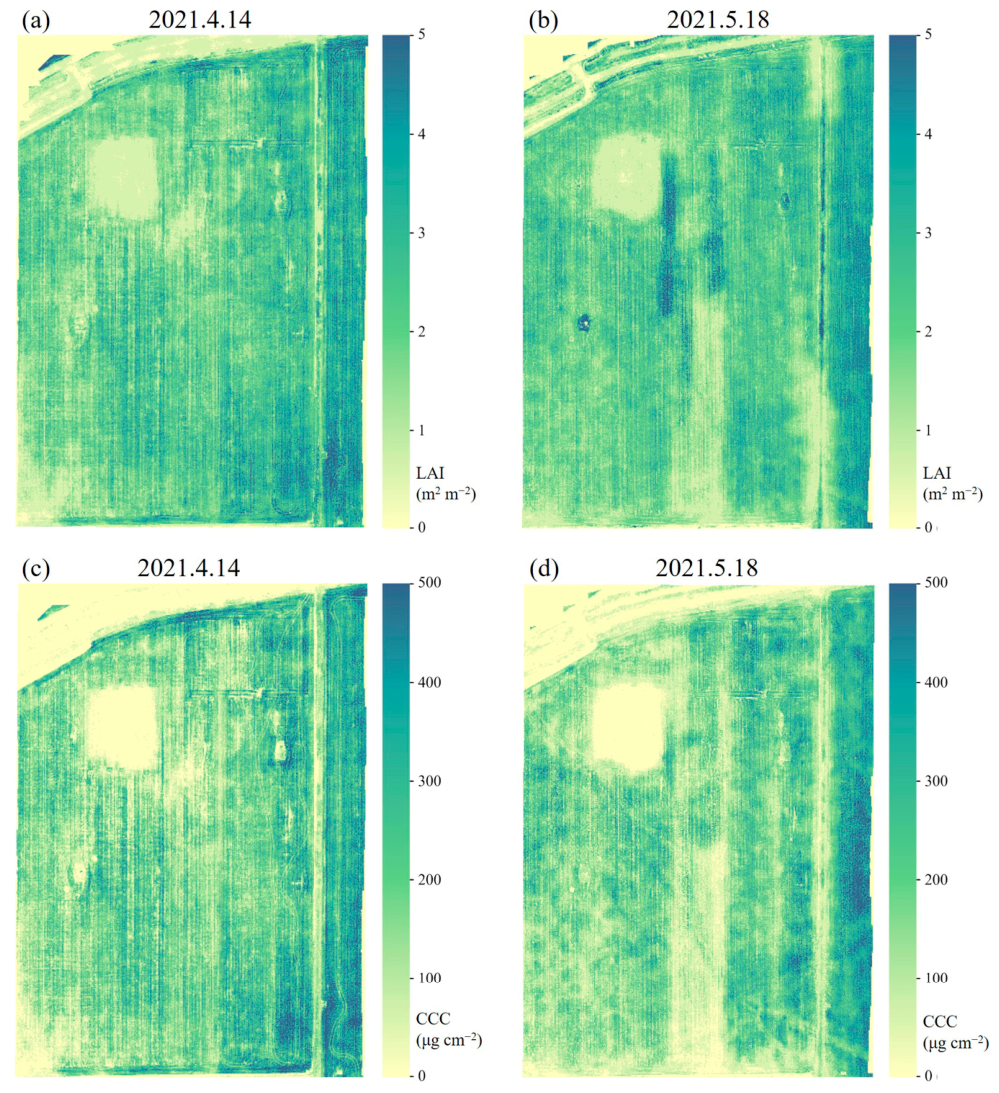
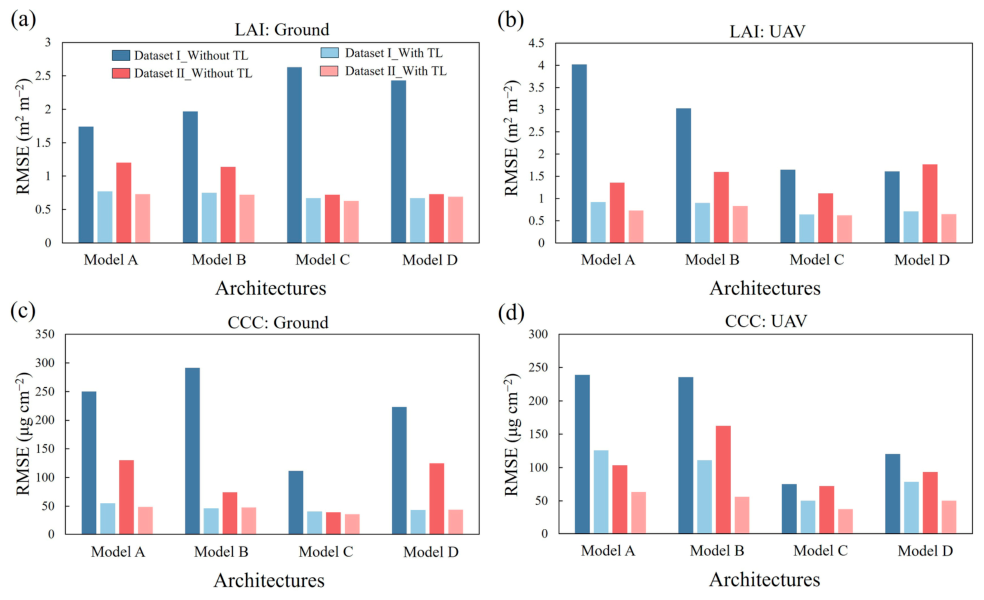
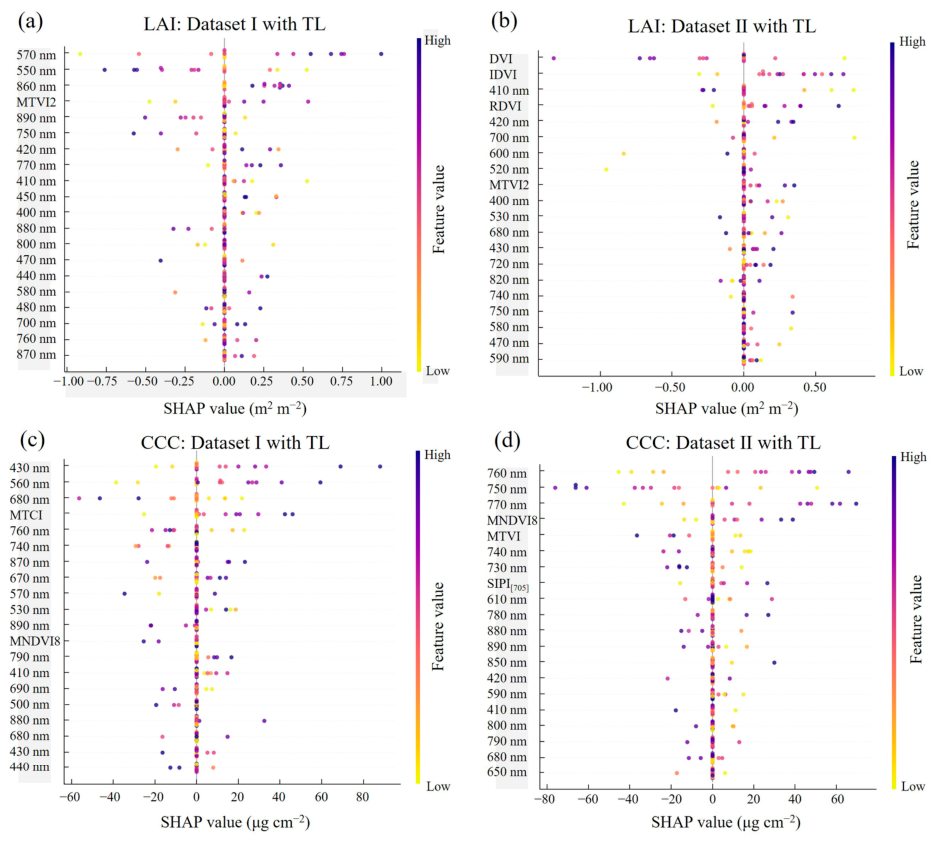
Accurate retrieval of crop structural and physiological traits from remote sensing data remains challenging due to limited field observations and poor cross-platform generalization of data-driven models. This study develops a physics-informed transfer learning framework to quantify the contributions of improving simulated data fidelity and increasing model complexity to retrieving winter wheat leaf area index (LAI) and canopy chlorophyll content (CCC) from hyperspectral observations. Two PROSAIL-D datasets with default and physically optimized leaf angle distributions were generated to represent different levels of simulation fidelity. Four dual-branch deep learning architectures (CNN, CNN–SE, CNN–Transformer, and CNN–SE–Transformer) integrating spectral bands and vegetation indices were pretrained on simulated datasets and transferred to real observations using progressive fine-tuning. Model performance was assessed using ground-based and unmanned aerial vehicle (UAV) hyperspectral datasets, and SHapley Additive exPlanations (SHAP) analysis was applied to interpret feature contributions. Results demonstrated that transfer learning substantially improved cross-domain generalization, while enhancing simulation fidelity provided greater performance gains than increasing network complexity. The CNN–Transformer model pretrained on physically optimized simulations achieved the highest accuracy and robustness for both LAI and CCC retrieval. At ground and UAV scales, it achieved LAI estimation accuracies of R2 = 0.55 (RMSE = 0.63) and R2 = 0.53 (RMSE = 0.62), respectively. For CCC estimation, the model obtained R2 = 0.59 at both scales, with RMSE values of 36.12 μg cm⁻2 and 37.56 μg cm⁻2 for ground and UAV observations, respectively. SHAP analysis indicated that physically optimized simulations shifted model attention toward physiologically relevant vegetation indices, whereas default simulations induced stronger dependence on unstable visible wavelengths. Physically informed simulation design combined with transfer learning effectively reduces simulation to reality discrepancies, whereas increasing deep model complexity alone provides limited improvement. The proposed framework offers an accurate, interpretable, and scalable solution for cross-platform crop trait retrieval from hyperspectral observations.
Keywords:
1. Introduction
2. Materials and Methods
2.1. Study Area and Field Experiments
2.2. Data Acquisition
2.2.1. Field Measurements of Winter Wheat LAI and CCC
2.2.2. Ground-Based Hyperspectral Reflectance Measurements
2.2.3. UAV-Based Hyperspectral Observations
2.3. Spectra Simulation Datasets
2.3.1. Simulations Using the PROSAIL-D Model
2.3.2. Simulations Using the PROSAIL-D Model with Optimized Leaf Angle Parameter
2.4. Input Variables and Feature Selection
2.4.1. Spectral Inputs
2.4.2. Vegetation Indices Construction
2.4.3. Feature Selection and Variable Determination
2.5. Framework for Model Development and Transfer Learning
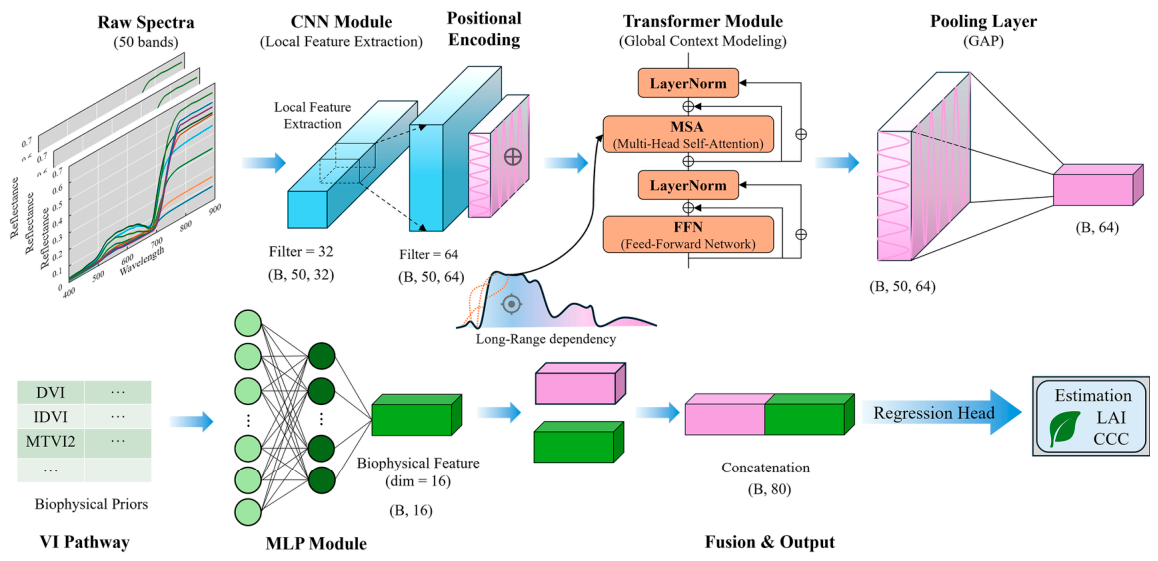
2.5.1. Proposed CNN–Transformer Architecture
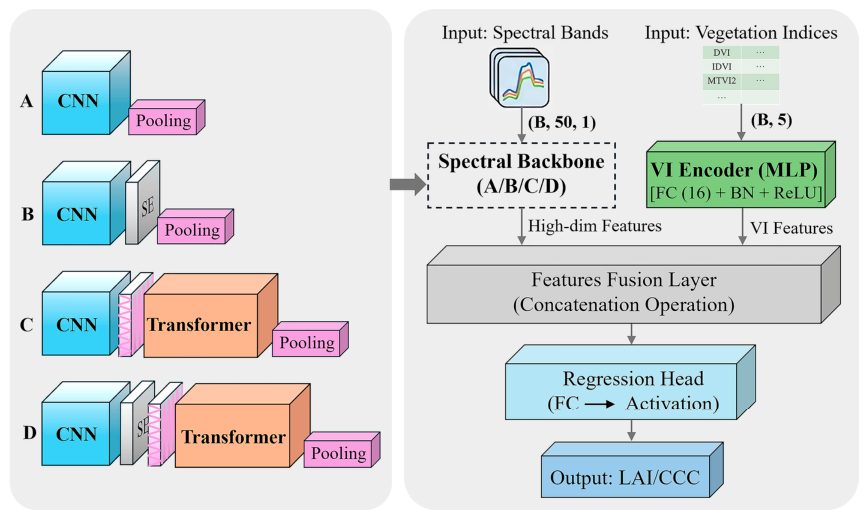
2.5.2. Comparative Models for Ablation Analysis
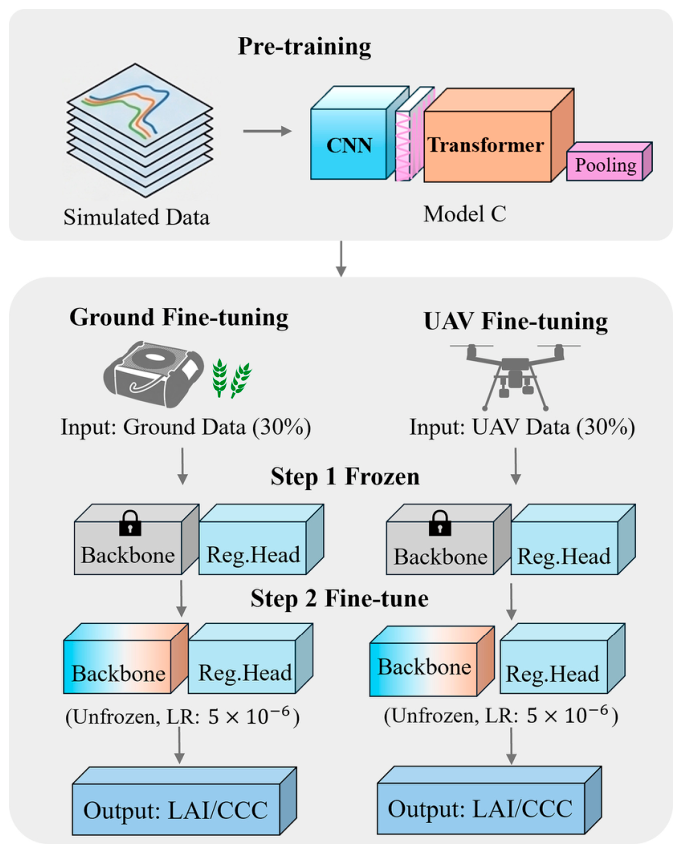
2.5.3. Unified Progressive Transfer Learning Strategy
2.6. Model Interpretability
2.7. Evaluation Metrics
3. Results
3.1. Performance Comparison of Candidate Models
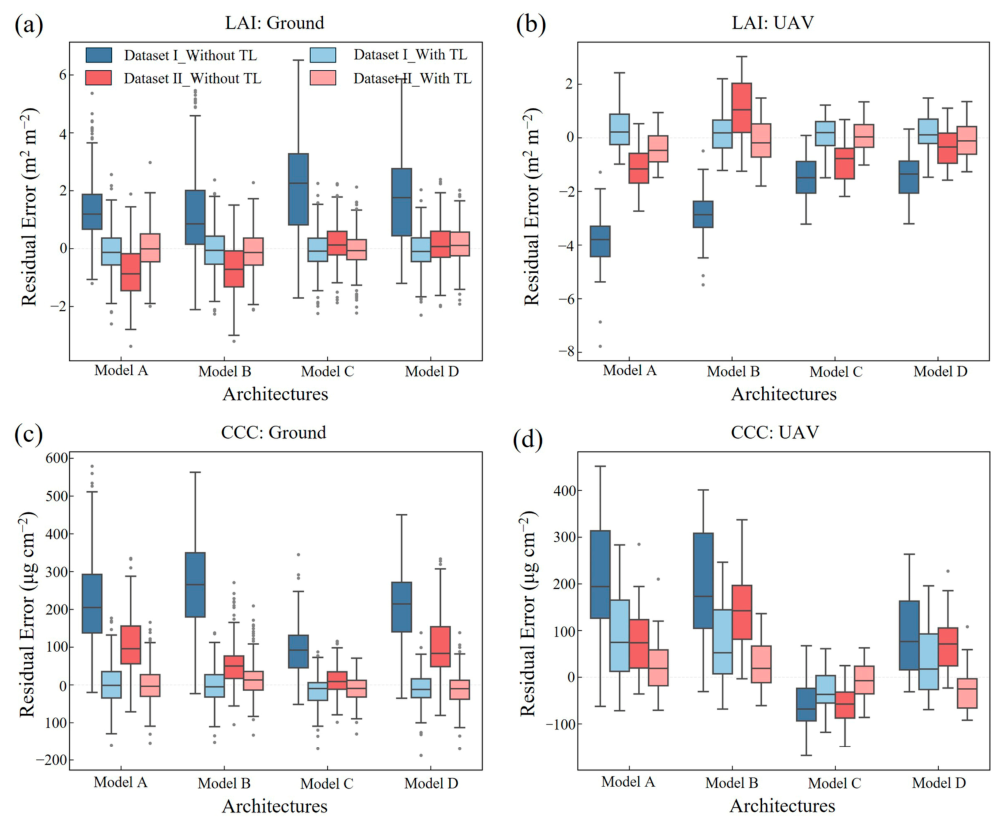
3.2. Effectiveness of Transfer Learning
3.3. Impact of Physical Prior Optimization
3.4. Model Interpretation and UAV-Scale Spatial Mapping
4. Discussion
4.1. Transfer Learning as the Essential Bridge Between Simulation and Reality
4.2. Physical Fidelity as the Dominant Factor in Generalization Performance
4.3. Physical Priors Reshape Feature Learning and Improve Cross-Scale Consistency
4.4. Limitations and Future Perspectives
5. Conclusions
Author Contributions
Funding
Data Availability Statement
Acknowledgments
Conflicts of Interest
References
- Godfray, H.C.J.; Beddington, J.R.; Crute, I.R.; Haddad, L.; Lawrence, D.; Muir, J.F.; Pretty, J.; Robinson, S.; Thomas, S.M.; Toulmin, C. Food security: the challenge of feeding 9 billion people. Science 2010, 327, 812–818. [Google Scholar] [CrossRef] [PubMed]
- Ma, G.; Pincebourde, S.; Bai, X.; Peng, Y.; Wang, X.; Yang, H.; Zhu, L.; Zhang, W.; Ma, C. Behavioural plasticity of a pest species may aggravate global wheat yield loss under climate change. Nat. Commun. 2025, 16, 11163. [Google Scholar] [CrossRef] [PubMed]
- Mulla, D.J. Twenty five years of remote sensing in precision agriculture: Key advances and remaining knowledge gaps. Biosyst. Eng. 2013, 114, 358–371. [Google Scholar] [CrossRef]
- Chlingaryan, A.; Sukkarieh, S.; Whelan, B. Machine learning approaches for crop yield prediction and nitrogen status estimation in precision agriculture: A review. Comput. Electron. Agr. 2018, 151, 61–69. [Google Scholar] [CrossRef]
- Hashemi, M.G.Z.; Alemohammad, H.; Jalilvand, E.; Tan, P.N.; Judge, J.; Cosh, M.; Das, N.N. Estimating crop biophysical parameters from satellite-based SAR and optical observations using self-supervised learning with geospatial foundation models. Remote Sens. Environ. 2025, 327, 114825. [Google Scholar] [CrossRef]
- Maddonni, G.A.; Otegui, M.E. Leaf area, light interception, and crop development in maize. Field Crop. Res. 1996, 48, 81–87. [Google Scholar] [CrossRef]
- Luo, S.; Li, Q.; Du, L.; Wu, Z. Time-space-angle scale effects and incorporation patterns in estimating rice LAI and leaf chlorophyll content by UAV multispectral remote sensing. Comput. Electron. Agr. 2025, 237, 110792. [Google Scholar] [CrossRef]
- Wang, S.; Guan, K.; Wang, Z.; Ainsworth, E.A.; Zheng, T.; Townsend, P.A.; Li, K.; Moller, C.; Wu, G.; Jiang, C. Unique contributions of chlorophyll and nitrogen to predict crop photosynthetic capacity from leaf spectroscopy. J. Exp. Bot. 2021, 72, 341–354. [Google Scholar] [PubMed]
- Zhang, B.; Gu, L.; Dai, M.; Bao, X.; Sun, Q.; Zhang, M.; Qu, X.; Li, Z.; Zhen, W.; Gu, X. Estimation of grain filling rate of winter wheat using leaf chlorophyll and LAI extracted from UAV images. Field Crop. Res. 2024, 306, 109198. [Google Scholar] [CrossRef]
- Guo, X.; Wang, R.; Chen, J.M.; Cheng, Z.; Zeng, H.; Miao, G.; Huang, Z.; Guo, Z.; Cao, J.; Niu, J. Synergetic inversion of leaf area index and leaf chlorophyll content using multi-spectral remote sensing data. Geo-Spat. Inf. Sci. 2025, 28, 22–35. [Google Scholar]
- Xie, Q.; Dash, J.; Huete, A.; Jiang, A.; Yin, G.; Ding, Y.; Peng, D.; Hall, C.C.; Brown, L.; Shi, Y.; Ye, H.; Dong, Y.; Huang, W. Retrieval of crop biophysical parameters from Sentinel-2 remote sensing imagery. Int. J. Appl. Earth Obs. 2019, 80, 187–195. [Google Scholar] [CrossRef]
- Li, W.; Li, D.; Warner, T.A.; Liu, S.; Baret, F.; Yang, P.; Jiang, J.; Dong, M.; Cheng, T.; Zhu, Y.; Cao, W.; Yao, X. Improved generality of wheat green LAI models through mitigation of the effect of leaf chlorophyll content variation with red edge vegetation indices. Remote Sens. Environ. 2025, 318, 114589. [Google Scholar] [CrossRef]
- Verrelst, J.; Camps-Valls, G.; Muñoz-Marí, J.; Rivera, J.P.; Veroustraete, F.; Clevers, J.G.P.W.; Moreno, J. Optical remote sensing and the retrieval of terrestrial vegetation bio-geophysical properties—A review. ISPRS J. Photogramm. 2015, 108, 273–290. [Google Scholar] [CrossRef]
- Tian, Z.; Fan, J.; Yu, T.; Leon, N.D.; Kaeppler, S.M.; Zhang, Z. Mitigating NDVI saturation in imagery of dense and healthy vegetation. ISPRS J. Photogramm. 2025, 227, 234–250. [Google Scholar] [CrossRef]
- Porterie, M.; Martín, M.P.; Burchard-Levine, V.; González-Cascón, R.; Démoulin, R. Combining spectral libraries and 3D radiative transfer modeling to improve the simulation of phenology in semi-arid grasslands. IEEE J.-STARS. 2025, 18, 22441–22465. [Google Scholar] [CrossRef]
- Sun, Q.; Jiao, Q.; Chen, X.; Xing, H.; Huang, W.; Zhang, B. Machine learning algorithms for the retrieval of canopy chlorophyll content and leaf area index of crops using the PROSAIL-D model with the adjusted average leaf angle. Remote Sens. 2023, 15, 2264. [Google Scholar] [CrossRef]
- Brown, L.A.; Fernandes, R.; Verrelst, J.; Morris, H.; Djamai, N.; Reyes-Muñoz, P.; D.Kovács, D.; Meier, C. GROUNDED EO: Data-driven Sentinel-2 LAI and FAPAR retrieval using Gaussian processes trained with extensive fiducial reference measurements. Remote Sens. Environ. 2025, 326, 114797. [Google Scholar] [CrossRef]
- Verrelst, J.; García-Soria, J.L.; Reyes-Muñoz, P.; Clerck, E.D.; Morata, M.; Rivera-Caicedo, J.P. Epistemic and aleatoric uncertainty in optical vegetation trait retrieval: Concepts, Methods, and Outlook. ISPRS J. Photogramm. 2026, 234, 20–45. [Google Scholar] [CrossRef]
- Maya Gopal, P.S.; Bhargavi, R. Performance evaluation of best feature subsets for crop yield prediction using machine learning algorithms. Appl. Artif. Intell. 2019, 33, 621–642. [Google Scholar] [CrossRef]
- Abdel-salam, M.; Kumar, N.; Mahajan, S. A proposed framework for crop yield prediction using hybrid feature selection approach and optimized machine learning. Neural Comput. Appl. 2024, 36, 20723–20750. [Google Scholar] [CrossRef]
- Ball, J.E.; Anderson, D.T.; Chan, C. Comprehensive survey of deep learning in remote sensing: theories, tools, and challenges for the community. J. Appl. Remote Sens. 2017, 11, 042609. [Google Scholar] [CrossRef]
- Wang, D.; Cao, W.; Zhang, F.; Li, Z.; Xu, S.; Wu, X. A review of deep learning in multiscale agricultural sensing. Remote Sens. 2022, 14, 559. [Google Scholar] [CrossRef]
- Peng, M.; Liu, Y.; Khan, A.; Ahmed, B.; Sarker, S.K.; Ghadi, Y.Y.; Bhatti, U.A.; Al-Razgan, M.; Ali, Y.A. Crop monitoring using remote sensing land use and land change data: Comparative analysis of deep learning methods using pre-trained CNN models. Big Data Res. 2024, 36, 100448. [Google Scholar] [CrossRef]
- Zheng, G. Transformer-Based Sensor-Agnostic Model for Satellite Chlorophyll Retrieval. IEEE T. Geosci. Remote 2025, 63, 4405213. [Google Scholar] [CrossRef]
- Mienye, I.D.; Swart, T.G.; Obaido, G. Recurrent neural networks: A comprehensive review of architectures, variants, and applications. Information 2024, 15, 517. [Google Scholar] [CrossRef]
- Khan, S.A.; Martínez-de-Morentin, X.; Alsabbagh, A.R.; Maillo, A.; Lagani, V.; Gomez-Cabrero, D.; Lehmann, R.; Tegner, J. Multimodal foundation transformer models for multiscale genomics. Nat. Methods 2026, 23, 299–311. [Google Scholar] [PubMed]
- Skobalski, J.; Sagan, V.; Alifu, H.; Akkad, O.A.; Lopes, F.A.; Grignola, F. Bridging the gap between crop breeding and GeoAI: Soybean yield prediction from multispectral UAV images with transfer learning. ISPRS J. Photogramm. 2024, 210, 260–281. [Google Scholar] [CrossRef]
- Zhang, Y.; Hui, J.; Qin, Q.; Sun, Y.; Zhang, T.; Sun, H.; Li, M. Transfer-learning-based approach for leaf chlorophyll content estimation of winter wheat from hyperspectral data. Remote Sens. Environ. 2021, 267, 112724. [Google Scholar] [CrossRef]
- Li, J.; Xiao, Z.; Sun, R.; Song, J. A method to estimate leaf area index from VIIRS surface reflectance using deep transfer learning. ISPRS J. Photogramm. 2023, 202, 512–527. [Google Scholar] [CrossRef]
- Porra, R.J. The chequered history of the development and use of simultaneous equations for the accurate determination of chlorophylls a and b. Photosynth. Res. 2002, 73, 149–156. [Google Scholar] [CrossRef] [PubMed]
- Féret, J.B.; Gitelson, A.A.; Noble, S.D.; Jacquemoud, S. PROSPECT-D: Towards modeling leaf optical properties through a complete lifecycle. Remote Sens. Environ. 2017, 193, 204–215. [Google Scholar] [CrossRef]
- Verhoef, W.; Jia, L.; Xiao, Q.; Su, Z. Unified optical-thermal four-stream radiative transfer theory for homogeneous vegetation canopies. IEEE T. Geosci. Remote 2007, 45, 1808–1822. [Google Scholar] [CrossRef]
- Verhoef, W. Theory of Radiative Transfer Models Applied in Optical Remote Sensing of Vegetation Canopies. Ph.D. Thesis, Wageningen Agricultural University, Wageningen, The Netherlands, 1998. [Google Scholar]
- Jiao, Q.; Sun, Q.; Zhang, B.; Huang, W.; Ye, H.; Zhang, Z.; Zhang, X.; Qian, B. A random forest algorithm for retrieving canopy chlorophyll content of wheat and soybean trained with PROSAIL simulations using adjusted average leaf angle. Remote Sens. 2021, 14, 98. [Google Scholar] [CrossRef]
- Rouse, J.W.; Haas, R.H., Jr.; Schell, J.A.; Deering, D.W. Monitoring vegetation systems in the Great Plains with ERTS. In NASA SP-351 Third ERTS-1 Symposium; Fraden, S.C., Marcanti, E.P., Becker, M.A., Eds.; Scientific and Technical Information Office, National Aeronautics and Space Administration: Washington, DC, USA, 1974; pp. 309–317. [Google Scholar]
- Richardson, A.J.; Weigand, C.L. Distinguishing vegetation from soil background information. Photogramm. Eng. Rem. S. 1977, 43, 1541–1552. [Google Scholar]
- Roujean, J.L.; Breon, F.M. Estimating PAR absorbed by vegetation from bidirectional reflectance measurements. Remote Sens. Environ. 1995, 51, 375–384. [Google Scholar] [CrossRef]
- Haboudane, D.; Miller, J.R.; Pattey, E.; Zarco-Tejada, P.J.; Strachan, I.B. Hyperspectral vegetation indices and novel algorithms for predicting green LAI of crop canopies: Modeling and validation in the context of precision agriculture. Remote Sens. Environ. 2004, 90, 337–352. [Google Scholar] [CrossRef]
- Rondeaux, G.; Steven, M.; Baret, F. Optimization of soil-adjusted vegetation indices. Remote Sens. Environ. 1996, 55, 95–107. [Google Scholar] [CrossRef]
- Sun, Y.; Ren, H.; Zhang, T.; Zhang, C.; Qin, Q. Crop leaf area index retrieval based on inverted difference vegetation index and NDVI. IEEE Geosci. Remote S. 2018, 15, 1662–1666. [Google Scholar] [CrossRef]
- Ali, M.; Montzka, C.; Stadler, A.; Menz, G.; Thonfeld, F.; Vereecken, H. Estimation and validation of RapidEye-based time-series of leaf area index for winter wheat in the Rur catchment (Germany). Remote Sens. 2015, 7, 2808–2831. [Google Scholar] [CrossRef]
- Broge, N.H.; Leblanc, E. Comparing prediction power and stability of broadband and hyperspectral vegetation indices for estimation of green leaf area index and canopy chlorophyll density. Remote Sens. Environ. 2001, 76, 156–172. [Google Scholar] [CrossRef]
- Jordan, C.F. Derivation of leaf-area index from quality of light on the forest floor. Ecology 1969, 50, 663–666. [Google Scholar] [CrossRef]
- Dash, J.; Curran, P.J. The MERIS terrestrial chlorophyll index. Int. J. Remote Sens. 2004, 25, 5403–5413. [Google Scholar] [CrossRef]
- Wu, C.; Niu, Z.; Tang, Q.; Huang, W. Estimating chlorophyll content from hyperspectral vegetation indices: Modeling and validation. Agr. For. Meteorol. 2008, 148, 1230–1241. [Google Scholar] [CrossRef]
- Gitelson, A.A.; Gritz, Y.; Merzlyak, M.N. Relationships between leaf chlorophyll content and spectral reflectance and algorithms for non-destructive chlorophyll assessment in higher plant leaves. J. Plant Physiol. 2003, 160, 271–282. [Google Scholar] [CrossRef] [PubMed]
- Gitelson, A.A.; Keydan, G.P.; Merzlyak, M.N. Three-band model for noninvasive estimation of chlorophyll, carotenoids, and anthocyanin contents in higher plant leaves. Geophys. Res. Lett. 2006, 33, L11402. [Google Scholar] [CrossRef]
- Mutanga, O.; Skidmore, A.K. Narrow band vegetation indices overcome the saturation problem in biomass estimation. Int. J. Remote Sens. 2004, 25, 3999–4014. [Google Scholar] [CrossRef]
- Penuelas, J.; Baret, F.; Filella, I. Semi-empirical indices to assess carotenoids/chlorophyll a ratio from leaf spectral reflectance. Photosynthetica 1995, 31, 221–230. [Google Scholar]
- Maccioni, A.; Agati, G.; Mazzinghi, P. New vegetation indices for remote measurement of chlorophylls based on leaf directional reflectance spectra. J. Photoch. Photobio. B. 2001, 61, 52–61. [Google Scholar] [CrossRef] [PubMed]
- Datt, B. Visible/near infrared reflectance and chlorophyll content in Eucalyptus leaves. Int. J. Remote Sens. 1999, 20, 2741–2759. [Google Scholar] [CrossRef]
- Yang, B.; Zhou, L.; Yang, G.; Zhang, G.; Qi, J.; Li, C. Integrating hyperspectral radiation transfer modeling and deep transfer learning to estimate nitrogen density in winter wheat canopies. Artif. Intell. Agr. 2026, 16, 753–763. [Google Scholar] [CrossRef]
- Zhang, P.; Lu, B.; Shang, J.; Shen, S.; Ge, J.; Wang, X.; Sun, S.; Yang, Y.; Zang, H.; Zeng, Z. PROSAIL-DNN: a fine-tuning transfer learning framework for field-scale oat leaf area index monitoring from UAV imagery. Comput. Electron. Agr. 2026, 241, 111272. [Google Scholar] [CrossRef]
- Du, R.; Shi, W.; Lu, X.; Xiang, Y.; Zhang, Y.; Feng, X.; Ma, Y. TrSC2Y: A transfer-learning-based model from UAV hyper-spectra imagery for field-scale canola yield prediction by integrating DSSAT with PROSAIL. Eur. J. Agron. 2026, 174, 127926. [Google Scholar] [CrossRef]
- Du, J.; Zhang, Y.; Wang, P.; Tansey, K.; Liu, J.; Zhang, S. Enhancing winter wheat yield estimation with a CNN-transformer hybrid framework utilizing multiple remotely sensed parameters. IEEE T. Geosci. Remote 2025, 63, 4405213. [Google Scholar] [CrossRef]
- Liu, L.; Xie, Y.; Zhu, B.; Song, K. A Deep Learning Model Combining CNN and Transformer for Rice Yield Estimation at County and Pixel Scales in Northeast China. IEEE J.-STARS. 2026, 19, 13927–13959. [Google Scholar] [CrossRef]
- Descals, A.; Verger, A.; Yin, G.; Filella, I.; Peñuelas, J. Local interpretation of machine learning models in remote sensing with SHAP: the case of global climate constraints on photosynthesis phenology. Int. J. Remote Sens. 2023, 44, 3160–3173. [Google Scholar] [CrossRef]
- Zeng, X.; Han, D.; Tansey, K.; Wang, P.; Pei, M.; Li, Y.; Li, F.; Du, Y. An interpretable wheat yield estimation model using time series remote sensing data and considering meteorological and soil influences. Remote Sens. 2025, 17, 3192. [Google Scholar] [CrossRef]
- Hu, Y.; Zhan, W.; He, Q.; Liu, Y.; Zhan, H. A spatially-informed interpretable deep learning framework for high-resolution nutrient monitoring in complex coastal waters. Int. J. Appl. Earth Obs. 2026, 146, 105025. [Google Scholar] [CrossRef]

| Year | Number of Plots | Nitrogen Levels | Fertilization Treatments | Irrigation Schemes | Observation Type | Measurement Period |
|---|---|---|---|---|---|---|
| 2002 | 48 | N1–N4 | Uniform | I1–I4 | Ground-based | 04/02 ~05/17 |
| 2004 | 42 | Uniform | Uniform | Uniform | Ground-based | 04/14 ~ 05/19 |
| 2019 | 32 | N1–N4 | F1–F4 | Uniform | Ground-based | 04/22 ~ 05/13 |
| 2021 | 32 | N1–N4 | F1–F4 | Uniform | Ground/UAV-based | 04/14 ~ 05/18 |
| Year | Parameter | Number | Minimum | Maximum | Mean | Standard Deviation |
|---|---|---|---|---|---|---|
| 2002 | LAI | 186 | 1.09 | 4.86 | 2.78 | 0.72 |
| CCC | 186 | 45.42 | 237.57 | 137.18 | 48.52 | |
| 2004 | LAI | 85 | 1.35 | 5.20 | 3.12 | 0.85 |
| CCC | 85 | 73.77 | 296.91 | 167.36 | 47.99 | |
| 2019 | LAI | 96 | 0.59 | 3.80 | 1.82 | 0.81 |
| CCC | 96 | 15.82 | 260.14 | 114.32 | 61.49 | |
| 2021 | LAI | 63 | 0.16 | 4.07 | 2.00 | 0.94 |
| CCC | 63 | 2.90 | 241.45 | 122.43 | 61.27 |
| Category | Parameter | Symbol | Unit | Range |
| Leaf level parameters | Leaf structure index | N | - | 1, 1.5, 2 |
| Leaf chlorophyll content | LCC | μg cm−2 | 10~80; interval, 10 | |
| Leaf dry matter content | Cm | g cm−2 | 0.003, 0.004,0.005, 0.006 | |
| Leaf brown pigment content | Cb | - | 0 | |
| Equivalent water thickness | Cw | cm | 0.02 | |
| Leaf carotenoid content | Car | μg cm−2 | 25% LCC | |
| Leaf anthocyanin content | CAnt | μg cm−2 | 2 | |
| Canopy level parameters | Leaf area index | LAI | m2 m−2 | 0.5, 1, 2, 3, 4, 5, 6, 7, 8 |
| Factor of dry soil | Fsoil | - | 0.1, 0.25, 0.5, 0.75, 1 | |
| Average leaf angle | ALA | Degrees | 26.8, 45, 45, 45, 57.3, 63.2 | |
| Hot spot parameter | hotS | m1 m−1 | 0.05 | |
| Fraction of diffuse incoming Solar radiation |
skyl | - | 0.5 | |
| Observation geometry | Solar zenith angle | θs | Degrees | 0, 10, 20, 30, 40, 50, 60 |
| View zenith angle | θv | Degrees | 0 | |
| Sun-sensor azimuth angle | φ | Degrees | 0 | |
| Optimized parameters (for Section 2.3.2) |
Adjusted Average Leaf Angle | ALAadj | Degrees | 62 |
| Target | VIs | Formulation | Reference |
|---|---|---|---|
| LAI | NDVI | [35] | |
| DVI | [36] | ||
| RDVI | [37] | ||
| MTVI2 | [38] | ||
| OSAVI | [39] | ||
| IDVI | [40] | ||
| SARE | [41] | ||
| TVI | [42] | ||
| S2MREP | [12] | ||
| SR | [43] | ||
| CCC | MTCI | [44] | |
| RMSR | [45] | ||
| CIred-edge | [46] | ||
| CIgreen | [47] | ||
| SR | [43] | ||
| MNDVI8 | [48] | ||
| RTCARI | [45] | ||
| SIPI [705] | [49] | ||
| Macc01 | [50] | ||
| Datt99 | [51] |
| Target Variable | Selected VIs | Target Variable | Selected VIs |
|---|---|---|---|
| LAI | DVI | CCC | MNDVI8 |
| IDVI | SIPI [705] | ||
| MTVI2 | MTCI | ||
| RDVI | RMSR | ||
| SARE | CIgreen |
| Dataset | Model | Strategy | LAI (m2 m−2) | CCC (μg cm−2) | ||||||
|---|---|---|---|---|---|---|---|---|---|---|
| Ground | UAV | Ground | UAV | |||||||
| R2 | RMSE | R2 | RMSE | R2 | RMSE | R2 | RMSE | |||
| Ⅰ | A | Without TL | 0.22 | 1.74 | 0.18 | 4.02 | 0.50 | 250.21 | 0.57 | 239.01 |
| With TL | 0.33 | 0.77 | 0.17 | 0.92 | 0.51 | 55.22 | 0.54 | 125.72 | ||
| B | Without TL | 0.16 | 1.97 | 0.20 | 3.03 | 0.51 | 291.44 | 0.50 | 235.75 | |
| With TL | 0.36 | 0.75 | 0.16 | 0.90 | 0.50 | 46.72 | 0.49 | 111.27 | ||
| C | Without TL | 0.14 | 2.63 | 0.34 | 1.65 | 0.48 | 111.58 | 0.38 | 75.41 | |
| With TL | 0.50 | 0.67 | 0.51 | 0.64 | 0.53 | 41.05 | 0.47 | 50.24 | ||
| D | Without TL | 0.12 | 2.43 | 0.22 | 1.61 | 0.58 | 223.24 | 0.45 | 120.20 | |
| With TL | 0.52 | 0.67 | 0.46 | 0.71 | 0.59 | 43.64 | 0.41 | 78.75 | ||
| Ⅱ | A | Without TL | 0.16 | 1.20 | 0.53 | 1.36 | 0.57 | 130.32 | 0.54 | 103.40 |
| With TL | 0.38 | 0.73 | 0.55 | 0.73 | 0.53 | 48.79 | 0.50 | 63.66 | ||
| B | Without TL | 0.10 | 1.14 | 0.36 | 1.60 | 0.54 | 74.48 | 0.54 | 162.43 | |
| With TL | 0.39 | 0.72 | 0.36 | 0.83 | 0.54 | 47.84 | 0.56 | 56.49 | ||
| C | Without TL | 0.51 | 0.72 | 0.45 | 1.12 | 0.61 | 39.54 | 0.44 | 72.30 | |
| With TL | 0.55 | 0.63 | 0.53 | 0.62 | 0.59 | 36.12 | 0.59 | 37.56 | ||
| D | Without TL | 0.43 | 0.73 | 0.47 | 1.77 | 0.58 | 125.06 | 0.54 | 93.38 | |
| With TL | 0.49 | 0.69 | 0.50 | 0.65 | 0.53 | 43.99 | 0.49 | 50.41 | ||
Disclaimer/Publisher’s Note: The statements, opinions and data contained in all publications are solely those of the individual author(s) and contributor(s) and not of MDPI and/or the editor(s). MDPI and/or the editor(s) disclaim responsibility for any injury to people or property resulting from any ideas, methods, instructions or products referred to in the content. |
© 2026 by the authors. Licensee MDPI, Basel, Switzerland. This article is an open access article distributed under the terms and conditions of the Creative Commons Attribution (CC BY) license (http://creativecommons.org/licenses/by/4.0/).