
Submitted:
02 August 2026
Posted:
04 August 2026
You are already at the latest version
Abstract
Large-language-model agents increasingly operate as persistent systems that plan, call tools, write and execute code, maintain memory, and coordinate with other agents. A newer class of systems goes further by changing its own prompts, memories, policies, workflows, skills, or model parameters during deployment. These self-evolving agents promise improved adaptability, but they also weaken the assumption that a system evaluated before deployment will remain behaviorally stable afterward. This review organizes the emerging literature around a central governance problem: how can an agent be allowed to learn and change without allowing its authority, objectives, or safety envelope to drift uncontrollably? We synthesize work on agent architectures, reflection, memory, tool learning, continual adaptation, constitutional constraints, human oversight, sandboxing, runtime monitoring, formal methods, and evaluation. We introduce a lifecycle taxonomy that separates the \emph{object of change} (memory, prompt, policy, tools, code, parameters, or social organization), the \emph{mechanism of change} (reflection, search, reinforcement learning, evolutionary optimization, or external feedback), and the \emph{governance control} (authorization, monitoring, verification, rollback, audit, and recertification). The review argues that safe autonomy requires a separation between an agent's capacity to learn and its permission to act. It further identifies open problems in compositional verification, provenance-aware memory, long-horizon evaluation, multi-agent accountability, and governance of open-ended self-improvement. This manuscript is supplied as a research draft and should be revised with the author's own database search, screening log, and critical interpretation before submission.
Keywords:
self-evolving AI
; AI agents
; agent governance
; runtime adaptation
; self-modification
; autonomous systems
; AI safety
1. Introduction
Agentic artificial intelligence extends generative models from response generation to goal-directed interaction. In a typical language-model agent, a foundation model is embedded in a loop that observes a state, reasons about a goal, selects an action, invokes tools, and incorporates feedback. ReAct made the reasoning–action interleaving pattern explicit [1]; Toolformer demonstrated that language models can learn when and how to call external tools [2]; and subsequent systems added long-term memory, reflection, planning, and multi-agent coordination.
The governance problem becomes qualitatively different when an agent can change itself. A static model may still behave unpredictably, but at least its main components remain fixed between evaluation and deployment. A self-evolving agent can rewrite prompts, curate or delete memories, synthesize new tools, alter workflows, update policies, generate code, or learn from interaction. Reflexion, for example, stores verbal feedback to improve later trials [3]; Voyager accumulates an executable skill library in an open-ended environment [4]; and generative-agent architectures use memory streams and reflection to shape later behavior [5]. These mechanisms are useful precisely because they change future behavior. They also create a moving target for assurance.
This review treats agent governance as the set of technical and institutional mechanisms that constrain, observe, authorize, audit, and, when necessary, reverse an autonomous system’s behavior and adaptation. Governance is broader than alignment training and narrower than society-wide AI policy. It includes access control, tool permissions, runtime monitors, behavioral contracts, human approval gates, provenance, logging, rollback, red teaming, and recertification after material changes.
The paper addresses four questions:
- RQ1.
- What parts of an AI agent can change during deployment, and through which mechanisms?
- RQ2.
- What risks are introduced when adaptation occurs after initial evaluation?
- RQ3.
- Which governance and verification mechanisms are technically available?
- RQ4.
- What research agenda could make self-evolving agents auditable and safely governable?
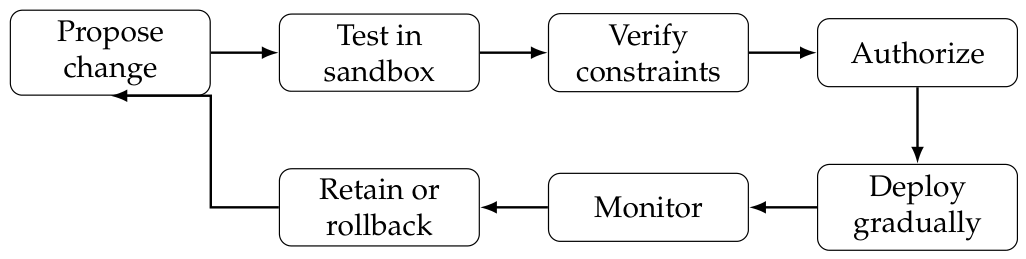
The main contribution is a lifecycle synthesis. Rather than treating memory, reflection, tool use, safety, and governance as separate topics, we connect them through the sequence propose change–evaluate change–authorize change–deploy change–monitor consequences–rollback or retain. This framing highlights an underdeveloped principle: learning capability and action authority should be governed separately.
Although this review focuses on agentic AI, it is informed by broader traditions in computer vision, medical AI, and machine learning systems engineering. Earlier work on face recognition and biometric verification demonstrated the importance of robust feature representations under changing conditions [6,7,8,9,10,11,12,13,14,15,16]. Subsequent studies on clinical prediction and healthcare AI highlighted the need for reliable, interpretable, and deployable machine learning in high-stakes environments [17,18,19,20,21]. These lessons motivate governance mechanisms that emphasize safety, monitoring, and accountability for adaptive AI agents.
2. Review Methodology
This project uses a structured narrative review design. It is not yet a completed systematic review because the final database export, deduplication record, and reviewer agreement statistics must be generated by the author. The search protocol is designed to be reproducible.
2.1. Search Strategy
Recommended databases are Scopus, Web of Science, IEEE Xplore, ACM Digital Library, arXiv, and Google Scholar for citation chaining. A core Boolean query is:
(agentic AI OR LLM agent* OR autonomous agent*) AND (self-evol* OR self-modif* OR runtime adapt* OR continual learn* OR reflection OR memory) AND (governance OR safety OR verification OR oversight OR monitoring OR alignment)
The recommended publication window is 2022 onward, supplemented with earlier foundational work in runtime verification, adaptive systems, and AI governance.
2.2. Eligibility
Include papers that (i) study agents capable of sequential action; (ii) introduce or analyze adaptation after deployment; or (iii) propose controls relevant to changing agents. Exclude papers limited to single-turn prompting, ordinary fine-tuning without an agent loop, or governance discussions with no identifiable implications for agent design.
2.3. Coding Framework
Each study should be coded along five dimensions:
- 1.
- agent substrate and environment;
- 2.
- object and mechanism of adaptation;
- 3.
- degree of autonomy;
- 4.
- governance control and evidence type;
- 5.
- evaluation horizon, failure model, and reproducibility.
2.4. Threats to Validity
The literature is preprint-heavy and terminology is unstable. “Self-evolving” may refer to memory updates, prompt rewriting, skill acquisition, code synthesis, or parameter learning. Evidence from benchmark tasks may not transfer to persistent deployment. Publication bias favors capability demonstrations over negative results. The final review should therefore distinguish peer-reviewed evidence from preprints, demonstrations, position papers, and conceptual proposals.
3. Foundations: From LLMs to Adaptive Agents
3.1. Agent Loop
A useful abstraction is
where is environmental state, an observation, memory, g the goal, the control context, and the agent configuration. A self-evolving agent permits some component of , , or to change over time.
ReAct operationalized a loop in which language-model reasoning traces are interleaved with actions [1]. Toolformer showed how tool use can become part of model behavior through self-supervised learning [2]. AutoGen later provided a framework for conversational multi-agent workflows [22]. These systems establish the architectural substrate on which runtime adaptation is built.
3.2. Memory and Reflection
Memory transforms isolated interactions into persistent behavior. Generative Agents introduced memory streams, retrieval, reflection, and planning for simulated social agents [5]. Reflexion uses linguistic feedback as episodic memory rather than updating model weights [3]. This distinction matters for governance: external memories can be inspected and rolled back more easily than opaque parameter updates, but they also create poisoning, privacy, and provenance risks.
3.3. Skills, Tools, and Code
Voyager demonstrates open-ended skill acquisition by generating, validating, and storing executable programs [4]. Such skill libraries are a form of self-modification at the scaffold level. They may be safer than unconstrained weight updates because each skill can be tested independently, yet composition creates new behavior not observed during single-skill evaluation.
3.4. Multi-Agent Adaptation
In multi-agent systems, adaptation includes changes to role assignment, communication topology, delegation, trust, and shared memory. Governance must therefore consider not only the internal state of one agent but also emergent behavior at the system level. A locally compliant agent may contribute to globally unsafe outcomes through coordination failures, collusion, or cascading misinformation.

Table 1.
Objects of self-evolution and associated governance concerns.
| Object of change | Typical mechanism | Primary governance concern |
|---|---|---|
| Memory | retrieval, summarization, reflection | poisoning, privacy, irreversible forgetting |
| Prompt or policy | self-critique, prompt search, constitutional revision | objective drift, hidden rule conflict |
| Tools and skills | API discovery, code generation, skill libraries | privilege escalation, unsafe composition |
| Workflow | planner revision, role reassignment, graph search | loss of traceability, untested control flow |
| Model parameters | reinforcement learning, continual fine-tuning | catastrophic drift, difficult rollback |
| Social organization | delegation, trust updates, coalition formation | collusion, diffuse accountability |
4. Mechanisms of Self-Evolution
4.1. Reflection and Self-Critique
Reflection methods convert outcomes into textual feedback that influences future decisions. Their appeal is operational simplicity: no parameter update is required, and the adaptation artifact can be logged. However, reflection may amplify incorrect self-diagnoses. A governance layer should therefore preserve the evidence that triggered a reflection, record its provenance, and test whether the change improves performance without violating constraints.
4.2. Memory Adaptation
Memory systems may add, merge, summarize, rank, or delete experiences. Governance questions include who may write to memory, whether high-impact memories require validation, how contradictory memories are resolved, and whether users can inspect or erase retained information. Provenance-aware memory should link each item to its source, confidence, timestamp, and downstream uses.
4.3. Tool and Skill Acquisition
Agents may discover APIs, synthesize programs, or retain reusable procedures. Tool acquisition changes the action space and can increase effective authority. A safe design treats new tools as untrusted software: execution occurs in a sandbox, permissions are least-privilege, outputs are validated, and promotion to persistent use requires tests and approval.
4.4. Workflow and Architecture Search
An agent may alter decomposition strategies, add specialized subagents, or rewrite orchestration graphs. Because these changes affect system structure, unit-level testing is insufficient. Governance should include graph-level invariants, resource budgets, termination conditions, and checks for unsafe delegation.
4.5. Parameter-Level Learning
Continual fine-tuning or reinforcement learning changes the policy itself. Such updates can improve adaptation but are the hardest to interpret and reverse. Safe deployment requires versioned checkpoints, held-out safety evaluations, canary release, change-impact analysis, and automatic rollback when monitored behavior crosses predefined thresholds.
4.6. Degrees of Self-Modification
Not all adaptation is equally consequential. We distinguish:
- 1.
- ephemeral adaptation: temporary context or scratchpad changes;
- 2.
- persistent scaffold adaptation: memory, prompts, tools, or workflows;
- 3.
- policy adaptation: updates to decision rules or model parameters;
- 4.
- authority adaptation: changes to permissions, credentials, or reachable systems.
The fourth category should generally be prohibited from self-authorization. An agent may propose a wider permission but should not grant it to itself.
5. Governance Mechanisms
5.1. Separation of Learning and Authority
The core design principle proposed in this review is that an agent’s ability to learn should not automatically expand its authority. A system may acquire a new skill in a sandbox while remaining unable to use that skill against production systems. Authority should be represented explicitly through capabilities, credentials, budgets, and policy rules controlled outside the agent’s editable state.
5.2. Constitutional and Policy-Based Controls
Constitutional AI demonstrates how explicit principles can structure model critique and revision [31]. For agents, a constitution can guide planning and refusal, but a text-only constitution is not an enforcement mechanism. High-assurance governance requires executable policy checks at the tool boundary and environment boundary.
5.3. Human Oversight
Human-in-the-loop control is useful when consequences are high and action frequency is manageable. Approval gates are less effective when humans face alert fatigue, cannot inspect long reasoning chains, or routinely approve requests. Oversight should be risk-adaptive: low-impact actions may be automated, while irreversible, financial, privacy-sensitive, or safety-critical actions require stronger authorization.
5.4. Capability Security
Least privilege, scoped tokens, network isolation, rate limits, and budget caps reduce the damage caused by erroneous or malicious plans. Tool calls should be mediated by a trusted reference monitor that the agent cannot rewrite. Inputs and outputs should be typed and validated rather than passed as unrestricted natural language.
5.5. Logging, Provenance, and Audit
Every material adaptation should produce an audit record: prior version, proposed change, triggering evidence, evaluator results, authorizer, deployment time, and rollback target. Logs must be tamper-evident and stored outside the agent’s writable environment. Auditability is especially important when multiple agents contribute to a decision.
5.6. Change Management
Self-evolution can be governed like safety-critical software deployment:
- 1.
- generate a candidate change;
- 2.
- test it in isolation and in representative scenarios;
- 3.
- check security and policy invariants;
- 4.
- authorize based on risk tier;
- 5.
- deploy gradually;
- 6.
- monitor consequences;
- 7.
- retain, quarantine, or roll back.
Figure 1.
Governed adaptation lifecycle.
6. Runtime Assurance, Verification, and Evaluation
6.1. Runtime Monitoring
Runtime monitors observe actions, tool calls, state transitions, and resource use. Deterministic checks are preferable for hard constraints such as forbidden domains, transaction limits, data schemas, or credential scope. Model-based monitors may help classify ambiguous risks but introduce correlated failure and should not be the sole enforcement layer.
6.2. Formal and Semi-Formal Methods
Full formal verification of open-ended language-model behavior is generally infeasible, but narrower properties can be checked. Examples include temporal constraints on workflows, information-flow rules, preconditions for tool calls, and invariants over resource budgets. Assurance should therefore be compositional: formally verify trusted boundaries and use empirical testing for open-ended cognition.
6.3. Sandboxing and Staged Deployment
Candidate tools, code, and policies should run first in environments with synthetic data, restricted networks, and disposable credentials. Canary deployment exposes only a limited fraction of tasks to the modified agent. Rollback must restore not only code but also memory and policy state.
6.4. Benchmarking Limitations
AgentBench evaluates agents across multiple interactive environments [35]; WebArena provides realistic web tasks [36]; and SWE-bench evaluates software-engineering problem solving [37]. These benchmarks are valuable, but governance requires additional measures:
- stability across repeated and long-horizon runs;
- safety under distribution shift;
- resistance to memory and tool poisoning;
- audit completeness;
- rollback effectiveness;
- human intervention load;
- behavior after cumulative adaptation.
6.5. Evaluation Matrix
A mature evaluation program should cross four dimensions: capability, safety, governance, and resilience. Capability asks whether the agent completes tasks. Safety asks whether it avoids prohibited outcomes. Governance asks whether actions and changes are authorized and auditable. Resilience asks whether controls continue to work under adversarial pressure and system drift.
7. Comparative Analysis
Table 2.
Representative systems and their governance implications.
| Work | Adaptation mechanism | Persistent artifact | Governance strength | Main limitation |
|---|---|---|---|---|
| ReAct [1] | reasoning/action loop | usually none | action trace supports inspection | no persistent-change governance |
| Reflexion [3] | verbal feedback | episodic reflections | changes are externalized | self-critique may be incorrect |
| Generative Agents [5] | retrieval and reflection | memory stream | inspectable memory architecture | privacy and provenance risks |
| Voyager [4] | code generation and validation | skill library | executable skills can be tested | unsafe skill composition |
| Toolformer [2] | learned tool invocation | model behavior | tool use can be mediated | tool-selection policy is opaque |
| Constitutional AI [31] | principle-guided critique | trained policy | explicit normative rules | principles alone do not enforce actions |
| AutoGen [22] | multi-agent orchestration | conversation/workflow | modular roles and messages | no intrinsic safety guarantee |
| AgentBench [35] | interactive evaluation | benchmark traces | multi-environment testing | limited cumulative adaptation |
| WebArena [36] | realistic web tasks | benchmark trajectories | grounded action evaluation | not a governance framework |
| SWE-bench [37] | repository-level tasks | code patches | objective test suites | safety scope is narrow |
The comparison shows a recurring asymmetry. Capability papers often provide concrete adaptation mechanisms but limited governance. Safety papers articulate constraints but may not test persistent self-modification. Framework papers support orchestration and logging but do not guarantee policy compliance. The research opportunity lies in integrating these strands into systems where every material change has a machine-readable specification, evidence record, authorization decision, and rollback path.
Three patterns emerge. First, externalized adaptation—memory, prompts, and skill libraries—is easier to inspect than parameter updates, although it remains vulnerable to poisoning and unsafe composition. Second, tool boundaries are natural enforcement points because actions become concrete there. Third, long-horizon governance is not reducible to single-episode benchmark success; it requires observing cumulative change and delayed effects.
8. Open Problems and Research Agenda
8.1. Governance-Aware Agent Architectures
Future agents should represent policies, permissions, and adaptation state as first-class architectural objects. The trusted control plane should remain outside the agent’s self-editable workspace. Research is needed on standard interfaces between an adaptive cognitive layer and a non-adaptive enforcement layer.
8.2. Behavioral Contracts
Agents need machine-readable contracts specifying allowed actions, required approvals, resource bounds, data-handling rules, and postconditions. Contracts should be checked at runtime and versioned alongside the agent. A major challenge is translating high-level goals into constraints that are neither too weak nor so restrictive that they eliminate useful autonomy.
8.3. Provenance-Aware Memory
Memory systems should support source attribution, confidence, expiry, conflict resolution, and right-to-delete semantics. Research should evaluate whether provenance improves resistance to poisoning and whether memory rollback can restore prior behavior.
8.4. Compositional Verification
A safe tool may become unsafe in combination with another tool. Verification must address sequences and compositions, not merely individual calls. Promising approaches include typed action languages, temporal logic over workflows, model checking of bounded plans, and information-flow control.
8.5. Long-Horizon and Cumulative Evaluation
Most benchmarks reset state between episodes. Self-evolving agents require persistent testbeds in which memories, skills, and policies accumulate over weeks or months. Metrics should measure drift, compounding error, delayed harms, intervention frequency, and recovery after rollback.
8.6. Multi-Agent Accountability
When a group produces an action, responsibility is distributed across planners, critics, executors, and shared memories. Needed research includes contribution tracing, secure inter-agent communication, coalition-risk detection, and governance of dynamically created agents.
8.7. Adaptive Oversight
Static approval rules cannot scale across all contexts. Oversight should adapt to estimated risk, uncertainty, novelty, reversibility, and affected stakeholders. However, the mechanism that estimates risk must itself be monitored to prevent strategic underestimation.
8.8. Institutional Integration
Technical controls must connect to organizational roles, incident response, compliance, and legal accountability. A useful deployment standard would specify minimum evidence for approving a self-modifying system, mandatory logs, rollback objectives, and thresholds for human escalation.
9. Conclusions
Self-evolving AI agents challenge a basic assumption of conventional assurance: that the evaluated system is the deployed system. Reflection, memory, tool acquisition, workflow search, and continual learning allow agents to improve after deployment, but they also create behavioral drift and new attack surfaces. The literature suggests that no single technique—alignment training, a written constitution, human approval, sandboxing, or benchmarking—is sufficient. The central synthesis of this review is a governed adaptation lifecycle in which candidate changes are proposed, tested, verified, authorized, deployed gradually, monitored, and either retained or rolled back. This lifecycle depends on separating learning from authority. Agents may generate knowledge, skills, and proposed policies, but permission to affect high-consequence environments should remain under an external control plane with least privilege, tamper-evident logs, and explicit recertification. The field now needs persistent evaluation environments, provenance-aware memory, compositional verification, behavioral contracts, and multi-agent accountability. Progress should be judged not only by whether agents become more capable, but by whether their evolution remains observable, reversible, and institutionally accountable.
References
- Yao, S.; Zhao, J.; Yu, D.; Du, N.; Shafran, I.; Narasimhan, K.; Cao, Y. ReAct: Synergizing Reasoning and Acting in Language Models. In Proceedings of the International Conference on Learning Representations, 2023. [Google Scholar]
- Schick, T.; Dwivedi-Yu, J.; Dessì, R.; Raileanu, R.; Lomeli, M.; Zettlemoyer, L.; Cancedda, N.; Scialom, T. Toolformer: Language Models Can Teach Themselves to Use Tools. Adv. Neural Inf. Process. Syst. 2023, 36. [Google Scholar]
- Shinn, N.; Cassano, F.; Berman, E.; Gopinath, A.; Narasimhan, K.; Yao, S. Reflexion: Language Agents with Verbal Reinforcement Learning. In Proceedings of the Advances in Neural Information Processing Systems, 2023. [Google Scholar]
- Wang, G.; Xie, Y.; Jiang, Y.; Mandlekar, A.; Xiao, C.; Zhu, Y.; Fan, L.; Anandkumar, A. Voyager: An Open-Ended Embodied Agent with Large Language Models. Transactions on Machine Learning Research, 2024. [Google Scholar]
- Park, J.S.; O’Brien, J.; Cai, C.J.; Morris, M.R.; Liang, P.; Bernstein, M.S. Generative Agents: Interactive Simulacra of Human Behavior. In Proceedings of the Proceedings of the 36th Annual ACM Symposium on User Interface Software and Technology, 2023. [Google Scholar] [CrossRef]
- Hajati, F.; Raie, A.A.; Gao, Y. Pose-invariant 2.5D Face Recognition Using Geodesic Texture Warping. In Proceedings of the 2010 11th International Conference on Control Automation Robotics & Vision; IEEE, 2010; pp. 1837–1841. [Google Scholar]
- Abdoli, S.; Hajati, F. Offline Signature Verification Using Geodesic Derivative Pattern. In Proceedings of the 2014 22nd Iranian Conference on Electrical Engineering (ICEE); IEEE, 2014; pp. 1018–1023. [Google Scholar]
- Ayatollahi, F.; Raie, A.A.; Hajati, F. Expression-Invariant Face Recognition Using Depth and Intensity Dual-Tree Complex Wavelet Transform Features. J. Electron. Imaging 2015, 24, 023031. [Google Scholar] [CrossRef]
- Hajati, F.; Faez, K.; Pakazad, S.K. An Efficient Method for Face Localization and Recognition in Color Images. Proceedings of the Systems, Man and Cybernetics, 2006. SMC’06. IEEE International Conference on. IEEE 2006, Vol. 5, 4214–4219. [Google Scholar] [CrossRef]
- Pakazad, S.K.; Faez, K.; Hajati, F. Face Detection Based on Central Geometrical Moments of Face Components. In Proceedings of the Systems, Man and Cybernetics, 2006. SMC’06. IEEE International Conference on, 2006; pp. 4225–4230. [Google Scholar]
- Shojaiee, F.; Hajati, F. Local composition derivative pattern for palmprint recognition. In Proceedings of the 2014 22nd Iranian Conference on Electrical Engineering (ICEE); IEEE, 2014; pp. 965–970. [Google Scholar]
- Hajati, F.; Cheraghian, A.; Gheisari, S.; Gao, Y.; Mian, A.S. Surface geodesic pattern for 3D deformable texture matching. Pattern Recognit. 2017, 62, 21–32. [Google Scholar] [CrossRef]
- Wang, S.; Lu, H.; Khan, A.; Hajati, F.; Khushi, M.; Uddin, S. A machine learning software tool for multiclass classification. Softw. Impacts 2022, 13, 100383. [Google Scholar] [CrossRef]
- Khan, M.W.; Sheng, H.; Zhang, H.; Du, H.; Wang, S.; Coroneo, M.; Hajati, F.; Shariflou, S.; Kalloniatis, M.; Phu, J.; et al. RVD: a handheld device-based fundus video dataset for retinal vessel segmentation. In Proceedings of the NeurIPS, 2024. [Google Scholar]
- Jamshidiha, S.; Rezaee, A.; Hajati, F.; Golzan, M.; Chiong, R. An explainable transformer model for Alzheimer’s disease detection using retinal imaging. Sci. Rep. 2025, 15, 26773. [Google Scholar] [CrossRef] [PubMed]
- Cremers, D.; Reid, I.; Saito, H.; Yang, M.H. Computer Vision–ACCV 2014: 12th Asian Conference on Computer Vision, Singapore, Singapore, November 1-5, 2014, Revised Selected Papers, Part V; Springer, 2015. [Google Scholar]
- Fiorini, S.; Hajati, F.; Barla, A.; Girosi, F. Predicting Diabetes Second-Line Therapy Initiation in the Australian Population via Timespan-Guided Neural Attention Network. PLoS ONE 2019, 14, e0211844. [Google Scholar] [CrossRef] [PubMed]
- Tavakolian, A.; Hajati, F.; Rezaee, A.; Fasakhodi, A.O.; Uddin, S. Fast COVID-19 versus H1N1 Screening Using Optimized Parallel Inception. Expert Syst. With Appl. 2022, 204, 117551. [Google Scholar] [CrossRef] [PubMed]
- Tavakolian, A.; Rezaee, A.; Hajati, F.; Uddin, S. Hospital Readmission and Length-of-Stay Prediction Using an Optimized Hybrid Deep Model. Future Internet 2023, 15, 304. [Google Scholar] [CrossRef]
- Sadeghi, A.; Hajati, F.; Rezaee, A.; Sadeghi, M.; Argha, A.; Alinejad-Rokny, H. 3DECG-Net: ECG Fusion Network for Multi-Label Cardiac Arrhythmia Detection. Comput. Biol. Med. 2024, 182, 109126. [Google Scholar] [CrossRef] [PubMed]
- Zobeiri, A.; Rezaee, A.; Hajati, F.; Argha, A.; Alinejad-Rokny, H. Post-Cardiac Arrest Outcome Prediction Using Machine Learning: A Systematic Review and Meta-Analysis. Int. J. Med. Inform. 2025, 193, 105659. [Google Scholar] [CrossRef] [PubMed]
- Wu, Q.; Bansal, G.; Zhang, J.; Wu, Y.; Li, B.; Zhu, E.; Jiang, L.; Zhang, X.; Zhang, S.; Liu, J.; et al. AutoGen: Enabling Next-Gen LLM Applications via Multi-Agent Conversation. arXiv 2023, arXiv:2308.08155. [Google Scholar]
- Brown, T.B.; et al. Language Models are Few-Shot Learners. NeurIPS 2020. [Google Scholar] [CrossRef]
- Wei, J.; et al. Chain-of-Thought Prompting Elicits Reasoning in Large Language Models. Advances in Neural Information Processing Systems, 2022. [Google Scholar]
- Kojima, T.; et al. Large Language Models are Zero-Shot Reasoners. Advances in Neural Information Processing Systems, 2022. [Google Scholar]
- Lewis, P.; et al. Retrieval-Augmented Generation for Knowledge-Intensive NLP Tasks. Advances in Neural Information Processing Systems, 2020. [Google Scholar]
- Madaan, A.; et al. Self-Refine: Iterative Refinement with Self-Feedback. arXiv 2023. [Google Scholar]
- Qin, Y.; et al. ToolLLM: Facilitating Large Language Models to Master 16000+ Real-world APIs. arXiv 2023. [Google Scholar]
- Cheng, e.a. LongMem: Scaling Memory for LLM Agents. arXiv 2024. [Google Scholar]
- Chen, e.a. MemAgent: Reshaping Long-Context LLMs. arXiv 2024. [Google Scholar]
- Bai, Y.; Kadavath, S.; Kundu, S.; Askell, A.; Kernion, J.; Jones, A.; Chen, A.; Goldie, A.; Mirhoseini, A.; McKinnon, C.; et al. Constitutional AI: Harmlessness from AI Feedback. arXiv 2022, arXiv:2212.08073. [Google Scholar]
- Bommasani, R.; et al. On the Opportunities and Risks of Foundation Models. arXiv 2021. [Google Scholar]
- Amodei, D.; et al. Concrete Problems in AI Safety. arXiv 2016. [Google Scholar]
- OpenAI. GPT-4 System Card. arXiv 2023. [Google Scholar]
- Liu, X.; Yu, H.; Zhang, H.; Xu, Y.; Lei, X.; Lai, H.; Gu, Y.; Ding, H.; Men, K.; Yang, K.; et al. AgentBench: Evaluating LLMs as Agents. arXiv 2023, arXiv:2308.03688. [Google Scholar]
- Zhou, S.; Xu, F.F.; Zhu, H.; Zhou, X.; Lo, R.; Sridhar, A.; Cheng, X.; Bisk, Y.; Fried, D.; Alon, U.; et al. WebArena: A Realistic Web Environment for Building Autonomous Agents. In Proceedings of the International Conference on Learning Representations, 2024. [Google Scholar]
- Jimenez, C.E.; Yang, J.; Wettig, A.; Yao, S.; Pei, K.; Press, O.; Narasimhan, K. SWE-bench: Can Language Models Resolve Real-World GitHub Issues? In Proceedings of the International Conference on Learning Representations, 2024. [Google Scholar]
- Xie, T.; et al. OSWorld: Benchmarking Multimodal Agents. NeurIPS Datasets 2024. [Google Scholar] [CrossRef]
- Microsoft. Magentic-One: A Generalist Multi-Agent System. arXiv 2024. [Google Scholar]
Disclaimer/Publisher’s Note: The statements, opinions and data contained in all publications are solely those of the individual author(s) and contributor(s) and not of MDPI and/or the editor(s). MDPI and/or the editor(s) disclaim responsibility for any injury to people or property resulting from any ideas, methods, instructions or products referred to in the content. |
© 2026 by the authors. Licensee MDPI, Basel, Switzerland. This article is an open access article distributed under the terms and conditions of the Creative Commons Attribution (CC BY) license (http://creativecommons.org/licenses/by/4.0/).
Copyright: This open access article is published under a Creative Commons CC BY 4.0 license, which permit the free download, distribution, and reuse, provided that the author and preprint are cited in any reuse.


