

Submitted:
01 August 2026
Posted:
04 August 2026
You are already at the latest version
Abstract
Background and Objectives: Coronary artery calcification impairs delivery and appli-cation of angioplasty equipment and is associated with worse outcomes following per-cutaneous coronary intervention (PCI). Although complex PCIs with the use of calci-um-modification techniques were historically concentrated in centers with on-site cardiac surgery, advances in PCI practice and percutaneous bailout strategies have expanded their use beyond surgical centers. Contemporary data regarding the safety and feasibility of the contemporary calcium-modification armamentarium at centers without on-site cardiac surgery remain limited. We aimed to evaluate the feasibility and safety of cal-cium-modification strategies at a single tertiary center without on-site cardiac surgery. Materials and Methods: In this single-center, retrospective, observational registry, 112 patients (83.0% male; mean age 71.9 ± 10.7 years) with 121 calcified lesions treated be-tween January 2019 and December 2024 were included; follow-up was available for 82 patients (median 34.2 months). The primary outcome was a composite of major adverse cardiac events (MACE: all-cause death, myocardial infarction, stroke, or clinically driven repeat revascularization). Exploratory analyses were performed to assess associations between clinical or procedural characteristics and adverse events. Results: Access was predominantly radial (90.7%). Calcium-modification strategies in-cluded intravascular lithotripsy (25.9%), rotational atherectomy (25.0%), non-compliant balloons (25.0%), cutting/scoring balloons (15.2%), and orbital atherectomy (8.9%). No patient required emergency coronary artery bypass grafting (CABG) or interhospital transfer for surgical management, and all procedural complications were managed percutaneously. MACE occurred in 18.3%, including all-cause mortality in 1.2%, major periprocedural myocardial injury in 2.4%, late myocardial infarction in 3.7%, no strokes, and clinically driven repeat revascularization in 13.4%. Observed event rates were within the range reported by contemporary calcium-modification trials conducted at centres with on-site cardiac surgery. Exploratory analyses were hypothesis-generating only; the as-sociations observed, for example with non-compliant balloon use and known coronary artery disease, are most consistent with confounding by indication rather than causal effects. Conclusions: In this retrospective single-center registry, contemporary calci-um-modification strategies, including atherectomy, intravascular lithotripsy, and spe-cialty balloon techniques, were feasible and safe at a center without on-site cardiac sur-gery. No patient required emergency CABG or surgical transfer, and observed rates of death, myocardial infarction, stroke, and procedural complications were low. These findings suggest that, in experienced hands and with percutaneous bailout capability, on-site cardiac surgery may not be a prerequisite for complex calcium-modification PCI in selected patients. Confirmation in larger, multicenter cohorts is required.
Keywords:
coronary artery calcification
; percutaneous coronary intervention
; calcium-modifying devices
; intravascular lithotripsy
; rotational atherectomy
; on-site cardiac surgery
; non-surgical center
; observational registry
; single-center
; radial access
1. Introduction
Coronary artery calcification (CAC) is a marker of advanced atherosclerosis and represents a major technical challenge during percutaneous coronary intervention (PCI) [1]. Severely calcified lesions impair the delivery of PCI material, lesion preparation, balloon and stent expansion, and can lead to suboptimal deployment. Residual stent underexpansion on intravascular imaging is associated with increased risks of stent thrombosis and in-stent restenosis [2,3,4] and contributes to worse clinical outcomes following PCI [5,6].
A range of calcium-modifying devices is currently available, including non-compliant and specialty balloons, rotational atherectomy (RA), orbital atherectomy (OA), and intravascular lithotripsy (IVL). Device selection is guided by calcium morphology, lesion characteristics, and operator experience, with combination approaches increasingly used for complex and resistant lesions [7,8,9]. Current guidelines and consensus statements advocate imaging-guided, morphology-based device selection, with combination approaches reserved for the most resistant lesions [10,11,12,13]. A consensus-based framework summarizing these principles, and a fuller account of the individual devices, are presented elsewhere by our group [14] and are shown for context in Figure 1. Calcium-modifying devices can cause coronary perforation with tamponade, extensive dissection, device entrapment and refractory no-reflow, complications that are uncommon but potentially fatal, and that historically justified confining these procedures to centres with immediate surgical availability [10,12]. The expanding use of these techniques has raised important questions regarding their implementation in centers without on-site cardiac surgery, particularly when advanced calcium-modification devices are required.
Historically, calcium-modification procedures and other complex PCI techniques were preferentially performed at centers with on-site cardiac surgery because of concerns about the need for emergency surgical bailout [15]. Randomized trials subsequently showed that elective and non-emergency PCI at hospitals without on-site cardiac surgery can achieve outcomes comparable to those at surgical centers, reflecting the declining frequency of emergency CABG after PCI [15,16]. Evidence dealing specifically with contemporary calcium-modification strategies in non-surgical centers, however, remains limited. Rotational atherectomy has been reported as feasible in selected centers without on-site surgery, with surgical-bailout rates of approximately 0.4%, and complex chronic total occlusion PCI is now performed safely in the same setting [17,18,19]. Data on the broader calcium-modification arsenal, including orbital atherectomy, intravascular lithotripsy, and specialty balloons, remain scarce.
The cardiac catheterization laboratory at our center performs PCI without on-site cardiac surgery. We therefore examined six years of consecutive calcium-modification procedures to evaluate the feasibility and safety of contemporary calcium-modification strategies in this setting, with particular focus on emergency surgical bailout and procedural outcomes. By describing experience with the full spectrum of contemporary calcium-modification techniques, including RA, OA, IVL, and specialty balloons, this study helps address a gap in the evidence on the implementation of complex calcium-modification PCI in centers without on-site cardiac surgery.
2. Materials and Methods
2.1. Study Design and Population
This was a single-center, retrospective, observational registry conducted at the Cardiac Catheterization Laboratory of “Asklepeion” General Hospital of Voula, a tertiary referral center in the southern suburbs of Athens, Greece. The center performs PCI without on-site cardiac surgery; patients requiring emergency surgery are transferred to a partner cardiac-surgical center. All consecutive patients who underwent PCI with at least one dedicated calcium-modifying device between January 2019 and December 2024 were screened from the institutional PCI registry. Eligible patients were ≥18 years of age; had angiographic evidence of moderate-to-severe coronary calcification (radiopacities visible within the vessel wall before contrast injection, involving both sides of the arterial lumen, per the SCAI consensus definition); were treated with at least one calcium-modifying device (RA, OA, IVL, non-compliant high-pressure balloon, scoring balloon, or cutting balloon); and had complete clinical and procedural documentation. Patients were excluded for primary PCI for ST-elevation myocardial infarction with cardiogenic shock (Killip IV), incomplete documentation, or enrollment in a concurrent protocol-mandated trial. Of 125 screened patients, 13 were excluded, yielding 112 patients (121 target lesions). Complete follow-up data were available for 82 patients, who constituted the complete-case follow-up cohort used for outcome analyses (Figure 2).
2.2. Ethics
The protocol was approved by the Institutional Review Board and Scientific Committee of “Asklepeion” General Hospital of Voula (see the Institutional Review Board Statement) and conducted in accordance with the Declaration of Helsinki (2013 revision) and Greek legislation on biomedical research (Law 4521/2018). Given the retrospective, non-interventional design and the use of anonymized routinely collected clinical data, the requirement for individual informed consent was waived. All data were de-identified prior to analysis in compliance with the EU General Data Protection Regulation (2016/679).
2.3. Procedural Techniques
All procedures were performed by experienced interventional cardiologists with expertise in complex PCI. Device and strategy selection were left to the treating operator, guided by angiographic assessment of calcification severity and distribution, vessel diameter, lesion length, and features such as tortuosity, bifurcation, and chronic total occlusion. Strategies comprised RA (Rotablator, Boston Scientific; pecking technique, burr-to-artery ratio 0.5–0.6), OA (Diamondback 360°, Cardiovascular Systems Inc.), IVL (Shockwave C2 coronary catheter, Shockwave Medical), and non-compliant high-pressure (OPN), scoring, or cutting balloon angioplasty. In centers without on-site cardiac surgery, procedural planning included availability of percutaneous bailout strategies, including covered stents, pericardiocentesis, and hemodynamic support when required. Intravascular imaging (IVUS or OCT) was used at operator discretion; its infrequent use during the study period reflected limited on-site availability and prevailing practice rather than a deliberate angiography-only strategy. Drug-eluting stents (DES) were implanted where feasible. Radial access was preferred in accordance with European guidelines [13]. All patients received aspirin, a P2Y12 inhibitor, and intraprocedural unfractionated heparin titrated to an activated clotting time >250 sec.
2.4. Data Collection and Endpoints
Data were extracted from the institutional electronic medical records and catheterization-laboratory database. The primary outcome was the composite of MACE, defined as all-cause death, myocardial infarction (MI), stroke, or clinically driven target-vessel revascularization during index hospitalization or follow-up. MI occurring during the index procedure or hospitalization was classified as periprocedural MI, whereas events occurring after discharge were classified as late MI. Cardiac troponin was measured by protocol in every patient before and after the index procedure. A postprocedural rise greater than five times the 99th percentile upper reference limit within 48 hours defined a periprocedural event; corroborating evidence of new myocardial ischemia on electrocardiography, imaging, or angiography was not required. Under the Fourth Universal Definition of Myocardial Infarction, a stand-alone postprocedural troponin rise of this magnitude establishes major periprocedural myocardial injury, whereas type 4a myocardial infarction requires the same biomarker threshold together with such ischemic evidence [20,21]. Prespecified secondary safety endpoints comprised coronary perforation (Ellis classification), coronary dissection requiring intervention, cardiac tamponade requiring pericardiocentesis, slow flow or no reflow, device entrapment, and the need for emergency CABG or interhospital surgical transfer. Periprocedural events reported here therefore correspond to major periprocedural myocardial injury rather than adjudicated type 4a myocardial infarction, and were counted as the myocardial infarction component of the MACE composite. Because sampling was systematic rather than prompted by clinical suspicion, these events were ascertained uniformly across the cohort. Previous CABG on a non-target vessel was recorded as a baseline characteristic. Given the non-surgical setting, the requirement for emergency CABG, interhospital transfer for surgical bailout, and management of procedural complications with percutaneous techniques were specifically assessed. Calcium-modification strategy was captured by two distinct variables: a per-lesion “technique” variable (non-mutually exclusive, reflecting individual device deployments) and a per-patient “principal strategy” variable (mutually exclusive). Follow-up was calculated from the index procedure to December 2024 or death; data were available for 82 of 112 patients (73.2%), with a median follow-up of 34.2 months (interquartile range 17.8–48.6; range 5.8–103.6). 13 patients fullfileld the exclusion cirteria. Patient-, lesion-, and procedure-level denominators are stated explicitly for each analysis.
2.5. Statistical Analysis
Continuous variables are presented as mean ± standard deviation or median with interquartile range, as appropriate, and categorical variables as frequencies and percentages. Normality was assessed using the Shapiro–Wilk test. The primary analysis was descriptive and focused on procedural feasibility and clinical outcomes. Exploratory analyses were performed to identify clinical or procedural characteristics associated with adverse events. Given the limited number of outcome events, categorical comparisons were performed using Fisher’s exact test with Haldane–Anscombe correction for odds ratio estimation where appropriate. These analyses were considered hypothesis-generating and were not intended to establish independent predictors. Analyses were performed using IBM SPSS Statistics version 28. A two-sided p value <0.05 was considered statistically significant. No formal sample-size calculation was performed.
3. Results
3.1. Baseline Characteristics
The cohort included 112 patients with a mean age of 71.9 ± 10.7 years (range 45–92), and was predominantly male (93 patients, 83.0%). Clinical presentations reflected a complex coronary population, including NSTEMI (18.9%) and unstable angina (16.7%), while positive myocardial perfusion scintigraphy was the most frequent indication (20.0%). Hypertension was the most prevalent cardiovascular risk factor (74.1%), followed by dyslipidemia under statin therapy (64.3%) and diabetes mellitus (36.6%). A substantial proportion of patients had established coronary artery disease (58.9%) or previous PCI (42.9%), reflecting the advanced atherosclerotic burden of this cohort (Table 1).
3.2. Procedural Characteristics
Vascular access was predominantly radial, with the right radial artery used in 78.0% of procedures and radial access overall (right radial, left radial, and ulnar) in 90.7%. The complete contemporary spectrum of calcium-modification strategies was used, with the principal calcium-modification strategy being IVL in 25.9%, followed by RA in 25.0%, and non-compliant high-pressure balloon in 25.0%, with cutting and scoring balloons combined in 15.2% and OA in 8.9%. On a per-lesion basis (92 device deployments across 121 lesions), IVL was the most frequently deployed technique (26.1%), followed by non-compliant balloons (23.9%) and RA (19.6%). The mean number of drug-eluting stents per patient was 1.72 ± 0.85 (range 0–4), and intravascular imaging was used in 6.2% of cases (4 patients with IVUS, 1 patient with OCT) (Table 2). The left anterior descending artery (LAD) was the most frequently treated vessel (39.7%), followed by the left circumflex (LCx) (18.2%) and right coronary artery (RCA) (16.5%); left main (LM) involvement was present in 9.9% of lesions (Table 3).
3.3. Clinical Outcomes
Among all 112 patients, no patient required emergency coronary artery bypass grafting (CABG) or interhospital transfer for surgical management (0/112, 0%). All procedural complications were managed without surgical intervention, including coronary dissection and failed stent delivery attempts, while coronary perforation with extravasation was treated successfully with covered-stent implantation. From the 82 patients in the complete-case follow-up cohort, the primary composite MACE rate was 18.3% (15/82; 95% CI 11.4–28.0%). All-cause mortality was 1.2%; major periprocedural myocardial injury occurred in 2.4% and late myocardial infarction in 3.7%; no strokes were recorded. Clinically driven repeat revascularization occurred in 13.4% (11/82; 95% CI 7.7–22.4%), accounting for most of the composite. Three further patients underwent surveillance angiography confirming stent patency without need for intervention and were not counted as events. Procedural complications occurred in 2.4%, and the broader “any adverse event” composite in 20.7% (17/82; 95% CI 13.4–30.7%) (Table 4).
3.4. Exploratory Associations with Adverse Events
Given the limited number of adverse events, these analyses were considered exploratory and hypothesis-generating. Associations are reported as statistical relationships and should not be interpreted as independent predictors. For repeat revascularization (11 events), no clinical or procedural characteristic was significantly associated with outcome (Table 5). For the broader composite of any adverse event (17 events), non-compliant balloon use (OR 4.41, 95% CI 1.43–13.67) and known coronary artery disease (OR 4.97, 95% CI 1.30–18.97) were associated with higher odds, while prior PCI and NSTEMI presentation showed borderline associations (Table 6). Given the number of variables examined and the absence of correction for multiple comparisons, these findings should be interpreted cautiously. The observed associations are most likely influenced by confounding by indication, as non-compliant balloons are typically used in more resistant and heavily calcified lesions.
3.5. Contextual Comparison with Published Data
For contextual purposes, selected baseline and outcome characteristics of the present cohort are presented alongside previously published calcium-modification studies (Table 7). These comparisons are descriptive only and should not be interpreted as direct comparisons because of differences in study design, patient selection, endpoint definitions, and follow-up duration. The mean age of the present cohort was comparable with previous studies performed in centers with cardiac surgery departments on-site, while the proportion of male patients was higher (83.0%). Observed mortality (1.2%) fell within the range reported in prior calcium-modification series. The periprocedural myocardial infarction column, by contrast, carries little interpretable signal. The comparator studies applied different biomarkers at different thresholds, and the size of that effect is easily underestimated: in ORBIT II the same patients yielded a one-year myocardial infarction rate of 9.7% under the trial definition and 2.0% under the SCAI criteria, with the composite moving from 16.4% to 9.9% [22]. The present cohort rests on a troponin criterion different again from either. Numerical similarity along this row should not be read as agreement between studies, nor numerical difference as disagreement. No strokes were observed. Clinically driven repeat revascularization occurred in 13.4% over a median follow-up of 34.2 months; this endpoint differs from target-lesion or target-vessel revascularization reported in randomized trials and should therefore not be directly compared.
4. Discussion
The principal contribution of this study is the evaluation of contemporary calcium-modification PCI in a setting traditionally considered challenging for complex coronary interventions: a center without on-site cardiac surgery. Rather than representing another device-specific outcome series, this study addresses a broader question regarding the infrastructure required for advanced PCI in the modern era. Over a six-year period, our center implemented a comprehensive calcium-modification strategy incorporating RA, OA, IVL and specialty balloon technologies. The safety of complex PCI may increasingly depend on appropriate patient selection, operator expertise, procedural planning, and availability of effective bailout strategies, rather than solely on the immediate presence of cardiac surgery.
The historical preference for performing complex PCI in centers with on-site cardiac surgery was driven by concerns regarding the management of rare but potentially catastrophic complications, including coronary perforation, tamponade, device entrapment, and the need for emergency surgical revascularization. These concerns were particularly relevant during the early development of atherectomy technologies, when complication rates were higher and percutaneous bailout options were more limited. However, the landscape of complex PCI has evolved substantially over recent decades. Advances in device technology, improvements in operator experience, widespread adoption of radial access, increasing use of intravascular imaging, and development of effective catheter-based rescue strategies have progressively reduced the reliance on emergency surgical intervention. In parallel, randomized data have demonstrated that elective PCI at hospitals without on-site cardiac surgery can achieve outcomes comparable to those of surgical centers in appropriately selected patients, challenging the assumption that immediate surgical availability is an absolute prerequisite for advanced PCI programs [15,16].
The concerns that shaped this historical preference are grounded in device-specific mechanisms of injury, and each platform in the contemporary armamentarium carries a distinct hazard profile. Rotational atherectomy ablates inelastic calcium with a diamond-coated burr rotating at 135,000–180,000 rpm and is intended for uncrossable or undilatable lesions; recognized complications include slow flow or no reflow from particulate embolization, coronary dissection, perforation, burr entrapment, and transient bradyarrhythmia during ablation of the right or dominant circumflex artery [7,24]. Orbital atherectomy employs an eccentrically mounted diamond-coated crown whose orbit widens with rotational speed, permitting bidirectional sanding and modification of both superficial and deeper calcium across a range of vessel calibers; dissection, perforation, slow flow and periprocedural myocardial injury have all been reported [22,23]. Intravascular lithotripsy delivers pulsatile acoustic pressure waves from a balloon inflated at low pressure, fracturing superficial and deep calcium with minimal barotrauma, but requires that the device first cross the lesion, and is associated with pulse-synchronous ventricular capture beats and, rarely, balloon rupture or perforation [12,24]. Non-compliant and super-high-pressure balloons, scoring balloons and cutting balloons achieve controlled plaque incision and limit balloon slippage in concentric fibrocalcific disease, at the cost of a higher risk of dissection and perforation when oversized and reduced deliverability in tortuous anatomy [8,9,24].
Coronary perforation with tamponade, extensive dissection, device entrapment and refractory no-reflow are therefore the specific complications that historically motivated immediate surgical availability [10,12]. The relevant question for a non-surgical program is not whether they occur, but whether they can be managed percutaneously when they do. In the present cohort, every procedural complication that occurred was managed percutaneously, including one coronary perforation with extravasation treated by covered-stent implantation, and no patient required emergency CABG or interhospital transfer for surgical management.
The randomized trials cited above were not designed to address the most technically demanding lesions, those requiring advanced calcium modification. More recent single-center reports have begun to fill this gap: rotational atherectomy has been implemented in non-surgical centers with low rates of surgical conversion [17], coronary debulking devices have been introduced at a newly qualifying facility following revision of national facility criteria in Japan [18], and complex chronic total occlusion programs have reported acceptable outcomes in the same setting [19]. The Japanese experience is of particular relevance, since it followed a deliberate regulatory decision to extend eligibility for these procedures beyond established centers. What has been missing is an account of the full calcium-modification arsenal, rather than a single device platform, delivered without surgical backup. The present cohort provides that account, spanning rotational and orbital atherectomy, intravascular lithotripsy, and specialty balloons, and reflects the way calcium modification is now practiced: individualized to lesion morphology and calcium distribution rather than tied to one tool [7,10,12].
The clinical outcomes observed in this cohort should be interpreted in the context of the complexity of patients undergoing calcium-modification PCI. Severe coronary calcification is consistently associated with increased procedural difficulty and adverse ischemic outcomes after PCI, particularly when inadequate lesion preparation results in suboptimal stent expansion [5,6]. The high prevalence of statin therapy is also relevant to the calcified phenotype of this cohort: independent of their plaque-regressive effects, statins promote coronary atheroma calcification, an effect that appears to relate to treatment intensity and is thought to contribute to plaque stabilization [35]. A predominantly statin-treated secondary-prevention population would therefore be expected to present with a more densely calcified substrate, although these cross-sectional data permit no causal inference. In this setting, the observed rates of procedural complications and myocardial infarction were comparable with those reported in contemporary calcium-modification experiences, although differences in design and endpoint definitions limit direct comparison. Previous studies of individual calcium-modification technologies, including rotational and orbital atherectomy, have shown that acceptable procedural outcomes can be achieved in heavily calcified lesions [7,23,24]. Our findings extend these observations by suggesting that the overall strategy of contemporary calcium modification, rather than the use of a single device platform, may be successfully implemented in appropriately selected patients treated at centers without on-site cardiac surgery.
The clinical implications of these findings should be interpreted within the broader framework of contemporary complex PCI practice. The absence of on-site cardiac surgery should not be viewed as an isolated determinant of procedural safety, but rather as one component of a comprehensive risk-management strategy. Current consensus documents emphasize that treatment of heavily calcified coronary lesions requires appropriate patient selection, intracoronary imaging when available, familiarity with multiple calcium-modification techniques, and individualized procedural planning according to calcium morphology and lesion characteristics [10,12]. In this context, centers performing advanced calcium modification without surgical backup should maintain experienced operators, established complication-management protocols, access to percutaneous bailout strategies, and predefined pathways for referral or transfer when surgical intervention is required. Taken together, these considerations suggest that on-site cardiac surgery is better understood as one element of program readiness than as an independent safeguard. The organization of the interventional program, its operator experience, complication protocols, bailout inventory, imaging access, and transfer pathways, may matter more than the physical proximity of an operating room.
A closely analogous debate is currently unfolding in structural intervention. The requirement for on-site cardiac surgery during transcatheter aortic valve implantation rests on expert consensus rather than randomized evidence [36], and whether it remains justified is now openly contested, having been argued in both directions in dedicated commentaries and in a formal debate in the European Heart Journal [37,38,39], against a background of contemporary data indicating that intraprocedural complications requiring emergency cardiac surgery have become rare [40]. The parallel is instructive in both directions. Advocates of transcatheter valve therapy beyond surgical centers explicitly invoke the coronary experience as precedent, while the persistence of the structural requirement is a reminder that the case must be made procedure by procedure, according to whether the specific complications of a given intervention are amenable to percutaneous rescue, rather than by analogy alone.
4.1. Future Directions
Future development of calcium-modification programs will likely depend not only on expanding access to advanced devices, but also on improving procedural planning, lesion assessment, and standardization of care. Increasing integration of intravascular imaging may allow more precise characterization of calcium burden, guide device selection, and optimize stent deployment, with recent randomized data supporting the role of imaging-guided PCI in complex and severely calcified lesions [25,26,27]. Emerging approaches, including automated calcium quantification and artificial intelligence-based interpretation of coronary imaging, may further refine patient selection and procedural planning by providing objective assessment of lesion complexity before intervention [28,29,30,31,32]. In parallel, advances in robotic-assisted PCI and remote procedural technologies may influence future models of complex PCI delivery by improving precision, reducing operator exposure, and potentially facilitating broader dissemination of specialized techniques [33,34]. Future multicenter registries should focus on defining the institutional requirements, operator experience thresholds, and procedural pathways necessary for safe implementation of contemporary calcium-modification strategies across diverse healthcare settings.
4.2. Limitations
Several limitations should be acknowledged. First, the retrospective single-center design and absence of a contemporaneous control group limit causal interpretation and preclude direct comparison with centers with on-site cardiac surgery. Second, although the cohort represents consecutive real-world experience, the number of patients and adverse events was modest, limiting the statistical power of exploratory analyses and requiring cautious interpretation of associations. Third, patients presenting with ST-elevation myocardial infarction complicated by cardiogenic shock were excluded by design. This removes the subgroup at highest risk of periprocedural death and hemodynamic collapse, and the safety estimates reported here should therefore be understood as applying to elective and non-shock urgent calcium-modification PCI rather than to the full spectrum of clinical presentations. Fourth, complete follow-up was available for 73.2% of the cohort, which may introduce potential follow-up bias despite the absence of major differences in baseline characteristics between patients with and without available follow-up; because incomplete documentation was itself an exclusion criterion, the analyzable cohort is partly shaped by record quality. Fifth, intravascular imaging was used in a minority of cases, reflecting availability and practice patterns during the study period, and does not represent a deliberate angiography-only approach. Sixth, baseline pharmacotherapy was captured only for statin exposure, which was ascertained from the recorded dyslipidemia diagnosis rather than independently; statin intensity, duration and achieved lipid levels were unavailable. Seventh, periprocedural events were defined by a postprocedural troponin rise above five times the 99th percentile upper reference limit without a mandated ischemic criterion, and therefore represent major periprocedural myocardial injury rather than adjudicated type 4a myocardial infarction [21]. Omitting the ischemic criterion makes the definition more inclusive rather than less, so the figure reported here should not be read as an understatement. A related caveat applies to patients presenting with non-ST-elevation myocardial infarction or unstable angina, in whom preprocedural troponin was already elevated and for whom the Fourth Universal Definition additionally requires a rise exceeding 20% from a stable or falling baseline; this refinement was not applied uniformly. Set against these limitations, troponin was sampled by protocol in every patient rather than in response to clinical suspicion, so ascertainment was uniform and not weighted toward patients whose procedures were eventful. None of these considerations affects ascertainment of death, stroke, repeat revascularization, or the need for surgical bailout, which are the outcomes on which the central conclusion rests. Finally, these findings originate from a tertiary referral center with experienced operators and established procedural pathways; therefore, they should not be generalized to all centers without on-site cardiac surgery.
5. Conclusions
Contemporary calcium-modification PCI, incorporating atherectomy, intravascular lithotripsy, and specialty balloon technologies, was safe and feasible at a tertiary center without on-site cardiac surgery and was associated with low observed rates of major procedural complications and no need for emergency surgical bailout. In selected patients treated within experienced programs with appropriate procedural planning and rescue pathways, advanced calcium-modification strategies may be safely implemented beyond traditional surgical centers. Further multicenter studies are required to define the optimal organizational framework and generalizability of this approach.
Author Contributions
Conceptualization, S.C.K. and A.S.T.; methodology, S.C.K., A.S.T. and N.T.; formal analysis, S.C.K.; investigation, S.C.K., N.T., A.C.K., N.K. and P.T.; data curation, S.C.K. and N.T.; writing—original draft preparation, S.C.K.; writing—review and editing, A.S.T., N.T., A.C.K., N.K., P.T. and L.P.; visualization, S.C.K.; supervision, A.S.T. and L.P.; project administration, S.C.K. and A.S.T. All authors have read and agreed to the published version of the manuscript.
Funding
This research received no external funding.
Institutional Review Board Statement
The study was conducted in accordance with the Declaration of Helsinki and approved by the Institutional Review Board (Scientific Committee) of “Asklepeion” General Hospital of Voula (103-15/01/26).
Informed Consent Statement
Patient consent was waived owing to the retrospective, non-interventional design using anonymized, routinely collected data.
Data Availability Statement
The data presented in this study are available from the corresponding author upon reasonable request; they are not publicly available owing to privacy and ethical restrictions.
Conflicts of Interest
The authors declare no conflicts of interest.
Abbreviations
The following abbreviations are used in this manuscript:
| CABG | coronary artery bypass grafting |
| CAC | coronary artery calcification |
| CAD | coronary artery disease |
| CI | confidence interval |
| CK-MB | creatine kinase–myocardial band |
| CT | computed tomography |
| D1 | first diagonal branch |
| DES | drug-eluting stent |
| HFrEF | heart failure with reduced ejection fraction |
| IVL | intravascular lithotripsy |
| IVUS | intravascular ultrasound |
| LAD | left anterior descending artery |
| LCx | left circumflex artery |
| LM | left main |
| MACE | major adverse cardiac events |
| MI | myocardial infarction |
| NC | non-compliant |
| NR | not reported |
| NSTEMI | non-ST-elevation myocardial infarction |
| OA | orbital atherectomy |
| OCT | optical coherence tomography |
| OM1 | first obtuse marginal branch |
| OR | odds ratio |
| PCI | percutaneous coronary intervention |
| RA | rotational atherectomy |
| RCA | right coronary artery |
| SCAI | Society for Cardiovascular Angiography and Interventions |
| SD | standard deviation |
| TLR | target-lesion revascularization |
References
- Madhavan, M.V.; Tarigopula, M.; Mintz, G.S.; et al. Coronary artery calcification: pathogenesis and prognostic implications. J. Am. Coll. Cardiol. 2014, 63(17), 1703–14. [Google Scholar] [CrossRef]
- Mintz, G.S.; Popma, J.J.; Pichard, A.D.; et al. Patterns of calcification in coronary artery disease. A statistical analysis of intravascular ultrasound and coronary angiography in 1155 lesions. Circulation 1995, 91(7), 1959–65. [Google Scholar] [CrossRef] [PubMed]
- Fujii, K.; Carlier, S.G.; Mintz, G.S.; et al. Stent underexpansion and residual reference segment stenosis are related to stent thrombosis after sirolimus-eluting stent implantation: an intravascular ultrasound study. J. Am. Coll. Cardiol. 2005, 45(7), 995–8. [Google Scholar] [CrossRef] [PubMed]
- Doi, H.; Maehara, A.; Mintz, G.S.; et al. Impact of post-intervention minimal stent area on 9-month follow-up patency of paclitaxel-eluting stents: an integrated intravascular ultrasound analysis from the TAXUS IV, V, and VI and TAXUS ATLAS Workhorse, Long Lesion, and Direct Stent Trials. JACC Cardiovasc Interv. 2009, 2(12), 1269–75. [Google Scholar] [CrossRef] [PubMed]
- Bourantas, C.V.; Zhang, Y.J.; Garg, S.; et al. Prognostic implications of coronary calcification in patients with obstructive coronary artery disease treated by percutaneous coronary intervention: a patient-level pooled analysis of 7 contemporary stent trials. Heart 2014, 100(15), 1158–64. [Google Scholar] [CrossRef] [PubMed]
- Genereux, P.; Madhavan, M.V.; Mintz, G.S.; et al. Ischemic outcomes after coronary intervention of calcified vessels in acute coronary syndromes. Pooled analysis from the HORIZONS-AMI and ACUITY trials. J. Am. Coll. Cardiol. 2014, 63(18), 1845–54. [Google Scholar] [CrossRef] [PubMed]
- Sharma, S.K.; Tomey, M.I.; Teirstein, P.S.; et al. North American Expert Review of Rotational Atherectomy. Circ. Cardiovasc Interv. 2019, 12(5), e007448. [Google Scholar] [CrossRef] [PubMed]
- Sorini Dini, C.; Nardi, G.; Ristalli, F.; et al. Contemporary Approach to Heavily Calcified Coronary Lesions. Interv. Cardiol. 2019, 14(3), 154–163. [Google Scholar] [CrossRef] [PubMed]
- Bittl, J.A.; Chew, D.P.; Topol, E.J.; et al. Meta-analysis of randomized trials of percutaneous transluminal coronary angioplasty versus atherectomy, cutting balloon atherotomy, or laser angioplasty. J. Am. Coll. Cardiol. 2004, 43(6), 936–42. [Google Scholar] [CrossRef] [PubMed]
- Riley, R.F.; Patel, M.P.; Abbott, J.D.; et al. SCAI Expert Consensus Statement on the Management of Calcified Coronary Lesions. J. Soc. Cardiovasc Angiogr. Interv. 2024, 3(2), 101259. [Google Scholar] [CrossRef] [PubMed]
- Lawton, J.S.; Tamis-Holland, J.E.; Bangalore, S.; et al. 2021 ACC/AHA/SCAI Guideline for Coronary Artery Revascularization: Executive Summary. Circulation 2022, 145(3), e4–e17. [Google Scholar] [CrossRef] [PubMed]
- Barbato, E.; Gallinoro, E.; Abdel-Wahab, M.; et al. Management strategies for heavily calcified coronary stenoses: an EAPCI clinical consensus statement in collaboration with the EURO4C-PCR group. Eur. Heart J. 2023, 44(41), 4340–4356. [Google Scholar] [CrossRef] [PubMed]
- Vrints, C.; Andreotti, F.; Koskinas, K.C.; et al. 2024 ESC Guidelines for the management of chronic coronary syndromes. Eur. Heart J. 2024, 45(36), 3415–3537. [Google Scholar] [CrossRef] [PubMed]
- Kotoulas, S.C.; Triantafyllis, A.S.; Tsiamis, N.; et al. Imaging-Guided Calcium Modification in Percutaneous Coronary Intervention: A Narrative Review of Devices, Combination Strategies, and Lesion-Specific Selection. Tomography (under review). 2026. [Google Scholar] [CrossRef] [PubMed]
- Aversano, T.; Lemmon, C.C.; Liu, L.; et al. Outcomes of Percutaneous Coronary Intervention at Hospitals With or Without On-Site Cardiac Surgery. N Engl. J. Med. 2012, 366(19), 1792–802. [Google Scholar] [CrossRef] [PubMed]
- Jacobs, A.K.; Normand, S.L.; Massaro, J.M.; et al. Nonemergency PCI at Hospitals With or Without On-Site Cardiac Surgery. N Engl. J. Med. 2013, 368(16), 1498–508. [Google Scholar] [CrossRef] [PubMed]
- Saunders, S.L.; Malhotra, G.; Gardiner, K.; et al. Safety and Workflow Using Rotational Atherectomy in Non-Surgical Centres—The SWAN Study. Heart Lung Circ. 2025, 35(2), 249–258. [Google Scholar] [PubMed]
- Nomura, T.; Wada, N.; Ota, I.; et al. Early experience with coronary debulking devices in a newcomer facility after introducing revised facility criteria in Japan. Cardiovasc Interv. Ther. 2023, 38(1), 104–112. [Google Scholar] [PubMed]
- Gilpin, T.R.; Maznyczka, A.; Anantharam, B.; Dana, A. Procedural Results and Long-term Outcome of Chronic Total Occlusion Percutaneous Coronary Intervention in a UK Non-surgical Centre. Interv. Cardiol. 2024, 19, e05. [Google Scholar] [CrossRef] [PubMed]
- Thygesen, K.; Alpert, J.S.; Jaffe, A.S.; et al. Third universal definition of myocardial infarction. Eur. Heart J. 2012, 33(20), 2551–67. [Google Scholar] [CrossRef] [PubMed]
- Thygesen, K.; Alpert, J.S.; Jaffe, A.S.; et al. Fourth universal definition of myocardial infarction (2018). Eur. Heart J. 2019, 40(3), 237–269. [Google Scholar] [CrossRef] [PubMed]
- Généreux, P.; Lee, A.C.; Kim, C.Y.; et al. Orbital Atherectomy for Treating De Novo Severely Calcified Coronary Narrowing (1-Year Results from the Pivotal ORBIT II Trial). Am. J. Cardiol. 2015, 115(12), 1685–90. [Google Scholar] [CrossRef] [PubMed]
- Lee, M.S.; Shlofmitz, R.A.; Shlofmitz, E.; et al. Procedural and Long-Term Ischemic Outcomes of Tight Subtotal Occlusions Treated with Orbital Atherectomy: An ORBIT II Subanalysis. Cardiovasc Revasc Med. 2019, 20(7), 563–568. [Google Scholar] [CrossRef] [PubMed]
- Montelaro, B.M.; Wilson, T.M.; Newman, N.; et al. Calcium modification techniques in complex percutaneous coronary intervention: State-of-the-art review. Trends Cardiovasc Med. 2025, 35(7), 430–439. [Google Scholar] [CrossRef] [PubMed]
- Ali, Z.A.; Landmesser, U.; Maehara, A.; et al. Optical Coherence Tomography-Guided versus Angiography-Guided PCI. N Engl. J. Med. 2023, 389(16), 1466–1476. [Google Scholar] [CrossRef] [PubMed]
- Lee, J.M.; Choi, K.H.; Song, Y.B.; et al. Intravascular Imaging-Guided or Angiography-Guided Complex PCI. N Engl. J. Med. 2023, 388(18), 1668–1679. [Google Scholar] [CrossRef] [PubMed]
- Stone, G.W.; Ali, Z.A.; Maehara, A.; et al. Intravascular imaging-guided PCI versus angiography-guided PCI in patients with severely calcified coronary lesions (ECLIPSE): a randomised trial. Lancet 2025, 405(10491), 1721–1731. [Google Scholar]
- Sato, T.; Matsumura, M.; Yamamoto, K.; et al. A Revised Optical Coherence Tomography-Derived Calcium Score to Predict Stent Underexpansion in Severely Calcified Lesions. JACC Cardiovasc Interv. 2025, 18(5), 622–633. [Google Scholar] [CrossRef] [PubMed]
- Abdelrahman, K.; Shiyovich, A.; Huck, D.M.; et al. Artificial Intelligence in Coronary Artery Calcium Scoring Detection and Quantification. Diagnostics 2024, 14(2), 125. [Google Scholar] [CrossRef] [PubMed]
- Lin, A.; Kolossvary, M.; Motwani, M.; et al. Deep learning-enabled coronary CT angiography for plaque and stenosis quantification and cardiac risk prediction: an international multicentre study. Lancet Digit Health 2022, 4(4), e256–e265. [Google Scholar] [CrossRef] [PubMed]
- Schulze, K.; Stantien, A.M.; Williams, M.C.; et al. Coronary CT angiography evaluation with artificial intelligence for individualized medical treatment of atherosclerosis: a Consensus Statement from the QCI Study Group. Nat. Rev. Cardiol. 2026, 23(2), 100–115. [Google Scholar] [CrossRef] [PubMed]
- Shin, D.; Sami, Z.; Cannata, M.; et al. Artificial Intelligence in Intravascular Imaging for Percutaneous Coronary Interventions: A New Era of Precision. J. Soc. Cardiovasc Angiogr. Interv. 2025, 4 3 Pt B, 102506. [Google Scholar] [CrossRef] [PubMed]
- Mahmud, E.; Madder, R.D.; Wohns, D.H.; et al. Robotic-Assisted Percutaneous Coronary Intervention: Final Results of the PRECISION and PRECISION GRX Studies. J. Soc. Cardiovasc Angiogr. Interv. 2025, 4(7), 103655. [Google Scholar] [CrossRef] [PubMed]
- von zur Muhlen, C.; Jeuck, M.; Heidt, T.; et al. One-year outcome of robotical vs. manual percutaneous coronary intervention. Clin. Res. Cardiol. 2025, 114(8), 1000–1007. [Google Scholar] [CrossRef] [PubMed]
- Puri, R.; Nicholls, S.J.; Shao, M.; Kataoka, Y.; Uno, K.; Kapadia, S.R.; Tuzcu, E.M.; Nissen, S.E. Impact of statins on serial coronary calcification during atheroma progression and regression. J. Am. Coll. Cardiol. 2015, 65(13), 1273–1282. [Google Scholar] [CrossRef] [PubMed]
- Praz, F.; Borger, M.A.; Lanz, J.; et al. 2025 ESC/EACTS Guidelines for the management of valvular heart disease. Eur. Heart J. 2025, 46(44), 4635–4736. [Google Scholar] [CrossRef] [PubMed]
- Compagnone, M.; Dall’Ara, G.; Grotti, S.; et al. Transcatheter Aortic Valve Replacement Without On-Site Cardiac Surgery: Ready for Prime Time? JACC Cardiovasc Interv. 2023, 16(24), 3026–3030. [Google Scholar] [PubMed]
- Urena, M.; Vahanian, A.; Iung, B. Transcatheter Aortic Valve Replacement Without Onsite Cardiac Surgery. JACC Cardiovasc Interv. 2023, 16(24), 3031–3033. [Google Scholar] [CrossRef] [PubMed]
- Compagnone, M.; Windecker, S.; Dall’Ara, G.; et al. Great debate: transcatheter aortic valve implantation should also be performed in non-surgical centres. Eur. Heart J. 2025, 46(32), 3154–3166. [Google Scholar] [CrossRef] [PubMed]
- Verolino, G.; Di Mauro, M.; Calderone, D.; Lorusso, R. Major Intraprocedural Complications During Transcatheter Aortic Valve Implantation Requiring Emergent Cardiac Surgery: An Updated Systematic Review. Am. J. Cardiol. 2025, 247, 21–28. [Google Scholar] [CrossRef] [PubMed]
Figure 1.
Consensus-based framework for imaging-guided selection of calcium-modifying devices, shown for context. It summarizes current expert-consensus recommendations [10,12]; in the present retrospective cohort, device selection was left to operator discretion and was not prospectively dictated by this framework. IVUS, intravascular ultrasound; OCT, optical coherence tomography; RotaTripsy, combined rotational atherectomy and intravascular lithotripsy.
Figure 1.
Consensus-based framework for imaging-guided selection of calcium-modifying devices, shown for context. It summarizes current expert-consensus recommendations [10,12]; in the present retrospective cohort, device selection was left to operator discretion and was not prospectively dictated by this framework. IVUS, intravascular ultrasound; OCT, optical coherence tomography; RotaTripsy, combined rotational atherectomy and intravascular lithotripsy.
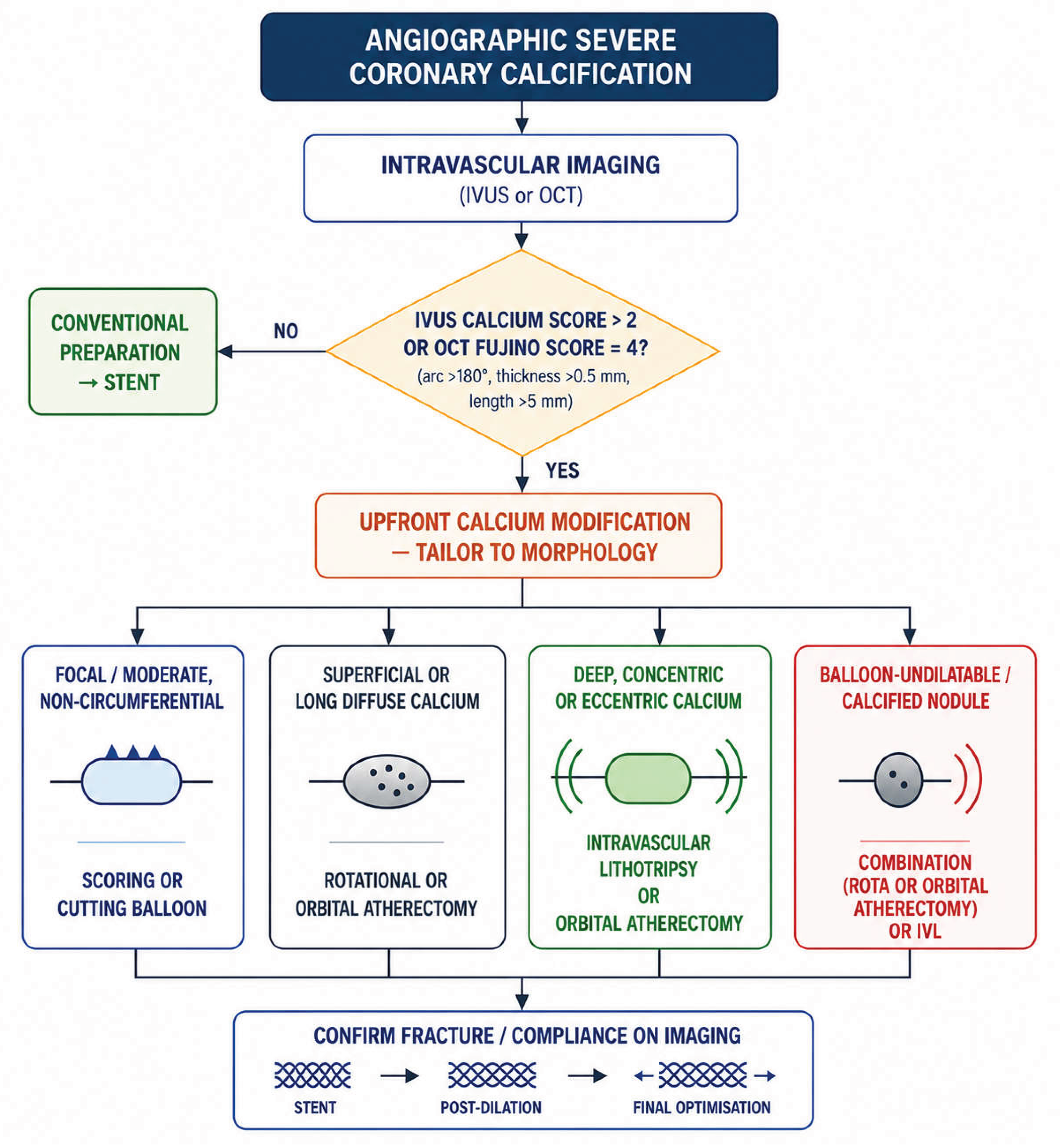
Figure 2.
Study flow diagram. Of 125 patients screened, 112 enrolled patients (121 calcified lesions). Complete follow-up data were available for 82 patients, who constituted the complete-case follow-up cohort. CABG, coronary artery bypass grafting; IVL, intravascular lithotripsy; NC, non-compliant; OA, orbital atherectomy; RA, rotational atherectomy.
Figure 2.
Study flow diagram. Of 125 patients screened, 112 enrolled patients (121 calcified lesions). Complete follow-up data were available for 82 patients, who constituted the complete-case follow-up cohort. CABG, coronary artery bypass grafting; IVL, intravascular lithotripsy; NC, non-compliant; OA, orbital atherectomy; RA, rotational atherectomy.
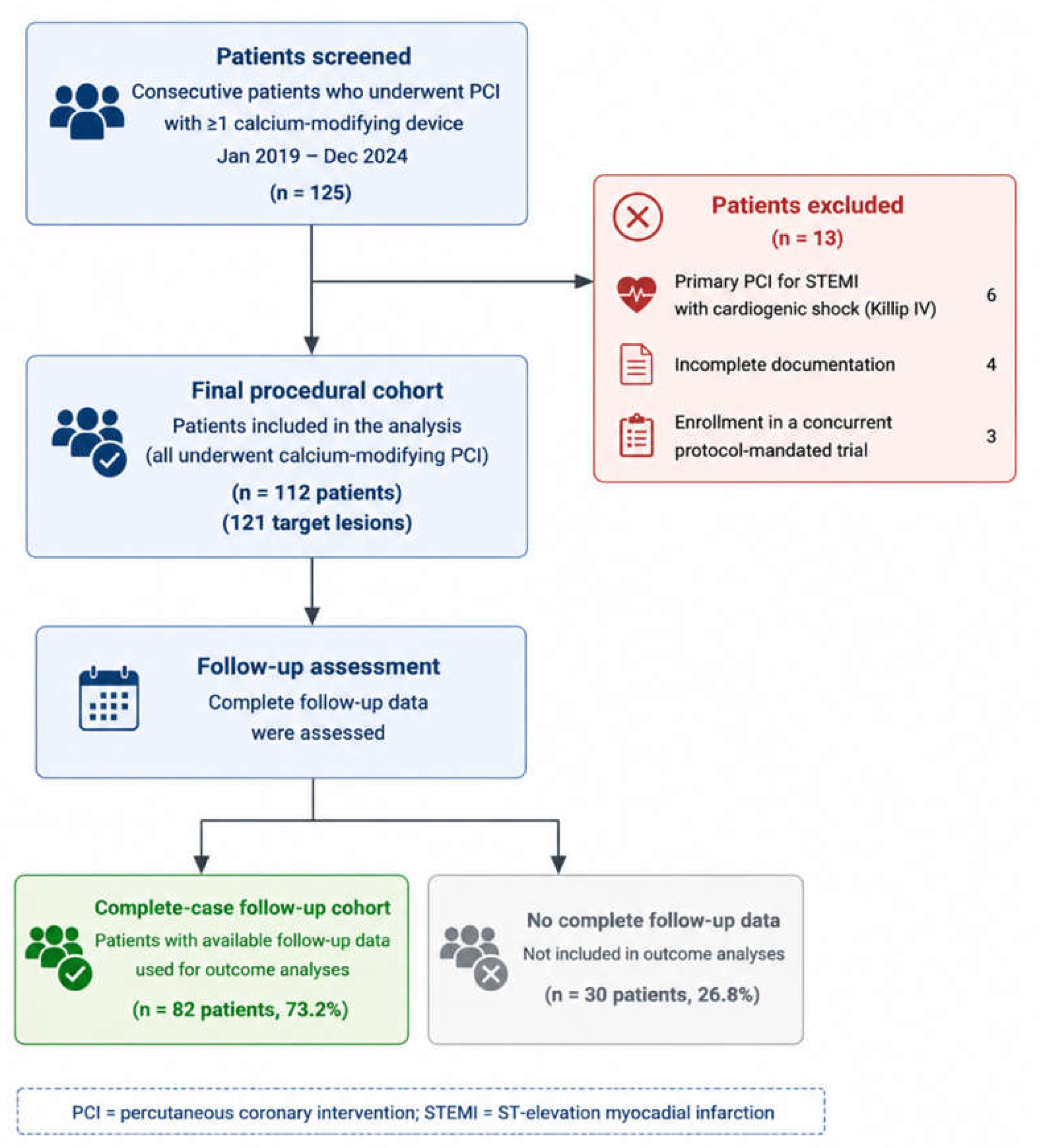

Table 1.
Baseline demographic, clinical, and risk-factor characteristics.
| Characteristic | n | % |
| Age, mean ± SD (years) | 71.9 ± 10.7 | 45–92 |
| Male sex | 93 | 83.0 |
| Clinical indication | ||
| Positive scintigraphy | 18 | 20.0 |
| NSTEMI | 17 | 18.9 |
| Unstable angina | 15 | 16.7 |
| Other | 15 | 16.7 |
| Residual lesions | 6 | 6.7 |
| Positive stress echocardiography | 5 | 5.6 |
| Refusal of CABG | 5 | 5.6 |
| Positive CT angiography | 4 | 4.4 |
| Angina-like symptoms | 3 | 3.3 |
| Positive stress test | 2 | 2.2 |
| Cardiovascular risk factors | ||
| Hypertension | 83 | 74.1 |
| Dyslipidemia | 72 | 64.3 |
| Diabetes mellitus | 41 | 36.6 |
| Smoking | 22 | 19.6 |
| Family history of CAD | 9 | 8.0 |
| Prior cardiovascular history | ||
| Known CAD | 66 | 58.9 |
| Prior PCI | 48 | 42.9 |
| Prior coronary angiography | 39 | 34.8 |
| Prior myocardial infarction | 11 | 9.8 |
| HFrEF | 2 | 1.8 |
| Previous CABG (non-target vessel) ‡ | 3 | 3.7 |
Clinical-indication percentages use the subset with a single documented primary indication (n = 90); all other percentages use n = 112. ‡ Previous CABG on a non-target vessel (target-vessel CABG was an exclusion criterion) was systematically ascertained only for the 82-patient complete-case follow-up cohort during outcome adjudication and was not captured for the full 112-patient cohort; this percentage uses n = 82 and should be read as a minimum estimate. CABG, coronary artery bypass grafting; CAD, coronary artery disease; CT, computed tomography; HFrEF, heart failure with reduced ejection fraction; NSTEMI, non-ST-elevation myocardial infarction; PCI, percutaneous coronary intervention.
Table 2.
Procedural characteristics.
| Characteristic | n | % |
| Vascular access (per procedure) | ||
| Right radial artery | 92 | 78.0 |
| Left radial artery | 12 | 10.2 |
| Right femoral artery | 11 | 9.3 |
| Right ulnar artery | 3 | 2.5 |
| Principal strategy (per patient) | ||
| Intravascular lithotripsy | — | 25.9 |
| Rotational atherectomy | — | 25.0 |
| Non-compliant high-pressure balloon | — | 25.0 |
| Cutting / scoring balloons | — | 15.2 |
| Orbital atherectomy | — | 8.9 |
| Technique (per lesion; 92 deployments) | ||
| Intravascular lithotripsy | 24 | 26.1 |
| Non-compliant high-pressure balloon | 22 | 23.9 |
| Rotational atherectomy | 18 | 19.6 |
| Orbital atherectomy | 11 | 12.0 |
| Cutting balloon | 9 | 9.8 |
| Scoring balloon | 8 | 8.7 |
| DES per patient, mean ± SD | 1.72 ± 0.85 | 0–4 |
| Contrast volume, mean ± SD (mL) | 349.5 ± 120.5 | n = 33 |
| Intravascular imaging (IVUS/OCT) | 5 | 6.2 |
Vascular-access counts are per procedure (118 procedures in 112 patients). DES, drug-eluting stent; IVUS, intravascular ultrasound; OCT, optical coherence tomography.
Table 3.
Target-vessel distribution.
| Vessel | n | % |
| Left anterior descending (LAD) | 48 | 39.7 |
| Left circumflex (LCx) | 22 | 18.2 |
| Right coronary artery (RCA) | 20 | 16.5 |
| Left main (LM) | 12 | 9.9 |
| First diagonal branch (D1) | 6 | 5.0 |
| Left main-associated vessels | 4 | 3.3 |
| Other vessels | 4 | 3.3 |
| Diagonal branches | 3 | 2.5 |
| First obtuse marginal (OM1) | 2 | 1.7 |
Table 4.
In-hospital and follow-up outcomes.
| Outcome | n | % |
| Primary composite MACE * | 15 | 18.3 |
| Death | 1 | 1.2 |
| Periprocedural myocardial injury | 2 | 2.4 |
| Myocardial infarction (late/follow-up) | 3 | 3.7 |
| Stroke | 0 | 0 |
| Repeat revascularization | 11 | 13.4 |
| Procedural complications | 2 | 2.4 |
| Coronary Perforation | 1 | 1.2 |
| Cardiac Tamponade requiring pericardiocentesis | 0 | 0 |
| Slow Flow – No Reflow | 1 | 1.2 |
| Device Entrapment | 0 | 0 |
| Arrhythmia | 1 | 1.2 |
| Emergency CABG / surgical transfer | 0 | 0 |
| Any adverse event (composite) † | 17 | 20.7 |
| Intravascular imaging use | 5 | 6.2 |
* MACE = death + MI (periprocedural + late) + stroke + repeat revascularization. Periprocedural events were defined by troponin criteria without a mandated ischemic criterion and therefore correspond to major periprocedural myocardial injury. † Any adverse event = MACE + procedural complications + arrhythmia + other. Percentages use n = 82 unless otherwise indicated. Patients experiencing more than one event are counted once in the composite. Three patients with surveillance angiography confirming stent patency (no intervention) are not counted as revascularization events. No emergency CABG or interhospital surgical transfer occurred in any of the 112 enrolled patients. CABG, coronary artery bypass grafting.
Table 5.
Exploratory logistic regression for repeat revascularization.
| Variable | n exposed | events in exposed | p | OR (95% CI) |
| NSTEMI presentation | 15 | 4 | 0.110 | 3.06 (0.77–12.27) |
| Non-compliant balloon | 22 | 5 | 0.159 | 2.60 (0.70–9.60) |
| Known CAD | 45 | 8 | 0.330 | 2.38 (0.58–9.72) |
| Diabetes | 32 | 6 | 0.328 | 2.03 (0.56–7.32) |
| Angina | 14 | 3 | 0.393 | 2.01 (0.46–8.79) |
| Prior PCI | 34 | 6 | 0.513 | 1.80 (0.50–6.47) |
| Left circumflex involvement | 22 | 4 | 0.479 | 1.65 (0.43–6.31) |
| IVL | 24 | 4 | 0.724 | 1.43 (0.38–5.42) |
| Rotational atherectomy | 18 | 3 | 0.701 | 1.38 (0.32–5.83) |
* Fisher’s exact test, Haldane–Anscombe corrected odds ratios; 11 events / 81 patients (one patient could not be reliably linked to procedure-level baseline data and was excluded). No variable was statistically associated with repeat revascularization. IVL, intravascular lithotripsy; OR, odds ratio; CI, confidence interval; PCI, percutaneous coronary intervention.
Table 6.
Exploratory logistic regression for any adverse event.
| Variable | n exposed | events in exposed | p | OR (95% CI) | |
| Non-compliant balloon | 22 | 9 | 0.013 | 4.41 (1.43–13.67) | |
| Known CAD | 45 | 14 | 0.014 | 4.97 (1.30–18.97) | |
| Prior PCI | 34 | 11 | 0.052 | 3.27 (1.07–10.00) | |
| NSTEMI presentation | 15 | 6 | 0.074 | 3.33 (0.98–11.28) | |
| Left circumflex involvement | 22 | 7 | 0.218 | 2.29 (0.74–7.05) | |
| Left main involvement | 16 | 5 | 0.308 | 2.01 (0.59–6.86) | |
| Angina | 14 | 4 | 0.478 | 1.66 (0.45–6.15) | |
| Rotational atherectomy | 18 | 5 | 0.513 | 1.63 (0.49–5.47) | |
| Dyslipidemia | 55 | 13 | 0.561 | 1.70 (0.50–5.85) | |
Fisher’s exact test, Haldane–Anscombe corrected odds ratios; 17 events / 81 patients. Nineteen candidate variables were tested per outcome without adjustment for multiple comparisons; 1–2 nominally significant findings are expected by chance alone. Device- and disease-burden-related associations are most plausibly explained by confounding by indication. CAD, coronary artery disease; NSTEMI, non-ST-elevation myocardial infarction; PCI, percutaneous coronary intervention.
Table 7.
Contextual (qualitative) comparison of the present cohort with selected published studies.
| Parameter | Asklepeion | Disrupt CAD III | ORBIT II | PREPARE-CALC | ROTAXUS |
| N (patients) | 112 | 431 | 443 | 200 | 240 |
| Mean age (years) | 71.9 | 71.5 | 72.2 | 73.0 | 71.7 |
| Male (%) | 83.0 | 72.0 | 65.0 | 75.5 | 78.8 |
| Diabetes (%) | 36.6 | 41.0 | 36.1 | 35.5 | 35.4 |
| Hypertension (%) | 74.1 | 91.0 | 93.0 | 88.0 | 90.4 |
| Mortality (%) | 1.2 | 0.5 * | 6.7 † | 2.0 † | 0.4 † |
| MI, periprocedural (%) | 2.4 | 7.2 * | 11.2 † | 5.0 † | 3.3 † |
| TLR / Redo (%) | 13.4 | 4.3 ‡ | 7.8 † | 12.0 § | 11.7 † |
| Radial access (%) | 90.7 | NR | NR | NR | NR |
Qualitative comparison only; no statistical testing was performed. Myocardial infarction definitions are not common across columns: the ORBIT II figures are CK-MB based, whereas the present cohort applied troponin criteria. Endpoint definitions and follow-up differ across studies: * 30-day; † 60-day to 3-year depending on study; ‡ 1-year; § 5-year. NR, not reported. MI, myocardial infarction; TLR, target-lesion revascularization.
Disclaimer/Publisher’s Note: The statements, opinions and data contained in all publications are solely those of the individual author(s) and contributor(s) and not of MDPI and/or the editor(s). MDPI and/or the editor(s) disclaim responsibility for any injury to people or property resulting from any ideas, methods, instructions or products referred to in the content. |
© 2026 by the authors. Licensee MDPI, Basel, Switzerland. This article is an open access article distributed under the terms and conditions of the Creative Commons Attribution (CC BY) license (http://creativecommons.org/licenses/by/4.0/).
Copyright: This open access article is published under a Creative Commons CC BY 4.0 license, which permit the free download, distribution, and reuse, provided that the author and preprint are cited in any reuse.