

Submitted:
01 August 2026
Posted:
04 August 2026
You are already at the latest version
Abstract
This qualitative investigation examines the multifaceted role of the media in managing collective psychological crises during disasters and armed conflicts, with particular emphasis on identifying and evaluating mitigation strategies that enhance community resilience. Through semi-structured interviews with 45 purposively selected participants—media professionals, mental health experts, academic researchers, and community members directly affected by crisis media coverage, the study explores the complex, bidirectional relationship between media discourse and collective psychological responses. Interpretive phenomenological analysis was employed to capture nuanced understandings of how communities experience and interpret media narratives during traumatic events. The findings reveal that constructive journalism approaches, strategically balanced content, and institutionalized collaboration between media organizations and mental health professionals contribute to meaningful enhancements in community resilience. The study articulates the key psychological mechanisms through which media influence collective behavior and proposes an evidence-based framework—the Psychologically Informed Crisis Coverage (PICC) model—for responsible crisis reporting. The results indicate that transparent, culturally sensitive, and solution-oriented coverage can transform collective trauma responses from patterns of despair and fragmentation into opportunities for community cohesion, collective healing, and posttraumatic growth. Synthesizing emerging research on digital media effects, trauma-informed organizational practice, and culturally responsive crisis communication, the study offers actionable implications for media practitioners, organizational leaders, and policymakers seeking to align media practices with public mental health imperatives.
Keywords:
collective psychological crises
; media management
; community resilience
; constructive journalism
; crisis
; vicarious trauma
; trauma-informed journalism
; media effects
; posttraumatic growth
; and community psychology
1. Introduction
In an era characterized by rapid information dissemination through digital platforms and 24-hour news cycles, the media’s influence on collective psychological states during crises has never been more profound or consequential. Disasters, armed conflicts, and public health emergencies disrupt not only physical and social infrastructure but also engender widespread psychological distress, often amplified by media portrayals that shape public perception, emotional response, and communal recovery (Garfin et al., 2020; Thompson et al., 2019). This study examines the intricate interplay between media practices and collective trauma, drawing on interpretive phenomenological analysis to illuminate how journalistic approaches can either exacerbate psychological fragmentation or foster resilience and posttraumatic growth.
Grounded in interdisciplinary frameworks from media psychology, trauma studies, and community resilience theory, the study addresses a critical gap in understanding the mechanisms through which media narratives influence community-level outcomes (Houston et al., 2018; Norris et al., 2008). By examining the perspectives of diverse stakeholders—media professionals, mental health experts, and affected community members—the research identifies evidence-based strategies for mitigating harm and enhancing adaptive coping. The sections that follow present the research problem, objectives, methodology, findings, and implications, culminating in a novel framework for psychologically informed crisis reporting that aligns media responsibilities with public mental health imperatives in an increasingly interconnected world.
2. Research Problem
Despite the accelerating pace of global information dissemination and the well-documented amplification of psychological impacts through digital news cycles and social media, a significant knowledge gap persists regarding the specific psychological mechanisms through which media coverage influences collective trauma responses and community resilience. Prior research has examined individual psychological responses to crisis media exposure (Holman et al., 2020; Thompson et al., 2019) and broad emergency communication strategies (Veil et al., 2011), yet few studies have systematically investigated the nuanced, dynamic interplay among media practices, collective psychological processes, and longitudinal community recovery trajectories—particularly within contemporary hybrid media environments that combine traditional journalism with social media dynamics. Systematic reviews demonstrate that media exposure during crises is associated with increases in anxiety, depression, and posttraumatic stress symptoms (Houston et al., 2018); however, the mechanisms for mitigating these effects remain underexplored in practical media contexts.
The emergence of algorithmically curated news, engagement-driven amplification of crisis content, and the proliferation of misinformation during disasters have further complicated the landscape, creating new challenges for traditional journalistic approaches to crisis communication (Brady et al., 2023; Wardle & Derakhshan, 2017). Concurrently, growing recognition of structural inequities in crisis coverage—whereby communities that receive less media attention also receive measurably less relief and slower assistance (Eisensee & Strömberg, 2007)—underscores the need for culturally grounded research on how different demographic groups experience crisis media narratives. This study addresses these gaps through an in-depth, multi-stakeholder qualitative investigation of how different media approaches influence collective psychological responses, and by identifying evidence-based strategies for enhancing community resilience through responsible, psychologically informed crisis reporting attentive to digital dynamics and structural equity.
3. Research Objectives
The overarching objective of this research is to examine the media’s role in managing collective psychological crises and to identify and evaluate effective, evidence-based strategies for enhancing community resilience during and after traumatic events. The specific objectives are: (1) to analyze the psychological mechanisms through which different media coverage approaches influence collective trauma responses, encompassing both traditional and digital/social media dynamics; (2) to identify and compare media strategies in terms of their demonstrated effectiveness in promoting community resilience, posttraumatic growth, and adaptive coping; (3) to synthesize the perspectives and experiential knowledge of media professionals, mental health experts, and affected community members regarding optimal crisis reporting in hybrid media environments; (4) to develop an empirically grounded framework for responsible crisis coverage that addresses structural equity, cultural responsiveness, and digital media considerations; (5) to provide evidence-based recommendations for media institutions, organizational leaders, and policymakers that align media practices with public mental health objectives while preserving journalistic integrity and press freedom; and (6) to identify the organizational barriers, economic pressures, and systemic factors that facilitate or hinder the adoption of psychologically informed crisis reporting.
4. Research Questions
The study was guided by six research questions: (1) How do different media approaches—traditional problem-focused reporting, constructive journalism, solution-oriented coverage, and digital and social media strategies—differentially influence collective psychological responses during crises, and what mechanisms underlie these differential effects? (2) What psychological, social, and cultural mechanisms link media coverage to community resilience, collective efficacy, posttraumatic growth, and recovery trajectories? (3) What strategies do experienced media professionals and mental health experts identify as most effective for managing collective psychological crises while maintaining journalistic integrity, and what organizational structures support their implementation? (4) How do community members, particularly those from marginalized and culturally diverse populations—experience, interpret, and psychologically respond to media coverage during and after traumatic events, and what factors mediate these responses? (5) What comprehensive framework can guide responsible, evidence-based media practice during collective psychological crises in ways that are culturally responsive, structurally equitable, and operationally feasible? (6) What organizational factors, economic models, and systemic pressures currently facilitate or obstruct the adoption of psychologically informed crisis reporting, and what interventions might support organizational transformation?
5. Significance of the Study
This study holds theoretical, practical, and societal significance for multiple stakeholder groups. Theoretically, it contributes to the expanding literature on media psychology, crisis communication, and community resilience by providing empirical evidence of the psychological mechanisms linking media practices to collective outcomes (Holman et al., 2020; Houston et al., 2018). The study extends existing frameworks by synthesizing perspectives from trauma psychology (Van der Kolk, 2014), cultural trauma theory (Alexander, 2012), and posttraumatic growth research (Tedeschi et al., 2018) to develop a more comprehensive understanding of the media’s constitutive role in collective crisis experience.
Practically, the findings offer actionable insight for media practitioners and organizational leaders seeking to balance traditional journalistic responsibilities with contemporary ethical imperatives regarding public mental health. A growing experimental literature indicates that constructive and solutions-oriented approaches reliably improve audience emotional outcomes while remaining economically viable (Baden et al., 2019; Gyldensted, 2015; McIntyre & Lough, 2023), addressing common concerns about feasibility. For policymakers and media regulators, the study offers empirically grounded guidance for developing professional standards that promote responsible crisis reporting while safeguarding press freedom, drawing on regulatory and newsroom models documented by Haagerup (2017) and Bro (2019). For organizational leaders, it illuminates the systemic barriers to implementing psychologically informed practices—economic pressure, professional culture, and resource constraints—and provides evidence for targeted structural change. Finally, the study addresses the urgent societal need to align media practices with evolving understandings of collective trauma and community mental health in an era of continuous crisis, a need underscored by the documented mental health consequences of pandemic-era media exposure (Garfin et al., 2020; Price et al., 2022).
6. Thesis Statement
Media organizations can transition from serving as potential amplifiers of collective trauma to functioning as intentional architects of community resilience, adaptive coping, and posttraumatic growth by deliberately adopting psychologically informed practices—constructive narrative framing, cultural responsiveness, trauma-informed content development, institutional partnerships with mental health professionals, and sustained recovery-phase engagement—while maintaining journalistic integrity and operational sustainability within contemporary hybrid media environments.
7. Methodology
This section outlines the methodological approach employed to investigate how media organizations can adopt responsible, evidence-based practices during collective psychological crises. Rooted in a commitment to rigor, cultural responsiveness, and structural equity, the methodology was designed to capture the nuanced experiences of diverse stakeholders, and the subsections below detail the research design, philosophical orientation, participant selection, and procedures for data collection and analysis.
7.1. Research Design
The study employed a qualitative design grounded in interpretive phenomenology (Smith et al., 2009) to explore the lived experiences, professional insights, and psychological responses of individuals involved in or significantly affected by crisis media coverage. This approach was selected for its demonstrated strength in capturing rich, contextually situated understandings of how participants make sense of the interplay among media narratives, trauma responses, and resilience processes (Creswell & Poth, 2018). Interpretive phenomenology enables researchers to approach participants’ experience closely while maintaining analytic distance, making it particularly suitable for sensitive topics such as trauma (Finlay, 2011). By triangulating data from three stakeholder groups—media professionals, mental health experts, and community members—the design aimed to produce a credible, multidimensional account of the phenomenon (Denzin, 2012; Lincoln & Guba, 1985). The study was conducted between January and June 2024, capturing contemporary understandings informed by recent crises, including extended pandemic effects, armed conflicts in multiple regions, and accelerating climate-related disasters.
7.2. Philosophical Orientation
The study is guided by a constructivist epistemology, which holds that knowledge is actively constructed through interaction, interpretation, and social discourse rather than passively discovered (Berger & Luckmann, 1966; Guba & Lincoln, 1994; Lincoln & Guba, 2013). This position aligns with the study’s analytical focus on how media narratives and collective psychological responses are co-created through social meaning-making (Schwandt, 2000). The ontological stance is relativist, acknowledging multiple, equally valid realities of crisis media experience across cultural, professional, and geographic contexts (Denzin & Lincoln, 2018)—an orientation essential to the study’s commitment to understanding how different communities construct meaning around crises.
7.3. Participant Selection and Demographics
A total of 45 participants were recruited using purposive and snowball sampling to ensure maximum variation in professional experience, crisis-context exposure, cultural background, and geographic location (Patton, 2015). The sample was stratified into three equally weighted groups of 15 participants each, enabling cross-group comparison; recruitment occurred through media organizations, mental health professional associations, crisis response organizations, survivor support networks, and community organizations. Inclusion required a minimum of three years of relevant professional or lived experience with crisis events. As shown in Figure 1, the design balanced journalistic, clinical, and community perspectives across nine distinct subgroups.
Table 1 details the demographic and crisis-context characteristics of the sample. Demographic diversity was intentionally pursued beyond professional categories: the sample included European American (n = 24), Hispanic/Latino (n = 8), African American (n = 7), Asian American (n = 4), and Native American (n = 2) participants; gender representation comprised 26 women, 18 men, and one non-binary individual. This diversity enables analysis of how structural inequities shape media experiences and psychological impacts (Eisensee & Strömberg, 2007).
7.4. Data Collection Procedures
Data were collected between January and June 2024 through semi-structured interviews guided by a protocol developed from the literature and consultation with trauma psychology experts (see Appendix A). This approach allowed consistent questioning across participants while providing flexibility to probe emergent themes (Kvale & Brinkmann, 2009). The guide contained approximately 20 core questions across six domains: (a) media exposure and experience during crises, (b) psychological and emotional responses, (c) perception of media responsibility, (d) assessment of specific media practices, (e) suggestions for improvement, and (f) cultural and community considerations. Interviews lasted 45–120 minutes (M = 78, SD = 24.5) and were conducted via secure video conference (n = 28; 62.2%) or in person (n = 17; 37.8%) according to participant preference and accessibility; video interviewing has been validated as broadly equivalent to in-person interviewing for qualitative data collection (Deakin & Wakefield, 2014). All interviews were audio-recorded with consent and transcribed verbatim, yielding approximately 378,000 words of data (M = 8,400 words per transcript). Interview summaries were returned to 15 randomly selected participants (33.3%) for member checking, and all confirmed the accuracy of transcription and interpretation (Lincoln & Guba, 1985).
7.5. Data Analysis
Data were analyzed using Braun and Clarke’s (2006) six-phase thematic analysis framework, implemented in NVivo 12 (QSR International, 2020) and informed by the authors’ subsequent reflexive elaborations (Braun & Clarke, 2019). In Phase 1 (familiarization), the primary researcher read all 45 transcripts repeatedly, noting semantic content, emotional tone, and transcription markers. In Phase 2 (initial coding), open coding generated approximately 287 initial codes spanning semantic and latent levels. In Phase 3 (theme development), codes were clustered into candidate themes through systematic comparison, interrogating recurring patterns, theoretical resonances, and internal contradictions. In Phase 4 (refinement), candidate themes were reviewed against the full dataset; themes endorsed in fewer than three interviews were reconsidered unless they contributed important nuance. In Phase 5 (definition), each theme received an operational definition specifying its essence and scope, and in Phase 6 (reporting), findings were organized thematically with illustrative quotations and frequency tables. To strengthen reliability, two independent researchers coded 20% of transcripts (nine interviews, ~75,600 words); initial inter-rater agreement was substantial (Cohen’s κ = .82), exceeding the conventional .75 threshold (McHugh, 2012), and discrepancies were resolved by reference to the full dataset and theoretical frameworks.
7.6. Trustworthiness and Ethical Considerations
Trustworthiness was established through strategies aligned with Lincoln and Guba’s (1985) framework. Credibility was enhanced through triangulation of stakeholder groups, member checking with one third of participants, prolonged engagement (five months of active analysis), and persistent attention to internal contradictions. Transferability was supported through thick description of contexts, methodology, and participant characteristics. Dependability was ensured through a comprehensive audit trail documenting coding and theme-development decisions, and confirmability through reflexive journaling that examined how the researchers’ backgrounds and assumptions might shape the analysis (D’Cruz et al., 2007; Finlay, 2011).
The study received Institutional Review Board approval (Protocol #2023-789, December 15, 2023) and implemented comprehensive ethical protocols. All participants provided written informed consent, with forms available in English and Spanish. Given the sensitivity of crisis topics, interviews used trauma-informed framing, participants could decline questions or withdraw at any time, and each interview concluded with debriefing and referral information for mental health resources; four of the 15 community members accepted referral information. Identities were protected through pseudonymization, with encrypted storage of recordings and transcripts and access to identifying information restricted to the primary researcher. Audio recordings will be deleted three years after study completion (June 2027). The research team-maintained transparency regarding funding and declares no conflicts of interest.
8. Theoretical Framework
No single theory adequately explains how media shape psychological outcomes during collective crises. This section therefore sets out the theoretical foundations of the study, drawing together perspectives from media effects research, trauma studies, and community psychology. Together these frameworks clarify three linked processes: how audiences learn and form beliefs from crisis coverage, how narrative and framing choices construct shared meaning, and how those choices support or undermine recovery at the community level. The synthesis that follows provides the conceptual basis for the analysis presented in later sections.
Foundational Theoretical Perspectives
This study integrates multiple complementary theoretical frameworks to develop a comprehensive understanding of the media’s role in collective psychological crises; this integrative strategy acknowledges the complexity of media effects and the multifaceted nature of collective trauma (Houston et al., 2018). Social Cognitive Theory (Bandura, 2009) posits that individuals learn vicariously through media exposure, developing behavioral scripts and efficacy beliefs from mediated models; during crises, portrayals of coping, panic, or collective action directly shape audience self-efficacy, as demonstrated in pandemic contexts where media modeling influenced population-level responses to health threats (Garfin et al., 2020).
Cultivation Theory (Gerbner & Gross, 1976; Gerbner et al., 2002) proposes that long-term, heavy exposure to media framing cultivates corresponding perceptions of reality, with effects most pronounced among heavy viewers lacking direct experience. Applied to crises, repetitive coverage can cultivate exaggerated perceptions of threat and personal vulnerability pattern consistent with the systematic evidence that disaster media exposure predicts distress in dose-response fashion (Houston et al., 2018; Thompson et al., 2019). Framing Theory (Entman, 2007; Lecheler & de Vreese, 2019) emphasizes that the selection, emphasis, and interpretation of information shape audience understanding: Entman’s four framing functions—problem definition, causal diagnosis, moral evaluation, and treatment recommendation—provide a comprehensive account of how media shape collective responses, and subsequent research clarifies how frames operate at individual, social, and institutional levels and interact with audience predispositions (Gross, 2008; Scheufele & Iyengar, 2017).
Constructive Journalism Theory (Bro, 2019; Gyldensted, 2015; Haagerup, 2017) offers a philosophical and practical alternative that incorporates solutions, responses, and community assets alongside problem identification while preserving critical scrutiny and accuracy. A systematic review of 22 audience-effects experiments confirms that constructive and solutions stories reliably affect audience emotions, though effects on other outcomes remain mixed (McIntyre & Lough, 2023). Cultural Trauma Theory (Alexander, 2012; Alexander et al., 2004; Smelser, 2004) explains how traumatic events become collective experiences through narrative construction, with the media serving as the primary arena in which trauma meaning and collective identity are constructed—an insight essential for understanding why narrative choices matter beyond individual psychology. Trauma-Informed Care Theory (Substance Abuse and Mental Health Services Administration [SAMHSA], 2014) supplies six principles—safety, trustworthiness and transparency, peer support, collaboration, empowerment, and cultural sensitivity—that have been extended from direct service provision to organizational contexts, including media organizations (Bloom & Farragher, 2013). Finally, Community Resilience Theory (Norris et al., 2008; Pfefferbaum et al., 2013) conceptualizes resilience not as an individual trait but as a community-level adaptive capacity involving economic, social, cultural, and civic resources—an ecological perspective crucial for understanding how media can facilitate or impede community-level recovery. Table 2 compares these frameworks and their applications to crisis coverage.
9. Literature Review
This review synthesizes research on the psychological consequences of crisis media coverage and on the reporting practices that shape them. It moves from evidence on media exposure and distress, vicarious and mediated trauma, and collective trauma and posttraumatic growth, to the narrative mechanisms that mediate these outcomes: framing choices, constructive and solution-oriented reporting, and cultural sensitivity and representation equity. It then examines the digital and algorithmic conditions under which contemporary crisis coverage circulates, alongside the professional and organizational pressures bearing on journalists themselves. The review closes by identifying the gaps this study addresses.
9.1. Media’s Psychological Impact During Collective Crises
Contemporary scholarship documents the profound psychological impact of media during crises across diverse methodological approaches. In a landmark population-based study following the Boston Marathon bombings, repeated bombing-related media exposure was associated with higher acute stress than direct exposure, with dose-response relationships between exposure hours and symptom severity (Holman et al., 2014). Prospective research extends this evidence: individuals exposed to graphic crisis imagery show elevated posttraumatic stress and impaired functioning months later, and prior sensitization amplifies responses to subsequent events (Garfin et al., 2015; Holman et al., 2020). Media functions during disasters, terrorism, and pandemics thus extend far beyond information dissemination to encompass the management of collective psychological states, and effects are neither uniformly positive nor negative but depend on content characteristics, exposure duration, individual differences, and context (Garfin et al., 2020; Houston et al., 2018).
9.2. Vicarious and Mediated Trauma
The phenomenon of mediated or vicarious trauma is a critical concern in crisis contexts. Thompson et al. (2019) demonstrated that media exposure to mass-violence events can fuel a self-perpetuating cycle of distress, in which distress motivates further exposure that in turn heightens distress. Several mechanisms are implicated: emotional contagion, whereby exposure to others’ distress induces similar states in observers—a process grounded in the shared neural circuitry of empathy (Zaki & Ochsner, 2012); identification with victims, which renders threats personally relevant; intrusive imagery, whereby graphic visuals become involuntary mental representations; and meaning-making disruption, whereby individuals struggle to integrate traumatic information into existing worldviews (Holman et al., 2020). Importantly, the same vicarious processes can operate positively: Hernández-Wolfe (2018) synthesizes evidence for “vicarious resilience,” whereby narratives emphasizing strength, recovery, and communal solidarity generate positive psychological effects in wider audiences—an observational-learning process consistent with Social Cognitive Theory (Bandura, 2009).
9.3. Collective Trauma, Community Response, and Posttraumatic Growth
Alexander (2012) conceptualizes collective trauma as arising when traumatic events are processed into a group’s collective memory through public narratives, with media as the primary vehicle. Smelser (2004) describes how media construct the “trauma drama” that defines an event’s meaning—determining which aspects are emphasized, whose voices are heard, and how the event enters collective identity. Posttraumatic growth (PTG) research completes this picture: significant psychological challenges, when successfully navigated, can produce enhanced relationships, personal strength, appreciation of life, and spiritual change (Tedeschi et al., 2018). Emerging evidence extends PTG to vicarious contexts—among Chinese journalists with high emotional involvement in their subjects, vicarious exposure to trauma predicted vicarious posttraumatic growth through secondary traumatic stress, moderated by empathy (Xiong & Liao, 2023)—suggesting that constructive, hopeful narratives may support growth trajectories at community scale, whereas problem-saturated narratives may impede them.
9.4. Media Framing and Crisis Narratives
Framing research demonstrates that journalists’ frames profoundly shape collective psychological responses (Gross, 2008; Lecheler & de Vreese, 2019). A particularly problematic frame is “disaster mythology,” which overemphasizes panic, social breakdown, and helplessness despite abundant evidence that disaster-affected communities predominantly display prosocial behavior, mutual aid, and adaptive cooperation (Clarke, 2002; Tierney et al., 2006). This frame misrepresents community behavior and may inhibit help-seeking and collective action. By contrast, resilience framing that highlights community capacity and solidarity is associated with improved psychological outcomes and civic engagement in the disaster-media literature (Houston et al., 2018). Research on counter-framing shows that exposure to competing frames can attenuate initially dominant frames, though early frames tend to persist (Chong & Druckman, 2007; Scheufele & Iyengar, 2017)—an insight with important implications for pluralistic information environments.
9.5. Constructive Journalism and Solution-Oriented Approaches
Constructive journalism offers a philosophical and practical alternative to problem-saturated reporting (Haagerup, 2017). Rather than “false positivity,” constructive approaches create productive narratives that empower audiences while maintaining accuracy and critical perspective; the approach is explicitly distinguished from positive journalism (which avoids negative information) and advocacy journalism (which promotes particular positions) (Bro, 2019; Gyldensted, 2015). The experimental evidence base has matured considerably. Baden et al. (2019) found that constructively framed news elevated positive affect and behavioral intentions without reducing perceived credibility. McIntyre’s (2019) experiments showed that including solution information in stories about social problems increased reader efficacy and positive affect. Synthesizing 22 experiments across 19 studies, McIntyre and Lough (2023) concluded that solutions and constructive stories unequivocally affect audience emotions, while calling for greater clarity regarding behavioral and attitudinal outcomes. The most recent wave of research extends these findings to consequential domains: constructive coverage of severe mental illness reduced attitudinal and behavioral stigma and increased trust in healthcare professionals in a repeated-exposure experiment (van Antwerpen et al., 2025); climate solutions stories increased readers’ individual and collective response efficacy (Thier, 2025); and solutions stories raised pro-environmental behavioral intentions through positive affect and collective efficacy beliefs (Maduneme & Cohen, 2024). Organizationally, the Solutions Journalism Network has developed trainable methodologies now implemented across hundreds of newsrooms worldwide (Solutions Journalism Network, 2024), and economic analyses suggest constructive approaches do not require substantially greater resources than traditional reporting (Bro, 2019).
9.6. Cultural Considerations and Representation Equity
Culture profoundly shapes crisis communication, influencing trust in sources, preferred coping mechanisms, event interpretation, and help-seeking patterns; ethnocentric, one-size-fits-all crisis communication risks alienating the very communities most at risk (Falkheimer & Heide, 2006). Research on media use in disaster impact phases shows that communication needs and practices are strongly conditioned by local and cultural context (Pérez-Lugo, 2004). Representation inequities compound these cultural failures with material consequences: analyses of international disaster coverage demonstrate that crises receiving less news attention—systematically those in less newsworthy regions or competing with other media events—elicit measurably less relief funding, independent of objective severity (Eisensee & Strömberg, 2007). Such findings underscore that coverage disparities are not merely symbolic but shape resource allocation and recovery capacity, motivating culturally grounded and equity-attentive approaches to crisis reporting.
9.7. Digital Media Ecology, Algorithmic Curation, and Emerging Challenges
The digital transformation of news creates novel psychological risks. The social-mediated crisis communication literature describes complex, multi-directional information flows in which social media facilitate rapid information sharing and support networks (Oh et al., 2013; Veil et al., 2011) while also enabling misinformation cascades and compulsive negative-news consumption. During the early COVID-19 pandemic, health misinformation spread rapidly through social networks, prompting the World Health Organization to formalize “infodemic management” frameworks (Tangcharoensathien et al., 2020; Wardle & Derakhshan, 2017). Algorithmic systems optimized for engagement preferentially amplify emotionally arousing content, and functional misalignments between human social-learning biases and engagement-based ranking magnify outrage and extreme content (Brady et al., 2023); personalization may additionally narrow information exposure, although evidence on filter bubbles is more nuanced than early accounts suggested (Pariser, 2011; Sunstein, 2017; Zuiderveen Borgesius et al., 2016). A rapidly growing literature on “doomscrolling” documents the mental health costs of habitual negative-news consumption: daily doomscrolling predicted worse mental health symptoms during the pandemic (Price et al., 2022); doomscrolling is linked to existential anxiety across cultural contexts (Shabahang et al., 2024); and its association with diminished well-being is serially mediated by reduced mindfulness and secondary traumatic stress (Taskin et al., 2024).
9.8. Professional Challenges, Organizational Barriers, and Journalist Well-Being
Organizational research identifies tensions between traditional journalistic values—conflict, novelty, problem focus—and constructive approaches, with implementation requiring cultural change, explicit training, and editorial leadership (Bro, 2019). Economic pressures compound these tensions: advertising-dependent business models reward engagement, creating incentives for emotionally arousing coverage in increasingly competitive local news markets (George & Waldfogel, 2006). A further, long-neglected organizational dimension concerns journalists’ own trauma. Qualitative research with conflict journalists documents significant direct and vicarious trauma exposure, alongside a striking lack of organizational support and prevention structures (Obermaier et al., 2023). A systematic review of 88 studies finds elevated rates of PTSD, depression, and anxiety among journalists covering war, conflict, and terrorism—in some samples comparable to combat veterans (Mohammed, 2025)—and scholars now advocate embedding “trauma literacy” in journalism education (Ogunyemi & Price, 2023). Encouragingly, vicarious posttraumatic growth is also documented among journalists when organizational and social support are present (Xiong & Liao, 2023), reinforcing the case for trauma-informed newsroom practice.
9.9. Gaps in the Current Literature
Despite this accumulating research, significant gaps persist. First, studies typically focus on single crisis events or types, limiting generalizability, and comparative meta-analytic work remains limited. Second, the perspectives of media practitioners, their motivations, ethical reasoning, and organizational constraints—are underexplored relative to audience effects. Third, and most critically, longitudinal research tracking long-term recovery and media effects is scarce, with most studies confined to acute phases. Fourth, systematic investigation of the application of trauma-informed principles in journalism contexts is only beginning (Ogunyemi & Price, 2023). Fifth, research examining media effects in structurally diverse communities—including how representation inequities affect psychological outcomes—remains thin (Eisensee & Strömberg, 2007). The present study addresses these gaps through its multi-stakeholder, multi-crisis qualitative design, aiming to produce a holistic, practice-grounded framework reflecting diverse perspectives and contemporary media realities.
10. Results
Thematic analysis yielded six themes that together map the psychological architecture of crisis media coverage. As shown in Figure 2, every theme was endorsed by more than four fifths of the sample, and the dual-edged nature of coverage was recognized universally, indicating strong cross-stakeholder convergence despite participants’ divergent professional vantage points.
10.1. Theme 1: The Dual-Edged Nature of Crisis Media Coverage
All 45 participants (100%) described the media as fundamentally dual-edged: an essential lifeline providing critical information and a potential source of profound psychological harm. The theme emerged consistently across stakeholder groups and crisis contexts. Media professional Sarah (journalist, 15 years’ experience in disaster coverage) articulated the tension: “We are caught between our duty to inform and the knowledge that our coverage can genuinely harm people. During the earthquake coverage, I saw how our repeated broadcasts of destruction footage affected viewers. However, people also needed to know the scope of what happened. It is a constant, gut-wrenching balancing act.” Mental health expert Dr. Rodriguez, a clinical psychologist specializing in disaster mental health, observed that “the same coverage that informs can trigger and re-traumatize. Increased anxiety, depression, and PTSD symptoms correlate directly with media exposure levels, particularly with repetitive graphic imagery. … The mechanism appears to be a combination of emotional contagion … and intrusive imagery, where graphic visuals become involuntary mental representations.”
Community member Ahmed (terrorism survivor, age 34) described the personal impact: “Every time I saw the footage replayed—and it was replayed hundreds of times—I was reliving that day. … Three years later, certain images still come to mind involuntarily. I did not experience those images directly; I experienced them through the media.” These accounts align closely with the quantitative literature on media-amplified acute stress and the distress cycle of repeated exposure (Holman et al., 2014; Thompson et al., 2019), and Ahmed’s involuntary imagery matches the intrusive-imagery mechanism documented in prospective studies of graphic coverage (Holman et al., 2020). Table 3 quantifies this dual-edged phenomenon, documenting the frequency with which participants identified specific beneficial and harmful functions.
The dual-edged character was perceived not as contradiction but as a reflection of media power. As editor Michael put it, “Media is like a knife—a powerful tool that can heal or harm. The key is understanding how to use it responsibly.” This lay theorization anticipates the differential-susceptibility logic of the disaster media effects literature, in which identical content produces divergent outcomes across audiences and contexts (Houston et al., 2018).
10.2. Theme 2: Narrative Choices and Collective Meaning-Making
Thirty-nine participants (86.7%) emphasized that language choices, frame selection, and scope decisions shape collective psychological responses. Editor Michael (22 years’ experience) explained: “Labeling something as a ‘catastrophe’ versus a ‘challenge’ shapes how people perceive their ability to cope. … During the hurricane coverage, we made a deliberate choice to use ‘hurricane recovery effort’ rather than ‘hurricane devastation.’ It was not about minimizing the real harm … but about framing the overall narrative to include human agency and community response.” Dr. Chen, a trauma specialist, elaborated the collective implications: “The stories that the media tells about crises become the stories that communities tell themselves. When coverage focuses exclusively on victimhood and helplessness, it can create … ‘learned helplessness’ at the collective level. … Conversely, narratives of resilience and agency activate community resources and foster posttraumatic growth. However, this is not about fake positivity; it is about comprehensive, accurate narratives that include context, causes, responses, and possibilities.”
Community member Lisa (Hurricane Maria survivor, nurse, age 41) described the transformative power of constructive narratives: “The local newspaper ran a series on ‘rebuilding together.’ These stories of neighbors helping neighbors gave me hope when I felt overwhelmed. It reminded me that we were not just victims; we were a community responding.” Participants also understood narratives as becoming embedded in cultural memory; as Dr. Williams noted, “Fifty years from now, how people remember this crisis will be shaped by how the media covered it.” These findings instantiate framing theory’s core claims (Entman, 2007; Gross, 2008) and cultural trauma theory’s account of mediated collective memory (Alexander, 2012; Smelser, 2004), while Lisa’s testimony mirrors experimental evidence that solutions-inclusive stories enhance efficacy and hope (Baden et al., 2019; McIntyre, 2019; McIntyre & Lough, 2023).
10.3. Theme 3: Cultural Sensitivity, Representation Equity, and Diverse Community Needs
Thirty-eight participants (84.4%) highlighted how one-size-fits-all media approaches frequently failed diverse communities, sometimes exacerbating distress. Journalist Maria (11 years’ experience in an urban newsroom) recounted an organizational lesson: “During the pandemic, we realized that our standard crisis reporting was not effectively reaching immigrant communities. Language was just the start—the whole approach to discussing family, community responsibility, and government authority needed cultural adaptation. … Using the wrong frames actually created distrust.” Community member Fatima (community leader and terrorism survivor, age 47) described alienation from culturally insensitive coverage: “After the bombing, all the coverage focused on individual trauma and personal therapy. In my community, we heal together through religious practices and communal support. The media made it seem like we were doing it wrong.” Mental health expert Dr. Patel synthesized the pattern: “Media that ignore these differences do not just miss people; they actively create distress by delegitimizing culturally authentic responses.”
These accounts corroborate the social-constructionist critique of ethnocentric crisis communication (Falkheimer & Heide, 2006) and evidence that disaster-communication needs are conditioned by cultural context (Pérez-Lugo, 2004). Participants extended the analysis to structural equity: as Dr. Jackson observed, “When media focuses disproportionately on disasters affecting wealthy neighborhoods while neglecting … low-income neighborhoods, that shapes how resources flow”—a perception consistent with econometric evidence that news attention causally affects disaster relief allocation (Eisensee & Strömberg, 2007). Table 4 synthesizes the cultural dimensions participants identified as shaping crisis media reception, together with the adaptations they recommended.
10.4. Theme 4: Temporal Dynamics of Crisis Coverage and Long-Term Recovery Misalignment
Forty-one participants (91.1%) identified the “spike and fade” pattern of media attention as profoundly misaligned with the long-term, non-linear nature of psychological recovery. News director Robert (26 years’ experience) outlined the pattern: “There is an initial shock phase where we scramble for facts. … Then the saturation phase, where coverage expands exponentially. … Then comes what I call the ‘fade-out,’ where coverage drops off dramatically, typically after 2–4 weeks, following a news cycle that bears no relationship to actual recovery timelines. A community recovering from a hurricane has a 5–10-year recovery timeline. We covered it intensively for three weeks.” Dr. Williams described the psychological ramifications: “When media attention disappears while communities are still struggling … it can trigger feelings of abandonment and forgotten suffering. Silence can be as damaging as initial sensationalism.” Community member James (tornado survivor, age 52) expressed the impact directly: “For three weeks after the tornado, we could not escape the cameras. … Then, suddenly, nothing. It feels like the world has forgotten us. This feeling of abandonment was a second trauma.”
Participants identified five consequences of temporal misalignment: feelings of abandonment when attention departed; resource disparities, because sustained attention channels funding and support (a mechanism empirically documented by Eisensee & Strömberg, 2007); increased depression and hopelessness during active recovery; accountability gaps, as fading scrutiny reduces oversight of recovery processes; and narrative incompleteness, whereby collective memory preserves the disaster but not the rebuilding. As survivor advocate Rebecca summarized, “The collective memory is of the disaster, not of how communities rebuild.” This theme extends the community-resilience literature’s emphasis on long-horizon adaptive processes (Norris et al., 2008; Pfefferbaum et al., 2013) by specifying the media’s role in sustaining—or truncating—the attentional resources those processes require.
10.5. Theme 5: Solutions, Resilience-Focused Approaches, and Evidence-Based Strategies
Thirty-nine participants (86.7%) identified practical strategies that balanced informational needs with psychological well-being, emphasizing that such strategies enhance rather than compromise journalistic accuracy and comprehensiveness. Journalist Tom (14 years in digital news) described his outlet’s shift: “We have moved from just reporting problems to including ‘what’s being done’ and ‘how to help’ in every crisis story. … It gives people a sense of agency—they are not just consuming a story about catastrophe; they are learning what they can actually do. Interestingly, our engagement metrics improved.” Dr. Anderson, a mental health expert who consults for media organizations, emphasized institutional collaboration: “When media outlets partner with mental health professionals, not just for crisis response but also for editorial guidance …, the quality improves dramatically. We can identify when framing is likely to induce learned helplessness. … This should be standard practice.”
Table 5 summarizes the eight strategy categories identified across participant groups, together with reported benefits and implementation challenges. Notably, the strategies participants generated independently converge with the experimental constructive-journalism literature—content balance and resource integration parallel the solution-information manipulations shown to raise efficacy and positive affect (Baden et al., 2019; McIntyre, 2019; Thier, 2025), while trauma-informed language and visual sensitivity operationalize the harm-minimization mechanisms identified in media-trauma research (Holman et al., 2020).
Participants were candid about implementation barriers. One news editor noted, “We are understaffed, underfunded, and expected to produce enormous amounts of content daily. Adding solutions reporting, multilingual coverage, and relationship-building takes resources we don’t have.” Others documented successful implementation: “When we committed to constructive approaches and built relationships with community organizations, people started trusting us more. … That actually made reporting easier and better.” This tension between resource constraints and trust dividends mirrors the economics of constructive journalism documented in the organizational literature (Bro, 2019; George & Waldfogel, 2006).
10.6. Theme 6: Organizational Culture, Professional Values, and Ethical Tensions
Although not anticipated as a major theme, 37 participants (82.2%) explicitly discussed tensions between traditional journalistic values and psychologically informed approaches. Investigative journalist Sarah reflected: “We are trained to pursue truth wherever it leads, to hold power accountable. … However, we are also trained with the saying ‘if it bleeds, it leads.’ … We rarely learn anything about psychology, trauma, or how our reporting affects people. The training doesn’t prepare us for ethical reasoning about psychological harm.” Another journalist framed the dilemma precisely: “There’s this tension between ‘the public has a right to know’ and ‘this particular disclosure might traumatize vulnerable viewers.’ Both are real values.” Mental health professionals described encountering confusion about “whether limiting graphic imagery is censorship or responsible practice,” and community members questioned whether journalists consider their impact at all.
This theme converges with three strands of recent scholarship: the documented absence of trauma literacy in journalism education (Ogunyemi & Price, 2023); the professional-identity tensions surrounding constructive journalism (Bro, 2019); and the neglected occupational trauma of journalists themselves, who frequently lack organizational support for processing the very content whose effects on audiences they must weigh (Mohammed, 2025; Obermaier et al., 2023). Together, the six themes indicate that psychologically informed crisis coverage is simultaneously a content problem, a cultural problem, and an organizational problem—a conclusion with direct implications for the framework developed in the Discussion.
11. Discussion
This section interprets the six themes considering existing theory and evidence. It argues that media function less as a conduit for crisis information than as an active influence on how communities interpret and recover from collective adversity, and that competing narratives within the wider media ecology place particular responsibility on journalistic judgment. Building on that argument, the discussion sets out a shift from attention-driven to resilience-focused reporting, presents the Psychologically Informed Crisis Coverage (PICC) model and a practical framework for implementing it, and examines the organizational barriers likely to constrain adoption. It concludes with the study’s theoretical contributions.
11.1. Reconceptualizing Media’s Role: From Information Conduit to Psychological Architect
The findings compel a fundamental reconceptualization of the media’s role—from passive information conduit to active “psychological architect”: an entity whose narrative choices, temporal decisions, framing selections, and organizational practices actively construct the psychological reality and meaning-making frameworks through which communities experience crises. This conceptualization extends traditional media-effects theories (Bandura, 2009; Holman et al., 2020) by emphasizing media’s constitutive, rather than merely reflective, role in collective psychological experience. Media do not simply report pre-existing crises; through narrative construction, temporal structuring, and frame selection, they shape what crises mean, how communities understand them, and what possibilities for response appear available.
This architectural function operates through five mechanisms identified in the data: narrative framing, which supplies interpretive schemas for understanding events; temporal structuring, which allocates attention across crisis and recovery phases; symbolic representation, which determines what is visible and valued; definitional authority, which establishes whose voices and knowledge count; and emotional modeling, which demonstrates how to respond emotionally and behaviorally. The implication for practice is the development of “psychological literacy” among journalists—competencies extending beyond traditional training to trauma responses, collective efficacy, cultural meaning-making, and posttraumatic growth processes (Ogunyemi & Price, 2023; Tedeschi et al., 2018). Importantly, this reconceptualization does not diminish the responsibility to report accurately; rather, it expands what accuracy requires. If narrative choices shape psychological responses, then accurate reporting must reflect the full reality of situations—causes, responses, and possibilities—not merely dramatic moments.
11.2. The Narrative Ecology: Competition, Dominance, and Journalistic Leadership
The findings suggest a dynamic “narrative ecology” in which story types—victimhood, resilience, accountability, and blame narratives—compete for dominance in the media landscape, with the media acting as primary amplifier and legitimizer of whichever narrative becomes the collective story of a crisis. This framework extends work on resilience framing in disaster media (Houston et al., 2018) by offering an ecological perspective that acknowledges multiple competing narratives rather than a single inevitable one. The concept of first-story effects is particularly consequential: initial frames become cognitive anchors that shape subsequent information processing, and framing research demonstrates that early frames persist even against later counter-frames (Chong & Druckman, 2007; Scheufele & Iyengar, 2017). Media decisions in the immediate aftermath of crises—“tragedy” or “challenge,” “disaster” or “disruption”—therefore exert outsized influence on long-term community response, underscoring the importance of editorial leadership and deliberate decision-making precisely when time pressure is greatest.
11.3. Paradigm Shift: From Attention-Driven to Resilience-Focused Reporting
The ethical tensions identified by participants reveal a structural conflict between attention-driven news values and psychologically informed reporting. The “competitive trauma” phenomenon—outlets competing for attention through increasingly sensational crisis coverage—emerges directly from economic models that reward engagement metrics (Brady et al., 2023; George & Waldfogel, 2006). As presented in Table 6, shifting toward psychologically informed practice requires a paradigm transformation in how media organizations conceptualize audiences, measure success, and define journalistic purpose.
This paradigm shift is not merely aspirational: elements have already been implemented. The Solutions Journalism Network, founded in 2013, has trained journalists across hundreds of newsrooms worldwide (Solutions Journalism Network, 2024), and constructive approaches implemented in Scandinavian public and commercial media have produced award-winning coverage while maintaining engagement (Haagerup, 2017). Recent experimental work suggests such approaches can also build audience trust in specific reporting domains (van Antwerpen et al., 2025). The shift nonetheless requires systemic change: reorienting incentives from engagement toward credibility metrics, training staff in trauma psychology and ethical reasoning, establishing mental health and community partnerships, resourcing sustained coverage, and shifting organizational culture toward comprehensive rather than sensational reporting.
11.4. The PICC Model: Psychologically Informed Crisis Coverage Framework
Based on systematic analysis of participant insights and integration with contemporary literature, this study proposes the Psychologically Informed Crisis Coverage (PICC) model—an evidence-based framework designed to align crisis reporting with public mental health imperatives while maintaining journalistic integrity, accuracy, and press freedom. As depicted in Figure 3, the model comprises six integrated, mutually reinforcing components: narrative consciousness, ethical reflexivity, cultural responsiveness, temporal alignment, collaborative integration, and trauma-informed practice.
The components are designed to function as an integrated whole: narrative consciousness requires cultural responsiveness to ensure frames are appropriate; temporal alignment depends on collaborative integration to sustain relationships through recovery; and traumas-informed practice underwrites all other components by creating psychologically safe newsrooms. Table 7 specifies each component’s core principle, theoretical basis, practical applications, implementation considerations, and evidence base.
11.5. Implementation Framework: From Model to Practice
Moving from model to organizational practice requires systematic implementation. Drawing on the organizational change literature and participant insights, a four-phase pathway is recommended. Phase 1—Foundation and planning (months 1–3): organizational assessment of current practices and readiness; leadership commitment and resource allocation; formation of an implementation team spanning journalists, editors, managers, and external advisors; and identification of community and mental health partners. Phase 2—Training and pilots (months 4–6): staff training in trauma psychology, cultural competency, and constructive journalism; establishment of formal partnerships; pilot implementation within a specific beat or crisis type; and development of editorial guidelines. Phase 3—Expanded implementation (months 7–12): gradual extension across the organization, ongoing training, monitoring, and integration into standard operating procedures. Phase 4—Institutionalization (year 2 onward): full cultural integration, regular outcome evaluation, professional network participation, and adaptation to emerging research. Successful implementation must attend to professional identity: as one editor observed, PICC approaches “do not require [journalists] to stop” pursuing accountability—“It’s expansion, not replacement of traditional journalism values.”
11.6. Organizational Barriers and Systemic Challenges
Although conceptually sound and operationally feasible, the PICC model faces substantial implementation barriers. Economic pressures: advertising-dependent models reward sensationalism, and outlets shifting toward constructive approaches may initially lose sensation-seeking audiences—although experimental and organizational evidence suggests constructive approaches can build loyalty and credibility over time (Bro, 2019; van Antwerpen et al., 2025). Professional culture: journalism training emphasizes conflict, novelty, and problem focus, and some journalists experience solution focus as a violation of professional values; education must demonstrate how constructive approaches honor truth-telling and public service (Bro, 2019). Resource constraints: relationship-building, multilingual coverage, and sustained recovery reporting all require investment that financially pressured organizations struggle to allocate; cost-sharing partnerships and philanthropic funding offer partial remedies. Structural inequities: coverage disparities reflect broader societal inequities in what is deemed newsworthy (Eisensee & Strömberg, 2007), so addressing media disparities requires attention to underlying structures as well as practices.
11.7. Theoretical Contributions
This study makes four theoretical contributions. First, the psychological architect conceptualization extends media-effects theory by emphasizing media’s constitutive role in constructing the psychological reality through which communities experience crises. Second, the narrative ecology framework offers a dynamic account of multiple narratives competing for dominance, refining single-narrative models of crisis framing. Third, the integration of community resilience and posttraumatic growth perspectives with media psychology broadens the field’s understanding of media’s potential role beyond harm reduction to active support of adaptive community processes (Norris et al., 2008; Tedeschi et al., 2018). Fourth, the structural inequity lens incorporates representation disparities and coverage inequities into crisis media theory, connecting media psychology to the political economy of attention (Eisensee & Strömberg, 2007; George & Waldfogel, 2006).
12. Conclusion
This qualitative study of the media’s influence during collective psychological crises affirms the media’s pivotal role as a psychological architect whose practices, narratives, and strategic decisions can either exacerbate collective trauma and fragmentation or actively promote healing, meaning making, and community cohesion. The multi-stakeholder approach—incorporating media professionals, mental health experts, and affected community members—yielded a rich, multidimensional understanding of these dynamics across crisis types and community contexts. Four insights stand out. First, participants universally recognized the dual-edged nature of crisis coverage: an essential lifeline that can simultaneously harm. Second, narrative choices matter fundamentally—word selection, framing, and scope shape collective psychological responses, making narrative consciousness essential to responsible reporting. Third, uniform approaches fail diverse communities; culturally adapted, community-responsive strategies are necessary for equitable psychological coverage. Fourth, the prevailing spike-and-fade pattern of coverage, driven by news cycles rather than recovery timelines, inflicts harm through abandonment and invisibility, making temporal alignment with community recovery a core professional obligation.
Theoretically, the research introduces the psychological-architect conceptualization and the narrative-ecology framework, and the PICC model synthesizes trauma psychology, community psychology, communication theory, and stakeholder insight into an actionable framework for media organizations at any stage of transformation. For policymakers and regulators, the study offers empirically grounded guidance for professional standards that promote responsible crisis reporting while preserving press freedom. For community members, it validates experiences of harm from sensationalized coverage while documenting the potential of responsible media to support healing—evidence that advocating for better media practices is warranted and that media organizations can change. The ultimate vision is a media ecosystem that consciously embraces public health responsibilities: transcending the mere documentation of disasters to promote community connection, collective meaning-making, and evidence-based recovery. Such an approach does not compromise journalistic integrity; it represents an evolution toward a more comprehensive, humanistic understanding of journalism’s role in democratic societies and in communities experiencing collective trauma.
13. Recommendations for Future Research
Acknowledging this study’s limitations—a qualitative design privileging depth over breadth, reliance on retrospective accounts, and a predominantly single-country sample—future research should pursue five scientifically grounded priorities. First, longitudinal outcome research should track communities for multiple years post-crisis, empirically mapping relationships between coverage patterns (including temporal alignment) and psychological recovery trajectories, thereby addressing the acute-phase bias that pervades the disaster media literature (Houston et al., 2018).
Second, intervention and implementation trials should test PICC components experimentally—comparing audience responses to traditional versus PICC-informed news packages on anxiety, agency, trust, and behavior—and evaluate organizational implementation through case studies of newsrooms adopting trauma-informed and constructive practices. Such work should build on the maturing experimental literature on constructive journalism, which currently shows consistent emotional effects but mixed behavioral findings (McIntyre & Lough, 2023; Thier, 2025; van Antwerpen et al., 2025), and should include cost–benefit analyses of the business case for psychologically informed approaches.
Third, cross-cultural and comparative media system research should replicate the present design in non-Western, non-English-speaking, and resource-constrained contexts, and examine how media structures (public vs. commercial, national vs. local, nonprofit vs. profit) condition the capacity to implement psychologically informed reporting; participatory action research co-designed with communities offers the most ecologically valid pathway (Falkheimer & Heide, 2006).
Fourth, digital and algorithmic effects research should examine how engagement-optimized curation shapes crisis narrative dominance and collective understanding, including misinformation dynamics, doomscrolling, and the potential of platform design to support rather than undermine resilience (Brady et al., 2023; Price et al., 2022; Taskin et al., 2024). Fifth, journalist well-being research should investigate vicarious trauma, protective organizational practices, and the relationship between journalist well-being and coverage quality, alongside the development and evaluation of trauma-literacy curricula in journalism education (Mohammed, 2025; Obermaier et al., 2023; Ogunyemi & Price, 2023; Xiong & Liao, 2023). Progress on these five fronts would convert the PICC model from an empirically grounded proposal into a validated, globally adaptable standard for crisis journalism.
more susceptible than others.
Declarations
.
The funding statements
This work was supported and funded by the Deanship of Scientific Research at Imam Mohammad ibn Saud Islamic University (IMSIU) (grant number IMSIU-DDRSP2602).
Conflicts of Interest
The author declares no conflicts of interest.
Transparency
The author confirms that the manuscript is an honest, accurate and transparent account of the study that no vital features of the study have been omitted and that any discrepancies from the study as planned have been explained. This study followed all ethical practices during writing.
Data availability statements
I used publicly available data and have uploaded a descriptive file titled “Supplementary”.
Consent to Publish declaration
applicable.
Consent to Participate declaration
not applicable.
Ethics declaration
not applicable.
References
- Alexander, J. C. Trauma: A social theory; Polity Press, 2012; ISBN 9780745651224. [Google Scholar]
- Alexander, J. C.; Eyerman, R.; Giesen, B.; Smelser, N. J.; Sztompka, P. (Eds.) Cultural trauma and collective identity; University of California Press, 2004; ISBN 9780520235953. [Google Scholar]
- Baden, D.; McIntyre, K.; Homberg, F. The impact of constructive news on affective and behavioural responses. Journal. Stud. 2019, 20(13), 1940–1959. [Google Scholar] [CrossRef]
- Bandura, A. Social cognitive theory of mass communication. In Media effects: Advances in theory and research, 3rd ed.; Bryant, J., Oliver, M. B., Eds.; Routledge, 2009; pp. 94–124. [Google Scholar] [CrossRef]
- Berger, P. L.; Luckmann, T. The social construction of reality: A treatise in the sociology of knowledge; Doubleday, 1966; ISSN ISBN 9780385058988. [Google Scholar]
- Bloom, S. L.; Farragher, B. Restoring sanctuary: A new operating system for trauma-informed systems of care; Oxford University Press, 2013; ISBN 9780199796366. [Google Scholar]
- Brady, W. J.; Jackson, J. C.; Lindström, B.; Crockett, M. J. Algorithm-mediated social learning in online social networks. Trends Cogn. Sci. 2023, 27(10), 947–960. [Google Scholar] [CrossRef] [PubMed]
- Braun, V.; Clarke, V. Using thematic analysis in psychology. Qual. Res. Psychol. 2006, 3(2), 77–101. [Google Scholar] [CrossRef]
- Braun, V.; Clarke, V. Reflecting on reflexive thematic analysis. Qual. Res. Sport Exerc. Health 2019, 11(4), 589–597. [Google Scholar] [CrossRef]
- Bro, P. Constructive journalism: Proponents, precedents, and principles. Journalism 2019, 20(4), 504–519. [Google Scholar] [CrossRef]
- Chong, D.; Druckman, J. N. Framing theory. Annu. Rev. Political Sci. 10 2007, 103–126. [Google Scholar] [CrossRef]
- Clarke, L. Panic: Myth or reality? Contexts 2002, 1(3), 21–26. [Google Scholar] [CrossRef]
- Creswell, J. W.; Poth, C. N. Qualitative inquiry and research design: Choosing among five approaches, 4th ed.; SAGE Publications, 2018; ISBN 9781506330204. [Google Scholar]
- D’Cruz, H.; Gillingham, P.; Melendez, S. Reflexivity, its meanings and relevance for social work: A critical review of the literature. Br. J. Soc. Work 2007, 37(1), 73–90. [Google Scholar] [CrossRef]
- Deakin, H.; Wakefield, K. Skype interviewing: Reflections of two PhD researchers. Qual. Res. 2014, 14(5), 603–616. [Google Scholar] [CrossRef]
- Denzin, N. K. Triangulation 2.0. J. Mix. Methods Res. 2012, 6(2), 80–88. [Google Scholar] [CrossRef]
- Denzin, N. K.; Lincoln, Y. S. (Eds.) The SAGE handbook of qualitative research, 5th ed.; SAGE Publications, 2018; ISBN 9781483349800. [Google Scholar]
- Eisensee, T.; Strömberg, D. News droughts, news floods, and U.S. disaster relief. Q. J. Econ. 2007, 122(2), 693–728. [Google Scholar] [CrossRef]
- Entman, R. M. Framing bias: Media in the distribution of power. J. Commun. 2007, 57(1), 163–173. [Google Scholar] [CrossRef]
- Falkheimer, J.; Heide, M. Multicultural crisis communication: Towards a social constructionist perspective. J. Conting. Crisis Manag. 2006, 14(4), 180–189. [Google Scholar] [CrossRef]
- Finlay, L. Phenomenology for therapists: Researching the lived world; Wiley-Blackwell, 2011; ISBN 9780470666456. [Google Scholar]
- Garfin, D. R.; Holman, E. A.; Silver, R. C. Cumulative exposure to prior collective trauma and acute stress responses to the Boston Marathon bombings. Psychol. Sci. 2015, 26(6), 675–683. [Google Scholar] [CrossRef] [PubMed]
- Garfin, D. R.; Silver, R. C.; Holman, E. A. The novel coronavirus (COVID-2019) outbreak: Amplification of public health consequences by media exposure. Health Psychol. 2020, 39(5), 355–357. [Google Scholar] [CrossRef] [PubMed]
- George, L. M.; Waldfogel, J. The New York Times and the market for local newspapers. Am. Econ. Rev. 2006, 96(1), 435–447. [Google Scholar] [CrossRef]
- Gerbner, G.; Gross, L. Living with television: The violence profile. J. Commun. 1976, 26(2), 172–199. [Google Scholar] [CrossRef] [PubMed]
- Gerbner, G.; Gross, L.; Morgan, M.; Signorielli, N.; Shanahan, J. Growing up with television: Cultivation processes. In Media effects: Advances in theory and research, 2nd ed.; Bryant, J., Zillmann, D., Eds.; Lawrence Erlbaum, 2002; pp. 43–67. ISBN 9780805838640. [Google Scholar]
- Gross, K. Framing persuasive appeals: Episodic and thematic framing, emotional response, and policy opinion. Political Psychol. 2008, 29(2), 169–192. [Google Scholar] [CrossRef]
- Guba, E. G.; Lincoln, Y. S. Competing paradigms in qualitative research. In Handbook of qualitative research; Denzin, N. K., Lincoln, Y. S., Eds.; SAGE Publications, 1994; pp. 105–117. ISSN ISBN 9780803946798. [Google Scholar]
- Gyldensted, C. From mirrors to movers: Five elements of positive psychology in constructive journalism; GGroup Publishing, 2015; ISBN 9788793233263. [Google Scholar]
- Haagerup, U. Constructive news: How to save the media and democracy with journalism of tomorrow, 2nd ed.; Aarhus University Press, 2017; ISBN 9788771843194. [Google Scholar]
- Hernández-Wolfe, P. Vicarious resilience: A comprehensive review. Rev. De Estud. Soc. 66 2018, 9–17. [Google Scholar] [CrossRef]
- Holman, E. A.; Garfin, D. R.; Lubens, P.; Silver, R. C. Media exposure to collective trauma, mental health, and functioning: Does it matter what you see? Clin. Psychol. Sci. 2020, 8(1), 111–124. [Google Scholar] [CrossRef]
- Holman, E. A.; Garfin, D. R.; Silver, R. C. Media’s role in broadcasting acute stress following the Boston Marathon bombings. Proc. Natl. Acad. Sci. 2014, 111(1), 93–98. [Google Scholar] [CrossRef] [PubMed]
- Houston, J. B.; Spialek, M. L.; First, J. Disaster media effects: A systematic review and synthesis based on the differential susceptibility to media effects model. J. Commun. 2018, 68(4), 734–757. [Google Scholar] [CrossRef]
- Kvale, S.; Brinkmann, S. InterViews: Learning the craft of qualitative research interviewing, 2nd ed.; SAGE Publications, 2009; ISBN 9780761925422. [Google Scholar]
- Lecheler, S.; de Vreese, C. H. News framing effects; Routledge, 2019. [Google Scholar] [CrossRef]
- Lincoln, Y. S.; Guba, E. G. Naturalistic inquiry; SAGE Publications, 1985; ISBN 9780803924314. [Google Scholar]
- Lincoln, Y. S.; Guba, E. G. The constructivist credo; Left Coast Press, 2013; ISBN 9781611321739. [Google Scholar]
- Maduneme, E.; Cohen, A. S. Solutions journalism stories boost pro-environmental behavioral intentions through positive affect and collective efficacy beliefs. Environment and Behavior. Advance online publication. 2024. [CrossRef]
- Magis, K. Community resilience: An indicator of social sustainability. Soc. Nat. Resour. 2010, 23(5), 401–416. [Google Scholar] [CrossRef]
- McHugh, M. L. Interrater reliability: The kappa statistic. Biochem. Medica 2012, 22(3), 276–282. [Google Scholar] [CrossRef]
- McIntyre, K. Solutions journalism: The effects of including solution information in news stories about social problems. Journal. Pract. 2019, 13(1), 16–34. [Google Scholar] [CrossRef]
- McIntyre, K.; Lough, K. Evaluating the effects of solutions and constructive journalism: A systematic review of audience-focused research. Newsp. Res. J. 2023, 44(3), 276–300. [Google Scholar] [CrossRef]
- Mohammed, I. A systematic review of the literature on the mental health of journalists reporting on war, conflict and terrorism: Gaps and recommendations for future studies. Journal. Media 2025, 6(3), 129. [Google Scholar] [CrossRef]
- Norris, F. H.; Stevens, S. P.; Pfefferbaum, B.; Wyche, K. F.; Pfefferbaum, R. L. Community resilience as a metaphor, theory, set of capacities, and strategy for disaster readiness. Am. J. Community Psychol. 2008, 41(1–2), 127–150. [Google Scholar] [CrossRef] [PubMed]
- Obermaier, M.; Wiedicke, A.; Steindl, N.; Hanitzsch, T. Reporting trauma: Conflict journalists’ exposure to potentially traumatizing events, short- and long-term consequences, and coping behavior. Journalism Studies. Advance online publication. 2023. [CrossRef]
- Ogunyemi, O.; Price, L. T. Introduction: Trauma literacy in global journalism: Toward an education agenda. Journal. Mass Commun. Educ. 2023, 78(2), 107–111. [Google Scholar] [CrossRef]
- Oh, O.; Agrawal, M.; Rao, H. R. Community intelligence and social media services: A rumor theoretic analysis of tweets during social crises. MIS Q. 2013, 37(2), 407–426. [Google Scholar] [CrossRef]
- Pariser, E. The filter bubble: What the Internet is hiding from you; Penguin Press, 2011; ISBN 9781594203008. [Google Scholar]
- Patton, M. Q. Qualitative research and evaluation methods: Integrating theory and practice, 4th ed.; SAGE Publications, 2015; ISBN 9781412972123. [Google Scholar]
- Pérez-Lugo, M. Media uses in disaster situations: A new focus on the impact phase. Sociol. Inq. 2004, 74(2), 210–225. [Google Scholar] [CrossRef]
- Pfefferbaum, R. L.; Pfefferbaum, B.; Van Horn, R. L.; Klomp, R. W.; Norris, F. H.; Reissman, D. B. The Communities Advancing Resilience Toolkit (CART): An intervention to build community resilience to disasters. J. Public Health Manag. Pract. 2013, 19(3), 250–258. [Google Scholar] [CrossRef] [PubMed]
- Price, M.; Legrand, A. C.; Brier, Z. M. F.; van Stolk-Cooke, K.; Peck, K.; Dodds, P. S.; Danforth, C. M.; Adams, Z. W. Doomscrolling during COVID-19: The negative association between daily social and traditional media consumption and mental health symptoms during the COVID-19 pandemic. Psychol. Trauma Theory Res. Pract. Policy 2022, 14(8), 1338–1346. [Google Scholar] [CrossRef] [PubMed]
- QSR International. NVivo 12 Plus [Computer software]. 2020. Available online: https://www.qsrinternational.com/nvivo/.
- Scheufele, D. A.; Iyengar, S. The state of framing research: A call for new directions. In The Oxford handbook of political communication; Kenski, K., Jamieson, K. H., Eds.; Oxford University Press, 2017; pp. 619–632. [Google Scholar] [CrossRef]
- Schwandt, T. A. Three epistemological stances for qualitative inquiry. In Handbook of qualitative research, 2nd ed.; Denzin, N. K., Lincoln, Y. S., Eds.; SAGE Publications, 2000; pp. 189–213. ISBN 9780761915126. [Google Scholar]
- Shabahang, R.; Hwang, H.; Thomas, E. F.; Aruguete, M. S.; McCutcheon, L. E.; Orosz, G.; Hossein Khanzadeh, A. A.; Mokhtari Chirani, B.; Zsila, Á. Doomscrolling evokes existential anxiety and fosters pessimism about human nature? Evidence from Iran and the United States. Comput. Hum. Behav. Rep. 15 2024, 100438. [Google Scholar] [CrossRef]
- Smelser, N. J. Psychological trauma and cultural trauma. In Cultural trauma and collective identity; Alexander, J. C., Eyerman, R., Giesen, B., Smelser, N. J., Sztompka, P., Eds.; University of California Press, 2004; pp. 31–59. ISBN 9780520235953. [Google Scholar]
- Smith, J. A.; Flowers, P.; Larkin, M. Interpretative phenomenological analysis: Theory, method and research; SAGE Publications, 2009; ISBN 9781412908344. [Google Scholar]
- Solutions Journalism Network. About the Solutions Journalism Network. 2024. Available online: https://www.solutionsjournalism.org/.
- Substance Abuse and Mental Health Services Administration. 2014. SAMHSA’s concept of trauma and guidance for a trauma-informed approach (HHS Publication No. SMA 14-4884). Available online: https://store.samhsa.gov/product/sma14-4884.
- Sunstein, C. R. #Republic: Divided democracy in the age of social media; Princeton University Press, 2017; ISBN 9780691175515. [Google Scholar]
- Tangcharoensathien, V.; Calleja, N.; Nguyen, T.; Purnat, T.; D’Amore, R.; Nguyen, T.; Briand, S.; et al. Framework for managing the COVID-19 infodemic: Methods and results of an online, crowdsourced WHO technical consultation. J. Med. Internet Res. 2020, 22(6), e19659. [Google Scholar] [CrossRef] [PubMed]
- Taskin, S.; Yildirim Kurtulus, H.; Satici, S. A.; Deniz, M. E. Doomscrolling and mental well-being in social media users: A serial mediation through mindfulness and secondary traumatic stress. J. Community Psychol. Advance online publication. 2024. [Google Scholar] [CrossRef] [PubMed]
- Tedeschi, R. G.; Shakespeare-Finch, J.; Taku, K.; Calhoun, L. G. Posttraumatic growth: Theory, research, and applications; Routledge, 2018. [Google Scholar] [CrossRef]
- Thier, K. A new journalism for a new climate: Is solutions journalism the solution? Sci. Commun. Advance online publication. 2025. [Google Scholar] [CrossRef]
- Thompson, R. R.; Jones, N. M.; Holman, E. A.; Silver, R. C. Media exposure to mass violence events can fuel a cycle of distress. Sci. Adv. 2019, 5(4), eaav3502. [Google Scholar] [CrossRef] [PubMed]
- Tierney, K.; Bevc, C.; Kuligowski, E. Metaphors matter: Disaster myths, media frames, and their consequences in Hurricane Katrina. Ann. Am. Acad. Political Soc. Sci. 2006, 604(1), 57–81. [Google Scholar] [CrossRef]
- van Antwerpen, N.; Fielding, V.; Ross, A.; Searston, R. A.; Kovacevic, P.; Ejova, A.; Stephens, R. G.; Opozda, M. J.; Soontiens, W.; Morgan, A. Testing constructive journalism’s effects on stigma, trust, and engagement. Journalism Studies. Advance online publication. 2025. [CrossRef]
- Van der Kolk, B. The body keeps the score: Brain, mind, and body in the healing of trauma; Viking, 2014; ISBN 9780670785933. [Google Scholar]
- Veil, S. R.; Buehner, T.; Palenchar, M. J. A work-in-progress literature review: Incorporating social media in risk and crisis communication. J. Conting. Crisis Manag. 2011, 19(2), 110–122. [Google Scholar] [CrossRef]
- Wardle, C.; Derakhshan, H. Information disorder: Toward an interdisciplinary framework for research and policymaking; Council of Europe., 2017; Available online: https://rm.coe.int/information-disorder-toward-an-interdisciplinary-framework-for-researc/168076277c.
- Xiong, Y.; Liao, S. Thriving after trauma in emotional livelihood journalism in China: Vicarious exposure to trauma and vicarious post-traumatic growth among journalists. Journalism. Advance online publication. 2023. [CrossRef]
- Zaki, J.; Ochsner, K. The neuroscience of empathy: Progress, pitfalls and promise. Nat. Neurosci. 2012, 15(5), 675–680. [Google Scholar] [CrossRef] [PubMed]
- Zuiderveen Borgesius, F. J.; Trilling, D.; Möller, J.; Bodó, B.; de Vreese, C. H.; Helberger, N. Should we worry about filter bubbles? Internet Policy Rev. 2016, 5(1). [Google Scholar] [CrossRef]
- Author Biography.
- Dr. Safran Safar Almakaty is widely recognized for his contributions to communication, media studies, and higher education, particularly within Saudi Arabia and the broader Middle East. A Professor at Imam Mohammad ibn Saud Islamic University (IMSIU) in Riyadh, he holds a Master of Arts from Michigan State University and a PhD from the University of Kentucky. His scholarship examines media transformation and international communication, analyzing how new technologies, global trends, and sociopolitical forces reshape public discourse and information exchange. He also advises government agencies, corporate entities, and non-profit organizations on communication strategy and higher education policy and is committed to mentoring the next generation of scholars and practitioners.
- Appendix A: Interview Guide (Abbreviated Version).
- Opening and consent (5 minutes). Welcome and thanks; review of study purpose and confidentiality protections; confirmation of consent and recording permission.
- Demographics and background (5 minutes). Professional role or crisis experience; years of experience; crisis contexts encountered.
- Media exposure and experience during crises (10 minutes). Sources and patterns of crisis news consumption or production; salient coverage episodes.
- Psychological and emotional responses (15 minutes). Emotional reactions to crisis coverage; perceived effects on self, family, and community; coping responses.
- Perception of media responsibility (10 minutes). Views on the media’s obligations during crises; balance between informing and protecting audiences.
- Assessment of media practices (15 minutes). Evaluation of specific practices (graphic imagery, repetition, framing, follow-up coverage); examples of helpful and harmful coverage.
- Cultural and community considerations (10 minutes). Cultural factors shaping reception of coverage; representation and equity concerns.
- Solutions and improvements (10 minutes). Recommended strategies for psychologically informed coverage; organizational and policy changes.
- Closing (5 minutes). Additional comments; debriefing; provision of mental health resources and referral information.
Figure 1.
Stakeholder Composition of the Study Sample; Note. Authors’ data from participant recruitment and screening procedures (January–June 2024). Bar shading distinguishes subgroups within each stakeholder group.
Figure 1.
Stakeholder Composition of the Study Sample; Note. Authors’ data from participant recruitment and screening procedures (January–June 2024). Bar shading distinguishes subgroups within each stakeholder group.
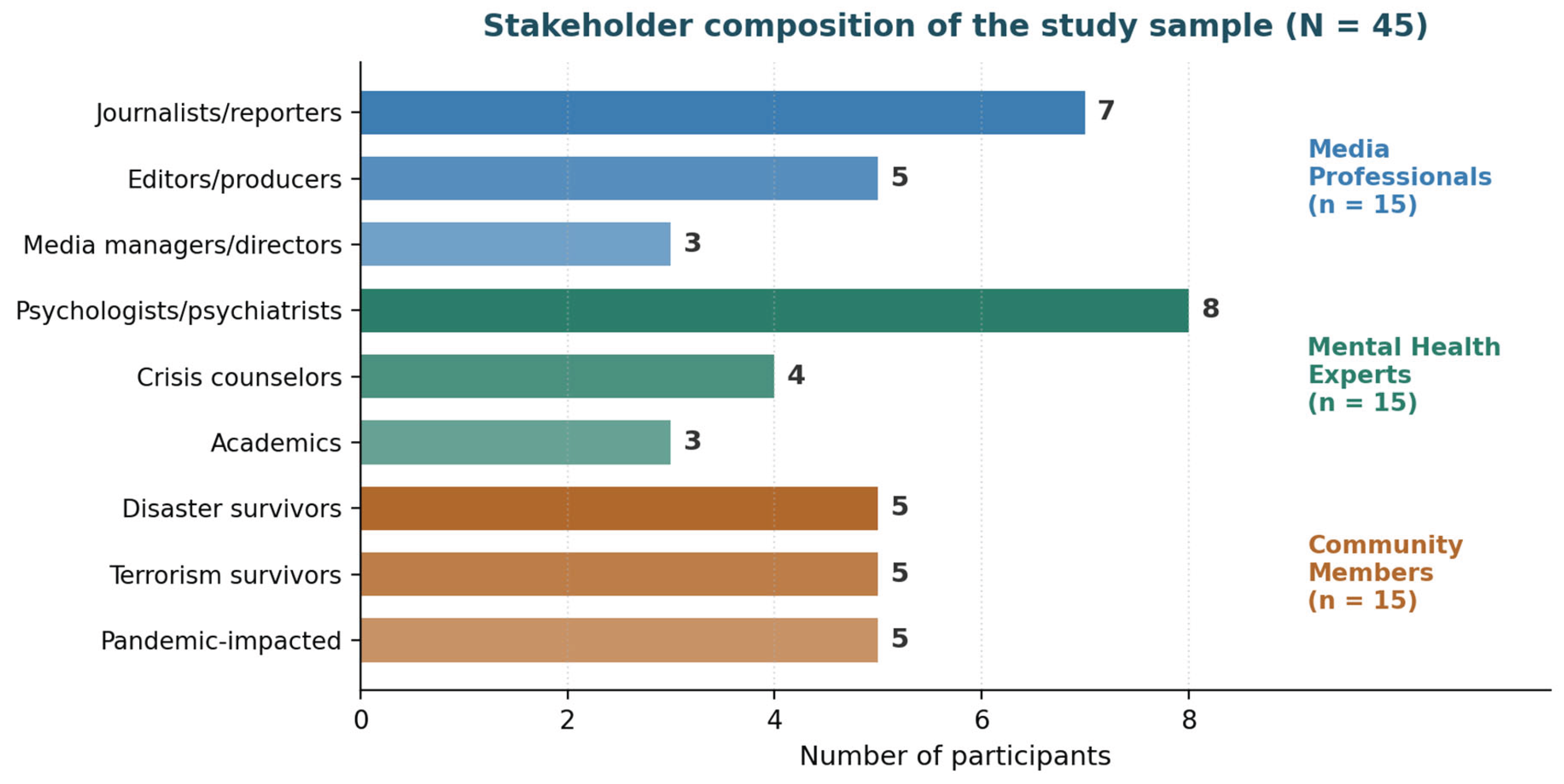
Figure 2.
Prevalence of the Six Themes Across Participants. Note. Authors’ thematic analysis of 45 semi-structured interviews (January–June 2024). Percentages indicate the proportion of participants whose interviews contained each theme.
Figure 2.
Prevalence of the Six Themes Across Participants. Note. Authors’ thematic analysis of 45 semi-structured interviews (January–June 2024). Percentages indicate the proportion of participants whose interviews contained each theme.
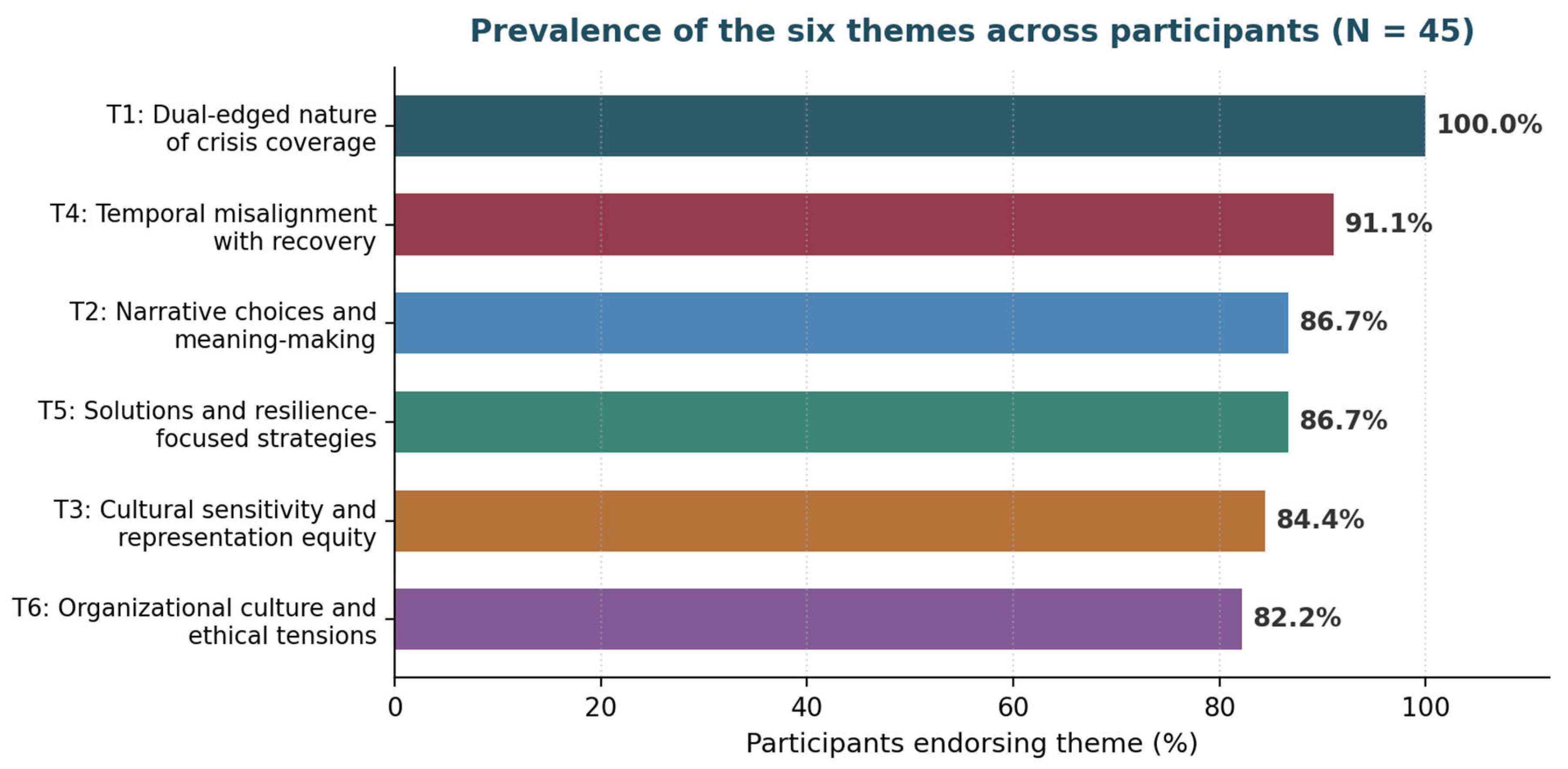
Figure 3.
The Psychologically Informed Crisis Coverage (PICC) Model; Note. Authors’ model derived from thematic analysis of 45 stakeholder interviews and integration with trauma psychology, community resilience, and constructive journalism literatures. Bidirectional arrows denote mutual reinforcement among components.
Figure 3.
The Psychologically Informed Crisis Coverage (PICC) Model; Note. Authors’ model derived from thematic analysis of 45 stakeholder interviews and integration with trauma psychology, community resilience, and constructive journalism literatures. Bidirectional arrows denote mutual reinforcement among components.
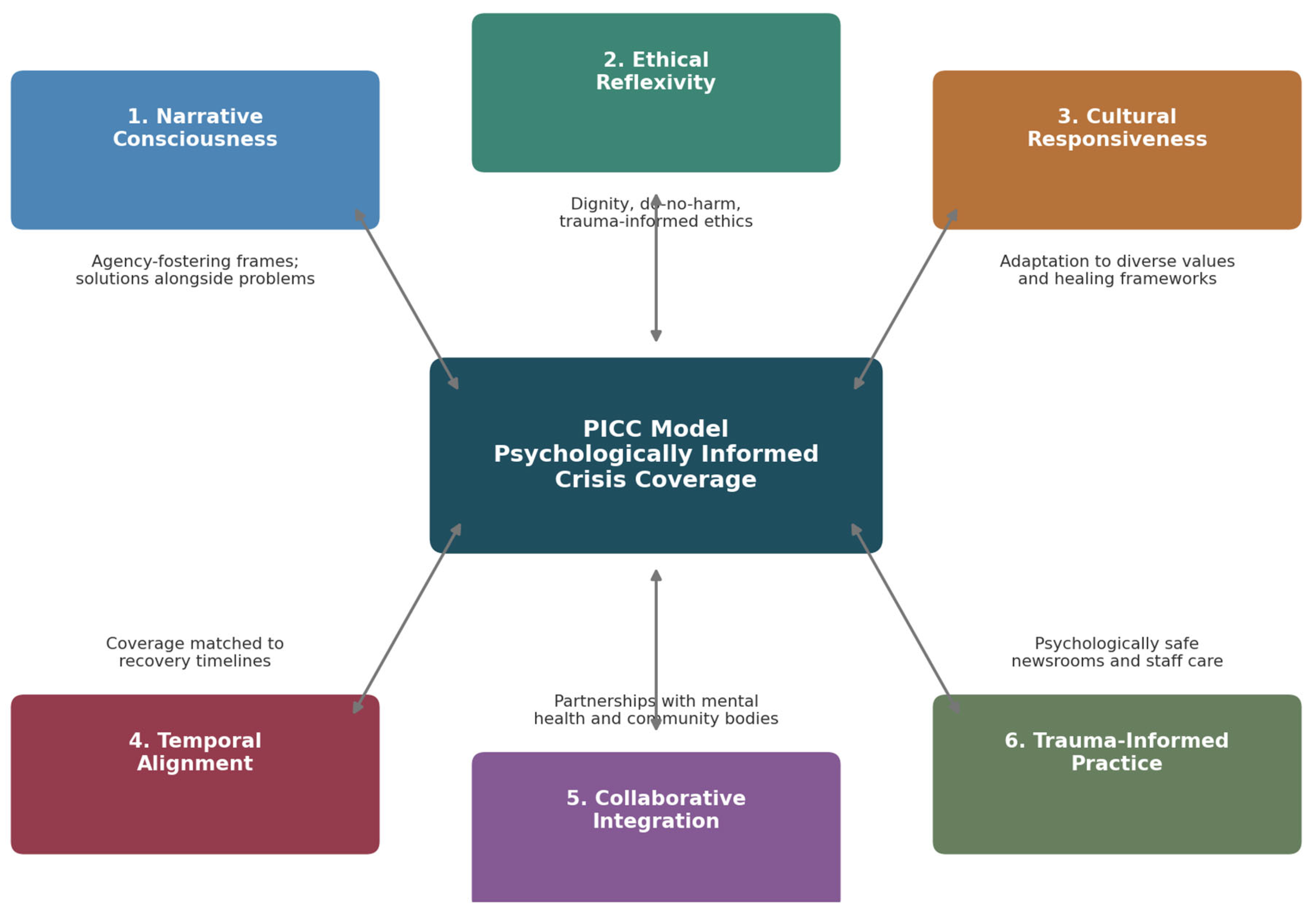

Table 1.
Participant Demographics and Crisis Context Exposure (N = 45).
| Category | Subgroup | n | Key Characteristics | Crisis Contexts | Geographic Distribution |
|---|---|---|---|---|---|
| Media professionals | Journalists/reporters | 7 | Experience 5–25 years (M = 12.4); print (2), broadcast (3), digital (2) | Natural disaster, terrorism, pandemic, armed conflict | Urban (5), regional (2) |
| Editors/producers | 5 | Experience 10–30 years (M = 17.8); local (2) and national (3) outlets | Natural disaster, terrorism, pandemic | Urban (4), national (1) | |
| Media managers/directors | 3 | Experience 15–35 years (M = 24.3); strategic oversight roles | Natural disaster, pandemic | Urban (2), national (1) | |
| Mental health experts | Psychologists/psychiatrists | 8 | Trauma psychology (5), community psychology (3) | Natural disaster, terrorism, pandemic | Urban (6), regional (2) |
| Crisis counselors | 4 | Experience 8–20 years (M = 13.5); on-the-ground disaster response | Natural disaster, terrorism | Regional (2), rural (2) | |
| Academics | 3 | Media psychology (1), crisis communication (1), trauma studies (1) | N/A | Urban (2), regional (1) | |
| Community members | Natural disaster survivors | 5 | Hurricane survivors; ages 28–67 (M = 43.2) | Natural disaster (hurricane) | Coastal (3), urban (2) |
| Terrorism incident survivors | 5 | Direct survivors (2), family members (3); ages 22–58 (M = 41.4) | Terrorism | Urban (5) | |
| Pandemic-impacted individuals | 5 | Health workers (2), bereaved (2), isolated elderly (1); ages 31–74 (M = 48.6) | Pandemic (COVID-19) | Mixed urban/regional (5) |
Note. Data from participant recruitment and screening procedures conducted for this study (January–June 2024). All participants provided informed consent and met group-specific inclusion criteria; many had experience with multiple crisis types. M = mean.
Table 2.
Key Theoretical Frameworks Applied to Crisis Media Psychology.
| Theoretical Framework | Key Proponents | Core Concept | Application to Crisis Coverage | Recent Developments |
|---|---|---|---|---|
| Social Cognitive Theory | Bandura (2009); Garfin et al. (2020) | Vicarious learning through mediated models; self-efficacy shaped by media portrayals | Audiences adopt coping strategies or panic behaviors modeled in coverage; resilience portrayals boost collective efficacy | Integration with digital media; modeling effects of social media content |
| Cultivation Theory | Gerbner & Gross (1976); Gerbner et al. (2002) | Heavy media exposure shapes perceptions of reality; “mean world” effects | Repetitive crisis coverage cultivates exaggerated threat perception and distress | Extension to algorithmic curation and selective exposure (Brady et al., 2023) |
| Framing Theory | Entman (2007); Lecheler & de Vreese (2019) | Selection and emphasis shape interpretation via problem definition, causal diagnosis, moral judgment, and remedies | Framing a crisis as “tragedy” vs. “challenge” influences emotion, attribution, efficacy, and support for solutions | Multilevel framing analysis; counter-framing and frame persistence (Scheufele & Iyengar, 2017) |
| Constructive Journalism | Haagerup (2017); Gyldensted (2015); Bro (2019) | Rigorous reporting that includes solutions, responses, and community assets | Solution-oriented stories mitigate anxiety and helplessness, fostering agency and engagement | Systematic review of audience effects (McIntyre & Lough, 2023); stigma and trust experiments (van Antwerpen et al., 2025) |
| Cultural Trauma Theory | Alexander (2012); Alexander et al. (2004); Smelser (2004) | Events become collective trauma through narrative processes inscribed in group consciousness | Media act as the primary arena for constructing trauma meaning and collective identity | Counter-narratives of marginalized communities; contemporary crisis applications |
| Trauma-Informed Care | SAMHSA (2014); Bloom & Farragher (2013) | Safety, trustworthiness, peer support, collaboration, empowerment, cultural sensitivity | Trauma-informed media organizations produce less traumatizing content and safer newsrooms | Extension to institutional change; trauma literacy in journalism education (Ogunyemi & Price, 2023) |
| Community Resilience Theory | Norris et al. (2008); Pfefferbaum et al. (2013); Magis (2010) | Resilience as community-level adaptive capacity built on networked resources | Media support resilience by fostering social capital, hope, coordination, and recognition of community strengths | Integration with posttraumatic growth (Tedeschi et al., 2018); attention to resilience disparities |
Note. Authors’ synthesis of seminal and recent works in media psychology and crisis communication. Full bibliographic details appear in the References.
Table 3.
Beneficial and Harmful Functions of Crisis Media Coverage as Identified by Participants (N = 45).
Table 3.
Beneficial and Harmful Functions of Crisis Media Coverage as Identified by Participants (N = 45).
| Beneficial Functions | n | % | Harmful Functions | n | % |
|---|---|---|---|---|---|
| Information dissemination | 45 | 100.0 | Anxiety generation | 44 | 97.8 |
| Safety coordination | 43 | 95.6 | Trauma amplification | 42 | 93.3 |
| Resource mobilization | 41 | 91.1 | Misinformation spread | 37 | 82.2 |
| Community connection facilitation | 38 | 84.4 | Learned helplessness induction | 33 | 73.3 |
| Meaning-making facilitation | 35 | 77.8 | Desensitization to suffering | 31 | 68.9 |
| Hope and inspiration | 26 | 57.8 | Social fragmentation | 28 | 62.2 |
| Strengthening community identity | 22 | 48.9 | Victim blaming and scapegoating | 18 | 40.0 |
Note. Authors’ thematic analysis of interview transcripts (January–June 2024). Percentages do not sum to 100 because participants identified multiple functions, and most identified beneficial and harmful effects simultaneously.
Table 4.
Cultural Dimensions Influencing Crisis Media Reception and Psychological Impact (N = 45).
| Cultural Dimension | Identified Media Preferences | Observed Coping Patterns | Recommended Adaptations (From Data) |
|---|---|---|---|
| Collectivistic vs. individualistic orientation | Community-focused narratives; shared responsibility; family involvement | Group healing; communal mourning and rituals; collective decision-making | Highlight communal responses; feature community leaders and collective action |
| Religious/spiritual frameworks | Meaning-making content; spiritual perspectives; references to faith traditions | Faith-based coping; prayer and ritual; spiritual community support | Include spiritual leaders; acknowledge religious meaning-making; respect diverse faith responses |
| Language diversity | Native-language options; multilingual content; culturally appropriate idioms | Culturally specific emotional expression; language-specific concepts of resilience | Provide multilingual coverage; employ diverse staff; translate cultural meaning, not just words |
| Authority and trust relationships | Trusted community members; historically informed source preferences | Varied trust in institutions; reliance on community networks | Diversify sources beyond officials; include community voices; acknowledge historical contexts of distrust |
| Emotional expression norms | Indirect vs. direct coverage; private vs. public expression emphasis | Private vs. public grief processing; gender-differentiated expression | Respect expression boundaries; avoid imposing dominant-culture norms |
| Family/kinship structures | Extended family emphasis; roles of elders; intergenerational responsibility | Family-based decision-making; elder wisdom; collective family resources | Include extended families; highlight elder roles; recognize diverse family structures |
| Health and healing frameworks | Medical vs. traditional healing; mind–body integration | Traditional healing practices; holistic approaches | Include diverse healing frameworks; partner with community healers |
Note. Cross-cultural analysis based on participant interviews; recommendations reflect practices identified by mental health experts and community members from diverse cultural backgrounds.
Table 5.
Effective Strategies for Psychologically Informed and Trauma-Sensitive Crisis Coverage (N = 45).
Table 5.
Effective Strategies for Psychologically Informed and Trauma-Sensitive Crisis Coverage (N = 45).
| Strategy Category | Specific Approaches | Reported Benefits | Implementation Challenges |
|---|---|---|---|
| Content balance | Include solution-focused stories alongside problems; feature responses and recovery; contextualize information | Increased hope and agency; reduced helplessness; fuller comprehension | Additional reporting resources; conflicts with “if it bleeds, it leads” values |
| Trauma-informed language | Avoid sensationalism; precise terminology; limit graphic description; content warnings | Reduced anxiety and re-traumatization; improved comprehension | Requires trauma-psychology training; tension with conventions |
| Community voice integration | Feature local perspectives, survivors, and community leaders; solicit community input | Enhanced connection and trust; better representation; legitimation of diverse responses | Time-intensive; relationship-building; power imbalances in voice selection |
| Resource integration | Embed help resources in all crisis content; include hotlines and support services; update regularly | Improved coping access; actionable information; reduced isolation | Ongoing coordination; accuracy responsibility as services change |
| Visual sensitivity | Limit graphic imagery; warn before graphic material; contextualize visuals | Decreased traumatization and intrusive memories; protection of vulnerable viewers | Balance with documentation function; perceived as censorship by some |
| Temporal sensitivity | Sustained recovery coverage; milestone follow-ups; anniversary reflection | Continued support; normalized recovery expectations; sustained accountability | Challenges news cycles; requires long-term institutional commitment |
| Cultural adaptation | Consult community leaders; multilingual resources; culturally adapted frames; diverse staffing | Improved reach and trust; reduced alienation; more accurate coverage | Resource-intensive; requires cultural competence and ongoing learning |
| Collaboration and partnerships | Partner with mental health professionals; advisory boards; community feedback mechanisms | Improved quality; expertise access; pre-publication harm identification | Relationship-building costs; potential conflicts of interest; role boundaries |
Note. Synthesis of strategies recommended across the three participant groups, derived from thematic analysis and cross-referenced with the constructive journalism and trauma-informed practice literatures. Benefits and challenges reflect participant perspectives rather than independent empirical validation.
Table 6.
Comparative Analysis of Crisis Reporting Paradigms: Traditional Versus Psychologically Informed Approaches.
Table 6.
Comparative Analysis of Crisis Reporting Paradigms: Traditional Versus Psychologically Informed Approaches.
| Feature | Traditional (“If It Bleeds, It Leads”) Paradigm | Psychologically Informed Paradigm |
|---|---|---|
| Primary organizational goal | Capture audience attention; maximize ratings, clicks, impressions | Inform comprehensively, minimize psychological harm, foster evidence-based resilience |
| Conceptualization of audience | Consumers of information; competitors for attention | Citizens in distress; community members with varying vulnerability and needs |
| Portrayal of affected people | Sources of dramatic content; primarily “victims” | Experts in their own experience; “survivors” with full humanity |
| Narrative focus | Problems, conflict, devastation, helplessness | Problems contextualized with causes, responses, solutions, and agency |
| Use of visual imagery | Graphic, sensational, repetitive | Judicious, contextualized; balance between documentation and protection |
| Temporal focus | Acute-phase coverage; “hit-and-run” reporting | Sustained engagement aligned with community recovery timelines |
| Success metrics | Ratings, clicks, engagement, advertising revenue | Public understanding, resilience indicators, mental health outcomes, trust |
| Relationship with communities | Extractive; transactional; brief engagement | Collaborative; respectful; reciprocal; ongoing accountability |
| Staff training | Journalism and production skills | Journalism skills plus trauma psychology, cultural competency, ethical reasoning |
| Editorial decision-making | Speed and compelling narrative; individual judgment | Speed plus deliberation; trauma-informed team review; editorial guidelines |
| Organizational partnerships | Primarily other media and official sources | Mental health professionals, community organizations, cultural leaders |
| Definition of “news” | Novel, dramatic, conflict-based events | Information important for public understanding, including developments, solutions, and community capacity |
Note. Synthesis of thematic findings with the constructive journalism literature (Bro, 2019; Haagerup, 2017; McIntyre & Lough, 2023) and trauma-informed practice principles (SAMHSA, 2014).
Table 7.
The PICC Model: Components, Principles, and Implementation Strategies.
| Component | Core Principle | Theoretical Basis | Practical Applications | Evidence Base |
|---|---|---|---|---|
| 1. Narrative consciousness | Construct narratives that foster agency and avoid learned helplessness; broaden scope beyond problems to causes, responses, and possibilities | Social Cognitive Theory (Bandura, 2009); Framing Theory (Entman, 2007); constructive journalism (Haagerup, 2017) | Train journalists in framing; use empowering language; balance problem and solution focus; include “how communities are responding” angles | Constructive stories reliably improve audience emotion and efficacy (Baden et al., 2019; McIntyre & Lough, 2023) |
| 2. Ethical reflexivity | Prioritize dignity and harm minimization; recognize power imbalances; integrate trauma-informed ethics into editorial decisions | Trauma-informed care principles (SAMHSA, 2014); media ethics | Adopt do-no-harm guidelines for survivor interviews; meaningful consent; editorial review; redefine success beyond clicks | Trauma-informed principles improve outcomes across service systems (Bloom & Farragher, 2013; SAMHSA, 2014) |
| 3. Cultural responsiveness | Adapt communication to diverse values, preferences, and healing frameworks; recognize structural inequities in coverage | Cultural Trauma Theory (Alexander, 2012); social-constructionist crisis communication (Falkheimer & Heide, 2006) | Consult community leaders; multilingual coverage; culturally adapted frames; diverse staffing; community advisory boards | Cultural adaptation improves reception (Falkheimer & Heide, 2006; Pérez-Lugo, 2004); coverage disparities shape relief (Eisensee & Strömberg, 2007) |
| 4. Temporal alignment | Match coverage rhythm to long-term, non-linear community recovery rather than news cycles | Community Resilience Theory (Norris et al., 2008; Pfefferbaum et al., 2013); PTG theory (Tedeschi et al., 2018) | Commit to milestone follow-ups; create recovery beats; forward-looking anniversary coverage; track long-term outcomes | Recovery research documents multi-year timelines misaligned with acute-phase media attention (Houston et al., 2018) |
| 5. Collaborative integration | Partner systematically with mental health professionals, community organizations, and survivors in planning and production | Interdisciplinary collaboration; community psychology; participatory research | Formal partnerships; media–health advisory boards; embedded resource information; feedback mechanisms | Collaborative models enhance crisis communication quality (Veil et al., 2011) |
| 6. Trauma-informed practice | Integrate trauma psychology into production processes; protect staff experiencing vicarious trauma; create psychologically safe newsrooms | Trauma psychology (Van der Kolk, 2014); organizational trauma-informed practice (Bloom & Farragher, 2013) | Staff training in trauma response and survivor-centered interviewing; graphic-content exposure protocols; peer support; debriefing | Journalists face elevated trauma symptoms and lack organizational support (Mohammed, 2025; Obermaier et al., 2023); support enables vicarious growth (Xiong & Liao, 2023) |
Note. Authors’ model based on systematic thematic analysis of participant insights integrated with contemporary trauma psychology, community psychology, and constructive journalism literatures.
Disclaimer/Publisher’s Note: The statements, opinions and data contained in all publications are solely those of the individual author(s) and contributor(s) and not of MDPI and/or the editor(s). MDPI and/or the editor(s) disclaim responsibility for any injury to people or property resulting from any ideas, methods, instructions or products referred to in the content. |
© 2026 by the author. Licensee MDPI, Basel, Switzerland. This article is an open access article distributed under the terms and conditions of the Creative Commons Attribution (CC BY) license.
Copyright: This open access article is published under a Creative Commons CC BY 4.0 license, which permit the free download, distribution, and reuse, provided that the author and preprint are cited in any reuse.