
Submitted:
02 August 2026
Posted:
03 August 2026
You are already at the latest version
Abstract
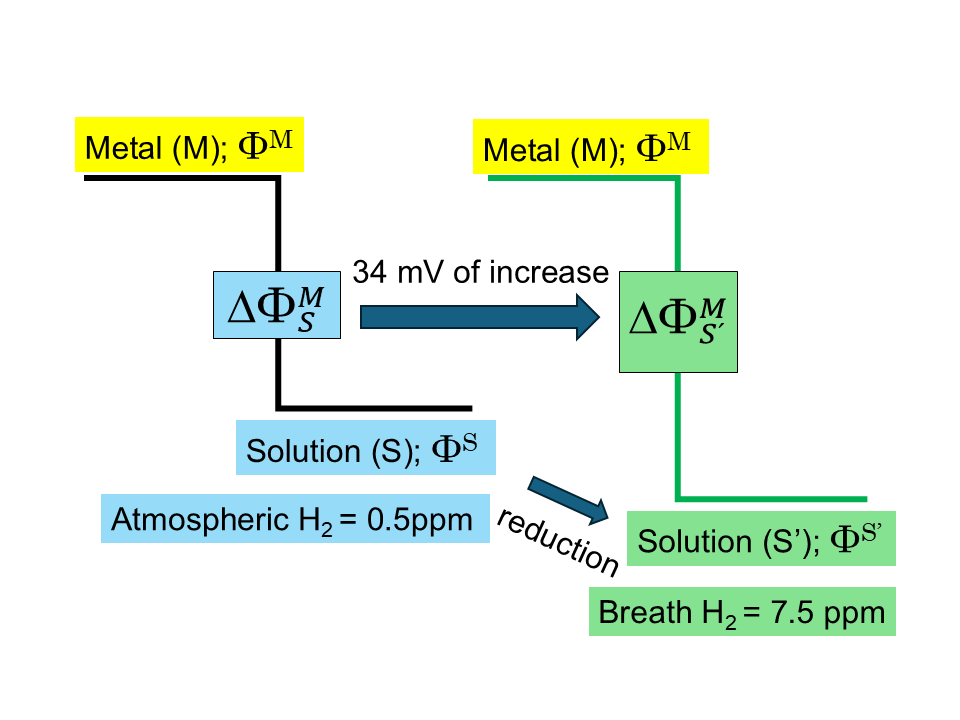
Hydrogen (H2) is fermented by the intestinal microbiota, transferred to the blood according to the pressure gradient, and exhaled. Since H2 is not produced or metabolized in human cells, alveolar H2 saturates the entire human body, including cellular organelles such as mitochondria, owing to gas exchange in the lungs. The electron transport chain comprises a series of redox enzymes in the mitochondria of human cells that drive adenosine triphosphate (ATP) synthesis. The catalytic activity of electron-transport enzymes is optimized at certain electrochemical potentials, as is the hydrogen ion activity (pH). However, the human body is an aqueous solution, which must be electrically neutral. Membrane potentials exist between the inside and outside of human cells because of the unequal distribution of ions across the membrane. The single-electrode potential can only be assessed relative to that of another electrode (a reference electrode). We measured the electrochemical potentials relative to a standard hydrogen electrode (SHE), and found that H2 partial pressure was a fundamental factor affecting the SHE, pH, and a reversible hydrogen electrode (RHE). The H2 partial pressure is not a unit in the human body, therefore, breath H2 is an external variable of the redox environment in the human body.
Keywords:
breath hydrogen
; electrochemical potential
; reversible hydrogen electrode
; reduction-oxidation enzyme
; potential-current kinetics
Copyright: This open access article is published under a Creative Commons CC BY 4.0 license, which permit the free download, distribution, and reuse, provided that the author and preprint are cited in any reuse.


