

Submitted:
02 August 2026
Posted:
03 August 2026
You are already at the latest version
Abstract
Industrial construction projects involve complex interactions among uncertainty, risk, schedule, and cost, motivating the development of advanced analytical and decision-support methodologies. This study systematically reviews methodological approaches to risk assessment and performance management in industrial construction. Following the PRISMA 2020 guidelines, searches of the Scopus and Web of Science databases identified 234 records, of which 56 journal articles published between 2011 and 2025 satisfied the predefined eligibility and quality criteria. The selected studies were classified according to methodological family, uncertainty representation, and the degree of time–cost–risk integration. Four dominant methodological families were identified: multicriteria and fuzzy decision-making, probabilistic and simulation-based modeling, optimization, and artificial intelligence and machine learning. Twenty-seven studies assessed risk independently of time and cost, whereas only four jointly modeled all three dimensions. Probabilistic and optimization-based methods demonstrated the highest level of integrated analysis, while most machine-learning approaches remained prediction-oriented and most existing models were static rather than adaptive. Based on this synthesis, the review proposes a unified analytical taxonomy and a research agenda for integrated decision-support frameworks that combine dynamic uncertainty updating, predictive analytics, and multi-objective optimization. The findings highlight important methodological gaps and provide a structured foundation for developing mathematically rigorous, adaptive models that support robust decision-making in complex industrial construction environments.
Keywords:
industrial construction
; uncertainty modeling
; optimization
; decision-support systems
; artificial intelligence
; systematic literature review
1. Introduction
Industrial engineering systems such as power generation plants [1], petrochemical industries [2], oil and gas pipelines [3], mining construction [4], and renewable energy generation plants [5] represent some of the most capital-intensive and technologically complex construction projects. Their successful delivery requires effective management of multiple interacting factors, including project risk, schedule, cost, resource allocation, and operational uncertainty. Increasing technological sophistication, geographically distributed supply chains, and evolving regulatory requirements have made industrial construction an important application domain for analytical modeling, optimization, and computational decision-support methods. These characteristics motivate the development of quantitative methodologies capable of supporting informed decision-making under uncertainty [6,7].
Industrial construction differs substantially from residential and commercial construction in terms of project scale, engineering complexity, investment requirements, and exposure to uncertainty. Engineering, Procurement, and Construction (EPC) projects, including power stations, petrochemical plants, mining ventures, and pipeline systems, require continuous coordination among multiple stakeholders while balancing competing objectives related to cost, schedule, risk, safety, and resource utilization under stringent regulatory constraints. Because these objectives are strongly interdependent, integrated analytical frameworks that combine uncertainty quantification, optimization, and mathematical decision-support techniques have become increasingly important. Consequently, integrated time–cost–risk management has emerged as a significant research area at the intersection of construction engineering, operations research, and computational intelligence.
This review focuses on the analytical methodologies used to represent uncertainty and support decision-making in industrial construction projects. Rather than emphasizing individual project performance measures, the study considers time, cost, and risk as interconnected dimensions whose interactions influence overall project performance throughout the project lifecycle. Particular attention is given to methodological developments in multicriteria decision-making, probabilistic modeling, optimization, and artificial intelligence, together with their ability to integrate uncertainty representation within unified analytical and decision-support frameworks.
In the last twenty years, significant attention has been given to risk analysis and construction performance management, and the development of these areas can be described in terms of specific methodological phases, resembling the general evolution of decision science, operations research, and data science. The early attempts at risk analysis in construction have mainly used qualitative techniques such as risk matrices, checklists, and expert scoring techniques for identifying, prioritizing, and mitigating project risks. Such techniques turned out to be effective during the initial phase of project planning but could not deal effectively with quantifying risks and the interdependencies between project variables.
From among all these innovations, MCDM approaches along with fuzzy logic methods have gained wide acceptance for the assessment of construction risks in cases of uncertainty [8,9]. Such techniques give decision-makers the ability to consider conflicting objectives such as cost, time, safety, and environmental impact, while considering that there is an element of uncertainty associated with expert knowledge. The AHP, fuzzy AHP, and other techniques such as DEMATEL as well as their hybrid versions have been found to be quite effective in ranking the risk factors in construction and analyzing the relationships among them [4,10]. Hybrid models that include several MCDM approaches have also increased the level of adaptability of risk assessment when there is a lack of information.
Simultaneously, probabilistic approaches, as well as approaches using simulations, have become popular when considering uncertainties in the results of projects [11,12]. Monte Carlo simulation, Bayesian network modeling, stochastic models, and other similar approaches allow the decision makers to obtain the probabilities of different outcomes regarding the cost, time performance, and safety of projects and are used in industrial construction to estimate the probability of the cost overrunning and schedule delaying under uncertain conditions. By explicitly taking into account uncertainties instead of assuming deterministic data, these approaches provide a more realistic view on industrial construction settings.
The areas of research related to optimization and scheduling form another area that has received considerable attention in terms of making the planning process more efficient and effective, while making the best use of resources. Several approaches including multi-objective optimization, genetic algorithms, evolutionary algorithms, and simulation-based optimization have been applied to achieve a compromise between conflicting criteria like minimizing construction time, minimizing costs, and making better use of project resources [13,14]. However, most optimization models still employ a deterministic approach and are used at the planning stage.
In more recent times, advancements in the field of artificial intelligence, machine learning, natural language processing, and digital project management technology have been driving the process towards becoming data-driven approaches. Algorithms of machine learning have been employed in predicting cost overruns, discovering safety risks, analyzing project documents, assessing the scheduling performance, and even in conducting predictive risk assessments through large amounts of heterogeneous data related to the projects [15,16,17]. The process described above is indicative of the digital transformation of the construction industry, implying that there is a slow but steady trend towards developing a data-driven and predictive approach.
While the aforementioned methodological improvements are substantial, the current state of knowledge is still fragmented. The majority of studies that are currently available consider only single dimensions of project performance—cost overrun, schedule delay, safety risks, or resource allocation—but fail to incorporate the complexities of time-cost-risk interactions in the context of industrial megaprojects [18,19]. Developed methodologies have also been static in nature, tailored to support the decisions in the planning phase instead of supporting adaptive project management when the situation changes. In addition, while artificial intelligence and optimization methods have shown great potential in the aspects of prediction and computation, they have not been incorporated into more complex frameworks aimed at providing assistance in managing adaptive project decisions under continuous evolution of uncertainty [20,21]. In results, current methodologies often gives a valuable analytical capabilities in specific domains but remain insufficient for holistic decision-making across the complete project life cycle.
Another limitation relates to the industrial setting. There exists a considerable amount of literature about construction management, but the majority of it has been derived in terms of residential or commercial construction projects and very little has been done regarding industrial construction [20,21]. Structures, technologies, regulations, and risks of the industrial project are completely different from those of the conventional one, and hence the models designed for conventional construction cannot be used for industrial megaprojects as they are.
Based on the above observations, the need for a more structured methodological synthesis becomes evident. Although previous review studies have summarized developments in construction risk management, they have generally classified existing approaches according to individual analytical techniques or specific application domains. The current review extends these perspectives by proposing a unified analytical taxonomy that simultaneously classifies existing approaches according to (i) analytical methodology, (ii) uncertainty representation, and (iii) the degree of time–cost–risk integration. This taxonomy provides a systematic framework for comparing existing methodologies, identifying methodological gaps, and highlighting opportunities for developing integrated analytical and decision-support models. Building upon this framework, the review systematically synthesizes recent methodological developments in industrial construction risk assessment and performance management, evaluates how existing approaches represent uncertainty and support project decisions, and establishes a research agenda for future integrated analytical frameworks.
Accordingly, this review seeks to answer the following research questions:
- What methodological approaches dominate research on risk assessment and project performance in industrial construction projects?
- To what extent do existing studies integrate time, cost, and risk within unified analytical frameworks?
- What methodological limitations currently hinder the development of adaptive and intelligent decision-support systems for industrial construction?
- How can integrated and adaptive time–cost–risk frameworks improve decision-making and project performance in industrial construction?
By way of addressing the above questions, the study contributes to the existing knowledge base in multiple ways. First, it presents an extensive and structured overview of the recent methodological advances specifically in the realm of industrial construction—a sector that has been relatively understudied compared to the more traditional construction of buildings but is nevertheless very strategically important from the economic perspective. Second, the study introduces the proposed unified analytical taxonomy that allows for classifying all the approaches existing today not only according to their analytical methodology, but also their uncertainty management and integration capabilities. Third, the review identifies and analyzes the extent to which the existing methods take into account the interdependency of such key project dimensions as time, cost, and risk—and thus concludes that there are significant gaps and methodological inconsistencies associated with that issue, with most methodologies still viewing those dimensions separately rather than jointly. Finally, based on the gaps identified above, the study suggests a promising research agenda focused on integrating various methodologies for optimization, probabilistic reasoning, artificial intelligence, and decision support.
Unlike previous reviews on construction management literature, which mostly focus on studying the elements of construction management in isolation, including cost estimation, scheduling, or risk analysis methods, the current study provides an extensive review using a systems perspective, whereby it considers the interaction between time, cost, and risk in industrial construction environment. Unlike previous review articles that classify the literature according to the methodological approaches only, this study provides a broad view of the classification criteria by including methodological approach, representation of uncertainties, and integration of methods in one unified framework—the multidimensional perspective—that allows for a better understanding of the contemporary advances in the field while at the same time highlighting research areas that have not been extensively studied. The results of the study have important practical applications for researchers, project managers, infrastructure owners, and policy makers that are interested in decision-making processes in complex industrial construction environment: through the identification of the advantages and shortcomings of the methodologies as well as future directions in research, it contributes to development of intelligent decision-support system.
The rest of the paper is structured as follows. Section 2 describes the methodology of the systematic review, including search process, selection criteria, evaluation of the quality of the studies and analysis approach. Section 3 provides the results of the thematic analysis and describes the suggested taxonomy of dimensions. Section 4 outlines the main gaps in methodology and opportunities for further research. Section 5 considers the implication of the findings for integrated time–cost–risk management in industrial construction. Finally, Section 6 concludes the paper and suggests directions for future research.
2. Methodology
This paper adheres to PRISMA 2020 (Preferred Reporting Items for Systematic Reviews and Meta-Analyses) guidelines for a systematic, reproducible, and transparent review process. A systematic literature review has been carried out to examine and critically analyze the methodologies developed for risk assessment and performance management of industrial construction projects. The entire review methodology from literature search to the final selection of studies is illustrated in Figure 1.
2.1. Literature Search Strategy
A structured literature search was conducted in Scopus and Web of Science Core Collection on 12 December 2025 and updated on 21 January 2026 because of their extensive coverage of peer-reviewed literature in the fields of engineering, construction management, and project management. Search terms were generated by an iterative process to maximize the capturing of relevant studies while minimizing irrelevant results. The same search phrases were used in both databases, with some adjustments for differences in the database syntax and indexing.
The literature search was intended to include publications that concern industrial construction, project risks, cost performance, schedule management, uncertainties, and optimization. Only peer-reviewed journal articles written in English within the period of 2011 and 2025 were included. Other types of documents (conferences papers, book chapters, reviews, and non-English documents) were not considered. The search yielded 234 references, including 174 from Scopus and 60 from Web of Science.
The search terms were selected to capture methodological studies addressing risk assessment, uncertainty modeling, optimization, scheduling, and performance management across a broad range of industrial infrastructure projects, including energy facilities, pipelines, mining operations, and process plants. Database-specific search strings, filters, search dates and export formats are reported in Appendix A.
2.2. Inclusion and Exclusion Criteria
Eligibility criteria were specified before conducting the literature review in order to make sure that studies included into the review directly contribute to its objectives. Eligible studies should examine problems of industrial construction or introduce methods applicable to industrial construction projects. Special attention was paid to the studies investigating issues related to risk assessment and uncertainty modeling, project scheduling and optimization, performance evaluation and its links to the results of projects in terms of cost, scheduling, safety, or other performance measures.
Researches dedicated to environmental and geotechnical issues without any practical implications for the problems of construction were not considered. As far as the scientific quality is concerned, only the peer-reviewed journal articles published in Q1-rated journals were included into the review; the studies presented at conferences, the book chapters, and papers written in languages other than English were disregarded.
Despite the fact that the review deals with the topic of industrial construction, some researches which were conducted in wider construction context were considered in case of their contribution to industrial megaprojects through providing certain methodological frameworks. Such studies were taken into account only in case of their applicability to industrial construction in terms of multicriteria decision making, probabilistic modeling, optimization, or artificial intelligence—were directly transferable to industrial construction risk and performance management.
2.3. Screening Procedure
The study selection process followed the PRISMA 2020 framework illustrated in Figure 1. After removing duplicate records, the remaining studies were filtered according to journal quality, title and abstract relevance, and full-text eligibility.
Initially, duplicate records retrieved from both databases were eliminated. The remaining studies were then restricted to Q1-ranked journals according to the Scimago Journal Rank (SJR) to ensure methodological rigor and high publication quality. Titles and abstracts were subsequently screened independently by two reviewers using the predefined eligibility criteria. Disagreements were resolved through discussion, and where necessary, consultation with a third reviewer.
Articles that passed the initial screening underwent full-text evaluation. At this stage, studies were assessed for their methodological relevance, industrial construction context, and the availability of sufficient information for comparative analysis. Papers were excluded if they lacked a clear methodological contribution, failed to address measurable project performance indicators, or focused on construction contexts that were not transferable to industrial infrastructure.
The complete screening process reduced the initial set of 234 records to a final corpus of 56 peer-reviewed studies. The number of records retained and excluded at each stage, together with the corresponding exclusion reasons, is summarized in Figure 1. This structured procedure ensured a transparent, reproducible, and unbiased selection of studies for subsequent analysis.
2.4. Quality Assessment
In order to verify the quality and applicability of the reviewed literature, all of the studies selected after the full-text screening stage went through the quality assessment. Four criteria were used: (i) applicability to industrial construction, (ii) methodology, (iii) direct link between the suggested method and the project performance metrics, and (iv) availability of enough information for further data extraction and comparison. All criteria are listed in Table 1.
Two independent reviewers scored each study on a three-tier scale of Meets, Partially Meets, and Does Not Meet. The papers were accepted for further consideration only when at least three out of the four criteria were fulfilled, and it was necessary to fulfill the first one anyway. Disputes between the reviewers were discussed until the agreement was reached.
In addition to the journal-level quality criterion described in Section 2.2 (inclusion restricted to Q1-ranked journals in the Scimago Journal Rank), the methodological suitability of each individual study was assessed using the criteria summarized in Table 1.
2.5. Methodological Limitations Appraisal
To characterize the strength of the evidence reviewed in this paper, a structured appraisal of methodological limitations was conducted. Because established risk-of-bias instruments such as ROBIS and the Joanna Briggs Institute (JBI) checklists are designed primarily for clinical and health-related evidence, an author-developed rubric adapted to engineering and construction management research was applied instead. The rubric draws on the general logic of these instruments but does not claim direct compliance with them. Four domains of potential limitation were examined: selection limitations, methodological limitations, reporting limitations, and data limitations.
Selection limitations concerned the representativeness and generalizability of the research context; methodological limitations concerned the transparency and replicability of the analytical approach; reporting limitations covered the completeness with which both methodology and performance outcomes were reported; and data limitations concerned the quality and empirical validity of the data used.
Each study was independently evaluated by two reviewers using a three-level classification (low, moderate, or high concern). Papers were not excluded solely because of elevated concern levels; instead, the appraisal was used to guide the interpretation of findings during the synthesis, and studies with higher ratings were weighted accordingly when drawing overall conclusions.
The overall distribution of appraisal ratings across the reviewed studies is presented in Figure 2. The results indicate generally low methodological and reporting concerns, while moderate levels of selection and data concerns primarily reflect the widespread use of single-case studies and simulation-based validation in industrial construction research.
2.6. Data Extraction and Analytical Framework
A standardized data extraction framework was developed to ensure consistent comparison across the selected studies. For each publication, information was collected regarding publication characteristics, industrial application domain, methodological approach, uncertainty representation, project performance dimensions, and principal research findings.
The extracted information was subsequently analyzed using thematic synthesis. This approach enabled the identification of major methodological trends, comparison of analytical techniques, evaluation of integration among time, cost, and risk dimensions, and development of the taxonomy proposed in this study. The structured extraction process also facilitated comparative assessment of methodological strengths, limitations, and research gaps across different analytical approaches.
2.7. Reproducibility and Protocol
The review protocol was developed prior to the literature search and incorporated the research questions, search strategy, inclusion criteria, screening procedure, quality assessment, and analysis approach. The following methodological choices were consistently used throughout the review process for the sake of reproducibility and transparency. Every step of the review, starting from database searches and ending up with the data extraction process, was performed in accordance with the predefined procedure and checked independently by two reviewers. Thus, the entire search strategy, inclusion criteria, PRISMA flowchart (see Figure 1), quality assessment procedure (see Table 1), and methodological limitations appraisal (see Figure 2) allow reproducing the methodology of the review independently. In spite of the fact that the review protocol was not preregistered, all methodological aspects were described prior to conducting the search and then consistently implemented throughout the review process.
3. Results and Thematic Analysis
3.1. Overview of the Selected Studies
Following the systematic screening procedure described in Section 2, a total of 56 peer-reviewed journal articles were retained for the final analysis. The overall characteristics of the reviewed literature are summarized in Figure 3, which illustrates both the annual publication trend and the geographical distribution of the included studies.
The search process is constrained by methodological consistency and takes into account modern developments by focusing on the peer-reviewed scientific literature in English, covering the period from 2011 to 2025. This approach guarantees the timeliness and scientific integrity of the review. Figure 3a shows that the trend towards increased publication rate of articles over time is observed in the research area under discussion. Moreover, an increase in the number of publications related to risk-oriented performance management in industrial construction projects can be noticed since 2015, which may be explained by the increased complexity of industrial construction projects and greater availability of their project information that can be analyzed using complex methods. The geographical distribution of published articles (Figure 3b) shows that there have been scholarly contributions from different regions of the world, including North America, Europe, Asia, the Middle East, and some emerging economies. Notably, despite geographical variations in contexts, there is substantial similarity in methodological approaches and performance-related concerns used in all published articles.
The reviewed studies cover a broad spectrum of industrial asset types, as illustrated in Figure 4. A significant portion of the literature focuses on general or mixed industrial construction environments, reflecting the multidisciplinary and complex nature of industrial project management research. In addition, considerable attention is given to pipeline systems and nuclear power plants, which are characterized by high-risk operations, strict regulatory requirements, and large-scale infrastructure complexity. Other studies investigate mining and tunneling projects, oil and gas facilities, hydropower and dam construction, renewable energy systems such as offshore wind farms, and general power plant applications. This diversity demonstrates that risk and performance management approaches are being applied across multiple industrial sectors with varying operational challenges, safety requirements, and project uncertainties [5,6,21,22,23]. A significant body of literature is focused on various types of energy-related infrastructure projects, including those related to nuclear and oil and gas construction projects. This is due to the large capital investment, regulatory, and technological issues associated with such projects.
Table 2 provides a structured overview of the reviewed studies, including the industrial asset context, analytical methodology, and the primary project performance dimensions addressed.
3.2. Methodological Landscape of Time–Cost–Risk Research
Looking across the 56 papers as a body of work rather than as individual studies, four recognizable families of methods emerge — each with its own logic, its own natural home in the project lifecycle, and its own characteristic blind spots. A handful of studies did not fit comfortably within any of these four families and are grouped under an `Other’ category for completeness. These include a comparative schedule analysis of traditional versus advanced work packaging for nuclear power plant construction [30], a qualitative evaluation of safety management approaches in hydropower projects [39], a socio-technical content analysis combined with reference class forecasting applied to offshore wind plants [5], and an organizational design study examining coordination mechanisms in mega industrial construction projects [21]. Each makes a genuine contribution on its own terms, but none engages directly with risk assessment, uncertainty modeling, or time–cost trade-off analysis in the way that defines the four primary families. They are therefore kept in the corpus on the grounds of broader relevance to industrial construction performance management, but set aside for the family-level analysis that follows. What each family does well — and where it consistently falls short — is the foundation for the central argument this review makes: that no single approach has yet managed to hold risk, time, and cost together within one coherent analytical framework. Figure 5 shows how the four families are distributed across the corpus, and Figure 6 traces how their relative prominence has shifted between 2011 and 2025.
Fuzzy MCDM Approaches
The largest single family in this review, representing 32% of the included papers, is based on multi-criteria decision-making (MCDM) and fuzzy logic. The idea behind such methods is roughly: construction risk assessment in the early stages is almost always based on expert judgment and expert judgment is seldom precise or certain. Tools such as DEMATEL-ISM and extended prospect theory-based cloud models [4,10] provide a systematic framework for the analyst to transpose qualitative opinions into ordered priorities without assuming that the underlying data is more precise than it is. The increasing sophistication of fuzzy set extensions — type-2 fuzzy sets, cloud models, intuitionistic fuzzy numbers — has advanced these tools even further, making them more and more capable of handling layered uncertainty where even the uncertainty itself is uncertain [10]. That being said, MCDM and fuzzy approaches have a limitation that is becoming harder and harder to ignore as the field has matured. They are prioritization tools: good at telling you which risks matter most, but silent on what happens to project cost if those risks actually materialize, or how schedule buffers should shift in response. The output is a list ranked. What it does not do is model the way a project actually reacts to pressure.
Probabilistic and Simulation-Based Methods
The second family is in a different part of the analysis space. MCDM methods deal with ambiguity in what experts think, probabilistic and simulation-based approaches deal with uncertainty in what actually happens. Monte Carlo simulation, Bayesian networks and stochastic modeling [7,12,55] all turn on a change of perspective: project cost and duration are not a single number to be predicted, but distributions to be understood, and the question that really matters is not what will this cost?but what is the probability it will cost more than we can afford? More sophisticated versions such as those combining Dempster–Shafer evidence theory and cloud models have taken this one step further by capturing the epistemic uncertainty in addition to the more well-known aleatory type [55] that enables analysts to make reasoned judgements even on risks for which the probabilities are not well understood. These methods are indeed very well suited for cost and schedule risk analysis on large infrastructure projects. But they do have real restrictions, and they are worth naming. A credible Monte-Carlo model requires reliable input distributions, and this requires project data that is often commercially sensitive, incomplete or simply unavailable. The computational demands can be significant. And most likely the most important, most probabilistic models in this corpus consider cost and schedule as outcomes to be described, not decisions to be made — they chart the potential futures well enough but say little about how a project manager should choose between them.
Optimization-Based Approaches
Optimization methods address exactly that gap — they are prescriptive where probabilistic models are descriptive. Genetic algorithms and multi-objective evolutionary methods [13,14,52] all share a common structure: define the objectives, specify the constraints, and find the combination of decisions that best balances competing demands on time, cost, and resources. Multi-objective variants are particularly relevant to industrial construction, where the right answer is rarely "minimize cost" but rather ` "find an acceptable trade-off between cost, duration, and risk exposure "— a genuinely different kind of question that single-objective models cannot answer.
Most optimization studies in this corpus assume determinism: activity durations, resource costs, and labour productivity rates are treated as known with certainty. Industrial megaprojects, however, operate in environments where these inputs are uncertain at the outset and become more uncertain as execution proceeds. An optimal schedule derived under deterministic assumptions is therefore liable to lose its optimality at the first significant deviation from plan.
Machine Learning and Data-Driven Methods
Family four is the youngest and, by the appearance of Figure 6, the fastest growing. Machine learning, deep learning, and natural language processing [16,17,46] have made it to construction risk studies only because there was sufficient data to learn from — information produced by construction monitoring systems, accident data bases, contract information, and site sensors has increased in the last ten years. The applications are varied: predicting which projects are most likely to overrun, identifying safety hazards from inspection reports, extracting risk factors from contract text. In most cases, the models perform well by the metric they are evaluated on.
The difficulty is that predictive performance and decision support are not the same thing. Knowing that a project has a 70% probability of a cost overrun is useful, but it does not tell a project manager what to do about it. Most ML applications in this corpus stop at the prediction step, without connecting their outputs to the optimization or planning frameworks that would make the prediction actionable. There is also the interpretability problem: a deep learning model that flags high risk cannot explain why it has done so in terms that a project team can verify, challenge, or use as the basis for a mitigation strategy.
Integration Across the Four Families
A comparative evaluation of these four approaches suggests that they are less rivals than complements: probabilistic models are particularly well-suited to capturing uncertainty in cost and schedule estimation, optimization approaches are strongest in resource allocation and planning, and machine learning excels at pattern recognition in large datasets. The case for hybrid approaches is therefore not simply that combining methods is fashionable — it is that no single family covers the full decision space that industrial construction project managers actually face.
Figure 7 examines this question directly by disaggregating the integration level of each paper — that is, the number of performance dimensions (risk, time, and cost) that the paper simultaneously addresses within a single analytical framework. A paper that prioritizes risks without connecting the results to cost or schedule is coded as single-dimension; one that links, say, schedule delays to cost overruns is dual-integration; one that models all three jointly is fully integrated.
The findings shown in Figure 7 highlight the issue of fragmentation more effectively than mere numbers could do. Perhaps the most telling example here is that of fuzzy MCDM, where out of 18 published papers, 16 – i.e., an overwhelming 89% – deal solely with one-dimensional assessment of performance, and this is invariably that of risk prioritization. However, this is not a criticism of the studies themselves, but rather highlights the way MCDM methodologies were designed to work. The consequence, however, is that the most widely used methodological family in this literature is structurally ill-suited to answer the integrative questions that motivated the field in the first place. On the contrary, the Optimization group shows itself as more promising, since five out of nine articles achieve double integration via inclusion of schedule and cost within a unified objective function, while one article achieves full triple integration. Another methodology, Probabilistic, shows decent results as well, since only three out of ten articles stay at the level of one dimension, while two achieve full integration due to the intrinsic characteristics of probabilistic modeling. ML offers a different story: 11 out of its 15 papers maintain their single-dimensionality, only 3 are doubly integrated, while 1 paper is triply integrated—a clear indication that even high prediction accuracy does not necessarily mean proper decision support across all project dimensions.
A brief overview of the advantages, disadvantages and levels of integration for the four methodologies is presented in Table 3. The message is definitely not about choosing the wrong methodologies, but rather about developing them separately from each other and thus dealing only with certain aspects of the problem. It is a research challenge, addressed later in this work, to figure out how this problem could be overcome.
To further structure these methodological developments, a taxonomy is proposed in the following subsection to provide a unified classification framework.
3.3. Proposed Taxonomy of Risk and Performance Modeling Approaches
Based on the thematic synthesis of the reviewed literature, this study proposes a structured taxonomy to classify existing methodological approaches in industrial construction risk and performance management. While previous studies have primarily categorized methods based on their analytical techniques, the proposed taxonomy extends this perspective by incorporating multiple dimensions that reflect the complexity of real-world project environments.
The proposed taxonomy is organized across three key dimensions: (i) methodological approach, (ii) level of uncertainty representation, and (iii) degree of integration among time, cost, and risk components.
1. Methodological Approach: This dimension classifies the primary analytical technique employed in the study. Four dominant categories are identified:
- Multicriteria and fuzzy-based approaches (e.g., AHP, fuzzy logic, DEMATEL)
- Probabilistic and simulation-based models (e.g., Monte Carlo simulation, Bayesian networks)
- Optimization and scheduling techniques (e.g., genetic algorithms, mixed-integer programming)
- Data-driven and artificial intelligence methods (e.g., machine learning, deep learning, NLP)
2. Uncertainty Representation: This dimension captures the formal mechanism used to represent uncertain project information:
- Deterministic: fixed input values are used and uncertainty is not explicitly represented.
- Probabilistic or stochastic: uncertainty is represented through probability distributions, stochastic processes, Bayesian models, or simulation.
- Epistemic or fuzzy: incomplete knowledge and linguistic judgement are represented through fuzzy sets, intervals, cloud models, evidence theory, or related approaches.
- Hybrid or data-adaptive: two or more uncertainty representations are combined, or uncertainty estimates are updated using incoming project data.
Studies using multiple uncertainty mechanisms were coded as hybrid only when the mechanisms were integrated within the same analytical framework. The presence of machine learning alone did not result in a hybrid classification; the uncertainty representation of the model itself was examined.
3. Integration Level: This dimension evaluates the extent to which time, cost, and risk are jointly analyzed:
- Single-dimension models, focusing on only one performance aspect (e.g., cost or schedule)
- Dual-integration models, addressing two interrelated dimensions (e.g., time–cost or cost–risk)
- Fully integrated models, simultaneously considering time, cost, and risk interactions
The proposed taxonomy provides an all-encompassing classification system for understanding how various methodological approaches are used to manage uncertainty and performance in projects related to industrial construction. It must be noted that these two aspects are closely interlinked to the methodological approach chosen by researchers, and the way uncertainty is addressed in this case directly influences the level of integration that can be achieved within the framework of the model. In the reviewed corpus, probabilistic and optimization-based approaches exhibited the highest proportions of dual or full integration. By contrast, most machine-learning studies remained single-dimensional despite their potential to support adaptive integration when combined with uncertainty modeling and optimization.
To operationalize the integration level dimension, the following coding rules were applied consistently across all 56 reviewed studies. A study was coded as single-dimension if its analytical framework addressed only one performance outcome (cost, schedule, or risk) in isolation without modeling interactions with the other dimensions. The study was coded as Dual-Integration when it explicitly considered the relationship between any two of the three variables within a single analytical framework (e.g., between schedule delays and cost overruns using the resource-loading functions, and between the probability estimate of the risk and schedule buffers). The study was coded as Full Integration when all the three were considered together within an integrated method, with special focus on the modeling of risk uncertainty propagation into cost and time results. For example, to make some concrete classification from the literature review, when a study applied multicriteria prioritization approaches for risk prioritization in construction projects without any relationship to time and cost predictions, it was coded as Single-Dimension; when a study used probabilistic simulations to find the probability distributions of cost overruns and schedule delays, it was coded as Dual-Integration; when a study used a fuzzy multi-objective optimization approach to minimize all the three variables simultaneously, it was coded as Full Integration. The aggregate outcomes of this coding process are reflected in the figures and discussion presented in Section 3.4.
The proposed taxonomy allows us to identify such gaps in the research, including the need for the development of integrated and data-driven decision support systems, which can account for the complex dynamics of interactions between time, cost, and risk under uncertainty. The taxonomy not only describes the existing studies but also sets a basis for future research, which could lead to developing such methods. The proposed taxonomy is presented in Figure 8, which summarizes the relationships between methodological approaches, uncertainty representation, and integration levels.
The taxonomy is applied analytically to the reviewed studies through the thematic synthesis presented in Sections 3.2 and 3.4. Specifically, the distribution of methodological approaches illustrated in Figure 5, the integration patterns visualized in Figure 7, and the performance linkages discussed in Section 3.4 collectively represent the systematic application of the three taxonomic dimensions across the 56 reviewed studies. Together, these analyses demonstrate that the majority of existing studies occupy the lower integration levels of the taxonomy, combining a single representation of uncertainty with single-dimensional performance analysis. Only a small subset of studies approaches the higher levels of the taxonomy where hybrid uncertainty modeling and full time–cost–risk integration converge, confirming the primary research gap this review seeks to address.
Figure 9.
Heatmap illustrating the degree of integration among time, cost, and risk dimensions across the reviewed studies.
Figure 9.
Heatmap illustrating the degree of integration among time, cost, and risk dimensions across the reviewed studies.
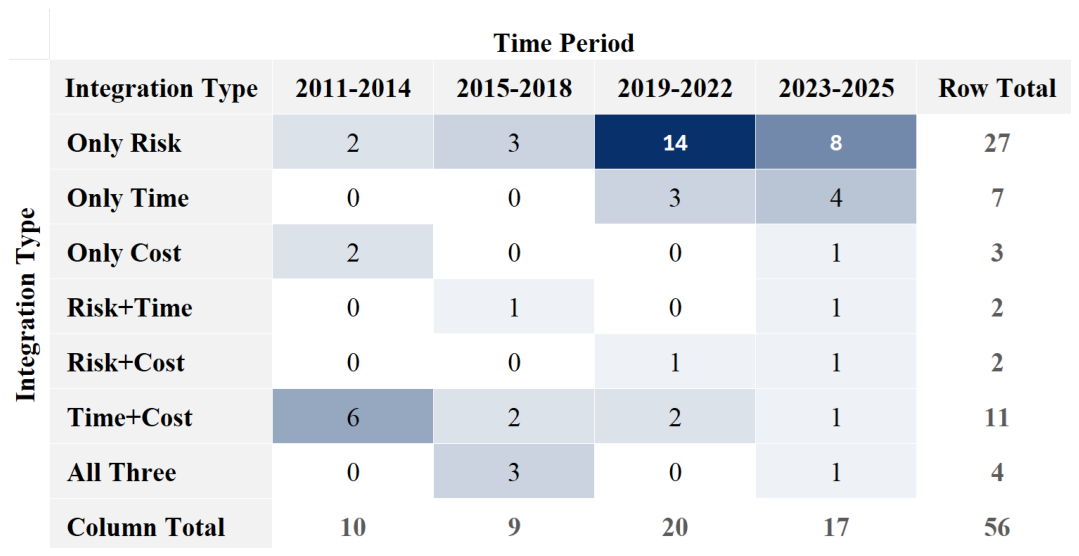
In this study, integration refers to the extent to which analytical models simultaneously consider and interrelate multiple project performance dimensions, particularly time, cost, and risk, within a unified modeling framework. The taxonomy also illustrates the progression from traditional deterministic approaches toward fully integrated and data-driven frameworks. This taxonomy extends existing classifications by integrating methodological, uncertainty, and performance dimensions within a single analytical framework.
3.4. Risk Management Perspectives and Performance Linkages
One of the clearest findings to emerge from reading across the 56 included papers is that risk dominates the conversation. Almost every study is motivated, at least in part, by the need to identify, evaluate, or mitigate risk — and this makes sense, given the scale and complexity of the industrial construction environments under examination. Power plants, pipelines, nuclear facilities, and mining infrastructure are inherently high-risk undertakings, and the consequences of failure are not abstract. What is more interesting, however, is not the prevalence of risk research in isolation but the question of how risk connects to the other two dimensions that determine whether a project succeeds: time and cost. This section examines those connections, and the gaps where they are missing.
How the three dimensions are distributed across the corpus
Figure 10 presents the overall count of papers addressing each performance dimension as a primary measured outcome. Risk management and safety assessment appear in 35 of the 56 papers (63%), making them by far the most studied performance area. Schedule and time performance come second, addressed in 24 papers (43%), and cost performance — cost overruns, budget control, financial risk — appears in 20 papers (36%). Papers addressing multiple dimensions are counted once per dimension, which is why the total across the three bars exceeds 56.
These headline figures, taken at face value, suggest reasonable coverage across all three dimensions. But aggregate counts obscure what is actually happening. A paper that builds a risk prioritization framework for pipeline construction and a paper that develops a multi-objective optimization model linking schedule delays to cost overruns both count as “risk papers” — yet they are doing fundamentally different things. To understand the real state of integration in this literature, it is necessary to ask not just how many papers address each dimension but which methodological approaches are responsible for the coverage, and whether the dimensions are being studied together or separately.
How performance coverage varies across methodological families
Figure 11 addresses this question directly. It shows, for each of the four methodological families and the ’Other’ category, what proportion of papers within that family address risk, schedule, and cost as primary outcomes. The Color intensity reflects the coverage level — darker cells indicate that the dimension is central to most papers in that family, lighter cells indicate it is rarely addressed.
The most striking feature of Figure 11 is the asymmetry within the Fuzzy MCDM row. Sixteen of the 18 MCDM papers — 89% — address risk or safety as a primary outcome, a near-total orientation toward a single dimension. Schedule is addressed in only 3 of those 18 papers (17%), and cost in just 1 (6%). This is not a coincidence: it reflects the structural design of MCDM frameworks as prioritization and ranking tools. They are built to answer the question “which risk factor matters most?” and they do so well. But they are not built to answer the follow-up questions that project managers actually need answered: “if this risk materialises, how much will it cost us?” or “how should we adjust our schedule buffers in response?” The gap between what MCDM does and what integrated risk management requires is plainly visible in the Color contrast across the three cells of that row — the risk cell is dark, while schedule and cost, particularly the latter, are strikingly pale. The Optimization row contains another story. All nine optimization papers (100%) deal with schedule performance, making this family unique in its coverage of some dimension by reaching its maximum. Five out of nine papers (56%) discuss cost as the second most covered topic, while risk turns out to be the least considered dimension (only 2 papers out of 9, 22%). Such statistics point at a specific property of an optimization problem definition; specifically, a scheduling system utilizing genetic algorithms to minimize project duration must necessarily take into account both time and resources, with adding cost being a natural expansion of such approach. The introduction of risk, however, seems to be a bigger challenge, as indicated by the figures shown in Figure 11 (whereas all 9 out of 9 papers address schedule performance, only 2 (22%) explicitly incorporate risk as an objective.). Finally, the Machine Learning row shows what is arguably the most important gap in need of further exploration in future research. Although some differences are noticeable for different dimensions—specifically, 53% vs 33% vs 47% for risk, time, and cost respectively—the latter statistic reveals even deeper meaning: despite the apparently reasonable level of risk coverage, the relatively low importance attributed to schedule performance indicates that machine learning was used mainly as a prediction tool in those papers. A model that forecasts cost overruns from historical project data or flags safety hazards from incident reports is genuinely useful, but it is doing something quite different from integrated decision support. Knowing that a project is likely to overrun does not, on its own, tell the project team what to do about it — and that gap between prediction and action remains largely unaddressed across the ML papers in this corpus. The Probabilistic family, by contrast, shows a notably balanced profile — 60% for risk, 60% for time, and 70% for cost — and the evenness of that distribution is not accidental. Monte Carlo simulation and Bayesian networks naturally produce output distributions that span both cost and schedule simultaneously, which makes it structurally easier for probabilistic studies to address multiple dimensions within a single analytical framework than it is for families whose outputs are inherently single-dimensional. Several papers in this group [12,42] employ integrated approaches such as earned value management and hybrid analytical frameworks that jointly evaluate cost and schedule performance within unified project control systems, and these represent some of the more genuinely integrated contributions in the corpus.
What the integration heatmap adds
The other visual presentation in Figure 9, namely, the integration heatmap, provides another interpretation: Instead of reflecting the number of times each dimension occurs individually, this diagram demonstrates how frequently pairs and triplets of dimensions occur together within one paper. The most prevailing cell throughout all periods is “Only Risk” – a total of 27 papers involve this aspect while not relating it to either time or cost. The “Time + Cost” pair was used in 11 studies, and the majority of them can be found for the 2011-2018 period when scheduling models were considered the key type of research. The fully integrated works are represented by four studies out of 15 years of analysis. This picture of fragmentation is not an artifact of how the papers were selected or coded. It reflects a genuine feature of how the field has developed: risk assessment, scheduling, and cost modeling have grown as largely separate research communities, each with their own methods, their own journals, and their own professional communities. The overlap between them has increased over time, as the heatmap shows, but it remains limited. System dynamics and network analysis approaches, identified in recent work [25,27] as emerging trends in integrated project risk management, offer some of the more promising directions for closing this gap — particularly for large infrastructure projects where the cascading effects of a single delay or cost escalation can propagate rapidly across multiple project systems.
The case for integration
The picture that emerges from Figure 9, Figure 10 and Figure 11 taken together is this: the field has made genuine progress in developing sophisticated methods for each of the three dimensions individually, but the connections between them remain underdeveloped. Risk is studied; cost is studied; schedule is studied. What is rarely studied is the mechanism by which a risk event propagates into a cost overrun and a schedule delay simultaneously, and how project managers might intervene in that propagation in real time.
Digital twin technologies [35], which provide continuous monitoring of project status and can in principle connect risk sensors, cost tracking systems, and schedule models within a single integrated platform, represent perhaps the most promising near-term vehicle for this kind of integration. But the gap is not primarily technological — it is conceptual. Before an integrated system can be built, the analytical framework that would underpin it needs to be developed, and that framework does not yet exist in a form that has been validated against real industrial construction projects. This is the challenge that the research gaps and future directions identified in the following section seek to address.
4. Research Gaps and Future Directions
Based on the analytical application of the proposed taxonomy across the reviewed literature, as demonstrated through Figure 5 and Figure 9, the following key research gaps are identified.
A systematic evaluation of the reviewed literature has identified significant research gaps that currently limit the formulation of effective risk and performance management frameworks for industrial construction projects. Although significant methodological developments have been made, the research has been fragmented with respect to the application of various research approaches and project performance dimensions. The salient research gaps, along with the corresponding limitations of the present research and possible areas for further research, are presented in Table 4.
One of the major limitations, however, is the lack of integrated frameworks that can analyze the interdependencies between time, cost, and risk at the same time [27]. As shown by the integration heatmap in Figure 9, a large number of research studies have focused more on individual performance parameters than on modeling the interdependencies between the parameters within a single framework. As a result, current models provide only limited insights into the project, which is a major limitation for strategic decision-making in industrial construction.
Another notable gap in the analytical models is the largely static nature of many current models. In this case, a significant number of models have been developed to enable decision-making in specific stages of the project lifecycle and not for constant adaptation in response to changes in the project environment. Industrial construction projects are implemented in a dynamic environment characterized by technological complexity, legal uncertainty, and changing stakeholder demands. In this case, risk management models that can continuously update plans in response to changes in the project environment are essential for improving the resilience and performance of projects [25,27].
The limited application of advanced optimization methodologies is an important research gap. Although the application of optimization methodologies, such as those derived from the field of operations research, has significant potential for managing complex project scheduling and resource allocation problems, its application in construction risk management is limited. The application of robust optimization, stochastic programming, and multi-stage decision models has the potential to enhance the ability of project managers to evaluate alternative strategies under conditions of uncertainty and balance conflicting project objectives.
Furthermore, the abundance of digital information has sparked much interest in using artificial intelligence and machine learning methods. Machine learning techniques have found their place in analyzing data on construction projects, predicting over-budgeting, assessing safety issues, and spotting patterns in project documentation [4,17]. Nevertheless, the current application is mostly devoted to predictions or classifications; the development of machine learning algorithms integrated into decision support systems has to be the subject of future research.
Another important gap in the literature can be found in the lack of studies conducted regarding industrial construction projects. The vast majority of the existing studies is related either to residential or commercial buildings, while there are many differences between such projects and those associated with industrial construction projects [31,45,47]. As a consequence, the framework of analysis of the overall construction industry might not be applicable to the specifics of industrial megaprojects.
The major research priorities identified through this review are summarized in Table 4, which maps each gap to concrete future research directions. These priorities emphasize the development of analytical frameworks that integrate risk assessment, predictive analytics, and optimization techniques within unified decision-support systems. These research needs must be addressed to improve the development of intelligent decision-support systems that can improve performance, robustness, and decision-making in uncertain situations in increasingly complex industrial construction environments. The integration of supply chain visibility and stakeholder management [32] with advanced risk assessment methodologies is another area that offers opportunities for improving project management through better coordination and information sharing.
Future research should focus on developing fully integrated, data-driven models that align with the higher levels of the proposed taxonomy, particularly those capable of simultaneously addressing time, cost, and risk interactions within adaptive decision-support frameworks.
5. Discussion
The picture that emerges from this review is one of a field that has come a long way methodologically, but has not yet solved the problem it set out to solve. Over the past 15 years, the toolkit available to researchers studying risk and performance in industrial construction has expanded considerably — from qualitative checklists and risk matrices toward probabilistic simulation, multi-objective optimization, and, most recently, machine learning and deep learning. Figure 5 and Figure 6 document this progression clearly. What those figures do not show, and what this discussion seeks to address, is the gap between methodological sophistication and genuine analytical integration.
Fragmentation Across Dimensions
The most consistent finding across this review is that methods have been developed largely in isolation from one another, each solving one part of the problem without being designed to connect with the others. The heatmap in Figure 9 makes this concrete: the dominant integration pattern across the 56 papers is single-dimension, with risk assessment papers that make no contact with cost or schedule, scheduling optimization models that treat risk as a constraint rather than a dynamic variable, and cost prediction tools that operate independently of both. As shown in Figure 7, even the methodological family with the strongest integration profile — optimization — achieves full three-way integration in only one paper out of nine.
This fragmentation is no trivial inconvenience. In industrial construction, risk, time and cost are tightly, and very often, intrinsically coupled. A geological surprise on a pipeline project delays one activity, which cascades into resource conflicts elsewhere, thrusts several work streams beyond their planned completion dates, triggers penalty clauses in the EPC contract and ultimately escalates the cost exposure of the owner. A risk assessment framework that identifies the geological surprise but cannot track the financial and schedule consequences of that surprise is only solving part of the problem that project managers actually face.
The Static Nature of Existing Models
A related problem is that most analytical frameworks in this corpus were designed to support decision-making at a specific point in the project lifecycle — typically the planning or tendering stage — rather than to update dynamically as execution unfolds. Risk registers are populated before work begins; Monte Carlo models are run during front-end planning; optimization schedules are produced at contract award. Once the project is under way, these tools tend to be set aside rather than continuously refreshed.
This static orientation is understandable from a practical standpoint — updating a sophisticated analytical model in real time requires both the data infrastructure and the organizational capacity to act on what the model produces, neither of which is straightforward on a complex industrial site. But the consequence is that the models are most reliable precisely when the available information is least complete, and least relevant precisely when the project is under stress and the information is richest. Industrial construction environments are characterized by regulatory volatility, supply chain disruptions, and shifting stakeholder demands, none of which respect the schedule of a front-end planning exercise. Approaches capable of incorporating new information as it becomes available — Bayesian updating, adaptive scheduling, scenario-based replanning — are therefore essential complements to the static frameworks that currently dominate the literature [27,38].
What Each Methodological Family Can and Cannot Do
It is worth being precise about the specific capabilities and limitations of each methodological family, because the case for hybridization rests on understanding what is actually missing from each approach individually.
MCDM and fuzzy methods are the most popular family in this corpus and the most easily accessible in practice: they do not require big data, can be run with modest computational resources and produce outputs – ranked risk factors, weighted criteria matrices – that project teams can understand and act on without specialist training. However, they are diagnostic, not predictive or prescriptive. They determine which risks are most important; they cannot tell you what will happen to the duration of the project if those risks are realised, or how resources should be reallocated in response.
The probabilistic approaches fall between two extremes. Monte Carlo analysis and Bayesian networks include the element of uncertainty, which is absent in MCDM, and result in probability distributions rather than numerical values. This is a step forward as it helps project managers consider various possible scenarios instead of making plans based on one specific expected scenario. The problem here is that these distributions should be predetermined, and for the industrial megaprojects, working in an environment of regulatory uncertainty and new technologies, it is almost impossible to have such distributions. The assumption of the stability of probability estimates is especially inappropriate for projects that take 10 or more years to implement.
optimization methods exhibit the greatest amount of prescriptive potential among all four families. A good optimization model goes beyond mere description of the status quo; it explores the decision-making space for arrangements that are able to combine time, cost and risk under certain constraints. The key drawback of optimization approaches is the inherent assumption of determinism. The majority of optimization models included in this literature review assume that the duration of activities, resource costs and productivity rates are known, which is true for short and deterministic workstreams but becomes less appropriate with increasing uncertainty over several years.
Machine learning approaches demonstrate the strongest predictive performance by conventional metrics — accuracy, precision, recall — and they are the fastest-growing family by publication volume. Their gap is twofold. First, most ML applications in this corpus stop at prediction: they identify that a project is at elevated risk of cost overrun, or flag a safety hazard from a site photograph, without connecting that output to a planning or resource allocation decision. Second, the interpretability problem is real and practical: a construction manager who cannot interrogate a model’s reasoning cannot verify whether its prediction is based on relevant features of the current project or on artifacts of the training data. This limits the degree to which ML outputs can be trusted as the basis for significant resource or scheduling decisions.
Taken together, this comparative assessment points to a clear conclusion: none of the four methodological families, as represented in the included studies, covers the full decision-making challenge of industrial construction project management on its own. MCDM excels at early-stage risk prioritization but cannot propagate those priorities into operational decisions; probabilistic models quantify uncertainty but cannot optimize responses to it; optimization finds efficient solutions but cannot model the uncertainty that surrounds them; machine learning predicts outcomes but cannot prescribe actions. The case for deliberate methodological hybridization is therefore not a matter of methodological fashion — it is a logical consequence of what these families, in their current published forms, individually lack.
Practical Constraints on Integration
It would be wrong, however, to conclude from this analysis that the path forward is simply to build more complex models. Industrial megaprojects operate under a set of organizational and contractual constraints that any practical framework must accommodate.
Nuclear power stations, oil and gas processing facilities, and major pipeline systems are typically delivered under engineering, procurement, and construction (EPC) contracts that specify the conditions and timing of key decisions in advance. The decision to approve a revised schedule, release additional contingency funds, or invoke a force majeure clause is not made by a project manager in consultation with an analytical model — it is made at a contractually defined milestone, by a governance structure involving owners, contractors, regulators, and often government bodies. A framework that assumes continuous adaptive replanning is therefore solving a problem that the contractual architecture of EPC delivery does not readily allow.
Data acquisition is yet another issue. Industrial construction projects’ performance data is highly confidential, is particular to the layout of individual facilities, and lacks any standardization in practice. Gathering enough data to develop a sufficiently sized, clean, and properly labeled dataset for use with current machine learning models cannot be reduced to installing appropriate sensors, and would require the concerted effort of the project owner, contractor, and possibly even sub-contractor with potentially conflicting views on the information obtained from this data. This problem is not insurmountable, but this is why the most realistic framework integration option will be one that will be able to work efficiently with less than ideal data.
The implication is that the most practical approach to time–cost–risk integration may not be the most technically sophisticated one. A hybrid framework that combines the interpretability of probabilistic models — so that project managers can understand and challenge the outputs — with the prescriptive capability of optimization frameworks — so that the outputs can be translated directly into resource and schedule decisions — is likely to be more useful in practice than a deep learning model whose predictions cannot be explained or a multi-objective optimization that assumes away the uncertainty it is meant to address.
The Role of Digital Technologies
Recent developments in construction technology open up new possibilities for closing the gap between analytical capability and practical implementation. Building information modeling (BIM) provides a structured data environment in which geometric, schedule, and cost information coexist within a single model, creating a natural substrate for integrated risk analysis. Digital twin technology [35] goes further, maintaining a continuously updated representation of project status that can in principle serve as the input layer for a real-time risk and performance monitoring system. Project data platforms and AI-based site monitoring systems increasingly provide the sensor data and documentation streams that data-driven methods need to function at project scale.
In conjunction with predictive analytics and optimization, however, this combination could create a decision-making context that is distinctly different from the static planning systems that currently dominate the field. In this context, the manager of the construction project can continuously monitor changing conditions, simulate their possible outcomes, and evaluate the options for responding. The enabling technologies for such a context are increasingly available; the remaining barriers are analytical, organizational, contractual, and technological. In particular, no included study presented a theoretical construct capable of tying these systems together into a time–cost–risk management system validated with empirical evidence from actual industrial construction sites. Geotechnical and geological uncertainties are added complexities associated with such integrated frameworks [43].
The Missing Feedback Mechanism
Figure 12 compares the four family approaches across six different dimensions: dealing with uncertainty, computational complexity, data needed, interpretation of results, real-time processing, and actual use. What becomes evident from the radar plots is that success in one dimension comes at the cost of failure in another; there is no clear family that wins across all dimensions, which may be the strongest point of this review in favor of hybrids.
However, there is one recurring limitation that neither figure captures directly. Most included frameworks — even those that incorporate all three dimensions — share a similar shortcoming: the forward flow of risk into schedule and cost consequences is considered, but the backward flow is not. No included study explicitly modelled the relationship between the amount of overrun experienced and the increased risk that this overrun entails. As a project starts to lag behind schedule, everything else becomes more costly, subcontractor relations deteriorate, regulatory pressure rises, and there is greater likelihood of additional delays. This cycle of feedback — from the results of past operations into future risks — is exactly what makes industrial megaproject management so complex, and it was not represented in the analytical models included in this review.
The framework outlined in Figure 13 seeks to fill this gap by integrating risk assessment, predictive analytics, and time–cost–risk optimization into a single decision-making structure linked by continuous data flow. All elements of this framework correspond to the three dimensions of the taxonomy proposed in Section 3.3: analytical approach, uncertainty representation, and integration level. In this sense the framework is not an add-on to the taxonomy but a direct instantiation of it — a demonstration that the taxonomic structure has practical as well as descriptive value. The potential empirical test cases for this framework include nuclear power plant construction [22], oil and gas facility projects [2], and underground industrial construction [28], each of which presents a distinct combination of risk profile, regulatory environment, and data availability that would stress-test different components of an integrated model.
The most important design requirement for a next-generation integrated decision-support system is therefore not better prediction algorithms or more expressive optimization formulations — it is the feedback mechanism, shown as the return path in Figure 13, that allows a model to re-estimate remaining risk in light of actual deviations from plan, updating cost and schedule projections continuously rather than only at contractually mandated review points. Building and validating such a mechanism, in the context of real industrial construction projects, is the primary unresolved challenge that this review identifies.
Practical Implications
The main message of this review for practitioners dealing with industrial construction projects is that the use of separate risk, schedule and cost tools in a fragmented way is a source of project risk itself. When the risk assessment team, the scheduling team and the cost control team run with different models, different assumptions and different update cycles the integrated picture of project status that leadership needs to make good decisions is never assembled. Although the development of integrated decision support systems entails high costs in terms of data generation capacity, analytics capability, and organizational processes that act on model outputs, these costs may be considerably lower than those associated with the overruns and delays caused by fragmentary analysis.
The implementation of digital technology solutions such as BIM and project data platforms is certainly an important requirement, yet it is insufficient on its own. The technology generates data; the analytical framework gives sense to it; the organizational processes make sense of it. All three have to evolve simultaneously in order for the benefits of integrated risk management to materialise.
Implications for Integrated Analytical Frameworks
The findings indicate that integrated time–cost–risk management provides a foundation for advanced analytical decision support in industrial construction. From a project performance perspective, early identification of interacting risks can reduce contingency misuse, claims, and lifecycle cost escalation. Operationally, improved scheduling and resource allocation can limit idle equipment, repeated mobilization, material waste, and rework-related emissions. From a safety-management perspective, linking schedule pressure and cost constraints to safety-risk indicators can help prevent decisions that improve short-term performance at the expense of worker well-being. However, the reviewed literature rarely models these performance consequences explicitly. Future decision-support systems should incorporate additional performance indicators alongside time, cost, and risk to improve analytical support for complex industrial construction projects.
Study Limitations
This review has several limitations. First, the search was restricted to English-language journal articles indexed in Scopus and Web of Science; therefore, conference papers, technical standards, industry reports, and other grey literature that may contain relevant practical evidence were excluded. Second, restricting the corpus to Q1 journals improved consistency but may have excluded methodologically valuable studies from specialised or practice-oriented outlets; journal quartile should not be interpreted as a direct measure of individual-study quality. Third, the search period excluded foundational work published before 2011. Fourth, the assignment of multi-method studies to a primary methodological family and the classification of uncertainty and integration levels involved interpretive judgement, despite independent coding and consensus procedures. Fifth, the heterogeneity of study designs, outcomes, industrial contexts, and validation procedures prevented statistical meta-analysis. Finally, the review protocol was not prospectively registered. These limitations mean that the reported distributions should be interpreted as a structured representation of the selected corpus rather than as exhaustive estimates of the entire industrial-construction literature.
6. Conclusions
This systematic review examined 56 studies on risk assessment and performance management in industrial construction published between 2011 and 2025. Four dominant methodological families were identified: multicriteria and fuzzy decision-making, probabilistic and simulation-based modeling, optimization, and artificial intelligence and machine learning. The results demonstrate substantial methodological development but limited integration: 27 studies addressed risk without linking it to time or cost, while only four jointly modelled all three dimensions.
Probabilistic and optimization approaches currently provide the strongest basis for integrated analysis, whereas fuzzy MCDM studies predominantly support risk prioritization and most machine-learning studies remain focused on prediction. Across the corpus, models are generally applied at discrete planning stages rather than continuously updated during project execution.
Future work should focus on closed-loop hybrid systems that combine uncertainty updating, predictive analytics, multi-objective optimization, and project-monitoring technologies such as BIM and digital twins. These systems should support integrated modeling of cost, schedule, safety, resource utilization, and uncertainty within adaptive decision-support frameworks. Validation using longitudinal data from real industrial projects is necessary before such frameworks can provide reliable support for integrated project decision-making.
Author Contributions
Conceptualization, C.T. and A.Z.; methodology, C.T.; validation, M.K., I.V., and A.Z.; formal analysis, C.T. and A.Z.; investigation, C.T.; resources, C.T.; data curation, C.T.; writing—original draft preparation, C.T.; writing—review and editing, C.T., A.Z., M.K., and I.V.; visualization, C.T.; supervision, C.T.; project administration, M.K.; funding acquisition, M.K. All authors have read and agreed to the published version of the manuscript.
Funding
This research is funded by the Science Committee of the Ministry of Science and Higher Education of the Republic of Kazakhstan, Grant No. AP26100823.
Institutional Review Board Statement
Not applicable.
Informed Consent Statement
Not applicable.
Data Availability Statement
The original contributions presented in this study are included in the article. Further inquiries can be directed to the corresponding author.
Acknowledgments
During the preparation of this work, the authors used Claude (Anthropic) to assist with manuscript editing and revision, including improving the language and clarity of the text. After using this tool, the authors reviewed and edited the content and take full responsibility for the content of the published article.
Conflicts of Interest
The authors declare no conflicts of interest. The funders had no role in the design of the study; in the collection, analyses, or interpretation of data; in the writing of the manuscript; or in the decision to publish the results.
Appendix A. Database Search Strings
The following search strings were executed on 12 December 2025. The Scopus query used the TITLE-ABS-KEY field; the Web of Science Core Collection query used the Topic (TS) field, which is the closest functional equivalent, together with the corresponding year, document type, and language refinements.
Appendix A.1. Scopus
TITLE-ABS-KEY ( "manufacturing plant" OR "oil refinery" OR "power plant" OR "gas processing plant" OR "petrochemical plant" OR "chemical plant" OR "process plant" OR "mine" OR "pipeline" OR "EPC project" OR "industrial construction" OR "oil and gas" ) AND TITLE-ABS-KEY ( "construction project" ) AND TITLE-ABS-KEY ( "cost overrun" OR "budget overrun" OR "cost escalation" OR "cost performance" OR "cost control" OR "project risk" OR "risk assessment" OR "risk analysis" OR "risk management" OR "risk optimization" OR "risk mitigation" OR uncertainty OR "schedule delay" OR "project delay" OR "time overrun" OR "schedule overrun" OR "schedule performance" OR "schedule risk" ) AND ( PUBYEAR > 2010 AND PUBYEAR < 2026 ) AND ( LIMIT-TO ( SRCTYPE , "j" ) ) AND ( LIMIT-TO ( PUBSTAGE , "final" ) ) AND ( LIMIT-TO ( DOCTYPE , "ar" ) ) AND ( LIMIT-TO ( LANGUAGE , "English" ) )
Appendix A.2. Web of Science Core Collection
TS=(("manufacturing plant" OR "oil refinery" OR "power plant" OR "gas processing plant" OR "petrochemical plant" OR "chemical plant" OR "process plant" OR mine OR pipeline OR "EPC project" OR "industrial construction" OR "oil and gas") AND "construction project" AND ("cost overrun" OR "budget overrun" OR "cost escalation" OR "cost performance" OR "cost control" OR "project risk" OR "risk assessment" OR "risk analysis" OR "risk management" OR "risk optimization" OR "risk mitigation" OR uncertainty OR "schedule delay" OR "project delay" OR "time overrun" OR "schedule overrun" OR "schedule performance" OR "schedule risk")) AND PY=(2011-2025) AND DT=(Article) AND LA=(English)
References
- Wright, E.R.; Cho, K.; Hastak, M. Assessment of Critical Construction Engineering and Management Aspects of Nuclear Power Projects. J. Manag. Eng. 2014, 30(4), 04014016. [Google Scholar] [CrossRef]
- Dehdasht, G.; Mohamad Zin, R.; Ferwati, M.; Mohammed Abdullahi, M.; Keyvanfar, A.; McCaffer, R. DEMATEL-ANP Risk Assessment in Oil and Gas Construction Projects. Sustainability 2017, 9(8), 1420. [Google Scholar] [CrossRef]
- Al-Mhdawi, M.K.S.; O’Connor, A.; Qazi, A. Structural Equation Modeling and Fuzzy Set Theory: Advancing Risk Assessment in Oil and Gas Construction Projects. Environ. Impact Assess. Rev. 2024, 109, 107622. [Google Scholar] [CrossRef]
- Shi, X.; Liu, Y.; Ma, K.; Gu, Z.; Qiao, Y.; Ni, G.; Ojum, C.; Opoku, A.; Liu, Y. Evaluation of Risk Factors Affecting the Safety of Coal Mine Construction Projects Using an Integrated DEMATEL-ISM Approach. Eng. Constr. Archit. Manag. 2025, 32(5), 3432–3452. [Google Scholar] [CrossRef]
- Koch, C. Contested Overruns and Performance of Offshore Wind Power Plants. Constr. Manag. Econ. 2012, 30(8), 609–622. [Google Scholar] [CrossRef]
- Araújo-Rey, C.; Sebastián, M.A. An Approach to the Analysis of Causes of Delays in Industrial Construction Projects through Planning and Statistical Computing. Sustainability 2021, 13(7), 3975. [Google Scholar] [CrossRef]
- Gupta, V.K.; Thakkar, J.J. A Quantitative Risk Assessment Methodology for Construction Project. Sādhanā 2018, 43(7), 116. [Google Scholar] [CrossRef]
- Mete, S.; Serin, F.; Oz, N.E.; Gul, M. A Decision-Support System Based on Pythagorean Fuzzy VIKOR for Occupational Risk Assessment of a Natural Gas Pipeline Construction. J. Nat. Gas. Sci. Eng. 2019, 71, 102979. [Google Scholar] [CrossRef]
- Sadeghi, N.; Gerami Seresht, N.; Pedrycz, W.; Fayek, A.R. Fuzzy granular computing for evaluating average uncertainty in machine learning models. Eng. Appl. Artif. Intell. 2025, 160, 111723. [Google Scholar] [CrossRef]
- Wang, W.; Liu, X.; Ma, Y.; Liu, S. A New Approach for Occupational Risk Evaluation of Natural Gas Pipeline Construction with Extended Cumulative Prospect Theory. Int. J. Fuzzy Syst. 2021, 23(1), 158–181. [Google Scholar] [CrossRef]
- Larionov, A.; Nezhnikova, E.; Smirnova, E. Risk Assessment Models to Improve Environmental Safety in the Field of the Economy and Organization of Construction: A Case Study of Russia. Sustainability 2021, 13(24), 13539. [Google Scholar] [CrossRef]
- Senses, S.; Kumral, M. Embedding Extreme Events to Mine Project Planning: Implications on Cost, Time, and Disclosure Standards. Resour. Policy 2023, 86, 104162. [Google Scholar] [CrossRef]
- Torabi Yeganeh, F.; Zegordi, S.H. A Multi-Objective Optimization Approach to Project Scheduling with Resiliency Criteria under Uncertain Activity Duration. Ann. Oper. Res. 2020, 285(1–2), 161–196. [Google Scholar] [CrossRef]
- Xu, J.; Zheng, H.; Zeng, Z.; Wu, S.; Shen, M. Discrete Time–Cost–Environment Trade-off Problem for Large-Scale Construction Systems with Multiple Modes under Fuzzy Uncertainty and Its Application to Jinping-II Hydroelectric Project. Int. J. Proj. Manag. 2012, 30(8), 950–966. [Google Scholar] [CrossRef]
- Elizabeth, R.M.C.; Sattari, F.; Lefsrud, L.; Gue, B. Visualizing What’s Missing: Using Deep Learning and Bow-Tie Diagrams to Identify and Visualize Missing Leading Indicators in Industrial Construction. J. Saf. Res. 2025, 93, 1–11. [Google Scholar] [CrossRef] [PubMed]
- Ma, G.; Wu, Z.; Jia, J.; Shang, S. Safety Risk Factors Comprehensive Analysis for Construction Project: Combined Cascading Effect and Machine Learning Approach. Saf. Sci. 2021, 143, 105410. [Google Scholar] [CrossRef]
- Williams, T.P.; Gong, J. Predicting Construction Cost Overruns Using Text Mining, Numerical Data and Ensemble Classifiers. Autom. Constr. 2014, 43, 23–29. [Google Scholar] [CrossRef]
- Heravi, G.; Gholami, A. The Influence of Project Risk Management Maturity and Organizational Learning on the Success of Power Plant Construction Projects. Proj. Manag. J. 2018, 49(5), 22–37. [Google Scholar] [CrossRef]
- Zheng, J.; Qiang, M. Understanding the Changes in Construction Project Managers’ Competences through Resume Data Mining. J. Civ. Eng. Manag. 2022, 28(4), 305–319. [Google Scholar] [CrossRef]
- Hammad, A.; AbouRizk, S.; Mohamed, Y. Application of KDD Techniques to Extract Useful Knowledge from Labor Resources Data in Industrial Construction Projects. J. Manag. Eng. 2014, 30(6), 05014011. [Google Scholar] [CrossRef]
- Sun, J.; Zhang, P. Owner Organization Design for Mega Industrial Construction Projects. Int. J. Proj. Manag. 2011, 29(7), 828–833. [Google Scholar] [CrossRef]
- Kim, M.; Lee, I.; Jung, Y. International Project Risk Management for Nuclear Power Plant (NPP) Construction: Featuring Comparative Analysis with Fossil and Gas Power Plants. Sustainability 2017, 9(3), 469. [Google Scholar] [CrossRef]
- Sánchez Colmenarejo, J.I.; Camprubí, F.M.; González-Gaya, C.; Sánchez-Lite, A. Power Plant Construction Projects Risk Assessment: A Proposed Method for Temporary Systems of Commissioning. Buildings 2022, 12(8), 1260. [Google Scholar] [CrossRef]
- Adamtey, S.; Onsarigo, L. Analysis of Pipe-Bursting Construction Risks Using Probability-Impact Model. J. Eng. Des. Technol. 2018, 16(3), 461–477. [Google Scholar] [CrossRef]
- Bakhshayesh, M.; Abbasianjahromi, H. Integrating Text Mining and System Dynamics to Evaluate Financial Risks of Construction Contracts. Artif. Intell. Law. 2024, 32(3), 741–768. [Google Scholar] [CrossRef]
- Birjandi, A.K.; Akhyani, F.; Sheikh, R.; Sana, S.S. Evaluation and Selecting the Contractor in Bidding with Incomplete Information Using MCGDM Method. Soft Comput. 2019, 23(20), 10569–10585. [Google Scholar] [CrossRef]
- Casotti, A.L.N.; Zio, E. Network Analysis-Enhanced Project Risk Management for Nuclear Power Plant Construction. Reliab. Eng. Syst. Saf. 2025, 263, 111269. [Google Scholar] [CrossRef]
- Cheng, M.; Lu, Y. Developing a Risk Assessment Method for Complex Pipe Jacking Construction Projects. Autom. Constr. 2015, 58, 48–59. [Google Scholar] [CrossRef]
- Chi, S.; Suk, S.-J.; Kang, Y.; Mulva, S.P. Development of a Data Mining-Based Analysis Framework for Multi-Attribute Construction Project Information. Adv. Eng. Inform. 2012, 26(3), 574–581. [Google Scholar] [CrossRef]
- Choo, D.; Jung, W. A Preliminary Study on the Comparative Schedule Analysis of Traditional and Advanced Work Packaging Plans for Nuclear Power Plant Construction. Appl. Sci. 2025, 15(20), 11113. [Google Scholar] [CrossRef]
- Collins, W.; Parrish, K.; Gibson, G.E. Development of a Project Scope Definition and Assessment Tool for Small Industrial Construction Projects. J. Manag. Eng. 2017, 33(4), 04017015. [Google Scholar] [CrossRef]
- Dharmapalan, V.; O’Brien, W.J.; Morrice, D. Benefits of Visibility in Industrial Construction Projects: Supply Chain Stakeholders’ Perspectives. Front. Built Environ. 2025, 11, 1698777. [Google Scholar] [CrossRef]
- Francom, T.; El Asmar, M.; Ariaratnam, S.T. Performance Analysis of Construction Manager at Risk on Pipeline Engineering and Construction Projects. J. Manag. Eng. 2016, 32(6), 04016016. [Google Scholar] [CrossRef]
- Gao, J.; Ren, H.; Cai, W. Risk Assessment of Construction Projects in China under Traditional and Industrial Production Modes. Eng. Constr. Archit. Manag. 2019, 26(9), 2147–2168. [Google Scholar] [CrossRef]
- Hu, F.; Qiu, X.; Jing, G.; Tang, J.; Zhu, Y. Digital Twin-Based Decision Making Paradigm of Raise Boring Method. J. Intell. Manuf. 2023, 34(5), 2387–2405. [Google Scholar] [CrossRef]
- Karamoozian, A.; Wu, D.; Chen, C.L.P.; Luo, C. An Approach for Risk Prioritization in Construction Projects Using Analytic Network Process and Decision Making Trial and Evaluation Laboratory. IEEE Access 2019, 7, 159842–159854. [Google Scholar] [CrossRef]
- Karimi, H.; Taylor, T.R.B.; Goodrum, P.M.; Srinivasan, C. Quantitative Analysis of the Impact of Craft Worker Availability on Construction Project Safety Performance. Constr. Innov. 2016, 16(3), 307–322. [Google Scholar] [CrossRef]
- Kedir, N.; Fayek, A.R. Integrated fuzzy system dynamics–fuzzy agent-based modeling of construction crew motivation and productivity. Adv. Eng. Inform. 2025, 66, 103367. [Google Scholar] [CrossRef]
- Kjellén, U. Managing Safety in Hydropower Projects in Emerging Markets – Experiences in Developing from a Reactive to a Proactive Approach. Saf. Sci. 2012, 50(10), 1941–1951. [Google Scholar] [CrossRef]
- Koulinas, G.K.; Demesouka, O.E.; Bougelis, G.G.; Koulouriotis, D.E. Risk Prioritization in a Natural Gas Compressor Station Construction Project Using the Analytical Hierarchy Process. Sustainability 2022, 14(20), 13172. [Google Scholar] [CrossRef]
- Krechowicz, M. Comprehensive Risk Management in Horizontal Directional Drilling Projects. J. Constr. Eng. Manag. 2020, 146(5), 04020034. [Google Scholar] [CrossRef]
- Lei, Z.; Hu, Y.; Hua, J.; Marton, B.; Goldberg, N.; Marton, P.; Marton, N. An Earned-Value-Analysis (EVA)-Based Project Control Framework in Large-Scale Scaffolding Projects Using Linear Regression Modeling. ITcon 2022, 27, 630–641. [Google Scholar] [CrossRef]
- Leu, S.-S.; Wen, P.-H.; Ludiansari, M.; Gahi, J. Risk, Robustness and Microtunneling Machine Selection under Geological Uncertainty of Clayed Sand Layer in Taiwan. Tunn. Undergr. Space Technol. 2025, 165, 106876. [Google Scholar] [CrossRef]
- Liang, H.; Xie, X.; Chen, X.; Li, Q.; He, W.; Yang, Z.; Ren, M. Study on Risk Assessment of Tunnel Construction across Mined-out Region Based on Combined Weight-Two-Dimensional Cloud Model. Sci. Rep. 2025, 15(1), 7233. [Google Scholar] [CrossRef] [PubMed]
- Locatelli, G.; Mancini, M. Looking Back to See the Future: Building Nuclear Power Plants in Europe. Constr. Manag. Econ. 2012, 30(8), 623–637. [Google Scholar] [CrossRef]
- Mammadov, F.; Aghayev, Z.; Hasanov, E. ML-Based Prescriptive Model for Pipeline Construction Accident Outcome Prediction. Saf. Sci. 2023, 168, 106227. [Google Scholar] [CrossRef]
- Pérez, D.; Lagos, C.; Alarcón, L.F. Key Last Planner System Metrics to Assess Project Performance in High-Rise Building and Industrial Construction Projects. J. Constr. Eng. Manag. 2022, 148(1), 04021179. [Google Scholar] [CrossRef]
- Pilger, J.D.; Machado, Ê.L.; De Assis Lawisch-Rodriguez, A.; Zappe, A.L.; Rodriguez-Lopez, D.A. Environmental Impacts and Cost Overrun Derived from Adjustments of a Road Construction Project Setting. J. Clean. Prod. 2020, 256, 120731. [Google Scholar] [CrossRef]
- Sherman, R.; Parrish, K.; Lamanna, A. Identifying and Categorizing Risks Incumbent in US Nuclear Power Plant Construction. J. Constr. Eng. Manag. 2021, 147(4), 04021024. [Google Scholar] [CrossRef]
- Somi, S.; Gerami Seresht, N.; Fayek, A.R. Framework for Risk Identification of Renewable Energy Projects Using Fuzzy Case-Based Reasoning. Sustainability 2020, 12(13), 5231. [Google Scholar] [CrossRef]
- Sui, Y.; Ding, R.; Wang, H. A Novel Approach for Occupational Health and Safety and Environment Risk Assessment for Nuclear Power Plant Construction Project. J. Clean. Prod. 2020, 258, 120945. [Google Scholar] [CrossRef]
- Taghaddos, M.; Mousaei, A.; Taghaddos, H.; Hermann, U.; Mohamed, Y.; AbouRizk, S. Optimized Variable Resource Allocation Framework for Scheduling of Fast-Track Industrial Construction Projects. Autom. Constr. 2024, 158, 105208. [Google Scholar] [CrossRef]
- Taylor, T.R.B.; Ford, D.N.; Reinschmidt, K.F. Impact of Public Policy and Societal Risk Perception on U.S. Civilian Nuclear Power Plant Construction. J. Constr. Eng. Manag. 2012, 138(8), 972–981. [Google Scholar] [CrossRef]
- Wang, W.; Wang, Y.; Fan, S.; Han, X.; Wu, Q.; Pamucar, D. A Complex Spherical Fuzzy CRADIS Method Based Fine-Kinney Framework for Occupational Risk Evaluation in Natural Gas Pipeline Construction. J. Pet. Sci. Eng. 2023, 220, 111246. [Google Scholar] [CrossRef]
- Xu, J.; Ding, R.; Li, M.; Dai, T.; Zheng, M.; Yu, T.; Sui, Y. A New Bayesian Network Model for Risk Assessment Based on Cloud Model, Interval Type-2 Fuzzy Sets and Improved D-S Evidence Theory. Inf. Sci. 2022, 618, 336–355. [Google Scholar] [CrossRef]
- Youssef, M.; Gab-Allah, A.; Hagras, O.; Bahader, I. Factors Affecting Delays in Oil and Gas Construction Projects. Sci. Rep. 2025, 15(1), 44655. [Google Scholar] [CrossRef] [PubMed]
Figure 1.
PRISMA 2020-style flow diagram illustrating the systematic study selection process.
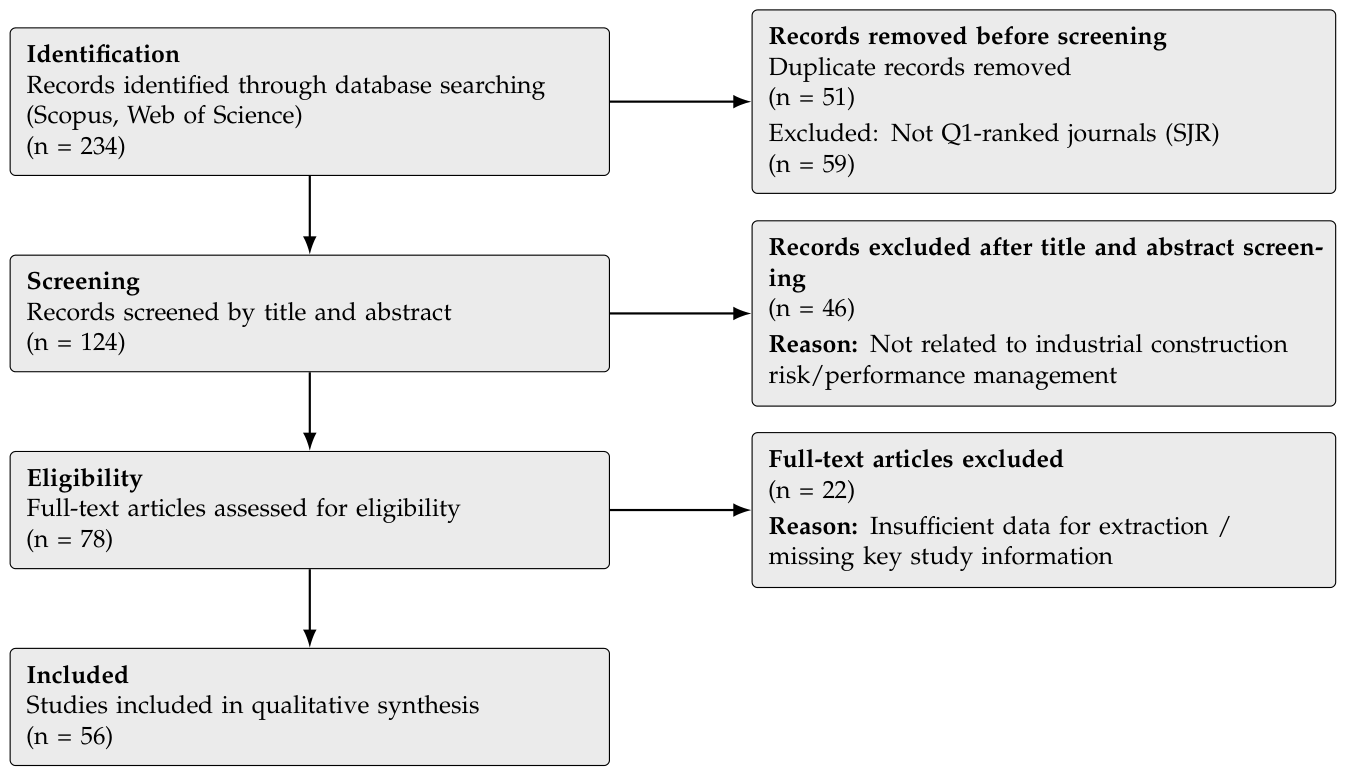
Figure 2.
Methodological limitations appraisal across the 56 reviewed studies, evaluated along four domains: selection, methodological, reporting, and data limitations. Each bar shows the number of papers rated as low, moderate, or high concern.
Figure 2.
Methodological limitations appraisal across the 56 reviewed studies, evaluated along four domains: selection, methodological, reporting, and data limitations. Each bar shows the number of papers rated as low, moderate, or high concern.
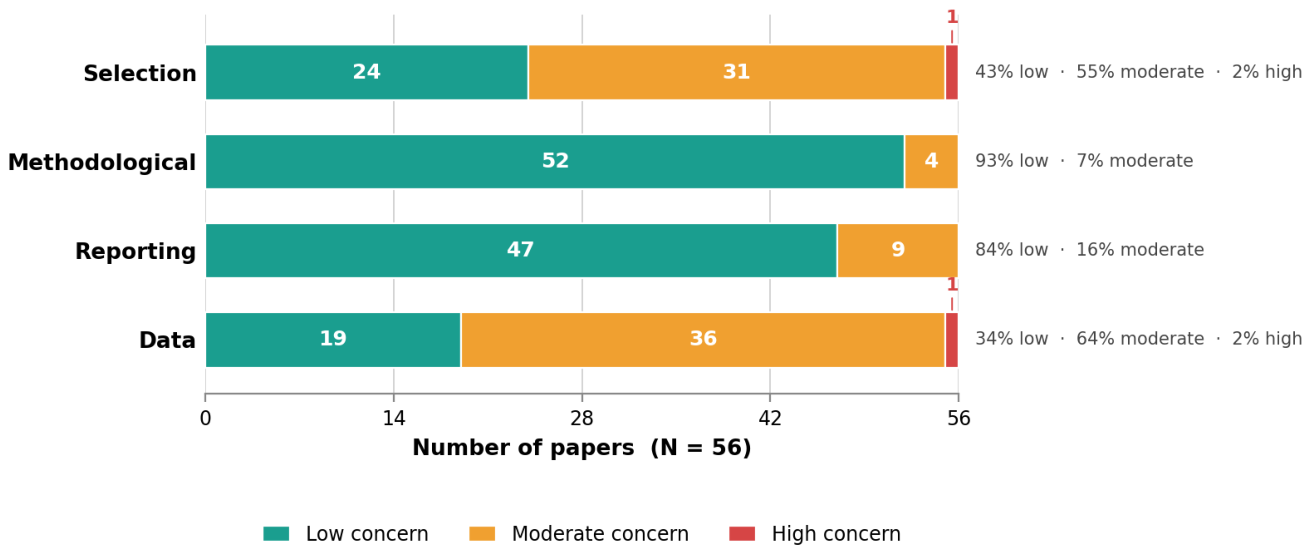
Figure 3.
Descriptive overview of the final corpus (): growth in publication volume over time and regional distribution of study contexts.
Figure 3.
Descriptive overview of the final corpus (): growth in publication volume over time and regional distribution of study contexts.
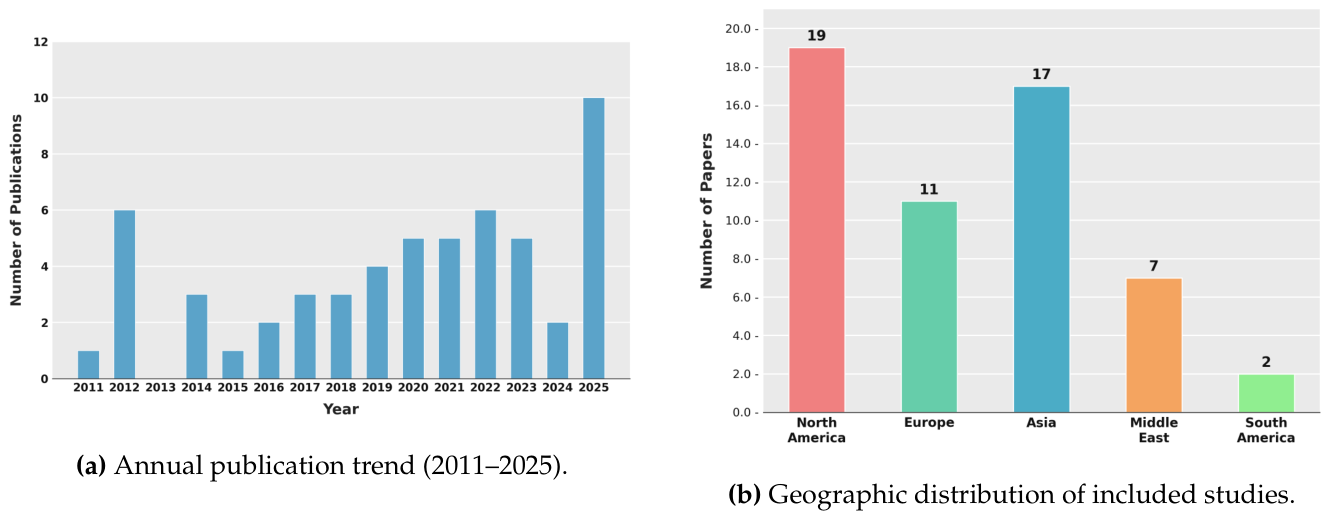
Figure 4.
Industrial asset types represented in the reviewed literature
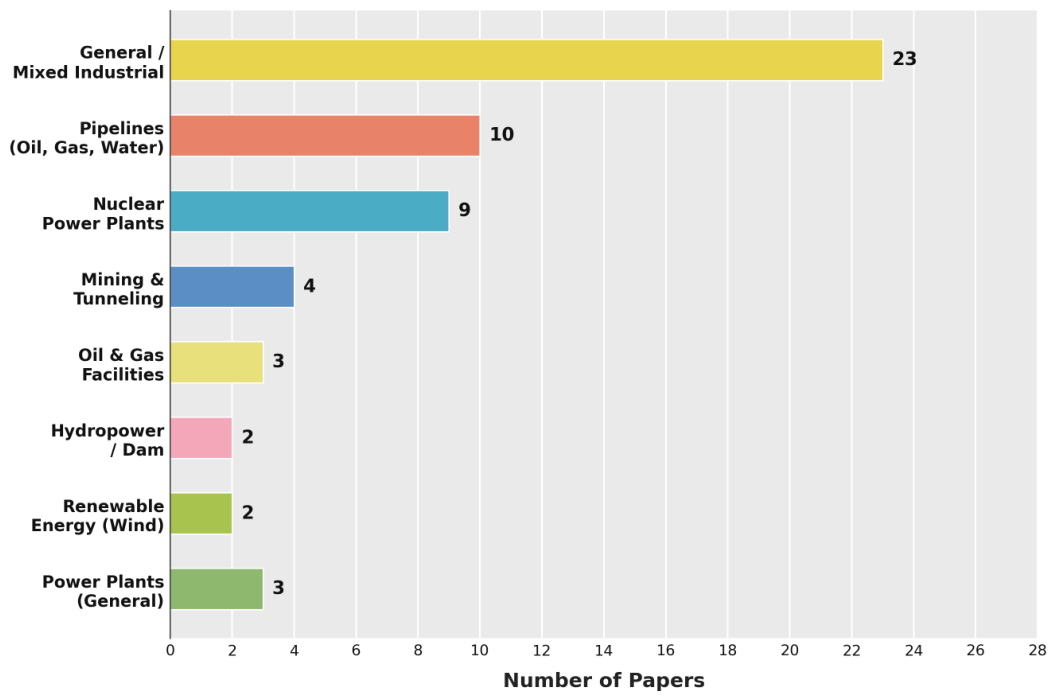
Figure 5.
Methodological distribution across the 56 reviewed papers.
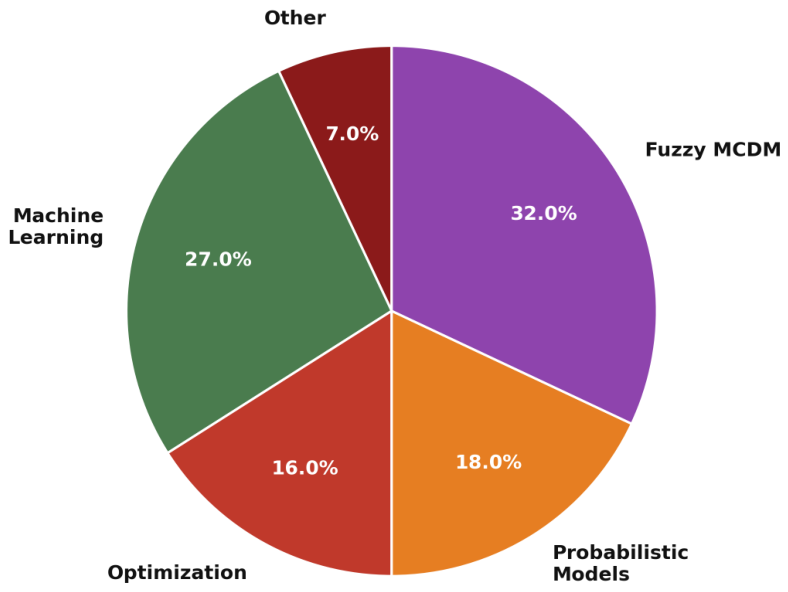
Figure 6.
Evolution of methodological approaches over time.
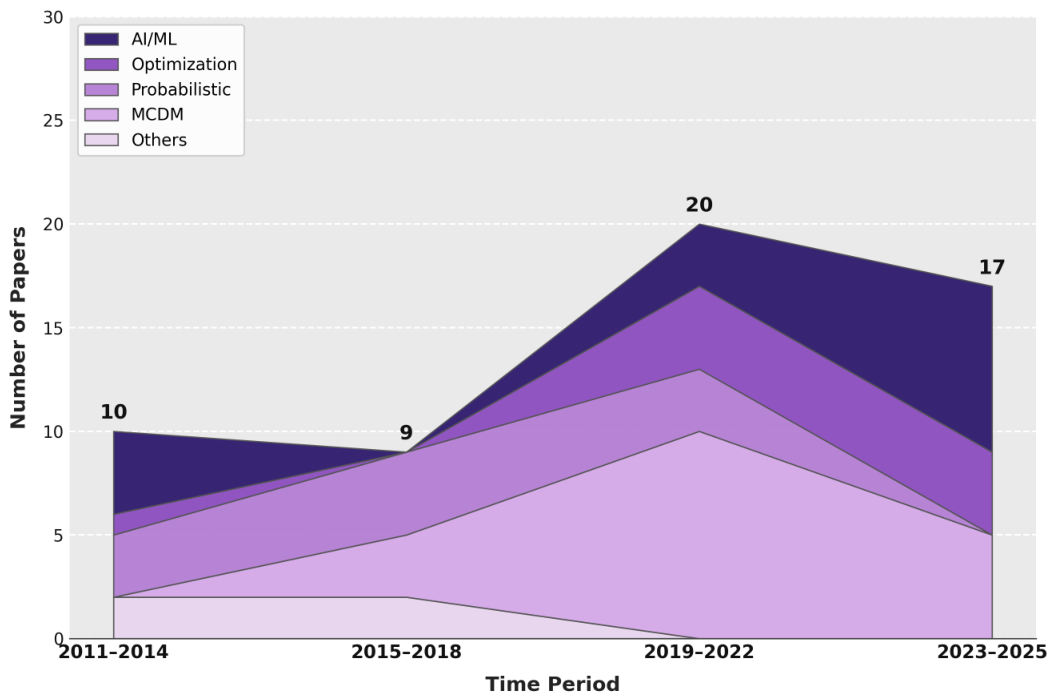
Figure 7.
Distribution of integration levels across the four methodological families. Each bar shows the number of papers within that family categorized as single-dimension, dual-integration, or fully integrated (all three of risk, time, and cost addressed simultaneously). The italic annotation above each bar gives the percentage of single-dimension papers within that family.
Figure 7.
Distribution of integration levels across the four methodological families. Each bar shows the number of papers within that family categorized as single-dimension, dual-integration, or fully integrated (all three of risk, time, and cost addressed simultaneously). The italic annotation above each bar gives the percentage of single-dimension papers within that family.
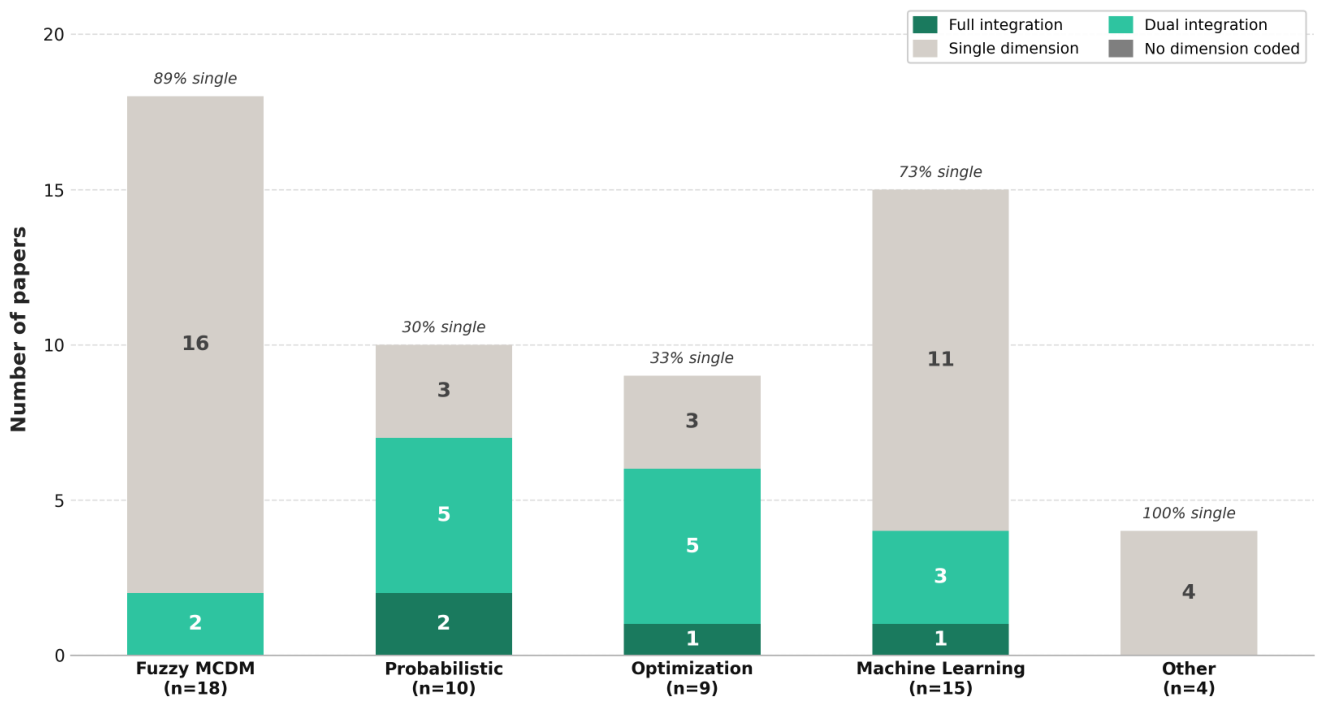
Figure 8.
Proposed taxonomy of methodological approaches in industrial construction risk and performance management, structured across three dimensions: analytical method, uncertainty representation, and level of integration.
Figure 8.
Proposed taxonomy of methodological approaches in industrial construction risk and performance management, structured across three dimensions: analytical method, uncertainty representation, and level of integration.
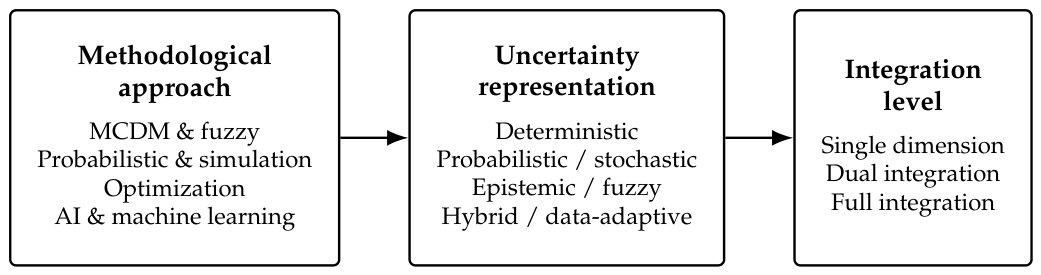
Figure 10.
Number of reviewed studies addressing risk or safety, schedule or time, and cost or budget as primary performance dimensions. Studies addressing more than one dimension are counted in each applicable category; therefore, the category totals exceed the corpus size of 56.
Figure 10.
Number of reviewed studies addressing risk or safety, schedule or time, and cost or budget as primary performance dimensions. Studies addressing more than one dimension are counted in each applicable category; therefore, the category totals exceed the corpus size of 56.
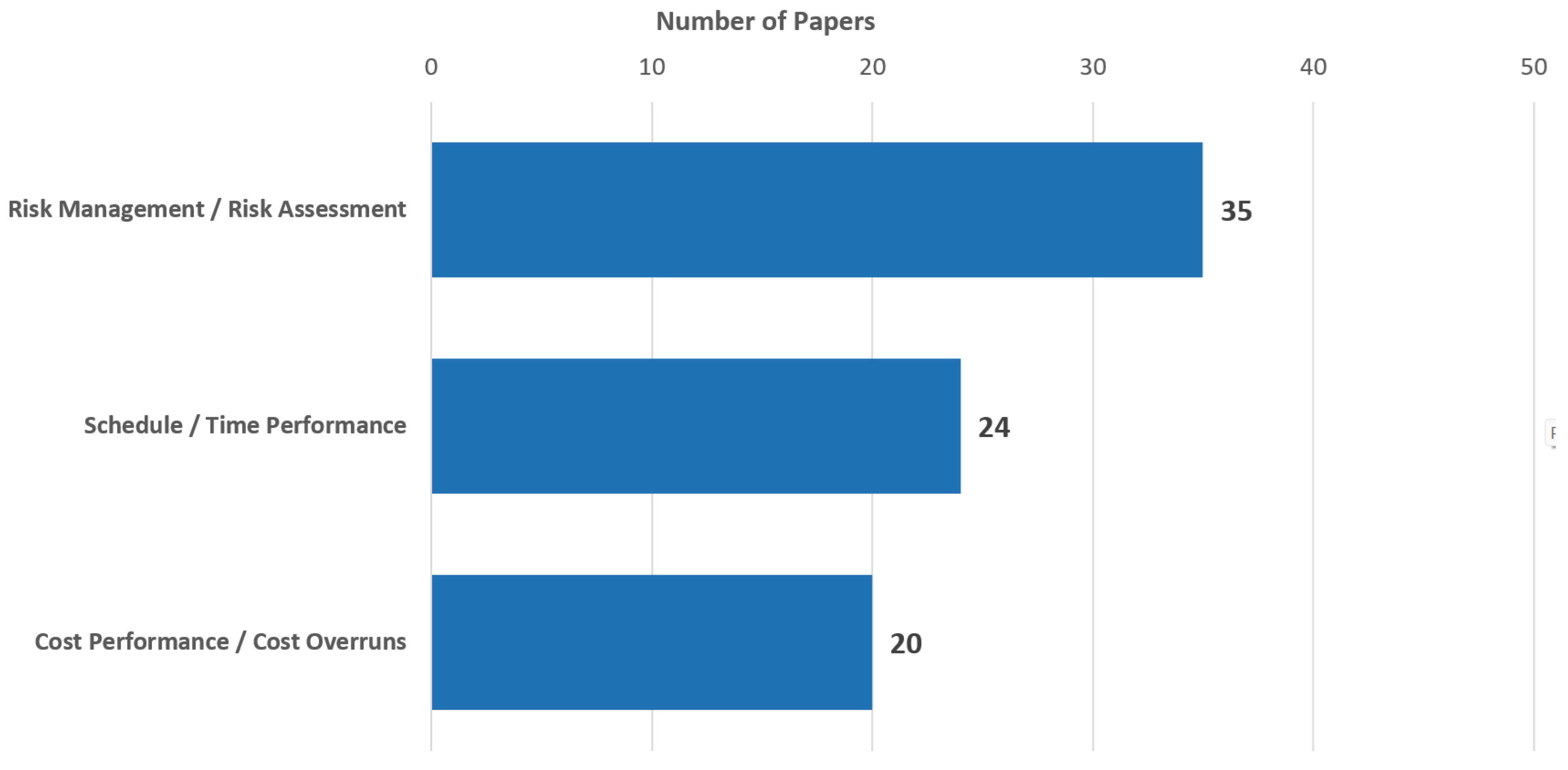
Figure 11.
Percentage of papers within each methodological family that address risk/safety, schedule/time, and cost/budget as primary performance outcomes. Cell values show the raw count and percentage of papers within each method family. Color intensity reflects coverage level, from pale (low) to dark green (high). .
Figure 11.
Percentage of papers within each methodological family that address risk/safety, schedule/time, and cost/budget as primary performance outcomes. Cell values show the raw count and percentage of papers within each method family. Color intensity reflects coverage level, from pale (low) to dark green (high). .
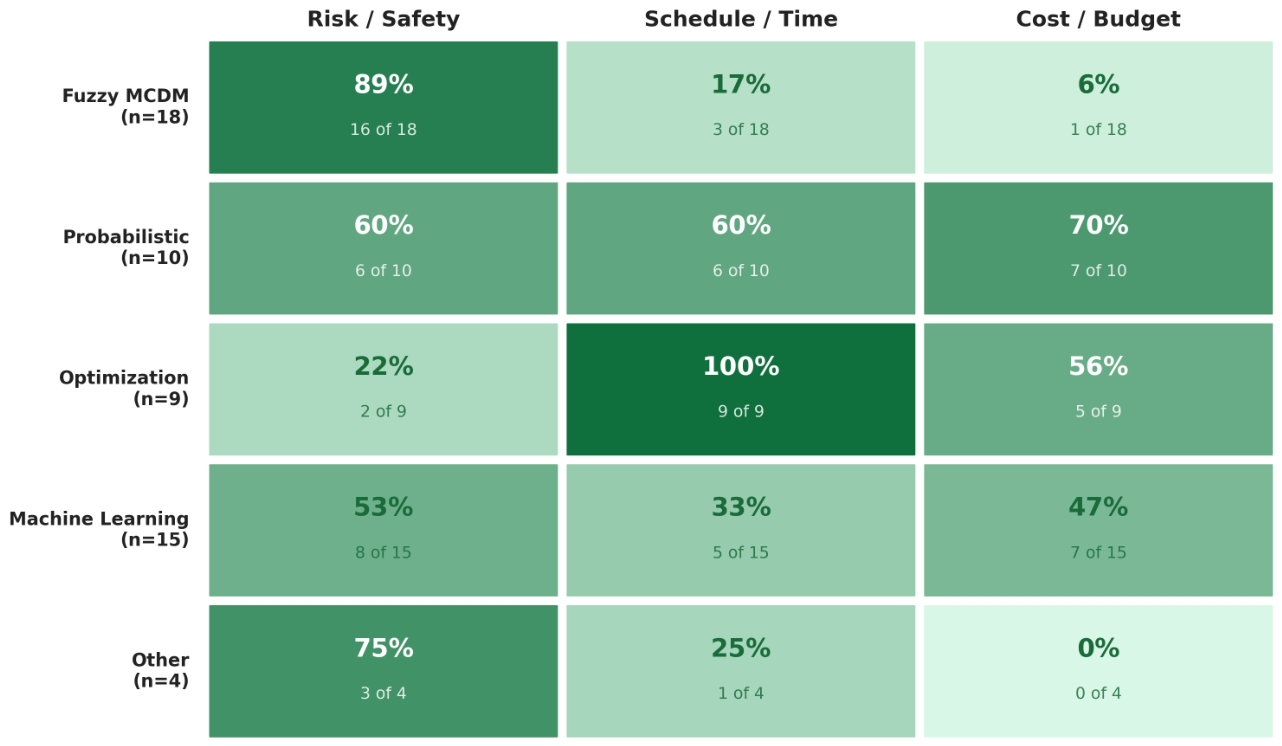
Figure 12.
Comparative evaluation of major methodological approaches based on Uncertainty Handling, Computational Efficiency, Data Requirements, Interpretability, Real-time Support, and Practical Adoption.
Figure 12.
Comparative evaluation of major methodological approaches based on Uncertainty Handling, Computational Efficiency, Data Requirements, Interpretability, Real-time Support, and Practical Adoption.
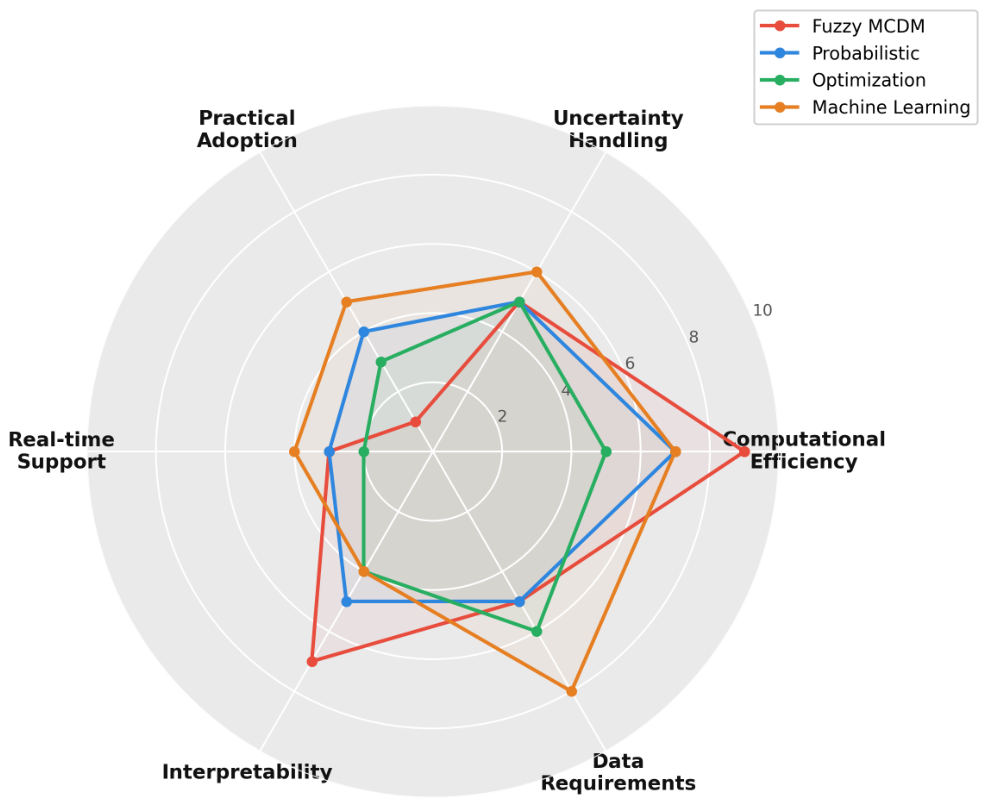
Figure 13.
Proposed integrated analytical framework derived from the unified analytical taxonomy. The feedback path denotes continuous re-estimation of remaining risk and of cost and schedule projections in response to observed deviations from plan.
Figure 13.
Proposed integrated analytical framework derived from the unified analytical taxonomy. The feedback path denotes continuous re-estimation of remaining risk and of cost and schedule projections in response to observed deviations from plan.
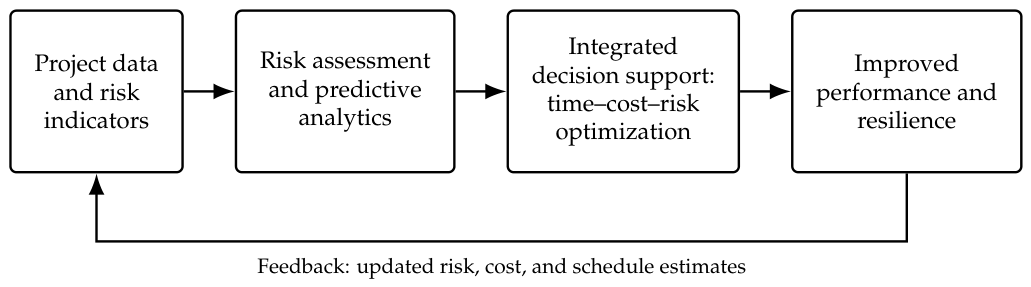

Table 1.
Quality assessment criteria used for study selection
| Criterion | Description |
|---|---|
| Relevance | Focus on industrial construction projects |
| Methodological clarity | Clear description of analytical or modeling approach |
| Performance linkage | Connection to cost, schedule, risk, or safety outcomes |
| Data adequacy | Sufficient detail for data extraction and analysis |
Table 2.
Summary of reviewed studies on risk and performance management in industrial construction projects
Table 2.
Summary of reviewed studies on risk and performance management in industrial construction projects
| No. | Author(s) | Industrial Asset | Methodological Approach | Performance Dimension |
| 1 | [24] | Pipeline construction projects | Probability–impact risk model with survey data | Cost impact, schedule, risk response |
| 2 | [3] | Oil and gas construction projects (USA) | Structural Equation Modeling and Fuzzy Set Theory | Risk significance and effect on project performance |
| 3 | [6] | General / Mixed Industrial | Statistical data analysis and regression | Causes of delays, schedule risk |
| 4 | [25] | Construction projects (including industrial) | Text mining combined with system dynamics | Financial risk impact on project cost |
| 5 | [26] | General / Mixed Industrial | Multi-Criteria Group Decision Making (intuitionistic fuzzy outranking method) | Contractor selection under uncertainty, cost and schedule risk |
| 6 | [27] | Nuclear power plant construction | Network analysis + multi-objective evolutionary optimization | Delay risk management, schedule and cost risk |
| 7 | [28] | Pipe jacking projects (water transmission pipeline) | Fuzzy FMEA-based risk assessment model | Risk evaluation and prioritization, project safety and schedule |
| 8 | [29] | Capital construction projects (including industrial) | Data mining-based decision support framework | Cost performance prediction, project performance |
| 9 | [30] | Nuclear power plant construction | Comparative schedule analysis of traditional vs. advanced work packaging | Schedule resilience, productivity |
| 10 | [31] | General / Mixed Industrial | Front-end planning tool development (PDRI-SIP) | Cost and schedule performance |
| 11 | [2] | Oil and gas construction projects | DEMATEL–ANP risk assessment | Risk prioritization and mitigation |
| 12 | [32] | General / Mixed Industrial | Supply chain visibility survey and analysis | Risk mitigation, productivity, coordination |
| 13 | [15] | Industrial construction projects | Deep learning, NLP, and Bow-Tie diagrams | Safety risk identification and visualization |
| 14 | [33] | Pipeline construction projects | Performance benchmarking of CMAR vs. DBB delivery | Cost and schedule performance |
| 15 | [34] | General / Mixed Industrial | Risk life cycle assessment; comparison of traditional vs. industrial modes | Risk occurrence timing, financial losses |
| 16 | [7] | Industrial construction projects | Quantitative risk assessment (GTOPSIS, JRAP, MCS) | Cost and schedule risks, risk prioritization |
| 17 | [20] | Industrial construction projects | Data mining for labor resource management | Schedule delays, budget overruns |
| 18 | [18] | Power plant construction projects | Risk management maturity and organizational learning | Cost, time, quality success factors |
| 19 | [35] | Mining infrastructure | Digital twin-based process planning and decision making | Process planning optimization, risk management |
| 20 | [36] | General / Mixed Industrial | ANP + DEMATEL for risk prioritization | Risk assessment, interdependencies, prioritization |
| 21 | [37] | General / Mixed Industrial | Statistical modeling (Poisson regression) of craft worker availability impact | Safety performance (TRIR) |
| 22 | [38] | General / Mixed Industrial | Integrated fuzzy system dynamics and agent-based modeling | Crew motivation, labor productivity |
| 23 | [22] | Nuclear power plant construction | Standardized risk management methodology; risk breakdown structure | Risk identification, performance improvement |
| 24 | [39] | Hydroelectric power plant/dam construction | Safety management approaches comparison | Safety performance outcomes |
| 25 | [5] | Offshore wind power plants | Socio-technical content analysis; reference class forecasting | Cost and schedule overruns, performance |
| 26 | [40] | Pipeline construction (natural gas compressor station) | Analytical Hierarchy Process (AHP) | Occupational health and safety risk prioritization |
| 27 | [41] | Pipeline construction (horizontal directional drilling) | Fuzzy fault tree analysis and risk response matrix | Comprehensive risk management |
| 28 | [11] | General / Mixed Industrial | Monte Carlo simulation-based quantitative risk assessment | Environmental safety risks |
| 29 | [42] | Industrial construction projects (scaffolding) | Earned Value Analysis (EVA) + linear regression productivity modeling | Cost and schedule performance |
| 30 | [43] | Pipeline construction (microtunneling) | Risk- and robustness-based machine selection under geological uncertainty | Cost and risk management |
| 31 | [44] | Tunnel construction across mined-out regions | Combined weight and two-dimensional cloud model | Safety risk assessment |
| 32 | [45] | Nuclear power plant construction | Historical analysis on governance and budget overruns | Cost escalations, schedule delays |
| 33 | [16] | General / Mixed Industrial | Machine learning and network cascading effect analysis | Safety risk assessment |
| 34 | [46] | Pipeline construction projects | ML-based prescriptive model for accident outcome prediction | Occupational health and safety risk |
| 35 | [8] | Pipeline construction (natural gas) | Pythagorean fuzzy VIKOR decision-support system | Occupational risk assessment |
| 36 | [47] | General / Mixed Industrial | Last Planner System (LPS) metrics analysis | Schedule and project performance |
| 37 | [48] | Road construction projects (including industrial) | Life Cycle Assessment (LCA) with cost overrun analysis | Environmental impacts, cost overruns |
| 38 | [9] | General / Mixed Industrial | Fuzzy granular computing for ML uncertainty quantification | Uncertainty and prediction reliability |
| 39 | [23] | Power plant construction projects | Risk assessment method for commissioning systems | Safety during commissioning |
| 40 | [12] | Open-pit mine construction projects | Extreme value theory + discrete event simulation | Cost and schedule impacts of earthquakes |
| 41 | [49] | Nuclear power plant construction | Risk register analysis and categorization | Risk trends, cost overruns |
| 42 | [4] | Coal mine construction projects | Text mining + DEMATEL–ISM integrated approach | Occupational health and safety risk factors |
| 43 | [50] | Renewable energy projects | Fuzzy case-based reasoning for risk identification | Risk factors classification |
| 44 | [51] | Nuclear power plant construction | Hybrid fuzzy mathematical modeling for OHSE risk | Occupational health, safety, and environment risk |
| 45 | [21] | Mega industrial construction projects | Organizational design and coordination analysis | Risk and performance under complexity |
| 46 | [52] | Fast-track industrial construction projects | Data-driven resource allocation and graph-based optimization | Schedule and resource efficiency under uncertainty |
| 47 | [53] | Nuclear power plant construction | Dynamic simulation of societal and policy impact | Schedule and cost overruns |
| 48 | [13] | Power plant construction projects | Multi-objective optimization with resiliency criteria | Schedule resilience under uncertainty |
| 49 | [10] | Pipeline construction (natural gas) | Extended cumulative prospect theory and cloud model | Occupational risk evaluation |
| 50 | [54] | Pipeline construction (natural gas) | Complex spherical fuzzy CRADIS + Fine-Kinney framework | Occupational risk evaluation |
| 51 | [17] | Mixed industrial/infrastructure construction | Text mining and ensemble classifiers | Construction cost overrun prediction |
| 52 | [1] | Nuclear power plant construction | Factor analysis for critical project management aspects | Cost and schedule overruns |
| 53 | [55] | Nuclear power plant construction | Bayesian network with cloud model and fuzzy sets | Risk quantification and uncertainty |
| 54 | [14] | Hydroelectric power/dam construction | Fuzzy adaptive hybrid genetic algorithm for time–cost–environment trade-off | Multi-objective optimization |
| 55 | [56] | Oil and gas construction projects (Egypt) | Mixed-methods with structural model of delay factors | Causes of schedule delays |
| 56 | [19] | General / Mixed Industrial | Resume data mining (Dynamic Topic Model) for competence trends | Project manager competences, management capability |
Note: Some studies classified as general construction or non-industrial projects are included due to their methodological relevance. These studies provide transferable analytical approaches applicable to industrial construction environments, particularly in risk assessment, optimization, and performance analysis.
Table 3.
Comparison of major methodological approaches used in industrial construction risk management research
Table 3.
Comparison of major methodological approaches used in industrial construction risk management research
| Methodological Approach | Typical Techniques | Strengths | Limitations | Typical Applications | Integration Capability |
|---|---|---|---|---|---|
| Multicriteria and Fuzzy Risk Assessment | AHP, Fuzzy AHP, DEMATEL, ANP, hybrid MCDM models | Handles subjective expert knowledge and incomplete information; useful in early project stages where expert judgment dominates decision-making | Often static; limited ability to represent dynamic interactions between project variables and evolving project conditions | Risk prioritization and early-stage decision support | Low |
| Probabilistic and Simulation-Based Modeling | Monte Carlo simulation, Bayesian networks, stochastic analysis | Provides probabilistic estimation of cost and schedule outcomes and supports uncertainty analysis in complex industrial construction projects | Requires reliable probability distributions and large datasets; computational requirements can be high | Cost and schedule risk analysis in large infrastructure projects | Moderate-High |
| Optimization-Based Planning and Resource Allocation Approaches | Genetic algorithms, multi-objective evolutionary methods, and simulation-optimization models | Supports trade-off analysis among project duration, cost, and resource allocation, and improves project planning efficiency | Often assumes deterministic relationships and may have limited adaptability during project execution | Project scheduling and resource planning | Moderate-High |
| Data-Driven and Artificial Intelligence Methods | Machine learning, deep learning, natural language processing, predictive analytics | Identifies hidden patterns in project data and improves prediction accuracy for cost overruns, safety incidents, and schedule delays | Limited interpretability (black-box models) and weak integration with traditional project management frameworks | Cost prediction, safety monitoring, and performance forecasting | Low–Moderate currently; high potential when integrated with optimization and uncertainty modeling |
Table 4.
Key research gaps and future directions in risk and performance management for industrial construction projects
Table 4.
Key research gaps and future directions in risk and performance management for industrial construction projects
| Research Gap | Current Limitations in Literature | Future Research Directions |
|---|---|---|
| Fragmented analysis of time–cost–risk relationships | Many studies analyze cost, schedule, or safety risks independently rather than modeling their interactions. | Develop integrated analytical frameworks that simultaneously evaluate trade-offs among time, cost, and risk within unified decision-support systems. |
| Static risk assessment models | Most frameworks support decision-making at discrete project phases and lack mechanisms for continuous adaptation. | Design adaptive and dynamic models capable of updating risk assessments and project plans as project conditions evolve. |
| Limited use of advanced optimization techniques | Robust optimization, stochastic programming, and multi-stage decision models remain underutilized in construction planning. | Apply advanced optimization methods to support resilient project scheduling and resource allocation under uncertainty. |
| Partial integration of artificial intelligence methods | Machine learning models are often used only for prediction tasks rather than embedded within decision-support frameworks. | Integrate artificial intelligence with optimization and simulation techniques to support intelligent decision-support systems. |
| Limited focus on industrial construction contexts | Many studies address general construction environments rather than industrial infrastructure projects. | Conduct empirical and methodological research specifically targeting industrial megaprojects such as energy facilities, pipelines, and mining infrastructure. |
| Insufficient integration of digital technologies | Digital twin, BIM, and project monitoring data appear only in isolated studies and are rarely embedded within integrated risk management frameworks. | Develop frameworks that combine digital construction technologies with predictive analytics and optimization for real-time decision support. |
Disclaimer/Publisher’s Note: The statements, opinions and data contained in all publications are solely those of the individual author(s) and contributor(s) and not of MDPI and/or the editor(s). MDPI and/or the editor(s) disclaim responsibility for any injury to people or property resulting from any ideas, methods, instructions or products referred to in the content. |
© 2026 by the authors. Licensee MDPI, Basel, Switzerland. This article is an open access article distributed under the terms and conditions of the Creative Commons Attribution (CC BY) license (http://creativecommons.org/licenses/by/4.0/).
Copyright: This open access article is published under a Creative Commons CC BY 4.0 license, which permit the free download, distribution, and reuse, provided that the author and preprint are cited in any reuse.