

Submitted:
20 July 2026
Posted:
03 August 2026
You are already at the latest version
Abstract
In 1974, Richard Alewyn argued that the pleasure of fear, as represented by the 'uncanny', was an aesthetic post-Enlightenment phenomenon. In order to evaluate this thesis, it is necessary to investigate artefacts from the pre-Enlightenment era. This article therefore focuses on 17th-century music theatre, searching for clues to the pleasure of fear and the uncanny in such works. After investigating examples from La Pellegrina (Intermedio), Cavalieri's Rappresentazione di Anima, et di Corpo, Monteverdi's Ballo delle Ingrate, Lully's Béllérophon and Alceste, Purcell's Dido and Aeneas, and Charpentier's Médée, as well as contemporaneous descriptions of these performances, the article concludes that pre-Enlightenment art did imply the pleasure of fear, and possibly the uncanny. However, three observations can be made in contrast to post-Enlightenment art: 1) The horrible agents in 17th-century music theatre do not usually occur of their own accord, but are intentionally evoked by human agents; 2) The horrible is not usually the subject itself, but comes into play as part of a love drama or similar; 3) 17th-century music theatre does not thematise the disturbance of a natural order; rather, the monsters simply belong to the fictional reality.
Keywords:
uncanny
; baroque period
; music theatre
; historical music psychology
; opera
In his essay ‘The Pleasure of Fear’, Richard Alewyn argues that during the Enlightenment, belief in supernatural threats posed by ghosts, demons and similar entities and phenomena was abandoned. However, he suggests that this very abandonment gave rise to an artistic and aesthetic pleasure in fear. He cites the actual or supposed fact that the fear of such threats had not yet died out, but was now experienced as a stimulus, as a psychological explanation for this 1. “It turned out, in fact, that the ideas of the Enlightenment succeeded more quickly in instructing reason than in instructing the instincts.” 2 The artistic-aesthetic sphere that was opened up was that of the uncanny.3
In his essay, Richard Alewyn sets out an argument that serves as a basic assumption guiding much subsequent research. This helps to explain why there are relevant studies on the supernatural, the fantastic and the uncanny in musical theatre from the 18th century onwards, 4 but not relating to the 17th century or earlier periods. From the outset, Albert Gier approaches Handel’s magical operas from a perspective that does not allow for the existence of the fantastic in the pre-Enlightenment era. 5 However, Axel Rüth has provided plausible arguments and examples to show that it cannot be that simple.6 [190]
Historical work is easily prone to the risk of ‘othering’. The correct assumption that historical, social and cultural contexts give rise to differences can lead to the overly generalized assumption of differences. Differences in presentation and terminology are often mistakenly interpreted as differences in substance, even though these differences sometimes only concern the surface. A deeper understanding of history can reveal commonalities. For example, Eberhard Kötter has demonstrated in two impressive studies that today’s listeners, even those with no musical training, largely understand the emotions (or ‘affects’, to use the terminology of the time) intended by ‘Baroque music’. 7
This essay will examine whether musical works from before 1700 reveal a ‘pleasure in fear’, as first identified by Alewyn in the period of the Enlightenment and exemplified in the Gothic novel. The period before 1700 was chosen in order to find examples that are not suspected of being from the Enlightenment era, and which are also sufficiently distant from the phenomena on which Alewyn focused, both culturally and chronologically. Of course, the choice of this specific year is arbitrary.
A search for artefacts that imply a delight in fear could be conducted in three ways: terminologically, psychologically or phenomenologically. A terminological search would begin with the concept of the uncanny. However, this concept did not become established until the 19th century. 8A terminological search would suggest that the concept of the uncanny only emerged after the Enlightenment. However, this conclusion is by no means inevitable. The relevant artefacts or the experiences they evoke may have existed before the term emerged or became widespread. Similarly, one cannot [191] conclude that the corresponding cultures were unfamiliar with the uncanny just because it is difficult to translate.
A psychological investigation would examine accounts of reception to determine whether encounters with artefacts prior to 1700 resulted in experiences, feelings, emotions or affects comparable to those later described as uncanny. However, this method is not feasible due to the scarcity of sufficiently explicit documents from before 1700, and the fact that they are not available in relevant databases. Nevertheless, individual sources of this kind will be consulted. The present study, however, focuses on a phenomenological approach. In this context, the term does not imply an orientation towards specific philosophical theories; rather, it means that the study seeks phenomena in music whose characteristics suggest they should evoke pleasure derived from fear. The study seeks artefacts whose horror and menace stem from their supernatural nature, transcending the categories of the experiential world. This transgression occurs in particular through the reversal (in the monstrous) or suspension (revenants, ghosts, etc.) of the assumed natural order. 9 This will be referred to below as the “horrible.”
This definition of relevant artefacts implies that the search can focus exclusively on vocal music, since the criteria cannot be applied to purely instrumental music. It is of little use to answer the central question of whether the ‘pleasure in fear’, as measured by the artefacts and their implications, truly exists with a simple ‘yes’ or ‘no’. Therefore, it should be broken down into two more specific questions: (1) how the Horrible is represented musically, and (2) how it is staged. Particular focus will be placed on the extent to which evidence of an intended terrifying effect can be found in these contexts. Preliminary work on this topic has been conducted by Reinhold Hammerstein, who examined the depiction of the numinous in opera from Monteverdi to Mozart. 10 Much of the following discussion overlaps with his observations and merely serves to highlight the question of the role of the pleasure of fear. This is achieved, on the one hand, by discussing contemporary documents on the effect of music and, on the other hand, by demonstrating [192] that theories from the mid-18th century onwards, which can be linked to an aesthetic of the horrific, are indeed capable of plausibly explaining 17th-century phenomena retrospectively.
Ⅰ. Music
Four aspects of music that were used to depict horror or evoke an aesthetic shudder will be discussed: (a) the symbolism of musical instruments; (b) deep voices; (c) the roar of thunder; and (d) monotonous singing.
a) The Symbolism of Musical Instruments
Robert L. Weaver demonstrated that, in the mid-16th century, trombones and low-pitched string instruments were favoured in scenes depicting hell. 11 This tradition is reflected in opera in some cases, although the regal or positive organ were also used in addition to the instruments mentioned. 12 This tradition began to fade at the same time in opera.13 It is difficult to say to what extent these instruments served a purely symbolic function, or whether they had an expressive effect on the audience. After all, Filippo Baldinucci (1681 ff.) describes the music of the second intermezzo from L’amico fido in Florence (1586) in a way that does not rule out the experience of such expressiveness:
Then one saw a wretched boat approaching across the filthy marsh. In it sat Flegias, accompanied only by the infernal sound of trumpets and double basses. He sang along with the eerie song of the underworld’s inhabitants. Whenever he stirred the muddy water with his fiery oar, smoke rose from it. 14
[193] However, it is unclear what basis there is for Baldinucci’s vivid description, since he was born in 1625 and could not have witnessed the 1586 performance. Nevertheless, his text is a valuable pre-1700 document offering insight into an idealised perception. It is unclear from the text, however, whether the instruments are described as ‘infernal’ because of their sound or their symbolic function. Unfortunately, the music has not survived.
b) Low Voices
In line with Hammerstein’s observation that low registers are often used to convey the numinous, 15 horrible figures tend to sing in the lowest register at a slow tempo. Notable examples include Charon and Pluto in Monteverdi’s L’Orfeo, and the same two figures in Cesti’s Pomo d’Oro. Other examples are the sorcerer Amisodar in Lully’s Bellérophon and the spirit of Samuel in Charpentier’s David et Jonathas.
In his Ballo delle Ingrate, Monteverdi emphasises the low register of Pluto’s voice very clearly. This is evident through his frequent use of the note E, phrases that remain entirely within the range of G and F, and Pluto’s repeated descent from the heights into the deepest abysses. 16 It is also potentially significant that the bass singing voice functions as the bass accompaniment for long periods, moving colla parte with the basso continuo rather than forming its own melodic line above it. While this was not unusual in the 17th century, it greatly enhances the sense of profundity (profundus).
A few conclusions can be drawn regarding the effect of deep voices based on a report about Monteverdi’s Ballo delle Ingrate. These are connected to the character of Pluto, who exudes dignity and intimidating power. His position as the god of the underworld is the main source of these qualities: he rules over the realm of the dead and can therefore command the dead, such as the ungrateful women, to dance. The decision of whether to grant Cupid’s request to summon dead souls as a warning lies with him. [194] As Pluto possesses princely power, he is characterised in the stage directions as a courtly prince. At the beginning of the dance, the following instructions appear: “The Ungrateful Ones begin to dance this entrance, two by two, with mournful gestures and heavy steps. Meanwhile, Pluto stands in the middle, walking with natural and heavy steps.” 17 Pluto forms the center, and even though the adjective “grave” is used equally for his steps and those of the Ingrates, in the first case—in the context of the dance and the sad gestures—it should be understood as “lethargic,” while in the second—that is, in the context of the ruler and in conjunction with the adjective “natural”—it should be understood as “solemn, stern, serious, weighty.” This interpretation is supported by the stage direction following the dance: “They dance to the center: Pluto turns toward the princess and the ladies with a noble bearing and says: Dal tenebroso orror del mio gran Regno […].”18
The “nobile postura” explicitly conveys the princely aura of the ruler of the underworld. The deep voice, moderate tempo, noble posture and weighty movements create a majestic appearance, perhaps intended to instil fear, but which, as it took place in a theatre, may instead have provided a thrill. In any case, contemporary observer Federico Follino (1608) described Pluto’s appearance in this scene as follows:
After dancing to the point where they filled the entire floor space in various intertwined formations, the Ungrateful Ones lined up in two rows of eight at a signal from Pluto, who was standing in front of the stage. As he moved through them with great dignity towards the princesses, who were standing in the background opposite the stage, he began to sing the following verses in a thoroughly courtly manner, accompanied by the instruments, full of terrible majesty as he approached them: Dal tenebroso orror del mio gran Regno […].19
[195] The key phrase here is “pieno d’orrida maestà.” Pluto’s horror originates from his majestic appearance. It is Pluto’s voice, in particular, that is explicitly described as horrifying. Regarding the conclusion of the song addressed to the princesses, it states:
As the words came to an end, the instruments started a new, even more melancholy tune. Those Ungrateful Ones began another dance, their movements filled with despair and sorrow. With a thousand intertwining steps and shifts in emotion, they approached the stage, gradually ascending it in the same order in which they had descended. Once they were all up there, Pluto sang in a voice filled with horror and dread: Tornate a’l negro chiostro […].20
This horrifying quality of the voice is likely due to its low pitch and slow tempo. However, it cannot be ruled out that a change in timbre also played a role. Regarding the earlier singing of the spirits of Hell, Follino had written:
When Pluto called out, many terrifying and monstrous shadows emerged from the cave. They spewed flames from all directions, striking fear and dread into the others. They addressed Pluto in a terrifying yet harmonious voice: Che vuoi? che imperi? 21
Apart from the dissonances (F–F-sharp), no harmonic or other irregularities can be detected here. Similarly, Pluto’s singing at the relevant passage shows no harmonic anomalies, 22 so manipulation of the voice cannot be ruled out. However, the only possibility is a vocal modification that does not undermine the solemn, majestic nature of the description. In this respect, the central element of terror seems to lie in this majesty. [196]
The horrifying effect of the majestic can be fully understood in the context of Edmund Burke’s 1757 theory of the sublime. According to Burke, the sublime arises from the terrible. “Whatever is fitted in any sort to excite the ideas of pain, and danger, that is to say, whatever is in any sort terrible, or is conversant about terrible objects, or operates in a manner analogous to terror, is a source of the sublime.” 23 For Burke, power is one of the key factors in experiencing the sublime:
Besides those things which directly suggest the idea of danger, and those which produce a similar effect from a mechanical cause, I know of nothing sublime, which is not some modification of power. And this branch rises[,] as naturally as the other two branches, from terror, the common stock of everything that is sublime. 24
Therefore, it is not surprising that princes are cited as examples of the sublime: “The power that arises from the institution of kings and commanders has the same connection with terror. Sovereigns are frequently addressed with [the] title of ‘dread majesty’”. 25 The highest, and therefore most awe-inspiring, majesty is, of course, divine. In the sociopolitical context of the time, the transition from secular to heavenly majesty was a natural one because the prince’s authority and power were unrestricted and derived from the divine right of kings. 26 Regarding the Bible, Burke observes: “In the scripture, wherever God is represented as appearing or speaking, every thing terrible in nature is called up to heighten the awe and solemnity of the divine presence.” 27 Burke finds the strongest words to describe the concept of the divine: [197]
But whilst we contemplate so vast an object, under the arm, as it were, of almighty power, and invested upon every side with omnipresence, we shrink into the minuteness of our own nature, and are, in a manner, annihilated before him.28
This description of divine power unmistakably foreshadows Rudolf Otto’s theory of the sacred, published in 1917. According to Otto, the experience of the sacred is, as is well known, accompanied by dread. He goes into even greater detail to analyse the distinctive nature of the saint as the “ultimate overpowering being” (schlechthin Übermächtige): as “unspeakable” (unsagbar); transcending rational thought; 29 a “thrilling mystery” (schauervolles Geheimnis); 30 the “utterly other” (das ganz Andere); “the strange and the alienating, falling entirely outside the realm of the familiar, the understood and the trusted, and therefore intimate’” (Fremde und Befremdende, das aus dem Bereiche des Gewohnten Verstandenen und Vertrauten und darum ›Heimlichen‹ überhaupt Herausfallende). 31 In our context, it is particularly noteworthy that Otto sees the origin of religious experiences of the sacred as being in the uncanny:
The precursor to “religious awe” is “demonic” awe (= panic-stricken terror) with its apocryphal offshoot, “ghostly awe.” And it finds its first stirrings in the feeling for the “uncanny.” All development in the history of religion has sprung from this “awe” and its “raw” form—from this feeling of the “uncanny” that broke through at some point in its earliest stirrings, emerging as something foreign and new in the minds of early humanity. With its breakthrough, a new epoch of humanity began. “Demons” such as “gods” and whatever else “mythological perception” or “imagination” produced as reifications of this feeling.32
Like Burke, Otto points to the presence of these feelings and phenomena in the Bible:
Compare Exodus 23:27, which states, “I will send the terror of God before you and throw into confusion all the nations among whom you come.” with Job 9:34 and 13:21. This is a terror filled with inner dread that no created [198] being — not even the most menacing and overpowering — can instill. There is something ‘ghostly’ about it.33
‘The Majestic’ is one of the terms Otto uses to describe the incomprehensible and terrifying sense of superiority:
What has been developed so far regarding the tremendum can be summarised in the ideogram ‘absolute unapproachability’. However, one immediately senses that another element must be added to fully capture it: the element of ‘power’, ‘force’, ‘overpowering force’ or ‘absolute overpowering force’. Let us choose ‘majestas’ as a symbolic name for this. This is all the more fitting because even in ‘majesty’, a faint trace of the numinous still lingers for our linguistic sensibility. The element of the tremendum can then be conveyed more fully as ‘tremenda majestas’.34
The “tremenda majestas” takes us back to both Burke’s “dread majesty” and Follino’s “orrida maestà” in the Ballo delle Ingrate. Despite the differences in theatrical concepts, musical conventions, cultural practices and social institutions, an experience emerges that may relate to an aspect of the human emotional landscape that transcends historical change.
c) Thunderous Roar
Mighty gods and demons often appear amid a thunderous roar. This is reflected in the libretti, not only in the stage directions, but also in the vocal texts at times. In Lully’s Bellérophon, Act III, Scene 5, the god Apollo is called upon to help in the battle against a monster. The Pythia appears amid lightning and thunder: “The altar that has appeared sinks into the ground, and the Pythia emerges from her cave with dishevelled hair. At the same time, there are loud claps of thunder. The temple trembles and there are flashes of lightning all around.”35 The Pythia comments on these events, commanding reverence: “Maintain absolute silence! Apollo will hear you and speak himself. His arrival has already caused the lightning to flash. Hear the wind rustling! Hear the roar of thunder! See how the temple and the earth tremble! He is coming; I can see him. [199] Tremble as I do when you see him!” 36 Thomas Corneille puts an exemplary description of the fear of God into the mouth of Pythia that corresponds exactly to Rudolf Otto’s concept of the ‘Tremendum’.
In Charpentier’s Médée, the thunder of the underworld represents the destructive power attained by the wronged wife through her magical abilities. However, divine forces are also at play here: In Act III, Scene 5, Hecate, the goddess of magic, grants Medea the favour of the god of the underworld for her magical endeavours. The subterranean rumbling and the trembling of the ground signify that Medea’s pleas have been answered: “God of the Underworld and the dark realms, King of pale shadows, support my sorcery. Let me know that Hecate is well disposed towards me, let Avernus tremble and shake everything with its roar.” 37 The libretto calls for an underground rumbling at this point (“On entend un bruit souterrain”).38
In Purcell’s Dido and Aeneas, the witches plot to destroy the romantic happiness of Dido and Aeneas. They retreat to their subterranean vault to prepare the spell, which is too terrible for the open sky. A dance of the Furies, the “Echo Dance,” seals their determination. At the end of the dance, the stage directions call for lightning, thunder and “horrid music”. Once again, a clamor accompanies the display of supernatural and superhuman power, spreading terror. Unfortunately, it is not known how the “horrid music” was to be performed. The source material for this opera is generally extremely problematic. 39 Regarding the passage in question here, Christopher Hogwood wrote on the occasion of his 1994 recording: “The (very garbled) text of the ›Echo Dance‹ is followed by ‘horried Musick’ according to the libretto, which is supplied here [in the recording] by a combination of orchestral cacophony and off-stage sound effects: the Tenbury MS adds ›Thunder & Light’ning … The Furies sink down in the Cave, the Rest fly up.’”40 [200]
In fact, Edmund Burke considered excessive volume, and thunderous roars in particular, to be the archetypal musical representation of sublime horror:
Excessive loudness alone is sufficient to overpower the soul, to suspend its action, and to fill it with terror. The noise of vast cataracts, raging storms, thunder, or artillery, awakes a great and aweful sensation in the mind, though we can observe no nicety or artifice in those sorts of music.41
Any further observations would be overly speculative, but Purcell’s musical portrayal of the witches, with their low register, evil laughter and sometimes bizarre melodic lines, as well as the impatient, urgent repetition of “tell us” four times, makes it highly likely that the intention here was to create a horrific scene, culminating in a thunderous roar, premised on a delight in fear.
d) Monotonous Singing
In the third act of Emilio de’ Cavalieri’s Rappresentatione di Anima, et di Corpo (1600), the damned souls lament their torments. At first, one sings alone: ‘The fire, the eternal fire; cruel sin, for which the Supreme Judge has condemned us.’ Like an echo from the depths of hell, a chorus of the damned repeats: ‘The fire, the eternal fire. The fire, the eternal fire.” 42 The chorus sings these words, each voice at a single pitch. The basso continuo also remains fixed on G major. The final chord on the last syllable is the only harmonic change, though the bass and upper voices of the chorus maintain their pitch of D (see Ex. 1).
This is a remarkable passage because it either draws on or, more accurately, anticipates a technique that did not become established until the course of the 18th century and remained a recurring motif in ghost songs throughout the 19th century as well. August Apel offered a plausible explanation for its effect in [201] 1800. 43
Ex. 1.
Emilio de’ Cavalieri, *Rappresentatione di Anima, et di Corpo* (Rome 1600), Act III, No. 66.
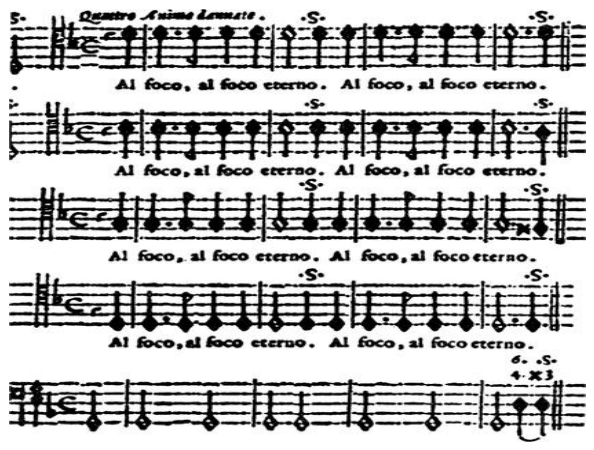
He argues that monotonous singing represents the ghosts’ existence in a state between life and death. He contends that the emotive musical expression of singing is specifically human because vitality goes hand in hand with emotionality. While ghosts appear and express themselves through singing in vocal music, according to Apel, they do so without feeling or expression. One might expect the dead souls in Cavalieri’s opera to utter sounds of pain due to the tormenting flames, but instead they express themselves in a rigid, monotonous and almost monosyllabic manner. They have become mere shadows of humanity.
This is uncanny. In any case, it corresponds exactly, both musically and conceptually, to Ernst Jentsch’s phenomenological description of the uncanny. 44 According to him (and personally, I still consider it the best phenomenological analysis of the uncanny), what strikes us as uncanny is that which eludes the fundamental experiential categories of reality, particularly those between life and death or between animacy and inanimate matter: the corpse [202] that seems to move the corners of its mouth, or the tree whose bark suddenly takes on facial features at twilight. It is remarkable how precisely Apel’s description of the spirit and its corresponding musical representation fits this description of the uncanny, including, indeed, the monotonous singing in Cavalieri.
More so than in the previous examples, one might ask here whether it is legitimate to apply theories from around 1800 or 1900 to music that is 200 or 300 years older. The hasty assumption of historical difference is as problematic as its denial (perhaps even more so, because in the current climate of historical emotion research, it is far more likely to be blindly accepted than the opposite assumption of continuity). The fact that the uncanny did not yet exist in the 17th century cannot therefore be an argument here; and the stylistic device employed by Cavalieri is so striking that an explanation is necessary in any case.
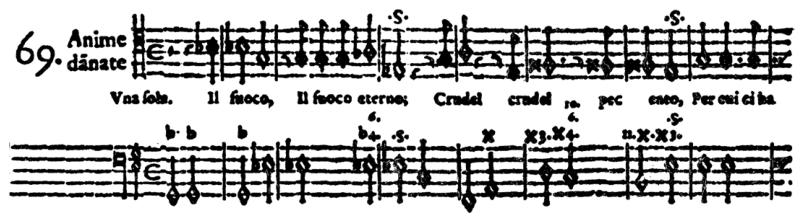
The Rappresentatione explicitly aimed to depict and evoke emotions. This is emphasised in the preface, verging on a manifesto: 45 Cavalieri is said to have renewed music in such a way that it “evokes various states of mind, such as piety, joy, weeping, laughter, etc.”46 At first, the damned soul sings alone, and its singing seems to vividly portray its torments, for the harmony is extremely restless, leaping over great distances within a narrow range. Starting on the G note with a minor third, it reaches the B note with a major third on the word “peccato,” after the tritone C–F♯ had already been introduced on the word “crudel.” The opening is particularly striking, with its numerous B-flat accidentals. G minor appears in contrast to the preceding major key, and then E-flat and A-flat are introduced immediately. The piece then gradually accumulates sharps up to the note D-sharp. Thus, 14 different notes appear in five measures: A-flat, E-flat, B flat, F, C, G, D, A, E, B, F-sharp, C-sharp, G-sharp and D-sharp. Here, the horror of sin and the cruelty of its punishment become audible and palpable (see Ex. 2).
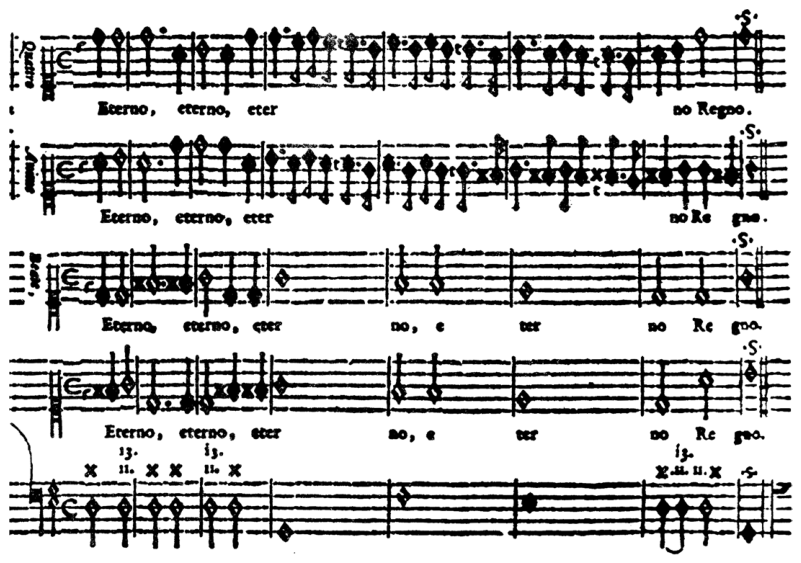
Once the damned souls have fallen silent, they are contrasted with the blessed souls in Heaven. In exact parallel to the song of the damned, we first hear one of the blessed singing. “Eternal, eternal kingdom, O kingdom, O eternal kingdom: O highest and heavenly good, which knows no end.” The choir responds: “Eternal, eternal, [203] eternal kingdom.”47
Ex. 2.
Emilio de’ Cavalieri, Rappresentatione di Anima, et di Corpo (Rome 1600), Act III, No. 69.
Semantically and expressively mirroring the chorus of damned souls, the blessed rejoice with an exuberant melisma on “Eterno” in a simple yet lively harmony. The joyful vitality of the blessed stands in direct contrast to the monotonous, emotionless, monosyllabic singing of the damned (Ex. 3). This dramaturgy supports the interpretation advocated here, drawing on the work of Apel and Jentsch.
Ex. 3.
Emilio de’ Cavalieri, *Rappresentatione di Anima, et di Corpo* (Rome 1600), Act III, No. 71.
[204]Against this backdrop, it can no longer be considered a coincidence that ghosts who sing monotonously also feature in Lully’s opera Alceste (1674). However, only a tendency can be observed here, rather than a consistent application of this stylistic device. Act IV opens on the banks of the River Acheron, where several ghosts beg Charon to ferry them across. Charon refuses to ferry a ghost who cannot pay, whereupon the ghost begins to argue. She raises her voice four times, remaining at a single pitch for the first two occasions. Interestingly, the ghost invokes his own shadowy nature: “Une Ombre tient si peu de place”—“a ghost takes up hardly any space.”48 However, the accompanying harmony does not remain static, but oscillates between the tonic (A) and its dominant (see Ex. 4). The ghost’s subsequent plea to be taken across is structured in a very similar way, except the harmony has now shifted to G major.49
Ex. 4.
Jean-Baptiste Lully, Alceste, Act IV, Scene 149.
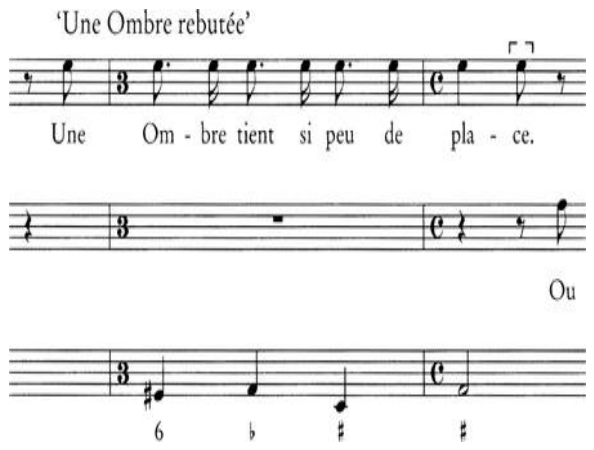
Two successive cries of ‘Ah!’ (‘Helas! Charon! Helas!’) from the rejected spirit use just two notes: E and F. These can certainly be understood as a sighing motif, contrasting with the shadowy singing of the preceding two verses. Previously, the chorus of spirits had asked Charon to ferry them across. The three-part chorus of high female voices also uses a very limited range of pitches: the upper voice moves between D and E, the middle voice between H and C, and the lower voice remains on G. There is no “sigh” effect here, though, because the melody of the upper voice takes [205] center stage. Notably, the ghostly voices contrast starkly with the lively and bustling Charon, who is very un-ghostly, and the instrumental accompaniment ceases. They sing a cappella. While there is no strict monotony, the sonic impression does bear some resemblance to it.
A comparison of Lully’s and Cavalieri’s compositions reveals that the same stylistic device can be nuanced in different ways. The deep male voices, with their consistent monotony and depiction of the gaping maw of hell, may have been perceived as far more terrifying than the ethereal female voices of Lully’s ghosts. However, both compositions share an eerie, shadowy quality.
Ⅱ. Staging
The music does not always capture the horror suggested by the plot or stage action. Often, it is the staging that takes on this role instead (though, of course, the two usually go hand in hand). A clear example of this can be found in the interludes from La Pellegrina (1589). The fourth interlude celebrates a Golden Age that will dawn with the Medici wedding, celebrated by the performance of La Pellegrina, in which there will be no more evil on earth and Hell will no longer gain new inhabitants. A chorus composed by Giovanni Bardi sings the verses: “Wretched inhabitant of the dark underworld! You will find nothing but envy and indignation in that realm of pain. Hell’s harsh prison will be your eternal torment. No more dead people will come to you; the gates of Tartarus will remain sealed forever […].”50
Despite the word “horror,” the text emphasizes compassion for the inhabitants of the underworld. Adopting the perspective of an observer, it highlights the eternal loneliness of the denizens of hell, who will never again receive new souls. The music shows no signs of fear or terror. The devils are portrayed as pitiful victims. Although [206] Reinhold Hammerstein highlights the low pitch of the chorus, which is supported by a low instrumental texture featuring four trombones, 51 this is probably intended to convey pain and suffering, as are the C–E–G♯ chord on “tormento” and the diminished fourth interval F♯–B on “dolente”. These are two striking expressive devices that Hammerstein also mentions. The music is indeed described as melancholic and lament-like by Bastiano de’ Rossi. 52
However, the staging seems to have served to heighten the experience of terror. De’ Rossi reports:
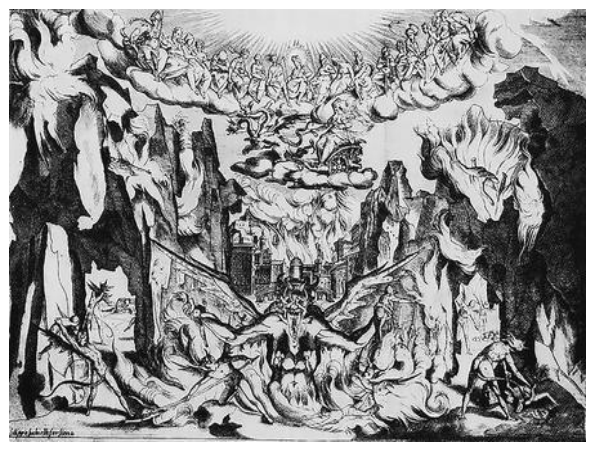
Just as the cloud closed and vanished, the scene was instantly filled with rocks, caves and caverns full of fire and flames. It seemed as though they were winding their way through the air, spewing smoke into the sky. As the scene filled with this horror, the stage opened to reveal an even greater horror: the mouth of Hell gaped wide and two hosts of Furies and dreadful devils poured out. Yet they appeared so sad and resigned here that it seemed as though they had abandoned their pride out of fear.53
The stage production also appears to be ambivalent: at first, the dual horror takes centre stage, but upon closer inspection, a melancholic element becomes apparent. Although the visual aspect is dominated by terror, the music uses intermedial techniques to convey the simultaneous presence of horror and melancholy. The sudden opening of the mouth of hell appears to be the central device used to evoke terror (see illustration).
Illustration.
La Pellegrina (Florence 1589), Intermedio IV 54.
In Lully’s Bellérophon, the fury of the summoned monster is made visible through an elaborate stage production: “Gradually, [207] the entire stage becomes visible, filled with fire and smoke to suggest the devastation the chimera is wreaking on the land.”55
One of the most striking descriptions of horror staging comes, once again, from Follino’s account of Monteverdi’s Ballo delle Ingrate. 56 Follino discusses the various aspects of the staging that appear to have been intended to evoke terror and horror. First, he briefly discusses the stage design: “The ‘horde of the damned’ emerged from the cave through a gap in the flames, gazing at the air and light with great sorrow and gestures of profound compassion.” 57 [208] He then goes on to describe in great detail the costumes, which are said to have had a very remarkable effect:
These condemned souls were dressed in extravagant, beautiful robes that reached the ground. They were made of rich fabric woven specifically for this purpose. The fabric was such an exquisite colour, interwoven with fine silver and gold threads, that it resembled ashes mixed with flaming sparks. The robes and cloaks, which hung bizarrely from their shoulders, were embroidered with thick flames of silk and gold arranged so skilfully that they appeared to be burning. Amid these flames, garnets, rubies and other precious stones were arranged beautifully, mingling like burning embers.58
Unfortunately, it is not stated whether these costumes were considered terrifying. However, the description of their gestures suggests as much. There is consistent mention here of the mixture of horror and pity evoked by the appearance of the damned souls, their dance and their facial expressions:
[…] their faces, bearing traces of past beauty, were so disfigured and pale that they evoked horror and pity. Yet they descended the stage in pairs with great sorrow, their gestures expressing their feelings, as they gracefully came down in pairs, their steps accompanied by the sound of numerous instruments playing a melancholic and subdued dance aria. When they reached the theatre floor, they performed a dance so beautiful and indescribable. Their steps, movements and actions were sometimes full of sorrow or despair, and at other times they displayed gestures of compassion or indignation. Sometimes they embraced one another as if tears of tenderness were in their eyes; at other times, they struck one another in rage and fury. From time to time, they could be seen turning their faces away and fleeing from one another with frightened expressions, then pursued one another with menacing looks, fought with one another, begged each other for forgiveness, and performed a thousand other gestures, all portrayed with such affection and naturalness that they so deeply moved the hearts of the audience that there was not a single person in that theater who did not feel his [209] heart stirred and agitated in a thousand ways by the shifting tides of their passions.59
It is noteworthy that the emotional impact of the dance on the audience is emphasised. The shift in emotions described refers to those mentioned in the text, such as sorrow, melancholy, compassion, indignation and anger, as well as terror and menace. The fact that such a powerful expressive effect is emphasised is significant, as it shows that the aim was not merely to admire the sophistication of the stage technology and design, as Albert Gier suggests with regard to Handel’s ghost and magic scenes, 60 but rather to convey emotions that, at their best, ‘stirred up’ the audience. Whether this reaction actually occurred in this way, or whether it has been exaggerated and idealised here, is of little consequence. The issue is not the success of the production, but rather the intention behind it — that is, its aesthetic objective.
At the risk of overinterpreting, I would like to conclude by referring to the character of the music and drawing a connection to monotony. While the music does not meet the above-explained criteria for monotony, the principle identified by Apel may nevertheless be applicable to dance. As with singing, dance can be seen as an expression of humanity and vitality. Yet here we have a dance that specifically lacks momentum, a typical element of dance. The music is described as melancholic and listless; the dance, as indefinite. 61 Especially when considered alongside the references to the lowered bodies and the numerous expressions relating to pain, we seem to be dealing with a dance that expresses the [210] absence of vital energy and, much like monotonous singing—fitting for dead souls—may be intended to convey the ghostly existence between life and death.
As I said, these are just hypotheses. However, they suggest that it might be worthwhile continuing the search for clues. The opening of Monteverdi’s scenic madrigal also lends weight to these speculations, as startling the audience was an integral part of the production:
Once everyone had comfortably taken their seats and a terrifying din produced beneath the stage by discordant drummers had signaled the start, the curtain rose at the same admirable speed as in the comedy. In the center of the stage, one could see the vast mouth of a wide, deep cave which seemed to extend beyond the limits of perspective. The cave was so vast that the human eye could not take it all in or discern its end.62
Ⅲ. The Pleasure of Fear?
So, was there a pleasure in fear in 17th-century musical theatre? The answer is clearly yes; horrific events were depicted, and experiencing terror or dread was an integral part of the theatrical experience. However, it is more difficult to answer the question of what kind of fear was the focus in each case. In some cases, it is difficult to justify the presence of the uncanny. For example, it is not obvious to claim this in the devastation wrought by the monster in Lully’s Bellérophon. Nevertheless, the widespread assumption that the uncanny did not exist before the Enlightenment should not lead to hasty conclusions. As already noted in the introduction, the near-total absence of the word itself cannot be used as an argument.
Indeed, the majestic quality of the deep voices and the rumbling thunder in the background, as well as the monotonous nature of the singing, suggested the relevance of the uncanny in 17th-century musical theatre. There may be many reasons why quantitatively [211] comparable phenomena are much less common in 17th-century musical theatre than in 19th-century theatre. Firstly, far fewer works have survived, or at least are widely circulated and accessible. Secondly, the popularity of certain aesthetic experiences must be distinguished from whether they were even known about or possible in the first place. Thirdly, there are genre-specific preferences. Therefore, more elements of the uncanny may be found in 19th-century musical theatre because a preference for them existed, but not in 17th-century theatre. In my view, the uncanny does not play a particularly significant role in contemporary pop music, yet the production of horror films with corresponding music is booming. Therefore, great caution is warranted when drawing conclusions about culture as a whole based on specific genres.
Similarly, it is important not to simply devalue the depiction of horror by pointing to its functionalisation. For example, it is true that Cavalieri’s Rappresentatione follows a moral-theological agenda. In this respect, the scenes of hell serve as a religiously (and thus also sociopolitically) motivated deterrent and educational tool. However, it would be a fallacy to conclude from this that no pleasure was derived from the fear it evokes. The film Stigmata (Rupert Wainwright, USA, 1999) aims to provide its audience with religious and moral education, yet it also satisfies the thrill of fear that underlies horror films. Stigmata may be exceptional in its overtness, but many horror films demonstrate that they possess motivations that extend beyond the mere pleasure of fear. 63 Therefore, the reference to such functions is interesting but has little bearing on the question of whether fear can be pleasurable.
However, examining the material in more detail may provide insight into specific aspects of the thrill of fear in the 17th century:
- During the Baroque period, horrific agents rarely intervene in plots of their own accord. In Orfeo, the protagonist seeks out the Underworld himself. In Ballo delle Ingrate, Venus must persuade Pluto at length to summon the damned souls. In Médée, the protagonist summons the demons herself; In Bellérophon, Stenobée seeks out the sorcerer Amisodar, [212] hoping that he will create a monster. It is the human — or, at most, demigod-like yet humanly acting — protagonists who intentionally conjure up evil. By contrast, in the Gothic novel, the horrible appears of its own accord. The only exception I am aware of from the 17th century so far is Purcell’s Dido and Aeneas. “Destruction’s our delight,” the witches sing, laughing at the calamity they cause. They act of their own accord.
- The theme is almost never horror for its own sake: almost all Baroque operas deal with love gone wrong. The horrific is conjured, summoned or displayed as a form of revenge or warning. Alternatively, a protagonist such as Orfeo may venture into the realm of the uncanny in order to win back their love. In either case, the trigger for the appearance of the horrific is a human protagonist or antagonist. This is true even of dedicated horror operas such as Lully’s Bellerophon and Charpentier’s Médée. This differs from the Gothic novel, where the horrific is the driving force of the plot. Once again, Purcell’s Dido and Aeneas must be cited as an exception.
- Disruption to the natural order was not a central theme of the Baroque period. Although the monsters depicted are generally borrowed from ancient mythology rather than the contemporary imagination, the disruption of the natural order does not become an explicit focus of the plot. In this respect, these works resemble the fantasy novel, in contrast to the Gothic novel or horror film, where the intrusion of the inexplicable and rupture in reality are central themes. The only exception is Charpentier’s Médée, which chronologically falls quite close to the beginning of the Enlightenment. In this work, Creon asks in bewilderment: “What miracle is it that, against my will, I am no longer angry when I see these things?”64
I am very grateful to Martin Küster for his critical reading and valuable commentaries.
References
- Richard Alewyn, “Die Lust an der Angst,” in: idem, Probleme und Gestalten. Essays, Frankfurt am Main 1974, pp. 307–330, here p. 315. Alewyn does not discuss the psychological plausibility of this thesis, which would also be worth examining; the present article is concerned solely with investigating the historical aspects of the thesis.
- Ibid., p. 317; cf. p. 328.
- Ibid., p. 320.
- David Joseph Buch, Magic Flutes and Enchanted Forests: The Supernatural in Eighteenth-entury Musical Theater, Chicago–London 2008; Clive McClelland, Ombra: Supernatural Music in the Eighteenth Century, Lanham 2012.
- Albert Gier, “Mögliche Welten. Freiräume des Wunderbaren im nichtaristotelischen Theater,” in: Beiträge zur Musik des Barock. Tanz – Oper – Oratorium. Bericht über die Symposien der Internationalen Händel-Akademie Karlsruhe 1994 bis 1997. Günter Könemann zum 65. Geburtstag, ed. by Hans Joachim Marx, Laaber 1998 (= Veröffentlichungen der Internationalen Händel-Akademie Karlsruhe 6), pp. 237–252.
- Axel Rüth, Imaginationen der Angst. Das christliche Wunderbare und das Phantastische, Berlin–Boston 2019.
- Eberhard Kötter, “Zu Bezügen zwischen den Benennungen von Affekten in der Barockmusik und Begriffen der heutigen Emotionspsychologie,” in: Musikpsychologie. Jahrbuch der Deutschen Gesellschaft für Musikpsychologie 12 (1995), pp. 75–88; idem, “Zum Einfluß der musikalischen Vorbildung auf die Beurteilung barocker Affekte in Opernarien Händels,” in: Musikpsychologie. Jahrbuch der Deutschen Gesellschaft für Musikpsychologie 13 (1998), pp. 55–68.
- The corresponding entries in the encyclopedias Ästhetische Grundbegriffe and Historisches Wörterbuch der Philosophie even regard the uncanny as a category specific to the 20th century; see Anneleen Masschelein, “Unheimlich / das Unheimliche,” in: Ästhetische Grundbegriffe. Historisches Wörterbuch in sieben Bänden, ed. by Karlheinz Barck et al., vol. 6, Stuttgart–Weimar 2005, pp. 241–260; Helmut Hühn, “Unheimliche, das,” in: Historisches Wörterbuch der Philosophie Online, ed. by Joachim Ritter et al., Basel 1971–2007, online 2017, DOI: 10.24894/HWPh.4435 (last accessed December 20, 2022).
- In what follows, it is assumed that, regardless of what people of that time believed, monsters and ghosts were just as little a part of everyday experience then as they are today.
- Reinhold Hammerstein, Die Stimme aus der anderen Welt. Über die Darstellung des Numinosen in der Oper von Monteverdi bis Mozart, Tutzing 1998.
- Robert L. Weaver, “Sixteenth-Century Instrumentation,” in The Musical Quarterly 47 (1961), no. 3,pp. 363–378, here pp. 370–372. On the trombone, see also Howard Mayer Brown, Sixteenth-Century Instrumentation. The Music for the Florentine Intermedii, [Dallas] 1973 (= Musicological Studies and Documents 30), p. 60; Hammerstein, Die Stimme aus der anderen Welt (note 10), pp. 21–22.
- Weaver, “Sixteenth-Century Instrumentation” (note 11), p. 372.
- Robert L. Weaver, “The Orchestra in Early Italian Opera,” in Journal of the American Musicological Society 17 (1964), no. 1, pp. 83–89.
- Filippo Baldinucci, Notizie dei professori del disegno da Cimabue […], vol. 2, Florence 1846, pp. 512–513: “Veddesi intanto solcare il sordido stagno una schifosa barca, in cui era Flegias, che a suono infernale di tromboni e contrabbassi, senz’ altro più, accompagnava lo spaventoso canto di quegli abitatori d’inferno, e nel battere ch’ e’ faceva sovente col remo tutto infuocato l’onda fangosa, quella vedeasi fumare.” (Unless otherwise noted, all translations from Italian and French into German are by Frank Hentschel). See August Wilhelm Ambros, Geschichte der Musik, 3rd revised ed., reviewed and expanded by Hugo Leichtentritt, vol. 4, Leipzig 1909, pp. 247–248; Weaver, “Sixteenth-Century Instrumentation” (note 11), p. 371; Nino Pirrotta and Elena Povoledo, Music and Theater from Poliziano to Monteverdi, trans. by Karen Eales, Cambridge, et al., 2008, p. 209.
- Hammerstein, Die Stimme aus der anderen Welt (note 10), p. 38.
- Claudio Monteverdi, Madrigali guerrieri, et amorosi, libro Ottavo, ed. by Anna Maria Vacchelli, Cremona 2004 (= Opera omnia 14, 2), for example, p. 584 (“del mio gran regno,” “per rapir non vegno”), p. 587 (“nel regno securo”), p. 341 (“antro è la giù”).
- Ibid., p. 575: “Qui con gesti lamentevoli, le Ingrate a dui a dui incominciano a passi gravi a danzare la presente entrata, stando Plutone nel mezzo, camminando a passi naturali e gravi.”.
- Ibid., p. 584: “Danzano il ballo sino a mezzo: Plutone si pone in nobil postura, rivolto verso la Principessa e Damme, cosi dice: Da ‘l tenebroso orror de ‘l mio gran regno […].”.
- “Poi ch’ebbero queste Ingrate danzato tanto che intrecciandosi in vari modi si trovarono occupar tutto lo spazio di quel piano, si posero ad un cenno di Plutone, ch’era fermo dinanzi al palco, in ischiera lungh’esso, otto per parte, et egli movendosi pel mezzo di loro con molta gravita verso le Principesse ch’erano in prospettiva dirimpetto il palco, poiche si fu lor fatto vicino, pieno d’orrida maesta, prese a cantare, accompagnato dal suono, con modo assai cortese i seguenti versi: Da’l tenebroso orror de’l mio gran regno […]” (quoted from the partial edition in: Angelo Solerti, Gli albori del melodramma, Vol. 2: I. Ottavio Rinuccini, Milan, et al., 1904, p. 256); see also, regarding this source, Tim Carter, “New Light on Monteverdi’s ‘Ballo delle Ingrate’ (Mantua, 1608),” in: Il Saggiatore musicale 6 (1999), no. 1/2, pp. 63–90; Virginia Christy Lamothe, “Fanning the Flames of Love: Hidden Performance Solutions for Monteverdi’s ‘Ballo delle Ingrate’ in Dance Practice,” in Performance Practice: Issues and Approaches, ed. Timothy D. Watkins, Ann Arbor 2009, pp. 97–108.
- Solerti, Gli albori, vol. 2 (note 19), pp. 257–258: “In su’l fine di queste parole ripigliando gli stormenti [recte stromenti?] una nuov’aria da ballo più flebile dell’altra, ricominciarono quelle Ingrate un altro balletto con atti pieni di maggior disperazione e di maggior cordoglio e con mille intrecciamenti e mille variazioni d’affetti si vennero avvicinando a poco a poco al palco e salendo sopra di esso con lo stess’ordine col quale n’erano discese, poichè furono tutte colà di sopra, Plutone con voce d’orrore e di spavento disse cantando: Tornate a’l negro chiostro […].”.
- Ibid., p. 254: “Al chiamar di Plutone uscirono di quella caverna molte Ombre orribili e mostruose, che versavano fiamme da varie parti con molto terrore altrui; e presentateglisi avanti con voce orrenda, ma pero armoniosa, dissero: Che vuoi? che imperi.”.
- In contrast, for example, to the abrupt clash of G and F-sharp between the instrumental bass and Pluto’s singing voice on “fere ministre” in the preceding invocation of the spirits of the underworld (Monteverdi, Madrigali [note 16], p. 568).
- Edmund Burke, A Philosophical Enquiry into the Origin of Our Ideas of the Sublime and Beautiful, London 1759, p. 58.
- Ibid., p. 110.
- Ibid., p. 116.
- Rainer A. Müller, Der Fürstenhof in der frühen Neuzeit, Munich 1995 (= Enzyklopädie deutscher Geschichte 33), p. 8.
- Burke, On the Sublime and the Beautiful (note 23), p. 105.
- Ibid., p. 104.
- Rudolf Otto, Das Heilige. Über das Irrationale in der Idee des Göttlichen und sein Verhältnis zum Rationalen, reprint of the unabridged special edition, Munich 1979, Munich 1991 (= Beck’sche Reihe 328), p. 10.
- Ibid., p. 13.
- Ibid., p. 31.
- Ibid., p. 16: “[…] die ‚dämonische’ Scheu (= panischer Schrecken) mit ihrem apokryfen Absenker, der ‚gespenstischen Scheu’. Und in dem Gefühle für das ‚Unheimliche’ (uncanny) hat sie ihre erste Regung. Von dieser ‚Scheu’ und ihrer ‚Roh’-form, von diesem irgend wann einmal in erster Regung durchgebrochenen Gefühle eines ‚Unheimlichen’, das fremd und neu in den Gemütern der Urmenschheit auftauchte, ist alle religionsgeschichtliche Entwicklung ausgegangen. Mit seinem Durchbruche begann eine neue Epoche des Menschentumes. In ihm wurzeln ‚Dämonen’ wie ‚Götter’ und was sonst die ‚mythologische Apperzeption’ oder die ‚Fantasie’ an Verdinglichungen dieses Gefühles hervorbrachte.”.
- Ibid., p. 15.
- Ibid., p. 22: “Man kann das bisher vom tremendum Entwickelte zusammenfassen in das Ideogramm ‚schlechthinnige Unnahbarkeit’. Man fühlt dann gleich daß noch ein Moment hinzukommen muß um es ganz zu erschöpfen: nämlich das Moment von ‚Macht’ ‚Gewalt’ ‚Übergewalt’, ‚schlechthinniger Übergewalt’. Wir wollen hierfür als Symbol-Namen ‚majestas’ wählen. Umso eher als selbst in ‚Majestät’ auch für unser Sprachgefühl noch eine leise letzte Spur des Numinosen nachzittert. Das Moment des tremendum ist uns dann voller wiedergebbar als ‚tremenda majestas’.”.
- “L’Autel qui a paru s’enfonce, & la Pythie sort de son antre les cheveux épars. En mesme temps on entend de grands éclats de Tonnerre. Le Temple tremble, & on le voit tout brillant d’éclairs” (Thomas Corneille and Jean-Baptiste Lully, Bellérophon, libretto, Paris 1679, p. 34).
- Ibid.: “Gardez tous un silence extreme, / Apollon vous entend & va parler luy-mesme. / Son approche désja fait briller les éclairs, / Entendez raisonner le sifflement des airs. / Escoutez le bruit du Tonnerre, / Voyez trembler & le Temple & la Terre, / Il va parroistre, je le voy; / A son aspect fremissez comme moy.”.
- “Dieu du Cocyte & des royaumes sombres, / Roy des pasles Ombres, / Sois attentif à mes enchantements. / Pour m’asseurer qu’Hecate m’est propice, / Que l’Averne fremisse, / Et faße tout trembler par ses mugissements” (Thomas Corneille and Marc-Antoine Charpentier, Médée. Tragédie en musique, libretto, Paris 1693, p. 52). Unfortunately, I did not have access to Edmond Lemaître’s 1998 edition.
- Ibid.
- See most recently Ellen T. Harris, Henry Purcell’s Dido and Aeneas, New York 2 2017, Chapter 3 (pp. 59–81).
- Christopher Hogwood, “A Note on Performance,” in: CD booklet for Henry Purcell. Dido & Aeneas, Decca 436 992-2, 1994, pp. 12–13, here p. 13.
- Burke, On the Sublime and the Beautiful (note 23), p. 121.
- “Il fuoco, Il fuoco eterno; Crudel crudel peccato, Per cui ci ha condannato Il Giudice superno” (Emilio de’ Cavalieri, Rappresentatione di Anima, et di Corpo, score, Rome 1600, reprinted Bologna 1967 [= Bibliotheca musica Bononiensis 4/1], pp. XXIX–XXX).
- August Apel, “Ueber musikalische Behandlung der Geister,” in: Allgemeine musikalische Zeitung 8 (1805/06), No. 8, cols. 119–127, No. 9, cols. 129–134; first published in: Der neue teutsche Merkur 3 (1800), No. 10, pp. 95–111; see also Frank Hentschel, “Musik und das Unheimliche im 19. Jahrhundert,” in: Archiv für Musikwissenschaft 73 (2016), no. 1, pp. 9–50, here pp. 45–46; English translation: https://doi.org/10.31219/osf.io/pjxre .
- Ernst Jentsch, “Zur Psychologie des Unheimlichen,” in: Psychiatrisch-neurologische Wochenschrift 8 (1906/07), No. 22, pp. 195–198, No. 23, pp. 203–205.
- Cavalieri, Rappresentatione (note 42), Preface, unpaginated.
- Ibid.: “Musica da lui rinouata commoua a diuersi affetti, come a pieta, & a giubilo; a pianto, & ariso, & ad altri simili […].”.
- Ibid., p. XXX: “Eterno, eterno Regno: O Regno, ò Regno eterno: O ben sommo, e superno, Che mai non giunge al segno: Eterno, eterno, eterno Regno.”.
- Jean-Baptiste Lully and Philippe Quinault, Alceste ou Le Triomphe d’Alcide. Tragédie, score, ed. by Herbert Schneider et al., Hildesheim et al. 2018 (= Lully, Œuvres complètes 3/3), p. 261.
- Ibid.
- “Miseri habitator del ciec’averno / Giu nel dolente regno / Null’altro scendera ch’invidia e sdegno Sara l’horror sara il tormento eterno / Duro carcer inferno / A te non piu verra la gente morta / Chiud’in eterno la tartarea porta […]” (Music for the interludes of “La Pellegrina,” full score, ed. by Daniel P. Walker, Paris 1963 [= Les fetes du mariage de Ferdinand de Médicis et de Christine de Lorraine. Florence 1589, vol. 1], pp. 85–87).
- Hammerstein, Die Stimme aus der anderen Welt (note 10), pp. 28–29.
- “Posersi pianamente, e dolenti in su quegli scogli a sedere, e con una musica malinconica, e lamenteuole (opera del nostro poeta) cominciarono, cantando, sopra arpi, uiole, e cetere, a lamentarsi con tai parole del bene, che n’aueuan pronosticato i démoni della Nugola” (Bastiano de’ Rossi, Description of the Set and the Interludes, Florence 1589, p. 52).
- “Richiusa, e sparita la Nugola, la scena in uno stante fu coperta tutta di scogli, d’antri, cauerne, piene di fuochi, e di fiamme ardenti, e pareua, che, serpeggiando per l’aria mandassero il fumo al Cielo. Coperta la scena di questo orrore, s’aperse il palco, e uno uia molto maggiore ne dimostro: perche, in aprirsi, aperse l’inferno, e uscinne due schiere di furie, e diauoli spauentosi: ma auuegnache fosser tali, per tutto cio comparuero quiui in uista si dolorosa, e dimessa, che pareua, che per paura auessero abbandonata la lor fierezza” (ibid., pp. 51–52; see also Pirrotta/Povoledo, Music and Theatre [note 14], p. 381; cf. also the description in Baldinucci, Professori del disegno, vol. 2 [note 14], pp. 519–520).
- Hellmuth Christian Wolff, Oper. Szene und Darstellung von 1600 bis 1900, Leipzig 1968 (= Musikgeschichte in Bildern 4/1), p. 25.
- “On commence a voir icy tout le Paisage de l’enfoncement du Theatre, remply de feu & de fumée, pour marquer le dégast que fait la Chimere dans le Pais” (Corneille/Lully, Bellerophon [note 35], p. 44).
- See also Carter, “New Light” (note 19) and Lamothe, “Fanning the Flames of Love” (note 19).
- Solerti, Gli albori, vol. 2 (note 19), p. 255: “[…] e la condennata schiera camminando per quella voragine tra le fiamme e ‘l fuoco usci dalla spelonca, rimirando con molto cordoglio, e con atti degni di gran compassione, l’aere e la luce.”.
- Ibid., pp. 255–256: “Erano quelle anime condannate vestite con abiti di foggia molto stravagante e bella che si stendevano infino a terra, composti di un ricco drappo che fu tessuto apposta per tale effetto. Egli era di color berettino misto di sottilissime fila d’argento e d’oro con tanto artifizio, che a riguardarlo pareva cenere mischiata con ardenti faville; e si vedevano cosi le vesti come i manti (che in maniera molto bizzarra pendevano loro dalle spalle) ricamati di spesse fiamme conteste diseta e d’oro, tanto ben disposte che ciascheduno stimava che ardessero; e tra dette fiamme si potevano veder con bellissimo ordine consparsi carbonchi, rubini et al.tre gemme che rassomigliavano l’accese brace.”.
- Ibid., p. 256: „[…] e le lor faccie, mostrando alcuni segni di gia passata bellezza, erano in guisa trasformate e pallide che apportavano terrore e compassione insieme a riguardarle. Calarono queste, ma pero con gran dolore significato per gesti, a due a due per una piacevole discesa dal palco, accompagnando i passi col suono di una gran quantita di stormenti [stromenti] che suonavano un’aria da ballo malinconiosa e flebile; e giunte in sul piano del teatro fecero un balletto cosi bello e cosi vago, con passi, con moti e con atti ora di dolore et ora di disperazione, e quando con gesti di misericordia e quando di sdegno, talor abbracciandosi come se avesser le lagrime per tenerezza su gli occhi, talor percuotendosi gonfie di rabbia e di furore. Vedevansi ad or ad ora abborrir i loro aspetti e fuggirsi l’una l’altra con timorose maniere, e seguitarsi da poi con minaccioso sembiante, azzuffarsi insieme, dimandarsi perdono e mille altri moti rappresentati con tale affetto e con tanta naturalezza che ne restarono in modo impressi i cuori de’ riguardanti, che non fu alcuno in quel teatro ch’alla mutazione delle passioni loro non sentisse muoversi e conturbarsi in mille guise il cuore”.
- Gier, “Mögliche Welten” (note 5), p. 243.
- “Vago” can mean “dark” or “vague,” but it can also mean “graceful”; however, based on the context, the former meaning seems more likely to me here.
- Solerti, Gli albori, vol. 2 (note 19), p. 249: “Or poiche furono cola dentro tutti agiatamente accomodati, dato il segno con uno strepito spaventoso sotto il palco di tamburri discordati, s’alzo la tela con quella velocita mirabile con cui alzossi nella Comedia, e nel mezzo del palco si vide una gran bocca di un’ampia e profondissima caverna, la quale, stendendosi oltre i confini della prospettiva, pareva che andasse tanto in la che non potesse giunger umana vista per iscoprirne il fine.”.
- Examples in: Frank Hentschel, Töne der Angst. Die Musik im Horrorfilm (Sounds of Fear: Music in Horror Films), Berlin 2011 (= Deep Focus 12).
- Marc-Antoine Charpentier, Médée. Tragédie mise en musique, Partitur, Paris 1694, S. 284: »Par quel prodige a moy-meme contraire / En voyant ces objets n’ay-je plus de colere.«.
Disclaimer/Publisher’s Note: The statements, opinions and data contained in all publications are solely those of the individual author(s) and contributor(s) and not of MDPI and/or the editor(s). MDPI and/or the editor(s) disclaim responsibility for any injury to people or property resulting from any ideas, methods, instructions or products referred to in the content. |
© 2026 by the author. Licensee MDPI, Basel, Switzerland. This article is an open access article distributed under the terms and conditions of the Creative Commons Attribution (CC BY) license.
Copyright: This open access article is published under a Creative Commons CC BY 4.0 license, which permit the free download, distribution, and reuse, provided that the author and preprint are cited in any reuse.


