
Submitted:
02 August 2026
Posted:
03 August 2026
You are already at the latest version
Abstract
Background. Aorto-iliac Trans-Atlantic Inter-Society Consensus II (TASC II) C and D lesions with involvement of the aortic bifurcation are complex and their endovascular treatment with kissing stenting can be technically demanding. The aim of this study is to analyze the outcomes, risk factors and follow-up of aorto-iliac revascularization through kissing stenting. Methods. A single center, retrospective, observational study was performed including patients treated with aorto-iliac kissing stenting from 2016 to 2025 for TASC II C and D lesions. Pre-/peri- and post-operative data were prospectively collected and retrospectively analyzed. Aorto-iliac calcification consisted of calcific lesions involving more than 70% of the aortic circumference. Technical and clinical success, primary patency and reintervention rate were analyzed. Results. Overall, 123 patients were included, 48 (39%) female; mean age was 68±7 years. Sixty-nine patients (56%) had critical limb-threatening Ischemia, 46 (37%) diabetes mellitus, 5 (4%) end-stage chronic kidney disease in hemodialysis and 70 (57%) aortic calcification. Femoral accesses were percutaneous in 19 (15%) and surgical in 104 (85%) cases; additional brachial access was used in 49 (40%) patients. Simultaneous femoral endarterectomy was performed in 48 (39%) cases. Stentgrafts and bare metal stents were used in 32 (26%) and 91 (74%) cases, respectively. Technical success was 100%. Primary patency at 1, 3 and 5 years was 100%, 98±3% and 94±5%, respectively. At a mean follow up of 39 months, 4 (3%) stents thrombosis occurred. Freedom from reintervention at 1, 3 and 5 years was 99%, 93% and 81%, respectively. Calcification was associated with a higher 3-year reintervention rate: 13% vs 0%, p=.037. Brachial access, additional femoral endarterectomy and use of covered stents didn’t affect the reintervention rate. Conclusions. Kissing stent is an effective and safe technique to provide revascularization in aorto-iliac TASC C-D lesions with involvement of the aortic bifurcation, with good outcomes in terms of technical, clinical success and primary patency. It often needs an upper limb access and/or adjunctive procedures such as femoral endarterectomy. Presence of severe calcification is associated to a higher reintervention rate.
Keywords:
aortoiliac occlusive disease
; hybrid revascularization
; kissing stent
; endovascular treatment
; femoral endarterectomy
; TASC II C/D lesions
; peripheral arterial disease
; aortic bifurcation
1. Introduction
Aorto-iliac occlusive disease (AIOD) is a progressive atherosclerotic condition commonly involving the iliac bifurcation affecting approximatively 3-10% of the general population. The prevalence is higher in young (<70 years old), smoking and dyslipidemic patients. [1]
In 2007 Norgen et al. developed a classification based on the anatomical features of the disease, called the Trans-Atlantic Inter-Society Consensus II (TASC II) [2]. Types C and D represent the most challenging scenarios, particularly patterns showing extensive stenosis or occlusion of both iliac axes, or an aorto-iliac barrage.
Historically, open surgery has been considered the gold standard treatment for TASC C/D lesions, with excellent early and mid-term results in terms of patency, yet yielding a considerable rate of perioperative major complications [1]. The advent and evolution of endovascular techniques have shifted the treatment paradigm toward less invasive approaches. [3]. Endovascular treatment can be performed with different procedures: CERAB (Covered Endovascular Reconstruction of the Aortic Bifurcation), barrel and kissing stenting, all of which are well-validated techniques.
Kissing stenting consists in the simultaneous bilateral deployment of stents at the aortic bifurcation for the treatment of lesions involving the aortic bifurcation and/or the common iliac arteries (Figure 1). In cases of challenging anatomy, an upper extremity access, to increase the pushability with an antegrade recanalization may be required. Nowadays kissing stenting has emerged as a widely adopted method, offering favorable technical success with reduced morbidity. On the other hand, supportive data concerning mid and long-term results in terms of primary patency and reintervention, especially in complex anatomies, and correlation to specific risk factors have not been fully described.
This study aims to evaluate the outcomes of kissing stenting for complex aorto-iliac TASC II C and D lesions and the impact of anatomical and technical factors on long-term outcomes.
2. Materials and Methods
Study Population
A single center, retrospective, observational study was conducted. Patients with TASC C/D lesions involving the aortic bifurcation treated with aorto-iliac kissing stenting for occlusive disease between January 2016 and October 2025 were included. The data were prospectively collected into a dedicated database and retrospectively analyzed.
Demographics, comorbidities and risk factors were evaluated as preoperative features. All patients underwent a preoperative Computed Tomography Angiography (CTA) scan and Doppler-ultrasound (DUS) examination to investigate the extension of the disease and the characteristics of the plaques. Aorto-iliac calcification was evaluated at axial and coronal projections of CTAs and assessed as presence of calcific lesions in more than 70% of the aortic wall, as previously reported. [4]
Procedural Details
Procedures were performed in a Philips hybrid operating room. Written consent from each patient was obtained before procedures. Percutaneous or cutdown accesses were based on the wall features of the common femoral arteries (calcification and/or presence of plaques). If a downward recanalization was necessary, because of challenging anatomy or technical failure from below, a left surgical brachial access was performed under general anesthesia. Lesions were crossed using standard guidewires and support catheters of appropriate size and length. Following lesion crossing, pre-dilatation was performed as needed, and two stents were deployed simultaneously in a kissing fashion, landing proximally in the distal aorta below the inferior mesenteric artery if possible, and distally in the common iliac arteries.
Stent choice (bare-metal or covered) was based on lesion morphology. Covered stents (CS) were used in case of thrombotic lesions; in all other cases, bare-metal stents (BMS) were preferred in order to preserve collateral pathways of lumbar arteries and inferior mesenteric artery, if the landing zone extends above it.
Balloon-expandable stents were used in the aorto-common iliac segment, whereas self-expandable stents were deployed across the common and external iliac artery to exploit their adaptability, in patients with more extensive disease.
Hemostasis was achieved with interrupted suture in surgically isolated femoral arteries, while percutaneous accesses were approached using the Perclose Prostyle suture-mediated closure system.
Postoperative Management
Postoperative medical therapy was prescribed according to the anamnestic factors and the procedural details. Dual antiplatelet therapy (DAPT) was adopted as the standard postoperative regimen whenever clinically feasible for 1 to 6 months.
Postoperative surveillance included clinical examination, DUS at 6 months, CTA at 12 months and yearly DUS thereafter.
Endpoints
Endpoints of the study were technical success (TS), clinical success (CS), primary patency (PP) and freedom from reintervention. TS was defined as patency with <30% residual stenosis and no other major complication, such as artery dissection or rupture, distal embolization. CS was defined by the improving of at least one Rutherford’s category between preoperative and post-procedural clinical presentation. PP was defined as absence of >50% restenosis on imaging. Based on the results, risk factors for loss of patency and reintervention were searched among anatomic characteristics evaluated at the CTA and adjunctive procedures as the use of brachial access or femoral endarterectomy.
Statistical Analysis
Continuous variables were described with median and interquartile range (IQR) and were compared by Mann-Whitney’s test. Categorical variables were reported as percentage and were compared using Fisher’s test. A value of P 0.05 (two-tailed) was considered to be significant. Statistics were performed with an SPSS 23.0 software (SPSS Inc, Chicago, IL, USA).
3. Results
Study Population
Between January 2016 and October 2025, 192 patients were treated in our center for both surgical and endovascular aorto-iliac revascularization procedures; among these, 123 patients underwent endovascular reconstruction of the aorto-iliac segment with the kissing stent technique for lesions TASC II C and D involving the aortic bifurcation. The mean age was 68±7 years and 61% of them were male. The choice of a surgical revascularization was reserved to cases of aorto-iliac occlusion extending in the proximity of the renal arteries.
Demographics, preoperative cardiovascular risk factors and comorbidities were summarized in Table 1. Sixty-nine patients (56%) presented with critical limb-threatening ischemia, 46 (37%) diabetes mellitus, 5 (4%) end-stage chronic kidney disease in hemodialysis and 70 (57%) aortic calcification.
Procedural Details
Cut-down femoral accesses were performed in the majority of cases (85%) and in 49 cases (40%) an additional surgical exposure of the proximal third of the arm was required. Accesses to brachial arteries were always surgical. Endarterectomy of the femoral bifurcation with patch angioplasty was performed in 39% of cases. Table 2 summarizes procedural details.
Endpoints and Statistical Analysis
Technical success was 100%. No perioperative major adverse events (acute myocardial infarction, acute respiratory failure, stroke) were observed. All patients (100%) presented improvement of the clinical presentation. Perioperative outcomes are reported in Table 3. Four patients (3%) developed stent thrombosis within 30 days from the procedure, and they were treated in urgent setting with iliac recanalization and relining. Two patients (2%) returned to the operating Room for hematomas and one (0.8%) for patch infection.
The mean follow up was 39 months. Primary patency at 1, 3 and 5 years was 100%, 98±3%and 94±5%, respectively. During the follow-up, 2 (2%) stent thromboses occurred. Freedom from reintervention at 1, 3 and 5 years was 99%, 93% and 81%, respectively (Figure 2).
Of the two patients with stent thrombosis, one underwent relining with CS of the right iliac axis one year after the main procedure; the other needed recanalization of both common iliac arteries and bilateral relining with two CS. During the later follow up they both remained free from restenosis or re-occlusion.
There was a case of femoral patch infection occurring eight months after the main procedure, that was treated with explant and ligation of the external iliac artery and, at a later stage, an axillo-femoral bypass. Two patients (2%) who developed dehiscence of the groin wound underwent surgical revision.
Aortic calcification was associated with a higher 3-year reintervention rate (13% vs 0%, p=.037). Brachial access, additional femoral endarterectomy and use of CS didn’t affect the reintervention rate (Figure 3).
4. Discussion
Our experience with the kissing stent technique showed excellent technical success and durable patency outcomes, consistent with the recent literature findings. Technical success was as high as 100%, a result that aligns with or exceeds pooled data from major meta-analyses [5,6], where success rates for TASC C/D lesions consistently range between 95% and 98.5%. Comprehensive reviews of the endovascular-first approach for complex aorto-iliac disease, including the work by Jebbink et al. [7] in their systematic review, highlight its increasing safety and efficacy as a first-line treatment. Recent evidence from Piffaretti et al. (2021) [8] confirms that the progress of materials now allows the successful recanalization even of extensive aorto-iliac occlusions, significantly reducing the necessity of open surgical conversion.
The primary patency rates observed in our study—98% at 3 years and 94% at 5 years—ranks among the highest reported in the current literature. While systematic reviews report 2-to-3-year primary patency rates between 80% and 87% for complex lesions [9], our results reflect a high-performance cohort. Historical data and older series, such as those discussed by Shen et al. and Pulli (2015) [10,11], often questioned the long-term durability of endovascular techniques compared to open surgery. However, contemporary series show that while aorto-bifemoral bypass remains a benchmark for 10-year durability, the modern endovascular-first approach offers comparable mid-term outcomes with significantly lower perioperative morbidity. [12]
The choice between CS and BMS remains a cornerstone of the clinical debate. Although our study did not find a statistically significant difference in reintervention rates between the two groups, broader literature increasingly favors CS for complex disease. The COBEST trial demonstrated that CS provide superior primary patency and a significantly lower rate of reintervention compared to BMS, especially in TASC C and D lesions. [13]
Clinical summaries, such as the iVS-2022 summary, and studies by Bontinis et al. highly recommend the use of CS to mitigate the risk of arterial rupture during the aggressive dilation required for calcified vessels. [14] Some authors [15,16] describe advanced anatomical reconstruction techniques, such as CERAB, stating they may offer superior flow dynamics compared to traditional KS, potentially reducing the risk of future restenosis. In our experience, the use of BMS proved functional and non-inferior to CS in terms of patency and freedom from reintervention. Our approach to this pathology is based on the fact that the type of stent is chosen according to the plaque’s characteristics: in presence of thrombotic aspects, CS are normally preferred. In all other cases, our aim is always to preserve lumbar, sacral and hypogastric arteries, so BMS are preferred whenever possible to avoid jeopardizing their patency.
A critical finding in our analysis was that severe aortic calcification (involving >70% of the wall) is an independent predictor of reintervention, with a 3-year rate of 13% vs 0%. This is strongly supported in our previous work [4] and research into CT calcification patterns, which identify high calcific burden as a primary driver of incomplete stent expansion and subsequent flow disturbances. To address these anatomical challenges, Fazzini et al. (2024) [17] proposed the integration of adjunctive technologies like Intravascular Lithotripsy (IVL) to “prepare” the vessel wall. Preparing calcified segments with IVL may facilitate better stent apposition and reduce the risk of elastic recoil or thrombotic complications.
The high incidence of brachial access (40%) and femoral endarterectomy (40%) in our cohort underscores the complexity of TASC C/D lesions. Current literature reinforces the value of a “hybrid” strategy where surgical common femoral artery reconstruction secures the outflow while proximal endovascular stenting treats the inflow. [11,18] As evidenced by our data, these adjunctive procedures do not negatively impact long-term outcomes but are essential tools for achieving technical success in hostile anatomies.
Despite the limitations of its retrospective design and the limited number of patients reaching a long-term follow-up, our findings support the endovascular-first strategy for TASC C and D lesions. Patient selection and precise preoperative planning remain the cornerstones for satisfactory outcomes. Continued research is essential to further define the optimal stent selection and post-procedural protocols, as suggested by recent meta-analytical data.
5. Conclusions
Our study confirms that the kissing stent technique for TASC C and D lesions is technically feasible, safe, and offers good mid-term durability. Technical success and primary patency are high, with low perioperative morbidity. Adjunctive procedures do not negatively impact outcomes, while severe calcification is an independent predictor of reintervention. Our findings reinforce the endovascular-first strategy for TASC C and D lesions, provided that proper planning and adjuncts (e.g., brachial access, hybrid approach) are used. Open surgery should be reserved for highly calcified, coral reef-type lesions or after endovascular failure. Thus, patient selection and accurate preoperative planning remain cornerstones for satisfactory outcomes.
Further prospective, multicenter studies are warranted to define optimal stent choice, antiplatelet strategy, and treatment algorithm for different anatomical subgroups.
Author Contributions
RP, EA and MM have given substantial contributions to the conception of the manuscript, acquisition, analysis and interpretation of the data. All authors have participated to drafting the manuscript, MG and GF revised it critically. All authors read and approved the final version of the manuscript. All authors contributed equally to the manuscript and read and approved the final version of the manuscript. The data associated with the paper are available from the corresponding author upon reasonable request.
Funding
This research received no external funding.
Institutional Review Board Statement
The study was conducted in accordance with the Declaration of Helsinki, and approved by the local ethics committee (Ethical Committee protocol code 153/2015/U/OSS/AOUBo.
Informed Consent Statement
Informed consent was obtained from all participants prior to their inclusion in the study.
Conflicts of Interest
The authors have no competing interests.
Abbreviations
The following abbreviations are used in this manuscript:
| TASC II | Trans-Atlantic Inter-Society Consensus II |
| CERAB | Covered Endovascular Reconstruction of the Aortic Bifurcation |
| CTA | Computed Tomography Angiography |
| DUS CS BMS DAPT TS PP IQR IVL |
Doppler-ultrasound Covered stent Bare-metal stent Dual antiplatelet therapy Technical success Primary patency Interquartile range Intravascular lithotripsy |
References
- Wang, K.; Cui, Y.; Zhang, W.; Jiang, P.; He, J.; Mei, F. Treatment Options for TASC II C and D Aorto-iliac Occlusive Disease: A Systematic Review and Network Meta-analysis. J. Endovasc. Ther. Published online. 2025. [Google Scholar] [CrossRef] [PubMed]
- Norgren, L.; Hiatt, W.R.; Dormandy, J.A.; et al. Inter-Society Consensus for the Management of Peripheral Arterial Disease (TASC II). J. Vasc. Surg. 2007, 45 Suppl S, S5–S67. [Google Scholar] [CrossRef] [PubMed]
- Dong, X.; Peng, Z.; Ren, Y.; et al. Endovascular treatment of aorto-iliac occlusive disease with TASC II C and D lesions: 10 year’s experience of clinical technique. BMC Cardiovasc Disord. 2023, 23(1), 71. [Google Scholar] [CrossRef] [PubMed]
- Sonetto, A.; Faggioli, G.; Pini, R.; et al. Kissing Stent Technique for TASC C-D Lesions of Common Iliac Arteries: Clinical and Anatomical Predictors of Outcome. Ann. Vasc. Surg. 2021, 71, 288–297. [Google Scholar] [CrossRef] [PubMed]
- Salem, M.; Hosny, M.S.; Francia, F.; et al. Management of Extensive Aorto-Iliac Disease: A Systematic Review and Meta-Analysis of 9319 Patients. Cardiovasc Interv. Radiol. 2021, 44(10), 1518–1535. [Google Scholar] [CrossRef] [PubMed]
- Groot Jebbink, E.; Holewijn, S.; Versluis, M.; et al. Meta-analysis of Individual Patient Data After Kissing Stent Treatment for Aortoiliac Occlusive Disease. J. Endovasc. Ther. 2019, 26(1), 31–40. [Google Scholar] [CrossRef] [PubMed]
- Groot Jebbink, E.; Holewijn, S.; Slump, C.H.; Lardenoije, J.W.; Reijnen, M.M.P.J. Systematic Review of Results of Kissing Stents in the Treatment of Aortoiliac Occlusive Disease. Ann. Vasc. Surg. 2017, 42, 328–336. [Google Scholar] [CrossRef] [PubMed]
- Piffaretti, G.; Fargion, A.T.; Dorigo, W.; et al. Endovascular Reconstruction for Total Aorto-Iliac Occlusion. J. Endovasc. Ther. 2022, 29(4), 565–575. [Google Scholar] [PubMed]
- Amanvermez Senarslan, D.; Yildırım, F.; Bayram, B.; Kurdal, A.T.; Tetik, O. Results of endovascular treatments of Trans-Atlantic Inter-Society Consensus C or D aortoiliac occlusive disease involving the aortic bifurcation. SAGE Open Med. 2023, 11, 20503121231179836. [Google Scholar] [CrossRef] [PubMed]
- Shen, C.; Zhang, Y.; Qu, C.; Fang, J.; Liu, X.; Teng, L. Outcomes of Total Aortoiliac Revascularization for TASC-II C&D Lesion with Kissing Self-Expanding Covered Stents. Ann. Vasc. Surg. 2020, 68, 434–441. [Google Scholar] [CrossRef] [PubMed]
- Pulli, R.; Dorigo, W.; Fargion, A.; et al. Early and midterm results of kissing stent technique in the management of aortoiliac obstructive disease. Ann. Vasc. Surg. 2015, 29(3), 543–550. [Google Scholar] [CrossRef] [PubMed]
- Pascarella, L.; Aboul Hosn, M. Minimally Invasive Management of Severe Aortoiliac Occlusive Disease. J. Laparoendosc. Adv. Surg. Tech A 2018, 28(5), 562–568. [Google Scholar] [CrossRef] [PubMed]
- Mwipatayi, B.P.; Thomas, S.; Wong, J.; et al. A comparison of covered vs bare expandable stents for the treatment of aortoiliac occlusive disease. J. Vasc. Surg. 2011, 54(6), 1561–1570. [Google Scholar] [CrossRef] [PubMed]
- Bontinis, V.; Bontinis, A.; Giannopoulos, A.; et al. Editor’s Choice - Covered Stents Versus Bare Metal Stents in the Treatment of Aorto-iliac Disease: A Systematic Review and Individual Participant Data Meta-analysis. Eur. J. Vasc. Endovasc. Surg. 2024, 68(3), 348–358. [Google Scholar] [CrossRef] [PubMed]
- Reijnen, M.M. Update on covered endovascular reconstruction of the aortic bifurcation. Vascular 2020, 28(3), 225–232. [Google Scholar] [CrossRef] [PubMed]
- Squizzato, F.; D’Oria, M.; Bozza, R.; Porcellato, L.; Grego, F.; Lepidi, S. Propensity-Matched Comparison of Endovascular versus Open Reconstruction for TASC-II C/D AortoIliac Occlusive Disease. A Ten-Year Single-Center Experience with Self-Expanding Covered Stents. Ann. Vasc. Surg. 2021, 71, 84–95. [Google Scholar] [CrossRef] [PubMed]
- Fazzini, S.; Pennetta, F.F.; Torsello, G.; et al. Intravascular Iliac Artery Lithotripsy to Facilitate Aortic Endograft Delivery: Midterm Results of a Dual-Center Experience. J. Endovasc. Ther. 2025, 32(6), 2183–2195. [Google Scholar] [CrossRef] [PubMed]
- Zacà, S.; Desantis, C.; Di Stefano, L.; Pulli, R.; Angiletta, D. Outcomes of Endovascular Reconstructive Techniques in Trans-Atlantic Inter-Society Consensus II C-D Aortoiliac Lesions. Ann. Vasc. Surg. 2023, 90, 172–180. [Google Scholar] [CrossRef] [PubMed]
Figure 1.
The kissing stent technique consists in deploying wo stents simultaneously in a kissing fashion, landing proximally in the distal aorta and distally in the common iliac arteries.
Figure 1.
The kissing stent technique consists in deploying wo stents simultaneously in a kissing fashion, landing proximally in the distal aorta and distally in the common iliac arteries.
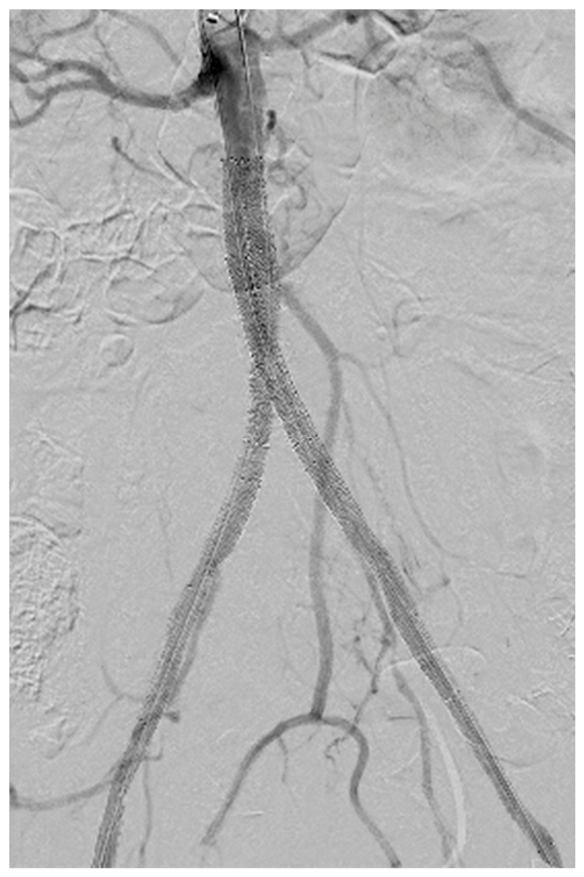
Figure 2.
Overall five-year survival (A) and freedom from reintervention (B).
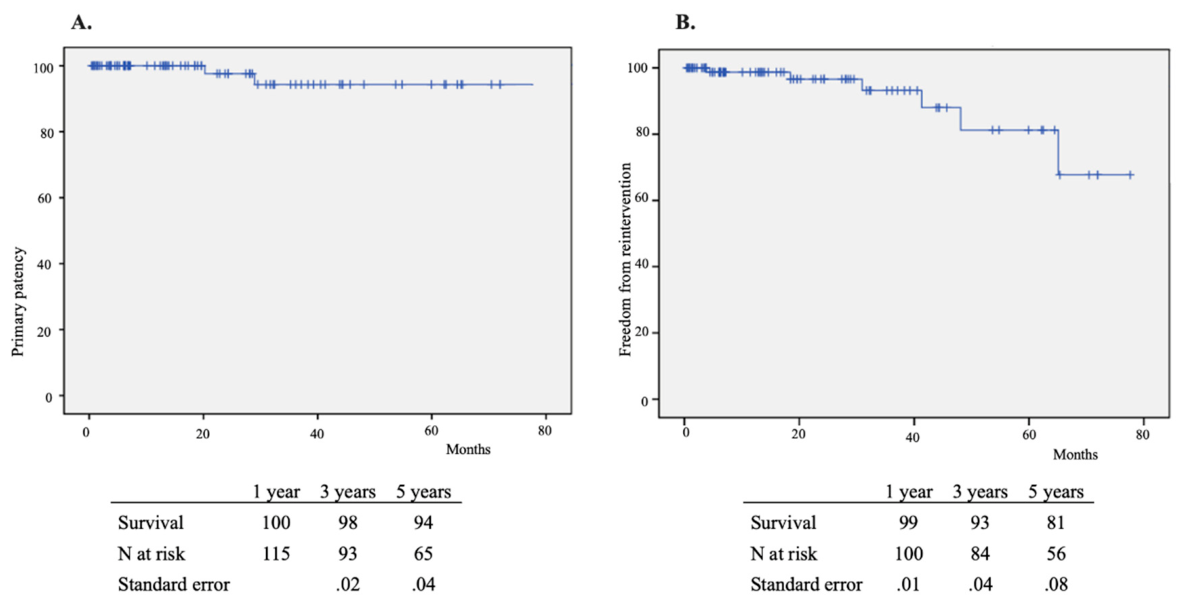
Figure 3.
Estimated five-year freedom from reintervention according to aortic calcification (A), the use of a brachial access (B), adjunctive femoral endarterectomy (C) and covered stents (D).
Figure 3.
Estimated five-year freedom from reintervention according to aortic calcification (A), the use of a brachial access (B), adjunctive femoral endarterectomy (C) and covered stents (D).
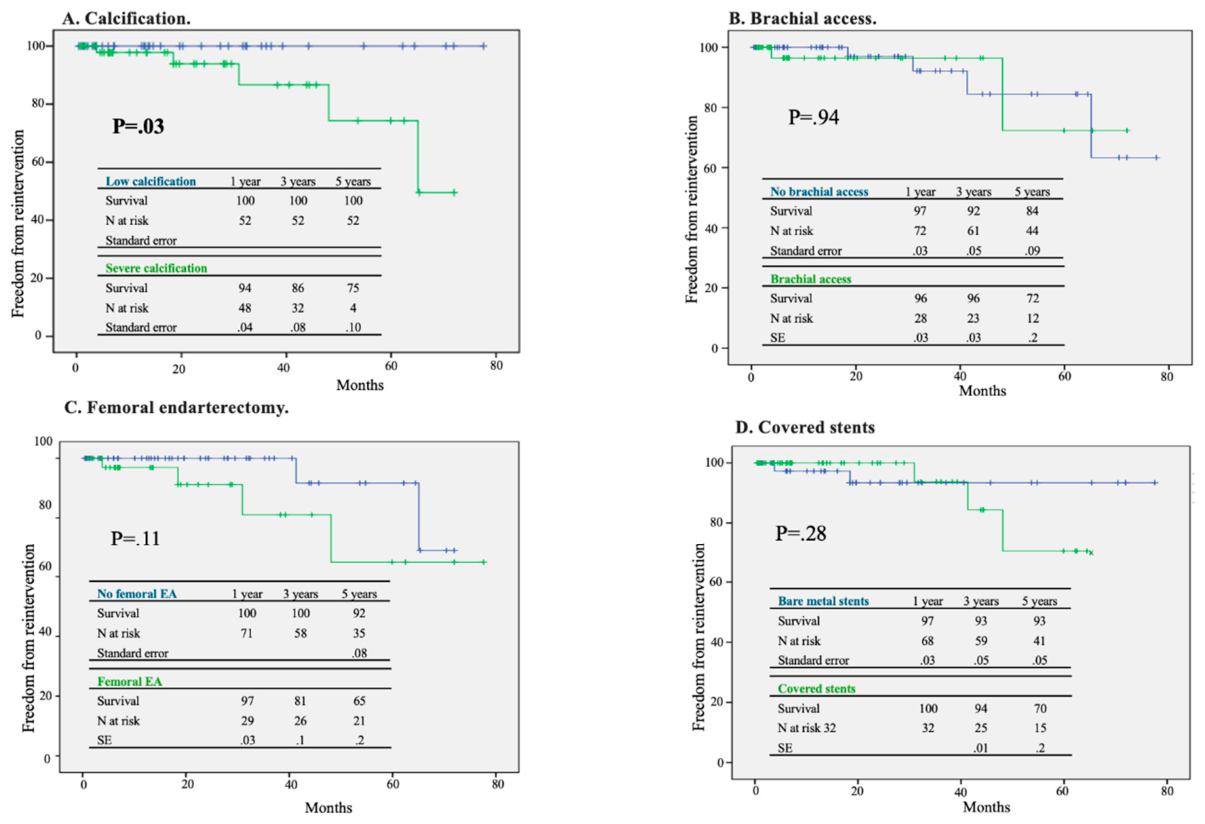

Table 1.
Demographics and comorbidities of the patients.
| n | % | |
| Male sex | 75 | 61 |
| Hypertension | 105 | 85 |
| Smoke | 114 | 93 |
| Hyperlipidaemia | 82 | 67 |
| Diabetes mellitus | 46 | 37 |
| Chronic obstructive pulmonary disease | 22 | 18 |
| Coronary artery disease | 32 | 26 |
Chronic kidney disease (>stage 3)
|
27 5 |
22 4 |
| Atrial fibrillation | 7 | 6 |
| Obesity | 9 | 7 |
| Critical limb-threatening ischemia | 69 | 56 |
| Rutherford cat. 3 | 54 | 44 |
| Rutherford cat. 4 | 31 | 25 |
| Rutherford cat. 5 | 32 | 26 |
| Rutherford cat. 6 | 6 | 5 |
| Internal iliac arteries patency | 70 | 57 |
| Aortic calcification | 68 | 55 |
| External iliac artery (EIA) disease | 73 | 59 |
| Total | 123 | 100 |
Table 2.
Procedural details.
| n | % | |
| Percutaneous femo18. | 18 | 15 |
| Cutdown femoral access | 105 | 85 |
| Brachial access | 49 | 40 |
Common femoral endarterectomy
|
48 12 |
39 10 |
| Kissing stent with Bare metal stents | 91 | 74 |
| Kissing stent with Covered stents | 32 | 26 |
| PTA/stenting external iliac artery | 46 | 37 |
| General anaesthesia | 100 | 81 |
| Local/locoregional anaesthesia | 23 | 19 |
| Total | 123 | 100 |
Table 3.
Perioperative outcomes.
| n | % | |
| Technical success | 123 | 100 |
| Clinical success | 123 | 100 |
| Acute myocardial infarction | 0 | 0 |
| Acute respiratory failure | 0 | 0 |
| Stroke | 0 | 0 |
| Acute kidney injury | 1 | 0.8 |
| Patients with stent thrombosis | 4 | 3 |
| Reintervention | 7 | 6 |
| Total (patients) | 123 | 100 |
| No. of iliac axes thrombosis | 4 | 1.5 |
| Total (iliac arteries) | 246 | 100 |
Disclaimer/Publisher’s Note: The statements, opinions and data contained in all publications are solely those of the individual author(s) and contributor(s) and not of MDPI and/or the editor(s). MDPI and/or the editor(s) disclaim responsibility for any injury to people or property resulting from any ideas, methods, instructions or products referred to in the content. |
© 2026 by the authors. Licensee MDPI, Basel, Switzerland. This article is an open access article distributed under the terms and conditions of the Creative Commons Attribution (CC BY) license (http://creativecommons.org/licenses/by/4.0/).
Copyright: This open access article is published under a Creative Commons CC BY 4.0 license, which permit the free download, distribution, and reuse, provided that the author and preprint are cited in any reuse.


