
Submitted:
31 July 2026
Posted:
03 August 2026
You are already at the latest version
Abstract
Background/Objectives: Robotic-assisted abdominal wall reconstruction is increasingly used for complex ventral hernias; however, implementation in low-volume settings and early adoption of complex cases remain controversial. This study aimed to evaluate perioperative outcomes of robotic ventral hernia repair with early inclusion of complex cases and to compare these results with open surgery. Methods: Prospectively collected data were retrospectively analyzed for consecutive complex robotic ventral hernia repairs performed between September 2021 and December 2025. A cohort of consecutive open Rives–Stoppa repairs was included for comparison (n = 21 per group). Outcomes included operative time, length of hospital stay (LOS), and perioperative complications. Results: Operative time was significantly longer in the robotic group (median 310 vs. 118 minutes, p < 0.001). The median LOS was significantly shorter following robotic repair (3 vs. 5 days, p = 0.0018). Postoperative complications occurred in 10% of robotic cases and 24% of open cases (p = 0.41). Major complications and reoperation rates were low and comparable between groups. Complex robotic cases, including procedures requiring component separation, were introduced early without evidence of worse short-term outcomes. Conclusions: Robotic ventral hernia repair was associated with significantly shorter hospital stay compared with open surgery, despite longer operative times and higher procedural complexity. Complication rates were comparable between groups. Early inclusion of technically complex cases did not compromise short-term outcomes.
Keywords:
robotic surgery
; ventral hernia
; incisional hernia
; abdominal wall reconstruction
; transversus abdominis release (TAR)
; learning curve
; low-volume center
; retromuscular repair
; minimally invasive surgery
1. Introduction
Incisional hernias represent a frequent and clinically relevant problem in abdominal wall surgery. Open retromuscular repair, most commonly performed using the Rives–Stoppa technique, is widely regarded as a reference standard for midline incisional hernias and has been widely utilized with well-proven outcomes [1]. Current European Hernia Society (EHS) guidelines recommend mesh placement in the retromuscular plane, while intraperitoneal mesh placement should be used with caution due to potential long-term complications [2].
Over the past decades, minimally invasive approaches have been increasingly adopted in ventral hernia repair. Laparoscopic techniques have demonstrated advantages in terms of reduced wound complications and shorter recovery; however, their applicability in complex hernia cases has historically been limited. In particular, laparoscopic repair has frequently been associated with intraperitoneal mesh placement and has not reliably allowed for consistent fascial closure or anatomical reconstruction of the abdominal wall in larger or more complex defects [3]. In the absence of advanced expertise, extraperitoneal mesh placement and formal abdominal wall reconstruction have been difficult to achieve using conventional laparoscopic techniques, and such approaches have generally been recommended only for experienced surgeons.
Robotic-assisted surgery has emerged as a platform that potentially addresses several of these limitations. The robotic system enables enhanced three-dimensional visualization, improved instrument articulation, and precise intracorporeal suturing, thereby facilitating more consistent fascial closure and anatomical reconstruction of the abdominal wall. Importantly, these technical advantages allow for reproducible access to retromuscular and preperitoneal planes, aligning minimally invasive surgery with guideline-supported principles of extraperitoneal mesh placement. As a result, advanced reconstructive techniques, including transversus abdominis release (TAR) and other forms of component separation, have increasingly been performed in a minimally invasive setting using robotic platforms [4].
Although some studies have reported overcoming of the learning curve after as few as 7–12 cases in simple hernia procedures, particularly robotic transabdominal preperitoneal (TAPP) repair [5,6], such rapid skill acquisition has not been universally shown.
Contemporary analyses and expert recommendations increasingly support a structured training model, advocating a stepwise progression from simple to more complex procedures. The European Hernia Society (EHS) training pathway emphasizes gradual escalation of case complexity as a key principle to ensure patient safety during the learning phase [7].
Strict adherence to such structured training pathways may not be feasible in all clinical settings. Limited access to robotic platforms, competition between surgical specialties for operating time, and institutional resource constraints may significantly influence the implementation of robotic programs, particularly in low-volume centers.
In addition, economic considerations remain a major factor in the adoption of robotic hernia surgery. Notably, a single-center study even reported that robotic TAPP may be less expensive than laparoscopic repair, with cost differences of approximately 100–200 USD per case [8]. However, the vast majority of available studies have demonstrated higher overall costs associated with robotic hernia repair compared with both laparoscopic and open approaches. Consequently, the use of robotic platforms in abdominal wall surgery remains limited in many institutions, where priority is often given to oncologic or other high-impact surgical procedures.
The definition of a "complex" ventral hernia remains heterogeneous and not universally established. While several classifications have been proposed, complexity is generally understood as a multifactorial concept encompassing anatomical and clinical factors such as defect size, nonstandard location, prior repairs, mesh presence or infection, loss of domain, and patient comorbidities [9].
Surgeons have historically struggled with consistent categorization, resulting in variable interpretations and inconsistent reporting across studies [10,11]. Consequently, the definition of complexity often depends on institutional practice and surgeon experience.
For the purpose of this study, the term "complex" is used in a broader, pragmatic sense, encompassing not only formally defined complex hernias but also procedures considered technically demanding or challenging within the context of robotic hernia surgery, allowing for meaningful comparison between study groups.
In our institution, robotic abdominal wall surgery was introduced under specific organizational constraints. Implementation of a robotic hernia program preceded the publication of structured training pathways and was characterized by limited access to the robotic platform, largely due to prioritization of other surgical domains, particularly oncologic procedures. As a result, overall procedural volume remained low, while the use of robotic systems for less complex cases was limited. Consequently, more complex abdominal wall reconstructions were introduced relatively early in the implementation phase.
The aim of this study was to evaluate the safety and short-term outcomes of robotic ventral hernia repair in this setting, with particular emphasis on the early adoption of technically complex cases.
2. Materials and Methods
2.1. Study Design and Patient Selection
Prospectively collected data were retrospectively analyzed for all consecutive patients undergoing robotic ventral hernia repair at the University Medical Centre Ljubljana between September 2021 and December 2025. Of the 44 robotic procedures performed during this period, 21 patients were classified as having complex hernias and were included in the analysis. The first complex robotic case was performed in May of 2022, with the first component separation (transversus abdominis release, TAR) performed as early as the 8th robotic hernia procedure overall.
For comparison, a cohort of consecutive patients undergoing open ventral hernia repair (Rives–Stoppa technique) was included. To ensure comparability, the number of open cases was matched to the number of complex robotic cases. Inclusion of the open cohort began at the start of 2023, with consecutive cases collected until the target number was reached; the last included open case was operated on in September 2024. One patient in whom adjunctive fascial traction (Fasciotens) was used was excluded from the open group. The final analysis included 21 patients in each group.
2.2. Surgical Technique and Case Stratification
All robotic procedures were performed by a single surgeon with extensive prior experience in robotic-assisted colorectal surgery (>100 procedures) using the da Vinci Xi platform. Surgical approach and technique in the complex hernia group were tailored according to hernia characteristics and included transabdominal preperitoneal repair for lateral and midline defects, and retromuscular reconstruction, with or without posterior component separation (transversus abdominis release, TAR).
Robotic cases were stratified according to procedural complexity into three categories: straightforward, intermediate, and complex (technically challenging). Straightforward cases included primary inguinal and small umbilical hernias. Intermediate cases comprised umbilical hernias with rectus diastasis, selected recurrent inguinal hernias, and simple parastomal repairs. Complex cases included midline incisional hernias, lateral hernias, parastomal hernias with concurrent midline hernia, and cases requiring component separation techniques – TAR. Only patients in the complex category were included in the comparative analysis with the open group.
Robotic complex procedures included 2 unilateral transversus abdominis releases (TAR), 3 robotic Pauli repairs, 4 retromuscular Rives–Stoppa repairs, 1 robotic Rives–Stoppa repair combined with recurrent inguinal hernia repair, 9 preperitoneal lateral hernia repairs performed with the patient in the lateral decubitus position and 2 preperitoneal midline mesh repairs. All meshes were placed in extraperitoneal positions and all meshes measured at least 14 cm in the shorter dimension (width).
2.3. Data Collection and Definitions
The following variables were collected: patient age at surgery, sex, body mass index (BMI), American Society of Anesthesiologists (ASA) score, number of previous hernia repairs, presence of recurrent hernia, hernia type and location, and presence of stoma.
Operative variables included operative time (skin-to-skin), intraoperative complications, and need for conversion.
Length of hospital stay (LOS) was defined as the number of postoperative days, calculated from the date of surgery to the date of discharge, with same-day discharge recorded as one day.
Postoperative outcomes included any complication, major complications defined as Clavien–Dindo grade ≥ III, reoperation, and readmission within 30 days. Follow-up data regarding long-term recurrence were not systematically available and were therefore not included in the analysis.
2.4. Outcomes
The primary outcome of the study was postoperative length of hospital stay (LOS). Secondary outcomes included operative time, postoperative complications, major complications (Clavien–Dindo ≥ III), reoperation rate, and readmission rate within 30 days.
2.5. Statistical Analysis
Continuous variables were expressed as median and interquartile range (IQR) and compared using the Mann–Whitney U test. Categorical variables were compared using Fisher's exact test.
A p-value < 0.05 was considered statistically significant. Statistical analysis was performed using R software (version 4.6.0; R Foundation for Statistical Computing, Vienna, Austria).
3. Results
3.1. Patient Characteristics
A total of 42 patients were included in the comparative analysis, with 21 patients in the robotic group (complex cases) and 21 in the open group.Baseline patient characteristics, summarized in Table 1, were comparable between the two groups. Patient age (median 59 vs. 59 years; IQR 49–69 vs. 52–71), body mass index (BMI) (median 28.1 vs. 29.0 kg/m²; IQR 25.4–30.9 vs. 26.8–32.3), and sex distribution (male 62% vs. 67%) were similar between groups. The majority of patients in both groups were classified as ASA II–III.
3.2. Operative Details
Operative time was significantly longer in the robotic group compared with the open group (median 310 vs. 118 minutes, p < 0.001). The interquartile range (IQR) was 257–390 minutes in the robotic group and 86–133 minutes in the open group. The mean operative time was 331 minutes (range 141–575) in the robotic group and 124 minutes (range 63–236) in the open group. Component separation techniques were performed in 5 patients (24%) in the robotic group and in none of the open cases. A stoma was present in 3 patients (14%) in the robotic group and in 0 patients in the open group. Recurrent hernia was present in 7 patients (33.3%) in the robotic group and 6 patients (28.6%) in the open group (p = 1.000); among these, 3 patients in the robotic group had undergone 2 previous repairs and 4 had undergone 1 previous repair, compared to 2 and 4 patients in the open group, respectively.
Intraoperative complications occurred in 3 patients (14%) in the robotic group and 4 patients (19%) in the open group (p = 1.000). In the robotic group, one complication involved injury to an ileal conduit and two involved serosal injury of the small bowel. In the open group, all intraoperative complications consisted of serosal injury of the small bowel requiring suture repair. No conversions to open surgery were observed in the robotic group. A representative case is illustrated in Figure 1, demonstrating a recurrent (onlay hernioplasty) lateral incisional hernia following lumbotomy for partial nephrectomy, with preoperative and postoperative imaging.
3.3. Postoperative Outcomes
The median length of hospital stay was significantly shorter in the robotic group compared with the open group (median 3 vs. 5 days, p = 0.0018). The interquartile range (IQR) for length of hospital stay was 2–4 days in the robotic group and 3–8 days in the open group.
Postoperative complications occurred in 2 patients (10%) in the robotic group and 5 patients (24%) in the open group, with no statistically significant difference between groups (p = 0.41).
Major complications (Clavien–Dindo ≥ III) were rare, with one event recorded in each group (5% vs. 5%, p = 1.000).
Reoperation was required in one patient in each group (5% vs. 5%, p = 1.000). Readmission occurred in two patients (10%) in the open group and none in the robotic group (p = 0.49).
Operative and postoperative outcomes are summarized in Table 2.
3.4. Case Complexity
Robotic procedures included a spectrum of case complexity. Technically demanding cases were introduced early in the implementation phase.
These included component separation with transversus abdominis release (TAR); notably, such complex procedures were performed as early as cases 8, 10, 11, and 12, demonstrating early adoption of advanced operative techniques within the robotic program (Figure 2).
4. Discussion
The aim of this study was not to promote early adoption of complex robotic hernia repair, but rather to report our institutional experience under real-world constraints. In our cohort, early introduction of complex cases did not result in statistically significant differences in perioperative outcomes compared with open surgery.
Operative time in the robotic group was significantly longer compared with open surgery (median 310 vs. 118 minutes, p < 0.001). This reflects both the early phase of robotic program implementation and the fact that more extensive procedures were performed in the robotic group. These included complex abdominal wall reconstructions and cases requiring component separation techniques, including transversus abdominis release (TAR), which were introduced early in the robotic experience.
In addition, operative times in our cohort remained longer than those reported in the literature for comparable procedures following completion of the learning curve. For example, unilateral TAR has been reported to require slightly more than two hours of operative time in experienced hands [12]. This further highlights the impact of early program implementation and case complexity on operative duration.
Despite this, we observed a significantly shorter length of hospital stay in the robotic group, which aligns with previously reported benefits of minimally invasive abdominal wall reconstruction [13,14]. Importantly, this reduction in hospital stay was observed in our study despite the higher procedural complexity in the robotic cohort with even 5 cases of component separation and none in the open group, suggesting that the advantages of minimally invasive techniques may be preserved even in more demanding clinical scenarios.
With regard to complications, outcomes were not different between groups. Only one patient in the robotic group required reoperation due to suspected mesh infection. Computed tomography findings demonstrated fluid collection suggestive of infection, with gas inclusions raising suspicion for abscess formation. However, intraoperative findings revealed no evidence of infection, and microbiological samples remained sterile. The intra-operative finding was consistent with seromatous fluid, and the CT appearance of gas was disregarded as retained carbon dioxide following robotic surgery. The hernia defect repair itself remained intact, and simple excision of the hernia sac was performed with an uneventful remaining postoperative course. This event may represent a technical error, as more experience with robotic techniques might have allowed avoidance of this complication.
Interestingly, early engagement with complex cases also enabled integration of robotic surgery into multidisciplinary care. In one patient, robotic repair of a recurrent hernia was performed following urological metastasectomy for clear cell renal carcinoma, allowing both procedures to be completed within a single operation, with a favorable outcome.
In the open group, one patient required multiple reoperations due to mesh infection. Although this finding has no statistical significance, it is consistent with literature suggesting lower infection rates following minimally invasive approaches [15,16]. Furthermore, despite longer operative times and technically demanding procedures, including lateral hernias requiring positioning in the lateral decubitus position, and component separation procedures, no increase in overall complication rates was observed in the robotic group.
This study has several limitations. The relatively small sample size limits statistical power, particularly for infrequent outcomes such as major complications and readmissions. As such, the present study primarily reflects institutional experience rather than providing definitive evidence for broader clinical conclusions. The retrospective design introduces potential selection bias, and long-term follow-up data, including recurrence rates, were not systematically available.
While adherence to structured training pathways may have further optimized outcomes, such pathways were not fully feasible in our setting. Nevertheless, the approach adopted allowed us to offer selected patients a conceptually optimal surgical strategy, particularly in terms of mesh positioning and abdominal wall reconstruction. Within the limitations of this analysis, this did not result in inferior outcomes.
5. Conclusions
In this single-center experience, robotic ventral hernia repair was associated with significantly shorter hospital stay compared with open surgery, despite longer operative times and higher procedural complexity. Complication rates were comparable between groups. Early inclusion of technically complex cases, including procedures requiring component separation, did not compromise short-term outcomes. While a structured, stepwise approach as recommended by current training pathways remains preferable, these findings suggest that in selected resource-limited settings, early implementation of complex robotic procedures may be feasible without compromising patient safety.
Author Contributions
Conceptualization, A.H. and J.G.; methodology, A.H. and A.T.; formal analysis, A.H.; investigation, A.H., B.T., P.S., and J.G.; data curation, A.H.; writing—original draft preparation, A.H.; writing—review and editing, A.T., B.T., P.S., and J.G.; supervision, J.G. All authors have read and agreed to the published version of the manuscript.
Funding
This research received no external funding. The APC was funded by University Medical Centre Ljubljana.
Institutional Review Board Statement
The study was conducted in accordance with the Declaration of Helsinki. Ethical review and approval were waived for this study due to its retrospective nature and use of anonymized data.
Informed Consent Statement
Patient consent was waived due to the retrospective nature of the study and the use of anonymized data.
Data Availability Statement
The data presented in this study are available on request from the corresponding author due to privacy restrictions.
Acknowledgments: During the preparation of this manuscript, the authors used ChatGPT (OpenAI, GPT-5.5) for sentence formulation and language/grammar correction. The authors have reviewed and edited the output and take full responsibility for the content of this publication.
Conflicts of Interest
The authors declare no conflicts of interest. The funders had no role in the design of the study; in the collection, analyses, or interpretation of data; in the writing of the manuscript; or in the decision to publish the results.
Abbreviations
The following abbreviations are used in this manuscript:
| TAR | Transversus abdominis release |
| TAPP | Transabdominal preperitoneal repair |
| LOS | Length of hospital stay |
| BMI | Body mass index |
| ASA | American Society of Anesthesiologists |
| IQR | Interquartile range |
| EHS | European Hernia Society |
References
- Siegal, S.R.; Pauli, E.M. Posterior component separation/transversus abdominis release. Plast. Aesthet. Res. 2019, 6, 25. [Google Scholar] [CrossRef]
- Sanders, D.L.; Pawlak, M.M.; Simons, M.P.; Aufenacker, T.; Balla, A.; Berger, C.; Berrevoet, F.; de Beaux, A.C.; East, B.; Henriksen, N.A.; et al. Midline incisional hernia guidelines: the European Hernia Society. BJS 2023, 110, 1732–1768. [Google Scholar] [CrossRef] [PubMed]
- Köckerling, F. Recurrent incisional hernia repair—An overview. Front. Surg. 2019, 6, 26. [Google Scholar] [CrossRef] [PubMed]
- Warren, J.A.; Blackhurst, D.; Ewing, J.A.; Carbonell, A.M. Open versus robotic retromuscular ventral hernia repair: outcomes of the ORREO prospective randomized controlled trial. Surg. Endosc. 2024, 38, 7466–7474. [Google Scholar] [CrossRef] [PubMed]
- Choi, Y.S.; Kim, K.D.; Choi, M.S.; Heo, Y.S.; Yi, J.W.; Choe, Y.-M. Initial experience of robot-assisted transabdominal preperitoneal (TAPP) inguinal hernia repair by a single surgeon in South Korea. Medicina 2023, 59, 582. [Google Scholar] [CrossRef] [PubMed]
- Okamoto, N.; Mineta, S.; Mishima, K.; Fujiyama, Y.; Wakabayashi, T.; Fujita, S.; Sakamoto, J.; Wakabayashi, G. Comparison of short-term outcomes of robotic and laparoscopic transabdominal peritoneal repair for unilateral inguinal hernia: a propensity-score matched analysis. Hernia 2023, 27, 1131–1138. [Google Scholar] [CrossRef] [PubMed]
- Vierstraete, M.; Simons, M.; Borch, K.; de Beaux, A.; East, B.; Reinpold, W.; Stabilini, C.; Muysoms, F. Description of the current Da Vinci® training pathway for robotic abdominal wall surgery by the European Hernia Society. J. Abdom. Wall Surg. 2022, 1, 10914. [Google Scholar] [CrossRef] [PubMed]
- Viera, O.J.; Florin, J.L.; Morales, K.E. Long-term outcomes of robotic inguinal hernia repair (r-TAPP): a retrospective review of 434 consecutive cases by a single surgeon with 3–8 years of follow-up. J. Robot. Surg. 2025, 19, 57. [Google Scholar] [CrossRef] [PubMed]
- Slater, N.J.; Montgomery, A.; Berrevoet, F.; Carbonell, A.M.; Chang, A.; Franklin, M.; Kercher, K.W.; Lammers, B.J.; Parra-Davilla, E.; Roll, S.; et al. Criteria for definition of a complex abdominal wall hernia. Hernia 2014, 18, 7–17. [Google Scholar] [CrossRef] [PubMed]
- Meza-Hernandez, J.; Huchim-Servín, P.E.; Escamilla-Lopez, A.; Villanueva-Lechuga, D. Exploring variable approaches in complex hernia repair: A comprehensive literature review. Cureus 2024, 16, e60181. [Google Scholar] [CrossRef] [PubMed]
- Barbosa, C.A.; Soares de Faria, M.H.; Messias, B.A. Predictive factors for complexity in abdominal wall hernias: a literature scope review. Rev. Col. Bras. Cir. 2024, 51, e20243670. [Google Scholar] [CrossRef] [PubMed]
- Kudsi, O.Y.; Gokcal, F.; Bou-Ayash, N.; Crawford, A.S. Learning curve of robotic transversus abdominis release in ventral hernia repair: a cumulative sum (CUSUM) analysis. Surg. Endosc. 2022, 36, 3480–3488. [Google Scholar] [CrossRef] [PubMed]
- Carbonell, A.M.; Warren, J.A.; Prabhu, A.S.; Ballecer, C.D.; Janczyk, R.J.; Herrera, J.; Huang, L.C.; Phillips, S.; Rosen, M.J.; Poulose, B.K. Reducing length of stay using a robotic-assisted approach for retromuscular ventral hernia repair. Ann. Surg. 2018, 267, 210–217. [Google Scholar] [CrossRef] [PubMed]
- de'Angelis, N.; Schena, C.A.; Moszkowicz, D.; Kuperas, C.; Fara, R.; Gaujoux, S.; Gillion, J.F.; Gronnier, C.; Loriau, J.; Mathonnet, M.; et al. Robotic surgery for inguinal and ventral hernia repair: a systematic review and meta-analysis. Surg. Endosc. 2024, 38, 24–46. [Google Scholar] [CrossRef] [PubMed]
- Capoccia Giovannini, S.; Vierstraete, M.; Frascio, M.; Camerini, G.; Muysoms, F.; Stabilini, C. Systematic review and meta-analysis on robotic assisted ventral hernia repair: the ROVER review. Hernia 2025, 29, 95. [Google Scholar] [CrossRef] [PubMed]
- Lima, D.L.; Balthazar da Silveira, C.A.; de Oliveira, C.N.B.; Rasador, A.C.D.; Kasakewitch, J.P.G.; Nogueira, R.L.; Beffa, L.; Malcher, F. Open versus robotic transversus abdominis release for ventral hernia repair: an updated systematic review, meta-analysis, and meta-regression. Surg. Endosc. 2024, 38, 7083–7092. [Google Scholar] [CrossRef] [PubMed]
Figure 1.
Representative computed tomography images of a recurrent lateral incisional hernia following lumbotomy for partial nephrectomy. (A) Preoperative axial CT demonstrating a recurrent lateral hernia after previous failed onlay hernioplasty. (B) Postoperative axial CT at 5 months following robotic preperitoneal repair performed with the patient in the lateral decubitus position, demonstrating successful abdominal wall reconstruction with mesh in the extraperitoneal position..
Figure 1.
Representative computed tomography images of a recurrent lateral incisional hernia following lumbotomy for partial nephrectomy. (A) Preoperative axial CT demonstrating a recurrent lateral hernia after previous failed onlay hernioplasty. (B) Postoperative axial CT at 5 months following robotic preperitoneal repair performed with the patient in the lateral decubitus position, demonstrating successful abdominal wall reconstruction with mesh in the extraperitoneal position..
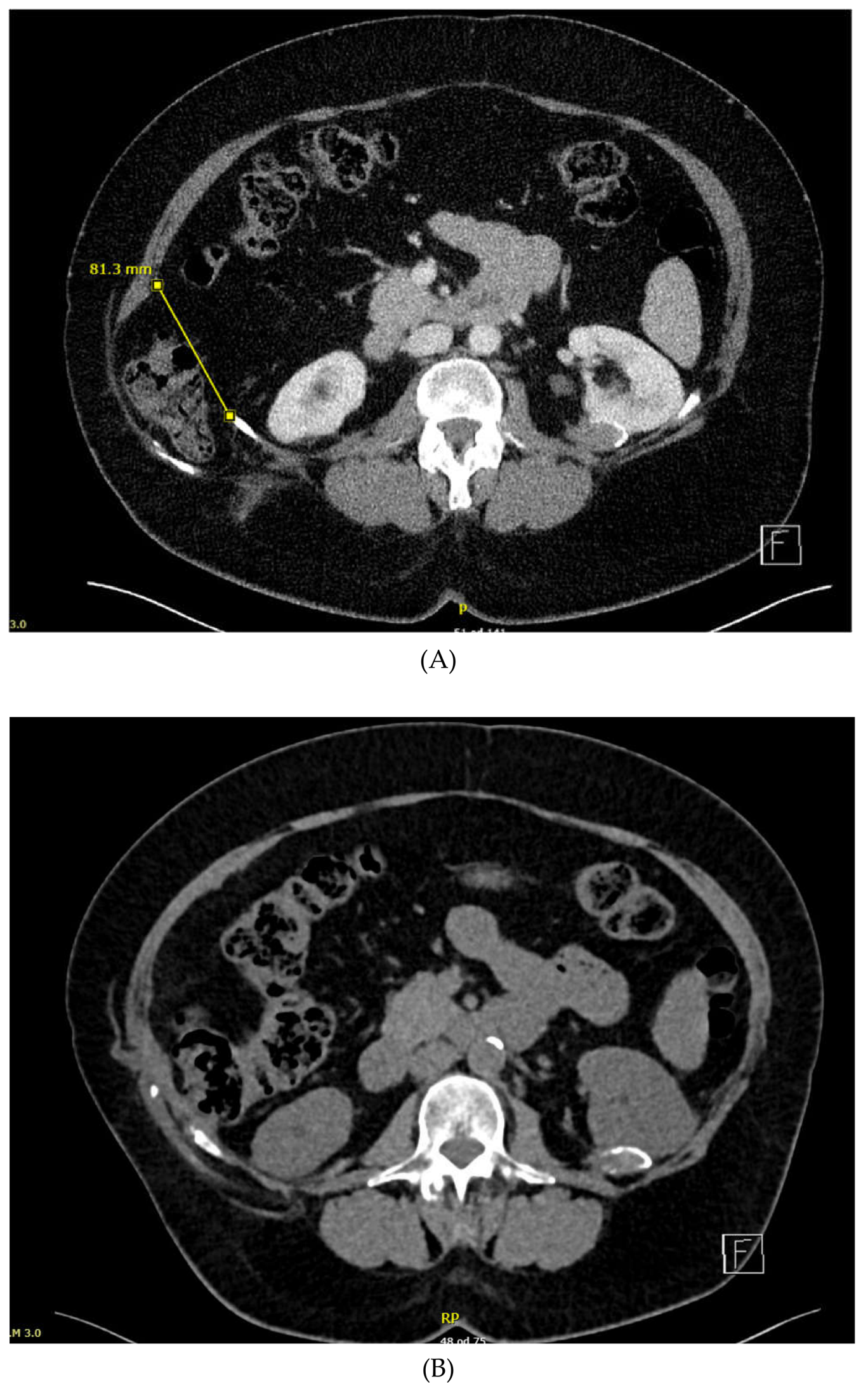
Figure 2.
Distribution of case complexity across the robotic series. Complexity levels were defined as 1 (straightforward), 2 (intermediate), and 3 (complex). Early occurrence of complex cases reflects early implementation of advanced reconstructive procedures.
Figure 2.
Distribution of case complexity across the robotic series. Complexity levels were defined as 1 (straightforward), 2 (intermediate), and 3 (complex). Early occurrence of complex cases reflects early implementation of advanced reconstructive procedures.
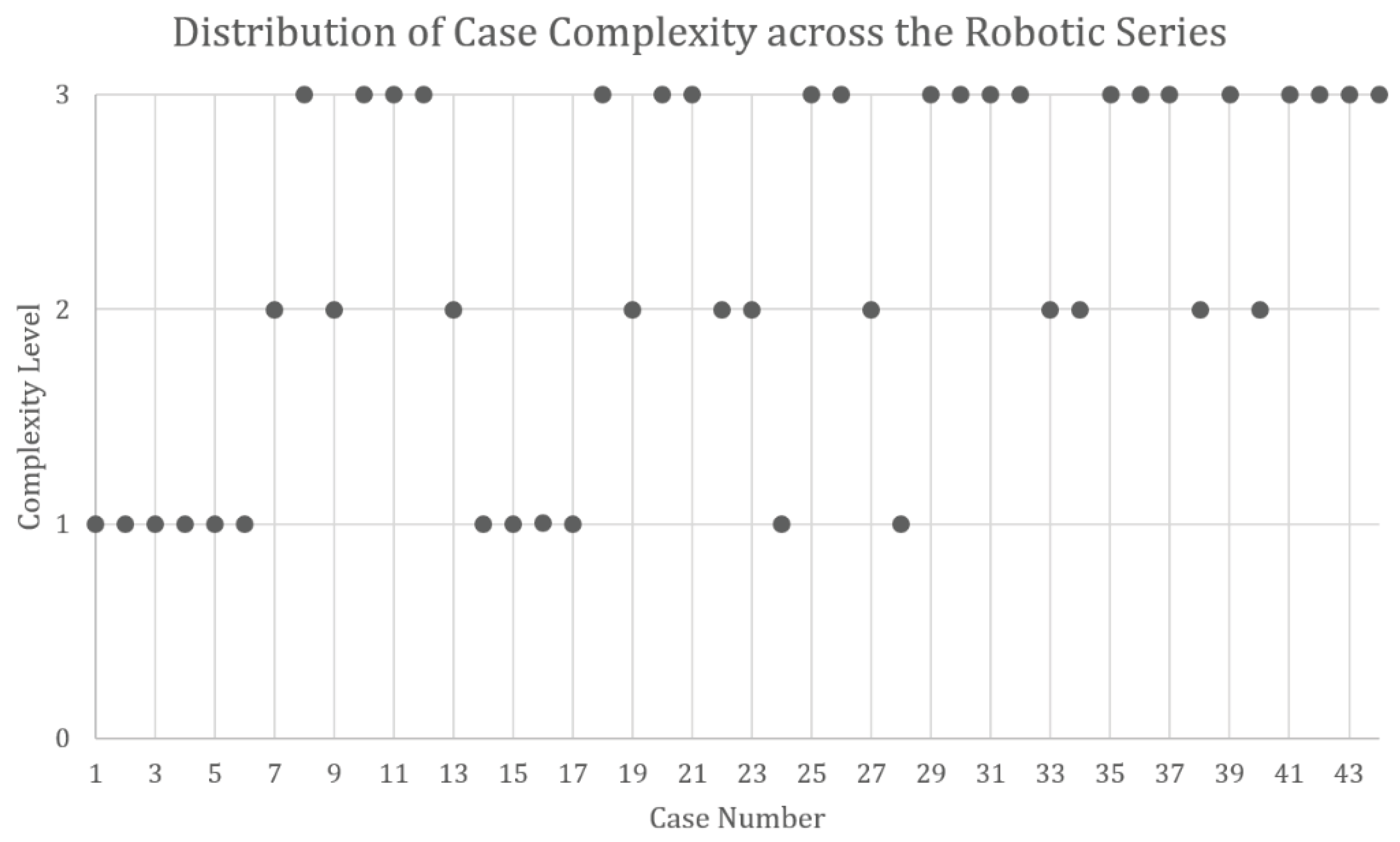

Table 1.
Baseline characteristics.
| Variable | Robotic (n = 21) | Open (n = 21) | p-value |
|---|---|---|---|
| Age (years) | 59 (49–69) | 59 (52–71) | 0.67 |
| BMI (kg/m²) | 28.1 (25.4–30.9) | 29.0 (26.8–32.3) | 0.35 |
| Sex (male) | 13 (62%) | 14 (67%) | 1.00 |
| Sex (female) | 8 (38%) | 7 (33%) | — |
| ASA I | 3 (14%) | 0 (0%) | |
| ASA II | 12 (57%) | 10 (48%) | |
| ASA III | 6 (29%) | 11 (52%) | 0.12 |
Table 2.
Operative and postoperative outcomes.
| Outcome | Robotic (n = 21) | Open (n = 21) | p-value |
|---|---|---|---|
| Operative time (min) | 310 (257–390) | 118 (86–133) | <0.001 |
| Length of stay (days) | 3 (2-4) | 5 (3-8) | 0.0018 |
| Intraoperative complications | 3 (14%) | 4 (19%) | 1.000 |
| Any postoperative complication | 2 (10%) | 5 (24%) | 0.41 |
| Clavien–Dindo ≥ III | 1 (5%) | 1 (5%) | 1.000 |
| Reoperation | 1 (5%) | 1 (5%) | 1.000 |
| Readmission | 0 (0%) | 2 (10%) | 0.49 |
Data are presented as median (IQR) or number (%). p-values were calculated using the Mann–Whitney U test for continuous variables and Fisher’s exact test for categorical variables.
Disclaimer/Publisher’s Note: The statements, opinions and data contained in all publications are solely those of the individual author(s) and contributor(s) and not of MDPI and/or the editor(s). MDPI and/or the editor(s) disclaim responsibility for any injury to people or property resulting from any ideas, methods, instructions or products referred to in the content. |
© 2026 by the authors. Licensee MDPI, Basel, Switzerland. This article is an open access article distributed under the terms and conditions of the Creative Commons Attribution (CC BY) license (http://creativecommons.org/licenses/by/4.0/).
Copyright: This open access article is published under a Creative Commons CC BY 4.0 license, which permit the free download, distribution, and reuse, provided that the author and preprint are cited in any reuse.


