

Submitted:
31 July 2026
Posted:
03 August 2026
You are already at the latest version
Abstract
Artificial intelligence is transforming governance, healthcare, education, finance, and public administration across Africa while simultaneously introducing new ethical challenges related to surveillance, digital inequality, algorithmic bias, and data sovereignty. Existing AI ethics frameworks are largely grounded in universal principles of transparency, fairness, and accountability but often pay insufficient attention to the relational, historical, and socio-political realities shaping technological development in African societies. This article addresses this gap by integrating Ubuntu, African liberation theology, and contemporary AI ethics within a phenomenological framework. Drawing on Interpretative Phenomenological Analysis (IPA), it examines how African theologians, AI scholars, and civil society actors understand the ethical implications of algorithmic power and its consequences for human dignity, social justice, and community life. The analysis demonstrates that AI governance in Africa cannot be reduced to technical regulation or compliance with global standards. Instead, participants consistently interpret artificial intelligence through relational understandings of personhood, solidarity, moral responsibility, and collective flourishing. Building on UNESCO's ethical principles while incorporating Innovationology, Noesology, Mode 4 Knowledge Production, and Integral Ecology of Innovation, the article develops a Relational AI Governance framework that situates technological innovation within broader commitments to human emancipation, epistemic pluralism, ecological stewardship, and inclusive development. It argues that African theological traditions are not merely local ethical resources but offer globally relevant insights for reimagining AI governance in ways that promote justice, sustainability, and human dignity.
Keywords:
artificial intelligence
; AI ethics
; Ubuntu
; African liberation theology
; algorithmic power
; Innovationology
; Noesology
; digital justice
1. Introduction
Artificial intelligence (AI) has become one of the defining technologies of the twenty-first century, reshaping economies, governance, education, healthcare, and public administration. Across Africa, governments increasingly deploy AI for digital public services, financial inclusion, agricultural innovation, and health systems, while private technology companies expand data infrastructures and algorithmic decision-making. These developments offer significant opportunities for socio-economic transformation but also raise profound ethical concerns regarding surveillance, algorithmic discrimination, digital inequality, data extraction, and technological dependency (UNESCO, 2021; Floridi, 2023).
Contemporary AI ethics has largely evolved through universal normative principles emphasizing transparency, accountability, fairness, privacy, and human rights. Although these principles provide an essential foundation for responsible AI governance, they often overlook the relational, historical, and cultural dimensions that shape technological experiences in the Global South. African societies confront AI within contexts marked by colonial legacies, unequal technological infrastructures, epistemic asymmetries, and persistent socio-economic exclusion. Consequently, ethical governance requires frameworks capable of addressing not only technical risks but also questions of justice, dignity, and collective well-being.
Ubuntu offers such a perspective by understanding personhood as fundamentally relational rather than individualistic. Its emphasis on solidarity, reciprocity, and communal flourishing complements African liberation theology, which interprets social structures through the ethical imperative of human emancipation and preferential concern for marginalized communities (Metz, 2023). Together, these traditions provide a normative vision that challenges purely technocratic approaches to AI governance and reframes technology as a moral project embedded within relationships, communities, and ecological systems.
This article argues that AI governance in Africa should be understood through an integrated framework combining normative AI ethics, Ubuntu, liberation theology, critical analyses of algorithmic power, and emerging perspectives from Innovationology and Noesology (Moleka, 2024, 2025, 2026). Rather than treating artificial intelligence as a neutral technological innovation, the study examines how algorithmic systems shape human agency, social relations, and institutional power.
Using Interpretative Phenomenological Analysis, the research explores how African theologians, AI researchers, and civil society actors interpret the ethical implications of AI in their lived contexts. It asks three interrelated questions: How is algorithmic power experienced within African societies? How do Ubuntu and liberation theology reshape prevailing approaches to AI ethics? And how can African intellectual traditions contribute to more just, inclusive, and sustainable models of global AI governance?
By bringing together AI ethics, African philosophy, theology, and innovation studies, the article develops a relational approach to AI governance that extends existing debates beyond technical regulation toward a vision of technological development grounded in human dignity, epistemic justice, ecological responsibility, and collective flourishing. This interdisciplinary contribution positions African thought not as a peripheral perspective but as a source of theoretical innovation capable of enriching global conversations on the future governance of intelligent technologies.
2. Theoretical Foundations: Ubuntu, Liberation Theology, and Algorithmic Power
Artificial intelligence is not merely a technological innovation but a socio-political force that increasingly shapes knowledge, institutions, and human relationships. Consequently, ethical reflection on AI requires analytical frameworks that extend beyond technical performance to address questions of power, justice, dignity, and collective well-being. This article develops an interdisciplinary framework that integrates normative AI ethics, Ubuntu philosophy, African liberation theology, and recent advances in Innovationology and Noesology to examine how intelligent technologies can either reinforce or transform existing social structures.
The first pillar of this framework is normative AI ethics. International initiatives, particularly UNESCO's Recommendation on the Ethics of Artificial Intelligence, have established globally recognized principles centred on human rights, transparency, accountability, fairness, privacy, and sustainability (UNESCO, 2021). Floridi (2023) similarly argues that AI governance should ensure that technological innovation remains aligned with human values and democratic institutions. These principles provide an indispensable ethical foundation but remain largely universal in orientation, offering limited engagement with the historical, cultural, and relational realities that characterize African societies.
Ubuntu complements these universal principles by redefining ethics through relationships rather than individual autonomy. The well-known maxim, umuntu ngumuntu ngabantu ("a person is a person through other persons"), expresses an understanding of humanity grounded in reciprocity, solidarity, compassion, and communal responsibility (Metz, 2023). Within this perspective, artificial intelligence cannot be evaluated solely according to efficiency or accuracy but must be assessed according to its capacity to strengthen human relationships, protect dignity, and contribute to collective flourishing. Ethical technologies are therefore those that enhance rather than diminish the social fabric upon which communities depend.
African liberation theology extends this relational perspective by interpreting technological systems through the lens of justice and emancipation. Historically, liberation theology has challenged political, economic, and cultural structures that perpetuate oppression while affirming the agency of marginalized communities (Freire, 1970). In the digital era, algorithmic systems increasingly influence access to employment, education, healthcare, finance, and public services. These systems are therefore not politically neutral but participate in the production and distribution of opportunities, risks, and inequalities. Ethical AI governance must consequently address questions of digital exclusion, algorithmic discrimination, and technological dependency alongside traditional concerns regarding privacy and accountability.
The concept of algorithmic power provides a critical lens for understanding these dynamics. Rather than functioning as neutral computational tools, algorithms increasingly shape public knowledge, influence institutional decision-making, and reproduce existing asymmetries of economic and political power (Benjamin, 2023; Noble, 2018). Within African contexts, these processes may reinforce forms of digital colonialism through unequal control of data, technological infrastructures, and artificial intelligence ecosystems. Moleka (2026a) argues that algorithmic power should therefore be understood as part of broader transformations affecting social organization, economic systems, and human agency in the age of intelligent technologies.
Moving beyond critique, this article adopts Innovationology as a framework for transformative technological development. Innovationology conceptualizes innovation as a multidimensional process integrating scientific creativity, ethical responsibility, institutional transformation, ecological sustainability, and social inclusion (Moleka, 2024a). Rather than measuring technological progress solely through economic productivity or computational performance, Innovationology evaluates innovation according to its contribution to human flourishing and regenerative development.
This perspective is further enriched by Noesology, which expands conventional understandings of intelligence beyond information processing toward cognitive, ethical, relational, ecological, cultural, and spiritual dimensions (Moleka, 2025b). Together with Mode 4 Knowledge Production, Integral Ecology of Innovation, and the Moleka Grid, these approaches promote epistemic pluralism by integrating scientific knowledge with Indigenous wisdom, theological reflection, and community experience (Moleka, 2024b, 2024c, 2024d, 2025c). They provide a conceptual bridge between global AI ethics and African philosophical traditions while positioning technological innovation within broader systems of social and ecological transformation.
Taken together, these theoretical perspectives form the foundation of a relational model of AI governance. Rather than viewing artificial intelligence as an autonomous technological domain, the framework understands AI as embedded within networks of human relationships, institutional structures, ecological systems, and moral responsibilities. From this perspective, responsible AI governance is not achieved merely through regulatory compliance but through the cultivation of technologies that advance justice, solidarity, sustainability, and the dignity of every person. This integrated framework informs the phenomenological methodology presented in the following section and guides the interpretation of participants' lived experiences of algorithmic power in contemporary Africa.
3. Theoretical Framework
Artificial intelligence is transforming not only technological systems but also the ethical, political, and epistemological foundations of contemporary societies. Understanding its implications in African contexts requires a framework that extends beyond conventional AI ethics to incorporate relational philosophies, critical analyses of power, and transformative theories of innovation. This article therefore develops an integrated framework that brings together normative AI ethics, Ubuntu, African liberation theology, algorithmic power, Innovationology, and Noesology.
Normative AI ethics provides the global ethical foundation for responsible AI governance. International frameworks, particularly UNESCO's Recommendation on the Ethics of Artificial Intelligence, emphasize human rights, transparency, accountability, fairness, privacy, and sustainability as essential principles for trustworthy AI (UNESCO, 2021). Floridi (2023) similarly argues that AI should remain aligned with human values and democratic institutions rather than becoming an autonomous force detached from ethical oversight. While these principles establish an indispensable normative baseline, they remain largely universal in orientation and pay limited attention to the historical and relational realities that characterize African societies.
Ubuntu broadens this ethical perspective by redefining personhood as fundamentally relational. Rather than viewing individuals as autonomous decision-makers, Ubuntu understands humanity through mutual dependence, solidarity, compassion, and shared responsibility. As Metz (2023) argues, ethical action is measured by its capacity to strengthen harmonious relationships and promote communal flourishing. Applied to artificial intelligence, this perspective shifts attention from technological efficiency toward the social consequences of algorithmic systems, asking whether AI strengthens human dignity, social cohesion, and collective well-being.
African liberation theology further deepens this relational ethic by examining technology through the lens of justice and emancipation. Historically concerned with confronting oppression and restoring human dignity, liberation theology provides an analytical framework for evaluating how algorithmic systems may reproduce exclusion, inequality, and new forms of domination. Artificial intelligence is therefore understood not as a politically neutral technology but as a socio-technical system embedded within economic, institutional, and historical structures that shape opportunities, distribute risks, and influence human agency.
The concept of algorithmic power provides a bridge between critical social theory and AI governance. Algorithms increasingly mediate access to information, employment, education, healthcare, financial services, and public administration, thereby influencing both individual lives and institutional decision-making. In many African contexts, these technologies operate within asymmetrical global digital infrastructures that risk reinforcing data dependency and digital colonialism. Building on Moleka (2026a), this study conceptualizes algorithmic power as the capacity of intelligent technological systems to reshape social relations, redistribute authority, and redefine the conditions under which knowledge, opportunity, and participation are produced.
To move beyond critique, the article incorporates Innovationology as a science of transformative innovation. Innovationology understands innovation as an integrated process linking scientific creativity, institutional transformation, ethical responsibility, ecological sustainability, and inclusive development (Moleka, 2024a). Rather than measuring technological success exclusively through productivity or economic growth, it evaluates innovation according to its contribution to human flourishing and regenerative societal transformation.
Complementing this perspective, Noesology expands the concept of intelligence beyond computational reasoning to include cognitive, ethical, relational, ecological, cultural, and spiritual dimensions (Moleka, 2025b). Together with Mode 4 Knowledge Production, Integral Ecology of Innovation, and the Moleka Grid, Noesology promotes epistemic pluralism by integrating scientific knowledge with Indigenous wisdom, theological reflection, and community experience (Moleka, 2024b–d; 2025c). These complementary frameworks provide an alternative epistemological foundation for AI governance that recognizes multiple forms of intelligence and knowledge while emphasizing their collective contribution to sustainable development.
Taken together, these perspectives form an integrated theoretical framework in which responsible AI governance emerges from the interaction of ethical principles, relational personhood, social justice, multidimensional intelligence, and transformative innovation. Rather than treating artificial intelligence as a purely technical phenomenon, the framework situates it within broader systems of human relationships, institutional change, ecological stewardship, and moral responsibility. It therefore provides the conceptual foundation for analysing participants' lived experiences of AI and for developing a relational model of AI governance rooted in African philosophical and theological traditions.
Figure 1.
Integrated Conceptual Framework for Relational AI Governance.
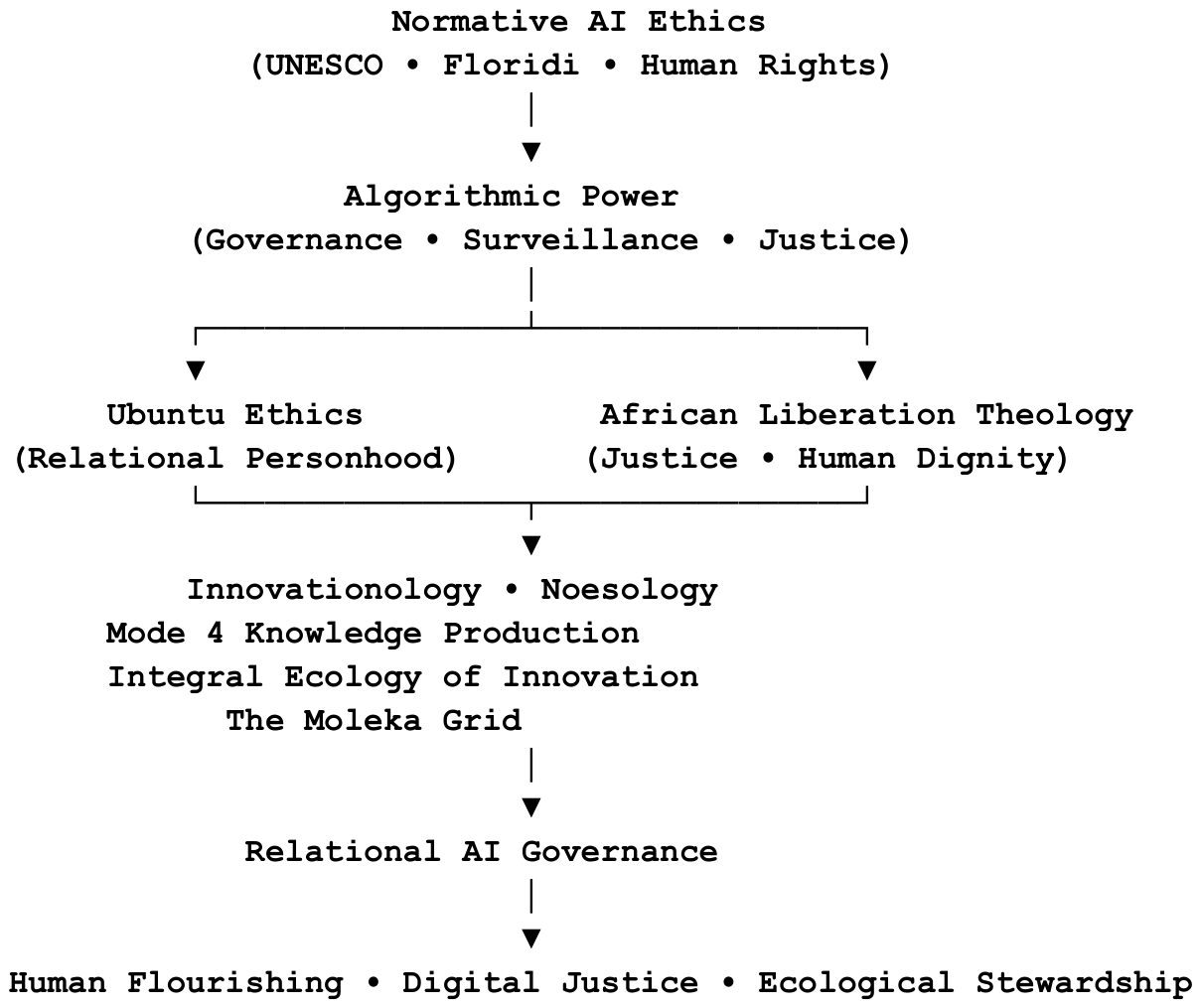
This figure synthesizes the article's central argument by illustrating how universal principles of AI ethics are enriched through African relational philosophy, liberation theology, and transformative theories of innovation to produce a model of Relational AI Governance.
This integrated framework serves as the analytical lens for the phenomenological methodology presented in the next section and guides the interpretation of participants' experiences of algorithmic power in contemporary African societies.
4. Methodology
This study employs Interpretative Phenomenological Analysis (IPA) to explore how African theologians and other key stakeholders make sense of the ethical implications of artificial intelligence in their lived and professional contexts. IPA is particularly appropriate because it seeks to understand how individuals interpret complex social phenomena while acknowledging that meaning is constructed through personal experience, cultural values, and social interaction (Smith et al., 2022). Rather than measuring attitudes quantitatively, the approach provides an in-depth examination of how participants perceive the relationship between artificial intelligence, human dignity, justice, and community.
The research is grounded in an interpretivist philosophical paradigm, which assumes that ethical understandings of AI are socially and culturally situated. This perspective recognizes that experiences of algorithmic technologies are shaped by historical realities, institutional contexts, and collective worldviews. Such an approach is especially relevant in African societies, where ethical reasoning frequently emphasizes relationality, communal responsibility, and social justice.
Purposive sampling was employed to recruit participants possessing direct knowledge of artificial intelligence and its societal implications. The study included African theologians engaged in public theology, civil society leaders working on digital rights and social justice, AI researchers involved in technological innovation, and advocates specializing in digital governance and human rights. This diversity of perspectives enabled a comprehensive exploration of AI ethics across theological, academic, technological, and civic domains.
Data were collected through semi-structured interviews conducted either face-to-face or via secure online platforms. The interview guide explored participants' perceptions of algorithmic decision-making, surveillance, human dignity, digital inequality, accountability, and the relevance of Ubuntu and liberation theology for AI governance. Open-ended questions encouraged participants to describe their experiences and reflect critically on the opportunities and ethical challenges associated with artificial intelligence.
Interviews were audio-recorded with participants' informed consent, transcribed verbatim, and anonymized to ensure confidentiality. Ethical approval was obtained from the relevant institutional review process before data collection commenced, and all participants provided voluntary informed consent consistent with internationally accepted principles for research involving human participants.
Data analysis followed the established stages of Interpretative Phenomenological Analysis. Individual transcripts were read repeatedly to identify significant statements, emerging meanings, and experiential patterns. These initial interpretations were subsequently refined into broader themes through an iterative process of comparison across participants while preserving the uniqueness of individual narratives. Reflexive memo writing accompanied each stage of analysis to enhance analytical transparency and reduce researcher bias.
The trustworthiness of the findings was strengthened through methodological triangulation across participant groups, member checking with selected participants, maintenance of an audit trail documenting analytical decisions, and continual reflexive engagement throughout the research process. These procedures enhanced the credibility, dependability, confirmability, and transferability of the findings while ensuring that participants' perspectives remained central to the interpretation.
5. Findings
The analysis revealed five interconnected themes that illuminate how African stakeholders understand the ethical implications of artificial intelligence. Although participants acknowledged AI's transformative potential for development, they consistently argued that technological innovation must remain subordinate to human dignity, social justice, and collective well-being.
5.1. Human Dignity Versus Algorithmic Reductionism
Participants expressed concern that algorithmic systems increasingly reduce individuals to data profiles, predictive scores, and behavioural categories. While recognizing the efficiency of automated decision-making, many argued that AI risks overlooking the complexity of human identity, moral agency, and social context. A theologian summarized this concern by stating, "A person is more than data. Technology should assist human judgment, not replace our humanity." For many participants, ethical AI requires preserving the intrinsic dignity of every individual regardless of technological capability.
5.2. Surveillance and Digital Domination
A second recurring theme concerned the expansion of digital surveillance. Participants viewed the growing collection of personal data by governments and technology companies as a significant ethical challenge, particularly where regulatory safeguards remain limited. Civil society representatives warned that AI-driven surveillance could reinforce political control, deepen inequalities, and weaken democratic accountability. An AI researcher observed, "Technology should protect citizens, not become a mechanism for monitoring every aspect of their lives." These perspectives reflected broader concerns about digital sovereignty and responsible governance.
5.3. Ubuntu as Resistance to Technological Individualism
Participants consistently contrasted African relational values with the individualistic assumptions embedded in many digital technologies. Ubuntu was described as an ethical framework that prioritizes mutual care, solidarity, and shared responsibility over technological efficiency alone. Several participants argued that AI systems designed without community participation risk undermining social cohesion and excluding vulnerable populations. One participant explained, "Technology should strengthen relationships instead of isolating people from one another." Ubuntu therefore emerged as a normative framework capable of guiding more inclusive and socially responsive AI governance.
5.4. Liberation Theology and Algorithmic Justice
Participants also interpreted artificial intelligence through the lens of justice and social transformation. They argued that algorithmic systems are never ethically neutral because they influence access to employment, education, healthcare, financial services, and public resources. Consequently, AI governance must address structural inequalities rather than focusing exclusively on technical performance or regulatory compliance. As one participant remarked, "Justice in the digital age means ensuring that technology serves those who are often left behind." This perspective extended liberation theology into contemporary debates on digital governance by emphasizing the moral responsibility to protect marginalized communities.
5.5. Innovation as Moral Stewardship
The final theme emphasized that innovation should be understood as a form of ethical stewardship rather than technological advancement alone. Participants viewed AI as a powerful instrument for improving healthcare, education, agriculture, environmental management, and public administration when developed within transparent and accountable governance systems. However, they stressed that innovation must remain oriented toward the common good and ecological sustainability. One participant concluded, "Innovation has value only when it enables people and communities to flourish together."
Collectively, these findings demonstrate that participants evaluate artificial intelligence primarily through relational, ethical, and justice-oriented perspectives rather than purely technical criteria. Their experiences suggest that effective AI governance in Africa requires integrating human dignity, community participation, social justice, and responsible innovation into the design and regulation of intelligent technologies.
6. Discussion
The findings of this study demonstrate that the ethical governance of artificial intelligence cannot be adequately addressed through technical regulation, institutional compliance, or risk-management frameworks alone. Although contemporary AI ethics literature has made significant progress in establishing principles related to transparency, accountability, fairness, human oversight, and the protection of fundamental rights, these approaches often remain grounded in individualistic and institutional assumptions about technology governance. The integration of Ubuntu philosophy, African liberation theology, Innovationology, Noesology, and ecological perspectives reveals the necessity of a more relational understanding of intelligence, technology, and social transformation.
Artificial intelligence should therefore not be understood merely as a collection of computational systems but as a socio-technical force embedded within cultural, political, economic, and ecological contexts. AI technologies influence how societies produce knowledge, distribute opportunities, exercise power, and imagine their collective futures. Consequently, AI governance requires more than controlling technological risks; it requires examining the relationships that shape technological development and determining whether these relationships promote justice, dignity, sustainability, and human flourishing.
The concept of Relational AI Governance developed in this article responds to this challenge by proposing that artificial intelligence must be governed as a relational phenomenon. Rather than focusing exclusively on the behaviour of algorithms, relational governance examines the interactions among humans, communities, institutions, knowledge systems, technologies, and ecological environments. This approach expands AI ethics from a framework primarily concerned with preventing harm into a transformative framework concerned with creating conditions for collective flourishing.
6.1. Comparison with UNESCO AI Ethics
The proposed framework shares important similarities with UNESCO’s Recommendation on the Ethics of Artificial Intelligence, particularly its emphasis on human rights, transparency, accountability, fairness, environmental sustainability, and human agency (UNESCO, 2021). UNESCO represents one of the most comprehensive global efforts to establish a universal ethical foundation for AI governance. However, the relational approach developed in this article argues that existing global frameworks, while essential, require further philosophical expansion to address historical inequalities, epistemic exclusion, and diverse cultural understandings of intelligence.
UNESCO’s framework primarily approaches AI ethics through the protection of individuals and societies from potential technological harms. The relational perspective complements this approach by introducing the idea of collective and interconnected dignity. From an Ubuntu perspective, dignity does not exist only as an individual possession but emerges through relationships between persons, communities, generations, and the natural environment. Consequently, ethical AI governance must ask not only whether algorithms respect individual rights but also whether technological systems strengthen social relationships, community resilience, and ecological balance.
This distinction is particularly significant for African contexts where questions of technological development are inseparable from histories of colonial extraction, unequal knowledge production, and developmental challenges. Relational AI Governance therefore extends UNESCO’s human-centred approach toward a more community-centred and ecologically embedded model.
6.2. Comparison with Floridi’s Philosophy of Information
The framework also engages with Luciano Floridi’s philosophy of information, particularly his argument that humanity increasingly exists within an “infosphere” where informational processes shape reality and generate new ethical responsibilities (Floridi, 2014). Floridi’s information ethics provides an important contribution by challenging narrow human-centred approaches and emphasizing the moral significance of informational environments.
However, Relational AI Governance introduces a different ontological emphasis. While Floridi conceptualizes reality through informational structures and argues for ethical consideration of informational entities, the present framework emphasizes relationships as the foundation of intelligence and ethical responsibility. Intelligence is not understood solely as information processing capacity but as the ability to participate meaningfully within networks of social, cultural, and ecological relationships.
This relational ontology resonates with Indigenous epistemologies that understand knowledge as situated, collective, and inseparable from responsibilities toward communities and ecosystems (Battiste, 2013; Kimmerer, 2013). Thus, while Floridi expands ethics beyond human-centred concerns through information ontology, Relational AI Governance expands AI ethics through relational ontology.
6.3. Contribution to Ubuntu Scholarship
This article contributes to Ubuntu scholarship by extending Ubuntu from interpersonal ethics into the governance of emerging technologies. Ubuntu has traditionally emphasized the relational nature of human existence, expressed through the principle that human identity is constituted through relationships with others (Mbiti, 1969; Ramose, 1999). However, contemporary digital societies increasingly experience relationships mediated by algorithmic systems, making AI governance a crucial domain for applying Ubuntu philosophy.
The relational interpretation proposed here suggests that AI should not be evaluated only according to efficiency, accuracy, or economic value but according to the quality of relationships it produces. Technologies that increase exclusion, surveillance, inequality, or social fragmentation contradict Ubuntu principles, whereas technologies that strengthen participation, cooperation, knowledge sharing, and collective empowerment align with relational ethics.
By introducing Ubuntu into AI governance debates, this study challenges the assumption that ethical AI must emerge exclusively from Western philosophical traditions. Instead, it demonstrates that African philosophical traditions provide conceptual resources capable of enriching global conversations about responsible technological futures.
6.4. Contribution to Liberation Theology
The integration of liberation theology introduces a critical perspective on power, inequality, and technological justice. Liberation theology has historically examined how social, political, and economic structures can reproduce oppression and has emphasized the transformation of unjust systems through solidarity with marginalized communities (Gutiérrez, 1973; Boff, 1995).
Applied to artificial intelligence, liberation theology raises fundamental questions about technological power. Who designs AI systems? Whose knowledge is represented in datasets? Which communities benefit from automation, and which communities experience exclusion? These questions reveal that AI governance is not only a technical challenge but also an ethical and political issue.
A liberation-oriented approach to AI therefore requires epistemic justice and technological participation. Communities historically excluded from technological innovation must become active participants in shaping AI futures. Relational AI Governance incorporates this perspective by arguing that ethical AI must contribute to empowerment, social justice, and human liberation rather than merely improving institutional efficiency.
6.5. Contribution to AI Governance Theory
The contribution of this article to AI governance theory lies in shifting the discussion from a regulatory model toward a relational and transformative governance model. Existing AI governance approaches generally emphasize standards, oversight mechanisms, accountability structures, and risk mitigation (Jobin, Ienca, & Vayena, 2019). These contributions remain necessary, but they do not fully address the deeper question of what kind of societies AI systems should help create.
Relational AI Governance argues that governance must consider the multiple relationships involved in technological development: relationships between humans and machines, between communities and institutions, between knowledge systems, and between technology and ecosystems. AI governance therefore becomes a question of organizing relationships responsibly rather than simply controlling technological outcomes.
This perspective is particularly relevant for emerging economies where AI adoption is connected to broader processes of development, sovereignty, and social transformation.
6.6. Contribution to Innovationology
The framework also contributes to Innovationology by redefining innovation as a relational and transformative process rather than merely a mechanism of economic competitiveness. Traditional innovation theories have frequently emphasized technological novelty, market performance, and organizational efficiency. Innovationology expands this understanding by examining how innovations reshape systems, institutions, knowledge structures, and human capabilities.
Within this perspective, artificial intelligence represents not simply a technological innovation but a transformative force capable of restructuring societies. The ethical evaluation of AI should therefore consider whether it enhances inclusive development, institutional resilience, ecological sustainability, and collective intelligence.
Relational AI Governance contributes to transformative innovation theory by proposing that responsible AI must generate value not only for organizations and markets but also for communities and ecosystems.
6.7. Contribution to Noesology
The integration of Noesology provides an epistemological foundation for understanding intelligence beyond computational reductionism. Contemporary AI discourse often defines intelligence through measurable computational performance, data processing, and predictive capacity. Noesology challenges this limitation by examining intelligence as a broader phenomenon involving meaning, interpretation, consciousness, values, and relational understanding.
From this perspective, AI governance must address not only what artificial systems can calculate but also what forms of knowledge and intelligence they promote. Algorithms inevitably reflect assumptions about reality, knowledge, and human priorities. Therefore, ethical governance requires attention to epistemic diversity and the recognition of multiple forms of intelligence.
Relational AI Governance introduces epistemic pluralism as a fundamental principle because sustainable technological futures require dialogue between scientific knowledge, Indigenous knowledge, cultural wisdom, and ecological understanding.
6.8. Contribution to Ecosystem Stewardship
Finally, this article contributes to ecological approaches to AI governance by emphasizing that artificial intelligence exists within planetary systems. AI infrastructures depend on energy consumption, mineral extraction, data centres, and material resources, creating environmental consequences that cannot be ignored (Crawford, 2021).
A relational ecological perspective views technology as embedded within Earth systems rather than separate from nature. Consequently, responsible AI governance must promote regenerative relationships between technological development and ecological sustainability.
The framework developed here therefore positions AI not as an autonomous technological revolution but as part of a broader human responsibility toward planetary stewardship.
7. The Relational AI Governance Framework
The principal theoretical contribution of this article is the development of the Relational AI Governance Framework (RAIGF). This framework proposes that artificial intelligence should be governed through a relational ontology that recognizes the interdependence between human dignity, social relationships, knowledge systems, technological infrastructures, and ecological environments.
Unlike conventional AI ethics models that primarily focus on controlling risks and ensuring compliance, Relational AI Governance seeks to transform the relationship between society and intelligent technologies. It argues that AI should function as a contributor to collective flourishing rather than as a mechanism that reinforces existing inequalities or extractive systems.
The first principle of this framework is human dignity. AI systems must preserve and enhance human flourishing by recognizing individuals as persons with social, cultural, and moral identities rather than reducing them to data profiles or economic resources.
The second principle is relational intelligence. Intelligence must be understood not only as computational ability but as a capacity emerging from relationships, cooperation, interpretation, and responsibility. AI should therefore support collective intelligence rather than replace or diminish human relational capacities.
The third principle is community participation. Communities affected by AI systems must participate in their design, evaluation, and governance. This principle challenges centralized technological decision-making and promotes democratic participation in shaping technological futures.
The fourth principle is algorithmic transparency. Transparency must extend beyond technical explainability to include social accountability. People and communities should understand how algorithmic systems influence decisions affecting their lives.
The fifth principle is epistemic pluralism. AI governance must recognize multiple knowledge traditions and encourage dialogue between scientific, Indigenous, cultural, and ecological knowledge systems.
The sixth principle is ecological responsibility. AI development must respect planetary boundaries and contribute to regenerative relationships between technology and the environment.
The seventh principle is transformative innovation. AI should be evaluated according to its ability to generate inclusive, sustainable, and regenerative transformation rather than merely technological efficiency.
Together, these seven principles establish Relational AI Governance as a new theoretical framework capable of connecting AI ethics with Ubuntu philosophy, liberation theology, Innovationology, Noesology, and ecological governance.
8. Policy Implications
The Relational AI Governance Framework has significant implications for policymakers, institutions, and social actors engaged in shaping the future of artificial intelligence. It argues that AI governance cannot be reduced to the creation of technical standards, regulatory mechanisms, or innovation strategies detached from social realities. Instead, effective governance requires an integrated approach that considers historical contexts, cultural values, ecological responsibilities, and the participation of affected communities.
For Africa, this perspective is particularly important because the adoption of artificial intelligence is occurring within contexts shaped by uneven technological development, infrastructural limitations, knowledge inequalities, and historical patterns of resource extraction. While AI presents significant opportunities for economic transformation, healthcare improvement, education, environmental management, and public administration, these benefits cannot be achieved without governance models that address questions of sovereignty, inclusion, and justice.
8.1. Implications for the African Union AI Strategy
The African Union’s emerging approach to artificial intelligence governance provides an important opportunity to develop a distinctive African contribution to global AI debates. Rather than simply adapting international AI governance models developed elsewhere, African institutions can incorporate indigenous philosophical resources, particularly Ubuntu, into continental AI strategies.
The Relational AI Governance Framework suggests that African AI policy should move beyond a purely developmental approach focused on technological adoption toward a transformative approach focused on building ethical, inclusive, and regenerative digital societies. AI sovereignty should not only concern ownership of infrastructure and data but also the ability of African societies to define the values, purposes, and knowledge systems guiding technological development.
An Ubuntu-inspired AI strategy would emphasize collective dignity, social participation, community empowerment, and ecological responsibility. This approach could enable African countries to contribute original perspectives to global AI governance rather than remaining primarily consumers of externally developed ethical frameworks.
8.2. Implications for National AI Governance
At the national level, governments require governance structures capable of balancing innovation with ethical responsibility. Many existing AI policy approaches prioritize economic competitiveness, digital transformation, and investment attraction. While these objectives are important, they must be complemented by mechanisms ensuring that AI contributes to social justice and sustainable development.
Relational AI Governance proposes that national AI strategies should integrate ethical impact assessments that evaluate not only technical risks but also social, cultural, and ecological consequences. Governments should establish participatory mechanisms allowing citizens, civil society organizations, researchers, Indigenous communities, and vulnerable populations to contribute to AI policy decisions.
Furthermore, national AI governance should address epistemic sovereignty by investing in local research capacity, African datasets, multilingual AI systems, and knowledge infrastructures that reflect the diversity of African societies. Without such efforts, AI systems risk reproducing external assumptions and reinforcing existing global inequalities in knowledge production.
8.3. Implications for Churches and Religious Institutions
Religious institutions, particularly churches in Africa, represent important actors in discussions about ethical technology because they have historically played significant roles in education, social development, community organization, and advocacy for justice.
The integration of liberation theology into AI governance suggests that churches should engage critically with technological transformation. Their role should extend beyond discussions of technological risks toward active participation in shaping humane technological futures.
Churches can contribute by promoting ethical reflection on AI, supporting digital literacy initiatives, defending marginalized communities affected by technological exclusion, and encouraging responsible innovation that serves human dignity. From a theological perspective, artificial intelligence raises fundamental questions about human identity, creativity, responsibility, and the meaning of progress.
A relational theological approach recognizes technology as part of human creativity while emphasizing that technological development must remain oriented toward service, solidarity, and the flourishing of creation.
8.4. Implications for Universities and Research Institutions
Universities have a central responsibility in developing the intellectual foundations necessary for ethical AI governance. The Relational AI Governance Framework calls for interdisciplinary research that brings together computer science, philosophy, theology, anthropology, social sciences, environmental studies, and Indigenous knowledge systems.
Higher education institutions should move beyond technical AI training toward programs that cultivate ethical reasoning, cultural awareness, and social responsibility among future AI researchers and professionals. This requires new forms of knowledge production capable of connecting technological expertise with broader questions of justice and sustainability.
Universities in Africa also have an important role in developing locally grounded AI research agendas. This includes creating African AI laboratories, strengthening computational capacity, developing context-sensitive datasets, and promoting research approaches that reflect African realities and priorities.
8.5. Implications for Civil Society
Civil society organizations play a critical role in ensuring that AI governance remains accountable to communities rather than being shaped exclusively by governments and corporations. The relational perspective emphasizes that citizens should not be passive recipients of technological change but active participants in determining technological futures.
Civil society actors can contribute through public education, advocacy, monitoring algorithmic impacts, and representing communities whose voices are often excluded from technological decision-making. In particular, organizations working on human rights, environmental justice, social inclusion, and community development can provide essential perspectives on the societal consequences of AI systems.
A relational governance approach therefore requires democratic engagement throughout the entire AI lifecycle, from design and deployment to evaluation and revision.
8.6. Implications for Technology Companies
Technology companies developing and deploying artificial intelligence systems must recognize that technological innovation is inseparable from social responsibility. The Relational AI Governance Framework challenges companies to move beyond voluntary ethical commitments toward deeper accountability structures.
Responsible AI development requires attention to data practices, algorithmic impacts, environmental costs, labour conditions, and the social consequences of automation. Companies should incorporate diverse perspectives into AI design processes and ensure that communities affected by their technologies have meaningful opportunities for participation.
The framework also encourages technology companies to redefine innovation success. Rather than measuring achievement only through market expansion, computational performance, or financial returns, companies should evaluate whether their systems contribute to inclusive prosperity, social trust, and ecological sustainability.
8.7. Implications for International Organizations
International organizations engaged in AI governance should recognize that global AI ethics requires epistemic diversity. Universal principles remain important, but universalism should not imply the dominance of a single philosophical tradition.
Organizations such as UNESCO, the United Nations, development agencies, and international research networks should create greater space for contributions from African philosophies, Indigenous knowledge systems, and other non-Western intellectual traditions.
Relational AI Governance provides a pathway toward a more pluralistic global AI governance architecture in which different civilizations contribute their ethical perspectives to shaping the future of intelligent technologies.
9. Conclusion
Artificial intelligence represents one of the most significant technological transformations of the twenty-first century, but its governance cannot be reduced to technical regulation alone. The challenges posed by AI are not exclusively computational; they are philosophical, ethical, political, ecological, and civilizational. As artificial intelligence increasingly influences knowledge production, economic systems, public institutions, and human relationships, societies require governance frameworks capable of addressing the deeper questions surrounding technological purpose and human flourishing.
This article has argued that existing AI ethics approaches, while valuable, remain insufficient when separated from broader questions of relationality, historical justice, epistemic diversity, and ecological responsibility. By bringing Ubuntu philosophy, African liberation theology, Innovationology, Noesology, and ecosystem stewardship into dialogue with contemporary AI governance debates, the study develops the concept of Relational AI Governance as a transformative theoretical framework.
Relational AI Governance challenges the assumption that intelligence should be understood primarily through computational capacity or technological autonomy. Instead, it proposes that intelligence is fundamentally relational, emerging through interactions among humans, communities, knowledge systems, technologies, and ecological environments. This perspective expands AI ethics from a framework focused primarily on preventing technological harm toward a framework oriented toward creating conditions for collective flourishing.
The framework’s seven principles—human dignity, relational intelligence, community participation, algorithmic transparency, epistemic pluralism, ecological responsibility, and transformative innovation—provide a foundation for rethinking how societies design, deploy, and govern intelligent technologies. These principles demonstrate that ethical AI is not simply a matter of making algorithms more accurate or accountable; it is a question of ensuring that technological systems contribute to justice, sustainability, and human development.
The African contribution to AI governance should therefore not be understood merely as an effort to apply global ethical standards within African contexts. Rather, African intellectual traditions possess important philosophical resources capable of reshaping global debates about the future of artificial intelligence. Ubuntu offers a relational understanding of personhood; liberation theology provides a critical perspective on technological power and justice; Innovationology offers a theory of transformative change; and Noesology expands understanding of intelligence beyond computational reductionism.
The future of AI governance requires a movement from technological domination toward technological stewardship. Artificial intelligence should become a tool for strengthening relationships, expanding human capabilities, protecting ecosystems, and enabling more equitable futures. In this sense, Relational AI Governance represents not only an ethical framework for artificial intelligence but also a broader vision of technological civilization grounded in dignity, solidarity, ecological responsibility, and sustainable human flourishing.
Rather than adapting African ethical traditions to existing AI frameworks, this article demonstrates that African philosophies and knowledge systems can actively contribute to redefining the global governance of intelligent technologies. The challenge ahead is not merely to create smarter machines, but to create wiser societies capable of guiding intelligence toward the common good.
References
- Battiste, M. Decolonizing Education: Nourishing the Learning Spirit; Purich Publishing: Saskatoon, 2013. [Google Scholar]
- Benjamin, R. Viral justice: How we grow the world we want; Princeton University Press, 2023. [Google Scholar]
- Boff, L. Ecology and Liberation: A New Paradigm; Orbis Books: Maryknoll, NY, 1995. [Google Scholar]
- Brokensha, S.; Kotzé, E.; Senekal, B. A. AI in and for Africa: A Humanistic Perspective; Chapman and Hall/CRC, 2023. [Google Scholar]
- Crawford, K. Atlas of AI: Power, Politics, and the Planetary Costs of Artificial Intelligence; Yale University Press: New Haven, 2021. [Google Scholar]
- Floridi, L. The Fourth Revolution: How the Infosphere is Reshaping Human Reality; Oxford University Press: Oxford, 2014. [Google Scholar]
- Floridi, L. The ethics of artificial intelligence; Oxford University Press, 2023. [Google Scholar]
- Freire, P. Pedagogy of the Oppressed; Continuum, 1970. [Google Scholar]
- Gutiérrez, G. A Theology of Liberation: History, Politics, and Salvation; Orbis Books: Maryknoll, NY, 1973. [Google Scholar]
- Jobin, A.; Ienca, M.; Vayena, E. The global landscape of AI ethics guidelines. Nat. Mach. Intell. 1 2019, 389–399. [Google Scholar]
- Kimmerer, R. W. Braiding Sweetgrass: Indigenous Wisdom, Scientific Knowledge and the Teachings of Plants; Milkweed Editions: Minneapolis, 2013. [Google Scholar]
- Mbiti, J. S. African Religions and Philosophy; Heinemann: London, 1969. [Google Scholar]
- Metz, T. Ubuntu and African ethics. In The Stanford Encyclopedia of Philosophy; Zalta, E. N., Nodelman, U., Eds.; 2023; Available online: https://plato.stanford.edu/.
- Moleka, P. Innovationology: A Groundbreaking Transdisciplinary Framework for Sustainable and Equitable Development in Africa. Int. J. Soc. Sci. Manag. Rev. 2024a, 7(5), 178–193. [Google Scholar]
- Moleka, P. The theology of innovation: Unveiling the divine spark in human creativity; Preprints, 2024b. [Google Scholar]
- Moleka, P. The Revolutionary Potential of Mode 4 Knowledge Production; Preprints, 2024c. [Google Scholar]
- Moleka, P. Integral ecology of innovation: Bridging spirituality, sustainability, and systems thinking; Preprints, 2024d. [Google Scholar]
- Moleka, P. Unlocking the innovation code: Towards a grand unified theory. SSRN 2025a. [Google Scholar] [CrossRef]
- Moleka, P. A New Epistemology of Intelligence: Rethinking Knowledge Through Noesology; Preprints, 2025b. [Google Scholar]
- Moleka, P. The Moleka Grid: An Ontological Diagnostic Framework for Systemic Transformation; Preprints, 2025c. [Google Scholar]
- Moleka, P. Ubuntu and sustainable cities in Africa. In The Palgrave Handbook of Ubuntu, Inequality and Sustainable Development; Springer Nature, 2025d; pp. 355–370. [Google Scholar]
- Moleka, P. Algorithmic Power and the Dialectics of Humanity: Artificial Intelligence, Capital, and the Reconfiguration of Social Totality. Int. J. Multidiscip. Humanit. Soc. Sci. 2026a, 2(2), 5–14. [Google Scholar] [CrossRef]
- Moleka, P. Leveraging AI and Innovationology to enhance human well-being through ecosystem stewardship. In The Palgrave Handbook of Ecosystems and Wellbeing; Springer Nature, 2026b; pp. 1–37. [Google Scholar]
- Moleka, P. Circular Bioeconomy and Regenerative Resource Systems. In The Palgrave Encyclopedia of Sustainable Resources and Ecosystem Resilience; Springer Nature, 2026c; pp. 1–20. [Google Scholar]
- Noble, S. U. Algorithms of Oppression: How Search Engines Reinforce Racism; New York University Press, 2018. [Google Scholar]
- Ramose, M. B. African Philosophy Through Ubuntu; Mond Books: Harare, 1999. [Google Scholar]
- Sarirete, A. A theoretical framework for analyzing civilizational trajectories in the twenty-first century: A scholarly monograph in comparative civilizational studies, geopolitical theory, critical spatial analysis, and planetary systems thinking 2026. [CrossRef]
- UNESCO. Recommendation on the Ethics of Artificial Intelligence; UNESCO: Paris, 2021. [Google Scholar]
- Vallor, S. The AI Mirror: How to Reclaim Our Humanity in an Age of Machine Thinking; Oxford University Press, 2024. [Google Scholar]
Disclaimer/Publisher’s Note: The statements, opinions and data contained in all publications are solely those of the individual author(s) and contributor(s) and not of MDPI and/or the editor(s). MDPI and/or the editor(s) disclaim responsibility for any injury to people or property resulting from any ideas, methods, instructions or products referred to in the content. |
© 2026 by the authors. Licensee MDPI, Basel, Switzerland. This article is an open access article distributed under the terms and conditions of the Creative Commons Attribution (CC BY) license (http://creativecommons.org/licenses/by/4.0/).
Copyright: This open access article is published under a Creative Commons CC BY 4.0 license, which permit the free download, distribution, and reuse, provided that the author and preprint are cited in any reuse.