

Submitted:
31 July 2026
Posted:
03 August 2026
You are already at the latest version
Abstract
Terraced houses remain the dominant and most widely inhabited housing type in Malaysia, yet their repetitive cellular organisation routinely produces a structural tension between market-standardised spatial layouts and the diverse, evolving practices of everyday domestic life. Over six decades of comparatively limited design innovation have reinforced this standardisation, making the terraced cell an undertheorised site of spatial negotiation. This article aims to describe the position of cellular operation in negotiating the living context of Malaysian terraced-house design. Employing a constructivist, qualitative multiple-case study methodology, the article examines three anonymised contemporary terraced-house cases (CSA, CSB and CSC) through desk review, semi-structured interviews, spatial observation and cross-case interpretation. Thematic data coding and analysis were conducted using ATLAS.ti and organised through the Thematic Analysis Matrix (TAM), a structured qualitative instrument for systematic thematic exposition. Typo-morphological diagramming was applied to spatially visualise operational, abstractive and estrangement dimensions of each case. Findings reveal that cellular operation is not merely a functional matter of plan efficiency; rather, it operates through the negotiation of thresholds, public–private gradients, domestic display, rear and central spatial layering, multigenerational accommodation, family care and gendered domestic practice. Across the three cases, the terraced cell emerges as an active medium through which occupants and designers exercise agency, enact choice, achieve perceived comfort and construct adaptive domestic meaning. The study argues that the living context of terraced housing is best understood as an operational relationship among practice, formality and situation, rather than as a predetermined arrangement of rooms. These findings contribute to housing-environment and domestic well-being research by demonstrating how modest spatial operations—without reliance on high-technology flexibility or extensive post-occupancy renovation—can support everyday well-being, agency and family life within constrained typological boundaries.
Keywords:
cellular operation
; terraced house
; housing environments
; domestic well-being
; Malaysian housing
; qualitative case study
; typology
; adaptive dwelling
; programmatic spatiality
; thematic analysis
1. Introduction
Housing environments shape human well-being through mechanisms that extend well beyond technical performance. The capacity of domestic space to support privacy, personal control, social interaction, family care, identity and everyday routines is now widely recognised in built-environment research as a primary mediator of mental health, life satisfaction and social experience [1,2]. Housing studies consistently demonstrate that improving physical conditions alone—through thermal comfort, structural repair or spatial enlargement—does not automatically produce well-being when residents lose meaningful control over their domestic environment [3]. It is the operational relationship between the spatial form of the home and the daily practices enacted within it that determines whether a dwelling supports or undermines inhabitants' quality of life [4].
In Malaysia, the terraced house occupies a uniquely significant position within this broader discussion. As the dominant, popular and most widely inhabited housing type in the country, the terraced house is both an architectural form and a social fact, reproducing itself through repetitive cellular attributes across every Malaysian city and suburb [5,6]. Its contemporary production, however, is largely governed by commodity logics and genotypical spatial conventions that limit formal innovation [7]. Research consistently identifies this as a paradox: despite six decades of limited major design change [8], terraced houses remain objects of strong demand, extensive modification and sustained aspiration among Malaysia's growing middle class. This tension between the fixed commodity cell and the dynamic practices of everyday life constitutes the central problematic addressed in this article.
The cellular unit of the terraced house—defined by its narrow frontage, deep floor plan, party-wall separation and front-to-back spatial sequences simultaneously a structural constraint and a site of creative domestic negotiation. Prior research has examined Malaysian terraced houses predominantly through the lenses of passive design performance, modification patterns and market preferences [9,10,11]. Far less scholarly attention has been directed to how the terraced cell itself, as a typological form, operates as a medium for everyday spatial practice and domestic well-being. This article addresses that gap.
This article examines how cellular operation in contemporary Malaysian terraced houses contributes to the negotiation of living context. It develops the concept of Terraced Programmatic Spatiality (TPS) as an analytical and generative framework grounded in the triangulated relationship among practice, formality and situation—a triadic spatial logic through which the terraced cell can be understood as a programmatic generator rather than a fixed functional model.
The central argument is that the terraced house cell should be interpreted as an operational device: a spatial unit whose well-being value emerges not from its room count or floor area but from the way occupants and designers negotiate thresholds, family practices, domestic performance and adaptive use. The article therefore asks: how does cellular operation contribute to the living context of Malaysian terraced-house design? In answering this question, the paper positions cellular operation as a conceptual bridge among housing typology, domestic practice and perceived well-being, and contributes to ongoing debates about how housing environments can be designed and theorised to support human flourishing within constrained spatial and economic boundaries.
2. Literature Review
2.1. Housing Environments and Domestic Well-Being
The relationship between housing environments and human well-being has attracted sustained scholarly attention across multiple disciplines. Evans's foundational review established that the built environment influences mental health through mechanisms of personal control, social support and restoration [1], while Bonnefoy demonstrated that inadequate housing is associated with a range of adverse health outcomes [2]. More recently, Riva et al. conducted a scoping review confirming that housing conditions—including dwelling type, spatial configuration and indoor environmental quality—have significant implications for mental health outcomes across OECD countries [12]. Clapham's conceptualisation of well-being within housing policy further emphasises subjective happiness, social identity and residents' own interpretive frameworks as crucial mediators that aggregate physical conditions cannot adequately capture [3].
The indoor spatial environment plays a particularly important role. Carmona's analysis of place quality established that the built environment influences health and well-being through social, economic and psychological pathways, including conditions of safety, legibility, adaptability and human-scale design [10]. Privacy, as both a psychological need and a spatial phenomenon, has been identified as a fundamental well-being determinant in domestic settings, with researchers demonstrating that the spatial configuration of the home significantly affects residents' capacity to achieve appropriate degrees of separation and togetherness [13,14]. A systematic literature review by Ramos et al. (2022) confirmed that inadequate housing design, combined with new forms of social interaction and pandemic-related confinement, has intensified the significance of privacy as a domestic spatial concern [14].
Studies focusing specifically on housing adaptability further reinforce the agency dimension of well-being. Residents who are able to modify, personalise and meaningfully inhabit their homes report higher levels of satisfaction, stronger senses of place attachment and greater domestic well-being [15,16]. Lawrence's comprehensive treatment of housing, dwellings and home placed the capacity for meaningful occupation—including cultural practices, gendered routines and intergenerational living—at the centre of what makes a dwelling a home rather than merely a shelter [17]. These perspectives collectively suggest that the physical attributes of a housing cell gain their well-being significance from the degree to which they can support diverse, meaningful and adaptive domestic practices.
2.2. Typological Theory and Terraced House Design
Typological theory provides the conceptual foundation for understanding how terraced houses function as both standardised market products and sites of domestic differentiation. Rapoport's influential work on house form and culture established that architectural types encode cultural values and social relations, functioning as interpretive frameworks through which households make sense of domestic space [4]. Habraken's support theory offered a procedural complement, arguing that mass housing should provide a structural 'support' capable of accommodating diverse 'infills' corresponding to residents' individual needs and preferences [18]. Alexander, Ishikawa and Silverstein's pattern language contributed further by describing domestic space in terms of recurring spatial relationships that respond to fundamental human needs [19].
Within architectural theory proper, Jacoby’s distinction between typal and typological reasoning illuminates the operative logic of the terraced house. The ‘type’, drawing on Quatremère’s foundational definition,is a generative formal principle—an internal logic that can be reinterpreted across instances—whereas a ‘model’ is a fixed formal exemplar to be replicated [20,21]. The Malaysian terraced house has functioned predominantly as a model, reproducing genotypical spatial conventions that restrict creative interpretation. The TPS framework argues that treating the terraced cell as a type—rather than a model—unlocks its potential as a programmatic generator capable of supporting diverse domestic arrangements [8].
The urban morphological tradition, articulated by Moudon, treats housing types as building blocks of urban form whose internal spatial logic evolves in response to social change and occupant agency [22]. This perspective aligns with empirical observations of Malaysian terraced housing, where modification and personalisation—driven by the inadequacy of standardised layouts to accommodate evolving household practices—have become culturally normalised responses to typological rigidity [9,11]. The extent of these modifications confirms, rather than refutes, the spatial intelligence embedded in the terraced cell: residents repeatedly demonstrate that the cell contains latent spatial potential that developers and designers have not yet systematically theorised or designed for [8].
2.3. Space Syntax, Domestic Configuration and Social Relations
Space syntax theory offers a precise analytical vocabulary for understanding how domestic spatial configuration encodes and reproduces social relations. Hillier and Hanson's seminal work demonstrated that spatial depth, access patterns and boundary conditions are not merely functional attributes of buildings but are structural mediators of social interaction, privacy and control [23]. Applied to domestic settings, their analysis showed that the arrangement of rooms within a dwelling—particularly the depth and sequence of spaces from the dwelling's public threshold to its most private interior—systematically shapes the social relations enacted within it. Hanson extended this analysis to housing specifically, demonstrating how the genotype of a dwelling—its deep spatial structure—encodes cultural values related to gender, family organisation and social presentation [24].
These insights are directly pertinent to the Malaysian terraced house, whose narrow, deep plan and highly structured front-to-back organisation establish a powerful spatial genotype. The dichotomy between front (public, formal) and rear (private, informal, service-oriented) domains, identified by Ioannidis (2005) as a defining characteristic of the terraced typology, reflects a modernist spatial logic that may no longer align with contemporary Malaysian household practices [9]. Research on the spatial logic of privacy in contemporary shared and domestic housing environments confirms that spatial configuration continues to play a decisive role in enabling or restricting residents' capacity for privacy management, domestic agency and meaningful spatial use [13].
2.4. Cellular Operation and Programmatic Potential
The concept of cellular operation, as theorised within the TPS framework, encompasses the set of spatial actions through which a terraced-house cell is activated, adapted, layered or reinterpreted in relation to daily living [8]. These operations may occur at the front threshold, rear extension, central family zone, staircase, void, kitchen, patio or any transitional space within the cellular boundary. Their well-being significance lies not in stylistic novelty or technical complexity but in how they alter the lived relationship between household practices and architectural form.
The distinction between a functionally organised home and a programmatically organised one is theoretically significant. As Koolhaas, Mau and colleagues articulated, a spatial programme is not merely a list of functions to be accommodated but an agenda that generates unexpected encounters, relationships and meanings between activities [25]. Applied to terraced housing, a programmatic approach moves beyond single-area specialisation—in which each room is designated to a fixed function—toward a polyvalent cellular logic in which spaces can sustain multiple meaningful interpretations [8,18]. Hertzberger's concept of polyvalence is directly relevant here: a polyvalent space does not require mechanical flexibility but spatial relationships that permit more than one meaningful occupation without necessitating physical modification [18].
The desire-based design framework, as articulated by Leitão (2022) and applied within the TPS framework, further enriches this theoretical position by situating the user’s agentic desire—their aspirational, open-ended pursuit of spatial meaning—as a productive design force rather than merely a reactive response to functional deficits [8]. This aligns with Lawrence’s insistence that housing well-being is constituted not only by safety and adequacy but by the ability to conduct valued practices and express domestic identity [17]. The present article examines how cellular operation operationalises these theoretical positions within the specific typological constraints of the Malaysian terraced house.
3. Materials and Methods
3.1. Research Design and Philosophical Positioning
This study is grounded in a constructivist epistemological paradigm. Constructivism proceeds from the premise that multiple, constructed realities co-exist and that the researcher’s interpretive role is constitutive of—rather than separate from—the knowledge produced [26]. This positioning is appropriate for research that seeks to interpret spatial meaning, domestic practice and lived experience rather than measure predictable variables or test a nomothetic model.
3.2. Multiple-Case Study Strategy
A qualitative multiple-case study strategy was employed, following Stake's [26] framework for bounded, analytically purposive case inquiry and Yin's [27] established protocols for design, data collection and cross-case analysis. The multiple-case design allows for replication logic: each case provides an independent analytical instance, and cross-case synthesis identifies patterns that transcend individual specificity while remaining grounded in contextual richness. The unit of analysis is the terraced-house cell as lived and modified through domestic practice—not the individual household or the neighbourhood context.
Three cases were selected, anonymised as CSA, CSB and CSC. Case selection was purposive and theoretically motivated, prioritising cases that demonstrated identifiable engagement with cellular operation and contemporary Malaysian middle-class domestic life based on the three distinct formation of terraced house performances particularly of the front, middle and back region (Figure 1). Selection criteria included: (1) the case being a contemporary local terraced house in Greater Kuala Lumpur; (2) documentary evidence of spatial personalisation or modification available through publicly accessible media (Instagram home tour platforms and published media features); (3) residents' willingness to participate in semi-structured interviews; and (4) spatial access for on-site observation. Purposive sampling of this kind does not aim for statistical representativeness but for analytical richness and theoretical transferability [26,27].
3.3. Data Sources and Collection
Multiple data sources were employed across each case to enable triangulation and strengthen the credibility of interpretations. The sources comprised: (a) desk review of architectural documentation, media presentations and Instagram home tour records; (b) semi-structured interviews with residents, conducted on-site; (c) spatial observations and researcher sketches; and (d) preliminary layouts decoded from photographic documentation. Interview questions were structured around the study’s central research question, exploring how residents understood, enacted and valued the spatial operations of their terraced cell in relation to everyday domestic life, family practice, comfort and identity.
On-site records were maintained through ten structured worksheets (WS1–WS10), following Stake's [26] case database protocol. Preliminary records (WS1–WS3) covered media documentation and initial layout analysis. On-site records (WS4–WS5) captured interview transcripts and observational sketches. Investigation records (WS6–WS10) documented assertion statements, typo-morphological diagrams and cross-case synthesis.
3.4. Analytical Process: TAM, Thematic and Typo-Morphological Analysis
The analytical process involved four sequential but iterative stages: content mapping, thematic analysis, typo-morphological analysis and cross-case synthesis.
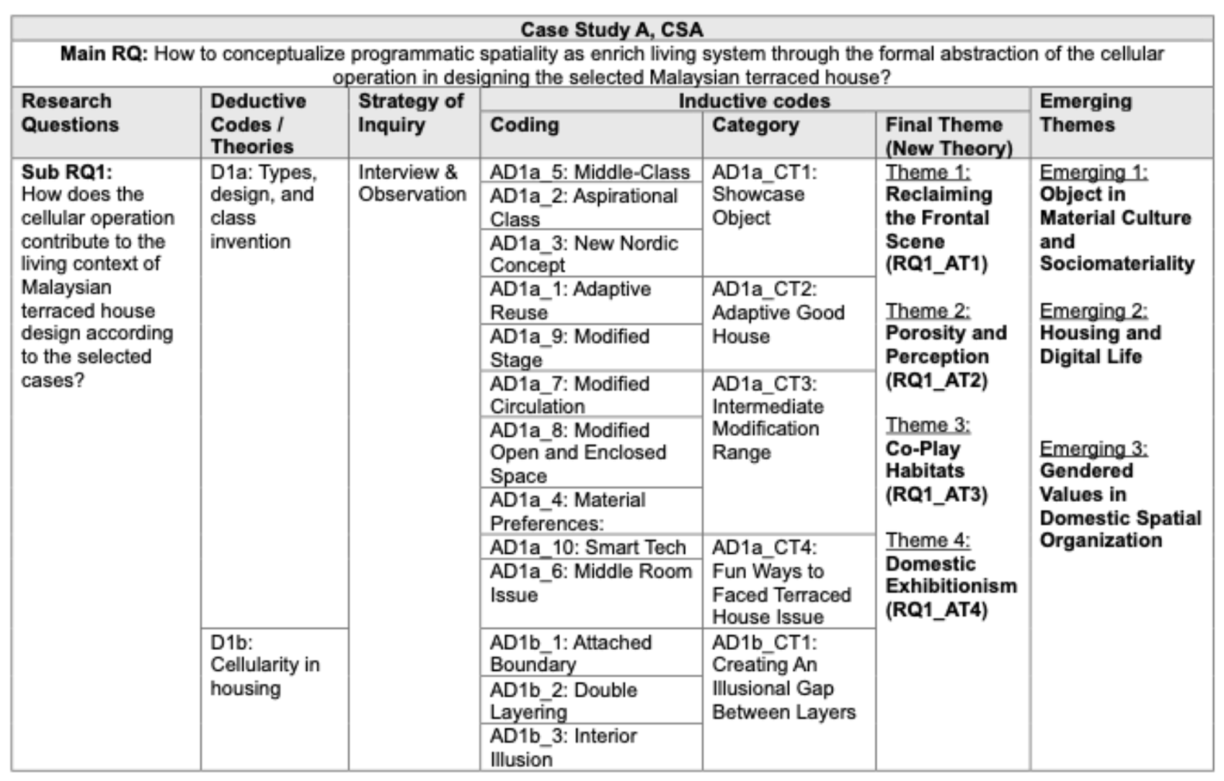
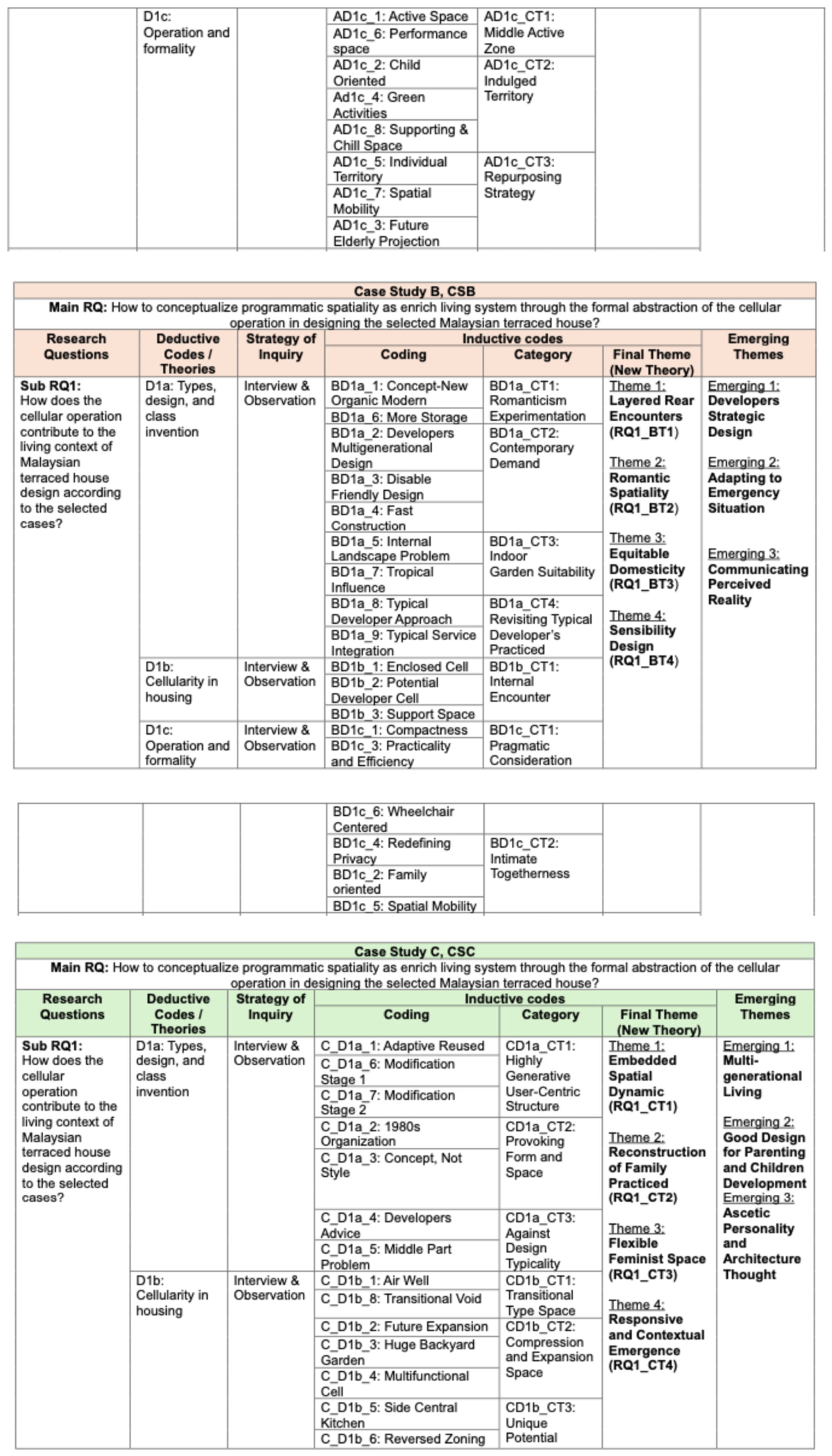
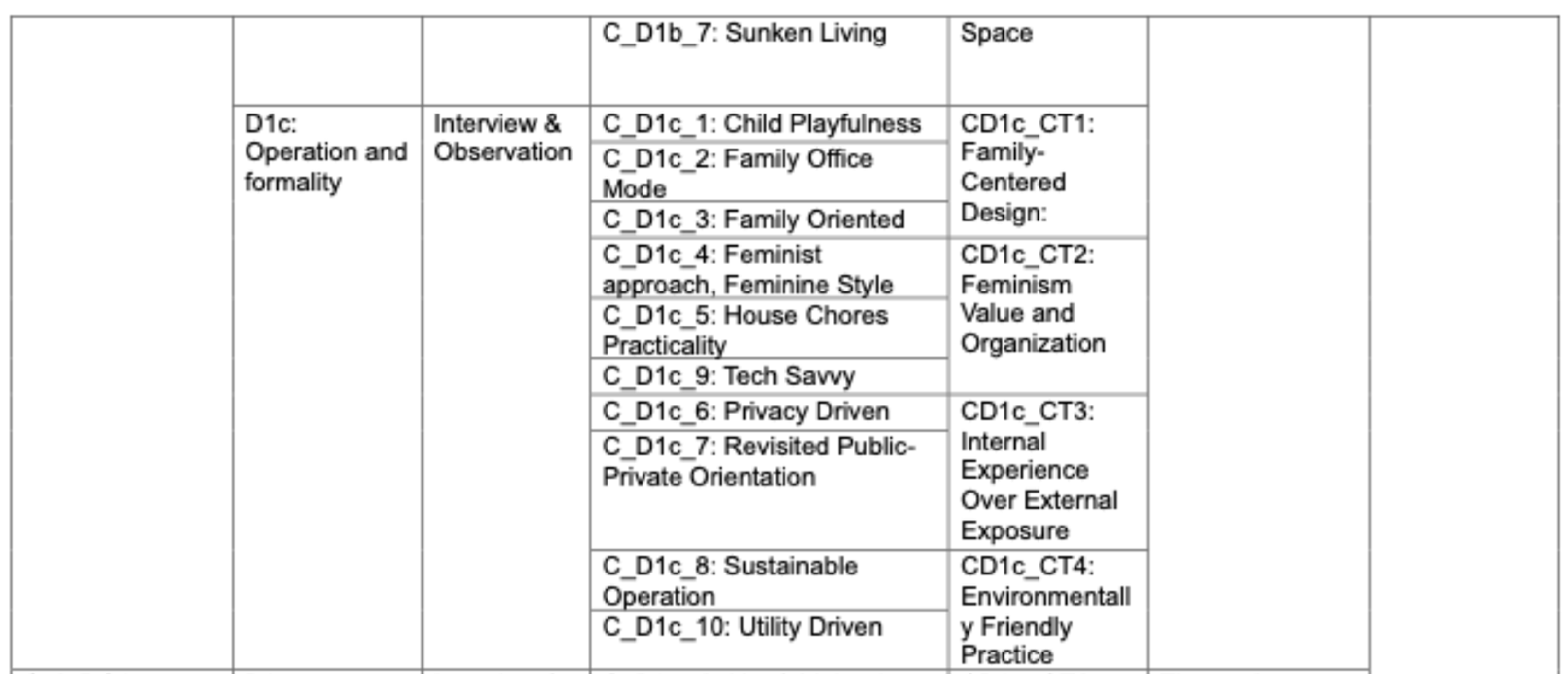
Thematic analysis was conducted following the six-phase framework of Braun and Clarke [28] and was implemented using ATLAS.ti software. The Thematic Analysis Matrix (TAM), developed by Zairul [29,30], was employed as the principal organisational instrument for systematic thematic exposition (Table 1). The TAM is a structured tabular framework that aligns research questions with deductive codes, inductive categories and emergent themes across data sources, ensuring rigour, transparency and traceability in qualitative theme development [30]. For each case, deductive codes derived from the theoretical framework (typological operation, threshold, formality, practice, situation) were applied alongside inductively generated codes arising from interview and observational data. Categories were developed by clustering semantically related codes, and themes were identified as the highest-order analytical units, each corresponding directly to a research sub-question.
Typo-morphological analysis was applied concurrently with thematic analysis to spatially visualise and validate thematic findings (Figure 2). This approach integrated three analytical registers: (A) operational interfaces—translating thematic operational content into morphological plan diagrams representing activity interfaces, spatial organisation and formal arrangement; (B) differential processes—mapping elements that creatively deviated from typological convention into sectional and plan diagrams, focusing on threshold articulation, micro-level lifestyle accommodations and unique formal elements; and (C) defamiliarisation processes—identifying estrangement effects through isometric projections (Figure 3) that revealed how specific formal elements deviated from their normative spatial context. The thematic typo-morphological integration establishes that qualitative themes in architectural research can and should be spatially visualised and experienced—not merely textually reported [8].
Cross-case analysis was subsequently conducted to determine the typal relations and ephemeral typological patterns between cases, seeking cellular spatial patterns that operated across all three cases. Trustworthiness was established through data triangulation, peer debriefing, member checking and expert review, consistent with Lincoln and Guba's [31] criteria of credibility, transferability, dependability and confirmability.

Table 2.
Methodological summary of the study design.
| Component | Operationalisation in this article |
| Research focus | The contribution of cellular operation to the living context of selected Malaysian terraced-house cases |
| Paradigm | Constructivist; qualitative, interpretive |
| Strategy | Multiple-case study [26,27] |
| Cases | Three anonymised contemporary local terraced-house cases: CSA, CSB and CSC, Greater Kuala Lumpur |
| Data sources | Desk review, semi-structured interviews, spatial observation, media documentation |
| Analysis tools | TAM [29,30], ATLAS.ti, thematic analysis [28], typo-morphological analysis, cross-case synthesis |
| Trustworthiness | Data triangulation, peer debriefing, member checking, expert review [31] |
| Output | Interpretation of how cellular operation supports agency, adaptability and domestic well-being |
4. Results
4.1. Cellular Operation as Negotiated Living Context: Cross-Case Overview
Thematic analysis and typo-morphological synthesis across all three cases reveal that cellular operation contributes to living context by transforming the terraced house from a fixed, commodified spatial product into a negotiated domestic system. In none of the three cases is the cell treated as a neutral container. Instead, the cell becomes an active setting through which residents manage visibility, privacy, family care, domestic identity, everyday movement and sensory comfort. Cross-case analysis confirms that these operational themes are distributed across the full depth of the terraced cell—from front threshold to rear extension—rather than confined to a single zone or type of renovation.
The TAM-organised thematic findings reveal a consistent underlying logic: cellular operation is driven by the residents' agentic desire to activate latent spatial potential within standardised typological constraints [8,29]. Each case foregrounds a different portion of the terraced cell as its primary operational domain, yet all three demonstrate that the cell can be read as a polyvalent medium capable of supporting multiple meaningful domestic interpretations simultaneously. CSA prioritises the frontal scene and public-facing threshold; CSB develops a rear-oriented domestic layer centred on the kitchen, dining and backyard; CSC reconstructs the central and middle zones as flexible, care-oriented spatial systems (Figure 4). Together, these operational emphases constitute a spatial gradient from front to rear that the cross-case synthesis maps as a cellular operational field, rather than a sequence of isolated room functions.
4.2. CSA: Reclaiming the Frontal Scene
4.2.1. Thematic Findings
CSA demonstrates how the front portion of the terraced house—conventionally reduced to a porch setback or a parking apron—can be reinterpreted as a rich threshold zone mediating between public street and private home. TAM-derived themes for CSA include: Reclaiming the Frontal Scene, Porosity and Perception, Co-Play Habitat and Domestic Exhibitionism (Figure 4). These themes collectively describe a spatial strategy in which the front of the house is activated as a zone of controlled social encounter, domestic identity display and children's play—a three-dimensional threshold rather than a leftover setback.
The occupants of CSA did not accept the standard front boundary condition of the terrace type but actively reinterpreted it through material choices, spatial arrangements and programmatic decisions. Frontal activities were deliberately extended into the porch and transitional zone, creating a 'co-play' field in which the movement of children, adults and occasional visitors overlaps across living, dining, patio and outdoor areas. This operation produces what the TAM analysis codes as 'integrated clarity'—a spatial condition in which the boundary between inside and outside is permeable but legible, enabling occupants to exercise conscious control over degrees of exposure and enclosure.
4.2.2. Typo-Morphological Analysis
The operational interface diagram (Protocol A) for CSA maps the frontal concentration of activities (codes 1A-5, 1A-6) and the permeability gaps that mediate inside-outside relations (codes 1A-7). Play nodes (1A-9), play tracks (1A-10) and exhibition zones (1A-12) articulate the spatial circuit through which the co-play operation is enacted. The differential process diagram (Protocol B) identifies experiential set strategy (2A-2b) with modular intervention (2A-3b) as the formal devices through which typological convention is creatively deviated. The defamiliarisation diagram (Protocol C) reveals irrational and pleasurable encounters (3A-15, 3A-17) operating as cross-atmospheric spatial situations that render familiar front zones unfamiliar and spatially generative. These morphological findings confirm and spatially ground the thematic interpretation (Figure 5).
4.2.3. Living-Context Contribution
CSA contributes to living context through the well-being mechanisms of spatial agency, domestic identity and controlled social exposure. By reinterpreting the front threshold as a zone of domestic expression and co-play, the occupants transform a potentially residual zone into a meaningful spatial resource that supports children's play, family interaction, social presentation and a sense of spatial confidence. This aligns with the conceptualisation of well-being as encompassing not merely safety and comfort but the capacity for meaningful social performance and identity expression within the domestic environment [3,10,17].
4.3. CSB: Layering the Rear Domestic Environment
4.3.1. Thematic Findings
CSB presents a narrative of the rear as a site of primary domestic significance. TAM-derived themes include: Layered Rear Encounters, Romantic Spatiality, Equitable Domesticity and Sensibility Design. These themes describe how the back portion of the terraced house—conventionally a zone of service, laundry and waste—is reinterpreted as a layered environment for family encounter, practical care, sensory pleasure and equitable domestic life.
The occupants of CSB extended the meaning of the kitchen, dining area, laundry zone and backyard into a coherent rear domestic landscape rather than a residual service zone. The operation of the rear is strategic: accessibility and ease of movement are embedded within the spatial arrangement, accommodating multigenerational domestic needs without requiring expensive structural modification. The TAM analysis codes this as 'equitable domesticity': a spatial strategy that distributes domestic utility and comfort in ways that respond to the diverse capacities and needs of household members—including children, adults and elderly family members.
4.3.2. Typo-Morphological Analysis
The operational interface (Protocol A) defines a romanticizing framing of its layered segment, which is highly sensitive towards the rear end (1B-5, 1B-7). Such a connotation provides unique abstraction whereby the differential diagrams (Protocol B) for CSB identify quasi-spontaneous flexibility (2B-6a) and planning in quasi-spontaneous flexibility (2B-6b) as the primary formal abstractions through which typological deviation occurs. The vacant quality of non-functional transitional spaces—deliberately left unspecified to accommodate future domestic change—is identified as a key programmatic device. The defamiliarisation diagrams (Protocol C) reveal subversive domesticity operations in which the rear zone (3B-9, 3B-10), divorced from its normative service designation, acquires new spatial legitimacy as a centre of domestic life. The typo-morphological series confirms that CSB's rear domestic layer is not informal or makeshift but a consciously designed spatial strategy that reframes adaptation as a design value (Figure 6).
4.3.3. Living-Context Contribution
CSB's primary living-context contribution is the valorisation of the rear as a site of domestic comfort, family care and multigenerational accommodation. By treating the kitchen-dining-backyard relationship as a layered spatial system rather than a hierarchy of functions, the occupants produce a domestic environment in which practical care, family proximity and sensory pleasure coexist. This is directly relevant to well-being frameworks that identify multigenerational adaptability, ease of movement and domestic practicality as core dimensions of housing quality [3,12,14].
4.4. CSC: Reconstructing Family Practice Through the Cell
4.4.1. Thematic Findings
CSC presents the terraced cell as a family-orchestrating system. TAM-derived themes include: Embedded Spatial Dynamic, Reconstruction of Family Practice, Flexible Feminist Space and Responsive Contextual Emergence. These themes describe how the central and kitchen-related zones are reorganised around family care, maternal visibility, child supervision and practical household management. The case is explicitly oriented around a rationalist, minimalist aesthetic—characterised by the occupant as resonating with the concept of 'zuhd' (contentment with simplicity)—which operates as a design principle rather than merely a stylistic preference.
The term 'flexible feminist space' is employed cautiously and analytically to describe how CSC's design acknowledges women's practical spatial authority, surveillance needs, care labour and household decision-making. This does not reduce the home to a gendered stereotype but recognises that domestic well-being is shaped by who performs care work, who requires visibility and how household routines are spatially supported. The cabinetry organiser system at the lounge-entry zone, designed as a compartmentalised station for children's school-related routines, exemplifies this: it spatialises the logic of care labour into an architectural device rather than leaving it to improvised furniture arrangement.
4.4.2. Typo-Morphological Analysis
The thematic findings (Protocol A) leverage family operation (1C-5) into domestic practice centered on the flexi zone (1C-12), thus exposing a unique integration between parallel spaces (1C-7, 1C-11) (Figure 7). The differential diagrams (Protocol B) for CSC reveal fractured reality operations in which the central domestic zone is reconstructed through environmental reciprocity that caters to inside-outside abstraction (2C-2c) and system synthesis (2C-3c). The temporal neutrality theme (2C-4d) contributes an important typological dimension: CSC's resistance to fleeting trends—manifested through geometric reduction, muted tonal palettes, and the abstracted reinterpretation of nostalgic forms—embeds a durable spatial logic that transcends particular moments of domestic life. Isometric projections of the defamiliarization process (Protocol C) confirm that the cell operates as a systemic whole rather than a sum of discrete room-functions, with skylights, cross-ventilation axes and cabinetry systems functioning as integrated spatial devices that produce the estranged conditions. Such conditions manifest a fractured axis (3C-11), a liminal effect (3C-16), and a sentimental ambience (3C-17), which corroborate the thematic analysis.
4.4.3. Living-Context Contribution
CSC's primary contribution to living context is the articulation of a care-oriented spatial geography within the constraints of the terraced cell. By foregrounding maternal visibility, family proximity, child supervision and environmental integration as design principles, CSC demonstrates that a modest terraced house can function as a spatially sophisticated family-care system—without high-technology intervention or structural alteration. This aligns with well-being research emphasising the importance of family proximity, care support, personal control and meaningful domestic practice as determinants of housing well-being [1,3,12,17].
Table 3.
Cross-case summary of cellular operational findings.
| Case | Primary Operational Emphasis | Living-Context Contribution | Well-Being Relevance |
| CSA | Front threshold, porosity, display and co-play | Reclaims the front as a zone of social negotiation and domestic identity expression | Agency, play, controlled exposure and household expression |
| CSB | Rear layering, kitchen/dining relation, accessibility and multigenerational accommodation | Turns service and back spaces into meaningful family care and comfort environments | Comfort, multigenerational use, ease of movement and daily practicality |
| CSC | Central family orchestration, maternal visibility and flexible feminist domesticity | Reconstructs the terraced cell as an integrated care-oriented spatial system | Supervision, family proximity, gendered care support and adaptable routines |
5. Discussion
5.1. Cellular Operation as a Triadic Mechanism: Practice, Formality and Situation
The cross-case findings confirm that cellular operation contributes to living context through three interrelated mechanisms: practice, formality and situation. Practice refers to the activities, habits, care relations, aspirations and social performances enacted by residents within the terraced cell. Formality refers to the spatial configuration, boundary condition, threshold articulation, section, material organisation and typological structure of the cell as a built form. Situation refers to the specific contexts—front, back, middle, public, private, family-oriented, neighbourhood-adjacent—within which the cell is activated and experienced. These three dimensions, which form the triangulated core of the TPS framework [8], are not sequential or hierarchical; they are mutually constitutive.
This triadic model resonates with and extends several established bodies of housing and well-being literature. Lawrence's framework of housing as a social and cultural product identified the mutual constitution of spatial form, social relations and cultural practice as the defining characteristic of the home [17]. Hillier and Hanson's space syntax theory demonstrated that formal spatial organisation encodes social practice rather than merely accommodating it [23], a dynamic that the present study's typo-morphological findings confirm at the scale of the individual terraced cell. Lefebvre's theorisation of space as simultaneously conceived, perceived and lived [32] provides a broader philosophical context within which practice, formality and situation operate as the spatial equivalents of his triadic spatial categories.
The novelty of the present study's contribution lies in operationalising this triadic relationship at the level of the terraced house cell—a constrained typological unit—and demonstrating that even within the narrow formal limits of the Malaysian terraced house, the triadic operation produces significant spatial differentiation and well-being value. CSA's frontal operation, CSB's rear layering and CSC's central orchestration each represent a different spatial expression of the same triadic logic, confirming both its analytical robustness and its transferability across diverse domestic contexts.
5.2. Agency, Polyvalence and the Programmatic Potential of the Terraced Cell
A consistent finding across all three cases is that cellular operation supports resident agency—the capacity to exercise meaningful spatial choices, adapt the home to changing household needs and construct a domestic environment that reflects personal values and aspirations. This finding resonates strongly with Clapham's [3] argument that housing well-being is fundamentally a question of residents' capacity to realise their own goals and interpretive frameworks within the domestic environment, rather than an objective function of physical housing standards. It also aligns with Leitão's [8,33] desire-based design framework, which positions agentic desire—the resident's aspiration to activate spatial potential beyond functional need—as a productive design force.
The concept of polyvalence, as theorised by Hertzberger and applied in the TPS framework, emerges as the key spatial mechanism through which cellular operation produces agency [8]. A polyvalent cell does not require mechanical flexibility or structural modification; it requires spatial relationships that permit more than one meaningful domestic interpretation within its existing form. CSA's front zone accommodates display, play, supervision and controlled social encounter simultaneously. CSB's rear zone accommodates cooking, dining, family gathering, and outdoor relaxation as overlapping rather than mutually exclusive activities. CSC's central zone accommodates family supervision, homework management, informal gathering, storage and environmental regulation as integrated functions within a single spatial system. These findings confirm that polyvalence can be achieved through the considered articulation of thresholds, openings, levels, material conditions and spatial sequence—without necessitating the expensive and technically complex flexible systems that characterise high-end residential design [8].
This is a significant finding for Malaysian housing policy and practice. If terraced houses continue to be designed as fixed commodity cells—in which spatial value is determined by room count and floor area—residents will continue to modify, extend and renovate at personal expense, often in ways that compromise structural integrity or regulatory compliance [9,11]. If, however, designers treat cellular operation as a primary design principle—embedding polyvalent thresholds, adaptable rear layers, visible family zones and spatially rich transitional areas into the initial design—future terraced houses can be planned to support greater domestic agency without requiring extensive post-occupancy modification [8].
5.3. Well-Being Dimensions of Cellular Operation
The present study's findings engage specifically with several well-being dimensions identified in the broader literature. Privacy and personal control—consistently identified as primary mechanisms linking housing to well-being [1,3,13,14]—are supported in all three cases through the nuanced negotiation of thresholds, boundaries and visibility. CSA's frontal porosity provides controlled exposure rather than either full transparency or full enclosure, enabling the occupants to manage social interaction at the front threshold. CSB's rear layering provides graduated privacy across the kitchen-dining-backyard continuum, supporting domestic care activities without subjecting them to unwanted external visibility. CSC's environmental reciprocity—achieved through skylights, louvred openings, an indoor pocket garden and strategic positioning of transparent surfaces—integrates natural light and ventilation while maintaining the domestic enclosure necessary for family privacy.
The multigenerational dimension of well-being—encompassing the spatial needs of children, adults, elderly household members and anticipated future occupants—emerges as a significant cross-case theme that resonates with recent research on housing adaptability and ageing-in-place [12,16]. CSA's double-access configuration, CSB's non-functional vacancy and CSC's concrete flat surface are three distinct spatial provisions that share the same underlying logic: anticipatory polyvalence, or the deliberate provision of spatial openness that can accommodate future household change without requiring structural alteration. This finding challenges the prevailing model of Malaysian terraced housing design, in which multigenerational accommodation is treated as an exceptional condition requiring post-occupancy renovation rather than an ordinary design parameter to be embedded from the outset [8,9].
Gendered dimensions of domestic well-being—long recognised in housing studies but less systematically addressed in typological research—are given particular prominence in CSB and CSC. CSB's equitable domesticity reframes the kitchen and rear zone as the spatial core of the home rather than its residual service periphery, a reframing that materially improves the well-being of household members whose primary domestic activities are concentrated in these spaces. CSC's flexible feminist space articulates the maternal gaze—the need for visual access across the home for simultaneous supervision of children, management of household routines and personal activity—as a legitimate and spatialisable design parameter. These findings extend and ground the existing literature on gendered domestic space [8,34] by demonstrating how specific cellular operations can be designed to support equitable domestic life within typological constraints.
5.4. Implications for Malaysian Housing Policy and Design Practice
The findings carry practical implications for Malaysian housing policy and design practice. The National Housing Policy 2018–2025 identifies the absence of design innovation as a critical challenge in Malaysian housing [8]. The present study suggests that design innovation need not require disruptive technological systems or large-scale typological departure. Instead, a more immediate and cost-effective pathway exists through the systematic articulation of cellular operation as a design principle—embedding polyvalent thresholds, care-oriented spatial systems and adaptable rear zones within the existing typological framework of the terraced house.
Developers, whose design decisions are primarily shaped by cost efficiency and market demand, can benefit from the finding that polyvalent cellular organisation does not require expensive construction methods or high-tech flexible systems. Zairul's [8,35] 'standardise-customise' strategy—which advocates designing within the familiar typological language of the terraced cell while embedding spatial potential for user customisation—offers a commercially viable pathway toward greater domestic well-being that does not conflict with the economic logic of mass housing production.
For design practitioners, the triadic framework of practice–formality–situation provides a structured analytical and generative tool for terraced-house design. Rather than optimising for room count, floor area or passive performance metrics alone, designers can evaluate and develop cellular configurations according to the operational potential they offer: the degree to which threshold conditions support controlled social encounter, the extent to which rear zones accommodate multigenerational care, the capacity of central zones to support family supervision and adaptive use, and the overall polyvalence of the spatial system as a whole.
6. Design Implications
Drawing on the cross-case findings and their theoretical grounding, the following design implications are proposed for Malaysian terraced-house design practice:
First, front thresholds should be designed as active spatial mediators rather than residual setbacks. The front zone of the terraced cell can be articulated to support controlled sociability, children's play, domestic identity display and graduated transitions between street and home. Porous boundaries, level changes, planting strategies and material variation can all be employed to differentiate the threshold without compromising enclosure.
Second, rear zones should be valorised as potential centres of domestic life rather than designated purely as service areas. Kitchens, dining areas, laundry zones and backyards can be integrated into a layered domestic landscape that supports comfort, care, family interaction and multigenerational practicality. The spatial depth and section of the rear zone offer particular opportunities for environmental integration—cross-ventilation, natural light and indoor-outdoor connection—that improve both environmental performance and domestic well-being.
Third, terraced-house cells should incorporate adaptable central and transitional zones capable of supporting family supervision, shared activity, work-from-home practices and flexible household routines. These zones—neither fully public nor fully private—may represent the most significant well-being resource within the terraced cell, offering spatial opportunities for the overlapping activities of diverse household members.
Fourth, accessibility and multigenerational accommodation should be embedded as ordinary design parameters from the initial stage of design, rather than treated as exceptional conditions addressed through post-occupancy modification. Spatial vacancy—deliberately unspecified transitional zones—offers a cost-effective mechanism for anticipatory polyvalence.
Fifth, and overarchingly, the terraced cell should be designed for polyvalence: spatial relationships that permit multiple meaningful interpretations without requiring physical alteration. This requires design attention to threshold conditions, spatial depth sequences, boundary articulation and section—the fundamental formal attributes of the cell—rather than merely to room designations and floor-area calculations.
7. Limitations and Future Research
Several limitations of the present study warrant acknowledgement. The scope of the study is focused on the cellular operation dimension of Malaysian terraced-house design; it does not extend to formal abstraction, situational estrangement or comprehensive framework formulation at the full typological scale, which represent directions for subsequent investigation. The well-being interpretation is qualitative and spatial, grounded in how the selected cases demonstrate agency, adaptability, care, comfort and domestic meaning, rather than in quantitative well-being measurement.
The three cases, while analytically rich, are not statistically representative of the full population of Malaysian terraced houses. They are contemporary, middle-class cases located in Greater Kuala Lumpur, and the findings may not be directly transferable to different income groups, regional contexts, development periods or household compositions. The purposive selection ensures theoretical richness but limits the scope of empirical generalisation.
Future research should test the cellular operation framework across a wider range of Malaysian terraced houses, including different income categories, ethnic compositions, development periods and geographic regions. A mixed-methods extension combining spatial analysis, post-occupancy evaluation and validated well-being instruments would strengthen the empirical evidence base for the relationship between cellular operation and measurable well-being outcomes. Emerging thematic directions identified through the cross-case analysis—including gendered domestic transformation, resilience and proactive design, and the evolving domestic sphere—offer productive directions for housing research. Additionally, comparative research examining cellular operation in other Southeast Asian housing types would advance the transferability of the TPS framework beyond its current Malaysian context.
8. Conclusions
This article has examined cellular operation as the primary mechanism through which the living context of Malaysian terraced-house design is negotiated and constructed. The central conclusion is that cellular operation contributes to the living context of Malaysian terraced-house design by enabling meaningful negotiation between standardised typological form and the diverse, evolving practices of everyday domestic life.
Across three analytically rich cases—CSA, CSB and CSC—the terraced cell operates through front threshold agency, rear domestic layering and central family orchestration. These operational strategies, analysed through the Thematic Analysis Matrix (TAM) and spatially grounded through typo-morphological diagrams, support conditions directly associated with domestic well-being: privacy control, family proximity, domestic identity, adaptive use, multigenerational accessibility and care. The triadic framework of practice, formality and situation provides an analytically robust and practically applicable model for understanding how cellular operation produces living context and well-being value within typological constraints.
The Malaysian terraced house should therefore not be understood solely as a repetitive housing commodity whose value is determined by room count and floor area. It can also be understood as a negotiated living environment whose well-being potential depends fundamentally on the operational capacity of the cell to support multiple meaningful domestic interpretations. This reframing has implications for housing design practice, developer strategy and policy—suggesting that design innovation in Malaysian terraced housing is achievable not through disruptive technological systems but through the systematic cultivation of cellular polyvalence, threshold porosity, care-oriented spatial organisation and anticipatory adaptability within the existing typological framework.
Author Contributions
Conceptualization, M.Z. and M.F.K.; methodology, M.F.K. and M.Z. formal analysis, M.F.K.; investigation, M.F.K.; resources, M.Z..; data curation, M.F.K.; writing—original draft preparation, M.F.K. and M.Z.; writing—review and editing, M.Z.; visualization, M.F.K.; supervision, M.Z. All authors have read and agreed to the published version of the manuscript.
Funding
This research was supported by the Ministry of Higher Education Malaysia (MoHE) and Universiti Teknologi MARA (UiTM) through the SLAB/SLAI scholarship, and by Geran Inisiatif Putra Siswazah 2024, School of Graduate Studies, Universiti Putra Malaysia.
Institutional Review Board Statement
The study was conducted in accordance with the Declaration of Helsinki and approved by the Ethics Committee for Research involving Human Subjects of Universiti Putra Malaysia (JKEUPM) (Reference No.: JKEUPM-2024-465, approved on 13 September 2024).
Informed Consent Statement
Informed consent was obtained from all interview participants prior to data collection, in accordance with the ethical procedures governing this study.
Data Availability Statement
The data supporting the findings of this study are available from the corresponding author upon reasonable request, subject to participant consent and institutional requirements.
Conflicts of Interest
The authors declare no conflict of interest.
References
- Evans, G.W. The built environment and mental health. J. Urban Health 2003, 80, 536–555. [Google Scholar] [CrossRef] [PubMed]
- Bonnefoy, X. Inadequate housing and health: An overview. Int. J. Environ. Pollut. 2007, 30, 411–429. [Google Scholar] [CrossRef]
- Clapham, D. Happiness, well-being and housing policy. Policy Polit. 2010, 38, 253–267. [Google Scholar] [CrossRef]
- Rapoport, A. House Form and Culture; Prentice-Hall: Englewood Cliffs, NJ, USA, 1969. [Google Scholar]
- Hung, C.C.; Hoe, Y.W. Terrace Transformations in the Tropics; Universiti Malaya Press: Kuala Lumpur, Malaysia, 2021. [Google Scholar]
- Rahim, F.A.; Hashim, R. Terrace house design and residents' satisfaction in Klang Valley, Malaysia. Int. J. Built Environ. Sustain. 2012, 1, 14–23. [Google Scholar]
- Aureli, P.V. The minimal dwelling and its discontents. Log 2023, 57, 5–14. [Google Scholar]
- Kholid, M.F.; Zairul, M. Terraced Programmatic Spatiality: A design framework for Malaysian terraced house design. Int. J. Archit. Res. 2026. [Google Scholar] [CrossRef]
- Ioannidis, K. The spatial genotype of the Malaysian terraced house. Archit. Sci. Rev. 2005, 48, 71–82. [Google Scholar]
- Carmona, M. Place value: Place quality and its impact on health, social, economic and environmental outcomes. J. Urban Des. 2019, 24, 1–48. [Google Scholar] [CrossRef]
- Omar, S.A.; Yaman, S.K.; Khoiry, M.A.; Hamzah, N. Issues in Malaysian terraced house design: A review. Pertanika J. Soc. Sci. Humanit. 2016, 24, 1–14. [Google Scholar]
- Riva, A.; Rebecchi, A.; Capolongo, S.; Gola, M. Can homes affect well-being? A scoping review among housing conditions, indoor environmental quality, and mental health outcomes. Int. J. Environ. Res. Public Health 2022, 19, 15975. [Google Scholar] [CrossRef] [PubMed]
- Morán-Laorden, A.; Claramunt, M.; Verd, J.M. The spatial logic of privacy: Uncovering privacy patterns in shared housing environments. Buildings 2025, 15, 3532. [Google Scholar] [CrossRef]
- Ramos, N.M.M.; Almeida, R.M.S.F.; Simões, M.L.; Rebelo, F.; Correia, A. Privacy and housing: Research perspectives based on a systematic literature review. J. Hous. Built Environ. 2022, 37, 653–683. [Google Scholar] [CrossRef] [PubMed]
- Jusan, M.M.; Sulaiman, A.B. Personalization of house design: Individual differences and house form preference. WSEAS Trans. Environ. Dev. 2005, 1, 1–6. [Google Scholar]
- Wil, A.H.; Ismail, Z. Multigenerational living and housing adaptation in Malaysia. J. Urban Technol. 2025, 32, 1–18. [Google Scholar]
- Lawrence, R.J. Housing, Dwellings and Homes: Design Theory, Research and Practice; Wiley: Chichester, UK, 1987. [Google Scholar]
- Habraken, N.J. Supports: An Alternative to Mass Housing; Architectural Press: London, UK, 1972. [Google Scholar]
- Alexander, C.; Ishikawa, S.; Silverstein, M. A Pattern Language: Towns, Buildings, Construction; Oxford University Press: New York, NY, USA, 1977. [Google Scholar]
- Jacoby, S. Type versus typology. J. Archit. 2015, 20, 931–937. [Google Scholar] [CrossRef]
- Jacoby, S. Typal and typological reasoning: A diagrammatic practice of architecture. J. Archit. 2015, 20, 938–961. [Google Scholar] [CrossRef]
- Moudon, A.V. Urban morphology as an emerging interdisciplinary field. Urban Morphol. 1997, 1, 3–10. [Google Scholar] [CrossRef]
- Hillier, B.; Hanson, J. The Social Logic of Space; Cambridge University Press: Cambridge, UK, 1984. [Google Scholar] [CrossRef]
- Hanson, J. Decoding Homes and Houses; Cambridge University Press: Cambridge, UK, 1998. [Google Scholar] [CrossRef]
- Koolhaas, R.; Mau, B.; Werlemann, H. SMLXL; Monacelli Press: New York, NY, USA, 2006. [Google Scholar]
- Stake, R.E. Multiple Case Study Analysis; Guilford Press: New York, NY, USA, 2006. [Google Scholar]
- Yin, R.K. Case Study Research and Applications: Design and Methods, 6th ed.; SAGE: Thousand Oaks, CA, USA, 2018. [Google Scholar]
- Braun, V.; Clarke, V. Using thematic analysis in psychology. Qual. Res. Psychol. 2006, 3, 77–101. [Google Scholar] [CrossRef]
- Zairul, M. A thematic review on IBS publications from 2015–2019: Analysis of patterns and trends. J. Inf. Technol. Constr. 2021, 26, 1–17. [Google Scholar] [CrossRef]
- Zairul, M. Enhancing qualitative research with thematic analysis matrix (TAM): A systematic approach to thematic analysis in architectural research. Alam Cipta 2025, 18, 1. [Google Scholar] [CrossRef]
- Lincoln, Y.S.; Guba, E.G. Naturalistic Inquiry; SAGE: Beverly Hills, CA, USA, 1985. [Google Scholar]
- Lefebvre, H. The Production of Space; Blackwell: Oxford, UK, 1991. [Google Scholar]
- Leitão, L. (Ed.) Desire as Design Force; CIAUD: Lisbon, Portugal, 2022. [Google Scholar]
- Borton, L.; Harriss, E. Gender and the production of space. In Gender and Architecture; Wiley: Chichester, UK, 2017. [Google Scholar]
- Zairul, M. flexZhouse: New business model for affordable housing in Malaysia. A+BE Archit. Built Environ. 2017, (2), 1–318. [Google Scholar] [CrossRef]
- Saji, R. The Malaysian terraced house: Spatial analysis and modification patterns. Archit. Sci. Rev. 2012, 55, 83–92. [Google Scholar]
- Powell, K. Terrace Transformations in the Tropics: Contemporary Malaysian Homes; Powell and Moya: London, UK, 2021. [Google Scholar]
- Moneo, R. On typology. Oppositions 1978, 13, 23–45. [Google Scholar] [CrossRef]
- Wan, X.; Blas, J. Architectural estrangement and defamiliarization: Theory, methods and applications. Archit. Theory Rev. 2022, 26, 1–24. [Google Scholar]
- Wildman, S.; Moss, K. The evolving domestic sphere: Privacy, agency and the contemporary home. Hous. Stud. 2022, 37, 1451–1470. [Google Scholar]
Figure 1.
Selected Case Studies – CSA, CSB, CSC.
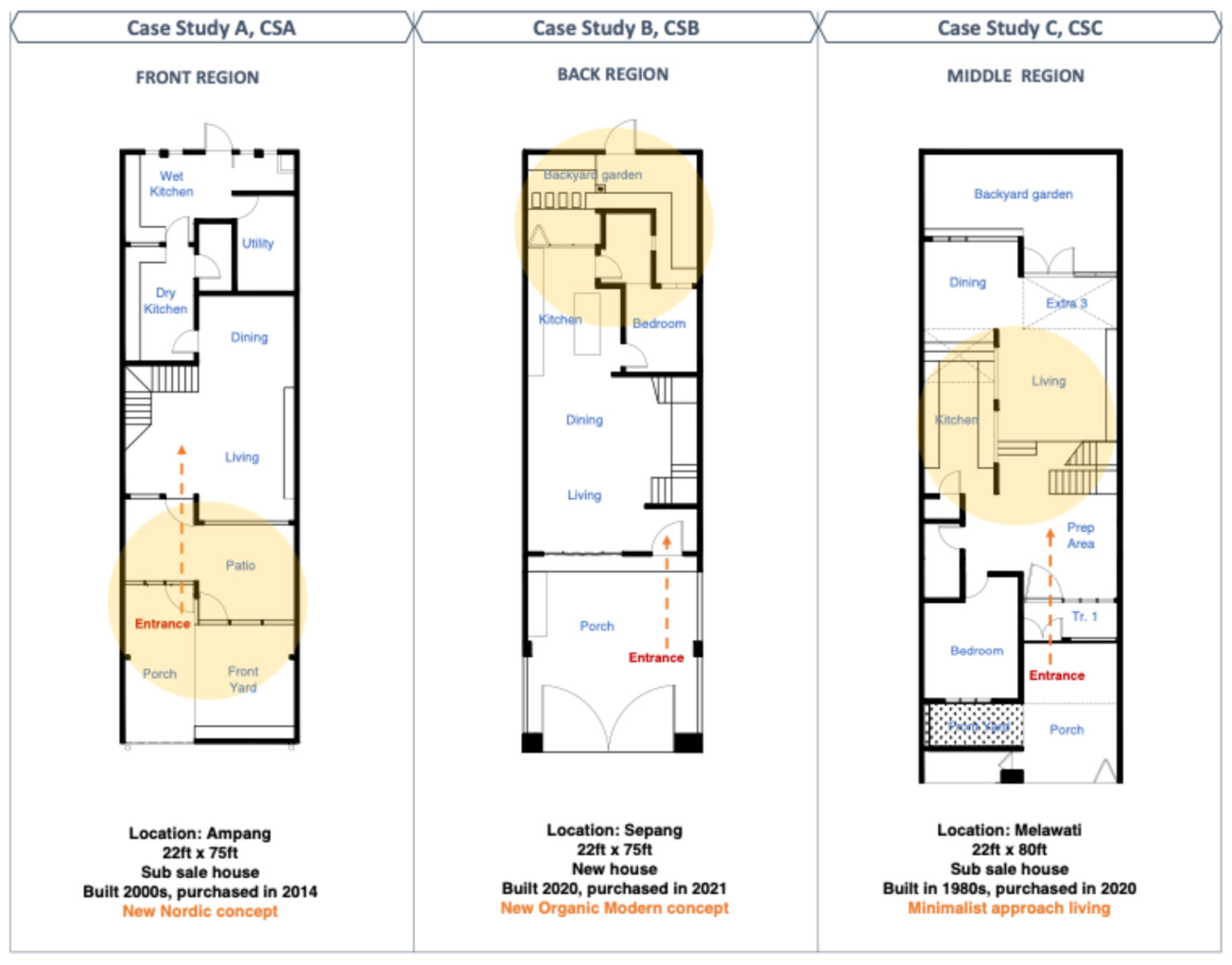
Figure 2.
Single Case Sample – Linking thematic analysis to typo-morphological analysis.
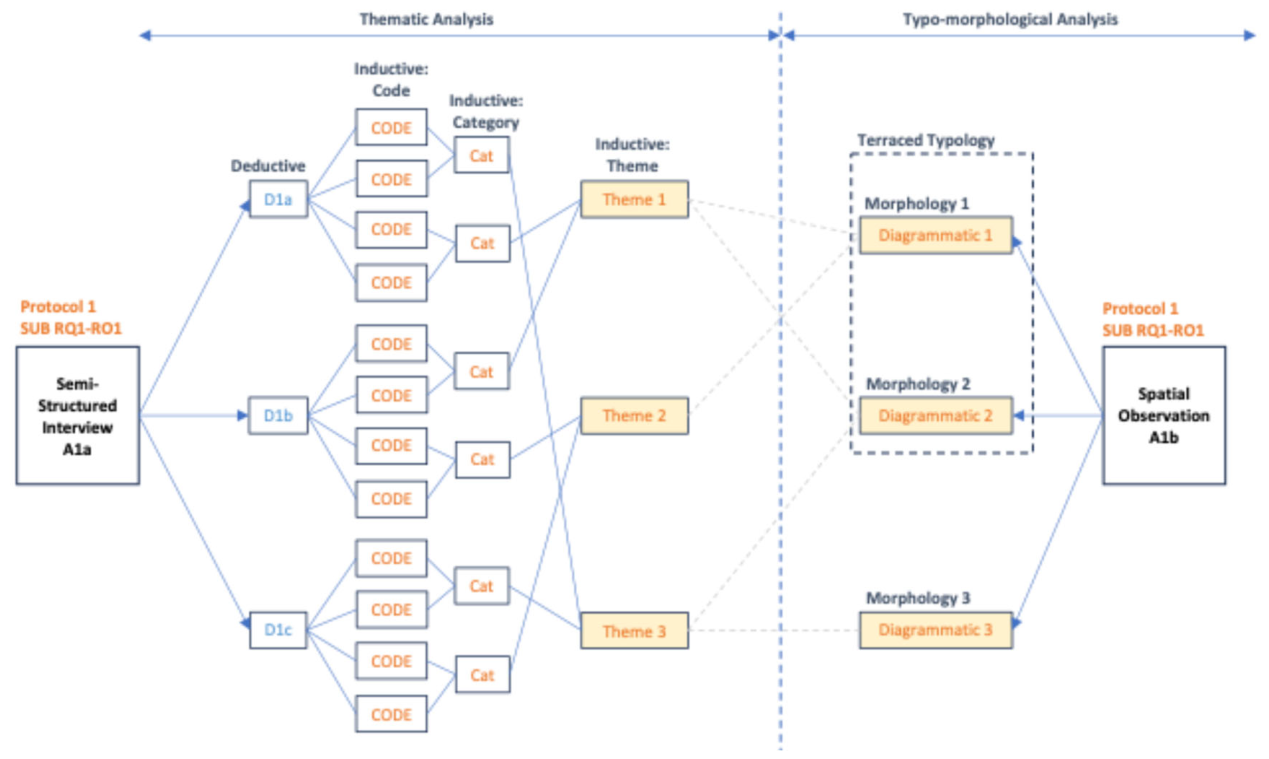
Figure 3.
Typo-morphological Analysis – (a) Diagrammatic plan of operational interface process; (b) Diagrammatic section and plan of differential process; (c) Diagrammatic isometric of defamiliarisation process.
Figure 3.
Typo-morphological Analysis – (a) Diagrammatic plan of operational interface process; (b) Diagrammatic section and plan of differential process; (c) Diagrammatic isometric of defamiliarisation process.
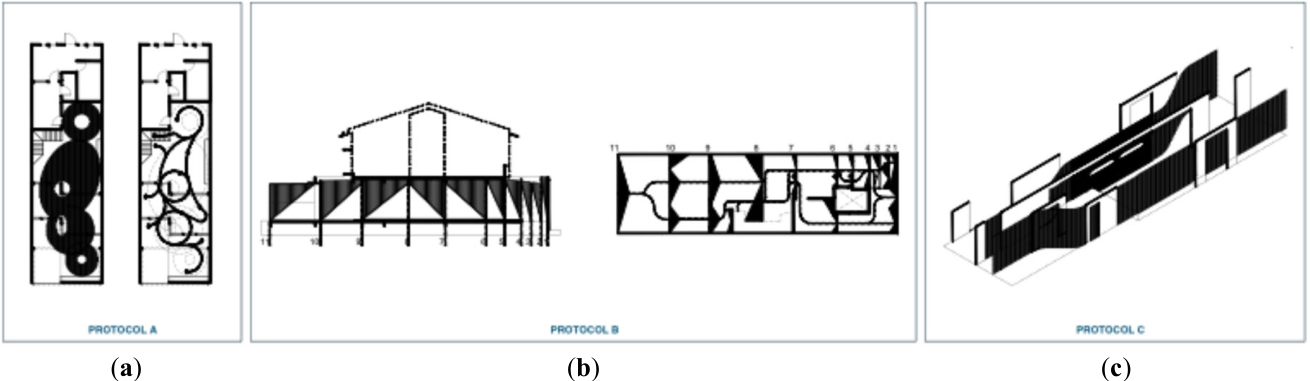
Figure 4.
Cellular Setting – Cross Case Overview (Extracted from TAM).
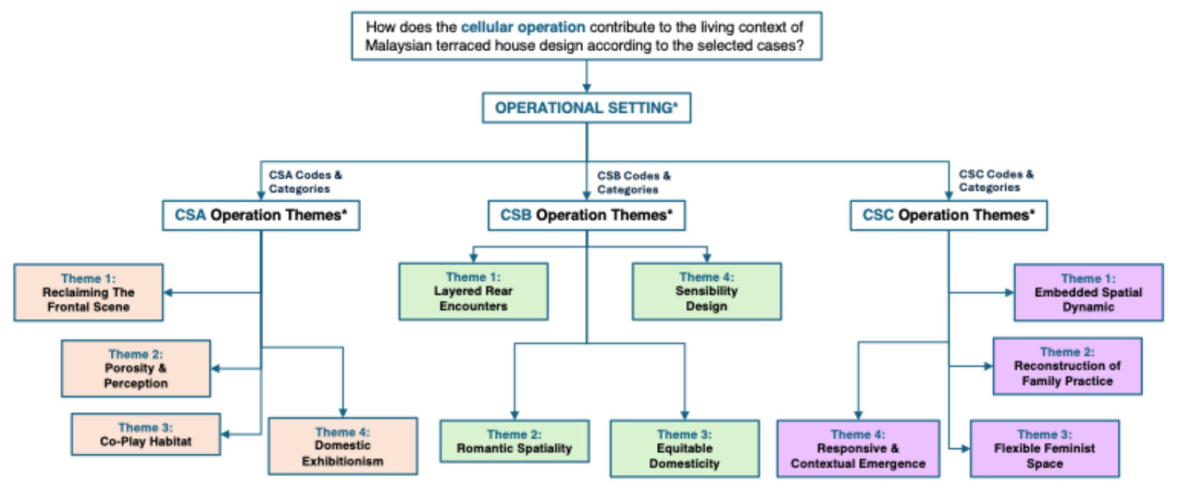
Figure 5.
CSA Typo-Morphological Series.
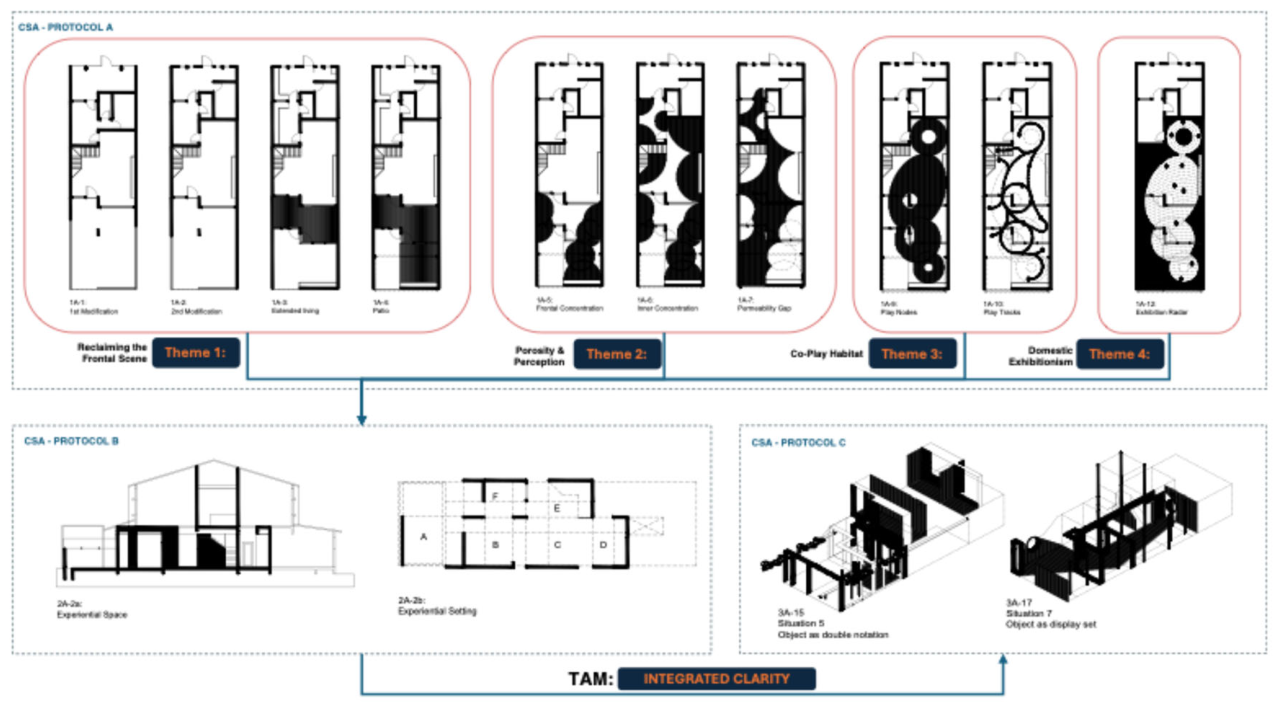
Figure 6.
CSB Typo-Morphological Series.
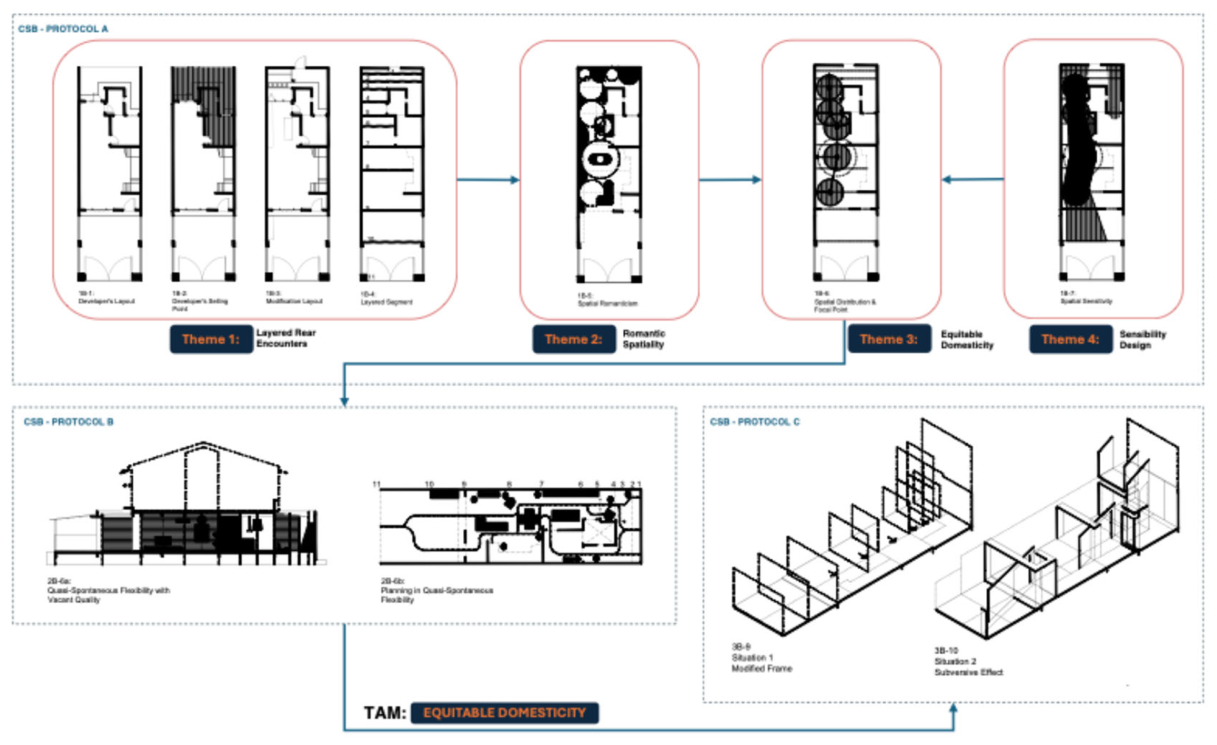
Figure 7.
CSC Typo-Morphological Series.
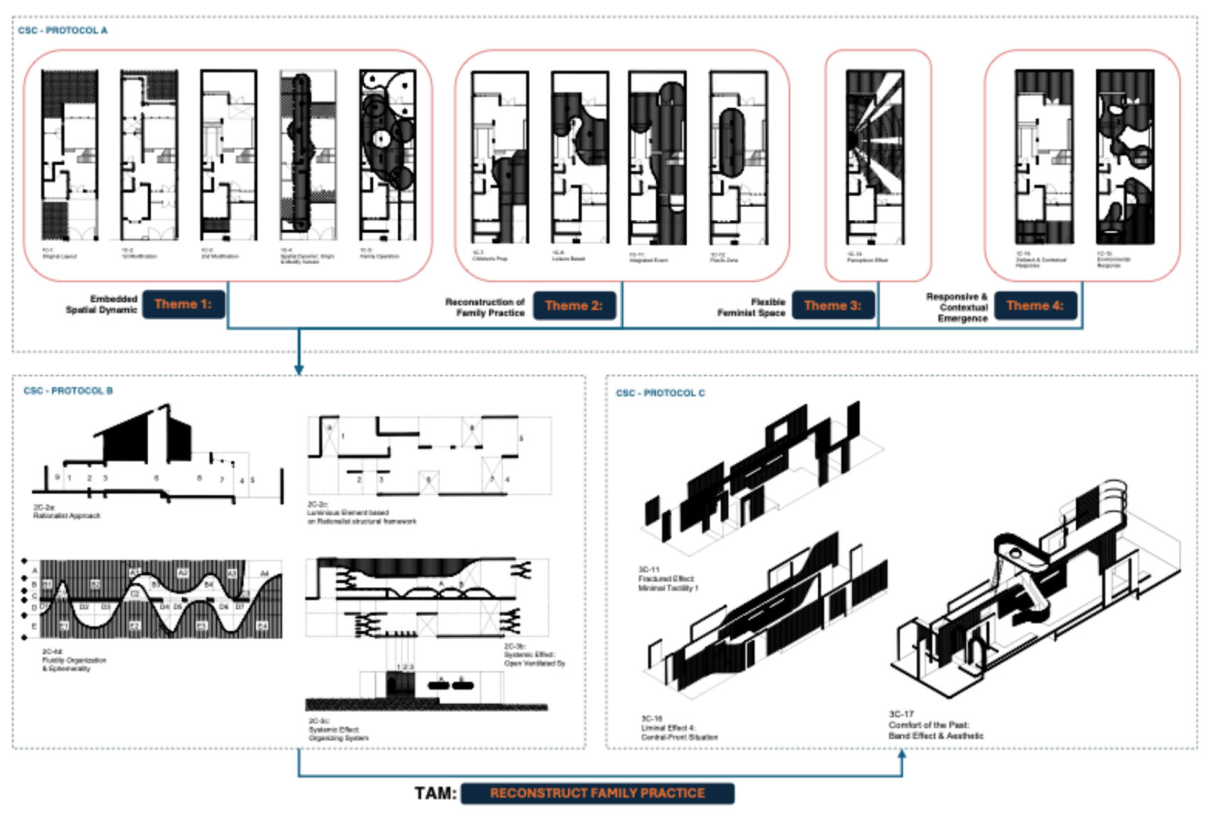
Table 1.
Thematic Analysis Matrix.
 |
 |
 |
Disclaimer/Publisher’s Note: The statements, opinions and data contained in all publications are solely those of the individual author(s) and contributor(s) and not of MDPI and/or the editor(s). MDPI and/or the editor(s) disclaim responsibility for any injury to people or property resulting from any ideas, methods, instructions or products referred to in the content. |
© 2026 by the authors. Licensee MDPI, Basel, Switzerland. This article is an open access article distributed under the terms and conditions of the Creative Commons Attribution (CC BY) license (http://creativecommons.org/licenses/by/4.0/).
Copyright: This open access article is published under a Creative Commons CC BY 4.0 license, which permit the free download, distribution, and reuse, provided that the author and preprint are cited in any reuse.