

Submitted:
30 July 2026
Posted:
03 August 2026
You are already at the latest version
Abstract
Background: Dementia prevention has emerged as a global public health priority, with growing evidence indicating that a substantial proportion of dementia cases may be delayed or prevented through modification of life-course risk factors. Despite this expanding epidemiological evidence base, translating knowledge into sustained behavioural change remains a persistent challenge. Digital dementia risk-reduction education offers unprecedented opportunities to increase public access to evidence-based prevention information; however, existing approaches frequently emphasise information delivery rather than explaining the processes through which individuals interpret, internalise, and act upon that information. Objective: This paper examines the theoretical foundations of Context–Mechanism–Outcome (CMO) reasoning within realist evaluation and proposes a domain-specific realist-informed conceptual framework to strengthen explanation of how digital dementia risk-reduction education may influence behavioural readiness and preventive action. Methods: A conceptual synthesis was undertaken drawing upon critical realism, realist evaluation, health literacy, behaviour change theory, implementation science, and contemporary dementia prevention literature. The paper also synthesises an emerging programme of conceptual scholarship on dementia prevention literacy and digital dementia education (Carey, 2026a–e) to develop a coherent programme theory for future empirical investigation. Results: The proposed framework extends established CMO reasoning by distinguishing broader contextual influences, digital intervention characteristics, resource availability, and user engagement while proposing interpretative engagement as a potential generative mechanism through which individuals construct meaning from dementia prevention information. Behavioural readiness is positioned as an intermediate outcome linking interpretation with sustained dementia risk-reduction behaviours. The framework integrates complementary theoretical traditions into a single explanatory model capable of informing future realist evaluation of digital dementia interventions. Conclusions: Rather than replacing established realist evaluation, the proposed framework provides a domain-specific refinement designed to improve theoretical explanation within digital dementia risk-reduction education. By emphasising interpretation, meaning-making, and behavioural readiness, the framework offers a foundation for future empirical testing and contributes to ongoing theory development within realist-informed digital health research.
Keywords:
dementia prevention
; digital dementia education
; realist evaluation
; Context–Mechanism–Outcome
; critical realism
; health literacy
; behaviour change
; implementation science
; interpretative engagement
; programme theory.
1. Introduction
1.1. Background
Dementia is one of the most significant public health challenges of the twenty-first century, affecting millions of individuals worldwide and imposing substantial emotional, social, and economic burdens on individuals, families, healthcare systems, and societies. Although no curative treatment currently exists for most forms of dementia, increasing epidemiological evidence indicates that a considerable proportion of cases may be delayed or prevented through modification of potentially modifiable risk factors across the life course (Livingston et al., 2024; World Health Organization [WHO], 2019).
This expanding evidence base has repositioned dementia prevention and risk reduction as central priorities within international public health policy. Consequently, digital health technologies have grown rapidly as vehicles for communicating dementia prevention information, increasing public awareness, and encouraging healthier lifestyle behaviours. Digital platforms, including websites, mobile applications, online education programmes, and interactive decision-support tools offer scalable opportunities to disseminate evidence-based information beyond traditional healthcare settings while improving accessibility across diverse populations.
Despite these advances, the widespread availability of prevention information has not consistently translated into sustained behavioural change. Many individuals remain unaware of modifiable dementia risk factors, misunderstand their personal relevance, or experience difficulty integrating prevention recommendations into everyday life. These observations suggest that access to information alone is insufficient to explain why some individuals successfully adopt dementia risk-reduction behaviours while others do not.
Accordingly, greater theoretical attention is required to explain the processes through which digital dementia education influences understanding, interpretation, motivation, and action. Such explanations are essential for designing and evaluating interventions that move beyond information provision towards meaningful behavioural outcomes and provide a stronger theoretical basis for understanding how digital dementia risk-reduction education contributes to effective public health practice.
1.2. The Evidence-to-Action Translation Gap
Over the past two decades, dementia prevention has evolved from a relatively speculative concept into an evidence-informed public health priority. Successive epidemiological studies have demonstrated that a substantial proportion of dementia cases may be attributable to potentially modifiable risk factors operating across the life course. The 2024 Lancet Standing Commission estimated that approximately 45% of dementia cases may be delayed or prevented through modification of fourteen potentially modifiable risk factors, reinforcing prevention as a central public health strategy (Livingston et al., 2024). Similarly, the World Health Organization (2019) has emphasised dementia risk reduction through interventions targeting lifestyle modification, cardiovascular health, education, physical activity, smoking cessation, and social engagement.
Despite this increasingly robust evidence base, a persistent gap remains between scientific knowledge and public action. Awareness of dementia risk factors continues to vary considerably across populations, and greater knowledge has not consistently translated into sustained behavioural change. Many individuals continue to regard dementia as an inevitable consequence of ageing, underestimate the relevance of modifiable risk factors, or experience difficulty incorporating prevention recommendations into their everyday lives. Consequently, the principal challenge facing dementia prevention is no longer simply the generation of epidemiological evidence, but understanding how that evidence is translated into meaningful personal action.
This evidence-to-action translation gap has become a recurring theme within contemporary dementia prevention research and provides the foundation for an emerging programme of conceptual scholarship examining dementia prevention literacy and digital dementia education (Carey, 2026a–e). Earlier work introduced the concept of dementia prevention literacy as the capacity to access, understand, evaluate, and apply evidence relating to modifiable dementia risk factors (Carey, 2026c). Subsequent conceptual development argued that dementia education should be understood as a process of behavioural and contextual change rather than information transfer alone (Carey, 2026b). Collectively, these studies suggest that effective dementia prevention depends not only upon the availability of evidence, but also upon the processes through which individuals interpret, contextualise, and act upon that evidence. These conceptual developments therefore highlight the need for explanatory frameworks capable of accounting for the interaction between educational interventions, individual reasoning, and the contexts in which behavioural decisions are made.
Accordingly, the central explanatory question addressed in this paper is not simply whether digital dementia risk-reduction education works, but how, for whom, under what circumstances, and through which mechanisms it contributes to behavioural readiness and sustained risk-reduction behaviours. These questions align closely with the explanatory aims of realist evaluation and provide the rationale for the realist-informed conceptual framework developed in the following sections.
1.3. Why Realist Evaluation Provides an Appropriate Explanatory Foundation
Realist evaluation was developed to explain why complex social and health interventions produce different outcomes across different settings. Rather than assuming that interventions exert uniform effects, realist evaluation proposes that outcomes are generated through interactions between contextual conditions and underlying causal mechanisms (Pawson & Tilley, 1997). From this perspective, interventions do not directly cause outcomes; instead, they provide resources and opportunities that individuals interpret and respond to within particular contexts. The emphasis therefore shifts from determining whether an intervention works to understanding how and why outcomes emerge under different conditions.
The explanatory strength of realist evaluation lies in its emphasis on Context–Mechanism–Outcome (CMO) configurations. Context refers to the conditions that influence whether particular mechanisms are activated. Mechanisms represent the reasoning, responses, and generative processes through which participants engage with intervention resources, while outcomes are the observable consequences that emerge from these interactions. Consequently, realist evaluation seeks to explain not simply whether programmes succeed, but why they succeed in some circumstances while producing different outcomes in others. This explanatory orientation is particularly valuable for complex interventions in which outcomes are contingent upon multiple interacting influences rather than simple cause-and-effect relationships.
Accordingly, realist evaluation has made an important contribution to implementation science, health services research, and the evaluation of complex health interventions. Increasingly, realist approaches have also been applied to digital health interventions, recognising that outcomes are shaped by dynamic interactions between technological design, individual capability, organisational environments, and broader social systems rather than by technology alone. This perspective acknowledges that identical interventions may produce different outcomes depending upon the contexts within which individuals engage with them.
Digital dementia risk-reduction education represents a particularly appropriate application of realist thinking because educational interventions are inherently interactive and context dependent. Users selectively encounter information, evaluate its credibility, assess its personal relevance, interpret its implications, and determine whether behavioural change is warranted. These interpretative processes are neither automatic nor uniform; rather, they emerge through dynamic interactions between prior knowledge, beliefs, motivation, digital literacy, health literacy, technological design, and wider contextual influences. Although realist evaluation provides a strong explanatory foundation for understanding such complexity, greater conceptual specificity may be required to explain how these interacting processes contribute to behavioural readiness and meaningful dementia risk-reduction behaviours. This observation provides the rationale for developing the realist-informed conceptual framework presented in this paper.
1.4. Purpose and Contribution of This Paper
The purpose of this paper is not to replace established Context–Mechanism–Outcome (CMO) reasoning, but to examine how it may be refined for application within digital dementia risk-reduction education. Building upon the philosophical foundations of critical realism and realist evaluation, the paper synthesises contemporary literature from health literacy, behaviour change theory, implementation science, and dementia prevention alongside an emerging programme of conceptual scholarship concerning dementia prevention literacy and digital dementia education (Carey, 2026a–e).
The paper proposes a realist-informed conceptual framework that extends traditional CMO reasoning by distinguishing broader contextual influences, digital intervention characteristics, resource availability, user engagement processes, interpretative engagement, behavioural readiness, and real-world outcomes within a coherent programme theory. Central to this framework is the proposition that interpretative engagement represents a potential domain-specific generative mechanism through which individuals transform dementia prevention information into personally meaningful understanding and behavioural intention. Rather than being presented as an established empirical finding, this proposition is advanced as a future-oriented theoretical refinement requiring empirical investigation through realist-informed research.
By positioning digital dementia risk-reduction education within a realist-informed explanatory framework, this paper seeks to contribute to ongoing theory development concerning how evidence is translated into meaningful public action. More specifically, it aims to strengthen programme theory for digital dementia education by providing greater conceptual specificity regarding the relationships between context, mechanisms, intervention resources, participant reasoning, behavioural readiness, and subsequent behavioural outcomes. In doing so, the paper provides a conceptual foundation for future realist evaluation, mixed-methods investigation, and continued theoretical refinement within digital dementia risk-reduction education.
1.5. Positioning the Manuscript Within an Evolving Programme of Scholarship
The conceptual framework presented in this paper did not emerge as an isolated theoretical proposition. Rather, it represents the culmination of an evolving programme of scholarship that has progressively examined the theoretical, educational, and methodological challenges associated with digital dementia risk-reduction education. Each preceding publication has addressed a distinct conceptual problem while contributing to a broader programme theory concerned with how evidence-based dementia prevention information may be translated into meaningful behavioural action.
The programme commenced with the development of the concept of dementia prevention literacy (Carey, 2026c), which proposed that effective dementia prevention depends not only upon public awareness of modifiable risk factors, but also upon individuals’ capacity to access, understand, critically evaluate, and apply prevention information within their everyday lives. Drawing upon health literacy theory, this work identified a persistent translation gap between epidemiological evidence and public action and argued that improving public understanding requires greater attention to the processes through which prevention knowledge becomes personally meaningful and behaviourally relevant.
Building upon this foundation, Reconceptualising Dementia Education: From Information Transfer to Behavioural and Contextual Change (Carey, 2026b) challenged traditional educational models that primarily emphasise the transmission of information. Instead, it argued that dementia education should be understood as a dynamic behavioural process in which educational outcomes emerge through interactions between educational content, contextual influences, and individual engagement. This reconceptualisation shifted the emphasis from information delivery towards explanation of how behavioural change occurs within differing contexts.
The next stage of theoretical development broadened this perspective through interdisciplinary integration. Carey (2026e) establishes a unified conceptual framework by merging dementia prevention literacy, health literacy, behaviour change theory, implementation science, and realist evaluation. This work contends that traditional, single-theory approaches fail to capture the complexities of digital dementia risk-reduction education. Instead, Carey argues that integrating these diverse, complementary frameworks provides far greater explanatory power.
Attention subsequently turned to the explanatory potential of realist evaluation itself. Beyond Information Delivery: Towards a Realist-Informed Conceptual Framework for the Evaluation of Digital Dementia Education (Carey, 2026a) argued that realist evaluation provides an appropriate methodological foundation for understanding how digital educational interventions generate behavioural outcomes. Rather than evaluating interventions solely according to effectiveness, the paper proposed that realist approaches offer greater explanatory value by examining how contextual conditions interact with underlying mechanisms to generate different outcomes across different circumstances. This work established the conceptual foundations upon which the present programme theory has been developed.
The progression from conceptual synthesis towards empirical investigation is reflected in Understanding How Digital Dementia Risk-Reduction Education Works: A Realist-Informed Mixed-Methods Study of Engagement, Interpretation and Behavioural Readiness in Midlife Adults (Carey, 2026e). While primarily focused upon research methodology, that study is explicitly informed by the programme theory developed across the preceding conceptual papers. It proposes a realist-informed mixed-methods design capable of examining how contextual conditions, participant engagement, interpretative processes, and behavioural readiness interact to influence dementia risk-reduction behaviours. Consequently, the empirical study represents the planned operationalisation and testing of the programme theory articulated throughout this programme of scholarship.
The present manuscript occupies a distinctive position within this evolving body of work. Rather than presenting an entirely new theoretical model, it synthesises and extends the conceptual developments established across the preceding publications into a coherent realist-informed programme theory for digital dementia risk-reduction education. It brings together philosophical foundations, realist evaluation, health literacy, behaviour change theory, implementation science, and dementia prevention research within a single explanatory framework while advancing interpretative engagement as a proposed domain-specific generative mechanism requiring future empirical investigation.
Viewed collectively, these publications illustrate an iterative process of conceptual development that is consistent with the principles of realist inquiry. Initial work identified the knowledge translation problem through the concept of dementia prevention literacy. Subsequent scholarship reconceptualised dementia education as a behavioural process, integrated complementary theoretical perspectives, established realist evaluation as the most appropriate explanatory foundation, and developed a methodology for empirical programme theory testing. The present paper represents the synthesis of these developments by articulating the overarching programme theory that links them within a coherent explanatory framework.
Accordingly, this manuscript should be understood not as the endpoint of conceptual development, but as a pivotal stage within an ongoing programme of research. It establishes the theoretical architecture that underpins subsequent empirical investigation while contributing to broader discussions concerning future theory development within realist-informed digital health education. In doing so, it provides a coherent conceptual foundation from which future empirical testing, theoretical refinement, and implementation research may continue to evolve.
2. Philosophical Foundations of Realist Explanation
2.1. Critical Realism and Generative Causation
Realist evaluation is philosophically grounded in critical realism, principally developed through the work of Bhaskar (1978, 1979). Critical realism emerged as an alternative to both positivist approaches to causality, which often emphasise observable relationships between variables, and constructivist perspectives that focus primarily on subjective interpretation without necessarily explaining the underlying causal processes that generate observed outcomes. Instead, critical realism proposes that reality exists independently of human perception while recognising that knowledge of reality is necessarily incomplete, socially situated, theory-informed, and open to continual refinement.
A central principle of critical realism is the concept of generative causation. Unlike approaches that conceptualise causality as a direct relationship between an intervention and an observed outcome, critical realism argues that outcomes emerge through underlying mechanisms operating within particular contextual conditions (Bhaskar, 1978). These mechanisms are not always directly observable; rather, they are identified through theoretical explanation of the processes that generate particular events or outcomes. Consequently, similar interventions may produce different outcomes because the mechanisms through which change occurs are activated, constrained, or transformed by differing contextual circumstances.
Bhaskar (1978) further distinguished between three interconnected domains of reality: the empirical domain, consisting of experiences and observations; the actual domain, encompassing events that occur regardless of whether they are observed; and the real domain, comprising the underlying structures, powers, and mechanisms that generate observable phenomena. This ontological distinction has significant implications for health research because observed outcomes alone cannot fully explain why interventions succeed or fail. Instead, researchers must seek to understand the often-unobservable mechanisms through which individuals interpret and respond to intervention resources within particular contexts.
This distinction is especially relevant within dementia prevention. Increased awareness of modifiable dementia risk factors does not inevitably lead to behavioural change. The observable outcome—whether an individual adopts healthier behaviours—provides only a partial explanation of the change process. A realist perspective therefore seeks to examine what mechanisms were activated, how individuals interpreted prevention information, and why similar educational interventions produced different responses among different individuals and communities.
Accordingly, critical realism provides the philosophical foundation for explanatory rather than purely descriptive research. It shifts attention away from simply determining whether interventions work towards understanding how, why, for whom, and under what circumstances (Pawson & Tilley, 1997) particular outcomes are generated. These explanatory questions subsequently became central to the development of realist evaluation.
2.2. The Emergence of Realist Evaluation
Building upon the philosophical foundations of critical realism, Pawson and Tilley (1997) developed realist evaluation as an explanatory approach for investigating complex social programmes and interventions. They argued that interventions should not be understood as direct causes of outcomes. Rather, interventions provide resources, opportunities, or constraints that individuals interpret and respond to within specific social, organisational, and cultural contexts.
This perspective represented an important shift from traditional programme evaluation approaches that frequently sought to determine whether interventions were effective through comparisons of average outcomes between intervention and control groups. Although such approaches remain valuable for estimating overall effects, they often provide limited explanation regarding why interventions produce successful outcomes in some settings while producing limited or different outcomes in others.
Pawson and Tilley (1997) proposed that evaluation should instead focus on identifying the causal processes through which interventions generate outcomes. Their Context–Mechanism–Outcome (CMO) heuristic conceptualised causation as an interaction between contextual conditions and underlying mechanisms that collectively produce observable outcomes. Rather than viewing interventions as universally effective or ineffective, realist evaluation seeks to understand the circumstances under which particular processes of change occur.
Importantly, realist evaluation does not conceptualise mechanisms as components of interventions themselves. Instead, mechanisms refer to the reasoning, responses, and reactions that are generated when individuals engage with intervention resources. Programmes therefore provide opportunities for change; however, change occurs only when those opportunities activate mechanisms within particular contextual circumstances. Consequently, identical interventions may generate different outcomes because contextual conditions influence whether mechanisms are activated, inhibited, or altered.
This explanatory emphasis has contributed substantially to evaluation research across healthcare, education, social policy, and implementation science. Rather than asking whether an intervention works universally, realist evaluation asks what works, for whom, under what circumstances, in what respects, and why (Pawson & Tilley, 1997). These questions are particularly relevant to contemporary digital health interventions, where outcomes emerge through complex interactions between technological design, individual engagement, and broader social and environmental influences.
2.3. Development of Context–Mechanism–Outcome Reasoning
Since its introduction, Context–Mechanism–Outcome (CMO) reasoning has become the defining explanatory heuristic of realist evaluation. CMO reasoning is often portrayed as a simple configuration, but is more accurately understood as a framework for investigating generative causation, rather than as a linear causal sequence. Contexts influence whether mechanisms are activated, mechanisms generate outcomes, and outcomes may subsequently influence future contexts through ongoing feedback processes.
Over time, scholarly understanding of CMO configurations has become increasingly sophisticated. Pawson (2013) emphasised that interventions operate within open social systems characterised by multiple interacting influences, meaning that simple causal attribution is often inappropriate. Granlund and Imms (2024) noted that recent methodological developments clarify the distinction between programme resources and participant reasoning. Specifically, mechanisms do not reside within interventions themselves, but emerge through the interaction between resources and human interpretation (Dalkin et al., 2015).
These developments have strengthened realist evaluation by recognising that contextual influences extend beyond individual demographic characteristics to include organisational structures, social relationships, institutional environments, cultural expectations, and previous experiences. Similarly, mechanisms have increasingly been understood as dynamic reasoning processes involving motivation, trust, confidence, perceived relevance, interpretation, and decision-making. Outcomes are therefore conceptualised not simply as endpoints but as emergent consequences arising from interactions between contextual conditions and generative mechanisms.
Such developments have enabled realist evaluation to move beyond simplified explanations of intervention effectiveness towards richer accounts of causal complexity. Nevertheless, theoretical refinement continues as realist approaches are increasingly applied to diverse fields, including digital health interventions, implementation research, and complex adaptive systems.
2.4. Contemporary Interpretations of Mechanisms
Despite widespread acceptance of Context–Mechanism–Outcome reasoning, the meaning and operationalisation of mechanisms remains one of the most debated aspects of realist methodology. Early applications occasionally conceptualised mechanisms as elements or components of interventions themselves, creating ambiguity between programme activities and the underlying processes through which change occurs.
Subsequent methodological developments have sought to clarify this distinction. Dalkin et al. (2015) suggested that mechanisms should be considered as being derived from the interaction of the reasoning of the participants and the resources of the programme. From this perspective, interventions provide resources, while mechanisms arise when individuals interpret, evaluate, and respond to those resources within specific contextual conditions. Wong et al. (2016) similarly emphasised that mechanisms should be theorised as generative explanatory processes rather than observable features of interventions.
This distinction is particularly important within digital dementia risk-reduction education. Educational resources, including websites, mobile applications, online learning platforms, and interactive decision-support tools, represent programme resources rather than mechanisms themselves. The mechanism lies within the cognitive and interpretative processes through which individuals engage with these resources, evaluate their credibility, determine their personal relevance, and decide whether behavioural change is appropriate or achievable. This perspective provides the conceptual foundation for the present paper’s proposal of interpretative engagement as a potential domain-specific generative mechanism. Rather than representing a departure from realist methodology, interpretative engagement is presented as a theoretically informed refinement of existing understandings of participant reasoning within the specific context of digital dementia risk-reduction education.
2.5. Strengths and Continuing Theoretical Challenges
Realist evaluation has become an influential explanatory approach for investigating complex health and social interventions. Its emphasis on generative causation, contextual complexity, and mechanism-based explanation has significantly advanced understanding of why interventions produce variable outcomes across different populations and settings. Its increasing application within implementation science, public health, and digital health research demonstrates both its flexibility and explanatory value. Nevertheless, emerging application domains continue to identify opportunities for theoretical refinement. Digital health interventions present particular challenges because individuals actively interact with information, technologies, and digital environments rather than passively receiving programme inputs. Behavioural outcomes depend not only upon access to information but also upon engagement, interpretation, meaning-making, perceived relevance, confidence, and readiness for action. These processes may remain insufficiently specified within conventional Context–Mechanism–Outcome formulations.
Accordingly, the issue is not whether realist evaluation remains appropriate for digital dementia risk-reduction education, but how its explanatory capacity may be further strengthened within domains characterised by complex interactions between technology, cognition, behaviour, and context. Digital dementia education represents one such domain in which greater theoretical specificity may enhance understanding of how educational interventions contribute to behavioural readiness and sustained preventive action. The following chapter therefore examines digital dementia risk-reduction education as an emerging explanatory challenge. It considers why existing approaches have often remained focused on information provision and identifies the conceptual gap that provides the rationale for development of the proposed realist-informed programme theory framework.
3. Digital Dementia Risk-Reduction Education as an Emerging Explanatory Challenge
3.1. The Global Expansion of Digital Dementia Prevention
Digital technologies are increasingly transforming the delivery of health education and public health interventions. Growing internet accessibility, widespread smartphone adoption, and rapid advances in digital health platforms have created unprecedented opportunities to disseminate evidence-based health information at scale. Within dementia prevention, digital interventions now include educational websites, mobile applications, online decision-support tools, social media initiatives, telehealth services, and interactive learning programmes designed to improve public understanding of potentially modifiable dementia risk factors.
This expansion reflects increasing recognition that dementia prevention requires sustained engagement across the life course rather than reliance upon isolated clinical encounters. Digital platforms provide flexibility, scalability, and opportunities for personalised learning that traditional face-to-face education alone may not achieve. Individuals can access prevention information at times and locations that align with their circumstances, creating opportunities to reach populations who may have limited engagement with conventional healthcare services. Furthermore, digital technologies provide opportunities to incorporate behavioural prompts, interactive feedback, personalised recommendations, and longitudinal monitoring of engagement. These capabilities position digital dementia education as more than a mechanism for information dissemination. Rather, digital environments may provide opportunities through which individuals progressively develop understanding, confidence, self-efficacy, and behavioural capability.
However, despite these technological advances, evidence regarding the effectiveness of digital dementia education remains inconsistent. Many interventions demonstrate improvements in knowledge and awareness immediately following participation, yet fewer studies demonstrate sustained behavioural change or long-term adoption of dementia risk-reduction practices. This discrepancy indicates that technological innovation alone cannot adequately explain intervention success and highlights the need to understand the mechanisms through which digital education contributes to meaningful behavioural outcomes.
3.2. Limitations of Information-Transmission Models
A substantial proportion of existing health education literature implicitly assumes that increasing knowledge will naturally lead to healthier behaviours. This assumption reflects traditional information-transmission models in which educational effectiveness is primarily assessed through exposure to information, acquisition of factual knowledge, or immediate improvements in awareness. While these approaches have contributed significantly to public understanding of dementia risk factors, they provide limited explanation of how knowledge is transformed into sustained behavioural action. Research across health promotion consistently demonstrates that knowledge alone is rarely sufficient to modify complex health behaviours. Individuals may understand recommended lifestyle changes while remaining unable or unwilling to implement them due to competing priorities, environmental barriers, emotional responses, cultural beliefs, social influences, or perceptions regarding personal relevance and feasibility. Therefore, information-based educational interventions may overestimate the role of knowledge and underestimate the role of interpretation, motivation, capability and contextual conditions (Bailey et al., 2020).
These limitations are particularly evident within dementia prevention. Although epidemiological evidence concerning modifiable dementia risk factors has expanded substantially, public awareness remains variable and adoption of prevention behaviours continues to differ considerably between individuals and populations. Many people continue to perceive dementia as an unavoidable consequence of ageing despite increasing evidence supporting opportunities for risk reduction. Others acknowledge prevention messages but experience difficulty translating this knowledge into sustained behavioural practices.
These observations suggest that the central challenge is not simply the accurate communication of prevention evidence. Rather, it involves understanding the processes through which individuals evaluate, interpret, personalise, and act upon that evidence within the complexity of everyday life. To meet this challenge, we need explanatory frameworks that go beyond the acquisition of information and focus on the development of meaning, motivation and behaviour.
3.3. Dementia Prevention Literacy as a Conceptual Foundation
Recognition of the evidence-to-action gap has contributed to increasing interest in dementia prevention literacy, a concept that extends traditional approaches to health literacy into the specific context of dementia risk reduction. Dementia prevention literacy encompasses more than awareness of risk factors; it includes the capacity to access, understand, critically evaluate, communicate, and apply prevention information in ways that support informed decision-making and sustained behavioural change (Carey, 2026c).
This perspective represents an important conceptual shift because it recognises that effective prevention depends not simply upon exposure to information, but upon the quality of individuals’ engagement with that information. Knowledge becomes meaningful when individuals perceive its relevance, trust its credibility, integrate it with existing beliefs and experiences, and consider its implications within the context of their own lives. Consequently, previous conceptual work suggested that dementia prevention literacy should be conceptualised as a dynamic capability rather than a static set of facts (Carey, 2026c). Building upon this foundation, subsequent scholarship argued that dementia education itself should be reconceptualised as a process of behavioural and contextual change rather than information transfer alone (Carey, 2026b). Collectively, these contributions suggest that effective educational interventions operate through complex interactions between individual capability, contextual influences, intervention resources, and opportunities for behavioural engagement.
While these conceptual developments provide important foundations for understanding dementia prevention education, they also highlight the need for a broader explanatory framework capable of integrating health literacy, behaviour change theory, implementation science, and realist evaluation within a coherent programme theory.
3.4. Why Digital Education Requires a Realist Perspective
The most significant difference between traditional and digital education is that users are actively involved in creating their own learning experience (Haleem et al., 2022). Individuals determine when they engage with educational resources, which information they prioritise, how deeply they explore available content, and whether they return for continued learning. Consequently, digital interventions operate within highly variable contexts characterised by differences in digital literacy, health literacy, motivation, technological confidence, social support, and environmental opportunity.
From a realist perspective, these contextual variations are not secondary considerations but central determinants of intervention outcomes. Firth (2024) states, the same digital resources may have different effects as people experience and interpret them in different personal, technological and social contexts. Educational resources therefore create opportunities for change; however, meaningful outcomes depend upon the mechanisms activated through individuals’ engagement with those resources.
This perspective shifts attention away from evaluating digital platforms solely as technological products and towards understanding the causal processes through which they influence behaviour. Factors such as accessibility, usability, credibility, personal relevance, emotional engagement, and perceived feasibility become integral components of programme explanation rather than merely practical considerations of implementation.
Realist evaluation therefore provides an appropriate theoretical foundation because it explicitly recognises that interventions work differently for different individuals within different contexts. Nevertheless, applying realist reasoning to digital dementia education requires further conceptual development to explain the interpretative processes through which educational resources are transformed into understanding, behavioural readiness, and sustained preventive action.
3.5. The Need for a Domain-Specific Programme Theory
The preceding discussion demonstrates that current approaches to digital dementia risk-reduction education remain distributed across multiple theoretical traditions. Epidemiological research identifies modifiable dementia risk factors, health literacy explains processes of understanding and applying health information, behaviour change theory examines determinants of behavioural action, and implementation science investigates intervention adoption within complex systems. Each perspective provides valuable insights; however, no single framework adequately explains how these components interact within digital dementia education.
This paper therefore argues that a domain-specific programme theory is required to integrate these complementary perspectives while retaining the explanatory strengths of realist evaluation. Such a framework should (1) identify contextual conditions that influence digital education, (2) distinguish intervention resources from underlying mechanisms, (3) explain how individuals construct meaning from prevention information, and (4) account for the development of behavioural readiness as a prerequisite to ongoing dementia risk-reduction practices (Godbee, 2019).
This requirement provides the rationale for the realist-informed conceptual framework proposed in the following chapter. Rather than replacing established Context–Mechanism–Outcome reasoning, the framework seeks to refine its application within digital dementia risk-reduction education by providing greater conceptual precision regarding the relationships between context, engagement, interpretation, behavioural readiness, and outcomes.
4. A Realist-Informed Programme Theory Framework for Digital Dementia Risk-Reduction Education
4.1. Introduction
The aforementioned sections have demonstrated that dementia prevention has grown in importance as a public health priority and that digital technologies offer substantial chances to provide evidence-based risk-reduction education at scale (Reetz et al., 2026). However, they have also demonstrated that existing approaches frequently emphasise information dissemination while providing limited explanation of the causal processes through which digital educational interventions contribute to behavioural change.
Realist evaluation provides an appropriate explanatory foundation for addressing this limitation because it seeks to understand how, why, for whom, and under what circumstances interventions produce particular outcomes (Pawson & Tilley, 1997). Nevertheless, digital dementia risk-reduction education introduces additional complexity requiring further conceptual refinement. Individuals do not simply receive prevention information; they actively engage with digital resources, assess credibility, interpret personal relevance, negotiate existing beliefs and experiences, and determine whether behavioural change is appropriate, feasible, or achievable within their circumstances.
These processes are dynamic, iterative, and highly dependent upon contextual conditions. The effectiveness of digital dementia education therefore cannot be adequately explained through exposure to information alone. Instead, explanation requires attention to the interactions between educational resources, individual interpretation, behavioural capability, motivation, and the broader environments in which prevention decisions are made.
The framework proposed in this paper is presented as a domain-specific programme theory that extends the explanatory application of Context–Mechanism–Outcome (CMO) reasoning within digital dementia risk-reduction education (Carey, 2026a). It is not intended to replace established realist evaluation principles, but rather to refine their application by explicitly incorporating user engagement, interpretative processes, behavioural readiness, and feedback mechanisms that are particularly relevant within digital learning environments.
The proposed framework synthesises insights from critical realism, realist evaluation, health literacy, behaviour change theory, implementation science, and contemporary dementia prevention research into an integrated explanatory model designed to inform future empirical investigation and programme theory refinement.
4.2. Conceptual Principles Underpinning the Framework
The proposed realist-informed programme theory is founded upon four interrelated conceptual principles that guide its interpretation of how digital dementia risk-reduction education may generate behavioural outcomes (Carey, 2026a).
First, outcomes are generated rather than directly caused.
Consistent with critical realist philosophy, digital educational interventions do not independently produce behavioural change. Rather, they provide resources, opportunities, and experiences that individuals encounter within particular contextual conditions. Outcomes emerge when these resources activate underlying generative mechanisms through processes of human reasoning, interpretation, and response (Bhaskar, 1978; Pawson & Tilley, 1997).
Second, context is multidimensional.
Within realist evaluation, context extends beyond demographic characteristics or physical environments. It includes social relationships, cultural expectations, technological environments, organisational influences, previous experiences, health literacy, digital capability, emotional circumstances, and individual beliefs regarding dementia, ageing, and prevention. Both the availability of educational resources and how people understand and react to them are shaped by these contextual factors.
Third, mechanisms involve human interpretation and reasoning.
There is no intrinsic capacity for educational content to influence behaviour (Carey, 2026a). Rather, change occurs through the ways individuals interpret, evaluate, and integrate information within their existing cognitive, emotional, and behavioural frameworks. Meaning-making therefore occupies a central position within the proposed programme theory, with interpretative engagement proposed as a potential generative mechanism linking educational resources with behavioural readiness.
Fourth, behavioural change is developmental rather than instantaneous.
Individuals rarely progress directly from information exposure to sustained behavioural modification. Instead, behavioural change is conceptualised as a progressive process involving engagement, interpretation, capability development, intention formation, behavioural experimentation, and longer-term maintenance. This developmental perspective acknowledges that readiness for action may emerge gradually through repeated interactions between individuals, interventions, and contextual environments.
Together, these principles position digital dementia education as a dynamic process involving interactions between intervention resources, contextual conditions, human reasoning, and behavioural development. The framework therefore extends conventional information-delivery approaches by focusing on the explanatory processes through which digital education may contribute to meaningful preventive action.
4.3. Overview of the Proposed Framework
Figure 1 presents the proposed Realist-Informed Conceptual Framework for Evaluating Digital Dementia Education. The framework extends conventional Context–Mechanism–Outcome reasoning by explicitly distinguishing the interconnected domains through which digital dementia risk-reduction education may generate behavioural outcomes.
The framework begins with the wider contextual environment, recognising that individuals encounter dementia prevention information within broader social, cultural, economic, technological, and healthcare systems. These contextual influences shape opportunities for engagement before individuals interact with any specific educational intervention.
Within this environment, the digital dementia education intervention provides evidence-based educational resources designed to improve understanding of modifiable dementia risk factors. These resources may include websites, mobile applications, online educational programmes, decision-support tools, interactive learning modules, and other digital platforms.
The intervention is subsequently experienced through two interacting domains: resource availability and user engagement.
Resource availability refers to the accessibility, usability, credibility, quality, technological functionality, and adaptability of educational resources. These characteristics influence whether digital education provides meaningful opportunities for learning and engagement.
User engagement reflects the individual’s active interaction with digital content, including attention, participation, emotional involvement, perceived relevance, curiosity, and willingness to explore available resources. Together, these domains establish the conditions within which generative mechanisms may be activated.
The framework is informed by realist evaluation theory (Pawson & Tilley, 1997), which conceptualises outcomes as emerging through interactions between contexts, mechanisms, and outcomes rather than through direct intervention effects. Within this perspective, digital dementia education is not assumed to operate universally; rather, its impact depends upon how individuals engage with, interpret, and apply educational content within specific personal, social, and environmental circumstances.
The framework also integrates three complementary theoretical perspectives:
- Health literacy theory, which explains individuals’ capacity to access, understand, evaluate, communicate, and apply health information across the intervention pathway (Sørensen et al., 2012; Sørensen et al., 2021; Nutbeam & Lloyd, 2021; Dodds et al., 2025).
- The COM-B model of behaviour, which explains how capability, opportunity, and motivation interact to influence behavioural readiness and behavioural enactment (Michie et al., 2011).
- Implementation science, which contributes understanding of contextual variability, intervention usability, scalability, and real-world delivery conditions (Craig et al., 2008; Skivington et al., 2021).
The framework consists of six interrelated domains:
-
Resource Availability (Context)Access to digital educational resources, including technological accessibility, usability, credibility, and opportunities for meaningful engagement.
-
User Engagement (Mechanism)Initial interaction with educational content, including attention, participation, emotional involvement, and willingness to engage with prevention information.
-
Interpretative Engagement (Core Generative Mechanism)The process through which individuals actively construct meaning from educational content by evaluating relevance, personal applicability, credibility, and connections with lived experience.
-
Behavioural Readiness (Intermediate Outcome/Mechanism)The development of understanding, self-efficacy, perceived capability, risk perception, motivation, and intention necessary to support behavioural action.
-
Contextual Influences (Context)Social, cultural, emotional, environmental, and organisational factors that facilitate or constrain behavioural enactment.
-
Real-World Outcomes (Outcome)Adoption of dementia risk-reduction strategies, behavioural modification, enhanced wellbeing, and longer-term maintenance of preventive practices (Dodds, 2025).
A central theoretical contribution of the framework is the explicit positioning of interpretative engagement as a core explanatory mechanism linking exposure to educational information with behavioural outcomes. Existing evaluation approaches frequently assume that engagement or knowledge acquisition is sufficient to explain behavioural change. In contrast, this framework proposes that individuals must actively interpret and contextualise information before behavioural readiness can develop.
The framework further incorporates feedback loops, recognising that outcomes may reshape future engagement, perceptions, confidence, and contextual conditions over time. This reflects the iterative and non-linear nature of behaviour change and implementation processes within real-world environments.
4.4. Interpretative Engagement as a Proposed Generative Mechanism
Interpretative engagement represents the central theoretical proposition advanced within the present programme theory. Consistent with realist evaluation, mechanisms are understood not as features of interventions themselves but as the reasoning and responses that arise when individuals engage with programme resources within particular contexts. Building on this principle, the proposed framework suggests that digital dementia risk-reduction education may operate through a process in which individuals actively interpret, personalise, and evaluate prevention information before behavioural readiness develops.
Interpretative engagement extends beyond simple exposure to educational content. It involves assessing the credibility of information, considering its relevance to one’s own circumstances, integrating new knowledge with existing beliefs and experiences, and evaluating whether recommended behaviours are achievable within everyday life. These interpretative processes are likely to differ between individuals according to health literacy, digital literacy, prior knowledge, motivation, cultural expectations, and wider contextual influences.
Importantly, interpretative engagement is proposed as a theoretically derived candidate mechanism rather than an empirically established causal process. Future realist-informed studies should therefore investigate whether this mechanism is consistently activated across different digital educational environments, how contextual factors influence its activation, and whether alternative mechanisms may operate under differing circumstances. Positioning interpretative engagement in this manner remains fully consistent with realist methodology, in which programme theories are continually refined through empirical testing and theoretical revision.
4.5. Behavioural Readiness as an Intermediate Outcome
The proposed framework introduces behavioural readiness as an intermediate explanatory outcome linking interpretative engagement with sustained dementia risk-reduction behaviours. Traditional educational evaluations frequently measure immediate knowledge acquisition or longer-term behavioural outcomes while providing limited explanation of the developmental processes occurring between these stages.
Behavioural readiness reflects a state in which individuals possess sufficient understanding, confidence, perceived capability, motivation, and intention to consider implementing recommended preventive behaviours. It therefore represents preparedness for action rather than behavioural performance itself. This distinction is important because individuals may demonstrate meaningful cognitive and motivational change before observable behavioural modification becomes evident.
Conceptualising behavioural readiness as an intermediate outcome also aligns with contemporary behaviour change theory, particularly the COM-B model, in which capability, opportunity, and motivation interact to influence behaviour. Within the present programme theory, behavioural readiness provides an explanatory bridge between cognitive interpretation and real-world action while recognising that movement towards sustained behavioural change is frequently gradual, iterative, and context dependent.
4.6. Feedback Loops and Dynamic Programme Theory
A further refinement introduced by the proposed programme theory is the explicit recognition that educational interventions operate within dynamic systems characterised by continuous feedback rather than linear progression. Realist evaluation has long acknowledged that programmes function within open systems in which contexts, mechanisms, and outcomes interact over time. The present framework makes these reciprocal relationships more explicit for digital dementia risk-reduction education.
Successful behavioural experiences may reinforce confidence, strengthen perceived relevance, increase trust in educational resources, and encourage further engagement with prevention information. Conversely, unsuccessful experiences may reduce motivation, alter perceptions of intervention credibility, or modify future patterns of engagement. Outcomes therefore become new contextual conditions that influence subsequent cycles of engagement, interpretation, and behavioural development.
This systems perspective positions programme theory as an evolving explanatory model rather than a fixed causal pathway. It reflects the iterative nature of realist inquiry, where programme theories are progressively refined through repeated interaction between conceptual development and empirical investigation.
5. Extending Classical Context–Mechanism–Outcome Reasoning: A Domain-Specific Refinement for Digital Dementia Risk-Reduction Education
5.1. Introduction
Context–Mechanism–Outcome (CMO) reasoning has become the defining explanatory heuristic within realist evaluation and has been widely applied across healthcare, education, implementation science, and social policy. Its enduring contribution lies in recognising that interventions do not directly produce outcomes. Rather, interventions provide resources and opportunities that interact with contextual conditions to activate underlying generative mechanisms through which outcomes emerge (Pawson & Tilley, 1997).
This emphasis on generative causation has substantially influenced contemporary approaches to evaluating complex interventions by shifting attention away from simple questions of effectiveness towards explanation of how and why interventions produce different outcomes across different settings and populations.
The realist-informed framework presented in this paper is firmly grounded within this intellectual tradition. However, the realisation that digital dementia risk-reduction education presents explanatory issues that aren’t usually well stated in traditional CMO formulations is what spurred its creation. People who use digital learning materials are not merely information consumers (Ali et al., 2024). They participate in ongoing processes of information seeking, interpretation, reflection, evaluation, and decision-making that occur over time and within multiple interacting contexts.
Accordingly, the framework does not seek to replace classical CMO reasoning or modify the philosophical foundations of realist evaluation. Rather, it represents a domain-specific refinement intended to improve explanatory precision within digital dementia risk-reduction education. It extends realist programme theory by making explicit several processes that may remain implicit within broader CMO formulations, including user engagement, interpretative processes, behavioural readiness, and feedback relationships.
5.2. Preserving the Foundations of Realist Evaluation
A central principle of the proposed framework is that the philosophical foundations of realist evaluation remain unchanged. Critical realism continues to provide the ontological basis for understanding causation as the operation of underlying generative mechanisms within open social systems (Bhaskar, 1978; Pawson & Tilley, 1997).
Likewise, the fundamental realist question—what works, for whom, under what circumstances, and why? This remains the organising principle guiding programme explanation (Pawson & Tilley, 1997). The framework therefore preserves the defining characteristics of realist methodology.
First, outcomes remain conceptualised as emergent phenomena generated through interactions between contextual conditions and underlying mechanisms rather than as direct effects of interventions.
Second, contextual influences continue to be understood as conditions that shape whether mechanisms are activated, constrained, or transformed rather than as independent causal variables.
Third, mechanisms remain conceptualised as the reasoning, responses, and reactions of individuals engaging with programme resources rather than as characteristics embedded within interventions themselves (Dalkin et al., 2015).
Finally, explanation continues to depend upon identifying plausible causal pathways that account for variation in outcomes across different contexts.
These continuities ensure that the framework remains situated within established realist evaluation while providing additional conceptual refinement appropriate to digital health education environments.
5.3. Refining the Concept of Context
Classical CMO reasoning recognises that context influences whether mechanisms are activated. However, digital dementia risk-reduction education requires further specification of contextual conditions because users interact simultaneously within multiple overlapping environments.
The proposed framework therefore conceptualises context as comprising three interconnected domains: wider context, resource context, and user context.
The wider context includes social, cultural, economic, organisational, healthcare, and policy environments that shape opportunities for dementia prevention and influence public perceptions regarding dementia, ageing, and health responsibility. These broader influences determine the circumstances in which digital interventions are encountered and interpreted.
The digital intervention’s features, such as accessibility, usability, credibility, navigational design, interaction, information quality, and opportunities for personalized learning, are all included in the resource context (Fitzpatrick, 2023). Although these characteristics are not mechanisms themselves, they influence whether intervention resources are capable of supporting meaningful engagement.
The user context incorporates individual factors including health literacy, digital literacy, prior knowledge, beliefs regarding dementia, personal experiences, emotional readiness, motivation, social support, and competing life priorities. These influences shape how individuals approach, interpret, and respond to prevention information.
Rather than conceptualising context as a single explanatory category, the framework proposes that these contextual domains interact continuously throughout the educational process. This refinement increases explanatory precision while remaining consistent with realist principles that emphasise the contingent relationship between context, mechanism, and outcome.
5.4. Expanding the Understanding of Mechanisms
The principal theoretical contribution of the framework concerns further specification of mechanisms operating within digital dementia risk-reduction education.
Realist methodology conceptualises mechanisms as the reasoning and responses triggered when individuals encounter programme resources. Methodological developments have progressively clarified that mechanisms emerge through interactions between intervention resources and participant reasoning rather than residing within interventions themselves (Dalkin et al., 2015; Wong et al., 2016).
However, digital educational environments introduce increasingly complex cognitive and interpretative processes through which individuals transform information into understanding, perceived relevance, and behavioural capability.
The framework therefore proposes interpretative engagement as a potential generative mechanism requiring future empirical investigation.
Interpretative engagement refers to the active processes through which individuals assess the credibility of educational information, evaluate its relevance to their circumstances, integrate new knowledge with existing beliefs and experiences, consider the feasibility of recommended behaviours, and construct personally meaningful understandings of dementia prevention.
Importantly, interpretative engagement is not proposed as a replacement for existing realist conceptualisations of mechanisms. Rather, it represents a domain-specific elaboration of participant reasoning within digital educational contexts.
This refinement provides a more explicit explanation of the causal pathway linking educational resources with behavioural readiness while remaining compatible with realist theory and its emphasis on human interpretation as central to causal processes.
5.5. Behavioural Readiness as a Developmental Process
A further refinement introduced by the framework concerns the conceptualisation of behavioural readiness as an intermediate stage linking interpretation with sustained behavioural change.
Traditional intervention evaluations frequently report behavioural outcomes as measurable endpoints, such as whether recommended health behaviours have been adopted. However, behaviour change rarely occurs instantaneously Increased comprehension, improved self-assurance, motivation, intention formulation, behavioural experimentation, and longer-term maintenance are among the stages that people often move through (Raihan & Cogburn, 2023).
The framework therefore positions behavioural readiness as a developmental construct reflecting preparedness for action rather than behavioural performance itself.
This conceptualisation aligns with contemporary behaviour change theory, particularly the COM-B model, which proposes that behaviour emerges through interactions between capability, opportunity, and motivation (Michie et al., 2011). Within the proposed framework, behavioural readiness provides an explanatory bridge between interpretative engagement and subsequent behavioural outcomes.
Importantly, this construct also helps explain why educational interventions may demonstrate improvements in knowledge or awareness without producing immediate measurable behavioural change. Increased readiness may represent an important intermediate outcome that precedes longer-term behavioural modification.
5.6. Programme Theory as a Dynamic System
A further distinguishing feature of the framework is its recognition that programme theory operates dynamically rather than as a linear sequence.
Although CMO configurations are sometimes represented sequentially, realist philosophy acknowledges that interventions operate within open and adaptive social systems characterised by ongoing interaction and change (Pawson, 2013).
Digital educational interventions illustrate this complexity particularly clearly because users may repeatedly interact with educational resources over extended periods. Successful behavioural experiences may strengthen confidence, reinforce motivation, increase trust in educational resources, and encourage continued engagement. Conversely, unsuccessful experiences may reduce participation, diminish perceived relevance, or alter perceptions regarding intervention credibility.
These reciprocal influences demonstrate that programme outcomes may reshape future contextual conditions and subsequent mechanisms.
Accordingly, the proposed framework explicitly incorporates feedback processes recognising that context, mechanisms, and outcomes influence one another over time. This systems perspective reflects contemporary understandings of complex adaptive interventions while remaining consistent with realist explanatory principles.
5.7. Comparison with Classical Context–Mechanism–Outcome Reasoning
The relationship between classical CMO reasoning and the proposed realist-informed programme theory is summarised in Table 1.
The comparison illustrates that the framework preserves the essential structure of Context–Mechanism–Outcome reasoning while providing additional conceptual specificity relevant to digital dementia education. Its contribution lies in extending realist explanatory capacity within an increasingly important area of digital public health.
5.8. Contribution to Future Theory Development
The framework contributes to future theory development in three principal ways.
First, it refines understanding of context by distinguishing wider environmental influences, digital resource characteristics, and individual user conditions. This provides greater specificity regarding the circumstances under which digital dementia education may generate different outcomes.
Second, it advances conceptualisation of mechanisms through the proposal of interpretative engagement as a potential generative process requiring empirical examination. This refinement makes explicit the meaning-making processes through which individuals transform prevention information into personally relevant understanding.
Third, it introduces behavioural readiness and dynamic feedback processes as explicit components of programme theory, strengthening explanation of how educational interventions may contribute to sustained behavioural change over time.
These refinements remain intentionally provisional. They are presented not as definitive theoretical conclusions but as theory-informed propositions designed to guide future realist-informed empirical investigation. Their contribution will ultimately depend upon rigorous testing across diverse populations, digital platforms, and implementation settings.
6. Implications for Research, Practice and Policy
6.1. Introduction
Conceptual frameworks achieve their greatest value when they provide explanatory guidance that informs both future research and practical application. The realist-informed programme theory developed in this paper is intended to serve these complementary purposes. By integrating critical realism, realist evaluation, health literacy, behaviour change theory, implementation science, and dementia prevention research, the framework provides a structured explanation of how digital dementia risk-reduction education may contribute to meaningful behavioural outcomes.
Rather than conceptualising digital education as a mechanism for disseminating information alone, the framework positions educational interventions as complex social processes operating within dynamic contextual environments. Individuals actively engage with digital resources, interpret prevention information, evaluate personal relevance, and determine whether behavioural change is possible within their circumstances.
This perspective has important implications for how future interventions are designed, implemented, evaluated, and translated into public health practice. It shifts attention from simply measuring whether information has been delivered towards understanding the processes through which educational resources may contribute to behavioural readiness and sustained preventive action.
6.2. Implications for Future Research
A principal contribution of the programme theory is its potential to guide future empirical investigation. Although digital dementia education has expanded substantially, relatively few studies have explicitly examined the mechanisms through which educational interventions influence behavioural outcomes. Many evaluations continue to focus primarily on changes in knowledge, attitudes, satisfaction, or self-reported behaviour without fully explaining the causal processes responsible for these outcomes.
The framework provides a foundation for developing empirically testable programme theories using realist-informed methodologies. Future research may investigate how differing contextual conditions influence engagement with digital interventions, which mechanisms appear to be activated among different populations, and how these mechanisms contribute to variation in behavioural outcomes.
Importantly, the framework supports mixed-methods realist evaluation. Quantitative approaches may identify patterns of engagement, changes in knowledge, behavioural readiness, and behavioural outcomes across different contexts. Qualitative methods may explore how participants interpret educational resources, construct meaning from prevention information, and describe the reasoning processes influencing behavioural decisions.
Through retroductive analysis, these complementary sources of evidence may be integrated to develop, refine, and test Context–Mechanism–Outcome configurations. Such an approach aligns with the explanatory objectives of realist evaluation by seeking to understand not only whether interventions produce outcomes, but the circumstances and processes through which those outcomes occur (Pawson & Tilley, 1997).
This methodological orientation aligns with the proposed empirical investigation described by Carey (2026e), which seeks to examine engagement, interpretation, and behavioural readiness among midlife adults through a realist-informed mixed-methods design. Consequently, the present programme theory provides the conceptual foundation upon which subsequent empirical evaluation and refinement may be undertaken.
6.3. Implications for Digital Intervention Design
The framework also has important implications for the design of digital dementia risk-reduction interventions. If behavioural outcomes depend upon interpretative engagement rather than information exposure alone, intervention development should prioritise features that facilitate active meaning-making and personal relevance.
Digital platforms should therefore provide information that is accessible, credible, understandable, and applicable while encouraging reflection rather than passive consumption. Interactive educational components, personalised feedback, self-assessment tools, decision-support resources, and behaviour planning strategies may assist individuals in connecting prevention evidence with their own circumstances.
Equally important is recognition that users differ substantially in health literacy, digital capability, cultural background, previous experiences with dementia, motivation, and readiness for change. Effective interventions should therefore accommodate diverse learning needs through flexible presentation formats, clear communication approaches, culturally appropriate content, and adaptable pathways that support progressive engagement.
The framework also suggests that evaluation of digital interventions should move beyond traditional utilisation indicators such as website visits, downloads, or completion rates. Although these measures provide useful information regarding reach and accessibility, they provide limited explanation of whether meaningful engagement or behavioural preparation has occurred.
More comprehensive evaluation should consider indicators related to engagement quality, interpretative processes, behavioural readiness, and sustained interaction over time. Such measures are likely to provide a more complete understanding of intervention effectiveness and explanatory value.
6.4. Implications for Public Health Practice
The programme theory reinforces the importance of viewing dementia prevention as a process of behavioural capability development rather than simply increasing public awareness.
Public health initiatives have traditionally focused on communicating prevention messages through campaigns designed to improve understanding of modifiable dementia risk factors. While these approaches remain essential, their impact may be strengthened when combined with strategies that support interpretation, reflection, personal relevance, and practical application.
Health professionals also have an important role within this process. Digital educational resources should complement rather than replace professional guidance. Clinicians, nurses, allied health professionals, and community educators can assist individuals in interpreting prevention information, addressing misconceptions, and identifying realistic opportunities for behavioural change within their personal circumstances.
The framework further highlights the importance of integrating dementia prevention within broader healthy ageing strategies. Lifestyle behaviours associated with dementia risk reduction, including physical activity, cardiovascular health, cognitive engagement, nutrition, and social participation, also contribute to prevention and management of multiple chronic conditions.
Consequently, digital dementia education should be positioned as part of a broader public health approach that supports healthy ageing across the life course rather than as an isolated dementia-specific intervention.
6.5. Implications for Health Policy
At a policy level, the framework supports continued investment in evidence-based digital health education while emphasising the importance of evaluating interventions beyond traditional measures of information dissemination.
Policy frameworks increasingly recognise digital technologies as important components of contemporary healthcare delivery. However, technological availability alone does not guarantee behavioural impact. Sustainable investment requires understanding not only whether digital interventions are accessible, but also how individuals engage with them, which contextual barriers influence participation, and how behavioural readiness develops over time.
The framework therefore encourages policymakers to adopt evaluation approaches capable of explaining variation in programme outcomes across diverse populations. This is particularly important when interventions are implemented nationally or internationally, where differences in culture, socioeconomic conditions, healthcare systems, and digital infrastructure may substantially influence effectiveness.
By encouraging explanation rather than simple measurement of outcomes, realist-informed evaluation may strengthen the evidence base supporting digital dementia prevention programmes and contribute to more effective allocation of public health resources.
6.6. Positioning the Proposed Programme Theory in Relation to Classical Realist Evaluation
The proposed realist-informed programme theory should be understood as an extension of, rather than an alternative to, the foundational principles of realist evaluation established by Pawson and Tilley (1997). Realist evaluation was developed to explain how interventions generate outcomes through the interaction of contextual conditions and underlying generative mechanisms, guided by the central question of what works, for whom, under what circumstances, and why.
The present framework retains these philosophical and methodological foundations. It continues to recognise that interventions do not produce outcomes directly, but provide resources that interact with individual reasoning, capabilities and contextual conditions to influence outcomes. Within this perspective, digital dementia risk-reduction education is conceptualised as a complex intervention in which educational resources must be interpreted and integrated within the lived circumstances of individuals.
The purpose of the proposed programme theory is therefore not to modify the core assumptions of realist evaluation, but to provide additional explanatory detail relevant to digital educational environments. Specifically, the framework highlights the importance of understanding how individuals engage with digital resources, interpret prevention information, develop readiness for behavioural change, and subsequently maintain or modify health-related practices.
This refinement is particularly relevant because digital educational interventions differ from many traditional interventions in that participants often interact independently with resources over time. The mechanisms through which these interventions operate may therefore involve complex processes of meaning-making, reflection, motivation and behavioural decision-making that require explicit theoretical consideration.
Accordingly, the proposed framework remains positioned within the realist tradition while extending its application to an emerging area of digital public health. The framework should be regarded as a domain-specific programme theory designed to support future realist-informed investigation rather than as a replacement for established realist evaluation approaches. Its explanatory value will ultimately depend upon empirical testing and subsequent refinement through future research.
6.7. Contribution to Future Theory Development
Beyond practical application, the programme theory contributes to ongoing theoretical development within realist evaluation and digital health research.
It demonstrates how established realist principles may be refined within a specific application domain while remaining philosophically consistent with critical realism. The framework proposes that interpretative engagement provides a potentially useful theoretical construct for explaining how educational resources become personally meaningful and behaviourally relevant.
At the same time, behavioural readiness is positioned as an intermediate explanatory outcome linking cognitive interpretation with subsequent lifestyle modification. Together, these concepts provide opportunities for future theoretical refinement through empirical investigation across different populations, technologies, and implementation settings.
Importantly, the framework is presented as a programme theory rather than a completed explanatory model. Its propositions remain open to confirmation, modification, or refinement as further evidence emerges. This position reflects the iterative nature of realist inquiry, where programme theories evolve through continuing interaction between conceptual development and empirical investigation.
Accordingly, the contribution of this paper lies not in presenting a definitive explanation of digital dementia education, but in providing a theoretically coherent foundation capable of supporting ongoing research and future theory development.
6.8. Summary
The realist-informed programme theory proposed in this paper has implications extending beyond dementia prevention. It demonstrates how realist evaluation may be refined to explain complex digital educational interventions characterised by active user engagement, interpretative processes, and dynamic contextual influences.
For researchers, the framework provides a foundation for developing empirically testable programme theories. For practitioners, it offers guidance for designing interventions that prioritise meaningful engagement rather than information delivery alone. For policymakers, it encourages evaluation approaches that explain why interventions succeed or fail across differing contexts.
Collectively, these contributions position the framework as a future-oriented foundation for advancing dementia prevention research and realist-informed digital health scholarship.
Ultimately, the value of the programme theory will depend upon continued empirical testing, theoretical refinement, and scholarly dialogue. It is offered not as a final explanation, but as a contribution to the ongoing development of realist-informed theory capable of strengthening understanding of how digital dementia risk-reduction education may contribute to healthier ageing and dementia prevention across diverse populations.
7. Theoretical Contributions, Implications and Future Research
7.1. Introduction
The development of programme theory represents a central objective of realist inquiry, providing explanatory propositions regarding how interventions generate outcomes through interactions between contextual conditions and underlying generative mechanisms (Pawson & Tilley, 1997; Pawson, 2013). Unlike approaches that focus primarily on determining whether interventions are effective, realist inquiry seeks to explain the processes through which interventions produce different outcomes across different populations, settings, and circumstances. Within increasingly complex digital health environments, this explanatory objective has become particularly important because educational interventions involve dynamic interactions between technological resources, individual interpretation, behavioural capability, and broader social contexts.
Digital dementia risk-reduction education illustrates this complexity. Although substantial epidemiological evidence demonstrates that modification of potentially modifiable risk factors may contribute to delaying or reducing dementia risk across the life course (Livingston et al., 2024; World Health Organisation [WHO], 2019), translating this evidence into sustained public action remains challenging.
Digital interventions have expanded opportunities to provide accessible prevention information through websites, mobile applications, online learning platforms, and interactive health resources. However, the availability of information alone does not explain why some individuals engage with prevention messages, develop confidence and motivation, and adopt risk-reduction behaviours, while others do not.
The realist-informed programme theory proposed in this manuscript has been developed in response to this explanatory challenge. Drawing upon critical realism, realist evaluation, health literacy, dementia prevention literacy, behaviour change theory, implementation science, and contemporary dementia prevention research, the framework seeks to provide greater conceptual specificity regarding how digital dementia education may contribute to behavioural outcomes.
Importantly, the proposed framework is not presented as an alternative philosophical position to realist evaluation, nor does it seek to replace the Context–Mechanism–Outcome (CMO) heuristic that has provided the foundation for realist explanation. Rather, it represents a domain-specific refinement intended to strengthen programme theory development within the specific context of digital dementia risk-reduction education. The framework proposes additional explanatory constructs, including intervention resources, user engagement, interpretative engagement, behavioural readiness, and dynamic feedback processes to make explicit aspects of digital educational pathways that may otherwise remain insufficiently articulated.
The inclusion of these constructs should not be interpreted as suggesting established causal relationships. Instead, they represent theoretically informed propositions requiring empirical investigation through future realist-informed evaluation. This position reflects the iterative nature of realist inquiry, where programme theories are progressively developed through cycles of conceptual refinement, empirical testing, and theoretical modification (Pawson, 2013; Wong et al., 2013, 2016).
The increasing international emphasis on dementia risk reduction further highlights the importance of developing explanatory frameworks capable of addressing not only what prevention information should be communicated, but also how individuals engage with, interpret, and apply that information within everyday contexts.
The second edition of the World Health Organisation’s guidelines on risk reduction of cognitive decline and dementia reinforces the need to consider the processes through which evidence-based recommendations are translated into meaningful action (WHO, 2026). While contemporary evidence demonstrates substantial opportunities for dementia risk reduction through modification of life-course risk factors (Livingston et al., 2024; WHO, 2026), successful implementation depends upon interactions between educational resources, individual interpretation, contextual influences, and behavioural capability.
This section examines the theoretical contribution of the proposed programme theory. It first considers its relationship with classical realist evaluation before examining its implications for programme theory development, digital dementia risk-reduction education, implementation science, and future empirical research. Particular attention is given to how greater conceptual specificity may strengthen explanatory understanding while remaining consistent with the philosophical assumptions of critical realism and the methodological principles of realist evaluation.
7.2. Extending Classical Realist Evaluation
Since its development by Pawson and Tilley (1997), realist evaluation has significantly influenced approaches to understanding complex health and social interventions. Its central proposition—that interventions generate outcomes through the activation of mechanisms within particular contexts—represented an important shift away from evaluation approaches focused primarily on measuring effectiveness. Instead, realist evaluation prioritised explanation by asking the fundamental question: what works, for whom, under what circumstances, and why? (Pawson & Tilley, 1997).
The explanatory strength of realist evaluation lies in its recognition that interventions do not directly produce outcomes. Rather, programmes provide resources, opportunities, or constraints that interact with individuals’ reasoning, capacities, and circumstances. Outcomes emerge through these interactions rather than from interventions alone. This perspective reflects the critical realist understanding that observable outcomes are generated through underlying mechanisms operating within particular contextual environments (Bhaskar, 1978, 1979).
The Context–Mechanism–Outcome heuristic has demonstrated considerable flexibility across healthcare, education, implementation science, and public policy. However, the increasing complexity of digital educational interventions raises questions regarding the level of conceptual detail required when developing programme theories for specific intervention domains.
Digital dementia risk-reduction education presents several characteristics that require careful consideration. Unlike interventions delivered through relatively stable interpersonal interactions, digital interventions often involve repeated interactions between individuals and educational technologies over extended periods. Users may encounter information selectively, determine their own learning pathways, evaluate credibility, interpret relevance, and decide whether recommended actions are achievable within their personal circumstances.
These processes are influenced by health literacy, digital literacy, motivation, previous experiences, social support, cultural beliefs, and competing life priorities.
Consequently, there is value in developing programme theories that provide greater differentiation between intervention resources, engagement processes, interpretative processes, behavioural readiness, and subsequent behavioural outcomes. Such refinement does not indicate inadequacy within classical CMO reasoning. Rather, it reflects the established realist principle that programme theories should become increasingly specific and sophisticated as they are applied to particular intervention contexts (Pawson, 2013).
The present programme theory therefore retains the central logic of realist evaluation while elaborating the educational pathway through which digital interventions may influence behavioural outcomes. It proposes that digital educational resources first create opportunities for engagement; engagement provides the conditions through which interpretative processes may occur; interpretative engagement may contribute to behavioural readiness; and behavioural readiness may support subsequent behavioural enactment.
Within this framework, interpretative engagement is positioned as a candidate generative mechanism. It is not proposed as an established mechanism but as a theoretically derived proposition requiring empirical examination. Specifically, it refers to the cognitive and contextual processes through which individuals construct meaning from prevention information, evaluate its relevance, integrate it with existing beliefs, and determine whether behavioural action is appropriate or achievable.
This approach remains consistent with realist evaluation because it seeks to refine understanding of how mechanisms operate rather than modify the philosophical foundations of realist inquiry. As Pawson (2013) emphasised, programme theories are inherently provisional and should evolve through cycles of theoretical development and empirical investigation. The contribution of the present framework therefore lies in generating explicit explanatory propositions that may guide future research rather than providing a definitive explanation of digital dementia education.
7.3. Positioning the Proposed Programme Theory Within Realist Evaluation
The relationship between the proposed programme theory and classical realist evaluation is best understood as a process of conceptual refinement. The framework retains the fundamental assumptions of realist inquiry, including the importance of generative causation, contextual variation and the role of mechanisms in explaining how interventions produce different outcomes across diverse circumstances.
The Context–Mechanism–Outcome (CMO) heuristic developed by Pawson and Tilley (1997) provides the foundational explanatory structure upon which the proposed programme theory is developed. However, because CMO reasoning is intentionally flexible and applicable across diverse intervention settings, programme theories require further specification to explain how mechanisms may operate within particular domains and under particular contextual conditions.
Digital dementia risk-reduction education represents one such domain where additional conceptual differentiation may strengthen explanatory precision. Within the proposed programme theory, the pathway between intervention resources and behavioural outcomes is elaborated through several interconnected components: digital intervention resources, user engagement, interpretative engagement, behavioural readiness and longer-term behavioural outcomes.
This elaboration does not suggest that these components represent additional universal stages within realist evaluation. Rather, they represent theoretically informed propositions developed to address the explanatory challenges associated with digital dementia education, where exposure to information alone is unlikely to account for differences in behavioural outcomes.
Within this framework, interpretative engagement is proposed as a candidate generative mechanism through which individuals assess, personalise and apply dementia risk-reduction information. Behavioural readiness is conceptualised as an intermediate outcome that may precede sustained behavioural enactment. Both concepts remain provisional and require empirical investigation through realist-informed evaluation.
Figure 2 illustrates the relationship between classical CMO reasoning and the proposed domain-specific refinement. The comparison demonstrates that the proposed programme theory maintains the philosophical foundations of realist evaluation while providing additional conceptual detail to explain educational processes within digital dementia risk-reduction interventions.
The framework therefore represents a contribution to future theory development within realist-informed digital health research. Its purpose is not to supersede established realist evaluation but to demonstrate how programme theories may evolve when applied to increasingly complex intervention environments.
The proposed framework therefore seeks to strengthen explanatory precision while preserving the core assumptions of realist inquiry. It represents an application-specific programme theory designed to support future investigation, empirical testing and ongoing theoretical refinement within digital dementia risk-reduction education.
7.4. Theoretical Contributions of the Proposed Programme Theory
The principal theoretical contribution of the proposed realist-informed programme theory lies in its attempt to provide greater explanatory specificity regarding how digital dementia risk-reduction education may contribute to behavioural change. The Context–Mechanism–Outcome (CMO) heuristic has provided a highly influential foundation for explaining complex interventions by identifying how contextual conditions interact with generative mechanisms to produce outcomes (Pawson & Tilley, 1997; Pawson, 2013). However, realist evaluation also recognises that programme theories must be progressively refined to explain the specific causal processes operating within particular intervention settings. Digital dementia risk-reduction education represents one such setting where additional conceptual clarification may be valuable. Digital interventions are not passive channels through which information is transferred. Rather, they represent complex educational environments in which individuals actively engage with resources, interpret information, evaluate personal relevance, negotiate existing beliefs, and determine whether behavioural change is feasible within their circumstances.
The proposed programme theory contributes to this area by explicitly differentiating several interconnected explanatory components that are frequently implicit within broader intervention evaluations. These components are not proposed as replacements for classical realist concepts but as domain-specific refinements intended to strengthen programme theory development. First, the framework explicitly distinguishes intervention resources from mechanisms. Digital platforms, educational materials, interactive tools, and personalised feedback systems represent resources provided by the intervention. Consistent with realist principles, these resources do not directly produce outcomes. Rather, they create opportunities for individuals to engage with information and potentially activate underlying reasoning processes. This distinction reinforces the realist position that mechanisms reside not within interventions themselves, but within the responses generated when individuals encounter intervention resources within particular contexts. Second, the framework differentiates user engagement from deeper interpretative processes. Digital interaction is an important component of educational participation, but engagement alone does not necessarily indicate understanding, meaning-making, or behavioural change. A person may access educational content without considering its relevance, integrating it with existing knowledge, or developing motivation to act. By separating engagement from interpretation, the framework seeks to clarify an important explanatory pathway between exposure to information and subsequent behavioural outcomes. Third, the framework proposes interpretative engagement as a candidate generative mechanism within digital dementia risk-reduction education. Interpretative engagement refers to the process through which individuals actively construct meaning from educational information by assessing credibility, considering personal relevance, integrating new knowledge with previous experiences, and evaluating the feasibility of recommended actions.
This proposition extends realist conceptualisations of participant reasoning by providing greater specificity regarding the cognitive and contextual processes through which educational resources may influence behaviour. Importantly, interpretative engagement is not presented as a confirmed mechanism. Rather, it represents a theoretically informed proposition requiring empirical investigation through realist-informed research. Future studies will need to examine whether this construct adequately explains variation in outcomes across different populations, intervention designs, and contextual environments.
Fourth, the framework introduces behavioural readiness as an intermediate explanatory outcome linking interpretation with behavioural enactment. Conventional intervention evaluations frequently focus on observable behavioural outcomes, such as whether individuals adopt recommended lifestyle behaviours. However, behavioural change is frequently slow and may entail previous phases of development, such as improved comprehension, self-assurance, perceived competence, drive, and intention (Duckworth & Gross, 2020). Positioning behavioural readiness within the programme theory allows researchers to account for situations in which digital interventions produce meaningful cognitive or motivational changes before measurable behavioural outcomes become evident. This may be particularly important in dementia prevention, where sustained lifestyle modification often requires ongoing adaptation rather than immediate behavioural transformation. Finally, the framework incorporates dynamic feedback processes as an explicit component of programme theory. Digital health interventions frequently operate within changing environments where previous experiences influence future engagement. Successful behavioural experiences may strengthen confidence, reinforce motivation, and encourage continued interaction with prevention resources. Conversely, unsuccessful attempts may reduce confidence, alter perceptions of relevance, or decrease future engagement.
This recognition of feedback processes extends the framework beyond a simple linear progression from intervention exposure to outcome. Instead, it conceptualises digital dementia education as an evolving process in which contexts, mechanisms, and outcomes continuously influence one another over time. Such an approach aligns with contemporary understandings of complex adaptive systems and the iterative nature of behaviour change within real-world environments. The theoretical refinements proposed within this programme theory are summarised in Table 2. The table identifies the principal conceptual contributions of the framework, describes their intended explanatory purpose, and highlights their potential value for future realist-informed evaluation. Importantly, these contributions should be understood as theoretically derived propositions rather than established causal mechanisms. Their purpose is to provide greater conceptual specificity for examining how digital dementia risk-reduction education may operate within complex social and behavioural contexts and to guide future empirical investigation and programme theory refinement.
7.5. Implications for Digital Dementia Risk-Reduction Education
The rapid expansion of digital technologies has substantially increased opportunities for delivering dementia risk-reduction education across diverse populations. Websites, mobile applications, online learning environments, personalised educational platforms, and interactive decision-support systems provide new opportunities to communicate evidence regarding modifiable dementia risk factors beyond traditional healthcare settings. However, increased availability of information has not consistently resulted in widespread adoption of dementia risk-reduction behaviours. This continuing evidence-to-action gap highlights the limitations of approaches that conceptualise education primarily as information transmission. The proposed programme theory argues that effective digital dementia education requires greater attention to the processes through which individuals interpret, personalise, and apply prevention information within their everyday lives.
From this perspective, educational resources represent opportunities rather than direct causes of behavioural change. Individuals engage with information through existing beliefs, experiences, motivations, social circumstances, and perceived capabilities. Consequently, identical digital interventions may produce different outcomes because users encounter and interpret resources within different contextual conditions. This perspective aligns with contemporary approaches to health literacy, which emphasise that effective use of health information involves more than access or comprehension. Health literacy includes the capacity to access, understand, critically evaluate, and apply information in ways that support informed decision-making and meaningful action (Nutbeam, 2000, 2008; Nutbeam & Lloyd, 2021). Similarly, dementia prevention literacy extends this principle by emphasising the importance of translating evidence regarding modifiable risk factors into personally meaningful understanding and practical application (Carey, 2026c). By incorporating interpretative engagement and behavioural readiness, the proposed programme theory provides a conceptual bridge between health literacy perspectives and realist explanation. It suggests that the pathway from information exposure to behavioural action involves intermediate processes through which individuals construct meaning, develop confidence, and determine whether prevention behaviours are achievable.
This perspective also has implications for future digital intervention design. Rather than focusing solely on delivering accurate information, developers may consider strategies that encourage reflection, personal relevance, and active engagement. Examples may include personalised feedback, interactive scenarios, goal-setting activities, self-assessment tools, and opportunities for reinforcement over time. Although these design implications remain theoretically informed rather than empirically confirmed, they provide potential directions for future intervention development and evaluation. Importantly, the framework also supports more sophisticated evaluation approaches by encouraging researchers to examine not only whether digital interventions produce outcomes, but how and why those outcomes occur. Through identifying potential explanatory pathways, the programme theory may assist researchers in developing richer Context–Mechanism–Outcome configurations, improving comparison across studies, and contributing to cumulative knowledge development within digital dementia risk-reduction education.
7.6. Implications for Realist Evaluation and Implementation Science
Beyond its application to dementia prevention, the proposed programme theory has broader implications for realist evaluation and implementation science. Contemporary implementation research increasingly recognises that intervention effectiveness is shaped by complex interactions between intervention characteristics, organisational environments, individual behaviour, social systems, and broader contextual influences (Greenhalgh et al., 2017; May et al., 2016; Nilsen, 2015). However, explaining precisely how educational interventions generate behavioural outcomes remains a continuing challenge.
Within realist evaluation, the primary purpose of programme theory is not to determine whether an intervention works in isolation, but to explain the causal processes through which outcomes emerge under particular circumstances. This requires identification of plausible relationships between contexts, mechanisms, and outcomes that can account for observed variation across populations and settings (Pawson & Tilley, 1997; Pawson, 2013). The present programme theory contributes to this process by providing greater conceptual differentiation regarding the pathway through which digital dementia risk-reduction education may influence behavioural outcomes. Specifically, the framework distinguishes between intervention resources, user engagement, interpretative engagement, behavioural readiness, and subsequent behavioural outcomes. This distinction is important because digital educational interventions often involve complex interactions between technology, information, cognition, motivation, and social context. Simply demonstrating that an individual accessed an educational resource provides limited explanation regarding whether meaningful learning occurred or whether behavioural change is likely to follow.
From a realist perspective, access to digital education represents an intervention resource rather than a mechanism of change. The mechanism emerges through the reasoning processes activated when individuals engage with and interpret educational information within their own circumstances. The proposed construct of interpretative engagement therefore provides one possible explanation for how educational resources may become personally meaningful and capable of influencing behavioural readiness. However, consistent with realist principles, interpretative engagement is presented as a candidate generative mechanism requiring empirical investigation, rather than as an established mechanism. This refinement may assist implementation researchers by encouraging greater attention to the processes occurring between intervention delivery and behavioural outcomes. Traditional implementation evaluations may examine whether digital interventions were delivered as intended, whether users accessed resources, or whether outcomes improved. While these measures remain important, they may not fully explain why similar interventions generate different outcomes among different groups. The proposed framework encourages investigation of how users interpret intervention resources, how contextual conditions influence these interpretations, and how these processes contribute to behavioural capability and action.
The framework also aligns with contemporary developments within implementation science that emphasise adaptation, context sensitivity, and the importance of understanding intervention mechanisms within real-world environments. Digital health interventions rarely operate within controlled conditions; rather, they are embedded within complex adaptive systems where users, technologies, healthcare environments, and social influences continuously interact (Greenhalgh et al., 2017). Recognising these interactions strengthens the capacity of realist approaches to explain why interventions succeed, fail, or require modification across different implementation contexts. A further implication concerns the relationship between realist evaluation and behaviour change theory. Behaviour change frameworks such as COM-B identify capability, opportunity, and motivation as central determinants of behavioural action (Michie et al., 2011). However, realist evaluation provides additional explanatory depth by examining how these factors become activated within particular contexts through generative mechanisms. The proposed programme theory therefore positions behavioural readiness as a bridge between interpretative processes and behavioural enactment, providing a potential point of integration between realist evaluation and behaviour change approaches. The framework may also support the development of more sophisticated Context–Mechanism–Outcome configurations for digital health interventions. For example, future realist evaluations may examine whether individuals with adequate digital and health literacy, when provided with accessible and credible dementia prevention resources, develop stronger interpretative engagement leading to increased behavioural readiness. Conversely, researchers may investigate whether limited digital capability, competing life demands, or low perceived personal relevance constrain mechanism activation despite exposure to high-quality educational resources. Consistent with realist philosophy, these propositions remain provisional. Future empirical studies will determine whether interpretative engagement, behavioural readiness, and associated contextual configurations provide useful explanations of variation in digital dementia education outcomes. Through this iterative process of testing, refinement, and theoretical development, the framework may contribute to a deeper understanding of how digital educational interventions can support healthier ageing and dementia prevention.
7.7. Strengths and Limitations of the Proposed Programme Theory
The principal strength of the proposed programme theory lies in its ability to integrate diverse theoretical traditions within a coherent realist-informed explanatory framework while remaining philosophically consistent with critical realism and realist evaluation. Rather than replacing established Context–Mechanism–Outcome reasoning, the framework provides greater conceptual specificity regarding engagement, interpretation, behavioural readiness, and feedback processes that may be particularly relevant within digital dementia risk-reduction education. A further strength is that the framework generates explicit, theoretically derived propositions suitable for empirical investigation. By distinguishing intervention resources from participant reasoning and proposing interpretative engagement as a candidate generative mechanism, the programme theory offers clear directions for future realist-informed evaluation. Nevertheless, several limitations should be acknowledged. The framework remains conceptual and has not yet undergone empirical testing. Consequently, the proposed relationships between its components should be regarded as provisional rather than definitive. Furthermore, the applicability of the framework across different cultural settings, healthcare systems, digital technologies, and population groups remains unknown. Continued refinement through empirical investigation will therefore be essential. Realist programme theories are not static explanatory models but are expected to evolve through successive cycles of conceptual development, empirical testing, refinement, and theoretical synthesis. Figure 3 illustrates the proposed iterative process through which the present programme theory may develop over time as new empirical evidence becomes available.
The preceding discussion has identified both the conceptual strengths and the current limitations of the proposed programme theory. Table 3 summarises these considerations by distinguishing those aspects that represent theoretical advances from those requiring further empirical investigation. This summary reinforces that the framework is presented as a future-oriented programme theory intended to guide realist-informed research rather than as a completed explanatory model.
7.8. Future Research Agenda
Future research should prioritise empirical testing of the proposed programme theory using realist-informed methodologies capable of examining how contextual conditions influence engagement, interpretation, behavioural readiness, and behavioural outcomes. Mixed-methods designs incorporating qualitative exploration of participant reasoning alongside quantitative measures of engagement and behavioural change appear particularly well suited to this objective.
Additional studies should investigate whether interpretative engagement consistently functions as a generative mechanism across different digital interventions and populations or whether alternative mechanisms emerge under differing contextual circumstances. Comparative studies involving culturally diverse populations, varying levels of digital literacy, and different healthcare settings would further strengthen theoretical refinement.
Longitudinal research will also be important for examining how behavioural readiness develops over time and how feedback processes influence sustained engagement and behavioural maintenance. Together, such investigations will contribute to the iterative refinement of programme theory that lies at the heart of realist inquiry.
7.9. Conclusion
The proposed realist-informed programme theory represents a future-oriented conceptual refinement intended to strengthen explanation within digital dementia risk-reduction education. By integrating critical realism, realist evaluation, health literacy, behaviour change theory, implementation science, and dementia prevention research, the framework provides a coherent theoretical basis for understanding how educational resources may contribute to behavioural readiness and sustained preventive action.
Its principal contribution lies not in presenting a definitive causal model but in articulating theoretically informed propositions that can guide future empirical investigation. Through continued cycles of realist-informed evaluation, theoretical refinement, and programme theory development, the framework has the potential to contribute to a more sophisticated understanding of how digital dementia education supports healthier ageing and dementia risk reduction.
8. Strengths, Limitations and Future Research Directions
8.1. Introduction
Conceptual scholarship plays an important role in advancing scientific knowledge by integrating existing evidence, clarifying theoretical relationships, and proposing explanatory models capable of guiding future empirical investigation. Unlike empirical research, conceptual contributions are not evaluated primarily through statistical demonstration of effectiveness; rather, their value is determined by the coherence of their theoretical reasoning, alignment with established scholarship, explanatory usefulness, and capacity to generate productive avenues for future research.
The realist-informed programme theory developed in this paper should therefore be understood as an evolving theoretical contribution rather than a completed explanatory model. Its purpose is to provide a theoretically coherent framework for understanding how digital dementia risk-reduction education may generate behavioural outcomes through interactions between contextual conditions, intervention resources, participant interpretation, and behavioural processes.
Consistent with realist philosophy (Pawson & Tilley, 1997), the framework does not seek to provide universal explanations or assume that digital educational interventions produce consistent effects across all populations (Greenhalgh & Manzano, 2022; Renmans et al., 2024). While Aunger and Aunger (2026) noted that “issues highlighted in realist methods include difficulties in: defining mechanism and context and a ‘lack of explicit intervention families’, which limits transferability” (p. 48), this framework addresses such challenges by proposing that outcomes emerge through context-dependent generative processes that require empirical investigation and ongoing refinement. Recognition of both the strengths and limitations of the framework is therefore essential to ensure its responsible application and continued development within dementia prevention research, digital health, and realist evaluation.
8.2. Strengths of the Proposed Framework
A major strength of the proposed framework is its integration of multiple complementary theoretical traditions that have frequently developed along parallel rather than interconnected pathways. Digital dementia risk-reduction education represents a complex intervention domain involving epidemiological evidence, health communication, individual cognition, behaviour change, technological design, and implementation environments. No single theoretical perspective fully explains these interacting processes.
By synthesising critical realism, realist evaluation, dementia prevention literacy, health literacy, behaviour change theory, implementation science, and digital health education, the framework provides an integrated explanatory approach capable of addressing this complexity. Rather than viewing educational interventions primarily as mechanisms for transferring information, it conceptualises them as dynamic processes in which individuals interpret, evaluate, and apply information within particular life circumstances.
A second strength is its explicit alignment with realist principles of generative explanation. Traditional evaluations of health education interventions frequently focus on measurable outcomes, such as knowledge acquisition, satisfaction, or self-reported behavioural change. While these outcomes remain important, they provide limited explanation of why similar interventions produce different results among different individuals or settings.
The proposed framework addresses this limitation by focusing on the causal processes underlying observed outcomes. Consistent with realist evaluation, it seeks to explain how, why, for whom, and under what circumstances digital dementia education contributes to behavioural readiness and sustained risk-reduction practices (Pawson & Tilley, 1997; Pawson, 2013).
A third strength is the greater conceptual specificity provided for digital educational environments. Conventional Context–Mechanism–Outcome (CMO) reasoning provides an essential explanatory foundation; however, digital interventions introduce additional complexities associated with user autonomy, technological interaction, information interpretation, and longitudinal engagement.
The proposed framework therefore explicitly distinguishes between:
- contextual conditions, including social, cultural, technological, and individual influences;
- intervention resources, including digital educational content and technological features;
- user engagement, representing interaction with available resources;
- interpretative engagement, proposed as a candidate generative mechanism through which individuals construct personal meaning from information;
- behavioural readiness, representing an intermediate outcome preceding sustained behavioural enactment; and
- feedback processes, recognising that outcomes may modify future engagement and contextual conditions.
This differentiation provides a more detailed programme theory while remaining consistent with the foundational assumptions of realist evaluation.
A further strength is the framework’s contribution to an emerging programme of scholarship examining dementia prevention literacy, behavioural and contextual change, and realist-informed digital dementia education (Carey, 2026a, 2026b, 2026c, 2026d, 2026e). Rather than representing an isolated conceptual proposition, the framework integrates these preceding theoretical developments into a broader explanatory model intended to guide future empirical research.
Table 4 summarises the principal strengths of the proposed realist-informed programme theory.
8.3. Limitations
Despite these strengths, several limitations require consideration.
First, the framework remains conceptual rather than empirically validated. Although it is informed by established theoretical traditions and supported by contemporary literature, the proposed relationships between context, interpretative engagement, behavioural readiness, and outcomes require systematic investigation. Accordingly, the framework should be regarded as a programme theory generating empirically testable propositions rather than a confirmed explanatory model.
Second, interpretative engagement is proposed as a domain-specific generative mechanism based upon theoretical synthesis. While this proposition is consistent with realist understandings of mechanisms as participant reasoning processes, its explanatory usefulness remains uncertain until examined through empirical realist inquiry. Future research may confirm, refine, expand, or challenge this construct and may identify additional mechanisms contributing to behavioural change within digital dementia education.
Third, the framework has been developed specifically within the context of digital dementia risk-reduction education. Although some theoretical principles may have relevance for other digital health interventions, transferability cannot be assumed. Different health domains may involve alternative forms of knowledge, motivation, risk perception, and behavioural complexity requiring further theoretical adaptation.
Fourth, the framework necessarily simplifies complex human and social processes. Behavioural outcomes emerge through interactions among psychological, social, environmental, cultural, economic, and institutional influences. Although realist approaches acknowledge this complexity through attention to open systems and contextual variation, no conceptual framework can fully capture every factor influencing human behaviour.
Fifth, increasing conceptual specificity introduces additional challenges for operationalisation. Constructs such as interpretative engagement and behavioural readiness require careful theoretical definition and development of appropriate qualitative and quantitative approaches capable of identifying their operation within real-world settings.
These limitations should not be interpreted as weaknesses that undermine the framework’s contribution. Rather, they reflect the provisional and iterative nature of realist programme theory development, where explanatory models are progressively refined through interaction between theory, evidence, and empirical investigation (Pawson, 2013).
8.4. Directions for Future Research
The proposed framework provides several priorities for future research.
The immediate priority is empirical evaluation of the proposed programme theory through realist-informed mixed-methods studies. Such research should investigate how contextual conditions influence engagement with digital dementia education, how interpretative engagement develops, and whether behavioural readiness functions as an intermediate explanatory outcome between learning and sustained behaviour change.
Future studies should examine the proposed framework across diverse populations, including individuals with differing levels of health literacy, digital capability, socioeconomic circumstances, cultural backgrounds, and previous experiences of dementia. Such investigation is necessary because realist evaluation assumes that mechanisms are context dependent and may operate differently across populations and settings (Pawson & Tilley, 1997).
Longitudinal research will also be important. Behaviour change associated with dementia risk reduction typically develops over extended periods rather than immediately following educational exposure. Future studies should therefore examine how individuals transition from information exposure, through interpretation and readiness, towards sustained behavioural practices.
Further theoretical refinement should examine the dimensions and components of interpretative engagement. Future research may investigate whether interpretative engagement incorporates cognitive processes such as understanding and evaluation, emotional processes such as concern and personal relevance, and behavioural processes such as intention formation and planning.
Similarly, behavioural readiness requires further conceptual and empirical development. Future studies should determine how readiness may be measured, how it changes over time, and whether improvements in readiness reliably predict longer-term behavioural outcomes.
8.5. Concluding Perspective
Conceptual frameworks achieve their greatest scientific value when they stimulate continued inquiry, encourage theoretical refinement, and provide foundations for empirical investigation. The realist-informed programme theory proposed in this paper is therefore presented as an evolving contribution to understanding how digital dementia risk-reduction education may generate behavioural outcomes.
Its principal contribution does not lie in replacing established Context–Mechanism–Outcome reasoning, but in demonstrating how domain-specific refinement may strengthen explanatory capacity within a complex digital health environment. By explicitly incorporating intervention resources, user engagement, interpretative engagement, behavioural readiness, and dynamic feedback processes, the framework provides a more detailed account of the potential pathway between educational exposure and behavioural change.
Importantly, the framework remains provisional. Interpretative engagement and behavioural readiness are presented as theoretically informed propositions requiring empirical investigation rather than established causal mechanisms. This position is consistent with realist philosophy, where programme theories are continually refined through interaction between theoretical explanation and empirical evidence.
The future value of the framework will therefore depend upon its capacity to generate meaningful research questions, support rigorous evaluation, and contribute to improved understanding of how digital dementia education can support prevention and healthier ageing.
Through continued theoretical development, empirical testing, and refinement, the framework may contribute to the broader advancement of realist-informed approaches within digital health research and dementia prevention science.
9. Conclusions: Advancing Realist-Informed Programme Theory for Digital Dementia Risk-Reduction Education
9.1. Advancing Realist-Informed Explanation Within Digital Dementia Risk-Reduction Education
Understanding how complex health interventions generate outcomes requires approaches that move beyond questions of effectiveness alone. While traditional evaluation approaches have often focused on determining whether interventions produce measurable effects, realist approaches seek to explain the underlying processes through which outcomes emerge. The evolution of realist thinking, from the philosophical foundations of critical realism through to the development of Context–Mechanism–Outcome (CMO) reasoning, has provided an influential framework for examining how interventions generate different outcomes across diverse contexts.
The enduring contribution of realist evaluation lies in recognising that interventions do not operate independently of the environments in which they are implemented. Rather, outcomes emerge through interactions between intervention resources, contextual conditions, and the generative mechanisms through which individuals and systems respond.
Consequently, the same intervention may produce different outcomes depending upon how individuals interpret, engage with, and respond to available resources within particular circumstances.
This manuscript has examined the continuing relevance of CMO reasoning while identifying opportunities for further conceptual development within the specific and increasingly important context of digital dementia risk-reduction education. Digital interventions introduce additional complexity because individuals are not passive recipients of educational information. Instead, they actively engage with digital resources, interpret evidence, assess personal relevance, negotiate competing beliefs and circumstances, and determine whether behavioural change is achievable within their own lives.
Accordingly, understanding digital dementia education requires explanatory models capable of accounting not only for intervention delivery but also for the cognitive, behavioural, technological and contextual processes through which educational resources become meaningful and potentially transformative.
9.2. A Contribution Through Conceptual Refinement
The proposed domain-specific realist-informed conceptual framework does not seek to replace established realist evaluation principles. Rather, it builds upon the foundations of CMO reasoning by introducing greater conceptual specificity for a rapidly developing area of digital health research.
The framework retains the central realist proposition that outcomes emerge through interactions between contexts and mechanisms. However, it proposes that digital dementia risk-reduction education may benefit from distinguishing between different contextual domains that influence how educational resources are encountered and interpreted.
Specifically, the framework proposes two interacting contextual domains:
User context (Cuser) — representing individual characteristics, experiences, knowledge, beliefs, capabilities, motivations, health literacy, digital literacy and personal circumstances that influence engagement with dementia prevention information.
Digital resource context (Cresource) — representing the characteristics of the digital educational environment, including accessibility, usability, credibility, design quality, interactivity, personalisation and opportunities for meaningful engagement.
Together, these contextual domains shape the conditions under which educational resources may activate underlying mechanisms.
Within this configuration, interpretative engagement is proposed as a potential generative mechanism through which individuals evaluate, personalise and apply dementia risk-reduction information. This concept reflects the proposition that information exposure alone is unlikely to explain behavioural change. Instead, individuals must actively engage with information, construct meaning, determine relevance, and assess whether recommended actions are feasible within their own circumstances. Figure 4 presents the proposed refined realist-informed explanation pathway.
9.3. Implications for Future Theory Development
Consistent with realist philosophy (Pawson & Tilley, 1997), the framework does not seek to provide universal explanations or assume that digital educational interventions produce consistent effects across all populations (Greenhalgh & Manzano, 2022; Renmans et al., 2024). While Aunger and Aunger (2026) noted that “issues highlighted in realist methods include difficulties in: defining mechanism and context... and a ‘lack of explicit intervention families’, which limits transferability” (p. 48), this framework addresses such challenges by proposing that outcomes emerge through context-dependent generative processes that require empirical investigation and ongoing refinement. By embedding a future-oriented trajectory into this design, the significance of this contribution lies in its potential to support future theory development within realist-informed digital health research (Thacharodi et al., 2023). Incorporating such “futures thinking” (Carey, 2022) ensures that the framework remains highly adaptive to evolving technological and clinical landscapes. Recognition of both the strengths and limitations of the framework is therefore essential to ensure its responsible application and continued development within dementia prevention research, digital health, and realist evaluation.
The framework provides a conceptual foundation for examining:
- how digital health resources interact with individual contexts;
- how meaning-making processes influence behavioural responses;
- how health literacy and behaviour change processes may operate within realist explanations;
- how digital interventions may be designed and evaluated more effectively;
- how programme theories may evolve through iterative cycles of empirical testing and refinement.
Importantly, the framework remains open to empirical examination and theoretical modification. Future research may confirm, revise, extend, or challenge the proposed relationships between context, mechanisms and outcomes. Such refinement represents an essential feature of theoretical development within complex fields, particularly where interventions operate within open social systems characterised by variability, adaptation and human agency.
The framework therefore represents not a final explanatory model but a foundation for generating more sophisticated programme theories capable of explaining how digital dementia education operates under different circumstances.
9.4. Looking Forward
As digital technologies become increasingly integrated into public health strategies, understanding the processes through which individuals engage with health information will become increasingly important. Dementia risk reduction represents a particularly significant example of this challenge because translating epidemiological evidence into sustained action requires considerably more than improving information availability.
Future research should continue examining how digital interventions can support meaningful engagement, informed decision-making, behavioural confidence and sustained lifestyle change. Realist-informed approaches provide an appropriate foundation for this work because they acknowledge complexity, contextual variation and human agency.
The future challenge is therefore not simply developing additional digital resources, but understanding how such resources can be designed and implemented in ways that support meaningful interpretation and practical action.
The contribution of this manuscript is consequently not to provide a final explanation of digital dementia risk-reduction education, but to offer a theoretically informed pathway for continued investigation (Ali et al., 2024).
By extending realist thinking into a domain-specific context, the proposed framework aims to support ongoing dialogue, empirical inquiry and future theory development within digital health education.
9.5. Final Scholarly Perspective
Scientific progress depends upon the continual refinement of theory through interaction between conceptual development, empirical investigation and critical scholarly dialogue. Within dementia prevention, the rapid expansion of epidemiological evidence has substantially strengthened understanding of modifiable risk factors across the life course. However, translating this evidence into sustained behavioural change remains one of the most significant challenges confronting contemporary public health.
This manuscript has argued that addressing this challenge requires movement beyond questions of intervention effectiveness towards explanation of the underlying causal processes through which digital dementia risk-reduction education influences behaviour.
Drawing upon critical realism and realist evaluation, the paper has demonstrated that educational interventions cannot be understood solely through their content or delivery. Their influence depends upon interactions between contextual conditions, intervention resources, participant reasoning and the mechanisms through which individuals construct meaning from health information.
The realist-informed programme theory presented in this manuscript represents a domain-specific refinement of established Context–Mechanism–Outcome reasoning. It retains the philosophical foundations of critical realism while proposing greater conceptual precision regarding the processes through which digital educational interventions may contribute to behavioural readiness and sustained dementia risk-reduction practices.
In particular, interpretative engagement is advanced as a theoretically plausible generative mechanism requiring rigorous empirical investigation. This concept highlights the importance of understanding how individuals transform externally provided evidence into personally meaningful knowledge capable of influencing decision-making and behaviour.
Importantly, this manuscript does not claim that the proposed framework represents a definitive explanation of digital dementia education. Consistent with realist inquiry, the framework is presented as a provisional programme theory that should be tested, challenged and refined through future empirical research. Its value will ultimately be determined not by conceptual elegance alone, but by its ability to explain variation in intervention outcomes across differing populations, contexts and implementation settings.
The framework also demonstrates the importance of interdisciplinary integration. By bringing together dementia prevention literacy, health literacy, behaviour change theory, implementation science and realist evaluation, the manuscript illustrates how theoretical synthesis can generate explanations that extend beyond the contribution of any single discipline.
More broadly, this work contributes to the continuing evolution of realist evaluation. Since the publication of Realistic Evaluation by Pawson and Tilley (1997), realist methodology has become a major approach for understanding complex interventions. As new application domains emerge, particularly within digital health, opportunities arise to refine programme theories while remaining faithful to the philosophical principles of generative causation established through critical realism.
The programme of scholarship represented by Carey (2026a–e) reflects a progressive development from identifying the dementia prevention literacy challenge, through reconceptualising dementia education, integrating complementary theoretical perspectives, proposing a realist-informed conceptual framework, and establishing directions for realist-informed empirical investigation. The present manuscript represents the theoretical synthesis of this programme, connecting conceptual development with future empirical evaluation.
As populations continue to age and dementia prevalence increases globally, the importance of effective prevention strategies will continue to grow. Digital education is likely to become increasingly important within these strategies. However, its success will depend not simply upon technological innovation, but upon understanding how individuals engage with, interpret and apply prevention information within the realities of everyday life.
Developing robust explanatory theories is therefore essential to ensuring that digital interventions contribute meaningfully to public health improvement rather than merely expanding access to information.
In conclusion, this manuscript provides a theoretically grounded contribution to future programme theory development within digital dementia risk-reduction education. By extending Context–Mechanism–Outcome reasoning through the concepts of interpretative engagement, behavioural readiness and dynamic contextual interaction, it establishes a foundation for future empirical investigation, theoretical refinement and implementation research. The framework is offered as a contribution to the continuing development of realist-informed digital health education and as a basis for improving understanding of how digital interventions may support dementia prevention and healthier ageing across diverse populations.
Author Contributions
The author was solely responsible for the conceptualisation, development of the theoretical framework, literature synthesis, and preparation of the manuscript.
Funding
This research received no external financial support, grants, or institutional funding.
Institutional Review Board Statement
Ethical approval was not required for this study because it involved conceptual scholarship, theoretical framework development, and analysis of existing literature only. No human participants, personal data, or identifiable information were involved.
Data Availability Statement
No datasets were generated, collected, or analysed for this conceptual review and theoretical framework study. The manuscript is based upon conceptual analysis and synthesis of existing scholarly literature.
Conflicts of Interest
The author declares that there are no conflicts of interest associated with this manuscript.
References
Author’s Scholarship Publications
- Carey, P. Beyond information delivery: Towards a realist-informed conceptual framework for the evaluation of digital dementia education. J. Prev. Med. Healthc. 2026a, 8(2), 1048. [Google Scholar] [CrossRef]
- Carey, P. Reconceptualising dementia education: From information transfer to behavioural and contextual change. Int. Intern. Med. J. (IIMJ) OA 2026b, 4(2), 1–9. [Google Scholar] [CrossRef]
- Carey, P. A conceptual framework for understanding dementia prevention literacy: Bridging the translation gap between epidemiological evidence and public action. Epidemiol. Public Health OA 2026c, 2(1), 1–12. [Google Scholar] [CrossRef]
- Carey, P. From dementia prevention literacy to realist-informed digital dementia education: An integrated theoretical perspective. Int. J. Nat. Sci. Interdiscip. Res. OA 2026d, 1(2), 1–7. [Google Scholar] [CrossRef]
- Carey, P. Understanding how digital dementia risk-reduction education works: A realist-informed mixed-methods study of engagement, interpretation and behavioural readiness in midlife adults. Biomed. Sci. Clin. Res. OA 2026e, 5(3), 1–25. Available online: https://www.opastpublishers.com/journal/biomedical-science-and-clinical-research/articles-in-press. [CrossRef]
Foundational Realist Evaluation
- Aunger, J.; Aunger, R. A framework for strengthening realist synthesis and evaluation by integrating behavioural science. Evaluation 2026, 32(1), 45–63. [Google Scholar] [CrossRef]
- Bhaskar, R. A realist theory of science, 2nd ed.; Harvester Press, 1978. [Google Scholar]
- Bhaskar, R. The possibility of naturalism: A philosophical critique of the contemporary human sciences; Harvester Press, 1979. [Google Scholar]
- Dalkin, S. M.; Greenhalgh, J.; Jones, D.; Cunningham, B.; Lhussier, M. What’s in a mechanism? Development of a key concept in realist evaluation. Implement. Sci. 2015, 10, 49. [Google Scholar] [CrossRef]
- Greenhalgh, J.; Manzano, A. Understanding ‘context’ in realist evaluation and synthesis. Int. J. Soc. Res. Methodol. 2022, 25(5), 583–595. [Google Scholar] [CrossRef]
- Pawson, R. The science of evaluation: A realist manifesto; SAGE Publications, 2013. [Google Scholar]
- Pawson, R.; Tilley, N. Realistic evaluation; SAGE Publications, 1997. [Google Scholar]
- Renmans, D.; Westhorp, G.; Astbury, B.; Belrhiti, Z.; Hardwick, R.; Leeuw, F.; Maidment, I.; Williams, E. Feasibility and desirability of a realist CMOC database: Lessons learned. Evaluation 2024, 30(4), 1–19. [Google Scholar] [CrossRef]
- Wong, G.; Greenhalgh, T.; Westhorp, G.; Buckingham, J.; Pawson, R. RAMESES publication standards: Realist syntheses. BMC Med. 2013, 11, 21. [Google Scholar] [CrossRef]
- Wong, G.; Westhorp, G.; Manzano, A.; Greenhalgh, J.; Jagosh, J.; Greenhalgh, T. RAMESES II reporting standards for realist evaluations. BMC Med. 2016, 14, 96. [Google Scholar] [CrossRef]
Behaviour Change Theory
- Ajzen, I. The theory of planned behaviour. Organ. Behav. Hum. Decis. Process. 1991, 50(2), 179–211. [Google Scholar] [CrossRef]
- Bailey, D. H.; Duncan, G. J.; Cunha, F.; Foorman, B. R.; Yeager, D. S. Persistence and Fade-Out of Educational-Intervention Effects: Mechanisms and Potential Solutions. Psychol. Sci. Public Interest A J. Am. Psychol. Soc. 2020, 21(2), 55–97. [Google Scholar] [CrossRef]
- Bandura, A. Social foundations of thought and action: A social cognitive theory; Prentice Hall, 1986. [Google Scholar]
- Duckworth, A. L.; Gross, J. J. Behaviour Change. Organ. Behav. Hum. Decis. Process. 2020, 161 (Suppl), 39–49. [Google Scholar] [CrossRef]
- Michie, S.; Atkins, L.; West, R. The behaviour change wheel: A guide to designing interventions; Silverback Publishing, 2014. [Google Scholar]
- Michie, S.; van Stralen, M. M.; West, R. The behaviour change wheel: A new method for characterising and designing behaviour change interventions. Implement. Sci. 2011, 6, 42. [Google Scholar] [CrossRef]
- Raihan, N.; Cogburn, M. Stages of change theory. In StatPearls [Internet]; StatPearls Publishing, 6 March 2023; Available online: https://www.ncbi.nlm.nih.gov/books/NBK556005/.
Complexity Theory and Systems Thinking
- Granlund, M.; Imms, C. Participation as a means: Implications for intervention reasoning. Front. Rehabil. Sci. 2024, 5, 1399818. [Google Scholar] [CrossRef]
- May, C. R.; Johnson, M.; Finch, T. Implementation, context and complexity. Sociology 2016, 50(3), 623–635. [Google Scholar] [CrossRef]
- Saqr, M.; Dever, D.; López-Pernas, S.; Gernigon, C.; Marchand, G.; Kaplan, A. Complex dynamic systems in education: Beyond the static, the linear and the causal reductionism . In Advanced learning analytics methods: A Practical Guide Using R; 2025; Available online: https://lamethods.org/book2/chapters/ch12-cds/ch12-cds.html.
Health Literacy
- Arias López, M. D. P.; Ong, B. A.; Borrat Frigola, X.; Fernández, A. L.; Hicklent, R. S.; Obeles, A. J. T.; Rocimo, A. M.; Celi, L. A. Digital literacy as a new determinant of health: A scoping review. PLoS Digit. Health 2023, 2(10), e0000279. [Google Scholar] [CrossRef]
- Fitzpatrick, P. J. Improving health literacy using the power of digital communications to achieve better health outcomes for patients and practitioners. Front. Digit. Health 2023, 5, 1264780. [Google Scholar] [CrossRef]
- Nutbeam, D. Health literacy as a public health goal: A challenge for contemporary health education and communication strategies into the 21st century. Health Promot. Int. 2000, 15(3), 259–267. [Google Scholar] [CrossRef]
- Nutbeam, D. The evolving concept of health literacy. Soc. Sci. Med. 2008, 67(12), 2072–2078. [Google Scholar] [CrossRef]
- Nutbeam, D.; Lloyd, J. E. Understanding and responding to health literacy as a social determinant of health. Annu. Rev. Public Health 2021, 42, 159–173. [Google Scholar] [CrossRef]
Digital Health, Education and Implementation Science
- Ali, Z.; Janarthanan, J.; Mohan, P. Understanding Digital Dementia and Cognitive Impact in the Current Era of the Internet: A Review. Cureus 2024, 16(9), e70029. [Google Scholar] [CrossRef]
- Carey, P. The value of futures thinking and scenario analysis to assist education system change in an age of disruptive technologies. Lead. Manag. 2022, 28(1), 20–30. Available online: https://www.acel.org.au/ACELWEB/Publications/Leading_and_Managing/2022/LM_28_1.aspx.
- Greenhalgh, T.; Wherton, J.; Papoutsi, C.; Lynch, J.; Hughes, G.; A’Court, C.; Hinder, S.; Fahy, N.; Procter, R.; Shaw, S. Beyond adoption: A new framework for theorising and evaluating nonadoption, abandonment, scale-up, spread and sustainability (NASSS). J. Med. Internet Res. 2017, 19(11), e367. [Google Scholar] [CrossRef]
- Haleem, A.; Javaid, M.; Qadri, M. A.; Suman, R. Understanding the role of digital technologies in education: A review . Sustain. Oper. Comput. 2022, 3, 275–285. [Google Scholar] [CrossRef]
- Nilsen, P. Making sense of implementation theories, models and frameworks. Implement. Sci. 2015, 10, 53. [Google Scholar] [CrossRef]
- Thacharodi, A.; Singh, P.; Meenatchi, R.; Tawfeeq Ahmed, Z. H.; Kumar, R. R. S.; V, N.; Kavish, S.; Maqbool, M.; Hassan, S. Revolutionising healthcare and medicine: The impact of modern technologies for a healthier future: A comprehensive review. Health Care Sci. 2024, 3(5), 329–349. [Google Scholar] [CrossRef] [PubMed]
Dementia Prevention and Risk Reduction
- Firth, J.; Torous, J.; López-Gil, J. F.; Linardon, J.; Milton, A.; Lambert, J.; Smith, L.; Jarić, I.; Fabian, H.; Vancampfort, D.; Onyeaka, H.; Schuch, F. B.; Firth, J. A. From “online brains” to “online lives”: Understanding the individualised impacts of Internet use across psychological, cognitive and social dimensions. World Psychiatry Off. J. World Psychiatr. Assoc. (WPA) 2024, 23(2), 176–190. [Google Scholar] [CrossRef]
- Godbee, K.; Gunn, J.; Lautenschlager, N. T.; Curran, E.; Palmer, V. J. Implementing dementia risk reduction in primary care: a preliminary conceptual model based on a scoping review of practitioners’ views. Prim. Health Care Res. Dev. 2019, 20, e140. [Google Scholar] [CrossRef]
- Livingston, G.; Huntley, J.; Liu, K. Y.; Costafreda, S. G.; Selbæk, G.; Alladi, S.; Ames, D.; Banerjee, S.; Burns, A.; Brayne, C.; Fox, N. C.; Ferri, C. P.; Gitlin, L. N.; Howard, R.; Kales, H. C.; Kivimäki, M.; Larson, E. B.; Nakasujja, N.; Rockwood, K.; Samus, Q. Dementia prevention, intervention, and care: 2024 report of the Lancet Standing Commission. The Lancet 2024, 404(10452), 572–628. [Google Scholar] [CrossRef]
- Reetz, K.; Liepelt-Scarfone, I.; Häger, A.; Flöel, A.; Schulz, J. B.; Dementia Commission of the German Society for Neurology (DGN). The best treatment is prevention: Prevention of cognitive decline and dementia - current state, gaps and next steps. Neurol. Res. Pract. 2026, 8(1), 30. [Google Scholar] [CrossRef]
- World Health Organization. Risk reduction of cognitive decline and dementia: WHO guidelines; World Health Organization, 2019. [Google Scholar]
- World Health Organization. Risk reduction of cognitive decline and dementia: WHO guidelines, 2nd ed.; World Health Organization, 2026. [Google Scholar]
Figure 1.
Realist-Informed Conceptual Framework for Evaluating Digital Dementia Education. Note: The framework illustrates a realist-informed programme theory in which digital dementia education produces outcomes through interactions between contextual conditions, intervention resources, generative mechanisms, and behavioural outcomes. The model conceptualises dementia education as a dynamic and iterative process involving resource availability, user engagement, interpretative engagement, behavioural readiness, contextual influences, and real-world outcomes. Rather than representing a linear pathway, the framework demonstrates how outcomes emerge through Context–Mechanism–Outcome configurations and subsequent feedback processes. Carey, 2026a in his paper Beyond Information Delivery: Towards a Realist-Informed Conceptual Framework for the Evaluation of Digital Dementia Education pointed out, the framework is informed by realist evaluation theory (Pawson & Tilley, 1997), health literacy theory (Sørensen et al., 2012; Sørensen et al., 2021; Nutbeam & Lloyd, 2021; Dodds et al., 2025), the COM-B model of behaviour (Michie et al., 2011), and implementation science principles (Craig et al., 2008; Skivington et al., 2021).
Figure 1.
Realist-Informed Conceptual Framework for Evaluating Digital Dementia Education. Note: The framework illustrates a realist-informed programme theory in which digital dementia education produces outcomes through interactions between contextual conditions, intervention resources, generative mechanisms, and behavioural outcomes. The model conceptualises dementia education as a dynamic and iterative process involving resource availability, user engagement, interpretative engagement, behavioural readiness, contextual influences, and real-world outcomes. Rather than representing a linear pathway, the framework demonstrates how outcomes emerge through Context–Mechanism–Outcome configurations and subsequent feedback processes. Carey, 2026a in his paper Beyond Information Delivery: Towards a Realist-Informed Conceptual Framework for the Evaluation of Digital Dementia Education pointed out, the framework is informed by realist evaluation theory (Pawson & Tilley, 1997), health literacy theory (Sørensen et al., 2012; Sørensen et al., 2021; Nutbeam & Lloyd, 2021; Dodds et al., 2025), the COM-B model of behaviour (Michie et al., 2011), and implementation science principles (Craig et al., 2008; Skivington et al., 2021).
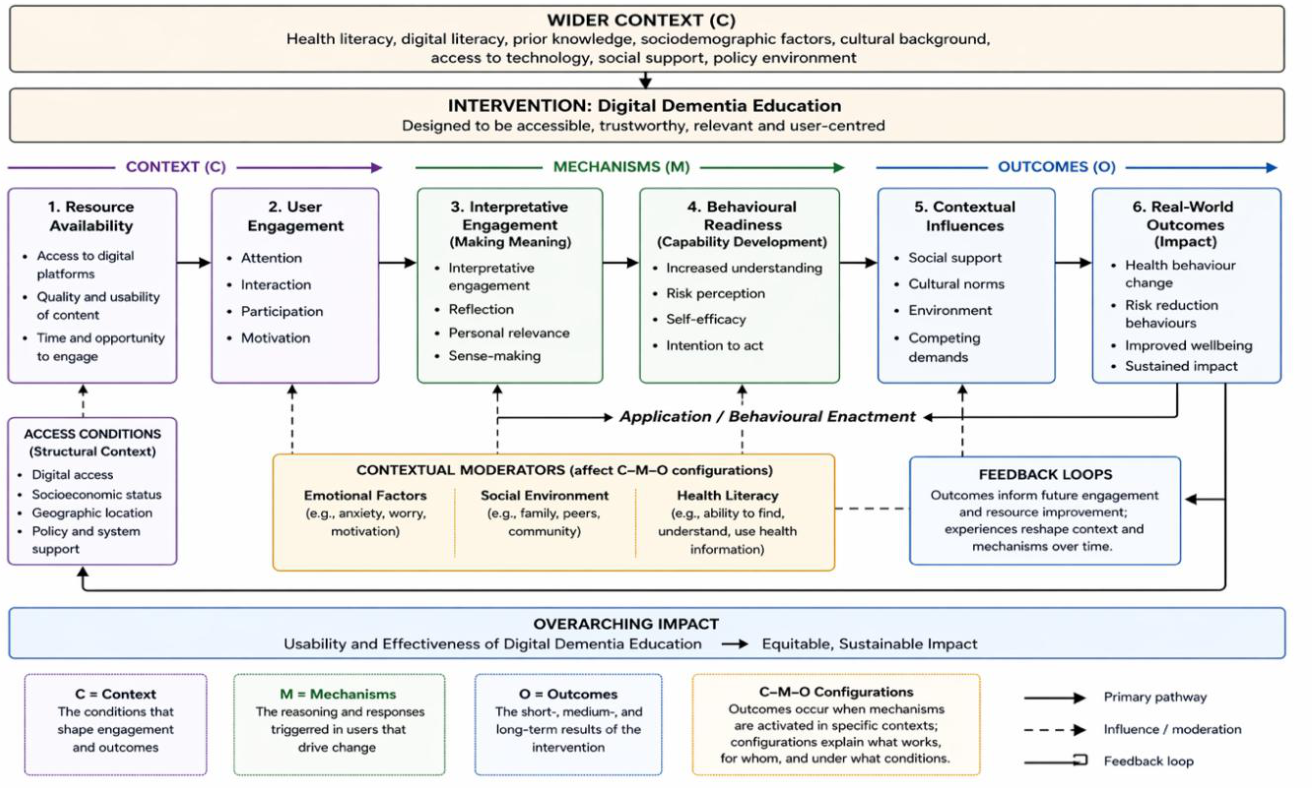
Figure 2.
Comparison of Classical Context–Mechanism–Outcome (CMO) Reasoning and the Proposed Realist-Informed Programme Theory for Digital Dementia Risk-Reduction Education. Note: The left panel summarises the foundational Context–Mechanism–Outcome (CMO) heuristic developed within realist evaluation by Pawson and Tilley (1997), in which intervention outcomes are explained through the interaction between contextual conditions and generative mechanisms. The right panel presents the proposed realist-informed programme theory for digital dementia risk-reduction education, synthesising concepts developed across Carey (2026a, 2026b, 2026c, 2026d, 2026e). The proposed framework retains the philosophical foundations of critical realism and realist evaluation while providing greater conceptual specificity through explicit consideration of intervention resources, user engagement, interpretative engagement (proposed generative mechanism), behavioural readiness, behavioural outcomes and dynamic feedback processes. The comparison is intended to illustrate a domain-specific refinement of realist programme theory and should not be interpreted as replacing, modifying or superseding established CMO reasoning. The proposed constructs remain theoretical propositions requiring future empirical investigation and refinement.
Figure 2.
Comparison of Classical Context–Mechanism–Outcome (CMO) Reasoning and the Proposed Realist-Informed Programme Theory for Digital Dementia Risk-Reduction Education. Note: The left panel summarises the foundational Context–Mechanism–Outcome (CMO) heuristic developed within realist evaluation by Pawson and Tilley (1997), in which intervention outcomes are explained through the interaction between contextual conditions and generative mechanisms. The right panel presents the proposed realist-informed programme theory for digital dementia risk-reduction education, synthesising concepts developed across Carey (2026a, 2026b, 2026c, 2026d, 2026e). The proposed framework retains the philosophical foundations of critical realism and realist evaluation while providing greater conceptual specificity through explicit consideration of intervention resources, user engagement, interpretative engagement (proposed generative mechanism), behavioural readiness, behavioural outcomes and dynamic feedback processes. The comparison is intended to illustrate a domain-specific refinement of realist programme theory and should not be interpreted as replacing, modifying or superseding established CMO reasoning. The proposed constructs remain theoretical propositions requiring future empirical investigation and refinement.
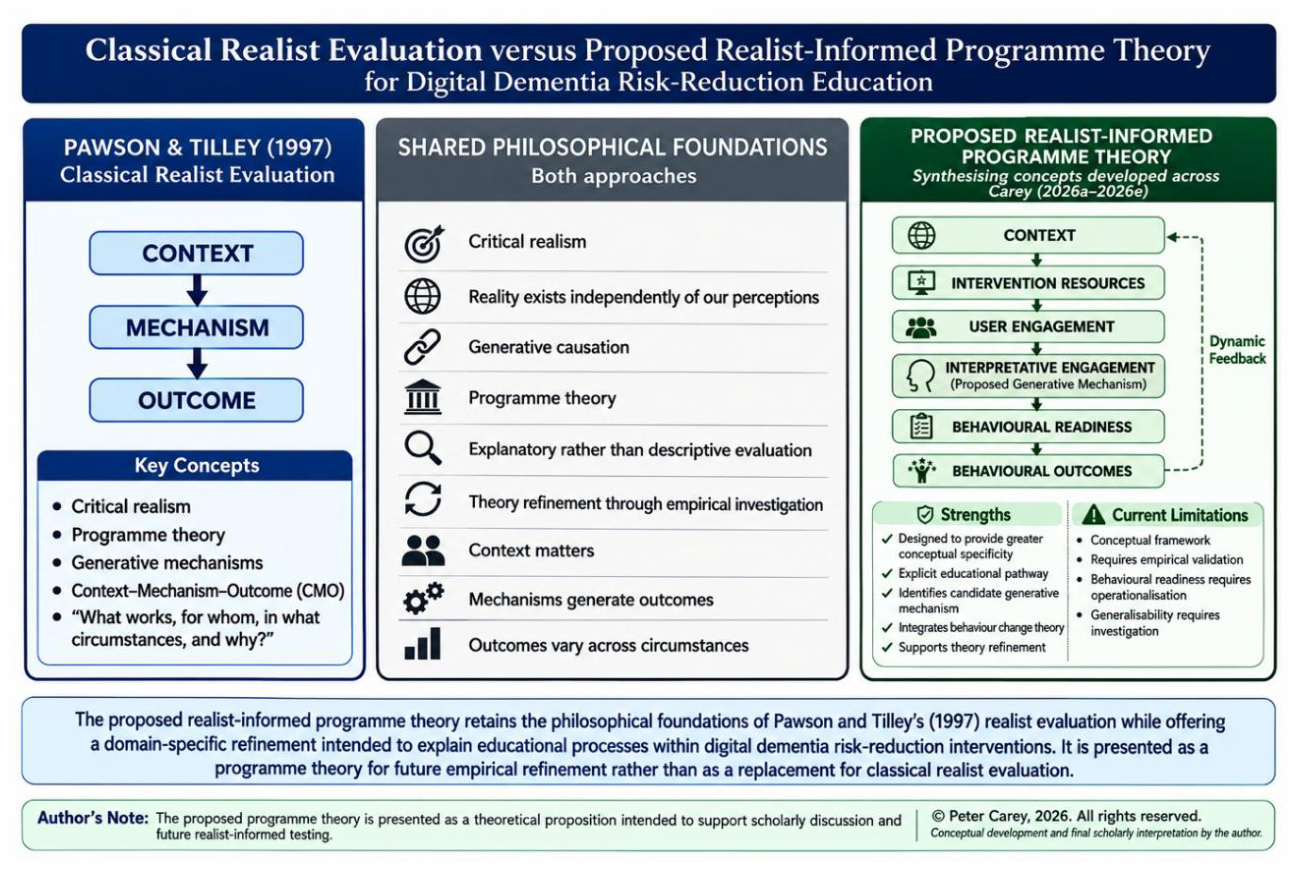
Figure 3.
Iterative Refinement of the Proposed Realist-Informed Programme Theory. NOTE: The proposed programme theory is intended to evolve through successive cycles of realist-informed empirical investigation. Findings from Context–Mechanism–Outcome (CMO) analyses inform refinement of explanatory propositions, generating progressively stronger programme theories that can guide future digital dementia risk-reduction interventions.
Figure 3.
Iterative Refinement of the Proposed Realist-Informed Programme Theory. NOTE: The proposed programme theory is intended to evolve through successive cycles of realist-informed empirical investigation. Findings from Context–Mechanism–Outcome (CMO) analyses inform refinement of explanatory propositions, generating progressively stronger programme theories that can guide future digital dementia risk-reduction interventions.
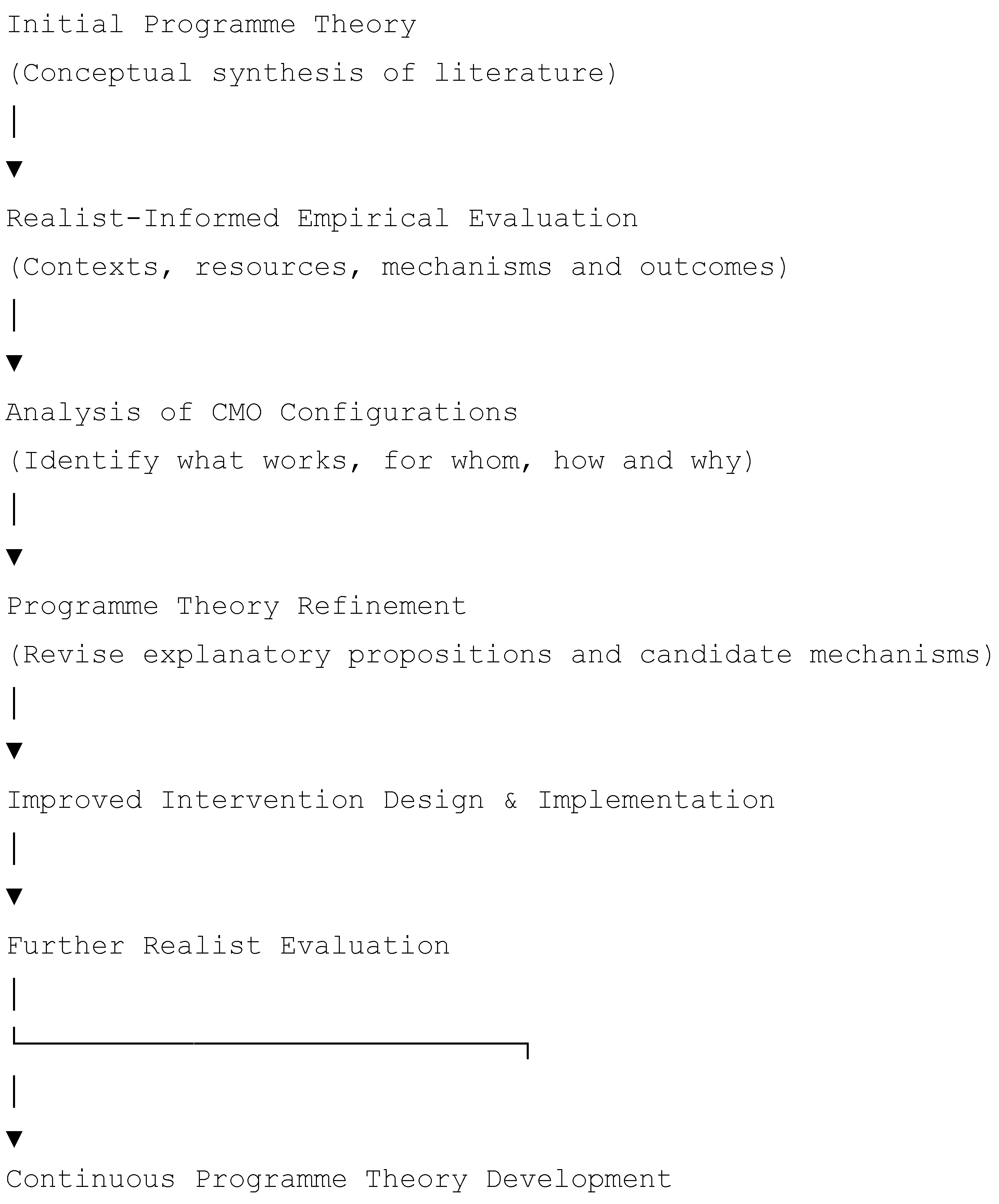
Figure 4.
Proposed Domain-Specific Refinement of Context–Mechanism–Outcome Reasoning for Digital Dementia Risk-Reduction Education. Note: The figure represents a proposed refinement of classical Context–Mechanism–Outcome reasoning for digital dementia risk-reduction education. It retains the realist assumption that outcomes emerge through interactions between contextual conditions and generative mechanisms. The additional domains of digital resource context, user engagement, interpretative engagement and behavioural readiness are proposed explanatory constructs intended to increase conceptual specificity and guide future empirical investigation. They should be regarded as theoretically informed propositions rather than established causal mechanisms.
Figure 4.
Proposed Domain-Specific Refinement of Context–Mechanism–Outcome Reasoning for Digital Dementia Risk-Reduction Education. Note: The figure represents a proposed refinement of classical Context–Mechanism–Outcome reasoning for digital dementia risk-reduction education. It retains the realist assumption that outcomes emerge through interactions between contextual conditions and generative mechanisms. The additional domains of digital resource context, user engagement, interpretative engagement and behavioural readiness are proposed explanatory constructs intended to increase conceptual specificity and guide future empirical investigation. They should be regarded as theoretically informed propositions rather than established causal mechanisms.
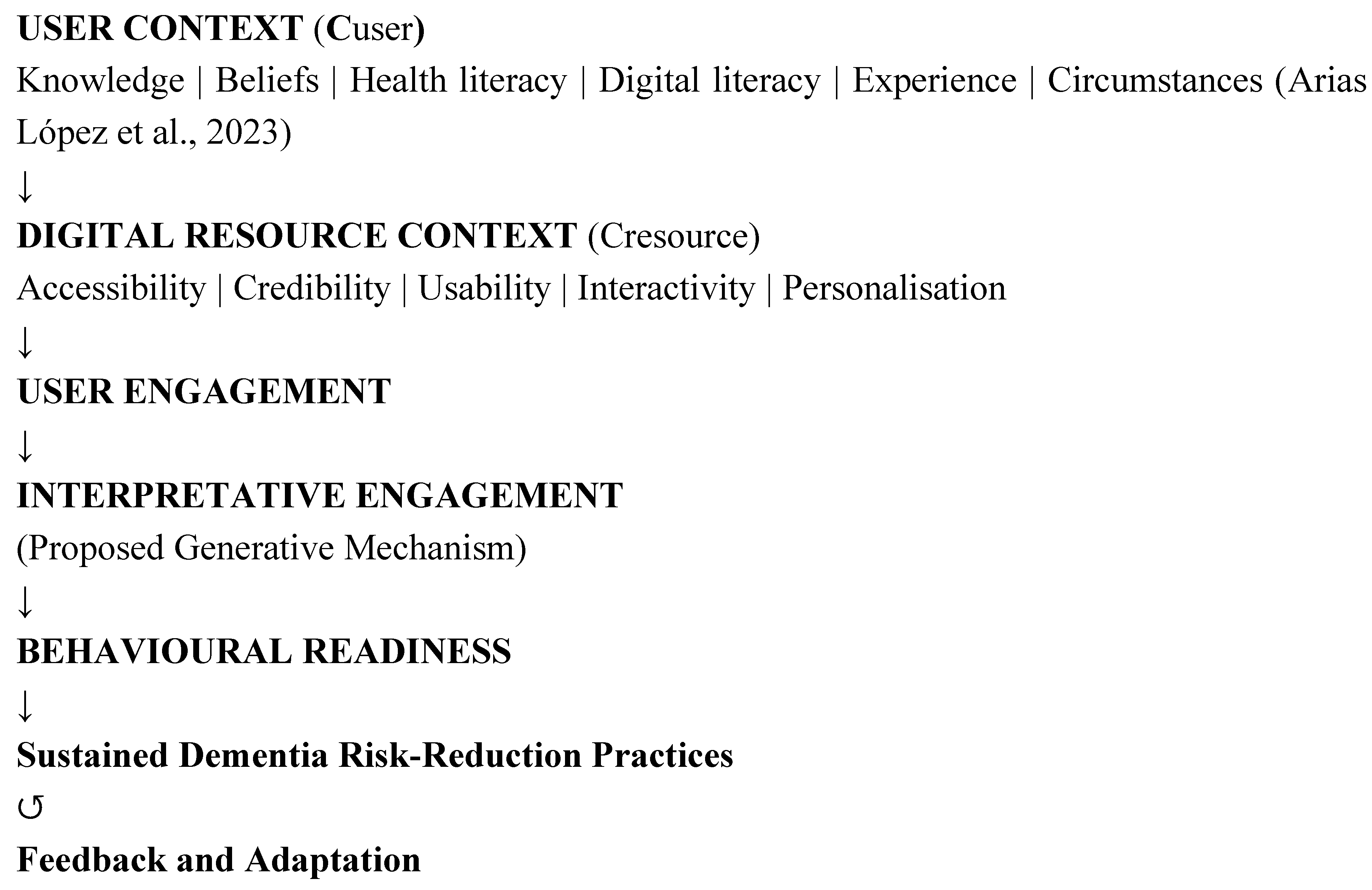

Table 1.
Comparison of Classical Context–Mechanism–Outcome Reasoning and the Proposed Realist-Informed Programme Theory Framework.
Table 1.
Comparison of Classical Context–Mechanism–Outcome Reasoning and the Proposed Realist-Informed Programme Theory Framework.
| Dimension | Classical CMO Reasoning | Proposed Framework |
| Philosophical foundation | Critical realism | Critical realism |
| Purpose | Explain how interventions generate outcomes | Explain how digital dementia education may generate behavioural readiness and sustained prevention practices |
| Context | General contextual conditions influencing mechanisms | Wider context, resource context, and user context explicitly distinguished |
| Mechanism | Participant reasoning and responses activated by programme resources | Interpretative engagement proposed as a domain-specific generative mechanism |
| Intermediate processes | Often implicit within causal explanation | User engagement and behavioural readiness explicitly theorised |
| Outcome | Programme outcomes generated through CMO configurations | Behavioural readiness, sustained dementia risk-reduction practices, and feedback processes (Saqr et al., 2025) |
| Programme theory | Context-dependent explanation | A description of dynamic systems that incorporates reciprocal feedback |
Note: The comparison demonstrates that the proposed framework retains the philosophical assumptions and causal architecture of realist evaluation while extending its explanatory application to digital dementia risk-reduction education. The refinement does not represent a new causal model independent of realist theory; rather, it specifies additional domains considered important for explaining how digital educational resources may generate behavioural outcomes through processes of engagement, interpretation, and readiness development.
Table 2.
Proposed Theoretical Contributions of the Realist-Informed Programme Theory Framework.
| Proposed contribution | Description | Potential value for realist evaluation |
| Explicit intervention resources | Distinguishes digital educational resources and technological features from underlying mechanisms | Improves conceptual clarity regarding what programmes provide and how change may occur |
| User engagement | Recognises active interaction with digital educational resources | Enables investigation of participation patterns and engagement processes |
| Interpretative engagement | Proposed generative mechanism through which individuals construct personal meaning from prevention information | Generates explicit, testable realist propositions regarding how educational resources may influence behavioural processes |
| Behavioural readiness | Intermediate explanatory outcome preceding sustained behavioural enactment | Helps explain why knowledge development may precede observable behaviour change |
| Dynamic feedback processes | Recognises that outcomes influence future engagement, interpretation, and contextual conditions | Reflects iterative learning, adaptation, and programme evolution within complex systems |
Note: The proposed contributions represent theoretically informed refinements intended to increase conceptual specificity within programme theories for digital dementia risk-reduction education. Each construct should be regarded as a candidate explanatory component requiring future empirical investigation rather than as an established causal mechanism.
Table 3.
Strengths and Limitations of the Proposed Programme Theory.
| Strengths | Limitations |
| Retains philosophical consistency with realist evaluation. | Conceptual propositions have not yet been empirically tested. |
| Integrates health literacy, behaviour change theory and implementation science. | Applicability across different cultures and healthcare systems remains unknown. |
| Explicitly distinguishes intervention resources from mechanisms. | Interpretative engagement remains a candidate mechanism requiring validation. |
| Introduces behavioural readiness as an intermediate explanatory outcome. | Relationships between framework components require empirical refinement. |
| Recognises dynamic feedback processes within digital education. | Operational measures for some constructs require further development. |
| Provides a coherent programme theory to guide future realist evaluation. | Effectiveness within different digital technologies remains to be investigated. |
Note. The strengths represent theoretical contributions of the proposed framework, whereas the limitations identify areas requiring future empirical investigation and programme theory refinement.
Table 4.
Strengths of the Proposed Realist-Informed Programme Theory.
| Strength | Contribution |
| Integration of complementary theories | Brings together critical realism, realist evaluation, health literacy, behaviour change theory, implementation science, and dementia prevention literacy. |
| Explanatory focus | Moves beyond measuring intervention outcomes to examining underlying causal processes. |
| Domain-specific refinement | Provides additional conceptual specificity for digital dementia risk-reduction education. |
| Mechanism clarification | Distinguishes intervention resources from participant reasoning processes. |
| Future research utility | Generates explicit propositions suitable for realist-informed empirical investigation. |
| Theoretical integration | Provides a foundation connecting previous scholarship on dementia prevention literacy and digital education. |
Note: These strengths represent theoretical contributions of the proposed framework. Their practical value will depend upon future empirical evaluation and programme theory refinement.
Disclaimer/Publisher’s Note: The statements, opinions and data contained in all publications are solely those of the individual author(s) and contributor(s) and not of MDPI and/or the editor(s). MDPI and/or the editor(s) disclaim responsibility for any injury to people or property resulting from any ideas, methods, instructions or products referred to in the content. |
© 2026 by the authors. Licensee MDPI, Basel, Switzerland. This article is an open access article distributed under the terms and conditions of the Creative Commons Attribution (CC BY) license (http://creativecommons.org/licenses/by/4.0/).
Copyright: This open access article is published under a Creative Commons CC BY 4.0 license, which permit the free download, distribution, and reuse, provided that the author and preprint are cited in any reuse.


